Technical Field
The present invention relates to a powdery dispersant
suitable for producing hydraulic compositions, such as cement,
of excellent fluidity; a process for producing the
dispersant; and a hydraulic composition containing the
dispersant. More particularly, the invention relates to a
powdery dispersant which can be incorporated in advance into
a pre-mixed hydraulic composition product; a process for
producing the dispersant; and a variety of hydraulic
compositions containing the dispersant.
Background Art
Mechanical strength and durability of hardened cement-containing
compositions such as concrete and mortar increase
as the water/cement ratio (W/C) decreases, whereas fluidity
and workability of the compositions become poor as the W/C
ratio decreases. Therefore, a cement dispersant is added to
hydraulic compositions in order to assure sufficient fluidity
thereof, even though the compositions have a low W/C ratio.
Liquid-type dispersants and powdery dispersants predominantly
containing a naphthalenesulfonate salt-formalin condensate or
a melaminesulfonate salt-formalin condensate are widely
employed as the aforementioned dispersants for preparing
hydraulic compositions. However, when these dispersants are
added to a hydraulic composition, fluidity thereof greatly
decreases with elapse of time, thereby disadvantageously
lowering workability. Therefore, there have also been
employed dispersants containing, as an active ingredient, a
polycarboxylate polymer obtained from an acid such as acrylic
acid or methacrylic acid.
Since dispersants containing a polycarboxylate polymer
are generally in the form of liquid, they cannot be
incorporated into a pre-mixed product, which is frequently
employed as a plastering material. As compared with powdery
dispersants, liquid dispersants require care for
transportation and containers, as well as additional
treatment of the containers, to thereby increase cost for use
of liquid dispersants. In addition, since formalin which is
contained in a sulfonate salt-formalin condensate is a
hazardous substance, restriction is imposed on handling and
use of dispersants containing a formalin condensate.
Thus, pulverization of a dispersant containing a
polycarboxylate polymer as a predominant ingredient has been
investigated. However, when a powdery dispersant having high
solubility to water is produced through a conventional
pulverization technique (Japanese Patent Publication (kokoku)
No. 7-14829), an insoluble gel is formed during pulverization
and the thus-obtained powder has poor characteristics, e.g.,
poor dispersibility.
Pulverization by means of a spray-drier is also a known
technique (Japanese Patent No. 2669761). Since a large
amount of inorganic powder must be used in combination in the
above technique, the polycarboxylate polymer content in the
formed dispersant decreases or the polymer is adsorbed with
the inorganic powder, to thereby disadvantageously lower
dispersion performance during use in an aqueous solution.
Furthermore, when an attempt is made to produce such a
dispersant at high content, i.e., approximately 100%, a
portion of the product is adsorbed inside a drying tower,
thereby lowering production yield thereof. When
pulverization of a high-viscoelasticity polymer is attempted,
overload of a motor prevents continuous and safe operation.
In addition, water removed during a drying step tends to
exhibit a high COD, to thereby require additional wastewater
treatment.
In view of the foregoing, an object of the present
invention is to provide a high-performance powdery dispersant
for preparing a high-fluidity hydraulic composition, which
dispersant contains a polycarboxylate polymer having a
polyalkylene glycol chain. Another object of the invention
is to provide a process for effectively producing the
dispersant. Still another object is to provide a hydraulic
composition containing the dispersant.
Disclosure of the Invention
The present inventors have conducted earnest studies,
and have found that when a reducing agent is added to
polycarboxylate polymer having a polyalkylene glycol chain
and the resultant mixture is dried and pulverized, there is
effectively produced a powdery dispersant which imparts
excellent fluidity to a hydraulic composition. The present
invention has been accomplished on the basis of this finding.
Accordingly, the present invention provides a process
for producing a powdery dispersant for preparing a hydraulic
composition, which process comprises adding a reducing agent
to a liquid predominantly containing a polycarboxylate
polymer having a polyalkylene glycol chain, and drying and
pulverizing the resultant mixture. The invention also
provides the thus-produced powdery dispersant for preparing a
hydraulic composition.
Further, the present invention provides a granular
hydraulic composition containing hydraulic material and the
aforementioned powdery dispersant for preparing a hydraulic
composition.
Further, the present invention provides a cement grout
composition containing a binder, an aggregate, an expansion
accelerator, and the aforementioned powdery dispersant for
preparing a hydraulic composition.
Still further, the present invention provides a self-leveling
cement composition containing a binder, a fine
aggregate, a defoaming agent, and the aforementioned powdery
dispersant for preparing a hydraulic composition.
Still further, the present invention provides a quick-setting
grout composition containing a quick-setting cement,
gypsum, and the aforementioned powdery dispersant for
preparing a hydraulic composition.
Still further, the present invention provides a quick-setting
self-leveling composition containing a quick-setting
cement, gypsum, a defoaming agent, and the aforementioned
powdery dispersant for preparing a hydraulic composition.
Still further, the present invention provides a cement
composition which contains the aforementioned powdery
dispersant for preparing a hydraulic composition, and a
cement predominantly containing calcium aluminates.
Best Mode for Carrying Out the Invention
No particular limitation is imposed on the
polycarboxylate polymer compounds having a polyalkylene
glycol chain which may be employed in the present invention,
so long as the compounds may be employed as cement
dispersants. Examples of such polymer compounds include (A)
(meth)acrylate copolymers having a polyalkylene glycol chain
and (B) maleate copolymers having a polyalkylene glycol chain
(in the case of (B), multi-valent metal salts thereof are
excluded). These may be employed singly or in combination of
two or more species.
Of copolymers (A), preferable ones are (meth)acrylate
copolymers having a polyalkylene glycol chain and a group
-COOM (wherein M represents a hydrogen atom, an alkali metal,
an alkaline earth metal, ammonium, or an organic amine). Of
copolymers (B), preferable ones are polyalkylene glycol
alkenyl ether-maleic anhydride copolymers (with multi-valent
salts thereof being excluded).
In the aforementioned (meth)acrylate copolymers (A), M
of the group -COOM is preferably a hydrogen atom; an alkali
metal such as sodium or potassium; an alkaline earth metal
such as calcium or magnesium; ammonium; or an organic amine.
In the aforementioned copolymers (A) and (B), a
polyalkylene glycol chain is preferably a C2-C4 polyalkylene
glycol chain, more preferably a chain represented by -
O(CH2CH(R3)O)n-. In the chain -O(CH2CH(R3)O)n-, R3 represents
a hydrogen atom or a methyl group, and n is 2-200, preferably
5-109, more preferably 20-109, still more preferably 30-109.
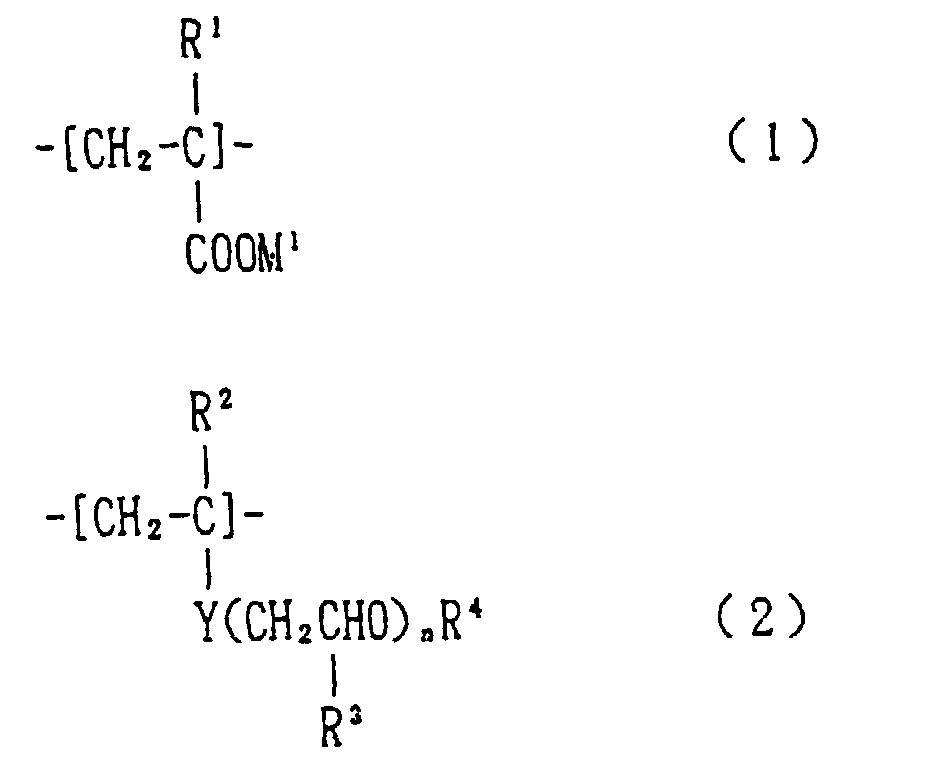
Of the aforementioned copolymers (A), preferable ones
are acrylate or methacrylate polymer compounds comprising at
least two different structural units represented by the
following formulas (1) and (2):
(wherein each of R
1,R
2, and R
3, which may be identical to or
different from one another, represents a hydrogen atom or a
methyl group; R
4 represents a C1-C3 alkyl group; M
1
represents a hydrogen atom, an alkali metal, an alkaline
earth metal, ammonium, or an organic amine; Y represents -
CH
2O- or -COO-; and n is 2-200).
There are two types of structural unit (2); a
structural unit in which Y is -CH2O- and a structural unit in
which Y is -COO-, and either or both of these two units may
be present in copolymers (A). In the case in which both are
present, either of the structural units may have a mean
molecular number (n) of 2-200, and preferably, the amount of
structural unit (2) in which Y is -COO- is 1-30 mol% and the
amount of structural unit (2) in which Y is -CH2O- is 1-30
mol%.
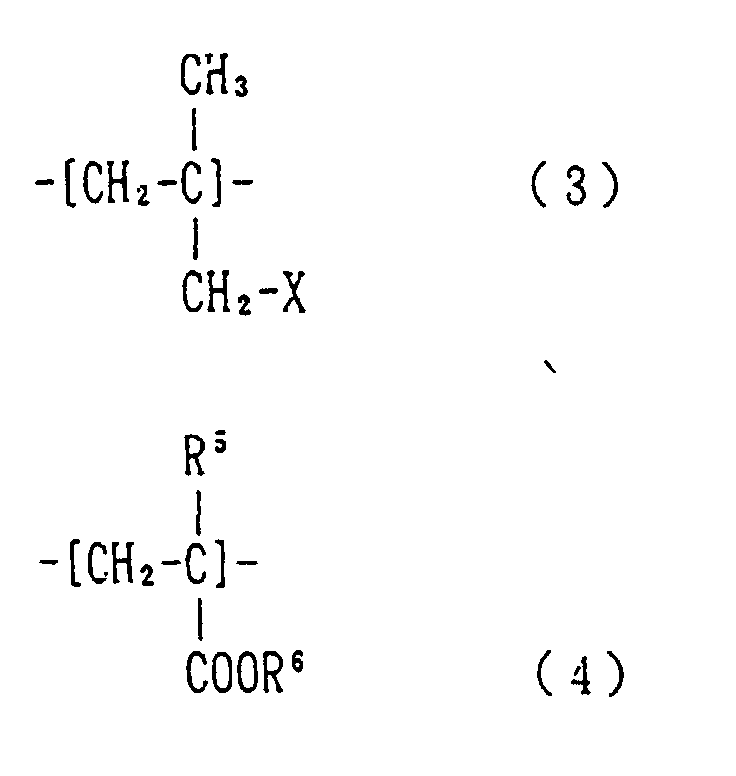
In the present invention, (meth)acrylate polymer
compounds may comprise, in addition to the aforementioned
structural units represented by formulas (1) or (2), at least
one of structural units represented by the following formulas
(3) and (4):
[wherein R
5 represents a hydrogen atom or a methyl group; R
6
represents C1-C3 alkyl group; and X represents SO
3M
2 or -O-Ph-SO
3M
2
(wherein M
2 represents a hydrogen atom, an alkali
metal, an alkaline earth metal, ammonium, or an organic amine,
and Ph represents a phenylene group)].
In addition, preferable (meth)acrylate copolymers (A)
include (meth)acrylate copolymers having a number average
molecular weight of 2,000-50,000, comprising structural unit
(1) represented by formula (1) in an amount of 40-80 mol%,
structural unit (2) represented by formula (2) in an amount
of 1-45 mol%, structural unit (3) represented by formula (3)
in an amount of 2-25 mol%, and structural unit (4)
represented by formula (4) in an amount of 3-20 mol%.
In the aforementioned formulas (1) to (4), each of R1
and R2 preferably represents a methyl group. Each of R4 and
R6 may be a methyl group, an ethyl group, an n-propyl group,
or an i-propyl group. Of these, a methyl group is preferable.
M1 is preferably sodium, potassium, calcium, magnesium, or an
alkanolamine. Of these, sodium is particularly preferable,
in consideration of water-solubility. M2 of a group X may be
an alkali metal such as sodium or potassium, an alkaline
earth metal such as calcium or magnesium, ammonium, or an
organic amine including an alkanolamine such as ethanolamine.
The group X is preferably -SO3Na. In formula (2), n is 2-200,
preferably 5-109, more preferably 20-109, still more
preferably 30-109. Structural unit (1) is preferably present
in an amount of 40-80 mol%, more preferably 45-75 mol%.
Structural unit (2) is preferably present in an amount of 1-45
mol%, more preferably 3-40 mol%. Structural unit (3) is
preferably present in an amount of 2-25 mol%, more preferably
5-20 mol%. Structural unit (4) is preferably present in an
amount of 3-20 mol%, more preferably 5-15 mol%. As used
herein, mol% of each structural unit is on the basis of the
case in which total mol% of structural units (1) to (4) is
100 mol%.
More preferable (meth)acrylate copolymers (A) are
(meth)acrylate copolymers having a number average molecular
weight of 2,000-50,000, which comprise structural unit (5)
represented by the following formula (5) in an amount of 40-70
mol%, structural unit (6) represented by the following
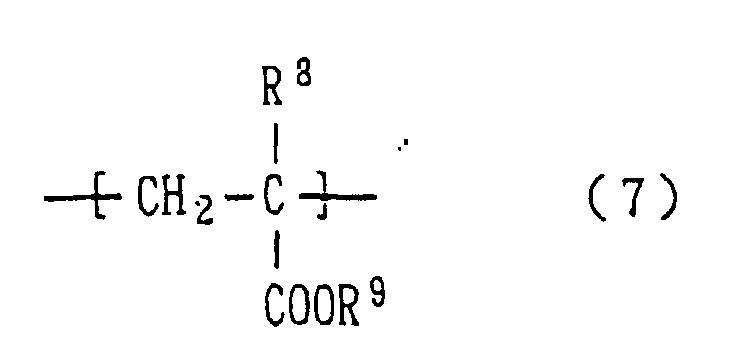
formula (6) in an amount of 5-30 mol%, structural unit (7)
represented by the following formula (7) in an amount of 1-20
mol%, structural unit (8) represented by the following
formula (8) in an amount of 1-30 mol%, and structural unit
(9) represented by the following formula (9) in an amount of
1-30 mol%:
[wherein R
7, R
8, R
10, R
11, R
13, and R
14, which may be identical
to or different from one another, each represent a hydrogen
atom or a methyl group; R
9, R
12, and R
15 each represent a C1-C3
alkyl group; M
3 represents a hydrogen atom, an alkali
metal, an alkaline earth metal, ammonium, or an organic
amine; Z represents -SO
3M
4 or -O-Ph-SO
3M
4 (wherein M
4
represents a hydrogen atom, an alkali metal, an alkaline
earth metal, ammonium, or an organic amine, and Ph represents
a phenylene group); m is an integer of 2-200; and p is an
integer of 2-109].
In the aforementioned formulas (5) to (9), R7, R10, and
R13 each preferably represents a methyl group. R9, R12, and
R15 may each represent a methyl group, an ethyl group, an n-propyl
group, or an i-propyl group. Of these, a methyl group
is preferable. M3 and M4 each preferably represent sodium,
potassium, calcium, magnesium, or an alkanolamine. Of these,
sodium is more preferable. Group Z is preferably -SO3Na. In
formula (8), m is 2-200, preferably 5-109, more preferably
20-109, still more preferably 30-109. In formula (9), p is
2-109, preferably 5-50. Structural unit (5) is preferably
present in an amount of 40-70 mol%, more preferably 45-65
mol%. Structural unit (6) is preferably present in an amount
of 5-30 mol%, more preferably 8-23 mol%. Structural unit (7)
is preferably present in an amount of 1-20 mol%, more
preferably 1-15 mol%. Structural unit (8) is preferably
present in an amount of 1-30 mol%, more preferably 5-25 mol%.
Structural unit (9) is preferably present in an amount of 1-30
mol%, more preferably 3-25 mol%. As used herein, mol% of
each structural unit is on the basis of the case in which
total mol% of structural units (5) to (9) is 100 mol%.
(Meth)acrylate copolymers comprising the aforementioned
structural units preferably have a number average molecular
weight of 2,000-50,000 (calculated by means of GPC, as
reduced to polyethylene glycol), more preferably 3,500-30,000.
Meanwhile, maleate copolymers (B) may be
methylpolyethylene glycol vinyl ether-maleic anhydride
copolymers, polyethylene glycol allyl ether-maleic anhydride
copolymers, methylpolyethylene glycol allyl ether-maleic
anhydride copolymers, or methyl methacrylate polyethylene
glycol-maleate copolymers. Copolymers (B) preferably have a
number average molecular weight (calculated by means of GPC,
as reduced to polyethylene glycol) of 3,000-200,000, more
preferably 3,000-80,000.
The powdery dispersant for preparing a hydraulic
composition of the present invention is produced by adding a
reducing agent to a solution predominantly comprising the
aforementioned polycarboxylate polymer compound having a
polyalkylene glycol chain, and then drying and pulverizing
the resultant mixture. The solution predominantly comprising
the aforementioned polycarboxylate polymer compound may
contain water, a solution of organic solvent, or a dispersing
solution.
When a solution predominantly comprising the
polycarboxylate polymer compound having a polyalkylene glycol
chain is acidic, an aqueous solution of alkali metal or
alkaline earth metal such as sodium hydroxide, potassium
hydroxide, or calcium hydroxide is preferably added to the
polymer solution, adjusting the pH of the solution to 7-9.
Since the polymer compound is easily hydrolyzed, the pH of
the solution is adjusted in order to prevent deformation or
property deterioration of the polymer compound in the
solution accompanying hydrolysis of the compound during
heating and drying, which are performed later. When the pH
of the solution is less than 7, large amounts of reducing
agent are required, whereas when the pH is in excess of 9,
the polymer compound is easily hydrolyzed or the COD of water
that is removed when the solution is dried becomes high,
which is unsatisfactory. When the pH of the solution is
adjusted to 7-9 in advance, adjusting the pH by the addition
of a pH-adjusting agent is unnecessary. Subsequently, a
reducing agent is added to the solution having a pH of 7-9.
A reducing agent which is added may be any of known ones, so
long as it rarely reacts with the polymer compound which is a
primary component of the solution. A reducing agent may be a
reducing inorganic compound and/or a reducing organic
compound.
When a reducing inorganic compound and/or a reducing
organic compound are incorporated into a solution
predominantly comprising the polycarboxylate polymer compound
having a polyalkylene glycol chain, the load imposed on a
kneader-mixer is reduced during drying and pulverizing, gel
is not produced during drying, and the COD (chemical oxygen
demand) of water that is removed is reduced.
Examples of reducing inorganic compounds include
sulfite salts, nitrite salts, and thiosulfate salts. These
salts are preferably alkali metal salts or alkaline earth
metal salts. The reason why gelation is prevented during
kneading and mixing in a drying step by the addition of such
a reducing inorganic agent has not been elucidated, but it is
considered that the reducing inorganic agent may inactivate a
radical reaction initiator remaining in the solution
comprising the polycarboxylate copolymer. Therefore, the
amount of a reducing inorganic agent is determined in
accordance with the species of radical reaction initiator
remaining in the solution or the amount thereof. Usually,
the amount of a reducing inorganic agent is equal to or less
than the amount of a radical reaction initiator (as reduced
to solid: mol), which is employed for synthesis of the
polymer compound. Preferably, the amount of a reducing
inorganic agent is equal to or less than the amount of a
residual radical reaction initiator (as reduced to solid:
mol), or is equal to or more than the amount of the reducing
agent such that the reducing agent can inactivate the
residual initiator for preventing oxidation by the initiator.
A reducing organic compound is preferably an amine
compound, more preferably an alkanolamine. Specific examples
include alkanolamines such as triethanolamine, diethanolamine,
monoethanolamine, isopropanolamine, and N,N-diethylethanolamine;
alkylamines such as sec-butylamine; and
diamines such as ethylenediamine. When such a reducing
organic compound is added to the solution comprising the
polymer compound, the load imposed on a kneader-mixer is
considerably reduced, and the COD of water that is removed
during drying and pulverizing is reduced to 200 mg/L or less.
The amount of a reducing inorganic compound or a
reducing organic compound which is added is preferably 0.01-2.5
wt.% on the basis of the solid content of the
polycarboxylate polymer compound, more preferably 0.5-1.5
wt.%. When such a reducing organic compound is added to the
solution comprising the polymer compound, the load imposed on
a kneader-mixer is reduced during drying and pulverizing, and
the COD of water that is removed during drying is reduced,
for the reasons described below. The reducing agent may act
as a powdering aiding agent, and the agent may facilitate
polymerization by the effect of amine at a low temperature in
the vicinity of room temperature, resulting in consumption of
non-reacted monomer.
After a reducing agent is added to the solution
comprising the polymer compound, the resultant mixture is
kneaded and mixed. Kneading and mixing are preferably
performed at a temperature of about 10-120°C, more preferably
about 20-100°C.
The drying method which may be employed is not
particularly limited, so long as a convection-type drying
apparatus or a heat-conduction-type drying apparatus is
employed. When the solution comprising the polymer compound
in an amount of 5-40% is dried, a convection-type drying
apparatus such as a spray drier or a flash jet drier is
suitably employed. When the solution comprising the polymer
compound in an amount of 40% or more or the solution of high
viscoelasticity is dried, a heat-conduction-type drying
apparatus such as a kneading-mixing drier or a band-type
continuous vacuum drier is preferably employed. However, the
polycarboxylate polymer compound having a polyalkylene glycol
chain may have high viscosity when concentrated, and thus, in
view of high efficiency of powdering, the polymer compound is
preferably dried and pulverized while it is kneaded and mixed.
Kneading and mixing are preferably carried out at a
temperature off about 40-120°C, more preferably about 60-110°C.
Kneading and mixing may be carried out in air, but
are preferably carried out at reduced pressure or in an
atmosphere of inert gas such as nitrogen or argon, in order
to prevent deformation of the polymer compound. The polymer
compound is preferably dried and pulverized while kneaded and
mixed at a power of 0.5 kg/m3/rpm or more, after the compound
is concentrated so as to have a hardness of 30° or more.
Through such a drying procedure, a powdery dispersant can be
produced. After completion of drying, the powder may be
agglomerated into a floc, but the floc is brittle and thus is
easily formed into particles by low pulverizing power.
In the present invention, in order to improve the
moisture absorbability or blocking ability of the powdery
dispersant or to reduce error in weighing, in addition to the
aforementioned essential components, polyalkylene glycols,
C8-C22 fatty acids or salts thereof, or inorganic powder may
further be incorporated into the powdery dispersant after
drying.
Examples of preferable polyalkylene glycols include
polyethylene glycol having a molecular weight of 1,000-20,000
and polypropylene glycol having a molecular weight of 2,000-6,000.
Of these, polyethylene glycol is more preferable, and
polyethylene glycol having a mean molecular weight of 2,000-4,000
is still more preferable.
C8-C22 fatty acids or salts thereof may be saturated or
unsaturated, and may have a linear chain or branched chain.
Specific examples include caprylic acid, pelargonic acid,
capric acid, undecylic acid, lauric acid, tridecylic acid,
myristic acid, pentadecylic acid, palmitic acid, heptadecylic
acid, stearic acid, nonadecanoic acid, arachic acid, behenic
acid, undecylenic acid, oleic acid, elaidic acid, cetoleic
acid, erucic acid, brassidic acid, and salts thereof. Salts
of the aforementioned fatty acids are preferably salts of
metals such as sodium, potassium, barium, calcium, zinc,
aluminum, and magnesium. Of these, stearic acid or salts
thereof are preferable, and calcium stearate is more
preferable. The amount of polyalkylene glycols or C8-C22
fatty acids or salts thereof is preferably 0.2-30 wt.% on the
basis of the solid content of the polycarboxylate polymer
compound having a polyalkylene glycol chain, more preferably
0.5-20 wt.%.
Examples of inorganic powders which may be employed
include powder of inorganic salts such as calcium carbonate
and calcium silicate; clay mineral powders such as kaolinite
and bentonite; and fine powders such as blast furnace slag
and fly ash. These inorganic powders are effectively
employed in order to improve properties of the powdery
dispersant, such as moisture absorbability and blocking
ability thereof. In order to pulverize the polycarboxylate
polymer compound at high concentration, the amount of
inorganic powder which is employed is preferably 0.1-30 wt.%
on the basis of the solid content of the compound, more
preferably 0.5-10 wt.%.
In consideration of convenience upon use, the
pulverized dispersant is preferably prepared so as to have a
mean particle size of 5-2,000 µm, more preferably 10-500 µm,
through arbitrary crushing and classification methods.
However, the produced powdery dispersant is relatively weak
against heat, and thus a crushing machine of low heat-storage
is preferably employed for crushing the dispersant.
Specifically, a pin-type mill is preferably employed. A
crushing machine comprising a screen for regulating particle
size may be employed, but preferably, crushing and
classification are carried out separately, since heat of
crushing increases when an uncrushed substance is accumulated
in a crushing machine.
The powdery dispersant of the present invention is
useful as a dispersant employed in a hydraulic composition
such as cement, gypsum, fly ash, blast furnace slag, or
silica fumes. Preferably, the powdery dispersant is employed
as a cement dispersant.
No particular limitation is imposed on the hydraulic
material, such as cement, to which the powdery dispersant may
be applied. Examples of such cements include ordinary
portland cement, high-early-strength cement, ultra high-early-strength
cement, moderate-heat cement, sulfate-resistant
cement, and blended cements such as blast furnace-slag
cement, fly ash cement, and pozolan cement. In addition,
the powdery dispersant may be applied to alumina cement
containing large amounts of calcium aluminate, or eco-cement
which is produced by firing at least one type of incinerated
ashes of city refuse. Furthermore, the dispersant may be
applied to spraying cement containing a setting accelerator,
or a concrete composition containing blast furnace slag or
fly ash as an aggregate component. Examples of hydraulic
materials other than cement include gypsum, blast-furnace
slag, fly ash, and silica fumes. The amount of the
dispersant which is incorporated into a hydraulic material
such as cement is appropriately 0.005-5 wt.% on the basis of
cement (100 wt.%). Particularly, a granular cement mixture
containing the dispersant in an amount of 0.01-3 wt.% is
preferable. When the amount of the dispersant which is
incorporated is less than 0.005 wt.%, the dispersion effect
is reduced. Even when the amount is in excess of 5 wt.%,
dispersibility is not further enhanced.
Hydraulic compositions comprising the dispersant of the
present invention will next be described.
1. Cement grout composition
The cement grout composition of the present invention
comprises a binder, an aggregate, an expansion accelerator,
and the powdery dispersant for preparing a hydraulic
composition of the present invention.
When the amount of the dispersant which is incorporated
into the grout composition is very small, the effect of the
dispersant is not obtained, whereas the amount is very large,
the dispersant may cause retardation of setting of the
composition or reduction in strength of the hardened
composition. Therefore, the amount of the dispersant is
preferably 0.005-5 parts by weight on the basis of 100 parts
by weight of a binder, more preferably 0.01-3 parts by weight.
Examples of binders which may be employed in the
present invention include cements other than quick-setting
cements, such as portland cements (e.g., ordinary portland
cement, high-early-strength cement, ultra high-early-strength
cement, moderate-heat cement, and sulfate-resistant cement),
and blended cements (e.g., blast furnace-slag cement, fly ash
cement, and pozolan cement).
Examples of aggregates which may be employed in the
present invention include river sand, sea sand, land sand,
crushed sand, and silica sand. The sand is preferably dried
when employed. The aforementioned sand may be employed in
combination with fly ash, blast furnace slag, calcium
carbonate, or silica fumes. When the grout composition is
provided as a mixed grout mortar composition, an aggregate
which is incorporated preferably has a size of 5 mm or less
and an FM of approximately 1.5-3.0. In the case of a grout
mortar composition, when the amount of an aggregate which is
incorporated is very small, the hardened composition
undergoes excessive shrinkage, whereas when the amount is
very large, the fluidity of the composition or the strength
of the hardened composition is reduced. Therefore, the
amount of an aggregate is preferably 30-300 parts by weight
on the basis of 100 parts by weight of a binder, more
preferably 60-150 parts by weight.
In the present invention, an expansion accelerator is
employed in order to secure adhesion of the grout composition
to a structure. Therefore, there may be employed an
expansion accelerator which exhibits the effect for reducing
shrinkage of the hardened composition and an expansion effect
by hydration. Examples of such expansion accelerators
include calcium sulfur aluminate inorganic substances such as
hauyne, calcium aluminate inorganic substances such as
amorphous or crystalline aluminates, lime inorganic
substances such as calcium oxide, and metal substances such
as aluminum metal powder and iron powder. The amount of an
expansion accelerator which is incorporated is as follows.
In the case in which a lime expansion accelerator is
incorporated, the amount is preferably 0.5-20 parts by weight
on the basis of 100 parts by weight of a binder, more
preferably 1-10 parts by weight. In the case in which
aluminum metal powder is incorporated, the amount is
preferably 0.0002-0.01 parts by weight on the basis of 100
parts by weight of a binder, more preferably 0.0006-0.008
parts by weight. In the grout composition, more preferably,
aluminum metal powder is incorporated in combination with a
calcium sulfur aluminate inorganic substance, a calcium
aluminate inorganic substance, or a lime inorganic substance,
since the effect for reducing shrinkage of the hardened
composition is maintained for a prolonged period of time
after the composition is produced.
The cement grout composition of the present invention
may further contain a thickener.
In the present invention, a thickener is employed in
order to prevent separation of materials, and therefore a
thickener, which exhibits the effect for imparting viscosity,
may be employed. For example, methyl cellulose or polyvinyl
alcohol may be employed. The amount of a thickener which is
incorporated is preferably 0.001-0.2 parts by weight on the
basis of 100 parts by weight of a binder, more preferably
0.002-0.05 parts by weight.
If necessary, the cement grout composition of the
present invention may contain, in addition to the
aforementioned materials, an organic shrinkage-reducing agent.
The composition may further contain extenders or admixtures,
so long as they do not adversely affect the physical
properties of the composition.
The cement grout composition of the present invention
is usually provided in a bag-packed form, after the
aforementioned materials are mixed. The composition is
kneaded with water by use of a mixer at a building site, and
then the resultant composition is installed. The type of a
mixer which is employed is not particularly limited, and the
amount of water which is added to the composition is usually
30-100 parts by weight on the basis of 100 parts by weight of
a binder.
2. Self-leveling cement composition
The self-leveling cement composition of the present
invention comprises a binder, a fine aggregate, a deforming
agent, and the powdery dispersant for preparing a hydraulic
composition of the present invention.
When the amount of the dispersant which is incorporated
into the self-leveling cement composition is very small, the
effect of the dispersant is not obtained, whereas the amount
is very large, the dispersant may cause retardation of
setting of the composition or reduction in strength of the
hardened composition. Therefore, the amount of dispersant is
preferably 0.005-5 parts by weight on the basis of 100 parts
by weight of a binder, more preferably 0.01-3 parts by weight.
Examples of binders which are preferably employed in
the present invention include cements other than quick-setting
cements, such as portland cements (e.g., ordinary
portland cement, high-early-strength cement, ultra high-early-strength
cement, moderate-heat cement, and sulfate-resistant
cement), and blended cements (e.g., blast furnace-slag
cement, fly ash cement, and pozolan cement).
Examples of fine aggregates which may be employed in
the present invention include river sand, sea sand, land sand,
crushed sand, and silica sand. The sand is preferably dried
when employed. The aforementioned sand may be employed in
combination with fly ash, blast furnace slag, calcium
carbonate, or silica fumes. A fine aggregate which is
incorporated preferably has a size of 5 mm or less and an FM
of approximately 1.5-3.0. In consideration of the fluidity
of the composition or the strength of the hardened
composition, the amount of an aggregate which is incorporated
is preferably 30-300 parts by weight on the basis of 100
parts by weight of a binder, more preferably 60-150 parts by
weight.
In the present invention, a defoaming agent is employed
in order to prevent rising or depression, which is attributed
to foam, of a floor in which the composition is employed. A
defoaming agent may be a known defoaming agent such as a
silicone surfactant or nonionic surfactant. The amount of a
defoaming agent which is incorporated is preferably 0.01-0.6
parts by weight on the basis of 100 parts by weight of a
binder, more preferably 0.05-0.4 parts by weight.
The self-leveling cement composition of the present
invention may further contain a thickener. In the present
invention, a thickener is employed in order to prevent
separation of materials or dry-shrinkage of the hardened
composition. For example, methyl cellulose, hydroxyethyl
cellulose, or carboxymethyl cellulose may be employed. In
consideration of the fluidity and self-leveling ability of
the composition, the amount of a thickener which is
incorporated is preferably 0.005-0.6 parts by weight on the
basis of 100 parts by weight of a binder, more preferably
0.01-0.4 parts by weight.
If necessary, the self-leveling cement composition of
the present invention may contain, in addition to the
aforementioned materials, an expanding agent or an organic
shrinkage-reducing agent, in order to prevent cracking of the
hardened composition attributed to shrinkage. The
composition may further contain extenders or admixtures, so
long as they do not adversely affect the physical properties
of the composition
The self-leveling cement composition of the present
invention is usually provided in the form of mixture of the
aforementioned materials. The composition is kneaded with
water by use of a mixer at a building site, and then the
resultant composition is installed. The type of a mixer
which is employed is not particularly limited, and the amount
of water which is added to the composition is usually 30-100
parts by weight on the basis of 100 parts by weight of a
binder.
3. Quick-setting grout composition
The quick-setting grout composition of the present
invention comprises quick-setting cement, gypsum, and the
powdery dispersant for preparing a hydraulic composition of
the present invention.
When the amount of the dispersant which is incorporated
into the grout composition is very small, the effect of the
dispersant is not obtained, whereas the amount is very large,
the dispersant may cause retardation of setting of the
composition or reduction in strength of the hardened
composition. Therefore, the amount of dispersant is
preferably 0.005-5 parts by weight on the basis of a binder
(total of quick-setting cement, other cements, and gypsum)
(100 parts by weight), more preferably 0.01-3 parts by weight.
In the present invention, any quick-setting cement may
be employed, so long as the cement predominantly contains
calcium aluminate. A preferable quick-setting cement
contains monocalcium aluminate (CA) as a primary component,
and contains Al2O3 in an amount of 65 wt.% or less. A more
preferable quick-setting cement contains monocalcium
aluminate (CA) as a primary component, and contains Al2O3 in
an amount of 30-45 wt.%. In order to attain high fluidity
and sufficient quick-setting ability of the composition, in
the present invention, quick-setting cement is preferably
employed in combination with portland cements (e.g., ordinary
portland cement, high-early-strength cement, ultra high-early-strength
cement, moderate-heat cement, and sulfate-resistant
cement), or blended cements (e.g., blast furnace-slag
cement, fly ash cement, and pozolan cement). When
quick-setting cement and ordinary portland cement are
employed in combination, the incorporation ratio of quick-setting
cement to normal cement (by weight) is preferably
1/99 to 90/10, more preferably 3/97 to 50/50.
Gypsum which is employed in the present invention
exhibits the effect for enhancing fluidity and quick-setting
ability of the composition, and is also expected to exhibit
an effect for reducing dry-shrinkage of the hardened
composition. In the present invention, any of anhydrous
gypsum, hemihydrate gypsum, and dihydrate gypsum may be
employed as gypsum, but anhydrous gypsum is most preferable,
in consideration of fluidity and quick-setting ability of the
composition and of reduction in dry-shrinkage of the hardened
composition. The amount of gypsum which is incorporated is
preferably 2-150 parts by weight on the basis of quick-setting
cement (100 parts by weight), more preferably 10-70
parts by weight.
The quick-setting grout composition of the present
invention may further contain a thickener, a setting modifier,
an aggregate, and an expansion accelerator.
In the present invention, a thickener is employed in
order to prevent separation of materials, and therefore a
thicker which exhibits the effect for imparting viscosity may
be employed. For example, methyl cellulose or polyvinyl
alcohol may be employed. The amount of a thickener which is
incorporated is preferably 0.001-0.2 parts by weight on the
basis of 100 parts by weight of a binder, more preferably
0.002-0.05 parts by weight.
Examples of setting modifiers which are preferably
employed include compounds which exhibit setting-acceleration
effect; i.e., alkali metal salts, such as lithium carbonate,
lithium hydroxide, lithium chloride, lithium nitrate,
potassium carbonate, potassium hydroxide, sodium carbonate,
and sodium hydroxide. Of these, lithium carbonate is more
preferable. In consideration of fluidity of the composition
and setting acceleration effect of such a compound, the
amount of the compound which is incorporated is preferably
0.005-2 parts by weight on the basis of 100 parts by weight
of a binder, more preferably 0.05-0.5 parts by weight. Also,
examples of setting modifiers which are preferably employed
include compounds which exhibit setting-retardation effect;
i.e., hydroxycarboxylic acids (including salts therof), such
as tartaric acid, citric acid, malic acid, gluconic acid, and
salts thereof. Of these, tartaric acid and citric acid are
more preferable. In consideration of quick-setting ability
of the composition and setting-retardation effect of such a
compound, the amount of the compound which is incorporated is
preferably 0.005-3 parts by weight on the basis of 100 parts
by weight of a binder, more preferably 0.03-1 parts by weight.
Examples of aggregates which may be employed in the
present invention include river sand, sea sand, land sand,
crushed sand, and silica sand. The sand is preferably dried
when employed. The aforementioned sand may be employed in
combination with fly ash, blast furnace slag, calcium
carbonate, or silica fumes. When the grout composition is
provided as a mixed grout mortar composition, an aggregate
which is incorporated preferably has a size of 5 mm or less
and an FM of approximately 1.5-3.0. In the case of a grout
mortar composition, the amount of an aggregate which is
incorporated is preferably 30-300 parts by weight on the
basis of 100 parts by weight of a binder, more preferably 60-150
parts by weight.
In the present invention, an expansion accelerator is
employed in order to secure adhesion of the grout composition
to a structure. Therefore, there may be employed an
expansion accelerator which exhibits an effect for reducing
shrinkage of the hardened composition and an expansion effect
by hydration. Examples of such expansion accelerators
include calcium sulfur aluminate inorganic substances such as
hauyne; calcium aluminate inorganic substances such as
amorphous or crystalline aluminates; lime inorganic
substances such as calcium oxide; and metal substances such
as aluminum metal powder and iron powder. The amount of an
expansion accelerator which is incorporated is as follows.
In the case in which a lime expansion accelerator is
incorporated, the amount is preferably 0.5-20 parts by weight
on the basis of a binder (100 parts by weigh), more
preferably 1-10 parts by weight. In the case in which
aluminum metal powder is incorporated, the amount is
preferably 0.0002-0.01 parts by weight on the basis of 100
parts by weight of a binder, more preferably 0.0006-0.008
parts by weight. In the grout composition, more preferably,
aluminum metal powder is incorporated in combination with a
calcium sulfur aluminate inorganic substance, a calcium
aluminate inorganic substance, or a lime inorganic substance,
since the effect for reducing shrinkage of the hardened
composition is maintained for a prolonged period of time
after the composition is produced.
If necessary, the quick-setting grout composition of
the present invention may contain, in addition to the
aforementioned materials, a shrinkage-reducing agent. The
composition may further contain extenders or admixtures, so
long as they do not adversely affect the physical properties
of the composition.
The quick-setting grout composition of the present
invention is usually provided in the form of mixture of the
aforementioned materials. The composition is kneaded with
water by use of a mixer at a building site, and then the
resultant composition is installed. The type of a mixer
which is employed is not particularly limited, and the amount
of water which is added to the composition is usually 30-100
parts by weight on the basis of 100 parts by weight of a
binder.
4. Quick-setting self-leveling composition
The quick-setting self-leveling composition of the
present invention comprises quick-setting cement, gypsum, a
defoaming agent, and the powdery dispersant for preparing a
hydraulic composition of the present invention.
When the amount of the dispersant which is incorporated
into the self-leveling composition is very small, the effect
of the dispersant is not obtained, whereas the amount is very
large, the dispersant may cause retardation of setting of the
composition or reduction in strength of the hardened
composition. Therefore, the amount of dispersant is
preferably 0.005-5 parts by weight on the basis of a binder
(total of quick-setting cement, other cements, and gypsum)
(100 parts by weight), more preferably 0.01-3 parts by weight.
Quick-setting cement and gypsum employed in the self-leveling
composition are the same as those employed in the
above-described quick-setting grout composition.
In the present invention, a defoaming agent is employed
in order to prevent generation of blisters or depressiona,
which are attributed to air bubbles, of the floor in which
the composition is employed. A defoaming agent may be a
known one such as a silicone surfactant or a nonionic
surfactant. The amount of a defoaming agent which is
incorporated is preferably 0.01-0.6 parts by weight on the
basis of 100 parts by weight of a binder, more preferably
0.05-0.4 parts by weight.
The quick-setting self-leveling composition of the
present invention may further contain a thickener, a setting
modifier, and an aggregate.
In the present invention, a thickener is employed in
order to prevent separation of materials or dry-shrinkage of
the hardened composition. For example, methyl cellulose,
hydroxyethyl cellulose, or carboxymethyl cellulose may be
employed. In consideration of the fluidity and self-leveling
ability of the composition, the amount of a thickener which
is incorporated is preferably 0.005-0.6 parts by weight on
the basis of 100 parts by weight of a binder, more preferably
0.01-0.4 parts by weight.
Examples of setting modifiers which are preferably
employed include compounds which exhibits setting-acceleration
effect, i.e., alkali metal salts, such as
lithium carbonate, lithium hydroxide, lithium chloride,
lithium nitrate, potassium carbonate, potassium hydroxide,
sodium carbonate, and sodium hydroxide. Of these, lithium
carbonate is more preferable. In consideration of fluidity
of the composition and setting acceleration effect of such a
compound, the amount of the compound which is incorporated is
preferably 0.005-2 parts by weight on the basis of 100 parts
by weight of a binder, more preferably 0.05-0.5 parts by
weight. Also, examples of setting modifiers which are
preferably employed include compounds which exhibit setting-retardation
effect, i.e., hydroxycarboxylic acids (including
salts thereof), such as tartaric acid, citric acid, malic
acid, gluconic acid, and salts thereof. Of these, tartaric
acid and citric acid are more preferable. In consideration
of quick-setting ability of the composition and setting-retardation
effect of such a compound, the amount of the
compound which is incorporated is preferably 0.005-3 parts by
weight on the basis of 100 parts by weight of a binder, more
preferably 0.03-1 parts by weight.
Examples of fine aggregates which may be employed in
the present invention include river sand, sea sand, land sand,
crushed sand, and silica sand. The sand is preferably dried
when employed. The aforementioned sand may be employed in
combination with fly ash, blast furnace slag, calcium
carbonate, or silica fume. A fine aggregate which is
preferably incorporated has a size of 5 mm or less and an FM
of approximately 1.5-3.0. In consideration of the fluidity
of the composition or the strength of the hardened
composition, the amount of a fine aggregate which is
incorporated is preferably 30-300 parts by weight on the
basis of 100 parts by weight of a binder, more preferably 60-150
parts by weight.
If necessary, the quick-setting self-leveling
composition of the present invention may contain, in addition
to the aforementioned materials, an expansive or a shrinkage-reducing
agent, in order to prevent cracking of the hardened
composition attributed to shrinkage. The composition may
further contain extenders or admixtures, so long as they do
not adversely affect the physical properties of the
composition.
The quick-setting self-leveling composition of the
present invention is usually provided in the form of mixture
of the aforementioned materials. The composition is kneaded
with water by use of a mixer at a building site, and then the
resultant composition is installed. The type of a mixer
which is employed is not particularly limited, and the amount
of water which is added to the composition is usually 30-100
parts by weight on the basis of 100 parts by weight of a
binder.
5. (Quick-setting) cement composition
The cement composition of the present invention
comprises cement predominantly containing calcium aluminates,
and the powdery dispersant for preparing hydraulic
composition of the present invention.
When the amount of the dispersant which is incorporated
into the cement composition is very small, the effect of the
dispersant is not obtained, whereas when the amount is very
large, the dispersant may cause retardation of setting of the
composition or reduction in strength of the hardened
composition. Therefore, the amount of dispersant is
preferably 0.005-5 parts by weight on the basis of cement
predominantly containing calcium aluminates (100 parts by
weight), more preferably 0.01-3 parts by weight, still more
preferably 0.05-1.5 parts by weight.
When the cement composition is employed as mortar or
concrete, river sand, sea sand, land sand, crushed sand, or
silica sand may be employed as an aggregate. The sand is
preferably dried when employed. The aforementioned sand may
be employed in combination with fly ash, blast furnace slag,
calcium carbonate, or silica fume. When the cement
composition is provided in the form of a premised mortar
composition, an aggregate which is incorporated preferably
has a size of 5 mm or less and an FM of approximately 1.5-3.0.
In the case of a mortar composition, the amount of an
aggregate which is incorporated is preferably 30-300 parts by
weight on the basis of a binder (cement predominantly
containing calcium aluminates) (100 parts by weight), more
preferably 60-150 parts by weight.
The cement composition of the present invention may
contain a setting retarder or a setting accelerator, in order
to regulating quick-setting ability of the composition. A
setting retarder may be any compound which exhibits the
effect for retarding hydration of cement predominantly
containing calcium aluminates. For example, a compound
having a hydroxycarboxyl group, such as citric acid, tartaric
acid, or gluconic acid, may be employed. Examples of
setting-accelerators include alkali metal salts such as
potassium carbonate, sodium carbonate, sodium
hydrogencarbonate, lithium carbonate, and sodium aluminate.
If necessary, the cement composition of the present
invention may contain, in addition to the aforementioned
materials, an expansive, a shrinkage-reducing agent, a
thickener, or a setting ability-improving agent (e.g.,
gypsum). The composition may further contain extenders or
admixtures, so long as they do not adversely affect the
physical properties of the composition.
The cement composition of the present invention is
usually provided in the form of mixture of the aforementioned
materials. The composition is kneaded with water by use of a
mixer at a building site, and then the resultant composition
is installed. The type of a mixer which is employed is not
particularly limited, and the amount of water which is added
to the composition is usually 30-100 parts by weight on the
basis of a binder (cement predominantly containing calcium
aluminates) (100 parts by weight).
Examples
The present invention will next be described in more
detail by way of examples, which should not be construed as
limiting the invention thereto.
Examples 1 to 9
(Meth)acrylate polymers (A) to (D) were produced by use
of (NH
4)
2S
2O
8 as a polymerization initiator. Each polymer
comprises compounds corresponding to structural units (1) to
(4) with compositional proportions (mol%) thereof as shown in
Table 1. Liquid mixtures of a solid content of 45% were
prepared from each polymer, and some prepared samples
(Examples 1 and 5) had a pH of 6.7 and other prepared samples
(Examples 2 to 4, 6 to 9, and Comparative Examples 1 to 3)
had a pH of 6.1. To each sample (800 g) (only Examples 1 to
9 and Comparative Example 3), a 10 wt.% aqueous sodium
hydroxide solution (75.2 g) was added for adjustment of the
pH of the sample. Each of the thus-prepared samples was
mixed by means of a handy-mixer for approximately three
minutes at ambient temperature. After completion of mixing,
a reducing agent was added to the sample, and the resultant
mixture was placed in a 1-L kneader-mixer and kneaded at 90°C
and 30 Torr so as to concentrate and dry the mixture, thereby
producing a powdery dispersant.
| Polymers | Substances of structural unit and composition (mol%) | No. av. mol. wt. |
| | formula (1) | formula (2) | formula (3) | formula (4) |
| (A) | Na methacrylate (54) | Methoxy-PEG(n=40) methcrylate (31) | Na methallyl sulfonate (7) | Methyl acrylate (8) | 11800 |
| (B) | Na methacrylate (63) | Methoxy-PEG(n=75) methacrylate (9) | Na methallyl sulfonate (13) | Methyl acrylate (15) | 18900 |
| (C) | Na methacrylate (60) | Methoxy-PEG(n=23) methacrylate (10) + Methoxy-PEG(n=8) monoallyl ether (15) | Na methallyl sulfonate (8) + p-methallyloxybenzene sulfonic acid (5) | Methyl acrylate (2) | 5600 |
| (D) | Na methacrylate (64) | Methoxy-PEG(n=75) methacrylate (6) + Methoxy-PEG(n=30) monoallyl ether (10) | Na methallyl sulfonate (10) + p-methallyloxybenzene sulfonic acid (7) | Methyl acrylate (3) | 17000 |
Table 2 shows employed predominant polymeric
ingredients (represented by (A) to (D) in Table 1); pH of
liquid mixtures (adjusted pH for pH-adjusted samples); and
reducing agents and the amounts of the agent (wt.% based on
the solid weight of a mixture). The features of samples
dried in the aforementioned manner are also shown in Table 2.
Subsequently, the average particle size of the thus-obtained
dried powder was adjusted to 250 µm, and the powder
(0.14 g) was added to ordinary portland cement (100 g)
(product of Taiheiyo Cement), followed by mixing under dry
conditions, to thereby prepare a cement mixture. Water (30
g) was added to the cement mixture, and the resultant mixture
was kneaded by means of a Hobart mixer for three minutes.
The paste flow of the kneaded product was measured. The
above dried powder was also kneaded with water, and
solubility to a cement slurry and the paste flow (mm) of the
kneaded product are also shown in Table 2. In Comparative
Example 4, there was employed a commercially available liquid
cement dispersant containing a naphthalenesulfonate salt-formalin
condensate as a predominant ingredient. In
Comparative Example 5, there was employed a commercially
available liquid cement dispersant containing a
polycarboxylate polymer as a predominant ingredient. In
Comparative Example 6, there was employed a
commercially available powdery cement dispersant containing a
polycarboxylate polymer as a predominant ingredient. Each of
three dispersants (0.88 g, as solid content) was kneaded with
cement (100 g) and water (30 g), to thereby prepare a paste,
which was subjected to paste flow measurement. Paste flow
was measured in the following manner. A hollow cylindrical
pipe piece (inner diameter of 50 mm, height of 51 mm, inner
volume of 100 mL) made of hard resin was placed upright on a
horizontal polished glass plate. A kneaded cement paste was
charged into the pipe piece to its top, and the pipe piece
was lifted up immediately after charging. After slump of the
paste stopped, two arbitrarily selected diameters of the
bottom of the slumped paste, which were ordinary to each
other, were measured, to thereby represent the average paste
flow of the sample.
| | Base component | pH of mixture | Reducing agents | Amount of reducing agent | Form after drying | Solubility to cement slurry | Paste flow |
| Ex. 1 | A | 8.3 | formaldehyde | 5 | powdery | dispersed | 187 |
| Ex. 2 | A | 7.4 | Na sulfite | 0.5 | powdery | dispersed | 151 |
| Ex. 3 | A | 7.4 | Na sulfite | 1 | powdery | dispersed | 191 |
| Ex. 4 | A | 7.4 | Na sulfite | 2 | powdery | dispersed | 187 |
| Ex. 5 | A | 8.3 | Na sulfite | 5 | powdery | dispersed | 183 |
| Ex. 6 | A | 7.4 | Na thiosulfate | 0.5 | powdery | dispersed | 150 |
| Ex. 7 | B | 7.4 | Na sulfite | 2 | powdery | dispersed | 220 |
| Ex. 8 | C | 7.4 | Na sulfite | 2 | powdery | dispersed | 191 |
| Ex. 9 | D | 7.4 | Na sulfite | 2 | powdery | dispersed | 222 |
| Comp. Ex. 1 | A | 6.1 | none | - | partially geled | insoluble matter | - |
| Comp. Ex. 2 | A | 6.1 | formaldehyde | 5 | partially geled | insoluble matter | - |
| Comp. Ex. 3 | A | 7.4 | none | - | partially geled | insoluble matter | - |
| Comp. Ex. 4 | commercial product | - | - | - | (liquid) | dispersed | 110 |
| Comp. Ex. 5 | commercial product | - | - | - | (liquid) | dispersed | 189 |
| Comp. Ex. 6 | commercial product | - | - | - | (powdery) | dispersed | 80 |
Polycarboxylate polymers employed in Examples described
below are shown in Tables 3 and 4.
Polycarboxylate polymer aqueous solution (1)
(45% solid content aqueous solution) |
| formula (1) | formula (2) | formula (3) | formula (4) |
| Na methacrylate | Methoxy-PEG(n=40) methacrylate | Na methallylsulfonate | Methyl acrylate | No. av. mol. wt. |
| 54 | 31 | 7 | 8 | 11800 |
Polycarboxylate polymer aqueous solution (2)
(45% solid content aqueous solution) |
| formula (1) | formula (2) | formula (3) | formula (4) |
| Na methacrylate | Methoxy-PEG(n=40) methacrylate (16) + Methoxy-PEG(n=23) methacrylate (15) | Na methallylsulfonate | Methyl acrylate | No. av. mol. wt. |
| 54 | 31 | 7 | 8 | 10900 |
Liquid mixtures of a solid content of 45% were prepared
from each of polymers shown in Tables 3 and 4, to thereby
prepare samples. To each sample (800 g) subjected to pH
adjustment, a 10 wt.% aqueous sodium hydroxide solution (75.2
g) was added. Each of the thus-prepared sample was mixed by
means of a handy-mixer for approximately three minutes at
ambient temperature. After completion of mixing, at least
one selected from sodium sulfite and triethanolamine was
added, in an amount of 0.5-2 wt.% based on the solid content
of the dispersant, to the sample to be subjected to reduction
treatment, followed by stirring for three minutes. The
resultant mixture was placed in a 1-L kneader-mixer and
kneaded at 90°C and 30 Torr so as to concentrate and dry the
mixture. Table 5 shows employed reducing agents; pH
adjustment; the amount of gel generated after drying and
pulverization; load imposed on a kneader-mixer; and COD
(chemical oxygen demand) of water removed during drying.
[Method for measuring water content]
Water content was measured by means of a Kett water-content-measuring
apparatus (type FD-600, product of KETT
ELECTRIC LABORATORY).
[Method for measuring COD]
COD of water was measured on the basis of JIS K0102.
Specifically, a sample was acidified with sulfuric acid, and
potassium permanganate serving as an oxidizing agent was
added to the acidified sample. The mixture was allowed to
react for 30 minutes in a boiling water bath. The amount of
oxygen was calculated from the amount of consumed potassium
permanganate.
COD = (b-a) × f × 0.2 × 1000/V (mg/L)
The load imposed on a kneader-mixer was measured by
means of a torque meter (product of Yamazaki Seiki Kenkyusho).
The amount of generated gel was measured by dissolving a
powdery dispersant (20 g) in distilled water (200 mL),
collecting formed insoluble gel, drying, and weighing.
As is clear from Table 5, when drying and pulverizing
are carried out in the presence of a reducing inorganic
compound and a reducing organic compound, pulverization can
be carried out favorably while imposing a small load on a
kneader. In addition, since removed water exhibits a low
level of COD, wastewater treatment can be omitted.
Furthermore, in the present invention no gel generation
occurs during pulverizing.
Test Example 1
Each dried powder obtained in the aforementioned manner
was crushed by means of a pin-type mill and passed through a
sieve of 0.6 mm, to thereby prepare a powdery cement
dispersant having a particle size of 0.6 mm or less. The
powdery cement dispersant (0.10 g) was added to ordinary
portland cement (100 g) (product of Taiheiyo Cement),
followed by mixing under dry conditions, to thereby prepare a
cement mixture. Water (30 g) was added to the cement mixture,
and the resultant mixture was kneaded by means of a Hobart
mixer for three minutes. The paste flow of the kneaded
product was measured. The aqueous polymer solution shown in
Table 3 was employed in the Comparative Test Example. The
solution was added in an amount of 0.10 g as reduced to solid.
Paste flow was measured in the following manner. A hollow
cylindrical pipe piece (inner diameter of 50 mm, height of 51
mm, inner volume of 100 mL) made of vinyl chloride resin was
placed upright on a horizontal glass plate (thickness 5 mm).
A kneaded cement paste was charged into the pipe piece to its
top, and the pipe piece was lifted up after charging. After
slump of the paste stopped, two arbitrarily selected
diameters of the bottom of the slumped paste, which were
normal to each other, were measured, to thereby represent the
average paste flow the sample. The results are shown in
Table 6.
| | Treatment with | Paste flow (mm) | Setting time |
| | | | Initial (min) | Final (min) |
| Comp. Ex. | Aq. soln. (Table 3) | 187 | 250 | 370 |
| Ex. | Example 12 | 186 | 210 | 320 |
The following materials were employed in Examples 15
and 16.
[Materials employed]
(1) Binder
High-early-strength portland cement (product of
Taiheiyo Cement)
(2) Fine aggregate
Lime stone crushed sand FM = 2.5
(3) Powdery cement dispersant
1. Powdery cement dispersant according to the invention
[Process for producing the powdery cement dispersant
employed in the invention]
Liquid mixtures of a solid content of 45% were prepared
from each of polymers shown in Tables 3 and 4, to thereby
prepare samples. To each sample (800 g), a 10 wt.% aqueous
sodium hydroxide solution (75.2 g) was added for adjustment
of pH. Each of the thus-prepared samples was mixed for
approximately three minutes at ambient temperature. After
completion of mixing, sodium sulfite and triethanolamine
serving as reducing agents were added in amounts of 0.5-2
wt.% based on the solid content of the dispersant to the
sample, followed by stirring for three minutes. The
resultant mixture was placed in a 1-L kneader-mixer and
kneaded at 90°C and 30 Torr so as to concentrate and dry the
mixture. The thus-obtained powder was crushed by means of a
crusher (type MCG 180, product of Matsubara), to thereby
prepare powdery cement dispersants (1) and (2) having a
particle size of 50-500 µm as shown in Table 7.
| Powdery cement dispersants | Solid content of polycarboxylate polymer (%) | Water content (%) |
| Powdery cement dispersant (1) | 98.2 | 1.8 |
| Powdery cement dispersant (2) | 97.9 | 2.1 |
Metolose (cellulose thickener, product of Shin-Etsu
Chemical Co., Ltd.)
(5) Expansion accelerator
1. Calcium oxide expansive (Expan, product of Taiheiyo
Cement)
2. Metallic aluminum powder (purity ≥99%, finess of
powder ≥180 mesh, JIS K 5906 (Al powder for coating) type II,
88 µm residue ≤2%)
Examples of cement grout compositions according to the
present invention will be shown in Table 8.
| (parts by weight) |
| | | Base | Admixtures |
| Category | Composition No. | Binder | Fine aggregate | Powdery dispersant | Thickener | Expansion accelerator |
| | | | | Type | Amount | | metallic Al powder | CaO expansive |
| Ex. | 15 | 100 | 100 | Powdery cement dispersant (1) | 0.18 | 0.005 | 0.0015 | 5 |
| 16 | 100 | 100 | Powdery cement dispersant (2) | 0.15 | 0.005 | 0.0015 | 5 |
| Comp. Ex. | 17 | 100 | 100 | Melment F10 | 1.0 | 0.005 | 0.0015 | 5 |
Performance tests of cement grout compositions
according to the present invention were carried out as
follows.
[Test Example]
Water (18 parts by weight) was added to each material
(100 parts by weight) having a composition as shown in Table
8, and the resultant mixture was mixed for three minutes by
means of a Hobart mixer, to thereby prepare a slurry. Flow
and consistency (J-funnel passing time) of each slurry were
measured from immediately after kneading to 75 minutes after
kneading with intervals of 15 minutes, so as to evaluate
fluidity and viscosity, respectively. Bleeding ratio was
measured so as to evaluate the degree of material separation.
In addition, expansion coefficient after kneading to a
material age of 24 hours and compressive strength to a
material age of 28 days were measured. The results are shown
in Tables 9 to 12.
[Method for measuring flow]
Flow was measured on the basis of the "Physical testing
method for cement," JIS R 5201.
[Method for measuring J-funnel passing time]
J-funnel passing time was measured on the basis of the
PC testing method of grout (JSCE-F531) specified by of Japan
Society of Civil Engineers. The employed J-funnel had a
outlet having an inner diameter of 14 mm.
[Method for measuring expansion coefficient]
Expansion coefficient was measured on the basis of the
PC testing method of grout (container method) (JSCE-F533)
specified by of Japan Society of Civil Engineers to a
material age of 24 hours.
[Method for measuring bleeding ratio]
Bleeding ratio was measured on the basis of the PC
testing method of grout (polyethylene bag method) (JSCE-F532)
specified by of Japan Society of Civil Engineers.
[Method for measuring compressive strength]
Compressive strength at the material age of 28 days was
measured on the basis of the "Physical testing method for
cement," JIS R 5201.
| Category | Composition No. | Time-elapsed change in flow (mm) after kneading | Fluidity evaluation |
| | | Immediately | 15 min | 30 min | 45 min | 60 min | 75 min |
| Ex. | 15 | 231 | 233 | 235 | 235 | 232 | 230 | O |
| 16 | 235 | 233 | 230 | 228 | 225 | 221 | O |
| Comp. Ex. | 17 | 231 | 208 | 200 | 191 | 177 | 164 | X |
| Category | Composition No. | Time-elapsed change in J-funnel passing time (sec) after kneading | Viscosity evaluation |
| | | Immediately | 15 min | 30 min | 45 min | 60 min | 75 min |
| Ex. | 15 | 7.8 | 8.2 | 8.8 | 10.1 | 12.2 | 13.4 | O |
| 16 | 7.3 | 7.8 | 8.5 | 10.4 | 12.4 | 13.7 | O |
| Comp. Ex. | 17 | 7.6 | 9.5 | 12.2 | 15.7 | 18.2 | 20.4 | X |
| Category | Composition No. | Expansion coefficient (%) | Expansion coefficient evaluation |
| | | 2 hrs | 4 hrs | 6 hrs | 12 hrs | 24 hrs |
| Ex. | 15 | + 0.16 | + 0.40 | + 0.72 | + 0.91 | + 0.95 | O |
| Comp. Ex. | 16 | + 0.15 | + 0.39 | + 0.70 | + 0.86 | + 0.92 | O |
| 17 | + 0.13 | + 0.33 | + 0.67 | + 0.83 | + 1.01 | O |
| Category | Composition No. | Bleeding ratio | Compressive strength |
| | | (%) | Evaluation | (N/mm2) | Evaluation |
| Example | 15 | 0 | O | 51 | O |
| 16 | 0 | O | 53 | O |
| Comp. Ex. | 17 | 0 | O | 47 | O |
As is clear from Tables 9 to 12, cement grout
compositions according to the present invention maintain
excellent filling ability and resistance to material
separation for a long period of time and have an excellent
bleeding ratio, an excellent expansion coefficient, and an
excellent compressive strength, as compared with samples
employing a conventional powdery cement dispersant.
Examples 17 and 18 Cement self-leveling compositions
The following materials were employed in Examples 17
and 18.
[Materials employed]
(1) Binder
Ordinary portland cement (product of Taiheiyo Cement)
(2) Fine aggregate
Silica sand (produced in Yamagata area) F. M = 2.3
(3) Powdery cement dispersant
1. Powdery cement dispersant according to the present
invention
Dispersants shown Table 7 were employed.
2. Conventional powdery cement dispersant
Melment F10 (melaminesulfonate salt-formalin condensate,
product of SKW Eastasia)
(4) Thickener
Metolose (cellulose thickener, product of Shin-Etsu
Chemical Co., Ltd.)
(5) Defoaming agent
SN-defoamer 14HP (product of San Nopco Ltd.)
Examples of cement self-leveling compositions according
to the present invention will be shown in Table 13.
| ( parts by weight) |
| Category | Composition No. | Base | Admixtures |
| | | Binder | Fine aggregate | Powdery dispersant | Thickener | Defoaming agent |
| | | | | Type | Amount |
| Ex. | 17 | 100 | 100 | Powdery cement dispersant (1) | 0.20 | 0.2 | 0.2 |
| 18 | 100 | 100 | Powdery cement dispersant (2) | 0.15 | 0.2 | 0.2 |
| Comp. Ex. | 18 | 100 | 100 | Melment F10 | 1.2 | 0.2 | 0.2 |
Performance tests of cement self-leveling compositions
according to the present invention were carried out as
follows.
[Test Example]
Water (21 parts by weight) was added to each material
(100 parts by weight) having a composition as shown in Table
13, and the resultant mixture was mixed for three minutes by
means of a Hobart mixer, to thereby prepare a slurry. Flow
and consistency (J-funnel passing time) of each slurry were
measured from immediately after kneading to five hours after
kneading with intervals of one hour, so as to evaluate
fluidity and viscosity, respectively. Setting time was
measured so as to evaluate hardening rate. The results are
shown in Tables 14 to 16.
[Method for measuring flow]
Paste flow was measured on the basis of JASS 15M-103
(quality standard of self-leveling material) specified by
Architectural Institute of Japan in the following manner.
A hollow cylindrical pipe piece (inner diameter of 50
mm, height of 51 mm, inner volume of 100 mL) made of vinyl
chloride resin was placed upright on a polished glass plate
(thickness 5 mm). A prepared cement self-leveling
composition was charged into the pipe piece to its top, and
the pipe piece was lifted up after charging. After slump of
the composition stopped, two arbitrarily selected diameters
of the bottom of the slumped paste, which were normal to each
other, were measured, to thereby represent the average paste
flow the sample.
[Method for measuring J-funnel passing time]
J-funnel passing time was measured on the basis of the
method of consistency test (draft) described in "Industrial
Material Standard Handbook (edited by Nihon Zairyo Gakkai)"
published by Japan Society of Civil Engineers. The employed
J-funnel had an outlet having an inner diameter of 10 mm.
[Method for measuring setting time]
Setting time was measured on the basis of the "Physical
testing method for cement," JIS R-5201.
| Category | Composition No. | Time-elapsed change in flow (mm) after kneading | Fluidity evaluation |
| | | Immediately | 1 hr | 2 hrs | 3 hrs | 4 hrs | 5 hrs | 6 hrs |
| Example | 17 | 236 | 237 | 234 | 230 | 228 | 224 | 220 | O |
| 18 | 243 | 244 | 242 | 235 | 228 | 214 | 205 | O |
| Comp. Ex. | 18 | 235 | 214 | 200 | 195 | 177 | 155 | 128 | X |
| Category | Composition No. | Time-elapsed change in J-funnel passing time (sec) after kneading | Separation resistance evaluation |
| | | Immediately | 1 hr | 2 hrs | 3 hrs | 4 hrs | 5 hrs | 6 hrs |
| Ex. | 17 | 20.2 | 22.4 | 23.2 | 23.7 | 24.7 | 25.7 | 27.3 | O |
| 18 | 20.0 | 22.3 | 23.4 | 24.6 | 26.1 | 27.6 | 29.1 | O |
| Comp. Ex. | 18 | 19.4 | 26.2 | 29.0 | 43.3 | 72.1 | unmeasurable | unmeasurable | X |
| Category | Composition No. | Setting time | Hardening rate evaluation |
| | | Initial | Final |
| Ex. | 17 | 11-40 | 17-20 | O |
| 18 | 10-10 | 16-00 | O |
| Comp. Ex. | 18 | 13-50 | 21-10 | X |
As is clear from Tables 14 to 16, cement self-leveling
compositions according to the present invention maintain
excellent filling ability for a long period of time and
exhibit no material separation and retardation in hardening,
as compared with samples employing a conventional powdery
dispersant.
Examples 19 to 22 Quick-setting grout compositions
The following materials were employed in Examples 19 to
22.
[Materials employed]
(1) Cement
1. Quick-setting cement, CIMENT FONDU LAFARGE (alumina
cement, product of LAFARGE ALUMINATE)
The chemical composition of the quick-setting cement
(CIMENT FONDU LAFARGE) is shown in Table 17.
| Chemical composition of the quick-setting cement (Siman Fondu
Raffage) |
| Component | Al2O3 | CaO | SiO2 | Fe2O3 |
| (%) | 39.5 | 38.0 | 3.8 | 16.0 |
2. Ordinary portland cement (product of Taiheiyo
Cement)
(2) Gypsum
Type III anhydrous gypsum (Blame specific surface area
7000 cm2/g)
(3) Fine aggregate
Limestone crushed sand F. M = 2.5
(4) Powdery cement dispersant
1. Powdery cement dispersant according to the present
invention
Dispersants shown Table 7 were employed.
2. Conventional powdery cement dispersant
Melment F10 (melaminesulfonate salt-formalin condensate,
product of SKW Eastasia)
(5) Thickener
Metolose (cellulose thickener, product of Shin-Etsu
Chemical Co., Ltd.)
(6) Expansive
1. Calcium oxide expansive (Expan, product of Taiheiyo
Cement)
2. Metallic aluminum powder (purity ≥99%, finess of
powder ≥180 mesh, JIS K 5906 (Al powder for coating) type II,
88 µm residue ≤2%)
(7) Setting modifier
1. Setting accelerator: lithium carbonate (commercial
product)
2. Setting retarder: tartaric acid (commercial product)
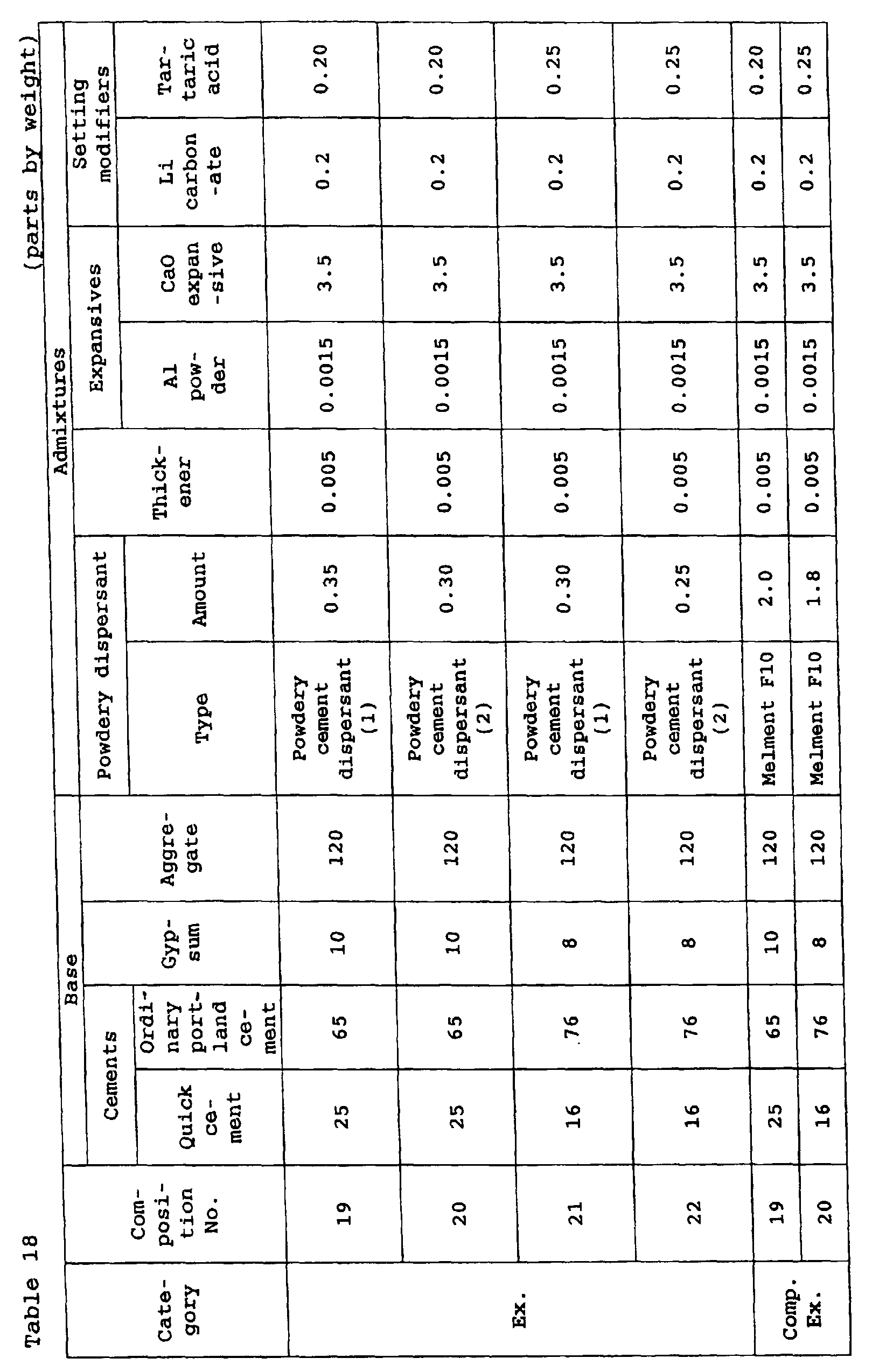
Examples of quick-setting grout compositions according
to the present invention will be shown in Table 18.
Performance tests of quick-setting grout compositions
according to the present invention were carried out as
follows.
[Test Example]
Water (19 parts by weight) was added to each material
(100 parts by weight) having a composition as shown in Table
18, and the resultant mixture was mixed for three minutes by
means of a Hobart mixer, to thereby prepare a slurry. Flow
and consistency (J-funnel passing time) of each slurry were
measured from immediately after kneading to 40 minutes after
kneading with intervals of 10 minutes, so as to evaluate
fluidity and viscosity, respectively. Setting time and
compressive strength of a hardened sample of a material age
of 24 hours were measured so as to evaluate a quick-setting
property. The results are shown in Tables 19 to 22.
[Method for measuring flow]
Flow was measured on the basis of the "Physical testing
method for cement," JIS R 5201.
[Method for measuring J-funnel passing time]
J-funnel passing time was measured on the basis of the
PC testing method of grout (JSCE-F531) specified by of Japan
Society of Civil Engineers. The employed J-funnel had an
outlet having an inner diameter of 14 mm.
[Method for measuring setting time]
Setting time was measured on the basis of the "setting
test of concrete by use of a Proctor intrusion needle
specified by ASTM-C403T.
[Method for measuring compressive strength]
Compressive strength was measured for a hardened sample
of a material age of 24 hours on the basis of the "Physical
testing method for cement," JIS R 5201.
[Method for measuring expansion coefficient]
Expansion coefficient was measured on the basis of the
PC testing method of grout (container method) (JSCE-F533)
specified by of Japan Society of Civil Engineers to a
material age of 24 hours.
| Category | composition No. | Time-elapsed change in flow (mm) after kneading | Fluidity evaluation |
| | | Immediately | 10 min | 20 min | 30 min | 40 min |
| Ex. | 19 | 234 | 230 | 224 | 210 | 191 | O |
| 20 | 237 | 235 | 225 | 202 | 183 | O |
| 21 | 244 | 242 | 228 | 203 | 176 | O |
| 22 | 248 | 246 | 230 | 198 | 172 | O |
| Comp. Ex. | 19 | 233 | 224 | 210 | 172 | 136 | X |
| 20 | 237 | 226 | 198 | 136 | 105 | X |
| Category | Composition No. | Time-elapsed change in J-funnel passing time (sec) after kneading | Viscosity evaluation |
| | | Immediately | 10 min | 20 min | 30 min | 40 min |
| Ex. | 19 | 7.4 | 8.2 | 8.8 | 12.8 | 18.7 | O |
| 20 | 7.1 | 7.8 | 9.1 | 13.9 | >20 | O |
| 21 | 6.8 | 7.6 | 9.2 | 14.6 | >20 | O |
| 22 | 6.5 | 7.4 | 9.1 | 16.4 | >20 | O |
| Comp. Ex. | 19 | 6.8 | 8.8 | 12.4 | >20 | >20 | X |
| 20 | 6.3 | 8.7 | 17.6 | >20 | >20 | X |
| Category | Composition No. | Setting time | Compressive strength (material age 24 hrs) (N/mm2) | Evaluation |
| | | Initial (min) | final (min) |
| Ex. | 19 | 75 | 135 | 28 | O |
| 20 | 67 | 124 | 30 | O |
| 21 | 60 | 108 | 26 | O |
| 22 | 54 | 92 | 27 | O |
| Comp. Ex. | 19 | 52 | 162 | 22 | X |
| 20 | 35 | 125 | 19 | X |
| Category | Composition No. | Expansion coefficient (%) | Expansion coefficient evaluation |
| | | 2 hrs | 4 hrs | 6 hrs | 12 hrs | 24 hrs |
| Ex. | 19 | + 0.33 | + 0.45 | + 0.57 | + 0.68 | + 0.72 | O |
| 20 | + 0.41 | + 0.52 | + 0.66 | + 0.74 | + 0.82 | O |
| 21 | + 0.28 | + 0.35 | + 0.42 | + 0.50 | + 0.54 | O |
| 22 | + 0.30 | + 0.37 | + 0.43 | + 0.48 | + 0.52 | O |
| Comp. Ex. | 19 | + 0.33 | + 0.44 | + 0.56 | + 0.68 | + 0.81 | O |
| 20 | + 0.44 | + 0.53 | + 0.66 | + 0.78 | + 0.83 | O |
As is clear from Tables 19 to 22, quick-setting grout
compositions according to the present invention maintain
excellent filling ability and resistance to material
separation for a long period of time and have an excellent
quick setting property, as compared with samples employing a
conventional powdery dispersant.
Examples 23 to 26 Quick-setting self-leveling
compositions
The following materials were employed in Examples 23 to
26.
[Materials employed]
(1) Cement and (2) gypsum
The same materials as employed in Examples 19 to 22
were employed.
(3) Fine aggregate
Silica sand (produced in Yamagata area) F. M = 2.3
(4) Powdery cement dispersant
1. Powdery cement dispersant according to the invention
Dispersants shown Table 7 were employed.
2. Conventional powdery cement dispersant
Melment F10 (melaminesulfonate salt-formalin condensate,
product of SKW Eastasia)
(5) Thickener
Metolose (cellulose thickener, product of Shin-Etsu
Chemical Co., Ltd.)
(6) Defoaming agent
SN-defoamer 14HP (product of San Nopco Ltd.)
(7) Setting modifier
1. Setting accelerator: lithium carbonate (commercial
product)
2. Setting retarder: tartaric acid (commercial product)
Examples of quick-setting self-leveling compositions
according to the present invention will be shown in Table 23.
Performance tests of quick-setting self-leveling
compositions according to the present invention were carried
out as follows.
[Test Example]
Water (21 parts by weight) was added to each material
(100 parts by weight) having a composition as shown in Table
23, and the resultant mixture was mixed for three minutes by
means of a Hobart mixer, to thereby prepare a slurry. Flow
of each slurry was measured from immediately after kneading
to 60 minutes after kneading with intervals of 10 minutes, so
as to evaluate fluidity. Setting time and compressive
strength of a hardened sample were measured so as to evaluate
a quick setting property. The results are shown in Tables 24
and 25.
[Method for measuring flow]
Paste flow was measured on the basis of JASS 15M-103
(quality standard of self-leveling material) specified by
Architectural Institute of Japan in the following manner.
A hollow cylindrical pipe piece (inner diameter of 50
mm, height of 51 mm, inner volume of 100 mL) made of vinyl
chloride resin was placed upright on a polished glass plate
(thickness 5 mm). A prepared quick-setting self-leveling
composition was charged into the pipe piece to its top, and
the pipe piece was lifted up after charging. After slump of
the composition stopped, two arbitrarily selected diameters
of the bottom of the slumped paste, which were normal to each
other, were measured, to thereby represent the average paste
flow the sample. When the time-elapsed flow was measured,
the sample slurry was kneaded by means of a Hobart mixer for
20 seconds before measurement.
[Method for measuring setting time]
Setting time was measured on the basis of the "Physical
testing method for cement," JIS R 5201.
[Method for measuring compressive strength]
Compressive strength was measured for a hardened sample
of a material age of one day on the basis of the "Physical
testing method for cement," JIS R 5201.
| Category | Composition No. | Time-elapsed change in flow (mm) after kneading | Fluidity evaluation |
| | | Immediately | 10 min | 20 min | 30 min | 40 min | 50 min | 60 min |
| Ex. | 23 | 222 | 220 | 217 | 214 | 211 | 204 | 196 | O |
| 24 | 226 | 225 | 222 | 217 | 210 | 202 | 189 | O |
| 25 | 241 | 238 | 231 | 220 | 197 | 171 | 125 | O |
| 26 | 246 | 245 | 235 | 221 | 193 | 162 | 96 | O |
| Comp. Ex. | 21 | 230 | 226 | 216 | 210 | 198 | 185 | 171 | O |
| 22 | 240 | 221 | 208 | 172 | 136 | 82 | unmeasurable | X |
| Category | Composition No. | Setting time (min.) | Compressive strength (material age 1 day) (N/mm2) | Hardening rate evaluation |
| | | Initial | final |
| Ex. | 23 | 92 | 146 | 22.5 | O |
| 24 | 86 | 138 | 23.4 | O |
| 25 | 72 | 120 | 21.6 | O |
| 26 | 68 | 115 | 22.7 | O |
| Comp. Ex. | 21 | 78 | 168 | 20.8 | X |
| 22 | 54 | 131 | 20.2 | O |
As is clear from Tables 24 to 25, quick-setting self-leveling
compositions according to the present invention
maintain excellent filling ability for a long period of time
and have a sufficient quick-setting property, as compared
with samples employing a conventional powdery dispersant.
Examples 27 and 28 Quick-setting cement compositions
The following materials were employed in Examples 27
and 28.
[Materials employed]
(1) Binder (calcium aluminate-base cement
Jet cement, product of Taiheiyo Cement)
(2) Powdery cement dispersant
1. Powdery cement dispersant according to the present
invention
Dispersants shown Table 7 were employed.
2. Conventional powdery cement dispersant
Mighty 100 (naphthalenesulfonate salt-formalin
condensate, product of Kao Corporation)
(3) Setting modifier
Setting retarder: citric acid (Jet-setter, product of
Onoda)
Examples of cement compositions according to the
present invention will be shown in Table 26.
| Category | Composition No. | Binder | Setting Modifier | Powdery dispersant |
| | | | | Type | Amount |
| Example | 27 | 100 | 0.2 | Powdery cement dispersant (1) | 0.20 |
| 28 | 100 | 0.2 | Powdery cement dispersant (1) | 0.18 |
| Comp. Ex. | 23 | 100 | 0.3 | Mighty 100 | 1.2 |
Performance tests of cement compositions according to
the present invention were carried out as follows.
[Test Example]
Water (40 parts by weight) was added to each material
(100 parts by weight) having a composition as shown in Table
26, and the resultant mixture was mixed for three minutes by
means of a Hobart mixer, to thereby prepare a slurry. Flow
and setting time of each slurry were measured so as to
evaluate fluidity and a quick setting property, respectively.
The results are shown in Tables 27 and 28.
[Method for measuring flow]
Flow was measured on the basis of the "Physical
testing method for cement," JIS R 5201.
[Method for measuring setting time]
Setting time was measured on the basis of the "Physical
testing method for cement," JIS R 5201.
| Category | Composition No. | Time-elapsed change in flow (mm) after kneading | Fluidity evaluation |
| | | Immediately | 10 min | 20 min | 30 min |
| Ex. | 27 | 219 | 218 | 201 | 190 | O |
| 28 | 220 | 217 | 202 | 189 | O |
| Comp. Ex. | 23 | 213 | 201 | 174 | 152 | X |
| Category | Composition No. | Setting time (min) |
| | | Initial | Final | Evaluation |
| Example | 27 | 46 | 61 | O |
| 28 | 40 | 52 | O |
| Comp. Ex. | 23 | 72 | 92 | X |
As is clear from Tables 27 and 28, cement compositions
according to the present invention maintain excellent
fluidity for a time required for practical use and have
excellent quick-setting properties, as compared with samples
employing a conventional powdery cement dispersant.
Industrial Applicability
The powdery dispersant of the present invention
exhibits excellent dispersibility which is equivalent to that
of a liquid dispersant. For example, even when a cement
composition containing the dispersant has low W/C ratio,
excellent fluidity of the composition can be secured, and
setting of the composition does not retard. The dispersant
can be added to cement in advance, and the mixture can be
stored or transported in the form of granular mixture, and
thus the dispersant is applicable to a so-called premixed
product.
The cement grout composition of the present invention
can maintain high packing ability and high separation
resistance for a prolonged period of time, as compared with a
conventional premixed cement grout composition. Therefore,
even in the case in which the composition of the present
invention is added to a complex structure in large amounts,
no problem arises in execution.
The cement self-leveling composition of the present
invention can maintain high fluidity for a prolonged period
of time, and is rapidly hardened, as compared with a
conventional premixed cement self-leveling composition.
Therefore, even when the composition of the present invention
is installed in large amounts, the composition does not cause
deterioration of the precise level, resulting in efficient
execution.
The quick-setting grout composition of the present
invention can maintain high packing ability and separation
resistance for a prolonged period of time, as compared with a
conventional premixed quick-setting grout composition.
Therefore, the composition of the present invention is
applicable to a complex structure, and excellent quick-setting
ability of the composition enables reduction in
execution period.
The quick-setting self-leveling composition of the
present invention can maintain high fluidity for a prolonged
period of time, and has sufficient quick-setting ability, as
compared with a conventional premised quick-setting self-leveling
composition. Therefore, even when the composition
of the present invention is installed in large amounts and
the installed surface must be opened within a short time, the
composition does not cause deterioration of the precise level,
resulting in efficient execution.
The cement composition of the present invention can
maintain high fluidity for practically sufficient period of
time, and has excellent quick-setting ability, as compared
with a conventional premised cement composition. Therefore,
employment of the cement composition of the present invention
enables efficient execution and reduction in execution period.