EP1052165A2 - Endless rubber track and vehicle containing such track - Google Patents
Endless rubber track and vehicle containing such track Download PDFInfo
- Publication number
- EP1052165A2 EP1052165A2 EP00109428A EP00109428A EP1052165A2 EP 1052165 A2 EP1052165 A2 EP 1052165A2 EP 00109428 A EP00109428 A EP 00109428A EP 00109428 A EP00109428 A EP 00109428A EP 1052165 A2 EP1052165 A2 EP 1052165A2
- Authority
- EP
- European Patent Office
- Prior art keywords
- track
- rubber
- phr
- tread
- carbon black
- Prior art date
- Legal status (The legal status is an assumption and is not a legal conclusion. Google has not performed a legal analysis and makes no representation as to the accuracy of the status listed.)
- Granted
Links
- 229920001971 elastomer Polymers 0.000 title claims abstract description 100
- 239000005060 rubber Substances 0.000 title claims abstract description 83
- 239000000203 mixture Substances 0.000 claims abstract description 59
- VYPSYNLAJGMNEJ-UHFFFAOYSA-N Silicium dioxide Chemical compound O=[Si]=O VYPSYNLAJGMNEJ-UHFFFAOYSA-N 0.000 claims description 36
- 239000006229 carbon black Substances 0.000 claims description 26
- 239000000377 silicon dioxide Substances 0.000 claims description 18
- 239000000806 elastomer Substances 0.000 claims description 17
- NINIDFKCEFEMDL-UHFFFAOYSA-N Sulfur Chemical compound [S] NINIDFKCEFEMDL-UHFFFAOYSA-N 0.000 claims description 15
- 239000011593 sulfur Substances 0.000 claims description 15
- 229910052717 sulfur Inorganic materials 0.000 claims description 15
- 238000010057 rubber processing Methods 0.000 claims description 14
- 238000005299 abrasion Methods 0.000 claims description 12
- 125000003118 aryl group Chemical group 0.000 claims description 8
- 239000007822 coupling agent Substances 0.000 claims description 7
- 229920003193 cis-1,4-polybutadiene polymer Polymers 0.000 claims description 5
- 239000012763 reinforcing filler Substances 0.000 claims description 5
- ZNRLMGFXSPUZNR-UHFFFAOYSA-N 2,2,4-trimethyl-1h-quinoline Chemical compound C1=CC=C2C(C)=CC(C)(C)NC2=C1 ZNRLMGFXSPUZNR-UHFFFAOYSA-N 0.000 claims description 4
- ZCYVEMRRCGMTRW-UHFFFAOYSA-N 7553-56-2 Chemical compound [I] ZCYVEMRRCGMTRW-UHFFFAOYSA-N 0.000 claims description 4
- PPBRXRYQALVLMV-UHFFFAOYSA-N Styrene Chemical compound C=CC1=CC=CC=C1 PPBRXRYQALVLMV-UHFFFAOYSA-N 0.000 claims description 4
- 229910052740 iodine Inorganic materials 0.000 claims description 4
- 239000011630 iodine Substances 0.000 claims description 4
- 229920003048 styrene butadiene rubber Polymers 0.000 claims description 4
- 229920003211 cis-1,4-polyisoprene Polymers 0.000 claims description 3
- QAZLUNIWYYOJPC-UHFFFAOYSA-M sulfenamide Chemical compound [Cl-].COC1=C(C)C=[N+]2C3=NC4=CC=C(OC)C=C4N3SCC2=C1C QAZLUNIWYYOJPC-UHFFFAOYSA-M 0.000 claims description 3
- 230000002452 interceptive effect Effects 0.000 claims description 2
- 125000005372 silanol group Chemical group 0.000 claims description 2
- 235000019241 carbon black Nutrition 0.000 description 21
- 239000003921 oil Substances 0.000 description 12
- 239000000523 sample Substances 0.000 description 12
- 230000000704 physical effect Effects 0.000 description 9
- DOIRQSBPFJWKBE-UHFFFAOYSA-N dibutyl phthalate Chemical compound CCCCOC(=O)C1=CC=CC=C1C(=O)OCCCC DOIRQSBPFJWKBE-UHFFFAOYSA-N 0.000 description 8
- 239000004615 ingredient Substances 0.000 description 8
- 238000004073 vulcanization Methods 0.000 description 8
- 239000013068 control sample Substances 0.000 description 7
- 230000006872 improvement Effects 0.000 description 7
- 244000043261 Hevea brasiliensis Species 0.000 description 6
- XLOMVQKBTHCTTD-UHFFFAOYSA-N Zinc monoxide Chemical compound [Zn]=O XLOMVQKBTHCTTD-UHFFFAOYSA-N 0.000 description 6
- 229920003052 natural elastomer Polymers 0.000 description 6
- 229920001194 natural rubber Polymers 0.000 description 6
- 239000003963 antioxidant agent Substances 0.000 description 5
- IJGRMHOSHXDMSA-UHFFFAOYSA-N Atomic nitrogen Chemical compound N#N IJGRMHOSHXDMSA-UHFFFAOYSA-N 0.000 description 4
- 230000003078 antioxidant effect Effects 0.000 description 4
- 150000001875 compounds Chemical class 0.000 description 4
- 230000000977 initiatory effect Effects 0.000 description 4
- 239000006057 Non-nutritive feed additive Substances 0.000 description 3
- 239000000654 additive Substances 0.000 description 3
- 235000014113 dietary fatty acids Nutrition 0.000 description 3
- 239000000194 fatty acid Substances 0.000 description 3
- 229930195729 fatty acid Natural products 0.000 description 3
- 150000004665 fatty acids Chemical class 0.000 description 3
- 229920005989 resin Polymers 0.000 description 3
- 239000011347 resin Substances 0.000 description 3
- 239000011787 zinc oxide Substances 0.000 description 3
- ZRALSGWEFCBTJO-UHFFFAOYSA-N Guanidine Chemical compound NC(N)=N ZRALSGWEFCBTJO-UHFFFAOYSA-N 0.000 description 2
- 241000872198 Serjania polyphylla Species 0.000 description 2
- 235000021355 Stearic acid Nutrition 0.000 description 2
- 229910000831 Steel Inorganic materials 0.000 description 2
- 239000003905 agrochemical Substances 0.000 description 2
- 150000004945 aromatic hydrocarbons Chemical class 0.000 description 2
- 239000003795 chemical substances by application Substances 0.000 description 2
- 238000005336 cracking Methods 0.000 description 2
- 239000000463 material Substances 0.000 description 2
- 238000000034 method Methods 0.000 description 2
- 229910052757 nitrogen Inorganic materials 0.000 description 2
- QIQXTHQIDYTFRH-UHFFFAOYSA-N octadecanoic acid Chemical compound CCCCCCCCCCCCCCCCCC(O)=O QIQXTHQIDYTFRH-UHFFFAOYSA-N 0.000 description 2
- OQCDKBAXFALNLD-UHFFFAOYSA-N octadecanoic acid Natural products CCCCCCCC(C)CCCCCCCCC(O)=O OQCDKBAXFALNLD-UHFFFAOYSA-N 0.000 description 2
- 229920002857 polybutadiene Polymers 0.000 description 2
- -1 precipitated silica Chemical compound 0.000 description 2
- 230000002787 reinforcement Effects 0.000 description 2
- 239000008117 stearic acid Substances 0.000 description 2
- 239000010959 steel Substances 0.000 description 2
- 238000010059 sulfur vulcanization Methods 0.000 description 2
- 239000001993 wax Substances 0.000 description 2
- LLMLGZUZTFMXSA-UHFFFAOYSA-N 2,3,4,5,6-pentachlorobenzenethiol Chemical compound SC1=C(Cl)C(Cl)=C(Cl)C(Cl)=C1Cl LLMLGZUZTFMXSA-UHFFFAOYSA-N 0.000 description 1
- BWGNESOTFCXPMA-UHFFFAOYSA-N Dihydrogen disulfide Chemical compound SS BWGNESOTFCXPMA-UHFFFAOYSA-N 0.000 description 1
- 241000196324 Embryophyta Species 0.000 description 1
- CHJJGSNFBQVOTG-UHFFFAOYSA-N N-methyl-guanidine Natural products CNC(N)=N CHJJGSNFBQVOTG-UHFFFAOYSA-N 0.000 description 1
- 239000005062 Polybutadiene Substances 0.000 description 1
- 239000012190 activator Substances 0.000 description 1
- 230000000996 additive effect Effects 0.000 description 1
- 230000015572 biosynthetic process Effects 0.000 description 1
- MTAZNLWOLGHBHU-UHFFFAOYSA-N butadiene-styrene rubber Chemical compound C=CC=C.C=CC1=CC=CC=C1 MTAZNLWOLGHBHU-UHFFFAOYSA-N 0.000 description 1
- DKVNPHBNOWQYFE-UHFFFAOYSA-N carbamodithioic acid Chemical compound NC(S)=S DKVNPHBNOWQYFE-UHFFFAOYSA-N 0.000 description 1
- 238000006243 chemical reaction Methods 0.000 description 1
- 238000005056 compaction Methods 0.000 description 1
- 238000013329 compounding Methods 0.000 description 1
- 239000000470 constituent Substances 0.000 description 1
- 238000004132 cross linking Methods 0.000 description 1
- 238000013036 cure process Methods 0.000 description 1
- 150000001993 dienes Chemical class 0.000 description 1
- SWSQBOPZIKWTGO-UHFFFAOYSA-N dimethylaminoamidine Natural products CN(C)C(N)=N SWSQBOPZIKWTGO-UHFFFAOYSA-N 0.000 description 1
- 239000012990 dithiocarbamate Substances 0.000 description 1
- 230000000694 effects Effects 0.000 description 1
- 230000002708 enhancing effect Effects 0.000 description 1
- 230000007717 exclusion Effects 0.000 description 1
- 239000004744 fabric Substances 0.000 description 1
- 239000011152 fibreglass Substances 0.000 description 1
- 238000005188 flotation Methods 0.000 description 1
- 238000003306 harvesting Methods 0.000 description 1
- 230000007774 longterm Effects 0.000 description 1
- 238000004519 manufacturing process Methods 0.000 description 1
- 239000004200 microcrystalline wax Substances 0.000 description 1
- 235000019808 microcrystalline wax Nutrition 0.000 description 1
- 230000002093 peripheral effect Effects 0.000 description 1
- 239000004014 plasticizer Substances 0.000 description 1
- 238000002360 preparation method Methods 0.000 description 1
- 230000009467 reduction Effects 0.000 description 1
- 238000010058 rubber compounding Methods 0.000 description 1
- YWWOEPOBDHZQEJ-UHFFFAOYSA-N s-(4-cyclohexyl-1,3-benzothiazol-2-yl)thiohydroxylamine Chemical compound C1=CC=C2SC(SN)=NC2=C1C1CCCCC1 YWWOEPOBDHZQEJ-UHFFFAOYSA-N 0.000 description 1
- FJDAAUABGSPSKH-UHFFFAOYSA-N s-(4-tert-butyl-1,3-benzothiazol-2-yl)thiohydroxylamine Chemical compound CC(C)(C)C1=CC=CC2=C1N=C(SN)S2 FJDAAUABGSPSKH-UHFFFAOYSA-N 0.000 description 1
- 239000002689 soil Substances 0.000 description 1
- 238000001179 sorption measurement Methods 0.000 description 1
- 238000005987 sulfurization reaction Methods 0.000 description 1
- 229960002447 thiram Drugs 0.000 description 1
Images

Classifications
-
- B—PERFORMING OPERATIONS; TRANSPORTING
- B62—LAND VEHICLES FOR TRAVELLING OTHERWISE THAN ON RAILS
- B62D—MOTOR VEHICLES; TRAILERS
- B62D55/00—Endless track vehicles
- B62D55/08—Endless track units; Parts thereof
- B62D55/18—Tracks
- B62D55/24—Tracks of continuously flexible type, e.g. rubber belts
-
- C—CHEMISTRY; METALLURGY
- C08—ORGANIC MACROMOLECULAR COMPOUNDS; THEIR PREPARATION OR CHEMICAL WORKING-UP; COMPOSITIONS BASED THEREON
- C08L—COMPOSITIONS OF MACROMOLECULAR COMPOUNDS
- C08L7/00—Compositions of natural rubber
Definitions
- the invention relates to an endless vehicular rubber track.
- the invention particularly relates to such track having a tread component of a rubber composition.
- Endless rubber tractor tracks are increasingly being used for propelling various vehicles over the ground such as, for example, various tractors and other agricultural vehicles including, for example, combines and spreaders, as well as various earth moving machines.
- such track is conventionally positioned over at least two wheels, normally a drive wheel for engaging an inner surface of the track and driving the track and at least one driven wheel to control the path of the track as it moves to propel the associated vehicle.
- the outer surface of the peripheral tread configuration of the track typically contains a plurality of raised lugs designed for engaging the ground and assisting the propelling of the associated vehicle such as, for example, a tractor over an agricultural ground.
- the tread of such rubber tracks provide a considerably wider footprint than conventional pneumatic tires and are, thereby, more adaptable to agricultural fields in that they offer better flotation and less soil compaction than rubber tires, which may result in better crop yield.
- use of rubber tracks instead of pneumatic tires may permit a farmer to get out into a field earlier in the planting season and plant crops sooner in point of time and may permit a harvesting of a crop on a more timely basis as compared to conventional pneumatic rubber tire equipped agricultural vehicles.
- Such use and advantages of rubber tractor tracks are well known to those having skill in such art.
- Such rubber tracks are conventionally in a form of an endless rubber belt reinforced with continuous steel cables molded into the rubber composition itself to add dimensional stability for the track.
- the rubber track As the rubber track is driven around the aforesaid wheels, it is (1) subject to extensive contortional flexing and, thus, may be subject to tread crack initiation and propagation over time and (2) may be subject to various agricultural chemicals and crop stubble as is well known to those having skill in such art.
- the rubber composition for the tread component of the track have appropriate resistance to flex fatigue, resistance to abrasion and durability.
- an endless rubber track designed to encompass at least one drive wheel and at least one driven wheel is comprised of an inner component containing a plurality of lugs designed to be engaged and/or guided by said drive and driven wheels and an outer tread component, said tread component being of a configuration comprised of a plurality of co-extensive, raised lugs thereon designed to ground engaging; wherein said tread is of a rubber composition comprised of, based upon 100 parts by weight elastomers (phr), (A) elastomers comprised of (1) 15 to 40 phr of cis 1,4-polybutadiene elastomer and, correspondingly, (2) 60 to 85 phr at least one additional elastomer selected from (i) 60 to 75, alternatively 40 to 55, phr of natural cis 1,4-polyisoprene elastomer and, correspondingly, (ii) zero to 15, alternatively 5 to 10, phr of styrene
- said additional elastomer is natural rubber in order to enhance resistance to flex fatigue and tear.
- such rubber composition for said track tread component is characterized by having a minimum flex fatigue resistance of at least 90 kilocycles at 65 percent strain according to ASTM D4482, and abrasion resistance in a range of 70 to 180 according to ASTM D5963.
- a vehicle having at least two endless rubber track systems, namely a track system on each side of the vehicle, for driving said vehicle over the ground, said track systems individually comprised of the track of this invention, a plurality of wheels engaged with said vehicle and encompassed by said track wherein at least one of said wheels is a drive wheel.
- the flex fatigue limitation of the cured track's tread rubber composition is considered herein to be important or significant to the durability and service life of the track tread.
- the abrasion resistance of the cured track's tread rubber composition is considered herein to be important or significant to wear performance of the track tread. (e.g.: resistance to wear due to abrasion)
- the prescribed combination of elastomers, carbon black, silica and antioxidant content of the cured track's tread rubber composition is considered herein to be important or significant to aid in achieving the track tread's performance (e.g.: resistance to flex fatigue and resistance to wear).
- significant aspects of this invention are (1) use of a combination of natural rubber and cis 1,4-polybutadiene rubber designed to promote treadwear and flex fatigue resistance, (2) relatively low level (content) of sulfur curative designed to promote less crosslinking and higher chain extension of the tread rubber composition, (3) exclusion of a coupling agent for the silica designed to increase the cured elastomer composition's resistance to flex fatigue and maintain resistance to tear propagation as compared to such composition using a silica coupling agent, (4) specified carbon black as a tire tread grade of carbon black in order to arrive as a suitable tear strength and resistance or tread service related damage (5) relatively high antioxidant content, usually a combination of antioxidant and antiozonant, in order to achieve suitable long term durability and resistance to flex fatigue and (6) relatively low level of rubber processing oil, if any, in order to promote a relatively high tensile strength for the track tread rubber composition.
- the track including its tread component, is then sulfur cured (vulcanized) in a suitable mold at an elevated temperature (e.g.: 150°C to 170°C) at an elevated temperature.
- an elevated temperature e.g.: 150°C to 170°C
- the invention also contemplates a sulfur-vulcanized endless track.
- the invention contemplates a vehicle having at least two endless rubber track systems (each on an opposite side of the vehicle) for driving said vehicle over the ground, said track systems individually comprised of said track, a plurality of wheels engaged with said vehicle and encompassed by said track wherein at least one of said wheels is a drive wheel.
- FIGURE 1 depicts a perspective view of an endless rubber track
- FIGURE 2 depicts a longitudinal cross-section of such track.
- a rubber track (1) having a rubber tread component (2) of a lug (3) and groove (4) configuration.
- the tread (2) is of a rubber composition composed of cis 1,4-polyisoprene natural rubber and cis 1,4-polybutadiene rubber which contains a combination of prescribed carbon black and precipitated silica reinforcement in combination of a designed balance between curing system, antidegradant and rubber processing oil according to this invention.
- Lugs (5) positioned on the inner surface of the track (1) are also shown which can be engaged by an appropriate drive wheel of the vehicle to drive the track (1).
- the track (1) can be driven by a friction wheel.
- the track (1) itself is composed of the circumferential tread (2) on a carcass (6) which contains a fabric (e.g. steel or glass fiber reinforced plastic) belt reinforcement (7) for dimensional stability.
- a fabric e.g. steel or glass fiber reinforced plastic
- the track tread in an agricultural operation presents problems not normally experienced by a toriodially-shaped pneumatic tire.
- the track has a relatively thin cross-section not supported by pneumatic air pressure as would be experienced by a pneumatic tire.
- the track inherently presents a large footprint on the ground whereas a toroidal pneumatic tire presents a relatively small footprint.
- the track tread presents special problems and challenges as it propels a vehicle over what is usually a relatively harsh environment comprising a ground which may contain various agricultural chemicals as well as crop stubble which can abrade away or even puncture the surface the track tread.
- a track with a tread which it presents abrasion resistance to wear occurring from the ground and crop stubble contact and, also, flex fatigue as it contorts around the various drive and driven wheels of the associated vehicle.
- the track tread rubber composition is composed of specified elastomers, carbon black, silica in the absence of coupling agent, as well as controlled selection and amounts of antidegradant, processing oil and sulfur-cure accelerators.
- the specified components for the rubber composition for the track tread are novel and inventive in that specified ingredients are chosen and utilized in a unique combination thereof by the specified combination thereof as well as specified amounts for a track rubber tread component.
- the carbon black is a tire tread grade of carbon black with an Iodine Number (ASTM D1510) in a range of 115 to 130 g/kg, a dibutyl phthalate (DBP) value (ASTM) D2414) in a range of 105 to 125 cm 3 /100g and a Tint value (ASTM D3265) in a range of 120 to 140.
- ASTM D1510 Iodine Number
- DBP dibutyl phthalate
- ASTM dibutyl phthalate
- ASTM D3265 Tint value
- carbon blacks are, for example, those of ASTM designations N-220 and N234.
- the Iodine Number limitation for the carbon black is considered herein to be important, or significant, to enhance abrasion resistance and hysteretic qualities of the track tread rubber composition.
- the DBP value limitation for the carbon black is considered herein to be important or significant to enhance resistance to flex fatigue of the track tread rubber composition.
- Tint value limitation is considered herein to be important or significant to enhance abrasion resistance for the track tread rubber composition.
- a relatively high level, or content, of antidegradant is used, namely, in a range of 4.5 to 10 phr in order to enhance resistance to flex fatigue over time for the track tread rubber composition.
- Such antidegradants should be a combination of antiozonant and antioxidant for rubber compositions as conventionally used for cured rubber compositions intended to be exposed to atmospheric conditions in dynamic applications.
- antidegradants are, for example, polymerized 2,2,4-trimethyl 1,2-dihydroquinoline which might be obtained as Flectol TMQ from the Flexsys America L.A. company, N-1,3-dimethylbutyl-N'-phenyl para-phenhylenediamine which might be obtained as Wingstay® 300, a trademark of The Goodyear Tire & Rubber Company and mixed aryl-p-phenylenediamines such as Wingstay® 100, a trademark of The Goodyear Tire & Rubber Company.
- Such antidegradants are well known to those having skill in such art.
- aromatic hydrocarbon rubber processing oils in a range of zero to 10, preferably one to 10, phr is desired for the practice of this invention in order to enhance processability of the unvulcanized rubber composition for the track tread as well as to enhance a balance of a combination of tensile strength and elongation of a sulfur-vulcanized track tread rubber composition.
- aromatic rubber processing oil as well as mixtures of alkylated napthenic and aromatic hydrocarbon rubber processing oils, and their use as processing aids, are well known to those having skill in the preparation of rubber compositions.
- a semi-EV vulcanization system which is comprised of a relatively limited sulfur content in a range of 0.75 to 1.5 phr in combination with a primary sulfenamide-based accelerator preferably selected from at least one cyclohexylbenzothiazole sulfenamide, tert-butyl-2-benzothiazole sulfenamide and N-dicyclohexyl-2-benzothiazole sulfenamide, all of which are well known primary sulfur-vulcanization accelerators.
- a primary sulfenamide-based accelerator preferably selected from at least one cyclohexylbenzothiazole sulfenamide, tert-butyl-2-benzothiazole sulfenamide and N-dicyclohexyl-2-benzothiazole sulfenamide, all of which are well known primary sulfur-vulcanization accelerators.
- si-EV vulcanization system as used in the description of this invention, it is meant that approximately equal amounts (phr) of primary accelerator(s) and added free sulfur are used.
- secondary accelerator(s) as well as vulcanization retarder(s) may also be used where appropriate to control the vulcanization reaction.
- silica particularly precipitated silica, is used primarily to assist in enhancing, or reducing, tear resistance of the track tread's rubber composition.
- silicas may be used, preferably precipitated silicas.
- Precipitated silicas for use in rubber compositions, including for tire treads, are well known to those skilled in such art.
- Representative of such silicas are, for example, HiSil 210 and HiSil from PPG Industries.
- a silica coupler is not used.
- the rubber composition of the track tread rubber may be compounded by methods generally known in the rubber compounding art, such as, unless otherwise specified herein, mixing the sulfur-vulcanizable constituent diene-based elastomers with various commonly-used additive materials such as, for example, curing aids, such as sulfur, activators, retarders and accelerators, processing additives, such as the aforesaid aromatic rubber processing oils, resins including tackifying resins if used, plasticizers if used, fatty acid including stearic acid, zinc oxide, waxes, antioxidants and antiozonants as discussed herein, peptizing agents if used, and reinforcing fillers such as carbon black and precipitated silica as discussed herein.
- curing aids such as sulfur, activators, retarders and accelerators
- processing additives such as the aforesaid aromatic rubber processing oils
- resins including tackifying resins if used such as the aforesaid aromatic rubber processing oils
- Typical amounts of tackifier resins may be, for example, 1 to 5 phr, usually 1 to 5 phr.
- processing aids if used, may be 1 to 10 phr.
- Such processing aids can include, for example, the aforesaid aromatic rubber processing oil which includes a combination, of mixture, of aromatic and naphthenic rubber processing oil.
- Typical amounts of fatty acids, if used, which can include stearic acid may be, for example, 0.5 to 4 phr.
- Typical amounts of zinc oxide may be, for example, 2 to 5 phr.
- Typical amounts of waxes if used, such as microcrystalline waxes may be, for example, 1 to 5 phr.
- Typical amounts of peptizers may be, for example, 0.1 to 1 phr.
- Typical peptizers may be, for example and if used, pentachlorothiophenol and dibenzamidodiphenyl disulfide.
- the vulcanization is conducted in the presence of a sulfur-vulcanizing agent, accelerator and, optionally, a secondary accelerator and/or retarder in the practice of this invention in which, as hereinbefore related, a semi-EV vulcanization system is prescribed.
- the secondary accelerator may be, for example, a guanidine, dithiocarbamate or thiuram compound.
- the track can be built, shaped, molded and cured by various methods which are known or apparent to those having skill in such art.
- the rubber composition, or compound, for the tractor track tread may be prepared, for example, by mixing the ingredients in several sequential non-productive stages (without the sulfur and associated accelerator(s) curatives together with antidegradant(s) to temperatures of about 165°C followed by a final productive mixing stage to a temperature of about 105°C in which the curatives and antidegradants are added.
- An internal rubber mixer (Banbury type) may be used.
- the resulting uncured rubber compounds may then be extruded to form, for example, one or more sections of the track which, in turn, may be inserted into a suitable mold and cured at a temperature of, for example, about 150°C to form a continuous track.
- Rubber compositions are prepared which are referred to as Samples X, Y and Z. Sample X is used as a Control.
- Control Sample X is based upon an elastomer composition of natural rubber/SBR/silica/coupling agent/conventional sulfur-vulcanization system.
- Samples Y and Z represent rubber compositions for the tread of the track of this invention.
- compositions for the Samples are shown in the following Table 1.
- Sample X utilized Carbon black A and Samples Y and Z utilized Carbon black B.
- Carbon black B differs from Carbon Black A by having a significantly higher Tint value and Nitrogen Surface Area. This is considered as being significant because it enables an improvement (increase) in abrasion resistance which is somewhat predictive of reduced treadwear for the track surface and tear strength for the rubber composition.
- the ingredients are first mixed in at least one non-productive mixing stage for about five minutes to a temperature of about 165°C.
- the non-productive mix stages refer to the mixing of the ingredients without the curatives such as sulfur and vulcanization accelerators.
- the term "non-productive" mixing is well known to those having skill in such art.
- the sulfur curative, together with accelerator(s) is mixed in a final mixing stage for about 2 minutes to a temperature of about 110°C.
- Example I The rubber compositions of Example I were cured for about 50 and for about 100 minutes, respectively, at a temperature of about 150°C in order to evaluate the effect of curing the rubber samples over time.
- a primary objective is to maximize flex life and minimize both track wear and crack formation.
- Samples XX, YY and ZZ which correspond to rubber compositions X, Y and Z of Example I herein, with Sample XX representing the Control Sample.
- Tracks XX YY and ZZ correspond to Samples XX, YY and ZZ. Tracks Cured for approximately 100 Minutes Property Track XX Control Track YY Track ZZ A. Track Flex Test Total No. of cracks 1015 185 37 Total length of 3175 559 102 cracks (cm) Flex test ranking 3 2 1 B. Treadwear Test Average treadwear 1.67 1.53 1.16 (mm/hour) Wear ranking 3 2 1
- the track flex test data demonstrates a significant reduction in cracking, namely a significance in resistance to cracking for track tread Samples YY and ZZ.
- Samples YY and ZZ are, respectively, 82 percent and 96 percent better when compared to the control Sample XX.
- the track treadwear data also demonstrates a significant improvement in wear resistance for the track tread rubber compositions YY and ZZ.
- abrasion values for Samples YY and ZZ are 9 percent and 31 percent, respectively, better than that of control Sample XX.
Landscapes
- Chemical & Material Sciences (AREA)
- Engineering & Computer Science (AREA)
- Health & Medical Sciences (AREA)
- Chemical Kinetics & Catalysis (AREA)
- Medicinal Chemistry (AREA)
- Polymers & Plastics (AREA)
- Organic Chemistry (AREA)
- Combustion & Propulsion (AREA)
- Transportation (AREA)
- Mechanical Engineering (AREA)
- Compositions Of Macromolecular Compounds (AREA)
- Tires In General (AREA)
Abstract
Description
- The invention relates to an endless vehicular rubber track. The invention particularly relates to such track having a tread component of a rubber composition.
- Endless rubber tractor tracks are increasingly being used for propelling various vehicles over the ground such as, for example, various tractors and other agricultural vehicles including, for example, combines and spreaders, as well as various earth moving machines.
- In particular, such track is conventionally positioned over at least two wheels, normally a drive wheel for engaging an inner surface of the track and driving the track and at least one driven wheel to control the path of the track as it moves to propel the associated vehicle. The outer surface of the peripheral tread configuration of the track typically contains a plurality of raised lugs designed for engaging the ground and assisting the propelling of the associated vehicle such as, for example, a tractor over an agricultural ground.
- In practice, the tread of such rubber tracks provide a considerably wider footprint than conventional pneumatic tires and are, thereby, more adaptable to agricultural fields in that they offer better flotation and less soil compaction than rubber tires, which may result in better crop yield. In addition, use of rubber tracks instead of pneumatic tires may permit a farmer to get out into a field earlier in the planting season and plant crops sooner in point of time and may permit a harvesting of a crop on a more timely basis as compared to conventional pneumatic rubber tire equipped agricultural vehicles. Such use and advantages of rubber tractor tracks are well known to those having skill in such art.
- Such rubber tracks are conventionally in a form of an endless rubber belt reinforced with continuous steel cables molded into the rubber composition itself to add dimensional stability for the track.
- As the rubber track is driven around the aforesaid wheels, it is (1) subject to extensive contortional flexing and, thus, may be subject to tread crack initiation and propagation over time and (2) may be subject to various agricultural chemicals and crop stubble as is well known to those having skill in such art.
- Accordingly, it is desired that the rubber composition for the tread component of the track have appropriate resistance to flex fatigue, resistance to abrasion and durability.
- In accordance with this invention, an endless rubber track designed to encompass at least one drive wheel and at least one driven wheel is comprised of an inner component containing a plurality of lugs designed to be engaged and/or guided by said drive and driven wheels and an outer tread component, said tread component being of a configuration comprised of a plurality of co-extensive, raised lugs thereon designed to ground engaging; wherein said tread is of a rubber composition comprised of, based upon 100 parts by weight elastomers (phr), (A) elastomers comprised of (1) 15 to 40 phr of
cis 1,4-polybutadiene elastomer and, correspondingly, (2) 60 to 85 phr at least one additional elastomer selected from (i) 60 to 75, alternatively 40 to 55, phr ofnatural cis 1,4-polyisoprene elastomer and, correspondingly, (ii) zero to 15, alternatively 5 to 10, phr of styrene/butadiene copolymer rubber which contains from 10 to 40 weight percent bound styrene; wherein said additional elastomer is preferably only natural rubber, (B) 40 to 80 phr of reinforcing filler comprised of carbon black and a minor amount of precipitated silica; wherein said carbon black is present in an amount of 35 to 65 phr and said precipitated silica is present in an amount of from 3 to 15 phr; wherein said reinforcing filler is exclusive of a coupling agent having a moiety reactive with silanol groups on the surface of said silica and another moiety interactive with said elastomer(s), (C) sulfur curative in a range of 0.75 to 1.5 phr and a sulfenamide sulfur cure accelerator, (D) 4.5 to 10 of antidegradant, and (E) zero to 10, preferably 1 to 5, phr of rubber processing oil selected from at least one of aromatic rubber processing oil and mixture of aromatic and naphenic rubber processing oil; wherein said carbon black is characterized by having an Iodine Number in a range of 115 to 130 g/kg, a DBP value in a range of 105 to 125 cm3/100g, and a Tint value in a range of 120 to 140. - In practice, it is preferred that said additional elastomer is natural rubber in order to enhance resistance to flex fatigue and tear.
- Preferably, as a limitation to the above rubber composition, such rubber composition for said track tread component is characterized by having a minimum flex fatigue resistance of at least 90 kilocycles at 65 percent strain according to ASTM D4482, and abrasion resistance in a range of 70 to 180 according to ASTM D5963.
- In further accordance with this invention, a vehicle is provided having at least two endless rubber track systems, namely a track system on each side of the vehicle, for driving said vehicle over the ground, said track systems individually comprised of the track of this invention, a plurality of wheels engaged with said vehicle and encompassed by said track wherein at least one of said wheels is a drive wheel.
- The flex fatigue limitation of the cured track's tread rubber composition is considered herein to be important or significant to the durability and service life of the track tread.
- The abrasion resistance of the cured track's tread rubber composition is considered herein to be important or significant to wear performance of the track tread. (e.g.: resistance to wear due to abrasion)
- The prescribed combination of elastomers, carbon black, silica and antioxidant content of the cured track's tread rubber composition is considered herein to be important or significant to aid in achieving the track tread's performance (e.g.: resistance to flex fatigue and resistance to wear).
- In addition to the above physical properties of the cured track's tread rubber composition, significant aspects of this invention are (1) use of a combination of natural rubber and
cis 1,4-polybutadiene rubber designed to promote treadwear and flex fatigue resistance, (2) relatively low level (content) of sulfur curative designed to promote less crosslinking and higher chain extension of the tread rubber composition, (3) exclusion of a coupling agent for the silica designed to increase the cured elastomer composition's resistance to flex fatigue and maintain resistance to tear propagation as compared to such composition using a silica coupling agent, (4) specified carbon black as a tire tread grade of carbon black in order to arrive as a suitable tear strength and resistance or tread service related damage (5) relatively high antioxidant content, usually a combination of antioxidant and antiozonant, in order to achieve suitable long term durability and resistance to flex fatigue and (6) relatively low level of rubber processing oil, if any, in order to promote a relatively high tensile strength for the track tread rubber composition. - Indeed, while the individual ingredients are known, it is considered that the above combination of ingredients for the tread component of the endless track for this invention is novel and inventive.
- The track, including its tread component, is then sulfur cured (vulcanized) in a suitable mold at an elevated temperature (e.g.: 150°C to 170°C) at an elevated temperature.
- Accordingly, the invention also contemplates a sulfur-vulcanized endless track.
- Further, the invention contemplates a vehicle having at least two endless rubber track systems (each on an opposite side of the vehicle) for driving said vehicle over the ground, said track systems individually comprised of said track, a plurality of wheels engaged with said vehicle and encompassed by said track wherein at least one of said wheels is a drive wheel.
- For a further understanding of this invention, the accompanying drawings are referred to in FIGURE 1 which depicts a perspective view of an endless rubber track, FIGURE 2 depicts a longitudinal cross-section of such track.
- In the drawings, a rubber track (1) is provided having a rubber tread component (2) of a lug (3) and groove (4) configuration. The tread (2) is of a rubber composition composed of
cis 1,4-polyisoprene natural rubber andcis 1,4-polybutadiene rubber which contains a combination of prescribed carbon black and precipitated silica reinforcement in combination of a designed balance between curing system, antidegradant and rubber processing oil according to this invention. - Lugs (5) positioned on the inner surface of the track (1) are also shown which can be engaged by an appropriate drive wheel of the vehicle to drive the track (1). Alternatively, the track (1) can be driven by a friction wheel.
- The track (1) itself is composed of the circumferential tread (2) on a carcass (6) which contains a fabric (e.g. steel or glass fiber reinforced plastic) belt reinforcement (7) for dimensional stability.
- It is to be appreciated that use of the track tread in an agricultural operation presents problems not normally experienced by a toriodially-shaped pneumatic tire. In one aspect, the track has a relatively thin cross-section not supported by pneumatic air pressure as would be experienced by a pneumatic tire. Further, the track inherently presents a large footprint on the ground whereas a toroidal pneumatic tire presents a relatively small footprint.
- Indeed, the track tread presents special problems and challenges as it propels a vehicle over what is usually a relatively harsh environment comprising a ground which may contain various agricultural chemicals as well as crop stubble which can abrade away or even puncture the surface the track tread.
- Accordingly, it is desirable to provide a track with a tread which it presents abrasion resistance to wear occurring from the ground and crop stubble contact and, also, flex fatigue as it contorts around the various drive and driven wheels of the associated vehicle.
- In particular, and for the purposes of this invention, the track tread rubber composition is composed of specified elastomers, carbon black, silica in the absence of coupling agent, as well as controlled selection and amounts of antidegradant, processing oil and sulfur-cure accelerators.
- It is to be appreciated that the individual materials recited above have been and are being utilized for various tread compositions for various pneumatic tires.
- However, it is considered herein that it is a significant aspect of this invention that the specified components for the rubber composition for the track tread are novel and inventive in that specified ingredients are chosen and utilized in a unique combination thereof by the specified combination thereof as well as specified amounts for a track rubber tread component.
- In particular, the carbon black is a tire tread grade of carbon black with an Iodine Number (ASTM D1510) in a range of 115 to 130 g/kg, a dibutyl phthalate (DBP) value (ASTM) D2414) in a range of 105 to 125 cm3/100g and a Tint value (ASTM D3265) in a range of 120 to 140.
- Representative examples of such carbon blacks are, for example, those of ASTM designations N-220 and N234.
- In particular, the Iodine Number limitation for the carbon black is considered herein to be important, or significant, to enhance abrasion resistance and hysteretic qualities of the track tread rubber composition.
- The DBP value limitation for the carbon black is considered herein to be important or significant to enhance resistance to flex fatigue of the track tread rubber composition.
- The Tint value limitation is considered herein to be important or significant to enhance abrasion resistance for the track tread rubber composition.
- In the practice of this invention, a relatively high level, or content, of antidegradant is used, namely, in a range of 4.5 to 10 phr in order to enhance resistance to flex fatigue over time for the track tread rubber composition.
- Such antidegradants should be a combination of antiozonant and antioxidant for rubber compositions as conventionally used for cured rubber compositions intended to be exposed to atmospheric conditions in dynamic applications.
- Representative examples of such antidegradants are, for example, polymerized 2,2,4-
trimethyl 1,2-dihydroquinoline which might be obtained as Flectol TMQ from the Flexsys America L.A. company, N-1,3-dimethylbutyl-N'-phenyl para-phenhylenediamine which might be obtained as Wingstay® 300, a trademark of The Goodyear Tire & Rubber Company and mixed aryl-p-phenylenediamines such as Wingstay® 100, a trademark of The Goodyear Tire & Rubber Company. Such antidegradants are well known to those having skill in such art. - Use of aromatic hydrocarbon rubber processing oils in a range of zero to 10, preferably one to 10, phr is desired for the practice of this invention in order to enhance processability of the unvulcanized rubber composition for the track tread as well as to enhance a balance of a combination of tensile strength and elongation of a sulfur-vulcanized track tread rubber composition. Such aromatic rubber processing oil as well as mixtures of alkylated napthenic and aromatic hydrocarbon rubber processing oils, and their use as processing aids, are well known to those having skill in the preparation of rubber compositions.
- It is desired, for the practice of this invention, that a semi-EV vulcanization system be used which is comprised of a relatively limited sulfur content in a range of 0.75 to 1.5 phr in combination with a primary sulfenamide-based accelerator preferably selected from at least one cyclohexylbenzothiazole sulfenamide, tert-butyl-2-benzothiazole sulfenamide and N-dicyclohexyl-2-benzothiazole sulfenamide, all of which are well known primary sulfur-vulcanization accelerators.
- By the term "semi-EV vulcanization system", as used in the description of this invention, it is meant that approximately equal amounts (phr) of primary accelerator(s) and added free sulfur are used.
- It is to be appreciated that secondary accelerator(s) as well as vulcanization retarder(s) may also be used where appropriate to control the vulcanization reaction.
- In the practice of this invention, silica, particularly precipitated silica, is used primarily to assist in enhancing, or reducing, tear resistance of the track tread's rubber composition.
- Various silicas may be used, preferably precipitated silicas. Precipitated silicas for use in rubber compositions, including for tire treads, are well known to those skilled in such art. Representative of such silicas are, for example, HiSil 210 and HiSil from PPG Industries.
- In the practice of this invention, preferably a silica coupler is not used.
- It is readily understood by those having skill in the art that the rubber composition of the track tread rubber may be compounded by methods generally known in the rubber compounding art, such as, unless otherwise specified herein, mixing the sulfur-vulcanizable constituent diene-based elastomers with various commonly-used additive materials such as, for example, curing aids, such as sulfur, activators, retarders and accelerators, processing additives, such as the aforesaid aromatic rubber processing oils, resins including tackifying resins if used, plasticizers if used, fatty acid including stearic acid, zinc oxide, waxes, antioxidants and antiozonants as discussed herein, peptizing agents if used, and reinforcing fillers such as carbon black and precipitated silica as discussed herein. As known to those skilled in the art, depending on the intended use of the sulfur vulcanizable and sulfur-vulcanized compounds or tread compounds, the additives mentioned above are selected and commonly used in conventional amounts unless otherwise specified for the track tread of this invention.
- Typical amounts of tackifier resins, if used, may be, for example, 1 to 5 phr, usually 1 to 5 phr. Typical amounts of processing aids, if used, may be 1 to 10 phr. Such processing aids can include, for example, the aforesaid aromatic rubber processing oil which includes a combination, of mixture, of aromatic and naphthenic rubber processing oil. Typical amounts of fatty acids, if used, which can include stearic acid may be, for example, 0.5 to 4 phr. Typical amounts of zinc oxide may be, for example, 2 to 5 phr. Typical amounts of waxes if used, such as microcrystalline waxes may be, for example, 1 to 5 phr. Typical amounts of peptizers, if used, may be, for example, 0.1 to 1 phr. Typical peptizers may be, for example and if used, pentachlorothiophenol and dibenzamidodiphenyl disulfide.
- The vulcanization is conducted in the presence of a sulfur-vulcanizing agent, accelerator and, optionally, a secondary accelerator and/or retarder in the practice of this invention in which, as hereinbefore related, a semi-EV vulcanization system is prescribed.
- If a secondary accelerator is used, the secondary accelerator may be, for example, a guanidine, dithiocarbamate or thiuram compound.
- A portion of the selection and amounts of the various compounding ingredients are important as hereinbefore described. Otherwise the selection and amounts may be adjusted or modified by the practitioner as deemed suitable for the desired track tread properties.
- The track can be built, shaped, molded and cured by various methods which are known or apparent to those having skill in such art.
- The rubber composition, or compound, for the tractor track tread may be prepared, for example, by mixing the ingredients in several sequential non-productive stages (without the sulfur and associated accelerator(s) curatives together with antidegradant(s) to temperatures of about 165°C followed by a final productive mixing stage to a temperature of about 105°C in which the curatives and antidegradants are added. An internal rubber mixer (Banbury type) may be used.
- The resulting uncured rubber compounds may then be extruded to form, for example, one or more sections of the track which, in turn, may be inserted into a suitable mold and cured at a temperature of, for example, about 150°C to form a continuous track.
- Rubber compositions are prepared which are referred to as Samples X, Y and Z. Sample X is used as a Control.
- Control Sample X is based upon an elastomer composition of natural rubber/SBR/silica/coupling agent/conventional sulfur-vulcanization system.
- Accordingly, Samples Y and Z represent rubber compositions for the tread of the track of this invention.
- The compositions for the Samples are shown in the following Table 1.
- Significantly, Sample X utilized Carbon black A and Samples Y and Z utilized Carbon black B. Carbon black B differs from Carbon Black A by having a significantly higher Tint value and Nitrogen Surface Area. This is considered as being significant because it enables an improvement (increase) in abrasion resistance which is somewhat predictive of reduced treadwear for the track surface and tear strength for the rubber composition.
- For the rubber composition, the ingredients are first mixed in at least one non-productive mixing stage for about five minutes to a temperature of about 165°C. The non-productive mix stages refer to the mixing of the ingredients without the curatives such as sulfur and vulcanization accelerators. The term "non-productive" mixing is well known to those having skill in such art. Then the sulfur curative, together with accelerator(s), is mixed in a final mixing stage for about 2 minutes to a temperature of about 110°C.
Sample X Control Sample Y Sample Z Non-Productive Mixing Natural rubber 80 80 65 SBR 20 0 0 Polybutadiene rubber 0 20 35 Carbon Black A 48 0 0 Carbon Black B 0 48 65 Silica 7 7 5 Coupling agent 2 0 0 Zinc oxide 4 3.5 3.5 Fatty acid 3 2 2 Antidegradants 2.8 8 8 Productive Mixing Sulfur 1.5 0.95 0.95 Accelerators 1.4 1.5 1.5 - The rubber compositions of Example I were cured for about 50 and for about 100 minutes, respectively, at a temperature of about 150°C in order to evaluate the effect of curing the rubber samples over time.
- Various physical properties of the rubber compositions were measured and reported in the following Tables 2 and 3. Samples X, Y and Z correspond to Samples X, Y and Z of Example I.
- In particular, physical properties for the rubber compositions cured for 50 minutes are shown in Table 2 and physical properties for the rubber compositions cured for 100 minutes are shown in Table 3.
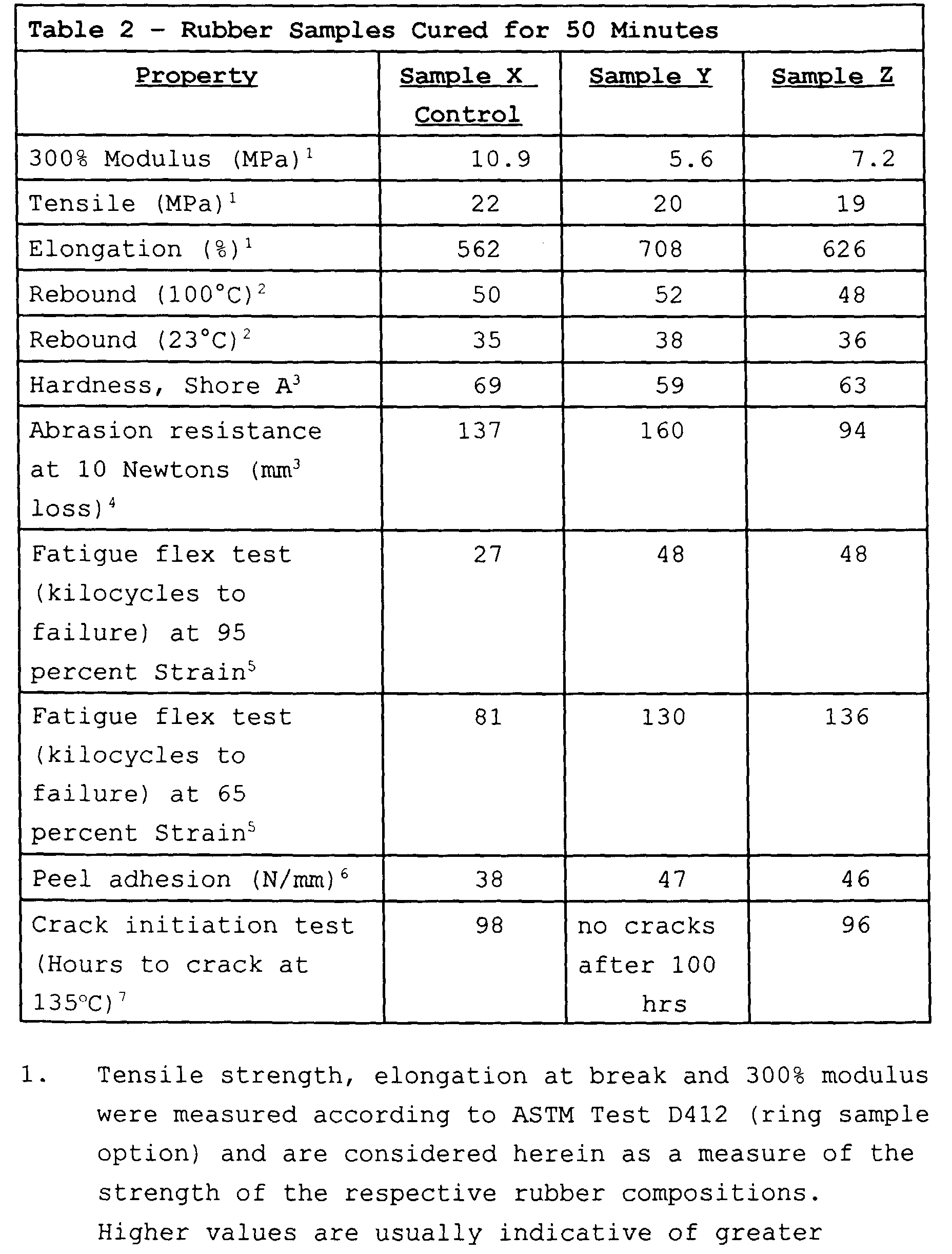

- The following physical properties of the Samples Y and Z are significantly better, or substantially equivalent, as compared to Control Sample X.
- 1. greater elongation at break;
- 2. greater number of kilocycles to Fatigue failure;
- 3. substantially equivalent Rebound properties;
- 4. substantially equivalent hardness and tensile strength.
-
- The improvements in the above respective elongation and fatigue failure properties while substantially maintaining Rebound, hardness, tensile strength and resistance to crack initiation is a significant overall improvement, particularly for durability of a rubber composition for a track tread which is expected to undergo extensive flexing when used as a vehicular track.
- Such improvement is particularly evident for Sample Z which also exhibited a significant improvement in abrasion resistance.
- It is considered herein that such improvements in the respective physical properties of Samples Y and Z, and particularly Sample Y, are achieved via a combination of
- 1. replacement of the styrene/butadiene rubber with cis 1,4-polybutadiene rubber and using an increased amount for Sample Y; and
- 2. use of a carbon black with higher colloidal properties as indicated by higher tint value 131 and higher nitrogen adsorption value of 130.
-
- It is important to appreciate that varying selection and amounts of ingredients in a rubber composition involves many trade-offs insofar as resultant rubber composition properties is concerned, particularly since it is often not reasonably possible to achieve all of desired physical properties for a tread rubber composition.
- For endless track treads of this invention, a primary objective is to maximize flex life and minimize both track wear and crack formation.
- The properties shown in Table 2 and the following Tables 3 and 4 show that the rubber composition exhibited by Sample Z significantly increases flex life and reduces track wear and tendency for crack initiation and fatigue failure. The undesirable, reduced hardness and rebound are considered to be within an acceptable range for the track of this invention.
- Actual portions of a track tread were prepared and vulcanized and identified herein as Samples XX, YY and ZZ which correspond to rubber compositions X, Y and Z of Example I herein, with Sample XX representing the Control Sample.
- In particular, as shown in Table 3 for Sample ZZ, the extension of the vulcanization time to 100 minutes for the track composition (Table 3) from 50 minutes (Table 2) for the rubber composition, it is observed that equivalent rubber composition physical properties were obtained with little or no reversion of its physical properties. This cure condition, namely 100 minutes at 150°C, is intended to simulate the production track cure process conditions.
Track Samples Cured for 100 Minutes Property Sample XX Control Sample YY Sample ZZ 300% Modulus (MPa) 9.6 5.4 6.3 Tensile (MPa) 20 17 17 Elongation (%) 547 654 637 Rebound (100°C) 50 46 42 Rebound (23°C) 35.3 35.8 33.7 Hardness, Shore A 65 56 62 DIN abrasion at 10 Newtons (mm3 loss) 139 - - Fatigue flex test (kilocycles to failure) 18.2 25.6 22.4 Crack initiation test at 135°C (Hours to crack) 142 223 194 Peel adhesion (N/mm) 32 53 50 - A continuous track was prepared similar to FIGURE 1 and tested with results shown in the following Table 4. Tracks XX YY and ZZ correspond to Samples XX, YY and ZZ.
Tracks Cured for approximately 100 Minutes Property Track XX Control Track YY Track ZZ A. Track Flex Test Total No. of cracks 1015 185 37 Total length of 3175 559 102 cracks (cm) Flex test ranking 3 2 1 B. Treadwear Test Average treadwear 1.67 1.53 1.16 (mm/hour) Wear ranking 3 2 1 - The track flex test data demonstrates a significant reduction in cracking, namely a significance in resistance to cracking for track tread Samples YY and ZZ. In particular, Samples YY and ZZ are, respectively, 82 percent and 96 percent better when compared to the control Sample XX.
- The track treadwear data also demonstrates a significant improvement in wear resistance for the track tread rubber compositions YY and ZZ. In particular, abrasion values for Samples YY and ZZ are 9 percent and 31 percent, respectively, better than that of control Sample XX.
Claims (6)
- An endless rubber track (1) designed to encompass at least one drive wheel and at least one driven wheel, comprised of an inner component containing a plurality of lugs (5) designed to be engaged and/or guided by said drive and driven wheels and an outer tread component (2), said tread component being of a configuration comprised of a plurality of co-extensive, raised lugs (3) thereon designed to ground engaging; wherein said tread is of a rubber composition comprised of, based upon 100 parts by weight elastomers (phr), (A) elastomers comprised of (1) 15 to 40 phr of cis 1,4-polybutadiene rubber and, correspondingly, (2) at least one additional elastomer selected from (i) 60 to 85 phr of natural cis 1,4-polyisoprene rubber and (ii) zero to 15 phr of styrene/butadiene copolymer rubber containing from 10 to 40 percent bound styrene, (B) 40 to 80 phr of reinforcing filler comprised of carbon black and a minor amount of precipitated silica; wherein said carbon black is present in an amount of 35 to 65 phr and said precipitated silica is present in an amount of from 3 to 20 phr and the ratio of said carbon black to precipitated silica is in a range of 4/1 to 7/1; wherein said reinforcing filler is exclusive of a coupling agent having a moiety reactive with silanol groups on the surface of said silica and another moiety interactive with said elastomer(s), (C) sulfur curative in a range of 0.75 to 1.5 phr and a sulfenamide sulfur cure accelerator, (D) 4.5 to 10 phr of antidegradant, and (E) zero to 10 phr of rubber processing oil selected from at least one of aromatic rubber processing oil and mixture of aromatic and naphthenic rubber processing oil; wherein said carbon black has an Iodine Number in a range of 115 to 130 g/kg, a DBP value in a range of 105 to 125 cm3/100g, and a Tint value in a range of 120 to 140.
- The track (1) of claim 1 wherein said carbon black is selected from at least one of N220 and N234.
- The track (1) of claim 1 or 2 wherein said antidegradant is selected from at least one of polymerized 2,2,4-trimethyl 1,2-dihydroquinoline, N-1,3-dimethylbutyl-N'-phenylpara-phenylenediamine and mixed aryl-p-phenylenediamines.
- The track (1) of any of the preceding claims, wherein the track is sulfur vulcanized.
- The track (1) of claim 4 wherein the rubber composition for said tread component (2) has a minimum flex fatigue resistance of at least 90 kilocycles at 65 percent strain according to ASTM D4482 and an abrasion resistance in a range of 70 to 100 mm3 loss according to ASTM D5963.
- A vehicle having at least two opposing endless rubber track systems, namely a track system on each side of the vehicle, for driving said vehicle over the ground, characterized in that said track systems are individually comprised of the track (1) of claim 4 or 5, a plurality of wheels engaged with said vehicle and encompassed by said track wherein at least one of said wheels is a drive wheel.
Applications Claiming Priority (2)
| Application Number | Priority Date | Filing Date | Title |
|---|---|---|---|
| US31050999A | 1999-05-12 | 1999-05-12 | |
| US310509 | 1999-05-12 |
Publications (3)
| Publication Number | Publication Date |
|---|---|
| EP1052165A2 true EP1052165A2 (en) | 2000-11-15 |
| EP1052165A3 EP1052165A3 (en) | 2003-07-09 |
| EP1052165B1 EP1052165B1 (en) | 2007-08-08 |
Family
ID=23202817
Family Applications (1)
| Application Number | Title | Priority Date | Filing Date |
|---|---|---|---|
| EP00109428A Expired - Lifetime EP1052165B1 (en) | 1999-05-12 | 2000-05-03 | Endless rubber track and vehicle containing such track |
Country Status (5)
| Country | Link |
|---|---|
| EP (1) | EP1052165B1 (en) |
| JP (1) | JP2001026671A (en) |
| BR (1) | BR0009622A (en) |
| CA (1) | CA2301788A1 (en) |
| DE (1) | DE60035824T2 (en) |
Cited By (4)
| Publication number | Priority date | Publication date | Assignee | Title |
|---|---|---|---|---|
| EP1120335A1 (en) * | 2000-01-28 | 2001-08-01 | The Goodyear Tire & Rubber Company | Endless rubber track and vehicle containing such track |
| US6799815B2 (en) | 2001-09-12 | 2004-10-05 | The Goodyear Tire & Rubber Company | Cold environment endless rubber track and vehicle containing such track |
| WO2009068392A1 (en) * | 2007-12-01 | 2009-06-04 | Continental Aktiengesellschaft | Rubber mixture having improved rupture property and improved wear |
| WO2018114084A1 (en) * | 2016-12-19 | 2018-06-28 | Contitech Transportbandsysteme Gmbh | Crawler track, in particular rubber crawler track |
Families Citing this family (10)
| Publication number | Priority date | Publication date | Assignee | Title |
|---|---|---|---|---|
| JP4064123B2 (en) * | 2002-02-14 | 2008-03-19 | 住友ゴム工業株式会社 | Rubber crawler |
| JP4235587B2 (en) * | 2004-06-03 | 2009-03-11 | 住友ゴム工業株式会社 | Rubber crawler |
| JP4879779B2 (en) * | 2007-03-02 | 2012-02-22 | 株式会社ブリヂストン | Rubber crawler |
| JP2011006590A (en) | 2009-06-26 | 2011-01-13 | Bridgestone Corp | Rubber crawler |
| WO2011082157A1 (en) * | 2009-12-30 | 2011-07-07 | Michelin Recherche Et Technique S.A. | Rubber composition with organic salt curing agent |
| CA2882515C (en) | 2012-08-31 | 2016-10-18 | Soucy Techno Inc. | Rubber compositions reinforced with fibers and nanometric filamentary structures, and uses thereof |
| JP5910426B2 (en) * | 2012-09-07 | 2016-04-27 | トヨタ自動車東日本株式会社 | Omni-directional wheel, omni-directional wheel unit and moving body |
| US9840611B2 (en) | 2013-10-18 | 2017-12-12 | Soucy Techno Inc. | Rubber compositions and uses thereof |
| CA2925929C (en) | 2013-12-19 | 2018-12-04 | Soucy Techno Inc. | Rubber compositions and uses thereof |
| CN113072748B (en) * | 2020-01-22 | 2023-08-01 | 江苏徐工工程机械研究院有限公司 | Heavy-duty rubber, preparation method and crawler belt |
Family Cites Families (14)
| Publication number | Priority date | Publication date | Assignee | Title |
|---|---|---|---|---|
| US3781067A (en) * | 1972-09-21 | 1973-12-25 | Goodyear Tire & Rubber | Belt track structure |
| US4279449A (en) * | 1978-07-20 | 1981-07-21 | The Goodyear Tire & Rubber Company | Slide surface compound for track-driven vehicle |
| JPH06867B2 (en) * | 1986-05-26 | 1994-01-05 | 旭カ−ボン株式会社 | Highly reinforced farnes car bomb rack for rubber |
| JPH05170974A (en) * | 1991-12-25 | 1993-07-09 | Yokohama Rubber Co Ltd:The | Rubber composition for tire tread |
| US5760114A (en) * | 1996-08-26 | 1998-06-02 | The Goodyear Tire & Rubber Company | Rubber compound containing aminobenzylamine |
| JPH1121363A (en) * | 1997-07-04 | 1999-01-26 | Bridgestone Corp | Rubber composition, vulcanized rubber and tire |
| JP4750235B2 (en) * | 1997-07-04 | 2011-08-17 | 株式会社ブリヂストン | Vulcanized rubber and tires |
| US5844044A (en) * | 1997-07-18 | 1998-12-01 | The Goodyear Tire & Rubber Company | Trans 1,4-butadiene/isoprene copolymers and tire with tread thereof |
| US5997673A (en) * | 1997-09-04 | 1999-12-07 | The Goodyear Tire & Rubber Company | Tire tread compounds comprising partially crosslinked natural rubber |
| JPH11139359A (en) * | 1997-11-04 | 1999-05-25 | Bridgestone Corp | Rubber crawler |
| JP3410950B2 (en) * | 1998-02-16 | 2003-05-26 | オーツタイヤ株式会社 | Rubber composition for tire driven elastic crawler |
| AU1862899A (en) * | 1998-03-11 | 1999-09-23 | Goodyear Tire And Rubber Company, The | Emulsion styrene-butadiene rubber |
| JP4342008B2 (en) * | 1998-08-20 | 2009-10-14 | 住友ゴム工業株式会社 | Rubber composition for preventing mud adhesion in traveling body |
| JP2000344947A (en) * | 1999-06-09 | 2000-12-12 | Ohtsu Tire & Rubber Co Ltd :The | Rubber composition |
-
2000
- 2000-03-21 CA CA 2301788 patent/CA2301788A1/en not_active Abandoned
- 2000-05-03 EP EP00109428A patent/EP1052165B1/en not_active Expired - Lifetime
- 2000-05-03 DE DE2000635824 patent/DE60035824T2/en not_active Expired - Fee Related
- 2000-05-08 BR BR0009622-9A patent/BR0009622A/en not_active IP Right Cessation
- 2000-05-12 JP JP2000139922A patent/JP2001026671A/en active Pending
Non-Patent Citations (1)
| Title |
|---|
| None |
Cited By (5)
| Publication number | Priority date | Publication date | Assignee | Title |
|---|---|---|---|---|
| US6296329B1 (en) | 1999-05-12 | 2001-10-02 | The Goodyear Tire & Rubber Company | Endless rubber track and vehicle containing such track |
| EP1120335A1 (en) * | 2000-01-28 | 2001-08-01 | The Goodyear Tire & Rubber Company | Endless rubber track and vehicle containing such track |
| US6799815B2 (en) | 2001-09-12 | 2004-10-05 | The Goodyear Tire & Rubber Company | Cold environment endless rubber track and vehicle containing such track |
| WO2009068392A1 (en) * | 2007-12-01 | 2009-06-04 | Continental Aktiengesellschaft | Rubber mixture having improved rupture property and improved wear |
| WO2018114084A1 (en) * | 2016-12-19 | 2018-06-28 | Contitech Transportbandsysteme Gmbh | Crawler track, in particular rubber crawler track |
Also Published As
| Publication number | Publication date |
|---|---|
| EP1052165B1 (en) | 2007-08-08 |
| JP2001026671A (en) | 2001-01-30 |
| DE60035824T2 (en) | 2008-05-15 |
| CA2301788A1 (en) | 2000-11-12 |
| DE60035824D1 (en) | 2007-09-20 |
| EP1052165A3 (en) | 2003-07-09 |
| BR0009622A (en) | 2002-04-23 |
Similar Documents
| Publication | Publication Date | Title |
|---|---|---|
| US6296329B1 (en) | Endless rubber track and vehicle containing such track | |
| US6799815B2 (en) | Cold environment endless rubber track and vehicle containing such track | |
| US6429245B1 (en) | Tire tread with elastomers of spatially defined Tg's | |
| EP1033265B1 (en) | Tire with reinforced rubber sidewall | |
| US6761198B2 (en) | Pneumatic tire having lug and groove configuration extending from tread over at least 30% of sidewall | |
| EP0632093B1 (en) | Silica reinforced rubber composition | |
| US5336730A (en) | Tire with silica reinforced tread | |
| EP1092565B1 (en) | Tire with silica-reinforced tread comprised of trans 1,4-polybutadiene, solution SBR, polyisoprene and defined amount of carbon black and amorphous silica | |
| EP0791623B1 (en) | Silica reinforced rubber composition and tire with tread thereof | |
| US5877249A (en) | Tire with tread having silica reinforcement field | |
| US8957149B2 (en) | Preparation and use of silica reinforced rubber composition for truck tire tread | |
| EP1052165B1 (en) | Endless rubber track and vehicle containing such track | |
| MXPA97000990A (en) | Composition of reinforced rubber with silice and silver with bearing band of the mi | |
| US6579930B2 (en) | Tire with minimal-marking tread and skid steering, fixed axle, tire/wheel or vehicular track assembly where said tire or track has a minimal-marking tread | |
| EP2452831B1 (en) | Tire with tread containing carboxylated styrene/butadiene rubber | |
| US5756589A (en) | Silica reinforced rubber composition and use in tires | |
| US6913329B1 (en) | Endless rubber track having guide lugs with guide lug support layer, and vehicle containing such track | |
| US20050056356A1 (en) | Farm tractor drive tire with tread of rubber composition containing dispersion of in situ silane modified composite of plasticizer treated starch core | |
| EP1726617B1 (en) | Tire with tread comprised of natural rubber and specialized emulsion prepared styrene/butadiene elastomer | |
| US20040116574A1 (en) | Tire with rubber composition | |
| EP1197515A1 (en) | Endless rubber track having guide lugs with guide lug support layer, and vehicle containing such track | |
| EP0863027A2 (en) | Tyre with chafer composition | |
| EP0796893A1 (en) | Tire having silica reinforced tread | |
| US6410624B1 (en) | Tire with tread of novel polymer blend including styrene-rich styrene/isoprene/butadiene segmented terpolymer | |
| EP0735085A1 (en) | Silica reinforced rubber composition and tire with tread |
Legal Events
| Date | Code | Title | Description |
|---|---|---|---|
| PUAI | Public reference made under article 153(3) epc to a published international application that has entered the european phase |
Free format text: ORIGINAL CODE: 0009012 |
|
| AK | Designated contracting states |
Kind code of ref document: A2 Designated state(s): AT BE CH CY DE DK ES FI FR GB GR IE IT LI LU MC NL PT SE |
|
| AX | Request for extension of the european patent |
Free format text: AL;LT;LV;MK;RO;SI |
|
| PUAL | Search report despatched |
Free format text: ORIGINAL CODE: 0009013 |
|
| AK | Designated contracting states |
Designated state(s): AT BE CH CY DE DK ES FI FR GB GR IE IT LI LU MC NL PT SE |
|
| AX | Request for extension of the european patent |
Extension state: AL LT LV MK RO SI |
|
| 17P | Request for examination filed |
Effective date: 20040109 |
|
| AKX | Designation fees paid |
Designated state(s): DE ES FR GB IT |
|
| GRAP | Despatch of communication of intention to grant a patent |
Free format text: ORIGINAL CODE: EPIDOSNIGR1 |
|
| GRAS | Grant fee paid |
Free format text: ORIGINAL CODE: EPIDOSNIGR3 |
|
| GRAA | (expected) grant |
Free format text: ORIGINAL CODE: 0009210 |
|
| AK | Designated contracting states |
Kind code of ref document: B1 Designated state(s): DE ES FR GB IT |
|
| REG | Reference to a national code |
Ref country code: GB Ref legal event code: FG4D |
|
| REF | Corresponds to: |
Ref document number: 60035824 Country of ref document: DE Date of ref document: 20070920 Kind code of ref document: P |
|
| PG25 | Lapsed in a contracting state [announced via postgrant information from national office to epo] |
Ref country code: ES Free format text: LAPSE BECAUSE OF FAILURE TO SUBMIT A TRANSLATION OF THE DESCRIPTION OR TO PAY THE FEE WITHIN THE PRESCRIBED TIME-LIMIT Effective date: 20071119 |
|
| ET | Fr: translation filed | ||
| PLBE | No opposition filed within time limit |
Free format text: ORIGINAL CODE: 0009261 |
|
| STAA | Information on the status of an ep patent application or granted ep patent |
Free format text: STATUS: NO OPPOSITION FILED WITHIN TIME LIMIT |
|
| 26N | No opposition filed |
Effective date: 20080509 |
|
| GBPC | Gb: european patent ceased through non-payment of renewal fee |
Effective date: 20080503 |
|
| REG | Reference to a national code |
Ref country code: FR Ref legal event code: ST Effective date: 20090119 |
|
| PG25 | Lapsed in a contracting state [announced via postgrant information from national office to epo] |
Ref country code: FR Free format text: LAPSE BECAUSE OF NON-PAYMENT OF DUE FEES Effective date: 20080602 Ref country code: DE Free format text: LAPSE BECAUSE OF NON-PAYMENT OF DUE FEES Effective date: 20081202 |
|
| PG25 | Lapsed in a contracting state [announced via postgrant information from national office to epo] |
Ref country code: GB Free format text: LAPSE BECAUSE OF NON-PAYMENT OF DUE FEES Effective date: 20080503 |
|
| PG25 | Lapsed in a contracting state [announced via postgrant information from national office to epo] |
Ref country code: IT Free format text: LAPSE BECAUSE OF NON-PAYMENT OF DUE FEES Effective date: 20080531 |