EP1052112A2 - Color developer composition, aqueous dispersion, recording sheet and color developing ink - Google Patents
Color developer composition, aqueous dispersion, recording sheet and color developing ink Download PDFInfo
- Publication number
- EP1052112A2 EP1052112A2 EP00303959A EP00303959A EP1052112A2 EP 1052112 A2 EP1052112 A2 EP 1052112A2 EP 00303959 A EP00303959 A EP 00303959A EP 00303959 A EP00303959 A EP 00303959A EP 1052112 A2 EP1052112 A2 EP 1052112A2
- Authority
- EP
- European Patent Office
- Prior art keywords
- color developer
- developer composition
- color
- salicylic acid
- aqueous dispersion
- Prior art date
- Legal status (The legal status is an assumption and is not a legal conclusion. Google has not performed a legal analysis and makes no representation as to the accuracy of the status listed.)
- Granted
Links
Images
Classifications
-
- B—PERFORMING OPERATIONS; TRANSPORTING
- B41—PRINTING; LINING MACHINES; TYPEWRITERS; STAMPS
- B41M—PRINTING, DUPLICATING, MARKING, OR COPYING PROCESSES; COLOUR PRINTING
- B41M5/00—Duplicating or marking methods; Sheet materials for use therein
- B41M5/26—Thermography ; Marking by high energetic means, e.g. laser otherwise than by burning, and characterised by the material used
- B41M5/30—Thermography ; Marking by high energetic means, e.g. laser otherwise than by burning, and characterised by the material used using chemical colour formers
- B41M5/333—Colour developing components therefor, e.g. acidic compounds
- B41M5/3333—Non-macromolecular compounds
- B41M5/3335—Compounds containing phenolic or carboxylic acid groups or metal salts thereof
-
- G—PHYSICS
- G03—PHOTOGRAPHY; CINEMATOGRAPHY; ANALOGOUS TECHNIQUES USING WAVES OTHER THAN OPTICAL WAVES; ELECTROGRAPHY; HOLOGRAPHY
- G03G—ELECTROGRAPHY; ELECTROPHOTOGRAPHY; MAGNETOGRAPHY
- G03G9/00—Developers
-
- B—PERFORMING OPERATIONS; TRANSPORTING
- B41—PRINTING; LINING MACHINES; TYPEWRITERS; STAMPS
- B41M—PRINTING, DUPLICATING, MARKING, OR COPYING PROCESSES; COLOUR PRINTING
- B41M5/00—Duplicating or marking methods; Sheet materials for use therein
- B41M5/124—Duplicating or marking methods; Sheet materials for use therein using pressure to make a masked colour visible, e.g. to make a coloured support visible, to create an opaque or transparent pattern, or to form colour by uniting colour-forming components
- B41M5/132—Chemical colour-forming components; Additives or binders therefor
- B41M5/155—Colour-developing components, e.g. acidic compounds; Additives or binders therefor; Layers containing such colour-developing components, additives or binders
-
- B—PERFORMING OPERATIONS; TRANSPORTING
- B41—PRINTING; LINING MACHINES; TYPEWRITERS; STAMPS
- B41M—PRINTING, DUPLICATING, MARKING, OR COPYING PROCESSES; COLOUR PRINTING
- B41M5/00—Duplicating or marking methods; Sheet materials for use therein
- B41M5/26—Thermography ; Marking by high energetic means, e.g. laser otherwise than by burning, and characterised by the material used
- B41M5/30—Thermography ; Marking by high energetic means, e.g. laser otherwise than by burning, and characterised by the material used using chemical colour formers
- B41M5/337—Additives; Binders
- B41M5/3372—Macromolecular compounds
Definitions
- the present invention relates to a color developer composition, and an aqueous dispersion, recording sheet and color developing ink obtained by using the same.
- Examples of pressure-sensitive recording sheets include an upper sheet prepared by applying on one surface of a base material microcapsules comprising therein a capsule oil dissolving an electron donative developing compound (color former) and the like, an intermediate sheet prepared by applying on one surface of a base material a color developer (electron receptive compound) which develops color in contact with an electron donative developing compound and by applying on the opposite surface microcapsules, and a lower sheet prepared by applying on one surface of a base material a developer, and in general, they are used in a combination of upper sheet-lower sheet or upper sheet-intermediate sheet-lower sheet.
- an upper sheet prepared by applying on one surface of a base material microcapsules comprising therein a capsule oil dissolving an electron donative developing compound (color former) and the like
- an intermediate sheet prepared by applying on one surface of a base material a color developer (electron receptive compound) which develops color in contact with an electron donative developing compound and by applying on the opposite surface microcapsules
- a copy sheet in the form of a single body which can effect copying with a single sheet, prepared by applying on the same surface of a base material microcapsules and a color developer.
- salicylic acid derivatives for example, polyvalent metal salts of 3,5-disubstituted salicylic acid derivatives (e.g., Japanese Patent Publication (JP-B) No. 51-25174), or polyvalent metal salts of a salicylic acid resin obtained by reacting salicylates with styrenes to obtain salicylate resins, hydrolyzing the salicylate resins, then, allowing polyvalent metal compounds to act on the hydrolyzates (Japanese Patent Application Laid-Open (JP-A) No. 1-133780), have been known to be useful as a developer (electron receptive compound) for a pressure-sensitive recording sheet.
- JP-B Japanese Patent Publication
- JP-A Japanese Patent Application Laid-Open
- a composition containing a metal salt of an aromatic carboxylic acid, and a carboxylic amide JP-A No. 2-215582
- a composition obtained by dissolving a polyvalent metal salt of a salicylic acid derivative into vegetable oil and an organic solvent having a boiling point of 200°C or lower, and emulsifying the solution in water JP-A No. 4-52184
- a composition composed of a polyvalent metal salt of a salicylic acid derivative, and a polyoxyalkylene or derivative thereof JP-A No. 6-15951
- a preferred embodiment of the present invention may enable one to provide a color developer composition which has excellent dispersion stability and manifests excellent color developing speed, and an aqueous dispersion, recording sheet and color developing ink obtained by using the same.
- the present inventors have intensively investigated a color developer composition, and an aqueous dispersion, recording sheet and color developing ink thereof and resultantly completed the present invention. Namely, the present invention relates to
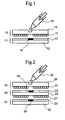
- Fig. 1 is a schematic configuration view of one example of a pressure-sensitive recording sheet.
- Fig. 2 is a schematic configuration view of another example of a pressure-sensitive recording sheet.
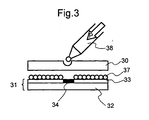
- Fig. 3 is a schematic configuration view of further another example of a pressure-sensitive recording sheet.
- the color developer composition, aqueous dispersion, recording sheet and color developing ink of the present invention will be described in detail below.
- the color developer composition of the present invention comprises a component (A): a color developer containing a polyvalent metal salt of a salicylic acid derivative, and a component (B): a polyester polyol having in the molecule skeleton at least one carbonate bond or ester bond, and a derivative thereof.
- polyvalent metal salt of a salicylic acid derivative which is a component of the component (A) of the present invention
- R 1 to R 4 include a hydrogen atom, fluorine atom, chorine atom, bromine atom, alkyl group having 1 to 20 carbon atoms, alkoxy group having 1 to 20 carbon atoms, aralkyl group which may have a substituent having a total carbon number of 7 to 20, or aryl group which may have a substituent having a total carbon number of 6 to 20.
- polyvalent metal salt of a salicylic acid derivative of the present invention include polyvalent metal salts of salicylic acid, 3-methylsalicylic acid, 6-ethylsalicylic acid, 5-isopropylsalicylic acid, 5-sec-butylsalicylic acid, 5-tert-butylsalicylic acid, 5-tert-amylsalicylic acid, 5-cyclohexylsalicylic acid, 5-n-octylsalicylic acid, 5-tert-octylsalicylic acid, 5-isononylsalicylic acid, 3-isododecylsalicylic acid, 5-isododecylsalicylic acid, 5-isopentadecylsalicylic acid, 4-methoxysalicylic acid, 6-methoxysalicylic acid, 5-ethoxysalicylic acid, 6-isopropoxysalicylic acid, 4-n-hexyloxylsalicylic acid
- examples of the polyvalent metal salt of a salicylic acid derivative of the present invention include polyvalent metal salts of 2-hydroxy-1-benzyl-3-naphthoic acid, 2-hydroxy-3-( ⁇ , ⁇ -dimethylbenzyl)-1-naphtoic acid, 3-hydroxy-7-( ⁇ , ⁇ -dimethylbenzyl)-2-naphtoic acid, further, carboxy-modified terpene-phenol resins described in JP-A No. 62-19486, polystyrenated salicylic acid resin derivatives described in JP-A Nos. 63-112537, 63-186729, 1-133780 and the like, polybenzylated styrenated salicylic acid resin derivatives described in JP-A No. 2-160815, and the like.
- the isononyl group, isododecyl group, and isopentadecyl group are generic names for substituents generated by addition of a propylene trimer, propylene tetramer or 1-butene trimer, and propylene pentamer, respectively.
- salicylic acid derivatives are partially available commercially, and can be obtained, for example, from phenol derivatives by Kolbe-Schmitt reaction.
- magnesium, zinc, nickel, aluminum and calcium are listed, and zinc is particularly preferable.
- polyvalent metal salts of salicylic acid derivatives may be used alone, or in combination of two or more. Further, polyvalent metal salts of a mixture of salicylic acid derivatives which are obtained by polyvalent metal salt-formation using a plurality of salicylic acid derivatives may also permissible.
- the polyvalent metal salt of a salicylic acid derivative of the present invention may sometimes form a hydrate, and in the present specification, the polyvalent metal salt of a salicylic acid derivative also include such hydrates.
- the component (B) according to the present invention includes a polyester polyol having in the molecule skeleton at least one carbonate bond or ester bond, and a derivative thereof.
- Derivatives include compounds in which one or more hydroxy groups are derivatised, e.g. to form ether or ester groups.
- polyester polyol having in the molecule skeleton at least one carbonate bond or ester bond which is the component (B) of the present invention
- carbonate diols lactone-based polyester polyols
- condensed polyester polyols and the like.
- polycarbonate diols which are one embodiment of the component (B) of the present invention, are polyethylene carbonate diol, polypropylene carbonate diol, polytetramethylene carbonate diol, polypentamethylene carbonate diol, polyhexamethylene carbonate diol, polyheptamethylene carbonate diol, or polycarbonate diols obtained by substituting an alkoxy group, acyloxy group and the like for the end groups of these polycarbonate diols, and the like. These polycarbonate diols may be used alone, or in combination of two or more.
- the average molecular weight of the polycarbonate diol according to the present invention is generally from about 500 to 30000, preferably from about 600 to 10000, more preferably from about 700 to 5000, particularly preferably from about 800 to 4000.
- lactone-based polyester polyol which is one embodiment of the component (B) of the present invention
- lactone-based polyester polyol which is one embodiment of the component (B) of the present invention
- examples of the caprolactone include ⁇ -butyrolactone, ⁇ -valerolactone and ⁇ -caprolactone.
- polyvalent alcohol used as an initiator examples include ethylene glycol, propylene glycol, butanediol, hexanediol, neopentyl glycol, diethylene glycol, triethylene glycol, pentanediol, cyclohexanediol, glycerine, trimethylolpropane, trimethylolethane, pentaerythritol, polyethylene ether glycol, polypropylene ether glycol, polybutylene ether glycol, polytetramethylene ether glycol, polypentamethylene ether glycol and polyhexamethylene ether glycol.
- lactone-based polyester polyols obtained by substituting an alkoxy group, acyloxy group and the like for the end groups of these lactone-based polyester polyols, are listed. These lactone-based polyester polyols may be used alone or in combination of two or more.
- the average molecular weight of the lactone-based polyester polyol according to the present invention is generally from about 500 to 30000, preferably from about 600 to 10000, more preferably from about 700 to 5000, particularly preferably from about 800 to 4000.
- the condensed polyester polyol which is one embodiment of the component (B) of the present invention
- the condensed polyester polyol which is one embodiment of the component (B) of the present invention
- the dicarboxylic acid include adipic acid, o-phthalic acid, m-phthalic acid, p-phthalic acid, succinic acid, azelaic acid, suberic acid, ricinoleic acid and the like.
- polyvalent alcohol examples include ethylene glycol, propylene glycol, butanediol, hexanediol, neopentyl glycol, diethylene glycol, triethylene glycol, pentanediol, cyclohexanediol, glycerine, trimethylolpropane, trimethylolethane, pentaerythritol and the like.
- condensed polyester polyols obtained by substituting an alkoxy group, acyloxy group and the like for the end groups of these condensed type polyester polyols, are listed. These condensed polyester polyols may be used alone or in combination of two or more.
- the average molecular weight of the condensed polyester polyol according to the present invention is generally from about 500 to 30000, preferably from about 600 to 10000, more preferably from about 700 to 5000, particularly preferably from about 800 to 4000.
- polycarbonate diols lactone-based polyester polyols, or condensed polyester polyols may be used together.
- the color developer composition of the present invention is a color developer composition
- a color developer composition comprising (A) a color developer containing a polyvalent metal salt of a salicylic acid derivative, and (B) a polyester polyol having in the molecule skeleton at least one carbonate bond or ester bond, and a derivative thereof, and though there is no specific restriction to the composition thereof, and the total amount of a polyester polyol having in the molecule skeleton at least one carbonate bond or ester bond, and a derivative thereof included in the component (B) is generally from about 1 to 100 parts by weight, preferably from 1 to 40 parts by weight, more preferably from 1 to 25 parts by weight based on 100 parts by weight of a color developer containing a polyvalent metal salt of a salicylic acid derivative as the component (A).
- the component (B) may be added directly to the component (A), a color developer containing a polyvalent metal salt of a salicylic acid derivative, or the component (B) may be added to an aqueous dispersion of the component (A).
- an aqueous dispersion of a color developer containing a polyvalent metal salt of a salicylic acid derivative may be prepared before compounding of the component (B) to the dispersion, or in preparing an aqueous dispersion of a color developer containing a polyvalent metal salt of a salicylic acid derivative, the component (B) may be dispersed together with the color developer (emulsion-dispersion).
- the component (B) in preparing an aqueous dispersion of the component (A), a color developer containing a polyvalent metal salt of a salicylic acid derivative, the component (B) is dispersed together with the color developer (emulsion-dispersion).
- the color developer composition of the present invention is a color developer composition comprising (A) a color developer containing a polyvalent metal salt of a salicylic acid derivative, and (B) a polyester polyol having in the molecule skeleton at least one carbonate bond or ester bond, and a derivative thereof, and further, there may be a preferable case in which a color developer composition having further improved color developing speed under lower temperature environment can be obtained by inclusion of an oligomer of a styrene derivative, preferably an oligomer of 2 to 20 styrene derivatives.
- This oligomer may be a linear oligomer (for example, liner dimer of styrene, 1,3-diphenyl-1-butene), or a cyclic oligomer (for example, cyclic dimer of styrene, 1-methyl-3-phenyl-indane), or also a mixture thereof.
- linear oligomer for example, liner dimer of styrene, 1,3-diphenyl-1-butene
- a cyclic oligomer for example, cyclic dimer of styrene, 1-methyl-3-phenyl-indane
- known color developers e.g., acid clay minerals such as acid clay, activated clay, attapulgite and bentonite, phenols-formaldehyde condensate, phenols-salicylic acids-formaldehyde condensate, or polyvalent metal salts of these condensates, and the like.
- acid clay minerals such as acid clay, activated clay, attapulgite and bentonite
- phenols-formaldehyde condensate phenols-salicylic acids-formaldehyde condensate
- polyvalent metal salts of these condensates e.g., sodium sulfate, sodium phenols-formaldehyde condensate, sodium phenols-salicylic acids-formaldehyde condensate, or polyvalent metal salts of these condensates, and the like.
- color developer composition of the present invention may contain various additives such as ultraviolet absorber, antioxidant and light stabilizer, if necessary.
- Examples of the ultraviolet absorber which can be used in the color developer composition of the present invention include benzophenone derivatives such as 2,4-dihydroxybenzophenone, 2-hydroxy-4-methoxybenzophenone, 2-hydroxy-4-dodecyloxybenzophenone, benzotriazole derivatives such as 2-(2'-hydroxy-5'-methylphenyl)-benzotriazole, 2-(2'-hydroxyl-5'-tert-butylphenyl)-benzotriazole, 2-(2'-hydroxyl-3',5'-di-tert-butylphenyl)benzotriazole, cyano acrylate derivatives such as 2-ethylhexyl-2-cyano-3,3'-diphenyl acrylate and ethyl-2-cyano-3,3'-diphenyl acrylate.
- benzophenone derivatives such as 2,4-dihydroxybenzophenone, 2-hydroxy-4-methoxybenzophenone, 2-hydroxy-4-dode
- the amount of the ultraviolet absorber contained in the color developer composition of the present invention is generally from 0.1 to 30 parts by weight, preferably from 1 to 20 parts by weight based on 100 parts by weight of the color developer (A) containing a polyvalent metal salt of a salicylic acid derivative.
- antioxidants examples include phenol derivatives such as 2,6-di-tert-butylphenol, 2,6-diisopropyl-4-methylphenol, 2,6-di-tert-butyl-4-methylphenol, 2-tert-butyl-4-methoxyphenol, 2,5-di-tert-octyl-4-methoxyphenol, 2,5-di-tert-butylhydroquinone, 2,5-di-tert-octylhydroquinone, 1,1,3-tris(2'-methyl-4'-hydroxy-5'-tert-butylphenyl)butane, 1,1,3-tris(2'-methyl-4'-hydroxy-5'-cyclohexylphenyl)butane, 1,1,3-tris(2'-ethyl-4'-hydroxy-5'-tert-butylphenyl)butane, 1,1,3-tris(3',5'-di-tert-butyl-4'-hydroxy
- the amount of the antioxidant contained in the color developer composition of the present invention is generally from 0.1 to 30 parts by weight, preferably from 1 to 20 parts by weight based on 100 parts by weight of the component (A).
- Examples of the light stabilizer include hindered amine derivatives such as 2,2,4-trimethyl-1,2-dihydroquinoline polymer, 6-ethoxy-2,2,4-trimethyl-1,2-dihydroquinoline, 4-benzyloxy-2,2,6,6-tetramethylpiperidine and bis(2,2,6,6-tetramethylpiperidine) adipate.
- hindered amine derivatives such as 2,2,4-trimethyl-1,2-dihydroquinoline polymer, 6-ethoxy-2,2,4-trimethyl-1,2-dihydroquinoline, 4-benzyloxy-2,2,6,6-tetramethylpiperidine and bis(2,2,6,6-tetramethylpiperidine) adipate.
- the amount of the light stabilizer contained in the color developer composition of the present invention is generally from 0.1 to 30 parts by weight, preferably from 1 to 20 parts by weight based on 100 parts by weight of the component (A).
- an aqueous dispersion of the color developer composition of the present invention may be prepared before compounding the additive into the aqueous dispersion, or in preparing an aqueous dispersion of the color developer composition, the additive may be dispersed together with the color developer composition (emulsion-dispersion), and more preferably, in preparing an aqueous dispersion of the color developer composition, the additive is dispersed together with the color developer composition (emulsion-dispersion).
- the color developer composition of the present invention is generally used in the form of an aqueous dispersion, coating solution obtained by using an aqueous dispersion, and the like.
- An aqueous dispersion of the color developer composition of the present invention is applied as it is or in the form of a coating solution, onto a base material to form a layer of the color developer composition to be used as a recording sheet.
- the method (II) in which an aqueous dispersion is prepared by emulsion-dispersion is more preferable method.
- Preparation of an aqueous solution of a color developer composition is generally conducted in a water medium in the presence of a dispersing agent.
- ionic or nonionic surfactants are preferable, and examples thereof include synthetic or natural polymer compounds such as polyvinyl alcohol, alkyl-modified polyvinyl alcohol, cyanoethyl-modified polyvinyl alcohol, ether-modified polyvinyl alcohol, sulfonated polyvinyl alcohol, polyacrylamide, polyacrylic acid, acrylamide-alkyl acrylate copolymer, alkali metal salt of polystyrenesulfonic acid, maleic anhydride-isobutyrene copolymer, carboxymethylcellulose, hydroxyethylcellulose, polyvinylpyrrolidone, starch and derivatives thereof, casein, gum arabic, agar, gelatin and the like, alkali metal salts of alkylbenzenesulfonic acids, alkali metal salts of alkylnaphthalenesulfonic acids, alkali metal salts of dialkyl
- Polyvinyl alcohol alkyl-modified polyvinyl alcohol, cyanoethyl-modified polyvinyl alcohol, ether-modified polyvinyl alcohol, sulfonated polyvinyl alcohol, alkali metal salts of polystyrenesulfonic acid, alkali metal salts of alkylsulfonic acids are preferable, polyvinyl alcohol is more preferable, and polyvinyl alcohol having a saponification degree of 80 to 100% is particularly preferable. These dispersing agents may be used alone or in combination of two or more.
- the use amount of the dispersing agent is not particularly restricted, and in general, for example from about 1 to 30 parts by weight, more preferably from about 1 to 20 parts by weight, more preferably from about 1 to 15 parts by weight, particularly preferably from about 1 to 10 parts by weight, based on 100 parts by weight of a color developer composition containing a polyvalent metal salt of a salicylic acid derivative.
- organic solvent used those having smaller solubility in water, excellent property for dissolving a color developer composition, and relatively lower boiling point are preferable.
- organic solvent examples include hydrocarbon solvents such as benzene, toluene, xylene, ethylbenzene and 1-methylnaphthalene, halogenated hydrocarbon solvents such as dichloromethane, chloroform, tetrachloroethylene, 1,2-dichloroethane, 1,1,1-trichloroethane, 1,1,2-trichloroethane, 1,1,2,2-tetrachloroethane, chlorobenzene, o-dichlorobenzene, m-dichlorobenzene, p-dichlorobenzene, o-chlorotoluene, m-clorotoluene and p-chlorotoluene, ketone solvents such as methyl ethyl ketone, methyl isobutyl ketone and cyclohexanone, ester solvents such as ethyl acetate, butyl acetate and am
- the use amount of the organic solvent is not particularly restricted, and in general, for example, from about 5 to 500 parts by weight, more preferably from about 20 to 300 parts by weight based on 100 parts by weight of a color developer composition containing a polyvalent metal salt of a salicylic acid derivative.
- the emulsion-dispersion is conducted at a temperature of not more than the boiling point of an organic solvent, and effected under atmospheric pressure or positive pressure.
- an organic solvent is distilled off to obtain an aqueous dispersion of a color developer composition.
- the organic solvent can be distilled off by heating at a temperature not lower than the boiling point of the organic solvent under atmospheric pressure or reduced pressure.
- aqueous dispersion can also be dispersed further using a disperser (for example, sand grinder, annular mill and the like), if necessary.
- the concentration of solid components is 55% by weight or less, preferably 50% by weight or less.
- the average particle size of a color developer composition in the aqueous dispersion of the present invention is generally 10 ⁇ m or less, preferably from about 0.1 to 5 ⁇ m, more preferably from about 0.2 to 3 ⁇ m, particularly preferably from about 0.3 to 2 ⁇ m.
- the aqueous dispersion of the color developer composition of the present invention may further contain a binder (binding agent), pigment and the like in addition to the color developer composition to provide a solution which can be used as a coating solution.
- This coating solution may also contain various additives such as a de-foaming agent, pH regulating agent and viscosity controlling agent, if necessary.
- the content of solid components in the coating solution is from about 10 to 60% by weight, preferably from about 15 to 50% by weight.
- the binder is not particularly restricted, and examples thereof include synthetic or natural polymer compounds such as polyvinyl alcohol, casein, starch and derivatives thereof, gum arabic, methylcellulose, carboxymethylcellulose, polyacrylic acid, and latices such as styrene-butadiene copolymer latex and acrylic acid latex.
- the binder may be used alone or in combination of two or more.
- the use amount of the binder is not particularly restricted, and in general, from about 3 to 40% by weight, preferably from about 5 to 30% by weight based on the total solid content in the coating solution.
- the pigment is not particularly restricted, and examples thereof include inorganic pigments such as zinc oxide, zinc carbonate, calcium carbonate, magnesium carbonate, barium carbonate, magnesium sulfate, barium sulfate, titanium oxide, talc, kaolin, activated clay, diatomaceous earth, zinc hydroxide, aluminum hydroxide, magnesium hydroxide, alumina and silica, organic pigments such as styrene-microball, nylon particle, urea-formalin filler, polyethylene particle, cellulose filler and starch particle.
- inorganic pigments such as zinc oxide, zinc carbonate, calcium carbonate, magnesium carbonate, barium carbonate, magnesium sulfate, barium sulfate, titanium oxide, talc, kaolin, activated clay, diatomaceous earth, zinc hydroxide, aluminum hydroxide, magnesium hydroxide, alumina and silica
- organic pigments such as styrene-microball, nylon particle, urea-formalin filler
- the pigment may be used alone or in combination of two or more.
- the use amount of the pigment is not particularly restricted, and in general, from about 5 to 90% by weight, preferably from about 10 to 85% by weight based on the total solid content in the coating solution.
- aqueous dispersion of a color developer composition of the present invention can be applied on a base material such as paper, plastic sheet, synthetic paper, or composite sheets made by combining them by an application apparatus such as, for example, an air knife coater, blade coater, roll coater, size press coater, curtain coater and short dwell coater according to a known method, and dried to form a layer of the color developer, manufacturing a recording sheet.
- an application apparatus such as, for example, an air knife coater, blade coater, roll coater, size press coater, curtain coater and short dwell coater according to a known method, and dried to form a layer of the color developer, manufacturing a recording sheet.
- the weight of a layer of a color developer composition on a base material is not particularly restricted, and in general, is 0.5 g/m 2 or more, preferably from about 0.5 to 10 g/m 2 .
- the form of the recording sheet of the present invention is not particularly restricted, and there are exemplified pressure-sensitive recording sheets, heat-sensitive recording sheets, heat-sensitive multiple copying sheets described in JP-A No. 10-166723, and the like. Pressure-sensitive recording sheets are more preferable.
- the microcapsule can be produced by known various micro capsulation methods such as, for example, a coacervation method, interfacial polymerization method, inner polymerization method, phase separation method and outer polymerization method, using a solution prepared by dissolving an electron-donative color developing compound in a capsule oil.
- the wall film material of the microcapsule there are listed, for example, polyurethane, epoxy resin, polyurea, urea-formaldehyde resins, melamine-folmaldehyde resins, and the like.
- the electron-donative color developing compound there are listed, for example, triarylmethane-based compounds, diarylmethane-based compounds, rhodaminelactam-based compounds, fluoran-based compounds, indolyl phthalide-based compounds, pyridine-based compounds, spiro-based compounds, fluorene-based compounds, phenothiazine-based compounds and the like.
- These electron-donative color developing compounds may be used alone or in combination of two or more.
- capsule oil there are listed, for example, cotton seed oil, castor oil, kerosene, paraffin, chlorinated paraffin, naphthene oil, alkylated biphenyl, alkylated terphenyl, alkylated naphthalene, diarylalkane, hydrogenated terphenyl, dialkyl phthalate and the like.
- capsule oils may be used alone or in combination of two or more.
- the color developing ink of the present invention contains the color developer composition of the present invention, photo-curable compound, photo-polymerization agent and pigment.
- the content of the color developer composition of the present invention is not particularly restricted, and in general, from 10 to 60% by weight, more preferably from 20 to 50% by weight.
- Examples of the photo-curable compound used in the color developing ink include acrylate-based prepolymers and acrylate-based monomers such as epoxy acrylate, rosin-modified epoxy acrylate, polyester acrylate, polyurethane acrylate, polyether acrylate, alkyd acrylate, lauryl acrylate, 2-ethylhexyl acrylate, 2-hydroxyethyl acrylate, diethylene glycol dimethacrylate, diethylene glycol diacrylate, tricyclodecane dimethanol diacrylate, ethylene oxide-modified bisphenol F diacrylate, trimethylolpropane triacrylate and trimethylolethane trimethacrylate.
- acrylate-based prepolymers and acrylate-based monomers such as epoxy acrylate, rosin-modified epoxy acrylate, polyester acrylate, polyurethane acrylate, polyether acrylate, alkyd acrylate, lauryl acrylate, 2-ethylhexyl acryl
- the content of the photo-curable compound in the color developing ink is not particularly restricted, and controlled, in general, from 20 to 90% by weight, more preferably from 30 to 80% by weight.
- photo-polymerization agent there are listed, for example, acetophenone derivatives, benzyl derivatives, benzoin derivatives, anthraquinone derivatives, oxime derivatives, xanthone derivatives, thioxanthone derivative, and the like.
- the content of the photo-polymerization agent in the color developing ink is not particularly restricted, and in general, from 0.5 to 40% by weight, more preferably from 1 to 20% by weight.
- pigment there are listed, for example, titanium oxide, zinc oxide, calcium carbonate, aluminum hydroxide, barium sulfate, alumina white, kaolin, activated clay and the like.
- the content of the pigment in the color developing ink is not particularly restricted, and in general, from 1 to 50% by weight, more preferably from 3 to 30% by weight.
- the color developing ink of the present invention may also contain, for example, a polymerization inhibitor, dispersing agent, and further, the above-mentioned ultraviolet absorber, antioxidant, light stabilizer and the like, if necessary.
- the color developing ink of the present invention can be prepared by mixing a color developer composition, photo-curable compound, photo-polymerization agent, pigment and others.
- a mixer such as, for example, an attritor and three-roll mill, if necessary.
- the color developing ink of the present invention can form a layer containing the color developer composition of the present invention on a base material, to be used as a recording sheet.
- the color developing ink of the present invention can be printed on a base material such as paper, plastic sheet, synthetic paper, or composite sheets obtained by combining them, or on one surface of a base material carrying on the opposite surface thereof applied microcapsules containing therein an electron-donative color developing compound and a capsule oil, then, irradiated with lights for curing of the printed surface, giving a recording sheet.
- a base material such as paper, plastic sheet, synthetic paper, or composite sheets obtained by combining them, or on one surface of a base material carrying on the opposite surface thereof applied microcapsules containing therein an electron-donative color developing compound and a capsule oil, then, irradiated with lights for curing of the printed surface, giving a recording sheet.
- the printing method there are listed, for example, an offset printing method and relief printing method, and the offset printing method is more preferable.
- the light irradiation source a mercury lamp and metal halide lamp can be used, for example.
- the amount of the color developing ink applied on a base material by printing is not particularly restricted, and in general, 0.5 g/m 2 or more, preferably from about 0.5 to 5 g/m 2 , more preferably from about 1 to 3 g/m 2 in terms of the ink.
- the resulted emulsion was heated while stirring to distill off 1,2-dichloroethane, giving 92 g of an aqueous dispersion of a color developer composition (average particle size: 0.8 ⁇ m) of the present invention of a concentration of 45%.
- An aqueous dispersion of a color developer composition having an average particle size of 0.7 ⁇ m was obtained according to the method described in Example 1, except that 38 g of a zinc salt of a polystyrenated salicylic acid resin produced in the following synthesis example and 2 g of polyhexamethylene carbonate diol having an average molecular weight of about 1850 (manufactured by EniChem, "RAVECARB® 107”) were used, instead of 35 g of a zinc salt of 3,5-di( ⁇ -methylbenzyl)salicylic acid and 5 g of polyhexamethylene carbonate diol having an average molecular weight of about 1850 (manufactured by EniChem, "RAVECARB® 107”), in Example 1.
- an aqueous solution of 40 g (1 mol) of sodium hydroxide dissolved in 1000 g of water was added to this, and the mixture was stirred for 6 hours at 95°C.
- To this solution was added 3000 g of water, then, an aqueous solution of 144 g (0.5 mol) of zinc sulfate 7-hydrate dissolved in 2000 g of water was added dropwise over a period of 1 hour at 25°C.
- the mixture was further stirred for 2 hours at room temperature, then, filtrated, washed with water and dried to obtain 460 g of a colorless zinc salt of a polystyrenated salicylic acid resin.
- the softening point was 134°C.
- a mixture of 30 g of 3,5-di( ⁇ -methylbenzyl)-salicylic acid and 10 g of 3-( ⁇ -methylbenzyl)-5-(1',3'-diphenylbutyl)salicylic acid was dissolved in an aqueous solution of 4.5 g of sodium hydroxide dissolved in 200 g of water, at 30°C.
- To this aqueous solution was added dropwise an aqueous solution of 16 g of zinc sulfate 7-hydrate dissolved in 80 g of water, over a period of 30 minutes.
- toluene solution 80 g was added to an aqueous solution of 2.0 g of polyvinyl alcohol (manufactured by Kuraray Co., Ltd., Poval PVA203: product name) dissolved in 100 g of water, and emulsified and dispersed while stirring at a revolution of 10000 rpm using a homomixer (manufactured by Tokushu Kika Kogyo Co., Ltd.).
- the resulted emulsion was heated while stirring to distill off toluene, giving 92 g of an aqueous dispersion of a color developer composition (average particle size: 0.7 ⁇ m) of the present invention of a concentration of 45%.
- An aqueous dispersion of a color developer composition having an average particle size of 0.8 ⁇ m was obtained according to the method described in Example 1, except that 36 g of a zinc salt of 3,5-di( ⁇ -methylbenzyl)salicylic acid and 4 g of polyhexamethylene carbonate diol having an average molecular weight of about 1000 (manufactured by EniChem, "RAVECARB® 102") were used, instead of 35 g of a zinc salt of 3,5-di( ⁇ -methylbenzyl)salicylic acid and 5 g of polyhexamethylene carbonate diol having an average molecular weight of about 1850 (manufactured by EniChem, "RAVECARB® 107”), in Example 1.
- An aqueous dispersion of a color developer composition having an average particle size of 0.8 ⁇ m was obtained according to the method described in Example 1, except that 34 g of a zinc salt of a polystyrenated salicylic acid resin produced according to the method of the synthesis example and 6 g of polycaprolactone diol having an average molecular weight of about 1000 (polymer obtained by ring-opening of e-caprolactone using neopentyl glycol as a initiator, manufactured by SOLVAY, "CAPA® 214”) were used, instead of 35 g of a zinc salt of 3,5-di( ⁇ -methylbenzyl)salicylic acid and 5 g of polyhexamethylene carbonate diol having an average molecular weight of about 1850 (manufactured by EniChem, "RAVECARB® 107”), in Example 1.
- An aqueous dispersion of a color developer composition having an average particle size of 0.8 ⁇ m was obtained according to the method described in Example 3, except that 37 g of a mixed zinc salt of 3,5-di( ⁇ -methylbenzyl)salicylic acid and 3-( ⁇ -methylbenzyl)-5-(1',3'-diphenylbutyl)salicylic acid and 3 g of polycaprolactone diol having an average molecular weight of about 2000 (polymer obtained by ring-opening of ⁇ -caprolactone using diethylene glycol as a initiator, manufactured by SOLVAY, "CAPA® 226") were used, instead of 32 g of a mixed zinc salt of 3,5-di( ⁇ -methylbenzyl)-salicylic acid and 3-( «-methylbenzyl)-5-(1 ,3'-diphenylbutyl)salicylic acid and 8 g of polyhexamethylene carbonate diol having an average molecular weight of about 1850 (
- aqueous dispersion of a color developer composition having an average particle size of 0.9 ⁇ m was obtained according to the method described in Example 1, except that 34 g of a zinc salt of 3,5-di( ⁇ -methylbenzyl) salicylic acid and 6 g of polycaprolactone diol having an average molecular weight of about 2000 (polymer obtained by ring-opening of e-caprolactone using polytetramethylene ether glycol as a initiator, manufactured by Aldrich Chemical, "TERATHANE® CL 2000" trademark of E.I.
- Example 1 du Pont de Nemours & Co., Inc. were used, instead of 35 g of a zinc salt of 3,5-di( ⁇ -methylbenzyl)salicylic acid and 5 g of polyhexamethylene carbonate diol having an average molecular weight of about 1850 (manufactured by EniChem, "RAVECARB® 107"), in Example 1.
- An aqueous dispersion of a color developer composition having an average particle size of 0.9 ⁇ m was obtained according to the method described in Example 1, except that 36 g of a zinc salt of 3,5-di( ⁇ -methylbenzyl) salicylic acid and 4 g of polycaprolactone diol having an average molecular weight of about 2000 (polymer obtained by ring-opening of ⁇ -caprolactone using polytetramethylene ether glycol as a initiator, manufactured by SOLVAY, "CAPA® 720”) were used, instead of 35 g of a zinc salt of 3,5-di( ⁇ -methylbenzyl)salicylic acid and 5 g of polyhexamethylene carbonate diol having an average molecular weight of about 1850 (manufactured by EniChem, "RAVECARB® 107”), in Example 1.
- Example 1 An aqueous dispersion of a color developer composition having an average particle size of 0.9 ⁇ m was obtained according to the method described in Example 1, except that the polyhexamethylene carbonate diol having an average molecular weight of about 1850 (manufactured by EniChem, "RAVECARB® 107") was not used, in Example 1.
- Example 2 An aqueous dispersion of a color developer composition having an average particle size of 0.8 ⁇ m was obtained according to the method described in Example 2, except that the polyhexamethylene carbonate diol having an average molecular weight of about 1850 (manufactured by EniChem, "RAVECARB® 107") was not used, in Example 2.
- Example 3 An aqueous dispersion of a color developer composition having an average particle size of 0.8 ⁇ m was obtained according to the method described in Example 3, except that the polyhexamethylene carbonate diol having an average molecular weight of about 1850 (manufactured by EniChem, "RAVECARB® 107") was not used, in Example 3.
- An aqueous dispersion of a color developer composition having an average particle size of 0.8 ⁇ m was obtained according to the method described in Example 3, except that 37 g of a mixed zinc salt of 3,5-di( ⁇ -methylbenzyl)salicylic acid and 3-( ⁇ -methylbenzyl)-5-(1',3'-diphenylbutyl)salicylic acid and 3 g of stearic amide were used, instead of 32 g of a mixed zinc salt of 3,5-di( ⁇ -methylbenzyl)salicylic acid and 3-( ⁇ -methylbenzyl)-5-(1',3'-diphenylbutyl)salicylic acid and 8 g of polyhexamethylene carbonate diol having an average molecular weight of about 1850 (manufactured by EniChem, "RAVECARB® 107”), in Example 3.
- An aqueous dispersion of a color developer composition having an average particle size of 0.9 ⁇ m was obtained according to the method described in Example 1, except that 34 g of a zinc salt of 3,5-di( ⁇ -methylbenzyl)salicylic acid and 6 g of polytetramethylene glycol having an average molecular weight of 1000 (manufactured by Merck KGaA, Polytetrahydrofuran 1000) were used, instead of 35 g of a zinc salt of 3,5-di(a-methylbenzyl)salicylic acid and 5 g of polyhexamethylene carbonate diol having an average molecular weight of about 1850 (manufactured by EniChem, "RAVECARB® 107”), in Example 1.
- composition ratios (ratio by weight) of color developer compositions produced in Examples 1 to 8 and Comparative Examples 1 to 5, and evaluations of dispersion stability measured according to the following method, are shown in Table 1.
- aqueous dispersions of the color developer compositions produced in Examples 1 to 8, Comparative Examples 1 to 5 were mixed with various materials in the following composition, to prepare coating solutions.
- This coating solution was applied on high quality paper (50 g/m 2 ) at a coated amount of in dry condition (weight of color developer composition layer or color developer layer) of 3.0 g/m 2 , and dried to produce a pressure-sensitive recording sheet (lower sheet).
- the color developed concentrations of the recorded image after 5 seconds (measured only at 5°C), 10 seconds and 24 hours were measured by using ⁇ 80 color difference meter [manufactured by Nippon Denshoku Kogyo K.K.], and represented by Y value.
- Color developer composition of the present invention 28 g ⁇ Rosin-modified epoxy acrylate [Product Name: BANBEAM UV-22C, manufactured 17 g by Harima Chemicals, Inc.] ⁇ Tricyclodecanedimethanol diacrylate [Trade Name: YUPIMER® UV SA-1002, 44 g manufactured by MITSUBISHI CHEMICAL CORPORATION] ⁇ 2,2-dimethoxy-2-phenylacetophenone [trade name: IRGACURE® 651, manufactured 4 g by Chiba] ⁇ Titanium oxide [trade name: TIPAQUE® CR93, manufactured 7 g by Ishihara Sangyo Kaisha Ltd.] Color developing ink 100 g
- the ink was printed on form paper (DIAFORMTM manufactured by Mitsubishi Paper Mills Ltd.) at a basis weight of 2 g/m 2 using an offset printing machine (15% aqueous solution of isopropyl alcohol was used as wetting water, and water was fed by Dahlgren mode, and treated with an ultraviolet ray irradiation apparatus (high pressure mercury lamp) to dry the color developing ink, giving a recording sheet.
- Printing was conducted for 5000 meters, and stain of a water roller was observed to find no stain at all.
- the color developing ink produced by using the color developer composition of the present invention causes no stain on a water roller in offset printing, and has excellent offset printing suitability.
Landscapes
- Chemical & Material Sciences (AREA)
- Chemical Kinetics & Catalysis (AREA)
- General Chemical & Material Sciences (AREA)
- Physics & Mathematics (AREA)
- Optics & Photonics (AREA)
- General Physics & Mathematics (AREA)
- Color Printing (AREA)
- Inks, Pencil-Leads, Or Crayons (AREA)
Abstract
Description

| Color developer composition Component (B)/component (A) (ratio by weight) | Precipitation proportion (%) | |
| Ex. 1 | 14.3/100 | 1 |
| Ex. 2 | 5.3/100 | 1 |
| Ex. 3 | 25.0/100 | 2 |
| Ex. 4 | 11.1/100 | 1 |
| Ex. 5 | 17.6/100 | 2 |
| Ex. 6 | 8.1/100 | 1 |
| Ex. 7 | 17.6/100 | 2 |
| Ex. 8 | 11.1/100 | 2 |
| Comp. Ex. 1 | 0/100 | 15 |
| Comp. Ex. 2 | 0/100 | 10 |
| Comp. Ex. 3 | 0/100 | 11 |
| Comp. Ex. 4 | 0/100( 8.1) | 12 |
| Comp. Ex. 5 | 0/100(17.6) | 6 |
| · 45% aqueous dispersion of color developer composition | 10 g |
| · 69% aqueous dispersion of light calcium carbonate | 50 g |
| · 20% water suspension of starch | 9 g |
| · 50% aqueous dispersion of carboxy-modified SBR latex | 5 g |
| · Water | 142.5 g |
| 20% Coating solution | 216.5 g |
| Color developed concentration (0°C) | Color developed concentration (5°C) | ||||
| After 10 sec. (Y) | After 24 h. (Y) | After 5 sec. (Y) | After 10 sec. (Y) | After 24 h. (Y) | |
| Ex. 9 | 48 | 31 | 58 | 45 | 30 |
| Ex. 10 | 49 | 32 | 60 | 48 | 31 |
| Ex. 11 | 47 | 33 | 58 | 46 | 32 |
| Ex. 12 | 49 | 31 | 58 | 47 | 30 |
| Ex. 13 | 47 | 33 | 56 | 46 | 32 |
| Ex. 14 | 49 | 32 | 58 | 48 | 31 |
| Ex. 15 | 49 | 33 | 59 | 46 | 32 |
| Ex. 16 | 46 | 32 | 56 | 46 | 31 |
| Comp.Ex.6 | 76 | 31 | 81 | 71 | 30 |
| Comp.Ex.7 | 77 | 33 | 81 | 74 | 32 |
| Comp.Ex.8 | 77 | 32 | 82 | 72 | 32 |
| Comp.Ex.9 | 74 | 33 | 80 | 62 | 32 |
| Comp.Ex.10 | 58 | 33 | 70 | 50 | 32 |
| · Color developer composition of the present invention | 28 g |
| · Rosin-modified epoxy acrylate | |
| [Product Name: BANBEAM UV-22C, manufactured | 17 g |
| by Harima Chemicals, Inc.] | |
| · Tricyclodecanedimethanol diacrylate | |
| [Trade Name: YUPIMER® UV SA-1002, | 44 g |
| manufactured by MITSUBISHI CHEMICAL | |
| CORPORATION] | |
| · 2,2-dimethoxy-2-phenylacetophenone | |
| [trade name: IRGACURE® 651, manufactured | 4 g |
| by Chiba] | |
| · Titanium oxide | |
| [trade name: TIPAQUE® CR93, manufactured | 7 g |
| by Ishihara Sangyo Kaisha Ltd.] | |
| Color developing ink | 100 g |
Claims (10)
- A color developer composition comprising (A) a color developer containing a polyvalent metal salt of a salicylic acid or derivative thereof, and (B) a polyester polyol having in the molecule skeleton at least one carbonate bond or ester bond, or a derivative thereof.
- A color developer composition according to claim 1 wherein said component (A) comprises a polyvalent metal salt of a compound of formula (1):wherein, R1 to R4 are each independently a hydrogen atom, halogen atom, alkyl group, alkoxy group, aralkyl group or aryl group, and adjacent two groups of R1 to R4 may bond to form a ring.

- A color developer composition according to claim 1 or claim 2 wherein said component (B) comprises one or more compounds selected from carbonate diols, lactone-based polyester polyols, condensed polyester polyols, and derivatives of such compounds in which one or more hydroxy groups are derivatised.
- The color developer composition according to any preceding claim wherein the polyester polyol or derivative thereof is a polycarbonate diol or lactone-based polyester polyol.
- The color developer composition according to any preceding claim wherein the content of the component (B) is from 1 to 25 parts by weight based on 100 parts by weight of the component (A).
- An aqueous dispersion of a color developer composition prepared by dispersing a color developer composition according to any preceding claim in water.
- A recording sheet having on a base material a layer containing a color developer composition according to any of claims 1-5.
- A recording sheet obtained by applying on a base material a coating solution prepared by using an aqueous dispersion of a color developer composition according to claim 6.
- A color developing ink comprising a color developer, photo-curable compound, photo-polymerizing agent and pigment wherein the color developer is a color developer composition according to any of claims 1-5.
- A recording sheet obtained by printing using a color developing ink according to claim 9 on a base material.
Applications Claiming Priority (2)
| Application Number | Priority Date | Filing Date | Title |
|---|---|---|---|
| JP12977199 | 1999-05-11 | ||
| JP12977199 | 1999-05-11 |
Publications (3)
| Publication Number | Publication Date |
|---|---|
| EP1052112A2 true EP1052112A2 (en) | 2000-11-15 |
| EP1052112A3 EP1052112A3 (en) | 2002-07-17 |
| EP1052112B1 EP1052112B1 (en) | 2004-02-04 |
Family
ID=15017815
Family Applications (1)
| Application Number | Title | Priority Date | Filing Date |
|---|---|---|---|
| EP00303959A Expired - Lifetime EP1052112B1 (en) | 1999-05-11 | 2000-05-11 | Color developer composition, aqueous dispersion, recording sheet and color developing ink |
Country Status (7)
| Country | Link |
|---|---|
| US (1) | US6383982B1 (en) |
| EP (1) | EP1052112B1 (en) |
| KR (1) | KR100396441B1 (en) |
| CN (1) | CN1276299A (en) |
| DE (1) | DE60008038T2 (en) |
| ID (1) | ID25960A (en) |
| TW (1) | TW553852B (en) |
Cited By (1)
| Publication number | Priority date | Publication date | Assignee | Title |
|---|---|---|---|---|
| EP1204536A4 (en) * | 1999-07-23 | 2004-07-14 | Mead Corp | CARBON FREE COPY PAPER |
Families Citing this family (12)
| Publication number | Priority date | Publication date | Assignee | Title |
|---|---|---|---|---|
| SE9600070D0 (en) * | 1996-01-08 | 1996-01-08 | Astra Ab | New oral pharmaceutical dosage forms |
| JP3935347B2 (en) * | 2001-12-13 | 2007-06-20 | オリヱント化学工業株式会社 | Charge control agent and method for producing the same, charge control resin particles, and toner for developing electrostatic image |
| DE60314159T2 (en) * | 2002-09-05 | 2008-02-21 | Vocfree, Inc. | QUICK DRY COATING |
| US20050084790A1 (en) * | 2003-10-17 | 2005-04-21 | Eastman Kodak Company | Color developer composition and imaging element containing same |
| WO2005040242A1 (en) | 2003-10-29 | 2005-05-06 | Zonglai Liu | Color developer resin composition, its emulsion and its preparing process |
| US7727319B2 (en) * | 2006-04-19 | 2010-06-01 | Crayola Llc | Water-based ink system |
| US7815723B2 (en) * | 2006-04-19 | 2010-10-19 | Crayola Llc | Water-based ink system |
| CN102230300B (en) * | 2011-04-22 | 2013-11-20 | 金华盛纸业(苏州工业园区)有限公司 | Digital carbonless copy paper |
| CN102230299B (en) * | 2011-04-22 | 2013-04-17 | 金华盛纸业(苏州工业园区)有限公司 | Chemical painting for curtain coating |
| EP3412739B1 (en) * | 2016-02-05 | 2022-02-23 | FUJIFILM Corporation | Ink composition, ink set, image recording method, and ink composition production method |
| US20210340390A1 (en) * | 2020-04-29 | 2021-11-04 | Phoseon Technology, Inc. | Biocompatible ink |
| EP4582261A4 (en) * | 2022-08-29 | 2026-02-18 | Osaka Sealing Label Print | HEAT-SENSITIVE RECORDING MATERIAL |
Family Cites Families (4)
| Publication number | Priority date | Publication date | Assignee | Title |
|---|---|---|---|---|
| JPS60220786A (en) * | 1984-04-17 | 1985-11-05 | Kanzaki Paper Mfg Co Ltd | Manufacture of thermal recording medium |
| CA1331070C (en) * | 1988-03-17 | 1994-07-26 | Noriyuki Tajiri | Crosslinked polyester for toner and process for preparation thereof |
| EP0485391B1 (en) * | 1989-05-23 | 2000-01-26 | Commtech International Management Corporation | Electrophotographic toner and developer compositions and color reproduction processes using same |
| JP2994719B2 (en) * | 1990-10-01 | 1999-12-27 | キヤノン株式会社 | Cleaning member |
-
2000
- 2000-05-02 US US09/563,240 patent/US6383982B1/en not_active Expired - Fee Related
- 2000-05-09 KR KR10-2000-0024530A patent/KR100396441B1/en not_active Expired - Fee Related
- 2000-05-11 ID IDP20000401D patent/ID25960A/en unknown
- 2000-05-11 DE DE60008038T patent/DE60008038T2/en not_active Expired - Fee Related
- 2000-05-11 CN CN00118717A patent/CN1276299A/en active Pending
- 2000-05-11 TW TW089108991A patent/TW553852B/en not_active IP Right Cessation
- 2000-05-11 EP EP00303959A patent/EP1052112B1/en not_active Expired - Lifetime
Cited By (1)
| Publication number | Priority date | Publication date | Assignee | Title |
|---|---|---|---|---|
| EP1204536A4 (en) * | 1999-07-23 | 2004-07-14 | Mead Corp | CARBON FREE COPY PAPER |
Also Published As
| Publication number | Publication date |
|---|---|
| CN1276299A (en) | 2000-12-13 |
| EP1052112B1 (en) | 2004-02-04 |
| KR20010014883A (en) | 2001-02-26 |
| US6383982B1 (en) | 2002-05-07 |
| ID25960A (en) | 2000-11-16 |
| EP1052112A3 (en) | 2002-07-17 |
| TW553852B (en) | 2003-09-21 |
| KR100396441B1 (en) | 2003-09-02 |
| DE60008038D1 (en) | 2004-03-11 |
| DE60008038T2 (en) | 2004-07-08 |
Similar Documents
| Publication | Publication Date | Title |
|---|---|---|
| EP1052112B1 (en) | Color developer composition, aqueous dispersion, recording sheet and color developing ink | |
| US4046941A (en) | Support sheet with sensitized coating of organic acid substance and organic high molecular compound particulate mixture | |
| JPS61169281A (en) | Thermal recording material | |
| JPS61244587A (en) | Thermal recording material | |
| JP3415562B2 (en) | Developer composition, aqueous dispersion, recording sheet and developer ink | |
| JP3573517B2 (en) | Developer composition for pressure-sensitive recording and pressure-sensitive recording sheet | |
| JP2727234B2 (en) | Thermal recording material | |
| JP3320534B2 (en) | Developer composition and pressure-sensitive recording sheet | |
| JP3580588B2 (en) | Developer composition for pressure-sensitive recording and pressure-sensitive recording sheet | |
| JP3320528B2 (en) | Developer composition and pressure-sensitive recording sheet | |
| JP3901383B2 (en) | Developer, aqueous dispersion, recording sheet and developer ink | |
| JP3580584B2 (en) | Developer composition for pressure-sensitive recording and pressure-sensitive recording sheet | |
| JP3580587B2 (en) | Developer composition for pressure-sensitive recording and pressure-sensitive recording sheet | |
| JP3573513B2 (en) | Developer composition for pressure-sensitive recording and pressure-sensitive recording sheet | |
| JP3320525B2 (en) | Developer composition and pressure-sensitive recording sheet | |
| JPH09220853A (en) | Developer composition for pressure-sensitive recording and pressure-sensitive recording sheet | |
| JP2870194B2 (en) | Pressure-sensitive copy paper | |
| JPH1086511A (en) | Tamper-resistant copy sheet | |
| JP2725099B2 (en) | Method for producing developer sheet for pressure-sensitive recording paper | |
| JPH08300811A (en) | Developer composition for pressure-sensitive recording and pressure-sensitive recording sheet | |
| JPH05193251A (en) | Developing ink | |
| JPH0995047A (en) | Tamper-proof copy slip for tampering prevention | |
| JPH08244340A (en) | Developer composition for pressure-sensitive recording and pressure-sensitive recording sheet | |
| JPH0796661A (en) | Developer sheet for pressure sensitive recording | |
| JPH04195048A (en) | Recording material |
Legal Events
| Date | Code | Title | Description |
|---|---|---|---|
| PUAI | Public reference made under article 153(3) epc to a published international application that has entered the european phase |
Free format text: ORIGINAL CODE: 0009012 |
|
| 17P | Request for examination filed |
Effective date: 20000602 |
|
| AK | Designated contracting states |
Kind code of ref document: A2 Designated state(s): AT BE CH CY DE DK ES FI FR GB GR IE IT LI LU MC NL PT SE |
|
| AX | Request for extension of the european patent |
Free format text: AL;LT;LV;MK;RO;SI |
|
| PUAL | Search report despatched |
Free format text: ORIGINAL CODE: 0009013 |
|
| AK | Designated contracting states |
Kind code of ref document: A3 Designated state(s): AT BE CH CY DE DK ES FI FR GB GR IE IT LI LU MC NL PT SE |
|
| AX | Request for extension of the european patent |
Free format text: AL;LT;LV;MK;RO;SI |
|
| RIC1 | Information provided on ipc code assigned before grant |
Free format text: 7B 41M 5/30 A, 7B 41M 5/155 B, 7C 09D 11/00 B, 7G 03G 9/00 B, 7C 08K 5/13 B, 7C 08L 67/00 B, 7C 08L 69/00 B |
|
| AKX | Designation fees paid |
Designated state(s): DE FR GB |
|
| 17Q | First examination report despatched |
Effective date: 20030327 |
|
| GRAH | Despatch of communication of intention to grant a patent |
Free format text: ORIGINAL CODE: EPIDOS IGRA |
|
| GRAS | Grant fee paid |
Free format text: ORIGINAL CODE: EPIDOSNIGR3 |
|
| GRAA | (expected) grant |
Free format text: ORIGINAL CODE: 0009210 |
|
| AK | Designated contracting states |
Kind code of ref document: B1 Designated state(s): DE FR GB |
|
| REG | Reference to a national code |
Ref country code: GB Ref legal event code: FG4D |
|
| REG | Reference to a national code |
Ref country code: IE Ref legal event code: FG4D |
|
| REF | Corresponds to: |
Ref document number: 60008038 Country of ref document: DE Date of ref document: 20040311 Kind code of ref document: P |
|
| PGFP | Annual fee paid to national office [announced via postgrant information from national office to epo] |
Ref country code: FR Payment date: 20040416 Year of fee payment: 5 |
|
| PGFP | Annual fee paid to national office [announced via postgrant information from national office to epo] |
Ref country code: GB Payment date: 20040430 Year of fee payment: 5 |
|
| PGFP | Annual fee paid to national office [announced via postgrant information from national office to epo] |
Ref country code: DE Payment date: 20040527 Year of fee payment: 5 |
|
| ET | Fr: translation filed | ||
| RAP2 | Party data changed (patent owner data changed or rights of a patent transferred) |
Owner name: MITSUI CHEMICALS, INC. |
|
| PLBE | No opposition filed within time limit |
Free format text: ORIGINAL CODE: 0009261 |
|
| STAA | Information on the status of an ep patent application or granted ep patent |
Free format text: STATUS: NO OPPOSITION FILED WITHIN TIME LIMIT |
|
| 26N | No opposition filed |
Effective date: 20041105 |
|
| REG | Reference to a national code |
Ref country code: IE Ref legal event code: MM4A |
|
| PG25 | Lapsed in a contracting state [announced via postgrant information from national office to epo] |
Ref country code: GB Free format text: LAPSE BECAUSE OF NON-PAYMENT OF DUE FEES Effective date: 20050511 |
|
| PG25 | Lapsed in a contracting state [announced via postgrant information from national office to epo] |
Ref country code: DE Free format text: LAPSE BECAUSE OF NON-PAYMENT OF DUE FEES Effective date: 20051201 |
|
| GBPC | Gb: european patent ceased through non-payment of renewal fee |
Effective date: 20050511 |
|
| PG25 | Lapsed in a contracting state [announced via postgrant information from national office to epo] |
Ref country code: FR Free format text: LAPSE BECAUSE OF NON-PAYMENT OF DUE FEES Effective date: 20060131 |
|
| REG | Reference to a national code |
Ref country code: FR Ref legal event code: ST Effective date: 20060131 |