EP1051408B1 - Fluorochemical benzotriazoles - Google Patents
Fluorochemical benzotriazoles Download PDFInfo
- Publication number
- EP1051408B1 EP1051408B1 EP99902286A EP99902286A EP1051408B1 EP 1051408 B1 EP1051408 B1 EP 1051408B1 EP 99902286 A EP99902286 A EP 99902286A EP 99902286 A EP99902286 A EP 99902286A EP 1051408 B1 EP1051408 B1 EP 1051408B1
- Authority
- EP
- European Patent Office
- Prior art keywords
- fluorochemical
- composition
- benzotriazole
- metallic
- metalloid
- Prior art date
- Legal status (The legal status is an assumption and is not a legal conclusion. Google has not performed a legal analysis and makes no representation as to the accuracy of the status listed.)
- Expired - Lifetime
Links
- 150000001565 benzotriazoles Chemical class 0.000 title claims description 13
- 150000001875 compounds Chemical class 0.000 claims abstract description 26
- 125000000217 alkyl group Chemical group 0.000 claims abstract description 11
- 125000002947 alkylene group Chemical group 0.000 claims abstract description 3
- QRUDEWIWKLJBPS-UHFFFAOYSA-N benzotriazole Chemical compound C1=CC=C2N[N][N]C2=C1 QRUDEWIWKLJBPS-UHFFFAOYSA-N 0.000 claims description 26
- 239000012964 benzotriazole Substances 0.000 claims description 26
- 239000000203 mixture Substances 0.000 claims description 25
- 229910052752 metalloid Inorganic materials 0.000 claims description 19
- 150000002738 metalloids Chemical class 0.000 claims description 19
- 239000010408 film Substances 0.000 claims description 17
- 229910052751 metal Inorganic materials 0.000 claims description 14
- 239000002184 metal Substances 0.000 claims description 14
- 238000000034 method Methods 0.000 claims description 14
- 239000002356 single layer Substances 0.000 claims description 13
- 239000002904 solvent Substances 0.000 claims description 13
- 239000003795 chemical substances by application Substances 0.000 claims description 11
- 239000010409 thin film Substances 0.000 claims description 7
- 238000005260 corrosion Methods 0.000 claims description 6
- 230000007797 corrosion Effects 0.000 claims description 6
- 239000003112 inhibitor Substances 0.000 claims description 2
- 230000005764 inhibitory process Effects 0.000 claims description 2
- 230000001464 adherent effect Effects 0.000 claims 2
- RYGMFSIKBFXOCR-UHFFFAOYSA-N Copper Chemical compound [Cu] RYGMFSIKBFXOCR-UHFFFAOYSA-N 0.000 description 23
- 239000010949 copper Substances 0.000 description 23
- 229910052802 copper Inorganic materials 0.000 description 21
- 238000012360 testing method Methods 0.000 description 18
- GUOVBFFLXKJFEE-UHFFFAOYSA-N 2h-benzotriazole-5-carboxylic acid Chemical compound C1=C(C(=O)O)C=CC2=NNN=C21 GUOVBFFLXKJFEE-UHFFFAOYSA-N 0.000 description 14
- LFQSCWFLJHTTHZ-UHFFFAOYSA-N Ethanol Chemical compound CCO LFQSCWFLJHTTHZ-UHFFFAOYSA-N 0.000 description 13
- 238000001228 spectrum Methods 0.000 description 8
- 239000000463 material Substances 0.000 description 7
- WYURNTSHIVDZCO-UHFFFAOYSA-N Tetrahydrofuran Chemical compound C1CCOC1 WYURNTSHIVDZCO-UHFFFAOYSA-N 0.000 description 6
- YXFVVABEGXRONW-UHFFFAOYSA-N Toluene Chemical compound CC1=CC=CC=C1 YXFVVABEGXRONW-UHFFFAOYSA-N 0.000 description 6
- 239000007787 solid Substances 0.000 description 6
- XLYOFNOQVPJJNP-UHFFFAOYSA-N water Substances O XLYOFNOQVPJJNP-UHFFFAOYSA-N 0.000 description 6
- PXGOKWXKJXAPGV-UHFFFAOYSA-N Fluorine Chemical compound FF PXGOKWXKJXAPGV-UHFFFAOYSA-N 0.000 description 5
- 238000004833 X-ray photoelectron spectroscopy Methods 0.000 description 5
- 229910052731 fluorine Inorganic materials 0.000 description 5
- 239000011737 fluorine Substances 0.000 description 5
- 238000002290 gas chromatography-mass spectrometry Methods 0.000 description 5
- 229920001296 polysiloxane Polymers 0.000 description 5
- 239000013014 purified material Substances 0.000 description 5
- 229920006395 saturated elastomer Polymers 0.000 description 5
- 239000000126 substance Substances 0.000 description 5
- IJGRMHOSHXDMSA-UHFFFAOYSA-N Atomic nitrogen Chemical compound N#N IJGRMHOSHXDMSA-UHFFFAOYSA-N 0.000 description 4
- OKTJSMMVPCPJKN-UHFFFAOYSA-N Carbon Chemical compound [C] OKTJSMMVPCPJKN-UHFFFAOYSA-N 0.000 description 4
- NINIDFKCEFEMDL-UHFFFAOYSA-N Sulfur Chemical compound [S] NINIDFKCEFEMDL-UHFFFAOYSA-N 0.000 description 4
- 229910045601 alloy Inorganic materials 0.000 description 4
- 239000000956 alloy Substances 0.000 description 4
- 229910052799 carbon Inorganic materials 0.000 description 4
- 125000004432 carbon atom Chemical group C* 0.000 description 4
- 238000000576 coating method Methods 0.000 description 4
- 125000004435 hydrogen atom Chemical group [H]* 0.000 description 4
- 238000002844 melting Methods 0.000 description 4
- 230000008018 melting Effects 0.000 description 4
- 238000005065 mining Methods 0.000 description 4
- 238000002360 preparation method Methods 0.000 description 4
- 239000011541 reaction mixture Substances 0.000 description 4
- 239000000758 substrate Substances 0.000 description 4
- 239000011593 sulfur Substances 0.000 description 4
- 229910052717 sulfur Inorganic materials 0.000 description 4
- CSCPPACGZOOCGX-UHFFFAOYSA-N Acetone Chemical compound CC(C)=O CSCPPACGZOOCGX-UHFFFAOYSA-N 0.000 description 3
- RWSOTUBLDIXVET-UHFFFAOYSA-N Dihydrogen sulfide Chemical compound S RWSOTUBLDIXVET-UHFFFAOYSA-N 0.000 description 3
- XEKOWRVHYACXOJ-UHFFFAOYSA-N Ethyl acetate Chemical compound CCOC(C)=O XEKOWRVHYACXOJ-UHFFFAOYSA-N 0.000 description 3
- KFZMGEQAYNKOFK-UHFFFAOYSA-N Isopropanol Chemical compound CC(C)O KFZMGEQAYNKOFK-UHFFFAOYSA-N 0.000 description 3
- KWYUFKZDYYNOTN-UHFFFAOYSA-M Potassium hydroxide Chemical compound [OH-].[K+] KWYUFKZDYYNOTN-UHFFFAOYSA-M 0.000 description 3
- 239000004820 Pressure-sensitive adhesive Substances 0.000 description 3
- 229910000037 hydrogen sulfide Inorganic materials 0.000 description 3
- 238000004519 manufacturing process Methods 0.000 description 3
- -1 polytetrafluoroethylenes Polymers 0.000 description 3
- 239000000047 product Substances 0.000 description 3
- 150000003254 radicals Chemical class 0.000 description 3
- 238000004381 surface treatment Methods 0.000 description 3
- 238000011282 treatment Methods 0.000 description 3
- 150000003852 triazoles Chemical class 0.000 description 3
- XEEYBQQBJWHFJM-UHFFFAOYSA-N Iron Chemical compound [Fe] XEEYBQQBJWHFJM-UHFFFAOYSA-N 0.000 description 2
- IMNFDUFMRHMDMM-UHFFFAOYSA-N N-Heptane Chemical compound CCCCCCC IMNFDUFMRHMDMM-UHFFFAOYSA-N 0.000 description 2
- PXHVJJICTQNCMI-UHFFFAOYSA-N Nickel Chemical compound [Ni] PXHVJJICTQNCMI-UHFFFAOYSA-N 0.000 description 2
- 239000002253 acid Substances 0.000 description 2
- 239000000853 adhesive Substances 0.000 description 2
- 230000001070 adhesive effect Effects 0.000 description 2
- 238000004458 analytical method Methods 0.000 description 2
- 230000000052 comparative effect Effects 0.000 description 2
- 239000011889 copper foil Substances 0.000 description 2
- 230000007613 environmental effect Effects 0.000 description 2
- 238000001914 filtration Methods 0.000 description 2
- 238000000260 fractional sublimation Methods 0.000 description 2
- 239000011521 glass Substances 0.000 description 2
- 239000001257 hydrogen Substances 0.000 description 2
- 229910052739 hydrogen Inorganic materials 0.000 description 2
- 229910052757 nitrogen Inorganic materials 0.000 description 2
- 239000003921 oil Substances 0.000 description 2
- 238000004806 packaging method and process Methods 0.000 description 2
- 239000002244 precipitate Substances 0.000 description 2
- 239000011241 protective layer Substances 0.000 description 2
- 239000012265 solid product Substances 0.000 description 2
- ITMCEJHCFYSIIV-UHFFFAOYSA-N triflic acid Chemical compound OS(=O)(=O)C(F)(F)F ITMCEJHCFYSIIV-UHFFFAOYSA-N 0.000 description 2
- 239000001993 wax Substances 0.000 description 2
- NIXOWILDQLNWCW-UHFFFAOYSA-M Acrylate Chemical compound [O-]C(=O)C=C NIXOWILDQLNWCW-UHFFFAOYSA-M 0.000 description 1
- 0 CCCCCCCCC(C(**=C)C12)([C@@]1(CCC)C(C)=CCCCC)[N+]2(*****C)[O-] Chemical compound CCCCCCCCC(C(**=C)C12)([C@@]1(CCC)C(C)=CCCCC)[N+]2(*****C)[O-] 0.000 description 1
- VYZAMTAEIAYCRO-UHFFFAOYSA-N Chromium Chemical compound [Cr] VYZAMTAEIAYCRO-UHFFFAOYSA-N 0.000 description 1
- UFHFLCQGNIYNRP-UHFFFAOYSA-N Hydrogen Chemical compound [H][H] UFHFLCQGNIYNRP-UHFFFAOYSA-N 0.000 description 1
- 239000004698 Polyethylene Substances 0.000 description 1
- BQCADISMDOOEFD-UHFFFAOYSA-N Silver Chemical compound [Ag] BQCADISMDOOEFD-UHFFFAOYSA-N 0.000 description 1
- 229910000831 Steel Inorganic materials 0.000 description 1
- UCKMPCXJQFINFW-UHFFFAOYSA-N Sulphide Chemical compound [S-2] UCKMPCXJQFINFW-UHFFFAOYSA-N 0.000 description 1
- HCHKCACWOHOZIP-UHFFFAOYSA-N Zinc Chemical compound [Zn] HCHKCACWOHOZIP-UHFFFAOYSA-N 0.000 description 1
- 239000002390 adhesive tape Substances 0.000 description 1
- 229910052782 aluminium Inorganic materials 0.000 description 1
- XAGFODPZIPBFFR-UHFFFAOYSA-N aluminium Chemical compound [Al] XAGFODPZIPBFFR-UHFFFAOYSA-N 0.000 description 1
- 239000012298 atmosphere Substances 0.000 description 1
- QVGXLLKOCUKJST-UHFFFAOYSA-N atomic oxygen Chemical compound [O] QVGXLLKOCUKJST-UHFFFAOYSA-N 0.000 description 1
- 230000015572 biosynthetic process Effects 0.000 description 1
- 229910052804 chromium Inorganic materials 0.000 description 1
- 239000011651 chromium Substances 0.000 description 1
- 239000011248 coating agent Substances 0.000 description 1
- 230000001143 conditioned effect Effects 0.000 description 1
- 239000013058 crude material Substances 0.000 description 1
- 230000001419 dependent effect Effects 0.000 description 1
- 238000001514 detection method Methods 0.000 description 1
- 239000002019 doping agent Substances 0.000 description 1
- 239000003814 drug Substances 0.000 description 1
- 230000005611 electricity Effects 0.000 description 1
- 238000005516 engineering process Methods 0.000 description 1
- 230000005284 excitation Effects 0.000 description 1
- 125000001153 fluoro group Chemical group F* 0.000 description 1
- NBVXSUQYWXRMNV-UHFFFAOYSA-N fluoromethane Chemical compound FC NBVXSUQYWXRMNV-UHFFFAOYSA-N 0.000 description 1
- 239000007789 gas Substances 0.000 description 1
- 229910052732 germanium Inorganic materials 0.000 description 1
- GNPVGFCGXDBREM-UHFFFAOYSA-N germanium atom Chemical compound [Ge] GNPVGFCGXDBREM-UHFFFAOYSA-N 0.000 description 1
- PCHJSUWPFVWCPO-UHFFFAOYSA-N gold Chemical compound [Au] PCHJSUWPFVWCPO-UHFFFAOYSA-N 0.000 description 1
- 229910052737 gold Inorganic materials 0.000 description 1
- 239000010931 gold Substances 0.000 description 1
- 238000010438 heat treatment Methods 0.000 description 1
- 239000012456 homogeneous solution Substances 0.000 description 1
- 230000002209 hydrophobic effect Effects 0.000 description 1
- TUJKJAMUKRIRHC-UHFFFAOYSA-N hydroxyl Chemical compound [OH] TUJKJAMUKRIRHC-UHFFFAOYSA-N 0.000 description 1
- AQYSYJUIMQTRMV-UHFFFAOYSA-N hypofluorous acid Chemical class FO AQYSYJUIMQTRMV-UHFFFAOYSA-N 0.000 description 1
- 238000010348 incorporation Methods 0.000 description 1
- 230000002401 inhibitory effect Effects 0.000 description 1
- 239000000543 intermediate Substances 0.000 description 1
- 229910052742 iron Inorganic materials 0.000 description 1
- 239000010410 layer Substances 0.000 description 1
- 239000007788 liquid Substances 0.000 description 1
- 239000002932 luster Substances 0.000 description 1
- 229910001092 metal group alloy Inorganic materials 0.000 description 1
- 125000000325 methylidene group Chemical group [H]C([H])=* 0.000 description 1
- 239000006082 mold release agent Substances 0.000 description 1
- 229910052759 nickel Inorganic materials 0.000 description 1
- 239000012299 nitrogen atmosphere Substances 0.000 description 1
- 239000011368 organic material Substances 0.000 description 1
- 229910052760 oxygen Inorganic materials 0.000 description 1
- 239000001301 oxygen Substances 0.000 description 1
- 229920000435 poly(dimethylsiloxane) Polymers 0.000 description 1
- 229920000573 polyethylene Polymers 0.000 description 1
- 229920001343 polytetrafluoroethylene Polymers 0.000 description 1
- 239000011814 protection agent Substances 0.000 description 1
- 150000003839 salts Chemical class 0.000 description 1
- 239000004065 semiconductor Substances 0.000 description 1
- 230000035945 sensitivity Effects 0.000 description 1
- 238000000926 separation method Methods 0.000 description 1
- 229910052709 silver Inorganic materials 0.000 description 1
- 239000004332 silver Substances 0.000 description 1
- 238000005507 spraying Methods 0.000 description 1
- 239000010959 steel Substances 0.000 description 1
- 238000003756 stirring Methods 0.000 description 1
- 238000000859 sublimation Methods 0.000 description 1
- 230000008022 sublimation Effects 0.000 description 1
- 238000010998 test method Methods 0.000 description 1
- YLQBMQCUIZJEEH-UHFFFAOYSA-N tetrahydrofuran Natural products C=1C=COC=1 YLQBMQCUIZJEEH-UHFFFAOYSA-N 0.000 description 1
- 239000012808 vapor phase Substances 0.000 description 1
- 229910052725 zinc Inorganic materials 0.000 description 1
- 239000011701 zinc Substances 0.000 description 1
Images

Classifications
-
- B—PERFORMING OPERATIONS; TRANSPORTING
- B82—NANOTECHNOLOGY
- B82Y—SPECIFIC USES OR APPLICATIONS OF NANOSTRUCTURES; MEASUREMENT OR ANALYSIS OF NANOSTRUCTURES; MANUFACTURE OR TREATMENT OF NANOSTRUCTURES
- B82Y30/00—Nanotechnology for materials or surface science, e.g. nanocomposites
-
- B—PERFORMING OPERATIONS; TRANSPORTING
- B29—WORKING OF PLASTICS; WORKING OF SUBSTANCES IN A PLASTIC STATE IN GENERAL
- B29C—SHAPING OR JOINING OF PLASTICS; SHAPING OF MATERIAL IN A PLASTIC STATE, NOT OTHERWISE PROVIDED FOR; AFTER-TREATMENT OF THE SHAPED PRODUCTS, e.g. REPAIRING
- B29C33/00—Moulds or cores; Details thereof or accessories therefor
- B29C33/56—Coatings, e.g. enameled or galvanised; Releasing, lubricating or separating agents
- B29C33/60—Releasing, lubricating or separating agents
-
- B—PERFORMING OPERATIONS; TRANSPORTING
- B82—NANOTECHNOLOGY
- B82Y—SPECIFIC USES OR APPLICATIONS OF NANOSTRUCTURES; MEASUREMENT OR ANALYSIS OF NANOSTRUCTURES; MANUFACTURE OR TREATMENT OF NANOSTRUCTURES
- B82Y40/00—Manufacture or treatment of nanostructures
-
- C—CHEMISTRY; METALLURGY
- C07—ORGANIC CHEMISTRY
- C07D—HETEROCYCLIC COMPOUNDS
- C07D249/00—Heterocyclic compounds containing five-membered rings having three nitrogen atoms as the only ring hetero atoms
- C07D249/16—Heterocyclic compounds containing five-membered rings having three nitrogen atoms as the only ring hetero atoms condensed with carbocyclic rings or ring systems
- C07D249/18—Benzotriazoles
-
- C—CHEMISTRY; METALLURGY
- C10—PETROLEUM, GAS OR COKE INDUSTRIES; TECHNICAL GASES CONTAINING CARBON MONOXIDE; FUELS; LUBRICANTS; PEAT
- C10M—LUBRICATING COMPOSITIONS; USE OF CHEMICAL SUBSTANCES EITHER ALONE OR AS LUBRICATING INGREDIENTS IN A LUBRICATING COMPOSITION
- C10M133/00—Lubricating compositions characterised by the additive being an organic non-macromolecular compound containing nitrogen
- C10M133/02—Lubricating compositions characterised by the additive being an organic non-macromolecular compound containing nitrogen having a carbon chain of less than 30 atoms
- C10M133/38—Heterocyclic nitrogen compounds
- C10M133/44—Five-membered ring containing nitrogen and carbon only
-
- C—CHEMISTRY; METALLURGY
- C23—COATING METALLIC MATERIAL; COATING MATERIAL WITH METALLIC MATERIAL; CHEMICAL SURFACE TREATMENT; DIFFUSION TREATMENT OF METALLIC MATERIAL; COATING BY VACUUM EVAPORATION, BY SPUTTERING, BY ION IMPLANTATION OR BY CHEMICAL VAPOUR DEPOSITION, IN GENERAL; INHIBITING CORROSION OF METALLIC MATERIAL OR INCRUSTATION IN GENERAL
- C23F—NON-MECHANICAL REMOVAL OF METALLIC MATERIAL FROM SURFACE; INHIBITING CORROSION OF METALLIC MATERIAL OR INCRUSTATION IN GENERAL; MULTI-STEP PROCESSES FOR SURFACE TREATMENT OF METALLIC MATERIAL INVOLVING AT LEAST ONE PROCESS PROVIDED FOR IN CLASS C23 AND AT LEAST ONE PROCESS COVERED BY SUBCLASS C21D OR C22F OR CLASS C25
- C23F11/00—Inhibiting corrosion of metallic material by applying inhibitors to the surface in danger of corrosion or adding them to the corrosive agent
- C23F11/08—Inhibiting corrosion of metallic material by applying inhibitors to the surface in danger of corrosion or adding them to the corrosive agent in other liquids
- C23F11/10—Inhibiting corrosion of metallic material by applying inhibitors to the surface in danger of corrosion or adding them to the corrosive agent in other liquids using organic inhibitors
- C23F11/14—Nitrogen-containing compounds
- C23F11/149—Heterocyclic compounds containing nitrogen as hetero atom
-
- Y—GENERAL TAGGING OF NEW TECHNOLOGICAL DEVELOPMENTS; GENERAL TAGGING OF CROSS-SECTIONAL TECHNOLOGIES SPANNING OVER SEVERAL SECTIONS OF THE IPC; TECHNICAL SUBJECTS COVERED BY FORMER USPC CROSS-REFERENCE ART COLLECTIONS [XRACs] AND DIGESTS
- Y10—TECHNICAL SUBJECTS COVERED BY FORMER USPC
- Y10T—TECHNICAL SUBJECTS COVERED BY FORMER US CLASSIFICATION
- Y10T428/00—Stock material or miscellaneous articles
- Y10T428/26—Web or sheet containing structurally defined element or component, the element or component having a specified physical dimension
- Y10T428/261—In terms of molecular thickness or light wave length
-
- Y—GENERAL TAGGING OF NEW TECHNOLOGICAL DEVELOPMENTS; GENERAL TAGGING OF CROSS-SECTIONAL TECHNOLOGIES SPANNING OVER SEVERAL SECTIONS OF THE IPC; TECHNICAL SUBJECTS COVERED BY FORMER USPC CROSS-REFERENCE ART COLLECTIONS [XRACs] AND DIGESTS
- Y10—TECHNICAL SUBJECTS COVERED BY FORMER USPC
- Y10T—TECHNICAL SUBJECTS COVERED BY FORMER US CLASSIFICATION
- Y10T428/00—Stock material or miscellaneous articles
- Y10T428/31504—Composite [nonstructural laminate]
-
- Y—GENERAL TAGGING OF NEW TECHNOLOGICAL DEVELOPMENTS; GENERAL TAGGING OF CROSS-SECTIONAL TECHNOLOGIES SPANNING OVER SEVERAL SECTIONS OF THE IPC; TECHNICAL SUBJECTS COVERED BY FORMER USPC CROSS-REFERENCE ART COLLECTIONS [XRACs] AND DIGESTS
- Y10—TECHNICAL SUBJECTS COVERED BY FORMER USPC
- Y10T—TECHNICAL SUBJECTS COVERED BY FORMER US CLASSIFICATION
- Y10T428/00—Stock material or miscellaneous articles
- Y10T428/31504—Composite [nonstructural laminate]
- Y10T428/31678—Of metal
Definitions
- This invention relates to fluorochemical benzotriazole compounds and uses thereof.
- US-A-5,504,214 relates to a substituted benzotriazoles, which contain at least 2 fluorine atoms per molecule and have been described as excellent intermediates for preparing active compounds for pharmaceuticals and plant-protection agents.
- the invention provides fluorochemical benzotriazoles that chemically bond to metal and metalloid surfaces and provide, for example, release and/or corrosion inhibiting characteristics to those surfaces.
- the compounds of the invention are characterized as having a head group which bonds to a metallic or metalloid surface and a tail portion, which is suitably different in polarity and/or functionality from a material to be released.
- the compounds of the invention when applied to a metallic or metalloid surface form durable, self-assembled films that are monolayers or substantially monolayers.
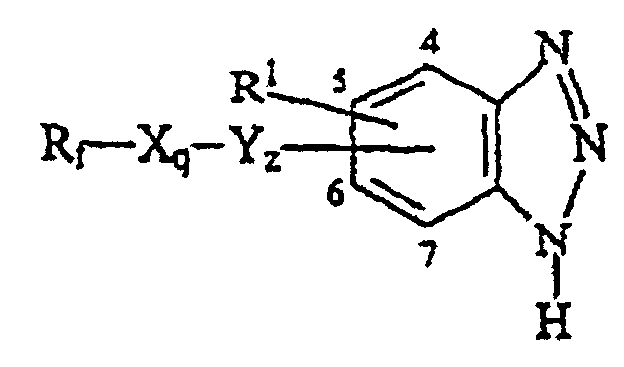
- Fluorochemical benzotriazoles of the invention include those having the formula: wherein R f is C n F 2n+1 -(CH 2 ) m -, wherein n is an integer from 1 to 22 and m is 0, or an integer from 1 to 3; X is -CO 2 -, -SO 3 -, -CONH-, -O-, -S-, a covalent bond, -SO 2 NR-, or -NR-, wherein R is H or C 1 to C 5 alkyl; Y is -CH 2 -, wherein z is 0 or 1; and R 1 is H, C 1-5 alkyl or R f -X-Y z - with the provisos that when X is -S-, or -O-, m is 0, and z is 0, n is ⁇ 7 and when X is a covalent bond, m or z is at least 1.
- n + m is equal to an integer from 8 to 20.
- compositions comprising one or more of the fluorochemical benzotriazoles.
- This invention also provides a method of treating a metallic or a metalloid surface with a compound of the invention comprising the step of contacting a composition comprising a fluorochemical benzotriazole of the invention to the metallic or metalloid surface.
- An ultra-thin film can be formed on a surface by contacting the surface with a fluorochemical benzotriazole in liquid or vapor form.
- This invention also provides fluorochemical benzotriazole compositions for use as release agents comprising one or more compounds having the formula: wherein R f is C n F 2n+1 -(CH 2 ) m -, wherein n is 1 to 22, m is 0 or an integer from 1 to 3; X is -CO 2 -, -SO 3 -, -S-, -O-, -CONH-, a covalent bond, -SO 2 NR-, or -NR-, wherein R is H or C 1 to C 5 alkyl, and q is 0 or 1; Y is C 1 -C 4 alkylene, and z is 0 or 1; and R 1 is H, C 1 to C 5 alkyl, or R f X-Y z .
- Some of the advantages of the compounds of the invention include: application of the compounds of the invention to a surface is relatively fast and simple which minimizes cost and environmental impact; dense films or layers can be foamed using very small amounts of die compound; compounds of the invention self-assemble into protective layers; and the protective layers can be very durable depending upon the surface type and compound used.
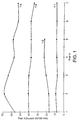
- Figure 1 is a graphical depiction of the Peel Adhesion Values shown in Table 1 for ScotchTM Brand MagicTM Tape.
- Figure 2 is a graphical depiction of the Peel Adhesion Values shown in Table 1 for HighlandTM Brand Packaging Tape.
- Metallic surface refers to surface coated or formed from a metal or a metal alloy which may also contain a metalloid.
- Metal refers to an element such as iron, gold, aluminum, etc., generally characterized by ductility, malleability, luster, and conductivity of heat and electricity which forms a base with the hydroxyl radical and can replace the hydrogen atom of an acid to form a salt.
- Metalloid refers to nonmetallic elements having some of the properties of a metal and/or forming an alloy with a metal (for example, semiconductors) and also includes nonmetallic elements which contain metal and/or metalloid dopants.
- Release agent refers to a compound or composition which imparts a release characteristic to a surface.
- the fluoroaliphatic radical R f is a fluorinated, stable, inert, non-polar, monovalent moiety which is both oleophobic and hydrophobic. While R f can have a large number of carbon atoms, compounds where R f is not more than 22 carbon atoms are preferred since large radicals represent less efficient utilization of fluorine than is possible with smaller R f radicals.
- the skeletal chain of R f can be straight or branched and can be composed of only carbon, hydrogen, and fluorine, or only carbon and fluorine.
- R f will have 1 to 22 carbon atoms, preferably at least 3, and more preferably about 6 to about 12 and will contain from about 40 to about 83 weight percent, and preferably from about 40 to about 74 weight percent, fluorine.
- the terminal portion of the moiety is a perfluorinated moiety which preferably contains at least 3 carbon atoms.
- the preferred compounds are those in which R f is substantially completely fluorinated, for example, where R f is C n F 2n+1 -(CH 2 ) m -, and where m is 2.
- X may be a covalent bond, -CO 2 -, -SO 3 -, -CONH-, -SO 2 NR-, -O-, -S- or -NR-, wherein R is H or C 1 to C 5 alkyl.
- Y may be methylene or a covalent bond.
- R 1 may be a hydrogen atom, lower alkyl, or R f -X-Y- as described above and is preferably a hydrogen atom.
- the R f -X-Y- moiety is located at the number 5 carbon of the benzotriazole molecule.
- Compounds of the invention can be generally obtained by reacting benzotriazoles with fluoro-alcohols.
- the reaction is generally carried out in solution with the triazole and the alcohol being dissolved in a suitable solvent.
- Useful triazole solvents include trifluoromethanesulfonic acid and toluene.
- the reaction is conducted at a temperature of from about 100 to about 120 °C in an inert gaseous atmosphere.
- the reaction mixture is cooled, the isolated precipitate is re-dissolved in a suitable solvent the pH is adjusted to alkaline and the solvent is evaporated.
- the material can be purified using known techniques such as fractional sublimation.
- the compounds of the invention will form substantially continuous monolayer films on metal or metalloid surfaces by simply contacting the compound(s) with the surface to be treated.
- the molecules form "substantially continuous monolayer” films meaning that the individual molecules pack together as densely as their molecular structures allow. It is believed that the films self assemble in that the triazole groups of the molecules of the invention attach to available areas of the metal/metailoid surface and that the pendent fluorocarbon tails are aligned substantially towards the external interface.
- the effectiveness of a monolayer film and the degree to which a monolayer film is formed on a surface is generally dependent upon the strength of the bond between the compound and the particular metal or metalloid surface and the conditions under which the film-coated surface is used. For example, some metal or metalloid surfaces may require a highly tenacious monolayer film while other such surfaces require monolayer films having much lower bond strength.
- Useful metal and metalloid surfaces include any surface that will form a bond with compounds of the invention and preferably, form a monolayer or a substantially continuous monolayer film. Examples of suitable surfaces for forming said monolayer films include those comprising copper, nickel, chromium, zinc, silver, germanium, and alloys thereof.
- the monolayer or substantially continuous monolayer films of the invention may be formed by contacting a surface with an amount of the compound or compounds of the invention sufficient to coat the entire surface.
- the compound may be dissolved in an appropriate solvent, the composition may be applied to the surface, and allowed to dry. Suitable solvents include ethyl acetate, 2-propanol, acetone, water and mixtures thereof.
- the compounds of the present invention may be deposited onto a surface from the vapor phase. Any excess compound may be removed by rinsing the substrate with solvent and/or through use of the treated substrate.
- the fluorochemical benzotriazoles of the invention are particularly useful as release agents for metal or metalloid surfaces or substrates. Specific uses include those as release agents for pressure sensitive adhesive tape release backings and for molds.
- the compositions of the invention may also be used as a corrosion inhibitor for metal or metalloid surfaces.
- the resulting reaction mixture was heated to 105-110 °C under a nitrogen atmosphere for approximately 14 hours and cooled to ambient temperature.
- the cooled reaction mixture was poured over crushed ice (approximately 400 g), the resulting mixture was vigorously agitated to break up larger lumps of the precipitated product and the solid product was isolated by filtration after the ice had melted.
- the isolated product was dissolved in tetrahydrofuran (THF, 500 mL), about 50 mL of water were added to the solution, and methanolic potassium hydroxide (1 N) was added to rapid, dropwise fashion to increase the pH of the solution to about 8-9 (as determined by pH paper).
- the sides of the reaction container were washed with water (about 100-150 mL) and the resulting mixture was stirred under a nitrogen stream to evaporate the THF. After most of the THE had evaporated (approximately 2.5 hours) the product was present as a frothy precipitate in approximately 200 mL of water. The solid product was isolated by filtration, rinsed with several aliquots (approximately 100 mL) of water, and air-dried overnight. The crude material was purified by fractional sublimation at approximately 115°C and 10 -6 Torr (133 x 10 -6 Pa).
- a waxy solid consisting of a mixture of unreacted alcohol and traces of water and solvent, which was collected on the finger of the sublimator after three to five hours was removed and the sublimation was continued at 167-171°C to produce purified 1H,1H,2H,2H-perfluorododecyl benzotriazole-5-carboxylic acid ester (BTA-FCE-12) as a faintly pink/white solid having a melting point of 171°C.
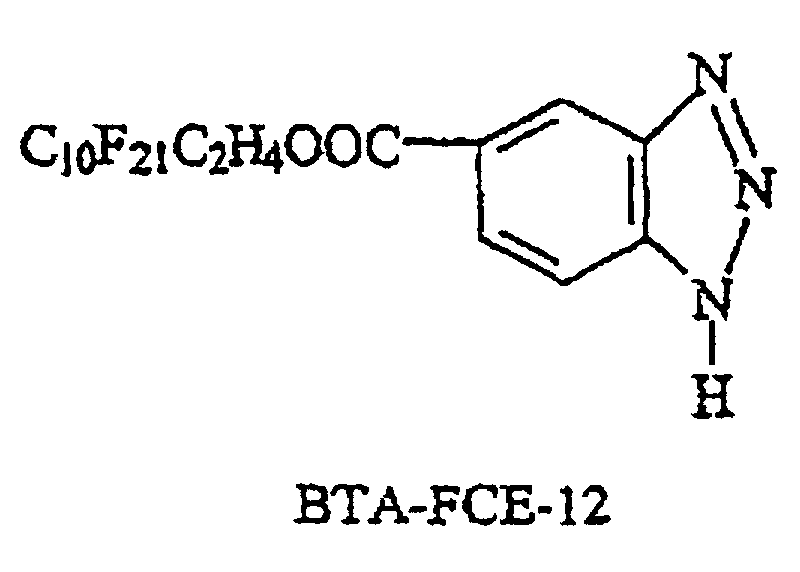
- the NMR ( 1 H, 13 C, 19 F), infrared and GC/MS spectra of the purified material were consistent with the following structure:
- 1H,1H,2H,2H-perfluorodecyl benzotriazole-5-carboxylic acid ester was prepared substantially using the procedure described for the preparation of 1H,1H,2H,2H-perfluorododecyl benzotriazole-5-carboxylic acid ester described in Example 1 except that 1H,1H,2H,2H-perfluorodecyl alcohol (9.3 g, available from PCR Chemicals) was substituted for 1H,1H,2H,2H-perfluorododecyl alcohol.
- the 1H,1H,2H,2H-perfluorodecyl benzotriazole-5-carboxylic acid ester (BTA-FCE-10) was obtained as a pink/white solid having a melting point of 143-145 °C.
- the NMR ( 1 H, 13 C, 19 F), infrared, and GC/MS spectra of the purified material were consistent with the following structure:
- 1H,1H,2H,2H-perfluorooctyl benzotriazole-5-carboxylic acid ester was prepared substantially using the procedure described for the preparation of 1H,1H,2H,2H-perfluorododecyl benzotriazole-5-carboxylic acid ester described in Example 1 except that 1H,1H,2H,2H-perfluorooctyl alcohol (7.3g, available from PCR Chemicals) was substituted for 1H,1H,2H,2H-perfluorododecyl alcohol.
- the 1H,1H,2H,2H-perfluorooctyl benzotriazole-5-carboxylic acid ester (BTA-FCE-8) was obtained as a pink/white solid having a melting point of 118-122 °C.
- the NMR ( 1 H, 13 C, 19 F), infrared, and GC/MS spectra of the purified material were consistent with the following structure:
- 1H,1H,2H,2H-perfluorohexyl benzotriazole-5-carboxylic acid ester was prepared substantially using the procedure described for the preparation of 1H,1H,2H,2H-perfluorododecyl benzotriazole-5-carboxylic acid ester described in Example 1 except that 1H,1H,2H,2H-perfluorohexyl alcohol (5.3 g, available from PCR Chemicals) was substituted for 1H,1H,2H,2H-perfluorododecyl alcohol.
- the 1H,1H,2H,2H-perfluorohexyl benzotriazole-5-carboxylic acid ester (BTA-FCE-6) was obtained as a pink/white solid having a melting point of 105-107 °C.
- the NMR ( 1 H, 13 C, 19 F), infrared, and GC/MS spectra of the purified material were consistent with the following structure:
- Adhesion test coupons (20.3 by 5.1 cm) were prepared from a 3.2 mm thick copper plate (hot rolled copper sheet, ASTM B 152 Alloy 110, soft M20 temper, Central Steel & Wire Co., Chicago, IL). Each test coupon was surface finished using a hand-held sander and progressively finer sandpaper (3M WETORDRYTM, TRI-M-ITETM 280, 600 and 1200 grit, available from Minnesota Mining and Manufacturing Company, St. Paul, MN) for three minutes each stage.
- a hand-held sander and progressively finer sandpaper (3M WETORDRYTM, TRI-M-ITETM 280, 600 and 1200 grit, available from Minnesota Mining and Manufacturing Company, St. Paul, MN) for three minutes each stage.
- the coupon was cleaned by wiping it with a heptane saturated wipe (Kimwipes® Extra Low Lint Wiper #34256, available from Kimberley Clark Corp, Roswell, GA) followed by wiping with an ethanol saturated wipe.
- BTA-FCE-12 prepared as described above, was applied to the surface of two clean test coupons by placing the coupons in a 10.2 cm diameter by 25.4 cm tall evacuable glass chamber together with 29 mg of the BTA-FCE-12, the apparatus evacuated to 10 -7 Torr (133 x 10 -7 Pa) and the evacuated chamber placed in a circulating air oven maintained at 150 °C for 3.5 hours.
- Benzotriazole was applied to a third test coupon by heating the coupon under vacuum (10 -7 Torr (133 x 10 -7 Pa)) with 50.3 mg BTA at 150 °C for 1.5 hours to provide a comparative reactive surface treatment.
- a fourth test coupon was treated with a silicone release material by spray-coating the coupon with a linear poly(dimethylsiloxane) mold release agent, IMS S312-A (available from IMS, Chagrin Falls, OH), to provide comparison with a non-reactive surface treatment.
- a linear poly(dimethylsiloxane) mold release agent IMS S312-A (available from IMS, Chagrin Falls, OH)
- test coupon which had been cleaned using the solvent saturated wipe techniques described above served as a control.
- peel adhesion data are summarized in Table 1. Graphs depicting the data series in these two tables are shown in Figures 1 and 2. Curves 1-1 and 2-1 depict the peel adhesion data for BTA-FCE-12 treated copper; curves 1-2 and 2-2 depict the peel adhesion data for silicone treated copper; curves 1-3 and 2-3 depict the peel adhesion data for untreated copper; and curves 1-4 and 2-4 depict the peel adhesion data for BTA treated copper.
- BTA-PCE-12 modifies the copper surface to give values of peel adhesion that are appreciably lower than the control copper surface or copper treated with a silicone release agent or treated with the parent benzotriazole.
- Soft rolled alloy 110 copper foil having a caliper of 0.00343 cm and purity greater than 99.90 % was used for the corrosion inhibition tests.
- the copper was cleaned as previously described, using the solvent saturated wipe, and was cut into 5cm x 10cm test coupons.
- test coupon was treated with BTA-FCE-12 by placing it inside a 6.0 cm diameter by 22.0 cm tall evacuable glass chamber, together with 35.4 mg of BTA-FCE-12, the chamber was evacuated to 1x10 -7 Torr (133 x 10 -7 Pa), and the evacuated chamber was placed in a circulating air oven maintained at 150 °C for one hour.
- a second test coupon was treated with 44.0 mg benzotriazole (BTA) using substantially the same procedure, except that the oven was maintained at 100 °C, to provide a comparative reactive surface treatment.
- Copper foil that had been cleaned using the solvent saturated wipe techniques described above served as a control.
- the samples were removed from the bag after one hour and the surface on each was analysed using X-ray photoelectron spectroscopy (XPS or ESCA) using a Model SSX-100-01 M-ProbeTM ESCA Spectrometer (available from Surface Science Laboratories, Mountain View, CA) which makes use of an Al K ⁇ monochromatic X-ray excitation source and a hemispherical energy analyzer.
- XPS or ESCA X-ray photoelectron spectroscopy
- Model SSX-100-01 M-ProbeTM ESCA Spectrometer available from Surface Science Laboratories, Mountain View, CA
- the photoelectron take-off angle for all spectra recorded was 38 ° measured with respect to the surface normal.
- the area analyzed on each was 200 ⁇ m x 750 ⁇ m.
- the pressure in the vacuum system during analysis was maintained at or below 2.7 x 10 -7 Pa.
- the data show that the BTA-FCE-12 treated surface has no sulfur present at a detectable level while the BTA and untreated copper surfaces show evidence for the incorporation of sulfur after the H 2 S exposure.
- the detection limit for sulfur on this type of surfae is approximately 0.08 atomic % (signal:noise is 2.0).
- the binding energy of the S(2p 3/2 ) peak on the untreated and BTA treated copper samples after exposure to H 2 S is between 162 and 163 eV, matching those given in the NIST XPS Database for Cu 2 S (NIST Standard Reference Database #20 - Version 2.0, U.S. Department of Commerce, National Institute of Standards and Technology, Gaithersburg, MD).
Landscapes
- Chemical & Material Sciences (AREA)
- Engineering & Computer Science (AREA)
- Organic Chemistry (AREA)
- Nanotechnology (AREA)
- Materials Engineering (AREA)
- Mechanical Engineering (AREA)
- Condensed Matter Physics & Semiconductors (AREA)
- Crystallography & Structural Chemistry (AREA)
- General Physics & Mathematics (AREA)
- Physics & Mathematics (AREA)
- Composite Materials (AREA)
- Chemical Kinetics & Catalysis (AREA)
- General Chemical & Material Sciences (AREA)
- Oil, Petroleum & Natural Gas (AREA)
- Metallurgy (AREA)
- Manufacturing & Machinery (AREA)
- Preventing Corrosion Or Incrustation Of Metals (AREA)
- Pharmaceuticals Containing Other Organic And Inorganic Compounds (AREA)
- Plural Heterocyclic Compounds (AREA)
Abstract
Description
- This invention relates to fluorochemical benzotriazole compounds and uses thereof.
- Heretofore, there have been many ways to enhance the separation or release of one material from a surface of another material or substrate. For example, organic materials such as oils and waxes and silicones have been used as release agents to provide release characteristics to surfaces. One of the disadvantages of these release agents is that they usually need to be frequently re-applied to the surface so as to provide adequate release properties. Polymeric release coatings such as those made from polytetrafluoroethylenes have addressed some of the shortcomings of oils, waxes, silicones and other temporary coatings and are often more durable. Typically, however, polymeric release coatings require a thicker coating than the non-durable treatments, they can be subject to thickness variations and can present application difficulties.
- US-A-5,504,214 relates to a substituted benzotriazoles, which contain at least 2 fluorine atoms per molecule and have been described as excellent intermediates for preparing active compounds for pharmaceuticals and plant-protection agents.
- The invention provides fluorochemical benzotriazoles that chemically bond to metal and metalloid surfaces and provide, for example, release and/or corrosion inhibiting characteristics to those surfaces. The compounds of the invention are characterized as having a head group which bonds to a metallic or metalloid surface and a tail portion, which is suitably different in polarity and/or functionality from a material to be released. The compounds of the invention when applied to a metallic or metalloid surface form durable, self-assembled films that are monolayers or substantially monolayers. Fluorochemical benzotriazoles of the invention include those having the formula:wherein Rf is Cn F2n+1 -(CH2)m-, wherein n is an integer from 1 to 22 and m is 0, or an integer from 1 to 3; X is -CO2-, -SO3-, -CONH-, -O-, -S-, a covalent bond, -SO2NR-, or -NR-, wherein R is H or C1 to C5 alkyl; Y is -CH2-, wherein z is 0 or 1; and R1 is H, C1-5 alkyl or Rf-X-Yz- with the provisos that when X is -S-, or -O-, m is 0, and z is 0, n is ≥ 7 and when X is a covalent bond, m or z is at least 1. Preferably n + m is equal to an integer from 8 to 20.

- This invention further provides compositions comprising one or more of the fluorochemical benzotriazoles.
- This invention also provides a method of treating a metallic or a metalloid surface with a compound of the invention comprising the step of contacting a composition comprising a fluorochemical benzotriazole of the invention to the metallic or metalloid surface. An ultra-thin film can be formed on a surface by contacting the surface with a fluorochemical benzotriazole in liquid or vapor form.
- This invention also provides fluorochemical benzotriazole compositions for use as release agents comprising one or more compounds having the formula:wherein Rf is Cn F2n+1 -(CH2)m-, wherein n is 1 to 22, m is 0 or an integer from 1 to 3; X is -CO2-, -SO3-, -S-, -O-, -CONH-, a covalent bond, -SO2NR-, or -NR-, wherein R is H or C1 to C5 alkyl, and q is 0 or 1; Y is C1 -C4 alkylene, and z is 0 or 1; and R1 is H, C1 to C5 alkyl, or RfX-Yz.
- Some of the advantages of the compounds of the invention include: application of the compounds of the invention to a surface is relatively fast and simple which minimizes cost and environmental impact; dense films or layers can be foamed using very small amounts of die compound; compounds of the invention self-assemble into protective layers; and the protective layers can be very durable depending upon the surface type and compound used.
- Figure 1 is a graphical depiction of the Peel Adhesion Values shown in Table 1 for Scotch™ Brand Magic™ Tape.
- Figure 2 is a graphical depiction of the Peel Adhesion Values shown in Table 1 for Highland™ Brand Packaging Tape.
- "Metallic surface" refers to surface coated or formed from a metal or a metal alloy which may also contain a metalloid. "Metal" refers to an element such as iron, gold, aluminum, etc., generally characterized by ductility, malleability, luster, and conductivity of heat and electricity which forms a base with the hydroxyl radical and can replace the hydrogen atom of an acid to form a salt. "Metalloid" refers to nonmetallic elements having some of the properties of a metal and/or forming an alloy with a metal (for example, semiconductors) and also includes nonmetallic elements which contain metal and/or metalloid dopants. "Release agent" refers to a compound or composition which imparts a release characteristic to a surface.
- The fluoroaliphatic radical Rf, is a fluorinated, stable, inert, non-polar, monovalent moiety which is both oleophobic and hydrophobic. While Rf can have a large number of carbon atoms, compounds where Rf is not more than 22 carbon atoms are preferred since large radicals represent less efficient utilization of fluorine than is possible with smaller Rf radicals. The skeletal chain of Rf can be straight or branched and can be composed of only carbon, hydrogen, and fluorine, or only carbon and fluorine. Generally, Rf will have 1 to 22 carbon atoms, preferably at least 3, and more preferably about 6 to about 12 and will contain from about 40 to about 83 weight percent, and preferably from about 40 to about 74 weight percent, fluorine. Preferably, the terminal portion of the moiety is a perfluorinated moiety which preferably contains at least 3 carbon atoms. The preferred compounds are those in which Rf is substantially completely fluorinated, for example, where Rf is CnF2n+1 -(CH2)m-, and where m is 2.
- X may be a covalent bond, -CO2-, -SO3-, -CONH-, -SO2NR-, -O-, -S- or -NR-, wherein R is H or C1 to C5 alkyl. Y may be methylene or a covalent bond. R1 may be a hydrogen atom, lower alkyl, or Rf-X-Y- as described above and is preferably a hydrogen atom. Preferably, the Rf-X-Y- moiety is located at the
number 5 carbon of the benzotriazole molecule. - Compounds of the invention can be generally obtained by reacting benzotriazoles with fluoro-alcohols. The reaction is generally carried out in solution with the triazole and the alcohol being dissolved in a suitable solvent. Useful triazole solvents include trifluoromethanesulfonic acid and toluene. The reaction is conducted at a temperature of from about 100 to about 120 °C in an inert gaseous atmosphere. The reaction mixture is cooled, the isolated precipitate is re-dissolved in a suitable solvent the pH is adjusted to alkaline and the solvent is evaporated. Optionally, the material can be purified using known techniques such as fractional sublimation.
- The compounds of the invention will form substantially continuous monolayer films on metal or metalloid surfaces by simply contacting the compound(s) with the surface to be treated. The molecules form "substantially continuous monolayer" films meaning that the individual molecules pack together as densely as their molecular structures allow. It is believed that the films self assemble in that the triazole groups of the molecules of the invention attach to available areas of the metal/metailoid surface and that the pendent fluorocarbon tails are aligned substantially towards the external interface.
- The effectiveness of a monolayer film and the degree to which a monolayer film is formed on a surface is generally dependent upon the strength of the bond between the compound and the particular metal or metalloid surface and the conditions under which the film-coated surface is used. For example, some metal or metalloid surfaces may require a highly tenacious monolayer film while other such surfaces require monolayer films having much lower bond strength. Useful metal and metalloid surfaces include any surface that will form a bond with compounds of the invention and preferably, form a monolayer or a substantially continuous monolayer film. Examples of suitable surfaces for forming said monolayer films include those comprising copper, nickel, chromium, zinc, silver, germanium, and alloys thereof.
- The monolayer or substantially continuous monolayer films of the invention may be formed by contacting a surface with an amount of the compound or compounds of the invention sufficient to coat the entire surface. The compound may be dissolved in an appropriate solvent, the composition may be applied to the surface, and allowed to dry. Suitable solvents include ethyl acetate, 2-propanol, acetone, water and mixtures thereof. Alternatively, the compounds of the present invention may be deposited onto a surface from the vapor phase. Any excess compound may be removed by rinsing the substrate with solvent and/or through use of the treated substrate.
- The fluorochemical benzotriazoles of the invention are particularly useful as release agents for metal or metalloid surfaces or substrates. Specific uses include those as release agents for pressure sensitive adhesive tape release backings and for molds. The compositions of the invention may also be used as a corrosion inhibitor for metal or metalloid surfaces.
- The features and advantages of the present invention are illustrated in the following examples which incorporate particular materials and amounts, and should not be construed to unduly limit this invention. All materials are commercially available unless otherwise stated or apparent. All parts, percentages, ratios and the like in the examples are by weight unless otherwise indicated.
- 1H,1H,2H,2H-perfluorododecyl benzotriazole-5-carboxylic acid ester was prepared as follows:
- A mixture of benzotriazole-5-carboxylic acid (3.5 g, available from Aldrich Chemical Co., Inc, Milwaukee, WI) and trifluoromethanesulfonic acid ("Triflic" acid, approximately 12 g, available from Minnesota Mining and Manufacturing Company, St. Paul, MN) was heated at approximately 90 °C, with stirring, until a homogeneous solution was obtained (approximately 1 hour). 1H,1H,2H,2H-perfluorododecyl alcohol (11.58 g, available from PCR Chemicals, Gainesville, FL) was melted and added to the reaction mixture along with 18 mL of dry toluene. The resulting reaction mixture was heated to 105-110 °C under a nitrogen atmosphere for approximately 14 hours and cooled to ambient temperature. The cooled reaction mixture was poured over crushed ice (approximately 400 g), the resulting mixture was vigorously agitated to break up larger lumps of the precipitated product and the solid product was isolated by filtration after the ice had melted. The isolated product was dissolved in tetrahydrofuran (THF, 500 mL), about 50 mL of water were added to the solution, and methanolic potassium hydroxide (1 N) was added to rapid, dropwise fashion to increase the pH of the solution to about 8-9 (as determined by pH paper). The sides of the reaction container were washed with water (about 100-150 mL) and the resulting mixture was stirred under a nitrogen stream to evaporate the THF. After most of the THE had evaporated (approximately 2.5 hours) the product was present as a frothy precipitate in approximately 200 mL of water. The solid product was isolated by filtration, rinsed with several aliquots (approximately 100 mL) of water, and air-dried overnight. The crude material was purified by fractional sublimation at approximately 115°C and 10-6 Torr (133 x 10-6 Pa). A waxy solid, consisting of a mixture of unreacted alcohol and traces of water and solvent, which was collected on the finger of the sublimator after three to five hours was removed and the sublimation was continued at 167-171°C to produce purified 1H,1H,2H,2H-perfluorododecyl benzotriazole-5-carboxylic acid ester (BTA-FCE-12) as a faintly pink/white solid having a melting point of 171°C. The NMR (1H,13C,19F), infrared and GC/MS spectra of the purified material were consistent with the following structure:
- An approximately 4:3:1 mixture of 1H,1H,2H,2H-perfluorotetradecyl benzotriazole-5-carboxylic acid ester (BTA-FCE-14), 1H,1H,2H,2H-perfluorododecyl benzotriazole-5-carboxylic acid ester (BTA-FCE-12), and 1H,1H,2H,2H-perfluorodecyl benzotriazole-5-carboxylic acid ester (BTA-FCE-10) was prepared substantially using the procedure described for the preparation of 1H,1H,2H,2H-perfluorododecyl benzotriazole-5-carboxylic acid ester described in Example 1 except that an approximately 4:3:1 mixture of 1H,1H,2H,2H-perfluorotetradecyl alcohol, 1H,1H,2H,2H-perfluorododecyl alcohol, and 1H,1H,2H,2H-perfluorodecyl alcohol (12g, available from Daikin Chemical, Tokyo, Japan) was substituted for 1H,1H,2H,2H-perfluorododecyl alcohol. The above mixture of BTA-FCE-14, BTA-FCE-12, and BTA-FCE-10 was obtained as a pink/white solid. The NMR (1H, 13C, 19F), and GC/MS spectra of the purified material were consistent with the following structures:

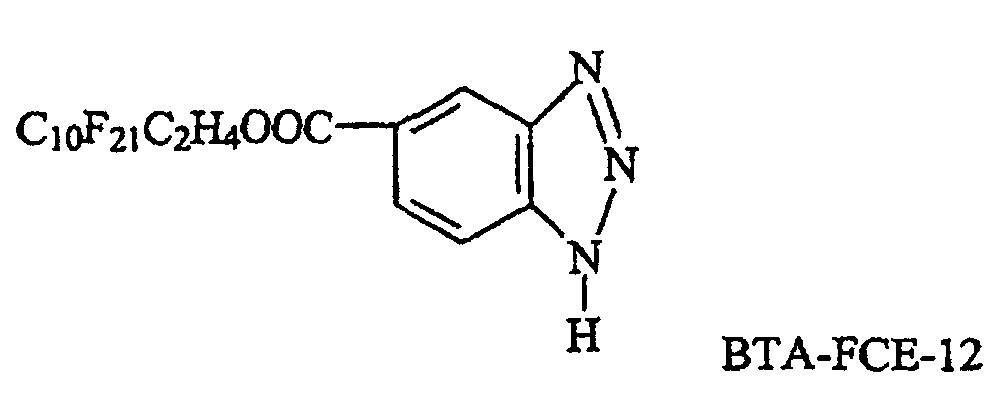

- 1H,1H,2H,2H-perfluorodecyl benzotriazole-5-carboxylic acid ester was prepared substantially using the procedure described for the preparation of 1H,1H,2H,2H-perfluorododecyl benzotriazole-5-carboxylic acid ester described in Example 1 except that 1H,1H,2H,2H-perfluorodecyl alcohol (9.3 g, available from PCR Chemicals) was substituted for 1H,1H,2H,2H-perfluorododecyl alcohol. The 1H,1H,2H,2H-perfluorodecyl benzotriazole-5-carboxylic acid ester (BTA-FCE-10) was obtained as a pink/white solid having a melting point of 143-145 °C. The NMR (1H, 13C, 19F), infrared, and GC/MS spectra of the purified material were consistent with the following structure:

- 1H,1H,2H,2H-perfluorooctyl benzotriazole-5-carboxylic acid ester was prepared substantially using the procedure described for the preparation of 1H,1H,2H,2H-perfluorododecyl benzotriazole-5-carboxylic acid ester described in Example 1 except that 1H,1H,2H,2H-perfluorooctyl alcohol (7.3g, available from PCR Chemicals) was substituted for 1H,1H,2H,2H-perfluorododecyl alcohol. The 1H,1H,2H,2H-perfluorooctyl benzotriazole-5-carboxylic acid ester (BTA-FCE-8) was obtained as a pink/white solid having a melting point of 118-122 °C. The NMR (1H, 13C, 19F), infrared, and GC/MS spectra of the purified material were consistent with the following structure:

- 1H,1H,2H,2H-perfluorohexyl benzotriazole-5-carboxylic acid ester was prepared substantially using the procedure described for the preparation of 1H,1H,2H,2H-perfluorododecyl benzotriazole-5-carboxylic acid ester described in Example 1 except that 1H,1H,2H,2H-perfluorohexyl alcohol (5.3 g, available from PCR Chemicals) was substituted for 1H,1H,2H,2H-perfluorododecyl alcohol. The 1H,1H,2H,2H-perfluorohexyl benzotriazole-5-carboxylic acid ester (BTA-FCE-6) was obtained as a pink/white solid having a melting point of 105-107 °C. The NMR (1H, 13C, 19F), infrared, and GC/MS spectra of the purified material were consistent with the following structure:

- The ability of 1H,1H,2H,2H-perfluorododecyl benzotriazole-5-carboxylic acid ester to react with and change the surface properties of copper was studied using a standard test for peel adhesion, ASTM D 3330-96, except that tape samples were repeatedly applied over the same area of the test coupon, using the peel strength as an indicator of the substantivity of the release treatment to the copper surface.
- Adhesion test coupons (20.3 by 5.1 cm) were prepared from a 3.2 mm thick copper plate (hot rolled copper sheet, ASTM B 152 Alloy 110, soft M20 temper, Central Steel & Wire Co., Chicago, IL). Each test coupon was surface finished using a hand-held sander and progressively finer sandpaper (3M WETORDRY™, TRI-M-ITE™ 280, 600 and 1200 grit, available from Minnesota Mining and Manufacturing Company, St. Paul, MN) for three minutes each stage. Immediately prior to applying a release treatment to the test coupon, the coupon was cleaned by wiping it with a heptane saturated wipe (Kimwipes® Extra Low Lint Wiper #34256, available from Kimberley Clark Corp, Roswell, GA) followed by wiping with an ethanol saturated wipe. BTA-FCE-12, prepared as described above, was applied to the surface of two clean test coupons by placing the coupons in a 10.2 cm diameter by 25.4 cm tall evacuable glass chamber together with 29 mg of the BTA-FCE-12, the apparatus evacuated to 10-7 Torr (133 x 10-7 Pa) and the evacuated chamber placed in a circulating air oven maintained at 150 °C for 3.5 hours.
- Benzotriazole (BTA) was applied to a third test coupon by heating the coupon under vacuum (10-7 Torr (133 x 10-7 Pa)) with 50.3 mg BTA at 150 °C for 1.5 hours to provide a comparative reactive surface treatment.
- A fourth test coupon was treated with a silicone release material by spray-coating the coupon with a linear poly(dimethylsiloxane) mold release agent, IMS S312-A (available from IMS, Chagrin Falls, OH), to provide comparison with a non-reactive surface treatment.
- A test coupon which had been cleaned using the solvent saturated wipe techniques described above served as a control.
- The adherence of a strip of pressure-sensitive adhesive tape to the treated and control copper coupons described above was directly measured under conditions described in ASTM Standard D 3330-96. The tape was applied to the test coupon as specified in the test procedure and subsequently peeled from the surface at a 180 ° angle at a rate of 38.1 nun per second using a constant-rate-of-extension adhesion tester manufactured by Instrumentors Inc., Strongsville, OH. All tape and the copper test coupons were conditioned at 50% relative humidity and 23 °C for 24 hours prior to testing, and all peel tests were performed under these environmental conditions.
- Two commercially-available pressure-sensitive adhesive tapes, Scotch™ Brand Magic™ Tape #810 (available from Minnesota Mining and Manufacturing Company), having an acrylate based adhesive, and Highland™ Brand Packaging Tape #371 (available from Minnesota Mining and Manufacturing Co.), having a Kraton™ based adhesive, were used in the adhesion testing.
- Representative peel adhesion data are summarized in Table 1. Graphs depicting the data series in these two tables are shown in Figures 1 and 2. Curves 1-1 and 2-1 depict the peel adhesion data for BTA-FCE-12 treated copper; curves 1-2 and 2-2 depict the peel adhesion data for silicone treated copper; curves 1-3 and 2-3 depict the peel adhesion data for untreated copper; and curves 1-4 and 2-4 depict the peel adhesion data for BTA treated copper. BTA-PCE-12 modifies the copper surface to give values of peel adhesion that are appreciably lower than the control copper surface or copper treated with a silicone release agent or treated with the parent benzotriazole.


- The ability of 1H,1H,2H,2H-perfluorododecyl benzotriazole-5-carboxylic acid ester to react with and change the surface properties of copper was studied by examining its ability to inhibit corrosion of the copper surface.
- Soft rolled alloy 110 copper foil having a caliper of 0.00343 cm and purity greater than 99.90 % was used for the corrosion inhibition tests. The copper was cleaned as previously described, using the solvent saturated wipe, and was cut into 5cm x 10cm test coupons.
- One test coupon was treated with BTA-FCE-12 by placing it inside a 6.0 cm diameter by 22.0 cm tall evacuable glass chamber, together with 35.4 mg of BTA-FCE-12, the chamber was evacuated to 1x10⁻⁷ Torr (133 x 10-7 Pa), and the evacuated chamber was placed in a circulating air oven maintained at 150 °C for one hour.
A second test coupon was treated with 44.0 mg benzotriazole (BTA) using substantially the same procedure, except that the oven was maintained at 100 °C, to provide a comparative reactive surface treatment. - Copper foil that had been cleaned using the solvent saturated wipe techniques described above served as a control.
- Five-centimeter by three-centimeter samples of the BTA-FCE-12 and-BTA treated copper, and a control, were positioned in a non-overlapping configuration inside a 12.7 cm x 20.3 cm polyethylene bag, the bag was sealed, 100 microliters of hydrogen sulfide gas were injected directly through the wall of the bag, the puncture was sealed with adhesive tape, and the surface of the samples was observed for color change due to sulfide formation. Only the control was seen to change, becoming dark red to purple within an hour.
The samples were removed from the bag after one hour and the surface on each was analysed using X-ray photoelectron spectroscopy (XPS or ESCA) using a Model SSX-100-01 M-Probe™ ESCA Spectrometer (available from Surface Science Laboratories, Mountain View, CA) which makes use of an AlKα monochromatic X-ray excitation source and a hemispherical energy analyzer. The photoelectron take-off angle for all spectra recorded was 38 ° measured with respect to the surface normal. The area analyzed on each was 200µm x 750 µm. The pressure in the vacuum system during analysis was maintained at or below 2.7 x 10⁻⁷ Pa. - A survey spectrum was recorded on each sample surface (0 eV - 1100 eV binding energy/2200 data points/100 milliseconds dwell time per data point per scan x 8 scans). The atomic percent concentrations of carbon, oxygen, nitrogen, copper, fluorine, and sulfur on each surface were calculated by measuring the areas of the C(1s1/2), O(1s1/2), N(1s1/2), Cu(2p3/2), F(1s1/2) and S(2p3/2,1/2) photoelectron peaks in each survey spectrum and dividing each by the appropriate relative sensitivity factor provided in the data reduction software supplied by the instrument manufacturer. All calculations were made ignoring the presence of hydrogen which cannot be detected by this technique. The information obtained from these analyses is summarized in Table 2.
- The data show that the BTA-FCE-12 treated surface has no sulfur present at a detectable level while the BTA and untreated copper surfaces show evidence for the incorporation of sulfur after the H2S exposure. The detection limit for sulfur on this type of surfae is approximately 0.08 atomic % (signal:noise is 2.0). The binding energy of the S(2p3/2) peak on the untreated and BTA treated copper samples after exposure to H2S is between 162 and 163 eV, matching those given in the NIST XPS Database for Cu2S (NIST Standard Reference Database #20 - Version 2.0, U.S. Department of Commerce, National Institute of Standards and Technology, Gaithersburg, MD).

Claims (24)
- A fluorochemical benzotriazole having the formula:wherein Rf is Cn F2n+1 -(CH2)m-, wherein n is 1 to 22 and m is 0, or an integer from 1 to 3;

X is -CO2-, -SO3-, -CONH-, -O-, -S-, a covalent bond, -SO2NR-, or -NR-, wherein R is H or C1 to C5 alkyl;
Y is -CH2- wherein z is 0 or 1; and
R1 is H, C1 to C5 alkyl or Rf-X-Yz-
with the provisos that when X is -S-, or -O-, m is 0, and z is 0, n is ≥ 7 and when X is a covalent bond, m or z is at least 1. - The fluorochemical benzotriazole according to claim 1 wherein R1 is H.
- The fluorochemical benzotriazole according to claim I wherein n is 3 to 12.
- The fluorochemical benzotriazole according to claim 3 wherein z is 0.
- The fluorochemical benzotriazole according to claim 4 wherein X is -CO2-, -SO3-, -O-, -NR-, -SO2NR-, or -S-.
- The fluorochemical benzotriazole according to claim 5 wherein n is at least 3.
- The fluorochemical benzotriazole according to claim 1 wherein n is 6 to 12.
- The fluorochemical benzotriazole according to claim 7 wherein m is 2 and z is 0.
- The fluorochemical benzotriazole according to claim 8 wherein X is -CO2-.
- The fluorochemical benzotriazole according to claim 9 wherein n is 10.
- The fluorochemical benzotriazole according to claim 1 wherein n is at least 6 and wherein n + m ranges from 8 to 20.
- A composition for imparting release or corrosion inhibition properties to a metal or metalloid surface comprising one or more of the compounds according to any of claims 1 to 11.
- The composition of claim 12 wherein said composition comprises two or more compounds according to any of claims 1 to 11.
- The composition of claim 12 or 13, further containing a solvent.
- A method for forming an adherent ultra-thin film on a metallic or a metalloid surface comprising the step of contacting a composition comprising a fluorochemical benzotriazole according to any of claims 1 to 11 with said surface.
- The method of claim 15 wherein said composition further comprises a solvent.
- The method of claim 15 wherein said composition is in the form of a solution or a vapor.
- An ultra-thin film comprising a plurality of molecules of one or more fluorochemical benzotriazoles according to any of claims 1 to 11 bonded to a metallic or non-metallic surface wherein said plurality of molecules forms a self-assembled film that is a substantially continuous monolayer.
- An article comprising a metallic or a metalloid surface having a self-assembled ultra-thin film adhered to said surface, said film comprising a plurality of molecules of one or more fluorochemical benzotriazoles according to any of claims 1 to 11 adhered to said surface.
- The composition of claim 12 used as a release agent or a corrosion inhibitor.
- A composition for use as a release agent, said composition comprising one or more fluorochemical benzotriazoles having the formula:wherein Rf is Cn F2n+1 -(CH2)m-, n is 1 to 22, m is 0 or an integer from 1 to 3;

X is -CO2-, -SO3-, -S-, -O-, -CONH-, a covalent bond, -SO2NR-, or -NR-, wherein R is H or C1 to C5 alkyl, and q is 0 or 1;
Y is C1 - C4 alkylene, and z is 0 or 1; and
R1 is H, C1 to C5 alkyl, or Rf-X-Yz. - An article having a release surface comprising a metallic or a metalloid surface having a self-assembled ultra-thin film adhered to said surface, said film comprising a plurality of molecules of one or more fluorochemical benzotriazoles as defined in any of claims 1 to 11 adhered to said surface.
- A method of forming a release agent in the form of adherent ultra-thin film on a metallic or a metalloid surface comprising the step of contacting a composition comprising a fluorochemical benzotriazole as defined in any of claims 1 to 11 with said surface.
- A release agent in the form of an ultra-thin film comprising a plurality of molecules of one or more fluorochemical benzotriazoles as defined in any of claims 1 to 11 bonded to a metallic or non-metallic surface wherein said plurality of molecules forms a self-assembled film that is a substantially continuous monolayer.
Applications Claiming Priority (3)
| Application Number | Priority Date | Filing Date | Title |
|---|---|---|---|
| US1409898A | 1998-01-27 | 1998-01-27 | |
| US14098 | 1998-01-27 | ||
| PCT/US1999/000899 WO1999037626A1 (en) | 1998-01-27 | 1999-01-15 | Fluorochemical benzotriazoles |
Publications (2)
| Publication Number | Publication Date |
|---|---|
| EP1051408A1 EP1051408A1 (en) | 2000-11-15 |
| EP1051408B1 true EP1051408B1 (en) | 2003-08-27 |
Family
ID=21763516
Family Applications (1)
| Application Number | Title | Priority Date | Filing Date |
|---|---|---|---|
| EP99902286A Expired - Lifetime EP1051408B1 (en) | 1998-01-27 | 1999-01-15 | Fluorochemical benzotriazoles |
Country Status (9)
| Country | Link |
|---|---|
| US (1) | US6376065B1 (en) |
| EP (1) | EP1051408B1 (en) |
| JP (2) | JP4652567B2 (en) |
| KR (1) | KR100530819B1 (en) |
| CN (1) | CN1132821C (en) |
| AU (1) | AU2230599A (en) |
| DE (1) | DE69910732T2 (en) |
| MY (1) | MY122213A (en) |
| WO (1) | WO1999037626A1 (en) |
Families Citing this family (56)
| Publication number | Priority date | Publication date | Assignee | Title |
|---|---|---|---|---|
| US20100302479A1 (en) * | 1996-03-21 | 2010-12-02 | Aronson Joseph T | Optical article |
| US6166218A (en) * | 1996-11-07 | 2000-12-26 | Ciba Specialty Chemicals Corporation | Benzotriazole UV absorbers having enhanced durability |
| CN1132821C (en) * | 1998-01-27 | 2003-12-31 | 美国3M公司 | Fluorochemical Benzotriazoles |
| EP1127381B1 (en) | 1998-11-02 | 2015-09-23 | 3M Innovative Properties Company | Transparent conductive oxides for plastic flat panel displays |
| US6632872B1 (en) | 2000-09-19 | 2003-10-14 | 3M Innovative Properties Company | Adhesive compositions including self-assembling molecules, adhesives, articles, and methods |
| US6824882B2 (en) | 2002-05-31 | 2004-11-30 | 3M Innovative Properties Company | Fluorinated phosphonic acids |
| US6933051B2 (en) * | 2002-08-17 | 2005-08-23 | 3M Innovative Properties Company | Flexible electrically conductive film |
| US6969166B2 (en) * | 2003-05-29 | 2005-11-29 | 3M Innovative Properties Company | Method for modifying the surface of a substrate |
| US20040241323A1 (en) * | 2003-05-29 | 2004-12-02 | 3M Innovative Properties Company | Method for applying adhesive to a substrate |
| US20040241396A1 (en) * | 2003-05-29 | 2004-12-02 | 3M Innovative Properties Company | Method of modifying a surface of a substrate and articles therefrom |
| ATE346852T1 (en) * | 2003-08-21 | 2006-12-15 | 3M Innovative Properties Co | PERFLUORPOLYETHERAMID BONDED PHOSPHONATES, PHOSPHATES AND DERIVATIVES THEREOF |
| US7189479B2 (en) * | 2003-08-21 | 2007-03-13 | 3M Innovative Properties Company | Phototool coating |
| US7148360B2 (en) | 2004-01-30 | 2006-12-12 | 3M Innovative Properties Company | Perfluoropolyether benzotriazole compounds |
| US20060141219A1 (en) * | 2004-12-23 | 2006-06-29 | Benson Olester Jr | Roll of a uniaxially oriented article having a structured surface |
| US20060141218A1 (en) * | 2004-12-23 | 2006-06-29 | Biernath Rolf W | Uniaxially oriented articles having structured surface |
| US20060141220A1 (en) * | 2004-12-23 | 2006-06-29 | Merrill William W | Uniaxially oriented article having a structured surface |
| US20060138686A1 (en) * | 2004-12-23 | 2006-06-29 | Ouderkirk Andrew J | Method of making a uniaxially stretched polymeric film having structured surface |
| US20060204720A1 (en) * | 2004-12-23 | 2006-09-14 | Biernath Rolf W | Uniaxially oriented birefringent article having a structured surface |
| US20060138705A1 (en) * | 2004-12-23 | 2006-06-29 | Korba Gary A | Method of making a structured surface article |
| US20060138702A1 (en) * | 2004-12-23 | 2006-06-29 | Biernath Rolf W | Method of making uniaxially oriented articles having structured surfaces |
| US20060138694A1 (en) * | 2004-12-23 | 2006-06-29 | Biernath Rolf W | Method of making a polymeric film having structured surfaces via replication |
| US20060170808A1 (en) * | 2005-02-02 | 2006-08-03 | Biernath Rolf W | Article having a birefringent surface for use as a blur filter |
| US20060170797A1 (en) * | 2005-02-02 | 2006-08-03 | Biernath Rolf W | Article having a birefringent surface for use as a blur filter |
| DE602006009090D1 (en) * | 2005-04-08 | 2009-10-22 | 3M Innovative Properties Co | STRUCTURED ORIENTED FILMS FOR USE IN DISPLAYS |
| ES2878427T3 (en) | 2005-05-06 | 2021-11-18 | Swimc Llc | Method to improve the corrosion resistance of metal surfaces |
| WO2006122056A2 (en) * | 2005-05-09 | 2006-11-16 | Kids Story Book, Llc | Personalized digital sound recording |
| US7651863B2 (en) * | 2005-07-14 | 2010-01-26 | 3M Innovative Properties Company | Surface-enhanced spectroscopic method, flexible structured substrate, and method of making the same |
| US7906057B2 (en) * | 2005-07-14 | 2011-03-15 | 3M Innovative Properties Company | Nanostructured article and method of making the same |
| US20070014997A1 (en) * | 2005-07-14 | 2007-01-18 | 3M Innovative Properties Company | Tool and method of making and using the same |
| US20070065636A1 (en) * | 2005-08-04 | 2007-03-22 | Merrill William W | Article having a birefringent surface and microstructured features having a variable pitch or angles and process for making the article |
| US7418202B2 (en) | 2005-08-04 | 2008-08-26 | 3M Innovative Properties Company | Article having a birefringent surface and microstructured features having a variable pitch or angles for use as a blur filter |
| US20070066785A1 (en) * | 2005-09-22 | 2007-03-22 | Acosta Erick J | Triazole-containing fluorinated urethanes and ureas |
| US20070066762A1 (en) * | 2005-09-22 | 2007-03-22 | Acosta Erick J | Triazole-containing fluorinated polymers |
| US9134471B2 (en) | 2006-06-28 | 2015-09-15 | 3M Innovative Properties Company | Oriented polymeric articles and method |
| US20080114177A1 (en) * | 2006-11-15 | 2008-05-15 | 3M Innovative Properties Company | Method for preparing fluorinated benzotriazole compounds |
| BRPI0721299B1 (en) * | 2006-12-28 | 2018-07-24 | 3M Innovative Properties Company. | METHOD FOR FORMATION OF A CONDUCTIVE FILM ON A FLEXIBLE POLYMER HOLDER, CONDUCTORY FILM AND METHOD FOR THE MANUFACTURE OF A VITRIFICATION ARTICLE |
| US20080315459A1 (en) * | 2007-06-21 | 2008-12-25 | 3M Innovative Properties Company | Articles and methods for replication of microstructures and nanofeatures |
| US20090114618A1 (en) * | 2007-06-21 | 2009-05-07 | 3M Innovative Properties Company | Method of making hierarchical articles |
| US20090041986A1 (en) * | 2007-06-21 | 2009-02-12 | 3M Innovative Properties Company | Method of making hierarchical articles |
| US7891636B2 (en) * | 2007-08-27 | 2011-02-22 | 3M Innovative Properties Company | Silicone mold and use thereof |
| CN101939669A (en) * | 2007-10-30 | 2011-01-05 | 3M创新有限公司 | Multilayer stacked optical bandpass film with EMI shielding for optical display filters |
| EP2240285A4 (en) * | 2007-12-31 | 2012-08-01 | 3M Innovative Properties Co | Method for applying a coatable material |
| KR20110000665A (en) * | 2008-03-26 | 2011-01-04 | 쓰리엠 이노베이티브 프로퍼티즈 컴파니 | Slide coating a fluid comprising a multi unit polymeric precursor |
| EP2268418A1 (en) * | 2008-03-26 | 2011-01-05 | 3M Innovative Properties Company | Methods of slide coating two or more fluids |
| US20110014391A1 (en) * | 2008-03-26 | 2011-01-20 | Yapel Robert A | Methods of slide coating two or more fluids |
| US8350451B2 (en) * | 2008-06-05 | 2013-01-08 | 3M Innovative Properties Company | Ultrathin transparent EMI shielding film comprising a polymer basecoat and crosslinked polymer transparent dielectric layer |
| US9003970B2 (en) * | 2008-06-30 | 2015-04-14 | 3M Innovative Properties Company | Solvent assisted method of microcontact printing |
| US20100252961A1 (en) * | 2009-04-06 | 2010-10-07 | 3M Innovative Properties Company | Optical film replication on low thermal diffusivity tooling with conformal coating |
| WO2011017039A2 (en) | 2009-08-03 | 2011-02-10 | 3M Innovative Properties Company | Antireflective transparent emi shielding optical filter |
| US20120211918A1 (en) | 2009-11-10 | 2012-08-23 | Ausen Ronald W | Method for making polylactide films |
| US9309412B2 (en) | 2010-11-02 | 2016-04-12 | 3M Innovative Properties Company | Siloxane graft co-polymers for mold release |
| JP5826282B2 (en) | 2010-11-04 | 2015-12-02 | スリーエム イノベイティブ プロパティズ カンパニー | Fluorinated compositions containing phosphorus-containing acid groups and alkoxysilane groups |
| EP2500009A1 (en) | 2011-03-17 | 2012-09-19 | 3M Innovative Properties Company | Dental ceramic article, process of production and use thereof |
| US8628869B2 (en) | 2012-01-30 | 2014-01-14 | HGST Netherlands B.V. | Magnetic media and magnetic recording devices using fluorine compounds |
| JP5993779B2 (en) * | 2013-03-29 | 2016-09-14 | 富士フイルム株式会社 | Conductive film forming composition, conductive film, wiring board |
| MX2018015336A (en) * | 2016-06-09 | 2019-08-16 | Chemtreat Inc | Corrosion inhibition for aqueous systems using a halogenated triazole. |
Family Cites Families (23)
| Publication number | Priority date | Publication date | Assignee | Title |
|---|---|---|---|---|
| DE1130282B (en) * | 1960-01-16 | 1962-05-24 | Agfa Ag | Process for keeping photographic silver halide emulsions clear at higher developer temperatures |
| JPS4826012B1 (en) * | 1969-12-26 | 1973-08-03 | ||
| JPS5494319A (en) * | 1978-01-09 | 1979-07-26 | Konishiroku Photo Ind Co Ltd | Silver halide photographic material |
| US4187186A (en) * | 1978-04-12 | 1980-02-05 | Mobil Oil Corporation | Lubricant compositions containing esters of benzotriazolecarboxylic acid |
| JPS62103640A (en) * | 1985-07-18 | 1987-05-14 | Fuji Photo Film Co Ltd | Silver halide color photographic sensitive material |
| JPH0778186B2 (en) * | 1986-05-23 | 1995-08-23 | 旭硝子株式会社 | Curable composition |
| DE3767605D1 (en) * | 1986-07-31 | 1991-02-28 | Ciba Geigy Ag | METHOD FOR INHIBITING METAL SURFACE CORROSION BY USING PERFLUORALKYL-CONTAINING TRIAZOLES. |
| US4788292A (en) * | 1986-07-31 | 1988-11-29 | Ciba-Geigy Corporation | Perfluoroalkyl substituted benzotriazoles |
| JPS63295630A (en) * | 1987-05-27 | 1988-12-02 | Asahi Glass Co Ltd | Production of alternating fluorinated polyether/ester copolymer |
| JP2986513B2 (en) * | 1990-06-15 | 1999-12-06 | 克嘉 蓼沼 | Solid material and surface treatment method thereof |
| JP3035672B2 (en) * | 1991-06-10 | 2000-04-24 | 株式会社ネオス | Fluorine-containing aromatic ester |
| CA2071596A1 (en) * | 1991-07-10 | 1993-01-11 | Frederick E. Behr | Perfluoroalkyl halides and derivatives |
| JPH05320957A (en) * | 1992-05-15 | 1993-12-07 | Union Chem Kk | Rust preventing material |
| JPH0641011A (en) * | 1992-07-24 | 1994-02-15 | Fuji Photo Film Co Ltd | Carboxyl group-containing fluoroester compound and its production |
| US5250698A (en) * | 1992-08-05 | 1993-10-05 | Ciba-Geigy Corporation | 2-(2-hydroxy-3-perfluoroalkyl thiomethyl-5-alkylphenyl)2H-benzotriazoles and stabilized compositions thereof |
| DE4302461A1 (en) * | 1993-01-29 | 1994-08-04 | Bayer Ag | Fluorinated benzotriazoles |
| JPH07228575A (en) * | 1994-02-18 | 1995-08-29 | Japan Energy Corp | Novel benzotriazole fluorine derivative, method for producing the same, and metal surface treating agent using the same |
| JPH07309847A (en) * | 1994-05-20 | 1995-11-28 | Japan Energy Corp | Novel benzotriazole fluoromethacryl isocyanate derivative, method for producing the same, and surface treatment agent using the same |
| JP3605868B2 (en) * | 1995-03-01 | 2004-12-22 | 日本油脂株式会社 | Water and oil repellent materials |
| MY129257A (en) * | 1995-03-21 | 2007-03-30 | Betz Laboratories | Methods of inhibiting corrosion using halo-benzotriazoles |
| TW399094B (en) * | 1995-04-11 | 2000-07-21 | Ciba Sc Holding Ag | Compounds with (benzo)triazole radicals |
| DE69720943D1 (en) * | 1996-12-30 | 2003-05-22 | Agfa Gevaert Nv | A method of processing a silver halide photographic light-sensitive material |
| CN1132821C (en) * | 1998-01-27 | 2003-12-31 | 美国3M公司 | Fluorochemical Benzotriazoles |
-
1999
- 1999-01-15 CN CN998023612A patent/CN1132821C/en not_active Expired - Lifetime
- 1999-01-15 JP JP2000528550A patent/JP4652567B2/en not_active Expired - Fee Related
- 1999-01-15 DE DE69910732T patent/DE69910732T2/en not_active Expired - Lifetime
- 1999-01-15 EP EP99902286A patent/EP1051408B1/en not_active Expired - Lifetime
- 1999-01-15 AU AU22305/99A patent/AU2230599A/en not_active Abandoned
- 1999-01-15 WO PCT/US1999/000899 patent/WO1999037626A1/en not_active Ceased
- 1999-01-15 KR KR10-2000-7008129A patent/KR100530819B1/en not_active Expired - Fee Related
- 1999-01-26 MY MYPI99000260A patent/MY122213A/en unknown
-
2000
- 2000-09-20 US US09/666,359 patent/US6376065B1/en not_active Expired - Lifetime
-
2010
- 2010-07-27 JP JP2010167658A patent/JP2011016805A/en active Pending
Also Published As
| Publication number | Publication date |
|---|---|
| JP2011016805A (en) | 2011-01-27 |
| JP2002501057A (en) | 2002-01-15 |
| AU2230599A (en) | 1999-08-09 |
| JP4652567B2 (en) | 2011-03-16 |
| US6376065B1 (en) | 2002-04-23 |
| KR100530819B1 (en) | 2005-11-24 |
| DE69910732D1 (en) | 2003-10-02 |
| CN1132821C (en) | 2003-12-31 |
| DE69910732T2 (en) | 2004-06-17 |
| KR20010034378A (en) | 2001-04-25 |
| MY122213A (en) | 2006-03-31 |
| WO1999037626A1 (en) | 1999-07-29 |
| EP1051408A1 (en) | 2000-11-15 |
| CN1289327A (en) | 2001-03-28 |
Similar Documents
| Publication | Publication Date | Title |
|---|---|---|
| US6376065B1 (en) | Fluorochemical benzotriazoles | |
| EP1353978B1 (en) | Adhesive compositions including self-assembling molecules, adhesives, articles, and methods | |
| EP2147041B1 (en) | Method of applying an anti-corrosion and/or adhesion promoting coating to a metal and resulting coated metal | |
| US8951630B2 (en) | Ultra-thin hydrophobic and oleophobic layer, method of manufacture and use in watchmaking as an epilame and in mechanical engineering as a barrier film | |
| GB1582818A (en) | Coating metal or oxide surfaces with fluorosilicon compounds | |
| EP2152720B1 (en) | Hydroxyl-functional carbamoyl organosilicon compounds of low voc and hap generating potential, anti-corrosion and/or adhesion promoting coating compositions containing same, environmentally benign method of coating metal therewith and resulting coated metal | |
| AU2007225424B2 (en) | Water dispersible silanes as corrosion-protection coatings and paint primers for metal pretreatment | |
| EP0188037A1 (en) | Bidentate chelating monomers and polymers | |
| Mekhalif et al. | X-Ray photoelectron spectroscopy study of polycrystalline zinc modified by n-dodecanethiol and 3-perfluorooctyl-propanethiol | |
| Sinapi et al. | Formation and characterization of thin films of H (CH2) xPO (OH) 2 on polycrystalline zinc substrates | |
| Burleigh et al. | Self-assembled monolayers of perfluoroalkyl amideethanethiols, fluoroalkylthiols, and alkylthiols for the prevention of silver tarnish | |
| Shimura et al. | Preparation of a self-assembled monolayer on iron by the formation of a covalent bond between carbon and iron atoms | |
| Fonder et al. | Anchoring of sulfur‐containing alkylphosphonic and semifluorinated alkylphosphonic molecules on a polycrystalline aluminum substrate | |
| WO2004011437A1 (en) | Novel imidazole alcohol compound, process for producing the same, and surface-treating agent comprising the same | |
| EP1927649A1 (en) | Ultra-thin water and oil repellent layer, manufacturing method and use in mechanics as a barrier film | |
| WO2021124019A1 (en) | Block copolymers with a fluorinated block and a phosphorus-containing block | |
| JP2006513264A (en) | Hydrophobic-hydrophilic compounds for metal surface treatment | |
| JP3382852B2 (en) | Novel polyoxyethylene alkylphenol ether derivative, method for producing the same, and metal surface treating agent using the same | |
| Van Chi et al. | Corrosion protection of carbon steel using zirconium oxide/silane pretreatment and powder coating | |
| CA1250496A (en) | Chelating polymers for modifying metal surface properties | |
| JP2804398B2 (en) | Corrosion-resistant steel plate with excellent corrosion resistance and plating adhesion | |
| JP3279196B2 (en) | Galvanized steel sheet for organic resin coated steel sheet with excellent processing adhesion and corrosion resistance | |
| Whitesides et al. | Formation of monolayer films by the spontaneous assembly of organic thiols from solution onto gold | |
| Bafna | Environmentally-Friendly Polyurethane-Silane Superprimer for Corrosion Protection of AA2024-T3 | |
| Nishihara et al. | Application of Synchrotron Radiation Photoemission Spectroscopy to Structure Analysis of Thin Corrosion Product Films on Hot-Dip Zn-Al Coatings |
Legal Events
| Date | Code | Title | Description |
|---|---|---|---|
| PUAI | Public reference made under article 153(3) epc to a published international application that has entered the european phase |
Free format text: ORIGINAL CODE: 0009012 |
|
| 17P | Request for examination filed |
Effective date: 20000811 |
|
| AK | Designated contracting states |
Kind code of ref document: A1 Designated state(s): DE FR GB |
|
| 17Q | First examination report despatched |
Effective date: 20010209 |
|
| GRAG | Despatch of communication of intention to grant |
Free format text: ORIGINAL CODE: EPIDOS AGRA |
|
| GRAG | Despatch of communication of intention to grant |
Free format text: ORIGINAL CODE: EPIDOS AGRA |
|
| GRAG | Despatch of communication of intention to grant |
Free format text: ORIGINAL CODE: EPIDOS AGRA |
|
| GRAH | Despatch of communication of intention to grant a patent |
Free format text: ORIGINAL CODE: EPIDOS IGRA |
|
| GRAS | Grant fee paid |
Free format text: ORIGINAL CODE: EPIDOSNIGR3 |
|
| GRAA | (expected) grant |
Free format text: ORIGINAL CODE: 0009210 |
|
| AK | Designated contracting states |
Designated state(s): DE FR GB |
|
| REG | Reference to a national code |
Ref country code: GB Ref legal event code: FG4D |
|
| REF | Corresponds to: |
Ref document number: 69910732 Country of ref document: DE Date of ref document: 20031002 Kind code of ref document: P |
|
| ET | Fr: translation filed | ||
| PLBE | No opposition filed within time limit |
Free format text: ORIGINAL CODE: 0009261 |
|
| STAA | Information on the status of an ep patent application or granted ep patent |
Free format text: STATUS: NO OPPOSITION FILED WITHIN TIME LIMIT |
|
| 26N | No opposition filed |
Effective date: 20040528 |
|
| PGFP | Annual fee paid to national office [announced via postgrant information from national office to epo] |
Ref country code: GB Payment date: 20070125 Year of fee payment: 9 |
|
| PGFP | Annual fee paid to national office [announced via postgrant information from national office to epo] |
Ref country code: FR Payment date: 20070117 Year of fee payment: 9 |
|
| GBPC | Gb: european patent ceased through non-payment of renewal fee |
Effective date: 20080115 |
|
| REG | Reference to a national code |
Ref country code: FR Ref legal event code: ST Effective date: 20081029 |
|
| PG25 | Lapsed in a contracting state [announced via postgrant information from national office to epo] |
Ref country code: GB Free format text: LAPSE BECAUSE OF NON-PAYMENT OF DUE FEES Effective date: 20080115 |
|
| PG25 | Lapsed in a contracting state [announced via postgrant information from national office to epo] |
Ref country code: FR Free format text: LAPSE BECAUSE OF NON-PAYMENT OF DUE FEES Effective date: 20080131 |
|
| PGFP | Annual fee paid to national office [announced via postgrant information from national office to epo] |
Ref country code: DE Payment date: 20180103 Year of fee payment: 20 |
|
| REG | Reference to a national code |
Ref country code: DE Ref legal event code: R071 Ref document number: 69910732 Country of ref document: DE |