EP1049352A2 - Mischungs Verfahren zum Verbesseren des Planungsverfahren für Vermittlungsstellen mit gepufferten Eingängen - Google Patents
Mischungs Verfahren zum Verbesseren des Planungsverfahren für Vermittlungsstellen mit gepufferten Eingängen Download PDFInfo
- Publication number
- EP1049352A2 EP1049352A2 EP99122862A EP99122862A EP1049352A2 EP 1049352 A2 EP1049352 A2 EP 1049352A2 EP 99122862 A EP99122862 A EP 99122862A EP 99122862 A EP99122862 A EP 99122862A EP 1049352 A2 EP1049352 A2 EP 1049352A2
- Authority
- EP
- European Patent Office
- Prior art keywords
- matching
- vertex
- shakeup
- input
- unweighted
- Prior art date
- Legal status (The legal status is an assumption and is not a legal conclusion. Google has not performed a legal analysis and makes no representation as to the accuracy of the status listed.)
- Withdrawn
Links
- 238000000034 method Methods 0.000 title claims abstract description 100
- 238000013459 approach Methods 0.000 description 32
- 238000004422 calculation algorithm Methods 0.000 description 21
- 238000002474 experimental method Methods 0.000 description 10
- 230000006870 function Effects 0.000 description 7
- 238000004088 simulation Methods 0.000 description 7
- 230000006872 improvement Effects 0.000 description 5
- 230000008901 benefit Effects 0.000 description 4
- 238000013461 design Methods 0.000 description 4
- 230000007246 mechanism Effects 0.000 description 4
- 238000012360 testing method Methods 0.000 description 4
- 238000013528 artificial neural network Methods 0.000 description 3
- 238000004891 communication Methods 0.000 description 3
- 230000008569 process Effects 0.000 description 3
- 230000001934 delay Effects 0.000 description 2
- 239000004744 fabric Substances 0.000 description 2
- 238000012986 modification Methods 0.000 description 2
- 230000004048 modification Effects 0.000 description 2
- 238000011160 research Methods 0.000 description 2
- 240000003537 Ficus benghalensis Species 0.000 description 1
- 101100010166 Mus musculus Dok3 gene Proteins 0.000 description 1
- 230000003466 anti-cipated effect Effects 0.000 description 1
- 230000003190 augmentative effect Effects 0.000 description 1
- 238000004364 calculation method Methods 0.000 description 1
- 230000008859 change Effects 0.000 description 1
- 230000002860 competitive effect Effects 0.000 description 1
- 238000007796 conventional method Methods 0.000 description 1
- 230000003247 decreasing effect Effects 0.000 description 1
- 238000009826 distribution Methods 0.000 description 1
- 230000000694 effects Effects 0.000 description 1
- 239000000796 flavoring agent Substances 0.000 description 1
- 235000019634 flavors Nutrition 0.000 description 1
- 238000011835 investigation Methods 0.000 description 1
- 230000008450 motivation Effects 0.000 description 1
- 230000006855 networking Effects 0.000 description 1
- 238000005457 optimization Methods 0.000 description 1
- 238000007616 round robin method Methods 0.000 description 1
- 238000013112 stability test Methods 0.000 description 1
- 238000010561 standard procedure Methods 0.000 description 1
- 230000001960 triggered effect Effects 0.000 description 1
- 238000009827 uniform distribution Methods 0.000 description 1
Images





Classifications
-
- H—ELECTRICITY
- H04—ELECTRIC COMMUNICATION TECHNIQUE
- H04L—TRANSMISSION OF DIGITAL INFORMATION, e.g. TELEGRAPHIC COMMUNICATION
- H04L49/00—Packet switching elements
- H04L49/30—Peripheral units, e.g. input or output ports
- H04L49/3081—ATM peripheral units, e.g. policing, insertion or extraction
-
- H—ELECTRICITY
- H04—ELECTRIC COMMUNICATION TECHNIQUE
- H04L—TRANSMISSION OF DIGITAL INFORMATION, e.g. TELEGRAPHIC COMMUNICATION
- H04L12/00—Data switching networks
- H04L12/54—Store-and-forward switching systems
- H04L12/56—Packet switching systems
- H04L12/5601—Transfer mode dependent, e.g. ATM
-
- H—ELECTRICITY
- H04—ELECTRIC COMMUNICATION TECHNIQUE
- H04L—TRANSMISSION OF DIGITAL INFORMATION, e.g. TELEGRAPHIC COMMUNICATION
- H04L47/00—Traffic control in data switching networks
- H04L47/50—Queue scheduling
-
- H—ELECTRICITY
- H04—ELECTRIC COMMUNICATION TECHNIQUE
- H04Q—SELECTING
- H04Q11/00—Selecting arrangements for multiplex systems
- H04Q11/04—Selecting arrangements for multiplex systems for time-division multiplexing
-
- H—ELECTRICITY
- H04—ELECTRIC COMMUNICATION TECHNIQUE
- H04L—TRANSMISSION OF DIGITAL INFORMATION, e.g. TELEGRAPHIC COMMUNICATION
- H04L12/00—Data switching networks
- H04L12/54—Store-and-forward switching systems
- H04L12/56—Packet switching systems
- H04L12/5601—Transfer mode dependent, e.g. ATM
- H04L2012/5678—Traffic aspects, e.g. arbitration, load balancing, smoothing, buffer management
- H04L2012/5679—Arbitration or scheduling
-
- H—ELECTRICITY
- H04—ELECTRIC COMMUNICATION TECHNIQUE
- H04Q—SELECTING
- H04Q2213/00—Indexing scheme relating to selecting arrangements in general and for multiplex systems
- H04Q2213/1305—Software aspects
-
- H—ELECTRICITY
- H04—ELECTRIC COMMUNICATION TECHNIQUE
- H04Q—SELECTING
- H04Q2213/00—Indexing scheme relating to selecting arrangements in general and for multiplex systems
- H04Q2213/13093—Personal computer, PC
-
- H—ELECTRICITY
- H04—ELECTRIC COMMUNICATION TECHNIQUE
- H04Q—SELECTING
- H04Q2213/00—Indexing scheme relating to selecting arrangements in general and for multiplex systems
- H04Q2213/131—Register
-
- H—ELECTRICITY
- H04—ELECTRIC COMMUNICATION TECHNIQUE
- H04Q—SELECTING
- H04Q2213/00—Indexing scheme relating to selecting arrangements in general and for multiplex systems
- H04Q2213/13103—Memory
Definitions
- the present invention relates to a queuing system with multiple queues requiring multiple services, and more specifically to an improvement of a scheduling technique for input-queued switches.
- the present invention may be embodied in methods using an unweighted and weighted shakeup approach; method for queuing in a switch using an unweighted and a weighted shakeup approach; an unweighted shakeup switch and a weighted shakeup switch; and a network system using a combination of weighted and unweighted shakeup switches.
- An important example of such a queuing system is a router switch used in applications like the Internet.
- the present application uses a switch as an important example of a queuing system that can be represented using a bipartite graph. It should be noted that the present invention should not be limited to a switch and can be applied to any queuing system that can be represented using a bipartite graph.
- Switch designs capable of handling aggregate bandwidths of tens or hundreds of gigabits per second, with commensurate increase in the number of input and output ports are presently available. Examples of such switches are described in N. MeKeown, M. Izzard, A. Mekkittikul, W. Ellersick, and M. Horowitz, "The Tiny Tera: A packet core switch” in Hot Interconnects IV, (Stanford University), pp. 161-173, August 1996; and C. Partridge, P. P. Carvey, E. Burgess, I. Castineyra, T. Clarke, L Graham, M. Hathaway, P. Herman, A. King, S.
- QoS quality-of-service
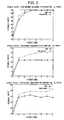
- the switching fabric is a crossbar switch that has N input ports and N output ports, N being any natural number. It should be noted that the present invention is not limited to such a switch and can be used for any switch including a switch with M input ports and N output ports, M and N being natural numbers.
- a crossbar switch is capable of routing an arbitrary permutation of fixed-sized packets (cells) in one time step.
- VOQ virtual output queuing
- VOQ allows the switch to have greater flexibility when selecting a permutation.
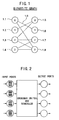
- N 4 is shown in FIG. 2.
- selecting appropriate permutations quickly is a fundamental problem. But what is the most appropriate permutation? One reasonable approach would be to route the most cells possible in the current time step.
- a further drawback of MBM demonstrated by McKeown is that it can be unstable even for traffic flows for which no input or output port is expected to handle a throughput greater than its maximum capacity.
- a queuing method is considered unstable when it can result in unbounded queue lengths. Further information on these drawbacks can be found in N. W. McKeown, Scheduling Algorithms for Input-Queued Cell Switches. PhD thesis, University of California at Berkeley, 1995.
- a flow is said to be admissible when no input or output port switch is loaded to its full capacity. It was later shown independently by Tassiulas and Ephremides; and McKeown, Anantharam, and Walrand that a generalization of the MBM approach, called Maximum Weight Bipartite Matching (MWBM), would be stable for all admissible flows. See N. McKeown, V. Anantharam, and I. Walrand, "Achieving 100% throughput in an input-queued switch," in Proceedings IEEE INFOCOM'96, (San Francisco, CA), pp. 296-302, March 1996. As with MBM, however, implementing full MWBM is problematic.
- MBM and MWBM approaches may be suitable in different contexts.
- the MBM approach is quite reasonable. If there is no call-admission control for flows, then the ability to support all admissible flows will not be a particularly useful feature. In such a case, maximizing instantaneous bandwidth is a more reasonable design goal.
- QoS is required and call-admission control is used, an approach like MWBM that is stable for all admissible traffic is highly desirable.
- the unweighted approaches to the scheduling problem do not take into account the size of the different queues, only whether they are empty or not.
- the switch can be modeled as a bipartite graph, where each input port is represented by a node in one set, each output port is represented by a node in the other set, and the existence of an edge between two vertices indicates that a cell exists to be routed between the corresponding input and output ports in the switch. Finding a matching corresponds to the selection of a permutation to route.
- a maximum bipartite matching approach is the first example of an unweighted approach. Computing an actual maximum size matching is now considered. The fastest method to compute a maximum size matching runs in O(n 1/2 m) time worst-case. See E. A. Dinitz, "Algorithm for solution of a problem of maximum flow in networks with power estimation," Soviet Math. Dokl, vol. 11, pp. 1277-1280,1970 and S. Even and R. E. Tarjan, "Network flow and testing graph connectivity,” SIAM Journal on Computing, vol. 4. pp. 507-518, 1975.
- the MBM approach has several drawbacks. It can lead to instability with an admissible but non-uniform traffic even on a 3 x 3 switch. See N. McKeown, V. Anantharam, and I. Walrand, "Achieving 100% throughput in an input-queued switch," in Proceedings IEEE INFOCOM'96, (San Francisco, CA), pp. 296-302, March 1996.
- Another problem with MBM is that the relevant methods are sequential in nature, requiring a centralized controller with knowledge of the state of each of the O(n 2 ) queues at each time step.
- PIM Parallel Iterative Matching
- the RND heuristic is similar to FIM. The difference is that every unmatched input i make only a single request to a randomly chosen output port j for which i has a queued cell.
- scheduling for a given time slot t is determined by a fixed priority schedule.
- the input i 1 with the highest priority chooses randomly among the outputs for which it has a cell queued.
- the input i 2 with the next highest priority chooses next among the not-taken outputs, and so on.
- the input-port priorities will be incremented by 1, modulo N.
- SLIP was developed by McKeown and analyzed extensively in N. W. McKeown, "Scheduling Algorithms for Input-Queued Cell Switches", PhD thesis, University of California at Berkeley, 1995.
- each input port and output port has a distinct priority wheel.
- An input sends a request to every output for which it has a queued cell.
- An output j chooses to accept a request from port i , based on its priority wheel; if the grant is accepted by i , the priority wheel at j will be set to ( i + 1) mod N .
- Input ports accept grants based on priority wheels, and advance their wheels in a similar fashion.
- the PIM, RND and SLIP heuristics fall into the class of iterative heuristics. Iterative heuristics are not guaranteed to find a maximal matching in a single execution (iteration). Therefore repeating them more than once, may increase the size of the permutation. Of course there is a tradeoff with speed, since the switch fabric may have to operate at a higher speed if more than one iterations are required for each permutation. The number of iterations is a parameter of importance as shown subsequently ( infra Section C).
- the sizes of the queues affect the execution of the scheduling method.
- the edges of the graph are assigned weights and the objective is to compute a matching of maximum weight.
- Maximum weight bipartite matching has the advantage that it has been proven theoretically so be stable under admissible traffic where the traffic flow from input i to output j can be modeled as a sequence of independent and identically distributed random variables. See N. McKeown, V. Anantharam, and I. Walrand, "Achieving 100% throughput in an input-queued switch," in Proceedings IEEE INFOCOM'96, (San Francisco, CA), pp. 296-302, March 1996 and A. Mekkittikul and N.
- ILPF is a simple heuristic proposed in to approximate the solution found by MWBM-LPF. See A. Mekkittikul and N. McKeown, "A practical scheduling algorithm to achieve 100% throughput in input-queued switches," in Proceedings IEEE INFOCOM'98, (San Francisco, GA), pp. 792-799, March 1998.
- the heuristic exploits the special assignment of edge weights as a function of port weights.
- the inputs and outputs are sorted according to their S and R values.
- the sorted list of outputs is traversed in decreasing order and output j is matched to the input i with the largest S i value such that (i) i is still unmatched and (ii) q ij > 0.
- This scheduler is similar to the RR-RND method described in Section IB.1(d). The difference is that each input i selects among the not taken outputs j the one with the maximum q ij value.
- the present invention uses a Shakeup technique, which can be used in conjunction with a number of the existing MBM and MWBM heuristics to improve their performance dramatically.
- the Shakeup technique assumes an initial matching is provided, and unmatched nodes have the ability to "knock out" existing matches. Intuitively, this provides a mechanism to jump out of local maxima in the matching heuristic.
- a computer-implemented unweighted queueing method for a system with M groups of N input queues each of said N input queues requesting a unique one of N services, wherein M and N are natural numbers, said method comprising representing each of said M groups as a node in a first set of vertices of a bipartite graph; representing each of said N services as a node in a second set of vertices of said bipartite graph; representing each non-empty queue as an edge between a vertex in said first set corresponding to one of said M groups to which said each non-empty queue belongs to and a vertex in said second set corresponding to a service requested by said each non-empty queue; performing an initial matching by finding a subset of edges such that no vertex is incident to more than one edge in such subset; performing an unweighted shakeup matching for a hitherto unmatched vertex x in said first set to a vertex y in the second set
- Another aspect of the present invention is a computer-implemented unweighted queuing method for a system with M group of N input queues each of said N input queues requesting a unique one of N services, wherein M and N are natural numbers, said method comprising: representing each of said M groups as a node in a first set of vertices of a bipartite graph; representing each of said N services as a node in a second set of vertices of said bipartite graph; representing each non-empty queue as an edge between a vertex in said first set corresponding to one of said M groups to which said each non-empty queue belongs to and a vertex in said second set corresponding to a service requested by said each non-empty queue; performing an initial matching by finding a subset of edges such that no vertex is incident to more than one edge in such subset, wherein if a vertex can be matched using more than one edges, one edge is selected from said more than one edges with a probability relative to the size of queue
- Yet another aspect of the present invention is a method of unweighted routing in a switch comprising input ports and output ports, having cells to route between said input ports and said output ports, each input port having one queue each for each said output port, thereby each input port having as many queues as a number of said output ports, said method comprising: representing each said input ports as a node in a first set of vertices of a bipartite graph; representing each said output ports as a node in a second set of vertices of said bipartite graph; representing each non-empty queue between any of said input ports and any of said output ports as an edge between a vertex in said first set corresponding to said any of said input ports and a vertex in said second set corresponding to said any of said output ports, thereby creating a set of edges; performing an initial matching by finding a subset of edges such that no vertex is incident to more than one edge in said subset; performing an unweighted shakeup matching for a hitherto unmatched vertex x
- Yet another aspect of the present invention is a method of weighted routing in a switch comprising input ports and output ports, having cells to route between said input ports and said output ports, each input port having one queue each for each said output port, thereby each input port having as many queues as a number of said output ports, said method comprising: representing each said input ports as a node in a first set of vertices of a bipartite graph; representing each said output ports as a node in a second set of vertices of said bipartite graph; representing each non-empty queue between any of said input ports and any of said output ports as an edge between a vertex in said first set corresponding to said any of said input ports and a vertex in said second set corresponding to said any of said output ports, thereby creating a set of edges; performing an initial matching by finding a subset of edges such that no vertex is incident to more than one edge in such subset, wherein if a vertex can be matched using more than one edges, one edge is selected
- unweighted shakeup is performed for every alternate matching.
- weighted shakeup is performed for every alternate matching.
- unweighted shakeup is performed only if no increase in the size of matching is possible without shakeup.
- weighted shakeup is performed only if no increase in the size of matching is possible without shakeup.
- an unweighted shakeup switch for use in a network, said switch comprising: input ports; output ports, wherein cells are routed between said input ports and said output ports; a graph generator that generates a bipartite graph with each said input ports as a node in a first set of vertices of the bipartite graph and each said output ports is a node in a second set of vertices of said bipartite graph and a cell to be routed between an input port and an output port is an edge between a vertex in said first set said second set; a matcher for performing an initial matching by finding a subset of edges such that no vertex is incident to more than one edge in such subset; an unweighted shakeup matcher for performing an unweighted shakeup matching for a hitherto unmatched vertex x in said first set to a vertex y in the second set, wherein said unweighted shakeup matcher adds new matching (x,y) if y is
- Still another aspect of the present invention is a weighted shakeup switch for use in a network, said switch comprising: input ports; output ports, wherein cells are routed between said input ports and said output ports; a graph generator that generates a bipartite graph with each said input ports as a node in a first set of vertices of the bipartite graph and each said output ports is a node in a second set of vertices of said bipartite graph and a cell to be routed between an input port and an output port is an edge between a vertex in said first set said second set; a matcher for performing an initial matching by finding a subset of edges such that no vertex is incident to more than one edge in such subset; an weighted shakeup matcher for performing an weighted shakeup matching for a hitherto unmatched vertex x in said first set to a vertex y in the second set, wherein said unweighted shakeup matcher adds (x,y) if y is not part of
- unweighted shakeup is performed for every alternate matching.
- weighted shakeup is performed for every alternate matching.
- unweighted shakeup is performed only if no increase in the size of matching is possible without shakeup.
- weighted shakeup is performed only if no increase in the size of matching is possible without shakeup.
- Still another aspect of the present invention is a network system comprising a 15 plurality of switches for routing messages, a first subset of the plurality of said switches being unweighted shakeup switches, a second subset of the plurality of said switches being weighted shakeup switches.
- the shakeup approach comes in two varieties: one for unweighted and another for weighted heuristics.
- the motivation behind the Shakeup operation in both cases is to provide a way for the scheduler to escape from a local maximum, i.e. a maximal matching, and by doing so to speed the convergence of the queuing system to a steady state. Randomization is a crucial component of Shakeup.
- A be the set of vertices representing input ports
- B be the set of vertices representing output ports.
- the switch used in this case has N input ports and N output ports. Each input port has N queues associated with it, each queue holding cells to be routed for a specific output port. Thus there are N x N queues. Cells to be transmitted are thus queued in the appropriate on of the N x N queues.
- each input port is represented as a first set of vertices in a bipartite graph.
- each output port is represented as a second set of vertices in the bipartite graph.
- non-empty queues are represented as edges in this bipartite graph.
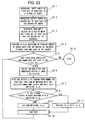
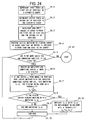
- each unmatched vertex in A will be allowed to force a match for itself, even if that means removing an existing match.
- each unmatched vertex x in set A that is incident to at least one edge selects uniformly at random one of those incident edges, say (x,y) in 23.7.
- a test is performed at 23.8 to see a match (x,y) exists. If y ⁇ B is unmatched, then (x, y) is added to the matching at 23.9.
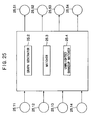
- FIG. 25 shows a preferred embodiment of an unweighted shakeup switch according to the present invention.
- This switch has four input ports 25.11-25.14 and four output ports 25.51-25.54. Cells are routed between the input ports and the output ports.
- An unweighted scheduler 25.6 performs the routing.
- the unweighted scheduler comprises a graph generator 25.2 that generates a bipartite graph with each input ports 25.11-25.14 as a node in a first set of vertices of the bipartite graph and each output ports 25.51-25.54 is a node in a second set of vertices of the bipartite graph.
- a specific cell to be routed between an input port and an output port is an edge between a vertex in the first set and the second set.
- the unweighted scheduler further comprises a matcher 25.3 for performing an initial matching by finding a subset of edges such that no vertex is incident to more than one edge in such subset.
- An unweighted shakeup matcher 25.4 performs an unweighted shakeup matching for a hitherto unmatched vertex x in said first set to a vertex y in the second set.
- the unweighted shakeup matcher adds new matching (x,y) if y is not part of any previous matching and replaces g a matching involving y by a matching (x,y) if y is already part of a matching (z,y).
- the switch used in this case has N input ports and N output ports. Each input port has N queues associated with it, each queue holding cells to be routed for a specific output port. Thus there are N x N queues. Cells to be transmitted are thus queued in the appropriate on of the N x N queues.
- each input port is represented as a first set of vertices in a bipartite graph.
- each output port is represented as a second set of vertices in the bipartite graph.
- non-empty queues are represented as edges in this bipartite graph. It should be clear that at a maximum there are N x N edges possible if all the queues are non-empty.
- Weighted Shakeup is slightly different in that it takes into account queue lengths.
- the basic idea behind extending unweighted to weighted is to give preference to those input and output polls that are heavily loaded; the unweighted Shakeup applied above does not do this. Indeed, as all edges are treated equally in the unweighted Shakeup approach, it is possible that applying unweighted Shakeup to a weighted heuristic will make the solution worse. Weighted Shakeup, therefore, uses weights when selecting possible edges to add to the matching. Specifically, each unmatched vertex in set A that is incident to at least one edge randomly selects one of those edges in 24.6.
- edge (i,j') is selected with probability q ij /( ⁇ k-1 N q ik ). Let (i,j') be the selected edge. If the vertex j' ⁇ B is unmatched, then (i,j') becomes part of the matching 24.9.
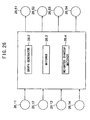
- Fig. 26 shows a preferred embodiment of an unweighted shakeup switch according to the present invention.
- This switch has four input ports 26.11-26.14 and four output ports 26.51-26.54. Cells are routed between the input ports and the output ports.
- a weighted scheduler 26.6 performs the routing.
- the weighted scheduler comprises a graph generator 26.2 that generates a bipartite graph with each input ports 26.11-26.14 as a node in a first set of vertices of the bipartite graph and each output ports 26.51-26.54 is a node in a second set of vertices of the bipartite graph.
- a specific cell to be routed between an input port and an output port is an edge between a vertex in the first set and the second set.
- the weighted scheduler further comprises a matcher 26.3 for performing an initial matching by finding a subset of edges such that no vertex is incident to more than one edge in such subset.
- the weighted scheduler further comprises a weighted shakeup matcher 26.4 for performing a weighted shakeup matching for a hitherto unmatched vertex x in said first set to a vertex y in the second set, wherein said weighted shakeup matcher adds (x,y) if y is not part of any previous matching, said vertex y being selected with a probability: wherein q xy is a length of a queue between vertices x and y, and replaces a matching involving y by a matching (x,y) if y is already part of a matching (z,y), said replacement being done with a probability: q xy q xy + q zy
- Shakeups can be used in a stand-alone manner, or in conjunction with other heuristic approaches.
- Two general types of implementations are envisioned: orthogonal and hybrid.
- the "basic heuristic" e.g., SLIP, PIM, etc.
- Shakeup are performed in alternate phases.
- SLIP is the basic heuristic sequence of operations would be: SLIP, Shakeup, SLIP, Shakeup, SLIP Shakeup, SLIP Shakeup, etc.
- the Shakeup phase is performed simultaneously with the basic heuristic phase. Each unmatched input port examines which output ports it can send cells to.
- the input port competes for it as defined by the basic heuristic, and does not do Shakeup in this iteration.
- the input port performs Shakeup this iteration instead of the basic heuristic.
- the orthogonal and hybrid approaches are slightly different, the basic idea of using randomization to get out of local maxima is the same, and in practice both approaches are likely to have similar performance. For some implementations, however, the hybrid approach can require less communication than the orthogonal approach.
- the Shakeup schemes would be fairly simple to implement, using hardware similar to that needed by many of the existing unweighted heuristics. Some additional logic for a pseudo-random generator would be necessary, but it is estimated that this logic does not have to be sophisticated. The present simulations obtained good performance by implementing Shakeup using the C built-in pseudo-random generator.
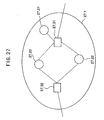
- Fig. 27 shows a preferred embodiment of a network system with shakeup and unshakeup switches.
- This network system comprises a network 27.1 that comprises several switches. Of the switches, 27.31 and 27.32 are unshakeup switches and 27.20, 27.21 and 27.22 are unshakeup switches.
- a random bipartite graph G p (2N) is a graph with N vertices on each side of the bipartition, such that an edge between any two vertices on different sides is included with probability p independently of the others.
- the random graph model has been extensively studied, in part to capture the behavior of graph algorithms on "typical" inputs. See B. Bollobas, Random Graphs. Harcourt Brace Janovich, 1985 for an excellent survey of the subject. In the present problem p could be related to, although it is clearly different from, the probability that input i has a cell to send to output j for any pair (i,j) at the given time step at which a permutation needs to be found.
- traffic types are also compared. In general, the goal is to begin to define a benchmark suite of traffic types that could be used to compare different schedulers. These traffic types should be selected to represent both typical and worst-case situations.
- each input port receives cells generated from its own source (that is, there are N sources). Each source is independent of the other sources, and generates at most one cell per time step.
- Output ports are chosen with a uniform distribution over the N possibilities. All input ports and output ports will handle the same traffic load.
- Each input port is the source of exactly k flows and each output port is the destination of exactly k flows. All flows have the same rate. To create the flows at the start of the simulation, k random permutations are used, selecting each of the N! possibilities with equal probability.
- the first permutation is (1,3,7,5,6,4,2,0) and the second permutation is (5,6,2,3,1,4,0,7).
- input port 0 will send cells only to output ports 1 and 5 (with equal probability);
- input port 1 will send cells only to output ports 3 and 6; etc.
- input port 5 sends only to output port 4.
- McKeown et al provide an example of an admissible flow pattern that causes the queues to grow unboundedly if MBM is the scheduling algorithm. See N. McKeown, V. Anantharam, and I. Walrand, "Achieving 100% throughput in an input-queued switch," in Proceedings IEEE INFOCOM'96, (San Francisco, CA), pp. 296-302, March 1996.
- the example is essentially a case of unbalanced flows. This class is interesting because, intuitively, it is better to give preference to heavily loaded ports. For the present simulations, half of the input ports are the source of exactly k flows and half are the source of 2k flows.
- Each flow generates traffic at the same rate, so half the input ports are loaded at rate ⁇ while the other half are loaded at 2 ⁇ .
- 2k random permutations are used, selecting each of the N! possibilities with equal probability.
- For the heavily loaded input ports all 2k flows are defined by the permutations.
- For the lightly loaded ports only the first k permutations are used to define the flows. Note that the output ports will support no less than k flows and no more than 2k flows.
- a rate of x% implies all input and output ports are loaded at that rate.
- a rate of x% implies the heavily loaded input ports run at x%, while the lightly loaded input ports run at rate x/2 %.
- Non-bursty (Bernoulli): At each time step, a cell is generated by a source with some fixed probability, independent of all previous traffic. The probability density function that determined the output port is the same for all cells generated by the source.
- Bursty Traffic is generated as bursts of cells (ON bursts), followed by bursts of no cells (OFF bursts). The probability density function that determines the output port is the same for all ON bursts generated by the source. All cells within an ON burst will have the same destination. To create a burst with expected length m, the burst is discontinued at each time step with probability 1/m. (The use of a geometric distribution to model bursty traffic can be found in See N. W. McKeown, Scheduling Algorithms for Input-Queued Cell Switches. PhD thesis, University of California at Berkeley, 1995, for example.)
- the various methods are tested to determine the maximum input rate for which they are stable as a function of the number of iterations of the method to select a single permutation. This is called the stability rate.
- A be a method running for i iterations.
- the range of traffic rates from 0% to 100% is considered, as defined for the traffic types described in Section B.
- a check is done to see if the sum of all the queue lengths Q has become greater than or equal to 16N 2 if so, the method is declared unstable at rate r.
- checkpoints are established for every 1,000 time steps; if the value of 0 at a checkpoint is equal to or less than the value of Q at the previous checkpoint, the method is declared stable at rate r.
- the method is declared stable at rate r. If the method is stable for rate r, the search mechanism considers only larger rates in the future. If the method is unstable, only smaller rates are considered in the future. For efficiency, in the actual implementation a linear search is not performed on all possible rates but a binary search is performed instead.
- the experimental space for the first category of experiments consists of all the possible values of the tuple (A, i, r, flow type).
- the number of iterations i ranges from 1 to 8.
- iterations are meaningless since maximal matchings are computed in the first iteration.
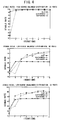
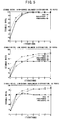
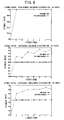
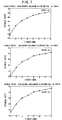
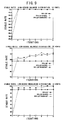
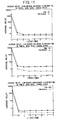
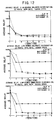
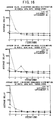
- a horizontal line is depicted in the graph.
- the two axes show rate and number of iterations.
- the relevant graphs are in Figures 3-10.
- the results for related methods A are aggregated.
- X, X-HYBRID and X-SHAKE there will be three methods in a graph.
- X is any vintage method like PIM or SLIP.
- X-SHAKE implements the orthogonal use of Shakeup: at every one of the i iterations X is run followed by an execution of unweighted Shakeup,
- X-HYBRID implements the hybrid use of Shakeup: at each of the i iterations the basic heuristic X "merged" with Shakeup as outlined in Section A is run.
- weighted Shakeup performs slightly better than pure Shakeup which can marginally degrade performance every other iteration (due to the fact that it blindly unmatches the heavily loaded ports matched by ILPF).
- the situation is similar for RR-LQF although the gains from (weighted) Shakeup are larger, of the order of 5-6%.
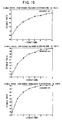
- Average delay means the average delay of all cells that were successfully routed within the time window of the simulation. (In general, the input queues can still contain cells that do not contribute to this value.) A cell that is routed immediately has delay 0.
- the stability experiments outlined above give information that allows in most cases a clear ranking of the methods based on the maximum input rate they can support. However, this ranking would not give the full picture. For a given rate r it could very well be the case that both methods A and A' are declared (eventually) stable but they differ significantly in the average delay they incur on the packets. On the other hand, testing the methods solely based on average delay and ranking them accordingly could be misleading as well.
- a method may actually settle for a large but stable average delay for a given rate r, information that is lost by looking at the average delay only.
- Second, what is the rate r at which one should examine the average delay incurred by A? If r is high enough so that A is unstable, the average delay obtained will be essentially meaningless and A will be judged unfairly under inputs it cannot possibly handle. Using the data from the stability results this pitfall is avoided by choosing r 85% for all the average delay graphs, a value at which almost all of the methods tested were shown to be stable.
- the average delay graphs confirm the picture given by the stability graphs for the advantages gained by Shakeup.
- the gains are more tangible for the unweighted methods.
- the improvements obtained by the application of Shakeup range from roughly 10% to a quite dramatic 10-fold improvement for SLIP and RR-RND on low-degree balanced inputs.
- Shakeup and weighted Shakeup are tested as stand-alone methods to verify robustness. After 6 iterations, the average delay is competitive with the one obtained by almost any other heuristic.
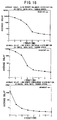
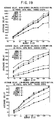
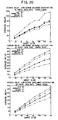
- the axes show average delay and burst size. See Figures 19 and 20.
- the number of time steps is set again at 100,000.
- the burst size increases by increments of 17 in the range [See A. C. Kam and K.-Y, Siu, "Linear complexity algorithms for bandwidth reservations and delay guarantees in input-queued switches with no speedup," in Proceedings of the 6th International Conference on Network Protocols, pp. 2-11, 1998 and 136].
- the results are as expected, i.e.
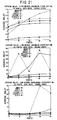
- the axes show average delay and number of ports.
- p 4, 8,16, 32, 64.
- Figures 21 and 22 are tested and the results for unweighted- and weighted-type methods are presented respectively. The results demonstrate that most of the methods scale reasonably well, i.e. the average delay increases very slowly as the number of ports grows. There are some exceptions though.
- the average delay for RR-RND in Fig. 21 increases sharply with the number of ports for low-degree balanced flows.
- RR-RND is by definition a very rigid method in the way it prioritizes input ports.
- the average delay for SLIP in Figure 21 fluctuates between 30 and 140 for low-degree balanced and between 3 and 26 for unbalanced inputs.
- SLIP's behavior is hard to predict a priori due to the different priority wheels maintained by each port. If these wheels are aligned the wrong way - an event which apparently occurs on the same traffic type simply as N grows - SLIP's performance suffers.
- the variation in average delay for the weighted-type methods in Fig. 22 is bounded by 5; therefore these methods scale in a satisfactory manner.
Landscapes
- Engineering & Computer Science (AREA)
- Computer Networks & Wireless Communication (AREA)
- Signal Processing (AREA)
- Data Exchanges In Wide-Area Networks (AREA)
Applications Claiming Priority (4)
| Application Number | Priority Date | Filing Date | Title |
|---|---|---|---|
| US342975 | 1994-11-21 | ||
| US12868599P | 1999-04-09 | 1999-04-09 | |
| US128685P | 1999-04-09 | ||
| US34297599A | 1999-06-30 | 1999-06-30 |
Publications (2)
| Publication Number | Publication Date |
|---|---|
| EP1049352A2 true EP1049352A2 (de) | 2000-11-02 |
| EP1049352A3 EP1049352A3 (de) | 2003-01-08 |
Family
ID=26826834
Family Applications (1)
| Application Number | Title | Priority Date | Filing Date |
|---|---|---|---|
| EP99122862A Withdrawn EP1049352A3 (de) | 1999-04-09 | 1999-11-17 | Mischungs Verfahren zum Verbesseren des Planungsverfahren für Vermittlungsstellen mit gepufferten Eingängen |
Country Status (2)
| Country | Link |
|---|---|
| EP (1) | EP1049352A3 (de) |
| JP (1) | JP3166766B2 (de) |
Cited By (11)
| Publication number | Priority date | Publication date | Assignee | Title |
|---|---|---|---|---|
| US6876650B2 (en) * | 2000-05-04 | 2005-04-05 | Pmc-Sierra, Inc. | Bipartite graphical connecting scheduling in time and space switch fabrics |
| US6973036B2 (en) | 2001-11-01 | 2005-12-06 | International Business Machines Corporation | QoS scheduler and method for implementing peak service distance using next peak service time violated indication |
| US6982986B2 (en) | 2001-11-01 | 2006-01-03 | International Business Machines Corporation | QoS scheduler and method for implementing quality of service anticipating the end of a chain of flows |
| US7046676B2 (en) | 2001-11-01 | 2006-05-16 | International Business Machines Corporation | QoS scheduler and method for implementing quality of service with cached status array |
| US7103051B2 (en) | 2001-11-01 | 2006-09-05 | International Business Machines Corporation | QoS scheduler and method for implementing quality of service with aging time stamps |
| US7187684B2 (en) | 2001-11-01 | 2007-03-06 | International Business Machines Corporation | Weighted fair queue having extended effective range |
| US7257124B2 (en) | 2002-03-20 | 2007-08-14 | International Business Machines Corporation | Method and apparatus for improving the fairness of new attaches to a weighted fair queue in a quality of service (QoS) scheduler |
| US7280474B2 (en) | 2001-11-01 | 2007-10-09 | International Business Machines Corporation | Weighted fair queue having adjustable scaling factor |
| US7310345B2 (en) | 2001-11-01 | 2007-12-18 | International Business Machines Corporation | Empty indicators for weighted fair queues |
| US7317683B2 (en) | 2001-11-01 | 2008-01-08 | International Business Machines Corporation | Weighted fair queue serving plural output ports |
| US7680043B2 (en) | 2002-03-20 | 2010-03-16 | International Business Machines Corporation | Network processor having fast flow queue disable process |
-
1999
- 1999-08-31 JP JP24464899A patent/JP3166766B2/ja not_active Expired - Fee Related
- 1999-11-17 EP EP99122862A patent/EP1049352A3/de not_active Withdrawn
Non-Patent Citations (11)
| Title |
|---|
| ANDERSON T E: "HIGH SPEED SWITCH SCHEDULING FOR LOCAL AREA NETWORKS" ACM SIGPLAN NOTICES, ASSOCIATION FOR COMPUTING MACHINERY, NEW YORK, US, vol. 27, no. 9, 1 September 1992 (1992-09-01), pages 98-110, XP000330593 ISSN: 0362-1340 * |
| BROWN T X ET AL: "NEURAL NETWORK DESIGN OF A BANYAN NETWORK CONTROLLER" IEEE JOURNAL ON SELECTED AREAS IN COMMUNICATIONS, IEEE INC. NEW YORK, US, vol. 8, no. 8, 1 October 1990 (1990-10-01), pages 1428-1438, XP002039122 ISSN: 0733-8716 * |
| KAM A C ET AL: "Linear complexity algorithms for bandwidth reservations and delay guarantees in input-queued switches with no speedup" NETWORK PROTOCOLS, 1998. PROCEEDINGS. SIXTH INTERNATIONAL CONFERENCE ON AUSTIN, TX, USA 13-16 OCT. 1998, LOS ALAMITOS, CA, USA,IEEE COMPUT. SOC, US, 13 October 1998 (1998-10-13), pages 2-11, XP010309362 ISBN: 0-8186-8988-9 * |
| KAROL M J ET AL: "Improving the performance of input-queued ATM packet switches" ONE WORLD THROUGH COMMUNICATIONS. FLORENCE, MAY 4 - 8, 1992, PROCEEDINGS OF THE CONFERENCE ON COMPUTER COMMUNICATIONS (INFOCOM), NEW YORK, IEEE, US, vol. 2 CONF. 11, 4 May 1992 (1992-05-04), pages 110-115, XP010062319 ISBN: 0-7803-0602-3 * |
| MCKEOWN N ET AL: "Achieving 100% throughput in an input-queued switch" PROCEEDINGS OF IEEE INFOCOM 1996. CONFERENCE ON COMPUTER COMMUNICATIONS. FIFTEENTH ANNUAL JOINT CONFERENCE OF THE IEEE COMPUTER AND COMMUNICATIONS SOCIETIES. NETWORKING THE NEXT GENERATION. SAN FRANCISCO, MAR. 24 - 28, 1996, PROCEEDINGS OF INFOCOM, L, vol. 2 CONF. 15, 24 March 1996 (1996-03-24), pages 296-302, XP010158083 ISBN: 0-8186-7293-5 * |
| MCKEOWN N ET AL: "SCHEDULING CELLS IN AN INPUT-QUEUED SWITCH" ELECTRONICS LETTERS, IEE STEVENAGE, GB, vol. 29, no. 25, 9 December 1993 (1993-12-09), pages 2174-2175, XP000424130 ISSN: 0013-5194 * |
| MCKEOWN N ET AL: "TINY TERA: A PACKET SWITCH CORE" IEEE MICRO, IEEE INC. NEW YORK, US, vol. 17, no. 1, 1997, pages 26-33, XP000642693 ISSN: 0272-1732 * |
| MCKEOWN: "THE ISLIP SCHEDULING ALGORITHM FOR INPUT-QUEUED SWITCHES" IEEE / ACM TRANSACTIONS ON NETWORKING, IEEE INC. NEW YORK, US, vol. 7, no. 2, April 1999 (1999-04), pages 188-201, XP000828686 ISSN: 1063-6692 * |
| MEKKITTIKUL A ET AL: "A practical scheduling algorithm to achieve 100% throughput in input-queued switches" INFOCOM '98. SEVENTEENTH ANNUAL JOINT CONFERENCE OF THE IEEE COMPUTER AND COMMUNICATIONS SOCIETIES. PROCEEDINGS. IEEE SAN FRANCISCO, CA, USA 29 MARCH-2 APRIL 1998, NEW YORK, NY, USA,IEEE, US, 29 March 1998 (1998-03-29), pages 792-799, XP010270430 ISBN: 0-7803-4383-2 * |
| TASSIULAS L: "Linear complexity algorithms for maximum throughput in radio networks and input queued switches" INFOCOM '98. SEVENTEENTH ANNUAL JOINT CONFERENCE OF THE IEEE COMPUTER AND COMMUNICATIONS SOCIETIES. PROCEEDINGS. IEEE SAN FRANCISCO, CA, USA 29 MARCH-2 APRIL 1998, NEW YORK, NY, USA,IEEE, US, 29 March 1998 (1998-03-29), pages 533-539, XP010270421 ISBN: 0-7803-4383-2 * |
| TROUDET T P ET AL: "NEURAL NETWORK ARCHITECTURE FOR CROSSBAR SWITCH CONTROL" IEEE TRANSACTIONS ON CIRCUITS AND SYSTEMS, IEEE INC. NEW YORK, US, vol. 38, no. 1, 1991, pages 42-56, XP000207539 * |
Cited By (11)
| Publication number | Priority date | Publication date | Assignee | Title |
|---|---|---|---|---|
| US6876650B2 (en) * | 2000-05-04 | 2005-04-05 | Pmc-Sierra, Inc. | Bipartite graphical connecting scheduling in time and space switch fabrics |
| US6973036B2 (en) | 2001-11-01 | 2005-12-06 | International Business Machines Corporation | QoS scheduler and method for implementing peak service distance using next peak service time violated indication |
| US6982986B2 (en) | 2001-11-01 | 2006-01-03 | International Business Machines Corporation | QoS scheduler and method for implementing quality of service anticipating the end of a chain of flows |
| US7046676B2 (en) | 2001-11-01 | 2006-05-16 | International Business Machines Corporation | QoS scheduler and method for implementing quality of service with cached status array |
| US7103051B2 (en) | 2001-11-01 | 2006-09-05 | International Business Machines Corporation | QoS scheduler and method for implementing quality of service with aging time stamps |
| US7187684B2 (en) | 2001-11-01 | 2007-03-06 | International Business Machines Corporation | Weighted fair queue having extended effective range |
| US7280474B2 (en) | 2001-11-01 | 2007-10-09 | International Business Machines Corporation | Weighted fair queue having adjustable scaling factor |
| US7310345B2 (en) | 2001-11-01 | 2007-12-18 | International Business Machines Corporation | Empty indicators for weighted fair queues |
| US7317683B2 (en) | 2001-11-01 | 2008-01-08 | International Business Machines Corporation | Weighted fair queue serving plural output ports |
| US7257124B2 (en) | 2002-03-20 | 2007-08-14 | International Business Machines Corporation | Method and apparatus for improving the fairness of new attaches to a weighted fair queue in a quality of service (QoS) scheduler |
| US7680043B2 (en) | 2002-03-20 | 2010-03-16 | International Business Machines Corporation | Network processor having fast flow queue disable process |
Also Published As
| Publication number | Publication date |
|---|---|
| JP2000295288A (ja) | 2000-10-20 |
| EP1049352A3 (de) | 2003-01-08 |
| JP3166766B2 (ja) | 2001-05-14 |
Similar Documents
| Publication | Publication Date | Title |
|---|---|---|
| Giaccone et al. | Randomized scheduling algorithms for high-aggregate bandwidth switches | |
| Leonardi et al. | Bounds on average delays and queue size averages and variances in input-queued cell-based switches | |
| Goudreau et al. | Scheduling algorithms for input-queued switches: randomized techniques and experimental evaluation | |
| Giaccone et al. | Throughput region of finite-buffered networks | |
| EP1049352A2 (de) | Mischungs Verfahren zum Verbesseren des Planungsverfahren für Vermittlungsstellen mit gepufferten Eingängen | |
| Lin et al. | The concurrent matching switch architecture | |
| JP3175735B2 (ja) | スイッチのルーティング方法、及びそれを用いたシューティングブランクス・スイッチ | |
| Yang et al. | An efficient scheduling algorithm for CIOQ switches with space-division multiplexing expansion | |
| Shah | Maximal matching scheduling is good enough | |
| Constantin et al. | Improving performance bounds for weighted round-robin schedulers under constrained cross-traffic | |
| Fayyazi et al. | Parallel maximum weight bipartite matching algorithms for scheduling in input-queued switches | |
| Li et al. | Enhanced Birkhoff–von Neumann decomposition algorithm for input queued switches | |
| Zhang et al. | Adaptive max-min fair scheduling in buffered crossbar switches without speedup | |
| Tu et al. | Design a simple and high performance switch using a two-stage architecture | |
| Oommen et al. | Discretized learning automata solutions to the capacity assignment problem for prioritized networks | |
| Park et al. | The folded hypercube ATM switches | |
| Marsan et al. | On the stability of isolated and interconnected input-queueing switches under multiclass traffic | |
| WO2022035935A1 (en) | Multi-packet sliding window scheduler and method for input-queued switches | |
| Elhanany et al. | On the performance of output queued cell switches with non-uniformly distributed bursty arrivals | |
| Zhang et al. | An on-demand queue management architecture for a programmable traffic manager | |
| Li et al. | Stability of a frame-based oldest-cell-first maximal weight matching algorithm | |
| Song et al. | Integrated Queuing and Scheduling for Unicast and Multicast Traffic in Input-Queued Packet Switches | |
| Minagar et al. | The optimized prioritized iSLIP scheduling algorithm for input-queued switches with ability to support multiple priority levels | |
| Ayandeh | A framework for benchmarking performance of switch fabrics | |
| Vasiliadis et al. | Improving performance of finite-buffered blocking delta networks with 2-class priority routing through asymmetric-sized buffer queues |
Legal Events
| Date | Code | Title | Description |
|---|---|---|---|
| PUAI | Public reference made under article 153(3) epc to a published international application that has entered the european phase |
Free format text: ORIGINAL CODE: 0009012 |
|
| AK | Designated contracting states |
Kind code of ref document: A2 Designated state(s): AT BE CH CY DE DK ES FI FR GB GR IE IT LI LU MC NL PT SE |
|
| AX | Request for extension of the european patent |
Free format text: AL;LT;LV;MK;RO;SI |
|
| PUAL | Search report despatched |
Free format text: ORIGINAL CODE: 0009013 |
|
| AK | Designated contracting states |
Kind code of ref document: A3 Designated state(s): AT BE CH CY DE DK ES FI FR GB GR IE IT LI LU MC NL PT SE |
|
| AX | Request for extension of the european patent |
Free format text: AL;LT;LV;MK;RO;SI |
|
| 17P | Request for examination filed |
Effective date: 20021128 |
|
| STAA | Information on the status of an ep patent application or granted ep patent |
Free format text: STATUS: THE APPLICATION HAS BEEN WITHDRAWN |
|
| 18W | Application withdrawn |
Effective date: 20030110 |