EP1049008A2 - Method and apparatus for building a calling convention prolog and epilog code using a register allocator - Google Patents
Method and apparatus for building a calling convention prolog and epilog code using a register allocator Download PDFInfo
- Publication number
- EP1049008A2 EP1049008A2 EP00303418A EP00303418A EP1049008A2 EP 1049008 A2 EP1049008 A2 EP 1049008A2 EP 00303418 A EP00303418 A EP 00303418A EP 00303418 A EP00303418 A EP 00303418A EP 1049008 A2 EP1049008 A2 EP 1049008A2
- Authority
- EP
- European Patent Office
- Prior art keywords
- register
- computer
- code
- calling convention
- intersection
- Prior art date
- Legal status (The legal status is an assumption and is not a legal conclusion. Google has not performed a legal analysis and makes no representation as to the accuracy of the status listed.)
- Withdrawn
Links
Images




Classifications
-
- G—PHYSICS
- G06—COMPUTING OR CALCULATING; COUNTING
- G06F—ELECTRIC DIGITAL DATA PROCESSING
- G06F8/00—Arrangements for software engineering
- G06F8/40—Transformation of program code
- G06F8/41—Compilation
- G06F8/44—Encoding
- G06F8/441—Register allocation; Assignment of physical memory space to logical memory space
-
- G—PHYSICS
- G06—COMPUTING OR CALCULATING; COUNTING
- G06F—ELECTRIC DIGITAL DATA PROCESSING
- G06F8/00—Arrangements for software engineering
- G06F8/40—Transformation of program code
- G06F8/41—Compilation
- G06F8/44—Encoding
- G06F8/447—Target code generation
Definitions
- the present invention relates generally to methods and apparatus for improving the performance of software applications. More particularly, the present invention relates to methods and apparatus for enabling a register allocator to build calling convention prolog and epilog code for subroutine calls.
- Optimizing a computer program generally serves to eliminate portions of computer code which are essentially unused.
- optimizing a computer program as a part of a compilation process may restructure computational operations to allow overall computations to be performed more efficiently, thereby consuming fewer computer resources.
- An optimizer is arranged to effectively transform or otherwise compile a computer program, e.g. , a computer program written in a programming language such as C++, FORTRAN, or Java bytecodes, into a faster program.
- the faster, or optimized, program generally includes substantially all the same, observable behaviors as the original, or pre-converted, computer program.
- the optimized program includes the same mathematical behavior as its associated original program.
- the optimized program generally recreates the same mathematical behavior with fewer computations.
- an optimizer generally includes a register allocator which is arranged to control the use of registers within an optimized, or otherwise compiled, internal representation of a program.
- a register allocator allocates register space in which data associated with a program may be stored.
- a register is a location associated with a processor of a computer that may be accessed relatively quickly, as compared to the speed associated with accessing "regular" memory space, e.g. , stack space which is partitioned into stack slots, associated with a computer.
- a calling convention is generally a convention by which calls to a subroutine are made.
- a calling convention typically specifies where arguments are passed, i.e. , which register or stack slot each argument appears in.
- a calling convention may specify which registers must be preserved across the subroutine, i.e., callee-save registers. If callee-save registers are used in the subroutine, the callee-save registers generally need to be saved and restored.
- the calling convention may also specify whether some registers are unused or used for special purposes. Saving and restoring registers, along with any other special handling, typically occurs at the entry and exit of subroutines, and is called prolog and epilog code. Additional information is available after the register allocation process is completed. Such additional information includes, but is not limited to, the stack frame size associated with the subroutine and a set of registers, which is to be saved and restored.
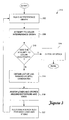
- Figure 1 is a diagrammatic representation of a compiler which includes a register allocator and a calling convention code generator.
- Source code 102 is provided as input to a compiler 106, which may be an optimizing compiler.
- source code 102 includes a call 108 to a subroutine 110, as well as incoming arguments 112 associated with call 108. Specifically, the location of incoming arguments 112 is specified with respect to call 108.
- a register allocator 116 which is included in compiler 106, is arranged to allocate memory space for use by source code 102. After register allocator 116 performs a register allocation, a calling convention code generator 118 generates prolog and epilog code associated with source code 102. By way of example, if any callee-save register is used in any part of the allocation, then code which is used to save and to restore the callee-save register is inserted into the prolog and epilog code. Prolog and epilog code is included in an internal representation 120 of source code 102. Once internal representation 120 is generated, compiler 106 creates machine instructions 124 from internal representation 120.
- Internal representation 120 includes copy, load, and store instructions that are associated with definitions and uses of variables, in addition to a calling convention for a subroutine. As shown, variables, or values, "c" and “d” are stored on a stack. Variable “d” must be spilled across the subroutine call, as will be appreciated by those skilled in the art. Hence, variable “d” is reloaded from a stack after the subroutine call to "foo.”
- Process 202 generally involves the conversion of "virtual" registers into “real” registers, as will be appreciated by those skilled in the art. Prior to allocation, the compiler assumes that it has an unlimited number of "virtual" registers to work with. It is the job of the allocator to map the unlimited virtual registers into the very limited set of real registers that the overall machine has.
- Process 202 begins at step 204 in which calling convention code is inserted into source code obtained by a compiler.
- the compiler studies the calling convention in step 206. Specifically, the compiler studies an incoming argument associated with the calling convention.
- step 208 a determination is made as to whether the incoming value, or argument, is associated with a register or a stack location, e.g. , a stack slot. When it is determined that the incoming argument is stored in a register, then process flow moves to step 216 where the incoming value is copied to a virtual register. Typically, the copying is performed using a register-to-register copy command.
- register allocation is performed.
- the steps associated with performing a register allocation will be discussed below with respect to Figure 3.
- a register allocation process generates allocation choices. That is, an overall register allocation process may be used to determine how different values are assigned to registers, i.e. , "real" registers, and stack slots.
- the allocation choices generated by the register allocation process arc converted into machine instructions by the compiler in step 214. It should be appreciated that turning allocation choices into machine instructions includes building prolog and epilog code using information obtained during the register allocation process. The process of creating machine instructions is completed once allocation choices have been converted.
- step 210 the incoming value is loaded into a virtual register. From step 210, process flow proceeds to step 212 where a register allocation is performed.
- FIG 3 is a process flow diagram which illustrates the steps associated with allocating stack space, i.e., step 212 of Figure 2, in response to coloring an interference graph.
- the process 212 of allocating memory associated with a segment of source code begins at step 302 in which an interference graph is constructed for the segment of source code. After the interference graph is constructed, an attempt is made to color the interference graph in step 306. Typically, a variety of different methods may be applied in an attempt to color the interference graph. Once the attempt is made to color the interference graph in step 306, a determination is made in step 310 as to whether the attempt to color the interference graph was successful. In other words, a determination is made regarding whether each variable associated with the interference graph was successfully assigned to a register without conflict.
- the spill code is code that moves data to and from stack slots in an effort to reduce the number of registers that are simultaneously required, as will be understood by those skilled in the art.
- a stack slot is a piece of a stack frame which an allocator uses to hold information when all registers are full.
- an optimizer includes a specialized stack slot allocator that is arranged to allocate stack slots for spill code as needed.
- Stack slots for spill code are also generally needed when arguments which are beyond arguments which fit in the registers are passed on a stack.
- step 310 determines whether the attempt to color the interference graph was successful. If the determination in step 310 is that the attempt to color the interference graph was not successful, process flow moves from step 310 to step 314 in which a list of live ranges is obtained as spill candidates. That is, variables which may be spilled into stack slots are identified.
- load instructions and store instructions are assigned around definitions and uses in the segment of source code. Specifically, a load command to load a variable is inserted before a use of the variable in the segment of source code, while a store instruction to store a variable is inserted after the variable is defined in the segment of source code.
- a stack slot is allocated for each load and store in step 322.
- a stack slot allocator which is separate from a register allocator is used to allocate the stack slots. While a stack slot allocator is separate from a register allocator, it should be understood that both allocators may be included in an optimizer or a compiler. Allocating the stack slots allows spill candidates to be spilled into the stack slots. From step 322, process flow returns to step 302 where an interference graph is constructed.
- step 310 if the determination that the attempt to color the interference graph was successful, then the implication is that each variable has successfully been associated with either a register or a stack slot.
- process flow moves to step 326 in which the allocation is cleaned up, or finalized.
- stack slot numbers are converted to offsets into the stack frame, copies are manifested as loads or stores as required, actual register numbers are inserted into the machine instructions, and other house-cleaning chores are attended to, as will be appreciated by those skilled in the art.
- a computer-implemented method for generating code associated with a calling convention includes obtaining compilable source code, and identifying at least one argument associated with the calling convention. The location of the argument with respect to memory space is described by a register mask. The method also includes performing a register allocation using a register allocator that is arranged to allocate registers. During the register allocation, code associated with the calling convention is produced.
- a computer-implemented method for building a calling convention associated with a call to a subroutine in an object-based system includes obtaining source code that is suitable for compilation, creating a plurality of register masks each having an associated variable with an associated live range, and determining an intersection of the plurality of register masks. A register allocation is performed using the intersection. The register allocation, in addition to allocating registers, generates code associated with the calling convention. In one embodiment, the method further includes converting the code associated with the calling convention into machine instructions, the machine instructions being suitable for execution by a computing system.
- the calling convention may be readily characterized.
- the allocator may be arranged to efficiently perform an allocation.
- the source code from which the calling convention code is generated may be readily ported between different platforms.
- Figure 1 is a diagrammatic representation of a compiler which is arranged to build a calling convention.
- Figure 2 is a process flow diagram which illustrates the steps associated with generating machine instructions.
- Figure 3 is a process flow diagram which illustrates the steps associated with a process of allocating stack space, i.e. , step 212 of Figure 2.
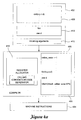
- Figure 4a is a diagrammatic representation of a compiler which includes a register allocator that is arranged to build a calling convention in accordance with an embodiment of the present invention.
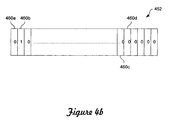
- Figure 4b is a diagrammatic representation of a register mask in accordance with an embodiment of the present invention.
- Figure 5 is a process flow diagram which illustrates the steps associated with generating machine instructions in accordance with an embodiment of the present invention.
- FIG. 6 is a process flow diagram which illustrates the steps associated with a process of allocating stack slots, i.e., step 508 of Figure 4, in accordance with an embodiment of the present invention.
- Figure 7 is a diagrammatic representation of a general purpose computer system suitable for implementing the present invention.
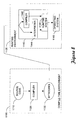
- Figure 8 is a diagrammatic representation of a virtual machine which is supported by the computer system of Figure 7, and is suitable for implementing the present invention.
- a compiler e.g. , an optimizing compiler, often includes a stack slot allocator that is used to allocate stack slots to hold variables which may not be stored in registers due to the fact that the number of registers associated with a processor is finite.
- Such compilers also generally include a calling convention code generator which is arranged to build subroutine calling convention code.
- a set of values i.e. , incoming arguments, are in fixed locations specified by a calling convention.
- additional information such as the size of an associated stack frame and the set of registers used to store variables associated with the calling convention are needed. Such information is typically not available until after the register allocation process is completed. By requiring a register allocation process to occur prior to building a calling convention, the portability of code including calling convention code is reduced, as small changes to the calling conventions may cause large platform-based changes in calling convention code.
- stack-based values or variables are treated in the same manner as machine registers, a specialized stack slot allocator will not be required.
- Using a register allocator to allocate stack slots enables the stack slots to be treated in the same manner as registers, thereby eliminating bugs associated with the heuristics that are commonly used to treat values store in stack slots.
- a register allocator to substantially automatically generate calling convention code allows calling convention code to he generated when locations for incoming arguments to a subroutine call are known. Specifically, by effectively integrating the allocation of instruction, i.e., subroutine call, inputs and instruction results with the allocation of arguments, the register allocator may generate calling convention code.
- Allowing the register allocator to generate calling convention code typically has a minimal effect on the register allocator.
- the register allocator may be impacted by the setting of initial conditions.
- the use of a register allocator to generate calling convention code increases the flexibility of overall code which includes the calling convention code, and enables the code to execute more quickly.
- the use of a register allocator to generate calling convention code enables the calling convention code to be substantially machine independent. For example, the allocator is informed of the actual initial location of incoming arguments, instead of having them immediately moved to virtual registers. If the incoming location is considered to be satisfactory, then the move to a virtual register is avoided.
- a spill code mechanism is arranged to build the prolog and epilog code, and a relatively simple interface may be used to describe the behavior of callee-save registers, thereby making it relatively easy to port the interface to different central processing units (CPUs). Such an interface may also enable a set of callee-save registers, i.e., the calling convention on the same CPU, to be changed.
- the use of a spill code mechanism to build calling convention code, e.g., prolog and epilog code allows the spill candidate selection heuristics to combine in a global way the effects of spilling a callee-save register or not spilling a callee-save register.
- a register allocator declares substantially all callee-save registers to be live on entry and used at exit, e.g. , live on entry into a subroutine and used at the exit of the subroutine.
- Such declarations effectively create a set of live ranges that are relatively long, e.g., they may cover an entire method, and have substantially only a single use and substantially only a single definition.
- live ranges make ideal spill candidates, if required.
- Source code 402 is provided as input to a compiler 406, which, in the described embodiment, is an optimizing compiler.
- Source code 402 includes a call 408 to a subroutine 410, as well as incoming arguments 412.
- Incoming arguments 412 are associated with call 108, i.e., the location of incoming arguments 112 is specified with respect to call 108.
- the location of incoming arguments may be specified in register masks, as will be described below with reference to Figure 4b.
- each incoming argument has an associated register mask.
- a register allocator 416 which is included in optimizing compiler 406, is arranged to allocate memory space for use by source code 402. As will be discussed below with respect to Figures 5 and 6, register allocator 416 is arranged to allocate stack space in the same manner as register space is allocated. Register allocator 416 is further arranged to use incoming arguments 412 to create calling convention code, which is included in an internal representation 420 of source code 402. In other words, live ranges for the callee-save registers are added. In Fig 4a, a live range for machine register EDI is added; it is defined to be live on entry to the subroutine and is required to be back in EDI when the subroutine returns. Optimizing compiler 406 is further arranged to convert internal representation 420 into machine instructions 424 that are suitable for execution.
- each incoming argument, or input variable, that is used by a register allocator to build a calling convention may have an associated register mask.
- a register mask is a collection of bits, or bit masks, that represent valid registers and, in some cases, stack slots.
- a register mask is a number space that is arranged to represent all possible machine registers and, if appropriate, stack slots.
- the number of bits in a register mask may vary depending upon the platform upon which machine instructions are to be executed.
- a register mask may be a collection of ninety-six bits.
- Figure 4b is a diagrammatic representation of a register mask in accordance with an embodiment of the present invention.
- a register mask 452 includes multiple bits 460. Each bit 460 is set to indicate whether a particular register is valid with respect to the variable with which register mask 452 is associated. The number of bits 460 is dependent, at least in part, upon the number of registers or stack slots that are associated with a particular processor. In the described embodiment, when a bit, e.g., bit 460b, is set to a value of "1," the implication is that the register associated with bit 460b is valid. Alternatively, when a bit, e.g., bit 460a, is set to a value of "0,” the indication is that the associated register is not valid.
- At most one bit 460 is set, i.e. , set to "1," in register mask 452, since bits 460 represent single precision values such as integers or floats.
- two bits 460 may be set, as for example when bits 460 represent long integers.
- FIG. 5 is a process flow diagram which illustrates the steps associated with generating machine instructions in accordance with an embodiment of the present invention. Specifically, the steps associated with generating machine instructions with calling conventions which are determined by a register allocator will be described.
- the process 502 of generating machine instructions using an optimizing compiler, which includes a register allocator begins at step 504 in which register masks are obtained for the calling convention.
- a register mask is a collection of bits, or a bit mask, that represents a collection of valid registers and, in some cases, stack slots.
- the number of bits included in a register mask may vary widely depending, for example, upon the type of processor associated with a computing system.
- the register mask is effectively used to describe the location of a value associated with a calling convention.
- a live range is a range or distance over which a particular variable remains accessible.
- the intersection of register masks generally identifies registers or stack slots that are used by more than one value.
- the intersection of register masks provides a set of "nodes" for an interference graph coloring process, as will be discussed below with reference to Figure 6.
- the use of the intersection of register masks simplifies a coloring process, as a leftover color will typically be in existence. If, after intersecting the register masks for a particular live range, the register mask has no colors, then this live range must spill immediately.
- register allocation is performed in step 508.
- One embodiment of a method for allowing an optimizing compiler to allocate registers and stack slots will be discussed below with reference to Figure 6.
- the register allocation generates allocation choices that include calling convention code.
- the allocation choices that result from the register allocation process of step 508 are converted into machine instructions on step 510.
- the optimizing compiler converts the allocation choices into machine instructions. Once the allocation choices are converted, the process of generating machine instructions is completed.
- Figure 6 describes the steps associated one process of allocating registers and stack slots, as appropriate, i.e., step 508 of Figure 5, will be described in accordance with an embodiment of the present invention.
- Figure 6 describes the performance of an interference graph coloring on source code in conjunction with allocating registers and stack slots.
- Register allocation processes are often associated with interference graph coloring processes.
- the process of allocating memory space begins at step 601 in which callee-save live ranges are inserted with respect to the source code.
- Process flow moves from step 601 to step 604 in which an interference graph is created, or "built," for a particular segment of source code.
- the segment of source code may generally be a section of a software application written in substantially any suitable programming language, e.g.
- an interference graph involves representing live ranges associated with variables, or values, in the source code and representing interferences between live ranges, as previously discussed.
- the "nodes" of the interference graph are obtained from the intersection of the register masks, as mentioned previously with respect to Figure 5.
- Coloring the interference graph involves assigning registers to different variables without conflicts or interference.
- the methods used to color an interference graph to perform register allocation may vary widely. Such methods may include, but are not limited to, the Briggs-Chaitin register allocation method, the Chow style allocation method, and the linear scan allocation method.
- Step 616 a list of live ranges associated with the interference graph is obtained as spill candidates. That is, values which may be spilled into stack slots are identified. In general, substantially any heuristic may be used to choose the spill candidates. Typically, choices will include the set-up callee-save live ranges, i.e., the set up in step 601, before the an attempt is made at coloring an interference graph. Callee-save live ranges may be selected as part of the spill candidate selection process. Spilling a callee-save live range, in the described embodiment, effectively builds prolog and epilog code.
- a copy instruction is assigned after a definition associated with a spill candidate and before an instruction that is associated with, e.g. , uses, a spill candidate.
- a copy instruction that is assigned around a definition or a use instruction typically has the appearance of a register-to-register, i.e., "reg-reg," copy instruction.
- a copy instruction may involve placing values on a stack, but generally does not require placing values on a stack.
- step 612 determines whether an attempt at coloring was successful, when it is determined that the attempt was successful, then the indication is that no spilling is necessary. That is, when coloring is determined to be successful, then no additional stack slots are required to store variables. In the described embodiment, there is generally a leftover color associated with the coloring process. Accordingly, an attempt at coloring is typically successful.
- process flow proceeds to step 628 in which each copy associated with copy instructions assigned around definitions and uses is assessed to determine whether it corresponds to a store instruction, a load instruction, or a register-to-register copy instruction. Such a determination is necessary because the real copy instructions in the CPU generally may not move values between stack slots and registers. Load and store instructions are typically required in order to move values between stack slots and registers.
- step 632 the size of a stack frame which includes stack slots allocated in step 624 is determined.
- the generation of calling convention code uses information such as the size of a stack frame. While the size of a stack frame may depend upon a variety of different factors, in the described embodiment, the size of the stack frame is dependent upon the largest stack slot in the associated namespace, as will be appreciated by those skilled in the art.
- the stack is cleaned in step 636. Cleaning up the stack generally includes converting copies into loads and stores as appropriate. In the described embodiment, no special "pass" to generate saves and restores of callee-save registers, i.e., prolog and epilog code, is required. After the stack is cleaned up, the process of performing an allocation is completed.
- FIG. 7 illustrates a typical, general purpose computer system suitable for implementing the present invention.
- the computer system 1030 includes any number of processors 1032 (also referred to as central processing units, or CPUs) that are coupled to memory devices including primary storage devices 1034 (typically a random access memory, or RAM) and primary storage devices 1036 (typically a read only memory, or ROM).
- processors 1032 also referred to as central processing units, or CPUs
- RAM random access memory
- ROM read only memory
- Computer system 1030 may be arranged to support a virtual machine, as will be appreciated by those skilled in the art.
- ROM acts to transfer data and instructions uni-directionally to the CPU 1032
- RAM is used typically to transfer data and instructions in a bi-directional manner.
- CPU 1032 may generally include any number of processors.
- Both primary storage devices 1034, 1036 may include any suitable computer-readable media.
- a secondary storage medium 1038 which is typically a mass memory device, is also coupled bidirectionally to CPU 1032 and provides additional data storage capacity.
- the mass memory device 1038 is a computer-readable medium that may be used to store programs including computer code, data, and the like.
- mass memory device 1038 is a storage medium such as a hard disk or a tape which is generally slower than primary storage devices 1034, 1036.
- Mass memory storage device 1038 may take the form of a magnetic or paper tape reader or some other well-known device. It will be appreciated that the information retained within the mass memory device 1038, may, in appropriate cases, be incorporated in standard fashion as part of RAM 1036 as virtual memory.
- a specific primary storage device 1034 such as a CD-ROM may also pass data uni-directionally to the CPU 1032.
- CPU 1032 is also coupled to one or more input/output devices 1040 that may include, but are not limited to, devices such as video monitors, track balls, mice, keyboards, microphones, touch-sensitive displays, transducer card readers, magnetic or paper tape readers, tablets, styluses, voice or handwriting recognizers, or other well-known input devices such as, of course, other computers.
- CPU 1032 optionally may be coupled to a computer or telecommunications network, e.g., a local area network, an internet network or an intranet network, using a network connection as shown generally at 1012. With such a network connection, it is contemplated that the CPU 1032 might receive information from the network, or might output information to the network in the course of performing the above-described method steps.
- Such information which is often represented as a sequence of instructions to be executed using CPU 1032, may be received from and outputted to the network, for example, in the form of a computer data signal embodied in a carrier wave.
- the above-described devices and materials will be familiar to those of skill in the computer hardware and software arts.
- FIG 8 is a diagrammatic representation of a virtual machine which is supported by computer system 1030 of Figure 7, and is suitable for implementing the present invention.
- a computer program e.g. , a computer program written in the JavaTM programming language developed by Sun Microsystems of Palo Alto, California
- source code 1110 is provided to a compiler 1120 within a compile-time environment 1105.
- Compiler 1120 translates source code 1110 into byte codes 1130.
- source code 1110 is translated into byte codes 1130 at the time source code 1110 is created by a software developer.
- Byte codes 1130 may generally be reproduced, downloaded, or otherwise distributed through a network, e.g. , network 1012 of Figure 7, or stored on a storage device such as primary storage 1034 of Figure 7.
- byte codes 1130 are platform independent. That is, byte codes 1130 may be executed on substantially any computer system that is running a suitable virtual machine 1140.
- byte codes 1130 may be executed on a computer system that is running a JavaTM virtual machine.
- Byte codes 1130 are provided to a runtime environment 1135 which includes virtual machine 1140.
- Runtime environment 1135 may generally be executed using a processor such as CPU 1032 of Figure 7.
- Virtual machine 1140 includes a compiler 1142, an interpreter 1144, and a runtime system 1146.
- Byte codes 1130 may generally be provided either to compiler 1142 or interpreter 1144.
- interpreter 1144 When byte codes 1130 are provided to compiler 1142, methods contained in byte codes 1130 are compiled into machine instructions, as described above. On the other hand, when byte codes 1130 are provided to interpreter 1144, byte codes 1130 are read into interpreter 1144 one byte code at a time. Interpreter 1144 then performs the operation defined by each byte code as each byte code is read into interpreter 1144. In general, interpreter 1144 processes byte codes 1130 and performs operations associated with byte codes 1130 substantially continuously.
- runtime system 1146 may obtain the method from interpreter 1144. If, on the other hand, it is determined that the method is to he invoked as a compiled method, runtime system 1146 activates compiler 1142. Compiler 1142 then generates machine instructions from byte codes 1130, and executes the machine-language instructions. In general, the machine-language instructions are discarded when virtual machine 1140 terminates.
- steps involved with generating machine instructions associated with a calling convention may be reordered, removed or added.
- steps involved with the methods of the present invention may be reordered, removed, or added without departing from the spirit or the scope of the present invention.
- a callee-save register is a register that a subroutine call may not destroy the contents of.
- a callee-save register is an EDI register in an Intel 80x86 CPU.
- a computer system may not use register space associated with callee-save registers. Instead, the number of callee-save registers which are in use are counted, and a spill is performed to obtain stack slots to compensate for all callee-save registers up front.
- the present invention may be implemented for use with a callee-save register by saving information associated with the callee-save register into a stack, using the callee-save register as a "regular" register, then returning the information associated to the callee-save register.
- a register allocator which may substantially automatically generate calling convention code is generally arranged to handle incoming arguments to a call, outgoing arguments from a call, callee-save registers, and caller-save registers.
- the number of bits associated with a register mask may generally be widely varied, depending, for example, upon the platform with which the register mask is associated.
- the present invention has been described as being suitable for use with an Intel platform, the present invention may be implemented for use with substantially any suitable platform including, but not limited to, a Power PC platform and a Sparc platform. Therefore, the present examples are to be considered as illustrative and not restrictive, and the invention is not to be limited to the details given herein, but may be modified within the scope of the appended claims.
Landscapes
- Engineering & Computer Science (AREA)
- General Engineering & Computer Science (AREA)
- Theoretical Computer Science (AREA)
- Software Systems (AREA)
- Physics & Mathematics (AREA)
- General Physics & Mathematics (AREA)
- Devices For Executing Special Programs (AREA)
Abstract
Description
Claims (13)
- A computer-implemented method for generating code associated with a calling convention, the computer-implemented method comprising:obtaining source code, the source code being suitable for compilation by a compiler, wherein the compiler includes a register allocator arranged to allocate memory space;identifying at least one argument associated with the calling convention, wherein the location of the argument in the memory space is described by a register mask; andperforming a register allocation process using the register allocator, wherein the register allocation process is arranged to produce the code associated with the calling convention.
- A computer-implemented method for building a calling convention, the calling convention being associated with a call to a subroutine in an object-based system, the computer-implemented method comprising:obtaining source code, the source code being suitable for compilation;creating a plurality of register masks, each of the plurality of register masks having an associated variable, each associated variable having an associated live range, each associated variable further being included in the source code;determining an intersection of the plurality of register masks; andperforming a register allocation, wherein the performing the register allocation includes using the intersection and generating code associated with the calling convention.
- A computer-implemented method as recited in claim 2 further including:
converting the code associated with the calling convention into machine instructions, the machine instructions being suitable for execution by a computing system. - A computer-implemented method as recited in one of claims 2 and 3 wherein determining the intersection of the plurality of register masks includes:
identifying a valid register for a variable associated with the intersection. - A computer-implemented method as recited in one of claims 2 and 3 wherein determining the intersection of the plurality of register masks includes:
identifying a stack slot for a variable associated with the intersection. - A computer-implemented method as recited in any one of claims 2-5 further including:
generating an interference graph using the intersection. - A computer-implemented method as recited in claim 6 further including: coloring the interference graph.
- A computer-implemented method as recited in any one of claims 2-7 wherein performing the register allocation includes:allocating a register; andallocating a stack slot.
- A computer system arranged to build a calling convention, the calling convention being associated with a call to a subroutine in an object-based system associated with the computer system, the computer system comprising:a processor;a source code input mechanism arranged to obtain source code, the source code being suitable for compilation;a register mask generator arranged to create a plurality of register masks, each of the plurality of register masks having an associated variable, each associated variable having an associated live range;a determinator arranged to determining an intersection of the plurality of register masks; anda compiler, the compiler including a register allocator, wherein the register allocator is arranged to generate code associated with the calling convention using the intersection.
- A computer system as recited in claim 9 wherein the compiler is arranged to convert the code associated with the calling convention into machine instructions, the machine instructions being suitable for execution.
- A computer system as recited in one of claims 9 and 10 wherein the register allocator is further arranged to allocating a register and to allocate a stack slot.
- A computer program product for building a calling convention in an object-based system, the computer program product comprising:computer code for creating a plurality of register masks, each of the plurality of register masks having an associated variable, each associated variable having an associated live range;computer code for determining an intersection of the plurality of register masks;computer code for allocating registers, the computer code for allocating registers including computer code for using the intersection to generate the calling convention; anda computer readable medium that stores the computer codes.
- A computer program product according to claim 12 wherein the computer readable medium is one selected from the group consisting of a data signal embodied in a carrier wave, a floppy disk, a CD-ROM, a tape drive, an optical drive, flash memory, and a hard drive.
Applications Claiming Priority (2)
| Application Number | Priority Date | Filing Date | Title |
|---|---|---|---|
| US298411 | 1999-04-23 | ||
| US09/298,411 US6408433B1 (en) | 1999-04-23 | 1999-04-23 | Method and apparatus for building calling convention prolog and epilog code using a register allocator |
Publications (2)
| Publication Number | Publication Date |
|---|---|
| EP1049008A2 true EP1049008A2 (en) | 2000-11-02 |
| EP1049008A3 EP1049008A3 (en) | 2006-12-06 |
Family
ID=23150399
Family Applications (1)
| Application Number | Title | Priority Date | Filing Date |
|---|---|---|---|
| EP00303418A Withdrawn EP1049008A3 (en) | 1999-04-23 | 2000-04-25 | Method and apparatus for building a calling convention prolog and epilog code using a register allocator |
Country Status (6)
| Country | Link |
|---|---|
| US (1) | US6408433B1 (en) |
| EP (1) | EP1049008A3 (en) |
| JP (1) | JP2000347874A (en) |
| CN (1) | CN1186722C (en) |
| AU (1) | AU775007B2 (en) |
| CA (1) | CA2306535A1 (en) |
Cited By (1)
| Publication number | Priority date | Publication date | Assignee | Title |
|---|---|---|---|---|
| AU775007B2 (en) * | 1999-04-23 | 2004-07-15 | Sun Microsystems, Inc. | Method and apparatus for building a calling convention prolog and epilog code using a register allocator |
Families Citing this family (35)
| Publication number | Priority date | Publication date | Assignee | Title |
|---|---|---|---|---|
| JP3605327B2 (en) * | 1999-11-18 | 2004-12-22 | 富士通株式会社 | Program execution device |
| US20020013938A1 (en) * | 2000-02-09 | 2002-01-31 | Evelyn Duesterwald | Fast runtime scheme for removing dead code across linked fragments |
| US6912647B1 (en) | 2000-09-28 | 2005-06-28 | International Business Machines Corportion | Apparatus and method for creating instruction bundles in an explicitly parallel architecture |
| US6883165B1 (en) | 2000-09-28 | 2005-04-19 | International Business Machines Corporation | Apparatus and method for avoiding deadlocks in a multithreaded environment |
| US6799262B1 (en) | 2000-09-28 | 2004-09-28 | International Business Machines Corporation | Apparatus and method for creating instruction groups for explicity parallel architectures |
| US6886094B1 (en) | 2000-09-28 | 2005-04-26 | International Business Machines Corporation | Apparatus and method for detecting and handling exceptions |
| US6779106B1 (en) | 2000-09-28 | 2004-08-17 | International Business Machines Corporation | Apparatus and method for an enhanced integer divide in an IA64 architecture |
| US6966055B2 (en) * | 2001-03-02 | 2005-11-15 | International Business Machines Corporation | Optimizing post-link code |
| JP3763518B2 (en) * | 2001-05-29 | 2006-04-05 | インターナショナル・ビジネス・マシーンズ・コーポレーション | COMPILER, COMPILING METHOD THEREOF, AND PROGRAM |
| JP3956112B2 (en) * | 2002-06-12 | 2007-08-08 | インターナショナル・ビジネス・マシーンズ・コーポレーション | Compiler, register allocation device, program, recording medium, compilation method, and register allocation method |
| AU2002363920A1 (en) * | 2002-10-29 | 2004-05-25 | Freescale Semiconductor, Inc. | Method and apparatus for selectively optimizing interpreted language code |
| US7191318B2 (en) * | 2002-12-12 | 2007-03-13 | Alacritech, Inc. | Native copy instruction for file-access processor with copy-rule-based validation |
| JP3974063B2 (en) * | 2003-03-24 | 2007-09-12 | 松下電器産業株式会社 | Processor and compiler |
| EP1761851B1 (en) * | 2004-06-14 | 2009-10-07 | Nxp B.V. | Interface device for debugging and/or tracing a computer system comprising one or multiple masters and one or multiple slaves working together |
| US20050289520A1 (en) * | 2004-06-29 | 2005-12-29 | Redvers Consulting, Ltd. | Unidirectional cloaking device for source code |
| US7324106B1 (en) * | 2004-07-27 | 2008-01-29 | Nvidia Corporation | Translation of register-combiner state into shader microcode |
| US7640421B1 (en) * | 2006-07-28 | 2009-12-29 | Nvidia Corporation | Method and system for determining context switch state |
| US8180805B2 (en) | 2008-08-25 | 2012-05-15 | Sap Ag | Systems and methods for assigning hosts in response to a data query |
| US8468511B2 (en) * | 2008-12-31 | 2013-06-18 | International Business Machines Corporation | Use of name mangling techniques to encode cross procedure register assignment |
| CN101710291B (en) * | 2009-11-27 | 2012-12-12 | 中国科学院声学研究所 | Register allocation method for optimizing stack space |
| JP2011141676A (en) * | 2010-01-06 | 2011-07-21 | Toshiba Corp | Apparatus and method for processing language, and computer program product |
| US8615745B2 (en) | 2011-10-03 | 2013-12-24 | International Business Machines Corporation | Compiling code for an enhanced application binary interface (ABI) with decode time instruction optimization |
| US8612959B2 (en) | 2011-10-03 | 2013-12-17 | International Business Machines Corporation | Linking code for an enhanced application binary interface (ABI) with decode time instruction optimization |
| US8756591B2 (en) * | 2011-10-03 | 2014-06-17 | International Business Machines Corporation | Generating compiled code that indicates register liveness |
| CN103853532B (en) * | 2012-11-29 | 2017-09-29 | 国际商业机器公司 | Method and apparatus for function call |
| US9329875B2 (en) * | 2014-04-28 | 2016-05-03 | International Business Machines Corporation | Global entry point and local entry point for callee function |
| US9557917B2 (en) | 2014-11-10 | 2017-01-31 | International Business Machines Corporation | Conditional stack frame allocation |
| US9864518B2 (en) * | 2014-11-10 | 2018-01-09 | International Business Machines Corporation | Assigning home memory addresses to function call parameters |
| US10452409B2 (en) * | 2015-10-23 | 2019-10-22 | Oracle International Corporation | Universal adapter for native calling |
| US11556319B2 (en) | 2020-09-01 | 2023-01-17 | Huawei Technologies Co., Ltd. | Systems and methods for extending a live range of a virtual scalar register |
| WO2023142005A1 (en) * | 2022-01-28 | 2023-08-03 | Intel Corporation | Concept for handling memory spills |
| CN114661296B (en) * | 2022-03-28 | 2022-12-09 | 优视科技有限公司 | Program code compiling method, program code compiling device, electronic equipment and storage medium |
| CN115509645A (en) * | 2022-09-30 | 2022-12-23 | 北京奕斯伟计算技术股份有限公司 | Function call method and device |
| US12613685B2 (en) * | 2023-05-01 | 2026-04-28 | Mellanox Technologies, Ltd. | Register allocation optimization using per-register bin packing |
| US20240378035A1 (en) * | 2023-05-09 | 2024-11-14 | Nvidia Corporation | Compilation technique using metrics |
Family Cites Families (7)
| Publication number | Priority date | Publication date | Assignee | Title |
|---|---|---|---|---|
| US1072952A (en) * | 1910-01-22 | 1913-09-09 | Benjamin Rush Jolly | Specific-gravity balance. |
| CN1149476C (en) * | 1995-03-16 | 2004-05-12 | 松下电器产业株式会社 | resource allocation device |
| US5729748A (en) * | 1995-04-03 | 1998-03-17 | Microsoft Corporation | Call template builder and method |
| US5784066A (en) * | 1995-11-22 | 1998-07-21 | International Business Machines Corporation | Method and apparatus for using partner information to color nodes in an interference graph within a computer system |
| US6072952A (en) * | 1998-04-22 | 2000-06-06 | Hewlett-Packard Co. | Method and apparatus for coalescing variables |
| US6408433B1 (en) * | 1999-04-23 | 2002-06-18 | Sun Microsystems, Inc. | Method and apparatus for building calling convention prolog and epilog code using a register allocator |
| JP2003047874A (en) * | 2001-08-06 | 2003-02-18 | Tetsuo Sekiya | Electric garbage disposer |
-
1999
- 1999-04-23 US US09/298,411 patent/US6408433B1/en not_active Expired - Lifetime
-
2000
- 2000-04-20 AU AU28916/00A patent/AU775007B2/en not_active Expired
- 2000-04-20 CA CA002306535A patent/CA2306535A1/en not_active Abandoned
- 2000-04-24 CN CNB001070193A patent/CN1186722C/en not_active Expired - Lifetime
- 2000-04-24 JP JP2000123052A patent/JP2000347874A/en active Pending
- 2000-04-25 EP EP00303418A patent/EP1049008A3/en not_active Withdrawn
Cited By (1)
| Publication number | Priority date | Publication date | Assignee | Title |
|---|---|---|---|---|
| AU775007B2 (en) * | 1999-04-23 | 2004-07-15 | Sun Microsystems, Inc. | Method and apparatus for building a calling convention prolog and epilog code using a register allocator |
Also Published As
| Publication number | Publication date |
|---|---|
| CN1271889A (en) | 2000-11-01 |
| JP2000347874A (en) | 2000-12-15 |
| AU775007B2 (en) | 2004-07-15 |
| CA2306535A1 (en) | 2000-10-23 |
| US6408433B1 (en) | 2002-06-18 |
| AU2891600A (en) | 2000-10-26 |
| EP1049008A3 (en) | 2006-12-06 |
| CN1186722C (en) | 2005-01-26 |
Similar Documents
| Publication | Publication Date | Title |
|---|---|---|
| US6408433B1 (en) | Method and apparatus for building calling convention prolog and epilog code using a register allocator | |
| Krall | Efficient JavaVM just-in-time compilation | |
| US6434743B1 (en) | Method and apparatus for allocating stack slots | |
| Steele Jr et al. | Lambda: The ultimate imperative | |
| US6553565B2 (en) | Method and apparatus for debugging optimized code | |
| US6463582B1 (en) | Dynamic optimizing object code translator for architecture emulation and dynamic optimizing object code translation method | |
| US6363522B1 (en) | Method and apparatus for handling exceptions as normal control flow | |
| EP0428084B1 (en) | Method and apparatus for compiling computer programs with interprocedural register allocation | |
| US6973644B2 (en) | Program interpreter | |
| KR100624248B1 (en) | Array static initialization method, method in data processing system, data processing system and computer readable medium | |
| US6230317B1 (en) | Method and apparatus for software pipelining of nested loops | |
| Allen et al. | The experimental compiling system | |
| US20030079210A1 (en) | Integrated register allocator in a compiler | |
| US6421824B1 (en) | Method and apparatus for producing a sparse interference graph | |
| Chase | Garbage collection and other optimizations | |
| US6275985B1 (en) | Method and apparatus for developing an application that implements garbage collection efficiently by combining proxy objects with compiler support | |
| Koseki et al. | Preference-directed graph coloring | |
| Sastry | Efficient array update analysis of strict functional languages | |
| Bal | The design and implementation of the EM global optimizer | |
| Ramsay | The POPLOG program development system | |
| Lewis | THE ULTIMATE IMPERATIVE | |
| Philippsen et al. | Complex numbers for Java |
Legal Events
| Date | Code | Title | Description |
|---|---|---|---|
| PUAI | Public reference made under article 153(3) epc to a published international application that has entered the european phase |
Free format text: ORIGINAL CODE: 0009012 |
|
| AK | Designated contracting states |
Kind code of ref document: A2 Designated state(s): AT BE CH CY DE DK ES FI FR GB GR IE IT LI LU MC NL PT SE |
|
| AX | Request for extension of the european patent |
Free format text: AL;LT;LV;MK;RO;SI |
|
| PUAL | Search report despatched |
Free format text: ORIGINAL CODE: 0009013 |
|
| AK | Designated contracting states |
Kind code of ref document: A3 Designated state(s): AT BE CH CY DE DK ES FI FR GB GR IE IT LI LU MC NL PT SE |
|
| AX | Request for extension of the european patent |
Extension state: AL LT LV MK RO SI |
|
| 17P | Request for examination filed |
Effective date: 20070430 |
|
| AKX | Designation fees paid |
Designated state(s): DE GB |
|
| 17Q | First examination report despatched |
Effective date: 20071115 |
|
| STAA | Information on the status of an ep patent application or granted ep patent |
Free format text: STATUS: THE APPLICATION IS DEEMED TO BE WITHDRAWN |
|
| 18D | Application deemed to be withdrawn |
Effective date: 20080326 |