EP1048699A2 - Ink set, printing method, ink, printed article, printing apparatus, ink cartridge, recording unit, and process of forming polymeric compound films - Google Patents
Ink set, printing method, ink, printed article, printing apparatus, ink cartridge, recording unit, and process of forming polymeric compound films Download PDFInfo
- Publication number
- EP1048699A2 EP1048699A2 EP00108846A EP00108846A EP1048699A2 EP 1048699 A2 EP1048699 A2 EP 1048699A2 EP 00108846 A EP00108846 A EP 00108846A EP 00108846 A EP00108846 A EP 00108846A EP 1048699 A2 EP1048699 A2 EP 1048699A2
- Authority
- EP
- European Patent Office
- Prior art keywords
- liquid composition
- ink
- compound
- color
- water
- Prior art date
- Legal status (The legal status is an assumption and is not a legal conclusion. Google has not performed a legal analysis and makes no representation as to the accuracy of the status listed.)
- Granted
Links
- 0 BC(C(*C)C(*=B)OC1*)C1N Chemical compound BC(C(*C)C(*=B)OC1*)C1N 0.000 description 1
Images


Classifications
-
- C—CHEMISTRY; METALLURGY
- C09—DYES; PAINTS; POLISHES; NATURAL RESINS; ADHESIVES; COMPOSITIONS NOT OTHERWISE PROVIDED FOR; APPLICATIONS OF MATERIALS NOT OTHERWISE PROVIDED FOR
- C09D—COATING COMPOSITIONS, e.g. PAINTS, VARNISHES OR LACQUERS; FILLING PASTES; CHEMICAL PAINT OR INK REMOVERS; INKS; CORRECTING FLUIDS; WOODSTAINS; PASTES OR SOLIDS FOR COLOURING OR PRINTING; USE OF MATERIALS THEREFOR
- C09D11/00—Inks
- C09D11/30—Inkjet printing inks
-
- C—CHEMISTRY; METALLURGY
- C09—DYES; PAINTS; POLISHES; NATURAL RESINS; ADHESIVES; COMPOSITIONS NOT OTHERWISE PROVIDED FOR; APPLICATIONS OF MATERIALS NOT OTHERWISE PROVIDED FOR
- C09D—COATING COMPOSITIONS, e.g. PAINTS, VARNISHES OR LACQUERS; FILLING PASTES; CHEMICAL PAINT OR INK REMOVERS; INKS; CORRECTING FLUIDS; WOODSTAINS; PASTES OR SOLIDS FOR COLOURING OR PRINTING; USE OF MATERIALS THEREFOR
- C09D11/00—Inks
- C09D11/30—Inkjet printing inks
- C09D11/40—Ink-sets specially adapted for multi-colour inkjet printing
-
- C—CHEMISTRY; METALLURGY
- C09—DYES; PAINTS; POLISHES; NATURAL RESINS; ADHESIVES; COMPOSITIONS NOT OTHERWISE PROVIDED FOR; APPLICATIONS OF MATERIALS NOT OTHERWISE PROVIDED FOR
- C09D—COATING COMPOSITIONS, e.g. PAINTS, VARNISHES OR LACQUERS; FILLING PASTES; CHEMICAL PAINT OR INK REMOVERS; INKS; CORRECTING FLUIDS; WOODSTAINS; PASTES OR SOLIDS FOR COLOURING OR PRINTING; USE OF MATERIALS THEREFOR
- C09D11/00—Inks
- C09D11/54—Inks based on two liquids, one liquid being the ink, the other liquid being a reaction solution, a fixer or a treatment solution for the ink
Definitions
- the present invention relates to an ink set, a printing method, an ink, a printed article, a printing apparatus, an ink cartridge, a recording unit, end a process for forming a polymeric compound film.
- Printed articles prepared by depositing an ink on a recording medium by ink-jet recording should have the characteristics below:
- Japanese Patent 2510420 discloses a method in which an ink containing carboxymethylcellulose and another ink containing an aluminum salt are allowed to react on a recording medium, and a method in which an ink containing hexamethylenediamine and another ink containing an aliphatic dibasic acid anhydride/chloride are allowed to react on a recording medium.
- Japanese Patent Application Laid-Open No. 10-287035 discloses a printing method in which an acrylate monomer in the recording liquid is polymerized by photopolymerization initiator under application of UV ray energy.
- the above-mentioned two-liquid ink-jet printing method requires generally a fixation step like light irradiation after application of the liquids onto the recording medium, and the printing apparatus therefor will be large and complicated. Therefore, such a printing method is not suitable for personal uses and other non-industrial application fields.
- the conventional two-liquid ink-jet printing process employs a less water-soluble or water-insoluble substance as the reactive substance, which requires addition of an organic solvent for dissolving the reactive substances to obtain an aqueous solution for ejection by an ink-jet system.
- the added organic solvent may affect the permeability of the liquid into the recording medium to lower the print quality.
- an ink set should be developed which comprises liquids containing a substance highly water-soluble and reactive in water to cause rapid reaction by simple mixing; or containing a substance highly water-soluble and reactive in water to cause rapid reaction by simple mixing, and not adversely affecting a coexisting coloring material.
- the present invention has been accomplished on the above technical background.
- An object of the present invention is to provide an ink set which gives a printed article having excellent water resistance and abrasion resistance and deteriorated less by ozone or a like external factor.
- Another object of the present invention is to provide a printing method which is capable of giving a high-quality printed article having excellent water resistance and abrasion resistance, and is capable of giving a high-quality printed article stably regardless of the type of the recording medium.
- Still another object of the present invention is to provide an ink which is suitable for giving a printed article having excellent water resistance and abrasion resistance and deteriorated less by ozone or a like external factor.
- a further object of the present invention is to provide a printed article having excellent water resistance and abrasion resistance and deteriorated less by ozone or a like external factor.
- a still further object of the present invention is to provide a printing apparatus, an ink cartridge, and a recording unit for preparing a high-quality printed article having excellent water resistance and abrasion resistance and deteriorated less by ozone or a like external factor.
- a still further object of the present invention is to provide an ink set which is capable of forming a polymeric compound film having excellent water resistance and abrasion resistance.
- a still further object of the present invention is to provide a method of forming a polymeric compound film having excellent water resistance and abrasion resistance on the surface of a recording medium.
- a still further object of the present invention is to provide an aqueous ink useful for forming a dense polymeric compound film having excellent water resistance and abrasion resistance on the surface of a recording medium.
- the ink set of an embodiment of the present invention comprises a first liquid composition containing a first water-soluble compound having in the molecule an ethylenically unsaturated double bond having an electron-attractive substituent on the ⁇ -position, and a second liquid composition containing a second water-soluble compound having an active hydrogen capable of being added to the first compound in coexistence; at least one of the first liquid composition and the second liquid composition further containing a coloring material.
- the ink set of another embodiment of the present invention comprises a first liquid composition containing a first water-soluble compound having in the molecule an ethylenically unsaturated double bond having an electron-attractive substituent on the ⁇ -position, a second liquid composition containing a second water-soluble compound having an active hydrogen capable of being added to the first compound in coexistence, and an ink containing a coloring material.
- the printing method of an embodiment of the present invention comprises the steps of (i) providing an ink set comprising a first liquid composition containing a first water-soluble compound having in the molecule an ethylenically unsaturated double bond having an electron-attractive substituent on the the ⁇ -position, and a second liquid composition containing a second water-soluble compound having an active hydrogen capable of being added to the first compound in coexistence, at least one of the first liquid composition and the second liquid composition further containing a coloring material; and (ii) applying the first liquid composition and the second liquid composition respectively onto prescribed positions on a recording medium to cause mixing or contact of the first liquid composition and the second liquid composition.
- the printing method of another embodiment of the present invention comprises the steps of (i) providing an ink set comprising a first liquid composition containing a first water-soluble compound having in the molecule an ethylenically unsaturated double bond having an electron-attractive substituent on the ⁇ -position, a second liquid composition containing a second water-soluble compound having an active hydrogen capable of being added to the first compound in coexistence, and an ink containing a coloring material; (ii) applying the first liquid composition and the second liquid composition respectively onto prescribed positions on a recording medium to cause mixing or contact of the ink with the first liquid composition and the second liquid composition; and (iii) applying the ink onto the recording medium to cause mixing or contact of the first liquid composition and the second liquid composition.
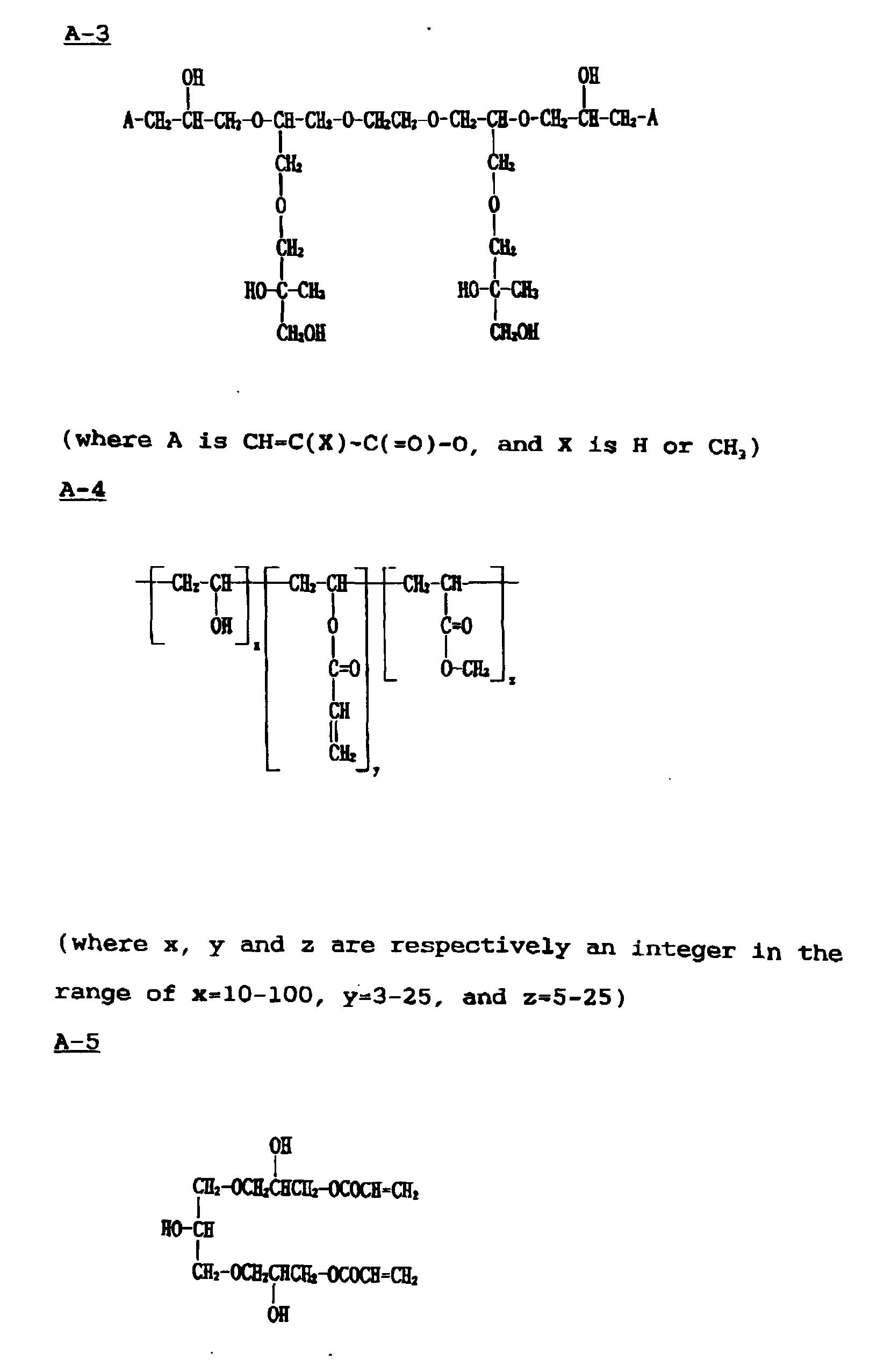
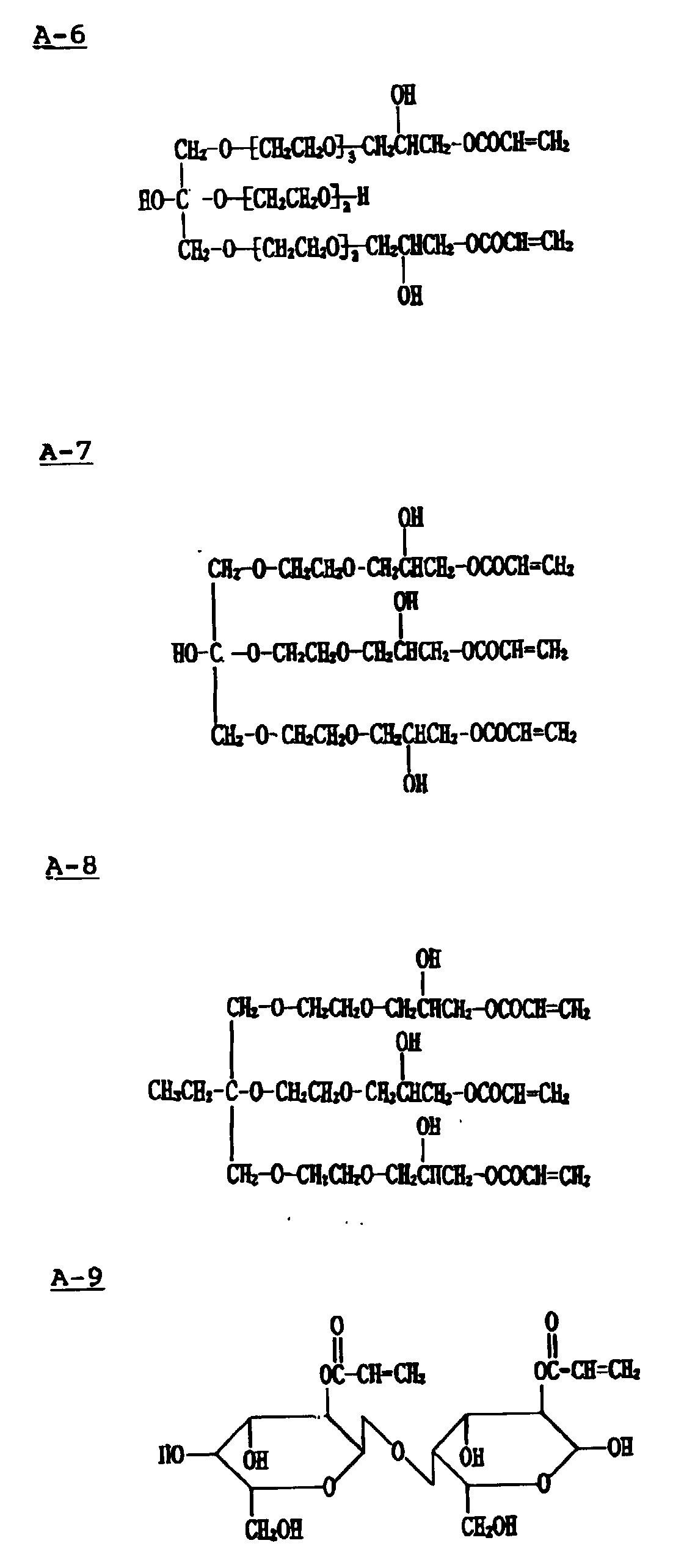
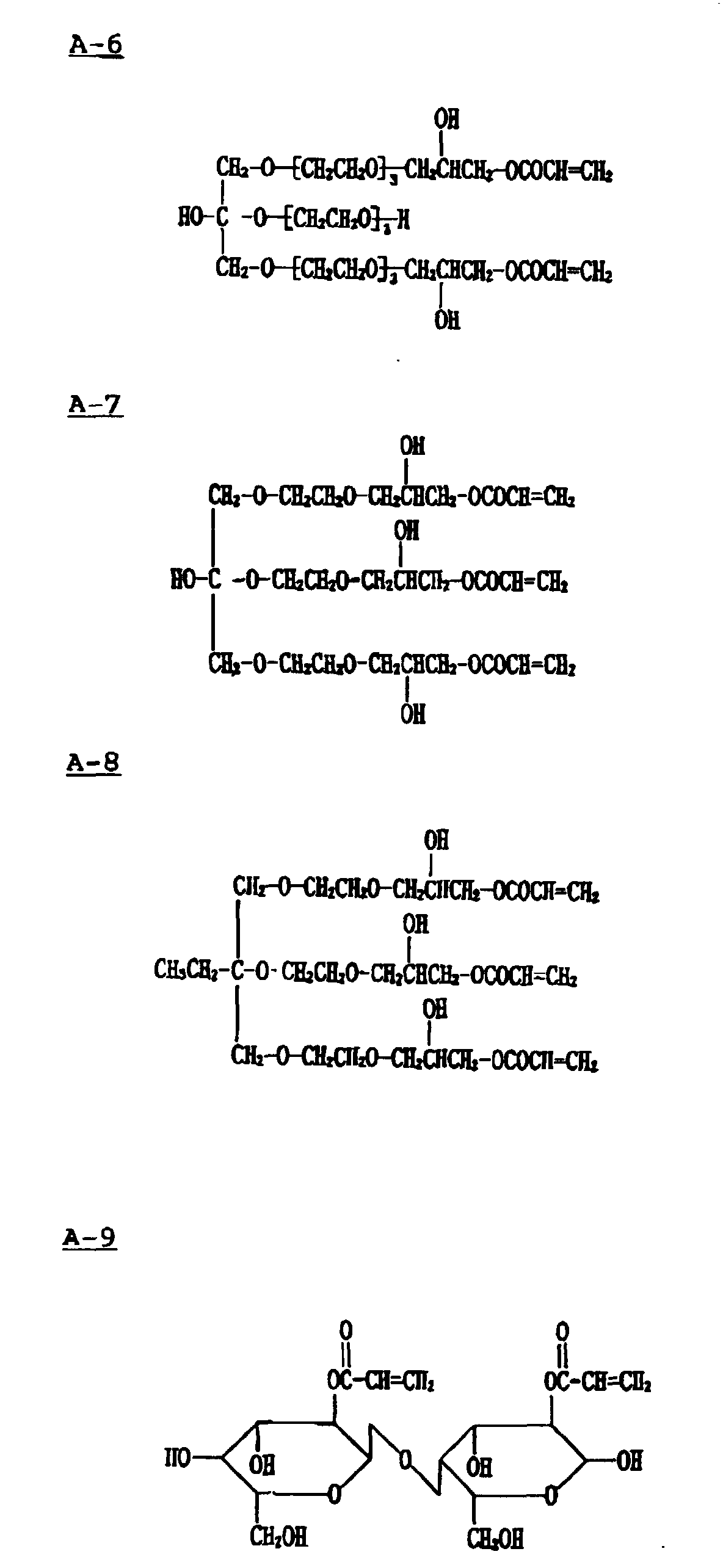
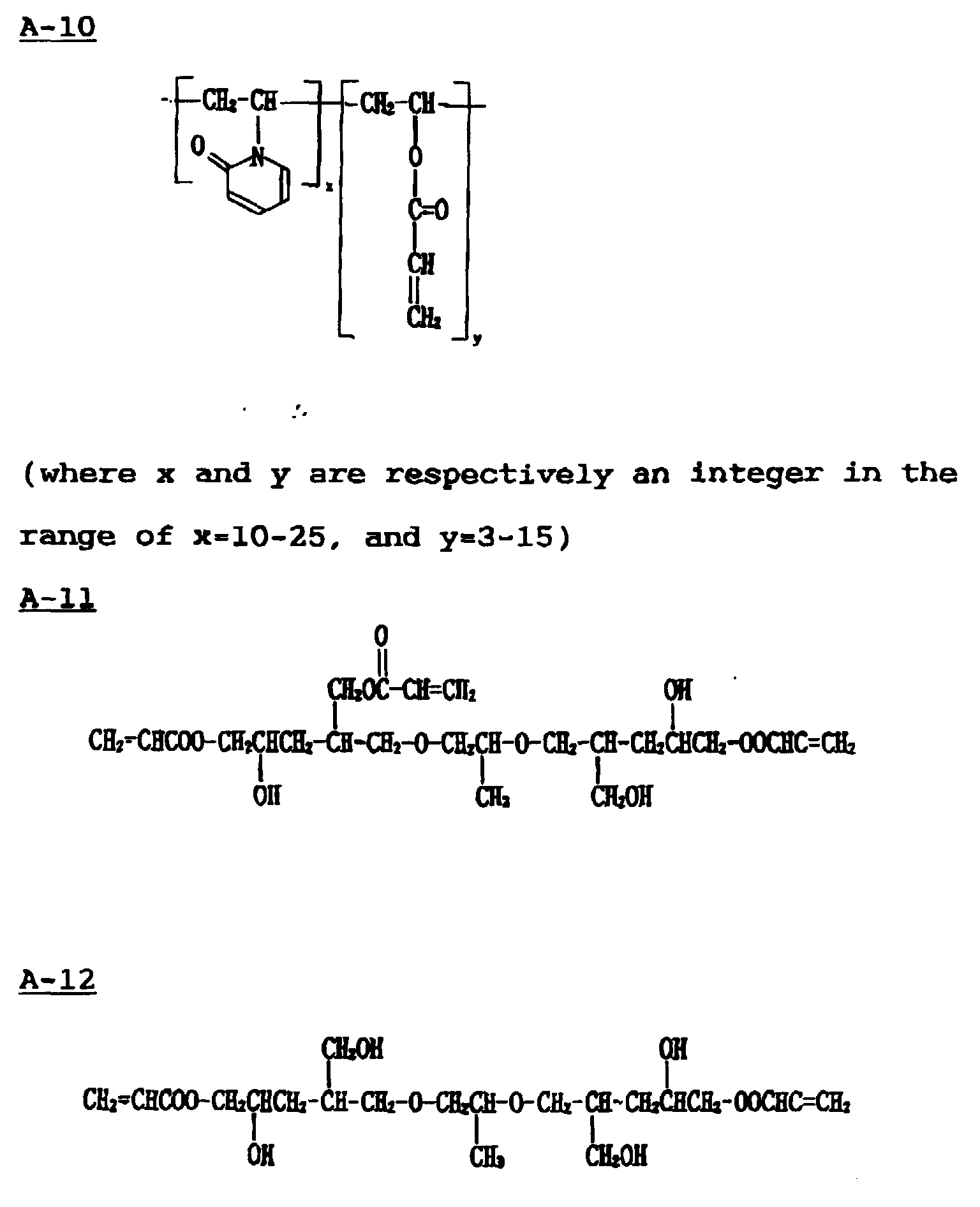
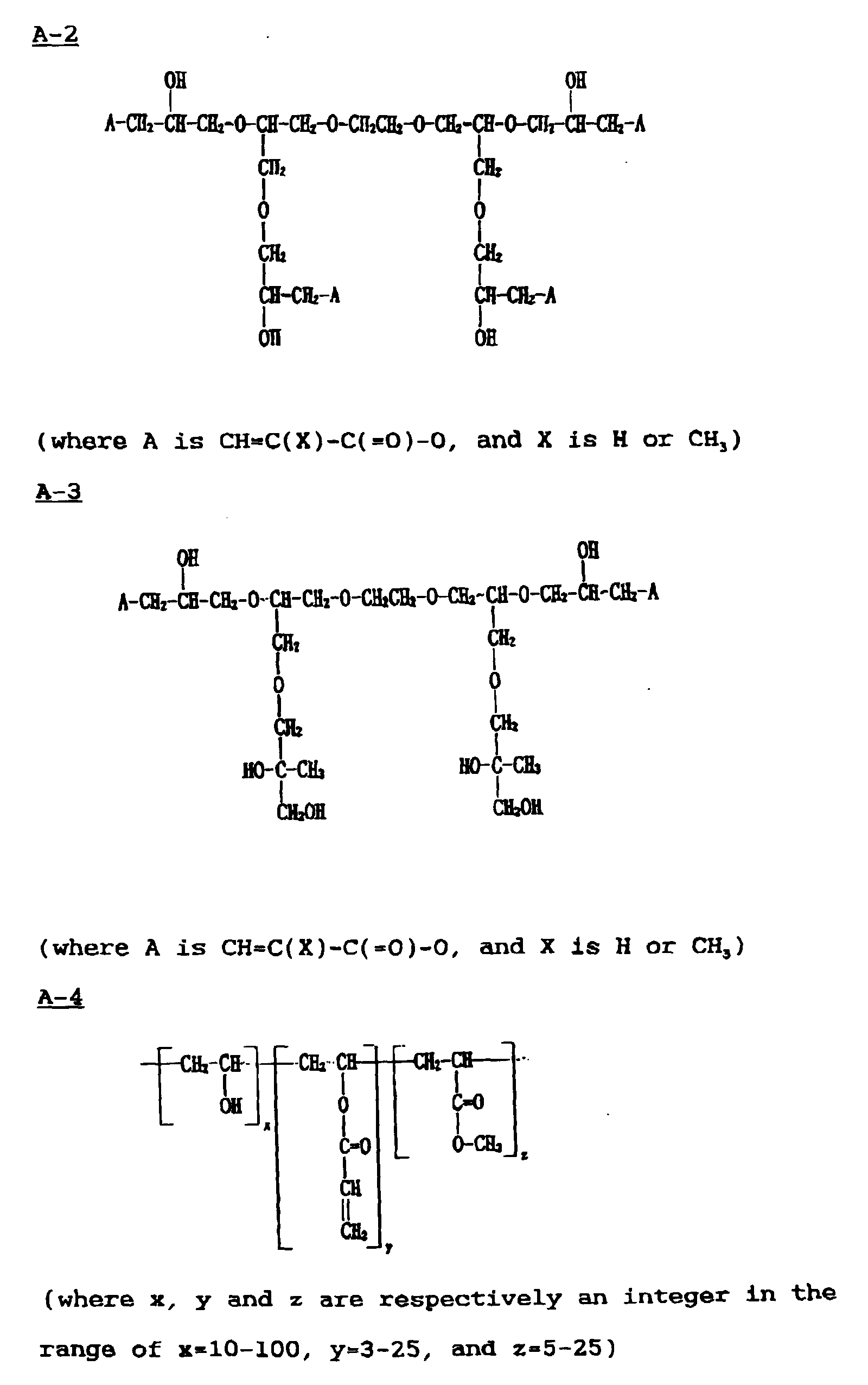
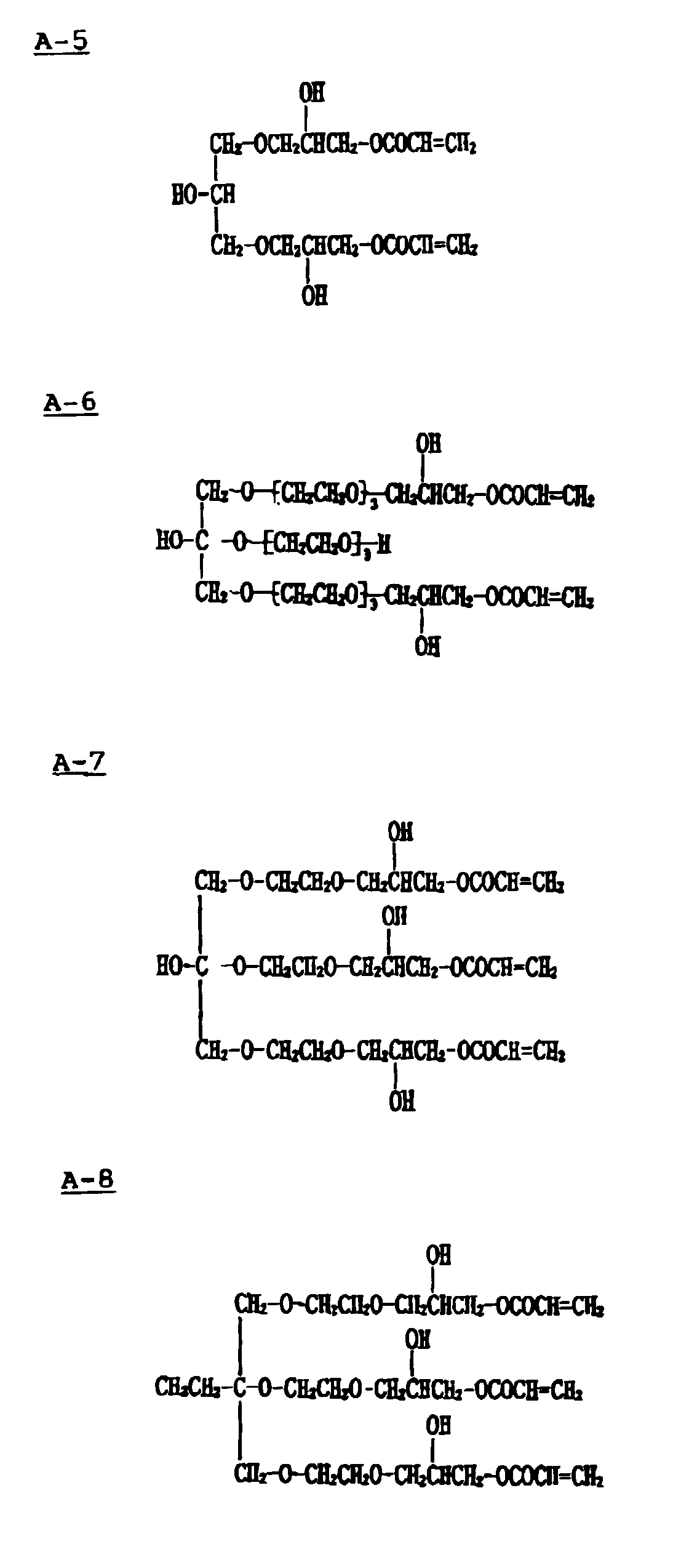
- the ink of an embodiment of the present invention contains, in an aqueous medium, at least one compound selected from the group consisting of the compounds represented by Chemical Formulas A-1 to A-12 below, and a coloring material.
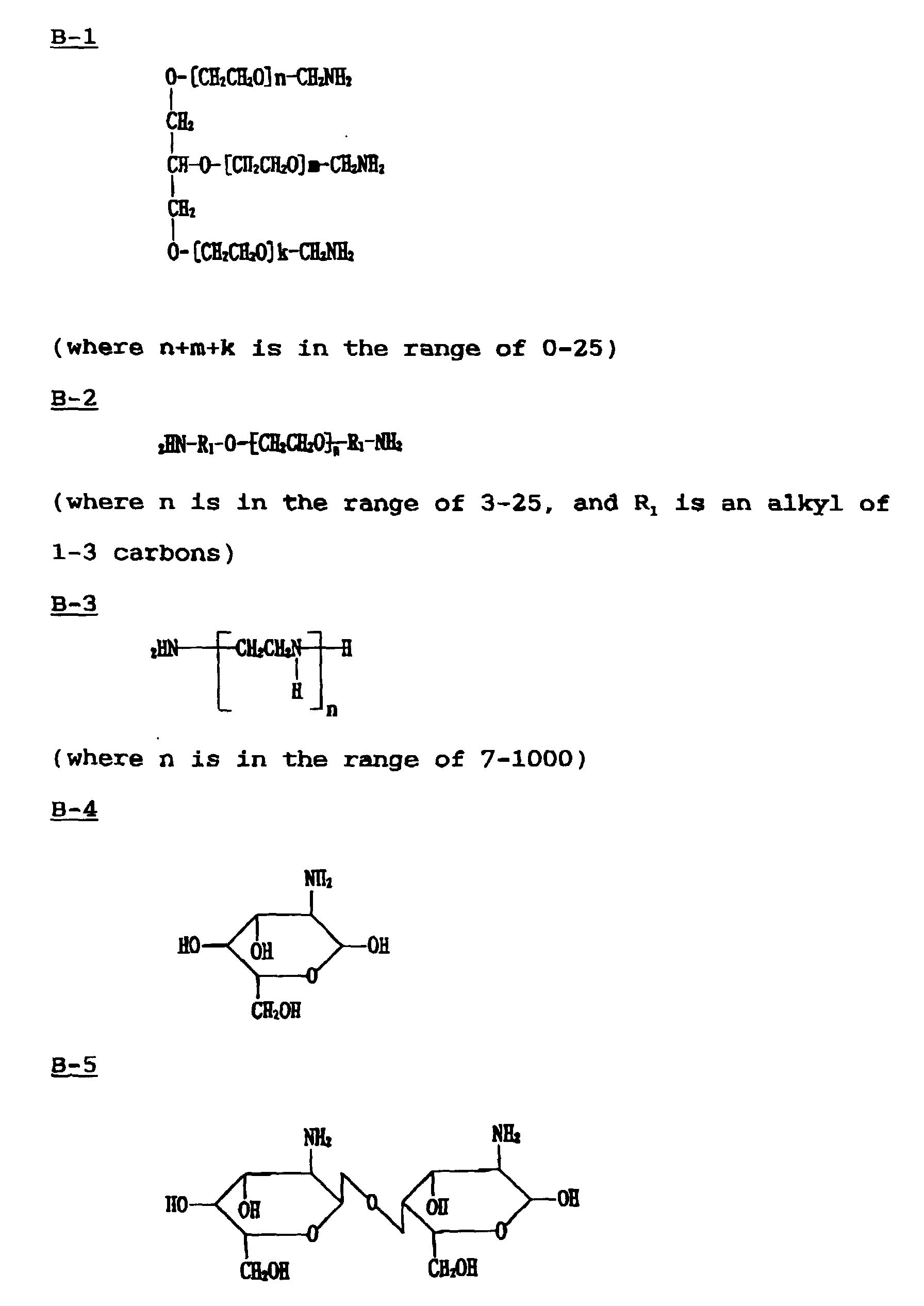
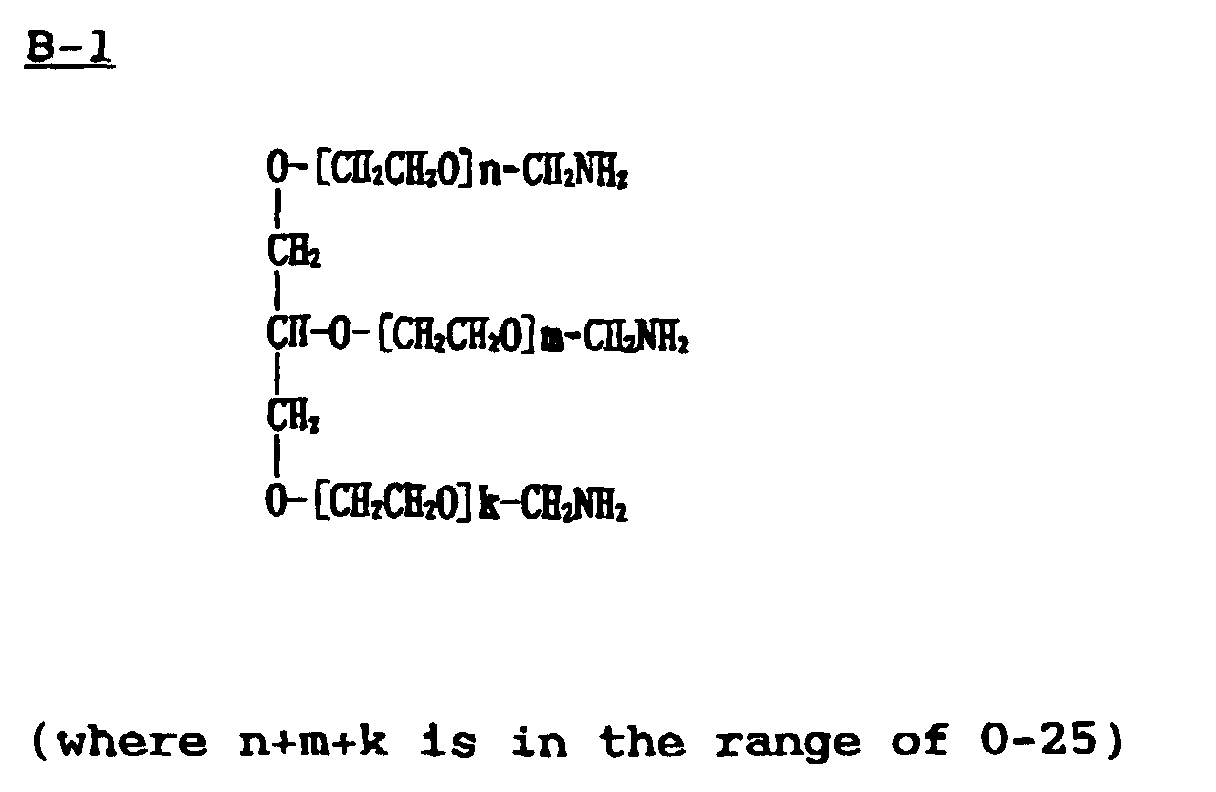
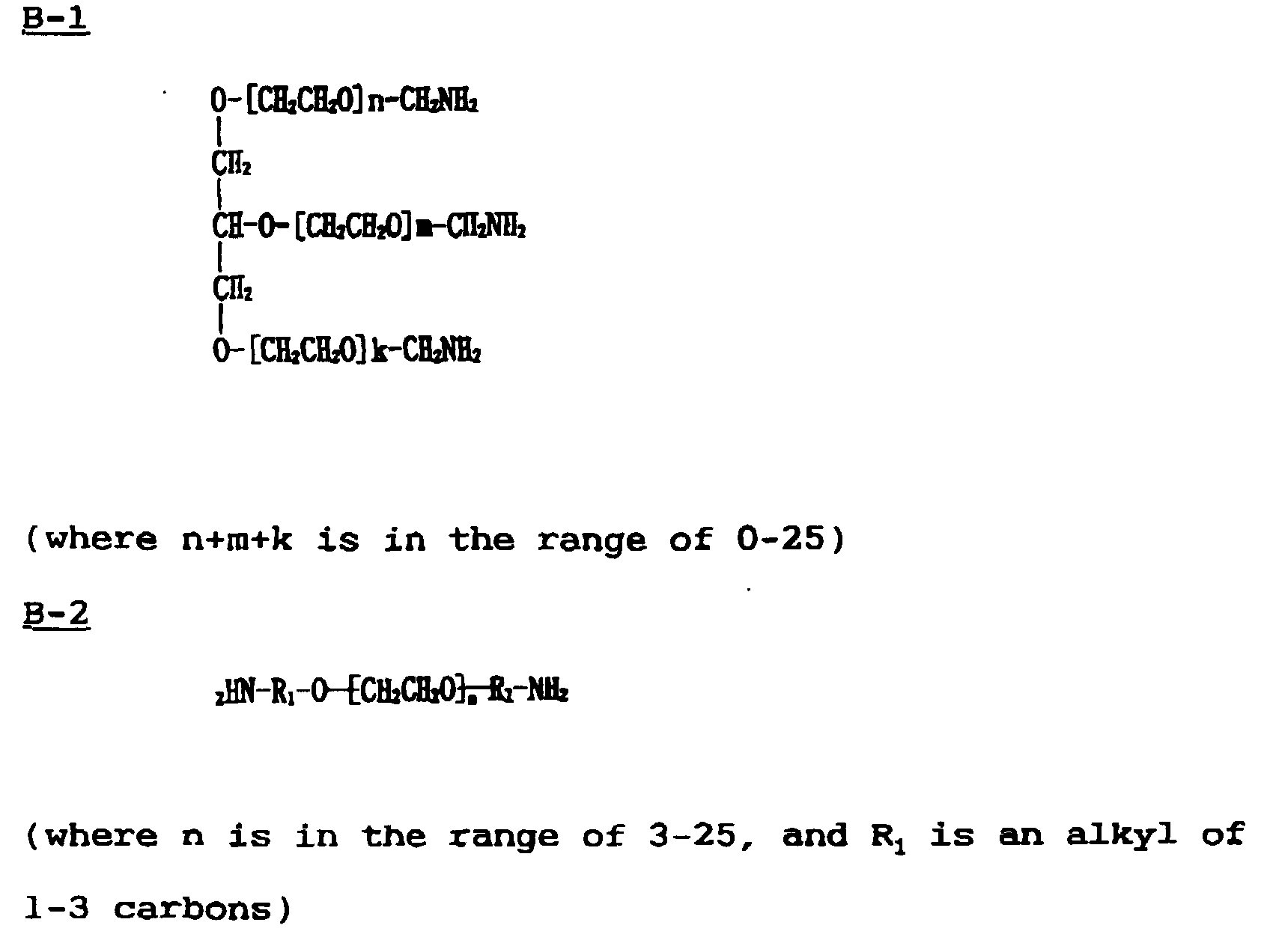
- the ink of another embodiment of the present invention contains, in an aqueous medium, at least one compound selected from the group consisting of the compounds represented by Chemical Formulas B-1 to B-17 below, and a coloring material.
- the ink of still another embodiment of the present invention contains, in an aqueous medium, at least one compound selected from the group consisting of the compounds represented by chemical Formulas B-1 to B-3 below, and a coloring material.
- the printed article of an embodiment of the present invention is a printed article having a colored portion containing a coloring material on a recording medium, the colored portion further containing a reaction product of a first liquid composition and a second liquid composition; the first liquid composition conatining a first water-soluble compound having in the molecule an ethylenically unsaturated double bond having an electron-attractive substituent on the ⁇ -position, and the second liquid composition containing a second water-soluble compound having an active hydrogen atoms addable to the first compound in coexistence.
- the printing apparatus of an embodiment of the present invention comprises an ink set comprising a first liquid composition containing a first water-soluble compound having in the molecule an ethylenically unsaturated double bond having an electron-attractive substituent on the ⁇ -position, and a second liquid composition containing a second water-soluble compound having an active hydrogen atom addable to the first compound in coexistence, at least one of the first liquid composition and the second liquid composition further containing a coloring material; an ejecting means for ejecting the first liquid composition and the second liquid composition separately onto a recording medium; and a controlling means to bring the first liquid composition and the second liquid composition into contact together in a liquid state on the recording medium.
- the printing apparatus of another embodiment of the present invention comprises an ink set comprising a first liquid composition containing a first water-soluble compound having in the molecule an ethylenically unsaturated double bond having an electron-attractive substituent on the ⁇ -position, a second liquid composition containing a second water-soluble compound having an active hydrogen atom addable to the first compound in coexistence, and an ink containing a coloring material; an ejecting means for ejecting the first liquid composition, and the second liquid composition, and the ink separately onto a recording medium; and a controlling means to bring the first liquid composition, the second liquid composition, and the ink into contact together in a liquid state on the recording medium.
- the ink cartridge of an embodiment of the present invention comprises a first liquid container holding a first liquid composition containing a first water-soluble compound having in the molecule an ethylenically unsaturated double bond having an electron-attractive substituent on the ⁇ -position, and a second liquid container holding a second liquid composition containing a second water-soluble compound having an active hydrogen atom addable to the first compound in coexistence; at least one of the first liquid composition and the second liquid composition further containing a coloring material; the ink cartridge being mountable to and demountable from an ink-jet head for ejecting the first liquid composition and the second liquid composition separately.
- the ink cartridge of another embodiment of the present invention comprises a first liquid container holding a first liquid composition containing a first water-soluble compound having in the molecule an ethylenically unsaturated double bond having an electron-attractive substituent on the ⁇ -position, a second liquid container holding a second liquid composition containing a second water-soluble compound having an active hydrogen atom addable to the first compound in coexistence, and an ink container holding an ink containing a coloring material; the ink cartridge being mountable to and demountable from an ink-jet head for ejecting the first liquid composition, the second liquid composition, and the ink separately.
- the recording unit of an embodiment of the present invention comprises a first liquid container holding a first liquid composition containing a first water-soluble compound having in the molecule an ethylenically unsaturated double bond having an electron-attractive substituent on the ⁇ -position, a first ink-jet head for ejecting the first liquid composition held in the first liquid container, a second liquid container holding a second liquid composition containing a second water-soluble compound having an active hydrogen atom addable to the first compound in coexistence, and a second ink-jet head for ejecting the second liquid composition held in the second liquid container; at least one of the first liquid composition and the second liquid composition further containing a coloring material.
- the recording unit of another embodiment of the present invention comprises a first liquid container holding a first liquid composition containing a first water-soluble compound having in the molecule an ethylenically unsaturated double bond having an electron-attractive substituent on the ⁇ -position, a first ink-jet head for ejecting the first liquid composition held in the first liquid container, a second liquid container holding a second liquid composition containing a second compound having an active hydrogen capable of being added to the first compound in coexistence, a second ink-jet head for ejecting the second liquid composition held in the second liquid container, an ink container holding an ink containing a coloring material, and a third ink-jet head for ejecting the ink held in the ink container.
- the ink set of a still another embodiment of the present invention comprises a first liquid composition containing a first water-soluble compound having in the molecule an ethylenically unsaturated double bond having an electron-attractive substituent on the ⁇ -position, and a second liquid composition containing a second water-soluble compound having an active hydrogen capable of being added to the first compound in coexistence.
- the method of forming a polymeric compound film of an embodiment of the present invention comprises the steps of (i) providing an ink set comprising a first liquid composition containing a first water-soluble compound having in the molecule an ethylenically unsaturated double bond having an electron-attractive substituent on the ⁇ -position, a second liquid composition containing a second water-soluble compound having an active hydrogen capable of being added to the first compound in coexistence; and (ii) applying the first liquid composition and the second liquid composition respectively onto prescribed positions on a recording medium to cause mixing or contact of the first liquid composition with the second liquid composition to cause reaction of the first compound with the second compound.
- the ink of a further embodiment of the present invention contains, in an aqueous medium, at least one compound selected from the group consisting of the compounds represented by Chemical Formulas A-1 to A-12 below.
- the ink of a still further embodiment of the present invention contains at least one compound selected from the group consisting of the compounds represented by chemical Formulas B-1 to B-17 below.
- the ink of a still further embodiment of the present invention contains at least one compound selected from the group consisting of the compounds represented by Chemical Formulas B-1 to B-3 below.
- the ink set of an embodiment of the present invention comprises a first liquid composition containing a first water-soluble compound having in the molecule an ethylenically unsaturated double bond having an electron-attractive substituent on the ⁇ -position, and a second liquid composition containing a second water-soluble compound having an active hydrogen capable of being added to the first compound in coexistence; at least one of the first liquid composition and the second liquid composition further containing a coloring material.
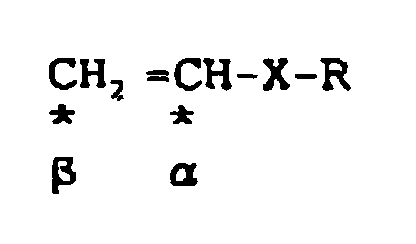
- the term "the ⁇ -position” is based on the conventional nomenclature in organic chemistry for identifying the carbon atoms of a carbon-carbon double bond by ⁇ and ⁇ as shown below. As above, of the carbons of the carbon-carbon double bond, the non-terminal carbon atom is named the ⁇ -position.
- the term "electron-attractive” signifies a state of a substituent deficient in electrons and attracting electrons from the adjacent atoms or another molecule.
- the electron attractive group typically includes groups of nitro, nitrile, carbonyl, carboxyl, and carbonic acid ester.
- the electron-attractive group attached to the double bond By the electron-attractive group attached to the double bond, the electron density at the ⁇ - and ⁇ -carbons is decreased in comparison with that without the electron attractive group.
- the unsaturated double bond having an electron-attractive group attracts electrons from electron-rich molecules or atom groups to cause an addition reaction.
- Such a reaction is known as Michael addition reaction.
- the Michael addition reaction is addition of the hydrogen atom to a carbon-carbon double bond having an electron attractive functional group under relatively mild conditions.
- the group of nitro, carboxyl, nitrile, or carboxylic ester tends to attract electrons in comparison with hydrogen atom to decrease the electron density in the double bond and to raise the reactivity with an electron-donating substance.
- the actual reaction velocity depends on the properties of the compound H-X. This is explained in detail in the published book: Shin Jikken Kagaku Koza (New Experimental Chemistry Library), "Syntheses and Reactions of Organic Compounds" p.1370 (Maruzen Co., 1977) under the title of "Addition reaction of an amine to a olefin".
- the compound of H-X includes nucleophilic substances such as amines, aldimines, ketimines, hydroxy-containing compounds, polyenamines, methane tricarboxylic esters, malonic acid, polyesters, acetoacetates, and polyamidoamines.
- nucleophilic substances such as amines, aldimines, ketimines, hydroxy-containing compounds, polyenamines, methane tricarboxylic esters, malonic acid, polyesters, acetoacetates, and polyamidoamines.
- Japanese Patent Application Laid-Open No. 61-23615 discloses a curable composition containing (1) a copolymer of an aminoalkyl methacrylate or a copolymer of an aminoalkyl methacrylate and an ethylenic unsaturated monomer, and (2) a compound having at least two acryloyl groups in the molecule.
- This addition reaction has not been utilized in two-liquid type ink-jet recording.
- the reactive components in the respective liquids should be sufficiently water-soluble, and be capable of maintaining the reactivity in the aqueous medium, and the reactive components should cause reaction immediately on mixing on a recording medium to fix the coloring material.
- the first water-soluble compound having in the molecule an ethylenic unsaturated double bond having an electron attractive substituent on the ⁇ -position includes
- the polyol herein signifies generally compounds having two or more hydroxyl groups.
- the water-soluble functional group includes groups of hydroxyl, carboxyl, sulfo, morpholino, piperidino, pyridyl, and pyrrolidonyl.
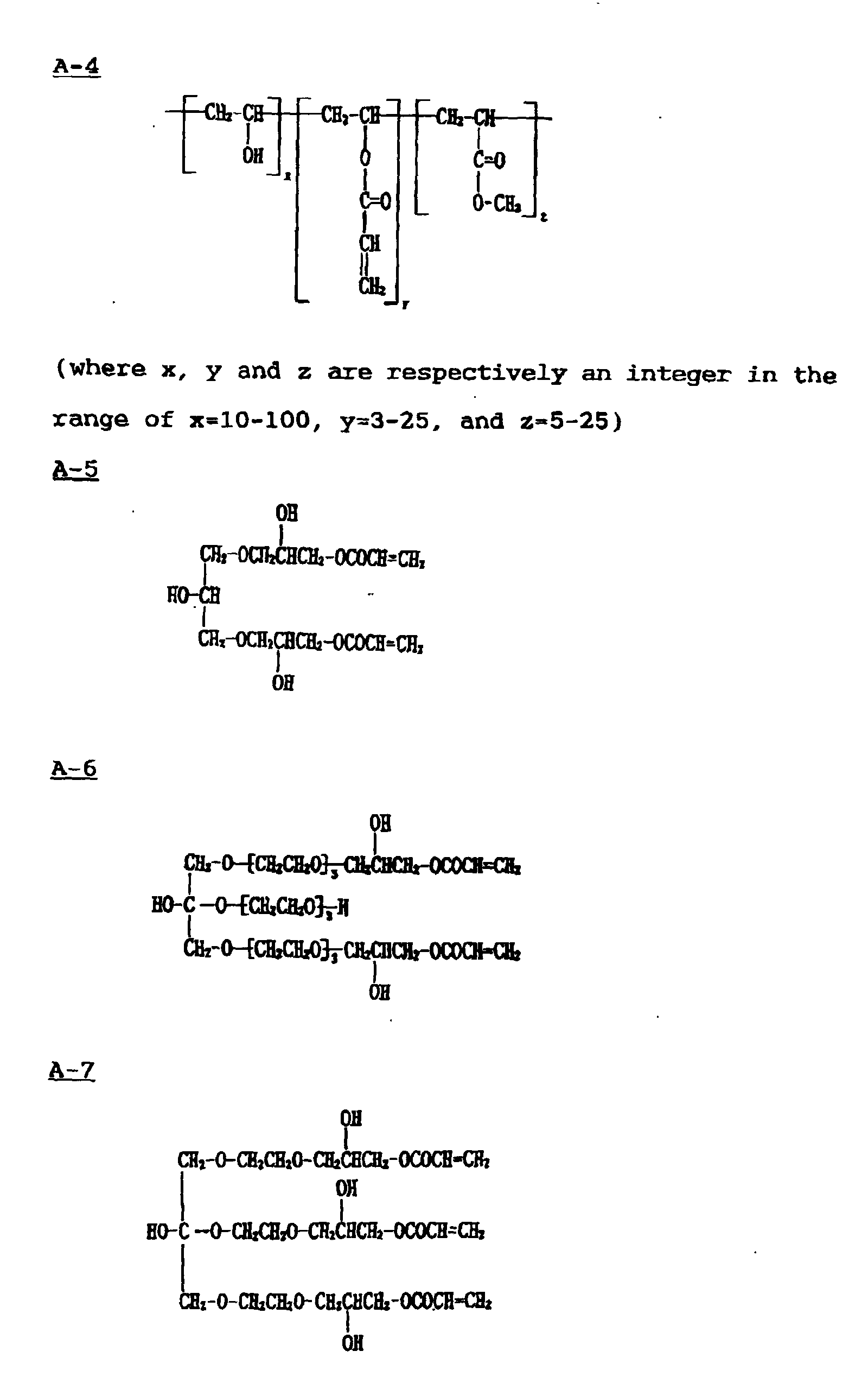
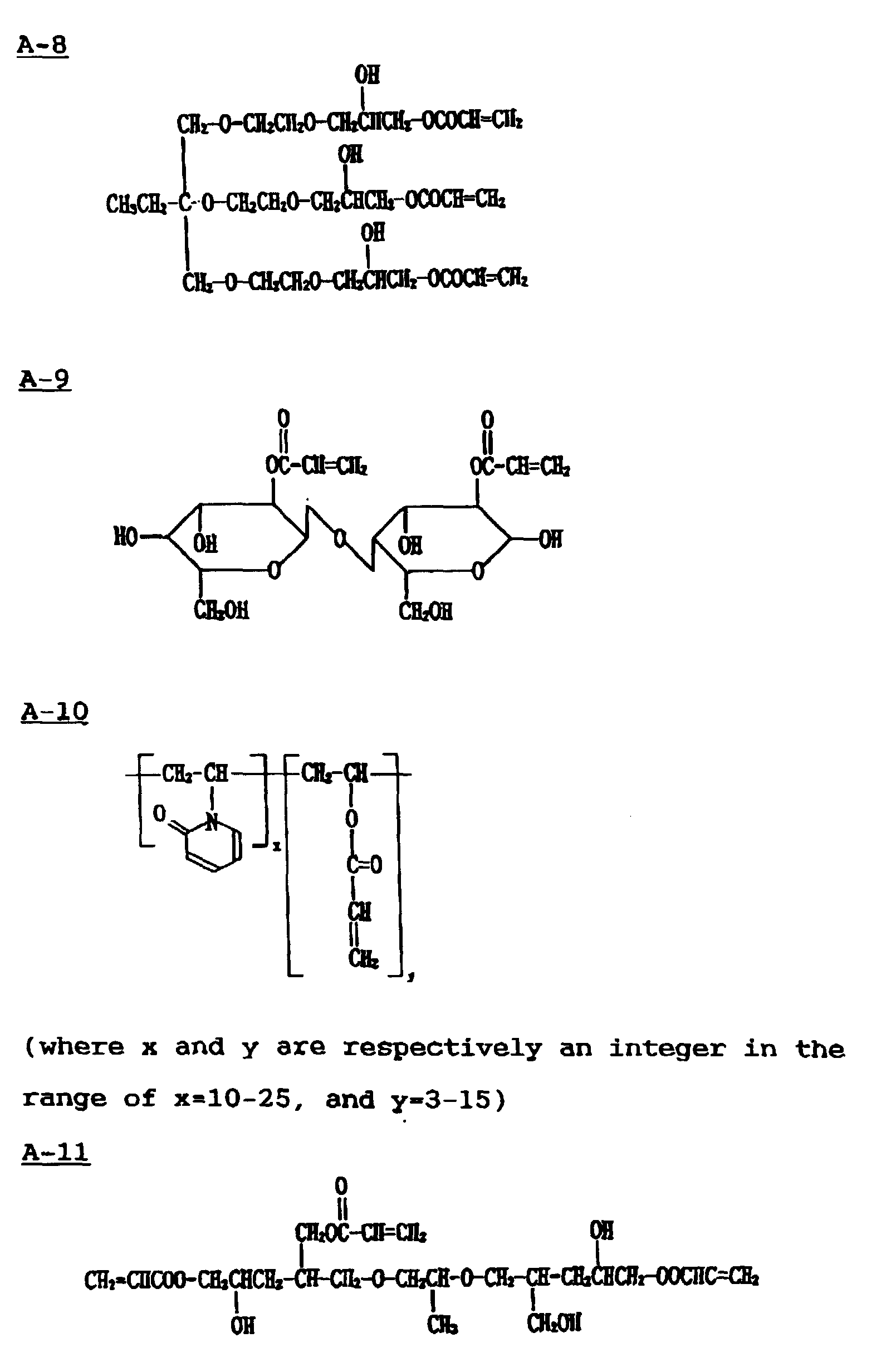
- Such compounds include specifically the compounds represented by Structural Formulas A-1 to A-12 below.
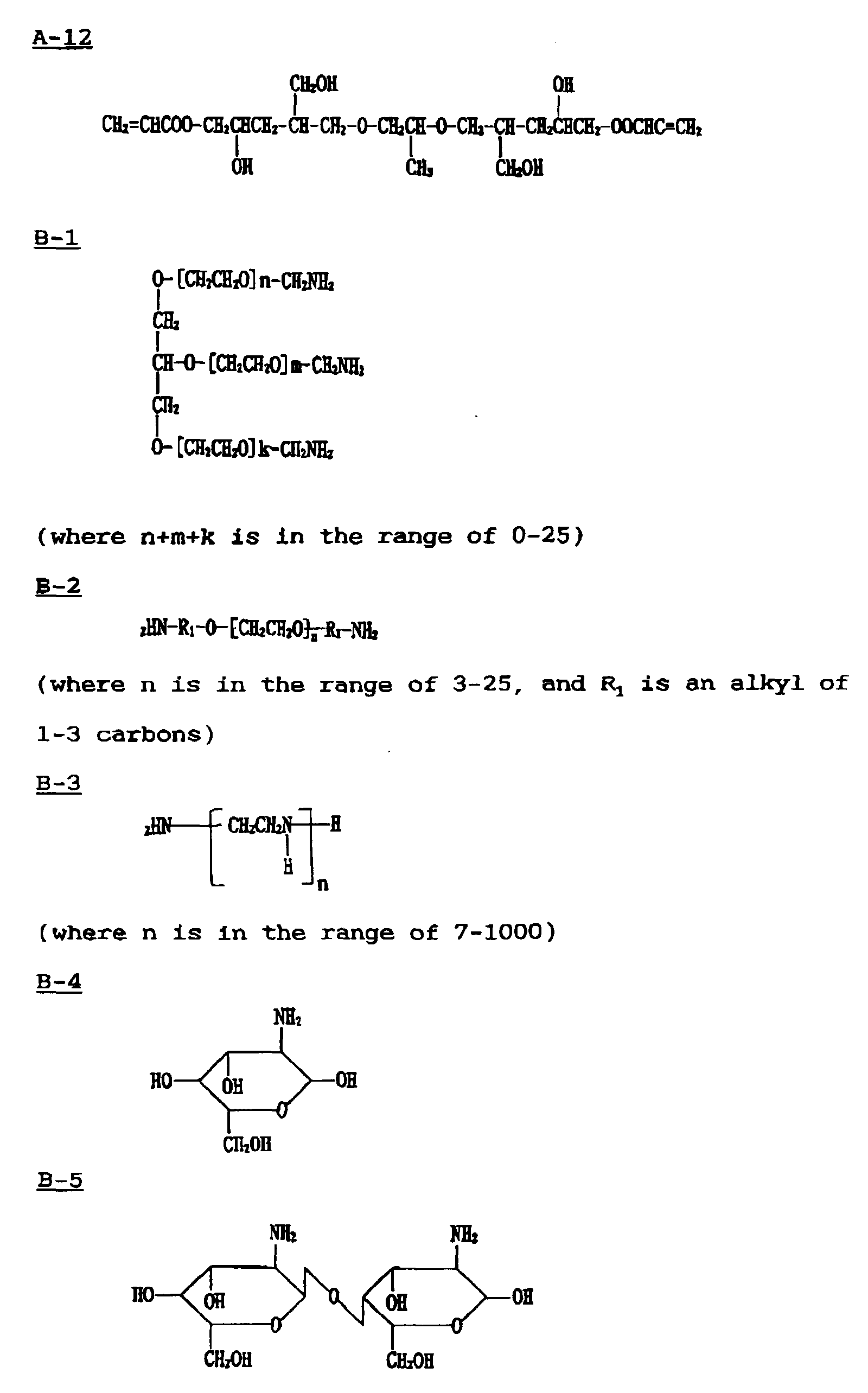
- the aforementioned second compound which has active hydrogen and can cause addition reaction with the first compound brought into coexistence are compounds having a primary amino group or a secondary amino group in the molecule, including compounds (a) to (d) shown below.
- Table 1 shows the solubilities in water, and the reactivity of Compounds A-1 to A-12, and B-1 to B-17.
- the water solubility is shown by the highest concentration of the compound for forming a uniform transparent aqueous solution.
- the reactivity of the compound of Group A is shown by the time for gel formation by the reaction of an aqueous 50% solution of the compound of Group A with a 50% solution of Compound B-1 (trade name: Lupasol FG, supplied by BASF Co.).
- the reactivity of the compound of Group B is shown by the time for gel formation by the reaction of a 50% solution of the compound of Group B with an aqueous 50% solution of Compound A-1.
- the concentrations of the above compounds are preferably in the range from 1% to 30% by weight, more preferably from 5% to 30% by weight in order that the first liquid composition containing at least one of the first compounds and the second liquid composition containing the second compound are brought into contact and mixed to react rapidly to impart sufficient water resistance and abrasion resistance to the printed article.
- the compounds of A-1 to A-12, and B-1 to B-17 have sufficient water solubility. Therefore, an organic solvent need not be employed for dissolving the first and second compounds in the preparation of the first and second liquid compositions.
- the compound of A group and the compound of B group cause an addition reaction with each other. Therefore, by use of a compound having three or more functional groups as one or both of the group-A compound and the Group-B compound, the reaction is allowed to proceed more rapidly on the recording medium to improve adhesiveness of the colored portion onto the recording medium, the water resistance, the abrasion resistance, and the durability.
- the coloring material should give an intended color on printing by using at least one of the first liquid composition and the second liquid composition.
- the coloring material may be any of the dyes for ink-jet recording inks.
- the coloring material includes pigments, anionic dyes, and cationic dyes.
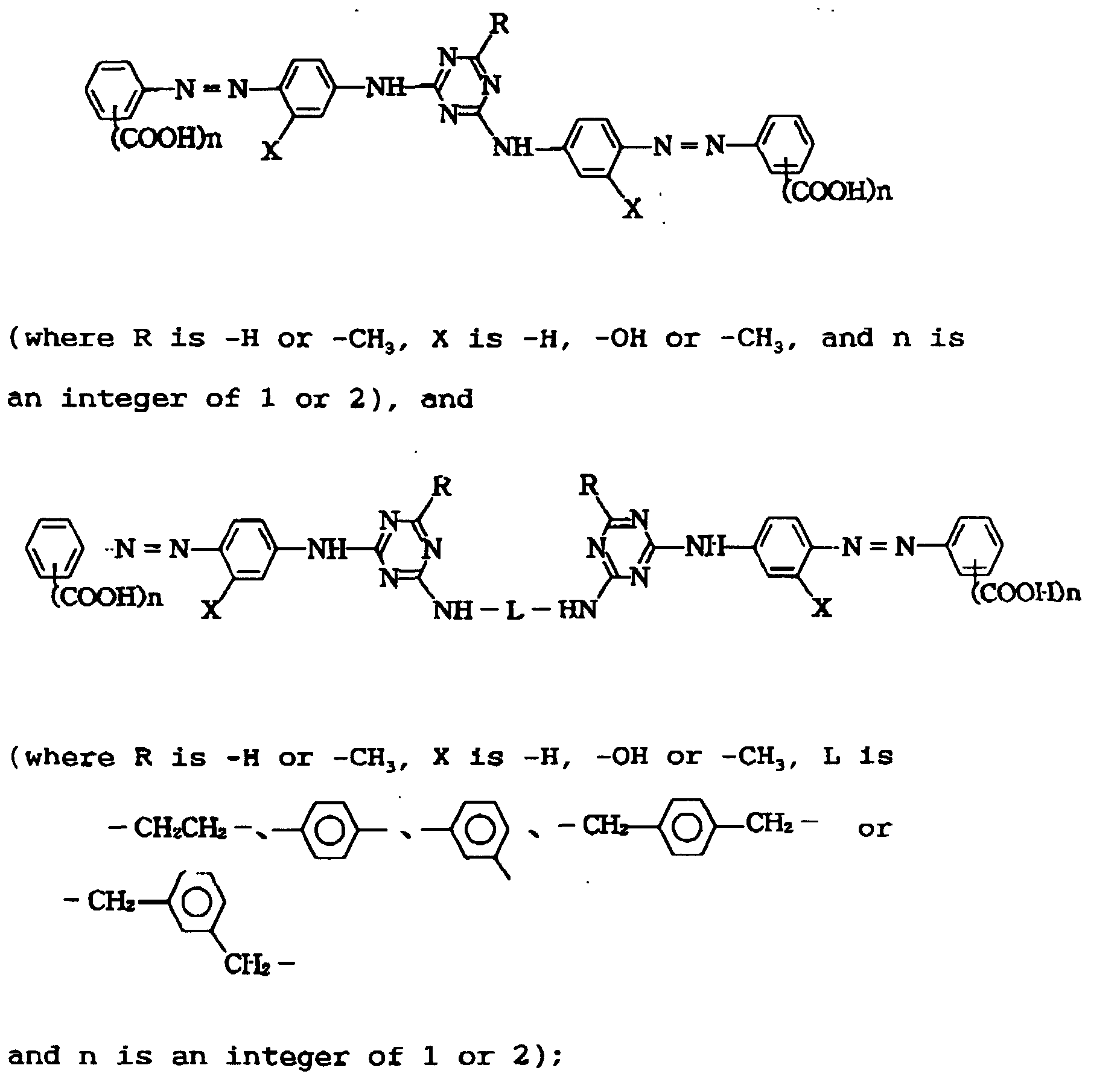
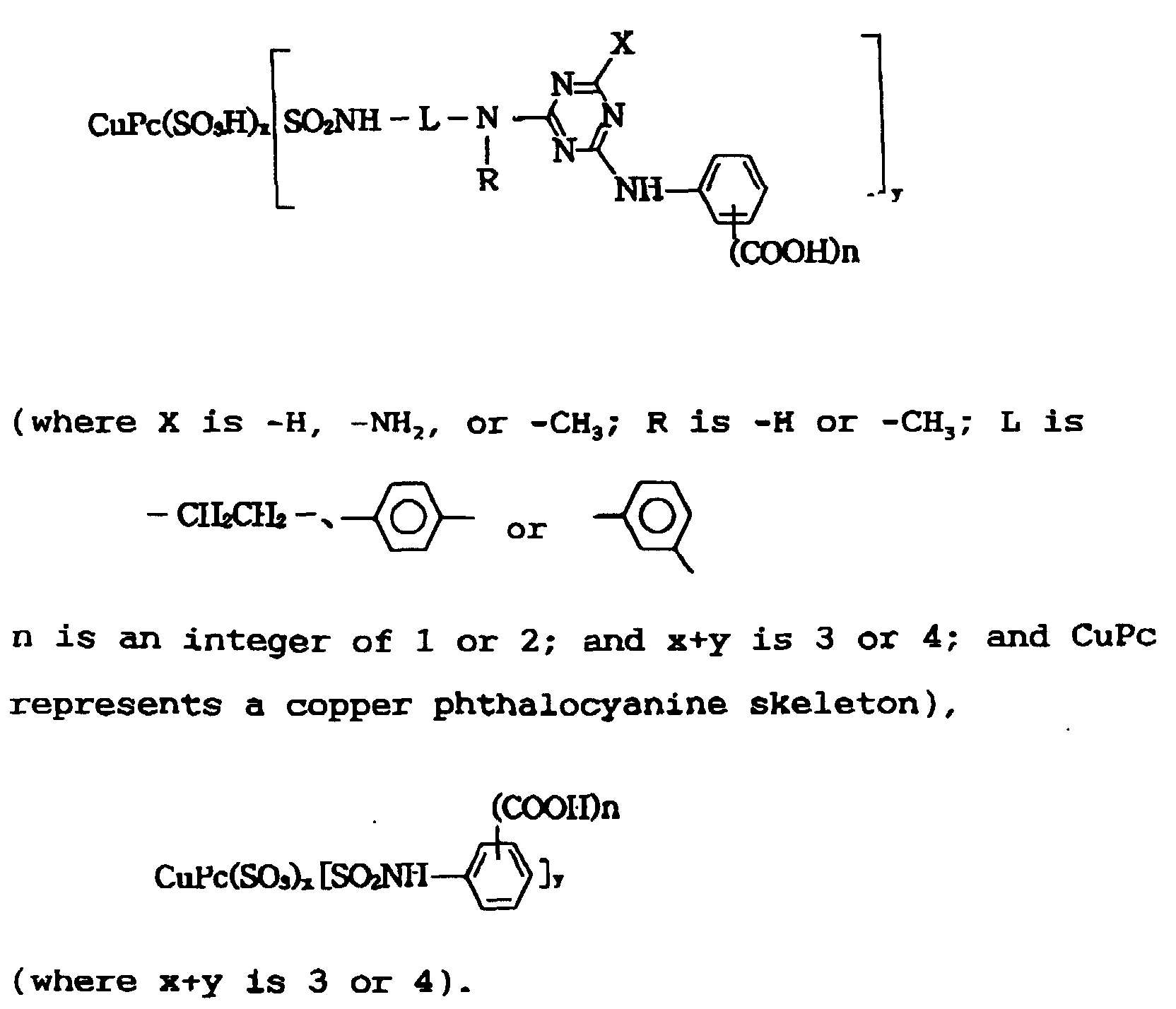
- the pigments include which is made dispersible stably in an aqueous solvent by action of a water-soluble cationic polymeric compound or a water-soluble anionic polymeric compound, and self-dispersing pigments dispersible in an aqueous solution without addition of a water-soluble ionic polymeric compound.
- the self-dispersing pigments include ones having a cationic group combined on the surface thereof, and ones having an anionic group combined on the surface thereof.
- the first liquid composition or the second liquid composition may be made into a black ink or a color ink.
- the second compound is basic. Therefore, in incorporation of the coloring material into the second composition, the coloring material and the second compound are preferably selected in consideration of the compatibility between the coloring material and the second compound.
- the black pigment used for preparation of the black ink is explained below.
- the self-dispersing cationic black pigment is, for example, a black pigment which has a cationic group bonded to the pigment surface and is dispersible stably in an aqueous medium without a water-soluble ionic polymeric compound or a surfactant.
- the cationic group includes quaternary ammonium, substituted quaternary ammonium, pyridinium, and phosphonium.
- the cationic group bonded to the pigment surface may be of one type, or of plural types.
- a cationically charged carbon black has on the surface thereof a cationic group selected from the groups shown below.
- R represents an alkyl group of 1 to 12 carbons, a substituted or unsubstituted phenyl group, or the like.
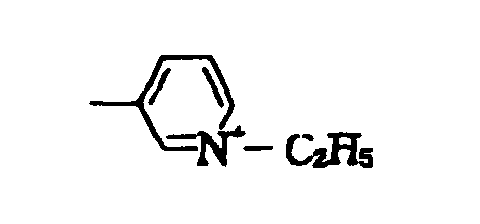
- the above self-dispersing carbon black charged cationically by bonding of a hydrophilic group can be produced, for example, by bonding of an N-ethylpyridyl group of the structure below.
- carbon black is allowed to react with 3-diazo-N-ethylpyridinium bromide. Otherwise to make the carbon black anionic, carbon black is allowed to react with 4-diazobenzoic acid.
- the carbon black having been charged to be anionic or cationic by introduction of a hydrophilic group onto the surface of the carbon black particles can disperse stably in an aqueous ink without addition of a dispersant owing to high water dispersibility caused by ionic repulsion.
- the hydrophilic group may be bonded directly to the surface of the carbon black. Otherwise, the hydrophilic group may be bonded indirectly with interposition of an atomic group between the surface of the carbon black and the hydrophilic group.
- the specific examples of the interposed atomic group include linear or branched alkylene groups of 1 to 12 carbons, substituted or unsubstituted phenylene groups, and substituted or unsubstituted naphthylene groups.
- the substituent on the phenylene group or the naphthylene groups includes linear or branched alkyl group of 1 to 6 carbons.
- Untreated carbon black also can be dispersed in the ink by addition of a water-soluble cationic polymeric compound as the dispersant into the ink as shown in Japanese Patent Application Laid-Open No. 8-80665.
- the particulate black pigment dispersed by this method is also suitable for the present invention.
- the cationic polymeric compound therefor includes copolymers containing a monomer such as N,N-dimethylaminoethyl methacrylate, N,N-dimethylaminoethyl acrylate, N,N-dimethylaminopropyl methacrylate, N,N-dimethylaminopropyl acrylate, N,N-dimethylacrylamide, N,N-dimethylmethacrylamide, N,N-dimethylaminoethylacrylamide, N,N-dimethylethylmathacrylamide, N,N-dimethylaminopropylacrylamide, and N,N-dimethylaminopropylmethacrylamide with the monomer weight ratio ranging from 10% to 50% by weight.
- the comonomer therefor includes water-soluble monomers such as acrylamides, acrylonitrile, and alkyl acrylates.
- the cationic black pigment dispersion in which the black pigment is dispersed by a cationic polymeric compound, has an average particle diameter ranging preferably from 70 nm to 250 nm.
- the cationic group includes quaternary ammonium, and tertiary amine salts.
- the counter ion may be an anionic group of an inorganic or organic acid such as acetic acid, lactic acid, hydrochloric acid, sulfuric acid, succinic acid, bromic acid, hydrofluoric acid, or the like. The presence of the counter ions gives stable water-dispersibility in a dissociated state.
- the cationic group is added to the black pigment or the water-soluble polymeric compound in an amount to obtain a satisfactory dispersion state in the ink to achieve the intended effect of the present invention.
- the black pigment is dispersed in the ink in an amount ranging from 0.5 to 10 parts by weight based on 100 parts by weight of the ink.
- the pH of the ink is controlled to be in the range from 2.5 to 8.0.
- the above mentioned particle diameter and pH are preferred to obtain more stable dispersion state of the dispersion.
- a self-dispersing carbon black having an anionic group on the surface can be prepared, for example, by surface modification by bonding covalently an anionic functional group.
- the anionic functional group is, for example, at least one selected from -COOM, -SO 3 M, -PO 3 HM, and PO 3 M 2 (where M represents a hydrogen atom, an alkali metal, an ammonium group, or an organic ammonium group).
- -COOM, and -SO 3 M are suitable for anionic charging of the carbon black by direct or indirect bonding to the carbon black surface to give excellent dispersibility of the carbon black.
- the above alkali metal M includes lithium, sodium, and potassium.
- the above-mentioned organic ammonium includes mono-, di-, and tri-methylammonium; mono-, di-, and tri-ethylammonium; and mono-, di-, and tri-methanolammonium.
- the anionically charged self-dispersing carbon black can be produced by oxidation treatment of the carbon black with sodium hypochlorite. By this treatment, a -COONa group is introduced by bonding to the carbon black surface.
- the aforementioned hydrophilic group may be bonded directly to the carbon black surface. Otherwise the hydrophilic group may be bonded indirectly to the carbon black surface with interposition of another atomic group.
- This interposed atomic group includes specifically linear or branched alkylene groups of 1 to 12 carbons, substituted or unsubstituted phenylene groups, and substituted or unsubstituted naphthylene groups.
- the substituent for the phenylene group and the naphthylene group includes linear or branched alkyl groups of 1 to 6 carbons.
- the specific examples of combination of the interposed atomic group and the hydrophilic group are -C 2 H 4 -COOM, -Ph-SO 3 M, Ph-COOM, and so forth (Ph represents phenyl).
- Ordinary carbon black can be used as the coloring material by combination with a water-soluble anionic polymeric compound as a dispersant.
- the water-soluble anionic polymeric compound therefor includes water-soluble polymeric compounds which are soluble in alkaline water, exemplified by styrene-acrylic acid copolymers, styrene-acrylic acid-alkyl acrylate copolymers, styrene-maleic acid copolymers, and styrene-maleic acid-acrylic acid copolymers.
- the black coloring material includes not only the aforementioned pigments but also dyes.
- the dye is selected preferably from those having sufficient light fastness.
- the preferred black anionic dye includes monoazo complexes and disazo complexes having a coordinating polyvalent metal such as Cr, Cu, Mn, Al, Zn, and Fe; and non-complex type azo black dyes such as C.I. Direct Black 17, C.I Direct Black 19, C.I. Direct Black 51, C-I. Direct Black 154, C.I. Direct Black 174, and C.I. Direct Black 195.
- Black cationic dyes are also useful as the coloring material.
- the black cationic dyes include Aizen Cationic Black SBH, Aizen Cationic Black BXH, Aizen Cationic Black SH, Aizen Cationic Black ACH, Aizen Cationic Black MH, and Aizen Cationic Black TH produced by Hodogaya Chemical Co.; Sumiacryl Black B, Sumiacryl Black R, Sumiacryl Black AP, Sumiacryl Black BP, Sumiacryl Black CP, and Sumiacryl Black PPP produced by Sumitomo Chemical Co.; and Diacryl Supra Black GSL, Diacryl Black RSL, and Diacryl Supra Black ESL produced by Mitsubishi Chemical Co.
- the organic pigments having a hue of a process color for the color ink include:
- Dyes are generally inferior in light fastness to pigments.
- the dye can be made practically useful by selecting the wavelength and intensity of the light for curing to minimize the discoloration of the dye in many cases.
- the applicable dyes can be selected depending on the uses.
- the useful anionic dyes for respective colors include:
- the anionic color dye is not limited to the above. Any compound newly developed can be applied without difficulty to the present invention provided that the that the hue, the light resistance, and solubility are suitable.
- Cationic dyes which have a bright hue and are excellent in dyeing power, are generally inferior in light resistance to pigments. However, the dye can be made practically useful by selecting the wavelength and irradiation time of the light for curing.
- Usual cationic dyes have a structural skeleton of cyanine, azo, azomethine, xanthene, triphenylmethane, methine, polymethine, phthalocyanine, or the like.
- the cationic color dyes include C.I. Basic Yellow 1, C.I. Basic Yellow 11, C.I. Basic Yellow 13, C.I. Basic Yellow 19, C.I. Basic Yellow 21, C.I. Basic Yellow 25, C.I. Basic Yellow 33, C.I. Basic Yellow 36, C.I.
- Basic Red 1 C.I. Basic Red 2, C.I. Basic Red 9, C.I. Basic Red 12, C.I. Basic Red 13, C.I. Basic Red 38, C.I. Basic Red 39, C.I. Basic Red 92, C.I. Basic Blue 1, C.I. Basic Blue 3, C.I. Basic Blue 5, C.I. Basic Blue 9, C.I. Basic Blue 19, C.I. Basic Blue 24, C.I. Basic Blue 25, C.I. Basic Blue 26, C.I. Basic Blue 28, C.I. Basic Blue 45, C.I. Basic Blue 54, and C.I. Basic Blue 65.
- These dyes may be used in combination for preparation of a black ink.
- the first compound and the second compound which are highly soluble in water and are nonvolatile, serves respectively as a drying inhibitor in a liquid composition state before the reaction. Therefore, the organic solvent conventionally employed in ink-jet recording or other applications is not necessary, but may be used for wetting of the recording medium, control of the ink dot shape, improvement of ink penetration and ink fixation, and other purposes.
- an aqueous solvent is used as for the solvent for the aqueous black or color ink.
- the aqueous solvent may be a mixture of water and a water-soluble organic solvent.
- the aqueous organic solvent includes ethylene glycol, diethylene glycol, triethylene glycol, tripropylene glycol, glycerin, 1,2,4-butanetriol, 1,2 6-hexanetriol, 1,2,5-pentanetriol, 1,2-butanediol, 1,3-butanediol, 1,4-butanediol, dimetylsulfoxide, diacetone alcohol, glycerin monoallyl ether, propylene glycol, butylene glycol, polyethylene glycol 300, thiodiglycol, N-methyl-2-pyrrolidone, 2-pyrrolidone, ⁇ -butyrolactone, 1,3-dimethyl-2-imidazolidinone, sulfolane, trimethylolpropane,
- the aqueous solvent further includes hexylene glycol, ethylene glycol monopropyl ether, ethylene glycol monobutyl ether, ethylene glycol monoisobutyl ether, ethylene glycol monophenyl ether, diethylene glycol diethyl ether, diethylene glycol monobutyl ether, diethylene glycol monoisobutyl ether, triethylene glycol monobutyl ether, triethylene glycol dimethyl ether, triethylene glycol diethyl ether, tetraethylene glycol dimethyl ether, tetraethylene glycol diethyl ether, propylene glycol monobutyl ether, dipropylene glycol monomethyl ether, dipropylene glycol monopropyl ether, dipropylene glycol monobutyl ether, tripropylene glycol monomethyl ether, glycerin monoacetate, glycerin diacetate, glycerin triacetate, ethylene glycol monomethyl ether acetate, di
- a primary alcohol such as ethanol, n-propanol, 2-propanol, 1-methoxy-2-propanol, furfuryl alcohol, and tetrahydrofufuryl alcohol may be used for controlling the penetration and wetting of the ink.
- the aqueous solvent is used usually in an amount ranging from 5% to 40% by weight based on the entire ink.
- the coloring material a dye or a pigment
- the dye as the coloring material is contained at a concentration ranging preferably from 0.5% to 7.0% by weight in the liquid; and the pigment as the coloring material is contained at a concentration ranging preferably from 0.5% to 10% by weight in the liquid.
- a light color ink having a lower concentration is used sometimes for higher reproducibility of halftone.
- the concentration of the dye or pigment as the coloring material may be lowered to about 0.1% by weight.
- the first and second liquid compositions are used suitably for recording by ejection of liquid droplets by action of mechanical energy to the ink, recording by ejection of liquid droplets by bubbling of the ink by application of thermal energy to the ink, or other type of recording.
- the ink for such ink-jet recording has preferably the properties for precise ink ejection from an ink-jet head.
- the properties of the ink is preferably adjusted to give suitable size of dot shape on application of the ink onto a recording medium for high-quality image formation.
- the liquid preferably has a viscosity ranging from 1 to 15 cP, and a surface tension not lower than 25 dyn/cm, more preferably a viscosity ranging from 1 to 5 cP, and a surface tension ranging from 25 to 50 dyn/cm.
- the ink set of an embodiment of the present invention is exemplified by the combinations of the first liquid composition and the second liquid composition as shown in Table 2.
- Ink Sets 1-3 are useful for forming black print on a recording medium.
- By use of such an ink set by applying the first liquid composition and the second liquid composition onto a recording medium so as to mix with each other, penetration of the coloring material or materials contained in one or both of the first and second liquid compositions into the recording medium is inhibited by the reaction product of the first and second compounds contained in the liquids. Consequently, a printed article can be obtained with high black color density with less or little feathering. Further, the fixation of the coloring material on the recording medium is improved to result in excellent water resistance and excellent abrasion resistance of the print.
- each of the first liquid composition and the second liquid composition contains a black color material or another color material.
- the first compound and the second compound cause reaction at the boundary between the black print area and the color print area. Therefore, less or little bleeding arises at the boundary region.
- the color ink containing a coloring material in the first liquid composition and/or the second liquid composition is, for example, at least one ink selected from a cyan ink, a magenta ink, and a yellow ink.
- the ink set having all of the cyan ink, the magenta ink, and the yellow ink enables multicolor printing of extremely high quality.
- first liquid composition and the second liquid composition contain respectively an ink of the same color tone and the inks have the same or nearly the same color tone, bleeding is suppressed or inhibited between the printed area of that color and the adjacent printed area of another color on a recording medium.
- first liquid composition and the second liquid composition contain respectively a coloring material different in color tone to obtain different color inks, bleeding is suppressed or inhibited between the printed areas of different colors on a recording medium.
- Ink Set 9 is constituted of the first liquid composition, the second liquid composition, and an ink containing a coloring material.
- the ink may be a black ink, a color ink, or a combination of a black ink and a color ink.
- the ink is a black ink or a color ink
- the first liquid composition, the second liquid composition, and the ink are applied by use of this ink set so as to mix together on a recording medium to obtain a printed article with a high optical density, less feathering, excellent water resistance, and excellent abrasion resistance.
- the ink is constituted of inks of a black ink and a color ink
- the first liquid composition and the black ink are applied so as to mix together on a recording medium
- the second liquid composition and the color ink are applied so as to mix together on the recording medium and to be adjacent to the above black ink print area
- the bleeding at the boundary region between the black print area and the color print area is effectively inhibited to obtain a high-quality color printed article.
- both the first and second compounds can be added in an amount up to about 50% by weight of the ink owing to synergism of the water solubilities of both the compounds.
- the water-soluble polymeric compound is added at a concentration of less than about 10% by weight owing to the limitation of the ink viscosity.
- the above ink set enables remarkable improvement of abrasion resistance of printed articles.
- the combination of the first liquid composition and the second composition of Ink Set 9 without the ink containing a coloring material (hereinafter the combination is referred to as Ink Set 10) can form a remarkably high-solid polymeric compound film on a recording medium.
- the formed polymeric film has a high solid content, and a large layer thickness.
- Such a film is useful practically as a coating layer and as a print having rising portions by itself, and is useful for protection of the ink-jet recorded matters, and as a protection layer, or top coating, of printed articles.
- the ink-jet recorded articles are improved further in glossiness, reflection density, prevention of staining, dirt removability, water resistance, light fastness, ozone resistance, and so forth.
- Such a protection film is useful for the local protection of limited necessary portions.
- Ink Set 10 giving the aforementioned effects is included in the scope of the present invention.
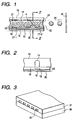
- Fig. 1 is a sectional view of a head 13 along an ink flow path.
- Fig. 2 is a sectional view of the head taken along line 2-2 in Fig. 1.
- the head 13 is constructed by bonding a plate of glass, ceramics, silicon, plastics, or the like having a flow path (nozzle) 14 for ink flow with a heater element substrate 15 for thermal recording.
- the heater element substrate 15 is constituted of a protection layer 16 formed from silicon oxide, silicon nitride, silicon carbide, or the like; electrodes 17-1, 17-2 formed from aluminum, gold, aluminum-copper alloy, or the like; a heating resistor layer 18 formed from a high melting material such as HfB 2 , TaN, and TaAl; a heat-accumulating layer 19 formed from thermally oxidized silicon, aluminum oxide, or the like; and a substrate 20 made of a heat-radiating material such as silicon, aluminum, and aluminum nitride.
- the region denoted by a symbol "n" on the heater element substrate head 15 On application of an electric signal information to the electrodes 17-1, 17-2 of the head, the region denoted by a symbol "n" on the heater element substrate head 15 generates heat abruptly to form bubbles in the ink on the surface of the heater element substrate, the pressure of the bubbles pushes out the meniscus 23 to eject the ink 21 through the nozzle 14 and the orifice 22 in a shape of droplets 24. The ejected ink droplets travel toward a recording sheet 25.
- Fig. 3 shows a external appearance of a multiple head having juxtaposed plural heads shown in Fig. 1.
- the multiple head is formed by bonding a glass plate 27 having multiple nozzles 26 with a heat-generating head 28 like the one shown in Fig. 1.
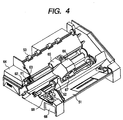
- Fig. 4 shows an example of the ink-jet recording apparatus equipped with the above-described head.
- a blade 61 as a wiping member is held at one end of the blade with a blade-holding member, forming a fixed end in a shape of a cantilever.
- the blade 61 is placed at a position adjacent to the recording region of the recording head, and, in this example, is held so as to protrude into the moving path of the recording head.
- a cap 62 for the ejection nozzle face of a recording head 65 is placed at a home position adjacent to the blade 61, and is constituted such that it moves in the direction perpendicular to the moving direction of the recording head to come into contact with the ejection nozzle face to cap the nozzle.
- An ink absorbent 63 is placed at a position adjacent to the blade 61, and is held so as to protrude into the moving path of the recording head 65 in a manner similar to that of the blade 61.
- the blade 61, the cap 62, and the ink absorbent 63 constitute an ejection recovery device 64.
- the blade 61, and the ink absorbent 63 serve to remove off water, dust, and the like from the face of the ink ejection nozzle.
- a recording head 65 has an energy-generating means for the ejection, and conducts recording by ejecting the ink onto a recording medium opposing to the ejection nozzle face.
- a carriage 66 is provided for supporting and moving the recording head 65. The carriage 66 is engaged slidably with a guide rod 67. A portion of the carriage 66 is connected (not shown in the drawing) to a belt 69 driven by a motor 68, so that the carriage 66 is movable along the guide rod 67 to the recording region of the recording head 65 and the adjacent region thereto.
- a paper sheet delivery device 51 for delivery of a recording medium and a paper sheet delivery roller 52 driven by a motor (not shown in the drawing) delivers a recording medium to the position opposing to the ejection nozzle face of the recording head.
- the recording medium is delivered with the progress of the recording, and is delivered further to a paper discharge device provided with paper sheet-discharging rollers 53.
- the cap 62 of the ejection-recovery device 64 is positioned out of the moving path of the recording head 65, and the blade 61 is allowed to protrude to the moving path. Thereby, the ejecting nozzle face of the recording head 65 is wiped.
- the cap 62 protrudes toward the moving path of the recording head to come into contact with the ejection nozzle face.
- the cap 62 and the blade 61 are at the same position as in the above-mentioned wiping step, so that the ejection nozzle face of the recording head 65 is wiped also in this movement.
- the recording head is moved to the home position not only at the completion of the recording and at the time of ejection recovery, but is also moved at a predetermined intervals during recording from the recording region.
- the nozzle is wiped by this movement.
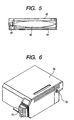
- Fig. 5 is a sectional view of an example of an ink cartridge 45 which holds an ink to be supplied through an ink supplying member such as a tube.
- An ink container 40 for example, an ink bag, contains an ink to be supplied, and has a rubber plug 42 at the tip. Insertion of a needle (not shown in the drawing) into the plug 42 enables supply of the ink from the ink bag 40 to the head.
- a waste-ink absorbent 44 serves to absorb a waste ink.
- the liquid-contacting face of the ink container is preferably formed from polyolefin, especially polyethylene, in the present invention.
- the ink-jet recording apparatus used in the present invention is not limited to the above-mentioned one which has separately a head and an ink cartridge. Integration thereof as shown in Fig. 6 may suitably be employed.
- a recording unit 70 houses an ink holding member such as an ink absorbent, and the ink in the absorbent is ejected from a plurality of orifices of a head 71.
- the ink absorbent is made preferably of polyurethane in the present invention.
- the ink-holding member may be a structure of an ink bag having a spring inside without employing the ink absorbent.
- An air-communication opening 72 is provided for communication of the cartridge interior with the open air.
- the recording unit 70 may be used in place of the recording head 65 shown in Fig. 4, and is made to be mountable to and demountable from the carriage 66.
- an on-demand ink-jet recording head In another example of the ink-jet recording apparatus which utilizes a dynamic energy, an on-demand ink-jet recording head is employed.
- the on-demand ink-jet recording head comprises a nozzle-holding substrate having plural nozzles, and a pressure-generating element constituted of a piezo-electric material opposing to the nozzles and an electroconductive material, and is filled with an ink around the pressure-generating element. By application of a voltage, the pressure-generating element is displaced to eject the ink droplets through the nozzles.
- Fig. 7 shows an example of the constitution of the recording head which is the main portion of the recording apparatus.
- This head is constituted of an ink flow path 80 communicating with an ink chamber (not shown in the drawing), an orifice plate 81 for ejecting a prescribed volume of the ink droplets, a vibration plate 82 for exerting pressure directly to the ink, a piezo-electric element 83 joined to the vibration plate 82 and displacing in response to electric signals, and a substrate 84 for fixing the orifice plate 81, the vibration plate 82, and so forth.
- the ink flow path 80 is formed from a photosensitive resin, or a like material.
- An ejection orifice 85 is formed through the orifice plate 81 from a metal such as stainless steel, and nickel by boring by electrocasting or press working, or like processing.
- the vibration plate 82 is formed from a film of a metal such as stainless steel, nickel, and titanium, or a film of high-elasticity resin.
- the piezo-electric element 83 is made from a dielectric material such as barium titanate, and PZT.
- pulsed voltage is applied to the piezo-electric element 83 to cause deformation stress therein to deform the vibration plate joined to the piezo-electric element 83, whereby the ink in the ink flow path 80 is pressurized vertically to eject ink droplets (not shown in the drawing) to conduct recording.
- a recording bead can be used by incorporation into a recording apparatus similar to that shown in Fig. 4.
- the recording apparatus with such a recording head may be driven in the same manner as described before.
- Fig. 9 shows an example, in which the recording units 91, 92, 93, 94 eject respectively an ink of yellow, magenta, cyan, and black.
- the recording units are placed on the carriage of the aforementioned recording apparatus, and eject the respective color inks in accordance with recording signals.
- the example shown by Fig. 9 employs four recording units.
- the present invention is not limited thereto.
- the recording is conducted by use of a recording head 95 which has separate ink flow paths provided for ejecting the respective colors of the ink supplied from the ink cartridges 86-89.
- the present invention enables printing of high-quality image having excellent water resistance and excellent abrasion resistance with less feathering and less bleeding without conducting light irradiation or the like treatment after the printing.
- a first liquid composition and a second liquid composition (ink) were prepared which have the constitutions shown below.
- the ink set comprising the first liquid composition and the second composition is tested for printing by means of an ink-jet printer (trade name: BJC700J, Canon Inc.).
- the first liquid composition and the second composition were charged respectively to two print heads.
- Electrophotographic copying paper sheets (non-coat paper, trade name: PB Paper, Canon Inc.) were set in this printer.
- a document containing characters and patterns was printed thereon.
- the second liquid composition was applied firstly onto the paper sheet, and then the first liquid composition was applied onto the ink-printed area in superposition with a time-lag of about 1/50 second.
- the first liquid composition and the second liquid composition came to be mixed sufficiently on the paper sheet.
- the obtained print was left standing for one day in a usual office environment conditions (temperature: 25°C, humidity: 50%). Then the print was evaluated for dot definition, water resistance, and marking-pen resistance according to the methods below. Table 3 shows the results.
- the dots printed on the paper sheet were examined visually for the concentration and occurrence of beard-like feathering.
- the printed portion was traced with a yellow marking pen (trade name: ZEBRA fluorescence PEN2, Zebra Co.). Traced portion was examined visually for occurrence of turbidness.
- a yellow marking pen trade name: ZEBRA fluorescence PEN2, Zebra Co.
- An ink set was prepared which comprised a first liquid composition and a second liquid composition having the constitutions shown in Table 4. With this ink set, printing was conducted in the same manner as in Example 1 except that the first liquid composition was applied first and than the second liquid composition was applied. Table 5 shows the results.
- An ink set was prepared which comprised a first liquid composition and second liquid compositions having the constitutions shown in Tables 6 and 7.
- the four inks were charged respectively into print heads of an ink-jet color printer (trade name: BJF-800, Canon Inc.). In the printing, on the black-ink-applied portion, any one of the color inks was applied in superposition to cause reaction between the first compound (A-3) and the second compound (B-1).
- the recording medium was plain paper sheets for electrophotography, and two types of gloss paper sheets for ink-jet recording (trade names, GP-301, and HG-201, Canon Inc.)
- the print was evaluated for water resistance, abrasion resistance, marking-pen resistance, and reflectivity of the printed characters.
- the liquid compositions were evaluated for clogging liableness and ejection stability. The evaluation standards are shown below.
- the printed character is rubbed five times with a commercial stationery rubber in a manner to erase the characters, and the state of the characters is examined.
- the printed portion is traced with a yellow marking pen (trade name: ZEBRA fluorescence PEN2, Zebra Co.). Traced portion is examined visually for occurrence of turbidity.
- a yellow marking pen trade name: ZEBRA fluorescence PEN2, Zebra Co.
- the printer nozzle is capped and is left standing for one day. Then the printing is started again, and the ejection state through the nozzle and the regularity of the dots are examined.
- Example 3 For Comparison with Example 3, the same ink set as in Example 3 was prepared except that the first liquid composition was changed to the black ink having the constitution shown below, and the printing test was conducted in the same manner as in Example 3.
- Self-dispersing type carbon black component (trade name: Cabojet 300, Cabot Co.) 6 parts Triethylene glycol 15 parts Water 79 parts
- Example 3 For Comparison with Example 3, the same ink set as in Example 3 was prepared except that the first liquid composition was changed to the black ink having the constitution shown below, and the printing test was conducted in the same manner as in Example 3.
- Self-dispersing type carbon black component (trade name: Cabojet 300, Cabot Co.) 6 parts Aqueous solution of styrene-acrylic acid copolymer amine salt (concentration: 20wt%, number-average molecular weight: 3500 acid value: 230) 25 parts Triethylene glycol 15 parts Water 54 parts
- a color ink-jet printer trade name: BJC700J, Canon Inc.
- an ink-jet glossy paper sheet trade name: GP301, Canon Inc.
- the second liquid compositions of the respective colors were applied on the prescribed positions on the recording medium, and thereon the first liquid composition was applied to allow the first compound to react with the second compound.
- Example 4 The prints obtained in Example 4 by use of plain paper sheets and glossy paper sheets were excellent in water resistance, abrasion resistance, and marking-pen resistance.
- a water-soluble dye which does not usually give water resistance with an ink additive, the remarkably high water resistance of the print could be achieved with the dot density maintained.
- An ink set was prepared in the same manner as in Example 4 except that the first liquid composition was changed to the ink having the constitution shown in Table 11, and printing test was conducted in the same manner as in Example 4.
- Example 5 The prints obtained in Example 5 by use of plain paper sheets and glossy paper sheets were greatly improved in abrasion resistance, and marking-pen resistance. Even with an aqueous pigment ink which does not always give sufficient adhesiveness of the ink to the recording medium, the related performances were greatly improved by the present invention.
- a first liquid composition and a second liquid composition were prepared as shown in Tables 12 and 13.
- the recording medium was plain paper sheets for electrophotography, and two types of glossy paper sheets for ink-jet recording (trade names, GP-301, and HG-201, Canon Inc.)
- the print was found to be excellent in water resistance and marking-pen resistance of the dye ink, and in abrasion resistance and marking-pen resistance of the black pigment ink.
- a first liquid composition and a second liquid composition were prepared as shown in Tables 14 and 15.
- inks were charged respectively into print heads of an ink-jet color printer (trade name: BJF-800, Canon Inc.).
- any of the color inks was applied in dots onto prescribed positions before application of the black ink, and thereon the black ink was applied in superposition.
- the printing was conducted at a highest-speed printing mode so as to complete every dot by two-scan reciprocation of the head.
- the recording medium was plain paper sheets for electrophotography, and two types of glossy paper sheets for ink-jet recording (trade names, GP-301, and HG-201, Canon Inc.).
- a first liquid composition and a second liquid composition were prepared as shown in Tables 16 and 17.
- Black ink 1 shown in Table 16 was applied to form eight solid patterns of 3cm ⁇ 3cm on an ink-jet glossy paper sheet (trade name: GP301, Canon K.K.) by means of an ink-Jet printer (trade name: BJF-600, Canon K.K.).
- the second liquid composition having the constitution shown in Table 17 was applied in half an amount of Black Ink 1 used for the solid pattern.
- the printed glossy paper sheet was left standing indoors for 24 hours, and the hues of the respective solid patterns were measured.
- This printed paper sheet was placed in an atmosphere of 3 ppm ozone in an ozone testing apparatus for two hours. The hues of the respective solid patterns were measured again. Thereby, the color differences of the patterns with the second liquid composition applied was compared with the color differences of the patterns with the second liquid not applied.
- Transparent inks containing no coloring material were prepared as below.
- Compound A-3 30% by weight Water 70% by weight
- the two inks were charged respectively to two ink-jet printer head, and solid printing was conducted in two manners.
- the first transparent ink (first liquid composition) and the second transparent ink (second liquid composition) were applied on an ink-jet recording glossy film (trade name: HG-201, Canon Inc.) having an image formed thereon so as to cause mixing of the transparent inks in a liquid state on the film surface.
- the amount of the inks applied was 20 mL/m 2 in total.
- the image was evaluated.
- the polymeric compound film formed by the reaction of the first compound with the second compound on the glossy film was less scratchable, and the discoloration of the image was remarkably retarded during storage in an indoor environment.
- Direct Black 168 2.8 parts Compound A-6 20 parts 1,3-propanediol 5 parts Water 72.2 parts pH adjuster small amount Black Ink 3/ pH 9.0 C.I.
- Direct Black 195 2.5 parts Compound A-6 20 parts 1,3-propanediol 5 parts Water 72.5 parts pH adjuster small amount Cyan Ink 1/ pH 8.5 C.I.
- Direct Blue 199 2.0 parts Compound A-6 20 parts 1,3-propanediol 5 parts Water 73 parts pH adjuster small amount Cyan Ink 2/ pH 8.5 C.I.
- the ink set comprises a first liquid composition containing a first water-soluble compound having in the molecule an ethylenically unsaturated double bond having an electron-attractive substituent on the ⁇ -position, and a second liquid composition containing a second water-soluble compound having an active hydrogen atom addable to the first compound in coexistence, at least one of the first liquid composition and the second liquid composition further containing a coloring material.
Landscapes
- Chemical & Material Sciences (AREA)
- Life Sciences & Earth Sciences (AREA)
- Engineering & Computer Science (AREA)
- Materials Engineering (AREA)
- Wood Science & Technology (AREA)
- Organic Chemistry (AREA)
- Chemical Kinetics & Catalysis (AREA)
- Inks, Pencil-Leads, Or Crayons (AREA)
- Ink Jet Recording Methods And Recording Media Thereof (AREA)
- Ink Jet (AREA)
Abstract
Description












| Compound A-8 | 20 |
| Water | |
| 80 parts |
| Polyethylenimine (Compound B-3) (number-average molecular weight: 13500) | 20 parts |
| C.I. Direct Black 168 | 3.5 parts |
| Water | 76.5 parts |
| C.I. Direct Black 168 | 3.5 |
| Diethylene glycol | |
| 15 parts | |
| Water | 81.5 parts |
| Self-dispersing type carbon black component (trade name: Cabojet 300, Cabot Co.) | 6 |
| Triethylene glycol | |
| 15 parts | |
| Water | 79 parts |
| Self-dispersing type carbon black component (trade name: Cabojet 300, Cabot Co.) | 6 parts |
| Aqueous solution of styrene-acrylic acid copolymer amine salt (concentration: 20wt%, number-average molecular weight: 3500 acid value: 230) | 25 |
| Triethylene glycol | |
| 15 parts | |
| Water | 54 parts |
| Compound A-3 | 30% by |
| Water | |
| 70% by weight |
| Epomine SP-012 | 30% by |
| Water | |
| 70% by weight |
| Compound | Solubility | Time for gel formation (seconds) |
| A-1 | Ca 10% | 15 |
| A-2 | >30% | 10 |
| A-3 | >30% | 20 |
| A-4 | ca 30% | 10 |
| A-5 | >30% | 20 |
| A-6 | >30% | 25 |
| A-7 | >30% | 25 |
| A-8 | >30% | 25 |
| A-9 | ca 10% | 60 |
| A-10 | ca 20% | 10 |
| A-11 | >30% | 20 |
| A-12 | >30% | 20 |
| B-1 ( | >30% | 30 |
| B-1 ( | >30% | 30 |
| B-1 ( | >30% | 30 |
| B-2 ( | >30% | 600 |
| B-2 ( | >30% | 600 |
| B-3 (polymn deg: n=7) | >30% | 60 |
| B-3 (Epomin SP-012) | >30% | 15 |
| B-3 (Epomin SP-008) | >30% | 15 |
| B-3 (Lupasol FG) | >30% | 15 |
| B-4 | 20% | 600 |
| B-5 | 20% | 600 |
| B-6 | 20% | 600 |
| B-7 (n=4) | 10% | 300 |
| B-8 | >30% | 600 |
| B-9 | >30% | 600 |
| B-10 | >30% | 600 |
| First liquid composition | Second liquid composition | |||||
| Coloring material | Coloring material | |||||
| No coloring material | Black | Color | No coloring material | Black | Color | |
| Ink Set 1 | x | x | ||||
| Ink Set 2 | x | x | ||||
| Ink Set 3 | x | x | ||||
| Ink Set 4 | x | x | ||||
| Ink Set 5 | x | x | ||||
| Ink Set 6 | x | x | ||||
| Ink Set 7 | x | x | ||||
| Ink Set 8 | x | x | ||||
| Ink Sets 9 | x | x |
| Example 1 | Comparative Example 1 | |
| Dot definition | High density, | High density, |
| High definition | High definition | |
| Water resistance | No change of print quality, | Characters being decipherable, |
| No ink bleeding, | Black turbidness occurring at periphery of characters | |
| Definite | ||
| Marking-pen resistance | No turbidness occurred | Turbidness in non-printed portions |
| First liquid composition | Second liquid composition (Black ink) | |||
| Compound A-1 | 15 aprts | Compound B-3 | 10 parts | |
| Diethylene glycol | 10 parts | C.I. Direct Black 168 | 3.5 parts | |
| N-Nethyl-2-pyrrolidone | 7 | Diethylene glycol | 15 | |
| Water | ||||
| 68 parts | Water | 71.5 parts |
| Example 2 | |
| Dot definition | High density, |
| High definition | |
| Water resistance | No change of print quality, |
| No ink bleeding, | |
| Definite | |
| Marking-pen resistance | No turbidness caused by marker pen |
| First liquid composition (black ink) | |
| | 15 parts |
| Self dispersing type carbon black disperse component (trade name: Cabojet 300, Cabot Co.) | 6 |
| Triethylene glycol | |
| 15 | |
| Water | |
| 64 parts |
| Second liquid composition | ||
| Blue ink | C.I. Direct Blue 199 | 3 parts |
| Compound B-1 ( | 12 parts | |
| Diethylene glycol | 10 parts | |
| N-Methyl-2-pyrrolidone | 7 | |
| Water | ||
| 68 parts | ||
| Yellow ink | C.I. Direct Yellow 132 | 5 parts |
| Compound B-1 ( | 12 parts | |
| Diethylene glycol | 10 parts | |
| N-Methyl-2-pyrrolidone | 7 | |
| Water | ||
| 66 parts | ||
| Magenta ink | C.I. | 4 parts |
| Compound B-1 ( | 12 parts | |
| Diethylene glycol | 10 parts | |
| N-Methyl-2-pyrrolidone | 7 | |
| Water | ||
| 67 parts |
| Example | Comparative Example | ||
| 3 | 2 | 3 | |
| Water resistance | Excellent | Fair | Excellent |
| Abrasion resistance | Excellent | Poor | Fair |
| Marking-pen resistance | Excellent | Poor | Fair |
| Reflection density of characters | Excellent | Excellent | Excellent |
| Non-clogging | Excellent | Excellent | Poor |
| Ejection stability | Excellent | Excellent | Poor |
| First liquid composition | ||
| Blue ink | C.I. Direct Blue 199 | 3 parts |
| Compound A-6 | 10 | |
| Water | ||
| 87 parts | ||
| Yellow ink | C.I. Direct Yellow 132 | 5 parts |
| Compound A-6 | 10 | |
| Water | ||
| 85 parts | ||
| Magenta ink | C.I. | 4 parts |
| Compound A-6 | 10 | |
| Water | ||
| 66 parts | ||
| Black | Carbon black dispersion | 30 parts |
| Compound A-6 | 10 parts | |
| Water | 60 parts |
| Second | |
| Polyethlenimine | |
| 20 | |
| Water | |
| 80 parts |
| First liquid composition | ||
| Blue ink | Aqueous dispersion of | 25 parts (pigment: 4 parts) |
| Compound A-6 | 10 | |
| Water | ||
| 65 parts | ||
| Yellow ink | Aqueous dispersion of Pigment Yellow 128 | 50 parts (pigment: 5 parts) |
| Compound A-6 | 10 | |
| Water | ||
| 40 parts | ||
| Magenta ink | Aqueous dispersion of Pigment Red 122 | 27 parts (pigment: 4 parts) |
| Compound A-6 | 10 | |
| Water | ||
| 63 parts | ||
| Black | Carbon black dispersion | 30 parts (pigment: 6 parts) |
| Compound A-6 | 10 parts | |
| Water | 60 parts |
| First liquid composition | ||
| Blue ink | C.I. Direct Blue 199 | 3 parts |
| Compound A-2 | 10 parts | |
| Diethylene glycol | 10 parts | |
| N-Methyl-2-pyrrolidone | 7 parts | |
| Water | 60 parts | |
| Yellow ink | C.I. Direct Yellow 132 | 5 parts |
| Compound A-2 | 10 parts | |
| Diethylene glycol | 10 parts | |
| N-Methyl-2-pyrrolidone | 7 | |
| Water | ||
| 68 parts | ||
| Magenta ink | | 4 parts |
| Compound B-1 ( | 10 parts | |
| Diethylene glycol | 10 parts | |
| N-Methyl-2-pyrrolidone | 7 | |
| Water | ||
| 69 parts |
| Second liquid composition (black ink) | |
| Compound B-6 | 15 parts |
| Self-dispersing type carbon black disperse component (trade name: Cabojet 300, Cabot Co.) | 5 parts (solid matter) |
| | 15 |
| Water | |
| 65 parts |
| First liquid composition (black ink)/ pH=3.5 | |
| Compound A-2 | 8 parts |
| Cationic carbon black dispersion (trade name: IJX-55, Cabot Co.) | 5 parts (solid matter) |
| | 15 |
| Water | |
| 72 parts |
| Second liquid composition | ||
| Blue ink/ pH=12.5 | C.I. Direct Blue 199 | 3.5 parts |
| Triethylenetetramine (second compound) | 17 | |
| Triethylene glycol | ||
| 20 parts | ||
| Water | 60 parts | |
| Yellow ink/ pH=12.2 | C.I. Direct Yellow 132 | 6 parts |
| Triethylenetetramine (second compound) | 17 | |
| Triethylene glycol | ||
| 20 | ||
| Water | ||
| 68 parts | ||
| Magenta ink/ pH=12.3 | C.I. | 4 parts |
| Triethylenetetramine (second compound) | 17 | |
| Triethylene glycol | ||
| 20 parts | ||
| Water | 59 parts |
| First liquid composition | ||
| Black Ink 1/ pH=8.0 | C.I. | 3.0 |
| Compound A-6 | ||
| 20 parts | ||
| 1,3-propanediol | 5 | |
| Water | ||
| 72 parts | ||
| pH adjuster | small | |
| Black Ink | ||
| 2/ pH=8.5 | C.I. Direct Black 168 | 2.8 |
| Compound A-6 | ||
| 20 parts | ||
| 1,3-propanediol | 5 parts | |
| Water | 72.2 parts | |
| pH adjuster | small amount | |
| Black Ink 3/ pH=9.0 | C.I. Direct Black 195 | 2.5 |
| Compound A-6 | ||
| 20 parts | ||
| 1,3-propanediol | 5 parts | |
| Water | 72.5 parts | |
| pH adjuster | small amount | |
| Cyan Ink 1/ pH=8.5 | C.I. Direct Blue 199 | 2.0 |
| Compound A-6 | ||
| 20 parts | ||
| 1,3-propanediol | 5 parts | |
| Water | 73 parts | |
| pH adjuster | small | |
| Cyan Ink | ||
| 2/ pH=8.5 | C.I. | 2 |
| Compound A-6 | ||
| 20 parts | ||
| 1,3-propanediol | 5 parts | |
| Water | 73 parts | |
| pH adjuster | small amount | |
| Cyan Ink 3/ pH=9.5 | | 2 |
| Compound A-6 | ||
| 20 parts | ||
| 1,3-propanediol | 5 parts | |
| Water | 73 parts | |
| pH adjuster | small amount |
| Second liquid composition (coloress ink)/ pH=11.0 | |
| Compound B-1 (Lupasol FG) | 25 parts |
| Water | 75 parts |
| Ink | Color difference without second liquid composition | Color difference with second liquid composition applied |
| Black Ink 1 | 30.2 | 3.6 |
| | 23.3 | 4.5 |
| Black Ink 3 | 39.6 | 5.3 |
| Cyan Ink 1 | 25.4 | 6.6 |
| | 24.3 | 6.0 |
| Cyan Ink 3 | 30.8 | 5.7 |
Claims (78)
- An ink set, comprising a first liquid composition containing a first water-soluble compound having in the molecule an ethylenically unsaturated double bond having an electron-attractive substituent on the α-position, and a second liquid composition containing a second water-soluble compound having an active hydrogen atom capable of being added to the first compound in coexistence; at least one of the first liquid composition and the second liquid composition further containing a coloring material.
- The ink set according to claim 1, wherein the first compound has two or more ethylenically unsaturated double bonds.
- The ink set according to claim 1 or 2, wherein the second compound has two or more active hydrogen atoms capable of being added to the first compound.
- The ink set according to any one of claims 1 to 3, wherein the second compound has two or more amino groups selected from primary amino groups and secondary amino groups.
- The ink set according to any one of claims 1 to 4, wherein the first liquid composition is a black ink, and the second liquid composition is a liquid having a color tone not substantially affecting the color tone of a printed article obtained with the first liquid composition.
- The ink set according to any one of claims 1 to 4, wherein the second liquid composition is a black ink, and the first liquid composition has a color tone not substantially affecting the color tone of a printed article obtained with the second liquid composition.
- The ink set according to any one of claims 1 to 4, wherein the first liquid composition and the second liquid composition are respectively a black ink.
- The ink set according to any one of claims 1 to 4, wherein one of the first liquid composition and the second liquid composition is a color ink, and the other is a black ink.
- The ink set according to any of claims 1 to 4, wherein the first liquid composition is a color ink, and the second liquid composition is a liquid having a color tone not substantially affecting the color tone of a printed article obtained with the first liquid composition.
- The ink set according to any one of claims 1 to 4, wherein the second liquid composition is a color ink, and the first liquid composition is a liquid having a color tone not substantially affecting the color tone of a printed article obtained with the second liquid composition.
- The ink set according to any one of claims 7 to 10, wherein the color ink is at least one selected from yellow inks, cyan inks, and magenta inks.
- The ink set according to any one of claims 1 to 4, wherein the first liquid composition and the second liquid composition are respectively a color ink.
- The ink set according to claim 11, wherein the color of the first liquid composition as the color ink is different from the color of the second liquid composition as the color ink.
- The ink set according to claim 13, wherein the color inks are at least two color inks having respectively a color selected from yellow, cyan, and magenta.
- The ink set according to any one of claims 1 to 14, wherein the first compound is at least one selected from the compounds represented by Formulas A-1 to A-12, and the second compound is at least one selected from the compounds represented by Formulas B-1 to B-17:



- An ink set, comprising a first liquid composition containing a first water-soluble compound having in the molecule an ethylenically unsaturated double bond having an electron-attractive substituent on the α-position, a second liquid composition containing a second water-soluble compound having an active hydrogen atom capable of being added to the first compound in coexistence, and an ink containing a coloring material.
- The ink set according to claim 16, wherein the ink is a black ink.
- The ink set according to claim 16, wherein the ink is a color ink.
- The ink set according to claim 18, wherein the color ink is at least one selected from yellow inks, cyan inks, and magenta inks.
- The ink set according to any one of claims 16 to 19, wherein the first liquid composition and the second liquid composition respectively have a color tone not substantially affecting the color tone of a printed article obtained with the ink.
- The ink set according to any one of claims 16 to 20, wherein the first compound has two or more ethylenically unsaturated double bonds.
- The ink set according to claim 16, wherein the second compound has two or more active hydrogen atoms capable of being added to the first compound.
- The ink set according to claim 22, wherein the second compound has two or more amino groups selected from primary amino groups and secondary amino groups.
- The ink set according to any one of claims 16 to 23, wherein the first compound is at least one selected from the compounds represented by Formulas A-1 to A-12, and the second compound is at least one selected from the compounds represented by Formulas B-1 to B-17:




- A printing method comprising the steps of (i) providing an ink set comprising a first liquid composition containing a first water-soluble compound having in the molecule an ethylenically unsaturated double bond having an electron-attractive substituent on the α-position, and a second liquid composition containing a second water-soluble compound having an active hydrogen atom capable of being added to the first compound in coexistence, at least one of the first liquid composition and the second liquid composition further containing a coloring material; and (ii) applying the first liquid composition and the second liquid composition respectively onto prescribed positions on a recording medium to cause mixing or contact of the first liquid composition and the second liquid composition.
- The printing method according to claim 25, wherein, in step (ii), at least one of the first liquid composition and the second liquid composition is applied by an ink-jet system onto a recording medium.
- The printing method according to claim 25 or 26, wherein the first liquid composition is a black ink, and the second liquid composition is a liquid having a color tone not substantially affecting the color tone of a printed article obtained with the first liquid composition.
- The printing method according to claim 25 or 26, wherein the second liquid composition is a black ink, and the first liquid composition is a liquid having a color tone not substantially affecting the color tone of a printed article obtained with the second liquid composition.
- The printing method according to claim 25 or 26, wherein the first liquid composition and the second liquid composition are black inks.
- The printing method according to claim 25 or 26, wherein the first liquid composition is a black ink and the second liquid composition is a color ink.
- The printing method according to claim 25 or 26, wherein the first liquid composition is a color ink and the second liquid composition is a black ink.
- The printing method according to claim 25 or 26, wherein the first liquid composition is a color ink, and the second liquid composition is a liquid having a color tone not substantially affecting the color tone of a printed article obtained with the first liquid composition.
- The printing method according to claim 25 or 26, wherein the second liquid composition is a color ink, and the first liquid composition is a liquid having a color tone not substantially affecting the color tone of a printed article obtained with the second liquid composition.
- The printing method according to any of claims 30 to 33, wherein the color ink is at least one selected from yellow inks, cyan inks, and magenta inks.
- The printing method according to claim 25 or 26, wherein the first liquid composition and the second liquid composition are respectively a color ink.
- The printing method according to claim 35, wherein the color of the first liquid composition as the color ink is different from the color of the second liquid composition as the color ink.
- The printing method according to claim 36, wherein the color inks are at least two color inks having respectively a color selected from yellow, cyan, and magenta.
- A printing method comprising the steps of (i) providing an ink set comprising a first liquid composition containing a first water-soluble compound having in the molecule an ethylenically unsaturated double bond having an electron-attractive substituent on the α-position, a second liquid composition containing a second water-soluble compound having an active hydrogen atom capable of being added to the first compound in coexistence, and an ink containing a coloring material; (ii) applying the first liquid composition and the second liquid composition respectively onto prescribed positions on a recording medium to cause mixing or contact of the first liquid composition and the second liquid composition; and (iii) applying the ink onto the recording medium to cause mixing or contact of the ink with the first liquid composition or the second liquid composition.
- The printing method according to claim 38, wherein, in step (ii), at least one of the first liquid composition and the second liquid composition is applied by an ink-jet system onto a recording medium.
- The printing method according to claim 38 or 39, wherein, in step (iii), the ink is applied by an ink-jet system onto a recording medium.
- The printing method according to any one of claims 38 to 40, wherein the ink is a black ink.
- The printing method according to any one of claims 38 to 40, wherein the ink is a color ink.
- The printing method according to claim 38, wherein the ink includes separate plural inks having different color tones.
- The printing method according to claim 43, wherein the plural inks having different color tones are a black ink and a color ink.
- The printing method according to claim 43, wherein the plural inks having different color tones are color inks.
- The printing method according to claim 44 or 45, wherein the color ink is at least one selected from yellow inks, cyan inks, and magenta inks.
- The printing method according to any one of claims 38 to 46, wherein the first liquid composition and the second liquid composition are respectively a liquid having a color tone not substantially affecting the color tone of a printed article obtained with the ink.
- The printing method according to any one of claims 25 to 47, wherein the first compound has two or more ethylenically unsaturated double bonds.
- The printing method according to any of claims 25 to 48, wherein the second compound has two or more active hydrogen atoms capable of being added to the first compound.
- The printing method according to claim 49, wherein the second compound has two or more amino groups selected from primary amino groups and secondary amino groups.
- The printing method according to any one of claims 25 to 50, wherein the first compound is at least one selected from the compounds represented by Formulas A-1 to A-12, and the second compound is at least one selected from the compounds represented by Formulas B-1 to B-17:
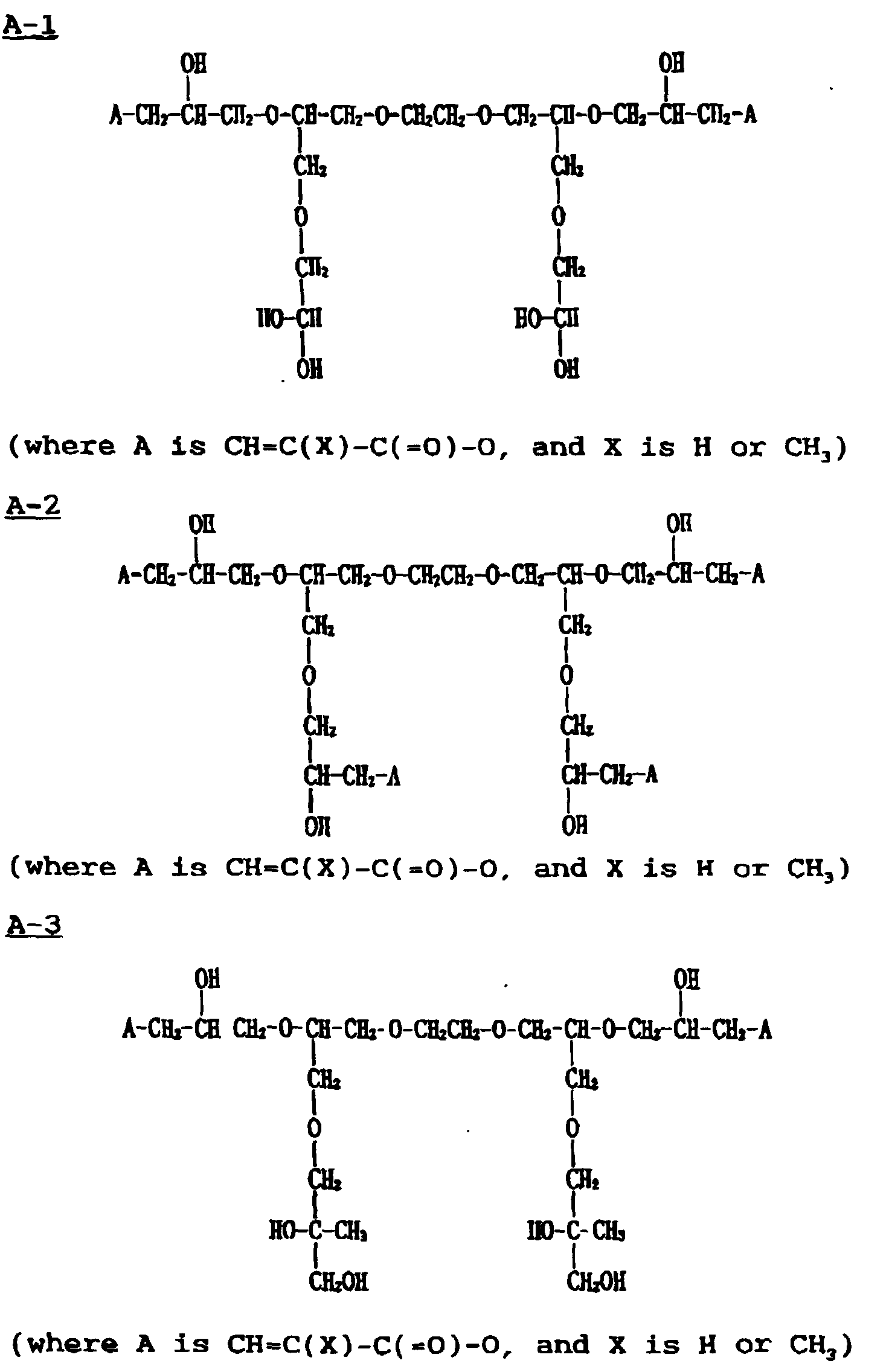
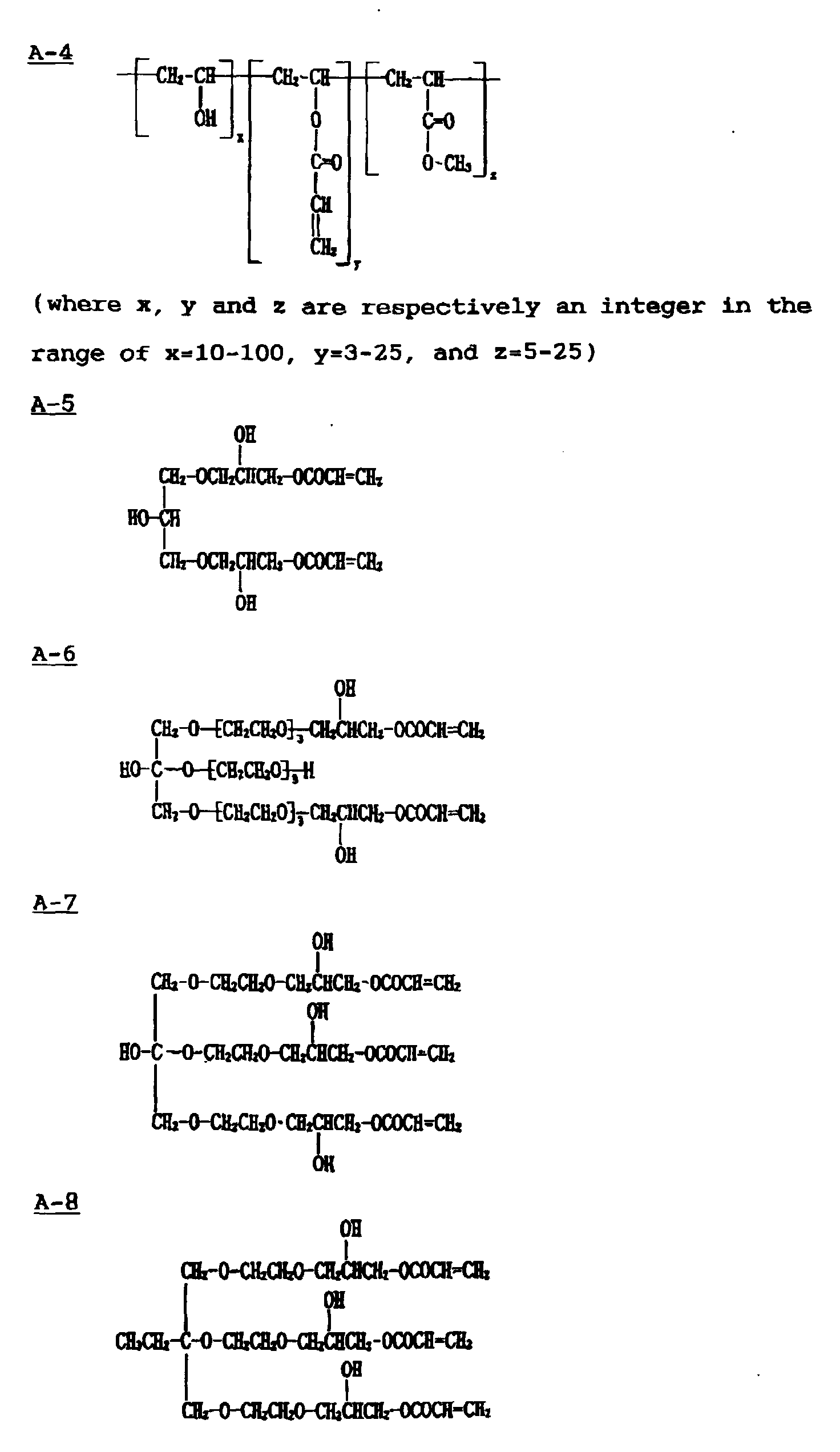

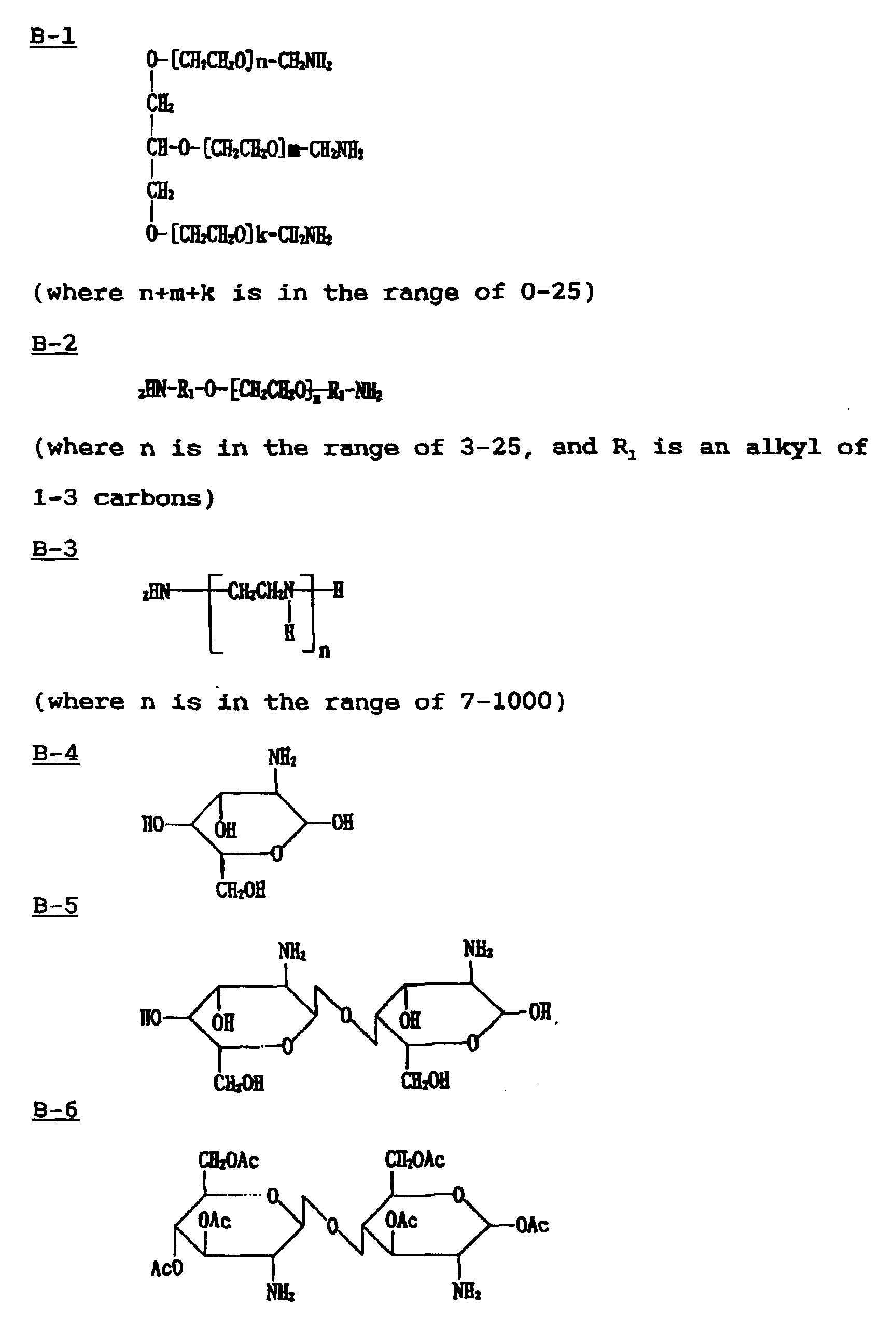
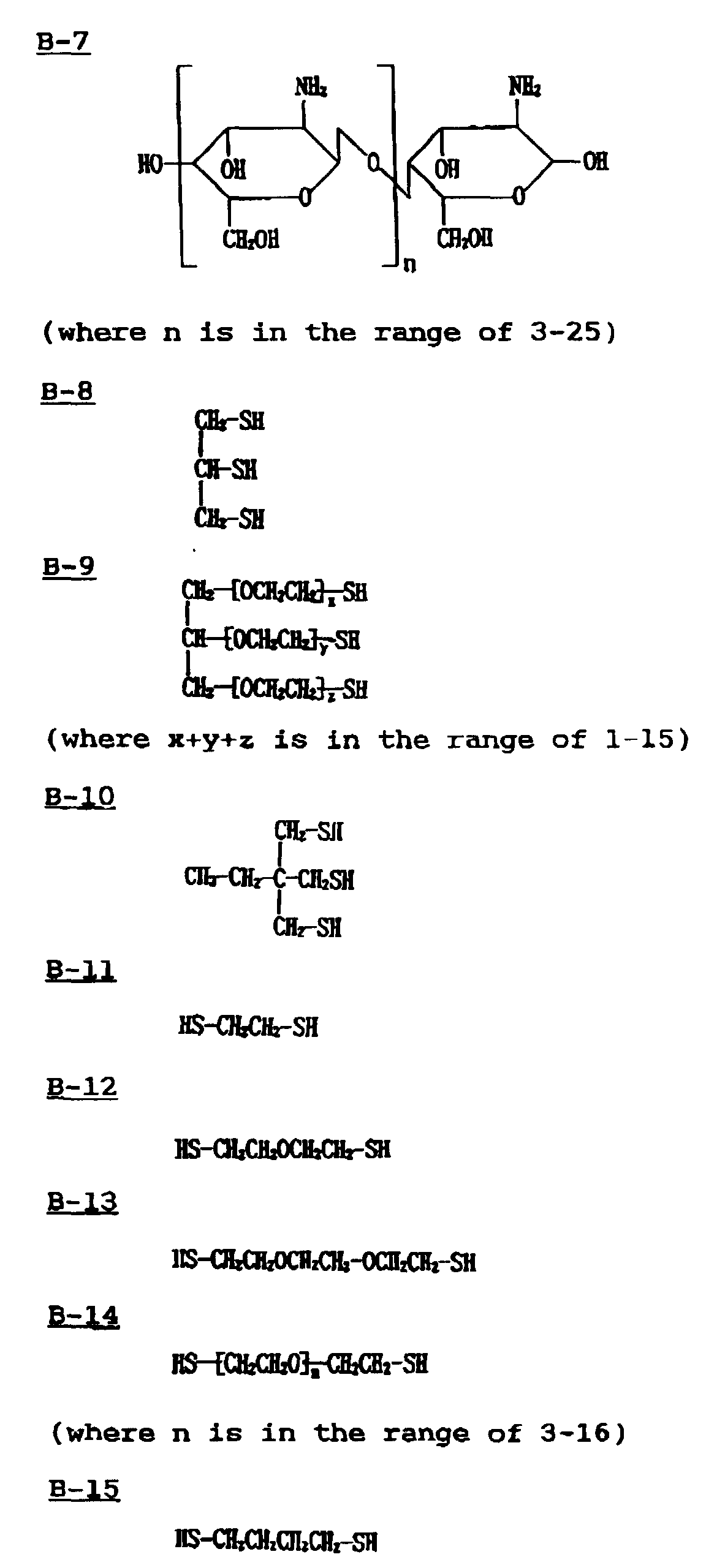

- An ink, containing, in an aqueous medium, at least one compound selected from the compounds represented by Formulas A-1 to A-12, and a coloring material:


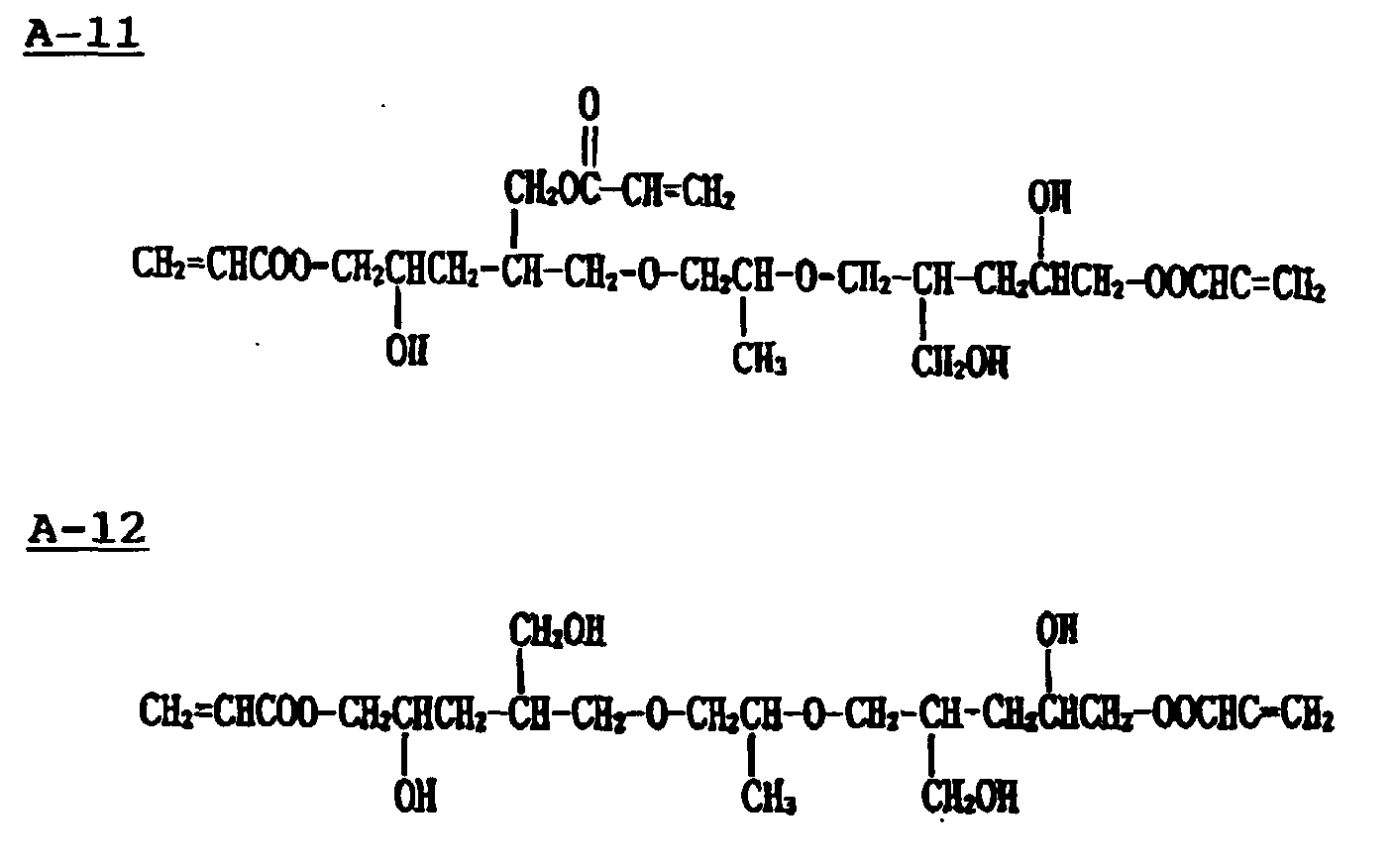
- An ink, containing, in an aqueous medium, at least one compound selected from the compounds represented by Formulas B-1 to B-17, and a coloring material:
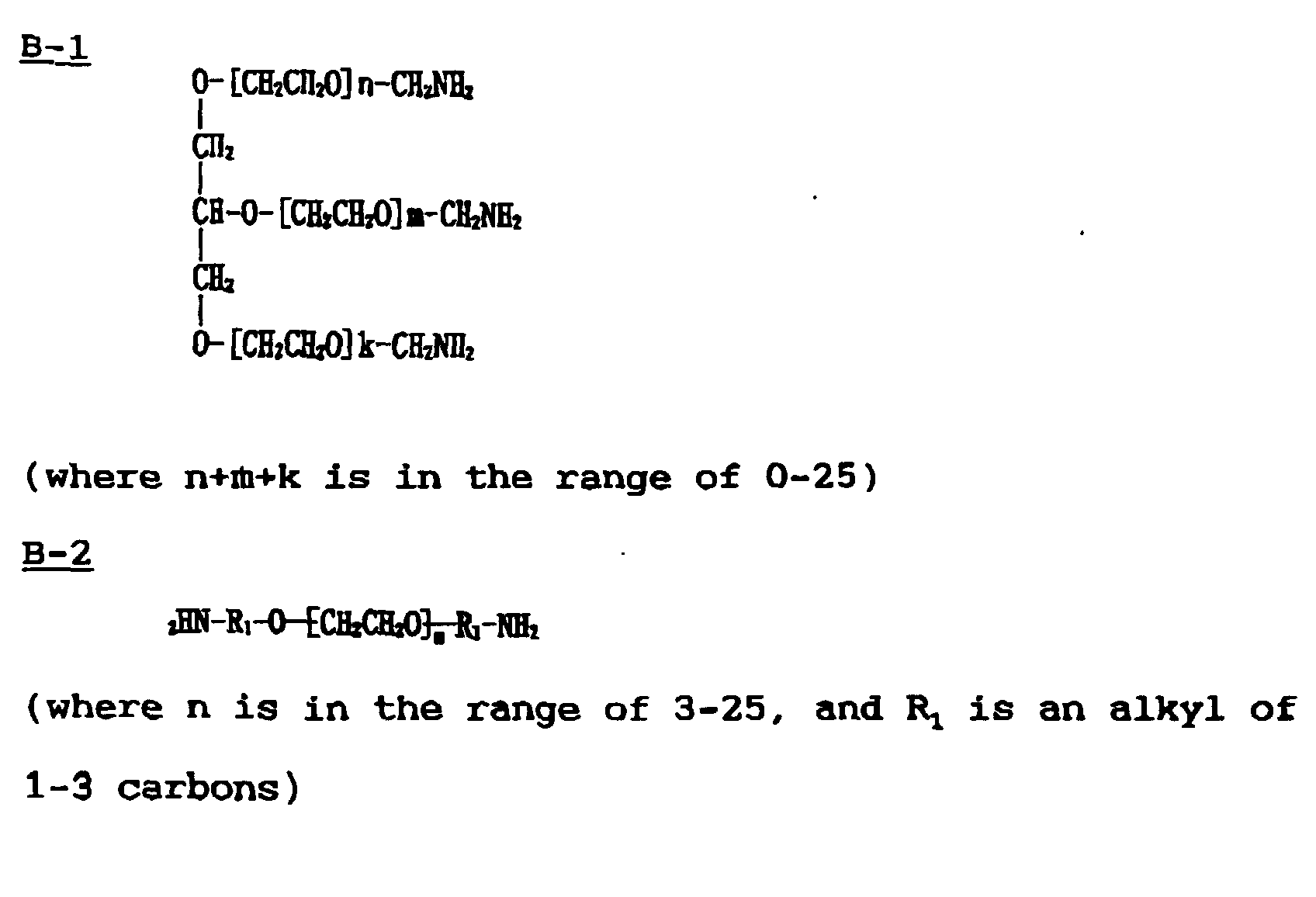
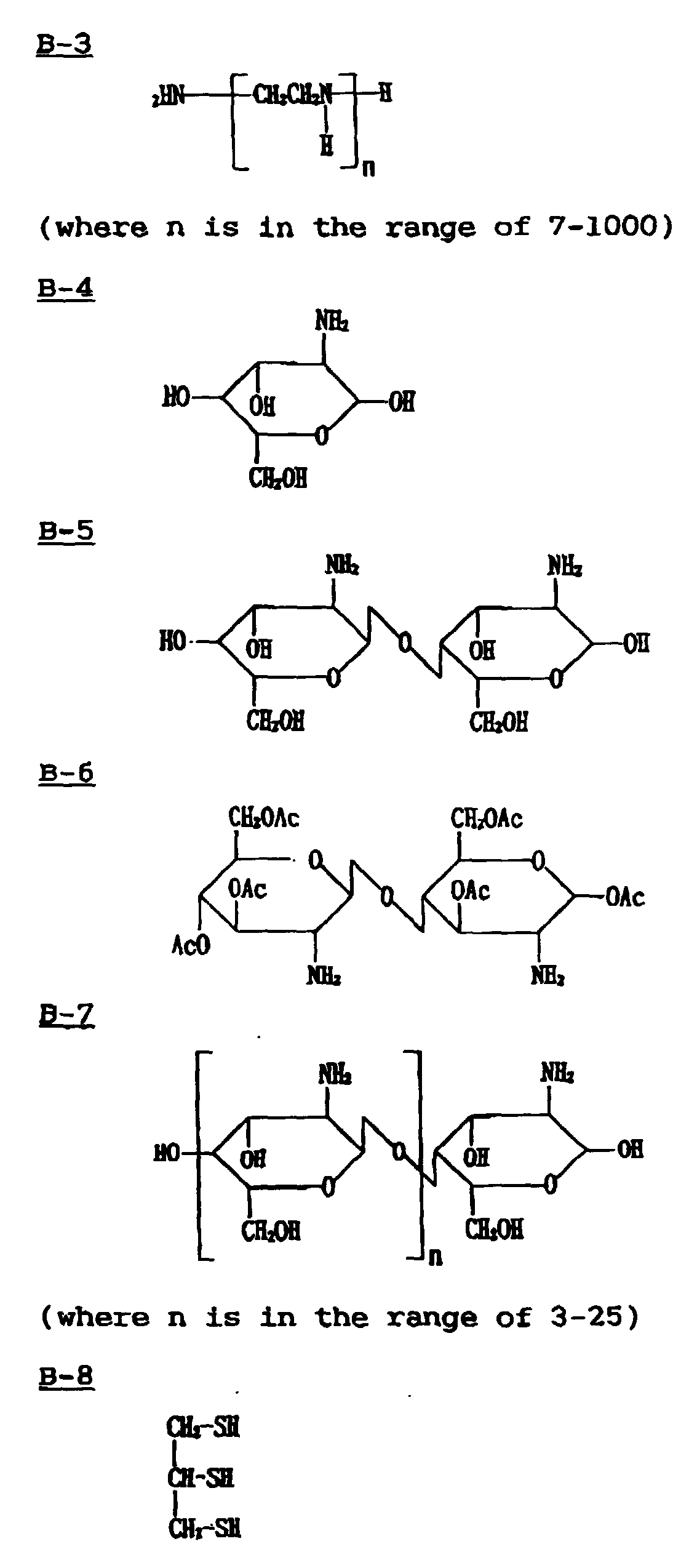

- An ink, containing, in an aqueous medium, at least one compound selected from the compounds represented by Formulas B-1 to B-3, and a coloring material:
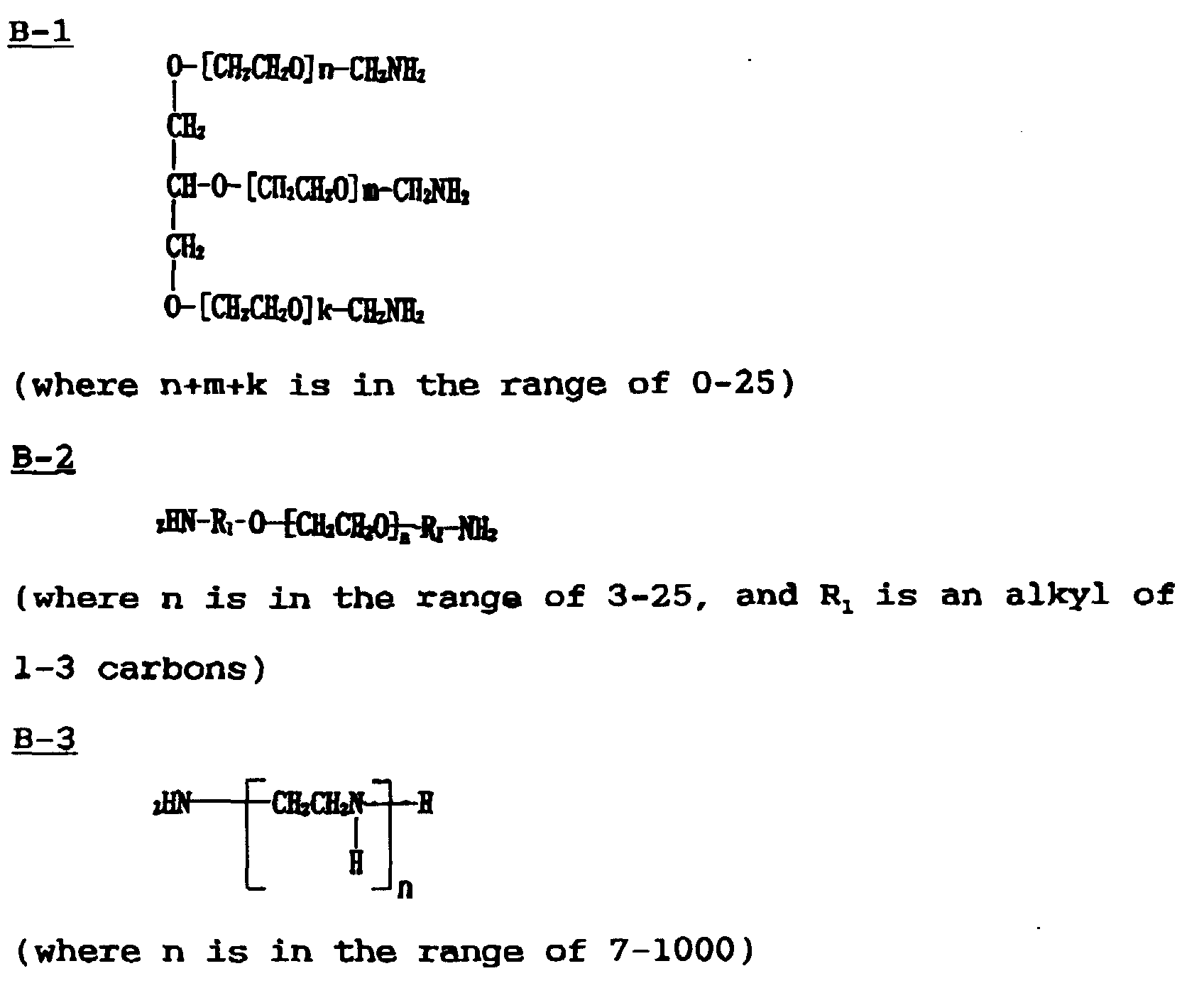
- A printed article having a colored portion containing a coloring material on a recording medium, the colored portion further containing a reaction product of a first liquid composition and a second liquid composition; the first liquid composition containing a first water-soluble compound having in the molecule an ethylenically unsaturated double bond having an electron-attractive substituent on the α-position, and the second liquid composition containing a second water-soluble compound having an active hydrogen atom capable of being added to the first compound in coexistence.
- The printed article according to claim 55, wherein at least one of the first liquid composition and the second liquid composition contains the coloring material.
- The printed article according to claim 56, wherein the colored portion is formed by applying at least one of the first liquid composition and the second liquid composition by an ink-jet system onto the recording medium.
- The printed article according to claim 55, wherein the colored portion is formed by applying at least one of the first liquid composition, the second liquid composition, and the ink by an ink-jet system onto the recording medium.
- A printing apparatus, comprising an ink set comprising a first liquid composition containing a first water-soluble compound having in the molecule an ethylenically unsaturated double bond having an electron-attractive substituent on the α-position, and a second liquid composition containing a second water-soluble compound having an active hydrogen atoms capable of being added to the first compound in coexistence, at least one of the first liquid composition and the second liquid composition further containing a coloring material; an ejecting means for ejecting the first liquid composition and the second liquid composition separately onto a recording medium; and a controlling means to bring the first liquid composition and the second liquid composition into contact together in a liquid state on the recording medium.
- A printing apparatus comprising an ink set comprising a first liquid composition containing a first water-soluble compound having in the molecule an ethylenically unsaturated double bond having an electron-attractive substituent on the α-position, a second liquid composition containing a second water-soluble compound having an active hydrogen atom capable of being added to the first compound in coexistence, and an ink containing a coloring material; an ejecting means for ejecting the first liquid composition, the second liquid composition, and the ink separately onto a recording medium; and a controlling means to bring the first liquid composition, the second liquid composition, and the ink into contact together in a liquid state on the recording medium.
- An ink cartridge, comprising a first liquid container holding a first liquid composition containing a first water-soluble compound having in the molecule an ethylenically unsaturated double bond having an electron-attractive substituent on the α-position, and a second liquid container holding a second liquid composition containing a second water-soluble compound having an active hydrogen atom capable of being added to the first compound in coexistence; at least one of the first liquid composition and the second liquid composition further containing a coloring material; the ink cartridge being mountable to and demountable from an ink-jet head for ejecting the first liquid composition and the second liquid composition separately.
- An ink cartridge, comprising a first liquid container holding a first liquid composition containing a first water-soluble compound having in the molecule an ethylenically unsaturated double bond having an electron-attractive substituent on the α-position, a second liquid container holding a second liquid composition containing a second water-soluble compound having an active hydrogen atom capable of being added to the first compound in coexistence, and an ink container holding an ink containing a coloring material; the ink cartridge being mountable to and demountable from an ink-jet head for ejecting the first liquid composition, the second liquid composition, and the ink separately.
- A recording unit, comprising a first liquid container holding a first liquid composition containing a first water-soluble compound having in the molecule an ethylenically unsaturated double bond having an electron-attractive substituent on the α-position, a first ink-jet head for ejecting the first liquid composition held in the first liquid container, a second liquid container holding a second liquid composition containing a second water-soluble compound having an active hydrogen atom capable of being added to the first compound in coexistence, and a second ink-jet head for ejecting the second liquid composition held in the second liquid container; at least one of the first liquid composition and the second liquid composition further containing a coloring material.
- A recording unit, comprising a first liquid container holding a first liquid composition containing a first water-soluble compound having in the molecule an ethylenically unsaturated double bond having an electron-attractive substituent on the α-position, a first ink-jet head for ejecting the first liquid composition held in the first liquid container, a second liquid container holding a second liquid composition containing a second compound having an active hydrogen atom capable of being added to the first compound in coexistence, a second ink-jet head for ejecting the second liquid composition held in the second liquid container, an ink container holding an ink containg a coloring material, and a third ink-jet head for ejecting the ink held in the ink container.
- An ink set, comprising a first liquid composition containing a first water-soluble compound having in the molecule an ethylenically unsaturated double bond having an electron-attractive substituent on the α-position, and a second liquid composition containing a second water-soluble compound having an active hydrogen atom capable of being added to the first compound in coexistence.
- The ink set according to claim 65, wherein the first compound has two or more ethylenically unsaturated double bonds.
- The ink set according to claim 65 or 66, wherein the second compound has two or more active hydrogen atoms capable of being added to the first compound.
- The ink set according to claim 67, wherein the second compound has two or more amino groups selected from primary amino groups and secondary amino groups.
- The ink set according to any one of claims 65 to 68, wherein the first compound is at least one selected from the compounds represented by Formulas A-1 to A-12, and the second compound is at least one selected from the compounds represented by Formulas B-1 to B-17:


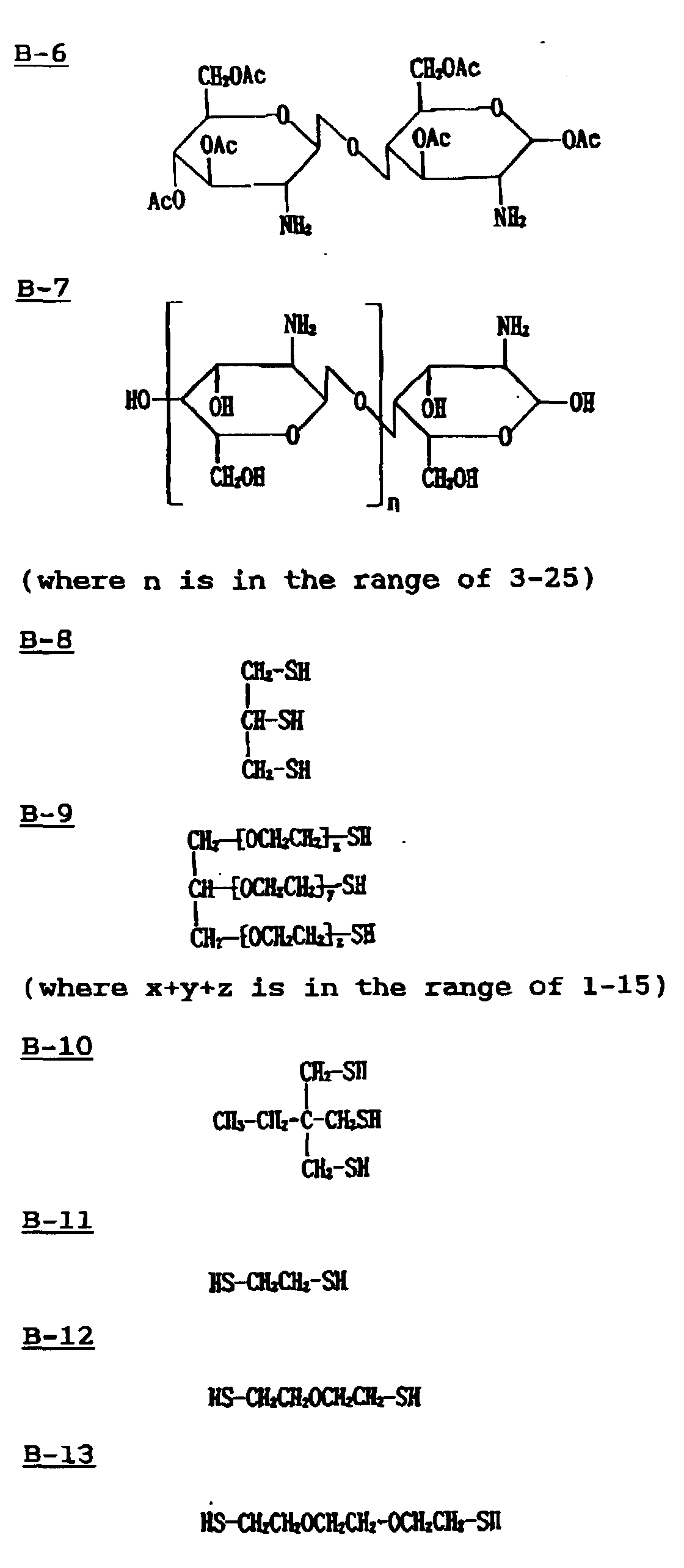

- A method of forming a polymeric compound film, comprising the steps of (i) providing an ink set comprising a first liquid composition containing a first water-soluble compound having in the molecule an ethylenically unsaturated double bond having an electron-attractive substituent on the α-position, a second liquid composition containing a second water-soluble compound having an active hydrogen atom capable of being added to the first compound in coexistence; and (ii) applying the first liquid composition and the second liquid composition respectively onto prescribed positions on a recording medium to cause mixing or contact of the first liquid composition and the second liquid composition to cause reaction of the first compound and the second compound.
- The method according to claim 70, wherein, in step (ii), at least one of the first liquid composition and the second liquid composition is applied by an ink-jet system onto a recording medium.
- The method according to claim 70 or 71, wherein the first compound has two or more ethylenically unsaturated double bonds.
- The method according to any one of claims 70 to 72, wherein the second compound has two or more active hydrogen atoms capable of being added to the first compound.
- The method according to claim 73, wherein the second compound has two or more amino groups selected from primary amino groups and secondary amino groups.
- The method according to any one of claims 71 to 74, wherein the first compound is at least one selected from the compounds represented by Formulas A-1 to A-12, and the second compound is at least one selected from the compounds represented by Formulas B-1 to B-17:

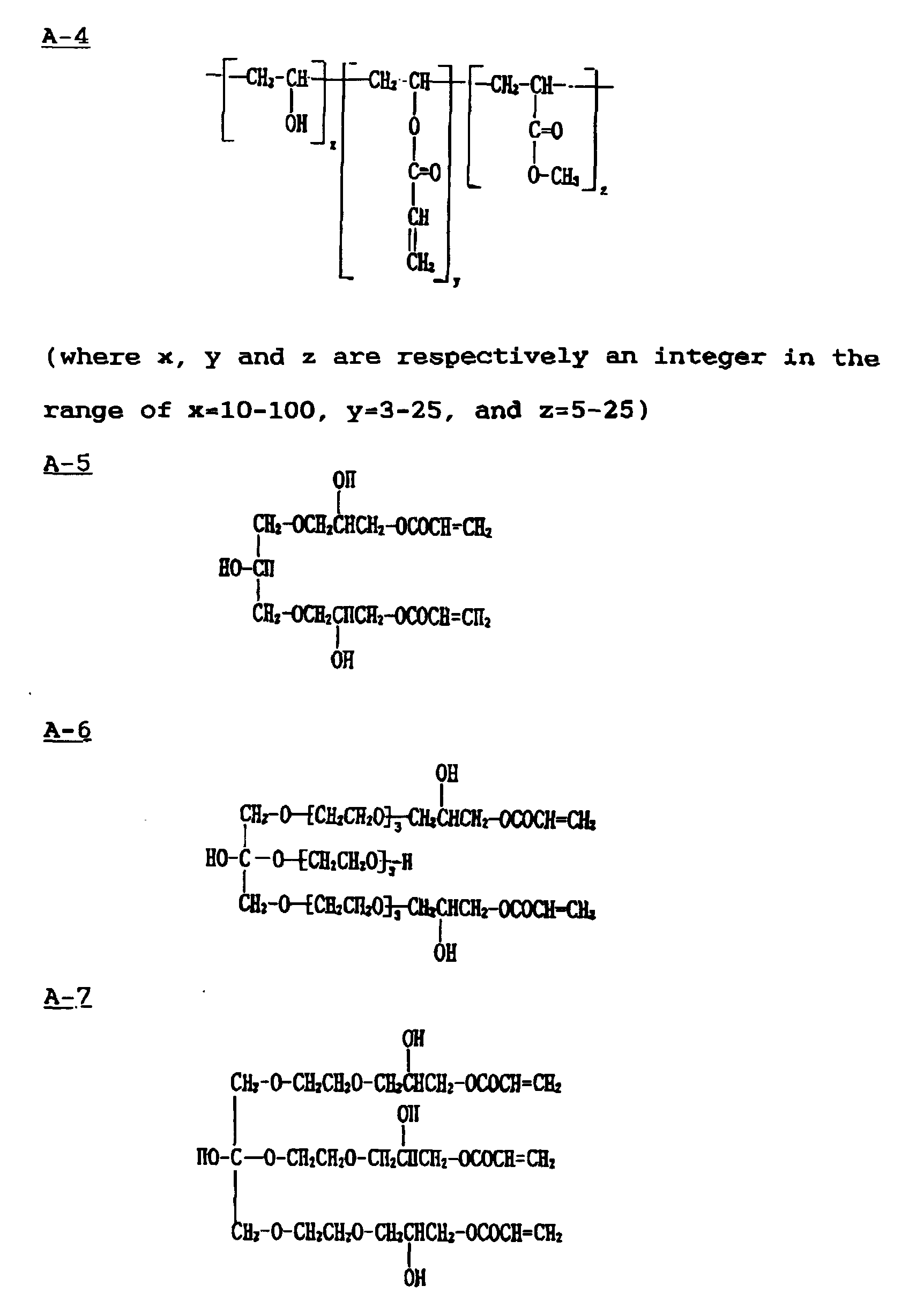
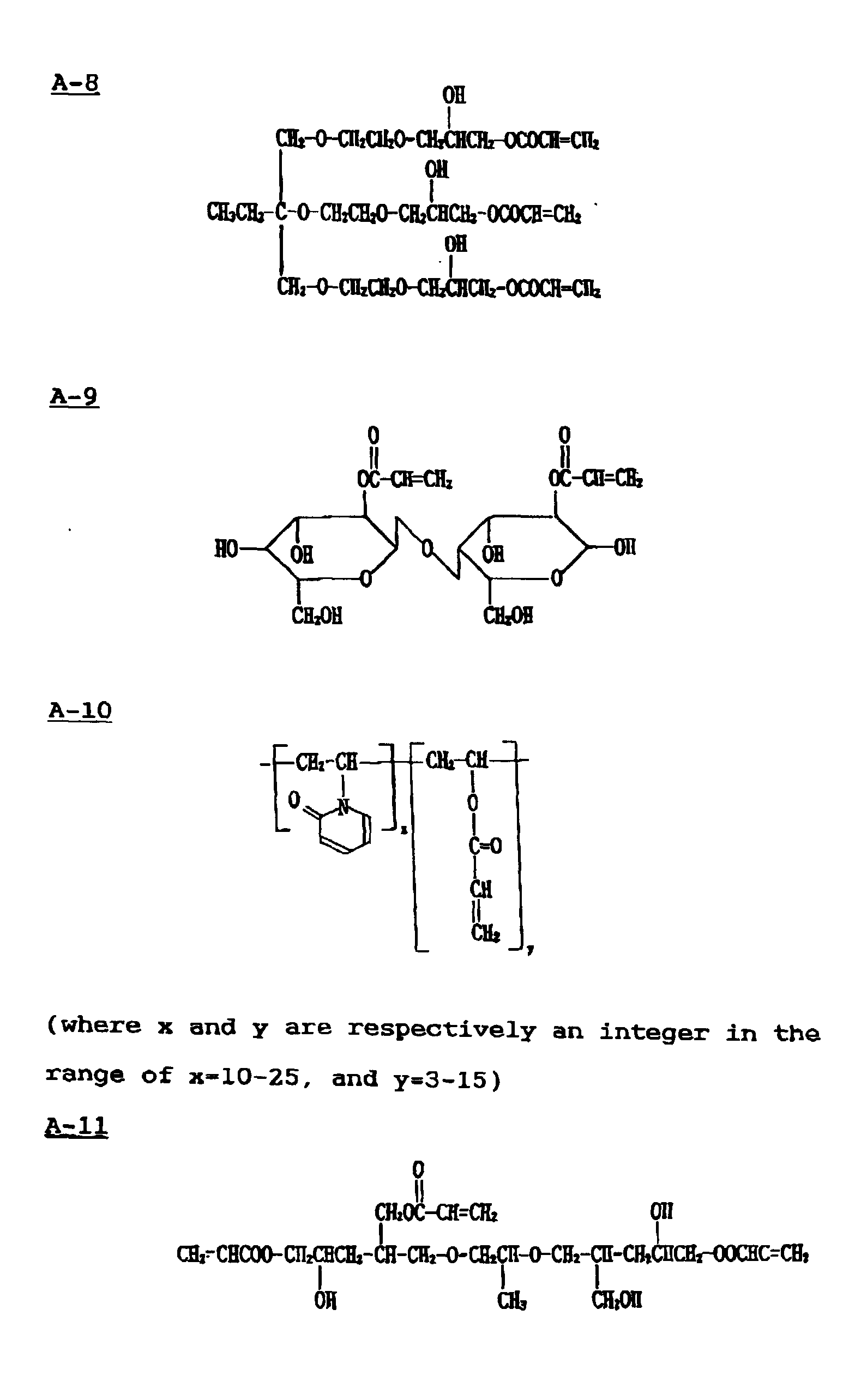


- An ink, containing, in an aqueous medium, at least one compound selected from the group consisting of the compounds represented by Chemical Formulas A-1 to A-12 below.
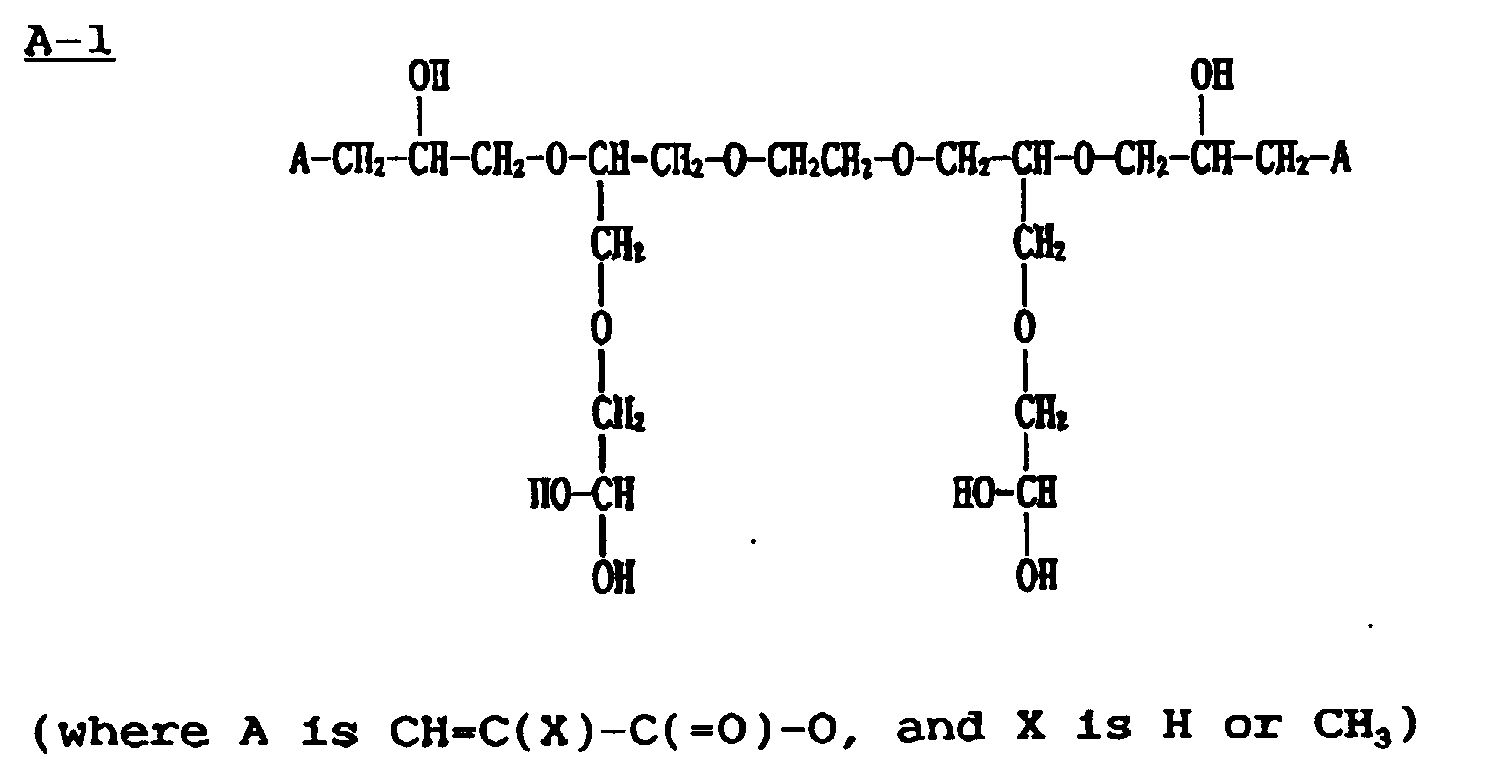
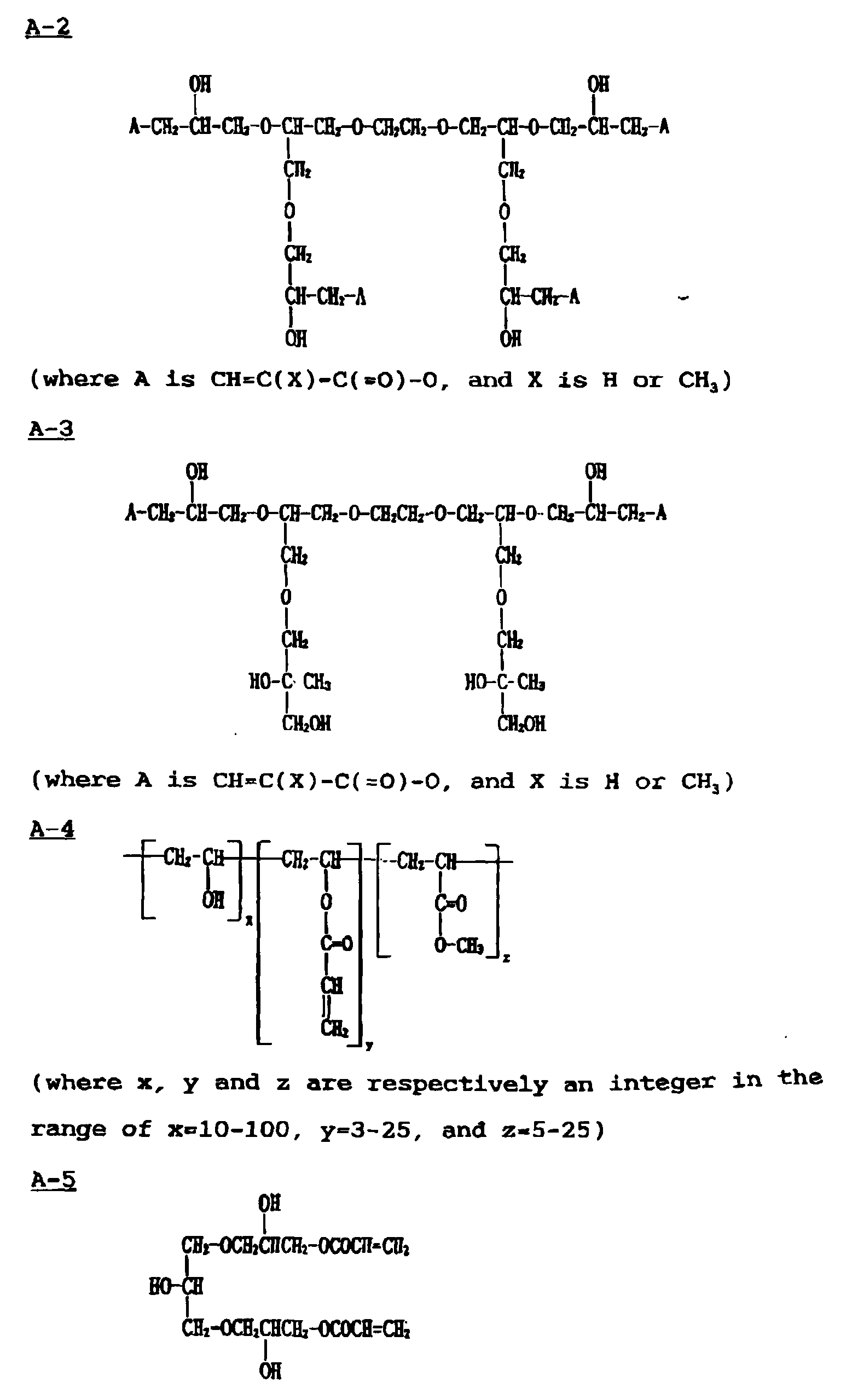
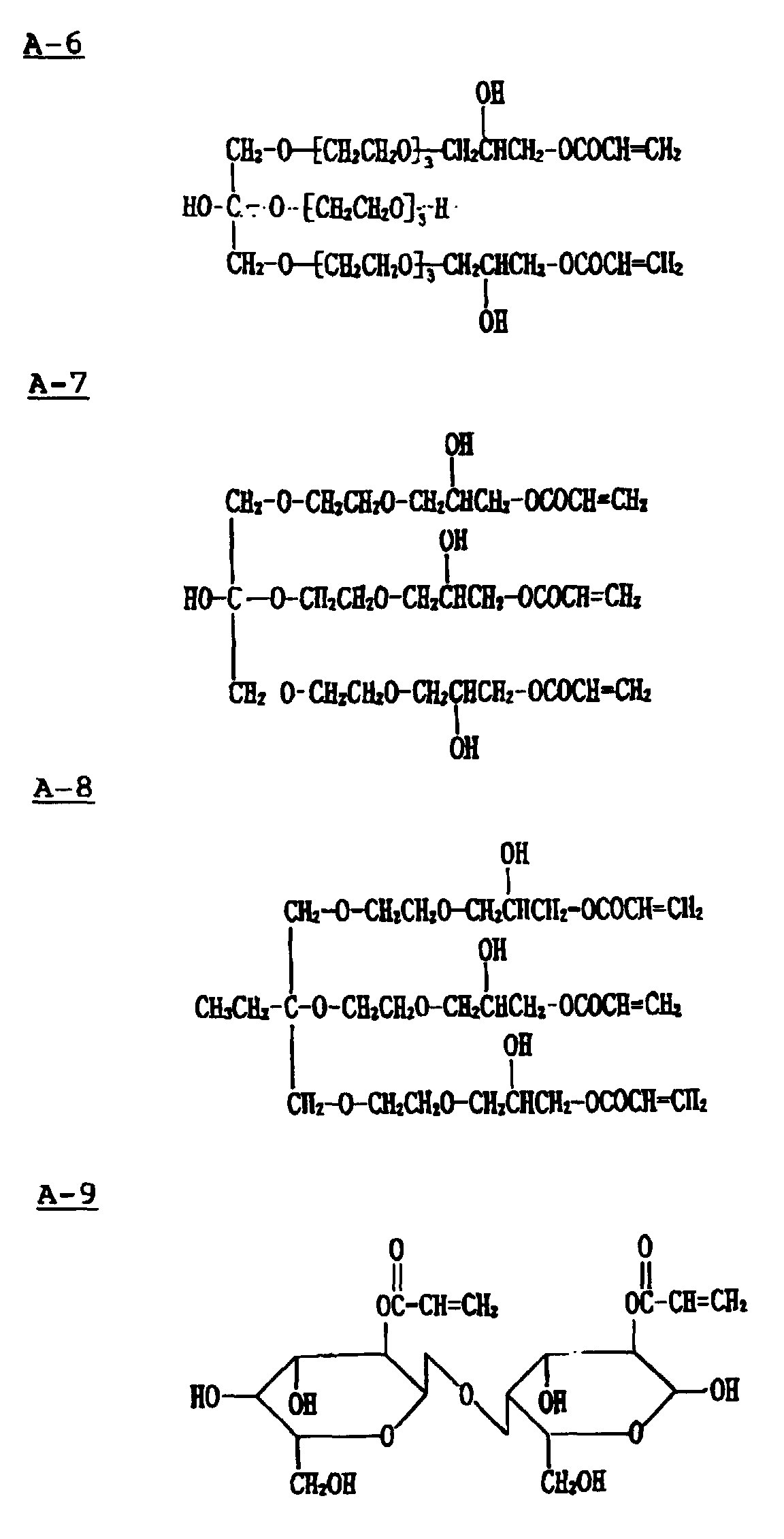

- An ink, containing, in an aqueous medium, at least one compound selected from the group consisting of the compounds represented by Chemical Formulas B-1 to B-17 below:


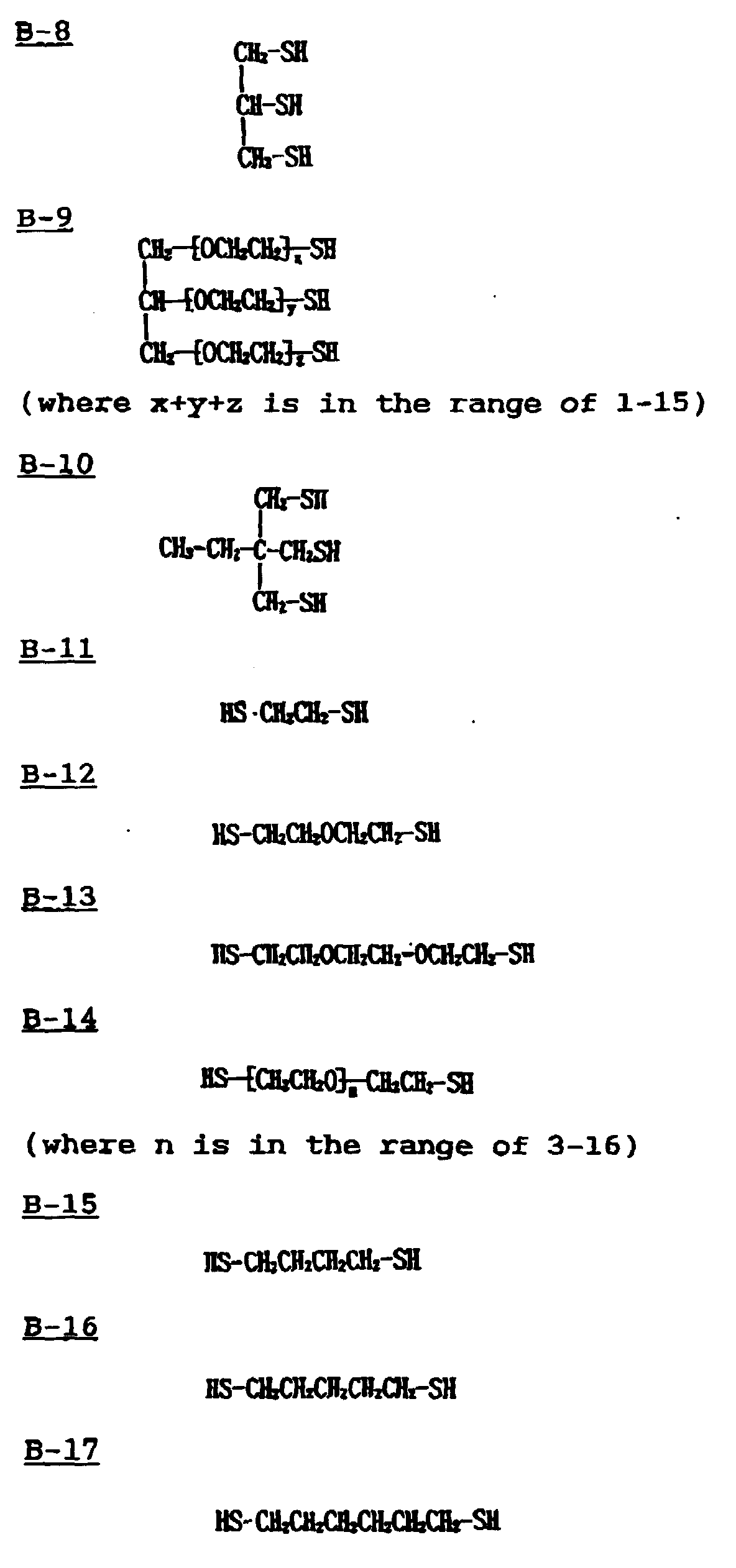
- An ink, containing, in an aqueous medium, at least one compound selected from the group consisting of the compounds represented by Chemical Formulas B-1 to B-3 below:

Applications Claiming Priority (4)
| Application Number | Priority Date | Filing Date | Title |
|---|---|---|---|
| JP11962399 | 1999-04-27 | ||
| JP11962399 | 1999-04-27 | ||
| JP29248099 | 1999-10-14 | ||
| JP29248099 | 1999-10-14 |
Publications (3)
| Publication Number | Publication Date |
|---|---|
| EP1048699A2 true EP1048699A2 (en) | 2000-11-02 |
| EP1048699A3 EP1048699A3 (en) | 2003-06-04 |
| EP1048699B1 EP1048699B1 (en) | 2011-07-20 |
Family
ID=26457314
Family Applications (1)
| Application Number | Title | Priority Date | Filing Date |
|---|---|---|---|
| EP00108846A Expired - Lifetime EP1048699B1 (en) | 1999-04-27 | 2000-04-26 | Ink set, printing method, ink, printed article, printing apparatus, ink cartridge, recording unit, and process of forming polymeric compound films |
Country Status (2)
| Country | Link |
|---|---|
| US (1) | US6503307B1 (en) |
| EP (1) | EP1048699B1 (en) |
Families Citing this family (21)
| Publication number | Priority date | Publication date | Assignee | Title |
|---|---|---|---|---|
| US6585815B2 (en) * | 2000-06-21 | 2003-07-01 | Canon Kabushiki Kaisha | Ink set, ink-jet printing method using such ink set, recording unit, ink cartridge and ink-jet printing apparatus |
| CA2356809C (en) * | 2000-09-04 | 2005-11-22 | Canon Kabushiki Kaisha | Ink set for ink jet recording |
| US7273276B2 (en) * | 2001-08-08 | 2007-09-25 | Konica Minolta Holdings, Inc. | Method for forming image |
| US6863392B2 (en) * | 2001-10-15 | 2005-03-08 | Canon Kabushiki Kaisha | Ink-jet recording process, ink-jet recorded image and method of alleviating difference in gloss in the ink-jet recorded image |
| JP2003277651A (en) * | 2002-03-20 | 2003-10-02 | Brother Ind Ltd | Aqueous ink for inkjet recording and inkjet recording method |
| JP2004010632A (en) * | 2002-06-03 | 2004-01-15 | Fuji Xerox Co Ltd | Black ink for inkjet recording, ink set, and inkjet recording method using this |
| DE602004009958T2 (en) * | 2003-09-08 | 2008-08-28 | E.I. Dupont De Nemours And Co., Wilmington | INK JET PRINT INK, INK COMBINATION AND PRINTING METHOD |
| US7192476B2 (en) * | 2003-10-22 | 2007-03-20 | Brother Kogyo Kabushiki Kaisha | Fluorescent water base ink for ink-jet recording |
| CN100564461C (en) * | 2004-03-26 | 2009-12-02 | 佳能株式会社 | Active energy ray-curable aqueous ink composition, inkjet recording method using same, ink cartridge, recording unit, and inkjet recording apparatus |
| WO2005092993A1 (en) * | 2004-03-26 | 2005-10-06 | Canon Kabushiki Kaisha | Active energy radiation hardenable water base ink and utilizing the same, method of inkjet recording, ink cartridge, recording unit and inkjet recording apparatus |
| US7622513B2 (en) * | 2004-12-01 | 2009-11-24 | Hewlett-Packard Development Company, L.P. | Inkjet printing system that provides improved mottle |
| JP2009529443A (en) * | 2006-03-09 | 2009-08-20 | イー・アイ・デュポン・ドウ・ヌムール・アンド・カンパニー | Inkjet ink set |
| BRPI0711727B1 (en) * | 2006-05-31 | 2018-01-30 | The Sherwin-Williams Company | DISPERSING POLYMER, DISPERSION, SURFACE COATING COMPOSITION AND METHOD FOR DISPERSING PIGMENTAL PARTICLES IN LIQUID- VEHICLE |
| US20080057231A1 (en) * | 2006-06-27 | 2008-03-06 | Jun Li | Ink Jet Recording Sheet for Pigmented Ink |
| US20080039549A1 (en) * | 2006-06-30 | 2008-02-14 | Jun Li | Two-Part Printing System with Acrylic-Based Polymers |
| WO2008055244A2 (en) | 2006-10-31 | 2008-05-08 | Sensient Colors Inc. | Modified pigments and methods for making and using the same |
| EP3483222A3 (en) | 2007-08-23 | 2019-08-07 | Sensient Colors LLC | Self-dispersed pigments and methods for making and using the same |
| EP2417202A2 (en) * | 2009-04-07 | 2012-02-15 | Sensient Colors LLC | Self-dispersing particles and methods for making and using the same |
| US9714456B2 (en) | 2013-01-18 | 2017-07-25 | Allena Pharmaceuticals, Inc. | Crystallized oxalate decarboxylase and methods of use |
| EP4592368A3 (en) | 2019-06-07 | 2025-11-05 | Swimc Llc | Polymer composition for thin coatings |
| DE102019116103B4 (en) | 2019-06-13 | 2021-04-22 | Notion Systems GmbH | Method for labeling a printed circuit board by creating shading in a functional lacquer layer |
Family Cites Families (15)
| Publication number | Priority date | Publication date | Assignee | Title |
|---|---|---|---|---|
| JPS6123615A (en) * | 1984-06-18 | 1986-02-01 | Takeda Chem Ind Ltd | Curable resin composition |
| US4694302A (en) | 1986-06-06 | 1987-09-15 | Hewlett-Packard Company | Reactive ink-jet printing |
| US5129948A (en) * | 1991-05-16 | 1992-07-14 | Xerox Corporation | Ink for ink jet printing |
| US5696182A (en) | 1993-03-15 | 1997-12-09 | Canon Kabushiki Kaisha | Ink, ink-jet recording process making use of the ink, and apparatus using the ink |
| DE69413363T2 (en) | 1993-12-14 | 1999-04-29 | Canon K.K., Tokio/Tokyo | Ink, ink jet recording method and ink jet printing apparatus using the same |
| JP3683946B2 (en) | 1994-07-13 | 2005-08-17 | キヤノン株式会社 | Aqueous pigment ink set for ink jet, recording unit, ink cartridge, and ink jet recording apparatus |
| US5746818A (en) * | 1995-08-31 | 1998-05-05 | Seiko Epson Corporation | Pigment ink composition capable of forming image having no significant bleeding or feathering |
| JPH09111165A (en) | 1995-10-20 | 1997-04-28 | Canon Inc | Ink and color ink jet recording method using the same |
| JP3984663B2 (en) | 1995-12-01 | 2007-10-03 | キヤノン株式会社 | Two-component recording ink, ink set using the ink, recording method using the ink set, and apparatus used for the recording method |
| JP3550637B2 (en) * | 1996-09-27 | 2004-08-04 | セイコーエプソン株式会社 | Inkjet recording method |
| US6238045B1 (en) * | 1997-02-18 | 2001-05-29 | Canon Kabushiki Kaisha | Image forming method, ink-jet recording method and instruments used in such methods |
| JP3642152B2 (en) * | 1997-04-16 | 2005-04-27 | セイコーエプソン株式会社 | Inkjet recording method, recorded matter, and inkjet recording apparatus |
| US6056811A (en) | 1997-08-25 | 2000-05-02 | Canon Kabushiki Kaisha | Water-based ink for ink-jet recording, ink-jet recording process, recording unit, ink cartridge and ink-jet recording apparatus |
| US6299675B1 (en) * | 1998-05-28 | 2001-10-09 | Canon Kabushiki Kaisha | Printing method, image forming process, ink, ink set, recording unit, image forming apparatus and print |
| US6261350B1 (en) * | 1999-08-17 | 2001-07-17 | Hewlett-Packard Company | Increasing chroma and edge acuity of dye-based inks by underprinting using vesicle technique |
-
2000
- 2000-04-26 EP EP00108846A patent/EP1048699B1/en not_active Expired - Lifetime
- 2000-04-26 US US09/558,513 patent/US6503307B1/en not_active Expired - Fee Related
Also Published As
| Publication number | Publication date |
|---|---|
| US6503307B1 (en) | 2003-01-07 |
| EP1048699A3 (en) | 2003-06-04 |
| EP1048699B1 (en) | 2011-07-20 |
Similar Documents
| Publication | Publication Date | Title |
|---|---|---|
| US6503307B1 (en) | Ink set, printing method, ink, printed article, printing apparatus, ink cartridge, recording unit, and process of forming polymeric compound films | |
| JP3576862B2 (en) | Ink, image forming method and photopolymerization initiator | |
| JP3874336B2 (en) | Recording liquid, ink jet recording method using the same, and recording apparatus | |
| EP1577353B1 (en) | Method of ink jet recording | |
| US6695443B2 (en) | Ink for ink jet recording, ink set for ink jet recording, method for ink jet recording, ink cartridge for ink jet recording, ink jet recording apparatus and recorded article | |
| AU752078B2 (en) | Ink, ink set, ink cartridge, recording unit, image recording process and image recording apparatus | |
| EP1764397B1 (en) | Cyan ink and ink set | |
| US6054505A (en) | Ink compositions with improved shelf stability | |
| EP1685200B1 (en) | Inkjet ink, ink set and method of printing | |
| EP0761782B1 (en) | Water-based ink for ink-jet, ink-jet recording method and use of the ink | |
| JPH08143804A (en) | Aqueous dispersion ink for bubble jet, inkjet recording method and recording apparatus using the same | |
| US7449056B2 (en) | Ink-jet recording ink, recording method and recording apparatus | |
| JP2007505189A (en) | Ink jet ink, ink set and printing method | |
| JP4302940B2 (en) | Ink set for inkjet recording | |
| JP3880079B2 (en) | Aqueous dispersion ink, ink jet recording method, recording unit, ink cartridge and ink jet recording apparatus using the same | |
| JP3673582B2 (en) | Black pigment ink, ink set, ink jet recording method, recording unit, ink cartridge, ink jet recording apparatus, and bleed suppression method | |
| JPH08143802A (en) | Aqueous dispersion ink for bubble jet, inkjet recording method and recording apparatus using the same | |
| JP4978978B2 (en) | Recording liquid, recording method, recording liquid cartridge, and recording apparatus | |
| JP2012016954A (en) | Inkjet ink printing method | |
| JP2004204240A (en) | Ink, inkjet recording method using the same, and photopolymerization initiator | |
| JPH09124984A (en) | Aqueous ink for inkjet and inkjet recording method and equipment using the same | |
| JP4458314B2 (en) | Ink set, printing method, ink, printed matter, printing apparatus, ink cartridge, recording unit, and polymer compound film forming method | |
| JP4934977B2 (en) | Ink set, recording method using the same, and recorded matter | |
| US20030119939A1 (en) | Ink compositions containing quaternary-substituted lightfastness agents | |
| JPH08333537A (en) | Aqueous ink for ink jet, ink jet recording method using the same, and device using the ink |
Legal Events
| Date | Code | Title | Description |
|---|---|---|---|
| PUAI | Public reference made under article 153(3) epc to a published international application that has entered the european phase |
Free format text: ORIGINAL CODE: 0009012 |
|
| AK | Designated contracting states |
Kind code of ref document: A2 Designated state(s): AT BE CH CY DE DK ES FI FR GB GR IE IT LI LU MC NL PT SE |
|
| AX | Request for extension of the european patent |
Free format text: AL;LT;LV;MK;RO;SI |
|
| PUAL | Search report despatched |
Free format text: ORIGINAL CODE: 0009013 |
|
| AK | Designated contracting states |
Designated state(s): AT BE CH CY DE DK ES FI FR GB GR IE IT LI LU MC NL PT SE |
|
| AX | Request for extension of the european patent |
Extension state: AL LT LV MK RO SI |
|
| 17P | Request for examination filed |
Effective date: 20031016 |
|
| AKX | Designation fees paid |
Designated state(s): DE ES FR GB IT NL |
|
| GRAP | Despatch of communication of intention to grant a patent |
Free format text: ORIGINAL CODE: EPIDOSNIGR1 |
|
| GRAS | Grant fee paid |
Free format text: ORIGINAL CODE: EPIDOSNIGR3 |
|
| GRAA | (expected) grant |
Free format text: ORIGINAL CODE: 0009210 |
|
| AK | Designated contracting states |
Kind code of ref document: B1 Designated state(s): DE ES FR GB IT NL |
|
| REG | Reference to a national code |
Ref country code: GB Ref legal event code: FG4D |
|
| REG | Reference to a national code |
Ref country code: DE Ref legal event code: R096 Ref document number: 60046223 Country of ref document: DE Effective date: 20110908 |
|
| REG | Reference to a national code |
Ref country code: NL Ref legal event code: VDEP Effective date: 20110720 |
|
| PG25 | Lapsed in a contracting state [announced via postgrant information from national office to epo] |
Ref country code: NL Free format text: LAPSE BECAUSE OF FAILURE TO SUBMIT A TRANSLATION OF THE DESCRIPTION OR TO PAY THE FEE WITHIN THE PRESCRIBED TIME-LIMIT Effective date: 20110720 |
|
| PLBE | No opposition filed within time limit |
Free format text: ORIGINAL CODE: 0009261 |
|
| STAA | Information on the status of an ep patent application or granted ep patent |
Free format text: STATUS: NO OPPOSITION FILED WITHIN TIME LIMIT |
|
| PG25 | Lapsed in a contracting state [announced via postgrant information from national office to epo] |
Ref country code: IT Free format text: LAPSE BECAUSE OF FAILURE TO SUBMIT A TRANSLATION OF THE DESCRIPTION OR TO PAY THE FEE WITHIN THE PRESCRIBED TIME-LIMIT Effective date: 20110720 |
|
| 26N | No opposition filed |
Effective date: 20120423 |
|
| REG | Reference to a national code |
Ref country code: DE Ref legal event code: R097 Ref document number: 60046223 Country of ref document: DE Effective date: 20120423 |
|
| GBPC | Gb: european patent ceased through non-payment of renewal fee |
Effective date: 20120426 |
|
| REG | Reference to a national code |
Ref country code: FR Ref legal event code: ST Effective date: 20121228 |
|
| PG25 | Lapsed in a contracting state [announced via postgrant information from national office to epo] |
Ref country code: GB Free format text: LAPSE BECAUSE OF NON-PAYMENT OF DUE FEES Effective date: 20120426 |
|
| PG25 | Lapsed in a contracting state [announced via postgrant information from national office to epo] |
Ref country code: FR Free format text: LAPSE BECAUSE OF NON-PAYMENT OF DUE FEES Effective date: 20120430 |
|
| PG25 | Lapsed in a contracting state [announced via postgrant information from national office to epo] |
Ref country code: ES Free format text: LAPSE BECAUSE OF FAILURE TO SUBMIT A TRANSLATION OF THE DESCRIPTION OR TO PAY THE FEE WITHIN THE PRESCRIBED TIME-LIMIT Effective date: 20111031 |
|
| PGFP | Annual fee paid to national office [announced via postgrant information from national office to epo] |
Ref country code: DE Payment date: 20140430 Year of fee payment: 15 |
|
| REG | Reference to a national code |
Ref country code: DE Ref legal event code: R119 Ref document number: 60046223 Country of ref document: DE |
|
| PG25 | Lapsed in a contracting state [announced via postgrant information from national office to epo] |
Ref country code: DE Free format text: LAPSE BECAUSE OF NON-PAYMENT OF DUE FEES Effective date: 20151103 |