EP1048645A2 - Process for making secondary amphoacetates and diacetates - Google Patents
Process for making secondary amphoacetates and diacetates Download PDFInfo
- Publication number
- EP1048645A2 EP1048645A2 EP00108527A EP00108527A EP1048645A2 EP 1048645 A2 EP1048645 A2 EP 1048645A2 EP 00108527 A EP00108527 A EP 00108527A EP 00108527 A EP00108527 A EP 00108527A EP 1048645 A2 EP1048645 A2 EP 1048645A2
- Authority
- EP
- European Patent Office
- Prior art keywords
- formula
- temperature
- amphoacetates
- hours
- aqueous solution
- Prior art date
- Legal status (The legal status is an assumption and is not a legal conclusion. Google has not performed a legal analysis and makes no representation as to the accuracy of the status listed.)
- Withdrawn
Links
Classifications
-
- C—CHEMISTRY; METALLURGY
- C07—ORGANIC CHEMISTRY
- C07C—ACYCLIC OR CARBOCYCLIC COMPOUNDS
- C07C231/00—Preparation of carboxylic acid amides
- C07C231/10—Preparation of carboxylic acid amides from compounds not provided for in groups C07C231/02 - C07C231/08
Definitions
- Amphoacetates are a well known group of surfactants (see US 5 744 063, DE 36 39 752, DE 196 36 205, DE 43 07 709 and DE 42 40 154). These amphoacetates are made by reacting 1-hydroxyethyl-2-alkyl-2-imidazoline with chloroacetic acid or the alkali salt thereof. This reaction, however, does not yield a single product but a ring-opening of the imidazoline yields a mixture of the secondary monoamide and the tertiary monoamide of the formulae
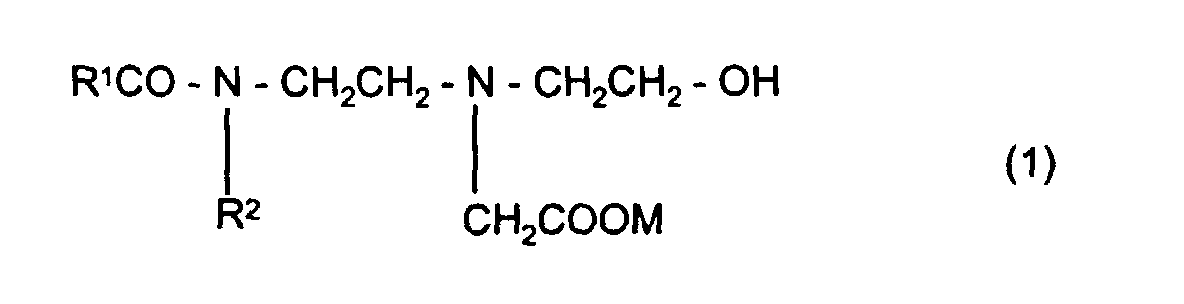
- Subject matter of this invention is a process for making secondary amphoacetate and amphodiacetate of the formula 1 wherein R 1 is C 8 -C 18 -alkyl or C 8 C 18 -alkenyl, R 2 is hydrogen or a group of the formula -CH 2 COOM and M is alkaline or alkaline earth metal.
- the process comprises the controlled alkaline hydrolysis of a compound of the formula 2.
- the hydrolysis occurs at a pH between 7 - 14, at a temperature of 80 to 90 deg C and a reaction time of at least 24 hours.
- the resultant secondary amide of formula 3 R 1 - CONH - CH 2 CH 2 - NH - CH 2 CH 2 - OH (3) can be cleanly converted "in situ" to the corresponding secondary amphoacetate or diacetate by reaction with an aqueous solution of chloroacetic acid or is alkali salt at a pH from 7 fo 14 and a temperature of 80 to 90°C.
- the imidazoline compounds of formula 2 are made by reacting aminoethylethanolamine with a fatty acid or mixtures thereof having the carbon atom range indicated above.
- Examples of single fatty acids and fatty acid mixtures that can be used to prepare the imidazolines can include coconut oil fatty acid, palm kernel oil fatty acid, capric caproic, caprylic, hexadecadienoic, lauric, linoleic, linolenic, margaric, myristic, myristoleic, oleic, palmitic, palmitoleic, stearic and the like.
- the formation of the imidazoline compound of formula 2 is made by heating the fatty acid(s) with the aminoethylethanolamine according to processes known per se, for example by heating a mixture of one mole fatty acid(s) with 1 to 2.5 mole of aminoethyl ethanolamine first at a temperature of 150 to 180°C, and subsequently to 180 to 230°C under reduced pressure to remove the water formed in the reaction (DE 43 07 709).
- This imidazoline compound is ring opened under controlled conditions to yield predominantly (> 95 %) the secondary amide ( pH 7 to 14, preferably pH 8 to 9, and at 80 to 90 deg C for at least 24 hours ).
- the addition of the monochloroacetate takes place. This is conducted at pH 8 - 12 and at 85 deg C. Processing for this stage will take up to 24 hours, but more typically 8 - 12 hours.
- Stage 1 allows control of the product to only one pure (> 95 %) species (secondary amide amine, formula 3 ) thus enabling step 2 of the process to be conducted with a smaller optimum excess of monochloroacetate yielding high (80 - 90 %, typically 85 %) levels of mono acetate product in the final product. This is confirmed by quantitative high resolution NMR experiments.
- the ratio of monochloroacetate to compound of formula (1) is 1.15 to1.0 for the mono-acetate and 2.1 to 2.0 for the di-acetate.
- the resulting aqueous solution of the secondary amphoacetate or di-acetate can be used as such or they can be further diluted with water or suitable organic solvents such as glycerol, ethylene glycol, propyleneglycol, diethyleneglycol or their mono- or diether derivatives. Due to the fact that these solutions essentially contain only the secondary amphoacetates the viscosity of these solutions does not rise upon storage.
- the pure amphoacetate surfactants of the present invention are extremely mild and non-irritating to both eyes and skin. They also exhibit enhanced wetting speed, greater surface tension reduction, high foaming and foam stabilization properties, low toxicity, and excellent compatibility with other anionic, ionic and nonionic surfactants. These products are stable over a wide pH range and are biodegradable. These properties make these surfactants adaptable for use in products ranging from cosmetics to industrial applications and are usable wherever amphoacetate surfactants of this type have found use.
- non-irritating shampoos including baby shampoos, body shampoos including bubble baths, bar soaps, bath gels, hair conditioning gels, lotions, skincreams and lotions, make up removal creams and lotions, liquid detergents, dish detergents and other washing and cosmetic products that contact the skin.
- the pH was controlled manually during charging of SMCA every 15 minutes with addition of 32 % caustic soda to maintain the pH within the range 8.5 - 9.0.
- the temperature required control during SMCA addition with cooling to maintain the temperature within the range 50 - 60 deg C.
- the flask was gently heated to raise the temperature to 80 - 85 deg C.
- the control of pH was maintained at 8.5 - 9.0 throughout this stage of the process.
- the measurement of residual SMCA indicated a level of approximately 1000 ppm.
- the pH at this stage was raised to a level of 11.5 - 12.0.
- the process was maintained at this level for a further 3 hours until the SMCA level was measured at ⁇ 20 ppm.
- the total 32 % caustic soda usage during the pH control was 103 g (0.824 mols).
- the product was cooled and the pH trimmed with citric acid (approximately 2 g ) to the range 9.5 - 10.5.
Landscapes
- Chemical & Material Sciences (AREA)
- Organic Chemistry (AREA)
- Organic Low-Molecular-Weight Compounds And Preparation Thereof (AREA)
- Detergent Compositions (AREA)
- Emulsifying, Dispersing, Foam-Producing Or Wetting Agents (AREA)
Abstract


Description


| 60 °C/pH 7-8 | 85 °C/pH 7-8 | |||
| Reaction Time | Mol-% sec. Monoamid | Mol-% tert. Monoamid | Mol-% sec. Monoamid | Mol-% tert. Monoamid |
| 3 h | 69 | 31 | 74 | 26 |
| 7 h | 71 | 29 | 86 | 14 |
| 24 h | 81 | 19 | 97 | 3 |
- appearance
- clear pale yellow liquid
- colour
- approximately Iodine 4
- Viscosity
- 1220 cps at 20 deg C
- SMCA
- < 20 ppm
- Sodium Chloride
- 5.58 %
- pH (5%)
- 10.23
- Specific gravity 20 C
- 1.1139 g/cc
- NMR 400 MHz
- 85 % Mono acetate, < = 5 % non-alkylated,
10 % diacetate
Claims (1)
- Process for making secondary amphoacetate and amphodiacetate of the formulawherein R1 is C8-C18-alkyl or C8-C18-alkenyl, R2 is hydrogen or a group of the formula -CH2COOM and M is alkaline or alkaline earth metal, which comprises heating a compound of the formula 2
 at pH between 7 - 14, at a temperature of 80 to 90 deg C and for at least 24 hours and subsequent reaction with an aqueous solution of chloroacetic acid or is alkali salt at a pH from 7 fo 14 and a temperature of 80 to 90°C.
Applications Claiming Priority (2)
| Application Number | Priority Date | Filing Date | Title |
|---|---|---|---|
| US09/302,606 US6025522A (en) | 1999-04-30 | 1999-04-30 | Process for making secondary amphoacetates and diacetates |
| US302606 | 1999-04-30 |
Publications (2)
| Publication Number | Publication Date |
|---|---|
| EP1048645A2 true EP1048645A2 (en) | 2000-11-02 |
| EP1048645A3 EP1048645A3 (en) | 2000-11-08 |
Family
ID=23168482
Family Applications (1)
| Application Number | Title | Priority Date | Filing Date |
|---|---|---|---|
| EP00108527A Withdrawn EP1048645A3 (en) | 1999-04-30 | 2000-04-19 | Process for making secondary amphoacetates and diacetates |
Country Status (3)
| Country | Link |
|---|---|
| US (1) | US6025522A (en) |
| EP (1) | EP1048645A3 (en) |
| JP (1) | JP2000344721A (en) |
Families Citing this family (2)
| Publication number | Priority date | Publication date | Assignee | Title |
|---|---|---|---|---|
| US20030228244A1 (en) * | 2002-06-05 | 2003-12-11 | Perez Libardo A. | Inhibition of the depletion of metal values from pregnant lixiviant solutions |
| US10583073B2 (en) | 2016-06-20 | 2020-03-10 | Rita Corporation | Surfactant composition |
Family Cites Families (3)
| Publication number | Priority date | Publication date | Assignee | Title |
|---|---|---|---|---|
| DE4240154A1 (en) * | 1992-11-30 | 1994-06-01 | Henkel Kgaa | Process for the production of low viscosity, storage stable amphoteric surfactants |
| CA2132289A1 (en) * | 1993-10-12 | 1995-04-13 | Bharat Desai | Higher purity imidazoline based amphoacetate surfactants and processes for the preparation thereof |
| DE19636205C2 (en) * | 1996-09-06 | 1998-07-09 | Henkel Kgaa | Process for the production of low viscosity, storage stable amphoteric surfactants |
-
1999
- 1999-04-30 US US09/302,606 patent/US6025522A/en not_active Expired - Fee Related
-
2000
- 2000-04-19 EP EP00108527A patent/EP1048645A3/en not_active Withdrawn
- 2000-04-28 JP JP2000130717A patent/JP2000344721A/en not_active Withdrawn
Also Published As
| Publication number | Publication date |
|---|---|
| JP2000344721A (en) | 2000-12-12 |
| EP1048645A3 (en) | 2000-11-08 |
| US6025522A (en) | 2000-02-15 |
Similar Documents
| Publication | Publication Date | Title |
|---|---|---|
| US6232496B1 (en) | Process for the preparation of amphoacetate surfactants | |
| US5744063A (en) | Higher purity imidazoline based amphoacetate surfactants and processes for the preparation thereof | |
| JPH07504703A (en) | Fluid composition containing polyhydroxy fatty acid amide | |
| CN101466819B (en) | Process for the formulation and production of acyl alkylisethionate ester compositions | |
| JP3608844B2 (en) | High viscosity liquid detergent composition | |
| EP0001006B1 (en) | Carboalkylated derivatives of acylated ethylene diamines, process for their preparation and surface-active compositions | |
| US5739365A (en) | Method for preparing ammonium hydroxyalkyl sulfonates and ammonium alkanoyl alkyl sulfonates produced therefrom | |
| JPH08503707A (en) | Synthesis of sulfated polyhydroxy fatty acid amide surfactant | |
| US5681972A (en) | Process for preparing highly concentrated, free-flowing aqueous solutions of betaines | |
| US6025522A (en) | Process for making secondary amphoacetates and diacetates | |
| US5464565A (en) | Process for the preparation of highly concentrated free-flowing aqueous solutions of betaines | |
| US3941817A (en) | Tertiary amide amphoteric surface active agents and process for their manufacture | |
| US4790956A (en) | Acyloxyalkanesulfonate paste composition and method for preparing same | |
| US6335370B1 (en) | Fluid concentrated hydroalcoholic compositions of copra or oil palm alkyl-amidopropylbetains | |
| JPH09505616A (en) | Low-viscosity hydrous concentrate of betaine surfactant | |
| US6335375B1 (en) | Concentrated fluid aqueous-alcoholic compositions of hydrogenated coconut or palm kernel oil alkylamidopropylbetaines | |
| JPH0912521A (en) | Process for producing light-colored amide amino acid or betaine | |
| WO1981000106A1 (en) | Amine oxide foam stabilizers for alkyl benzene sulfonate foaming agents | |
| JP3347393B2 (en) | Process for producing N, N-dialkylglucamine compounds and derivatives thereof | |
| JPS5951532B2 (en) | Novel amine amide compound, method for producing the same, and surfactant containing the amine amide compound | |
| JP3505312B2 (en) | Method for producing light-colored amide group-containing surfactant | |
| JP3926428B2 (en) | Amine oxide production method | |
| US5342961A (en) | Process for the production of low-viscosity imidazolinium surfactants by quaternization of 1-hydroxyethyl-2-alkyl imidazolines | |
| JP2003160470A (en) | Liquid personal cleansing composition | |
| JP2698601B2 (en) | Method for producing amphoteric surfactant composition |
Legal Events
| Date | Code | Title | Description |
|---|---|---|---|
| PUAI | Public reference made under article 153(3) epc to a published international application that has entered the european phase |
Free format text: ORIGINAL CODE: 0009012 |
|
| PUAL | Search report despatched |
Free format text: ORIGINAL CODE: 0009013 |
|
| AK | Designated contracting states |
Kind code of ref document: A2 Designated state(s): AT BE CH CY DE DK ES FI FR GB GR IE IT LI LU MC NL PT SE |
|
| AX | Request for extension of the european patent |
Free format text: AL;LT;LV;MK;RO;SI |
|
| AK | Designated contracting states |
Kind code of ref document: A3 Designated state(s): AT BE CH CY DE DK ES FI FR GB GR IE IT LI LU MC NL PT SE |
|
| AX | Request for extension of the european patent |
Free format text: AL;LT;LV;MK;RO;SI |
|
| 17P | Request for examination filed |
Effective date: 20010508 |
|
| AKX | Designation fees paid |
Free format text: AT BE CH CY DE DK ES FI FR GB GR IE IT LI LU MC NL PT SE |
|
| 17Q | First examination report despatched |
Effective date: 20011010 |
|
| STAA | Information on the status of an ep patent application or granted ep patent |
Free format text: STATUS: THE APPLICATION HAS BEEN WITHDRAWN |
|
| 18W | Application withdrawn |
Withdrawal date: 20011215 |