Hot melt adhesives are used commercially for a wide variety of applications. The major
advantage of hot melt adhesive systems is the lack of a carrier fluid which eliminates the need
for drying the adhesive film once it is applied to the substrate. This elimination of the drying step
overcomes hazards associated with solvent usage and also allows for faster production line
speeds and lower transportation costs.
For various applications, such paper bonding applications including tissue/towel
lamination, roll wrap, bag ending, and moisture activated front seals for envelopes, it is also
desired that some hot melt adhesives be water-dispersible.
We have now found that the use of high hydroxyl compounds, which function as
tackifiers in hot melt adhesive formulations, at high levels, >10%, provide hot melts with
improved water sensitivity compared to hot melts formulated with conventional tackifiers. These
compounds find particular use in hot melt adhesives based on sulfonated polyesters and graft
copolymers of vinyl monomers and polyalkylene oxide polymers.
Thus, in its broadest aspect, the present invention is directed to hot melt adhesive
compositions comprising a sulfonated polyester or a graft copolymer of at least one vinyl
monomer and at least one polyalkylene oxide polymer; and a high hydroxyl number compound.
It will be recognized that the general formulations described above can be adapted to
include a wide variety of hot melt adhesive compositions, the more precise formulations of which
will vary depending upon the specific end use, as known to those skilled in the particular art.
The present invention is directed to hot melt adhesive compositions, with improved
water sensitivity, comprising a sulfonated polyester or a graft copolymer of at least one vinyl
monomer and at least one polyalkylene oxide polymer; and a high hydroxyl number compound.
The high hydroxyl compound aids in the water dispersibility of the hot melt adhesive
formulation. Specifically, the compounds described here will provide the adhesives of the
present invention with improved water sensitivity, as compared to hot melt adhesives formulated
with conventional tackifiers (rosin and rosin derivatives, terpene phenolics, and α-methyl
styrene). Water sensitive adhesives may be used in remoistenable and repulpable applications,
or in wetness indicator adhesives.
The compounds of the present invention are solid high hydroxyl materials with a
hydroxyl number >100mg KOH/g. The compounds are amorphous, with a low melt viscosity and
a softening point above room temperature. Preferred compounds are styrene allyl alcohol
copolymers available from ARCO Chemical under the tradename SAA-100 with an hydroxyl
number of 210 mg KOH/g and orthophthalate neopentyl glycol polyester polyol available from
Stepan under the tradename Stepanol PN-110 with a hydroxyl number of 110 mg KOH/g.
These compounds form miscible blends with sulfonated polyester base polymers and
polyethylene glycol grafted polyvinyl acetate base polymers. The compounds are present in an
amount of 5 to 40%, preferably 10 to 35% by weight of the adhesive.
The polymeric component of the present adhesive formulation is any polymer suitable
for use in formulating hot melt adhesives. Preferred are the sulfonated polyesters, or a graft
copolymers of vinyl monomers and polyalkylene oxide polymers. The polymeric component is
present in the adhesive compositions in an amount greater than 40% by weight, preferably 60%
by weight.
The sulfonated polyester component of the present invention is a condensation polymer
comprising the reaction product of:
wherein all stated mole percentages are based on the total of all acid, hydroxyl and amino group
containing reactants being equal to 200 mole percent, and wherein the polymer contains
proportions of acid-group containing reactants (100 mole percent acid) to hydroxy- and amino-group
containing reactants (100 mole percent base) such that the value of (equivalents) EQ
(base) divided by (equivalents) EQ (acid) is between 0.5 and 2.
The difunctional acid or ester reactant of (a) of the composition of the present invention
is preferably substantially aliphatic in nature and may be an acid selected from the group
consisting of oxalic; malonic; dimethylmalonic; succinic; glutaric; adipic; trimethyladipic; pimelic;
pivalic; fumaric; maleic; dodecanoic; 2,2-dimethylglutaric; azelaic; sebacic; 1,3-cyclopentanedicarboxylic;
1,2-cyclohexanedicarboxylic; 1,3-cyclohexane dicarboxylic; 1,4-cyclohexanedicarboxylic;
phthalic; terephthalic; isophthalic; 2,5-norbornane-dicarboxylic; 1,3-naphthalic;
diphenic; 4,4'-oxydibenzoic; diglycolic; thiodipropionic; 4,4'-sulfonyldibenzoic; and
2,5-naphthalenedicarboxylic acids and esters thereof and mixtures thereof. The difunctional
dicarboxylic acid or ester reactant of (a) is preferably selected from the group of acids consisting
of isophthalic acid, terephthalic acid, phthalic anhydride (acid), adipic acid, pivalic acid,
dodecanedioic acid, sebacic acid, azelaic acid, 1,4-cyclohexanedicarboxylic acid, 1,3-cyclohexane-dicarboxylic
acid, maleic anhydride, fumaric acid, succinic anhydride (acid), 2,6-naphthalenedicarboxylic
acid, and glutaric acid and esters thereof and mixtures thereof. The
more preferred difunctional dicarboxylic acid reactants of (a) are selected from the group
consisting of isophthalic acid, adipic acid, 1,4-cyclohexanedicarboxylic acid, 1,3-cyclohexanedicarboxylic
acid and mixtures thereof with 1,4-cyclohexanedicarboxylic acid being
most preferred.
The sulphomonomer reactant of (b) is preferably selected from the group consisting of
difunctional monomers containing a -S03M group attached to a nucleus selected from the group
consisting of benzene, naphthalene, anthracene, diphenyl, oxydiphenyl, sulfonyldiphenyl, and
methylenediphenyl, wherein M is Na+, Li+, Mg++, Ca++, Fe++, and Fe+++. The more preferred
sulfomonomer reactant of (b) is selected from the group consisting of diols an diol adducts of
multifunctional reactant containing at least three hydroxyl groups and a monocarboxylic acid
sulfomonomer containing at least one metallic sulfonate group or nitrogen-containing non-metallic
sulfonate group attached to an aromatic or cyclo-aliphatic nucleus. Alternatively, a more
preferred group of sulfomonomers include 5-sodiosulfoisophthalic acid, dimethyl 5-sodiosulfoisophthalate,
5-lithiosulfoisphthalic acid, and bis(2-hydroxyethyl)-5-sodiosulfoisophthalate;
with the 5-sodiosulfoisophthalic acid or dimethyl 5-sodiosulfoisophthalate
being most preferred.
The difunctional reactant of (c) is preferably a diol selected from the group consisting of
ethylene glycol; propylene glycol, 1,3-propanediol, 2-methyl-1,3-propanediol, 2,4-dimethyl-2-ethyl-hexane-1,3-diol,
2,2-dimethyl-1,3-propanediol (neopentyl glycol), 2-ethyl-2-butyl-1,3-propanediol
(neopentyl glycol), 2-ethyl-2-butyl-1,3-propanediol, 2-ethyl-2-isobutyl-1,3-propanediol,
1,3-butanediol, 1,4-butanediol, 1,5-pentanediol, 1,6-hexanediol, 2,2,4-trimethyl-1,6-hexanediol,
thiodiethanol, 1,2-cyclohexanedimethanol, 1,3-cyclohexane-dimethanol, 1,4-cyclohexanedimethanol,
2,2,4,4-tetramethyl- 1,3-cyclobutanediol, p-xylylenediol, diethylene
glycol, triethylene glycol, tetraethylene glycol, pentaethylene glycol, hexaethylene glycol,
heptaethylene glycol, octaethylene glycol, nonaethylene glycol, decaethylene glycols, 2,2,4-trimethyl-1-1,3-pentanediol,
hydroxypivalyl hydroxypivalate, dipropylene glycol, 1,10-decanediol,
hydrogenated bisphenol A, and mixtures thereof. The difunctional reactant of (c) is more
preferably selected from the group consisting of diethylene glycol; neopentyl glycol,
cyclohexanedimethanol, 2-ethyl-2-butyl-1,3-propanediol, 2,2,4-trimethyl-1,3-pentanediol,
hydroxypivalyl hydroxypivalate, and 2-methyl-1,3-propanediol, with diethylene glycol, neopentyl
glycol, and cyclohexanedimethanol being most preferred.
Advantageous difunctional components which are aminoalcohols include aromatic,
aliphatic, heterocyclic and other types as in regard to component (d). Specific examples include
5-aminomethyl-cyclohexane-methanol; 5-amino-2-ethyl-pentanol-1, 2-(4-b-hydroxyethoxyphenyl)-1-aminoethane,
3-amino-2,2-dimethylpropanol, hydroxyethylamine, etc. Generally these
aminoalcohols contain from 2 to 20 carbon atoms, one -NRH group and one -C(R)2-OH group.
Advantageous difunctional monomer components which are aminocarboxylic acids
include aromatic aliphatic, heterocylic, and other types as in regard to component (d) and include
lactams. Specific examples include 6-aminocaproic acid, its lactam known as caprolactam,
omega-aminoundecanoic acid, 3-amino-2-dimethylpropionic acid, 4-(b-aminoethyl)-benzoic acid,
2-(b-aminopropoxy) benzoic acid, 4-aminomethlcyclohexanecarboxylic acid, 2-(b-aminopropoxy)
cyclohexanecarboxylic acid, etc. Generally these compounds contain from 2 to 20 carbon
atoms.
Advantageous examples of difunctional monomer component (d) which are diamines
include ethylene-diamine; hexamethylenediamine; 2,2,4-trimethylhexamethylenediamine; 4-oxaheptane-1,7-diamine;
4,7-dioxadecane-1,10-diamine; 1,4-cyclohexanebismethylamine; 1,3-cycloheptamethylene-diamine;
dodecamethylene-diamine, etc.
Reactant (e), when used, preferably contains 3 to 6 hydroxyl and/or carboxyl groups;
more preferred is trimethylolpropane (TMP), trimethylolethane (TME), glycerine, pentaerythritol,
arytritol, threitol, dipentaerythritol, sorbitol, trimellitic anhydride, pyromellitic dianhydride, or
dimethylolpropionic acid, with TMP being most preferred. It is preferred that reactant (e) be
present in a minor amount up to 40 mole percent, more preferred 0 to 20 mole percent.
The polyester composition used as a component of the hot melt adhesives of the
present invention preferably comprises 60 to 100 mole percent of (a), 4 to 20 mole percent of
(b), 80 to 100 mole percent of (c), 0 to 10 mole percent of (d), and 0 to 20 mole percent of (e).
In other more preferred embodiments of the invention the polyester comprises 60 to 100
mole percent of 1,4-cyclohexanedicarboxylic acid; 4 to 20 mole percent of 5-sodiosulfoisophthalic
acid or dimethyl 5-sodiosulfoisophthalate; and 80 to 100 mole percent of
diethylene glycol, neopentyl glycol or cyclohexanedimethanol.
The use of sulfonated polyester confers the additional advantage of providing a degree
of water sensitivity which is dependent on the ionic strength of the aqueous environment. Thus,
adhesives can be formulated which are sufficiently resistant to the ionic environments
encountered during use (such as the exposure to bodily fluids encountered in diapers and
feminine napkins) yet still disperse and/or debond in tap water, which is of lower ionic strength.
These adhesives are therefore particularly useful in constructing flushable disposable articles.
Hot melt adhesives based on sulfonated polyesters are described in U.S. Patent No.
5,750,605. The preparation of the polyesters used herein is generally described, for example, in
U.S. Patent Nos. 4,910,292, 4,973,656, and 4,990,593.
The preferred polycondensation reactant conditions for the preparation of the polyester
are at a temperature of 150 to 230°C in the presence of a catalyst. The catalyst for the
polycondensation reaction is preferably an acid catalyst more preferably an organo-metallic
compound, such as a tin or titanium containing compound. Suitable examples of the acid
catalyst include dibutyltinoxide, stannous oxalate, titaniumtetraisopropoxide, butylstannoic acid,
and p-toluenesulfonic acid, with butylstannoic acid being most preferred. A preferred
butylstannoic acid catalytic amount is 0 to 0.5 weight percent, based on the total weight of
reactants, preferably 0.01 to 0.2 weight percent, with 0.1 weight percent being most preferred.
The viscosity of the polyester is preferably between 1000cP and 1,000,000cP at 350°F,
most preferably between 5000 and 60,000 cP. Viscosity is measured in a Brookfield viscometer
using a #27 spindle. Viscosity is generally related to molecular weight with higher viscosities
corresponding to higher molecular weights.
In another embodiment, the polymeric component of the hot melt adhesives of the
present invention are based on graft copolymer comprising about 40 to 85 weight percent of at
least one vinyl monomer and about 15 to 60 weight percent of at least one polyalkylene oxide
polymer.
The graft copolymers used herein are actually mixtures of graft and homopolymers of
the respective monomers. For convenience these graft copolymer/homopolymer mixtures will
be referred to as "graft copolymers" throughout the specification and claims. The preferred vinyl
monomer used in the graft copolymer is vinyl acetate or an alkyl-substituted acrylate such as
methyl acrylate or ethyl acrylate or mixtures thereof. The preferred polyalkylene oxide is a
polyethylene oxide homo- orcopolymer with a molecular weight of 3,000 to 100,000. The most
preferred is a polyethylene glycol grafted polyvinyl acetate polymer.
The specific water-soluble polyalkylene oxide polymers used in the graft copolymers
described herein have a molecular weight of about 3,000 to 100,000 and a polymerized ethylene
oxide content of at least 50% by weight. The polyalkylene oxide polymers may be
homopolymers of ethylene oxide (including the ester and ether derivatives thereof), random
copolymers of ethylene and propylene oxide, block copolymers of ethylene and propylene
oxides, or mixtures thereof. It will be noted that mixtures of different polyalkylene oxide polymers
may be utilized, and copolymers and homopolymers may be used together in such mixtures.
The polymers are commercially available from companies such as Union Carbide (the
polyethylene oxide polymers, poly (ethylene oxide/propylene oxide) copolymers and
monomethyl ethers of polyethylene oxide), BASF Wyandotte (the block copolymers) and Dow
Chemical Company (the homopolymers and random copolymers). More specifically, the Union
Carbide products sold under the trade names CARBOWAX (for polyethylene oxides) and
METHOXY CARBOWAX (for the monomethyl ethers of polyethylene oxide) have an average
molecular weight roughly indicated by the numeral following the trade name.
The polymerized ethylene oxide content of the polyalkylene oxide polymer should be at
least 50% by weight of the polymer and preferably at least 75%. Polymers having a lower
content of polymerized ethylene oxide groups display only limited solubility in water, and hence
are not useful as the water-sensitive polymer component of the present invention. Polyalkylene
oxide polymers containing less than about 50% by weight of polymerized ethylene oxide are,
however, useful as plasticizers or diluents.
The polyalkylene oxide polymers having a molecular weight of less than about 3,000,
when used as the sole polyalkylene oxide, have been found not to impart water dispersibility to
the graft copolymers, and hence, such lower molecular weight polyalkylene oxide fractions
should not be included in determining the proportion of the water-soluble component present in
the graft copolymer. On the other hand, such low molecular weight polyalkylene oxides (e.g.,
CARBOWAX 600) are useful in plasticizers or diluents.
The vinyl monomers useful in the graft copolymers of the present invention are
preferably vinyl acetate and the lower alkyl-substituted acrylates or methacrylates such as
methyl acrylate and ethyl acrylate. Other useful vinyl monomers include the alkyl esters of
acrylic acid containing 1 to 10 carbon atoms in the alkyl portion; styrene; and vinyl esters such
as vinyl propionate, vinyl butyrate, vinyl 2-ethylhexanote and the like. Use of the vinyl
monomers, and in particular the vinyl acetate monomer, provides sufficient chain transfer in
grafting to produce a graft copolymer which is thermally stable, moderately polar and are readily
formulatable into an adhesive. The graft copolymer preferably comprises from about 40 to 85%
of at least one vinyl monomer and about 15 to 60% by weight of at least one water-soluble
polyalkylene oxide polymer, and most preferably contains 15 to 45% by weight of the
polyalkylene oxide component(s).
While various vinyl monomers may be utilized by themselves for grafting onto the water-soluble
polymer backbone, small amounts of other ethylenically unsaturated monomers may be
utilized as comonomers with the vinyl monomer to improve particular properties such as water-dispersibility,
adhesion, softness and the like. Monomers useful as comonomers with the vinyl
monomers include 2-hydroxyethyl acrylate, N-vinyl pyrrolidone, sodium vinyl sulfonate (the
sodium salt of ethylene sulfonic acid) and the alkyl esters of metharylic acid containing 1 to 8
carbon atoms in the alkyl portion. Such comonomers are generally utilized in quantities not
exceeding about 40% by weight of the total graft copolymer.
The graft copolymers used herein as well as a process for the production thereof is
described in U.S. Patent No. 3,891,584 issued June 24, 1975 to Ray-Chaudhuri et al., the
disclosure of which is incorporated by reference.
Other polymers suitable for use herein as the base polymer in the hot melt adhesive
compositions include the water sensitive and/or biodegradable thermoplastic polymers such as,
for example, hydroxybutyrate/hydroxyvalerate polymers, polylactide homo- or copolymers,
hydroxypropyl cellulose, polyethyloxazoline, polyvinylmethylether, polyvinylpyrrolidone,
polyamides, hydroxy functional or aliphatic polyesters, starch esters or cellulose esters having a
degree of substitution (DS) less than 2.5 and the like.
Useful polymers therefore include homo- or copolymer of polylactide containing at least
20 molar percent of the lactide comonomer. The general structure of the polylactide is shown
below:
Suitable polymers for use herein have a number average molecular weight (Mn) within the range
of 10,000 to 200,000.
While poly(D,L-lactide) and the meso- are essentially amorphous, poly(L-lactide) or
poly(D-lactide) are crystalline in nature and have a crystalline melting point of 186°C depending
on molecular weight and stereopurity. The polymers may be prepared by ring-opening
polymerization of the bimolecular cyclic ester of lactic acid with acid or base catalysts such as
PbO, SnCl2, SnCl4, ZnCl2, SbF5, Sb2O3, or triethylamine using solution, precipitation or melt
processes. Alternatively, they may be obtained commercially from Henley Chemicals, Inc. under
the Resomere tradename; from Poly Sciences Inc. or from Cargill.
In addition to homopolymers of poly(l-lactide), poly(D,L-lactide), and poly(meso-lactide)
suitable polymers for use herein may also be prepared by copolymerization with other lactones
such as glycoside or caprolactone. Thus, poly(D,L-lactide-co-glycoside) polymers containing
equimolar amounts of the lactide and glycoside components are available from Henley
Chemicals as Resomer RG502, 503, 504, 505 and 506 and are suitable for use herein. In
addition, poly(D,L-lactide-co-glycoside) polymers known as Resomer RG752, 755 and 756
containing 75% of the lactide component as well as the Resomer 858 polymer which contains
85% lactide are also suitable.
The use of this class of polymer in hot melt adhesives is described in U.S. Patent Nos.
5,252,646 and 5,312,850 to lovine et al.
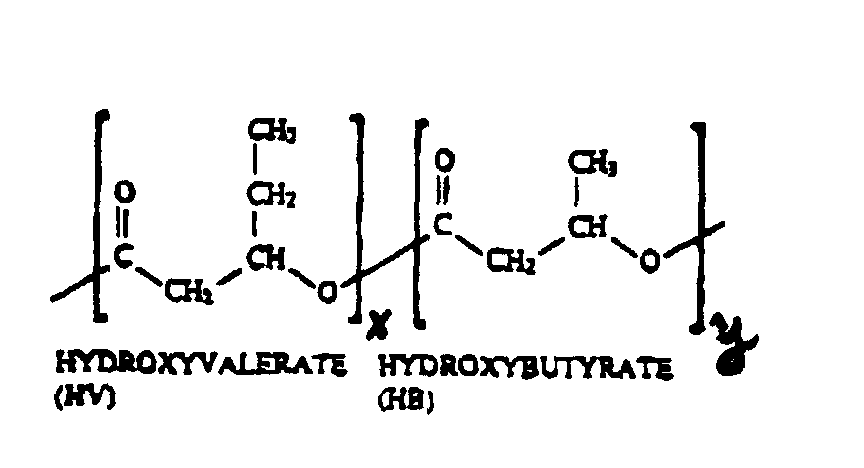
Also useful herein are the linear polyesters of 3-hydroxybutyric (HB) and 3-hydroxyvaleric
(HV) adds produced from the fermentation of sugars by the bacterium
Alcaligenes eutrophus. The general structure is shown below:
Polymers suitable for use herein contain 9 to 35% of the hydroxyvalerate component
and were available from Zeneca under the Biopol tradename.
The use of these polymers in hot melt adhesive is described in U.S. Patent No.
5,169,889 to Brady et al.
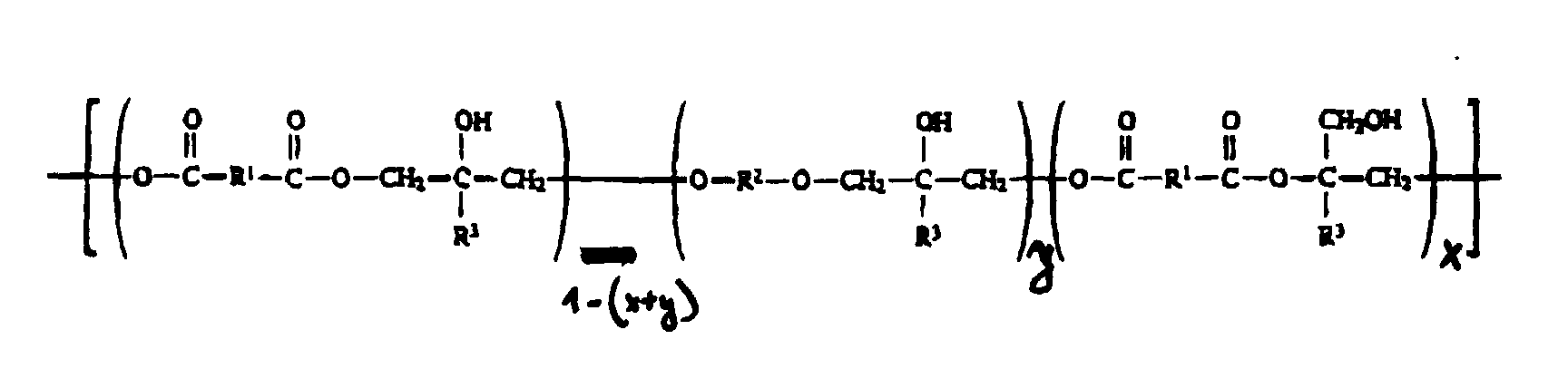
Also useful are the thermoplastic methylol polyesters containing repeating units of the
formula:
wherein each of R
1 and R
2 is individually a divalent organic moiety which is predominantly
hydrocarbon, each R
3 is individually hydrogen or lower alkyl, y is a fraction from 0 to 0.5 and x is
a fraction from about 0.05 to about 0.4.
These hydroxy functional polyesters are suitably prepared by contacting one or more
diglycidyl ethers or diglycidyl esters with one or more diacids or anhydrides under conditions
including the use of an onium catalyst sufficient to cause the acid moieties to react with epoxy
moieties to form a polymer backbone having ester linkages and pendant methylol moieties.
Depending upon the particular starting materials, the resulting polymer will be crystalline, semi-crystalline
or amorphous in nature.
The preparation of these materials are described in greater detail in U.S. Patent No.
5,171,820 to Mang et al. while their use in hot melt adhesives is described in U.S. Patent No.
5,583,187.
Saturated polyesters are derived from saturated diacids and diols. These also vary in
crystallinity from amorphous to highly crystalline. They are available from Hüls under the
Dynapol tradename.
The use of hydroxypropyl cellulose in hydrophilic hot melt adhesives has been
disclosed, for example, in U.S. Patent No. 5,356,963. Similarly, cellulose or starch esters,
especially cellulose acetate and starch acetate, having a degree of substitution less than 2.5
may also be tackified with sucrose benzoate in accordance with the invention. The use of starch
esters in hot melt adhesives has been disclosed in, among others, U.S. Patent No. 5,360,845.
Other ingredients which may be present in adhesive formulations of the present
invention include polar nonionic, anionic or cationic plasticizers; crystalline wax materials and
stabilizers.
The hot melt adhesives of the invention may include 0 to 35% of at least one crystalline
material selected from the group consisting of a compatible crystalline wax and a crystalline
thermoplastic polymer. In such cases, the waxes are employed at levels of 0 to 35% by weight,
to reduce the melt viscosity while improving heat resistance. The waxes used must be highly
polar, containing ≥ 3 X 10⁻³ equiv/g of polar groups and at least one group per molecule and with
a molecular weight below 500 g/mole. Higher concentrations of polar groups are necessary for
higher molecular weight waxes. These polar groups include hydroxyl, amide (primary,
secondary, and tertiary), sulfone, phosphate esters, sulfonamide, carbonate, urea, amine,
urethane, carboxylic acid; and carboxylate salts, ureas, and sulfonate salts.
Suitable crystalline polar waxes include 12-hydroxystearamide, N-(2-hydroxy ethyl) 12-hydroxystearamide
(PARICIN 220 from CasChem), stearamide (KEMAMIDE S from Witco),
glycerin monostearate, sorbitan monostearate, and 12-hydroxy stearic acid. Also useful in
combination with the above are the less polar waxes such as N,N'-ethylene-bis-stearamide
(KEMAMIDE W-40 from Witco), hydrogenated castor oil (castor wax), oxidized synthetic waxes,
and functionalized synthetic waxes such as oxidized polyethylene waxes (PETROLITE E-1040).
The crystalline component may alternatively be a crystalline hydrophobic thermoplastic
polymer present in the adhesive 5 to 60%, preferably 10 to 40%. These polymers are employed
in order to impart flexibility, toughness and strength. Suitable crystalline thermoplastic polymers
include ethylene vinyl acetate copolymers containing about 12 to 50% vinyl acetate, ethylene
acrylic acid, ethylene methyl acrylate and ethylene n-butyl acrylate copolymers as well as
polylactide, caprolactone polymers and poly(hydroxy-butyrate/hydroxyvalerate), polyvinyl
alcohol, linear saturated polyesters such as DYNAPOL or DYNACOLL polymers from Hüls,
GRILTEX from EMS-Chemie, poly (ethylene oxide) polyether amide or polyester ether block
copolymers available from Atochem (PEBAX) or Hoechst Celanese (RITEFLEX) respectively,
and polyamide polymers such as those available from Union Camp (UNIREZ) or Hüls
(VESTAMELT). The polymers added may be amorphous or crystalline, but at least 5% of a
crystalline polymer is required to achieve adequate properties.
Preferred among these crystalline polymers are other polyester polymers such as those
available from EMS-Chemie, Sumter, SC, under the tradename GRILTEX, or from Hüls
America, Piscataway, NJ, under the tradenames DYNAPOL and DYNACOLL (lower molecular
weight). Also preferred are polyamides such as those available from Union Camp, Wayne, NJ,
under the UNIREZ tradename or copolyamides available from Hüls under the VESTAMELT
tradename and also from EMS-Chemie also under the GRILTEX name.
It may also be desirable to incorporate into the hot melt adhesive up to 20% by weight of
certain other hydrophilic non-crystalline polymers such as hydroxyethyl cellulose, hydroxypropyl
cellulose, polyvinyl methyl ether, polyvinylpyrrolidone, polyethyloxazoline, starch or cellulose
esters, particularly the acetates with a degree of substitution less than 2.5; the latter polymers
functioning to increase the water sensitivity of the adhesives which may be desired for some
applications.
Other hydrophobic compatible polymers include elastomeric polymers such as styrene
containing block copolymers, e.g., styrene-isoprene-styrene, epoxidized polyisoprene, styrene-butadiene-styrene,
styrene-ethylene butylene-styrene, styrene-ethylene propylene styrene may
also be present at levels up to about 30% by weight. Of these polymers, those based on
styrene-isoprene-styrene are most preferred.
The hot melt adhesives of the present invention also comprise 0 to 45%, preferably 5 to
20% by weight of anionic, cationic or polar nonionic plasticizers which are available in either solid
or liquid form.
Examples of anionic plasticizers include the sulfosuccinate salts, such as sodium dioctyl
sulfosuccinate, a solid plasticizer available under the tradename CYTEC OT-100 from Cytec
Industries; sulfated fatty acids such as AHCOWET RS from ICI; and EMULSIFIER K-30, a solid
alkane sulfonate available from Bayer Inc.
Examples of cationic plasticizers include the fatty amine quaternary ammonium salts,
such as ATLAS G-265 with HLB of 33, available from ICI; and ATLAS-G-3634A an imidazoline
quaternary ammonium salt, also available from ICI.
Preferred polar nonionic liquid plasticizers including phthalate plasticizers such as
dioctyl phthalate and butyl benzyl phthalate (e.g., SANTICIZER 160 from Monsanto); liquid
polyesters (non-crystalline) such as DYNACOL 720 from Hüls and the liquid polymeric
plasticizer available from C.P. Hall; benzoate plasticizers such as 1,4-cyclohexane dimethanol
dibenzoate (e.g., BENZOFLEX 352 available commercially from Velsicol), diethylene
glycol/dipropylene glycol dibenzoate (e.g., BENZOFLEX 50 from Velsicol) and diethylene glycol
dibenzoate where the mole fraction of hydroxyl groups which have been esterified ranges from
0.5 to 0.95 (e.g., BENZOFLEX 2-45 High Hydroxyl also from Velsicol); phosphate plasticizers
such as t-butylphenyl diphenyl phosphate (e.g., SANTICIZER 154 available commercially from
Monsanto); poly(ethylene glycol) with molecular weight below about 1000 and derivatives of
poly(ethylene glycol) (e.g., PYCAL 94, the phenyl ether of PEG, available commercially from
ICI); ethoxylated bis phenol A (e.g., MACOL 206 EM from PPG Industries); dinonyl phenol
ethyoxylates (e.g., SURFONIC DNP 100 from Huntsman Chemical Corp.); liquid rosin
derivatives having Ring and Ball melting points below about 60°C such as the methyl ester of
hydrogenated rosin (e.g., HERCOLYN D from Hercules); as well as vegetable and animal oils
such as glycerol esters of fatty acids and polymerization products thereof. Particularly preferred
plasticizers include phenyl ether of polyethyleneglycol; butyl benzyl phthalate; benzoates such
as 1,4-cyclohexane dimethanol dibenzoate, diethylene glycol/dipropylene glycol dibenzoate, and
diethylene glycol dibenzoate where the mole fraction of hydroxyl groups which have been
esterified ranges from 0.5 to 0.95.
Among the applicable stabilizers or antioxidants which may be included herein are high
molecular weight hindered phenols and multifunctional phenols such as sulfur and phosphorous-containing
phenols. Representative hindered phenols include: 1,3,5-trimethyl-2,4,6-tris(3,5-di-tert-butyl-4-hydroxyphenyl)
propionate; n-octadecyl 3,5-di-tert-butyl-4-hydroxyphenyl)
propionate; 4,4'-methlenebis (2,6-di-tert-butylphenol); 4,4'-thiobis (6-tert-butyl-o-cresol); 2,6-di-tert-butylphenol;
6-(4-hydroxyphenoxy)-2,4-bis(n-octylthio)-1,3,5-triazine; di-n-actadecyl-3,5-di-tert-butyl-4-hydroxy-benzylphosphonate;
2-(n-octylthio)-ethyl 3,5-di-tert-butyl-4-hydroxy-benzoate;
and sorbitol hexa[3-(3,5-di-tert-butyl-4-hydroxyphenyl)-propionate]. If used, the
stabilizer is present in levels of about 0.1 to 3% by weight.
In addition to the high hydroxyl number compound, optional polar tackifying resins, may
be present in an amount of 0 to 40% by weight. These tackifiers will have a Ring and Ball
softening point greater than 60°C and include rosin and rosin derivatives, terpene phenolics, and
the like. More particularly, the useful tackifying resins include any compatible resins or mixtures
thereof such as (1) natural and modified rosins such, for example, as gum rosin, wood rosin, tall
oil rosin, distilled rosin, hydrogenated rosin, dimerized rosin, and polymerized rosin; (2) rosin
esters such as glycerol and pentaerythritol esters of natural and modified rosins, such, for
example as the glycerol ester of pale, wood rosin, the glycerol ester of hydrogenated rosin, the
glycerol ester of polymerized rosin, the pentaerythritol ester of hydrogenated rosin, and the
phenolic-modified pentaerythritol ester of rosin; and (3) phenolic modified (a) terpene or (b) a-methyl
styrene resins as well as the hydrogenated derivatives thereof such, for example, as the
resin product resulting from the condensation, in an acidic medium of a bicyclic terpene and a
phenol. Mixtures of two or more of the above described tackifying resins, as well as blends of
the above resins with small amounts of (e.g., less than about 20% of the adhesive) less
compatible resins may be utilized for some formulations.
Representative polar tackifiers include ionic materials such as FORAL NC available
from Hercules; non-ionic materials such as FORAL AX also from Hercules; alpha methyl styrene
phenolics such as URATAK 68520 from DSM Resins; rosin esters such as UNITAC R100L
available from Union Camp; and, terpene phenolics such as NIREZ 300, available from Arizona
Chemical.
Another tackifier is sucrose benzoate which is particularly useful due to its
biodegradable and compostable character. Sucrose benzoate is preferably utilized in its alcohol
soluble form wherein the sucrose is partially esterified. This grade is a light colored, clear non-crystalline
solid with a softening point of about 95°C. Alternatively, the non-alcohol organic
soluble grade, a water-clear, non-crystalline flake solid having a softening point of 98°C may also
be used. Both grades are available commercially from Veliscol Chemical Corporation.
Optional additives may be incorporated into the hot melt compositions in order to modify
certain properties thereof. Among these additives may be included colorants such as titanium
dioxide; and fillers such as talc and clay, etc.
Thus, in a preferred embodiment, the present invention is directed to hot melt adhesive
compositions comprising (a) >40% by weight of a sulfonated polyester or a graft copolymer of at
least one vinyl monomer and at least one polyalkylene oxide polymer; (b) 5 to 40% by weight of
a high hydroxyl number compound; (c) 0 to 45% by weight of a polar nonionic, anionic or
cationic plasticizer (d) 0 to 35% by weight of at least one crystalline material selected from the
group consisting of a compatible crystalline wax diluent and a crystalline thermoplastic polymer,
(e) and 0 to 3% by weight of a stabilizer; with the total of (a) - (e) to equal 100% by weight.
The hot melt adhesive compositions of the invention may be formulated using
techniques known in the art. An exemplary procedure for preparing an adhesive according to
the preferred embodiment above involves placing approximately 40% of the total high hydroxyl
number compound concentration with all the polymer, wax, plasticizers and stabilizers in a
jacketed mixing kettle, preferably in a jacketed heavy duty mixer, which is equipped with rotors
and thereupon raising the temperature to a range of from up to about 190°C. After the
compound has melted, the temperature is lowered to 150° to 165°C. Mixing and heating are
continued until a smooth, homogeneous mass is obtained whereupon the remainder of the
compound is thoroughly and uniformly admixed therewith.
As noted above, the hydrophilic hot melt adhesives of the invention will be formulated
differently depending upon the particular end use.
The following examples are merely illustrative, and not intended to limit the scope of
present claims in any manner.
EXAMPLES
In the following illustrative examples all parts are given by weight and all temperatures in
degrees Celsius unless otherwise noted.
In preparing the following samples, a heavy duty mixer which had been heated to 165°C
and which was equipped with a stirring paddle was charged with 40% of the tackifying resin
and/or diluent. After melting of the resins, stirring was then initiated whereupon the polyester
was added slowly at 165°C over a one-half hour period after which the temperature was lowered
to 150°C. Heating and stirring were continued until a homogeneous mass was obtained
whereupon the remainder of the tackifying resin and/or diluent was admixed therewith.
The samples were tested using the following procedures:
Viscosity measurements were determined after 30 minutes using a Brookfield
viscometer (Spindle 27).
Some of the adhesives were also tested for thermal stability by storing at 275°F for 24
hours. After the testing period, remove the jar, check for the following:
Water Dispersibility
The percent water dispersibility is determined using the TAPPI UM 666 test
procedure. The test results show improved dispersibility of the adhesives of the present
invention as compared to conventional hot melt adhesives.
The following were used in the formulations:
- PARICIN 220 is a 12-hydroxystearamide wax from CasChem Inc.
- SANTOVAR A is a 2,5-di(tert-amyl) hydroquinone antioxidant from Monsanto.
- TNPP is a tris nonylphenyl phosphite antioxidant from GE Inc.
- URATAK 68528 is an α-methyl styrene-styrene tackifier available from DSM Resins
with an hydroxyl number 0 mg KOH/g.
- URATAK 68520 is an α-methyl styrene phenolic tackifier available from DSM Resins
with an hydroxyl number 39 mg KOH/g.
- NIREZ V-2040 a is an terpene phenolic from Arizona Chemical with an hydroxyl
number of 72 mg KOH/g.
- STEPANOL PN-110 is an orthophthalate neopentyl glycol polyester polyol available
from Stepan.
- SAA-100 is a styrene allyl alcohol copolymer available from ARCO Chemical.
- CYCLOFLEX 70-3566 is a polyethylene glycol grafted polyvinyl acetate polymer,
containing 70% vinyl acetate and 30% polyethylene glycol, available from National Starch and
Chemical Company.
EXAMPLE 1
Hot melt adhesives were formulated with EASTMAN AQ 1350, a branched sulfonated
polyester available from Eastman Chemical. Each sample was prepared from 50% by weight
EASTMAN AQ 1350; 50% by weight of a tackifier or high hydroxyl compound as shown below
in Table 1:
| | 1-1 | 1-2 | 1-3 | 1-4 | 1-5 |
| URATAK 68528 | 50 | 0 | 0 | 0 | 0 |
| STEPANOL PN 110 | 0 | 50 | 0 | 0 | 0 |
| NIREZ V-2040 | 0 | 0 | 50 | 0 | 0 |
| SAA 100 | 0 | 0 | 0 | 50 | 0 |
| URATAK 68520 | 0 | 0 | 0 | 0 | 50 |
The moisture uptake of each of the above blends was then evaluated by placing 30 grams of
each blend in an oven for 24 hours at 275°F. Incompatibility was observed with sample 1-1, so
this sample was discarded. Of the remaining samples, 1 gram of each was placed in a weighing
tin and left there for one week. After one week the sample was weighted and the moisture
uptake determined:
| Sample | % Moisture Uptake |
| 1-2 | 4.5 |
| 1-3 | 2.0 |
| 1-4 | 4.3 |
| 1-5 | 2.4 |
Example 1 was repeated using 50% by weight of CYCLOFLEX 70-3566, instead of
Eastman AQ 1350. The same tackifiers or high hydroxyl compounds, in the same amounts
were used. Formulations 2-1 and 2-5 were incompatible, as judged by phase separation after
24 hours at 275°F. The moisture uptake was measured and the following results obtained:
| Sample | % Moisture Uptake |
| 2-2 | 3.5 |
| 2-3 | 1.7 |
| 2-4 | 3.0 |
The results shown above in Examples 1 and 2 show that adhesives with STEPANOL PN-110
and SAA-100 have a higher moisture uptake than those prepared with NIREZ V-2040 or
URATAK 68528. URATAK 68520 was not compatible at this level with either hydrophilic base
polymer. This data shows that the high hydroxyl compounds provide a boost in water
sensitivity to the final adhesive formulation.
EXAMPLE 3
Hot melt adhesives were formulated with EASTMAN AQ 1350. Each sample was
prepared from 50% by weight EASTMAN AQ 1350; 20% by weight PARICIN 220; 0.5% by
weight SANTOVAR A; and 0.5% by weight TNPP. Each formulation was prepared with 30%
by weight of a tackifier or high hydroxyl compound as shown below:
| | 3-1 | 3-2 | 3-3 | 3-4 |
| SAA 100 | 30 | 0 | 0 | 0 |
| STEPANOL PN 110 | 0 | 30 | 0 | 0 |
| NIREZ V 240 | 0 | 0 | 30 | 0 |
| URATAK 68528 | 0 | 0 | 0 | 30 |
| Hydroxyl Number (mg KOH/g) | 210 | 110 | 72 | 0 |
The results are shown below in Table 3:
| | 3-1 | 3-2 | 3-3 | 3-4 |
| Viscosity (cps) |
| 275°F | 9800 | 3365 | 8000 | 6325 |
| 300°F | 2100 | 1785 | 3850 | 3250 |
| Thermal Stability 275°F @ 24 hrs. |
| Separation | none | none | none | none |
| Char | none | none | none | Sl. Swirl |
| Gel | none | none | none | none |
| Edge ring | none | none | none | none |
| Skin | none | none | none | none |
| Odor | mild | mild | mild | strong |
| Color | yellow/brown | light brown | brown | cream |
| Viscosity at 275°F | 7100 | 2765 | 5590 | 5460 |
| ov(%) | -27.6 | -21.7 | -30.2 | -13.6 |
| % dispersibility | 98% | 98% | 95% | 92% |
The data in Table 3 above, show that Samples 3-1 and 3-2, both comprising a
compound with hydroxyl number greater than 100 mg KOH/g have superior dispersibility to
adhesives formulated with conventional tackifiers, Samples 3-3 and 3-4 (prepared with terpene
phenolic and α-methyl styrene-styrene, respectively).
EXAMPLE 4
Hot melt adhesives were formulated with CYCLOFLEX 70-3566, a polyethylene glycol
grafted polyvinyl acetate polymer, available from National Starch and Chemical Company. Each
sample was prepared from 50% by weight CYCLOFLEX 70-3566; 20% by weight PARICIN
220; 0.5% by weight SANTOVAR A; and 0.5% by weight TNPP. Each formulation was
prepared with 30% by weight of a tackifier or high hydroxyl compound as shown below in
Table 4:
| | 4-1 | 4-2 | 4-3 | 4-4 |
| SAA 100 | 30 | 0 | 0 | 0 |
| STEPANOL PN 110 | 0 | 30 | 0 | 0 |
| NIREZ V-2040 | 0 | 0 | 30 | 0 |
| URATAK 68528 | 0 | 0 | 0 | 30 |
| Hydroxyl Number (mg KOH/g) | 210 | 110 | 72 | 0 |
The results are shown below in Table 5:
| | 4-1 | 4-2 | 4-3 | 4-4 |
| Viscosity (cps) |
| 275°F | 1625 | 1160 | 2150 | 2140 |
| 300°F | 875 | 700 | 1120 | 1050 |
| Thermal Stability 275°F @ 24 hrs. |
| Separation/Char/Gel | none | sl. Swirl | sl. Swirl | separation |
| Edge ring/skin | none | none | none | none |
| Odor | mild | mild | mild | mild |
| Color | light brown | brown | light brown | brown |
| Viscosity at 275 °F | 1840 | 1195 | 2075 | -- |
| ov(%) | +13.2 | +3.0 | +3.71 | -- |
| % dispersibility | 97.8% | 97.6% | 94% | 88% |
The data in Table 5 above, show that Samples 4-1 and 4-2, both comprising a
compound with hydroxyl number greater than 100 mg KOH/g have superior dispersibility to
adhesives formulated with conventional tackifiers, Samples 4-3 and 4-4 (prepared with terpene
phenolic and α-methyl styrene-styrene, respectively). In addition, Sample 4-4, prepared with α-methyl
styrene-styrene was unstable; it exhibited phase separation at 275°F.