EP1046669A1 - Low odor polyoxyalkylene polyol, process for producing the same and urethane composition - Google Patents
Low odor polyoxyalkylene polyol, process for producing the same and urethane composition Download PDFInfo
- Publication number
- EP1046669A1 EP1046669A1 EP20000108640 EP00108640A EP1046669A1 EP 1046669 A1 EP1046669 A1 EP 1046669A1 EP 20000108640 EP20000108640 EP 20000108640 EP 00108640 A EP00108640 A EP 00108640A EP 1046669 A1 EP1046669 A1 EP 1046669A1
- Authority
- EP
- European Patent Office
- Prior art keywords
- amine
- polyoxyalkylene polyol
- low odor
- odor
- polyol
- Prior art date
- Legal status (The legal status is an assumption and is not a legal conclusion. Google has not performed a legal analysis and makes no representation as to the accuracy of the status listed.)
- Granted
Links
- 229920005862 polyol Polymers 0.000 title claims abstract description 109
- 150000003077 polyols Chemical class 0.000 title claims abstract description 108
- JOYRKODLDBILNP-UHFFFAOYSA-N Ethyl urethane Chemical compound CCOC(N)=O JOYRKODLDBILNP-UHFFFAOYSA-N 0.000 title claims abstract description 46
- 239000000203 mixture Substances 0.000 title claims abstract description 23
- 238000000034 method Methods 0.000 title claims abstract description 13
- 150000001412 amines Chemical class 0.000 claims abstract description 65
- 125000004435 hydrogen atom Chemical group [H]* 0.000 claims abstract description 9
- 125000005842 heteroatom Chemical group 0.000 claims abstract description 7
- 125000003277 amino group Chemical group 0.000 claims abstract description 6
- 229910052757 nitrogen Inorganic materials 0.000 claims abstract description 5
- 125000004429 atom Chemical group 0.000 claims abstract description 4
- 229910052799 carbon Inorganic materials 0.000 claims abstract description 4
- 125000004432 carbon atom Chemical group C* 0.000 claims abstract description 4
- 125000004433 nitrogen atom Chemical group N* 0.000 claims abstract description 4
- 125000000962 organic group Chemical group 0.000 claims abstract description 4
- 238000010438 heat treatment Methods 0.000 claims description 7
- 238000006116 polymerization reaction Methods 0.000 claims description 7
- 125000001931 aliphatic group Chemical group 0.000 claims description 4
- 125000003118 aryl group Chemical group 0.000 claims description 4
- 238000009835 boiling Methods 0.000 claims description 4
- 125000005702 oxyalkylene group Chemical group 0.000 claims description 3
- 239000002994 raw material Substances 0.000 abstract description 18
- 150000001299 aldehydes Chemical class 0.000 description 34
- 238000006243 chemical reaction Methods 0.000 description 19
- -1 phosphagen compound Chemical class 0.000 description 16
- LYCAIKOWRPUZTN-UHFFFAOYSA-N Ethylene glycol Chemical compound OCCO LYCAIKOWRPUZTN-UHFFFAOYSA-N 0.000 description 13
- 239000000047 product Substances 0.000 description 13
- 125000002947 alkylene group Chemical group 0.000 description 11
- ZMXDDKWLCZADIW-UHFFFAOYSA-N N,N-Dimethylformamide Chemical compound CN(C)C=O ZMXDDKWLCZADIW-UHFFFAOYSA-N 0.000 description 9
- 150000001875 compounds Chemical class 0.000 description 8
- NBBJYMSMWIIQGU-UHFFFAOYSA-N Propionic aldehyde Chemical compound CCC=O NBBJYMSMWIIQGU-UHFFFAOYSA-N 0.000 description 7
- 239000003054 catalyst Substances 0.000 description 7
- 238000004519 manufacturing process Methods 0.000 description 7
- 150000003335 secondary amines Chemical class 0.000 description 6
- 230000003247 decreasing effect Effects 0.000 description 5
- 239000005056 polyisocyanate Substances 0.000 description 5
- 229920001228 polyisocyanate Polymers 0.000 description 5
- 150000003141 primary amines Chemical class 0.000 description 5
- UPMLOUAZCHDJJD-UHFFFAOYSA-N 4,4'-Diphenylmethane Diisocyanate Chemical compound C1=CC(N=C=O)=CC=C1CC1=CC=C(N=C=O)C=C1 UPMLOUAZCHDJJD-UHFFFAOYSA-N 0.000 description 4
- IKHGUXGNUITLKF-UHFFFAOYSA-N Acetaldehyde Chemical compound CC=O IKHGUXGNUITLKF-UHFFFAOYSA-N 0.000 description 4
- PEDCQBHIVMGVHV-UHFFFAOYSA-N Glycerine Chemical compound OCC(O)CO PEDCQBHIVMGVHV-UHFFFAOYSA-N 0.000 description 4
- 229920000642 polymer Polymers 0.000 description 4
- 239000003505 polymerization initiator Substances 0.000 description 4
- 229920001451 polypropylene glycol Polymers 0.000 description 4
- 238000002360 preparation method Methods 0.000 description 4
- 239000002904 solvent Substances 0.000 description 4
- LFQSCWFLJHTTHZ-UHFFFAOYSA-N Ethanol Chemical compound CCO LFQSCWFLJHTTHZ-UHFFFAOYSA-N 0.000 description 3
- OKKJLVBELUTLKV-UHFFFAOYSA-N Methanol Chemical compound OC OKKJLVBELUTLKV-UHFFFAOYSA-N 0.000 description 3
- DNIAPMSPPWPWGF-UHFFFAOYSA-N Propylene glycol Chemical compound CC(O)CO DNIAPMSPPWPWGF-UHFFFAOYSA-N 0.000 description 3
- CZMRCDWAGMRECN-UGDNZRGBSA-N Sucrose Chemical compound O[C@H]1[C@H](O)[C@@H](CO)O[C@@]1(CO)O[C@@H]1[C@H](O)[C@@H](O)[C@H](O)[C@@H](CO)O1 CZMRCDWAGMRECN-UGDNZRGBSA-N 0.000 description 3
- 229930006000 Sucrose Natural products 0.000 description 3
- WYURNTSHIVDZCO-UHFFFAOYSA-N Tetrahydrofuran Chemical compound C1CCOC1 WYURNTSHIVDZCO-UHFFFAOYSA-N 0.000 description 3
- 150000001298 alcohols Chemical class 0.000 description 3
- 230000015572 biosynthetic process Effects 0.000 description 3
- 239000007795 chemical reaction product Substances 0.000 description 3
- 239000003795 chemical substances by application Substances 0.000 description 3
- 230000007423 decrease Effects 0.000 description 3
- 238000006297 dehydration reaction Methods 0.000 description 3
- ZBCBWPMODOFKDW-UHFFFAOYSA-N diethanolamine Chemical compound OCCNCCO ZBCBWPMODOFKDW-UHFFFAOYSA-N 0.000 description 3
- MTHSVFCYNBDYFN-UHFFFAOYSA-N diethylene glycol Chemical compound OCCOCCO MTHSVFCYNBDYFN-UHFFFAOYSA-N 0.000 description 3
- 230000000694 effects Effects 0.000 description 3
- 150000002081 enamines Chemical class 0.000 description 3
- 150000002148 esters Chemical class 0.000 description 3
- 238000011156 evaluation Methods 0.000 description 3
- 150000002466 imines Chemical class 0.000 description 3
- 239000000463 material Substances 0.000 description 3
- 125000002924 primary amino group Chemical group [H]N([H])* 0.000 description 3
- 230000009257 reactivity Effects 0.000 description 3
- 239000005720 sucrose Substances 0.000 description 3
- 150000003512 tertiary amines Chemical class 0.000 description 3
- PUPZLCDOIYMWBV-UHFFFAOYSA-N (+/-)-1,3-Butanediol Chemical compound CC(O)CCO PUPZLCDOIYMWBV-UHFFFAOYSA-N 0.000 description 2
- OZJPLYNZGCXSJM-UHFFFAOYSA-N 5-valerolactone Chemical compound O=C1CCCCO1 OZJPLYNZGCXSJM-UHFFFAOYSA-N 0.000 description 2
- PAYRUJLWNCNPSJ-UHFFFAOYSA-N Aniline Chemical compound NC1=CC=CC=C1 PAYRUJLWNCNPSJ-UHFFFAOYSA-N 0.000 description 2
- IAYPIBMASNFSPL-UHFFFAOYSA-N Ethylene oxide Chemical compound C1CO1 IAYPIBMASNFSPL-UHFFFAOYSA-N 0.000 description 2
- QIGBRXMKCJKVMJ-UHFFFAOYSA-N Hydroquinone Chemical compound OC1=CC=C(O)C=C1 QIGBRXMKCJKVMJ-UHFFFAOYSA-N 0.000 description 2
- CSNNHWWHGAXBCP-UHFFFAOYSA-L Magnesium sulfate Chemical compound [Mg+2].[O-][S+2]([O-])([O-])[O-] CSNNHWWHGAXBCP-UHFFFAOYSA-L 0.000 description 2
- 239000004721 Polyphenylene oxide Substances 0.000 description 2
- GOOHAUXETOMSMM-UHFFFAOYSA-N Propylene oxide Chemical compound CC1CO1 GOOHAUXETOMSMM-UHFFFAOYSA-N 0.000 description 2
- KKEYFWRCBNTPAC-UHFFFAOYSA-N Terephthalic acid Chemical compound OC(=O)C1=CC=C(C(O)=O)C=C1 KKEYFWRCBNTPAC-UHFFFAOYSA-N 0.000 description 2
- 239000002253 acid Substances 0.000 description 2
- 239000000853 adhesive Substances 0.000 description 2
- 230000001070 adhesive effect Effects 0.000 description 2
- WNLRTRBMVRJNCN-UHFFFAOYSA-N adipic acid Chemical compound OC(=O)CCCCC(O)=O WNLRTRBMVRJNCN-UHFFFAOYSA-N 0.000 description 2
- 238000004458 analytical method Methods 0.000 description 2
- 239000003963 antioxidant agent Substances 0.000 description 2
- 230000003078 antioxidant effect Effects 0.000 description 2
- 150000004982 aromatic amines Chemical class 0.000 description 2
- IISBACLAFKSPIT-UHFFFAOYSA-N bisphenol A Chemical compound C=1C=C(O)C=CC=1C(C)(C)C1=CC=C(O)C=C1 IISBACLAFKSPIT-UHFFFAOYSA-N 0.000 description 2
- PXKLMJQFEQBVLD-UHFFFAOYSA-N bisphenol F Chemical compound C1=CC(O)=CC=C1CC1=CC=C(O)C=C1 PXKLMJQFEQBVLD-UHFFFAOYSA-N 0.000 description 2
- HQABUPZFAYXKJW-UHFFFAOYSA-N butan-1-amine Chemical compound CCCCN HQABUPZFAYXKJW-UHFFFAOYSA-N 0.000 description 2
- WERYXYBDKMZEQL-UHFFFAOYSA-N butane-1,4-diol Chemical compound OCCCCO WERYXYBDKMZEQL-UHFFFAOYSA-N 0.000 description 2
- ZTQSAGDEMFDKMZ-UHFFFAOYSA-N butyric aldehyde Natural products CCCC=O ZTQSAGDEMFDKMZ-UHFFFAOYSA-N 0.000 description 2
- 150000001732 carboxylic acid derivatives Chemical class 0.000 description 2
- 239000004359 castor oil Substances 0.000 description 2
- 235000019438 castor oil Nutrition 0.000 description 2
- YCIMNLLNPGFGHC-UHFFFAOYSA-N catechol Chemical compound OC1=CC=CC=C1O YCIMNLLNPGFGHC-UHFFFAOYSA-N 0.000 description 2
- PMMYEEVYMWASQN-IMJSIDKUSA-N cis-4-Hydroxy-L-proline Chemical compound O[C@@H]1CN[C@H](C(O)=O)C1 PMMYEEVYMWASQN-IMJSIDKUSA-N 0.000 description 2
- 230000000052 comparative effect Effects 0.000 description 2
- 239000002537 cosmetic Substances 0.000 description 2
- 239000012024 dehydrating agents Substances 0.000 description 2
- 230000018044 dehydration Effects 0.000 description 2
- 125000005442 diisocyanate group Chemical group 0.000 description 2
- JRBPAEWTRLWTQC-UHFFFAOYSA-N dodecylamine Chemical compound CCCCCCCCCCCCN JRBPAEWTRLWTQC-UHFFFAOYSA-N 0.000 description 2
- 238000001035 drying Methods 0.000 description 2
- 150000002118 epoxides Chemical class 0.000 description 2
- 235000011187 glycerol Nutrition 0.000 description 2
- ZEMPKEQAKRGZGQ-XOQCFJPHSA-N glycerol triricinoleate Natural products CCCCCC[C@@H](O)CC=CCCCCCCCC(=O)OC[C@@H](COC(=O)CCCCCCCC=CC[C@@H](O)CCCCCC)OC(=O)CCCCCCCC=CC[C@H](O)CCCCCC ZEMPKEQAKRGZGQ-XOQCFJPHSA-N 0.000 description 2
- NAQMVNRVTILPCV-UHFFFAOYSA-N hexane-1,6-diamine Chemical compound NCCCCCCN NAQMVNRVTILPCV-UHFFFAOYSA-N 0.000 description 2
- 239000010720 hydraulic oil Substances 0.000 description 2
- 239000001257 hydrogen Substances 0.000 description 2
- 229910052739 hydrogen Inorganic materials 0.000 description 2
- 150000002483 hydrogen compounds Chemical class 0.000 description 2
- WGCNASOHLSPBMP-UHFFFAOYSA-N hydroxyacetaldehyde Natural products OCC=O WGCNASOHLSPBMP-UHFFFAOYSA-N 0.000 description 2
- BMFVGAAISNGQNM-UHFFFAOYSA-N isopentylamine Chemical compound CC(C)CCN BMFVGAAISNGQNM-UHFFFAOYSA-N 0.000 description 2
- QQVIHTHCMHWDBS-UHFFFAOYSA-N isophthalic acid Chemical compound OC(=O)C1=CC=CC(C(O)=O)=C1 QQVIHTHCMHWDBS-UHFFFAOYSA-N 0.000 description 2
- 239000000314 lubricant Substances 0.000 description 2
- 229940127554 medical product Drugs 0.000 description 2
- HKUFIYBZNQSHQS-UHFFFAOYSA-N n-octadecyloctadecan-1-amine Chemical compound CCCCCCCCCCCCCCCCCCNCCCCCCCCCCCCCCCCCC HKUFIYBZNQSHQS-UHFFFAOYSA-N 0.000 description 2
- BDJRBEYXGGNYIS-UHFFFAOYSA-N nonanedioic acid Chemical compound OC(=O)CCCCCCCC(O)=O BDJRBEYXGGNYIS-UHFFFAOYSA-N 0.000 description 2
- 150000002989 phenols Chemical class 0.000 description 2
- WLJVNTCWHIRURA-UHFFFAOYSA-N pimelic acid Chemical compound OC(=O)CCCCCC(O)=O WLJVNTCWHIRURA-UHFFFAOYSA-N 0.000 description 2
- 229920000768 polyamine Polymers 0.000 description 2
- 229920000570 polyether Polymers 0.000 description 2
- 239000002685 polymerization catalyst Substances 0.000 description 2
- 239000004814 polyurethane Substances 0.000 description 2
- 229920002635 polyurethane Polymers 0.000 description 2
- 238000000746 purification Methods 0.000 description 2
- 230000035484 reaction time Effects 0.000 description 2
- 238000007151 ring opening polymerisation reaction Methods 0.000 description 2
- 239000003566 sealing material Substances 0.000 description 2
- CXMXRPHRNRROMY-UHFFFAOYSA-N sebacic acid Chemical compound OC(=O)CCCCCCCCC(O)=O CXMXRPHRNRROMY-UHFFFAOYSA-N 0.000 description 2
- 229920002050 silicone resin Polymers 0.000 description 2
- TYFQFVWCELRYAO-UHFFFAOYSA-N suberic acid Chemical compound OC(=O)CCCCCCC(O)=O TYFQFVWCELRYAO-UHFFFAOYSA-N 0.000 description 2
- 239000004094 surface-active agent Substances 0.000 description 2
- XLYOFNOQVPJJNP-UHFFFAOYSA-N water Substances O XLYOFNOQVPJJNP-UHFFFAOYSA-N 0.000 description 2
- DNIAPMSPPWPWGF-VKHMYHEASA-N (+)-propylene glycol Chemical compound C[C@H](O)CO DNIAPMSPPWPWGF-VKHMYHEASA-N 0.000 description 1
- QGLWBTPVKHMVHM-KTKRTIGZSA-N (z)-octadec-9-en-1-amine Chemical compound CCCCCCCC\C=C/CCCCCCCCN QGLWBTPVKHMVHM-KTKRTIGZSA-N 0.000 description 1
- NNOZGCICXAYKLW-UHFFFAOYSA-N 1,2-bis(2-isocyanatopropan-2-yl)benzene Chemical compound O=C=NC(C)(C)C1=CC=CC=C1C(C)(C)N=C=O NNOZGCICXAYKLW-UHFFFAOYSA-N 0.000 description 1
- FKTHNVSLHLHISI-UHFFFAOYSA-N 1,2-bis(isocyanatomethyl)benzene Chemical compound O=C=NCC1=CC=CC=C1CN=C=O FKTHNVSLHLHISI-UHFFFAOYSA-N 0.000 description 1
- ZXHZWRZAWJVPIC-UHFFFAOYSA-N 1,2-diisocyanatonaphthalene Chemical compound C1=CC=CC2=C(N=C=O)C(N=C=O)=CC=C21 ZXHZWRZAWJVPIC-UHFFFAOYSA-N 0.000 description 1
- YPFDHNVEDLHUCE-UHFFFAOYSA-N 1,3-propanediol Substances OCCCO YPFDHNVEDLHUCE-UHFFFAOYSA-N 0.000 description 1
- 229940035437 1,3-propanediol Drugs 0.000 description 1
- ALQLPWJFHRMHIU-UHFFFAOYSA-N 1,4-diisocyanatobenzene Chemical compound O=C=NC1=CC=C(N=C=O)C=C1 ALQLPWJFHRMHIU-UHFFFAOYSA-N 0.000 description 1
- FJLUATLTXUNBOT-UHFFFAOYSA-N 1-Hexadecylamine Chemical compound CCCCCCCCCCCCCCCCN FJLUATLTXUNBOT-UHFFFAOYSA-N 0.000 description 1
- BMVXCPBXGZKUPN-UHFFFAOYSA-N 1-hexanamine Chemical compound CCCCCCN BMVXCPBXGZKUPN-UHFFFAOYSA-N 0.000 description 1
- LFSYUSUFCBOHGU-UHFFFAOYSA-N 1-isocyanato-2-[(4-isocyanatophenyl)methyl]benzene Chemical compound C1=CC(N=C=O)=CC=C1CC1=CC=CC=C1N=C=O LFSYUSUFCBOHGU-UHFFFAOYSA-N 0.000 description 1
- RTBFRGCFXZNCOE-UHFFFAOYSA-N 1-methylsulfonylpiperidin-4-one Chemical compound CS(=O)(=O)N1CCC(=O)CC1 RTBFRGCFXZNCOE-UHFFFAOYSA-N 0.000 description 1
- STMDPCBYJCIZOD-UHFFFAOYSA-N 2-(2,4-dinitroanilino)-4-methylpentanoic acid Chemical compound CC(C)CC(C(O)=O)NC1=CC=C([N+]([O-])=O)C=C1[N+]([O-])=O STMDPCBYJCIZOD-UHFFFAOYSA-N 0.000 description 1
- LKMJVFRMDSNFRT-UHFFFAOYSA-N 2-(methoxymethyl)oxirane Chemical compound COCC1CO1 LKMJVFRMDSNFRT-UHFFFAOYSA-N 0.000 description 1
- AQZRARFZZMGLHL-UHFFFAOYSA-N 2-(trifluoromethyl)oxirane Chemical compound FC(F)(F)C1CO1 AQZRARFZZMGLHL-UHFFFAOYSA-N 0.000 description 1
- HZAXFHJVJLSVMW-UHFFFAOYSA-N 2-Aminoethan-1-ol Chemical compound NCCO HZAXFHJVJLSVMW-UHFFFAOYSA-N 0.000 description 1
- TXBCBTDQIULDIA-UHFFFAOYSA-N 2-[[3-hydroxy-2,2-bis(hydroxymethyl)propoxy]methyl]-2-(hydroxymethyl)propane-1,3-diol Chemical compound OCC(CO)(CO)COCC(CO)(CO)CO TXBCBTDQIULDIA-UHFFFAOYSA-N 0.000 description 1
- JCBPETKZIGVZRE-UHFFFAOYSA-N 2-aminobutan-1-ol Chemical compound CCC(N)CO JCBPETKZIGVZRE-UHFFFAOYSA-N 0.000 description 1
- CJNRGSHEMCMUOE-UHFFFAOYSA-N 2-piperidin-1-ylethanamine Chemical compound NCCN1CCCCC1 CJNRGSHEMCMUOE-UHFFFAOYSA-N 0.000 description 1
- BYPFICORERPGJY-UHFFFAOYSA-N 3,4-diisocyanatobicyclo[2.2.1]hept-2-ene Chemical compound C1CC2(N=C=O)C(N=C=O)=CC1C2 BYPFICORERPGJY-UHFFFAOYSA-N 0.000 description 1
- REJGIEGOYWEWPR-UHFFFAOYSA-N 3-(2-methylpropoxy)propan-1-amine Chemical compound CC(C)COCCCN REJGIEGOYWEWPR-UHFFFAOYSA-N 0.000 description 1
- KRPRVQWGKLEFKN-UHFFFAOYSA-N 3-(3-aminopropoxy)propan-1-amine Chemical compound NCCCOCCCN KRPRVQWGKLEFKN-UHFFFAOYSA-N 0.000 description 1
- TWXCJZHSMRBNGO-UHFFFAOYSA-N 3-decoxypropan-1-amine Chemical compound CCCCCCCCCCOCCCN TWXCJZHSMRBNGO-UHFFFAOYSA-N 0.000 description 1
- ZRJOUVOXPWNFOF-UHFFFAOYSA-N 3-dodecoxypropan-1-amine Chemical compound CCCCCCCCCCCCOCCCN ZRJOUVOXPWNFOF-UHFFFAOYSA-N 0.000 description 1
- XYUINKARGUCCQJ-UHFFFAOYSA-N 3-imino-n-propylpropan-1-amine Chemical compound CCCNCCC=N XYUINKARGUCCQJ-UHFFFAOYSA-N 0.000 description 1
- FAXDZWQIWUSWJH-UHFFFAOYSA-N 3-methoxypropan-1-amine Chemical compound COCCCN FAXDZWQIWUSWJH-UHFFFAOYSA-N 0.000 description 1
- ZFAGOADKDXXTSV-UHFFFAOYSA-N 3-methylpentan-2-amine Chemical compound CCC(C)C(C)N ZFAGOADKDXXTSV-UHFFFAOYSA-N 0.000 description 1
- UIKUBYKUYUSRSM-UHFFFAOYSA-N 3-morpholinopropylamine Chemical compound NCCCN1CCOCC1 UIKUBYKUYUSRSM-UHFFFAOYSA-N 0.000 description 1
- VPWNQTHUCYMVMZ-UHFFFAOYSA-N 4,4'-sulfonyldiphenol Chemical compound C1=CC(O)=CC=C1S(=O)(=O)C1=CC=C(O)C=C1 VPWNQTHUCYMVMZ-UHFFFAOYSA-N 0.000 description 1
- BVKZGUZCCUSVTD-UHFFFAOYSA-M Bicarbonate Chemical compound OC([O-])=O BVKZGUZCCUSVTD-UHFFFAOYSA-M 0.000 description 1
- SAIKULLUBZKPDA-UHFFFAOYSA-N Bis(2-ethylhexyl) amine Chemical compound CCCCC(CC)CNCC(CC)CCCC SAIKULLUBZKPDA-UHFFFAOYSA-N 0.000 description 1
- UXVMQQNJUSDDNG-UHFFFAOYSA-L Calcium chloride Chemical compound [Cl-].[Cl-].[Ca+2] UXVMQQNJUSDDNG-UHFFFAOYSA-L 0.000 description 1
- BVKZGUZCCUSVTD-UHFFFAOYSA-L Carbonate Chemical compound [O-]C([O-])=O BVKZGUZCCUSVTD-UHFFFAOYSA-L 0.000 description 1
- 239000009261 D 400 Substances 0.000 description 1
- FBPFZTCFMRRESA-FSIIMWSLSA-N D-Glucitol Natural products OC[C@H](O)[C@H](O)[C@@H](O)[C@H](O)CO FBPFZTCFMRRESA-FSIIMWSLSA-N 0.000 description 1
- FBPFZTCFMRRESA-JGWLITMVSA-N D-glucitol Chemical compound OC[C@H](O)[C@@H](O)[C@H](O)[C@H](O)CO FBPFZTCFMRRESA-JGWLITMVSA-N 0.000 description 1
- RPNUMPOLZDHAAY-UHFFFAOYSA-N Diethylenetriamine Chemical compound NCCNCCN RPNUMPOLZDHAAY-UHFFFAOYSA-N 0.000 description 1
- BRLQWZUYTZBJKN-UHFFFAOYSA-N Epichlorohydrin Chemical compound ClCC1CO1 BRLQWZUYTZBJKN-UHFFFAOYSA-N 0.000 description 1
- PIICEJLVQHRZGT-UHFFFAOYSA-N Ethylenediamine Chemical compound NCCN PIICEJLVQHRZGT-UHFFFAOYSA-N 0.000 description 1
- 208000033962 Fontaine progeroid syndrome Diseases 0.000 description 1
- WQZGKKKJIJFFOK-GASJEMHNSA-N Glucose Natural products OC[C@H]1OC(O)[C@H](O)[C@@H](O)[C@@H]1O WQZGKKKJIJFFOK-GASJEMHNSA-N 0.000 description 1
- 239000005057 Hexamethylene diisocyanate Substances 0.000 description 1
- 239000005058 Isophorone diisocyanate Substances 0.000 description 1
- LRHPLDYGYMQRHN-UHFFFAOYSA-N N-Butanol Chemical class CCCCO LRHPLDYGYMQRHN-UHFFFAOYSA-N 0.000 description 1
- REYJJPSVUYRZGE-UHFFFAOYSA-N Octadecylamine Chemical compound CCCCCCCCCCCCCCCCCCN REYJJPSVUYRZGE-UHFFFAOYSA-N 0.000 description 1
- RVGRUAULSDPKGF-UHFFFAOYSA-N Poloxamer Chemical compound C1CO1.CC1CO1 RVGRUAULSDPKGF-UHFFFAOYSA-N 0.000 description 1
- 229920003171 Poly (ethylene oxide) Polymers 0.000 description 1
- 239000004743 Polypropylene Substances 0.000 description 1
- 229920005830 Polyurethane Foam Polymers 0.000 description 1
- PMZURENOXWZQFD-UHFFFAOYSA-L Sodium Sulfate Chemical compound [Na+].[Na+].[O-]S([O-])(=O)=O PMZURENOXWZQFD-UHFFFAOYSA-L 0.000 description 1
- AWMVMTVKBNGEAK-UHFFFAOYSA-N Styrene oxide Chemical compound C1OC1C1=CC=CC=C1 AWMVMTVKBNGEAK-UHFFFAOYSA-N 0.000 description 1
- GSEJCLTVZPLZKY-UHFFFAOYSA-N Triethanolamine Chemical compound OCCN(CCO)CCO GSEJCLTVZPLZKY-UHFFFAOYSA-N 0.000 description 1
- ZJCCRDAZUWHFQH-UHFFFAOYSA-N Trimethylolpropane Chemical compound CCC(CO)(CO)CO ZJCCRDAZUWHFQH-UHFFFAOYSA-N 0.000 description 1
- 238000012644 addition polymerization Methods 0.000 description 1
- 239000000654 additive Substances 0.000 description 1
- 235000011037 adipic acid Nutrition 0.000 description 1
- 239000001361 adipic acid Substances 0.000 description 1
- 125000002723 alicyclic group Chemical group 0.000 description 1
- 239000003513 alkali Substances 0.000 description 1
- 229910052783 alkali metal Inorganic materials 0.000 description 1
- 150000001340 alkali metals Chemical class 0.000 description 1
- JFCQEDHGNNZCLN-UHFFFAOYSA-N anhydrous glutaric acid Natural products OC(=O)CCCC(O)=O JFCQEDHGNNZCLN-UHFFFAOYSA-N 0.000 description 1
- QVGXLLKOCUKJST-UHFFFAOYSA-N atomic oxygen Chemical compound [O] QVGXLLKOCUKJST-UHFFFAOYSA-N 0.000 description 1
- BHXFKXOIODIUJO-UHFFFAOYSA-N benzene-1,4-dicarbonitrile Chemical compound N#CC1=CC=C(C#N)C=C1 BHXFKXOIODIUJO-UHFFFAOYSA-N 0.000 description 1
- WQZGKKKJIJFFOK-VFUOTHLCSA-N beta-D-glucose Chemical compound OC[C@H]1O[C@@H](O)[C@H](O)[C@@H](O)[C@@H]1O WQZGKKKJIJFFOK-VFUOTHLCSA-N 0.000 description 1
- VEZXCJBBBCKRPI-UHFFFAOYSA-N beta-propiolactone Chemical compound O=C1CCO1 VEZXCJBBBCKRPI-UHFFFAOYSA-N 0.000 description 1
- 229910052797 bismuth Inorganic materials 0.000 description 1
- JCXGWMGPZLAOME-UHFFFAOYSA-N bismuth atom Chemical compound [Bi] JCXGWMGPZLAOME-UHFFFAOYSA-N 0.000 description 1
- 229920001400 block copolymer Polymers 0.000 description 1
- YCGLLKBCDJTRBY-UHFFFAOYSA-N but-1-ene-1,1-diamine Chemical compound CCC=C(N)N YCGLLKBCDJTRBY-UHFFFAOYSA-N 0.000 description 1
- 235000019437 butane-1,3-diol Nutrition 0.000 description 1
- 229910052792 caesium Inorganic materials 0.000 description 1
- TVFDJXOCXUVLDH-UHFFFAOYSA-N caesium atom Chemical compound [Cs] TVFDJXOCXUVLDH-UHFFFAOYSA-N 0.000 description 1
- 239000001110 calcium chloride Substances 0.000 description 1
- 229910001628 calcium chloride Inorganic materials 0.000 description 1
- 235000011148 calcium chloride Nutrition 0.000 description 1
- 150000001720 carbohydrates Chemical class 0.000 description 1
- BVKZGUZCCUSVTD-UHFFFAOYSA-N carbonic acid Chemical compound OC(O)=O BVKZGUZCCUSVTD-UHFFFAOYSA-N 0.000 description 1
- 239000011248 coating agent Substances 0.000 description 1
- 239000008199 coating composition Substances 0.000 description 1
- 238000000576 coating method Methods 0.000 description 1
- 238000005260 corrosion Methods 0.000 description 1
- 230000007797 corrosion Effects 0.000 description 1
- VEIOBOXBGYWJIT-UHFFFAOYSA-N cyclohexane;methanol Chemical compound OC.OC.C1CCCCC1 VEIOBOXBGYWJIT-UHFFFAOYSA-N 0.000 description 1
- ZWAJLVLEBYIOTI-UHFFFAOYSA-N cyclohexene oxide Chemical compound C1CCCC2OC21 ZWAJLVLEBYIOTI-UHFFFAOYSA-N 0.000 description 1
- FWFSEYBSWVRWGL-UHFFFAOYSA-N cyclohexene oxide Natural products O=C1CCCC=C1 FWFSEYBSWVRWGL-UHFFFAOYSA-N 0.000 description 1
- 239000008121 dextrose Substances 0.000 description 1
- 150000004985 diamines Chemical class 0.000 description 1
- 229940043237 diethanolamine Drugs 0.000 description 1
- 229940105990 diglycerin Drugs 0.000 description 1
- GPLRAVKSCUXZTP-UHFFFAOYSA-N diglycerol Chemical compound OCC(O)COCC(O)CO GPLRAVKSCUXZTP-UHFFFAOYSA-N 0.000 description 1
- NAPSCFZYZVSQHF-UHFFFAOYSA-N dimantine Chemical compound CCCCCCCCCCCCCCCCCCN(C)C NAPSCFZYZVSQHF-UHFFFAOYSA-N 0.000 description 1
- 229950010007 dimantine Drugs 0.000 description 1
- 239000000539 dimer Substances 0.000 description 1
- LAWOZCWGWDVVSG-UHFFFAOYSA-N dioctylamine Chemical compound CCCCCCCCNCCCCCCCC LAWOZCWGWDVVSG-UHFFFAOYSA-N 0.000 description 1
- 150000002009 diols Chemical class 0.000 description 1
- ZZTCPWRAHWXWCH-UHFFFAOYSA-N diphenylmethanediamine Chemical compound C=1C=CC=CC=1C(N)(N)C1=CC=CC=C1 ZZTCPWRAHWXWCH-UHFFFAOYSA-N 0.000 description 1
- WEHWNAOGRSTTBQ-UHFFFAOYSA-N dipropylamine Chemical compound CCCNCCC WEHWNAOGRSTTBQ-UHFFFAOYSA-N 0.000 description 1
- SZXQTJUDPRGNJN-UHFFFAOYSA-N dipropylene glycol Chemical compound OCCCOCCCO SZXQTJUDPRGNJN-UHFFFAOYSA-N 0.000 description 1
- GKIPXFAANLTWBM-UHFFFAOYSA-N epibromohydrin Chemical compound BrCC1CO1 GKIPXFAANLTWBM-UHFFFAOYSA-N 0.000 description 1
- 125000000524 functional group Chemical group 0.000 description 1
- 239000007789 gas Substances 0.000 description 1
- 238000002290 gas chromatography-mass spectrometry Methods 0.000 description 1
- 229930182478 glucoside Natural products 0.000 description 1
- 238000003988 headspace gas chromatography Methods 0.000 description 1
- RRAMGCGOFNQTLD-UHFFFAOYSA-N hexamethylene diisocyanate Chemical compound O=C=NCCCCCCN=C=O RRAMGCGOFNQTLD-UHFFFAOYSA-N 0.000 description 1
- UFAPLAOEQMMKJA-UHFFFAOYSA-N hexane-1,2,5-triol Chemical compound CC(O)CCC(O)CO UFAPLAOEQMMKJA-UHFFFAOYSA-N 0.000 description 1
- XXMIOPMDWAUFGU-UHFFFAOYSA-N hexane-1,6-diol Chemical compound OCCCCCCO XXMIOPMDWAUFGU-UHFFFAOYSA-N 0.000 description 1
- 125000002887 hydroxy group Chemical group [H]O* 0.000 description 1
- 239000012948 isocyanate Chemical group 0.000 description 1
- IQPQWNKOIGAROB-UHFFFAOYSA-N isocyanate group Chemical group [N-]=C=O IQPQWNKOIGAROB-UHFFFAOYSA-N 0.000 description 1
- 150000002513 isocyanates Chemical group 0.000 description 1
- NIMLQBUJDJZYEJ-UHFFFAOYSA-N isophorone diisocyanate Chemical compound CC1(C)CC(N=C=O)CC(C)(CN=C=O)C1 NIMLQBUJDJZYEJ-UHFFFAOYSA-N 0.000 description 1
- 150000002596 lactones Chemical class 0.000 description 1
- 229910052943 magnesium sulfate Inorganic materials 0.000 description 1
- 235000019341 magnesium sulphate Nutrition 0.000 description 1
- HOVAGTYPODGVJG-ZFYZTMLRSA-N methyl alpha-D-glucopyranoside Chemical compound CO[C@H]1O[C@H](CO)[C@@H](O)[C@H](O)[C@H]1O HOVAGTYPODGVJG-ZFYZTMLRSA-N 0.000 description 1
- 239000002808 molecular sieve Substances 0.000 description 1
- KYCGURZGBKFEQB-UHFFFAOYSA-N n',n'-dibutylpropane-1,3-diamine Chemical compound CCCCN(CCCC)CCCN KYCGURZGBKFEQB-UHFFFAOYSA-N 0.000 description 1
- DILRJUIACXKSQE-UHFFFAOYSA-N n',n'-dimethylethane-1,2-diamine Chemical compound CN(C)CCN DILRJUIACXKSQE-UHFFFAOYSA-N 0.000 description 1
- SCZVXVGZMZRGRU-UHFFFAOYSA-N n'-ethylethane-1,2-diamine Chemical compound CCNCCN SCZVXVGZMZRGRU-UHFFFAOYSA-N 0.000 description 1
- NHLUVTZJQOJKCC-UHFFFAOYSA-N n,n-dimethylhexadecan-1-amine Chemical compound CCCCCCCCCCCCCCCCN(C)C NHLUVTZJQOJKCC-UHFFFAOYSA-N 0.000 description 1
- SFBHPFQSSDCYSL-UHFFFAOYSA-N n,n-dimethyltetradecan-1-amine Chemical compound CCCCCCCCCCCCCCN(C)C SFBHPFQSSDCYSL-UHFFFAOYSA-N 0.000 description 1
- TZTQUOTYYSUZNA-UHFFFAOYSA-N n-ethyl-3-methylbutan-1-amine Chemical compound CCNCCC(C)C TZTQUOTYYSUZNA-UHFFFAOYSA-N 0.000 description 1
- SZEGKVHRCLBFKJ-UHFFFAOYSA-N n-methyloctadecan-1-amine Chemical compound CCCCCCCCCCCCCCCCCCNC SZEGKVHRCLBFKJ-UHFFFAOYSA-N 0.000 description 1
- SLCVBVWXLSEKPL-UHFFFAOYSA-N neopentyl glycol Chemical compound OCC(C)(C)CO SLCVBVWXLSEKPL-UHFFFAOYSA-N 0.000 description 1
- SXJVFQLYZSNZBT-UHFFFAOYSA-N nonane-1,9-diamine Chemical compound NCCCCCCCCCN SXJVFQLYZSNZBT-UHFFFAOYSA-N 0.000 description 1
- 229920003986 novolac Polymers 0.000 description 1
- HBXNJMZWGSCKPW-UHFFFAOYSA-N octan-2-amine Chemical compound CCCCCCC(C)N HBXNJMZWGSCKPW-UHFFFAOYSA-N 0.000 description 1
- 230000003647 oxidation Effects 0.000 description 1
- 238000007254 oxidation reaction Methods 0.000 description 1
- 239000001301 oxygen Substances 0.000 description 1
- 229910052760 oxygen Inorganic materials 0.000 description 1
- 239000005022 packaging material Substances 0.000 description 1
- WXZMFSXDPGVJKK-UHFFFAOYSA-N pentaerythritol Chemical compound OCC(CO)(CO)CO WXZMFSXDPGVJKK-UHFFFAOYSA-N 0.000 description 1
- UWJJYHHHVWZFEP-UHFFFAOYSA-N pentane-1,1-diol Chemical compound CCCCC(O)O UWJJYHHHVWZFEP-UHFFFAOYSA-N 0.000 description 1
- 150000002978 peroxides Chemical class 0.000 description 1
- 230000000704 physical effect Effects 0.000 description 1
- 229920000083 poly(allylamine) Polymers 0.000 description 1
- 229920000515 polycarbonate Polymers 0.000 description 1
- 239000004417 polycarbonate Substances 0.000 description 1
- 229920005906 polyester polyol Polymers 0.000 description 1
- 229920000223 polyglycerol Polymers 0.000 description 1
- 229920001155 polypropylene Polymers 0.000 description 1
- 229920000166 polytrimethylene carbonate Polymers 0.000 description 1
- 229920003225 polyurethane elastomer Polymers 0.000 description 1
- 239000011496 polyurethane foam Substances 0.000 description 1
- ZNZJJSYHZBXQSM-UHFFFAOYSA-N propane-2,2-diamine Chemical compound CC(C)(N)N ZNZJJSYHZBXQSM-UHFFFAOYSA-N 0.000 description 1
- 229920005989 resin Polymers 0.000 description 1
- 239000011347 resin Substances 0.000 description 1
- 229920003987 resole Polymers 0.000 description 1
- GHMLBKRAJCXXBS-UHFFFAOYSA-N resorcinol Chemical compound OC1=CC=CC(O)=C1 GHMLBKRAJCXXBS-UHFFFAOYSA-N 0.000 description 1
- 229960001755 resorcinol Drugs 0.000 description 1
- 238000007142 ring opening reaction Methods 0.000 description 1
- 150000003839 salts Chemical class 0.000 description 1
- 238000007789 sealing Methods 0.000 description 1
- URGAHOPLAPQHLN-UHFFFAOYSA-N sodium aluminosilicate Chemical compound [Na+].[Al+3].[O-][Si]([O-])=O.[O-][Si]([O-])=O URGAHOPLAPQHLN-UHFFFAOYSA-N 0.000 description 1
- 229910052938 sodium sulfate Inorganic materials 0.000 description 1
- 235000011152 sodium sulphate Nutrition 0.000 description 1
- 239000000600 sorbitol Substances 0.000 description 1
- 238000003756 stirring Methods 0.000 description 1
- 238000003860 storage Methods 0.000 description 1
- 150000005846 sugar alcohols Polymers 0.000 description 1
- 238000003786 synthesis reaction Methods 0.000 description 1
- DVKJHBMWWAPEIU-UHFFFAOYSA-N toluene 2,4-diisocyanate Chemical compound CC1=CC=C(N=C=O)C=C1N=C=O DVKJHBMWWAPEIU-UHFFFAOYSA-N 0.000 description 1
- RUELTTOHQODFPA-UHFFFAOYSA-N toluene 2,6-diisocyanate Chemical compound CC1=C(N=C=O)C=CC=C1N=C=O RUELTTOHQODFPA-UHFFFAOYSA-N 0.000 description 1
- PJANXHGTPQOBST-VAWYXSNFSA-N trans-stilbene Chemical group C=1C=CC=CC=1/C=C/C1=CC=CC=C1 PJANXHGTPQOBST-VAWYXSNFSA-N 0.000 description 1
- 229960004418 trolamine Drugs 0.000 description 1
- 238000009489 vacuum treatment Methods 0.000 description 1
Classifications
-
- C—CHEMISTRY; METALLURGY
- C08—ORGANIC MACROMOLECULAR COMPOUNDS; THEIR PREPARATION OR CHEMICAL WORKING-UP; COMPOSITIONS BASED THEREON
- C08G—MACROMOLECULAR COMPOUNDS OBTAINED OTHERWISE THAN BY REACTIONS ONLY INVOLVING UNSATURATED CARBON-TO-CARBON BONDS
- C08G65/00—Macromolecular compounds obtained by reactions forming an ether link in the main chain of the macromolecule
- C08G65/34—Macromolecular compounds obtained by reactions forming an ether link in the main chain of the macromolecule from hydroxy compounds or their metallic derivatives
- C08G65/46—Post-polymerisation treatment, e.g. recovery, purification, drying
-
- C—CHEMISTRY; METALLURGY
- C08—ORGANIC MACROMOLECULAR COMPOUNDS; THEIR PREPARATION OR CHEMICAL WORKING-UP; COMPOSITIONS BASED THEREON
- C08G—MACROMOLECULAR COMPOUNDS OBTAINED OTHERWISE THAN BY REACTIONS ONLY INVOLVING UNSATURATED CARBON-TO-CARBON BONDS
- C08G18/00—Polymeric products of isocyanates or isothiocyanates
- C08G18/06—Polymeric products of isocyanates or isothiocyanates with compounds having active hydrogen
- C08G18/28—Polymeric products of isocyanates or isothiocyanates with compounds having active hydrogen characterised by the compounds used containing active hydrogen
- C08G18/2805—Compounds having only one group containing active hydrogen
- C08G18/285—Nitrogen containing compounds
- C08G18/2865—Compounds having only one primary or secondary amino group; Ammonia
-
- C—CHEMISTRY; METALLURGY
- C08—ORGANIC MACROMOLECULAR COMPOUNDS; THEIR PREPARATION OR CHEMICAL WORKING-UP; COMPOSITIONS BASED THEREON
- C08G—MACROMOLECULAR COMPOUNDS OBTAINED OTHERWISE THAN BY REACTIONS ONLY INVOLVING UNSATURATED CARBON-TO-CARBON BONDS
- C08G18/00—Polymeric products of isocyanates or isothiocyanates
- C08G18/06—Polymeric products of isocyanates or isothiocyanates with compounds having active hydrogen
- C08G18/28—Polymeric products of isocyanates or isothiocyanates with compounds having active hydrogen characterised by the compounds used containing active hydrogen
- C08G18/40—High-molecular-weight compounds
- C08G18/48—Polyethers
-
- C—CHEMISTRY; METALLURGY
- C08—ORGANIC MACROMOLECULAR COMPOUNDS; THEIR PREPARATION OR CHEMICAL WORKING-UP; COMPOSITIONS BASED THEREON
- C08G—MACROMOLECULAR COMPOUNDS OBTAINED OTHERWISE THAN BY REACTIONS ONLY INVOLVING UNSATURATED CARBON-TO-CARBON BONDS
- C08G65/00—Macromolecular compounds obtained by reactions forming an ether link in the main chain of the macromolecule
- C08G65/02—Macromolecular compounds obtained by reactions forming an ether link in the main chain of the macromolecule from cyclic ethers by opening of the heterocyclic ring
- C08G65/32—Polymers modified by chemical after-treatment
- C08G65/321—Polymers modified by chemical after-treatment with inorganic compounds
- C08G65/325—Polymers modified by chemical after-treatment with inorganic compounds containing nitrogen
Definitions
- the present invention relates to a low odor polyoxyalkylene polyol, a process for producing the same, and a low odor urethane prepolymer and a low odor urethane composition which use the polyoxyalkylene polyol as their raw materials.
- Polyoxyalkylene polyol such as polypropylene glycol is widely used as a solvent or a synthetic raw material for a polyurethane or a modified silicone resin, but there has conventionally been the problem of its odor.
- This polyoxyalkylene polyol is generally obtained by ring opening addition polymerization of an alkylene oxide (epoxide) using a polyol such as ethylene glycol, glycerin or sucrose, as a polymerization initiator.
- odor of polyoxyalkylene polyol varies depending on a solvent, a catalyst or the like used in the course of the production. Methods of avoiding odor of polyoxyalkylene polyol when producing the same have conventionally been proposed.
- a method of using polyoxyalkylene polyol in place of dimethylformamide (DMF) in order to avoid odor of DMF that is used as a solvent for sucrose as a polymerization initiator Japanese Patent Application Laid-open No. Hei 9(1997)-194588, Japanese Patent Application Laid-open No. Hei 10(1998)-81743, Japanese Patent Application Laid-open No. Hei 10(1998)-81744, etc.
- a method of using a phosphagen compound in order to avoid amine odor when amine is used as a polymerization catalyst Japanese Patent Application Laid-open No. Hei 10(1998)-36499, Japanese Patent Application Laid-open No. Hei 11(1999)-60721, Japanese Patent Application Laid-open No. Hei 11(1999)-60722, etc.
- aldehyde odor is unpleasant when using the polyoxyalkylene polyol, and besides, because of its inherent persistency, offensive odor clings to clothes after working. Further, urethane composition, its molded product, and the like using the polyoxyalkylene polyol also have the offensive odor. In particular, solution is urgently demanded to reduce aldehyde odor for the application in which a foamed urethane product is used in a closed space, as in the case of automotive upholsteries.
- aldehyde is by-produced by oxidation of alkylene oxide which is a synthetic raw material of polyoxyalkylene polyol, and in some cases the aldehyde may be contained in the raw material alkylene oxide in the order of several to several tens ppm.
- a method is proposed to suppress formation of aldehyde when producing polyoxyalkylene polyol. For example, it is proposed to use carbonate or bicarbonate of cesium as a polymerization catalyst in order to avoid alkali corrosion of alkylene oxide due to an alkali metal (Japanese Patent Application Laid-Open No. Hei 7(1995)-316284).
- the present invention has been made in view of the above prior art, and an object of the present invention is therefore to provide a low odor polyoxyalkylene polyol, a process for producing the low odor polyoxyalkylene polyol and a low odor urethane composition using the low odor polyoxyalkylene polyol as a raw material.
- the object of obtaining a polyoxyalkylene polyol having low aldehyde odor has been achieved by the surprising finding that a low odor polyoxyalkylene polyol is easily obtained by adding an amine having a specific structure to polyoxyalkylene polyol, and that, when this polyoxyalkylene polyol is used as a production raw material, a urethane composition which has low odor and which is not influenced by the amine is obtained.
- the present invention has been completed based on those findings.
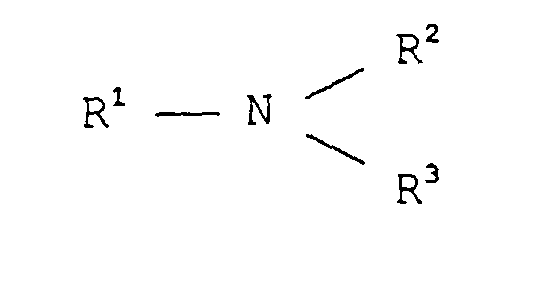
- a low odor polyoxyalkylene polyol according to the present invention comprises polyoxyalkylene polyol with amine added thereto, the amine having at least one amino group represented by the following formula (1): wherein R 1 , R 2 and R 3 independently represent hydrogen atom or an organic group which may contain a hetero atom in which an atom bonded to nitrogen atom is carbon atom.
- the added amount of the above amine to the polyoxyalkylene polyol is generally 10,000 ppm or less.
- R 1 , R 2 and R 3 in the above formula (1) it is preferable that at least one of those is hydrogen atom and at least one of those is an aliphatic hydrocarbon group which may contain hetero atom and/or aromatic group.
- An amine containing at least one primary amino group in which any two of R 1 , R 2 and R 3 are hydrogen atoms is particularly preferable in the present invention.
- an amine containing a single amino group described above i.e., monoamine, is also preferable.
- the amine has preferably a boiling point of 100°C or higher under ordinary pressure.
- the above-described low odor polyoxyalkylene polyol can be obtained by, for example, adding the amine represented by the above formula (1) to polyoxyalkylene polyol obtained by polymerization of oxyalkylene, and heating the resulting mixture under reduced pressure.
- the present invention also provides a low odor urethane prepolymer using the above polyoxyalkylene polyol as a raw material, and a low odor urethane composition containing the urethane prepolymer. Since the amine reacts at the synthesis of the urethane prepolymer, amine derived from the low odor polyoxyalkylene polyol does not remain in the urethane prepolymer and the urethane composition containing the same.
- a low odor polyoxyalkylene polyol according to the present invention comprises polyoxyalkylene polyol with amine added thereto, the amine having a specific structure as will be described later.
- the polyoxyalkylene polyol to which the amine is added includes a wide variety of known polyoxyalkylene polyols, and production conditions thereof such as a polymerization initiator, a catalyst, production raw materials, reaction conditions and the like are not particularly limited. Further, there is no particular limitation on molecular weight of the polyoxyalkylene polyol, type of polymerization, structural unit, polymerization manner and the like. However, polyoxyalkylene polyol having aldehyde odor is normally used.
- the polyoxyalkylene polyol used in the present invention is generally the one obtained by ring opening polymerization of alkylene oxide (epoxide) using an active hydrogen compound as a polymerization initiator.
- a compound containing an ester component may also be used if it has aldehyde odor.
- alkylene oxide examples include ethylene oxide, propylene oxide, butylene oxide, tetramethylene oxide, styrene oxide, cyclohexene oxide, epichlorohydrin, epibromohydrin, methyl glycidyl ether, allyl glycidyl ether and trifluoropropylene oxide.
- the polyoxyalkylene polyol may contain units derived from two or more kinds of the above compounds.
- the polyoxyalkylene polyol preferably used in the present invention contains, of those listed above, units derived from ethylene oxide, propylene oxide, butylene oxide or the combination thereof.
- Examples of the active hydrogen compound includes alcohols, phenol compounds, polyamines and alkanol amines. More specifically, included in examples of the active hydrogen compounds are: monohydric alcohols such as methanol, ethanol or butanols; water; dihydric alcohols such as ethylene glycol, diethylene glycol, propylene glycol, dipropylene glycol, 1,3-propane diol, 1,4-cyclohexane diol, 1,3-butane diol, 1,4-butane diol, pentane diol, neopentyl glycol, 1,6-hexane diol, 1,4-cyclohexane diol or cyclohexane dimethanol; alkanol amines such as monoethanol amine, diethanol amine or triethanol amine; polyhydric alcohols such as glycerin, diglycerin, polyglycerol, trimethylol propane, 1,2,5-hexane triol, penta
- polyol the compounds having two or more hydroxyl groups, of the compounds listed as the active hydrogen compounds in the above may be presented.
- polyoxyalkylene polyol containing ester unit examples include, specifically, polyester polyol, lactone-based polyol and polycarbonate diol.
- Production conditions such as reaction temperature, pressure or reaction time, in producing the polyoxyalkylene polyol are not particularly limited. Further, a crude polyoxyalkylene polyol synthesized may be subjected to a known purification method such as reduced pressure treatment, and may contain a known antioxidant.
- polyoxyalkylene polyol to which the amine is added is appropriately selected in view of the physical properties or the like depending on the use of end products.
- general purpose polyoxyalkylene polyols such as polypropylene polyol (PPG), polyoxyethylene polyol or propylene oxide-ethylene oxide block copolymer are particularly preferable in the present invention.
- Examples of the odorous aldehyde contained in such a polyoxyalkylene polyol normally include low molecular weight aldehydes such as acetoaldehyde or propionaldehyde (propyl aldehyde). It is regarded that commercially available polyoxyalkylene polyol products contain aldehydes generally in an amount of about 5 to 50 ppm.
- the amine added to the polyoxyalkylene polyol is represented by the following formula (1): wherein R 1 , R 2 and R 3 independently represent hydrogen atom or an organic group which may contain a hetero atom in which an atom bonded to nitrogen atom is carbon atom, at least one of R 1 , R 2 and R 3 may represent a divalent group.
- R 1 , R 2 and R 3 are hydrogen atom and at least one of R 1 , R 2 and R 3 is an aliphatic hydrocarbon group that may contain hetero atom and/or aromatic group are preferable.
- An amine having at least one primary amino group in which any two of R 1 , R 2 and R 3 are hydrogen atoms is particularly preferable in the present invention.
- an amine having a single amino group described above i.e., a monoamine, is preferable.
- the amine has preferably a boiling point of 100°C or higher under ordinary pressure.
- Examples of the particularly preferable amine include distearyl amine, steary amine and lauryl amine.
- the amine is added desirably in an amount of 10,000 ppm (wt) or less. Specifically, the amount is generally 10 to 10,000 ppm, preferably 50 to 1,000 ppm.
- Production conditions such as reaction temperature, pressure, reaction time and other additives, in producing the above low odor polyoxyalkylene polyol are not particularly limited. However, it is preferable to add the amine to the polyoxyalkylene polyol previously prepared and then heating the resulting mixture. Stirring is also preferable. For example, it is preferable to add the amine to a polyoxyalkylene polyol obtained by polymerization of oxyalkylene, and then heating the resulting mixture under reduced pressure.
- Reactivity of aldehyde to the amine decreases in the order of primary amine, secondary amine and tertially amine. Therefore, the primary amine is most effective. Further, reactivity of aldehyde to an aliphatic amine is higher than the reactivity of aldehyde to an aromatic amine such as aniline. Therefore, use of the aliphatic amine is more effective.
- the reaction of aldehyde with an amine is accelerated by heating. Further, the reaction forming an imine or an enamine is dehydration reaction. Therefore, if water is present in the reaction system, the reaction may not proceed or the imine or enamine formed may be decomposed to return to the original aldehyde and amine. For this reason, a dehydrating agent such as sodium sulfate, magnesium sulfate, calcium chloride or molecular sieve is added to the reaction system. Odor can be removed more effectively by conducting the reaction while heating under reducing pressure.
- a dehydrating agent such as sodium sulfate, magnesium sulfate, calcium chloride or molecular sieve is added to the reaction system. Odor can be removed more effectively by conducting the reaction while heating under reducing pressure.
- the degree of the reduced pressure is preferably 39.9 kPa (300 mmHg) or lower, more desirably 13.3 kPa (100 mmHg) or lower.
- the reaction temperature is preferably 60 to 140°C, more desirably 80 to 120°C.
- the amine is preferably added after completion of the polymerization of alkylene oxide. More specifically, the amine is preferably added in the state that unreacted alkylene oxide does not remain, or added in an equivalent larger than that of the unreacted alkylene oxide. The reason for this is that if alkylene oxide remains in the reaction system, the amine added reacts with the alkylene oxide, so that primary amine converts into secondary amine or tertiary amine and secondary amine converts into tertiary amine, thereby the ability to remove aldehyde decreases.
- a step of dehydration drying the polyoxyalkylene glycol is involved in producing a urethane prepolymer, and it is economically preferable to add the amine at that time.
- Amount of the odorous low molecular weight aldehyde in the low odor polyoxyalkylene polyol is less as compared with the amount prior to addition of the amine.
- the amount of aldehyde can be measured by a normal instrument analytical method such as head space gas chromatography.
- the amount of the odorous low molecular weight aldehyde contained in the low odor polyoxyalkylene polyol is preferably lower than the detective limit of this analytical method. More specifically, the amount of acetoaldehyde is preferably 0.1 ppm or lower and the amount of propionaldehyde is preferably 0.1 ppm or lower.
- the low odor polyoxyalkylene polyol can be used as it is for a solvent free of offensive odor during or after working, and it can be used as it is for surfactants, hydraulic oils, lubricants, cosmetics, sanitary goods or medical products, or used as a synthetic raw material thereof. Further, the low odor polyoxyalkylene polyol is suitable for use in various synthetic raw materials. For instance, it may be applied to wide range of resins that generally uses a polyoxyalkylene polyol as a raw material.
- the low odor polyoxyalkylene polyol can suitably be used, for example, as a synthetic raw material for polyurethane, such as polymer dispersed polyol, isocyanate group-terminated prepolymer (urethane prepolymer), polyether ester polyol or polyoxyalkylene polyamine, or as a synthetic raw material for a modified silicone resin having polyether skeleton.
- polyurethane such as polymer dispersed polyol, isocyanate group-terminated prepolymer (urethane prepolymer), polyether ester polyol or polyoxyalkylene polyamine, or as a synthetic raw material for a modified silicone resin having polyether skeleton.
- low odor urethane polymer when it is used as a synthetic raw material for a urethane compound such as urethane polymer, low odor urethane polymer can be obtained as well as low odor urethane composition containing the same. This can overcome the odor problem of, for example, low odor urethane foamed material.
- the present invention also provides a urethane composition containing a urethane polymer prepared using the polyoxyalkylene polyol as a raw material.
- the urethane prepolymer can be prepared according to the method of obtaining the urethane prepolymer from general polyol and polyisocyanate.
- the polyoxyalkylene polyol is used as at least a part of the polyol component.
- the polyisocyanate used in the preparation of the urethane prepolymer can be any polyisocyanate so long as it contains two or more isocyanate groups in one molecule, and known aromatic, aliphatic and alicyclic polyisocyanates can be used. In general, diisocyanate is used.
- diisocyanate examples include 2,4-tolylene diisocyanate, 2,6-tolylene diisocyanate and diphenylmethane diisocyanate (MDI) such as 4,4'-diphenylmethane diisocyanate, 2,4'-diphenylmethane diisocyanate or 2,2'-diphenylmethane diisocyanate, toluidine diisocyanate, xylylene diisocyanate, hexamethylene diisocyanate, isophorone diisocyanate, naphthalene diisocyanate, paraphenylene diisocyanate, norbornene diisocyanate, isopropenyl- ⁇ , ⁇ dimethylbenzoyl diisocyanate and tetramethyl xylylene diisocyanate.
- MDI diphenylmethane diisocyanate
- MDI diphenylmethane diisocyanate
- MDI diphenylmethan
- polyoxyalkylene polyol is appropriately selected from the above-described compounds depending on molecular weight, the number of functional group or the like of the desired end product.
- Polyol and polyoxyalkylene polyol may be used by suitably combining two or more thereof.
- the curing agent and/or curing catalyst are appropriately selected from known curing agents and curing catalysts depending on whether the objective composition is one-pack type or two-pack type.
- the amine in the polyoxyalkylene polyol reacts with the polyol together with polyisocyanate in preparing the urethane prepolymer. Therefore, the amine is not present in the form of amine in the urethane composition, and as a result, the amine does not decrease storage stability of the urethane composition regardless of one-pack type or two-pack type.
- the above urethane composition can widely be used in general urethane compositions such as coating materials, sealing materials, adhesives, soft or hard polyurethane foams or polyurethane elastomers, or in molded products thereof. It is especially suitable for use as foamed molded products used in a closed space, as in automotive upholsteries and floor boards. Further, foamed molded product of the urethane composition does not impart odor to clothes or the like, and therefore suitably used as packaging materials for clothes.
- the amount of aldehyde in polyoxyalkylene polyol was measured with a gas chromatograph mass analyzer (GC-MS) using JMS-GCMATE GCMS SYSTEM, manufactured by Nippon Denshi Co.
- GC-MS gas chromatograph mass analyzer
- Odor of polyoxyalkylene polyol and urethane prepolymer was evaluated by sealing a test piece in a metallic container (1 liter), allowing to stand it in an oven at 40°C for 4 hours and evaluating the odor with a functional evaluation (five-grade evaluation) .
- the evaluation results are shown by numerical values.
- the amount of the obtained low odor polyoxyalkylene polyol was measured. The results obtained are shown in Table 1 together with the results of odor test.
- Odor of the polyoxyalkylene polyol was decreased in the same manner as in Example 2 except for using polyoxyalkylene polyol and amine as shown in Table 1.
- a urethane prepolymer was prepared using the polyoxyalkylene polyol. The results obtained are shown in Table 1.
- the polyoxyalkylene polyol provided by the present invention has low aldehyde odor and does-not generate offensive odor, so that odor does not cling after working.
- the present invention can obtain this low odor poloxyyalkylene polyol by a simple process.
- various low odor synthetic products and molded products can be obtained using the low odor polyoxyalkylene polyol as a raw material.
- the polyoxyalkylene polyol according to the present invention is suitably used in products for use in a closed space, such as foamed urethane products for automotive upholsteries.
- it is suitably applicable to a wide range of uses such as coating compositions, sealing materials, adhesives, floor boards, surfactants, hydraulic oils, lubricants, cosmetics, sanitary goods, medical products and the like.
Landscapes
- Chemical & Material Sciences (AREA)
- Health & Medical Sciences (AREA)
- Chemical Kinetics & Catalysis (AREA)
- Medicinal Chemistry (AREA)
- Polymers & Plastics (AREA)
- Organic Chemistry (AREA)
- Inorganic Chemistry (AREA)
- General Chemical & Material Sciences (AREA)
- Polyurethanes Or Polyureas (AREA)
- Polyethers (AREA)
Abstract
Description
- The present invention relates to a low odor polyoxyalkylene polyol, a process for producing the same, and a low odor urethane prepolymer and a low odor urethane composition which use the polyoxyalkylene polyol as their raw materials.
- Polyoxyalkylene polyol such as polypropylene glycol is widely used as a solvent or a synthetic raw material for a polyurethane or a modified silicone resin, but there has conventionally been the problem of its odor. This polyoxyalkylene polyol is generally obtained by ring opening addition polymerization of an alkylene oxide (epoxide) using a polyol such as ethylene glycol, glycerin or sucrose, as a polymerization initiator. However, odor of polyoxyalkylene polyol varies depending on a solvent, a catalyst or the like used in the course of the production. Methods of avoiding odor of polyoxyalkylene polyol when producing the same have conventionally been proposed. For example, a method of using polyoxyalkylene polyol in place of dimethylformamide (DMF) in order to avoid odor of DMF that is used as a solvent for sucrose as a polymerization initiator (Japanese Patent Application Laid-open No. Hei 9(1997)-194588, Japanese Patent Application Laid-open No. Hei 10(1998)-81743, Japanese Patent Application Laid-open No. Hei 10(1998)-81744, etc.) and a method of using a phosphagen compound in order to avoid amine odor when amine is used as a polymerization catalyst (Japanese Patent Application Laid-open No. Hei 10(1998)-36499, Japanese Patent Application Laid-open No. Hei 11(1999)-60721, Japanese Patent Application Laid-open No. Hei 11(1999)-60722, etc.) have been proposed.
- Of the odor of polyoxyalkylene polyol, aldehyde odor is unpleasant when using the polyoxyalkylene polyol, and besides, because of its inherent persistency, offensive odor clings to clothes after working. Further, urethane composition, its molded product, and the like using the polyoxyalkylene polyol also have the offensive odor. In particular, solution is urgently demanded to reduce aldehyde odor for the application in which a foamed urethane product is used in a closed space, as in the case of automotive upholsteries.
- It is known that aldehyde is by-produced by oxidation of alkylene oxide which is a synthetic raw material of polyoxyalkylene polyol, and in some cases the aldehyde may be contained in the raw material alkylene oxide in the order of several to several tens ppm. Further, a method is proposed to suppress formation of aldehyde when producing polyoxyalkylene polyol. For example, it is proposed to use carbonate or bicarbonate of cesium as a polymerization catalyst in order to avoid alkali corrosion of alkylene oxide due to an alkali metal (Japanese Patent Application Laid-Open No. Hei 7(1995)-316284). Furthermore, in the production of polyoxyalkylene polyol using the phosphagen compound as a catalyst, it is proposed to control oxygen density together with addition of an antioxidant at purification in order to suppress formation of aldehyde and peroxide when purifying (vacuum treatment) a crude polyoxyalkylene polyol obtained by polymerization.
- However, most of commercially available polyoxyalkylene polyols still have aldehyde odor.
- The present invention has been made in view of the above prior art, and an object of the present invention is therefore to provide a low odor polyoxyalkylene polyol, a process for producing the low odor polyoxyalkylene polyol and a low odor urethane composition using the low odor polyoxyalkylene polyol as a raw material.
- The object of obtaining a polyoxyalkylene polyol having low aldehyde odor has been achieved by the surprising finding that a low odor polyoxyalkylene polyol is easily obtained by adding an amine having a specific structure to polyoxyalkylene polyol, and that, when this polyoxyalkylene polyol is used as a production raw material, a urethane composition which has low odor and which is not influenced by the amine is obtained. The present invention has been completed based on those findings.
- A low odor polyoxyalkylene polyol according to the present invention comprises polyoxyalkylene polyol with amine added thereto, the amine having at least one amino group represented by the following formula (1):wherein R1, R2 and R3 independently represent hydrogen atom or an organic group which may contain a hetero atom in which an atom bonded to nitrogen atom is carbon atom.

- The added amount of the above amine to the polyoxyalkylene polyol is generally 10,000 ppm or less.
- Of R1, R2 and R3 in the above formula (1), it is preferable that at least one of those is hydrogen atom and at least one of those is an aliphatic hydrocarbon group which may contain hetero atom and/or aromatic group.
- An amine containing at least one primary amino group in which any two of R1, R2 and R3 are hydrogen atoms is particularly preferable in the present invention.
- Further, an amine containing a single amino group described above, i.e., monoamine, is also preferable.
- The amine has preferably a boiling point of 100°C or higher under ordinary pressure.
- The above-described low odor polyoxyalkylene polyol can be obtained by, for example, adding the amine represented by the above formula (1) to polyoxyalkylene polyol obtained by polymerization of oxyalkylene, and heating the resulting mixture under reduced pressure.
- The present invention also provides a low odor urethane prepolymer using the above polyoxyalkylene polyol as a raw material, and a low odor urethane composition containing the urethane prepolymer. Since the amine reacts at the synthesis of the urethane prepolymer, amine derived from the low odor polyoxyalkylene polyol does not remain in the urethane prepolymer and the urethane composition containing the same.
- The present invention is described in detail below.
- A low odor polyoxyalkylene polyol according to the present invention comprises polyoxyalkylene polyol with amine added thereto, the amine having a specific structure as will be described later.
- In the present invention, the polyoxyalkylene polyol to which the amine is added includes a wide variety of known polyoxyalkylene polyols, and production conditions thereof such as a polymerization initiator, a catalyst, production raw materials, reaction conditions and the like are not particularly limited. Further, there is no particular limitation on molecular weight of the polyoxyalkylene polyol, type of polymerization, structural unit, polymerization manner and the like. However, polyoxyalkylene polyol having aldehyde odor is normally used.
- The polyoxyalkylene polyol used in the present invention is generally the one obtained by ring opening polymerization of alkylene oxide (epoxide) using an active hydrogen compound as a polymerization initiator. However, a compound containing an ester component may also be used if it has aldehyde odor.
- Examples of the alkylene oxide include ethylene oxide, propylene oxide, butylene oxide, tetramethylene oxide, styrene oxide, cyclohexene oxide, epichlorohydrin, epibromohydrin, methyl glycidyl ether, allyl glycidyl ether and trifluoropropylene oxide. The polyoxyalkylene polyol may contain units derived from two or more kinds of the above compounds.
- The polyoxyalkylene polyol preferably used in the present invention contains, of those listed above, units derived from ethylene oxide, propylene oxide, butylene oxide or the combination thereof.
- Examples of the active hydrogen compound includes alcohols, phenol compounds, polyamines and alkanol amines. More specifically, included in examples of the active hydrogen compounds are: monohydric alcohols such as methanol, ethanol or butanols; water; dihydric alcohols such as ethylene glycol, diethylene glycol, propylene glycol, dipropylene glycol, 1,3-propane diol, 1,4-cyclohexane diol, 1,3-butane diol, 1,4-butane diol, pentane diol, neopentyl glycol, 1,6-hexane diol, 1,4-cyclohexane diol or cyclohexane dimethanol; alkanol amines such as monoethanol amine, diethanol amine or triethanol amine; polyhydric alcohols such as glycerin, diglycerin, polyglycerol, trimethylol propane, 1,2,5-hexane triol, pentaerythritol, dipentaerythritol or tripehtaerythritol; saccharides or derivatives thereof, such as glycose, sorbitol, dextrose, fluctose, sucrose, α-methyl glucoside and α-hydroxyethyl glucoside; aliphatic amines such as ethylene diamine, di(2-aminoethyl)amine or hexamethylene diamine; aromatic amines such as toluylene diamine, or diphenylmethane diamine; and phenol compounds such as bisphenol A, bisphenol F, bisphenol S, novolak, resole, hydroquinone, resorcin or catechol. Those are used alone or as mixtures of two or more thereof.
- Examples of the ester component which may be contained in the polyoxyalkylene polyol include units derived from polyol and polybasic carboxylic acid such as low molecular weight carboxylic acid (e.g., glutaric acid, adipic acid, azelaic acid, pimelic acid, suberic acid, sebacic acid, terephthalic acid, isophthalic acid, dimer acid) or hydroxy carboxylic acid (e.g., oligomeric acid, castor oil or a reaction product of castor oil and ethylene glycol); and ring opening polymerization units such as propionlactone or valerolactone. Two or more kinds of those units may be contained. As a specific examples of the polyol, the compounds having two or more hydroxyl groups, of the compounds listed as the active hydrogen compounds in the above may be presented.
- Examples of the polyoxyalkylene polyol containing ester unit include, specifically, polyester polyol, lactone-based polyol and polycarbonate diol.
- Production conditions, such as reaction temperature, pressure or reaction time, in producing the polyoxyalkylene polyol are not particularly limited. Further, a crude polyoxyalkylene polyol synthesized may be subjected to a known purification method such as reduced pressure treatment, and may contain a known antioxidant.
- The polyoxyalkylene polyol to which the amine is added is appropriately selected in view of the physical properties or the like depending on the use of end products. Of various polyoxyalkylene polyols, general purpose polyoxyalkylene polyols such as polypropylene polyol (PPG), polyoxyethylene polyol or propylene oxide-ethylene oxide block copolymer are particularly preferable in the present invention.
- Examples of the odorous aldehyde contained in such a polyoxyalkylene polyol normally include low molecular weight aldehydes such as acetoaldehyde or propionaldehyde (propyl aldehyde). It is regarded that commercially available polyoxyalkylene polyol products contain aldehydes generally in an amount of about 5 to 50 ppm.
- The amine added to the polyoxyalkylene polyol is represented by the following formula (1):wherein R1, R2 and R3 independently represent hydrogen atom or an organic group which may contain a hetero atom in which an atom bonded to nitrogen atom is carbon atom, at least one of R1, R2 and R3 may represent a divalent group.
- Examples of the amine represented by the formula (1) are as follows:
- Primary amino group-containing amines such as butyl amine, 1,2-dimethylbutyl amine, hexyl amine, isoamyl amine, 2-octyl amine, aminobutanol, 3-decyloxypropyl amine, 3-methoxypropyl amine, 3-isobutoxypropyl amine, 3-lauryloxypropyl amine, 3-myristyloxypropyl amine, lauryl amine, hexadecyl amine, stearyl amine, oleyl amine, polyoxypropylene amine (trade names: Jefermin D230, D-400 and D-2000, products of Sanseki Texaco Chemical Co.), dimethylaminoethyl amine, ethylaminoethyl amine, diaminopropane, dibutylaminopropyl amine, 2-hydroxyethylaminopropyl amine, bis (3-aminopropyl)ether, diaminobutene, 1,9-nonane diamine, N-aminoethyl piperidine, N-aminopropyl morpholine, iminobispropyl amine, N,N'-bisaminopropyl-1,4-butylene diamine, polyallyl amine;
- secondary amines such as dipropyl amine, dioctyl amine, di(2-ethylhexyl)amine, N-ethyl-isoamyl amine, distearyl amine, N-methylstearyl amine; and
- tertiary amines such as dimethylpalmityl amine, dimethylmyristyl amine, dimethylbehenyl amine, dimethylstearyl amine.
-
- Of the above compounds, compounds in which at least one of R1, R2 and R3 is hydrogen atom and at least one of R1, R2 and R3 is an aliphatic hydrocarbon group that may contain hetero atom and/or aromatic group are preferable.
- An amine having at least one primary amino group in which any two of R1, R2 and R3 are hydrogen atoms is particularly preferable in the present invention.
- Further, an amine having a single amino group described above, i.e., a monoamine, is preferable.
- The amine has preferably a boiling point of 100°C or higher under ordinary pressure.
- Examples of the particularly preferable amine include distearyl amine, steary amine and lauryl amine.
- Use of the above amine makes it possible to deodorize aldehyde odor without newly arising another problem of amine odor due to addition of amine. To attain this effect, the amine is added desirably in an amount of 10,000 ppm (wt) or less. Specifically, the amount is generally 10 to 10,000 ppm, preferably 50 to 1,000 ppm.
- Production conditions such as reaction temperature, pressure, reaction time and other additives, in producing the above low odor polyoxyalkylene polyol are not particularly limited. However, it is preferable to add the amine to the polyoxyalkylene polyol previously prepared and then heating the resulting mixture. Stirring is also preferable. For example, it is preferable to add the amine to a polyoxyalkylene polyol obtained by polymerization of oxyalkylene, and then heating the resulting mixture under reduced pressure.
- Jerry March, "Advanced Organic Chemistry", third edition, pp.796-798, Wiley-Interscience Publication JOHN WILEY & SONS describes the reaction of an amine with aldehyde. As described in the book, it is known that aldehyde is reacted with a primary amine to form an imine, aldehyde is reacted with a secondary amine to form an enamine and aldehyde is reacted with a tertially amine to form a salt. As a result, aldehyde is derived into the above compound having very less odor and thus odor can be suppressed.
- Reactivity of aldehyde to the amine decreases in the order of primary amine, secondary amine and tertially amine. Therefore, the primary amine is most effective. Further, reactivity of aldehyde to an aliphatic amine is higher than the reactivity of aldehyde to an aromatic amine such as aniline. Therefore, use of the aliphatic amine is more effective.
- The reaction of aldehyde with an amine is accelerated by heating. Further, the reaction forming an imine or an enamine is dehydration reaction. Therefore, if water is present in the reaction system, the reaction may not proceed or the imine or enamine formed may be decomposed to return to the original aldehyde and amine. For this reason, a dehydrating agent such as sodium sulfate, magnesium sulfate, calcium chloride or molecular sieve is added to the reaction system. Odor can be removed more effectively by conducting the reaction while heating under reducing pressure.
- The degree of the reduced pressure is preferably 39.9 kPa (300 mmHg) or lower, more desirably 13.3 kPa (100 mmHg) or lower.
- The reaction temperature is preferably 60 to 140°C, more desirably 80 to 120°C.
- The amine is preferably added after completion of the polymerization of alkylene oxide. More specifically, the amine is preferably added in the state that unreacted alkylene oxide does not remain, or added in an equivalent larger than that of the unreacted alkylene oxide. The reason for this is that if alkylene oxide remains in the reaction system, the amine added reacts with the alkylene oxide, so that primary amine converts into secondary amine or tertiary amine and secondary amine converts into tertiary amine, thereby the ability to remove aldehyde decreases.
- In particular, a step of dehydration drying the polyoxyalkylene glycol is involved in producing a urethane prepolymer, and it is economically preferable to add the amine at that time.
- Amount of the odorous low molecular weight aldehyde in the low odor polyoxyalkylene polyol is less as compared with the amount prior to addition of the amine. The amount of aldehyde can be measured by a normal instrument analytical method such as head space gas chromatography. In the present invention, the amount of the odorous low molecular weight aldehyde contained in the low odor polyoxyalkylene polyol is preferably lower than the detective limit of this analytical method. More specifically, the amount of acetoaldehyde is preferably 0.1 ppm or lower and the amount of propionaldehyde is preferably 0.1 ppm or lower.
- The low odor polyoxyalkylene polyol can be used as it is for a solvent free of offensive odor during or after working, and it can be used as it is for surfactants, hydraulic oils, lubricants, cosmetics, sanitary goods or medical products, or used as a synthetic raw material thereof. Further, the low odor polyoxyalkylene polyol is suitable for use in various synthetic raw materials. For instance, it may be applied to wide range of resins that generally uses a polyoxyalkylene polyol as a raw material. The low odor polyoxyalkylene polyol can suitably be used, for example, as a synthetic raw material for polyurethane, such as polymer dispersed polyol, isocyanate group-terminated prepolymer (urethane prepolymer), polyether ester polyol or polyoxyalkylene polyamine, or as a synthetic raw material for a modified silicone resin having polyether skeleton.
- In particular, when it is used as a synthetic raw material for a urethane compound such as urethane polymer, low odor urethane polymer can be obtained as well as low odor urethane composition containing the same. This can overcome the odor problem of, for example, low odor urethane foamed material.
- When the above polyoxyalkylene polyol is used as a raw material, synthetic products having low aldehyde odor can be obtained. Therefore, the present invention also provides a urethane composition containing a urethane polymer prepared using the polyoxyalkylene polyol as a raw material.
- The urethane prepolymer can be prepared according to the method of obtaining the urethane prepolymer from general polyol and polyisocyanate. In this case, there is no particular limitation except that the polyoxyalkylene polyol is used as at least a part of the polyol component.
- The polyisocyanate used in the preparation of the urethane prepolymer can be any polyisocyanate so long as it contains two or more isocyanate groups in one molecule, and known aromatic, aliphatic and alicyclic polyisocyanates can be used. In general, diisocyanate is used. Examples of the diisocyanate include 2,4-tolylene diisocyanate, 2,6-tolylene diisocyanate and diphenylmethane diisocyanate (MDI) such as 4,4'-diphenylmethane diisocyanate, 2,4'-diphenylmethane diisocyanate or 2,2'-diphenylmethane diisocyanate, toluidine diisocyanate, xylylene diisocyanate, hexamethylene diisocyanate, isophorone diisocyanate, naphthalene diisocyanate, paraphenylene diisocyanate, norbornene diisocyanate, isopropenyl-α,α dimethylbenzoyl diisocyanate and tetramethyl xylylene diisocyanate.
- The polyoxyalkylene polyol is appropriately selected from the above-described compounds depending on molecular weight, the number of functional group or the like of the desired end product. Polyol and polyoxyalkylene polyol may be used by suitably combining two or more thereof.
- In forming a urethane composition from the urethane prepolymer and a curing agent and/or a curing catalyst, the curing agent and/or curing catalyst are appropriately selected from known curing agents and curing catalysts depending on whether the objective composition is one-pack type or two-pack type. The amine in the polyoxyalkylene polyol reacts with the polyol together with polyisocyanate in preparing the urethane prepolymer. Therefore, the amine is not present in the form of amine in the urethane composition, and as a result, the amine does not decrease storage stability of the urethane composition regardless of one-pack type or two-pack type.
- The above urethane composition can widely be used in general urethane compositions such as coating materials, sealing materials, adhesives, soft or hard polyurethane foams or polyurethane elastomers, or in molded products thereof. It is especially suitable for use as foamed molded products used in a closed space, as in automotive upholsteries and floor boards. Further, foamed molded product of the urethane composition does not impart odor to clothes or the like, and therefore suitably used as packaging materials for clothes.
- The present invention is described in more detail referring to the following examples, but it should be noted that the invention is not limited thereto.
- In the following examples, the amount of aldehyde in polyoxyalkylene polyol was measured with a gas chromatograph mass analyzer (GC-MS) using JMS-GCMATE GCMS SYSTEM, manufactured by Nippon Denshi Co.
- Odor of polyoxyalkylene polyol and urethane prepolymer was evaluated by sealing a test piece in a metallic container (1 liter), allowing to stand it in an oven at 40°C for 4 hours and evaluating the odor with a functional evaluation (five-grade evaluation) . The evaluation results are shown by numerical values.
- 1: Markedly sensible
- 2: Obviously sensible
- 3: Sensible
- 4: Bearly sensible
- 5: Not sensible at all
-
- The results of measuring the amount of propyl aldehyde in commercially available products of polyoxyalkylene polyol as shown in Table 1 are shown in Table 1 together with the results of odor test.
- MDI was added to polyoxyalkylene polyol such that the index (NCO/OH) was 2, and reaction was conducted at 80°C for 12 hours in the presence of bismuth catalyst. Odor of the urethane prepolymer obtained is shown in Table 1.
- 1,000 g of polyoxyalkylene polyol shown in Reference Example 1 or 2 and amine in an amount shown in Table 1 were placed in a three-necked flask, and mixed with a mechanical stirrer under the treatment conditions shown in Table 1.
- The amount of the obtained low odor polyoxyalkylene polyol was measured. The results obtained are shown in Table 1 together with the results of odor test.
- Using the low odor polyoxyalkylene polyol obtained above, reaction was conducted in the same manner as in the Reference Examples. The results of odor test are shown in Table 1.
- Amine was reacted in the same manner as in Example 1 except for changing a part of the reaction conditions so that the reaction was conducted at 100°C under reduced pressure, thereby decreasing odor of the polyoxyalkylene polyol. A urethane prepolymer was then prepared using the polyoxyalkylene polyol. The results obtained are shown in Table 1.
- Amine was reacted in the same manner as in Example 1 except that the type and amount of the amine used were changed as shown in Table 1, thereby decreasing odor polyoxyalkylene polyol. A urethane prepolymer was prepared using the polyoxyalkylene polyol. The results obtained are shown in Table 1.
- Odor of the polyoxyalkylene polyol was decreased in the same manner as in Example 2 except for using polyoxyalkylene polyol and amine as shown in Table 1. A urethane prepolymer was prepared using the polyoxyalkylene polyol. The results obtained are shown in Table 1.
- The polyoxyalkylene polyol shown in Reference Example 1 or 2 was dried under normal dehydration conditions. The results obtained are shown in Table 1.
- Using the polyoxyalkylene polyol obtained above, reaction was conducted in the same manner as in the Reference Examples. The results of odor test are shown in Table 1.

- As is apparent from the above test results, the commercially available polyoxypropylene glycols obviously have odor of propyl aldehyde. Even when such materials are dried under the general drying conditions (Comparative Examples), though the amount of aldehyde was decreased, difference in the odor is not recognized (when the residual amount of aldehyde is about 10 ppm, it was not felt that its odor reduces). If the polyoxyalkylene glycol is reacted with an amine in the presence of a dehydrating agent as in Example 1, the amount of aldehyde was decreased and its odor also reduced.
- Further, if the reaction is conducted at 100°C under reduced pressure, the odor was considerably suppressed. In the heating reaction under reduced pressure, the effect by amine increases as the boiling point of the amine is higher (Examples 2 and 3). The effect by a primary amine is larger than by a secondary amine (Examples 4 and 5).
- The polyoxyalkylene polyol provided by the present invention has low aldehyde odor and does-not generate offensive odor, so that odor does not cling after working. The present invention can obtain this low odor poloxyyalkylene polyol by a simple process. Further, various low odor synthetic products and molded products can be obtained using the low odor polyoxyalkylene polyol as a raw material. In particular, the polyoxyalkylene polyol according to the present invention is suitably used in products for use in a closed space, such as foamed urethane products for automotive upholsteries. In addition, owing to its low odor, it is suitably applicable to a wide range of uses such as coating compositions, sealing materials, adhesives, floor boards, surfactants, hydraulic oils, lubricants, cosmetics, sanitary goods, medical products and the like.
Claims (8)
- A low odor polyoxyalkylene polyol comprising polyoxyalkylene polyol with amine added thereto, the amine having at least one amino group represented by the following formula (1):wherein R1, R2 and R3 independently represent hydrogen atom or an organic group which may contain a hetero atom in which an atom bonded to nitrogen atom is carbon atom, at least one of R1, R2 and R3 may represent a divalent group.

- The low odor polyoxyalkylene polyol as claimed in claim 1, wherein the amount of the amine added to the polyoxyalkylene polyol is 10,000 ppm or less.
- The low odor polyoxyalkylene polyol as claimed in claim 1 or 2, wherein at least one of R1, R2 and R3 in the formula (1) is hydrogen atom and at least one of R1, R2 and R3 in the formula (1) is an aliphatic hydrocarbon group which may contain hetero atom and/or aromatic group.
- The low odor polyoxyalkylene polyol as claimed in any one of claims 1 to 3, wherein the amine is a monoamine.
- The low odor polyoxyalkylene polyol as claimed in any one of claims 1 to 4, wherein the amine has a boiling point of 100°C or higher under ordinary pressure.
- A process for producing the low odor polyoxyalkylene polyol as claimed in any one of claims 1 to 5, the method comprising adding the amine having at least one amino group represented by the formula (1) to a polyoxyalkylene polyol obtained by polymerization of oxyalkylene, and heating the resulting mixture under reduced pressure.
- A low odor urethane prepolymer obtainable from the polyoxyalkylene polyol as claimed in any one of claims 1 to 5.
- A low odor urethane composition containing the urethane prepolymer as claimed in claim 7.
Applications Claiming Priority (2)
| Application Number | Priority Date | Filing Date | Title |
|---|---|---|---|
| JP11649699 | 1999-04-23 | ||
| JP11649699A JP4545844B2 (en) | 1999-04-23 | 1999-04-23 | Low odor polyoxyalkylene polyol, process for producing the same, and urethane composition |
Publications (2)
| Publication Number | Publication Date |
|---|---|
| EP1046669A1 true EP1046669A1 (en) | 2000-10-25 |
| EP1046669B1 EP1046669B1 (en) | 2004-09-01 |
Family
ID=14688585
Family Applications (1)
| Application Number | Title | Priority Date | Filing Date |
|---|---|---|---|
| EP00108640A Expired - Lifetime EP1046669B1 (en) | 1999-04-23 | 2000-04-20 | Utilisation of amines for the production of a low odor polyoxyalkylene polyol and use of the same in an urethane composition |
Country Status (5)
| Country | Link |
|---|---|
| US (1) | US6723836B1 (en) |
| EP (1) | EP1046669B1 (en) |
| JP (1) | JP4545844B2 (en) |
| KR (1) | KR100585028B1 (en) |
| DE (1) | DE60013350T2 (en) |
Families Citing this family (10)
| Publication number | Priority date | Publication date | Assignee | Title |
|---|---|---|---|---|
| EP1497344B1 (en) * | 2002-04-25 | 2006-06-14 | Neville Chemical Europe B.V. | Improved modifiers for coatings, adhesives or sealants |
| JP4303516B2 (en) * | 2003-04-28 | 2009-07-29 | 三洋化成工業株式会社 | Method for treating alkylene oxide adduct |
| JP4893037B2 (en) * | 2006-03-17 | 2012-03-07 | 東洋インキScホールディングス株式会社 | Resin composition and molded product thereof |
| WO2017058797A1 (en) | 2015-09-28 | 2017-04-06 | Milliken & Company | Composition and method for reducing residual aldehyde content and foul odors of polyols |
| DE102016007994C5 (en) | 2016-06-30 | 2026-03-19 | Bayerische Motoren Werke Aktiengesellschaft | Use of an amine compound |
| JP2018172464A (en) * | 2017-03-31 | 2018-11-08 | 三洋化成工業株式会社 | POLYOL COMPOSITION AND METHOD FOR PRODUCING POLYOL COMPOSITION |
| EP3774977A1 (en) | 2018-03-27 | 2021-02-17 | Milliken & Company | Composition and method for reducing aldehyde content in polyurethane foams |
| DE102019200905A1 (en) * | 2019-01-24 | 2020-07-30 | Fraunhofer-Gesellschaft zur Förderung der angewandten Forschung e.V. | Process for stabilizing halogen-free thermoplastic recycled plastics, plastic composition, stabilizer composition and use of the stabilizer composition |
| JP7601590B2 (en) * | 2020-09-29 | 2024-12-17 | アイカ工業株式会社 | Urethane resin composition |
| US20230416181A1 (en) * | 2020-12-18 | 2023-12-28 | Dow Global Technologies Llc | Oxygenated solvent odorant removal composition |
Citations (4)
| Publication number | Priority date | Publication date | Assignee | Title |
|---|---|---|---|---|
| US3503910A (en) * | 1967-01-05 | 1970-03-31 | Hercules Inc | Elastomeric poly(epihalohydrin) compositions of improved processability |
| GB2147593A (en) * | 1983-10-06 | 1985-05-15 | Basf Wyandotte Corp | Reducing the viscosity of filled liquid polymers |
| EP0538881A2 (en) * | 1991-10-24 | 1993-04-28 | Kanegafuchi Chemical Industry Co., Ltd. | Curable resin composition |
| US5672768A (en) * | 1995-08-18 | 1997-09-30 | Bayer Aktiengesellschaft | Low-odor, higher molecular weight polyether polyols, a process for producing them, and their use for the production of polymers, cosmetics and pharmaceutical products synthesized from polyether polyols |
Family Cites Families (10)
| Publication number | Priority date | Publication date | Assignee | Title |
|---|---|---|---|---|
| US4332936A (en) * | 1978-10-16 | 1982-06-01 | Mobay Chemical Corporation | Method of making polyether polyols from solid hydroxyl containing initiators |
| NZ233358A (en) * | 1989-04-20 | 1991-06-25 | Mitsui Toatsu Chemicals | Preparation of polyether polyols by addition polymerisation of an alkylene oxide to an active hydrogen containing compound using an amine compound catalyst |
| JPH0649167A (en) * | 1990-12-27 | 1994-02-22 | Toyo Kuoritei One:Kk | Method for producing flame-retardant polyurethane foam |
| JPH07316284A (en) | 1994-05-30 | 1995-12-05 | Sanyo Chem Ind Ltd | Production of polyether and polyether composition |
| JP3534546B2 (en) | 1995-09-12 | 2004-06-07 | 三井化学株式会社 | Catalyst for polymerizing alkylene oxide compounds and method for producing polyalkylene oxide |
| JPH09194588A (en) | 1996-01-18 | 1997-07-29 | Mitsui Toatsu Chem Inc | Polyether polyol and method for producing the same |
| JPH1081743A (en) | 1996-09-06 | 1998-03-31 | Mitsui Petrochem Ind Ltd | Method for producing polyether polyol |
| JPH1081744A (en) | 1996-09-09 | 1998-03-31 | Mitsui Petrochem Ind Ltd | Method for producing polyether polyol |
| JP3703262B2 (en) | 1997-08-19 | 2005-10-05 | 三井化学株式会社 | Polyoxyalkylene polyol, flexible polyurethane foam, and method for producing non-foamed polyurethane |
| JP3703263B2 (en) | 1997-08-19 | 2005-10-05 | 三井化学株式会社 | Process for producing polyoxyalkylene polyol |
-
1999
- 1999-04-23 JP JP11649699A patent/JP4545844B2/en not_active Expired - Fee Related
-
2000
- 2000-04-20 DE DE60013350T patent/DE60013350T2/en not_active Expired - Fee Related
- 2000-04-20 EP EP00108640A patent/EP1046669B1/en not_active Expired - Lifetime
- 2000-04-20 US US09/552,886 patent/US6723836B1/en not_active Expired - Fee Related
- 2000-04-21 KR KR1020000021249A patent/KR100585028B1/en not_active Expired - Fee Related
Patent Citations (4)
| Publication number | Priority date | Publication date | Assignee | Title |
|---|---|---|---|---|
| US3503910A (en) * | 1967-01-05 | 1970-03-31 | Hercules Inc | Elastomeric poly(epihalohydrin) compositions of improved processability |
| GB2147593A (en) * | 1983-10-06 | 1985-05-15 | Basf Wyandotte Corp | Reducing the viscosity of filled liquid polymers |
| EP0538881A2 (en) * | 1991-10-24 | 1993-04-28 | Kanegafuchi Chemical Industry Co., Ltd. | Curable resin composition |
| US5672768A (en) * | 1995-08-18 | 1997-09-30 | Bayer Aktiengesellschaft | Low-odor, higher molecular weight polyether polyols, a process for producing them, and their use for the production of polymers, cosmetics and pharmaceutical products synthesized from polyether polyols |
Also Published As
| Publication number | Publication date |
|---|---|
| KR20000071767A (en) | 2000-11-25 |
| EP1046669B1 (en) | 2004-09-01 |
| DE60013350T2 (en) | 2005-09-08 |
| JP2000302862A (en) | 2000-10-31 |
| US6723836B1 (en) | 2004-04-20 |
| KR100585028B1 (en) | 2006-06-01 |
| JP4545844B2 (en) | 2010-09-15 |
| DE60013350D1 (en) | 2004-10-07 |
Similar Documents
| Publication | Publication Date | Title |
|---|---|---|
| JP5254719B2 (en) | Autocatalytic polyol | |
| JP6401059B2 (en) | Amine polyether polyols and polyurethane foam compositions made from cyclic amine compounds | |
| US10793692B2 (en) | Viscoelastic flexible foams comprising hydroxyl-terminated prepolymers | |
| US20060135634A1 (en) | Low amine emission polyurethane foam | |
| EP1046669B1 (en) | Utilisation of amines for the production of a low odor polyoxyalkylene polyol and use of the same in an urethane composition | |
| US6156814A (en) | Amido functional amine catalysts for the production of polyurethanes | |
| EP1714989B1 (en) | Polyurethane foams made with blowing catalyst compositions containing primary hydroxyl groups and high ethylenediamine backbones | |
| JP2015224325A (en) | Catalyst composition for producing polyurethane resin, and method for producing polyurethane resin using the same | |
| JP6891467B2 (en) | A catalyst composition for producing polyurethane foam, and a method for producing a flexible polyurethane foam using the catalyst composition. | |
| JP4432241B2 (en) | Catalyst composition for producing polyurethane resin and method for producing polyurethane resin | |
| BR112014015973B1 (en) | COMPOSITION, POLYURETHANE FOAM AND METHOD FOR PREPARING A POLYURETHANE FOAM | |
| JP5272375B2 (en) | Amine catalyst for producing polyurethane resin and method for producing polyurethane resin using the same | |
| JP2006152281A (en) | Hydroxyalkylated polyalkylene polyamine composition, method for producing the same, and method for producing polyurethane resin using the same | |
| JP4186652B2 (en) | Catalyst composition for producing polyurethane resin and method for producing polyurethane resin | |
| JPH04173826A (en) | Production of polyol for rigid urethane foam and production of foam using the same polyol | |
| MXPA97002462A (en) | Amina reagent catalysts for use in polyuretry polymers | |
| JP2017171863A (en) | Catalyst composition for producing polyurethane resin and method for producing flexible polyurethane foam using the same | |
| MXPA97005467A (en) | Production of flexible polyurethane foams |
Legal Events
| Date | Code | Title | Description |
|---|---|---|---|
| PUAI | Public reference made under article 153(3) epc to a published international application that has entered the european phase |
Free format text: ORIGINAL CODE: 0009012 |
|
| AK | Designated contracting states |
Kind code of ref document: A1 Designated state(s): DE FR GB |
|
| AX | Request for extension of the european patent |
Free format text: AL;LT;LV;MK;RO;SI |
|
| 17P | Request for examination filed |
Effective date: 20010330 |
|
| AKX | Designation fees paid |
Free format text: DE FR GB |
|
| 17Q | First examination report despatched |
Effective date: 20030225 |
|
| GRAP | Despatch of communication of intention to grant a patent |
Free format text: ORIGINAL CODE: EPIDOSNIGR1 |
|
| RTI1 | Title (correction) |
Free format text: UTILISATION OF AMINES FOR THE PRODUCTION OF LOW ODOR POLYOXYALKYLENE POLYOL AND URETHANE COMPOSITION |
|
| GRAS | Grant fee paid |
Free format text: ORIGINAL CODE: EPIDOSNIGR3 |
|
| GRAA | (expected) grant |
Free format text: ORIGINAL CODE: 0009210 |
|
| RTI1 | Title (correction) |
Free format text: UTILISATION OF AMINES FOR THE PRODUCTION OF A LOW ODOR POLYOXYALKYLENE POLYOL AND USE OF THE SAME IN AN URETHANE COMPOSIT |
|
| AK | Designated contracting states |
Kind code of ref document: B1 Designated state(s): DE FR GB |
|
| REG | Reference to a national code |
Ref country code: GB Ref legal event code: FG4D |
|
| REF | Corresponds to: |
Ref document number: 60013350 Country of ref document: DE Date of ref document: 20041007 Kind code of ref document: P |
|
| ET | Fr: translation filed | ||
| PLBE | No opposition filed within time limit |
Free format text: ORIGINAL CODE: 0009261 |
|
| STAA | Information on the status of an ep patent application or granted ep patent |
Free format text: STATUS: NO OPPOSITION FILED WITHIN TIME LIMIT |
|
| 26N | No opposition filed |
Effective date: 20050602 |
|
| PGFP | Annual fee paid to national office [announced via postgrant information from national office to epo] |
Ref country code: FR Payment date: 20060410 Year of fee payment: 7 |
|
| PGFP | Annual fee paid to national office [announced via postgrant information from national office to epo] |
Ref country code: DE Payment date: 20060413 Year of fee payment: 7 |
|
| PGFP | Annual fee paid to national office [announced via postgrant information from national office to epo] |
Ref country code: GB Payment date: 20060419 Year of fee payment: 7 |
|
| GBPC | Gb: european patent ceased through non-payment of renewal fee |
Effective date: 20070420 |
|
| PG25 | Lapsed in a contracting state [announced via postgrant information from national office to epo] |
Ref country code: DE Free format text: LAPSE BECAUSE OF NON-PAYMENT OF DUE FEES Effective date: 20071101 |
|
| PG25 | Lapsed in a contracting state [announced via postgrant information from national office to epo] |
Ref country code: GB Free format text: LAPSE BECAUSE OF NON-PAYMENT OF DUE FEES Effective date: 20070420 |
|
| PG25 | Lapsed in a contracting state [announced via postgrant information from national office to epo] |
Ref country code: FR Free format text: LAPSE BECAUSE OF NON-PAYMENT OF DUE FEES Effective date: 20070430 |