EP1045343A2 - Rendering system - Google Patents
Rendering system Download PDFInfo
- Publication number
- EP1045343A2 EP1045343A2 EP00303108A EP00303108A EP1045343A2 EP 1045343 A2 EP1045343 A2 EP 1045343A2 EP 00303108 A EP00303108 A EP 00303108A EP 00303108 A EP00303108 A EP 00303108A EP 1045343 A2 EP1045343 A2 EP 1045343A2
- Authority
- EP
- European Patent Office
- Prior art keywords
- rendering
- color
- colors
- full
- mode
- Prior art date
- Legal status (The legal status is an assumption and is not a legal conclusion. Google has not performed a legal analysis and makes no representation as to the accuracy of the status listed.)
- Granted
Links
Images


Classifications
-
- G—PHYSICS
- G06—COMPUTING OR CALCULATING; COUNTING
- G06T—IMAGE DATA PROCESSING OR GENERATION, IN GENERAL
- G06T11/00—Two-dimensional [2D] image generation
- G06T11/10—Texturing; Colouring; Generation of textures or colours
Definitions
- the present invention relates to a rendering system for handling graphical images in a color environment using, for example, 256 colors and 16 colors.
- the invention also relates to a medium for recording the rendering system.
- the invention relates to a rendering method for handling graphical images in a subtractive-color environment using 256 colors and 16 colors that are based on, for example, red, green, and blue (so-called RGB).
- CMYK cyan, magenta, yellow, and black
- Various rendering systems as described above include those that handles full colors, and in addition, various simple systems that are used in a subtractive-color environment that uses RGB-based 256 and 16 colors.
- the rendering system used in the aforementioned subtractive environment basically, required colors are set using a device for storing colors, such as a palette, and desired colors are selected therefrom and used for rendering.
- desired colors are selected therefrom and used for rendering.
- operations that are simply executable with a single color or two colors that are selected for most rendering operations are included, but there is nothing more than that. Therefore, the system produces a problem in that the selection range for desired colors is narrow.
- an object of the present invention is to provide a rendering system that improves the existing rendering system that can be implemented only in the full-color environment so as to be executable also in the subtractive-color environment.
- Another object of the present invention is to provide a rendering system with which the operation for storing colors in the device for storing colors such as that used in the described existing rendering system can be omitted.
- Another object of the present invention is to provide a medium for recording the described rendering system.
- Another object of the present invention is to provide a rendering method that can be used in the subtractive-color environment.
- the rendering system of the present invention is mainly used in a subtractive-color environment that uses, for example, RGB-based 256 colors and 16 colors. Particularly, the present invention mainly handles two-dimensional graphical images in the subtractive-color environment.
- the present invention has a device for storing colors (which may also be referred to as a color-storing device, hereinbelow), an automatic-retrieving mode for colors stored in the aforementioned device, and a rendering mode that automatically retrieves colors and is selected by the user as required.
- a device for storing colors which may also be referred to as a color-storing device, hereinbelow
- an automatic-retrieving mode for colors stored in the aforementioned device a rendering mode that automatically retrieves colors and is selected by the user as required.
- the color-storing device of the present invention is, for example, a palette.
- the palette of the invention refers to a region that stores colors used for rendering of graphical images. Selecting a color stored in the color-storing device specifies information on the graphical-images to be rendered.
- the subtractive-color environment is not restricted to an environment solely composed of RGB-color information, but it includes semitransparent information alpha.
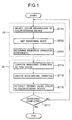
- FIG. 1 is a flowchart showing steps of rendering that is performed by the rendering system of the present invention.
- operations can be grouped into two operation ranges, one is an operation range 10 for steps (ST11 to ST13) that a person performs, and the other is an operation range 20 for steps (ST14 to ST16) for steps that the rendering system performs.
- a desired color is selected as color information.
- the color may be selected from the color-storing device (such as a palette) according to a conventional method, that is, method in which, for example, an RGB value is inputted using a number; a method in which an optional color is selected from full-color gradation; and a method in which a desired color is selected from color examples.
- step 12 the user sets the rendering mode.
- the rendering mode of the present invention allows specification of methods for selecting the color, for storing the color in the color-storing device, and for using the color for rendering according to the color having the aforementioned full-color information.
- the rendering mode set in this step is implemented in step 15 (ST15) described below.
- the rendering mode is selected as desired by the user, thereby enabling rendering that can be performed only in the full-color environment to be implemented.
- Step 13 determines, for example, rendering operations and positions. This step performs rendering operations for actually forming a graphical image, including operations for determining positions, for example, the starting point and the terminal point when a rectangle or a line is rendered using a pen tool.
- step 14 the rendering system of the present invention computes the rendering operations in step ST13 by handling them as full-color information.
- the present invention mainly handles graphical images in the subtractive-color environment that uses, for example, the RGB-based 256 colors or 16 colors, however, internal computation is performed in the full-color environment. There is no restriction to the computation method. A conventional method may be employed.
- Step 15 executes the rendering mode selected in step 12 according to the full-color information obtained in step 14.
- the rendering mode of the present invention allows specification of methods for selecting a color, storing the color in the color-storing device, and using the color for rendering according to the color having the aforementioned full-color information.
- step 12 there are three types of the rendering modes.
- the rendering system of the present invention when the color according to the full-color information obtained as a result of step 14 already is preset in the color-storing device, the color is used, and rendering is implemented; when the color according to the full-color information is preset therein, the color that is most suitable to the color according to the full-color information selected by the user in ST12 is stored, and the color is used, and rendering is performed thereby.
- the rendering mode will be explained referring to Figs.2,3 hereinafter.
- the color is stored in the color-storing device when the color appropriate to the color according to the full-color information is obtained.
- the color need not be always stored at the described time.
- the color information may be stored in a storage medium such as a memory, thereby storing it at a stage of rendering the graphical image.
- it may be arranged such that the information is stored automatically at a later stage.
- step 16 the color is selected from the color-storing device in which the color is stored in the aforementioned ST15, and rendering is actually performed.
- step 17 determines termination of rendering; when further rendering is performed, processing returns to ST11, and the operations from ST11 to ST16 are repeated. On the other hand, when rendering is terminated (when "Yes" in ST17), the rendering operation is terminated.
- the rendering system of the present invention even in the subtractive-color environment, the rendering operation that is performed only in the full-color environment can be executed.
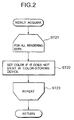
- FIGS. 2 and 3 are explanatory regarding the two modes “newly acquire” and “use approximate color” mentioned in ST12 as examples.
- other modes can also be specified.
- FIG. 2 is a flowchart of operations in the "newly acquire” rendering mode.
- the "newly acquire” mode allows determination as to whether or not a color that has the full-color information on a dot to be rendered, which has been computed out in ST14, is preset in the color-storing device of the rendering system. The detection can be automatically implemented.
- step 22 if the color that has the computed full-color information on a dot is not preset in the color-storing device, the color is retrieved. Operations in step 21 (ST21) to step 23 (ST23) are repeated for all dots that will be rendered, necessary colors are set in the color-storing device, and the mode-specific operation terminates.
- retrieval operations for colors for all the dots to be rendered are presented as in the cases of step 21 (ST21) to step 23 (ST23) in FIG. 2.
- This mode also allows determination as to whether or not a color that has the full-color information on a rendering dot, which has been computed out in ST14, is preset (step 32 (ST32)).
- the detection can be automatically implemented.
- step 31 (ST31) to step 35 (ST35) are performed for all the rendering dots, thereby, necessary colors are selected from the color-storing device, and the mode-specific operation terminates.
- the present invention allows a rendering mode to be composed by combining a plurality of the rendering modes as described above. Therefore, other rendering modes can be used, and also, modes different from the above can be combined to compose various rendering modes.
- the color-storing device in the rendering system of the present invention may be, for example, a device in which colors are prearranged. In this case, it may be arranged such that colors are automatically retrieved when colors are selected according to the rendering mode and the full-color information in step 14 of the present invention. According to this arrangement, the operation for retrieving colors and setting in the color-storing device is reduced, thereby allowing the user to perform the rendering operation unconsciously of the color-storing device. There is no specific restriction to the color-storing device.
- FIG. 4 is an overall view of one mode of the rendering system according to the present invention. However, it is just an example, therefore, the present invention is not restricted thereto. Also, the rendering system in FIG. 4 is used in, for example, the subtractive-color environment that uses RGB-based 256 or 16 colors; particularly, it handles two-dimensional graphical images.
- a rendering system 41 of the present invention is configured of a rendering-operation tool 42 composed of rendering tools, such as a pen tool, a brush tool, a rectangle-ellipse-rendering tool, and a tool for magnifying and reducing line-drawn images; a palette 43, that is, a device for storing colors; a rendering region 44 where line-drawings, figures, and the like, are rendered; an RGB-input tool 45 for inputting an RGB ratio in a color; a full-color gradation tool 46 that allows an optional color to be selected from full-color gradations; a rendering-mode-selecting device 47 of the present invention; and color examples 48.
- the RGB-input tool 45 allows input using slide bars, and in addition, allows direct input of numerical values for specification of colors.
- a color for a graphical image to be rendered is selected.
- the color has the full-color information, and, regardless of colors preset in the palette 43, the color necessary for rendering is selected from one of the RGB-input tool 45, a full-color gradation tool 46, and color examples 48 so as to be used as full-color information.
- the color may be selected from the palette 43 as full-color information.
- the color that has the full-color information may be selected either by adjusting a slide bar with the RGB-input tool 45 so as to obtain the full-color information or by carrying out direct type-in input of a desired RGB value.
- the color may be selected from the full-color gradation tool 46 that has the full-color information by using an input device such as a pointing device to input the selected color. Also, when the desired color having full-color information is preset in the color examples 48, the desired color may be selected by using an input device such as the pointing device to input the color.
- a rendering mode that the user of the rendering system desires is selected from the rendering-mode-selecting device 47. For example, one of the described the "newly acquire” rendering mode, the “use approximate color” rendering mode, and the “non-rendering” mode is selected.
- a rendering tool such as, a pen tool, a brush tool, and a rectangle/ellipse-rendering tool
- a graphical image is inputted.
- This step includes a case where straight lines, rectangles/ellipses, and the like, are rendered, and in addition, a case where a prerendered figure is colored as in a case where gradation is applied between two points specified.
- the color for the graphical image which has been created in the rendering operation is computed as full-color information. According to the full-color information obtained in this step, the color to be rendered is selected.
- the rendering mode here is the one that has been selected by the rendering-mode-selecting device 47, as described above.
- the rendering-mode-specific operation sets the color, which is actually rendered, in the palette 43.
- a color to be used to render a graphical image is selected from colors set in the palette 43.
- the rendering system of this invention is used to render graphical images in the subtractive-color environment that uses, for example, the RGB-based 256 colors or 16 colors. Accordingly, all of the full colors cannot be displayed, while restricted number of colors of the full colors (for example, the RGB-based 256 or 16 colors) can be displayed. Therefore, according to the aforementioned full-color information, a color that is usable for presentation is set in the palette 43, the color for the graphical image is selected from the palette 43, and the graphical image is rendered using the colors.
- the "newly acquire” rendering mode selected when a color according to the full-color information is not preset in the palette 43, a new color according to the full-color information is set in the palette 43, and the color is selected.
- the "use approximate color” mode selected when a color according to the full-color information is not preset in the palette 43, a color that is most similar to the color is selected from colors in the palette 43.
- the color is selected.
- the graphical image is actually rendered in the rendering region 44 by using the color in the palette 43.
- the color can be automatically retrieved into or stored in the palette 43 during processing of the rendering mode and during rendering in the rendering region 44.
- time required for the user to select each color could be saved.
- user-specific retrieval of colors into the palette 43 can be implemented in a retrieval mode specified by the user (for example, a mode specified using a script).
- colors preset in the palette 43 can be deleted as required.
- a portion of the color to be deleted is selected by using an input device, such as a pointing device, and then, a deletion operation like a deletion command is executed.
- colors can be automatically deleted in the order specified by the user.
- colors can be deleted according to an optional deletion algorithm. Accordingly, the rendering system 41 can handle the number of colors, which is larger than the number of colors preset in the palette 43.
- FIG. 5 shows examples in which gradation is applied to a predetermined graphical image.
- FIG. 5A shows a rendering result of a case where gradation from a yellow color to an orange color is applied to the lower half of the triangle portion of the graphical image when the "newly acquire” rendering mode is selected.
- FIG. 5B shows a rendering result of a case where gradation from the yellow color to the orange color is applied to the lower half of the triangle portion when the "use approximate color” mode is selected.
- the present invention also provides a medium for recording the above-described rendering system.
- Examples of the medium include information storage media including a floppy disk (FD), a magnetic storage medium such as a magnetic tape, a magneto-optical storage medium such as an MO, an optical storage medium such as a CD-ROM, a read-only memory (ROM), and a flash memory.
- FD floppy disk
- MO magneto-optical storage medium
- MO magneto-optical storage medium
- CD-ROM compact disc-read-only memory
- ROM read-only memory
- flash memory any medium that has capacity of recording the above-described rendering system can be used.
- the present invention provides a rendering method that uses the above-described rendering system.
- the rendering method has steps of selecting colors from full-color information; setting a rendering mode for selection, storage, and use of the colors according to the full-color information; determining rendering operations for forming graphical images in a rendering region; computing the aforementioned rendering operations as full-color information; executing the aforementioned rendering mode using the full-color information obtained as a result of the computation; and implementing rendering.
Landscapes
- Physics & Mathematics (AREA)
- General Physics & Mathematics (AREA)
- Engineering & Computer Science (AREA)
- Theoretical Computer Science (AREA)
- Image Generation (AREA)
- Processing Or Creating Images (AREA)
- Color Image Communication Systems (AREA)
- Controls And Circuits For Display Device (AREA)
Abstract
Description
Claims (25)
- A rendering system for rendering colored graphical images in a subtractive-color environment, characterized by comprising a full-color-information acquisition device, a color-storing device, a rendering mode, and a rendering device for the colored graphical images, wherein colors are stored in said color-storing device according to the rendering mode and full-color information for the graphical images which was obtained by said full-color-information acquisition device, and the colored graphical images are rendered by using said colors stored and said rendering device.
- The rendering system as stated in claim 1, wherein said rendering mode is one of a mode for selecting new colors and a mode for approximating with colors existing in said color-scoring device.
- The rendering system as stated in claim 3, wherein said color-storing device is a palette.
- The rendering system as stated in claim 1, wherein one of a 256-color palette and a 16-color palette is used.
- The rendering system as stated in claim 1, a rendering object is a two-dimensional graphical image.
- A rendering method for use in a subtractive-color environment and using a rendering system that comprises a full-color-information acquisition device, a color-storing device, a rendering mode, and a rendering device for colored graphical images, characterized by comprising:step of storing colors in said color-storing device according to the rendering mode and full-color information for the graphical images which was obtained by said full-color-information acquisition device, andstep of rendering the colored graphical images by using said colors stored and said rendering device.
- The rendering method as stated in claim 6, wherein said rendering mode is one of a mode for selecting new colors and a mode for approximating with colors existing in said color-storing device.
- The rendering method as stated in claim 6, wherein said color-storing device is a palette.
- The rendering method as stated in claim 8, wherein one of a 256-color palette and a 16-color palette is used.
- The rendering method as stated in claim 6, a rendering object is a two-dimensional graphical image.
- A rendering method for rendering full-color graphical images in a subtractive-color environment, comprising steps of:selecting colors from full-color information;setting a rendering mode for selection, storage, and use of the colors according to said full-color information;determining rendering operations for forming the graphical images in a rendering region;computing said rendering operations as full-color information;executing said rendering mode by using the full-color information obtained as a result of the computation; andimplementing rendering.
- The rendering method as stated in claim 11, wherein said rendering mode is one of a mode for selecting new colors and a mode for approximating with colors existing in said color-storing device.
- The rendering method as stated in claim 11, wherein said subtractive-color environment uses either 256 colors or 16 colors.
- The rendering method as stated in claim 11, a rendering object is a two-dimensional graphical image.
- A storage medium for storing a program that allows a computer to read and execute a rendering method according to a rendering system that is used in a subtractive-color environment and comprises a full-color-information acquisition device, a color-storing device, a rendering mode, and a rendering device for colored graphical images, said program comprising:step of storing colors in said color-storing device according to the rendering mode and full-color information for the graphical images which was obtained by said full-color-information acquisition device, andstep of rendering the colored graphical images by using said colors stored and said rendering device.
- The storage medium as stated in claim 15, wherein said rendering mode is one of a mode for selecting new colors and a mode for approximating with colors existing in said color-storing device.
- The storage medium as stated in claim 15, wherein said color-storing device is a palette.
- The storage medium as stated in claim 17, wherein one of a 256-color palette and a 16-color palette is used.
- The storage medium as stated in claim 15, a rendering object is a two-dimensional graphical image.
- A storage medium for storing a program that allows a computer to read and execute a rendering method for rendering graphical images similar to full-color graphical images in a subtractive-color emvironment, said program comprising:selecting colors from full-color information;setting a rendering mode for selection, storage, and use of the colors according to said full-color information;determining rendering operations for forming the graphical images in a rendering region;computing said rendering operations as full-color information;executing said rendering mode by using the full-color information obtained as a result of the computation; andimplementing rendering.
- The storage medium as stated in claim 20, wherein said rendering mode is one of a mode for selecting new colors and a mode for approximating with colors existing in said color-storing device.
- The storage medium as stated in claim 20, wherein one of a 256-color palette and a 16-color palette is used.
- The storage medium as stated in claim 20, a rendering object is a two-dimensional graphical image.
- A rendering-display pattern for displaying a rendering region and a palette in a subtractive-color environment, comprising at least one of an RGB input tool for inputting RGB color ratios and a gradation tool for selecting colors from a full-color gradation.
- A rendering-display pattern as stated in claim 24, further comprising a rendering-mode-selection display.
Applications Claiming Priority (2)
| Application Number | Priority Date | Filing Date | Title |
|---|---|---|---|
| JP11106676A JP2000298465A (en) | 1999-04-14 | 1999-04-14 | Drawing system, medium recording the system, and drawing method using the system |
| JP10667699 | 1999-04-14 |
Publications (3)
| Publication Number | Publication Date |
|---|---|
| EP1045343A2 true EP1045343A2 (en) | 2000-10-18 |
| EP1045343A3 EP1045343A3 (en) | 2001-10-31 |
| EP1045343B1 EP1045343B1 (en) | 2006-08-02 |
Family
ID=14439684
Family Applications (1)
| Application Number | Title | Priority Date | Filing Date |
|---|---|---|---|
| EP00303108A Expired - Lifetime EP1045343B1 (en) | 1999-04-14 | 2000-04-13 | Rendering system |
Country Status (3)
| Country | Link |
|---|---|
| EP (1) | EP1045343B1 (en) |
| JP (1) | JP2000298465A (en) |
| DE (1) | DE60029669D1 (en) |
Families Citing this family (1)
| Publication number | Priority date | Publication date | Assignee | Title |
|---|---|---|---|---|
| KR20120001639A (en) | 2010-06-29 | 2012-01-04 | 주식회사 나노브릭 | Surface marking method and device |
Family Cites Families (5)
| Publication number | Priority date | Publication date | Assignee | Title |
|---|---|---|---|---|
| JPS62195982A (en) * | 1986-02-24 | 1987-08-29 | Konishiroku Photo Ind Co Ltd | Compression method and reproduction method for color picture data |
| US5218671A (en) * | 1989-05-31 | 1993-06-08 | Computer Design, Inc. | Image color correction system and method |
| US5003494A (en) * | 1989-12-18 | 1991-03-26 | Eastman Kodak Company | Data storage system for an electronic color printer |
| US5341464A (en) * | 1992-12-23 | 1994-08-23 | Microsoft Corporation | Luminance emphasized color image rendering |
| JP3630835B2 (en) * | 1996-04-02 | 2005-03-23 | キヤノン株式会社 | Image processing method |
-
1999
- 1999-04-14 JP JP11106676A patent/JP2000298465A/en active Pending
-
2000
- 2000-04-13 DE DE60029669T patent/DE60029669D1/en not_active Expired - Lifetime
- 2000-04-13 EP EP00303108A patent/EP1045343B1/en not_active Expired - Lifetime
Also Published As
| Publication number | Publication date |
|---|---|
| EP1045343B1 (en) | 2006-08-02 |
| DE60029669D1 (en) | 2006-09-14 |
| JP2000298465A (en) | 2000-10-24 |
| EP1045343A3 (en) | 2001-10-31 |
Similar Documents
| Publication | Publication Date | Title |
|---|---|---|
| US5249263A (en) | Color palette display interface for a computer-based image editor | |
| EP0680018B1 (en) | Computer-aided color selection and colorizing system | |
| US8274696B2 (en) | Color table editing apparatus, color table editing method, program, and storage medium | |
| Martin et al. | High-dimensional brushing for interactive exploration of multivariate data. | |
| US6021221A (en) | Image processing apparatus | |
| EP0849707B1 (en) | Image creating apparatus | |
| JP3895492B2 (en) | Image processing apparatus, image processing method, and computer-readable recording medium storing program for causing computer to execute the method | |
| EP0183539B1 (en) | Colour graphics data processing apparatus | |
| EP0684584B1 (en) | Objective-based color selection system | |
| EP1085464B1 (en) | Method for automatic text placement in digital images | |
| US8013869B2 (en) | Color selection interface | |
| EP0384879A2 (en) | Apparatus and method for color selection | |
| US20040001072A1 (en) | In-gamut color picker | |
| US20040240729A1 (en) | Secondary color modification of a digital image | |
| KR100633144B1 (en) | Color management method and color management device applying the same | |
| US6266611B1 (en) | Image processing method and apparatus and storing medium | |
| EP1045343B1 (en) | Rendering system | |
| US6184895B1 (en) | Method and system for using color information to create special effects | |
| US7266241B2 (en) | Secondary color modification of a digital image | |
| JP3726413B2 (en) | Image processing apparatus and recording medium | |
| KR100368345B1 (en) | Image display apparatus and image display method | |
| JP3360948B2 (en) | Document processing apparatus and document processing method | |
| JP2004152315A (en) | IMAGE PROCESSING DEVICE, IMAGE PROCESSING METHOD, AND COMPUTER-READABLE RECORDING MEDIUM RECORDING PROGRAM FOR CAUSING COMPUTER TO EXECUTE THE METHOD | |
| JP2002502526A (en) | A method for displaying and navigating within a larger file containing graphic elements and for compressing a file containing text and graphic or image information | |
| JP3403679B2 (en) | Geographic information system and its program recording medium |
Legal Events
| Date | Code | Title | Description |
|---|---|---|---|
| PUAI | Public reference made under article 153(3) epc to a published international application that has entered the european phase |
Free format text: ORIGINAL CODE: 0009012 |
|
| AK | Designated contracting states |
Kind code of ref document: A2 Designated state(s): DE ES FR GB IT Kind code of ref document: A2 Designated state(s): AT BE CH CY DE DK ES FI FR GB GR IE IT LI LU MC NL PT SE |
|
| AX | Request for extension of the european patent |
Free format text: AL;LT;LV;MK;RO;SI |
|
| PUAL | Search report despatched |
Free format text: ORIGINAL CODE: 0009013 |
|
| AK | Designated contracting states |
Kind code of ref document: A3 Designated state(s): AT BE CH CY DE DK ES FI FR GB GR IE IT LI LU MC NL PT SE |
|
| AX | Request for extension of the european patent |
Free format text: AL;LT;LV;MK;RO;SI |
|
| 17P | Request for examination filed |
Effective date: 20020425 |
|
| AKX | Designation fees paid |
Free format text: DE ES FR GB IT |
|
| 17Q | First examination report despatched |
Effective date: 20040203 |
|
| GRAP | Despatch of communication of intention to grant a patent |
Free format text: ORIGINAL CODE: EPIDOSNIGR1 |
|
| GRAS | Grant fee paid |
Free format text: ORIGINAL CODE: EPIDOSNIGR3 |
|
| GRAA | (expected) grant |
Free format text: ORIGINAL CODE: 0009210 |
|
| AK | Designated contracting states |
Kind code of ref document: B1 Designated state(s): DE ES FR GB IT |
|
| PG25 | Lapsed in a contracting state [announced via postgrant information from national office to epo] |
Ref country code: IT Free format text: LAPSE BECAUSE OF FAILURE TO SUBMIT A TRANSLATION OF THE DESCRIPTION OR TO PAY THE FEE WITHIN THE PRESCRIBED TIME-LIMIT;WARNING: LAPSES OF ITALIAN PATENTS WITH EFFECTIVE DATE BEFORE 2007 MAY HAVE OCCURRED AT ANY TIME BEFORE 2007. THE CORRECT EFFECTIVE DATE MAY BE DIFFERENT FROM THE ONE RECORDED. Effective date: 20060802 |
|
| REG | Reference to a national code |
Ref country code: GB Ref legal event code: FG4D |
|
| REF | Corresponds to: |
Ref document number: 60029669 Country of ref document: DE Date of ref document: 20060914 Kind code of ref document: P |
|
| PG25 | Lapsed in a contracting state [announced via postgrant information from national office to epo] |
Ref country code: DE Free format text: LAPSE BECAUSE OF FAILURE TO SUBMIT A TRANSLATION OF THE DESCRIPTION OR TO PAY THE FEE WITHIN THE PRESCRIBED TIME-LIMIT Effective date: 20061103 |
|
| PG25 | Lapsed in a contracting state [announced via postgrant information from national office to epo] |
Ref country code: ES Free format text: LAPSE BECAUSE OF FAILURE TO SUBMIT A TRANSLATION OF THE DESCRIPTION OR TO PAY THE FEE WITHIN THE PRESCRIBED TIME-LIMIT Effective date: 20061113 |
|
| EN | Fr: translation not filed | ||
| PLBE | No opposition filed within time limit |
Free format text: ORIGINAL CODE: 0009261 |
|
| STAA | Information on the status of an ep patent application or granted ep patent |
Free format text: STATUS: NO OPPOSITION FILED WITHIN TIME LIMIT |
|
| 26N | No opposition filed |
Effective date: 20070503 |
|
| PG25 | Lapsed in a contracting state [announced via postgrant information from national office to epo] |
Ref country code: FR Free format text: LAPSE BECAUSE OF FAILURE TO SUBMIT A TRANSLATION OF THE DESCRIPTION OR TO PAY THE FEE WITHIN THE PRESCRIBED TIME-LIMIT Effective date: 20070511 |
|
| PG25 | Lapsed in a contracting state [announced via postgrant information from national office to epo] |
Ref country code: FR Free format text: LAPSE BECAUSE OF FAILURE TO SUBMIT A TRANSLATION OF THE DESCRIPTION OR TO PAY THE FEE WITHIN THE PRESCRIBED TIME-LIMIT Effective date: 20060802 |
|
| PGFP | Annual fee paid to national office [announced via postgrant information from national office to epo] |
Ref country code: GB Payment date: 20120411 Year of fee payment: 13 |
|
| GBPC | Gb: european patent ceased through non-payment of renewal fee |
Effective date: 20130413 |
|
| PG25 | Lapsed in a contracting state [announced via postgrant information from national office to epo] |
Ref country code: GB Free format text: LAPSE BECAUSE OF NON-PAYMENT OF DUE FEES Effective date: 20130413 |