EP1044616A2 - Acrylic resin glove and internal surface treating agent thereof - Google Patents
Acrylic resin glove and internal surface treating agent thereof Download PDFInfo
- Publication number
- EP1044616A2 EP1044616A2 EP00107906A EP00107906A EP1044616A2 EP 1044616 A2 EP1044616 A2 EP 1044616A2 EP 00107906 A EP00107906 A EP 00107906A EP 00107906 A EP00107906 A EP 00107906A EP 1044616 A2 EP1044616 A2 EP 1044616A2
- Authority
- EP
- European Patent Office
- Prior art keywords
- acrylic resin
- glove
- treating agent
- weight
- surface treating
- Prior art date
- Legal status (The legal status is an assumption and is not a legal conclusion. Google has not performed a legal analysis and makes no representation as to the accuracy of the status listed.)
- Granted
Links
- 239000004925 Acrylic resin Substances 0.000 title claims abstract description 206
- 229920000178 Acrylic resin Polymers 0.000 title claims abstract description 206
- 239000003795 chemical substances by application Substances 0.000 title claims abstract description 103
- 239000000839 emulsion Substances 0.000 claims abstract description 105
- 229920005989 resin Polymers 0.000 claims abstract description 89
- 239000011347 resin Substances 0.000 claims abstract description 89
- 239000012766 organic filler Substances 0.000 claims abstract description 32
- 239000002245 particle Substances 0.000 claims abstract description 19
- 239000011859 microparticle Substances 0.000 claims abstract description 18
- 239000011324 bead Substances 0.000 claims abstract description 6
- 239000001913 cellulose Substances 0.000 claims abstract description 6
- 229920002678 cellulose Polymers 0.000 claims abstract description 6
- 239000003431 cross linking reagent Substances 0.000 claims description 68
- XLOMVQKBTHCTTD-UHFFFAOYSA-N Zinc monoxide Chemical compound [Zn]=O XLOMVQKBTHCTTD-UHFFFAOYSA-N 0.000 claims description 26
- 239000011787 zinc oxide Substances 0.000 claims description 26
- 235000014692 zinc oxide Nutrition 0.000 claims description 26
- 239000007787 solid Substances 0.000 claims description 25
- 230000001235 sensitizing effect Effects 0.000 claims description 24
- 239000003599 detergent Substances 0.000 claims description 19
- 230000014759 maintenance of location Effects 0.000 claims description 18
- 238000000034 method Methods 0.000 claims description 15
- 238000009864 tensile test Methods 0.000 claims description 10
- 238000012360 testing method Methods 0.000 claims description 8
- 238000005406 washing Methods 0.000 abstract description 10
- 230000000052 comparative effect Effects 0.000 description 30
- BZHJMEDXRYGGRV-UHFFFAOYSA-N Vinyl chloride Chemical compound ClC=C BZHJMEDXRYGGRV-UHFFFAOYSA-N 0.000 description 21
- 239000004640 Melamine resin Substances 0.000 description 16
- 229920000877 Melamine resin Polymers 0.000 description 16
- 239000004816 latex Substances 0.000 description 14
- 229920000126 latex Polymers 0.000 description 14
- 244000043261 Hevea brasiliensis Species 0.000 description 13
- 238000004519 manufacturing process Methods 0.000 description 13
- 229920003052 natural elastomer Polymers 0.000 description 13
- 229920001194 natural rubber Polymers 0.000 description 13
- 229920000459 Nitrile rubber Polymers 0.000 description 12
- 238000007598 dipping method Methods 0.000 description 12
- 229920001971 elastomer Polymers 0.000 description 12
- 239000005060 rubber Substances 0.000 description 12
- 230000000704 physical effect Effects 0.000 description 11
- ZCCIPPOKBCJFDN-UHFFFAOYSA-N calcium nitrate Chemical compound [Ca+2].[O-][N+]([O-])=O.[O-][N+]([O-])=O ZCCIPPOKBCJFDN-UHFFFAOYSA-N 0.000 description 10
- 238000011156 evaluation Methods 0.000 description 10
- NIXOWILDQLNWCW-UHFFFAOYSA-N 2-Propenoic acid Natural products OC(=O)C=C NIXOWILDQLNWCW-UHFFFAOYSA-N 0.000 description 9
- 229920000642 polymer Polymers 0.000 description 9
- 239000002270 dispersing agent Substances 0.000 description 8
- 239000000203 mixture Substances 0.000 description 8
- 229920003002 synthetic resin Polymers 0.000 description 8
- 238000004132 cross linking Methods 0.000 description 7
- HGUFODBRKLSHSI-UHFFFAOYSA-N 2,3,7,8-tetrachloro-dibenzo-p-dioxin Chemical compound O1C2=CC(Cl)=C(Cl)C=C2OC2=C1C=C(Cl)C(Cl)=C2 HGUFODBRKLSHSI-UHFFFAOYSA-N 0.000 description 6
- 239000003963 antioxidant agent Substances 0.000 description 6
- 239000000945 filler Substances 0.000 description 6
- 239000000314 lubricant Substances 0.000 description 5
- 229920002432 poly(vinyl methyl ether) polymer Polymers 0.000 description 5
- -1 polysiloxane Polymers 0.000 description 5
- 150000003839 salts Chemical class 0.000 description 5
- IMSODMZESSGVBE-UHFFFAOYSA-N 2-Oxazoline Chemical compound C1CN=CO1 IMSODMZESSGVBE-UHFFFAOYSA-N 0.000 description 4
- NIXOWILDQLNWCW-UHFFFAOYSA-M Acrylate Chemical compound [O-]C(=O)C=C NIXOWILDQLNWCW-UHFFFAOYSA-M 0.000 description 4
- VTYYLEPIZMXCLO-UHFFFAOYSA-L Calcium carbonate Chemical compound [Ca+2].[O-]C([O-])=O VTYYLEPIZMXCLO-UHFFFAOYSA-L 0.000 description 4
- 239000000654 additive Substances 0.000 description 4
- 230000003078 antioxidant effect Effects 0.000 description 4
- 230000015572 biosynthetic process Effects 0.000 description 4
- 239000004927 clay Substances 0.000 description 4
- 239000003822 epoxy resin Substances 0.000 description 4
- 229920000647 polyepoxide Polymers 0.000 description 4
- 239000000843 powder Substances 0.000 description 4
- 239000004636 vulcanized rubber Substances 0.000 description 4
- ZAMOUSCENKQFHK-UHFFFAOYSA-N Chlorine atom Chemical compound [Cl] ZAMOUSCENKQFHK-UHFFFAOYSA-N 0.000 description 3
- 239000000460 chlorine Substances 0.000 description 3
- 229910052801 chlorine Inorganic materials 0.000 description 3
- 229920001577 copolymer Polymers 0.000 description 3
- 239000012948 isocyanate Substances 0.000 description 3
- 150000002513 isocyanates Chemical class 0.000 description 3
- 238000005259 measurement Methods 0.000 description 3
- 238000002360 preparation method Methods 0.000 description 3
- 239000000126 substance Substances 0.000 description 3
- 239000000057 synthetic resin Substances 0.000 description 3
- 229920002554 vinyl polymer Polymers 0.000 description 3
- PAWQVTBBRAZDMG-UHFFFAOYSA-N 2-(3-bromo-2-fluorophenyl)acetic acid Chemical compound OC(=O)CC1=CC=CC(Br)=C1F PAWQVTBBRAZDMG-UHFFFAOYSA-N 0.000 description 2
- 206010027654 Allergic conditions Diseases 0.000 description 2
- 239000005995 Aluminium silicate Substances 0.000 description 2
- USFZMSVCRYTOJT-UHFFFAOYSA-N Ammonium acetate Chemical compound N.CC(O)=O USFZMSVCRYTOJT-UHFFFAOYSA-N 0.000 description 2
- 239000005695 Ammonium acetate Substances 0.000 description 2
- UXVMQQNJUSDDNG-UHFFFAOYSA-L Calcium chloride Chemical compound [Cl-].[Cl-].[Ca+2] UXVMQQNJUSDDNG-UHFFFAOYSA-L 0.000 description 2
- KXDHJXZQYSOELW-UHFFFAOYSA-M Carbamate Chemical compound NC([O-])=O KXDHJXZQYSOELW-UHFFFAOYSA-M 0.000 description 2
- NSEQHAPSDIEVCD-UHFFFAOYSA-N N.[Zn+2] Chemical compound N.[Zn+2] NSEQHAPSDIEVCD-UHFFFAOYSA-N 0.000 description 2
- 239000004721 Polyphenylene oxide Substances 0.000 description 2
- VYPSYNLAJGMNEJ-UHFFFAOYSA-N Silicium dioxide Chemical compound O=[Si]=O VYPSYNLAJGMNEJ-UHFFFAOYSA-N 0.000 description 2
- PPBRXRYQALVLMV-UHFFFAOYSA-N Styrene Chemical compound C=CC1=CC=CC=C1 PPBRXRYQALVLMV-UHFFFAOYSA-N 0.000 description 2
- NINIDFKCEFEMDL-UHFFFAOYSA-N Sulfur Chemical compound [S] NINIDFKCEFEMDL-UHFFFAOYSA-N 0.000 description 2
- HCHKCACWOHOZIP-UHFFFAOYSA-N Zinc Chemical compound [Zn] HCHKCACWOHOZIP-UHFFFAOYSA-N 0.000 description 2
- 235000012211 aluminium silicate Nutrition 0.000 description 2
- 150000001412 amines Chemical class 0.000 description 2
- 229940043376 ammonium acetate Drugs 0.000 description 2
- 235000019257 ammonium acetate Nutrition 0.000 description 2
- 150000003863 ammonium salts Chemical class 0.000 description 2
- 239000003945 anionic surfactant Substances 0.000 description 2
- 238000005452 bending Methods 0.000 description 2
- 229910000019 calcium carbonate Inorganic materials 0.000 description 2
- 239000001110 calcium chloride Substances 0.000 description 2
- 229910001628 calcium chloride Inorganic materials 0.000 description 2
- 125000003178 carboxy group Chemical group [H]OC(*)=O 0.000 description 2
- 239000000919 ceramic Substances 0.000 description 2
- 230000015271 coagulation Effects 0.000 description 2
- 238000005345 coagulation Methods 0.000 description 2
- 238000011109 contamination Methods 0.000 description 2
- 239000006185 dispersion Substances 0.000 description 2
- 238000001035 drying Methods 0.000 description 2
- 230000000694 effects Effects 0.000 description 2
- 210000004209 hair Anatomy 0.000 description 2
- 230000001771 impaired effect Effects 0.000 description 2
- NLYAJNPCOHFWQQ-UHFFFAOYSA-N kaolin Chemical compound O.O.O=[Al]O[Si](=O)O[Si](=O)O[Al]=O NLYAJNPCOHFWQQ-UHFFFAOYSA-N 0.000 description 2
- 239000000463 material Substances 0.000 description 2
- 229910052751 metal Inorganic materials 0.000 description 2
- 239000002184 metal Substances 0.000 description 2
- 125000002496 methyl group Chemical group [H]C([H])([H])* 0.000 description 2
- 239000000178 monomer Substances 0.000 description 2
- 150000002989 phenols Chemical class 0.000 description 2
- 229920001515 polyalkylene glycol Polymers 0.000 description 2
- 229920000570 polyether Polymers 0.000 description 2
- 229920001296 polysiloxane Polymers 0.000 description 2
- 229920002635 polyurethane Polymers 0.000 description 2
- 239000004814 polyurethane Substances 0.000 description 2
- 238000012545 processing Methods 0.000 description 2
- 238000010186 staining Methods 0.000 description 2
- 230000003068 static effect Effects 0.000 description 2
- 239000011593 sulfur Substances 0.000 description 2
- 229910052717 sulfur Inorganic materials 0.000 description 2
- 238000010998 test method Methods 0.000 description 2
- WGTYBPLFGIVFAS-UHFFFAOYSA-N tetramethylazanium;hydrate Chemical compound O.C[N+](C)(C)C WGTYBPLFGIVFAS-UHFFFAOYSA-N 0.000 description 2
- 125000000391 vinyl group Chemical group [H]C([*])=C([H])[H] 0.000 description 2
- 238000004073 vulcanization Methods 0.000 description 2
- 229920003169 water-soluble polymer Polymers 0.000 description 2
- 229910052725 zinc Inorganic materials 0.000 description 2
- 239000011701 zinc Substances 0.000 description 2
- SMZOUWXMTYCWNB-UHFFFAOYSA-N 2-(2-methoxy-5-methylphenyl)ethanamine Chemical compound COC1=CC=C(C)C=C1CCN SMZOUWXMTYCWNB-UHFFFAOYSA-N 0.000 description 1
- NLHHRLWOUZZQLW-UHFFFAOYSA-N Acrylonitrile Chemical compound C=CC#N NLHHRLWOUZZQLW-UHFFFAOYSA-N 0.000 description 1
- VEXZGXHMUGYJMC-UHFFFAOYSA-M Chloride anion Chemical compound [Cl-] VEXZGXHMUGYJMC-UHFFFAOYSA-M 0.000 description 1
- YCKRFDGAMUMZLT-UHFFFAOYSA-N Fluorine atom Chemical compound [F] YCKRFDGAMUMZLT-UHFFFAOYSA-N 0.000 description 1
- DGAQECJNVWCQMB-PUAWFVPOSA-M Ilexoside XXIX Chemical compound C[C@@H]1CC[C@@]2(CC[C@@]3(C(=CC[C@H]4[C@]3(CC[C@@H]5[C@@]4(CC[C@@H](C5(C)C)OS(=O)(=O)[O-])C)C)[C@@H]2[C@]1(C)O)C)C(=O)O[C@H]6[C@@H]([C@H]([C@@H]([C@H](O6)CO)O)O)O.[Na+] DGAQECJNVWCQMB-PUAWFVPOSA-M 0.000 description 1
- CERQOIWHTDAKMF-UHFFFAOYSA-N Methacrylic acid Chemical compound CC(=C)C(O)=O CERQOIWHTDAKMF-UHFFFAOYSA-N 0.000 description 1
- VVQNEPGJFQJSBK-UHFFFAOYSA-N Methyl methacrylate Chemical compound COC(=O)C(C)=C VVQNEPGJFQJSBK-UHFFFAOYSA-N 0.000 description 1
- 239000004698 Polyethylene Substances 0.000 description 1
- 239000004743 Polypropylene Substances 0.000 description 1
- 229920002472 Starch Polymers 0.000 description 1
- XTXRWKRVRITETP-UHFFFAOYSA-N Vinyl acetate Chemical compound CC(=O)OC=C XTXRWKRVRITETP-UHFFFAOYSA-N 0.000 description 1
- 230000002730 additional effect Effects 0.000 description 1
- 150000003973 alkyl amines Chemical class 0.000 description 1
- 125000000217 alkyl group Chemical group 0.000 description 1
- 229940077388 benzenesulfonate Drugs 0.000 description 1
- 125000004432 carbon atom Chemical group C* 0.000 description 1
- 239000011248 coating agent Substances 0.000 description 1
- 238000000576 coating method Methods 0.000 description 1
- 238000007796 conventional method Methods 0.000 description 1
- 238000007334 copolymerization reaction Methods 0.000 description 1
- 230000002542 deteriorative effect Effects 0.000 description 1
- 150000001993 dienes Chemical class 0.000 description 1
- FPAFDBFIGPHWGO-UHFFFAOYSA-N dioxosilane;oxomagnesium;hydrate Chemical compound O.[Mg]=O.[Mg]=O.[Mg]=O.O=[Si]=O.O=[Si]=O.O=[Si]=O.O=[Si]=O FPAFDBFIGPHWGO-UHFFFAOYSA-N 0.000 description 1
- 238000002845 discoloration Methods 0.000 description 1
- 239000012153 distilled water Substances 0.000 description 1
- 239000000428 dust Substances 0.000 description 1
- 238000010410 dusting Methods 0.000 description 1
- 230000002708 enhancing effect Effects 0.000 description 1
- 230000007613 environmental effect Effects 0.000 description 1
- 238000003912 environmental pollution Methods 0.000 description 1
- 150000002148 esters Chemical group 0.000 description 1
- 125000001495 ethyl group Chemical group [H]C([H])([H])C([H])([H])* 0.000 description 1
- 229910052731 fluorine Inorganic materials 0.000 description 1
- 239000011737 fluorine Substances 0.000 description 1
- 230000009477 glass transition Effects 0.000 description 1
- 238000010438 heat treatment Methods 0.000 description 1
- 229920001519 homopolymer Polymers 0.000 description 1
- 125000002887 hydroxy group Chemical group [H]O* 0.000 description 1
- 238000007689 inspection Methods 0.000 description 1
- 125000001449 isopropyl group Chemical group [H]C([H])([H])C([H])(*)C([H])([H])[H] 0.000 description 1
- 238000010030 laminating Methods 0.000 description 1
- 239000010445 mica Substances 0.000 description 1
- 229910052618 mica group Inorganic materials 0.000 description 1
- 238000002156 mixing Methods 0.000 description 1
- 125000004108 n-butyl group Chemical group [H]C([H])([H])C([H])([H])C([H])([H])C([H])([H])* 0.000 description 1
- 125000004123 n-propyl group Chemical group [H]C([H])([H])C([H])([H])C([H])([H])* 0.000 description 1
- 150000002825 nitriles Chemical class 0.000 description 1
- 229920000573 polyethylene Polymers 0.000 description 1
- 229920000193 polymethacrylate Polymers 0.000 description 1
- 229920001155 polypropylene Polymers 0.000 description 1
- 229920005749 polyurethane resin Polymers 0.000 description 1
- 102000004169 proteins and genes Human genes 0.000 description 1
- 108090000623 proteins and genes Proteins 0.000 description 1
- 239000000377 silicon dioxide Substances 0.000 description 1
- 239000011734 sodium Substances 0.000 description 1
- 229910052708 sodium Inorganic materials 0.000 description 1
- 239000002904 solvent Substances 0.000 description 1
- 239000008107 starch Substances 0.000 description 1
- 235000019698 starch Nutrition 0.000 description 1
- 229920003048 styrene butadiene rubber Polymers 0.000 description 1
- 125000001424 substituent group Chemical group 0.000 description 1
- 238000004381 surface treatment Methods 0.000 description 1
- 239000004094 surface-active agent Substances 0.000 description 1
- 229920003051 synthetic elastomer Polymers 0.000 description 1
- 239000005061 synthetic rubber Substances 0.000 description 1
- 125000000999 tert-butyl group Chemical group [H]C([H])([H])C(*)(C([H])([H])[H])C([H])([H])[H] 0.000 description 1
- 150000003673 urethanes Chemical class 0.000 description 1
- ORGHESHFQPYLAO-UHFFFAOYSA-N vinyl radical Chemical class C=[CH] ORGHESHFQPYLAO-UHFFFAOYSA-N 0.000 description 1
- XLYOFNOQVPJJNP-UHFFFAOYSA-N water Chemical compound O XLYOFNOQVPJJNP-UHFFFAOYSA-N 0.000 description 1
Classifications
-
- B—PERFORMING OPERATIONS; TRANSPORTING
- B29—WORKING OF PLASTICS; WORKING OF SUBSTANCES IN A PLASTIC STATE IN GENERAL
- B29C—SHAPING OR JOINING OF PLASTICS; SHAPING OF MATERIAL IN A PLASTIC STATE, NOT OTHERWISE PROVIDED FOR; AFTER-TREATMENT OF THE SHAPED PRODUCTS, e.g. REPAIRING
- B29C37/00—Component parts, details, accessories or auxiliary operations, not covered by group B29C33/00 or B29C35/00
- B29C37/0067—Using separating agents during or after moulding; Applying separating agents on preforms or articles, e.g. to prevent sticking to each other
-
- A—HUMAN NECESSITIES
- A41—WEARING APPAREL
- A41D—OUTERWEAR; PROTECTIVE GARMENTS; ACCESSORIES
- A41D19/00—Gloves
- A41D19/0055—Plastic or rubber gloves
- A41D19/0058—Three-dimensional gloves
- A41D19/0062—Three-dimensional gloves made of one layer of material
-
- Y—GENERAL TAGGING OF NEW TECHNOLOGICAL DEVELOPMENTS; GENERAL TAGGING OF CROSS-SECTIONAL TECHNOLOGIES SPANNING OVER SEVERAL SECTIONS OF THE IPC; TECHNICAL SUBJECTS COVERED BY FORMER USPC CROSS-REFERENCE ART COLLECTIONS [XRACs] AND DIGESTS
- Y10—TECHNICAL SUBJECTS COVERED BY FORMER USPC
- Y10T—TECHNICAL SUBJECTS COVERED BY FORMER US CLASSIFICATION
- Y10T428/00—Stock material or miscellaneous articles
- Y10T428/13—Hollow or container type article [e.g., tube, vase, etc.]
- Y10T428/1352—Polymer or resin containing [i.e., natural or synthetic]
-
- Y—GENERAL TAGGING OF NEW TECHNOLOGICAL DEVELOPMENTS; GENERAL TAGGING OF CROSS-SECTIONAL TECHNOLOGIES SPANNING OVER SEVERAL SECTIONS OF THE IPC; TECHNICAL SUBJECTS COVERED BY FORMER USPC CROSS-REFERENCE ART COLLECTIONS [XRACs] AND DIGESTS
- Y10—TECHNICAL SUBJECTS COVERED BY FORMER USPC
- Y10T—TECHNICAL SUBJECTS COVERED BY FORMER US CLASSIFICATION
- Y10T428/00—Stock material or miscellaneous articles
- Y10T428/13—Hollow or container type article [e.g., tube, vase, etc.]
- Y10T428/1352—Polymer or resin containing [i.e., natural or synthetic]
- Y10T428/1386—Natural or synthetic rubber or rubber-like compound containing
-
- Y—GENERAL TAGGING OF NEW TECHNOLOGICAL DEVELOPMENTS; GENERAL TAGGING OF CROSS-SECTIONAL TECHNOLOGIES SPANNING OVER SEVERAL SECTIONS OF THE IPC; TECHNICAL SUBJECTS COVERED BY FORMER USPC CROSS-REFERENCE ART COLLECTIONS [XRACs] AND DIGESTS
- Y10—TECHNICAL SUBJECTS COVERED BY FORMER USPC
- Y10T—TECHNICAL SUBJECTS COVERED BY FORMER US CLASSIFICATION
- Y10T428/00—Stock material or miscellaneous articles
- Y10T428/24—Structurally defined web or sheet [e.g., overall dimension, etc.]
- Y10T428/24355—Continuous and nonuniform or irregular surface on layer or component [e.g., roofing, etc.]
- Y10T428/24372—Particulate matter
-
- Y—GENERAL TAGGING OF NEW TECHNOLOGICAL DEVELOPMENTS; GENERAL TAGGING OF CROSS-SECTIONAL TECHNOLOGIES SPANNING OVER SEVERAL SECTIONS OF THE IPC; TECHNICAL SUBJECTS COVERED BY FORMER USPC CROSS-REFERENCE ART COLLECTIONS [XRACs] AND DIGESTS
- Y10—TECHNICAL SUBJECTS COVERED BY FORMER USPC
- Y10T—TECHNICAL SUBJECTS COVERED BY FORMER US CLASSIFICATION
- Y10T428/00—Stock material or miscellaneous articles
- Y10T428/24—Structurally defined web or sheet [e.g., overall dimension, etc.]
- Y10T428/24355—Continuous and nonuniform or irregular surface on layer or component [e.g., roofing, etc.]
- Y10T428/24372—Particulate matter
- Y10T428/2438—Coated
-
- Y—GENERAL TAGGING OF NEW TECHNOLOGICAL DEVELOPMENTS; GENERAL TAGGING OF CROSS-SECTIONAL TECHNOLOGIES SPANNING OVER SEVERAL SECTIONS OF THE IPC; TECHNICAL SUBJECTS COVERED BY FORMER USPC CROSS-REFERENCE ART COLLECTIONS [XRACs] AND DIGESTS
- Y10—TECHNICAL SUBJECTS COVERED BY FORMER USPC
- Y10T—TECHNICAL SUBJECTS COVERED BY FORMER US CLASSIFICATION
- Y10T428/00—Stock material or miscellaneous articles
- Y10T428/24—Structurally defined web or sheet [e.g., overall dimension, etc.]
- Y10T428/24355—Continuous and nonuniform or irregular surface on layer or component [e.g., roofing, etc.]
- Y10T428/24372—Particulate matter
- Y10T428/24405—Polymer or resin [e.g., natural or synthetic rubber, etc.]
-
- Y—GENERAL TAGGING OF NEW TECHNOLOGICAL DEVELOPMENTS; GENERAL TAGGING OF CROSS-SECTIONAL TECHNOLOGIES SPANNING OVER SEVERAL SECTIONS OF THE IPC; TECHNICAL SUBJECTS COVERED BY FORMER USPC CROSS-REFERENCE ART COLLECTIONS [XRACs] AND DIGESTS
- Y10—TECHNICAL SUBJECTS COVERED BY FORMER USPC
- Y10T—TECHNICAL SUBJECTS COVERED BY FORMER US CLASSIFICATION
- Y10T428/00—Stock material or miscellaneous articles
- Y10T428/31504—Composite [nonstructural laminate]
- Y10T428/31826—Of natural rubber
-
- Y—GENERAL TAGGING OF NEW TECHNOLOGICAL DEVELOPMENTS; GENERAL TAGGING OF CROSS-SECTIONAL TECHNOLOGIES SPANNING OVER SEVERAL SECTIONS OF THE IPC; TECHNICAL SUBJECTS COVERED BY FORMER USPC CROSS-REFERENCE ART COLLECTIONS [XRACs] AND DIGESTS
- Y10—TECHNICAL SUBJECTS COVERED BY FORMER USPC
- Y10T—TECHNICAL SUBJECTS COVERED BY FORMER US CLASSIFICATION
- Y10T428/00—Stock material or miscellaneous articles
- Y10T428/31504—Composite [nonstructural laminate]
- Y10T428/31826—Of natural rubber
- Y10T428/31833—Next to aldehyde or ketone condensation product or addition polymer from unsaturated monomers
- Y10T428/31837—Including polyene monomers
-
- Y—GENERAL TAGGING OF NEW TECHNOLOGICAL DEVELOPMENTS; GENERAL TAGGING OF CROSS-SECTIONAL TECHNOLOGIES SPANNING OVER SEVERAL SECTIONS OF THE IPC; TECHNICAL SUBJECTS COVERED BY FORMER USPC CROSS-REFERENCE ART COLLECTIONS [XRACs] AND DIGESTS
- Y10—TECHNICAL SUBJECTS COVERED BY FORMER USPC
- Y10T—TECHNICAL SUBJECTS COVERED BY FORMER US CLASSIFICATION
- Y10T428/00—Stock material or miscellaneous articles
- Y10T428/31504—Composite [nonstructural laminate]
- Y10T428/31826—Of natural rubber
- Y10T428/31841—Next to cellulosic
-
- Y—GENERAL TAGGING OF NEW TECHNOLOGICAL DEVELOPMENTS; GENERAL TAGGING OF CROSS-SECTIONAL TECHNOLOGIES SPANNING OVER SEVERAL SECTIONS OF THE IPC; TECHNICAL SUBJECTS COVERED BY FORMER USPC CROSS-REFERENCE ART COLLECTIONS [XRACs] AND DIGESTS
- Y10—TECHNICAL SUBJECTS COVERED BY FORMER USPC
- Y10T—TECHNICAL SUBJECTS COVERED BY FORMER US CLASSIFICATION
- Y10T428/00—Stock material or miscellaneous articles
- Y10T428/31504—Composite [nonstructural laminate]
- Y10T428/31855—Of addition polymer from unsaturated monomers
- Y10T428/3188—Next to cellulosic
-
- Y—GENERAL TAGGING OF NEW TECHNOLOGICAL DEVELOPMENTS; GENERAL TAGGING OF CROSS-SECTIONAL TECHNOLOGIES SPANNING OVER SEVERAL SECTIONS OF THE IPC; TECHNICAL SUBJECTS COVERED BY FORMER USPC CROSS-REFERENCE ART COLLECTIONS [XRACs] AND DIGESTS
- Y10—TECHNICAL SUBJECTS COVERED BY FORMER USPC
- Y10T—TECHNICAL SUBJECTS COVERED BY FORMER US CLASSIFICATION
- Y10T428/00—Stock material or miscellaneous articles
- Y10T428/31504—Composite [nonstructural laminate]
- Y10T428/31855—Of addition polymer from unsaturated monomers
- Y10T428/31909—Next to second addition polymer from unsaturated monomers
- Y10T428/31928—Ester, halide or nitrile of addition polymer
-
- Y—GENERAL TAGGING OF NEW TECHNOLOGICAL DEVELOPMENTS; GENERAL TAGGING OF CROSS-SECTIONAL TECHNOLOGIES SPANNING OVER SEVERAL SECTIONS OF THE IPC; TECHNICAL SUBJECTS COVERED BY FORMER USPC CROSS-REFERENCE ART COLLECTIONS [XRACs] AND DIGESTS
- Y10—TECHNICAL SUBJECTS COVERED BY FORMER USPC
- Y10T—TECHNICAL SUBJECTS COVERED BY FORMER US CLASSIFICATION
- Y10T428/00—Stock material or miscellaneous articles
- Y10T428/31504—Composite [nonstructural laminate]
- Y10T428/31855—Of addition polymer from unsaturated monomers
- Y10T428/31938—Polymer of monoethylenically unsaturated hydrocarbon
Definitions
- the present invention relates to an acrylic resin glove which is superior in fitting and detaching properties, and a treating agent which is used to improve the lubricity of the interior surface of the glove.
- Gloves which have hitherto been applied widely to the field of household, working, inspection, and operation are classified roughly into a glove made of a rubber and a glove made of a vinyl chloride resin.
- a natural rubber (NR) and a synthetic rubber such as acrylonitrile-butadiene rubber (NBR), styrene-butadiene rubber (SBR) or the like have such a problem that adhesion with hands is enhanced due to its high stickiness and a gummy feel occurs, thereby making it impossible to smoothly fit or detach the glove.
- a glove made of the natural rubber (NR) causes allergic conditions due to a protein contained in the natural rubber.
- a glove made of a vinyl chloride resin having a large modulus is superior in fitting and detaching properties of the glove, but causes generation of dioxine on disposal and incineration. With the enhancement of the interest in environmental problems, use of the glove has been limited.
- the gloves disclosed in the above Patent Publications require a step of forming a new film by dipping or application and a laminating step by coating, thereby to cause a problem such as complicated production processes, resulting in high production cost. It is also impossible to solve such a problem that fitting and detaching properties are inferior than those of the glove made of the vinyl chloride resin.
- Japanese Unexamined Patent Publication (Kokai) No. 8-283522 discloses, as a glove made of the material other than the vinyl chloride resin, a glove obtained by forming a composition comprising a latex of a copolymer of a unsaturated nitrile having a carboxyl group in a molecule and a conjugated diene, and a polyurethane resin emulsion.
- the invention described in the above Patent Publication has an object of improving the oil resistance and solvent resistance, and the fitting and detaching properties of the glove according to the present invention are insufficient as compared with the glove made of the vinyl.
- the lubricant adhered and hair implanted on the interior surface of the glove are liable to remove from the glove body by repeated use and washing and, therefore, the effect of enhancing the lubricity can not be maintained for a long period.
- the lubricant is adhered on hands after detaching the glove, thereby to cause contamination of the environment. Therefore, it can not be used in an operation where dust must be drastically avoided, for example, production of electronic parts.
- some lubricant causes allergic conditions by touching directly with the skin of hands.
- Japanese Unexamined Patent Publication (Kokai) No. 8-337910 discloses a NBR glove comprising an acrylic resin layer containing inorganic micro-particles such as silica powders on the interior surface of a glove base composed of an acrylonitrile-butadiene rubber (NBR) latex.
- Japanese Unexamined Patent Publication (Kokai) No. 4-119102 discloses a glove made of a vinyl chloride resin wherein a layer of a synthetic resin emulsion containing an organic filler is provided to enhance the lubricity of the interior surface.
- Japanese Unexamined Patent Publication (Kokai) No. 8-337910 describes that organic micro-particles of the vinyl chloride resin can be used in place of inorganic micro-particles as micro-powders to be added for improving the lubricity of the acrylic resin layer.
- vinyl chloride there is a fear that dioxine is generated on disposal as described above.
- the invention described in Japanese Unexamined Patent Publication (Kokai) No. 4-119102 relates to a glove made of a vinyl chloride resin and this glove has a problem that the oil resistance and mechanical strength of the glove itself are poor and dioxine is generated on disposal.
- a glove made of an acrylic resin has a large modulus and does not cause environmental pollution on disposal, like a bag made of vinyl chloride, in the present invention, thus succeeding in production of the glove.
- a conventional treating agent is not suited for use as an interior surface treating agent for the glove made of an acrylic resin. That is, a conventionally known interior surface treating agent for glove contains a latex as a base and is not suited for practical use because of its low adhesion to the glove made of the acrylic resin.
- an object of the present invention is to provide an acrylic resin glove which has physical properties, that are identical or superior to those of a glove made of a vinyl chloride resin, such as fitting and detaching properties, and which does not cause generation of dioxine upon disposal and incineration.
- Another object of the present invention is to achieve the above object and to provide a glove which is superior in detergent resistance while maintaining mechanical characteristic of a film.
- Still another object of the present invention is to provide an interior surface treating agent used to make fitting and detaching properties of an acrylic resin bag excellent, and to provide an acrylic resin glove which is superior in fitting and detaching properties by using the interior surface treating agent.
- the present inventors have intensively studied to solve the above problems. As a result, the present inventors have succeeded in providing a glove which has physical properties, that are identical or superior to those of a glove made of a vinyl chloride resin, particularly fitting and detaching properties, and which does not cause dioxine upon disposal and incineration, when a film having a crosslinked structure is formed from an acrylic resin emulsion using a simple method such as dipping method.
- the present inventors have further studied about an interior surface treating agent suited for an acrylic resin glove. As a result, the present inventors have also succeeded in obtaining an acrylic resin glove which is superior in fitting and detaching properties, that are not deteriorated during the use for a long period, and which exerts a small influence on the environment upon disposal, when micro-particles of predetermined organic fillers are contained in an acrylic resin emulsion and the content thereof is adjusted within a predetermined range.
- the present invention includes the following inventions:
- a glove having physical properties that are identical or superior to those of a glove made of a vinyl chloride resin, by incorporating a heat sensitizing agent and an anode cohesive agent into a predetermined acrylic resin emulsion, dipping a heated mold to gel the emulsion and subjecting to a drying treatment, that is, through a simple production process, similar to the case of producing a glove made of a vinyl chloride resin using a conventional dipping method.
- the film is preferably formed by a heat sensitizing method as described in the item (2).
- the acrylic resin emulsion used for film formation in the present invention preferably contains a crosslinking agent as described in the item (3).
- the crosslinking agent is preferably zinc white or a resin crosslinking agent.
- the content of the resin crosslinking agent is within a range from 0.5 to 5 parts by weight based on 100 parts by weight of the resin solid content of the acrylic resin emulsion.
- the acrylic resin glove of the present invention can improve the elongation as required characteristics of a glove by appropriately adjusting the type of acrylic resin emulsion, and the type and amount of crosslinking agent (particularly zinc white and resin crosslinking agent). In addition, it can also improve the resistance to detergent, and durability of the glove.
- the acrylic resin glove of the present invention wherein the type of the acrylic resin emulsion, and the type and amount of the crosslinking agent have been adjusted, is characterized in that (i) the elongation at breakage determined by the tensile test defined in JIS S 2042 is not less than 300% as described in the item (6) or (7) and/or (ii) the tensile load retention and elongation at breakage retention determined by the detergent resistance test defined in JIS S 2042 are not less than 70%.
- a resin emulsion as a base of the interior surface treating agent is the same resin as an acrylic resin constituting the acrylic resin glove body. Therefore, the adhesion between a layer of the interior surface treating agent to be provided in a glove body by an interior surface treatment and the glove body is good and peel-off does not occur during the use for a long period.
- the interior surface treating agent contains micro-particles of the predetermined organic fillers and the content is adjusted within a predetermined range, it is made possible to impart good lubricity to the interior surface of the acrylic resin glove.
- the interior surface treating agent according to the present invention preferably contains a crosslinking agent in the acrylic resin emulsion as described in the item (10).
- the acrylic resin glove body and the interior surface treating agent layer provided in the interior surface of the acrylic resin glove can be simultaneously crosslinked, thereby improving the adhesion between the interior surface treating agent layer and the acrylic resin glove body.
- the acrylic resin glove described in the item (8) according to the present invention is characterized in that a film of the interior surface treating agent is formed on the interior surface of the acrylic resin glove body.
- the acrylic resin glove has noticeably excellent fitting and detaching feel, thereby making it possible to make fitting and detaching feel excellent without impairing an intrinsic large modulus of the acrylic resin glove.
- the lubricity of the interior surface can be improved and the state can be maintained for a long period without deteriorating intrinsic physical properties of the acrylic resin glove.
- fitting and detaching can be smoothly conducted for a long period.
- a film is formed by using an acrylic resin emulsion.
- acrylic resin emulsion used in the present invention examples include those of various grades ranging from hard to soft, for example:
- the substituent constituting an ester moiety in the acrylate and (meth)acrylate includes, for example, an alkyl group having 1 to 4 carbon atoms, such as methyl, ethyl, n-propyl, i-propyl, n-butyl, or t-butyl.
- the acrylic resin emulsion preferably contains a crosslinking agent so as to improve the crosslinking ability of the acrylic resin and to enhance the strength of the glove.
- a film can be formed in the absence of a crosslinking agent, but the strength of the glove can be more enhanced by incorporating a crosslinking agent.
- the acrylic resin emulsion includes conventionally known various cross linking agents used for processing the polymer, for example:
- the content of the crosslinking agent is optionally selected so as to exhibit adequate crosslinking ability.
- the total amount of the zinc white (a) and the resin cross linking agent (b) is preferably within a range from 1 to 10 parts by weight, and particularly preferably from 1 to 5 parts by weight.
- Each of the zinc white (a) and the resin crosslinking agent (b) can be contained in the acrylic resin emulsion, respectively, but they are used in combination more preferably. When using them in combination, different additional effects can be exhibited, for example, zinc white can improve the film-formation ability by a heat sensitizing method, while the resin crosslinking agent (b) can improve the detergent resistance of the acrylic resin glove.
- the content of the crosslinking agent based on 100 parts by weight of the resin solid content of the acrylic resin emulsion about 0.5 to 5 parts by weight of zinc white and 0.5 to 5 parts by weight of a resin crosslinking agent are used in combination, more preferably.
- the content of the zinc white exceeds the above range, the elongation of the glove is likely to be lowered.
- the content of the resin crosslinking agent exceeds the above range, the detergent resistance of the glove is likely to be deteriorated.
- the acrylic resin emulsion used in the production of the acrylic resin glove of the present invention may contain conventionally known various additives such as antioxidants, fillers and dispersants, in addition to crosslinking agents.
- non-staining phenols are preferably used, but amines may also be used.
- the amount of the antioxidant is preferably within a range from about 0.5 to 3 parts by weight based on 100 parts by weight of the resin solid content of the acrylic resin emulsion.
- the filler includes, for example, kaolin clay, hard clay, calcium carbonate, etc.
- the amount of the filler is preferably not more than 10 parts by weight based on 100 parts by weight of the above resin solid content.
- the dispersant may also be incorporated to improve the dispersion of the respective additives into the acrylic resin emulsion.
- the dispersant includes, for example, various anionic surfactants.
- the amount of the dispersant is preferably within a range from about 0.3 to 1.0 parts by weight based on the weight of the component to be dispersed.
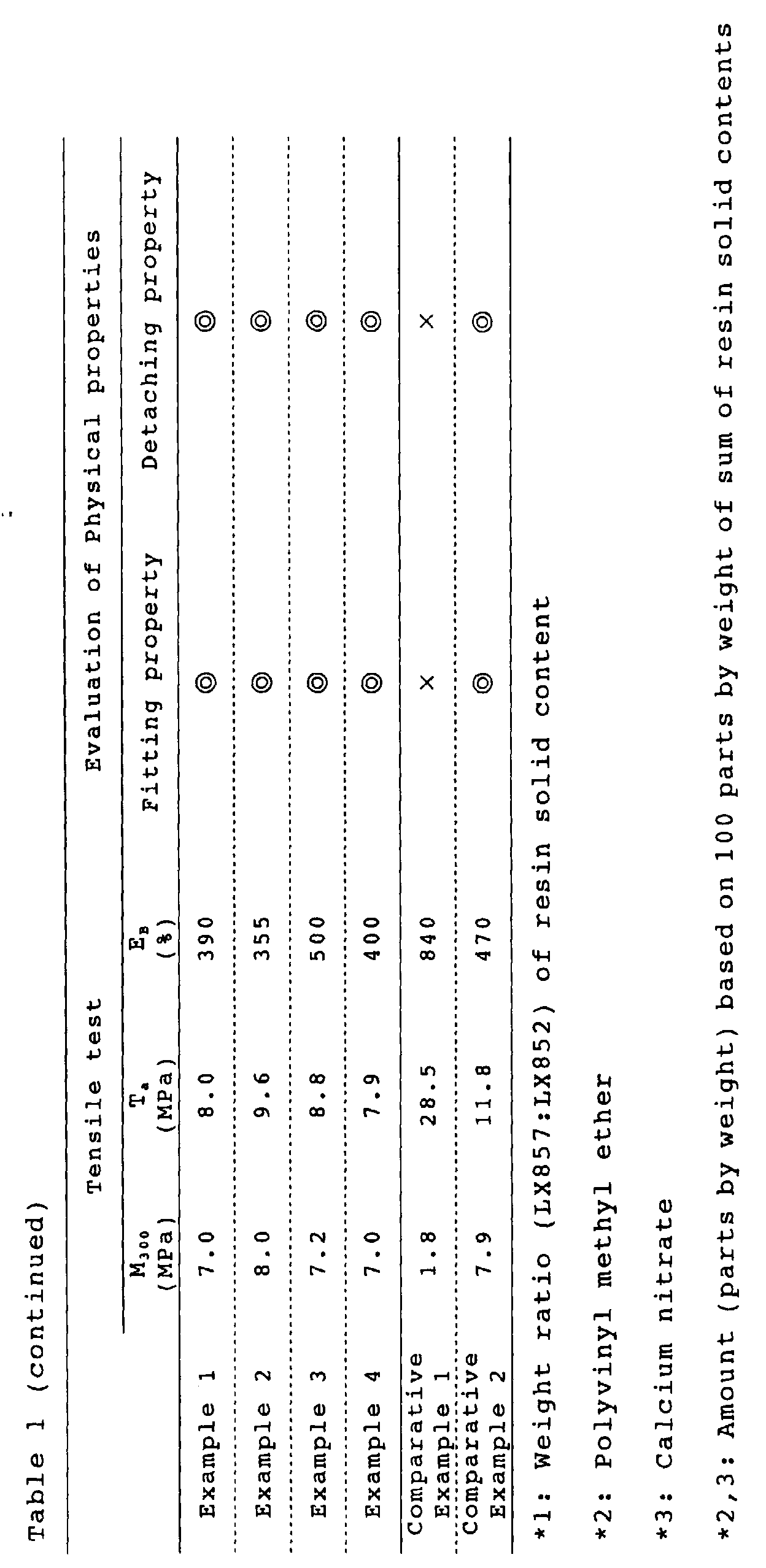
- the acrylic resin glove of the present invention has preferably a tension stress M 300 (i.e. modulus) of not less than 7.0 MPa, especially within from 7.0 to 8.0 MPa at 300% elongation defined in JIS K 6251 (tensile test of vulcanized rubber) so as to improve various properties such as modulus, flexibility and elongation of the glove.
- a tension stress M 300 i.e. modulus
- JIS K 6251 tensile test of vulcanized rubber
- the acrylic resin glove of the present invention can improve the elongation as required characteristics of the glove and the resistance to detergent by appropriately selecting the acrylic resin emulsion and crosslinking agent from those described above and appropriately adjusting the amount of the zinc white and resin crosslinking agent within the above range.
- the acrylic resin glove of the present invention preferably has an elongation at breakage E B of not less than 300% determined by "the tensile test" defined in JIS S 2042 in order to obtain excellent flexibility on fitting and a fitting feel for hand.
- the content of zinc white based on acrylic resin emulsion used for film formation of the glove is not limited, but may not more than 5 parts by weight based on 100 parts by weight of the resin solid content of the resin emulsion.
- the elongation at breakage E B of the acrylic resin glove is preferably not less than 350%, and more preferably not less than 400%.
- the acrylic resin glove of the present invention preferably has the tensile load retention S R and elongation at breakage retention S E of not less than 70% determined by "the detergent resistance test" defined in JIS S 2042 in order to enhance the resistance to detergent and to improve the durability of the glove.
- the content of the resin crosslinking agent based on acrylic resin emulsion used for film formation of a glove is not limited, but may be adjusted within a range from 0.5 to 5 parts by weight based on 100 parts by weight of the resin solid content of the resin emulsion.
- the tensile load retention S R and elongation at breakage retention S E of the acrylic resin glove may be preferably not less than 75%, and more preferably not less than 80%.
- the glove of the present invention is produced by incorporating a heat sensitizing agent and a cohesive agent into a predetermined acrylic resin emulsion, optionally incorporating a crosslinking agent as described above, dipping a heated mold to gel the resin emulsion, and subjecting to a drying treatment.
- the temperature of the mold of glove is preferably adjusted depending on the type of the acrylic resin emulsion, and is usually adjusted so that the temperature of surface of the mold is within a range from about 70 to 100°C. Furthermore, conventionally known molds such as molds made of china, ceramic, etc. can be used as the mold for the glove.
- the heat sensitizing agent includes, for example, inorganic or organic ammonium salt such as ammonium nitrate, ammonium acetate, zinc-ammonium complex salt, etc.; and water-soluble polymer having a clouding point of not less than ordinary temperature and not more than 100°C, such as polyvinyl methyl ether, polyalkylene glycol, polyether polyformal, functional polysiloxane, etc.
- the anode cohesive agent includes, for example, divalent or multivalent metal salt, such as calcium nitrate, calcium chloride, etc.; and organic alkylamine salt such as tetramethylammonium hydrate.
- the amount of the heat sensitizing agent and the anode cohesive agent may be adjusted according a conventional procedure, and is normally adjusted within a range from 0.5 to 5 parts by weight, particularly from 0.5 to 2.0 parts by weight, based on 100 parts by weight of the resin solid content of the resin emulsion.
- Method for production of glove should not be limited to this heat sensitizing method.
- a normal salt coagulation method or direct coagulation method using a high viscosity incorporating agent can be also employed.
- the acrylic resin emulsion which can be used in the interior surface treating agent according to the present invention includes, for example, those (1) to (4) described above.
- the same crosslinking agent as that described above is preferably added in the acrylic resin emulsion as a base emulsion of the interior surface treating agent for the acrylic resin glove of the present invention so as to improve the adhesion between a layer which is formed by the interior surface treating agent and the acrylic resin glove and to enhance the strength of the acrylic resin glove.
- a film can be formed in the absence of a crosslinking agent, and the strength of the acrylic resin glove can be further improved by incorporating the crosslinking agent.
- the crosslinking agent includes conventionally known various cross linking agents used for processing a polymer, such as melamine resin and epoxy resin.
- the amount of the crosslinking agent is not specifically limited, but is preferably within a range from 1 to 10 parts by weight, and particularly from 1 to 5 parts by weight, based on 100 parts by weight of the resin solid content of the acrylic resin emulsion.
- antioxidants can be added to the acrylic resin emulsion, in addition to the above crosslinking agents and organic fillers described below.
- non-staining phenols are preferably used, but amines may also be used.
- the amount of the antioxidant is preferably within a range from about 0.5 to 3 parts by weight based on 100 parts by weight of the resin solid content of the acrylic resin emulsion.
- the filler includes, for example, kaolin clay, hard clay, calcium carbonate, etc.
- the amount of the filler is preferably not more than 10 parts by weight based on 100 parts by weight of the above resin solid content.
- the dispersant is added to improve the dispersion of the respective additives described above into the acrylic resin emulsion.
- the dispersing agent includes, for example, anionic surfactants.
- the amount of the dispersant is preferably within a range from about 0.3 to 1.0 parts by weight based on the weight of the component to be dispersed.
- micro-particles of (meth)acrylic resins such as methyl methacrylate(PMMA), micro-particles of polyolefinic resins such as polyethylene and polypropylene, or organic fillers of cellulose beads are added to the acrylic resin emulsion.
- PMMA methyl methacrylate
- polyolefinic resins such as polyethylene and polypropylene
- organic fillers of cellulose beads are added to the acrylic resin emulsion.
- An average particle diameter of the organic filler is adjusted within a range from 3 to 10 ⁇ m.
- the average particle diameter of the organic filler is particularly preferably within a range from 3 to 6 ⁇ m in the above range.
- the amount of the organic filler is adjusted within a range from 2 to 8 parts by weight based on the total interior surface treating agent.
- the average particle diameter is lower than the above range, it becomes impossible to impart sufficient lubricity to the interior surface of the acrylic resin glove. Therefore, there is a fear that it becomes impossible to impart good fitting and detaching feels to the acrylic resin glove.
- the average particle diameter exceeds the above range, a layer of the interior treating agent is hardly formed or rough feel occurs on the interior surface of the acrylic resin glove. Therefore, there is a fear that fitting and detaching feels of the glove are impaired.
- the amount of the organic filler is particularly within a range from 2 to 6 parts by weight in the above range.
- the acrylic resin glove can be produced by using the interior treating agent through the following steps (a) to (d) of:
- the heat sensitizing agent used in the step (a) includes, for example, inorganic or organic ammonium salt such as ammonium nitrate, ammonium acetate, zinc-ammonium complex salt, etc.; or water-soluble polymer having a clouding point of not less than ordinary temperature and not more than 100°C , such as polyvinyl methyl ether, polyalkyleneglycol, polyether polyformal, functional polysiloxane, etc.
- the anode cohesive agent includes, for example, divalent or multivalent metal salt such as calcium nitrate, calcium chloride, etc.; or organic alkylamine such as tetramethylammonium hydrate.
- the amount of the heat sensitizing agent and anode cohesive agent may be adjusted according a conventional procedure, and is normally adjusted within a range from 0.5 to 5 parts by weight, particularly from 0.5 to 2.0 parts by weight, based on 100 parts by weight of the resin solid content of the resin emulsion.
- the type and the amount of the crosslinking agent are the same as those in case of the crosslinking agent added to the interior surface treating agent.
- the temperature of the mold for glove is preferably adjusted depending on the type of the acrylic resin emulsion, and is usually adjusted so that the temperature of the surface of the mold is within a range from about 70 to 100°C. Furthermore, conventionally known molds such as molds made of china, ceramic, etc. can be used as the mold for glove.
- the crosslinking treatment in the step (d) is not specifically limited, but may be carried out at a temperature within a range from 100 to 130°C for 20 to 60 minutes.
- the acrylic resin glove of the present invention has preferably a tension stress M 300 (i.e. modulus) of not less than 7.0 MPa, especially within from 7.0 to 8.0 MPa on 300% tension defined in JIS K 6251 (tensile test of vulcanized rubber) to improve various properties such as modulus, flexibility and elongation of the glove on forming a film of the interior surface treating agent for the acrylic resin glove of the present invention on the surface of the acrylic resin glove body.
- a tension stress of the glove M 300 can be preferably adjusted by the type of the acrylic resin emulsion used, especially difference between soft and hard, mixing ratio, etc.
- the tension stress M 300 is lower than 7.0 Mpa, there is a fear that it becomes impossible to obtain fitting and detaching properties, that are equivalent or superior to those of a glove made of a vinyl chloride resin.
- a mold for glove pre-heated to about 100°C was dipped in the resin emulsion for 5 seconds, and then the mold for glove was pulled up and dried at room temperature.
- the resin emulsion film was allowed to stand in an oven at 120°C for 30 minutes and dried completely to obtain an acrylic resin glove.
- Example 2 In the same manner as in Example 1, except that 5 parts by weight of a melamine resin [manufactured by DAINIPPON INK AND CHEMICALS, INC. (Japan) under the trade name of "BEKKAMIN PM-N"] was incorporated in place of zinc white, an acrylic resin glove was made.
- a melamine resin manufactured by DAINIPPON INK AND CHEMICALS, INC. (Japan) under the trade name of "BEKKAMIN PM-N"
- the acrylic resin glove obtained from Examples 1 to 4 was punched to prepare a dumbbell specimen No.4 defined in JIS K 6251 (tensile test of vulcanized rubber).
- Example 2 Furthermore, in the same manner as in Example 1, the respective measurements were conducted using a glove made of a natural rubber [manufactured by Dunlop Home Products Co., Ltd. (Japan) under the trade name of "SAWAYAKA TENENNGOME USUDE”] (Comparative Example 1) and a glove made of a vinyl chloride resin [manufactured by the same company under the trade name of "SAWAYAKA VINYL USUDE”] (Comparative Example 2), respectively.
- a glove made of a natural rubber manufactured by Dunlop Home Products Co., Ltd. (Japan) under the trade name of "SAWAYAKA TENENNGOME USUDE”
- a glove made of a vinyl chloride resin manufactured by the same company under the trade name of "SAWAYAKA VINYL USUDE”
- the glove of the above Examples and Comparative Examples were actually fit by five subjects to evaluate a fitting feel of the glove (ease of working on fitting the rubber glove; degree of load on hands, and degree of tightening hands, so-called fitting feel) and a detaching feel (handling on fitting or detaching of a rubber glove).
- the fitting and detaching properties were evaluated according to the following criteria, which was expressed by the average evaluation of the respective subject.
- melamine resin manufactured by DAINIPPON INK AND CHEMICALS, INC. (Japan) under the trade name "BEKKAMIN PM-N" was used as the melamine resin.
- a mold for glove pre-heated to about 100°C was dipped in the resin emulsion for 5 seconds, and then the mold for glove was pulled up and dried at room temperature.
- the resin emulsion film was allowed to stand in an oven at 100°C for 30 minutes and dried completely to obtain a glove.
- Example 5 In the same manner as in Example 5, except that 5 parts by weight of a block isocyanate [manufactured by Sumitomo Bayer Urethane Co., Ltd. (Japan) under the trade name "BAYHYJULE BL116"] was used as a resin crosslinking agent in place of a melamine resin, an acrylic resin glove was obtained.
- a block isocyanate manufactured by Sumitomo Bayer Urethane Co., Ltd. (Japan) under the trade name "BAYHYJULE BL116"
- the acrylic resin glove obtained in Examples 5 to 12 was punched to prepare a dumbbell specimen No.4 defined in JIS K 6251 (tensile test of vulcanized rubber).
- the elongation at breakage E B (%) was determined according to the test method described in the above JIS K 6251.
- the test was carried out by adjusting the temperature of a 2% sodium n-lauryl benzene sulfonate solution to 55 ⁇ 1°C and dipping a whole glove in the solution for 22 ⁇ 0.25 hours.
- the tensile load at breakage retention S R and elongation at breakage retention S E were determined.
- the evaluation was conducted by three levels: ⁇ [good film forming property (heat sensitizing ability) and possible to form a film having uniform thickness; ⁇ : insufficient film forming property (heat sensitizing ability) and possible to form a film having non-uniform thickness]; and X: poor film forming property (heat sensitizing ability) and impossible to form a film.
- an acrylic resin glove obtained in Example 10 had actually adequate physical properties such as fitting and detaching properties, elongation, etc., but the detergent resistance was inferior to gloves obtained in Examples 5 to 9 because no resin crosslinking agent was incorporated in the acrylic resin emulsion.
- acrylic resin gloves obtained in Examples 11 and 12 had actually sufficient physical properties such as detergent resistance, etc., but the elongation was low and fitting and detaching properties were poor because of a large amount of the resin crosslinking agent (and content of the whole crosslinking agent) in the acrylic resin emulsion.
- an acrylic resin glove of the present invention there can be obtained an acrylic resin glove having physical properties that are equivalent or superior to those of a vinyl chloride glove, particularly fitting and detaching properties. Sufficient elongation and excellent detergent resistance can be also imparted by appropriately adjusting the content of the zinc white and the resin crosslinking agent in the acrylic resin emulsion used for production of the acrylic resin glove.
- Such an acrylic resin glove can be produced by a simple producing method and does not generate dioxine on disposal and incineration to cause contamination of the environment, because no vinyl chloride is contained.
- particles of methyl polymethacrylate (PMMA) as the organic filler [manufactured by Nippon Pure Chemicals Co., Ltd. (Japan) under the trade name of "JYULIMAR MB-S", average particle diameter of 4 ⁇ m] was incorporated into the diluted blend emulsion in a ratio of 2% by weight to obtain an interior surface treating agent for the acrylic resin emulsion.
- PMMA methyl polymethacrylate
- a film of the acrylic resin emulsion, which has been formed on the surface of the mold for glove in "Production of glove body” was dipped in the interior surface treating agent obtained in "Preparation of interior surface treating agent” as a whole mold for glove for 20 seconds, the resin emulsion being in a gel phase.
- a layer of the interior surface treating agent was formed on the surface of the film.
- the interior surface treating agent was used at room temperature and the film of the acrylic resin emulsion was dipped in the interior surface treating agent for about 20 seconds.
- the mold for glove was pulled up from the interior surface treating agent and then heated at 100 to 130°C for 20 to 60 minutes thereby to crosslink between the film formed on the surface of the mold (glove body) and the layer on the interior surface treating agent.
- the layer formed of resin emulsion and the interior surface treating agent was removed from a mold with turning to obtain an acrylic resin glove whose interior surface is lubricated.
- Example 13 In the same manner as in Example 13, except that the amount of the organic filler in the interior surface treating agent was adjusted to the value indicated in Table 3, an acrylic resin glove whose interior surface is lubricated was obtained.
- Example 13 In the same manner as in Example 13, except that as the organic filler in the interior surface treating agent, one having a particle diameter indicated in Table 3 was used and the amount of the organic filler was adjusted to the value indicated in Table 3, an acrylic resin glove whose interior surface is lubricated was obtained.
- Example 14 In the same manner as in Example 13, except that as the organic filler in the interior surface treating agent, one having a particle diameter indicated in Table 4 was used and the amount of the organic filler was adjusted to the value indicated in Table 4, an acrylic resin glove whose interior surface is lubricated was obtained.
- One (1) part by weight of sulfur (curing agent), 1 part by weight of zinc white (crosslinking agent) and 1 part by weight of zinc dibutyl carbamate (vulcanization accelerator, BZ) were added based on 100 parts by weight of the rubber solid content in a natural rubber (NR) latex as a base latex, and then the mixture was diluted so that a concentration of the rubber solid content is 0.4% by weight to obtain NR latex as a base.
- NR natural rubber
- One (1) part by weight of sulfur (curing agent), 1 part by weight of zinc white (crosslinking agent) and 1 part by weight of zinc dibutyl carbamate (vulcanization accelerator, BZ) were added based on 100 parts by weight of the rubber solid content in an acrylonitrile-butadiene rubber (NBR) latex as a base latex, and then the mixture was diluted to give a concentration of the rubber solid content of 0.4% by weight to obtain NBR latex as a base.
- NBR acrylonitrile-butadiene rubber
- the static friction coefficient of the interior surface (surface having a higher lubricity, wherein a layer of the interior surface treating agent had been formed) in the gloves obtained in the above Examples and Comparative Examples was measured before washing (before use) and after washing, using Heidon type 10 [manufactured by Shinto Kagaku Co., Ltd. (Japan) under the trade name of HEIDON-10DR] as a measuring machine. Furthermore, the measurement was conducted under the conditions of a load of 50g, using normal paper as an object on measuring the friction coefficient.
- the gloves of the above Examples and Comparative Examples and control were actually fit by ten subjects to evaluate fitting feel of the glove (ease of working on fitting a rubber glove; degree of load on hands and degree of tightening hands, so-called fitting feel) and a detaching feel (handling on fitting or detaching of a rubber glove).
- gloves of Examples 13 to 16 wherein the layer of the interior surface treating agent according to the present invention had been provided on the interior surface of the acrylic resin glove had a low static friction coefficient of the interior surface and excellent lubricity.
- fitting and detaching feels before and after washing were excellent and, therefore, the effect obtained by forming a layer of the interior surface treating agent could be maintained for a long period.
- Comparative Example 3 wherein the amount of the organic filler in the interior surface treating agent is small and Comparative Example 5 wherein the particle diameter of the organic filler is small, the lubricity could not be sufficiently improved and excellent fitting and detaching feels could not be obtained.
- Comparative Example 4 wherein the amount of the organic filler in the interior surface treating agent was too large and Comparative Example 6 wherein the particle diameter was too large, the friction coefficient was small, but a rough feel occurred and fitting and detaching feels were insufficient.
- Comparative Examples 7 and 8 wherein the interior surface treating agent containing, as a base, a latex such as NR or NBR containing a vulcanizing agent was used, the fitting and detaching feel became inferior before washing because of insufficient adhesion between the interior surface treating agent layer and the acrylic resin glove body. Whereby, it became apparent that those of the same resin emulsion as the resin constituting the glove body are preferably used in the interior surface treating layer of the acrylic resin glove.
Landscapes
- Compositions Of Macromolecular Compounds (AREA)
- Gloves (AREA)
Abstract
Description

| Crosslinking agent | Elongation | Detergent resistance | Heat sensitizing agent | ||||
| Resin crosslinking agent | Zinc white Content | EB (%) | SR (%) | SE (%) | |||
| Type | Content | ||||||
| Example 5 | Melamine resin | 1 | 3 | 520 | 73 | 80 | ○ |
| Example 6 | Melamine resin | 5 | 3 | 340 | 87 | 90 | ○ |
| Example 7 | Epoxy resin | 5 | 3 | 320 | 85 | 100 | ○ |
| Example 8 | Oxazoline resin | 5 | 3 | 370 | 77 | 83 | ○ |
| Example 9 | Block isocyanate | 5 | 3 | 320 | 83 | 90 | ○ |
| Example 10 | - | - | 3 | 600 | 50 | 50 | ○ |
| Example 11 | Melamine resin | 8 | 3 | 275 | 88 | 92 | ○ |
| Example 12 | Oxazolinine resin | 8 | 3 | 200 | 82 | 85 | ○ |
| Interior surface treating agent | Organic filler | ||
| Type of Base emulsion/base latex | Particle diameter (µm) | Amount (% by weight) | |
| Example 13 | Acrylic | 4 | 2 |
| Example 14 | Acrylic | 4 | 5 |
| Example 15 | Acrylic | 10 | 2 |
| Example 16 | Acrylic | 4 | 8 |
| Control | Containing no interior surface treating agent | - | - |
| Evaluation of physical properties of glove | |||
| Friction coefficient | Fitting and detaching feels | ||
| Before washing | After washing | ||
| Example 13 | 0.50 | o ○ | o ○ |
| Example 14 | 0.42 | o ○ | o ○ |
| Example 15 | 0.55 | o ○ | o ○ |
| Example 16 | 0.40 | o ○ | o ○ |
| Control | 1.2 | ○ | ○ |
| Interior surface treating agent | Organic filler | ||
| Type of Base emulsion/base latex | Particle diameter (µm) | Amount (% by weight) | |
| Comparative Example 3 | Acrylic | 4 | 1 |
| Comparative Example 4 | Acrylic | 4 | 10 |
| Comparative Example 5 | Acrylic | 2 | 2 |
| Comparative Example 6 | Acrylic | 20 | 2 |
| Comparative Example 7 | NR | 5 | 3 |
| Comparative Example 8 | NBR | 4 | 2 |
| Control | Containing no interior surface treating agent | - | - |
| Evaluation of physical properties of glove | |||
| Friction coefficient | Fitting and detaching feels | ||
| Before washing | After washing | ||
| Comparative Example 3 | 0.93 | X | X |
| Comparative Example 4 | 0.52 | X | X |
| Comparative Example 5 | 1.00 | X | X |
| Comparative Example 6 | 0.70 | X | X |
| Comparative Example 7 | 1.0 | X | X |
| Comparative Example 8 | 1.0 | X | X |
| Control | 1.2 | ○ | ○ |
Claims (11)
- An acrylic resin glove comprising a film having a crosslinked structure, said film being formed of an acrylic resin emulsion.
- The acrylic resin glove according to claim 1, wherein the film is formed by a heat sensitizing method.
- The acrylic resin glove according to claim 1 or 2, wherein the acrylic resin emulsion contains a crosslinking agent.
- The acrylic resin glove according to claim 3, wherein the crosslinking agent contains, zinc white and a resin crosslinking agent.
- The acrylic resin glove according to claim 4, wherein the content of zinc white is within a range from 0.5 to 5 parts by weight based on 100 parts by weight of the resin solid content of the acrylic resin emulsion and the content of the resin crosslinking agent is within a range from 0.5 to 5 parts by weight based on 100 parts by weight of the resin solid content of the acrylic resin emulsion.
- The acrylic resin glove according to claim 1 or 2, wherein the elongation at breakage determined by the tensile test defined in JIS S 2042 is not less than 300%.
- The acrylic resin glove according to claim 1 or 2, wherein both of the tensile load retention and elongation at breakage retention determined by the detergent resistance test defined in JIS S 2042 is not less than 70%.
- An acrylic resin glove comprising an acrylic resin bag body, and a film of an internal surface treating agent for acrylic resin glove formed on the internal surface of the acrylic resin bag body, said internal surface treating agent containing an acrylic resin emulsion, and at least one organic filler selected from the group consisting of (meth)acrylic resin micro-particles, polyolefinic resin micro-particles and cellulose beads, each having an average particle diameter within a range from 3 to 10 µm, the content of said organic filler being within a range from 2 to 8% by weight based on the total weight.
- The acrylic resin glove according to claim 8, wherein a film of an internal surface treating agent further containing a crosslinking agent in the acrylic resin emulsion is formed on the internal surface of the acrylic resin glove body.
- An internal surface treating agent for acrylic resin glove, comprising an acrylic resin emulsion, and at least one organic filler selected from the group consisting of (meth)acrylic resin micro-particles, polyolefinic resin micro-particles and cellulose beads, each having an average particle diameter within a range from 3 to 10 µm, the content of said organic filler being within a range from 2 to 8% by weight based on the total weight.
- The internal surface treating agent for acrylic resin glove according to claim 10, further comprising a crosslinking agent.
Applications Claiming Priority (6)
| Application Number | Priority Date | Filing Date | Title |
|---|---|---|---|
| JP10706699 | 1999-04-14 | ||
| JP10706699 | 1999-04-14 | ||
| JP19347699 | 1999-07-07 | ||
| JP19347699A JP4148602B2 (en) | 1999-07-07 | 1999-07-07 | Internal treatment agent for acrylic resin gloves and gloves using the same |
| JP30761099A JP4148614B2 (en) | 1999-04-14 | 1999-10-28 | Acrylic resin gloves |
| JP30761099 | 1999-10-28 |
Publications (3)
| Publication Number | Publication Date |
|---|---|
| EP1044616A2 true EP1044616A2 (en) | 2000-10-18 |
| EP1044616A3 EP1044616A3 (en) | 2002-07-24 |
| EP1044616B1 EP1044616B1 (en) | 2006-07-12 |
Family
ID=27310899
Family Applications (1)
| Application Number | Title | Priority Date | Filing Date |
|---|---|---|---|
| EP20000107906 Expired - Lifetime EP1044616B1 (en) | 1999-04-14 | 2000-04-13 | Acrylic resin glove |
Country Status (4)
| Country | Link |
|---|---|
| US (1) | US6641879B1 (en) |
| EP (1) | EP1044616B1 (en) |
| AU (1) | AU781491B2 (en) |
| DE (1) | DE60029268T2 (en) |
Cited By (6)
| Publication number | Priority date | Publication date | Assignee | Title |
|---|---|---|---|---|
| WO2002068168A3 (en) * | 2001-02-21 | 2003-02-27 | Nat Starch Chem Invest | Mold release and anti-blocking coating for powder-free natural or synthetic rubber articles |
| US6784397B2 (en) | 2001-02-21 | 2004-08-31 | National Starch And Chemical Investment Holding Corporation | Mold release and anti-blocking coating for powder-free natural of synthetic rubber articles |
| EP1541630A1 (en) * | 2003-11-21 | 2005-06-15 | Shinemound Enterprise, Inc. | Crosslinking Polymer Composition |
| WO2005104887A1 (en) * | 2004-05-03 | 2005-11-10 | Scp P.M.T.B. | Encoded multiple-use glove made of natural or synthetic polymers with its physical washing device and its individual computerized tracking |
| CN103535939A (en) * | 2013-11-12 | 2014-01-29 | 镇江苏惠乳胶制品有限公司 | Novel anti-skidding rubber glove |
| WO2019205206A1 (en) * | 2018-04-28 | 2019-10-31 | 山东星宇手套有限公司 | Natural latex composite slurry and preparation method therefor, and protective gloves and manufacturing method therefor |
Families Citing this family (12)
| Publication number | Priority date | Publication date | Assignee | Title |
|---|---|---|---|---|
| US20060212992A1 (en) * | 2000-08-01 | 2006-09-28 | Nile Jeffery G | Coating for rubber gloves |
| US6972148B2 (en) * | 2003-06-23 | 2005-12-06 | Kimberly-Clark Worldwide, Inc. | Glove having improved donning characteristics |
| US7175895B2 (en) * | 2003-11-19 | 2007-02-13 | Kimberly-Clark Worldwide, Inc. | Glove with medicated porous beads |
| US9752022B2 (en) * | 2008-07-10 | 2017-09-05 | Avery Dennison Corporation | Composition, film and related methods |
| AU2010339710B2 (en) * | 2009-12-21 | 2015-07-16 | Ansell Limited | Powder-free glove with stable and fast-acting antimicrobial coating |
| EP2542409B1 (en) | 2010-03-04 | 2018-12-19 | Avery Dennison Corporation | Non-pvc film and non-pvc film laminate |
| JP5255596B2 (en) * | 2010-05-17 | 2013-08-07 | 住友ゴム工業株式会社 | Rubber gloves |
| US9707715B2 (en) | 2011-10-31 | 2017-07-18 | Kimberly-Clark Worldwide, Inc. | Elastomeric articles having a welded seam made from a multi-layer film |
| US8566965B2 (en) | 2011-10-31 | 2013-10-29 | Kimberly-Clark Worldwide, Inc. | Elastomeric articles having a welded seam that possess strength and elasticity |
| BR112016014704A8 (en) | 2013-12-30 | 2020-05-26 | Avery Dennison Corp | protective film, film laminate, advertising or informational graphic, method of producing a protective film, use of a transparent protective film and advertising graphic roll or sheet |
| US11229248B2 (en) * | 2015-12-02 | 2022-01-25 | Showa Glove Co. | Supporting glove and method for manufacturing the supporting glove |
| AT518307B1 (en) * | 2016-03-04 | 2020-04-15 | Semperit Ag Holding | Method of making a prophylactic article |
Family Cites Families (15)
| Publication number | Priority date | Publication date | Assignee | Title |
|---|---|---|---|---|
| NL6503238A (en) * | 1964-03-18 | 1965-09-20 | ||
| CA1049345A (en) * | 1975-06-24 | 1979-02-27 | Pascal E. Esemplare | Rubber articles having improved slip coating |
| US5143971A (en) * | 1986-10-20 | 1992-09-01 | The B.F. Goodrich Company | Rubbery carboxylated acrylate polymer, latex, and preparation thereof |
| CA1325309C (en) * | 1986-10-20 | 1993-12-14 | Vic Stanislawczyk | Film of rubbery latex, articles of manufacture made from the film, and a process of making the film |
| ATE88357T1 (en) | 1987-04-21 | 1993-05-15 | Smith & Nephew | GLOVE. |
| JPH0753922B2 (en) | 1990-08-31 | 1995-06-07 | ハニー化成株式会社 | Method for manufacturing gloves made of vinyl chloride resin |
| US5084514A (en) * | 1990-11-14 | 1992-01-28 | Reichhold Chemicals, Inc. | Latex gloves with improved donnability |
| JP2504631B2 (en) * | 1991-04-30 | 1996-06-05 | 住友ゴム工業株式会社 | Glove manufacturing method |
| US5284157A (en) * | 1991-07-26 | 1994-02-08 | Ortho Pharmaceutical Corporation | Elastomeric film products with improved chemical resistance |
| JP2898473B2 (en) | 1992-06-22 | 1999-06-02 | 松山株式会社 | Harvester |
| JP3694772B2 (en) | 1995-04-17 | 2005-09-14 | 大日本インキ化学工業株式会社 | Immersion molding composition |
| JPH08337910A (en) * | 1995-06-13 | 1996-12-24 | S T Chem Co Ltd | Nbr glove and its production |
| JP3146413B2 (en) * | 1997-08-25 | 2001-03-19 | ハニー化成株式会社 | Method for producing rubber gloves with excellent adhesion |
| US6019922A (en) * | 1997-10-01 | 2000-02-01 | Johnson & Johnson Mfg Sn Bhd | Powder-free medical gloves |
| JPH11161527A (en) | 1997-11-28 | 1999-06-18 | Toshiba Corp | Data storage system |
-
2000
- 2000-04-12 AU AU27691/00A patent/AU781491B2/en not_active Ceased
- 2000-04-13 DE DE2000629268 patent/DE60029268T2/en not_active Expired - Lifetime
- 2000-04-13 EP EP20000107906 patent/EP1044616B1/en not_active Expired - Lifetime
- 2000-04-14 US US09/549,526 patent/US6641879B1/en not_active Expired - Fee Related
Cited By (6)
| Publication number | Priority date | Publication date | Assignee | Title |
|---|---|---|---|---|
| WO2002068168A3 (en) * | 2001-02-21 | 2003-02-27 | Nat Starch Chem Invest | Mold release and anti-blocking coating for powder-free natural or synthetic rubber articles |
| US6784397B2 (en) | 2001-02-21 | 2004-08-31 | National Starch And Chemical Investment Holding Corporation | Mold release and anti-blocking coating for powder-free natural of synthetic rubber articles |
| EP1541630A1 (en) * | 2003-11-21 | 2005-06-15 | Shinemound Enterprise, Inc. | Crosslinking Polymer Composition |
| WO2005104887A1 (en) * | 2004-05-03 | 2005-11-10 | Scp P.M.T.B. | Encoded multiple-use glove made of natural or synthetic polymers with its physical washing device and its individual computerized tracking |
| CN103535939A (en) * | 2013-11-12 | 2014-01-29 | 镇江苏惠乳胶制品有限公司 | Novel anti-skidding rubber glove |
| WO2019205206A1 (en) * | 2018-04-28 | 2019-10-31 | 山东星宇手套有限公司 | Natural latex composite slurry and preparation method therefor, and protective gloves and manufacturing method therefor |
Also Published As
| Publication number | Publication date |
|---|---|
| US6641879B1 (en) | 2003-11-04 |
| EP1044616B1 (en) | 2006-07-12 |
| DE60029268D1 (en) | 2006-08-24 |
| AU781491B2 (en) | 2005-05-26 |
| DE60029268T2 (en) | 2006-12-07 |
| AU2769100A (en) | 2000-10-26 |
| EP1044616A3 (en) | 2002-07-24 |
Similar Documents
| Publication | Publication Date | Title |
|---|---|---|
| US6641879B1 (en) | Acrylic glove with internal coating | |
| US8250672B2 (en) | Exterior-coated nitrile rubber article having natural rubber characteristics | |
| US8250673B2 (en) | Nitrile rubber article having natural rubber characteristics | |
| US6638587B1 (en) | Elastomeric article having silicone-based composite coating | |
| CN103228688B (en) | Elastomer rubber and elastomer product that do not use vulcanization accelerator or sulfur | |
| AU610265B2 (en) | Elastomeric composition having increased ozone resistance | |
| JP2004526063A (en) | Elastomer articles made of synthetic polymers | |
| MXPA05005508A (en) | Crosslinking agent for coated elastomeric article. | |
| AU2016255360B2 (en) | Nitrile rubber glove with stretch modifier | |
| JP3146413B2 (en) | Method for producing rubber gloves with excellent adhesion | |
| WO1996025278A1 (en) | Acrylic emulsion coatings for rubber articles | |
| JP4350831B2 (en) | gloves | |
| JPH1060221A (en) | Thermoplastic resin composition and its molded article | |
| JP4148602B2 (en) | Internal treatment agent for acrylic resin gloves and gloves using the same | |
| JP4148614B2 (en) | Acrylic resin gloves | |
| JP2002201324A (en) | Resin composition, heat-shrinkable film, heat-shrinkable multilayer film | |
| JP2001089913A (en) | Acrylic resin gloves | |
| AU747769B2 (en) | Acrylic emulsion compositions and process for the production of rubber articles | |
| JP2001295113A (en) | Acrylic resin gloves | |
| JPH0638084Y2 (en) | Rubber gloves | |
| JP2000290434A (en) | Surface treatment agent for rubber products and rubber gloves using the same | |
| JP2001081615A (en) | Gloves and manufacturing method thereof |
Legal Events
| Date | Code | Title | Description |
|---|---|---|---|
| PUAI | Public reference made under article 153(3) epc to a published international application that has entered the european phase |
Free format text: ORIGINAL CODE: 0009012 |
|
| AK | Designated contracting states |
Kind code of ref document: A2 Designated state(s): AT BE CH CY DE DK ES FI FR GB GR IE IT LI LU MC NL PT SE |
|
| AX | Request for extension of the european patent |
Free format text: AL;LT;LV;MK;RO;SI |
|
| PUAL | Search report despatched |
Free format text: ORIGINAL CODE: 0009013 |
|
| RIC1 | Information provided on ipc code assigned before grant |
Free format text: 7A 41D 19/015 A, 7B 29C 33/62 B, 7A 41D 19/00 B, 7C 10M 173/02 B |
|
| AK | Designated contracting states |
Kind code of ref document: A3 Designated state(s): AT BE CH CY DE DK ES FI FR GB GR IE IT LI LU MC NL PT SE |
|
| AX | Request for extension of the european patent |
Free format text: AL;LT;LV;MK;RO;SI |
|
| 17P | Request for examination filed |
Effective date: 20020905 |
|
| AKX | Designation fees paid |
Designated state(s): DE FR GB |
|
| 17Q | First examination report despatched |
Effective date: 20031117 |
|
| GRAP | Despatch of communication of intention to grant a patent |
Free format text: ORIGINAL CODE: EPIDOSNIGR1 |
|
| RTI1 | Title (correction) |
Free format text: ACRYLIC RESIN GLOVE |
|
| GRAS | Grant fee paid |
Free format text: ORIGINAL CODE: EPIDOSNIGR3 |
|
| GRAA | (expected) grant |
Free format text: ORIGINAL CODE: 0009210 |
|
| AK | Designated contracting states |
Kind code of ref document: B1 Designated state(s): DE FR GB |
|
| REG | Reference to a national code |
Ref country code: GB Ref legal event code: FG4D |
|
| REF | Corresponds to: |
Ref document number: 60029268 Country of ref document: DE Date of ref document: 20060824 Kind code of ref document: P |
|
| ET | Fr: translation filed | ||
| PLBE | No opposition filed within time limit |
Free format text: ORIGINAL CODE: 0009261 |
|
| STAA | Information on the status of an ep patent application or granted ep patent |
Free format text: STATUS: NO OPPOSITION FILED WITHIN TIME LIMIT |
|
| 26N | No opposition filed |
Effective date: 20070413 |
|
| PGFP | Annual fee paid to national office [announced via postgrant information from national office to epo] |
Ref country code: FR Payment date: 20110426 Year of fee payment: 12 Ref country code: DE Payment date: 20110406 Year of fee payment: 12 |
|
| PGFP | Annual fee paid to national office [announced via postgrant information from national office to epo] |
Ref country code: GB Payment date: 20110413 Year of fee payment: 12 |
|
| GBPC | Gb: european patent ceased through non-payment of renewal fee |
Effective date: 20120413 |
|
| REG | Reference to a national code |
Ref country code: FR Ref legal event code: ST Effective date: 20121228 |
|
| PG25 | Lapsed in a contracting state [announced via postgrant information from national office to epo] |
Ref country code: GB Free format text: LAPSE BECAUSE OF NON-PAYMENT OF DUE FEES Effective date: 20120413 |
|
| REG | Reference to a national code |
Ref country code: DE Ref legal event code: R119 Ref document number: 60029268 Country of ref document: DE Effective date: 20121101 |
|
| PG25 | Lapsed in a contracting state [announced via postgrant information from national office to epo] |
Ref country code: FR Free format text: LAPSE BECAUSE OF NON-PAYMENT OF DUE FEES Effective date: 20120430 |
|
| PG25 | Lapsed in a contracting state [announced via postgrant information from national office to epo] |
Ref country code: DE Free format text: LAPSE BECAUSE OF NON-PAYMENT OF DUE FEES Effective date: 20121101 |