EP1043978B1 - Phospholipid-coated microcrystals for the sustained release of pharmacologically active compounds and methods of their manufacture and use - Google Patents
Phospholipid-coated microcrystals for the sustained release of pharmacologically active compounds and methods of their manufacture and use Download PDFInfo
- Publication number
- EP1043978B1 EP1043978B1 EP99971704A EP99971704A EP1043978B1 EP 1043978 B1 EP1043978 B1 EP 1043978B1 EP 99971704 A EP99971704 A EP 99971704A EP 99971704 A EP99971704 A EP 99971704A EP 1043978 B1 EP1043978 B1 EP 1043978B1
- Authority
- EP
- European Patent Office
- Prior art keywords
- microcrystals
- diameter
- composition
- percent
- pharmacologically active
- Prior art date
- Legal status (The legal status is an assumption and is not a legal conclusion. Google has not performed a legal analysis and makes no representation as to the accuracy of the status listed.)
- Expired - Lifetime
Links
- 239000013081 microcrystal Substances 0.000 title claims abstract description 210
- 150000001875 compounds Chemical class 0.000 title claims abstract description 87
- 238000000034 method Methods 0.000 title claims abstract description 83
- 150000003904 phospholipids Chemical class 0.000 title claims abstract description 51
- 238000004519 manufacturing process Methods 0.000 title claims abstract description 23
- 238000013268 sustained release Methods 0.000 title claims abstract description 21
- 239000012730 sustained-release form Substances 0.000 title claims abstract description 21
- 239000000203 mixture Substances 0.000 claims abstract description 83
- 239000008194 pharmaceutical composition Substances 0.000 claims abstract description 17
- 239000000725 suspension Substances 0.000 claims description 75
- IWVCMVBTMGNXQD-UHFFFAOYSA-N terramycin dehydrate Natural products C1=CC=C2C(O)(C)C3C(O)C4C(N(C)C)C(O)=C(C(N)=O)C(=O)C4(O)C(O)=C3C(=O)C2=C1O IWVCMVBTMGNXQD-UHFFFAOYSA-N 0.000 claims description 47
- 239000004100 Oxytetracycline Substances 0.000 claims description 46
- 229960000625 oxytetracycline Drugs 0.000 claims description 46
- IWVCMVBTMGNXQD-PXOLEDIWSA-N oxytetracycline Chemical compound C1=CC=C2[C@](O)(C)[C@H]3[C@H](O)[C@H]4[C@H](N(C)C)C(O)=C(C(N)=O)C(=O)[C@@]4(O)C(O)=C3C(=O)C2=C1O IWVCMVBTMGNXQD-PXOLEDIWSA-N 0.000 claims description 46
- 235000019366 oxytetracycline Nutrition 0.000 claims description 46
- 229960000223 tilmicosin Drugs 0.000 claims description 46
- JTSDBFGMPLKDCD-XVFHVFLVSA-N tilmicosin Chemical compound O([C@@H]1[C@@H](C)[C@H](O)CC(=O)O[C@@H]([C@H](/C=C(\C)/C=C/C(=O)[C@H](C)C[C@@H]1CCN1C[C@H](C)C[C@H](C)C1)CO[C@H]1[C@@H]([C@H](OC)[C@H](O)[C@@H](C)O1)OC)CC)[C@@H]1O[C@H](C)[C@@H](O)[C@H](N(C)C)[C@H]1O JTSDBFGMPLKDCD-XVFHVFLVSA-N 0.000 claims description 46
- 150000002632 lipids Chemical class 0.000 claims description 34
- 241000124008 Mammalia Species 0.000 claims description 31
- 230000003115 biocidal effect Effects 0.000 claims description 18
- NOOCSNJCXJYGPE-UHFFFAOYSA-N flunixin Chemical group C1=CC=C(C(F)(F)F)C(C)=C1NC1=NC=CC=C1C(O)=O NOOCSNJCXJYGPE-UHFFFAOYSA-N 0.000 claims description 17
- 208000015181 infectious disease Diseases 0.000 claims description 17
- 241000283690 Bos taurus Species 0.000 claims description 16
- 229960000588 flunixin Drugs 0.000 claims description 16
- YQNQNVDNTFHQSW-UHFFFAOYSA-N acetic acid [2-[[(5-nitro-2-thiazolyl)amino]-oxomethyl]phenyl] ester Chemical compound CC(=O)OC1=CC=CC=C1C(=O)NC1=NC=C([N+]([O-])=O)S1 YQNQNVDNTFHQSW-UHFFFAOYSA-N 0.000 claims description 15
- 229960002480 nitazoxanide Drugs 0.000 claims description 14
- -1 anesthetic Substances 0.000 claims description 11
- 208000023504 respiratory system disease Diseases 0.000 claims description 11
- 239000003242 anti bacterial agent Substances 0.000 claims description 10
- GSDSWSVVBLHKDQ-UHFFFAOYSA-N 9-fluoro-3-methyl-10-(4-methylpiperazin-1-yl)-7-oxo-2,3-dihydro-7H-[1,4]oxazino[2,3,4-ij]quinoline-6-carboxylic acid Chemical compound FC1=CC(C(C(C(O)=O)=C2)=O)=C3N2C(C)COC3=C1N1CCN(C)CC1 GSDSWSVVBLHKDQ-UHFFFAOYSA-N 0.000 claims description 9
- 229940121363 anti-inflammatory agent Drugs 0.000 claims description 9
- 239000002260 anti-inflammatory agent Substances 0.000 claims description 9
- GCFBRXLSHGKWDP-XCGNWRKASA-N cefoperazone Chemical compound O=C1C(=O)N(CC)CCN1C(=O)N[C@H](C=1C=CC(O)=CC=1)C(=O)N[C@@H]1C(=O)N2C(C(O)=O)=C(CSC=3N(N=NN=3)C)CS[C@@H]21 GCFBRXLSHGKWDP-XCGNWRKASA-N 0.000 claims description 9
- 229960001699 ofloxacin Drugs 0.000 claims description 8
- 230000003444 anaesthetic effect Effects 0.000 claims description 7
- 229960004682 cefoperazone Drugs 0.000 claims description 7
- 229930186147 Cephalosporin Natural products 0.000 claims description 6
- 229940124587 cephalosporin Drugs 0.000 claims description 6
- 150000001780 cephalosporins Chemical class 0.000 claims description 6
- 230000000884 anti-protozoa Effects 0.000 claims description 5
- 239000003795 chemical substances by application Substances 0.000 claims description 5
- MYSWGUAQZAJSOK-UHFFFAOYSA-N ciprofloxacin Chemical compound C12=CC(N3CCNCC3)=C(F)C=C2C(=O)C(C(=O)O)=CN1C1CC1 MYSWGUAQZAJSOK-UHFFFAOYSA-N 0.000 claims description 5
- 230000005855 radiation Effects 0.000 claims description 5
- 241000282465 Canis Species 0.000 claims description 4
- MLYYVTUWGNIJIB-BXKDBHETSA-N cefazolin Chemical compound S1C(C)=NN=C1SCC1=C(C(O)=O)N2C(=O)[C@@H](NC(=O)CN3N=NN=C3)[C@H]2SC1 MLYYVTUWGNIJIB-BXKDBHETSA-N 0.000 claims description 4
- 229960001139 cefazolin Drugs 0.000 claims description 4
- XBHBWNFJWIASRO-UHFFFAOYSA-N 6-fluoro-1-(4-fluorophenyl)-4-oxo-7-(1-piperazinyl)-3-quinolinecarboxylic acid Chemical compound C12=CC(N3CCNCC3)=C(F)C=C2C(=O)C(C(=O)O)=CN1C1=CC=C(F)C=C1 XBHBWNFJWIASRO-UHFFFAOYSA-N 0.000 claims description 3
- 241000283073 Equus caballus Species 0.000 claims description 3
- 241000282324 Felis Species 0.000 claims description 3
- QYIYFLOTGYLRGG-GPCCPHFNSA-N cefaclor Chemical compound C1([C@H](C(=O)N[C@@H]2C(N3C(=C(Cl)CS[C@@H]32)C(O)=O)=O)N)=CC=CC=C1 QYIYFLOTGYLRGG-GPCCPHFNSA-N 0.000 claims description 3
- 229960005361 cefaclor Drugs 0.000 claims description 3
- 230000001954 sterilising effect Effects 0.000 claims description 3
- 206010061218 Inflammation Diseases 0.000 claims description 2
- 229960003405 ciprofloxacin Drugs 0.000 claims description 2
- 230000004054 inflammatory process Effects 0.000 claims description 2
- 238000007911 parenteral administration Methods 0.000 claims description 2
- 229950007734 sarafloxacin Drugs 0.000 claims description 2
- 238000007920 subcutaneous administration Methods 0.000 claims description 2
- JFPVXVDWJQMJEE-IZRZKJBUSA-N cefuroxime Chemical compound N([C@@H]1C(N2C(=C(COC(N)=O)CS[C@@H]21)C(O)=O)=O)C(=O)\C(=N/OC)C1=CC=CO1 JFPVXVDWJQMJEE-IZRZKJBUSA-N 0.000 claims 2
- 229960001668 cefuroxime Drugs 0.000 claims 1
- 238000002347 injection Methods 0.000 abstract description 15
- 239000007924 injection Substances 0.000 abstract description 15
- 238000002360 preparation method Methods 0.000 description 41
- XLYOFNOQVPJJNP-UHFFFAOYSA-N water Substances O XLYOFNOQVPJJNP-UHFFFAOYSA-N 0.000 description 35
- 241001465754 Metazoa Species 0.000 description 33
- 241000282326 Felis catus Species 0.000 description 28
- 239000003814 drug Substances 0.000 description 25
- 229940079593 drug Drugs 0.000 description 25
- 239000006188 syrup Substances 0.000 description 23
- 235000020357 syrup Nutrition 0.000 description 23
- 241000282472 Canis lupus familiaris Species 0.000 description 20
- FBPFZTCFMRRESA-KVTDHHQDSA-N D-Mannitol Chemical compound OC[C@@H](O)[C@@H](O)[C@H](O)[C@H](O)CO FBPFZTCFMRRESA-KVTDHHQDSA-N 0.000 description 15
- 229930195725 Mannitol Natural products 0.000 description 15
- 239000000594 mannitol Substances 0.000 description 15
- 235000010355 mannitol Nutrition 0.000 description 15
- 210000001519 tissue Anatomy 0.000 description 15
- 239000000463 material Substances 0.000 description 14
- 239000002245 particle Substances 0.000 description 14
- 230000008901 benefit Effects 0.000 description 13
- 206010011224 Cough Diseases 0.000 description 11
- 241000283086 Equidae Species 0.000 description 11
- 210000004369 blood Anatomy 0.000 description 10
- 239000008280 blood Substances 0.000 description 10
- 210000000601 blood cell Anatomy 0.000 description 10
- 210000002966 serum Anatomy 0.000 description 9
- 238000002560 therapeutic procedure Methods 0.000 description 9
- 238000011282 treatment Methods 0.000 description 9
- 239000005457 ice water Substances 0.000 description 8
- 238000000386 microscopy Methods 0.000 description 8
- HEMHJVSKTPXQMS-UHFFFAOYSA-M sodium hydroxide Inorganic materials [OH-].[Na+] HEMHJVSKTPXQMS-UHFFFAOYSA-M 0.000 description 8
- 239000000243 solution Substances 0.000 description 8
- 241000282887 Suidae Species 0.000 description 7
- 210000004072 lung Anatomy 0.000 description 7
- 238000003756 stirring Methods 0.000 description 7
- 231100000419 toxicity Toxicity 0.000 description 7
- 230000001988 toxicity Effects 0.000 description 7
- 239000008215 water for injection Substances 0.000 description 7
- 238000001816 cooling Methods 0.000 description 6
- 239000013078 crystal Substances 0.000 description 6
- 201000010099 disease Diseases 0.000 description 6
- 208000037265 diseases, disorders, signs and symptoms Diseases 0.000 description 6
- 239000007787 solid Substances 0.000 description 6
- 230000001225 therapeutic effect Effects 0.000 description 6
- 206010039101 Rhinorrhoea Diseases 0.000 description 5
- 229940088710 antibiotic agent Drugs 0.000 description 5
- 239000011248 coating agent Substances 0.000 description 5
- 238000000576 coating method Methods 0.000 description 5
- 238000000265 homogenisation Methods 0.000 description 5
- 208000010753 nasal discharge Diseases 0.000 description 5
- 230000008569 process Effects 0.000 description 5
- 239000000523 sample Substances 0.000 description 5
- 239000012064 sodium phosphate buffer Substances 0.000 description 5
- 238000000527 sonication Methods 0.000 description 5
- LSQZJLSUYDQPKJ-NJBDSQKTSA-N amoxicillin Chemical compound C1([C@@H](N)C(=O)N[C@H]2[C@H]3SC([C@@H](N3C2=O)C(O)=O)(C)C)=CC=C(O)C=C1 LSQZJLSUYDQPKJ-NJBDSQKTSA-N 0.000 description 4
- 230000037396 body weight Effects 0.000 description 4
- 238000005516 engineering process Methods 0.000 description 4
- 238000009472 formulation Methods 0.000 description 4
- 239000008240 homogeneous mixture Substances 0.000 description 4
- LXCFILQKKLGQFO-UHFFFAOYSA-N methylparaben Chemical compound COC(=O)C1=CC=C(O)C=C1 LXCFILQKKLGQFO-UHFFFAOYSA-N 0.000 description 4
- 238000002156 mixing Methods 0.000 description 4
- 210000003205 muscle Anatomy 0.000 description 4
- 239000008188 pellet Substances 0.000 description 4
- 239000000047 product Substances 0.000 description 4
- QELSKZZBTMNZEB-UHFFFAOYSA-N propylparaben Chemical compound CCCOC(=O)C1=CC=C(O)C=C1 QELSKZZBTMNZEB-UHFFFAOYSA-N 0.000 description 4
- 238000010254 subcutaneous injection Methods 0.000 description 4
- 239000007929 subcutaneous injection Substances 0.000 description 4
- JZNWSCPGTDBMEW-UHFFFAOYSA-N Glycerophosphorylethanolamin Natural products NCCOP(O)(=O)OCC(O)CO JZNWSCPGTDBMEW-UHFFFAOYSA-N 0.000 description 3
- 230000005856 abnormality Effects 0.000 description 3
- 239000007900 aqueous suspension Substances 0.000 description 3
- 210000004027 cell Anatomy 0.000 description 3
- 238000006243 chemical reaction Methods 0.000 description 3
- 238000000605 extraction Methods 0.000 description 3
- 239000000835 fiber Substances 0.000 description 3
- 239000012467 final product Substances 0.000 description 3
- 210000001630 jejunum Anatomy 0.000 description 3
- 210000003734 kidney Anatomy 0.000 description 3
- 239000002609 medium Substances 0.000 description 3
- 125000002496 methyl group Chemical group [H]C([H])([H])* 0.000 description 3
- 239000000825 pharmaceutical preparation Substances 0.000 description 3
- 239000007971 pharmaceutical suspension Substances 0.000 description 3
- WTJKGGKOPKCXLL-RRHRGVEJSA-N phosphatidylcholine Chemical compound CCCCCCCCCCCCCCCC(=O)OC[C@H](COP([O-])(=O)OCC[N+](C)(C)C)OC(=O)CCCCCCCC=CCCCCCCCC WTJKGGKOPKCXLL-RRHRGVEJSA-N 0.000 description 3
- 150000008104 phosphatidylethanolamines Chemical class 0.000 description 3
- 206010041232 sneezing Diseases 0.000 description 3
- 239000001488 sodium phosphate Substances 0.000 description 3
- 229910000162 sodium phosphate Inorganic materials 0.000 description 3
- 210000003437 trachea Anatomy 0.000 description 3
- RYFMWSXOAZQYPI-UHFFFAOYSA-K trisodium phosphate Chemical compound [Na+].[Na+].[Na+].[O-]P([O-])([O-])=O RYFMWSXOAZQYPI-UHFFFAOYSA-K 0.000 description 3
- SCNWTQPZTZMXBG-UHFFFAOYSA-N 2-methyloct-2-enoic acid Chemical compound CCCCCC=C(C)C(O)=O SCNWTQPZTZMXBG-UHFFFAOYSA-N 0.000 description 2
- CSCPPACGZOOCGX-UHFFFAOYSA-N Acetone Chemical compound CC(C)=O CSCPPACGZOOCGX-UHFFFAOYSA-N 0.000 description 2
- LFQSCWFLJHTTHZ-UHFFFAOYSA-N Ethanol Chemical compound CCO LFQSCWFLJHTTHZ-UHFFFAOYSA-N 0.000 description 2
- 206010067482 No adverse event Diseases 0.000 description 2
- 101000882917 Penaeus paulensis Hemolymph clottable protein Proteins 0.000 description 2
- 206010037660 Pyrexia Diseases 0.000 description 2
- 206010057190 Respiratory tract infections Diseases 0.000 description 2
- 206010046542 Urinary hesitation Diseases 0.000 description 2
- 238000007792 addition Methods 0.000 description 2
- 229940035674 anesthetics Drugs 0.000 description 2
- 230000001580 bacterial effect Effects 0.000 description 2
- 230000004888 barrier function Effects 0.000 description 2
- 230000009286 beneficial effect Effects 0.000 description 2
- 230000008859 change Effects 0.000 description 2
- 230000001351 cycling effect Effects 0.000 description 2
- 230000003247 decreasing effect Effects 0.000 description 2
- 230000000694 effects Effects 0.000 description 2
- 210000002969 egg yolk Anatomy 0.000 description 2
- 230000009969 flowable effect Effects 0.000 description 2
- 235000013305 food Nutrition 0.000 description 2
- 239000003193 general anesthetic agent Substances 0.000 description 2
- 230000036541 health Effects 0.000 description 2
- 210000000265 leukocyte Anatomy 0.000 description 2
- 239000007788 liquid Substances 0.000 description 2
- 235000010270 methyl p-hydroxybenzoate Nutrition 0.000 description 2
- 239000004292 methyl p-hydroxybenzoate Substances 0.000 description 2
- 229960002216 methylparaben Drugs 0.000 description 2
- 230000004048 modification Effects 0.000 description 2
- 238000012986 modification Methods 0.000 description 2
- 238000002559 palpation Methods 0.000 description 2
- 229940127557 pharmaceutical product Drugs 0.000 description 2
- 235000010232 propyl p-hydroxybenzoate Nutrition 0.000 description 2
- 239000004405 propyl p-hydroxybenzoate Substances 0.000 description 2
- 229960003415 propylparaben Drugs 0.000 description 2
- 210000002345 respiratory system Anatomy 0.000 description 2
- 208000020029 respiratory tract infectious disease Diseases 0.000 description 2
- 231100000161 signs of toxicity Toxicity 0.000 description 2
- 239000002904 solvent Substances 0.000 description 2
- 239000000126 substance Substances 0.000 description 2
- 125000000446 sulfanediyl group Chemical group *S* 0.000 description 2
- 238000011285 therapeutic regimen Methods 0.000 description 2
- 231100000732 tissue residue Toxicity 0.000 description 2
- 231100000331 toxic Toxicity 0.000 description 2
- 230000002588 toxic effect Effects 0.000 description 2
- QRPHLEPFYLNRDA-NLGRAQRVSA-N 2-[(4r,5s,6s,7r,9r,11e,13e,15r,16r)-6-[(2r,3r,4s,5s,6r)-4-(dimethylamino)-3,5-dihydroxy-6-methyloxan-2-yl]oxy-16-ethyl-4-hydroxy-15-[[(2r,3r,4r,5r,6r)-5-hydroxy-3,4-dimethoxy-6-methyloxan-2-yl]oxymethyl]-5,9,13-trimethyl-2,10-dioxo-1-oxacyclohexadeca-11,1 Chemical compound O([C@@H]1[C@@H](C)[C@H](O)CC(=O)O[C@@H]([C@H](/C=C(\C)/C=C/C(=O)[C@H](C)C[C@@H]1CC=O)CO[C@H]1[C@@H]([C@H](OC)[C@H](O)[C@@H](C)O1)OC)CC)[C@@H]1O[C@H](C)[C@@H](O)[C@H](N(C)C)[C@H]1O QRPHLEPFYLNRDA-NLGRAQRVSA-N 0.000 description 1
- 125000002941 2-furyl group Chemical group O1C([*])=C([H])C([H])=C1[H] 0.000 description 1
- FJKROLUGYXJWQN-UHFFFAOYSA-N 4-hydroxybenzoic acid Chemical compound OC(=O)C1=CC=C(O)C=C1 FJKROLUGYXJWQN-UHFFFAOYSA-N 0.000 description 1
- QYIYFLOTGYLRGG-UHFFFAOYSA-N 7-[(2-azaniumyl-2-phenylacetyl)amino]-3-chloro-8-oxo-5-thia-1-azabicyclo[4.2.0]oct-2-ene-2-carboxylate Chemical compound C12SCC(Cl)=C(C(O)=O)N2C(=O)C1NC(=O)C(N)C1=CC=CC=C1 QYIYFLOTGYLRGG-UHFFFAOYSA-N 0.000 description 1
- APKFDSVGJQXUKY-KKGHZKTASA-N Amphotericin-B Natural products O[C@H]1[C@@H](N)[C@H](O)[C@@H](C)O[C@H]1O[C@H]1C=CC=CC=CC=CC=CC=CC=C[C@H](C)[C@@H](O)[C@@H](C)[C@H](C)OC(=O)C[C@H](O)C[C@H](O)CC[C@@H](O)[C@H](O)C[C@H](O)C[C@](O)(C[C@H](O)[C@H]2C(O)=O)O[C@H]2C1 APKFDSVGJQXUKY-KKGHZKTASA-N 0.000 description 1
- 241000588807 Bordetella Species 0.000 description 1
- 206010012735 Diarrhoea Diseases 0.000 description 1
- 241000233866 Fungi Species 0.000 description 1
- 241000287828 Gallus gallus Species 0.000 description 1
- VDYACOATPFOZIO-UBWHGVKJSA-N Kadsurenone Chemical compound C1=C(OC)C(OC)=CC=C1[C@@H]1[C@@H](C)[C@@]2(OC)C=C(CC=C)C(=O)C=C2O1 VDYACOATPFOZIO-UBWHGVKJSA-N 0.000 description 1
- 208000008939 Pneumonic Pasteurellosis Diseases 0.000 description 1
- 241000282898 Sus scrofa Species 0.000 description 1
- 239000004098 Tetracycline Substances 0.000 description 1
- 238000005411 Van der Waals force Methods 0.000 description 1
- 125000000738 acetamido group Chemical group [H]C([H])([H])C(=O)N([H])[*] 0.000 description 1
- 125000002777 acetyl group Chemical group [H]C([H])([H])C(*)=O 0.000 description 1
- 239000002253 acid Substances 0.000 description 1
- 239000004480 active ingredient Substances 0.000 description 1
- 239000002671 adjuvant Substances 0.000 description 1
- 230000002411 adverse Effects 0.000 description 1
- 230000002776 aggregation Effects 0.000 description 1
- 238000004220 aggregation Methods 0.000 description 1
- 238000013019 agitation Methods 0.000 description 1
- 229960003022 amoxicillin Drugs 0.000 description 1
- APKFDSVGJQXUKY-INPOYWNPSA-N amphotericin B Chemical compound O[C@H]1[C@@H](N)[C@H](O)[C@@H](C)O[C@H]1O[C@H]1/C=C/C=C/C=C/C=C/C=C/C=C/C=C/[C@H](C)[C@@H](O)[C@@H](C)[C@H](C)OC(=O)C[C@H](O)C[C@H](O)CC[C@@H](O)[C@H](O)C[C@H](O)C[C@](O)(C[C@H](O)[C@H]2C(O)=O)O[C@H]2C1 APKFDSVGJQXUKY-INPOYWNPSA-N 0.000 description 1
- 229960003942 amphotericin b Drugs 0.000 description 1
- 238000004458 analytical method Methods 0.000 description 1
- 229940121375 antifungal agent Drugs 0.000 description 1
- 239000003429 antifungal agent Substances 0.000 description 1
- 239000003904 antiprotozoal agent Substances 0.000 description 1
- 230000036528 appetite Effects 0.000 description 1
- 235000019789 appetite Nutrition 0.000 description 1
- 239000012736 aqueous medium Substances 0.000 description 1
- 238000003556 assay Methods 0.000 description 1
- 235000015278 beef Nutrition 0.000 description 1
- 238000004159 blood analysis Methods 0.000 description 1
- 230000036760 body temperature Effects 0.000 description 1
- 244000309466 calf Species 0.000 description 1
- 125000003917 carbamoyl group Chemical group [H]N([H])C(*)=O 0.000 description 1
- 125000005518 carboxamido group Chemical group 0.000 description 1
- 210000000170 cell membrane Anatomy 0.000 description 1
- 238000005119 centrifugation Methods 0.000 description 1
- 238000001311 chemical methods and process Methods 0.000 description 1
- UHZZMRAGKVHANO-UHFFFAOYSA-M chlormequat chloride Chemical compound [Cl-].C[N+](C)(C)CCCl UHZZMRAGKVHANO-UHFFFAOYSA-M 0.000 description 1
- DIOIOSKKIYDRIQ-UHFFFAOYSA-N ciprofloxacin hydrochloride Chemical compound Cl.C12=CC(N3CCNCC3)=C(F)C=C2C(=O)C(C(=O)O)=CN1C1CC1 DIOIOSKKIYDRIQ-UHFFFAOYSA-N 0.000 description 1
- 238000010668 complexation reaction Methods 0.000 description 1
- 238000011443 conventional therapy Methods 0.000 description 1
- SIBFMRAHSCSBRP-UHFFFAOYSA-N denudatin B Natural products COC1=C2OC(C(C)C2(OC)C=C(CC=C)C1=O)c3ccc(OC)c(OC)c3 SIBFMRAHSCSBRP-UHFFFAOYSA-N 0.000 description 1
- 239000007933 dermal patch Substances 0.000 description 1
- 235000014113 dietary fatty acids Nutrition 0.000 description 1
- 238000009792 diffusion process Methods 0.000 description 1
- 230000003292 diminished effect Effects 0.000 description 1
- 239000002270 dispersing agent Substances 0.000 description 1
- 238000009826 distribution Methods 0.000 description 1
- 229940126534 drug product Drugs 0.000 description 1
- 239000008344 egg yolk phospholipid Substances 0.000 description 1
- 235000013601 eggs Nutrition 0.000 description 1
- 235000019441 ethanol Nutrition 0.000 description 1
- 238000001704 evaporation Methods 0.000 description 1
- 238000013213 extrapolation Methods 0.000 description 1
- 239000004744 fabric Substances 0.000 description 1
- 239000000194 fatty acid Substances 0.000 description 1
- 229930195729 fatty acid Natural products 0.000 description 1
- 150000004665 fatty acids Chemical class 0.000 description 1
- 230000002538 fungal effect Effects 0.000 description 1
- 238000004817 gas chromatography Methods 0.000 description 1
- SQOJOAFXDQDRGF-MMQTXUMRSA-N ginkgolide-b Chemical compound O[C@H]([C@]12[C@H](C(C)(C)C)C[C@H]3OC4=O)C(=O)O[C@H]2O[C@]24[C@@]13[C@@H](O)[C@@H]1OC(=O)[C@@H](C)[C@]21O SQOJOAFXDQDRGF-MMQTXUMRSA-N 0.000 description 1
- 230000002209 hydrophobic effect Effects 0.000 description 1
- 239000004615 ingredient Substances 0.000 description 1
- 229940102213 injectable suspension Drugs 0.000 description 1
- 230000003993 interaction Effects 0.000 description 1
- 230000002147 killing effect Effects 0.000 description 1
- 230000000670 limiting effect Effects 0.000 description 1
- 238000004949 mass spectrometry Methods 0.000 description 1
- 238000002483 medication Methods 0.000 description 1
- 239000012528 membrane Substances 0.000 description 1
- 239000011859 microparticle Substances 0.000 description 1
- 229960000988 nystatin Drugs 0.000 description 1
- VQOXZBDYSJBXMA-NQTDYLQESA-N nystatin A1 Chemical compound O[C@H]1[C@@H](N)[C@H](O)[C@@H](C)O[C@H]1O[C@H]1/C=C/C=C/C=C/C=C/CC/C=C/C=C/[C@H](C)[C@@H](O)[C@@H](C)[C@H](C)OC(=O)C[C@H](O)C[C@H](O)C[C@H](O)CC[C@@H](O)[C@H](O)C[C@](O)(C[C@H](O)[C@H]2C(O)=O)O[C@H]2C1 VQOXZBDYSJBXMA-NQTDYLQESA-N 0.000 description 1
- 239000003960 organic solvent Substances 0.000 description 1
- LSQZJLSUYDQPKJ-UHFFFAOYSA-N p-Hydroxyampicillin Natural products O=C1N2C(C(O)=O)C(C)(C)SC2C1NC(=O)C(N)C1=CC=C(O)C=C1 LSQZJLSUYDQPKJ-UHFFFAOYSA-N 0.000 description 1
- 230000003071 parasitic effect Effects 0.000 description 1
- 239000000843 powder Substances 0.000 description 1
- 239000002244 precipitate Substances 0.000 description 1
- 238000001556 precipitation Methods 0.000 description 1
- 125000002924 primary amino group Chemical group [H]N([H])* 0.000 description 1
- OLBCVFGFOZPWHH-UHFFFAOYSA-N propofol Chemical compound CC(C)C1=CC=CC(C(C)C)=C1O OLBCVFGFOZPWHH-UHFFFAOYSA-N 0.000 description 1
- 230000001681 protective effect Effects 0.000 description 1
- 239000002994 raw material Substances 0.000 description 1
- 238000011084 recovery Methods 0.000 description 1
- 238000009877 rendering Methods 0.000 description 1
- 238000005070 sampling Methods 0.000 description 1
- 230000035939 shock Effects 0.000 description 1
- 239000008259 solid foam Substances 0.000 description 1
- 229910001220 stainless steel Inorganic materials 0.000 description 1
- 239000010935 stainless steel Substances 0.000 description 1
- 238000004659 sterilization and disinfection Methods 0.000 description 1
- 238000012414 sterilization procedure Methods 0.000 description 1
- 150000003431 steroids Chemical class 0.000 description 1
- 239000000829 suppository Substances 0.000 description 1
- 208000024891 symptom Diseases 0.000 description 1
- 238000012360 testing method Methods 0.000 description 1
- 229960002180 tetracycline Drugs 0.000 description 1
- 229930101283 tetracycline Natural products 0.000 description 1
- 235000019364 tetracycline Nutrition 0.000 description 1
- 150000003522 tetracyclines Chemical class 0.000 description 1
- 150000003626 triacylglycerols Chemical class 0.000 description 1
Images



Classifications
-
- A—HUMAN NECESSITIES
- A61—MEDICAL OR VETERINARY SCIENCE; HYGIENE
- A61K—PREPARATIONS FOR MEDICAL, DENTAL OR TOILETRY PURPOSES
- A61K9/00—Medicinal preparations characterised by special physical form
- A61K9/48—Preparations in capsules, e.g. of gelatin, of chocolate
- A61K9/50—Microcapsules having a gas, liquid or semi-solid filling; Solid microparticles or pellets surrounded by a distinct coating layer, e.g. coated microspheres, coated drug crystals
- A61K9/5005—Wall or coating material
- A61K9/5015—Organic compounds, e.g. fats, sugars
-
- A—HUMAN NECESSITIES
- A61—MEDICAL OR VETERINARY SCIENCE; HYGIENE
- A61K—PREPARATIONS FOR MEDICAL, DENTAL OR TOILETRY PURPOSES
- A61K47/00—Medicinal preparations characterised by the non-active ingredients used, e.g. carriers or inert additives; Targeting or modifying agents chemically bound to the active ingredient
- A61K47/06—Organic compounds, e.g. natural or synthetic hydrocarbons, polyolefins, mineral oil, petrolatum or ozokerite
- A61K47/24—Organic compounds, e.g. natural or synthetic hydrocarbons, polyolefins, mineral oil, petrolatum or ozokerite containing atoms other than carbon, hydrogen, oxygen, halogen, nitrogen or sulfur, e.g. cyclomethicone or phospholipids
-
- A—HUMAN NECESSITIES
- A61—MEDICAL OR VETERINARY SCIENCE; HYGIENE
- A61K—PREPARATIONS FOR MEDICAL, DENTAL OR TOILETRY PURPOSES
- A61K9/00—Medicinal preparations characterised by special physical form
- A61K9/0012—Galenical forms characterised by the site of application
- A61K9/0019—Injectable compositions; Intramuscular, intravenous, arterial, subcutaneous administration; Compositions to be administered through the skin in an invasive manner
-
- A—HUMAN NECESSITIES
- A61—MEDICAL OR VETERINARY SCIENCE; HYGIENE
- A61K—PREPARATIONS FOR MEDICAL, DENTAL OR TOILETRY PURPOSES
- A61K9/00—Medicinal preparations characterised by special physical form
- A61K9/10—Dispersions; Emulsions
- A61K9/127—Synthetic bilayered vehicles, e.g. liposomes or liposomes with cholesterol as the only non-phosphatidyl surfactant
-
- A—HUMAN NECESSITIES
- A61—MEDICAL OR VETERINARY SCIENCE; HYGIENE
- A61K—PREPARATIONS FOR MEDICAL, DENTAL OR TOILETRY PURPOSES
- A61K9/00—Medicinal preparations characterised by special physical form
- A61K9/14—Particulate form, e.g. powders, Processes for size reducing of pure drugs or the resulting products, Pure drug nanoparticles
- A61K9/141—Intimate drug-carrier mixtures characterised by the carrier, e.g. ordered mixtures, adsorbates, solid solutions, eutectica, co-dried, co-solubilised, co-kneaded, co-milled, co-ground products, co-precipitates, co-evaporates, co-extrudates, co-melts; Drug nanoparticles with adsorbed surface modifiers
- A61K9/145—Intimate drug-carrier mixtures characterised by the carrier, e.g. ordered mixtures, adsorbates, solid solutions, eutectica, co-dried, co-solubilised, co-kneaded, co-milled, co-ground products, co-precipitates, co-evaporates, co-extrudates, co-melts; Drug nanoparticles with adsorbed surface modifiers with organic compounds
-
- A—HUMAN NECESSITIES
- A61—MEDICAL OR VETERINARY SCIENCE; HYGIENE
- A61P—SPECIFIC THERAPEUTIC ACTIVITY OF CHEMICAL COMPOUNDS OR MEDICINAL PREPARATIONS
- A61P11/00—Drugs for disorders of the respiratory system
-
- A—HUMAN NECESSITIES
- A61—MEDICAL OR VETERINARY SCIENCE; HYGIENE
- A61P—SPECIFIC THERAPEUTIC ACTIVITY OF CHEMICAL COMPOUNDS OR MEDICINAL PREPARATIONS
- A61P23/00—Anaesthetics
-
- A—HUMAN NECESSITIES
- A61—MEDICAL OR VETERINARY SCIENCE; HYGIENE
- A61P—SPECIFIC THERAPEUTIC ACTIVITY OF CHEMICAL COMPOUNDS OR MEDICINAL PREPARATIONS
- A61P29/00—Non-central analgesic, antipyretic or antiinflammatory agents, e.g. antirheumatic agents; Non-steroidal antiinflammatory drugs [NSAID]
-
- A—HUMAN NECESSITIES
- A61—MEDICAL OR VETERINARY SCIENCE; HYGIENE
- A61P—SPECIFIC THERAPEUTIC ACTIVITY OF CHEMICAL COMPOUNDS OR MEDICINAL PREPARATIONS
- A61P31/00—Antiinfectives, i.e. antibiotics, antiseptics, chemotherapeutics
-
- A—HUMAN NECESSITIES
- A61—MEDICAL OR VETERINARY SCIENCE; HYGIENE
- A61P—SPECIFIC THERAPEUTIC ACTIVITY OF CHEMICAL COMPOUNDS OR MEDICINAL PREPARATIONS
- A61P31/00—Antiinfectives, i.e. antibiotics, antiseptics, chemotherapeutics
- A61P31/04—Antibacterial agents
-
- A—HUMAN NECESSITIES
- A61—MEDICAL OR VETERINARY SCIENCE; HYGIENE
- A61P—SPECIFIC THERAPEUTIC ACTIVITY OF CHEMICAL COMPOUNDS OR MEDICINAL PREPARATIONS
- A61P33/00—Antiparasitic agents
- A61P33/02—Antiprotozoals, e.g. for leishmaniasis, trichomoniasis, toxoplasmosis
Definitions
- WO 96/16643 discloses a device generally comprising a carrier in the form of fibers, sutures, fabrics, cross-linked solid foams or bandages, a pharmaceutical in solid microparticulate form releasably bound to the carrier fibers, and a lipid adjuvant which aids the binding of the microparticles to the fibers as well as their function in the body.
- Baurain et al. U.S. Patent No. 4,973,467 describes the preparation of microcrystals of ginkolide B, kadsurenone, amphotericin B, and nystatin.
- Baurain et al. prepared microcrystals by the common method of forming a lipid film in a flask by dissolving the lipids to be used in organic solvent, evaporating the solvent, and then sonicating in the presence of the active compound to produce microcrystals sized between 0.1 ⁇ m and 2 ⁇ m.
- microcrystals having homogeneous microcrystals of a very small size.
- the present invention discloses that unexpected benefits, including benefits in timed release delivery, can be realized by producing a composition which contains microcrystals of varying sizes.
- the present invention discloses compositions wherein at least 50 percent of the microcrytals are from about 0.5 ⁇ m to about 3.0 ⁇ m in diameter, at least ten percent of the microcrystals are from about 3.0 ⁇ m to about 10 ⁇ m in diameter, and the compositions contain microcrystals which are greater than about 10 ⁇ m in diameter.
- at least about 50 percent of the microcrystals will be from about 0.5 ⁇ m to about 3 ⁇ m in diameter
- from about thirty to about forty percent of the microcrystals will be from about 3 ⁇ m to about 10 ⁇ m in diameter
- the composition contains microcrystals which are greater than about 10 ⁇ m in diameter.
- the present invention also provides a method suitable for economically producing yields of up to thousands of liters of pharmaceutical compositions for the sustained release of a pharmacologically active compound.
- the method can be applied with a commercial scale homogenizer, or any instrument or technique which provides the necessary forces to effectively coat the pharmacologically active compound with the lipid suspension, to produce the microcrystals of the present invention.
- These microcrystals exhibit several beneficial characteristics, including a longer sustained release time and the ability to sharply decrease the toxicity of drug compounds.
- These microcrystals may be formed into an injectable suspension for subcutaneous injection into a mammal. The suspension may be syringeable and therefore suitable for subcutaneous injection.
- microcrystals of this invention can be administered to the mammal in a variety of other ways including, but not limited to, skin patches, ocular inserts, shooting through the skin at high velocity with a medical "air gun,” suppositories, or simply providing the compounds in a mammal's food and water.
- the present invention also discloses methods for treating infections in mammals.
- methods are provided for treating respiratory diseases in mammals, in particular, infections of the respiratory tract.
- methods are provided for treating bovine respiratory disease (commonly known as "shipping fever"), kennel cough in dogs, and Potomac fever in horses.
- methods are provided for treating infections of the respiratory tract in cats.
- Prior methods of treating infections in animals have centered on the regular and repeated administration of antibiotics to the mammal until the infection was eradicated, sometimes by incorporating the drug into the animal's food or water, by oral administration in a paste or with a balling gun, or by repeated injections.
- Therapeutic regimens often failed due to a failure on the part of the animal owner to follow the prescribed regimen.
- the present invention provides a method of treating infections which requires only a single administration of the microcrystal compositions of the present invention.
- the microcrystal composition may be an injectable syringeable suspension.
- the administration can be delivered by an animal care professional and does not require further participation by the owner for a successful result of the therapy, thereby eliminating issues of therapy noncompliance by the owner as a reason for failure of the therapy.
- the present methods are applicable to a variety of mammals including, but not limited to, bovines, equines, porcines, canines, and felines.
- mammals including, but not limited to, bovines, equines, porcines, canines, and felines.
- bovines equines
- porcines canines
- felines felines
- compositions and techniques described herein can be applied to a wide variety of pharmacologically active compounds.
- Various antibiotics, anesthetics, anti-inflammatory agents, and anti-protozoan agents may all be incorporated into a microcrystal suspension, as may other chemical compounds of varied uses which will be apparent to those of skill in the art.
- the present invention is directed towards novel pharmaceutical compositions for the sustained release of pharmacologically active compounds, and methods of their manufacture.
- the pharmaceutical compositions contain microcrystals of pharmacologically active compounds which are encapsulated within a phospholipid bilayer.
- microcrystals are a solid, crystalline form of the particular pharmacologically active compound of interest.
- the suspension may be made suitable for injection into a mammal, and may be made syringeable as well.
- the present invention provides pharmaceutical suspensions of microcrystals which contain a pharmacologically active compound contained within a phospholipid layer.
- a pharmacologically active compound contained within a phospholipid layer.
- at least about fifty percent of the microcrystals are from about 0.5 ⁇ m to about 3.0 ⁇ m in diameter
- at least about 10 percent of the microcrystals are from about 3 ⁇ m to about 10 ⁇ m in diameter
- at least about 90 percent of the microcrystals are less than about 10 ⁇ m in diameter.
- the suspension also contains microcrystals which are greater than about 10 ⁇ m in diameter.
- At least about fifty percent of the microcrystals are from about 0.5 ⁇ m to about 3.0 ⁇ m in diameter, from about thirty to about 40 percent of the microcrystals are from about 3.0 ⁇ m to about 10 ⁇ m in diameter, and the suspension contains microcrystals which are greater than about 10 ⁇ m in diameter. In a particularly preferred embodiment, at least about 1 percent of the microcrystals are greater than about 10 ⁇ m in diameter.
- the present invention also provides methods for treating infections in a variety of mammals which involve the administration of the microcrystals produced by these methods.
- the infection may be a bacterial, fungal, protozoa, or any type of parasitic organism which has invaded the body.
- the microcrystal suspension may be made into an injectable syringeable suspension and the administration accomplished by subcutaneous injection.
- the present invention also provides methods of manufacturing the pharmaceutical compositions of the present invention for the sustained release of pharmacologically active compounds.
- the compositions contain microcrystals which contain pharmacologically active compounds contained within a phospholipid layer.
- the method includes the steps of forming a lipid suspension which contains the pharmacologically active compound and passing the lipid suspension with the pharmacologically active compound through a homogenizer at high pressure to coat the compound with the lipid suspension and produce a suspension of microcrystals where at least about fifty percent of the microcrystals are from about 0.5 ⁇ m to about 3 ⁇ m in diameter, and at least about ten percent of the microcrystals are from about 3 ⁇ m to about 10 ⁇ m in diameter, and the suspension contains microcrystals which are greater than about 10 ⁇ m in diameter.
- at least about 25 percent of the microcrystals will be greater than about 3 ⁇ m in diameter.
- at least about 25 percent of the microcrystals will be from about
- compositions of the present invention for the sustained release of pharmacologically active compounds.
- the compositions contain microcrystals which contain pharmacologically active compounds contained within a phospholipid layer.
- the methods include the steps of forming a lipid suspension, and contacting the lipid suspension with the pharmacologically active compound to coat the pharmacologically active compound with the lipid suspension and produce a suspension of microcrystals where at least about fifty percent of the microcrystals are from about 0.5 ⁇ m to about 3 ⁇ m in diameter, and at least about ten percent of the microcrystals are from about 3 ⁇ m to about 10 ⁇ m in diameter, and the suspension contains microcrystals which are greater than about 10 ⁇ m in diameter.
- at least about 25 percent of the microcrystals will be greater than about 3 ⁇ m in diameter.
- at least about 25 percent of the microcrystals will be from about 3 ⁇ m to about 10 ⁇ m
- the method produces water insoluble drugs which are coated with the phospholipid suspension and which have been modified such that they can be safely injected and have a sustained release from an injection site in a mammal, and provide an effective therapy for a variety of disease states.
- the microcrystals can be produced within the above stated size distribution range which serves to increase the sustained release time of the pharmacologically active compound they contain.
- the lipid suspension is passed through a homogenizer repeatedly at high pressure. In a preferred embodiment, it is passed through a homogenizer three times at high pressure. In other embodiments, the lipid suspension may be passed through a homogenizer a number of times necessary to obtain a microcrystal suspension which lacks clumping, contains particles within the desired size ranges indicated above, and is free-flowing.
- the pharmacologically active compound may be an antibiotic.
- the antibiotic may be a cephalone, tilmicosin, or nitazoxanide.
- the antibiotic may also be a floroquinolone such as ofloxacin, sarafloxicin, or ciprofloxicin.
- the antibiotic may also be a cephalosporin such as cefazolin, cefuroxine or a derivative of cefuroxine, cefoperazone, or cefoclor.
- the antibiotic may be a tetracycline such as oxytetracycline.
- the pharmacologically active compound may also be a floroquinolone and a cephalosporin which have been combined to form a single molecule.
- the pharmacologically active compound may also be an anti-inflammatory agent, such as flunixin.
- the pharmaceutical composition may be an anesthetic, such as propofal, or an anti-protozoan agent, such as nitazoxanide.
- the suspension of microcrystals produced by the manufacturing method may also be sterilized with radiation or another sterilization method. In a preferred embodiment, the suspension of microcrystals is sterilized with gamma radiation.
- Tilmicosin is chemically known as 20-deoxo-20-(3,5-dimethyl piperidinyl)-1-yl desmycosin.
- Ciprofloxacin is chemically known as 1-cyclopropyl-6-fluoro-1,4-dihydro-4-oxo-7-(1-piperazinyl)-3-quinoline carboxylic acid.
- Cefazolin is chemically known as [(6R-trans)-3[[5-methyl-1,3,4-thiadiazol-2-yl) thio]methyl]-8-oxo-7-[(1H-tetrazol-1-yl acetyl)-amino]-5-thia-1-azabicyclo[4,2,0]oct-2-ene-2-carboxylic acid].
- Cefaclor is chemically known as 7-[(aminophenylacetyl)amino]-3-chloro-8-oxo-5-thia-1-azabicyclo[4,2,0]oct-2-ene-2-carboxylic acid.
- Cefoperazone is chemically known as 7-[D-(-)- ⁇ -(4-ethyl-2,3-dioxo-1-piperzine carboxamido)- ⁇ -(4-hydroxylphenyl) acetamido]-3[[1-methyl-1H-tetra-zol-5-yl) thio]methyl]-3-cephem-4-carboxylic acid.
- Cefuroxine is chemically known as [6R-[6 ⁇ ,7 ⁇ (Z)]]-3-[[(aminocarbonyl)oxy]methyl]-7-[[2-furanyl(methoxyimino) acetyl] amino]-8-oxo-5-thia-1-azabicyclo[4,2,0]oct-2-ene-2-carboxylic acid.
- Oxytetracycline is chemically known as 4-(dimethylamino)-1,4,4a,5, 5a,6,11,12a-octahydro-3,5,6,10,12,12a-hexahydroxy-6-methyl-1,11-dioxo-2-naphthalenecarboxamide.
- Ofloxacin is chemically known as ( ⁇ )-9-fluoro-2,3-dihydro-3-methyl-10-(4-methyl-1-piperazinyl)-7-oxo-7H-pyrido-[1,2,3-de]-1,4-benzoxazine-6-carboxylic acid.
- Flunixin is chemically known as 2-[[2-methyl-3-(trifluoromethyl) phenyl]amino]-3-pyridine carboxylic acid.
- Propofal is chemically known as 2,6-bis(1-methylethyl) phenol.
- Cephalone (cephaquinolone) is chemically known as 7[(1-cyclopropyl-6-fluoro-7-(4-ethyl piperazine-1-yl-1-, 4 dihydro-4-oxoquinoline-3-yl) carboxamido] cefalosporanic acid.
- Nitazoxanide (NTZ) is chemically known as 2-(acetyloxy)-N-(5-nitro-2-thiazolyl) benzamide.
- Sarafloxacin is chemically known as 6-Fluoro-1-(4-fluorophenyl)-1,4-dihydro-4-oxo-7-(1-piperazinyl)-3-quinolinecarboxylic acid.
- the present invention also provides a method for treating an infection in a mammal.
- the method contains the steps of administering to the mammal an effective dose of a suspension containing microcrystals which contains a pharmacologically active compound within a phospholipid layer.
- At least about 50 percent of the microcrystals are from about 0.5 ⁇ m to about 3 ⁇ m in diameter, at least about ten percent of the microcrystals are from about 3 ⁇ m to about 10 ⁇ m in diameter, and the suspension contains microcrystals that are greater than about 10 ⁇ m in diameter.
- at least about 25 percent of the microcrystals will be from about 3 ⁇ m to about 10 ⁇ m.
- the pharmacologically active compound may be any of the pharmacologically active compounds described herein.
- the infection may be a respiratory disease and may be treated with microcrystals containing any of the above named compounds.
- the infection may be bovine respiratory disease and the pharmacologically active compound may be oxytetracycline.
- the disease may be "kennel cough," the mammal a canine, and the pharmacologically active compound tilmicosin.
- the infection may also be caused by a protozoa and the microcrystal may contain an anti-protozoa agent such as nitazoxanide (NTZ).
- NTZ nitazoxanide
- the infection may also be caused by a fungus and the pharmacologically active compound contained in the microcrystal may be an anti-fungal agent.
- the microcrystals may contain a wide variety of pharmacologically active compounds which may be used to treat a wide variety of diseases.
- the suspensions of the present invention may be made into an injectable syringeable form and administered to the mammal by parenteral administration.
- the mammal may be a bovine, an equine, a porcine, a canine, a feline, or any mammal.
- the invention provides a method for treating inflammation in a mammal.
- the pharmacologically active compound will be an anti-inflammatory agent contained within a phospholipid layer.
- the anti-inflammatory agent may be flunixin.
- the above method may be a method for treating pain in a mammal.
- the microcrystals contain an anesthetic.
- the anesthetic may be propofal. All of the pharmaceutical compounds described herein may be made into a syringeable injectable form and administered to the mammal parenterally.
- the present invention also provides a pharmaceutical composition which contains microcrystals, which are compositionally from about 10 percent to about 30 percent by weight of a pharmacologically active compound, and from about 15 percent to about 30 percent of a phospholipid syrup.
- the microcrystals may be compositionally from about 25 percent to about 30 percent by weight of a pharmacologically active compound, and about 20 percent of a phospholipid syrup.
- the pharmacologically active compound may be an antibiotic, such as oxytetracycline. In other embodiments, the pharmacologically active compound may be any of the compounds described herein.
- the present invention relates to a new technology for the manufacture of sustained release pharmaceutical compositions, particularly as applied to water insoluble drugs in a veterinary context.
- the compositions may be provided as suspensions in an injectable syringeable form.
- the invention provides for the manufacture of microcrystals which contain from about 10 percent to about 30 percent (w/v) of an antibiotic or other pharmacologically active compound as the active ingredient, and from about 15 percent to about 30 precent (w/v) of phospholipids syrup as dispersing agent.
- the suspension products may be terminally sterilized by gamma radiation.
- the suspension may contain microcrystals which contain from about 25 percent to about 30 percent (w/v) of a pharmacologically active compound (OTC), and about 20 percent (w/v) phospholipids syrup.
- OTC pharmacologically active compound
- the pharmacologicaly active compound is oxytetracycline (OTC).
- the antibiotic-containing suspensions are sustained release formulations which are effective for the treatment of various diseases.
- methods for the manufacture of suspensions containing microcrystals which contain numerous antibiotics, including tilmicosin, cephalone, ofloxacin, cefazolin, cefuroxine and its derivatives, cefoperazone, cefaclor, sarafloxicin, NTZ, and ciprofloxicin.
- Other methods are provided for the manufacture of microcrystals which contain anti-inflammatory agents such as flunixin, anesthetics such as propofal, and anti-protozoan agents such as nitazoxanide.
- the suspensions may be provided in a syringeable injectable form.
- the dose may be calculated on a per pound basis.
- the suspension dose may be administered subcutaneously per injection for the required number of injections in different skin regions per treatment. In cows, more than one injection may be required, whereas in other mammals such as dogs, cats, or pigs a single injection of the antibiotic may be effective to achieve the therapeutic objective.
- the injection(s) can provide therapeutic tissue levels of pharmacologically active compound over periods of up to 10-12 days.
- Water insoluble drugs may be rendered injectable by formulating as aqueous suspensions of phospholipid-coated antibiotic microcrystals for veterinary subcutaneous administration.
- the membrane phospholipid stabilizes the microcrystals by both hydrophobic and hydrophilic interactions.
- microcrystals of the present invention offer the additional advantage of sharply reducing the toxicity of certain pharmacologically active compounds, rendering these compounds safe to use.
- drugs such as tilmicosin and flunixin because of their known toxic effects.
- Similar concerns surround the use of oxytetracycline in horses and cows.
- tilmicosin and flunixin can be safely injected into cats, dogs, and pigs when they are coated with the phospholipid compositions of the present invention. Oxytetracycline can also be rendered much safer for horses and cows when coated with these compositions.
- the present invention makes available to the animal caretaker drug products which were formerly underutilized due to concerns over animal safety.
- the present invention also provides a new tool to animal caretakers dealing with resistant strains of organisms since previously underutilized antibiotics can be used with greater confidence.
- An important aspect of the present invention is the fact that homogenization at high pressure of solid particles of pharmacologically active compounds, such as antibiotics or other drugs, with a lipid suspension produces a thorough and complete coating of the solid particles with the lipid suspension.
- At least about 50 percent of the microcrystals are from about 0.5 ⁇ m to about 3 ⁇ m in diameter, from about 30 percent to about 40 percent of the microcrystals are from about 3.0 ⁇ m to about 10 ⁇ m in diameter, and the suspension contains microcrystals which are greater than about 10 ⁇ m in diameter. In a particularly preferred embodiment, at least about one percent of the microcrystals are greater than about 10 ⁇ m in diameter.
- the longer sustained release times which have been attainable with the compositions and methods of the present invention result in important advantages.
- Cattle can be treated once every 10-12 days as opposed to presently available methods and compounds which require treatment at intervals of about 3-5 days. Therefore, the present invention offers the additional benefit of cost savings to the animal owners and substantially decreased stress on the animals, which are treated at less frequent intervals, or a single time.
- compositions and methods disclosed herein we have been able to realize the useful benefits of microcrystal technology, and have shown the efficacy of these novel pharmaceutical products and obtained release times longer than any others thus far available. Since homogenization can be conveniently practiced on a large scale using industrial-sized homogenizers, this invention makes available methods of producing microcrystals of useful pharmacologically active compounds on a large, commercially viable scale where up to thousands of liters of material can be conveniently and economically produced.
- the temperature of the suspension increases during homogenization.
- the consistency of the suspension is not acceptable at a processing temperature greater than 60°C, and preferably should be processed below 50°C.
- the suspension contains microcrystals of oxytetracycline.
- This suspension is very useful for the treatment of bovine respiratory disease.
- the person of skill in the art will realize that the principles and techniques disclosed herein can be applied to a variety of compounds in many contexts. Even water soluble compounds can be chemically modified so as to behave more like water insoluble compounds. This can be accomplished by a change in pH or by covalent modification of the molecule or by complexation with various molecules which are used in the art to decrease the water soluble properties of a molecule.
- microcrystals of the present invention We have achieved success in manufacturing the microcrystals of the present invention with a homogenizer from APV Gaulin Rannie, Wilmington, Massachusetts, Model MS18-10TBS, which was operated according to the manufacturer's instructions. We were unable to achieve the desired level of coating of microcrystals with homogenizers of other manufacturers which operate according to a principle of agitation with a probe with blades and stirring.
- the properties of the homogenizer which are needed to successfully conduct the method are that the suspension is forced through a very small aperture under pressure, as opposed to those homogenizers which work according to a "chop and blend" principle. It is believed that the shear forces generated by the pressures involved combined with the forcing of the crystalline particles through the small aperture facilitates the coating of the crystalline form of the pharmacologically active compound with the composition of phospholipid syrup.
- the process is conducted with pressures of above 10,000 psi which reduces the size of the microcrystals.
- the homogenizer produces microcrystals which are of a variety of sizes, at least about 90% of which are less than about 10 ⁇ m in diameter. More than about 50 percent of the microcrystals will be from about 0.5 ⁇ m to about 3 ⁇ m in diameter, and the composition will contain microcrystals greater than about 10 ⁇ m in diameter. In preferred embodiments, a substantial portion, usually from about 30 percent to about 40 percent will be from about 3 ⁇ m to about 10 ⁇ m in diameter.
- approximately 1-2% will be greater than about 10 ⁇ m in diameter. This range of sizes is very beneficial for obtaining longer sustained release times than have been previously available.
- the homogenizer forces the material through the apertures and breaks up any clumps which are present, it also coats the solid particles with the lipid composition. Any homogenizer which operates according to the same principles as the Gaulin Homogenizer should produce microcrystals which can be effectively used to practice the present inventions.
- microcrystals described herein A person of skill in the art will realize that other instruments operating under a variety of principles may be used to produce the microcrystals described herein, as long as they produce a suspension which is flowable, lacks clumping, thoroughly coats the microcrystals with the lipid composition, and are able to produce microcrystals of the sizes described herein.
- Useful, though not optimal, microcrystals may also be obtained by utilizing the novel lipid composition described above with microcrystals described in the prior art.
- the benefit of being able to economically produce microcrystal suspensions on a commercially viable scale will be realized, as well as sustained release times which may be realized with the novel lipid composition disclosed herein.
- microcrystals of the present invention are able to be taken up by or attach to blood cells. While not wanting to be limited or bound by any particular theory, it is believed that the phospholipid compositions of the present invention enables the crystalline drug compounds to be taken up by or associated with blood cells by either being recognized by the blood cell as a compound to be taken into the cell, by associating with or becoming embedded within the cell membrane, or by van der Waals forces. It may be that the microcrystals become associated with the blood cells by a combination of these factors, or by other, presently unknown factors. However, the microcrystals of the present invention are associated with blood cells in blood analysis assays.
- the lipid composition of the present invention contains a particular mix of phospholipids. We have found that increased sustained release times may be obtained by using this phospholipid composition.
- the phospholipid composition of the present invention can be derived from egg lecithin.
- the composition contains phosphatidylcholine and a substantial amount of phosphatidylethanolamine. It also contains other lipids such as steroids, di- and tri- glycerides, and other fatty acids.
- the present method allows for the extraction of a lipid mixture which is useful for practicing the present invention at a cost which is substantially less than those previously available.
- lipid Approximately 70% of the phospholipid syrup material was lipid. At least 50% of the lipids were phosphatidylcholine and at least 15% was phosphatidylethanolamine. The remainder were other lipids. While these are typical compositions, more or less of these materials may be present. For example, we found that phosphatidylcholine sometimes comprised up to 68% of the lipid material, and phosphatidylethanolamine can comprise as little as 10% or 15% or as much as 25% of the lipid material. The actual amounts may vary depending on a variety of factors which are normal and expected in chemical processes, such as the technique of the operator.
- This example illustrates the method whereby microcrystals containing oxytetracycline were prepared.
- the formula for making the microcrystals was as follows: oxytetracycline (OTC) 25% w/v phospholipid syrup (from Example 1) 20% w/v mannitol USP 2.25% methylparaben NF 0.18% propylparaben NF 0.02% Water for Injection QS
- water for injection (WFI) USP was added to a 3,000 L stainless steel formulation tank to approximately 40% of target final tank batch volume at a temperature of not more than 32°C (10). Mannitol USP was added and the ingredients mixed until the mannitol dissolved. WFI was then added to 45% of final tank batch volume, and the solution mixed for at least 10 minutes. Mannitol was tested for and whenever necessary, increments of mannitol or WFI were added to achieve a final mannitol concentration of 2.25% (w/v). Suspension recirculation was then initiated (20).
- Methylparaben NF, propylparaben NF, phospholipids syrup (see Example 1), and oxytetracycline were added with continuous recirculation.
- the solution was mixed for a minimum of 30 minutes until the suspension appeared to be creamy without any clumps of raw material.
- WFI was added to the target final batch volume and mixed for at least 15 minutes.
- the mannitol and paraben were first mixed with WFI using less than the total expected amount of water.
- the OTC powder was then blended into this liquid.
- QS'ed the final volume of water to have a complete "pre-mix" for processing through a Gaulin Homogenizer for three complete passes, as explained below (20).
- the suspension was cooled to not more than 70°F.
- Discrete pass 1 (30) was performed by passing the suspension from one mixing tank through the homogenizer into a second mixing tank at 10,000 psi (stage 1 valve) and 500 psi (stage 2 valve).
- the pH may be measured and adjusted if necessary with ION sodium hydroxide and/or 5 N HCl.
- the formulation may be tested for oxytetracycline and adjusted if necessary (40).
- Discrete pass 2 (50) is performed by passing the suspension from one mixing tank through the homogenizer into the second tank at 10,000 psi (stage 1 valve) and 500 psi (stage 2 valve).
- Discrete pass 3 was performed by passing the suspension from one mixing tank through the homogenizer into the second tank at 10,000 (stage 1 valve) and 500 psi (stage 2 valve). The pH may then be measured and adjusted with 10 N sodium hydroxide and/or 5 N HCl, if required (70).
- the suspension is aliquoted into containers of appropriate size (80), visually inspected (90), packed for shipping (100), and may be sterilized by gamma irradiation (110).
- gamma irradiation 110
- the process here disclosed produces phospholipid-coated microcrystals containing antibiotic in an aqueous suspension.
- the drug is administered once to produce therapeutic blood and tissue levels of oxytetracycline for 12 days in cows.
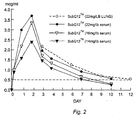
- This example illustrates the injection of various dosages of microcrystals containing OTC into cattle and the levels of OTC achieved in serum and lung tissue. Sustained release of OTC and tissue residue depletion data are also illustrated.
- a sample of an oxytetracycline microcrystal suspension was manufactured in accordance with Example 2, and potency was measured at 250 mg/ml.
- Suspension formulation dosages of 22 mg/lb animal weight, 16 mg/lb, and 10 mg/lb were subcutaneously injected into healthy beef cattle which weighed from 734-764 lbs.
- Figure 2 shows the mean serum and lung tissue concentrations of OTC as a function of time. The OTC blood concentrations reached peak levels of 3.7 ppm at 54 hrs. Depletion rates appeared fairly similar among the dosage levels. Even at 10 days post-dose there were relatively significant serum OTC concentrations; 0.2, 0.3 and 0.6 ppm for the 10, 16 and 22 mg/lb dosages, respectively.
- tissue residue depletion of OTC administered subcutaneously in healthy calves at a target dose rate of 22 mg OTC/lb body weight in order to determine whether effective quantities of the drug were actually present in body tissue.
- Group average body weights on the day of drug treatment were between 587-632 lbs.
- Lung tissue levels averaged 2.18 ppm at 3 days withdrawal and declined progressively through the last sampling point at 12 days postdose, when levels averaged 0.55 ppm.
- compositions of the present invention have the ability to sharply reduce the toxicity of drugs.
- Tilmicosin is generally not used in dogs, cats, or pigs, because of concerns about the toxicity of this drug compound. Treatment of these animals with effective doses of tilmicosin may result in the death of these animals.
- Flunixin is generally not used in cats, also because of concerns over toxicity. Flunixin is sometimes used with hesitancy in dogs, but is also surrounded by the same toxicity concerns. It is noted that treatment of these animals with dosages of only one-half of those described below is capable of causing the death of these animals.
- This example illustrates that microcrystals containing 25% oxytetracycline were safely injected into horses at a dosage as high as 16 mg/lb.
- OTC microcrystals were injected subcutaneously and intra-muscularly into healthy horses. This was found to cause temporary sore muscles in the horses, but no other adverse effects were observed. Therapeutic levels of OTC will be observed for up to 10 days.
- OTC microcrystals were also administered intravenously into horses at a dose of 14 mg/lb. No adverse effects were observed with this mode of administration, and statistical extrapolation revealed therapeutic levels of OTC will remain in the blood for at least five days.
- OTC microcrystals were also administered intravenously at a dose of 16 mg/lb. No adverse effects were observed, and this dose will provide therapeutic levels of OTC for over five days.
- the lipid coating of the microcrystal composition serves to form a protective barrier and protect the labile white blood cells from the OTC.
- Tilmicosin can also be manufactured on a large scale by following the principles taught in the examples above.
- This example discusses the results of injecting microcrystals containing tilmicosin into dogs, cats, and pigs and the subsequent analysis of body tissues for tilmicosin content. It is illustrated that another benefit of the present invention is that compounds which are otherwise too toxic to be safety administered to animals can be safely administered after being coated with the phospholipid compositions of the present invention. In the present embodiment, the invention enables the animal caretaker to take advantage of this very effective antibiotic.
- Figure 3 illustrates levels of tilmicosin in the blood serum and Figure 4 illustrates levels of tilmicosin in the blood pellet.
- Figure 3 illustrates levels of tilmicosin in the blood serum and
- Figure 4 illustrates levels of tilmicosin in the blood pellet.
- serum refers to the liquid portion of blood which remains after at least a substantial portion of the blood cells and clotting proteins have been removed.
- Bood Pellet refers to the portion of blood which forms as a pellet following precipitation of at least a substantial portion of the clotting proteins and blood cells following centrifugation.
- FIG. 5 shows that high levels of tilmicosin are found in the variety of tissues studied after six days. These results show that the tilmicosin was moving from the blood cells and into the various body tissues.
- Two pigs were injected intramuscularly with a dose of 20 mg/kg of microcrystals containing tilmicosin.
- lungs, trachea, kidneys, jejunum, samples of dorsal and ventral skin, and a piece of latissimus dorsi muscle were harvested from both animals and a control.
- Levels of tilmicosin found in the tissues are illustrated in Figure 5. None of the pigs died as a result of the tilmicosin administration, despite the high dose used.
- Two female cats were injected subcutaneously in the dorsal cervical area with a dose of 20 mg/kg of microcrystals containing tilmicosin. No abnormalities were observed over the six-day in-life observation period. On the sixth day, lungs, trachea, kidneys, jejunum, samples of dorsal and ventral skin, and a piece of latissimus dorsi muscle were harvested. Levels of tilmicosin found in the tissues are illustrated in Figure 5.
- This example discusses how microcrystals containing tilmicosin were used to treat "kennel cough" in puppies with success. This example also describes a comparison of therapy with tilmicosin microcrystals versus conventional therapy with amoxicillin.
- Example 7 The Use of Tilmicosin Microcrystals to Treat Respiratory Disease in Cats
- This example illustrates how 20% Tilmicosin microcrystals were used to treat upper respiratory infections in cats.
- Three cats with upper respiratory infections that were suspected to be at least partially bacterial were selected for study.
- the cats were healthy except for the respiratory disease and had no history of previous drug reactions.
- One cat was treated with tilmicosin microcrystals and was injected subcutaneously in the dorsal cervical area using aseptic technique at a dose of 20 mg/kg.
- the second cat was treated with clavimox®, which is an approved antibiotic with a label indication for upper respiratory disease.
- the third cat was untreated.
- the cat treated with clavimox® showed mild sneezing and/or cough and an elevation in rectal temperature of less than one degree. Ocular and/or nasal discharge was either mild or absent.
- the untreated cat showed severe sneezing and coughing, elevated body temperature, and a very evident discharge from the eyes and nose. Appetite was diminished or absent.
- This example illustrates that microcrystals containing flunixin can be safely injected into dogs and cats.
- Two dogs and two cats (both groups containing one male and one female) were selected for study.
- the animals were injected subcutaneously between the shoulder blades at a dose rate of 20 mg/kg of body weight at Day 0.
- the animals were observed daily for seven days for signs of toxicity and general health.
- the female cat had diarrhea on days 2-4. No other abnormalities were observed in any of the other animals.
- This example illustrates that microcrystals containing cefoperozone can be safely injected into dogs and cats.
- Two dogs and two cats (both groups containing one male and one female) were selected for study.
- the animals were injected subcutaneously between the shoulder blades at a dose rate of 20 mg/kg of body weight at Day 0.
- the animals were observed for signs of toxicity and general health for seven days. No abnormalities were observed in any of the animals.
- microcrystals containing various pharmacologically active compounds on a small scale, using a laboratory scale sonicator or small volume microfluidizer.
- microcrystals containing several pharmacologically. active compounds is illustrated in the examples set forth below.
- the examples illustrate some of the problems which may be encountered in working with a particular drug, and solutions which were devised. The person of skill in the art will see that these solutions, and others which are known in the art, can be applied to successfully manufacture microcrystals of a wide variety of water insoluble compounds.
- a flunixin microcrystal suspension was prepared in the following manner; In a 500 ml beaker 90 mI of 300 mM mannitol, 2 mM sodium phosphate buffer was mixed with 30 grams of flunixin and 30 grams phospholipids syrup. The preparation was blended using an Omni GLH homogenizer (which operates according to a "chop and blend" principle) with a medium probe while titrating to pH 5.2. The preparation was then passed through a M-110F Microfluidizer from Microfluidics Corporation, using an inlet pressure of 55 psi resulting in an internal pressure of 1400 psi.
- a 20% tilmicosin microcrystal preparation was made in the following manner; In a 500 ml beaker 42.4 grams of tilmicosin was mixed with 40 grams of phospholipid syrup and 120 ml of 300 mM mannitol, 2 mM sodium phosphate buffer at pH 8.2. The mixture was then blended using an Omni GLH homogenizer with a medium probe. The pH of the preparation went to 9.07 and was allowed to remain there. The preparation was then passed a total of 7 times through a M-110F Microfluidizer from Microfluidics Corporation, using an inlet pressure of 55 psi resulting in an internal pressure of 1400 psi.
- a preparation of cephalone microcrystals was made in the following manner. 30 grams of phospholipids syrup were hydrated in 90 ml of 300 mM mannitol, 2 mM sodium phosphate pH 8.2 for 30 minutes. The mixture was then blended using an Omni GLH homogenizer for 5 minutes while titrating to a pH of 7.10. Next 30 grams of cephalone was added to the preparation and the mixture was blended and titrated to pH 6.75. The mixture was then passed a total of seven times through a M-110F Microfluidizer from Microfluidics Corporation, using an inlet pressure of 55 psi resulting in an internal pressure of 1100 psi. An ice water cooling coil bath was used on the outlet port of the Microfluidizer to prevent the build up of heat in the preparation. The preparation appeared as a homogeneous mixture with a average particle size of less than 3 microns by microscopy.
- a preparation of nitazoxanide microcrystals was made in the following manner: 30 grams of phospholipids syrup were hydrated in 90 ml of 300 mM mannitol, 2 mM sodium phosphate pH 8.2 for 30 minutes. The mixture was then blended using a Omni GLH homogenizer for 5 minutes while titrating to a pH of 5.14. Next 30 grams of nitazoxanide was added to the preparation and the mixture was blended and titrated to pH 5.02. The mixture was then passed a total of seven times through a M-110F Microfluidizer from Microfluidics Corporation, using an inlet pressure of 55 psi resulting in an internal pressure of 1100 psi. An ice water cooling coil bath was used on the outlet port of the microfluidizer to prevent the build up of heat in the preparation. The preparation appeared as a homogeneous mixture with a average particle size of less than 3 ⁇ m by microscopy.
- a preparation of 20% ofloxacin microcrystals was obtained in the following manner: In a 500 ml beaker 40 grams of ofloxacin was. mixed with 40 grams of phospholipids syrup and 120 ml of 300 mM mannitol, 2 mM sodium phosphate buffer at pH 8.2. The mixture was then blended using an Omni GLH homogenizer with a medium probe. The pH of the preparation went to 7.06 and was allowed to remain there. The preparation was then passed a total of seven times through a M-110F Microfluidizer from Microfluidics Corporation, using an inlet pressure of 55 psi resulting in an internal pressure of 1400 psi.
- phospholipid syrup (see Example 1) was hydrated in 90 ml of 300 mM mannitol, 2 mM sodium phosphate, pH 8.2 for 30 minutes. The mixture was then blended using an Omni GLH homogenizer for five minutes while titrating to a pH of 7.10. 30 grams of cefaquinolone was then added to the preparation and the mixture was blended and titrated to pH 6.75. The mixture was then passed a total of seven times through an M-110F Microfluidizer from Microfluidics Corporation, using an inlet pressure of 55 psi resulting in an internal pressure of 1100 psi. An ice water cooling coil bath was used on the outlet port of the microfluidizer to prevent the build up of heat in the preparation. The preparation appeared as a homogeneous mixture with an average particle size of less than 3 ⁇ m by microscopy.
- phospholipid syrup in a 100 ml beaker, 4.8 grams of phospholipid syrup (see Example 1) was hydrated in 38.3 ml of 300 mM mannitol, 2 mM sodium phosphate buffer at pH 8.2 for one hour, and then was blended using an Omni GLH homogenizer. Next 4.86 grams of ofloxacin was added to the preparation and the mixture was blended as above. The preparation was then sonicated for 30 minutes using a Sonifier Cell Disrupter from Heat Systems Ultrasonics, cycling the sonicator off for one minute for every 3 minutes sonication time and keeping the preparation immersed in an ice water bath to prevent the build up of heat while being titrated to a pH of 6.87. The resulting preparation appeared as a milky white suspension and had an average particle size of less than 3 ⁇ m.
- a preparation of cefoperazone microcrystals was prepared in the following manner; In a 50 ml beaker, 3.0 grams of phospholipids syrup and 6.0 grams of cefoperazone acid was added slowly to 21 ml of 300 mM mannitol, 2 mM sodium phosphate buffer at pH 8.2 with intermittent sonication supplied by a Sonifier Cell Disrupter from Heat Systems Ultrasonics. The preparation was then sonicated for 10 minutes, cycling the sonicator off for one minute for every 3 minutes sonication time and keeping the preparation immersed in an ice water bath to prevent the build up of heat while being titrated to a pH 4.47.
Landscapes
- Health & Medical Sciences (AREA)
- Chemical & Material Sciences (AREA)
- Life Sciences & Earth Sciences (AREA)
- Veterinary Medicine (AREA)
- Medicinal Chemistry (AREA)
- Public Health (AREA)
- Pharmacology & Pharmacy (AREA)
- Animal Behavior & Ethology (AREA)
- General Health & Medical Sciences (AREA)
- Epidemiology (AREA)
- Engineering & Computer Science (AREA)
- General Chemical & Material Sciences (AREA)
- Chemical Kinetics & Catalysis (AREA)
- Bioinformatics & Cheminformatics (AREA)
- Nuclear Medicine, Radiotherapy & Molecular Imaging (AREA)
- Organic Chemistry (AREA)
- Oil, Petroleum & Natural Gas (AREA)
- Biophysics (AREA)
- Dispersion Chemistry (AREA)
- Dermatology (AREA)
- Oncology (AREA)
- Communicable Diseases (AREA)
- Molecular Biology (AREA)
- Anesthesiology (AREA)
- Tropical Medicine & Parasitology (AREA)
- Pulmonology (AREA)
- Pain & Pain Management (AREA)
- Rheumatology (AREA)
- Pharmaceuticals Containing Other Organic And Inorganic Compounds (AREA)
- Medicinal Preparation (AREA)
- Acyclic And Carbocyclic Compounds In Medicinal Compositions (AREA)
Abstract
Description
| oxytetracycline (OTC) | 25% w/v |
| phospholipid syrup (from Example 1) | 20% w/v |
| mannitol USP | 2.25% |
| methylparaben NF | 0.18% |
| propylparaben NF | 0.02% |
| Water for Injection | QS |
Claims (29)
- A pharmaceutical composition comprising microcrystals, the microcrystals comprising a pharmacologically active compound and being contained within a phospholipid layer, wherein
at least 50 percent of the microcrystals are from 0.5 µm to 3.0 µm in diameter; and
at least 10 percent of the microcrystals are from 3.0 µm to 10 µm in diameter;
at least 90% of the microcrystals are less than 10 µm in diameter; and
the composition contains microcrystals that are greater than 10 µm in diameter. - The composition of claim 1, wherein
from about thirty to about forty percent of the microcrystals are from 3.0 µm to 10 µm in diameter. - The composition of claim 1 or 2, wherein at least about 1% of the microcrystals are greater than 10 µm in diameter.
- A method for manufacturing a pharmaceutical composition for the sustained release of a pharmacologically active compound, the composition comprising microcrystals of a pharmacologically active compound contained within a phospholipid layer, the method comprising:forming a suspension comprising microcrystals of the pharmacologically active compound suspended in a lipid composition; andpassing the suspension through a homogenizer at high pressure to coat the microcrystals with the lipid composition to produce a composition of microcrystals of a pharmacologically active compound contained within a phospholipid layer, wherein
at least 50 percent of the microcrystals are from 0.5 µm to 3 µm in diameter;
at least ten percent of the microcrystals are from 3 µm to 10 µm in diameter; and
the composition contains microcrystals which are greater than 10 µm in diameter. - A method for manufacturing a pharmaceutical composition for the sustained release of a pharmacologically active compound, the composition comprising microcrystals of a pharmacologically active compound contained within a phospholipid layer, the method comprising:whereinforming a lipid suspension; andcontacting the lipid suspension with the microcrystals to coat the microcrystals with the lipid suspension to produce a composition of microcrystals coated with a phospholipid layer
at least 50 percent of the microcrystals are from 0.5 µm to 3 µm in diameter;
at least ten percent of the microcrystals are from 3 µm to 10 µm in diameter, and
the composition contains microcrystals which are larger than 10 µm in diameter. - The method of claim 4 or 5, wherein at least about 1% of the microcrystals are greater than 10 µm in diameter.
- The method of claim 4 or 6, wherein at least about twenty five percent of the microcrystals are greater than 3 µm in diameter.
- The method of claim 4, wherein the composition of lipid and microcrystals is passed through the homogenizer a plurality of times.
- The method of claim 4 or 7, wherein the pharmacologically active compound is an antibiotic, anesthetic, anti-inflammatory agent, anti-protozoan agent.
- The method of claim 9, wherein the antibiotic is oxytetracycline, floroquinolone, tilmicosin, cephalosporin, nitazoxanide.
- The method of claim 9, wherein the antibiotic is a floroquinolone and a cephalosporin covalently combined to form a single molecule.
- The method of claim 10 or 11, wherein the floroquinolone is selected from the group consisting of: ofloxacin, sarafloxacin, and ciprofloxacin.
- The method of claim 10, wherein the cephalosporin is cefazolin, cefuroxime or a derivative of cefuroxime, cefoperazone, cefaclor.
- The method of claim 9, wherein the anesthetic is propofal.
- The method of claim 9, wherein the anti-inflammatory agent is flunixin.
- The method of claim 9, wherein the anti-protozoan agent is nitazoxanide.
- The method of claims 4 to 7 further comprising the step of sterilizing the composition of microcrystals.
- The method of claim 17, wherein the step of sterilizing the composition of microcrystals comprises the use of gamma radiation to sterilize the composition.
- The use of microcrystals for preparing a pharmaceutical composition for treating an infection or for treating respiratory disease in a mammal, said composition comprising an effective dose of a composition of microcrystals, the microcrystals comprising an antibiotic and being contained within a phospholipid layer; wherein
at least 50 percent of the microcrystals are from 0.5 µm to 3.0 µm in diameter;
at least ten percent of the microcrystals are from 3.0 µm to 10 µm in diameter; and
the composition contains microcrystals that are larger than 10 µm in diameter. - The use of microcrystals for preparing a pharmaceutical composition for treating inflammation in a mammal, said composition comprising an effective dose of a composition of microcrystals, the microcrystals comprising an anti-inflammatory agent and being contained within a phospholipid layer; wherein
at least 50 percent of the microcrystals are from 0.5 µm to 3.0 µm in diameter;
at least ten percent of the microcrystals are from 3.0 µm to 10 µm in diameter; and
the composition contains microcrystals that are larger than 10 µm in diameter. - The use of microcrystals for preparing a pharmaceutical composition for treating pain in a mammal, said composition comprising an effective dose of a composition of microcrystals, the microcrystals comprising an anesthetic and being contained within a phospholipid layer; wherein
at least 50 percent of the microcrystals are from 0.5 µm to 3.0 µm in diameter;
at least ten percent of the microcrystals are from 3.0 µm to 10 µm in diameter; and
the composition contains microcrystals that are greater than 10 µm in diameter. - The use of claim 19, wherein the antibiotic is selected from the group consisting of: oxytetracyline, tilmicosin, cephalone, a floroquinolone, a cephalosporin, or nitazoxanide.
- The use of claims 19 or 22, wherein the mammal is selected from the group consisting of: bovine, equine, porcines, canines, and felines.
- The use of claims 19 or 22, wherein the infection is caused by a protozoan.
- The use of claims 19 or 22, wherein the respiratory disease is bovine respiratory disease.
- The use of claim 20, wherein the anti-inflammatory agent is flunixin.
- The use of claim 21, wherein the anesthetic is propofal.
- The use of any of claims 19 to 27, wherein at least about 1% of the microcrystals are larger than 10 µm in diameter.
- The use of any of claims 19 to 27, wherein the composition as administered to the mammal is in a form suitable for parenteral administration or subcutaneous administration.
Applications Claiming Priority (3)
| Application Number | Priority Date | Filing Date | Title |
|---|---|---|---|
| US09/190,049 US6180136B1 (en) | 1998-11-10 | 1998-11-10 | Phospholipid-coated microcrystals for the sustained release of pharmacologically active compounds and methods of their manufacture and use |
| PCT/US1999/026452 WO2000027369A1 (en) | 1998-11-10 | 1999-11-08 | Phospholipid-coated microcrystals for the sustained release of pharmacologically active compounds and methods of their manufacture and use |
| US190049 | 2005-07-27 |
Publications (2)
| Publication Number | Publication Date |
|---|---|
| EP1043978A1 EP1043978A1 (en) | 2000-10-18 |
| EP1043978B1 true EP1043978B1 (en) | 2004-06-09 |
Family
ID=22699828
Family Applications (1)
| Application Number | Title | Priority Date | Filing Date |
|---|---|---|---|
| EP99971704A Expired - Lifetime EP1043978B1 (en) | 1998-11-10 | 1999-11-08 | Phospholipid-coated microcrystals for the sustained release of pharmacologically active compounds and methods of their manufacture and use |
Country Status (9)
| Country | Link |
|---|---|
| US (2) | US6180136B1 (en) |
| EP (1) | EP1043978B1 (en) |
| JP (1) | JP3831613B2 (en) |
| AT (1) | ATE268594T1 (en) |
| AU (1) | AU760111B2 (en) |
| CA (1) | CA2315975C (en) |
| DE (1) | DE69917883T2 (en) |
| ES (1) | ES2221484T3 (en) |
| WO (1) | WO2000027369A1 (en) |
Families Citing this family (42)
| Publication number | Priority date | Publication date | Assignee | Title |
|---|---|---|---|---|
| US6797276B1 (en) | 1996-11-14 | 2004-09-28 | The United States Of America As Represented By The Secretary Of The Army | Use of penetration enhancers and barrier disruption agents to enhance the transcutaneous immune response |
| US20060002949A1 (en) | 1996-11-14 | 2006-01-05 | Army Govt. Of The Usa, As Rep. By Secretary Of The Office Of The Command Judge Advocate, Hq Usamrmc. | Transcutaneous immunization without heterologous adjuvant |
| US5980898A (en) | 1996-11-14 | 1999-11-09 | The United States Of America As Represented By The U.S. Army Medical Research & Material Command | Adjuvant for transcutaneous immunization |
| US20060002959A1 (en) * | 1996-11-14 | 2006-01-05 | Government Of The United States | Skin-sctive adjuvants for transcutaneous immuization |
| US20040258703A1 (en) * | 1997-11-14 | 2004-12-23 | The Government Of The Us, As Represented By The Secretary Of The Army | Skin-active adjuvants for transcutaneous immunization |
| US7101575B2 (en) * | 1998-03-19 | 2006-09-05 | Max-Planck-Gesellschaft Zur Forderung Der Wissenschaften E.V. | Production of nanocapsules and microcapsules by layer-wise polyelectrolyte self-assembly |
| US6979456B1 (en) | 1998-04-01 | 2005-12-27 | Jagotec Ag | Anticancer compositions |
| JP4198318B2 (en) | 1998-08-19 | 2008-12-17 | ヤーゴテック アクチェンゲゼルシャフト | Injectable aqueous dispersion of propofol |
| WO2000061184A2 (en) * | 1999-04-08 | 2000-10-19 | Glenn Gregory M | Dry formulation for transcutaneous immunization |
| WO2000077281A1 (en) * | 1999-06-10 | 2000-12-21 | MAX-PLANCK-Gesellschaft zur Förderung der Wissenschaften e.V. | Encapsulation of crystals via multilayer coatings |
| EA008242B1 (en) | 1999-12-08 | 2007-04-27 | Фармация Корпорейшн | Cyclooxygenase-2 inhibitor compositions having rapid onset of therapeutic effect and methods for treating diseases |
| US8404217B2 (en) * | 2000-05-10 | 2013-03-26 | Novartis Ag | Formulation for pulmonary administration of antifungal agents, and associated methods of manufacture and use |
| US20020035107A1 (en) * | 2000-06-20 | 2002-03-21 | Stefan Henke | Highly concentrated stable meloxicam solutions |
| US6955908B1 (en) * | 2000-06-21 | 2005-10-18 | Lambl Barbara B | Organism associated with nongonococcal urethritis |
| PT1372708E (en) * | 2001-02-13 | 2008-09-29 | Us Gov Sec Army | Vaccine for transcutaneous immunization against travellers` diarrhoea |
| IN188924B (en) * | 2001-03-01 | 2002-11-23 | Bharat Serums & Vaccines Ltd | |
| DE10139965B4 (en) * | 2001-08-14 | 2005-12-29 | Biotest Ag | Gamma sterilizable culture medium for the detection of yeasts and fungi |
| US7125568B2 (en) | 2001-08-23 | 2006-10-24 | Sung Michael T | Lipophilic drug compositions |
| DE10149674A1 (en) | 2001-10-09 | 2003-04-24 | Apogepha Arzneimittel Gmbh | Orally administered composition for sustained release of propiverine, useful for treatment of hypertonic bladder disorders, especially by once-daily administration |
| DE10161077A1 (en) * | 2001-12-12 | 2003-06-18 | Boehringer Ingelheim Vetmed | Highly concentrated stable meloxicam solutions for needleless injection |
| WO2003106589A1 (en) * | 2002-06-13 | 2003-12-24 | Lyotropic Therapeutics, Inc. | A nanoporous particle with a retained target |
| KR20040015622A (en) * | 2002-08-13 | 2004-02-19 | 대한뉴팜(주) | Injectable Composition Comprising Ceftiofur Sodium as Active Ingredient |
| UY27939A1 (en) | 2002-08-21 | 2004-03-31 | Glaxo Group Ltd | COMPOUNDS |
| US8992980B2 (en) * | 2002-10-25 | 2015-03-31 | Boehringer Ingelheim Vetmedica Gmbh | Water-soluble meloxicam granules |
| US6936273B2 (en) * | 2002-12-20 | 2005-08-30 | Idexx Laboratories, Inc. | Liposomal analgesic formulation and use |
| KR20050103906A (en) * | 2003-01-20 | 2005-11-01 | 오리거 인터내셔널 에스.에이. | Use of a composition comprising vitamin k1 oxide or a derivative thereof for the treatment and/or the prevention of mammal dermatological lesions |
| EP1568369A1 (en) * | 2004-02-23 | 2005-08-31 | Boehringer Ingelheim Vetmedica Gmbh | Use of meloxicam for the treatment of respiratory diseases in pigs |
| DE102004013637A1 (en) * | 2004-03-19 | 2005-10-13 | Capsulution Nanoscience Ag | Process for the preparation of CS particles and microcapsules using porous templates as well as CS particles and microcapsules |
| DE102004021281A1 (en) * | 2004-04-29 | 2005-11-24 | Boehringer Ingelheim Vetmedica Gmbh | Use of meloxicam formulations in veterinary medicine |
| US7444197B2 (en) * | 2004-05-06 | 2008-10-28 | Smp Logic Systems Llc | Methods, systems, and software program for validation and monitoring of pharmaceutical manufacturing processes |
| DE102004030409A1 (en) * | 2004-06-23 | 2006-01-26 | Boehringer Ingelheim Vetmedica Gmbh | New use of meloxicam in veterinary medicine |
| WO2006030450A2 (en) * | 2004-09-13 | 2006-03-23 | Bharat Serums & Vaccines Ltd. | Stable emulsion compositions for intravenous administration having antimicrobial preservative efficacy |
| US20070015803A1 (en) * | 2005-04-12 | 2007-01-18 | Romark Laboratories L.C. | Methods for treating diseases through interruption of protein maturation, compounds that inhibit the function of molecular chaperones such as protein disulfide isomerases or interfere with glycosylation, pharmaceutical compositions comprising them, and screening methods for identifying therapeutic agents |
| NZ567627A (en) * | 2005-09-30 | 2011-08-26 | Boehringer Ingelheim Vetmed | Granulation process for making a divisible tablet containing meloxicam |
| AP2907A (en) * | 2006-01-09 | 2014-05-31 | Romark Lab Lc | Viral hepatitis treatment |
| US8642062B2 (en) | 2007-10-31 | 2014-02-04 | Abbott Cardiovascular Systems Inc. | Implantable device having a slow dissolving polymer |
| US7828996B1 (en) | 2009-03-27 | 2010-11-09 | Abbott Cardiovascular Systems Inc. | Method for the manufacture of stable, nano-sized particles |
| MX2012004177A (en) | 2009-10-12 | 2012-05-08 | Boehringer Ingelheim Vetmed | Containers for compositions comprising meloxicam. |
| US9149480B2 (en) | 2010-03-03 | 2015-10-06 | Boehringer Ingeleheim Vetmedica GmbH | Use of meloxicam for the long-term treatment of musculoskeletal disorders in cats |
| US9795568B2 (en) | 2010-05-05 | 2017-10-24 | Boehringer Ingelheim Vetmedica Gmbh | Low concentration meloxicam tablets |
| CN102302456B (en) * | 2011-07-26 | 2014-03-12 | 武汉回盛生物科技有限公司 | Preparation method of tilmicosin phosphate microsphere specifically for use on animals |
| CN117598997B (en) * | 2023-08-21 | 2024-08-06 | 沈阳伟嘉生物技术有限公司 | Tilmicosin-natural plant organic acid microcrystalline double salt powder preparation and preparation method and application thereof |
Family Cites Families (11)
| Publication number | Priority date | Publication date | Assignee | Title |
|---|---|---|---|---|
| US4528193A (en) * | 1978-12-27 | 1985-07-09 | A. Natterman & Cie. Gmbh | Inflammation-preventing pharmaceutical composition of oral administration |
| DE2914788A1 (en) | 1979-04-11 | 1980-10-16 | Nattermann A & Cie | PARENTERAL APPLICABLE, STABLE DRUG SOLUTIONS WITH ANTI-INFLAMMATORY EFFECT |
| DE3022136C2 (en) * | 1980-06-13 | 1986-07-17 | A. Nattermann & Cie GmbH, 5000 Köln | Process for filling pharmaceutical compositions containing phospholipids into hard capsules |
| US4847015A (en) * | 1986-02-10 | 1989-07-11 | Kewpie Kabushiki Kaisha | Process for producing egg yolk lecithin having reduced PE content and/or containing substantially no impurities |
| DE3608455A1 (en) * | 1986-03-14 | 1987-09-17 | Nattermann A & Cie | PRODUCTS CONTAINING PHOSPHOLIPID, THEIR PRODUCTION AND USE |
| CA1338736C (en) | 1986-12-05 | 1996-11-26 | Roger Baurain | Microcrystals containing an active ingredient with affinity for phospholipids and at least one phospholipid; process for preparing the same |
| JPH01131189A (en) * | 1987-11-17 | 1989-05-24 | Nippon Oil & Fats Co Ltd | Production of docosahexaenoic acid-containing phosphoilipid |
| JPH02132736A (en) | 1988-11-14 | 1990-05-22 | Toshiba Corp | Large power klystron |
| US5091188A (en) | 1990-04-26 | 1992-02-25 | Haynes Duncan H | Phospholipid-coated microcrystals: injectable formulations of water-insoluble drugs |
| US5091187A (en) | 1990-04-26 | 1992-02-25 | Haynes Duncan H | Phospholipid-coated microcrystals: injectable formulations of water-insoluble drugs |
| US5660854A (en) | 1994-11-28 | 1997-08-26 | Haynes; Duncan H | Drug releasing surgical implant or dressing material |
-
1998
- 1998-11-10 US US09/190,049 patent/US6180136B1/en not_active Expired - Fee Related
-
1999
- 1999-11-08 DE DE69917883T patent/DE69917883T2/en not_active Expired - Fee Related
- 1999-11-08 CA CA002315975A patent/CA2315975C/en not_active Expired - Fee Related
- 1999-11-08 ES ES99971704T patent/ES2221484T3/en not_active Expired - Lifetime
- 1999-11-08 AT AT99971704T patent/ATE268594T1/en not_active IP Right Cessation
- 1999-11-08 AU AU14735/00A patent/AU760111B2/en not_active Ceased
- 1999-11-08 EP EP99971704A patent/EP1043978B1/en not_active Expired - Lifetime
- 1999-11-08 JP JP2000580600A patent/JP3831613B2/en not_active Expired - Fee Related
- 1999-11-08 WO PCT/US1999/026452 patent/WO2000027369A1/en not_active Ceased
-
2000
- 2000-07-25 US US09/624,556 patent/US6423338B1/en not_active Expired - Fee Related
Also Published As
| Publication number | Publication date |
|---|---|
| ES2221484T3 (en) | 2004-12-16 |
| WO2000027369A1 (en) | 2000-05-18 |
| DE69917883T2 (en) | 2005-06-02 |
| AU1473500A (en) | 2000-05-29 |
| JP2002529400A (en) | 2002-09-10 |
| US6180136B1 (en) | 2001-01-30 |
| AU760111B2 (en) | 2003-05-08 |
| US6423338B1 (en) | 2002-07-23 |
| JP3831613B2 (en) | 2006-10-11 |
| DE69917883D1 (en) | 2004-07-15 |
| ATE268594T1 (en) | 2004-06-15 |
| EP1043978A1 (en) | 2000-10-18 |
| CA2315975A1 (en) | 2000-05-18 |
| CA2315975C (en) | 2009-01-13 |
Similar Documents
| Publication | Publication Date | Title |
|---|---|---|
| US6423338B1 (en) | Phospholipid-coated microcrystals for the sustained release of pharmacologically active compounds and methods of their manufacture and use | |
| JP6577548B2 (en) | Depot formulation of hydrophobic active ingredient and method for preparing the same | |
| EP1462101B1 (en) | Drinkable preparation comprising ketoprofen and use thereof in the simultaneous treatment of a group of animals of respiratory diseases | |
| RU2627429C2 (en) | Compositions with controlled release and methods of their use | |
| TW200808373A (en) | Liquid drug formulation | |
| EP3946260B1 (en) | Pregabalin formulations and use thereof | |
| US20200330436A1 (en) | Compositions and Methods for Treatment and Prevention of Pyrexia in Horses | |
| CN115518039B (en) | Tolfenamic acid solid lipid nano suspension for livestock and preparation method thereof | |
| CN110721152B (en) | Sustained-release composition for treating animal skin parasite and fungus infection | |
| WO2003011214A2 (en) | Novel methods and formulations for administration of active agents | |
| JP2929014B2 (en) | Veterinary pharmaceutical composition | |
| ES2346573T3 (en) | CEFQUINOMA COMPOSITIONS AND METHODS FOR USE. | |
| CN116407497B (en) | Compound alfaxalone injection and preparation method thereof | |
| JP6189437B2 (en) | Injectable antibiotic preparation and method of use thereof | |
| US12295958B2 (en) | Ready-to-use injectable formulations | |
| WO1994026110A1 (en) | Stable quinolone and naphthyridine premix formulations | |
| CN121154534A (en) | Etoricoxib injection and preparation method thereof | |
| CN117717555A (en) | A kind of soluble oftenanone anti-coccidial composition | |
| EP2934524B1 (en) | Penethamate veterinary injectable formulations | |
| CN117136063A (en) | Pharmaceutical compositions and aprepitant injection and freeze-dried powder injection | |
| CN104983680A (en) | Stability nanometer suspension preparation of worm repellent compound for sheep and preparation method thereof | |
| HK40060289A (en) | Pregabalin formulations and use thereof | |
| CN118286156A (en) | Weight-reducing polypeptide pharmaceutical composition, nasal spray and preparation method thereof | |
| PL171682B1 (en) | A method of producing a pharmaceutical agent and a pharmaceutical agent |
Legal Events
| Date | Code | Title | Description |
|---|---|---|---|
| PUAI | Public reference made under article 153(3) epc to a published international application that has entered the european phase |
Free format text: ORIGINAL CODE: 0009012 |
|
| 17P | Request for examination filed |
Effective date: 20000807 |
|
| AK | Designated contracting states |
Kind code of ref document: A1 Designated state(s): AT BE CH CY DE DK ES FI FR GB GR IE IT LI LU MC NL PT SE |
|
| AX | Request for extension of the european patent |
Free format text: AL;LT;LV;MK;RO;SI |
|
| 17Q | First examination report despatched |
Effective date: 20021031 |
|
| GRAP | Despatch of communication of intention to grant a patent |
Free format text: ORIGINAL CODE: EPIDOSNIGR1 |
|
| GRAP | Despatch of communication of intention to grant a patent |
Free format text: ORIGINAL CODE: EPIDOSNIGR1 |
|
| GRAS | Grant fee paid |
Free format text: ORIGINAL CODE: EPIDOSNIGR3 |
|
| GRAA | (expected) grant |
Free format text: ORIGINAL CODE: 0009210 |
|
| AK | Designated contracting states |
Kind code of ref document: B1 Designated state(s): AT BE CH CY DE DK ES FI FR GB GR IE IT LI LU MC NL PT SE |
|
| PG25 | Lapsed in a contracting state [announced via postgrant information from national office to epo] |
Ref country code: NL Free format text: LAPSE BECAUSE OF FAILURE TO SUBMIT A TRANSLATION OF THE DESCRIPTION OR TO PAY THE FEE WITHIN THE PRESCRIBED TIME-LIMIT Effective date: 20040609 Ref country code: LI Free format text: LAPSE BECAUSE OF FAILURE TO SUBMIT A TRANSLATION OF THE DESCRIPTION OR TO PAY THE FEE WITHIN THE PRESCRIBED TIME-LIMIT Effective date: 20040609 Ref country code: FI Free format text: LAPSE BECAUSE OF FAILURE TO SUBMIT A TRANSLATION OF THE DESCRIPTION OR TO PAY THE FEE WITHIN THE PRESCRIBED TIME-LIMIT Effective date: 20040609 Ref country code: CY Free format text: LAPSE BECAUSE OF FAILURE TO SUBMIT A TRANSLATION OF THE DESCRIPTION OR TO PAY THE FEE WITHIN THE PRESCRIBED TIME-LIMIT Effective date: 20040609 Ref country code: CH Free format text: LAPSE BECAUSE OF FAILURE TO SUBMIT A TRANSLATION OF THE DESCRIPTION OR TO PAY THE FEE WITHIN THE PRESCRIBED TIME-LIMIT Effective date: 20040609 Ref country code: BE Free format text: LAPSE BECAUSE OF FAILURE TO SUBMIT A TRANSLATION OF THE DESCRIPTION OR TO PAY THE FEE WITHIN THE PRESCRIBED TIME-LIMIT Effective date: 20040609 Ref country code: AT Free format text: LAPSE BECAUSE OF FAILURE TO SUBMIT A TRANSLATION OF THE DESCRIPTION OR TO PAY THE FEE WITHIN THE PRESCRIBED TIME-LIMIT Effective date: 20040609 |
|
| REG | Reference to a national code |
Ref country code: GB Ref legal event code: FG4D |
|
| REG | Reference to a national code |
Ref country code: CH Ref legal event code: EP |
|
| REF | Corresponds to: |
Ref document number: 69917883 Country of ref document: DE Date of ref document: 20040715 Kind code of ref document: P |
|
| REG | Reference to a national code |
Ref country code: IE Ref legal event code: FG4D |
|
| PG25 | Lapsed in a contracting state [announced via postgrant information from national office to epo] |
Ref country code: SE Free format text: LAPSE BECAUSE OF FAILURE TO SUBMIT A TRANSLATION OF THE DESCRIPTION OR TO PAY THE FEE WITHIN THE PRESCRIBED TIME-LIMIT Effective date: 20040909 Ref country code: GR Free format text: LAPSE BECAUSE OF FAILURE TO SUBMIT A TRANSLATION OF THE DESCRIPTION OR TO PAY THE FEE WITHIN THE PRESCRIBED TIME-LIMIT Effective date: 20040909 Ref country code: DK Free format text: LAPSE BECAUSE OF FAILURE TO SUBMIT A TRANSLATION OF THE DESCRIPTION OR TO PAY THE FEE WITHIN THE PRESCRIBED TIME-LIMIT Effective date: 20040909 |
|
| PG25 | Lapsed in a contracting state [announced via postgrant information from national office to epo] |
Ref country code: LU Free format text: LAPSE BECAUSE OF NON-PAYMENT OF DUE FEES Effective date: 20041108 Ref country code: IE Free format text: LAPSE BECAUSE OF NON-PAYMENT OF DUE FEES Effective date: 20041108 |
|
| LTIE | Lt: invalidation of european patent or patent extension |
Effective date: 20040609 |
|
| PG25 | Lapsed in a contracting state [announced via postgrant information from national office to epo] |
Ref country code: MC Free format text: LAPSE BECAUSE OF NON-PAYMENT OF DUE FEES Effective date: 20041130 |
|
| NLV1 | Nl: lapsed or annulled due to failure to fulfill the requirements of art. 29p and 29m of the patents act | ||
| REG | Reference to a national code |
Ref country code: CH Ref legal event code: PL |
|
| REG | Reference to a national code |
Ref country code: ES Ref legal event code: FG2A Ref document number: 2221484 Country of ref document: ES Kind code of ref document: T3 |
|
| ET | Fr: translation filed | ||
| PLBE | No opposition filed within time limit |
Free format text: ORIGINAL CODE: 0009261 |
|
| STAA | Information on the status of an ep patent application or granted ep patent |
Free format text: STATUS: NO OPPOSITION FILED WITHIN TIME LIMIT |
|
| 26N | No opposition filed |
Effective date: 20050310 |
|
| REG | Reference to a national code |
Ref country code: IE Ref legal event code: MM4A |
|
| PG25 | Lapsed in a contracting state [announced via postgrant information from national office to epo] |
Ref country code: PT Free format text: LAPSE BECAUSE OF NON-PAYMENT OF DUE FEES Effective date: 20041109 |
|
| PGFP | Annual fee paid to national office [announced via postgrant information from national office to epo] |
Ref country code: DE Payment date: 20081114 Year of fee payment: 10 |
|
| PGFP | Annual fee paid to national office [announced via postgrant information from national office to epo] |
Ref country code: ES Payment date: 20081216 Year of fee payment: 10 |
|
| PGFP | Annual fee paid to national office [announced via postgrant information from national office to epo] |
Ref country code: IT Payment date: 20081129 Year of fee payment: 10 |
|
| PGFP | Annual fee paid to national office [announced via postgrant information from national office to epo] |
Ref country code: FR Payment date: 20081112 Year of fee payment: 10 |
|
| PGFP | Annual fee paid to national office [announced via postgrant information from national office to epo] |
Ref country code: GB Payment date: 20081112 Year of fee payment: 10 |
|
| GBPC | Gb: european patent ceased through non-payment of renewal fee |
Effective date: 20091108 |
|
| REG | Reference to a national code |
Ref country code: FR Ref legal event code: ST Effective date: 20100730 |
|
| PG25 | Lapsed in a contracting state [announced via postgrant information from national office to epo] |
Ref country code: FR Free format text: LAPSE BECAUSE OF NON-PAYMENT OF DUE FEES Effective date: 20091130 |
|
| PG25 | Lapsed in a contracting state [announced via postgrant information from national office to epo] |
Ref country code: DE Free format text: LAPSE BECAUSE OF NON-PAYMENT OF DUE FEES Effective date: 20100601 |
|
| PG25 | Lapsed in a contracting state [announced via postgrant information from national office to epo] |
Ref country code: GB Free format text: LAPSE BECAUSE OF NON-PAYMENT OF DUE FEES Effective date: 20091108 |
|
| PG25 | Lapsed in a contracting state [announced via postgrant information from national office to epo] |
Ref country code: IT Free format text: LAPSE BECAUSE OF NON-PAYMENT OF DUE FEES Effective date: 20091108 |
|
| REG | Reference to a national code |
Ref country code: ES Ref legal event code: FD2A Effective date: 20110412 |
|
| PG25 | Lapsed in a contracting state [announced via postgrant information from national office to epo] |
Ref country code: ES Free format text: LAPSE BECAUSE OF NON-PAYMENT OF DUE FEES Effective date: 20110331 |
|
| PG25 | Lapsed in a contracting state [announced via postgrant information from national office to epo] |
Ref country code: ES Free format text: LAPSE BECAUSE OF NON-PAYMENT OF DUE FEES Effective date: 20091109 |