EP1043885A2 - Negotiating an exchange of image processing functionality - Google Patents
Negotiating an exchange of image processing functionality Download PDFInfo
- Publication number
- EP1043885A2 EP1043885A2 EP00301912A EP00301912A EP1043885A2 EP 1043885 A2 EP1043885 A2 EP 1043885A2 EP 00301912 A EP00301912 A EP 00301912A EP 00301912 A EP00301912 A EP 00301912A EP 1043885 A2 EP1043885 A2 EP 1043885A2
- Authority
- EP
- European Patent Office
- Prior art keywords
- functionality
- devices
- image processing
- image
- transfer
- Prior art date
- Legal status (The legal status is an assumption and is not a legal conclusion. Google has not performed a legal analysis and makes no representation as to the accuracy of the status listed.)
- Granted
Links
Images



Classifications
-
- H—ELECTRICITY
- H04—ELECTRIC COMMUNICATION TECHNIQUE
- H04N—PICTORIAL COMMUNICATION, e.g. TELEVISION
- H04N1/00—Scanning, transmission or reproduction of documents or the like, e.g. facsimile transmission; Details thereof
- H04N1/32—Circuits or arrangements for control or supervision between transmitter and receiver or between image input and image output device, e.g. between a still-image camera and its memory or between a still-image camera and a printer device
- H04N1/333—Mode signalling or mode changing; Handshaking therefor
- H04N1/33376—Mode signalling or mode changing; Handshaking therefor according to characteristics or state of one of the communicating parties, e.g. available memory capacity
-
- H—ELECTRICITY
- H04—ELECTRIC COMMUNICATION TECHNIQUE
- H04L—TRANSMISSION OF DIGITAL INFORMATION, e.g. TELEGRAPHIC COMMUNICATION
- H04L69/00—Network arrangements, protocols or services independent of the application payload and not provided for in the other groups of this subclass
- H04L69/24—Negotiation of communication capabilities
-
- H—ELECTRICITY
- H04—ELECTRIC COMMUNICATION TECHNIQUE
- H04N—PICTORIAL COMMUNICATION, e.g. TELEVISION
- H04N1/00—Scanning, transmission or reproduction of documents or the like, e.g. facsimile transmission; Details thereof
- H04N1/32—Circuits or arrangements for control or supervision between transmitter and receiver or between image input and image output device, e.g. between a still-image camera and its memory or between a still-image camera and a printer device
- H04N1/32561—Circuits or arrangements for control or supervision between transmitter and receiver or between image input and image output device, e.g. between a still-image camera and its memory or between a still-image camera and a printer device using a programmed control device, e.g. a microprocessor
-
- H—ELECTRICITY
- H04—ELECTRIC COMMUNICATION TECHNIQUE
- H04N—PICTORIAL COMMUNICATION, e.g. TELEVISION
- H04N2201/00—Indexing scheme relating to scanning, transmission or reproduction of documents or the like, and to details thereof
- H04N2201/0008—Connection or combination of a still picture apparatus with another apparatus
- H04N2201/0074—Arrangements for the control of a still picture apparatus by the connected apparatus
Definitions
- the present invention relates to transmission of image data between two image processing devices over a bi-directional communication interface, such as a local area network. More specifically, the invention involves negotiation between two devices such as an image output device and an image input device, so as to transfer image data between the devices, and so as to negotiate whether exportable image processing functionality on one device should be exported to the other device so as to increase overall image transfer efficiency.
- JetSendTM is a device-to-device communications protocol for local and wide area networks that allows network devices to intelligently negotiate information exchange.
- the JetsendTM protocol allows the two devices to connect over a network, to negotiate a common data type for the information exchange, to provide device status, and to exchange the needed information, all without intervention from a user or from a third device such as a computer which provides oversight over the communication between the two devices.
- JetSendTM protocol is described at length in "HP JetSend Communications Technology, Section I: Architectural Overview; Section II: Protocol References; and Section III: E-Material Specification", Version 1.0, Hewlett Packard Co., 1997.
- One common example of information exchange is the exchange of image data between an image input device (such as a scanner or digital camera) and an image output device (such as a printer or facsimile or optical projector).
- an image input device such as a scanner or digital camera
- an image output device such as a printer or facsimile or optical projector.
- the image input device and the image output device jointly negotiate for a common data type for the image data, based on the image processing capabilities of the input and output devices, and thereafter exchange the image data in accordance with the negotiated data type.
- the scanner might include image processing capabilities so as to provide image data according to data formats that include full color image data and grayscale image data.
- the printer might include image processing capabilities that allow it to accept full color image data, grayscale image data, and black-and-white image data, and thereafter to process such data so as to printout a monochrome image.
- image processing capabilities that allow it to accept full color image data, grayscale image data, and black-and-white image data, and thereafter to process such data so as to printout a monochrome image.
- the most efficient data type for transfer of image data is grayscale image data, since it is commonly exportable and receivable by both the scanner and the printer, and since it results in the transmission of the least amount of data (and consequently the least amount of transmission time).
- the scanner would scan in an image, convert the image into grayscale data, and transmit the grayscale data over the bidirectional communication interface to the printer; whereupon the printer would receive the grayscale image data from the bi-directional communication interface, convert the grayscale image data to monochrome image data, and print out the monochrome image data.
- An aspect of the invention considers the relative processing capabilities between two devices involved in an information exchange on a bi-directional communication link, and exchanges data processing functionality between the devices so as to take advantage of better performance on one device relative to that of another.
- the invention is a negotiation for an exchange of image processing functionality between two devices communicating over a bi-directional communication link.
- the devices exchanges device class modules which include information concerning the relative processing power of the two devices, and thereafter exchange function code descriptions which include information concerning the functionality available in each device, together with information concerning whether such functionality is exportable to other devices.
- the two devices negotiate an assignment of functionality between the two devices, so as to effect an efficient image data transfer.
- the devices determine whether an exchange of functionality is needed, and if such an exchange is needed, the devices transfer the functionality in the form of executable code. Data transfer is thereafter effected using the negotiated assignment of functionality between the two devices, including functionality that has been exported from one device to another.
- negotiation of assignment of functionality involves a determination of alternative processing sequences for image data transfer.
- image data transfer often involves the sequential application of individual image processing functions, such as functions to convert image data from one format to another, to compress and decompress the image data, to change the color depth (or to eliminate color), or to apply color correction functions.
- image processing functions such as functions to convert image data from one format to another, to compress and decompress the image data, to change the color depth (or to eliminate color), or to apply color correction functions.
- a cost function is applied to each alternative, with the cost function considering cost in terms of data transfer time and image quality.
- the processing sequence with the lowest cost is then selected, with its attendant exchange of processing functionality from one device to another.
- each of the two devices involved in the information exchange can refer to a third device on the bi-directional communication link, with the third device including a repository of image processing functionality.
- the negotiation to assign functionality to effect image data transfer can proceed by additional functionality provided by the repository of image processing functions, so as to achieve and even further increase efficiency in image data transfer.
- the invention is applicable in any environment for which a two-way communication interface is available between two remote devices. Once such environment is a local or wide area network that connects devices having JetSendTM protocol. Accordingly, the invention is described herein in connection with the JetSendTM protocol, with the understanding that any two-way communication interface is equally usable.
- Figure 1 is a topological view of a representative wide area network to which the present invention may be applied. Shown in Figure 1 are three separate local area networks (LAN's) 100, 110 and 120, connected to each other through modems 130 and backbone 140 into an overall wide area network (WAN). Each of LAN's 100, 110 and 120 may be configured physically into any of the known network configurations such as Ethernet or Token Ring, and each LAN may carry network transmissions using one or more network protocols over one or more frame types. Because of the diversity of protocols and frame types, the wide area network of Figure 1 is often referred to as a "heterogeneous" network.
- LAN's local area network
- WAN wide area network
- LAN's 100 and 110 are configured as Ethernet networks while LAN 120 is configured as a Token Ring network.
- each of the LAN's Connected to each of the LAN's are plural workstations and plural networked devices.
- workstations 103 and 108 are workstations 103 and 108, together with networked devices including printer 102, scanner 104, and printers 105 and 109.
- file server 106 which manages access to files stored on large capacity network disk 107.
- Other unshown networked devices and workstations may also be connected to LAN 100.
- LAN 110 Connected to LAN 110 are workstations 111 and 112, and networked devices including printers 115 and 116 and multi-function (print, scan and fax) device 118.
- printers 115 and 116 and multi-function (print, scan and fax) device 118.
- multi-function device 118 is connected to LAN 110 through a network interface 119, as explained more fully below.
- LAN 110 also includes file server 113 which manages access to large capacity network disk 114.
- LAN 120 Connected to LAN 120 are workstations 121 and 122, as well as networked devices such as printer 116.
- Each of the networked devices includes a network interface such as a network interface card ("NIC") or a stand-alone network interface.
- the function of the network interface is to provide an electrical and software interface to two-way communication on the network, specifically to receive and to send network transmissions to and from the networked device.
- the function of the NIC is to receive print jobs from LAN 100, such as a print job from a print queue in file server 106.
- another function of the NIC for printer 102 is to send transmissions from printer 102 to LAN 100, such as transmissions which poll for the presence of print jobs in the print queue.
- Such transmissions of the network interface will hereinafter be referred to as "device-specific" transmissions, since they relate to the purpose of the networked device.
- At least some of the devices on the WAN are JetSendTM-enabled devices.
- scanner 104 and printer 115 might be JetSendTM-enabled, meaning that such devices can communicate directly over the WAN, without the intermediary of some other computing device such as one of the workstations, so as to cause an original document to be scanned in by scanner 104 and printed by printer 115.
- JetSendTM-enabled devices both input and output, are also possible, such as a JetSendTM-enabled networked camera, a JetSendTM-enab1ed networked whiteboard, a JetSendTM-enabled networked facsimile, a JetSendTM-enabled networked projector, a JetStandTM-enabled networked workstation, and the like. JetSendTM communications between such devices will hereinafter be referred to as "JetSendTM" transmissions.
- Each networked device on the WAN includes some network interface.
- printers 102, 105, 109 and 115 each include a single NIC.
- Scanner 104 includes a single NIC.
- Multi-function device 118 includes standalone network interface 119 which includes a multi-function controller 119a. JetSendTM software operates on the network interface.
- FIG. 2 is a block diagram of a representative network interface, such as a network interface card, for interfacing a networked device to a network.
- the network interface includes central processing unit (CPU) 11 such as an Intel 80188 8-bit programmable microprocessor which is interfaced to computer bus 12.
- CPU central processing unit
- NVRAM non-volatile RAM
- DRAM dynamic RAM
- EEPROM electrically erasable programmable read only memory
- serial interface 19 which includes both a transmit and a receive terminal.
- Configuration parameters and other important information concerning the configuration of the network interface are ordinarily stored in NVRAM 14, where such information may be stored between power cycles.
- LED indicators 17 are provided so as to give a user a general indication as to the processing status of the network interface, and may include, for example, indicator LEDs for power and data communication.
- Serial interface 19 is provided so as to allow local serial access to the network interface.
- the interface is between the local area network and the networked device, and the network interface is therefore usually provided with a connector 20 for connecting to the LAN as well as a connector 21 for connecting to the networked device.
- a network interface controller 22 is connected to bus 12 and to network connector 20, and provides hardware interface for capturing and assembling network transmissions received by the network interface and transmitted onto the LAN.
- Static RAM (SRAM) 24 is provided for network interface controller 22 so as to store, on a temporary basis, such network transmissions.
- peripheral interface controller 25 which is connected to bus 12 and peripheral connector 21, provides peripheral interface between the network interface and the networked device serviced by the network interface.
- Peripheral controller 25 may be of any of a variety of different controllers, and can, for example, be constructed for a bi-directional interface (such as a SCSI interface, an IEEE 1284 interface, a dual port RAM interface, a shared RAM interface, and the like) or a uni-directional interface (such as a standard Centronix RS-232 interface or the like).
- Peripheral interface controller 25 is provided with SRAM 26 for temporary storage of data transmitted between the network interface and the networked device.
- Figure 3 illustrates the architecture of software for an image input device such as scanner 104, as stored in and executed by the NIC.
- Such software is stored as computer-executable process steps in a computer readable medium, such as the aforementioned EEPROM 16.
- the architecture of the software extends through the NIC between the LAN and the networked input device, so as to provide interface for the networked device to the LAN.
- the architecture of the software includes physical layer 31, a plurality of different protocol stacks 32, a negotiation controller 33 according to the invention, JetSendTM interaction protocol 34, and device-specific applications such as scanner control application 35.
- Device-specific applications are applications concerning the functionality of the network device, such as the aforementioned scanner control application 35.
- JetSendTM interaction protocol 34 provides for communication between JetSendTM-enabled devices, and preferably is implemented using a number of layered protocols, with each protocol layer communicating with the corresponding layer in the other device.
- the layers preferably include interaction policies, interaction protocol, session protocol and reliable messaging protocol.
- Plural protocol stacks 32 are preferred since they increase the flexibility of a networked device by allowing it to communicate via the network interface on the LAN using plural different network protocols.
- two different network protocol stacks are shown, including IPX protocol stack 36 and IP protocol stack 37.
- Other protocol stacks may also be provided, such as a DDP protocol stack, a UDP protocol stack, a NetBIOS protocol stack, or an AppleTalk protocol stack.
- DDP protocol stack a DDP protocol stack
- UDP protocol stack a UDP protocol stack
- NetBIOS protocol stack a NetBIOS protocol stack
- AppleTalk protocol stack an AppleTalk protocol stack
- Figure 4 illustrates the architecture of software for an image output device such as printer 115, as stored in and executed by the NIC for the printer.
- image output device such as printer 115
- software is stored as computer-executable process steps in a computer readable medium, such as in EPROM 16.
- the architecture of the software extends through the NIC between the LAN and the networked output device, so as to provide interface for the networked device to the LAN.
- the architecture of the software in Figure 4 includes physical layer 41, a plurality of different protocol stacks 42, device-specific applications such as printing control applications 44, a JetSendTM interface protocol 45, and a negotiation controller 46 according to the invention.
- the NIC further includes a printer interface module such as XP module 47.
- XP module 47 provides process steps for a standard interface between the NIC and the printer.
- the printer includes a print engine and a print controller, and XP module 47 interfaces directly to the print controller over whatever interface is provided therebetween, such as the aforementioned bi-directional interfaces or the aforementioned uni-directional interfaces.
- plural protocol stacks 42 increase the flexibility of a networked output device such as the printer, by allowing the NIC to communicate via the network interface using plural different output protocols.
- a networked output device such as the printer
- two different protocol stacks are shown including IP protocol stack 48 and IPX protocol stack 49.
- Other protocol stacks may also be provided; and it is further possible for the networked output device to operate over even a single protocol stack.
- printer control application 44 JetSendTM interaction protocol 45 and negotiation controller 46 are all shown as operating over the IP protocol stack 48. It is to be understood that this is representative only, and it is typical for printer control applications, JetsendTM interface protocols, and negotiation controllers also to operate over each of the different protocol stacks included in the NIC.
- JetSendTM interaction protocol 45 is similar to but complementary to JetSendTM interaction protocol 34.
- Each of negotiation controllers 33 and 46 respectively stores two types of data modules that are exchanged during negotiation processing between two devices so as to determine whether or not image processing functionality of one device is transmitted to the other device for execution by that other device.
- the two data modules are a device class module and a function code description code.
- a device class module is included for each different device; however, for function code description modules, many function code description modules are included in each device, corresponding to each of the different functions that the device performs.
- Figures 5 and 6 illustrate the content of the device class module and the function code description module.
- the device class module stores information concerning processing power of the device, as well as information identifying processor type.
- device class module 50 includes fields respectively storing device type 51 (such as "scanner” or “printer"), device processing power 52 (such as a numeric value indicating relative processing capability of the device), platform CPU 54 (such as the specific manufacturer of microprocessor 11), platform operating system (such as various real-time operating systems like VxWorks or pSOS), and storage availability 56 (such as the total amount of storage available in DRAM 15 beyond that which is needed for default processing of the device).
- device type 51 such as "scanner” or "printer”
- device processing power 52 such as a numeric value indicating relative processing capability of the device
- platform CPU 54 such as the specific manufacturer of microprocessor 11
- platform operating system such as various real-time operating systems like VxWorks or pSOS
- storage availability 56 such as the total amount of storage available in DRAM 15 beyond that which is needed for default processing of the device.
- the function code description module includes information pertaining to each of the different functions that the device is capable of performing, as well as information concerning whether such functions are exportable to other devices together with information that can be used to determine whether exportability is desired.
- function code description module 60 includes fields for a function identification 61 (such as compression or decompression capability, image conversion capability, color correction capability, and the like), version identifier 62 so as to identify the specific version of the function in question, a name field 64 which gives an alphanumeric reading of the function in question, a purpose field 65 which gives an alphanumeric explanation of the purpose of the function in question, a processing cost factor 66 (such as a numeric factor that indicates the relative processing complexity of the processing in question), a size field 67 which gives the amount of storage needed to execute the function in question, and an exportability field 68 which gives an indication as to whether or not the function in question is exportable to another device, as well as information as to whether or not the function in question is platform independent or platform dependent.
- a function identification 61 such as
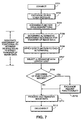
- Figure 7 is a flow diagram for explaining negotiation processing according to the invention, and specifically negotiation processing to determine whether or not image processing functionality should be exported from one device for execution on another device in connection with a transfer of image data between the two devices.
- the process steps shown in Figure 7 are computer-executable process steps preferably stored on a computer readable medium, such as EEPROM 16 or DRAM 15. Briefly, according to Figure 7, the process steps operate to exchange device information and exchange exportable function information between the two devices, to negotiate an assignment of functions between the two devices so as to effect a transfer of image data, to exchange exportable functions as needed, and to transfer image data according to the negotiated assignment of functions.
- the first device and the second device connect over the bi-directional communication link and establish two-way communication with each other.
- the devices are an image input device, such as a scanner or a digital camera, and an image output device, such as a printer or facsimile or overhead projector.
- step S702 the first and second devices exchange device class modules, thereby providing the other device with information concerning device capabilities and platform.
- the first and second devices exchange function code descriptions, thereby providing the other device with information concerning the available image processing functions as well as whether or not such image processing functions are exportable.
- the first device provides the second device with a function code description for each of its image processing functions including, for example, image processing functions such as color conversion functions, compression and decompression functions, color manipulation functions, and image conversion functions.
- the second device likewise provides the first device with a function code description for each of its image processing functions.
- the first and second devices negotiate an assignment of functionality so as to effect the transfer of image data. Specifically, in steps S705 through S707, the first and second devices mutually determine various alternatives for image processing functionality needed so as to transfer image data from the first device to the second device. This determination is made without regard to where specific image processing functionality might reside, and thus contemplates the overall image processing functionality needed to effect the data transfer. For each of the different alternatives, the devices apply a cost function so as to determine which alternative is the lowest cost. For example, the cost function might involve a simple determination of the quickest time to transfer the image data, or the cost function might involve a determination of which alternative provides the best image quality. It is also possible to provide a cost function which contemplates a tradeoff between image transfer time and image quality, such that a reasonably good image is transferred in the least amount of time.
- step S705 the devices determine the various alternative processing sequences that are needed to effect a transfer of image data.
- one possible alternative to a processing sequence is to convert color data directly to monochrome data, to transfer the monochrome data to the printer, and to print the monochrome data at the printer.
- a different alternative processing sequence is to convert the color data to grayscale data to compress the grayscale data, to transmit the grayscale data to the printer, to decompress the grayscale data, to convert the decompressed grayscale data to monochrome data, and to print the monochrome data.
- Each of these different alternative processing sequences for a transfer of image data is developed by the devices in this step S705.
- step S706 a cost function is applied to each of the different alternatives that were determined in step S705.
- step S707 the image processing sequence with the lowest cost function is selected.
- steps S705 through S707 ordinarily contemplate a determination of various alternative processing sequences by both the first and second devices, it is possible for these steps to be performed only in one device. In such a situation, it is ordinarily preferable for the processing steps to be performed in the sending device, for the reason that the sending device ordinarily has more information about the desires of the user in effecting the data transfer.
- Step S709 determines whether an exchange of functionality is needed, based on the selected image processing sequence from step S707. Specifically, if the selected image processing sequence contemplates an exchange of image processing functionality from one device to another, then flow branches to step S710 to exchange the needed functionality. In any event, flow then advances to step S711 in which the image data is processed according to the selected processing sequence and transferred from the first device to the second device. In step S712, the devices disconnect.
- FIGs 8, 9A and 9B are views for a detailed example of an exchange between a scanner and a printer.
- the scanner and the printer exchange device class modules (step S702).
- the scanner sends its device class module indicating that it is a scanner, with a processing power factor of 12, a StrongARM processing unit, and VxWorks operating system. 400 Kb of memory is available in the scanner for processing capabilities beyond those ordinarily needed by the scanner itself.
- the device class module from the printer indicates that it is a monochrome laser printer with a processing power factor of 8, a MIPS microprocessor and a pSOS operating system. 256 Kb of storage is available on the printer for processing beyond the normal needs of the printer itself.
- the printer and the scanner exchange function code descriptions.
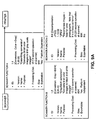
- Function code descriptions for the scanner are illustrated in Figure 9A, and indicate that the scanner has three functions: image conversion from 24-bit color to 8-bit grayscale; image conversion from 8-bit grayscale to black-and-white; and JPEG decompression.
- the function code description indicates that the processing cost factor is 15, the size needed is 64 Kb, the function is exportable, and the function is platform dependent (meaning that it can execute only on a platform and operating system that is the same as that of the scanner which is VxWorks on a StrongARM CPU).
- the function code description indicates that the processing cost factor is 12, the size is 85 Kb, the function is exportable, and it is platform independent (meaning that it can be executed on any operating system or any CPU). Platform independent code is ordinarily written in a platform independent language such as JAVA.
- the function code description indicates that its processing cost factor is 20, its size is 90 Kb, and that it is not exportable.
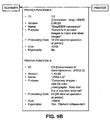
- Figure 9B illustrates the function code descriptions provided by the printer to the scanner.
- the printer reports two functions: image conversion from 8-bit grayscale to black-and-white; and JPEG-LS compression and decompression.
- image conversion from grayscale to black-and-white the function code description indicates that its processing cost is 10, its size is 40 Kb, and it is not exportable.
- JPEG-LS compression and decompression the function code description indicates that its processing cost is 25, its size is 100 Kb, it is exportable and platform independent.
- the printer and the scanner then commence a negotiation of assignment of functionality so as to effect transfer of image data from the scanner to the printer (steps S705 through S707).
- the printer and the scanner or the scanner alone, in the case where only one device makes the final selection of a processing sequence) immediately determine that JPEG-LS is the optimal compression choice for compression, since JPEG-LS is a lossless scheme employing a higher image quality than JPEG alone.
- the printer since the printer is not capable of printing color, the image must be converted from 24-bit color to black-and-white data.
- the conversion from 24-bit color to black-and-white data need not be done in a single step, because the printer has image conversion capability from a 8-bit grayscale to black-and-white. Accordingly, it is possible for the scanner to covert from 24-bit color to 8-bit grayscale, and for the printer to convert from 8-bit grayscale to black-and-white.
- printer and the scanner have function codes for conversion of grayscale images to black-and-white
- the printer's version is older (version 3.00.00 as compared to version 2.00.23). If the image processing requirements for the current job would require it, and if such a transfer were included in the cost function, then transfer of the scanner's version to the printer would have been effected.
- Cost function (Time to transfer function and to install it) + (Time to transfer image data) + (Time to execute function codes at each of the printer and scanner).
- the lowest cost processing alternative is an alternative where the scanner converts 24-bit color to grayscale data, compresses the grayscale data according to JPEG-LS compression that it obtains from the printer, and transfers the compressed grayscale data to the printer; whereafter the printer decompresses the compressed grayscale data, converts the decompressed grayscale data to black-and-white image data, and prints out the image.
- the printer transfers its functionality for JPEG-LS compression to the scanner. Thereafter, the data transfer job is processed according to the agreed-upon image processing sequence, resulting in a scan at the scanner and a printout at the printer.
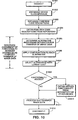
- Figure 10 is a flow diagram for a second embodiment of the invention.
- functionality need not be obtained only from the devices involved in the transfer of image data. Rather, functionality can also be obtained from a repository of functionality elsewhere on the network, such as from a file server or a computer workstation, or from another image processing device on the network that is not involved in the transfer of image data in question from the first device to the second device.
- step S1001 the first and second devices connect and in steps S1002 and S1003 the devices exchange device class modules and function code descriptions.
- step S1004 the first and second devices obtain function code descriptions from a repository or repositories of image processing functionality.
- steps S1005 through S1007 the devices negotiate an assignment of functionality to effect the transfer of image data, this time considering both functionality present in the first and second devices, together with functionality present in the repository or repositories.
- the devices determine alternative processing sequences for the transfer of image data
- step S1006 the devices apply a cost function to each different alternative
- step S1007 the devices select the processing alternative with the lowest cost function.
- step S1009 the devices determine whether functionality not currently present in the first and second devices is needed in order to process the image data according to the selected alternative. If functionality is needed, then flow branches to step S1010 in which the functionality is obtained from the other device, or from the repository of image processing functionality, as appropriate. Thereafter, flow branches to step S1011 to process the image data according to the agreed-upon processing alternative, and to transfer the image data from the first device to the second device. After transfer, the devices disconnect in step S1012.
- the device after transfer of functionality, in either of the first or second embodiments, it is possible for the device that received the functionality to retain it indefinitely. Thus, following receipt of a function, the device can store it in DRAM 16 for use in subsequent image processing jobs, including for use in exporting the functionality to other devices in subsequent image data transfers.
- the transfer of image data to act as a trigger for the first and second devices to go out and to obtain needed image processing functionality
- the devices it is possible for the devices to communicate continuously in the background, over the bi-directional communication link so as to locate and obtain image processing functionality that might be needed in future image data transfers.
- the device it is possible according to the invention for the device to communicate with the repository so as to obtain the updated function, so as to have the updated function available for use in subsequent image data transfers.
Landscapes
- Engineering & Computer Science (AREA)
- Signal Processing (AREA)
- Multimedia (AREA)
- Computer Hardware Design (AREA)
- Microelectronics & Electronic Packaging (AREA)
- Computer Security & Cryptography (AREA)
- Computer Networks & Wireless Communication (AREA)
- Facsimiles In General (AREA)
- Computer And Data Communications (AREA)
- Communication Control (AREA)
- Information Transfer Between Computers (AREA)
- Small-Scale Networks (AREA)
Abstract
Description
Claims (10)
- A method for negotiating an exchange of image processing functionality between first and second devices over a bi-directional communication link, comprising the steps of:exchanging device class modules between the first and second devices, the device class modules including information concerning relative processing power of the first and second devices;exchanging function code descriptions between the first and second devices, the function code descriptions including information concerning functionality respectively available in the first and second devices, together with information concerning whether such functionality is exportable to other devices;negotiating an assignment of image processing functionality between the first and second devices, with the overall image processing functionality effecting an efficient image transfer between the first and second devices; andexchanging image processing functionality between the first and second devices in a case where the negotiated image processing functionality indicates that functionality in one of the first and second devices is needed by the other of the first and second devices.
- A method according to claim 1, further comprising the step of transferring image data from the first device to the second device using the negotiated assignment of functionality, including functionality that has been exported from one device to the other.
- A method according to Claim 1, wherein said step of negotiating an assignment of functionality includes the steps of:determining alternative processing sequences for image data transfer;applying a cost function to each alternative; andselecting the alternative with the lowest cost function.
- A method according to Claim 3, wherein said cost function contemplates both image transfer time and image quality.
- A method according to Claim 1, further comprising the step of obtaining function code descriptions for functionality in a repository of image processing functionality, wherein said step of negotiating to assign functionality includes the step of negotiating in respect of the image processing functionality exported from the repository, and wherein said step of transferring functionality includes the step of transferring functionality from the repository.
- A method according to Claim 5, wherein said first and second devices retain transferred functionality for use in connection with subsequent image processing jobs.
- A method according to Claim 1, wherein said first and second devices retain transferred functionality for use in connection with subsequent image processing jobs.
- A network interface device for interfacing between an image processing peripheral and a local area network, said network interface device including:a network protocol stack means for interfacing between the local area network and the network interface device, and for receiving network communications directed to the image processing peripheral;a device-specific application layer means for providing device-specific image processing functionality for driving the image processing peripheral, the device-specific application means being adapted to receive network communications directed to the peripheral device from the network protocol stack means; anda negotiation controller for negotiating an exchange of image processing functionality between a second device on the local area network, the negotiation controller being programmed with instructions for carrying out the method of any one of Claims 1 to 7.
- Program instruction code for controlling a processor to carry out the method of any one of claims 1 to 7.
- A carrier medium for carrying the program instruction code of claim 9.
Applications Claiming Priority (2)
| Application Number | Priority Date | Filing Date | Title |
|---|---|---|---|
| US09/288,967 US6947994B1 (en) | 1999-04-09 | 1999-04-09 | Negotiating an exchange of image processing functionality |
| US288967 | 1999-04-09 |
Publications (3)
| Publication Number | Publication Date |
|---|---|
| EP1043885A2 true EP1043885A2 (en) | 2000-10-11 |
| EP1043885A3 EP1043885A3 (en) | 2003-10-15 |
| EP1043885B1 EP1043885B1 (en) | 2010-05-26 |
Family
ID=23109445
Family Applications (1)
| Application Number | Title | Priority Date | Filing Date |
|---|---|---|---|
| EP00301912A Expired - Lifetime EP1043885B1 (en) | 1999-04-09 | 2000-03-08 | Negotiating an exchange of image processing functionality |
Country Status (4)
| Country | Link |
|---|---|
| US (3) | US6947994B1 (en) |
| EP (1) | EP1043885B1 (en) |
| JP (1) | JP2000347977A (en) |
| DE (1) | DE60044445D1 (en) |
Cited By (5)
| Publication number | Priority date | Publication date | Assignee | Title |
|---|---|---|---|---|
| EP1229726A1 (en) * | 2001-02-05 | 2002-08-07 | Ricoh Company, Ltd. | Image processing apparatus having a status holding function, and image processing system including the same |
| EP1244285A1 (en) * | 2001-03-15 | 2002-09-25 | Ricoh Company, Ltd. | Nonvolatile memory life prolonging circuit and image forming apparatus |
| GB2385500A (en) * | 2002-02-13 | 2003-08-20 | Hewlett Packard Co | Optimised message transfer protocol and system using such a protocol |
| WO2007006209A1 (en) | 2005-07-07 | 2007-01-18 | Huawei Technologies Co., Ltd. | Method, system and terminal for negotiating to correct the gamma characteristic |
| EP1843569A1 (en) * | 2006-04-07 | 2007-10-10 | Vodafone Holding GmbH | Mobile radio apparatus and method for transmitting digital images |
Families Citing this family (20)
| Publication number | Priority date | Publication date | Assignee | Title |
|---|---|---|---|---|
| US6859832B1 (en) * | 2000-10-16 | 2005-02-22 | Electronics For Imaging, Inc. | Methods and systems for the provision of remote printing services over a network |
| KR100406936B1 (en) * | 2001-06-07 | 2003-11-21 | 삼성전자주식회사 | Data relay apparatus and method thereof |
| CN1277176C (en) * | 2002-01-15 | 2006-09-27 | 夏普株式会社 | Printing system and printing method |
| US7197562B2 (en) * | 2002-04-05 | 2007-03-27 | Infocus Corporation | Projector device management system |
| US7317547B2 (en) * | 2002-05-07 | 2008-01-08 | Hewlett-Packard Development Company, L.P. | Single compressor with plural decompressors for multi-laser printing |
| JP2004341760A (en) * | 2003-05-15 | 2004-12-02 | Ricoh Co Ltd | Image forming apparatus, program, and storage medium |
| US11582065B2 (en) * | 2007-06-12 | 2023-02-14 | Icontrol Networks, Inc. | Systems and methods for device communication |
| US20060203257A1 (en) * | 2005-03-11 | 2006-09-14 | Microsoft Corporation | System and method for managing output path with context preservation |
| KR100928759B1 (en) * | 2005-05-17 | 2009-11-25 | 세이코 엡슨 가부시키가이샤 | Printing system, POS system, connecting device, control method of printing system and computer readable recording medium recording the program |
| US8700730B2 (en) * | 2005-08-18 | 2014-04-15 | Microsoft Corporation | Aggregated audio/video crossbar connections |
| US8244051B2 (en) * | 2006-03-15 | 2012-08-14 | Microsoft Corporation | Efficient encoding of alternative graphic sets |
| US7797722B2 (en) * | 2006-05-26 | 2010-09-14 | Sony Corporation | System and method for content delivery |
| JP5100182B2 (en) * | 2007-03-30 | 2012-12-19 | キヤノン株式会社 | Data transfer device, data reception device, and data transfer system |
| JP4501972B2 (en) * | 2007-08-27 | 2010-07-14 | 富士ゼロックス株式会社 | Instruction generation program, instruction generation apparatus, and document processing system |
| US8341216B2 (en) * | 2010-06-30 | 2012-12-25 | Eastman Kodak Company | Efficient method for image processing in a computer network |
| JP2013152640A (en) * | 2012-01-25 | 2013-08-08 | Canon Inc | Information processing apparatus, information processing method, and program |
| JP6269012B2 (en) * | 2013-12-13 | 2018-01-31 | 富士ゼロックス株式会社 | Information processing system, information processing apparatus, and information processing program |
| KR102553150B1 (en) * | 2018-03-23 | 2023-07-10 | 삼성전자주식회사 | Electronic device for processing image with external electronic device acquired and method for operating thefeof |
| JP7490392B2 (en) * | 2019-08-27 | 2024-05-27 | キヤノン株式会社 | Image forming apparatus, information processing system, control method for image forming apparatus, and program |
| WO2021166120A1 (en) * | 2020-02-19 | 2021-08-26 | 三菱電機株式会社 | Information processing device, information processing method, and information processing program |
Family Cites Families (34)
| Publication number | Priority date | Publication date | Assignee | Title |
|---|---|---|---|---|
| US5214779A (en) | 1988-06-30 | 1993-05-25 | International Business Machines Corporation | Variable construct representation embedded in data stream which references definition for dynamically generating data used in processing the data stream |
| US6222950B1 (en) * | 1990-03-23 | 2001-04-24 | Canon Kabushiki Kaisha | Image processing with conversion from N-value to M-value data |
| EP0487308B1 (en) * | 1990-11-21 | 2000-01-26 | Canon Kabushiki Kaisha | Color image communication |
| US5493409A (en) * | 1990-11-29 | 1996-02-20 | Minolta Camera Kabushiki Kaisha | Still video camera having a printer capable of printing a photographed image in a plurality of printing modes |
| US5386512A (en) | 1991-07-19 | 1995-01-31 | International Business Machines Corporation | System for deriving and testing mutual capability set after receiving updated capability from other processors and before requesting service information |
| US5291585A (en) | 1991-07-29 | 1994-03-01 | Dell Usa, L.P. | Computer system having system feature extension software containing a self-describing feature table for accessing I/O devices according to machine-independent format |
| JPH06276334A (en) * | 1993-03-23 | 1994-09-30 | Ricoh Co Ltd | Copy system |
| US5420696A (en) * | 1993-06-24 | 1995-05-30 | Xerox Corporation | Image data transfer architecture and method for an electronic reprographic machine |
| JPH0766913A (en) * | 1993-08-24 | 1995-03-10 | Fuji Xerox Co Ltd | Image communication equipment |
| US5513126A (en) | 1993-10-04 | 1996-04-30 | Xerox Corporation | Network having selectively accessible recipient prioritized communication channel profiles |
| CA2134620A1 (en) | 1993-11-05 | 1995-05-06 | Arul Menezes | System and method for exchanging computer data processing capabilities |
| US5694549A (en) | 1994-03-03 | 1997-12-02 | Telescan, Inc. | Multi-provider on-line communications system |
| US5640572A (en) | 1994-05-04 | 1997-06-17 | National Instruments Corporation | System and method for mapping driver level event function calls from a process-based driver level program to a session-based instrumentation control driver level system |
| US5604860A (en) | 1994-10-27 | 1997-02-18 | Xerox Corporation | Feature library and stored customized control interfaces |
| US6373531B1 (en) * | 1995-10-05 | 2002-04-16 | Canon Kabushiki Kaisha | Image processing apparatus, method, and recording medium for performing color correction suitable for matching ambient light for different types of output devices |
| US5717439A (en) | 1995-10-10 | 1998-02-10 | Xerox Corporation | Hierarchy of saving and retrieving control templates |
| US5726883A (en) | 1995-10-10 | 1998-03-10 | Xerox Corporation | Method of customizing control interfaces for devices on a network |
| US5805777A (en) | 1995-10-11 | 1998-09-08 | Eastman Kodak Company | Extended printer control interface |
| JP3607436B2 (en) * | 1995-12-18 | 2005-01-05 | 株式会社リコー | Facsimile apparatus and facsimile communication system |
| JP3834878B2 (en) * | 1996-07-23 | 2006-10-18 | ソニー株式会社 | Printing system, printing method, conversion device, data processing method, and printing device |
| JP3986588B2 (en) * | 1996-09-12 | 2007-10-03 | ブラザー工業株式会社 | Image image forming system and scanner device |
| JPH10145584A (en) * | 1996-11-15 | 1998-05-29 | Canon Inc | Image processing apparatus and method and storage medium storing method |
| US6167442A (en) * | 1997-02-18 | 2000-12-26 | Truespectra Inc. | Method and system for accessing and of rendering an image for transmission over a network |
| DE69835314T2 (en) * | 1997-04-15 | 2007-05-10 | Hewlett-Packard Development Co., L.P., Houston | Method and device for format-controlled interaction between devices |
| JPH1173398A (en) | 1997-06-03 | 1999-03-16 | Toshiba Corp | Distributed network computing system, information exchange device used in the system, information exchange method having security function used in the system, computer readable storage medium storing this method |
| JP3603577B2 (en) * | 1997-12-26 | 2004-12-22 | 富士ゼロックス株式会社 | Image processing system |
| JPH11196359A (en) * | 1997-12-27 | 1999-07-21 | Konica Corp | Image forming device |
| US6000946A (en) * | 1998-03-09 | 1999-12-14 | Hewlett-Packard Company | Collaborative drawing device |
| US6298164B1 (en) * | 1998-10-02 | 2001-10-02 | Canon Kabushiki Kaisha | PCL conversion of JETSEND images |
| US6775033B1 (en) * | 1998-10-27 | 2004-08-10 | Canon Kabushiki Kaisha | Image communication apparatus and communication control method thereof |
| US6874022B1 (en) * | 1999-03-12 | 2005-03-29 | Cisco Technology, Inc. | Method and system for modeling behavior of elements in a telecommunications system |
| JP2001016474A (en) * | 1999-06-30 | 2001-01-19 | Canon Inc | Image forming apparatus, control method therefor, and storage medium |
| JP3937656B2 (en) * | 1999-06-30 | 2007-06-27 | キヤノン株式会社 | Image processing apparatus, control method therefor, and storage medium |
| US6516358B1 (en) * | 1999-09-09 | 2003-02-04 | Hewlett-Packard Company | Appliance communications manager |
-
1999
- 1999-04-09 US US09/288,967 patent/US6947994B1/en not_active Expired - Fee Related
-
2000
- 2000-03-08 EP EP00301912A patent/EP1043885B1/en not_active Expired - Lifetime
- 2000-03-08 DE DE60044445T patent/DE60044445D1/en not_active Expired - Lifetime
- 2000-04-07 JP JP2000106951A patent/JP2000347977A/en not_active Withdrawn
-
2005
- 2005-07-12 US US11/178,359 patent/US7284038B2/en not_active Expired - Fee Related
-
2007
- 2007-09-14 US US11/898,676 patent/US7574485B2/en not_active Expired - Fee Related
Cited By (10)
| Publication number | Priority date | Publication date | Assignee | Title |
|---|---|---|---|---|
| EP1229726A1 (en) * | 2001-02-05 | 2002-08-07 | Ricoh Company, Ltd. | Image processing apparatus having a status holding function, and image processing system including the same |
| US7123847B2 (en) | 2001-02-05 | 2006-10-17 | Ricoh Company, Ltd. | Image processing apparatus having a status holding function, and image processing system including the same |
| US7394557B2 (en) | 2001-02-05 | 2008-07-01 | Ricoh Company, Ltd. | Image processing apparatus having a status holding function, and image processing system including the same |
| EP1244285A1 (en) * | 2001-03-15 | 2002-09-25 | Ricoh Company, Ltd. | Nonvolatile memory life prolonging circuit and image forming apparatus |
| US7221468B2 (en) | 2001-03-15 | 2007-05-22 | Ricoh Company, Ltd. | Nonvolatile memory life prolonging circuit and image forming apparatus |
| GB2385500A (en) * | 2002-02-13 | 2003-08-20 | Hewlett Packard Co | Optimised message transfer protocol and system using such a protocol |
| GB2385500B (en) * | 2002-02-13 | 2004-08-11 | Hewlett Packard Co | A method of optimising messaging or data transfer, and a system using such a method |
| WO2007006209A1 (en) | 2005-07-07 | 2007-01-18 | Huawei Technologies Co., Ltd. | Method, system and terminal for negotiating to correct the gamma characteristic |
| EP1906673A4 (en) * | 2005-07-07 | 2008-11-19 | Huawei Tech Co Ltd | METHOD, SYSTEM AND NEGOTIATION TERMINAL FOR CORRECTING GAMMA CHARACTERISTICS |
| EP1843569A1 (en) * | 2006-04-07 | 2007-10-10 | Vodafone Holding GmbH | Mobile radio apparatus and method for transmitting digital images |
Also Published As
| Publication number | Publication date |
|---|---|
| US7284038B2 (en) | 2007-10-16 |
| US6947994B1 (en) | 2005-09-20 |
| EP1043885B1 (en) | 2010-05-26 |
| JP2000347977A (en) | 2000-12-15 |
| EP1043885A3 (en) | 2003-10-15 |
| DE60044445D1 (en) | 2010-07-08 |
| US20080010360A1 (en) | 2008-01-10 |
| US7574485B2 (en) | 2009-08-11 |
| US20050251578A1 (en) | 2005-11-10 |
Similar Documents
| Publication | Publication Date | Title |
|---|---|---|
| US7574485B2 (en) | Negotiating an exchange of image processing functionality | |
| FI102923B (en) | Information printing system, procedure for printing information and terminals for printing information | |
| JPH10232925A (en) | Image transmission method, image transmission system, computer-usable medium, and memory for transmitting image information from a scanner to a client computer via a network | |
| JP2001331458A (en) | Network control device and method | |
| US20030058471A1 (en) | Method and apparatus for image processing capable of automatically adding/upgrading image processing functions, and a computer readable data medium containing computer instructions for performing the method | |
| JP2001043163A (en) | Method, apparatus, medium and network scanner for controlling the execution of remote applications over a network | |
| US6298164B1 (en) | PCL conversion of JETSEND images | |
| US8493641B2 (en) | Image processing device, image processing method, and program for performing direct printing which considers color matching processing based on a profile describing the input color characteristics of an image input device and the output color characteristics of an image output device | |
| EP1158744B1 (en) | Digital communication devices and digital communication methods | |
| US7511839B2 (en) | Composite apparatus and facsimile apparatus connectable to LAN, and control method for LAN connection | |
| JP2000270325A (en) | File communication server | |
| JP2003248566A (en) | Printing system and printing method thereof | |
| JP4033812B2 (en) | Facsimile communication system, communication terminal apparatus, transmission control method, program, and recording medium | |
| US20070171877A1 (en) | Image processing apparatus and image processing system and its control method | |
| US20060215217A1 (en) | Image forming system, image forming method and image reading device | |
| JP2002366315A (en) | Picture processing system, data transfer system, and device and terminal to be used in these systems | |
| JP4189592B2 (en) | Image data management apparatus, image forming apparatus, and image data management method | |
| JP2003015846A (en) | Image printing system, print control terminal device, connected media conversion device, print control method, print control program, and connected media conversion program | |
| JP3879752B2 (en) | Network facsimile apparatus and data transfer method | |
| JPH07105069A (en) | Data reader | |
| JP3508060B2 (en) | Infrared communication method | |
| JP2025186847A (en) | Information processing device, control method thereof, and program | |
| JP4429653B2 (en) | Service search system and service search method | |
| JPH10116162A (en) | Image output apparatus and control method thereof | |
| JP3994569B2 (en) | Image processing device |
Legal Events
| Date | Code | Title | Description |
|---|---|---|---|
| PUAI | Public reference made under article 153(3) epc to a published international application that has entered the european phase |
Free format text: ORIGINAL CODE: 0009012 |
|
| AK | Designated contracting states |
Kind code of ref document: A2 Designated state(s): AT BE CH CY DE DK ES FI FR GB GR IE IT LI LU MC NL PT SE |
|
| AX | Request for extension of the european patent |
Free format text: AL;LT;LV;MK;RO;SI |
|
| PUAL | Search report despatched |
Free format text: ORIGINAL CODE: 0009013 |
|
| AK | Designated contracting states |
Kind code of ref document: A3 Designated state(s): AT BE CH CY DE DK ES FI FR GB GR IE IT LI LU MC NL PT SE |
|
| AX | Request for extension of the european patent |
Extension state: AL LT LV MK RO SI |
|
| RIC1 | Information provided on ipc code assigned before grant |
Ipc: 7H 04N 1/333 B Ipc: 7H 04N 1/32 A |
|
| 17P | Request for examination filed |
Effective date: 20040225 |
|
| AKX | Designation fees paid |
Designated state(s): DE FR GB IT |
|
| 17Q | First examination report despatched |
Effective date: 20050530 |
|
| GRAP | Despatch of communication of intention to grant a patent |
Free format text: ORIGINAL CODE: EPIDOSNIGR1 |
|
| GRAS | Grant fee paid |
Free format text: ORIGINAL CODE: EPIDOSNIGR3 |
|
| GRAA | (expected) grant |
Free format text: ORIGINAL CODE: 0009210 |
|
| AK | Designated contracting states |
Kind code of ref document: B1 Designated state(s): DE FR GB IT |
|
| REG | Reference to a national code |
Ref country code: GB Ref legal event code: FG4D |
|
| REF | Corresponds to: |
Ref document number: 60044445 Country of ref document: DE Date of ref document: 20100708 Kind code of ref document: P |
|
| PG25 | Lapsed in a contracting state [announced via postgrant information from national office to epo] |
Ref country code: IT Free format text: LAPSE BECAUSE OF FAILURE TO SUBMIT A TRANSLATION OF THE DESCRIPTION OR TO PAY THE FEE WITHIN THE PRESCRIBED TIME-LIMIT Effective date: 20100526 |
|
| PLBE | No opposition filed within time limit |
Free format text: ORIGINAL CODE: 0009261 |
|
| STAA | Information on the status of an ep patent application or granted ep patent |
Free format text: STATUS: NO OPPOSITION FILED WITHIN TIME LIMIT |
|
| 26N | No opposition filed |
Effective date: 20110301 |
|
| REG | Reference to a national code |
Ref country code: DE Ref legal event code: R097 Ref document number: 60044445 Country of ref document: DE Effective date: 20110228 |
|
| REG | Reference to a national code |
Ref country code: FR Ref legal event code: ST Effective date: 20111130 |
|
| PG25 | Lapsed in a contracting state [announced via postgrant information from national office to epo] |
Ref country code: DE Free format text: LAPSE BECAUSE OF NON-PAYMENT OF DUE FEES Effective date: 20111001 Ref country code: FR Free format text: LAPSE BECAUSE OF NON-PAYMENT OF DUE FEES Effective date: 20110331 |
|
| REG | Reference to a national code |
Ref country code: DE Ref legal event code: R119 Ref document number: 60044445 Country of ref document: DE Effective date: 20111001 |
|
| PGFP | Annual fee paid to national office [announced via postgrant information from national office to epo] |
Ref country code: GB Payment date: 20130320 Year of fee payment: 14 |
|
| GBPC | Gb: european patent ceased through non-payment of renewal fee |
Effective date: 20140308 |
|
| PG25 | Lapsed in a contracting state [announced via postgrant information from national office to epo] |
Ref country code: GB Free format text: LAPSE BECAUSE OF NON-PAYMENT OF DUE FEES Effective date: 20140308 |