EP1043132A2 - Pressure casting apparatus with two-part moulds for sanitary appliances, and relative mould - Google Patents
Pressure casting apparatus with two-part moulds for sanitary appliances, and relative mould Download PDFInfo
- Publication number
- EP1043132A2 EP1043132A2 EP00201264A EP00201264A EP1043132A2 EP 1043132 A2 EP1043132 A2 EP 1043132A2 EP 00201264 A EP00201264 A EP 00201264A EP 00201264 A EP00201264 A EP 00201264A EP 1043132 A2 EP1043132 A2 EP 1043132A2
- Authority
- EP
- European Patent Office
- Prior art keywords
- mould
- pressure
- framework
- female
- slip
- Prior art date
- Legal status (The legal status is an assumption and is not a legal conclusion. Google has not performed a legal analysis and makes no representation as to the accuracy of the status listed.)
- Granted
Links
Images
Classifications
-
- B—PERFORMING OPERATIONS; TRANSPORTING
- B28—WORKING CEMENT, CLAY, OR STONE
- B28B—SHAPING CLAY OR OTHER CERAMIC COMPOSITIONS; SHAPING SLAG; SHAPING MIXTURES CONTAINING CEMENTITIOUS MATERIAL, e.g. PLASTER
- B28B1/00—Producing shaped prefabricated articles from the material
- B28B1/26—Producing shaped prefabricated articles from the material by slip-casting, i.e. by casting a suspension or dispersion of the material in a liquid-absorbent or porous mould, the liquid being allowed to soak into or pass through the walls of the mould; Moulds therefor ; specially for manufacturing articles starting from a ceramic slip; Moulds therefor
- B28B1/265—Producing shaped prefabricated articles from the material by slip-casting, i.e. by casting a suspension or dispersion of the material in a liquid-absorbent or porous mould, the liquid being allowed to soak into or pass through the walls of the mould; Moulds therefor ; specially for manufacturing articles starting from a ceramic slip; Moulds therefor pressure being applied on the slip in the filled mould or on the moulded article in the mould, e.g. pneumatically, by compressing slip in a closed mould
- B28B1/266—Means for counteracting the pressure being applied on the slip or on the moulded article in the mould, e.g. means for clamping the moulds parts together in a frame-like structure
Definitions
- This invention relates to pressure casting lines for sanitary appliances, in particular lines for forming sanitary appliances with moulds comprising only two parts.
- Sanitary appliances are formed by casting slip in hygroscopic and/or permeable moulds, which can comprise two or more parts depending on the complexity of the appliance to be formed.
- Plaster moulds have been traditionally used, the absorbent power of the plaster being utilized to dehydrate the ceramic slip.
- the use of this type of mould involves very lengthy forming cycles.
- plaster moulds last for only a small number of forming cycles.
- moulds are stressed not only in their closure direction but also in directions perpendicular to the closure direction, hence they have to comprise lateral reinforcement structures the purpose of which is to limit their outward deformation.
- Said structures generally comprise adjustable means enabling the mould sides to be precompressed. This enables mould deformation to be reduced with consequent increase in its strength, both because resin withstands compression better than tension, and because the deformation imposed on the mould, being opposite to that caused by the slip pressure, at least partly nullifies the effects, so limiting the tensions within the mould during casting.
- the deformation induced by the casting pressure also depends on the shape of the piece to be formed.
- the mould is subjected, in certain parts, to very high stresses which on the one hand can cause premature mould fracture and on the other hand produce considerable tensions within the appliance being formed. These tensions result in fracture of the appliance either during its removal from the mould or during one of the subsequent processing stages, ie drying and firing. Consequently, in forming the aforesaid types of appliances, the casting pressure used must not be too high, so increasing the forming time.
- An object of this invention is to overcome the aforesaid drawbacks within the framework of a rational, reliable and relatively low-cost solution.
- the moulds are positioned in series, and formed into blocks composed of the female part of one mould and that male part which is to be inserted into the female part of the adjacent block.
- the mould closure forces are compensated between one mould and the next along the forming line which has therefore to counteract only the closure force of a single mould, whatever the number of its constituent moulds.
- the line construction is therefore light and economical, practically without limitation on the number of moulds present therein.
- an external frame comprising means able to exert from the outside a pressure on the mould which is close, moment by moment, to that which the slip exerts on it from the inside, so as to prevent, moment by moment, any deformation thereof.
- the pressure exerted by said means can be conveniently controlled to above or below the casting pressure, to allow small deformations of desired extent, convenient in forming the piece and removing it from the mould.
- Said means able to exert a pressure on the outer lateral surface of the mould are at least one element, which surrounds at least that lateral surface of the block corresponding to the forming cavity, and can be inflated by a suitable fluid.
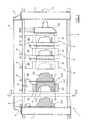
- Figures 2 show the apparatus 1, comprising two endpieces 2 and 3, each of which comprises in an upper central position a flange 4 for fixing it to a beam 5 of I cross-section.
- the two endpieces 2 and 3 are connected together by four identical parallel bars 6 positioned at the vertices of a quadrilateral as shown in Figure 2.
- the beam 5 is arranged to support the blocks 100, each composed of the female part 101 of one mould, on the rear of which there is fixed by usual flanges 7 the male part 102 of the adjacent mould.
- each block 100 is supported by the beam 5 via a carriage 8, which is suspended from the beam 5 by wheels 9 which enable it to traverse in the direction of the longitudinal axis of the beam 5.
- Each carriage 8 comprises an upper plate 80 to which the wheels 9 are fixed, and which lowerly supports a rectangular frame 81.
- the purpose of the frame 81 is to contain the female part 101 of the block 100, an inflatable element 12 being interposed between the outer wall of the female part 101 and the inner wall of the frame 81.
- the inflatable element 12 is fed with a liquid or gaseous fluid from a usual system, not shown, which maintains the fluid pressure in the element 12 equal, moment by moment, to the pressure exerted by the slip inside the cavity which forms when two blocks 100 are brought into contact to copenetrate.
- the endpiece 2 carries a male mould part 102 aligned with the suspended blocks 100, whereas the endpiece 3 supports a cylinder-piston unit 13 connected to a slidable thrust head 130 carrying a female mould part 101, and arranged to maintain the blocks 100 in contact with each other and with said male part 102.
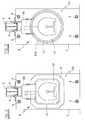
- Figure 3 shows a variant of the invention which differs from the preceding with regard to the shape of the frame, indicated in Figure 3 by the reference number 810, surrounding the female part 101 of the block 100.
- the frame 810 is circular instead of rectangular. This enables the frame to be constructed with a very small thickness, preferably of between 4 and 50 mm, as the frame has to support only tensile stresses and not bending stresses.
- the invention operates as follows.
- the operator moves the first carriage 8 on the left against the male part 102 fixed to the endpiece 2, so that this becomes inserted into the female part 101 of the block.
- the operator proceeds in the same manner with all the remaining blocks, and finally operates the cylinder-piston unit 13 to urge the movable head 130 to axially lock all the blocks 100 against each other and against the endpiece 2.
- the pressure introduced into the interior of the inflatable element could be different from the instantaneous pressure of the slip in order to introduce into the mould controlled deformations which, on disappearing when the pressure ceases, facilitate removal of the appliance from the mould.
- the frames 81 and 810 are dimensioned not for rigidity but to withstand the pressure exerted by the inflatable elements 12. This means that frames can be constructed which are much lighter for equal efficiency.
- the invention can also be usefully applied if a single sanitary appliance is to be formed at a time.
- the blocks 100 are dispensed with, and the thrust head 130 carries fixed to it the mould part 101 which, on receiving the mould part 102 rigid with the endpiece 2, creates the single forming cavity.
Landscapes
- Engineering & Computer Science (AREA)
- Chemical & Material Sciences (AREA)
- Ceramic Engineering (AREA)
- Dispersion Chemistry (AREA)
- Manufacturing & Machinery (AREA)
- Mechanical Engineering (AREA)
- Moulds For Moulding Plastics Or The Like (AREA)
- Producing Shaped Articles From Materials (AREA)
Abstract
Description
Claims (9)
- An apparatus for pressure casting sanitary appliances, comprising an outer framework, at least one block slidable within said framework and comprising a male mould part and a female mould part, a fixed endpiece of said framework being provided with that male part which is to be inserted into the female part of said at least one block, a movable head of said framework being provided with that female mould part which is to receive the male part of said at least one block, means for thrusting said movable head in the direction of said fixed endpiece, and means for feeding pressurized slip into the cavities which form when said blocks are positioned one against the other, characterised in that at least that mould portion comprising the cavity of the female mould part is surrounded by at least one frame, between which and said portion there being defined a space occupied by at least one inflatable element fed with pressurized fluid.
- An apparatus as claimed in claim 1, characterised in that no blocks are provided, the male part of the fixed endpiece hence being inserted into the female part of the movable head.
- An apparatus as claimed in claim 1, characterised in that the pressure inside the element is adjustable.
- An apparatus as claimed in claim 1, characterised in that the pressure inside said at least one inflatable element is maintained, moment by moment, equal to the slip pressure.
- An apparatus as claimed in claim 1, characterised in that the pressure inside said at least one inflatable element is maintained, moment by moment, at a pressure which is predetermined on the basis of the slip pressure.
- A casting apparatus as claimed in claim 1, characterised in that the means for thrusting the movable head are a cylinder-piston unit arranged to exert a thrust at least equal to that exerted by the slip fed into the mould.
- An apparatus as claimed in claim 1, characterised in that said frame is of polygonal section.
- An apparatus as claimed in claim 1, characterised in that said frame is cylindrical.
- An apparatus as claimed in claims 1 and 8, characterised in that, when assembled, the mould has a cylindrical outer shape.
Applications Claiming Priority (2)
| Application Number | Priority Date | Filing Date | Title |
|---|---|---|---|
| IT1999RE000042A IT1309747B1 (en) | 1999-04-09 | 1999-04-09 | PRESSURE CASTING APPARATUS WITH MOLDS IN TWO PARTS SANITARY ITEMS AND RELATIVE MOLD |
| ITRE990042 | 1999-04-09 |
Publications (3)
| Publication Number | Publication Date |
|---|---|
| EP1043132A2 true EP1043132A2 (en) | 2000-10-11 |
| EP1043132A3 EP1043132A3 (en) | 2002-06-05 |
| EP1043132B1 EP1043132B1 (en) | 2003-10-08 |
Family
ID=11399418
Family Applications (1)
| Application Number | Title | Priority Date | Filing Date |
|---|---|---|---|
| EP00201264A Expired - Lifetime EP1043132B1 (en) | 1999-04-09 | 2000-04-07 | Pressure casting apparatus with two-part moulds for sanitary appliances |
Country Status (6)
| Country | Link |
|---|---|
| US (1) | US6655942B1 (en) |
| EP (1) | EP1043132B1 (en) |
| AT (1) | ATE251532T1 (en) |
| DE (1) | DE60005732T2 (en) |
| ES (1) | ES2208217T3 (en) |
| IT (1) | IT1309747B1 (en) |
Cited By (7)
| Publication number | Priority date | Publication date | Assignee | Title |
|---|---|---|---|---|
| EP1905561A3 (en) * | 2006-09-27 | 2009-04-22 | Sacmi Cooperativa Meccanici Imola Societa' Cooperativa | Equipment for the manufacture of ceramic sanitary wares |
| EP2103401A2 (en) | 2008-03-17 | 2009-09-23 | Sacmi Cooperativa Meccanici Imola Societa' Cooperativa | Installation for the manufacture of ceramic products. |
| EP2366517A1 (en) | 2010-03-18 | 2011-09-21 | Sacmi Cooperativa Meccanici Imola Societa' Cooperativa | Machine for the production of ceramic products. |
| IT202000000169A1 (en) * | 2020-01-08 | 2021-07-08 | Sacmi | EQUIPMENT FOR THE FORMING OF CERAMIC ARTICLES THROUGH PRESSURE CASTING |
| IT202000000166A1 (en) * | 2020-01-08 | 2021-07-08 | Sacmi | METHOD AND APPARATUS FOR THE FORMING OF CERAMIC ARTICLES BY PRESSURE CASTING |
| EP3848172A3 (en) * | 2020-01-08 | 2021-09-29 | Sacmi Cooperativa Meccanici Imola Societa' Cooperativa | Apparatus for forming ceramic articles through pressure casting |
| IT202200007859A1 (en) | 2022-04-21 | 2023-10-21 | Siderurgica Scopetti S R L | MACHINE FOR PRESSURE CASTING OF CERAMIC AND COMPOUND MATERIALS WITH WEIGHT RESETTING MACHINE |
Families Citing this family (8)
| Publication number | Priority date | Publication date | Assignee | Title |
|---|---|---|---|---|
| US6251147B1 (en) * | 1998-10-01 | 2001-06-26 | Gregory J. Peterson | Artifical firelog and firestarter chip producing apparatus and method and products produced therefrom |
| BR0016457A (en) * | 1999-12-16 | 2002-10-29 | Porvair Plc | Method and apparatus for molding ceramic articles |
| DE102005053518A1 (en) * | 2004-11-26 | 2006-06-14 | Webasto Ag | Method for producing a heat exchanger |
| IT1393484B1 (en) * | 2009-03-31 | 2012-04-27 | Sacmi | MOLD FOR THE CREATION OF CERAMIC MANUFACTURES. |
| CN106217631B (en) * | 2016-08-19 | 2018-10-30 | 九牧厨卫股份有限公司 | A kind of ceramic body automatic demoulding method of horizontal press |
| CN108501184B (en) * | 2018-05-28 | 2024-01-23 | 洛阳震动机械有限公司 | Carbon crucible vibration forming machine |
| CN109638301B (en) * | 2019-01-23 | 2024-03-29 | 北京氢璞创能科技有限公司 | Fuel cell plate mould pressing manufacture equipment |
| CN113681828B (en) * | 2021-08-11 | 2023-08-25 | 株洲时代新材料科技股份有限公司 | Split type combined cavity vulcanizing mold of rail damper and production method thereof |
Family Cites Families (8)
| Publication number | Priority date | Publication date | Assignee | Title |
|---|---|---|---|---|
| GB1359684A (en) * | 1972-08-10 | 1974-07-10 | British Ceramic Res Ass | Casting of ceramic articles |
| JPS6342803A (en) * | 1986-08-08 | 1988-02-24 | 東陶機器株式会社 | Casting molding method and device |
| JPH01222901A (en) * | 1988-03-02 | 1989-09-06 | Toto Ltd | Press molding device for earthenware |
| GB9205838D0 (en) * | 1992-03-18 | 1992-04-29 | British Ceramic Res Ltd | Moulding apparatus |
| HU212972B (en) * | 1994-06-29 | 1997-01-28 | Laufen Keramik Holding | Procedure and apparatus for moulding ceramic-parts from moulding-slag |
| JPH0899307A (en) * | 1994-09-30 | 1996-04-16 | Toto Ltd | Casting mold of slurry |
| GB2330109A (en) * | 1997-10-13 | 1999-04-14 | Porvair Plc | Casting machine |
| IT1304574B1 (en) * | 1998-11-06 | 2001-03-19 | Sacmi | PRESSURE CASTING LINE FOR SANITARY ITEMS AND RELATED MOLDS. |
-
1999
- 1999-04-09 IT IT1999RE000042A patent/IT1309747B1/en active
-
2000
- 2000-04-07 ES ES00201264T patent/ES2208217T3/en not_active Expired - Lifetime
- 2000-04-07 EP EP00201264A patent/EP1043132B1/en not_active Expired - Lifetime
- 2000-04-07 US US09/545,408 patent/US6655942B1/en not_active Expired - Lifetime
- 2000-04-07 AT AT00201264T patent/ATE251532T1/en not_active IP Right Cessation
- 2000-04-07 DE DE60005732T patent/DE60005732T2/en not_active Expired - Lifetime
Cited By (11)
| Publication number | Priority date | Publication date | Assignee | Title |
|---|---|---|---|---|
| EP1905561A3 (en) * | 2006-09-27 | 2009-04-22 | Sacmi Cooperativa Meccanici Imola Societa' Cooperativa | Equipment for the manufacture of ceramic sanitary wares |
| CN101152738B (en) * | 2006-09-27 | 2011-07-20 | 伊莫拉Sacmi机械合作公司 | Equipment for the manufacture of ceramic sanitary wares |
| EP2103401A2 (en) | 2008-03-17 | 2009-09-23 | Sacmi Cooperativa Meccanici Imola Societa' Cooperativa | Installation for the manufacture of ceramic products. |
| US8057208B2 (en) | 2008-03-17 | 2011-11-15 | Sacmi Cooperativa Meccanici Imola Societa' Cooperativa | Installation for the manufacture of ceramic products |
| EP2660025A1 (en) | 2008-03-17 | 2013-11-06 | Sacmi Cooperativa Meccanici Imola Societa' Cooperativa | Installation for the manufacture of ceramic products |
| EP2366517A1 (en) | 2010-03-18 | 2011-09-21 | Sacmi Cooperativa Meccanici Imola Societa' Cooperativa | Machine for the production of ceramic products. |
| IT202000000169A1 (en) * | 2020-01-08 | 2021-07-08 | Sacmi | EQUIPMENT FOR THE FORMING OF CERAMIC ARTICLES THROUGH PRESSURE CASTING |
| IT202000000166A1 (en) * | 2020-01-08 | 2021-07-08 | Sacmi | METHOD AND APPARATUS FOR THE FORMING OF CERAMIC ARTICLES BY PRESSURE CASTING |
| EP3848172A3 (en) * | 2020-01-08 | 2021-09-29 | Sacmi Cooperativa Meccanici Imola Societa' Cooperativa | Apparatus for forming ceramic articles through pressure casting |
| IT202200007859A1 (en) | 2022-04-21 | 2023-10-21 | Siderurgica Scopetti S R L | MACHINE FOR PRESSURE CASTING OF CERAMIC AND COMPOUND MATERIALS WITH WEIGHT RESETTING MACHINE |
| EP4265386A2 (en) | 2022-04-21 | 2023-10-25 | Siderurgica Scopetti S.r.l. | Machine for pressure casting ceramic materials and compounds, with weight zeroing apparatus |
Also Published As
| Publication number | Publication date |
|---|---|
| IT1309747B1 (en) | 2002-01-30 |
| US6655942B1 (en) | 2003-12-02 |
| EP1043132B1 (en) | 2003-10-08 |
| ATE251532T1 (en) | 2003-10-15 |
| DE60005732T2 (en) | 2004-08-05 |
| EP1043132A3 (en) | 2002-06-05 |
| ITRE990042A1 (en) | 2000-10-09 |
| ES2208217T3 (en) | 2004-06-16 |
| DE60005732D1 (en) | 2003-11-13 |
| ITRE990042A0 (en) | 1999-04-09 |
Similar Documents
| Publication | Publication Date | Title |
|---|---|---|
| EP1043132B1 (en) | Pressure casting apparatus with two-part moulds for sanitary appliances | |
| KR890004630B1 (en) | Mold used in pressure casting ceramic articles | |
| EP0190681B1 (en) | Forming press of the pressure cell type | |
| US7748972B2 (en) | Tensioning installation for the frameworks of pre-tensioned architectural elements | |
| EP0999021A2 (en) | Pressure casting line for sanitary articles, and relative mould | |
| KR102615967B1 (en) | Manufacturing method and manufacturing device of concrete piles | |
| US2983021A (en) | Processes and apparatus for the manufacture of concrete articles, particularly of reinforced concrete | |
| JP3922945B2 (en) | Prestressed concrete plate manufacturing equipment | |
| JP3076566B1 (en) | Inner mold for manufacturing hollow PCa members | |
| US5062285A (en) | Horizontal metal extrusion press | |
| JPH0122050B2 (en) | ||
| JPH0516131A (en) | Manufacturing method of precast concrete members | |
| EP0396302A1 (en) | Apparatus for use in moulding | |
| JPH07186131A (en) | Method for manufacturing precast concrete column with hollow structure and hollow form used for it | |
| EP3848172B1 (en) | Apparatus for forming ceramic articles through pressure casting | |
| CN214394678U (en) | Civil engineering fundamental mode mounting fixture | |
| KR200339754Y1 (en) | purifier tank making device | |
| JP4073977B2 (en) | Moving molding machine for press concrete manufacturing equipment | |
| RU1803323C (en) | Mold for manufacturing pressure vibrating hydraulic pressed tubular articles | |
| KR20050039151A (en) | Strut preloading jack and structure for supporting strut using thereof | |
| JP3792703B2 (en) | Post-compression system and post-compression method | |
| RU2000201C1 (en) | Die set for forming block bricks | |
| JPH0213130Y2 (en) | ||
| SU1606334A1 (en) | Hole-forming core | |
| KR200347346Y1 (en) | A form |
Legal Events
| Date | Code | Title | Description |
|---|---|---|---|
| PUAI | Public reference made under article 153(3) epc to a published international application that has entered the european phase |
Free format text: ORIGINAL CODE: 0009012 |
|
| AK | Designated contracting states |
Kind code of ref document: A2 Designated state(s): AT BE CH CY DE DK ES FI FR GB GR IE IT LI LU MC NL PT SE |
|
| AX | Request for extension of the european patent |
Free format text: AL;LT;LV;MK;RO;SI |
|
| PUAL | Search report despatched |
Free format text: ORIGINAL CODE: 0009013 |
|
| AK | Designated contracting states |
Kind code of ref document: A3 Designated state(s): AT BE CH CY DE DK ES FI FR GB GR IE IT LI LU MC NL PT SE |
|
| AX | Request for extension of the european patent |
Free format text: AL;LT;LV;MK;RO;SI |
|
| 17P | Request for examination filed |
Effective date: 20021016 |
|
| AKX | Designation fees paid |
Designated state(s): AT BE CH CY DE DK ES FI FR GB GR IE IT LI LU MC NL PT SE |
|
| AXX | Extension fees paid |
Extension state: RO Payment date: 20021016 |
|
| GRAH | Despatch of communication of intention to grant a patent |
Free format text: ORIGINAL CODE: EPIDOS IGRA |
|
| RTI1 | Title (correction) |
Free format text: PRESSURE CASTING APPARATUS WITH TWO-PART MOULDS FOR SANITARY APPLIANCES |
|
| GRAS | Grant fee paid |
Free format text: ORIGINAL CODE: EPIDOSNIGR3 |
|
| GRAA | (expected) grant |
Free format text: ORIGINAL CODE: 0009210 |
|
| AK | Designated contracting states |
Kind code of ref document: B1 Designated state(s): AT BE CH CY DE DK ES FI FR GB GR IE IT LI LU MC NL PT SE |
|
| AX | Request for extension of the european patent |
Extension state: RO |
|
| PG25 | Lapsed in a contracting state [announced via postgrant information from national office to epo] |
Ref country code: BE Free format text: LAPSE BECAUSE OF FAILURE TO SUBMIT A TRANSLATION OF THE DESCRIPTION OR TO PAY THE FEE WITHIN THE PRESCRIBED TIME-LIMIT Effective date: 20031008 Ref country code: LI Free format text: LAPSE BECAUSE OF FAILURE TO SUBMIT A TRANSLATION OF THE DESCRIPTION OR TO PAY THE FEE WITHIN THE PRESCRIBED TIME-LIMIT Effective date: 20031008 Ref country code: FI Free format text: LAPSE BECAUSE OF FAILURE TO SUBMIT A TRANSLATION OF THE DESCRIPTION OR TO PAY THE FEE WITHIN THE PRESCRIBED TIME-LIMIT Effective date: 20031008 Ref country code: NL Free format text: LAPSE BECAUSE OF FAILURE TO SUBMIT A TRANSLATION OF THE DESCRIPTION OR TO PAY THE FEE WITHIN THE PRESCRIBED TIME-LIMIT Effective date: 20031008 Ref country code: AT Free format text: LAPSE BECAUSE OF FAILURE TO SUBMIT A TRANSLATION OF THE DESCRIPTION OR TO PAY THE FEE WITHIN THE PRESCRIBED TIME-LIMIT Effective date: 20031008 Ref country code: CH Free format text: LAPSE BECAUSE OF FAILURE TO SUBMIT A TRANSLATION OF THE DESCRIPTION OR TO PAY THE FEE WITHIN THE PRESCRIBED TIME-LIMIT Effective date: 20031008 Ref country code: CY Free format text: LAPSE BECAUSE OF FAILURE TO SUBMIT A TRANSLATION OF THE DESCRIPTION OR TO PAY THE FEE WITHIN THE PRESCRIBED TIME-LIMIT Effective date: 20031008 |
|
| REG | Reference to a national code |
Ref country code: GB Ref legal event code: FG4D |
|
| REG | Reference to a national code |
Ref country code: CH Ref legal event code: EP |
|
| REG | Reference to a national code |
Ref country code: IE Ref legal event code: FG4D |
|
| REF | Corresponds to: |
Ref document number: 60005732 Country of ref document: DE Date of ref document: 20031113 Kind code of ref document: P |
|
| PG25 | Lapsed in a contracting state [announced via postgrant information from national office to epo] |
Ref country code: DK Free format text: LAPSE BECAUSE OF FAILURE TO SUBMIT A TRANSLATION OF THE DESCRIPTION OR TO PAY THE FEE WITHIN THE PRESCRIBED TIME-LIMIT Effective date: 20040108 Ref country code: GR Free format text: LAPSE BECAUSE OF FAILURE TO SUBMIT A TRANSLATION OF THE DESCRIPTION OR TO PAY THE FEE WITHIN THE PRESCRIBED TIME-LIMIT Effective date: 20040108 Ref country code: SE Free format text: LAPSE BECAUSE OF FAILURE TO SUBMIT A TRANSLATION OF THE DESCRIPTION OR TO PAY THE FEE WITHIN THE PRESCRIBED TIME-LIMIT Effective date: 20040108 |
|
| NLV1 | Nl: lapsed or annulled due to failure to fulfill the requirements of art. 29p and 29m of the patents act | ||
| PG25 | Lapsed in a contracting state [announced via postgrant information from national office to epo] |
Ref country code: IE Free format text: LAPSE BECAUSE OF NON-PAYMENT OF DUE FEES Effective date: 20040407 Ref country code: LU Free format text: LAPSE BECAUSE OF NON-PAYMENT OF DUE FEES Effective date: 20040407 |
|
| REG | Reference to a national code |
Ref country code: CH Ref legal event code: PL |
|
| PG25 | Lapsed in a contracting state [announced via postgrant information from national office to epo] |
Ref country code: MC Free format text: LAPSE BECAUSE OF NON-PAYMENT OF DUE FEES Effective date: 20040430 |
|
| REG | Reference to a national code |
Ref country code: ES Ref legal event code: FG2A Ref document number: 2208217 Country of ref document: ES Kind code of ref document: T3 |
|
| ET | Fr: translation filed | ||
| PLBE | No opposition filed within time limit |
Free format text: ORIGINAL CODE: 0009261 |
|
| STAA | Information on the status of an ep patent application or granted ep patent |
Free format text: STATUS: NO OPPOSITION FILED WITHIN TIME LIMIT |
|
| 26N | No opposition filed |
Effective date: 20040709 |
|
| REG | Reference to a national code |
Ref country code: IE Ref legal event code: MM4A |
|
| PG25 | Lapsed in a contracting state [announced via postgrant information from national office to epo] |
Ref country code: PT Free format text: LAPSE BECAUSE OF NON-PAYMENT OF DUE FEES Effective date: 20040308 |
|
| REG | Reference to a national code |
Ref country code: FR Ref legal event code: PLFP Year of fee payment: 16 |
|
| PGFP | Annual fee paid to national office [announced via postgrant information from national office to epo] |
Ref country code: FR Payment date: 20150319 Year of fee payment: 16 |
|
| REG | Reference to a national code |
Ref country code: FR Ref legal event code: ST Effective date: 20161230 |
|
| PG25 | Lapsed in a contracting state [announced via postgrant information from national office to epo] |
Ref country code: FR Free format text: LAPSE BECAUSE OF NON-PAYMENT OF DUE FEES Effective date: 20160502 |
|
| PGFP | Annual fee paid to national office [announced via postgrant information from national office to epo] |
Ref country code: IT Payment date: 20190321 Year of fee payment: 20 Ref country code: GB Payment date: 20190325 Year of fee payment: 20 |
|
| PGFP | Annual fee paid to national office [announced via postgrant information from national office to epo] |
Ref country code: ES Payment date: 20190502 Year of fee payment: 20 Ref country code: DE Payment date: 20190220 Year of fee payment: 20 |
|
| REG | Reference to a national code |
Ref country code: DE Ref legal event code: R071 Ref document number: 60005732 Country of ref document: DE |
|
| REG | Reference to a national code |
Ref country code: GB Ref legal event code: PE20 Expiry date: 20200406 |
|
| PG25 | Lapsed in a contracting state [announced via postgrant information from national office to epo] |
Ref country code: GB Free format text: LAPSE BECAUSE OF EXPIRATION OF PROTECTION Effective date: 20200406 |
|
| REG | Reference to a national code |
Ref country code: ES Ref legal event code: FD2A Effective date: 20201203 |
|
| PG25 | Lapsed in a contracting state [announced via postgrant information from national office to epo] |
Ref country code: ES Free format text: LAPSE BECAUSE OF EXPIRATION OF PROTECTION Effective date: 20200408 |