EP1042413B1 - Fouling inhibition - Google Patents
Fouling inhibition Download PDFInfo
- Publication number
- EP1042413B1 EP1042413B1 EP98962609A EP98962609A EP1042413B1 EP 1042413 B1 EP1042413 B1 EP 1042413B1 EP 98962609 A EP98962609 A EP 98962609A EP 98962609 A EP98962609 A EP 98962609A EP 1042413 B1 EP1042413 B1 EP 1042413B1
- Authority
- EP
- European Patent Office
- Prior art keywords
- fouling
- curable
- group
- polymer
- groups
- Prior art date
- Legal status (The legal status is an assumption and is not a legal conclusion. Google has not performed a legal analysis and makes no representation as to the accuracy of the status listed.)
- Revoked
Links
Classifications
-
- C—CHEMISTRY; METALLURGY
- C09—DYES; PAINTS; POLISHES; NATURAL RESINS; ADHESIVES; COMPOSITIONS NOT OTHERWISE PROVIDED FOR; APPLICATIONS OF MATERIALS NOT OTHERWISE PROVIDED FOR
- C09D—COATING COMPOSITIONS, e.g. PAINTS, VARNISHES OR LACQUERS; FILLING PASTES; CHEMICAL PAINT OR INK REMOVERS; INKS; CORRECTING FLUIDS; WOODSTAINS; PASTES OR SOLIDS FOR COLOURING OR PRINTING; USE OF MATERIALS THEREFOR
- C09D5/00—Coating compositions, e.g. paints, varnishes or lacquers, characterised by their physical nature or the effects produced; Filling pastes
- C09D5/16—Antifouling paints; Underwater paints
-
- C—CHEMISTRY; METALLURGY
- C09—DYES; PAINTS; POLISHES; NATURAL RESINS; ADHESIVES; COMPOSITIONS NOT OTHERWISE PROVIDED FOR; APPLICATIONS OF MATERIALS NOT OTHERWISE PROVIDED FOR
- C09D—COATING COMPOSITIONS, e.g. PAINTS, VARNISHES OR LACQUERS; FILLING PASTES; CHEMICAL PAINT OR INK REMOVERS; INKS; CORRECTING FLUIDS; WOODSTAINS; PASTES OR SOLIDS FOR COLOURING OR PRINTING; USE OF MATERIALS THEREFOR
- C09D5/00—Coating compositions, e.g. paints, varnishes or lacquers, characterised by their physical nature or the effects produced; Filling pastes
- C09D5/16—Antifouling paints; Underwater paints
- C09D5/1693—Antifouling paints; Underwater paints as part of a multilayer system
-
- C—CHEMISTRY; METALLURGY
- C09—DYES; PAINTS; POLISHES; NATURAL RESINS; ADHESIVES; COMPOSITIONS NOT OTHERWISE PROVIDED FOR; APPLICATIONS OF MATERIALS NOT OTHERWISE PROVIDED FOR
- C09D—COATING COMPOSITIONS, e.g. PAINTS, VARNISHES OR LACQUERS; FILLING PASTES; CHEMICAL PAINT OR INK REMOVERS; INKS; CORRECTING FLUIDS; WOODSTAINS; PASTES OR SOLIDS FOR COLOURING OR PRINTING; USE OF MATERIALS THEREFOR
- C09D133/00—Coating compositions based on homopolymers or copolymers of compounds having one or more unsaturated aliphatic radicals, each having only one carbon-to-carbon double bond, and at least one being terminated by only one carboxyl radical, or of salts, anhydrides, esters, amides, imides, or nitriles thereof; Coating compositions based on derivatives of such polymers
- C09D133/04—Homopolymers or copolymers of esters
- C09D133/06—Homopolymers or copolymers of esters of esters containing only carbon, hydrogen and oxygen, the oxygen atom being present only as part of the carboxyl radical
- C09D133/10—Homopolymers or copolymers of methacrylic acid esters
- C09D133/12—Homopolymers or copolymers of methyl methacrylate
-
- C—CHEMISTRY; METALLURGY
- C09—DYES; PAINTS; POLISHES; NATURAL RESINS; ADHESIVES; COMPOSITIONS NOT OTHERWISE PROVIDED FOR; APPLICATIONS OF MATERIALS NOT OTHERWISE PROVIDED FOR
- C09D—COATING COMPOSITIONS, e.g. PAINTS, VARNISHES OR LACQUERS; FILLING PASTES; CHEMICAL PAINT OR INK REMOVERS; INKS; CORRECTING FLUIDS; WOODSTAINS; PASTES OR SOLIDS FOR COLOURING OR PRINTING; USE OF MATERIALS THEREFOR
- C09D133/00—Coating compositions based on homopolymers or copolymers of compounds having one or more unsaturated aliphatic radicals, each having only one carbon-to-carbon double bond, and at least one being terminated by only one carboxyl radical, or of salts, anhydrides, esters, amides, imides, or nitriles thereof; Coating compositions based on derivatives of such polymers
- C09D133/04—Homopolymers or copolymers of esters
- C09D133/14—Homopolymers or copolymers of esters of esters containing halogen, nitrogen, sulfur or oxygen atoms in addition to the carboxy oxygen
- C09D133/16—Homopolymers or copolymers of esters containing halogen atoms
-
- C—CHEMISTRY; METALLURGY
- C09—DYES; PAINTS; POLISHES; NATURAL RESINS; ADHESIVES; COMPOSITIONS NOT OTHERWISE PROVIDED FOR; APPLICATIONS OF MATERIALS NOT OTHERWISE PROVIDED FOR
- C09D—COATING COMPOSITIONS, e.g. PAINTS, VARNISHES OR LACQUERS; FILLING PASTES; CHEMICAL PAINT OR INK REMOVERS; INKS; CORRECTING FLUIDS; WOODSTAINS; PASTES OR SOLIDS FOR COLOURING OR PRINTING; USE OF MATERIALS THEREFOR
- C09D183/00—Coating compositions based on macromolecular compounds obtained by reactions forming in the main chain of the macromolecule a linkage containing silicon, with or without sulfur, nitrogen, oxygen, or carbon only; Coating compositions based on derivatives of such polymers
- C09D183/04—Polysiloxanes
-
- C—CHEMISTRY; METALLURGY
- C09—DYES; PAINTS; POLISHES; NATURAL RESINS; ADHESIVES; COMPOSITIONS NOT OTHERWISE PROVIDED FOR; APPLICATIONS OF MATERIALS NOT OTHERWISE PROVIDED FOR
- C09D—COATING COMPOSITIONS, e.g. PAINTS, VARNISHES OR LACQUERS; FILLING PASTES; CHEMICAL PAINT OR INK REMOVERS; INKS; CORRECTING FLUIDS; WOODSTAINS; PASTES OR SOLIDS FOR COLOURING OR PRINTING; USE OF MATERIALS THEREFOR
- C09D5/00—Coating compositions, e.g. paints, varnishes or lacquers, characterised by their physical nature or the effects produced; Filling pastes
- C09D5/16—Antifouling paints; Underwater paints
- C09D5/1656—Antifouling paints; Underwater paints characterised by the film-forming substance
- C09D5/1662—Synthetic film-forming substance
- C09D5/1668—Vinyl-type polymers
Definitions
- This invention relates to a process for inhibiting fouling of a substrate in a fouling environment, more especially a marine or other aquatic environment.
- Man-made structures such as boat hulls, buoys, drilling platforms, oil production rigs and pipes which are immersed in water are prone to fouling by aquatic organisms such as green and brown algae, barnacles, mussels and the like.
- Marine structures are commonly of metal, but may also comprise other structural materials such as concrete.
- the hulls may instead comprise, for example, wood or a fibre-reinforced resin. This fouling is a nuisance on boat hulls, because it increases the frictional resistance towards movement through the water, with the consequence of reduced speeds and increased fuel costs.
- silicone rubber coatings resist fouling by aquatic organisms. It is believed that such coatings present a surface to which the organisms cannot easily adhere, and they can accordingly be called non-fouling rather than anti-fouling coatings. Silicone rubbers and silicone compounds generally have very low toxic properties. Silicone rubber coatings have, however, gained little commercial acceptance. It is difficult to make them adhere well to the substrate surface that is to be protected, and they are mechanically rather weak and liable to damage.
- EP 0 032 597 discloses that silicone polymers onto which organic polymeric segments are grafted may be vulcanised to form non-fouling coatings.
- the vulcanisation procedure may utilise a crosslinking agent such as tetraethyl orthosilicate and a catalyst such as a tin salt.
- GB 2 188 938 discloses that vinylic polymers containing polymeric silicone side chains may be used to form thermoplastic non-fouling coatings.
- GB Patent Application 2 192 400 discloses anti-fouling paint compositions which comprise a vinylic copolymer obtained by copolymerisation of:
- GB 1 470 465 discloses the use of silicone oils as slipping agents in a vulcanised silicone rubber formulation.
- GB 1 581 727 discloses the use of silicone-free organic compounds, for example polyolefins with a molecular weight up to about 5000, as slipping agents in a vulcanised silicone rubber formulation.
- WO 93/13179 discloses a composition for fouling inhibition which comprises (A) a functional-group containing polymer having no more than a minor proportion of siloxane repeating units and (B) a polysiloxane which is curable with the polymer (A).
- the innermost region of the resulting coating generally comprises no more than a minor proportion of siloxane material whereas the coating presents a siloxane-rich surface layer to the external environment.
- the coating provides fouling inhibition properties whilst at the same time the problems of mechanical weakness of previously proposed silicone rubber coatings are alleviated or avoided.
- EP 0 164 609 deals with a process of increasing the adhesion of elastomers made of cured polysiloxanes or an epoxy based base-coat by applying to it a priming layer comprising a copolymer of (meth)acryloxyalkylsilane containing at least one Si-O-Cu linked organic group and an animated silane.
- the present invention provides a process for inhibiting the fouling of a substrate in a fouling environment, which comprises forming on the substrate, before exposure to the said environment, a coating comprising a film-forming polymer (A) carrying unreacted silicon-containing functional groups providing latent reactivity, and thereafter applying a layer comprising a curable polymeric fouling-inhibiting material (B) and bonding the applied layer to the said coating by a condensation curing reaction involving the unreacted functional groups thereon.
- A film-forming polymer
- B curable polymeric fouling-inhibiting material
- the invention further provides a substrate bearing a coating which has been applied by the process, i.e., having an outer layer comprising cured component (B).
- An especially important aspect of the present invention comprises inhibition of fouling of structures in aquatic and, in particular, marine environments, especially the hulls of boats and ships of all sizes.
- the curable polymeric fouling-inhibiting material (B) carries functional groups capable of condensation curing with the unreacted silicon-containing functional groups on the initial coating comprising the film-forming polymer (A).
- the material (B) advantageously comprises a curable polysiloxane, but other curable polymeric materials, especially fluorine-containing polymers, for example, fluoro-acrylate polymers, may be used.
- the invention comprises the provision of an initial coating which, after application, carries unreacted silicon-containing functional groups which provide latent reactivity for subsequent curing with the curable polymeric fouling-inhibiting material (B).
- the condensation curing reaction between the silicon-containing functional groups on the initial coating and a curable polysiloxane may proceed, for example, as follows: (i) ⁇ Si-OH + HO-Si ⁇ ⁇ ⁇ Si-O-Si ⁇ + H 2 O (ii) ⁇ Si-OCH 3 + HO-Si ⁇ ⁇ ⁇ Si-O-Si ⁇ + CH 3 OH (iii) ⁇ Si-H + HO-Si ⁇ ⁇ ⁇ Si-O-Si ⁇ + H 2 (iv) ⁇ Si-O-NR a -R b + HO-Si ⁇ ⁇ ⁇ Si-O-Si ⁇ + R a -R b NOH (v) ⁇ Si-NR C R d + HO-Si ⁇ ⁇ ⁇ Si-O-Si ⁇ + R c R d NH (vii) ⁇ Si-O-NCR'R 2 + HO-Si ⁇ ⁇ Si-
- the film-forming polymer (A) may comprise pendant and/or terminal curable functional groups.
- Pendant curable functionality is preferred, for example, in the case where the polymer is derived from one or more ethylenically unsaturated monomers, and terminal curable functionality is preferred, for example, if the polymer (A) is polyurethane, epoxy or polyester based.
- the silicon-containing curable groups may be mono-, di- or tri-functional. In the case of di- or tri-functional groups, it is in general not necessary to provide a separate cross-linking agent for the curing reaction with the polysiloxane (B).
- the curable silicon-containing groups are curable by virtue of one or more curable functional groups selected from aliphatic, aromatic and araliphatic ether (for example, methoxy) and oxime groups.
- the silicon-containing functional groups can in principle be curable by virtue of ester groups, there may be difficulties in obtaining the desired period of latency in the case of ester groups comprising relatively short-chain hydrocarbon moieties (say, up to C 3 or C 4 ). Mention may also be made of silicon-containing functional groups which are curable by virtue of groups other than epoxy groups.
- the curable silicon-containing functional groups are groups of the formula -Si (R 1 ) (R 2 ) (R 3 ) in which the groups represented by R 1 , R 2 and R 3 may be the same or different and each may comprise an ether or ester group, preferably a group including a straight-chain or branched alkyl moiety having from 1 to 4 carbon atoms, and in which one or two of R 1 to R 3 may represent hydrogen or a hydrocarbon group, preferably a straight-chain or branched alkyl group having from 1 to 4 carbon atoms.
- Examples of preferred silicon-containing functional groups are trimethoxy silyl and methyl dimethoxysilyl.
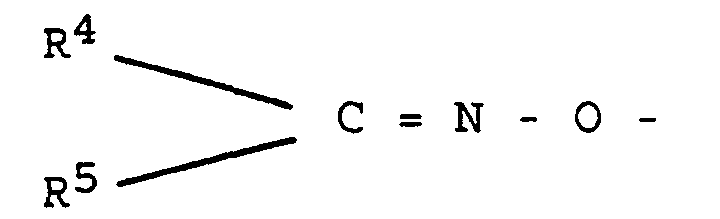
- R 4 and R 5 may be the same or different and each represents a straight-chain or branched, saturated or unsaturated, aliphatic hydrocarbon radical, preferably having up to 7 carbon atoms, more especially up to 4 carbon atoms, especially a methyl or ethyl group; an aromatic group, for example, a phenyl group; or an araliphatic group, for example, a benzyl group; or R 4 and R 5 together represent an alkylene group; or one of R 4 and R 5 represents hydrogen.
- each of R 4 and R 5 is other than an aromatic group.
- a group R 4 and/or R 5 may be substituted or unsubstituted.
- the silicon-containing functional groups do not contain any amine functionality, and preferably also no silanol functionality; each of those functionalities tends to detract from the desired latent reactivity.
- the film-forming polymer does not contain any functional groups apart from those conferring the desired latent reactivity. If any other functional groups are present, care must be taken to ensure that such additional groups do not detract from the desired latent reactivity. Examples of functional groups which may interfere in this way are acid functionalities and amine (including imine) and other base functionalities. Such interfering groups should be avoided both in the film-forming polymer and in the coating formulation used to apply the polymer.
- pendant curable silicon-containing functional groups in (A) are connected to the polymer by a chemical linkage that is resistant to aqueous hydrolysis in natural waters; sea water, for example, has pH 8.0-8.3.
- the silicon-containing bonds which are capable of undergoing condensation curing as described above, for example silyl ether and silyl ester, are therefore generally unsuitable for the purpose of attaching silicon-containing groups to the polymer backbone.
- the said chemical linkage should contain silicon directly linked to carbon.
- the chemical linkage may comprise an alkylene group C n H 2n where n is a non-zero integer preferably having the value 1-5, an alkylidene group, or an arylene group, for example phenylene, or may be a direct chemical bond to a carbon atom in the polymer backbone.
- the film-forming polymer may be derived from one or more ethylenically unsaturated monomers, more especially from one or more ethylenically unsaturated monomers selected from unsaturated aliphatic hydrocarbons, for example, ethylene, propylene and butylene; unsaturated halogenated hydrocarbons, for example, vinyl chloride, vinyl fluoride, vinylidene chloride and vinylidene fluoride; vinyl aromatic compounds, for example, vinyl pyridine, vinylnaphthalene, and styrene (including ring-substituted styrenes); unsaturated esters, amides and nitriles; and N-vinyl compounds, for example, N-vinyl pyrrolidone, N-vinyl carbazole and N-vinyl caprolactam. Mention should also be made of polyvinylacetate and polyvinylalcohol.
- the film-forming polymer may comprise repeating units derived from urethanes, ureas, urethane-ureas, amides, imides, amide-imides, epoxy compounds, and esters. Mention should also be made of alkyl resins and polyethers.
- olefinic monomers such compounds as acrylic and methacrylic esters, amides and nitrile derivatives, styrene and vinyl chloride.
- Acrylate and methacrylate esters are preferred monomers, especially those derived from saturated alcohols containing 4-16 carbon atoms, such as the butyl, hexyl, octyl, decyl, dodecyl and hexadecyl esters. Mention should also be made of isobornyl acrylate and isobornyl methacrylate.
- the polymer of (A) is derived from one or more monomers (A1) which carry curable silicon-containing groups and one or more monomers (A2) which do not carry such groups.
- the molar proportion of monomer(s) (A1) to that of monomer(s) (A2) may be in the range of from 5% to 25%, typically at least 8% or 12% and usually not exceeding 20%. The preferred range is dependent principally on the nature of the latent functional groups, the latency period desired, and the nature of the polymer backbone.
- Polymers (A) carrying curable silicon-containing groups may expediently be manufactured by the polymerisation of one or more monomers containing such groups, advantageously with one or more comonomers which do not contain such groups.
- silicon-containing monomers may be derivatives of compounds such as acrylic acid, methacrylic acid, styrene, or ethylene.
- derivatives of acrylic and methacrylic acid are the esters in which the esterifying group includes the said silicon-containing group.
- Examples of derivatives of styrene as monomers (A1) are those in which a benzene ring is substituted both with a vinyl or 2-propenyl group and with a silicon-containing group.
- styrene derivatives there may be mentioned the isomeric trimethoxysilylstyrenes and the isomeric 2-(trimethoxysilylethyl)styrenes.
- derivatives of ethylene as monomers (A1) may be mentioned trimethoxyvinylsilane and triethoxyvinylsilane.
- trimethoxysilyl and methyl dimethoxysilyl functional groups may be incorporated by reaction of the corresponding mercaptopropyl silane with epoxy groups.
- polymer (A) is derived from the following monomers in the following molar proportions:
- the film-forming polymer may have a number-average molecular weight in the range of from 1 000 to 50 000, preferably up to 15 000, more especially from 3000 to 10 000.
- a chain transfer agent may be used in the production of the film-forming polymer (A).
- chain transfer agents there may be mentioned 1-dodecanethiol and mercapto- propyltrimethoxysilane.
- the molecular weight of the polymer may also be controlled by varying the content of polymerisation initiator.
- preferred free-radical initiators include organic peroxides such as tert -butyl peroxy-2-ethylhexanoate (available under the trade name Trigonox 215) and the materials available under the trade names Trigonox 27 and Trigonox 41-C 75.
- the initial coating formulation should not include any cross-linking agent or curing catalyst, nor indeed any other material which may detract unduly from the desired latency (for example, acids, bases, organic metal salts, water or other protic solvents).
- the initial coating should be formulated so as to behave generally as a thermoplastic material during the period of latency, with only a minimum of self-curing taking place. The initial film formation takes place by solvent evaporation rather than by a curing reaction.
- the practical minimum period of latency will depend in turn on the desired or necessary minimum interval between application of the initial coating and subsequent application of the curable polysiloxane. In general it is considered that a minimum latency period of 2 hours under the prevailing conditions will be needed, but there will be circumstances requiring a minimum of 12, 24 or 48 hours, a week, a month or even longer. Factors influencing the latency period have been outlined hereinbefore.
- the latency period for any given coating can be determined using a standard overcoating test under specified conditions of temperature and humidity. Test portions of the curable polysiloxane material are applied at a series of different time intervals to different test areas of an initially coated substrate and cured onto the initial coating. The latency period is identified as the maximum time interval (after application of the initial layer) at which satisfactory adhesion of the coating (B) is still achieved.
- the coating (B) can be applied at any time before expiry of the latency period for the initial coating used.
- the or each curable polysiloxane applied according to the invention as material (B) to the initial coating having latent reactivity may be an organohydrogenpolysiloxane or a polydiorganosiloxane.
- the polysiloxane may, for example, comprise a copolymer of diorganosiloxane units with organohydrogen siloxane units and/or with other diorganosiloxane units, or a homopolymer of organohydrogen siloxane units or of diorganosiloxane units.
- polysiloxanes which comprise one or more other co-monomers in addition to siloxane repeating units.
- Such polysiloxanes may be derived from siloxane units and one or more ethylenically unsaturated monomers, more especially one or more ethylenically unsaturated monomers selected from unsaturated aliphatic hydrocarbons, for example, ethylene, propylene and butylene; unsaturated halogenated hydrocarbons, for example, vinyl chloride, vinyl fluoride, vinylidene chloride and vinylidene fluoride; vinyl aromatic compounds, for example, vinyl pyridine, and vinylnaphthalene; unsaturated esters, amides and nitriles; and N-vinyl compounds, for example, N-vinyl pyrrolidone, N-vinyl carbazole and N-vinyl caprolactam. Mention should also be made of polyvinylacetate and polyvinylalcohol.
- a polysiloxane copolymer may include repeating units derived from urethanes, ureas, urethane-ureas, amides, imides, amide-imides, epoxy compounds, and esters. Mention should also be made of alkyl resins and polyethers.
- olefinic co-monomers such compounds as acrylic and methacrylic esters, amides and nitrile derivatives, and vinyl chloride.
- Acrylate and methacrylate esters may, for example, be derived from saturated alcohols containing 4-16 carbon atoms, such as the butyl, hexyl, octyl, decyl, dodecyl and hexadecyl esters. Mention should also be made of isobornyl acrylate and isobornyl methacrylate.
- At least 55% of the repeating units are siloxane repeating units.
- the proportion of siloxane repeating units is preferably at least 75%, especially at least 90%, and more especially at least 95%.
- coatings (B) which are derived from polysiloxanes in admixture or conjunction with one or more organic polymeric materials.
- the polysiloxane content of such mixtures or combinations is advantageously at least 75% by weight, preferably at least 90% by weight and especially at least 95% by weight.
- the other material(s) used in such mixtures or combinations may themselves carry functional groups which are curable with the unreacted silicon-containing functional groups on the initial coating, or may carry no such groups.
- those groups may be the same as those on the polysiloxane (which may itself comprise a mixture or combination of two or more polysiloxane materials, at least one of which is curable with the initial coating) or different functional groups may be employed.
- the other material(s) used in admixture or conjunction with the polysiloxane(s) may themselves have fouling-inhibiting properties, but need not do so provided that the total coating (B) has such properties. Mention may be made in this connection of coatings (B) which are derived from polysiloxanes in admixture or conjunction with one or more fluorine-containing polymers.
- polymeric fouling-inhibiting materials especially fluorine-containing polymers
- the curable polysiloxane(s) or other material (B) may in principle contain any of the functional groups, which may be pendant and/or terminal, described above in connection with the initial coating as susceptible to condensation curing. Interference with latency is no longer a consideration, however, so that, for example, there are not the same disadvantages arising from the presence of silanol groups, and the polysiloxane or other material (B) is advantageously curable by virtue of such groups.
- the polysiloxane or other material (B) may be curable by virtue of curable functional groups selected from aliphatic, aromatic and araliphatic ether, ester and oxime groups, which may be substituted or unsubstituted, or also trialkoxysilyl or hydrosilyl groups.
- a curable ether group may be, for example, an alkoxy group such as, for instance, methoxy or ethoxy.
- An example of a curable ester group is acetoxy.
- the fouling-inhibiting material (B) is curable by virtue of silanol or silicon-alkoxy groups.
- a curable polysiloxane may be curable by virtue of oxime groups of the formula in which R4 and R5 may be the same or different and each represents a straight-chain or branched, saturated or unsaurated, aliphatic hydrocarbon radical, preferably having up to 7 carbon atoms, more especially up to 4 carbon atoms, especially a methyl or ethyl group; an aromatic group, for example, a phenyl group; or an araliphatic group, for example, a benzyl group, or R4 and R5 together represent an alkylene group, or one of R4 and R5 represents hydrogen.
- a group R4 and/or R5 may be substituted or unsubstituted.
- Preferred polysiloxanes are linear polymers and advantageously have the structure R 3 O(SiR 1 R 2 O) n R 3 , in which R 1 and R 2 , which may be the same or different on each silicon atom and on different silicon atoms in the polymer, each represents an alkyl group such as, for example, methyl, ethyl, or propyl; an alkenyl group such as, for example, vinyl or allyl; a cycloalkyl or cycloalkenyl group; an aryl group such as, for example, phenyl; or a halogenated or cyano-substituted hydrocarbon group, with the proviso that one of R 1 and R 2 may represent hydrogen on some or all of the silicon atoms and that R 1 and R 2 may each represent hydrogen on some of the silicon atoms, OR 3 represents a curable functional group in which R 3 represents a monovalent radical such as, for example, hydrogen, alkyl, aryl or R 4 R 5
- the polysiloxane or other material (B) may have a number-average molecular weight in the range of from 500, 1 000 or 1 500 to 310 000, generally from 1 800 to 80 000 or 85 000.
- the number-average molecular weight is at least 5 000, advan- tageously at least 10 000, and more especially at least 15 000.
- the upper limit of molecular weight will usually be 60 000 or 70 000.
- the polysiloxane or other material (B) preferably has a viscosity in the range of from 7.5 to 200 poise at 25°C.
- a viscosity in the range of from 7.5 to 200 poise at 25°C.
- a curing catalyst is used to promote the reaction of the curable polysiloxane or other material (B) with the unreacted functional groups on the initial coating.
- catalysts which may be used include the carboxylic acid salts of various metals, for example, tin, zinc, iron, lead, barium and zirconium.
- the salts are preferably salts of long-chain carboxylic acids, for example, dibutyltin dilaurate, dibutyltin dioctoate, iron stearate, tin (II) octoate and lead octoate.
- suitable catalysts include organobismuth and organotitanium compounds and organo-phosphates such as bis(2-ethyl hexyl) hydrogen phosphate.
- catalysts include chelates such as, for example, dibutyltin acetoacetonate.
- the catalyst may comprise a halogenated organic acid, which has at least one halogen substituent on a carbon atom which is in ⁇ -position relative to the acid group, and/or at least one halogen substituent on a carbon atom which is in ⁇ -position relative to the acid group, or a derivative which is hydrolysable to form such an acid under the conditions of the condensation reaction.
- references to the acid catalyst include references to hydrolysable derivatives thereof.
- the acid catalyst may be a mono-, di- or polybasic acid, but is preferably a monobasic acid.
- the acid catalyst is a protonic acid and may comprise one or more carboxylic and/or sulphonic acid groups, preferably one or more carboxylic acid groups.
- the or each halogen substituent may be fluorine, chlorine or bromine, but is preferably chlorine.
- the acid catalyst may comprise dichloroacetic acid, trichloroacetic acid or tribromoacetic acid.
- the acid is advantageously an aliphatic acid, but may comprise one or more aromatic groups, such as phenyl or substituted phenyl, provided that there is preferably no aromatic group attached to the ⁇ -carbon atom or bonded directly to the acid group.
- An aromatic group may be a heterocyclic group, such as pyridyl or pyrrolyl.
- An aliphatic acid may be a cyclic or, preferably, an acyciic acid.
- the catalyst is a halogenated alkanoic acid having up to 5 carbon atoms or a hydroxy-substituted derivative of such an acid.
- anhydrides for instance, trichloroacetic acid anhydride
- esters which may be hydrocarbyl esters, especially methyl esters, or alkyl silyl esters, advantageously C 1-4 alkylsilyl esters, especially methylsilyl esters.
- the catalyst may comprise trimethylsilyltrichloroacetate.
- the catalyst contains more than one acid group, there may be halogen substitution on each ⁇ - and/or ⁇ -carbon atom or on only some of those carbon atoms.
- the acid catalyst may carry one or more other substituents in addition to the specified halogen substitution.
- the acid catalyst may be used alone or in conjunction with one or more other such catalysts but in the absence of any metal salt catalyst of the kind previously proposed.
- acid catalysts of the invention offer the possibility of dispensing with tin-based catalysts such as dibutyltindilaurate.
- the proportion of catalyst may be in the range of from 0.01 to 5% by weight, based on the amount of polymer (B), preferably at least 0.05% by weight and advantageously not exceeding 2% by weight.
- a cross-linking agent comprises a functional silane, more especially a functional silane of the formula in which the groups represented by R 1 to R 4 may be the same or different and, subject to there being at least di-functionality, each may comprise a straight-chain or branched, saturated or unsaturated, aliphatic hydrocarbon radical, preferably having up to 7 carbon atoms, more especially up to 4 carbon atoms, or an aromatic or araliphatic hydrocarbon radical, such as, for example, phenyl or benzyl, or an aliphatic or aromatic ⁇ ther group, such as an alkoxy, phenoxy or benzyloxy group, or an ester group.
- An aliphatic group R 1 to R 4 is preferably an alkyl group, advantageously a C 1 -C 4 alkyl group, preferably a methyl or ethyl group, and an alkoxy group R 1 to R 4 is advantageously C 1 -C 4 alkoxy, preferably methoxy or ethoxy.
- alkoxysilanes of the formula (I) include tetraalkyl orthosilicates such as tetramethyl, -ethyl, -propyl or -butyl orthosilicate, dimethoxydimethyl silane and diethoxydimethyl silane.
- a compound of formula (I) in order to serve as a cross-linking agent, must be at least difunctional and preferably at least tri-functional. Any of the groups R 1 to R 4 in formula (I) may be unsubstituted or may be substituted by one or more substituents selected, for example, from halogen (especially chlorine or fluorine), amino groups or alkyl groups, which may themselves be substituted or unsubstituted.
- halogen especially chlorine or fluorine
- a functional silane cross-linking agent may be reactive by virtue of one or more oxime groups of the formula in which R 4 and R 5 may be the same or different and each represents a straight-chain or branched saturated or unsaturated, aliphatic hydrocarbon radical, preferably having up to 7 carbon atoms, more especially up to 4 carbon atoms, especially a methyl or ethyl group; an aromatic group, for example, a phenyl group; or an araliphatic group, for example, a benzyl group, or R 4 and R 5 together represent an alkylene group, or one of R 4 and R 5 represents hydrogen.
- a group R 4 and/or R 5 may be substituted or unsubstituted.
- CH 3 Si [ON C(CH 3 ) 2 ] 3
- CH 3 Si [ON C
- cross-linking or curing agents include oximes such as vinyltris(methylethylketoxime) or methyltris(methylethylketoxime).
- a cross-linking or curing agent may comprise a cyclic compound of the following formula: in which n is an integer of from 3 to 10, and R represents hydrogen or methyl.
- n is an integer of from 3 to 10
- R represents hydrogen or methyl.
- a silane cross-linking agent may in principle be incorporated in a monomeric form or in the form of a self-condensation product, which may be, for example, a dimer, trimer, heptamer or a low molecular weight polymer.
- the proportion of cross-linking agent may be in the range of from 0.05 to 10% by weight, generally from 2 to 5% by weight, based on the amount of polymer (B).
- Suitable solvents include aromatic hydro-carbons, for example toluene, xylene and trimethylbenzene; alcohols, for example, butanol; ketones, for example 4-methylpentan-2-one (methyl iso butylketone), 5-methylhexan-2-one (methyl iso amylketone) and cyclohexanone; esters, for example butyl acetate and 2-ethoxyethyl acetate, and mixtures of the above with one another or with an aliphatic hydrocarbon, for example in the form of white spirit.
- aromatic hydro-carbons for example toluene, xylene and trimethylbenzene
- alcohols for example, butanol
- ketones for example 4-methylpentan-2-one (methyl iso butylketone), 5-methylhexan-2-one (methyl iso amylketone) and cyclohexanone
- esters for example butyl acetate and 2-ethoxyethyl acetate,
- a solution of the coating composition comprising components (A) or (B), as the case may be, may comprise at least 35% by weight solids, generally at least 50% by weight solids. More concentrated solutions, for example containing at least 70% solids, may be employed if the polymer component (A) is of low molecular weight.
- the maximum solids content may be as high as 90% by weight or even more, but in general the maximum practicable solids content will be in the range 75-85% by weight, typically 80% by weight.
- such reduction in water content may be achieved by distillation in conjunction with a drying agent such as, for example, sodium, sodium hydride or calcium hydride or anhydrous calcium sulphate, but advantageously a reactive water-scavenger is used, for example, an inorganic salt such as, for example, magnesium sulphate (followed by filtration) or a mono- or di-functional silane, for instance, ethoxytrimethyl silane.
- a drying agent such as, for example, sodium, sodium hydride or calcium hydride or anhydrous calcium sulphate
- a reactive water-scavenger is used, for example, an inorganic salt such as, for example, magnesium sulphate (followed by filtration) or a mono- or di-functional silane, for instance, ethoxytrimethyl silane.
- a coating composition comprising polymer (B) may include one or more unreactive oils such as, for example, a silicone oil, especially a methylphenyl silicone oil such as that sold by Rhone-Poulenc under the trademark "Rhodorsil Huile 550" or a petroleum or polyolefin oil or a polyaromatic oil.
- a preferred example is petrolatum oil.
- the proportion of unreactive oil(s) may be in the range of from 5 to 25% by weight, based on the amount of component (B), preferably up to 10% by weight.
- the initial coating may be a clear, transparent material or may be pigmented or dyed, provided that any pigment or dye used does not detract unduly from the desired latency (as a result, for example, of high moisture content or surface acidity or basicity).
- the pigment volume concentration in the coating formulation may typically be in the range of from 0.5 to 25%. Particular mention may be made, for instance, of the use of metallic flake materials (for example, aluminium flake) or other so-called barrier pigments; also anti-corrosive pigments.
- the curable polysiloxane or other material (B) may likewise be clear, pigmented or dyed, and either or both layers may incorporate other excipients and/or fillers such as barium sulphate or other mineral fillers, pyrogenic silica, bentonite or other clays.
- a coating formulation comprising the curable polysiloxane(s) can in principle be packaged in a one-, two or three-pack system.
- the initial coating formulation can be applied simply and easily as a one-pack system.
- the thickness of the initial coating layer when dry may be in the range of from 50 to 100 microns, and the thickness of the layer comprising cured polysiloxane may be in the same range. More than one of each layer may be applied if desired.
- the substrate can be any material that is to be used in a fouling, especially aquatic, environment.
- the substrate may be metal, for instance, steel or aluminium; wood; concrete; a fibre-reinforced resin such as, for instance, a polyester resin; or another plastics material.
- a known anti-corrosive coating (such as, for instance, an epoxy, vinyl or alkyd coating) may be applied to the substrate before application of the initial coating formulation.
- the initial layer applied in accordance with the invention can be formulated as a combined tie-coat and sealer.
- a particular advantage of the invention is that the initial coating can be applied successfully over a range of worn or damaged anti-fouling coatings, especially if suitable barrier or anti-corrosive pigments are used, thereby avoiding a time-consuming and (in the case of toxic anti-fouling materials) potentially hazardous operation.
- the only surface preparation needed before application of an initial coating according to the invention is a high-pressure fresh water wash.
- anti-fouling coatings to which an initial coating according to the invention can be applied include self-polishing tin copolymers, rosin Laroflex and rosin acrylic.
- Low surface-energy systems such as silicones and fluoropolymers do not provide a sound base on which to apply an initial coating according to the invention.
- the initial layer composition in the process of the invention can be designed to permit a relatively long time interval between the application of the separate layers.
- a glass-reinforced plastics (GRP) substrate bearing a coating of aged anti-fouling material (self-polishing tin copolymer, rosin Laroflex or rosin acrylic) is cleaned by high-pressure washing and allowed to dry.
- a first coating formulation is applied to the washed substrate by brushing and roller-coating and allowed to dry to give an initial layer of average thickness 75 microns having latent reactivity by virtue of unreacted functional groups derived from the coating formulation.
- a second coating formulation comprising a curable organopolysiloxane or a curable fluorinated acrylic polymer, is applied to the initial layer and cured to give an adherent anti-fouling layer of average thickness 75 microns.
- composition of the first coating formulation is as follows: Parts by weight: Acrylic polymer A 54.7 Xylene 7.5 Bentone 2.9 Talc 16.7 Black iron oxide 2.9 Aluminium flake 13.0 Methyl isobutyl ketone 2.3
- the latency period provided by the initial layer formed from this composition is determined in a preliminary experiment, in which test portions of the curable organopolysiloxane composition are applied at a series of different time intervals to different test areas of the initial layer.
- the latency period is taken to be the maximum time interval, under the prevailing conditions of temperature and humidity (after application of the initial layer) at which satisfactory adhesion of the polysiloxane coating is still achieved.
- Example 1 The process of Example 1 is repeated using the different initial coating compositions set out below.
- the same GRP substrate is used except where indicated.
- the acrylic polymer A used in the Examples is derived from the following monomers: Parts by weight: Methoxyethylacrylate 306.6 Methylmethacrylate 715.3 Trimethoxysilylpropylmethacrylate 283.2 Mercaptopropyltrimethoxy silane 56.0
- the acrylic polymer A is prepared as follows:-
- Trimethylbenzenes (540.0g) are added to a 3 litre flange-topped reaction vessel, fitted with mechanical stirrer, temperature probe, water condenser and feed inlet.
- a monomer feed is prepared, made up from monomers and radical initiator Azobis(isobutyronitrile) (AIBN, 23.4g).
- AIBN Azobis(isobutyronitrile)
- the reaction vessel is heated to 100°C under a slow stream of nitrogen and the feed added over a 3 hour period. During the addition, the temperature is maintained at 100°C using a temperature control unit.
- the solution Upon completion of the monomer feed, the solution is maintained at 100°C for 30 minutes after which time a boost of AIBN (7.8g) in trimethylbenzenes (30g) is added in one shot.
- the acrylic polymer B used in the Examples is derived from the following monomers: Parts by weight: Butylacrylate 198.2 Methylmethacrylate 757.0 Triisopropoxysilylpropylmethacrylate 393.1
- the epoxy adduct I used in the Examples is obtained from 966.2 parts by weight of Epikote 1001 (a condensation product of bisphenol A and epichlorohydrin) and 33.8 parts by weight of mercaptopropyltrimethoxysilane.
- the adduct is prepared by the following procedure:-Ethanol (1000.0g) and Epikote 1001 are added via a wide neck funnel to a 3 litre flange-topped reaction vessel, fitted with mechanical stirrer, temperature probe and water condenser. A white emulsion is formed on stirring and heating to reflux (ca. 78°C).
- Mercaptopropyltrimethoxy silane is then added drop-wise via a peristaltic pump over a period of 4 hours. After addition of the silane, the reaction is allowed to proceed at reflux for a further 1 hour, or until the reaction is complete as determined by 13 C NMR.
- An alternative epoxy adduct II may be obtained analogously from 900.0 parts by weight of Epikote 1004 (a condensation product of bisphenol A and epichlorhydrin) and 100.0 parts by weight of mercaptopropyldimethoxymethyl silane.
- the latency period provided by acrylic polymer A and the epoxy adduct I is up to 7 days; the latency period provided by acrylic polymer B and the epoxy adduct II is up to 2 weeks.
- Coating formulations for forming the second coating in the Examples are as follows:
Landscapes
- Chemical & Material Sciences (AREA)
- Life Sciences & Earth Sciences (AREA)
- Engineering & Computer Science (AREA)
- Materials Engineering (AREA)
- Wood Science & Technology (AREA)
- Organic Chemistry (AREA)
- Chemical Kinetics & Catalysis (AREA)
- Paints Or Removers (AREA)
- Application Of Or Painting With Fluid Materials (AREA)
- Pharmaceuticals Containing Other Organic And Inorganic Compounds (AREA)
- Laminated Bodies (AREA)
- Transition And Organic Metals Composition Catalysts For Addition Polymerization (AREA)
- Acyclic And Carbocyclic Compounds In Medicinal Compositions (AREA)
- Pyrane Compounds (AREA)
- Nitrogen Condensed Heterocyclic Rings (AREA)
- Preparation Of Compounds By Using Micro-Organisms (AREA)
- Hydrogenated Pyridines (AREA)
- Agricultural Chemicals And Associated Chemicals (AREA)
- Devices For Conveying Motion By Means Of Endless Flexible Members (AREA)
Abstract
Description
RcRdNH
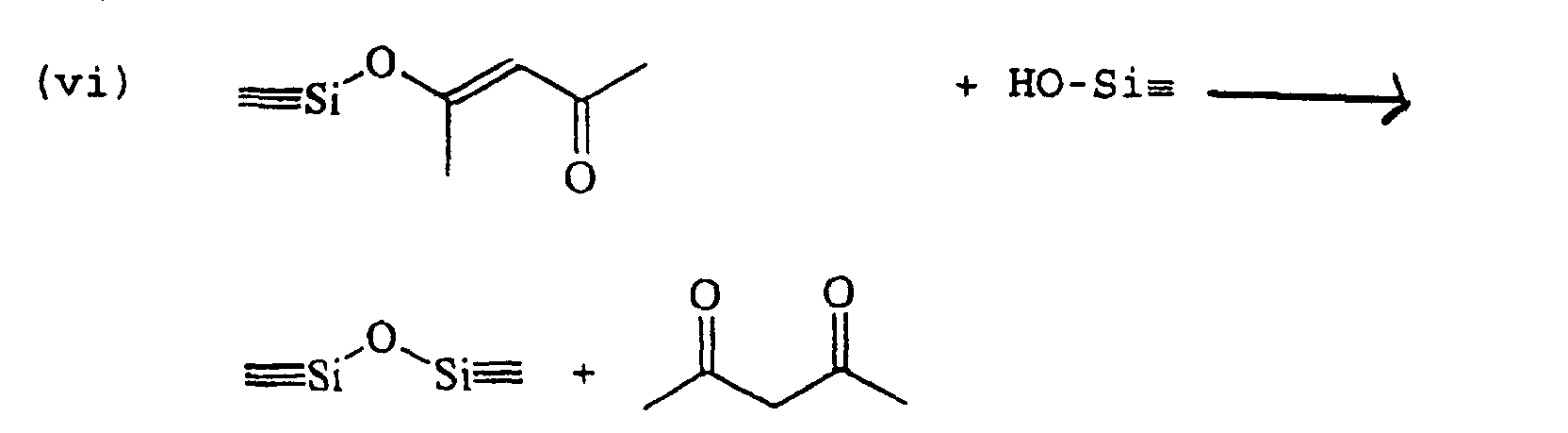
R'R2CNOH, which
H or CH3
H or CH3
Compound I(R represents CH3) is particularly preferred ("TMSPM").

Although the film-forming polymer may include a proportion of siloxane repeating units, advantageously at least a major proportion of the repeating units, and preferably at least 55% of the units, are other than siloxane units. The proportion of siloxane repeating units is advantageously not more than 25%, preferably not more than 10%, and more especially not more than 5%. In a preferred form of composition, the polymer of component (A) is substantially free of siloxane repeating units.


OR3 represents a curable functional group in which R3 represents a monovalent radical such as, for example, hydrogen, alkyl, aryl or R4R5CN where R4 and R5 are as hereinbefore defined, and
n represents a degree of polymerisation. Preferably R1 and R2 are each methyl, although partial or total replacement of R2 by phenyl may be of advantage.
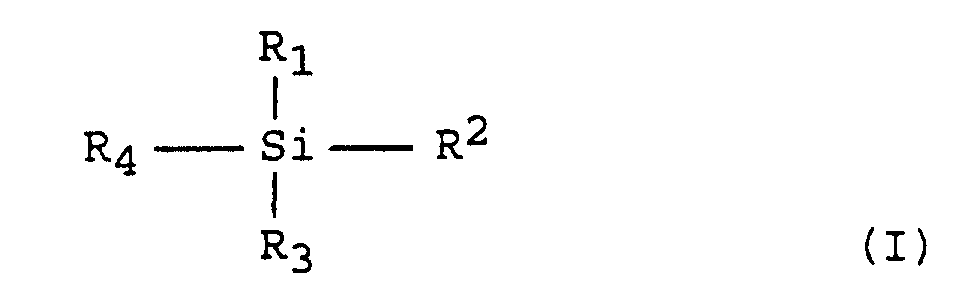
Any of the groups R1 to R4 in formula (I) may be unsubstituted or may be substituted by one or more substituents selected, for example, from halogen (especially chlorine or fluorine), amino groups or alkyl groups, which may themselves be substituted or unsubstituted.

or R4 and R5 together represent an alkylene group, or one of R4 and R5 represents hydrogen. A group R4 and/or R5 may be substituted or unsubstituted.



In principle, such reduction in water content may be achieved by distillation in conjunction with a drying agent such as, for example, sodium, sodium hydride or calcium hydride or anhydrous calcium sulphate, but advantageously a reactive water-scavenger is used, for example, an inorganic salt such as, for example, magnesium sulphate (followed by filtration) or a mono- or di-functional silane, for instance, ethoxytrimethyl silane.
| Parts by weight: | |
| Acrylic polymer A | 54.7 |
| Xylene | 7.5 |
| Bentone | 2.9 |
| Talc | 16.7 |
| Black iron oxide | 2.9 |
| Aluminium flake | 13.0 |
| Methyl isobutyl ketone | 2.3 |
| Parts by weight | |
| Acrylic polymer A | 67.0 |
| Xylene | 10.1 |
| Bentone | 1.6 |
| Talc | 9.3 |
| Black iron oxide | 1.6 |
| Aluminium flake | 7.2 |
| Methyl isobutyl ketone | 3.2 |
| Parts by weight | |
| Acrylic polymer A | 91.5 |
| Xylene | 8.5 |
| Substrate: gel-coated GRP (no previous anti-fouling treatment), primed with an epoxy anti-corrosive composition. |
| Parts by weight | |
| Acrylic polymer A | 54.7 |
| Xylene | 7.5 |
| Bentone | 2.9 |
| Talc | 16.7 |
| Black iron oxide | 2.9 |
| Aluminium flake | 13.0 |
| Methyl isobutyl ketone | 2.3 |
| Parts by weight | |
| Acrylic polymer B | 67.0 |
| Xylene | 10.1 |
| Bentone | 1.6 |
| Talc | 9.3 |
| Black iron oxide | 1.6 |
| Aluminium flake | 7.2 |
| Methyl isobutyl ketone | 3.2 |
| Parts by weight | |
| Acrylic polymer B | 91.5 |
| Xylene | 8.5 |
| Substrate: wood (no previous anti-fouling treatment), primed with an anti-fouling primer. |
| Parts by weight | |
| Epikote 1001 Adduct | 54.7 |
| Xylene | 7.5 |
| Bentone | 2.9 |
| Talc | 16.7 |
| Black iron oxide | 2.9 |
| Aluminium flake | 13.0 |
| Methyl isobutyl ketone | 2.3 |
| Parts by weight | |
| Epikote 1001 Adduct | 91.5 |
| Xylene | 8.5 |
| Substrate: bare concrete (no previous anti-fouling treatment), primed with an epoxy anti-corrosive composition. |
| Parts by weight: | |
| Methoxyethylacrylate | 306.6 |
| Methylmethacrylate | 715.3 |
| Trimethoxysilylpropylmethacrylate | 283.2 |
| Mercaptopropyltrimethoxy silane | 56.0 |
| % Solids (Theor.) = | 70% |
| Tg (Theor.) = | 39.1°C |
| Molecular Weight (Mn) ~ | 3000 |
| Parts by weight: | |
| Butylacrylate | 198.2 |
| Methylmethacrylate | 757.0 |
| Triisopropoxysilylpropylmethacrylate | 393.1 |
| % Solids (Theor.) = | 70% |
| Tg (Theor.) = | 38.9°C |
| % Solids (Theor.) = | 60% |
| Tg (Theor.) = | 61.9°C |
| Parts by weight | |
| α,ω- hydroxy functional dimethyl siloxane (viscosity 35 poise) | 55.00 |
| Methyltrimethoxy silane | 2.50 |
| Airflow silica (Aerosil) | 2.20 |
| Titanium ethylacetoacetonate | 1.00 |
| Trimethylbenzenes | 29.40 |
| Parts by weight | |
| Base | |
| α,ω-hydroxy functional dimethyl siloxane (viscosity 35 poise) | 100.00 |
| Air floated silica (Aerosil) | 8.00 |
| Methyltris(methylethylketoxime)silane | 6.00 |
| Catalyst Solution | |
| Trimethylbenzenes | 15.00 |
| Dibutyltindilaurate | 0.08 |
| Parts by weight | |
| Base | |
| Fluorinated acrylic polymer C | 70.00 |
| Trimethylbenzenes | 30.00 |
| Catalyst Solution | |
| Trimethylbenzenes | 15.00 |
| Dibutyltindilaurate | 0.08 |
| Parts by weight | |
| Butylacrylate | 57.10 |
| Methylmethylmethacrylate | 92.9 |
| Trimethoxysilylpropylmethacrylate | 32.10 |
| Pentafluoropropylmethacrylate | 19.40 |
| % Solids (Theor.) = | 70% |
| Molecular weight (Mn) = | 8000 |
| Parts by weight | |
| Base | |
| α,ω-hydroxy functional dimethyl siloxane (viscosity 35 poise) | 56.00 |
| Air floated silica (Aerosil) | 1.70 |
| Silicone oil (Rhodorsil RP550) | 4.10 |
| Trimethylbenzenes | 11.10 |
| Curing agent | |
| Tetraethylorthosilicate | 2.60 |
| Silicone oil (Rhodorsil RP550) | 0.80 |
| Trimethylbenzenes | 8.50 |
| Catalyst Solution | |
| Dibutyltindilaurate | 0.55 |
| Trimethylbenzenes | 14.20 |
Claims (40)
- A process for inhibiting the fouling of a substrate in a fouling environment, which comprises forming on the substrate, before exposure to the said environment, a coating comprising a film-forming polymer (A) carrying unreacted curable silicon-containing functional groups providing latent reactivity, and thereafter applying a layer comprising a curable polymeric fouling-inhibiting material (B) and bonding the applied layer to the said coating by a condensation curing reaction involving the unreacted functional groups thereon.
- A process as claimed in claim 1 wherein the curable silicon-containing functional groups of (A) are pendant functional groups.
- A process as claimed in claim 1 or 2, wherein the silicon containing functional groups are curable by virtue of one or more curable functional groups selected from aliphatic, aromatic and araliphatic ether and oxime groups, which groups may be substituted or unsubstituted.
- A process as claimed in claim 1 or claim 2, wherein the curable silicon-containing functional groups are groups of the formula
- A process as claimed in claim 4, wherein the ether or ester groups include a straight-chain or branched alkyl moiety having from 1 to 4 carbon atoms.
- A process as claimed in claim 4 or 5, wherein the hydrogen or hydrocarbon group includes a straight-chain or branched alkyl group having from 1 to 4 carbon atoms.
- A process as claimed in claim 1 or claim 2, wherein the silicon-containing functional groups are curable by virtue of one or more oxime groups of the formulain which R4 and R5 may be the same or different and each represents a straight-chain or branched, saturated or unsaturated, aliphatic hydrocarbon radical; an aromatic group; or an araliphatic group; or R4 and R5 together represent an alkylene group; or one of R4 and R5 represents hydrogen.

- A process as claimed in claim 7, wherein the hydrocarbon radical has up to 7 carbon atoms
- A process as claimed in claim 7 or 8, wherein the hydrocarbon radical has up to 4 carbon atoms
- A process as claimed in any one of claims 7 to 9, wherein the hydrocarbon radical is a methyl or ethyl group.
- A process as claimed in any one of claims 7 to 10, wherein the aromatic group is a phenyl group.
- A process as claimed in any one of claims 7 to 11, wherein the aromatic group is a benzyl group.
- A process as claimed in claim 1 or claim 2, wherein the curable silicon-containing functional groups are trimethoxy silyl or methyl dimethoxysilyl groups.
- A process as claimed in any one of claims 1 to 13, wherein the polymer (A) has no silanol or amine functionality.
- A process as claimed in any one of claims 1 to 14, wherein the polymer (A) carries no functional groups other than the curable silicon-containing functional groups conferring latent reactivity.
- A process as claimed in any one of claims 1 to 15, wherein at least a major proportion of the repeating units in the film-forming polymer (A) are other than siloxane repeating units.
- A process as claimed in claim 16, wherein the proportion of siloxane repeating units in the film- forming polymer (A) is not more than 25%.
- A process as claimed in claim 17, wherein the proportion of siloxane repeating units in the film-forming polymer (A) is not more than 10%.
- A process as claimed in claim 18, wherein the proportion of siloxane repeating units in the film-forming polymer (A) is not more than 5%.
- A process as claimed in any one of claims 1 to 19, wherein the polymer (A) is free from siloxane repeating units.
- A process as claimed in any one of claims 1 to 20, wherein the polymer (A) is derived from one or more monomers (A1) which carry curable silicon-containing functional groups and one or more monomers (A2) which do not carry such groups.
- A process as claimed in any one of claims 1 to 21, wherein the polymer (A) is derived from one or more ethylenically unsaturated monomers.
- A process as claimed in any one of claims 1 to 22, wherein the Tg of the polymer (A) is above ambient temperature.
- A process as claimed in any one of claims 1 to 23, wherein the polymer (A) has a number-average molecular weight in the range of from 3 000 to 10 000.
- A process as claimed in any one of claims 1 to 24, wherein the unreacted curable silicon-containing functional groups provide a period of latent reactivity of 48 hours or more.
- A process as claimed in any one of claims 1 to 25, wherein the fouling-inhibiting material (B) is curable by virtue of silanol or silicon-alkoxy groups.
- A process as claimed in any one of claims 1 to 25, wherein the fouling-inhibiting material (B) is curable by virtue of curable functional groups selected from aliphatic, aromatic and araliphatic ether, ester and oxime groups, trialkoxysilyl or hydrosilyl groups.
- A process as claimed in any one of claims 1 to 27, wherein the fouling-inhibiting material (B) is a linear polymer.
- A process as claimed in any one of claims 1 to 28, wherein the fouling-inhibiting material comprises a curable polysiloxane.
- A process as claimed in claim 29, wherein the polysiloxane (B) has the structure R3O(SiR1R2O)nR3, in which R1 and R2, which may be the same or different on each silicon atom and on different silicon atoms in the polymer, each represents an alkyl group; an alkenyl group; a cycloalkyl or cycloalkenyl group; an aryl group; or a halogenated or cyano-substituted hydrocarbon group, with the proviso that one of R1 and R2 may represent hydrogen on some or all of the silicon atoms and that R1 and R2 may each represent hydrogen on some of the silicon atoms, OR3 represents a curable functional group in which R3 represents a monovalent radical; and n represents a degree of polymerisation.
- A process as claimed in any one of claims 1 to 28, wherein the fouling-inhibiting material comprises a curable fluorine-containing polymer.
- A process as claimed in claim 31, wherein the fluorine-containing polymer comprises a fluoro-acrylate polymer.
- A process as claimed in any one of claims 1 to 32, wherein the fouling-inhibiting material (B) has a number-average molecular weight in the range of from 5 000 to 85 000.
- A process as claimed in any one of claims 1 to 33, wherein the fouling-inhibiting material (B) is applied in admixture or conjunction with a catalyst for the condensation curing reaction.
- A process as claimed in any one of claims 1 to 34, wherein the fouling-inhibiting material (B) is applied in admixture or conjunction with a cross-linking agent for the condensation curing reaction.
- A process as claimed in any one of claims 1 to 35, wherein the substrate has a worn or damaged anti-fouling coating thereon.
- A process as claimed in any one of claims 1 to 36, wherein the fouling environment is an aquatic environment.
- A process as claimed in claim 37, wherein the fouling environment is a marine environment.
- A substrate in a fouling environment and bearing a coating and a cured fouling-inhibiting layer thereon formed by a process as defined in any one of claims 1 to 38.
- A substrate as claimed in claim 39, wherein the cured fouling-inhibiting layer is a cured polysiloxane layer.
Applications Claiming Priority (3)
| Application Number | Priority Date | Filing Date | Title |
|---|---|---|---|
| GBGB9727261.1A GB9727261D0 (en) | 1997-12-23 | 1997-12-23 | Fouling inhibition |
| GB9727261 | 1997-12-23 | ||
| PCT/GB1998/003883 WO1999033927A1 (en) | 1997-12-23 | 1998-12-23 | Fouling inhibition |
Publications (2)
| Publication Number | Publication Date |
|---|---|
| EP1042413A1 EP1042413A1 (en) | 2000-10-11 |
| EP1042413B1 true EP1042413B1 (en) | 2004-06-09 |
Family
ID=10824178
Family Applications (1)
| Application Number | Title | Priority Date | Filing Date |
|---|---|---|---|
| EP98962609A Revoked EP1042413B1 (en) | 1997-12-23 | 1998-12-23 | Fouling inhibition |
Country Status (18)
| Country | Link |
|---|---|
| US (1) | US6723376B1 (en) |
| EP (1) | EP1042413B1 (en) |
| JP (2) | JP2002500239A (en) |
| KR (1) | KR100556015B1 (en) |
| CN (1) | CN1210357C (en) |
| AT (1) | ATE268802T1 (en) |
| AU (1) | AU752136B2 (en) |
| CA (1) | CA2315690C (en) |
| DE (1) | DE69824449T2 (en) |
| DK (1) | DK1042413T3 (en) |
| ES (1) | ES2223144T3 (en) |
| GB (1) | GB9727261D0 (en) |
| NO (1) | NO20003263L (en) |
| NZ (1) | NZ505172A (en) |
| PL (1) | PL188787B1 (en) |
| PT (1) | PT1042413E (en) |
| RU (1) | RU2211849C2 (en) |
| WO (1) | WO1999033927A1 (en) |
Cited By (1)
| Publication number | Priority date | Publication date | Assignee | Title |
|---|---|---|---|---|
| EP2796522B1 (en) | 2011-12-21 | 2019-06-19 | Nitto Denko Corporation | Adhesive tape preventing adhesion by aquatic organisms |
Families Citing this family (33)
| Publication number | Priority date | Publication date | Assignee | Title |
|---|---|---|---|---|
| AU7750001A (en) | 2000-06-06 | 2001-12-17 | Int Coatings Ltd | Antifouling coating composition comprising a fluorinated resin |
| US20020192181A1 (en) | 2001-03-21 | 2002-12-19 | Williams David Neil | Anti-fouling compositions with a fluorinated alkyl- or alkoxy-containing polymer or oligomer |
| US6767978B2 (en) * | 2002-01-03 | 2004-07-27 | Atofina Chemicals, Inc. | Copolymers containing fluoro and silyl groups and their use in marine antifoulant composition |
| JP4361239B2 (en) | 2002-03-06 | 2009-11-11 | 中国塗料株式会社 | Antifouling paint composition, coating film comprising the composition, substrate coated with the coating film, and antifouling method |
| AU2004278075B2 (en) | 2003-10-03 | 2008-02-14 | Hempel A/S | A tie-coat composition comprising at least two types of functional polysiloxane compounds and a method for using the same for establishing a coating on a substrate |
| US7803894B2 (en) * | 2003-12-05 | 2010-09-28 | 3M Innovatie Properties Company | Coating compositions with perfluoropolyetherisocyanate derived silane and alkoxysilanes |
| ES2527453T3 (en) | 2004-12-14 | 2015-01-23 | Chugoku Marine Paints, Ltd. | Composition of anticorrosive epoxy coating, anticorrosive coating film, organopolysiloxane antifouling composite film and vessel and underwater structure covered with said composite material coating film |
| CA2603446C (en) * | 2005-04-05 | 2012-03-13 | Chugoku Marine Paints, Ltd. | Tie coat for organopolysiloxane-based antifouling coating film, composite coating film, and ship and underwater structure coated with the coating film |
| ATE423541T1 (en) * | 2005-06-21 | 2009-03-15 | Ivoclar Vivadent Ag | DENTAL MATERIALS WITH EXCEPTIONAL DISTRIBUTION OF FLUORINE |
| DE102005052940A1 (en) * | 2005-11-03 | 2007-05-10 | Degussa Gmbh | Process for coating substrates |
| MY143579A (en) * | 2006-02-17 | 2011-05-31 | Chugoku Marine Paints | Curable organopolysiloxane composition and antifouling composite coating film |
| JP5189773B2 (en) * | 2006-02-20 | 2013-04-24 | 中国塗料株式会社 | Cured organopolysiloxane antifouling composite coating, substrate / ship covered with the composite coating, and antifouling method |
| KR101475801B1 (en) | 2007-05-01 | 2014-12-23 | 아크조노벨코팅스인터내셔널비.브이. | Anti-fouling coating compositions containing a carboxyl-functional organosilicone |
| CN101675126B (en) * | 2007-05-01 | 2014-07-30 | 阿克佐诺贝尔国际涂料股份有限公司 | Antifouling coating composition based on curable polyorganosiloxane polyoxyalkylene copolymers |
| NO20073388L (en) * | 2007-07-02 | 2009-01-05 | Jotun As | Organofunctional polysiloxane polymers and coating compositions containing said polymers |
| CN103228744B (en) | 2010-10-14 | 2016-10-12 | 汉伯公司 | High solid content antifouling paint composition |
| EP2492323A1 (en) | 2011-02-23 | 2012-08-29 | Akzo Nobel Coatings International B.V. | Biofouling resistant composition |
| US8921503B2 (en) | 2011-03-31 | 2014-12-30 | Akzo Nobel Coatings International B.V. | Foul preventing coating composition |
| AU2012271948B2 (en) * | 2011-06-21 | 2015-10-15 | Akzo Nobel Coatings International B.V. | Biocidal foul release coating systems |
| JP5860536B2 (en) | 2011-08-18 | 2016-02-16 | アクゾ ノーベル コーティングス インターナショナル ビー ヴィ | Fouling resistant composition comprising sterol and / or a derivative thereof |
| EP3378905A1 (en) * | 2013-02-15 | 2018-09-26 | Momentive Performance Materials Inc. | Antifouling system comprising silicone hydrogel |
| EP2961805B1 (en) | 2013-02-26 | 2016-12-21 | Akzo Nobel Coatings International B.V. | Anti-fouling compositions with a fluorinated oxyalkylene-containing polymer or oligomer |
| KR102354241B1 (en) | 2013-12-03 | 2022-01-21 | 아크조노벨코팅스인터내셔널비.브이. | A method for coating an aged coating layer on a substrate, and a coating composition suitable for use in this method |
| US20160312041A1 (en) * | 2013-12-05 | 2016-10-27 | Ppg Coatings Europe B.V. | A Coating Composition |
| WO2017009297A1 (en) | 2015-07-13 | 2017-01-19 | Jotun A/S | Antifouling composition |
| CA3049632A1 (en) | 2017-01-17 | 2018-07-26 | Akzo Nobel Coatings International B.V. | Foul release coating composition, substrate coated with such coating composition, and use of such coating composition |
| SG11201906534XA (en) | 2017-01-19 | 2019-08-27 | Jotun As | Antifouling composition |
| CN109652077B (en) * | 2017-10-12 | 2022-07-12 | 中国石油化工股份有限公司 | Method for preventing polymerization of advanced alkyne in acetylene concentration system |
| CN111448267B (en) | 2017-12-14 | 2022-11-04 | 阿克佐诺贝尔国际涂料股份有限公司 | Fouling release coating compositions, substrates coated with the coating compositions and uses of the coating compositions |
| SG11202100108SA (en) * | 2018-07-13 | 2021-02-25 | Akzo Nobel Coatings Int Bv | Tie-coat composition |
| AU2020253152B2 (en) | 2019-04-02 | 2025-07-24 | Akzo Nobel Coatings International B.V. | Aqueous coating composition, substrate coated with such composition, process for controlling aquatic biofouling using such coating composition |
| WO2022202897A1 (en) * | 2021-03-26 | 2022-09-29 | 中国塗料株式会社 | Primer composition |
| WO2022207681A1 (en) | 2021-03-30 | 2022-10-06 | Akzo Nobel Coatings International B.V. | Fouling control coating composition |
Family Cites Families (16)
| Publication number | Priority date | Publication date | Assignee | Title |
|---|---|---|---|---|
| GB1307001A (en) | 1970-01-12 | 1973-02-14 | Kroyer K K K | Marine structure having a surface coating for the prevention of accumulation of marine organisms |
| US3702778A (en) | 1970-03-23 | 1972-11-14 | Battelle Memorial Institute | Ship's hull coated with antifouling silicone rubber |
| GB1470465A (en) | 1975-01-20 | 1977-04-14 | Int Paint Co | Coated marine surfaces |
| AU504536B2 (en) | 1975-10-02 | 1979-10-18 | Sws Silicones Corporation | Bonding rtv silicone rubbers |
| GB1581727A (en) | 1976-12-21 | 1980-12-17 | Shell Int Research | Coated marine structure |
| EP0032597B1 (en) | 1979-12-11 | 1983-11-30 | Shell Internationale Researchmaatschappij B.V. | Coated marine structure |
| DE3209755A1 (en) | 1982-03-17 | 1983-09-22 | Wacker-Chemie GmbH, 8000 München | METHOD FOR REINFORCING THE ADHESION OF ORGANOPOLYSILOXANELASTOMERS |
| DE3418406A1 (en) * | 1984-05-17 | 1985-11-21 | Wacker-Chemie GmbH, 8000 München | METHOD FOR REINFORCING THE ADHESION OF ELASTOMERS AND COATINGS PRODUCED BY THIS METHOD |
| CA1274649A (en) | 1985-12-27 | 1990-09-25 | Shigeru Masuoka | Antifouling coating |
| GB2192400B (en) | 1986-07-07 | 1990-04-18 | Kansai Paint Co Ltd | Antifouling paint composition |
| GB9127171D0 (en) * | 1991-12-20 | 1992-02-19 | Courtaulds Coatings Holdings | Coating compositions |
| GB9210624D0 (en) * | 1992-05-19 | 1992-07-01 | Alfa Laval Separation Ab | Vibratory screening apparatus |
| JP3289193B2 (en) * | 1995-09-08 | 2002-06-04 | 日本ペイント株式会社 | Amine-bound resin and antifouling paint |
| US5902851A (en) * | 1996-12-24 | 1999-05-11 | Matsushita Electric Works, Ltd. | Resinous composition for foul releasing coat and coating articles |
| US5904988A (en) * | 1997-05-27 | 1999-05-18 | General Electric Company | Sprayable, condensation curable silicone foul release coatings and articles coated therewith |
| US6180249B1 (en) * | 1998-09-08 | 2001-01-30 | General Electric Company | Curable silicone foul release coatings and articles |
-
1997
- 1997-12-23 GB GBGB9727261.1A patent/GB9727261D0/en not_active Ceased
-
1998
- 1998-12-23 PL PL98341474A patent/PL188787B1/en not_active IP Right Cessation
- 1998-12-23 DK DK98962609T patent/DK1042413T3/en active
- 1998-12-23 WO PCT/GB1998/003883 patent/WO1999033927A1/en not_active Ceased
- 1998-12-23 EP EP98962609A patent/EP1042413B1/en not_active Revoked
- 1998-12-23 NZ NZ505172A patent/NZ505172A/en unknown
- 1998-12-23 DE DE69824449T patent/DE69824449T2/en not_active Revoked
- 1998-12-23 CN CNB988130572A patent/CN1210357C/en not_active Expired - Fee Related
- 1998-12-23 AT AT98962609T patent/ATE268802T1/en active
- 1998-12-23 JP JP2000526590A patent/JP2002500239A/en active Pending
- 1998-12-23 PT PT98962609T patent/PT1042413E/en unknown
- 1998-12-23 AU AU17739/99A patent/AU752136B2/en not_active Ceased
- 1998-12-23 KR KR1020007006962A patent/KR100556015B1/en not_active Ceased
- 1998-12-23 CA CA002315690A patent/CA2315690C/en not_active Expired - Fee Related
- 1998-12-23 RU RU2000119739/04A patent/RU2211849C2/en not_active IP Right Cessation
- 1998-12-23 ES ES98962609T patent/ES2223144T3/en not_active Expired - Lifetime
-
2000
- 2000-06-22 US US09/599,174 patent/US6723376B1/en not_active Expired - Lifetime
- 2000-06-22 NO NO20003263A patent/NO20003263L/en not_active Application Discontinuation
-
2009
- 2009-06-10 JP JP2009138791A patent/JP2009235415A/en not_active Withdrawn
Cited By (1)
| Publication number | Priority date | Publication date | Assignee | Title |
|---|---|---|---|---|
| EP2796522B1 (en) | 2011-12-21 | 2019-06-19 | Nitto Denko Corporation | Adhesive tape preventing adhesion by aquatic organisms |
Also Published As
| Publication number | Publication date |
|---|---|
| WO1999033927A1 (en) | 1999-07-08 |
| NO20003263D0 (en) | 2000-06-22 |
| GB9727261D0 (en) | 1998-02-25 |
| NO20003263L (en) | 2000-08-21 |
| JP2002500239A (en) | 2002-01-08 |
| PT1042413E (en) | 2004-10-29 |
| KR20010033462A (en) | 2001-04-25 |
| DK1042413T3 (en) | 2004-09-27 |
| AU752136B2 (en) | 2002-09-05 |
| AU1773999A (en) | 1999-07-19 |
| KR100556015B1 (en) | 2006-03-03 |
| CN1210357C (en) | 2005-07-13 |
| PL188787B1 (en) | 2005-04-29 |
| PL341474A1 (en) | 2001-04-23 |
| US6723376B1 (en) | 2004-04-20 |
| CA2315690C (en) | 2008-09-16 |
| ATE268802T1 (en) | 2004-06-15 |
| DE69824449T2 (en) | 2005-06-23 |
| CA2315690A1 (en) | 1999-07-08 |
| CN1285860A (en) | 2001-02-28 |
| JP2009235415A (en) | 2009-10-15 |
| HK1033469A1 (en) | 2001-08-31 |
| NZ505172A (en) | 2002-10-25 |
| EP1042413A1 (en) | 2000-10-11 |
| DE69824449D1 (en) | 2004-07-15 |
| ES2223144T3 (en) | 2005-02-16 |
| RU2211849C2 (en) | 2003-09-10 |
Similar Documents
| Publication | Publication Date | Title |
|---|---|---|
| US6723376B1 (en) | Fouling inhibition | |
| US5663215A (en) | Coating compositions | |
| JP7431378B2 (en) | Contaminant releasable coating composition | |
| US8450443B2 (en) | Antifouling coating composition based on curable polyorganosiloxane polyoxyalkylene copolymers | |
| EP0617725B1 (en) | Process for fouling inhibition | |
| CN101437909B (en) | descaling composition | |
| CN101568597B (en) | Curable composition, antifouling coating composition, antifouling coating film, base with antifouling coating film, and method for preventing fouling on base | |
| EP0762955A1 (en) | Antifouling and foul-release coatings | |
| CN112368342B (en) | Tie Coating Composition | |
| WO1998039391A1 (en) | Fouling inhibition | |
| JP3704616B2 (en) | Self-polishing antifouling paint composition containing hydrolyzable silicon-containing resin |
Legal Events
| Date | Code | Title | Description |
|---|---|---|---|
| PUAI | Public reference made under article 153(3) epc to a published international application that has entered the european phase |
Free format text: ORIGINAL CODE: 0009012 |
|
| 17P | Request for examination filed |
Effective date: 20000609 |
|
| AK | Designated contracting states |
Kind code of ref document: A1 Designated state(s): AT BE CH CY DE DK ES FI FR GB GR IE IT LI LU MC NL PT SE |
|
| 17Q | First examination report despatched |
Effective date: 20020412 |
|
| GRAP | Despatch of communication of intention to grant a patent |
Free format text: ORIGINAL CODE: EPIDOSNIGR1 |
|
| GRAS | Grant fee paid |
Free format text: ORIGINAL CODE: EPIDOSNIGR3 |
|
| GRAA | (expected) grant |
Free format text: ORIGINAL CODE: 0009210 |
|
| RAP1 | Party data changed (applicant data changed or rights of an application transferred) |
Owner name: AKZO NOBEL COATINGS INTERNATIONAL B.V. |
|
| AK | Designated contracting states |
Kind code of ref document: B1 Designated state(s): AT BE CH CY DE DK ES FI FR GB GR IE IT LI LU MC NL PT SE |
|
| PG25 | Lapsed in a contracting state [announced via postgrant information from national office to epo] |
Ref country code: FI Free format text: LAPSE BECAUSE OF FAILURE TO SUBMIT A TRANSLATION OF THE DESCRIPTION OR TO PAY THE FEE WITHIN THE PRESCRIBED TIME-LIMIT Effective date: 20040609 Ref country code: CY Free format text: LAPSE BECAUSE OF FAILURE TO SUBMIT A TRANSLATION OF THE DESCRIPTION OR TO PAY THE FEE WITHIN THE PRESCRIBED TIME-LIMIT Effective date: 20040609 |
|
| REG | Reference to a national code |
Ref country code: GB Ref legal event code: FG4D |
|
| REG | Reference to a national code |
Ref country code: CH Ref legal event code: EP |
|
| REF | Corresponds to: |
Ref document number: 69824449 Country of ref document: DE Date of ref document: 20040715 Kind code of ref document: P |
|
| REG | Reference to a national code |
Ref country code: IE Ref legal event code: FG4D |
|
| REG | Reference to a national code |
Ref country code: DK Ref legal event code: T3 |
|
| REG | Reference to a national code |
Ref country code: CH Ref legal event code: NV Representative=s name: RITSCHER & PARTNER AG |
|
| REG | Reference to a national code |
Ref country code: SE Ref legal event code: TRGR |
|
| REG | Reference to a national code |
Ref country code: GR Ref legal event code: EP Ref document number: 20040402938 Country of ref document: GR |
|
| REG | Reference to a national code |
Ref country code: PT Ref legal event code: SC4A Free format text: AVAILABILITY OF NATIONAL TRANSLATION Effective date: 20040824 |
|
| PG25 | Lapsed in a contracting state [announced via postgrant information from national office to epo] |
Ref country code: LU Free format text: LAPSE BECAUSE OF NON-PAYMENT OF DUE FEES Effective date: 20041223 Ref country code: IE Free format text: LAPSE BECAUSE OF NON-PAYMENT OF DUE FEES Effective date: 20041223 |
|
| PG25 | Lapsed in a contracting state [announced via postgrant information from national office to epo] |
Ref country code: MC Free format text: LAPSE BECAUSE OF NON-PAYMENT OF DUE FEES Effective date: 20041231 |
|
| REG | Reference to a national code |
Ref country code: ES Ref legal event code: FG2A Ref document number: 2223144 Country of ref document: ES Kind code of ref document: T3 |
|
| PLAQ | Examination of admissibility of opposition: information related to despatch of communication + time limit deleted |
Free format text: ORIGINAL CODE: EPIDOSDOPE2 |
|
| PLBI | Opposition filed |
Free format text: ORIGINAL CODE: 0009260 |
|
| PLBQ | Unpublished change to opponent data |
Free format text: ORIGINAL CODE: EPIDOS OPPO |
|
| PLAQ | Examination of admissibility of opposition: information related to despatch of communication + time limit deleted |
Free format text: ORIGINAL CODE: EPIDOSDOPE2 |
|
| PLAR | Examination of admissibility of opposition: information related to receipt of reply deleted |
Free format text: ORIGINAL CODE: EPIDOSDOPE4 |
|
| PLBQ | Unpublished change to opponent data |
Free format text: ORIGINAL CODE: EPIDOS OPPO |
|
| PLAB | Opposition data, opponent's data or that of the opponent's representative modified |
Free format text: ORIGINAL CODE: 0009299OPPO |
|
| ET | Fr: translation filed | ||
| 26 | Opposition filed |
Opponent name: CHUGOKU MARINE PAINTS LTD. Effective date: 20050218 |
|
| PLAX | Notice of opposition and request to file observation + time limit sent |
Free format text: ORIGINAL CODE: EPIDOSNOBS2 |
|
| R26 | Opposition filed (corrected) |
Opponent name: CHUGOKU MARINE PAINTS LTD. Effective date: 20050218 |
|
| NLR1 | Nl: opposition has been filed with the epo |
Opponent name: CHUGOKU MARINE PAINTS LTD. |
|
| NLR1 | Nl: opposition has been filed with the epo |
Opponent name: CHUGOKU MARINE PAINTS LTD. |
|
| PLAF | Information modified related to communication of a notice of opposition and request to file observations + time limit |
Free format text: ORIGINAL CODE: EPIDOSCOBS2 |
|
| REG | Reference to a national code |
Ref country code: IE Ref legal event code: MM4A |
|
| PLBB | Reply of patent proprietor to notice(s) of opposition received |
Free format text: ORIGINAL CODE: EPIDOSNOBS3 |
|
| REG | Reference to a national code |
Ref country code: CH Ref legal event code: PCAR Free format text: RITSCHER & PARTNER AG;RESIRAIN 1;8125 ZOLLIKERBERG (CH) |
|
| PGFP | Annual fee paid to national office [announced via postgrant information from national office to epo] |
Ref country code: ES Payment date: 20091228 Year of fee payment: 12 Ref country code: DK Payment date: 20091229 Year of fee payment: 12 Ref country code: CH Payment date: 20091228 Year of fee payment: 12 Ref country code: AT Payment date: 20091202 Year of fee payment: 12 |
|
| PGFP | Annual fee paid to national office [announced via postgrant information from national office to epo] |
Ref country code: NL Payment date: 20091224 Year of fee payment: 12 |
|
| PGFP | Annual fee paid to national office [announced via postgrant information from national office to epo] |
Ref country code: PT Payment date: 20091215 Year of fee payment: 12 |
|
| PGFP | Annual fee paid to national office [announced via postgrant information from national office to epo] |
Ref country code: GB Payment date: 20091229 Year of fee payment: 12 Ref country code: FR Payment date: 20100106 Year of fee payment: 12 |
|
| RDAF | Communication despatched that patent is revoked |
Free format text: ORIGINAL CODE: EPIDOSNREV1 |
|
| PGFP | Annual fee paid to national office [announced via postgrant information from national office to epo] |
Ref country code: IT Payment date: 20091229 Year of fee payment: 12 |
|
| PGFP | Annual fee paid to national office [announced via postgrant information from national office to epo] |
Ref country code: GR Payment date: 20091229 Year of fee payment: 12 Ref country code: DE Payment date: 20091230 Year of fee payment: 12 Ref country code: BE Payment date: 20100212 Year of fee payment: 12 |
|
| RDAG | Patent revoked |
Free format text: ORIGINAL CODE: 0009271 |
|
| STAA | Information on the status of an ep patent application or granted ep patent |
Free format text: STATUS: PATENT REVOKED |
|
| REG | Reference to a national code |
Ref country code: CH Ref legal event code: PL |
|
| 27W | Patent revoked |
Effective date: 20100612 |
|
| GBPR | Gb: patent revoked under art. 102 of the ep convention designating the uk as contracting state |
Effective date: 20100612 |
|
| PG25 | Lapsed in a contracting state [announced via postgrant information from national office to epo] |
Ref country code: LI Free format text: LAPSE BECAUSE OF THE APPLICANT RENOUNCES Effective date: 20040609 Ref country code: CH Free format text: LAPSE BECAUSE OF THE APPLICANT RENOUNCES Effective date: 20040609 |
|
| REG | Reference to a national code |
Ref country code: SE Ref legal event code: ECNC |
|
| PGFP | Annual fee paid to national office [announced via postgrant information from national office to epo] |
Ref country code: SE Payment date: 20091230 Year of fee payment: 12 |