EP1041118A2 - Resin composition - Google Patents
Resin composition Download PDFInfo
- Publication number
- EP1041118A2 EP1041118A2 EP00106845A EP00106845A EP1041118A2 EP 1041118 A2 EP1041118 A2 EP 1041118A2 EP 00106845 A EP00106845 A EP 00106845A EP 00106845 A EP00106845 A EP 00106845A EP 1041118 A2 EP1041118 A2 EP 1041118A2
- Authority
- EP
- European Patent Office
- Prior art keywords
- acid
- copolymer
- weight
- resin
- film
- Prior art date
- Legal status (The legal status is an assumption and is not a legal conclusion. Google has not performed a legal analysis and makes no representation as to the accuracy of the status listed.)
- Granted
Links
- GMUZQPVTDQHUHU-UHFFFAOYSA-N CCC(C)(C)C(CC(N1C(C)(C)CC)=O)C1=O Chemical compound CCC(C)(C)C(CC(N1C(C)(C)CC)=O)C1=O GMUZQPVTDQHUHU-UHFFFAOYSA-N 0.000 description 1
Classifications
-
- C—CHEMISTRY; METALLURGY
- C08—ORGANIC MACROMOLECULAR COMPOUNDS; THEIR PREPARATION OR CHEMICAL WORKING-UP; COMPOSITIONS BASED THEREON
- C08L—COMPOSITIONS OF MACROMOLECULAR COMPOUNDS
- C08L67/00—Compositions of polyesters obtained by reactions forming a carboxylic ester link in the main chain; Compositions of derivatives of such polymers
- C08L67/02—Polyesters derived from dicarboxylic acids and dihydroxy compounds
-
- C—CHEMISTRY; METALLURGY
- C08—ORGANIC MACROMOLECULAR COMPOUNDS; THEIR PREPARATION OR CHEMICAL WORKING-UP; COMPOSITIONS BASED THEREON
- C08L—COMPOSITIONS OF MACROMOLECULAR COMPOUNDS
- C08L101/00—Compositions of unspecified macromolecular compounds
-
- C—CHEMISTRY; METALLURGY
- C08—ORGANIC MACROMOLECULAR COMPOUNDS; THEIR PREPARATION OR CHEMICAL WORKING-UP; COMPOSITIONS BASED THEREON
- C08L—COMPOSITIONS OF MACROMOLECULAR COMPOUNDS
- C08L69/00—Compositions of polycarbonates; Compositions of derivatives of polycarbonates
Definitions
- the present invention relates to a novel resin composition wherein a resin additive itself has degradability.
- the resin composition of the present invention is a novel resin composition having improved wettability, and is especially useful as a degradable plastic or a bioabsorbable plastic which can be degraded under a natural environment or in a living body.
- the present invention relates to a method for accelerating the hydrolysis of a resin such as an aliphatic polyester, and a method for inhibiting its heat deterioration.
- Polyhydroxycarboxylic acids typified by polylactic acid (PLA), polyglycolic acid (PGA), polycaprolactone (PCL) and the like are utilized as biodegradable plastics which can be degraded by water, an enzyme and the like under a natural environment or in a living body.
- PLA polylactic acid
- PGA polyglycolic acid
- PCL polycaprolactone
- Japanese Patent Application Laid-Open No. 64824/1987 discloses a method for obtaining a lactic acid-glycolic acid copolymer (PLGA) useful as a base material for a slowly releasable agent and having a low molecular weight and a polydispersity by the ring-opening polymerization of glycollide (GLD) which is a cyclic dimer of glycolic acid and lactide (LTD) which is a cyclic dimer of lactic acid.
- GLD glycollide
- LTD lactide
- PLA is utilized as a material for disposable containers, packaging materials and the like owing to its good processability and the excellent mechanical strength of its molded products.
- PLA has a disadvantage that its degradation velocity is relatively slow under conditions (e.g., in sea water, soil or the like) other than in compost, and hence PLA can scarcely be used in a field where it is desired that PLA degrades and vanishes within several months.
- PLA is less hydrophilic, and for this reason, it is scarcely compatible to a hydrophilic substance such as polyethylene glycol. Therefore, the additive tends to bleed out during molding or after molding, the mechanical strength of molded articles decreases, and appearance such as transparency is impaired. In consequence, such a conception is not practical.
- PLA its degradation in a body is too slow, so that it remains in the boy for a long time after the agent has been released, which is not preferable. Therefore, a product having a high degradation velocity has been investigated, for example, by using PLGA of a low molecular weight instead of PLA.
- PLGA still is not all-purpose, and some problems are indicated, for example, as follows.
- An objective of the present invention is to provide a novel resin composition wherein hydrolysis is accelerated and heat deterioration is inhibited.
- Another objective of the present invention is to provide a method capable of blending an additive with a resin without separation and also capable of accelerating the hydrolysis of a resin such as an aliphatic polyester or inhibiting the heat deterioration of the same by the function of the additive.
- the present inventors have found that when a copolymer having a hydrophilic segment and a hydrophobic segment is mixed with a resin such as a polyester, they can be mixed without separation and also the wettability of the resin can be enhanced, whereby hydrolysis can be accelerated. Furthermore, they have also found that when the copolymer is mixed with a resin such as, especially, a polyhydroxycarboxylic acid, remarkable effects can be exerted. That is to say, a degradation rate can be increased and heat deterioration during heating can be inhibited without impairing the properties of the polyhydroxycarboxylic acid.
- a first aspect of the present invention is directed to a resin composition
- a resin composition comprising a block or a graft copolymer (A) having a polyamino acid as a hydrophilic segment (a-1) and a degradable polymer as a hydrophobic segment (a-2), and a resin (B).
- a second aspect of the present invention is directed to a method for accelerating the hydrolysis of a resin which comprises the step of mixing 1 to 50% by weight of a copolymer (A) having a weight-average molecular weight of 1000 to 100000 with a resin (B) having a weight-average molecular weight of 3000 to 500000.
- a third aspect of the present invention is directed to a method for inhibiting the heat deterioration of a resin.
- a resin composition of the present invention comprises a block or a graft copolymer (A) and a resin (B).
- Typical examples of the resin (B) for use in the present invention includes, but are not limited to, the following resins including degradable resins.
- hydroxycarboxylic acids such as ⁇ -hydroxymonocarboxylic acids (e.g., glycolic acid, lactic acid, 2-hydroxybutyric acid, 2-hydroxyvaleric acid, 2-hydroxycaproic acid and 2-hydroxycapric acid), hydroxydicarboxylic acids (e.g., malic acid), hydroxytricarboxylic acids (e.g., citric acid); copolymers with any other monomers; and mixtures thereof.
- ⁇ -hydroxymonocarboxylic acids e.g., glycolic acid, lactic acid, 2-hydroxybutyric acid, 2-hydroxyvaleric acid, 2-hydroxycaproic acid and 2-hydroxycapric acid
- hydroxydicarboxylic acids e.g., malic acid
- hydroxytricarboxylic acids e.g., citric acid
- lactides such as glycollide, lactide, benzylmalolactonate, malide benzyl ester and 3-[(benzyloxycarbonyl)methyl]-1,4-dioxan-2,5-dione
- copolymers with any other monomers and mixtures thereof.
- lactones such as ⁇ -propiolactone, ⁇ -valerolactone, ⁇ -caprolactone and N-benzyloxycarbonyl-L-serin- ⁇ -lactone
- copolymers with any other monomers and mixtures thereof.
- they may each copolymerize with glycollide or lactide which is a cyclic dimer of an ⁇ -hydroxy acid.
- poly(oxycarbonyloxyethylene) and spiroorthopolycarbonate are examples.
- poly ⁇ 3,9-bis(ethylidene)-2,4,8,10-tetraoxaspiro[5.5]undecan-1,6-hexandiol ⁇ poly ⁇ 3,9-bis(ethylidene)-2,4,8,10-tetraoxaspiro[5.5]undecan-1,6-hexandiol ⁇ .
- poly(isobutyl ⁇ -cyanoacrylate) for example, poly(isobutyl ⁇ -cyanoacrylate).
- polydiaminophosphazene For example, polydiaminophosphazene.
- Synthetic resins typified by polyhydroxyesters which can be produced with the aid of microorganisms; and resins to which degradability is imparted by blending each resin with starch, modified starch, skin powder, pulverized cellulose or the like.
- the polyolefin-based resins, the polycarbonates and the degradable resins are preferable, and the degradable resins are especially preferable in that the copolymer (A) and the resin (B) can more homogeneously be mixed without separation.
- the degradable resins the aliphatic polyesters, the polylactides and the polylactones are preferable, the aliphatic polyesters are more preferable, and the polyhydroxycarboxylic acids are most preferable, from the viewpoint of compatibility with the copolymer (A).
- the polyhydroxycarboxylic acid means a polymer or a copolymer of a hydroxycarboxylic acid having both of a hydroxyl group and a carboxyl group.
- the hydroxycarboxylic acids preferable are lactic acid, glycolic acid, hydroxycaproic acid, hydroxybutanoic acid, hydroxypropionic acid and the like.
- a constitutional moiety (a copolymerized unit) other than the hydroxycarboxylic acid may be present.
- a ratio of the constitutional unit derived from the hydroxycarboxylic acid is preferably 20 mol% or more, more preferably 50 mol% or more.
- polyhydroxycarboxylic acids which can most suitably be used include polylactic acid, lactic acid-glycolic acid copolymer and polycaprolactone.
- the molecular weight of the resin (B) is not particularly limited. Nevertheless, in view of the easiness of mixing with the copolymer (A), the weight-average molecular weight of the resin (B) is preferably within the range of 1000 to 1000000, more preferably 3000 to 500000.
- the copolymer (A) which can be used in the present invention is a block or a graft copolymer having a polyamino acid as a hydrophilic segment (a-1) and a degradable polymer as a hydrophobic segment (a-2).
- the hydrophobic segment means a degradable polymer which is sparingly soluble or insoluble especially in water, or a segment derived from this polymer, and it is less hydrophilic than the hydrophilic segment.
- the hydrophilic segment means a polymer which is soluble in water or which is more hydrophilic than the hydrophobic segment even if it is sparingly soluble in water, or a segment derived from this polymer.
- a preferable embodiment of the hydrophilic segment (a-1) of the copolymer (A) is constituted of a constitutional unit derived from aspartic acid
- a preferable embodiment of the hydrophobic segment (a-2) is constituted of a constitutional unit derived from the following hydroxycarboxylic acids, polylactides, polylactones or carbonates.
- ⁇ -Hydroxymonocarboxylic acids e.g., glycolic acid, lactic acid, 2-hydroxybutyric acid, 2-hydroxyvaleric acid, 2-hydroxycaproic acid and 2-hydroxycapric acid
- hydroxydicarboxylic acids e.g., malic acid
- hydroxytricarboxylic acids e.g., citric acid
- glycollide lactide, p-dioxanone, 1,4-benzylmalolactonate, malite benzyl ester, 3-[(benzyloxycarbonyl)methyl]-1,4-dioxan-2,5-dione and tetramethyl glycollide.
- ethylene carbonate tetramethylene carbonate, trimethylene carbonate, neopentylene carbonate, ethylene oxolate and propylene oxolate.
- acids containing one or more selected from the group consisting of the above hydroxycarboxylic acids as well as lactides and lactones derived from the hydoxycarboxylic acids are generally called hydroxycarboxylic acids.
- glycolic acid, lactic acid, 2-hydroxybutyric acid, 2-hydroxyvaleric acid, 2-hydroxycaproic acid and the like mentioned above are especially generally called ⁇ -hydroxycarboxylic acids.
- a preferable embodiment of the hydrophobic segment (a-2) of the copolymer (A) is a constitutional unit derived from a hydroxycarboxylic acid.
- glycolic acid lactic acid, glycollide, lactide or ⁇ -caprolactone.
- an aspartic acid-hydroxycarboxylic acid copolymer is preferable.
- This copolymer can be obtained by the copolymerization of aspartic acid with a hydroxycarboxylic acid or lactide, glycollide, p-dioxanone, ⁇ -propiolactone, ⁇ -butyrolactone, ⁇ -valerolactone, ⁇ -caprolactone or the like.
- the aspartic acid-hydroxycarboxylic acid copolymer there coexist at least a constitutional unit derived from aspartic acid and a constitutional unit derived from the hydroxycarboxylic acid.
- the copolymer preferably contains 1 mol% or more of the constitutional unit derived from aspartic acid and 1 mol% or more of the constitutional unit derived from the hydroxycarboxylic acid.
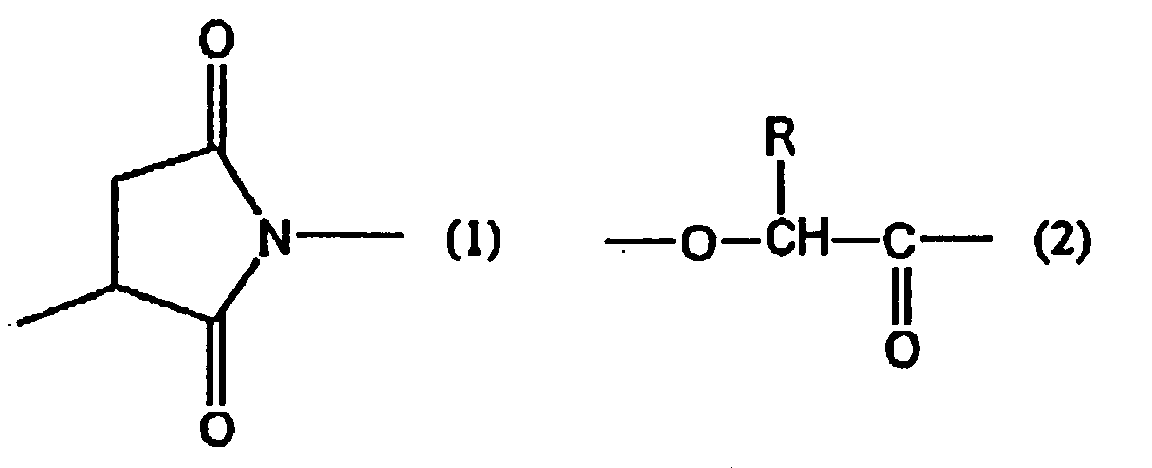
- Aspartic acid can dehydrate/condense to form a polymer having a succinimide unit, and so the constitutional unit derived from aspartic acid also may include such a succinimide unit.
- the succinimide unit means the constitutional unit represented by the following formula (1) :
- composition ratio of the unit derived from aspartic acid to the unit derived from the hydroxycarboxylic acid in the aspartic acid-hydroxycarboxylic acid copolymer is preferably within a range of 1/1 to 1/50.
- the constitutional unit derived from the hydroxycarboxylic acid in the aspartic acid-hydroxycarboxylic acid copolymer it is preferable to use at least one selected from the group consisting of an ⁇ -hydroxycarboxylic acid, glycollide, lactide, p-dioxanone, ⁇ -propiolactone, ⁇ -butyrolactone, ⁇ -valerolactone and ⁇ -caprolactone.
- the aspartic acid-hydroxycarboxylic acid copolymer may contain a constitutional unit other than aspartic acid and the hydroxycarboxylic acid as a result of the copolymerization.
- the amount of the other constitutional unit is required to be such a level as not to seriously impair the properties of the aspartic acid-hydroxycarboxylic acid copolymer. In view of this point, the amount of the other constitutional unit should be about 20 mol% or less.
- a method for producing the aspartic acid-hydroxycarboxylic acid copolymer is not particularly limited.
- the copolymer can be obtained by mixing aspartic acid with the hydroxycarboxylic acid in a desired ratio, followed by dehydration/condensation with heating under a reduced pressure.
- it can also be obtained by reacting aspartic acid with a cyclic anhydride compound of a hydroxycarboxylic acid such as lactide (LTD), glycollide (GLD) or caprolactone (CL).
- the preferable aspartic acid-hydroxycarboxylic acid copolymer in the present invention can be obtained by heating a mixture of aspartic acid and one or more compounds selected from the group consisting of lactide, glycollide, lactic acid and glycolic acid.
- the resultant copolymer is a copolymer having both of at least a succinimide unit and/or an aspartic acid unit, and a lactic acid unit and/or a glycolic acid unit as repeating units.
- the resin composition of the present invention can be obtained by, for example, mixing the aspartic acid-hydroxycarboxylic acid copolymer having a weight-average molecular weight of 1000 to 100000 with the polyhydroxycarboxylic acid having a weight-average molecular weight of 3000 to 500000.
- a composition ratio of these materials is preferably 0.01 to 3300 parts by weight of the aspartic acid-hydroxycarboxylic acid copolymer to 100 parts by weight of the polyhydroxycarboxylic acid.
- the composition ratio of the aspartic acid-hydroxycarboxylic acid copolymer is too high, a thermoplastic resin composition having a high degradation rate is obtained.
- composition ratio of the aspartic acid-hydroxycarboxylic acid copolymer to the polyhydroxycarboxylic acid is too low, it is difficult to expect an effect of accelerating the degradation rate of the polyhydroxycarboxylic acid and an effect of inhibiting the heat deterioration thereof.
- the composition ratio by weight of the aspartic acid-hydroxycarboxylic acid copolymer to the polyhydroxycarboxylic acid is preferably adjusted to a range of about 1/99 to 33/67.
- Both the compounds are well compatible with each other owing to a hydroxycarboxylic acid segment present in the aspartic acid-hydrocarboxylic acid copolymer.
- a hydroxycarboxylic acid segment present in the aspartic acid-hydrocarboxylic acid copolymer.
- the aspartic acid-lactic acid copolymer having a copolymer composition ratio of aspartic acid to lactic acid of 1/5 and a weight-average molecular weight of 20000 are added to 95 parts by weight of PLA having a weight-average molecular weight of about 150000 and they are then melted and mixed at 200°C by the use of a small-sized kneader, both the materials are well compatible with each other.
- the resultant mixture is then subjected to processing such as pressing to obtain a film-having a transparency similar to that of a PLA film.
- the thus obtained film shows about the same mechanical strength properties (tensile strength, elongation, elasticity modulus, etc.) as that of
- the PLA film having a weight-average molecular weight of about 150000 its mechanical strength properties and appearance scarcely change even after it is immersed in neutral water at 37°C for about 5 months.
- the film obtained from the resin composition of the present invention within the above-mentioned range whitens after about 1 month under the same conditions, and the strength of the film becomes 0 and the molecular weight thereof decreases to 20000 or less after about 5 months.
- the polyhydroxycarboxylic acid is labile to heat and therefore its molecular weight is prone to decrease by heating during molding such as kneading or injection.
- the aspartic acid-hydroxycarboxylic acid copolymer is mixed with the polyhydroxycarboxylic acid, the heat deterioration can be inhibited.
- PLA having a weight-average molecular weight of 280000 is melted at 220°C in air
- this molecular weight decreases to 140000, a weight loss of 5.6% after 1 hour, and to 60000 and 40000 after 2 hours and 3 hours, respectively.
- the aspartic acid-hydroxycarboxylic acid copolymer is typically a polymer, having an aspartic acid unit and a lactic acid unit and/or a glycolic acid unit as repeating units, which can be obtained by ring-opening a succinimide unit by hydrolysis, this succinimide unit being a constitutional unit of a copolymer formed by heating a mixture of aspartic acid and lactide and/or glycollide.
- a carboxyl group at a molecular chain end of the polymer is not necessarily a COOH group, and at this chain end, there may be formed a salt of a base such as an alkaline metal, an alkaline earth metal or an amine.
- a copolymer having at least a succinimide unit and/or an aspartic acid unit as well as a lactic acid unit and/or a glycolic acid unit as repeating units, which can be obtained by heating a mixture of aspartic acid and at least one compound selected from the group consisting of lactide, glycollide, lactic acid and glycolic acid, the structure of this copolymer can be confirmed by a known analytical technique such as the measurement of a nuclear magnetic resonance (NMR) spectrum and the measurement of an infrared absorption (IR) spectrum.
- NMR nuclear magnetic resonance
- IR infrared absorption
- the aspartic acid unit contained in the structure of the aspartic acid-hydroxycarboxylic acid copolymer may be a mixture of an ⁇ -amide type monomer unit and a ⁇ -amide type monomer unit, and a ratio of both the units is not particularly limited.
- the molecular weight of the aspartic acid-hydroxycarboxylic acid copolymer is preferably in a range of about 1000 to 100000 in terms of weight-average molecular weight in view of good mixing with a polyhydroxycarboxylic acid as well as the increase of the degradation accelerating effect and the heat deterioration inhibiting effect.
- the reason for the degradation accelerating effect is that the wettability of the resin composition is enhanced by mixing the copolymer (A) with the resin (B).
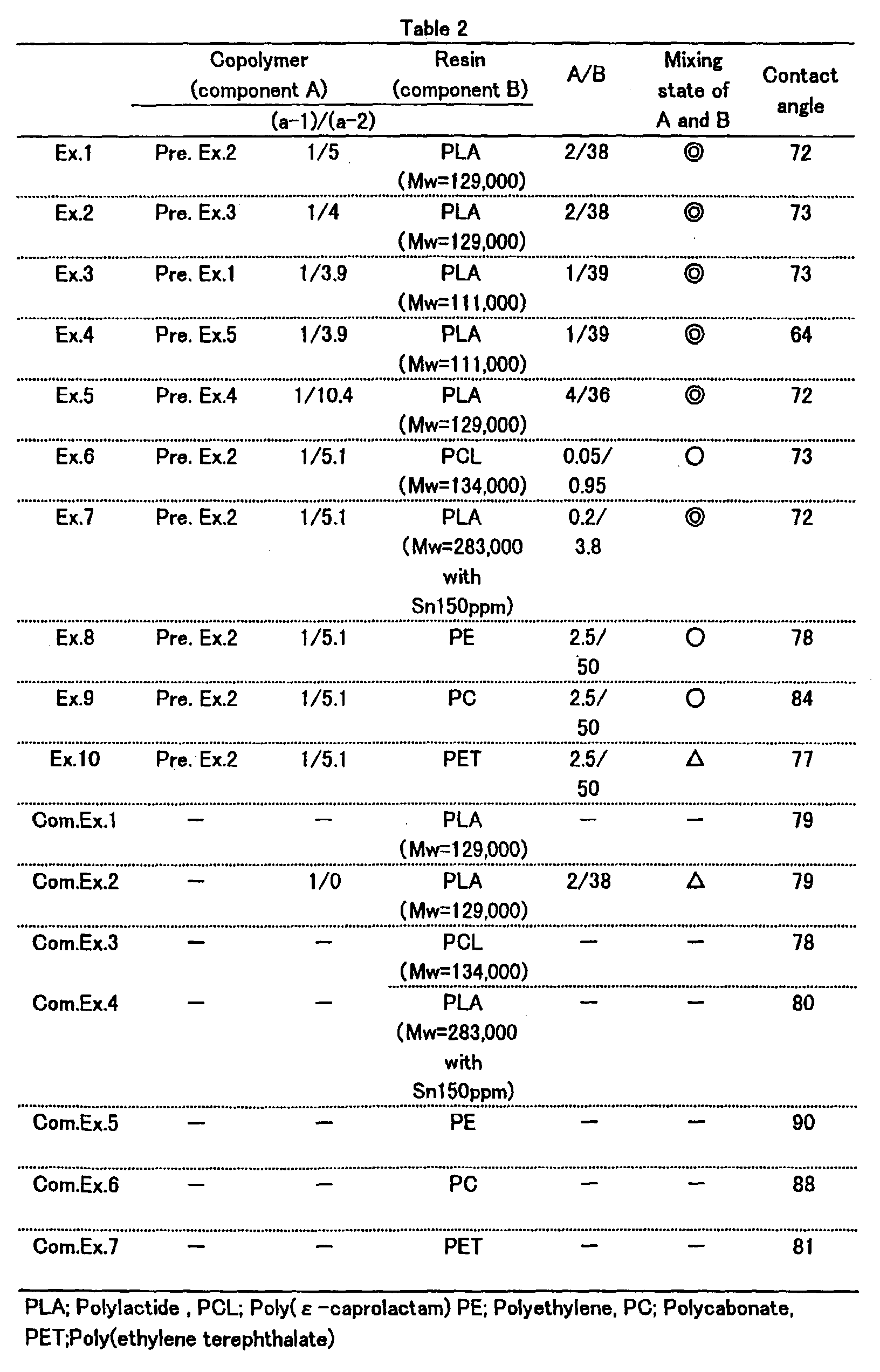
- the enhancement of the wettability can be judged by determining contact angles to water drops on a film made of a resin composition containing the copolymer (A) and the resin (B), and a film made of the resin (B) alone.
- the resin film may be any of a cast film, a thermally pressed film, a stretched film and the like.
- GPC gel permeation chromatography
- a polymer sample powder was sufficiently mixed with a KBr powder, and the resultant powder mixture was then pressed under degassing to form a pellet.
- a spectrum was measured by means of an FT-IR apparatus.
- a film stamped out in a dumbbell shape was drawn at a tensile rate of 20 mm/mm by the use of a tensile testing machine to measure stresses, thereby obtaining tensile strength at breaking, tensile modulus of elasticity, and elongation at breaking.
- a mixing state of a component A and a component B in a formed film was judged in the following manner.
- the pressure of the reaction system was gradually reduced and reached 1 mmHg after 2 hours.
- the reactor was taken out of the oil bath, and the reaction solution was taken out and then cooled/solidified.
- the resultant lightly yellowish brown transparent solid was pulverized to obtain a powdery polymer.
- the Mw and Mw/Mn of the polymer were 6500 and 7.4, respectively.
- composition ratio of a unit derived from aspartic acid (an aspartic acid unit and a succinimide unit) to a lactic acid unit in the polymer was 1:3.9.
- the pressure of the reaction system was gradually reduced and reached 1 mmHg after 2 hours.
- the temperate of the oil bath was lowered to 160°C, and the reaction was further continued for 15 hours.
- the reactor was taken out of the oil bath, and the reaction solution was taken out and then cooled/solidified.
- the resultant lightly yellowish brown transparent solid was pulverized to obtain a powdery polymer. According to DMF-based GPC, the Mw and Mw/Mn of the polymer were 14700 and 1.38, respectively.
- composition ratio of a unit derived from aspartic acid to a lactic acid unit in the polymer was 1:5.1.
- the white powder of aspartic acid was immediately dissolved, and the reaction solution became lightly yellow transparent. After 1.5 hours from the start of heating, the pressure of the reaction system was gradually reduced and reached 1 mmHg after 2 hours. The heating was further continued for 2 hours. The reactor was taken out of the oil bath, and the reaction solution was taken out and then cooled/solidified. The resultant lightly yellowish brown transparent solid was pulverized to obtain a powdery polymer. According to DMF-based GPC, the Mw and Mw/Mn of the polymer were 3400 and 12.6, respectively.
- the pressure of the reaction system was gradually reduced and reached 1 mmHg after 3 hours.
- the temperate of the oil bath was lowered to 160°C, and the reaction was further continued for 30 hours.
- the reactor was taken out of the oil bath, and the reaction solution was taken out and then cooled/solidified.
- the resultant lightly yellowish brown transparent solid was pulverized to obtain a powdery polymer. According to DMF-based GPC, the Mw and Mw/Mn of the polymer were 34000 and 1.44, respectively.
- composition ratio of a unit derived from aspartic acid to a lactic acid unit in the polymer was 1:10.4.
- Aspartic acid was heated at 220°C for 2 hours in an oven under a nitrogen atmosphere to obtain a brown powder. According to NMR and IR measurements, it was confirmed that this brown powder was polysuccinimide. According to DMF-based GPC, Mw of the thus obtained polymer was 15,000.
- the obtained film of the polylactic acid composition was colorless and transparent, and its Mw was 108000.
- the tensile strength of the film was 61 MPa, the tensile modulus of elasticity thereof was 1.1 GPa, and the elongation at breaking thereof was 10%.
- the above film was scarcely different in appearance and physical properties from a PLA film to which the aspartic acid-lactic acid copolymer was not added.
- the tensile strength of the film was 48 MPa after 1 month, 40 MPa after 2 months, 26 MPa after 3.5 months, and 0 MPa after 5 months (the film was too brittle to measure).
- the Mw of the film was 87000 after 1 month, 75000 after 2 months, 51000 after 3.5 months, and 45000 after 5 months.
- the polylactic acid was used in the form of the composition obtained by blending the polylactic acid itself with the aspartic acid-lactic acid copolymer, a hydrolysis rate could effectively be accelerated.
- Example 2 In the same manner as in Example 1 except that any aspartic acid-lactic acid copolymer was not added, 38 g of PLA having a weight average molecular weight Mw of 129000 determined by chloroform-based GPC were melted and stirred at 200°C for 5 minutes by the use of a small-sized kneader, and the melt was then subjected to thermal pressing at 190°C to prepare a film.
- the pressed PLA film was colorless and transparent, and its Mw was 98000.
- the tensile strength of the film was 58 MPa, the tensile modulus of elasticity thereof was 1.1 GPa, and the elongation at breaking thereof was 8%.
- the tensile strength of the film was 62 MPa after 1 month, 58 MPa after 2 months, 57 MPa after 3.5 months, and 55 MPa after 5 months. Accordingly, even after 5 months, the strength of the film hardly lowered, and in addition, the film was still colorless and transparent and hence the appearance of the film scarcely changed.
- the Mw of the film was 92000 after 1 month, 90000 after 2 months, 87000 after 3.5 months, and 80000 after 5 months. Accordingly, the decrease of the molecular weight was also slow. Furthermore, even after the lapse of 11 months, the weight retention ratio of the PLA film was 99%.
- poly(L-lactic acid) (PLA) having a weight average molecular weight Mw of 129000 determined by chloroform-based GPC was added 2 g of polysuccinimide obtained in Preparation Example 6. They were blended at 200°C for 5 minutes by the use of a small-sized kneader. The resultant polylactic acid composition was subjected to thermal pressing at 190°C to prepare a film.
- the obtained film of the polylactic acid composition was a non-homogeneous and opaque white-spotted film, and its Mw was 96000.
- the tensile strength of the film was 39 MPa, the tensile modulus of elasticity thereof was 1.8 GPa, and the elongation at breaking thereof was 5%.
- the appearance and the mechanical strength of the PLA film were remarkably impaired.
- the tensile strength of the film was 36 MPa after 1 month, 42 MPa after 2 months, 40 MPa after 3.5 months, and 38 MPa after 5 months. Accordingly, the strength of the film scarcely lowered.
- the Mw of the film was 90000 after 1 month, 89000 after 2 months, 85000 after 3.5 months, and 82000 after 5 months. Accordingly, the decrease of the molecular weight was also slow.
- the obtained film of the polylactic acid composition was colorless and transparent, and its Mw was 97000.
- the tensile strength of the film was 59 MPa, the tensile modulus of elasticity thereof was 1.2 GPa, and the elongation at breaking thereof was 8%.
- the above film was scarcely different in appearance and physical properties from a PLA film to which the aspartic acid-lactic acid copolymer was not added.
- the tensile strength of the film was 40 MPa after 1 month, 25 MPa after 2 months, 0 MPa after 3.5 months, and 0 MPa after 5 months.
- the Mw of the film was 67000 after 1 month, 42000 after 2 months, 27000 after 3.5 months, and 24000 after 5 months.
- the weight retention ratio of the film was 99% after 1 month, 99% after 2 months, 97% after 3.5 months, and 90% after 5 months.
- the polylactic acid was used in the form of the composition obtained by blending the polylactic acid itself with the aspartic acid-lactic acid copolymer, a hydrolysis rate could effectively be accelerated.
- the resultant polylactic acid composition was subjected to thermal pressing at 190°C to prepare a film.
- the obtained film of the polylactic acid composition was colorless and transparent, and its Mw was 93000.
- the tensile strength of the film was 62 MPa, the tensile modulus of elasticity thereof was 1.2 GPa, and the elongation at breaking thereof was 8%.
- the above film was scarcely different in appearance and physical properties from a PLA film to which the aspartic acid-lactic acid copolymer was not added.
- the film With the lapse of the immersion time and after about 1 month, the film gradually whitened and became opaque. After about 5 months, the tensile strength of the film was substantially 0, and hence the film was brittle, white and opaque.
- the Mw of the film was 45000 after 5 months, 24000 after 7 months, 15000 after 9 months, and 15000 after 11 months.
- the weight retention ratio of the film was 99% after 5 months, 93% after 7 months, 88% after 9 months, and 82% after 11 months.
- the polylactic acid was used in the form of the composition obtained by blending the polylactic acid itself with the aspartic acid-lactic acid copolymer, a hydrolysis rate could effectively be accelerated.
- the resultant polylactic acid composition was subjected to thermal pressing at 190°C to prepare a film.
- the obtained film of the polylactic acid composition was slightly white and transparent, and its Mw was 82000.
- the tensile strength of the film was 62 MPa, the tensile modulus of elasticity thereof was 1.1 GPa, and the elongation at breaking thereof was 8%.
- the above film was scarcely different in appearance and physical properties from a PLA film to which the aspartic acid-lactic acid copolymer was not added.
- the film After 1 day of the immersion, the film already whitened and became opaque. After the lapse of about 5 months, the strength of the film was about 0, and hence the film was brittle, white and opaque.
- the Mw of the film was 41000 after 5 months, 25000 after 7 months, 17000 after 9 months, and 17000 after 11 months.
- the weight retention ratio of the film was 97% after 5 months, 95% after 7 months, 91% after 9 months, and 90% after 11 months.
- the polylactic acid was used in the form of the composition obtained by blending the polylactic acid itself with the aspartic acid-lactic acid copolymer, a hydrolysis rate could effectively be accelerated.
- the obtained film of the polylactic acid composition was colorless and transparent, and its Mw was 102000.
- the tensile strength of the film was 58 MPa, the tensile modulus of elasticity thereof was 1.0 GPa, and the elongation at breaking thereof was 11%.
- the above film was scarcely different in appearance and physical properties from a PLA film to which the aspartic acid-lactic acid copolymer was not added.
- the tensile strength of the film was 42 MPa after 1 month, 36 MPa after 2 months, 28 MPa after 3.5 months, and 12 MPa after 5 months.
- the Mw of the film was 81000 after 1 month, 72000 after 2 months, 50000 after 3.5 months, and 45000 after 5 months.
- the polylactic acid was used in the form of the composition obtained by blending the polylactic acid itself with the aspartic acid-lactic acid copolymer, a hydrolysis rate could effectively be accelerated.
- PCL poly( ⁇ -caprolactone)
- This PCL composition film was immersed in a phosphate buffer solution of pH 7.3 put in a container with a cap, and this container was then placed in a constant temperature oven at 37°C.
- Example 6 In the same manner as in Example 6 except that any aspartic acid-lactic acid copolymer was not added, 1.0 g of PCL having a weight-average molecular weight Mw of 134000 determined by chloroform-based GPC was dissolved in chloroform. The resultant solution was cast onto a petri dish, and the chloroform was then gradually removed by drying to prepare a PCL film containing no aspartic acid-lactic acid copolymer.
- This PCL film was immersed in a phosphate buffer solution of pH 7.3 put in a container with a cap, and the container was then placed in a constant temperature oven at 37°C.
- the film was taken out and then dried, and the Mw (chloroform-based GPC) of the film was measured. As a result, it was 134000, which indicated that the film was scarcely degraded.
- This polylactic acid composition film was placed in a test tube, and the test tube was then immersed in an oil bath at 220°C for a predetermined period of time.
- the Mw (chloroform-based GPC) of the film was 211000 after 1 hour, 17500 after 2 hours, and 13100 after 3hours.
- the weight loss of the sample by thermal degradation after 1 hour was 0.4%.
- the polylactic acid was used in the form of the composition obtained by blending the polylactic acid itself with the aspartic acid-lactic acid copolymer, a hydrolysis rate could effectively be accelerated.
- PLA poly(L-lactic acid)
- This PLA film was placed in a test tube, and the test tube was then immersed in an oil bath at 220°C for a predetermined period of time.
- the Mw (chloroform-based GPC) of the sample was 142000 after 1 hour, 63000 after 2 hours, and 44000 after 3 hours.
- the weight loss of the sample by thermal degradation after 1 hour was 5.6%.
- Example 8 In the same manner as in Example 8 except that any aspartic acid-lactic acid copolymer was not added, 50 g of polyethylene powder were thermally pressed at 170°C to prepare a polyester film. The obtained film was transparent. A contact angle to water on this film was determined, and it was 78°.
- Example 9 The same manners as in Example 8 except that polycarbonate powder (trade name L-1250wp made by TEIZIN Inc.) was used in Example 9, and ground material of clear flake (made by YONO PET BOTTLE RECYCLE Inc.) was used in Example 10, were conducted. The results are shown in Table 2.
- the addition of the copolymer (A) permits the production of a resin composition in which wettability and degradability can be improved and heat deterioration can be inhibited.
Landscapes
- Chemical & Material Sciences (AREA)
- Health & Medical Sciences (AREA)
- Chemical Kinetics & Catalysis (AREA)
- Medicinal Chemistry (AREA)
- Polymers & Plastics (AREA)
- Organic Chemistry (AREA)
- Biological Depolymerization Polymers (AREA)
- Compositions Of Macromolecular Compounds (AREA)
Abstract
Description

| Hydrophilic segment unit | Hydrophobic segment unit | (a-1)/(a-2) | Mw | |
| Pre. Ex.1 | L-Asp | L-LTD | 1/3.9 | 9400 |
| Pre. Ex.2 | L-Asp | L-LTD | 1/5.1 | 16300 |
| Pre. Ex.3 | L-Asp | L-LA | 1/4 | 3400 |
| Pre. Ex.4 | L-Asp | L-LTD | 1/10.4 | 36000 |
| Pre. Ex.5 | Hydrolyzed one in Pre. Ex.1 | - | 9000 | |
| Pre. Ex.6 | L-Asp | - | - | 15000 |
| L-Asp ; L-Aspratic acid , L-LTD; L-Lactide |
Claims (18)
- A resin composition comprising a block or a graft copolymer (A) having a polyamino acid as a hydrophilic segment (a-1) and a degradable polymer as a hydrophobic segment (a-2), and a resin (B).
- The resin composition according to Claim 1, wherein the composition ratio by weight of the copolymer (A) to the resin (B) [(A)/(B)] is in a range of [1/99] to [33/67].
- The resin composition according to Claim 1, wherein the resin (B) is at least one resin selected from the group consisting of polyolefin resins, polystyrene resins, polyester resins, polycarbonate resins and degradable resins.
- The resin composition according to Claim 3, wherein the resin (B) is the degradable resin.
- The resin composition according to Claim 1, wherein the hydrophilic segment (a-1) of the copolymer (A) comprises a constitutional unit derived from aspartic acid, and the hydrophobic segment (a-2) comprises a constitutional unit derived from a hydroxycarboxylic acid, a lactide or a lactone.
- The resin composition according to Claim 1, wherein the hydrophobic segment (a-2) of the copolymer (A) comprises a constitutional unit derived from lactic acid, glycolic acid, lactide, glycollide or ε-caprolactone.
- The resin composition according to Claim 1, wherein the weight-average molecular weight of the copolymer (A) is in a range of 1,000 to 100,000.
- The resin composition according to Claim 1, wherein the ratio of the hydrophilic segment (a-1) to the hydrophobic segment (a-2) [(a-1)/(a-2)] is in a range of [1/1] to [1/50].
- The resin composition according to Claim 1, wherein the copolymer (A) is a copolymer which is obtained by heating a mixture of aspartic acid and at least one selected from the group consisting of hydroxycarboxylic acids, lactides and lactones and which has a succinimide unit and/or an aspartic acid unit and a hydroxycarboxylic acid unit as repeating constitutional units.
- The resin composition according to Claim 1, wherein the copolymer (A) is a copolymer which is obtained by heating a mixture of aspartic acid and at least one selected from the group consisting of lactic acid, glycolic acid, lactide, glycollide and ε-caprolactone and which has a succinimide unit and/or an aspartic acid unit and a hydroxycarboxylic acid unit as repeating units.
- The resin composition according to Claim 1, wherein the copolymer (A) has both of a succinimide unit represented by the following formula (1) as the repeating unit of the hydrophilic segment (a-1) and a hydroxycarboxylic acid unit represented by the following formula (2) as the repeating unit of the hydrophobic segment (a-2) :wherein, in the formula (2), R is a methyl group or a hydrogen atom.
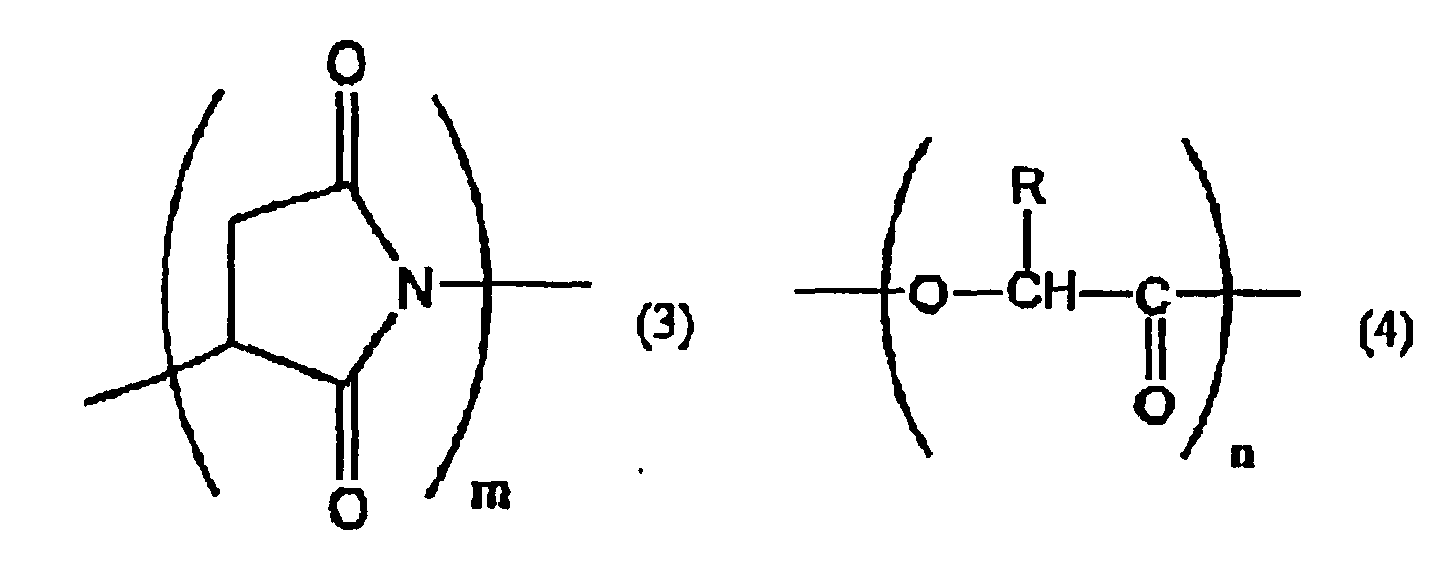
- The resin composition according to Claim 1, wherein the hydrophilic segment (a-1) of the copolymer (A) is a polysuccinimde segment represented by the following formula (3), and the hydrophobic segment (a-2) is a polyhydroxycarboxylic acid segment represented by the following formula (4), and the ratio of the succinimide unit in the copolymer (A) is in a range of 1 to 33 mol% and the ratio of the hydroxycarboxylic acid unit is in a range of 67 to 99 mol%:wherein, in the formula (3), m is a value of from 1 to 100; and in the formula (4), R is a methyl group or a hydrogen atom, and n is a value of from 1 to 1,000.
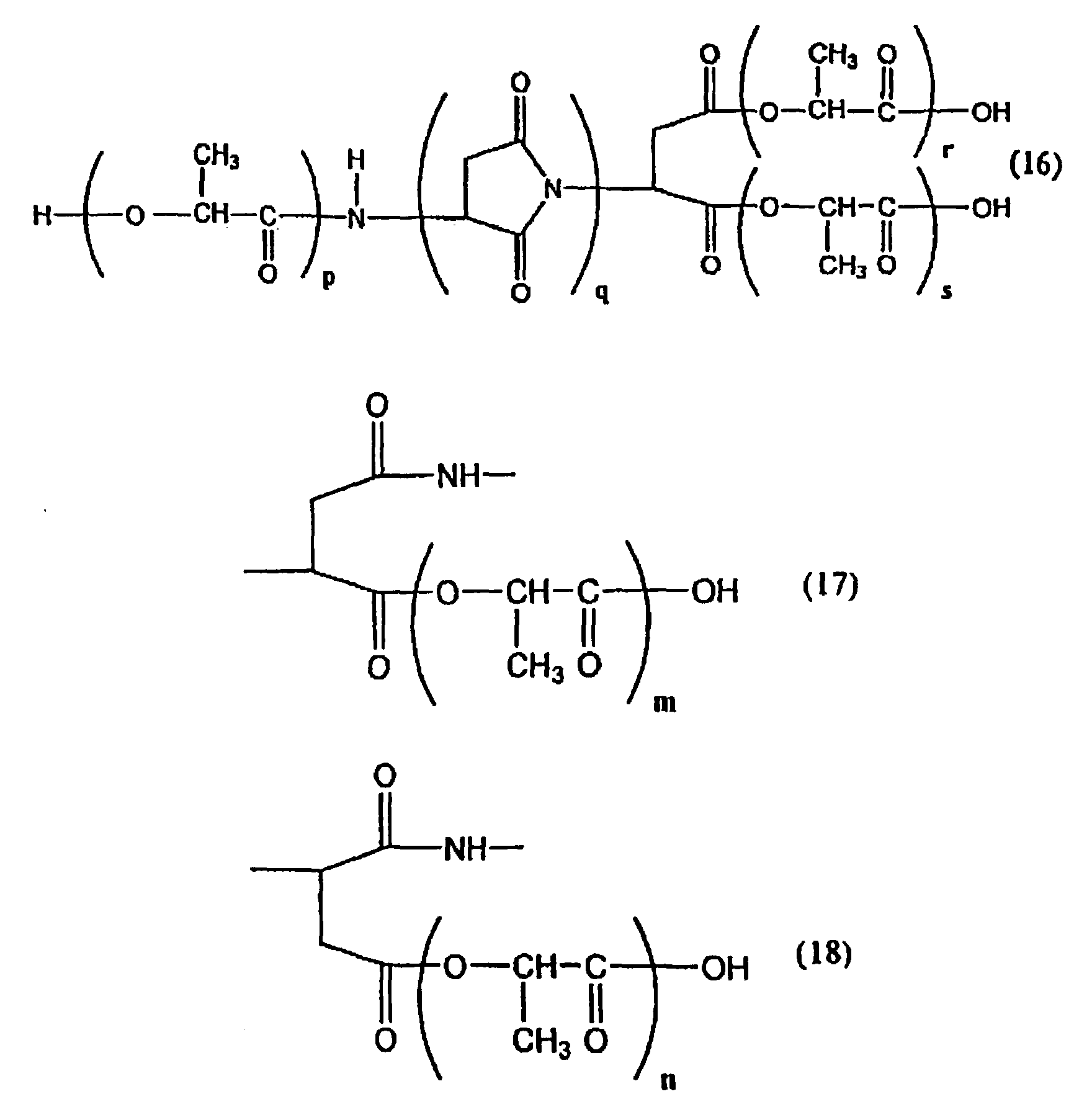
- The resin composition according to Claim 1, wherein the copolymer (A) is a branched copolymer having all of a segment (a-1-1) represented by the following formula (5), a segment (a-1-2) represented by the following formula (6) and a polyhydroxycarboxylic acid segment (a-2-1) represented by the following formula (7) as the hydrophilic segment (a-1);
the ratio of a unit derived from aspartic acid represented by the formula (8) in the copolymer (A) is in a range of 1 to 33 mol%, and the ratio of hydroxycarboxylic acid unit is a range of 67 to 99 mol%, and the molecular terminal of the copolymer (A) comprises at least one group selected from the group consisting of an amino group, a hydroxyl group, a carboxyl group and a salt of a carboxylic acid:wherein, in the formula (5), x is a value of from 0 to 100; in the formula (6), y is an integer of from 0 to 100, and M is a metal or hydrogen; and in the formula (7), z is a value of from 2 to 1,000, and R is a methyl group or hydrogen).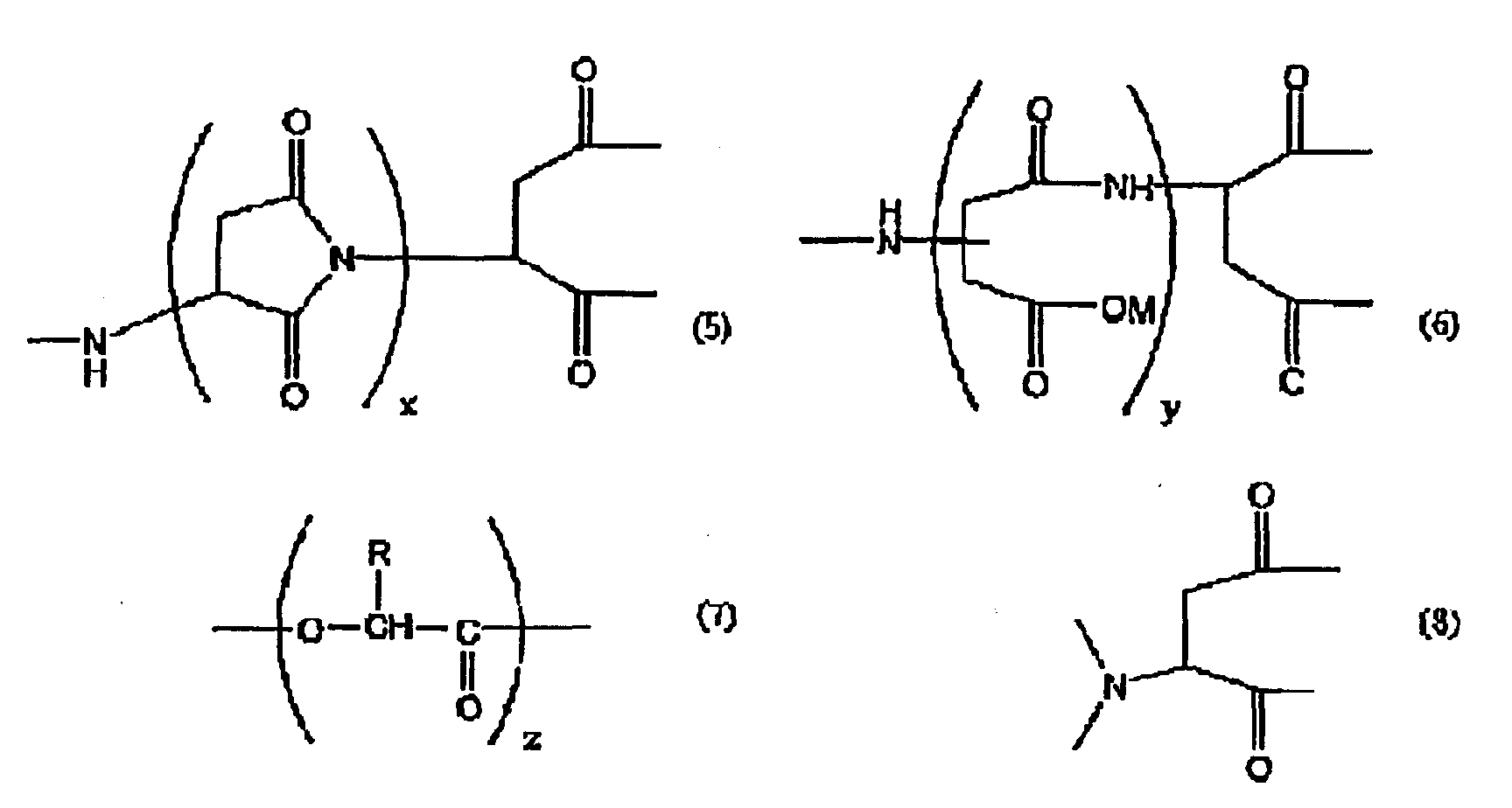
- The resin composition according to Claim 1, wherein the resin (B) is an aliphatic polyester.
- A method of accelerating the hydrolysis of a resin which comprises the step of mixing 1 to 50% by weight of a copolymer (A) having a weight-average molecular weight of 1,000 to 100,000 with a resin (B) having a weight-average molecular weight of 3,000 to 500,000.
- A method of accelerating the hydrolysis of an aliphatic polyester which comprises the step of mixing 1 to 50% by weight of a copolymer which has a weight-average molecular weight of 1,000 to 100,000 and which is obtained from aspartic acid and at least one selected from the group consisting of lactic acid, glycolic acid, hydroxycaproic acid, hydroxybutanoic acid, lactide, glycollide and ε-caprolactone with an aliphatic polyester having a weight-average molecular weight of 3,000 to 500,000.
- A method of inhibiting the heat deterioration of a resin which comprises the step of mixing 1 to 50% by weight of a copolymer (A) having a weight-average molecular weight of 1,000 to 100,000 with a resin (B) having a weight-average molecular weight of from 3,000 to 500,000.
- A method of inhibiting the heat deterioration of an aliphatic polyester which comprises the step of mixing 1 to 50% by weight of a copolymer which has a weight-average molecular weight of 1,000 to 100,000 and which is obtained from aspartic acid and at least one selected from the group consisting of lactic acid, glycolic acid, hydroxycaproic acid, hydroxybutanoic acid, lactide, glycollide and ε-caprolactone with an aliphatic polyester having a weight-average molecular weight of 3,000 to 500,000.
Applications Claiming Priority (2)
| Application Number | Priority Date | Filing Date | Title |
|---|---|---|---|
| JP9045399 | 1999-03-31 | ||
| JP9045399 | 1999-03-31 |
Publications (3)
| Publication Number | Publication Date |
|---|---|
| EP1041118A2 true EP1041118A2 (en) | 2000-10-04 |
| EP1041118A3 EP1041118A3 (en) | 2001-01-31 |
| EP1041118B1 EP1041118B1 (en) | 2010-05-26 |
Family
ID=13999048
Family Applications (1)
| Application Number | Title | Priority Date | Filing Date |
|---|---|---|---|
| EP00106845A Expired - Lifetime EP1041118B1 (en) | 1999-03-31 | 2000-03-30 | Resin composition |
Country Status (3)
| Country | Link |
|---|---|
| US (1) | US6372844B1 (en) |
| EP (1) | EP1041118B1 (en) |
| DE (1) | DE60044444D1 (en) |
Cited By (4)
| Publication number | Priority date | Publication date | Assignee | Title |
|---|---|---|---|---|
| CN102973988A (en) * | 2012-12-19 | 2013-03-20 | 杭州铭众生物科技有限公司 | Absorbable vessel ligature clamp and preparation method thereof |
| CN103006288A (en) * | 2012-12-19 | 2013-04-03 | 杭州铭众生物科技有限公司 | V-shaped vessel ligature clamp with single-layer structure and method for preparing V-shaped vessel ligature clamp |
| EP2894197A4 (en) * | 2012-09-07 | 2016-03-23 | Mitsui Chemicals Inc | Aqueous dispersion, and additive for fracturing work |
| CN112280267A (en) * | 2020-11-02 | 2021-01-29 | 安徽国登管业科技有限公司 | Preparation method of degradable polylactic acid tableware with strong moisture absorption resistance |
Families Citing this family (8)
| Publication number | Priority date | Publication date | Assignee | Title |
|---|---|---|---|---|
| US20040231845A1 (en) * | 2003-05-15 | 2004-11-25 | Cooke Claude E. | Applications of degradable polymers in wells |
| US20090107684A1 (en) | 2007-10-31 | 2009-04-30 | Cooke Jr Claude E | Applications of degradable polymers for delayed mechanical changes in wells |
| JP3889376B2 (en) * | 2003-05-16 | 2007-03-07 | 松下電器産業株式会社 | Battery package and manufacturing method thereof |
| US7576145B2 (en) * | 2004-04-28 | 2009-08-18 | Plasbio, Inc. | Method for producing degradable polymers |
| US7842761B2 (en) * | 2008-04-03 | 2010-11-30 | Lapol, Llc | Bioderived plasticizer for biopolymers |
| CN103429661B (en) | 2011-04-01 | 2016-11-16 | 三井化学株式会社 | Biodegradable resin composition and molded body thereof |
| JP6183039B2 (en) | 2012-12-12 | 2017-08-23 | 東洋製罐株式会社 | Dispersion liquid for excavation and mining method using the same |
| RU2758314C2 (en) * | 2019-11-07 | 2021-10-28 | Татьяна Николаевна Овчинникова | Method for producing polymers based on lactones and mixtures thereof |
Family Cites Families (5)
| Publication number | Priority date | Publication date | Assignee | Title |
|---|---|---|---|---|
| US5256460A (en) | 1992-09-14 | 1993-10-26 | Snia Tecnopolimeri S.P.A. | Polymeric blend with high resistance to fuel |
| US5654381A (en) | 1995-06-16 | 1997-08-05 | Massachusetts Institute Of Technology | Functionalized polyester graft copolymers |
| FR2739388B1 (en) | 1995-09-29 | 1997-11-21 | Nyltech Italia | THERMOPLASTIC COMPOSITION FOR FUEL LINE |
| US6372880B1 (en) | 1997-12-25 | 2002-04-16 | Mitsui Chemicals, Inc. | Copolymer and process for preparing the same |
| US6093792A (en) * | 1998-09-16 | 2000-07-25 | University Of Massachusetts | Bioresorbable copolymers |
-
2000
- 2000-03-28 US US09/536,677 patent/US6372844B1/en not_active Expired - Lifetime
- 2000-03-30 DE DE60044444T patent/DE60044444D1/en not_active Expired - Lifetime
- 2000-03-30 EP EP00106845A patent/EP1041118B1/en not_active Expired - Lifetime
Cited By (6)
| Publication number | Priority date | Publication date | Assignee | Title |
|---|---|---|---|---|
| EP2894197A4 (en) * | 2012-09-07 | 2016-03-23 | Mitsui Chemicals Inc | Aqueous dispersion, and additive for fracturing work |
| CN102973988A (en) * | 2012-12-19 | 2013-03-20 | 杭州铭众生物科技有限公司 | Absorbable vessel ligature clamp and preparation method thereof |
| CN103006288A (en) * | 2012-12-19 | 2013-04-03 | 杭州铭众生物科技有限公司 | V-shaped vessel ligature clamp with single-layer structure and method for preparing V-shaped vessel ligature clamp |
| CN102973988B (en) * | 2012-12-19 | 2014-05-07 | 杭州铭众生物科技有限公司 | Absorbable vessel ligature clamp and preparation method thereof |
| CN103006288B (en) * | 2012-12-19 | 2014-06-18 | 杭州铭众生物科技有限公司 | V-shaped vessel ligature clamp with single-layer structure and method for preparing V-shaped vessel ligature clamp |
| CN112280267A (en) * | 2020-11-02 | 2021-01-29 | 安徽国登管业科技有限公司 | Preparation method of degradable polylactic acid tableware with strong moisture absorption resistance |
Also Published As
| Publication number | Publication date |
|---|---|
| US6372844B1 (en) | 2002-04-16 |
| DE60044444D1 (en) | 2010-07-08 |
| EP1041118B1 (en) | 2010-05-26 |
| EP1041118A3 (en) | 2001-01-31 |
Similar Documents
| Publication | Publication Date | Title |
|---|---|---|
| US5424346A (en) | Biodegradable replacement of crystal polystyrene | |
| US6353086B1 (en) | Lactic acid residue containing polymer composition and product having improved stability, and method for preparation and use thereof | |
| US5981694A (en) | Melt-stable lactide polymer composition and process for manufacture thereof | |
| EP0667885B1 (en) | Rubber-modified polylactide and/or glycolide composition | |
| US6372844B1 (en) | Resin composition | |
| Urayama et al. | Microstructure and thermomechanical properties of glassy polylactides with different optical purity of the lactate units | |
| EP0990678B1 (en) | Biodegradable polyester/polyester carbonate resin composition | |
| JP2003096285A (en) | Polylactic acid resin composition, method for producing the same, and molded article | |
| EP0496737A1 (en) | Hydrodegradable polyesters | |
| US5594076A (en) | Hydrodegradable polyesters | |
| Pepic et al. | Synthesis and characterization of biodegradable aliphatic copolyesters with poly (ethylene oxide) soft segments | |
| AU2020202896A1 (en) | Copolymer, method for producing same and resin composition | |
| US9309402B2 (en) | Biodegradable resin composition and molded article of the same | |
| JP4634566B2 (en) | Resin composition and method for producing the same | |
| US20100099830A1 (en) | Resin composition, method for producing thereof, and copolymer | |
| CN121219360A (en) | Resin Composition | |
| JP7049627B2 (en) | Hydrolysis method of resin composition | |
| US20010051692A1 (en) | Resin composition and molded article | |
| Little | Synthesis and characterisation of glycolic acid-based copolymers for biodegradable plastic packaging | |
| JPH05148418A (en) | Hydrolyzable Nylon Composition and Method for Promoting Nylon Hydrolyzability | |
| JP3756677B2 (en) | Resin composition and molded body | |
| WO2004000376A1 (en) | Biodegradable and bioabsorbable materials for medical use and process for producing the same | |
| EP4549487A1 (en) | Copolymer and method for producing copolymer | |
| JP2025529967A (en) | Polyester polyol copolymer and method for producing the polyester polyol copolymer | |
| JP2025525633A (en) | Copolymer and method for producing the copolymer |
Legal Events
| Date | Code | Title | Description |
|---|---|---|---|
| PUAI | Public reference made under article 153(3) epc to a published international application that has entered the european phase |
Free format text: ORIGINAL CODE: 0009012 |
|
| AK | Designated contracting states |
Kind code of ref document: A2 Designated state(s): DE FR GB |
|
| AX | Request for extension of the european patent |
Free format text: AL;LT;LV;MK;RO;SI |
|
| PUAL | Search report despatched |
Free format text: ORIGINAL CODE: 0009013 |
|
| AK | Designated contracting states |
Kind code of ref document: A3 Designated state(s): AT BE CH CY DE DK ES FI FR GB GR IE IT LI LU MC NL PT SE |
|
| AX | Request for extension of the european patent |
Free format text: AL;LT;LV;MK;RO;SI |
|
| 17P | Request for examination filed |
Effective date: 20010716 |
|
| AKX | Designation fees paid |
Free format text: DE FR GB |
|
| RAP1 | Party data changed (applicant data changed or rights of an application transferred) |
Owner name: MITSUI CHEMICALS, INC. |
|
| GRAP | Despatch of communication of intention to grant a patent |
Free format text: ORIGINAL CODE: EPIDOSNIGR1 |
|
| GRAS | Grant fee paid |
Free format text: ORIGINAL CODE: EPIDOSNIGR3 |
|
| GRAA | (expected) grant |
Free format text: ORIGINAL CODE: 0009210 |
|
| AK | Designated contracting states |
Kind code of ref document: B1 Designated state(s): DE FR GB |
|
| REG | Reference to a national code |
Ref country code: GB Ref legal event code: FG4D |
|
| REF | Corresponds to: |
Ref document number: 60044444 Country of ref document: DE Date of ref document: 20100708 Kind code of ref document: P |
|
| PLBE | No opposition filed within time limit |
Free format text: ORIGINAL CODE: 0009261 |
|
| STAA | Information on the status of an ep patent application or granted ep patent |
Free format text: STATUS: NO OPPOSITION FILED WITHIN TIME LIMIT |
|
| 26N | No opposition filed |
Effective date: 20110301 |
|
| REG | Reference to a national code |
Ref country code: DE Ref legal event code: R097 Ref document number: 60044444 Country of ref document: DE Effective date: 20110228 |
|
| REG | Reference to a national code |
Ref country code: FR Ref legal event code: PLFP Year of fee payment: 16 |
|
| REG | Reference to a national code |
Ref country code: FR Ref legal event code: PLFP Year of fee payment: 17 |
|
| REG | Reference to a national code |
Ref country code: FR Ref legal event code: PLFP Year of fee payment: 18 |
|
| PGFP | Annual fee paid to national office [announced via postgrant information from national office to epo] |
Ref country code: FR Payment date: 20170322 Year of fee payment: 18 Ref country code: DE Payment date: 20170322 Year of fee payment: 18 |
|
| PGFP | Annual fee paid to national office [announced via postgrant information from national office to epo] |
Ref country code: GB Payment date: 20170322 Year of fee payment: 18 |
|
| REG | Reference to a national code |
Ref country code: DE Ref legal event code: R119 Ref document number: 60044444 Country of ref document: DE |
|
| GBPC | Gb: european patent ceased through non-payment of renewal fee |
Effective date: 20180330 |
|
| PG25 | Lapsed in a contracting state [announced via postgrant information from national office to epo] |
Ref country code: DE Free format text: LAPSE BECAUSE OF NON-PAYMENT OF DUE FEES Effective date: 20181002 |
|
| PG25 | Lapsed in a contracting state [announced via postgrant information from national office to epo] |
Ref country code: GB Free format text: LAPSE BECAUSE OF NON-PAYMENT OF DUE FEES Effective date: 20180330 |
|
| PG25 | Lapsed in a contracting state [announced via postgrant information from national office to epo] |
Ref country code: FR Free format text: LAPSE BECAUSE OF NON-PAYMENT OF DUE FEES Effective date: 20180331 |