EP1041060A1 - Procédé de production de méthylacétylène et de propadiène - Google Patents
Procédé de production de méthylacétylène et de propadiène Download PDFInfo
- Publication number
- EP1041060A1 EP1041060A1 EP00400574A EP00400574A EP1041060A1 EP 1041060 A1 EP1041060 A1 EP 1041060A1 EP 00400574 A EP00400574 A EP 00400574A EP 00400574 A EP00400574 A EP 00400574A EP 1041060 A1 EP1041060 A1 EP 1041060A1
- Authority
- EP
- European Patent Office
- Prior art keywords
- zone
- heating zone
- heating
- methylacetylene
- propadiene
- Prior art date
- Legal status (The legal status is an assumption and is not a legal conclusion. Google has not performed a legal analysis and makes no representation as to the accuracy of the status listed.)
- Granted
Links
- 238000000034 method Methods 0.000 title claims abstract description 27
- MWWATHDPGQKSAR-UHFFFAOYSA-N propyne Chemical group CC#C MWWATHDPGQKSAR-UHFFFAOYSA-N 0.000 title claims abstract description 10
- IYABWNGZIDDRAK-UHFFFAOYSA-N allene Chemical compound C=C=C IYABWNGZIDDRAK-UHFFFAOYSA-N 0.000 title claims abstract description 9
- 238000010438 heat treatment Methods 0.000 claims abstract description 93
- 238000000197 pyrolysis Methods 0.000 claims abstract description 23
- 239000000203 mixture Substances 0.000 claims abstract description 22
- 238000006243 chemical reaction Methods 0.000 claims abstract description 18
- 238000001816 cooling Methods 0.000 claims abstract description 16
- 229930195733 hydrocarbon Natural products 0.000 claims abstract description 15
- 150000002430 hydrocarbons Chemical group 0.000 claims abstract description 15
- 230000015572 biosynthetic process Effects 0.000 claims abstract description 14
- 239000004215 Carbon black (E152) Substances 0.000 claims abstract description 10
- VBUBYMVULIMEHR-UHFFFAOYSA-N propa-1,2-diene;prop-1-yne Chemical compound CC#C.C=C=C VBUBYMVULIMEHR-UHFFFAOYSA-N 0.000 claims abstract description 10
- 125000004432 carbon atom Chemical group C* 0.000 claims abstract description 8
- 239000003085 diluting agent Substances 0.000 claims abstract description 8
- 238000004519 manufacturing process Methods 0.000 claims abstract description 5
- 239000007789 gas Substances 0.000 claims description 28
- XLYOFNOQVPJJNP-UHFFFAOYSA-N water Chemical compound O XLYOFNOQVPJJNP-UHFFFAOYSA-N 0.000 claims description 10
- 229910010293 ceramic material Inorganic materials 0.000 claims description 7
- 238000005192 partition Methods 0.000 claims description 6
- IJGRMHOSHXDMSA-UHFFFAOYSA-N Atomic nitrogen Chemical compound N#N IJGRMHOSHXDMSA-UHFFFAOYSA-N 0.000 claims description 4
- 239000011819 refractory material Substances 0.000 claims description 3
- 229910052757 nitrogen Inorganic materials 0.000 claims description 2
- 239000008246 gaseous mixture Substances 0.000 abstract description 2
- ATUOYWHBWRKTHZ-UHFFFAOYSA-N Propane Chemical compound CCC ATUOYWHBWRKTHZ-UHFFFAOYSA-N 0.000 description 12
- 238000010791 quenching Methods 0.000 description 11
- 230000000171 quenching effect Effects 0.000 description 11
- QQONPFPTGQHPMA-UHFFFAOYSA-N propylene Natural products CC=C QQONPFPTGQHPMA-UHFFFAOYSA-N 0.000 description 9
- 239000000047 product Substances 0.000 description 7
- 125000004805 propylene group Chemical group [H]C([H])([H])C([H])([*:1])C([H])([H])[*:2] 0.000 description 7
- UHOVQNZJYSORNB-UHFFFAOYSA-N Benzene Chemical compound C1=CC=CC=C1 UHOVQNZJYSORNB-UHFFFAOYSA-N 0.000 description 6
- 239000012530 fluid Substances 0.000 description 6
- VNWKTOKETHGBQD-UHFFFAOYSA-N methane Chemical compound C VNWKTOKETHGBQD-UHFFFAOYSA-N 0.000 description 6
- 239000001294 propane Substances 0.000 description 6
- 150000001335 aliphatic alkanes Chemical class 0.000 description 4
- 239000003795 chemical substances by application Substances 0.000 description 4
- 238000005235 decoking Methods 0.000 description 4
- 238000004230 steam cracking Methods 0.000 description 4
- VGGSQFUCUMXWEO-UHFFFAOYSA-N Ethene Chemical compound C=C VGGSQFUCUMXWEO-UHFFFAOYSA-N 0.000 description 3
- 239000005977 Ethylene Substances 0.000 description 3
- HSFWRNGVRCDJHI-UHFFFAOYSA-N alpha-acetylene Natural products C#C HSFWRNGVRCDJHI-UHFFFAOYSA-N 0.000 description 3
- 230000001276 controlling effect Effects 0.000 description 3
- 238000005485 electric heating Methods 0.000 description 3
- 125000002534 ethynyl group Chemical group [H]C#C* 0.000 description 3
- VXNZUUAINFGPBY-UHFFFAOYSA-N 1-Butene Chemical compound CCC=C VXNZUUAINFGPBY-UHFFFAOYSA-N 0.000 description 2
- VQTUBCCKSQIDNK-UHFFFAOYSA-N Isobutene Chemical compound CC(C)=C VQTUBCCKSQIDNK-UHFFFAOYSA-N 0.000 description 2
- 150000001336 alkenes Chemical class 0.000 description 2
- 239000000919 ceramic Substances 0.000 description 2
- 230000001105 regulatory effect Effects 0.000 description 2
- 229920006395 saturated elastomer Polymers 0.000 description 2
- HBMJWWWQQXIZIP-UHFFFAOYSA-N silicon carbide Chemical compound [Si+]#[C-] HBMJWWWQQXIZIP-UHFFFAOYSA-N 0.000 description 2
- 229910010271 silicon carbide Inorganic materials 0.000 description 2
- UGFAIRIUMAVXCW-UHFFFAOYSA-N Carbon monoxide Chemical compound [O+]#[C-] UGFAIRIUMAVXCW-UHFFFAOYSA-N 0.000 description 1
- UFHFLCQGNIYNRP-UHFFFAOYSA-N Hydrogen Chemical compound [H][H] UFHFLCQGNIYNRP-UHFFFAOYSA-N 0.000 description 1
- 125000001931 aliphatic group Chemical group 0.000 description 1
- 150000001338 aliphatic hydrocarbons Chemical class 0.000 description 1
- 239000001273 butane Substances 0.000 description 1
- 239000006227 byproduct Substances 0.000 description 1
- 229910002091 carbon monoxide Inorganic materials 0.000 description 1
- 238000004523 catalytic cracking Methods 0.000 description 1
- 238000000354 decomposition reaction Methods 0.000 description 1
- 238000006356 dehydrogenation reaction Methods 0.000 description 1
- 238000006471 dimerization reaction Methods 0.000 description 1
- 238000007599 discharging Methods 0.000 description 1
- 239000000945 filler Substances 0.000 description 1
- 239000001257 hydrogen Substances 0.000 description 1
- 229910052739 hydrogen Inorganic materials 0.000 description 1
- 239000011261 inert gas Substances 0.000 description 1
- 238000006317 isomerization reaction Methods 0.000 description 1
- 229910000953 kanthal Inorganic materials 0.000 description 1
- 239000000463 material Substances 0.000 description 1
- SYSQUGFVNFXIIT-UHFFFAOYSA-N n-[4-(1,3-benzoxazol-2-yl)phenyl]-4-nitrobenzenesulfonamide Chemical class C1=CC([N+](=O)[O-])=CC=C1S(=O)(=O)NC1=CC=C(C=2OC3=CC=CC=C3N=2)C=C1 SYSQUGFVNFXIIT-UHFFFAOYSA-N 0.000 description 1
- IJDNQMDRQITEOD-UHFFFAOYSA-N n-butane Chemical compound CCCC IJDNQMDRQITEOD-UHFFFAOYSA-N 0.000 description 1
- OFBQJSOFQDEBGM-UHFFFAOYSA-N n-pentane Natural products CCCCC OFBQJSOFQDEBGM-UHFFFAOYSA-N 0.000 description 1
- 239000012495 reaction gas Substances 0.000 description 1
- 239000000523 sample Substances 0.000 description 1
- 238000003786 synthesis reaction Methods 0.000 description 1
- 125000000383 tetramethylene group Chemical group [H]C([H])([*:1])C([H])([H])C([H])([H])C([H])([H])[*:2] 0.000 description 1
- 229930195735 unsaturated hydrocarbon Natural products 0.000 description 1
Images


Classifications
-
- C—CHEMISTRY; METALLURGY
- C07—ORGANIC CHEMISTRY
- C07C—ACYCLIC OR CARBOCYCLIC COMPOUNDS
- C07C5/00—Preparation of hydrocarbons from hydrocarbons containing the same number of carbon atoms
- C07C5/32—Preparation of hydrocarbons from hydrocarbons containing the same number of carbon atoms by dehydrogenation with formation of free hydrogen
- C07C5/327—Formation of non-aromatic carbon-to-carbon double bonds only
-
- C—CHEMISTRY; METALLURGY
- C07—ORGANIC CHEMISTRY
- C07C—ACYCLIC OR CARBOCYCLIC COMPOUNDS
- C07C5/00—Preparation of hydrocarbons from hydrocarbons containing the same number of carbon atoms
- C07C5/32—Preparation of hydrocarbons from hydrocarbons containing the same number of carbon atoms by dehydrogenation with formation of free hydrogen
- C07C5/35—Formation of carbon-to-carbon triple bonds only
Definitions
- the invention relates to a process for the production of methylacetylene and propadiene by thermal conversion of a charge containing at least one hydrocarbon having at least three carbon atoms in its molecule.
- methylacetylene and propadiene The synthesis of methylacetylene and propadiene is known to those skilled in the art. She is most often carried out by pyrolysis of propylene, and / or isobutene or from propane, butane, but-1-ene or a mixture of isomers of but-2-enes.
- the FR patent application 2,732,014 of the applicant describes a thermal conversion process for hydrocarbons saturated or unsaturated aliphatics of acetylenic hydrocarbons. Said process applies particularly in the production of acetylene or methylacetylene but it does not describe the propadiene formation.
- Applicant's US patent application 5,554,347 describes a device comprising a reactor for carrying out reactions such as pyrolysis.
- Said reactor includes heat exchange means which are supplied with gas or a mixture of gases.
- One of the advantages of the invention is to be able to carry out the thermal conversion of a load while controlling the temperature during decomposition, which is currently not achievable with conventional steam cracking reactors.
- the method according to the invention allows to define temperature profiles. It defines a heating zone divided into three parts in which climbs are controlled in temperature.
- the invention relates to a process for producing methylacetylene and propadiene in a reaction zone, elongated in a direction (an axis), comprising a zone of heating and a cooling zone following said heating zone, in which a gas mixture circulating in the heating zone containing at least one hydrocarbon with at least three carbon atoms and at least one diluent, at a pressure absolute greater than atmospheric pressure in a substantially flowing direction parallel to the direction (to the axis) of the heating zone, said method being characterized in that that the heating zone comprises at least one preheating zone in which the temperature of said gas mixture increases from about 500 to 1200 ° C by 1/10 length of heating zone, at least one charge pyrolysis zone in which the temperature rises approximately 200 to 500 ° C per 1/10 length of heating zone and at least one zone of formation of methylacetylene - propadiene in which the temperature rises from about 700 to 1500 ° C per 1/10 length of heating zone, the products formed at the end of the zone being cooled in the
- the heating zone comprises at least at least two rows substantially parallel to the axis separated by a non-watertight partition in refractory material between two successive rows, each row comprising a plurality of heating means arranged in at least one layer of heating elements and surrounded by sheaths of ceramic material substantially parallel to each other and substantially perpendicular to the axis of the heating zone.
- hydrocarbon feedstocks used in the context of the present invention comprise hydrocarbons having at least three carbon atoms in their molecule.
- these are saturated aliphatic hydrocarbons such as propane and mixtures of alkanes (LPG) or unsaturated hydrocarbons such as propylene and butenes, mixtures of alkanes and d alkenes such as propane and propylene, cuts C 3 , C 4 and C 5 produced by catalytic cracking in a fluid bed, by steam cracking, by dehydrogenation of alkanes, by isomerization of oleins or by dimerization.
- LPG alkanes
- unsaturated hydrocarbons such as propylene and butenes
- mixtures of alkanes and d alkenes such as propane and propylene
- the feed essentially contains propylene and / or propane and comes from steam cracking.
- the charges are mixtures gaseous, which also contain at least one diluent.
- Said diluent is usually chosen in the group formed by water vapor and nitrogen Preferably, steam is used of water
- the weight ratio of the diluent to the hydrocarbon charge is usually about 0.1: 1 to 5: 1, preferably about 0.5 1 to 2.5: 1.
- the gas mixture, before being introduced in the heating zone, is previously heated to a temperature usually between approximately 100 and 650 ° C. It is then introduced parallel to the axis of the zone of heater.
- the heating zone is formed of at least one preheating zone, at least one zone pyrolysis and at least one methylacetylene-propadiene formation zone. She is the more often heated by heating means which are surrounded by a sheath, so as to forming heating elements.
- Said heating elements provide the heat necessary to start the reaction of pyrolysis.
- the total number of said elements in the heating zone is set by the user. It essentially depends on the nature of the load to be converted and the size of the device.
- heating elements are supplied with energy by any means known to those skilled in the art. Most often, they are supplied with electric heating or gas, preferably gas, either singly or in small groups, so that they define heating sections along the heating zone. They can thus modulate the amount of energy supplied throughout this area. They thus make it possible to establish a profile thermal.
- the heating zone is usually composed of 2 to 20 heating sections, preferably 3 to 12 sections.
- Said zone may also include means for controlling and modulating heating, such as those described, for example in patent applications EP 0 323 287 and US 5,554,347.
- the heating means can be electrical resistors surrounded by sheaths and heated by electrodes, as described in patent applications EP 0 323 287 and US 5 160 501 of the plaintiff or they may consist of sheaths containing a burner gas, as described in the patent application US 5,554,347 of the applicant.
- the heating elements form sheets which are substantially parallel to the axis of the zone. of heating.
- rows each comprising at least one layer heating elements.
- Each row is substantially parallel to the axis of the area of heater.
- the rows are separated by non-watertight partitions made of ceramic material. Said partitions have suitable shapes, which make it possible to create zones of turbulence at inside the rows, in order to favor the reaction of pyrolysis and formation of methylacetylene - propadiene.
- the sheaths surrounding the heating means are most often made of ceramic material. They can be arranged in a superimposed or staggered fashion and can form in transverse projection a beam with triangular, square or rectangular pitch
- the patent application US 5 160 501 of the applicant shows that it is absolutely not necessary to have a perfect seal at the level of the sheaths, so as to leave diffusing at least part of a sheath gas G contained in the space formed by said sheaths and resistors.
- This gas G contains hydrogen and / or water vapor and / or carbon monoxide and / or an inert gas, which can diffuse from the inside to the outside of sheaths without disturbing the pyrolysis reaction. It is then diluted in the gas mixture.
- Said sheaths are also described in the previously cited patent applications.
- the total charge residence time in the heating zone is usually included between about 12 and 2000 milliseconds (ms), preferably between about 56 and 1500 ms and even more preferably between about 111 and 1100 ms.
- the absolute pressure is generally higher than atmospheric pressure. Most often superior, it is greater than 1.1 bars (0.11 MPa), preferably between approximately 1.1 and 10 bars (0.11 and 1 MPa) and even more preferably between approximately 1.2 and 5 bars (0.12 and 0.5 MPa).
- Said heating zone is formed of a first zone for preheating the load.
- the heating means are heated so that the temperature of the gas mixture rises about 500 to 1200 ° C per 1/10 of the length of the heating zone.
- the outlet temperature of said zone is the minimum charge pyrolysis temperature.
- the pyrolysis zone makes it possible to convert the charge at least in part.
- the residence time of said charge in the pyrolysis zone is usually around 10 to 1000 ms, from preferably from about 50 to 900 ms, and even more preferably from about 100 to 700 ms.
- the energy supplied to the heating sections is modulated so that the rise in temperature in the pyrolysis zone is usually around 200 to 500 ° C per 1/10 of length of heating zone
- the methylacetylene-propadiene formation zone operates at high temperature. Time to stay of the gas mixture should be short, to avoid the formation of by-products. It depends essentially the nature of the load to be converted. It is generally between about 1 and 400 ms, most often between about 5 and 300 ms and even more preferably between about 10 and 200 ms. It is generally lower than that of the pyrolysis zone. We modulates the energy supplied to the different heating sections, so that the rise in temperature in the methylacetylene-propadiene formation zone is generally between approximately 700 and 1500 ° C per 1/10 of the length of the heating zone. The final temperature at the outlet of the heating zone is usually between approximately 800 and 1300 ° C, preferably between about 900 and 1100 ° C
- the heating zone is followed by a cooling (or quenching) zone, so as to lower quickly the temperature of the effluents obtained at the end of the heating zone.
- a cooling (quenching agent) zone well known to those skilled in the art
- the fluid is generally injected into effluents by means of injectors most often made of material ceramic, arranged on the periphery of the heating zone and connected to an external source of quenching fluid. All of the effluent gases are collected by an outlet orifice at the end of the reaction zone.
- the effluents can be at least partly cooled by circulating through watertight conduits arranged in the cooling zone by which the quenching agent flows, these conduits being connected to the external source of the quenching
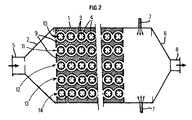
- the method according to the invention is usually implemented in a device comprising a reactor (1) of elongated shape along an axis, preferably of square or rectangular section, comprising at a first end means for supplying (5) a gaseous mixture, containing at least one hydrocarbon containing at least three carbon atoms, at the end opposite means for discharging (8) the effluents produced and between these two ends of the heating means then cooling means.
- Said reactor comprises at least two rows substantially parallel to the axis of the reactor, separated by a partition (9) not waterproof in refractory material between these two rows.
- Each row has a plurality heating means (3), said means being arranged in layers of heating elements and surrounded by sheaths (4) of ceramic material substantially parallel to each other and substantially perpendicular to the axis of the reactor, so as to define between the sheaths and / or the sheets formed of spaces or passages for the circulation of gas mixtures and / or effluents
- Said heating means and said ducts are adapted to heat said passages in successive, independent and substantially perpendicular cross sections to the axis of the reactor.
- Said reactor includes means for controlling and modulating heating connected to said heating means. It also includes means of cooling (7) of the effluents connected to said means for supplying cooling.
- said reactor can be preceded by a This cracker is described in particular in patent application FR 2 748 273 from The Applicant It allows the decoking of the reactor continuously.
- the steam cracker comprises at least two steam cracking tubes, each tube being connected at one end to a charge supply line Said supply lines are controlled by control valves. These valves allow the circulation of the mixture gaseous (containing the hydrocarbon charge and a fluid formed essentially of vapor water) in some steam cracker tubes, as well as the circulation of a single fluid formed mainly water vapor, in other tubes.
- the gas mixture from the tubes of the steam cracker containing the cracked products then circulates in at least one row of the pyrolysis reactor, the fluid formed essentially of steam, in at least one other row, so as to carry out the decoking.
- the valves allow alternating the pyrolysis steps and decoking, in each row of the pyrolysis reactor
- the products formed and the decoking effluent can be mixed before being introduced into the cooling zone. They can also be separately cooled in their respective rows located at the level of the cooling, then possibly be mixed.
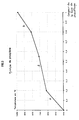
- FIG. 1 illustrates a theoretical temperature profile, for any load, in the heating zone. Said profile is expressed as a function of temperature (° C) and 1/10 of length of the heating zone.
- the heating zone is heated so as to obtain a controlled rise in temperature in each of the three successive zones.
- the ideal curve of temperature variation, in each zone is represented by a straight line. The inclination of each straight line (the slope) depends on the nature of the load to be cracked Heating means allow to regulate the temperature rise in each zone
- the latter which contains a mixture of water vapor and at least one hydrocarbon having at minus three carbon atoms in its molecule, has been preheated in a conventional way, preferably by convection, in an area not shown in the figure.
- the reactor has rows (10 to 14) separated from each other by partitions (9), non-watertight in ceramic material, in shape comprising cells adapted to favor turbulence inside the row and therefore to favor the reaction. These rows are substantially parallel to each other and substantially perpendicular to the axis of the reactor (1) defined according to the direction of flow of the load.
- Each row (10 to 14) comprises a plurality of heating means (3) surrounded by sheaths (4), arranged in parallel plies and forming in a plane (plane of the figure) a beam with square pitch.
- these ducts may contain a plurality of electrical resistors (3) bathed in a sheath gas G
- Said plies define substantially transverse heating sections perpendicular to the axis of the reactor (1).
- the supply of the heating sections is not shown in the figure. In the case of a electric heating, these are pairs of electrodes. In the case of gas heating, the sections are supplied by the circulation of a gas or a mixture of gases. Of pyrometric probes ensure in both cases the automatic temperature regulation of each heating section, by a conventional regulating device not shown in the figure.
- the heating means are heated by so that the temperature rises about 500 to 1200 ° C per 1/10 of the zone length of heater.
- the gas mixture is preheated, so that its temperature is brought to the minimum charge pyrolysis temperature.
- the gas mixture then circulates in the pyrolysis zone.
- the cracked charge then reaches the methylacetylene-propadiene formation zone, where the temperature rises from approximately 700 to 1500 ° C per 1/10 length of the heating zone.
- the effluents are cooled in a cooling zone (6). They are put in contact with a quenching agent introduced via quenching injectors (7) arranged at the periphery of the reactor (1) and connected to an external source of the quenching agent, not shown in the figure. All of the effluent gases are cooled to 500 ° C. and then collected by a outlet (8) at the end of the reactor (1).
- a horizontal indirect quenching reactor is used, the heating means of which are electrical resistors in silicon carbide of the Crusilite type from KANTHAL. These resistors are surrounded by sintered silicon carbide sheaths, arranged concentrically with respect to the center of the circle including the resistances.
- each resistor is 100 mm and its diameter of 10 mm
- the ceramic sheaths have a length of 110 mm, an outside diameter of 50 mm and an internal diameter of 42 mm.
- the distance between two neighboring ducts or a duct and the wall of the refractory concrete reactor is 5 mm.
- the temperature of the gas along the reactor is thermally regulated by means of thermocouples arranged in the spaces where the charge circulates.
- propylene with 99.7% purity diluted with water in a ratio is used. by weight steam / charge of 1.
- the charge is conventionally preheated to 450 ° C.
- Curve 1 represents the rise in temperature in the preheating zone
- curve 2 the temperature rise in the pyrolysis zone
- curve 3 the rise in the methylacetylene-propadiene formation zone.
- the effluent gases are first rapidly cooled to 500 ° C by exchange indirect, then other heat exchangers then lower their temperature at room temperature
- the propylene conversion rate is 60.5%.
- Example 2 Using a reactor similar to that used in Example 1 but comprising 21 elements of heating.
- the charge used is 99.5% purity propane, diluted with water in a ratio weight of water vapor / charge of 1. It is preheated in a conventional manner to 450 ° C.
- the propane conversion rate is 98.5%.
Landscapes
- Chemical & Material Sciences (AREA)
- Organic Chemistry (AREA)
- Organic Low-Molecular-Weight Compounds And Preparation Thereof (AREA)
- Production Of Liquid Hydrocarbon Mixture For Refining Petroleum (AREA)
Abstract
Description
| Gaine | Température (°C) | Montée en température (°C par 1/10 longueur de zone de chauffage) | Temps de séjour (ms) et Pression absolue (MPa) |
| 1 à 2 | 450-670 | 1100 | 22 ms; 0,15 MPa |
| 3 à 7 | 670-860 | 316 | 55 ms; 0,15 MPa |
| 8 à 9 | 860 à 1030 | 850 | 22 ms; 0,15 MPa |
| Produits | Sélectivité (%) |
| Méthane | 16,1 |
| Ethylène | 36,4 |
| Méthylacétylène | 8,2 |
| Propadiène | 12,4 |
| Acétylène | 3,2 |
| Benzène | 8,8 |
| Gaine | Température (°C) | Montée en température (°C par 1/10 longueur de zone de chauffage) | Temps de séjour (ms) et Pression absolue (bar) |
| 1 à 5 | 450-670 | 916 | 147 ms; 1,5 bars |
| 6 à 17 | 670-860 | 339 | 353 ms; 1,5 bars |
| 18 à 21 | 860-1050 | 1000 | 120 ms; 1,5 bars |
| Produits | Sélectivité (%) |
| Méthane | 19,7 |
| Ethylène | 41,0 |
| Méthylacétylène | 6,6 |
| Propadiène | 9,9 |
| Acétylène | 3,1 |
| Benzène | 4,1 |
| Propylène | 8,3 |
Claims (10)
- Procédé de production de méthylacétylène et de propadiène dans une zone de réaction, de forme allongée selon une direction (un axe), comprenant une zone de chauffage et une zone de refroidissement, faisant suite à ladite zone de chauffage, dans lequel on fait circuler, dans la zone de chauffage un mélange gazeux renfermant au moins un hydrocarbure à au moins trois atomes de carbone et au moins un diluent, à une pression absolue supérieure à la pression atmosphérique, selon une direction d'écoulement sensiblement parallèle à la direction (à l'axe) de la zone de chauffage, ledit procédé étant caractérisé en ce que la zone de chauffage comprend au moins une zone de préchauffage dans laquelle la température dudit mélange gazeux augmente d'environ 500 à 1200°C par 1/10 longueur de zone de chauffage, au moins une zone de pyrolyse de la charge dans laquelle la température monte d'environ 200 à 500°C par 1/10 longueur de zone de chauffage et au moins une zone de formation de méthylacétylène - propadiène dans laquelle la température monte d'environ 700 à 1500°C par 1/10 longueur de zone de chauffage, les produits formés à l'extrémité de la zone de chauffage étant refroidis dans la zone de refroidissement puis recueillis à l'extrémité de la zone réactionnelle.
- Procédé selon la revendication 1 dans lequel le diluent est choisi dans le groupe formé par la vapeur d'eau et l'azote.
- Procédé selon la revendication 1 ou 2 dans lequel le rapport pondéral du diluent à la charge hydrocarbonée est compris entre environ 0,1:1 et 5:1.
- Procédé selon l'une des revendications 1 à 3 dans lequel la température finale en sortie de la zone de chauffage est comprise entre environ 800 et 1300°C.
- Procédé selon l'une des revendications 1 à 4 dans lequel la pression absolue est supérieure à 1,1 bar (0,11 MPa).
- Procédé selon l'une des revendications 1 à 5 dans lequel le temps de séjour total de la charge, dans la zone de chauffage est compris entre environ 12 et 2000 millisecondes (ms)
- Procédé selon l'une des revendications 1 à 6 dans lequel le temps de séjour dans la zone de formation de méthylacétylène - propadiène est inférieur au temps de séjour dans la zone de pyrolyse.
- Procédé selon l'une des revendications 1 à 7 dans lequel le temps de séjour de la charge, dans la zone de pyrolyse est compris entre environ 10 à 1000 ms.
- Procédé selon l'une des revendications 1 à 8 dans lequel le temps de séjour de la charge, dans la zone de formation de méthylacétylène - propadiène est compris entre environ 1 et 400 ms
- Procédé selon l'une des revendications 1 à 9 dans lequel la zone de chauffage comporte au moins deux rangées sensiblement parallèles à l'axe séparées par une cloison non étanche en matériau réfractaire entre deux rangées successives, chaque rangée comprenant une pluralité de moyens de chauffage disposés en au moins une nappe d'éléments chauffants et entourés de gaines en matériau céramique sensiblement parallèles entre elles et sensiblement perpendiculaires à l'axe de la zone de chauffage.
Applications Claiming Priority (2)
| Application Number | Priority Date | Filing Date | Title |
|---|---|---|---|
| FR9904124A FR2791665B1 (fr) | 1999-03-31 | 1999-03-31 | Procede de production de methylacetylene et de propadiene |
| FR9904124 | 1999-03-31 |
Publications (2)
| Publication Number | Publication Date |
|---|---|
| EP1041060A1 true EP1041060A1 (fr) | 2000-10-04 |
| EP1041060B1 EP1041060B1 (fr) | 2003-06-04 |
Family
ID=9543935
Family Applications (1)
| Application Number | Title | Priority Date | Filing Date |
|---|---|---|---|
| EP00400574A Expired - Lifetime EP1041060B1 (fr) | 1999-03-31 | 2000-03-02 | Procédé de production de méthylacétylène et de propadiène |
Country Status (5)
| Country | Link |
|---|---|
| US (1) | US6333443B1 (fr) |
| EP (1) | EP1041060B1 (fr) |
| CA (1) | CA2302851A1 (fr) |
| DE (1) | DE60003110T2 (fr) |
| FR (1) | FR2791665B1 (fr) |
Families Citing this family (2)
| Publication number | Priority date | Publication date | Assignee | Title |
|---|---|---|---|---|
| US6783659B2 (en) | 2001-11-16 | 2004-08-31 | Chevron Phillips Chemical Company, L.P. | Process to produce a dilute ethylene stream and a dilute propylene stream |
| JP4539599B2 (ja) | 2006-03-31 | 2010-09-08 | 住友化学株式会社 | メタクリル酸メチルの製造方法 |
Citations (2)
| Publication number | Priority date | Publication date | Assignee | Title |
|---|---|---|---|---|
| FR1389102A (fr) * | 1964-02-19 | 1965-02-12 | Nat Lead Co | Procédé pour la préparation de l'allène et du méthyl acétylène |
| FR2732014A1 (fr) * | 1995-03-23 | 1996-09-27 | Inst Francais Du Petrole | Procede de conversion thermique d'hydrocarbures aliphatiques satures ou insatures en hydrocarbures acetyleniques |
Family Cites Families (5)
| Publication number | Priority date | Publication date | Assignee | Title |
|---|---|---|---|---|
| FR2662158B1 (fr) * | 1990-05-17 | 1992-08-14 | Inst Francais Du Petrole | Procede de conversion thermique du methane et reacteur pour la mise en óoeuvre du procede. |
| FR2682676B1 (fr) * | 1991-10-17 | 1993-11-26 | Institut Francais Petrole | Procede de conversion thermique du methane et reacteur pour la mise en óoeuvre du procede. |
| FR2683543B1 (fr) * | 1991-11-08 | 1994-02-11 | Inst Francais Du Petrole | Procede de pyrolyse thermique d'hydrocarbures utilisant un four electrique. |
| FR2715583B1 (fr) * | 1994-02-02 | 1996-04-05 | Inst Francais Du Petrole | Dispositif pour la mise en Óoeuvre de réactions chimiques nécessitant au moins au démarrage un apport de calories. |
| FR2748273B1 (fr) * | 1996-05-06 | 1998-06-26 | Inst Francais Du Petrole | Procede et dispositif de conversion thermique d'hydrocarbures en hydrocarbures aliphatiques plus insatures que les produits de depart, combinant une etape de vapocraquage et une etape de pyrolyse |
-
1999
- 1999-03-31 FR FR9904124A patent/FR2791665B1/fr not_active Expired - Fee Related
-
2000
- 2000-03-02 DE DE60003110T patent/DE60003110T2/de not_active Expired - Fee Related
- 2000-03-02 EP EP00400574A patent/EP1041060B1/fr not_active Expired - Lifetime
- 2000-03-29 CA CA002302851A patent/CA2302851A1/fr not_active Abandoned
- 2000-03-31 US US09/540,883 patent/US6333443B1/en not_active Expired - Fee Related
Patent Citations (2)
| Publication number | Priority date | Publication date | Assignee | Title |
|---|---|---|---|---|
| FR1389102A (fr) * | 1964-02-19 | 1965-02-12 | Nat Lead Co | Procédé pour la préparation de l'allène et du méthyl acétylène |
| FR2732014A1 (fr) * | 1995-03-23 | 1996-09-27 | Inst Francais Du Petrole | Procede de conversion thermique d'hydrocarbures aliphatiques satures ou insatures en hydrocarbures acetyleniques |
Also Published As
| Publication number | Publication date |
|---|---|
| DE60003110T2 (de) | 2003-12-04 |
| CA2302851A1 (fr) | 2000-09-30 |
| EP1041060B1 (fr) | 2003-06-04 |
| FR2791665A1 (fr) | 2000-10-06 |
| DE60003110D1 (de) | 2003-07-10 |
| FR2791665B1 (fr) | 2001-05-18 |
| US6333443B1 (en) | 2001-12-25 |
Similar Documents
| Publication | Publication Date | Title |
|---|---|---|
| US5554347A (en) | Apparatus for carrying out chemical reactions requiring addition of heat at least during start up | |
| EP0229093B1 (fr) | Procede de vapocraquage d'hydrocarbures | |
| CA1266061A (fr) | Procede de conversion thermique du methane en hydrocarbures de poids moleculaires plus eleves | |
| US3407789A (en) | Heating apparatus and process | |
| EP0542597B1 (fr) | Procédé de pyrolyse thermique d'hydrocarbures utilisant un four électrique | |
| CA2748051C (fr) | Reacteur adiabatique pour la production d'olefines | |
| CA2204541C (fr) | Procede et dispositif de conversion thermique d'hydrocarbures en hydrocarbures aliphatiques plus insatures que les produits de depart, combinant une etape de vapocraquage et une etape de pyrolyse | |
| US3487121A (en) | Hydrocarbon process | |
| CZ298233B6 (cs) | Ohrívák, jeho pouzití, a zpusob vnásení tepla do procesu reakcního zpracování | |
| JPS6410036B2 (fr) | ||
| EP0781828B1 (fr) | Procédé de pyrolyse et de décokage en continu applicable notamment à la production d'acétylène | |
| EP1041060B1 (fr) | Procédé de production de méthylacétylène et de propadiène | |
| EP0323287B1 (fr) | Procédé de conversion thermique du méthane en hydrocarbures de poids moléculaires plus élevés et réacteur pour la mise en oeuvre du procédé | |
| EP0289391B1 (fr) | Procédé de conversion/thermique du méthane en hydrocarbures de poids moléculaires plus élevés, réacteur pour la mise en oeuvre du procédé et procédé de réalisation du réacteur | |
| FR2641543A1 (fr) | Procede et dispositif de vapocraquage d'un hydrocarbure a deux atomes de carbone au moins dans une zone reactionnelle tubulaire chauffee par convection | |
| EP0733609B1 (fr) | Procédé de conversion thermique d'hydrocarbures aliphatiques saturés ou insaturés en hydrocarbures acétyléniques | |
| FR2589859A1 (fr) | Procede de conversion thermique du methane en hydrocarbures de poids moleculaires plus eleves | |
| BE601252A (fr) | ||
| SE176357C1 (fr) |
Legal Events
| Date | Code | Title | Description |
|---|---|---|---|
| PUAI | Public reference made under article 153(3) epc to a published international application that has entered the european phase |
Free format text: ORIGINAL CODE: 0009012 |
|
| AK | Designated contracting states |
Kind code of ref document: A1 Designated state(s): DE GB NL |
|
| AX | Request for extension of the european patent |
Free format text: AL;LT;LV;MK;RO;SI |
|
| 17P | Request for examination filed |
Effective date: 20010404 |
|
| AKX | Designation fees paid |
Free format text: DE GB NL |
|
| 17Q | First examination report despatched |
Effective date: 20020213 |
|
| GRAH | Despatch of communication of intention to grant a patent |
Free format text: ORIGINAL CODE: EPIDOS IGRA |
|
| GRAH | Despatch of communication of intention to grant a patent |
Free format text: ORIGINAL CODE: EPIDOS IGRA |
|
| GRAA | (expected) grant |
Free format text: ORIGINAL CODE: 0009210 |
|
| AK | Designated contracting states |
Designated state(s): DE GB NL |
|
| REG | Reference to a national code |
Ref country code: GB Ref legal event code: FG4D Free format text: NOT ENGLISH |
|
| REF | Corresponds to: |
Ref document number: 60003110 Country of ref document: DE Date of ref document: 20030710 Kind code of ref document: P |
|
| GBT | Gb: translation of ep patent filed (gb section 77(6)(a)/1977) |
Effective date: 20031006 |
|
| PG25 | Lapsed in a contracting state [announced via postgrant information from national office to epo] |
Ref country code: GB Free format text: LAPSE BECAUSE OF NON-PAYMENT OF DUE FEES Effective date: 20040302 |
|
| PLBE | No opposition filed within time limit |
Free format text: ORIGINAL CODE: 0009261 |
|
| STAA | Information on the status of an ep patent application or granted ep patent |
Free format text: STATUS: NO OPPOSITION FILED WITHIN TIME LIMIT |
|
| 26N | No opposition filed |
Effective date: 20040305 |
|
| PG25 | Lapsed in a contracting state [announced via postgrant information from national office to epo] |
Ref country code: NL Free format text: LAPSE BECAUSE OF NON-PAYMENT OF DUE FEES Effective date: 20041001 Ref country code: DE Free format text: LAPSE BECAUSE OF NON-PAYMENT OF DUE FEES Effective date: 20041001 |
|
| GBPC | Gb: european patent ceased through non-payment of renewal fee | ||
| NLV4 | Nl: lapsed or anulled due to non-payment of the annual fee |
Effective date: 20041001 |