EP1039771A1 - Procédé de protection radio électrique d'une zone contre l'usage de téléphones mobiles - Google Patents
Procédé de protection radio électrique d'une zone contre l'usage de téléphones mobiles Download PDFInfo
- Publication number
- EP1039771A1 EP1039771A1 EP00400783A EP00400783A EP1039771A1 EP 1039771 A1 EP1039771 A1 EP 1039771A1 EP 00400783 A EP00400783 A EP 00400783A EP 00400783 A EP00400783 A EP 00400783A EP 1039771 A1 EP1039771 A1 EP 1039771A1
- Authority
- EP
- European Patent Office
- Prior art keywords
- base station
- priority
- mobile
- telephone
- mobile phones
- Prior art date
- Legal status (The legal status is an assumption and is not a legal conclusion. Google has not performed a legal analysis and makes no representation as to the accuracy of the status listed.)
- Withdrawn
Links
- 238000000034 method Methods 0.000 title claims abstract description 22
- 230000004224 protection Effects 0.000 claims abstract description 8
- 238000004891 communication Methods 0.000 claims description 29
- 230000015654 memory Effects 0.000 claims description 18
- 238000006386 neutralization reaction Methods 0.000 claims description 10
- 238000012360 testing method Methods 0.000 description 5
- 238000006677 Appel reaction Methods 0.000 description 2
- 230000005540 biological transmission Effects 0.000 description 2
- 238000009792 diffusion process Methods 0.000 description 2
- 238000005516 engineering process Methods 0.000 description 2
- 230000008520 organization Effects 0.000 description 2
- 238000013459 approach Methods 0.000 description 1
- 230000008901 benefit Effects 0.000 description 1
- 230000000052 comparative effect Effects 0.000 description 1
- 230000000295 complement effect Effects 0.000 description 1
- 238000007796 conventional method Methods 0.000 description 1
- 230000009849 deactivation Effects 0.000 description 1
- 230000001419 dependent effect Effects 0.000 description 1
- 238000011161 development Methods 0.000 description 1
- 230000006870 function Effects 0.000 description 1
- 230000006872 improvement Effects 0.000 description 1
- 230000003472 neutralizing effect Effects 0.000 description 1
- 230000008569 process Effects 0.000 description 1
- 230000001950 radioprotection Effects 0.000 description 1
- 230000011664 signaling Effects 0.000 description 1
Images

Classifications
-
- H—ELECTRICITY
- H04—ELECTRIC COMMUNICATION TECHNIQUE
- H04W—WIRELESS COMMUNICATION NETWORKS
- H04W48/00—Access restriction; Network selection; Access point selection
- H04W48/02—Access restriction performed under specific conditions
- H04W48/04—Access restriction performed under specific conditions based on user or terminal location or mobility data, e.g. moving direction, speed
Definitions
- the present invention relates to a radioelectric protection method usable mainly in the field of mobile telephony.
- the goal of the invention is to limit untimely interventions of ringing or conversations exchanged with mobile phones in public areas sensitive, including theaters, cinemas, conference rooms,
- This problem is solved, according to the invention, by arranging in the area of radio protection not a jammer but a priority base station.
- an area, especially a sensitive area is under the radio coverage of a base station by one or more operators mobile phone. It is precisely because this sensitive area is thus covered that problems arise.
- the idea of the invention is then to constitute a priority base station by coverage of this sensitive area. Therefore the sensitive area will be covered twice (at least). It will be covered by a base station coverage area normal of a mobile operator, and by the priority base station, this must overcome the constraints of attaching a mobile phone to a specific operator. Indeed, the priority base station must be able to communicate with the mobile phones that are under its cover, some are their subscription features.
- the priority base station adopts a communication management mode such that leads to the neutralization of communications. Incoming calls are no longer routed. For outgoing calls the mobile phone receives a message network unavailability.
- a base station There are several ways to make a base station a priority. According to a improvement of the invention, mobile phone communications will be better neutralized if these mobile phones exchange with a base station according to a so-called CTS standard. In such a standard, a distinction is made between base stations private and public base stations. In this case, in particular for reasons cost, mobile phones have devices that cause them to tip over automatically from public use to private use. In practical with private use their communications are routed, from the private base station acting as a private branch exchange, via a network public switched telephone, at lower cost. So mobile phones have a hierarchy of use, private use having priority over public use.
- a priority base station according to the invention is a station which recognizes mobile phones as a private base station thereby generating mode switching of using this mobile phone.
- the priority base station communicates with mobile phones in the protection zone, by means of a short range radio communication protocol, of the type Bluetooth.
- this priority base station sends to mobile telephones located in said zone a disconnection message to the radio network to which they are attached.
- the priority base station is connected to the public switched network and manages communication with mobile phones located in said area, in a similar manner to the embodiment using the CTS standard.
- FIG. 1 shows all of the means that can be used to implement the method of the invention.
- a mobile telephone network 1 is constituted by a set of base stations such as 2 and 3 connected to central circuits 4 of a mobile operator. With base stations 2 and 3, telephones mobiles such as 5 to 7 can enter into relation, either with each other, or with other telephone contacts reachable for example by extension 8.
- a switched telephone network 9 is often interposed in the connection between mobile phones 5 to 7 and an extension 8.
- the mode management of mobile phones by the network 4 is of known type. He subscribes including certain standards. We know in particular the GSM standard (Global System for Mobile, global system of mobile telephony) and its variations in different frequency bands (DCS, PCS, UMTS ).
- each mobile phone 5 is equipped in its circuits of a circuit 10 called SIM (Subscriber Identity Module: identification module subscriber) which mainly provides references to a subscription by the holder of mobile phone 5 with the operator who manages the services central 4.
- SIM Subscriber Identity Module
- the SIM circuit 10 contains reference information 11 subscription.
- This information is also known as IMSI (International Mobile Subscriber Information: international subscriber information).
- IMSI International Mobile Subscriber Information: international subscriber information
- IMSI International Mobile Subscriber Information: international subscriber information
- Memory 13 In the central circuits 4, there is essentially a memory 13 of correspondence to track the movements of mobile phones 5 and to send them all communications intended for them.
- a first field 14 is a field comprising a telephone number by which a mobile phone can be reached.
- a second field 15 is a field corresponding to the characteristics of the subscription taken out by the owner of the mobile phone. In practice, in a record, field 15 includes the indications which correspond to those stored in the SIM circuit 10.
- the memory 13 maintains the name of the station (s) by which the mobile phone 5 can be reached.
- a telephone 5 When a telephone 5 is switched on, it transmits to the central circuits 4 the characteristics 11 of its subscription. This transmission takes place via a base station, for example base station 2.
- the central circuits 4 complete the corresponding recording of the table 13 to register next to fields 14 and 15 (which are inextricably linked to each other), the references of a base station SBi, here station 2, in the field 16 by which the mobile telephone signaled its entry into service.
- the look is carried out simply because the circuits 4 have received the characteristics 11 and can find the record that matches them. If a contact, from a extension 8 seeks to reach the holder of telephone 5, he dials the number phone assigned to it.
- the central circuits 4 allow to find next to the telephone number in field 14, the name of the SBi base station in field 16 by which this telephone 5 can be reached. Through the circuits 4 activate the base station SBi and this base station transmits a incoming call. In practice, it rings the telephone 5 ringtone (or warns it of any other way).
- More than one mobile operator may exist and govern the same regions together.
- central circuits 17 of a second mobile phone operator allow by base stations such than 18 to cover the same areas as base stations 2 and 3.
- a phone 5 cannot validly register and cannot validly have a field 16 completed, only in the central circuits 4 of the operator with which it is contractually bound.
- Circuit 17 does not recognize example not the subscription characteristics intended for circuits 4.
- a private base station 20 In a sensitive area 19, represented schematically by a space dashed parallelepiped, a private base station 20 has been placed. Station 20 is in connection with private switching circuits 21.
- the private base station 20 is either a home base station, usable at home, or a professional basis: for use within the framework of a company. To simplify the explanation, the base station 20 can contact telephone 5 of the same way as base station 2 could have done before.
- circuits 21 For a later connection, in these circuits 21, in a mode known normal, subscription information is not checked. Indeed the subscription characteristics are managed by the operator of circuit 4 and not by an owner of circuits 21. However, to avoid accepting in the network of station 20 any mobile phone, in circuits 21 we check that the device number 12 is stored there.
- circuits 4 record it using essentially the subscription number information.
- circuits 21 record it, essentially taking into account the device number that was previously recognized during the phase mentioned above. If phone 5, do not does not have a subscription number corresponding to a service managed by the operator of circuit 4, base station 2 ignores it: this telephone cannot get in touch with it. Similarly, if phone 5 has not been previously recognized by the base station 20 and the circuits 21, the latter ignore it.
- the priority base station is a base 20 private type, meeting the CTS standard (Cordless Telephone System), wireless phone system.
- CTS Coredless Telephone System
- a phone 5 can alternatively work with a private base station 20 or a public base station 2 (the one belonging to the circuit operator 4).
- the exchange protocols with the base stations are much the same.
- the CTS standard is a complement to GSM standard. In particular, management of transmission frequencies, time window synchronizations and generally any the organization of the communication is very close.
- the phones mobiles that subscribe to this standard also have circuits allowing prioritize one network over another. For this purpose, they have in their memories an indication 22 allowing to impose that the use priority will be private use (or on the contrary public use).
- telephone 5 switches and switches to using the private base.
- This known operation brings the user the possibility of reducing their costs of communication.
- the circuits 21 of the base station 20 are connected directly to the switched telephone network 9 allowing telephone 5 to enjoy of a lower tariff than that which is normally in force within the framework of the mobile telephony.
- the priority base station is a base station 20 of the private type, capable of communicating with the telephones mobiles located in the area it covers by means of a short range radio communication, Bluetooth type.
- This standard is a wireless technology operating in the range of 2.4 GHz frequencies, with digital bit rates up to 721 kbit / s.
- a communication space is defined around a master station, the devices, such as mobile phones, having a slave role in relation to this master station, by synchronizing with it.
- the priority base station 20 is characterized like said master station.
- the base station 20 is connected directly to the switched telephone network 9 and is recognized by a telephone 5 as a private base station.
- such an architecture is used (CTS, Bluetooth or any other equivalent system) to electrically protect zone 19.
- CTS CTS, Bluetooth or any other equivalent system
- we in area 19 has a private base station 20 and management circuits 21 from this private base station.
- these circuits 21 will be modified by compared to their version known to provide effective protection against nuisance of untimely telephone calls.
- FIG. 2a there is shown, schematically, the entry into relationship of a telephone 5 with a public base station 2 or a base station private 20.
- This entry into relationship mainly involves a request for recognition 23.
- This request is issued either by the base station or by the mobile phone.
- the request for recognition 23 is followed by a test 24 of recognition of the mobile phone by the base station.
- the base station is a public type base station and the test consists in finding in memory 13 a field 15 comprising the same information as subscription number information 11.
- a 24.2 test consists of searching the memory for circuits 21 if a device number 12 corresponding to that of device 5 has been previously registered.
- step 24 is followed by a step 25 for managing the communication in a known manner. If the recognition does not happen, simply base stations ignore in an operation 26 mobile phones which are not recognized.
- step 23 of request for recognition is directly followed by step 25 of phone management.
- the base station 20 of the invention which detected the presence of a phone 5 in its environment, and who did not know what mobile phone beforehand, should not normally have sent a message acceptance of phone 5 to say that she would handle it.
- the base station 20 of the invention stores in its memory 26 a recording corresponding to the number 12 of this telephone 5 device. It then automatically considers that it knows this device.
- the station 20 and the circuits 21 then send to the apparatus 5 a acceptance message to tell him that he is accepted in the network managed by this base station 20.
- telephone 25 is switched, using a base station public 2 to use a private base station 20.
- the telephone 5 when the telephone 5 switches, it informs the station of base 2 that he abandons the coverage thereof in favor of the coverage of the base station 20. In this case the information present in zone 16 of circuits 4 is modify to correspond now to the indications relating to the base station 20.
- the network dial-up telephone 9 will transmit the call to circuits 4.
- the references of the base station 20 and its connection circuits 21 are present in such a way that network 9 is again requested by circuits 4 to reach circuits 21, also connected to the telephone network switched 9. Under these conditions instead of being transmissible by base station 2, an incoming communication is transmissible by the base station 20.
- the priority base station of the invention comprises in plus memory 26, processor 29 and program memory 30 connected together by a bus 31.
- a program 32 stored in the program memory 30 implements the two operations 27 and 28 of network information and protection of the area.
- this alert may be performed by program 32 which sends this operator (via network 19) a corresponding message.
- Eventually operator 4 information does not occur not even. In this case everything can continue as if base station 2 was managing always phone 5.
- telephone 5 which in fact is managed by the base station 20, then follows a frequency and synchronization plan of the time frames such as that there is no possibility for him to pick up information that is intended and which relate to the arrival of an incoming call.
- circuits 21 or circuits 4 can send a failure message to the party making the call of different types.
- the message which can be returned to the caller is a message of unavailability of his correspondent, or even a message line occupation.
- the message sent will be a message from put in touch with a mailbox.
- Voicemail can be carried out either in circuits 4 or in circuits 21.
- a mailbox respectively 33 or 34 is associated with a record corresponding to a subscription number or a device number.
- neutralization 28 will be carried out by sending, via the program 32, from information from circuits 21 to circuits 4 according to which the mobile phone has stopped. In this case switching to the voice box 33 will be automatic: it is provided by the operator of circuits 4.
- the circuits 21 in memory will have, opposite the recording of each device a memory area forming a voice mailbox 34 to record messages intended for a telephone 5.
- a memory area forming a voice mailbox 34 to record messages intended for a telephone 5.
- their phone becomes unable to report to the station 20. Under these conditions the latter loses its connection with this telephone 5.
- the station 20 and the circuits 21 transmit via the network 9 a call from telephone 5 to transmit the stored messages to it.
- telephone 5 is informed messages stored in his voice mailbox 33 while this telephone 5 was under the coverage of this station 20.
- the station 20 and the circuits 21 inform the caller that the holder of telephone 5 is in a sensitive area 19, neutralized for his mobile phone, but can be reached again at the end of the performance, at from a certain time for example.
- the caller is sent information on the nature and / or conditions of neutralization.
- the base station 20 transmits to the mobile telephone which requests the network a message of unavailability of the latter.
- Phone 5 then has no possibility to go through another base station than base station 20 since it is naturally connected with it as the chosen priority base station via zone 22.
- the message sent to telephone 5 can be a voice message or a SMS type message, the content of which is displayed on the phone screen 5.
- This operation may not be immutable.
- the base station 20 will adopt a functioning as what has just been described only for a period of a representation. You then have to manage what happens at the end of the performance.
- the base station 20 and circuits 21 can send a message to phone 5 indicating that the base station will cut itself off and instructing it to search for another base station based.
- a message of this type is already known. It’s a hand over type message, tipping.
- the peculiarity here is that the base station 20 abandons the connection with telephone 5 without the agreement of a receiving base station 2.
- the mobile phone will search among all possible base stations, and not just the private ones, a base station at which it could join. It will then fall naturally under the dependency of the base station 2 which also covers area 19.
- priority base station will be a public base station capable of being recognize all mobile phones located within its coverage area.
- This base will be declared as a universal priority network name, such as PLMN (Public Land Mobile Network: public land mobile network). It will include means able to allow communication with any mobile phone whatever the public network to which it is attached, thanks in particular to so-called agreements roaming, between different public networks.
- PLMN Public Land Mobile Network: public land mobile network
- zone 19 in the theater.
- the priority base station will include means for indicating to the mobile phones located in its coverage area, a priority, so that the mobile phone automatically switches to using this priority base station. So, for example, by its transmitting power, it will be recognized as the best solution for all mobile phones present in zone 19. In this case, circuits 4 will have a preferential choice, at take advantage of this additional base station to manage all phones mobiles that are under its dependence. In this case, the notion of priority will result better communication quality with mobile phones. Thereby, whenever a mobile phone arrives in the station environment priority base, a handover will be caused from the base station 2 to the priority base station. Associated with this priority base station will be carried out in the operator's circuits 4 an operation similar to that described for circuits 21. A program such as 32 will neutralize calls, at least during the performance.
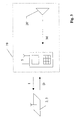
- the priority base station is a 20 'equipment, able to communicate with mobile phones located in the area it covers using a low radio communication protocol range, Bluetooth type. In this way, the mobile phones 5 located in its coverage area see 20 'equipment as a Bluetooth accessory.
- This equipment 20 includes means for sending to the telephones mobiles 5 located in its coverage area, a message of disconnection from the network radio communication to which said mobile telephones are attached 5.
- provision can be made for the message M either sent periodically by the 20 'equipment.
- the equipment 20 ′ sends the message M to mobile telephones 5 which transmit it, I, to their respective base station 2, 3 to which they are connected. This then returns a disconnection order D.
Landscapes
- Engineering & Computer Science (AREA)
- Computer Security & Cryptography (AREA)
- Computer Networks & Wireless Communication (AREA)
- Signal Processing (AREA)
- Mobile Radio Communication Systems (AREA)
Abstract
Description
- on émet à partir de stations de base des appels entrants à destination de téléphones mobiles,
- on reçoit dans des stations de base des appels sortants émanant de téléphones mobiles,
- on place une station de base prioritaire dans la zone et on neutralise avec cette station de base prioritaire des accès aux téléphones mobiles qui s'y trouvent
- Figure 1: une représentation schématique d'un réseau de téléphonie mobile, une station de base prioritaire, et une première réalisation du principe de l'invention de la neutralisation d'une zone sensible par cette station de base prioritaire ;
- Figures 2a et 2b : une représentation comparée des étapes de reconnaissance, dans un procédé classique et dans un procédé selon l'invention respectivement, et de gestion d'une communication téléphonique par une station de base.
- Figure 3 : une deuxième réalisation du principe de l'invention de la neutralisation d'une zone sensible par une station de base prioritaire.
Claims (15)
- Procédé de protection radioélectrique d'une zone (19) en téléphonie mobile, dans lequelcaractérisé en ce que la station de base prioritaire est apte à se faire reconnaítre des téléphones mobiles quelques soient leurs caractéristiques d'abonnement.on émet à partir de stations de base (2, 3) des appels entrants à destination des téléphones mobiles (5-7),on reçoit dans des stations de base des appels sortants émanant de téléphones mobiles,on place une station de base prioritaire (20) dans la zone et on neutralise (28) avec cette station de base prioritaire des accès aux téléphones mobiles qui s'y trouvent,
- Procédé selon la revendication 1, caractérisé en ce queon émet et on reçoit dans les téléphones mobiles selon un protocole déterminé,dans ce protocole déterminé, pour émettre et recevoir des appels d'un téléphone mobile, une station de base reconnaít (11, 15) une caractéristique d'abonnement de ce téléphone mobile à un réseau (4) de téléphonie mobile auquel cette station de base appartient, et en ce quedans la station de base prioritaire, on écarte (23, 25) les résultats de cette reconnaissance et on gère (25) la communication avec le téléphone mobile dans tous les cas.
- Procédé selon la revendication 2, caractérisé en ce quele protocole est un protocole CTS qui admet des stations de base publiques et des stations de base privées,dans une station de base publique on reconnaít la caractéristique d'abonné,dans une station de base privée on reconnaít une caractéristique (12) d'acceptation,dans une station de base prioritaire, on écarte les résultats de ces reconnaissances et on gère la communication avec le téléphone mobile dans tous les cas.
- Procédé selon la revendication 1, caractérisé en ce que la station de base prioritaire communique avec les téléphones mobiles qui se trouvent dans ladite zone (19) au moyen d'un protocole de communication radio de faible portée, du type Bluetooth.
- Procédé selon la revendication 4, caractérisé en ce que la station de base prioritaire envoie aux téléphones mobiles se trouvant dans ladite zone (19) un message de déconnexion au réseau de radiocommunication auquel ils sont rattachés.
- Procédé selon la revendication 4, caractérisé en ce que la station de base prioritaire est connectée au réseau public commuté et gère la communication avec les téléphones mobiles se trouvant dans ladite zone (19).
- Procédé selon la revendication 3 ou 6, caractérisé en ce quela station de base prioritaire envoie au téléphone mobile un message lui indiquant un caractère de base privée,le téléphone mobile interprète ce message et se commute (22) automatiquement en une utilisation de cette base privée.
- Procédé selon l'une des revendications 1 à 3, 6, 7, caractérisé en ce quepour neutraliser, on commute une utilisation du téléphone mobile d'un mode public à un mode privé en fonction d'une priorité (22) enregistrée dans le téléphone mobile.
- Procédé selon la revendication 2, caractérisé en ce que la station de base prioritaire est une station de base publique apte à se faire reconnaítre de tous les téléphones mobiles situés dans sa zone de couverture, quelques soient le réseau public auquel ils sont rattachés, la station de base prioritaire étant apte à gérer la communication avec lesdits téléphones mobiles.
- Procédé selon la revendication 9, caractérisé en ce que la station de base prioritaire comporte des moyens pour indiquer aux dits téléphones mobiles un caractère prioritaire, de sorte que le téléphone mobile se commute automatiquement en une utilisation de cette station de base prioritaire.
- Procédé selon l'une des revendications 1 à 3, 6 à 10, caractérisé en ce que pour neutraliser, on délivre pour des appels sortants un message d'indisponibilité.
- Procédé selon l'une des revendications 1 à 3, 6 à 11, caractérisé en ce que pour neutraliser, on oriente des appels entrants sur une messagerie (33, 34).
- Procédé selon la revendication 12, caractérisé en ce queon tient à jour une liste (26) des téléphones mobiles gérés par la station de base prioritaire,on mémorise des messages entrants dans une mémoire de messagerie, eton transmet aux téléphones mobiles qui ne sont plus dans la zone de cette station de base prioritaire des messages entrants mémorisés pendant qu'ils y étaient et qui les concernent.
- Procédé selon la revendication 13, caractérisé en ce que pour mémoriser, on mémorise les messages dans une mémoire de messagerie de la station de base prioritaire.
- Procédé selon l'une des revendications 1 à 14, caractérisé en ce que, pour neutraliser, on envoie à un interlocuteur absent des informations sur la nature et/ou les conditions de la neutralisation.
Applications Claiming Priority (3)
| Application Number | Priority Date | Filing Date | Title |
|---|---|---|---|
| FR9903513 | 1999-03-22 | ||
| FR9903513A FR2791510B1 (fr) | 1999-03-22 | 1999-03-22 | Procede de protection radioelectrique |
| PCT/FR2000/000731 WO2001072079A1 (fr) | 1999-03-22 | 2000-03-23 | Procede de protection radioelectrique d'une zone contre l'usage de telephones mobiles |
Publications (1)
| Publication Number | Publication Date |
|---|---|
| EP1039771A1 true EP1039771A1 (fr) | 2000-09-27 |
Family
ID=26212108
Family Applications (1)
| Application Number | Title | Priority Date | Filing Date |
|---|---|---|---|
| EP00400783A Withdrawn EP1039771A1 (fr) | 1999-03-22 | 2000-03-22 | Procédé de protection radio électrique d'une zone contre l'usage de téléphones mobiles |
Country Status (3)
| Country | Link |
|---|---|
| EP (1) | EP1039771A1 (fr) |
| FR (1) | FR2791510B1 (fr) |
| WO (1) | WO2001072079A1 (fr) |
Cited By (2)
| Publication number | Priority date | Publication date | Assignee | Title |
|---|---|---|---|---|
| WO2001043483A1 (fr) * | 1999-12-10 | 2001-06-14 | Telefonaktiebolaget Lm Ericsson (Publ) | Procede et dispositif pour reseau de communications mobiles |
| WO2007071462A1 (fr) * | 2005-12-15 | 2007-06-28 | Siemens Aktiengesellschaft | Procede et dispositif pour la desactivation côte reseau de stations mobiles |
Citations (4)
| Publication number | Priority date | Publication date | Assignee | Title |
|---|---|---|---|---|
| US5594947A (en) * | 1994-03-10 | 1997-01-14 | Motorola, Inc. | Method for providing alternate communication services based on geographic location |
| US5613204A (en) * | 1994-12-22 | 1997-03-18 | Bell Atlantic Mobile Systems, Inc. | Beacon system for roaming cellular stations |
| EP0830046A2 (fr) * | 1996-09-13 | 1998-03-18 | Nec Corporation | Limitation de l'émission d'une station mobile |
| EP0881851A1 (fr) * | 1997-05-28 | 1998-12-02 | TELEFONAKTIEBOLAGET L M ERICSSON (publ) | Transfer des appels selectif vers un téléphone mobile et/ou d'un téléphone sans fil |
-
1999
- 1999-03-22 FR FR9903513A patent/FR2791510B1/fr not_active Expired - Fee Related
-
2000
- 2000-03-22 EP EP00400783A patent/EP1039771A1/fr not_active Withdrawn
- 2000-03-23 WO PCT/FR2000/000731 patent/WO2001072079A1/fr not_active Ceased
Patent Citations (4)
| Publication number | Priority date | Publication date | Assignee | Title |
|---|---|---|---|---|
| US5594947A (en) * | 1994-03-10 | 1997-01-14 | Motorola, Inc. | Method for providing alternate communication services based on geographic location |
| US5613204A (en) * | 1994-12-22 | 1997-03-18 | Bell Atlantic Mobile Systems, Inc. | Beacon system for roaming cellular stations |
| EP0830046A2 (fr) * | 1996-09-13 | 1998-03-18 | Nec Corporation | Limitation de l'émission d'une station mobile |
| EP0881851A1 (fr) * | 1997-05-28 | 1998-12-02 | TELEFONAKTIEBOLAGET L M ERICSSON (publ) | Transfer des appels selectif vers un téléphone mobile et/ou d'un téléphone sans fil |
Cited By (3)
| Publication number | Priority date | Publication date | Assignee | Title |
|---|---|---|---|---|
| WO2001043483A1 (fr) * | 1999-12-10 | 2001-06-14 | Telefonaktiebolaget Lm Ericsson (Publ) | Procede et dispositif pour reseau de communications mobiles |
| WO2007071462A1 (fr) * | 2005-12-15 | 2007-06-28 | Siemens Aktiengesellschaft | Procede et dispositif pour la desactivation côte reseau de stations mobiles |
| US8195199B2 (en) | 2005-12-15 | 2012-06-05 | Siemens Aktiengesellschaft | Method and apparatus for deactivating mobile radio stations from the network |
Also Published As
| Publication number | Publication date |
|---|---|
| FR2791510B1 (fr) | 2001-05-04 |
| FR2791510A1 (fr) | 2000-09-29 |
| WO2001072079A1 (fr) | 2001-09-27 |
Similar Documents
| Publication | Publication Date | Title |
|---|---|---|
| CA2174754C (fr) | Installation de radio-telephone numerique a terminaux mobiles | |
| FR2687875A1 (fr) | Systeme de telecommunications permettant l'acheminement d'appels radiotelephoniques suivant plusieurs systemes radiotelephoniques, appareil radiotelephonique et procede associes. | |
| EP1316237B1 (fr) | Procede et dispositif de connexion d'un terminal a plusieurs reseaux de telecommunications | |
| FR2720583A1 (fr) | Procédé d'enregistrement de stations de base auprès d'un combiné dans un système de télécommunications de la deuxième génération, et dispositif associé. | |
| FR2687873A1 (fr) | Systeme de telecommunications a partage des frequences entre plusieurs systemes radiotelephones, appareil et procede associes. | |
| FR2687872A1 (fr) | Appareil et procede de selection entre plusieurs systemes radiotelephoniques. | |
| FR2687874A1 (fr) | Appareil radiotelephonique fonctionnant dans un double systeme, sans cordon et cellulaire, et son procede de fonctionnement. | |
| EP0993167A1 (fr) | Procédé de protection d'un terminal de radiocommunication contre un usage non autorisé | |
| FR2768893A1 (fr) | Procede d'initialisation de liaison entre un terminal mobile et une station de base domestique | |
| EP1457028B1 (fr) | Procede et systeme de rappel automatique multi reseaux | |
| EP1039771A1 (fr) | Procédé de protection radio électrique d'une zone contre l'usage de téléphones mobiles | |
| EP1338167A1 (fr) | Procede de filtrage de communications de telephones mobiles, et dispositif associe | |
| FR2720212A1 (fr) | Procédé de réglage des fréquences de référence dans un système de télécommunication. | |
| FR2870664A1 (fr) | Procede et dispositif ameliores de traitement des modes de communication d'un terminal de communication mobile | |
| FR2799861A1 (fr) | Procede d'appel d'urgence et telephone mobile pour la mise en oeuvre du procede | |
| EP1457031B1 (fr) | Procede et systeme de renvoi automatique d'appel telephonique | |
| EP1178652A1 (fr) | Procédé de gestion automatique de services d'un réseau et système correspondant | |
| EP0967812B1 (fr) | Blocage d'une téléphone mobile dépendant de la localisation dans un réseau téléphonique radio | |
| EP1457027B1 (fr) | Procede et systeme pour la fourniture d'un service de repertoire intelligent | |
| EP1251711A1 (fr) | Ensemble de téléphonie mobile, balise, et procédé de détection de proximité entre un terminal et une balise | |
| CA2195388A1 (fr) | Protocole d'acheminement local d'appels entrants du reseau telephonique commute dans un reseau cellulaire | |
| EP1120948A1 (fr) | Téléphone portable utilisé conjointement avec un téléphone sans fil pour une station d'accueil de type DECT | |
| EP1977589B1 (fr) | Procede permettant le transfert d' un appel | |
| JP2003528505A (ja) | 移動電話の使用に対する一定ゾーンの電波保護方法 | |
| FR2730882A1 (fr) | Procede de communication dans un systeme de radiocommunication avec des terminaux mobiles, utilisant la norme d'interface radio cai-ct2 |
Legal Events
| Date | Code | Title | Description |
|---|---|---|---|
| PUAI | Public reference made under article 153(3) epc to a published international application that has entered the european phase |
Free format text: ORIGINAL CODE: 0009012 |
|
| AK | Designated contracting states |
Kind code of ref document: A1 Designated state(s): AT BE CH CY DE DK ES FI FR GB GR IE IT LI LU MC NL PT SE |
|
| AX | Request for extension of the european patent |
Free format text: AL;LT;LV;MK;RO;SI |
|
| 17P | Request for examination filed |
Effective date: 20010327 |
|
| AKX | Designation fees paid |
Free format text: AT BE CH CY DE DK ES FI FR GB GR IE IT LI LU MC NL PT SE |
|
| RAP1 | Party data changed (applicant data changed or rights of an application transferred) |
Owner name: ALCATEL LUCENT |
|
| 17Q | First examination report despatched |
Effective date: 20080502 |
|
| RAP1 | Party data changed (applicant data changed or rights of an application transferred) |
Owner name: ALCATEL LUCENT |
|
| 111Z | Information provided on other rights and legal means of execution |
Free format text: AT BE CH CY DE DK ES FI FR GB GR IE IT LI LU MC NL PT SE Effective date: 20130410 |
|
| RAP1 | Party data changed (applicant data changed or rights of an application transferred) |
Owner name: ALCATEL LUCENT |
|
| D11X | Information provided on other rights and legal means of execution (deleted) | ||
| STAA | Information on the status of an ep patent application or granted ep patent |
Free format text: STATUS: THE APPLICATION IS DEEMED TO BE WITHDRAWN |
|
| 18D | Application deemed to be withdrawn |
Effective date: 20171003 |