EP1039418A2 - Method of registering surfaces using curvature - Google Patents
Method of registering surfaces using curvature Download PDFInfo
- Publication number
- EP1039418A2 EP1039418A2 EP00302111A EP00302111A EP1039418A2 EP 1039418 A2 EP1039418 A2 EP 1039418A2 EP 00302111 A EP00302111 A EP 00302111A EP 00302111 A EP00302111 A EP 00302111A EP 1039418 A2 EP1039418 A2 EP 1039418A2
- Authority
- EP
- European Patent Office
- Prior art keywords
- curvature
- patient
- determining
- registering surfaces
- model
- Prior art date
- Legal status (The legal status is an assumption and is not a legal conclusion. Google has not performed a legal analysis and makes no representation as to the accuracy of the status listed.)
- Withdrawn
Links
Images

Classifications
-
- G—PHYSICS
- G06—COMPUTING OR CALCULATING; COUNTING
- G06T—IMAGE DATA PROCESSING OR GENERATION, IN GENERAL
- G06T15/00—Three-dimensional [3D] image rendering
- G06T15/50—Lighting effects
- G06T15/80—Shading
-
- G—PHYSICS
- G06—COMPUTING OR CALCULATING; COUNTING
- G06T—IMAGE DATA PROCESSING OR GENERATION, IN GENERAL
- G06T15/00—Three-dimensional [3D] image rendering
- G06T15/50—Lighting effects
Definitions
- the invention relates to a method of registering surfaces using curvature data and in particular to a method of registering a patient surface created from patient range data with a model surface created from patient image data.
- U.S. Patent 5,740,802 assigned to the assignee of the present application, discloses a system that aligns live video of the patient and models generated from medical imaging to facilitate surgery. In smooth regions, without prominent landmarks, it is difficult to align the image data with the model data.
- An exemplary embodiment of the invention is directed to a method of registering a generated patient surface with a model surface based on curvature.
- the method includes acquiring patient range data and determining the patient curvature based on the range data.
- a patient surface is generated and shaded based on the patient curvature.
- a model surface is generated from image data and processed to determine the curvature of the model surface.
- the model surface is shaded to represent the model curvature.
- the shaded patient surface and the shaded model surface may be aligned by manipulating the patient surface and/or the model surface until the curvature features coincide.
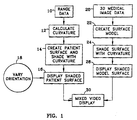
- Figure 1 illustrates, in flowchart form, a method of registering a patient surface with a model surface in an exemplary embodiment of the invention.
- range data are obtained from the patient.
- the range data may be derived from direct measurement (e.g. optical range data, coordinate measuring machines, etc.).
- image data representing the patient are obtained and may be provided from a variety of medical imaging techniques.
- the curvature of the range data is determined using either the mean curvature or the Gaussian curvature described herein.
- a model is created from the image data and the model surface curvature is determined.
- a system for creating surfaces from volumetric data has been described in U. S. Patent 4,821,213, Cline, Ludke, Lorensen, April 11, 1989, "System For The Simultaneous Display Of Two Or More Internal Surfaces Within A Solid Object" ("Marching Cubes Method”).
- the “Marching Cubes Method” produces surfaces efficiently; however as the number of volumetric data points becomes larger, it becomes more feasible to use another method, specifically that described in U. S. Patent 4,719,585, Jan.
- the dividing cubes method subdivides each voxel into points and normals using trilinear interpolation.
- the points and normals represent surfaces which are rendered.
- a modified marching cubes method may be used in step 22 to create the model surface and determine the curvature of the model surface.
- the marching cubes method yields a surface composed of triangles which may be used to calculate the curvature using the method of Gabriel Taubin described in IBM Research Report RC-19860 entitled "Estimating the Tensor of Curvature of a Surface from a Polyhedral Approximation.”
- the model surface is shaded to indicate curvature at step 24.
- the shading may be any visible indicia (e.g. color or gray scale) and different indicia are used to indicate different curvature values.
- Figure 3 illustrates a polygonal model 110 of the patient shaded to indicate curvature.
- a patient surface corresponding to the range data is generated and this patient surface is shaded to indicate the curvature.
- the patient surface may be generated from the range data by representing the range data with triangles lying in a plane (e.g. x-y plane) and then deforming the plane in another dimension (e.g. z) to obtain a polygonal model.
- Figure 2 illustrates the patient surface 100 shaded to indicate curvature.
- the shaded patient surface and the shaded model surface are displayed.
- orientation of the patient surface is varied so that the patient surface is aligned with the model surface.
- the model surface may be varied in orientation or the orientation of both the patient surface and the model surface may be varied to align the two images.
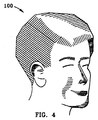
- Figure 4 illustrates the patient surface 100 oriented in the same manner as the model surface of Figure 3.
- the images of the patient surface and model surface are mixed and displayed.
- Curvature is defined for a surface as the rate of change of the normal vector with arc length.
- a surface there are two principal curvatures.
- the rotational invariance of both the mean curvature and the Gaussian curvature are useful in displaying the patient surface with curvature shading. If the patient surface orientation is varied, the curvature shading will not vary, which facilitates alignment of the patient surface and the model surface.
- the curvature constants nine altogether, are calculated from the patient data by taking the central differences of the normal vectors along the three axes where a, b, c are the spacings between sampled points.
- the invention can be embodied in the form of computer-implemented processes and apparatus for practicing those processes.
- the invention can also be embodied in the form of computer program code containing instructions embodied in tangible media, such as floppy diskettes, CD-ROMs, hard drives, or any other computer-readable storage medium, wherein, when the computer program code is loaded into and executed by a computer, the computer becomes an apparatus for practicing the invention.
- the invention can also be embodied in the form of computer program code, for example, whether stored in a storage medium, loaded into and/or executed by a computer, or transmitted over a communication medium such as electrical wiring or cabling, fiber optics, or via electromagnetic radiation; in each instance, when the computer program code is loaded into and executed by a computer, the computer becomes an apparatus for practicing the invention.
- the computer program code segments When implemented on a general-purpose microprocessor, the computer program code segments configure the microprocessor to create specific logic circuits.
Landscapes
- Engineering & Computer Science (AREA)
- Computer Graphics (AREA)
- Physics & Mathematics (AREA)
- General Physics & Mathematics (AREA)
- Theoretical Computer Science (AREA)
- Apparatus For Radiation Diagnosis (AREA)
- Magnetic Resonance Imaging Apparatus (AREA)
- Image Analysis (AREA)
- Image Processing (AREA)
- Length Measuring Devices By Optical Means (AREA)
- Measurement Of The Respiration, Hearing Ability, Form, And Blood Characteristics Of Living Organisms (AREA)
Abstract
Description

Claims (9)
- A method for registering surfaces comprising:acquiring a first surface from a body having curvature to be imaged;acquiring a second surface from said body;determining a first curvature of said first surface;determining a second curvature of said second surface;shading said first surface in response to said first curvature;shading said second surface in response to said second curvature; andvarying orientation of at least one of said first surface and said second surface to align said first surface and said second surface in registration with each other.
- The method for registering surfaces of claim 1 wherein the step of determining a first curvature comprises determining a mean curvature.
- The method for registering surfaces of claim 2 wherein, in a Cartesian coordinate system, said mean curvature is represented aswhere
- The method for registering surfaces of claim 1 wherein the step of determining a first curvature comprises determining a Gaussian curvature.
- The method for registering surfaces of claim 4 wherein said Gaussian curvature is represented aswhere
- The method for registering surfaces of claim 1 wherein the step of determining a second curvature includes the step of processing said second surface with marching cubes.
- The method for registering surfaces of claim 1 wherein said first surface represents a patient and is generated from patient range data.
- The method for registering surfaces of claim 1or claim 7 wherein said second surface represents a patient and is generated from image data.
- A storage medium encoded with machine-readable computer program code for registering surfaces comprising instructions for causing a computer to implement the method of any one of claims 1 to 8.
Applications Claiming Priority (2)
| Application Number | Priority Date | Filing Date | Title |
|---|---|---|---|
| US274010 | 1981-06-15 | ||
| US09/274,010 US6298148B1 (en) | 1999-03-22 | 1999-03-22 | Method of registering surfaces using curvature |
Publications (2)
| Publication Number | Publication Date |
|---|---|
| EP1039418A2 true EP1039418A2 (en) | 2000-09-27 |
| EP1039418A3 EP1039418A3 (en) | 2003-04-16 |
Family
ID=23046393
Family Applications (1)
| Application Number | Title | Priority Date | Filing Date |
|---|---|---|---|
| EP00302111A Withdrawn EP1039418A3 (en) | 1999-03-22 | 2000-03-15 | Method of registering surfaces using curvature |
Country Status (4)
| Country | Link |
|---|---|
| US (1) | US6298148B1 (en) |
| EP (1) | EP1039418A3 (en) |
| JP (1) | JP3510837B2 (en) |
| IL (1) | IL134965A (en) |
Families Citing this family (19)
| Publication number | Priority date | Publication date | Assignee | Title |
|---|---|---|---|---|
| US6771263B1 (en) * | 1998-10-13 | 2004-08-03 | Gmd-Forschungszentrum Informationstechnik Gmbh | Processing volumetric image data with shadows |
| DE10144004A1 (en) * | 2001-09-07 | 2003-03-27 | Philips Corp Intellectual Pty | Method of taking three-dimensional measurements for use in measuring physical properties in medical applications, by overlaying three dimensional images |
| US8425418B2 (en) * | 2006-05-18 | 2013-04-23 | Eigen, Llc | Method of ultrasonic imaging and biopsy of the prostate |
| US8064664B2 (en) * | 2006-10-18 | 2011-11-22 | Eigen, Inc. | Alignment method for registering medical images |
| US7804989B2 (en) * | 2006-10-30 | 2010-09-28 | Eigen, Inc. | Object recognition system for medical imaging |
| US20080161687A1 (en) * | 2006-12-29 | 2008-07-03 | Suri Jasjit S | Repeat biopsy system |
| US8175350B2 (en) * | 2007-01-15 | 2012-05-08 | Eigen, Inc. | Method for tissue culture extraction |
| US20080186378A1 (en) * | 2007-02-06 | 2008-08-07 | Feimo Shen | Method and apparatus for guiding towards targets during motion |
| US7856130B2 (en) * | 2007-03-28 | 2010-12-21 | Eigen, Inc. | Object recognition system for medical imaging |
| US20090048515A1 (en) * | 2007-08-14 | 2009-02-19 | Suri Jasjit S | Biopsy planning system |
| US8571277B2 (en) * | 2007-10-18 | 2013-10-29 | Eigen, Llc | Image interpolation for medical imaging |
| US7942829B2 (en) * | 2007-11-06 | 2011-05-17 | Eigen, Inc. | Biopsy planning and display apparatus |
| US20090324041A1 (en) * | 2008-01-23 | 2009-12-31 | Eigen, Llc | Apparatus for real-time 3d biopsy |
| US20100001996A1 (en) * | 2008-02-28 | 2010-01-07 | Eigen, Llc | Apparatus for guiding towards targets during motion using gpu processing |
| CN106575450B (en) | 2014-05-13 | 2019-07-26 | 河谷控股Ip有限责任公司 | Augmented reality content rendering via albedo models, systems and methods |
| US10716544B2 (en) | 2015-10-08 | 2020-07-21 | Zmk Medical Technologies Inc. | System for 3D multi-parametric ultrasound imaging |
| JP6795744B2 (en) * | 2016-09-21 | 2020-12-02 | 学校法人自治医科大学 | Medical support method and medical support device |
| US10646999B2 (en) * | 2017-07-20 | 2020-05-12 | Tata Consultancy Services Limited | Systems and methods for detecting grasp poses for handling target objects |
| US12399242B2 (en) | 2022-06-30 | 2025-08-26 | Quality Electrodynamics, Llc | Musculoskeletal RF surface coil for MRI |
Family Cites Families (19)
| Publication number | Priority date | Publication date | Assignee | Title |
|---|---|---|---|---|
| US3617016A (en) * | 1968-05-27 | 1971-11-02 | Emil J Bolsey | Image motion and change transducers and systems controlled thereby |
| SE365325B (en) * | 1971-11-04 | 1974-03-18 | Rothfjell R | |
| SE382704B (en) * | 1974-06-14 | 1976-02-09 | Rothfjell Rolf Eric | PROCEDURE FOR CREATING CHARACTERISTIC CONTOURS FROM A COLOR IMAGE. |
| US4637058A (en) * | 1984-09-12 | 1987-01-13 | Robotic Vision Systems, Inc. | Location of objects without use of salient features |
| US4719585A (en) | 1985-08-28 | 1988-01-12 | General Electric Company | Dividing cubes system and method for the display of surface structures contained within the interior region of a solid body |
| US4821213A (en) | 1986-12-19 | 1989-04-11 | General Electric Co. | System for the simultaneous display of two or more internal surfaces within a solid object |
| US4821210A (en) * | 1987-04-02 | 1989-04-11 | General Electric Co. | Fast display of three-dimensional images |
| US5142659A (en) * | 1989-04-18 | 1992-08-25 | Texas Instruments Incorporated | Estimation of local surface geometry from relative range images for object recognition |
| CA2051939A1 (en) * | 1990-10-02 | 1992-04-03 | Gary A. Ransford | Digital data registration and differencing compression system |
| US5163094A (en) * | 1991-03-20 | 1992-11-10 | Francine J. Prokoski | Method for identifying individuals from analysis of elemental shapes derived from biosensor data |
| DE69232403T2 (en) * | 1991-08-06 | 2002-08-22 | Canon K.K., Tokio/Tokyo | Three-dimensional model processing method and device |
| DE69332042T2 (en) * | 1992-12-18 | 2003-01-02 | Koninklijke Philips Electronics N.V., Eindhoven | Delayed positioning of relatively elastically deformed spatial images by matching surfaces |
| EP0646263B1 (en) | 1993-04-20 | 2000-05-31 | General Electric Company | Computer graphic and live video system for enhancing visualisation of body structures during surgery |
| US5999840A (en) | 1994-09-01 | 1999-12-07 | Massachusetts Institute Of Technology | System and method of registration of three-dimensional data sets |
| JPH09173352A (en) * | 1995-12-25 | 1997-07-08 | Toshiba Medical Eng Co Ltd | Medical navigation system |
| JP2976869B2 (en) * | 1995-12-28 | 1999-11-10 | 日産自動車株式会社 | Surface defect inspection equipment |
| US6173068B1 (en) * | 1996-07-29 | 2001-01-09 | Mikos, Ltd. | Method and apparatus for recognizing and classifying individuals based on minutiae |
| JP3910239B2 (en) * | 1996-11-14 | 2007-04-25 | 東芝医用システムエンジニアリング株式会社 | Medical image synthesizer |
| US5931667A (en) * | 1997-07-14 | 1999-08-03 | Papandreas; Samuel G. | Orthodontic apparatus and method |
-
1999
- 1999-03-22 US US09/274,010 patent/US6298148B1/en not_active Expired - Fee Related
-
2000
- 2000-03-09 IL IL13496500A patent/IL134965A/en not_active IP Right Cessation
- 2000-03-15 EP EP00302111A patent/EP1039418A3/en not_active Withdrawn
- 2000-03-21 JP JP2000077426A patent/JP3510837B2/en not_active Expired - Fee Related
Also Published As
| Publication number | Publication date |
|---|---|
| IL134965A0 (en) | 2001-05-20 |
| IL134965A (en) | 2003-10-31 |
| JP3510837B2 (en) | 2004-03-29 |
| EP1039418A3 (en) | 2003-04-16 |
| US6298148B1 (en) | 2001-10-02 |
| JP2000308628A (en) | 2000-11-07 |
Similar Documents
| Publication | Publication Date | Title |
|---|---|---|
| EP1039418A2 (en) | Method of registering surfaces using curvature | |
| EP1596330B1 (en) | Estimating position and orientation of markers in digital images | |
| EP1596329B1 (en) | Marker placement information estimating method and information processing device | |
| US8989518B2 (en) | Information processing method and apparatus for calculating information regarding measurement target on the basis of captured images | |
| US5283837A (en) | Accurate estimation of surface normals in 3-D data sets | |
| US8345927B2 (en) | Registration processing apparatus, registration method, and storage medium | |
| JP4152648B2 (en) | Method for segmenting a 3D image contained in an object | |
| US7487063B2 (en) | Three-dimensional modeling from arbitrary three-dimensional curves | |
| Kabus et al. | B-spline registration of 3D images with Levenberg-Marquardt optimization | |
| Park et al. | Volumetric deformable models with parameter functions: A new approach to the 3D motion analysis of the LV from MRI-SPAMM | |
| Clarkson et al. | Using photo-consistency to register 2D optical images of the human face to a 3D surface model | |
| WO2006105625A1 (en) | Method and system for pre-operative prediction | |
| WO2006082825A1 (en) | Mark arrangement measuring method, positional posture estimating method, mark arrangement measuring apparatus and positional posture estimating apparatus | |
| US20020174406A1 (en) | Device and method for feature quantity calculation | |
| JP2961264B1 (en) | Three-dimensional object model generation method and computer-readable recording medium recording three-dimensional object model generation program | |
| US20020094134A1 (en) | Method and system for placing three-dimensional models | |
| EP0854442B1 (en) | Method and system for displaying surfaces of volumetric data | |
| JP5726024B2 (en) | Information processing method and apparatus | |
| JP6109213B2 (en) | Information processing apparatus and method, program | |
| Stammberger et al. | Segmentation of MR images with B-spline snakes: A multi-resolution approach using the distance transformation for model forces | |
| JPH05266214A (en) | Picture display method | |
| JPH0618221A (en) | Integration of multi-viewpoint distance data | |
| Burel et al. | Registration of 3D objects using linear algebra | |
| Bell et al. | Analysis of area-based image matching under perspective distortion for a planar object model | |
| JPH03220677A (en) | Three-dimensional object picking system |
Legal Events
| Date | Code | Title | Description |
|---|---|---|---|
| PUAI | Public reference made under article 153(3) epc to a published international application that has entered the european phase |
Free format text: ORIGINAL CODE: 0009012 |
|
| AK | Designated contracting states |
Kind code of ref document: A2 Designated state(s): AT BE CH CY DE DK ES FI FR GB GR IE IT LI LU MC NL PT SE |
|
| AX | Request for extension of the european patent |
Free format text: AL;LT;LV;MK;RO;SI |
|
| PUAL | Search report despatched |
Free format text: ORIGINAL CODE: 0009013 |
|
| RIC1 | Information provided on ipc code assigned before grant |
Ipc: 7G 06T 7/00 B Ipc: 7G 06T 17/00 A |
|
| AK | Designated contracting states |
Designated state(s): AT BE CH CY DE DK ES FI FR GB GR IE IT LI LU MC NL PT SE |
|
| AX | Request for extension of the european patent |
Extension state: AL LT LV MK RO SI |
|
| 17P | Request for examination filed |
Effective date: 20031016 |
|
| AKX | Designation fees paid |
Designated state(s): DE NL |
|
| 17Q | First examination report despatched |
Effective date: 20031209 |
|
| STAA | Information on the status of an ep patent application or granted ep patent |
Free format text: STATUS: THE APPLICATION IS DEEMED TO BE WITHDRAWN |
|
| 18D | Application deemed to be withdrawn |
Effective date: 20131001 |