EP1039339A1 - Polymer latexes with core-shell morphology - Google Patents
Polymer latexes with core-shell morphology Download PDFInfo
- Publication number
- EP1039339A1 EP1039339A1 EP00200892A EP00200892A EP1039339A1 EP 1039339 A1 EP1039339 A1 EP 1039339A1 EP 00200892 A EP00200892 A EP 00200892A EP 00200892 A EP00200892 A EP 00200892A EP 1039339 A1 EP1039339 A1 EP 1039339A1
- Authority
- EP
- European Patent Office
- Prior art keywords
- acrylate
- methacrylate
- core
- latex
- polymer latex
- Prior art date
- Legal status (The legal status is an assumption and is not a legal conclusion. Google has not performed a legal analysis and makes no representation as to the accuracy of the status listed.)
- Withdrawn
Links
- 229920000642 polymer Polymers 0.000 title claims abstract description 60
- 239000011258 core-shell material Substances 0.000 title claims description 49
- 239000004816 latex Substances 0.000 claims abstract description 93
- 229920000126 latex Polymers 0.000 claims abstract description 93
- 239000000178 monomer Substances 0.000 claims abstract description 64
- 239000002245 particle Substances 0.000 claims abstract description 48
- XLYOFNOQVPJJNP-UHFFFAOYSA-N water Substances O XLYOFNOQVPJJNP-UHFFFAOYSA-N 0.000 claims abstract description 27
- 230000002209 hydrophobic effect Effects 0.000 claims abstract description 22
- -1 silver halide Chemical class 0.000 claims description 37
- SUPCQIBBMFXVTL-UHFFFAOYSA-N ethyl 2-methylprop-2-enoate Chemical compound CCOC(=O)C(C)=C SUPCQIBBMFXVTL-UHFFFAOYSA-N 0.000 claims description 25
- 239000000203 mixture Substances 0.000 claims description 21
- SOGAXMICEFXMKE-UHFFFAOYSA-N Butylmethacrylate Chemical compound CCCCOC(=O)C(C)=C SOGAXMICEFXMKE-UHFFFAOYSA-N 0.000 claims description 16
- 150000001875 compounds Chemical class 0.000 claims description 16
- NIXOWILDQLNWCW-UHFFFAOYSA-M Acrylate Chemical compound [O-]C(=O)C=C NIXOWILDQLNWCW-UHFFFAOYSA-M 0.000 claims description 15
- 229920003171 Poly (ethylene oxide) Polymers 0.000 claims description 12
- PPBRXRYQALVLMV-UHFFFAOYSA-N Styrene Chemical compound C=CC1=CC=CC=C1 PPBRXRYQALVLMV-UHFFFAOYSA-N 0.000 claims description 10
- CERQOIWHTDAKMF-UHFFFAOYSA-M Methacrylate Chemical compound CC(=C)C([O-])=O CERQOIWHTDAKMF-UHFFFAOYSA-M 0.000 claims description 8
- KAKZBPTYRLMSJV-UHFFFAOYSA-N Butadiene Chemical compound C=CC=C KAKZBPTYRLMSJV-UHFFFAOYSA-N 0.000 claims description 6
- CQEYYJKEWSMYFG-UHFFFAOYSA-N butyl acrylate Chemical compound CCCCOC(=O)C=C CQEYYJKEWSMYFG-UHFFFAOYSA-N 0.000 claims description 6
- VVQNEPGJFQJSBK-UHFFFAOYSA-N Methyl methacrylate Chemical compound COC(=O)C(C)=C VVQNEPGJFQJSBK-UHFFFAOYSA-N 0.000 claims description 5
- 239000000975 dye Substances 0.000 claims description 5
- 239000000463 material Substances 0.000 claims description 5
- GOXQRTZXKQZDDN-UHFFFAOYSA-N 2-Ethylhexyl acrylate Chemical compound CCCCC(CC)COC(=O)C=C GOXQRTZXKQZDDN-UHFFFAOYSA-N 0.000 claims description 4
- NLHHRLWOUZZQLW-UHFFFAOYSA-N Acrylonitrile Chemical compound C=CC#N NLHHRLWOUZZQLW-UHFFFAOYSA-N 0.000 claims description 4
- RRHGJUQNOFWUDK-UHFFFAOYSA-N Isoprene Chemical compound CC(=C)C=C RRHGJUQNOFWUDK-UHFFFAOYSA-N 0.000 claims description 4
- BAPJBEWLBFYGME-UHFFFAOYSA-N Methyl acrylate Chemical compound COC(=O)C=C BAPJBEWLBFYGME-UHFFFAOYSA-N 0.000 claims description 4
- 125000005250 alkyl acrylate group Chemical group 0.000 claims description 4
- BOQSSGDQNWEFSX-UHFFFAOYSA-N propan-2-yl 2-methylprop-2-enoate Chemical compound CC(C)OC(=O)C(C)=C BOQSSGDQNWEFSX-UHFFFAOYSA-N 0.000 claims description 4
- 229910052709 silver Inorganic materials 0.000 claims description 4
- 239000004332 silver Substances 0.000 claims description 4
- 239000002904 solvent Substances 0.000 claims description 4
- 239000003381 stabilizer Substances 0.000 claims description 4
- WOBHKFSMXKNTIM-UHFFFAOYSA-N Hydroxyethyl methacrylate Chemical compound CC(=C)C(=O)OCCO WOBHKFSMXKNTIM-UHFFFAOYSA-N 0.000 claims description 3
- GYCMBHHDWRMZGG-UHFFFAOYSA-N Methylacrylonitrile Chemical compound CC(=C)C#N GYCMBHHDWRMZGG-UHFFFAOYSA-N 0.000 claims description 3
- 239000006096 absorbing agent Substances 0.000 claims description 3
- 239000007844 bleaching agent Substances 0.000 claims description 3
- 150000001993 dienes Chemical class 0.000 claims description 3
- 125000001301 ethoxy group Chemical group [H]C([H])([H])C([H])([H])O* 0.000 claims description 3
- 239000000314 lubricant Substances 0.000 claims description 3
- 230000000873 masking effect Effects 0.000 claims description 3
- 125000000956 methoxy group Chemical group [H]C([H])([H])O* 0.000 claims description 3
- 229920001567 vinyl ester resin Polymers 0.000 claims description 3
- 125000000391 vinyl group Chemical group [H]C([*])=C([H])[H] 0.000 claims description 3
- FWWXYLGCHHIKNY-UHFFFAOYSA-N 2-ethoxyethyl prop-2-enoate Chemical compound CCOCCOC(=O)C=C FWWXYLGCHHIKNY-UHFFFAOYSA-N 0.000 claims description 2
- HFCUBKYHMMPGBY-UHFFFAOYSA-N 2-methoxyethyl prop-2-enoate Chemical compound COCCOC(=O)C=C HFCUBKYHMMPGBY-UHFFFAOYSA-N 0.000 claims description 2
- ZAWQXWZJKKICSZ-UHFFFAOYSA-N 3,3-dimethyl-2-methylidenebutanamide Chemical compound CC(C)(C)C(=C)C(N)=O ZAWQXWZJKKICSZ-UHFFFAOYSA-N 0.000 claims description 2
- WHNPOQXWAMXPTA-UHFFFAOYSA-N 3-methylbut-2-enamide Chemical compound CC(C)=CC(N)=O WHNPOQXWAMXPTA-UHFFFAOYSA-N 0.000 claims description 2
- FUYBFMXJTXPCJL-UHFFFAOYSA-N C(C=C/C(=O)OCC)(=O)OCC.C(C(=C)C)(=O)O Chemical compound C(C=C/C(=O)OCC)(=O)OCC.C(C(=C)C)(=O)O FUYBFMXJTXPCJL-UHFFFAOYSA-N 0.000 claims description 2
- JIGUQPWFLRLWPJ-UHFFFAOYSA-N Ethyl acrylate Chemical compound CCOC(=O)C=C JIGUQPWFLRLWPJ-UHFFFAOYSA-N 0.000 claims description 2
- XTXRWKRVRITETP-UHFFFAOYSA-N Vinyl acetate Chemical compound CC(=O)OC=C XTXRWKRVRITETP-UHFFFAOYSA-N 0.000 claims description 2
- XYLMUPLGERFSHI-UHFFFAOYSA-N alpha-Methylstyrene Chemical compound CC(=C)C1=CC=CC=C1 XYLMUPLGERFSHI-UHFFFAOYSA-N 0.000 claims description 2
- 150000001408 amides Chemical class 0.000 claims description 2
- 239000003963 antioxidant agent Substances 0.000 claims description 2
- GCTPMLUUWLLESL-UHFFFAOYSA-N benzyl prop-2-enoate Chemical compound C=CC(=O)OCC1=CC=CC=C1 GCTPMLUUWLLESL-UHFFFAOYSA-N 0.000 claims description 2
- OIWOHHBRDFKZNC-UHFFFAOYSA-N cyclohexyl 2-methylprop-2-enoate Chemical compound CC(=C)C(=O)OC1CCCCC1 OIWOHHBRDFKZNC-UHFFFAOYSA-N 0.000 claims description 2
- ZEFVHSWKYCYFFL-UHFFFAOYSA-N diethyl 2-methylidenebutanedioate Chemical compound CCOC(=O)CC(=C)C(=O)OCC ZEFVHSWKYCYFFL-UHFFFAOYSA-N 0.000 claims description 2
- YCUBDDIKWLELPD-UHFFFAOYSA-N ethenyl 2,2-dimethylpropanoate Chemical compound CC(C)(C)C(=O)OC=C YCUBDDIKWLELPD-UHFFFAOYSA-N 0.000 claims description 2
- GLVVKKSPKXTQRB-UHFFFAOYSA-N ethenyl dodecanoate Chemical compound CCCCCCCCCCCC(=O)OC=C GLVVKKSPKXTQRB-UHFFFAOYSA-N 0.000 claims description 2
- UIWXSTHGICQLQT-UHFFFAOYSA-N ethenyl propanoate Chemical compound CCC(=O)OC=C UIWXSTHGICQLQT-UHFFFAOYSA-N 0.000 claims description 2
- VQGWOOIHSXNRPW-UHFFFAOYSA-N n-butyl-2-methylprop-2-enamide Chemical compound CCCCNC(=O)C(C)=C VQGWOOIHSXNRPW-UHFFFAOYSA-N 0.000 claims description 2
- YRVUCYWJQFRCOB-UHFFFAOYSA-N n-butylprop-2-enamide Chemical compound CCCCNC(=O)C=C YRVUCYWJQFRCOB-UHFFFAOYSA-N 0.000 claims description 2
- FYCBGURDLIKBDA-UHFFFAOYSA-N n-hexyl-2-methylprop-2-enamide Chemical compound CCCCCCNC(=O)C(C)=C FYCBGURDLIKBDA-UHFFFAOYSA-N 0.000 claims description 2
- GCGQYJSQINRKQL-UHFFFAOYSA-N n-hexylprop-2-enamide Chemical compound CCCCCCNC(=O)C=C GCGQYJSQINRKQL-UHFFFAOYSA-N 0.000 claims description 2
- QNILTEGFHQSKFF-UHFFFAOYSA-N n-propan-2-ylprop-2-enamide Chemical compound CC(C)NC(=O)C=C QNILTEGFHQSKFF-UHFFFAOYSA-N 0.000 claims description 2
- PNJWIWWMYCMZRO-UHFFFAOYSA-N pent‐4‐en‐2‐one Natural products CC(=O)CC=C PNJWIWWMYCMZRO-UHFFFAOYSA-N 0.000 claims description 2
- 239000004848 polyfunctional curative Substances 0.000 claims description 2
- HJWLCRVIBGQPNF-UHFFFAOYSA-N prop-2-enylbenzene Chemical compound C=CCC1=CC=CC=C1 HJWLCRVIBGQPNF-UHFFFAOYSA-N 0.000 claims description 2
- LYBIZMNPXTXVMV-UHFFFAOYSA-N propan-2-yl prop-2-enoate Chemical compound CC(C)OC(=O)C=C LYBIZMNPXTXVMV-UHFFFAOYSA-N 0.000 claims description 2
- 229920002818 (Hydroxyethyl)methacrylate Polymers 0.000 claims 1
- WFTWWOCWRSUGAW-UHFFFAOYSA-N 2-(2-ethoxyethoxy)ethyl 2-methylprop-2-enoate Chemical compound CCOCCOCCOC(=O)C(C)=C WFTWWOCWRSUGAW-UHFFFAOYSA-N 0.000 claims 1
- FTALTLPZDVFJSS-UHFFFAOYSA-N 2-(2-ethoxyethoxy)ethyl prop-2-enoate Chemical compound CCOCCOCCOC(=O)C=C FTALTLPZDVFJSS-UHFFFAOYSA-N 0.000 claims 1
- DAVVKEZTUOGEAK-UHFFFAOYSA-N 2-(2-methoxyethoxy)ethyl 2-methylprop-2-enoate Chemical compound COCCOCCOC(=O)C(C)=C DAVVKEZTUOGEAK-UHFFFAOYSA-N 0.000 claims 1
- HZMXJTJBSWOCQB-UHFFFAOYSA-N 2-(2-methoxyethoxy)ethyl prop-2-enoate Chemical compound COCCOCCOC(=O)C=C HZMXJTJBSWOCQB-UHFFFAOYSA-N 0.000 claims 1
- SFPNZPQIIAJXGL-UHFFFAOYSA-N 2-ethoxyethyl 2-methylprop-2-enoate Chemical compound CCOCCOC(=O)C(C)=C SFPNZPQIIAJXGL-UHFFFAOYSA-N 0.000 claims 1
- OMIGHNLMNHATMP-UHFFFAOYSA-N 2-hydroxyethyl prop-2-enoate Chemical compound OCCOC(=O)C=C OMIGHNLMNHATMP-UHFFFAOYSA-N 0.000 claims 1
- YXYJVFYWCLAXHO-UHFFFAOYSA-N 2-methoxyethyl 2-methylprop-2-enoate Chemical compound COCCOC(=O)C(C)=C YXYJVFYWCLAXHO-UHFFFAOYSA-N 0.000 claims 1
- 238000002360 preparation method Methods 0.000 description 34
- 239000007787 solid Substances 0.000 description 30
- BDHFUVZGWQCTTF-UHFFFAOYSA-M sulfonate Chemical compound [O-]S(=O)=O BDHFUVZGWQCTTF-UHFFFAOYSA-M 0.000 description 21
- 239000004711 α-olefin Substances 0.000 description 19
- 238000000034 method Methods 0.000 description 15
- LCPVQAHEFVXVKT-UHFFFAOYSA-N 2-(2,4-difluorophenoxy)pyridin-3-amine Chemical group NC1=CC=CN=C1OC1=CC=C(F)C=C1F LCPVQAHEFVXVKT-UHFFFAOYSA-N 0.000 description 14
- CHQMHPLRPQMAMX-UHFFFAOYSA-L sodium persulfate Substances [Na+].[Na+].[O-]S(=O)(=O)OOS([O-])(=O)=O CHQMHPLRPQMAMX-UHFFFAOYSA-L 0.000 description 14
- XHZPRMZZQOIPDS-UHFFFAOYSA-N 2-Methyl-2-[(1-oxo-2-propenyl)amino]-1-propanesulfonic acid Chemical compound OS(=O)(=O)CC(C)(C)NC(=O)C=C XHZPRMZZQOIPDS-UHFFFAOYSA-N 0.000 description 13
- 239000008367 deionised water Substances 0.000 description 12
- 229910021641 deionized water Inorganic materials 0.000 description 12
- 239000008273 gelatin Substances 0.000 description 12
- 229920000159 gelatin Polymers 0.000 description 12
- 159000000000 sodium salts Chemical class 0.000 description 12
- 239000004094 surface-active agent Substances 0.000 description 12
- 108010010803 Gelatin Proteins 0.000 description 11
- 235000019322 gelatine Nutrition 0.000 description 11
- 235000011852 gelatine desserts Nutrition 0.000 description 11
- 230000008569 process Effects 0.000 description 11
- 239000006185 dispersion Substances 0.000 description 10
- 238000011068 loading method Methods 0.000 description 10
- 238000006116 polymerization reaction Methods 0.000 description 9
- IJGRMHOSHXDMSA-UHFFFAOYSA-N Atomic nitrogen Chemical compound N#N IJGRMHOSHXDMSA-UHFFFAOYSA-N 0.000 description 8
- 239000011257 shell material Substances 0.000 description 8
- 239000011734 sodium Substances 0.000 description 8
- 238000000576 coating method Methods 0.000 description 7
- 229910052708 sodium Inorganic materials 0.000 description 7
- 239000011248 coating agent Substances 0.000 description 6
- 239000002516 radical scavenger Substances 0.000 description 6
- 239000000243 solution Substances 0.000 description 6
- 238000009835 boiling Methods 0.000 description 5
- 238000007720 emulsion polymerization reaction Methods 0.000 description 5
- 229910052757 nitrogen Inorganic materials 0.000 description 5
- 150000003839 salts Chemical class 0.000 description 5
- SMZOUWXMTYCWNB-UHFFFAOYSA-N 2-(2-methoxy-5-methylphenyl)ethanamine Chemical compound COC1=CC=C(C)C=C1CCN SMZOUWXMTYCWNB-UHFFFAOYSA-N 0.000 description 4
- DOIRQSBPFJWKBE-UHFFFAOYSA-N dibutyl phthalate Chemical compound CCCCOC(=O)C1=CC=CC=C1C(=O)OCCCC DOIRQSBPFJWKBE-UHFFFAOYSA-N 0.000 description 4
- 230000000694 effects Effects 0.000 description 4
- 239000000839 emulsion Substances 0.000 description 4
- 239000003960 organic solvent Substances 0.000 description 4
- 230000000704 physical effect Effects 0.000 description 4
- 230000009257 reactivity Effects 0.000 description 4
- 230000009467 reduction Effects 0.000 description 4
- 238000006722 reduction reaction Methods 0.000 description 4
- NIXOWILDQLNWCW-UHFFFAOYSA-N 2-Propenoic acid Natural products OC(=O)C=C NIXOWILDQLNWCW-UHFFFAOYSA-N 0.000 description 3
- CSCPPACGZOOCGX-UHFFFAOYSA-N Acetone Chemical compound CC(C)=O CSCPPACGZOOCGX-UHFFFAOYSA-N 0.000 description 3
- CERQOIWHTDAKMF-UHFFFAOYSA-N Methacrylic acid Chemical compound CC(=C)C(O)=O CERQOIWHTDAKMF-UHFFFAOYSA-N 0.000 description 3
- OKKJLVBELUTLKV-UHFFFAOYSA-N Methanol Chemical compound OC OKKJLVBELUTLKV-UHFFFAOYSA-N 0.000 description 3
- 230000002411 adverse Effects 0.000 description 3
- 239000007864 aqueous solution Substances 0.000 description 3
- 239000000084 colloidal system Substances 0.000 description 3
- 239000007771 core particle Substances 0.000 description 3
- 238000001035 drying Methods 0.000 description 3
- 230000003993 interaction Effects 0.000 description 3
- 229920001451 polypropylene glycol Polymers 0.000 description 3
- 239000011882 ultra-fine particle Substances 0.000 description 3
- FMAFOGYOAFOAPP-UHFFFAOYSA-N 1,2-dibutylcyclohexa-3,5-diene-1,2-dicarboxylic acid Chemical compound CCCCC1(C(O)=O)C=CC=CC1(CCCC)C(O)=O FMAFOGYOAFOAPP-UHFFFAOYSA-N 0.000 description 2
- 239000004908 Emulsion polymer Substances 0.000 description 2
- MHAJPDPJQMAIIY-UHFFFAOYSA-N Hydrogen peroxide Chemical compound OO MHAJPDPJQMAIIY-UHFFFAOYSA-N 0.000 description 2
- DGAQECJNVWCQMB-PUAWFVPOSA-M Ilexoside XXIX Chemical compound C[C@@H]1CC[C@@]2(CC[C@@]3(C(=CC[C@H]4[C@]3(CC[C@@H]5[C@@]4(CC[C@@H](C5(C)C)OS(=O)(=O)[O-])C)C)[C@@H]2[C@]1(C)O)C)C(=O)O[C@H]6[C@@H]([C@H]([C@@H]([C@H](O6)CO)O)O)O.[Na+] DGAQECJNVWCQMB-PUAWFVPOSA-M 0.000 description 2
- CDBYLPFSWZWCQE-UHFFFAOYSA-L Sodium Carbonate Chemical compound [Na+].[Na+].[O-]C([O-])=O CDBYLPFSWZWCQE-UHFFFAOYSA-L 0.000 description 2
- DBMJMQXJHONAFJ-UHFFFAOYSA-M Sodium laurylsulphate Chemical compound [Na+].CCCCCCCCCCCCOS([O-])(=O)=O DBMJMQXJHONAFJ-UHFFFAOYSA-M 0.000 description 2
- QAOWNCQODCNURD-UHFFFAOYSA-N Sulfuric acid Chemical compound OS(O)(=O)=O QAOWNCQODCNURD-UHFFFAOYSA-N 0.000 description 2
- WYURNTSHIVDZCO-UHFFFAOYSA-N Tetrahydrofuran Chemical compound C1CCOC1 WYURNTSHIVDZCO-UHFFFAOYSA-N 0.000 description 2
- 230000015572 biosynthetic process Effects 0.000 description 2
- 239000006172 buffering agent Substances 0.000 description 2
- 229910052799 carbon Inorganic materials 0.000 description 2
- 125000004432 carbon atom Chemical group C* 0.000 description 2
- UHZZMRAGKVHANO-UHFFFAOYSA-M chlormequat chloride Chemical compound [Cl-].C[N+](C)(C)CCCl UHZZMRAGKVHANO-UHFFFAOYSA-M 0.000 description 2
- 230000000052 comparative effect Effects 0.000 description 2
- 229960002380 dibutyl phthalate Drugs 0.000 description 2
- 239000003995 emulsifying agent Substances 0.000 description 2
- WZXNKIQZEIEZEA-UHFFFAOYSA-N ethyl 2-(2-ethoxyethoxy)prop-2-enoate Chemical compound CCOCCOC(=C)C(=O)OCC WZXNKIQZEIEZEA-UHFFFAOYSA-N 0.000 description 2
- 239000012456 homogeneous solution Substances 0.000 description 2
- 238000010348 incorporation Methods 0.000 description 2
- 239000003112 inhibitor Substances 0.000 description 2
- 239000003999 initiator Substances 0.000 description 2
- QYZFTMMPKCOTAN-UHFFFAOYSA-N n-[2-(2-hydroxyethylamino)ethyl]-2-[[1-[2-(2-hydroxyethylamino)ethylamino]-2-methyl-1-oxopropan-2-yl]diazenyl]-2-methylpropanamide Chemical compound OCCNCCNC(=O)C(C)(C)N=NC(C)(C)C(=O)NCCNCCO QYZFTMMPKCOTAN-UHFFFAOYSA-N 0.000 description 2
- IZWPGJFSBABFGL-GMFCBQQYSA-M sodium;2-[methyl-[(z)-octadec-9-enoyl]amino]ethanesulfonate Chemical compound [Na+].CCCCCCCC\C=C/CCCCCCCC(=O)N(C)CCS([O-])(=O)=O IZWPGJFSBABFGL-GMFCBQQYSA-M 0.000 description 2
- QAOWNCQODCNURD-UHFFFAOYSA-L sulfate group Chemical group S(=O)(=O)([O-])[O-] QAOWNCQODCNURD-UHFFFAOYSA-L 0.000 description 2
- 230000008961 swelling Effects 0.000 description 2
- LWIHDJKSTIGBAC-UHFFFAOYSA-K tripotassium phosphate Chemical compound [K+].[K+].[K+].[O-]P([O-])([O-])=O LWIHDJKSTIGBAC-UHFFFAOYSA-K 0.000 description 2
- OZAIFHULBGXAKX-UHFFFAOYSA-N 2-(2-cyanopropan-2-yldiazenyl)-2-methylpropanenitrile Chemical compound N#CC(C)(C)N=NC(C)(C)C#N OZAIFHULBGXAKX-UHFFFAOYSA-N 0.000 description 1
- PRAMZQXXPOLCIY-UHFFFAOYSA-N 2-(2-methylprop-2-enoyloxy)ethanesulfonic acid Chemical compound CC(=C)C(=O)OCCS(O)(=O)=O PRAMZQXXPOLCIY-UHFFFAOYSA-N 0.000 description 1
- AZCYBBHXCQYWTO-UHFFFAOYSA-N 2-[(2-chloro-6-fluorophenyl)methoxy]benzaldehyde Chemical compound FC1=CC=CC(Cl)=C1COC1=CC=CC=C1C=O AZCYBBHXCQYWTO-UHFFFAOYSA-N 0.000 description 1
- 229940044192 2-hydroxyethyl methacrylate Drugs 0.000 description 1
- KFNGWPXYNSJXOP-UHFFFAOYSA-N 3-(2-methylprop-2-enoyloxy)propane-1-sulfonic acid Chemical compound CC(=C)C(=O)OCCCS(O)(=O)=O KFNGWPXYNSJXOP-UHFFFAOYSA-N 0.000 description 1
- QGZKDVFQNNGYKY-UHFFFAOYSA-O Ammonium Chemical compound [NH4+] QGZKDVFQNNGYKY-UHFFFAOYSA-O 0.000 description 1
- LSNNMFCWUKXFEE-UHFFFAOYSA-M Bisulfite Chemical compound OS([O-])=O LSNNMFCWUKXFEE-UHFFFAOYSA-M 0.000 description 1
- GAWIXWVDTYZWAW-UHFFFAOYSA-N C[CH]O Chemical group C[CH]O GAWIXWVDTYZWAW-UHFFFAOYSA-N 0.000 description 1
- VGGSQFUCUMXWEO-UHFFFAOYSA-N Ethene Chemical compound C=C VGGSQFUCUMXWEO-UHFFFAOYSA-N 0.000 description 1
- 239000005977 Ethylene Substances 0.000 description 1
- NBIIXXVUZAFLBC-UHFFFAOYSA-N Phosphoric acid Chemical group OP(O)(O)=O NBIIXXVUZAFLBC-UHFFFAOYSA-N 0.000 description 1
- 239000004721 Polyphenylene oxide Substances 0.000 description 1
- ZLMJMSJWJFRBEC-UHFFFAOYSA-N Potassium Chemical compound [K] ZLMJMSJWJFRBEC-UHFFFAOYSA-N 0.000 description 1
- VMHLLURERBWHNL-UHFFFAOYSA-M Sodium acetate Chemical compound [Na+].CC([O-])=O VMHLLURERBWHNL-UHFFFAOYSA-M 0.000 description 1
- UIIMBOGNXHQVGW-DEQYMQKBSA-M Sodium bicarbonate-14C Chemical compound [Na+].O[14C]([O-])=O UIIMBOGNXHQVGW-DEQYMQKBSA-M 0.000 description 1
- CZMRCDWAGMRECN-UGDNZRGBSA-N Sucrose Chemical compound O[C@H]1[C@H](O)[C@@H](CO)O[C@@]1(CO)O[C@@H]1[C@H](O)[C@@H](O)[C@H](O)[C@@H](CO)O1 CZMRCDWAGMRECN-UGDNZRGBSA-N 0.000 description 1
- 229930006000 Sucrose Natural products 0.000 description 1
- ULUAUXLGCMPNKK-UHFFFAOYSA-N Sulfobutanedioic acid Chemical class OC(=O)CC(C(O)=O)S(O)(=O)=O ULUAUXLGCMPNKK-UHFFFAOYSA-N 0.000 description 1
- 238000005299 abrasion Methods 0.000 description 1
- 125000002877 alkyl aryl group Chemical group 0.000 description 1
- 125000000217 alkyl group Chemical group 0.000 description 1
- 150000008052 alkyl sulfonates Chemical class 0.000 description 1
- 150000003863 ammonium salts Chemical class 0.000 description 1
- 229910021538 borax Inorganic materials 0.000 description 1
- 150000001732 carboxylic acid derivatives Chemical class 0.000 description 1
- 239000003054 catalyst Substances 0.000 description 1
- 150000001767 cationic compounds Chemical class 0.000 description 1
- 239000003638 chemical reducing agent Substances 0.000 description 1
- 239000003795 chemical substances by application Substances 0.000 description 1
- 229920001577 copolymer Polymers 0.000 description 1
- 238000005336 cracking Methods 0.000 description 1
- 230000007547 defect Effects 0.000 description 1
- 239000003599 detergent Substances 0.000 description 1
- 238000011161 development Methods 0.000 description 1
- 238000010790 dilution Methods 0.000 description 1
- 239000012895 dilution Substances 0.000 description 1
- ZPWVASYFFYYZEW-UHFFFAOYSA-L dipotassium hydrogen phosphate Chemical compound [K+].[K+].OP([O-])([O-])=O ZPWVASYFFYYZEW-UHFFFAOYSA-L 0.000 description 1
- 229910000396 dipotassium phosphate Inorganic materials 0.000 description 1
- 235000019797 dipotassium phosphate Nutrition 0.000 description 1
- GVGUFUZHNYFZLC-UHFFFAOYSA-N dodecyl benzenesulfonate;sodium Chemical compound [Na].CCCCCCCCCCCCOS(=O)(=O)C1=CC=CC=C1 GVGUFUZHNYFZLC-UHFFFAOYSA-N 0.000 description 1
- 238000010556 emulsion polymerization method Methods 0.000 description 1
- NLVXSWCKKBEXTG-UHFFFAOYSA-M ethenesulfonate Chemical compound [O-]S(=O)(=O)C=C NLVXSWCKKBEXTG-UHFFFAOYSA-M 0.000 description 1
- BNKAXGCRDYRABM-UHFFFAOYSA-N ethenyl dihydrogen phosphate Chemical compound OP(O)(=O)OC=C BNKAXGCRDYRABM-UHFFFAOYSA-N 0.000 description 1
- 125000001033 ether group Chemical group 0.000 description 1
- 125000005448 ethoxyethyl group Chemical group [H]C([H])([H])C([H])([H])OC([H])([H])C([H])([H])* 0.000 description 1
- 238000001704 evaporation Methods 0.000 description 1
- 230000008020 evaporation Effects 0.000 description 1
- 238000002474 experimental method Methods 0.000 description 1
- 239000010419 fine particle Substances 0.000 description 1
- 230000009477 glass transition Effects 0.000 description 1
- 150000002303 glucose derivatives Chemical class 0.000 description 1
- 229920001519 homopolymer Polymers 0.000 description 1
- 229910052739 hydrogen Inorganic materials 0.000 description 1
- 239000001257 hydrogen Substances 0.000 description 1
- 125000004435 hydrogen atom Chemical class [H]* 0.000 description 1
- 230000000977 initiatory effect Effects 0.000 description 1
- 239000006193 liquid solution Substances 0.000 description 1
- 238000012423 maintenance Methods 0.000 description 1
- 238000004519 manufacturing process Methods 0.000 description 1
- 238000005259 measurement Methods 0.000 description 1
- 239000000155 melt Substances 0.000 description 1
- 125000005395 methacrylic acid group Chemical class 0.000 description 1
- ZQMHJBXHRFJKOT-UHFFFAOYSA-N methyl 2-[(1-methoxy-2-methyl-1-oxopropan-2-yl)diazenyl]-2-methylpropanoate Chemical compound COC(=O)C(C)(C)N=NC(C)(C)C(=O)OC ZQMHJBXHRFJKOT-UHFFFAOYSA-N 0.000 description 1
- 230000004048 modification Effects 0.000 description 1
- 238000012986 modification Methods 0.000 description 1
- WXYRQYNPONMRTH-UHFFFAOYSA-N n-(1,3-dihydroxy-2-methylpropan-2-yl)-2-methylpropanamide Chemical compound CC(C)C(=O)NC(C)(CO)CO WXYRQYNPONMRTH-UHFFFAOYSA-N 0.000 description 1
- WVFLGSMUPMVNTQ-UHFFFAOYSA-N n-(2-hydroxyethyl)-2-[[1-(2-hydroxyethylamino)-2-methyl-1-oxopropan-2-yl]diazenyl]-2-methylpropanamide Chemical compound OCCNC(=O)C(C)(C)N=NC(C)(C)C(=O)NCCO WVFLGSMUPMVNTQ-UHFFFAOYSA-N 0.000 description 1
- 239000002736 nonionic surfactant Substances 0.000 description 1
- 230000003287 optical effect Effects 0.000 description 1
- JRKICGRDRMAZLK-UHFFFAOYSA-L peroxydisulfate Chemical compound [O-]S(=O)(=O)OOS([O-])(=O)=O JRKICGRDRMAZLK-UHFFFAOYSA-L 0.000 description 1
- 229920000233 poly(alkylene oxides) Polymers 0.000 description 1
- 229920000570 polyether Polymers 0.000 description 1
- 239000011591 potassium Substances 0.000 description 1
- 229910052700 potassium Inorganic materials 0.000 description 1
- IWZKICVEHNUQTL-UHFFFAOYSA-M potassium hydrogen phthalate Chemical compound [K+].OC(=O)C1=CC=CC=C1C([O-])=O IWZKICVEHNUQTL-UHFFFAOYSA-M 0.000 description 1
- 229910000160 potassium phosphate Inorganic materials 0.000 description 1
- 235000011009 potassium phosphates Nutrition 0.000 description 1
- QIFCIFLDTQJGHQ-UHFFFAOYSA-M potassium;2-phenylethenesulfonate Chemical compound [K+].[O-]S(=O)(=O)C=CC1=CC=CC=C1 QIFCIFLDTQJGHQ-UHFFFAOYSA-M 0.000 description 1
- 230000001681 protective effect Effects 0.000 description 1
- 230000005855 radiation Effects 0.000 description 1
- 239000007870 radical polymerization initiator Substances 0.000 description 1
- 238000010526 radical polymerization reaction Methods 0.000 description 1
- 150000003254 radicals Chemical class 0.000 description 1
- 238000006479 redox reaction Methods 0.000 description 1
- XWGJFPHUCFXLBL-UHFFFAOYSA-M rongalite Chemical compound [Na+].OCS([O-])=O XWGJFPHUCFXLBL-UHFFFAOYSA-M 0.000 description 1
- 230000002000 scavenging effect Effects 0.000 description 1
- 230000035945 sensitivity Effects 0.000 description 1
- 238000000926 separation method Methods 0.000 description 1
- 239000000344 soap Substances 0.000 description 1
- 239000001632 sodium acetate Substances 0.000 description 1
- 235000017281 sodium acetate Nutrition 0.000 description 1
- 229910000029 sodium carbonate Inorganic materials 0.000 description 1
- 235000017550 sodium carbonate Nutrition 0.000 description 1
- 229940080264 sodium dodecylbenzenesulfonate Drugs 0.000 description 1
- 229940074404 sodium succinate Drugs 0.000 description 1
- ZDQYSKICYIVCPN-UHFFFAOYSA-L sodium succinate (anhydrous) Chemical compound [Na+].[Na+].[O-]C(=O)CCC([O-])=O ZDQYSKICYIVCPN-UHFFFAOYSA-L 0.000 description 1
- 239000004328 sodium tetraborate Substances 0.000 description 1
- 235000010339 sodium tetraborate Nutrition 0.000 description 1
- FWFUWXVFYKCSQA-UHFFFAOYSA-M sodium;2-methyl-2-(prop-2-enoylamino)propane-1-sulfonate Chemical compound [Na+].[O-]S(=O)(=O)CC(C)(C)NC(=O)C=C FWFUWXVFYKCSQA-UHFFFAOYSA-M 0.000 description 1
- MNCGMVDMOKPCSQ-UHFFFAOYSA-M sodium;2-phenylethenesulfonate Chemical compound [Na+].[O-]S(=O)(=O)C=CC1=CC=CC=C1 MNCGMVDMOKPCSQ-UHFFFAOYSA-M 0.000 description 1
- 239000007962 solid dispersion Substances 0.000 description 1
- 238000001179 sorption measurement Methods 0.000 description 1
- 238000003756 stirring Methods 0.000 description 1
- 239000005720 sucrose Substances 0.000 description 1
- 150000003467 sulfuric acid derivatives Chemical class 0.000 description 1
- YLQBMQCUIZJEEH-UHFFFAOYSA-N tetrahydrofuran Natural products C=1C=COC=1 YLQBMQCUIZJEEH-UHFFFAOYSA-N 0.000 description 1
- 238000005979 thermal decomposition reaction Methods 0.000 description 1
Classifications
-
- G—PHYSICS
- G03—PHOTOGRAPHY; CINEMATOGRAPHY; ANALOGOUS TECHNIQUES USING WAVES OTHER THAN OPTICAL WAVES; ELECTROGRAPHY; HOLOGRAPHY
- G03C—PHOTOSENSITIVE MATERIALS FOR PHOTOGRAPHIC PURPOSES; PHOTOGRAPHIC PROCESSES, e.g. CINE, X-RAY, COLOUR, STEREO-PHOTOGRAPHIC PROCESSES; AUXILIARY PROCESSES IN PHOTOGRAPHY
- G03C7/00—Multicolour photographic processes or agents therefor; Regeneration of such processing agents; Photosensitive materials for multicolour processes
- G03C7/30—Colour processes using colour-coupling substances; Materials therefor; Preparing or processing such materials
- G03C7/388—Processes for the incorporation in the emulsion of substances liberating photographically active agents or colour-coupling substances; Solvents therefor
- G03C7/3882—Processes for the incorporation in the emulsion of substances liberating photographically active agents or colour-coupling substances; Solvents therefor characterised by the use of a specific polymer or latex
-
- C—CHEMISTRY; METALLURGY
- C08—ORGANIC MACROMOLECULAR COMPOUNDS; THEIR PREPARATION OR CHEMICAL WORKING-UP; COMPOSITIONS BASED THEREON
- C08F—MACROMOLECULAR COMPOUNDS OBTAINED BY REACTIONS ONLY INVOLVING CARBON-TO-CARBON UNSATURATED BONDS
- C08F265/00—Macromolecular compounds obtained by polymerising monomers on to polymers of unsaturated monocarboxylic acids or derivatives thereof as defined in group C08F20/00
- C08F265/04—Macromolecular compounds obtained by polymerising monomers on to polymers of unsaturated monocarboxylic acids or derivatives thereof as defined in group C08F20/00 on to polymers of esters
- C08F265/06—Polymerisation of acrylate or methacrylate esters on to polymers thereof
-
- C—CHEMISTRY; METALLURGY
- C08—ORGANIC MACROMOLECULAR COMPOUNDS; THEIR PREPARATION OR CHEMICAL WORKING-UP; COMPOSITIONS BASED THEREON
- C08F—MACROMOLECULAR COMPOUNDS OBTAINED BY REACTIONS ONLY INVOLVING CARBON-TO-CARBON UNSATURATED BONDS
- C08F291/00—Macromolecular compounds obtained by polymerising monomers on to macromolecular compounds according to more than one of the groups C08F251/00 - C08F289/00
-
- G—PHYSICS
- G03—PHOTOGRAPHY; CINEMATOGRAPHY; ANALOGOUS TECHNIQUES USING WAVES OTHER THAN OPTICAL WAVES; ELECTROGRAPHY; HOLOGRAPHY
- G03C—PHOTOSENSITIVE MATERIALS FOR PHOTOGRAPHIC PURPOSES; PHOTOGRAPHIC PROCESSES, e.g. CINE, X-RAY, COLOUR, STEREO-PHOTOGRAPHIC PROCESSES; AUXILIARY PROCESSES IN PHOTOGRAPHY
- G03C1/00—Photosensitive materials
- G03C1/005—Silver halide emulsions; Preparation thereof; Physical treatment thereof; Incorporation of additives therein
-
- G—PHYSICS
- G03—PHOTOGRAPHY; CINEMATOGRAPHY; ANALOGOUS TECHNIQUES USING WAVES OTHER THAN OPTICAL WAVES; ELECTROGRAPHY; HOLOGRAPHY
- G03C—PHOTOSENSITIVE MATERIALS FOR PHOTOGRAPHIC PURPOSES; PHOTOGRAPHIC PROCESSES, e.g. CINE, X-RAY, COLOUR, STEREO-PHOTOGRAPHIC PROCESSES; AUXILIARY PROCESSES IN PHOTOGRAPHY
- G03C1/00—Photosensitive materials
- G03C1/005—Silver halide emulsions; Preparation thereof; Physical treatment thereof; Incorporation of additives therein
- G03C1/04—Silver halide emulsions; Preparation thereof; Physical treatment thereof; Incorporation of additives therein with macromolecular additives; with layer-forming substances
- G03C1/053—Polymers obtained by reactions involving only carbon-to-carbon unsaturated bonds, e.g. vinyl polymers
-
- G—PHYSICS
- G03—PHOTOGRAPHY; CINEMATOGRAPHY; ANALOGOUS TECHNIQUES USING WAVES OTHER THAN OPTICAL WAVES; ELECTROGRAPHY; HOLOGRAPHY
- G03C—PHOTOSENSITIVE MATERIALS FOR PHOTOGRAPHIC PURPOSES; PHOTOGRAPHIC PROCESSES, e.g. CINE, X-RAY, COLOUR, STEREO-PHOTOGRAPHIC PROCESSES; AUXILIARY PROCESSES IN PHOTOGRAPHY
- G03C2200/00—Details
- G03C2200/36—Latex
Definitions
- the present invention describes small polymer particles that are useful in silver halide applications. More specifically, the present invention is concerned with polymer particles having a size less than 50 nm and have minimum interaction with gelatin.
- Polymer latex has been used extensively for silver halide photographic products.
- polymer latexes have been employed in several applications in which physical property modification was advantageous or essential.
- Properties that can be affected include dimensional stability, flexibility, drying rate, cracking, abrasion resistance, and differential swelling.
- the maintenance of dimensional stability is especially important in graphic arts products, microfilm, X-ray products, and other applications with a premium on resolution.
- Incorporation of a hydrophobic, nonswelling phase proportionately reduces swelling as a function or relative humidity and thus the drying will be also improved.
- Low glass transition (Tg) latexes and gelatin grafted latex have been used for the reduction of pressure sensitivity or undesirable fog of the photographic products.
- Polymer latexes are especially useful as the carrier of the photographically useful compounds.
- the photographically useful compounds include image couplers, developers, masking couplers, antifoggants, brightners, lubricants, latent image stabilizers, sensitizers, filter dyes, UV absorbers, oxidized developer scavengers, hardeners, stabilizers, antioxidants, bleach accelerators, and coupler solvents. This process is often called "loading". There are two major processes for the loading of photographically useful compounds into polymer latexes.
- the photographically useful compounds, coupler solvents, such as o-dibutylphthalate, and a low boiling water-miscible organic solvents, such as tetrahydrofuran, acetone, or methanol are mixed to form a homogeneous solution.
- This solution was then added slowly to the polymer latex with vigorous stirring to force the loading of photographically compounds into polymer latex.
- the low boiling organic solvents is removed by evaporation after the loading is completed, with the result that the hydrophobic compounds becomes imbedded in the latex particles.
- the first process is described in US 4,203,716, US 4,304,769, and US 4,368,258.
- the photographically useful compounds such as couplers, and optional high-boiling solvents, such as o-dibutylphthalate, are combined at a temperature sufficient to prepare a liquid solution of the oil compounds.
- This oil solution is then combined with an aqueous solution containing gelatin and surfactants to form pre-mix.
- Polymer latex is either included in the aqueous solution before the oil phase is added, or is added to the oil-gelatin premix.
- the mixture is then passed through a high shear device, such as homogenizer, colloid mill, or microfluidizer, to force the loading of the photographically useful compounds into the polymer latex.
- the second loading process is described in US 5,594,047, EP 0 727 703 and EP 0 727 703. The second process is preferred since low boiling organic solvents are not required.
- the particle size of the polymer latexes used in the photographic products are usually under 100nm or preferably under 50nm. Larger particle size polymer latexes tend to scatter light and reduce the film clarity of the photographic products. Large particle size latex also reduce the loading efficiency and reduce the photographic performance of the photographically useful compounds.
- gelatin solution containing small particle size latexes or dispersions tend to have very high melt viscosities. The cause of the high melt viscosity of small particle size latexes or dispersion is due to adsorption of gelatin onto the surface of these particles and thus the apparent hydrodynamic volume of the particles increase dramatically. The schematic explanation of this phenomena was shown column 4 lines 3-4 of US Pat. No. 5,135,844. High melt viscosity not only cause manufacturing difficulties and reduced the coating speed but also caused coating defects, such as coating unevenness and coating streaking. This is especially true when the particle size of the hydrophobic latex is less than 50 nm.
- US Pat. Nos. 3,409,435, US 5,135,844, and US 5,300,418 describe the use of oligomeric surfactants for the reduction of high melt viscosity.
- Three types of surfactants which are effective to reduce the high melt viscosity are mentioned.
- the first type is a surfactant composed of a 6 to 22 carbon atom hydrophobic tail with one or more attached hydrophilic chains of at least 8 oxyethylne and/or glycedyl ether groups that may or may not be terminated with a negative charge such as a sulfate group.
- the second type are block oligomeric surfactants composed of hydrophobic polyoxypropylene blocks(A) and hydrophilic polyoxyethylene blocks(B) joined in the manner of A-B-A, B-A-B, A-B, or with a connecting moiety between them.
- the third addenda type are sugar surfactants, composed of between one to three 6 to 22 carbon atom hydrophilic tails with one or more attached hydrophilic mono or oligosaccharidic chains that may or may not be terminated by a negatively charged group such as a sulfate group.
- sugar surfactants composed of between one to three 6 to 22 carbon atom hydrophilic tails with one or more attached hydrophilic mono or oligosaccharidic chains that may or may not be terminated by a negatively charged group such as a sulfate group.
- oligomeric surfactants tend to migrate from layer to layer or be adsorbed to the silver halide grain which fogs the emulsion.
- Sugar surfactants do not have the adverse photographic effects but they tend to reduce the surface tension of the layer and create coating problems, such as repellency.
- EP 0 695 968 discloses the use of ⁇ -cyclodextran for the reduction of melt viscosity.
- ⁇ -cyclodextran is expensive and fairly large amounts are needed to be effective.
- Another way of reducing high melt viscosities is by dilution with water. However, such a procedure leads to increased water load in the drier, and reduced the drying time.
- the present invention is a polymer latex that includes polymer particles having a core portion and a shell portion.
- the core portion contains polymerized hydrophobic ethylenically unsaturated monomers with a water solubility less than 1% at room temperature.
- the shell potion contains polymerized monomers defined by formula (I) wherein
- This invention relates to the preparation and composition of extra fine particle size polymer latexes for the use in the AgX photographic materials.
- the average particle size of the polymer latexes is less than 50nm.
- the polymer latexes of this invention have the core-shell morphology.
- the composition of the core is derived from monomers with low water solubilities (less than 1% in water at 25 °C).
- the class of monomers with low water solubility include alkyl acrylate, alkyl methacrylate, alkyl acrylamide, alkyl methacrylamide, styrene, acrylonitrile, butadiene, and ethylene. Two or more hydrophobic monomers can be copolymerized to from the core.
- the composition of shell is derived from monomers with high water solubilities (higher than 1% in water at 25 °C) and with poly(ethylene oxide) or poly(propylene oxide) repeating units, such as methoxyethyl (meth)acrylate, as methoxyethoxyethyl (meth)acrylate, ethoxyethyl (meth)acrylate, ethoxyethoxyethyl (meth)acrylate, hydroxyethyl (meth)acrylate, poly(ethylyne oxide) (meth)acrylate, methoxy poly(ethylene oxide) (meth)acrylate, and ethoxy poly(ethylene oxide) (meth)acrylate.
- monomers with high water solubilities higher than 1% in water at 25 °C
- poly(ethylene oxide) or poly(propylene oxide) repeating units such as methoxyethyl (meth)acrylate, as methoxyethoxyethyl (meth)acrylate,
- the first stage is the preparation of ultrafine small particle size core particles.
- the composition of the core is mainly the hydrophobic monomers such that their homopolymer or copolymer have with water solubility less than 0.1% at room temperature.
- the hydrophobic monomers include ethylene, propylene, 1-butene, styrenic monomers (such as styrene, vinyl toluene, alpha-methyl styrene), and mono-ethylenic vinyl esters (such as vinyl acetate, vinyl pivalate, vinyl propionate, vinyl laurate), alkyl acrylate or methacrylate (such as methyl acrylate, isopropy acrylate, isopropy acrylate, isopropyl methacrylate, isopropyl methacrylate, isopropyl methacrylate, isopropyl methacrylate, ethyl acrylate, ethyl methacrylate, n-butyl acrylate,
- hydrophobic monomers include methylmethacrylate, ethylmethacrylate, n-butylacrylate, n-butylmethacrylate, 2-ethylhexylacrylate, isopropylacrylate, isopropylmethacrylate, and styrene.
- Two or more hydrophobic monomers can be copolymerized to form the core.
- the total weight percent of the hydrophobic monomers is from 50 to 95%, and preferably from 70 to 90% based on the total amount of core-shell polymer compositions.
- the second stage is the formation of shell around the surface of the core particles.
- monomers defined in formula (I) are especially effective.
- the total weight percent of the hydrophilic comonomers is from 2 to 30 percent and preferably from 5 to 20 percent based on the total amount of core-shell polymer compositions.
- water-soluble ionogenic monomers containing carboxylic acid, sulfonic acid, sulfuric acid, and phosphoric acid functional groups may be used to modify the physical properties of polymer latex such as particle size and latex stability.
- Examples of these ionogenic monomers are vinyl sulfonate(H + , Na, or K + salt), 2-sulfoethylmethacrylate(H + , Na, or K + salt), 3-sulfopropylmethacrylate(H + , Na, or K + salt), sodium styrene sulfonate, potassium styrene sulfonate, 2-acryloamido-2-methyl-1-propanesulfonic acid(H + , Na, or K + salt), vinyl phosphoric acid, acrylic and methacrylic acid.
- Surface-active ionogenic monomers such as examples in US 4,340,664, can also be used to modify the physical properties of polymer latex.
- the preferred water soluble ionogenic monomer for use in the process is the 2-acryloamido-2-methyl-1-propanesulfonic acid as this material provides a stable polymer latex dispersion.
- Ionogenic monomers can be used with hydrophobic monomers to form the core or used with hydrophilic monomers defined in formula (I) to form the shell.
- a buffering agent can also be used to control the pH of the polymerization medium.
- buffering agents include sodium bicarbonate, sodium carbonate, potassium phosphate, potassium hydrogen phosphate, potassium hydrogen phthalate, sodium acetate, sodium succinate, and Borax.
- Emulsion polymerizations are well known in the art and are described in: (1) F. A. Bovey, Emulsion Polymerization, Interscience Publishers Inc., New York, 1955; (2) C. Schildknecht and I. Skeist, Polymerization Process, pp. 143-197, Wiley-Interscience Publication, NY, 1977; (3) R. Fitch, Polymer Colloid II, Plenum Press, NY, 1980; and (4) P. A. Lovell, M.S. El-Aasser, Emulsion Polymerization and Emulsion Polymers, Wiley, NY, 1997.
- the amount of surfactant used to stabilize the polymer latex is between 0.1 and 20% and, preferably, between 2 to 10% based on the total weight of monomers.
- a large number of surface-active compounds are suitable as emulsifying agents, such as soaps, alkylsulfonate and sulfates, cationic compounds, amphoteric compounds, nonionic surfactants, and high molecular weight protective colloids.
- surfactants can be found in McCutcheon's Emulsifiers & Detergents, MC Publishing Co., Glen Rock, NJ, USA.
- Examples are sodium N-methyl-N-oleoyltaurate, ⁇ -olefin sulfonate, sodium dodecylbenzene sulfonate, sodium dodecyl sulfate, sodium or ammonium salt of sulfated nonylphenoxypoly (ethyleneoxy) ethanol, sodium alkylnaphthalene sulfonate, ethoxylated alkylphenols, monM-1thanolamine dodecyldiphenyloxide disulfonate, derivatives of sulfosuccinate, poly(ethyleneoxy-b-propyleneoxy), sodium salt of alkylaryl polyether sulfonate, poly(saccharides), sucrose and glucose esters and derivatives.
- Preferred surfactants are sodium dodecyl sulfate, sodium N-methyl-N-oleoyltaurate, and ⁇ -olefin sulfonate.
- ⁇ -olefin sulfonate is especially efficient to prepare the ultrafine particle size latex of this invention.
- the free-radical polymerization of solid monomer is initiated by the addition to the monomer molecule of a free radical that has been formed either by thermal decomposition, by the oxidation-reduction reaction, or by physical action such as by UV light or other high energy radiation, ultrasonic waves, etc.
- a free radical that has been formed either by thermal decomposition, by the oxidation-reduction reaction, or by physical action such as by UV light or other high energy radiation, ultrasonic waves, etc.
- initiating agents is given in F. A. Bovey, Emulsion Polymerization, Interscience Publishers, Inc., New York, (1955), p. 59-93.
- Water-soluble initiators are preferred and can be added to the solid dispersion, to the polymerization vessel, or both.
- Examples are the salt of persulfate (sodium, potassium, and ammonium), hydrogen peroxide, 4,4-azobis(4-cyanovaleric acid), 2,2'-azobis(2-methyl-N-(2-hydroxyethyl)propionamide), 2,2'-azobis(2-methyl-N-(1,1-bis(hydroxymethyl)ethyl)propionamide, 2,2'-azobis(N,N'-dimethyleneisobutyramide) dihydrochloride, hydrogen peroxide-Fe +3 , persulfate-metabisulfite, persulfate-bisulfite, persulfate-sodium formaldehyde sulfoxylate, t-alkyl hydroperoxide, sodium formaldehyde sulfoxylate, etc.
- oil-soluble initiators examples include azobis(isobutyronitrile), dimethyl 2,2'-azobisisobutyrate, alkyl hydroperoide, etc.
- the amount of catalyst is usually from 0.01 to 5% by weight, preferably 0.1 to 3.0% by weight of the total monomers.
- the preferred free radical polymerization initiator is sodium persulfate as this material gives a high yield of the polymer latex and rapid polymerization.
- the formation of core-shell latexes with the composition of this invention is carried out by the seeded polymerization method.
- the hydrophobic monomers of this invention were polymerized by batch or semicontinous process first to form the seed.
- the hydrophilic monomers of this invention was then fed to the preformed seed polymer particles semicontinously to form the shell structure.
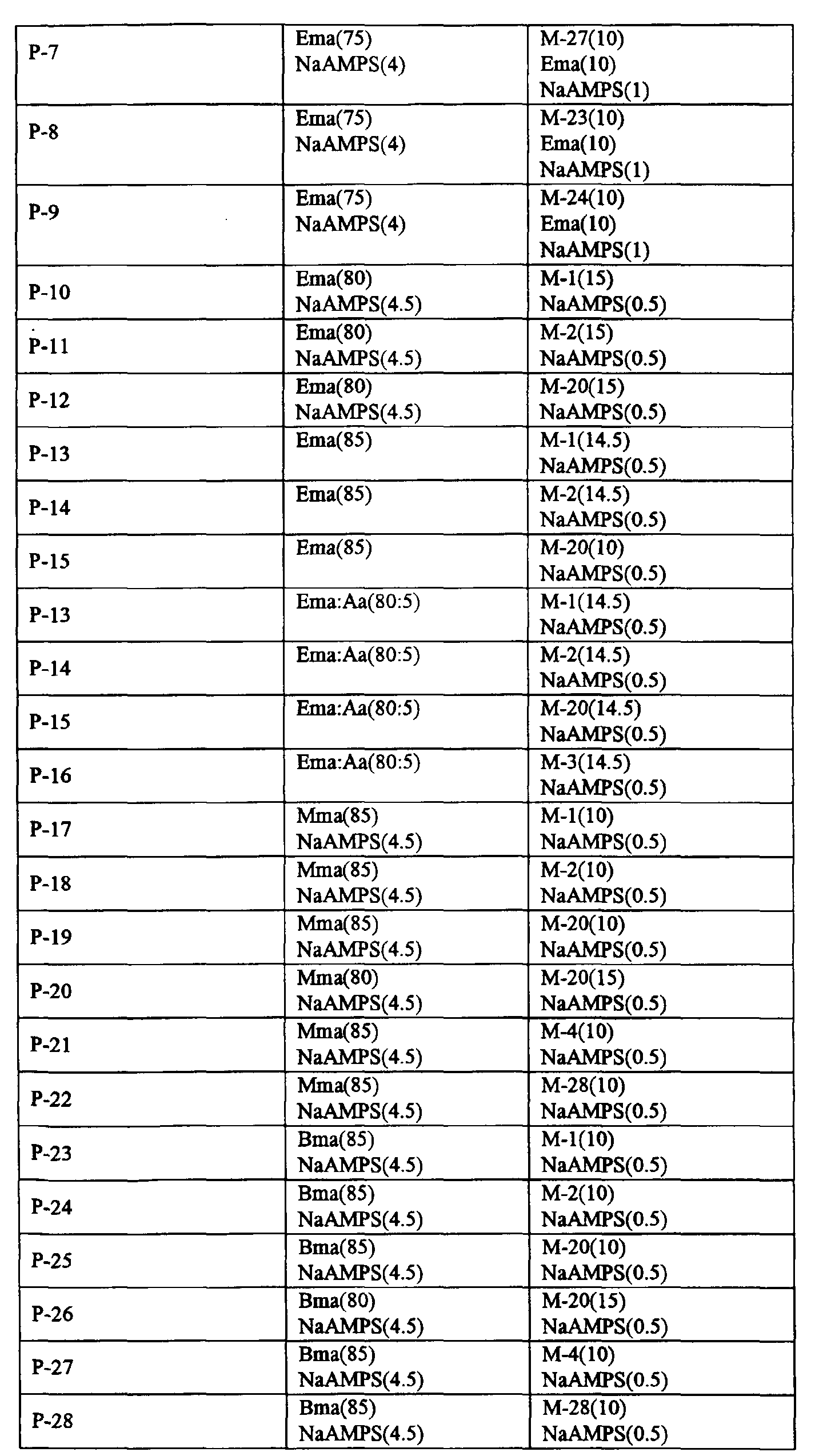
- Preferred polymers of this invention are shown in Table 2.
- the core-shell latexes of this invention are particularly useful for the loading of photographically useful compounds.
- the photographically useful compounds which can be loaded into polymer latexes of this invention include couplers (yellow, cyan, and magenta), masking couplers, inhibitor-releasing couplers, bleach accelerator-releasing couplers, white couplers, dye-releasing couplers, UV absorbers, photostabilizers, filter dyes, high-boiling organic solvents, reducing agents(including oxidized developer scavengers and nucleators), developers, development inhibitors and moderators, optical brighteners, and lubricants, etc.
- Examples of the photographically useful compounds are listed in EP 0 727 704, p-4 top-21.
- Rhodacal A-246L ⁇ -olefin sulfonate, 40 percent solid
- a monomer emulsion comprising 95 g of ethylmethacrylate, 10 g of 2-acryloamido-2-methyl-1-propanesulfonic acid(sodium salt,50%), 3.75 g of Rhodacal A-246L ( ⁇ -olefin sulfonate, 40% solid), 10 g of 10% sodium persulfate, and 200ml of deionized water was fed to the reactor over 2.25 hours. The latex was further polymerized for 30 mins after the monomer addition was finished.
- a second monomer emulsion comprising 11.1 g of 2-ethoxyethylacrylate, 1.17 g of 2-acryloamido-2-methyl-1-propanesulfonic acid (sodium salt, 50%), 1.1 g of 10% sodium persulfate, 0.83 g of Rhodacal A-246L ( ⁇ -olefin sulfonate, 40% solid), and 20 g deionized water was fed to the preformed latex from stage one over 10 mins and further polymerized for one hour. The latex was then cooled to room temperature and filtered. The % solid of the core-shell latex was 20.5% and the Z-average particle size was 43.8 nm.
- the preparation and composition of the ethylmethacrylate core latex was same as in example 1.
- the second stage monomer feed was composed of 11.1 g of 2-methoxyethylacrylate, 1.17 g of 2-acryloamido-2-methyl-1-propanesulfonic acid (sodium salt, 50%), 1.1 g of 10% sodium persulfate, 0.83 g of Rhodacal A-246L( ⁇ -olefin sulfonate, 40% solid), and 20 g D.I. water.
- the percent solids of the core-shell latex was 20.1% and the Z-average particle size was 40.9 nm.
- the preparation and composition of the ethylmethacrylate core latex was same as in example 1.
- the second stage monomer feed was composed of 11.1 g of 2-ethoxyethoxyethylacrylate, 1.17 g of 2-acryloamido-2-methyl-1-propanesulfonic acid (sodium salt, 50%), 1.1 g of 10% sodium persulfate, 0.83 g of Rhodacal A-246L ( ⁇ -olefin sulfonate, 40% solid), and 20 g deionized water.
- the percent solid of the core-shell latex was 20.0% and the Z-average particle size was 42.5 nm.
- the preparation and composition of the ethylmethacrylate core latex was same as example 1.
- the second stage monomer feed was composed of 17.8 g of 2-ethoxyethoxyethylacrylate, 1.87 g of 2-acryloamido-2-methyl-1-propanesulfonic acid (sodium salt, 50%), 1.87 g of 10% sodium persulfate, 1.33 g of Rhodacal A-246L ( ⁇ -olefin sulfonate, 40% solid), and 30 g deionized. water.
- the % solid of the core-shell latex was 20.8% and the Z-average particle size was 46.2nm.
- the preparation of the ethylmethacrylate core latex was same as in example 1 except 83.9 g of ethylmethacrylate and 8.84 g of 2-acryloamido-2-methyl-1-propanesulfonic acid (sodium salt) was used.
- the second stage monomer feed was composed of 11.1 g of ethylmethacrylate, 11.1 g of 2-hydroxyethylmethacrylate, 2.34 g of 2-acryloamido-2-methyl-1-propanesulfonic acid (sodium salt 50%), 2.2 g of 10% sodium persulfate, 1.66g of Rhodacal A-246L ( ⁇ -olefin sulfonate, 40 percent solid), and 40 g deionized water.
- the % solid of the core-shell latex was 19.6% and the Z-average particle size was 44.6 nm.
- the preparation of the ethylmethacrylate core latex was the same as example 5.
- the second stage monomer feed was composed of 11.1 g of ethylmethacrylate, 11.1 g of Sartomer SR-604 (polypropylene glycol methacrylate, MW. 405), 2.34 g of 2-acryloamido-2-methyl-1-propanesulfonic acid (sodium salt, 50%), 2.2 g of 10 % sodium persulfate, 1.66g of Rhodacal A-246L ( ⁇ -olefin sulfonate, 40% solid), and 40 g D.I. water.
- the % solid of the core-shell latex was 19.4 % and the Z-average particle size was 42.6 nm.
- the preparation of the ethylmethacrylate core latex was the same as example 5.
- the second stage monomer feed was composed of 11.1g of ethylmethacrylate, 11.1 g of methoxypolyoxyethylene methacrylate (Polyscience catalogue number 16663), 2.34 g of 2-acryloamido-2-methyl-1-propanesulfonic acid (sodium salt, 50%), 2.2 g of 10% sodium persulfate, 1.66g of Rhodacal A-246L ( ⁇ -olefin sulfonate, 40% solid), and 40 g deionized water.
- the % solid of the core-shell latex was 19.1 % and the Z-average particle size was 40.8 nm.
- the preparation of the ethylmethacrylate core latex was the same as example 5.
- the second stage monomer feed was composed of 11.1 g of ethylmethacrylate, 11.1 g of polyethyleneoxide methacrylate (Monomer&Polymer, Dajac, catalogue # 8926), 2.34 g of 2-acryloamido-2-methyl-1-propanesulfonic acid (sodium salt, 50%), 2.2 g of 10% sodium persulfate, 1.66g of Rhodacal A-246L ( ⁇ -olefin sulfonate, 40 % solid), and 40 g deionized water.
- the % solid of the core-shell latex was 19.2 % and the Z-average particle size was 41.2 nm.
- the preparation of the ethylmethacrylate core latex was the same as example 5.
- the second stage monomer feed was composed of 11.1g of ethylmethacrylate, 11.1 g of polyethyleneoxide methacrylate (HEMA-20 by Alcolac), 2.34 of 2-acryloamido-2-methyl-1-propanesulfonic acid sodium salt, 50%), 2.2 g of 10 % sodium persulfate, 1.66 g of Rhodacal A-246L ( ⁇ -olefin sulfonate, 40% solid), and 40 g deionized water.
- the % solid of the core-shell latex was 19.1% and the Z-average particle size was 45 nm.
- Rhodacal A-246L ⁇ -olefin sulfonate, 40% solid
- a monomer emulsion comprising 95 g of ethylmethacrylate, 10g of 2-acryloamido-2-methyl-1-propanesulfonic acid (sodium salt), 3.75 g of Rhodacal A-246L ( ⁇ -olefin sulfonate, 40% solid), 10 g of 10% sodium persulfate, and 200 ml of deionized water was fed to the reactor over 2.25 hours.
- the latex was further polymerized for 30 mins after the monomer addition was finished.
- the latex was cooled and filtered.
- the % solid of the core-shell latex was 20 % and the Z-average particle size was 40.0 nm.
- the preparation and composition of the ethylmethacrylate core latex was same as m example 5.
- the second stage monomer feed was composed of 11.1 g of ethylmethacrylate, 11.1 g of acrylic acid, 2.34 g of 2-acryloamido-2-methyl-1-propanesulfonic acid(sodium salt, 50%), 2.2 g of 10 % sodium persulfate, 1.66 g of Rhodacal A-246L ( ⁇ -olefin sulfonate, 40 % solid), and 40 g deionized water.
- the % solid of the core-shell latex was 20.1 % and the Z-ave particle size was 43 nm.
- the preparation and composition of the ethylmethacrylate core latex was same as in example 5.
- the second stage monomer feed was composed of 11.1 g of ethylmethacrylate, 11.1 g of methacrylic acid, 2.34 g of 2-acryloamido-2-methyl-1-propanesulfonic acid (sodium salt, 50%), 2.2 g of 10% sodium persulfate, 1.66 g of Rhodacal A-246L ( ⁇ -olefin sulfonate, 40 % solid), and 40 g deionized water.
- the % solid of the core-shell latex was 19.9 % and the Z-average particle size was 43.2 nm.
- the preparation of Ba/NaAMPS(95/5) non core-shell latex was same as in comparison example 1 except that 95g of n-butyl acrylate was used.
- the particle size was 44nm and the % solid of the core-shell latex was 19.8%.
- Bma/NaAMPS(95/5) non core-shell latex was same as in comparison example 1 except that 95g of n-butyl methacrylate was used.
- the particle size was 55nm and the % solid of the core-shell latex was 19.9%.
- composition is the same as invention example 2 except that all monomers were fed together to the reactor over three hours.
- the resulting non core-shell latex had a particle size of 65 nm, which is much larger than the corresponding core-shell latex prepared by the seeded polymerization of this invention.
- composition is the same as invention example 7 except that all monomers were fed together to the reactor over three hours.
- the resulting non core-shell latex had a particle size of 80 nm, which is much larger than the corresponding core-shell latex prepared by the seeded polymerization of this invention.
- Viscosity measurement were made on a solution containing 5.3 2% gelatin and 8 % latex to simulate the photographic dispersion. The viscosity was measured at 45°C by using a Brookfield HBTDV-IICP200 Digital Viscomer. Table 3 shows the viscosity values of a series ultrafine latexes of this invention and comparative examples.
- magenta crosstalk i. e., magenta dye density from a blue separation exposure
- a simplified multilayer coating format (Table 4) was developed.
- Dox scavengers from various dispersions were coated at 6 and 12 mg/sq.ft. Coatings were then exposed and processed trough standard RA4 process.
- Crosstalk was determined by the ratio of Dmax(Green) to Dmax(Blue), where high crosstalk is indicative of low Dox scavengers reactivity.
- the dispersion viscosity at 7.5 and 75 sec -1 and the reactivity of the loaded Dox scavenger dispersion were tabulated in Table 5.
Landscapes
- Chemical & Material Sciences (AREA)
- Chemical Kinetics & Catalysis (AREA)
- Physics & Mathematics (AREA)
- General Physics & Mathematics (AREA)
- Polymers & Plastics (AREA)
- Materials Engineering (AREA)
- Health & Medical Sciences (AREA)
- Medicinal Chemistry (AREA)
- Engineering & Computer Science (AREA)
- Organic Chemistry (AREA)
- Spectroscopy & Molecular Physics (AREA)
- Graft Or Block Polymers (AREA)
- Polymerisation Methods In General (AREA)
- Macromonomer-Based Addition Polymer (AREA)
- Compositions Of Macromolecular Compounds (AREA)
Abstract
The present invention is a polymer latex that includes polymer
particles having a core portion and a shell portion. The core portion contains
polymerized hydrophobic ethylenically unsaturated monomers with a water
solubility less than 1% at room temperature. The shell portion contains
polymerized monomers defined by formula (I)
 wherein
The polymer particles having a size of less than 50 nm.
Description
- The present invention describes small polymer particles that are useful in silver halide applications. More specifically, the present invention is concerned with polymer particles having a size less than 50 nm and have minimum interaction with gelatin.
- Polymer latex has been used extensively for silver halide photographic products. For example, polymer latexes have been employed in several applications in which physical property modification was advantageous or essential. Properties that can be affected include dimensional stability, flexibility, drying rate, cracking, abrasion resistance, and differential swelling. The maintenance of dimensional stability is especially important in graphic arts products, microfilm, X-ray products, and other applications with a premium on resolution. Incorporation of a hydrophobic, nonswelling phase proportionately reduces swelling as a function or relative humidity and thus the drying will be also improved. Low glass transition (Tg) latexes and gelatin grafted latex have been used for the reduction of pressure sensitivity or undesirable fog of the photographic products. Polymer latexes are especially useful as the carrier of the photographically useful compounds. The photographically useful compounds include image couplers, developers, masking couplers, antifoggants, brightners, lubricants, latent image stabilizers, sensitizers, filter dyes, UV absorbers, oxidized developer scavengers, hardeners, stabilizers, antioxidants, bleach accelerators, and coupler solvents. This process is often called "loading". There are two major processes for the loading of photographically useful compounds into polymer latexes. In the first process, the photographically useful compounds, coupler solvents, such as o-dibutylphthalate, and a low boiling water-miscible organic solvents, such as tetrahydrofuran, acetone, or methanol are mixed to form a homogeneous solution. This solution was then added slowly to the polymer latex with vigorous stirring to force the loading of photographically compounds into polymer latex. The low boiling organic solvents is removed by evaporation after the loading is completed, with the result that the hydrophobic compounds becomes imbedded in the latex particles. The first process is described in US 4,203,716, US 4,304,769, and US 4,368,258. In the second loading process the photographically useful compounds, such as couplers, and optional high-boiling solvents, such as o-dibutylphthalate, are combined at a temperature sufficient to prepare a liquid solution of the oil compounds. This oil solution is then combined with an aqueous solution containing gelatin and surfactants to form pre-mix. Polymer latex is either included in the aqueous solution before the oil phase is added, or is added to the oil-gelatin premix. The mixture is then passed through a high shear device, such as homogenizer, colloid mill, or microfluidizer, to force the loading of the photographically useful compounds into the polymer latex. The second loading process is described in US 5,594,047, EP 0 727 703 and EP 0 727 703. The second process is preferred since low boiling organic solvents are not required.
- The particle size of the polymer latexes used in the photographic products are usually under 100nm or preferably under 50nm. Larger particle size polymer latexes tend to scatter light and reduce the film clarity of the photographic products. Large particle size latex also reduce the loading efficiency and reduce the photographic performance of the photographically useful compounds. However, gelatin solution containing small particle size latexes or dispersions tend to have very high melt viscosities. The cause of the high melt viscosity of small particle size latexes or dispersion is due to adsorption of gelatin onto the surface of these particles and thus the apparent hydrodynamic volume of the particles increase dramatically. The schematic explanation of this phenomena was shown column 4 lines 3-4 of US Pat. No. 5,135,844. High melt viscosity not only cause manufacturing difficulties and reduced the coating speed but also caused coating defects, such as coating unevenness and coating streaking. This is especially true when the particle size of the hydrophobic latex is less than 50 nm.
- There are few addenda known in the prior art for the reduction of high melt viscosity of small particle size latex or dispersions. US Pat. Nos. 3,409,435, US 5,135,844, and US 5,300,418 describe the use of oligomeric surfactants for the reduction of high melt viscosity. Three types of surfactants which are effective to reduce the high melt viscosity are mentioned. The first type is a surfactant composed of a 6 to 22 carbon atom hydrophobic tail with one or more attached hydrophilic chains of at least 8 oxyethylne and/or glycedyl ether groups that may or may not be terminated with a negative charge such as a sulfate group. The second type are block oligomeric surfactants composed of hydrophobic polyoxypropylene blocks(A) and hydrophilic polyoxyethylene blocks(B) joined in the manner of A-B-A, B-A-B, A-B, or with a connecting moiety between them. The third addenda type are sugar surfactants, composed of between one to three 6 to 22 carbon atom hydrophilic tails with one or more attached hydrophilic mono or oligosaccharidic chains that may or may not be terminated by a negatively charged group such as a sulfate group. However, such prior art materials that containing a large number of polyalkylene oxide groups produce adverse photographic (sensitometric) effects in some photographic products. These oligomeric surfactants tend to migrate from layer to layer or be adsorbed to the silver halide grain which fogs the emulsion. Sugar surfactants do not have the adverse photographic effects but they tend to reduce the surface tension of the layer and create coating problems, such as repellency. EP 0 695 968 discloses the use of α-cyclodextran for the reduction of melt viscosity. However, α-cyclodextran is expensive and fairly large amounts are needed to be effective. Another way of reducing high melt viscosities is by dilution with water. However, such a procedure leads to increased water load in the drier, and reduced the drying time.
- Therefore, there is a need for the alternative ways to reduce the high melt viscosity when small particle size polymer latexes are used in photographic systems.
- The present invention is a polymer latex that includes polymer particles having a core portion and a shell portion. The core portion contains polymerized hydrophobic ethylenically unsaturated monomers with a water solubility less than 1% at room temperature. The shell potion contains polymerized monomers defined by formula (I)wherein

- X is O or NH, or NCH3,
- R1 and R2 are H, CH3, C2H5, C3H7, or C4H9,
- R3 and R4 are H, CH2 or -CHCH3,
- n1 and n2 are integers, n1 is from 1 to 4, n2 is from 1 to 20
-
- This invention relates to the preparation and composition of extra fine particle size polymer latexes for the use in the AgX photographic materials. The average particle size of the polymer latexes is less than 50nm. The polymer latexes of this invention have the core-shell morphology. The composition of the core is derived from monomers with low water solubilities (less than 1% in water at 25 °C). The class of monomers with low water solubility include alkyl acrylate, alkyl methacrylate, alkyl acrylamide, alkyl methacrylamide, styrene, acrylonitrile, butadiene, and ethylene. Two or more hydrophobic monomers can be copolymerized to from the core. The composition of shell is derived from monomers with high water solubilities (higher than 1% in water at 25 °C) and with poly(ethylene oxide) or poly(propylene oxide) repeating units, such as methoxyethyl (meth)acrylate, as methoxyethoxyethyl (meth)acrylate, ethoxyethyl (meth)acrylate, ethoxyethoxyethyl (meth)acrylate, hydroxyethyl (meth)acrylate, poly(ethylyne oxide) (meth)acrylate, methoxy poly(ethylene oxide) (meth)acrylate, and ethoxy poly(ethylene oxide) (meth)acrylate.
- We have developed a method preparing ultrafine small particle size polymer latexes which have much lower melt viscosity than the regular polymer latexes with same particle size. This is accomplished by the combination of two stage seeded polymerization and the incorporation of special functional monomers on the surface of the preformed seed particles. This invention does not require the addition of oligomeric surfactants as described in the prior art, therefore, the drawbacks of prior art can be avoided. The functional monomers incorporated in the second stage as shell materials are covalently bonded to the polymer particles and therefore would not migrate through layers and cause adverse sensitometric effects. The two stage seeded polymerization process is not new and is fully described in the "Emulsion Polymerization and Emulsion Polymers, P.A.Lovell and M.S.El-Aasser ed., Wiley, NY(1997) pp. 294-323. However, ultrafine polymer latexes (less than 50 nm in diameter) with the composition of this invention which have very low gelatin-particle interaction is new.
- The first stage is the preparation of ultrafine small particle size core particles. The composition of the core is mainly the hydrophobic monomers such that their homopolymer or copolymer have with water solubility less than 0.1% at room temperature. Examples of the hydrophobic monomers include ethylene, propylene, 1-butene, styrenic monomers (such as styrene, vinyl toluene, alpha-methyl styrene), and mono-ethylenic vinyl esters (such as vinyl acetate, vinyl pivalate, vinyl propionate, vinyl laurate), alkyl acrylate or methacrylate (such as methyl acrylate, isopropy acrylate, isopropyl methacrylate, ethyl acrylate, ethyl methacrylate, n-butyl acrylate, n-butyl methacrylate, methyl methacrylate, n-butyl methacrylate, benzyl acrylate, 2-ethylhexyl acrylate, cyclohexyl methacrylate, tetrafurfuryl acrylate, tetrafurfuryl methacrylate diethyl maleate, diethyl itaconate), ethylenic unsaturated monocarboxlic acid amides (such as isopropylacrylamide, n-butylacrylamide, n-hexylacrylamide, t-butylacrylamide, n-butylmethacrylamide, n-hexylmethacrylamide, and dimethylacrylamide), acrylonitrile), methacrylonitrile, and dienes (such as butadiene, isoprene). Most preferred hydrophobic monomers include methylmethacrylate, ethylmethacrylate, n-butylacrylate, n-butylmethacrylate, 2-ethylhexylacrylate, isopropylacrylate, isopropylmethacrylate, and styrene. Two or more hydrophobic monomers can be copolymerized to form the core. The total weight percent of the hydrophobic monomers is from 50 to 95%, and preferably from 70 to 90% based on the total amount of core-shell polymer compositions.
- The second stage is the formation of shell around the surface of the core particles. In order to minimize the interaction of the gelatin with the hydrophobic core particles, we have discovered that monomers defined in formula (I) are especially effective.Where

- X is O or NH, or NCH3.
- R1 and R2 are H, CH3, C2H5, C3H7, or C4H9.
- R3 and R4 are H, CH2 or -CHCH3,
- n1 and n2 are integers, n1 is from 1 to 4, n2 is from 1 to 20 Examples of the monomers as defined in formula (I) are shown in the Table 1.
-
- Two or more of the hydrophilic comonomers can be copolymerized together. The total weight percent of the hydrophilic comonomers is from 2 to 30 percent and preferably from 5 to 20 percent based on the total amount of core-shell polymer compositions.
- In addition to the hydrophobic and hydrophilic monomers described above, water-soluble ionogenic monomers containing carboxylic acid, sulfonic acid, sulfuric acid, and phosphoric acid functional groups may be used to modify the physical properties of polymer latex such as particle size and latex stability. Examples of these ionogenic monomers are vinyl sulfonate(H+, Na, or K+ salt), 2-sulfoethylmethacrylate(H+, Na, or K+ salt), 3-sulfopropylmethacrylate(H+, Na, or K+ salt), sodium styrene sulfonate, potassium styrene sulfonate, 2-acryloamido-2-methyl-1-propanesulfonic acid(H+ , Na, or K+ salt), vinyl phosphoric acid, acrylic and methacrylic acid. Surface-active ionogenic monomers, such as examples in US 4,340,664, can also be used to modify the physical properties of polymer latex. The preferred water soluble ionogenic monomer for use in the process is the 2-acryloamido-2-methyl-1-propanesulfonic acid as this material provides a stable polymer latex dispersion. Ionogenic monomers can be used with hydrophobic monomers to form the core or used with hydrophilic monomers defined in formula (I) to form the shell.
- A buffering agent can also be used to control the pH of the polymerization medium. Examples of buffering agents include sodium bicarbonate, sodium carbonate, potassium phosphate, potassium hydrogen phosphate, potassium hydrogen phthalate, sodium acetate, sodium succinate, and Borax.
- These polymer latexes are prepared by the emulsion polymerization method. Emulsion polymerizations are well known in the art and are described in: (1) F. A. Bovey, Emulsion Polymerization, Interscience Publishers Inc., New York, 1955; (2) C. Schildknecht and I. Skeist, Polymerization Process, pp. 143-197, Wiley-Interscience Publication, NY, 1977; (3) R. Fitch, Polymer Colloid II, Plenum Press, NY, 1980; and (4) P. A. Lovell, M.S. El-Aasser, Emulsion Polymerization and Emulsion Polymers, Wiley, NY, 1997. α-olefin sulfonate The amount of surfactant used to stabilize the polymer latex is between 0.1 and 20% and, preferably, between 2 to 10% based on the total weight of monomers. A large number of surface-active compounds are suitable as emulsifying agents, such as soaps, alkylsulfonate and sulfates, cationic compounds, amphoteric compounds, nonionic surfactants, and high molecular weight protective colloids. A complete list of surfactants can be found in McCutcheon's Emulsifiers & Detergents, MC Publishing Co., Glen Rock, NJ, USA. Examples are sodium N-methyl-N-oleoyltaurate, α-olefin sulfonate, sodium dodecylbenzene sulfonate, sodium dodecyl sulfate, sodium or ammonium salt of sulfated nonylphenoxypoly (ethyleneoxy) ethanol, sodium alkylnaphthalene sulfonate, ethoxylated alkylphenols, monM-1thanolamine dodecyldiphenyloxide disulfonate, derivatives of sulfosuccinate, poly(ethyleneoxy-b-propyleneoxy), sodium salt of alkylaryl polyether sulfonate, poly(saccharides), sucrose and glucose esters and derivatives. Preferred surfactants are sodium dodecyl sulfate, sodium N-methyl-N-oleoyltaurate, and α-olefin sulfonate. α-olefin sulfonate is especially efficient to prepare the ultrafine particle size latex of this invention.
- The free-radical polymerization of solid monomer is initiated by the addition to the monomer molecule of a free radical that has been formed either by thermal decomposition, by the oxidation-reduction reaction, or by physical action such as by UV light or other high energy radiation, ultrasonic waves, etc. A more complete list of initiating agents is given in F. A. Bovey, Emulsion Polymerization, Interscience Publishers, Inc., New York, (1955), p. 59-93. Water-soluble initiators are preferred and can be added to the solid dispersion, to the polymerization vessel, or both. Examples are the salt of persulfate (sodium, potassium, and ammonium), hydrogen peroxide, 4,4-azobis(4-cyanovaleric acid), 2,2'-azobis(2-methyl-N-(2-hydroxyethyl)propionamide), 2,2'-azobis(2-methyl-N-(1,1-bis(hydroxymethyl)ethyl)propionamide, 2,2'-azobis(N,N'-dimethyleneisobutyramide) dihydrochloride, hydrogen peroxide-Fe+3, persulfate-metabisulfite, persulfate-bisulfite, persulfate-sodium formaldehyde sulfoxylate, t-alkyl hydroperoxide, sodium formaldehyde sulfoxylate, etc. Examples of oil-soluble initiators include azobis(isobutyronitrile), dimethyl 2,2'-azobisisobutyrate, alkyl hydroperoide, etc. The amount of catalyst is usually from 0.01 to 5% by weight, preferably 0.1 to 3.0% by weight of the total monomers. The preferred free radical polymerization initiator is sodium persulfate as this material gives a high yield of the polymer latex and rapid polymerization.
- The formation of core-shell latexes with the composition of this invention is carried out by the seeded polymerization method. The hydrophobic monomers of this invention were polymerized by batch or semicontinous process first to form the seed. The hydrophilic monomers of this invention was then fed to the preformed seed polymer particles semicontinously to form the shell structure. Preferred polymers of this invention are shown in Table 2.


- The core-shell latexes of this invention are particularly useful for the loading of photographically useful compounds. Examples of the photographically useful compounds which can be loaded into polymer latexes of this invention include couplers (yellow, cyan, and magenta), masking couplers, inhibitor-releasing couplers, bleach accelerator-releasing couplers, white couplers, dye-releasing couplers, UV absorbers, photostabilizers, filter dyes, high-boiling organic solvents, reducing agents(including oxidized developer scavengers and nucleators), developers, development inhibitors and moderators, optical brighteners, and lubricants, etc. Examples of the photographically useful compounds are listed in EP 0 727 704, p-4 top-21.
- The typical procedure for the preparation of core-shell latex of this invention are demonstrated by the following examples.
- 200 ml deionized water and 3.75 g of Rhodacal A-246L (α-olefin sulfonate, 40 percent solid) were charged to a 500 ml 3-neck round flask equipped with a condenser, mechanical stirrer, and nitrogen inlet. The flask was immersed in an 80°C constant temperature bath and purged with nitrogen for 30 mins. A monomer emulsion comprising 95 g of ethylmethacrylate, 10 g of 2-acryloamido-2-methyl-1-propanesulfonic acid(sodium salt,50%), 3.75 g of Rhodacal A-246L (α-olefin sulfonate, 40% solid), 10 g of 10% sodium persulfate, and 200ml of deionized water was fed to the reactor over 2.25 hours. The latex was further polymerized for 30 mins after the monomer addition was finished.
- A second monomer emulsion comprising 11.1 g of 2-ethoxyethylacrylate, 1.17 g of 2-acryloamido-2-methyl-1-propanesulfonic acid (sodium salt, 50%), 1.1 g of 10% sodium persulfate, 0.83 g of Rhodacal A-246L (α-olefin sulfonate, 40% solid), and 20 g deionized water was fed to the preformed latex from stage one over 10 mins and further polymerized for one hour. The latex was then cooled to room temperature and filtered. The % solid of the core-shell latex was 20.5% and the Z-average particle size was 43.8 nm.
- The preparation and composition of the ethylmethacrylate core latex was same as in example 1. The second stage monomer feed was composed of 11.1 g of 2-methoxyethylacrylate, 1.17 g of 2-acryloamido-2-methyl-1-propanesulfonic acid (sodium salt, 50%), 1.1 g of 10% sodium persulfate, 0.83 g of Rhodacal A-246L(α-olefin sulfonate, 40% solid), and 20 g D.I. water. The percent solids of the core-shell latex was 20.1% and the Z-average particle size was 40.9 nm.
- The preparation and composition of the ethylmethacrylate core latex was same as in example 1. The second stage monomer feed was composed of 11.1 g of 2-ethoxyethoxyethylacrylate, 1.17 g of 2-acryloamido-2-methyl-1-propanesulfonic acid (sodium salt, 50%), 1.1 g of 10% sodium persulfate, 0.83 g of Rhodacal A-246L (α-olefin sulfonate, 40% solid), and 20 g deionized water. The percent solid of the core-shell latex was 20.0% and the Z-average particle size was 42.5 nm.
- The preparation and composition of the ethylmethacrylate core latex was same as example 1. The second stage monomer feed was composed of 17.8 g of 2-ethoxyethoxyethylacrylate, 1.87 g of 2-acryloamido-2-methyl-1-propanesulfonic acid (sodium salt, 50%), 1.87 g of 10% sodium persulfate, 1.33 g of Rhodacal A-246L (α-olefin sulfonate, 40% solid), and 30 g deionized. water. The % solid of the core-shell latex was 20.8% and the Z-average particle size was 46.2nm.
- The preparation of the ethylmethacrylate core latex was same as in example 1 except 83.9 g of ethylmethacrylate and 8.84 g of 2-acryloamido-2-methyl-1-propanesulfonic acid (sodium salt) was used. The second stage monomer feed was composed of 11.1 g of ethylmethacrylate, 11.1 g of 2-hydroxyethylmethacrylate, 2.34 g of 2-acryloamido-2-methyl-1-propanesulfonic acid (sodium salt 50%), 2.2 g of 10% sodium persulfate, 1.66g of Rhodacal A-246L (α-olefin sulfonate, 40 percent solid), and 40 g deionized water. The % solid of the core-shell latex was 19.6% and the Z-average particle size was 44.6 nm.
- The preparation of the ethylmethacrylate core latex was the same as example 5. The second stage monomer feed was composed of 11.1 g of ethylmethacrylate, 11.1 g of Sartomer SR-604 (polypropylene glycol methacrylate, MW. 405), 2.34 g of 2-acryloamido-2-methyl-1-propanesulfonic acid (sodium salt, 50%), 2.2 g of 10 % sodium persulfate, 1.66g of Rhodacal A-246L (α-olefin sulfonate, 40% solid), and 40 g D.I. water. The % solid of the core-shell latex was 19.4 % and the Z-average particle size was 42.6 nm.
- The preparation of the ethylmethacrylate core latex was the same as example 5. The second stage monomer feed was composed of 11.1g of ethylmethacrylate, 11.1 g of methoxypolyoxyethylene methacrylate (Polyscience catalogue number 16663), 2.34 g of 2-acryloamido-2-methyl-1-propanesulfonic acid (sodium salt, 50%), 2.2 g of 10% sodium persulfate, 1.66g of Rhodacal A-246L (α-olefin sulfonate, 40% solid), and 40 g deionized water. The % solid of the core-shell latex was 19.1 % and the Z-average particle size was 40.8 nm.
- The preparation of the ethylmethacrylate core latex was the same as example 5. The second stage monomer feed was composed of 11.1 g of ethylmethacrylate, 11.1 g of polyethyleneoxide methacrylate (Monomer&Polymer, Dajac, catalogue # 8926), 2.34 g of 2-acryloamido-2-methyl-1-propanesulfonic acid (sodium salt, 50%), 2.2 g of 10% sodium persulfate, 1.66g of Rhodacal A-246L (α-olefin sulfonate, 40 % solid), and 40 g deionized water. The % solid of the core-shell latex was 19.2 % and the Z-average particle size was 41.2 nm.
- The preparation of the ethylmethacrylate core latex was the same as example 5. The second stage monomer feed was composed of 11.1g of ethylmethacrylate, 11.1 g of polyethyleneoxide methacrylate (HEMA-20 by Alcolac), 2.34 of 2-acryloamido-2-methyl-1-propanesulfonic acid sodium salt, 50%), 2.2 g of 10 % sodium persulfate, 1.66 g of Rhodacal A-246L (α-olefin sulfonate, 40% solid), and 40 g deionized water. The % solid of the core-shell latex was 19.1% and the Z-average particle size was 45 nm.
- The preparation of small particle size latexes which do not have the core-shell structures as described in this invention are described below as comparison examples.
- 200ml deionized water and 3.75 g of Rhodacal A-246L (α-olefin sulfonate, 40% solid) were charged to a 500 ml 3-neck round bottom flask equipped with a condenser, mechanical stirrer, and nitrogen inlet. The flask was immersed in an 80 °C constant temperature bath and purged with nitrogen for 30 mins. A monomer emulsion comprising 95 g of ethylmethacrylate, 10g of 2-acryloamido-2-methyl-1-propanesulfonic acid (sodium salt), 3.75 g of Rhodacal A-246L (α-olefin sulfonate, 40% solid), 10 g of 10% sodium persulfate, and 200 ml of deionized water was fed to the reactor over 2.25 hours. The latex was further polymerized for 30 mins after the monomer addition was finished. The latex was cooled and filtered. The % solid of the core-shell latex was 20 % and the Z-average particle size was 40.0 nm.
- The preparation and composition of the ethylmethacrylate core latex was same as m example 5. The second stage monomer feed was composed of 11.1 g of ethylmethacrylate, 11.1 g of acrylic acid, 2.34 g of 2-acryloamido-2-methyl-1-propanesulfonic acid(sodium salt, 50%), 2.2 g of 10 % sodium persulfate, 1.66 g of Rhodacal A-246L (α-olefin sulfonate, 40 % solid), and 40 g deionized water. The % solid of the core-shell latex was 20.1 % and the Z-ave particle size was 43 nm.
- The preparation and composition of the ethylmethacrylate core latex was same as in example 5. The second stage monomer feed was composed of 11.1 g of ethylmethacrylate, 11.1 g of methacrylic acid, 2.34 g of 2-acryloamido-2-methyl-1-propanesulfonic acid (sodium salt, 50%), 2.2 g of 10% sodium persulfate, 1.66 g of Rhodacal A-246L (α-olefin sulfonate, 40 % solid), and 40 g deionized water. The % solid of the core-shell latex was 19.9 % and the Z-average particle size was 43.2 nm.
- The preparation of Ba/NaAMPS(95/5) non core-shell latex was same as in comparison example 1 except that 95g of n-butyl acrylate was used. The particle size was 44nm and the % solid of the core-shell latex was 19.8%.
- The preparation of Bma/NaAMPS(95/5) non core-shell latex was same as in comparison example 1 except that 95g of n-butyl methacrylate was used. The particle size was 55nm and the % solid of the core-shell latex was 19.9%.
- The composition is the same as invention example 2 except that all monomers were fed together to the reactor over three hours. The resulting non core-shell latex had a particle size of 65 nm, which is much larger than the corresponding core-shell latex prepared by the seeded polymerization of this invention.
- The composition is the same as invention example 7 except that all monomers were fed together to the reactor over three hours. The resulting non core-shell latex had a particle size of 80 nm, which is much larger than the corresponding core-shell latex prepared by the seeded polymerization of this invention.
- The advantages of the latexes of this invention will become more apparent by the following two viscosity experiments.
- Viscosity measurement were made on a solution containing 5.3 2% gelatin and 8 % latex to simulate the photographic dispersion. The viscosity was measured at 45°C by using a Brookfield HBTDV-IICP200 Digital Viscomer. Table 3 shows the viscosity values of a series ultrafine latexes of this invention and comparative examples.
Polymer ID Composition Wt Ratio Core-shell Particle Size(nm) Viscosity cps @75 sec-1 Remark Comparison 1 Ema:NaAMPS 95/5 No 40 41.80 Comparison Comparison 2 Ema:Aa:NaAMPS 85/10/5 No 43 44.50 Comparison Comparison 3 Ema:Maa:NaAMPS 85/10/5 Yes 43 41.8 Comparison Comparison 4 Ba:NaAMPS 95/5 No 44 123 Comparison Comparison 5 Bma:NaAMPS 95/5 No 55 63 Comparison Comparison 6 Ema:M-2: NaAMPS 85/10/5 No 65 36 Comparison Comparison 7 Ema:M-28: NaAMPS 85/10/5 No 80 38 Comparison P-2 Ema:M-2: NaAMPS 85/10/5 Yes 41 31.40 Invention P-3 Ema:M-20: NaAMPS 85/10/5 Yes 43 31.40 Invention P-4 Ema:M-20: NaAMPS 80/15/5 Yes 46 23.50 Invention P-5 Ema:M-4: NaAMPS 85/10/5 Yes 45 23.50 Invention P-6 Ema:M-28: NaAMPS 85/10/5 Yes 43 28.8 Invention P-7 Ema:M-27: NaAMPS 85/10/5 Yes 41 18.30 Invention P-8 Ema:M-23: NaAMPS 85/10/5 Yes 41 23.5 Invention P-9 Ema:M-24: NaAMPS 85/10/5 Yes 45 26.2 Invention Ema: Ethyl methacrylate
Mma: Methyl methacrylate
NaAMPS: 2-acryloamido-2-methyl-1-propanesulfonic acid, sodium salt
Bma: n-Butyl methacrylate
Ba: n-Butyl acrylate
Aa: Acrylic acid
Maa: Methacrylic acid - It is clear from Table 3 that polymer latexes of this invention have much lower melt viscosities than the comparative examples of similar particle sizes (comparison example 1, 2, 3) without the functional monomers of this invention. Also, comparison example 6 and 7, which have the same composition as invention example P-2 and P-7, have much larger particle size and higher viscosity. This table also demonstrates that other hydrophilic monomers, such as acrylic acid and methacrylic acids (comparison examples 2 and 3) are not as effective to reduce the melt viscosity as the functional monomers defined in formula (I).
- Selected latexes were chosen for the loading of Dox scavenger (Table 4) to the study the effect of comonomers on the reactivity of Dox scavengers and their melt viscosity. The dispersion was composed of 5.32 % Dox scavenger, 2.26 % dibutyl phthalate, 5.32 % of latexes, and 8.0 % of gelatin. Dox scavenger and dibutyl phthalate were mixed and heated at 110-120°C until a homogeneous solution was obtained. An aqueous solution containing gelatin and latex was added to form a pre-mix. The premix was then passed through a microfluidizer in a constant temperature bath at 70 °C, and with pressure of 7200 psi for three cycles. This process is described in US 5,594,047.
- In order to effectively evaluate magenta crosstalk (i. e., magenta dye density from a blue separation exposure) as a function of Dox scavengers reactivity, a simplified multilayer coating format (Table 4) was developed. Dox scavengers from various dispersions were coated at 6 and 12 mg/sq.ft. Coatings were then exposed and processed trough standard RA4 process. Crosstalk was determined by the ratio of Dmax(Green) to Dmax(Blue), where high crosstalk is indicative of low Dox scavengers reactivity. The dispersion viscosity at 7.5 and 75 sec-1 and the reactivity of the loaded Dox scavenger dispersion were tabulated in Table 5.

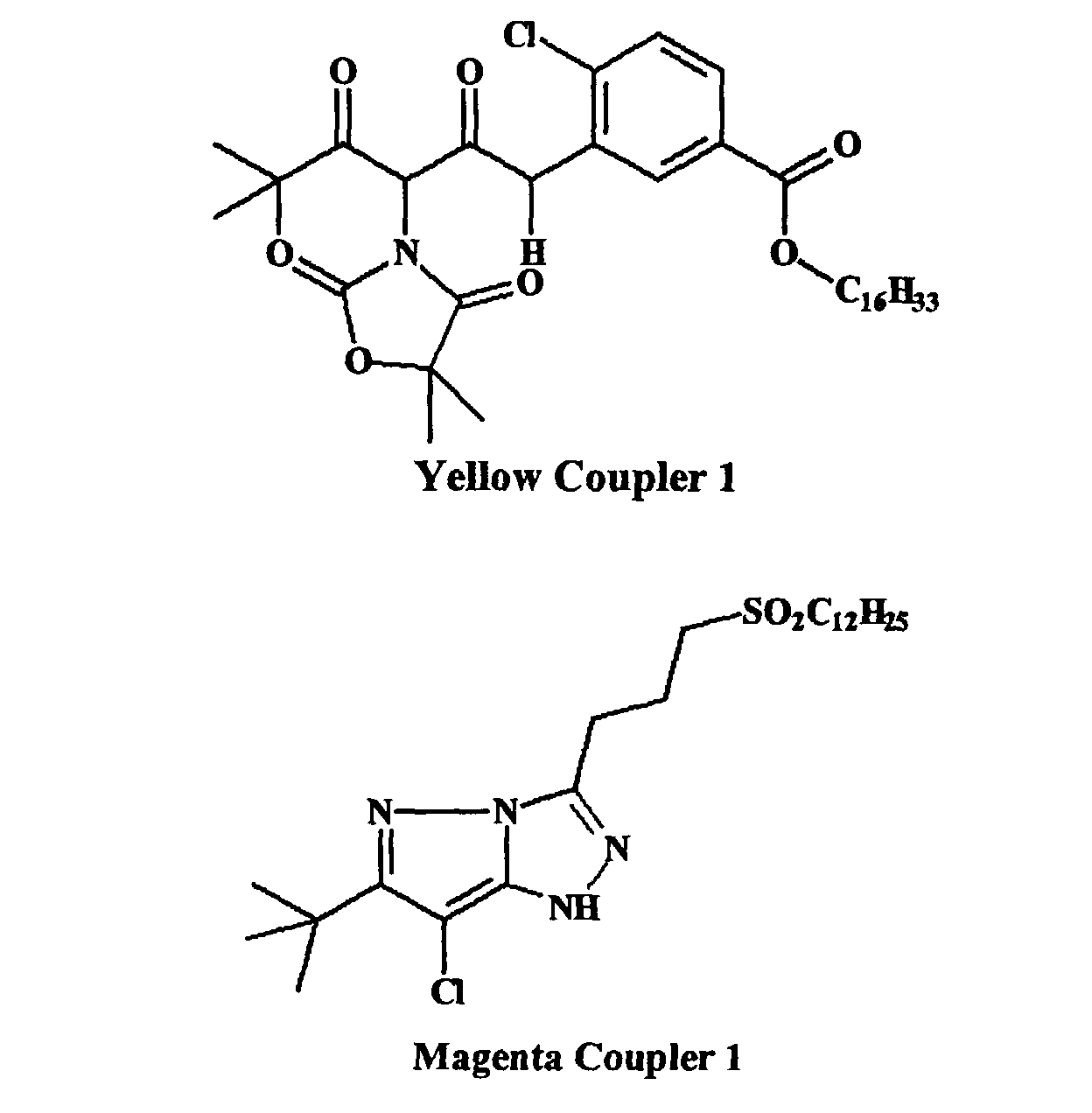
Polymer ID Composition Wt Ratio Particle Size (nm) of latex Viscosity cps @7.5 sec-1 Viscosity cps @75 sec-1 Crosstalk @12mg/ft2 Remarks Comparison 1 Ema:NaAMPS 95/5 40 1260 510 0.287 Comparison Comparison 2 Ema:Aa: 85/10/5 43 1650 645 0.296 Comparison NaAMPS Comparison 3 Ema:Maa: 85/10/5 43 1340 600 0.263 Comparison NaAMPS P-2 Ema:M-2: 85/10 /5 41 705 356 0.276 Invention NaAMPS P-5 Ema: M-4: 85/10/5 45 735 382 0.318 Invention NaAMPS P-6 Ema: M-28: 85/10/5 43 680 358 0.286 Invention NaAMPS - The advantages of the polymer latexes of this invention is very clear from Table 5 that the dispersion comprising Dox scavenger loaded in the latexes of this invention have good scavenging activities but their melt viscosities

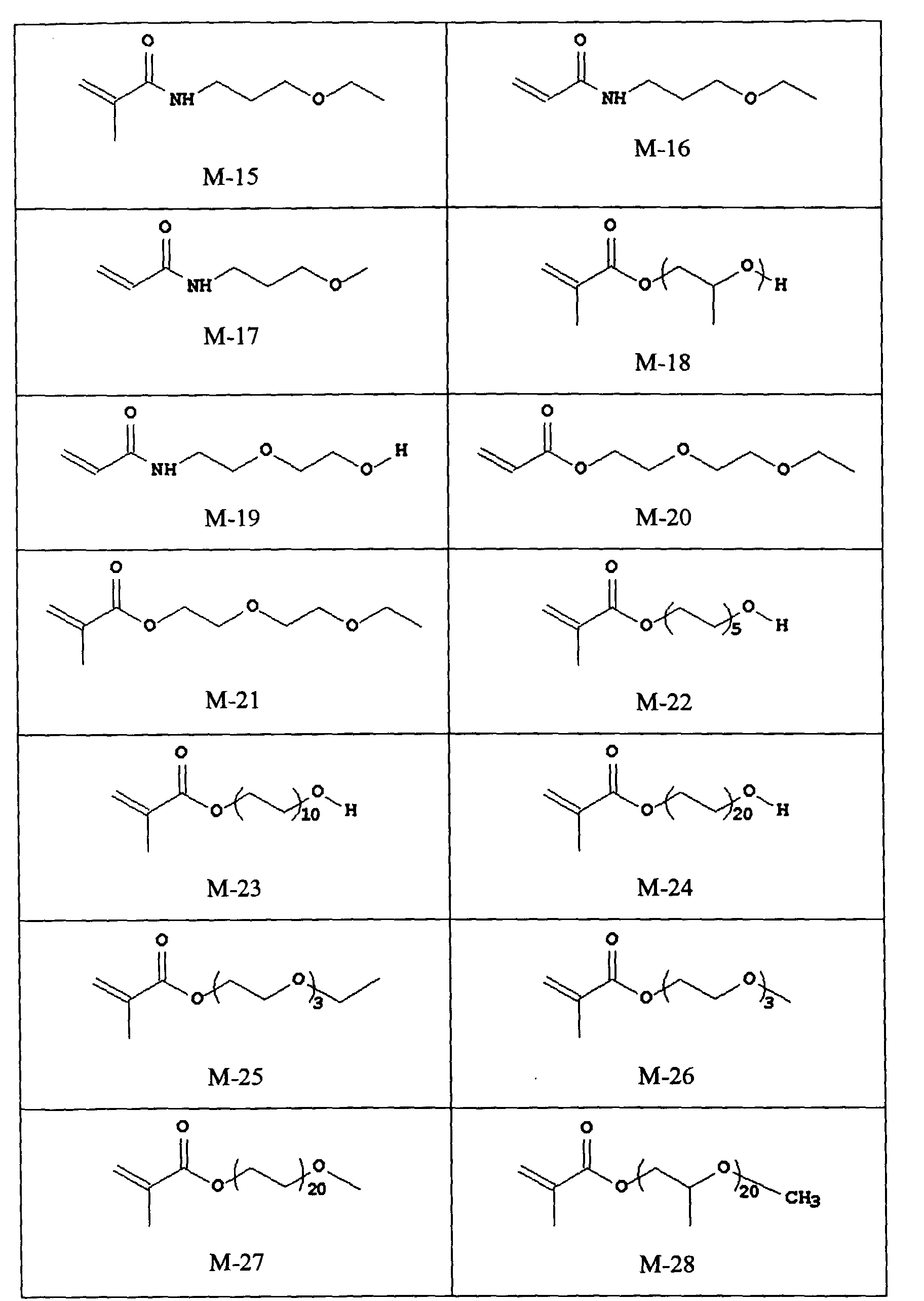
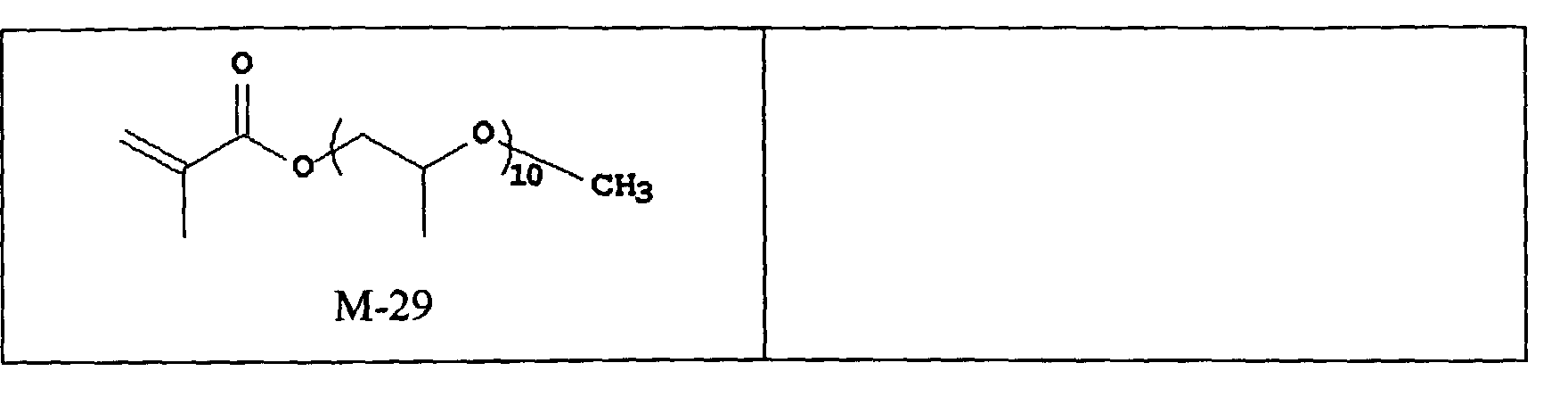
Claims (10)
- A polymer latex comprising; polymer particles comprising a core portion and a shell portion, the core portion comprising polymerized hydrophobic ethylenically unsaturated monomers with water solubility less than 1% at room temperature, the shell portion comprising polymerized monomers defined by formula (I)wherein
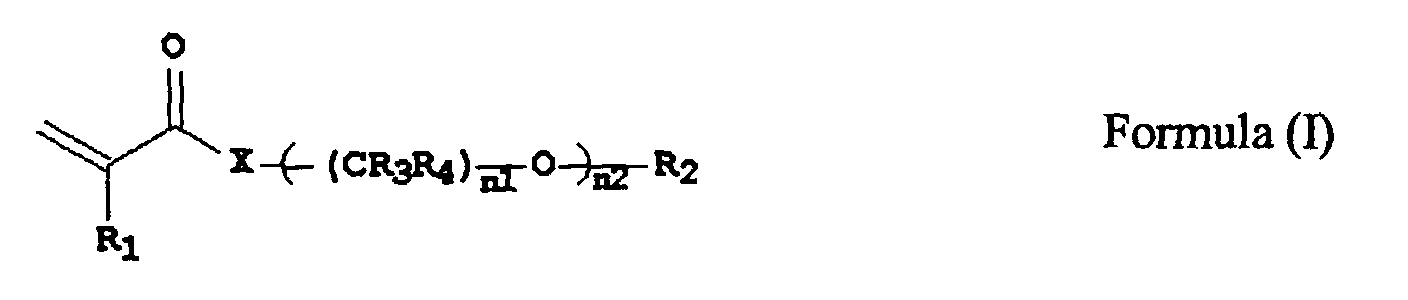 X is O or NH, or NCH3,R1 and R2 are H, CH3, C2H5, C3H7, or C4H9,R3 and R4 are H or CH3,R3 and R4 are H, CH2 or -CHCH3,n1 and n2 are integers, n1 is from 1 to 4, n2 is from 1 to 20.
 - The polymer latex of claim 1 wherein the polymer latex is used in the silver halide photographic materials.
- The polymer latex of claim 1 wherein the particle size of the polymer latex is less than 50nm.
- The polymer latex of claim 1 wherein the hydrophobic monomer to form the core portion of the polymer latex is from 50 to 95% by weight of the total polymer composition.
- The polymer latex of claim 1 wherein the hydrophilic monomer to form the shell portion of the polymer latex is from 5 to 50% by weight of the total polymer composition.
- The polymer latex of claim 1 wherein the monomers forming the core portion of the core-shell latex comprise ethylene, propylene, 1-butene, styrenic monomers, mono-ethylenic vinyl esters, alkyl acrylate, alkyl methacrylate, ethylenic alkyl acrylamides, alkyl methacrylamides , acrylonitrile, methacrylonitrile, and dienes. The weight % of hydrophobic monomers is from 50 to 95% of the total core-shell polymer latex.
- The polymer latex of claim 1 wherein the hydrophobic monomers forming the core portion of the core-shell latex comprise ethylene, propylene, 1-butene, styrenic monomers (such as styrene, vinyl toluene, alpha-methyl styrene), and mono-ethylenic vinyl esters (such as vinyl acetate, vinyl pivalate, vinyl propionate, vinyl laurate), alkyl acrylate or methacrylate (such as methyl acrylate, isopropy acrylate, isopropyl methacrylate, ethyl acrylate, ethyl methacrylate, n-butyl acrylate, n-butyl methacrylate, methyl methacrylate, n-butyl methacrylate, benzyl acrylate, 2-ethylhexyl acrylate, cyclohexyl methacrylate, tetrafurfuryl acrylate, tetrafurfuryl methacrylate diethyl maleate, diethyl itaconate), ethylenic unsaturated monocarboxlic acid amides (such as isopropylacrylamide, n-butylacrylamide, n-hexylacrylamide, t-butylacrylamide, n-butylmethacrylamide, n-hexylmethacrylamide, and dimethylacrylamide), acrylonitrile), methacrylonitrile, and dienes (such as butadiene, isoprene.
- Most preferred hydrophobic monomers in claim 1 include methylmethacrylate, ethylmethacrylate, n-butylacrylate, n-butylmethacrylate, 2-ethylhexylacrylate, isopropylacrylate, isopropylmethacrylate, and styrene.
- The polymer latex of claim 1 wherein the preferred hydrophilic monomers forming the shell portion of the core-shell latex include methoxyethyl acrylate, methoxyethyl methacrylate, methoxyethoxyethyl acrylate, methoxyethoxyethyl methacrylate, ethoxyethyl acrylate, ethoxyethyl methacrylate, , ethoxyethoxyethyl acrylate, ethoxyethoxyethyl methacrylate, hydroxyethyl acrylate, hydroxyethyl methacrylate, polyethyleneoxide acrylate, polyethyleneoxide methacrylate, methoxy poly(ethylene oxide) acrylate, methoxy polyethylene oxide methacrylate, ethoxy poly(ethylene oxide) acrylate and ethoxy poly(ethylene oxide) methacrylate.
- The polymer latex of claim 1 further comprising photographically useful compounds selected from the group consisting of image couplers, developers, masking couplers, antifoggants, brighteners, lubricants, latent image stabilizers, sensitizers, filter dyes, UV absorbers, oxidized developer scavengers, hardeners, stabilizers, antioxidants, bleach accelerators and coupler solvents.
Applications Claiming Priority (2)
| Application Number | Priority Date | Filing Date | Title |
|---|---|---|---|
| US276074 | 1981-06-22 | ||
| US09/276,074 US6203973B1 (en) | 1999-03-25 | 1999-03-25 | Polymer latexes with core-shell morphology |
Publications (1)
| Publication Number | Publication Date |
|---|---|
| EP1039339A1 true EP1039339A1 (en) | 2000-09-27 |
Family
ID=23055047
Family Applications (1)
| Application Number | Title | Priority Date | Filing Date |
|---|---|---|---|
| EP00200892A Withdrawn EP1039339A1 (en) | 1999-03-25 | 2000-03-13 | Polymer latexes with core-shell morphology |
Country Status (4)
| Country | Link |
|---|---|
| US (1) | US6203973B1 (en) |
| EP (1) | EP1039339A1 (en) |
| JP (1) | JP2000302830A (en) |
| CN (1) | CN1268522A (en) |
Cited By (1)
| Publication number | Priority date | Publication date | Assignee | Title |
|---|---|---|---|---|
| EP1541603A1 (en) * | 2003-12-09 | 2005-06-15 | Arkema Inc. | Core-shell polymers having having hydrophilic shells for improved shell coverage and anti-blocking properties |
Families Citing this family (18)
| Publication number | Priority date | Publication date | Assignee | Title |
|---|---|---|---|---|
| US6573313B2 (en) * | 2001-01-16 | 2003-06-03 | The Hong Kong Polytechnic University | Amphiphilic core-shell latexes |
| US6737448B2 (en) * | 2002-06-03 | 2004-05-18 | Staar Surgical Company | High refractive index, optically clear and soft hydrophobic acrylamide copolymers |
| US6858301B2 (en) * | 2003-01-02 | 2005-02-22 | Hewlett-Packard Development Company, L.P. | Specific core-shell polymer additive for ink-jet inks to improve durability |
| US6914106B2 (en) * | 2003-07-23 | 2005-07-05 | Eastman Kodak Company | Polymer microspheres containing latent colorants and method of preparation |
| WO2005021612A1 (en) * | 2003-09-03 | 2005-03-10 | Rhodia Inc | New copolymer having a controlled structure, and use thereof |
| US7612126B2 (en) * | 2003-12-04 | 2009-11-03 | Basf Aktiengesellschaft | Low-VOC aqueous coating compositions with excellent freeze-thaw stability |
| US20100034748A1 (en) * | 2008-08-07 | 2010-02-11 | Guizhi Li | Molecular imaging probes based on loaded reactive nano-scale latex |
| US20080181965A1 (en) * | 2006-04-10 | 2008-07-31 | Leon Jeffrey W | Loaded latex optical molecular imaging probes |
| US8906354B2 (en) | 2007-02-28 | 2014-12-09 | Bruker Biospin Corporation | Loaded latex optical molecular imaging probes containing lipophilic large stokes shift dyes |
| EP2640789B1 (en) | 2010-11-15 | 2023-03-01 | Sun Chemical Corporation | Compositions and methods to improve the setting properties and rub resistance of printing inks |
| WO2013086231A1 (en) | 2011-12-08 | 2013-06-13 | Sun Chemical Corporation | Overprint varnishes with non-aqueous dispersions |
| JP2015187235A (en) * | 2014-03-27 | 2015-10-29 | セイコーエプソン株式会社 | Ink composition, ink set, and recording method |
| US12127934B2 (en) | 2014-09-09 | 2024-10-29 | Staar Surgical Company | Method of Providing Modified Monovision to a Subject with a First Lens and a Second Lens |
| CN107072779B (en) | 2014-09-09 | 2020-01-14 | 斯塔尔外科有限公司 | Ocular implant with extended depth of field and enhanced distance vision |
| CN109070506B (en) | 2016-03-09 | 2021-06-29 | 斯塔尔外科有限公司 | Ophthalmic implants with extended depth of field and enhanced distance vision |
| ES2956033T3 (en) | 2018-08-17 | 2023-12-12 | Staar Surgical Co | Polymeric composition exhibiting refractive index nanogradient |
| WO2020170272A1 (en) * | 2019-02-23 | 2020-08-27 | Asian Paints Ltd. | Core-shell latex with non-yellowing properties |
| JP2024537856A (en) | 2021-10-04 | 2024-10-16 | スター サージカル カンパニー | Ophthalmic implants for correcting vision with adjustable optics and methods for making and using same - Patents.com |
Citations (2)
| Publication number | Priority date | Publication date | Assignee | Title |
|---|---|---|---|---|
| US5461103A (en) * | 1993-05-11 | 1995-10-24 | Air Products And Chemicals, Inc. | Process for producing a stable aqueous pressure sensitive adhesive polymer emulsion |
| US5756273A (en) * | 1996-02-06 | 1998-05-26 | Eastman Kodak Company | Photographic element containing a core/shell polymer latex |
Family Cites Families (12)
| Publication number | Priority date | Publication date | Assignee | Title |
|---|---|---|---|---|
| DE1186743B (en) | 1963-08-17 | 1965-02-04 | Agfa Ag | Process for reducing the viscosity of photographic halogen silver emulsions or gelatin solutions which contain dissolved diffusion-resistant azo dyes or color couplers |
| US4304769A (en) | 1974-09-17 | 1981-12-08 | Eastman Kodak Company | Process for achieving uniform, efficient distribution of hydrophobic materials through hydrophilic colloid layers and loaded latex compositions |
| US4203716A (en) | 1976-11-24 | 1980-05-20 | Eastman Kodak Company | Photographic elements having hydrophilic colloid layers containing hydrophobic addenda uniformly loaded in latex polymer particles |
| JPS5432552A (en) | 1977-08-17 | 1979-03-09 | Konishiroku Photo Ind | Method of making impregnating polymer latex composition |
| US5135844A (en) | 1989-06-15 | 1992-08-04 | Eastman Kodak Company | Preparation of low viscosity small particle photographic dispersions in gelatin |
| US5300418A (en) | 1992-04-16 | 1994-04-05 | Eastman Kodak Company | Viscosity control of photographic melts |
| US5321056A (en) * | 1992-06-19 | 1994-06-14 | Rohm And Haas Company | Amorphous, aromatic polyester containing impact modifier |
| EP0695968A3 (en) | 1994-08-01 | 1996-07-10 | Eastman Kodak Co | Viscosity reduction in a photographic melt |
| EP0716338B1 (en) * | 1994-12-09 | 2001-10-04 | Fuji Photo Film Co., Ltd. | Fine polymer particles having heterogeneous phase structure, silver halide photographic light- sensitive material containing the fine polymer particles and image-forming method |
| US5558980A (en) | 1995-02-17 | 1996-09-24 | Eastman Kodak Company | Method for preparing photographic elements comprising loaded latex compositions |
| US5594047A (en) | 1995-02-17 | 1997-01-14 | Eastman Kodak Company | Method for forming photographic dispersions comprising loaded latex polymers |
| US5990202A (en) * | 1997-10-31 | 1999-11-23 | Hewlett-Packard Company | Dual encapsulation technique for preparing ink-jets inks |
-
1999
- 1999-03-25 US US09/276,074 patent/US6203973B1/en not_active Expired - Fee Related
-
2000
- 2000-03-13 EP EP00200892A patent/EP1039339A1/en not_active Withdrawn
- 2000-03-24 JP JP2000088568A patent/JP2000302830A/en active Pending
- 2000-03-24 CN CN00104728A patent/CN1268522A/en active Pending
Patent Citations (2)
| Publication number | Priority date | Publication date | Assignee | Title |
|---|---|---|---|---|
| US5461103A (en) * | 1993-05-11 | 1995-10-24 | Air Products And Chemicals, Inc. | Process for producing a stable aqueous pressure sensitive adhesive polymer emulsion |
| US5756273A (en) * | 1996-02-06 | 1998-05-26 | Eastman Kodak Company | Photographic element containing a core/shell polymer latex |
Cited By (2)
| Publication number | Priority date | Publication date | Assignee | Title |
|---|---|---|---|---|
| EP1541603A1 (en) * | 2003-12-09 | 2005-06-15 | Arkema Inc. | Core-shell polymers having having hydrophilic shells for improved shell coverage and anti-blocking properties |
| US7195820B2 (en) | 2003-12-09 | 2007-03-27 | Arkema Inc. | Core-shell polymers having hydrophilic shells for improved shell coverage and anti-blocking properties |
Also Published As
| Publication number | Publication date |
|---|---|
| CN1268522A (en) | 2000-10-04 |
| US6203973B1 (en) | 2001-03-20 |
| JP2000302830A (en) | 2000-10-31 |
Similar Documents
| Publication | Publication Date | Title |
|---|---|---|
| US6203973B1 (en) | Polymer latexes with core-shell morphology | |
| US4396706A (en) | Silver halide photographic light-sensitive material and image forming method | |
| US4291113A (en) | Method for dispersing photographic additives | |
| JPS6023851A (en) | Photographing element | |
| US4935338A (en) | Silver halide photographic material containing aqueous latex having coated polymer particles | |
| EP0321399A2 (en) | Preparation of latexes of colour coupler polymers | |
| US4497929A (en) | Latex compositions comprising loadable polymeric particles | |
| CA1248387A (en) | Elements having hydrophilic layers containing hydrophobes in polymer particles and a method of making same | |
| US5455147A (en) | Methods of forming polymeric couplers | |
| DE3511944C2 (en) | Silver halide photographic light-sensitive material | |
| DE3426276C2 (en) | ||
| US4684605A (en) | Elements having hydrophilic layers containing hydrophobes in polymer particles | |
| US4578346A (en) | Silver halide color photographic light-sensitive materials | |
| US6075090A (en) | Method of preparing a non-aqueous composite wax particle dispersion | |
| US4608424A (en) | Latex compositions comprising loadable polymeric particles | |
| US4584255A (en) | Photographic color elements having hydrophilic layers containing hydrophobes in polymer particles | |
| Croome | Some aspects of the use of high molecular weight synthetic and natural polymers as additives to or replacements for gelatin in photographic products | |
| WO1987006723A2 (en) | Imaging elements having hydrophilic layers containing hydrophobes in polymer particles and method for manufacture thereof | |
| US6074809A (en) | Color photographic silver halide material | |
| US4684608A (en) | Latex compositions comprising loadable polymeric particles | |
| JPS5936253B2 (en) | Photographic elements for diffusion transfer film units | |
| US4654291A (en) | Emulsion polymerization of methacrylonitrile as vehicle for vesicular photography and method of making and using same | |
| JPH0413698B2 (en) | ||
| JPH07140575A (en) | Silver halide photographic sensitive material | |
| JPH0648348B2 (en) | Silver halide photographic light-sensitive material |
Legal Events
| Date | Code | Title | Description |
|---|---|---|---|
| PUAI | Public reference made under article 153(3) epc to a published international application that has entered the european phase |
Free format text: ORIGINAL CODE: 0009012 |
|
| AK | Designated contracting states |
Kind code of ref document: A1 Designated state(s): DE GB |
|
| AX | Request for extension of the european patent |
Free format text: AL;LT;LV;MK;RO;SI |
|
| 17P | Request for examination filed |
Effective date: 20010305 |
|
| AKX | Designation fees paid |
Free format text: DE GB |
|
| 17Q | First examination report despatched |
Effective date: 20040317 |
|
| STAA | Information on the status of an ep patent application or granted ep patent |
Free format text: STATUS: THE APPLICATION IS DEEMED TO BE WITHDRAWN |
|
| 18D | Application deemed to be withdrawn |
Effective date: 20040728 |