EP1038895A2 - 3- (N-(2-(N',N'-Dimethylamino Ethoxy)Ethyl) -N-Methylamino) Propionamide for the production of polyurethanes - Google Patents
3- (N-(2-(N',N'-Dimethylamino Ethoxy)Ethyl) -N-Methylamino) Propionamide for the production of polyurethanes Download PDFInfo
- Publication number
- EP1038895A2 EP1038895A2 EP00106266A EP00106266A EP1038895A2 EP 1038895 A2 EP1038895 A2 EP 1038895A2 EP 00106266 A EP00106266 A EP 00106266A EP 00106266 A EP00106266 A EP 00106266A EP 1038895 A2 EP1038895 A2 EP 1038895A2
- Authority
- EP
- European Patent Office
- Prior art keywords
- methylamino
- production
- propionamide
- foam
- ethyl
- Prior art date
- Legal status (The legal status is an assumption and is not a legal conclusion. Google has not performed a legal analysis and makes no representation as to the accuracy of the status listed.)
- Withdrawn
Links
- VGRYQVJFAGHMGF-UHFFFAOYSA-N CN(C)CCOCCN(C)CCC(N)=O Chemical compound CN(C)CCOCCN(C)CCC(N)=O VGRYQVJFAGHMGF-UHFFFAOYSA-N 0.000 description 1
Classifications
-
- C—CHEMISTRY; METALLURGY
- C07—ORGANIC CHEMISTRY
- C07C—ACYCLIC OR CARBOCYCLIC COMPOUNDS
- C07C233/00—Carboxylic acid amides
-
- C—CHEMISTRY; METALLURGY
- C08—ORGANIC MACROMOLECULAR COMPOUNDS; THEIR PREPARATION OR CHEMICAL WORKING-UP; COMPOSITIONS BASED THEREON
- C08G—MACROMOLECULAR COMPOUNDS OBTAINED OTHERWISE THAN BY REACTIONS ONLY INVOLVING UNSATURATED CARBON-TO-CARBON BONDS
- C08G18/00—Polymeric products of isocyanates or isothiocyanates
- C08G18/06—Polymeric products of isocyanates or isothiocyanates with compounds having active hydrogen
- C08G18/08—Processes
- C08G18/16—Catalysts
- C08G18/18—Catalysts containing secondary or tertiary amines or salts thereof
- C08G18/1841—Catalysts containing secondary or tertiary amines or salts thereof having carbonyl groups which may be linked to one or more nitrogen or oxygen atoms
-
- C—CHEMISTRY; METALLURGY
- C07—ORGANIC CHEMISTRY
- C07C—ACYCLIC OR CARBOCYCLIC COMPOUNDS
- C07C237/00—Carboxylic acid amides, the carbon skeleton of the acid part being further substituted by amino groups
- C07C237/02—Carboxylic acid amides, the carbon skeleton of the acid part being further substituted by amino groups having the carbon atoms of the carboxamide groups bound to acyclic carbon atoms of the carbon skeleton
- C07C237/04—Carboxylic acid amides, the carbon skeleton of the acid part being further substituted by amino groups having the carbon atoms of the carboxamide groups bound to acyclic carbon atoms of the carbon skeleton the carbon skeleton being acyclic and saturated
- C07C237/06—Carboxylic acid amides, the carbon skeleton of the acid part being further substituted by amino groups having the carbon atoms of the carboxamide groups bound to acyclic carbon atoms of the carbon skeleton the carbon skeleton being acyclic and saturated having the nitrogen atoms of the carboxamide groups bound to hydrogen atoms or to acyclic carbon atoms
-
- C—CHEMISTRY; METALLURGY
- C08—ORGANIC MACROMOLECULAR COMPOUNDS; THEIR PREPARATION OR CHEMICAL WORKING-UP; COMPOSITIONS BASED THEREON
- C08G—MACROMOLECULAR COMPOUNDS OBTAINED OTHERWISE THAN BY REACTIONS ONLY INVOLVING UNSATURATED CARBON-TO-CARBON BONDS
- C08G18/00—Polymeric products of isocyanates or isothiocyanates
- C08G18/06—Polymeric products of isocyanates or isothiocyanates with compounds having active hydrogen
- C08G18/28—Polymeric products of isocyanates or isothiocyanates with compounds having active hydrogen characterised by the compounds used containing active hydrogen
- C08G18/40—High-molecular-weight compounds
- C08G18/4009—Two or more macromolecular compounds not provided for in one single group of groups C08G18/42 - C08G18/64
- C08G18/4072—Mixtures of compounds of group C08G18/63 with other macromolecular compounds
-
- C—CHEMISTRY; METALLURGY
- C08—ORGANIC MACROMOLECULAR COMPOUNDS; THEIR PREPARATION OR CHEMICAL WORKING-UP; COMPOSITIONS BASED THEREON
- C08G—MACROMOLECULAR COMPOUNDS OBTAINED OTHERWISE THAN BY REACTIONS ONLY INVOLVING UNSATURATED CARBON-TO-CARBON BONDS
- C08G2110/00—Foam properties
- C08G2110/0008—Foam properties flexible
-
- C—CHEMISTRY; METALLURGY
- C08—ORGANIC MACROMOLECULAR COMPOUNDS; THEIR PREPARATION OR CHEMICAL WORKING-UP; COMPOSITIONS BASED THEREON
- C08G—MACROMOLECULAR COMPOUNDS OBTAINED OTHERWISE THAN BY REACTIONS ONLY INVOLVING UNSATURATED CARBON-TO-CARBON BONDS
- C08G2110/00—Foam properties
- C08G2110/0041—Foam properties having specified density
- C08G2110/005—< 50kg/m3
-
- C—CHEMISTRY; METALLURGY
- C08—ORGANIC MACROMOLECULAR COMPOUNDS; THEIR PREPARATION OR CHEMICAL WORKING-UP; COMPOSITIONS BASED THEREON
- C08G—MACROMOLECULAR COMPOUNDS OBTAINED OTHERWISE THAN BY REACTIONS ONLY INVOLVING UNSATURATED CARBON-TO-CARBON BONDS
- C08G2110/00—Foam properties
- C08G2110/0083—Foam properties prepared using water as the sole blowing agent
Definitions
- Polyurethane foams are widely used in automotive, housing and other industries.
- the foams are produced through the reaction of a polyisocyanate with a polyol in the presence of various additives.
- One class of additives which is particularly effective as blowing agents is the chlorofluorocarbons (CFCs).
- CFCs vaporize as a result of the reaction exotherm during polymerization and cause the polymerizing mass to form a foam.
- CFCs chlorofluorocarbons
- blowing occurs from carbon dioxide generated by the reaction of water with the polyisocyanate.
- Foams can be formed by a one-shot method or by formation of a prepolymer and subsequent reaction of the prepolymer with water in the presence of a catalyst to form the foam. Regardless of the method, a balance is needed between reaction of the isocyanate and the polyol (gelling) and the reaction of the isocyanate with water (blowing) in order to produce a polyurethane foam in which the cells are relatively uniform and the foam has specific properties depending on the anticipated application; for example, rigid foams, semi-rigid foams, and flexible foams.
- the ability of the catalyst to selectively promote either blowing or gelling is an important consideration in selecting a catalyst for the production of a polyurethane foam with specific properties. If a catalyst promotes the blowing reaction to too high a degree, carbon dioxide will be evolved before sufficient reaction of isocyanate with polyol has occurred. The carbon dioxide will bubble out of the formulation, resulting in collapse of the foam and production of a poor quality foam. At the opposite extreme, if a catalyst promotes the gelling reaction too strongly, a substantial portion of the carbon dioxide will be evolved after a significant degree of polymerization has occurred. Again, a poor quality foam is produced; characterized by high density, broken or poorly defined cells, or other undesirable features. Frequently, a gelling catalyst and a blowing catalyst are used together to achieve the desired balance of gelling and blowing in the foam.
- Tertiary amine catalysts have been used in the production of polyurethanes.
- the tertiary amine catalysts accelerate both blowing (reaction of water with isocyanate to generate carbon dioxide) and gelling (reaction of polyol with isocyanate) and have been shown to be effective in balancing the blowing and gelling reactions to produce a desirable product.
- typical tertiary amines used as catalysts for polyurethane production generally have offensive odors and many are highly volatile due to low molecular weight. Release of tertiary amines during polyurethane production may present safety and toxicity problems, and release of residual amines from consumer products is generally undesirable.
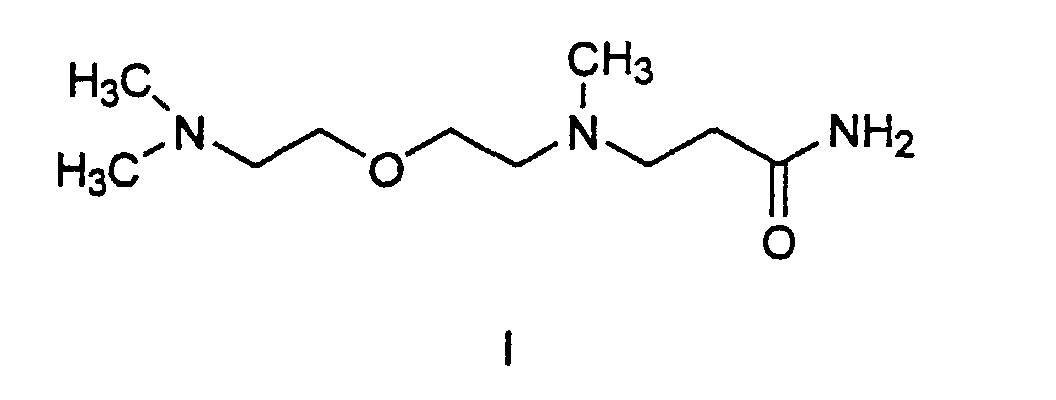
- This invention is directed to a new composition, 3- ⁇ N-[2-(N ,N -dimethylamino ethoxy)ethyl]-N-methylamino ⁇ propionamide, which is effective in catalyzing the reaction between an isocyanate and a compound containing a reactive hydrogen, such as an alcohol, a polyol, an amine or water. It is particularly effective in catalyzing the blowing reaction, i.e., the reaction between an isocyanate and water, in the production of foamed polyurethanes.
- the molecular structure of the new composition is shown below:
- 3- ⁇ N-[2-(N ,N -dimethylamino ethoxy)ethyl]-N-methylamino ⁇ propionamide is readily prepared by the nucleophilic addition of N,N,N -trimethyl bis(aminoethyl)ether to an acrylamide.
- N,N,N -trimethyl bis(aminoethyl)ether and acrylamide are present in the reaction mixture in molar ratio of from about 1:10 to about 20:1, and preferably at a ratio of 1 to 2 moles amine per equivalent of acrylamide.
- Air is used to saturate the reaction mixture in order to inhibit the free radical polymerization of acrylamide.
- the reaction is preferably carried out at atmospheric pressure; however other pressures can be used.
- the reaction can be carried out at a temperature from 0 and 100 °C, preferably from 30 and 80 °C, and is allowed to run for 0.1 to 100 hours, preferably from 2 to 6 hours.
- the reagent monomer can be reacted in batch fashion, via staged addition, or continuously, whichever is most suitable. Synthesis is advantageously performed in a mixture of the neat monomers, however, an inert solvent for both reactants may be employed.
- suitable solvents include amides, halogenated hydrocarbons, esters, and ethers, preferred solvents are ethers.
- the catalyst composition of this invention is selective to the blowing reaction for making foamed polyurethanes in which water reacts with an organic polyisocyanate to release carbon dioxide.
- the polyurethanes are prepared using any suitable organic polyisocyanates well known in the art; for example, hexamethylene diisocyanate, phenylene diisocyanate, toluene diisocyanate (“TDI”) and 4, 4'-diphenylmethane diisocyanate ("MDI").
- TDI hexamethylene diisocyanate
- phenylene diisocyanate phenylene diisocyanate
- MDI toluene diisocyanate
- MDI 4, 4'-diphenylmethane diisocyanate
- MDI 4, 4'-diphenylmethane diisocyanate
- prepolymers of these polyisocyanates comprising a partially pre-reacted mixture of a polyisocyanate and a polyether or polyester polyol.
- polyalkylene ether and polyester polyols Illustrative of suitable polyols as a component of the polyurethane composition are the polyalkylene ether and polyester polyols.
- the polyalkylene ether polyols include the poly(alkylene oxide) polymers such as poly(ethylene oxide) and poly(propylene oxide) polymers and copolymers with terminal hydroxyl groups derived from polyhydric compounds, including diols and triols; for example, ethylene glycol, propylene glycol, 1, 3-butane diol, 1, 4-butane diol, 1, 6-hexane diol, neopentyl glycol, diethylene glycol, dipropylene glycol, pentaerythritol, glycerol, diglycerol, trimethylol propane and similar low molecular weight polyols.
- a single high molecular weight polyether polyol may be used.
- mixtures of high molecular weight polyether polyols such as mixtures of di- and trifunctional materials and/or different molecular weight or different chemical composition materials may be used.
- Useful polyester polyols include those produced by reacting a dicarboxylic acid with an excess of a diol, for example, adipic acid with ethylene glycol or butanediol, or reacting a lactone with an excess of a diol such as caprolactone with propylene glycol.
- the masterbatch, or premix compositions frequently contain a polymer polyol.
- Polymer polyols are used in polyurethane foam to increase the foam's resistance to deformation, i.e. to increase the load-bearing properties of the foam.
- the first type described as a graft polyol, consists of a triol in which vinyl monomers are graft copolymerized. Styrene and acrylonitrile are the usual monomers of choice.
- the second type is a polyol containing a polyurea dispersion formed by the reaction of a diamine and TDI. Since TDI is used in excess, some of the TDI may react with both the polyol and polyurea.
- This second type of polymer polyol has a variant called PIPA polyol which is formed by the in-situ polymerization of TDI and alkanolamine in the polyol.
- polymer polyols may comprise 20-80% of the polyol portion of the masterbatch.
- chain extenders such as ethylene glycol and butanediol
- crosslinkers such as diethanolamine, diisopropanolamine, triethanolamine and tripropanolamine
- blowing agents such as water, methylene chloride, trichlorofluoromethane, and the like
- cell stabilizers such as silicones.
- the amount of a catalyst composition which is effective in the formation of polyurethanes may range from about 0.01 to 10 parts per 100 parts polyol (phpp) in the polyurethane formulation. Preferred amounts range from about 0.05 to 0.5 phpp.
- the 3- ⁇ N-[2-(N ,N -dimethylamino ethoxy)ethyl]-N-methylamino ⁇ -propionamide may be used in combination with other tertiary amine, organotin and carboxylate urethane catalysts well known in the urethane art.
- suitable gelling catalysts include but are not limited to trimethylamine, triethylamine, tributyl-amine, trioctylamine, diethyl cyclohexylamine, N-methylmorpholine, N-ethylmorpholine, N-octadecylmorpholine (N-cocomorpholine), N-methyldiethanolamine, N,N-dimethylethanolamine, N,N'-bis(2-hydroxypropyl)piperazine, N,N,N',N'-tetramethylethylene-diamine, N,N,N',N'-tetramethyl-1,3-propanediamine, triethylenediamine (1,4-diaza-bicyclo[2.2.2]octane), 1,8-diazabicyclo(5.4.0)undecene-7, 1,4-bis(2-hydroxypropyl)-2-methylpiperazine, N,N'-dimethylbenzylamine, N,N-dimethylcycl
- Suitable blowing catalysts include but are not limited to bis(dimethylaminoethyl)ether, pentamethyldiethylenetriamine, 2-[N-(dimethylaminoethoxyethyl)-N-methylamino]ethanol, and the like.
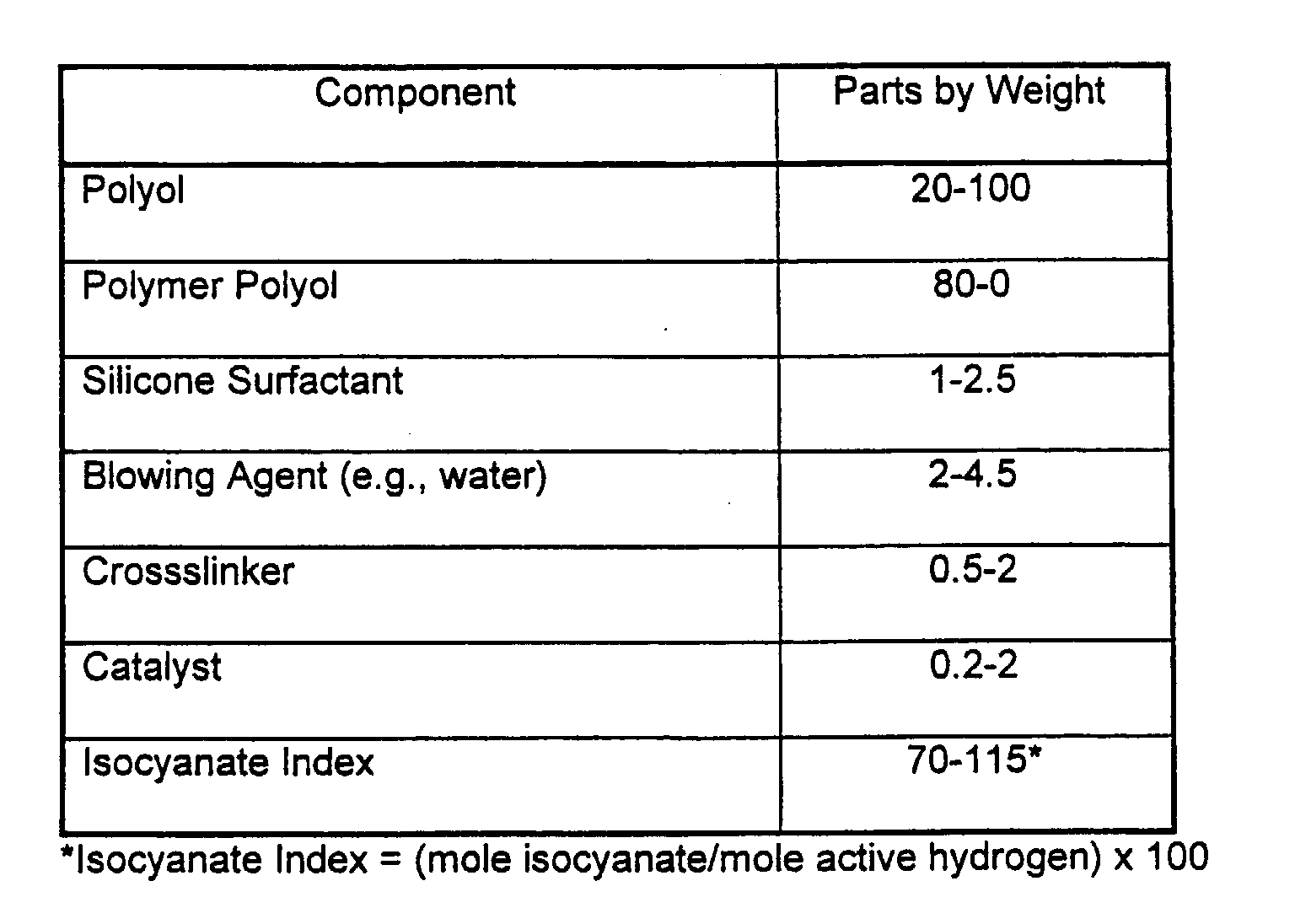
- a general polyurethane flexible foam formulation having a 1-3 lb/ft 3 (16-48 kg/m 3 ) density (e.g., automotive seating) containing a catalyst such as the catalyst composition according to the invention would comprise the following components:
- the invention will be further clarified by a consideration of the following examples, which are intended to be purely exemplary of the invention.
- a 50 ml 3 neck round bottom flask was fitted with the following: magnetic stirrer, reflux condenser, air bubbler, and a temperature controlled oil bath.
- the flask was charged with 14.2 g of acrylamide.
- N,N,N -trimethyl bis(aminoethyl)ether was added in one portion to the reaction flask at ambient temperature.
- the reaction mixture was stirred at 75 °C for 6 hours.
- the mixture was cooled to ambient temperature.
- the resulting mixture was filtered through a Celite layer. The filtrate was collected for foam application. 1 H NMR showed that the product was the desired structure.
- Polyurethane foam was prepared in a conventional manner using the following premix formulation: Component Parts by Weight E-648 (ethylene oxide tipped polyether polyol, marketed by Arco) 60 E-519 (styrene-acrylonitrile copolymer filled polyether polyol, marketed by Arco) 40 Dabco® DC-5043 surfactant (silicone surfactant marketed by Air Products and Chemicals, Inc.) 1.5 Diethanolamine 1.75 Water 3.25 TDI 80 (mixture of 80 wt. % 2,4-TDI and 20 wt. % 2,6-TDI) 105
- the catalyst was added to 202 g of the above premix in a 32 oz (951 ml) paper cup and the formulation was mixed for 20 seconds at 5000 RPM using an overhead stirrer fitted with a 2 inch (5.1 cm) diameter stirring paddle.
- the 32 oz. cup was dropped through a hole in the bottom of a 128 oz. (3804 ml) paper cup placed on a stand. The hole was sized to catch the lip of the 32 oz. cup.
- the total volume of the foam container was 160 oz.
Landscapes
- Chemical & Material Sciences (AREA)
- Organic Chemistry (AREA)
- Health & Medical Sciences (AREA)
- Chemical Kinetics & Catalysis (AREA)
- Medicinal Chemistry (AREA)
- Polymers & Plastics (AREA)
- Polyurethanes Or Polyureas (AREA)
- Organic Low-Molecular-Weight Compounds And Preparation Thereof (AREA)
Abstract

Description

- its high catalytic activity;
- its selectivity to the blowing reaction; and
- its capability to chemically bond to the urethane, thus preventing its release from the finished product.
| Component | Parts by Weight |
| E-648 (ethylene oxide tipped polyether polyol, marketed by Arco) | 60 |
| E-519 (styrene-acrylonitrile copolymer filled polyether polyol, marketed by Arco) | 40 |
| Dabco® DC-5043 surfactant (silicone surfactant marketed by Air Products and Chemicals, Inc.) | 1.5 |
| Diethanolamine | 1.75 |
| Water | 3.25 |
| TDI 80 (mixture of 80 wt. % 2,4-TDI and 20 wt. % 2,6-TDI) | 105 |
| Catalyst | TOC1 (sec.) | TOC2 (sec.) | Full Height (sec.) | Foam Height (mm) |
| 0.25 pphp DABCO 33-LV/0.10 pphp DABCO BL-11 | 13.33 | 45.62 | 122.47 | 407.50 |
| 0.25 pphp DABCO 33-LV/0.23 pphp Example 1 catalyst | 13.39 | 46.30 | 123.27 | 409.86 |
Claims (4)
- 3-{N-[2-(N,N

- A method for preparing polyurethane foam comprising reacting an organic polyisocyanate with a polyol in the presence of water and a catalyst composition comprising 3-{N-[2-(N
- The method of claim 2 wherein the catalyst also comprises a tertiary amine, organotin or a carboxylate.
- The method of claim 2 wherein the catalyst composition also comprises a triethylenediamine.
Applications Claiming Priority (2)
| Application Number | Priority Date | Filing Date | Title |
|---|---|---|---|
| US276966 | 1994-07-19 | ||
| US09/276,966 US6037496A (en) | 1999-03-26 | 1999-03-26 | 3-{N-[2-(N',N'-dimethylamino ethoxy)ethyl]-N-methylamino}propionamide for the production of polyurethanes |
Publications (2)
| Publication Number | Publication Date |
|---|---|
| EP1038895A2 true EP1038895A2 (en) | 2000-09-27 |
| EP1038895A3 EP1038895A3 (en) | 2001-11-14 |
Family
ID=23058859
Family Applications (1)
| Application Number | Title | Priority Date | Filing Date |
|---|---|---|---|
| EP00106266A Withdrawn EP1038895A3 (en) | 1999-03-26 | 2000-03-22 | 3- (N-(2-(N',N'-Dimethylamino Ethoxy)Ethyl) -N-Methylamino) Propionamide for the production of polyurethanes |
Country Status (6)
| Country | Link |
|---|---|
| US (2) | US6037496A (en) |
| EP (1) | EP1038895A3 (en) |
| JP (1) | JP3852904B2 (en) |
| KR (1) | KR100448082B1 (en) |
| CN (1) | CN1122020C (en) |
| BR (1) | BR0001380A (en) |
Families Citing this family (7)
| Publication number | Priority date | Publication date | Assignee | Title |
|---|---|---|---|---|
| US6037496A (en) * | 1999-03-26 | 2000-03-14 | Air Products And Chemicals, Inc. | 3-{N-[2-(N',N'-dimethylamino ethoxy)ethyl]-N-methylamino}propionamide for the production of polyurethanes |
| US6458860B1 (en) * | 2001-06-01 | 2002-10-01 | Huntsman Petrochemical Corporation | Advances in urethane foam catalysis |
| US7510038B2 (en) * | 2003-06-11 | 2009-03-31 | Delphi Technologies, Inc. | Steering system with lane keeping integration |
| US7009081B2 (en) * | 2003-08-04 | 2006-03-07 | Air Products And Chemicals, Inc. | N-methylated amines from selective vapor phase amination of amino ether alcohols |
| US8501828B2 (en) * | 2004-08-11 | 2013-08-06 | Huntsman Petrochemical Llc | Cure rebond binder |
| US20060141239A1 (en) * | 2004-12-28 | 2006-06-29 | Gilder Stephen D | Method for making a bonded foam product suitable for use as an underlayment for floor coverings |
| JP5421659B2 (en) * | 2009-06-05 | 2014-02-19 | 出光興産株式会社 | Urethane composition and paint and adhesive using the same |
Family Cites Families (13)
| Publication number | Priority date | Publication date | Assignee | Title |
|---|---|---|---|---|
| US3073787A (en) * | 1957-03-07 | 1963-01-15 | Du Pont | Improved process for preparing resilient isocyanate foams |
| US4007140A (en) * | 1972-11-01 | 1977-02-08 | Imperial Chemical Industries Limited | Tertiary amines as catalysts in polyurethane manufacture |
| US4048107A (en) * | 1976-01-12 | 1977-09-13 | Olin Corporation | Polyurethane foam preparation using amio acetal catalyst |
| US4094827A (en) * | 1976-10-18 | 1978-06-13 | Texaco Development Corporation | Substituted ureas as polyurethane catalysts |
| US4049591A (en) * | 1976-10-18 | 1977-09-20 | Texaco Development Corporation | Foams and elastomers prepared in the presence of high tertiary amine content polyurethane catalysts |
| DE2732292A1 (en) * | 1977-07-16 | 1979-02-01 | Bayer Ag | METHOD FOR MANUFACTURING POLYURETHANE PLASTICS |
| US4194069A (en) * | 1978-10-16 | 1980-03-18 | Texaco Development Corporation | Urea derivative and use as polyurethane catalyst |
| DE3027796A1 (en) * | 1980-07-23 | 1982-02-18 | Bayer Ag, 5090 Leverkusen | Opt. foamed polyurethane prodn. - catalysed by di:alkyl-aminoalkyl-urea deriv. catalysts generating no amine smell |
| DE3435070A1 (en) * | 1984-09-25 | 1986-04-03 | Bayer Ag, 5090 Leverkusen | METHOD FOR PRODUCING OPTIONALLY FOAMED POLYURETHANES, WHICH HAVE BEEN CONNECTED OR MADE-UP WITH ANOTHER MATERIAL |
| US5874483A (en) * | 1995-09-27 | 1999-02-23 | Air Products And Chemicals, Inc. | Aminopropylbis (aminoethyl) ether compositions for the production of polyurethanes |
| ATE214362T1 (en) * | 1996-04-04 | 2002-03-15 | Crompton Corp | METHOD FOR SYNTHESIS OF POLYURETHANES USING REACTIVE AMINE CATALYSTS |
| US5824711A (en) * | 1997-05-05 | 1998-10-20 | Air Products And Chemicals, Inc. | N,N,N'-trimethylbis (Aminoethyl) ether substituted urea compostions for the production of polyurethanes |
| US6037496A (en) * | 1999-03-26 | 2000-03-14 | Air Products And Chemicals, Inc. | 3-{N-[2-(N',N'-dimethylamino ethoxy)ethyl]-N-methylamino}propionamide for the production of polyurethanes |
-
1999
- 1999-03-26 US US09/276,966 patent/US6037496A/en not_active Expired - Fee Related
- 1999-12-07 US US09/456,261 patent/US6153659A/en not_active Expired - Fee Related
-
2000
- 2000-03-20 KR KR10-2000-0013964A patent/KR100448082B1/en not_active Expired - Fee Related
- 2000-03-20 BR BR0001380-3A patent/BR0001380A/en not_active Application Discontinuation
- 2000-03-22 EP EP00106266A patent/EP1038895A3/en not_active Withdrawn
- 2000-03-24 JP JP2000083576A patent/JP3852904B2/en not_active Expired - Fee Related
- 2000-03-24 CN CN00104729A patent/CN1122020C/en not_active Expired - Fee Related
Also Published As
| Publication number | Publication date |
|---|---|
| US6037496A (en) | 2000-03-14 |
| CN1270956A (en) | 2000-10-25 |
| JP2000297071A (en) | 2000-10-24 |
| CN1122020C (en) | 2003-09-24 |
| BR0001380A (en) | 2000-10-17 |
| KR20000062961A (en) | 2000-10-25 |
| US6153659A (en) | 2000-11-28 |
| EP1038895A3 (en) | 2001-11-14 |
| JP3852904B2 (en) | 2006-12-06 |
| KR100448082B1 (en) | 2004-09-10 |
Similar Documents
| Publication | Publication Date | Title |
|---|---|---|
| US6201033B1 (en) | Reactive catalyst compositions for improving water blown polyurethane foam performance | |
| US5824711A (en) | N,N,N'-trimethylbis (Aminoethyl) ether substituted urea compostions for the production of polyurethanes | |
| US6051527A (en) | Aminopropylbis(aminoethyl) ether compositions for the production of polyurethanes | |
| US5859079A (en) | Polyurethane catalyst compositions for improving foam performance | |
| MXPA96004243A (en) | Compositions of aminopropil bis (aminometil) eter for the production of polyureth | |
| EP1059318B1 (en) | Use of polyurethane catalyst compositions for improving rigid foam performance | |
| US6156814A (en) | Amido functional amine catalysts for the production of polyurethanes | |
| US5756557A (en) | Aminomethyl pyrrolidine urea compositions for the production of polyurethanes | |
| US6037496A (en) | 3-{N-[2-(N',N'-dimethylamino ethoxy)ethyl]-N-methylamino}propionamide for the production of polyurethanes | |
| US6380274B1 (en) | Catalyst compositions for the production of polyurethanes | |
| US6762211B1 (en) | Tertiary amino alkyl amide polyurethane catalysts derived from long chain alkyl and fatty carboxylic acids | |
| MXPA00002793A (en) | 3- (n-(2-(n',n'-dimethylamino ethoxy)ethyl) -n-methylamino) propionamide for the production of polyurethanes | |
| MXPA00002794A (en) | New catalyst compositions for the production of polyurethanes | |
| KR20040062885A (en) | Tertiary amino alkyl amide polyurethane catalysts derived from long chain alkyl and fatty carboxylic acids | |
| MXPA00002795A (en) | Amido functional amine catalysts for the production of polyurethanes | |
| MXPA98003521A (en) | Urea compositions substituted with ether n, n, n'trimethylbis (aminoethylene) for the production of polyurette | |
| MXPA98003525A (en) | Compositions of aminometil pyrrolidine urea parala polyurette production |
Legal Events
| Date | Code | Title | Description |
|---|---|---|---|
| PUAI | Public reference made under article 153(3) epc to a published international application that has entered the european phase |
Free format text: ORIGINAL CODE: 0009012 |
|
| AK | Designated contracting states |
Kind code of ref document: A2 Designated state(s): AT BE CH CY DE DK ES FI FR GB GR IE IT LI LU MC NL PT SE |
|
| AX | Request for extension of the european patent |
Free format text: AL;LT;LV;MK;RO;SI |
|
| PUAL | Search report despatched |
Free format text: ORIGINAL CODE: 0009013 |
|
| AK | Designated contracting states |
Kind code of ref document: A3 Designated state(s): AT BE CH CY DE DK ES FI FR GB GR IE IT LI LU MC NL PT SE |
|
| AX | Request for extension of the european patent |
Free format text: AL;LT;LV;MK;RO;SI |
|
| 17P | Request for examination filed |
Effective date: 20020108 |
|
| AKX | Designation fees paid |
Free format text: AT BE CH CY DE DK ES FI FR GB GR IE IT LI LU MC NL PT SE |
|
| GRAP | Despatch of communication of intention to grant a patent |
Free format text: ORIGINAL CODE: EPIDOSNIGR1 |
|
| STAA | Information on the status of an ep patent application or granted ep patent |
Free format text: STATUS: THE APPLICATION IS DEEMED TO BE WITHDRAWN |
|
| 18D | Application deemed to be withdrawn |
Effective date: 20070418 |