CROSS-REFERENCE TO RELATED APPLICATIONS
Not applicable.
STATEMENT REGARDING FEDERALLY SPONSORED RESEARCH OR
DEVELOPMENT
Not applicable.
BACKGROUND OF THE INVENTION
Polyurethanes are useful in a variety of applications. For example, polyurethane
elastomers are used in automotive parts, shoe soles, and other products in which
toughness, flexibility, strength, abrasion resistance, and shock-absorbing properties are
required. Polyurethanes are also used in coatings and in flexible and rigid foams.
Polyurethanes, in general, are produced by the reaction of a polyisocyanate and
a polyol in the presence of a catalyst. The catalyst is typically a low, molecular weight
tertiary amine such as triethylenediamine.
Polyurethane foams are produced through the reaction of a polyisocyanate with a
polyol in the presence of various additives. One class of additives which is particularly
effective as blowing agents is the chlorofluorocarbons (CFCs). CFCs vaporize as a
result of the reaction exotherm during polymerization and cause the polymerizing mass
to form a foam. However, the discovery that CFCs deplete ozone in the stratosphere
has resulted in mandates for restricting CFC use. Therefore, more efforts have gone
into the development of alternatives to CFCs for forming urethane foams and water
blowing has emerged as an important alternative. In this method, blowing occurs from
carbon dioxide generated by the reaction of water with the polyisocyanate. Foams can
be formed by a one-shot method or by formation of a prepolymer and subsequent
reaction of the prepolymer with water in the presence of a catalyst to form the foam.
Regardless of the method, a balance is needed between reaction of the isocyanate and
the polyol (gelling) and the reaction of the isocyanate with water (blowing) in order to
produce a polyurethane foam in which the cells are relatively uniform and the foam has
specific properties depending on the anticipated application; for example, rigid foams,
semi-rigid foams, and flexible foams.
The ability of the catalyst to selectively promote either blowing or gelling is an
important consideration in selecting a catalyst for the production of a polyurethane foam
with specific properties. If a catalyst promotes the blowing reaction to too high a degree,
carbon dioxide will be evolved before sufficient reaction of isocyanate with polyol has
occurred. The carbon dioxide will bubble out of the formulation, resulting in collapse of
the foam and production of a poor quality foam. At the opposite extreme, if a catalyst
promotes the gelling reaction too strongly, a substantial portion of the carbon dioxide will
be evolved after a significant degree of polymerization has occurred. Again, a poor
quality foam is produced; characterized by high density, broken or poorly defined cells,
or other undesirable features. Frequently, a gelling catalyst and a blowing catalyst are
used together to achieve the desired balance of gelling and blowing in the foam.
Tertiary amine catalysts have been used to in the production of polyurethanes.
The tertiary amine catalysts accelerate both blowing (reaction of water with isocyanate to
generate carbon dioxide) and gelling (reaction of polyol with isocyanate) and have been
shown to be effective in balancing the blowing and gelling reactions to produce a
desirable product. However, typical tertiary amines used as catalysts for polyurethane
production generally have offensive odors and many are highly volatile due to low
molecular weight. Release of tertiary amines during polyurethane production may
present significant safety and toxicity problems, and release of residual amines from
consumer products is generally undesirable.
Various alternatives to low molecular weight tertiary amine catalysts have been
reported in the prior art. Examples are described below:
U.S. Patent No. 3,073,787 (Krakler, 1963) discloses an improved process for
preparing isocyanate foams in which a 3-dialkylaminopropionamide and 2-dialkylaminoacetamide
are used as catalysts.
U.S. Patent No. 4,007,140 (Ibbotson, 1977) discloses the use of various tertiary
amines such as N,N
-bis(3-dimethylaminopropylamino)urea as low odor catalysts for the
manufacture of polyurethanes.
U.S. Patent No. 4,094,827 (McEntire, 1978) discloses the use of certain alkyl
substituted ureas, such as N,N-bis(dimethylaminopropyl)urea, as catalysts in the
production of polyurethane foam.
U.S. Patent No. 4,194,069 (Speranza et al., 1980) discloses the use of N-(3-dimethylaminopropyl)-N
-(3-morpholinopropyl)urea
as a catalyst for producing
polyurethanes.
U.S. Patent No. 4,248,930 (Haas et al., 1981) discloses new tertiary amine
compounds, such as bis(dimethylamino-n-propyl)amine, as catalysts for the production
of cellular or non-cellular polyurethane resins.
US Patent No. 4,644,017 (Haas et al., 1987) discloses the use of diffusion stable
amino alkyl ureas having tertiary amino groups in the production of a polyisocyanate
addition product.
DE 3027796 (1982) (Derwent abstract 82-13914E) discloses the use of dialkyl
aminoalkyl urea catalysts for the production of polyurethane foam. It is reported that no
smell is generated at polyurethane preparation temperatures.
EP 799,821 (1997) discloses amine/amide catalysts, such as 3-[3-dimethylaminopropyl]amino-N,N-dimethylpropanamide
and 3-[3-dimethylaminopropyl]amino-N-[3-dimethylaminopropyl]propanamide,
for the formation of polyurethanes. The catalysts
have low fugitivity due to their reactivity with isocyanates.
U.S. 5,824,711 (Kimock et al., 1998) discloses N,N,N
-trimethylbis(aminoethyl)ether
substituted urea compositions for the production of polyurethanes.
U.S. 5,874,483 (Savoca et al., 1999) discloses aminopropylbis(aminoethyl)ether
compositions for the production of polyurethanes.
BRIEF SUMMARY OF THE INVENTION
The present invention is directed to new compositions which are useful for
catalyzing the reaction between an organic polyisocyanate and a compound
containing a reactive hydrogen to form polyurethanes. The compositions have
been found to be especially effective catalysts for the blowing reaction, in which
an organic polyisocyanate reacts with water, and the gelling reaction, in which an
organic polyisocyanate reacts with a polyol. The catalyst composition is
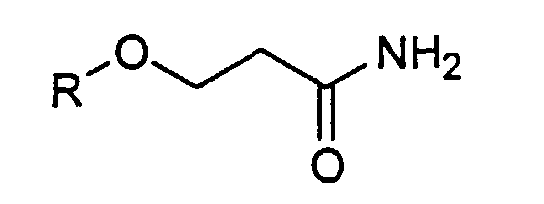
represented by the formula below:
wherein R is a linear alkyl, branched alkyl, cycloalkyl, polycyclic alkyl, alkylaminoalkyl, or
alkyloxyalkyl group having 1 to about 20 carbon atoms and at least one primary,
secondary, or tertiary amino functional group, preferably a tertiary amino group.
The invention is also directed to a process for producing polyurethanes using the new
catalyst composition.
These novel catalysts are shown to have unexpectedly high activity and good
blowing or gelling selectivity, depending upon the structure. The presence of an amide
group in the compounds causes the catalysts to be bound to the urethane during the
reaction and thus they are not released from the finished product. The above properties
make these materials useful for the production of polyurethanes, especially
polyurethane foams.
DETAILED DESCRIPTION OF THE INVENTION
The compounds of formula I are prepared by the nucleophilic addition of hydroxyl
functional amine to an acrylamide. Hydroxyl functional amine and acrylamide are
present in the reaction mixture in molar ratio of from about 1:10 to about 20:1, and
preferably at a ration of 1 to 2 moles hydroxyl amine per equivalent of acrylamide. Air is
used to saturate the reaction mixture in order to inhibit the free radical polymerization of
acrylamide. The reaction is preferably carried out at atmospheric pressure.
The reaction is conducted in the presence of base catalysts such as alkali or
alkaline earth metal hydrides, hydroxides, or alkoxides. Other useful catalysts include
aryl- and alkyl-lithium, potassium and sodium, tertiary amines, and metal amides. The
catalyst is present in the reaction mixture in an amount between about 0.00005 and
about 5 wt.%, and preferably between 0.0005 and 0.001wt.%. of the total weight of the
reactants.
The reaction can be carried out at a temperature from 0 to 100 °C, preferably
from 30 to 80 °C. The reaction is allowed to run for 0.1 to 100 hours, preferably for 2 to
6 hours.
In principle, the reagent monomer can be reacted in batch fashion, via staged
addition, or continuously. Synthesis is advantageously performed in a mixture of the
neat monomers, however, an inert solvent for both reactants may be employed.
Examples of suitable solvents are amides, halogenated hydrocarbons, esters, and
ethers, preferred solvents are ethers.
A wide range of hydroxyl functional amines are potentially useful as a co-reactant
with acrylamide. Examples of these compounds include 1-piperidineethanol, 1-methyl-2-piperidinemethanol,
3-hydroxyl-1-methylpiperidine, 3-quinuclidinol, 4-hydroxy-1-methylpiperidine,
1,3-bis(dimethylamino)-2-propanol, 1-dimethylamino-2-propanol, 1-diethylamino-2-propanol,
and 3-dimethylamino-1-propanol.
The catalyst compositions according to the invention can catalyze (1) the
reaction between an isocyanate functionality and an active hydrogen-containing
compound, such as, an alcohol, a polyol, an amine or water; especially the gelling
reaction of polyols with isocyanate to make polyurethanes and the blowing reaction of
water with isocyanate to release carbon dioxide for making foamed polyurethanes, and
(2) the trimerization of an isocyanate functionality to form polyisocyanurates.
The polyurethane products are prepared using any suitable organic
polyisocyanates well known in the art including, for example, hexamethylene
diisocyanate, phenylene diisocyanate, toluene diisocyanate (TDI) and 4,4'-diphenylmethane
diisocyanate (MDI). Especially suitable are the 2, 4- and 2, 6-TDI's
individually or together as their commercially available mixtures. Other suitable
isocyanates are mixtures of diisocyanates known commercially as "crude MDI", also
known as PAPI, which contain about 60% of 4, 4'-diphenylmethane diisocyanate along
with other isomeric and analogous higher polyisocyanates. Also suitable are
"prepolymers" of these polyisocyanates comprising a partially prereacted mixture of a
polyisocyanate and a polyether or polyester polyol.
Illustrative of suitable polyols as a component of the polyurethane composition
are the polyalkylene ether and polyester polyols. The polyalkylene ether polyols include
the poly(alkylene oxide) polymers such as poly(ethylene oxide) and poly(propylene
oxide) polymers and copolymers with terminal hydroxyl groups derived from polyhydric
compounds, including diols and triols; for example, among others, ethylene glycol,
propylene glycol, 1, 3-butane diol, 1, 4-butane diol, 1, 6-hexane diol, neopentyl glycol,
diethylene glycol, dipropylene glycol, pentaerythritol, glycerol, diglycerol, trimethylol
propane and similar low molecular weight polyols.
In the practice of this invention, a single high molecular weight polyether polyol
may be used. Also, mixtures of high molecular weight polyether polyols such as
mixtures of di- and trifunctional materials and/or different molecular weight or different
chemical composition materials may be used.
Useful polyester polyols include those produced by reacting a dicarboxylic acid
with an excess of a diol, for example, adipic acid with ethylene glycol or butanediol, or
reacting a lactone with an excess of a diol such as caprolactone with propylene glycol.
In addition to the polyether and polyester polyols, the masterbatches, or premix
compositions, frequently contain a polymer polyol. Polymer polyols are used in
polyurethane foam to increase the foam's resistance to deformation, i.e. to increase the
load-bearing properties of the foam. Currently, two different types of polymer polyols
are used to achieve load-bearing improvement. The first type, described as a graft
polyol, consists of a triol in which vinyl monomers are graft copolymerized. Styrene and
acrylonitrile are the usual monomers of choice. The second type, a polyurea modified
polyol, is a polyol containing a polyurea dispersion formed by the reaction of a diamine
and TDI. Since TDI is used in excess, some of the TDI may react with both the polyol
and polyurea. This second type of polymer polyol has a variant called PIPA polyol
which is formed by the in-situ polymerization of TDI and alkanolamine in the polyol.
Depending on the load-bearing requirements, polymer polyols may comprise 20-80% of
the polyol portion of the masterbatch.
Other typical agents found in the polyurethane foam formulations include chain
extenders such as ethylene glycol and butanediol; crosslinkers such as diethanolamine,
diisopropanolamine, triethanolamine and tripropanolamine; blowing agents such as
water, methylene chloride, trichlorofluoromethane, and the like; and cell stabilizers such
as silicones.
A catalytically effective amount of the catalyst composition is used in the
polyurethane formulation. Suitable amounts of the catalyst composition may range from
about 0.01 to 10 parts per 100 hundred parts polyol (phpp). Preferred amounts range
from 0.05 to 1.0 phpp.
The catalyst composition may be used in combination with other tertiary amine,
organotin and carboxylate urethane catalysts well known in the urethane art. For
example, suitable gelling catalysts include but are not limited to trimethylamine,
triethylamine, tributyl-amine, trioctylamine, diethyl cyclohexylamine, N-methylmorpholine,
N-ethylmorpholine, N-octadecylmorpholine (N-cocomorpholine), N-methyldiethanolamine,
N,N-dimethylethanolamine, N,N'-bis(2-hydroxypropyl)piperazine,
N,N,N',N'-tetramethylethylene-diamine, N,N,N',N'-tetramethyl-1,3-propanediamine,
triethylenediamine (1,4-diaza-bicyclo[2.2.2]octane), 1,8-diazabicyclo(5.4.0)undecene-7,
1,4-bis(2-hydroxypropyl)-2-methylpiperazine, N,N'-dimethylbenzylamine, N,N-dimethylcyclohexylamine,
benzyltriethylammonium bromide, bis(N,N-diethylaminoethyl)adipate,
N,N-diethylbenzylamine, N-ethylhexamethyleneamine, N-ethylpiperidine,
alpha-methylbenzyldimethylamine, dimethylhexadecylamine,
dimethylcetylamine, and the like. Suitable blowing catalysts include but are not limited
to bis(dimethylaminoethyl)ether, pentamethyldiethylenetriamine, 2-[N-(dimethylaminoethoxyethyl)-N-methylamino]ethanol,
and the like.
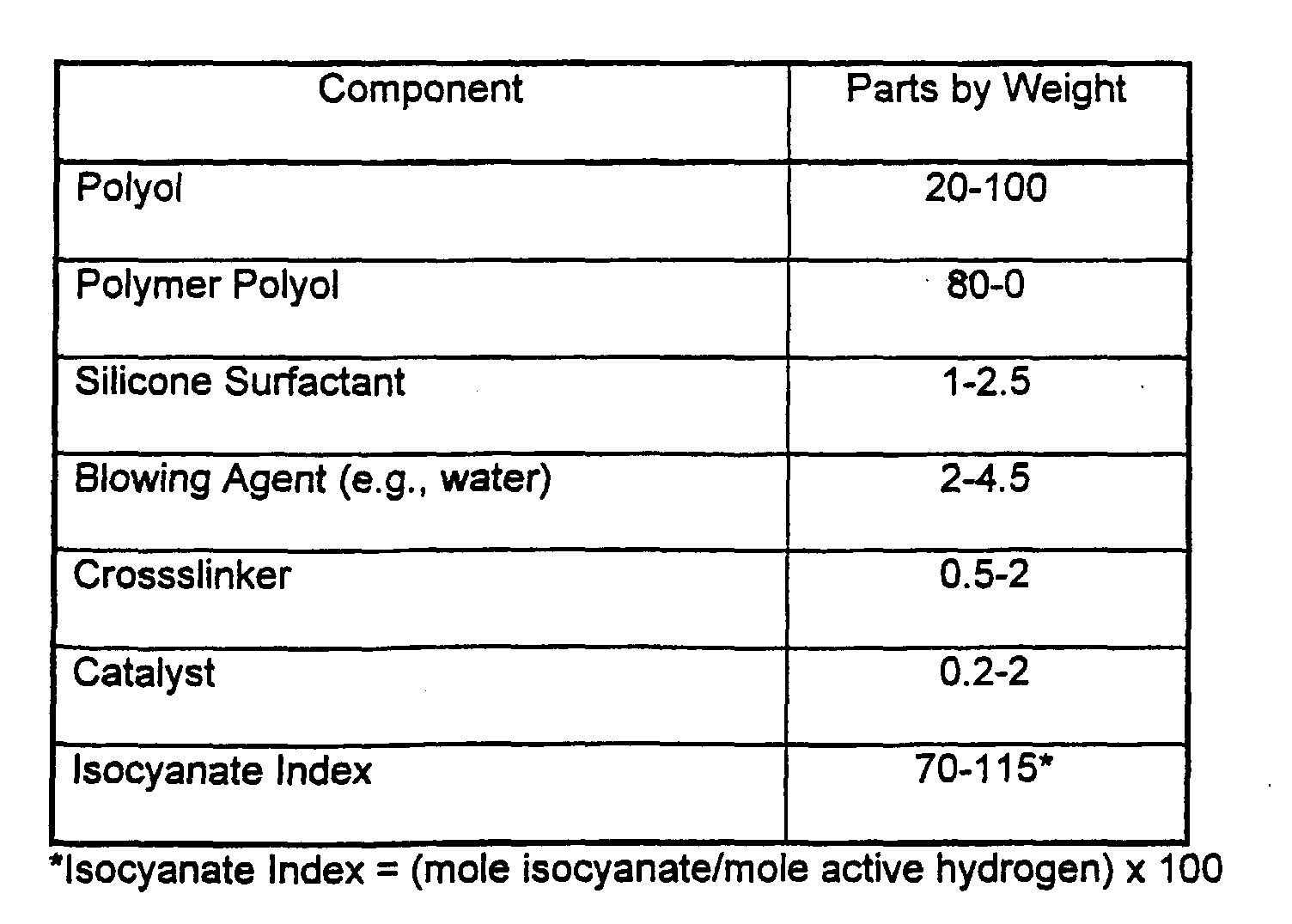
Following is a general polyurethane flexible foam formulation having a 1-3 lb/ft
3
(16-48 kg/m
3) density (e.g., foams used in automotive seating) containing a catalyst
such as the catalyst composition according to the invention:
The invention will be further clarified by a consideration of the following
examples, which are intended to be purely exemplary of the invention.
EXAMPLE 1
Preparation of 3-{2-[(2-Dimethylamino ethyl)methylamino]ethoxy}propionamide
A 50 ml 3 neck round bottom flask was fitted with the following: magnetic stirrer,
reflux condenser, air bubbler, and a temperature controlled oil bath. The flask was
charged with 7.3 g of 2-{[2-(dimethylamino) ethyl]methylamino}ethanol. Sodium hydride,
0.014 g, was then added carefully to the of 2-{[2-(dimethylamino)
ethyl]methylamino}ethanol with stirring. The mixture was stirred at a constant rate for
two minutes before 3.55 g of acrylamide was added. After the addition of acrylamide,
the reaction mixture was stirred at 50 °C for 6 hours. The mixture was cooled to
ambient temperature. Concentrated sulfuric acid, 0.034 g, then was added to neutralize
the product mixture. The resulting mixture was filtered through a Celite layer. The
filtrate was collected for foam application. Quantitative 1H NMR showed that the product
was 94% pure.
EXAMPLE 2
Preparation of 3-{2-{[2-(2-Dimethylamino ethoxy)ethyl]
methylamino}ethoxy}propionamide
A 50 ml 3 neck round bottom flask was fitted with the following: magnetic
stirrer, reflux condenser, air bubbler, and a temperature controlled oil bath. The
flask was charged with 19.0 g of 2-{[2-(2-dimethylamino ethoxy)ethyl]
methylamino}ethanol. Sodium hydride, 0.03 g, was then added carefully to the 2-{[2-(2-dimethylamino
ethoxy)ethyl]methylamino}ethanol solution with stirring.
The mixture was stirred at a constant rate for two minutes before 7.10 g of
acrylamide was added. After the addition of acrylamide, the reaction mixture was
stirred at 55 °C for 6 hours. The mixture was cooled to ambient temperature and
neutralized with 0.80 g of concentrated sulfuric acid. The resulting mixture was
filtered through a Celite layer. The filtrate was collected for foam application
without further purification. Quantitative 1H NMR showed that the product was
94% pure.
EXAMPLE 3
Preparation of 3-[2-(Dimethylamino)ethoxy]propionamide
A 100 ml 3 neck round bottom flask was fitted with the following: magnetic
stirrer, reflux condenser, air bubbler, and a temperature controlled oil bath. The
flask was charged with 22.25 g of 2-dimethylamino ethanol. Sodium hydride,
0.05 g, was then added carefully to 2-dimethylamino ethanol solution with
stirring. After stirring at a constant rate for two minutes, 17.75 g of acrylamide
was added. The reaction mixture was stirred at 45 °C for 6 hours. The mixture
was cooled to ambient temperature and neutralized with 0.11 g of concentrated
sulfuric acid. The resulting mixture was filtered through a Celite layer. The
filtrate was collected for foam application. Quantitative 1H NMR shows that the
product had ∼90% purity. The product could be further purified by reduced
pressure distillation. Fraction collected at 135 °C/1 mm Hg gives a colorless
needle shape crystal (60% yield, >96% in purity).
EXAMPLE 4
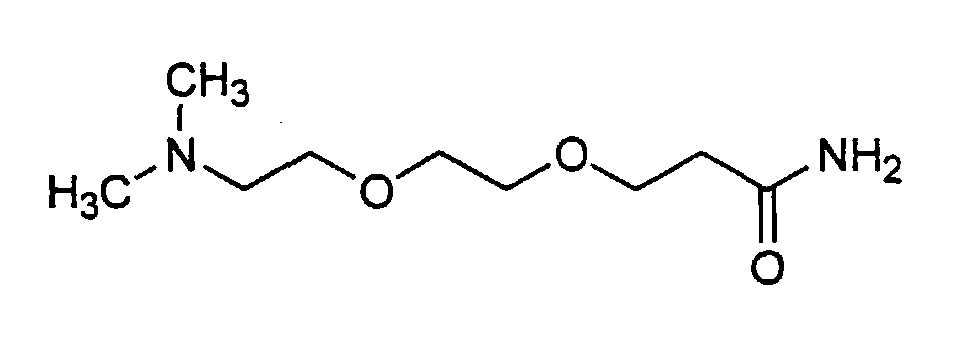
Preparation of 3-{2-[(2-Dimethylamino)ethoxy]ethoxy}propionamide
A 100 ml 3 neck round bottom flask was fitted with the following: magnetic
stirrer, reflux condenser, air bubbler, and a temperature controlled oil bath. The
flask was charged with 26.6 g of 2-[2-(dimethylamino)ethoxy] ethanol. Sodium
hydride, 0.05 g, was then added carefully of 2-[2-(dimethylamino)ethoxy] ethanol
solution with stirring. After stirring at a constant rate for two minutes, 14.2 g of
acrylamide was added. The reaction mixture was stirred at 55 °C for 6 hours.
The mixture was cooled to ambient temperature and neutralized with 0.11 g of
concentrated sulfuric acid. The resulting mixture was filtered through a Celite
layer. The product was purified by reduced pressure distillation. Fraction
collected at 130 °C/1 mm Hg gave a pale yellow liquid 29.5 g (72% yield, >96%
in purity).
In the following examples polyurethane foams were prepared in a
conventional manner using the following premix formulation:
| Premix Formulation |
| Component | Parts by Weight |
| E-648 (ethylene oxide tipped polyether polyol, marketed by Arco) | 60 |
| E-519 (styrene-acrylonitrile copolymer filled polyether polyol, marketed by Arco) | 40 |
| Dabco® DC-5043 (silicone surfactant marketed by Air Products and Chemicals, Inc.) | 1.5 |
| Diethanolamine | 1.75 |
| Water | 3.25 |
| TDI 80 (mixture of 80 wt% 2,4-TDI and 20 wt.% 2,6-TDI) | 105 (isocyanate index) |
For each foam, the catalyst was added to 202 g of the above premix in a
32 oz (951 ml) paper cup and the formulation was mixed for 20 seconds at 5000
RPM using an overhead stirrer fitted with a 2 inch (5.1 cm) diameter stirring
paddle. Sufficient TDI 80 was added to make a 105 index foam [index = (mole
isocyanate/mole active hydrogen) x 100] and the formulation was mixed well for
5 seconds using the same overhead stirrer. The 32 oz. cup was dropped
through a hole in the bottom of a 128 oz. (3804 ml) paper cup placed on a stand.
The hole was sized to catch the lip of the 32 oz. cup. The total volume of the
foam container was 160 oz. (4755 ml). Foams approximated this volume at the
end of the foam forming process. Times to reach the top of the mixing cup
(TOC1), the top of the 128 oz. cup (TOC2), and maximum foam height were
recorded.
EXAMPLE 5
Preparation of foam using 3-{2-[(2-dimethylamino
ethyl)methylamino]ethoxy}propionamide (example 1) as gelling catalyst
|
Catalyst
|
TOC1 (sec.)
|
TOC2 (sec.)
|
Full Height (sec.)
|
Foam Height (mm)
|
| 0.25 pphp DABCO 33LV/0.10 pphp DABCO BL-11 |
12.74 |
44.02 |
127.27 |
409.05 |
| 0.33 pphp Example 1 catalyst/0.10 pphp DABCO BL-11 |
12.11 |
43.19 |
131.99 |
411.42 |
EXAMPLE 6
Preparation of foam using 3-{2-{[2-(2-dimethylamino ethoxy)ethyl]
methylamino}ethoxy)propionamide (example 2) as blowing catalyst
|
Catalyst
|
TOC1 (sec.)
|
TOC2 (sec.)
|
Full Height (sec.)
|
Foam Height (mm)
|
| 0.25 pphp DABCO 33LV/0.10 pphp DABCO BL-11 |
13.33 |
45.62 |
122.47 |
407.50 |
| 0.25 pphp DABCO 33LV/0.225 pphp Example 2 catalyst |
14.08 |
48.02 |
125.16 |
408.62 |
EXAMPLE 7
Preparation of foam using 3-[2-(dimethylamino)ethoxy]propionamide (example 3) as
gelling catalyst
|
Catalyst
|
TOC1 (sec.)
|
TOC2 (sec.)
|
Full Height (sec.)
|
Foam Height (mm)
|
| 0.25 pphp DABCO 33LV/0.10 pphp DABCO BL-11 |
12.30 |
42.54 |
119.14 |
411.26 |
| 0.40 pphp Example 3 catalyst/0.10 pphp DABCO BL-11 |
11.27 |
42.13 |
129.53 |
408.95 |
EXAMPLE 8
Preparation of foam using 3-{2-[(2-dimethylamino)ethoxy]ethoxy}propionamide
(example 4) as gelling catalyst
| Catalyst | TOC1 (sec.) | TOC2 (sec.) | Full Height (sec.) | Foam Height (mm) |
| 0.25 pphp DABCO 33LV/0.10 pphp DABCO BL-11 | 12.30 | 42.54 | 119.14 | 411.26 |
| 0.36 pphp Example 4 catalyst/0.10 pphp DABCO BL-11 | 10.81 | 43.82 | 131.24 | 405.96 |
Examples 5 through 8 show that the compositions of this invention can be highly
effective as either gelling or blowing catalysts.