EP1038890A1 - Dendritic polymers and their preparation - Google Patents
Dendritic polymers and their preparation Download PDFInfo
- Publication number
- EP1038890A1 EP1038890A1 EP00302464A EP00302464A EP1038890A1 EP 1038890 A1 EP1038890 A1 EP 1038890A1 EP 00302464 A EP00302464 A EP 00302464A EP 00302464 A EP00302464 A EP 00302464A EP 1038890 A1 EP1038890 A1 EP 1038890A1
- Authority
- EP
- European Patent Office
- Prior art keywords
- polymer
- group
- carbon atoms
- branched
- groups
- Prior art date
- Legal status (The legal status is an assumption and is not a legal conclusion. Google has not performed a legal analysis and makes no representation as to the accuracy of the status listed.)
- Granted
Links
- 229920000736 dendritic polymer Polymers 0.000 title claims abstract description 23
- 239000000412 dendrimer Substances 0.000 title description 3
- 229920000642 polymer Polymers 0.000 claims abstract description 90
- 229920000587 hyperbranched polymer Polymers 0.000 claims abstract description 20
- 238000006116 polymerization reaction Methods 0.000 claims abstract description 19
- 239000000178 monomer Substances 0.000 claims abstract description 17
- XLLXMBCBJGATSP-UHFFFAOYSA-N 2-phenylethenol Chemical class OC=CC1=CC=CC=C1 XLLXMBCBJGATSP-UHFFFAOYSA-N 0.000 claims abstract description 6
- 230000000379 polymerizing effect Effects 0.000 claims abstract description 6
- 125000004432 carbon atom Chemical group C* 0.000 claims description 60
- 125000002947 alkylene group Chemical group 0.000 claims description 22
- 238000000034 method Methods 0.000 claims description 22
- 239000002253 acid Substances 0.000 claims description 21
- 125000002887 hydroxy group Chemical group [H]O* 0.000 claims description 21
- RTZKZFJDLAIYFH-UHFFFAOYSA-N Diethyl ether Chemical compound CCOCC RTZKZFJDLAIYFH-UHFFFAOYSA-N 0.000 claims description 19
- 125000004435 hydrogen atom Chemical group [H]* 0.000 claims description 14
- 125000006165 cyclic alkyl group Chemical group 0.000 claims description 11
- 125000000732 arylene group Chemical group 0.000 claims description 10
- 229910052739 hydrogen Inorganic materials 0.000 claims description 9
- 239000001257 hydrogen Substances 0.000 claims description 9
- 150000002989 phenols Chemical class 0.000 claims description 8
- 125000003118 aryl group Chemical group 0.000 claims description 7
- 125000004122 cyclic group Chemical group 0.000 claims description 7
- 125000005843 halogen group Chemical group 0.000 claims description 7
- 238000010539 anionic addition polymerization reaction Methods 0.000 claims description 6
- 125000002496 methyl group Chemical group [H]C([H])([H])* 0.000 claims description 6
- 239000000203 mixture Substances 0.000 claims description 6
- 238000010550 living polymerization reaction Methods 0.000 claims description 5
- 125000006239 protecting group Chemical group 0.000 claims description 5
- 125000004453 alkoxycarbonyl group Chemical group 0.000 claims description 4
- 125000002915 carbonyl group Chemical group [*:2]C([*:1])=O 0.000 claims description 4
- 125000003172 aldehyde group Chemical group 0.000 claims description 3
- 239000000463 material Substances 0.000 abstract description 10
- 239000011347 resin Substances 0.000 abstract description 9
- 229920005989 resin Polymers 0.000 abstract description 9
- -1 1-ethoxyethyl Chemical group 0.000 description 82
- 238000006243 chemical reaction Methods 0.000 description 45
- CSCPPACGZOOCGX-UHFFFAOYSA-N Acetone Chemical compound CC(C)=O CSCPPACGZOOCGX-UHFFFAOYSA-N 0.000 description 18
- WYURNTSHIVDZCO-UHFFFAOYSA-N Tetrahydrofuran Chemical compound C1CCOC1 WYURNTSHIVDZCO-UHFFFAOYSA-N 0.000 description 18
- 150000001875 compounds Chemical class 0.000 description 16
- XLYOFNOQVPJJNP-UHFFFAOYSA-N water Substances O XLYOFNOQVPJJNP-UHFFFAOYSA-N 0.000 description 16
- OKKJLVBELUTLKV-UHFFFAOYSA-N Methanol Chemical compound OC OKKJLVBELUTLKV-UHFFFAOYSA-N 0.000 description 15
- 238000001914 filtration Methods 0.000 description 12
- 239000007787 solid Substances 0.000 description 12
- 238000003756 stirring Methods 0.000 description 12
- GRFNSWBVXHLTCI-UHFFFAOYSA-N 1-ethenyl-4-[(2-methylpropan-2-yl)oxy]benzene Chemical compound CC(C)(C)OC1=CC=C(C=C)C=C1 GRFNSWBVXHLTCI-UHFFFAOYSA-N 0.000 description 11
- 238000004132 cross linking Methods 0.000 description 10
- 238000000425 proton nuclear magnetic resonance spectrum Methods 0.000 description 9
- YLQBMQCUIZJEEH-UHFFFAOYSA-N tetrahydrofuran Natural products C=1C=COC=1 YLQBMQCUIZJEEH-UHFFFAOYSA-N 0.000 description 9
- 229960000834 vinyl ether Drugs 0.000 description 9
- AFVFQIVMOAPDHO-UHFFFAOYSA-N Methanesulfonic acid Chemical compound CS(O)(=O)=O AFVFQIVMOAPDHO-UHFFFAOYSA-N 0.000 description 8
- 230000015572 biosynthetic process Effects 0.000 description 8
- 238000003786 synthesis reaction Methods 0.000 description 8
- VEXZGXHMUGYJMC-UHFFFAOYSA-N Hydrochloric acid Chemical compound Cl VEXZGXHMUGYJMC-UHFFFAOYSA-N 0.000 description 6
- 125000000217 alkyl group Chemical group 0.000 description 6
- 238000004458 analytical method Methods 0.000 description 6
- 238000001035 drying Methods 0.000 description 6
- 239000003999 initiator Substances 0.000 description 6
- 239000002244 precipitate Substances 0.000 description 6
- 125000000999 tert-butyl group Chemical group [H]C([H])([H])C(*)(C([H])([H])[H])C([H])([H])[H] 0.000 description 6
- ISWSIDIOOBJBQZ-UHFFFAOYSA-N Phenol Chemical compound OC1=CC=CC=C1 ISWSIDIOOBJBQZ-UHFFFAOYSA-N 0.000 description 5
- WGOPGODQLGJZGL-UHFFFAOYSA-N lithium;butane Chemical compound [Li+].CC[CH-]C WGOPGODQLGJZGL-UHFFFAOYSA-N 0.000 description 5
- 230000008569 process Effects 0.000 description 5
- ZRZHXNCATOYMJH-UHFFFAOYSA-N 1-(chloromethyl)-4-ethenylbenzene Chemical compound ClCC1=CC=C(C=C)C=C1 ZRZHXNCATOYMJH-UHFFFAOYSA-N 0.000 description 4
- VHUUQVKOLVNVRT-UHFFFAOYSA-N Ammonium hydroxide Chemical compound [NH4+].[OH-] VHUUQVKOLVNVRT-UHFFFAOYSA-N 0.000 description 4
- JUJWROOIHBZHMG-UHFFFAOYSA-N Pyridine Chemical compound C1=CC=NC=C1 JUJWROOIHBZHMG-UHFFFAOYSA-N 0.000 description 4
- QGZKDVFQNNGYKY-UHFFFAOYSA-N ammonia Natural products N QGZKDVFQNNGYKY-UHFFFAOYSA-N 0.000 description 4
- 230000003197 catalytic effect Effects 0.000 description 4
- FJKIXWOMBXYWOQ-UHFFFAOYSA-N ethenoxyethane Chemical compound CCOC=C FJKIXWOMBXYWOQ-UHFFFAOYSA-N 0.000 description 4
- 150000002430 hydrocarbons Chemical group 0.000 description 4
- 229940098779 methanesulfonic acid Drugs 0.000 description 4
- 230000035945 sensitivity Effects 0.000 description 4
- DYHSDKLCOJIUFX-UHFFFAOYSA-N tert-butoxycarbonyl anhydride Chemical compound CC(C)(C)OC(=O)OC(=O)OC(C)(C)C DYHSDKLCOJIUFX-UHFFFAOYSA-N 0.000 description 4
- MWZJGRDWJVHRDV-UHFFFAOYSA-N 1,4-bis(ethenoxy)butane Chemical compound C=COCCCCOC=C MWZJGRDWJVHRDV-UHFFFAOYSA-N 0.000 description 3
- FUGYGGDSWSUORM-UHFFFAOYSA-N 4-hydroxystyrene Chemical class OC1=CC=C(C=C)C=C1 FUGYGGDSWSUORM-UHFFFAOYSA-N 0.000 description 3
- UHOVQNZJYSORNB-UHFFFAOYSA-N Benzene Chemical compound C1=CC=CC=C1 UHOVQNZJYSORNB-UHFFFAOYSA-N 0.000 description 3
- 0 C*(CCC1)CC1*1(CC2C=CC(C)=CC(*)*2)C2=CC=*=C2*C1 Chemical compound C*(CCC1)CC1*1(CC2C=CC(C)=CC(*)*2)C2=CC=*=C2*C1 0.000 description 3
- UFHFLCQGNIYNRP-UHFFFAOYSA-N Hydrogen Chemical compound [H][H] UFHFLCQGNIYNRP-UHFFFAOYSA-N 0.000 description 3
- YXFVVABEGXRONW-UHFFFAOYSA-N Toluene Chemical compound CC1=CC=CC=C1 YXFVVABEGXRONW-UHFFFAOYSA-N 0.000 description 3
- 125000002252 acyl group Chemical group 0.000 description 3
- 125000003342 alkenyl group Chemical group 0.000 description 3
- 238000000149 argon plasma sintering Methods 0.000 description 3
- 229910052799 carbon Inorganic materials 0.000 description 3
- 125000003178 carboxy group Chemical group [H]OC(*)=O 0.000 description 3
- 238000007796 conventional method Methods 0.000 description 3
- 238000010828 elution Methods 0.000 description 3
- 125000001033 ether group Chemical group 0.000 description 3
- 125000005842 heteroatom Chemical group 0.000 description 3
- 125000000623 heterocyclic group Chemical group 0.000 description 3
- IQPQWNKOIGAROB-UHFFFAOYSA-N isocyanate group Chemical group [N-]=C=O IQPQWNKOIGAROB-UHFFFAOYSA-N 0.000 description 3
- 125000005188 oxoalkyl group Chemical group 0.000 description 3
- 239000011541 reaction mixture Substances 0.000 description 3
- 238000000926 separation method Methods 0.000 description 3
- 239000002904 solvent Substances 0.000 description 3
- 125000001424 substituent group Chemical group 0.000 description 3
- DVKJHBMWWAPEIU-UHFFFAOYSA-N toluene 2,4-diisocyanate Chemical compound CC1=CC=C(N=C=O)C=C1N=C=O DVKJHBMWWAPEIU-UHFFFAOYSA-N 0.000 description 3
- 125000004665 trialkylsilyl group Chemical group 0.000 description 3
- 238000005406 washing Methods 0.000 description 3
- NAWXUBYGYWOOIX-SFHVURJKSA-N (2s)-2-[[4-[2-(2,4-diaminoquinazolin-6-yl)ethyl]benzoyl]amino]-4-methylidenepentanedioic acid Chemical compound C1=CC2=NC(N)=NC(N)=C2C=C1CCC1=CC=C(C(=O)N[C@@H](CC(=C)C(O)=O)C(O)=O)C=C1 NAWXUBYGYWOOIX-SFHVURJKSA-N 0.000 description 2
- XDHOEHJVXXTEDV-HWKANZROSA-N (e)-1-ethoxyprop-1-ene Chemical compound CCO\C=C\C XDHOEHJVXXTEDV-HWKANZROSA-N 0.000 description 2
- RYHBNJHYFVUHQT-UHFFFAOYSA-N 1,4-Dioxane Chemical compound C1COCCO1 RYHBNJHYFVUHQT-UHFFFAOYSA-N 0.000 description 2
- CURLTUGMZLYLDI-UHFFFAOYSA-N Carbon dioxide Chemical compound O=C=O CURLTUGMZLYLDI-UHFFFAOYSA-N 0.000 description 2
- FBPFZTCFMRRESA-FSIIMWSLSA-N D-Glucitol Natural products OC[C@H](O)[C@H](O)[C@@H](O)[C@H](O)CO FBPFZTCFMRRESA-FSIIMWSLSA-N 0.000 description 2
- FBPFZTCFMRRESA-JGWLITMVSA-N D-glucitol Chemical compound OC[C@H](O)[C@@H](O)[C@H](O)[C@H](O)CO FBPFZTCFMRRESA-JGWLITMVSA-N 0.000 description 2
- 239000005057 Hexamethylene diisocyanate Substances 0.000 description 2
- MZRVEZGGRBJDDB-UHFFFAOYSA-N N-Butyllithium Chemical compound [Li]CCCC MZRVEZGGRBJDDB-UHFFFAOYSA-N 0.000 description 2
- ZJCCRDAZUWHFQH-UHFFFAOYSA-N Trimethylolpropane Chemical compound CCC(CO)(CO)CO ZJCCRDAZUWHFQH-UHFFFAOYSA-N 0.000 description 2
- 125000004036 acetal group Chemical group 0.000 description 2
- 125000003545 alkoxy group Chemical group 0.000 description 2
- GRDUSJSTMWOZIA-UHFFFAOYSA-N benzene-1,3-dicarboxylic acid;ethenoxyethene Chemical compound C=COC=C.OC(=O)C1=CC=CC(C(O)=O)=C1 GRDUSJSTMWOZIA-UHFFFAOYSA-N 0.000 description 2
- 229910052794 bromium Inorganic materials 0.000 description 2
- 229910052801 chlorine Inorganic materials 0.000 description 2
- 239000000460 chlorine Substances 0.000 description 2
- 125000004956 cyclohexylene group Chemical group 0.000 description 2
- APXMUPAOVOERQV-UHFFFAOYSA-N ethenoxyethene phthalic acid Chemical compound C(=C)OC=C.C(C=1C(C(=O)O)=CC=CC1)(=O)O APXMUPAOVOERQV-UHFFFAOYSA-N 0.000 description 2
- PWLIMLYJXOZPSJ-UHFFFAOYSA-N ethenoxyethene;terephthalic acid Chemical compound C=COC=C.OC(=O)C1=CC=C(C(O)=O)C=C1 PWLIMLYJXOZPSJ-UHFFFAOYSA-N 0.000 description 2
- 125000006232 ethoxy propyl group Chemical group [H]C([H])([H])C([H])([H])OC([H])([H])C([H])([H])C([H])([H])* 0.000 description 2
- 125000005448 ethoxyethyl group Chemical group [H]C([H])([H])C([H])([H])OC([H])([H])C([H])([H])* 0.000 description 2
- RRAMGCGOFNQTLD-UHFFFAOYSA-N hexamethylene diisocyanate Chemical compound O=C=NCCCCCCN=C=O RRAMGCGOFNQTLD-UHFFFAOYSA-N 0.000 description 2
- 229910052740 iodine Inorganic materials 0.000 description 2
- 125000001449 isopropyl group Chemical group [H]C([H])([H])C([H])(*)C([H])([H])[H] 0.000 description 2
- 229920002521 macromolecule Polymers 0.000 description 2
- 125000001997 phenyl group Chemical group [H]C1=C([H])C([H])=C(*)C([H])=C1[H] 0.000 description 2
- 238000001020 plasma etching Methods 0.000 description 2
- 239000005056 polyisocyanate Substances 0.000 description 2
- 229920001228 polyisocyanate Polymers 0.000 description 2
- UMJSCPRVCHMLSP-UHFFFAOYSA-N pyridine Natural products COC1=CC=CN=C1 UMJSCPRVCHMLSP-UHFFFAOYSA-N 0.000 description 2
- 239000000600 sorbitol Substances 0.000 description 2
- 150000005846 sugar alcohols Polymers 0.000 description 2
- 125000001412 tetrahydropyranyl group Chemical group 0.000 description 2
- 125000000026 trimethylsilyl group Chemical group [H]C([H])([H])[Si]([*])(C([H])([H])[H])C([H])([H])[H] 0.000 description 2
- BPMMHGIISLRQDW-TYYBGVCCSA-N (e)-but-2-enedioic acid;ethenoxyethene Chemical compound C=COC=C.OC(=O)\C=C\C(O)=O BPMMHGIISLRQDW-TYYBGVCCSA-N 0.000 description 1
- BPMMHGIISLRQDW-ODZAUARKSA-N (z)-but-2-enedioic acid;ethenoxyethene Chemical compound C=COC=C.OC(=O)\C=C/C(O)=O BPMMHGIISLRQDW-ODZAUARKSA-N 0.000 description 1
- GPHWXFINOWXMDN-UHFFFAOYSA-N 1,1-bis(ethenoxy)hexane Chemical compound CCCCCC(OC=C)OC=C GPHWXFINOWXMDN-UHFFFAOYSA-N 0.000 description 1
- CYIGRWUIQAVBFG-UHFFFAOYSA-N 1,2-bis(2-ethenoxyethoxy)ethane Chemical compound C=COCCOCCOCCOC=C CYIGRWUIQAVBFG-UHFFFAOYSA-N 0.000 description 1
- ZXHDVRATSGZISC-UHFFFAOYSA-N 1,2-bis(ethenoxy)ethane Chemical compound C=COCCOC=C ZXHDVRATSGZISC-UHFFFAOYSA-N 0.000 description 1
- LXSVCBDMOGLGFA-UHFFFAOYSA-N 1,2-bis(ethenoxy)propane Chemical compound C=COC(C)COC=C LXSVCBDMOGLGFA-UHFFFAOYSA-N 0.000 description 1
- XDWRKTULOHXYGN-UHFFFAOYSA-N 1,3-bis(ethenoxy)-2,2-bis(ethenoxymethyl)propane Chemical compound C=COCC(COC=C)(COC=C)COC=C XDWRKTULOHXYGN-UHFFFAOYSA-N 0.000 description 1
- AITKNDQVEUUYHE-UHFFFAOYSA-N 1,3-bis(ethenoxy)-2,2-dimethylpropane Chemical compound C=COCC(C)(C)COC=C AITKNDQVEUUYHE-UHFFFAOYSA-N 0.000 description 1
- QVOHHWQAOFEPOQ-UHFFFAOYSA-N 1,3-bis(ethenoxy)butane Chemical compound C=COC(C)CCOC=C QVOHHWQAOFEPOQ-UHFFFAOYSA-N 0.000 description 1
- QOYBXUIKQOIDQO-UHFFFAOYSA-N 1,3-bis(ethenoxy)propane Chemical compound C=COCCCOC=C QOYBXUIKQOIDQO-UHFFFAOYSA-N 0.000 description 1
- CGHMMUAOPPRRMX-UHFFFAOYSA-N 1,4-bis(ethenoxy)cyclohexane Chemical compound C=COC1CCC(OC=C)CC1 CGHMMUAOPPRRMX-UHFFFAOYSA-N 0.000 description 1
- DQNSRQYYCSXZDF-UHFFFAOYSA-N 1,4-bis(ethenoxymethyl)cyclohexane Chemical compound C=COCC1CCC(COC=C)CC1 DQNSRQYYCSXZDF-UHFFFAOYSA-N 0.000 description 1
- SBJCUZQNHOLYMD-UHFFFAOYSA-N 1,5-Naphthalene diisocyanate Chemical compound C1=CC=C2C(N=C=O)=CC=CC2=C1N=C=O SBJCUZQNHOLYMD-UHFFFAOYSA-N 0.000 description 1
- UEIPWOFSKAZYJO-UHFFFAOYSA-N 1-(2-ethenoxyethoxy)-2-[2-(2-ethenoxyethoxy)ethoxy]ethane Chemical compound C=COCCOCCOCCOCCOC=C UEIPWOFSKAZYJO-UHFFFAOYSA-N 0.000 description 1
- HDXVSRDSYNPSAE-UHFFFAOYSA-N 1-(4-ethenylphenyl)ethanone Chemical compound CC(=O)C1=CC=C(C=C)C=C1 HDXVSRDSYNPSAE-UHFFFAOYSA-N 0.000 description 1
- VXNZUUAINFGPBY-UHFFFAOYSA-N 1-Butene Chemical group CCC=C VXNZUUAINFGPBY-UHFFFAOYSA-N 0.000 description 1
- CZAVRNDQSIORTH-UHFFFAOYSA-N 1-ethenoxy-2,2-bis(ethenoxymethyl)butane Chemical compound C=COCC(CC)(COC=C)COC=C CZAVRNDQSIORTH-UHFFFAOYSA-N 0.000 description 1
- JQCSUVJDBHJKNG-UHFFFAOYSA-N 1-methoxy-ethyl Chemical group C[CH]OC JQCSUVJDBHJKNG-UHFFFAOYSA-N 0.000 description 1
- KWKAKUADMBZCLK-UHFFFAOYSA-N 1-octene Chemical group CCCCCCC=C KWKAKUADMBZCLK-UHFFFAOYSA-N 0.000 description 1
- SUFSXWBMZQUYOC-UHFFFAOYSA-N 2,2-bis(ethenoxymethyl)propane-1,3-diol Chemical compound C=COCC(CO)(CO)COC=C SUFSXWBMZQUYOC-UHFFFAOYSA-N 0.000 description 1
- YQTCQNIPQMJNTI-UHFFFAOYSA-N 2,2-dimethylpropan-1-one Chemical group CC(C)(C)[C]=O YQTCQNIPQMJNTI-UHFFFAOYSA-N 0.000 description 1
- ILRVMZXWYVQUMN-UHFFFAOYSA-N 3-ethenoxy-2,2-bis(ethenoxymethyl)propan-1-ol Chemical compound C=COCC(CO)(COC=C)COC=C ILRVMZXWYVQUMN-UHFFFAOYSA-N 0.000 description 1
- UPMLOUAZCHDJJD-UHFFFAOYSA-N 4,4'-Diphenylmethane Diisocyanate Chemical compound C1=CC(N=C=O)=CC=C1CC1=CC=C(N=C=O)C=C1 UPMLOUAZCHDJJD-UHFFFAOYSA-N 0.000 description 1
- SERCPQYXEUPQHB-UHFFFAOYSA-N 5,6-diisocyanato-5-methylcyclohexa-1,3-diene Chemical compound O=C=NC1(C)C=CC=CC1N=C=O SERCPQYXEUPQHB-UHFFFAOYSA-N 0.000 description 1
- ZCYVEMRRCGMTRW-UHFFFAOYSA-N 7553-56-2 Chemical compound [I] ZCYVEMRRCGMTRW-UHFFFAOYSA-N 0.000 description 1
- WKBOTKDWSSQWDR-UHFFFAOYSA-N Bromine atom Chemical compound [Br] WKBOTKDWSSQWDR-UHFFFAOYSA-N 0.000 description 1
- MVEGINXOCCFBBX-UHFFFAOYSA-N C(=C)OC=C.C(C(=C)CC(=O)O)(=O)O Chemical compound C(=C)OC=C.C(C(=C)CC(=O)O)(=O)O MVEGINXOCCFBBX-UHFFFAOYSA-N 0.000 description 1
- ZAMOUSCENKQFHK-UHFFFAOYSA-N Chlorine atom Chemical compound [Cl] ZAMOUSCENKQFHK-UHFFFAOYSA-N 0.000 description 1
- PXGOKWXKJXAPGV-UHFFFAOYSA-N Fluorine Chemical compound FF PXGOKWXKJXAPGV-UHFFFAOYSA-N 0.000 description 1
- VQTUBCCKSQIDNK-UHFFFAOYSA-N Isobutene Chemical group CC(C)=C VQTUBCCKSQIDNK-UHFFFAOYSA-N 0.000 description 1
- QORUGOXNWQUALA-UHFFFAOYSA-N N=C=O.N=C=O.N=C=O.C1=CC=C(C(C2=CC=CC=C2)C2=CC=CC=C2)C=C1 Chemical compound N=C=O.N=C=O.N=C=O.C1=CC=C(C(C2=CC=CC=C2)C2=CC=CC=C2)C=C1 QORUGOXNWQUALA-UHFFFAOYSA-N 0.000 description 1
- 229920000538 Poly[(phenyl isocyanate)-co-formaldehyde] Polymers 0.000 description 1
- 238000001015 X-ray lithography Methods 0.000 description 1
- 230000009471 action Effects 0.000 description 1
- 125000005073 adamantyl group Chemical group C12(CC3CC(CC(C1)C3)C2)* 0.000 description 1
- 238000012644 addition polymerization Methods 0.000 description 1
- 125000002723 alicyclic group Chemical group 0.000 description 1
- 125000001931 aliphatic group Chemical group 0.000 description 1
- 125000004448 alkyl carbonyl group Chemical group 0.000 description 1
- HSFWRNGVRCDJHI-UHFFFAOYSA-N alpha-acetylene Natural products C#C HSFWRNGVRCDJHI-UHFFFAOYSA-N 0.000 description 1
- 125000002029 aromatic hydrocarbon group Chemical group 0.000 description 1
- 229920005601 base polymer Polymers 0.000 description 1
- 230000008901 benefit Effects 0.000 description 1
- GDTBXPJZTBHREO-UHFFFAOYSA-N bromine Substances BrBr GDTBXPJZTBHREO-UHFFFAOYSA-N 0.000 description 1
- 125000006226 butoxyethyl group Chemical group 0.000 description 1
- 239000001569 carbon dioxide Substances 0.000 description 1
- 229910002092 carbon dioxide Inorganic materials 0.000 description 1
- 238000010538 cationic polymerization reaction Methods 0.000 description 1
- 230000008859 change Effects 0.000 description 1
- 239000007810 chemical reaction solvent Substances 0.000 description 1
- 239000003431 cross linking reagent Substances 0.000 description 1
- 125000000113 cyclohexyl group Chemical group [H]C1([H])C([H])([H])C([H])([H])C([H])(*)C([H])([H])C1([H])[H] 0.000 description 1
- 125000001511 cyclopentyl group Chemical group [H]C1([H])C([H])([H])C([H])([H])C([H])(*)C1([H])[H] 0.000 description 1
- 125000004979 cyclopentylene group Chemical group 0.000 description 1
- 238000000276 deep-ultraviolet lithography Methods 0.000 description 1
- 239000000539 dimer Substances 0.000 description 1
- 238000004090 dissolution Methods 0.000 description 1
- 238000001312 dry etching Methods 0.000 description 1
- 125000005677 ethinylene group Chemical group [*:2]C#C[*:1] 0.000 description 1
- 125000001495 ethyl group Chemical group [H]C([H])([H])C([H])([H])* 0.000 description 1
- 239000011737 fluorine Substances 0.000 description 1
- 229910052731 fluorine Inorganic materials 0.000 description 1
- 239000007789 gas Substances 0.000 description 1
- 230000006872 improvement Effects 0.000 description 1
- 230000010354 integration Effects 0.000 description 1
- 239000011630 iodine Substances 0.000 description 1
- 125000000959 isobutyl group Chemical group [H]C([H])([H])C([H])(C([H])([H])[H])C([H])([H])* 0.000 description 1
- 150000002605 large molecules Chemical class 0.000 description 1
- 238000001459 lithography Methods 0.000 description 1
- CXHHBNMLPJOKQD-UHFFFAOYSA-M methyl carbonate Chemical compound COC([O-])=O CXHHBNMLPJOKQD-UHFFFAOYSA-M 0.000 description 1
- 238000012986 modification Methods 0.000 description 1
- 230000004048 modification Effects 0.000 description 1
- CQDGTJPVBWZJAZ-UHFFFAOYSA-N monoethyl carbonate Chemical compound CCOC(O)=O CQDGTJPVBWZJAZ-UHFFFAOYSA-N 0.000 description 1
- 125000004108 n-butyl group Chemical group [H]C([H])([H])C([H])([H])C([H])([H])C([H])([H])* 0.000 description 1
- URXNVXOMQQCBHS-UHFFFAOYSA-N naphthalene;sodium Chemical compound [Na].C1=CC=CC2=CC=CC=C21 URXNVXOMQQCBHS-UHFFFAOYSA-N 0.000 description 1
- 229910052757 nitrogen Inorganic materials 0.000 description 1
- 229910052760 oxygen Inorganic materials 0.000 description 1
- 239000003973 paint Substances 0.000 description 1
- 125000000843 phenylene group Chemical group C1(=C(C=CC=C1)*)* 0.000 description 1
- 239000002798 polar solvent Substances 0.000 description 1
- 239000002952 polymeric resin Substances 0.000 description 1
- ZYBHSWXEWOPHBJ-UHFFFAOYSA-N potassium;propan-2-ylbenzene Chemical compound [K+].C[C-](C)C1=CC=CC=C1 ZYBHSWXEWOPHBJ-UHFFFAOYSA-N 0.000 description 1
- 239000000047 product Substances 0.000 description 1
- AHIHJODVQGBOND-UHFFFAOYSA-M propan-2-yl carbonate Chemical compound CC(C)OC([O-])=O AHIHJODVQGBOND-UHFFFAOYSA-M 0.000 description 1
- 125000001436 propyl group Chemical group [H]C([*])([H])C([H])([H])C([H])([H])[H] 0.000 description 1
- 125000004805 propylene group Chemical group [H]C([H])([H])C([H])([*:1])C([H])([H])[*:2] 0.000 description 1
- 238000010526 radical polymerization reaction Methods 0.000 description 1
- 229930195734 saturated hydrocarbon Natural products 0.000 description 1
- 238000006467 substitution reaction Methods 0.000 description 1
- 239000000758 substrate Substances 0.000 description 1
- 229920003002 synthetic resin Polymers 0.000 description 1
- 125000004213 tert-butoxy group Chemical group [H]C([H])([H])C(O*)(C([H])([H])[H])C([H])([H])[H] 0.000 description 1
- 125000005931 tert-butyloxycarbonyl group Chemical group [H]C([H])([H])C(OC(*)=O)(C([H])([H])[H])C([H])([H])[H] 0.000 description 1
- 125000003718 tetrahydrofuranyl group Chemical group 0.000 description 1
- QXJQHYBHAIHNGG-UHFFFAOYSA-N trimethylolethane Chemical compound OCC(C)(CO)CO QXJQHYBHAIHNGG-UHFFFAOYSA-N 0.000 description 1
- 239000008096 xylene Substances 0.000 description 1
Classifications
-
- C—CHEMISTRY; METALLURGY
- C08—ORGANIC MACROMOLECULAR COMPOUNDS; THEIR PREPARATION OR CHEMICAL WORKING-UP; COMPOSITIONS BASED THEREON
- C08F—MACROMOLECULAR COMPOUNDS OBTAINED BY REACTIONS ONLY INVOLVING CARBON-TO-CARBON UNSATURATED BONDS
- C08F257/00—Macromolecular compounds obtained by polymerising monomers on to polymers of aromatic monomers as defined in group C08F12/00
- C08F257/02—Macromolecular compounds obtained by polymerising monomers on to polymers of aromatic monomers as defined in group C08F12/00 on to polymers of styrene or alkyl-substituted styrenes
-
- A—HUMAN NECESSITIES
- A44—HABERDASHERY; JEWELLERY
- A44B—BUTTONS, PINS, BUCKLES, SLIDE FASTENERS, OR THE LIKE
- A44B19/00—Slide fasteners
- A44B19/10—Slide fasteners with a one-piece interlocking member on each stringer tape
- A44B19/12—Interlocking member in the shape of a continuous helix
-
- C—CHEMISTRY; METALLURGY
- C08—ORGANIC MACROMOLECULAR COMPOUNDS; THEIR PREPARATION OR CHEMICAL WORKING-UP; COMPOSITIONS BASED THEREON
- C08F—MACROMOLECULAR COMPOUNDS OBTAINED BY REACTIONS ONLY INVOLVING CARBON-TO-CARBON UNSATURATED BONDS
- C08F290/00—Macromolecular compounds obtained by polymerising monomers on to polymers modified by introduction of aliphatic unsaturated end or side groups
- C08F290/02—Macromolecular compounds obtained by polymerising monomers on to polymers modified by introduction of aliphatic unsaturated end or side groups on to polymers modified by introduction of unsaturated end groups
- C08F290/04—Polymers provided for in subclasses C08C or C08F
-
- C—CHEMISTRY; METALLURGY
- C08—ORGANIC MACROMOLECULAR COMPOUNDS; THEIR PREPARATION OR CHEMICAL WORKING-UP; COMPOSITIONS BASED THEREON
- C08F—MACROMOLECULAR COMPOUNDS OBTAINED BY REACTIONS ONLY INVOLVING CARBON-TO-CARBON UNSATURATED BONDS
- C08F297/00—Macromolecular compounds obtained by successively polymerising different monomer systems using a catalyst of the ionic or coordination type without deactivating the intermediate polymer
- C08F297/02—Macromolecular compounds obtained by successively polymerising different monomer systems using a catalyst of the ionic or coordination type without deactivating the intermediate polymer using a catalyst of the anionic type
Definitions
- This invention relates to novel dendritic or hyperbranched polymers of phenol derivatives and a method for preparing the same. More particularly, it relates to novel dendritic or hyperbranched polymers of polyhydroxystyrene derivatives and a method for preparing the same.
- the novel dendritic or hyperbranched polymers are useful as a base resin for resist material in forming ultrafine patterns during the microfabrication of VLSI.
- Deep-UV, EB and x-ray lithography is capable of achieving a minimum feature size of 0.2 ⁇ m or less.
- JP-A 62-115440 discloses a resist material comprising poly-4-tert-butoxystyrene and a photoacid generator.
- JP-A 3-223858 discloses a two-component resist material comprising a resin bearing tert-butoxy groups within the molecule, in combination with a photoacid generator.
- JP-A 4-211258 discloses a two-component resist material which is comprised of polyhydroxystyrene bearing methyl, isopropyl, tert-butyl, tetrahydropyranyl, and trimethylsilyl groups, together with a photoacid generator.
- the base polymers which have been developed for resists are synthesized by conventional techniques, typically addition polymerization such as radical polymerization, anion polymerization and cation polymerization as described in JP-A 4-279608, JP-A 57-44608, and JP-B 63-36602.
- the polymers synthesized by such conventional techniques basically have linear structures.
- linear polymer resins for resist material suffer from several problems. If they are required to be processed to such a finer pattern that the size of polymer molecules may become approximate to the size of fine lines, then a desired pattern of fine lines cannot be formed. Their heat resistance, sensitivity and resolution are unsatisfactory. A further improvement is thus desirable.
- An object of the invention is to provide a novel and improved dendritic or hyperbranched polymer which can be used as the base resin to formulate a resist composition preferably superior to prior-art resists in sensitivity, resolution, exposure latitude, process flexibility and reproducibility, and which forms a resist pattern having excellent plasma etching resistance and outstanding thermal stability.
- Another aspect of the invention is to provide methods for preparing and using the dendritic or hyperbranched polymer.
- the invention provides a polymer in the form of a dendritic or hyperbranched polymer of a phenol derivative having a weight average molecular weight of 500 to 10,000,000.
- the polymer includes recurring units (I) and/or recurring units (II) and recurring units (III) as shown below.
- the number of units (III) is 1 to 1,000.
- R 1 is hydrogen or methyl
- R 2 is independently a straight, branched or cyclic alkyl group of 1 to 30 carbon atoms or aryl group of 6 to 30 carbon atoms
- R 3 is a hydroxyl or OR 4 group
- R 4 is an acid labile group or acid stable group
- x is 0 or a positive integer
- y is a positive integer
- the sum of x and y is up to 5.
- R 1 is as defined above, and R 5 is a straight, branched or cyclic alkylene group of 1 to 30 carbon atoms or arylene group of 6 to 30 carbon atoms, or a mixture thereof, which may contain an ether or ester bond.
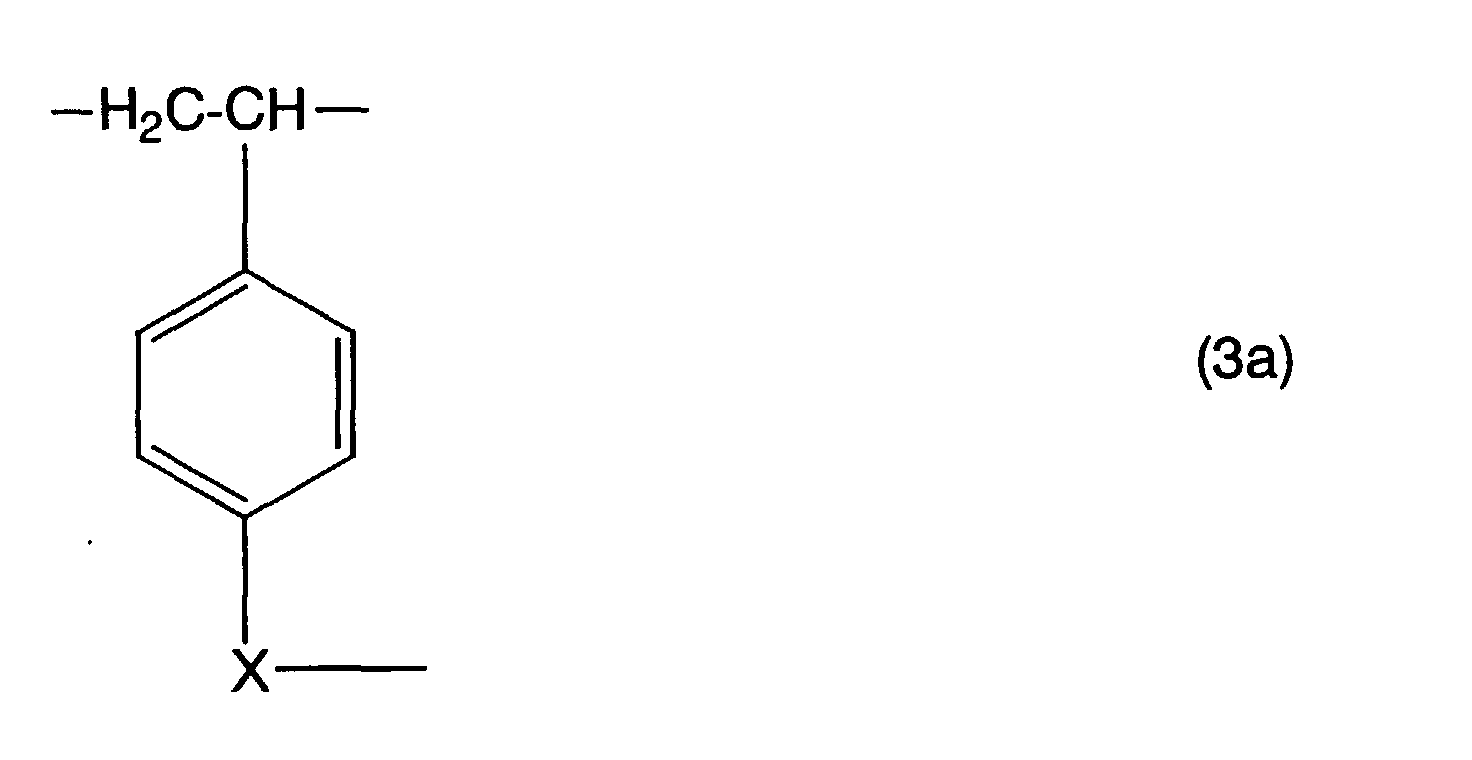
- the units (III) are preferably of the following formula (3a): wherein X is a valence bond or a straight or branched alkylene group of 1 to 10 carbon atoms which may contain a hydroxyl or carbonyl group.
- the dendritic or hyperbranched polymer comprises recurring units of at least one of the following formulae (4) to (8): wherein broken lines represent polymer chains of the recurring units (I) and/or (II), and A represents the units (III).
- the invention provides a method for preparing the dendritic polymer defined above, comprising the steps of polymerizing a hydroxystyrene derivative monomer into an intermediate and finally into a polymer, adding a branching monomer midway in the polymerization step to introduce branch chains into the intermediate, and repeating the polymerizing and branching steps until the desired polymer is obtained.
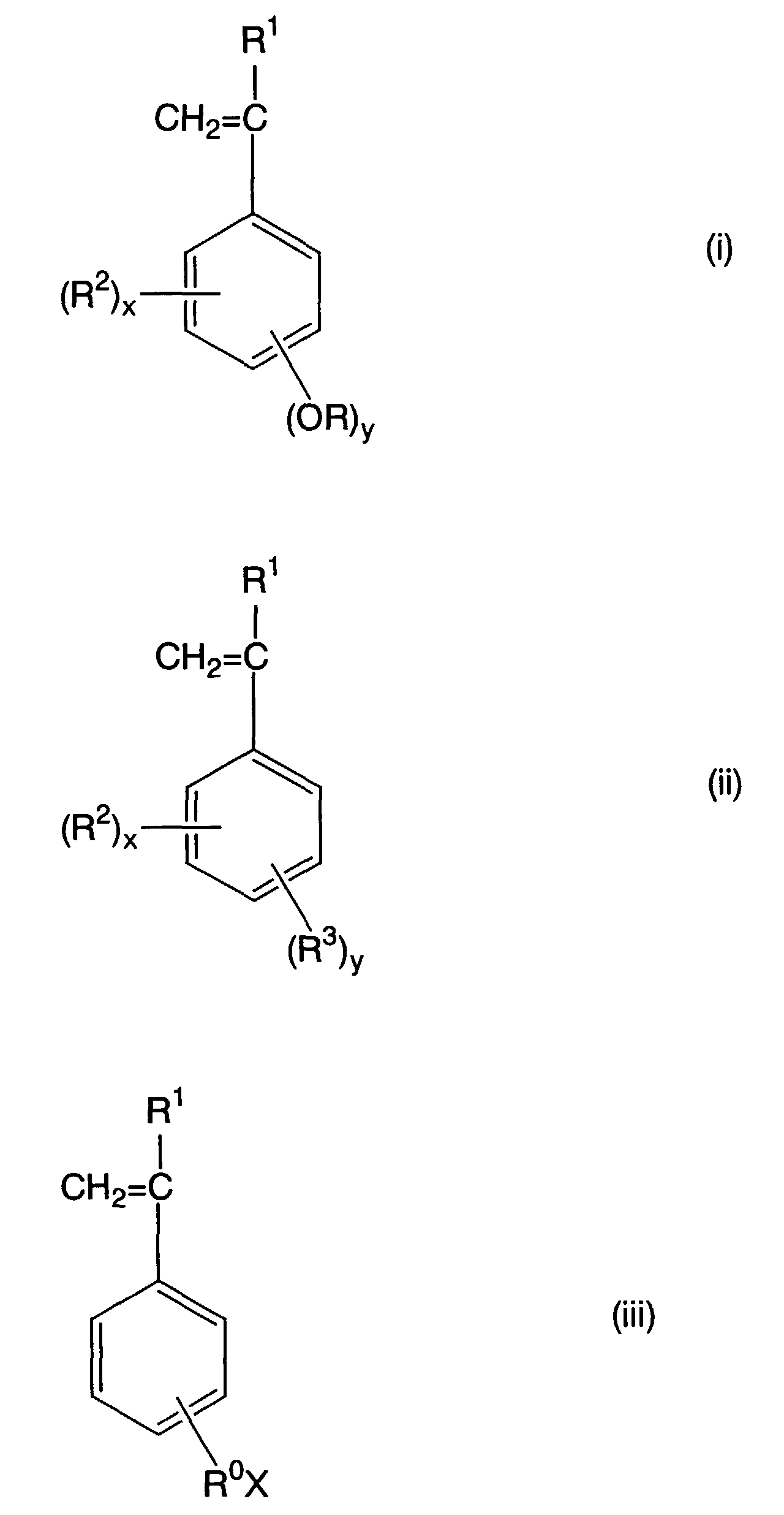
- the hydroxystyrene derivative monomer is represented by at least one of the following general formula (i) and (ii), and the branching monomer is presented by the following formula (iii).
- R 1 , R 2 , R 3 , x, and y are as defined in claim 2, R is a protective group for a hydroxyl group, R 0 is a valence bond or an alkylene group of 1 to 20 carbon atoms, and X is a halogen atom, aldehyde group or alkoxycarbonyl group.
- the polymerization step entails living polymerization, typically living anion polymerization.
- the novel polymers or macromolecules of the invention are dendritic or hyperbranched polymers of phenol derivatives.
- the resulting resist compositions are improved in performance due to the increased branches and increased free volume of the polymers, as compared with the prior art linear structure base resins.
- the dendritic or hyperbranched polymers have a smaller molecular size than corresponding linear polymers, which leads to an improved resolution.
- it is desired to improve heat resistance by increasing the molecular weight of the polymer this can be accomplished without increasing the viscosity considerably, which leads to an improved process stability.
- the dendritic polymers have an increased number of terminuses, which is effective for improving adhesion to substrates.
- the polymers can be designed as desired since the number of branches and terminuses can be freely controlled.
- the polymer or high molecular weight compound of the invention is a dendritic or hyperbranched polymer of a phenol derivative having a weight average molecular weight of 500 to 10,000,000.
- the polymer is comprised of recurring units (I) and/or recurring units (II) and recurring units (III) as shown below.
- the number of units (III) is 1 to 1,000, more preferably 1 to 500, and most preferably 1 to 200. The same may apply to the number average of units (III).
- R 1 is hydrogen or methyl
- R 2 which may be the same or different, is a straight, branched or cyclic alkyl group of 1 to 30 carbon atoms or aryl group of 6 to 30 carbon atoms
- R 3 is a hydroxyl or OR 4 group
- R 4 is an acid labile group or acid stable group
- x is 0 or a positive integer
- y is a positive integer, satisfying x+y ⁇ 5
- R 3 is OR 4 .
- R 1 is as defined above, and R 5 is a straight, branched or cyclic alkylene group of 1 to 30 carbon atoms or arylene group of 6 to 30 carbon atoms, or a mixture thereof, which may contain an ether or ester bond.
- the units (III) are of the following formula (3a): wherein X is a valence bond or a straight or branched alkylene group of 1 to 10 carbon atoms which may contain a hydroxyl or carbonyl group.
- R 2 represents straight, branched or cyclic alkyl groups or aryl groups of 1 to 30 carbon atoms, preferably 1 to 15 carbon atoms, more preferably 1 to 8 carbon atoms.
- Exemplary of the straight, branched or cyclic alkyl groups are methyl, ethyl, propyl, isopropyl, n-butyl, isobutyl, tert-butyl, cyclohexyl, and cyclopentyl.
- Phenyl is an exemplary aryl group.
- the acid labile group represented by R 4 may be selected from a variety of acid labile groups including conventional ones, but preferably of formula (9) or (10), tert-alkyl groups of 4 to 40 carbon atoms, trialkylsilyl groups whose alkyl groups each have 1 to 6 carbon atoms, and oxoalkyl groups of 4 to 20 carbon atoms.
- R 6 is selected from tert-alkyl groups of 4 to 40 carbon atoms, trialkylsilyl groups whose alkyl groups each have 1 to 6 carbon atoms, and oxoalkyl groups of 4 to 20 carbon atoms
- a is an integer of 0 to 10.
- R 7 is hydrogen or a straight, branched or cyclic alkyl group having 1 to 10 carbon atoms
- R 8 and R 9 are independently selected from straight, branched or cyclic alkyl groups having 1 to 10 carbon atoms, or R 8 and R 9 , taken together, form a ring.
- Examples of the acid labile group of formula (10) include straight or branched acetal groups such as 1-methoxyethyl, 1-ethoxyethyl, 1-n-propoxyethyl, 1-isopropoxyethyl, 1-n-butoxyethyl, 1-isobutoxyethyl, 1-sec-butoxyethyl, 1-tert-butoxyethyl, 1-tert-amyloxyethyl, 1-ethoxy-n-propyl, 1-cyclohexyloxyethyl, methoxypropyl, ethoxypropyl, 1-methoxy-1-methylethyl, and 1-ethoxy-1-methylethyl; and cyclic acetal groups such as tetrahydrofuranyl and tetrahydropyranyl, with the ethoxyethyl, butoxyethyl and ethoxypropyl groups being preferred.
- Examples of the acid labile group of formula (9) include tert-butoxycarbonyl, tert-butoxycarbonylmethyl, tert-amyloxycarbonyl, tert-amyloxycarbonylmethyl, 1-ethoxyethoxycarbonylmethyl, 2-tetrahydropyranyloxycarbonylmethyl, and 2-tetrahydrofuranyloxycarbonylmethyl groups.
- tertiary alkyl group examples include tert-butyl, triethylcarbyl, 1-ethylnorbornyl, 1-methylcyclohexyl, 2-(2-methyl)adamantyl and tert-amyl groups.
- trialkylsilyl group examples include those wherein alkyl moieties each have 1 to 6 carbon atoms such as trimethylsilyl, triethylsilyl and dimethyl-tert-butylsilyl groups.
- a typical oxoalkyl group is 3-oxocyclohexyl.
- crosslinking group Q having a C-O-C linkage.
- This crosslinking group Q provides intra- or intermolecular crosslinking between OH groups in units (I), as shown below.
- the crosslinking group Q is exemplified by groups of the following general formulas (Qa) and (Qb), preferably formulas (Qa') and (Qb').
- R' and R'' each are hydrogen or a straight, branched or cyclic alkyl group of 1 to 8 carbon atoms, or R' and R'', taken together, may form a ring, with the proviso that each of R' and R'' is a straight or branched alkylene group of 1 to 8 carbon atoms when they form a ring.
- R''' is a straight, branched or cyclic alkylene group of 1 to 10 carbon atoms.
- Letter d is 0 or an integer of 1 to 10.
- A is a c-valent aliphatic or alicyclic saturated hydrocarbon group, aromatic hydrocarbon group or heterocyclic group of 1 to 50 carbon atoms, which may have an intervening hetero atom and in which the hydrogen atom attached to a carbon atom may be partially replaced by a hydroxyl group, carboxyl group, acyl group or halogen atom.
- B is -CO-O-, -NHCO-O- or -NHCONH-.
- Letter c is an integer of 2 to 8, and c' is an integer of 1 to 7.
- R' and R'' each are hydrogen or a straight, branched or cyclic alkyl group of 1 to 8 carbon atoms, or R' and R'', taken together, may form a ring, with the proviso that each of R' and R'' is a straight or branched alkylene group of 1 to 8 carbon atoms when they form a ring.
- R''' is a straight, branched or cyclic alkylene group of 1 to 10 carbon atoms.
- Letter d is 0 or an integer of 1 to 5.
- A' is a c''-valent straight, branched or cyclic alkylene, alkyltriyl or alkyltetrayl group of 1 to 20 carbon atoms or an arylene group of 6 to 30 carbon atoms, which may have an intervening hetero atom and in which the hydrogen atom attached to a carbon atom may be partially replaced by a hydroxyl group, carboxyl group, acyl group or halogen atom.
- B is -CO-O-, -NHCO-O- or -NHCONH-.
- Letter c'' is an integer of 2 to 4
- c''' is an integer of 1 to 3.
- the straight, branched or cyclic alkyl groups of 1 to 8 carbon atoms are as exemplified above.
- Examples of the straight, branched or cyclic alkylene group of 1 to 10 carbon atoms represented by R''' include methylene, ethylene, propylene, isopropylene, n-butylene, isobutylene, cyclohexylene, and cyclopentylene. Examples of the group represented by A are described later.
- These crosslinking groups of formulas (Qa) and (Qb) originate from alkenyl ether compounds and halogenated alkyl ether compounds to be described later.
- the crosslinking group is not limited to a divalent one and trivalent to octavalent groups are acceptable.
- the divalent crosslinking group is exemplified by groups of the following formulas (Qa'') and (Qb'')
- the trivalent crosslinking group is exemplified by groups of the following formulas (Qa''') and (Qb''').
- R'a is hydrogen or a straight, branched or cyclic alkyl group of 1 to 7 carbon atoms
- Z is a halogen atom such as Cl, Br or I.
- the c-valent (divalent to octavalent) hydrocarbon groups represented by A include hydrocarbon groups, for example, substituted or unsubstituted alkylene groups having 1 to 50 carbon atoms, especially 1 to 40 carbon atoms, substituted or unsubstituted arylene groups having 6 to 50 carbon atoms, more preferably 6 to 40 carbon atoms, especially 6 to 20 carbon atoms, a combination of an alkylene group and an arylene group, and c'''-valent groups obtained by eliminating one hydrogen atom attached to a carbon atom from the foregoing groups wherein c''' is an integer of 3 to 8; and c-valent heterocyclic groups, and a combination of such a heterocyclic group with any one of the foregoing hydrocarbon groups.
- a hetero atom such as O, NH, N(CH 3 ), S and SO 2 may intervene and where substituted, the substituent is a hydroxyl, carboxyl, acyl group or a halogen atom such as fluorine, chlorine, bromine or iodine.
- a method as described by Stephen C. Lapin in Polymers Paint Colour Journal, 179 (4237), 321 (1988) may be used to prepare the compounds of general formula (I). This method involves synthesis via the reaction of a polyhydric alcohol or a polyhydric phenol with acetylene, or the reaction of a polyhydric alcohol or polyhydric phenol with a halogenated alkyl vinyl ether.
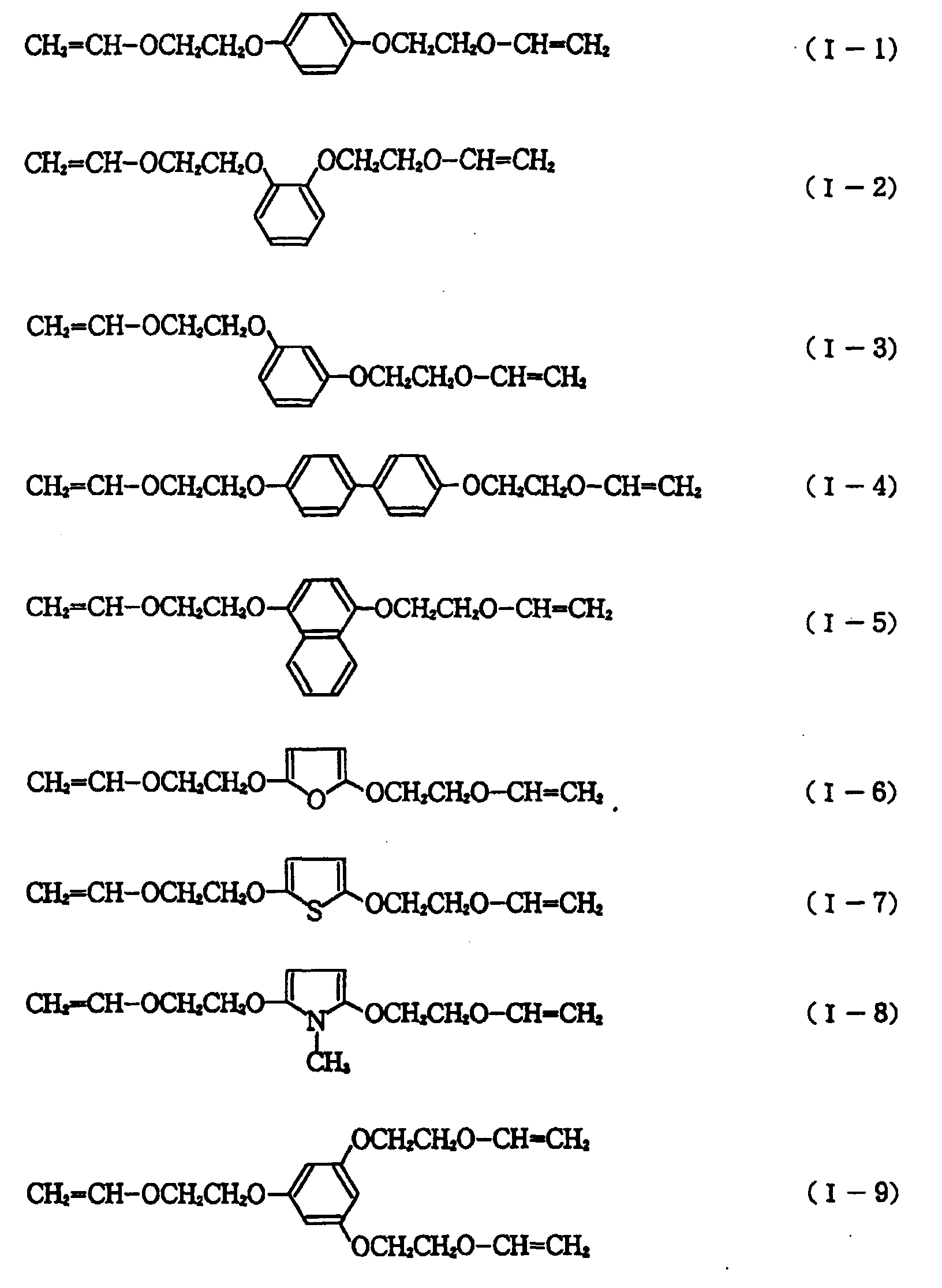
- Illustrative, non-limiting examples of compounds having formula (I) include ethylene glycol divinyl ether, triethylene glycol divinyl ether, 1,2-propanediol divinyl ether, 1,3-propanediol divinyl ether, 1,3-butanediol divinyl ether, 1,4-butanediol divinyl ether, tetramethylene glycol divinyl ether, neopentyl glycol divinyl ether, trimethylolpropane trivinyl ether, trimethylolethane trivinyl ether, hexanediol divinyl ether, 1,4-cyclohexanediol divinyl ether, 1,4-divinyloxymethyl cyclohexane, tetraethylene glycol divinyl ether, pentaerythritol divinyl ether, pentaerythritol trivinyl ether, penta
- the compound of general formula (II) above may be prepared by reacting a polycarboxylic acid with a halogenated alkyl vinyl ether.
- Illustrative, non-limiting examples of compounds having formula (II) in which B is -CO-O- include diethylene vinyl ether terephthalate, diethylene vinyl ether phthalate, diethylene vinyl ether isophthalate, dipropylene vinyl ether phthalate, dipropylene vinyl ether terephthalate, dipropylene vinyl ether isophthalate, diethylene vinyl ether maleate, diethylene vinyl ether fumarate, and diethylene vinyl ether itaconate.
- R'a, R'', and R''' are as defined above.
- Illustrative examples include polyisocyanate compounds such as triphenylmethane triisocyanate, diphenylmethane diisocyanate, tolylene diisocyanate, the dimer of 2,4-tolylene diisocyanate, naphthalene-1,5-diisocyanate, o-tolylene diisocyanate, polymethylene polyphenyl isocyanate, and hexamethylene diisocyanate; and polyisocyanate adducts such as the adduct of tolylene diisocyanate and trimethylolpropane, the adduct of hexamethylene diisocyanate and water, and the adduct of xylene diisocyanate and trimethylolpropane.
- polyisocyanate compounds such as triphenylmethane triisocyanate, diphenylmethane diisocyanate, tolylene diisocyanate, the dimer of 2,4-tolylene di
- Various compounds with terminal alkenyl ether groups may be obtained by reacting the above-mentioned isocyanate group-bearing compounds with the active hydrogen-bearing alkenyl ether compounds.
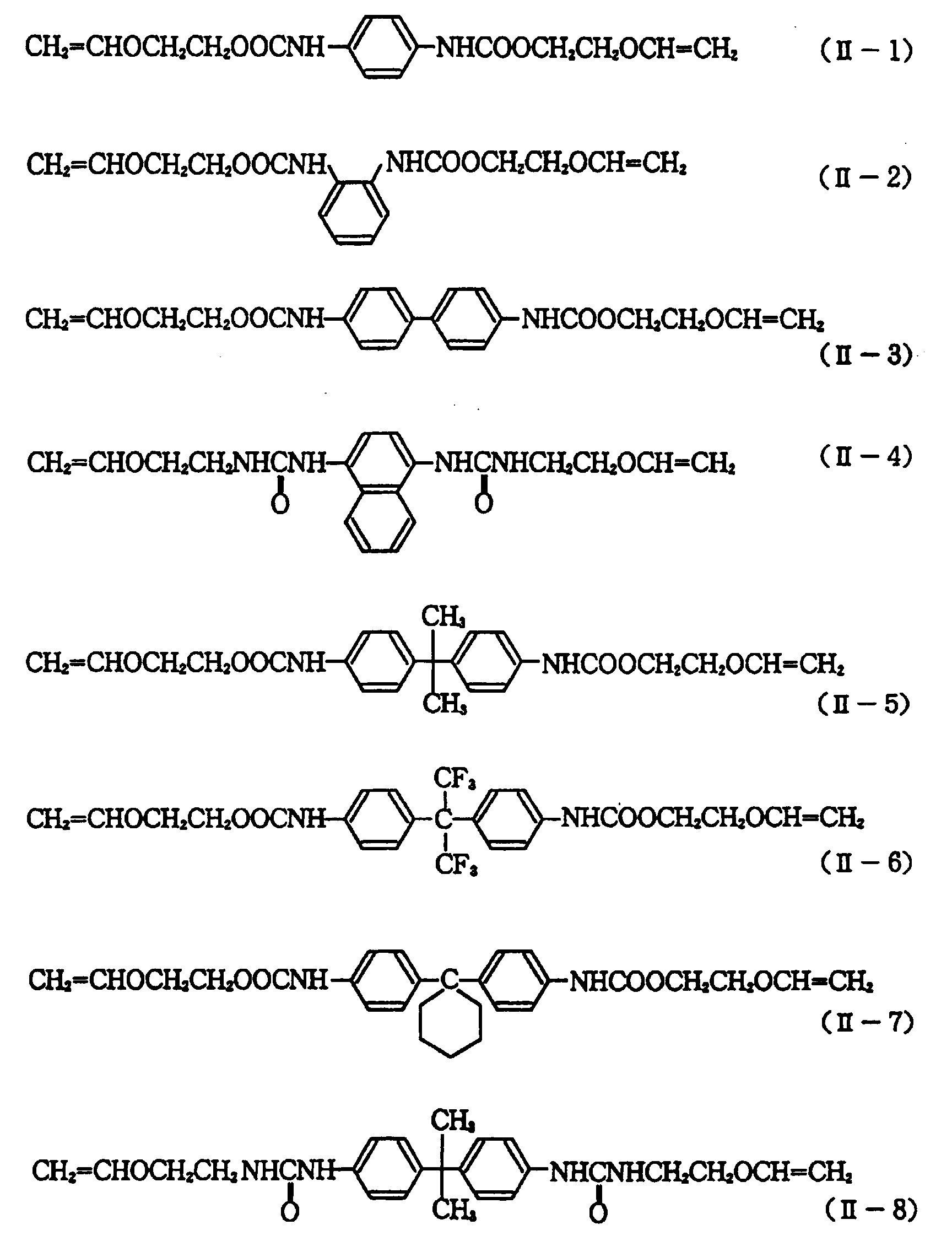
- Illustrative, non-limiting examples of such compounds include those of the following formulas (II-1) to (II-11).
- the acid stable group represented by R 4 designates a substituent other than the substituent which is eliminated under the action of an acid to produce a phenol to change a rate of dissolution, and includes e.g. primary and secondary alkyl groups, primary and secondary alkoxy groups, primary and secondary alkoxycarbonyl groups, primary, secondary and tertiary alkylcarbonyl groups, and aryl groups.
- the alkyl and alkoxy groups are preferably those of 1 to 20 carbon atoms, especially 1 to 10 carbon atoms.
- An exemplary aryl group is phenyl.
- Illustrative, non-limiting examples include methoxy, ethoxy, propoxy, cyclohexyloxy, acetyl, pivaloyl, methylcarbonate, ethylcarbonate, isopropylcarbonate, and methoxymethoxy.
- R 5 represents alkylene and arylene groups.
- the alkylene groups are preferably those of 1 to 20 carbon atoms, especially 1 to 10 carbon atoms.
- the arylene groups are preferably those of 6 to 20 carbon atoms, especially 6 to 10 carbon atoms.
- a combination of an alkylene group with an arylene group is also useful. These groups and combinations may have ether or ester bonds therein. Illustrative examples include methylene, ethylene, propylene, butylene, hexylene, cyclohexylene, octylene, phenylene, and combinations of any two or more of these groups, which may be separated by -O-, -CO- or -COO-. Preferred are groups represented by the following formula.
- X is a valence bond or a straight or branched alkylene group of 1 to 10 carbon atoms, preferably 1 to 8 carbon atoms, more preferably 1 to 6 carbon atoms, which may contain a hydroxyl or carbonyl group.
- alkylene group are the same as exemplified above.
- the polymer of the invention is a macromolecule which is branched and concatenated in the dendritic or hyperbranched manner, e.g. so as to contain units (I) and/or (II) which at one of their two bond sites are attached at respective ones of the three bond sites of units (III) and at the other of their two bond sites at respective ones of the three bond sites at other units (III), optionally via repeats of (I) and/or (II).
- the recurring units (I) and (II) are combined such that (II)/[(I)+(II)] may range from 0 to 1, preferably up to 0.8, more preferably up to 0.6, and most preferably up to 0.5.
- the lower limit of (II)/[(I)+(II)] is 0, preferably a positive number exclusive of 0, more preferably at least 0.01, further preferably at least 0.05, and most preferably at least 0.1.
- polymer of the invention is represented by the following formula (A).
- recurring units "a” and "b”, recurring units “c” and “d”, and recurring units "e” and “f” are attached to the three bond sites of each recurring unit (III).
- R 1 , R 2 , R 4 , and R 5 are as defined above, and x and y are as defined above.
- the letters “a” to “f” are 0 or positive numbers, with the proviso that each pair of "a” and “b”, “c” and “d”, and “e” and “f” are not equal to 0 at the same time.
- the values of a/(a+b) , c/(c+d) , e/(e+f) , and (a+c+e)/(a+b+c+d+e+f) range from 0 to 1. Like the above-mentioned range of (II)/[(I)+(II)], these values are preferably up to 0.8, more preferably up to 0.6, and most preferably up to 0.5.
- the lower limit of these values is 0, preferably a positive number exclusive of 0, more preferably at least 0.01, further preferably at least 0.05, and most preferably at least 0.1. These values may be identical or different.
- the polymers of the invention have a weight average molecular weight (Mw) of 500 to 10,000,000, preferably 1,000 to 1,000,000, more preferably 1,000 to 100,000, and most preferably 2,000 to 50,000.
- Mw weight average molecular weight
- the molecular weight distribution or dispersity represented by Mw/Mn is preferably from 1.0 to 5.0, more preferably from 1.0 to 3.0, though not critical.
- Illustrative examples of the dendritic or hyperbranched polymers of the invention are those having recurring units represented by at least one of the following approximate formulae (4) to (8).
- broken lines represent polymer chains of the recurring units (I) and/or (II), and A represents the units (III).
- A represents the units (III).
- the number of broken line segments between A and A is depicted merely for the sake of convenience, independent of the number of recurring units (I) and (II) included between A and A.
- Such a dendritic or hyperbranched polymer is preparable by effecting living polymerization of a phenol derivative, reacting with a compound having a polymerizable moiety and a terminating moiety and proceeding further polymerization. By repeating this operation, a dendritic or hyperbranched polymer of a phenol derivative can be synthesized.
- the living polymerization may be effected by any desired technique although living anion polymerization is preferred because of ease of control.
- living anion polymerization is initiated using a first monomer of the general formula (i) and/or a second monomer of the general formula (ii). After a predetermined amount of the monomer or monomers is polymerized to form an intermediate, a branching monomer of the general formula (iii) is added and reacted with the intermediate. Then the first monomer of formula (i) and/or the second monomer of formula (ii) are added again and polymerized. This operation is repeated until a desired polymer is obtained.
- R 1 , R 2 , R 3 , x, and y are as defined above, R is a protective group for a hydroxyl group, R 0 is a valence bond or an alkylene group of 1 to 20 carbon atoms, preferably 1 to 10 carbon atoms, and X is a halogen atom, aldehyde group or alkoxycarbonyl group.
- the protective group represented by R is not critical and may be selected from well-known ones. The protective group can be finally eliminated by a conventional technique.
- the reaction solvent is preferably selected from toluene, benzene, tetrahydrofuran, dioxane, and ethyl ether.
- polar solvents such as tetrahydrofuran, dioxane, and ethyl ether are preferable. They may be used alone or in admixture of two or more.
- the initiator used herein is preferably selected from sec-butyl lithium, n-butyl lithium, naphthalene sodium and cumyl potassium.
- the amount of the initiator used is proportional to the design molecular weight.
- Preferred reaction conditions include a temperature of -80°C to 100°C, preferably -70°C to 0°C, and a time of 0.1 to 50 hours, preferably 0.5 to 5 hours.
- the desired acid labile groups or acid stable groups may be introduced to the phenolic hydroxyl groups on the resulting poly(p-hydroxystyrene) e.g. by a well-known technique.
- polymerization may be effected as above using a hydroxystyrene derivative monomer having acid labile groups or acid stable groups already on its phenolic hydroxyl groups.
- novel polymers in the form of dendritic or hyperbranched polymers according to the invention essentially differ from conventional linear polymers.
- the conventional linear polymers have the drawback that reducing the size of a polymer leads to a lowering of strength.
- the novel polymers of the invention permit the polymer size to be changed as desired and have the advantage that the size of a polymer can be reduced while maintaining strength. Then the novel polymers offer resist materials which have a high resolution, sensitivity and plasma etching resistance which we have never seen with prior art resist materials.
- dispersity is a molecular weight distribution (Mw/Mn) defined as weight average molecular weight (Mw) divided by number average molecular weight (Mn).
- a 1-liter flask was charged with 500 ml of tetrahydrofuran as a solvent and 0.01 mol of sec-butyl lithium as an initiator.
- To the solution at -78°C was added 30 g of p-tert-butoxystyrene. With stirring, polymerization reaction was effected for 30 minutes. The reaction solution turned red.
- 0.005 mol of p-chloromethylstyrene was added to the reaction solution whereupon reaction was effected for 5 minutes. The reaction solution was red. Further 15 g of p-tert-butoxystyrene was added. With stirring, polymerization reaction was effected for 30 minutes. Polymerization was stopped by adding 0.1 mol of methanol to the reaction solution.
- the reaction mixture was poured into methanol whereupon the polymer precipitated. Separation and drying yielded 29 g of a white polymer which was tri-branched poly(p-tert-butoxystyrene).
- the polymer was found to have a weight average molecular weight of 4,500 g/mol as measured by the light scattering method and to be monodisperse enough to have a dispersity (Mw/Mn) of 1.07 as determined from the GPC elution curve.
- tri-branched poly(p-hydroxystyrene) 29 g of the above tri-branched poly(p-tert-butoxystyrene) was dissolved in 300 ml of acetone. A minor amount of conc. hydrochloric acid was added to the solution at 60°C, which was stirred for 7 hours. The reaction solution was poured into water whereupon the polymer precipitated. Washing and drying yielded 18 g of a polymer. The polymer had a weight average molecular weight of 3,000 g/mol. Since a peak attributable to tert-butyl group was not found in the proton-NMR spectrum, this polymer was confined to be tri-branched poly(p-hydroxystyrene) having a narrow dispersity.
- a 1-liter flask was charged with 500 ml of tetrahydrofuran as a solvent and 0.01 mol of sec-butyl lithium as an initiator.
- To the solution at -78°C was added 30 g of p-tert-butoxystyrene. With stirring, polymerization reaction was effected for 30 minutes. The reaction solution turned red.
- 0.005 mol of p-methylcarbonylstyrene was added to the reaction solution whereupon reaction was effected for 5 minutes. Further 15 g of p-tert-butoxystyrene was added. With stirring, polymerization reaction was effected for 30 minutes. Polymerization was stopped by adding 0.1 mol of methanol to the reaction solution.
- the reaction mixture was poured into methanol whereupon the polymer precipitated. Separation and drying yielded 28 g of a white polymer which was tri-branched poly(p-tert-butoxystyrene).
- the polymer was found to have a weight average molecular weight of 4,500 g/mol as measured by the light scattering method and to be monodisperse enough to have a dispersity (Mw/Mn) of 1.09 as determined from the GPC elution curve.
- tri-branched poly(p-hydroxystyrene) 28 g of the above tri-branched poly(p-tert-butoxystyrene) was dissolved in 300 ml of acetone. A minor amount of conc. hydrochloric acid was added to the solution at 60°C, which was stirred for 7 hours. The reaction solution was poured into water whereupon the polymer precipitated. Washing and drying yielded 17 g of a polymer. The polymer had a weight average molecular weight of 3,000 g/mol. Since a peak attributable to tert-butyl group was not found in the proton-NMR spectrum, this polymer was confined to be tri-branched poly(p-hydroxystyrene) having a narrow dispersity.
- the partially ethoxypropylated tri-branched polyhydroxystyrene, 20 g, was dissolved in 200 ml of pyridine. With stirring at 45°C, 3 g of di-tert-butyl dicarbonate was added to the solution. Reaction was effected for one hour whereupon the reaction solution was added dropwise to 3 liters of water whereupon a white solid settled out. The solid was collected by filtration and dissolved in 100 ml of acetone, and added dropwise to 5 liters of water again. The precipitate was collected by filtration and dried in vacuum, obtaining a polymer.
- a 2-liter flask was charged with 1000 ml of tetrahydrofuran as a solvent and 0.06 mol of sec-butyl lithium as an initiator.
- To the solution at -78°C was added 60 g of p-tert-butoxystyrene. With stirring, polymerization reaction was effected for 30 minutes. The reaction solution turned red.
- 0.03 mol of p-chloromethylstyrene was added to the reaction solution whereupon reaction was effected for 5 minutes. Then 30 g of p-tert-butoxystyrene was added to the reaction solution, which was stirred for 30 minutes for polymerization. The reaction solution was red.
- the reaction mixture was poured into methanol whereupon the polymer precipitated. Separation and drying yielded 99 g of a white polymer which was nona-branched poly (p-tert-butoxystyrene).
- the polymer was found to have a weight average molecular weight of 4,000 g/mol as measured by the light scattering method and to be monodisperse enough to have a dispersity (Mw/Mn) of 1.21 as determined from the GPC elution curve.
- Polymers 2 to 11 were prepared as above. It is noted that Polymer 5 was prepared by further crosslinking with 1,4-butane diol divinyl ether.
Landscapes
- Chemical & Material Sciences (AREA)
- Health & Medical Sciences (AREA)
- Chemical Kinetics & Catalysis (AREA)
- Medicinal Chemistry (AREA)
- Polymers & Plastics (AREA)
- Organic Chemistry (AREA)
- Inorganic Chemistry (AREA)
- Materials For Photolithography (AREA)
- Addition Polymer Or Copolymer, Post-Treatments, Or Chemical Modifications (AREA)
Abstract
Description
- This invention relates to novel dendritic or hyperbranched polymers of phenol derivatives and a method for preparing the same. More particularly, it relates to novel dendritic or hyperbranched polymers of polyhydroxystyrene derivatives and a method for preparing the same. The novel dendritic or hyperbranched polymers are useful as a base resin for resist material in forming ultrafine patterns during the microfabrication of VLSI.
- While a number of recent efforts that are being made to achieve a finer pattern rule in the drive for higher integration and operating speeds in LSI devices, lithography is thought to hold particular promise as the next generation in microfabrication technology. Deep-UV, EB and x-ray lithography is capable of achieving a minimum feature size of 0.2 µm or less.
- Recently developed acid-catalyzed chemically amplified positive resists, such as those described in JP-B 2-27660, JP-A 63-27829, USP 4,491,628 and USP 5,310,619, utilize a high-intensity KrF excimer laser as the deep-UV light source. These resists are especially promising for deep-UV lithography due to their excellent properties including sensitivity, resolution, and dry etching resistance.
- For example, JP-A 62-115440 discloses a resist material comprising poly-4-tert-butoxystyrene and a photoacid generator. Similarly, JP-A 3-223858 discloses a two-component resist material comprising a resin bearing tert-butoxy groups within the molecule, in combination with a photoacid generator. JP-A 4-211258 discloses a two-component resist material which is comprised of polyhydroxystyrene bearing methyl, isopropyl, tert-butyl, tetrahydropyranyl, and trimethylsilyl groups, together with a photoacid generator.
- In the state-of-the-art, the base polymers which have been developed for resists are synthesized by conventional techniques, typically addition polymerization such as radical polymerization, anion polymerization and cation polymerization as described in JP-A 4-279608, JP-A 57-44608, and JP-B 63-36602. The polymers synthesized by such conventional techniques basically have linear structures.
- These linear polymer resins for resist material, however, suffer from several problems. If they are required to be processed to such a finer pattern that the size of polymer molecules may become approximate to the size of fine lines, then a desired pattern of fine lines cannot be formed. Their heat resistance, sensitivity and resolution are unsatisfactory. A further improvement is thus desirable.
- An object of the invention is to provide a novel and improved dendritic or hyperbranched polymer which can be used as the base resin to formulate a resist composition preferably superior to prior-art resists in sensitivity, resolution, exposure latitude, process flexibility and reproducibility, and which forms a resist pattern having excellent plasma etching resistance and outstanding thermal stability. Another aspect of the invention is to provide methods for preparing and using the dendritic or hyperbranched polymer.
- We have found a novel dendritic or hyperbranched polymer of a phenol derivative that can be produced by the method to be described later. Resist compositions formulated using this dendritic or hyperbranched polymer as base resin are found superior in resolution, exposure latitude, process flexibility, and practical utility and advantageously used for precise microfabrication. Namely, the dendritic or hyperbranched polymer is quite useful as the base resin in resist material for VLSI microfabrication.
- In a first aspect, the invention provides a polymer in the form of a dendritic or hyperbranched polymer of a phenol derivative having a weight average molecular weight of 500 to 10,000,000.
- In one preferred embodiment, the polymer includes recurring units (I) and/or recurring units (II) and recurring units (III) as shown below. The number of units (III) is 1 to 1,000.Herein R1 is hydrogen or methyl, R2 is independently a straight, branched or cyclic alkyl group of 1 to 30 carbon atoms or aryl group of 6 to 30 carbon atoms, R3 is a hydroxyl or OR4 group, R4 is an acid labile group or acid stable group, x is 0 or a positive integer, y is a positive integer, and the sum of x and y is up to 5.
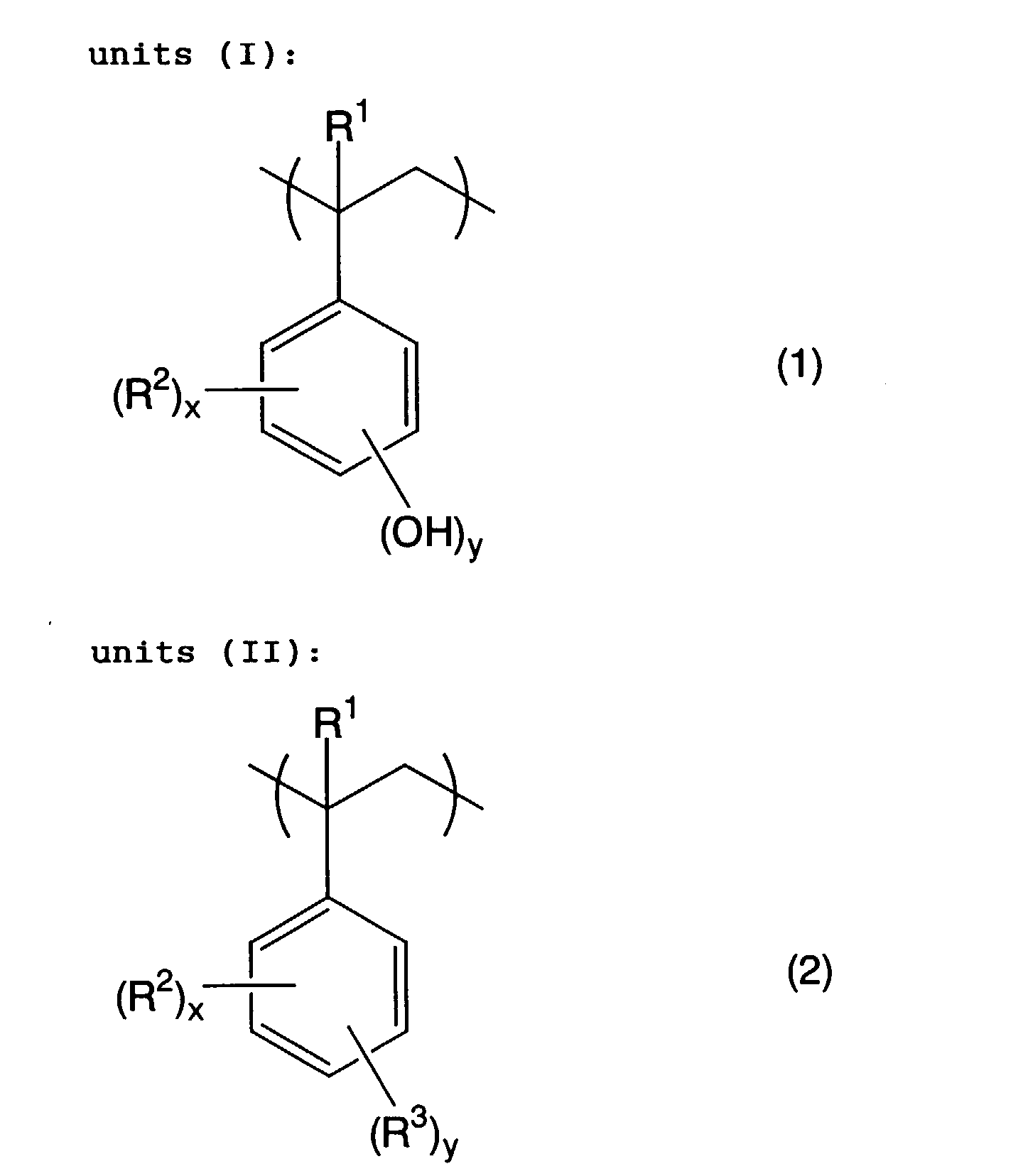 Herein R1 is as defined above, and R5 is a straight, branched or cyclic alkylene group of 1 to 30 carbon atoms or arylene group of 6 to 30 carbon atoms, or a mixture thereof, which may contain an ether or ester bond.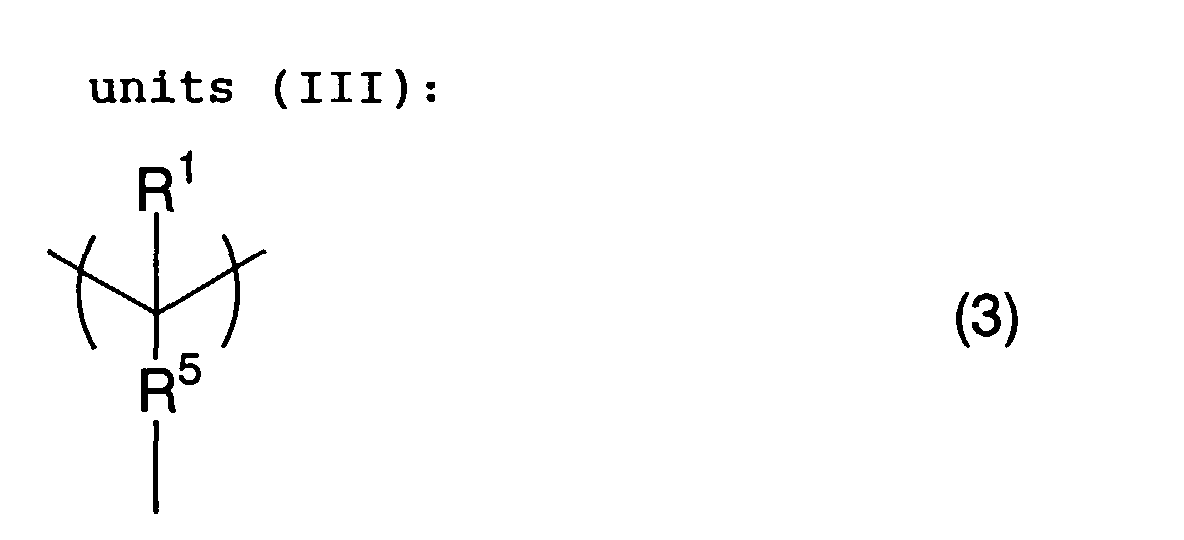
- The units (III) are preferably of the following formula (3a):wherein X is a valence bond or a straight or branched alkylene group of 1 to 10 carbon atoms which may contain a hydroxyl or carbonyl group.
- In a more preferred embodiment, the dendritic or hyperbranched polymer comprises recurring units of at least one of the following formulae (4) to (8):
 wherein broken lines represent polymer chains of the recurring units (I) and/or (II), and A represents the units (III).
- In a second aspect, the invention provides a method for preparing the dendritic polymer defined above, comprising the steps of polymerizing a hydroxystyrene derivative monomer into an intermediate and finally into a polymer, adding a branching monomer midway in the polymerization step to introduce branch chains into the intermediate, and repeating the polymerizing and branching steps until the desired polymer is obtained.
- In one preferred embodiment of the method, the hydroxystyrene derivative monomer is represented by at least one of the following general formula (i) and (ii), and the branching monomer is presented by the following formula (iii).
- An alternative definition of the polymer of the invention is as a product of such a process, optionally with any of the preferred/optional features disclosed herein.Herein R1, R2, R3, x, and y are as defined in claim 2, R is a protective group for a hydroxyl group, R0 is a valence bond or an alkylene group of 1 to 20 carbon atoms, and X is a halogen atom, aldehyde group or alkoxycarbonyl group.
- Preferably, the polymerization step entails living polymerization, typically living anion polymerization.
- The novel polymers or macromolecules of the invention are dendritic or hyperbranched polymers of phenol derivatives. When these polymers are used as the base resin, the resulting resist compositions are improved in performance due to the increased branches and increased free volume of the polymers, as compared with the prior art linear structure base resins. For example, the dendritic or hyperbranched polymers have a smaller molecular size than corresponding linear polymers, which leads to an improved resolution. When it is desired to improve heat resistance by increasing the molecular weight of the polymer, this can be accomplished without increasing the viscosity considerably, which leads to an improved process stability. The dendritic polymers have an increased number of terminuses, which is effective for improving adhesion to substrates. The polymers can be designed as desired since the number of branches and terminuses can be freely controlled.
- The polymer or high molecular weight compound of the invention is a dendritic or hyperbranched polymer of a phenol derivative having a weight average molecular weight of 500 to 10,000,000.
- Preferably the polymer is comprised of recurring units (I) and/or recurring units (II) and recurring units (III) as shown below. The number of units (III) is 1 to 1,000, more preferably 1 to 500, and most preferably 1 to 200. The same may apply to the number average of units (III).Herein R1 is hydrogen or methyl, R2, which may be the same or different, is a straight, branched or cyclic alkyl group of 1 to 30 carbon atoms or aryl group of 6 to 30 carbon atoms, R3 is a hydroxyl or OR4 group, R4 is an acid labile group or acid stable group, x is 0 or a positive integer, y is a positive integer, satisfying
 Herein R1 is as defined above, and R5 is a straight, branched or cyclic alkylene group of 1 to 30 carbon atoms or arylene group of 6 to 30 carbon atoms, or a mixture thereof, which may contain an ether or ester bond.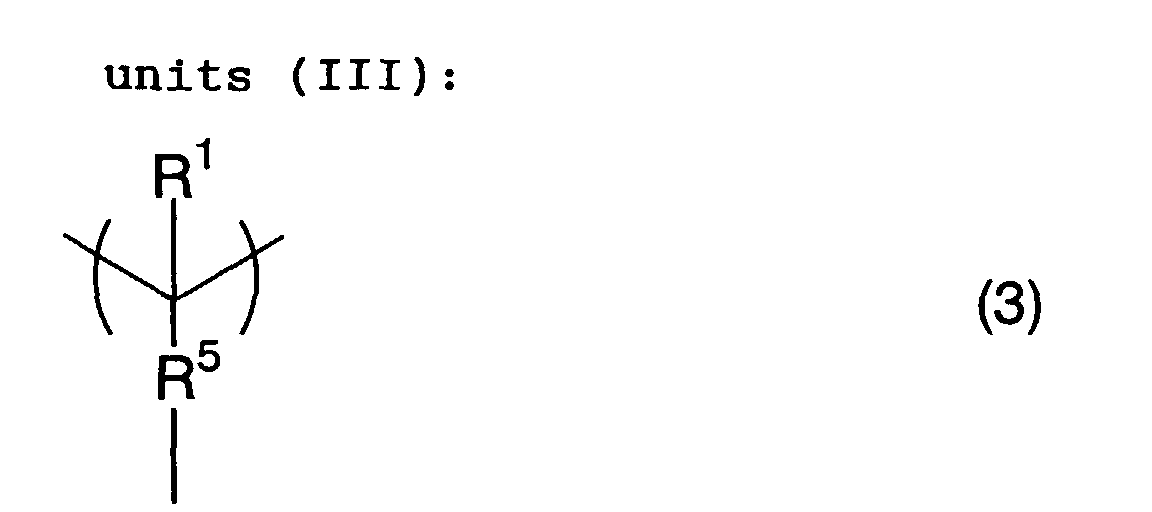
- More preferably, the units (III) are of the following formula (3a):wherein X is a valence bond or a straight or branched alkylene group of 1 to 10 carbon atoms which may contain a hydroxyl or carbonyl group.

- More illustratively, R2 represents straight, branched or cyclic alkyl groups or aryl groups of 1 to 30 carbon atoms, preferably 1 to 15 carbon atoms, more preferably 1 to 8 carbon atoms. Exemplary of the straight, branched or cyclic alkyl groups are methyl, ethyl, propyl, isopropyl, n-butyl, isobutyl, tert-butyl, cyclohexyl, and cyclopentyl. Phenyl is an exemplary aryl group.
- The acid labile group represented by R4 may be selected from a variety of acid labile groups including conventional ones, but preferably of formula (9) or (10), tert-alkyl groups of 4 to 40 carbon atoms, trialkylsilyl groups whose alkyl groups each have 1 to 6 carbon atoms, and oxoalkyl groups of 4 to 20 carbon atoms.In formula (9), R6 is selected from tert-alkyl groups of 4 to 40 carbon atoms, trialkylsilyl groups whose alkyl groups each have 1 to 6 carbon atoms, and oxoalkyl groups of 4 to 20 carbon atoms, and a is an integer of 0 to 10. In formula (10), R7 is hydrogen or a straight, branched or cyclic alkyl group having 1 to 10 carbon atoms, and R8 and R9 are independently selected from straight, branched or cyclic alkyl groups having 1 to 10 carbon atoms, or R8 and R9, taken together, form a ring.

- Examples of the acid labile group of formula (10) include straight or branched acetal groups such as 1-methoxyethyl, 1-ethoxyethyl, 1-n-propoxyethyl, 1-isopropoxyethyl, 1-n-butoxyethyl, 1-isobutoxyethyl, 1-sec-butoxyethyl, 1-tert-butoxyethyl, 1-tert-amyloxyethyl, 1-ethoxy-n-propyl, 1-cyclohexyloxyethyl, methoxypropyl, ethoxypropyl, 1-methoxy-1-methylethyl, and 1-ethoxy-1-methylethyl; and cyclic acetal groups such as tetrahydrofuranyl and tetrahydropyranyl, with the ethoxyethyl, butoxyethyl and ethoxypropyl groups being preferred. Examples of the acid labile group of formula (9) include tert-butoxycarbonyl, tert-butoxycarbonylmethyl, tert-amyloxycarbonyl, tert-amyloxycarbonylmethyl, 1-ethoxyethoxycarbonylmethyl, 2-tetrahydropyranyloxycarbonylmethyl, and 2-tetrahydrofuranyloxycarbonylmethyl groups.
- Examples of the tertiary alkyl group include tert-butyl, triethylcarbyl, 1-ethylnorbornyl, 1-methylcyclohexyl, 2-(2-methyl)adamantyl and tert-amyl groups.
- Examples of the trialkylsilyl group include those wherein alkyl moieties each have 1 to 6 carbon atoms such as trimethylsilyl, triethylsilyl and dimethyl-tert-butylsilyl groups.
- A typical oxoalkyl group is 3-oxocyclohexyl.
- Also included in the acid labile groups is a crosslinking group Q having a C-O-C linkage. This crosslinking group Q provides intra- or intermolecular crosslinking between OH groups in units (I), as shown below.

- The crosslinking group Q is exemplified by groups of the following general formulas (Qa) and (Qb), preferably formulas (Qa') and (Qb').

- Herein, R' and R'' each are hydrogen or a straight, branched or cyclic alkyl group of 1 to 8 carbon atoms, or R' and R'', taken together, may form a ring, with the proviso that each of R' and R'' is a straight or branched alkylene group of 1 to 8 carbon atoms when they form a ring. R''' is a straight, branched or cyclic alkylene group of 1 to 10 carbon atoms. Letter d is 0 or an integer of 1 to 10. A is a c-valent aliphatic or alicyclic saturated hydrocarbon group, aromatic hydrocarbon group or heterocyclic group of 1 to 50 carbon atoms, which may have an intervening hetero atom and in which the hydrogen atom attached to a carbon atom may be partially replaced by a hydroxyl group, carboxyl group, acyl group or halogen atom. B is -CO-O-, -NHCO-O- or -NHCONH-. Letter c is an integer of 2 to 8, and c' is an integer of 1 to 7.
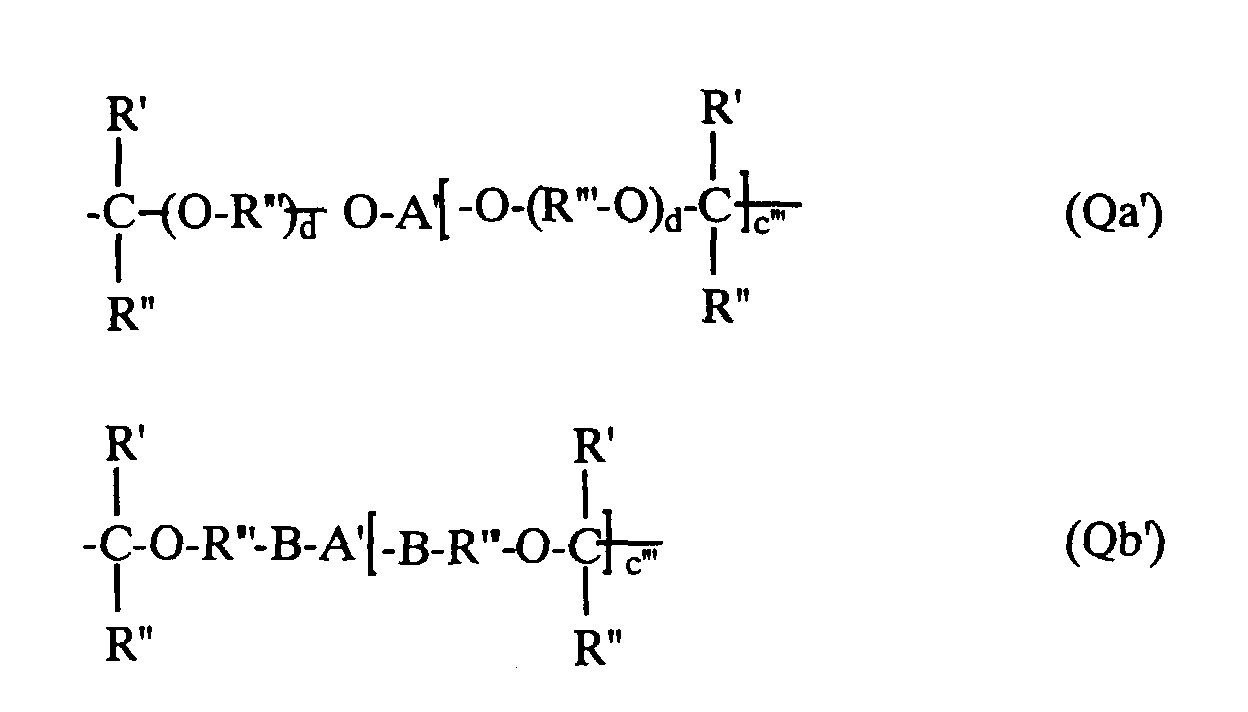
- Herein, R' and R'' each are hydrogen or a straight, branched or cyclic alkyl group of 1 to 8 carbon atoms, or R' and R'', taken together, may form a ring, with the proviso that each of R' and R'' is a straight or branched alkylene group of 1 to 8 carbon atoms when they form a ring. R''' is a straight, branched or cyclic alkylene group of 1 to 10 carbon atoms. Letter d is 0 or an integer of 1 to 5. A' is a c''-valent straight, branched or cyclic alkylene, alkyltriyl or alkyltetrayl group of 1 to 20 carbon atoms or an arylene group of 6 to 30 carbon atoms, which may have an intervening hetero atom and in which the hydrogen atom attached to a carbon atom may be partially replaced by a hydroxyl group, carboxyl group, acyl group or halogen atom. B is -CO-O-, -NHCO-O- or -NHCONH-. Letter c'' is an integer of 2 to 4, and c''' is an integer of 1 to 3.
- The straight, branched or cyclic alkyl groups of 1 to 8 carbon atoms are as exemplified above. Examples of the straight, branched or cyclic alkylene group of 1 to 10 carbon atoms represented by R''' include methylene, ethylene, propylene, isopropylene, n-butylene, isobutylene, cyclohexylene, and cyclopentylene. Examples of the group represented by A are described later. These crosslinking groups of formulas (Qa) and (Qb) originate from alkenyl ether compounds and halogenated alkyl ether compounds to be described later.
- As understood from the value of c' in formula (Qa) or (Qb), the crosslinking group is not limited to a divalent one and trivalent to octavalent groups are acceptable. For example, the divalent crosslinking group is exemplified by groups of the following formulas (Qa'') and (Qb''), and the trivalent crosslinking group is exemplified by groups of the following formulas (Qa''') and (Qb''').


- For introducing the above crosslinking groups, the following compounds may be used.

- Herein A, B, R', R'', R''', c and d are as defined above, R'a is hydrogen or a straight, branched or cyclic alkyl group of 1 to 7 carbon atoms, and Z is a halogen atom such as Cl, Br or I.
- The c-valent (divalent to octavalent) hydrocarbon groups represented by A include hydrocarbon groups, for example, substituted or unsubstituted alkylene groups having 1 to 50 carbon atoms, especially 1 to 40 carbon atoms, substituted or unsubstituted arylene groups having 6 to 50 carbon atoms, more preferably 6 to 40 carbon atoms, especially 6 to 20 carbon atoms, a combination of an alkylene group and an arylene group, and c'''-valent groups obtained by eliminating one hydrogen atom attached to a carbon atom from the foregoing groups wherein c''' is an integer of 3 to 8; and c-valent heterocyclic groups, and a combination of such a heterocyclic group with any one of the foregoing hydrocarbon groups. In the alkylene and arylene groups, a hetero atom such as O, NH, N(CH3), S and SO2 may intervene and where substituted, the substituent is a hydroxyl, carboxyl, acyl group or a halogen atom such as fluorine, chlorine, bromine or iodine.
- Illustrative examples of A are given below.


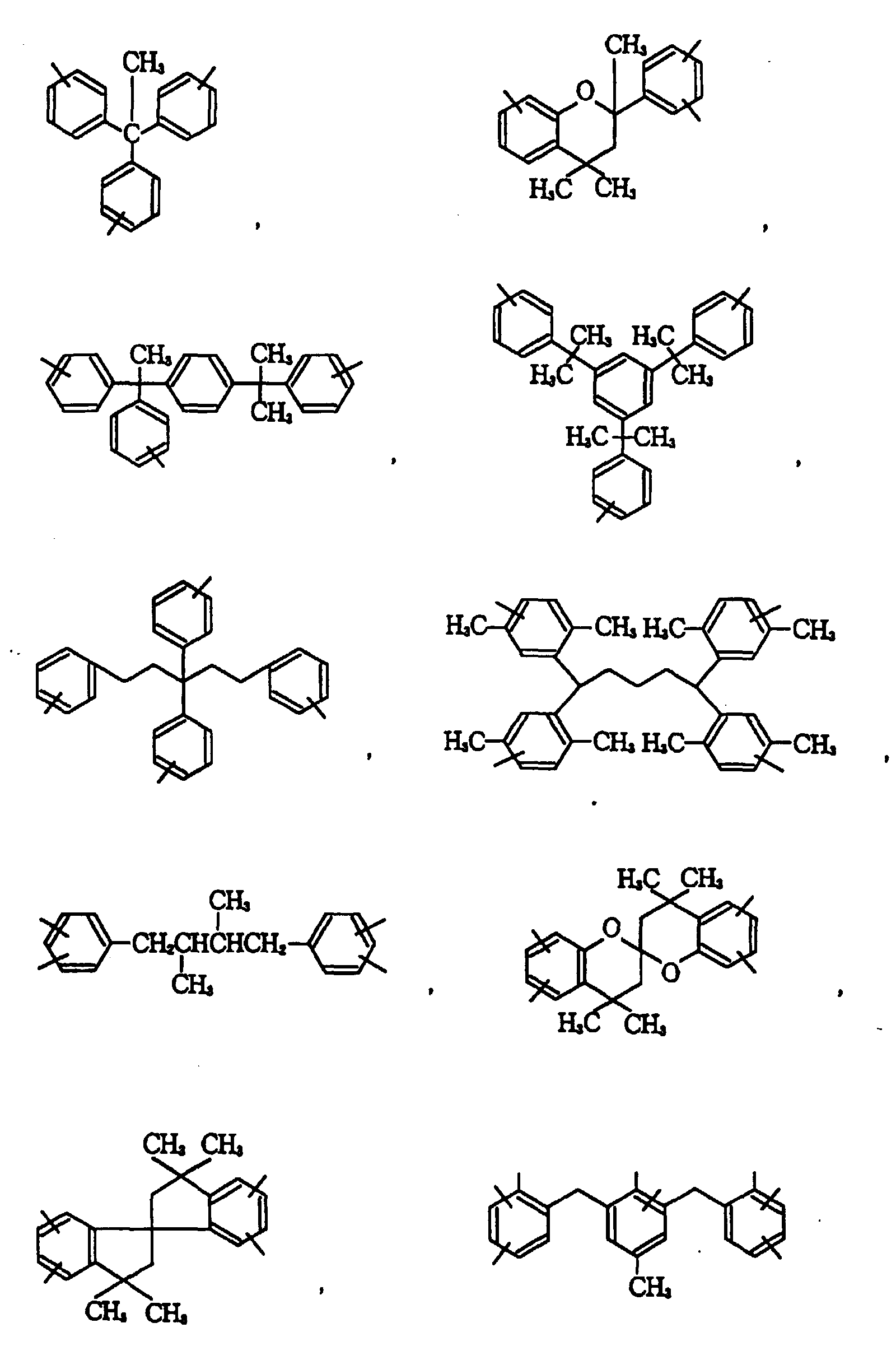
- A method as described by Stephen C. Lapin in Polymers Paint Colour Journal, 179 (4237), 321 (1988) may be used to prepare the compounds of general formula (I). This method involves synthesis via the reaction of a polyhydric alcohol or a polyhydric phenol with acetylene, or the reaction of a polyhydric alcohol or polyhydric phenol with a halogenated alkyl vinyl ether.
- Illustrative, non-limiting examples of compounds having formula (I) include ethylene glycol divinyl ether, triethylene glycol divinyl ether, 1,2-propanediol divinyl ether, 1,3-propanediol divinyl ether, 1,3-butanediol divinyl ether, 1,4-butanediol divinyl ether, tetramethylene glycol divinyl ether, neopentyl glycol divinyl ether, trimethylolpropane trivinyl ether, trimethylolethane trivinyl ether, hexanediol divinyl ether, 1,4-cyclohexanediol divinyl ether, 1,4-divinyloxymethyl cyclohexane, tetraethylene glycol divinyl ether, pentaerythritol divinyl ether, pentaerythritol trivinyl ether, pentaerythritol tetravinyl ether, sorbitol tetravinyl ether, sorbitol pentavinyl ether, ethylene glycol diethylene vinyl ether, triethylene glycol diethylene vinyl ether, ethylene glycol dipropylene vinyl ether, triethylene glycol diethylene vinyl ether, trimethylolpropane triethylene vinyl ether, trimethylolpropane diethylene vinyl ether, pentaerythritol diethylene vinyl ether, pentaerythritol triethylene vinyl ether, pentaerythritol tetraethylene vinyl ether, and compounds of the formulas (I-1) to (I-31) given below.


- When B is -CO-O-, the compound of general formula (II) above may be prepared by reacting a polycarboxylic acid with a halogenated alkyl vinyl ether. Illustrative, non-limiting examples of compounds having formula (II) in which B is -CO-O- include diethylene vinyl ether terephthalate, diethylene vinyl ether phthalate, diethylene vinyl ether isophthalate, dipropylene vinyl ether phthalate, dipropylene vinyl ether terephthalate, dipropylene vinyl ether isophthalate, diethylene vinyl ether maleate, diethylene vinyl ether fumarate, and diethylene vinyl ether itaconate.
- Examples of alkenyl ether group-containing compounds which are highly suitable for use in the invention include alkenyl ether group-containing compounds prepared by reacting an active hydrogen-bearing alkenyl ether compound of general formula (III), (IV), or (V) below, for example, with an isocyanate group-bearing compound.In these formulas, R'a, R'', and R''' are as defined above.
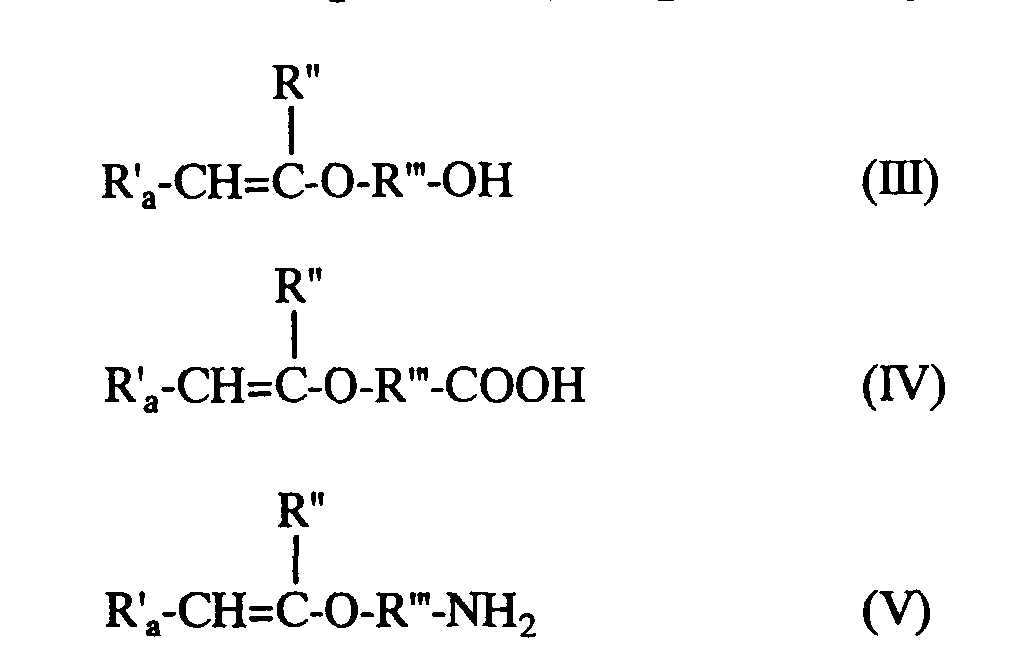
- When B is -NHCO-O- or -NHCONH-, examples of the isocyanate group-bearing compound of general formula (II) above which may be used include the compounds mentioned in Handbook of Crosslinking Agents, Taisei K.K., 1981. Illustrative examples include polyisocyanate compounds such as triphenylmethane triisocyanate, diphenylmethane diisocyanate, tolylene diisocyanate, the dimer of 2,4-tolylene diisocyanate, naphthalene-1,5-diisocyanate, o-tolylene diisocyanate, polymethylene polyphenyl isocyanate, and hexamethylene diisocyanate; and polyisocyanate adducts such as the adduct of tolylene diisocyanate and trimethylolpropane, the adduct of hexamethylene diisocyanate and water, and the adduct of xylene diisocyanate and trimethylolpropane. Various compounds with terminal alkenyl ether groups may be obtained by reacting the above-mentioned isocyanate group-bearing compounds with the active hydrogen-bearing alkenyl ether compounds. Illustrative, non-limiting examples of such compounds include those of the following formulas (II-1) to (II-11).

- The acid stable group represented by R4 designates a substituent other than the substituent which is eliminated under the action of an acid to produce a phenol to change a rate of dissolution, and includes e.g. primary and secondary alkyl groups, primary and secondary alkoxy groups, primary and secondary alkoxycarbonyl groups, primary, secondary and tertiary alkylcarbonyl groups, and aryl groups. The alkyl and alkoxy groups are preferably those of 1 to 20 carbon atoms, especially 1 to 10 carbon atoms. An exemplary aryl group is phenyl. Illustrative, non-limiting examples include methoxy, ethoxy, propoxy, cyclohexyloxy, acetyl, pivaloyl, methylcarbonate, ethylcarbonate, isopropylcarbonate, and methoxymethoxy.
- R5 represents alkylene and arylene groups. The alkylene groups are preferably those of 1 to 20 carbon atoms, especially 1 to 10 carbon atoms. The arylene groups are preferably those of 6 to 20 carbon atoms, especially 6 to 10 carbon atoms. A combination of an alkylene group with an arylene group is also useful. These groups and combinations may have ether or ester bonds therein. Illustrative examples include methylene, ethylene, propylene, butylene, hexylene, cyclohexylene, octylene, phenylene, and combinations of any two or more of these groups, which may be separated by -O-, -CO- or -COO-. Preferred are groups represented by the following formula.

- Herein, X is a valence bond or a straight or branched alkylene group of 1 to 10 carbon atoms, preferably 1 to 8 carbon atoms, more preferably 1 to 6 carbon atoms, which may contain a hydroxyl or carbonyl group. Examples of the alkylene group are the same as exemplified above.
- The polymer of the invention is a macromolecule which is branched and concatenated in the dendritic or hyperbranched manner, e.g. so as to contain units (I) and/or (II) which at one of their two bond sites are attached at respective ones of the three bond sites of units (III) and at the other of their two bond sites at respective ones of the three bond sites at other units (III), optionally via repeats of (I) and/or (II).
- The recurring units (I) and (II) are combined such that (II)/[(I)+(II)] may range from 0 to 1, preferably up to 0.8, more preferably up to 0.6, and most preferably up to 0.5. The lower limit of (II)/[(I)+(II)] is 0, preferably a positive number exclusive of 0, more preferably at least 0.01, further preferably at least 0.05, and most preferably at least 0.1.
- More illustratively, the polymer of the invention is represented by the following formula (A).
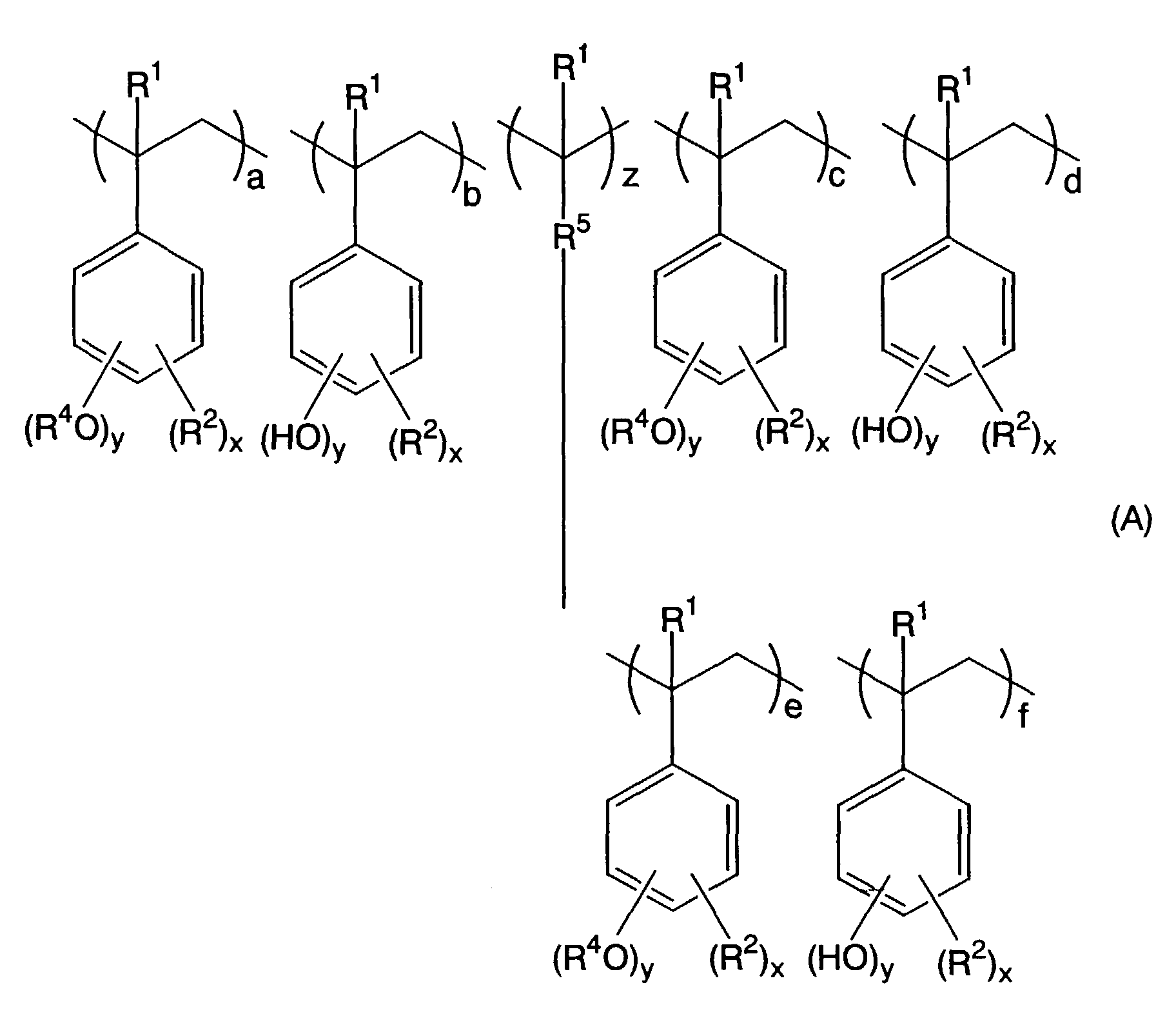
- Depending on the value of z representing the number of recurring units (III) wherein z varies with the number of branches, preferably from 1 to 1,000, more preferably from 1 to 100, and most preferably 1 to 50, recurring units "a" and "b", recurring units "c" and "d", and recurring units "e" and "f" are attached to the three bond sites of each recurring unit (III).
- R1, R2, R4, and R5 are as defined above, and x and y are as defined above.
- The letters "a" to "f" are 0 or positive numbers, with the proviso that each pair of "a" and "b", "c" and "d", and "e" and "f" are not equal to 0 at the same time. The values of
- As previously described, the polymers of the invention have a weight average molecular weight (Mw) of 500 to 10,000,000, preferably 1,000 to 1,000,000, more preferably 1,000 to 100,000, and most preferably 2,000 to 50,000. The molecular weight distribution or dispersity represented by Mw/Mn is preferably from 1.0 to 5.0, more preferably from 1.0 to 3.0, though not critical.
- Illustrative examples of the dendritic or hyperbranched polymers of the invention are those having recurring units represented by at least one of the following approximate formulae (4) to (8).


- Herein, broken lines represent polymer chains of the recurring units (I) and/or (II), and A represents the units (III). The number of broken line segments between A and A is depicted merely for the sake of convenience, independent of the number of recurring units (I) and (II) included between A and A.
- Such a dendritic or hyperbranched polymer is preparable by effecting living polymerization of a phenol derivative, reacting with a compound having a polymerizable moiety and a terminating moiety and proceeding further polymerization. By repeating this operation, a dendritic or hyperbranched polymer of a phenol derivative can be synthesized. The living polymerization may be effected by any desired technique although living anion polymerization is preferred because of ease of control.
- For example, living anion polymerization is initiated using a first monomer of the general formula (i) and/or a second monomer of the general formula (ii). After a predetermined amount of the monomer or monomers is polymerized to form an intermediate, a branching monomer of the general formula (iii) is added and reacted with the intermediate. Then the first monomer of formula (i) and/or the second monomer of formula (ii) are added again and polymerized. This operation is repeated until a desired polymer is obtained.
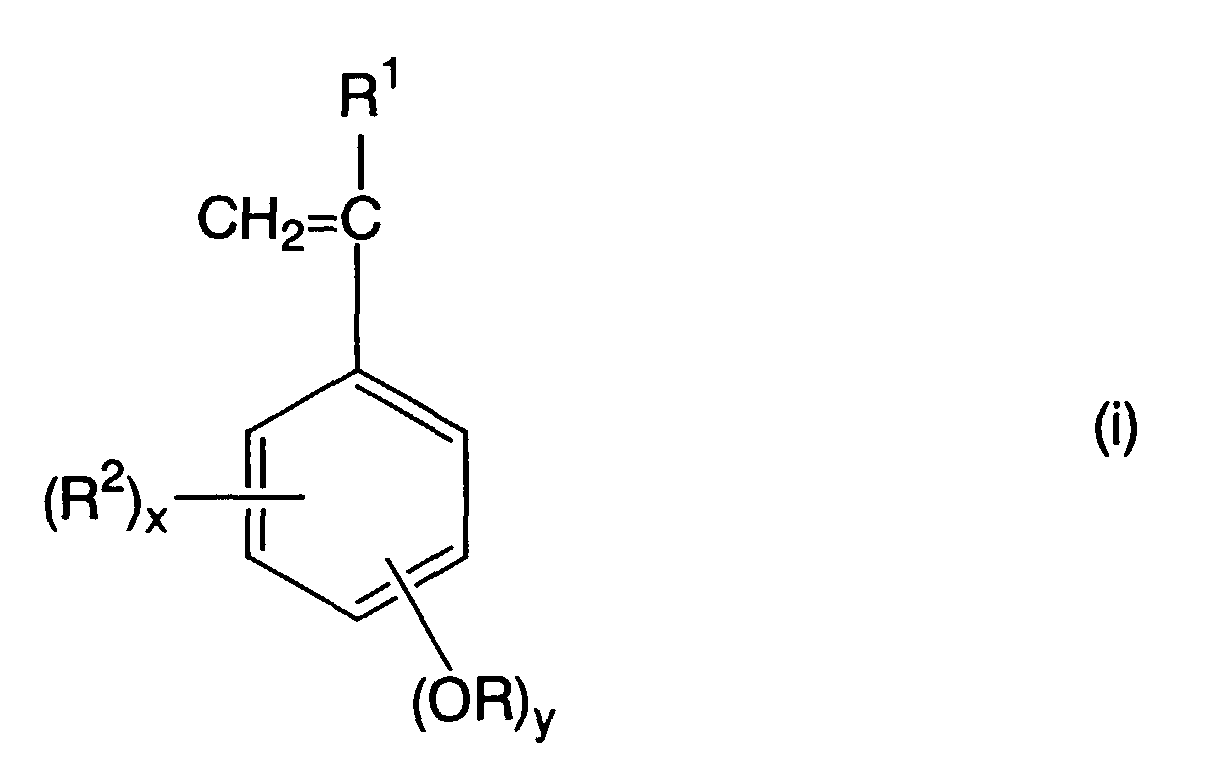

- Herein R1, R2, R3, x, and y are as defined above, R is a protective group for a hydroxyl group, R0 is a valence bond or an alkylene group of 1 to 20 carbon atoms, preferably 1 to 10 carbon atoms, and X is a halogen atom, aldehyde group or alkoxycarbonyl group. The protective group represented by R is not critical and may be selected from well-known ones. The protective group can be finally eliminated by a conventional technique.
- For living anion polymerization to take place, the reaction solvent is preferably selected from toluene, benzene, tetrahydrofuran, dioxane, and ethyl ether. Of these, polar solvents such as tetrahydrofuran, dioxane, and ethyl ether are preferable. They may be used alone or in admixture of two or more.
- The initiator used herein is preferably selected from sec-butyl lithium, n-butyl lithium, naphthalene sodium and cumyl potassium. The amount of the initiator used is proportional to the design molecular weight.
- Preferred reaction conditions include a temperature of -80°C to 100°C, preferably -70°C to 0°C, and a time of 0.1 to 50 hours, preferably 0.5 to 5 hours.
- One exemplary reaction scheme using sec-butyl lithium as the initiator is shown below. The degree of branching can be altered by repeating the reaction desired times.
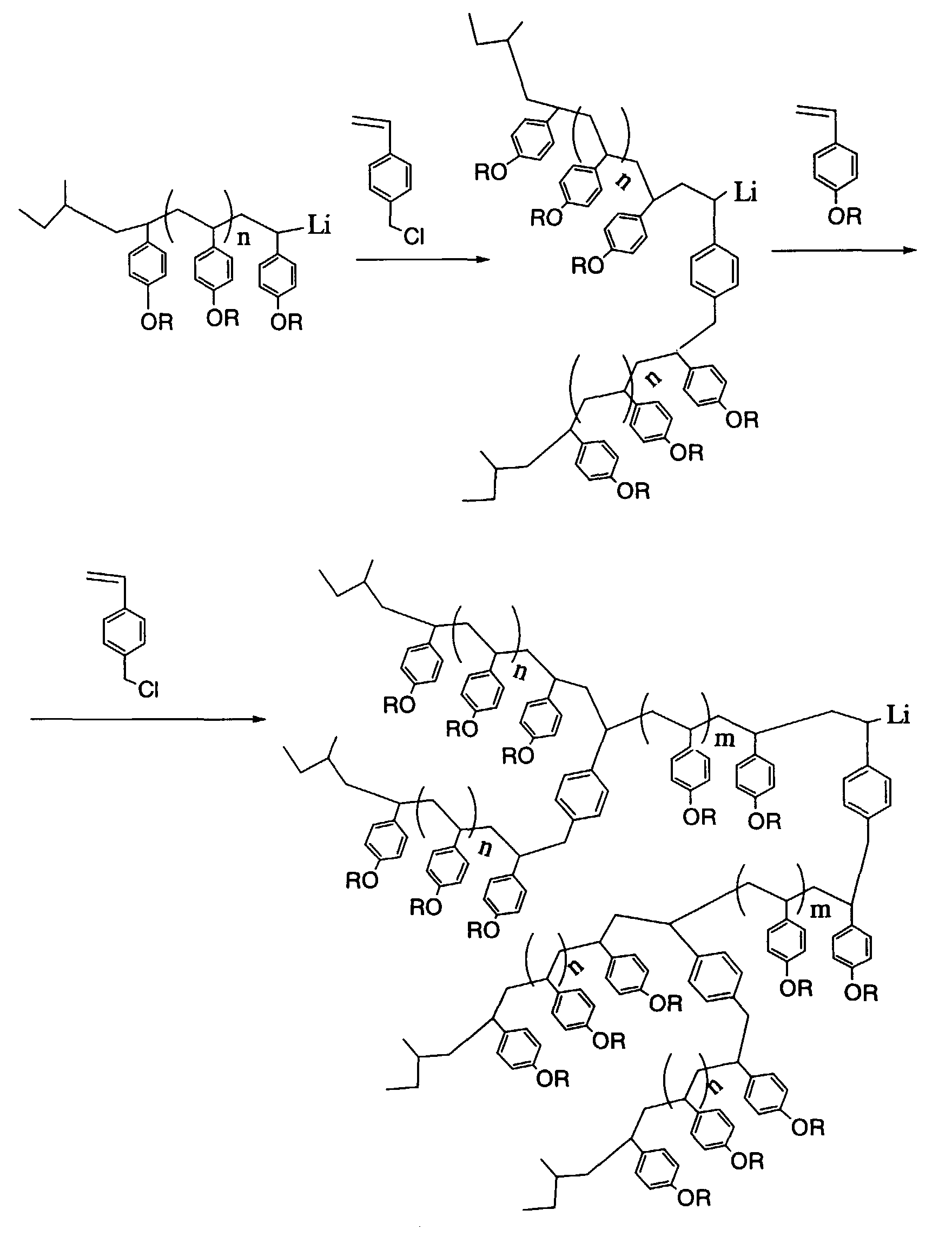
- When acid labile groups or acid stable groups are to be included, the desired acid labile groups or acid stable groups may be introduced to the phenolic hydroxyl groups on the resulting poly(p-hydroxystyrene) e.g. by a well-known technique. Alternatively, polymerization may be effected as above using a hydroxystyrene derivative monomer having acid labile groups or acid stable groups already on its phenolic hydroxyl groups.
- One exemplary process entailing the introduction of acid labile groups is shown below.


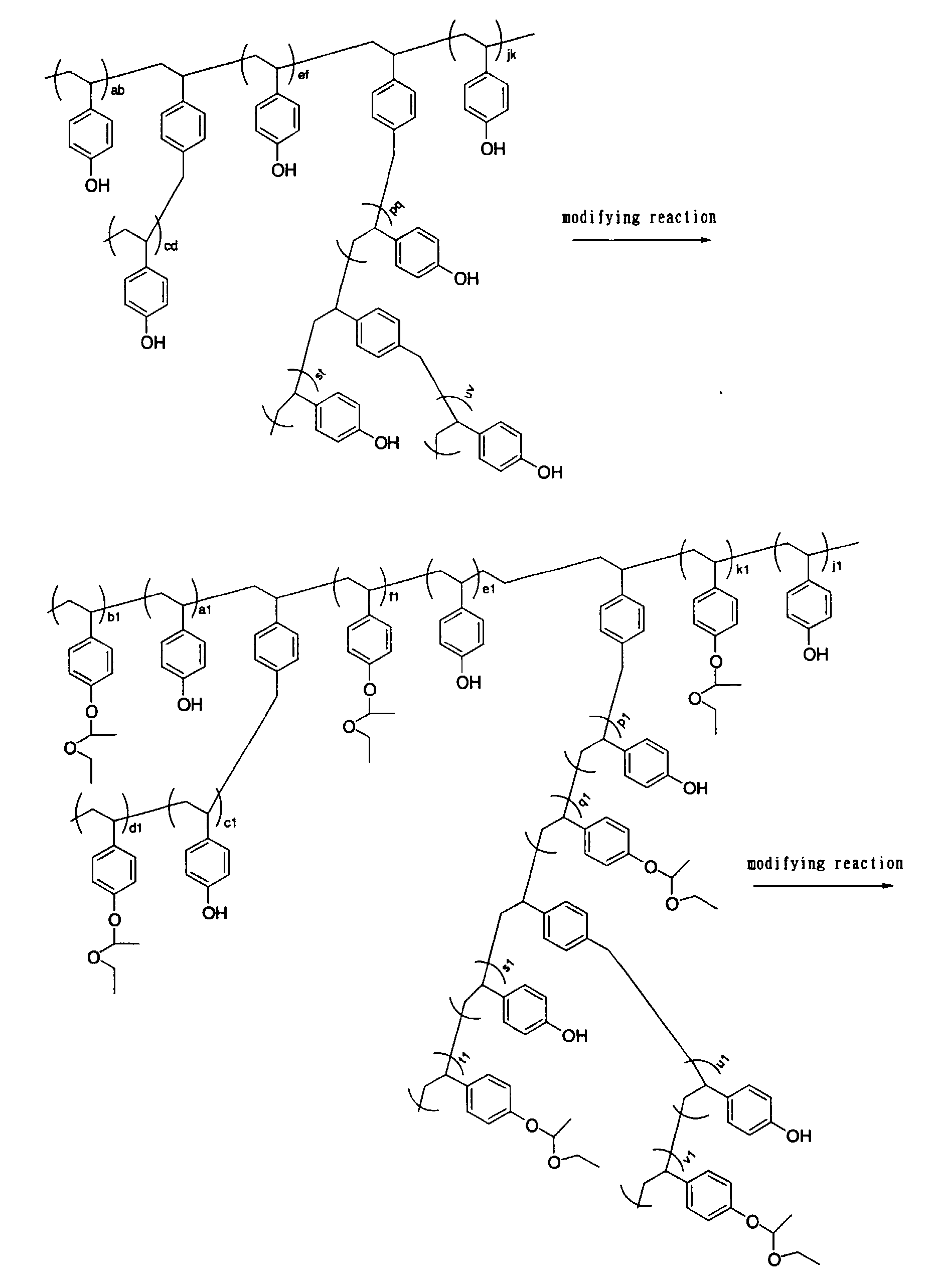

- The novel polymers in the form of dendritic or hyperbranched polymers according to the invention essentially differ from conventional linear polymers. When polymers are used as the base resin of resist materials where the resolution is in proportion to the size of a polymer, for example, the conventional linear polymers have the drawback that reducing the size of a polymer leads to a lowering of strength. By contrast, the novel polymers of the invention permit the polymer size to be changed as desired and have the advantage that the size of a polymer can be reduced while maintaining strength. Then the novel polymers offer resist materials which have a high resolution, sensitivity and plasma etching resistance which we have never seen with prior art resist materials.
- Examples of the invention are given below by way of illustration and not by way of limitation. It is noted that dispersity is a molecular weight distribution (Mw/Mn) defined as weight average molecular weight (Mw) divided by number average molecular weight (Mn).
- A 1-liter flask was charged with 500 ml of tetrahydrofuran as a solvent and 0.01 mol of sec-butyl lithium as an initiator. To the solution at -78°C was added 30 g of p-tert-butoxystyrene. With stirring, polymerization reaction was effected for 30 minutes. The reaction solution turned red. For producing a branched polymer, 0.005 mol of p-chloromethylstyrene was added to the reaction solution whereupon reaction was effected for 5 minutes. The reaction solution was red. Further 15 g of p-tert-butoxystyrene was added. With stirring, polymerization reaction was effected for 30 minutes. Polymerization was stopped by adding 0.1 mol of methanol to the reaction solution.
- For purifying the polymer, the reaction mixture was poured into methanol whereupon the polymer precipitated. Separation and drying yielded 29 g of a white polymer which was tri-branched poly(p-tert-butoxystyrene). The polymer was found to have a weight average molecular weight of 4,500 g/mol as measured by the light scattering method and to be monodisperse enough to have a dispersity (Mw/Mn) of 1.07 as determined from the GPC elution curve.
- For producing tri-branched poly(p-hydroxystyrene), 29 g of the above tri-branched poly(p-tert-butoxystyrene) was dissolved in 300 ml of acetone. A minor amount of conc. hydrochloric acid was added to the solution at 60°C, which was stirred for 7 hours. The reaction solution was poured into water whereupon the polymer precipitated. Washing and drying yielded 18 g of a polymer. The polymer had a weight average molecular weight of 3,000 g/mol. Since a peak attributable to tert-butyl group was not found in the proton-NMR spectrum, this polymer was confined to be tri-branched poly(p-hydroxystyrene) having a narrow dispersity.
- A 1-liter flask was charged with 500 ml of tetrahydrofuran as a solvent and 0.01 mol of sec-butyl lithium as an initiator. To the solution at -78°C was added 30 g of p-tert-butoxystyrene. With stirring, polymerization reaction was effected for 30 minutes. The reaction solution turned red. For producing a branched polymer, 0.005 mol of p-methylcarbonylstyrene was added to the reaction solution whereupon reaction was effected for 5 minutes. Further 15 g of p-tert-butoxystyrene was added. With stirring, polymerization reaction was effected for 30 minutes. Polymerization was stopped by adding 0.1 mol of methanol to the reaction solution.
- For purifying the polymer, the reaction mixture was poured into methanol whereupon the polymer precipitated. Separation and drying yielded 28 g of a white polymer which was tri-branched poly(p-tert-butoxystyrene). The polymer was found to have a weight average molecular weight of 4,500 g/mol as measured by the light scattering method and to be monodisperse enough to have a dispersity (Mw/Mn) of 1.09 as determined from the GPC elution curve.
- For producing tri-branched poly(p-hydroxystyrene), 28 g of the above tri-branched poly(p-tert-butoxystyrene) was dissolved in 300 ml of acetone. A minor amount of conc. hydrochloric acid was added to the solution at 60°C, which was stirred for 7 hours. The reaction solution was poured into water whereupon the polymer precipitated. Washing and drying yielded 17 g of a polymer. The polymer had a weight average molecular weight of 3,000 g/mol. Since a peak attributable to tert-butyl group was not found in the proton-NMR spectrum, this polymer was confined to be tri-branched poly(p-hydroxystyrene) having a narrow dispersity.
- The tri-branched polyhydroxystyrene obtained in Synthetic Example 1, 10 g, was dissolved in 100 ml of tetrahydrofuran and a catalytic amount of methanesulfonic acid was added. With stirring at 20°C, 3 g of ethyl vinyl ether was added to the solution. Reaction was effected for one hour whereupon the reaction solution was neutralized with conc. aqueous ammonia. The neutralized reaction solution was added dropwise to 5 liters of water whereupon a white solid settled out. The solid was collected by filtration and dissolved in 100 ml of acetone, and added dropwise to 5 liters of water again. The precipitate was collected by filtration and dried in vacuum, obtaining a polymer. On proton-NMR analysis of the polymer, it was found that 27% of the hydrogen atoms of hydroxyl groups in tri-branched polyhydroxystyrene were ethoxyethylated. The weight average molecular weight (Mw) and dispersity (Mw/Mn) of the polymer are shown in Table 1.
- The tri-branched polyhydroxystyrene obtained in Synthetic Example 1, 20 g, was dissolved in 200 ml of pyridine. With stirring at 45°C, 10 g of di-tert-butyl dicarbonate was added to the solution. Reaction was effected for one hour whereupon the reaction solution was added dropwise to 3 liters of water whereupon a white solid settled out. The solid was collected by filtration and dissolved in 100 ml of acetone, and added dropwise to 5 liters of water again. The precipitate was collected by filtration and dried in vacuum, obtaining a polymer. On proton-NMR analysis of the polymer, it was found that 27% of the hydrogen atoms of hydroxyl groups in tri-branched polyhydroxystyrene were t-butoxycarbonylated (t-BOC). The weight average molecular weight (Mw) and dispersity (Mw/Mn) of the polymer are shown in Table 1.
- The tri-branched polyhydroxystyrene obtained in Synthetic Example 1, 20 g, was dissolved in 200 ml of tetrahydrofuran and a catalytic amount of methanesulfonic acid was added. With stirring at 20°C, 5 g of ethyl propenyl ether was added to the solution. Reaction was effected for one hour whereupon the reaction solution was neutralized with conc. aqueous ammonia. The neutralized solution was added dropwise to 10 liters of water whereupon a white solid settled out. The solid was collected by filtration and dissolved in 200 ml of acetone, and added dropwise to 10 liters of water again. The precipitate was collected by filtration and dried in vacuum, obtaining a polymer. On proton-NMR analysis of the polymer, it was found that 20% of the hydrogen atoms of hydroxyl groups in tri-branched polyhydroxystyrene were ethoxypropylated.
- The partially ethoxypropylated tri-branched polyhydroxystyrene, 20 g, was dissolved in 200 ml of pyridine. With stirring at 45°C, 3 g of di-tert-butyl dicarbonate was added to the solution. Reaction was effected for one hour whereupon the reaction solution was added dropwise to 3 liters of water whereupon a white solid settled out. The solid was collected by filtration and dissolved in 100 ml of acetone, and added dropwise to 5 liters of water again. The precipitate was collected by filtration and dried in vacuum, obtaining a polymer. On proton-NMR analysis of the polymer, it was found that the hydrogen atoms of hydroxyl groups in tri-branched polyhydroxystyrene were 20% ethoxypropylated and 8% t-butoxycarbonylated (t-BOC). The weight average molecular weight (Mw) and dispersity (Mw/Mn) of the polymer are shown in Table 1.
- A 2-liter flask was charged with 1000 ml of tetrahydrofuran as a solvent and 0.06 mol of sec-butyl lithium as an initiator. To the solution at -78°C was added 60 g of p-tert-butoxystyrene. With stirring, polymerization reaction was effected for 30 minutes. The reaction solution turned red. For producing a tri-branched polymer, 0.03 mol of p-chloromethylstyrene was added to the reaction solution whereupon reaction was effected for 5 minutes. Then 30 g of p-tert-butoxystyrene was added to the reaction solution, which was stirred for 30 minutes for polymerization. The reaction solution was red. For producing penta-branched polymer, 0.015 mol of p-chloromethylstyrene was added to the reaction solution whereupon reaction was effected for 5 minutes. Then 15 g of p-tert-butoxystyrene was added to the reaction solution, which was stirred for 30 minutes for polymerization. The reaction solution was red. Finally for producing nona-branched polymer, 0.0075 mol of p-chloromethylstyrene was added to the reaction solution whereupon reaction was effected for 5 minutes. 7.5 g of p-tert-butoxystyrene was added to the reaction solution, which was stirred for 30 minutes for polymerization. The reaction solution was red.
- Further 10 g of p-tert-butoxystyrene was added to the reaction solution. With stirring, polymerization reaction was effected for 30 minutes. Polymerization was stopped by adding 0.1 mol of carbon dioxide gas to the reaction solution.
- For purifying the polymer, the reaction mixture was poured into methanol whereupon the polymer precipitated. Separation and drying yielded 99 g of a white polymer which was nona-branched poly (p-tert-butoxystyrene). The polymer was found to have a weight average molecular weight of 4,000 g/mol as measured by the light scattering method and to be monodisperse enough to have a dispersity (Mw/Mn) of 1.21 as determined from the GPC elution curve.
- For converting to nona-branched poly(p-hydroxystyrene), 99 g of the above nona-branched poly(p-tert-butoxystyrene) was dissolved in 1000 ml of acetone. A minor amount of conc. hydrochloric acid was added to the solution at 60°C, which was stirred for 7 hours. The reaction solution was poured into water whereupon the polymer precipitated. Washing and drying yielded 66 g of a polymer. The polymer had a weight average molecular weight of 3,000 g/mol. Since a peak attributable to tert-butyl group was not found in the proton-NMR spectrum, this polymer was confirmed to be nona-branched poly(p-hydroxystyrene) having a narrow dispersity.
- In a 2-liter flask, 99 g of the nona-branched poly(p-hydroxystyrene) thus obtained was dissolved in 1000 ml of tetrahydrofuran and a catalytic amount of methanesulfonic acid was added. With stirring at 20°C, 25 g of ethyl propenyl ether was added to the solution. Reaction was effected for 2 hours whereupon the reaction solution was neutralized with conc. aqueous ammonia. The neutralized solution was added dropwise to 10 liters of water whereupon a white solid settled out. The solid was collected by filtration and dissolved in 500 ml of acetone, and added dropwise to 10 liters of water again. The precipitate was collected by filtration and dried in vacuum, obtaining a polymer. On proton-NMR analysis of the polymer, it was found that 26% of the hydrogen atoms of hydroxyl groups in carboxylic acid-terminated polyhydroxystyrene were ethoxypropylated. The weight average molecular weight (Mw) and dispersity (Mw/Mn) of the polymer are shown in Table 1.
Polymer Mw Mw/Mn Synthetic Example 3 6000 1.1 Synthetic Example 4 5400 1.09 Synthetic Example 5 6200 1.09 Synthetic Example 6 4500 1.25 - In a 2-liter flask, 99 g of the nona-branched poly(p-hydroxystyrene) obtained in Synthetic Example 6 was dissolved in 1000 ml of tetrahydrofuran and a catalytic amount of methanesulfonic acid was added. With stirring at 20°C, 25 g of ethyl vinyl ether was added to the solution. Reaction was effected for 2 hours whereupon the reaction solution was neutralized with conc. aqueous ammonia. The neutralized solution was added dropwise to 10 liters of water whereupon a white solid settled out. The solid was collected by filtration and dissolved in 500 ml of acetone, and added dropwise to 10 liters of water again. The precipitate was collected by filtration and dried in vacuum, obtaining a polymer designated Polymer 1. By proton-NMR analysis, the rate of substitution of ethoxyethyl groups was determined.
- The following Polymers 2 to 11 were prepared as above. It is noted that Polymer 5 was prepared by further crosslinking with 1,4-butane diol divinyl ether.


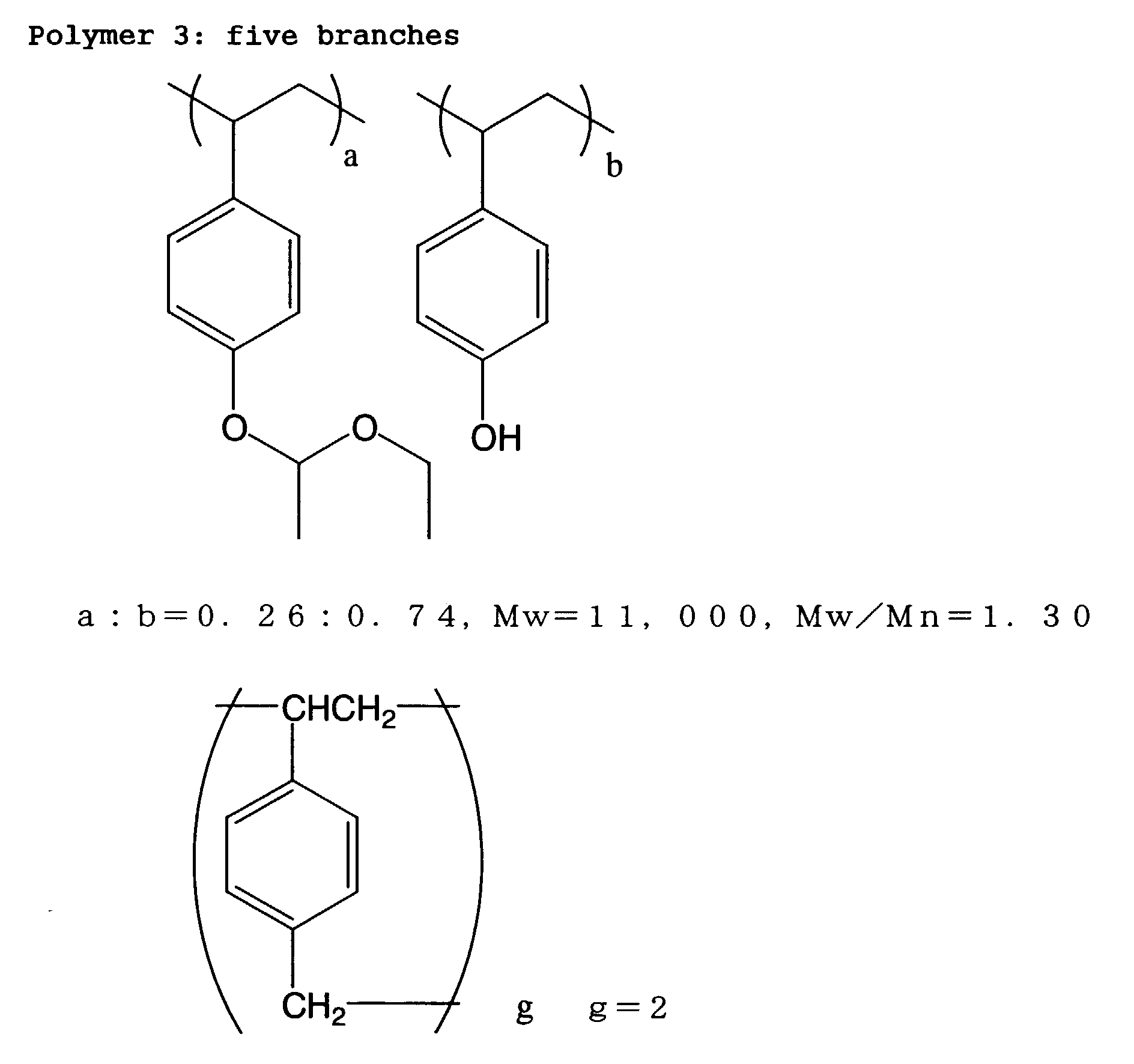
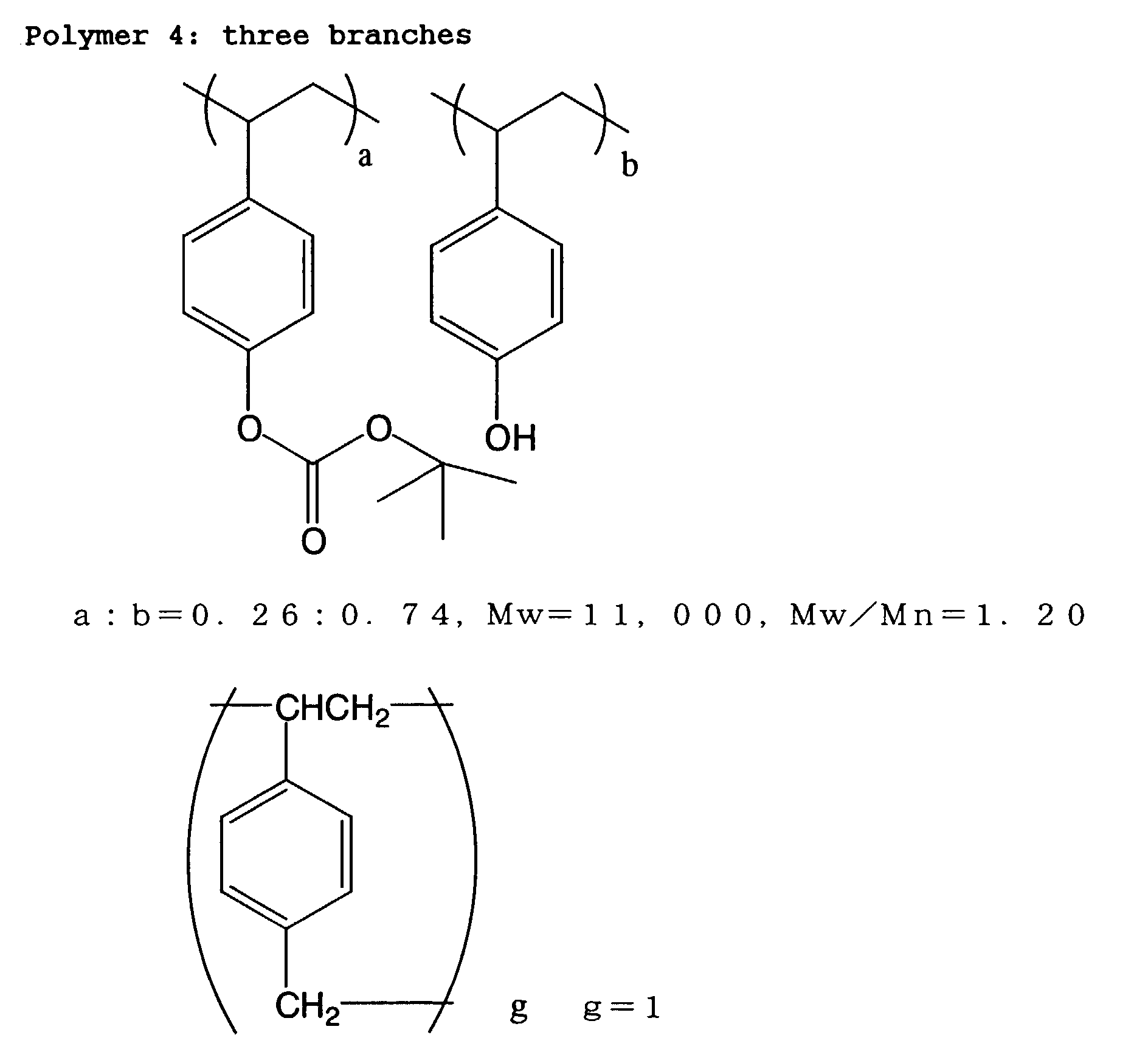
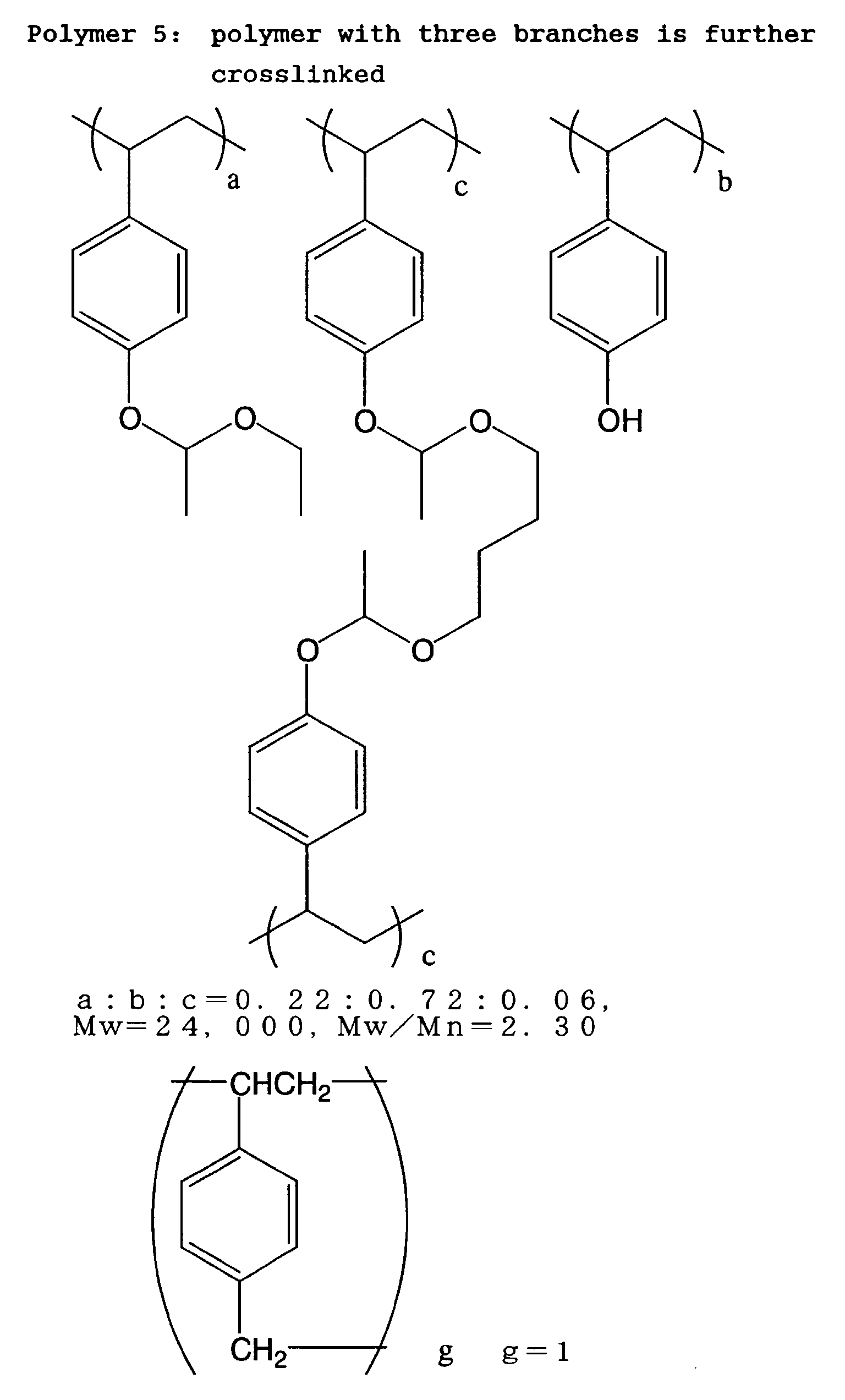


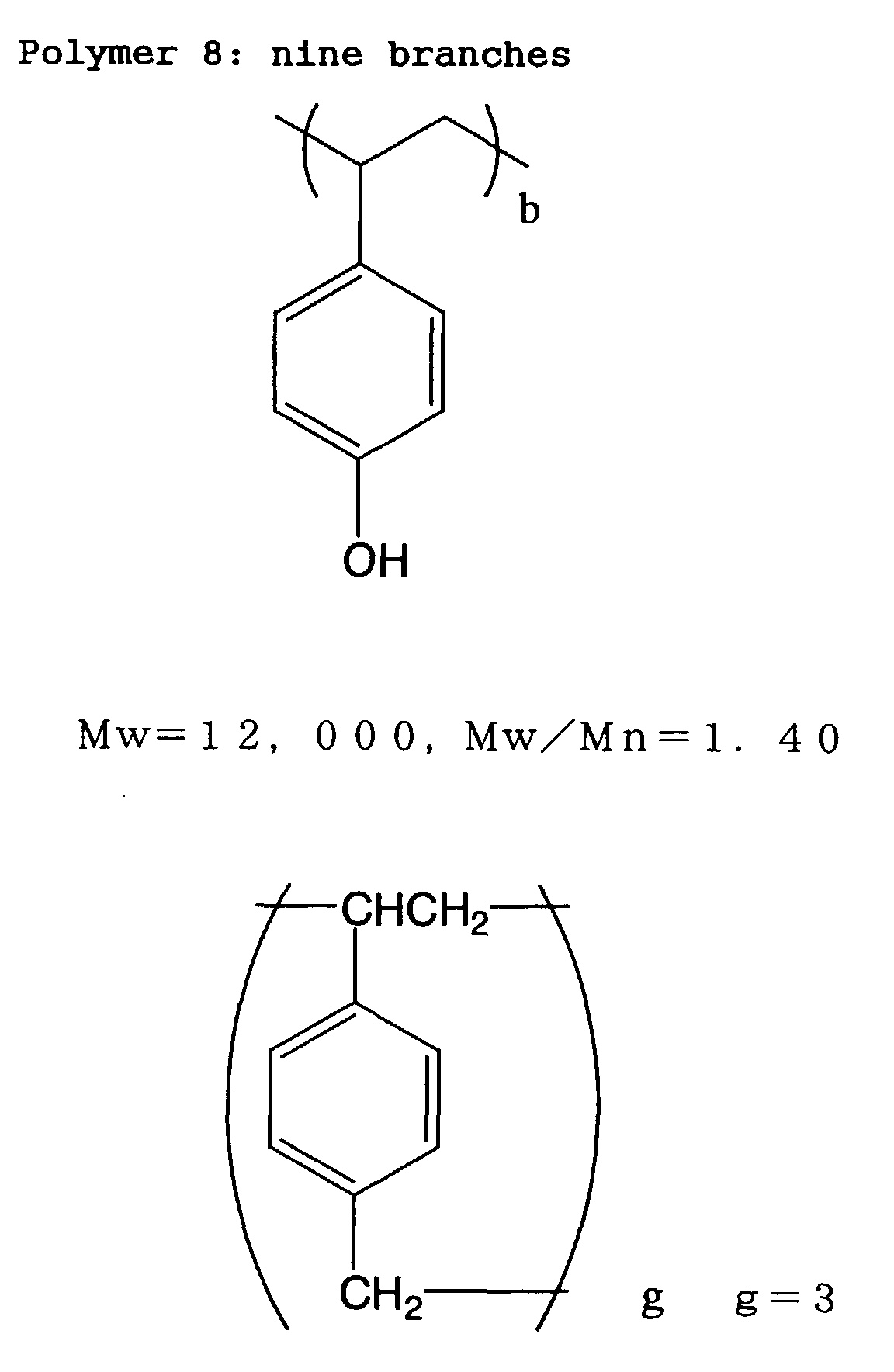


- Japanese Patent Application No. 11-082884 is incorporated herein by reference.
- Although some preferred embodiments have been described, many modifications and variations may be made thereto in light of the above teachings. It is therefore to be understood that the invention may be practiced otherwise than as specifically described in the examples.
Claims (8)
- A polymer in the form of a dendritic or hyperbranched polymer of a phenol derivative, having a weight average molecular weight of 500 to 10,000,000.
- The polymer of claim 1 comprising recurring units (I) or (II) or both and recurring units (III) as shown below, the number of units (III) being 1 to 1,000,wherein R1 is hydrogen or methyl, R2 is independently a straight, branched or cyclic alkyl group of 1 to 30 carbon atoms or aryl group of 6 to 30 carbon atoms, R3 is a hydroxyl or OR4 group, R4 is an acid labile group or acid stable group, x is 0 or a positive integer, y is a positive integer, and the sum of x and y is up to 5,
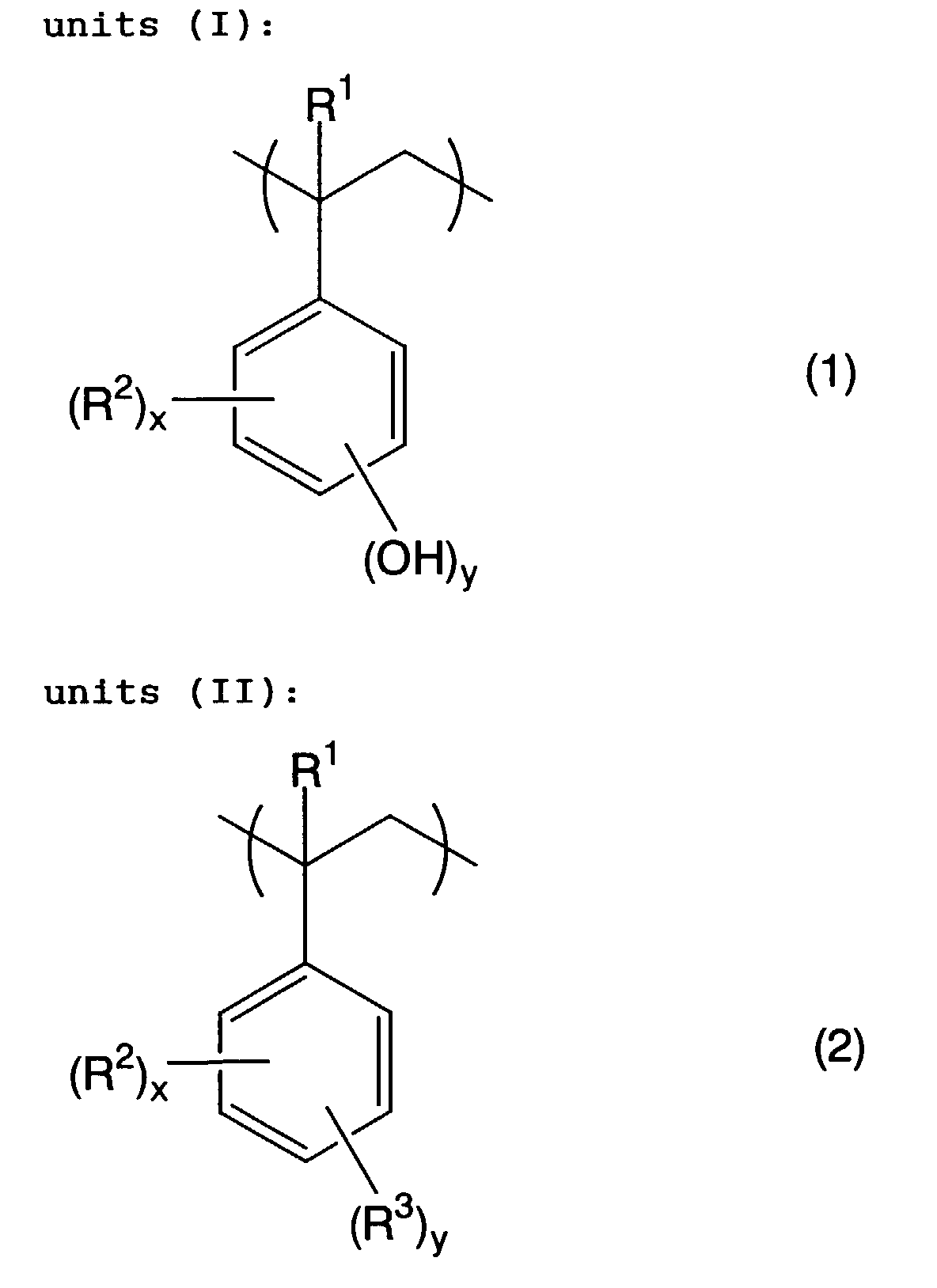 wherein R1 is as defined above, and R5 is a straight, branched or cyclic alkylene group of 1 to 30 carbon atoms or arylene group of 6 to 30 carbon atoms, or a mixture thereof, which may contain an ether or ester bond.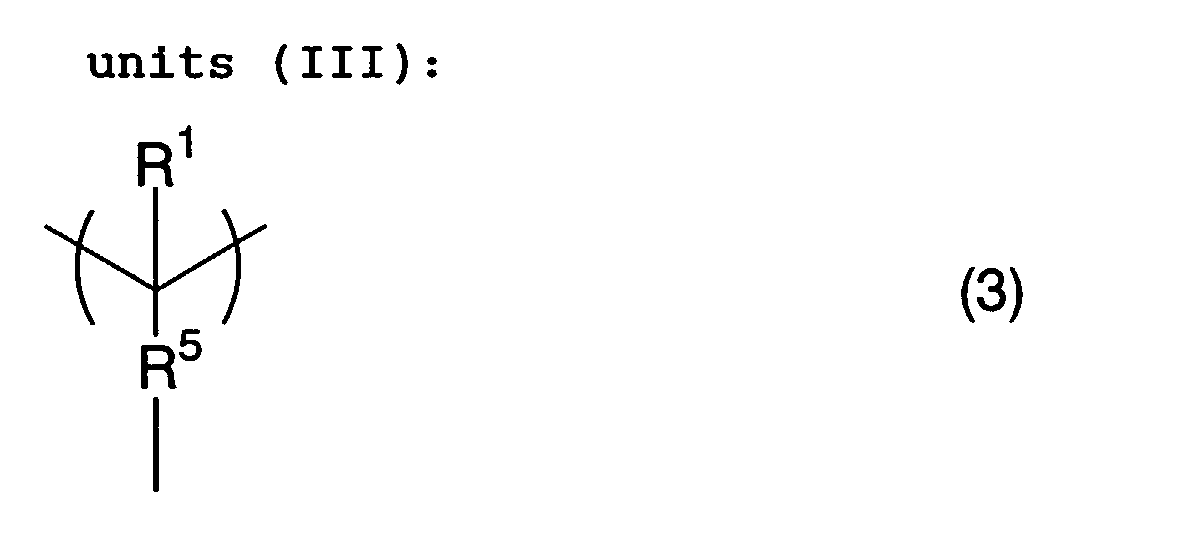
- The polymer of claim 2 wherein the units (III) are of the following formula (3a):wherein X is a valence bond or a straight or branched alkylene group of 1 to 10 carbon atoms which may contain a hydroxyl or carbonyl group.

- The polymer of claim 2 wherein the dendritic or hyperbranched polymer comprises recurring units of at least one of the following formulae (4) to (8):

 wherein broken lines represent polymer chains of the recurring units (I) and/or (II), and A represents the units (III).
- A method for preparing a polymer according to any one of the preceding claims comprising the steps of polymerizing a hydroxystyrene derivative monomer into an intermediate and finally into a polymer, adding a branching monomer midway in the polymerization step to introduce branch chains into the intermediate, and repeating the polymerizing and branching steps until the desired polymer is obtained.
- The method of claim 5 wherein the hydroxystyrene derivative monomer is represented by at least one of the following general formula (i) and (ii), and the branching monomer is presented by the following formula (iii):wherein R1, R2, R3 x, and y are as defined in claim 2, R is a protective group for a hydroxyl group, R0 is a valence bond or an alkylene group of 1 to 20 carbon atoms, and X is a halogen atom, aldehyde group or alkoxycarbonyl group.
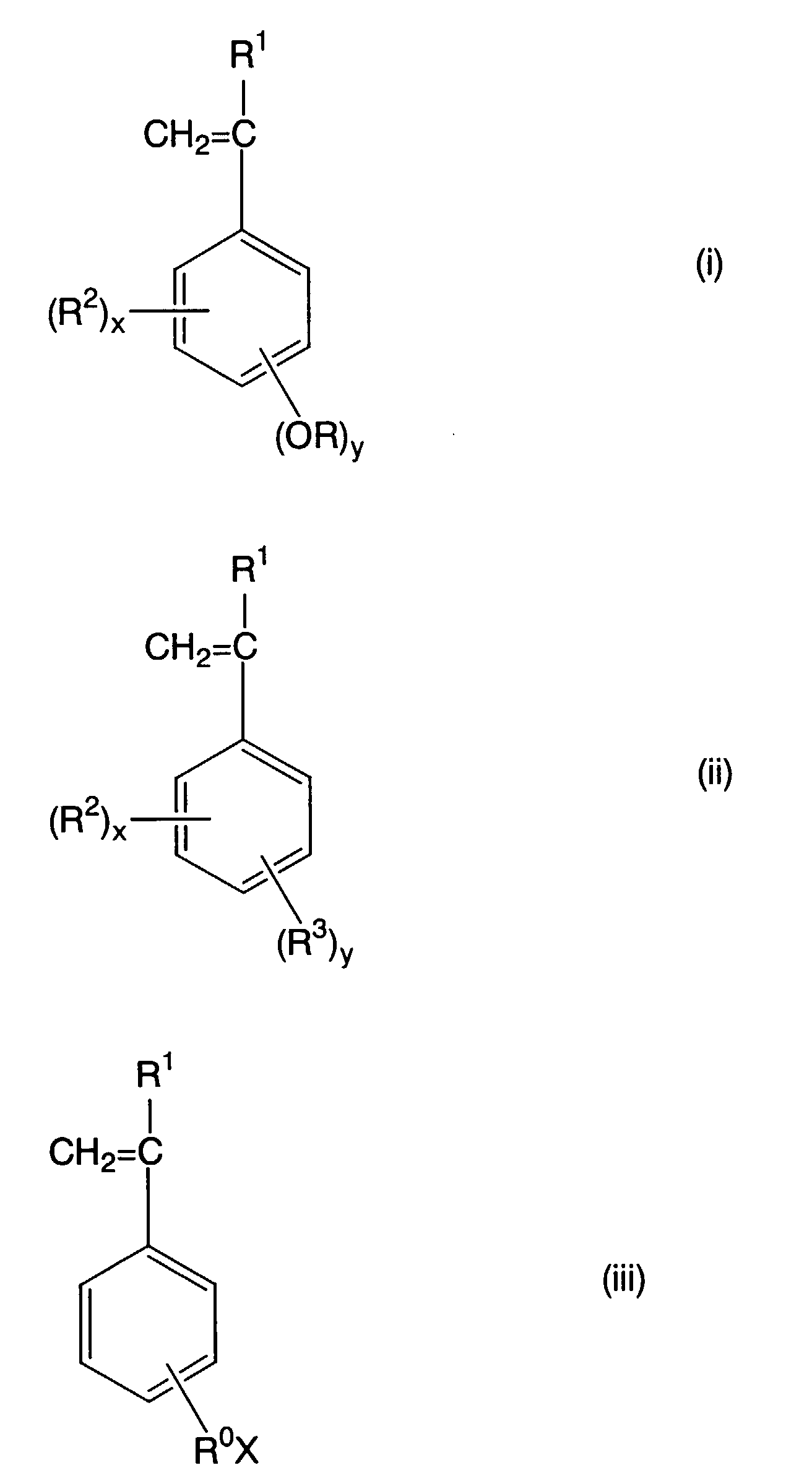
- The method of claim 5 or 6 wherein the polymerization step entails living polymerization.
- The method of claim 7 wherein the living polymerization is living anion polymerization.
Applications Claiming Priority (2)
| Application Number | Priority Date | Filing Date | Title |
|---|---|---|---|
| JP8288499 | 1999-03-26 | ||
| JP8288499 | 1999-03-26 |
Publications (2)
| Publication Number | Publication Date |
|---|---|
| EP1038890A1 true EP1038890A1 (en) | 2000-09-27 |
| EP1038890B1 EP1038890B1 (en) | 2005-01-26 |
Family
ID=13786710
Family Applications (1)
| Application Number | Title | Priority Date | Filing Date |
|---|---|---|---|
| EP00302464A Expired - Lifetime EP1038890B1 (en) | 1999-03-26 | 2000-03-27 | Dendritic polymers and their preparation |
Country Status (5)
| Country | Link |
|---|---|
| US (1) | US6414101B1 (en) |
| EP (1) | EP1038890B1 (en) |
| KR (1) | KR100503192B1 (en) |
| DE (1) | DE60017626T2 (en) |
| TW (1) | TWI226339B (en) |
Cited By (3)
| Publication number | Priority date | Publication date | Assignee | Title |
|---|---|---|---|---|
| EP1471111A4 (en) * | 2002-01-31 | 2006-12-27 | Dainippon Ink & Chemicals | STYRENE RESIN COMPOSITION AND PROCESS FOR PRODUCING THE SAME |
| CN100503666C (en) * | 2003-12-22 | 2009-06-24 | 狮王株式会社 | Hyperbranched polymer, method for producing the same, and resist composition containing the hyperbranched polymer |
| CN101133090B (en) * | 2005-03-03 | 2011-01-26 | 国立大学法人东京工业大学 | Hyperbranched polymers and methods for their manufacture |
Families Citing this family (11)
| Publication number | Priority date | Publication date | Assignee | Title |
|---|---|---|---|---|
| CN1886431B (en) * | 2003-11-26 | 2014-02-05 | 日本曹达株式会社 | A new type of multi-branched polymer |
| WO2005061566A1 (en) * | 2003-12-22 | 2005-07-07 | Lion Corporation | Hyperbranched polymer, process for producing the same and resist composition containing the hyperbranched polymer |
| US7662538B2 (en) * | 2004-11-08 | 2010-02-16 | Du Pont Electronic Polymers L.P. | Derivatized polyhydroxystyrenes (DPHS) with a novolak type structure and blocked DPHS (BDPHS) and processes for preparing the same |
| US7771913B2 (en) * | 2006-04-04 | 2010-08-10 | Shin-Etsu Chemical Co., Ltd. | Resist composition and patterning process using the same |
| JP4548617B2 (en) * | 2006-06-09 | 2010-09-22 | 信越化学工業株式会社 | Photoacid generator for chemically amplified resist material, resist material containing the photoacid generator, and pattern forming method using the same |
| US20080008956A1 (en) * | 2006-06-23 | 2008-01-10 | Eastman Kodak Company | Positive-working imageable members with branched hydroxystyrene polymers |
| EP2065408B1 (en) * | 2006-09-07 | 2012-07-04 | Nissan Chemical Industries, Ltd. | Hyperbranched polymer and process for production thereof |
| TWI331611B (en) * | 2006-11-23 | 2010-10-11 | Ind Tech Res Inst | Mononuclear star-branched polymer dielectric material and organic thin film transistor |
| US20080268839A1 (en) * | 2007-04-27 | 2008-10-30 | Ayers John I | Reducing a number of registration termination massages in a network for cellular devices |
| JP4466881B2 (en) | 2007-06-06 | 2010-05-26 | 信越化学工業株式会社 | Photomask blank, resist pattern forming method, and photomask manufacturing method |
| US11331392B2 (en) | 2014-12-04 | 2022-05-17 | The Trustees Of Columbia University In The City Of New York | Biodegradable thermo-responsive polymers and uses thereof |
Citations (6)
| Publication number | Priority date | Publication date | Assignee | Title |
|---|---|---|---|---|
| EP0007791A1 (en) * | 1978-07-24 | 1980-02-06 | Rohm And Haas Company | Polymer beads containing vinylbenzyl alcohol units, their production, processes for thermally crosslinking them, the thermally crosslinked beads and adsorbents and ion exchange resin formed therefrom |
| EP0464408A1 (en) * | 1990-06-14 | 1992-01-08 | Sekisui Chemical Co., Ltd. | Process for preparing star compounds |
| EP0496405A1 (en) * | 1991-01-25 | 1992-07-29 | Mitsubishi Kasei Corporation | Porous resin and process for its production |
| JPH06266105A (en) * | 1993-03-17 | 1994-09-22 | Fujitsu Ltd | Negative resist composition |
| EP0788031A1 (en) * | 1996-02-05 | 1997-08-06 | Fuji Photo Film Co., Ltd. | Positive working photosensitive composition |
| EP0942329A1 (en) * | 1997-09-22 | 1999-09-15 | Clariant International Ltd. | Novel process for preparing resists |
Family Cites Families (15)
| Publication number | Priority date | Publication date | Assignee | Title |
|---|---|---|---|---|
| JPS6030686B2 (en) | 1980-08-30 | 1985-07-18 | 丸善石油株式会社 | Method for producing parahydroxystyrene polymer |
| US4491628A (en) | 1982-08-23 | 1985-01-01 | International Business Machines Corporation | Positive- and negative-working resist compositions with acid generating photoinitiator and polymer with acid labile groups pendant from polymer backbone |
| US4603101A (en) | 1985-09-27 | 1986-07-29 | General Electric Company | Photoresist compositions containing t-substituted organomethyl vinylaryl ether materials |
| DE3750275T3 (en) | 1986-06-13 | 1998-10-01 | Microsi Inc | Lacquer composition and application. |
| JPS6336602A (en) | 1986-07-31 | 1988-02-17 | Nippon Telegr & Teleph Corp <Ntt> | Snow melting device for antenna |
| JP2578646B2 (en) | 1988-07-18 | 1997-02-05 | 三洋電機株式会社 | Non-aqueous secondary battery |
| US5252435A (en) | 1990-01-30 | 1993-10-12 | Matsushita Electric Industrial Co., Ltd. | Method for forming pattern |
| JPH03223858A (en) | 1990-01-30 | 1991-10-02 | Matsushita Electric Ind Co Ltd | Pattern formation method |
| JP2970879B2 (en) | 1990-01-30 | 1999-11-02 | 和光純薬工業株式会社 | Chemically amplified resist material |
| HUT64986A (en) | 1990-06-29 | 1994-03-28 | Hoechst Celanese Corp | Process for the production of polymers and copolymers with low optical density for use as photoresisting material |
| US5239015A (en) | 1990-06-29 | 1993-08-24 | Hoechst Celanese Corporation | Process for making low optical density polymers and copolymers for photoresists and optical applications |
| US5587441A (en) * | 1994-11-08 | 1996-12-24 | Cornell Research Foundation, Inc. | Hyperbranched polymers from AB monomers |
| US5591809A (en) * | 1995-08-18 | 1997-01-07 | Hoechst Celanese Corporation | Process for preparing hyperbranched polymers |
| JP3223858B2 (en) | 1996-12-24 | 2001-10-29 | 松下電器産業株式会社 | Alkaline storage battery, its positive electrode active material, and method for producing the same |
| US6252025B1 (en) * | 1998-08-11 | 2001-06-26 | Eastman Kodak Company | Vinyl hyperbranched polymer with photographically useful end groups |
-
2000
- 2000-03-24 US US09/535,166 patent/US6414101B1/en not_active Expired - Lifetime
- 2000-03-24 TW TW089105518A patent/TWI226339B/en not_active IP Right Cessation
- 2000-03-25 KR KR10-2000-0015272A patent/KR100503192B1/en not_active Expired - Fee Related
- 2000-03-27 EP EP00302464A patent/EP1038890B1/en not_active Expired - Lifetime
- 2000-03-27 DE DE60017626T patent/DE60017626T2/en not_active Expired - Lifetime
Patent Citations (6)
| Publication number | Priority date | Publication date | Assignee | Title |
|---|---|---|---|---|
| EP0007791A1 (en) * | 1978-07-24 | 1980-02-06 | Rohm And Haas Company | Polymer beads containing vinylbenzyl alcohol units, their production, processes for thermally crosslinking them, the thermally crosslinked beads and adsorbents and ion exchange resin formed therefrom |
| EP0464408A1 (en) * | 1990-06-14 | 1992-01-08 | Sekisui Chemical Co., Ltd. | Process for preparing star compounds |
| EP0496405A1 (en) * | 1991-01-25 | 1992-07-29 | Mitsubishi Kasei Corporation | Porous resin and process for its production |
| JPH06266105A (en) * | 1993-03-17 | 1994-09-22 | Fujitsu Ltd | Negative resist composition |
| EP0788031A1 (en) * | 1996-02-05 | 1997-08-06 | Fuji Photo Film Co., Ltd. | Positive working photosensitive composition |
| EP0942329A1 (en) * | 1997-09-22 | 1999-09-15 | Clariant International Ltd. | Novel process for preparing resists |
Non-Patent Citations (1)
| Title |
|---|
| PATENT ABSTRACTS OF JAPAN vol. 018, no. 674 (P - 1846) 19 December 1994 (1994-12-19) * |
Cited By (4)
| Publication number | Priority date | Publication date | Assignee | Title |
|---|---|---|---|---|
| EP1471111A4 (en) * | 2002-01-31 | 2006-12-27 | Dainippon Ink & Chemicals | STYRENE RESIN COMPOSITION AND PROCESS FOR PRODUCING THE SAME |
| KR100848345B1 (en) * | 2002-01-31 | 2008-07-25 | 디아이씨 가부시끼가이샤 | Styrene Resin Composition and Manufacturing Method Thereof |
| CN100503666C (en) * | 2003-12-22 | 2009-06-24 | 狮王株式会社 | Hyperbranched polymer, method for producing the same, and resist composition containing the hyperbranched polymer |
| CN101133090B (en) * | 2005-03-03 | 2011-01-26 | 国立大学法人东京工业大学 | Hyperbranched polymers and methods for their manufacture |
Also Published As
| Publication number | Publication date |
|---|---|
| TWI226339B (en) | 2005-01-11 |
| EP1038890B1 (en) | 2005-01-26 |
| US6414101B1 (en) | 2002-07-02 |
| DE60017626T2 (en) | 2005-12-22 |
| KR100503192B1 (en) | 2005-07-25 |
| KR20000076960A (en) | 2000-12-26 |
| DE60017626D1 (en) | 2005-03-03 |
Similar Documents
| Publication | Publication Date | Title |
|---|---|---|
| EP1038890B1 (en) | Dendritic polymers and their preparation | |
| KR100293130B1 (en) | Polymer compound and chemically amplified positive resist material | |
| CA1264392A (en) | Allyl terminated macromolecular monomers of polyethers | |
| EP0836119B1 (en) | Chemically amplified resist composition | |
| US5352564A (en) | Resist compositions | |
| US6416927B1 (en) | Chemically amplified resist compositions | |
| JP4420152B2 (en) | Polymer compound and production method thereof | |
| JP3749674B2 (en) | Resist composition comprising photosensitive polymer containing lactone in backbone | |
| JPH07252324A (en) | Vinyl monomer, its polymer and photosensitive resin composition made by using this polymer | |
| KR20110037170A (en) | Acrylic Monomer, Polymer, and Chemically Amplified Photoresist Compositions | |
| CN1315906C (en) | Modified polycyclic polymers | |
| KR100332463B1 (en) | Chemically amplified resist composition containing norbornane type low molecular additives | |
| EP0989462A1 (en) | Resist polymer and chemical amplified resist composition containing the same | |
| US7833690B2 (en) | Photoacid generators and lithographic resists comprising the same | |
| KR100591007B1 (en) | Novel polymers and chemically amplified resists containing them | |
| Frechet et al. | Chemically amplified imaging materials based on electrophilic aromatic substitution: poly [4-(acetoxymethyl) styrene-co-4-hydroxystyrene] | |
| CN104672410A (en) | Self-assembled structures, methods for their preparation, and articles comprising the same | |
| KR20060024072A (en) | Polymers of alkyl cyclic olefins and acrylic compounds having secondary hydroxyl groups and chemically amplified resist compositions containing the same | |
| EP1126320B1 (en) | Chemically amplified resist composition containing low molecular weight additives | |
| US6080524A (en) | Photosensitive polymer having cyclic backbone and resist composition comprising the same | |
| JPH0812626A (en) | Organocyclic hydrocarbon alcohol | |
| EP1078945B1 (en) | Polymer for use in a photoresist composition | |
| KR20080023657A (en) | Photoresist Monomers, Polymers, and Photoresist Compositions Comprising the Same | |
| JPH05232704A (en) | Positive resist material | |
| JP3433564B2 (en) | Polymer compound and chemically amplified positive resist composition |
Legal Events
| Date | Code | Title | Description |
|---|---|---|---|
| PUAI | Public reference made under article 153(3) epc to a published international application that has entered the european phase |
Free format text: ORIGINAL CODE: 0009012 |
|
| AK | Designated contracting states |
Kind code of ref document: A1 Designated state(s): DE FR GB |
|
| AX | Request for extension of the european patent |
Free format text: AL;LT;LV;MK;RO;SI |
|
| 17P | Request for examination filed |
Effective date: 20001129 |
|
| AKX | Designation fees paid |
Free format text: DE FR GB |
|
| 17Q | First examination report despatched |
Effective date: 20030826 |
|
| GRAP | Despatch of communication of intention to grant a patent |
Free format text: ORIGINAL CODE: EPIDOSNIGR1 |
|
| GRAS | Grant fee paid |
Free format text: ORIGINAL CODE: EPIDOSNIGR3 |
|
| GRAA | (expected) grant |
Free format text: ORIGINAL CODE: 0009210 |
|
| AK | Designated contracting states |
Kind code of ref document: B1 Designated state(s): DE FR GB |
|
| REG | Reference to a national code |
Ref country code: GB Ref legal event code: FG4D |
|
| REF | Corresponds to: |
Ref document number: 60017626 Country of ref document: DE Date of ref document: 20050303 Kind code of ref document: P |
|
| PLBE | No opposition filed within time limit |
Free format text: ORIGINAL CODE: 0009261 |
|
| STAA | Information on the status of an ep patent application or granted ep patent |
Free format text: STATUS: NO OPPOSITION FILED WITHIN TIME LIMIT |
|
| ET | Fr: translation filed | ||
| 26N | No opposition filed |
Effective date: 20051027 |
|
| PGFP | Annual fee paid to national office [announced via postgrant information from national office to epo] |
Ref country code: GB Payment date: 20080402 Year of fee payment: 9 |
|
| GBPC | Gb: european patent ceased through non-payment of renewal fee |
Effective date: 20090327 |
|
| PG25 | Lapsed in a contracting state [announced via postgrant information from national office to epo] |
Ref country code: GB Free format text: LAPSE BECAUSE OF NON-PAYMENT OF DUE FEES Effective date: 20090327 |
|
| REG | Reference to a national code |
Ref country code: FR Ref legal event code: PLFP Year of fee payment: 17 |
|
| REG | Reference to a national code |
Ref country code: FR Ref legal event code: PLFP Year of fee payment: 18 |
|
| REG | Reference to a national code |
Ref country code: FR Ref legal event code: PLFP Year of fee payment: 19 |
|
| PGFP | Annual fee paid to national office [announced via postgrant information from national office to epo] |
Ref country code: DE Payment date: 20180313 Year of fee payment: 19 |
|
| PGFP | Annual fee paid to national office [announced via postgrant information from national office to epo] |
Ref country code: FR Payment date: 20180223 Year of fee payment: 19 |
|
| REG | Reference to a national code |
Ref country code: DE Ref legal event code: R119 Ref document number: 60017626 Country of ref document: DE |
|
| PG25 | Lapsed in a contracting state [announced via postgrant information from national office to epo] |
Ref country code: DE Free format text: LAPSE BECAUSE OF NON-PAYMENT OF DUE FEES Effective date: 20191001 |
|
| PG25 | Lapsed in a contracting state [announced via postgrant information from national office to epo] |
Ref country code: FR Free format text: LAPSE BECAUSE OF NON-PAYMENT OF DUE FEES Effective date: 20190331 |