EP1038450A1 - Method for imparting a fried onion aroma to foodstuffs - Google Patents
Method for imparting a fried onion aroma to foodstuffs Download PDFInfo
- Publication number
- EP1038450A1 EP1038450A1 EP00200812A EP00200812A EP1038450A1 EP 1038450 A1 EP1038450 A1 EP 1038450A1 EP 00200812 A EP00200812 A EP 00200812A EP 00200812 A EP00200812 A EP 00200812A EP 1038450 A1 EP1038450 A1 EP 1038450A1
- Authority
- EP
- European Patent Office
- Prior art keywords
- foodstuff
- dmmt
- ppb
- added
- ppm
- Prior art date
- Legal status (The legal status is an assumption and is not a legal conclusion. Google has not performed a legal analysis and makes no representation as to the accuracy of the status listed.)
- Granted
Links
- 238000000034 method Methods 0.000 title claims abstract description 28
- 235000021397 ready fried onions Nutrition 0.000 title abstract description 24
- 241000234282 Allium Species 0.000 claims abstract description 29
- 241000196324 Embryophyta Species 0.000 claims abstract description 7
- VNWDIRWAEAIXKU-PHDIDXHHSA-N (2r,3r)-3,4-dimethyl-2,3-dihydrothiophene-2-thiol Chemical compound C[C@H]1[C@H](S)SC=C1C VNWDIRWAEAIXKU-PHDIDXHHSA-N 0.000 claims abstract description 6
- 241000894007 species Species 0.000 claims abstract description 6
- 239000000203 mixture Substances 0.000 claims description 36
- 235000002732 Allium cepa var. cepa Nutrition 0.000 claims description 21
- FHSDVOJKLYJNCQ-UHFFFAOYSA-N 1-(prop-1-enyldisulfanyl)prop-1-ene Chemical compound CC=CSSC=CC FHSDVOJKLYJNCQ-UHFFFAOYSA-N 0.000 claims description 18
- 235000015067 sauces Nutrition 0.000 claims description 16
- 239000003921 oil Substances 0.000 claims description 14
- XLYOFNOQVPJJNP-UHFFFAOYSA-N water Substances O XLYOFNOQVPJJNP-UHFFFAOYSA-N 0.000 claims description 14
- 239000003925 fat Substances 0.000 claims description 10
- 235000014347 soups Nutrition 0.000 claims description 10
- 230000000694 effects Effects 0.000 claims description 3
- 235000013305 food Nutrition 0.000 claims description 3
- 235000008216 herbs Nutrition 0.000 claims description 2
- 235000015143 herbs and spices Nutrition 0.000 claims description 2
- 235000013599 spices Nutrition 0.000 claims description 2
- 241000227653 Lycopersicon Species 0.000 description 9
- 235000007688 Lycopersicon esculentum Nutrition 0.000 description 9
- 235000019198 oils Nutrition 0.000 description 9
- 239000002243 precursor Substances 0.000 description 9
- LFQSCWFLJHTTHZ-UHFFFAOYSA-N Ethanol Chemical compound CCO LFQSCWFLJHTTHZ-UHFFFAOYSA-N 0.000 description 8
- OFBQJSOFQDEBGM-UHFFFAOYSA-N Pentane Chemical compound CCCCC OFBQJSOFQDEBGM-UHFFFAOYSA-N 0.000 description 8
- 150000001875 compounds Chemical class 0.000 description 8
- UHOVQNZJYSORNB-UHFFFAOYSA-N Benzene Chemical compound C1=CC=CC=C1 UHOVQNZJYSORNB-UHFFFAOYSA-N 0.000 description 6
- RTZKZFJDLAIYFH-UHFFFAOYSA-N Diethyl ether Chemical compound CCOCC RTZKZFJDLAIYFH-UHFFFAOYSA-N 0.000 description 6
- 235000019197 fats Nutrition 0.000 description 6
- 239000000796 flavoring agent Substances 0.000 description 6
- 238000002360 preparation method Methods 0.000 description 6
- 238000001704 evaporation Methods 0.000 description 4
- 230000008020 evaporation Effects 0.000 description 4
- 235000019634 flavors Nutrition 0.000 description 4
- 239000002904 solvent Substances 0.000 description 4
- IAZDPXIOMUYVGZ-UHFFFAOYSA-N Dimethylsulphoxide Chemical compound CS(C)=O IAZDPXIOMUYVGZ-UHFFFAOYSA-N 0.000 description 3
- HEMHJVSKTPXQMS-UHFFFAOYSA-M Sodium hydroxide Chemical compound [OH-].[Na+] HEMHJVSKTPXQMS-UHFFFAOYSA-M 0.000 description 3
- 238000006243 chemical reaction Methods 0.000 description 3
- 239000007788 liquid Substances 0.000 description 3
- 238000004806 packaging method and process Methods 0.000 description 3
- 239000000843 powder Substances 0.000 description 3
- 239000000243 solution Substances 0.000 description 3
- 244000016163 Allium sibiricum Species 0.000 description 2
- BWGNESOTFCXPMA-UHFFFAOYSA-N Dihydrogen disulfide Chemical compound SS BWGNESOTFCXPMA-UHFFFAOYSA-N 0.000 description 2
- UIIMBOGNXHQVGW-UHFFFAOYSA-M Sodium bicarbonate Chemical compound [Na+].OC([O-])=O UIIMBOGNXHQVGW-UHFFFAOYSA-M 0.000 description 2
- 238000009835 boiling Methods 0.000 description 2
- 238000001816 cooling Methods 0.000 description 2
- 238000005520 cutting process Methods 0.000 description 2
- 235000021186 dishes Nutrition 0.000 description 2
- 239000003480 eluent Substances 0.000 description 2
- 235000013410 fast food Nutrition 0.000 description 2
- 238000010438 heat treatment Methods 0.000 description 2
- 239000004615 ingredient Substances 0.000 description 2
- 239000010410 layer Substances 0.000 description 2
- 235000013372 meat Nutrition 0.000 description 2
- UMGDCJDMYOKAJW-UHFFFAOYSA-N thiourea Chemical compound NC(N)=S UMGDCJDMYOKAJW-UHFFFAOYSA-N 0.000 description 2
- 235000013311 vegetables Nutrition 0.000 description 2
- MPPPKRYCTPRNTB-UHFFFAOYSA-N 1-bromobutane Chemical compound CCCCBr MPPPKRYCTPRNTB-UHFFFAOYSA-N 0.000 description 1
- BQOGWZALJJSRCR-UHFFFAOYSA-N 1-prop-1-enylsulfanylbutane Chemical compound CCCCSC=CC BQOGWZALJJSRCR-UHFFFAOYSA-N 0.000 description 1
- HXMYUSWENPCWFT-UHFFFAOYSA-N 1-prop-2-enylsulfanylbutane Chemical compound CCCCSCC=C HXMYUSWENPCWFT-UHFFFAOYSA-N 0.000 description 1
- 241000251468 Actinopterygii Species 0.000 description 1
- 240000006108 Allium ampeloprasum Species 0.000 description 1
- 235000005254 Allium ampeloprasum Nutrition 0.000 description 1
- 244000291564 Allium cepa Species 0.000 description 1
- 235000010167 Allium cepa var aggregatum Nutrition 0.000 description 1
- 235000001270 Allium sibiricum Nutrition 0.000 description 1
- 239000012359 Methanesulfonyl chloride Substances 0.000 description 1
- 241001291279 Solanum galapagense Species 0.000 description 1
- 235000019486 Sunflower oil Nutrition 0.000 description 1
- XSQUKJJJFZCRTK-UHFFFAOYSA-N Urea Natural products NC(N)=O XSQUKJJJFZCRTK-UHFFFAOYSA-N 0.000 description 1
- ZVQOOHYFBIDMTQ-UHFFFAOYSA-N [methyl(oxido){1-[6-(trifluoromethyl)pyridin-3-yl]ethyl}-lambda(6)-sulfanylidene]cyanamide Chemical compound N#CN=S(C)(=O)C(C)C1=CC=C(C(F)(F)F)N=C1 ZVQOOHYFBIDMTQ-UHFFFAOYSA-N 0.000 description 1
- 230000002378 acidificating effect Effects 0.000 description 1
- BHELZAPQIKSEDF-UHFFFAOYSA-N allyl bromide Chemical compound BrCC=C BHELZAPQIKSEDF-UHFFFAOYSA-N 0.000 description 1
- 238000004458 analytical method Methods 0.000 description 1
- 239000003963 antioxidant agent Substances 0.000 description 1
- 230000015572 biosynthetic process Effects 0.000 description 1
- 235000014121 butter Nutrition 0.000 description 1
- 238000004440 column chromatography Methods 0.000 description 1
- 230000000593 degrading effect Effects 0.000 description 1
- 238000010790 dilution Methods 0.000 description 1
- 239000012895 dilution Substances 0.000 description 1
- 238000011156 evaluation Methods 0.000 description 1
- 230000000763 evoking effect Effects 0.000 description 1
- 238000002474 experimental method Methods 0.000 description 1
- 235000019688 fish Nutrition 0.000 description 1
- 239000003205 fragrance Substances 0.000 description 1
- 239000011521 glass Substances 0.000 description 1
- 239000005457 ice water Substances 0.000 description 1
- 238000011065 in-situ storage Methods 0.000 description 1
- 238000004519 manufacturing process Methods 0.000 description 1
- QARBMVPHQWIHKH-UHFFFAOYSA-N methanesulfonyl chloride Chemical compound CS(Cl)(=O)=O QARBMVPHQWIHKH-UHFFFAOYSA-N 0.000 description 1
- 238000002156 mixing Methods 0.000 description 1
- 235000014593 oils and fats Nutrition 0.000 description 1
- 239000012044 organic layer Substances 0.000 description 1
- LPNYRYFBWFDTMA-UHFFFAOYSA-N potassium tert-butoxide Chemical compound [K+].CC(C)(C)[O-] LPNYRYFBWFDTMA-UHFFFAOYSA-N 0.000 description 1
- 238000012545 processing Methods 0.000 description 1
- 150000003839 salts Chemical class 0.000 description 1
- -1 sauteeing Chemical class 0.000 description 1
- 229910000030 sodium bicarbonate Inorganic materials 0.000 description 1
- 239000007858 starting material Substances 0.000 description 1
- 150000003464 sulfur compounds Chemical class 0.000 description 1
- 239000002600 sunflower oil Substances 0.000 description 1
- 238000003786 synthesis reaction Methods 0.000 description 1
- 238000012360 testing method Methods 0.000 description 1
- JRMUNVKIHCOMHV-UHFFFAOYSA-M tetrabutylammonium bromide Chemical compound [Br-].CCCC[N+](CCCC)(CCCC)CCCC JRMUNVKIHCOMHV-UHFFFAOYSA-M 0.000 description 1
- 238000001149 thermolysis Methods 0.000 description 1
- 150000003626 triacylglycerols Chemical class 0.000 description 1
Images

Classifications
-
- A—HUMAN NECESSITIES
- A23—FOODS OR FOODSTUFFS; TREATMENT THEREOF, NOT COVERED BY OTHER CLASSES
- A23L—FOODS, FOODSTUFFS OR NON-ALCOHOLIC BEVERAGES, NOT OTHERWISE PROVIDED FOR; PREPARATION OR TREATMENT THEREOF
- A23L27/00—Spices; Flavouring agents or condiments; Artificial sweetening agents; Table salts; Dietetic salt substitutes; Preparation or treatment thereof
- A23L27/20—Synthetic spices, flavouring agents or condiments
- A23L27/205—Heterocyclic compounds
- A23L27/2052—Heterocyclic compounds having oxygen or sulfur as the only hetero atoms
Definitions
- the present invention relates to a method for imparting an aroma to foodstuffs, which aroma is generally associated with (freshly) fried onion and similar species.
- Onions and other members e.g. garlic, leek, shallots, chives, etcetera
- these ingredients are capable of imparting a distinct taste and aroma to foodstuffs.
- This will generally involve cutting or chopping onions which are then fried or sauteed for several minutes, usually in oil or butter.
- the taste and aroma of freshly fried or sauteed onions is liked in e.g. soups and sauces.
- fried onions In the ever increasing range of convenience food, which is partly or fully cooked, the taste and aroma of fried onions is in many cases a desired attribute.
- the industrial manufacturer may achieve this by incorporating fried onions in the foodstuff at some stage in the industrial process.
- Such fried onions may be either freshly prepared, dried or frozen or otherwise processed. Although this may provide acceptable results with respect to taste, the general experience is that a so-prepared foodstuff will in most cases lack the agreeable aroma of freshly fried or sauteed onions, which the housewife will perceive when freshly preparing a dish with onions which are fried or sauteed during the preparation of the dish.
- DMMT cis / trans -3,4-dimethyl-2-mercapto-2,3-dihydrothiophene
- DMMT is added to the foodstuff in an amount of 1 to 1000 ppm, more preferably 50 ppb to 50 ppm, preferably 250 ppb tp 5 ppm.
- an upper limit of 1000 ppb may be preferred.
- DMMT may be applied next to the presence of plants or (processed) parts thereof belonging to the genus of Allium, in a method for imparting a (fried) onion aroma and/or odour to a foodstuff, wherein cis/trans-3,4-dimethyl-2-mercapto-2,3-dihydrothiophene (DMMT) is added to said foodstuff in an amount of at least 50 ppb, and less than 1000 ppm.
- DMMT cis/trans-3,4-dimethyl-2-mercapto-2,3-dihydrothiophene
- amounts may be different, e.g. amounts of at least 150 ppb, preferably at least 250 ppb and less than 1000 ppm may be preferred.
- the compound cis / trans -3, 4-dimethyl-2-mercapto-2, 3-dihydrothiophene (DMMT) has a structure as is set out in figure 1.
- This compound is not present in raw onions, but is formed (together with an abundance of other odourants, flavourants, aroma- or taste compounds) by the subsequent action of cutting or comminuting onions, frying the so obtained pieces in fat or oil (or any alternative heat treatment in the presence of triglycerides like sauteeing, simmering or deep-frying). It is thought that both the cis and the trans -form of DMMT provide a fried onion aroma, although one may have a stronger effect than the other.
- DMMT can be prepared according to the various references by E. Block, as reported herein.
- a precursor of DMMT may be added to the foodstuff, which precursor may be converted to DMMT e.g. upon the application of heat.
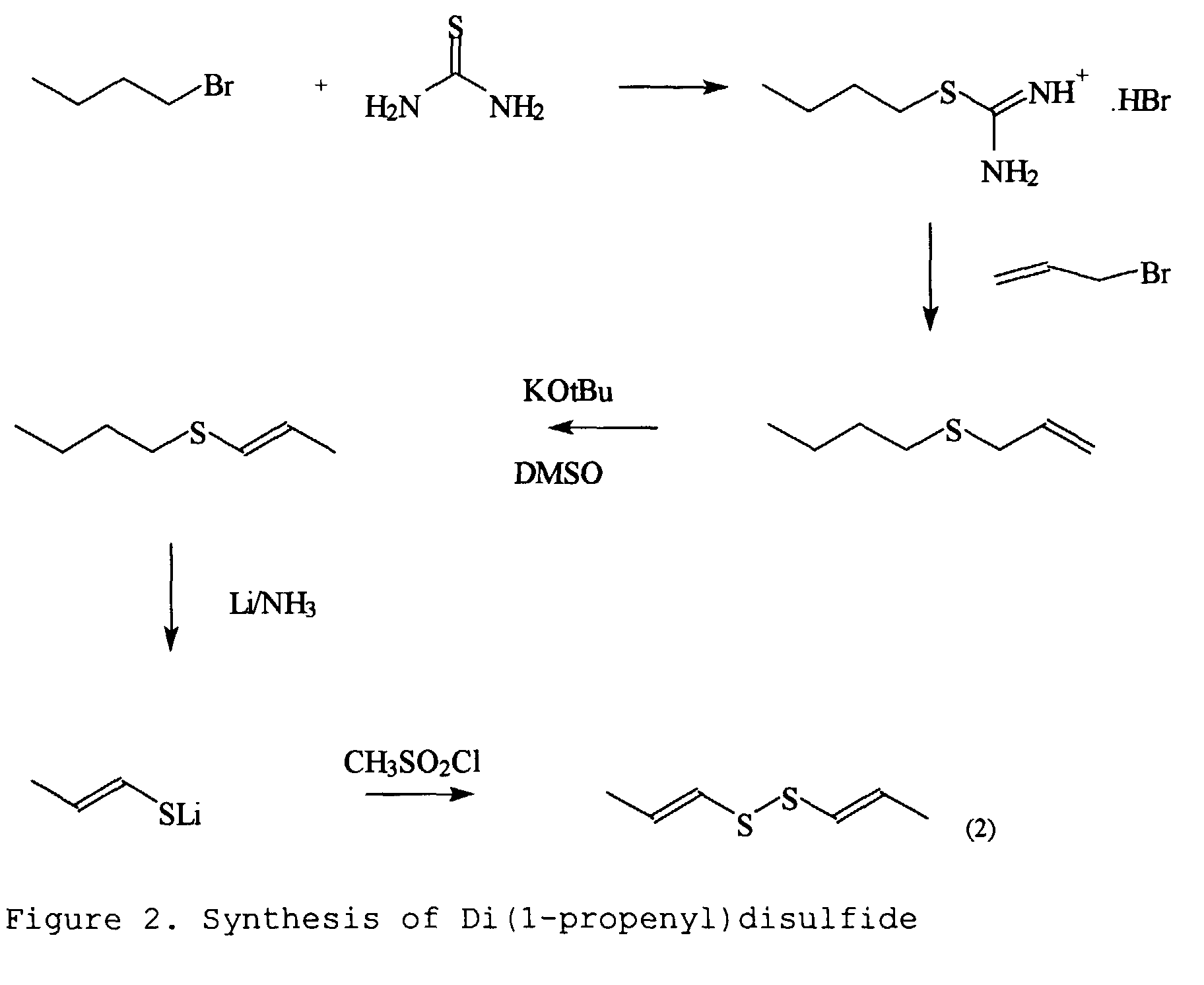
- a precursor is di(1-propenyl)disulfide (figure 2).
- This compound can be converted into DMMT easily by application of heat, typically 90-120°C) for 1-15 minutes. Heating to perform such conversion is preferably carried out in oil, such as when frying meat, fish or vegetables.
- the invention relates to a method for providing a foodstuff which, when heated, displays a (fried) onion aroma and/or odour, wherein di(1-propenyl)disulfide (DPDS) is added to said foodstuff, with the proviso that this is not achieved by adding species of plants or (processed) parts thereof belonging to the genus of Allium.
- DPDS is a precursor of DMMT, and can be converted in DMMT by applying suitable heat (e.g. conditions as are present when frying meat or vegetables).
- suitable heat e.g. conditions as are present when frying meat or vegetables.
- the amounts in which DPDS can suitably be applied are similar to that of DMMT.
- DPDS and DMMT may be applied in a composition jointly or separately.
- the invention further relates to a method for providing a foodstuff which, when heated, displays a (fried) onion aroma and/or odour, wherein di(1-propenyl)disulfide (DPDS) is added to said foodstuff in an amount of at least 50 ppb, preferably at least 250 ppb, and less than 1000 ppm.
- DPDS di(1-propenyl)disulfide
- the advantage of using the precursor is that some time and heat is needed to form most of the aroma. Especially when a combination of DMMT and the precursor is used in the preparation of a packed foodstuff, this may result in a packed foodstuff which liberates a fried onion aroma when the pack is opened (DMMT) and when the product is heated sufficiently, more DMMT is liberated as it is formed in situ following the conversion of the precursor (e.g. di(1-propenyl)disulfide) into DMMT. As the precursor is also present in the process of actually frying onions, no off-flavours or other disturbing components are introduced.
- the precursor e.g. di(1-propenyl)disulfide
- the method according to the invention is preferably applied to foodstuffs which have a low to very low water content (a w less than 0.7, preferably less than 0.5).
- foodstuffs are dry mixes (e.g. packed in sachets) for preparing soup or sauce, which can be turned in a soup or sauce by administering water or other aqueous liquid and optionally applying heat.
- the threshold value and volatility of DMMT are such that when DMMT is incorporated by the manufacturer of a dry soup or sauce in the dry mix, the aroma of freshly fried onions is almost immediately noticed once the packaging (e.g. a sachet) is opened.
- the water content in such compositions will usually be low (a w less than 0.7, preferably less than 0.5). Particulate composition having such water activities are preferred. A low level of water present will enhance stability of DMMT. However, application is not limited to dry foodstuffs. When a certain amount of water is present, measures will have to be taken to prevent DMMT from degrading. This can be done e.g. by encapsulating DMMT or by the addition of antioxidants.
- the method according to the invention is preferably applied to foodstuffs which are ambient stable, or which are processed such that they become ambient stable.
- ambient stable foodstuffs to which the method according to the invention may be applied are e.g. frying oils, frying fats and mixtures of such oils and fats.
- Other foodstuffs include for example mixtures of oils and/or fats with herbs and/or spices added thereto, as become increasingly popular in e.g. stir-fry dishes. Usually, such mixtures have very limited amounst of water in them, which make them very suitable for addition of DMMT and/or DPDS according to the invention.
- Suitable amounts for adding DMMT and di(1-propenyl)disulfide to the foodstuff are 1 to 1000 ppb, preferably 10-100 ppb, based on the total weight of the packed product.
- compositions obtained following the method(s) as set out above such as edible compositions comprising at least 50 ppb, preferably at least 250 ppb and less than 1000 ppm, of di(1-propenyl)disulfide (DPDS), and/or at least 50 ppb, preferably at least 250 ppb, and less than 1000 ppm of cis/trans-3, 4-dimethyl-2-mercapto-2, 3-dihydrothiophene (DMMT).
- Such edible compositions may further comprise at least 20%, preferably at least 40% by weight of edible fat, oil, or mixtures thereof. Examples of such compositions are e.g. frying oil, frying fat, or mixture thereof, optionally further containing herbs and spices.
- composition as set out above is a soup or sauce base product, which may be turned into a soup or sauce by dillution with an aqueous liquid, optionally under the application of heat.
- DMMT and/or DPDS are present in the composition predominantly in an encapsulated form.
- the invention also extends to oil or fat containing at least 1 ppb of di(1-propenyl)disulfide, preferably at least 10 ppb, and less than 1000 ppm. Preferably, this is achieved in the absence of plants or (processed) parts thereof belonging to the genus of Allium.
- Di(1-propenyl)disulfide (2) was synthesized according to the figure 2.
- Butyl bromide (69 g, 0.5 mol) was reacted in 500 ml of ethanol with thiourea (38 g, 0.5 mol) by boiling for several hours. The solvent was removed by evaporation on a rotary evaporator and the resulting viscous product dissolved in a mixture of 300ml of benzene and 300 ml of 30% NaOH soln. in water. 1 g of Tetrabutylammoniumbromide was added and 60 g of allylbromide (0.5 mol). The mixture was stirred for several hours and then separated. The benzene layer was dried and evaporated to leave butyl-allyl-sulfide in almost quantitative yield.
- the product was added in three equal portions to a solution of 2.5 g of KOtBu in 100 ml DMSO. After the addition the mixture was kept at 40-50 °C for 30 min. After cooling the mixture was poured into 300 ml ice water and extracted with pentane. The pentane layer was dried and evaporated to leave the butyl-propenyl-sulfide (46 g).
- a fraction (1 g) was purified by column chromatography, using pentane as eluent.
- the presence of the disulfide in the different column fractions could be detected by running the fractions on TLC, using pentane as eluent and subjecting the plates to UV light.
- the disulfide shows as a dark spot on the green background.
- the pure compound DMMT in ethanol was evaluated in a small expert panel (3 people) from sniffing strips.
- DMMT can be smelled after evaporation of the solvent on the sniffing strips.
- the resulting smell (after evaporation of the solvent and partial evaporation of the DMMT was described as: fried onion, meaty, sulphury.
- DMMT prepared as above was assesed in a simple, basic dry tomato sauce preparation, which is mixed with water just prior to evaluation.
- a dry tomato base sauce preparation was prepared by mixing: Tomato powder (Transa CB 3500) 91.5 % Sugar 4.5 % Salt 4.0 % Total 100.0 %
- the vial was closed and heated to 90°C for 5 minutes. After opnening a fried onion aroma was clearly perceived.
Landscapes
- Health & Medical Sciences (AREA)
- Nutrition Science (AREA)
- Life Sciences & Earth Sciences (AREA)
- Chemical & Material Sciences (AREA)
- Engineering & Computer Science (AREA)
- Food Science & Technology (AREA)
- Polymers & Plastics (AREA)
- Seeds, Soups, And Other Foods (AREA)
- Seasonings (AREA)
Abstract
Description
- The present invention relates to a method for imparting an aroma to foodstuffs, which aroma is generally associated with (freshly) fried onion and similar species.
- Onions and other members (e.g. garlic, leek, shallots, chives, etcetera) of the botanical genus of Allium are well known ingredients in dishes around the world. These ingredients are capable of imparting a distinct taste and aroma to foodstuffs. When freshly preparing foodstuffs in which the aroma and taste of onions is desired, this will generally involve cutting or chopping onions which are then fried or sauteed for several minutes, usually in oil or butter. In particular the taste and aroma of freshly fried or sauteed onions is liked in e.g. soups and sauces.
- In the ever increasing range of convenience food, which is partly or fully cooked, the taste and aroma of fried onions is in many cases a desired attribute. The industrial manufacturer may achieve this by incorporating fried onions in the foodstuff at some stage in the industrial process. Such fried onions may be either freshly prepared, dried or frozen or otherwise processed. Although this may provide acceptable results with respect to taste, the general experience is that a so-prepared foodstuff will in most cases lack the agreeable aroma of freshly fried or sauteed onions, which the housewife will perceive when freshly preparing a dish with onions which are fried or sauteed during the preparation of the dish.
- When incorporating fried onions (whether it be dried, frozen, or freshly prepared and further processed for obtaining keepability) in a fully or partly prepared foodstuff, the distinct aroma of fried onions is apparently lost at some stage during processing to such an extent that when the consumer opens the packaging of said foodstuff and heats or finishes the preparation prior to consupmtion, there is little to no aroma perceived of fried onions.
- Although the taste may be improved by incorporating in said foodstuffs a "fried onion" flavour as supplied by various flavour manufacturers, the results in terms of fried onion aroma are still disappointing in many respects.
- Various references in the past have attempted to shed some light on the complex chemistry and composition of fried onion flavour. Among such references are: E. Block, Angew. Chem. Int. Engl., 31, 1135-1178 (1992), E. Block and S.H. Zhao, Tetrahedron Letters, 31(35), 4999-5002 (1990), E. Block and E.M Calvey, Sulfur Compounds in Foods, 63-79 (1994).
- Following the above, there is a need for a convenient method for imparting a (fresh) fried onion aroma or odour to a foodstuff. Preferably, this objective should be achieved for (but not limited to) pre-processed foodstuffs such as convenience food, which only needs to be heated (with or without the addition of water) by the consumer. Examples of such foodstuffs are e.g. soup- and sauce base products (for example in dry form).
- It has now been found that the above may be achieved by a method for imparting a (fried) onion aroma and/or odour to a foodstuff, wherein cis/trans-3,4-dimethyl-2-mercapto-2,3-dihydrothiophene (DMMT) is added to said foodstuff, with the proviso that this is not achieved by adding species of plants or (processed) parts thereof belonging to the genus of Allium. Preferably, DMMT is added to the foodstuff in an amount of 1 to 1000 ppm, more preferably 50 ppb to 50 ppm, preferably 250 ppb tp 5 ppm. For some purposes, an upper limit of 1000 ppb may be preferred.
- Alternatively, DMMT may be applied next to the presence of plants or (processed) parts thereof belonging to the genus of Allium, in a method for imparting a (fried) onion aroma and/or odour to a foodstuff, wherein cis/trans-3,4-dimethyl-2-mercapto-2,3-dihydrothiophene (DMMT) is added to said foodstuff in an amount of at least 50 ppb, and less than 1000 ppm. For some purposes, depending e.g. upon the foodstuff to which DMMT is applied such amounts may be different, e.g. amounts of at least 150 ppb, preferably at least 250 ppb and less than 1000 ppm may be preferred.
- The compound cis/trans-3, 4-dimethyl-2-mercapto-2, 3-dihydrothiophene (DMMT) has a structure as is set out in figure 1.

- This compound is not present in raw onions, but is formed (together with an abundance of other odourants, flavourants, aroma- or taste compounds) by the subsequent action of cutting or comminuting onions, frying the so obtained pieces in fat or oil (or any alternative heat treatment in the presence of triglycerides like sauteeing, simmering or deep-frying). It is thought that both the cis and the trans-form of DMMT provide a fried onion aroma, although one may have a stronger effect than the other.
- DMMT can be prepared according to the various references by E. Block, as reported herein.
- In an alternative way, instead of or in addition to adding DMMT to foodstuffs a precursor of DMMT may be added to the foodstuff, which precursor may be converted to DMMT e.g. upon the application of heat. Such a precursor is di(1-propenyl)disulfide (figure 2). This compound can be converted into DMMT easily by application of heat, typically 90-120°C) for 1-15 minutes. Heating to perform such conversion is preferably carried out in oil, such as when frying meat, fish or vegetables.
- Hence, the invention relates to a method for providing a foodstuff which, when heated, displays a (fried) onion aroma and/or odour, wherein di(1-propenyl)disulfide (DPDS) is added to said foodstuff, with the proviso that this is not achieved by adding species of plants or (processed) parts thereof belonging to the genus of Allium. DPDS is a precursor of DMMT, and can be converted in DMMT by applying suitable heat (e.g. conditions as are present when frying meat or vegetables). The amounts in which DPDS can suitably be applied are similar to that of DMMT. DPDS and DMMT may be applied in a composition jointly or separately.
- Likewise, the invention further relates to a method for providing a foodstuff which, when heated, displays a (fried) onion aroma and/or odour, wherein di(1-propenyl)disulfide (DPDS) is added to said foodstuff in an amount of at least 50 ppb, preferably at least 250 ppb, and less than 1000 ppm.
- The advantage of using the precursor is that some time and heat is needed to form most of the aroma. Especially when a combination of DMMT and the precursor is used in the preparation of a packed foodstuff, this may result in a packed foodstuff which liberates a fried onion aroma when the pack is opened (DMMT) and when the product is heated sufficiently, more DMMT is liberated as it is formed in situ following the conversion of the precursor (e.g. di(1-propenyl)disulfide) into DMMT. As the precursor is also present in the process of actually frying onions, no off-flavours or other disturbing components are introduced.
- As DMMT is not very stable in the presence of water, the method according to the invention is preferably applied to foodstuffs which have a low to very low water content (aw less than 0.7, preferably less than 0.5). Examples of such foodstuffs are dry mixes (e.g. packed in sachets) for preparing soup or sauce, which can be turned in a soup or sauce by administering water or other aqueous liquid and optionally applying heat. The threshold value and volatility of DMMT are such that when DMMT is incorporated by the manufacturer of a dry soup or sauce in the dry mix, the aroma of freshly fried onions is almost immediately noticed once the packaging (e.g. a sachet) is opened. This will contribute to a positive, freshness appeal of the foodproduct, which is of particular importance in the case of dry mixes for soups and sauces, e.g. tomato-based sauce and soup. The aroma will be noticeable until some time after opening the packaging (i.e.during preparation).
- The water content in such compositions will usually be low (aw less than 0.7, preferably less than 0.5). Particulate composition having such water activities are preferred. A low level of water present will enhance stability of DMMT. However, application is not limited to dry foodstuffs. When a certain amount of water is present, measures will have to be taken to prevent DMMT from degrading. This can be done e.g. by encapsulating DMMT or by the addition of antioxidants.
- The method according to the invention is preferably applied to foodstuffs which are ambient stable, or which are processed such that they become ambient stable. Examples of ambient stable foodstuffs to which the method according to the invention may be applied are e.g. frying oils, frying fats and mixtures of such oils and fats. Other foodstuffs include for example mixtures of oils and/or fats with herbs and/or spices added thereto, as become increasingly popular in e.g. stir-fry dishes. Usually, such mixtures have very limited amounst of water in them, which make them very suitable for addition of DMMT and/or DPDS according to the invention.
- Suitable amounts for adding DMMT and di(1-propenyl)disulfide to the foodstuff are 1 to 1000 ppb, preferably 10-100 ppb, based on the total weight of the packed product.
- The invention further relates to compositions obtained following the method(s) as set out above, such as edible compositions comprising at least 50 ppb, preferably at least 250 ppb and less than 1000 ppm, of di(1-propenyl)disulfide (DPDS), and/or at least 50 ppb, preferably at least 250 ppb, and less than 1000 ppm of cis/trans-3, 4-dimethyl-2-mercapto-2, 3-dihydrothiophene (DMMT). Such edible compositions may further comprise at least 20%, preferably at least 40% by weight of edible fat, oil, or mixtures thereof. Examples of such compositions are e.g. frying oil, frying fat, or mixture thereof, optionally further containing herbs and spices.
- Alternatively, the composition as set out above is a soup or sauce base product, which may be turned into a soup or sauce by dillution with an aqueous liquid, optionally under the application of heat.
- For some purposes, it may be desired to have DMMT and/or DPDS are present in the composition predominantly in an encapsulated form.
- As the precursor of DMMT (i.e. di(1-propenyl)disulfide) is in good rates transferred into DMMT when frying in oil, the invention also extends to oil or fat containing at least 1 ppb of di(1-propenyl)disulfide, preferably at least 10 ppb, and less than 1000 ppm. Preferably, this is achieved in the absence of plants or (processed) parts thereof belonging to the genus of Allium.
- The invention is further exemplified by the following examples, which are to be understood as to be non-limiting.
- Di(1-propenyl)disulfide (2) was synthesized according to the figure 2.
- Butyl bromide (69 g, 0.5 mol) was reacted in 500 ml of ethanol with thiourea (38 g, 0.5 mol) by boiling for several hours. The solvent was removed by evaporation on a rotary evaporator and the resulting viscous product dissolved in a mixture of 300ml of benzene and 300 ml of 30% NaOH soln. in water. 1 g of Tetrabutylammoniumbromide was added and 60 g of allylbromide (0.5 mol). The mixture was stirred for several hours and then separated. The benzene layer was dried and evaporated to leave butyl-allyl-sulfide in almost quantitative yield. The product was added in three equal portions to a solution of 2.5 g of KOtBu in 100 ml DMSO. After the addition the mixture was kept at 40-50 °C for 30 min. After cooling the mixture was poured into 300 ml ice water and extracted with pentane. The pentane layer was dried and evaporated to leave the butyl-propenyl-sulfide (46 g).
- The compound, dissolved in ether, was slowly added to a soln. of 5 g Li in 300 ml NH3. After the addition the NH3 was removed (regularly some ether was added to keep the liquid level constant), the mixture was cooled to -70 °C and 81 g of methanesulfonyl chloride, dissolved in 250 ml ether was slowly added. When the addition was finished, the mixture was stirred at 5 °C for 1h, quenched with water and extracted. The organic layer was washed with NaHCO3 and dried. NMR of a sample showed the presence of some starting material.
- A fraction (1 g) was purified by column chromatography, using pentane as eluent. The presence of the disulfide in the different column fractions could be detected by running the fractions on TLC, using pentane as eluent and subjecting the plates to UV light. The disulfide shows as a dark spot on the green background.
- In this experiment 10 mg Di(1-propenyl)disulfide was heated for 15 minutes in a closed micro-flask without solvent in the oil-bath at 90°C. After cooling 1 ml of ethanol was added. Of this solution 10 µl was taken into 2 ml ethanol used for organoleptical trials (after further dilution of 100 mg of this solution in 10 g MCT-oil).
- The pure compound DMMT in ethanol was evaluated in a small expert panel (3 people) from sniffing strips. DMMT can be smelled after evaporation of the solvent on the sniffing strips. The resulting smell (after evaporation of the solvent and partial evaporation of the DMMT was described as: fried onion, meaty, sulphury.
- DMMT prepared as above was assesed in a simple, basic dry tomato sauce preparation, which is mixed with water just prior to evaluation.
- A dry tomato base sauce preparation (powder) was prepared by mixing:
Tomato powder (Transa CB 3500) 91.5 % Sugar 4.5 % Salt 4.0 % Total 100.0 % - To the base product DMMT was added in concentrations ranging from 32 to 2000 ppb.
- To 164 g of the tomato base powder containing DMMT 834 g of boiling water was added and stirred. The sauce was smelled and tasted and monadically described (4 people). The results are set out in table 1.
fried onion aroma by DMMT in tomato base sauce. Concentration DMMT (ppb) description 32 weak onion aroma 64 fried onion aroma 128 fried onion aroma 500 strong onion aroma 1000 very strong onion aroma 2000 too strong aroma, unpleasant - The sensorial description of DMMT as a pure compound at high concentrations was meaty/sulfury/onion and only at lower concentrations fried onion. The smell of the samples at blind testing evoked the association of fried onions and the taste rounded the acidic tomato taste off and smoothed the other flavours present. For application in tomato bases low concentrations ranging from 64 ppb to 1 ppm were found to be suitable for imparting a fried onion aroma to tomato base products.
- In a 20 ml glass vial were added:
- 5 ml sunflower oil
- 1000 ppm di(1-propenyl)disulfide
-
- The vial was closed and heated to 90°C for 5 minutes. After opnening a fried onion aroma was clearly perceived.
Claims (20)
- Method for imparting a (fried) onion aroma and/or odour to a foodstuff, wherein cis/trans-3,4-dimethyl-2-mercapto-2,3-dihydrothiophene (DMMT) is added to said foodstuff, with the proviso that this is not achieved by adding species of plants or (processed) parts thereof belonging to the genus of Allium.
- Method for providing a foodstuff which, when heated, displays a (fried) onion aroma and/or odour, wherein di(1-propenyl)disulfide (DPDS) is added to said foodstuff, with the proviso that this is not achieved by adding species of plants or (processed) parts thereof belonging to the genus of Allium.
- Method according to claim 1 or 2, wherein DMMT and/or DPDS is added to the foodstuff in an amount of 1 ppb to 1000 ppm.
- Method according to claim 3, wherein DMMT and/or DPDS is added to the foodstuff in an amount of 50 ppb to 50 ppm, preferably 250 ppb tp 5 ppm.
- Method for imparting a (fried) onion aroma and/or odour to a foodstuff, wherein cis/trans-3,4-dimethyl-2-mercapto-2,3--dihydrothiophene (DMMT) is added to said foodstuff in an amount of at least 50 ppb, and less than 1000 ppm.
- Method according to claim 5, wherein DMMT is added to said foodstuff in an amount of at least 150 ppb, preferably at least 250 ppb and less than 1000 ppm.
- Method for providing a foodstuff which, when heated, displays a (fried) onion aroma and/or odour, wherein di(1-propenyl)disulfide (DPDS) is added to said foodstuff in an amount of at least 50 ppb, preferably at least 250 ppb, and less than 1000 ppm.
- Method according to claim 1-7, wherein the foodstuff processed such that it is ambient stable.
- Method according to claim 8, wherein the foodstuff has a water activity aw of less than 0.7, preferably less than 0.5 composition.
- Method according to claim 9, wherein the foodstuff is a mixture of oils and/or fats with herbs and/or spices.
- Method according to claim 9, wherein the foodstuff is a frying oil, frying fat, or mixture thereof.
- Method according to claim 9, wherein the foodstuff is a dry particulate composition.
- Method according to claim 9, wherein the foodstuff is a soup or sauce base product.
- Method according to claim 1-13, wherein DMMT and DPDS are incorporated in the foodstuff jointly.
- Method according to claim 1-14, wherein the DMMT and/or DPDS are added in an encapsulated form.
- Edible composition comprising at least 50 ppb, preferably at least 250 ppb and less than 1000 ppm, of di(1-propenyl)disulfide (DPDS), and/or at least 50 ppb, preferably at least 250 ppb, and less than 1000 ppm of cis/trans-3, 4-dimethyl-2-mercapto-2, 3-dihydrothiophene (DMMT), based on the final food prior to consumption.
- Composition according to claim 16, further comprising at least 20%, preferably at least 40% by weight of edible fat, oil, or mixtures thereof.
- Composition according to claim 17, in the form of a frying oil, frying fat, or mixture thereof, optionally further containing herbs and spices.
- Composition according to claim 16, which composition is a soup or sauce base product.
- Composition according to claim 1-20 in which DMMT and/or DPDS are present in the composition predominantly in an encapsulated form.
Priority Applications (1)
| Application Number | Priority Date | Filing Date | Title |
|---|---|---|---|
| EP00200812A EP1038450B1 (en) | 1999-03-26 | 2000-03-08 | Method for imparting a fried onion aroma to foodstuffs |
Applications Claiming Priority (3)
| Application Number | Priority Date | Filing Date | Title |
|---|---|---|---|
| EP99200944 | 1999-03-26 | ||
| EP99200944 | 1999-03-26 | ||
| EP00200812A EP1038450B1 (en) | 1999-03-26 | 2000-03-08 | Method for imparting a fried onion aroma to foodstuffs |
Publications (2)
| Publication Number | Publication Date |
|---|---|
| EP1038450A1 true EP1038450A1 (en) | 2000-09-27 |
| EP1038450B1 EP1038450B1 (en) | 2012-05-30 |
Family
ID=26071965
Family Applications (1)
| Application Number | Title | Priority Date | Filing Date |
|---|---|---|---|
| EP00200812A Expired - Lifetime EP1038450B1 (en) | 1999-03-26 | 2000-03-08 | Method for imparting a fried onion aroma to foodstuffs |
Country Status (1)
| Country | Link |
|---|---|
| EP (1) | EP1038450B1 (en) |
Cited By (1)
| Publication number | Priority date | Publication date | Assignee | Title |
|---|---|---|---|---|
| US6406734B1 (en) * | 1999-03-26 | 2002-06-18 | Lipton Division Of Conopco, Inc. | Method for imparting a fried onion aroma to foodstuffs |
Citations (4)
| Publication number | Priority date | Publication date | Assignee | Title |
|---|---|---|---|---|
| US3686324A (en) * | 1969-08-18 | 1972-08-22 | Int Flavors & Fragrances Inc | Process for producing di-{11 and trisulfides from thiosulfinates |
| US4515968A (en) * | 1983-10-12 | 1985-05-07 | International Flavors & Fragrances Inc. | Furyl and phenyl mercaptals and use thereof in augmenting or enhancing the aroma or taste of foodstuffs |
| US5124168A (en) * | 1991-02-13 | 1992-06-23 | Tuterri's Incorporated | Pasta product and method of making the same |
| US5320862A (en) * | 1992-09-02 | 1994-06-14 | Tona Maria E | Edible, multipurpose flavored oil substantially free of flavoring agent particles |
-
2000
- 2000-03-08 EP EP00200812A patent/EP1038450B1/en not_active Expired - Lifetime
Patent Citations (4)
| Publication number | Priority date | Publication date | Assignee | Title |
|---|---|---|---|---|
| US3686324A (en) * | 1969-08-18 | 1972-08-22 | Int Flavors & Fragrances Inc | Process for producing di-{11 and trisulfides from thiosulfinates |
| US4515968A (en) * | 1983-10-12 | 1985-05-07 | International Flavors & Fragrances Inc. | Furyl and phenyl mercaptals and use thereof in augmenting or enhancing the aroma or taste of foodstuffs |
| US5124168A (en) * | 1991-02-13 | 1992-06-23 | Tuterri's Incorporated | Pasta product and method of making the same |
| US5320862A (en) * | 1992-09-02 | 1994-06-14 | Tona Maria E | Edible, multipurpose flavored oil substantially free of flavoring agent particles |
Non-Patent Citations (3)
| Title |
|---|
| BLOCK, ERIC ET AL: "Allium Chemistry: Synthesis and Sigmatropic Rearrangements of Alk(en)yl 1-Propenyl Disulfide S-Oxides from Cut Onion and Garlic", J. AM. CHEM. SOC. (1996), 118(12), 2799-810, XP002116478 * |
| BLOCK, ERIC ET AL: "Onion essential oil chemistry. Cis- and trans-2-mercapto-3,4-dimethyl-2, dihydrothiophene from pyrolysis of bis(1-propenyl) disulfide", TETRAHEDRON LETT. (1990), 31(35), 4999-5002, XP002116479 * |
| KUO, MAY CHIEN ET AL: "Volatile constituents of the distilled oils of Welsh onions (Allium fistulosum L. variety maichuon) and scallions (Allium fistulosum L. variety caespitosum)", J. AGRIC. FOOD CHEM. (1992), 40(1), 111-17, XP002116485 * |
Cited By (1)
| Publication number | Priority date | Publication date | Assignee | Title |
|---|---|---|---|---|
| US6406734B1 (en) * | 1999-03-26 | 2002-06-18 | Lipton Division Of Conopco, Inc. | Method for imparting a fried onion aroma to foodstuffs |
Also Published As
| Publication number | Publication date |
|---|---|
| EP1038450B1 (en) | 2012-05-30 |
Similar Documents
| Publication | Publication Date | Title |
|---|---|---|
| KR102032715B1 (en) | Removal process of off-flavors of vegetable proteins through coffee extract curing | |
| KR101463081B1 (en) | process of manufacturing garlic source | |
| SG178046A1 (en) | Onion extract, and process for production thereof | |
| JP2004180563A (en) | Acrylamide formation inhibitor | |
| EP0058870B1 (en) | Process for preparing 4-hydroxy-5-methyl-2,3-dihydrofuranone-3 and changing organoleptic properties of foods | |
| KR101248559B1 (en) | Black garlic seasoned kimchi and its manufacturing method | |
| US6406734B1 (en) | Method for imparting a fried onion aroma to foodstuffs | |
| JP4838419B2 (en) | Flavoring agent | |
| EP1038450B1 (en) | Method for imparting a fried onion aroma to foodstuffs | |
| EP3880002B1 (en) | Dry onion preparation | |
| JP2019208469A (en) | Food composition and production method for same | |
| JPS6356790B2 (en) | ||
| CN115720999A (en) | Compound seasoning and preparation method and application thereof | |
| JP2001095525A (en) | Acid seasonings | |
| JP2834340B2 (en) | Seasoning oil production method | |
| KR0152735B1 (en) | How to prepare soy sauce | |
| JP4582966B2 (en) | Flavoring precursor | |
| JP2022151298A (en) | Aroma imparting method and aroma imparting agent | |
| JP4582965B2 (en) | Flavoring composition | |
| KR102934650B1 (en) | Method for Manufacturing Chinese X.O Sauce Containing Aged Kimchi | |
| KR101934068B1 (en) | Preparation method for seasoned oil | |
| JP4530582B2 (en) | Flavoring composition | |
| JP7238455B2 (en) | FOOD, FLAVORS AND METHODS FOR PRODUCING FOOD, AND METHODS FOR ADDING FLAVOR TO FOOD | |
| JP4582964B2 (en) | Flavoring composition | |
| JP2005261397A (en) | Acrylamide production inhibitor |
Legal Events
| Date | Code | Title | Description |
|---|---|---|---|
| PUAI | Public reference made under article 153(3) epc to a published international application that has entered the european phase |
Free format text: ORIGINAL CODE: 0009012 |
|
| AK | Designated contracting states |
Kind code of ref document: A1 Designated state(s): CH DE ES FR GB IT LI NL |
|
| AX | Request for extension of the european patent |
Free format text: AL;LT;LV;MK;RO;SI |
|
| AKX | Designation fees paid |
Free format text: CH DE ES FR GB IT LI NL |
|
| 17P | Request for examination filed |
Effective date: 20000904 |
|
| R17P | Request for examination filed (corrected) |
Effective date: 20000904 |
|
| RAP1 | Party data changed (applicant data changed or rights of an application transferred) |
Owner name: UNILEVER PLC Owner name: UNILEVER N.V. |
|
| 17Q | First examination report despatched |
Effective date: 20090427 |
|
| R17C | First examination report despatched (corrected) |
Effective date: 20090514 |
|
| RAP1 | Party data changed (applicant data changed or rights of an application transferred) |
Owner name: SYMRISE GMBH & CO. KG |
|
| RAP1 | Party data changed (applicant data changed or rights of an application transferred) |
Owner name: SYMRISE AG |
|
| GRAP | Despatch of communication of intention to grant a patent |
Free format text: ORIGINAL CODE: EPIDOSNIGR1 |
|
| RIN1 | Information on inventor provided before grant (corrected) |
Inventor name: FONTIJNE, LEENDERT NICOLAAS,UNILEVER RES. VLAARDIN Inventor name: ALBANESE, GUIDO PIERRE,SCHAFFT FLEISCHWERKE ANSBAC |
|
| GRAS | Grant fee paid |
Free format text: ORIGINAL CODE: EPIDOSNIGR3 |
|
| GRAA | (expected) grant |
Free format text: ORIGINAL CODE: 0009210 |
|
| AK | Designated contracting states |
Kind code of ref document: B1 Designated state(s): CH DE ES FR GB IT LI NL |
|
| REG | Reference to a national code |
Ref country code: CH Ref legal event code: EP |
|
| REG | Reference to a national code |
Ref country code: DE Ref legal event code: R096 Ref document number: 60047224 Country of ref document: DE Effective date: 20120802 |
|
| REG | Reference to a national code |
Ref country code: NL Ref legal event code: VDEP Effective date: 20120530 |
|
| PG25 | Lapsed in a contracting state [announced via postgrant information from national office to epo] |
Ref country code: NL Free format text: LAPSE BECAUSE OF FAILURE TO SUBMIT A TRANSLATION OF THE DESCRIPTION OR TO PAY THE FEE WITHIN THE PRESCRIBED TIME-LIMIT Effective date: 20120530 |
|
| PG25 | Lapsed in a contracting state [announced via postgrant information from national office to epo] |
Ref country code: IT Free format text: LAPSE BECAUSE OF FAILURE TO SUBMIT A TRANSLATION OF THE DESCRIPTION OR TO PAY THE FEE WITHIN THE PRESCRIBED TIME-LIMIT Effective date: 20120530 |
|
| PLBE | No opposition filed within time limit |
Free format text: ORIGINAL CODE: 0009261 |
|
| STAA | Information on the status of an ep patent application or granted ep patent |
Free format text: STATUS: NO OPPOSITION FILED WITHIN TIME LIMIT |
|
| PG25 | Lapsed in a contracting state [announced via postgrant information from national office to epo] |
Ref country code: ES Free format text: LAPSE BECAUSE OF FAILURE TO SUBMIT A TRANSLATION OF THE DESCRIPTION OR TO PAY THE FEE WITHIN THE PRESCRIBED TIME-LIMIT Effective date: 20120910 |
|
| 26N | No opposition filed |
Effective date: 20130301 |
|
| REG | Reference to a national code |
Ref country code: DE Ref legal event code: R097 Ref document number: 60047224 Country of ref document: DE Effective date: 20130301 |
|
| REG | Reference to a national code |
Ref country code: CH Ref legal event code: PL |
|
| GBPC | Gb: european patent ceased through non-payment of renewal fee |
Effective date: 20130308 |
|
| REG | Reference to a national code |
Ref country code: FR Ref legal event code: ST Effective date: 20131129 |
|
| REG | Reference to a national code |
Ref country code: DE Ref legal event code: R119 Ref document number: 60047224 Country of ref document: DE Effective date: 20131001 |
|
| PG25 | Lapsed in a contracting state [announced via postgrant information from national office to epo] |
Ref country code: FR Free format text: LAPSE BECAUSE OF NON-PAYMENT OF DUE FEES Effective date: 20130402 Ref country code: DE Free format text: LAPSE BECAUSE OF NON-PAYMENT OF DUE FEES Effective date: 20131001 Ref country code: GB Free format text: LAPSE BECAUSE OF NON-PAYMENT OF DUE FEES Effective date: 20130308 Ref country code: LI Free format text: LAPSE BECAUSE OF NON-PAYMENT OF DUE FEES Effective date: 20130331 Ref country code: CH Free format text: LAPSE BECAUSE OF NON-PAYMENT OF DUE FEES Effective date: 20130331 |