EP1037871B1 - Novel antiarrhythmic compounds - Google Patents
Novel antiarrhythmic compounds Download PDFInfo
- Publication number
- EP1037871B1 EP1037871B1 EP98961331A EP98961331A EP1037871B1 EP 1037871 B1 EP1037871 B1 EP 1037871B1 EP 98961331 A EP98961331 A EP 98961331A EP 98961331 A EP98961331 A EP 98961331A EP 1037871 B1 EP1037871 B1 EP 1037871B1
- Authority
- EP
- European Patent Office
- Prior art keywords
- methyl
- compounds
- group
- dimethylphenoxy
- ethyl
- Prior art date
- Legal status (The legal status is an assumption and is not a legal conclusion. Google has not performed a legal analysis and makes no representation as to the accuracy of the status listed.)
- Expired - Lifetime
Links
- 150000001875 compounds Chemical class 0.000 title claims abstract description 138
- 230000003288 anthiarrhythmic effect Effects 0.000 title description 16
- 239000003416 antiarrhythmic agent Substances 0.000 title description 14
- 229910052739 hydrogen Inorganic materials 0.000 claims abstract description 28
- 239000001257 hydrogen Substances 0.000 claims abstract description 28
- 239000000203 mixture Substances 0.000 claims abstract description 25
- 150000003839 salts Chemical class 0.000 claims abstract description 20
- 150000002431 hydrogen Chemical class 0.000 claims abstract description 14
- 125000004178 (C1-C4) alkyl group Chemical group 0.000 claims abstract description 13
- 239000002253 acid Substances 0.000 claims abstract description 13
- UFHFLCQGNIYNRP-UHFFFAOYSA-N Hydrogen Chemical class [H][H] UFHFLCQGNIYNRP-UHFFFAOYSA-N 0.000 claims abstract description 12
- 229910052736 halogen Inorganic materials 0.000 claims abstract description 11
- 150000002367 halogens Chemical class 0.000 claims abstract description 10
- 125000003277 amino group Chemical group 0.000 claims abstract description 7
- 125000001797 benzyl group Chemical group [H]C1=C([H])C([H])=C(C([H])=C1[H])C([H])([H])* 0.000 claims abstract description 6
- 125000000449 nitro group Chemical group [O-][N+](*)=O 0.000 claims abstract description 6
- 125000003236 benzoyl group Chemical group [H]C1=C([H])C([H])=C(C([H])=C1[H])C(*)=O 0.000 claims abstract description 4
- 125000004769 (C1-C4) alkylsulfonyl group Chemical group 0.000 claims abstract description 3
- 125000005115 alkyl carbamoyl group Chemical group 0.000 claims abstract description 3
- 125000004448 alkyl carbonyl group Chemical group 0.000 claims abstract description 3
- 150000004677 hydrates Chemical class 0.000 claims abstract description 3
- 239000002207 metabolite Substances 0.000 claims abstract description 3
- 239000000651 prodrug Substances 0.000 claims abstract description 3
- 229940002612 prodrug Drugs 0.000 claims abstract description 3
- 206010003119 arrhythmia Diseases 0.000 claims description 20
- 238000002360 preparation method Methods 0.000 claims description 20
- 239000002904 solvent Substances 0.000 claims description 15
- IYIJFSQSQILPMZ-UHFFFAOYSA-N 4-[2-[1-(2,6-dimethylphenoxy)propan-2-yl-methylamino]ethyl]aniline Chemical compound C=1C=C(N)C=CC=1CCN(C)C(C)COC1=C(C)C=CC=C1C IYIJFSQSQILPMZ-UHFFFAOYSA-N 0.000 claims description 8
- 239000003814 drug Substances 0.000 claims description 5
- 239000008194 pharmaceutical composition Substances 0.000 claims description 5
- OCULOLABMGTDLY-UHFFFAOYSA-N n-[4-[2-[1-(2,6-dimethylphenoxy)propan-2-yl-methylamino]ethyl]phenyl]acetamide Chemical compound C=1C=C(NC(C)=O)C=CC=1CCN(C)C(C)COC1=C(C)C=CC=C1C OCULOLABMGTDLY-UHFFFAOYSA-N 0.000 claims description 4
- 239000003085 diluting agent Substances 0.000 claims description 3
- 239000004480 active ingredient Substances 0.000 claims description 2
- 239000000969 carrier Substances 0.000 claims description 2
- LBRKPAVUKRQZLP-UHFFFAOYSA-N 1-[4-[2-[1-(2,6-dimethylphenoxy)propan-2-yl-methylamino]ethyl]phenyl]-3-methylthiourea Chemical compound C1=CC(NC(=S)NC)=CC=C1CCN(C)C(C)COC1=C(C)C=CC=C1C LBRKPAVUKRQZLP-UHFFFAOYSA-N 0.000 claims 1
- 239000000654 additive Substances 0.000 claims 1
- HUTQLLQMTLVQSP-UHFFFAOYSA-N n-[4-[2-[1-(2,6-dimethylphenoxy)propan-2-yl-methylamino]ethyl]phenyl]methanesulfonamide Chemical compound C=1C=C(NS(C)(=O)=O)C=CC=1CCN(C)C(C)COC1=C(C)C=CC=C1C HUTQLLQMTLVQSP-UHFFFAOYSA-N 0.000 claims 1
- OPGZZMHCZHUKSZ-UHFFFAOYSA-N n-[4-[2-[1-(2,6-dimethylphenoxy)propan-2-ylamino]ethyl]phenyl]methanesulfonamide Chemical compound C=1C=C(NS(C)(=O)=O)C=CC=1CCNC(C)COC1=C(C)C=CC=C1C OPGZZMHCZHUKSZ-UHFFFAOYSA-N 0.000 claims 1
- HUTQLLQMTLVQSP-GOSISDBHSA-N n-[4-[2-[[(2r)-1-(2,6-dimethylphenoxy)propan-2-yl]-methylamino]ethyl]phenyl]methanesulfonamide Chemical compound C([C@@H](C)N(C)CCC=1C=CC(NS(C)(=O)=O)=CC=1)OC1=C(C)C=CC=C1C HUTQLLQMTLVQSP-GOSISDBHSA-N 0.000 claims 1
- HUTQLLQMTLVQSP-SFHVURJKSA-N n-[4-[2-[[(2s)-1-(2,6-dimethylphenoxy)propan-2-yl]-methylamino]ethyl]phenyl]methanesulfonamide Chemical compound C([C@H](C)N(C)CCC=1C=CC(NS(C)(=O)=O)=CC=1)OC1=C(C)C=CC=C1C HUTQLLQMTLVQSP-SFHVURJKSA-N 0.000 claims 1
- INSYVJKBNYOJNR-UHFFFAOYSA-N n-[4-[2-[methyl-[2-(2-methylphenoxy)ethyl]amino]ethyl]phenyl]methanesulfonamide Chemical compound C=1C=C(NS(C)(=O)=O)C=CC=1CCN(C)CCOC1=CC=CC=C1C INSYVJKBNYOJNR-UHFFFAOYSA-N 0.000 claims 1
- 125000004435 hydrogen atom Chemical group [H]* 0.000 abstract 2
- 125000002496 methyl group Chemical group [H]C([H])([H])* 0.000 description 76
- XEKOWRVHYACXOJ-UHFFFAOYSA-N Ethyl acetate Chemical compound CCOC(C)=O XEKOWRVHYACXOJ-UHFFFAOYSA-N 0.000 description 63
- -1 methanesulfonamido group Chemical group 0.000 description 35
- IAZDPXIOMUYVGZ-WFGJKAKNSA-N Dimethyl sulfoxide Chemical compound [2H]C([2H])([2H])S(=O)C([2H])([2H])[2H] IAZDPXIOMUYVGZ-WFGJKAKNSA-N 0.000 description 30
- OKKJLVBELUTLKV-UHFFFAOYSA-N Methanol Chemical compound OC OKKJLVBELUTLKV-UHFFFAOYSA-N 0.000 description 30
- HEDRZPFGACZZDS-MICDWDOJSA-N Trichloro(2H)methane Chemical compound [2H]C(Cl)(Cl)Cl HEDRZPFGACZZDS-MICDWDOJSA-N 0.000 description 30
- 230000000694 effects Effects 0.000 description 30
- 238000000034 method Methods 0.000 description 30
- 239000007858 starting material Substances 0.000 description 28
- 239000000243 solution Substances 0.000 description 25
- XLYOFNOQVPJJNP-UHFFFAOYSA-N water Chemical compound O XLYOFNOQVPJJNP-UHFFFAOYSA-N 0.000 description 21
- 125000006519 CCH3 Chemical group 0.000 description 19
- 239000000126 substance Substances 0.000 description 19
- 239000013078 crystal Substances 0.000 description 17
- 241001465754 Metazoa Species 0.000 description 16
- 125000000217 alkyl group Chemical group 0.000 description 16
- 150000003840 hydrochlorides Chemical class 0.000 description 16
- YMWUJEATGCHHMB-UHFFFAOYSA-N Dichloromethane Chemical compound ClCCl YMWUJEATGCHHMB-UHFFFAOYSA-N 0.000 description 15
- HEMHJVSKTPXQMS-UHFFFAOYSA-M Sodium hydroxide Chemical compound [OH-].[Na+] HEMHJVSKTPXQMS-UHFFFAOYSA-M 0.000 description 15
- ZMANZCXQSJIPKH-UHFFFAOYSA-N Triethylamine Chemical compound CCN(CC)CC ZMANZCXQSJIPKH-UHFFFAOYSA-N 0.000 description 15
- 230000006793 arrhythmia Effects 0.000 description 15
- 241000282472 Canis lupus familiaris Species 0.000 description 14
- 230000036982 action potential Effects 0.000 description 14
- VLKZOEOYAKHREP-UHFFFAOYSA-N n-Hexane Chemical compound CCCCCC VLKZOEOYAKHREP-UHFFFAOYSA-N 0.000 description 14
- 239000000047 product Substances 0.000 description 14
- LFQSCWFLJHTTHZ-UHFFFAOYSA-N Ethanol Chemical compound CCO LFQSCWFLJHTTHZ-UHFFFAOYSA-N 0.000 description 12
- KFZMGEQAYNKOFK-UHFFFAOYSA-N Isopropanol Chemical compound CC(C)O KFZMGEQAYNKOFK-UHFFFAOYSA-N 0.000 description 12
- 239000011541 reaction mixture Substances 0.000 description 12
- 230000002829 reductive effect Effects 0.000 description 12
- 210000004351 coronary vessel Anatomy 0.000 description 11
- ZMXDDKWLCZADIW-UHFFFAOYSA-N N,N-Dimethylformamide Chemical compound CN(C)C=O ZMXDDKWLCZADIW-UHFFFAOYSA-N 0.000 description 10
- WYURNTSHIVDZCO-UHFFFAOYSA-N Tetrahydrofuran Chemical compound C1CCOC1 WYURNTSHIVDZCO-UHFFFAOYSA-N 0.000 description 10
- 238000006243 chemical reaction Methods 0.000 description 10
- 230000037024 effective refractory period Effects 0.000 description 10
- 229960002370 sotalol Drugs 0.000 description 10
- 238000002474 experimental method Methods 0.000 description 9
- 239000003921 oil Substances 0.000 description 9
- VEXZGXHMUGYJMC-UHFFFAOYSA-N Hydrochloric acid Chemical compound Cl VEXZGXHMUGYJMC-UHFFFAOYSA-N 0.000 description 8
- 238000004296 chiral HPLC Methods 0.000 description 8
- 125000001997 phenyl group Chemical group [H]C1=C([H])C([H])=C(*)C([H])=C1[H] 0.000 description 8
- 230000008569 process Effects 0.000 description 8
- 238000004458 analytical method Methods 0.000 description 7
- 239000012043 crude product Substances 0.000 description 7
- 238000001704 evaporation Methods 0.000 description 7
- 230000008020 evaporation Effects 0.000 description 7
- 239000012074 organic phase Substances 0.000 description 7
- 230000001536 pro-arrhythmogenic effect Effects 0.000 description 7
- 230000002861 ventricular Effects 0.000 description 7
- 238000005303 weighing Methods 0.000 description 7
- WEVYAHXRMPXWCK-UHFFFAOYSA-N Acetonitrile Chemical compound CC#N WEVYAHXRMPXWCK-UHFFFAOYSA-N 0.000 description 6
- YXFVVABEGXRONW-UHFFFAOYSA-N Toluene Chemical compound CC1=CC=CC=C1 YXFVVABEGXRONW-UHFFFAOYSA-N 0.000 description 6
- 230000000747 cardiac effect Effects 0.000 description 6
- 238000011835 investigation Methods 0.000 description 6
- 210000000056 organ Anatomy 0.000 description 6
- 238000011084 recovery Methods 0.000 description 6
- 238000003756 stirring Methods 0.000 description 6
- FSTWMOUDEJBNAO-UHFFFAOYSA-N 2-[4-(methanesulfonamido)phenyl]acetic acid Chemical compound CS(=O)(=O)NC1=CC=C(CC(O)=O)C=C1 FSTWMOUDEJBNAO-UHFFFAOYSA-N 0.000 description 5
- 230000001154 acute effect Effects 0.000 description 5
- 239000003153 chemical reaction reagent Substances 0.000 description 5
- 238000004440 column chromatography Methods 0.000 description 5
- 230000000297 inotrophic effect Effects 0.000 description 5
- 210000003540 papillary muscle Anatomy 0.000 description 5
- 230000002336 repolarization Effects 0.000 description 5
- 230000004083 survival effect Effects 0.000 description 5
- YLQBMQCUIZJEEH-UHFFFAOYSA-N tetrahydrofuran Natural products C=1C=COC=1 YLQBMQCUIZJEEH-UHFFFAOYSA-N 0.000 description 5
- NOXXDOMLVLHPRZ-QGZVFWFLSA-N (2r)-1-(2,6-dimethylphenoxy)-n-methyl-n-[2-(4-nitrophenyl)ethyl]propan-2-amine Chemical compound C([C@@H](C)N(C)CCC=1C=CC(=CC=1)[N+]([O-])=O)OC1=C(C)C=CC=C1C NOXXDOMLVLHPRZ-QGZVFWFLSA-N 0.000 description 4
- VLPIATFUUWWMKC-SNVBAGLBSA-N (2r)-1-(2,6-dimethylphenoxy)propan-2-amine Chemical compound C[C@@H](N)COC1=C(C)C=CC=C1C VLPIATFUUWWMKC-SNVBAGLBSA-N 0.000 description 4
- NOXXDOMLVLHPRZ-KRWDZBQOSA-N (2s)-1-(2,6-dimethylphenoxy)-n-methyl-n-[2-(4-nitrophenyl)ethyl]propan-2-amine Chemical compound C([C@H](C)N(C)CCC=1C=CC(=CC=1)[N+]([O-])=O)OC1=C(C)C=CC=C1C NOXXDOMLVLHPRZ-KRWDZBQOSA-N 0.000 description 4
- NXXYKOUNUYWIHA-UHFFFAOYSA-N 2,6-Dimethylphenol Chemical compound CC1=CC=CC(C)=C1O NXXYKOUNUYWIHA-UHFFFAOYSA-N 0.000 description 4
- IYIJFSQSQILPMZ-QGZVFWFLSA-N 4-[2-[[(2r)-1-(2,6-dimethylphenoxy)propan-2-yl]-methylamino]ethyl]aniline Chemical compound C([C@@H](C)N(C)CCC=1C=CC(N)=CC=1)OC1=C(C)C=CC=C1C IYIJFSQSQILPMZ-QGZVFWFLSA-N 0.000 description 4
- LPGATOPDGYNZBJ-UHFFFAOYSA-N 4-[2-[methyl-[1-(2-methylphenoxy)propan-2-yl]amino]ethyl]aniline Chemical compound C=1C=C(N)C=CC=1CCN(C)C(C)COC1=CC=CC=C1C LPGATOPDGYNZBJ-UHFFFAOYSA-N 0.000 description 4
- SUKIFODMUWSXMN-UHFFFAOYSA-N 4-[2-[methyl-[2-(2-methylphenoxy)ethyl]amino]ethyl]aniline Chemical compound C=1C=C(N)C=CC=1CCN(C)CCOC1=CC=CC=C1C SUKIFODMUWSXMN-UHFFFAOYSA-N 0.000 description 4
- LGDSHSYDSCRFAB-UHFFFAOYSA-N Methyl isothiocyanate Chemical compound CN=C=S LGDSHSYDSCRFAB-UHFFFAOYSA-N 0.000 description 4
- SJRJJKPEHAURKC-UHFFFAOYSA-N N-Methylmorpholine Chemical compound CN1CCOCC1 SJRJJKPEHAURKC-UHFFFAOYSA-N 0.000 description 4
- 241000283973 Oryctolagus cuniculus Species 0.000 description 4
- 208000010476 Respiratory Paralysis Diseases 0.000 description 4
- CDBYLPFSWZWCQE-UHFFFAOYSA-L Sodium Carbonate Chemical compound [Na+].[Na+].[O-]C([O-])=O CDBYLPFSWZWCQE-UHFFFAOYSA-L 0.000 description 4
- 230000009471 action Effects 0.000 description 4
- 239000000460 chlorine Substances 0.000 description 4
- 125000001495 ethyl group Chemical group [H]C([H])([H])C([H])([H])* 0.000 description 4
- 238000007429 general method Methods 0.000 description 4
- 230000003834 intracellular effect Effects 0.000 description 4
- 239000012280 lithium aluminium hydride Substances 0.000 description 4
- 238000005259 measurement Methods 0.000 description 4
- 229960003404 mexiletine Drugs 0.000 description 4
- FQHZTDOIRFMNFK-UHFFFAOYSA-N n-[1-(2,5-dimethylphenoxy)propan-2-yl]-2-[4-(methanesulfonamido)phenyl]-n-methylacetamide Chemical compound C=1C=C(NS(C)(=O)=O)C=CC=1CC(=O)N(C)C(C)COC1=CC(C)=CC=C1C FQHZTDOIRFMNFK-UHFFFAOYSA-N 0.000 description 4
- WLFUTGXFGGLKPZ-UHFFFAOYSA-N n-[1-(2-chlorophenoxy)propan-2-yl]-2-[4-(methanesulfonamido)phenyl]-n-methylacetamide Chemical compound C=1C=C(NS(C)(=O)=O)C=CC=1CC(=O)N(C)C(C)COC1=CC=CC=C1Cl WLFUTGXFGGLKPZ-UHFFFAOYSA-N 0.000 description 4
- 230000010410 reperfusion Effects 0.000 description 4
- 230000000638 stimulation Effects 0.000 description 4
- 239000000725 suspension Substances 0.000 description 4
- NOXXDOMLVLHPRZ-UHFFFAOYSA-N 1-(2,6-dimethylphenoxy)-n-methyl-n-[2-(4-nitrophenyl)ethyl]propan-2-amine Chemical compound C=1C=C([N+]([O-])=O)C=CC=1CCN(C)C(C)COC1=C(C)C=CC=C1C NOXXDOMLVLHPRZ-UHFFFAOYSA-N 0.000 description 3
- CSCPPACGZOOCGX-UHFFFAOYSA-N Acetone Chemical compound CC(C)=O CSCPPACGZOOCGX-UHFFFAOYSA-N 0.000 description 3
- VZCYOOQTPOCHFL-OWOJBTEDSA-N Fumaric acid Chemical class OC(=O)\C=C\C(O)=O VZCYOOQTPOCHFL-OWOJBTEDSA-N 0.000 description 3
- DNIAPMSPPWPWGF-UHFFFAOYSA-N Propylene glycol Chemical compound CC(O)CO DNIAPMSPPWPWGF-UHFFFAOYSA-N 0.000 description 3
- 241000700159 Rattus Species 0.000 description 3
- 206010058156 Reperfusion arrhythmia Diseases 0.000 description 3
- 150000001412 amines Chemical class 0.000 description 3
- 239000008346 aqueous phase Substances 0.000 description 3
- 230000036772 blood pressure Effects 0.000 description 3
- 238000009835 boiling Methods 0.000 description 3
- 125000000484 butyl group Chemical group [H]C([*])([H])C([H])([H])C([H])([H])C([H])([H])[H] 0.000 description 3
- 239000003795 chemical substances by application Substances 0.000 description 3
- 230000006835 compression Effects 0.000 description 3
- 238000007906 compression Methods 0.000 description 3
- 238000010790 dilution Methods 0.000 description 3
- 239000012895 dilution Substances 0.000 description 3
- IXTMWRCNAAVVAI-UHFFFAOYSA-N dofetilide Chemical compound C=1C=C(NS(C)(=O)=O)C=CC=1CCN(C)CCOC1=CC=C(NS(C)(=O)=O)C=C1 IXTMWRCNAAVVAI-UHFFFAOYSA-N 0.000 description 3
- 230000002349 favourable effect Effects 0.000 description 3
- 238000001914 filtration Methods 0.000 description 3
- 238000010438 heat treatment Methods 0.000 description 3
- 238000011534 incubation Methods 0.000 description 3
- 210000003205 muscle Anatomy 0.000 description 3
- DEVOBXHJPYKSRC-UHFFFAOYSA-N n-methyl-1-(2-methylphenoxy)-n-[2-(4-nitrophenyl)ethyl]propan-2-amine Chemical compound C=1C=C([N+]([O-])=O)C=CC=1CCN(C)C(C)COC1=CC=CC=C1C DEVOBXHJPYKSRC-UHFFFAOYSA-N 0.000 description 3
- WYXXDHATCFEVGB-UHFFFAOYSA-N n-methyl-n-[2-(2-methylphenoxy)ethyl]-2-(4-nitrophenyl)ethanamine Chemical compound C=1C=C([N+]([O-])=O)C=CC=1CCN(C)CCOC1=CC=CC=C1C WYXXDHATCFEVGB-UHFFFAOYSA-N 0.000 description 3
- 235000015097 nutrients Nutrition 0.000 description 3
- 125000000951 phenoxy group Chemical group [H]C1=C([H])C([H])=C(O*)C([H])=C1[H] 0.000 description 3
- 239000002504 physiological saline solution Substances 0.000 description 3
- 230000009467 reduction Effects 0.000 description 3
- 239000011550 stock solution Substances 0.000 description 3
- 238000012360 testing method Methods 0.000 description 3
- 230000001225 therapeutic effect Effects 0.000 description 3
- 239000003981 vehicle Substances 0.000 description 3
- GXKJODUDPCAIAG-LLVKDONJSA-N (2r)-1-(2,6-dimethylphenoxy)-n-methylpropan-2-amine Chemical compound CN[C@H](C)COC1=C(C)C=CC=C1C GXKJODUDPCAIAG-LLVKDONJSA-N 0.000 description 2
- GXKJODUDPCAIAG-NSHDSACASA-N (2s)-1-(2,6-dimethylphenoxy)-n-methylpropan-2-amine Chemical compound CN[C@@H](C)COC1=C(C)C=CC=C1C GXKJODUDPCAIAG-NSHDSACASA-N 0.000 description 2
- RYHBNJHYFVUHQT-UHFFFAOYSA-N 1,4-Dioxane Chemical compound C1COCCO1 RYHBNJHYFVUHQT-UHFFFAOYSA-N 0.000 description 2
- NTURQZFFJDCTMZ-UHFFFAOYSA-N 1-(2-bromoethyl)-4-nitrobenzene Chemical compound [O-][N+](=O)C1=CC=C(CCBr)C=C1 NTURQZFFJDCTMZ-UHFFFAOYSA-N 0.000 description 2
- NKTOLZVEWDHZMU-UHFFFAOYSA-N 2,5-xylenol Chemical compound CC1=CC=C(C)C(O)=C1 NKTOLZVEWDHZMU-UHFFFAOYSA-N 0.000 description 2
- CRBJBYGJVIBWIY-UHFFFAOYSA-N 2-isopropylphenol Chemical compound CC(C)C1=CC=CC=C1O CRBJBYGJVIBWIY-UHFFFAOYSA-N 0.000 description 2
- YOETUEMZNOLGDB-UHFFFAOYSA-N 2-methylpropyl carbonochloridate Chemical compound CC(C)COC(Cl)=O YOETUEMZNOLGDB-UHFFFAOYSA-N 0.000 description 2
- URKVJIASKYNQQK-UHFFFAOYSA-N 4-[2-[2-(2,6-dimethylphenoxy)ethyl-methylamino]ethyl]aniline Chemical compound C=1C=C(N)C=CC=1CCN(C)CCOC1=C(C)C=CC=C1C URKVJIASKYNQQK-UHFFFAOYSA-N 0.000 description 2
- YYROPELSRYBVMQ-UHFFFAOYSA-N 4-toluenesulfonyl chloride Chemical compound CC1=CC=C(S(Cl)(=O)=O)C=C1 YYROPELSRYBVMQ-UHFFFAOYSA-N 0.000 description 2
- WKBOTKDWSSQWDR-UHFFFAOYSA-N Bromine atom Chemical compound [Br] WKBOTKDWSSQWDR-UHFFFAOYSA-N 0.000 description 2
- ZAMOUSCENKQFHK-UHFFFAOYSA-N Chlorine atom Chemical compound [Cl] ZAMOUSCENKQFHK-UHFFFAOYSA-N 0.000 description 2
- QOSSAOTZNIDXMA-UHFFFAOYSA-N Dicylcohexylcarbodiimide Chemical compound C1CCCCC1N=C=NC1CCCCC1 QOSSAOTZNIDXMA-UHFFFAOYSA-N 0.000 description 2
- RTZKZFJDLAIYFH-UHFFFAOYSA-N Diethyl ether Chemical compound CCOCC RTZKZFJDLAIYFH-UHFFFAOYSA-N 0.000 description 2
- QUSNBJAOOMFDIB-UHFFFAOYSA-N Ethylamine Chemical compound CCN QUSNBJAOOMFDIB-UHFFFAOYSA-N 0.000 description 2
- PXGOKWXKJXAPGV-UHFFFAOYSA-N Fluorine Chemical compound FF PXGOKWXKJXAPGV-UHFFFAOYSA-N 0.000 description 2
- 239000012359 Methanesulfonyl chloride Substances 0.000 description 2
- BAVYZALUXZFZLV-UHFFFAOYSA-N Methylamine Chemical compound NC BAVYZALUXZFZLV-UHFFFAOYSA-N 0.000 description 2
- 241000699670 Mus sp. Species 0.000 description 2
- LRHPLDYGYMQRHN-UHFFFAOYSA-N N-Butanol Chemical compound CCCCO LRHPLDYGYMQRHN-UHFFFAOYSA-N 0.000 description 2
- KDLHZDBZIXYQEI-UHFFFAOYSA-N Palladium Chemical compound [Pd] KDLHZDBZIXYQEI-UHFFFAOYSA-N 0.000 description 2
- WCUXLLCKKVVCTQ-UHFFFAOYSA-M Potassium chloride Chemical compound [Cl-].[K+] WCUXLLCKKVVCTQ-UHFFFAOYSA-M 0.000 description 2
- GOOHAUXETOMSMM-UHFFFAOYSA-N Propylene oxide Chemical compound CC1CO1 GOOHAUXETOMSMM-UHFFFAOYSA-N 0.000 description 2
- JUJWROOIHBZHMG-UHFFFAOYSA-N Pyridine Chemical compound C1=CC=NC=C1 JUJWROOIHBZHMG-UHFFFAOYSA-N 0.000 description 2
- 108010052164 Sodium Channels Proteins 0.000 description 2
- 102000018674 Sodium Channels Human genes 0.000 description 2
- PMZURENOXWZQFD-UHFFFAOYSA-L Sodium Sulfate Chemical compound [Na+].[Na+].[O-]S([O-])(=O)=O PMZURENOXWZQFD-UHFFFAOYSA-L 0.000 description 2
- 239000013543 active substance Substances 0.000 description 2
- 230000002411 adverse Effects 0.000 description 2
- 125000003545 alkoxy group Chemical group 0.000 description 2
- 125000000278 alkyl amino alkyl group Chemical group 0.000 description 2
- 125000003806 alkyl carbonyl amino group Chemical group 0.000 description 2
- 125000005422 alkyl sulfonamido group Chemical group 0.000 description 2
- 125000000043 benzamido group Chemical group [H]N([*])C(=O)C1=C([H])C([H])=C([H])C([H])=C1[H] 0.000 description 2
- 239000011230 binding agent Substances 0.000 description 2
- 230000037396 body weight Effects 0.000 description 2
- GDTBXPJZTBHREO-UHFFFAOYSA-N bromine Substances BrBr GDTBXPJZTBHREO-UHFFFAOYSA-N 0.000 description 2
- 229910052794 bromium Inorganic materials 0.000 description 2
- 239000003054 catalyst Substances 0.000 description 2
- 229910052801 chlorine Inorganic materials 0.000 description 2
- 230000003247 decreasing effect Effects 0.000 description 2
- 238000004821 distillation Methods 0.000 description 2
- 229960002994 dofetilide Drugs 0.000 description 2
- 239000002552 dosage form Substances 0.000 description 2
- 229940079593 drug Drugs 0.000 description 2
- 239000003480 eluent Substances 0.000 description 2
- 239000000945 filler Substances 0.000 description 2
- 239000000706 filtrate Substances 0.000 description 2
- 229910052731 fluorine Inorganic materials 0.000 description 2
- 239000011737 fluorine Substances 0.000 description 2
- 230000002496 gastric effect Effects 0.000 description 2
- 238000000338 in vitro Methods 0.000 description 2
- 208000028867 ischemia Diseases 0.000 description 2
- 125000001449 isopropyl group Chemical group [H]C([H])([H])C([H])(*)C([H])([H])[H] 0.000 description 2
- 239000007788 liquid Substances 0.000 description 2
- HQKMJHAJHXVSDF-UHFFFAOYSA-L magnesium stearate Chemical compound [Mg+2].CCCCCCCCCCCCCCCCCC([O-])=O.CCCCCCCCCCCCCCCCCC([O-])=O HQKMJHAJHXVSDF-UHFFFAOYSA-L 0.000 description 2
- 239000000463 material Substances 0.000 description 2
- 230000007246 mechanism Effects 0.000 description 2
- USJUUYYGHABIBU-UHFFFAOYSA-N methanesulfonamide;hydrochloride Chemical compound Cl.CS(N)(=O)=O USJUUYYGHABIBU-UHFFFAOYSA-N 0.000 description 2
- QARBMVPHQWIHKH-UHFFFAOYSA-N methanesulfonyl chloride Chemical compound CS(Cl)(=O)=O QARBMVPHQWIHKH-UHFFFAOYSA-N 0.000 description 2
- 208000010125 myocardial infarction Diseases 0.000 description 2
- 208000031225 myocardial ischemia Diseases 0.000 description 2
- JNQINTOKNLONBS-UHFFFAOYSA-N n-[1-(2,3-dimethylphenoxy)propan-2-yl]-2-[4-(methanesulfonamido)phenyl]-n-methylacetamide Chemical compound C=1C=C(NS(C)(=O)=O)C=CC=1CC(=O)N(C)C(C)COC1=CC=CC(C)=C1C JNQINTOKNLONBS-UHFFFAOYSA-N 0.000 description 2
- PTEMXZYFVMYQKW-UHFFFAOYSA-N n-[4-(2-bromoethyl)phenyl]methanesulfonamide Chemical compound CS(=O)(=O)NC1=CC=C(CCBr)C=C1 PTEMXZYFVMYQKW-UHFFFAOYSA-N 0.000 description 2
- DHHWTLWNNBCTCF-UHFFFAOYSA-N n-methyl-1-(2-methylphenoxy)propan-2-amine Chemical compound CNC(C)COC1=CC=CC=C1C DHHWTLWNNBCTCF-UHFFFAOYSA-N 0.000 description 2
- OOPGYHHBGIUHQN-UHFFFAOYSA-N n-methyl-1-(2-propan-2-ylphenoxy)propan-2-amine Chemical compound CNC(C)COC1=CC=CC=C1C(C)C OOPGYHHBGIUHQN-UHFFFAOYSA-N 0.000 description 2
- LAQPZEOLYXHYNH-UHFFFAOYSA-N n-methyl-2-(2-methylphenoxy)ethanamine Chemical compound CNCCOC1=CC=CC=C1C LAQPZEOLYXHYNH-UHFFFAOYSA-N 0.000 description 2
- 125000004123 n-propyl group Chemical group [H]C([H])([H])C([H])([H])C([H])([H])* 0.000 description 2
- 230000003287 optical effect Effects 0.000 description 2
- 125000000636 p-nitrophenyl group Chemical group [H]C1=C([H])C(=C([H])C([H])=C1*)[N+]([O-])=O 0.000 description 2
- WEXRUCMBJFQVBZ-UHFFFAOYSA-N pentobarbital Chemical compound CCCC(C)C1(CC)C(=O)NC(=O)NC1=O WEXRUCMBJFQVBZ-UHFFFAOYSA-N 0.000 description 2
- 230000000144 pharmacologic effect Effects 0.000 description 2
- 239000012071 phase Substances 0.000 description 2
- BASFCYQUMIYNBI-UHFFFAOYSA-N platinum Chemical compound [Pt] BASFCYQUMIYNBI-UHFFFAOYSA-N 0.000 description 2
- BWHMMNNQKKPAPP-UHFFFAOYSA-L potassium carbonate Chemical compound [K+].[K+].[O-]C([O-])=O BWHMMNNQKKPAPP-UHFFFAOYSA-L 0.000 description 2
- 125000002924 primary amino group Chemical group [H]N([H])* 0.000 description 2
- 230000002035 prolonged effect Effects 0.000 description 2
- 239000013558 reference substance Substances 0.000 description 2
- 229910000029 sodium carbonate Inorganic materials 0.000 description 2
- 239000007787 solid Substances 0.000 description 2
- 238000004809 thin layer chromatography Methods 0.000 description 2
- 208000003663 ventricular fibrillation Diseases 0.000 description 2
- 238000005406 washing Methods 0.000 description 2
- QFOWJPBDGSGFEJ-SNVBAGLBSA-N (2r)-1-(2,6-dimethylphenoxy)propan-2-ol Chemical compound C[C@@H](O)COC1=C(C)C=CC=C1C QFOWJPBDGSGFEJ-SNVBAGLBSA-N 0.000 description 1
- BUJAGSGYPOAWEI-SECBINFHSA-N (2r)-2-amino-n-(2,6-dimethylphenyl)propanamide Chemical compound C[C@@H](N)C(=O)NC1=C(C)C=CC=C1C BUJAGSGYPOAWEI-SECBINFHSA-N 0.000 description 1
- QFOWJPBDGSGFEJ-JTQLQIEISA-N (2s)-1-(2,6-dimethylphenoxy)propan-2-ol Chemical compound C[C@H](O)COC1=C(C)C=CC=C1C QFOWJPBDGSGFEJ-JTQLQIEISA-N 0.000 description 1
- PNKFEZFBLSXYHY-WLHGVMLRSA-N (e)-but-2-enedioic acid;n-[4-[2-[1-(2-chlorophenoxy)propan-2-yl-methylamino]ethyl]phenyl]methanesulfonamide Chemical compound OC(=O)\C=C\C(O)=O.C=1C=C(NS(C)(=O)=O)C=CC=1CCN(C)C(C)COC1=CC=CC=C1Cl PNKFEZFBLSXYHY-WLHGVMLRSA-N 0.000 description 1
- ZKDUZZCBKTZVAO-UHFFFAOYSA-N 1-(2,3-dimethylphenoxy)-n-methylpropan-2-amine Chemical compound CNC(C)COC1=CC=CC(C)=C1C ZKDUZZCBKTZVAO-UHFFFAOYSA-N 0.000 description 1
- XZIQOJNTEMQSHJ-UHFFFAOYSA-N 1-(2,5-dimethylphenoxy)-n-methylpropan-2-amine Chemical compound CNC(C)COC1=CC(C)=CC=C1C XZIQOJNTEMQSHJ-UHFFFAOYSA-N 0.000 description 1
- XRUNSJZVEXVAFH-UHFFFAOYSA-N 1-(2,5-dimethylphenoxy)propan-2-ol Chemical compound CC(O)COC1=CC(C)=CC=C1C XRUNSJZVEXVAFH-UHFFFAOYSA-N 0.000 description 1
- RQSXPRKALRPVLN-UHFFFAOYSA-N 1-(2,6-dimethylphenoxy)-n-methyl-n-[2-(4-nitrophenyl)ethyl]propan-2-amine;hydrochloride Chemical compound Cl.C=1C=C([N+]([O-])=O)C=CC=1CCN(C)C(C)COC1=C(C)C=CC=C1C RQSXPRKALRPVLN-UHFFFAOYSA-N 0.000 description 1
- GXKJODUDPCAIAG-UHFFFAOYSA-N 1-(2,6-dimethylphenoxy)-n-methylpropan-2-amine Chemical compound CNC(C)COC1=C(C)C=CC=C1C GXKJODUDPCAIAG-UHFFFAOYSA-N 0.000 description 1
- XSYULWVIPMFVBY-UHFFFAOYSA-N 1-(2-chlorophenoxy)-n-methylpropan-2-amine Chemical compound CNC(C)COC1=CC=CC=C1Cl XSYULWVIPMFVBY-UHFFFAOYSA-N 0.000 description 1
- SFFPPLGNVPIMGM-UHFFFAOYSA-N 1-(2-propan-2-ylphenoxy)propan-2-ol Chemical compound CC(O)COC1=CC=CC=C1C(C)C SFFPPLGNVPIMGM-UHFFFAOYSA-N 0.000 description 1
- WAHGCBNYHXVWCY-UHFFFAOYSA-N 1-[4-[2-[1-(2,6-dimethylphenoxy)propan-2-yl-methylamino]ethyl]phenyl]-3-ethylurea Chemical compound C1=CC(NC(=O)NCC)=CC=C1CCN(C)C(C)COC1=C(C)C=CC=C1C WAHGCBNYHXVWCY-UHFFFAOYSA-N 0.000 description 1
- 125000001088 1-naphthoyl group Chemical group C1(=CC=CC2=CC=CC=C12)C(=O)* 0.000 description 1
- KFWKGYLRGRMIES-UHFFFAOYSA-N 2-(2,6-dimethylphenoxy)-n-methylethanamine Chemical compound CNCCOC1=C(C)C=CC=C1C KFWKGYLRGRMIES-UHFFFAOYSA-N 0.000 description 1
- CSEWAUGPAQPMDC-UHFFFAOYSA-N 2-(4-aminophenyl)acetic acid Chemical compound NC1=CC=C(CC(O)=O)C=C1 CSEWAUGPAQPMDC-UHFFFAOYSA-N 0.000 description 1
- CBCWYSYBRINEON-UHFFFAOYSA-N 2-(methanesulfonamido)-2-phenylacetic acid Chemical compound CS(=O)(=O)NC(C(O)=O)C1=CC=CC=C1 CBCWYSYBRINEON-UHFFFAOYSA-N 0.000 description 1
- RDQDLPIZJMQZCI-UHFFFAOYSA-N 3-(2,6-dimethylphenoxy)-n-methylpropan-1-amine Chemical compound CNCCCOC1=C(C)C=CC=C1C RDQDLPIZJMQZCI-UHFFFAOYSA-N 0.000 description 1
- IAQSCGXJQGGVOP-UHFFFAOYSA-N 4-(2,6-dimethylphenoxy)-n-methylbutan-1-amine Chemical compound CNCCCCOC1=C(C)C=CC=C1C IAQSCGXJQGGVOP-UHFFFAOYSA-N 0.000 description 1
- IYIJFSQSQILPMZ-KRWDZBQOSA-N 4-[2-[[(2s)-1-(2,6-dimethylphenoxy)propan-2-yl]-methylamino]ethyl]aniline Chemical compound C([C@H](C)N(C)CCC=1C=CC(N)=CC=1)OC1=C(C)C=CC=C1C IYIJFSQSQILPMZ-KRWDZBQOSA-N 0.000 description 1
- HBAQYPYDRFILMT-UHFFFAOYSA-N 8-[3-(1-cyclopropylpyrazol-4-yl)-1H-pyrazolo[4,3-d]pyrimidin-5-yl]-3-methyl-3,8-diazabicyclo[3.2.1]octan-2-one Chemical class C1(CC1)N1N=CC(=C1)C1=NNC2=C1N=C(N=C2)N1C2C(N(CC1CC2)C)=O HBAQYPYDRFILMT-UHFFFAOYSA-N 0.000 description 1
- GUBGYTABKSRVRQ-XLOQQCSPSA-N Alpha-Lactose Chemical compound O[C@@H]1[C@@H](O)[C@@H](O)[C@@H](CO)O[C@H]1O[C@@H]1[C@@H](CO)O[C@H](O)[C@H](O)[C@H]1O GUBGYTABKSRVRQ-XLOQQCSPSA-N 0.000 description 1
- NLXLAEXVIDQMFP-UHFFFAOYSA-N Ammonium chloride Substances [NH4+].[Cl-] NLXLAEXVIDQMFP-UHFFFAOYSA-N 0.000 description 1
- VHUUQVKOLVNVRT-UHFFFAOYSA-N Ammonium hydroxide Chemical compound [NH4+].[OH-] VHUUQVKOLVNVRT-UHFFFAOYSA-N 0.000 description 1
- 206010003658 Atrial Fibrillation Diseases 0.000 description 1
- OKTJSMMVPCPJKN-UHFFFAOYSA-N Carbon Chemical group [C] OKTJSMMVPCPJKN-UHFFFAOYSA-N 0.000 description 1
- 208000024172 Cardiovascular disease Diseases 0.000 description 1
- MYOVXZIIZRIYDR-UHFFFAOYSA-N Cl.CNC(=S)NC1=CC=C(C=C1)CCN(C(COC1=C(C=CC=C1C)C)C)C.Cl.Cl.CNC(=S)NC1=CC=C(C=C1)CCN(C)C(COC1=C(C=CC=C1C)C)C Chemical compound Cl.CNC(=S)NC1=CC=C(C=C1)CCN(C(COC1=C(C=CC=C1C)C)C)C.Cl.Cl.CNC(=S)NC1=CC=C(C=C1)CCN(C)C(COC1=C(C=CC=C1C)C)C MYOVXZIIZRIYDR-UHFFFAOYSA-N 0.000 description 1
- 206010011086 Coronary artery occlusion Diseases 0.000 description 1
- DZLNHFMRPBPULJ-GSVOUGTGSA-N D-thioproline Chemical compound OC(=O)[C@H]1CSCN1 DZLNHFMRPBPULJ-GSVOUGTGSA-N 0.000 description 1
- FEWJPZIEWOKRBE-JCYAYHJZSA-N Dextrotartaric acid Chemical compound OC(=O)[C@H](O)[C@@H](O)C(O)=O FEWJPZIEWOKRBE-JCYAYHJZSA-N 0.000 description 1
- ZAFNJMIOTHYJRJ-UHFFFAOYSA-N Diisopropyl ether Chemical compound CC(C)OC(C)C ZAFNJMIOTHYJRJ-UHFFFAOYSA-N 0.000 description 1
- 239000004150 EU approved colour Substances 0.000 description 1
- JOYRKODLDBILNP-UHFFFAOYSA-N Ethyl urethane Chemical compound CCOC(N)=O JOYRKODLDBILNP-UHFFFAOYSA-N 0.000 description 1
- 239000001828 Gelatine Substances 0.000 description 1
- GUBGYTABKSRVRQ-QKKXKWKRSA-N Lactose Natural products OC[C@H]1O[C@@H](O[C@H]2[C@H](O)[C@@H](O)C(O)O[C@@H]2CO)[C@H](O)[C@@H](O)[C@H]1O GUBGYTABKSRVRQ-QKKXKWKRSA-N 0.000 description 1
- NNJVILVZKWQKPM-UHFFFAOYSA-N Lidocaine Chemical compound CCN(CC)CC(=O)NC1=C(C)C=CC=C1C NNJVILVZKWQKPM-UHFFFAOYSA-N 0.000 description 1
- 241000124008 Mammalia Species 0.000 description 1
- WYZBJNCMPHVONN-UHFFFAOYSA-N O.Cl.CN(C(COC1=C(C=CC=C1C)C)C)CCC1=CC=C(C=C1)NC(C)=O.Cl.Cl.CN(C(COC1=C(C=CC=C1C)C)C)CCC1=CC=C(C=C1)NC(C)=O.O Chemical compound O.Cl.CN(C(COC1=C(C=CC=C1C)C)C)CCC1=CC=C(C=C1)NC(C)=O.Cl.Cl.CN(C(COC1=C(C=CC=C1C)C)C)CCC1=CC=C(C=C1)NC(C)=O.O WYZBJNCMPHVONN-UHFFFAOYSA-N 0.000 description 1
- 239000002202 Polyethylene glycol Substances 0.000 description 1
- 208000000418 Premature Cardiac Complexes Diseases 0.000 description 1
- GOOHAUXETOMSMM-GSVOUGTGSA-N R-propylene oxide Chemical compound C[C@@H]1CO1 GOOHAUXETOMSMM-GSVOUGTGSA-N 0.000 description 1
- GOOHAUXETOMSMM-VKHMYHEASA-N S-propylene oxide Chemical compound C[C@H]1CO1 GOOHAUXETOMSMM-VKHMYHEASA-N 0.000 description 1
- UIIMBOGNXHQVGW-UHFFFAOYSA-M Sodium bicarbonate Chemical class [Na+].OC([O-])=O UIIMBOGNXHQVGW-UHFFFAOYSA-M 0.000 description 1
- 229920002472 Starch Polymers 0.000 description 1
- 235000021355 Stearic acid Nutrition 0.000 description 1
- 229930006000 Sucrose Natural products 0.000 description 1
- CZMRCDWAGMRECN-UGDNZRGBSA-N Sucrose Chemical compound O[C@H]1[C@H](O)[C@@H](CO)O[C@@]1(CO)O[C@@H]1[C@H](O)[C@@H](O)[C@H](O)[C@@H](CO)O1 CZMRCDWAGMRECN-UGDNZRGBSA-N 0.000 description 1
- 206010049418 Sudden Cardiac Death Diseases 0.000 description 1
- 208000002847 Surgical Wound Diseases 0.000 description 1
- 208000001871 Tachycardia Diseases 0.000 description 1
- 208000018452 Torsade de pointes Diseases 0.000 description 1
- 208000002363 Torsades de Pointes Diseases 0.000 description 1
- 125000000738 acetamido group Chemical group [H]C([H])([H])C(=O)N([H])[*] 0.000 description 1
- WETWJCDKMRHUPV-UHFFFAOYSA-N acetyl chloride Chemical compound CC(Cl)=O WETWJCDKMRHUPV-UHFFFAOYSA-N 0.000 description 1
- 239000012346 acetyl chloride Substances 0.000 description 1
- 230000002378 acidificating effect Effects 0.000 description 1
- 230000007059 acute toxicity Effects 0.000 description 1
- 231100000403 acute toxicity Toxicity 0.000 description 1
- 231100000369 acute toxicity data Toxicity 0.000 description 1
- 125000004442 acylamino group Chemical group 0.000 description 1
- 150000001298 alcohols Chemical class 0.000 description 1
- 125000003282 alkyl amino group Chemical group 0.000 description 1
- QGZKDVFQNNGYKY-UHFFFAOYSA-N ammonia Natural products N QGZKDVFQNNGYKY-UHFFFAOYSA-N 0.000 description 1
- SWLVFNYSXGMGBS-UHFFFAOYSA-N ammonium bromide Chemical compound [NH4+].[Br-] SWLVFNYSXGMGBS-UHFFFAOYSA-N 0.000 description 1
- 235000011114 ammonium hydroxide Nutrition 0.000 description 1
- 230000003276 anti-hypertensive effect Effects 0.000 description 1
- 230000000259 anti-tumor effect Effects 0.000 description 1
- 230000000767 anti-ulcer Effects 0.000 description 1
- 229940030600 antihypertensive agent Drugs 0.000 description 1
- 239000002220 antihypertensive agent Substances 0.000 description 1
- 239000003963 antioxidant agent Substances 0.000 description 1
- 230000002763 arrhythmic effect Effects 0.000 description 1
- 230000003126 arrythmogenic effect Effects 0.000 description 1
- WDIHJSXYQDMJHN-UHFFFAOYSA-L barium chloride Chemical compound [Cl-].[Cl-].[Ba+2] WDIHJSXYQDMJHN-UHFFFAOYSA-L 0.000 description 1
- 229910001626 barium chloride Inorganic materials 0.000 description 1
- PASDCCFISLVPSO-UHFFFAOYSA-N benzoyl chloride Chemical compound ClC(=O)C1=CC=CC=C1 PASDCCFISLVPSO-UHFFFAOYSA-N 0.000 description 1
- 230000004071 biological effect Effects 0.000 description 1
- 230000000903 blocking effect Effects 0.000 description 1
- 239000000872 buffer Substances 0.000 description 1
- 239000002775 capsule Substances 0.000 description 1
- 125000001951 carbamoylamino group Chemical group C(N)(=O)N* 0.000 description 1
- 125000004432 carbon atom Chemical group C* 0.000 description 1
- 125000003178 carboxy group Chemical group [H]OC(*)=O 0.000 description 1
- 230000003177 cardiotonic effect Effects 0.000 description 1
- 210000001168 carotid artery common Anatomy 0.000 description 1
- 239000007795 chemical reaction product Substances 0.000 description 1
- OJYGBLRPYBAHRT-IPQSZEQASA-N chloralose Chemical compound O1[C@H](C(Cl)(Cl)Cl)O[C@@H]2[C@@H](O)[C@@H]([C@H](O)CO)O[C@@H]21 OJYGBLRPYBAHRT-IPQSZEQASA-N 0.000 description 1
- 229950009941 chloralose Drugs 0.000 description 1
- 238000001816 cooling Methods 0.000 description 1
- 125000004093 cyano group Chemical group *C#N 0.000 description 1
- UKJLNMAFNRKWGR-UHFFFAOYSA-N cyclohexatrienamine Chemical group NC1=CC=C=C[CH]1 UKJLNMAFNRKWGR-UHFFFAOYSA-N 0.000 description 1
- 229960001270 d- tartaric acid Drugs 0.000 description 1
- 230000001419 dependent effect Effects 0.000 description 1
- 230000003205 diastolic effect Effects 0.000 description 1
- 235000013681 dietary sucrose Nutrition 0.000 description 1
- 230000003292 diminished effect Effects 0.000 description 1
- 201000010099 disease Diseases 0.000 description 1
- 208000037265 diseases, disorders, signs and symptoms Diseases 0.000 description 1
- 239000002270 dispersing agent Substances 0.000 description 1
- 239000012153 distilled water Substances 0.000 description 1
- 239000008298 dragée Substances 0.000 description 1
- 229940000406 drug candidate Drugs 0.000 description 1
- 238000002651 drug therapy Methods 0.000 description 1
- 230000002526 effect on cardiovascular system Effects 0.000 description 1
- 230000008030 elimination Effects 0.000 description 1
- 238000003379 elimination reaction Methods 0.000 description 1
- 239000003995 emulsifying agent Substances 0.000 description 1
- 230000001804 emulsifying effect Effects 0.000 description 1
- 239000000839 emulsion Substances 0.000 description 1
- 239000002024 ethyl acetate extract Substances 0.000 description 1
- WUDNUHPRLBTKOJ-UHFFFAOYSA-N ethyl isocyanate Chemical compound CCN=C=O WUDNUHPRLBTKOJ-UHFFFAOYSA-N 0.000 description 1
- 238000011156 evaluation Methods 0.000 description 1
- 210000001105 femoral artery Anatomy 0.000 description 1
- 239000000835 fiber Substances 0.000 description 1
- 125000002485 formyl group Chemical group [H]C(*)=O 0.000 description 1
- 239000001530 fumaric acid Substances 0.000 description 1
- 229920000159 gelatin Polymers 0.000 description 1
- 235000019322 gelatine Nutrition 0.000 description 1
- 239000011521 glass Substances 0.000 description 1
- 150000002334 glycols Chemical class 0.000 description 1
- 239000008187 granular material Substances 0.000 description 1
- 238000005984 hydrogenation reaction Methods 0.000 description 1
- 125000002887 hydroxy group Chemical group [H]O* 0.000 description 1
- 238000001727 in vivo Methods 0.000 description 1
- 230000001939 inductive effect Effects 0.000 description 1
- 238000001802 infusion Methods 0.000 description 1
- 230000005764 inhibitory process Effects 0.000 description 1
- 238000002347 injection Methods 0.000 description 1
- 239000007924 injection Substances 0.000 description 1
- 230000000968 intestinal effect Effects 0.000 description 1
- 238000001990 intravenous administration Methods 0.000 description 1
- 238000010253 intravenous injection Methods 0.000 description 1
- 230000001057 ionotropic effect Effects 0.000 description 1
- 239000008101 lactose Substances 0.000 description 1
- 231100000518 lethal Toxicity 0.000 description 1
- 230000001665 lethal effect Effects 0.000 description 1
- 229960004194 lidocaine Drugs 0.000 description 1
- 230000000670 limiting effect Effects 0.000 description 1
- 235000019359 magnesium stearate Nutrition 0.000 description 1
- 238000004519 manufacturing process Methods 0.000 description 1
- 230000010534 mechanism of action Effects 0.000 description 1
- 230000028161 membrane depolarization Effects 0.000 description 1
- RUZLIIJDZBWWSA-INIZCTEOSA-N methyl 2-[[(1s)-1-(7-methyl-2-morpholin-4-yl-4-oxopyrido[1,2-a]pyrimidin-9-yl)ethyl]amino]benzoate Chemical compound COC(=O)C1=CC=CC=C1N[C@@H](C)C1=CC(C)=CN2C(=O)C=C(N3CCOCC3)N=C12 RUZLIIJDZBWWSA-INIZCTEOSA-N 0.000 description 1
- 229920000609 methyl cellulose Polymers 0.000 description 1
- 125000000250 methylamino group Chemical group [H]N(*)C([H])([H])[H] 0.000 description 1
- 239000001923 methylcellulose Substances 0.000 description 1
- VLPIATFUUWWMKC-UHFFFAOYSA-N mexiletine Chemical compound CC(N)COC1=C(C)C=CC=C1C VLPIATFUUWWMKC-UHFFFAOYSA-N 0.000 description 1
- NFEIBWMZVIVJLQ-UHFFFAOYSA-N mexiletine hydrochloride Chemical compound [Cl-].CC([NH3+])COC1=C(C)C=CC=C1C NFEIBWMZVIVJLQ-UHFFFAOYSA-N 0.000 description 1
- 238000012986 modification Methods 0.000 description 1
- 230000004048 modification Effects 0.000 description 1
- UIIWZVKUTRIIGB-UHFFFAOYSA-N n-[2-(2,6-dimethylphenoxy)ethyl]-n-methyl-2-(4-nitrophenyl)ethanamine Chemical compound C=1C=C([N+]([O-])=O)C=CC=1CCN(C)CCOC1=C(C)C=CC=C1C UIIWZVKUTRIIGB-UHFFFAOYSA-N 0.000 description 1
- IXUFRLTYUOMRED-UHFFFAOYSA-N n-[2-(2,6-dimethylphenoxy)ethyl]-n-methyl-2-(4-nitrophenyl)ethanamine;hydrochloride Chemical compound Cl.C=1C=C([N+]([O-])=O)C=CC=1CCN(C)CCOC1=C(C)C=CC=C1C IXUFRLTYUOMRED-UHFFFAOYSA-N 0.000 description 1
- VRTDNSCGMDDBHZ-UHFFFAOYSA-N n-[2-(2,6-dimethylphenoxy)ethyl]propan-1-amine Chemical compound CCCNCCOC1=C(C)C=CC=C1C VRTDNSCGMDDBHZ-UHFFFAOYSA-N 0.000 description 1
- BKQQVMLSLLGORC-UHFFFAOYSA-N n-[4-[1-hydroxy-2-(1-phenoxyethylamino)ethyl]phenyl]methanesulfonamide Chemical compound C=1C=CC=CC=1OC(C)NCC(O)C1=CC=C(NS(C)(=O)=O)C=C1 BKQQVMLSLLGORC-UHFFFAOYSA-N 0.000 description 1
- BUQNTEKVFMZRDP-UHFFFAOYSA-N n-[4-[2-[1-(2,3-dimethylphenoxy)propan-2-yl-methylamino]ethyl]phenyl]methanesulfonamide;hydrochloride Chemical compound Cl.C=1C=C(NS(C)(=O)=O)C=CC=1CCN(C)C(C)COC1=CC=CC(C)=C1C BUQNTEKVFMZRDP-UHFFFAOYSA-N 0.000 description 1
- BIROENLPDGNEKF-UHFFFAOYSA-N n-[4-[2-[1-(2,5-dimethylphenoxy)propan-2-yl-methylamino]ethyl]phenyl]methanesulfonamide;hydrochloride Chemical compound Cl.C=1C=C(NS(C)(=O)=O)C=CC=1CCN(C)C(C)COC1=CC(C)=CC=C1C BIROENLPDGNEKF-UHFFFAOYSA-N 0.000 description 1
- WKVQQFIIAYWAJV-UHFFFAOYSA-N n-[4-[2-[1-(2,6-dimethylphenoxy)propan-2-yl-methylamino]ethyl]phenyl]benzamide;hydrochloride Chemical compound Cl.C=1C=C(NC(=O)C=2C=CC=CC=2)C=CC=1CCN(C)C(C)COC1=C(C)C=CC=C1C WKVQQFIIAYWAJV-UHFFFAOYSA-N 0.000 description 1
- VEUMEHKKBIUQDZ-UHFFFAOYSA-N n-[4-[2-[1-(2,6-dimethylphenoxy)propan-2-yl-methylamino]ethyl]phenyl]methanesulfonamide;hydrochloride Chemical compound Cl.C=1C=C(NS(C)(=O)=O)C=CC=1CCN(C)C(C)COC1=C(C)C=CC=C1C VEUMEHKKBIUQDZ-UHFFFAOYSA-N 0.000 description 1
- BCXZMGVTNKXTHS-UHFFFAOYSA-N n-[4-[2-[1-(2,6-dimethylphenoxy)propan-2-ylamino]ethyl]phenyl]methanesulfonamide;hydrochloride Chemical compound Cl.C=1C=C(NS(C)(=O)=O)C=CC=1CCNC(C)COC1=C(C)C=CC=C1C BCXZMGVTNKXTHS-UHFFFAOYSA-N 0.000 description 1
- XGEKVUMPINTHTG-UHFFFAOYSA-N n-[4-[2-[2-(2,6-dimethylphenoxy)ethyl-methylamino]ethyl]phenyl]methanesulfonamide;hydrochloride Chemical compound Cl.C=1C=C(NS(C)(=O)=O)C=CC=1CCN(C)CCOC1=C(C)C=CC=C1C XGEKVUMPINTHTG-UHFFFAOYSA-N 0.000 description 1
- LUWMCYQQVVIODX-UHFFFAOYSA-N n-[4-[2-[2-(2,6-dimethylphenoxy)ethyl-propylamino]ethyl]phenyl]methanesulfonamide Chemical compound C=1C=C(NS(C)(=O)=O)C=CC=1CCN(CCC)CCOC1=C(C)C=CC=C1C LUWMCYQQVVIODX-UHFFFAOYSA-N 0.000 description 1
- HVJKGXKKPKEFLP-UHFFFAOYSA-N n-[4-[2-[3-(2,6-dimethylphenoxy)propyl-methylamino]ethyl]phenyl]methanesulfonamide;hydrochloride Chemical compound Cl.C=1C=C(NS(C)(=O)=O)C=CC=1CCN(C)CCCOC1=C(C)C=CC=C1C HVJKGXKKPKEFLP-UHFFFAOYSA-N 0.000 description 1
- VEUMEHKKBIUQDZ-GMUIIQOCSA-N n-[4-[2-[[(2r)-1-(2,6-dimethylphenoxy)propan-2-yl]-methylamino]ethyl]phenyl]methanesulfonamide;hydrochloride Chemical compound Cl.C([C@@H](C)N(C)CCC=1C=CC(NS(C)(=O)=O)=CC=1)OC1=C(C)C=CC=C1C VEUMEHKKBIUQDZ-GMUIIQOCSA-N 0.000 description 1
- VEUMEHKKBIUQDZ-FERBBOLQSA-N n-[4-[2-[[(2s)-1-(2,6-dimethylphenoxy)propan-2-yl]-methylamino]ethyl]phenyl]methanesulfonamide;hydrochloride Chemical compound Cl.C([C@H](C)N(C)CCC=1C=CC(NS(C)(=O)=O)=CC=1)OC1=C(C)C=CC=C1C VEUMEHKKBIUQDZ-FERBBOLQSA-N 0.000 description 1
- MVRHNHCAFHRXKK-UHFFFAOYSA-N n-[4-[2-[methyl-[1-(2-methylphenoxy)propan-2-yl]amino]ethyl]phenyl]methanesulfonamide;hydrochloride Chemical compound Cl.C=1C=C(NS(C)(=O)=O)C=CC=1CCN(C)C(C)COC1=CC=CC=C1C MVRHNHCAFHRXKK-UHFFFAOYSA-N 0.000 description 1
- UPFQYDFOGUYCPC-UHFFFAOYSA-N n-[4-[2-[methyl-[1-(2-propan-2-ylphenoxy)propan-2-yl]amino]ethyl]phenyl]methanesulfonamide;hydrochloride Chemical compound Cl.CC(C)C1=CC=CC=C1OCC(C)N(C)CCC1=CC=C(NS(C)(=O)=O)C=C1 UPFQYDFOGUYCPC-UHFFFAOYSA-N 0.000 description 1
- FRGAJYQGESDSNE-UHFFFAOYSA-N n-[4-[2-[methyl-[2-(2-methylphenoxy)ethyl]amino]ethyl]phenyl]methanesulfonamide;hydrochloride Chemical compound Cl.C=1C=C(NS(C)(=O)=O)C=CC=1CCN(C)CCOC1=CC=CC=C1C FRGAJYQGESDSNE-UHFFFAOYSA-N 0.000 description 1
- QBEQFNDWQFLAOB-UHFFFAOYSA-N n-methyl-1-(2-methylphenoxy)-n-[2-(4-nitrophenyl)ethyl]propan-2-amine;hydrochloride Chemical compound Cl.C=1C=C([N+]([O-])=O)C=CC=1CCN(C)C(C)COC1=CC=CC=C1C QBEQFNDWQFLAOB-UHFFFAOYSA-N 0.000 description 1
- JIJVLECQOQJFEA-UHFFFAOYSA-N n-methyl-n-[2-(2-methylphenoxy)ethyl]-2-(4-nitrophenyl)ethanamine;hydrochloride Chemical compound Cl.C=1C=C([N+]([O-])=O)C=CC=1CCN(C)CCOC1=CC=CC=C1C JIJVLECQOQJFEA-UHFFFAOYSA-N 0.000 description 1
- QIQXTHQIDYTFRH-UHFFFAOYSA-N octadecanoic acid Chemical compound CCCCCCCCCCCCCCCCCC(O)=O QIQXTHQIDYTFRH-UHFFFAOYSA-N 0.000 description 1
- OQCDKBAXFALNLD-UHFFFAOYSA-N octadecanoic acid Natural products CCCCCCCC(C)CCCCCCCCC(O)=O OQCDKBAXFALNLD-UHFFFAOYSA-N 0.000 description 1
- 229940006093 opthalmologic coloring agent diagnostic Drugs 0.000 description 1
- 230000036961 partial effect Effects 0.000 description 1
- 239000001814 pectin Substances 0.000 description 1
- 235000010987 pectin Nutrition 0.000 description 1
- 229920001277 pectin Polymers 0.000 description 1
- 229960001412 pentobarbital Drugs 0.000 description 1
- 239000006187 pill Substances 0.000 description 1
- 229910052697 platinum Inorganic materials 0.000 description 1
- 229920001223 polyethylene glycol Polymers 0.000 description 1
- 235000010482 polyoxyethylene sorbitan monooleate Nutrition 0.000 description 1
- 229920000053 polysorbate 80 Polymers 0.000 description 1
- 230000009090 positive inotropic effect Effects 0.000 description 1
- 229910000027 potassium carbonate Inorganic materials 0.000 description 1
- 239000001103 potassium chloride Substances 0.000 description 1
- 235000011164 potassium chloride Nutrition 0.000 description 1
- 239000000843 powder Substances 0.000 description 1
- 239000002244 precipitate Substances 0.000 description 1
- 238000001556 precipitation Methods 0.000 description 1
- 239000002243 precursor Substances 0.000 description 1
- 238000012545 processing Methods 0.000 description 1
- 230000001737 promoting effect Effects 0.000 description 1
- 238000000746 purification Methods 0.000 description 1
- UMJSCPRVCHMLSP-UHFFFAOYSA-N pyridine Natural products COC1=CC=CN=C1 UMJSCPRVCHMLSP-UHFFFAOYSA-N 0.000 description 1
- 239000003087 receptor blocking agent Substances 0.000 description 1
- 238000001953 recrystallisation Methods 0.000 description 1
- 238000010992 reflux Methods 0.000 description 1
- 230000013577 regulation of ventricular cardiomyocyte membrane repolarization Effects 0.000 description 1
- 239000011347 resin Substances 0.000 description 1
- 229920005989 resin Polymers 0.000 description 1
- 230000029058 respiratory gaseous exchange Effects 0.000 description 1
- 230000000284 resting effect Effects 0.000 description 1
- 229910052938 sodium sulfate Inorganic materials 0.000 description 1
- 235000011152 sodium sulphate Nutrition 0.000 description 1
- 238000001228 spectrum Methods 0.000 description 1
- 230000006641 stabilisation Effects 0.000 description 1
- 238000011105 stabilization Methods 0.000 description 1
- 239000003381 stabilizer Substances 0.000 description 1
- 239000008107 starch Substances 0.000 description 1
- 235000019698 starch Nutrition 0.000 description 1
- 239000008117 stearic acid Substances 0.000 description 1
- 125000001424 substituent group Chemical group 0.000 description 1
- 238000006467 substitution reaction Methods 0.000 description 1
- 229960004793 sucrose Drugs 0.000 description 1
- 125000000446 sulfanediyl group Chemical group *S* 0.000 description 1
- 125000000472 sulfonyl group Chemical group *S(*)(=O)=O 0.000 description 1
- 239000000829 suppository Substances 0.000 description 1
- 235000020357 syrup Nutrition 0.000 description 1
- 239000006188 syrup Substances 0.000 description 1
- 239000003826 tablet Substances 0.000 description 1
- 230000006794 tachycardia Effects 0.000 description 1
- 239000000454 talc Substances 0.000 description 1
- 229910052623 talc Inorganic materials 0.000 description 1
- 235000012222 talc Nutrition 0.000 description 1
- 229960002872 tocainide Drugs 0.000 description 1
- 231100000419 toxicity Toxicity 0.000 description 1
- 230000001988 toxicity Effects 0.000 description 1
- VZCYOOQTPOCHFL-UHFFFAOYSA-N trans-butenedioic acid Natural products OC(=O)C=CC(O)=O VZCYOOQTPOCHFL-UHFFFAOYSA-N 0.000 description 1
- 238000009901 transfer hydrogenation reaction Methods 0.000 description 1
- 125000002023 trifluoromethyl group Chemical group FC(F)(F)* 0.000 description 1
- 206010047302 ventricular tachycardia Diseases 0.000 description 1
- 239000000080 wetting agent Substances 0.000 description 1
Images

Classifications
-
- C—CHEMISTRY; METALLURGY
- C07—ORGANIC CHEMISTRY
- C07C—ACYCLIC OR CARBOCYCLIC COMPOUNDS
- C07C233/00—Carboxylic acid amides
- C07C233/01—Carboxylic acid amides having carbon atoms of carboxamide groups bound to hydrogen atoms or to acyclic carbon atoms
- C07C233/34—Carboxylic acid amides having carbon atoms of carboxamide groups bound to hydrogen atoms or to acyclic carbon atoms having the nitrogen atom of at least one of the carboxamide groups bound to a carbon atom of a hydrocarbon radical substituted by amino groups
- C07C233/35—Carboxylic acid amides having carbon atoms of carboxamide groups bound to hydrogen atoms or to acyclic carbon atoms having the nitrogen atom of at least one of the carboxamide groups bound to a carbon atom of a hydrocarbon radical substituted by amino groups with the substituted hydrocarbon radical bound to the nitrogen atom of the carboxamide group by an acyclic carbon atom
- C07C233/36—Carboxylic acid amides having carbon atoms of carboxamide groups bound to hydrogen atoms or to acyclic carbon atoms having the nitrogen atom of at least one of the carboxamide groups bound to a carbon atom of a hydrocarbon radical substituted by amino groups with the substituted hydrocarbon radical bound to the nitrogen atom of the carboxamide group by an acyclic carbon atom having the carbon atom of the carboxamide group bound to a hydrogen atom or to a carbon atom of an acyclic saturated carbon skeleton
-
- A—HUMAN NECESSITIES
- A61—MEDICAL OR VETERINARY SCIENCE; HYGIENE
- A61P—SPECIFIC THERAPEUTIC ACTIVITY OF CHEMICAL COMPOUNDS OR MEDICINAL PREPARATIONS
- A61P9/00—Drugs for disorders of the cardiovascular system
- A61P9/06—Antiarrhythmics
-
- C—CHEMISTRY; METALLURGY
- C07—ORGANIC CHEMISTRY
- C07C—ACYCLIC OR CARBOCYCLIC COMPOUNDS
- C07C217/00—Compounds containing amino and etherified hydroxy groups bound to the same carbon skeleton
- C07C217/02—Compounds containing amino and etherified hydroxy groups bound to the same carbon skeleton having etherified hydroxy groups and amino groups bound to acyclic carbon atoms of the same carbon skeleton
- C07C217/04—Compounds containing amino and etherified hydroxy groups bound to the same carbon skeleton having etherified hydroxy groups and amino groups bound to acyclic carbon atoms of the same carbon skeleton the carbon skeleton being acyclic and saturated
- C07C217/06—Compounds containing amino and etherified hydroxy groups bound to the same carbon skeleton having etherified hydroxy groups and amino groups bound to acyclic carbon atoms of the same carbon skeleton the carbon skeleton being acyclic and saturated having only one etherified hydroxy group and one amino group bound to the carbon skeleton, which is not further substituted
- C07C217/14—Compounds containing amino and etherified hydroxy groups bound to the same carbon skeleton having etherified hydroxy groups and amino groups bound to acyclic carbon atoms of the same carbon skeleton the carbon skeleton being acyclic and saturated having only one etherified hydroxy group and one amino group bound to the carbon skeleton, which is not further substituted the oxygen atom of the etherified hydroxy group being further bound to a carbon atom of a six-membered aromatic ring
- C07C217/18—Compounds containing amino and etherified hydroxy groups bound to the same carbon skeleton having etherified hydroxy groups and amino groups bound to acyclic carbon atoms of the same carbon skeleton the carbon skeleton being acyclic and saturated having only one etherified hydroxy group and one amino group bound to the carbon skeleton, which is not further substituted the oxygen atom of the etherified hydroxy group being further bound to a carbon atom of a six-membered aromatic ring the six-membered aromatic ring or condensed ring system containing that ring being further substituted
-
- C—CHEMISTRY; METALLURGY
- C07—ORGANIC CHEMISTRY
- C07C—ACYCLIC OR CARBOCYCLIC COMPOUNDS
- C07C233/00—Carboxylic acid amides
- C07C233/64—Carboxylic acid amides having carbon atoms of carboxamide groups bound to carbon atoms of six-membered aromatic rings
- C07C233/77—Carboxylic acid amides having carbon atoms of carboxamide groups bound to carbon atoms of six-membered aromatic rings having the nitrogen atom of at least one of the carboxamide groups bound to a carbon atom of a hydrocarbon radical substituted by amino groups
- C07C233/78—Carboxylic acid amides having carbon atoms of carboxamide groups bound to carbon atoms of six-membered aromatic rings having the nitrogen atom of at least one of the carboxamide groups bound to a carbon atom of a hydrocarbon radical substituted by amino groups with the substituted hydrocarbon radical bound to the nitrogen atom of the carboxamide group by an acyclic carbon atom
-
- C—CHEMISTRY; METALLURGY
- C07—ORGANIC CHEMISTRY
- C07C—ACYCLIC OR CARBOCYCLIC COMPOUNDS
- C07C275/00—Derivatives of urea, i.e. compounds containing any of the groups, the nitrogen atoms not being part of nitro or nitroso groups
- C07C275/28—Derivatives of urea, i.e. compounds containing any of the groups, the nitrogen atoms not being part of nitro or nitroso groups having nitrogen atoms of urea groups bound to carbon atoms of six-membered aromatic rings of a carbon skeleton
- C07C275/40—Derivatives of urea, i.e. compounds containing any of the groups, the nitrogen atoms not being part of nitro or nitroso groups having nitrogen atoms of urea groups bound to carbon atoms of six-membered aromatic rings of a carbon skeleton being further substituted by nitrogen atoms not being part of nitro or nitroso groups
-
- C—CHEMISTRY; METALLURGY
- C07—ORGANIC CHEMISTRY
- C07C—ACYCLIC OR CARBOCYCLIC COMPOUNDS
- C07C311/00—Amides of sulfonic acids, i.e. compounds having singly-bound oxygen atoms of sulfo groups replaced by nitrogen atoms, not being part of nitro or nitroso groups
- C07C311/01—Sulfonamides having sulfur atoms of sulfonamide groups bound to acyclic carbon atoms
- C07C311/02—Sulfonamides having sulfur atoms of sulfonamide groups bound to acyclic carbon atoms of an acyclic saturated carbon skeleton
- C07C311/08—Sulfonamides having sulfur atoms of sulfonamide groups bound to acyclic carbon atoms of an acyclic saturated carbon skeleton having the nitrogen atom of at least one of the sulfonamide groups bound to a carbon atom of a six-membered aromatic ring
-
- C—CHEMISTRY; METALLURGY
- C07—ORGANIC CHEMISTRY
- C07C—ACYCLIC OR CARBOCYCLIC COMPOUNDS
- C07C335/00—Thioureas, i.e. compounds containing any of the groups, the nitrogen atoms not being part of nitro or nitroso groups
- C07C335/04—Derivatives of thiourea
- C07C335/16—Derivatives of thiourea having nitrogen atoms of thiourea groups bound to carbon atoms of six-membered aromatic rings of a carbon skeleton
- C07C335/20—Derivatives of thiourea having nitrogen atoms of thiourea groups bound to carbon atoms of six-membered aromatic rings of a carbon skeleton being further substituted by nitrogen atoms, not being part of nitro or nitroso groups
Definitions
- the present invention relates to novel, antiarrhythmically active phenoxyalkylamine derivatives possessing a double point of attack. More particularly, the present invention relates to new phenoxyalkylamine derivatives of the formula (I) and their salts as well as pharmaceutical compositions containing these compounds.
- cardiac arrhythmias represent one of the most severe fields of cardiovascular disorders. Out of these, the most serious one is cardiac ventricular fibrillation, which is the most frequent immediate cause of the sudden cardiac death and leads to about 400,000 deceases in one year in the United States alone. Atrial fibrillation also accompanied by serious complications occurs at nearly one million persons.
- the EP 245,997 relates to antiarrhythmically effective bis(aralkyl)amines and phenoxyalkylamine derivatives, from which some compounds exert a positive inotropic action, too. According to the authors, these compounds are selective antiarrhythmics of class III.
- the derivative of formula (VI) containing methanesulfonamido group in 4-positions of both phenyl rings was found to be most active.
- Phenoxyalkylamine derivatives possessing chemical structures standing near to the compounds of the invention are known from GBP 2,088,873, wherein the phenoxy group can be mono- or disubstituted by hydrogen, halogen, hydroxyl or alkoxy group, while the phenyl group(s) on the other end of the alkylaminoalkyl chain can be di- or trisubstituted by a para-hydroxyl or amino group and/or meta-halogen(s) as well as trifluoromethyl, cyano or nitro group(s). According to the authors, these compounds act on the heart and circulation, more particularly they exert antihypertensive, antiarrhythmic and/or cardiotonic effects. However, the biological data given in the description confirm only the positive inotropic efficiency of the compounds.
- the compounds of formula (I) can be considered to be safe antiarrhythmic drug candidates of a new type with a broad spectrum of activities.
- alkyl groups may have a straight or branched carbon chain; halogen may mean bromine, chlorine or fluorine.
- R 1 and R 2 independently from each other, may stand for methyl, ethyl, n-propyl, isopropyl or butyl group, furthermore fluorine, chlorine or bromine.
- R 1 and R 2 means hydrogen
- the other should be different from hydrogen.
- the substituted phenoxy group in formula (I) may be e.g.
- R 3 , R 4 , R 5 and R 6 independently from each other, stand for hydrogen, methyl, ethyl, n-propyl, isopropyl or butyl group; additionally, R 6 may mean also benzyl group; R 7 may stand e.g.
- R 1 means alkyl group
- R 2 -R 7 and n are as defined above and m is 0.
- An other preferred group of compounds of the invention comprises compounds of formula (I), wherein R 1 and R 2 together stand for 2,6--dialkyl group, R 3 and/or R 6 mean(s) alkyl group, R 7 and n are as defined above and m is 0.
- the compounds of formula (I) according to the invention can be prepared by using several methods known per se.
- this reaction can be carried out without any solvent under heating.
- the salts of compounds of formula (I) of the invention are directly formed in the reaction of their preparation or, when the compounds of formula (I) are separated in their base form, the salts can be prepared from the base obtained by dissolving the base in a suitable solvent, such as methanol, ethanol, isopropanol, ethyl ether, ethyl acetate or in a mixture thereof; and then adding to the solution the appropriate acid dissolved in a suitable solvent.
- a suitable solvent such as methanol, ethanol, isopropanol, ethyl ether, ethyl acetate or in a mixture thereof.
- the salts can be separated directly by filtration or optionally, by precipitation after addition of a suitable solvent; or by complete or partial evaporation of the solvent.
- the salts of compounds of formula (I) according to the invention contain the acid component in a non-stoichiometric ratio and/or they frequently crystallize in a hydrate form.
- the invention relates to these crystal forms, too.
- the compounds of formula (I) according to the invention may optionally contain also asymmetrical carbon atoms and therefore, they may occur in optically active and racemic modifications.
- Optically pure compounds can be prepared from optically pure precursors as starting materials; or the racemic end product can be resolved. In the latter case, the optical isomers can be separated e.g. by treating the racemic compound e.g. in methanol, ethanol, ethyl acetate, acetone or an other solvent with an optically active acid, e.g. with a 0.5 to 2.0 molar amount [calculated for the compound of formula (I)] of e.g.
- the optically active bases can be liberated from their salts thus obtained and separated, if desired, to prepare from the base obtained an acid addition salt with a therapeutically acceptable acid.
- the compounds of formula (I) according to the invention possess valuable antiarrhythmic effects.
- Right ventricular trabecules were prepared from the heart of mongrel dogs (weighing 5 to 10 kg each). The surviving heart pieces were placed into an organ bath (37 °C) containing modified Tyrode's nutrient medium and excited by point stimulation with a basal frequency of 1 Hz. Extracellular bipolar platinum electrodes were placed on the surface of the preparations, by means of which the propagation of the superficial potentials were registered; thus, the determination of the time of impulse conduction or the rate of impulse conduction, respectively, and the effective refractory period (ERP) became possible. During our experiments, the frequency of stimulation was temporarily varied from 0.5 Hz up to 3 Hz. The tested compounds were directly added to the organ bath after dilution of the stock solution according to the desired final concentration. The effects of the compounds were observed after waiting for an incubation period of 30 to 40 minutes.
- Right ventricular papillary muscle and Purkinje's fibres were prepared from the hearts of mongrel dogs (weighing 5 to 10 kg each). The preparations were placed into an organ bath (37 °C) containing modified Tyrode's nutrient medium. The preparations were excited by a basal frequency of 1 Hz. During the experiments, the frequency of stimulation was varied under broad limits by a computer-guided stimulator.
- the intracellular action potentials were registered by using glass capillary microelectrodes filled with 3 N potassium chloride solution (standard intracellular microelectrode techniques).
- the resting potential (RP), the amplitude of the action potential (APA) as well as the duration of the action potential (APD) were measured by using an IBM 386 compatible computer by means of an own-developed software.
- the compounds under test were directly added into the organ bath after dilution of the stock solutions according to the final concentrations desired. The effects of the compounds were observed after an incubation time of 30 to 40 minutes.
- Example 15 prolonged APD in the ventricular muscle of the dog and simultaneously abbreviated APD on Purkinje's fibres of the dog in concentrations of 2 ⁇ M and 5 ⁇ M. This result is extremely important since it can be expected that the compound would not increase but rather decrease the inhomogeneity of ventricular repolarization (which is an important proarrhythmic factor).
- Example 15 Effect of the compound of Example 15 on the action potential on Purkinje's fibres isolated from dog heart Parameter N Control Example 15 2 ⁇ M MDP (mV) 3 -82.0+2.1 -81.7 ⁇ 2.4 APA (mV) 3 111.3 ⁇ 3.8 112.7 ⁇ 3.9 APD 50 (ms) 3 261.7 ⁇ 36.2 180.7 ⁇ 14.8 APD 90 (ms) 3 468.0 ⁇ 81.1 400.0 ⁇ 47.4 V max (V/s) 3 397.3 ⁇ 25.4 392.3 ⁇ 23.7 MDP: maximal diastolic potential; APA: amplitude of the action potential; APD 50 : time of 50 % repolarization; APD 90 : time of 90 % repolarization; V max : maximum rate of depolarization; N: total number of animals in the group.
- MDP maximal diastolic potential
- APA amplitude of the action potential
- APD 50 time of 50 % repolarization
- APD 90 time of 90 % repolarization
- V max maximum rate of depolar
- Papillary muscles of hearts of rabbits were prepared and placed into an organ bath (37 °C) containing modified Tyrode's nutrient medium.
- the preparations were stimulated by point-stimulation with a basal frequency of 1 Hz.
- the contractile force was measured by using an auxotonic method.
- the compounds under test were directly added into the organ bath after dilution of the stock solution according to the final concentration desired. The effects of compounds were observed after an incubation period of 30 to 45 minutes.
- Example 15 used information can be obtained concerning the direct cardiac effects of the compounds investigated.
- the effect of the compound of Example 15 on the contractile force is illustrated on the right ventricular papillary muscle at a frequency of 1 Hz in Figure 2.
- the results showed that the expected therapeutic concentration of Example 15 did not induce any negative inotropic action since the contractile force of papillary muscle was not decreased by using a concentration lower than 30 ⁇ M.
- a loose surgical thread loop was placed round the left circumflex coronary artery of the heart following thoracotomy in pentobarbital (30 mg/kg i.v.) anaesthetized male rabbits (weighing 2 to 3 kg); both ends of the thread loop were led out from the chest through an elastic tube. Standard electrocardiogram was registered by using needle electrodes under the skin. The blood pressure of animals was continuously measured by using a catheter placed into the common carotid artery. After stabilization of the blood pressure and heart frequency, the loose loop was tightened to establish a regional myocardial ischaemia. After 10 minutes of ischaemia, the ligature was released and a reperfusion for 10 minutes was established.
- the survival, the incidence of arrhythmias, the time of onset of arrhythmia and the length of episodes were registered.
- the animals received physiological saline solution (control) intravenously (2 ml/kg) or 0.03 mg/kg of the compound of Example 15 or a 3 mg/kg dose of d-sotalol at 5 minutes before the occlusion.
- the ramus descendens anterior (LAD) branch of the left coronary artery of heart was prepared from the first main collateral branch and a loose loop from surgical thread was placed around it.
- LAD ascendens anterior
- the blood pressure of the animal was measured by using a cannule introduced to the left femoral artery and even the standard ECG parameters by using needle electrodes were continuously registered.
- the arrhythmias were induced by the occlusion for 25 minutes of a loop placed round the LAD.
- the survival after lethal arrhythmias and frequency of the arrhythmias were registered.
- the 28 dogs used in the experiments were divided into three groups.
- the compound of Example 15 was administered in a dose of 1 mg/kg to 8 animals; d-sotalol was given in a dose of 3 mg/kg to 10 animals by a single intravenous injection 10 minutes before compression of the coronary vessel.
- the control dogs (10 animals) received 5 ml of physiological saline solution in the same manner as the treated animals.
- a score system was also employed by considering the severity of episodes on the basis of a score system from 0 to 6.
- Both d-sotalol and the substance of Example 15, respectively, were suspended in 1% methylcellulose and administered orally through a gastric sound at 1 hour before the compression of the coronary vessel.
- the control animals received a treatment with the same volume, i.e. 5 ml/kg of vehicle.
- Example 15 On conscious rats, in the model of arrhythmia following the acute coronary artery occlusion, the compound of Example 15 (having a mixed mechanism of action) showed an antiarrhythmic effect even after oral administration while d-sotalol prolonging repolarization only proved to be inactive in these experiments (Table 9).
- An other preferable effect of the use of compound of Example 15 is that by using a dose of 25 mg/kg, the heart rate was statistically unchanged during the first 15 minutes of myocardial infarction; in contrast with the heart rate of the untreated control group which was decreased by about 15%.
- the compounds according to the invention can be used in mammals, including humans, for the elimination of cardiac arrhythmias.
- the compounds according to the invention and therapeutically acceptable salts thereof can be used alone or suitably in the form of pharmaceutical compositions.
- the invention relates also to these compositions.
- compositions contain an amount of the compound of formula (I) or a therapeutically acceptable salt thereof as active ingredient, which is required for exerting the effect, in admixture with vehicles, fillers, diluting agents and/or other pharmaceutical auxiliaries commonly used in the manufacture of drugs.
- Suitable carriers, diluting agents or fillers can be e.g. water, alcohols, gelatine, lactose, saccharose, starch, pectin, magnesium stearate, stearic acid, talc, various oils of animal or plant origin as well as glycols, e.g. propylene glycol or polyethylene glycol.
- the pharmaceutical auxiliaries are e.g. stabilizers, antioxidants, various natural or synthetic emulsifying, dispersing or wetting agents, colouring agents, aromatizing agents, buffers, disintegrating agents and other substances promoting the biological availability of the active agents.
- compositions according to the invention may be in the usual pharmaceutical dosage forms.
- Such usual dosage forms are e.g. oral compositions (administered through an oral route) prepared by using pharmaceutical auxiliaries; these are solid forms such as e.g. tablets, capsules, powders, pills, dragées or granules; or liquid compositions such as syrups, emulsions or suspensions; rectal compositions such as suppositories (which can be administered through a rectal route); and parenteral compositions (administered with avoiding the gastric and intestinal system) such as injections or infusions.
- a daily oral or parenteral, e.g. intravenous dose of the compound between about 0.1 mg and 5.0 mg, preferably about between 0.1 mg and 2.0 mg calculated for 1 kg of body-weight, can be administered.
- the title compound is prepared as described in Example 1, except that N-methyl-2-(2,6-dimethylphenoxy)ethylamine (BE 626,725) is used as starting material, to obtain the title compound in a yield of 30 % (HCl salt) of a white crystalline product, m.p.: 147-149 °C.
- Example 43 N-methyl-2-(2-methylphenoxy)ethylamine (Example 43) is used as starting material to obtain 28 % (HCl salt) of a white crystalline product, m.p.: 137-138 °C.
- Example 48 N-methyl-2-(2-methylphenoxy)-1-methylethylamine (Example 48) is used as starting material to give a yield of 14% (HCl salt) of white crystals, m.p.: 140-142 °C.
- Example 1 The title compound is prepared as described in Example 7, except that N-[2-(2,6-dimethylphenoxy)-1-methylethyl]-N-methyl-2-(4-nitrophenyl)ethylamine (Example 1) is used as starting material to give a yield of 90% of the oily base.
- Example 8 The title compound is prepared as described in Example 13, except that N-methyl-N-[2-(2-methylphenoxy)ethyl]-2-(4-aminophenyl)-ethylamine (Example 8) is used as starting material to give a yield of 71 % (HCl salt) of white crystals, m.p.: 180-181 °C.
- Example 9 The title product is prepared as described in Example 13, except that N-[2-(2,6-dimethylphenoxy)-1-methylethyl]-N-methyl-2-(4-aminophenyl)ethylamine (Example 9) is used as starting material to obtain a yield of 56 % (HCl salt) of white crystals, m.p.: 224-227 °C.
- Example 10 The title compound is prepared as described in Example 13, except that (S)-N-[2-(2,6-dimethylphenbxy)-1-methylethyl]-N-methyl-2--(4-aminophenyl)ethylamine (Example 10) is used as starting material to give a yield of 63% (HCl salt) of white crystals, m.p.: 192-193 °C.
- Example 11 The title product is prepared as described in Example 13, except that (R)-N-[2-(2,6-dimethylphenoxy)-1-methylethyl]-N-methyl-2-(4--aminophenyl)ethylamine (Example 11) is used as starting material to obtain a yield of 55% (HCl salt); white crystals, m.p.: 190-191 °C.
- Example 12 N-methyl-N-[2-(2-methylphenoxy)-1-methylethyl]-2-(4-aminophenyl)ethylamine (Example 12) is used as starting material to give a yield of 60% (HCl salt) of white crystals, m.p.: 165-167 °C.
- the combined organic phase is washed with water, then extracted with 2 N aqueous hydrochloric acid.
- the acidic phase is alkalinized to pH 9 by adding 10% sodium hydroxide and then extracted with ethyl acetate.
- the ethyl acetate extract is washed with water, dried and evaporated under reduced pressure to obtain 0.56 g of a thick oil as residue.
- This crude product is purified, if desired, by column chromatography by using a mixture of hexane and ethyl acetate of a ratio of 2:1 or 1:1, respectively.
- the HCl salt is obtained in a yield of 0.38 g (45%) as amorphous white flakes.
- Example 51 N-[2-(2,5-dimethylphenoxy)-1-methylethyl]-N-methyl-2-(4--methanesulfonamido-phenyl)acetamide (Example 51) is used as starting material to yield 40 % of the HCl salt, which is an amorphous white precipitate.
- Example 52 N-[2-(2-chlorophenoxy)-1-methylethyl]-N-methyl-2-(4-methanesulfonamido-phenyl)acetamide (Example 52) is used as starting material to give the fumarate salt in a yield of 46%, m.p.: 152-153 °C.
- the HCl salt is obtained in a yield of 60%; white crystals, m.p.: 210-211 °C.
- the HCI salt is obtained in a yield of 49%; white crystals, m.p.: 115-117 °C.
- the HCl salt is obtained in a yield of 42.0 %; strongly hygroscopic off-white crystals.
- reaction mixture is evaporated under reduced pressure, 10 ml of water are added to the evaporation residue, and the pH value is adjusted to alkaline, if necessary, by adding sodium hydroxide solution.
- the product is extracted three times with 20 ml of ethyl acetate each.
- the organic phase is washed with 50 ml of water, dried and evaporated to give 0.24 g (90 %) of an oil.
- the HCl salt is obtained in a yield of 0.19 g (66 %); white crystals, m.p.: 108-111 °C.
- the evaporation residue is purified by column chromatography or triturated with a little amount of n-hexane, decanted, 10 ml of water are added to the oil, the pH value is adjusted to alkaline by adding sodium hydroxide solution (when necessary), then the product is extracted three times with 20 ml of ethyl acetate each. The combined organic phase is washed with 50 ml of water, dried and evaporated to give 0.18 g (48 %) of the oily base.
- the salt is obtained in a yield of 0.136 g (31 %); hygroscopic white crystals, m.p.: 120-122 °C.
- Example 26 The title compound is prepared as described in Example 19, except that N-[4-[2-[N-methyl-N-[2-(2,6-dimethylphenoxy)-1-methylethyl]amino]ethyl]phenyl]acetamide (Example 26) is used as starting material to give the oily base in a yield of 60 %.
- the HCl salt is obtained in a total yield of 38 %; white crystals, m.p.: 86-89 °C.
- the product is extracted twice with 40 ml of ethyl acetate each, the organic phase is washed twice with 25 ml of 2 N hydrochloric acid each, twice with 20 ml of water each, twice with 20 ml of 1 N sodium carbonate solution each and finally three times with 20 ml of water each, and after evaporation of the solvent, if necessary, the evaporation residue is crystallized from a mixture of hexane and diisopropyl ether.
Landscapes
- Chemical & Material Sciences (AREA)
- Organic Chemistry (AREA)
- Health & Medical Sciences (AREA)
- Engineering & Computer Science (AREA)
- Bioinformatics & Cheminformatics (AREA)
- Cardiology (AREA)
- Heart & Thoracic Surgery (AREA)
- Chemical Kinetics & Catalysis (AREA)
- General Chemical & Material Sciences (AREA)
- Medicinal Chemistry (AREA)
- Nuclear Medicine, Radiotherapy & Molecular Imaging (AREA)
- Pharmacology & Pharmacy (AREA)
- Life Sciences & Earth Sciences (AREA)
- Animal Behavior & Ethology (AREA)
- General Health & Medical Sciences (AREA)
- Public Health (AREA)
- Veterinary Medicine (AREA)
- Acyclic And Carbocyclic Compounds In Medicinal Compositions (AREA)
- Pharmaceuticals Containing Other Organic And Inorganic Compounds (AREA)
- Organic Low-Molecular-Weight Compounds And Preparation Thereof (AREA)
- Plural Heterocyclic Compounds (AREA)
- Transition And Organic Metals Composition Catalysts For Addition Polymerization (AREA)
Abstract
Description
- The present invention relates to novel, antiarrhythmically active phenoxyalkylamine derivatives possessing a double point of attack. More particularly, the present invention relates to new phenoxyalkylamine derivatives of the formula (I)and their salts as well as pharmaceutical compositions containing these compounds.

- It is known that cardiac arrhythmias represent one of the most severe fields of cardiovascular disorders. Out of these, the most serious one is cardiac ventricular fibrillation, which is the most frequent immediate cause of the sudden cardiac death and leads to about 400,000 deceases in one year in the United States alone. Atrial fibrillation also accompanied by serious complications occurs at nearly one million persons.
- The most widely used method of treatment of arrhythmias is drug therapy. Nevertheless, the agents available at present cannot by far be considered to be the best solutions: their use may significantly be limited by their serious side effects. From this point of view, the negative results of two series of comprehensive clinical investigations [CAST I and CAST II. The CAST Investigators, N. Engl. J. Med. 321, 406 (1989) and ibidem 327, 227 (1992)] bringing to light that some so-called class IC antiarrhythmic agents with slow-recovery kinetics, which inhibit the maximal rate of repolarization of the action potential of heart, i.e. the sodium channel, deteriorated the chances of survival of patients recovering from myocardial infarction [an up-to-date classification of antiarrhythmics is presented e.g. by A. O. Grant., Jr. and N.C. Durham: Am. Heart J. 123, 1130 (1992)]. These unfavourable resuits can be brought into relation to the proarrhythmic (i.e. arrhythmia-provoking) effect and negative inotropic [i.e. cardiac performance (output)-weakening] effect of IC class antiarrhythmic agents. Later, it turned out that similarly, antiarrhythmic agents of class III, calling an increasing attention in the early 90's [which prolong the duration of action potential and therefore, the effective refractory period (abbreviated ERP)], are not free of dangerous side effects; and the clinical trials of d-sotalol (chemically d-N-[4-[1-hydroxy-2-(1-methylethylamino)-ethyl]phenyl]methanesulfonamide hydrochloride) as a prototype of class III were even interrupted in the treatment group because of the increase in mortality ascribable to the proarrhythmic effect [see e.g. P. Mátyus, A. Varró, J. Gy. Papp et al.: Med. Res. Rev. 17, 427 (1997)]. There exist the dangers or limits, respectively, of the use of two additional antiarrhythmic drug classes (II and IV) as well as of two other subgroups (IA and IB) of the sodium channel blocking class I (especially in the case of classes IV and IA).
- Even on the basis of those said above it is obvious that a high demand exists on a new type, safe but simultaneously suitably active antiarrhythmic agent. The aim of the invention is to develop an active agent and composition, respectively, meeting these requirements.
- A number of phenoxyalkylamine derivatives are known in the literature. However, both their chemical structures and biological effects are different from the compounds of formula (I) of the present invention.
- Hereinbelow, only the references describing the substances with structures most related to those according to the present invention are summarized.
- The EP 245,997 relates to antiarrhythmically effective bis(aralkyl)amines and phenoxyalkylamine derivatives, from which some compounds exert a positive inotropic action, too. According to the authors, these compounds are selective antiarrhythmics of class III. The derivative of formula (VI)containing methanesulfonamido group in 4-positions of both phenyl rings was found to be most active.

- The published Japanese patent application No. 06,107,614 discloses compounds not falling within the scope of the present invention, which can be characterized by formula (I), wherein R1, R2 and R3 mean hydrogen, both n and m are 0, or one of them is 1; R6 means hydrogen, alkyl, formyl or alkylthiocarbamoyl group and R7 stands for amino group substituted by p-chlorobenzenesulfonyl, 2,4,6-triisopropylbenzenesulfonyl, 8-quinolinesulfonyl, 1-naphthoyl or 2-pyridinecarbonyl group. According to the description these compounds are endowed of antiulcer effects.
- In USP 4,044,150 4'-[1-hydroxy-2-[(1-phenoxyethyl)amino]ethyl]-methanesulfonanilide of formula (VII)and the salts thereof are disclosed, which have a chemical structure standing near to a part of compounds of the present invention. According to the authors of this patent these substances are β-atrenerg receptor-blocking agents and as such they may be useful as antihypertensives.

- Phenoxyalkylamine derivatives possessing chemical structures standing near to the compounds of the invention are known from GBP 2,088,873, wherein the phenoxy group can be mono- or disubstituted by hydrogen, halogen, hydroxyl or alkoxy group, while the phenyl group(s) on the other end of the alkylaminoalkyl chain can be di- or trisubstituted by a para-hydroxyl or amino group and/or meta-halogen(s) as well as trifluoromethyl, cyano or nitro group(s). According to the authors, these compounds act on the heart and circulation, more particularly they exert antihypertensive, antiarrhythmic and/or cardiotonic effects. However, the biological data given in the description confirm only the positive inotropic efficiency of the compounds.
- Finally, it is mentioned as a point of interest that compounds analogous to substances of formula (I) of the invention, the phenoxy group of which is substituted by an acylamino group, and the phenyl group on the other end of the alkylaminoalkyl chain is substituted by a C1-4alkyl or alkoxy group and/or halogen (which, consequently, contain a substitution inverse to the compounds of the invention), possess an antitumour effect (EP 494,623).
- It has surprisingly been found during our investigations that the compounds of formula (I) possess a strong antiarrhythmic action and do not exhibit adverse side effects. In their mode of action, IB and III type effects are associated to result in a very favourable antiarrhythmic action of broader spectrum than those characterizing the individual components of action; this is a consequence of the combined mechanism. Simultaneously, it has been stated that the compounds of formula (I) are free from serious adverse effects, which are characteristic of the classes I and III.
- These favourable pharmacological properties of the compounds of formula (I) are particularly surprising in view of the literature data. Namely, concerning the chemical structural requirements of antiarrhythmics of classes IB and III, there exists a standpoint that the antiarrhythmic action of class IB is characteristic of ortho-disubstituted phenoxyalkylamino (or isosteric) systems containing a short alkyl chain and an amino substituent with small steric demand (cf. e.g. tocainide, lidocaine); whereas compounds exerting a strong effect of class III are characterized by a structure containing two phenyl groups connected by a relatively long chain, wherein both of the phenyl groups have typically para-positioned, i.e. symmetrically situated, electron-attracting substituents [for the detailed analysis of structure-effect relations, see e.g.: P. Mátyus, A. Varró, J. Gy. Papp et al: Med. Res. Rev. 17, 427 (1997)].
- Consequently, it is surprising even to one skilled in the art that compounds of formula (I) according to the invention, which have a structure fundamentally different from the typical representatives of antiarrhythmics of both classes IB and III, possess a significant antiarrhythmic effect associating the effects of both types IB and III while they are free from proarrhythmic or negative inotropic effects.
- From the literature it is well known that compounds with a double point of attack are very important for the pharmaceutical chemistry [see e.g.: "The Practice of Medicinal Chemistry" pp. 261 to 293, Ed; C. G. Wermuth, Academic Press, London (1996)]. In the present case, the combination of the above-mentioned two antiarrhythmic mechanisms of action is even more advantageous than the usual one because it results in qualitatively new, extremely favourable properties; namely, due to the simultaneous presence of both components of action, the compounds of formula (I) do not exhibit either proarrhythmic or negative ionotropic effects. Otherwise, this combination of effects embodied in one and the same molecule is more preferred from the viewpoints of pharmacokinetics and drug safety, too, in comparison to the combination of both individual molecules.
- When taken all together with the consideration that their toxicity is low, the compounds of formula (I) can be considered to be safe antiarrhythmic drug candidates of a new type with a broad spectrum of activities.
- Thus, the invention relates to compounds of formula (I),wherein

- R1 and R2,
- independently from each other, mean hydrogen, halogen or C1-4 alkyl group;
- R3, R4 and R5,
- independently from each other, stand for hydrogen or C1-4 alkyl group;
- R6
- represents hydrogen, C1-4 alkyl or benzyl group;
- R7
- means nitro group or amino group optionally monosubstituted by C1-4 alkyl, benzoyl, C1-4 alkylcarbonyl, C1-4 alkylsulfonyl, C1-4 alkylcarbamoyl or C1-4 alkylthiocarbamoyl group;
- In the compounds of the invention, alkyl groups may have a straight or branched carbon chain; halogen may mean bromine, chlorine or fluorine.
- According to those said above, in the formula (I) R1 and R2, independently from each other, may stand for methyl, ethyl, n-propyl, isopropyl or butyl group, furthermore fluorine, chlorine or bromine. In the case when one of R1 and R2 means hydrogen, the other should be different from hydrogen. Thus, the substituted phenoxy group in formula (I) may be e.g. 2,3-dimethylphenoxy, 2,4-dimethylphenoxy, 2,5-dimethylphenoxy, 2,6-dimethylphenoxy, 2,6-diethylphenoxy, 2-ethyl-6-methylphenoxy, 2-chloro-6-methylphenoxy, 2,6-dichlorophenoxy, 2--bromo-6-methylphenoxy, 2,6-dibromophenoxy, 2-bromo-4-chlorophenoxy, 2-methylphenoxy, 2-ethylphenoxy, 2-isopropylphenoxy, 2--chlorophenoxy, 2-bromophenoxy or 2-fluorophenoxy group.
- R3, R4, R5 and R6, independently from each other, stand for hydrogen, methyl, ethyl, n-propyl, isopropyl or butyl group; additionally, R6 may mean also benzyl group; R7 may stand e.g. for nitro, amino, methylamino, ethylamino, propylamino, isopropylamino, butylamino, acetylamino, propionylamino, isopropionylamino, butanoylamino, benzoylamino, methanesulfonamido, ethanesulfonamido, n-propanesulfonamido, isopropylsulfonamido, butanesulfonamido, methylureido, ethylureido, n-propylureido, isopropylureido, methylthioureido or ethylthioureido group.
- An advantageous group of the compounds of formula (I) according to the invention is represented by substances, wherein R1 means alkyl group, R2-R7 and n are as defined above and m is 0.
- An other preferred group of compounds of the invention comprises compounds of formula (I), wherein R1 and R2 together stand for 2,6--dialkyl group, R3 and/or R6 mean(s) alkyl group, R7 and n are as defined above and m is 0.
- The compounds of formula (I) according to the invention can be prepared by using several methods known per se.
- a) For the preparation of compounds of formula (I), wherein R1
and R2 mean alkyl group or halogen, or one of them means hydrogen,
R3, R4, R5, R6, n and m are as defined above and R7 stands for nitro
group, e.g. a compound of formula (II),
wherein R1, R2, R3, R4, R5, R6, n and m are as defined above, is reacted with 4-nitrophenethyl bromide. This reaction can be carried out under heating without any solvent or in various solvents, e.g. isopropanol, butanol or acetonitrile. A part of the amino compounds of formula (II) employed as starting materials are known in the literature (e.g. BE 626,725; US 3,659,019).The compounds of formula (II) not described in the literature till now can be prepared by known methods. The preparation of novel compounds of formula (II) starting from compounds of formula (V)
 is described in the Examples.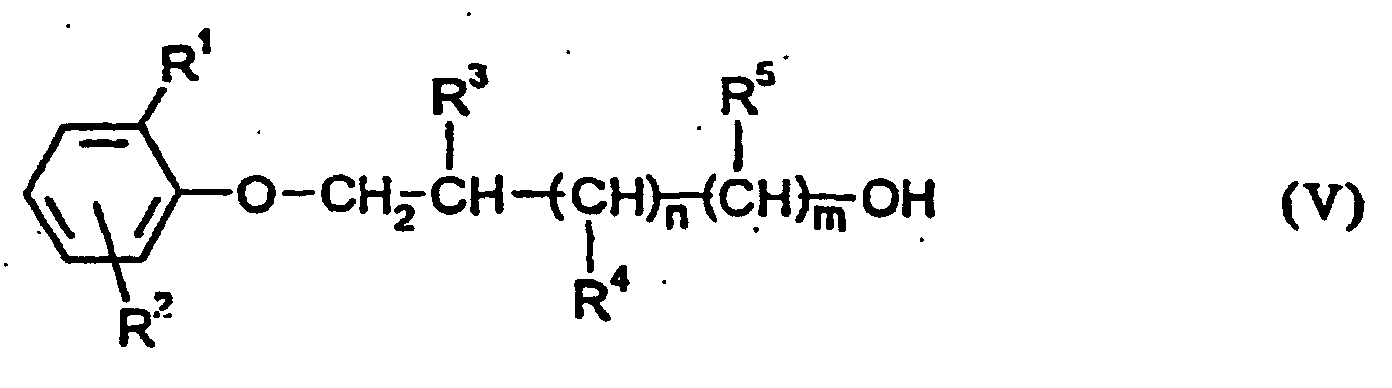
- b) For the preparation of compounds of formula (I), wherein R1 and R2 stand for alkyl group or one of them is hydrogen, R3, R4, R5, R6, n and m are as defined above and R7 stands for amino group, e.g. a compound of formula (I) wherein R1, R2, R3, R4, R5, R6, n and m are as defined above, and R7 means nitro group, is reduced in a manner known per se. This reduction may be carried out by catalytical hydrogenation or catalytical transfer hydrogenation or in an other way known from the literature.
- c) The preparation of compounds of formula (I), wherein R1 and R2 mean alkyl group or one of them stands for hydrogen, R3, R4, R5, n and m are as defined above, R6 means alkyl or benzyl group and R7 represents alkylsulfonamido, benzamido, alkyl(thio)ureido or aliphatic alkylcarbonylamino (e.g. acetylamino) group, can be achieved e.g. by reacting compounds of formula (I), wherein R1, R2, R3, R4, R5, R6, n and m are as defined above, and R7 means amino group, with a reagent suitable for introducing a sulfonyl group, or with acylating reagents in various solvents. According to a preferred embodiment of the above process c) compounds, wherein R7 means alkylsulfonamido, benzamido or alkylcarbonylamino group, are reacted in the presence of an acid-binding agent (e.g. triethylamine). This reaction is performed at room temperature or, if necessary, the reaction mixture is cooled or heated.According to an other preferable embodiment of the above process c) compounds, wherein R7 means an alkyl(thio)ureido group, are reacted in dioxane without any acid-binding agent at room temperature or under heating.
- d) For the preparation of compounds of formula (I), wherein R1 and R2 mean alkyl group or one of them is hydrogen, R3, R4, R5, n and m are as defined above, R6 stands for alkyl group and R7 represents alkylamino group, e.g. a compound of formula (I), wherein R1, R2, R3, R4, R5, R6, n and m are as defined above, and R7 means alkylcarbonylamino group, can be reduced in a way known per se. According to a preferred embodiment of process d) this reduction is carried out by using lithium aluminum hydride at the boiling point of tetrahydrofuran.
- e) For the preparation of compounds of formula (I), wherein R1
and R2 mean alkyl group, halogen or one of them is hydrogen, R3, R4,
R5, n and m are as defined above, R6 stands for alkyl group, hydrogen
or benzyl group, and R7 represents methanesulfonamido group, e.g. a
compound of formula (III),
wherein R1, R2, R3, R4, R5, R6, R7, n and m are as defined above, is reduced in a manner known per se. According to an advantageous embodiment of process e) this reduction is established by using lithium aluminium hydride in tetrahydrofuran at the boiling point.The compounds of formula (III) used in process e) can be prepared e.g. by reacting amines of formula (II) with (methanesulfonamido)-phenylacetic acid.According to a preferable embodiment of the above process used for the preparation of compounds of formula (III), the reaction is carried out in N,N-dimethylformamide, in the presence of 4--methylmorpholine, isobutyl chloroformate and triethylamine at a temperature of -10 °C and later 0 °C; or the reaction is performed in tetrahydrofuran in the presence of dicyclohexylcarbodiimide.

- f) For preparing compounds of formula (I), wherein R1 and R2 mean alkyl group, halogen or one of them is hydrogen, R3, R4, R5, R6, n and m are as defined above and R7 stands for a methanesulfonamido group, e.g. a compound of formula (II), wherein R1, R2, R3, R4, R5, R6, n and m are as defined above, is reacted with N-[4-(2-bromoethyl)--phenyl]methanesulfonamide.
-
- According to a preferred embodiment of process f) this reaction can be carried out without any solvent under heating.
- The salts of compounds of formula (I) of the invention are directly formed in the reaction of their preparation or, when the compounds of formula (I) are separated in their base form, the salts can be prepared from the base obtained by dissolving the base in a suitable solvent, such as methanol, ethanol, isopropanol, ethyl ether, ethyl acetate or in a mixture thereof; and then adding to the solution the appropriate acid dissolved in a suitable solvent. The salts can be separated directly by filtration or optionally, by precipitation after addition of a suitable solvent; or by complete or partial evaporation of the solvent.
- Frequently, the salts of compounds of formula (I) according to the invention contain the acid component in a non-stoichiometric ratio and/or they frequently crystallize in a hydrate form. The invention relates to these crystal forms, too.
- The compounds of formula (I) according to the invention may optionally contain also asymmetrical carbon atoms and therefore, they may occur in optically active and racemic modifications. Optically pure compounds can be prepared from optically pure precursors as starting materials; or the racemic end product can be resolved. In the latter case, the optical isomers can be separated e.g. by treating the racemic compound e.g. in methanol, ethanol, ethyl acetate, acetone or an other solvent with an optically active acid, e.g. with a 0.5 to 2.0 molar amount [calculated for the compound of formula (I)] of e.g. D-tartaric acid, O,O-dibenzoyl-L-tartaric acid, O,O-dibenzoyl-D-tartaric acid-N,N-dimethylmonoamide, L-thiazolidine-4-carboxylic acid or an other usual, optically active acid to obtain the diastereomer salt of one optical isomer in an immediately pure state or optionally after several recrystallizations (depending upon the acid used); and the other isomer is obtained by processing of the mother liquors in the base form or in the form of a salt thereof (which depends on the amount of the acid used), which is further purified, when necessary.
- Then, the optically active bases can be liberated from their salts thus obtained and separated, if desired, to prepare from the base obtained an acid addition salt with a therapeutically acceptable acid.
- As mentioned above, the compounds of formula (I) according to the invention possess valuable antiarrhythmic effects.
- In the following, the pharmacological results are discussed, which prove the IB- and III-class cardiac electrophysiological effect of compounds of formula (I) without a negative inotropic action and arrhythmia-inducing, i.e. proarrhythmic, effect, respectively, which are characteristic of classes IB and III. Finally, the in vivo antiarrhythmic action of the compounds of formula (I) will be shown in three arrhythmia models.
- The method used is essentially in agreement with the method of Varró et al. [Arch. Int. Pharmacodyn. Ther. 292, 157-165 (1988)].
- Right ventricular trabecules were prepared from the heart of mongrel dogs (weighing 5 to 10 kg each). The surviving heart pieces were placed into an organ bath (37 °C) containing modified Tyrode's nutrient medium and excited by point stimulation with a basal frequency of 1 Hz. Extracellular bipolar platinum electrodes were placed on the surface of the preparations, by means of which the propagation of the superficial potentials were registered; thus, the determination of the time of impulse conduction or the rate of impulse conduction, respectively, and the effective refractory period (ERP) became possible. During our experiments, the frequency of stimulation was temporarily varied from 0.5 Hz up to 3 Hz. The tested compounds were directly added to the organ bath after dilution of the stock solution according to the desired final concentration. The effects of the compounds were observed after waiting for an incubation period of 30 to 40 minutes.
- The results of the extracellular in vitro cardiac electrophysiological measurements are shown in Table 1.
Effects of compounds investigated on the impulse conduction and effective refractory period (ERP) on isolated right ventricular trabecule of dog heart Example Prolongation (%) of impulse conduction time Prolongation (%) of ERP (10 µM) N 1 Hz 3 Hz 1 Hz 3 Hz 9 (2 µM) 12 +38.0±3.5 +51.3±4.9 +31.8±2.5 +39.4±5.0 15 16 +42.0±7.5 +73.8 ±8.3 +22.8±1.3 +31.3±1.6 15 (2 µM) 8 +11.1±2.2 +13.4±2.8 +11.6±1.2 +13.6±2.9 16 12 +26.9±3.1 +39.7±3.1 +10.7±0.7 +14.3±1.7 17 12 +32.5±6.0 +35.1±5.9 +12.1±0.9 +17.1±2.1 18 12 +18.5±2.4 +21.7±4.0 +9.9±0.8 +14.0±1.3 20 12 +20.3±2.7 +24.5±3.5 +8.4±0.3 +12.6±0.6 22 12 +22.6±4.1 +28.3±5.3 +12.3±1.3 +18.1±1.8 23 12 +25.0±3.9 +25.0±4.2 +10.8±1.1 +14.9±1.4 24 12 +69.0±11.9 +82.9±11.0 +13.8±1.7 +18.4±1.2 25 12 +18.8±2.0 +18.8±3.1 +11.7±1.2 +17.0±1.3 Mexiletine (10 µM) 6 +3.9±1.8 +18.8±2.5 -1.9±1.7 +8.9±5.4 d-Sotalol (30 µM) 8 -4.5±5.1 -3.7±4.7 +12.4±2.3 +7.1±2.7 N: Total number of animals in the group. - From the compounds investigated, the compounds of Examples 9, 15, 16, 17 and 24 significantly prolonged the time of impulse conduction in a frequency-dependent manner, i.e. they diminished the rate of impulse conduction together with the simultaneous prolongation of the effective refractory period (ERP). Mexiletine (chemically 2-(2,6--dimethylphenoxy)-1-methylethylamine hydrochloride) used as reference substance exerted an effect mainly on impulse conduction whereas d-sotalol showed a considerable effect only on the ERP.
- The method used is essentially in agreement with the method of Papp et al. [J. Cardiovascular Pharmacol. Ther. 1, 287-296 (1996)].
- Right ventricular papillary muscle and Purkinje's fibres were prepared from the hearts of mongrel dogs (weighing 5 to 10 kg each). The preparations were placed into an organ bath (37 °C) containing modified Tyrode's nutrient medium. The preparations were excited by a basal frequency of 1 Hz. During the experiments, the frequency of stimulation was varied under broad limits by a computer-guided stimulator. The intracellular action potentials were registered by using glass capillary microelectrodes filled with 3 N potassium chloride solution (standard intracellular microelectrode techniques). The resting potential (RP), the amplitude of the action potential (APA) as well as the duration of the action potential (APD) were measured by using an IBM 386 compatible computer by means of an own-developed software. The compounds under test were directly added into the organ bath after dilution of the stock solutions according to the final concentrations desired. The effects of the compounds were observed after an incubation time of 30 to 40 minutes.
- The results of intracellular cardiac electrophysiological measurements on the papillary muscle are shown in Table 2. From the compounds tested, the compounds of Examples 9, 14, 15, 16, 17, 22, 26 and 27 induced a mexiletine-like inhibition of Vmax, which can be characterized by a relatively significant degree of rapid recovery kinetics together with the simultaneous prolongation of duration of the action potential (APD) (dofetilide-like effect; chemically, dofetilide is N-[4--[2-[N-methyl-N-[2-(4-methanesulfonamidophenoxy)ethyl]-amino]ethyl]phenyl]methanesulfonamide). No essential difference could be observed between the effects of the compound of Example 15 and its enantiomers (Examples 16 and 17) in this experiment.

- The effects of the tested compounds according to the invention on the action potential of Purkinje's fibres isolated from dog heart are summarized on the compound of Example 15 in Tables 3 and 4.
- The compound of Example 15 (5 µM) prolonged APD in the ventricular muscle of the dog and simultaneously abbreviated APD on Purkinje's fibres of the dog in concentrations of 2 µM and 5 µM. This result is extremely important since it can be expected that the compound would not increase but rather decrease the inhomogeneity of ventricular repolarization (which is an important proarrhythmic factor).
Effect of the compound of Example 15 on the action potential on Purkinje's fibres isolated from dog heart Parameter N Control Example 15 2 µM MDP (mV) 3 -82.0+2.1 -81.7±2.4 APA (mV) 3 111.3±3.8 112.7±3.9 APD50 (ms) 3 261.7±36.2 180.7±14.8 APD90 (ms) 3 468.0±81.1 400.0±47.4 Vmax (V/s) 3 397.3±25.4 392.3±23.7 MDP: maximal diastolic potential; APA: amplitude of the action potential; APD50: time of 50 % repolarization; APD90: time of 90 % repolarization; Vmax: maximum rate of depolarization; N: total number of animals in the group. Effect of the compound of Example 15 (5 µM) on the action potential on the ventricular muscle and Purkinje fibres of dog heart at stimulation frequency of 1 Hz Parameter Ventricular muscle Purkinje's fibre Control Example 15 Control Example 15 N = 6 N = 6 RP(mV) -84.3±1.4 -84.5±1.3 -87.7±1.3 -86.0±2.0 APA (mV) 106.8±2.2 106.3±2.0 118.7±0.9 111.0±2.4 APD50(ms) 195.0±6.7 209.5±7.1 313.5±26.0 121.3±13.8 APD90 (mS) 234.2±9.4 260.5±6.5 461.5±26.5 279.0±11.2 Vmax (V/s) 206.0±3.5 203.0±11.4 577.5±35.9 439.3±34.4 Vmax time of recovery T(ms) <30ms 270.1±14.4 - - Vmax time of recovery amplitude (V/s) - 83.6±13.5 (35±5%) - - Vmax time of recovery plateau phase (V/s) - 245.5±28.0 - - N: total number of animals in the group. - An early after-depolarization (EAD) was induced on dog Purkinje's fibres by the simultaneous use of 1 µM dofetilide and 20 µM BaCl2. These EAD-s were abolished by the addition of the compound (2 µM) of Example 15. The result of these experiments indicates that, in contrast with d-sotalol, it can be expected that the compound of Example 15 would not induce a "torsade de pointes" type tachycardia, i.e. a proarrhythmic complication connected with prolongation of the repolarization.
- The method used is essentially in agreement with the method of Virág et al. [Gen. Pharmac. 27, pp. 551-556 (1996)].
- Papillary muscles of hearts of rabbits (weighing 2 to 3 kg each) were prepared and placed into an organ bath (37 °C) containing modified Tyrode's nutrient medium. The preparations were stimulated by point-stimulation with a basal frequency of 1 Hz. The contractile force was measured by using an auxotonic method. The compounds under test were directly added into the organ bath after dilution of the stock solution according to the final concentration desired. The effects of compounds were observed after an incubation period of 30 to 45 minutes.
- Using this method used information can be obtained concerning the direct cardiac effects of the compounds investigated. The effect of the compound of Example 15 on the contractile force is illustrated on the right ventricular papillary muscle at a frequency of 1 Hz in Figure 2. The results showed that the expected therapeutic concentration of Example 15 did not induce any negative inotropic action since the contractile force of papillary muscle was not decreased by using a concentration lower than 30 µM.
-
- Animal: male CDI mice (starved) weighing 20 to 22 g each at the time of treatment.
- Observation period: 2 weeks.
- Vehicle: 1 to 2 % of Tween-80 in distilled water or in physiological saline, respectively.
- Treatment volume: 0.1 ml/10 g of body-weight. The results are shown in Table 5.
-
- The method used is essentially in agreement with the method of Thiemermann et al. [Br. J. Pharmacol. 97, pp. 401-408 (1989)].
- A loose surgical thread loop was placed round the left circumflex coronary artery of the heart following thoracotomy in pentobarbital (30 mg/kg i.v.) anaesthetized male rabbits (weighing 2 to 3 kg); both ends of the thread loop were led out from the chest through an elastic tube. Standard electrocardiogram was registered by using needle electrodes under the skin. The blood pressure of animals was continuously measured by using a catheter placed into the common carotid artery. After stabilization of the blood pressure and heart frequency, the loose loop was tightened to establish a regional myocardial ischaemia. After 10 minutes of ischaemia, the ligature was released and a reperfusion for 10 minutes was established. The survival, the incidence of arrhythmias, the time of onset of arrhythmia and the length of episodes were registered. The animals received physiological saline solution (control) intravenously (2 ml/kg) or 0.03 mg/kg of the compound of Example 15 or a 3 mg/kg dose of d-sotalol at 5 minutes before the occlusion.
- By using this method, it can be stated whether the compound under test would be effective for the protection from arrhythmias following coronary artery ligation. The experiments carried out indicated (see Tables 6 and 7) that the compound of Example 15 administered in a dose of 0.03 mg/kg possesses a strong antiarrhythmic effect on rabbits against reperfusion arrhythmias induced by ligation.

- The method used is essentially in agreement with the method of Végh et al. [Basic Res. Cardiol. 82, 159-171 (1987)].
- Mongrel dogs of both sexes weighing 10 to 20 kg each were anaesthetized by a mixture of chloralose (60 mg/kg) and urethane (200 mg/kg) and the animals were maintained on artificial respiration. After opening the chest, the ramus descendens anterior (LAD) branch of the left coronary artery of heart was prepared from the first main collateral branch and a loose loop from surgical thread was placed around it. During our experiments, the blood pressure of the animal was measured by using a cannule introduced to the left femoral artery and even the standard ECG parameters by using needle electrodes were continuously registered. The arrhythmias were induced by the occlusion for 25 minutes of a loop placed round the LAD. The survival after lethal arrhythmias and frequency of the arrhythmias were registered. The 28 dogs used in the experiments were divided into three groups. The compound of Example 15 was administered in a dose of 1 mg/kg to 8 animals; d-sotalol was given in a dose of 3 mg/kg to 10 animals by a single
intravenous injection 10 minutes before compression of the coronary vessel. The control dogs (10 animals) received 5 ml of physiological saline solution in the same manner as the treated animals. - By using this method it can be stated whether the substance investigated would be effective for protection against arrhythmias following the ligation of the coronary artery. The experiments carried out indicated (Table 8) that a dose of 1 mg/kg of the substance of Example 15 protected from the arrhythmogenic effects of ligation and reperfusion of the coronary artery to a higher degree than a dose of 3 mg/kg of d-sotalol, an observation proving the significant antiarrhythmic effectivity of this compound.
Investigation of occlusion and reperfusion arrhythmias following acute compression in anaesthetized dogs Compound N Occlusion Reperfusion VF Complete survival ES VT VF Control 10 327±22 10/10 6/10 4/4 0/7 100% 60% 100% 0% d-Sotalol (3 mg/kg) 10 128±14 5/10 3/10 2/7 5/10 50% 30% 29% 50% Example 15 (1 mg/kg) 8 36.6±84.1 1/8 1/8 0/7 7/8 12.5% 12.5% 0% 87.5% ES: extrasystole; VT: ventricular tachycardia; VF: ventricular fibrillation; N: total number of animals in the group. - The method used is essentially in agreement with the method of Leprán et al. [
J. Pharmacol. Methods 9, pp. 219-230 (1983)]. - During a previous operation, male rats weighing 340 to 360 g each were fitted with a loose surgical thread loop around the left descending coronary vessel, at about 2 mm from its origin. The ends of the loop thread were led out from the chest under the skin, then the surgical wound was closed. After complete recovery from this previous operation (7 to 8 days) acute myocardial ischaemia was induced by contracting the loose ligation in the conscious, freely moving animals. ECG was continuously registered by using bipolar chest electrodes before the ligation of the coronary artery and during the first 15 minutes of ischaemia. The ratio of survivals was determined and the developed arrhythmias were evaluated according to the Lambeth Convention [Walker et al.: Cardiovasc. Res. 22, 447-455 (1988)]. For evaluation of the arrhythmic episodes a score system was also employed by considering the severity of episodes on the basis of a score system from 0 to 6. Both d-sotalol and the substance of Example 15, respectively, were suspended in 1% methylcellulose and administered orally through a gastric sound at 1 hour before the compression of the coronary vessel. The control animals received a treatment with the same volume, i.e. 5 ml/kg of vehicle.
- On conscious rats, in the model of arrhythmia following the acute coronary artery occlusion, the compound of Example 15 (having a mixed mechanism of action) showed an antiarrhythmic effect even after oral administration while d-sotalol prolonging repolarization only proved to be inactive in these experiments (Table 9). An other preferable effect of the use of compound of Example 15 is that by using a dose of 25 mg/kg, the heart rate was statistically unchanged during the first 15 minutes of myocardial infarction; in contrast with the heart rate of the untreated control group which was decreased by about 15%.

- The compounds according to the invention can be used in mammals, including humans, for the elimination of cardiac arrhythmias.
- For therapeutical purposes, the compounds according to the invention and therapeutically acceptable salts thereof can be used alone or suitably in the form of pharmaceutical compositions. The invention relates also to these compositions.
- These pharmaceutical compositions contain an amount of the compound of formula (I) or a therapeutically acceptable salt thereof as active ingredient, which is required for exerting the effect, in admixture with vehicles, fillers, diluting agents and/or other pharmaceutical auxiliaries commonly used in the manufacture of drugs.
- Suitable carriers, diluting agents or fillers can be e.g. water, alcohols, gelatine, lactose, saccharose, starch, pectin, magnesium stearate, stearic acid, talc, various oils of animal or plant origin as well as glycols, e.g. propylene glycol or polyethylene glycol. The pharmaceutical auxiliaries are e.g. stabilizers, antioxidants, various natural or synthetic emulsifying, dispersing or wetting agents, colouring agents, aromatizing agents, buffers, disintegrating agents and other substances promoting the biological availability of the active agents.
- The pharmaceutical compositions according to the invention may be in the usual pharmaceutical dosage forms. Such usual dosage forms are e.g. oral compositions (administered through an oral route) prepared by using pharmaceutical auxiliaries; these are solid forms such as e.g. tablets, capsules, powders, pills, dragées or granules; or liquid compositions such as syrups, emulsions or suspensions; rectal compositions such as suppositories (which can be administered through a rectal route); and parenteral compositions (administered with avoiding the gastric and intestinal system) such as injections or infusions.
- Although the doses of compounds of the present invention required for the therapeutic action depend on the individual state and age of the patient and are determined finally by the physician, for treating diseases accompanied by arrhythmia a daily oral or parenteral, e.g. intravenous, dose of the compound between about 0.1 mg and 5.0 mg, preferably about between 0.1 mg and 2.0 mg calculated for 1 kg of body-weight, can be administered.
- Hereinbelow, the compounds according to the invention and the processes for their preparation are illustrated in the following non limiting Examples.
- To a solution containing 12.0 g (62 mmol) of N-methyl-2-(2,6--dimethylphenoxy)-1-methylethylamine (BE 626,725) in 40 ml of isopropanol, 7.13 g (31 mmol) of 4-nitrophenethyl bromide are added and the reaction mixture is boiled under reflux for 5 hours. After evaporation of the solvent, the residue is triturated with 20 ml of ethyl acetate. The precipitated amine hydrobromide is filtered and washed with ethyl acetate. After evaporation of the solution, the crude product (base) obtained is purified by column chromatography (eluent: dichloromethane/methanol = 9:0.1). The total yield (HCl salt) is 0.88 g (7.5 %) of a white, crystalline product, m.p.: 135-138 °C.
1HMR (CDCl3, very dilute solution): 1.15 (m, 3H, C-CH3); 2.25 (s, 6H, Ar-o-CH3 ); 2.90-4.20 (m, 10H, O-CH2-CH-N, N-CH3 , N-CH2-CH2 -Ar); 6.85-7.10 (m, 3H, Ar); 7,48 (d, 2H) and 8.20 (d, 2H) (Ar); 13.0 (br. 1H, NH+). - The title compound is prepared as described in Example 1, except that N-methyl-2-(2,6-dimethylphenoxy)ethylamine (BE 626,725) is used as starting material, to obtain the title compound in a yield of 30 % (HCl salt) of a white crystalline product, m.p.: 147-149 °C.
1HMR (DMSO-d6 ): 2.22 (s, 6H, Ar-CH3); 2.96 (d, 3H, N-CH3); 3.20-3.80 (m, 6H, CH2-CH2 -N-CH2 -CH2 -Ar); 4.05-4.25 (m, 2H, O--CH2 -CH2); 6.80-7.00 (m, 3H, Ar); 7.55 (d, 2H) and 8.15 (d, 2H) (p-nitrophenyl); 11.54 (br. 1H, NH+). - The title compound is prepared as described in Example 1, except that N-methyl-2-(2-methylphenoxy)ethylamine (Example 43) is used as starting material to obtain 28 % (HCl salt) of a white crystalline product, m.p.: 137-138 °C.
1HMR (DMSO-d6 ) 2.12 (s, 3H, Ar-CH3); 2.95 (s, 3H, N-CH3); 3.28 (t, 2H, CH2-CH2 -Ar); 3.35-3.80 (m, 4H, CH2 -N-CH 2); 4.42 (t, 2H, O-CH2 -CH2); 6.80-7.20 (m, 4H, Ar); 7.60 (d, 2H) and 8.22 (d, 2H) (p-nitrophenyl); 11.25 (br. 1H, NH+). - The title compound is prepared as described in Example 1, except that (S)-N-methyl-2-(2,6-dimethylphenoxy)-1-methylethylamine (Example 47) is used as starting material to give a yield of 17% (base) of an oily substance, which contains 1% of R-enantiomer based on chiral HPLC examination (Chiralcel OJ column); Rf = 0.7 (ethyl acetate/methanol = 9:1).
- The title compound is prepared as described in Example 1, except that (R)-N-methyl-2-(2,6-dimethylphenoxy)-1-methylethylamine (Example 46) is used as starting material to give a yield (base) of 17% of an oil containing no S-enantiomer on the basis of chiral HPLC examination (Chiralcel OJ column); Rf = 0.7 (ethyl acetate/methanol = 9:1).
- The title compound is prepared as described in Example 1, except that N-methyl-2-(2-methylphenoxy)-1-methylethylamine (Example 48) is used as starting material to give a yield of 14% (HCl salt) of white crystals, m.p.: 140-142 °C.
1HMR (DMSO-d6 ): 1.45 (m, 3H, C-CH3); 2.10 (s) and 2.20 (s) (total 3H, Ar-CH3); 2.88 (m, 3H, N-CH3); 3.20-3.60 (m, 4H, N-CH2 -CH2 -Ar); 3.92 (m, 1H, CH2-CH-N); 4.35 (m, 2H, O-CH2 -CH); 6.80--7.20 (m, 4H, Ar); 7.60 (m, 2H) and 8.22 (d, 2H) (Ar); 11.20 (br. s,. 1H, NH+). - A solution containing 0.40 g (1.23 mmol) of N-[2-(2,6-dimethylphenoxy)ethyl]-N-methyl-2-(4-nitrophenyl)ethylamine (Example 2) in 7 ml of isopropanol is added to a suspension of 0.1 g of 10% palladium-on-carbon catalyst in 7 ml of isopropanol. The suspension is hydrogenated under atmospheric pressure. After completion of the reaction, the catalyst is filtered and washed with isopropanol. The filtrate is evaporated to constant weight under reduced pressure to obtain 0.37 g of the oily base (76%), Rf = 0.35 (ethyl acetate/methanol = 9:1).
- The title compound is prepared as described in Example 7, except that N-[2-(2-methylphenoxy)ethyl]-N-methyl-2-(4-nitrophenyl)ethylamine (Example 3) is used as starting material to obtain a yield of 82% of the base (oil), Rf = 0.35 (ethyl acetate/methanol = 9:1).
- The title compound is prepared as described in Example 7, except that N-[2-(2,6-dimethylphenoxy)-1-methylethyl]-N-methyl-2-(4-nitrophenyl)ethylamine (Example 1) is used as starting material to give a yield of 90% of the oily base.
1HMR (CDCl3): 1.25 (d, 3H, C-CH3); 2.32 (s, 6H, Ar-CH3); 2.48 (s, 3H, N-CH3); 2.65-2.85 (m, 4H, N-CH2 -CH2 -Ar); 3.28 (m, 1H, CH2-CH-N); 3.2-3.8 (br. s, 2H, NH2); 3.65 (dd, J = 9.2 and 6.7 Hz, 1H) and 3.92 (dd, J = 9.2 and 5.7 Hz, 1H) (O-CH2 -CH); 6.66 (d, 2H, Ar); 6.9-7.10 (m, 5H, Ar). - The title compound is prepared as described in Example 7, except that (S)-N-[2-(2,6-dimethylphenoxy)-1-methylethyl]-N-methyl-2-(4--nitrophenyl)ethylamine (Example 4) is used as starting material to give a yield of 93% of a white oil (base), which contains 1 to 2 % of R-enantiomer on the basis of chiral HPLC examination (Chiralcel OJ column); Rf = 0.35 (ethyl acetate/methanol = 9:1).
- The title compound is prepared as described in Example 7, except that (R)-N-[2-(2,6-dimethylphenoxy)-1-methylethyl]-N-methyl-2-(4--nitrophenyl)ethylamine (Example 5) is used as starting material to obtain a yield of 89% of the white oily base, which contains 1 % of S-enantiomer on the basis of chiral HPLC examination (Chiralcel OJ column); Rf= 0.35 (ethyl acetate/methanol = 9:1).
- The title compound is prepared as described in Example 7, except that N-methyl-N-[2-(2-methylphenoxy)-1-methylethyl]-2-(4-nitrophenyl)ethylamine (Example 6) is used as starting material to give a yield of 89% of the oily base.
1HMR (CDCl3): 1.16 (d, 3H, C-CH3); 2.20 (s, 3H, Ar-CH3); 2.40 (s, 3H, N-CH3); 2.60-2.80 (m, 4H, N-CH2 -CH2 -Ar); 3.30-3.70 (br. s, 2H, NH2); 3.70 (m, 1H, CH2-CH2 -N); 3.82 (dd, 1H) and 4.02 (dd, 1H) (O-CH2 -CH); 6.60 (d, 2H) and 7.00 (d, 2H) (p-aminophenyl); 6.72--6.90 (m, 2H) and 7.08-7.20 (m, 2H) (Ar). - To a solution containing 1.44 g (4.82 mmol) of N-[2-(2,6--dimethylphenoxy)ethyl]-N-methyl-2-(4-aminophenyl)ethylamine (Example 7) in 50 ml of dichloromethane, 0.50 g (4.95 mmol) of triethylamine is added then 0.63 g (5.5 mmol) of methanesulfonyl chloride is dropwise added to the solution cooled to 0 °C at the same temperature. After further stirring the reaction mixture at 0 °C for 1 hour and washing with 30 ml of saturated sodium hydrogen carbonate solution, the aqueous phase is extracted twice with 20 ml of dichloromethane each. The combined organic phase is washed twice with 30 ml of water each, dried and evaporated to give a yield of 0.44 g (94%) of the oily base. The yield of HCl salt is 0.244 g (47 %) of white crystals, m.p.: 168-169 °C.
1HMR (DMSO-d6 ): 2.25 (s, 6H, Ar-CH3); 2.95 (s, 6H, N-CH3 and S-CH3 overlapping); 3.10 (t, 2H, CH2-CH2 -Ar); 3.25-3.75 (m, 4H, CH2-N-CH2 ); 4.15 (t, 2H, O-CH2 -CH2); 6.85-7.05 (m, 3H, Ar); 7.14 (d, 2H) and 7.24 (d, 2H) (4-methanesulfonamido-phenyl); 9.75 (s, 1H, Ar-NH-S); 11.20 (br. 1H, NH+). - The title compound is prepared as described in Example 13, except that N-methyl-N-[2-(2-methylphenoxy)ethyl]-2-(4-aminophenyl)-ethylamine (Example 8) is used as starting material to give a yield of 71 % (HCl salt) of white crystals, m.p.: 180-181 °C.
1HMR (DMSO-d6 ): 2.15 (s, 3H, Ar-CH3); 2.90 (d, 3H, N-CH3); 2.95 (s, 3H, S-CH3); 3.10 (t, 2H, CH2-CH2 -Ar); 3.25-3.80 (m, 4H, CH2 -N-CH2 ); 4.44 (t, 2H, O-CH2 -CH2); 6.80-7.00 (m, 2H, Ar) and 7.15-7.30 (m, 6H) (Ar); 9.75 (s, 1H, Ar-NH-S); 11.20 (br. 1H, NH+). - The title product is prepared as described in Example 13, except that N-[2-(2,6-dimethylphenoxy)-1-methylethyl]-N-methyl-2-(4-aminophenyl)ethylamine (Example 9) is used as starting material to obtain a yield of 56 % (HCl salt) of white crystals, m.p.: 224-227 °C.
1HMR (DMSO-d6 , at room temperature): 1.45 (m, 3H, C-CH3 ); 2.28 (s, 6H, Ar-o-CH3); 2.90 (m, 3H, N-CH3); 2.96 (s, 3H, S-CH3); 3.00-3.50 (m, 4H, N-CH2 -CH2 -Ar); 3.90 (m, 1H, CH2-CH-N); 3.98--4.16 (m, 2H, O-CH2-CH); 6.90-7.10 (m, 3H, Ar); 7.14-7.32. (m, 4H, Ar); 9.75 (s, 1H, Ar-NH-S); 10.90 (br. s, 1H, NH+). - The title compound is prepared as described in Example 13, except that (S)-N-[2-(2,6-dimethylphenbxy)-1-methylethyl]-N-methyl-2--(4-aminophenyl)ethylamine (Example 10) is used as starting material to give a yield of 63% (HCl salt) of white crystals, m.p.: 192-193 °C.
- On the basis of chiral HPLC analysis (Chiralcel OJ column), this product does not contain R-enantiomer.
1HMR (DMSO-d6 , at room temperature): 1.45 (m, 3H, C-CH3 ); 2.28 (s, 6H, Ar-o-CH3); 2.90 (m, 3H, N-CH3); 2.96 (s, 3H, S-CH3); 3.00-3.50 (m, 4H, N-CH2 -CH2 -Ar); 3.90 (m, 1H, CH2-CH-N); 3.98-4.16 (m, 2H, O-CH2 -CH); 6.90-7.10 (m, 3H, Ar); 7.14-7.32 (m, 4H, Ar); 9.70 (s, 1H, Ar-NH-S); 10.75 (br.s, 1H, NH+).
1HMR (DMSO-d6 , 100 °C): 1.45 (d, 3H, C-CH3 ); 2.28 (s, 6H,. Ar-o-CH3); 2.88 (s, 3H, N-CH3); 2.96 (s, 3H, S-CH3); 3.00-3.50 (m, 4H, N-CH2 -CH2 -Ar); 3.85 (m, 1H, CH2-CH-N); 4.04 (dd, J = 10.6 and 5.1 Hz, 1H) and 4.14 (dd, J = 10.6 and 5.6 Hz, 1H)(O-CH2 -CH); 6.90-7.06 (m, 3H, Ar); 7.16-7.30 (m, 4H, Ar); 9.35 (s, 1H, Ar-NH-S); 11.00 (br.s, 1H, NH+). - The title product is prepared as described in Example 13, except that (R)-N-[2-(2,6-dimethylphenoxy)-1-methylethyl]-N-methyl-2-(4--aminophenyl)ethylamine (Example 11) is used as starting material to obtain a yield of 55% (HCl salt); white crystals, m.p.: 190-191 °C.
- On the basis of chiral HPLC analysis (Chiralcel OJ column), this product does not contain S-enantiomer.
1HMR (DMSO-d6 , at room temperature): 1.45 (m, 3H, C-CH3 ); 2.28 (s, 6H, Ar-o-CH3); 2.90 (m, 3H, N-CH3); 2.96 (s, 3H, S-CH3); 3.00-3.50 (m, 4H, N-CH2 -CH2 -Ar); 3.90 (m, 1H, CH2-CH-N); 3.98--4.16 (m, 2H, O-CH2-CH); 6.90-7.10 (m, 3H, Ar); 7.14-7.32 (m, 4H, Ar); 9.70 (s, 1H, Ar-NH-S); 10.75 (br. s, 1H, NH+). - The title compound is prepared as described in Example 13, except that N-methyl-N-[2-(2-methylphenoxy)-1-methylethyl]-2-(4-aminophenyl)ethylamine (Example 12) is used as starting material to give a yield of 60% (HCl salt) of white crystals, m.p.: 165-167 °C.
1HMR (DMSO-d6 ): 1.38-1.52 (m, 3H, C-CH3); 2.10 (s) and 2.20 (s) (total 3H, Ar-CH3); 2.85 (m, 3H, N-CH3); 2.96 (s, 3H, S-CH3); 3.05-3.50 (m, 4H, N-CH2 -CH2 -Ar); 3.94 (m, 1H, CH2-CH-N); 4.20--4.40 (m, 2H, O-CH2 -CH); 6.80-7.00 (m, 2H) and 7.10-7.35 (m, 6H) (Ar); 9.72 (s, 1H, Ar-NH-S); 10.70-11.00 (br. 1H, NH+). - To a solution containing 0.82 g (2 mmol) of N-[2-(2,3-dimethylphenoxy)-1-methylethyl]-N-methyl-2-(4-methanesulfonamidophenyl)acetamide (Example 50) in 20 ml of abs. tetrahydrofuran, 0.10 g of lithium aluminium hydride (LAH) is added in small portions under stirring, then the mixture is boiled about one hour in order to complete the reaction. The progress of reaction is followed by thin-layer chromatography (TLC). After completion, the excess reagent is decomposed by adding ethyl acetate, then 10% sodium hydroxide solution is added and the mixture is extracted with ethyl acetate. The combined organic phase is washed with water, then extracted with 2 N aqueous hydrochloric acid. The acidic phase is alkalinized to
pH 9 by adding 10% sodium hydroxide and then extracted with ethyl acetate. The ethyl acetate extract is washed with water, dried and evaporated under reduced pressure to obtain 0.56 g of a thick oil as residue. This crude product is purified, if desired, by column chromatography by using a mixture of hexane and ethyl acetate of a ratio of 2:1 or 1:1, respectively. The HCl salt is obtained in a yield of 0.38 g (45%) as amorphous white flakes.
1HMR (DMSO-d6 ): 1.40-1.50 (m, 3H, C-CH3); 2.00 (s), 2.08 (s) and 2.22 (s) (totally 6H, Ar-CH3); 2.80-2.90 (m, 3H, N-CH3); 2.95 (s, 3H, S-CH3); 3.00-3.50 (m, 4H, N-CH2 -CH2 -Ar); 3.92 (m, 1H, CH2-CH -N); 4.25-4.35 (m, 2H, O-CH2 -CH); 6.75-7.30 (m, 7H, Ar); 9.75 (s, 1H, Ar-NH-S); 10.8-11.1 (m, 1H, NH+). - The title compound is prepared as described in Example 19, except that N-[2-(2,5-dimethylphenoxy)-1-methylethyl]-N-methyl-2-(4--methanesulfonamido-phenyl)acetamide (Example 51) is used as starting material to yield 40 % of the HCl salt, which is an amorphous white precipitate.
1HMR (DMSO-d6): 1.40-1.50 (m, 3H, C-CH3); 2.00 (s), 2.10 (s), 2.25 (s) and 2.26 (s) (total 6H, Ar-CH3); 2.80-2.90 (m, 3H, N-CH3); 2.95 (s, 3H, S-CH3); 3.00-3.50 (m, 4H, N-CH2 -CH2 -Ar); 3.92 (m, 1H, CH2-CH-N); 4.20-4.35 (m, 2H, O-CH2 -CH); 6.60-7.30 (m, 7H, Ar); 9.75 (s, 1H, Ar-NH-S); 10.65-11.00 (m, 1H, NH+). - The title product is prepared as described in Example 19, except that N-[2-(2-chlorophenoxy)-1-methylethyl]-N-methyl-2-(4-methanesulfonamido-phenyl)acetamide (Example 52) is used as starting material to give the fumarate salt in a yield of 46%, m.p.: 152-153 °C.
1HMR (DMSO-d6 ): 1.12 (d, 3H, C-CH3); 2.40 (s, 3H, N-CH3); 2.60-2.90 (m, 4H, N-CH2-CH2 -Ar); 2.92 (s, 3H, s-CH3); 3.24 (m, 1H, CH2-CH-N); 3.96 (dd, J = 10.0 and 6.0 Hz, 1H) and 4.10 (dd, j = 10.0 and 5.6 Hz, 1H) (O-CH2 -CH); 6.60 (s, 2H, fumaric acid); 6.90-7.45 (m, 7H, Ar); 9.58 (s, 1H, Ar-NH-S). - A mixture containing 0.58 g (2.08 mmol) of 2-(2,6-dimethylphenoxy)-1-methylethylamine (US 3,659,019) and 0.3 g (1.08 mmol) of N-(4-(2-bromoethyl)phenyl]methanesulfonamide (GB 971,041) is melted at 120 °C for 4 hours. The mixture obtained is purified by column chromatography, eluted with a mixture of dichloromethane and methanol of 9:0.2 ratio. The obtained product is triturated with hexane and filtered to give the base in a yield of 64%; white crystals, m.p.: 81-84 °C.
1HMR (CDCl3): 1.14 (d, 3H, C-CH3); 2.18 (s, 6H, Ar-CH3); 2.86 (s, 3H, S-CH3); 2.70-3.20 (m, 5H, CH2-CH-N-CH2 -CH2 -Ar); 3.64 (d, 2H, O-CH2 -CH); 4.0-4.6 (br., 2H, NH); 6.80-7.00 (m, 3H, Ar); 7.10--7.25 (m, 4H, Ar). - The HCl salt is obtained in a yield of 60%; white crystals, m.p.: 210-211 °C.
- The title compound is prepared as described in example 22, except that N-methyl-3-(2,6-dimethylphenoxy)propylamine (BE 626,725) is used as starting material to obtain the oily base in a yield of 59%.
1HMR (CDCl3, base): 1.96 (m, 2H, CH2-CH2 -CH2); 2.26 (s, 6H, Ar-CH3); 2.35 (s, 3H, N-CH3); 2.58-2.82 (m, 6H, CH2-CH2 -N-CH2 -CH2 -Ar); 2.92 (s, 3H, S-CH3); 3.75 (t, 2H, O-CH2 -CH2); 6.00-6.60 (1H, NH); 6.82-7.02 (m, 3H, 2,6-dimethylphenoxy group); 7.16 (s, 4H, 4-methanesulfonamido-phenyl group). - The HCI salt is obtained in a yield of 49%; white crystals, m.p.: 115-117 °C.
- The title compound is prepared as described in Example 22, except that N-methyl-4-(2,6-dimethylphenoxy)butylamine (BE 626,725) is used as starting material to obtain the oily base in a yield of 57%.
1HMR (CDCl3, base): 1.62-1.88 (m, 4H, CH2-CH2 -CH2 -CH2); 2.26 (s, 6H, Ar-CH3), 2.32 (s, 3H, N-CH3); 2.45-2.85 (m, 6H, CH2-CH2 -N--CH2 -CH2 -Ar); 2.95 (s, 3H, S-CH3); 3.75 (t, 2H, O-CH2 -CH2); 5.30--6.30 (1H, NH); 6.82-7.02 (m, 3H, 2,6-dimethylphenoxy group); 7.16 (s, 4H, 4-methanesulfonamido-phenyl group). - The HCl salt is obtained in a yield of 42.0 %; strongly hygroscopic off-white crystals.
- To a solution containing 0.2 g (0.64 mmol) of N-[2-(2,6-dimethylphenoxy)-1-methylethyl]-N-methyl-2-(4-aminophenyl)ethylamine (Example 9) in 1.7 ml of acetonitrile, 0.11 ml (0.768 mmol) of triethylamine is added, then 0.082 ml (7.04 mmol) of benzoyl chloride is added under stirring. The reaction mixture is stirred at room temperature (cooled or heated, if necessary). After completion, the reaction mixture is evaporated under reduced pressure, 10 ml of water are added to the evaporation residue, and the pH value is adjusted to alkaline, if necessary, by adding sodium hydroxide solution. The product is extracted three times with 20 ml of ethyl acetate each. The organic phase is washed with 50 ml of water, dried and evaporated to give 0.24 g (90 %) of an oil.
1HMR (CDCl3): 1.16 (d, 3H, C-CH3); 2.25 (s, 6H, Ar-CH3); 2.45 (s, 3H, N-CH3); 2.65-2.85 (m, 4H, N-CH2 -CH2 -Ar); 3.26 (sx, 1H, CH2-CH-N); 3.64 (dd, J = 9.5 and 6.1 Hz, 1H) and 3.84 (dd, J = 9.5 and 5.6 Hz, 1H) (O-CH2 -CH); 6.80-7.00 (m, 3H, Ar); 7.10 (d, 2H) and 7.80 (d, 2H) (p-benzoylamino-phenyl group); 7.25-7.45 (m, 3H) and 7.56 (d, 2H) (benzoyl group); 8.70 (s, 1H, NH). - The HCl salt is obtained in a yield of 0.19 g (66 %); white crystals, m.p.: 108-111 °C.
- The title compound is prepared as described in Example 25, except that acetyl chloride is used as acylating reagent to give the salt in a yield of 68%; white crystals, m.p.: 104-106 °C.
Analysis for C22H30N2O2·1.5HCl·H2O (molecular weight 427.20): calculated C 61.85; H 7.90; N 6.56; Cl 12.44; H2O 4.22 %; found C 61.79; H 7.74; N 6.34; Cl 13.96; H2O 4.70 %. - To a solution containing 0.30 g (0.96 mmol) of N-[2-(2,6-dimethylphenoxy)-1-methylethyl]-N-methyl-2-(4-aminophenyl)ethylamine (Example 9) in 2.5 ml of dioxane, 0.077 g (1.05 mmol) of methyl isothiocyanate is added. The reaction mixture is stirred at room temperature (and, if necessary, heated or further methyl isothiocyanate is added). After completion of the reaction, the solvent is evaporated under reduced pressure. The evaporation residue is purified by column chromatography or triturated with a little amount of n-hexane, decanted, 10 ml of water are added to the oil, the pH value is adjusted to alkaline by adding sodium hydroxide solution (when necessary), then the product is extracted three times with 20 ml of ethyl acetate each. The combined organic phase is washed with 50 ml of water, dried and evaporated to give 0.18 g (48 %) of the oily base.
1HMR (CDCl3): 1.16 (d, 3H, C-CH3); 2.26 (s, 6H, Ar-CH3); 2.42 (s, 3H, N-CH3); 2.65-2.90 (m, 4H, N-CH2 -CH2 -Ar); 3.10 (d, 3H, NH-CH3 ); 3.25 (m, 1H, CH2-CH-N); 3.62 (dd, J = 9.3 and 6.1 Hz, 1H); and 3.85 (dd, J = 9.3 and 5.9 Hz, 1H) (O-CH2 -CH); 6.04 (d, CS-NH-CH3); 6.85-7.00 (m, 3H, Ar); 7.12 (d, 2H) and 7.26 (d, 2H) (p--thioureido-phenyl group), 8.00 (s, 1H, Ar-NH-CS). - The salt is obtained in a yield of 0.136 g (31 %); hygroscopic white crystals, m.p.: 120-122 °C.
Analysis for C22H31N3OS·1.5HCl·0.5H2O (molecular weight 449.27): calculated C 58.82; H 7.52; N 9.35 %; found C 58.87; H 7.61; N 8.66 %. - The title compound is prepared as described in Example 27, except that ethyl isocyanate is used as reagent to obtain the oily base in a yield of 59%.
1HMR (CDCl3): 1.05 (t, 3H, CH2-CH3); 1.15 (d, 3H, CH-CH3 ); 2.28 (s, 6H, Ar-CH3); 2.40 (s, 3H, N-CH3); 2.60-2.80 (m, 4H, N-CH2-CH2-Ar); 3,08-3.28 (m, 3H, N-CH2 -CH3 and CH2-CH-N); 3.58 (dd, J = 9.1 and 6.5 Hz, 1H) and 3.86 (dd, J = 9.1 and 5.8 Hz, 1H) (O-CH2 -CH); 6.00 (t, 1H, CO-NH-CH2), 6.82-7.02 (m, 3H, o-dimethyl-phenoxy group); 7.05 (d, 2H) and 7.22 (d, 2H) (p-ethylureido-phenyl group); 7.90 (s, 1H, Ar-NH-CO). - The title compound is prepared as described in Example 19, except that N-[4-[2-[N-methyl-N-[2-(2,6-dimethylphenoxy)-1-methylethyl]amino]ethyl]phenyl]acetamide (Example 26) is used as starting material to give the oily base in a yield of 60 %.
1HMR (CDCl3, base): 1,17 (d, 3H, CH-CH3); 1.21 (t, 3H, CH2-CH3 ); 2.30 (s, 6H, Ar-CH3); 2.42 (s, 3H, N-CH3); 2.60-2.80 (m, 4H, N-CH2 -CH2 -Ar); 3.11 (q, 2H, N-CH2 -CH3); 3.01 (m, 1H, CH2-CH-N); 3.59 (dd, J = 9.1 and 6.7 Hz, 1H) and 3.86 (dd, J = 9.1 and 5.6 Hz, 1H) (O-CH2-CH); 6.54 (d, 2H) and 7.01 (d, 2H) (p-ethylamino-phenyl group); 6.86-7.06 (m, 3H, o-dimethylphenoxy group). - The title compound is prepared as described in Example 22, except that N-[2-(2,6-dimethylphenoxy)ethyl]propylamine (EP 152,131) is used as starting material to obtain the oily base in a yield of 25 %.
1HMR (CDCl3, base): 0.88 (t, 3H, N-CH2-CH2-CH3 ); 1.52 (m, 2H, N-CH2-CH2 -CH3); 2.27 (s, 6H, Ar-CH3); 2.60 (t, 2H, N-CH2 -CH2-CH3); 2.70-2.90 (m, 4H, N-CH2-CH2-Ar); 2.95 (s, 3H, S-CH3); 2.99 (t, 2H, O-CH2-CH2 -N); 3.85 (t, 2H, O-CH2 -CH2-N); 6.85-7.05 (m, 3H, 2,6-dimethylphenoxy group); 7.16 (s, 4H, p-methanesulfonamido-phenyl group). - The title compound is prepared as described in Example 22, except that N-methyl-2-(2-isopropylphenoxy)-1-methylethylamine (Example 49) is used as starting substance to give the oily base in a yield of 52 %.
1HMR (CDCl3, base): 1.12-1.22 (m, 9H, CH-CH3 and Ar-CH-(CH3 )2); 2.41 (s, 3H, N-CH3); 2.70-2.80 (m, 4H, N-CH2-CH2-Ar); 3.15-3.40 (m, 2H, CH2-CH-N and Ar-CH-(CH3)2); 3.81 (dd, J = 9.3 and 6.4 Hz, 1H) and 4.00 (dd, J = 9.3 and 5.4 Hz, 1H) (O-CH2 -CH); 6.77 (dd, J = 8.0 and 1.0 Hz, 1H); 6.92 (td, J = 7.5 and 1.0 Hz, 1H); 7.10-7.25 (m, 6H) (Ar). - The HCl salt is obtained in a total yield of 38 %; white crystals, m.p.: 86-89 °C.
- In a solution containing 5.44 g (53 mmol) of sodium carbonate in 36 ml of water, 3.2 g (20 mmol) of 4-aminophenylacetic acid are dissolved, 1.7 ml (2.48 g, 22 mmol) of methanesulfonyl chloride are added in one portion. and the mixture is heated at 85 °C for 4 hours. After cooling down and acidifying the reaction mixture to pH 3 with concentrated hydrochloric acid, the mixture is cooled in the refrigerator overnight, filtered, washed with water and dried to obtain 2.7 g of a crude product, which is recrystallized from 6 ml of hot water to give 2.40 g of the title substance as beige laminar crystals; yield: 53 %, m.p.: 145-147 °C.
1HMR (DMSO-d6 ): 2.95 (s, 3H, S-CH3); 3.48 (s, 2H, Ar-CH2 -CO); 7.10 (d, 2H) and 7.18 (d, 2H) (Ar); 9.65 (br, 1H, NH); 12.25 (br, 1H, COOH). - To a solution containing 3.67 g (30 mmol) of 2,5-dimethylphenol in 16 ml of 96% ethanol, 2.61 g (45 mmol) of propylene oxide and 0.44 g (3.2 mmol) of potassium carbonate are added, then the suspension formed is boiled while stirring for 6 hours. After filtration of the reaction mixture and washing with ethanol, the solvent is evaporated under reduced pressure. The crude product (obtained in a yield of 100%) is purified by distillation under reduced pressure, when necessary. The yield is 85 % of a colourless liquid; boiling point 104-107 °C/0.26 kPa; Rf = 0.1 (toluene).
- The title compound is prepared as described in Example 33, except that 2,6-dimethylphenol and R(+)-propylene oxide are used as starting materials to give the crude product in a yield of 100 %. Based on chiral HPLC analysis (Chiralcel OJ column), this product is of 74.4 % chemical purity, without S-enantiomer content.
- The title compound is prepared as described in Example 33, except that 2,6-dimethylphenol and S(-)-propylene oxide are used as starting materials to give a crude product in a yield of 100%. Based on chiral HPLC analysis (Chiralcel OJ column), this product is of 78% chemical purity, without R-enantiomer content.
- The title compound is prepared as described in Example 33, except that 2-isopropylphenol and propylene oxide are used as starting materials to give the crude product in a yield of 100 %; Rf = 0.1 (toluene).
- To a solution containing 30 mmol of the compound of formula (V) in 10 ml of pyridine, 7.63 g (40 mmol) of 4-toluenesulfonyl chloride are added at room temperature while stirring. After stirring for 3 hours, the reaction mixture is poured onto 55 ml of water. The product is extracted twice with 40 ml of ethyl acetate each, the organic phase is washed twice with 25 ml of 2 N hydrochloric acid each, twice with 20 ml of water each, twice with 20 ml of 1 N sodium carbonate solution each and finally three times with 20 ml of water each, and after evaporation of the solvent, if necessary, the evaporation residue is crystallized from a mixture of hexane and diisopropyl ether.
- By using the above general method, the following compounds of formula (IV),wherein R1, R2 and R3 are as given in Table 10, n and m are 0 and X means 4-toluenesulfonyloxy group, were prepared.
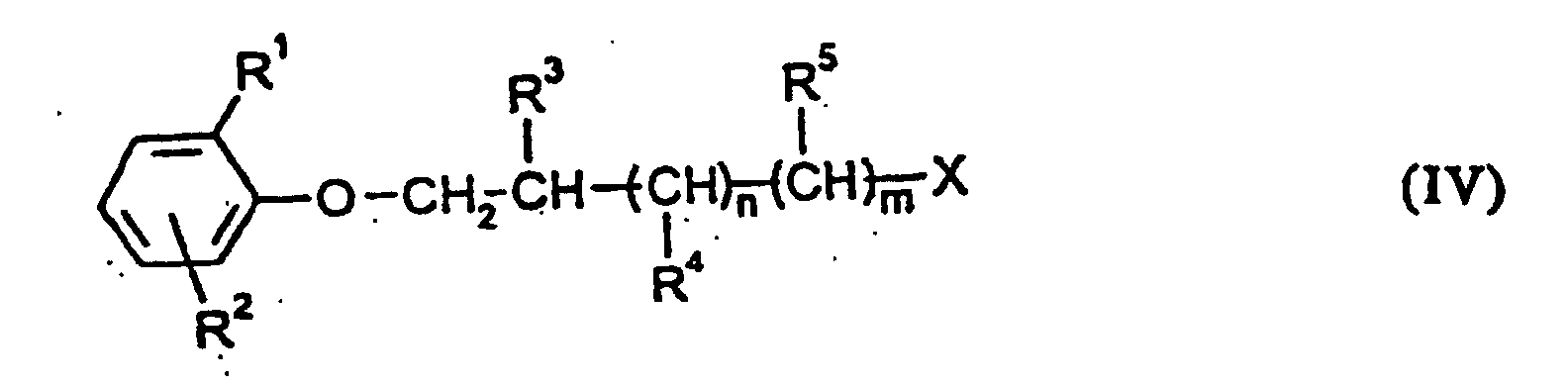

- After reacting 30 mmol of suitably substituted compounds of formula (IV) (wherein X means halogen or 4-toluenesulfonyloxy group). with 60 ml of 33% ethanolic methylamine or substituted amine at 100 °C in a closed tube for 5 hours, the reaction mixture is evaporated. The obtained oil is taken up in 40 ml of 2 N aqueous hydrochloric acid and washed with 10 ml of ethyl acetate. The pH value of the aqueous phase is adjusted to 10 by adding 5 N sodium hydroxide solution, then the mixture is extracted three times with 50 ml of dichloromethane each. The organic phase is washed twice with 40 ml of water each, dried, filtered, then the solution is evaporated. The obtained oil is transformed to a salt or purified by distillation under reduced pressure or used further in crude form.
- The following compounds of formula (II), wherein R1, R2, R3 and R6 are as defined in Table 11, and n and m are 0, were prepared by following the above general method.

- To a solution containing 0.80 g (3.5 mmol) of 4-methanesulfonamido-phenylacetic acid (Example 32) in 20 ml of N,N-dimethylformamide (DMF) 0.46 ml (0.42 g, 4,2 mmol) of 4-methylmorpholine is added, the mixture is cooled to -10 °C and 0.65 ml (0.70 g, 5 mmol) of isobutyl chloroformate is added. After 10 minutes a solution containing 0.68 g (3.5 mmol) of N-methyl-2-(2,3-dimethylphenoxy)-1-methylethylamine (Example 44) in 3 ml of DMF pre-cooled to -10 °C is added, then the pH value of the mixture is adjusted to 8.5 by adding triethylamine. The reaction mixture is stirred at -10 °C for 1 hour, then at 0 °C for 1 hour. Then, the solvent is evaporated under reduced pressure and the solid residue is alkalinized by adding aqueous ammonia solution and distributed between water and ethyl acetate. The aqueous phase is washed twice with ethyl acetate, the combined organic phase is washed once with water, dried over sodium sulphate and evaporated. Thus, 1.13 g of the title substance are obtained as an amorphous substance, which is suitable to the next step without further purification. Yield: 80 %.
1HMR (CDCl3): 1.18-1.38 (m, 3H, C-CH3); 2.10-2.20 (m, 3H) and 2.25-2.35 (m, 3H) (Ar-CH3); 2.85-3.05 (m, 6H, N-CH3 and S-CH3); 3.72-4.05 (m, 4H, O-CH2 -CH and CO-CH2 -Ar); 4.45 (m) and 5.15 (m) (total 1H, CH2-CH-N); 6.70 (dd, 1H), 6.83 (t, 1H) and 7.05 (dd, 1H) (2,3-dimethylphenoxy group); 7.10-7.22 (m, 4H, 4-methansulfonamido-phenyl group); 7.50 (s, 1H, Ar-NH-S). - To a solution containing 0.52 g (2.7 mmol) of N-methyl-2-(2,5-dimethylphenoxy)-1-methylethylamine (Example 45) in 15 ml of tetrahydrofuran 0.63 g (2.7 mmol) of 4-methanesulfonamido-phenylacetic acid (Example 32) and 0.63 g (3.05 mmol) of dicyclohexylcarbodiimide are added and the reaction mixture is stirred at room temperature for 16 hours. After filtration of the mixture, the filtrate is evaporated under reduced pressure and the pale yellowish resin of about 4.5 g obtained is purified by column chromatography by using a mixture of ethyl acetate and hexane as eluent. Thus, 0.76 g (70 %) of the title compound is obtained as an amorphous material.
1HMR (CDCl3): 1.18-1.36 (m, 3H, C-CH3); 2.10-2.18 (m, 3H) and 2.25-2.35 (m, 3H) (Ar-CH3); 2.84-3.04 (m, 6H, N-CH3 and S-CH3); 3.66 (s) and 3.80 (s) (total 2H, CO-CH2 -Ar); 3.85-4.05 (m, 2H, O-CH2 -CH); 4.44 (m) and 5.10 (m) (total 1H, CH2-CH-N); 6.56-6.62 (m, 1H), 6.62-6.74 (m, 1H) and 6.96-7.04 (m, 1H) (2,5-dimethylphenoxy group); 7.05-7.20 (m, 4H, p-methansulfonamido-phenyl group); 7.50--7.80 (m, 1H, Ar-NH-S). - The title compound is prepared as described in Example 50, except that N-methyl-2-(2-chlorophenoxy)-1-methylethylamine (FR. M. 5,912) is used as starting material to give a yield of 68% in the form of an amorphous material.
1HMR (CDCl3): 1.25-1.40 (m, 3H, C-CH3); 2.90-3.00 (m) and 3.12 (s) (total 6H, N-CH3 and S-CH3); 3.70 (s) and 3.85-4.20 (m, total 4H, O-CH2 -CH and CO-CH2 -Ar); 4.52 (m) and 5.08 (m) (total 1H, CH2-CH-N); 6.85-7.40 (m, 8H, Ar); 7.45-7.60 (m, 1H, Ar-NH-S).
with the proviso that R2 is different from hydrogen, when R1 is hydrogen,
as well as stereoisomers or mixtures of stereoisomers thereof, acid addition salts thereof and hydrates, prodrugs and metabolites of all these compounds.
| Acute toxicity data of the tested compound of Example 15 and mexiletine as reference substance | ||||
| Compound | Route of administration | Concentration (mg/kg) | Mortality | LD50 (mg/kg) (cause of death) |
| Example 15 | i.p. | 150 | 1/10 | |
| 175 | 7/10 | 170.4 (154.3-188.2) | ||
| 200 | 9/10 | (respiratory paralysis) | ||
| p.o. | 500 | 0/5 | ||
| 600 | 2/5 | 550-650 | ||
| 700 | 5/5 | (respiratory paralysis) | ||
| Mexiletine | i.p. | 130 | ||
| (respiratory paralysis) | ||||
| p.o. | 300 | |||
| (respiratory paralysis) |
Claims (5)
- Compounds of formula (I)wherein
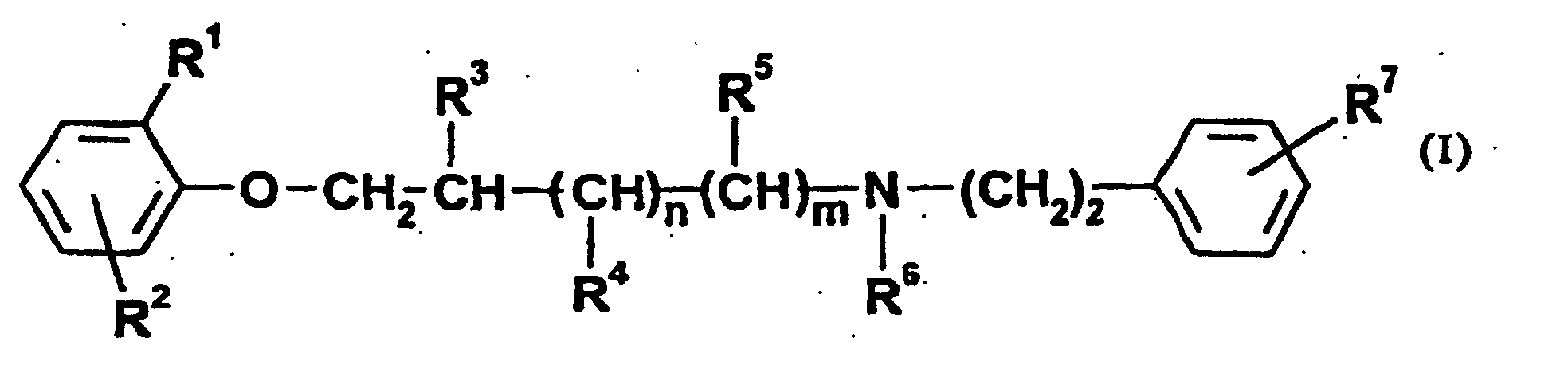
- R1 and R2,
- independently from each other, mean hydrogen, halogen or C1-4 alkyl group;
- R3, R4 and R5,
- independently from each other, stand for hydrogen or C1-4 alkyl group;
- R6
- represents hydrogen, C1-4 alkyl or benzyl group;
- R7
- means nitro group or amino group optionally monosubstituted by C1-4 alkyl, benzoyl, C1-4 alkylcarbonyl, C1-4 alkylsulfonyl, C1-4 alkylcarbamoyl or C1-4 alkylhiocarbamoyl group;
with the proviso that R2 is different from hydrogen, when R1 is hydrogen,
as well as stereoisomers or mixtures of stereoisomers thereof, acid addition salts thereof and hydrates, prodrugs and metabolites of all these compounds. - A compound as claimed in claim 1, selected from the group consisting of
N-[4-[2-[N-methyl-N-[2-(2,6-dimethylphenoxy)-1-methylethyl]-amino]ethyl]phenyl]methanesulfonamide,
(S)-N-[4-[2-[N-methyl-N-[2-(2,6-dimethylphenoxy)-1-methylethyl]amino]ethyl]phenyl]methanesulfonamide,
(R)-N-[4-[2-[N-methyl-N-[2-(2,6-dimethylphenoxy)-1-methylethyl]amino]ethyl]phenyl]methanesulfonamide,
N-[4-[2-[N-methyl-N-[2-(2-methylphenoxy)ethyl]amino]ethyl]-phenyl]methanesulfonamide,
N-[4-[2-[N-methyl-N-[2-(2,6-dimethylphenoxy)-1-methylethyl]-amino]ethyl]phenyl]acetamide,
N-[4-[2-[N-[2-(2,6-dimethylphenoxy)-1-methylethyl]-amino]ethyl]phenyl]methanesulfonamide,
1-Methyl-3-[4-[2-[N-methyl-N-[2-(2,6-dimethylphenoxy)-1--methylethyl]amino]ethyl]phenyl]thiourea,
2-[4-Aminophenyl]-N-methyl-N-[2-(2,6-dimethylphenoxy)-1--methylethyl]ethylamine
and the acid-addition salts of these compounds. - A pharmaceutical composition, which comprises as active ingredient a compound of formula (I), wherein R1, R2, R3, R4, R5, R6, R7, n and m are as defined in claim 1, or a therapeutically acceptable salt or hydrate thereof in admixture with solvents, diluting agents, carriers and additives commonly used in the preparation of medicaments.
- Compounds as claimed in claim 1 for the use as medicaments.
- Use of the compounds as claimed in claim 1 for the preparation of a medicament suitable for curing cardiac arrhythmia.
Applications Claiming Priority (3)
| Application Number | Priority Date | Filing Date | Title |
|---|---|---|---|
| HU9702411 | 1997-12-11 | ||
| HU9702411A HUP9702411A2 (en) | 1997-12-11 | 1997-12-11 | Phenoxy alkyl -amine derivatives and antiarrythmic pharmaceutical compositions containing the same |
| PCT/HU1998/000101 WO1999029655A1 (en) | 1997-12-11 | 1998-12-10 | Novel antiarrhythmic compounds |
Publications (2)
| Publication Number | Publication Date |
|---|---|
| EP1037871A1 EP1037871A1 (en) | 2000-09-27 |
| EP1037871B1 true EP1037871B1 (en) | 2002-07-03 |
Family
ID=89995855
Family Applications (1)
| Application Number | Title | Priority Date | Filing Date |
|---|---|---|---|
| EP98961331A Expired - Lifetime EP1037871B1 (en) | 1997-12-11 | 1998-12-10 | Novel antiarrhythmic compounds |
Country Status (22)
| Country | Link |
|---|---|
| US (1) | US6265445B1 (en) |
| EP (1) | EP1037871B1 (en) |
| JP (1) | JP2001525388A (en) |
| KR (1) | KR100576905B1 (en) |
| CN (1) | CN1140498C (en) |
| AT (1) | ATE220058T1 (en) |
| AU (1) | AU738672B2 (en) |
| BR (1) | BR9814270A (en) |
| CA (1) | CA2313191A1 (en) |
| DE (1) | DE69806411T2 (en) |
| DK (1) | DK1037871T3 (en) |
| ES (1) | ES2179547T3 (en) |
| HU (1) | HUP9702411A2 (en) |
| IL (1) | IL136659A (en) |
| NO (1) | NO20002946L (en) |
| NZ (1) | NZ504982A (en) |
| PL (1) | PL190788B1 (en) |
| PT (1) | PT1037871E (en) |
| RU (1) | RU2193024C2 (en) |
| SK (1) | SK284284B6 (en) |
| UA (1) | UA61979C2 (en) |
| WO (1) | WO1999029655A1 (en) |
Families Citing this family (4)
| Publication number | Priority date | Publication date | Assignee | Title |
|---|---|---|---|---|
| DE19956786A1 (en) * | 1999-11-25 | 2001-05-31 | Basf Ag | New optically active aminoalcohol and diamine derivatives useful as intermediates, e.g. for pharmaceuticals and plant protectants |
| US20030119406A1 (en) | 2001-12-20 | 2003-06-26 | Abuto Francis Paul | Targeted on-line stabilized absorbent structures |
| AU2002357560A1 (en) * | 2002-04-26 | 2003-11-10 | Shanghai Institute Of Materia Medica, Chinese Academy Of Sciences | Sulfamidophenylalkylamines and their production and use |
| CN102603543B (en) * | 2012-04-09 | 2014-07-02 | 佛山普正医药科技有限公司 | Preparation method of mexiletine hydrochloride |
Family Cites Families (4)
| Publication number | Priority date | Publication date | Assignee | Title |
|---|---|---|---|---|
| DD146749A3 (en) * | 1977-12-01 | 1981-03-04 | Dieter Lehmann | PROCESS FOR THE PREPARATION OF PHENOXYALKANOLAMINE DERIVATIVES |
| EG18188A (en) * | 1986-05-01 | 1992-09-30 | Pfizer Ltd | Process for preparation anti-arhythmia agents |
| NO179246C (en) * | 1991-11-20 | 1996-09-04 | Sankyo Co | Aromatic amino-alcohol derivatives and intermediates for their preparation |
| JPH06107614A (en) * | 1992-09-26 | 1994-04-19 | Arakusu:Kk | Arylsulfonamids or arylcarboxamides, acid addition salt thereof permissible as agent, production thereof and antipeptic ulcer agent comprising the same as active ingredient |
-
1997
- 1997-12-11 HU HU9702411A patent/HUP9702411A2/en unknown
-
1998
- 1998-10-12 UA UA2000063362A patent/UA61979C2/en unknown
- 1998-12-10 EP EP98961331A patent/EP1037871B1/en not_active Expired - Lifetime
- 1998-12-10 DE DE69806411T patent/DE69806411T2/en not_active Expired - Lifetime
- 1998-12-10 BR BR9814270-4A patent/BR9814270A/en not_active Application Discontinuation
- 1998-12-10 SK SK879-2000A patent/SK284284B6/en not_active IP Right Cessation
- 1998-12-10 PL PL341107A patent/PL190788B1/en not_active IP Right Cessation
- 1998-12-10 DK DK98961331T patent/DK1037871T3/en active
- 1998-12-10 KR KR1020007006348A patent/KR100576905B1/en not_active Expired - Fee Related
- 1998-12-10 ES ES98961331T patent/ES2179547T3/en not_active Expired - Lifetime
- 1998-12-10 US US09/555,602 patent/US6265445B1/en not_active Expired - Fee Related
- 1998-12-10 WO PCT/HU1998/000101 patent/WO1999029655A1/en not_active Ceased
- 1998-12-10 NZ NZ504982A patent/NZ504982A/en unknown
- 1998-12-10 CA CA002313191A patent/CA2313191A1/en not_active Abandoned
- 1998-12-10 CN CNB988135779A patent/CN1140498C/en not_active Expired - Fee Related
- 1998-12-10 JP JP2000524252A patent/JP2001525388A/en active Pending
- 1998-12-10 AU AU16789/99A patent/AU738672B2/en not_active Ceased
- 1998-12-10 IL IL13665998A patent/IL136659A/en not_active IP Right Cessation
- 1998-12-10 RU RU2000118325/04A patent/RU2193024C2/en not_active IP Right Cessation
- 1998-12-10 AT AT98961331T patent/ATE220058T1/en not_active IP Right Cessation
- 1998-12-10 PT PT98961331T patent/PT1037871E/en unknown
-
2000
- 2000-06-08 NO NO20002946A patent/NO20002946L/en not_active Application Discontinuation
Also Published As
| Publication number | Publication date |
|---|---|
| NO20002946D0 (en) | 2000-06-08 |
| DE69806411D1 (en) | 2002-08-08 |
| NO20002946L (en) | 2000-08-07 |
| AU1678999A (en) | 1999-06-28 |
| DE69806411T2 (en) | 2003-03-20 |
| IL136659A (en) | 2004-08-31 |
| SK284284B6 (en) | 2005-01-03 |
| RU2193024C2 (en) | 2002-11-20 |
| DK1037871T3 (en) | 2002-10-14 |
| ATE220058T1 (en) | 2002-07-15 |
| BR9814270A (en) | 2001-10-16 |
| CA2313191A1 (en) | 1999-06-17 |
| IL136659A0 (en) | 2001-06-14 |
| WO1999029655A1 (en) | 1999-06-17 |
| ES2179547T3 (en) | 2003-01-16 |
| UA61979C2 (en) | 2003-12-15 |
| NZ504982A (en) | 2002-07-26 |
| CN1284941A (en) | 2001-02-21 |
| PL341107A1 (en) | 2001-03-26 |
| KR20010032996A (en) | 2001-04-25 |
| HK1033937A1 (en) | 2001-10-05 |
| AU738672B2 (en) | 2001-09-20 |
| PL190788B1 (en) | 2006-01-31 |
| US6265445B1 (en) | 2001-07-24 |
| SK8792000A3 (en) | 2001-02-12 |
| HUP9702411A2 (en) | 2000-03-28 |
| KR100576905B1 (en) | 2006-05-03 |
| HU9702411D0 (en) | 1998-03-02 |
| EP1037871A1 (en) | 2000-09-27 |
| PT1037871E (en) | 2002-11-29 |
| JP2001525388A (en) | 2001-12-11 |
| CN1140498C (en) | 2004-03-03 |
Similar Documents
| Publication | Publication Date | Title |
|---|---|---|
| EP0178874B1 (en) | Alkylsulfonamidophenylalkylamines | |
| EP0245997B1 (en) | N-substituted p-aminoethylsulphon anilides as antiarrhythmic agents, and intermediates therefor | |
| US5449690A (en) | Naphthylethylureas and naphthylethylthioureas | |
| HU197293B (en) | Process for producing new phenoxy-acetamide derivatives and pharmaceutical compositions containing them as active components | |
| US5051423A (en) | Derivatized alkanolamines as cardiovascular agents | |
| WO1988002362A1 (en) | Aryl-n-aminoalkyl-4-(sulfonamido)benzamides, antiarrhytmic agents and compositions thereof | |
| US6265445B1 (en) | Antiarrhythmic compounds | |
| JPS62267250A (en) | Antiarrhythmic | |
| EP0221958B1 (en) | 3-aminopropyloxyphenyl derivatives their preparation and pharmaceutical compositions containing them | |
| MXPA00005768A (en) | Novel antiarrhythmic compounds | |
| US5677328A (en) | Ethylamino carbazole melatonergic agents | |
| JP3904599B2 (en) | Novel amine derivative, its production method and use as antiarrhythmic agent | |
| NZ200668A (en) | N-(aryloxyalkyl)-n'-(aminoalkyl)-thioureas and ureas;pharmaceutical compositions containing them | |
| CZ20002112A3 (en) | Anti-arrhythmic compounds | |
| US3917679A (en) | Quaternary ammonium salts of N-dialkylaminoalkyl-N-(2-indanyl)anilines | |
| JPH08333315A (en) | Ethylamidofluorene and improved process for its production | |
| JPWO1996004231A1 (en) | Novel amine derivatives, their production method and use as antiarrhythmic agents | |
| HK1033937B (en) | Novel antiarrhythmic compounds | |
| CA1296727C (en) | 3-aminopropyloxyphenyl derivatives their preparation and pharmaceutical compositions containing them | |
| KR960005793B1 (en) | Arrhythmia Medicine | |
| US3988454A (en) | Phenylalkylaralkylamines for pharmaceutical use | |
| EP0781273A1 (en) | 4-(4-methanesulfonamidophenyl)butylamine derivatives with antiarrhythmic activity |
Legal Events
| Date | Code | Title | Description |
|---|---|---|---|
| PUAI | Public reference made under article 153(3) epc to a published international application that has entered the european phase |
Free format text: ORIGINAL CODE: 0009012 |
|
| 17P | Request for examination filed |
Effective date: 20000606 |
|
| AK | Designated contracting states |
Kind code of ref document: A1 Designated state(s): AT BE CH CY DE DK ES FI FR GB GR IE IT LI LU MC NL PT SE |
|
| GRAG | Despatch of communication of intention to grant |
Free format text: ORIGINAL CODE: EPIDOS AGRA |
|
| 17Q | First examination report despatched |
Effective date: 20010829 |
|
| GRAG | Despatch of communication of intention to grant |
Free format text: ORIGINAL CODE: EPIDOS AGRA |
|
| GRAH | Despatch of communication of intention to grant a patent |
Free format text: ORIGINAL CODE: EPIDOS IGRA |
|
| GRAH | Despatch of communication of intention to grant a patent |
Free format text: ORIGINAL CODE: EPIDOS IGRA |
|
| GRAA | (expected) grant |
Free format text: ORIGINAL CODE: 0009210 |
|
| AK | Designated contracting states |
Kind code of ref document: B1 Designated state(s): AT BE CH CY DE DK ES FI FR GB GR IE IT LI LU MC NL PT SE |
|
| REF | Corresponds to: |
Ref document number: 220058 Country of ref document: AT Date of ref document: 20020715 Kind code of ref document: T |
|
| REG | Reference to a national code |
Ref country code: CH Ref legal event code: EP |
|
| REG | Reference to a national code |
Ref country code: IE Ref legal event code: FG4D |
|
| REF | Corresponds to: |
Ref document number: 69806411 Country of ref document: DE Date of ref document: 20020808 |
|
| REG | Reference to a national code |
Ref country code: DK Ref legal event code: T3 |
|
| REG | Reference to a national code |
Ref country code: CH Ref legal event code: NV Representative=s name: PATENTANWAELTE SCHAAD, BALASS, MENZL & PARTNER AG |
|
| REG | Reference to a national code |
Ref country code: GR Ref legal event code: EP Ref document number: 20020403195 Country of ref document: GR |
|
| REG | Reference to a national code |
Ref country code: PT Ref legal event code: SC4A Free format text: AVAILABILITY OF NATIONAL TRANSLATION Effective date: 20021001 |
|
| ET | Fr: translation filed | ||
| PG25 | Lapsed in a contracting state [announced via postgrant information from national office to epo] |
Ref country code: CY Free format text: LAPSE BECAUSE OF FAILURE TO SUBMIT A TRANSLATION OF THE DESCRIPTION OR TO PAY THE FEE WITHIN THE PRESCRIBED TIME-LIMIT Effective date: 20021231 |
|
| REG | Reference to a national code |
Ref country code: ES Ref legal event code: FG2A Ref document number: 2179547 Country of ref document: ES Kind code of ref document: T3 |
|
| PLBE | No opposition filed within time limit |
Free format text: ORIGINAL CODE: 0009261 |
|
| STAA | Information on the status of an ep patent application or granted ep patent |
Free format text: STATUS: NO OPPOSITION FILED WITHIN TIME LIMIT |
|
| 26N | No opposition filed |
Effective date: 20030404 |
|
| REG | Reference to a national code |
Ref country code: CH Ref legal event code: PFA Owner name: SZENT-GYOERGYI ALBERT ORVOSTUDOM?NYI EGYETEM Free format text: GYOGYSZERKUTATO INTEZET KFT.#BERLINI U. 47-49#H-1045 BUDAPEST (HU) $ SZENT-GYOERGYI ALBERT ORVOSTUDOM?NYI EGYETEM#FARMAKOL GIAI ES FARMAKOTER?PIAI INTEZETE, D M TER 12#6701 SZEGED (HU) -TRANSFER TO- SZENT-GYOERGYI ALBERT ORVOSTUDOM?NYI EGYETEM#FARMAKOL GIAI ES FARMAKOTER?PIAI INTEZETE, D M TER 12#6701 SZEGED (HU) $ IVAX DRUG RESEARCH INSTITUTE LIMITED#BERLINI UTCA 47-49#1045 BUDAPEST (HU) |
|
| NLT1 | Nl: modifications of names registered in virtue of documents presented to the patent office pursuant to art. 16 a, paragraph 1 |
Owner name: SZENT-GYOERGYI ALBERT ORVOSTUDOMANYI EGYETEM Owner name: IVAX DRUG RESEARCH INSTITUTE LTD. |
|
| REG | Reference to a national code |
Ref country code: PT Ref legal event code: PD4A Free format text: IVAX DRUG RESEARCH INSTITUTE LTD. HU Effective date: 20031014 |
|
| REG | Reference to a national code |
Ref country code: ES Ref legal event code: PC2A |
|
| REG | Reference to a national code |
Ref country code: FR Ref legal event code: CD |
|
| PGFP | Annual fee paid to national office [announced via postgrant information from national office to epo] |
Ref country code: LU Payment date: 20050926 Year of fee payment: 8 |
|
| PGFP | Annual fee paid to national office [announced via postgrant information from national office to epo] |
Ref country code: MC Payment date: 20051213 Year of fee payment: 8 |
|
| PG25 | Lapsed in a contracting state [announced via postgrant information from national office to epo] |
Ref country code: MC Free format text: LAPSE BECAUSE OF NON-PAYMENT OF DUE FEES Effective date: 20061231 |
|
| PG25 | Lapsed in a contracting state [announced via postgrant information from national office to epo] |
Ref country code: LU Free format text: LAPSE BECAUSE OF NON-PAYMENT OF DUE FEES Effective date: 20061210 |
|
| PGFP | Annual fee paid to national office [announced via postgrant information from national office to epo] |
Ref country code: SE Payment date: 20091214 Year of fee payment: 12 Ref country code: IE Payment date: 20091221 Year of fee payment: 12 Ref country code: FI Payment date: 20091215 Year of fee payment: 12 Ref country code: ES Payment date: 20091222 Year of fee payment: 12 Ref country code: DK Payment date: 20091214 Year of fee payment: 12 Ref country code: CH Payment date: 20091224 Year of fee payment: 12 Ref country code: AT Payment date: 20091217 Year of fee payment: 12 |
|
| PGFP | Annual fee paid to national office [announced via postgrant information from national office to epo] |
Ref country code: NL Payment date: 20091222 Year of fee payment: 12 |
|
| PGFP | Annual fee paid to national office [announced via postgrant information from national office to epo] |
Ref country code: PT Payment date: 20091203 Year of fee payment: 12 |
|
| PGFP | Annual fee paid to national office [announced via postgrant information from national office to epo] |
Ref country code: IT Payment date: 20091223 Year of fee payment: 12 Ref country code: GB Payment date: 20091218 Year of fee payment: 12 Ref country code: FR Payment date: 20100108 Year of fee payment: 12 |
|
| PGFP | Annual fee paid to national office [announced via postgrant information from national office to epo] |
Ref country code: GR Payment date: 20091218 Year of fee payment: 12 Ref country code: DE Payment date: 20091222 Year of fee payment: 12 Ref country code: BE Payment date: 20100212 Year of fee payment: 12 |
|
| REG | Reference to a national code |
Ref country code: PT Ref legal event code: MM4A Free format text: LAPSE DUE TO NON-PAYMENT OF FEES Effective date: 20110614 |
|
| BERE | Be: lapsed |
Owner name: *SZENT-GYORGYI ALBERT ORVOSTUDOMSSNYI EGYETEM Effective date: 20101231 Owner name: *IVAX GYOGYSZERKUTATO INTERZET KORLATOLT FELELOSSE Effective date: 20101231 |
|
| REG | Reference to a national code |
Ref country code: NL Ref legal event code: V1 Effective date: 20110701 |
|
| PG25 | Lapsed in a contracting state [announced via postgrant information from national office to epo] |
Ref country code: PT Free format text: LAPSE BECAUSE OF NON-PAYMENT OF DUE FEES Effective date: 20110614 |
|
| REG | Reference to a national code |
Ref country code: CH Ref legal event code: PL |
|
| REG | Reference to a national code |
Ref country code: DK Ref legal event code: EBP |
|
| GBPC | Gb: european patent ceased through non-payment of renewal fee |
Effective date: 20101210 |
|
| PG25 | Lapsed in a contracting state [announced via postgrant information from national office to epo] |
Ref country code: AT Free format text: LAPSE BECAUSE OF NON-PAYMENT OF DUE FEES Effective date: 20101210 Ref country code: FI Free format text: LAPSE BECAUSE OF NON-PAYMENT OF DUE FEES Effective date: 20101210 |
|
| REG | Reference to a national code |
Ref country code: FR Ref legal event code: ST Effective date: 20110831 |
|
| REG | Reference to a national code |
Ref country code: SE Ref legal event code: EUG |
|
| REG | Reference to a national code |
Ref country code: IE Ref legal event code: MM4A |
|
| PG25 | Lapsed in a contracting state [announced via postgrant information from national office to epo] |
Ref country code: BE Free format text: LAPSE BECAUSE OF NON-PAYMENT OF DUE FEES Effective date: 20101231 Ref country code: SE Free format text: LAPSE BECAUSE OF NON-PAYMENT OF DUE FEES Effective date: 20101211 |
|
| PG25 | Lapsed in a contracting state [announced via postgrant information from national office to epo] |
Ref country code: CH Free format text: LAPSE BECAUSE OF NON-PAYMENT OF DUE FEES Effective date: 20101231 Ref country code: LI Free format text: LAPSE BECAUSE OF NON-PAYMENT OF DUE FEES Effective date: 20101231 Ref country code: IE Free format text: LAPSE BECAUSE OF NON-PAYMENT OF DUE FEES Effective date: 20101210 Ref country code: FR Free format text: LAPSE BECAUSE OF NON-PAYMENT OF DUE FEES Effective date: 20110103 |
|
| PG25 | Lapsed in a contracting state [announced via postgrant information from national office to epo] |
Ref country code: GB Free format text: LAPSE BECAUSE OF NON-PAYMENT OF DUE FEES Effective date: 20101210 Ref country code: GR Free format text: LAPSE BECAUSE OF NON-PAYMENT OF DUE FEES Effective date: 20110704 Ref country code: DE Free format text: LAPSE BECAUSE OF NON-PAYMENT OF DUE FEES Effective date: 20110701 |
|
| REG | Reference to a national code |
Ref country code: DE Ref legal event code: R119 Ref document number: 69806411 Country of ref document: DE Effective date: 20110701 |
|
| PG25 | Lapsed in a contracting state [announced via postgrant information from national office to epo] |
Ref country code: IT Free format text: LAPSE BECAUSE OF NON-PAYMENT OF DUE FEES Effective date: 20101210 Ref country code: NL Free format text: LAPSE BECAUSE OF NON-PAYMENT OF DUE FEES Effective date: 20110701 |
|
| REG | Reference to a national code |
Ref country code: ES Ref legal event code: FD2A Effective date: 20120206 |
|
| PG25 | Lapsed in a contracting state [announced via postgrant information from national office to epo] |
Ref country code: ES Free format text: LAPSE BECAUSE OF NON-PAYMENT OF DUE FEES Effective date: 20101211 |