EP1037470A1 - Dispositif de régulation en débit ou en qualité d'un compresseur de données numériques, notamment d'images - Google Patents
Dispositif de régulation en débit ou en qualité d'un compresseur de données numériques, notamment d'images Download PDFInfo
- Publication number
- EP1037470A1 EP1037470A1 EP00400688A EP00400688A EP1037470A1 EP 1037470 A1 EP1037470 A1 EP 1037470A1 EP 00400688 A EP00400688 A EP 00400688A EP 00400688 A EP00400688 A EP 00400688A EP 1037470 A1 EP1037470 A1 EP 1037470A1
- Authority
- EP
- European Patent Office
- Prior art keywords
- data
- setpoint
- quantization
- quantization parameter
- decorrelated
- Prior art date
- Legal status (The legal status is an assumption and is not a legal conclusion. Google has not performed a legal analysis and makes no representation as to the accuracy of the status listed.)
- Ceased
Links
- 238000007906 compression Methods 0.000 title claims description 25
- 230000006835 compression Effects 0.000 title claims description 24
- 238000013139 quantization Methods 0.000 claims abstract description 40
- 230000005540 biological transmission Effects 0.000 claims abstract description 23
- 238000012545 processing Methods 0.000 claims abstract description 6
- 238000000034 method Methods 0.000 claims description 24
- 238000011002 quantification Methods 0.000 claims description 18
- 238000004364 calculation method Methods 0.000 claims description 7
- 230000001105 regulatory effect Effects 0.000 claims description 6
- 230000003247 decreasing effect Effects 0.000 claims description 3
- 238000003672 processing method Methods 0.000 claims description 2
- 238000013500 data storage Methods 0.000 claims 1
- 230000008569 process Effects 0.000 description 6
- 230000006870 function Effects 0.000 description 5
- 238000013144 data compression Methods 0.000 description 3
- PXFBZOLANLWPMH-UHFFFAOYSA-N 16-Epiaffinine Natural products C1C(C2=CC=CC=C2N2)=C2C(=O)CC2C(=CC)CN(C)C1C2CO PXFBZOLANLWPMH-UHFFFAOYSA-N 0.000 description 2
- 230000008901 benefit Effects 0.000 description 2
- 238000012937 correction Methods 0.000 description 2
- 238000013016 damping Methods 0.000 description 2
- 235000021183 entrée Nutrition 0.000 description 2
- 230000006399 behavior Effects 0.000 description 1
- 238000010276 construction Methods 0.000 description 1
- 238000012417 linear regression Methods 0.000 description 1
- 238000005259 measurement Methods 0.000 description 1
- 230000003287 optical effect Effects 0.000 description 1
- 230000009467 reduction Effects 0.000 description 1
- 230000002123 temporal effect Effects 0.000 description 1
- 230000009466 transformation Effects 0.000 description 1
- 238000011282 treatment Methods 0.000 description 1
Images


Classifications
-
- H—ELECTRICITY
- H04—ELECTRIC COMMUNICATION TECHNIQUE
- H04N—PICTORIAL COMMUNICATION, e.g. TELEVISION
- H04N19/00—Methods or arrangements for coding, decoding, compressing or decompressing digital video signals
- H04N19/10—Methods or arrangements for coding, decoding, compressing or decompressing digital video signals using adaptive coding
- H04N19/169—Methods or arrangements for coding, decoding, compressing or decompressing digital video signals using adaptive coding characterised by the coding unit, i.e. the structural portion or semantic portion of the video signal being the object or the subject of the adaptive coding
- H04N19/17—Methods or arrangements for coding, decoding, compressing or decompressing digital video signals using adaptive coding characterised by the coding unit, i.e. the structural portion or semantic portion of the video signal being the object or the subject of the adaptive coding the unit being an image region, e.g. an object
-
- H—ELECTRICITY
- H04—ELECTRIC COMMUNICATION TECHNIQUE
- H04N—PICTORIAL COMMUNICATION, e.g. TELEVISION
- H04N19/00—Methods or arrangements for coding, decoding, compressing or decompressing digital video signals
- H04N19/10—Methods or arrangements for coding, decoding, compressing or decompressing digital video signals using adaptive coding
- H04N19/102—Methods or arrangements for coding, decoding, compressing or decompressing digital video signals using adaptive coding characterised by the element, parameter or selection affected or controlled by the adaptive coding
- H04N19/124—Quantisation
- H04N19/126—Details of normalisation or weighting functions, e.g. normalisation matrices or variable uniform quantisers
-
- H—ELECTRICITY
- H04—ELECTRIC COMMUNICATION TECHNIQUE
- H04N—PICTORIAL COMMUNICATION, e.g. TELEVISION
- H04N19/00—Methods or arrangements for coding, decoding, compressing or decompressing digital video signals
- H04N19/10—Methods or arrangements for coding, decoding, compressing or decompressing digital video signals using adaptive coding
- H04N19/134—Methods or arrangements for coding, decoding, compressing or decompressing digital video signals using adaptive coding characterised by the element, parameter or criterion affecting or controlling the adaptive coding
- H04N19/146—Data rate or code amount at the encoder output
- H04N19/147—Data rate or code amount at the encoder output according to rate distortion criteria
-
- H—ELECTRICITY
- H04—ELECTRIC COMMUNICATION TECHNIQUE
- H04N—PICTORIAL COMMUNICATION, e.g. TELEVISION
- H04N19/00—Methods or arrangements for coding, decoding, compressing or decompressing digital video signals
- H04N19/10—Methods or arrangements for coding, decoding, compressing or decompressing digital video signals using adaptive coding
- H04N19/134—Methods or arrangements for coding, decoding, compressing or decompressing digital video signals using adaptive coding characterised by the element, parameter or criterion affecting or controlling the adaptive coding
- H04N19/146—Data rate or code amount at the encoder output
- H04N19/149—Data rate or code amount at the encoder output by estimating the code amount by means of a model, e.g. mathematical model or statistical model
-
- H—ELECTRICITY
- H04—ELECTRIC COMMUNICATION TECHNIQUE
- H04N—PICTORIAL COMMUNICATION, e.g. TELEVISION
- H04N19/00—Methods or arrangements for coding, decoding, compressing or decompressing digital video signals
- H04N19/10—Methods or arrangements for coding, decoding, compressing or decompressing digital video signals using adaptive coding
- H04N19/134—Methods or arrangements for coding, decoding, compressing or decompressing digital video signals using adaptive coding characterised by the element, parameter or criterion affecting or controlling the adaptive coding
- H04N19/146—Data rate or code amount at the encoder output
- H04N19/152—Data rate or code amount at the encoder output by measuring the fullness of the transmission buffer
-
- H—ELECTRICITY
- H04—ELECTRIC COMMUNICATION TECHNIQUE
- H04N—PICTORIAL COMMUNICATION, e.g. TELEVISION
- H04N19/00—Methods or arrangements for coding, decoding, compressing or decompressing digital video signals
- H04N19/10—Methods or arrangements for coding, decoding, compressing or decompressing digital video signals using adaptive coding
- H04N19/134—Methods or arrangements for coding, decoding, compressing or decompressing digital video signals using adaptive coding characterised by the element, parameter or criterion affecting or controlling the adaptive coding
- H04N19/154—Measured or subjectively estimated visual quality after decoding, e.g. measurement of distortion
-
- H—ELECTRICITY
- H04—ELECTRIC COMMUNICATION TECHNIQUE
- H04N—PICTORIAL COMMUNICATION, e.g. TELEVISION
- H04N19/00—Methods or arrangements for coding, decoding, compressing or decompressing digital video signals
- H04N19/10—Methods or arrangements for coding, decoding, compressing or decompressing digital video signals using adaptive coding
- H04N19/169—Methods or arrangements for coding, decoding, compressing or decompressing digital video signals using adaptive coding characterised by the coding unit, i.e. the structural portion or semantic portion of the video signal being the object or the subject of the adaptive coding
- H04N19/17—Methods or arrangements for coding, decoding, compressing or decompressing digital video signals using adaptive coding characterised by the coding unit, i.e. the structural portion or semantic portion of the video signal being the object or the subject of the adaptive coding the unit being an image region, e.g. an object
- H04N19/172—Methods or arrangements for coding, decoding, compressing or decompressing digital video signals using adaptive coding characterised by the coding unit, i.e. the structural portion or semantic portion of the video signal being the object or the subject of the adaptive coding the unit being an image region, e.g. an object the region being a picture, frame or field
-
- H—ELECTRICITY
- H04—ELECTRIC COMMUNICATION TECHNIQUE
- H04N—PICTORIAL COMMUNICATION, e.g. TELEVISION
- H04N19/00—Methods or arrangements for coding, decoding, compressing or decompressing digital video signals
- H04N19/10—Methods or arrangements for coding, decoding, compressing or decompressing digital video signals using adaptive coding
- H04N19/169—Methods or arrangements for coding, decoding, compressing or decompressing digital video signals using adaptive coding characterised by the coding unit, i.e. the structural portion or semantic portion of the video signal being the object or the subject of the adaptive coding
- H04N19/17—Methods or arrangements for coding, decoding, compressing or decompressing digital video signals using adaptive coding characterised by the coding unit, i.e. the structural portion or semantic portion of the video signal being the object or the subject of the adaptive coding the unit being an image region, e.g. an object
- H04N19/174—Methods or arrangements for coding, decoding, compressing or decompressing digital video signals using adaptive coding characterised by the coding unit, i.e. the structural portion or semantic portion of the video signal being the object or the subject of the adaptive coding the unit being an image region, e.g. an object the region being a slice, e.g. a line of blocks or a group of blocks
-
- H—ELECTRICITY
- H04—ELECTRIC COMMUNICATION TECHNIQUE
- H04N—PICTORIAL COMMUNICATION, e.g. TELEVISION
- H04N19/00—Methods or arrangements for coding, decoding, compressing or decompressing digital video signals
- H04N19/60—Methods or arrangements for coding, decoding, compressing or decompressing digital video signals using transform coding
-
- H—ELECTRICITY
- H04—ELECTRIC COMMUNICATION TECHNIQUE
- H04N—PICTORIAL COMMUNICATION, e.g. TELEVISION
- H04N19/00—Methods or arrangements for coding, decoding, compressing or decompressing digital video signals
- H04N19/60—Methods or arrangements for coding, decoding, compressing or decompressing digital video signals using transform coding
- H04N19/63—Methods or arrangements for coding, decoding, compressing or decompressing digital video signals using transform coding using sub-band based transform, e.g. wavelets
-
- H—ELECTRICITY
- H04—ELECTRIC COMMUNICATION TECHNIQUE
- H04N—PICTORIAL COMMUNICATION, e.g. TELEVISION
- H04N19/00—Methods or arrangements for coding, decoding, compressing or decompressing digital video signals
- H04N19/10—Methods or arrangements for coding, decoding, compressing or decompressing digital video signals using adaptive coding
-
- H—ELECTRICITY
- H04—ELECTRIC COMMUNICATION TECHNIQUE
- H04N—PICTORIAL COMMUNICATION, e.g. TELEVISION
- H04N19/00—Methods or arrangements for coding, decoding, compressing or decompressing digital video signals
- H04N19/10—Methods or arrangements for coding, decoding, compressing or decompressing digital video signals using adaptive coding
- H04N19/102—Methods or arrangements for coding, decoding, compressing or decompressing digital video signals using adaptive coding characterised by the element, parameter or selection affected or controlled by the adaptive coding
- H04N19/115—Selection of the code volume for a coding unit prior to coding
-
- H—ELECTRICITY
- H04—ELECTRIC COMMUNICATION TECHNIQUE
- H04N—PICTORIAL COMMUNICATION, e.g. TELEVISION
- H04N19/00—Methods or arrangements for coding, decoding, compressing or decompressing digital video signals
- H04N19/10—Methods or arrangements for coding, decoding, compressing or decompressing digital video signals using adaptive coding
- H04N19/134—Methods or arrangements for coding, decoding, compressing or decompressing digital video signals using adaptive coding characterised by the element, parameter or criterion affecting or controlling the adaptive coding
- H04N19/146—Data rate or code amount at the encoder output
Definitions
- the present invention relates to a data compression device located between a sensor and a transmission device.
- the invention applies particularly good at observation satellites that acquire data images and then transmit them to a ground station through a radio channel transmission, one of the characteristics of which is that it cannot transport information at constant rate.
- the volume of information acquired by the sensor is, in general, greater than the volume of information that the transmission channel can transmit. This is particularly true for observation satellites due to the increase the number and resolution of the on-board sensors. Consequently, it is necessary to use data compression methods which reduce the amount of information to be transmitted for the same volume of information acquired by the sensor.
- the compressor output flow is directly proportional to the entropy of the signal entry. In the general case, therefore, the amount of information to be transmitted varies over time since the characteristics of the input signal vary themselves with time.
- FIG. 1 illustrates in an extremely schematic way the architecture of a signal processing device in the context of the invention.
- This architecture takes the form of a processing chain along which are linked many elements.
- the element referenced 1 is a sensor. It can for example be a optical or infrared camera on board an observation satellite.
- Element 2 is a means of compression.
- Element 3 represents a flow regulation means.
- Element 4 is a mass memory that serves as a cache memory (or cache memory) to the transmission element 5.
- the transmission channel is not always available, in particular due to the temporal limitation of the visibility between the satellite and the stations at ground. It is therefore necessary to be able to memorize the data during these periods of unavailability of the transmission channel.
- the data flow may or may not pass through the mass memory 4, in depending on the availability of the transmission channel.
- a buffer memory B 1 (for buffer in English) is inserted between the compression means C 1 and the mass memory M 1 .
- a regulation means R 1 makes it possible to detect when the buffer memory B 1 is full, and then to interrupt the acquisition of data.
- the compression rate t is increased, to avoid saturation of the memory buffer B 2 .
- the object of the invention is therefore to overcome these various drawbacks of the state of technique.
- This device is characterized in that the regulating means has as input of decorrelated data coming from the decorrelation means, as well as a deposit.
- the device may also have a storage means arranged at the outlet of the compression means.
- the method can also implement a terminal step of storage of data in a storage means.
- the parameter of quantification also has measured information from this means memorization.
- the deposit can be a target flow or a target quality.
- Figure 1 shows schematically a compression device of images, conventionally used in the context of the invention.
- FIGS 2 and 3 illustrate solutions known in the state of the art.
- Figure 4 illustrates, in turn, the device according to the invention.
- the compression means C used by the device according to the invention is of the type commonly called transform coding.
- Such a compression scheme is conventionally broken down into three modules: a decorrelation module (C D ), a quantization module (C Q ) and a coding module (C C ).
- the role of the decorrelation module C D can be seen as a formatting of the data, so that they are processed with maximum efficiency by the quantization module C Q.
- the decorrelation of the data is carried out by a transformation into a discrete cosine (or DCT for Discrete Cosine Transform, in English).
- the role of the quantization module C Q is to reduce the information to be transmitted by quantifying the decorrelated signal.
- the coding module C C codes the quantized values by assigning a code of variable length which is a function of the probability of appearance of the various symbols of l 'alphabet.
- An example of a method for carrying out this coding is the so-called Huffman coding, presented in the article entitled “ A method for the construction of minimum redundancy codes" by DA Huffman, published in "Proceedings of the Institute of Electronics and Radio Engineers, in 1952.
- the decorrelated data (or coefficients) I D from the decorrelation means (C D ) are processed in the area. Indeed, in the case where the system implementing the device according to the invention is an observation satellite, the input data form a digital image with a width of a few thousand pixels, and of a length theoretically infinite since the sensor continues to acquire data. Consequently, the data stream from the sensor is divided into zones, and regulation is carried out on each of these zones.
- the division into zones of the decorrelated data I D depends on the nature of the decorrelation process.
- the zones will preferably be bands of the image.
- the decorrelation means implements a cosine transform
- the zones will then preferably be block lines.
- the invention can also be applied to the case of small images on which the all of the information can be stored.
- the image has only one area, on which the treatments are carried out following.
- the channel transmission is at constant rate. Also, it is advisable to convert this flow slightly variable in constant flow, by means of a memory M, having a integrator function.
- this memory is optional, in the since the invention is applicable to systems which do not have this constraint on the transmission channel.
- the quality of the regulation according to the invention fact that the variability of the flow rate at the outlet of the compression means C, is very low in comparison with state of the art solutions.
- the report of variability between the solution according to the invention and the solution presented in the French patent 2,707,070 can reach a factor greater than 100, depending of the nature of the image areas in which it is calculated.
- this memory M is essential in order to to have zero variability at the output of the device, it should be noted that this can be much smaller in size, due to the low variability of the flow entry. This reduction can be essential, especially in the case of a embedded system.
- the device according to the invention can be used either for carrying out a flow regulation, or for carrying out a quality regulation.
- the setpoint information I C is a setpoint flow, denoted Rc below.
- the objective of the regulation means R is then to supply the quantization means C Q with a quantization parameter PQ as a function of the reference flow rate R c and of the information I D from the decorrelation means C D.
- This quantization parameter can be recalculated for each zone of coefficients.
- the regulation means can sort by ordering the coefficients according to the decreasing amplitude of their absolute value. For example, these coefficients can be stored and sorted in an array I D [i], i varying from 1 to the cardinal of the zone, the cardinal of the zone being the number of coefficients it contains.
- Another way of doing things which has the advantage of reducing the calculation time and therefore to improve the implementation of the invention, consists in dispensing with sorting by constructing a histogram of the coefficient module and calculating the pitch of quantification linked to the desired bit rate with an algorithm explained later. This has the great advantage of not requiring a microprocessor and being implantable in ASIC.
- An example of practical implementation consists in storing the modules of the coefficients sorted in a one-dimensional table from which one comes to take the element corresponding to the index ⁇ ⁇ R c .
- ⁇ and ⁇ depend on the decorrelation process implemented by the decorrelation means C D. Preferably, these values are chosen according to the following table: ⁇ ⁇ Transformed into a cosine 2 1 5.5 Transformed into wavelets 1 1 6.5
- the regulation means R also has measured information I M coming from the memorization means M. This information makes it possible to correct the model by taking into account the filling rate of the memory M. Thus, when the memory is too full, the compression ratio can be increased by modifying the quantization parameter PQ. Conversely, when the memory becomes too empty, the compression ratio can be reduced.
- this information I M can measure the difference which exists between the filling rate of the memory M and a nominal rate (for example 50%).
- the quantization parameter PQ is a quantization step determined by the expression: in which ⁇ and ⁇ are two parameters which are preferably included in the following ranges: ⁇ [1; 2] and The parameter k is a damping factor, and Z is the cardinal of the coefficient area.
- the values of the parameters ⁇ and ⁇ depend on the decorrelation process implemented by the decorrelation means C D , and are preferably chosen according to the following table: ⁇ ⁇ Transformed into a cosine 2 1 5.5 Transformed into wavelets 1 1 6.5
- the damping factor k can also be determined so experimental. Classically, one can choose k in the interval [1; 6].
- the device according to the invention can also be used to carry out quality regulation.
- the setpoint information I C is a setpoint quality denoted Q C thereafter
- the objective for the regulation means R is to provide, for each zone of coefficients, the quantization parameter PQ making it possible to achieve this setpoint quality.
- the value of the flow rate R 0 is obtained from the reference quality Q c by applying the equality: in which ⁇ depends on the nature of the quality setpoint.
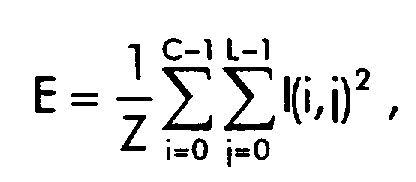
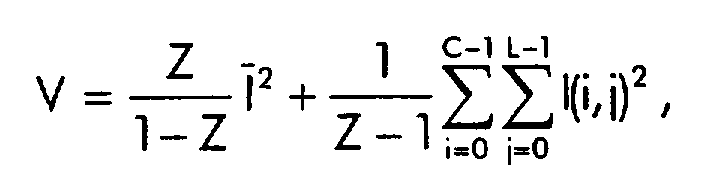
- ⁇ 10 Log 10 Z 2 AT - 1) 2 ⁇
- A is the number of bits on which the input data is coded, and Z the cardinal of the image area or of the image processed.
- ⁇ is a parameter, preferably such that 1/2 ⁇ ⁇ ⁇ 3.
- ⁇ , ⁇ and ⁇ depend on the decorrelation process implemented by the decorrelation means C D. Preferably, these values are chosen according to the following table: ⁇ ⁇ ⁇ Transformed into a cosine 2 1 5.5 1 + 1/2 Transformed into wavelets 1 1 6.5 1 + 1/12
Landscapes
- Engineering & Computer Science (AREA)
- Multimedia (AREA)
- Signal Processing (AREA)
- Physics & Mathematics (AREA)
- Algebra (AREA)
- General Physics & Mathematics (AREA)
- Mathematical Analysis (AREA)
- Mathematical Optimization (AREA)
- Pure & Applied Mathematics (AREA)
- Compression Or Coding Systems Of Tv Signals (AREA)
- Compression, Expansion, Code Conversion, And Decoders (AREA)
Abstract
Description
- On observe en pratique que la qualité de la prédiction du taux de compression fournie par l'estimation E n'est pas constante dans l'image et la variabilité de cette qualité peut être importante. Il s'ensuit donc une variabilité aussi importante de la qualité de la régulation, qui doit alors être compensée par un dispositif (dénommé correction de biais dans cette solution de l'état de l'art) permettant de corriger a posteriori l'erreur de prédiction. Si ce dispositif n'est pas utilisé, alors la mémoire tampon peut devoir être de taille importante, ce qui peut engendrer un accroissement de la complexité de mise en oeuvre matérielle et du coût, notamment pour les systèmes embarqués.
- Elle met en oeuvre un grand nombre de paramètres (Par) sous la forme d'un réseau de droites de prédiction dont le nombre est proportionnel au nombre de bits sur lesquels sont codées les données d'entrée. Ces droites sont caractérisées chacune par les deux paramètres d'une équation affine. Tous ces paramètres sont déterminés de manière empirique, c'est à dire en réalisant un grand nombre de mesures de débit et de complexité en fonction du pas de quantification et en effectuant finalement une régression linéaire sur les nuages de points obtenus. La mise en oeuvre de cette méthode est donc assez lourde et peut être imprécise du fait, notamment, de l'obligation de limiter le nombre de droites obtenues, ce qui revient à limiter le nombre de pas de quantification possibles pour la régulation.
- Enfin, d'un point de vue pratique la méthode peut être difficile à mettre en oeuvre dans le cas où le débit des données d'entrée est important. En effet, les calculs effectués dans la boucle de régulation, particulièrement le calcul du pas de quantification, ne peut pas être réalisé par un circuit ASIC. La mise en oeuvre nécessite donc l'utilisation d'un microprocesseur. Or les microprocesseurs ayant des fréquences d'horloge nettement plus limitées que celle d'un circuit de type ASIC, cela limite fortement la réalisation d'un tel type de régulation.
- Un moyen de compression des données, composé d'un moyen de décorrélation, d'un moyen de quantification et d'un moyen de codage,
- Un moyen de régulation fournissant au moyen de quantification, au moins un paramètre de quantification.
- Décorrélation des données,
- Calcul d'un paramètre de quantification à partir d'une consigne et des données décorrélées,
- Quantification de ces données décorrélées, selon ce paramètre de quantification,
- Codage des données quantifiées à l'étape précédente.

| α | β | |
| Transformée en cosinus | 2 | |
| Transformée en ondelettes | 1 | |


| α | β | |
| Transformée en cosinus | 2 | |
| Transformée en ondelettes | 1 | |


| α | β | χ | |
| Transformée en cosinus | 2 | | 1 + 1 / 2 |
| Transformée en ondelettes | 1 | | 1 + 1 / 12 |
Claims (24)
- Dispositif de traitement pour la transmission de données numériques d'images, dans un canal de transmission, comportant un moyen de compression (C) desdites données, composé d'un moyen de décorrélation (CD), d'un moyen de quantification (CQ) et d'un moyen de codage (CC), et un moyen de régulation (R) fournissant audit moyen de quantification (CQ) au moins un paramètre de quantification (PQ), caractérisé en ce que ledit moyen de régulation possède comme entrée des données décorrélées (ID) provenant dudit moyen de décorrélation (CD) et une consigne (IC).
- Dispositif selon la revendication 1, comportant en outre un moyen de mémorisation (M) disposé en sortie dudit moyen de compression (C).
- Dispositif selon la revendication 2, caractérisé en ce que ledit moyen de régulation (R) dispose en outre en entrée des informations mesurées (IM) provenant dudit moyen de mémorisation (M).
- Dispositif selon l'une des revendications précédentes, caractérisé en ce que lesdites données décorrélées (ID) sont organisées en zones, et en ce qu'au sein de chaque zone, ledit moyen de régulation (R) procède préalablement à un tri desdites données décorrélées (ID) par ordre d'amplitudes décroissantes de leur valeur absolue,
- Dispositif selon l'une des revendications précédentes, caractérisé en ce que ladite consigne (IC) est un débit de consigne (Rc).
- Dispositif selon les revendications 4 et 5 prises conjointement, caractérisé en ce que ledit au moins un paramètre de quantification (PQ) est un pas de quantification déterminé par l'expression PQ = α - |ID(β · RC)|, pour chacune desdites zones, α et β étant des paramètres positifs.
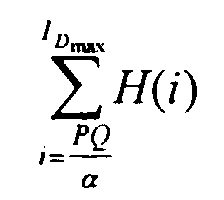
- Dispositif selon les revendications l'une des revendications 1 à 3, prise conjointement avec la revendication 5, caractérisé en ce que un histogramme (H) est construit par ledit moyen de régulation (R) à partir desdites données décorrélées (ID) et en ce que ledit au moins un paramètre de quantification (PQ) est un pas de quantification déterminé par l'expression

- Dispositif selon les revendications 3, 4 et 5 prises conjointement, caractérisé en ce que ledit au moins un paramètre de quantification (PQ) est un pas de quantification déterminé par l'expressionpour chacune desdites zones, α, β et k étant des paramètres positifs, Z le cardinal de l'ensemble desdites données décorrélées (ID) sur ladite zone et lesdites informations mesurées (IM) sont l'écart entre le niveau de remplissage dudit moyen de mémorisation (M) et un niveau nominal.

- Dispositif selon l'une des revendications 6 à 8, caractérisé en ce que ledit moyen de décorrélation met en oeuvre une transformée en cosinus discrète, et en ce que a vaut environ 2 et β vaut environ 1 / 5,5.
- Dispositif selon l'une des revendications 6 à 8, caractérisé en ce que ledit moyen de décorrélation met en oeuvre une transformée en ondelettes et en ce que α vaut environ 1 et β vaut environ 1 / 6,5.
- Dispositif selon l'une des revendications 1 à 4, caractérisé en ce que ladite consigne (IC) est une qualité de consigne (QC).
- Dispositif selon la revendication précédente, caractérisé en ce que ledit au moins un paramètre de quantification (PQ) est un pas de quantification déterminé par l'expression PQ = α · |ID (β · R0 )| pour chacune desdites zones, dans laquelle R0 est un débit à atteindre pour obtenir ladite qualité de consigne (QC), et α et β sont des paramètres positifs.
- Procédé de traitement pour la transmission de données numériques, notamment de données images, dans un canal de transmission, comportant les étapes ordonnées suivantes :Décorrélation desdites données,Calcul d'un paramètre de quantification à partir d'une consigne et des données décorrélées,Quantification desdites données décorrélées, selon ledit paramètre de quantification,Codage des données quantifiées à l'étape précédente.
- Procédé selon la revendication précédente, comportant en outre une étape de mémorisation des données en sortie de l'étape de codage dans un moyen de mémorisation (M).
- Procédé selon la revendication précédente, caractérisé en ce que le calcul dudit paramètre de quantification (PQ) dépend en outre d'informations mesurées (IM) provenant dudit moyen de mémorisation (M).
- Procédé selon l'une des revendications 13 à 15, caractérisé en ce que lesdites données décorrélées (ID) sont organisées en zones, et en ce qu'au sein de chaque zone, ladite étape de calcul comporte une étape préalable de tri desdites données décorrélées (ID) par ordre d'amplitudes décroissantes de leur valeur absolue.
- Procédé selon l'une des revendications 13 à 16, caractérisé en ce que ladite consigne (IC) est un débit de consigne (Rc).
- Procédé selon les revendications 16 et 17 prises conjointement, caractérisé en ce que ledit paramètre de quantification (PQ) est un pas de quantification déterminé par l'expression PQ = α · |lD(β · RC)|, pour chacune desdites zones, α et β étant des paramètres positifs.
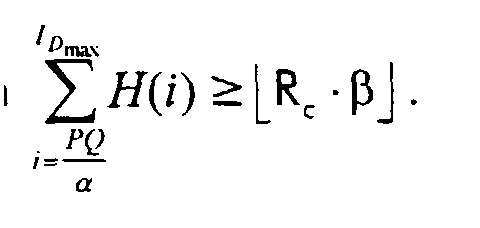
- Procédé selon l'une des revendications 13 à 15, prise conjointement avec la revendication 16, caractérisé en ce que un histogramme (H) est construit par ledit moyen de régulation (R) à partir desdites données décorrélées (ID) et en ce que ledit paramètre de quantification (PQ) est un pas de quantification déterminé par l'expression
- Procédé selon les revendications 15, 16 et 17 prises conjointement, caractérisé en ce que ledit paramètre de quantification (PQ) est un pas de quantification déterminé par l'expressionpour chacune desdites zones, α, β et k étant des paramètres positifs, Z le cardinal de l'ensemble desdites données décorrélées (ID) sur ladite zone et lesdites informations mesurées (IM) sont l'écart entre le niveau de remplissage dudit moyen de mémorisation (M) et un niveau nominal.
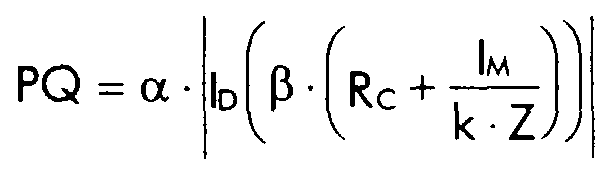
- Procédé selon l'une des revendications 18 à 20, caractérisé en ce que ladite étape de décorrélation met en oeuvre une transformée en cosinus discrète, et en ce que a vaut environ 2 et β vaut environ 1 / 5,5.
- Procédé selon l'une des revendications 18 à 20, caractérisé en ce que ladite étape de décorrélation met en oeuvre une transformée en ondelettes et en ce que a vaut environ 1 et β vaut environ 1 / 6,5.
- Procédé selon l'une des revendications 13 à 16, caractérisé en ce que ladite consigne (IC) est une qualité de consigne (QC).
- Procédé selon la revendication précédente, caractérisé en ce que ledit paramètre de quantification (PQ) est un pas de quantification déterminé par l'expressionpour chacune desdites zones, dans laquelle R0 est un débit à atteindre pour obtenir ladite qualité de consigne (QC), et α et β sont des paramètres positifs.

Applications Claiming Priority (2)
| Application Number | Priority Date | Filing Date | Title |
|---|---|---|---|
| FR9903371 | 1999-03-18 | ||
| FR9903371A FR2791211B1 (fr) | 1999-03-18 | 1999-03-18 | Dispositif de regulation en debit ou en qualite d'un compresseur de donnees numeriques, notamment d'images |
Publications (1)
| Publication Number | Publication Date |
|---|---|
| EP1037470A1 true EP1037470A1 (fr) | 2000-09-20 |
Family
ID=9543345
Family Applications (1)
| Application Number | Title | Priority Date | Filing Date |
|---|---|---|---|
| EP00400688A Ceased EP1037470A1 (fr) | 1999-03-18 | 2000-03-13 | Dispositif de régulation en débit ou en qualité d'un compresseur de données numériques, notamment d'images |
Country Status (7)
| Country | Link |
|---|---|
| US (1) | US6795218B1 (fr) |
| EP (1) | EP1037470A1 (fr) |
| JP (1) | JP4731657B2 (fr) |
| CN (1) | CN1253003C (fr) |
| CA (1) | CA2300503A1 (fr) |
| EA (1) | EA200000237A3 (fr) |
| FR (1) | FR2791211B1 (fr) |
Cited By (4)
| Publication number | Priority date | Publication date | Assignee | Title |
|---|---|---|---|---|
| FR2829657A1 (fr) * | 2001-09-13 | 2003-03-14 | Cit Alcatel | Procede et dispositif pour la compression de donnees devant etre transmises avec un debit constant |
| WO2006036298A1 (fr) * | 2004-09-15 | 2006-04-06 | Hewlett-Packard Development Company, L.P. | Systeme de compression de signaux physiologiques |
| WO2013096029A3 (fr) * | 2011-12-22 | 2013-08-15 | Pelco, Inc. | Quantification de vidéo intégrée |
| EP3171594A1 (fr) | 2015-11-20 | 2017-05-24 | Thales | Methode de compression d'images permettant d'obtenir une qualite de compression fixe |
Citations (10)
| Publication number | Priority date | Publication date | Assignee | Title |
|---|---|---|---|---|
| EP0239076A2 (fr) | 1986-03-24 | 1987-09-30 | Kokusai Denshin Denwa Co., Ltd | Dispositif de codage capable de coder une image mobile de façon exacte et adaptative |
| EP0478230A2 (fr) * | 1990-09-27 | 1992-04-01 | AT&T Corp. | Commande adaptative d'une mémoire tampon/quantificateur pour des codeurs par transformées vidéo |
| US5134476A (en) * | 1990-03-30 | 1992-07-28 | At&T Bell Laboratories | Video signal encoding with bit rate control |
| EP0514663A2 (fr) * | 1991-05-24 | 1992-11-25 | International Business Machines Corporation | Dispositif et procédé pour le codage d'images vidéo animées utilisant un quantificateur adaptatif |
| EP0540961A2 (fr) * | 1991-11-08 | 1993-05-12 | International Business Machines Corporation | Système de compression d'images vidéo animées avec allocation adaptive de bits et quantification |
| EP0631443A1 (fr) * | 1993-06-22 | 1994-12-28 | Centre National D'etudes Spatiales | Dispositif pour la transmission d'images relevées par un satellite |
| EP0684738A2 (fr) * | 1994-05-23 | 1995-11-29 | Canon Kabushiki Kaisha | Appareil de codage d'images |
| EP0741497A1 (fr) | 1991-02-21 | 1996-11-06 | Nec Corporation | Dispositif de codage pour comprimer des données d'image mobile et méthode de codage pour comprimer des données d'image |
| US5598213A (en) * | 1994-03-15 | 1997-01-28 | Samsung Electronics Co., Ltd. | Transmission bit-rate controlling apparatus for high efficiency coding of moving picture signal |
| US5745179A (en) * | 1992-09-11 | 1998-04-28 | Nec Corporation | Motion picture adaptive prediction encoder with a quantization parameter decided in accordance with block classification |
Family Cites Families (5)
| Publication number | Priority date | Publication date | Assignee | Title |
|---|---|---|---|---|
| US5246053A (en) * | 1985-09-25 | 1993-09-21 | Nergeco | Riser for a vertically-opening door |
| JPH0344269A (ja) * | 1989-07-12 | 1991-02-26 | Sony Corp | 画像データ伝送装置 |
| US5249053A (en) * | 1991-02-05 | 1993-09-28 | Dycam Inc. | Filmless digital camera with selective image compression |
| KR100323441B1 (ko) * | 1997-08-20 | 2002-06-20 | 윤종용 | 엠펙2동화상부호화/복호화시스템 |
| US6154493A (en) * | 1998-05-21 | 2000-11-28 | Intel Corporation | Compression of color images based on a 2-dimensional discrete wavelet transform yielding a perceptually lossless image |
-
1999
- 1999-03-18 FR FR9903371A patent/FR2791211B1/fr not_active Expired - Fee Related
-
2000
- 2000-03-09 CA CA002300503A patent/CA2300503A1/fr not_active Abandoned
- 2000-03-13 EP EP00400688A patent/EP1037470A1/fr not_active Ceased
- 2000-03-17 US US09/527,594 patent/US6795218B1/en not_active Expired - Lifetime
- 2000-03-17 CN CN00104073.1A patent/CN1253003C/zh not_active Expired - Fee Related
- 2000-03-17 EA EA200000237A patent/EA200000237A3/ru unknown
- 2000-03-17 JP JP2000075312A patent/JP4731657B2/ja not_active Expired - Fee Related
Patent Citations (10)
| Publication number | Priority date | Publication date | Assignee | Title |
|---|---|---|---|---|
| EP0239076A2 (fr) | 1986-03-24 | 1987-09-30 | Kokusai Denshin Denwa Co., Ltd | Dispositif de codage capable de coder une image mobile de façon exacte et adaptative |
| US5134476A (en) * | 1990-03-30 | 1992-07-28 | At&T Bell Laboratories | Video signal encoding with bit rate control |
| EP0478230A2 (fr) * | 1990-09-27 | 1992-04-01 | AT&T Corp. | Commande adaptative d'une mémoire tampon/quantificateur pour des codeurs par transformées vidéo |
| EP0741497A1 (fr) | 1991-02-21 | 1996-11-06 | Nec Corporation | Dispositif de codage pour comprimer des données d'image mobile et méthode de codage pour comprimer des données d'image |
| EP0514663A2 (fr) * | 1991-05-24 | 1992-11-25 | International Business Machines Corporation | Dispositif et procédé pour le codage d'images vidéo animées utilisant un quantificateur adaptatif |
| EP0540961A2 (fr) * | 1991-11-08 | 1993-05-12 | International Business Machines Corporation | Système de compression d'images vidéo animées avec allocation adaptive de bits et quantification |
| US5745179A (en) * | 1992-09-11 | 1998-04-28 | Nec Corporation | Motion picture adaptive prediction encoder with a quantization parameter decided in accordance with block classification |
| EP0631443A1 (fr) * | 1993-06-22 | 1994-12-28 | Centre National D'etudes Spatiales | Dispositif pour la transmission d'images relevées par un satellite |
| US5598213A (en) * | 1994-03-15 | 1997-01-28 | Samsung Electronics Co., Ltd. | Transmission bit-rate controlling apparatus for high efficiency coding of moving picture signal |
| EP0684738A2 (fr) * | 1994-05-23 | 1995-11-29 | Canon Kabushiki Kaisha | Appareil de codage d'images |
Cited By (9)
| Publication number | Priority date | Publication date | Assignee | Title |
|---|---|---|---|---|
| FR2829657A1 (fr) * | 2001-09-13 | 2003-03-14 | Cit Alcatel | Procede et dispositif pour la compression de donnees devant etre transmises avec un debit constant |
| WO2003024118A3 (fr) * | 2001-09-13 | 2004-02-19 | Cit Alcatel | Procede et dispositif pour la compression de donnees devant etre transmises avec un debit constant |
| US7336843B2 (en) | 2001-09-13 | 2008-02-26 | Alcatel | Method and device for compressing data to be transmitted at constant bit rate |
| WO2006036298A1 (fr) * | 2004-09-15 | 2006-04-06 | Hewlett-Packard Development Company, L.P. | Systeme de compression de signaux physiologiques |
| US7310648B2 (en) | 2004-09-15 | 2007-12-18 | Hewlett-Packard Development Company, L.P. | System for compression of physiological signals |
| WO2013096029A3 (fr) * | 2011-12-22 | 2013-08-15 | Pelco, Inc. | Quantification de vidéo intégrée |
| US8934020B2 (en) | 2011-12-22 | 2015-01-13 | Pelco, Inc. | Integrated video quantization |
| EP3171594A1 (fr) | 2015-11-20 | 2017-05-24 | Thales | Methode de compression d'images permettant d'obtenir une qualite de compression fixe |
| US10356443B2 (en) | 2015-11-20 | 2019-07-16 | Thales | Image compression method allowing a set compression quality to be obtained |
Also Published As
| Publication number | Publication date |
|---|---|
| JP2000308061A (ja) | 2000-11-02 |
| CN1253003C (zh) | 2006-04-19 |
| CN1268004A (zh) | 2000-09-27 |
| CA2300503A1 (fr) | 2000-09-18 |
| EA200000237A2 (ru) | 2000-10-30 |
| FR2791211A1 (fr) | 2000-09-22 |
| EA200000237A3 (ru) | 2000-12-25 |
| JP4731657B2 (ja) | 2011-07-27 |
| US6795218B1 (en) | 2004-09-21 |
| FR2791211B1 (fr) | 2001-10-19 |
Similar Documents
| Publication | Publication Date | Title |
|---|---|---|
| EP0189703B1 (fr) | Procédé adaptatif de codage et de décodage d'une suite d'images par transformation, et dispositifs pour la mise en oeuvre de ce procédé | |
| EP0270405B1 (fr) | Procédé et dispositif de réduction du bruit engendré par un codeur-décodeur d'images numériques opérant par blocs | |
| EP4630970A1 (fr) | Procédé et dispositif de codage et décodage d'images | |
| EP0506535B1 (fr) | Procédé et système de traitement des pré-échos d'un signal audio-numérique codé par transformée fréquentielle | |
| EP1037470A1 (fr) | Dispositif de régulation en débit ou en qualité d'un compresseur de données numériques, notamment d'images | |
| EP0276603B1 (fr) | Procédés de codage et de transmission d'un signal numérique, par rafraichissement temporel sélectif d'un quantificateur vectoriel | |
| EP0332553B1 (fr) | Procédé de réallocation de choix de traitement de sous-échantillonnage, sur critère de réduction de débit d'une séquence de données d'assistance à la reconstitution d'une image électronique sous-échantillonnée | |
| EP0360670B1 (fr) | Procédé de quantification à seuil variable dans un codage par transformation pour la transmission de signaux d'image | |
| EP0322058B1 (fr) | Dispositif de régulation de débit conjointe à au moins deux composantes de signaux vidéo numériques | |
| FR2940491A1 (fr) | Systeme de procede interactif pour la transmission sur un reseau bas debit d'images clefs selectrionnees dans un flux video | |
| WO2005008886A2 (fr) | Compression contextuelle d'images numeriques | |
| CA2459909C (fr) | Procede et dispositif pour la compression de donnees devant etre transmises avec un debit constant | |
| FR3116635A1 (fr) | Procédé de mise à jour d’un réseau de neurones artificiel | |
| EP0631443B1 (fr) | Dispositif pour la transmission d'images relevées par un satellite | |
| EP2887307B1 (fr) | Procédé de traitement d'images, notamment issues de systèmes de visualisation de nuit et système associé | |
| FR3137768A1 (fr) | Procédé et dispositif de détection d'anomalie et de détermination d'explication associée dans des séries temporelles de données | |
| EP1297494B1 (fr) | Procede et dispositif de traitement de sequences d'images avec masquage | |
| WO2026017840A1 (fr) | Procédés, dispositifs et programmes d'ordinateur de compression et décompression d'images de télédétection | |
| EP3843409A1 (fr) | Procede d'allocation pour liaison bas-debit | |
| EP0710421B1 (fr) | Procede et dispositif d'estimation d'un budget de bits pour encodeurs a longueur de mot variable | |
| EP0348321B1 (fr) | Procédé de régulation de débit de données d'assistance à la reconstruction d'images électroniques animées sous-échantillonnées | |
| EP0964582A1 (fr) | Dispositif pour la compression et la transmission de données, notamment d'images numériques, sur un canal à débit constant | |
| FR3090982A1 (fr) | Procédé et dispositif de mémorisation de données numériques | |
| WO2006053842A1 (fr) | Procede de codage d'images codees par ondelettes a controle de debit, dispositif de codage et programme d'ordinateur correspondants | |
| FR2655450A1 (fr) | Procede de compression d'images par auto-organisation d'un reseau neuronal. |
Legal Events
| Date | Code | Title | Description |
|---|---|---|---|
| PUAI | Public reference made under article 153(3) epc to a published international application that has entered the european phase |
Free format text: ORIGINAL CODE: 0009012 |
|
| AK | Designated contracting states |
Kind code of ref document: A1 Designated state(s): AT BE CH CY DE DK ES FI FR GB GR IE IT LI LU MC NL PT SE |
|
| AX | Request for extension of the european patent |
Free format text: AL;LT;LV;MK;RO;SI |
|
| 17P | Request for examination filed |
Effective date: 20010320 |
|
| AKX | Designation fees paid |
Free format text: AT BE CH CY DE DK ES FI FR GB GR IE IT LI LU MC NL PT SE |
|
| RAP1 | Party data changed (applicant data changed or rights of an application transferred) |
Owner name: ALCATEL LUCENT |
|
| 17Q | First examination report despatched |
Effective date: 20110928 |
|
| RAP1 | Party data changed (applicant data changed or rights of an application transferred) |
Owner name: ALCATEL LUCENT |
|
| STAA | Information on the status of an ep patent application or granted ep patent |
Free format text: STATUS: THE APPLICATION HAS BEEN REFUSED |
|
| 18R | Application refused |
Effective date: 20121010 |