EP1037182A2 - Anti-theft element in an anti-theft device - Google Patents
Anti-theft element in an anti-theft device Download PDFInfo
- Publication number
- EP1037182A2 EP1037182A2 EP00102808A EP00102808A EP1037182A2 EP 1037182 A2 EP1037182 A2 EP 1037182A2 EP 00102808 A EP00102808 A EP 00102808A EP 00102808 A EP00102808 A EP 00102808A EP 1037182 A2 EP1037182 A2 EP 1037182A2
- Authority
- EP
- European Patent Office
- Prior art keywords
- fouling
- substance
- ampule
- theft
- article
- Prior art date
- Legal status (The legal status is an assumption and is not a legal conclusion. Google has not performed a legal analysis and makes no representation as to the accuracy of the status listed.)
- Granted
Links
Images
Classifications
-
- G—PHYSICS
- G08—SIGNALLING
- G08B—SIGNALLING SYSTEMS, e.g. PERSONAL CALLING SYSTEMS; ORDER TELEGRAPHS; ALARM SYSTEMS
- G08B13/00—Burglar, theft or intruder alarms
- G08B13/22—Electrical actuation
- G08B13/24—Electrical actuation by interference with electromagnetic field distribution
- G08B13/2402—Electronic Article Surveillance [EAS], i.e. systems using tags for detecting removal of a tagged item from a secure area, e.g. tags for detecting shoplifting
- G08B13/2428—Tag details
- G08B13/2434—Tag housing and attachment details
-
- E—FIXED CONSTRUCTIONS
- E05—LOCKS; KEYS; WINDOW OR DOOR FITTINGS; SAFES
- E05B—LOCKS; ACCESSORIES THEREFOR; HANDCUFFS
- E05B73/00—Devices for locking portable objects against unauthorised removal; Miscellaneous locking devices
- E05B73/0017—Anti-theft devices, e.g. tags or monitors, fixed to articles, e.g. clothes, and to be removed at the check-out of shops
-
- G—PHYSICS
- G08—SIGNALLING
- G08B—SIGNALLING SYSTEMS, e.g. PERSONAL CALLING SYSTEMS; ORDER TELEGRAPHS; ALARM SYSTEMS
- G08B13/00—Burglar, theft or intruder alarms
- G08B13/22—Electrical actuation
- G08B13/24—Electrical actuation by interference with electromagnetic field distribution
- G08B13/2402—Electronic Article Surveillance [EAS], i.e. systems using tags for detecting removal of a tagged item from a secure area, e.g. tags for detecting shoplifting
- G08B13/2428—Tag details
- G08B13/2437—Tag layered structure, processes for making layered tags
-
- G—PHYSICS
- G08—SIGNALLING
- G08B—SIGNALLING SYSTEMS, e.g. PERSONAL CALLING SYSTEMS; ORDER TELEGRAPHS; ALARM SYSTEMS
- G08B15/00—Identifying, scaring or incapacitating burglars, thieves or intruders, e.g. by explosives
- G08B15/02—Identifying, scaring or incapacitating burglars, thieves or intruders, e.g. by explosives with smoke, gas, or coloured or odorous powder or liquid
-
- E—FIXED CONSTRUCTIONS
- E05—LOCKS; KEYS; WINDOW OR DOOR FITTINGS; SAFES
- E05B—LOCKS; ACCESSORIES THEREFOR; HANDCUFFS
- E05B39/00—Locks giving indication of authorised or unauthorised unlocking
- E05B39/002—Locks giving indication of authorised or unauthorised unlocking by releasing a liquid, e.g. ill-smelling or dye
Definitions
- the present invention relates to an anti-theft element for use in an anti-theft device which is intended to be attached to a theft-attractive article in a manner such that the device can only be released from said article with the aid of a special release device.
- the anti-theft element includes an ampule which contains a so-called fouling substance, for instance a stain, a corrosive substance, an ill-smelling substance or any other article-defacing and article-spoiling substance, and which is so arranged in the anti-theft element that any attempt to release the anti-theft device from the theft-attractive article without the aid of the release device will result in the anti-theft element being broken, crushed, destroyed or opened in some other way such that the fouling substance is released.
- the invention also relates to a fouling substance ampule intended for inclusion in an anti-theft element.
- Anti-theft or theft-deterrent devices of this kind are attached to theft-attractive articles, such as clothes, suitcases and other easily carried goods on sale in stores and like establishments, and are used to prevent or deter theft of such articles.
- Such a device is intended to be attached to the article in such a manner that the device can only be released with the aid of a special release device, it being assumed that potential thieves lack access to such a device. Attempts to remove the anti-theft device from an article without the aid of said release device will render the article practically unusable, either by tearing the article or by fouling the article with the fouling substance contained in the ampule as the ampule breaks and releases said substance, so as to stain, corrode or otherwise damage the article.
- an anti-theft device of this kind shall be able to stain different types of goods and materials, such as the cloth in an article of clothing, the leather of a shoe or suitcase, handbag, or some other material from which an article is comprised, so as to render the article practically unusable.
- Anti-theft devices that include ampules which contain a fouling substance that has a given fouling effect are known to the art; see for instance U.S. 5,438,738.
- the fouling substance enclosed in the ampule is a stain which contains a pronounced pigment, which may be light in colour, for instance yellow, or dark in colour, for instance blue, and which will have a fouling effect, i.e a staining effect, on the article concerned when the colour of the stain deviates sufficiently from the colour or tone of the cloth, leather or material from which the article is made. If the colour of the stain does not differ markedly from the colour of the article to which the device is attached, the anti-theft device together with its visible ampule enclosing the stain will loose its deterring capacity.
- Anti-theft devices that include several ampules containing fouling substances are also known to the art; see for instance U.S. 5,275,122.
- Such a known anti-theft device includes an anti-theft element which comprises double ampules that are placed on a respective side of a connecting element which is sensitive to irregular manipulation of the device and which is threaded through or pierced through the article concerned and interconnects both elements in the anti-theft device.
- An anti-theft element of this kind may, for instance, include an ampule that contains a light stain and which will therefore stain a dark cloth or material, and a second ampule which contains a dark stain which will therefore stain a light cloth or material.
- an anti-theft device of this kind is that it is expensive to produce because it includes double ampules and because the cost of the ampules constitutes a major part of the production costs of the anti-theft device as a whole.
- Another drawback is that an unauthorised person may be able to manipulate the anti-theft device so that only one of the two ampules will break. As mentioned above with respect to the single ampule solution, this may mean that the stain contained in the broken ampule will not deviate sufficiently in colour from the material from which the article is made and therewith render the article unusable.
- the object of the present invention is to solve the aforesaid problems, by providing an anti-theft device that includes an ampule containing a fouling substance with which the cost of producing the device and the weight of said device can be kept to a low, competitive level and which is effective in fouling or marking the theft-attractive article in a more pronounced manner than was earlier the case, so as to cause the article to become unusable if the anti-theft device is manipulated in an irregular manner.
- the inventive anti-theft device can be used highly effectively as a theft deterrent with all types of theft-attractive goods, regardless of the type of goods concerned, their colour and the material from which they are made.
- the device has the added advantage of being simple and reliable in construction, which results in low production costs and low weight.
- the fouling substances have mutually different fouling properties, meaning that if one of these fouling substances does not distinguish sufficiently from the theft-attractive article, it is ensured that the remaining substance or substances released simultaneously with the first-mentioned substance and having a different fouling property, for instance a different colour, will render the article unusable.
- a different fouling property for instance a different colour
- the cost of an ampule in an anti-theft device of this kind constitutes a major part of the total manufacturing cost of the device, about 40% in the case of a single ampule solution and about 60-75% in the case of a two-ampule solution, the inventive anti-protective device has a competitive advantage over known multi-ampule solutions due to its low production cost.
- the simple construction of the inventive anti-theft device also results in a device which is light in weight, therewith reducing the chance of the article being damaged when the anti-theft device is handled normally in the store.
- the ampule containing the fouling substances is clearly visible from one side of the anti-theft device and will therefore have an enhanced theft deterring effect by virtue of the fact that the fouling substances in the ampule are mutually immiscible and therewith show clearly that any attempt to release the anti-theft device from the article in an irregular manner would result in the article being stained, impaired or likewise fouled, so as to become useless, regardless of the specific properties of individual theft-attractive articles.
- the fouling substance phases enclosed in the ampule have mutually different densities, so that said substances will be layered and clearly delimited in the ampule, with a clear boundary between adjacent phases.
- ampule and fouling substance ampule used in the present context thus refer to ampules which are independently produced units that can be fitted into an anti-theft element.
- the terms also refer within the scope of the invention to ampules that are formed by and constitute a part of the construction of the anti-theft element and which define a cavity that contains fouling substances.
- the cavity will be broken open, e.g., along fracture weakenings in the cavity wall, so as to release the enclosed fouling substances.
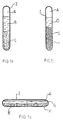
- Figures 1a-1c illustrate tubular, circular-cylindrical ampules 2 which are made of glass or some other fragile material, such as a plastic material for instance, and which contain fouling substances.
- the substance in the ampules 2 are stains that are intended to discolour an article that comes into contact therewith, or to spoil the article in some other way.
- the internal pressure of the ampule may be above atmospheric pressure, or equal to atmospheric pressure, or a pressure below atmospheric pressure.
- Figure 1a illustrates a first fouling substance ampule according to the invention in an upstanding position.
- the illustrated ampule 2 contains a given volume of air A, preferably about 20-30 volume-%, and two mutually different fouling substances, i.e. a first staining substance B and a second staining substance C.
- the two substances B and C consist in two liquid phases of mutually different colours which will therefore produce stains that distinguish from one another.
- the substance B may consist of an oil-based solution having a light, oil-dissolvable pigment or colorant, such as yellow for instance, while the substance C may consist in a water-based liquid phase that has a dark-coloured, water-soluble pigment or colorant, such as a dark blue colorant, for instance.
- the distinct liquid phases B and C have mutually different densities and therefore separate into different layers with a clear phase boundary therebetween.
- the heavier phase (the bottom phase) is comprised of the water-based staining substance C
- the lighter phase (the top phase) is comprised of the oil-based staining substance B.
- FIG 1b illustrates a second embodiment of an inventive ampule that contains fouling substances.
- the illustrated ampule 2 also contains three mutually different stains D, E and F that form three different coloured liquid phases which do not dissolve readily in one another or which are insoluble in one another.
- the stain D has the lowest density and therewith forms the upper phase in the ampule.
- the stains E and F of the illustrated embodiment have essentially the same density, meaning that the liquid phases E and F form bottom phases with a phase boundary against the stain D.
- the stains E and F are mutually immiscible but form bubbles in a known manner, as illustrated schematically in Figure 1b.
- the different stains D, E and F have different fouling properties and may contain mutually different pigments or colorants.
- the stain D may consist in a water-based phase containing a water soluble colorant
- the stains E and F may respectively consist in a fatty-acid based phase containing a colorant which is soluble in fatty acid and a silicone-oil based phase containing a colorant that is dissolvable in silicone oil.
- the densities of the phases based on fatty acid and silicone oil respectively are generally the same, and lower than the density of the water-based phase.
- the liquid phases E and F may, of course, also form liquid phases of mutually different densities, so as to form different layers with intermediate phase boundaries.
- a water-insoluble top phase based on oleic acid, an intermediate phase based on silicone oil and a water-based bottom phase are examples of three different liquid phases that will not readily dissolve in one another or that will not dissolve in one another at all, and that have mutually different densities.
- Figure 1c illustrates another embodiment of an inventive ampule, shown in a horizontal position.
- the ampule 2 also contains two different stains G, H in different liquid phases, and an alarm element 8.
- the alarm element 8 is sensed by an electronic alarm system, normally installed on the store premises and is enclosed in the ampule together with the stains so as to be inaccessible to external influences provided that the ampule is not broken, crushed or destroyed in some other way so as to release the stains.
- a stain containing ampule which also encloses an alarm element is described in more detail in WO 97/50066, to which reference is made herewith.
- At least one of the fouling substances may have a property that is different to the others, for instance may have a strong smelling or a corrosive property.
- One of the fouling substances may alternatively comprise a liquid phase that consists of a chemical mixture which contains a trace element for identification purposes, for instance a trace substance that can be identified with a certain producer.
- the trace substance may comprise a chemical that is not normally found in a colorant or other fouling substance, for instance a magnetic liquid.
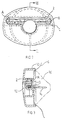
- FIGs 2 and 3 illustrate an exemplifying embodiment of an anti-theft device provided with an ampule 2 that contains a fouling substance in accordance with the ampule embodiment shown in Figure 1a, for instance.
- the anti-theft device includes a first anti-theft element 10 which has a base element 12 and an elongated connecting element 14 which projects out from the base element and which is intended to be inserted through the article 6 to be protected.
- a second element 16 (shown only schematically in Figure 3) is adapted for attachment to the connecting element 14 and to be locked thereon against movement away from the base element 12, so as to hold the anti-theft device securely on the article 6.
- One of the elements, in the illustrated case the anti-theft element 10, includes a theft deterrent.
- the anti-theft element comprises a fragile ampule which contains fouling substances and which may be of the kind shown in Figures 1a-1c.
- the ampule 2 is transparent and is placed for instance so as to be well visible from outside the anti-theft device.
- a potential thief is able to see and identify the contents of the ampule. It is therewith possible to see clearly from outside the anti-theft device that the fouling substances enclosed in the ampule will render the article unusable if the ampule should break, which will have a clear theft deterring effect.
- ampule 2 illustrated in Figure 1c will break in the same way and its contents destroy the article 6 if an attempt is made to render the alarm element 8 inactive in an irregular manner.
- the ampule may also enclose an inner fragile ampule, preferably a thin-walled ampule.
- the inner ampule is intended to be broken or crushed at the same time as the ampule containing said fouling substances, and will contain a substance which will react with the fouling substances in a suitable manner when coming into contact with said substance or substances.
- the inner ampule may hold a catalyst which causes the fouling substance or substances concerned to react with each other, or a hardener which causes the fouling substance or substances to harden and become permanently fixed to the theft attractive article.
- the inner ampule may also contain a further fouling substance, such as a colorant, with properties different to the fouling substance or substances in the outer ampule.
Landscapes
- Physics & Mathematics (AREA)
- General Physics & Mathematics (AREA)
- Engineering & Computer Science (AREA)
- Automation & Control Theory (AREA)
- Computer Security & Cryptography (AREA)
- Electromagnetism (AREA)
- Burglar Alarm Systems (AREA)
Abstract
Description
Claims (17)
- An anti-theft element for an anti-theft device which is intended to be attached to a theft-attractive article such that said device can only be removed from the article with the aid of a special release device, said anti-theft element including an ampule which contains a fouling substance and is disposed in said anti-theft element so as to be broken, crushed or destroyed or opened in some other way such as to release the fouling substance enclosed in the ampule should an attempt be made to release the anti-theft device from the theft-attractive article without the aid of said special release device, characterised in that the ampule (2) encloses a first fouling substance (B; D; G) having a specific fouling property, and at least one second fouling substance (C; E, F; H) having a fouling property that differs from the fouling property of said first fouling substance (B; D; G), and in that the chemical composition of the respective first fouling substance (B; D; G) and second fouling substance (C; E, F; H) is such that said substances (B, D, G; C, E, F; H) will not dissolve in one another.
- An anti-theft element according to Claim 1, characterised in that the fouling substances (B, D, G; C, E, F, H) are stains of mutually different colours.
- An anti-theft element according to Claim 2, characterised in that one of the stains (B, D, G; C, E, F, H) has a dark tint and another stain (C, E, F, H; B, D, G) has a light tint.
- An anti-theft element according to any one of the preceding Claims, characterised in that the density of the first fouling substance (B; D; G) differs from the density of the second fouling substance (C; E, F; H).
- An anti-theft element according to Claim 4, characterised in that said one fouling substance (B; D; G) is oil based and the other fouling substance (C; E, F; H) is water based.
- An anti-theft element according Claim 1, characterised in that the ampule (2) encloses a third fouling substance (F) whose fouling property differs from the fouling properties of the first fouling substance (B; D; G) and the second fouling substance (C; E; H), and in that the chemical composition of the third fouling substance (F) is such that said third substance will not dissolve in the first substance (B; D; G) nor in the second substance (C; E; H).
- An anti-theft element according to any one of the preceding Claims, characterised in that the ampule (2) encloses an alarm element (8) which can be sensed by an electronic alarm system and which is inaccessible to external influences unless the ampule (2) is broken, crushed or destroyed in some other way such as to release the fouling substances (B-H).
- An anti-theft element according to any one of the preceding Claims, characterised in that the ampule (2) is made of glass or a plastic material.
- An anti-theft element according to any one of the preceding Claims, characterised in that the ampule (2) also encloses an inner, fragile ampule which contains a substance that influences or supplements at least one of the surrounding fouling substances.
- A fouling-substance containing ampule which is intended to be fitted in an anti-theft element in an anti-theft device intended to be attached to a theft-attractive article such that said device can only be removed from said article with the aid of a special release device, said ampule enclosing a fouling substance and being disposed in the anti-theft element so as to be broken, crushed or otherwise destroyed or opened such as to release the fouling substance enclosed in said ampule should an attempt be made to release the anti-theft device from the theft-attractive article without the aid of said special release device, characterised in that the ampule (2) encloses a first fouling substance (B; D; G) having a specific fouling property, and at least one second fouling substance (C; E, F; H) having a fouling property which differs from the fouling property of the first fouling substance (B; D; G), and in that the chemical composition of said respective first fouling substance (B; D; G) and said second fouling substance (C; E, F; H) is such that said substances (B, D, G; C, E, F, H) will not dissolve in one another.
- A fouling-substance ampule according to Claim 10, characterised in that the fouling substances (B, D, G; C, E, F, H) are stains of mutually different colours.
- A fouling-substance ampule according to Claim 11, characterised in that one of said stains (B, D, G; C, E, F, H) has a dark tint and another stain (C, E, F, H; B, D, G) has a light tint.
- A fouling-substance ampule according to any one of Claims 10-12, characterised in that the density of the first fouling substance (B; D; G) differs from the density of the second fouling substance (C; E, F; H).
- A fouling-substance ampule according to Claim 13, characterised in that one fouling substance (B; D; G) is oil based and the other fouling substance (C; E, F; H) is water based.
- A fouling-substance ampule according to Claim 10, characterised in that the ampule (2) encloses a third fouling substance (F) having a fouling property that differs from the fouling properties of said first fouling substance (B; D; G) and said second fouling substance (C; E; H), and in that the chemical composition of the third fouling substance (F) is such that it will not dissolve in the first fouling substance (B; D; G) or in the second fouling substance (G; E; H).
- A fouling-substance ampule according to any one of Claims 10-15, characterised in that the ampule (2) is made of glass or a plastic material.
- A fouling-substance ampule according to any one of Claims 10-16, characterised in that the ampule (2) also encloses an inner, fragile ampule which encloses a substance that influences or supplements at least one of the surrounding fouling substances.
Applications Claiming Priority (2)
| Application Number | Priority Date | Filing Date | Title |
|---|---|---|---|
| SE9900964A SE513779C2 (en) | 1999-03-17 | 1999-03-17 | Anti-theft element and brand name vial intended to be included in an anti-theft element |
| SE9900964 | 1999-03-17 |
Publications (3)
| Publication Number | Publication Date |
|---|---|
| EP1037182A2 true EP1037182A2 (en) | 2000-09-20 |
| EP1037182A3 EP1037182A3 (en) | 2001-04-11 |
| EP1037182B1 EP1037182B1 (en) | 2003-09-24 |
Family
ID=20414885
Family Applications (1)
| Application Number | Title | Priority Date | Filing Date |
|---|---|---|---|
| EP20000102808 Expired - Lifetime EP1037182B1 (en) | 1999-03-17 | 2000-02-11 | Anti-theft element in an anti-theft device |
Country Status (7)
| Country | Link |
|---|---|
| EP (1) | EP1037182B1 (en) |
| JP (1) | JP2000285329A (en) |
| AU (1) | AU762774B2 (en) |
| CA (1) | CA2298143A1 (en) |
| DE (1) | DE60005428T2 (en) |
| ES (1) | ES2204371T3 (en) |
| SE (1) | SE513779C2 (en) |
Cited By (2)
| Publication number | Priority date | Publication date | Assignee | Title |
|---|---|---|---|---|
| GB2524719A (en) * | 2014-02-18 | 2015-10-07 | Trace In Metal Ltd | Apparatus for marking an asset as stolen |
| CN111033202A (en) * | 2017-07-31 | 2020-04-17 | 米契尔·李·路易斯 | safety overload cable |
Families Citing this family (2)
| Publication number | Priority date | Publication date | Assignee | Title |
|---|---|---|---|---|
| DE102004041602A1 (en) * | 2004-08-26 | 2006-11-16 | Sentronik Gmbh | Goods security device with variable individual magnetic locks has number of separate clamp elements adjustable in angular position and/or asymmetrically arranged relative to prong inserted in hosing |
| SE529472C2 (en) * | 2004-12-09 | 2007-08-14 | Sqs Ab | Method and apparatus for an alarmed value space |
Family Cites Families (5)
| Publication number | Priority date | Publication date | Assignee | Title |
|---|---|---|---|---|
| SE467556B (en) * | 1990-09-03 | 1992-08-03 | Faergklaemman Svenska Ab | STOELDSKYDDSANORDNING |
| SE9401604L (en) * | 1994-05-09 | 1995-11-10 | Faergklaemman Svenska Ab | Anti-theft device intended to be attached to goods that require theft |
| SE515559C2 (en) * | 1996-06-27 | 2001-08-27 | Faergklaemman Ab | Ampoule and anti-theft device with ampoule |
| US5852856A (en) * | 1997-11-13 | 1998-12-29 | Seidel; Stuart T. | Anti theft ink tag |
| SE517454C2 (en) * | 1998-04-01 | 2002-06-11 | Faergklaemman Ab | Anti-theft device and locking elements and associated release device for an anti-theft device |
-
1999
- 1999-03-17 SE SE9900964A patent/SE513779C2/en not_active IP Right Cessation
-
2000
- 2000-02-09 CA CA 2298143 patent/CA2298143A1/en not_active Abandoned
- 2000-02-11 ES ES00102808T patent/ES2204371T3/en not_active Expired - Lifetime
- 2000-02-11 DE DE2000605428 patent/DE60005428T2/en not_active Expired - Fee Related
- 2000-02-11 EP EP20000102808 patent/EP1037182B1/en not_active Expired - Lifetime
- 2000-03-08 JP JP2000063790A patent/JP2000285329A/en not_active Withdrawn
- 2000-03-13 AU AU20825/00A patent/AU762774B2/en not_active Ceased
Cited By (3)
| Publication number | Priority date | Publication date | Assignee | Title |
|---|---|---|---|---|
| GB2524719A (en) * | 2014-02-18 | 2015-10-07 | Trace In Metal Ltd | Apparatus for marking an asset as stolen |
| GB2524719B (en) * | 2014-02-18 | 2018-11-14 | Trace In Metal Ltd | Apparatus for marking an asset as stolen |
| CN111033202A (en) * | 2017-07-31 | 2020-04-17 | 米契尔·李·路易斯 | safety overload cable |
Also Published As
| Publication number | Publication date |
|---|---|
| SE513779C2 (en) | 2000-11-06 |
| CA2298143A1 (en) | 2000-09-17 |
| AU762774B2 (en) | 2003-07-03 |
| DE60005428D1 (en) | 2003-10-30 |
| AU2082500A (en) | 2000-09-21 |
| EP1037182A3 (en) | 2001-04-11 |
| EP1037182B1 (en) | 2003-09-24 |
| ES2204371T3 (en) | 2004-05-01 |
| JP2000285329A (en) | 2000-10-13 |
| SE9900964D0 (en) | 1999-03-17 |
| SE9900964L (en) | 2000-09-18 |
| DE60005428T2 (en) | 2004-07-22 |
Similar Documents
| Publication | Publication Date | Title |
|---|---|---|
| US5953799A (en) | Anti-theft tag | |
| US5051725A (en) | Security container | |
| US5428875A (en) | Theft deterrent tag with a cutting blade | |
| CA2344178A1 (en) | Product authentication indicia concealed in magnetomechanical eas marker | |
| SE423938B (en) | STOLDSKYDDSELEMENT | |
| JPH06500876A (en) | anti-theft device | |
| US6292101B1 (en) | Anti-theft element in an anti-theft device | |
| PT1391574E (en) | Security tag assembly | |
| US20120102802A1 (en) | Device for marking an item with a view to identifying same | |
| US20070252707A1 (en) | Dual Use Anti-theft Tag | |
| DE69706853T2 (en) | MANUFACTURING PROCESS FOR MARKING SUBSTANCE VIAL, AMPULLE AND ANTI-THEFT DEVICE THEREFOR | |
| EP0918125B1 (en) | Theft deterrent device | |
| EP1037182B1 (en) | Anti-theft element in an anti-theft device | |
| SE9401604L (en) | Anti-theft device intended to be attached to goods that require theft | |
| EP0585770B1 (en) | A theft-deterrent device for theft-attractive articles | |
| JPH09127876A (en) | Manufacture of product with built-in theft preventive device, product manufactured for such and method for preparation of theft preventive device for product | |
| CA2069824A1 (en) | Security Clip to Discourage Theft and a Procedure for Manufacturing Such a Security Clip | |
| US20080092394A1 (en) | Retail Theft-Deterrent Device and Method of Making | |
| JP4293336B2 (en) | Display case | |
| JP2000211648A (en) | Top and bottom identifying marker | |
| ITMI942038A1 (en) | ANTI-COUNTERFEIT LABEL WITH PROTECTED RETROFILECTIVE ELEMENT | |
| EP1784551A2 (en) | Anti-theft device |
Legal Events
| Date | Code | Title | Description |
|---|---|---|---|
| PUAI | Public reference made under article 153(3) epc to a published international application that has entered the european phase |
Free format text: ORIGINAL CODE: 0009012 |
|
| AK | Designated contracting states |
Kind code of ref document: A2 Designated state(s): DE ES FR GB IT NL |
|
| AX | Request for extension of the european patent |
Free format text: AL;LT;LV;MK;RO;SI |
|
| PUAL | Search report despatched |
Free format text: ORIGINAL CODE: 0009013 |
|
| AK | Designated contracting states |
Kind code of ref document: A3 Designated state(s): AT BE CH CY DE DK ES FI FR GB GR IE IT LI LU MC NL PT SE |
|
| AX | Request for extension of the european patent |
Free format text: AL;LT;LV;MK;RO;SI |
|
| 17P | Request for examination filed |
Effective date: 20011003 |
|
| AKX | Designation fees paid |
Free format text: DE ES FR GB IT NL |
|
| GRAH | Despatch of communication of intention to grant a patent |
Free format text: ORIGINAL CODE: EPIDOS IGRA |
|
| GRAS | Grant fee paid |
Free format text: ORIGINAL CODE: EPIDOSNIGR3 |
|
| GRAA | (expected) grant |
Free format text: ORIGINAL CODE: 0009210 |
|
| AK | Designated contracting states |
Kind code of ref document: B1 Designated state(s): DE ES FR GB IT NL |
|
| REG | Reference to a national code |
Ref country code: GB Ref legal event code: FG4D |
|
| REF | Corresponds to: |
Ref document number: 60005428 Country of ref document: DE Date of ref document: 20031030 Kind code of ref document: P |
|
| REG | Reference to a national code |
Ref country code: ES Ref legal event code: FG2A Ref document number: 2204371 Country of ref document: ES Kind code of ref document: T3 |
|
| ET | Fr: translation filed | ||
| PLBE | No opposition filed within time limit |
Free format text: ORIGINAL CODE: 0009261 |
|
| STAA | Information on the status of an ep patent application or granted ep patent |
Free format text: STATUS: NO OPPOSITION FILED WITHIN TIME LIMIT |
|
| 26N | No opposition filed |
Effective date: 20040625 |
|
| PGFP | Annual fee paid to national office [announced via postgrant information from national office to epo] |
Ref country code: NL Payment date: 20050216 Year of fee payment: 6 |
|
| PGFP | Annual fee paid to national office [announced via postgrant information from national office to epo] |
Ref country code: FR Payment date: 20060131 Year of fee payment: 7 |
|
| PGFP | Annual fee paid to national office [announced via postgrant information from national office to epo] |
Ref country code: ES Payment date: 20060223 Year of fee payment: 7 |
|
| PGFP | Annual fee paid to national office [announced via postgrant information from national office to epo] |
Ref country code: DE Payment date: 20060228 Year of fee payment: 7 Ref country code: IT Payment date: 20060228 Year of fee payment: 7 |
|
| PG25 | Lapsed in a contracting state [announced via postgrant information from national office to epo] |
Ref country code: NL Free format text: LAPSE BECAUSE OF NON-PAYMENT OF DUE FEES Effective date: 20060901 |
|
| NLV4 | Nl: lapsed or anulled due to non-payment of the annual fee |
Effective date: 20060901 |
|
| GBPC | Gb: european patent ceased through non-payment of renewal fee |
Effective date: 20070211 |
|
| REG | Reference to a national code |
Ref country code: FR Ref legal event code: ST Effective date: 20071030 |
|
| PG25 | Lapsed in a contracting state [announced via postgrant information from national office to epo] |
Ref country code: DE Free format text: LAPSE BECAUSE OF NON-PAYMENT OF DUE FEES Effective date: 20070901 |
|
| PG25 | Lapsed in a contracting state [announced via postgrant information from national office to epo] |
Ref country code: FR Free format text: LAPSE BECAUSE OF NON-PAYMENT OF DUE FEES Effective date: 20070228 Ref country code: GB Free format text: LAPSE BECAUSE OF NON-PAYMENT OF DUE FEES Effective date: 20070211 |
|
| REG | Reference to a national code |
Ref country code: ES Ref legal event code: FD2A Effective date: 20070212 |
|
| PG25 | Lapsed in a contracting state [announced via postgrant information from national office to epo] |
Ref country code: ES Free format text: LAPSE BECAUSE OF NON-PAYMENT OF DUE FEES Effective date: 20070212 |
|
| PGFP | Annual fee paid to national office [announced via postgrant information from national office to epo] |
Ref country code: GB Payment date: 20060131 Year of fee payment: 7 |
|
| PG25 | Lapsed in a contracting state [announced via postgrant information from national office to epo] |
Ref country code: IT Free format text: LAPSE BECAUSE OF NON-PAYMENT OF DUE FEES Effective date: 20070211 |