EP1035603A1 - Battery and capacitor using quinoxaline resin - Google Patents
Battery and capacitor using quinoxaline resin Download PDFInfo
- Publication number
- EP1035603A1 EP1035603A1 EP00104502A EP00104502A EP1035603A1 EP 1035603 A1 EP1035603 A1 EP 1035603A1 EP 00104502 A EP00104502 A EP 00104502A EP 00104502 A EP00104502 A EP 00104502A EP 1035603 A1 EP1035603 A1 EP 1035603A1
- Authority
- EP
- European Patent Office
- Prior art keywords
- quinoxaline
- capacity
- electrode
- film
- battery
- Prior art date
- Legal status (The legal status is an assumption and is not a legal conclusion. Google has not performed a legal analysis and makes no representation as to the accuracy of the status listed.)
- Granted
Links
- XSCHRSMBECNVNS-UHFFFAOYSA-N quinoxaline Chemical compound N1=CC=NC2=CC=CC=C21 XSCHRSMBECNVNS-UHFFFAOYSA-N 0.000 title claims abstract description 280
- 229920005989 resin Polymers 0.000 title claims abstract description 94
- 239000011347 resin Substances 0.000 title claims abstract description 94
- 239000003990 capacitor Substances 0.000 title claims description 27
- -1 sulfuric acid ions Chemical class 0.000 claims abstract description 94
- QAOWNCQODCNURD-UHFFFAOYSA-N sulfuric acid Substances OS(O)(=O)=O QAOWNCQODCNURD-UHFFFAOYSA-N 0.000 claims abstract description 50
- 239000003792 electrolyte Substances 0.000 claims abstract description 42
- 150000001768 cations Chemical class 0.000 claims abstract description 28
- 150000002500 ions Chemical class 0.000 claims abstract description 24
- 239000008151 electrolyte solution Substances 0.000 claims description 59
- 239000002019 doping agent Substances 0.000 claims description 47
- 238000000034 method Methods 0.000 claims description 37
- 229920000642 polymer Polymers 0.000 claims description 20
- 239000003960 organic solvent Substances 0.000 claims description 12
- 238000006116 polymerization reaction Methods 0.000 claims description 8
- 239000002253 acid Substances 0.000 claims description 5
- 229920006389 polyphenyl polymer Polymers 0.000 description 60
- 239000002002 slurry Substances 0.000 description 56
- 239000000126 substance Substances 0.000 description 50
- 229920000767 polyaniline Polymers 0.000 description 47
- 239000011149 active material Substances 0.000 description 45
- OKTJSMMVPCPJKN-UHFFFAOYSA-N Carbon Chemical compound [C] OKTJSMMVPCPJKN-UHFFFAOYSA-N 0.000 description 44
- 229910052799 carbon Inorganic materials 0.000 description 44
- 125000004122 cyclic group Chemical group 0.000 description 38
- 230000003647 oxidation Effects 0.000 description 38
- 238000007254 oxidation reaction Methods 0.000 description 38
- 238000006722 reduction reaction Methods 0.000 description 38
- 230000000052 comparative effect Effects 0.000 description 34
- 239000007773 negative electrode material Substances 0.000 description 22
- 238000000927 vapour-phase epitaxy Methods 0.000 description 22
- 238000006243 chemical reaction Methods 0.000 description 18
- 125000001567 quinoxalinyl group Chemical group N1=C(C=NC2=CC=CC=C12)* 0.000 description 17
- 239000000243 solution Substances 0.000 description 17
- 125000004433 nitrogen atom Chemical group N* 0.000 description 15
- 239000011230 binding agent Substances 0.000 description 14
- 239000002033 PVDF binder Substances 0.000 description 12
- 239000004020 conductor Substances 0.000 description 12
- 238000010586 diagram Methods 0.000 description 12
- 229920002981 polyvinylidene fluoride Polymers 0.000 description 12
- VEXZGXHMUGYJMC-UHFFFAOYSA-N Hydrochloric acid Chemical compound Cl VEXZGXHMUGYJMC-UHFFFAOYSA-N 0.000 description 11
- XLYOFNOQVPJJNP-UHFFFAOYSA-N water Substances O XLYOFNOQVPJJNP-UHFFFAOYSA-N 0.000 description 11
- PXHVJJICTQNCMI-UHFFFAOYSA-N Nickel Chemical compound [Ni] PXHVJJICTQNCMI-UHFFFAOYSA-N 0.000 description 10
- 239000002904 solvent Substances 0.000 description 10
- 229910001416 lithium ion Inorganic materials 0.000 description 9
- HBBGRARXTFLTSG-UHFFFAOYSA-N Lithium ion Chemical compound [Li+] HBBGRARXTFLTSG-UHFFFAOYSA-N 0.000 description 7
- NBIIXXVUZAFLBC-UHFFFAOYSA-N Phosphoric acid Chemical compound OP(O)(O)=O NBIIXXVUZAFLBC-UHFFFAOYSA-N 0.000 description 6
- DTQVDTLACAAQTR-UHFFFAOYSA-N Trifluoroacetic acid Chemical compound OC(=O)C(F)(F)F DTQVDTLACAAQTR-UHFFFAOYSA-N 0.000 description 6
- 230000006872 improvement Effects 0.000 description 6
- 239000000463 material Substances 0.000 description 6
- 230000007246 mechanism Effects 0.000 description 6
- 230000008569 process Effects 0.000 description 6
- ITMCEJHCFYSIIV-UHFFFAOYSA-N triflic acid Chemical compound OS(=O)(=O)C(F)(F)F ITMCEJHCFYSIIV-UHFFFAOYSA-N 0.000 description 6
- 229920002554 vinyl polymer Polymers 0.000 description 6
- UFHFLCQGNIYNRP-UHFFFAOYSA-N Hydrogen Chemical compound [H][H] UFHFLCQGNIYNRP-UHFFFAOYSA-N 0.000 description 5
- 150000001450 anions Chemical group 0.000 description 5
- 125000004429 atom Chemical group 0.000 description 5
- 239000001257 hydrogen Substances 0.000 description 5
- 229910052739 hydrogen Inorganic materials 0.000 description 5
- WDGKXRCNMKPDSD-UHFFFAOYSA-N lithium;trifluoromethanesulfonic acid Chemical compound [Li].OS(=O)(=O)C(F)(F)F WDGKXRCNMKPDSD-UHFFFAOYSA-N 0.000 description 5
- 229910052759 nickel Inorganic materials 0.000 description 5
- NAWXUBYGYWOOIX-SFHVURJKSA-N (2s)-2-[[4-[2-(2,4-diaminoquinazolin-6-yl)ethyl]benzoyl]amino]-4-methylidenepentanedioic acid Chemical compound C1=CC2=NC(N)=NC(N)=C2C=C1CCC1=CC=C(C(=O)N[C@@H](CC(=C)C(O)=O)C(O)=O)C=C1 NAWXUBYGYWOOIX-SFHVURJKSA-N 0.000 description 4
- LSNNMFCWUKXFEE-UHFFFAOYSA-M Bisulfite Chemical compound OS([O-])=O LSNNMFCWUKXFEE-UHFFFAOYSA-M 0.000 description 4
- 125000000217 alkyl group Chemical group 0.000 description 4
- 125000006267 biphenyl group Chemical group 0.000 description 4
- MHCFAGZWMAWTNR-UHFFFAOYSA-M lithium perchlorate Chemical compound [Li+].[O-]Cl(=O)(=O)=O MHCFAGZWMAWTNR-UHFFFAOYSA-M 0.000 description 4
- 229910001486 lithium perchlorate Inorganic materials 0.000 description 4
- 230000009257 reactivity Effects 0.000 description 4
- 238000006479 redox reaction Methods 0.000 description 4
- 229910000147 aluminium phosphate Inorganic materials 0.000 description 3
- 125000003118 aryl group Chemical group 0.000 description 3
- 125000000732 arylene group Chemical group 0.000 description 3
- 239000000460 chlorine Substances 0.000 description 3
- 125000001072 heteroaryl group Chemical group 0.000 description 3
- 125000001183 hydrocarbyl group Chemical group 0.000 description 3
- 239000007787 solid Substances 0.000 description 3
- BHPQYMZQTOCNFJ-UHFFFAOYSA-N Calcium cation Chemical compound [Ca+2] BHPQYMZQTOCNFJ-UHFFFAOYSA-N 0.000 description 2
- JLVVSXFLKOJNIY-UHFFFAOYSA-N Magnesium ion Chemical compound [Mg+2] JLVVSXFLKOJNIY-UHFFFAOYSA-N 0.000 description 2
- 150000001204 N-oxides Chemical class 0.000 description 2
- 229920000557 Nafion® Polymers 0.000 description 2
- VEQPNABPJHWNSG-UHFFFAOYSA-N Nickel(2+) Chemical compound [Ni+2] VEQPNABPJHWNSG-UHFFFAOYSA-N 0.000 description 2
- RAHZWNYVWXNFOC-UHFFFAOYSA-N Sulphur dioxide Chemical group O=S=O RAHZWNYVWXNFOC-UHFFFAOYSA-N 0.000 description 2
- 150000007513 acids Chemical class 0.000 description 2
- 229910052782 aluminium Inorganic materials 0.000 description 2
- 125000002178 anthracenyl group Chemical group C1(=CC=CC2=CC3=CC=CC=C3C=C12)* 0.000 description 2
- 125000005110 aryl thio group Chemical group 0.000 description 2
- 229910001422 barium ion Inorganic materials 0.000 description 2
- 229940092714 benzenesulfonic acid Drugs 0.000 description 2
- 229910001424 calcium ion Inorganic materials 0.000 description 2
- 229910052801 chlorine Inorganic materials 0.000 description 2
- 229920001940 conductive polymer Polymers 0.000 description 2
- 238000005260 corrosion Methods 0.000 description 2
- 230000007797 corrosion Effects 0.000 description 2
- 229940060296 dodecylbenzenesulfonic acid Drugs 0.000 description 2
- 230000005518 electrochemistry Effects 0.000 description 2
- 238000010828 elution Methods 0.000 description 2
- 125000005549 heteroarylene group Chemical group 0.000 description 2
- 125000004435 hydrogen atom Chemical group [H]* 0.000 description 2
- XEEYBQQBJWHFJM-UHFFFAOYSA-N iron Substances [Fe] XEEYBQQBJWHFJM-UHFFFAOYSA-N 0.000 description 2
- 229910052742 iron Inorganic materials 0.000 description 2
- 229910001425 magnesium ion Inorganic materials 0.000 description 2
- AFVFQIVMOAPDHO-UHFFFAOYSA-N methanesulfonic acid Substances CS(O)(=O)=O AFVFQIVMOAPDHO-UHFFFAOYSA-N 0.000 description 2
- 229940098779 methanesulfonic acid Drugs 0.000 description 2
- 125000002496 methyl group Chemical group [H]C([H])([H])* 0.000 description 2
- 230000004048 modification Effects 0.000 description 2
- 238000012986 modification Methods 0.000 description 2
- 125000001624 naphthyl group Chemical group 0.000 description 2
- 229910001453 nickel ion Inorganic materials 0.000 description 2
- JOXIMZWYDAKGHI-UHFFFAOYSA-N p-toluenesulfonic acid Substances CC1=CC=C(S(O)(=O)=O)C=C1 JOXIMZWYDAKGHI-UHFFFAOYSA-N 0.000 description 2
- 125000001997 phenyl group Chemical group [H]C1=C([H])C([H])=C(*)C([H])=C1[H] 0.000 description 2
- 229920000172 poly(styrenesulfonic acid) Polymers 0.000 description 2
- 229940005642 polystyrene sulfonic acid Drugs 0.000 description 2
- 229920000123 polythiophene Polymers 0.000 description 2
- 229910001414 potassium ion Inorganic materials 0.000 description 2
- 125000004076 pyridyl group Chemical group 0.000 description 2
- 230000009467 reduction Effects 0.000 description 2
- 229910001415 sodium ion Inorganic materials 0.000 description 2
- ZCYVEMRRCGMTRW-UHFFFAOYSA-N 7553-56-2 Chemical compound [I] ZCYVEMRRCGMTRW-UHFFFAOYSA-N 0.000 description 1
- 229920000265 Polyparaphenylene Polymers 0.000 description 1
- 229920000292 Polyquinoline Polymers 0.000 description 1
- 102100032268 Triadin Human genes 0.000 description 1
- 239000003929 acidic solution Substances 0.000 description 1
- 125000003545 alkoxy group Chemical group 0.000 description 1
- 125000004414 alkyl thio group Chemical group 0.000 description 1
- 125000002947 alkylene group Chemical group 0.000 description 1
- 125000005336 allyloxy group Chemical group 0.000 description 1
- HSFWRNGVRCDJHI-UHFFFAOYSA-N alpha-acetylene Natural products C#C HSFWRNGVRCDJHI-UHFFFAOYSA-N 0.000 description 1
- 125000003368 amide group Chemical group 0.000 description 1
- 125000003277 amino group Chemical group 0.000 description 1
- 125000006615 aromatic heterocyclic group Chemical group 0.000 description 1
- 230000015572 biosynthetic process Effects 0.000 description 1
- 239000003054 catalyst Substances 0.000 description 1
- 229960001231 choline Drugs 0.000 description 1
- 125000004093 cyano group Chemical group *C#N 0.000 description 1
- 125000000113 cyclohexyl group Chemical group [H]C1([H])C([H])([H])C([H])([H])C([H])(*)C([H])([H])C1([H])[H] 0.000 description 1
- 125000002704 decyl group Chemical group [H]C([H])([H])C([H])([H])C([H])([H])C([H])([H])C([H])([H])C([H])([H])C([H])([H])C([H])([H])C([H])([H])C([H])([H])* 0.000 description 1
- 238000007598 dipping method Methods 0.000 description 1
- 125000003438 dodecyl group Chemical group [H]C([H])([H])C([H])([H])C([H])([H])C([H])([H])C([H])([H])C([H])([H])C([H])([H])C([H])([H])C([H])([H])C([H])([H])C([H])([H])C([H])([H])* 0.000 description 1
- 125000004185 ester group Chemical group 0.000 description 1
- 125000001495 ethyl group Chemical group [H]C([H])([H])C([H])([H])* 0.000 description 1
- 125000005843 halogen group Chemical group 0.000 description 1
- 125000003187 heptyl group Chemical group [H]C([*])([H])C([H])([H])C([H])([H])C([H])([H])C([H])([H])C([H])([H])C([H])([H])[H] 0.000 description 1
- 125000004051 hexyl group Chemical group [H]C([H])([H])C([H])([H])C([H])([H])C([H])([H])C([H])([H])C([H])([H])* 0.000 description 1
- 125000002887 hydroxy group Chemical group [H]O* 0.000 description 1
- 230000002401 inhibitory effect Effects 0.000 description 1
- 229910010272 inorganic material Inorganic materials 0.000 description 1
- 239000011147 inorganic material Substances 0.000 description 1
- 229910052740 iodine Inorganic materials 0.000 description 1
- 239000011630 iodine Substances 0.000 description 1
- 125000001449 isopropyl group Chemical group [H]C([H])([H])C([H])(*)C([H])([H])[H] 0.000 description 1
- 125000000468 ketone group Chemical group 0.000 description 1
- 229910052751 metal Inorganic materials 0.000 description 1
- 239000002184 metal Substances 0.000 description 1
- 150000002739 metals Chemical class 0.000 description 1
- 239000000178 monomer Substances 0.000 description 1
- 125000004108 n-butyl group Chemical group [H]C([H])([H])C([H])([H])C([H])([H])C([H])([H])* 0.000 description 1
- 229910017604 nitric acid Inorganic materials 0.000 description 1
- 125000000449 nitro group Chemical group [O-][N+](*)=O 0.000 description 1
- 125000002347 octyl group Chemical group [H]C([*])([H])C([H])([H])C([H])([H])C([H])([H])C([H])([H])C([H])([H])C([H])([H])C([H])([H])[H] 0.000 description 1
- 150000007524 organic acids Chemical class 0.000 description 1
- 235000005985 organic acids Nutrition 0.000 description 1
- 239000007800 oxidant agent Substances 0.000 description 1
- 229920001197 polyacetylene Polymers 0.000 description 1
- 229920000128 polypyrrole Polymers 0.000 description 1
- 230000001737 promoting effect Effects 0.000 description 1
- 125000001436 propyl group Chemical group [H]C([*])([H])C([H])([H])C([H])([H])[H] 0.000 description 1
- 125000000714 pyrimidinyl group Chemical group 0.000 description 1
- 125000002914 sec-butyl group Chemical group [H]C([H])([H])C([H])([H])C([H])(*)C([H])([H])[H] 0.000 description 1
- 125000000999 tert-butyl group Chemical group [H]C([H])([H])C(*)(C([H])([H])[H])C([H])([H])[H] 0.000 description 1
- 108010072310 triadin Proteins 0.000 description 1
- 125000002023 trifluoromethyl group Chemical group FC(F)(F)* 0.000 description 1
- 125000002948 undecyl group Chemical group [H]C([*])([H])C([H])([H])C([H])([H])C([H])([H])C([H])([H])C([H])([H])C([H])([H])C([H])([H])C([H])([H])C([H])([H])C([H])([H])[H] 0.000 description 1
Images


Classifications
-
- C—CHEMISTRY; METALLURGY
- C08—ORGANIC MACROMOLECULAR COMPOUNDS; THEIR PREPARATION OR CHEMICAL WORKING-UP; COMPOSITIONS BASED THEREON
- C08G—MACROMOLECULAR COMPOUNDS OBTAINED OTHERWISE THAN BY REACTIONS ONLY INVOLVING UNSATURATED CARBON-TO-CARBON BONDS
- C08G61/00—Macromolecular compounds obtained by reactions forming a carbon-to-carbon link in the main chain of the macromolecule
- C08G61/12—Macromolecular compounds containing atoms other than carbon in the main chain of the macromolecule
- C08G61/122—Macromolecular compounds containing atoms other than carbon in the main chain of the macromolecule derived from five- or six-membered heterocyclic compounds, other than imides
-
- H—ELECTRICITY
- H01—ELECTRIC ELEMENTS
- H01M—PROCESSES OR MEANS, e.g. BATTERIES, FOR THE DIRECT CONVERSION OF CHEMICAL ENERGY INTO ELECTRICAL ENERGY
- H01M4/00—Electrodes
- H01M4/02—Electrodes composed of, or comprising, active material
- H01M2004/026—Electrodes composed of, or comprising, active material characterised by the polarity
- H01M2004/027—Negative electrodes
-
- H—ELECTRICITY
- H01—ELECTRIC ELEMENTS
- H01M—PROCESSES OR MEANS, e.g. BATTERIES, FOR THE DIRECT CONVERSION OF CHEMICAL ENERGY INTO ELECTRICAL ENERGY
- H01M2300/00—Electrolytes
- H01M2300/0002—Aqueous electrolytes
-
- H—ELECTRICITY
- H01—ELECTRIC ELEMENTS
- H01M—PROCESSES OR MEANS, e.g. BATTERIES, FOR THE DIRECT CONVERSION OF CHEMICAL ENERGY INTO ELECTRICAL ENERGY
- H01M4/00—Electrodes
- H01M4/02—Electrodes composed of, or comprising, active material
- H01M4/64—Carriers or collectors
- H01M4/66—Selection of materials
- H01M4/665—Composites
- H01M4/667—Composites in the form of layers, e.g. coatings
-
- Y—GENERAL TAGGING OF NEW TECHNOLOGICAL DEVELOPMENTS; GENERAL TAGGING OF CROSS-SECTIONAL TECHNOLOGIES SPANNING OVER SEVERAL SECTIONS OF THE IPC; TECHNICAL SUBJECTS COVERED BY FORMER USPC CROSS-REFERENCE ART COLLECTIONS [XRACs] AND DIGESTS
- Y02—TECHNOLOGIES OR APPLICATIONS FOR MITIGATION OR ADAPTATION AGAINST CLIMATE CHANGE
- Y02E—REDUCTION OF GREENHOUSE GAS [GHG] EMISSIONS, RELATED TO ENERGY GENERATION, TRANSMISSION OR DISTRIBUTION
- Y02E60/00—Enabling technologies; Technologies with a potential or indirect contribution to GHG emissions mitigation
- Y02E60/10—Energy storage using batteries
Definitions
- the present invention relates to a battery and a capacitor, and more particularly to a battery and a capacitor which has electrodes including a quinoxaline resin, so that the battery and capacitor are highly stable chemically and electrically and also thermally stable and further have high capacitances.
- a conductive martial film is formed on a surface of the electrode such as in a secondary battery and a capacitor.
- conductive polymers such as polythiophene, polyacetylene, polyphenylene, polypyridine, are available.
- oxidation electrochemistry by doping the material with a p-type dopant or reduction electrochemistry by doping the material with an n-type dopant.
- polyphenylquinoxaline displays a conductivity in high degree acidic solution, for example, 37%-hydrochloric acid, 70%-nitric acid, 99%-trifluoro sulfuric acid, 96%-sulfuric acid, whereby charge and discharge are caused in the same mechanism as shown in the above general formula.
- a concentrated hydrochloric acid a constant current charge was made to a film containing polyphenylquinoxaline to have confirmed that a capacitance is measured to be 125mAh/cm 3 .
- the above conductive material has the following problems.
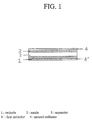
- the secondary battery using the conductive material has a structure as shown in FIG. 1.
- a positive electrode (an anode) 2 and a negative electrode (a cathode) 1 are separated by a separator 3.
- the positive electrode (anode) 2 is in contact with a second collector 4.
- the negative electrode (cathode) 3 is in contact with a first collector 4'.
- the positive and negative electrodes may be formed by applying the above conductive materials on the above collectors 4 and 4', respectively.
- the conductive materials such as polyquinolinediil polymers, polyquinoxalinediil, polymers, polypyridinediil polymers are used for the negative electrode 1.
- the above conductive materials such as N-oxide polyquinolinediil polymers, polyquinoxalinediil, polymers, polypyridinediil polymers comprise aromatic heterocyclic compounds which show low reactivity in electrolytic solution and have low capacity and further which are soluble to water or organic solvents. For those reasons, if the above conductive materials are used for the secondary battery, then it is possible that the conductive material is eluted into the electrolytic solution whereby the capacity is remarkably reduced.
- Polyphenylquinoxaline as one of the above conductive materials has a large molecular weight of monomer as a unit.
- Polyphenylquinoxaline is further doped with chlorine ions as dopant as shown in the above general formula (1), wherein only two electrons serve in reaction, for which reason, a capacity per a unit volume or a unit weight is small.
- the present invention provides an electrode containing a quinoxaline resin and an electrolyte which includes at least one of sulfuric acid ions and sulfonic acid ions, or the electrolyte which includes cations having ion radius of not more than 3 angstroms.
- the first present invention provides an electrode containing a quinoxaline resin and an electrolyte which includes at least one of sulfuric acid ions and sulfonic acid ions, so that sulfuric acid ions or sulfonic acid ions react with nitrogen atoms in quinoxaline rings in the quinoxaline resin, and whereby the number of electrons, which move in the oxidation and reduction reactions, are increased to promote the oxidation and reduction reactions between positive and negative electrodes, thereby allowing the device to have high energy efficiencies in a per unit volume or in a per unit weight, and further allowing the device to have a high capacity in a per unit volume or in a per unit weight.
- the second present invention also provides an electrode containing a quinoxaline resin and an electrolyte which includes cations having ion radius of not more than 3 angstroms, so that cations react with nitrogen atoms in quinoxaline rings in the quinoxaline resin, and whereby the number of electrons, which move in the oxidation and reduction reactions, are increased to promote the oxidation and reduction reactions between positive and negative electrodes thereby allowing the device to have high energy efficiencies in a per unit volume or in a per unit weight, and further allowing the device to have a high capacity in a per unit volume or in a per unit weight.
- the third present invention provides a battery having at least an electrode containing a quinoxaline resin and an electrolyte which includes at least one of sulfuric acid ions and sulfonic acid ions, so that sulfuric acid ions or sulfonic acid ions react with nitrogen atoms in quinoxaline rings in the quinoxaline resin and whereby the number of electrons, which move in the oxidation and reduction reactions, are increased to promote the oxidation and reduction reactions between positive and negative electrodes, thereby allowing the battery to have high energy efficiencies in a per unit volume or in a per unit weight, and further allowing the battery to have a high capacity in a per unit volume or in a per unit weight.
- the fourth present invention also provides a battery having at least an electrode containing a quinoxaline resin and an electrolyte which includes cations having ion radius of not more than 3 angstroms, so that cations react with nitrogen atoms in quinoxaline rings in the quinoxaline resin, and whereby the number of electrons, which move in the oxidation and reduction reactions, are increased to promote the oxidation and reduction reactions between positive and negative electrodes thereby allowing the battery to have high energy efficiencies in a per unit volume or in a per unit weight, and further allowing the battery to have a high capacity in a per unit volume or in a per unit weight.
- the fifth present invention provides a capacitor having at least an electrode containing a quinoxaline resin and an electrolyte which includes at least one of sulfuric acid ions and sulfonic acid ions, so that sulfuric acid ions or sulfonic acid ions react with nitrogen atoms in quinoxaline rings in the quinoxaline resin, and whereby the number of electrons, which move in the oxidation and reduction reactions, are increased to promote the oxidation and reduction reactions between positive and negative electrodes, thereby allowing the capacitor to have high energy efficiencies in a per unit volume or in a per unit weight, and further allowing the capacitor to have a high capacity in a per unit volume or in a per unit weight.
- the sixth present invention also provides a capacitor having at least an electrode containing a quinoxaline resin and an electrolyte which includes cations having ion radius of not more than 3 angstroms, so that cations react with nitrogen atoms in quinoxaline rings in the quinoxaline resin, and whereby the number of electrons, which move in the oxidation and reduction reactions, are increased to promote the oxidation and reduction reactions between positive and negative electrodes thereby allowing the capacitor to have high energy efficiencies in a per unit volume or in a per unit weight, and further allowing the capacitor to have a high capacity in a per unit volume or in a per unit weight.
- the seventh present invention also provides a method of forming an electrode comprising the steps of: forming a film containing a quinoxaline resin on a surface of a collector; and subjecting said quinoxaline resin to an electrolytic solution containing at least one of sulfuric acid ions and sulfonic acid ions for doping said quinoxaline resin with said electrolytic solution, so that sulfuric acid ions or sulfonic acid ions react with nitrogen atoms in quinoxaline rings in the quinoxaline resin, and whereby the number of electrons, which move in the oxidation and reduction reactions, are increased to promote the oxidation and reduction reactions between positive and negative electrodes, thereby allowing the device to have high energy efficiencies in a per unit volume or in a per unit weight, and further allowing the device to have a high capacity in a per unit volume or in a per unit weight.
- the method is also applicable to form a battery or a capacitor. If the method is applied to the battery, sulfuric acid ions or sulfonic acid ions react with nitrogen atoms in quinoxaline rings in the quinoxaline resin, and whereby the number of electrons, which move in the oxidation and reduction reactions, are increased to promote the oxidation and reduction reactions between positive and negative electrodes, thereby allowing the battery to have high energy efficiencies in a per unit volume or in a per unit weight, and further allowing the battery to have a high capacity in a per unit volume or in a per unit weight.
- sulfuric acid ions or sulfonic acid ions react with nitrogen atoms in quinoxaline rings in the quinoxaline resin, and whereby the number of electrons, which move in the oxidation and reduction reactions, are increased to promote the oxidation and reduction reactions between positive and negative electrodes, thereby allowing the capacitor to have high energy efficiencies in a per unit volume or in a per unit weight, and further allowing the capacitor to have a high capacity in a per unit volume or in a per unit weight.
- the eighth present invention also provides a method of forming an electrode comprising the steps of: forming a film containing a quinoxaline resin on a surface of a collector; and subjecting said quinoxaline resin to an electrolytic solution which includes cations having ion radius of not more than 3 angstroms for doping said quinoxaline resin with said electrolytic solution, so that cations react with nitrogen atoms in quinoxaline rings in the quinoxaline resin, and whereby the number of electrons, which move in the oxidation and reduction reactions, are increased to promote the oxidation and reduction reactions between positive and negative electrodes thereby allowing the device to have high energy efficiencies in a per unit volume or in a per unit weight, and further allowing the device to have a high capacity in a per unit volume or in a per unit weight.
- the above method is also applicable to a battery or a capacitor. If the method is applied to the battery, so that cations react with nitrogen atoms in quinoxaline rings in the quinoxaline resin, and whereby the number of electrons, which move in the oxidation and reduction reactions, are increased to promote the oxidation and reduction reactions between positive and negative electrodes thereby allowing the battery to have high energy efficiencies in a per unit volume or in a per unit weight, and further allowing the capacitor to have a high battery in a per unit volume or in a per unit weight.
- the method is applied to the capacitor, so that cations react with nitrogen atoms in quinoxaline rings in the quinoxaline resin, and whereby the number of electrons, which move in the oxidation and reduction reactions, are increased to promote the oxidation and reduction reactions between positive and negative electrodes thereby allowing the capacitor to have high energy efficiencies in a per unit volume or in a per unit weight, and further allowing the capacitor to have a high capacity in a per unit volume or in a per unit weight.
- FIG. 1 is a fragmentary cross sectional elevation view illustrative of a secondary battery which may cyclically usable upon charging the battery with an external power.
- a positive electrode (an anode) 2 and a negative electrode (a cathode) 1 are separated by a separator 3.
- the positive electrode (anode) 2 is in contact with a second collector 4.
- the negative electrode (cathode) 3 is in contact with a first collector 4'.
- the positive and negative electrodes may be formed by applying the above conductive materials on the above collectors 4 and 4', respectively.
- the negative electrode 1 comprises a film which includes a quinoxaline resin and an electrolyte which includes at least one of sulfuric acid ions and sulfonic acid ions.
- the electrolyte may include cations having ion radius of not more than 3 angstroms.
- the film of the negative electrode 1 may have a thickness in the range of, for example, 20-500 micrometers, and preferably 50-200 micrometers.
- the positive electrode 2 may be made of any one of conductive active materials selected in various materials, for example, polymers such as polyaniline, low molecular weight materials, inorganic materials and metals.
- the separator 3 may be formed by dipping into a solution solved with the above-described electrolyte or by using a gelled electrolyte or a solid state electrolyte.
- the solid state electrolyte includes no solvent molecule.
- the gelled electrolyte may be obtained by plasticization of the solid state electrolyte with an electrolytic solution.
- the electrolytic solution may be obtained by solving the electrolyte having ion-conductivity without, however, electron-conductivity into an organic solvent or water.
- Each of the collectors 4 and 4' may comprise a conductive material in the form of a sheet.
- the quinoxaline resin may preferably be polyquinoline resins having cyclic units represented by the following general formulae (2) and (3) in view of operability, electronic properties and low hygroscopicity.
- each of R1 and R2 represents any one of hydrogen atom, halogen atom, hydroxyl groups, sulfon groups, sulfuric acid groups, nitro groups, amino groups, alkyl-thio groups, aryl-thio groups, alkyl groups, aryl groups, alkoxy groups, allyl-oxy groups, holmyl groups (-COH), ketone groups (-COR 3 ), ester groups (-CO 2 R 4 or -OCOR 5 ), amide groups (-NR 6 COR 7 or - CONR 8 R 9 ) hetero-aryl groups, cyano groups, and divalent hydrocarbon groups which may have unsaturated bonding, where each of R3-R9 represents any one of hydrogen atom, alkyl groups, aryl groups, and hetero-aryl groups, and each of
- the above alkyl groups may be, for example, methyl groups, ethyl groups, propyl groups, isopropyl groups, n-butyl groups, sec-butyl groups, tert-butyl groups, penthyl groups, cyclopenthyl groups, hexyl groups, cyclohexyl groups, heptyl groups, octyl groups, 2-ethylhexyl groups, decyl groups, undecyl groups, dodecyl groups, or dococyl groups.
- the above aryl groups may be, for example, phenyl groups, biphenyl groups, naphthyl groups, anthracenyl groups, or diphenyl groups.
- the above heteroaryl groups may be, for example, pyridyl groups, quinorinidyl, or pyradyl groups.
- the above arylene groups may be, for example, phenyl groups, biphenyl groups, naphthyl groups, anthracenyl groups, or diphenyl groups.
- the above hetero-arylene groups may be, for example, polyaniline groups, polypyrrole groups, polythiophene groups, polyphenylenevinylene groups, aryl-thio groups, pyridyl groups, pyrimidyl groups, pyridadyl groups, triadin, quinorinidyl groups, or pyradyl groups,
- the above divalent hydrocarbon groups which may have unsaturated bonding formed by bonding two of R1 and two of R2 as well as two of L1 and two of L2, may be, for example, alkylene groups such as 1,3-propylene groups, 1,4-bytylene groups, 1,5-bentylene groups, given by the following general formula.
- the above quinoxaline resin is a polymer having quinoxaline ring in cyclic units.
- the polymerization degree of the quinoxaline resin should not be limited provided that the resin may be applied uniformly to form a substantially uniform thickness film. If the polymerization degree of the quinoxaline resin is extremely small, it is possible that the quinoxaline resin is dissolved into the electrolytic solution. It is, for example, preferable that the polymerization degree of the quinoxaline resin is in the range of 25-500, more preferably 50-250. A molecular weight of the quinoxaline resin may be changed in accordance with the object of forming the film or formation conditions.
- a weight average molecular weight of the quinoxaline resin may be, for example, in the range of 10000-1000000, preferably, 20000-100000.
- a number average molecular weight of the quinoxaline resin may be, for example, in the range of 3000-100000, preferably, 5000-10000.
- the quinoxaline resin may be synthesized in short processes without using an expensive catalyst as disclosed in Journal of Polymer Science vol. 5, 1453-1466, 1967.
- the electrode of the present invention contains the above quinoxaline resin and the electrolyte which includes at least one of sulfuric acid ions and sulfonic acid ions or which includes cations having ion radius of not more than 3 angstroms.
- the electrolyte including sulfuric acid ions is a substance which has a sulfuric acid group and which is dissociated into sulfuric acid ions in an electrolytic solution.
- Sulfuric acid is one example of the electrolyte including sulfuric acid ions.
- the electrolyte including sulfonic acid ions is a substance which has a sulfon group and which is dissociated into sulfonic acid ions in an electrolytic solution.
- sulfonic acid ions are organic acids such as benzene sulfonic acid ions, p-toluene sulfonic acid ions, benzene chloride sulfonic acid ions, dodecyl benzene sulfonic acid ions, methane sulfonic acid ions, trifluoromethane sulfonic acid ions, butane sulfonic acid ions, trichlorobenzene sulfonic acid ions, naphthalene sulfonic acid ions, perfluorobutane sulfonic acid ions, perfluorooctane sulfonic acid ions, and polymer acids such as polystyrene sulfonic acid ions, polyvinyl sulfonic acid ions and Nafion®.
- organic acids such as benzene sulfonic acid ions, p-toluene sulfonic acid
- the electrolyte including cations having ion radius of not more than 3 angstroms is a substance which is dissociated into cations having ion radius of not more than 3 angstroms in an electrolytic solution.
- Examples of the electrolyte including cations having ion radius of not more than 3 angstroms are proton, lithium ions, sodium ions, potassium ions, magnesium ions, calcium ions, barium ions, aluminum ions, iron ions, nickel ions, and tetramethylammonium ions.
- the above novel negative electrode 1 may be formed as follows. A slurry including the quinoxaline resin, a conductive auxiliary substance and methacresol is formed on the collector 4 by use of a doctor blade. After this slurry is dried in vacuum, a press-machine is used to form a film. Subsequently, the film is cut in a predetermined shape thereby forming the negative electrode 1.
- the above positive electrode 2 may be formed as follows. A slurry including a conductive active material, a conductive auxiliary substance and a binder resin such as polyvinylidene fluoride is sufficiently stirred and then formed on the collector 4 by use of a doctor blade. After this slurry is dried in vacuum, a press-machine is used to form a film. Subsequently, the film is cut in a predetermined shape thereby forming the positive electrode 2.
- an electrolytic solution is prepared, which is dissolved with the electrolyte including at least one of sulfuric acid ions and sulfonic acid ions or including cations having ion radius of not more than 3 angstroms.
- This electrolytic solution is used for electrochemically or chemically doping the negative and positive electrodes 1 and 2.
- the separator or gelled electrolyte 3 is immersed with an electrolytic solution.
- the above negative and positive electrodes 1 and 2 are placed in opposite sides of the separator or gelled electrolyte 3 so that the above negative and positive electrodes 1 and 2 sandwich the separator or gelled electrolyte 3, thereby forming the secondary battery.
- this electrolytic solution may be prepared by solving the electrolyte into water. If the electrolyte includes including cations having ion radius of not more than 3 angstroms, then this electrolytic solution may be prepared by solving the electrolyte into an organic solvent.
- the kind of the electrolyte to be used for preparing the electrolytic solution should not be limited to the above.
- the kind of the above binder resin should not be limited to polyvinylidene fluoride. Any binder resins, which are unlikely to show corrosion to the electrolytic solution, are available.
- the kind of the above organic solvent to be used for the above electrolytic solution should not be limited, provided that the electrolyte is dissolved into the organic solvent.
- the doping to the quinoxaline resin is carried out by use of the electrolytic solution dissolved with the electrolyte including at least one of sulfuric acid ions and sulfonic acid ions, then oxidation reduction reactions are caused in ion-neutralized state (H 3 O + HSO 4 - or H 3 O + SO 3 -) in the electrolytic solution, for which reason the vicinity of the quinoxaline resin is placed into a state in excess of proton, whereby the oxidation and reduction reactions given by the following chemical formulae (4) and (5).
- X represents anions as dopant, for example, organic acid ions such as sulfuric acids ions, benzene sulfonic acid ions, p-toluene sulfonic acid ions, benzene chloride sulfonic acid ions, dodecyl benzene sulfonic acid ions, methane sulfonic acid ions, trifluoromethane sulfonic acid ions, butane sulfonic acid ions, trichlorobenzene sulfonic acid ions, naphthalene sulfonic acid ions, perfluorobutane sulfonic acid ions, perfluorooctane sulfonic acid ions, and polymer acids such as polystyrene sulfonic acid ions, polyvinyl sulfonic acid ions and Nafion®.
- organic acid ions such as sulfuric acids ions, benzene sul
- the battery has a high energy efficiency in a unit volume and a high energy efficiency in a unit weight.
- the novel secondary battery has a high energy efficiency in a unit volume and a high energy efficiency in a unit weight.
- the doping to the quinoxaline resin is carried out by use of the electrolytic solution prepared by dissolving an organic solvent with the electrolyte including cations having ion radius of not more than 3 angstroms, then at the same time of reaction of anions as dopant to the quinoxaline resin, cations are reacted with nitrogen atoms in the quinoxaline rings in the quinoxaline resin.
- the reaction mechanisms are shown in the following formulae (6) and (7).
- X represents anions as dopant which is not limited
- C represents an ion having ion radius of not more than 3 angstroms, for example, proton, lithium ions, sodium ions, potassium ions, magnesium ions, calcium ions, barium ions, aluminum ions, iron ions, nickel ions, and tetramethylammonium ions.
- the electrolytic solution containing cations having ion radius of not more than 3 angstroms is used, thereby promoting the doping reaction so that a great increase in capacity can be obtained.
- the battery has the negative electrode containing a quinoxaline resin and an electrolyte which includes at least one of sulfuric acid ions and sulfonic acid ions, so that sulfuric acid ions or sulfonic acid ions react with nitrogen atoms in quinoxaline rings in the quinoxaline resin, and whereby the number of electrons, which move in the oxidation and reduction reactions, are increased to promote the oxidation and reduction reactions between positive and negative electrodes, thereby allowing the battery to have high energy efficiencies in a per unit volume or in a per unit weight, and further allowing the battery to have a high capacity in a per unit volume or in a per unit weight.
- the doping process to the quinoxaline resin activates the oxidation and reduction reactions.
- the activated oxidation and reduction reactions show high speed reactions, thereby charge and discharge in high rate can be obtained.
- the quinoxaline resin is highly stable to the solvent so that almost no elution of the quinoxaline resin to the solvent is caused, whereby an increased adhesiveness between the electrode and the collector can be obtained.
- the quinoxaline resin has extremely high chemical and electrical stability and a high thermal stability, so that the cyclic property of the battery is improved.
- the doped quinoxaline resin remains stable chemically and electrically, so that a self-discharge efficiency is extremely low, thereby preventing the battery from the self discharge.
- the battery has the negative electrode containing a quinoxaline resin and an electrolyte which includes cations having ion radius of not more than 3 angstroms, so that cations react with nitrogen atoms in quinoxaline rings in the quinoxaline resin, and whereby the number of electrons, which move in the oxidation and reduction reactions, are increased to promote the oxidation and reduction reactions between positive and negative electrodes, thereby allowing the battery to have high energy efficiencies in a per unit volume or in a per unit weight, and further allowing the battery to have a high capacity in a per unit volume or in a per unit weight.
- the doping process to the quinoxaline resin activates the oxidation and reduction reactions.
- the activated oxidation and reduction reactions show high speed reactions, thereby charge and discharge in high rate can be obtained.
- the quinoxaline resin is highly stable to the solvent so that almost no elution of the quinoxaline resin to the solvent is caused, whereby an increased adhesiveness between the electrode and the collector can be obtained.
- the quinoxaline resin has extremely high chemical and electrical stability and a high thermal stability, so that the cyclic property of the battery is improved.
- the doped quinoxaline resin remains stable chemically and electrically, so that a self-discharge efficiency is extremely low, thereby preventing the battery from the self-discharge.
- Polyphenylquinoxaline shown in the following general formula (8) was used as an active material for forming the negative electrode 1 shown in FIG. 1.
- Polyaniline shown in the following general formula (9) was used as an active material for forming the positive electrode 2 shown in FIG. 1.
- the trifluoromethane sulfonic acid was used as dopant to the negative and positive electrodes 1 and 2.
- the positive electrode 2 was prepared. Polyaniline shown in the above general formula (9) was used as an active material. A vapor phase epitaxy carbon as the conductive auxiliary substance was mixed to polyaniline at 4:1 in weight ratio of carbon to polyaniline. Polyvinylidene fluoride having an average molecular weight of 1100 as the binder resin was further added at 8% by weight, in order to obtain a slurry. This slurry was stirred by homogenizer. This slurry was then applied on a main face of the collector 4' by use of the doctor blade, whereby a film was formed on the main face of the collector 4'. The film was then dried in vacuum at 100-150°C for one hour. Subsequently, the roll-press machine was used to press the film to make the film of 100 micrometers in thickness. The film was then cut to be shaped to form the positive electrode 2.
- the negative electrode 1 was prepared. Polyphenyl quinoxaline shown in the above general formula (8) was used as an active material. A vapor phase epitaxy carbon as the conductive auxiliary substance was mixed to polyphenyl quinoxaline at 1:1 in weight ratio of carbon to polyphenyl quinoxaline. Matacresol was further added at room temperature, in order to obtain a slurry. This slurry was then applied on a main face of the collector 4 by use of the doctor blade, whereby a film was formed on the main face of the collector 4'. The film was then dried in vacuum at 100-150°C for one hour and thereafter an anneal was carried out. Subsequently, the roll-press machine was used to press the film to make the film of 100 micrometers in thickness. The film was then cut to be shaped to form the negative electrode 1.
- a trifluoromethane sulfonic acid solution was used for subjecting the negative and positive electrodes 1 and 2 to the electrochemical or chemical doping.
- the doped negative and positive electrodes 1 and 2 were placed in opposite sides of the separator 3 immersed with the electrolytic solution, whereby to obtain the secondary battery.
- the secondary battery was charged to measure various characteristics thereof.
- the secondary battery was charged in the range of 1-10C up to 0.9V at a constant current in the range of 1-10 mA/cm2, where a theoretical capacity was 198Wh/kg per the weight of the negative active material, for example, polyphenyl quinoxaline.
- the actual capacity did not depend upon the discharge rate and was 135 Wh/kg per the weight of the negative active material.
- a ratio of the actual capacity to the theoretical capacity was high, for example, 68%.
- the cyclic characteristics were also measured.
- a cyclic number necessary for dropping the capacity to 80% of the initial capacity of 135Wh/kg was 9000.
- a capacity storage characteristic was also measured. After the battery was placed at 25°C for 30 days, then the capacity was reduced to 80% of the initial capacity. Namely, the capacity showed such the characteristics as a lithium ion battery or a nickel hydrogen battery.
- the reaction mechanism of polyphenyl quinoxaline was as shown in the following formula (10), wherein four electrons contribute to promote the reactions, whereby a great improvement in capacity of the battery can be obtained. Namely, there was obtained the battery which has a high energy efficiency in a unit volume and a high energy efficiency in a unit weight.
- the trifluoromethane sulfonic acid solution was used as the electrolytic solution.
- other electrolytic solution may be used.
- Polyvinylidene fluoride was used as the binder resin.
- Other binder resins showing no corrosion to the electrolytic solution may be available.
- the polyvinyl sulfonic acid was used as a dopant to the negative and positive electrodes 1 and 2.
- polyphenyl quinoxaline was used as an active material for forming the negative electrode 1 shown in FIG. 1.
- Polyaniline was used as an active material for forming the positive electrode 2 shown in FIG. 1.
- the polyvinyl sulfonic acid was used as dopant to the negative and positive electrodes 1 and 2.
- the positive electrode 2 was prepared in the same manner as in Example 1. Polyaniline shown in the above general formula (9) was used as an active material. A vapor phase epitaxy carbon as the conductive auxiliary substance was mixed to polyaniline at 4:1 in weight ratio of carbon to polyaniline. Polyvinylidene fluoride having an average molecular weight of 1100 as the binder resin was further added at 8% by weight in order to obtain a slurry. This slurry was stirred by homogenizer. This slurry was then applied on a main face of the collector 4' by use of the doctor blade, whereby a film was formed on the main face of the collector 4'. The film was then dried in vacuum at 100-150°C for one hour. Subsequently, the roll-press machine was used to press the film to make the film of 100 micrometers in thickness. The film was then cut to be shaped to form the positive electrode 2.
- the negative electrode 1 was prepared in the same manner as in Example 1. Polyphenyl quinoxaline shown in the above general formula (8) was used as an active material. A vapor phase epitaxy carbon as the conductive auxiliary substance was mixed to polyphenyl quinoxaline at 1:1 in weight ratio of carbon to polyphenyl quinoxaline. Matacresol was further added at room temperature, in order to obtain a slurry. This slurry was then applied on a main face of the collector 4 by use of the doctor blade, whereby a film was formed on the main face of the collector 4'. The film was then dried in vacuum at 100-150°C for one hour and thereafter an anneal was carried out. Subsequently, the roll-press machine was used to press the film to make the film of 100 micrometers in thickness. The film was then cut to be shaped to form the negative electrode 1.
- a polyvinyl sulfonic acid solution was used for subjecting the negative and positive electrodes 1 and 2 to the electrochemical or chemical doping.
- the doped negative and positive electrodes 1 and 2 were placed in opposite sides of the separator 3 immersed with the electrolytic solution, whereby to obtain the secondary battery.
- the secondary battery was charged to measure various characteristics thereof
- the secondary battery was charged in the range of 1-10C up to 0.9V at a constant current in the range of 1-10 mA/cm2, where a theoretical capacity was 198Wh/kg per the weight of the negative active material, for example, polyphenyl quinoxaline.
- the actual capacity did not depend upon the discharge rate and was 160Wh/kg per the weight of the negative active material.
- a ratio of the actual capacity to the theoretical capacity was high, for example, 81%.
- the cyclic characteristics were also measured.
- a cyclic number necessary for dropping the capacity to 80% of the initial capacity of 160Wh/kg was 11000.
- a capacity storage characteristic was also measured. After the battery was placed at 25°C for 30 days, then the capacity was reduced to 80% of the initial capacity. Namely, the capacity showed such the characteristics as a lithium ion battery or a nickel hydrogen battery.
- the reaction mechanism of polyphenyl quinoxaline was as shown in the above formula (10), wherein four electrons contribute to promote the reactions, whereby a great improvement in capacity of the battery can be obtained. Namely, there was obtained the battery which has a high energy efficiency in a unit volume and a high energy efficiency in a unit weight.
- the polyvinyl sulfonic acid solution was used as the electrolytic solution.
- other electrolytic solution may be used.
- the use of polymer dopant causes a further increase in concentration of proton around polyphenyl quinoxaline whereby the reactivity was increased and the high capacity was obtained.
- the use of polymer dopant prevents de-doping whereby the cyclic property was improved.
- a sulfuric acid having sulfuric acid groups was used as a dopant to the negative and positive electrodes 1 and 2.
- polyphenyl quinoxaline was used as an active material for forming the negative electrode 1 shown in FIG. 1.
- Polyaniline was used as an active material for forming the positive electrode 2 shown in FIG. 1.
- the sulfuric acid was used as dopant to the negative and positive electrodes 1 and 2.
- the positive electrode 2 was prepared in the same manner as in Example 1. Polyaniline shown in the above general formula (9) was used as an active material. A vapor phase epitaxy carbon as the conductive auxiliary substance was mixed to polyaniline at 4:1 in weight ratio of carbon to polyaniline. Polyvinylidene fluoride having an average molecular weight of 1100 as the binder resin was further added at 8% by weight, in order to obtain a slurry. This slurry was stirred by homogenizer. This slurry was then applied on a main face of the collector 4' by use of the doctor blade, whereby a film was formed on the main face of the collector 4'. The film was then dried in vacuum at 100-150°C for one hour. Subsequently, the roll-press machine was used to press the film to make the film of 100 micrometers in thickness. The film was then cut to be shaped to form the positive electrode 2.
- the negative electrode 1 was prepared in the same manner as in Example 1. Polyphenyl quinoxaline shown in the above general formula (8) was used as an active material. A vapor phase epitaxy carbon as the conductive auxiliary substance was mixed to polyphenyl quinoxaline at 1:1 in weight ratio of carbon to polyphenyl quinoxaline. Matacresol was further added at room temperature, in order to obtain a slurry. This slurry was then applied on a main face of the collector 4 by use of the doctor blade, whereby a film was formed on the main face of the collector 4'. The film was then dried in vacuum at 100-150°C for one hour and thereafter an anneal was carried out. Subsequently, the roll-press machine was used to press the film to make the film of 100 micrometers in thickness. The film was then cut to be shaped to form the negative electrode 1.
- a sulfuric acid solution was used for subjecting the negative and positive electrodes 1 and 2 to the electrochemical or chemical doping.
- the doped negative and positive electrodes 1 and 2 were placed in opposite sides of the separator 3 immersed with the electrolytic solution, whereby to obtain the secondary battery.
- the secondary battery was charged to measure various characteristics thereof.
- the secondary battery was charged in the range of 1-10C up to 0.9V at a constant current in the range of 1-10 mA/cm2, where a theoretical capacity was 198Wh/kg per the weight of the negative active material, for example, polyphenyl quinoxaline.
- the actual capacity did not depend upon the discharge rate and was 170Wh/kg per the weight of the negative active material.
- a ratio of the actual capacity to the theoretical capacity was high, for example, 86%.
- the cyclic characteristics were also measured.
- a cyclic number necessary for dropping the capacity to 80% of the initial capacity of 170Wh/kg was 9000.
- a capacity storage characteristic was also measured. After the battery was placed at 25°C for 30 days, then the capacity was reduced to 80% of the initial capacity. Namely, the capacity showed such the characteristics as a lithium ion battery or a nickel hydrogen battery.
- the reaction mechanism of polyphenyl quinoxaline was as shown in the above formula (10), wherein four electrons contribute to promote the reactions, whereby a great improvement in capacity of the battery can be obtained. Namely, there was obtained the battery which has a high energy efficiency in a unit volume and a high energy efficiency in a unit weight.
- the sulfuric acid solution was used as the electrolytic solution.
- other electrolytic solution may be used.
- the use of polymer dopant causes a further increase in concentration of proton around polyphenyl quinoxaline whereby the reactivity was increased and the high capacity was obtained.
- the use of polymer dopant prevents de-doping whereby the cyclic property was improved.
- a lithium trifluoromethane sulfonic acid was used as a dopant to the negative and positive electrodes 1 and 2.
- PC/EC mixing solvent was used for the electrolytic solution.
- polyphenyl quinoxaline was used as an active material for forming the negative electrode 1 shown in FIG. 1.
- Polyaniline was used as an active material for forming the positive electrode 2 shown in FIG. 1.
- the lithium trifluoromethane sulfonic acid was used as dopant to the negative and positive electrodes 1 and 2.
- the positive electrode 2 was prepared in the same manner as in Example 1. Polyaniline shown in the above general formula (9) was used as an active material. A vapor phase epitaxy carbon as the conductive auxiliary substance was mixed to polyaniline at 4:1 in weight ratio of carbon to polyaniline. Polyvinylidene fluoride having an average molecular weight of 1100 as the binder resin was further added at 8% by weight, in order to obtain a slurry. This slurry was stirred by homogenizer. This slurry was then applied on a main face of the collector 4' by use of the doctor blade, whereby a film was formed on the main face of the collector 4'. The film was then dried in vacuum at 100-150°C for one hour. Subsequently, the roll -press machine was used to press the film to make the film of 100 micrometers in thickness. The film was then cut to be shaped to form the positive electrode 2.
- the negative electrode 1 was prepared in the same manner as in Example 1. Polyphenyl quinoxaline shown in the above general formula (8) was used as an active material. A vapor phase epitaxy carbon as the conductive auxiliary substance was mixed to polyphenyl quinoxaline at 1:1 in weight ratio of carbon to polyphenyl quinoxaline. Matacresol was further added at room temperature, in order to obtain a slurry. This slurry was then applied on a main face of the collector 4 by use of the doctor blade, whereby a film was formed on the main face of the collector 4'. The film was then dried in vacuum at 100-150°C for one hour and thereafter an anneal was carried out. Subsequently, the roll-press machine was used to press the film to make the film of 100 micrometers in thickness. The film was then cut to be shaped to form the negative electrode 1.
- a lithium trifluoromethane sulfonic acid solution was used for subjecting the negative and positive electrodes 1 and 2 to the electrochemical or chemical doping.
- the doped negative and positive electrodes 1 and 2 were placed in opposite sides of the separator 3 immersed with the electrolytic solution, whereby to obtain the secondary battery.
- the secondary battery was charged to measure various characteristics thereof.
- the secondary battery was charged in the range of 1-10C up to 2.2V at a constant current in the range of 1-10 mA/cm2, where a theoretical capacity was 484Wh/kg per the weight of the negative active material, for example, polyphenyl quinoxaline.
- the actual capacity did not depend upon the discharge rate and was 330Wh/kg per the weight of the negative active material.
- a ratio of the actual capacity to the theoretical capacity was high, for example, 68%.
- the cyclic characteristics were also measured.
- a cyclic number necessary for dropping the capacity to 80% of the initial capacity of 330Wh/kg was 7000.
- a capacity storage characteristic was also measured. After the battery was placed at 25°C for 30 days, then the capacity was reduced to 80% of the initial capacity. Namely, the capacity showed such the characteristics as a lithium ion battery or a nickel hydrogen battery.
- a great improvement in capacity of the battery can be obtained. Namely, there was obtained the battery which has a high energy efficiency in a unit volume and a high energy efficiency in a unit weight.
- the lithium trifluoromethane sulfonic acid solution was used as the dopant.
- PC/EC mixing organic solvent was used for the electrolytic solution.
- other electrolytic solution may be used.
- the use of organic solvent for the electrolytic solution causes the increase in electromotive force and also the increase in energy density of the capacitor It is not necessary to limit the above PC/EC mixing solvent for the electrolytic solution.
- lithium perchlorate was used as a dopant to the negative arid positive electrodes 1 and 2.
- PC/EC mixing solvent was used for the electrolytic solution.
- polyphenyl quinoxaline was used as an active material for forming the negative electrode 1 shown in FIG. 1.
- Polyaniline was used as an active material for forming the positive electrode 2 shown in FIG. 1.
- the lithium trifluoromethane sulfonic acid was used as dopant to the negative and positive electrodes 1 and 2.
- the positive electrode 2 was prepared in the same manner as in Example 1. Polyaniline shown in the above general formula (9) was used as an active material. A vapor phase epitaxy carbon as the conductive auxiliary substance was mixed to polyaniline at 4:1 in weight ratio of carbon to polyaniline. Polyvinylidene fluoride having an average molecular weight of 1100 as the binder resin was further added at 8% by weight, in order to obtain a slurry. This slurry was stirred by homogenizer. This slurry was then applied on a main face of the collector 4' by use of the doctor blade, whereby a film was formed on the main face of the collector 4'. The film was then dried in vacuum at 100-150°C for one hour. Subsequently, the roll-press machine was used to press the film to make the film of 100 micrometers in thickness. The film was then cut to be shaped to form the positive electrode 2.
- the negative electrode 1 was prepared in the same manner as in Example 1. Polyphenyl quinoxaline shown in the above general formula (8) was used as an active material. A vapor phase epitaxy carbon as the conductive auxiliary substance was mixed to polyphenyl quinoxaline at 1:1 in weight ratio of carbon to polyphenyl quinoxaline. Matacresol was further added at room temperature, in order to obtain a slurry. This slurry was then applied on a main face of the collector 4 by use of the doctor blade, whereby a film was formed on the main face of the collector 4'. The film was then dried in vacuum at 100-150°C for one hour and thereafter an anneal was carried out. Subsequently, the roll-press machine was used to press the film to make the film of 100 micrometers in thickness. The film was then cut to be shaped to form the negative electrode 1.
- a lithium perchlorate solution was used for subjecting the negative and positive electrodes 1 and 2 to the electrochemical or chemical doping.
- the doped negative and positive electrodes 1 and 2 were placed in opposite sides of the separator 3 immersed with the electrolytic solution, whereby to obtain the secondary battery.
- the secondary battery was charged to measure various characteristics thereof.
- the secondary battery was charged in the range of 1-10C up to 2.2V at a constant current in the range of 1-10 mA/cm2, where a theoretical capacity was 484Wh/kg per the weight of the negative active material, for example, polyphenyl quinoxaline.
- the actual capacity did not depend upon the discharge rate and was 354Wh/kg per the weight of the negative active material.
- a ratio of the actual capacity to the theoretical capacity was high, for example, 73%.
- the cyclic characteristics were also measured.
- a cyclic number necessary for dropping the capacity to 80% of the initial capacity of 354Wh/kg was 7000.
- a capacity storage characteristic was also measured. After the battery was placed at 25°C for 30 days, then the capacity was reduced to 80% of the initial capacity. Namely, the capacity showed such the characteristics as a lithium ion battery or a nickel hydrogen battery.
- the battery which has a high energy efficiency in a unit volume and a high energy efficiency in a unit weight.
- the lithium perchlorate as acid was used to increase the ion-conductivity so as to allow high rate charge and discharge.
- PC/EC mixing organic solvent was used for the electrolytic solution.
- other electrolytic solution may be used.
- the use of organic solvent for the electrolytic solution causes the increase in electromotive force and also the increase in energy density of the capacitor. It is not necessary to limit the above PC/EC mixing solvent for the electrolytic solution.
- polyphenyl quinoxaline was used as an active material for forming the negative electrode I shown in FIG. 1.
- Polyaniline was used as an active material for forming the positive electrode 2 shown in FIG. 1.
- the phosphoric acid was used as dopant to the negative and positive electrodes 1 and 2.
- the positive electrode 2 was prepared in the same manner as in Example 1. Polyaniline shown in the above general formula (9) was used as an active material. A vapor phase epitaxy carbon as the conductive auxiliary substance was mixed to polyaniline at 4:1 in weight ratio of carbon to polyaniline. Polyvinylidene fluoride having an average molecular weight of 1100 as the binder resin was further added at 8% by weight, in order to obtain a slurry. This slurry was stirred by homogenizer. This slurry was then applied on a main face of the collector 4' by use of the doctor blade, whereby a film was formed on the main face of the collector 4'. The film was then dried in vacuum at 100-150°C for one hour. Subsequently, the roll-press machine was used to press the film to make the film of 100 micrometers in thickness. The film was then cut to be shaped to form the positive electrode 2.
- the negative electrode 1 was prepared in the same manner as in Example 1. Polyphenyl quinoxaline shown in the above general formula (8) was used as an active material. A vapor phase epitaxy carbon as the conductive auxiliary substance was mixed to polyphenyl quinoxaline at 1:1 in weight ratio of carbon to polyphenyl quinoxaline. Matacresol was further added at room temperature, in order to obtain a slurry. This slurry was then applied on a main face of the collector 4 by use of the doctor blade, whereby a film was formed on the main face of the collector 4'. The film was then dried in vacuum at 100-150°C for one hour and thereafter an anneal was carried out. Subsequently, the roll-press machine was used to press the film to make the film of 100 micrometers in thickness. The film was then cut to be shaped to form the negative electrode 1.
- a phosphoric acid solution was used for subjecting the negative and positive electrodes 1 and 2 to the electrochemical or chemical doping.
- the doped negative and positive electrodes 1 and 2 were placed in opposite sides of the separator 3 immersed with the electrolytic solution, whereby to obtain the secondary battery.
- the secondary battery was charged to measure various characteristics thereof
- the secondary battery was charged in the range of 1-10C up to 0.9V at a constant current in the range of 1-10 mA/cm2, where a theoretical capacity was 198Wh/kg per the weight of the negative active material, for example, polyphenyl quinoxaline.
- the actual capacity did not depend upon the discharge rate and was 50Wh/kg per the weight of the negative active material.
- a ratio of the actual capacity to the theoretical capacity was high, for example, 25%.
- the cyclic characteristics were also measured.
- a cyclic number necessary for dropping the capacity to 80% of the initial capacity of 50Wh/kg was 9000.
- a capacity storage characteristic was also measured. After the battery was placed at 25°C for 30 days, then the capacity was reduced to 80% of the initial capacity.
- polyphenyl quinoxaline was used as an active material for forming the negative electrode 1 shown in FIG. 1.
- Polyaniline was used as an active material for forming the positive electrode 2 shown in FIG. 1.
- the trifluoroacetic acid was used as dopant to the negative and positive electrodes 1 and 2.
- the positive electrode 2 was prepared in the same manner as in Example 1. Polyaniline shown in the above general formula (9) was used as an active material. A vapor phase epitaxy carbon as the conductive auxiliary substance was mixed to polyaniline at 4:1 in weight ratio of carbon to polyaniline. Polyvinylidene fluoride having an average molecular weight of 1100 as the binder resin was further added at 8% by weight, in order to obtain a slurry. This slurry was stirred by homogenizer. This slurry was then applied on a main face of the collector 4' by use of the doctor blade, whereby a film was formed on the main face of the collector 4'. The film was then dried in vacuum at 100-150°C for one hour. Subsequently, the roll-press machine was used to press the film to make the film of 100 micrometers in thickness. The film was then cut to be shaped to form the positive electrode 2.
- the negative electrode 1 was prepared in the same manner as in Example 1. Polyphenyl quinoxaline shown in the above general formula (8) was used as an active material. A vapor phase epitaxy carbon as the conductive auxiliary substance was mixed to polyphenyl quinoxaline at 1:1 in weight ratio of carbon to polyphenyl quinoxaline. Matacresol was further added at room temperature, in order to obtain a shiny. This slurry was then applied on a main face of the collector 4 by use of the doctor blade, whereby a film was formed on the main face of the collector 4'. The film was then dried in vacuum at 100-150°C for one hour and thereafter an anneal was carried out. Subsequently, the roll-press machine was used to press the film to make the film of 100 micrometers in thickness. The film was then cut to be shaped to form the negative electrode 1.
- a trifluoroacetic acid solution was used for subjecting the negative and positive electrodes 1 and 2 to the electrochemical or chemical doping.
- the doped negative and positive electrodes 1 and 2 were placed in opposite sides of the separator 3 immersed with the electrolytic solution, whereby to obtain the secondary battery.
- the secondary battery was charged to measure various characteristics thereof.
- the secondary battery was charged in the range of 1-10C up to 0.9V at a constant current in the range of 1-10 mA/cm2, where a theoretical capacity was 198Wh/kg per the weight of the negative active material, for example, polyphenyl quinoxaline.
- the actual capacity did not depend upon the discharge rate and was 60Wh/kg per the weight of the negative active material.
- a ratio of the actual capacity to the theoretical capacity was high, for example, 30%.
- the cyclic characteristics were also measured.
- a cyclic number necessary for dropping the capacity to 80% of the initial capacity of 60Wh/kg was 5000.
- a capacity storage characteristic was also measured. After the battery was placed at 25°C for 1 hour, then the capacity was reduced to 20% of the initial capacity.
- polyphenyl quinoxaline was used as an active material for forming the negative electrode 1 shown in FIG. 1.
- Polyaniline was used as an active material for forming the positive electrode 2 shown in FIG. 1.
- the hydrochloric acid was used as dopant to the negative and positive electrodes 1 and 2.
- the positive electrode 2 was prepared in the same manner as in Example 1. Polyaniline shown in the above general formula (9) was used as an active material. A vapor phase epitaxy carbon as the conductive auxiliary substance was mixed to polyaniline at 4:1 in weight ratio of carbon to polyaniline. Polyvinylidene fluoride having an average molecular weight of 1100 as the binder resin was further added at 8% by weight, in order to obtain a slurry. This slurry was stirred by homogenizer. This slurry was then applied on a main face of the collector 4' by use of the doctor blade, whereby a film was formed on the main face of the collector 4'. The film was then dried in vacuum at 100-150°C for one hour. Subsequently, the roll-press machine was used to press the film to make the film of 100 micrometers in thickness. The film was then cut to be shaped to form the positive electrode 2.
- the negative electrode 1 was prepared in the same manner as in Example 1. Polyphenyl quinoxaline shown in the above general formula (8) was used as an active material. A vapor phase epitaxy carbon as the conductive auxiliary substance was mixed to polyphenyl quinoxaline at 1:1 in weight ratio of carbon to polyphenyl quinoxaline. Matacresol was further added at room temperature, in order to obtain a slurry. This slurry was then applied on a main face of the collector 4 by use of the doctor blade, whereby a film was formed on the main face of the collector 4'. The film was then dried in vacuum at 100-150°C for one hour and thereafter an anneal was carried out. Subsequently, the roll-press machine was used to press the film to make the film of 100 micrometers in thickness. The film was then cut to be shaped to form the negative electrode 1.
- a hydrochloric acid solution was used for subjecting the negative and positive electrodes 1 and 2 to the electrochemical or chemical doping.
- the doped negative and positive electrodes 1 and 2 were placed in opposite sides of the separator 3 immersed with the electrolytic solution, whereby to obtain the secondary battery.
- the secondary battery was charged to measure various characteristics thereof.
- the secondary battery was charged in the range of 1-10C up to 0. 9V at a constant current in the range of 1-10 mA/cm2, where a theoretical capacity was 198Wh/kg per the weight of the negative active material, for example, polyphenyl quinoxaline.
- the actual capacity did not depend upon the discharge rate and was 90Wh/kg per the weight of the negative active material.
- a ratio of the actual capacity to the theoretical capacity was high, for example, 45%.
- the cyclic characteristics were also measured.
- a cyclic number necessary for dropping the capacity to 80% of the initial capacity of 90Wh/kg was 1000.
- a capacity storage characteristic was also measured. After the battery was placed at 25°C for 1 hour, then the capacity was reduced to 20% of the initial capacity.
- polyphenyl quinoxaline was used as an active material for forming the negative electrode 1 shown in FIG. 1.
- Polyaniline was used as an active material for forming the positive electrode 2 shown in FIG. 1.
- Ttetraethylammonium tetrafluoroborate was used as dopant to the negative and positive electrodes 1 and 2.
- the positive electrode 2 was prepared in the same manner as in Example 1. Polyaniline shown in the above general formula (9) was used as an active material. A vapor phase epitaxy carbon as the conductive auxiliary substance was mixed to polyaniline at 4:1 in weight ratio of carbon to polyaniline. Polyvinylidene fluoride having an average molecular weight of 1100 as the binder resin was further added at 8% by weight, in order to obtain a slurry. This slurry was stirred by homogenizer. This slurry was then applied on a main face of the collector 4' by use of the doctor blade, whereby a film was formed on the main face of the collector 4'. The film was then dried in vacuum at 100-150°C for one hour. Subsequently, the roll-press machine was used to press the film to make the film of 100 micrometers in thickness. The film was then cut to be shaped to form the positive electrode 2.
- the negative electrode 1 was prepared in the same manner as in Example 1. Polyphenyl quinoxaline shown in the above general formula (8) was used as an active material. A vapor phase epitaxy carbon as the conductive auxiliary substance was mixed to polyphenyl quinoxaline at 1:1 in weight ratio of carbon to polyphenyl quinoxaline. Matacresol was further added at room temperature, in order to obtain a slurry. This slurry was then applied on a main face of the collector 4 by use of the doctor blade, whereby a film was formed on the main face of the collector 4'. The film was then dried in vacuum at 100-150°C for one hour and thereafter an anneal was carried out. Subsequently, the roll-press machine was used to press the film to make the film of 100 micrometers in thickness. The film was then cut to be shaped to form the negative electrode 1.
- a tetraethylammonium tetrafluoroborate solution was used for subjecting the negative and positive electrodes 1 and 2 to the electrochemical or chemical doping.
- the doped negative and positive electrodes 1 and 2 were placed in opposite sides of the separator 3 immersed with the electrolytic solution, whereby to obtain the secondary battery.
- the secondary battery was charged to measure various characteristics thereof.
- the secondary battery was charged in the range of 1-10C up to 2.2V at a constant current in the range of 1-10 mA/cm2, where a theoretical capacity was 484Wh/kg per the weight of the negative active material, for example, polyphenyl quinoxaline.
- the actual capacity did not depend upon the discharge rate and was 100Wh/kg per the weight of the negative active material.
- a ratio of the actual capacity to the theoretical capacity was high, for example, 21%.
- the cyclic characteristics were also measured.
- a cyclic number necessary for dropping the capacity to 80% of the initial capacity of 484Wh/kg was 7000.
- a capacity storage characteristic was also measured. After the battery was placed at 25°C for 30 days, then the capacity was reduced to 80% of the initial capacity.
- the following table 1 shows characteristics of the batteries of Examples 1-5, and Comparative Examples 1-4.
- FIG. 2 is a diagram illustrative of variations in voltage provided by batteries of Examples 1-5 versus discharge capacity wherein a discharge current is fixed at 1mA/cm 2 .
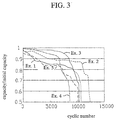
- FIG. 3 is a diagram illustrative of variations in ratio of capacity to initial capacity of batteries of Examples 1-5 versus cycle number
- FIG. 4 is a diagram illustrative of variations in voltage provided by batteries of Comparative Examples 1-4 versus discharge capacity wherein a discharge current is fixed at 1mA/cm 2 .
- FIG. 5 is a diagram illustrative of variations in ratio of capacity to initial capacity of batteries of Comparative Examples 1-4 versus cycle number.
- FIGS. 2 and 4 it is shown that the novel batteries of Examples 1-5 show voltage drops at higher discharge capacities as compared to the conventional batteries of Comparative Examples 1-4.
- the novel batteries of Examples 1-5 have higher available discharge as compared to the conventional batteries of Comparative Examples 1-4.
- the novel batteries of Examples 1-5 are much superior than the conventional batteries of Comparative Examples 1-4 in the voltage-discharge capacity characteristics.
- the novel batteries of Examples 1-5 have higher energy efficiency in a unit weight and higher energy efficiency in a unit weight than the conventional batteries of Comparative Examples 1-4.
- the novel batteries of Examples 1-5 show drops of the ratios of capacity to initial capacity at higher cyclic number as compared to the conventional batteries of Comparative Examples 1-4.
- the novel batteries of Examples 1-5 have higher durability as compared to the conventional batteries of Comparative Examples 1-4.
- the novel batteries of Examples 1-5 are much superior than the conventional batteries of Comparative Examples 1-4 in the durability or cyclic characteristic.
- the sulfuric acid was used as a dopant to the negative and positive electrodes 1 and 2.
- Polyphenyl quinoxaline was used as an active material for forming the negative and positive electrodes 1 and 2 shown in FIG. 1.
- the sulfuric acid was used as dopant to the negative and positive electrodes 1 and 2.
- the positive electrode 2 was prepared. Polyphenyl quinoxaline shown in the above general formula (8) was used as an active material. A vapor phase epitaxy carbon as the conductive auxiliary substance was mixed to polyphenyl quinoxaline at 1:1 in weight ratio of carbon to polyphenyl quinoxaline. Matacresol was further added at room temperature, in order to obtain a slurry. This slurry was then applied on a main face of the collector 4 by use of the doctor blade, whereby a film was formed on the main face of the collector 4'. The film was then dried in vacuum at 100-150°C for one hour Subsequently, the roll-press machine was used to press the film to make the film of 100 micrometers in thickness. The film was then cut to be shaped to form the positive electrode 2.
- the negative electrode 1 was prepared in the same manner as in Example 1. Polyphenyl quinoxaline shown in the above general formula (8) was used as an active material. A vapor phase epitaxy carbon as the conductive auxiliary substance was mixed to polyphenyl quinoxaline at 1:1 in weight ratio of carbon to polyphenyl quinoxaline. Matacresol was further added at room temperature, in order to obtain a slurry. This slurry was then applied on a main face of the collector 4 by use of the doctor blade, whereby a film was formed on the main face of the collector 4'. The film was then dried in vacuum at 100-150°C for one hour and thereafter an anneal was carried out. Subsequently, the roll-press machine was used to press the film to make the film of 100 micrometers in thickness. The film was then cut to be shaped to form the negative electrode 1.
- a sulfuric acid solution was used for subjecting the negative and positive electrodes 1 and 2 to the electrochemical or chemical doping.
- the doped negative and positive electrodes 1 and 2 were placed in opposite sides of the separator 3 immersed with the electrolytic solution, whereby to obtain the secondary battery.
- the secondary battery was charged to measure various characteristics thereof.
- the secondary battery was charged in the range of 1-10C up to 0.5V at a constant current in the range of 1-10 mA/cm2, where a theoretical capacity was 27.5 Wh/kg per the weight of the negative active material, for example, polyphenyl quinoxaline.
- the actual capacity did not depend upon the discharge rate and was 24Wh/kg per the weight of the negative active material.
- a ratio of the actual capacity to the theoretical capacity was high, for example, 87%.
- the cyclic characteristics were also measured. A cyclic number necessary for dropping the capacity to 80% of the initial capacity of 24Wh/kg was 9000.
- the reaction mechanism of polyphenyl quinoxaline was as shown in the above formula (10), wherein four electrons contribute to promote the reactions, whereby a great improvement in capacity of the battery can be obtained. Namely, there was obtained the battery which has a high energy efficiency in a unit volume and a high energy efficiency in a unit weight.
- polyaniline was used as an active material for forming the negative and positive electrodes 1 and 2 shown in FIG. 1.
- the sulfuric acid was also used as a dopant to the negative and positive electrodes 1 and 2.
- the positive electrode 2 was prepared. Polyaniline was used as an active material. A vapor phase epitaxy carbon as the conductive auxiliary substance was mixed to polyaniline at 1:1 in weight ratio of carbon to polyaniline. Matacresol was further added at room temperature, in order to obtain a slurry. This slurry was then applied on a main face of the collector 4 by use of the doctor blade, whereby a film was formed on the main face of the collector 4'. The film was then dried in vacuum at 100-150°C for one hour. Subsequently, the roll-press machine was used to press the film to make the film of 100 micrometers in thickness. The film was then cut to be shaped to form the positive electrode 2.
- the negative electrode 1 was prepared. Polyaniline was used as an active material. A vapor phase epitaxy carbon as the conductive auxiliary substance was mixed to polyaniline at 1:1 in weight ratio of carbon to polyaniline. Matacresol was further added at room temperature, in order to obtain a slurry. This slurry was then applied on a main face of the collector 4 by use of the doctor blade, whereby a film was formed on the main face of the collector 4'. The film was then dried in vacuum at 100-150°C for one hour and thereafter an anneal was carried out. Subsequently, the roll-press machine was used to press the film to make the film of 100 micrometers in thickness. The film was then cut to be shaped to form the negative electrode 1.
- a sulfuric acid solution was used for subjecting the negative and positive electrodes 1 and 2 to the electrochemical or chemical doping.
- the doped negative and positive electrodes 1 and 2 were placed in opposite sides of the separator 3 immersed with the electrolytic solution, whereby to obtain the secondary battery.
- the secondary battery was charged to measure various characteristics thereof.
- the secondary battery was charged in the range of 1-10C up to 0.5V at a constant current in the range of 1-10 mA/cm2, where a theoretical capacity was 21. 2Wh/kg per the weight of the negative active material, for example, polyaniline.
- the actual capacity did not depend upon the discharge rate and was 10Wh/kg per the weight of the negative active material.
- a ratio of the actual capacity to the theoretical capacity was high, for example, 47.2%.
- the cyclic characteristics were also measured. A cyclic number necessary for dropping the capacity to 80% of the initial capacity of 10Wh/kg was 10000.
- FIG. 6 is a diagram illustrative of variations in voltage of the novel battery of Example 6 and the conventional battery of Comparative Example 5 versus the discharge capacity, wherein the discharge current is fixed at 1mA/cm 2 .
- FIG. 7 is a diagram illustrative of variations in ratio of capacity to initial capacity of the novel battery of Example 6 and the conventional battery of Comparative Example 5 versus the cyclic number
- the novel battery of Example 6 shows a higher voltage versus the discharge capacity as compared to the conventional battery of Comparative Example 5.
- the novel battery of Example 6 has a higher available discharge as compared to the conventional battery of Comparative Example 5.
- the novel battery of Example 6 is much superior than the conventional battery of Comparative Example 5 in the voltage-discharge capacity characteristics.
- the novel battery of Example 6 has higher energy efficiency in a unit weight and higher energy efficiency in a unit weight than the conventional battery of Comparative Example 5.
- the novel battery of Example 6 shows the drop of the ratios of capacity to initial capacity at much higher cyclic number as compared to the conventional battery of Comparative Example 5.
- the novel battery of Example 6 has higher durability as compared to the conventional battery of Comparative Example 5.
- the novel battery of Example 6 is much superior than the conventional battery of Comparative Example 5 in the durability or cyclic characteristic.
Landscapes
- Chemical & Material Sciences (AREA)
- Health & Medical Sciences (AREA)
- Chemical Kinetics & Catalysis (AREA)
- Medicinal Chemistry (AREA)
- Polymers & Plastics (AREA)
- Organic Chemistry (AREA)
- Battery Electrode And Active Subsutance (AREA)
- Secondary Cells (AREA)
- Electric Double-Layer Capacitors Or The Like (AREA)
Abstract
Description
- The present invention relates to a battery and a capacitor, and more particularly to a battery and a capacitor which has electrodes including a quinoxaline resin, so that the battery and capacitor are highly stable chemically and electrically and also thermally stable and further have high capacitances.
- In the prior art, it has been known that a conductive martial film is formed on a surface of the electrode such as in a secondary battery and a capacitor. For the negative electrode or cathode, conductive polymers such as polythiophene, polyacetylene, polyphenylene, polypyridine, are available. In order to display the conductivity of those materials, it is necessary to do either oxidation electrochemistry by doping the material with a p-type dopant or reduction electrochemistry by doping the material with an n-type dopant.
- Those processes for oxidation or reduction are, however, complicated and also need to use a corrosiveness oxidizing agent such as iodine. Further, If I-, ClO4- or NR4 + (R = alkyl groups) is used as the dopant, the conductive material becomes unstable chemically and physically due to those dopant.
- As a result, if the above conductive material is used for the electrode, then the capacity is small and cyclic property is unstable.
- The above problems are caused by the doping processes, for which reason there has been developed materials usable for the electrode without doping process, for example, N-oxide polyquinolinediil polymers, polyquinoxalinediil, polymers, polypyridinediil polymers. Those conductive polymers are disclosed in Japanese laid-open patent publications No. 9-3171 and No. 9-124777.
- In Journal of Electrochemical Society, vol. 140, pp. 2498-2500, 1993, it is disclosed that polyphenylquinoxaline in a concentrated hydrochloric acid solution causes oxidation and reduction reactions as shown in below general formula (1), where choline ions (Cl-) are used as dopant.where polymerization degree is at least 5 and X- represents Cl-.

- In Journal of Electrochemical Society, vol. 145, pp. 1193-1196, 1998, it is disclosed that polyphenylquinoxaline displays a conductivity in high degree acidic solution, for example, 37%-hydrochloric acid, 70%-nitric acid, 99%-trifluoro sulfuric acid, 96%-sulfuric acid, whereby charge and discharge are caused in the same mechanism as shown in the above general formula. In a concentrated hydrochloric acid, a constant current charge was made to a film containing polyphenylquinoxaline to have confirmed that a capacitance is measured to be 125mAh/cm3.
- The above conductive material, however, has the following problems. The secondary battery using the conductive material has a structure as shown in FIG. 1. A positive electrode (an anode) 2 and a negative electrode (a cathode) 1 are separated by a
separator 3. The positive electrode (anode) 2 is in contact with asecond collector 4. The negative electrode (cathode) 3 is in contact with a first collector 4'. The positive and negative electrodes may be formed by applying the above conductive materials on theabove collectors 4 and 4', respectively. The conductive materials such as polyquinolinediil polymers, polyquinoxalinediil, polymers, polypyridinediil polymers are used for thenegative electrode 1. - The above conductive materials such as N-oxide polyquinolinediil polymers, polyquinoxalinediil, polymers, polypyridinediil polymers comprise aromatic heterocyclic compounds which show low reactivity in electrolytic solution and have low capacity and further which are soluble to water or organic solvents. For those reasons, if the above conductive materials are used for the secondary battery, then it is possible that the conductive material is eluted into the electrolytic solution whereby the capacity is remarkably reduced.
- Polyphenylquinoxaline as one of the above conductive materials has a large molecular weight of monomer as a unit. Polyphenylquinoxaline is further doped with chlorine ions as dopant as shown in the above general formula (1), wherein only two electrons serve in reaction, for which reason, a capacity per a unit volume or a unit weight is small.
- In the above circumstances, it had been required to develop novel electrode, battery and capacitor free from the above problem.
- Accordingly, it is an object of the present invention to provide a novel electrode free from the above problems.
- It is a further object of the present invention to provide a novel electrode which is unlikely to be eluted into an electrolytic solution.
- It is a still further object of the present invention to provide a novel battery which has a high capacity in a unit volume.
- It is yet a further object of the present invention to provide a novel battery which has a high energy efficiency in a unit volume.
- It is further more object of the present invention to provide a novel battery which has a high capacity in a unit weight.
- It is yet a further object of the present invention to provide a novel battery which has a high energy efficiency in a unit weight.
- It is moreover object of the present invention to provide a novel battery which has a high cyclic property.
- It is still more object of the present invention to provide a novel capacitor which has a high capacity.
- Additionally, it is an object of the present invention to provide a novel method of forming an electrode free from the above problems.
- It is a further object of the present invention to provide a novel method of forming an electrode which is unlikely to be eluted into an electrolytic solution.
- It is a still further object of the present invention to provide a novel method of forming a battery which has a high capacity in a unit volume.
- It is yet a further object of the present invention to provide a novel method of forming a battery which has a high energy efficiency in a unit volume.
- It is further more object of the present invention to provide a novel method of forming a battery which has a high capacity in a unit weight.
- It is yet a further object of the present invention to provide a novel method of forming a battery which has a high energy efficiency in a unit weight.
- It is moreover object of the present invention to provide a novel method of forming a battery which has a high cyclic property.
- It is still more object of the present invention to provide a novel method of forming a capacitor which has a high capacity.
- The present invention provides an electrode containing a quinoxaline resin and an electrolyte which includes at least one of sulfuric acid ions and sulfonic acid ions, or the electrolyte which includes cations having ion radius of not more than 3 angstroms.
- The above and other objects, features and advantages of the present invention will be apparent from the following descriptions.
- Preferred embodiments according to the present invention will be described in detail with reference to the accompanying drawings.
- FIG. 1 is a fragmentary cross sectional elevation view illustrative of a secondary battery which may cyclically usable upon charging the battery with an external power.
- FIG. 2 is a diagram illustrative of variations in voltage provided by batteries of Examples 1-5 versus discharge capacity wherein a discharge current is fixed at 1mA/cm2.
- FIG. 3 is a diagram illustrative of variations in ratio of capacity to initial capacity of batteries of Examples 1-5 versus cycle number.
- FIG. 4 is a diagram illustrative of variations in voltage provided by batteries of Comparative Examples 1-4 versus discharge capacity wherein a discharge current is fixed at 1mA/cm2.
- FIG. 5 is a diagram illustrative of variations in ratio of capacity to initial capacity of batteries of Comparative Examples 1-4 versus cycle number
- FIG. 6 is a diagram illustrative of variations in voltage of the novel battery of Example 6 and the conventional battery of Comparative Example 5 versus the discharge capacity, wherein the discharge current is fixed at 1mA/cm2.
- FIG. 7 is a diagram illustrative of variations in ratio of capacity to initial capacity of the novel battery of Example 6 and the conventional battery of Comparative Example 5 versus the cyclic number.
-
- The first present invention provides an electrode containing a quinoxaline resin and an electrolyte which includes at least one of sulfuric acid ions and sulfonic acid ions, so that sulfuric acid ions or sulfonic acid ions react with nitrogen atoms in quinoxaline rings in the quinoxaline resin, and whereby the number of electrons, which move in the oxidation and reduction reactions, are increased to promote the oxidation and reduction reactions between positive and negative electrodes, thereby allowing the device to have high energy efficiencies in a per unit volume or in a per unit weight, and further allowing the device to have a high capacity in a per unit volume or in a per unit weight.
- The second present invention also provides an electrode containing a quinoxaline resin and an electrolyte which includes cations having ion radius of not more than 3 angstroms, so that cations react with nitrogen atoms in quinoxaline rings in the quinoxaline resin, and whereby the number of electrons, which move in the oxidation and reduction reactions, are increased to promote the oxidation and reduction reactions between positive and negative electrodes thereby allowing the device to have high energy efficiencies in a per unit volume or in a per unit weight, and further allowing the device to have a high capacity in a per unit volume or in a per unit weight.
- The third present invention provides a battery having at least an electrode containing a quinoxaline resin and an electrolyte which includes at least one of sulfuric acid ions and sulfonic acid ions, so that sulfuric acid ions or sulfonic acid ions react with nitrogen atoms in quinoxaline rings in the quinoxaline resin and whereby the number of electrons, which move in the oxidation and reduction reactions, are increased to promote the oxidation and reduction reactions between positive and negative electrodes, thereby allowing the battery to have high energy efficiencies in a per unit volume or in a per unit weight, and further allowing the battery to have a high capacity in a per unit volume or in a per unit weight.
- The fourth present invention also provides a battery having at least an electrode containing a quinoxaline resin and an electrolyte which includes cations having ion radius of not more than 3 angstroms, so that cations react with nitrogen atoms in quinoxaline rings in the quinoxaline resin, and whereby the number of electrons, which move in the oxidation and reduction reactions, are increased to promote the oxidation and reduction reactions between positive and negative electrodes thereby allowing the battery to have high energy efficiencies in a per unit volume or in a per unit weight, and further allowing the battery to have a high capacity in a per unit volume or in a per unit weight.
- The fifth present invention provides a capacitor having at least an electrode containing a quinoxaline resin and an electrolyte which includes at least one of sulfuric acid ions and sulfonic acid ions, so that sulfuric acid ions or sulfonic acid ions react with nitrogen atoms in quinoxaline rings in the quinoxaline resin, and whereby the number of electrons, which move in the oxidation and reduction reactions, are increased to promote the oxidation and reduction reactions between positive and negative electrodes, thereby allowing the capacitor to have high energy efficiencies in a per unit volume or in a per unit weight, and further allowing the capacitor to have a high capacity in a per unit volume or in a per unit weight.
- The sixth present invention also provides a capacitor having at least an electrode containing a quinoxaline resin and an electrolyte which includes cations having ion radius of not more than 3 angstroms, so that cations react with nitrogen atoms in quinoxaline rings in the quinoxaline resin, and whereby the number of electrons, which move in the oxidation and reduction reactions, are increased to promote the oxidation and reduction reactions between positive and negative electrodes thereby allowing the capacitor to have high energy efficiencies in a per unit volume or in a per unit weight, and further allowing the capacitor to have a high capacity in a per unit volume or in a per unit weight.
- The seventh present invention also provides a method of forming an electrode comprising the steps of: forming a film containing a quinoxaline resin on a surface of a collector; and subjecting said quinoxaline resin to an electrolytic solution containing at least one of sulfuric acid ions and sulfonic acid ions for doping said quinoxaline resin with said electrolytic solution, so that sulfuric acid ions or sulfonic acid ions react with nitrogen atoms in quinoxaline rings in the quinoxaline resin, and whereby the number of electrons, which move in the oxidation and reduction reactions, are increased to promote the oxidation and reduction reactions between positive and negative electrodes, thereby allowing the device to have high energy efficiencies in a per unit volume or in a per unit weight, and further allowing the device to have a high capacity in a per unit volume or in a per unit weight.
- The method is also applicable to form a battery or a capacitor. If the method is applied to the battery, sulfuric acid ions or sulfonic acid ions react with nitrogen atoms in quinoxaline rings in the quinoxaline resin, and whereby the number of electrons, which move in the oxidation and reduction reactions, are increased to promote the oxidation and reduction reactions between positive and negative electrodes, thereby allowing the battery to have high energy efficiencies in a per unit volume or in a per unit weight, and further allowing the battery to have a high capacity in a per unit volume or in a per unit weight.
- If the method is applied to the capacitor, sulfuric acid ions or sulfonic acid ions react with nitrogen atoms in quinoxaline rings in the quinoxaline resin, and whereby the number of electrons, which move in the oxidation and reduction reactions, are increased to promote the oxidation and reduction reactions between positive and negative electrodes, thereby allowing the capacitor to have high energy efficiencies in a per unit volume or in a per unit weight, and further allowing the capacitor to have a high capacity in a per unit volume or in a per unit weight.
- The eighth present invention also provides a method of forming an electrode comprising the steps of: forming a film containing a quinoxaline resin on a surface of a collector; and subjecting said quinoxaline resin to an electrolytic solution which includes cations having ion radius of not more than 3 angstroms for doping said quinoxaline resin with said electrolytic solution, so that cations react with nitrogen atoms in quinoxaline rings in the quinoxaline resin, and whereby the number of electrons, which move in the oxidation and reduction reactions, are increased to promote the oxidation and reduction reactions between positive and negative electrodes thereby allowing the device to have high energy efficiencies in a per unit volume or in a per unit weight, and further allowing the device to have a high capacity in a per unit volume or in a per unit weight.
- The above method is also applicable to a battery or a capacitor. If the method is applied to the battery, so that cations react with nitrogen atoms in quinoxaline rings in the quinoxaline resin, and whereby the number of electrons, which move in the oxidation and reduction reactions, are increased to promote the oxidation and reduction reactions between positive and negative electrodes thereby allowing the battery to have high energy efficiencies in a per unit volume or in a per unit weight, and further allowing the capacitor to have a high battery in a per unit volume or in a per unit weight.
- If the method is applied to the capacitor, so that cations react with nitrogen atoms in quinoxaline rings in the quinoxaline resin, and whereby the number of electrons, which move in the oxidation and reduction reactions, are increased to promote the oxidation and reduction reactions between positive and negative electrodes thereby allowing the capacitor to have high energy efficiencies in a per unit volume or in a per unit weight, and further allowing the capacitor to have a high capacity in a per unit volume or in a per unit weight.
- A first embodiment according to the present invention will be described in detail with reference to the drawings. FIG. 1 is a fragmentary cross sectional elevation view illustrative of a secondary battery which may cyclically usable upon charging the battery with an external power. A positive electrode (an anode) 2 and a negative electrode (a cathode) 1 are separated by a
separator 3. The positive electrode (anode) 2 is in contact with asecond collector 4. The negative electrode (cathode) 3 is in contact with a first collector 4'. The positive and negative electrodes may be formed by applying the above conductive materials on theabove collectors 4 and 4', respectively. - The
negative electrode 1 comprises a film which includes a quinoxaline resin and an electrolyte which includes at least one of sulfuric acid ions and sulfonic acid ions. Alternatively, the electrolyte may include cations having ion radius of not more than 3 angstroms. The film of thenegative electrode 1 may have a thickness in the range of, for example, 20-500 micrometers, and preferably 50-200 micrometers. Thepositive electrode 2 may be made of any one of conductive active materials selected in various materials, for example, polymers such as polyaniline, low molecular weight materials, inorganic materials and metals. - The
separator 3 may be formed by dipping into a solution solved with the above-described electrolyte or by using a gelled electrolyte or a solid state electrolyte. The solid state electrolyte includes no solvent molecule. The gelled electrolyte may be obtained by plasticization of the solid state electrolyte with an electrolytic solution. The electrolytic solution may be obtained by solving the electrolyte having ion-conductivity without, however, electron-conductivity into an organic solvent or water. Each of thecollectors 4 and 4' may comprise a conductive material in the form of a sheet. - The quinoxaline resin may preferably be polyquinoline resins having cyclic units represented by the following general formulae (2) and (3) in view of operability, electronic properties and low hygroscopicity.where each of R1 and R2 represents any one of hydrogen atom, halogen atom, hydroxyl groups, sulfon groups, sulfuric acid groups, nitro groups, amino groups, alkyl-thio groups, aryl-thio groups, alkyl groups, aryl groups, alkoxy groups, allyl-oxy groups, holmyl groups (-COH), ketone groups (-COR3), ester groups (-CO2R4 or -OCOR5), amide groups (-NR6COR7 or - CONR8R9) hetero-aryl groups, cyano groups, and divalent hydrocarbon groups which may have unsaturated bonding, where each of R3-R9 represents any one of hydrogen atom, alkyl groups, aryl groups, and hetero-aryl groups, and each of m or m' represents any one of 0, 1, 2, 3, 4 or 5, and X represents any one of the direct chemical bonding without intervening any atoms or molecules, and indirect chemical bonding with intervening atoms or molecules, for example, -O-, -S-, -CO-, -SO-, -SO2-, - A-, -(-O-A-O-)-q, -Q-, -(-A-)-r, where q is the integer of 1-3, r is the integer of 1-500, A represents any one of -Ar1- (arylene groups), -Hr1- (hetero-arylene groups), -Ar1-O-Ar1-, -Ar1-CO-Ar1-, -Ar1-S-Ar1-, -Ar1-SO-Ar1-, - Ar1-SO2-Ar1-, -Ar1-Q-Ar1-, where Q is
 where each of L1 and L2 represents any one of methyl groups, trifluoromethyl groups, and divalent hydrocarbon groups which may have unsaturated bonding, and each of Z1 and Z2 represents any one of the direct chemical bonding without intervening any atoms or molecules, and arylene groups, and Y represents any one of the direct chemical bonding without intervening any atoms or molecules, and indirect chemical bonding with intervening atoms or molecules, for example, -O-, and -O-A-O-.
- The above alkyl groups may be, for example, methyl groups, ethyl groups, propyl groups, isopropyl groups, n-butyl groups, sec-butyl groups, tert-butyl groups, penthyl groups, cyclopenthyl groups, hexyl groups, cyclohexyl groups, heptyl groups, octyl groups, 2-ethylhexyl groups, decyl groups, undecyl groups, dodecyl groups, or dococyl groups. The above aryl groups may be, for example, phenyl groups, biphenyl groups, naphthyl groups, anthracenyl groups, or diphenyl groups. The above heteroaryl groups may be, for example, pyridyl groups, quinorinidyl, or pyradyl groups. The above arylene groups may be, for example, phenyl groups, biphenyl groups, naphthyl groups, anthracenyl groups, or diphenyl groups. The above hetero-arylene groups may be, for example, polyaniline groups, polypyrrole groups, polythiophene groups, polyphenylenevinylene groups, aryl-thio groups, pyridyl groups, pyrimidyl groups, pyridadyl groups, triadin, quinorinidyl groups, or pyradyl groups,
- The above divalent hydrocarbon groups, which may have unsaturated bonding formed by bonding two of R1 and two of R2 as well as two of L1 and two of L2, may be, for example, alkylene groups such as 1,3-propylene groups, 1,4-bytylene groups, 1,5-bentylene groups, given by the following general formula.
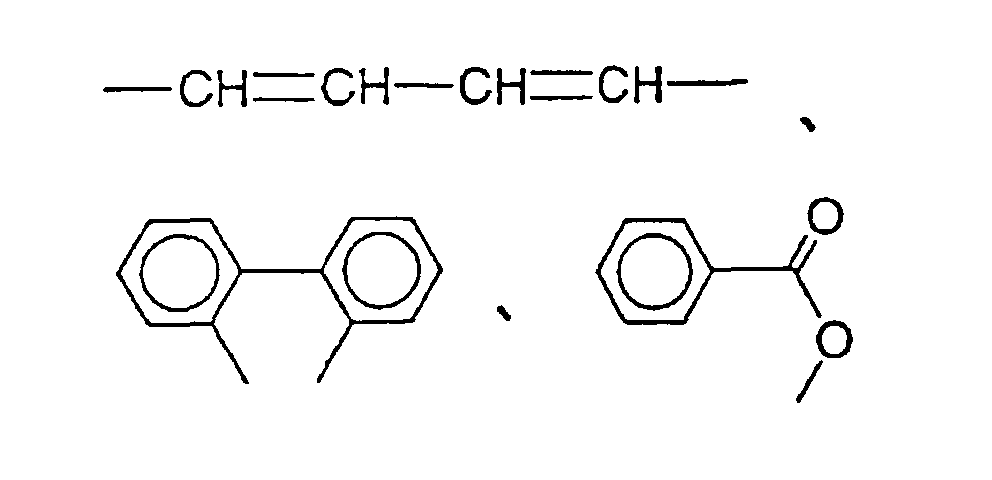
- The above quinoxaline resin is a polymer having quinoxaline ring in cyclic units. The polymerization degree of the quinoxaline resin should not be limited provided that the resin may be applied uniformly to form a substantially uniform thickness film. If the polymerization degree of the quinoxaline resin is extremely small, it is possible that the quinoxaline resin is dissolved into the electrolytic solution. It is, for example, preferable that the polymerization degree of the quinoxaline resin is in the range of 25-500, more preferably 50-250. A molecular weight of the quinoxaline resin may be changed in accordance with the object of forming the film or formation conditions. A weight average molecular weight of the quinoxaline resin may be, for example, in the range of 10000-1000000, preferably, 20000-100000. A number average molecular weight of the quinoxaline resin may be, for example, in the range of 3000-100000, preferably, 5000-10000.
- The quinoxaline resin may be synthesized in short processes without using an expensive catalyst as disclosed in Journal of Polymer Science vol. 5, 1453-1466, 1967.
- The electrode of the present invention contains the above quinoxaline resin and the electrolyte which includes at least one of sulfuric acid ions and sulfonic acid ions or which includes cations having ion radius of not more than 3 angstroms. The electrolyte including sulfuric acid ions is a substance which has a sulfuric acid group and which is dissociated into sulfuric acid ions in an electrolytic solution. Sulfuric acid is one example of the electrolyte including sulfuric acid ions. The electrolyte including sulfonic acid ions is a substance which has a sulfon group and which is dissociated into sulfonic acid ions in an electrolytic solution. Examples of the sulfonic acid ions are organic acids such as benzene sulfonic acid ions, p-toluene sulfonic acid ions, benzene chloride sulfonic acid ions, dodecyl benzene sulfonic acid ions, methane sulfonic acid ions, trifluoromethane sulfonic acid ions, butane sulfonic acid ions, trichlorobenzene sulfonic acid ions, naphthalene sulfonic acid ions, perfluorobutane sulfonic acid ions, perfluorooctane sulfonic acid ions, and polymer acids such as polystyrene sulfonic acid ions, polyvinyl sulfonic acid ions and Nafion®.
- The electrolyte including cations having ion radius of not more than 3 angstroms is a substance which is dissociated into cations having ion radius of not more than 3 angstroms in an electrolytic solution. Examples of the electrolyte including cations having ion radius of not more than 3 angstroms are proton, lithium ions, sodium ions, potassium ions, magnesium ions, calcium ions, barium ions, aluminum ions, iron ions, nickel ions, and tetramethylammonium ions.
- The method of forming the battery having the above novel negative electrode will be described.
- The above novel
negative electrode 1 may be formed as follows. A slurry including the quinoxaline resin, a conductive auxiliary substance and methacresol is formed on thecollector 4 by use of a doctor blade. After this slurry is dried in vacuum, a press-machine is used to form a film. Subsequently, the film is cut in a predetermined shape thereby forming thenegative electrode 1. - The above
positive electrode 2 may be formed as follows. A slurry including a conductive active material, a conductive auxiliary substance and a binder resin such as polyvinylidene fluoride is sufficiently stirred and then formed on thecollector 4 by use of a doctor blade. After this slurry is dried in vacuum, a press-machine is used to form a film. Subsequently, the film is cut in a predetermined shape thereby forming thepositive electrode 2. - Subsequently, an electrolytic solution is prepared, which is dissolved with the electrolyte including at least one of sulfuric acid ions and sulfonic acid ions or including cations having ion radius of not more than 3 angstroms. This electrolytic solution is used for electrochemically or chemically doping the negative and
positive electrodes electrolyte 3 is immersed with an electrolytic solution. The above negative andpositive electrodes electrolyte 3 so that the above negative andpositive electrodes electrolyte 3, thereby forming the secondary battery. If the electrolyte includes at least one of sulfuric acid ions and sulfonic acid ions, then this electrolytic solution may be prepared by solving the electrolyte into water. If the electrolyte includes including cations having ion radius of not more than 3 angstroms, then this electrolytic solution may be prepared by solving the electrolyte into an organic solvent. The kind of the electrolyte to be used for preparing the electrolytic solution should not be limited to the above. The kind of the above binder resin should not be limited to polyvinylidene fluoride. Any binder resins, which are unlikely to show corrosion to the electrolytic solution, are available. The kind of the above organic solvent to be used for the above electrolytic solution should not be limited, provided that the electrolyte is dissolved into the organic solvent. - If the doping to the quinoxaline resin is carried out by use of the electrolytic solution dissolved with the electrolyte including at least one of sulfuric acid ions and sulfonic acid ions, then oxidation reduction reactions are caused in ion-neutralized state (H3O+ HSO4- or H3O+ SO3-) in the electrolytic solution, for which reason the vicinity of the quinoxaline resin is placed into a state in excess of proton, whereby the oxidation and reduction reactions given by the following chemical formulae (4) and (5).

- In the above chemical formulae (4) and (5), X represents anions as dopant, for example, organic acid ions such as sulfuric acids ions, benzene sulfonic acid ions, p-toluene sulfonic acid ions, benzene chloride sulfonic acid ions, dodecyl benzene sulfonic acid ions, methane sulfonic acid ions, trifluoromethane sulfonic acid ions, butane sulfonic acid ions, trichlorobenzene sulfonic acid ions, naphthalene sulfonic acid ions, perfluorobutane sulfonic acid ions, perfluorooctane sulfonic acid ions, and polymer acids such as polystyrene sulfonic acid ions, polyvinyl sulfonic acid ions and Nafion®.
- In the oxidation and reduction reactions given by the chemical formula (4), two electrons contribute the reaction. In the oxidation and reduction reactions given by the chemical formula (5), four electrons contribute the reaction. A great increase in capacity of the battery can be obtained. Namely, the battery has a high energy efficiency in a unit volume and a high energy efficiency in a unit weight.
- In the prior art, chlorine ions (Cl-) are used for dopant and the reactions are shown by the above general formula (1). The number of electrons which contribute the oxidation reduction reactions given by the formulae (4) and (5) is double of the number of electrons which contribute the oxidation reduction reactions given by the formula (1). This causes the great increase in capacity of the novel secondary battery. Namely, the novel secondary battery has a high energy efficiency in a unit volume and a high energy efficiency in a unit weight.
- If the doping to the quinoxaline resin is carried out by use of the electrolytic solution prepared by dissolving an organic solvent with the electrolyte including cations having ion radius of not more than 3 angstroms, then at the same time of reaction of anions as dopant to the quinoxaline resin, cations are reacted with nitrogen atoms in the quinoxaline rings in the quinoxaline resin. The reaction mechanisms are shown in the following formulae (6) and (7).

- In the above chemical formulae (6) and (7), X represents anions as dopant which is not limited, and C represents an ion having ion radius of not more than 3 angstroms, for example, proton, lithium ions, sodium ions, potassium ions, magnesium ions, calcium ions, barium ions, aluminum ions, iron ions, nickel ions, and tetramethylammonium ions.
- If the ion radius were more than 3 angstroms, such large ions prevent cations from approaching in the vicinity of the quinoxaline rings, thereby inhibiting the doping reaction, whereby the reactivity of the oxidation reduction reaction is reduced. In order to prevent this problem, the electrolytic solution containing cations having ion radius of not more than 3 angstroms is used, thereby promoting the doping reaction so that a great increase in capacity can be obtained.
- As described above, in accordance with the present invention, the battery has the negative electrode containing a quinoxaline resin and an electrolyte which includes at least one of sulfuric acid ions and sulfonic acid ions, so that sulfuric acid ions or sulfonic acid ions react with nitrogen atoms in quinoxaline rings in the quinoxaline resin, and whereby the number of electrons, which move in the oxidation and reduction reactions, are increased to promote the oxidation and reduction reactions between positive and negative electrodes, thereby allowing the battery to have high energy efficiencies in a per unit volume or in a per unit weight, and further allowing the battery to have a high capacity in a per unit volume or in a per unit weight.
- Further, the doping process to the quinoxaline resin activates the oxidation and reduction reactions. The activated oxidation and reduction reactions show high speed reactions, thereby charge and discharge in high rate can be obtained.
- Furthermore, the quinoxaline resin is highly stable to the solvent so that almost no elution of the quinoxaline resin to the solvent is caused, whereby an increased adhesiveness between the electrode and the collector can be obtained.
- Moreover, the quinoxaline resin has extremely high chemical and electrical stability and a high thermal stability, so that the cyclic property of the battery is improved.
- In addition, the doped quinoxaline resin remains stable chemically and electrically, so that a self-discharge efficiency is extremely low, thereby preventing the battery from the self discharge.
- Alternatively, in accordance with the present invention, the battery has the negative electrode containing a quinoxaline resin and an electrolyte which includes cations having ion radius of not more than 3 angstroms, so that cations react with nitrogen atoms in quinoxaline rings in the quinoxaline resin, and whereby the number of electrons, which move in the oxidation and reduction reactions, are increased to promote the oxidation and reduction reactions between positive and negative electrodes, thereby allowing the battery to have high energy efficiencies in a per unit volume or in a per unit weight, and further allowing the battery to have a high capacity in a per unit volume or in a per unit weight.
- Further, the doping process to the quinoxaline resin activates the oxidation and reduction reactions. The activated oxidation and reduction reactions show high speed reactions, thereby charge and discharge in high rate can be obtained.
- Furthermore, the quinoxaline resin is highly stable to the solvent so that almost no elution of the quinoxaline resin to the solvent is caused, whereby an increased adhesiveness between the electrode and the collector can be obtained.
- Moreover, the quinoxaline resin has extremely high chemical and electrical stability and a high thermal stability, so that the cyclic property of the battery is improved.
- In addition, the doped quinoxaline resin remains stable chemically and electrically, so that a self-discharge efficiency is extremely low, thereby preventing the battery from the self-discharge.
- Polyphenylquinoxaline shown in the following general formula (8) was used as an active material for forming the
negative electrode 1 shown in FIG. 1. Polyaniline shown in the following general formula (9) was used as an active material for forming thepositive electrode 2 shown in FIG. 1. The trifluoromethane sulfonic acid was used as dopant to the negative andpositive electrodes 
- The
positive electrode 2 was prepared. Polyaniline shown in the above general formula (9) was used as an active material. A vapor phase epitaxy carbon as the conductive auxiliary substance was mixed to polyaniline at 4:1 in weight ratio of carbon to polyaniline. Polyvinylidene fluoride having an average molecular weight of 1100 as the binder resin was further added at 8% by weight, in order to obtain a slurry. This slurry was stirred by homogenizer. This slurry was then applied on a main face of the collector 4' by use of the doctor blade, whereby a film was formed on the main face of the collector 4'. The film was then dried in vacuum at 100-150°C for one hour. Subsequently, the roll-press machine was used to press the film to make the film of 100 micrometers in thickness. The film was then cut to be shaped to form thepositive electrode 2. - The
negative electrode 1 was prepared. Polyphenyl quinoxaline shown in the above general formula (8) was used as an active material. A vapor phase epitaxy carbon as the conductive auxiliary substance was mixed to polyphenyl quinoxaline at 1:1 in weight ratio of carbon to polyphenyl quinoxaline. Matacresol was further added at room temperature, in order to obtain a slurry. This slurry was then applied on a main face of thecollector 4 by use of the doctor blade, whereby a film was formed on the main face of the collector 4'. The film was then dried in vacuum at 100-150°C for one hour and thereafter an anneal was carried out. Subsequently, the roll-press machine was used to press the film to make the film of 100 micrometers in thickness. The film was then cut to be shaped to form thenegative electrode 1. - A trifluoromethane sulfonic acid solution was used for subjecting the negative and
positive electrodes positive electrodes separator 3 immersed with the electrolytic solution, whereby to obtain the secondary battery. - The secondary battery was charged to measure various characteristics thereof. The secondary battery was charged in the range of 1-10C up to 0.9V at a constant current in the range of 1-10 mA/cm2, where a theoretical capacity was 198Wh/kg per the weight of the negative active material, for example, polyphenyl quinoxaline. The actual capacity did not depend upon the discharge rate and was 135 Wh/kg per the weight of the negative active material. A ratio of the actual capacity to the theoretical capacity was high, for example, 68%. The cyclic characteristics were also measured. A cyclic number necessary for dropping the capacity to 80% of the initial capacity of 135Wh/kg was 9000. A capacity storage characteristic was also measured. After the battery was placed at 25°C for 30 days, then the capacity was reduced to 80% of the initial capacity. Namely, the capacity showed such the characteristics as a lithium ion battery or a nickel hydrogen battery.
- The reaction mechanism of polyphenyl quinoxaline was as shown in the following formula (10), wherein four electrons contribute to promote the reactions, whereby a great improvement in capacity of the battery can be obtained. Namely, there was obtained the battery which has a high energy efficiency in a unit volume and a high energy efficiency in a unit weight.
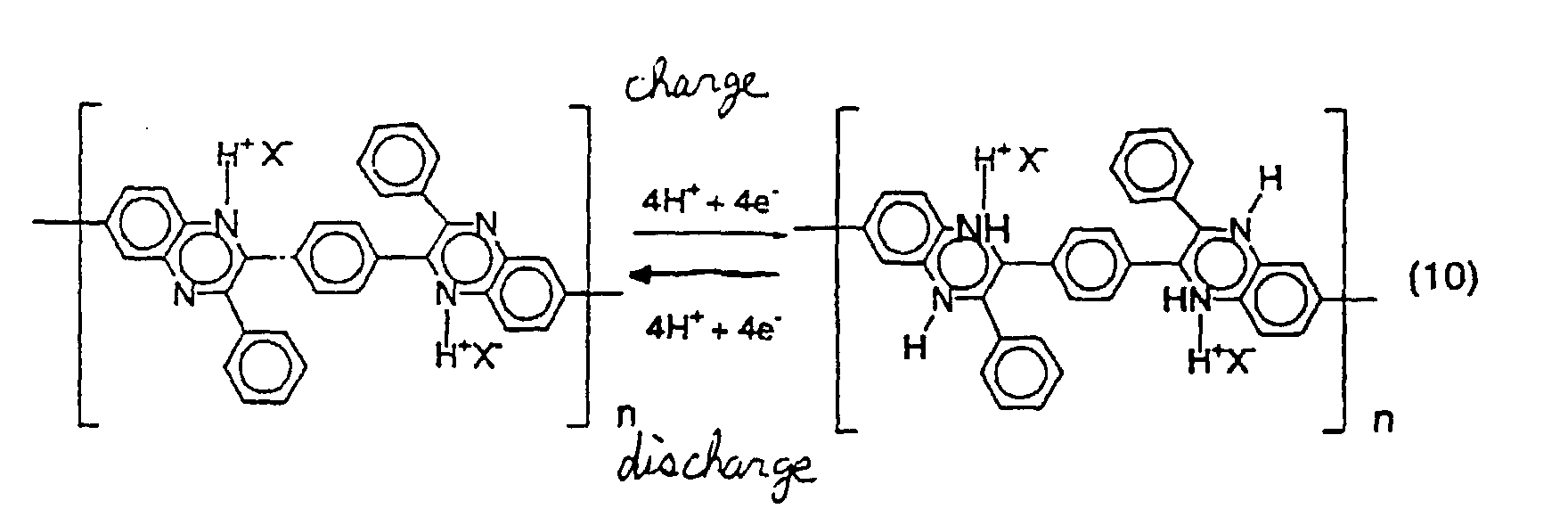
- In this example, the trifluoromethane sulfonic acid solution was used as the electrolytic solution. However, other electrolytic solution may be used. Polyvinylidene fluoride was used as the binder resin. Other binder resins showing no corrosion to the electrolytic solution may be available.
- In this example, the polyvinyl sulfonic acid was used as a dopant to the negative and
positive electrodes - Similarly to Example 1, polyphenyl quinoxaline was used as an active material for forming the
negative electrode 1 shown in FIG. 1. Polyaniline was used as an active material for forming thepositive electrode 2 shown in FIG. 1. The polyvinyl sulfonic acid was used as dopant to the negative andpositive electrodes - The
positive electrode 2 was prepared in the same manner as in Example 1. Polyaniline shown in the above general formula (9) was used as an active material. A vapor phase epitaxy carbon as the conductive auxiliary substance was mixed to polyaniline at 4:1 in weight ratio of carbon to polyaniline. Polyvinylidene fluoride having an average molecular weight of 1100 as the binder resin was further added at 8% by weight in order to obtain a slurry. This slurry was stirred by homogenizer. This slurry was then applied on a main face of the collector 4' by use of the doctor blade, whereby a film was formed on the main face of the collector 4'. The film was then dried in vacuum at 100-150°C for one hour. Subsequently, the roll-press machine was used to press the film to make the film of 100 micrometers in thickness. The film was then cut to be shaped to form thepositive electrode 2. - The
negative electrode 1 was prepared in the same manner as in Example 1. Polyphenyl quinoxaline shown in the above general formula (8) was used as an active material. A vapor phase epitaxy carbon as the conductive auxiliary substance was mixed to polyphenyl quinoxaline at 1:1 in weight ratio of carbon to polyphenyl quinoxaline. Matacresol was further added at room temperature, in order to obtain a slurry. This slurry was then applied on a main face of thecollector 4 by use of the doctor blade, whereby a film was formed on the main face of the collector 4'. The film was then dried in vacuum at 100-150°C for one hour and thereafter an anneal was carried out. Subsequently, the roll-press machine was used to press the film to make the film of 100 micrometers in thickness. The film was then cut to be shaped to form thenegative electrode 1. - A polyvinyl sulfonic acid solution was used for subjecting the negative and
positive electrodes positive electrodes separator 3 immersed with the electrolytic solution, whereby to obtain the secondary battery. - The secondary battery was charged to measure various characteristics thereof The secondary battery was charged in the range of 1-10C up to 0.9V at a constant current in the range of 1-10 mA/cm2, where a theoretical capacity was 198Wh/kg per the weight of the negative active material, for example, polyphenyl quinoxaline. The actual capacity did not depend upon the discharge rate and was 160Wh/kg per the weight of the negative active material. A ratio of the actual capacity to the theoretical capacity was high, for example, 81%. The cyclic characteristics were also measured. A cyclic number necessary for dropping the capacity to 80% of the initial capacity of 160Wh/kg was 11000. A capacity storage characteristic was also measured. After the battery was placed at 25°C for 30 days, then the capacity was reduced to 80% of the initial capacity. Namely, the capacity showed such the characteristics as a lithium ion battery or a nickel hydrogen battery.
- The reaction mechanism of polyphenyl quinoxaline was as shown in the above formula (10), wherein four electrons contribute to promote the reactions, whereby a great improvement in capacity of the battery can be obtained. Namely, there was obtained the battery which has a high energy efficiency in a unit volume and a high energy efficiency in a unit weight.
- In this example, the polyvinyl sulfonic acid solution was used as the electrolytic solution. However, other electrolytic solution may be used. The use of polymer dopant causes a further increase in concentration of proton around polyphenyl quinoxaline whereby the reactivity was increased and the high capacity was obtained. The use of polymer dopant prevents de-doping whereby the cyclic property was improved.
- In this example, a sulfuric acid having sulfuric acid groups was used as a dopant to the negative and
positive electrodes - Similarly to Example 1, polyphenyl quinoxaline was used as an active material for forming the
negative electrode 1 shown in FIG. 1. Polyaniline was used as an active material for forming thepositive electrode 2 shown in FIG. 1. The sulfuric acid was used as dopant to the negative andpositive electrodes - The
positive electrode 2 was prepared in the same manner as in Example 1. Polyaniline shown in the above general formula (9) was used as an active material. A vapor phase epitaxy carbon as the conductive auxiliary substance was mixed to polyaniline at 4:1 in weight ratio of carbon to polyaniline. Polyvinylidene fluoride having an average molecular weight of 1100 as the binder resin was further added at 8% by weight, in order to obtain a slurry. This slurry was stirred by homogenizer. This slurry was then applied on a main face of the collector 4' by use of the doctor blade, whereby a film was formed on the main face of the collector 4'. The film was then dried in vacuum at 100-150°C for one hour. Subsequently, the roll-press machine was used to press the film to make the film of 100 micrometers in thickness. The film was then cut to be shaped to form thepositive electrode 2. - The
negative electrode 1 was prepared in the same manner as in Example 1. Polyphenyl quinoxaline shown in the above general formula (8) was used as an active material. A vapor phase epitaxy carbon as the conductive auxiliary substance was mixed to polyphenyl quinoxaline at 1:1 in weight ratio of carbon to polyphenyl quinoxaline. Matacresol was further added at room temperature, in order to obtain a slurry. This slurry was then applied on a main face of thecollector 4 by use of the doctor blade, whereby a film was formed on the main face of the collector 4'. The film was then dried in vacuum at 100-150°C for one hour and thereafter an anneal was carried out. Subsequently, the roll-press machine was used to press the film to make the film of 100 micrometers in thickness. The film was then cut to be shaped to form thenegative electrode 1. - A sulfuric acid solution was used for subjecting the negative and
positive electrodes positive electrodes separator 3 immersed with the electrolytic solution, whereby to obtain the secondary battery. - The secondary battery was charged to measure various characteristics thereof. The secondary battery was charged in the range of 1-10C up to 0.9V at a constant current in the range of 1-10 mA/cm2, where a theoretical capacity was 198Wh/kg per the weight of the negative active material, for example, polyphenyl quinoxaline. The actual capacity did not depend upon the discharge rate and was 170Wh/kg per the weight of the negative active material. A ratio of the actual capacity to the theoretical capacity was high, for example, 86%. The cyclic characteristics were also measured. A cyclic number necessary for dropping the capacity to 80% of the initial capacity of 170Wh/kg was 9000. A capacity storage characteristic was also measured. After the battery was placed at 25°C for 30 days, then the capacity was reduced to 80% of the initial capacity. Namely, the capacity showed such the characteristics as a lithium ion battery or a nickel hydrogen battery.
- The reaction mechanism of polyphenyl quinoxaline was as shown in the above formula (10), wherein four electrons contribute to promote the reactions, whereby a great improvement in capacity of the battery can be obtained. Namely, there was obtained the battery which has a high energy efficiency in a unit volume and a high energy efficiency in a unit weight.
- In this example, the sulfuric acid solution was used as the electrolytic solution. However, other electrolytic solution may be used. The use of polymer dopant causes a further increase in concentration of proton around polyphenyl quinoxaline whereby the reactivity was increased and the high capacity was obtained. The use of polymer dopant prevents de-doping whereby the cyclic property was improved.
- In this example, a lithium trifluoromethane sulfonic acid was used as a dopant to the negative and
positive electrodes - Similarly to Example 1, polyphenyl quinoxaline was used as an active material for forming the
negative electrode 1 shown in FIG. 1. Polyaniline was used as an active material for forming thepositive electrode 2 shown in FIG. 1. The lithium trifluoromethane sulfonic acid was used as dopant to the negative andpositive electrodes - The
positive electrode 2 was prepared in the same manner as in Example 1. Polyaniline shown in the above general formula (9) was used as an active material. A vapor phase epitaxy carbon as the conductive auxiliary substance was mixed to polyaniline at 4:1 in weight ratio of carbon to polyaniline. Polyvinylidene fluoride having an average molecular weight of 1100 as the binder resin was further added at 8% by weight, in order to obtain a slurry. This slurry was stirred by homogenizer. This slurry was then applied on a main face of the collector 4' by use of the doctor blade, whereby a film was formed on the main face of the collector 4'. The film was then dried in vacuum at 100-150°C for one hour. Subsequently, the roll -press machine was used to press the film to make the film of 100 micrometers in thickness. The film was then cut to be shaped to form thepositive electrode 2. - The
negative electrode 1 was prepared in the same manner as in Example 1. Polyphenyl quinoxaline shown in the above general formula (8) was used as an active material. A vapor phase epitaxy carbon as the conductive auxiliary substance was mixed to polyphenyl quinoxaline at 1:1 in weight ratio of carbon to polyphenyl quinoxaline. Matacresol was further added at room temperature, in order to obtain a slurry. This slurry was then applied on a main face of thecollector 4 by use of the doctor blade, whereby a film was formed on the main face of the collector 4'. The film was then dried in vacuum at 100-150°C for one hour and thereafter an anneal was carried out. Subsequently, the roll-press machine was used to press the film to make the film of 100 micrometers in thickness. The film was then cut to be shaped to form thenegative electrode 1. - A lithium trifluoromethane sulfonic acid solution was used for subjecting the negative and
positive electrodes positive electrodes separator 3 immersed with the electrolytic solution, whereby to obtain the secondary battery. - The secondary battery was charged to measure various characteristics thereof. The secondary battery was charged in the range of 1-10C up to 2.2V at a constant current in the range of 1-10 mA/cm2, where a theoretical capacity was 484Wh/kg per the weight of the negative active material, for example, polyphenyl quinoxaline. The actual capacity did not depend upon the discharge rate and was 330Wh/kg per the weight of the negative active material. A ratio of the actual capacity to the theoretical capacity was high, for example, 68%. The cyclic characteristics were also measured. A cyclic number necessary for dropping the capacity to 80% of the initial capacity of 330Wh/kg was 7000. A capacity storage characteristic was also measured. After the battery was placed at 25°C for 30 days, then the capacity was reduced to 80% of the initial capacity. Namely, the capacity showed such the characteristics as a lithium ion battery or a nickel hydrogen battery.
- A great improvement in capacity of the battery can be obtained. Namely, there was obtained the battery which has a high energy efficiency in a unit volume and a high energy efficiency in a unit weight.
- In this example, the lithium trifluoromethane sulfonic acid solution was used as the dopant. PC/EC mixing organic solvent was used for the electrolytic solution. However, other electrolytic solution may be used. The use of organic solvent for the electrolytic solution causes the increase in electromotive force and also the increase in energy density of the capacitor It is not necessary to limit the above PC/EC mixing solvent for the electrolytic solution.
- In this example, lithium perchlorate was used as a dopant to the negative arid
positive electrodes - Similarly to Example 1, polyphenyl quinoxaline was used as an active material for forming the
negative electrode 1 shown in FIG. 1. Polyaniline was used as an active material for forming thepositive electrode 2 shown in FIG. 1. The lithium trifluoromethane sulfonic acid was used as dopant to the negative andpositive electrodes - The
positive electrode 2 was prepared in the same manner as in Example 1. Polyaniline shown in the above general formula (9) was used as an active material. A vapor phase epitaxy carbon as the conductive auxiliary substance was mixed to polyaniline at 4:1 in weight ratio of carbon to polyaniline. Polyvinylidene fluoride having an average molecular weight of 1100 as the binder resin was further added at 8% by weight, in order to obtain a slurry. This slurry was stirred by homogenizer. This slurry was then applied on a main face of the collector 4' by use of the doctor blade, whereby a film was formed on the main face of the collector 4'. The film was then dried in vacuum at 100-150°C for one hour. Subsequently, the roll-press machine was used to press the film to make the film of 100 micrometers in thickness. The film was then cut to be shaped to form thepositive electrode 2. - The
negative electrode 1 was prepared in the same manner as in Example 1. Polyphenyl quinoxaline shown in the above general formula (8) was used as an active material. A vapor phase epitaxy carbon as the conductive auxiliary substance was mixed to polyphenyl quinoxaline at 1:1 in weight ratio of carbon to polyphenyl quinoxaline. Matacresol was further added at room temperature, in order to obtain a slurry. This slurry was then applied on a main face of thecollector 4 by use of the doctor blade, whereby a film was formed on the main face of the collector 4'. The film was then dried in vacuum at 100-150°C for one hour and thereafter an anneal was carried out. Subsequently, the roll-press machine was used to press the film to make the film of 100 micrometers in thickness. The film was then cut to be shaped to form thenegative electrode 1. - A lithium perchlorate solution was used for subjecting the negative and
positive electrodes positive electrodes separator 3 immersed with the electrolytic solution, whereby to obtain the secondary battery. - The secondary battery was charged to measure various characteristics thereof. The secondary battery was charged in the range of 1-10C up to 2.2V at a constant current in the range of 1-10 mA/cm2, where a theoretical capacity was 484Wh/kg per the weight of the negative active material, for example, polyphenyl quinoxaline. The actual capacity did not depend upon the discharge rate and was 354Wh/kg per the weight of the negative active material. A ratio of the actual capacity to the theoretical capacity was high, for example, 73%. The cyclic characteristics were also measured. A cyclic number necessary for dropping the capacity to 80% of the initial capacity of 354Wh/kg was 7000. A capacity storage characteristic was also measured. After the battery was placed at 25°C for 30 days, then the capacity was reduced to 80% of the initial capacity. Namely, the capacity showed such the characteristics as a lithium ion battery or a nickel hydrogen battery.
- A great improvement in capacity of the battery can be obtained. Namely, there was obtained the battery, which has a high energy efficiency in a unit volume and a high energy efficiency in a unit weight.
- In this example, the lithium perchlorate as acid was used to increase the ion-conductivity so as to allow high rate charge and discharge. PC/EC mixing organic solvent was used for the electrolytic solution. However, other electrolytic solution may be used. The use of organic solvent for the electrolytic solution causes the increase in electromotive force and also the increase in energy density of the capacitor. It is not necessary to limit the above PC/EC mixing solvent for the electrolytic solution.
- In this comparative example, in place of trifluoromethane sulfonic acid used in Example 1, a phosphoric acid was used as a dopant to the negative and
positive electrodes - Similarly to Example 1, polyphenyl quinoxaline was used as an active material for forming the negative electrode I shown in FIG. 1. Polyaniline was used as an active material for forming the
positive electrode 2 shown in FIG. 1. The phosphoric acid was used as dopant to the negative andpositive electrodes - The
positive electrode 2 was prepared in the same manner as in Example 1. Polyaniline shown in the above general formula (9) was used as an active material. A vapor phase epitaxy carbon as the conductive auxiliary substance was mixed to polyaniline at 4:1 in weight ratio of carbon to polyaniline. Polyvinylidene fluoride having an average molecular weight of 1100 as the binder resin was further added at 8% by weight, in order to obtain a slurry. This slurry was stirred by homogenizer. This slurry was then applied on a main face of the collector 4' by use of the doctor blade, whereby a film was formed on the main face of the collector 4'. The film was then dried in vacuum at 100-150°C for one hour. Subsequently, the roll-press machine was used to press the film to make the film of 100 micrometers in thickness. The film was then cut to be shaped to form thepositive electrode 2. - The
negative electrode 1 was prepared in the same manner as in Example 1. Polyphenyl quinoxaline shown in the above general formula (8) was used as an active material. A vapor phase epitaxy carbon as the conductive auxiliary substance was mixed to polyphenyl quinoxaline at 1:1 in weight ratio of carbon to polyphenyl quinoxaline. Matacresol was further added at room temperature, in order to obtain a slurry. This slurry was then applied on a main face of thecollector 4 by use of the doctor blade, whereby a film was formed on the main face of the collector 4'. The film was then dried in vacuum at 100-150°C for one hour and thereafter an anneal was carried out. Subsequently, the roll-press machine was used to press the film to make the film of 100 micrometers in thickness. The film was then cut to be shaped to form thenegative electrode 1. - A phosphoric acid solution was used for subjecting the negative and
positive electrodes positive electrodes separator 3 immersed with the electrolytic solution, whereby to obtain the secondary battery. - The secondary battery was charged to measure various characteristics thereof The secondary battery was charged in the range of 1-10C up to 0.9V at a constant current in the range of 1-10 mA/cm2, where a theoretical capacity was 198Wh/kg per the weight of the negative active material, for example, polyphenyl quinoxaline. The actual capacity did not depend upon the discharge rate and was 50Wh/kg per the weight of the negative active material. A ratio of the actual capacity to the theoretical capacity was high, for example, 25%. The cyclic characteristics were also measured. A cyclic number necessary for dropping the capacity to 80% of the initial capacity of 50Wh/kg was 9000. A capacity storage characteristic was also measured. After the battery was placed at 25°C for 30 days, then the capacity was reduced to 80% of the initial capacity.
- In this comparative example, in place of trifluoromethane sulfonic acid used in Example 1, a trifluoroacetic acid was used as a dopant to the negative and
positive electrodes - Similarly to Example 1, polyphenyl quinoxaline was used as an active material for forming the
negative electrode 1 shown in FIG. 1. Polyaniline was used as an active material for forming thepositive electrode 2 shown in FIG. 1. The trifluoroacetic acid was used as dopant to the negative andpositive electrodes - The
positive electrode 2 was prepared in the same manner as in Example 1. Polyaniline shown in the above general formula (9) was used as an active material. A vapor phase epitaxy carbon as the conductive auxiliary substance was mixed to polyaniline at 4:1 in weight ratio of carbon to polyaniline. Polyvinylidene fluoride having an average molecular weight of 1100 as the binder resin was further added at 8% by weight, in order to obtain a slurry. This slurry was stirred by homogenizer. This slurry was then applied on a main face of the collector 4' by use of the doctor blade, whereby a film was formed on the main face of the collector 4'. The film was then dried in vacuum at 100-150°C for one hour. Subsequently, the roll-press machine was used to press the film to make the film of 100 micrometers in thickness. The film was then cut to be shaped to form thepositive electrode 2. - The
negative electrode 1 was prepared in the same manner as in Example 1. Polyphenyl quinoxaline shown in the above general formula (8) was used as an active material. A vapor phase epitaxy carbon as the conductive auxiliary substance was mixed to polyphenyl quinoxaline at 1:1 in weight ratio of carbon to polyphenyl quinoxaline. Matacresol was further added at room temperature, in order to obtain a shiny. This slurry was then applied on a main face of thecollector 4 by use of the doctor blade, whereby a film was formed on the main face of the collector 4'. The film was then dried in vacuum at 100-150°C for one hour and thereafter an anneal was carried out. Subsequently, the roll-press machine was used to press the film to make the film of 100 micrometers in thickness. The film was then cut to be shaped to form thenegative electrode 1. - A trifluoroacetic acid solution was used for subjecting the negative and
positive electrodes positive electrodes separator 3 immersed with the electrolytic solution, whereby to obtain the secondary battery. - The secondary battery was charged to measure various characteristics thereof. The secondary battery was charged in the range of 1-10C up to 0.9V at a constant current in the range of 1-10 mA/cm2, where a theoretical capacity was 198Wh/kg per the weight of the negative active material, for example, polyphenyl quinoxaline. The actual capacity did not depend upon the discharge rate and was 60Wh/kg per the weight of the negative active material. A ratio of the actual capacity to the theoretical capacity was high, for example, 30%. The cyclic characteristics were also measured. A cyclic number necessary for dropping the capacity to 80% of the initial capacity of 60Wh/kg was 5000. A capacity storage characteristic was also measured. After the battery was placed at 25°C for 1 hour, then the capacity was reduced to 20% of the initial capacity.
- In this comparative example, in place of trifluoromethane sulfonic acid used in Example 1, a hydrochloric acid was used as a dopant to the negative and
positive electrodes - Similarly to Example 1, polyphenyl quinoxaline was used as an active material for forming the
negative electrode 1 shown in FIG. 1. Polyaniline was used as an active material for forming thepositive electrode 2 shown in FIG. 1. The hydrochloric acid was used as dopant to the negative andpositive electrodes - The
positive electrode 2 was prepared in the same manner as in Example 1. Polyaniline shown in the above general formula (9) was used as an active material. A vapor phase epitaxy carbon as the conductive auxiliary substance was mixed to polyaniline at 4:1 in weight ratio of carbon to polyaniline. Polyvinylidene fluoride having an average molecular weight of 1100 as the binder resin was further added at 8% by weight, in order to obtain a slurry. This slurry was stirred by homogenizer. This slurry was then applied on a main face of the collector 4' by use of the doctor blade, whereby a film was formed on the main face of the collector 4'. The film was then dried in vacuum at 100-150°C for one hour. Subsequently, the roll-press machine was used to press the film to make the film of 100 micrometers in thickness. The film was then cut to be shaped to form thepositive electrode 2. - The
negative electrode 1 was prepared in the same manner as in Example 1. Polyphenyl quinoxaline shown in the above general formula (8) was used as an active material. A vapor phase epitaxy carbon as the conductive auxiliary substance was mixed to polyphenyl quinoxaline at 1:1 in weight ratio of carbon to polyphenyl quinoxaline. Matacresol was further added at room temperature, in order to obtain a slurry. This slurry was then applied on a main face of thecollector 4 by use of the doctor blade, whereby a film was formed on the main face of the collector 4'. The film was then dried in vacuum at 100-150°C for one hour and thereafter an anneal was carried out. Subsequently, the roll-press machine was used to press the film to make the film of 100 micrometers in thickness. The film was then cut to be shaped to form thenegative electrode 1. - A hydrochloric acid solution was used for subjecting the negative and
positive electrodes positive electrodes separator 3 immersed with the electrolytic solution, whereby to obtain the secondary battery. - The secondary battery was charged to measure various characteristics thereof. The secondary battery was charged in the range of 1-10C up to 0. 9V at a constant current in the range of 1-10 mA/cm2, where a theoretical capacity was 198Wh/kg per the weight of the negative active material, for example, polyphenyl quinoxaline. The actual capacity did not depend upon the discharge rate and was 90Wh/kg per the weight of the negative active material. A ratio of the actual capacity to the theoretical capacity was high, for example, 45%. The cyclic characteristics were also measured. A cyclic number necessary for dropping the capacity to 80% of the initial capacity of 90Wh/kg was 1000. A capacity storage characteristic was also measured. After the battery was placed at 25°C for 1 hour, then the capacity was reduced to 20% of the initial capacity.
- In this comparative example, in place of lithium perchlorate used in Example 5, tetraethylammonium tetrafluoroborate was used as a dopant to the negative and
positive electrodes - Similarly to Example 1, polyphenyl quinoxaline was used as an active material for forming the
negative electrode 1 shown in FIG. 1. Polyaniline was used as an active material for forming thepositive electrode 2 shown in FIG. 1. Ttetraethylammonium tetrafluoroborate was used as dopant to the negative andpositive electrodes - The
positive electrode 2 was prepared in the same manner as in Example 1. Polyaniline shown in the above general formula (9) was used as an active material. A vapor phase epitaxy carbon as the conductive auxiliary substance was mixed to polyaniline at 4:1 in weight ratio of carbon to polyaniline. Polyvinylidene fluoride having an average molecular weight of 1100 as the binder resin was further added at 8% by weight, in order to obtain a slurry. This slurry was stirred by homogenizer. This slurry was then applied on a main face of the collector 4' by use of the doctor blade, whereby a film was formed on the main face of the collector 4'. The film was then dried in vacuum at 100-150°C for one hour. Subsequently, the roll-press machine was used to press the film to make the film of 100 micrometers in thickness. The film was then cut to be shaped to form thepositive electrode 2. - The
negative electrode 1 was prepared in the same manner as in Example 1. Polyphenyl quinoxaline shown in the above general formula (8) was used as an active material. A vapor phase epitaxy carbon as the conductive auxiliary substance was mixed to polyphenyl quinoxaline at 1:1 in weight ratio of carbon to polyphenyl quinoxaline. Matacresol was further added at room temperature, in order to obtain a slurry. This slurry was then applied on a main face of thecollector 4 by use of the doctor blade, whereby a film was formed on the main face of the collector 4'. The film was then dried in vacuum at 100-150°C for one hour and thereafter an anneal was carried out. Subsequently, the roll-press machine was used to press the film to make the film of 100 micrometers in thickness. The film was then cut to be shaped to form thenegative electrode 1. - A tetraethylammonium tetrafluoroborate solution was used for subjecting the negative and
positive electrodes positive electrodes separator 3 immersed with the electrolytic solution, whereby to obtain the secondary battery. - The secondary battery was charged to measure various characteristics thereof. The secondary battery was charged in the range of 1-10C up to 2.2V at a constant current in the range of 1-10 mA/cm2, where a theoretical capacity was 484Wh/kg per the weight of the negative active material, for example, polyphenyl quinoxaline. The actual capacity did not depend upon the discharge rate and was 100Wh/kg per the weight of the negative active material. A ratio of the actual capacity to the theoretical capacity was high, for example, 21%. The cyclic characteristics were also measured. A cyclic number necessary for dropping the capacity to 80% of the initial capacity of 484Wh/kg was 7000. A capacity storage characteristic was also measured. After the battery was placed at 25°C for 30 days, then the capacity was reduced to 80% of the initial capacity.
- The following table 1 shows characteristics of the batteries of Examples 1-5, and Comparative Examples 1-4.
anion (dopant) cation electrolytic solution voltage (V) capacity (Wh/kg) cyclic property (80%) 1C 10C 25° C 40°C 65°C Ex. 1 CF SO
H+ water 0.9 135 130 9000 8000 5000 Ex. 2 PVSA H+ water 0.9 160 155 11000 10000 8000 Ex.3 HOS or SO
H+ water 0.9 170 155 9000 8000 5000 Ex.4 CF Li+ PC/EC 2.2 330 300 7000 6000 4000 Ex.5 ClO 
Li+ PC/EC 2.2 345 330 7000 6000 4000 Co.1 H PO
H+ water 0.9 50 45 9000 8000 5000 Co.2 CF H+ water 0.9 60 55 5000 2500 1000 Co.3 Cl H+ water 0.9 90 85 1000 500 100 Co.4 BF Et PC/EC 2.2 100 70 7000 6000 4000 - FIG. 2 is a diagram illustrative of variations in voltage provided by batteries of Examples 1-5 versus discharge capacity wherein a discharge current is fixed at 1mA/cm2. FIG. 3 is a diagram illustrative of variations in ratio of capacity to initial capacity of batteries of Examples 1-5 versus cycle number FIG. 4 is a diagram illustrative of variations in voltage provided by batteries of Comparative Examples 1-4 versus discharge capacity wherein a discharge current is fixed at 1mA/cm2. FIG. 5 is a diagram illustrative of variations in ratio of capacity to initial capacity of batteries of Comparative Examples 1-4 versus cycle number.
- In FIGS. 2 and 4, it is shown that the novel batteries of Examples 1-5 show voltage drops at higher discharge capacities as compared to the conventional batteries of Comparative Examples 1-4. The novel batteries of Examples 1-5 have higher available discharge as compared to the conventional batteries of Comparative Examples 1-4. The novel batteries of Examples 1-5 are much superior than the conventional batteries of Comparative Examples 1-4 in the voltage-discharge capacity characteristics. The novel batteries of Examples 1-5 have higher energy efficiency in a unit weight and higher energy efficiency in a unit weight than the conventional batteries of Comparative Examples 1-4.
- In FIGS. 3 and 5, it is shown that the novel batteries of Examples 1-5 show drops of the ratios of capacity to initial capacity at higher cyclic number as compared to the conventional batteries of Comparative Examples 1-4. The novel batteries of Examples 1-5 have higher durability as compared to the conventional batteries of Comparative Examples 1-4. The novel batteries of Examples 1-5 are much superior than the conventional batteries of Comparative Examples 1-4 in the durability or cyclic characteristic.
- In this example, the sulfuric acid was used as a dopant to the negative and
positive electrodes positive electrodes positive electrodes - The
positive electrode 2 was prepared. Polyphenyl quinoxaline shown in the above general formula (8) was used as an active material. A vapor phase epitaxy carbon as the conductive auxiliary substance was mixed to polyphenyl quinoxaline at 1:1 in weight ratio of carbon to polyphenyl quinoxaline. Matacresol was further added at room temperature, in order to obtain a slurry. This slurry was then applied on a main face of thecollector 4 by use of the doctor blade, whereby a film was formed on the main face of the collector 4'. The film was then dried in vacuum at 100-150°C for one hour Subsequently, the roll-press machine was used to press the film to make the film of 100 micrometers in thickness. The film was then cut to be shaped to form thepositive electrode 2. - The
negative electrode 1 was prepared in the same manner as in Example 1. Polyphenyl quinoxaline shown in the above general formula (8) was used as an active material. A vapor phase epitaxy carbon as the conductive auxiliary substance was mixed to polyphenyl quinoxaline at 1:1 in weight ratio of carbon to polyphenyl quinoxaline. Matacresol was further added at room temperature, in order to obtain a slurry. This slurry was then applied on a main face of thecollector 4 by use of the doctor blade, whereby a film was formed on the main face of the collector 4'. The film was then dried in vacuum at 100-150°C for one hour and thereafter an anneal was carried out. Subsequently, the roll-press machine was used to press the film to make the film of 100 micrometers in thickness. The film was then cut to be shaped to form thenegative electrode 1. - A sulfuric acid solution was used for subjecting the negative and
positive electrodes positive electrodes separator 3 immersed with the electrolytic solution, whereby to obtain the secondary battery. - The secondary battery was charged to measure various characteristics thereof. The secondary battery was charged in the range of 1-10C up to 0.5V at a constant current in the range of 1-10 mA/cm2, where a theoretical capacity was 27.5 Wh/kg per the weight of the negative active material, for example, polyphenyl quinoxaline. The actual capacity did not depend upon the discharge rate and was 24Wh/kg per the weight of the negative active material. A ratio of the actual capacity to the theoretical capacity was high, for example, 87%. The cyclic characteristics were also measured. A cyclic number necessary for dropping the capacity to 80% of the initial capacity of 24Wh/kg was 9000.
- The reaction mechanism of polyphenyl quinoxaline was as shown in the above formula (10), wherein four electrons contribute to promote the reactions, whereby a great improvement in capacity of the battery can be obtained. Namely, there was obtained the battery which has a high energy efficiency in a unit volume and a high energy efficiency in a unit weight.
- In this comparative example, in place of polyphenyl quinoxaline used in the above Example 6, polyaniline was used as an active material for forming the negative and
positive electrodes positive electrodes - The
positive electrode 2 was prepared. Polyaniline was used as an active material. A vapor phase epitaxy carbon as the conductive auxiliary substance was mixed to polyaniline at 1:1 in weight ratio of carbon to polyaniline. Matacresol was further added at room temperature, in order to obtain a slurry. This slurry was then applied on a main face of thecollector 4 by use of the doctor blade, whereby a film was formed on the main face of the collector 4'. The film was then dried in vacuum at 100-150°C for one hour. Subsequently, the roll-press machine was used to press the film to make the film of 100 micrometers in thickness. The film was then cut to be shaped to form thepositive electrode 2. - The
negative electrode 1 was prepared. Polyaniline was used as an active material. A vapor phase epitaxy carbon as the conductive auxiliary substance was mixed to polyaniline at 1:1 in weight ratio of carbon to polyaniline. Matacresol was further added at room temperature, in order to obtain a slurry. This slurry was then applied on a main face of thecollector 4 by use of the doctor blade, whereby a film was formed on the main face of the collector 4'. The film was then dried in vacuum at 100-150°C for one hour and thereafter an anneal was carried out. Subsequently, the roll-press machine was used to press the film to make the film of 100 micrometers in thickness. The film was then cut to be shaped to form thenegative electrode 1. - A sulfuric acid solution was used for subjecting the negative and
positive electrodes positive electrodes separator 3 immersed with the electrolytic solution, whereby to obtain the secondary battery. - The secondary battery was charged to measure various characteristics thereof. The secondary battery was charged in the range of 1-10C up to 0.5V at a constant current in the range of 1-10 mA/cm2, where a theoretical capacity was 21. 2Wh/kg per the weight of the negative active material, for example, polyaniline. The actual capacity did not depend upon the discharge rate and was 10Wh/kg per the weight of the negative active material. A ratio of the actual capacity to the theoretical capacity was high, for example, 47.2%. The cyclic characteristics were also measured. A cyclic number necessary for dropping the capacity to 80% of the initial capacity of 10Wh/kg was 10000.
- The following table 2 shows characteristics of the novel battery of Example 6 and the conventional battery of Comparative Example 5.
active material dopant (anion) electrolytic solution voltage (V) capacity (Wh/kg) Ex. 6 polyphenyl quinoxaline HSO4-SO4 2- water 0.5 24 Co. 5 polyaniline HSO4-SO4 2- water 0.5 10 - FIG. 6 is a diagram illustrative of variations in voltage of the novel battery of Example 6 and the conventional battery of Comparative Example 5 versus the discharge capacity, wherein the discharge current is fixed at 1mA/cm2. FIG. 7 is a diagram illustrative of variations in ratio of capacity to initial capacity of the novel battery of Example 6 and the conventional battery of Comparative Example 5 versus the cyclic number
- In FIG. 6, it is shown that the novel battery of Example 6 shows a higher voltage versus the discharge capacity as compared to the conventional battery of Comparative Example 5. The novel battery of Example 6 has a higher available discharge as compared to the conventional battery of Comparative Example 5. The novel battery of Example 6 is much superior than the conventional battery of Comparative Example 5 in the voltage-discharge capacity characteristics. The novel battery of Example 6 has higher energy efficiency in a unit weight and higher energy efficiency in a unit weight than the conventional battery of Comparative Example 5.
- In FIG. 7, it is shown that the novel battery of Example 6 shows the drop of the ratios of capacity to initial capacity at much higher cyclic number as compared to the conventional battery of Comparative Example 5. The novel battery of Example 6 has higher durability as compared to the conventional battery of Comparative Example 5. The novel battery of Example 6 is much superior than the conventional battery of Comparative Example 5 in the durability or cyclic characteristic.
- Whereas modifications of the present invention will be apparent to a person having ordinary skill in the art, to which the invention pertains, it is to be understood that embodiments as shown and described by way of illustrations are by no means intended to be considered in a limiting sense. Accordingly, it is to be intended to cover by claims all modifications which fall within the spirit and scope of the present invention.
Claims (28)
- An electrode containing a quinoxaline resin and an electrolyte which includes at least one of sulfuric acid ions and sulfonic acid ions, or which includes cations having ion radius of not more than 3 angstroms.
- The electrode as claimed in claim 1, characterized in that said quinoxaline resin has a polymerization degree in the range of 25-500.
- The electrode as claimed in claim 2, characterized in that said quinoxaline resin has a polymerization degree in the range of 50-250.
- The electrode as claimed in claim 1, characterized in that said quinoxaline resin has a weight average molecular weight in the range of 10000-1000000.
- The electrode as claimed in claim 4, characterized in that said quinoxaline resin has a weight average molecular weight in the range of 20000-100000.
- The electrode as claimed in claim 1, characterized in that said quinoxaline resin has a number average molecular weight in the range of 3000-100000.
- The electrode as claimed in claim 6, characterized in that said quinoxaline resin has a number average molecular weight in the range of 5000-10000.
- The electrode as claimed in claim 1, characterized in that said electrolyte is a dopant doped into said quinoxaline resin.
- The electrode as claimed in claim 8, characterized in that said dopant comprises a polymer.
- The electrode as claimed in claim 8, characterized in that said dopant causes an increase in concentration of proton in the vicinity of quinoxaline.
- The electrode as claimed in claim 8, characterized in that said dopant is doped by use of an organic solvent.
- The electrode as claimed in claim 8, characterized in that said dopant is doped by use of an acid having a high acidity to increase an ion-conductivity.
- A capacitor having at least an electrode of claim 1.
- A battery having at least an electrode of claim 1.
- A method of forming an electrode comprising the steps of:forming a film containing a quinoxaline resin on a surface of a collector ; andsubjecting said quinoxaline resin to an electrolytic solution containing at least one of sulfuric acid ions and sulfonic acid ions or containing cations having ion radius of not more than 3 angstroms for doping said quinoxaline resin with said electrolytic solution.
- The method as claimed in claim 15, characterized in that said quinoxaline resin has a polymerization degree in the range of 25-500.
- The method as claimed in claim 15, characterized in that said quinoxaline resin has a polymerization degree in the range of 50-250.
- The method as claimed in claim 15, characterized in that said quinoxaline resin has a weight average molecular weight in the range of 10000-1000000.
- The method as claimed in claim 18, characterized in that said quinoxaline resin has a weight average molecular weight in the range of 20000-100000.
- The method as claimed in claim 15, characterized in that said quinoxaline resin has a number average molecular weight in the range of 3000-100000.
- The method as claimed in claim 20, characterized in that said quinoxaline resin has a number average molecular weight in the range of 5000-10000.
- The method as claimed in claim 15, characterized in that said electrolyte is a dopant doped into said quinoxaline resin.
- The method as claimed in claim 22, characterized in that said dopant comprises a polymer.
- The method as claimed in claim 22, characterized in that said dopant causes an increase in concentration of proton in the vicinity of quinoxaline.
- The method as claimed in claim 22, characterized in that said dopant is doped by use of an organic solvent.
- The method as claimed in claim 22, characterized in that said dopant is doped by use of an acid having a high acidity to increase an ion-conductivity.
- The method as claimed in claim 15, characterized in that said electrode is of a battery.
- The method as claimed in claim 15, characterized in that said electrode is of a capacitor.
Applications Claiming Priority (2)
| Application Number | Priority Date | Filing Date | Title |
|---|---|---|---|
| JP6518399 | 1999-03-11 | ||
| JP06518399A JP3144410B2 (en) | 1999-03-11 | 1999-03-11 | Battery and capacitor using quinoxaline resin |
Publications (2)
| Publication Number | Publication Date |
|---|---|
| EP1035603A1 true EP1035603A1 (en) | 2000-09-13 |
| EP1035603B1 EP1035603B1 (en) | 2005-09-21 |
Family
ID=13279563
Family Applications (1)
| Application Number | Title | Priority Date | Filing Date |
|---|---|---|---|
| EP00104502A Expired - Lifetime EP1035603B1 (en) | 1999-03-11 | 2000-03-10 | Battery and capacitor using quinoxaline resin |
Country Status (5)
| Country | Link |
|---|---|
| US (1) | US6428928B1 (en) |
| EP (1) | EP1035603B1 (en) |
| JP (1) | JP3144410B2 (en) |
| KR (1) | KR100361478B1 (en) |
| DE (1) | DE60022697T2 (en) |
Cited By (2)
| Publication number | Priority date | Publication date | Assignee | Title |
|---|---|---|---|---|
| EP1091434A1 (en) * | 1999-10-07 | 2001-04-11 | Showa Denko Kabushiki Kaisha | Secondary battery and material therefor |
| WO2002103825A1 (en) * | 2001-06-14 | 2002-12-27 | Showa Denko K.K. | Method for producing composite material for electrode comprising quinoxaline based polymer, such material, electrode and battery using the same |
Families Citing this family (6)
| Publication number | Priority date | Publication date | Assignee | Title |
|---|---|---|---|---|
| US20030190530A1 (en) * | 2000-03-28 | 2003-10-09 | Li Yang | Lithium Secondary Battery |
| JP5261855B2 (en) * | 2001-07-05 | 2013-08-14 | 日産化学工業株式会社 | Energy storage medium |
| JP3723140B2 (en) | 2002-03-04 | 2005-12-07 | Necトーキン株式会社 | Power storage device using quinoxaline compound |
| DK1516376T3 (en) * | 2002-06-25 | 2009-11-16 | Applied Intellectual Capital L | Zinc-air battery with acid electrolyte |
| JP5392778B2 (en) * | 2010-01-14 | 2014-01-22 | 独立行政法人産業技術総合研究所 | Battery and capacitor electrode materials |
| JP6605909B2 (en) * | 2015-10-09 | 2019-11-13 | 株式会社トーキン | Electric double layer capacitor |
Citations (4)
| Publication number | Priority date | Publication date | Assignee | Title |
|---|---|---|---|---|
| US4768130A (en) * | 1986-10-10 | 1988-08-30 | Compagnie Europeenne De Composants Electroniques | Capacitor of the polymer film type with stability at high temperatures |
| WO1994029314A1 (en) * | 1993-06-11 | 1994-12-22 | Nkt Research Center A/S | Electroactive materials, a process for their preparation as well as the use thereof |
| WO1995024741A1 (en) * | 1994-03-08 | 1995-09-14 | Valence Technology, Inc. | Conductive-polymer-coated electrode particles |
| WO1997015607A1 (en) * | 1995-10-27 | 1997-05-01 | Nissan Chemical Industries, Ltd. | Novel polymers and production and use thereof |
Family Cites Families (7)
| Publication number | Priority date | Publication date | Assignee | Title |
|---|---|---|---|---|
| US4755326A (en) * | 1984-07-27 | 1988-07-05 | The United States Of America As Represented By The United States Department Of Energy | Electron-donor dopant, method of improving conductivity of polymers by doping therewith, and a polymer so treated |
| JPH03230475A (en) | 1990-02-01 | 1991-10-14 | Tokai Carbon Co Ltd | Lithium battery |
| JP3455891B2 (en) | 1995-06-15 | 2003-10-14 | 隆一 山本 | Conductive substances and their synthesis |
| JPH09204932A (en) * | 1996-01-25 | 1997-08-05 | Fujitsu Ltd | Electrolyte for lithium secondary battery and lithium secondary battery |
| JP4404322B2 (en) | 1997-04-15 | 2010-01-27 | 昭和電工株式会社 | Secondary battery and electrolyte and electrode active material used for the secondary battery |
| JP3230475B2 (en) | 1997-11-06 | 2001-11-19 | 株式会社村田製作所 | Control power supply circuit |
| US6096453A (en) | 1998-06-19 | 2000-08-01 | Adven Polymers, Inc. | Polymeric thin-film reversible electrochemical charge storage devices |
-
1999
- 1999-03-11 JP JP06518399A patent/JP3144410B2/en not_active Expired - Fee Related
-
2000
- 2000-03-08 US US09/520,797 patent/US6428928B1/en not_active Expired - Fee Related
- 2000-03-08 KR KR1020000011440A patent/KR100361478B1/en not_active Expired - Fee Related
- 2000-03-10 EP EP00104502A patent/EP1035603B1/en not_active Expired - Lifetime
- 2000-03-10 DE DE60022697T patent/DE60022697T2/en not_active Expired - Fee Related
Patent Citations (4)
| Publication number | Priority date | Publication date | Assignee | Title |
|---|---|---|---|---|
| US4768130A (en) * | 1986-10-10 | 1988-08-30 | Compagnie Europeenne De Composants Electroniques | Capacitor of the polymer film type with stability at high temperatures |
| WO1994029314A1 (en) * | 1993-06-11 | 1994-12-22 | Nkt Research Center A/S | Electroactive materials, a process for their preparation as well as the use thereof |
| WO1995024741A1 (en) * | 1994-03-08 | 1995-09-14 | Valence Technology, Inc. | Conductive-polymer-coated electrode particles |
| WO1997015607A1 (en) * | 1995-10-27 | 1997-05-01 | Nissan Chemical Industries, Ltd. | Novel polymers and production and use thereof |
Non-Patent Citations (2)
| Title |
|---|
| E. SONG AND W. PAIK: "Properties of polyphenylquinoxaline acid complex as an electrode material", JOURNAL OF ELECTROCHEMICAL SOCIETY, vol. 145, no. 4, April 1998 (1998-04-01), pages 1193 - 1196, XP002142141 * |
| M. A. PETIT ET AL: "Electrocehmical Properties of polyphenylquinoxaline films", JOURNAL OF ELECTROCHEMICAL SOCIETY, vol. 140, no. 9, September 1993 (1993-09-01), pages 2498 - 2500, XP002142142 * |
Cited By (3)
| Publication number | Priority date | Publication date | Assignee | Title |
|---|---|---|---|---|
| EP1091434A1 (en) * | 1999-10-07 | 2001-04-11 | Showa Denko Kabushiki Kaisha | Secondary battery and material therefor |
| WO2002103825A1 (en) * | 2001-06-14 | 2002-12-27 | Showa Denko K.K. | Method for producing composite material for electrode comprising quinoxaline based polymer, such material, electrode and battery using the same |
| US7226695B2 (en) | 2001-06-14 | 2007-06-05 | Showa Denko K.K. | Method for producing composite material for electrode comprising quinoxaline based polymer, such material, electrode and battery using the same |
Also Published As
| Publication number | Publication date |
|---|---|
| JP3144410B2 (en) | 2001-03-12 |
| DE60022697D1 (en) | 2005-10-27 |
| KR100361478B1 (en) | 2002-11-21 |
| EP1035603B1 (en) | 2005-09-21 |
| JP2000260422A (en) | 2000-09-22 |
| DE60022697T2 (en) | 2006-06-22 |
| US6428928B1 (en) | 2002-08-06 |
| KR20000076788A (en) | 2000-12-26 |
Similar Documents
| Publication | Publication Date | Title |
|---|---|---|
| US6509116B1 (en) | Secondary battery and capacitor using indole polymeric compound | |
| Song et al. | Polyanthraquinone as a reliable organic electrode for stable and fast lithium storage | |
| CN105958011A (en) | Nonaqueous-electrolyte secondary battery and positive-electrode sheet therefor | |
| EP3182501B1 (en) | Electrolyte for nonaqueous secondary battery and nonaqueous secondary battery using the same | |
| IL129676A (en) | Electrochemical storage cell containing at least one electrode formulated from a fluorophenyl thiophene polymer | |
| WO1999023711A9 (en) | An electrochemical storage cell containing at least one electrode formulated from a phenylene-thienyl based polymer | |
| JP2005209576A (en) | Copolymer compound and electrochemical cell using it | |
| EP1035603B1 (en) | Battery and capacitor using quinoxaline resin | |
| JP2001319655A (en) | Secondary battery and capacitor using polyquinoxaline ether | |
| KR20190044313A (en) | Selenium-sulfur compound electrode material coated with polyaniline for lithium-sulfur battery and lithium-sulfur battery using the same | |
| JP3183280B2 (en) | Electrodes and batteries | |
| JP5261855B2 (en) | Energy storage medium | |
| JP3723140B2 (en) | Power storage device using quinoxaline compound | |
| JP3089707B2 (en) | Solid electrode composition | |
| US20040248004A1 (en) | Secondary battery | |
| JP2008117648A (en) | Electrochemical cell | |
| Zhijiang | Study on a novel polymer-based secondary battery system | |
| JP2006048974A (en) | Electrode material for electrochemical element | |
| KR100574639B1 (en) | Sulfonated Binder for Lithium Polymer Battery, Electrode Composition Containing It and Lithium Polymer Battery Containing the Electrode Composition | |
| JPH043066B2 (en) | ||
| WO2014103780A1 (en) | Nonaqueous electrolyte secondary battery, and positive electrode sheet used therein | |
| JP2501821B2 (en) | Secondary battery | |
| JP2015011876A (en) | Method for manufacturing electrode, electrode obtained by the method, and power storage device including the same | |
| JP2006049387A (en) | Electrochemical capacitor | |
| JPH0668866A (en) | Lithium battery |
Legal Events
| Date | Code | Title | Description |
|---|---|---|---|
| PUAI | Public reference made under article 153(3) epc to a published international application that has entered the european phase |
Free format text: ORIGINAL CODE: 0009012 |
|
| AK | Designated contracting states |
Kind code of ref document: A1 Designated state(s): DE FR GB |
|
| AX | Request for extension of the european patent |
Free format text: AL;LT;LV;MK;RO;SI |
|
| 17P | Request for examination filed |
Effective date: 20000728 |
|
| AKX | Designation fees paid |
Free format text: DE FR GB |
|
| RAP1 | Party data changed (applicant data changed or rights of an application transferred) |
Owner name: NEC TOKIN CORPORATION |
|
| RAP1 | Party data changed (applicant data changed or rights of an application transferred) |
Owner name: NEC TOKIN CORPORATION |
|
| 17Q | First examination report despatched |
Effective date: 20031202 |
|
| GRAP | Despatch of communication of intention to grant a patent |
Free format text: ORIGINAL CODE: EPIDOSNIGR1 |
|
| GRAS | Grant fee paid |
Free format text: ORIGINAL CODE: EPIDOSNIGR3 |
|
| GRAA | (expected) grant |
Free format text: ORIGINAL CODE: 0009210 |
|
| AK | Designated contracting states |
Kind code of ref document: B1 Designated state(s): DE FR GB |
|
| REG | Reference to a national code |
Ref country code: GB Ref legal event code: FG4D |
|
| REF | Corresponds to: |
Ref document number: 60022697 Country of ref document: DE Date of ref document: 20051027 Kind code of ref document: P |
|
| ET | Fr: translation filed | ||
| PLBE | No opposition filed within time limit |
Free format text: ORIGINAL CODE: 0009261 |
|
| STAA | Information on the status of an ep patent application or granted ep patent |
Free format text: STATUS: NO OPPOSITION FILED WITHIN TIME LIMIT |
|
| 26N | No opposition filed |
Effective date: 20060622 |
|
| PGFP | Annual fee paid to national office [announced via postgrant information from national office to epo] |
Ref country code: GB Payment date: 20090304 Year of fee payment: 10 |
|
| PGFP | Annual fee paid to national office [announced via postgrant information from national office to epo] |
Ref country code: DE Payment date: 20090306 Year of fee payment: 10 |
|
| PGFP | Annual fee paid to national office [announced via postgrant information from national office to epo] |
Ref country code: FR Payment date: 20090316 Year of fee payment: 10 |
|
| GBPC | Gb: european patent ceased through non-payment of renewal fee |
Effective date: 20100310 |
|
| REG | Reference to a national code |
Ref country code: FR Ref legal event code: ST Effective date: 20101130 |
|
| PG25 | Lapsed in a contracting state [announced via postgrant information from national office to epo] |
Ref country code: FR Free format text: LAPSE BECAUSE OF NON-PAYMENT OF DUE FEES Effective date: 20100331 |
|
| PG25 | Lapsed in a contracting state [announced via postgrant information from national office to epo] |
Ref country code: DE Free format text: LAPSE BECAUSE OF NON-PAYMENT OF DUE FEES Effective date: 20101001 |
|
| PG25 | Lapsed in a contracting state [announced via postgrant information from national office to epo] |
Ref country code: GB Free format text: LAPSE BECAUSE OF NON-PAYMENT OF DUE FEES Effective date: 20100310 |