EP1035124A1 - Borate compound, and photopolymerizable composition and recording material which contain the same - Google Patents
Borate compound, and photopolymerizable composition and recording material which contain the same Download PDFInfo
- Publication number
- EP1035124A1 EP1035124A1 EP00300978A EP00300978A EP1035124A1 EP 1035124 A1 EP1035124 A1 EP 1035124A1 EP 00300978 A EP00300978 A EP 00300978A EP 00300978 A EP00300978 A EP 00300978A EP 1035124 A1 EP1035124 A1 EP 1035124A1
- Authority
- EP
- European Patent Office
- Prior art keywords
- group
- compound
- borate compound
- dye
- general formula
- Prior art date
- Legal status (The legal status is an assumption and is not a legal conclusion. Google has not performed a legal analysis and makes no representation as to the accuracy of the status listed.)
- Granted
Links
- -1 Borate compound Chemical class 0.000 title claims abstract description 243
- 239000000463 material Substances 0.000 title claims abstract description 84
- 239000000203 mixture Substances 0.000 title claims abstract description 57
- 125000001424 substituent group Chemical group 0.000 claims abstract description 30
- 150000001768 cations Chemical class 0.000 claims abstract description 29
- 125000003118 aryl group Chemical group 0.000 claims abstract description 25
- 125000000217 alkyl group Chemical group 0.000 claims abstract description 22
- 150000001875 compounds Chemical class 0.000 claims description 93
- 239000000758 substrate Substances 0.000 claims description 24
- 239000003094 microcapsule Substances 0.000 claims description 21
- 239000002243 precursor Substances 0.000 claims description 19
- 239000012954 diazonium Substances 0.000 claims description 18
- 150000003839 salts Chemical class 0.000 claims description 16
- 150000002500 ions Chemical class 0.000 claims description 15
- QGZKDVFQNNGYKY-UHFFFAOYSA-O Ammonium Chemical compound [NH4+] QGZKDVFQNNGYKY-UHFFFAOYSA-O 0.000 claims description 9
- 239000003795 chemical substances by application Substances 0.000 claims description 9
- 239000003638 chemical reducing agent Substances 0.000 claims description 8
- 230000007935 neutral effect Effects 0.000 claims description 7
- 229910052708 sodium Inorganic materials 0.000 claims description 7
- 239000011734 sodium Substances 0.000 claims description 7
- 125000004432 carbon atom Chemical group C* 0.000 claims description 6
- 229910052723 transition metal Inorganic materials 0.000 claims description 6
- DGAQECJNVWCQMB-PUAWFVPOSA-M Ilexoside XXIX Chemical compound C[C@@H]1CC[C@@]2(CC[C@@]3(C(=CC[C@H]4[C@]3(CC[C@@H]5[C@@]4(CC[C@@H](C5(C)C)OS(=O)(=O)[O-])C)C)[C@@H]2[C@]1(C)O)C)C(=O)O[C@H]6[C@@H]([C@H]([C@@H]([C@H](O6)CO)O)O)O.[Na+] DGAQECJNVWCQMB-PUAWFVPOSA-M 0.000 claims description 5
- 125000001797 benzyl group Chemical group [H]C1=C([H])C([H])=C(C([H])=C1[H])C([H])([H])* 0.000 claims description 5
- 229910052783 alkali metal Inorganic materials 0.000 claims description 3
- 150000001340 alkali metals Chemical class 0.000 claims description 3
- 229910052784 alkaline earth metal Inorganic materials 0.000 claims description 3
- 150000004010 onium ions Chemical class 0.000 claims description 3
- 125000001453 quaternary ammonium group Chemical group 0.000 claims description 3
- WHXSMMKQMYFTQS-UHFFFAOYSA-N Lithium Chemical compound [Li] WHXSMMKQMYFTQS-UHFFFAOYSA-N 0.000 claims description 2
- 229910052744 lithium Inorganic materials 0.000 claims description 2
- 150000003624 transition metals Chemical class 0.000 claims description 2
- 239000000975 dye Substances 0.000 description 126
- 239000010410 layer Substances 0.000 description 83
- 239000000243 solution Substances 0.000 description 77
- 230000035945 sensitivity Effects 0.000 description 34
- 230000003595 spectral effect Effects 0.000 description 30
- 238000000576 coating method Methods 0.000 description 29
- 230000001235 sensitizing effect Effects 0.000 description 29
- 239000011248 coating agent Substances 0.000 description 28
- XEKOWRVHYACXOJ-UHFFFAOYSA-N Ethyl acetate Chemical compound CCOC(C)=O XEKOWRVHYACXOJ-UHFFFAOYSA-N 0.000 description 27
- 238000000034 method Methods 0.000 description 26
- 239000000126 substance Substances 0.000 description 25
- 239000000049 pigment Substances 0.000 description 23
- 239000004094 surface-active agent Substances 0.000 description 22
- OKKJLVBELUTLKV-UHFFFAOYSA-N Methanol Chemical compound OC OKKJLVBELUTLKV-UHFFFAOYSA-N 0.000 description 21
- 229920000642 polymer Polymers 0.000 description 19
- YXFVVABEGXRONW-UHFFFAOYSA-N Toluene Chemical compound CC1=CC=CC=C1 YXFVVABEGXRONW-UHFFFAOYSA-N 0.000 description 18
- 238000002360 preparation method Methods 0.000 description 18
- 239000002904 solvent Substances 0.000 description 18
- XLYOFNOQVPJJNP-UHFFFAOYSA-N water Substances O XLYOFNOQVPJJNP-UHFFFAOYSA-N 0.000 description 18
- 108010010803 Gelatin Proteins 0.000 description 17
- 230000000052 comparative effect Effects 0.000 description 17
- 239000000839 emulsion Substances 0.000 description 17
- 229920000159 gelatin Polymers 0.000 description 17
- 239000008273 gelatin Substances 0.000 description 17
- 235000019322 gelatine Nutrition 0.000 description 17
- 235000011852 gelatine desserts Nutrition 0.000 description 17
- 230000015572 biosynthetic process Effects 0.000 description 16
- 239000002775 capsule Substances 0.000 description 16
- 238000006243 chemical reaction Methods 0.000 description 16
- 239000011241 protective layer Substances 0.000 description 16
- 239000002253 acid Substances 0.000 description 14
- 229920003169 water-soluble polymer Polymers 0.000 description 14
- BTBUEUYNUDRHOZ-UHFFFAOYSA-N Borate Chemical compound [O-]B([O-])[O-] BTBUEUYNUDRHOZ-UHFFFAOYSA-N 0.000 description 13
- 239000003999 initiator Substances 0.000 description 13
- 238000003786 synthesis reaction Methods 0.000 description 13
- 125000002091 cationic group Chemical group 0.000 description 12
- 238000011161 development Methods 0.000 description 12
- 238000010521 absorption reaction Methods 0.000 description 11
- 238000009835 boiling Methods 0.000 description 11
- 229920001577 copolymer Polymers 0.000 description 11
- 239000011259 mixed solution Substances 0.000 description 11
- 238000003860 storage Methods 0.000 description 11
- CSNNHWWHGAXBCP-UHFFFAOYSA-L Magnesium sulfate Chemical compound [Mg+2].[O-][S+2]([O-])([O-])[O-] CSNNHWWHGAXBCP-UHFFFAOYSA-L 0.000 description 10
- 239000004372 Polyvinyl alcohol Substances 0.000 description 10
- HEDRZPFGACZZDS-MICDWDOJSA-N Trichloro(2H)methane Chemical compound [2H]C(Cl)(Cl)Cl HEDRZPFGACZZDS-MICDWDOJSA-N 0.000 description 10
- 125000003545 alkoxy group Chemical group 0.000 description 10
- 238000011156 evaluation Methods 0.000 description 10
- 239000002609 medium Substances 0.000 description 10
- UHOVQNZJYSORNB-UHFFFAOYSA-N monobenzene Natural products C1=CC=CC=C1 UHOVQNZJYSORNB-UHFFFAOYSA-N 0.000 description 10
- 229920002451 polyvinyl alcohol Polymers 0.000 description 10
- 235000019422 polyvinyl alcohol Nutrition 0.000 description 10
- GGCZERPQGJTIQP-UHFFFAOYSA-N sodium;9,10-dioxoanthracene-2-sulfonic acid Chemical compound [Na+].C1=CC=C2C(=O)C3=CC(S(=O)(=O)O)=CC=C3C(=O)C2=C1 GGCZERPQGJTIQP-UHFFFAOYSA-N 0.000 description 10
- FBPFZTCFMRRESA-FSIIMWSLSA-N D-Glucitol Natural products OC[C@H](O)[C@H](O)[C@@H](O)[C@H](O)CO FBPFZTCFMRRESA-FSIIMWSLSA-N 0.000 description 9
- FBPFZTCFMRRESA-JGWLITMVSA-N D-glucitol Chemical compound OC[C@H](O)[C@@H](O)[C@H](O)[C@H](O)CO FBPFZTCFMRRESA-JGWLITMVSA-N 0.000 description 9
- VLKZOEOYAKHREP-UHFFFAOYSA-N n-Hexane Chemical compound CCCCCC VLKZOEOYAKHREP-UHFFFAOYSA-N 0.000 description 9
- 239000000600 sorbitol Substances 0.000 description 9
- 239000008346 aqueous phase Substances 0.000 description 8
- 150000001732 carboxylic acid derivatives Chemical class 0.000 description 8
- 230000000694 effects Effects 0.000 description 8
- 125000005843 halogen group Chemical group 0.000 description 8
- 229920000126 latex Polymers 0.000 description 8
- 239000004816 latex Substances 0.000 description 8
- 239000012071 phase Substances 0.000 description 8
- VYPSYNLAJGMNEJ-UHFFFAOYSA-N Silicium dioxide Chemical compound O=[Si]=O VYPSYNLAJGMNEJ-UHFFFAOYSA-N 0.000 description 7
- 125000001931 aliphatic group Chemical group 0.000 description 7
- 238000005859 coupling reaction Methods 0.000 description 7
- 238000002845 discoloration Methods 0.000 description 7
- 238000010438 heat treatment Methods 0.000 description 7
- 239000012948 isocyanate Substances 0.000 description 7
- 229910052751 metal Inorganic materials 0.000 description 7
- 239000002184 metal Substances 0.000 description 7
- 239000002245 particle Substances 0.000 description 7
- 238000006116 polymerization reaction Methods 0.000 description 7
- 238000003756 stirring Methods 0.000 description 7
- YMWUJEATGCHHMB-UHFFFAOYSA-N Dichloromethane Chemical compound ClCCl YMWUJEATGCHHMB-UHFFFAOYSA-N 0.000 description 6
- 125000004104 aryloxy group Chemical group 0.000 description 6
- RWCCWEUUXYIKHB-UHFFFAOYSA-N benzophenone Chemical compound C=1C=CC=CC=1C(=O)C1=CC=CC=C1 RWCCWEUUXYIKHB-UHFFFAOYSA-N 0.000 description 6
- 239000012965 benzophenone Substances 0.000 description 6
- 150000001642 boronic acid derivatives Chemical class 0.000 description 6
- 239000006185 dispersion Substances 0.000 description 6
- 150000002148 esters Chemical class 0.000 description 6
- 239000011133 lead Substances 0.000 description 6
- 238000002844 melting Methods 0.000 description 6
- 230000008018 melting Effects 0.000 description 6
- 125000002496 methyl group Chemical group [H]C([H])([H])* 0.000 description 6
- 150000007524 organic acids Chemical class 0.000 description 6
- 150000007530 organic bases Chemical class 0.000 description 6
- 238000011160 research Methods 0.000 description 6
- 229910052709 silver Inorganic materials 0.000 description 6
- 239000004332 silver Substances 0.000 description 6
- 238000005160 1H NMR spectroscopy Methods 0.000 description 5
- FJKROLUGYXJWQN-UHFFFAOYSA-N 4-hydroxybenzoic acid Chemical class OC(=O)C1=CC=C(O)C=C1 FJKROLUGYXJWQN-UHFFFAOYSA-N 0.000 description 5
- DRSHXJFUUPIBHX-UHFFFAOYSA-N COc1ccc(cc1)N1N=CC2C=NC(Nc3cc(OC)c(OC)c(OCCCN4CCN(C)CC4)c3)=NC12 Chemical compound COc1ccc(cc1)N1N=CC2C=NC(Nc3cc(OC)c(OC)c(OCCCN4CCN(C)CC4)c3)=NC12 DRSHXJFUUPIBHX-UHFFFAOYSA-N 0.000 description 5
- 229920002134 Carboxymethyl cellulose Polymers 0.000 description 5
- KJTLSVCANCCWHF-UHFFFAOYSA-N Ruthenium Chemical compound [Ru] KJTLSVCANCCWHF-UHFFFAOYSA-N 0.000 description 5
- BQCADISMDOOEFD-UHFFFAOYSA-N Silver Chemical compound [Ag] BQCADISMDOOEFD-UHFFFAOYSA-N 0.000 description 5
- 125000003342 alkenyl group Chemical group 0.000 description 5
- 125000004453 alkoxycarbonyl group Chemical group 0.000 description 5
- 125000003277 amino group Chemical group 0.000 description 5
- 238000004458 analytical method Methods 0.000 description 5
- 235000010948 carboxy methyl cellulose Nutrition 0.000 description 5
- 230000008878 coupling Effects 0.000 description 5
- 238000010168 coupling process Methods 0.000 description 5
- 125000004093 cyano group Chemical group *C#N 0.000 description 5
- 230000001804 emulsifying effect Effects 0.000 description 5
- 125000000623 heterocyclic group Chemical group 0.000 description 5
- 150000002513 isocyanates Chemical class 0.000 description 5
- 229910052943 magnesium sulfate Inorganic materials 0.000 description 5
- 235000019341 magnesium sulphate Nutrition 0.000 description 5
- 229910052757 nitrogen Inorganic materials 0.000 description 5
- 125000001997 phenyl group Chemical group [H]C1=C([H])C([H])=C(*)C([H])=C1[H] 0.000 description 5
- 239000004814 polyurethane Substances 0.000 description 5
- 150000003254 radicals Chemical class 0.000 description 5
- 229910052707 ruthenium Inorganic materials 0.000 description 5
- 125000000565 sulfonamide group Chemical group 0.000 description 5
- OHOCLIIKHYBGPW-UHFFFAOYSA-N tris(5-fluoro-2-methylphenyl)borane Chemical compound CC1=CC=C(F)C=C1B(C=1C(=CC=C(F)C=1)C)C1=CC(F)=CC=C1C OHOCLIIKHYBGPW-UHFFFAOYSA-N 0.000 description 5
- QGKMIGUHVLGJBR-UHFFFAOYSA-M (4z)-1-(3-methylbutyl)-4-[[1-(3-methylbutyl)quinolin-1-ium-4-yl]methylidene]quinoline;iodide Chemical compound [I-].C12=CC=CC=C2N(CCC(C)C)C=CC1=CC1=CC=[N+](CCC(C)C)C2=CC=CC=C12 QGKMIGUHVLGJBR-UHFFFAOYSA-M 0.000 description 4
- NIXOWILDQLNWCW-UHFFFAOYSA-N 2-Propenoic acid Natural products OC(=O)C=C NIXOWILDQLNWCW-UHFFFAOYSA-N 0.000 description 4
- VVBLNCFGVYUYGU-UHFFFAOYSA-N 4,4'-Bis(dimethylamino)benzophenone Chemical compound C1=CC(N(C)C)=CC=C1C(=O)C1=CC=C(N(C)C)C=C1 VVBLNCFGVYUYGU-UHFFFAOYSA-N 0.000 description 4
- NIXOWILDQLNWCW-UHFFFAOYSA-M Acrylate Chemical compound [O-]C(=O)C=C NIXOWILDQLNWCW-UHFFFAOYSA-M 0.000 description 4
- LFQSCWFLJHTTHZ-UHFFFAOYSA-N Ethanol Chemical compound CCO LFQSCWFLJHTTHZ-UHFFFAOYSA-N 0.000 description 4
- XEEYBQQBJWHFJM-UHFFFAOYSA-N Iron Chemical compound [Fe] XEEYBQQBJWHFJM-UHFFFAOYSA-N 0.000 description 4
- CERQOIWHTDAKMF-UHFFFAOYSA-M Methacrylate Chemical compound CC(=C)C([O-])=O CERQOIWHTDAKMF-UHFFFAOYSA-M 0.000 description 4
- MZRVEZGGRBJDDB-UHFFFAOYSA-N N-Butyllithium Chemical compound [Li]CCCC MZRVEZGGRBJDDB-UHFFFAOYSA-N 0.000 description 4
- 239000004952 Polyamide Substances 0.000 description 4
- JUJWROOIHBZHMG-UHFFFAOYSA-N Pyridine Chemical compound C1=CC=NC=C1 JUJWROOIHBZHMG-UHFFFAOYSA-N 0.000 description 4
- 125000002252 acyl group Chemical group 0.000 description 4
- 239000000654 additive Substances 0.000 description 4
- 125000004397 aminosulfonyl group Chemical group NS(=O)(=O)* 0.000 description 4
- 239000007864 aqueous solution Substances 0.000 description 4
- 125000003917 carbamoyl group Chemical group [H]N([H])C(*)=O 0.000 description 4
- 125000003178 carboxy group Chemical group [H]OC(*)=O 0.000 description 4
- 239000000084 colloidal system Substances 0.000 description 4
- 238000004945 emulsification Methods 0.000 description 4
- 125000001495 ethyl group Chemical group [H]C([H])([H])C([H])([H])* 0.000 description 4
- 229910001385 heavy metal Inorganic materials 0.000 description 4
- JMMWKPVZQRWMSS-UHFFFAOYSA-N isopropanol acetate Natural products CC(C)OC(C)=O JMMWKPVZQRWMSS-UHFFFAOYSA-N 0.000 description 4
- 229940011051 isopropyl acetate Drugs 0.000 description 4
- GWYFCOCPABKNJV-UHFFFAOYSA-N isovaleric acid Chemical compound CC(C)CC(O)=O GWYFCOCPABKNJV-UHFFFAOYSA-N 0.000 description 4
- 238000010030 laminating Methods 0.000 description 4
- QSHDDOUJBYECFT-UHFFFAOYSA-N mercury Chemical compound [Hg] QSHDDOUJBYECFT-UHFFFAOYSA-N 0.000 description 4
- 229910052753 mercury Inorganic materials 0.000 description 4
- 239000000178 monomer Substances 0.000 description 4
- 229920002647 polyamide Polymers 0.000 description 4
- 229920000728 polyester Polymers 0.000 description 4
- 229920005862 polyol Polymers 0.000 description 4
- 229920002635 polyurethane Polymers 0.000 description 4
- 230000001681 protective effect Effects 0.000 description 4
- PYWVYCXTNDRMGF-UHFFFAOYSA-N rhodamine B Chemical compound [Cl-].C=12C=CC(=[N+](CC)CC)C=C2OC2=CC(N(CC)CC)=CC=C2C=1C1=CC=CC=C1C(O)=O PYWVYCXTNDRMGF-UHFFFAOYSA-N 0.000 description 4
- AQRYNYUOKMNDDV-UHFFFAOYSA-M silver behenate Chemical compound [Ag+].CCCCCCCCCCCCCCCCCCCCCC([O-])=O AQRYNYUOKMNDDV-UHFFFAOYSA-M 0.000 description 4
- 239000002356 single layer Substances 0.000 description 4
- 239000007787 solid Substances 0.000 description 4
- JRMUNVKIHCOMHV-UHFFFAOYSA-M tetrabutylammonium bromide Chemical compound [Br-].CCCC[N+](CCCC)(CCCC)CCCC JRMUNVKIHCOMHV-UHFFFAOYSA-M 0.000 description 4
- QEMXHQIAXOOASZ-UHFFFAOYSA-N tetramethylammonium Chemical compound C[N+](C)(C)C QEMXHQIAXOOASZ-UHFFFAOYSA-N 0.000 description 4
- SMZOUWXMTYCWNB-UHFFFAOYSA-N 2-(2-methoxy-5-methylphenyl)ethanamine Chemical compound COC1=CC=C(C)C=C1CCN SMZOUWXMTYCWNB-UHFFFAOYSA-N 0.000 description 3
- ZWEHNKRNPOVVGH-UHFFFAOYSA-N 2-Butanone Chemical compound CCC(C)=O ZWEHNKRNPOVVGH-UHFFFAOYSA-N 0.000 description 3
- TXBCBTDQIULDIA-UHFFFAOYSA-N 2-[[3-hydroxy-2,2-bis(hydroxymethyl)propoxy]methyl]-2-(hydroxymethyl)propane-1,3-diol Chemical compound OCC(CO)(CO)COCC(CO)(CO)CO TXBCBTDQIULDIA-UHFFFAOYSA-N 0.000 description 3
- BCHZICNRHXRCHY-UHFFFAOYSA-N 2h-oxazine Chemical compound N1OC=CC=C1 BCHZICNRHXRCHY-UHFFFAOYSA-N 0.000 description 3
- NBPGPQJFYXNFKN-UHFFFAOYSA-N 4-methyl-2-(4-methylpyridin-2-yl)pyridine Chemical compound CC1=CC=NC(C=2N=CC=C(C)C=2)=C1 NBPGPQJFYXNFKN-UHFFFAOYSA-N 0.000 description 3
- 244000215068 Acacia senegal Species 0.000 description 3
- QTBSBXVTEAMEQO-UHFFFAOYSA-N Acetic acid Chemical compound CC(O)=O QTBSBXVTEAMEQO-UHFFFAOYSA-N 0.000 description 3
- CSCPPACGZOOCGX-UHFFFAOYSA-N Acetone Chemical compound CC(C)=O CSCPPACGZOOCGX-UHFFFAOYSA-N 0.000 description 3
- RTZKZFJDLAIYFH-UHFFFAOYSA-N Diethyl ether Chemical compound CCOCC RTZKZFJDLAIYFH-UHFFFAOYSA-N 0.000 description 3
- 229920000084 Gum arabic Polymers 0.000 description 3
- 229930194542 Keto Natural products 0.000 description 3
- 229920002396 Polyurea Polymers 0.000 description 3
- 239000006096 absorbing agent Substances 0.000 description 3
- 239000000205 acacia gum Substances 0.000 description 3
- 235000010489 acacia gum Nutrition 0.000 description 3
- 125000004442 acylamino group Chemical group 0.000 description 3
- 125000004423 acyloxy group Chemical group 0.000 description 3
- 238000005054 agglomeration Methods 0.000 description 3
- 230000002776 aggregation Effects 0.000 description 3
- 125000004644 alkyl sulfinyl group Chemical group 0.000 description 3
- 125000004390 alkyl sulfonyl group Chemical group 0.000 description 3
- 125000000304 alkynyl group Chemical group 0.000 description 3
- 150000001408 amides Chemical class 0.000 description 3
- 239000003963 antioxidant agent Substances 0.000 description 3
- 235000006708 antioxidants Nutrition 0.000 description 3
- 125000005135 aryl sulfinyl group Chemical group 0.000 description 3
- 125000004391 aryl sulfonyl group Chemical group 0.000 description 3
- 239000002585 base Substances 0.000 description 3
- 238000004061 bleaching Methods 0.000 description 3
- 239000001768 carboxy methyl cellulose Substances 0.000 description 3
- 239000008112 carboxymethyl-cellulose Substances 0.000 description 3
- 239000003086 colorant Substances 0.000 description 3
- 238000004040 coloring Methods 0.000 description 3
- 229940125904 compound 1 Drugs 0.000 description 3
- 229940125782 compound 2 Drugs 0.000 description 3
- 229940126214 compound 3 Drugs 0.000 description 3
- 239000003431 cross linking reagent Substances 0.000 description 3
- LDHQCZJRKDOVOX-NSCUHMNNSA-N crotonic acid Chemical compound C\C=C\C(O)=O LDHQCZJRKDOVOX-NSCUHMNNSA-N 0.000 description 3
- 239000000539 dimer Substances 0.000 description 3
- 238000005538 encapsulation Methods 0.000 description 3
- 125000003700 epoxy group Chemical group 0.000 description 3
- 125000002887 hydroxy group Chemical group [H]O* 0.000 description 3
- XHQSLVIGPHXVAK-UHFFFAOYSA-K iron(3+);octadecanoate Chemical compound [Fe+3].CCCCCCCCCCCCCCCCCC([O-])=O.CCCCCCCCCCCCCCCCCC([O-])=O.CCCCCCCCCCCCCCCCCC([O-])=O XHQSLVIGPHXVAK-UHFFFAOYSA-K 0.000 description 3
- 230000001678 irradiating effect Effects 0.000 description 3
- LDHQCZJRKDOVOX-IHWYPQMZSA-N isocrotonic acid Chemical compound C\C=C/C(O)=O LDHQCZJRKDOVOX-IHWYPQMZSA-N 0.000 description 3
- NLYAJNPCOHFWQQ-UHFFFAOYSA-N kaolin Chemical compound O.O.O=[Al]O[Si](=O)O[Si](=O)O[Al]=O NLYAJNPCOHFWQQ-UHFFFAOYSA-N 0.000 description 3
- 125000000468 ketone group Chemical group 0.000 description 3
- 238000004519 manufacturing process Methods 0.000 description 3
- 229920000609 methyl cellulose Polymers 0.000 description 3
- 239000001923 methylcellulose Substances 0.000 description 3
- 235000010981 methylcellulose Nutrition 0.000 description 3
- LVHBHZANLOWSRM-UHFFFAOYSA-N methylenebutanedioic acid Natural products OC(=O)CC(=C)C(O)=O LVHBHZANLOWSRM-UHFFFAOYSA-N 0.000 description 3
- 238000002156 mixing Methods 0.000 description 3
- 150000002989 phenols Chemical class 0.000 description 3
- 229920000139 polyethylene terephthalate Polymers 0.000 description 3
- 239000005020 polyethylene terephthalate Substances 0.000 description 3
- 125000002572 propoxy group Chemical group [*]OC([H])([H])C(C([H])([H])[H])([H])[H] 0.000 description 3
- MCSKRVKAXABJLX-UHFFFAOYSA-N pyrazolo[3,4-d]triazole Chemical compound N1=NN=C2N=NC=C21 MCSKRVKAXABJLX-UHFFFAOYSA-N 0.000 description 3
- 230000009257 reactivity Effects 0.000 description 3
- 229910052717 sulfur Inorganic materials 0.000 description 3
- 229920001059 synthetic polymer Polymers 0.000 description 3
- 125000000391 vinyl group Chemical group [H]C([*])=C([H])[H] 0.000 description 3
- CHEANNSDVJOIBS-MHZLTWQESA-N (3s)-3-cyclopropyl-3-[3-[[3-(5,5-dimethylcyclopenten-1-yl)-4-(2-fluoro-5-methoxyphenyl)phenyl]methoxy]phenyl]propanoic acid Chemical compound COC1=CC=C(F)C(C=2C(=CC(COC=3C=C(C=CC=3)[C@@H](CC(O)=O)C3CC3)=CC=2)C=2C(CCC=2)(C)C)=C1 CHEANNSDVJOIBS-MHZLTWQESA-N 0.000 description 2
- ARXJGSRGQADJSQ-UHFFFAOYSA-N 1-methoxypropan-2-ol Chemical compound COCC(C)O ARXJGSRGQADJSQ-UHFFFAOYSA-N 0.000 description 2
- BQZJOQXSCSZQPS-UHFFFAOYSA-N 2-methoxy-1,2-diphenylethanone Chemical compound C=1C=CC=CC=1C(OC)C(=O)C1=CC=CC=C1 BQZJOQXSCSZQPS-UHFFFAOYSA-N 0.000 description 2
- XLLIQLLCWZCATF-UHFFFAOYSA-N 2-methoxyethyl acetate Chemical compound COCCOC(C)=O XLLIQLLCWZCATF-UHFFFAOYSA-N 0.000 description 2
- NJWGQARXZDRHCD-UHFFFAOYSA-N 2-methylanthraquinone Chemical compound C1=CC=C2C(=O)C3=CC(C)=CC=C3C(=O)C2=C1 NJWGQARXZDRHCD-UHFFFAOYSA-N 0.000 description 2
- KUDUQBURMYMBIJ-UHFFFAOYSA-N 2-prop-2-enoyloxyethyl prop-2-enoate Chemical compound C=CC(=O)OCCOC(=O)C=C KUDUQBURMYMBIJ-UHFFFAOYSA-N 0.000 description 2
- YQUVCSBJEUQKSH-UHFFFAOYSA-N 3,4-dihydroxybenzoic acid Chemical compound OC(=O)C1=CC=C(O)C(O)=C1 YQUVCSBJEUQKSH-UHFFFAOYSA-N 0.000 description 2
- JGLYXLCIDZQOEW-UHFFFAOYSA-N 4,4,4-triphenylbutoxyboronic acid Chemical compound C=1C=CC=CC=1C(C=1C=CC=CC=1)(CCCOB(O)O)C1=CC=CC=C1 JGLYXLCIDZQOEW-UHFFFAOYSA-N 0.000 description 2
- 229940090248 4-hydroxybenzoic acid Drugs 0.000 description 2
- CDSULTPOCMWJCM-UHFFFAOYSA-N 4h-chromene-2,3-dione Chemical compound C1=CC=C2OC(=O)C(=O)CC2=C1 CDSULTPOCMWJCM-UHFFFAOYSA-N 0.000 description 2
- 239000005995 Aluminium silicate Substances 0.000 description 2
- PAYRUJLWNCNPSJ-UHFFFAOYSA-N Aniline Chemical compound NC1=CC=CC=C1 PAYRUJLWNCNPSJ-UHFFFAOYSA-N 0.000 description 2
- CIWBSHSKHKDKBQ-JLAZNSOCSA-N Ascorbic acid Chemical compound OC[C@H](O)[C@H]1OC(=O)C(O)=C1O CIWBSHSKHKDKBQ-JLAZNSOCSA-N 0.000 description 2
- IJGRMHOSHXDMSA-UHFFFAOYSA-N Atomic nitrogen Chemical compound N#N IJGRMHOSHXDMSA-UHFFFAOYSA-N 0.000 description 2
- ROFVEXUMMXZLPA-UHFFFAOYSA-N Bipyridyl Chemical compound N1=CC=CC=C1C1=CC=CC=N1 ROFVEXUMMXZLPA-UHFFFAOYSA-N 0.000 description 2
- SOGAXMICEFXMKE-UHFFFAOYSA-N Butylmethacrylate Chemical compound CCCCOC(=O)C(C)=C SOGAXMICEFXMKE-UHFFFAOYSA-N 0.000 description 2
- VTYYLEPIZMXCLO-UHFFFAOYSA-L Calcium carbonate Chemical compound [Ca+2].[O-]C([O-])=O VTYYLEPIZMXCLO-UHFFFAOYSA-L 0.000 description 2
- CURLTUGMZLYLDI-UHFFFAOYSA-N Carbon dioxide Chemical compound O=C=O CURLTUGMZLYLDI-UHFFFAOYSA-N 0.000 description 2
- LYCAIKOWRPUZTN-UHFFFAOYSA-N Ethylene glycol Chemical compound OCCO LYCAIKOWRPUZTN-UHFFFAOYSA-N 0.000 description 2
- PEDCQBHIVMGVHV-UHFFFAOYSA-N Glycerine Chemical compound OCC(O)CO PEDCQBHIVMGVHV-UHFFFAOYSA-N 0.000 description 2
- QIGBRXMKCJKVMJ-UHFFFAOYSA-N Hydroquinone Chemical compound OC1=CC=C(O)C=C1 QIGBRXMKCJKVMJ-UHFFFAOYSA-N 0.000 description 2
- 239000004354 Hydroxyethyl cellulose Substances 0.000 description 2
- 229920000663 Hydroxyethyl cellulose Polymers 0.000 description 2
- 229920002153 Hydroxypropyl cellulose Polymers 0.000 description 2
- SIKJAQJRHWYJAI-UHFFFAOYSA-N Indole Chemical compound C1=CC=C2NC=CC2=C1 SIKJAQJRHWYJAI-UHFFFAOYSA-N 0.000 description 2
- 238000012695 Interfacial polymerization Methods 0.000 description 2
- KFZMGEQAYNKOFK-UHFFFAOYSA-N Isopropanol Chemical compound CC(C)O KFZMGEQAYNKOFK-UHFFFAOYSA-N 0.000 description 2
- CERQOIWHTDAKMF-UHFFFAOYSA-N Methacrylic acid Chemical compound CC(=C)C(O)=O CERQOIWHTDAKMF-UHFFFAOYSA-N 0.000 description 2
- 229920000881 Modified starch Polymers 0.000 description 2
- LRHPLDYGYMQRHN-UHFFFAOYSA-N N-Butanol Chemical compound CCCCO LRHPLDYGYMQRHN-UHFFFAOYSA-N 0.000 description 2
- PXHVJJICTQNCMI-UHFFFAOYSA-N Nickel Chemical compound [Ni] PXHVJJICTQNCMI-UHFFFAOYSA-N 0.000 description 2
- CTQNGGLPUBDAKN-UHFFFAOYSA-N O-Xylene Chemical compound CC1=CC=CC=C1C CTQNGGLPUBDAKN-UHFFFAOYSA-N 0.000 description 2
- 229940123973 Oxygen scavenger Drugs 0.000 description 2
- ISWSIDIOOBJBQZ-UHFFFAOYSA-N Phenol Chemical compound OC1=CC=CC=C1 ISWSIDIOOBJBQZ-UHFFFAOYSA-N 0.000 description 2
- XYFCBTPGUUZFHI-UHFFFAOYSA-N Phosphine Chemical compound P XYFCBTPGUUZFHI-UHFFFAOYSA-N 0.000 description 2
- NBIIXXVUZAFLBC-UHFFFAOYSA-N Phosphoric acid Chemical compound OP(O)(O)=O NBIIXXVUZAFLBC-UHFFFAOYSA-N 0.000 description 2
- GLUUGHFHXGJENI-UHFFFAOYSA-N Piperazine Chemical compound C1CNCCN1 GLUUGHFHXGJENI-UHFFFAOYSA-N 0.000 description 2
- 239000005062 Polybutadiene Substances 0.000 description 2
- ATUOYWHBWRKTHZ-UHFFFAOYSA-N Propane Chemical compound CCC ATUOYWHBWRKTHZ-UHFFFAOYSA-N 0.000 description 2
- SMWDFEZZVXVKRB-UHFFFAOYSA-N Quinoline Chemical compound N1=CC=CC2=CC=CC=C21 SMWDFEZZVXVKRB-UHFFFAOYSA-N 0.000 description 2
- 229920002472 Starch Polymers 0.000 description 2
- 244000028419 Styrax benzoin Species 0.000 description 2
- 235000000126 Styrax benzoin Nutrition 0.000 description 2
- QAOWNCQODCNURD-UHFFFAOYSA-L Sulfate Chemical compound [O-]S([O-])(=O)=O QAOWNCQODCNURD-UHFFFAOYSA-L 0.000 description 2
- NINIDFKCEFEMDL-UHFFFAOYSA-N Sulfur Chemical compound [S] NINIDFKCEFEMDL-UHFFFAOYSA-N 0.000 description 2
- 235000008411 Sumatra benzointree Nutrition 0.000 description 2
- 239000007983 Tris buffer Substances 0.000 description 2
- XSQUKJJJFZCRTK-UHFFFAOYSA-N Urea Natural products NC(N)=O XSQUKJJJFZCRTK-UHFFFAOYSA-N 0.000 description 2
- 229920001807 Urea-formaldehyde Polymers 0.000 description 2
- XTXRWKRVRITETP-UHFFFAOYSA-N Vinyl acetate Chemical compound CC(=O)OC=C XTXRWKRVRITETP-UHFFFAOYSA-N 0.000 description 2
- XLOMVQKBTHCTTD-UHFFFAOYSA-N Zinc monoxide Chemical compound [Zn]=O XLOMVQKBTHCTTD-UHFFFAOYSA-N 0.000 description 2
- 230000002378 acidificating effect Effects 0.000 description 2
- DZBUGLKDJFMEHC-UHFFFAOYSA-N acridine Chemical compound C1=CC=CC2=CC3=CC=CC=C3N=C21 DZBUGLKDJFMEHC-UHFFFAOYSA-N 0.000 description 2
- 230000002411 adverse Effects 0.000 description 2
- 125000004414 alkyl thio group Chemical group 0.000 description 2
- 235000012211 aluminium silicate Nutrition 0.000 description 2
- 229920006318 anionic polymer Polymers 0.000 description 2
- 150000001450 anions Chemical class 0.000 description 2
- MWPLVEDNUUSJAV-UHFFFAOYSA-N anthracene Chemical compound C1=CC=CC2=CC3=CC=CC=C3C=C21 MWPLVEDNUUSJAV-UHFFFAOYSA-N 0.000 description 2
- 125000003710 aryl alkyl group Chemical group 0.000 description 2
- QVGXLLKOCUKJST-UHFFFAOYSA-N atomic oxygen Chemical compound [O] QVGXLLKOCUKJST-UHFFFAOYSA-N 0.000 description 2
- 239000000987 azo dye Substances 0.000 description 2
- WPYMKLBDIGXBTP-UHFFFAOYSA-N benzoic acid Chemical compound OC(=O)C1=CC=CC=C1 WPYMKLBDIGXBTP-UHFFFAOYSA-N 0.000 description 2
- 239000011230 binding agent Substances 0.000 description 2
- 230000005540 biological transmission Effects 0.000 description 2
- LRTQWXGNPCHTFW-UHFFFAOYSA-N buta-1,3-diene;methyl prop-2-enoate Chemical compound C=CC=C.COC(=O)C=C LRTQWXGNPCHTFW-UHFFFAOYSA-N 0.000 description 2
- BTANRVKWQNVYAZ-UHFFFAOYSA-N butan-2-ol Chemical compound CCC(C)O BTANRVKWQNVYAZ-UHFFFAOYSA-N 0.000 description 2
- WERYXYBDKMZEQL-UHFFFAOYSA-N butane-1,4-diol Chemical compound OCCCCO WERYXYBDKMZEQL-UHFFFAOYSA-N 0.000 description 2
- GKRVGTLVYRYCFR-UHFFFAOYSA-N butane-1,4-diol;2-methylidenebutanedioic acid Chemical compound OCCCCO.OC(=O)CC(=C)C(O)=O.OC(=O)CC(=C)C(O)=O GKRVGTLVYRYCFR-UHFFFAOYSA-N 0.000 description 2
- 125000000484 butyl group Chemical group [H]C([*])([H])C([H])([H])C([H])([H])C([H])([H])[H] 0.000 description 2
- 239000005018 casein Substances 0.000 description 2
- BECPQYXYKAMYBN-UHFFFAOYSA-N casein, tech. Chemical compound NCCCCC(C(O)=O)N=C(O)C(CC(O)=O)N=C(O)C(CCC(O)=N)N=C(O)C(CC(C)C)N=C(O)C(CCC(O)=O)N=C(O)C(CC(O)=O)N=C(O)C(CCC(O)=O)N=C(O)C(C(C)O)N=C(O)C(CCC(O)=N)N=C(O)C(CCC(O)=N)N=C(O)C(CCC(O)=N)N=C(O)C(CCC(O)=O)N=C(O)C(CCC(O)=O)N=C(O)C(COP(O)(O)=O)N=C(O)C(CCC(O)=N)N=C(O)C(N)CC1=CC=CC=C1 BECPQYXYKAMYBN-UHFFFAOYSA-N 0.000 description 2
- 235000021240 caseins Nutrition 0.000 description 2
- 229920002678 cellulose Polymers 0.000 description 2
- 239000001913 cellulose Substances 0.000 description 2
- ZYGHJZDHTFUPRJ-UHFFFAOYSA-N coumarin Chemical compound C1=CC=C2OC(=O)C=CC2=C1 ZYGHJZDHTFUPRJ-UHFFFAOYSA-N 0.000 description 2
- 238000001723 curing Methods 0.000 description 2
- 125000000753 cycloalkyl group Chemical group 0.000 description 2
- JHIVVAPYMSGYDF-UHFFFAOYSA-N cyclohexanone Chemical compound O=C1CCCCC1 JHIVVAPYMSGYDF-UHFFFAOYSA-N 0.000 description 2
- 150000001989 diazonium salts Chemical class 0.000 description 2
- 239000004815 dispersion polymer Substances 0.000 description 2
- UKMSUNONTOPOIO-UHFFFAOYSA-N docosanoic acid Chemical compound CCCCCCCCCCCCCCCCCCCCCC(O)=O UKMSUNONTOPOIO-UHFFFAOYSA-N 0.000 description 2
- 239000000945 filler Substances 0.000 description 2
- LNTHITQWFMADLM-UHFFFAOYSA-N gallic acid Chemical compound OC(=O)C1=CC(O)=C(O)C(O)=C1 LNTHITQWFMADLM-UHFFFAOYSA-N 0.000 description 2
- LEQAOMBKQFMDFZ-UHFFFAOYSA-N glyoxal Chemical compound O=CC=O LEQAOMBKQFMDFZ-UHFFFAOYSA-N 0.000 description 2
- 235000019382 gum benzoic Nutrition 0.000 description 2
- IPCSVZSSVZVIGE-UHFFFAOYSA-N hexadecanoic acid Chemical compound CCCCCCCCCCCCCCCC(O)=O IPCSVZSSVZVIGE-UHFFFAOYSA-N 0.000 description 2
- FUZZWVXGSFPDMH-UHFFFAOYSA-M hexanoate Chemical compound CCCCCC([O-])=O FUZZWVXGSFPDMH-UHFFFAOYSA-M 0.000 description 2
- 125000004435 hydrogen atom Chemical group [H]* 0.000 description 2
- 235000019447 hydroxyethyl cellulose Nutrition 0.000 description 2
- 239000001863 hydroxypropyl cellulose Substances 0.000 description 2
- 235000010977 hydroxypropyl cellulose Nutrition 0.000 description 2
- RAXXELZNTBOGNW-UHFFFAOYSA-N imidazole Natural products C1=CNC=N1 RAXXELZNTBOGNW-UHFFFAOYSA-N 0.000 description 2
- MGFYSGNNHQQTJW-UHFFFAOYSA-N iodonium Chemical compound [IH2+] MGFYSGNNHQQTJW-UHFFFAOYSA-N 0.000 description 2
- 229910052742 iron Inorganic materials 0.000 description 2
- WNZQDUSMALZDQF-UHFFFAOYSA-N isobenzofuranone Natural products C1=CC=C2C(=O)OCC2=C1 WNZQDUSMALZDQF-UHFFFAOYSA-N 0.000 description 2
- VZCYOOQTPOCHFL-UPHRSURJSA-N maleic acid Chemical compound OC(=O)\C=C/C(O)=O VZCYOOQTPOCHFL-UPHRSURJSA-N 0.000 description 2
- 229910052618 mica group Inorganic materials 0.000 description 2
- 235000019426 modified starch Nutrition 0.000 description 2
- 150000002780 morpholines Chemical class 0.000 description 2
- 150000004780 naphthols Chemical class 0.000 description 2
- 229920005615 natural polymer Polymers 0.000 description 2
- 229920003986 novolac Polymers 0.000 description 2
- NIHNNTQXNPWCJQ-UHFFFAOYSA-N o-biphenylenemethane Natural products C1=CC=C2CC3=CC=CC=C3C2=C1 NIHNNTQXNPWCJQ-UHFFFAOYSA-N 0.000 description 2
- 150000002894 organic compounds Chemical class 0.000 description 2
- 150000001451 organic peroxides Chemical class 0.000 description 2
- 239000003960 organic solvent Substances 0.000 description 2
- 230000003647 oxidation Effects 0.000 description 2
- 238000007254 oxidation reaction Methods 0.000 description 2
- 239000001301 oxygen Substances 0.000 description 2
- 229910052760 oxygen Inorganic materials 0.000 description 2
- 150000004885 piperazines Chemical class 0.000 description 2
- 150000003053 piperidines Chemical class 0.000 description 2
- 229920003023 plastic Polymers 0.000 description 2
- 239000004033 plastic Substances 0.000 description 2
- 229920000768 polyamine Polymers 0.000 description 2
- 229920002857 polybutadiene Polymers 0.000 description 2
- 229920000515 polycarbonate Polymers 0.000 description 2
- 239000004417 polycarbonate Substances 0.000 description 2
- 150000003077 polyols Chemical class 0.000 description 2
- 229920000036 polyvinylpyrrolidone Polymers 0.000 description 2
- 239000001267 polyvinylpyrrolidone Substances 0.000 description 2
- 235000013855 polyvinylpyrrolidone Nutrition 0.000 description 2
- 238000003825 pressing Methods 0.000 description 2
- BDERNNFJNOPAEC-UHFFFAOYSA-N propan-1-ol Chemical compound CCCO BDERNNFJNOPAEC-UHFFFAOYSA-N 0.000 description 2
- 150000003216 pyrazines Chemical class 0.000 description 2
- UMJSCPRVCHMLSP-UHFFFAOYSA-N pyridine Natural products COC1=CC=CN=C1 UMJSCPRVCHMLSP-UHFFFAOYSA-N 0.000 description 2
- GZTPJDLYPMPRDF-UHFFFAOYSA-N pyrrolo[3,2-c]pyrazole Chemical compound N1=NC2=CC=NC2=C1 GZTPJDLYPMPRDF-UHFFFAOYSA-N 0.000 description 2
- 239000001008 quinone-imine dye Substances 0.000 description 2
- 229920005989 resin Polymers 0.000 description 2
- 239000011347 resin Substances 0.000 description 2
- 239000004576 sand Substances 0.000 description 2
- 239000004065 semiconductor Substances 0.000 description 2
- ORYURPRSXLUCSS-UHFFFAOYSA-M silver;octadecanoate Chemical compound [Ag+].CCCCCCCCCCCCCCCCCC([O-])=O ORYURPRSXLUCSS-UHFFFAOYSA-M 0.000 description 2
- 125000003808 silyl group Chemical group [H][Si]([H])([H])[*] 0.000 description 2
- 239000008107 starch Substances 0.000 description 2
- 235000019698 starch Nutrition 0.000 description 2
- 229920003048 styrene butadiene rubber Polymers 0.000 description 2
- 125000000547 substituted alkyl group Chemical group 0.000 description 2
- 125000003107 substituted aryl group Chemical group 0.000 description 2
- 150000005846 sugar alcohols Polymers 0.000 description 2
- RWSOTUBLDIXVET-UHFFFAOYSA-O sulfonium Chemical compound [SH3+] RWSOTUBLDIXVET-UHFFFAOYSA-O 0.000 description 2
- 239000011593 sulfur Substances 0.000 description 2
- 125000005207 tetraalkylammonium group Chemical group 0.000 description 2
- HJUGFYREWKUQJT-UHFFFAOYSA-N tetrabromomethane Chemical compound BrC(Br)(Br)Br HJUGFYREWKUQJT-UHFFFAOYSA-N 0.000 description 2
- DZLFLBLQUQXARW-UHFFFAOYSA-N tetrabutylammonium Chemical compound CCCC[N+](CCCC)(CCCC)CCCC DZLFLBLQUQXARW-UHFFFAOYSA-N 0.000 description 2
- UMGDCJDMYOKAJW-UHFFFAOYSA-N thiourea Chemical compound NC(N)=S UMGDCJDMYOKAJW-UHFFFAOYSA-N 0.000 description 2
- YRHRIQCWCFGUEQ-UHFFFAOYSA-N thioxanthen-9-one Chemical compound C1=CC=C2C(=O)C3=CC=CC=C3SC2=C1 YRHRIQCWCFGUEQ-UHFFFAOYSA-N 0.000 description 2
- VZCYOOQTPOCHFL-UHFFFAOYSA-N trans-butenedioic acid Natural products OC(=O)C=CC(O)=O VZCYOOQTPOCHFL-UHFFFAOYSA-N 0.000 description 2
- LDHQCZJRKDOVOX-UHFFFAOYSA-N trans-crotonic acid Natural products CC=CC(O)=O LDHQCZJRKDOVOX-UHFFFAOYSA-N 0.000 description 2
- 238000012546 transfer Methods 0.000 description 2
- 238000001132 ultrasonic dispersion Methods 0.000 description 2
- 239000001993 wax Substances 0.000 description 2
- JNELGWHKGNBSMD-UHFFFAOYSA-N xanthone Chemical compound C1=CC=C2C(=O)C3=CC=CC=C3OC2=C1 JNELGWHKGNBSMD-UHFFFAOYSA-N 0.000 description 2
- 229910052724 xenon Inorganic materials 0.000 description 2
- FHNFHKCVQCLJFQ-UHFFFAOYSA-N xenon atom Chemical compound [Xe] FHNFHKCVQCLJFQ-UHFFFAOYSA-N 0.000 description 2
- 239000008096 xylene Substances 0.000 description 2
- DNNTVWFUEVZBLE-UHFFFAOYSA-N (1-methyl-2h-benzo[e][1,3]benzothiazol-2-yl)-phenylmethanone Chemical compound S1C2=CC=C3C=CC=CC3=C2N(C)C1C(=O)C1=CC=CC=C1 DNNTVWFUEVZBLE-UHFFFAOYSA-N 0.000 description 1
- OAKFFVBGTSPYEG-UHFFFAOYSA-N (4-prop-2-enoyloxycyclohexyl) prop-2-enoate Chemical compound C=CC(=O)OC1CCC(OC(=O)C=C)CC1 OAKFFVBGTSPYEG-UHFFFAOYSA-N 0.000 description 1
- RIPYNJLMMFGZSX-UHFFFAOYSA-N (5-benzoylperoxy-2,5-dimethylhexan-2-yl) benzenecarboperoxoate Chemical compound C=1C=CC=CC=1C(=O)OOC(C)(C)CCC(C)(C)OOC(=O)C1=CC=CC=C1 RIPYNJLMMFGZSX-UHFFFAOYSA-N 0.000 description 1
- FGTUGLXGCCYKPJ-SPIKMXEPSA-N (Z)-but-2-enedioic acid 2-[2-(2-hydroxyethoxy)ethoxy]ethanol Chemical compound OC(=O)\C=C/C(O)=O.OC(=O)\C=C/C(O)=O.OCCOCCOCCO FGTUGLXGCCYKPJ-SPIKMXEPSA-N 0.000 description 1
- SORHAFXJCOXOIC-CCAGOZQPSA-N (z)-4-[2-[(z)-3-carboxyprop-2-enoyl]oxyethoxy]-4-oxobut-2-enoic acid Chemical compound OC(=O)\C=C/C(=O)OCCOC(=O)\C=C/C(O)=O SORHAFXJCOXOIC-CCAGOZQPSA-N 0.000 description 1
- FUPAJKKAHDLPAZ-UHFFFAOYSA-N 1,2,3-triphenylguanidine Chemical compound C=1C=CC=CC=1NC(=NC=1C=CC=CC=1)NC1=CC=CC=C1 FUPAJKKAHDLPAZ-UHFFFAOYSA-N 0.000 description 1
- MYWOJODOMFBVCB-UHFFFAOYSA-N 1,2,6-trimethylphenanthrene Chemical compound CC1=CC=C2C3=CC(C)=CC=C3C=CC2=C1C MYWOJODOMFBVCB-UHFFFAOYSA-N 0.000 description 1
- WSLDOOZREJYCGB-UHFFFAOYSA-N 1,2-Dichloroethane Chemical compound ClCCCl WSLDOOZREJYCGB-UHFFFAOYSA-N 0.000 description 1
- UYEDESPZQLZMCL-UHFFFAOYSA-N 1,2-dimethylthioxanthen-9-one Chemical compound C1=CC=C2C(=O)C3=C(C)C(C)=CC=C3SC2=C1 UYEDESPZQLZMCL-UHFFFAOYSA-N 0.000 description 1
- MSAHTMIQULFMRG-UHFFFAOYSA-N 1,2-diphenyl-2-propan-2-yloxyethanone Chemical compound C=1C=CC=CC=1C(OC(C)C)C(=O)C1=CC=CC=C1 MSAHTMIQULFMRG-UHFFFAOYSA-N 0.000 description 1
- JIHQDMXYYFUGFV-UHFFFAOYSA-N 1,3,5-triazine Chemical class C1=NC=NC=N1 JIHQDMXYYFUGFV-UHFFFAOYSA-N 0.000 description 1
- VDYWHVQKENANGY-UHFFFAOYSA-N 1,3-Butyleneglycol dimethacrylate Chemical compound CC(=C)C(=O)OC(C)CCOC(=O)C(C)=C VDYWHVQKENANGY-UHFFFAOYSA-N 0.000 description 1
- RTTZISZSHSCFRH-UHFFFAOYSA-N 1,3-bis(isocyanatomethyl)benzene Chemical compound O=C=NCC1=CC=CC(CN=C=O)=C1 RTTZISZSHSCFRH-UHFFFAOYSA-N 0.000 description 1
- ILIMOFAFBPEQAT-UHFFFAOYSA-N 1,5,5-trimethyl-1,3-diazinane-2,4,6-trione Chemical compound CN1C(=O)NC(=O)C(C)(C)C1=O ILIMOFAFBPEQAT-UHFFFAOYSA-N 0.000 description 1
- UICXTANXZJJIBC-UHFFFAOYSA-N 1-(1-hydroperoxycyclohexyl)peroxycyclohexan-1-ol Chemical compound C1CCCCC1(O)OOC1(OO)CCCCC1 UICXTANXZJJIBC-UHFFFAOYSA-N 0.000 description 1
- DZSVIVLGBJKQAP-UHFFFAOYSA-N 1-(2-methyl-5-propan-2-ylcyclohex-2-en-1-yl)propan-1-one Chemical compound CCC(=O)C1CC(C(C)C)CC=C1C DZSVIVLGBJKQAP-UHFFFAOYSA-N 0.000 description 1
- TUSDEZXZIZRFGC-UHFFFAOYSA-N 1-O-galloyl-3,6-(R)-HHDP-beta-D-glucose Natural products OC1C(O2)COC(=O)C3=CC(O)=C(O)C(O)=C3C3=C(O)C(O)=C(O)C=C3C(=O)OC1C(O)C2OC(=O)C1=CC(O)=C(O)C(O)=C1 TUSDEZXZIZRFGC-UHFFFAOYSA-N 0.000 description 1
- ATYBDUQHRWXJQD-UHFFFAOYSA-N 1-[4-(2-hydroxy-3-naphthalen-2-yloxypropyl)piperazin-1-yl]-3-naphthalen-2-yloxypropan-2-ol Chemical compound C1=CC=CC2=CC(OCC(O)CN3CCN(CC3)CC(COC=3C=C4C=CC=CC4=CC=3)O)=CC=C21 ATYBDUQHRWXJQD-UHFFFAOYSA-N 0.000 description 1
- YHIJMIBVSIPDAN-UHFFFAOYSA-N 1-[4-(2-hydroxy-3-phenoxypropyl)piperazin-1-yl]-3-phenoxypropan-2-ol Chemical compound C1CN(CC(O)COC=2C=CC=CC=2)CCN1CC(O)COC1=CC=CC=C1 YHIJMIBVSIPDAN-UHFFFAOYSA-N 0.000 description 1
- HUDYANRNMZDQGA-UHFFFAOYSA-N 1-[4-(dimethylamino)phenyl]ethanone Chemical compound CN(C)C1=CC=C(C(C)=O)C=C1 HUDYANRNMZDQGA-UHFFFAOYSA-N 0.000 description 1
- AAUPHOUSNSWUKE-UHFFFAOYSA-N 1-[4-[2-hydroxy-3-(4-methoxyphenoxy)propyl]piperazin-1-yl]-3-(4-methoxyphenoxy)propan-2-ol Chemical compound C1=CC(OC)=CC=C1OCC(O)CN1CCN(CC(O)COC=2C=CC(OC)=CC=2)CC1 AAUPHOUSNSWUKE-UHFFFAOYSA-N 0.000 description 1
- LFYFXAZBXJEOBM-UHFFFAOYSA-N 1-[4-[2-hydroxy-3-(4-methylphenoxy)propyl]piperazin-1-yl]-3-(4-methylphenoxy)propan-2-ol Chemical compound C1=CC(C)=CC=C1OCC(O)CN1CCN(CC(O)COC=2C=CC(C)=CC=2)CC1 LFYFXAZBXJEOBM-UHFFFAOYSA-N 0.000 description 1
- ZFWAHZCOKGWUIT-UHFFFAOYSA-N 1-anilino-3-phenyliminourea Chemical compound C=1C=CC=CC=1N=NC(=O)NNC1=CC=CC=C1 ZFWAHZCOKGWUIT-UHFFFAOYSA-N 0.000 description 1
- LOZBSNNVCOJWGN-UHFFFAOYSA-N 1-benzylanthracene-9,10-dione Chemical compound C1=CC=C2C(=O)C3=CC=CC=C3C(=O)C2=C1CC1=CC=CC=C1 LOZBSNNVCOJWGN-UHFFFAOYSA-N 0.000 description 1
- BHDDSIBLLZQKRF-UHFFFAOYSA-N 1-dodecylpiperidine Chemical compound CCCCCCCCCCCCN1CCCCC1 BHDDSIBLLZQKRF-UHFFFAOYSA-N 0.000 description 1
- KJCVRFUGPWSIIH-UHFFFAOYSA-N 1-naphthol Chemical compound C1=CC=C2C(O)=CC=CC2=C1 KJCVRFUGPWSIIH-UHFFFAOYSA-N 0.000 description 1
- QPMPQYGUAKDGAE-UHFFFAOYSA-N 1-phenoxy-3-piperidin-1-ylpropan-2-ol Chemical compound C1CCCCN1CC(O)COC1=CC=CC=C1 QPMPQYGUAKDGAE-UHFFFAOYSA-N 0.000 description 1
- ULEQVBQWYCGDON-UHFFFAOYSA-N 1h-benzimidazole;silver Chemical compound [Ag].C1=CC=C2NC=NC2=C1 ULEQVBQWYCGDON-UHFFFAOYSA-N 0.000 description 1
- WQFYAGVHZYFXDO-UHFFFAOYSA-N 2'-anilino-6'-(diethylamino)-3'-methylspiro[2-benzofuran-3,9'-xanthene]-1-one Chemical compound C=1C(N(CC)CC)=CC=C(C2(C3=CC=CC=C3C(=O)O2)C2=C3)C=1OC2=CC(C)=C3NC1=CC=CC=C1 WQFYAGVHZYFXDO-UHFFFAOYSA-N 0.000 description 1
- DXUMYHZTYVPBEZ-UHFFFAOYSA-N 2,4,6-tris(trichloromethyl)-1,3,5-triazine Chemical compound ClC(Cl)(Cl)C1=NC(C(Cl)(Cl)Cl)=NC(C(Cl)(Cl)Cl)=N1 DXUMYHZTYVPBEZ-UHFFFAOYSA-N 0.000 description 1
- BTJPUDCSZVCXFQ-UHFFFAOYSA-N 2,4-diethylthioxanthen-9-one Chemical compound C1=CC=C2C(=O)C3=CC(CC)=CC(CC)=C3SC2=C1 BTJPUDCSZVCXFQ-UHFFFAOYSA-N 0.000 description 1
- RXAYEPUDXSKVHS-UHFFFAOYSA-N 2-(2-chlorophenyl)-4,5-bis(3-methoxyphenyl)-1h-imidazole Chemical class COC1=CC=CC(C2=C(NC(=N2)C=2C(=CC=CC=2)Cl)C=2C=C(OC)C=CC=2)=C1 RXAYEPUDXSKVHS-UHFFFAOYSA-N 0.000 description 1
- NSWNXQGJAPQOID-UHFFFAOYSA-N 2-(2-chlorophenyl)-4,5-diphenyl-1h-imidazole Chemical class ClC1=CC=CC=C1C1=NC(C=2C=CC=CC=2)=C(C=2C=CC=CC=2)N1 NSWNXQGJAPQOID-UHFFFAOYSA-N 0.000 description 1
- UIHRWPYOTGCOJP-UHFFFAOYSA-N 2-(2-fluorophenyl)-4,5-diphenyl-1h-imidazole Chemical class FC1=CC=CC=C1C1=NC(C=2C=CC=CC=2)=C(C=2C=CC=CC=2)N1 UIHRWPYOTGCOJP-UHFFFAOYSA-N 0.000 description 1
- XIOGJAPOAUEYJO-UHFFFAOYSA-N 2-(2-methoxyphenyl)-4,5-diphenyl-1h-imidazole Chemical class COC1=CC=CC=C1C1=NC(C=2C=CC=CC=2)=C(C=2C=CC=CC=2)N1 XIOGJAPOAUEYJO-UHFFFAOYSA-N 0.000 description 1
- XMNIXWIUMCBBBL-UHFFFAOYSA-N 2-(2-phenylpropan-2-ylperoxy)propan-2-ylbenzene Chemical compound C=1C=CC=CC=1C(C)(C)OOC(C)(C)C1=CC=CC=C1 XMNIXWIUMCBBBL-UHFFFAOYSA-N 0.000 description 1
- JAHNSTQSQJOJLO-UHFFFAOYSA-N 2-(3-fluorophenyl)-1h-imidazole Chemical compound FC1=CC=CC(C=2NC=CN=2)=C1 JAHNSTQSQJOJLO-UHFFFAOYSA-N 0.000 description 1
- SNFCQJAJPFWBDJ-UHFFFAOYSA-N 2-(4-methoxyphenyl)-4,5-diphenyl-1h-imidazole Chemical class C1=CC(OC)=CC=C1C1=NC(C=2C=CC=CC=2)=C(C=2C=CC=CC=2)N1 SNFCQJAJPFWBDJ-UHFFFAOYSA-N 0.000 description 1
- XNWFRZJHXBZDAG-UHFFFAOYSA-N 2-METHOXYETHANOL Chemical compound COCCO XNWFRZJHXBZDAG-UHFFFAOYSA-N 0.000 description 1
- APJRQJNSYFWQJD-GGWOSOGESA-N 2-[(e)-but-2-enoyl]oxyethyl (e)-but-2-enoate Chemical compound C\C=C\C(=O)OCCOC(=O)\C=C\C APJRQJNSYFWQJD-GGWOSOGESA-N 0.000 description 1
- APJRQJNSYFWQJD-GLIMQPGKSA-N 2-[(z)-but-2-enoyl]oxyethyl (z)-but-2-enoate Chemical compound C\C=C/C(=O)OCCOC(=O)\C=C/C APJRQJNSYFWQJD-GLIMQPGKSA-N 0.000 description 1
- HWSSEYVMGDIFMH-UHFFFAOYSA-N 2-[2-[2-(2-methylprop-2-enoyloxy)ethoxy]ethoxy]ethyl 2-methylprop-2-enoate Chemical compound CC(=C)C(=O)OCCOCCOCCOC(=O)C(C)=C HWSSEYVMGDIFMH-UHFFFAOYSA-N 0.000 description 1
- BURBNIPKSRJAIQ-UHFFFAOYSA-N 2-azaniumyl-3-[3-(trifluoromethyl)phenyl]propanoate Chemical compound OC(=O)C(N)CC1=CC=CC(C(F)(F)F)=C1 BURBNIPKSRJAIQ-UHFFFAOYSA-N 0.000 description 1
- 125000001340 2-chloroethyl group Chemical group [H]C([H])(Cl)C([H])([H])* 0.000 description 1
- 125000004182 2-chlorophenyl group Chemical group [H]C1=C([H])C(Cl)=C(*)C([H])=C1[H] 0.000 description 1
- ZCDADJXRUCOCJE-UHFFFAOYSA-N 2-chlorothioxanthen-9-one Chemical compound C1=CC=C2C(=O)C3=CC(Cl)=CC=C3SC2=C1 ZCDADJXRUCOCJE-UHFFFAOYSA-N 0.000 description 1
- 125000001731 2-cyanoethyl group Chemical group [H]C([H])(*)C([H])([H])C#N 0.000 description 1
- KMNCBSZOIQAUFX-UHFFFAOYSA-N 2-ethoxy-1,2-diphenylethanone Chemical compound C=1C=CC=CC=1C(OCC)C(=O)C1=CC=CC=C1 KMNCBSZOIQAUFX-UHFFFAOYSA-N 0.000 description 1
- WFUGQJXVXHBTEM-UHFFFAOYSA-N 2-hydroperoxy-2-(2-hydroperoxybutan-2-ylperoxy)butane Chemical compound CCC(C)(OO)OOC(C)(CC)OO WFUGQJXVXHBTEM-UHFFFAOYSA-N 0.000 description 1
- FLFWJIBUZQARMD-UHFFFAOYSA-N 2-mercapto-1,3-benzoxazole Chemical compound C1=CC=C2OC(S)=NC2=C1 FLFWJIBUZQARMD-UHFFFAOYSA-N 0.000 description 1
- CWBWZRTUSSENGW-UHFFFAOYSA-N 2-methoxy-4,6-bis(trichloromethyl)-1,3,5-triazine Chemical compound COC1=NC(C(Cl)(Cl)Cl)=NC(C(Cl)(Cl)Cl)=N1 CWBWZRTUSSENGW-UHFFFAOYSA-N 0.000 description 1
- 125000004200 2-methoxyethyl group Chemical group [H]C([H])([H])OC([H])([H])C([H])([H])* 0.000 description 1
- 125000004204 2-methoxyphenyl group Chemical group [H]C1=C([H])C(*)=C(OC([H])([H])[H])C([H])=C1[H] 0.000 description 1
- TURITJIWSQEMDB-UHFFFAOYSA-N 2-methyl-n-[(2-methylprop-2-enoylamino)methyl]prop-2-enamide Chemical compound CC(=C)C(=O)NCNC(=O)C(C)=C TURITJIWSQEMDB-UHFFFAOYSA-N 0.000 description 1
- YBKWKURHPIBUEM-UHFFFAOYSA-N 2-methyl-n-[6-(2-methylprop-2-enoylamino)hexyl]prop-2-enamide Chemical compound CC(=C)C(=O)NCCCCCCNC(=O)C(C)=C YBKWKURHPIBUEM-UHFFFAOYSA-N 0.000 description 1
- GDHSRTFITZTMMP-UHFFFAOYSA-N 2-methylidenebutanedioic acid;propane-1,2-diol Chemical compound CC(O)CO.OC(=O)CC(=C)C(O)=O.OC(=O)CC(=C)C(O)=O GDHSRTFITZTMMP-UHFFFAOYSA-N 0.000 description 1
- AXYQEGMSGMXGGK-UHFFFAOYSA-N 2-phenoxy-1,2-diphenylethanone Chemical compound C=1C=CC=CC=1C(=O)C(C=1C=CC=CC=1)OC1=CC=CC=C1 AXYQEGMSGMXGGK-UHFFFAOYSA-N 0.000 description 1
- AOPRXJXHLWYPQR-UHFFFAOYSA-N 2-phenoxyacetamide Chemical compound NC(=O)COC1=CC=CC=C1 AOPRXJXHLWYPQR-UHFFFAOYSA-N 0.000 description 1
- VFZKVQVQOMDJEG-UHFFFAOYSA-N 2-prop-2-enoyloxypropyl prop-2-enoate Chemical compound C=CC(=O)OC(C)COC(=O)C=C VFZKVQVQOMDJEG-UHFFFAOYSA-N 0.000 description 1
- 125000003903 2-propenyl group Chemical group [H]C([*])([H])C([H])=C([H])[H] 0.000 description 1
- 125000001494 2-propynyl group Chemical group [H]C#CC([H])([H])* 0.000 description 1
- YTPSFXZMJKMUJE-UHFFFAOYSA-N 2-tert-butylanthracene-9,10-dione Chemical compound C1=CC=C2C(=O)C3=CC(C(C)(C)C)=CC=C3C(=O)C2=C1 YTPSFXZMJKMUJE-UHFFFAOYSA-N 0.000 description 1
- IBWXIFXUDGADCV-UHFFFAOYSA-N 2h-benzotriazole;silver Chemical compound [Ag].C1=CC=C2NN=NC2=C1 IBWXIFXUDGADCV-UHFFFAOYSA-N 0.000 description 1
- AGIJRRREJXSQJR-UHFFFAOYSA-N 2h-thiazine Chemical compound N1SC=CC=C1 AGIJRRREJXSQJR-UHFFFAOYSA-N 0.000 description 1
- XOEUNIAGBKGZLU-UHFFFAOYSA-N 3,3-bis(2-methyl-1-octylindol-3-yl)-2-benzofuran-1-one Chemical compound C1=CC=C2C(C3(C4=CC=CC=C4C(=O)O3)C3=C(C)N(C4=CC=CC=C43)CCCCCCCC)=C(C)N(CCCCCCCC)C2=C1 XOEUNIAGBKGZLU-UHFFFAOYSA-N 0.000 description 1
- ABJAMKKUHBSXDS-UHFFFAOYSA-N 3,3-bis(6-amino-1,4-dimethylcyclohexa-2,4-dien-1-yl)-2-benzofuran-1-one Chemical compound C1=CC(C)=CC(N)C1(C)C1(C2(C)C(C=C(C)C=C2)N)C2=CC=CC=C2C(=O)O1 ABJAMKKUHBSXDS-UHFFFAOYSA-N 0.000 description 1
- 125000004189 3,4-dichlorophenyl group Chemical group [H]C1=C([H])C(Cl)=C(Cl)C([H])=C1* 0.000 description 1
- 125000003762 3,4-dimethoxyphenyl group Chemical group [H]C1=C([H])C(OC([H])([H])[H])=C(OC([H])([H])[H])C([H])=C1* 0.000 description 1
- GOLORTLGFDVFDW-UHFFFAOYSA-N 3-(1h-benzimidazol-2-yl)-7-(diethylamino)chromen-2-one Chemical compound C1=CC=C2NC(C3=CC4=CC=C(C=C4OC3=O)N(CC)CC)=NC2=C1 GOLORTLGFDVFDW-UHFFFAOYSA-N 0.000 description 1
- PYSRRFNXTXNWCD-UHFFFAOYSA-N 3-(2-phenylethenyl)furan-2,5-dione Chemical compound O=C1OC(=O)C(C=CC=2C=CC=CC=2)=C1 PYSRRFNXTXNWCD-UHFFFAOYSA-N 0.000 description 1
- 125000004179 3-chlorophenyl group Chemical group [H]C1=C([H])C(*)=C([H])C(Cl)=C1[H] 0.000 description 1
- 125000004207 3-methoxyphenyl group Chemical group [H]C1=C([H])C(*)=C([H])C(OC([H])([H])[H])=C1[H] 0.000 description 1
- FQMIAEWUVYWVNB-UHFFFAOYSA-N 3-prop-2-enoyloxybutyl prop-2-enoate Chemical compound C=CC(=O)OC(C)CCOC(=O)C=C FQMIAEWUVYWVNB-UHFFFAOYSA-N 0.000 description 1
- UQXORGNDTFKCJM-UHFFFAOYSA-N 4,6-bis(trichloromethyl)-1,3,5-triazin-2-amine Chemical compound NC1=NC(C(Cl)(Cl)Cl)=NC(C(Cl)(Cl)Cl)=N1 UQXORGNDTFKCJM-UHFFFAOYSA-N 0.000 description 1
- XOJWAAUYNWGQAU-UHFFFAOYSA-N 4-(2-methylprop-2-enoyloxy)butyl 2-methylprop-2-enoate Chemical compound CC(=C)C(=O)OCCCCOC(=O)C(C)=C XOJWAAUYNWGQAU-UHFFFAOYSA-N 0.000 description 1
- BGNGWHSBYQYVRX-UHFFFAOYSA-N 4-(dimethylamino)benzaldehyde Chemical compound CN(C)C1=CC=C(C=O)C=C1 BGNGWHSBYQYVRX-UHFFFAOYSA-N 0.000 description 1
- DBCAQXHNJOFNGC-UHFFFAOYSA-N 4-bromo-1,1,1-trifluorobutane Chemical compound FC(F)(F)CCCBr DBCAQXHNJOFNGC-UHFFFAOYSA-N 0.000 description 1
- 125000004801 4-cyanophenyl group Chemical group [H]C1=C([H])C(C#N)=C([H])C([H])=C1* 0.000 description 1
- 125000001255 4-fluorophenyl group Chemical group [H]C1=C([H])C(*)=C([H])C([H])=C1F 0.000 description 1
- 125000004172 4-methoxyphenyl group Chemical group [H]C1=C([H])C(OC([H])([H])[H])=C([H])C([H])=C1* 0.000 description 1
- 125000006181 4-methyl benzyl group Chemical group [H]C1=C([H])C(=C([H])C([H])=C1C([H])([H])[H])C([H])([H])* 0.000 description 1
- 125000000590 4-methylphenyl group Chemical group [H]C1=C([H])C(=C([H])C([H])=C1*)C([H])([H])[H] 0.000 description 1
- JHWGFJBTMHEZME-UHFFFAOYSA-N 4-prop-2-enoyloxybutyl prop-2-enoate Chemical compound C=CC(=O)OCCCCOC(=O)C=C JHWGFJBTMHEZME-UHFFFAOYSA-N 0.000 description 1
- NIPKXTKKYSKEON-UHFFFAOYSA-N 4-tritylphenol Chemical compound C1=CC(O)=CC=C1C(C=1C=CC=CC=1)(C=1C=CC=CC=1)C1=CC=CC=C1 NIPKXTKKYSKEON-UHFFFAOYSA-N 0.000 description 1
- XPRZEPQZVQSZHQ-UHFFFAOYSA-N 7-[4-(diethylamino)phenyl]-7-(1-ethyl-2-methylindol-3-yl)furo[3,4-b]pyridin-5-one Chemical compound C1=CC(N(CC)CC)=CC=C1C1(C=2C3=CC=CC=C3N(CC)C=2C)C2=NC=CC=C2C(=O)O1 XPRZEPQZVQSZHQ-UHFFFAOYSA-N 0.000 description 1
- JXSRRBVHLUJJFC-UHFFFAOYSA-N 7-amino-2-methylsulfanyl-[1,2,4]triazolo[1,5-a]pyrimidine-6-carbonitrile Chemical compound N1=CC(C#N)=C(N)N2N=C(SC)N=C21 JXSRRBVHLUJJFC-UHFFFAOYSA-N 0.000 description 1
- PQJUJGAVDBINPI-UHFFFAOYSA-N 9H-thioxanthene Chemical compound C1=CC=C2CC3=CC=CC=C3SC2=C1 PQJUJGAVDBINPI-UHFFFAOYSA-N 0.000 description 1
- GJCOSYZMQJWQCA-UHFFFAOYSA-N 9H-xanthene Chemical compound C1=CC=C2CC3=CC=CC=C3OC2=C1 GJCOSYZMQJWQCA-UHFFFAOYSA-N 0.000 description 1
- GXHJMMTXLIOGHJ-UHFFFAOYSA-N 9h-carbazole;silver Chemical compound [Ag].C1=CC=C2C3=CC=CC=C3NC2=C1 GXHJMMTXLIOGHJ-UHFFFAOYSA-N 0.000 description 1
- GDALETGZDYOOGB-UHFFFAOYSA-N Acridone Natural products C1=C(O)C=C2N(C)C3=CC=CC=C3C(=O)C2=C1O GDALETGZDYOOGB-UHFFFAOYSA-N 0.000 description 1
- BMFMQGXDDJALKQ-BYPYZUCNSA-N Argininic acid Chemical compound NC(N)=NCCC[C@H](O)C(O)=O BMFMQGXDDJALKQ-BYPYZUCNSA-N 0.000 description 1
- 235000021357 Behenic acid Nutrition 0.000 description 1
- 239000004342 Benzoyl peroxide Substances 0.000 description 1
- LSNNMFCWUKXFEE-UHFFFAOYSA-M Bisulfite Chemical compound OS([O-])=O LSNNMFCWUKXFEE-UHFFFAOYSA-M 0.000 description 1
- DKPFZGUDAPQIHT-UHFFFAOYSA-N Butyl acetate Natural products CCCCOC(C)=O DKPFZGUDAPQIHT-UHFFFAOYSA-N 0.000 description 1
- AXVCDCGTJGNMKM-UHFFFAOYSA-L C(C=1C(C(=O)[O-])=CC=CC1)(=O)[O-].[Ag+2] Chemical compound C(C=1C(C(=O)[O-])=CC=CC1)(=O)[O-].[Ag+2] AXVCDCGTJGNMKM-UHFFFAOYSA-L 0.000 description 1
- TYBKPAHASAPBHM-UHFFFAOYSA-L C1(=CC=CC=C1)OP(=O)([O-])[O-].[Ag+2] Chemical compound C1(=CC=CC=C1)OP(=O)([O-])[O-].[Ag+2] TYBKPAHASAPBHM-UHFFFAOYSA-L 0.000 description 1
- LAKGQRZUKPZJDH-GLIMQPGKSA-N C\C=C/C(=O)OCC(CO)(CO)COC(=O)\C=C/C Chemical compound C\C=C/C(=O)OCC(CO)(CO)COC(=O)\C=C/C LAKGQRZUKPZJDH-GLIMQPGKSA-N 0.000 description 1
- RYGMFSIKBFXOCR-UHFFFAOYSA-N Copper Chemical compound [Cu] RYGMFSIKBFXOCR-UHFFFAOYSA-N 0.000 description 1
- IPAJDLMMTVZVPP-UHFFFAOYSA-N Crystal violet lactone Chemical compound C1=CC(N(C)C)=CC=C1C1(C=2C=CC(=CC=2)N(C)C)C2=CC=C(N(C)C)C=C2C(=O)O1 IPAJDLMMTVZVPP-UHFFFAOYSA-N 0.000 description 1
- DSLZVSRJTYRBFB-LLEIAEIESA-N D-glucaric acid Chemical compound OC(=O)[C@@H](O)[C@@H](O)[C@H](O)[C@@H](O)C(O)=O DSLZVSRJTYRBFB-LLEIAEIESA-N 0.000 description 1
- ZNZYKNKBJPZETN-WELNAUFTSA-N Dialdehyde 11678 Chemical class N1C2=CC=CC=C2C2=C1[C@H](C[C@H](/C(=C/O)C(=O)OC)[C@@H](C=C)C=O)NCC2 ZNZYKNKBJPZETN-WELNAUFTSA-N 0.000 description 1
- RWSOTUBLDIXVET-UHFFFAOYSA-N Dihydrogen sulfide Chemical class S RWSOTUBLDIXVET-UHFFFAOYSA-N 0.000 description 1
- KSPIHGBHKVISFI-UHFFFAOYSA-N Diphenylcarbazide Chemical compound C=1C=CC=CC=1NNC(=O)NNC1=CC=CC=C1 KSPIHGBHKVISFI-UHFFFAOYSA-N 0.000 description 1
- BRLQWZUYTZBJKN-UHFFFAOYSA-N Epichlorohydrin Chemical compound ClCC1CO1 BRLQWZUYTZBJKN-UHFFFAOYSA-N 0.000 description 1
- JIGUQPWFLRLWPJ-UHFFFAOYSA-N Ethyl acrylate Chemical compound CCOC(=O)C=C JIGUQPWFLRLWPJ-UHFFFAOYSA-N 0.000 description 1
- PDQAZBWRQCGBEV-UHFFFAOYSA-N Ethylenethiourea Chemical compound S=C1NCCN1 PDQAZBWRQCGBEV-UHFFFAOYSA-N 0.000 description 1
- 239000001263 FEMA 3042 Substances 0.000 description 1
- PNKUSGQVOMIXLU-UHFFFAOYSA-N Formamidine Chemical class NC=N PNKUSGQVOMIXLU-UHFFFAOYSA-N 0.000 description 1
- SXRSQZLOMIGNAQ-UHFFFAOYSA-N Glutaraldehyde Chemical compound O=CCCCC=O SXRSQZLOMIGNAQ-UHFFFAOYSA-N 0.000 description 1
- 239000005909 Kieselgur Substances 0.000 description 1
- 229920000877 Melamine resin Polymers 0.000 description 1
- 239000004640 Melamine resin Substances 0.000 description 1
- 239000004368 Modified starch Substances 0.000 description 1
- VGGLHLAESQEWCR-UHFFFAOYSA-N N-(hydroxymethyl)urea Chemical compound NC(=O)NCO VGGLHLAESQEWCR-UHFFFAOYSA-N 0.000 description 1
- NPKSPKHJBVJUKB-UHFFFAOYSA-N N-phenylglycine Chemical compound OC(=O)CNC1=CC=CC=C1 NPKSPKHJBVJUKB-UHFFFAOYSA-N 0.000 description 1
- BXUURYQQDJGIGA-UHFFFAOYSA-N N1C=NN2N=CC=C21 Chemical class N1C=NN2N=CC=C21 BXUURYQQDJGIGA-UHFFFAOYSA-N 0.000 description 1
- 101150006989 NDEL1 gene Proteins 0.000 description 1
- 229920000459 Nitrile rubber Polymers 0.000 description 1
- NHGNTGPZNYKHHY-UHFFFAOYSA-N OC(=O)C=C.OC(=O)C=C.OC(=O)C=C.OCCOCCOCCO Chemical compound OC(=O)C=C.OC(=O)C=C.OC(=O)C=C.OCCOCCOCCO NHGNTGPZNYKHHY-UHFFFAOYSA-N 0.000 description 1
- YDMUKYUKJKCOEE-SPIKMXEPSA-N OC(=O)\C=C/C(O)=O.OC(=O)\C=C/C(O)=O.OCC(CO)(CO)CO Chemical compound OC(=O)\C=C/C(O)=O.OC(=O)\C=C/C(O)=O.OCC(CO)(CO)CO YDMUKYUKJKCOEE-SPIKMXEPSA-N 0.000 description 1
- BEAWHIRRACSRDJ-UHFFFAOYSA-N OCC(CO)(CO)CO.OC(=O)CC(=C)C(O)=O.OC(=O)CC(=C)C(O)=O Chemical compound OCC(CO)(CO)CO.OC(=O)CC(=C)C(O)=O.OC(=O)CC(=C)C(O)=O BEAWHIRRACSRDJ-UHFFFAOYSA-N 0.000 description 1
- 235000021314 Palmitic acid Nutrition 0.000 description 1
- AMFGWXWBFGVCKG-UHFFFAOYSA-N Panavia opaque Chemical compound C1=CC(OCC(O)COC(=O)C(=C)C)=CC=C1C(C)(C)C1=CC=C(OCC(O)COC(=O)C(C)=C)C=C1 AMFGWXWBFGVCKG-UHFFFAOYSA-N 0.000 description 1
- LRBQNJMCXXYXIU-PPKXGCFTSA-N Penta-digallate-beta-D-glucose Natural products OC1=C(O)C(O)=CC(C(=O)OC=2C(=C(O)C=C(C=2)C(=O)OC[C@@H]2[C@H]([C@H](OC(=O)C=3C=C(OC(=O)C=4C=C(O)C(O)=C(O)C=4)C(O)=C(O)C=3)[C@@H](OC(=O)C=3C=C(OC(=O)C=4C=C(O)C(O)=C(O)C=4)C(O)=C(O)C=3)[C@H](OC(=O)C=3C=C(OC(=O)C=4C=C(O)C(O)=C(O)C=4)C(O)=C(O)C=3)O2)OC(=O)C=2C=C(OC(=O)C=3C=C(O)C(O)=C(O)C=3)C(O)=C(O)C=2)O)=C1 LRBQNJMCXXYXIU-PPKXGCFTSA-N 0.000 description 1
- ABLZXFCXXLZCGV-UHFFFAOYSA-N Phosphorous acid Chemical compound OP(O)=O ABLZXFCXXLZCGV-UHFFFAOYSA-N 0.000 description 1
- 239000004698 Polyethylene Substances 0.000 description 1
- 239000004793 Polystyrene Substances 0.000 description 1
- OFOBLEOULBTSOW-UHFFFAOYSA-N Propanedioic acid Natural products OC(=O)CC(O)=O OFOBLEOULBTSOW-UHFFFAOYSA-N 0.000 description 1
- XBDQKXXYIPTUBI-UHFFFAOYSA-M Propionate Chemical compound CCC([O-])=O XBDQKXXYIPTUBI-UHFFFAOYSA-M 0.000 description 1
- 206010070834 Sensitisation Diseases 0.000 description 1
- 229920002125 Sokalan® Polymers 0.000 description 1
- 235000021355 Stearic acid Nutrition 0.000 description 1
- 229920000147 Styrene maleic anhydride Polymers 0.000 description 1
- YSMRWXYRXBRSND-UHFFFAOYSA-N TOTP Chemical compound CC1=CC=CC=C1OP(=O)(OC=1C(=CC=CC=1)C)OC1=CC=CC=C1C YSMRWXYRXBRSND-UHFFFAOYSA-N 0.000 description 1
- GWEVSGVZZGPLCZ-UHFFFAOYSA-N Titan oxide Chemical compound O=[Ti]=O GWEVSGVZZGPLCZ-UHFFFAOYSA-N 0.000 description 1
- OKKRPWIIYQTPQF-UHFFFAOYSA-N Trimethylolpropane trimethacrylate Chemical compound CC(=C)C(=O)OCC(CC)(COC(=O)C(C)=C)COC(=O)C(C)=C OKKRPWIIYQTPQF-UHFFFAOYSA-N 0.000 description 1
- HCHKCACWOHOZIP-UHFFFAOYSA-N Zinc Chemical compound [Zn] HCHKCACWOHOZIP-UHFFFAOYSA-N 0.000 description 1
- MBHRHUJRKGNOKX-UHFFFAOYSA-N [(4,6-diamino-1,3,5-triazin-2-yl)amino]methanol Chemical compound NC1=NC(N)=NC(NCO)=N1 MBHRHUJRKGNOKX-UHFFFAOYSA-N 0.000 description 1
- GQPVFBDWIUVLHG-UHFFFAOYSA-N [2,2-bis(hydroxymethyl)-3-(2-methylprop-2-enoyloxy)propyl] 2-methylprop-2-enoate Chemical compound CC(=C)C(=O)OCC(CO)(CO)COC(=O)C(C)=C GQPVFBDWIUVLHG-UHFFFAOYSA-N 0.000 description 1
- CQHKDHVZYZUZMJ-UHFFFAOYSA-N [2,2-bis(hydroxymethyl)-3-prop-2-enoyloxypropyl] prop-2-enoate Chemical compound C=CC(=O)OCC(CO)(CO)COC(=O)C=C CQHKDHVZYZUZMJ-UHFFFAOYSA-N 0.000 description 1
- HVVWZTWDBSEWIH-UHFFFAOYSA-N [2-(hydroxymethyl)-3-prop-2-enoyloxy-2-(prop-2-enoyloxymethyl)propyl] prop-2-enoate Chemical compound C=CC(=O)OCC(CO)(COC(=O)C=C)COC(=O)C=C HVVWZTWDBSEWIH-UHFFFAOYSA-N 0.000 description 1
- LAKGQRZUKPZJDH-GGWOSOGESA-N [2-[[(e)-but-2-enoyl]oxymethyl]-3-hydroxy-2-(hydroxymethyl)propyl] (e)-but-2-enoate Chemical compound C\C=C\C(=O)OCC(CO)(CO)COC(=O)\C=C\C LAKGQRZUKPZJDH-GGWOSOGESA-N 0.000 description 1
- SWHLOXLFJPTYTL-UHFFFAOYSA-N [2-methyl-3-(2-methylprop-2-enoyloxy)-2-(2-methylprop-2-enoyloxymethyl)propyl] 2-methylprop-2-enoate Chemical compound CC(=C)C(=O)OCC(C)(COC(=O)C(C)=C)COC(=O)C(C)=C SWHLOXLFJPTYTL-UHFFFAOYSA-N 0.000 description 1
- HSZUHSXXAOWGQY-UHFFFAOYSA-N [2-methyl-3-prop-2-enoyloxy-2-(prop-2-enoyloxymethyl)propyl] prop-2-enoate Chemical compound C=CC(=O)OCC(C)(COC(=O)C=C)COC(=O)C=C HSZUHSXXAOWGQY-UHFFFAOYSA-N 0.000 description 1
- ZKURGBYDCVNWKH-UHFFFAOYSA-N [3,7-bis(dimethylamino)phenothiazin-10-yl]-phenylmethanone Chemical compound C12=CC=C(N(C)C)C=C2SC2=CC(N(C)C)=CC=C2N1C(=O)C1=CC=CC=C1 ZKURGBYDCVNWKH-UHFFFAOYSA-N 0.000 description 1
- KLQWZWNTTNRVOZ-UHFFFAOYSA-M [3-(3,4-dimethyl-9-oxothioxanthen-2-yl)oxy-2-hydroxypropyl]-trimethylazanium;chloride Chemical compound [Cl-].C1=CC=C2C(=O)C3=CC(OCC(O)C[N+](C)(C)C)=C(C)C(C)=C3SC2=C1 KLQWZWNTTNRVOZ-UHFFFAOYSA-M 0.000 description 1
- BRHJUILQKFBMTL-UHFFFAOYSA-N [4,4-bis(dimethylamino)cyclohexa-1,5-dien-1-yl]-phenylmethanone Chemical compound C1=CC(N(C)C)(N(C)C)CC=C1C(=O)C1=CC=CC=C1 BRHJUILQKFBMTL-UHFFFAOYSA-N 0.000 description 1
- ARNIZPSLPHFDED-UHFFFAOYSA-N [4-(dimethylamino)phenyl]-(4-methoxyphenyl)methanone Chemical compound C1=CC(OC)=CC=C1C(=O)C1=CC=C(N(C)C)C=C1 ARNIZPSLPHFDED-UHFFFAOYSA-N 0.000 description 1
- BEUGBYXJXMVRFO-UHFFFAOYSA-N [4-(dimethylamino)phenyl]-phenylmethanone Chemical compound C1=CC(N(C)C)=CC=C1C(=O)C1=CC=CC=C1 BEUGBYXJXMVRFO-UHFFFAOYSA-N 0.000 description 1
- GUCYFKSBFREPBC-UHFFFAOYSA-N [phenyl-(2,4,6-trimethylbenzoyl)phosphoryl]-(2,4,6-trimethylphenyl)methanone Chemical compound CC1=CC(C)=CC(C)=C1C(=O)P(=O)(C=1C=CC=CC=1)C(=O)C1=C(C)C=C(C)C=C1C GUCYFKSBFREPBC-UHFFFAOYSA-N 0.000 description 1
- 235000011054 acetic acid Nutrition 0.000 description 1
- KXKVLQRXCPHEJC-UHFFFAOYSA-N acetic acid trimethyl ester Natural products COC(C)=O KXKVLQRXCPHEJC-UHFFFAOYSA-N 0.000 description 1
- 239000000999 acridine dye Substances 0.000 description 1
- FZEYVTFCMJSGMP-UHFFFAOYSA-N acridone Chemical compound C1=CC=C2C(=O)C3=CC=CC=C3NC2=C1 FZEYVTFCMJSGMP-UHFFFAOYSA-N 0.000 description 1
- 229920006322 acrylamide copolymer Polymers 0.000 description 1
- 230000009471 action Effects 0.000 description 1
- 239000012790 adhesive layer Substances 0.000 description 1
- GZCGUPFRVQAUEE-SLPGGIOYSA-N aldehydo-D-glucose Chemical compound OC[C@@H](O)[C@@H](O)[C@H](O)[C@@H](O)C=O GZCGUPFRVQAUEE-SLPGGIOYSA-N 0.000 description 1
- 150000007933 aliphatic carboxylic acids Chemical class 0.000 description 1
- WNROFYMDJYEPJX-UHFFFAOYSA-K aluminium hydroxide Chemical compound [OH-].[OH-].[OH-].[Al+3] WNROFYMDJYEPJX-UHFFFAOYSA-K 0.000 description 1
- PNEYBMLMFCGWSK-UHFFFAOYSA-N aluminium oxide Inorganic materials [O-2].[O-2].[O-2].[Al+3].[Al+3] PNEYBMLMFCGWSK-UHFFFAOYSA-N 0.000 description 1
- 229910000147 aluminium phosphate Inorganic materials 0.000 description 1
- 150000001409 amidines Chemical class 0.000 description 1
- 229940063284 ammonium salicylate Drugs 0.000 description 1
- 239000002280 amphoteric surfactant Substances 0.000 description 1
- 229940051880 analgesics and antipyretics pyrazolones Drugs 0.000 description 1
- 230000003078 antioxidant effect Effects 0.000 description 1
- 239000002216 antistatic agent Substances 0.000 description 1
- 239000003125 aqueous solvent Substances 0.000 description 1
- 150000008365 aromatic ketones Chemical class 0.000 description 1
- VUEDNLCYHKSELL-UHFFFAOYSA-N arsonium Chemical compound [AsH4+] VUEDNLCYHKSELL-UHFFFAOYSA-N 0.000 description 1
- 125000005129 aryl carbonyl group Chemical group 0.000 description 1
- 125000005110 aryl thio group Chemical group 0.000 description 1
- 235000010323 ascorbic acid Nutrition 0.000 description 1
- 229960005070 ascorbic acid Drugs 0.000 description 1
- 239000011668 ascorbic acid Substances 0.000 description 1
- 150000001540 azides Chemical class 0.000 description 1
- 125000005235 azinium group Chemical group 0.000 description 1
- 229940125717 barbiturate Drugs 0.000 description 1
- HNYOPLTXPVRDBG-UHFFFAOYSA-N barbituric acid Chemical compound O=C1CC(=O)NC(=O)N1 HNYOPLTXPVRDBG-UHFFFAOYSA-N 0.000 description 1
- AYJRCSIUFZENHW-DEQYMQKBSA-L barium(2+);oxomethanediolate Chemical compound [Ba+2].[O-][14C]([O-])=O AYJRCSIUFZENHW-DEQYMQKBSA-L 0.000 description 1
- 229940116224 behenate Drugs 0.000 description 1
- UKMSUNONTOPOIO-UHFFFAOYSA-M behenate Chemical compound CCCCCCCCCCCCCCCCCCCCCC([O-])=O UKMSUNONTOPOIO-UHFFFAOYSA-M 0.000 description 1
- 229940116226 behenic acid Drugs 0.000 description 1
- 239000000440 bentonite Substances 0.000 description 1
- 229910000278 bentonite Inorganic materials 0.000 description 1
- SVPXDRXYRYOSEX-UHFFFAOYSA-N bentoquatam Chemical compound O.O=[Si]=O.O=[Al]O[Al]=O SVPXDRXYRYOSEX-UHFFFAOYSA-N 0.000 description 1
- DUZWNKDFSDMOHT-UHFFFAOYSA-N benzene-1,3-diol;formaldehyde;urea Chemical compound O=C.NC(N)=O.OC1=CC=CC(O)=C1 DUZWNKDFSDMOHT-UHFFFAOYSA-N 0.000 description 1
- 150000001555 benzenes Chemical class 0.000 description 1
- KHBQMWCZKVMBLN-IDEBNGHGSA-N benzenesulfonamide Chemical compound NS(=O)(=O)[13C]1=[13CH][13CH]=[13CH][13CH]=[13CH]1 KHBQMWCZKVMBLN-IDEBNGHGSA-N 0.000 description 1
- KXNQKOAQSGJCQU-UHFFFAOYSA-N benzo[e][1,3]benzothiazole Chemical compound C1=CC=C2C(N=CS3)=C3C=CC2=C1 KXNQKOAQSGJCQU-UHFFFAOYSA-N 0.000 description 1
- 229960002130 benzoin Drugs 0.000 description 1
- 235000019400 benzoyl peroxide Nutrition 0.000 description 1
- QSRFYFHZPSGRQX-UHFFFAOYSA-N benzyl(tributyl)azanium Chemical compound CCCC[N+](CCCC)(CCCC)CC1=CC=CC=C1 QSRFYFHZPSGRQX-UHFFFAOYSA-N 0.000 description 1
- VBQDSLGFSUGBBE-UHFFFAOYSA-N benzyl(triethyl)azanium Chemical compound CC[N+](CC)(CC)CC1=CC=CC=C1 VBQDSLGFSUGBBE-UHFFFAOYSA-N 0.000 description 1
- YOUGRGFIHBUKRS-UHFFFAOYSA-N benzyl(trimethyl)azanium Chemical compound C[N+](C)(C)CC1=CC=CC=C1 YOUGRGFIHBUKRS-UHFFFAOYSA-N 0.000 description 1
- BCCDCNCWUHICFM-UHFFFAOYSA-N benzyl(tripropyl)azanium Chemical compound CCC[N+](CCC)(CCC)CC1=CC=CC=C1 BCCDCNCWUHICFM-UHFFFAOYSA-N 0.000 description 1
- RFVHVYKVRGKLNK-UHFFFAOYSA-N bis(4-methoxyphenyl)methanone Chemical compound C1=CC(OC)=CC=C1C(=O)C1=CC=C(OC)C=C1 RFVHVYKVRGKLNK-UHFFFAOYSA-N 0.000 description 1
- 229910021538 borax Inorganic materials 0.000 description 1
- KGBXLFKZBHKPEV-UHFFFAOYSA-N boric acid Chemical compound OB(O)O KGBXLFKZBHKPEV-UHFFFAOYSA-N 0.000 description 1
- 239000004327 boric acid Substances 0.000 description 1
- 150000001639 boron compounds Chemical class 0.000 description 1
- OZQCLFIWZYVKKK-UHFFFAOYSA-N butane-1,3-diol 2-methylidenebutanedioic acid Chemical compound CC(O)CCO.OC(=O)CC(=C)C(O)=O.OC(=O)CC(=C)C(O)=O OZQCLFIWZYVKKK-UHFFFAOYSA-N 0.000 description 1
- 229940043232 butyl acetate Drugs 0.000 description 1
- CQEYYJKEWSMYFG-UHFFFAOYSA-N butyl acrylate Chemical compound CCCCOC(=O)C=C CQEYYJKEWSMYFG-UHFFFAOYSA-N 0.000 description 1
- 229910000019 calcium carbonate Inorganic materials 0.000 description 1
- JGIATAMCQXIDNZ-UHFFFAOYSA-N calcium sulfide Chemical compound [Ca]=S JGIATAMCQXIDNZ-UHFFFAOYSA-N 0.000 description 1
- 125000001951 carbamoylamino group Chemical group C(N)(=O)N* 0.000 description 1
- 239000000298 carbocyanine Substances 0.000 description 1
- 239000001569 carbon dioxide Substances 0.000 description 1
- 229910002092 carbon dioxide Inorganic materials 0.000 description 1
- 125000002915 carbonyl group Chemical group [*:2]C([*:1])=O 0.000 description 1
- NEUSVAOJNUQRTM-UHFFFAOYSA-N cetylpyridinium Chemical compound CCCCCCCCCCCCCCCC[N+]1=CC=CC=C1 NEUSVAOJNUQRTM-UHFFFAOYSA-N 0.000 description 1
- 229960004830 cetylpyridinium Drugs 0.000 description 1
- 239000012986 chain transfer agent Substances 0.000 description 1
- 239000004927 clay Substances 0.000 description 1
- 238000005354 coacervation Methods 0.000 description 1
- 229910017052 cobalt Inorganic materials 0.000 description 1
- 239000010941 cobalt Substances 0.000 description 1
- GUTLYIVDDKVIGB-UHFFFAOYSA-N cobalt atom Chemical compound [Co] GUTLYIVDDKVIGB-UHFFFAOYSA-N 0.000 description 1
- 239000008119 colloidal silica Substances 0.000 description 1
- 230000000295 complement effect Effects 0.000 description 1
- 239000006258 conductive agent Substances 0.000 description 1
- 238000001816 cooling Methods 0.000 description 1
- 150000004696 coordination complex Chemical class 0.000 description 1
- 229910052802 copper Inorganic materials 0.000 description 1
- 239000010949 copper Substances 0.000 description 1
- 229960000956 coumarin Drugs 0.000 description 1
- 235000001671 coumarin Nutrition 0.000 description 1
- 238000004132 cross linking Methods 0.000 description 1
- 125000004122 cyclic group Chemical group 0.000 description 1
- 125000000113 cyclohexyl group Chemical group [H]C1([H])C([H])([H])C([H])([H])C([H])(*)C([H])([H])C1([H])[H] 0.000 description 1
- 125000001511 cyclopentyl group Chemical group [H]C1([H])C([H])([H])C([H])([H])C([H])(*)C1([H])[H] 0.000 description 1
- 125000002704 decyl group Chemical group [H]C([H])([H])C([H])([H])C([H])([H])C([H])([H])C([H])([H])C([H])([H])C([H])([H])C([H])([H])C([H])([H])C([H])([H])* 0.000 description 1
- 230000008021 deposition Effects 0.000 description 1
- ISAOCJYIOMOJEB-UHFFFAOYSA-N desyl alcohol Natural products C=1C=CC=CC=1C(O)C(=O)C1=CC=CC=C1 ISAOCJYIOMOJEB-UHFFFAOYSA-N 0.000 description 1
- 125000004663 dialkyl amino group Chemical group 0.000 description 1
- 239000012955 diaryliodonium Substances 0.000 description 1
- 125000005520 diaryliodonium group Chemical group 0.000 description 1
- 125000000664 diazo group Chemical group [N-]=[N+]=[*] 0.000 description 1
- MHDVGSVTJDSBDK-UHFFFAOYSA-N dibenzyl ether Chemical compound C=1C=CC=CC=1COCC1=CC=CC=C1 MHDVGSVTJDSBDK-UHFFFAOYSA-N 0.000 description 1
- POSWICCRDBKBMH-UHFFFAOYSA-N dihydroisophorone Natural products CC1CC(=O)CC(C)(C)C1 POSWICCRDBKBMH-UHFFFAOYSA-N 0.000 description 1
- VFHVQBAGLAREND-UHFFFAOYSA-N diphenylphosphoryl-(2,4,6-trimethylphenyl)methanone Chemical compound CC1=CC(C)=CC(C)=C1C(=O)P(=O)(C=1C=CC=CC=1)C1=CC=CC=C1 VFHVQBAGLAREND-UHFFFAOYSA-N 0.000 description 1
- 239000002612 dispersion medium Substances 0.000 description 1
- 238000004821 distillation Methods 0.000 description 1
- 239000012153 distilled water Substances 0.000 description 1
- YMRYNEIBKUSWAJ-UHFFFAOYSA-N ditert-butyl benzene-1,3-dicarboperoxoate Chemical compound CC(C)(C)OOC(=O)C1=CC=CC(C(=O)OOC(C)(C)C)=C1 YMRYNEIBKUSWAJ-UHFFFAOYSA-N 0.000 description 1
- FLJAJLOHHVNRHU-UHFFFAOYSA-K dodecanoate;iron(3+) Chemical compound [Fe+3].CCCCCCCCCCCC([O-])=O.CCCCCCCCCCCC([O-])=O.CCCCCCCCCCCC([O-])=O FLJAJLOHHVNRHU-UHFFFAOYSA-K 0.000 description 1
- GVGUFUZHNYFZLC-UHFFFAOYSA-N dodecyl benzenesulfonate;sodium Chemical compound [Na].CCCCCCCCCCCCOS(=O)(=O)C1=CC=CC=C1 GVGUFUZHNYFZLC-UHFFFAOYSA-N 0.000 description 1
- 125000003438 dodecyl group Chemical group [H]C([H])([H])C([H])([H])C([H])([H])C([H])([H])C([H])([H])C([H])([H])C([H])([H])C([H])([H])C([H])([H])C([H])([H])C([H])([H])C([H])([H])* 0.000 description 1
- PSYDSRLQABJJAD-UHFFFAOYSA-N dodecylthiourea Chemical compound CCCCCCCCCCCCNC(N)=S PSYDSRLQABJJAD-UHFFFAOYSA-N 0.000 description 1
- 238000001035 drying Methods 0.000 description 1
- DAOJMFXILKTYRL-UHFFFAOYSA-N ethane-1,2-diol;2-methylidenebutanedioic acid Chemical compound OCCO.OC(=O)CC(=C)C(O)=O.OC(=O)CC(=C)C(O)=O DAOJMFXILKTYRL-UHFFFAOYSA-N 0.000 description 1
- DUZXVLRTMFAOLX-UHFFFAOYSA-N ethenyl acetate;prop-2-enamide Chemical compound NC(=O)C=C.CC(=O)OC=C DUZXVLRTMFAOLX-UHFFFAOYSA-N 0.000 description 1
- 125000002573 ethenylidene group Chemical group [*]=C=C([H])[H] 0.000 description 1
- 125000001301 ethoxy group Chemical group [H]C([H])([H])C([H])([H])O* 0.000 description 1
- 229940093499 ethyl acetate Drugs 0.000 description 1
- STVZJERGLQHEKB-UHFFFAOYSA-N ethylene glycol dimethacrylate Substances CC(=C)C(=O)OCCOC(=O)C(C)=C STVZJERGLQHEKB-UHFFFAOYSA-N 0.000 description 1
- 238000001125 extrusion Methods 0.000 description 1
- 239000010419 fine particle Substances 0.000 description 1
- FWQHNLCNFPYBCA-UHFFFAOYSA-N fluoran Chemical compound C12=CC=CC=C2OC2=CC=CC=C2C11OC(=O)C2=CC=CC=C21 FWQHNLCNFPYBCA-UHFFFAOYSA-N 0.000 description 1
- YLQWCDOCJODRMT-UHFFFAOYSA-N fluoren-9-one Chemical compound C1=CC=C2C(=O)C3=CC=CC=C3C2=C1 YLQWCDOCJODRMT-UHFFFAOYSA-N 0.000 description 1
- 239000007850 fluorescent dye Substances 0.000 description 1
- WSFSSNUMVMOOMR-UHFFFAOYSA-N formaldehyde Substances O=C WSFSSNUMVMOOMR-UHFFFAOYSA-N 0.000 description 1
- 230000006870 function Effects 0.000 description 1
- 125000002541 furyl group Chemical group 0.000 description 1
- 229940074391 gallic acid Drugs 0.000 description 1
- 235000004515 gallic acid Nutrition 0.000 description 1
- 239000007789 gas Substances 0.000 description 1
- 235000011187 glycerol Nutrition 0.000 description 1
- 229940015043 glyoxal Drugs 0.000 description 1
- 150000002357 guanidines Chemical class 0.000 description 1
- 239000010440 gypsum Substances 0.000 description 1
- 229910052602 gypsum Inorganic materials 0.000 description 1
- 229910052736 halogen Inorganic materials 0.000 description 1
- 150000002367 halogens Chemical class 0.000 description 1
- 125000005842 heteroatom Chemical group 0.000 description 1
- 125000000592 heterocycloalkyl group Chemical group 0.000 description 1
- 125000004051 hexyl group Chemical group [H]C([H])([H])C([H])([H])C([H])([H])C([H])([H])C([H])([H])C([H])([H])* 0.000 description 1
- 238000009775 high-speed stirring Methods 0.000 description 1
- 229940042795 hydrazides for tuberculosis treatment Drugs 0.000 description 1
- BHEPBYXIRTUNPN-UHFFFAOYSA-N hydridophosphorus(.) (triplet) Chemical compound [PH] BHEPBYXIRTUNPN-UHFFFAOYSA-N 0.000 description 1
- 239000000852 hydrogen donor Substances 0.000 description 1
- XMBWDFGMSWQBCA-UHFFFAOYSA-N hydrogen iodide Chemical class I XMBWDFGMSWQBCA-UHFFFAOYSA-N 0.000 description 1
- 230000002209 hydrophobic effect Effects 0.000 description 1
- 125000001165 hydrophobic group Chemical group 0.000 description 1
- DOUHZFSGSXMPIE-UHFFFAOYSA-N hydroxidooxidosulfur(.) Chemical compound [O]SO DOUHZFSGSXMPIE-UHFFFAOYSA-N 0.000 description 1
- 150000002440 hydroxy compounds Chemical class 0.000 description 1
- WGCNASOHLSPBMP-UHFFFAOYSA-N hydroxyacetaldehyde Natural products OCC=O WGCNASOHLSPBMP-UHFFFAOYSA-N 0.000 description 1
- 150000002443 hydroxylamines Chemical class 0.000 description 1
- 229920003063 hydroxymethyl cellulose Polymers 0.000 description 1
- 229940031574 hydroxymethyl cellulose Drugs 0.000 description 1
- 150000002460 imidazoles Chemical class 0.000 description 1
- 125000001841 imino group Chemical group [H]N=* 0.000 description 1
- 238000005470 impregnation Methods 0.000 description 1
- 230000006872 improvement Effects 0.000 description 1
- 238000011065 in-situ storage Methods 0.000 description 1
- 239000001023 inorganic pigment Substances 0.000 description 1
- 230000003993 interaction Effects 0.000 description 1
- 229920000831 ionic polymer Polymers 0.000 description 1
- LHLBEDGLCWFKLY-UHFFFAOYSA-K iron(3+) nonanoate Chemical compound [Fe+3].CCCCCCCCC([O-])=O.CCCCCCCCC([O-])=O.CCCCCCCCC([O-])=O LHLBEDGLCWFKLY-UHFFFAOYSA-K 0.000 description 1
- IMRZFEJNJIFRDU-UHFFFAOYSA-K iron(3+);tetradecanoate Chemical compound [Fe+3].CCCCCCCCCCCCCC([O-])=O.CCCCCCCCCCCCCC([O-])=O.CCCCCCCCCCCCCC([O-])=O IMRZFEJNJIFRDU-UHFFFAOYSA-K 0.000 description 1
- IQPQWNKOIGAROB-UHFFFAOYSA-N isocyanate group Chemical group [N-]=C=O IQPQWNKOIGAROB-UHFFFAOYSA-N 0.000 description 1
- 125000001449 isopropyl group Chemical group [H]C([H])([H])C([H])(*)C([H])([H])[H] 0.000 description 1
- 150000002576 ketones Chemical class 0.000 description 1
- 150000003951 lactams Chemical class 0.000 description 1
- QDLAGTHXVHQKRE-UHFFFAOYSA-N lichenxanthone Natural products COC1=CC(O)=C2C(=O)C3=C(C)C=C(OC)C=C3OC2=C1 QDLAGTHXVHQKRE-UHFFFAOYSA-N 0.000 description 1
- 230000031700 light absorption Effects 0.000 description 1
- 229920005610 lignin Polymers 0.000 description 1
- CETVQRFGPOGIQJ-UHFFFAOYSA-N lithium;hexane Chemical compound [Li+].CCCCC[CH2-] CETVQRFGPOGIQJ-UHFFFAOYSA-N 0.000 description 1
- 125000000040 m-tolyl group Chemical group [H]C1=C([H])C(*)=C([H])C(=C1[H])C([H])([H])[H] 0.000 description 1
- ZLNQQNXFFQJAID-UHFFFAOYSA-L magnesium carbonate Chemical compound [Mg+2].[O-]C([O-])=O ZLNQQNXFFQJAID-UHFFFAOYSA-L 0.000 description 1
- 239000001095 magnesium carbonate Substances 0.000 description 1
- 229910000021 magnesium carbonate Inorganic materials 0.000 description 1
- VTHJTEIRLNZDEV-UHFFFAOYSA-L magnesium dihydroxide Chemical compound [OH-].[OH-].[Mg+2] VTHJTEIRLNZDEV-UHFFFAOYSA-L 0.000 description 1
- 239000000347 magnesium hydroxide Substances 0.000 description 1
- 229910001862 magnesium hydroxide Inorganic materials 0.000 description 1
- NMQPDYTXGLHYDX-UHFFFAOYSA-M magnesium;1-methanidyl-4-methylbenzene;chloride Chemical compound [Mg+2].[Cl-].CC1=CC=C([CH2-])C=C1 NMQPDYTXGLHYDX-UHFFFAOYSA-M 0.000 description 1
- SCEZYJKGDJPHQO-UHFFFAOYSA-M magnesium;methanidylbenzene;chloride Chemical compound [Mg+2].[Cl-].[CH2-]C1=CC=CC=C1 SCEZYJKGDJPHQO-UHFFFAOYSA-M 0.000 description 1
- 239000011976 maleic acid Substances 0.000 description 1
- FPYJFEHAWHCUMM-UHFFFAOYSA-N maleic anhydride Chemical compound O=C1OC(=O)C=C1 FPYJFEHAWHCUMM-UHFFFAOYSA-N 0.000 description 1
- 238000005259 measurement Methods 0.000 description 1
- BXDUJMLIUYJHNH-UHFFFAOYSA-L mercury(2+);oxalate Chemical compound [Hg+2].[O-]C(=O)C([O-])=O BXDUJMLIUYJHNH-UHFFFAOYSA-L 0.000 description 1
- DZVCFNFOPIZQKX-LTHRDKTGSA-M merocyanine Chemical compound [Na+].O=C1N(CCCC)C(=O)N(CCCC)C(=O)C1=C\C=C\C=C/1N(CCCS([O-])(=O)=O)C2=CC=CC=C2O\1 DZVCFNFOPIZQKX-LTHRDKTGSA-M 0.000 description 1
- 125000005395 methacrylic acid group Chemical group 0.000 description 1
- 125000000956 methoxy group Chemical group [H]C([H])([H])O* 0.000 description 1
- 229940073584 methylene chloride Drugs 0.000 description 1
- 125000001570 methylene group Chemical group [H]C([H])([*:1])[*:2] 0.000 description 1
- SNVLJLYUUXKWOJ-UHFFFAOYSA-N methylidenecarbene Chemical compound C=[C] SNVLJLYUUXKWOJ-UHFFFAOYSA-N 0.000 description 1
- 239000010445 mica Substances 0.000 description 1
- ZIUHHBKFKCYYJD-UHFFFAOYSA-N n,n'-methylenebisacrylamide Chemical compound C=CC(=O)NCNC(=O)C=C ZIUHHBKFKCYYJD-UHFFFAOYSA-N 0.000 description 1
- ALXIOUGHHXXLKX-UHFFFAOYSA-N n,n-dimethyl-2,6-di(propan-2-yl)aniline Chemical compound CC(C)C1=CC=CC(C(C)C)=C1N(C)C ALXIOUGHHXXLKX-UHFFFAOYSA-N 0.000 description 1
- WQEPLUUGTLDZJY-UHFFFAOYSA-N n-Pentadecanoic acid Natural products CCCCCCCCCCCCCCC(O)=O WQEPLUUGTLDZJY-UHFFFAOYSA-N 0.000 description 1
- YKYONYBAUNKHLG-UHFFFAOYSA-N n-Propyl acetate Natural products CCCOC(C)=O YKYONYBAUNKHLG-UHFFFAOYSA-N 0.000 description 1
- YQCFXPARMSSRRK-UHFFFAOYSA-N n-[6-(prop-2-enoylamino)hexyl]prop-2-enamide Chemical compound C=CC(=O)NCCCCCCNC(=O)C=C YQCFXPARMSSRRK-UHFFFAOYSA-N 0.000 description 1
- UFWIBTONFRDIAS-UHFFFAOYSA-N naphthalene-acid Natural products C1=CC=CC2=CC=CC=C21 UFWIBTONFRDIAS-UHFFFAOYSA-N 0.000 description 1
- 150000002790 naphthalenes Chemical class 0.000 description 1
- 229910052759 nickel Inorganic materials 0.000 description 1
- 125000000449 nitro group Chemical group [O-][N+](*)=O 0.000 description 1
- 125000004433 nitrogen atom Chemical group N* 0.000 description 1
- 150000002832 nitroso derivatives Chemical class 0.000 description 1
- FBUKVWPVBMHYJY-UHFFFAOYSA-M nonanoate Chemical compound CCCCCCCCC([O-])=O FBUKVWPVBMHYJY-UHFFFAOYSA-M 0.000 description 1
- 230000000269 nucleophilic effect Effects 0.000 description 1
- 125000003261 o-tolyl group Chemical group [H]C1=C([H])C(*)=C(C([H])=C1[H])C([H])([H])[H] 0.000 description 1
- QIQXTHQIDYTFRH-UHFFFAOYSA-N octadecanoic acid Chemical compound CCCCCCCCCCCCCCCCCC(O)=O QIQXTHQIDYTFRH-UHFFFAOYSA-N 0.000 description 1
- OQCDKBAXFALNLD-UHFFFAOYSA-N octadecanoic acid Natural products CCCCCCCC(C)CCCCCCCCC(O)=O OQCDKBAXFALNLD-UHFFFAOYSA-N 0.000 description 1
- 125000002347 octyl group Chemical group [H]C([*])([H])C([H])([H])C([H])([H])C([H])([H])C([H])([H])C([H])([H])C([H])([H])C([H])([H])[H] 0.000 description 1
- 125000003566 oxetanyl group Chemical group 0.000 description 1
- 239000007800 oxidant agent Substances 0.000 description 1
- 125000003854 p-chlorophenyl group Chemical group [H]C1=C([H])C(*)=C([H])C([H])=C1Cl 0.000 description 1
- 239000001814 pectin Substances 0.000 description 1
- 235000010987 pectin Nutrition 0.000 description 1
- 229920001277 pectin Polymers 0.000 description 1
- 230000035515 penetration Effects 0.000 description 1
- PNJWIWWMYCMZRO-UHFFFAOYSA-N pent‐4‐en‐2‐one Natural products CC(=O)CC=C PNJWIWWMYCMZRO-UHFFFAOYSA-N 0.000 description 1
- 230000035699 permeability Effects 0.000 description 1
- 150000004986 phenylenediamines Chemical class 0.000 description 1
- UEZVMMHDMIWARA-UHFFFAOYSA-M phosphonate Chemical compound [O-]P(=O)=O UEZVMMHDMIWARA-UHFFFAOYSA-M 0.000 description 1
- 229910000073 phosphorus hydride Inorganic materials 0.000 description 1
- 208000017983 photosensitivity disease Diseases 0.000 description 1
- 231100000434 photosensitization Toxicity 0.000 description 1
- IJAPPYDYQCXOEF-UHFFFAOYSA-N phthalazin-1(2H)-one Chemical compound C1=CC=C2C(=O)NN=CC2=C1 IJAPPYDYQCXOEF-UHFFFAOYSA-N 0.000 description 1
- IEQIEDJGQAUEQZ-UHFFFAOYSA-N phthalocyanine Chemical compound N1C(N=C2C3=CC=CC=C3C(N=C3C4=CC=CC=C4C(=N4)N3)=N2)=C(C=CC=C2)C2=C1N=C1C2=CC=CC=C2C4=N1 IEQIEDJGQAUEQZ-UHFFFAOYSA-N 0.000 description 1
- 229920006391 phthalonitrile polymer Polymers 0.000 description 1
- 239000002985 plastic film Substances 0.000 description 1
- 229920006255 plastic film Polymers 0.000 description 1
- 229920003207 poly(ethylene-2,6-naphthalate) Polymers 0.000 description 1
- 229920001467 poly(styrenesulfonates) Polymers 0.000 description 1
- 229920002401 polyacrylamide Polymers 0.000 description 1
- 229920000058 polyacrylate Polymers 0.000 description 1
- 239000004584 polyacrylic acid Substances 0.000 description 1
- 229920001515 polyalkylene glycol Polymers 0.000 description 1
- 229920006267 polyester film Polymers 0.000 description 1
- 229920000573 polyethylene Polymers 0.000 description 1
- 239000011112 polyethylene naphthalate Substances 0.000 description 1
- 229920001228 polyisocyanate Polymers 0.000 description 1
- 239000005056 polyisocyanate Substances 0.000 description 1
- 230000000379 polymerizing effect Effects 0.000 description 1
- ODGAOXROABLFNM-UHFFFAOYSA-N polynoxylin Chemical compound O=C.NC(N)=O ODGAOXROABLFNM-UHFFFAOYSA-N 0.000 description 1
- 150000008442 polyphenolic compounds Chemical class 0.000 description 1
- 235000013824 polyphenols Nutrition 0.000 description 1
- 229920002223 polystyrene Polymers 0.000 description 1
- 229920003226 polyurethane urea Polymers 0.000 description 1
- 159000000001 potassium salts Chemical class 0.000 description 1
- DPLVEEXVKBWGHE-UHFFFAOYSA-N potassium sulfide Chemical compound [S-2].[K+].[K+] DPLVEEXVKBWGHE-UHFFFAOYSA-N 0.000 description 1
- 238000001556 precipitation Methods 0.000 description 1
- 230000008569 process Effects 0.000 description 1
- 229940090181 propyl acetate Drugs 0.000 description 1
- 125000001436 propyl group Chemical group [H]C([*])([H])C([H])([H])C([H])([H])[H] 0.000 description 1
- JEXVQSWXXUJEMA-UHFFFAOYSA-N pyrazol-3-one Chemical class O=C1C=CN=N1 JEXVQSWXXUJEMA-UHFFFAOYSA-N 0.000 description 1
- 150000003217 pyrazoles Chemical class 0.000 description 1
- NDGRWYRVNANFNB-UHFFFAOYSA-N pyrazolidin-3-one Chemical class O=C1CCNN1 NDGRWYRVNANFNB-UHFFFAOYSA-N 0.000 description 1
- 150000003219 pyrazolines Chemical class 0.000 description 1
- 150000003222 pyridines Chemical class 0.000 description 1
- JUJWROOIHBZHMG-UHFFFAOYSA-O pyridinium Chemical compound C1=CC=[NH+]C=C1 JUJWROOIHBZHMG-UHFFFAOYSA-O 0.000 description 1
- 125000000719 pyrrolidinyl group Chemical group 0.000 description 1
- 125000000168 pyrrolyl group Chemical group 0.000 description 1
- 150000003856 quaternary ammonium compounds Chemical class 0.000 description 1
- 239000000376 reactant Substances 0.000 description 1
- 229960001755 resorcinol Drugs 0.000 description 1
- GHMLBKRAJCXXBS-UHFFFAOYSA-N resorcinol Chemical compound OC1=CC=CC(O)=C1 GHMLBKRAJCXXBS-UHFFFAOYSA-N 0.000 description 1
- 238000012552 review Methods 0.000 description 1
- ORIHZIZPTZTNCU-YVMONPNESA-N salicylaldoxime Chemical compound O\N=C/C1=CC=CC=C1O ORIHZIZPTZTNCU-YVMONPNESA-N 0.000 description 1
- 150000003872 salicylic acid derivatives Chemical class 0.000 description 1
- 230000008313 sensitization Effects 0.000 description 1
- 238000000926 separation method Methods 0.000 description 1
- 239000000377 silicon dioxide Substances 0.000 description 1
- 150000003378 silver Chemical class 0.000 description 1
- XNGYKPINNDWGGF-UHFFFAOYSA-L silver oxalate Chemical compound [Ag+].[Ag+].[O-]C(=O)C([O-])=O XNGYKPINNDWGGF-UHFFFAOYSA-L 0.000 description 1
- HBOLHHKBHGRQEW-UHFFFAOYSA-M silver;2-methylbenzenesulfinate Chemical compound [Ag+].CC1=CC=CC=C1S([O-])=O HBOLHHKBHGRQEW-UHFFFAOYSA-M 0.000 description 1
- CLDWGXZGFUNWKB-UHFFFAOYSA-M silver;benzoate Chemical compound [Ag+].[O-]C(=O)C1=CC=CC=C1 CLDWGXZGFUNWKB-UHFFFAOYSA-M 0.000 description 1
- MNMYRUHURLPFQW-UHFFFAOYSA-M silver;dodecanoate Chemical compound [Ag+].CCCCCCCCCCCC([O-])=O MNMYRUHURLPFQW-UHFFFAOYSA-M 0.000 description 1
- GURNTNKIRDSILY-UHFFFAOYSA-M silver;ethanesulfonate Chemical compound [Ag+].CCS([O-])(=O)=O GURNTNKIRDSILY-UHFFFAOYSA-M 0.000 description 1
- LTYHQUJGIQUHMS-UHFFFAOYSA-M silver;hexadecanoate Chemical compound [Ag+].CCCCCCCCCCCCCCCC([O-])=O LTYHQUJGIQUHMS-UHFFFAOYSA-M 0.000 description 1
- WSNSABOWXUGUPR-UHFFFAOYSA-M silver;icosanoate Chemical compound [Ag+].CCCCCCCCCCCCCCCCCCCC([O-])=O WSNSABOWXUGUPR-UHFFFAOYSA-M 0.000 description 1
- OHGHHPYRRURLHR-UHFFFAOYSA-M silver;tetradecanoate Chemical compound [Ag+].CCCCCCCCCCCCCC([O-])=O OHGHHPYRRURLHR-UHFFFAOYSA-M 0.000 description 1
- 239000000344 soap Substances 0.000 description 1
- 229940080264 sodium dodecylbenzenesulfonate Drugs 0.000 description 1
- 229940006186 sodium polystyrene sulfonate Drugs 0.000 description 1
- 239000004328 sodium tetraborate Substances 0.000 description 1
- 235000010339 sodium tetraborate Nutrition 0.000 description 1
- HAEPBEMBOAIUPN-UHFFFAOYSA-L sodium tetrathionate Chemical compound O.O.[Na+].[Na+].[O-]S(=O)(=O)SSS([O-])(=O)=O HAEPBEMBOAIUPN-UHFFFAOYSA-L 0.000 description 1
- AKHNMLFCWUSKQB-UHFFFAOYSA-L sodium thiosulfate Chemical compound [Na+].[Na+].[O-]S([O-])(=O)=S AKHNMLFCWUSKQB-UHFFFAOYSA-L 0.000 description 1
- 235000019345 sodium thiosulphate Nutrition 0.000 description 1
- YFGAFXCSLUUJRG-WCCKRBBISA-M sodium;(2s)-2-amino-5-(diaminomethylideneamino)pentanoate Chemical compound [Na+].[O-]C(=O)[C@@H](N)CCCN=C(N)N YFGAFXCSLUUJRG-WCCKRBBISA-M 0.000 description 1
- 238000001694 spray drying Methods 0.000 description 1
- 230000000087 stabilizing effect Effects 0.000 description 1
- 239000008117 stearic acid Substances 0.000 description 1
- ZEGFMFQPWDMMEP-UHFFFAOYSA-N strontium;sulfide Chemical compound [S-2].[Sr+2] ZEGFMFQPWDMMEP-UHFFFAOYSA-N 0.000 description 1
- 125000005504 styryl group Chemical group 0.000 description 1
- 235000000346 sugar Nutrition 0.000 description 1
- 150000008163 sugars Chemical class 0.000 description 1
- 229940124530 sulfonamide Drugs 0.000 description 1
- BDHFUVZGWQCTTF-UHFFFAOYSA-M sulfonate Chemical compound [O-]S(=O)=O BDHFUVZGWQCTTF-UHFFFAOYSA-M 0.000 description 1
- 125000000472 sulfonyl group Chemical group *S(*)(=O)=O 0.000 description 1
- 150000003464 sulfur compounds Chemical class 0.000 description 1
- 150000003467 sulfuric acid derivatives Chemical class 0.000 description 1
- 239000000454 talc Substances 0.000 description 1
- 229910052623 talc Inorganic materials 0.000 description 1
- LRBQNJMCXXYXIU-NRMVVENXSA-N tannic acid Chemical compound OC1=C(O)C(O)=CC(C(=O)OC=2C(=C(O)C=C(C=2)C(=O)OC[C@@H]2[C@H]([C@H](OC(=O)C=3C=C(OC(=O)C=4C=C(O)C(O)=C(O)C=4)C(O)=C(O)C=3)[C@@H](OC(=O)C=3C=C(OC(=O)C=4C=C(O)C(O)=C(O)C=4)C(O)=C(O)C=3)[C@@H](OC(=O)C=3C=C(OC(=O)C=4C=C(O)C(O)=C(O)C=4)C(O)=C(O)C=3)O2)OC(=O)C=2C=C(OC(=O)C=3C=C(O)C(O)=C(O)C=3)C(O)=C(O)C=2)O)=C1 LRBQNJMCXXYXIU-NRMVVENXSA-N 0.000 description 1
- 229920002258 tannic acid Polymers 0.000 description 1
- 235000015523 tannic acid Nutrition 0.000 description 1
- 229940033123 tannic acid Drugs 0.000 description 1
- GJBRNHKUVLOCEB-UHFFFAOYSA-N tert-butyl benzenecarboperoxoate Chemical compound CC(C)(C)OOC(=O)C1=CC=CC=C1 GJBRNHKUVLOCEB-UHFFFAOYSA-N 0.000 description 1
- 150000003512 tertiary amines Chemical class 0.000 description 1
- CBXCPBUEXACCNR-UHFFFAOYSA-N tetraethylammonium Chemical compound CC[N+](CC)(CC)CC CBXCPBUEXACCNR-UHFFFAOYSA-N 0.000 description 1
- FAGUFWYHJQFNRV-UHFFFAOYSA-N tetraethylenepentamine Chemical compound NCCNCCNCCNCCN FAGUFWYHJQFNRV-UHFFFAOYSA-N 0.000 description 1
- 125000003718 tetrahydrofuranyl group Chemical group 0.000 description 1
- SPALIFXDWQTXKS-UHFFFAOYSA-M tetrapentylazanium;bromide Chemical compound [Br-].CCCCC[N+](CCCCC)(CCCCC)CCCCC SPALIFXDWQTXKS-UHFFFAOYSA-M 0.000 description 1
- OSBSFAARYOCBHB-UHFFFAOYSA-N tetrapropylammonium Chemical compound CCC[N+](CCC)(CCC)CCC OSBSFAARYOCBHB-UHFFFAOYSA-N 0.000 description 1
- 239000001016 thiazine dye Substances 0.000 description 1
- 239000001017 thiazole dye Substances 0.000 description 1
- 125000001544 thienyl group Chemical group 0.000 description 1
- 125000005323 thioketone group Chemical group 0.000 description 1
- 150000003573 thiols Chemical class 0.000 description 1
- 150000003585 thioureas Chemical class 0.000 description 1
- OGIDPMRJRNCKJF-UHFFFAOYSA-N titanium oxide Inorganic materials [Ti]=O OGIDPMRJRNCKJF-UHFFFAOYSA-N 0.000 description 1
- 239000012780 transparent material Substances 0.000 description 1
- 239000001003 triarylmethane dye Substances 0.000 description 1
- DWWMSEANWMWMCB-UHFFFAOYSA-N tribromomethylsulfonylbenzene Chemical compound BrC(Br)(Br)S(=O)(=O)C1=CC=CC=C1 DWWMSEANWMWMCB-UHFFFAOYSA-N 0.000 description 1
- LGQXXHMEBUOXRP-UHFFFAOYSA-N tributyl borate Chemical compound CCCCOB(OCCCC)OCCCC LGQXXHMEBUOXRP-UHFFFAOYSA-N 0.000 description 1
- 125000003866 trichloromethyl group Chemical group ClC(Cl)(Cl)* 0.000 description 1
- 125000002023 trifluoromethyl group Chemical group FC(F)(F)* 0.000 description 1
- 239000013638 trimer Substances 0.000 description 1
- GETQZCLCWQTVFV-UHFFFAOYSA-N trimethylamine Chemical compound CN(C)C GETQZCLCWQTVFV-UHFFFAOYSA-N 0.000 description 1
- 238000000108 ultra-filtration Methods 0.000 description 1
- NQPDZGIKBAWPEJ-UHFFFAOYSA-N valeric acid Chemical compound CCCCC(O)=O NQPDZGIKBAWPEJ-UHFFFAOYSA-N 0.000 description 1
- 229920002554 vinyl polymer Polymers 0.000 description 1
- 238000005406 washing Methods 0.000 description 1
- 239000001018 xanthene dye Substances 0.000 description 1
- 238000004383 yellowing Methods 0.000 description 1
- 229910052725 zinc Inorganic materials 0.000 description 1
- 239000011701 zinc Substances 0.000 description 1
- 239000011787 zinc oxide Substances 0.000 description 1
Classifications
-
- G—PHYSICS
- G03—PHOTOGRAPHY; CINEMATOGRAPHY; ANALOGOUS TECHNIQUES USING WAVES OTHER THAN OPTICAL WAVES; ELECTROGRAPHY; HOLOGRAPHY
- G03F—PHOTOMECHANICAL PRODUCTION OF TEXTURED OR PATTERNED SURFACES, e.g. FOR PRINTING, FOR PROCESSING OF SEMICONDUCTOR DEVICES; MATERIALS THEREFOR; ORIGINALS THEREFOR; APPARATUS SPECIALLY ADAPTED THEREFOR
- G03F7/00—Photomechanical, e.g. photolithographic, production of textured or patterned surfaces, e.g. printing surfaces; Materials therefor, e.g. comprising photoresists; Apparatus specially adapted therefor
- G03F7/004—Photosensitive materials
- G03F7/027—Non-macromolecular photopolymerisable compounds having carbon-to-carbon double bonds, e.g. ethylenic compounds
- G03F7/028—Non-macromolecular photopolymerisable compounds having carbon-to-carbon double bonds, e.g. ethylenic compounds with photosensitivity-increasing substances, e.g. photoinitiators
- G03F7/029—Inorganic compounds; Onium compounds; Organic compounds having hetero atoms other than oxygen, nitrogen or sulfur
-
- C—CHEMISTRY; METALLURGY
- C07—ORGANIC CHEMISTRY
- C07F—ACYCLIC, CARBOCYCLIC OR HETEROCYCLIC COMPOUNDS CONTAINING ELEMENTS OTHER THAN CARBON, HYDROGEN, HALOGEN, OXYGEN, NITROGEN, SULFUR, SELENIUM OR TELLURIUM
- C07F5/00—Compounds containing elements of Groups 3 or 13 of the Periodic Table
- C07F5/02—Boron compounds
- C07F5/027—Organoboranes and organoborohydrides
-
- C—CHEMISTRY; METALLURGY
- C08—ORGANIC MACROMOLECULAR COMPOUNDS; THEIR PREPARATION OR CHEMICAL WORKING-UP; COMPOSITIONS BASED THEREON
- C08F—MACROMOLECULAR COMPOUNDS OBTAINED BY REACTIONS ONLY INVOLVING CARBON-TO-CARBON UNSATURATED BONDS
- C08F2/00—Processes of polymerisation
- C08F2/46—Polymerisation initiated by wave energy or particle radiation
- C08F2/48—Polymerisation initiated by wave energy or particle radiation by ultraviolet or visible light
- C08F2/50—Polymerisation initiated by wave energy or particle radiation by ultraviolet or visible light with sensitising agents
Definitions
- the present invention relates to a novel borate compound, and a photopolymerizable compound and a recording material which contain the borate compound.
- Examples using a borate compound in combination with a sensitizing dye as a photopolymerization initiator have hitherto been known.
- U.S. Patent Nos. 4,772,530 and 4,772,541 and 5,151,520 disclose triarylalkyl borates containing a cationic dye such as cyanine, rhodamine, and the like, as a counter ion. These compounds are used as a photopolymerization initiator.
- a quaternary ammonium compound such as tetramethylammonium, pyridinium and cetyl pyridinium as a counter cation of the triaryl alkyl borate.
- an object of the present invention is to provide a novel borate compound which has high sensitivity and is superior in storage properties even in cases where an acid-containing medium is also present, and a photopolymerizable compound and a recording material which contain the borate compound.
- the present inventors have conducted intensive studies. As a result, they have found that not only the sensitivity is improved, but also the storage properties are improved by a steric protection effect by introducing an electron donative group at the ortho-position of an aryl group of a triarylalkyl borate, thus completing the present invention.
- the present invention provides a borate compound (1) represented by the following general formula (I):
- R 1 represents an alkyl group which may have a substituent
- R 2 , R 3 and R 4 each represents an aryl group represented by the following general formula (II); and Z + represents a group capable of forming a cation
- R 5 represents an electron donative group
- R 6 to R 9 each represents a substituent, the total Hammett ⁇ constant of R 5 to R 9 being from 0 to 1.
- Still another aspect of the present invention is a photopolymerizable composition (2) comprising the borate compound of (1).
- Another aspect of the present invention is a photopolymerizable composition (3) according to (2), further comprising a dye and a radical-polymerizable compound.
- a further aspect of the present invention is a recording material comprising a substrate and a recording layer on the substrate, said recording layer containing the photopolymerizable composition of (2) or (3), a color developing component A, and a color developing component B capable of reacting with the color developing component A to develop a color of the color developing component (A).
- a borate compound of the present invention is characterized by being represented by the following general formula (I):
- R 1 represents an alkyl group.
- the alkyl group represented by R 1 may be substituted or not and examples of a substituent thereof include a halogen atom, aryl group, alkenyl group, alkynyl group, alkoxy group, aryloxy group, alkoxycarbonyl group, acyloxy group, acylamino group, carbamoyl group, cyano group, alkylsulphenyl group, arylsulfenyl group, alkylsulfinyl group, arylsulfinyl group, alkylsulfonyl group, arylsulfonyl group, sulfonamide group, sulfamoyl group, carboxy group, sulfonic group, acyl group, silyl group, heterocyclic group and the like.
- an alkyl group having 1 to 30 carbon atoms such as methyl group, ethyl group, isopropyl group, butyl group, hexyl group, octyl group, decyl group, dodecyl group, cyclopentyl group, allyl group, propargyl group, cyclohexyl group, 2-chloroethyl group, 2-methoxyethyl group, 2-phenoxyethyl group, 2-benzoyloxyethyl group, 2-cyanoethyl group, ethoxycarbonylmethyl group, 2-ethoxycarbonylethyl group, N,N-dibutylcarbamoylmethyl group, benzyl group, ⁇ -methylbenzyl group, 4-methylbenzyl group or the like is preferred.
- an alkyl group having 1 to 12 carbon atoms and a benzyl group are more preferred.
- R 2 , R 3 and R 4 each represents an aryl group represented by the following general formula (II).
- the aryl group may also be two or three kinds of aryl groups each having a different substituent, or may also be one kind of an aryl group having the same substituent.
- R 5 represents an electron donative group.
- the electron donative group represented by R 5 refers to a substituent wherein a Hammett ⁇ constant ( ⁇ P ) is negative.
- the electron donative group include an alkyl group, alkoxy group and the like.
- the alkyl group and alkoxy group may be substituted or not.
- substituents thereof include, for example, a halogen atom, aryl group, alkenyl group, alkynyl group, alkoxy group, aryloxy group, alkoxycarbonyl group, acyloxy group, acylamino group, carbamoyl group, cyano group, alkylsulphenyl group, arylsulfenyl group, alkylsulfinyl group, arylsulfinyl group, alkylsulfonyl group, arylsulfonyl group, sulfonamide group, sulfamoyl group, carboxy group, sulfonic group, acyl group, heterocyclic group and the like.
- the alkyl group and alkoxy group each preferably has 1 to 30 carbon atoms.
- Each aryl group represented by R 2 , R 3 and R 4 may also have a different electron donative group represented by R 5 , but is preferably the same electron donative group in view of synthesis.
- R 6 to R 9 each represents a substituent and the total value of the Hammett substituent ⁇ constants of R 5 to R 9 is from 0 to 1.
- Examples of the substituent represented by R 6 to R 9 include, for example, a hydrogen atom, halogen atom, alkyl group, aryl group, alkenyl group, alkynyl group, alkoxy group, aryloxy group, alkoxycarbonyl group, acyloxy group, acylamino group, carbamoyl group, cyano group, alkylsulphenyl group, arylsulfenyl group, alkylsulfinyl group, arylsulfinyl group, alkylsulfonyl group, arylsulfonyl group, sulfonamide group, sulfamoyl group, carboxy group, sulfonic group, acyl group, silyl group, heterocyclic group and the like, and these substituents may also be substituted with a substituent.
- the substituent represented by R 6 to R 9 may be selected so that the total value of the Hammett substituent ⁇ constants of R 5 to R 9 is from 0 to 1.
- total ⁇ constant The total value of the Hammett substituent ⁇ constants of R 5 to R 9 (hereinafter referred merely to as "total ⁇ constant") is from 0 to 1, but is from 0.1 to 0 .6, particularly preferably.
- the total ⁇ constant When the total ⁇ constant is larger than 1, the sensitivity is lowered because of too strong an electron attractive property, which is not preferred.
- the total ⁇ constant is from 0.1 to 0.6, the sensitivity is high and stability is sufficient in an acid-containing medium, which is more preferred.
- the Hammett substituent ⁇ constant is, for example, explained in detail in "Hammett's Rule: Structure And Reactivity” (written by Naoki INAMOTO, Maruzen Co.); “New Experimental Chemistry Course No. 14: Synthesis And Reaction of Organic Compound V” (published by Japan Chemical Association, page 2605, Maruzen Co., Ltd); “Explanation of Theoretical Organic Chemistry” (written by Tadao NAKAYA, page 217, Tokyo Kagaku Dojin Co.); and Chemical Review (Vol. 91, pages 165 to 195, 1991).
- borate compound represented by the general formula (I) those represented by the following general formula (III) or (IV) are preferred.
- R 5 represents the aforementioned electron donative group, and preferred examples thereof include non-substituted alkyl and alkoxy groups. Among these, a methyl group, ethyl group, methoxy group and ethoxy group are particularly preferred.
- R 7 in the general formula (III) and R 8 in the general formula (IV) each represents one of the substituents represented by R6 to R9.
- a halogen atom and trifluoromethyl group are particularly preferred.
- Typical examples of the aryl group represented by R 2 , R 3 and R 4 include a 5-fluoro-2-methylphenyl group, 2-methyl-5-(trifluoromethyl)phenyl group, 5-fluoro-2-methoxyphenyl group, 4-chloro-2-ethyl group, 5-fluoro-2-ethylphenyl group, 5-fluoro-2-ethoxy group, 4-chloro-2-methylphenyl group and the like.
- the 5-fluoro-2-methylphenyl group is particularly preferred.
- Z + represents a group capable of forming a cation.
- examples thereof include alkali metal (particularly lithium or sodium), alkali earth metal, transition metal, quaternary ammonium, dye cation or cationic transition metal coordination complex compound.
- Ammonium, tetraalkylammonium or dye cation is preferred.
- Tetraalkylammonium is represented by the following formula.
- R 74 to R 77 each represents an alkyl group. Examples thereof include tetramethylammonium wherein R 74 to R 77 each represents a methyl group, tetraethylammonium wherein R 74 to R 77 each represents an ethyl group, tetrapropylammonium wherein R 74 to R 77 each represents a propyl group, tetrabutylammonium wherein R 74 to R 77 each represents a butyl group and the like.
- R 78 to R 80 each represents an alkyl group.
- Preferred examples of the benzyltrialkylammonium include benzyltrimethylammonium, benzyltriethylammonium, benzyltripropylammonium, and benzyltributylammonium.
- Trialkylammonium ion e.g., trimethylammonium, is also preferred.
- Z + phosphonium ion and ammonium ion may also be used.
- R W , R X , R Y and R Z each independently represents a hydrogen atom, a non-substituted or substituted alkyl group, a cycloalkyl group, an alkenyl group, a phenyl group or an arylalkyl group or the like.
- alkyl group, cycloalkyl group, alkenyl group, phenyl group and aralkyl group include a halogen atom, hydroxyl group, heterocycloalkyl group (e.g. epoxy group, aziridyl group, oxetanyl group, furanyl group, pyrrolidinyl group, pyrrolyl group, thiophenyl group, tetrahydrofuranyl group, etc.), dialkylamino group, amino group, carboxyl group, alkyl or arylcarbonyl, and an aryloxy or alkoxycarbonyl group.
- Tetravalent nitrogen atom may be a portion of a five or six membered ring, or the other ring may be condensed.
- These ring systems may also include other hetero atoms such as S, N and O.
- a polyammonium ion or polyphosphonium ion as a poly compound of the above ammonium ion or phosphonium ion may be used, and a bis compound thereof is preferred.
- substituents in cases where the poly ion is substituted are the same substituents as those of the mono ion.
- ammonium ion and phosphonium ion can be substituted with a neutral dye (e.g., thioxanthene, thioxanthone, coumarin, ketocoumarin, and the like.).
- a neutral dye e.g., thioxanthene, thioxanthone, coumarin, ketocoumarin, and the like.
- These ions can be obtained by reacting ammonium and phosphonium ions substituted with a reactive group (e.g. epoxy group, amino group, hydroxyl group, etc.) with a proper neutral dye.
- a reactive group e.g. epoxy group, amino group, hydroxyl group, etc.
- these ions are described in EP-A No. 224967 (Quantacure QTX).
- an ammonium ion and phosphonium ion can be substituted with a colorless electron acceptor (e.g. benzophenone, etc.).
- a colorless electron acceptor e.g. benzophenone, etc.
- Z + in cases where ammonium ion is substituted with benzophenone are shown below, but are not limited thereto.
- the other quaternary ammonium ion includes, for example, trimethylcetylammonium ion or cetylpyrdinium ion.
- Z + include cations of the following cation group 1.
- X represents P (phosphorous), S (sulfur) or N (nitrogen), and R represents an alkyl group or an aryl group.
- Z + include cations of the following cation group 2 or cation group 3.
- R represents an alkyl group or an aryl group. These cations are described in J. Polym. Sci. Part A: Polymer Chem. 1992, 30, 1998 and Polymer 1993, 34 (6), 1130 by YAGUCHI et al.
- R' represents a non-substituted or substituted benzyl or phenacyl group. These cations are disclosed in JP-A No. 7-770221. An aromatic ring in the pyrimidium portion of these cations may also be substituted.
- Examples of other counter cations as 2 + include other onium ions, e.g., iodonium ion or sulfonium ion. These cations include, for example, those disclosed in EP-A No. 555058 and EP-A No. 690074, which are represented by the following formula.
- Z + include cations described below.
- R g represents an alkyl group, particularly an ethyl group, or a benzyl group.
- the aromatic ring may have a substituent.
- Z + may also be a halonium ion, and diaryliodonium ions disclosed in EP-A No. 334056 and EP-A No. 562897 are particularly preferred.
- Z + also include a ferrosenium cation represented by the following formula disclosed in EP-A No. 94915 and EP-A No. 109851.
- Z + may also be an ammonium ion, phosphonium ion, sulfonium ion, iodonium ion, cellonium ion, arsonium ion, telonium ion, onium ion such as bismusonium ion or the like.
- Z + may also be a cationic transition metal complex compound and specific examples thereof include those described in U.S. Patent No. 4,954,414.
- Z + may also be cationic dyes described in "Chemistry of Functional Pigment” (1981, CMC Publishing Co., pages 393-416) and “Coloring Material” (60 [4], pages 212-224 (1987)).
- any cationic dyes having a maximum absorption wavelength of 300nm or more, and preferably within a range from 400 to 1100 nm can be preferably used.
- cationic methine pigment, polymethine pigment, triarylmethane pigment, indoline pigment, azine pigment, xanthene pigment, cyanine pigment, hemicyanine pigment, rhodamine pigment, azamethine pigment, oxazine pigment or acridine pigment is preferred, and cationic cyanine pigment, hemicyanine pigment, rhodamine pigment or azamethine pigment is further preferred.
- borate compound represented by the general formula (I) of the present invention are illustrated, but the present invention is not limited to these specific examples.
- the borate compound represented by the general formula (I) of the present invention can be preferably used as a photopolymerization initiator. That is, since the borate compound of the present invention has high sensitivity and excellent storage properties due to a steric protection effect even in cases where an acid-containing medium is also present by introducing an electron donative group at the ortho-position of an aryl group of a triarylalkyl borate and controlling the total ⁇ constant of all substituents on the aryl group within a range from 0 to 1, the borate compound can be used in the photopolymerizable composition and the recording material described hereinafter, particularly preferably.
- the photopolymerizable composition of the present invention contains at least the borate compound (capable of functioning as a "photopolymerization initiator") of the present invention and contains preferably a pigment and a radical-polymerizable compound, and contains other components, if necessary.
- the photopolymerizable composition of the present invention contains at least the borate compound represented by the general formula (I) of the present invention as a photopolymerization initiator.
- the borate compounds represented by the general formula (I) may be used alone, or two or more kinds of them may be used in combination.
- borate compound I When using a borate compound of the general formula (I) wherein Z + is not one of the aforementioned cationic pigments(hereinafter referred to as a "borate compound I") in combination with a borate compound of the general formula (II) wherein Z + is one of the aforementioned cationic pigments, (hereinafter referred to as a "borate compound II") among the borate compounds of the present invention, these borate compounds are preferably used in combination so that a molar ratio of the borate portion to the cationic dyes portion is 1 or more, in view of sufficient enhanced sensitization and discoloration performances.
- a ratio of the borate compound I to the borate compound II is preferably used within a range from 1:1 to 50:1, more preferably from 1.2:1 to 30:1, and most preferably from 1.2:1 to 20:1.
- the ratio of the borate compound I to the borate compound II is smaller than 1:1, sufficient polymerization reactivity and discoloration performances are not obtained sometimes.
- the ratio exceeds 50:1, sufficient sensitivity can not obtained sometimes.
- the amount of the borate compound contained in the photopolymerizable composition of the present invention is preferably from 1 to 20% by weight, and more preferably from 4 to 15% by weight, based on the total weight of the following radical-polymerizable compound in the photopolymerizable composition.
- the photopolymerizable composition of the present invention can also contain compounds other than the borate compound of the present invention as the other photopolymerization initiator as far as the effect of the present invention is not adversely affected.
- Examples of the other photopolymerization initiator include: aromatic ketones, for example, bisacylphosphine oxides such as benzophenone, 4,4-bis(dimethylamino)benzophenone, 4-methoxy-4'-dimethylaminobenzophenone, 4,4'-dimethoxybenzophenone, 4-dimethylaminobenzophenone, 4-dimethylaminoacetophenone, benzylanthraquinone, 2-tert-butylanthraquinone, 2-methylanthraquinone, xanthone, thioxanthone, 2-chlorthioxanthone, 2,4-diethylthioxanthone, fluorenone, acridone, bis(2,4,6-trimethylbenzoyl)-phenylphosphine oxide, and the like; acylphosphine oxides such as 2,4,6-trimethylbenzoyl diphenylphosphine oxide, and the like;
- Examples of the combination of two or more compounds include a combination of 2,4,5-triarylimidazole dimer and mercaptobenzoxazole, a combination of 4,4'-bis(dimethylamino)benzophenone and benzophenone or benzoin methyl ether described in U.S. Patent No. 3,427,161, a combination of benzoyl-N-methylnaphthothiazoline and 2,4-bis(trichloromethyl)-6-(4'-methoxyphenyl)-triazole described in U.S. Patent No. 4,239,850, a combination of dialkylaminobenzoate and dimethylthioxanthone described in JP-A No. 57-23602, a combination of three kinds of compounds such as 4,4'-bis(dimethylamino)benzophenone, benzophenone and methyl polyhalide compound described in JP-A No. 59-78339 and the like.
- Borate compounds other than the borate compound of the present invention can also be added as the other photopolymerization initiator as far as the effect of the present invention is not adversely affected.
- borate compound examples include, for example, organoborate compounds described in JP-A Nos. 62-143044, 9-188685, 9-188686 and 9-188710, spectral sensitizing dye borate compound obtained from a cationic dyes or the like.
- a dye is preferably contained in the photopolymerizable composition of the present invention.
- the dye is preferably a spectral sensitizing dye having a maximum absorption wavelength at 300-1000 nm.
- the spectral sensitizing dyes is present together with the borate compound of the present invention, the resulting composition is efficiently sensitive to an exposure light source within a spectral absorption wavelength range. Therefore, the sensitivity is enhanced and generation of a radical can be controlled by using an arbitrary light source within an ultraviolet to infrared range.
- the borate compound of the present invention is the borate compound II, particularly a compound having both functions of a dye portion having a maximum absorption wavelength at 300-1000 nm in the structure and a borate portion, the aforementioned spectral sensitizing dye may not be used.
- the spectral sensitizing dye a dye selected arbitrarily from spectral sensitizing dyes within the above wavelength range for the purpose of controlling the sensitive wavelength so as to be suited for a light source used, high sensitivity can be obtained, and blue, green and red light sources or an infrared laser can be selected as the light source used for image exposure.
- a recording material produced by laminating a plurality of layers can form an image wherein each layer (color) has high sensitivity and high sharpness, by including a spectral sensitizing dye having a different absorption wavelength in each monochromatic layer having a different hue and using a light source suited for the absorption wavelength.
- a spectral sensitizing dye having a different absorption wavelength in each monochromatic layer having a different hue and using a light source suited for the absorption wavelength.
- spectral sensitizing dye for example, a known cation dye, neutral dye or anion dye can be used.
- spectral sensitizing dye examples include those described in "Research Disclosure, vol. 1. 200, December 1980, Item 20036" and “Sensitizer” (pages 160-163, Kodansha; edited by Katsumi TOKUMARU and Shin OGAWARA, 1987).
- the spectral sensitizing dye includes keto dyes such as coumarin (including ketocoumarin or sulfonocoumarin) dyes, oxonol dyes, hemioxonol dyes, etc.; non-keto dyes such as non-keto polymethine dyes, triarylmethane dyes, xanthene dyes, anthracene dyes, rhodamine, dyes, acridine dyes, aniline dyes, azo dyes, etc.; non-ketopolymethine dyes such as azomethine dyes, cyanine dyes, carbocyanine dyes, dicarbocyanine dyes, tricarbocyanine dyes, tricarbocyanine dyes, hemicyanine dyes, styryl dyes, etc.; and quinoneimine dyes such as azine dyes, oxazine dyes, thiazine dyes, quinoline dyes
- spectral sensitizing pigment By appropriately using the spectral sensitizing pigment, spectral sensitivity of the photopolymerization initiator used in the photopolymerizable composition of the present invention within the ultraviolet to infrared range can be obtained.
- Aforementioned various spectral sensitizing dyes may be used alone, or two or more kinds of them may also be used in combination.
- a ratio of the amount of the spectral sensitizing dye to the borate compound of the present invention is very important with regards to obtaining high sensitivity and, when used as the recording material, sufficient discoloration property due to light irradiation in a fixing step.
- the borate compound is preferably added in an amount required to sufficiently discolor the spectral sensitizing dye remaining in the layer so as to obtain sufficiently high sensitivity and discoloration performance.
- a ratio of the spectral sensitizing dye to the borate compound is preferably used within a range from 1:1 to 1:50, more preferably from 1:1.2 to 1:30, and most preferably from 1:1.2 to 1:20.
- the ratio of the spectral sensitizing dye to the borate compound exceeds 1:1, sufficient polymerization reactivity and discoloration performances are not obtained sometimes.
- the ratio is smaller than 1:50, coating properties are lowered sometimes.
- the total amount of the spectral sensitizing dye and borate compound is preferably from 0.1 to 25% by weight, more preferably from 0.1 to 20% by weight, and most preferably from 0.1 to 15% by weight, based on the amount of the radical-polymerizable compound used.
- the amount is smaller than 0.1% by weight, the effect of the present invention is not obtained sometimes.
- the amount exceeds 25% by weight, the storage stability is lowered and the coating properties are lowered, sometimes.
- the amount of the spectral sensitizing dye is preferably from 0.1 to 5% by weight, and more preferably from 0.5 to 2% by weight, based on the total weight of the recording layer when using the photopolymerizable composition of the present invention as the recording layer of the recording material.
- the spectral sensitizing dye and borate compound may be added to a coating solution for recording layer after mixing previously, or the spectral sensitizing dye and borate compound may also be added separately when preparing the coating solution for recording layer.
- a radical-polymerizable compound is preferably contained in the photopolymerizable composition of the present invention.
- the radical-polymerizable compound is contained for the purpose of imparting image durability and improving the sensitivity of the recording material after recording when using the photopolymerizable composition of the present invention as the recording material.
- the radical-polymerizable compound for example is preferably a compound having at least one ethylenically unsaturated bond in a chemical structure, said compound having a chemical structure such as monomer, prepolymer (dimer, trimer and oligomer thereof), a mixture thereof or a copolymer thereof.
- Specific examples thereof include unsaturated carboxylic acid and a salt thereof, ester of aliphatic polyhydric alcohol compound and unsaturated carboxylic acid, amide of aliphatic polyhydic amine compound and unsaturated carboxylic acid and the like.
- unsaturated carboxylic acid examples include acrylic acid, methacrylic acid, itaconic acid, crotonic acid, isocrotonic acid, maleic acid and the like.
- unsaturated carboxylic acid examples include sodium and potassium salts of aforementioned unsaturated carboxylic acid.
- ester of the aliphatic polyhydric alcohol and unsaturated carboxylic acid examples include acrylate, methacrylate, itaconate, crotonate, isocrotonate and the like. These compounds are described in detail below.
- acrylate examples include ethylene glycol diacrylate, triethylene glycol triacrylate, 1,3-butanediol diacrylate, tetramethylene glycol diacrylate, propylene glycol diacrylate, trimethylolethane triacrylate, 1,4-cyclohexanediol diacrylate, pentaerythritol diacrylate, pentaerythritol triacrylate, pentaerythritol tetraacrylate, dipentaerythritol diacrylate, dipentaerythritol triacrylate, dipentaerythritol tetraacrylate, sorbitol triacrylate, sorbitol tetraacrylate, sorbitol pentaacrylate, sorbitol hexaacrylate, polyester acrylate oligomer and the like.
- methacrylate examples include tetramethylene glycol dimethacrylate, triethylene glycol dimethacrylate, trimethylolpropane trimethacrylate, trimethylolethane trimethacrylate, ethylene glycol dimethacrylate, 1,3-butanediol dimethacrylate, pentaerythritol dimethacrylate, dipentaerythritol dimethacrylate, sorbitol tetramethacrylate, bis-[p-(3-methacryloxy-2-hydroxypropoxy)phenyl]dimethylmethane, bis-[p-(3-acryloxyethoxy)phenyl]dimethylmethane and the like.
- the itaconate examples include ethylene glycol diitaconate, propylene glycol diitaconate, 1,3-butanediol diitaconate, 1,4-butanediol diitaconate, tetramethylene glycol diitaconate, pentaerythritol diitaconate, sorbitol tetraitaconate and the like.
- crotonate examples include ethylene glycol dicrotonate, tetramethylene glycol dichrotonate, pentaerythritol dicrotonate, sorbitol tetracrotonate and the like.
- Examples of the isocrotonate include ethylene glycol diisocrotonate, pentaerythritol diisocrotonate, sorbitol tetraisocrotonate and the like.
- Examples of the maleate include ethylene glycol dimaleate, triethylene glycol dimaleate, pentaerythritol dimaleate, sorbitol tetramaleate and the like.
- esters may be used alone, or two or more kinds of them may be used in combination.
- amide of the aliphatic polyhydric amine compound and unsaturated carboxylic acid examples include methylenebis-acrylamide, methylenebis-methacrylamide, 1,6-hexamethylenebis-acrylamide, 1,6-hexamethylenebis-methacrylamide, diethylenetriaminetrisacrylamide, xylenebisacrylamide, xylenebismethacrylamide and the like.
- a vinylurethane compound having two or more polymerizable vinyl groups in one molecule described in JP-B No. 48-41708, wherein a vinyl monomer represented by the following general formula is added to a polyisocyanate compound having two or more kinds of isocyanate groups in one molecule is included among the examples.
- CH 2 C(R)COOCH 2 CH(R)OH wherein R represents H or CH 3 .
- a condensed compound of a polymer compound having a vinyl group or or vinylidene group e.g. a polymer compound having a hydroxyl group, an amino group, an epoxy group, halogen atom or a sulfonyloxy group, and acrylic acid, methacrylic acid or a derivative thereof is included among the examples.
- radical-polymerizable compounds may be used alone, or two or more kinds of them may also be used.
- the amount of the radical-polymerizable compound contained in the photopolymerizable compound of the present invention is preferably from 10 to 50 parts by weight, based on 1 part by weight of the borate compound.
- the amount is smaller than 10 parts by weight, the color density is lowered sometimes.
- the amount is larger than 50 parts by weight, the storage stability is lowered sometimes.
- reducing agents such as an oxygen scavenger or chain transfer agent of an active hydrogen donor, and other compounds capable of accelerating polymerization in a chain transfer manner can be added as an auxiliary.
- oxygen scavenger examples include phosphine, phosphonate, phosphite, primary silver salt or other compounds which can be easily oxidized by oxygen.
- N-phenylglycine trimethylbarbituric acid, N,N-dimethyl-2,6-diisopropylaniline, N,N,N-2,4,6-penthamethylaniline acid and the like.
- thiols, thioketones, trihaloemethyl compound, lophine dimer compound, iodonium salts, sulfonium salts, azinium salts, organic peroxide and azides are also useful as a polymerization accelerator.
- the photopolymerizable composition of the present invention can be preferably used in the recording material of the present invention, which is described below. Since the photopolymerizable composition of the present invention contains the borate compound of the present invention, there can be obtained the recording material which has high sensitivity and excellent storage properties due to a steric protection effect even in cases where an acid-containing medium is also present.
- the recording material of the present invention comprises a recording layer on a substrate, and further comprises other layer(s), if necessary.
- the recording layer contains the photopolymerizable composition of the present invention, a color developing component A, and a color developing component B capable of reacting with the color developing component A to color-develop the color developing component A, and further contains the other components, if necessary.
- photopolymerizable composition of the present invention used herein means a photopolymerizable composition containing the borate compound of the present invention, or a photopolymerizable composition containing at least the borate compound of the present invention, the dye and the radical-polymerizable compound.
- the borate compound of the present invention is a spectral sensitizing dye borate compound (borate compound II) obtained from a cationic dye
- a dye is not further contained.
- the color developing component B is a compound having a polymerizable group
- the aforementioned radical-polymerizable compound may not be further contained and the color developing component B having the polymerizable group can be used as the radical-polymerizable compound.
- Both of the color developing component A, and the color developing component B capable of reacting with the color developing component A to develop a color are substantially colorless and have excellent transparency before treatment.
- At least one of the color developing component A and the color developing component B is preferably contained in microcapsules in view of stability before recording, anti-fogging or durability of image, and preferably has a property of being able to develop color due to mutual contact after heating and/or applying pressure.
- Preferred combinations of the two components (the color developing component A and the color developing component B) forming the recording layer includes the following combinations (a) to (r) (in the following examples, the former is the color developing component A while the latter is the color developing component B).
- the combination of the electron donative dye precursor and the electron acceptive compound (a) the combination of the electron donative dye precursor and the electron acceptive compound, (b) the combination of the diazonium salt compound and coupling component, (c) the combination of the organic acid metal salt and the reducing agent, or (n) the combination of the protected dye (or the leuco dye) precursor and the deblocking agent is preferably used as the combination of the two components, the color developing component (A) and the color developing component (B), which form the aforementioned recording layer.
- the electron donative dye precursor used preferably in the present invention is not particularly limited so long as it is substantially colorless.
- preferable examples include those with a property of donating electrons or accepting protons such as an acid to develop color, and preferred examples thereof include a phthalide compound, fluoran compound, thiazine compound, leucoauramine compound, rhodaminelactam compound, spiropyran compound, pyridine compound, pyrazine compounds, fluorene compound and the like.
- Examples of the phthalide compound include compounds described in U.S. Reissued Patent No. 23,024, U.S. Patent Nos. 3,491,111, 3,491,112, 3,491,116, 3,491,112, 3,491,116 and 3,509,174. Specific examples thereof include 3,3-bis(p-dimethylaminophenyl)-6-dimethylaminophthalide, 3,3-bis(p-dimethylaminophenyl)phthalide, 3-(p-diethylaminophenyl)-3-(1-ethyl-2-methylindol-3-yl)-4-azaphthalide, 3,3-bis(1-octyl-2-methylindol-3-yl)phthalide and the like.
- fluoran compound examples include compounds described in U.S. Patent Nos. 3,624,107, 3,627,6787, 3,641,011, 3,462,107, 3,627,787, 3,641,011, 3,462,828, 3,681,390, 3,920,510 and 3,959,571.
- thiazine-based compound examples include benzoylleucomethyleneblue, p-nitrobenzylleucomethyleneblue and the like.
- leucoauramine compound examples include 4,4'-bis-dimethylaminobenzhydrin benzyl ether, N-halophenylleucoauramine, N-2,4,5-trichloroleucoauramine and the like.
- rhodaminelactam compound examples include rhodamine-B-anilinolactam, rhodamine-(p-nitrile)lactam and the like.
- spiropyran compound examples include compounds described in U.S. Patent No. 3,971,808, and specific examples thereof include 3-methyl-spiro-dinaphthopyran, 3-ethyl-spiro-dinaphthopyran 3,3'-dichloro-spiro-dinaphthopyran, 3-benzylspiro-dinaphthopyran, 3-methyl-naphtho-(3-methioxy-benzo)spiropyran, 3-propyl-spiro-dibenzopyran and the like.
- Examples of the pyridine compound and pyrazine compounds include compounds described in U.S. Patent Nos 3,775,424, 3,853,869 and 4,246,318.
- Examples of the fluorene compound include compounds described in JP-A No. 61-240989.
- the amount of the electron donative dye precursor contained in the recording layer is preferably from 0.1 to 5 g/m 2 , and more preferably from 0.1 to 3 g/m 2 .
- the amount is smaller than 0.1 g/m 2 , the color density becomes insufficient sometimes.
- the amount exceeds 5 g/m 2 , the coatability is lowered sometimes.
- the recording material of the present invention can be used as a full-color recording material.
- cyan, magenta and yellow color developing dyes those described in U.S. Patent No. 4,800,149 can be used.
- Preferred examples of the electron acceptive compound capable of reacting with the electron donative dye precursor to develop color include hydroxybenzoic acid, ester compound, phenol derivative, salicylic acid derivative, metal salt of aromatic carboxylic acid, acid clay, bentonite, novolak resin, metal-treated novolak, metal complex and the like.
- JP-A Nos. 4-226455, 63-173682, 59-83693, 60-141587, 62-99190 European Patent No. 29323, in JP-A Nos. 62-167077, 62-16708, 63-317558, JP-B Nos. 40-9309 and 45-14039, JP-A Nos. 52-140483, 48-51510, 57-210886, 58-87089, 59-11286, 60-176795 and 61-95988.
- the electron acceptive compound may have a polymerizable group.
- the electron acceptive compound is preferably used in an amount within a range from 0.1 to 30 parts by weight, and more preferably from 0.5 to 15 parts by weight, based on 1 part by weight of the electron donative dye precursor used.
- the amount is smaller than 0.1 parts by weight, the color density is insufficient sometimes.
- the amount exceeds 30 parts by weight, the sensitivity is lowered and the coating properties are lowered, sometimes.
- the diazonium salt compound reacts with the coupler as a coupling component described below to develop color of a desired hue, and is a photodecomposable diazonium salt compound which is decomposed when exposed to light in a specific wavelength range before the reaction, whereby the compound has no color developing capability even if the coupling component is present.
- the hue in this color developing system is decided by an azo dyes produced by reacting the diazonium salt compound with the coupler. Accordingly, since a maximum absorption wavelength (color developing hue) can be controlled by changing a chemical structure (position and type of substituent) of the diazonium salt compound or the coupler, any color hue can be obtained depending on the combination thereof.
- Examples of the photodecomposable diazonium salt compound used preferably in the present invention include an aromatic diazonium salt compound represented by the following formula: Ar-N 2 + X - wherein Ar represents a substituted or non-substituted aryl group, and X - represents an acid anion.
- Ar represents a substituted or non-substituted aryl group.
- substituents include an alkyl group, alkoxy group, alkylthio group, aryl group, aryloxy group, arylthio group, acyl group, alkoxycarbonyl group, carbamoyl group, carbamide group, sulfonyl group, sulfamoyl group, sulfonamide group, ureido group, amino group, heterocyclic group, cyano group, nitro group, halogen atom and the like, and these substituents may also be substituted.
- Ar is preferably an aryl group having 6 to 30 carbon atoms and examples thereof include a phenyl group, 2-methylphenyl group, 2-chlorophenyl group, 2-methoxyphenyl group, 2-butoxyphenyl group, 2-(2-ethylhexyloxy)phenyl group, 2-octyloxyphenyl group, 3-(2,4-di-t-pentylphenoxyethoxy)phenyl group, 4-chlorophenyl group, 2,5-dichlorophenyl group, 2,4,6-trimethylphenyl group, 3-chlorophenyl group, 3-methylphenyl group, 3-methoxyphenyl group, 3-butoxyphenyl group, 3-cyanophenyl group, 3-(2-ethylhexyloxy)phenyl group, 3,4-dichlorophenyl group, 3,5-dichlorophenyl group, 3,4-dimethoxyphenyl group,
- These groups may also be substituted with an alkyloxy group, an alkylthio group, a substituted phenyl group, a cyano group, a substituted amino group, a heterocyclic group or a halogen atom.
- the diazonium salt compound used preferably in the present invention preferably has 12 or more carbon atoms in the compound, solubility of 1% or less in water and solubility of 5% or more in ethyl acetate.
- these diazonium salt compounds may also be used alone, or two or more kinds of them may also be used in combination depending on various purposes such as controlling the hue.
- the diazonium salt compound is preferably contained in the recording layer in an amount within a range from 0.01 to 3 g/m 2 , and more preferably from 0.02 to 1.0 g/m 2 .
- the amount is smaller than 0.01 g/m 2 , a sufficient color developing property can not be obtained.
- the amount exceeds 3 g/m 2 , the sensitivity is lowered and the fixing time must be increased, which is not preferred.
- any of those capable of coupling with the diazonium salt compound in basic and/or neutral environments to form a dye can be used.
- These couplers can be used alone, or two or more kinds of them can be used in combination.
- Couplers are described in Research Disclosure, No. 17643, VII-C to G and Research Disclosure, No. 307105, VII-C to G.
- Non-diffusing couplers having a hydrophobic group referred to as a ballast group and polymerized couplers are preferred.
- the cyan coupler may be a naphthol coupler, phenol coupler or the like and specific examples thereof include couplers described in U.S. Patent Nos. 2,369,929, 2,772,162, 2,801,171, 2,895,826, 3,446,622, 3,758,308, 3,772,002, 4,052,212, 4,126,396, 4,146,396, 4,228,233, 4,254,212, 4,296,199, 4,296,200, 4,327,173, 4,333,999, 4,334,011, 4,343,011, 4,427,767, 4,451,559, 4,690,889 and 4,775,616, West German Patent No. 3,329,729, specifications of European Patent Nos. 121,365A and 249,453A, and JP-A No. 61-42,658.
- magenta coupler examples include imidazole[1,2-b]pyrazoles described in U.S. Patent No. 4,500,630, pyrazolo[1,5-b][1,2,4]triazoles described in U.S. Patent No. 4,540,654 and the like.
- magenta coupler further include a pyrazolotriazole coupler wherein a branched alkyl group is directly linked at the 2-position, 3-position or 6-position of a pyrazolotriazole ring as described in JP-A No. 61-65245, a pyrazoloazole coupler having a sulfonamide group in a molecule as described in JP-A No. 61-65,246, a pyrazoloazole coupler having an alkoxyphenylsulfonamide ballast group in a molecule as described in JP-A No.
- yellow coupler examples include couplers described in U.S. Patent Nos. 3,933,501, 3,973,968, 4,022,620, 4,248,961, 4,314,023, 4,326,024, 4,401,752 and 4,511,649, European Patent No. 24,9473A, JP-B No. 58-10739 and British Patent Nos. 1,425,020 and 1,476,760.
- a so-called methylene compound having a methylene group adjacent to a carbonyl group can also be included.
- the coupler may also have a polymerizable group.
- JP-A Nos. 4-201483 7-223367, 7-223368, 7-323660, 5-278608, 5-297024, 6-18669, 6-18670 and 7-316280.
- Those described in Japanese Patent Application Nos. 8-027095, 8-02796, 8-030799, 8-12610, 8-132394, 8-358755, 8-358756 and 9-069990, which were previously filed by the present applicant, can also be used as references.
- the coupler is preferably added in the recording layer in an amount within a range from 0.02 to 5 g/m 2 , and more preferably from 0.1 to 4 g/m 2 , in view of the effect.
- the amount is smaller than 0.02 g/m 2 , the color developing property is lowered sometimes.
- the amount exceeds 5 g/m 2 , the coating properties are lowered sometimes.
- the coupler compound is preferably used in an amount within a range from 0.1 to 20 parts by weight, and more preferably from 1 to 10 parts by weight, based on 1 part by weight of the diazonium salt compound.
- the amount is smaller than 0.1 part by weight, a sufficient color developing property can not be obtained.
- the amount exceeds 20 parts by weight, the coating properties are lowered, which is not preferred.
- the coupler compound can also be used by adding a water-soluble polymer, together with the other components, and dispersing solids using a sand mill.
- the method of dispersing or emulsifying a solid is not specifically limited, and a conventionally known method can be used. Details of these methods are described in JP-A No. 59-190886, 2-141279 and 7-17145.
- organic bases such as tertiary amines, piperidines, piperazines, amidines, formamidines, pyridines, guanidines, morpholines and the like can be used for the purpose of accelerating the coupling reaction.
- organic bases include piperazines such as N,N'-bis(3-phenoxy-2-hydroxypropyl)piperazine, N,N'-bis[3-(p-methylphenoxy)-2-hydroxypropyl]piperazine, N,N'-bis[3-(p-methoxyphenoxy)-2-hydroxypropyl]piperazine, N,N'-bis[3-(phenylthio-2-hydroxypropyl)piperazine, N,N'-bis[3-( ⁇ -naphthoxy)-2-hydroxypropyl]piperazine, N-3-bis( ⁇ -naphthoxy)-2-hydroxypropyl-N'-methylpiperazine, 1,4-bis ⁇ [3-(N-methylpiperadino)-2-hydroxy]propyloxy ⁇ benzene, etc.; morpholines such as N-[3-( ⁇ -naphthoxy)-2-hydroxy]propylmorpholine, 1,4-bis[3-(morpholino-2-hydroxy)propyl
- organic bases may be used alone, or two or more kinds of them may also be used in combination.
- An amount of the organic base used is not specifically limited, but the organic base is preferably used in the amount within a range from 1 to 30 mol per mol of the diazonium salt.
- An auxiliary color developer can also be added for the purpose of accelerating the color developing reaction.
- auxiliary color developer examples include a phenol derivative, naphthol derivative, alkoxy-substituted benzene, alkoxy-substituted naphthalene, hydroxy compound, carbonamide compound, sulfonamide compound and the like.
- the organometal salt include a silver salt of long-chain aliphatic carboxylic acid, such as silver laurate, silver myristate, silver palmitate, silver stearate, silver arachate, silver behenate, etc.; silver salt of organic compound having an imino group, such as benzotriazole silver salt, benzimidazole silver salt, carbazole silver salt, phthalazinone silver salt, etc.; silver salt of sulfur-containing compound, such as s-alkylthio glycolate, etc.; silver salt of aromatic carboxylic acid, such as silver benzoate, silver phthalate, etc.; silver salt of silver sulfonate, such as silver ethanesulfonate, etc.; silver salt of silver sulfinate, such as silver o-toluenesulfinate, etc.; silver salt of phosphoric acid, such as silver phenylphosphate, etc.; silver barbiturate; silver saccharate; silver salt of salicylaldoxime
- silver behenate is more preferred.
- Behenic acid may also be used in combination with silver behenate.
- the reducing agent can be appropriately used based on the description of JP-A No. 53-1020, page 227, lower left column, line 14 to page 229, upper right column, line 1. It is preferred to use mono-, bis-, tris- or tetrakisphenols, mono- or bisnaphthols, di- or polyhydroxynaphthalenes, di- or polyhydroxybenzenes, hydroxymonoethers, ascorbic acid, 3-pyrazolidones, pyrazolines, pyrazolones, reducing sugars, phenylenediamines, hydroxylamines, reductons, hydroxamines, hydrazides, amidoximes, N-hydroxyureas or the like.
- aromatic reducing agents such as polyphenols, sulfonamidephenols, naphthols and the like are particularly preferred.
- the combination of the electron donative dye precursor and the electron acceptive compound and (b) the combination of the diazonium compound and the coupler are preferably used.
- the method of encapsulating the aforementioned color developing component A or the color developing component B will be described.
- As the encapsulation method a conventionally known method can be used.
- Examples thereof include methods of utilizing coacervation of a hydrophilic wall forming material described in U.S. Patent Nos. 2,800,457 and 2,800,458, interfacial polymerization methods described in U.S. Patent No. 3,287,154, British Patent No. 990,443, JP-B Nos. 38-19574, 42-446 and 42-771, methods by deposition of a polymer described in U.S. Patent Nos. 3,418,250 and 3,660,304, method using an isocyanate polyol wall material described in U.S. Patent No. 3,796,669, method using an isocyanate polyol wall material described in U.S. Patent No.
- the encapsulation method is not limited thereto.
- capsules having a uniform particle diameter can be formed in a short time, thereby making it possible to obtain a recording material having an excellent storage property.
- the reactant capable of forming a polymer is added in the interior and/or exterior of the oil droplets.
- the polymer substance include polyurethane, polyurea, polyamide, polyester, polycarbonate, urea-formaldehyde resin, melamine resin, polystyrene, styrene-methacrylate copolymer, styrene-acrylate copolymer and the like.
- polyurethane, polyurea, polyamide, polyester and polycarbonate are preferred, and polyurethane and polyurea are particularly preferred.
- the aforementioned polymer substances can also be used in combination.
- water-soluble polymer examples include gelatin, polyvinyl pyrrolidone, polyvinyl alcohol and the like.
- the microcapsule wall can be formed by incorporating a polyhydric isocyanate and a second substance (e.g. polyol, polyamine, etc.) capable of reacting with the polyhydric isocyanate into an aqueous water-soluble polymer solution (aqueous phase) or an oily medium (oil phase) to be encapsulated, emulsifying and dispersing the mixture and then heating the result to cause a polymer forming reaction at an oil droplet interface.
- a polyhydric isocyanate e.g. polyol, polyamine, etc.
- polyhydric isocyanate and the polyol and polyamine, which are reacted with the polyhydric isocyanate, those described in U.S. Patent Nos. 3,281,383, 3,773,695 and 3,792,268, JP-B Nos. 48-40347, 49-24159, 48-80191 and 48-84086 can be used.
- the color developing component included therein may also be present in a state of a solution or a solid in the capsules.
- the color developing component A When the color developing component A is included in the state of a solution in the capsules, the color developing component A may be encapsulated in the state of being dissolved in a solvent.
- the solvent is preferably used in an amount within a range from 1 to 500 parts by weight based on 100 parts by weight of the color developing component A.
- a low boiling solvent having high solubility can also be used in combination.
- the low boiling solvent include ethyl acetate, propyl acetate, isopropyl acetate, butyl acetate, methylene chloride and the like.
- aqueous phase an aqueous solution prepared by dissolving a water-soluble polymer is used.
- the mixture is emulsified and dispersed by using means such as a homogenizer.
- the water-soluble polymer serves as a dispersion medium capable of making the dispersion homogeneous and easy and of stabilizing the emulsified and dispersed aqueous solution.
- a surfactant may also be added to at least one of the oil phase and the aqueous phase.
- the surfactant a known surfactant for emulsification can be used.
- the amount of the surfactant added is preferably from 0.1 to 5% by weight, and more preferably from 0.5 to 2% by weight, based on the weight of the oil phase.
- surfactant to be contained in the aqueous phase those that do not cause precipitation or agglomeration due to reaction with a protective colloid can be favorably selected and used by preferable selection.
- Preferred examples of the surfactant include, for example, sodium alkylbenzenesulfonate, sodium alkyl sulfate, dioctyl sodium sulfossucinate, polyalkylene glycol (e.g., polyoxyethylene nonyl phenyl ether) and the like.
- the water-soluble polymer to be contained as the protective colloid in the aqueous phase mixed with the oil phase can be appropriately selected from known anionic polymers, nonionic polymers and amphoteric polymers.
- anionic polymer any of natural and synthetic polymers can be used, and examples thereof include those having a group of -COO-, -SO 2 - or the like.
- polymers such as gum arabic, arginic acid, pectin, and the like
- semi-synthetic polymers such as carboxymethylcellulose, gelatin derivative (e.g. phthalated gelatin, and the like), sulfated starch, sulfated cellulose, sulfonic acid lignin, and the like
- synthetic polymers such as maleic anhydride (including hydrolyzate) copolymer, acrylic (methacrylic) polymer and copolymer, vinylbenzenesulonic polymer and copolymer, carboxy-modified polyvinyl alcohol, and the like.
- nonionic polymer examples include polyvinyl alcohol, hydroxyethylcellulose, methylcellulose and the like.
- amphoteric surfactant examples include gelatin and the like. Among these, gelatin, gelatin derivatives and polyvinyl alcohol are preferred.
- the aforementioned water-soluble polymer is used as an aqueous solution of 0.01 to 10% by weight.
- All components including the color developing component to be contained in the recording layer can also be used after solid-dispersing using means such as a sand mill, together with water-soluble polymers, sensitizers and other auxiliary color developing agents.
- these it is more preferred to use these as an emulsified dispersion prepared by previously dissolving the components in a high boiling organic solvent, which is slightly soluble or insoluble in water, mixing the resulting solution with an aqueous polymer solution (aqueous phase) containing a surfactant and/or a water-soluble polymer as a protective colloid, and emulsifying the mixture using a homogenizer.
- a low boiling solvent can also be used as an auxiliary solubilizer, if necessary.
- All components including the color developing component can also be emulsified and dispersed separately, or emulsified and dispersed after they are previously mixed and dissolved in a high boiling solvent.
- a preferred diameter of emulsified/dispersed particles is not more than 1 ⁇ m.
- the oil phase which contains the aforementioned components, the protective colloid and the aqueous phase containing a surfactant can be emulsified easily by using means ordinarily used for emulsification such as high speed stirring, ultrasonic dispersion, and the like, into fine particles, for example, known emulsification apparatuses such as a homogenizer, mantongory, ultrasonic dispersion machine, dissolver, Keddy mill or the like.
- the emulsified material After emulsification, the emulsified material is heated to 30-70°C to accelerate the capsule wall forming reaction. During the reaction, it is necessary to reduce probability of collision of the capsules by adding of water and to stir sufficiently, so as to prevent agglomeration of the capsules.
- a dispersed material for preventing agglomeration may also be added during the reaction. With the progress of the polymerization reaction, generation of a carbon dioxide gas is observed and termination of the generation can be regarded as an end point of the capsule wall forming reaction. Microcapsules including a desired dye therein can be usually obtained by reacting for several hours.
- An average particle diameter of the microcapsules used in the recording material of the present invention is preferably not more than 20 ⁇ m, and more preferably not more than 5 ⁇ m in view of obtaining high resolution.
- the average particle diameter is preferably not less than 0.1 ⁇ m.
- the recording layer can contain the following known antioxidants for the purpose of improving fastness of the image against light and heat or reducing yellowing due to light after fixing.
- antioxidants examples include those described in European Patent Nos. 223739A, 309401A, 309402A, 310551A, 310552A and 459416A, Germany Patent No. 3435443A, JP-A Nos. 54-48535, 62-262047, 63-113536, 63-163351, 2-262654, 2-71262, 3-121449, 5-61166 and 5-119449, U.S. Patent Nos. 4,814,262 and 4,980,275.
- the recording layer can also contain known various additives used conventionally in a thermal recording material or a pressure-sensitive recording material, as the other components.
- antioxidants include compounds described in JP-A Nos. 60-107384, 60-107383, 60-125470, 60-125471, 60-125472, 60-287485, 60-287486, 60-287487, 60-287488, 61-160287, 61-185483, 61-211079, 62-146678, 62-146680, 62-146679, 62-282885, 63-051174, 63-89877, 63-88380, 63-088381, 63-203372, 63-224989, 63-251282, 63-267594, 63-182484, 1-239282, 4-291685, 4-291684, 5-188687, 5-188686, 5-110490, 5-1108437 and 5-170361, JP-B Nos. 48-043294 and 48-033212.
- binder used in the recording layer examples include known water-soluble polymer compounds and latexes.
- water-soluble polymer compound examples include methylcellulose, carboxymethylcellulose, hydroxyethylcellulose, hydroxypropylcellulose, starch derivative, casein, gum arabic, gelatin, ethylene-maleic anhydride copolymer, styrene-maleic anhydride copolymer, polyvinyl alcohol, epichlorhydrin-modified polyamide, isobutylene-maleinsalycilic anhydride copolymer, polyacrylic acid, amide polyacrylate, and modified ones thereof.
- latexes examples include styrene-butadiene rubber latex, methyl acrylate-butadiene rubber latex, vinyl acetate emulsion and the like.
- the recording layer can contain known inorganic pigments as the other components.
- kaolin calcined kaolin, talc, pagodite, diatomaceous earth, calcium carbonate, aluminum hydroxide, magnesium hydroxide, zinc oxide, lithopone, amorphous silica, colloidal silica, calcined gypsum, silica, magnesium carbonate, titanium oxide, alumina, barium carbonate, mica, microballoon, urea-formalin filler, polyester particle, cellulose filler and the like.
- the recording layer can include various additives such as known waxes, antistatic agents, defoamers, conductive agents, fluorescent dyes, surfactants, ultraviolet absorbers and precursors thereof as the other components. Formation of recording layer
- the recording layer is formed by coating the coating solution for recording layer on a substrate and drying the coating solution.
- Examples of a solvent that can be used in the coating solution for recording layer include: water; alcohol such as methanol, ethanol, n-propanol, isopropanol, n-butanol, sec-butanol, methylcellosolve, 1-methoxy-2-propanol, and the like; halogen solvent such as methylene chloride, ethylene chloride, and the like; ketones such as acetone, cyclohexanone, methyl ethyl ketone, and the like; ester such as methylcellosolve acetate, ethyl acetate, methyl acetate, and the like; toluene; xylene; or mixtures of two or more kinds of these. Among these, xylene is particularly preferred.
- coaters such as a blade coater, rod coater, knife coater, roll doctor coater, reverse roll coater, transfer roll coater, gravure coater, kiss-roll coater, curtain coater, extrusion coater and the like.
- the coating solution can be coated with reference to the coating method described in "Research Disclosure, Vol. 200" (December 1980, Item 20036, XV).
- the film thickness of the recording layer is preferably from 0.1 to 50 ⁇ m, and more preferably from 5 to 35 ⁇ m.
- any paper substrate used in a conventional pressure-sensitive paper, thermal paper, or dry or wet diazo copying paper can be used.
- plastic film-laminated paper prepared by laminating plastic such as polyethylene on a paper, synthetic paper, plastic film made of polyethylene terephthalate or polyethylene naphthalate and the like.
- the substrate may contain various additives such as fluorescent whiteners, dyes and the like.
- additives such as fluorescent whiteners, dyes and the like.
- a protective layer as one of the other layer(s) may also be provided on the recording layer.
- the protective layer two or more layers may also be laminated, if necessary.
- Examples of the materials used in the protective layer include a water-soluble polymer compound such as polyvinyl alcohol, carboxy-modified polyvinyl alcohol, vinyl acetate-acrylamide copolymer, silicon-modified polyvinyl alcohol, starch, modified starch, methylcellulose, carboxymethylcellulose, hydroxymethylcellulose, gelatin, gum arabic, casein, styrene-maleic acid copolymer hydrolyzate, isobutuylene-maleic anhydride copolymer hydrolyzate, polyacrylamide derivative, polyvinyl pyrrolidone, sodium polystyrene sulfonate, sodium arginate, and the like; and latexes such as styrene-butadiene rubber latex, acrylonitrile-butadiene rubber latex, methyl acrylate-butadiene rubber latex, vinyl acetate emulsion, and the like.
- a water-soluble polymer compound such as polyvinyl alcohol, carboxy-mod
- the storage stability can be further improved by crosslinking the water-soluble polymer compound of the protective layer, and known crosslinking agents can be used as the crosslinking agent.
- a water-soluble initial condensate such as N-methylolurea, N-methylolmelamine, urea-formalin, and the like
- dialdehyde compounds such as glyoxal, glutaraldehyde, and the like
- inorganic crosslinking agent such as boric acid, borax, and the like
- polyamide epichlorhydrin examples thereof include a water-soluble initial condensate such as N-methylolurea, N-methylolmelamine, urea-formalin, and the like; dialdehyde compounds such as glyoxal, glutaraldehyde, and the like; inorganic crosslinking agent such as boric acid, borax, and the like; and polyamide epichlorhydrin.
- the protective layer may also be cured by electrons.
- the protective layer may also contain known dyes, metal soaps, waxes, surfactants, fluorescent whiteners, ultraviolet absorbers or the like.
- the amount of the protective layer coated is preferably from 0.2 to 5 g/m 2 , and more preferably from 0.5 to 2 g/m 2 .
- the film thickness is preferably from 0.2 to 5 ⁇ m, and more preferably from 0.5 to 2 ⁇ m.
- a back coat layer as one of the other layer(s) may be provided so as to correct curl balance of the substrate or to prevent penetration of chemicals from the back surface.
- the back coat layer can also be provided in the same manner as in the case of the protective layer, and can also be provided on the back surface in the form of a label; i.e., by using in combination with a release paper and via an adhesive layer.
- an intermediate layer containing optionally a filter dye can also be provided between the respective monochromatic recording layers forming the recording layer.
- the intermediate layer comprises mainly a binder, and can optionally contain additives such as curing agents, polymer latexes, micas, ultraviolet absorbers and the like.
- additives such as curing agents, polymer latexes, micas, ultraviolet absorbers and the like.
- the color filter it can be used after being by selected from the aforementioned spectral sensitizing dyes. It is preferred to use a compound having the same light absorption wavelength as that of the spectral sensitizing dye of each upper side of the intermediate layer because a clear image can be thereby formed.
- the filter dye can be added in a desired layer, particularly intermediate layer, after emulsifying and dispersing by an oil-in-water dispersion method or a polymer dispersion method.
- the filter dye is dissolved in any one of a high boiling solvent having a boiling point of not less than 175°C and a low boiling solvent having a boiling point of 30-160°C or a mixed solution of both solutions, and then the resulting solution is finely dispersed in an aqueous solvent such as water, aqueous gelatin solution, aqueous polyvinyl alcohol solution or the like, in the presence of a surfactant.
- a high boiling solvent having a boiling point of not less than 175°C and a low boiling solvent having a boiling point of 30-160°C or a mixed solution of both solutions and then the resulting solution is finely dispersed in an aqueous solvent such as water, aqueous gelatin solution, aqueous polyvinyl alcohol solution or the like, in the presence of a surfactant.
- the high boiling solvent includes, for example, solvents described in U.S. Patent No. 2,322,027.
- the high boiling solvent and auxiliary solvent may be the same solvent as that used in the production of the microcapsules.
- Dispersion may be accompanied with phase inversion and the solution may be used for coating after removing or reducing the auxiliary solvent by distillation, nudel water-washing, ultrafiltration or the like.
- the latex include acrylate or methacrylate, such as ethyl acrylate, n-butyl acrylate, n-butyl methacrylate, 2-acetacetoxyethyl methacrylate, and the like; and copolymer latex of acid monomer, such as acrylic acid, 2-acrylamide-2-methylpropanesulfonic acid, and the like.
- acrylate or methacrylate such as ethyl acrylate, n-butyl acrylate, n-butyl methacrylate, 2-acetacetoxyethyl methacrylate, and the like
- copolymer latex of acid monomer such as acrylic acid, 2-acrylamide-2-methylpropanesulfonic acid, and the like.
- a layer containing a polymer capable of reducing oxygen permeability e.g., gelatin, PVA, and the like, between the substrate and the recording layer. It becomes possible to prevent photo-oxidative discoloration of the image by forming such a layer.
- an anti-halation layer capable of being bleached with light or heat is preferred in view of an improvement in whiteness of the unexposed portion.
- a combination of dye and a boron compound can be used.
- a system of bleaching a color-developed dye using a base or a nucleophilic agent can be utilized.
- each recording layer contains microcapsules containing the color developing component A capable of developing a color having a different hue, and the color developing component B, but these components may also be contained in a single layer (as a matter of course, the component contained in the capsules and the other component may also be replaced with each other).
- these recording materials are irradiated with light, a multi-color image is formed by photosensitization due to differences in light source wavelength.
- a latent image corresponding to light having different wavelengths is formed.
- the color developing components capable of developing different hues e.g. yellow, magenta, and cyan
- a multi-color recording material particularly, a full-color recording material
- a corresponding photopolymerization initiator and color developing component may also be contained separately in each layer to cause color separation, or may also be contained in a single layer.
- the both are preferably included in the microcapsules.
- a multi-color recording material, particularly, a full-color recording material can be produced in a simple manner.
- the recording material of the present invention can be used in a conventionally known image recording method.
- the recording material of the present invention can form an image through the following steps; a latent image forming step of irradiating the recording layer with light, which is absorbed by the dye and is not absorbed by the borate compound represented by the aforementioned formula (I), in an image-like pattern, and polymerizing the polymerizable compound with a radical generated at a portion irradiated with light, to form a latent image; and an image visibilizing step of applying heat and/or pressure to the whole surface of the recording layer and reacting the color developing component A with the color developing component B to thereby make visible the latent image.
- a multi-color image can be easily obtained and a full-color image can be easily obtained by using organic dyes having three primary colors such as yellow, magenta and cyan as the hue.
- the absorption wavelength of the dyes which can be selected on formation of the multi-color image, can be selected within a wide range from ultraviolet to near infrared and the resulting image exhibits little color mixture.
- the dye In the latent image forming step, when the dye is irradiated with light, the dye is excited and a radical is generated from a borate compound by an interaction between the dye and borate compound.
- the polymerizable compound is polymerized by the radical.
- the polymerizable compound refers to the color developing component B having a polymerizable group, a capsule oil having a polymerizable group, and the radical-polymerizable compound which is present at the exterior of the capsules. These compounds or at least one of them are polymerized.
- On heating or pressurizing in the image visibilizing step contact between the color developing component A and the color developing component B is prevented. That is, color of only the unexposed portion is developed by the contact between the color developing component A and the color developing component B.
- the wavelength of a light source may be appropriately selected from a wide range from ultraviolet to near infrared according to the dye and the borate compound to be used.
- the light source for example, a semiconductor laser, LED, xenon light, fluorescent lamp or mercury lamp can be used. It is also possible to use a light source having two or more kinds of wavelengths according to the organic dye to be used.
- Light is usually irradiated from the recording layer side of the recording material, when using a transparent substrate as the substrate of the recording material, light can also be irradiated from the face of the substrate side.
- the amount of light for forming the latent image may be an amount sufficient to initiate the polymerization of the radical-polymerizable compound, and may be comparatively small. Accordingly, a large light capacity is not required for writing of the image and an inexpensive light source can be employed, and furthermore, image writing can be conducted at high speed.
- Heat and/or pressure to be applied to the whole surface of the recording layer in the image visibilizing step may be selected under the conditions sufficient for the microcapsules to break, or for a substance to penetrate through the capsule walls. Specifically, the conditions of the temperature and/or pressure and time may be appropriately adjusted according to the material of the capsule wall of the microcapsules.
- the heating temperature is preferably from 50 to 250°C, and particularly preferably from 70 to 150°C.
- examples of a heat source that can be used for heating, include a heat roller, thermal head, heat stamp, near infrared rays (laser), infrared rays (laser) and the like
- examples of a pressurizing method include using a pressure roller, pressure pen or the like.
- the image thus formed is preferably subjected to a fixing step of irradiating the whole surface of the recording layer with light.
- the dye used as the spectral sensitizing dye, which is originally present in the recording layer is bleached by a radical from a borate compound as a result of exposure, to improve thereby the whiteness of the unexposed area (exposed portion in the latent image forming step).
- the polymerizable compound, which is not polymerized by light in the fixing step and remains, is also polymerized, thereby exerting the excellent effect of fixing the image more firmly.
- light having any wavelength of 300 to 1000 nm may also be irradiated and lights having the absorption wavelengths of both the dye and the borate compound may also be irradiated.
- a light source for example, there can be used those used generally, such as a laser, xenon light, fluorescent lamp, mercury lamp or the like.
- the light source used in this case is not for writing an image, but for irradiating the whole surface of the recording layer of the recording material. Therefore, even if those having high output are used, the cost does not become high and low cost and high speed can be realized.
- a black color-developing electron donative colorless dye (1) represented by the following structural formula was dissolved in 16.9 g of ethyl acetate, and then 20g of capsule wall material (trade name: Takenate D-110N, manufactured by Takeda Chemical Industries Co., Ltd.) and 2g of capsule wall material (trade name: Millionate MR200, manufactured by Nippon Polyurethane Industries Co., Ltd.) were added.
- the resulting solution was added to a mixed solution of 42 g of 8% phthalated gelatin and 1.4 g of a 10% sodium dodecylbenzenesulfonate solution, and then emulsified and dispersed at a temperature of 20°C to obtain an emulsion.
- 14 g of water and 72 g of an aqueous 2.9% tetraethylenepentamine solution were added.
- the mixed solution was heated to 60°C while stirring and allowed to stand for 2 hours to prepare an electron donative colorless dye-including microcapsule solution (I) having an average particle diameter of 0.5 ⁇ m, comprising the electron donative colorless dye (1) as a core.
- a photopolymerizable composition emulsion (I) is composed of a borate compound-containing solution (A) and a dye-containing solution (B) described below.
- borate compound (1-1) represented by aforementioned [Chemical Formula 19]
- 2.5 g of tricresyl phosphate were dissolved in 4.5 g of isopropyl acetate (solubility in water: about 4.3%) and the resulting solution was added to a mixed solution of 7.8 g of an aqueous 15% gelatin solution, 0.4 g of an aqueous 10% solution of a surfactant (1) represented by the following structural formula and 3.7 g of water.
- the mixed solution was emulsified at 10000 rpm using a homogenizer (manufactured by Nippon Seiki Co., Ltd.) to prepare a borate compound-containing solution (A).
- the resulting solution was added to a mixed solution of 109.1 g of an aqueous 15% gelatin solution, 0.8 g of an aqueous 2% solution of the surfactant (1) and 4.0 g of an aqueous 2% solution of a surfactant (2) represented by the aforementioned formula, and the mixed solution was emulsified for five minutes at 10000 rpm using a homogenizer (manufactured by Nippon Seiki Co., Ltd.) to prepare a dye-containing solution (B).
- a homogenizer manufactured by Nippon Seiki Co., Ltd.
- the coating solution (I) for photosensitive thermal recording layer was coated using a coating bar so that the dry weight of the photosensitive thermal recording layer was 30 g/m 2 , and then dried.
- the coating solution for protective layer was coated using a coating bar so that the dry weight of the protective layer was 2 g/m 2 , and then dried, to produce a photosensitive thermal recording material.
- the photosensitive thermal recording material was exposed to light from the protective layer side at a maximum exposure energy of 15 mJ/cm 2 in the form of a step-wedged image so that the exposure energy changes in turn, using a semiconductor laser beam having a wavelength of 657 nm.
- the recording material wherein a latent image has been formed by exposure was heated on a heating plate at 120°C for 5 seconds, and then the whole surface of the photosensitive thermal recording layer of the recording material was irradiated with light on a high luminance (58000 lux) sharkstain for 30 seconds. As a result, distinct color was developed to obtain a step-wedged image wherein whiteness of the unexposed portion was high.
- the resulting photosensitive thermal recording material was allowed to stand in an environment with a temperature of 35°C and a relative humidity of 80%RH for 3 days and the sensitivity was evaluated in the same manner as above. The results are shown in Table 1.
- the color density (D max ) and fog density (D min ) were measured by using a Macbeth transmission type densitometer (manufactured by Macbeth Co.) or a Macbeth reflection type densitometer (manufactured by Macbeth Co.). The results are shown in Table 1.
- Example 1 In the same manner as in Example 1, except that the borate compound (1-7) was used in place of the borate compound (1-1) used in the preparation of the photopolymerizable composition emulsion (I), a photosensitive thermal recording material was produced, and then the same evaluation as in Example 1 was conducted. The results are shown in Table 1.
- Example 1 In the same manner as in Example 1, except that the borate compound (1-8) was used in place of the borate compound (1-1) used in the preparation of the photopolymerizable composition emulsion (I), a photosensitive thermal recording material was produced, and then the same evaluation as in Example 1 was conducted. The results are shown in Table 1.
- Example 1 In the same manner as in Example 1, except that the borate compound (1-9) was used in place of the borate compound (1-1) used in the preparation of the photopolymerizable composition emulsion (I), a photosensitive thermal recording material was produced, and then the same evaluation as in Example 1 was conducted. The results are shown in Table 1.
- Example 1 In the same manner as in Example 1, except that the borate compound (1-10) was used in place of the borate compound (1-1) used in the preparation of the photopolymerizable composition emulsion (I), a photosensitive thermal recording material was produced, and then the same evaluation as in Example 1 was conducted. The results are shown in Table 1.
- Example 1 In the same manner as in Example 1, except that a borate compound represented by the following structural formula (comparative compound 1) was used in place of the borate compound (1-1) used in the preparation of the photopolymerizable composition emulsion (I), a photosensitive thermal recording material was produced, and then the same evaluation as in Example 1 was conducted. The results are shown in Table 1.
- Example 2 In the same manner as in Example 1, except that a borate compound represented by the following structural formula (comparative compound 2) was used in place of the borate compound (1-1) used in the preparation of the photopolymerizable composition emulsion (I), a photosensitive thermal recording material was produced, and then the same evaluation as in Example 1 was conducted. The results are shown in Table 1.
- Example 2 In the same manner as in Example 1, except that a magenta color-developing electron donative colorless dye (2) represented by the following structural formula was used in place of the electron donative colorless dye (1) used in the preparation of the electron donative colorless dye-including microcapsule solution (I), an electron donative colorless dye-including microcapsule solution (II) having an average particle diameter of 0.5 ⁇ m, comprising an electron donative colorless dye (2) as a core was prepared.
- a magenta color-developing electron donative colorless dye (2) represented by the following structural formula was used in place of the electron donative colorless dye (1) used in the preparation of the electron donative colorless dye-including microcapsule solution (I)
- an electron donative colorless dye-including microcapsule solution (II) having an average particle diameter of 0.5 ⁇ m, comprising an electron donative colorless dye (2) as a core was prepared.
- the resulting solution was added to a mixed solution of 13 g of an aqueous 13% gelatin solution, 0.8 g of an aqueous 2% solution of the surfactant (1) and 0.8 g of an aqueous 2% solution of the surfactant (2), and the mixed solution was emulsified at 10000 rpm using a homogenizer (manufactured by Nippon Seiki Co., Ltd.) for 5 minutes to prepare a photopolymerizable composition emulsion (II).
- a homogenizer manufactured by Nippon Seiki Co., Ltd.
- the coating solution (II) for photosensitive thermal recording layer was coated using a coating bar so that the dry weight of the photosensitive thermal recording layer was 6 g/m 2 , and then dried.
- the coating solution for protective layer prepared in Example 1 was coated using a coating bar so that the dry weight of the protective layer was 2 g/m 2 , and then dried, to produce a photosensitive thermal recording material.
- the resulting photosensitive thermal recording material was evaluated in the same manner as in Example 1. The results are shown in Table 1.
- Example 6 In the same manner as in Example 6, except that the borate compound (1-17) was used in place of the borate compound (1-16) used in the preparation of the photopolymerizable composition emulsion (II), a photosensitive thermal recording material was produced, and then the same evaluation as in Example 6 was conducted. The results are shown in Table 1.
- Example 6 In the same manner as in Example 6, except that a borate compound represented by the following structural formula (comparative compound 3) was used in place of the borate compound (1-16) used in the preparation of the photopolymerizable composition emulsion (II), a photosensitive thermal recording material was produced, and then the same evaluation as in Example 6 was conducted. The results are shown in Table 1.
- the recording materials containing the borate compound of the present invention have good initial sensitivity, excellent sensitivity after the thermo-treatment and good storage properties.
- the recording materials of Comparative Examples 1 and 3 were inferior in initial sensitivity. The reason is considered to be as follows. That is, the sensitivity was lowered because the total ⁇ constant of the borate compound was high, such as 1.02, and the electron attractive property was too strong.
- the recording material of Comparative Example 2 was superior in initial sensitivity, but was inferior in sensitivity after the thermo-treatment. This reason is considered as follows. That is, the acid stability is poor because an electron attractive group is absent at the ortho-position of the aryl group represented by the general formula (II).
- the novel borate compound which has high sensitivity and is superior in storage properties even in a case where an acid-containing medium is also present, and the photopolymerizable compound and the recording material which contain the same.
Landscapes
- Chemical & Material Sciences (AREA)
- Organic Chemistry (AREA)
- Physics & Mathematics (AREA)
- Inorganic Chemistry (AREA)
- Medicinal Chemistry (AREA)
- Polymers & Plastics (AREA)
- Chemical Kinetics & Catalysis (AREA)
- Health & Medical Sciences (AREA)
- Spectroscopy & Molecular Physics (AREA)
- General Physics & Mathematics (AREA)
- Materials For Photolithography (AREA)
- Polymerisation Methods In General (AREA)
- Polymerization Catalysts (AREA)
Abstract

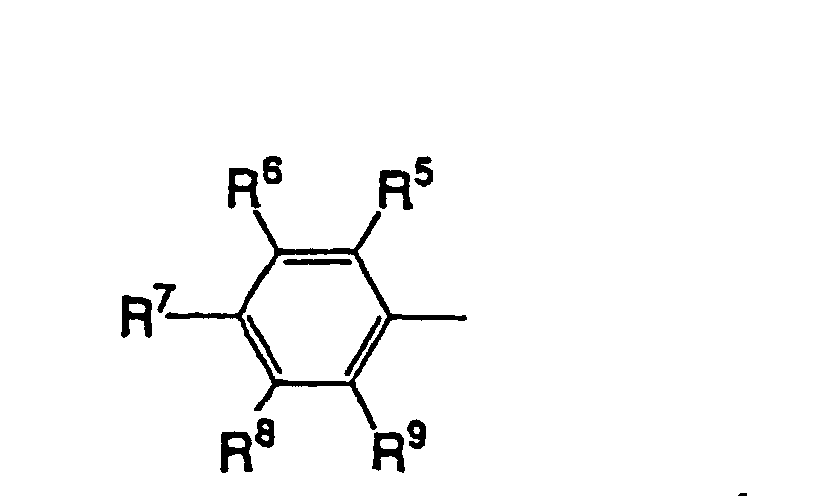
Description
- The present invention relates to a novel borate compound, and a photopolymerizable compound and a recording material which contain the borate compound.
- Examples using a borate compound in combination with a sensitizing dye as a photopolymerization initiator have hitherto been known. For example, U.S. Patent Nos. 4,772,530 and 4,772,541 and 5,151,520 disclose triarylalkyl borates containing a cationic dye such as cyanine, rhodamine, and the like, as a counter ion. These compounds are used as a photopolymerization initiator. As is known from U.S. Patent No. 5,055,372, a quaternary ammonium compound such as tetramethylammonium, pyridinium and cetyl pyridinium as a counter cation of the triaryl alkyl borate.
- However, since these borate compounds are unstable in a medium containing a component having an acidic group (hereinafter referred to as an "acid-containing medium"), they can not be used as the photopolymerization initiator in the medium. Japanese Patent Application Laid-Open (JP-A) No. 9-188686 discloses that a triarylalkyl borate becomes stable in an acid-containing medium by introducing an electron attractive group into an aryl group of the triarylalkyl borate. However, since an oxidation potential of the borate compound is enhanced by introducing the electron attractive group, there is the drawback that the sensitivity becomes lower than that of triphenylalkyl borate.
- The present invention is directed to solve the aforementioned problems of the prior art and to attain the following object. That is, an object of the present invention is to provide a novel borate compound which has high sensitivity and is superior in storage properties even in cases where an acid-containing medium is also present, and a photopolymerizable compound and a recording material which contain the borate compound.
- To solve the aforementioned problems, the present inventors have conducted intensive studies. As a result, they have found that not only the sensitivity is improved, but also the storage properties are improved by a steric protection effect by introducing an electron donative group at the ortho-position of an aryl group of a triarylalkyl borate, thus completing the present invention.
- Means for solving the aforementioned problems are as follows. The present invention provides a borate compound (1) represented by the following general formula (I):
- wherein R1 represents an alkyl group which may have a substituent; R2, R3 and R4 each represents an aryl group represented by the following general formula (II); and Z+ represents a group capable of forming a cation,
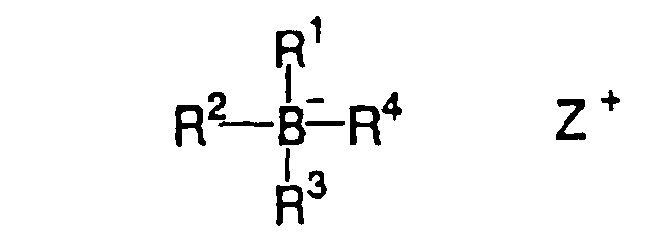
- wherein R5 represents an electron donative group; and R6 to R9 each represents a substituent, the total Hammett σ constant of R5 to R9 being from 0 to 1.

- Still another aspect of the present invention is a photopolymerizable composition (2) comprising the borate compound of (1).
- Another aspect of the present invention is a photopolymerizable composition (3) according to (2), further comprising a dye and a radical-polymerizable compound.
- A further aspect of the present invention is a recording material comprising a substrate and a recording layer on the substrate, said recording layer containing the photopolymerizable composition of (2) or (3), a color developing component A, and a color developing component B capable of reacting with the color developing component A to develop a color of the color developing component (A).
- The present invention will be described in detail hereinafter.
- A borate compound of the present invention is characterized by being represented by the following general formula (I):
-
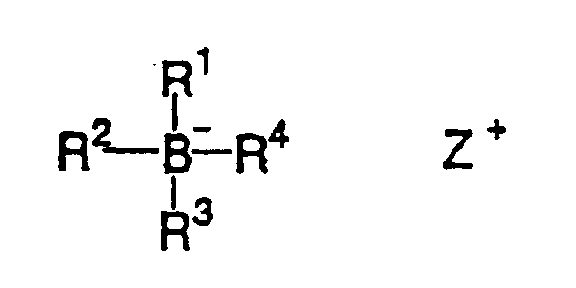
- In the general formula (I), R1 represents an alkyl group. The alkyl group represented by R1 may be substituted or not and examples of a substituent thereof include a halogen atom, aryl group, alkenyl group, alkynyl group, alkoxy group, aryloxy group, alkoxycarbonyl group, acyloxy group, acylamino group, carbamoyl group, cyano group, alkylsulphenyl group, arylsulfenyl group, alkylsulfinyl group, arylsulfinyl group, alkylsulfonyl group, arylsulfonyl group, sulfonamide group, sulfamoyl group, carboxy group, sulfonic group, acyl group, silyl group, heterocyclic group and the like.
- As the alkyl group, for example, an alkyl group having 1 to 30 carbon atoms, such as methyl group, ethyl group, isopropyl group, butyl group, hexyl group, octyl group, decyl group, dodecyl group, cyclopentyl group, allyl group, propargyl group, cyclohexyl group, 2-chloroethyl group, 2-methoxyethyl group, 2-phenoxyethyl group, 2-benzoyloxyethyl group, 2-cyanoethyl group, ethoxycarbonylmethyl group, 2-ethoxycarbonylethyl group, N,N-dibutylcarbamoylmethyl group, benzyl group, α-methylbenzyl group, 4-methylbenzyl group or the like is preferred. Among these, an alkyl group having 1 to 12 carbon atoms and a benzyl group are more preferred.
- In the general formula (I), R2, R3 and R4 each represents an aryl group represented by the following general formula (II). The aryl group may also be two or three kinds of aryl groups each having a different substituent, or may also be one kind of an aryl group having the same substituent.
-

- In the general formula (II), R5 represents an electron donative group. The electron donative group represented by R5 refers to a substituent wherein a Hammett σ constant (σ P) is negative.
- Specific examples of the electron donative group include an alkyl group, alkoxy group and the like. The alkyl group and alkoxy group may be substituted or not. Examples of substituents thereof include, for example, a halogen atom, aryl group, alkenyl group, alkynyl group, alkoxy group, aryloxy group, alkoxycarbonyl group, acyloxy group, acylamino group, carbamoyl group, cyano group, alkylsulphenyl group, arylsulfenyl group, alkylsulfinyl group, arylsulfinyl group, alkylsulfonyl group, arylsulfonyl group, sulfonamide group, sulfamoyl group, carboxy group, sulfonic group, acyl group, heterocyclic group and the like. The alkyl group and alkoxy group each preferably has 1 to 30 carbon atoms.
- Each aryl group represented by R2, R3 and R4 may also have a different electron donative group represented by R5, but is preferably the same electron donative group in view of synthesis.
- In the formula (II), R6 to R9 each represents a substituent and the total value of the Hammett substituent σ constants of R5 to R9 is from 0 to 1.
- Examples of the substituent represented by R6 to R9 include, for example, a hydrogen atom, halogen atom, alkyl group, aryl group, alkenyl group, alkynyl group, alkoxy group, aryloxy group, alkoxycarbonyl group, acyloxy group, acylamino group, carbamoyl group, cyano group, alkylsulphenyl group, arylsulfenyl group, alkylsulfinyl group, arylsulfinyl group, alkylsulfonyl group, arylsulfonyl group, sulfonamide group, sulfamoyl group, carboxy group, sulfonic group, acyl group, silyl group, heterocyclic group and the like, and these substituents may also be substituted with a substituent.
- The substituent represented by R6 to R9 may be selected so that the total value of the Hammett substituent σ constants of R5 to R9 is from 0 to 1.
- The total value of the Hammett substituent σ constants of R5 to R9 (hereinafter referred merely to as "total σ constant") is from 0 to 1, but is from 0.1 to 0 .6, particularly preferably.
- When the total σ constant is larger than 1, the sensitivity is lowered because of too strong an electron attractive property, which is not preferred. When the total σ constant is from 0.1 to 0.6, the sensitivity is high and stability is sufficient in an acid-containing medium, which is more preferred.
- The Hammett substituent σ constant is, for example, explained in detail in "Hammett's Rule: Structure And Reactivity" (written by Naoki INAMOTO, Maruzen Co.); "New Experimental Chemistry Course No. 14: Synthesis And Reaction of Organic Compound V" (published by Japan Chemical Association, page 2605, Maruzen Co., Ltd); "Explanation of Theoretical Organic Chemistry" (written by Tadao NAKAYA, page 217, Tokyo Kagaku Dojin Co.); and Chemical Review (Vol. 91, pages 165 to 195, 1991).
- As the borate compound represented by the general formula (I), those represented by the following general formula (III) or (IV) are preferred.
-
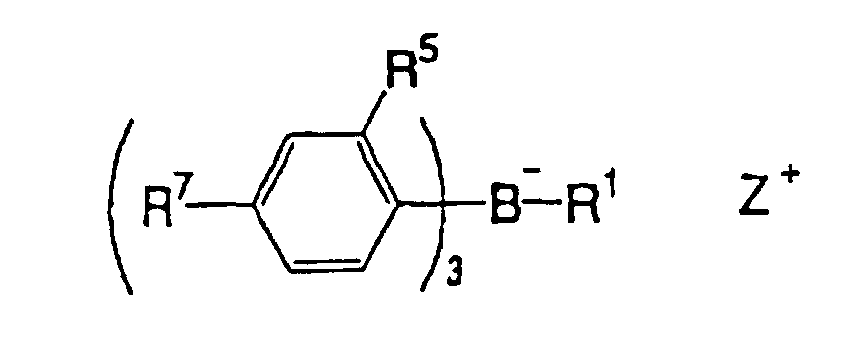
-

- In the general formulas (III) and (IV), R5 represents the aforementioned electron donative group, and preferred examples thereof include non-substituted alkyl and alkoxy groups. Among these, a methyl group, ethyl group, methoxy group and ethoxy group are particularly preferred.
- R7 in the general formula (III) and R8 in the general formula (IV) each represents one of the substituents represented by R6 to R9. Among these, a halogen atom and trifluoromethyl group are particularly preferred.
- Typical examples of the aryl group represented by R2, R3 and R4 include a 5-fluoro-2-methylphenyl group, 2-methyl-5-(trifluoromethyl)phenyl group, 5-fluoro-2-methoxyphenyl group, 4-chloro-2-ethyl group, 5-fluoro-2-ethylphenyl group, 5-fluoro-2-ethoxy group, 4-chloro-2-methylphenyl group and the like. Among these, the 5-fluoro-2-methylphenyl group is particularly preferred.
- In the general formula (I), Z+ represents a group capable of forming a cation. Examples thereof include alkali metal (particularly lithium or sodium), alkali earth metal, transition metal, quaternary ammonium, dye cation or cationic transition metal coordination complex compound. Ammonium, tetraalkylammonium or dye cation is preferred. Tetraalkylammonium is represented by the following formula.
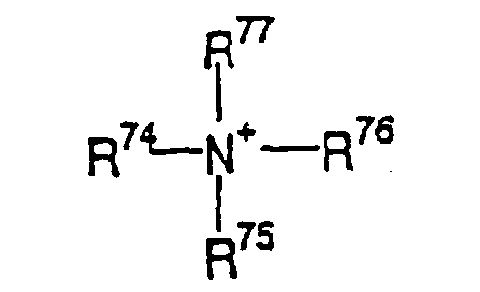
- In the formula, R74 to R77 each represents an alkyl group. Examples thereof include tetramethylammonium wherein R74 to R77 each represents a methyl group, tetraethylammonium wherein R74 to R77 each represents an ethyl group, tetrapropylammonium wherein R74 to R77 each represents a propyl group, tetrabutylammonium wherein R74 to R77 each represents a butyl group and the like.
- As Z+, benzyltrialkylammonium described below is also preferred.

- In the formula, R78 to R80 each represents an alkyl group. Preferred examples of the benzyltrialkylammonium include benzyltrimethylammonium, benzyltriethylammonium, benzyltripropylammonium, and benzyltributylammonium. Trialkylammonium ion, e.g., trimethylammonium, is also preferred. As Z+, phosphonium ion and ammonium ion may also be used.
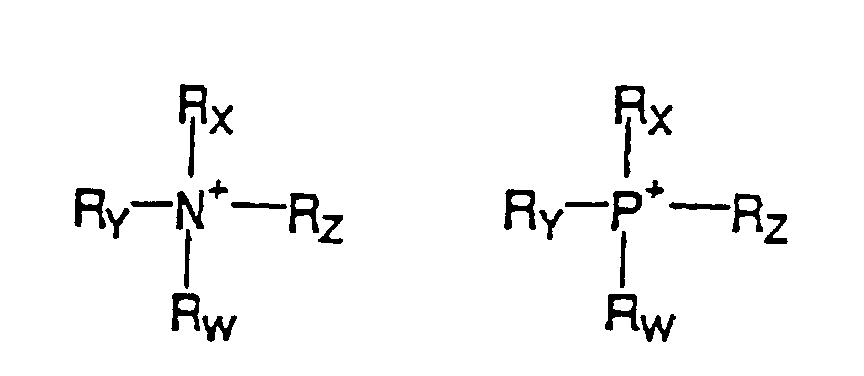
- In the formula, RW, RX, RY and RZ each independently represents a hydrogen atom, a non-substituted or substituted alkyl group, a cycloalkyl group, an alkenyl group, a phenyl group or an arylalkyl group or the like.
- Specific examples of the alkyl group, cycloalkyl group, alkenyl group, phenyl group and aralkyl group include a halogen atom, hydroxyl group, heterocycloalkyl group (e.g. epoxy group, aziridyl group, oxetanyl group, furanyl group, pyrrolidinyl group, pyrrolyl group, thiophenyl group, tetrahydrofuranyl group, etc.), dialkylamino group, amino group, carboxyl group, alkyl or arylcarbonyl, and an aryloxy or alkoxycarbonyl group. Tetravalent nitrogen atom may be a portion of a five or six membered ring, or the other ring may be condensed. These ring systems may also include other hetero atoms such as S, N and O.
- As Z+, a polyammonium ion or polyphosphonium ion as a poly compound of the above ammonium ion or phosphonium ion may be used, and a bis compound thereof is preferred. Examples of the substituent, in cases where the poly ion is substituted, are the same substituents as those of the mono ion.
- The ammonium ion and phosphonium ion can be substituted with a neutral dye (e.g., thioxanthene, thioxanthone, coumarin, ketocoumarin, and the like.). These ions can be obtained by reacting ammonium and phosphonium ions substituted with a reactive group (e.g. epoxy group, amino group, hydroxyl group, etc.) with a proper neutral dye. For example, these ions are described in EP-A No. 224967 (Quantacure QTX).
- In the same manner, an ammonium ion and phosphonium ion can be substituted with a colorless electron acceptor (e.g. benzophenone, etc.). Examples of Z+ in cases where ammonium ion is substituted with benzophenone are shown below, but are not limited thereto.
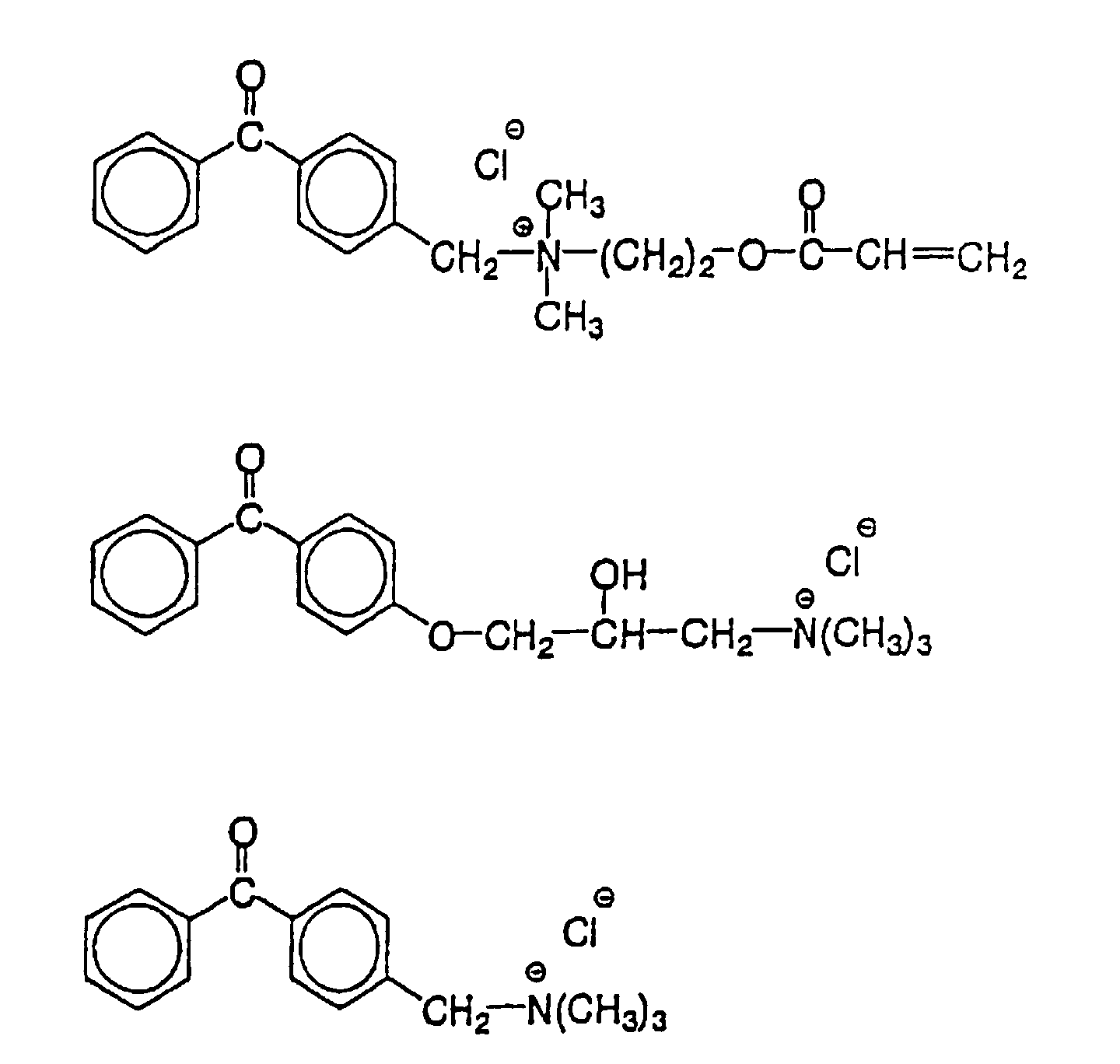
- The other quaternary ammonium ion includes, for example, trimethylcetylammonium ion or cetylpyrdinium ion.
- Other examples of Z+ include cations of the following cation group 1.
-

- In the formula, X represents P (phosphorous), S (sulfur) or N (nitrogen), and R represents an alkyl group or an aryl group.
- Other examples of Z+ include cations of the following cation group 2 or cation group 3. In the following cation group 2, R represents an alkyl group or an aryl group. These cations are described in J. Polym. Sci. Part A: Polymer Chem. 1992, 30, 1998 and Polymer 1993, 34 (6), 1130 by YAGUCHI et al. In the cation group 3, R' represents a non-substituted or substituted benzyl or phenacyl group. These cations are disclosed in JP-A No. 7-770221. An aromatic ring in the pyrimidium portion of these cations may also be substituted.
-

-

- Examples of other counter cations as 2+ include other onium ions, e.g., iodonium ion or sulfonium ion. These cations include, for example, those disclosed in EP-A No. 555058 and EP-A No. 690074, which are represented by the following formula.

- As Z+, the following cations are also preferred.
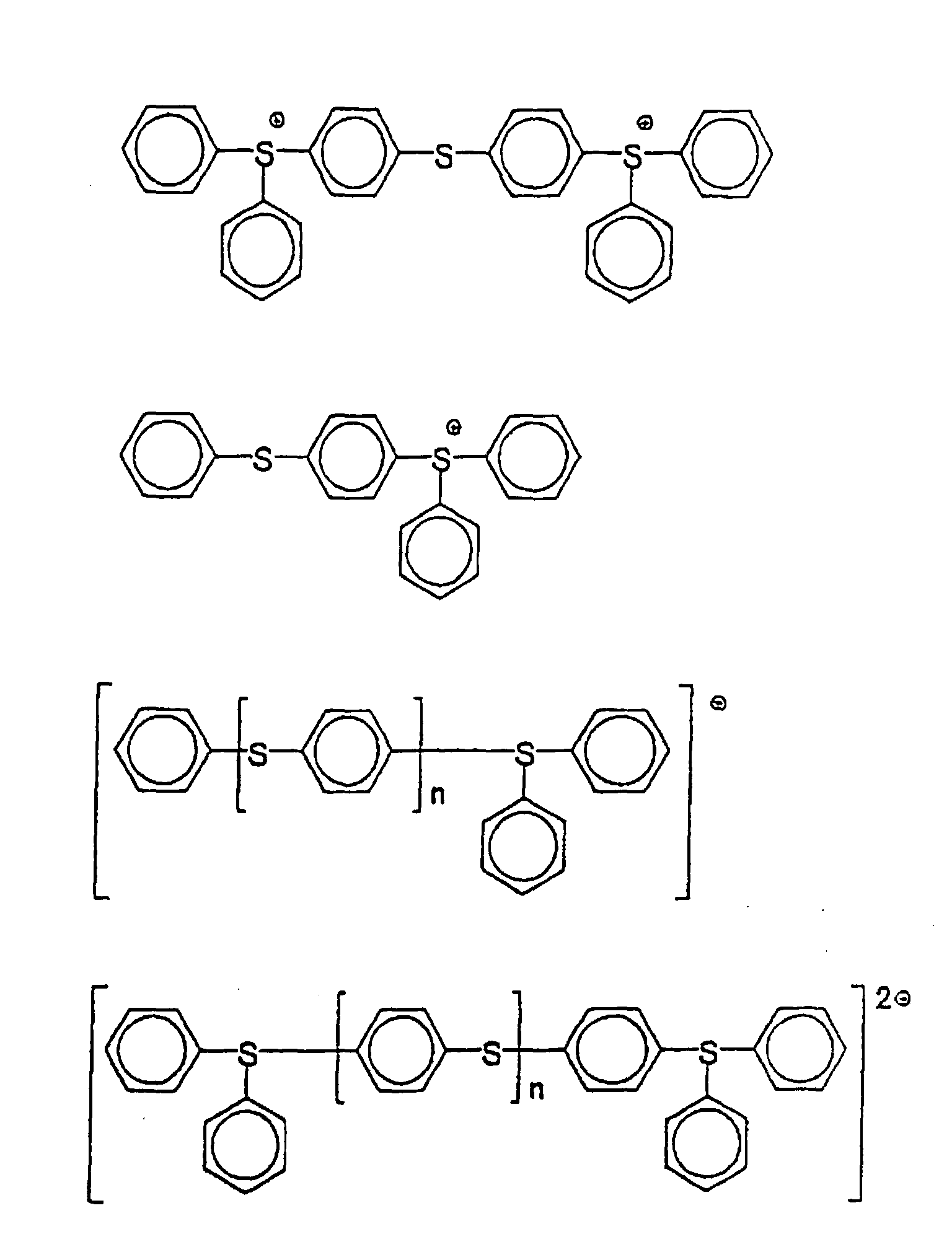
- Other examples of Z+ include cations described below. In the following formula, Rg represents an alkyl group, particularly an ethyl group, or a benzyl group. The aromatic ring may have a substituent.
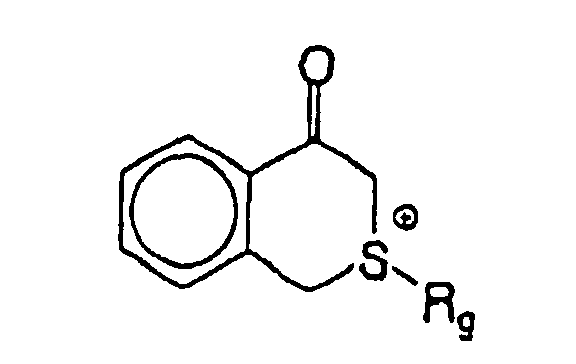
- Z+ may also be a halonium ion, and diaryliodonium ions disclosed in EP-A No. 334056 and EP-A No. 562897 are particularly preferred.
- Preferable examples of Z+ also include a ferrosenium cation represented by the following formula disclosed in EP-A No. 94915 and EP-A No. 109851.
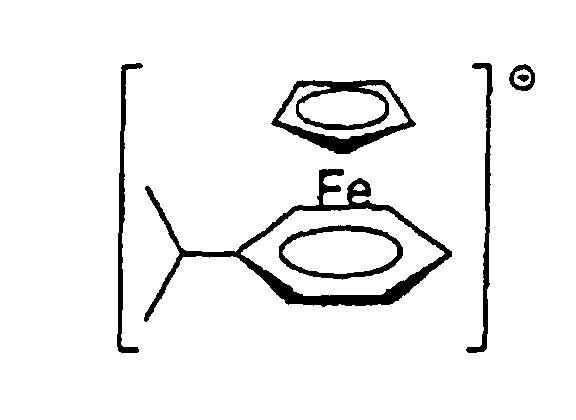
- Z+ may also be an ammonium ion, phosphonium ion, sulfonium ion, iodonium ion, cellonium ion, arsonium ion, telonium ion, onium ion such as bismusonium ion or the like.
- Z+ may also be a cationic transition metal complex compound and specific examples thereof include those described in U.S. Patent No. 4,954,414. Among these, bis(2,2'-bipyridine), (4,4'-dimethyl-2,2'-bipyridine)ruthenium, tris(4,4'-dimethyl-2,2'-bipyridine)ruthenium, tris(4,4'-dimethyl-2,2'-bipyridine)iron, tris (2,2',2''-terpyridine)ruthenium, tris (2,2'-bipyridine)ruthenium and (2,2'-bipyridine)(5-chloro-1,10-phenanthrine)ruthenium are particularly preferred.
- Z+ may also be cationic dyes described in "Chemistry of Functional Pigment" (1981, CMC Publishing Co., pages 393-416) and "Coloring Material" (60 [4], pages 212-224 (1987)).
- Specifically, any cationic dyes having a maximum absorption wavelength of 300nm or more, and preferably within a range from 400 to 1100 nm can be preferably used. Among these, cationic methine pigment, polymethine pigment, triarylmethane pigment, indoline pigment, azine pigment, xanthene pigment, cyanine pigment, hemicyanine pigment, rhodamine pigment, azamethine pigment, oxazine pigment or acridine pigment is preferred, and cationic cyanine pigment, hemicyanine pigment, rhodamine pigment or azamethine pigment is further preferred.
- Specific examples of the borate compound represented by the general formula (I) of the present invention are illustrated, but the present invention is not limited to these specific examples.
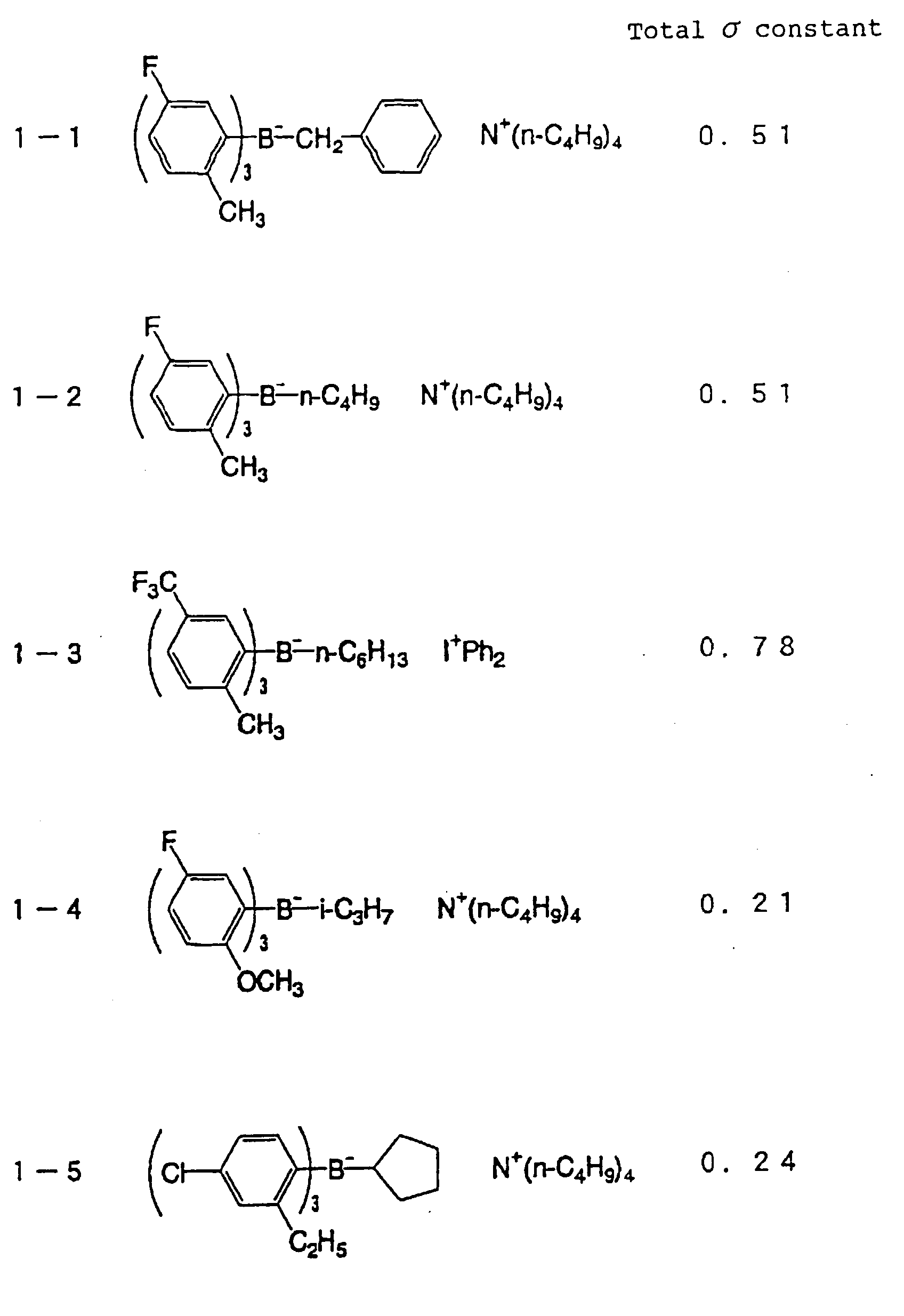


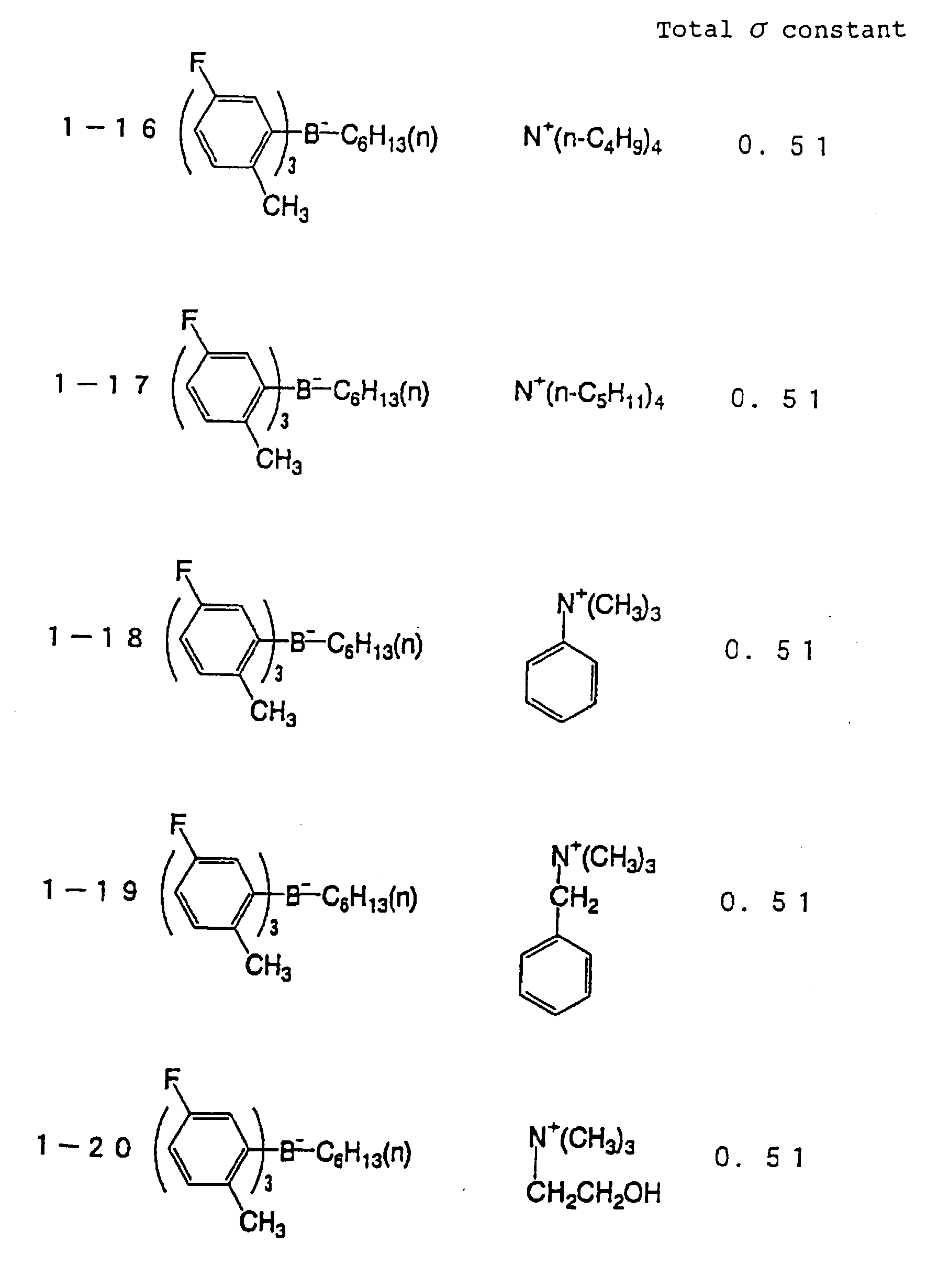


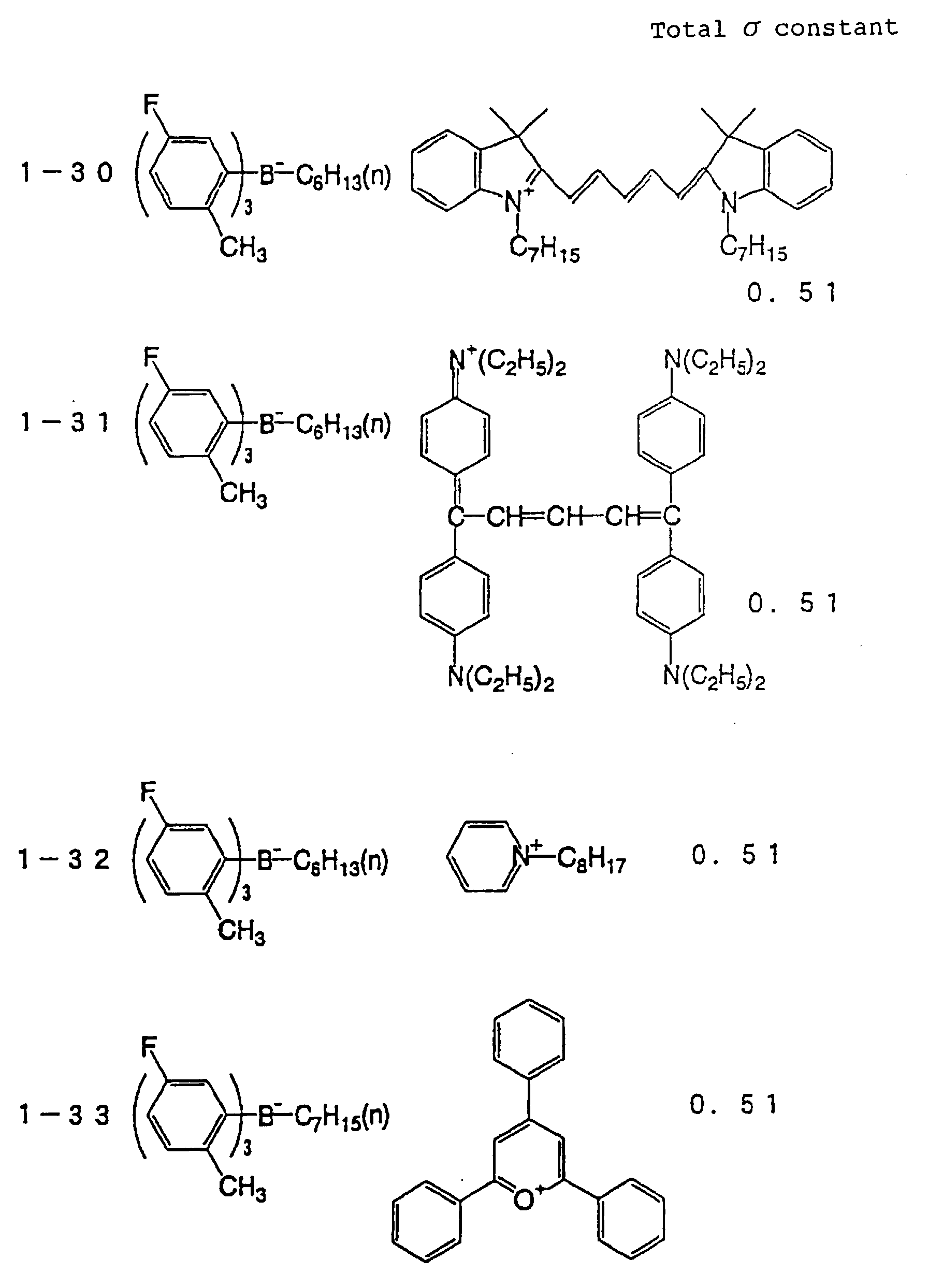
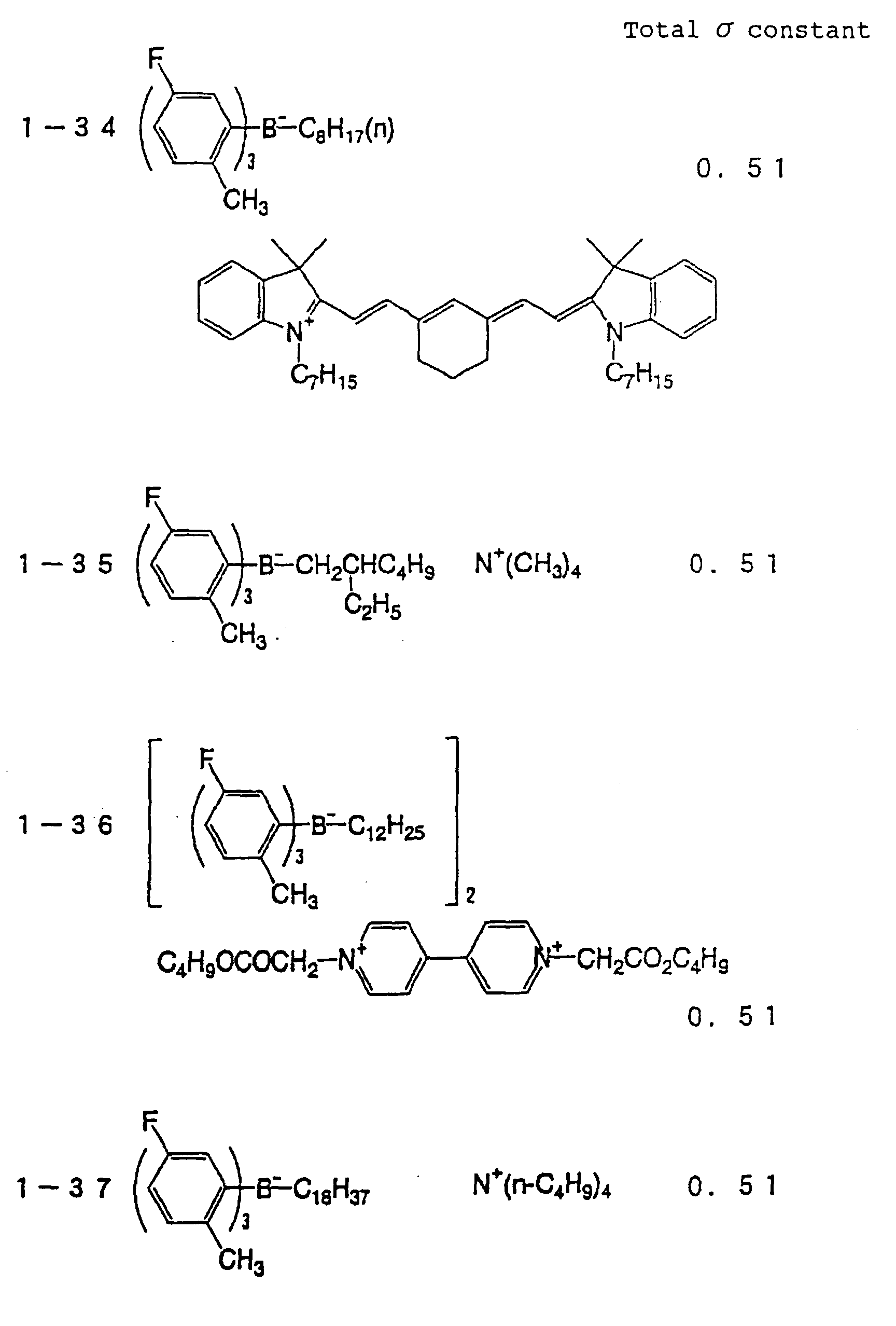


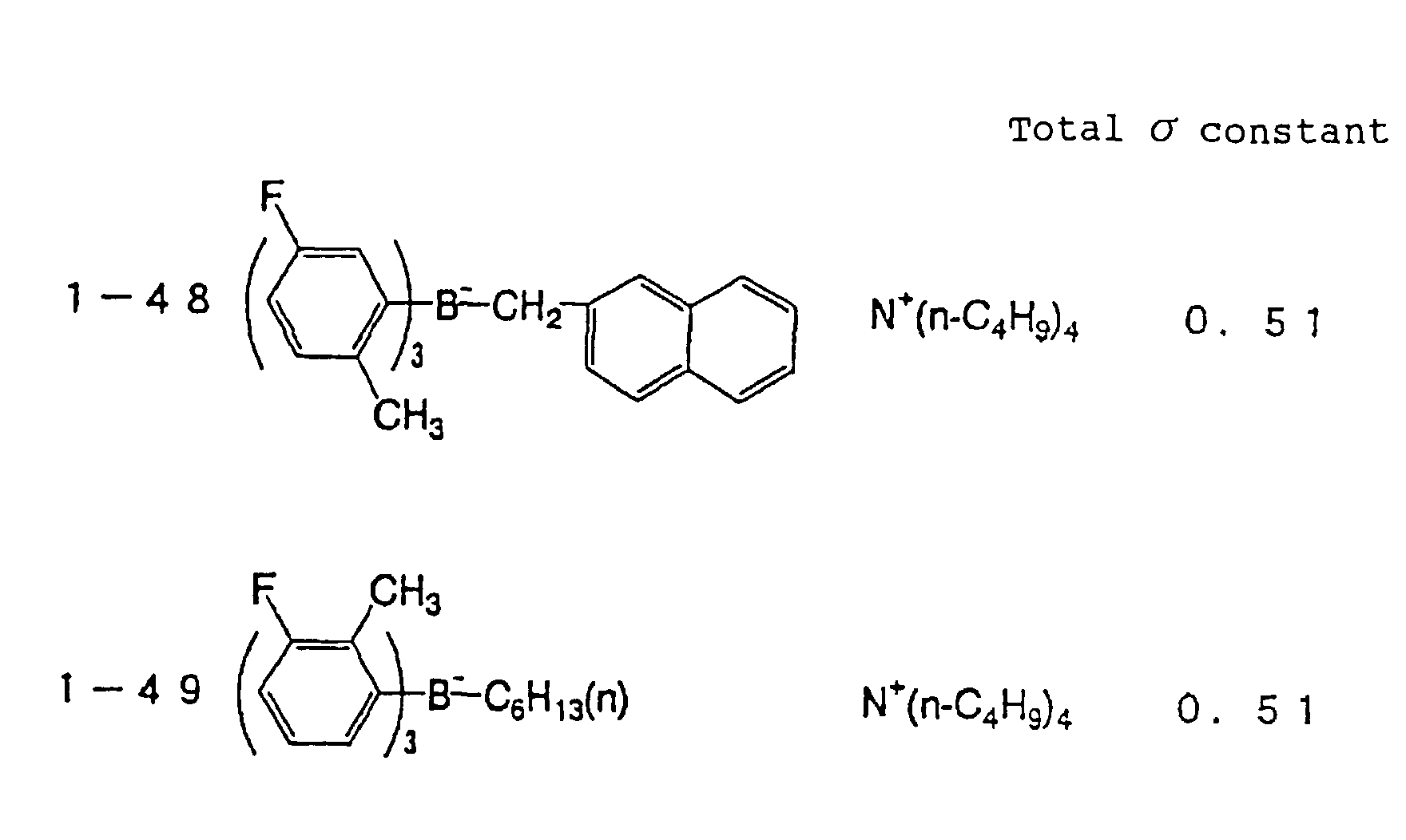
- Synthesis Examples of the borate compound according to the present invention are shown below. The number in parenthesis of the borate compound represents the number of aforementioned compound.
- 25 ml of a 1M THF solution of benzylmagnesium chloride was added dropwise to 6.7 g of tris(5-fluoro-2-methylphenyl)borane in 20 ml of toluene at 0°C. After the mixture was heated to room temperature and stirred for 1 hour, a solution prepared by dissolving 9.67 g of tetrabutylammonium bromide in 50 ml of water was added. After stirring for 1 hour, the reaction solution was extracted with ethyl acetate and the extract was dried over magnesium sulfate, filtered and then concentrated to obtain an oily substance. This oily substance was recrystallized from methanol and dried to obtain 6.97 g of the desired borate compound (1-1).
- The melting point was of from 127 to 128°C. 1H-NMR (CDCl3) analysis afforded the results of 0.94 (12H), 1.28 (8H), 1.89 (9H), 2.80 (10H), 6.47 (3H), 6.7-6.9 (8H), and 7.07 (3H).
- 15 ml of a 1.6M hexane solution of n-butyl lithium was added dropwise to 6.76 g of tris(5-fluoro-2-methylphenyl)borane in 20 ml of toluene at 0°C. After the mixture was heated to room temperature and stirred for 1 hour, a solution prepared by dissolving 9.67 g of tetrabutylammonium bromide in 50 ml of water was added. After stirring for 1 hour, the reaction solution was extracted with ethyl acetate and the extract was dried over magnesium sulfate, filtered and then concentrated to obtain an oily substance. This oily substance was recrystallized from methanol and dried to obtain 6.51 g of the desired borate compound (1-2).
- The melting point was of from 166 to 167°C. 1H-NMR (CDCl3) analysis afforded the results of 0.83 (3H), 0.93 (12H), 1.05-1.47 (22H), 1.94 (9H), 2.77 (8H), 6.48 (3H), 6.81 (3H), and 6.93 (3H).
- 25 ml of a 1M diethyl ether solution of 4-methylbenzylmagnesium chloride was added dropwise to 6.76 g of tris(5-fluoro-2-methylphenyl)borane in 20 ml of toluene at 0°C. After the mixture was heated to room temperature and stirred for 1 hour, a solution prepared by dissolving 9.67 g of tetrabutylammonium bromide in 50 ml of water was added. After stirring for 1 hour, the reaction solution was extracted with ethyl acetate and the extract was dried over magnesium sulfate, filtered and then concentrated to obtain an oily substance. This oily substance was recrystallized from methanol and dried to obtain 7.63 g of the desired borate compound (1-45).
- The melting point was of from 152 to 153°C. 1H-NMR (CDCl3) analysis afforded the results of 0.95 (12H), 1.29 (8H), 1.39 (8H), 1.89 (9H), 2.14 (3H), 2.70 (2H), 2.81 (8H), 6.50 (3H), 6.63 (2H), 6.76 (5H), and 7.07 (3H).
- 16.7 ml of a 1.8M hexane solution of n-hexyl lithium was added dropwise to 6.76 g of tris(5-fluoro-2-methylphenyl)borane in 20 ml of toluene at 0°C. After the mixture was heated to room temperature and stirred for 1 hour, a solution prepared by dissolving 9.67 g of tetrabutylammonium bromide in 50 ml of water was added. After stirring for 1 hour, the reaction solution was extracted with ethyl acetate and the extract was dried over magnesium sulfate, filtered and then concentrated to obtain an oily substance. This oily substance was recrystallized from methanol and dried to obtain 6.79 g of the desired borate compound (1-16).
- The melting point was of from 92-93°C. 1H-NMR (CDCl3) analysis afforded the results of 0.84 (3H), 0.96 (12H), 1.09-1.49 (26H), 1.97 (9H), 2.78 (8H), 6.49 (8H), 6.49 (3H), 6.82 (3H), and 6.94 (3H).
- 16.7 ml of a 1.8M hexane solution of n-butyl lithium was added dropwise to 6.76 g of tris(5-fluoro-2-methylphenyl)borane in 20 ml of toluene at 0°C. After the mixture was heated to room temperature and stirred for 1 hour, 50 ml of water was added and a solution prepared by dissolving 11.4 g of tetrapentylammonium bromide in 20 ml of methanol was further added. After stirring for 1 hour, the reaction solution was extracted with ethyl acetate and the extract was dried over magnesium sulfate, filtered and then concentrated to obtain an oily substance. This oily substance was recrystallized from methanol and dried to obtain 8.37 g of the desired borate compound (117).
- The melting point was of from 96 to 97°C. 1H-NMR (CDCl3) analysis afforded the results of 0.84 (3H), 0.92 (12H), 1.10-1.53 (34H), 1.96 (9H), 2.77 (8H), 6.49 (3H), 6.82 (3H), and 6.93 (3H).
- The borate compound represented by the general formula (I) of the present invention can be preferably used as a photopolymerization initiator. That is, since the borate compound of the present invention has high sensitivity and excellent storage properties due to a steric protection effect even in cases where an acid-containing medium is also present by introducing an electron donative group at the ortho-position of an aryl group of a triarylalkyl borate and controlling the total σ constant of all substituents on the aryl group within a range from 0 to 1, the borate compound can be used in the photopolymerizable composition and the recording material described hereinafter, particularly preferably.
- The photopolymerizable composition of the present invention contains at least the borate compound (capable of functioning as a "photopolymerization initiator") of the present invention and contains preferably a pigment and a radical-polymerizable compound, and contains other components, if necessary.
- The photopolymerizable composition of the present invention contains at least the borate compound represented by the general formula (I) of the present invention as a photopolymerization initiator.
- The borate compounds represented by the general formula (I) may be used alone, or two or more kinds of them may be used in combination.
- When using a borate compound of the general formula (I) wherein Z+ is not one of the aforementioned cationic pigments(hereinafter referred to as a "borate compound I") in combination with a borate compound of the general formula (II) wherein Z+ is one of the aforementioned cationic pigments, (hereinafter referred to as a "borate compound II") among the borate compounds of the present invention, these borate compounds are preferably used in combination so that a molar ratio of the borate portion to the cationic dyes portion is 1 or more, in view of sufficient enhanced sensitization and discoloration performances.
- A ratio of the borate compound I to the borate compound II is preferably used within a range from 1:1 to 50:1, more preferably from 1.2:1 to 30:1, and most preferably from 1.2:1 to 20:1. When the ratio of the borate compound I to the borate compound II is smaller than 1:1, sufficient polymerization reactivity and discoloration performances are not obtained sometimes. On the other hand, when the ratio exceeds 50:1, sufficient sensitivity can not obtained sometimes.
- The amount of the borate compound contained in the photopolymerizable composition of the present invention is preferably from 1 to 20% by weight, and more preferably from 4 to 15% by weight, based on the total weight of the following radical-polymerizable compound in the photopolymerizable composition.
- When the amount is smaller than 1% by weight, the polymerizability and discoloration performances are lowered sometimes. On the other hand, when the amount is larger than 20% by weight, the storage stability is lowered sometimes.
- The photopolymerizable composition of the present invention can also contain compounds other than the borate compound of the present invention as the other photopolymerization initiator as far as the effect of the present invention is not adversely affected.
- Examples of the other photopolymerization initiator include: aromatic ketones, for example, bisacylphosphine oxides such as benzophenone, 4,4-bis(dimethylamino)benzophenone, 4-methoxy-4'-dimethylaminobenzophenone, 4,4'-dimethoxybenzophenone, 4-dimethylaminobenzophenone, 4-dimethylaminoacetophenone, benzylanthraquinone, 2-tert-butylanthraquinone, 2-methylanthraquinone, xanthone, thioxanthone, 2-chlorthioxanthone, 2,4-diethylthioxanthone, fluorenone, acridone, bis(2,4,6-trimethylbenzoyl)-phenylphosphine oxide, and the like; acylphosphine oxides such as 2,4,6-trimethylbenzoyl diphenylphosphine oxide, and the like;
- benzoins and benzoin ethers, such as benzoin methyl ether, benzoin ethyl ether, benzoin isopropyl ether, benzoin phenyl ether, etc.; 2,4,6-triarylimidazole dimers such as 2-(o-chlorophenyl)-4,5-diphenylimidazole dimer, 2-(o-chlorophenyl)-4,5-di(m-methoxyphenyl)imidazole dimer, 2-(o-fluorophenyl)-4,5-diphenylimidazole dimer, 2-(o-methoxyphenyl)-4,5-diphenylimidazole dimer, 2-(p-methoxyphenyl)-4,5-diphenylimidazole dimer, etc.; polyhalides such as carbon tetrabromide, phenyltribromomethylsulfone, phenyltrichloromethylketone, and the like; compounds described in JP-A No. 59-133428, Japanese Patent Application Publication (JP-B) Nos. 57-1819 and 57-6096, and U.S. Patent No. 3,615,455;
- S-triazine derivatives having a trihalogen-substituted methyl group described in JP-A No. 58-290803, such as 2,4,6-tris(trichloromethyl)-S-triazine, 2-methoxy-4,6-bis(trichloromethyl)-S-triazine, 2-amino-4,6-bis(trichloromethyl)-S-triazine, 2-(P-methoxystyryl)-4,6-bis(trichloromethyl)-S-triazine, etc.;
- Organic peroxides described in JP-A No. 59-189340, such as methyl ethyl ketone peroxide, cyclohexanone peroxide, 3,3,5-trimethylcyclohexanone peroxide, benzoyl peroxide, ditert-butyldiperoxyisophthalate, 2,5-dimethyl-2,5-di(benzoylperoxy)hexane, tert-butylperoxybenzoate, a,a'-bis(tert-butylperoxyisopropyl)benzene, dicumyl peroxide, 3,3',4,4'-tetra-(tert-isobutylperoxycarbonyl)benzophenone, and the like;
- azinium salt compound dedscribed in U.S. Patent No. 4,743,530; organic organoboron compounds described in European Patent No. 0223587, such as tetramethylammonium salt of triphenylbutyl borate, tetrabutylammonium salt of triphenylbutyl borate, tetramethylammonium salt of tri(P-methoxyphenyl)butyl borate, and the like; and diaryl iodonium salts and iron-arene complex.
-
- Those using two or more compounds in combination are also known and can be used in the photopolymerizable composition of the present invention.
- Examples of the combination of two or more compounds include a combination of 2,4,5-triarylimidazole dimer and mercaptobenzoxazole, a combination of 4,4'-bis(dimethylamino)benzophenone and benzophenone or benzoin methyl ether described in U.S. Patent No. 3,427,161, a combination of benzoyl-N-methylnaphthothiazoline and 2,4-bis(trichloromethyl)-6-(4'-methoxyphenyl)-triazole described in U.S. Patent No. 4,239,850, a combination of dialkylaminobenzoate and dimethylthioxanthone described in JP-A No. 57-23602, a combination of three kinds of compounds such as 4,4'-bis(dimethylamino)benzophenone, benzophenone and methyl polyhalide compound described in JP-A No. 59-78339 and the like.
- Borate compounds other than the borate compound of the present invention can also be added as the other photopolymerization initiator as far as the effect of the present invention is not adversely affected.
- Examples of such a borate compound include, for example, organoborate compounds described in JP-A Nos. 62-143044, 9-188685, 9-188686 and 9-188710, spectral sensitizing dye borate compound obtained from a cationic dyes or the like.
- A dye is preferably contained in the photopolymerizable composition of the present invention.
- The dye is preferably a spectral sensitizing dye having a maximum absorption wavelength at 300-1000 nm. When the spectral sensitizing dyes is present together with the borate compound of the present invention, the resulting composition is efficiently sensitive to an exposure light source within a spectral absorption wavelength range. Therefore, the sensitivity is enhanced and generation of a radical can be controlled by using an arbitrary light source within an ultraviolet to infrared range.
- When the borate compound of the present invention is the borate compound II, particularly a compound having both functions of a dye portion having a maximum absorption wavelength at 300-1000 nm in the structure and a borate portion, the aforementioned spectral sensitizing dye may not be used.
- By using, as the spectral sensitizing dye, a dye selected arbitrarily from spectral sensitizing dyes within the above wavelength range for the purpose of controlling the sensitive wavelength so as to be suited for a light source used, high sensitivity can be obtained, and blue, green and red light sources or an infrared laser can be selected as the light source used for image exposure.
- In cases where a color image is formed by using a multicolor recording material produced by laminating monochromatic recording layers capable of developing colors having different hues, even a recording material produced by laminating a plurality of layers can form an image wherein each layer (color) has high sensitivity and high sharpness, by including a spectral sensitizing dye having a different absorption wavelength in each monochromatic layer having a different hue and using a light source suited for the absorption wavelength. Thus, high sensitivity and high sharpness of the entire multicolor recording material can be attained.
- As the spectral sensitizing dye, for example, a known cation dye, neutral dye or anion dye can be used.
- Examples of the spectral sensitizing dye include those described in "Research Disclosure, vol. 1. 200, December 1980, Item 20036" and "Sensitizer" (pages 160-163, Kodansha; edited by Katsumi TOKUMARU and Shin OGAWARA, 1987).
- Specific examples thereof include 3-ketocoumarin compound described in JP-A No. 58-15603, thipyrilium salt described in JP-A No. 58-40302, naphthothiazole merocyanine compound described in JP-A Nos. 59-28328 and 60-53300, merocyanine compound described in JP-B Nos. 61-9621, 62-3842, JP-A Nos. 59-89303 and 60-60104 and the like.
- Further examples include dyes described in "Chemistry of Functional Dyes" (1981, CMC Publishing Co., pages 393-416) and "Coloring Material" (60[4]212-224 (1987), and specific examples thereof include cationic dyes, cationic carbonium dyes, cationic quinoneimine dyes, cationic indoline dyes, cationic styryl dyes and the like.
- The spectral sensitizing dye includes keto dyes such as coumarin (including ketocoumarin or sulfonocoumarin) dyes, oxonol dyes, hemioxonol dyes, etc.; non-keto dyes such as non-keto polymethine dyes, triarylmethane dyes, xanthene dyes, anthracene dyes, rhodamine, dyes, acridine dyes, aniline dyes, azo dyes, etc.; non-ketopolymethine dyes such as azomethine dyes, cyanine dyes, carbocyanine dyes, dicarbocyanine dyes, tricarbocyanine dyes, tricarbocyanine dyes, hemicyanine dyes, styryl dyes, etc.; and quinoneimine dyes such as azine dyes, oxazine dyes, thiazine dyes, quinoline dyes, thiazole dyes, etc.
- By appropriately using the spectral sensitizing pigment, spectral sensitivity of the photopolymerization initiator used in the photopolymerizable composition of the present invention within the ultraviolet to infrared range can be obtained.
- Aforementioned various spectral sensitizing dyes may be used alone, or two or more kinds of them may also be used in combination.
- A ratio of the amount of the spectral sensitizing dye to the borate compound of the present invention is very important with regards to obtaining high sensitivity and, when used as the recording material, sufficient discoloration property due to light irradiation in a fixing step.
- In addition to the ratio of the spectral sensitizing dye to the borate compound (= 1:1 (molar ratio)), which is required for the photopolymerization reaction, the borate compound is preferably added in an amount required to sufficiently discolor the spectral sensitizing dye remaining in the layer so as to obtain sufficiently high sensitivity and discoloration performance.
- A ratio of the spectral sensitizing dye to the borate compound is preferably used within a range from 1:1 to 1:50, more preferably from 1:1.2 to 1:30, and most preferably from 1:1.2 to 1:20. When the ratio of the spectral sensitizing dye to the borate compound exceeds 1:1, sufficient polymerization reactivity and discoloration performances are not obtained sometimes. On the other hand, when the ratio is smaller than 1:50, coating properties are lowered sometimes.
- The total amount of the spectral sensitizing dye and borate compound is preferably from 0.1 to 25% by weight, more preferably from 0.1 to 20% by weight, and most preferably from 0.1 to 15% by weight, based on the amount of the radical-polymerizable compound used. When the amount is smaller than 0.1% by weight, the effect of the present invention is not obtained sometimes. On the other hand, when the amount exceeds 25% by weight, the storage stability is lowered and the coating properties are lowered, sometimes.
- The amount of the spectral sensitizing dye is preferably from 0.1 to 5% by weight, and more preferably from 0.5 to 2% by weight, based on the total weight of the recording layer when using the photopolymerizable composition of the present invention as the recording layer of the recording material.
- The spectral sensitizing dye and borate compound may be added to a coating solution for recording layer after mixing previously, or the spectral sensitizing dye and borate compound may also be added separately when preparing the coating solution for recording layer.
- A radical-polymerizable compound is preferably contained in the photopolymerizable composition of the present invention. The radical-polymerizable compound is contained for the purpose of imparting image durability and improving the sensitivity of the recording material after recording when using the photopolymerizable composition of the present invention as the recording material.
- The radical-polymerizable compound, for example is preferably a compound having at least one ethylenically unsaturated bond in a chemical structure, said compound having a chemical structure such as monomer, prepolymer (dimer, trimer and oligomer thereof), a mixture thereof or a copolymer thereof.
- Specific examples thereof include unsaturated carboxylic acid and a salt thereof, ester of aliphatic polyhydric alcohol compound and unsaturated carboxylic acid, amide of aliphatic polyhydic amine compound and unsaturated carboxylic acid and the like.
- Specific examples of the unsaturated carboxylic acid include acrylic acid, methacrylic acid, itaconic acid, crotonic acid, isocrotonic acid, maleic acid and the like.
- Specific examples of the unsaturated carboxylic acid include sodium and potassium salts of aforementioned unsaturated carboxylic acid.
- Examples of the ester of the aliphatic polyhydric alcohol and unsaturated carboxylic acid include acrylate, methacrylate, itaconate, crotonate, isocrotonate and the like. These compounds are described in detail below.
- Examples of the acrylate include ethylene glycol diacrylate, triethylene glycol triacrylate, 1,3-butanediol diacrylate, tetramethylene glycol diacrylate, propylene glycol diacrylate, trimethylolethane triacrylate, 1,4-cyclohexanediol diacrylate, pentaerythritol diacrylate, pentaerythritol triacrylate, pentaerythritol tetraacrylate, dipentaerythritol diacrylate, dipentaerythritol triacrylate, dipentaerythritol tetraacrylate, sorbitol triacrylate, sorbitol tetraacrylate, sorbitol pentaacrylate, sorbitol hexaacrylate, polyester acrylate oligomer and the like.
- Examples of the methacrylate include tetramethylene glycol dimethacrylate, triethylene glycol dimethacrylate, trimethylolpropane trimethacrylate, trimethylolethane trimethacrylate, ethylene glycol dimethacrylate, 1,3-butanediol dimethacrylate, pentaerythritol dimethacrylate, dipentaerythritol dimethacrylate, sorbitol tetramethacrylate, bis-[p-(3-methacryloxy-2-hydroxypropoxy)phenyl]dimethylmethane, bis-[p-(3-acryloxyethoxy)phenyl]dimethylmethane and the like.
- Examples of the itaconate include ethylene glycol diitaconate, propylene glycol diitaconate, 1,3-butanediol diitaconate, 1,4-butanediol diitaconate, tetramethylene glycol diitaconate, pentaerythritol diitaconate, sorbitol tetraitaconate and the like.
- Examples of the crotonate include ethylene glycol dicrotonate, tetramethylene glycol dichrotonate, pentaerythritol dicrotonate, sorbitol tetracrotonate and the like.
- Examples of the isocrotonate include ethylene glycol diisocrotonate, pentaerythritol diisocrotonate, sorbitol tetraisocrotonate and the like. Examples of the maleate include ethylene glycol dimaleate, triethylene glycol dimaleate, pentaerythritol dimaleate, sorbitol tetramaleate and the like.
- These esters may be used alone, or two or more kinds of them may be used in combination.
- Specific examples of the amide of the aliphatic polyhydric amine compound and unsaturated carboxylic acid include methylenebis-acrylamide, methylenebis-methacrylamide, 1,6-hexamethylenebis-acrylamide, 1,6-hexamethylenebis-methacrylamide, diethylenetriaminetrisacrylamide, xylenebisacrylamide, xylenebismethacrylamide and the like.
- In addition to the aforementioned compounds, a vinylurethane compound having two or more polymerizable vinyl groups in one molecule described in JP-B No. 48-41708, wherein a vinyl monomer represented by the following general formula is added to a polyisocyanate compound having two or more kinds of isocyanate groups in one molecule, is included among the examples.
- A condensed compound of a polymer compound having a vinyl group or or vinylidene group, e.g. a polymer compound having a hydroxyl group, an amino group, an epoxy group, halogen atom or a sulfonyloxy group, and acrylic acid, methacrylic acid or a derivative thereof is included among the examples.
- The aforementioned radical-polymerizable compounds may be used alone, or two or more kinds of them may also be used.
- The amount of the radical-polymerizable compound contained in the photopolymerizable compound of the present invention is preferably from 10 to 50 parts by weight, based on 1 part by weight of the borate compound. When the amount is smaller than 10 parts by weight, the color density is lowered sometimes. On the other hand, when the amount is larger than 50 parts by weight, the storage stability is lowered sometimes. Other components
- With regard to components other than the aforementioned components, reducing agents such as an oxygen scavenger or chain transfer agent of an active hydrogen donor, and other compounds capable of accelerating polymerization in a chain transfer manner can be added as an auxiliary.
- Examples of the oxygen scavenger include phosphine, phosphonate, phosphite, primary silver salt or other compounds which can be easily oxidized by oxygen.
- Specific examples include N-phenylglycine, trimethylbarbituric acid, N,N-dimethyl-2,6-diisopropylaniline, N,N,N-2,4,6-penthamethylaniline acid and the like. Furthermore, thiols, thioketones, trihaloemethyl compound, lophine dimer compound, iodonium salts, sulfonium salts, azinium salts, organic peroxide and azides are also useful as a polymerization accelerator.
- The photopolymerizable composition of the present invention can be preferably used in the recording material of the present invention, which is described below. Since the photopolymerizable composition of the present invention contains the borate compound of the present invention, there can be obtained the recording material which has high sensitivity and excellent storage properties due to a steric protection effect even in cases where an acid-containing medium is also present.
- The recording material of the present invention comprises a recording layer on a substrate, and further comprises other layer(s), if necessary.
- The recording layer contains the photopolymerizable composition of the present invention, a color developing component A, and a color developing component B capable of reacting with the color developing component A to color-develop the color developing component A, and further contains the other components, if necessary.
- The terms "photopolymerizable composition" of the present invention used herein means a photopolymerizable composition containing the borate compound of the present invention, or a photopolymerizable composition containing at least the borate compound of the present invention, the dye and the radical-polymerizable compound.
- That is, when the borate compound of the present invention is a spectral sensitizing dye borate compound (borate compound II) obtained from a cationic dye, a dye is not further contained. When the color developing component B is a compound having a polymerizable group, the aforementioned radical-polymerizable compound may not be further contained and the color developing component B having the polymerizable group can be used as the radical-polymerizable compound. Color developing component A and color developing component B
- Both of the color developing component A, and the color developing component B capable of reacting with the color developing component A to develop a color, are substantially colorless and have excellent transparency before treatment.
- At least one of the color developing component A and the color developing component B is preferably contained in microcapsules in view of stability before recording, anti-fogging or durability of image, and preferably has a property of being able to develop color due to mutual contact after heating and/or applying pressure.
- Preferred combinations of the two components (the color developing component A and the color developing component B) forming the recording layer includes the following combinations (a) to (r) (in the following examples, the former is the color developing component A while the latter is the color developing component B).
- (a) a combination of an electron donative dye precursor and an electron acceptive compound
- (b) a combination of a diazonium salt compound and a coupling component (hereinafter appropriately referred to as "coupler")
- (c) a combination of an organic acid metal salt such as silver behenate, silver stearate, etc. and a reducing agent such as protocatechuic acid, spiroindan, hydroquinone, etc.
- (d) a combination of a long-chain fatty acid iron salt such as ferric stearate, ferric myristate, etc. and phenols such as tannic acid, gallic acid, ammonium salicylate, etc.
- (e) a combination of an organic acid heavy metal salt, such as nickel, cobalt, lead, copper, iron, mercury and silver salts of acetic acid, stearic acid, palmitic acid, etc. and an alkali metal or alkali earth metal sulfate, such as calcium sulfide, strontium sulfide, potassium sulfide, etc. and combination of an organic acid heavy metal salt and an organocheleting agent such as s-diphenylcarbazide, diphenylcarbazone, etc.
- (f) a combination of a heavy metal sulfate such as sulfates of silver, lead, mercury, sodium, etc. and a sulfur compound such as sodium tetrathionate, sodium thiosulfate, thiourea, etc.
- (g) a combination of an aliphatic ferric salt such as ferric stearate, etc. and an aromatic polyhydroxy compound such as 3,4-hydroxytetraphenylmethane, etc.
- (h) a combination of an organic acid metal salt such as silver oxalate, mercury oxalate, etc. and an organopolyhydroxy compound such as polyhydroxyalcohol, glycerin, glycol, etc.
- (i) a combination of an aliphatic ferric salt such as ferric pelargonate, ferric laurate, etc. and a thiocesylcarbamide or isothiocesylcarbamide derivative
- (j) a combination of an organic acid lead salt such as lead caproate, lead pelargonate, lead behenate, etc. and a thiourea derivative such as ethylenethiourea, N-dodecylthiourea, etc.
- (k) a combination of a higher aliphatic heavy metal salt such as ferric stearate, copper stearate, etc. and zinc dialkylthiocarbamate
- (l) a combination capable of forming oxazine dye, such as a combination of resorcin and a nitroso compound
- (m) a combination of a formazane compound and reducing agent and/or metal salt
- (n) a combination of a protected dye (or leuco dye) precursor and deblocking agent
- (o) a combination of an oxidation type color developer and an oxidizing agent
- (p) a combination of phthalonitriles and diiminoisoindolines (combination capable of forming phthalocyanine)
- (q) a combination of isocyanates and diiminoisoindolines (combination capable of forming coloring dyes)
- (r) a combination of pigment precursor and acid or base (combination capable of forming pigment) and the like
-
- Among these, (a) the combination of the electron donative dye precursor and the electron acceptive compound, (b) the combination of the diazonium salt compound and coupling component, (c) the combination of the organic acid metal salt and the reducing agent, or (n) the combination of the protected dye (or the leuco dye) precursor and the deblocking agent is preferably used as the combination of the two components, the color developing component (A) and the color developing component (B), which form the aforementioned recording layer.
- The combinations (a), (b) and (c) of the aforementioned composition, which are preferably contained in aforementioned recording layer, are described in detail below.
- The electron donative dye precursor used preferably in the present invention is not particularly limited so long as it is substantially colorless. However, preferable examples include those with a property of donating electrons or accepting protons such as an acid to develop color, and preferred examples thereof include a phthalide compound, fluoran compound, thiazine compound, leucoauramine compound, rhodaminelactam compound, spiropyran compound, pyridine compound, pyrazine compounds, fluorene compound and the like.
- Examples of the phthalide compound include compounds described in U.S. Reissued Patent No. 23,024, U.S. Patent Nos. 3,491,111, 3,491,112, 3,491,116, 3,491,112, 3,491,116 and 3,509,174. Specific examples thereof include 3,3-bis(p-dimethylaminophenyl)-6-dimethylaminophthalide, 3,3-bis(p-dimethylaminophenyl)phthalide, 3-(p-diethylaminophenyl)-3-(1-ethyl-2-methylindol-3-yl)-4-azaphthalide, 3,3-bis(1-octyl-2-methylindol-3-yl)phthalide and the like.
- Examples of the fluoran compound include compounds described in U.S. Patent Nos. 3,624,107, 3,627,6787, 3,641,011, 3,462,107, 3,627,787, 3,641,011, 3,462,828, 3,681,390, 3,920,510 and 3,959,571. Specific examples thereof include 2-(benzylamino)fluoran, 2-anilino-3-methyl-6-diethylaminofluoran, 2-anilino-3-methyl-6-dibutylaminofluoran, 2-anilino-3-methyl-6-N-ethyl-N-isoamylaminofluoran, 2-anilino-3-methyl-6-N-methyl-N-cyclohexylaminofluoran, 2-anilino-3-chlor-6-diethylaminofluoran, 2-anilino-3-methyl-6-N-ethyl-N-isobutylaminofluoran, 2-anilino-6-dibutylaminofluoran, 2-anilino-3-methyl-6-N-methyl-N-tetrahydrofurfurylaminofluoran, 2-anilino-3-methyl-6-piperidinoaminofluoran, 2-(o-chloroanilino)-6-diethylaminofluoran, 2-(3,4-dichloranilino)-6-diethylaminofluoran and the like.
- Examples of the thiazine-based compound include benzoylleucomethyleneblue, p-nitrobenzylleucomethyleneblue and the like.
- Examples of the leucoauramine compound include 4,4'-bis-dimethylaminobenzhydrin benzyl ether, N-halophenylleucoauramine, N-2,4,5-trichloroleucoauramine and the like.
- Examples of the rhodaminelactam compound include rhodamine-B-anilinolactam, rhodamine-(p-nitrile)lactam and the like.
- Examples of the spiropyran compound include compounds described in U.S. Patent No. 3,971,808, and specific examples thereof include 3-methyl-spiro-dinaphthopyran, 3-ethyl-spiro-dinaphthopyran 3,3'-dichloro-spiro-dinaphthopyran, 3-benzylspiro-dinaphthopyran, 3-methyl-naphtho-(3-methioxy-benzo)spiropyran, 3-propyl-spiro-dibenzopyran and the like.
- Examples of the pyridine compound and pyrazine compounds include compounds described in U.S. Patent Nos 3,775,424, 3,853,869 and 4,246,318.
- Examples of the fluorene compound include compounds described in JP-A No. 61-240989.
- The amount of the electron donative dye precursor contained in the recording layer is preferably from 0.1 to 5 g/m2, and more preferably from 0.1 to 3 g/m2. When the amount is smaller than 0.1 g/m2, the color density becomes insufficient sometimes. On the other hand, when the amount exceeds 5 g/m2, the coatability is lowered sometimes.
- When using electron donative dye precursors each of which develops a color of a hue such as cyan, magenta or yellow as the electron donative dye precursor, the recording material of the present invention can be used as a full-color recording material.
- As the cyan, magenta and yellow color developing dyes, those described in U.S. Patent No. 4,800,149 can be used.
- As the electron donative dye precursor for yellow color development, those described in U.S. Patent No. 4,800,148 can be used. As the electron donative dye precursor for cyan color development, those described in JP-A No. 63-535342 can be used.
- Preferred examples of the electron acceptive compound capable of reacting with the electron donative dye precursor to develop color include hydroxybenzoic acid, ester compound, phenol derivative, salicylic acid derivative, metal salt of aromatic carboxylic acid, acid clay, bentonite, novolak resin, metal-treated novolak, metal complex and the like.
- Specific examples thereof include those described in JP-A Nos. 4-226455, 63-173682, 59-83693, 60-141587, 62-99190, European Patent No. 29323, in JP-A Nos. 62-167077, 62-16708, 63-317558, JP-B Nos. 40-9309 and 45-14039, JP-A Nos. 52-140483, 48-51510, 57-210886, 58-87089, 59-11286, 60-176795 and 61-95988. The electron acceptive compound may have a polymerizable group.
- The electron acceptive compound is preferably used in an amount within a range from 0.1 to 30 parts by weight, and more preferably from 0.5 to 15 parts by weight, based on 1 part by weight of the electron donative dye precursor used. When the amount is smaller than 0.1 parts by weight, the color density is insufficient sometimes. On the other hand, when the amount exceeds 30 parts by weight, the sensitivity is lowered and the coating properties are lowered, sometimes.
- The diazonium salt compound reacts with the coupler as a coupling component described below to develop color of a desired hue, and is a photodecomposable diazonium salt compound which is decomposed when exposed to light in a specific wavelength range before the reaction, whereby the compound has no color developing capability even if the coupling component is present.
- The hue in this color developing system is decided by an azo dyes produced by reacting the diazonium salt compound with the coupler. Accordingly, since a maximum absorption wavelength (color developing hue) can be controlled by changing a chemical structure (position and type of substituent) of the diazonium salt compound or the coupler, any color hue can be obtained depending on the combination thereof.
- Examples of the photodecomposable diazonium salt compound used preferably in the present invention include an aromatic diazonium salt compound represented by the following formula:
- In the above formula, Ar represents a substituted or non-substituted aryl group. Examples of the substituent include an alkyl group, alkoxy group, alkylthio group, aryl group, aryloxy group, arylthio group, acyl group, alkoxycarbonyl group, carbamoyl group, carbamide group, sulfonyl group, sulfamoyl group, sulfonamide group, ureido group, amino group, heterocyclic group, cyano group, nitro group, halogen atom and the like, and these substituents may also be substituted.
- Ar is preferably an aryl group having 6 to 30 carbon atoms and examples thereof include a phenyl group, 2-methylphenyl group, 2-chlorophenyl group, 2-methoxyphenyl group, 2-butoxyphenyl group, 2-(2-ethylhexyloxy)phenyl group, 2-octyloxyphenyl group, 3-(2,4-di-t-pentylphenoxyethoxy)phenyl group, 4-chlorophenyl group, 2,5-dichlorophenyl group, 2,4,6-trimethylphenyl group, 3-chlorophenyl group, 3-methylphenyl group, 3-methoxyphenyl group, 3-butoxyphenyl group, 3-cyanophenyl group, 3-(2-ethylhexyloxy)phenyl group, 3,4-dichlorophenyl group, 3,5-dichlorophenyl group, 3,4-dimethoxyphenyl group,
- 3-(dibutylaminocarbonylmethoxy)phenyl group, 4-cyanophenyl group, 4-methylphenyl group, 4-methoxyphenyl group, 4-butoxyphenyl group, 4-(2-ethylhexyloxy)phenyl group, 4-benzylphenyl group, 4-aminosulfonylphenyl group, 4-N,N-dibutylaminosulfonylphenyl group, 4-ethoxycarbonylphenyl group, 4-(2-ethylhexylcarbonyl)phenyl group, 4-fluorophenyl group, 3-acetylphenyl group, 2-acetylaminophenyl group, 4-(4-chlorophenylthio)phenyl group, 4-(4-methylphenyl)thio-2,5-butoxyphenyl group, 4-(N-benzyl-N-methylamino)-2-dodecyloxycarbonylphenyl group and the like.
-
- These groups may also be substituted with an alkyloxy group, an alkylthio group, a substituted phenyl group, a cyano group, a substituted amino group, a heterocyclic group or a halogen atom.
- The diazonium salt compound used preferably in the present invention preferably has 12 or more carbon atoms in the compound, solubility of 1% or less in water and solubility of 5% or more in ethyl acetate.
- Specific examples of the diazonium salt compound used preferably in the recording material of the present invention are shown below but are not limited thereto.
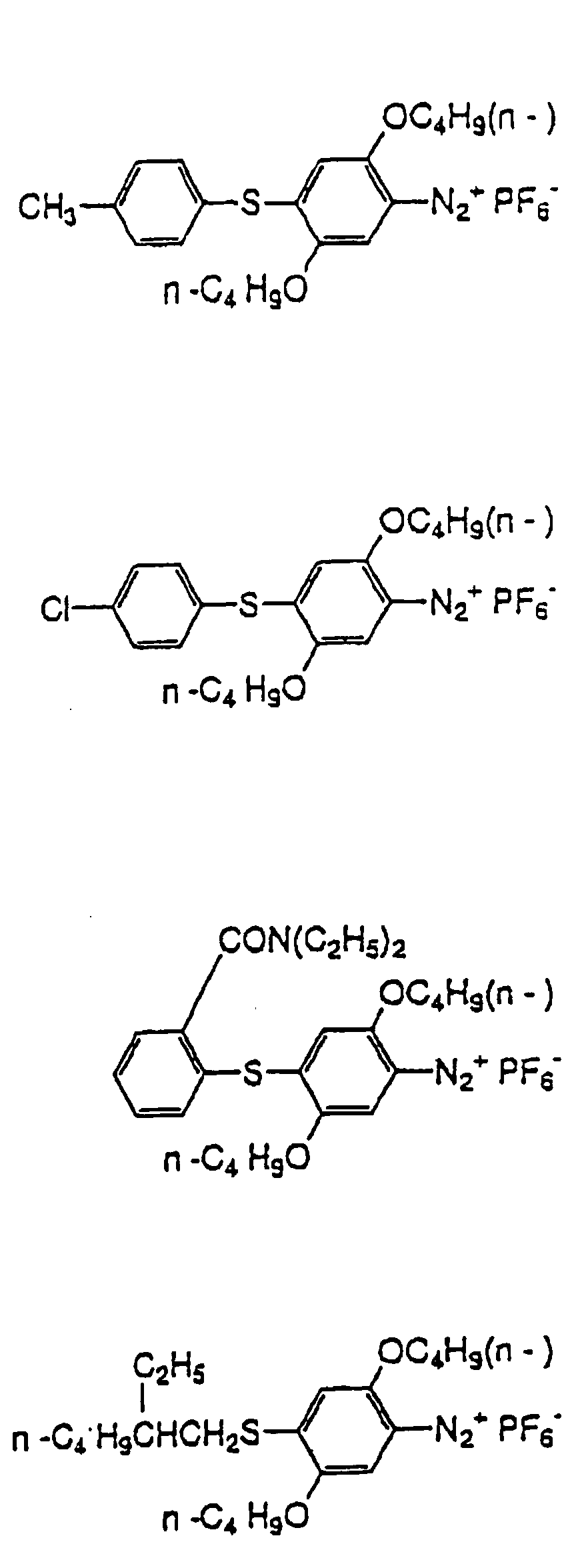
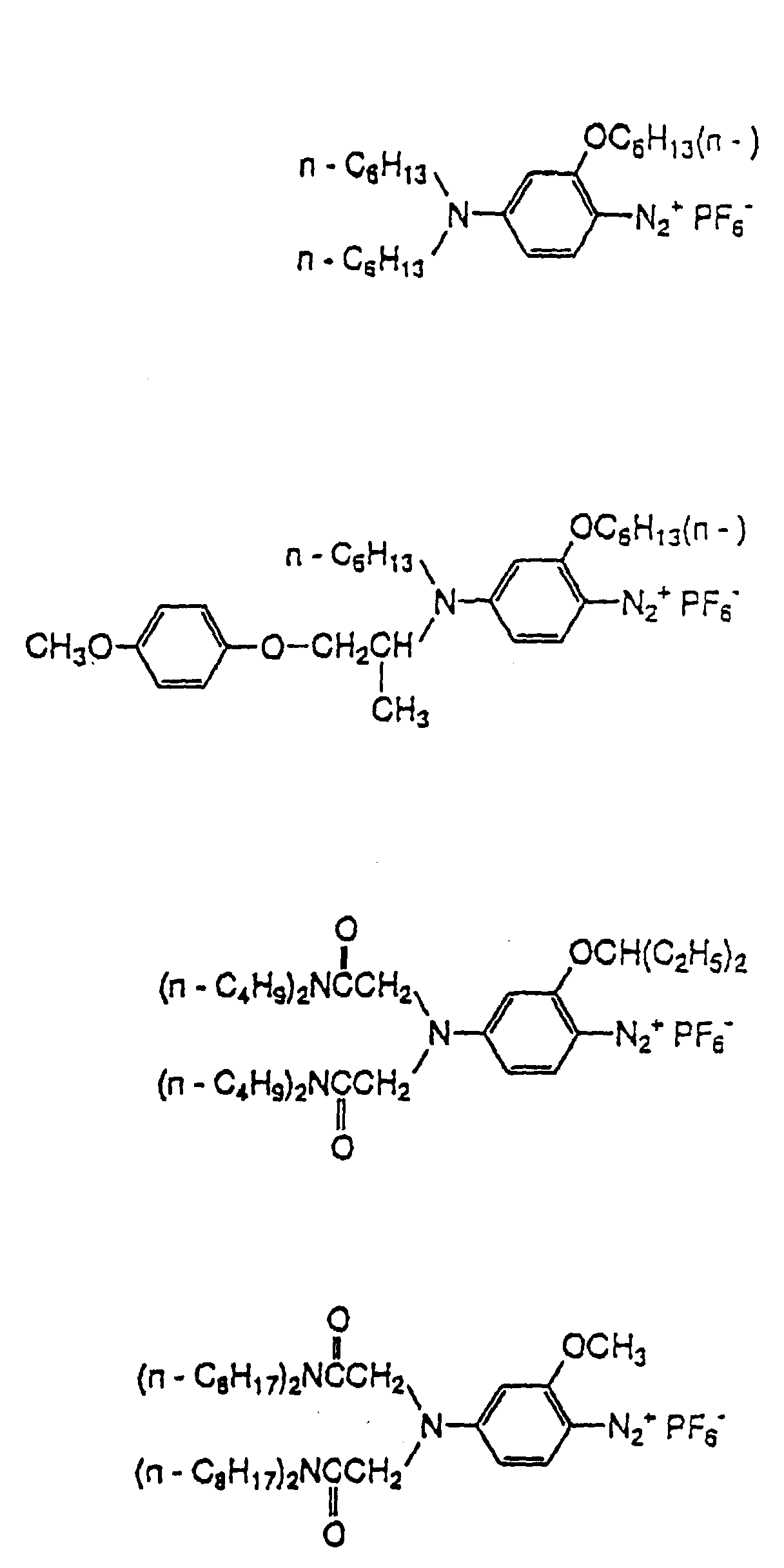

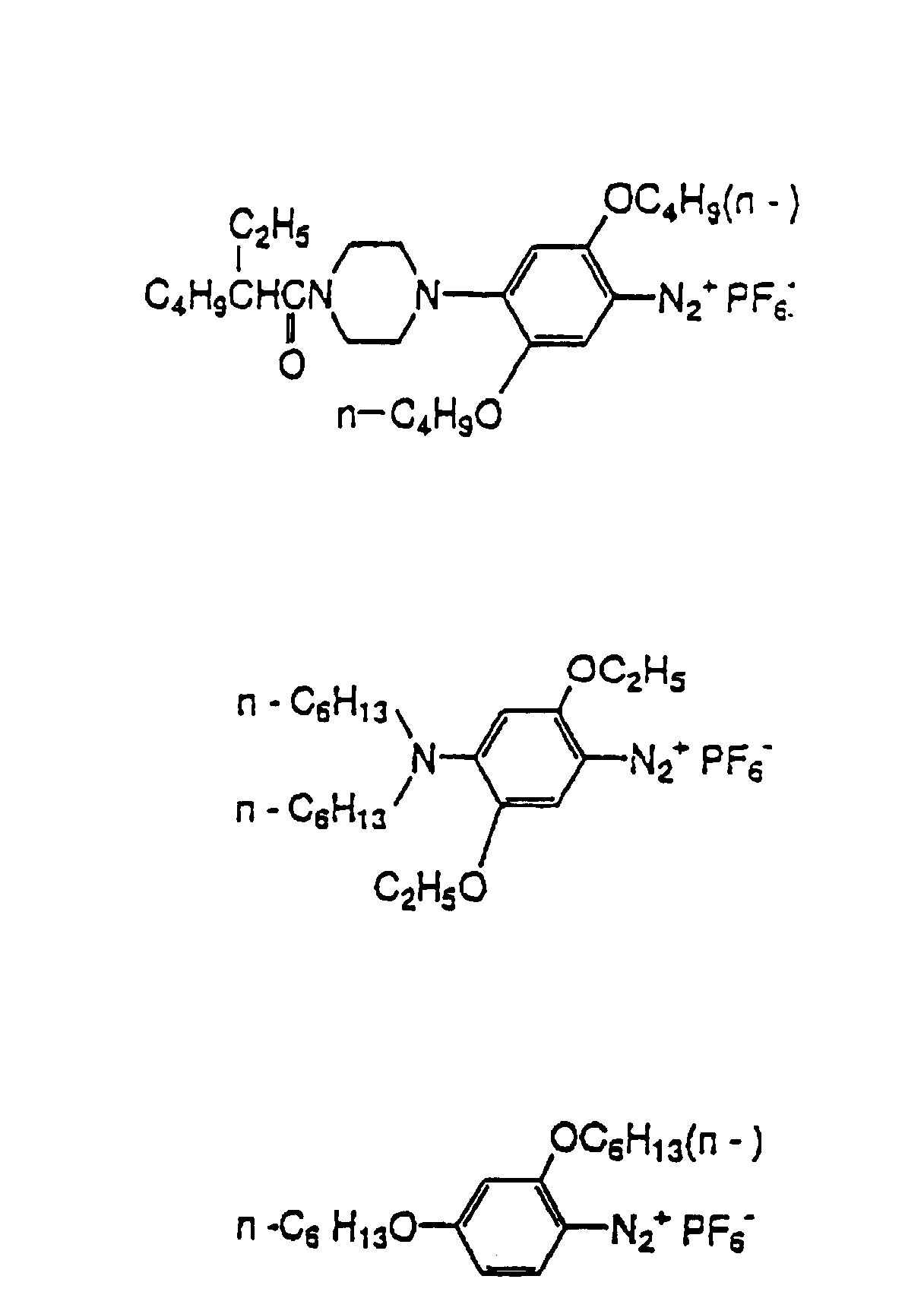


- In the present invention, these diazonium salt compounds may also be used alone, or two or more kinds of them may also be used in combination depending on various purposes such as controlling the hue.
- The diazonium salt compound is preferably contained in the recording layer in an amount within a range from 0.01 to 3 g/m2, and more preferably from 0.02 to 1.0 g/m2. When the amount is smaller than 0.01 g/m2, a sufficient color developing property can not be obtained. On the other hand, when the amount exceeds 3 g/m2, the sensitivity is lowered and the fixing time must be increased, which is not preferred.
- As the coupler engaging in the coupling reaction with the diazonium salt compound, any of those capable of coupling with the diazonium salt compound in basic and/or neutral environments to form a dye can be used. These couplers can be used alone, or two or more kinds of them can be used in combination.
- The couplers are described in Research Disclosure, No. 17643, VII-C to G and Research Disclosure, No. 307105, VII-C to G. Non-diffusing couplers having a hydrophobic group referred to as a ballast group and polymerized couplers are preferred.
- Among the couplers used preferably in the present invention, the cyan coupler may be a naphthol coupler, phenol coupler or the like and specific examples thereof include couplers described in U.S. Patent Nos. 2,369,929, 2,772,162, 2,801,171, 2,895,826, 3,446,622, 3,758,308, 3,772,002, 4,052,212, 4,126,396, 4,146,396, 4,228,233, 4,254,212, 4,296,199, 4,296,200, 4,327,173, 4,333,999, 4,334,011, 4,343,011, 4,427,767, 4,451,559, 4,690,889 and 4,775,616, West German Patent No. 3,329,729, specifications of European Patent Nos. 121,365A and 249,453A, and JP-A No. 61-42,658.
- Examples of the magenta coupler include imidazole[1,2-b]pyrazoles described in U.S. Patent No. 4,500,630, pyrazolo[1,5-b][1,2,4]triazoles described in U.S. Patent No. 4,540,654 and the like.
- Examples of the magenta coupler further include a pyrazolotriazole coupler wherein a branched alkyl group is directly linked at the 2-position, 3-position or 6-position of a pyrazolotriazole ring as described in JP-A No. 61-65245, a pyrazoloazole coupler having a sulfonamide group in a molecule as described in JP-A No. 61-65,246, a pyrazoloazole coupler having an alkoxyphenylsulfonamide ballast group in a molecule as described in JP-A No. 61-147254, a pyrazolotriazole coupler having an alkoxy or aryloxy group at the 6-position as described in European Patent Application Laid-Open Nos. 226849A and 294785A, and couplers described in U.S. Patent Nos. 3,061,432, 3,725,067, 4,310,619, 4,351,897 and 4,556,630, European Patent No. 73,636, JP-A Nos. 55-118034, 60-35730, 60-43659, 60-185951 and 61-72238, and International Publication WO88/04795, Research Disclosure Nos. 24220 and 24230.
- Examples of the yellow coupler include couplers described in U.S. Patent Nos. 3,933,501, 3,973,968, 4,022,620, 4,248,961, 4,314,023, 4,326,024, 4,401,752 and 4,511,649, European Patent No. 24,9473A, JP-B No. 58-10739 and British Patent Nos. 1,425,020 and 1,476,760.
- Typical examples of the polymerized dyes-forming coupler are described in U.S. Patent Nos. 3,451,820, 4,080,211, 4,367,282, 4,409,320 and 4,576,910, European Patent No. 34,1188A and British Patent No. 2,102,137.
- A so-called methylene compound having a methylene group adjacent to a carbonyl group can also be included.
- In addition, those described in Japanese Patent Application Nos. 9-260336 and 9-271395 can also be included and can be appropriately selected within the range corresponding to the object of the present invention. The coupler may also have a polymerizable group.
- Details are described in JP-A Nos. 4-201483, 7-223367, 7-223368, 7-323660, 5-278608, 5-297024, 6-18669, 6-18670 and 7-316280. Those described in Japanese Patent Application Nos. 8-027095, 8-02796, 8-030799, 8-12610, 8-132394, 8-358755, 8-358756 and 9-069990, which were previously filed by the present applicant, can also be used as references.
- The coupler is preferably added in the recording layer in an amount within a range from 0.02 to 5 g/m2, and more preferably from 0.1 to 4 g/m2, in view of the effect. When the amount is smaller than 0.02 g/m2, the color developing property is lowered sometimes. On the other hand, when the amount exceeds 5 g/m2, the coating properties are lowered sometimes.
- The coupler compound is preferably used in an amount within a range from 0.1 to 20 parts by weight, and more preferably from 1 to 10 parts by weight, based on 1 part by weight of the diazonium salt compound. When the amount is smaller than 0.1 part by weight, a sufficient color developing property can not be obtained. On the other hand, when the amount exceeds 20 parts by weight, the coating properties are lowered, which is not preferred.
- The coupler compound can also be used by adding a water-soluble polymer, together with the other components, and dispersing solids using a sand mill. The method of dispersing or emulsifying a solid is not specifically limited, and a conventionally known method can be used. Details of these methods are described in JP-A No. 59-190886, 2-141279 and 7-17145.
- In the present invention, if necessary, organic bases such as tertiary amines, piperidines, piperazines, amidines, formamidines, pyridines, guanidines, morpholines and the like can be used for the purpose of accelerating the coupling reaction.
- Examples of these organic bases include piperazines such as N,N'-bis(3-phenoxy-2-hydroxypropyl)piperazine, N,N'-bis[3-(p-methylphenoxy)-2-hydroxypropyl]piperazine, N,N'-bis[3-(p-methoxyphenoxy)-2-hydroxypropyl]piperazine, N,N'-bis[3-(phenylthio-2-hydroxypropyl)piperazine, N,N'-bis[3-(β-naphthoxy)-2-hydroxypropyl]piperazine, N-3-bis(β-naphthoxy)-2-hydroxypropyl-N'-methylpiperazine, 1,4-bis{[3-(N-methylpiperadino)-2-hydroxy]propyloxy}benzene, etc.; morpholines such as N-[3-(β-naphthoxy)-2-hydroxy]propylmorpholine, 1,4-bis[3-(morpholino-2-hydroxy)propyloxy]benzene, 1,3-bis[3-(morpholino-2-hydroxy)propyloxy]benzene, etc.; piperidines such as N-(3-phenoxy-2-hydroxypropyl)piperidine, N-dodecylpiperidine, etc.; triphenylguanidine, 4-hydroxybenzoic acid 2-N-methyl-N-benzylaminoethyl ester, 4-hydroxybenzoic acid 2-N,N-di-n-butylaminoethyl ester, 4-(3-N,N-dibutylaminopropoxy)benzenesulfonamide, 4-(2-N,N-dibutylaminoethoxycarbonyl)phenoxyacetamide, etc.
- These organic bases may be used alone, or two or more kinds of them may also be used in combination.
- These organic bases are described in JP-A Nos. 57-123086, 60-49991 and 60-94381, and Japanese Patent Application Nos. 7-228731, 7-235157 and 7-235158.
- An amount of the organic base used is not specifically limited, but the organic base is preferably used in the amount within a range from 1 to 30 mol per mol of the diazonium salt.
- An auxiliary color developer can also be added for the purpose of accelerating the color developing reaction.
- Examples of the auxiliary color developer include a phenol derivative, naphthol derivative, alkoxy-substituted benzene, alkoxy-substituted naphthalene, hydroxy compound, carbonamide compound, sulfonamide compound and the like.
- It is considered that high color density is obtained because these compounds have an action of reducing a melting point of the coupler compound or basic substance or improving heat transmission of the microcapsule wall. (c) The combination of the organometal salt and the reducing agent
- Specific examples of the organometal salt include a silver salt of long-chain aliphatic carboxylic acid, such as silver laurate, silver myristate, silver palmitate, silver stearate, silver arachate, silver behenate, etc.; silver salt of organic compound having an imino group, such as benzotriazole silver salt, benzimidazole silver salt, carbazole silver salt, phthalazinone silver salt, etc.; silver salt of sulfur-containing compound, such as s-alkylthio glycolate, etc.; silver salt of aromatic carboxylic acid, such as silver benzoate, silver phthalate, etc.; silver salt of silver sulfonate, such as silver ethanesulfonate, etc.; silver salt of silver sulfinate, such as silver o-toluenesulfinate, etc.; silver salt of phosphoric acid, such as silver phenylphosphate, etc.; silver barbiturate; silver saccharate; silver salt of salicylaldoxime; or an any mixture thereof.
- Among these, long-chain aliphatic silver carboxylate is preferred and silver behenate is more preferred. Behenic acid may also be used in combination with silver behenate.
- The reducing agent can be appropriately used based on the description of JP-A No. 53-1020, page 227, lower left column, line 14 to page 229, upper right column, line 1. It is preferred to use mono-, bis-, tris- or tetrakisphenols, mono- or bisnaphthols, di- or polyhydroxynaphthalenes, di- or polyhydroxybenzenes, hydroxymonoethers, ascorbic acid, 3-pyrazolidones, pyrazolines, pyrazolones, reducing sugars, phenylenediamines, hydroxylamines, reductons, hydroxamines, hydrazides, amidoximes, N-hydroxyureas or the like.
- Among these, aromatic reducing agents such as polyphenols, sulfonamidephenols, naphthols and the like are particularly preferred.
- To ensure sufficient transparency of the recording material, (a) the combination of the electron donative dye precursor and the electron acceptive compound and (b) the combination of the diazonium compound and the coupler are preferably used.
- The method of encapsulating the aforementioned color developing component A or the color developing component B will be described. As the encapsulation method, a conventionally known method can be used.
- Examples thereof include methods of utilizing coacervation of a hydrophilic wall forming material described in U.S. Patent Nos. 2,800,457 and 2,800,458, interfacial polymerization methods described in U.S. Patent No. 3,287,154, British Patent No. 990,443, JP-B Nos. 38-19574, 42-446 and 42-771, methods by deposition of a polymer described in U.S. Patent Nos. 3,418,250 and 3,660,304, method using an isocyanate polyol wall material described in U.S. Patent No. 3,796,669, method using an isocyanate polyol wall material described in U.S. Patent No. 33,914,451, methods using urea-formaldehyde and urea formaldehyde-resorcinol wall forming materials described in U.S. Patent Nos. 4,001,140, 4,087,376 and 4,089,802, methods using wall forming material such as metalmine-formaldehyde resin, hydroxypropylcellulose, etc. described in U.S. Patent No. 4,925,455, in situ methods by polymerization of a monomer described in JP-B No. 36-9168 and JP-A No. 51-9076, electrolytic dispersion cooling method described in British Patent Nos. 952,807 and 965,074, spray-drying methods described in U.S. Patent Nos. 3,111,407 and British Patent No. 930,422 and the like.
- The encapsulation method is not limited thereto. In the present invention, it is particularly preferred to use an interfacial polymerization method of mixing an oil phase, which is prepared by dissolving or dispersing the color developing component A in a hydrophobic organic solvent as the core of the capsule, with an aqueous phase which is prepared by dissolving a water-soluble polymer, emulsifying and dispersing the mixture using means such as a homogenizer, and heating to cause a polymer forming reaction at an oil droplet interface, resulting in formation of a microcapsule wall of a polymer substance.
- That is, capsules having a uniform particle diameter can be formed in a short time, thereby making it possible to obtain a recording material having an excellent storage property.
- The reactant capable of forming a polymer is added in the interior and/or exterior of the oil droplets. Specific examples of the polymer substance include polyurethane, polyurea, polyamide, polyester, polycarbonate, urea-formaldehyde resin, melamine resin, polystyrene, styrene-methacrylate copolymer, styrene-acrylate copolymer and the like. Among these, polyurethane, polyurea, polyamide, polyester and polycarbonate are preferred, and polyurethane and polyurea are particularly preferred. The aforementioned polymer substances can also be used in combination.
- Examples of the water-soluble polymer include gelatin, polyvinyl pyrrolidone, polyvinyl alcohol and the like.
- When using polyurethane as the capsule wall material, the microcapsule wall can be formed by incorporating a polyhydric isocyanate and a second substance (e.g. polyol, polyamine, etc.) capable of reacting with the polyhydric isocyanate into an aqueous water-soluble polymer solution (aqueous phase) or an oily medium (oil phase) to be encapsulated, emulsifying and dispersing the mixture and then heating the result to cause a polymer forming reaction at an oil droplet interface.
- As the polyhydric isocyanate, and the polyol and polyamine, which are reacted with the polyhydric isocyanate, those described in U.S. Patent Nos. 3,281,383, 3,773,695 and 3,792,268, JP-B Nos. 48-40347, 49-24159, 48-80191 and 48-84086 can be used.
- In the present invention, in cases where microcapsules containing the color developing component A is prepared, the color developing component included therein may also be present in a state of a solution or a solid in the capsules.
- When the color developing component A is included in the state of a solution in the capsules, the color developing component A may be encapsulated in the state of being dissolved in a solvent. In this case, the solvent is preferably used in an amount within a range from 1 to 500 parts by weight based on 100 parts by weight of the color developing component A.
- When the solubility of the color developing component A to be encapsulated in the solvent is poor, a low boiling solvent having high solubility can also be used in combination. Examples of the low boiling solvent include ethyl acetate, propyl acetate, isopropyl acetate, butyl acetate, methylene chloride and the like.
- As the aqueous phase, an aqueous solution prepared by dissolving a water-soluble polymer is used. After the oil phase is introduced in the aqueous solution, the mixture is emulsified and dispersed by using means such as a homogenizer. The water-soluble polymer serves as a dispersion medium capable of making the dispersion homogeneous and easy and of stabilizing the emulsified and dispersed aqueous solution. To emulsify and disperse the mixture more homogeneously and to stabilize the mixture, a surfactant may also be added to at least one of the oil phase and the aqueous phase. As the surfactant, a known surfactant for emulsification can be used. The amount of the surfactant added is preferably from 0.1 to 5% by weight, and more preferably from 0.5 to 2% by weight, based on the weight of the oil phase.
- As the surfactant to be contained in the aqueous phase, those that do not cause precipitation or agglomeration due to reaction with a protective colloid can be favorably selected and used by preferable selection.
- Preferred examples of the surfactant include, for example, sodium alkylbenzenesulfonate, sodium alkyl sulfate, dioctyl sodium sulfossucinate, polyalkylene glycol (e.g., polyoxyethylene nonyl phenyl ether) and the like.
- As mentioned above, the water-soluble polymer to be contained as the protective colloid in the aqueous phase mixed with the oil phase can be appropriately selected from known anionic polymers, nonionic polymers and amphoteric polymers.
- As the anionic polymer, any of natural and synthetic polymers can be used, and examples thereof include those having a group of -COO-, -SO2- or the like.
- Specific examples thereof include natural polymers such as gum arabic, arginic acid, pectin, and the like; semi-synthetic polymers such as carboxymethylcellulose, gelatin derivative (e.g. phthalated gelatin, and the like), sulfated starch, sulfated cellulose, sulfonic acid lignin, and the like; and synthetic polymers such as maleic anhydride (including hydrolyzate) copolymer, acrylic (methacrylic) polymer and copolymer, vinylbenzenesulonic polymer and copolymer, carboxy-modified polyvinyl alcohol, and the like.
- Examples of the nonionic polymer include polyvinyl alcohol, hydroxyethylcellulose, methylcellulose and the like.
- Examples of the amphoteric surfactant include gelatin and the like. Among these, gelatin, gelatin derivatives and polyvinyl alcohol are preferred.
- The aforementioned water-soluble polymer is used as an aqueous solution of 0.01 to 10% by weight.
- All components including the color developing component to be contained in the recording layer can also be used after solid-dispersing using means such as a sand mill, together with water-soluble polymers, sensitizers and other auxiliary color developing agents. However, it is more preferred to use these as an emulsified dispersion prepared by previously dissolving the components in a high boiling organic solvent, which is slightly soluble or insoluble in water, mixing the resulting solution with an aqueous polymer solution (aqueous phase) containing a surfactant and/or a water-soluble polymer as a protective colloid, and emulsifying the mixture using a homogenizer. In this case, a low boiling solvent can also be used as an auxiliary solubilizer, if necessary.
- All components including the color developing component can also be emulsified and dispersed separately, or emulsified and dispersed after they are previously mixed and dissolved in a high boiling solvent. A preferred diameter of emulsified/dispersed particles is not more than 1 µm.
- The oil phase, which contains the aforementioned components, the protective colloid and the aqueous phase containing a surfactant can be emulsified easily by using means ordinarily used for emulsification such as high speed stirring, ultrasonic dispersion, and the like, into fine particles, for example, known emulsification apparatuses such as a homogenizer, mantongory, ultrasonic dispersion machine, dissolver, Keddy mill or the like.
- After emulsification, the emulsified material is heated to 30-70°C to accelerate the capsule wall forming reaction. During the reaction, it is necessary to reduce probability of collision of the capsules by adding of water and to stir sufficiently, so as to prevent agglomeration of the capsules.
- A dispersed material for preventing agglomeration may also be added during the reaction. With the progress of the polymerization reaction, generation of a carbon dioxide gas is observed and termination of the generation can be regarded as an end point of the capsule wall forming reaction. Microcapsules including a desired dye therein can be usually obtained by reacting for several hours.
- An average particle diameter of the microcapsules used in the recording material of the present invention is preferably not more than 20 µm, and more preferably not more than 5 µm in view of obtaining high resolution. When the formed microcapsule is too small, surface area to a fixed solid content increases and, therefore, a large amount of a wall material is required. Thus, the average particle diameter is preferably not less than 0.1 µm.
- As other components, the recording layer can contain the following known antioxidants for the purpose of improving fastness of the image against light and heat or reducing yellowing due to light after fixing.
- Examples of the antioxidant include those described in European Patent Nos. 223739A, 309401A, 309402A, 310551A, 310552A and 459416A, Germany Patent No. 3435443A, JP-A Nos. 54-48535, 62-262047, 63-113536, 63-163351, 2-262654, 2-71262, 3-121449, 5-61166 and 5-119449, U.S. Patent Nos. 4,814,262 and 4,980,275.
- The recording layer can also contain known various additives used conventionally in a thermal recording material or a pressure-sensitive recording material, as the other components.
- Specific examples of these antioxidants include compounds described in JP-A Nos. 60-107384, 60-107383, 60-125470, 60-125471, 60-125472, 60-287485, 60-287486, 60-287487, 60-287488, 61-160287, 61-185483, 61-211079, 62-146678, 62-146680, 62-146679, 62-282885, 63-051174, 63-89877, 63-88380, 63-088381, 63-203372, 63-224989, 63-251282, 63-267594, 63-182484, 1-239282, 4-291685, 4-291684, 5-188687, 5-188686, 5-110490, 5-1108437 and 5-170361, JP-B Nos. 48-043294 and 48-033212.
- Examples of the binder used in the recording layer include known water-soluble polymer compounds and latexes.
- Examples of the water-soluble polymer compound include methylcellulose, carboxymethylcellulose, hydroxyethylcellulose, hydroxypropylcellulose, starch derivative, casein, gum arabic, gelatin, ethylene-maleic anhydride copolymer, styrene-maleic anhydride copolymer, polyvinyl alcohol, epichlorhydrin-modified polyamide, isobutylene-maleinsalycilic anhydride copolymer, polyacrylic acid, amide polyacrylate, and modified ones thereof. Examples of the latexes include styrene-butadiene rubber latex, methyl acrylate-butadiene rubber latex, vinyl acetate emulsion and the like.
- The recording layer can contain known inorganic pigments as the other components.
- Specific examples thereof include kaolin, calcined kaolin, talc, pagodite, diatomaceous earth, calcium carbonate, aluminum hydroxide, magnesium hydroxide, zinc oxide, lithopone, amorphous silica, colloidal silica, calcined gypsum, silica, magnesium carbonate, titanium oxide, alumina, barium carbonate, mica, microballoon, urea-formalin filler, polyester particle, cellulose filler and the like.
- The recording layer can include various additives such as known waxes, antistatic agents, defoamers, conductive agents, fluorescent dyes, surfactants, ultraviolet absorbers and precursors thereof as the other components. Formation of recording layer
- The recording layer is formed by coating the coating solution for recording layer on a substrate and drying the coating solution.
- Examples of a solvent that can be used in the coating solution for recording layer, include: water; alcohol such as methanol, ethanol, n-propanol, isopropanol, n-butanol, sec-butanol, methylcellosolve, 1-methoxy-2-propanol, and the like; halogen solvent such as methylene chloride, ethylene chloride, and the like; ketones such as acetone, cyclohexanone, methyl ethyl ketone, and the like; ester such as methylcellosolve acetate, ethyl acetate, methyl acetate, and the like; toluene; xylene; or mixtures of two or more kinds of these. Among these, xylene is particularly preferred.
- When the substrate is coated with the coating solution for recording layer, there can be used coaters such as a blade coater, rod coater, knife coater, roll doctor coater, reverse roll coater, transfer roll coater, gravure coater, kiss-roll coater, curtain coater, extrusion coater and the like.
- The coating solution can be coated with reference to the coating method described in "Research Disclosure, Vol. 200" (December 1980, Item 20036, XV).
- The film thickness of the recording layer is preferably from 0.1 to 50 µm, and more preferably from 5 to 35 µm. Substrate
- As the substrate, any paper substrate used in a conventional pressure-sensitive paper, thermal paper, or dry or wet diazo copying paper can be used.
- Specific examples thereof include acidic paper, neutral paper, coat paper, plastic film-laminated paper prepared by laminating plastic such as polyethylene on a paper, synthetic paper, plastic film made of polyethylene terephthalate or polyethylene naphthalate and the like. When using a transparent material as the substrate, it becomes possible to irradiate light from the substrate side of the recording material in a latent image forming step or fixing step.
- The substrate may contain various additives such as fluorescent whiteners, dyes and the like. Other layers
- In the recording material of the present invention, a protective layer as one of the other layer(s) may also be provided on the recording layer. As the protective layer, two or more layers may also be laminated, if necessary.
- Examples of the materials used in the protective layer include a water-soluble polymer compound such as polyvinyl alcohol, carboxy-modified polyvinyl alcohol, vinyl acetate-acrylamide copolymer, silicon-modified polyvinyl alcohol, starch, modified starch, methylcellulose, carboxymethylcellulose, hydroxymethylcellulose, gelatin, gum arabic, casein, styrene-maleic acid copolymer hydrolyzate, isobutuylene-maleic anhydride copolymer hydrolyzate, polyacrylamide derivative, polyvinyl pyrrolidone, sodium polystyrene sulfonate, sodium arginate, and the like; and latexes such as styrene-butadiene rubber latex, acrylonitrile-butadiene rubber latex, methyl acrylate-butadiene rubber latex, vinyl acetate emulsion, and the like.
- The storage stability can be further improved by crosslinking the water-soluble polymer compound of the protective layer, and known crosslinking agents can be used as the crosslinking agent.
- Specific examples thereof include a water-soluble initial condensate such as N-methylolurea, N-methylolmelamine, urea-formalin, and the like; dialdehyde compounds such as glyoxal, glutaraldehyde, and the like; inorganic crosslinking agent such as boric acid, borax, and the like; and polyamide epichlorhydrin.
- The protective layer may also be cured by electrons. The protective layer may also contain known dyes, metal soaps, waxes, surfactants, fluorescent whiteners, ultraviolet absorbers or the like.
- The amount of the protective layer coated is preferably from 0.2 to 5 g/m2, and more preferably from 0.5 to 2 g/m2. The film thickness is preferably from 0.2 to 5 µm, and more preferably from 0.5 to 2 µm.
- In the recording material of the present invention, a back coat layer as one of the other layer(s) may be provided so as to correct curl balance of the substrate or to prevent penetration of chemicals from the back surface.
- The back coat layer can also be provided in the same manner as in the case of the protective layer, and can also be provided on the back surface in the form of a label; i.e., by using in combination with a release paper and via an adhesive layer.
- In the recording material of the present invention, when laminating on the substrate a plurality of recording layers each having a different hue, an intermediate layer containing optionally a filter dye can also be provided between the respective monochromatic recording layers forming the recording layer.
- The intermediate layer comprises mainly a binder, and can optionally contain additives such as curing agents, polymer latexes, micas, ultraviolet absorbers and the like. When using the color filter, it can be used after being by selected from the aforementioned spectral sensitizing dyes. It is preferred to use a compound having the same light absorption wavelength as that of the spectral sensitizing dye of each upper side of the intermediate layer because a clear image can be thereby formed.
- The filter dye can be added in a desired layer, particularly intermediate layer, after emulsifying and dispersing by an oil-in-water dispersion method or a polymer dispersion method.
- According to the oil-in-water dispersion method, the filter dye is dissolved in any one of a high boiling solvent having a boiling point of not less than 175°C and a low boiling solvent having a boiling point of 30-160°C or a mixed solution of both solutions, and then the resulting solution is finely dispersed in an aqueous solvent such as water, aqueous gelatin solution, aqueous polyvinyl alcohol solution or the like, in the presence of a surfactant.
- The high boiling solvent includes, for example, solvents described in U.S. Patent No. 2,322,027. The high boiling solvent and auxiliary solvent may be the same solvent as that used in the production of the microcapsules.
- Dispersion may be accompanied with phase inversion and the solution may be used for coating after removing or reducing the auxiliary solvent by distillation, nudel water-washing, ultrafiltration or the like.
- Specific examples of the latex used in steps of the polymer dispersion method, curing and impregnation are described in U.S. Patent No. 4,199,383, West German Patent Application (OLS) Nos. 2,541,274 and 2,541,230, JP-A Nos. 49-74538, 51-59943 and 54-32552, and "Research Disclosure, Vol. 148" (August 1976, Item 14850).
- Preferred examples of the latex include acrylate or methacrylate, such as ethyl acrylate, n-butyl acrylate, n-butyl methacrylate, 2-acetacetoxyethyl methacrylate, and the like; and copolymer latex of acid monomer, such as acrylic acid, 2-acrylamide-2-methylpropanesulfonic acid, and the like.
- It is also possible to provide a layer containing a polymer capable of reducing oxygen permeability, e.g., gelatin, PVA, and the like, between the substrate and the recording layer. It becomes possible to prevent photo-oxidative discoloration of the image by forming such a layer.
- Furthermore, it is possible to provide a so-called anti-halation layer between the substrate and the recording layer, or to provide the anti-halation layer at the opposite side of the recording layer in the case of a transparent substrate. In this case as well, an anti-halation layer capable of being bleached with light or heat is preferred in view of an improvement in whiteness of the unexposed portion. When bleaching with light, for example, a combination of dye and a boron compound can be used. When bleaching with heat, for example, a system of bleaching a color-developed dye using a base or a nucleophilic agent can be utilized.
- When using the recording material of the present invention as a full-color recording material, plural recording layers having different hues are laminated on the substrate and each recording layer contain microcapsules containing the color developing component A capable of developing a color having a different hue, and the color developing component B, but these components may also be contained in a single layer (as a matter of course, the component contained in the capsules and the other component may also be replaced with each other). When these recording materials are irradiated with light, a multi-color image is formed by photosensitization due to differences in light source wavelength.
- When using a plurality of photopolymerization initiators having different absorption wavelengths, a latent image corresponding to light having different wavelengths is formed. Accordingly, by using the color developing components capable of developing different hues (e.g. yellow, magenta, and cyan) corresponding to the absorption wavelengths (may also be the same color, complementary colors or another color relation), a multi-color recording material, particularly, a full-color recording material can be produced. A corresponding photopolymerization initiator and color developing component may also be contained separately in each layer to cause color separation, or may also be contained in a single layer. When contained in the single layer, the both are preferably included in the microcapsules. When contained in the single layer, a multi-color recording material, particularly, a full-color recording material can be produced in a simple manner.
- The recording material of the present invention can be used in a conventionally known image recording method.
- A preferred image recording method using the recording material of the present invention will be described below.
- The recording material of the present invention can form an image through the following steps; a latent image forming step of irradiating the recording layer with light, which is absorbed by the dye and is not absorbed by the borate compound represented by the aforementioned formula (I), in an image-like pattern, and polymerizing the polymerizable compound with a radical generated at a portion irradiated with light, to form a latent image; and an image visibilizing step of applying heat and/or pressure to the whole surface of the recording layer and reacting the color developing component A with the color developing component B to thereby make visible the latent image.
- In the case of the recording material wherein the recording layer contains a plurality of organic dyes, a multi-color image can be easily obtained and a full-color image can be easily obtained by using organic dyes having three primary colors such as yellow, magenta and cyan as the hue. The absorption wavelength of the dyes, which can be selected on formation of the multi-color image, can be selected within a wide range from ultraviolet to near infrared and the resulting image exhibits little color mixture.
- This image recording process will be described in detail.
- In the latent image forming step, when the dye is irradiated with light, the dye is excited and a radical is generated from a borate compound by an interaction between the dye and borate compound. The polymerizable compound is polymerized by the radical. The polymerizable compound refers to the color developing component B having a polymerizable group, a capsule oil having a polymerizable group, and the radical-polymerizable compound which is present at the exterior of the capsules. These compounds or at least one of them are polymerized. On heating or pressurizing in the image visibilizing step, contact between the color developing component A and the color developing component B is prevented. That is, color of only the unexposed portion is developed by the contact between the color developing component A and the color developing component B.
- The wavelength of a light source may be appropriately selected from a wide range from ultraviolet to near infrared according to the dye and the borate compound to be used. As the light source, for example, a semiconductor laser, LED, xenon light, fluorescent lamp or mercury lamp can be used. It is also possible to use a light source having two or more kinds of wavelengths according to the organic dye to be used.
- Light is usually irradiated from the recording layer side of the recording material, when using a transparent substrate as the substrate of the recording material, light can also be irradiated from the face of the substrate side.
- The amount of light for forming the latent image may be an amount sufficient to initiate the polymerization of the radical-polymerizable compound, and may be comparatively small. Accordingly, a large light capacity is not required for writing of the image and an inexpensive light source can be employed, and furthermore, image writing can be conducted at high speed.
- Heat and/or pressure to be applied to the whole surface of the recording layer in the image visibilizing step may be selected under the conditions sufficient for the microcapsules to break, or for a substance to penetrate through the capsule walls. Specifically, the conditions of the temperature and/or pressure and time may be appropriately adjusted according to the material of the capsule wall of the microcapsules. The heating temperature is preferably from 50 to 250°C, and particularly preferably from 70 to 150°C. For cases where heat is applied to the whole surface of the recording layer, examples of a heat source that can be used for heating, include a heat roller, thermal head, heat stamp, near infrared rays (laser), infrared rays (laser) and the like, When applying pressure to the whole surface of the recording layer, examples of a pressurizing method include using a pressure roller, pressure pen or the like.
- The image thus formed is preferably subjected to a fixing step of irradiating the whole surface of the recording layer with light. The dye used as the spectral sensitizing dye, which is originally present in the recording layer, is bleached by a radical from a borate compound as a result of exposure, to improve thereby the whiteness of the unexposed area (exposed portion in the latent image forming step). The polymerizable compound, which is not polymerized by light in the fixing step and remains, is also polymerized, thereby exerting the excellent effect of fixing the image more firmly.
- At this time, light having any wavelength of 300 to 1000 nm may also be irradiated and lights having the absorption wavelengths of both the dye and the borate compound may also be irradiated. As a light source, for example, there can be used those used generally, such as a laser, xenon light, fluorescent lamp, mercury lamp or the like. As a matter of course, the light source used in this case is not for writing an image, but for irradiating the whole surface of the recording layer of the recording material. Therefore, even if those having high output are used, the cost does not become high and low cost and high speed can be realized.
- The following Examples further illustrate the present invention but are not to be construed to limit the scope thereof. In the following Examples, percentages are by weight unless otherwise stated.
- 8.9 g of a black color-developing electron donative colorless dye (1) represented by the following structural formula was dissolved in 16.9 g of ethyl acetate, and then 20g of capsule wall material (trade name: Takenate D-110N, manufactured by Takeda Chemical Industries Co., Ltd.) and 2g of capsule wall material (trade name: Millionate MR200, manufactured by Nippon Polyurethane Industries Co., Ltd.) were added.
- The resulting solution was added to a mixed solution of 42 g of 8% phthalated gelatin and 1.4 g of a 10% sodium dodecylbenzenesulfonate solution, and then emulsified and dispersed at a temperature of 20°C to obtain an emulsion. To the resulting emulsion, 14 g of water and 72 g of an aqueous 2.9% tetraethylenepentamine solution were added. The mixed solution was heated to 60°C while stirring and allowed to stand for 2 hours to prepare an electron donative colorless dye-including microcapsule solution (I) having an average particle diameter of 0.5 µm, comprising the electron donative colorless dye (1) as a core.
-
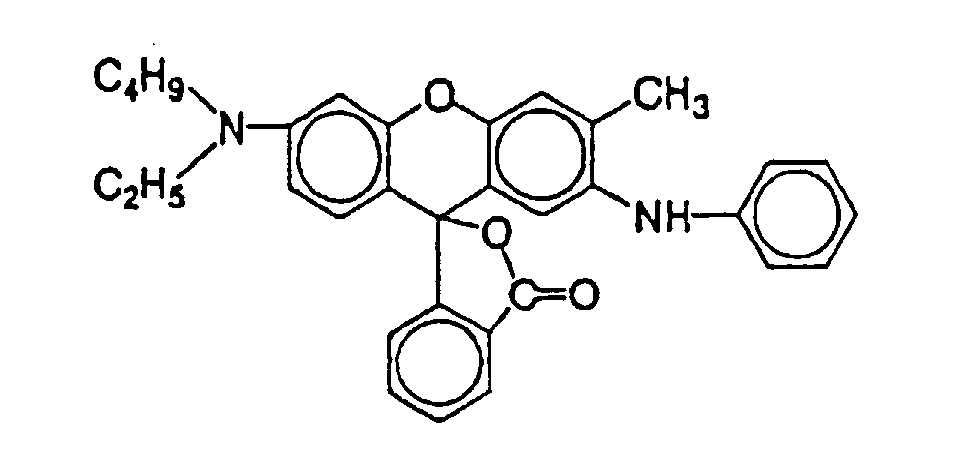
- A photopolymerizable composition emulsion (I) is composed of a borate compound-containing solution (A) and a dye-containing solution (B) described below.
- 0.5 g of the borate compound (1-1) represented by aforementioned [Chemical Formula 19] and 2.5 g of tricresyl phosphate were dissolved in 4.5 g of isopropyl acetate (solubility in water: about 4.3%) and the resulting solution was added to a mixed solution of 7.8 g of an aqueous 15% gelatin solution, 0.4 g of an aqueous 10% solution of a surfactant (1) represented by the following structural formula and 3.7 g of water. Then, the mixed solution was emulsified at 10000 rpm using a homogenizer (manufactured by Nippon Seiki Co., Ltd.) to prepare a borate compound-containing solution (A).
-

-
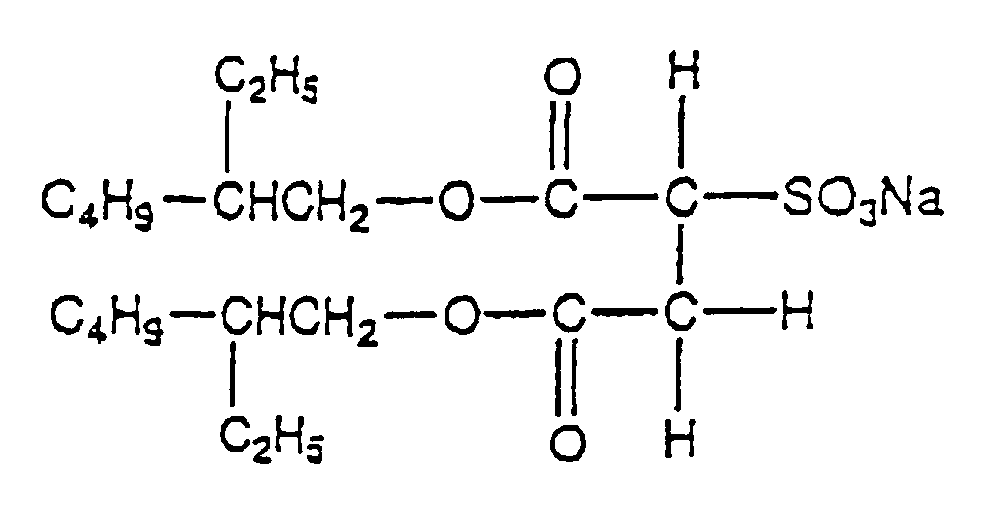
-
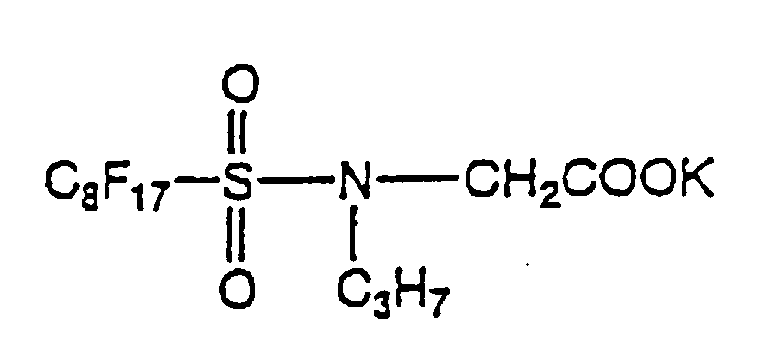
-

- To a mixed solution of 0.498 g of a spectral sensitizing dye (1) represented by the following structural formula, 0.498 g of an auxiliary (1) represented by the following structural formula used for enhancement of sensitivity, and 5.25 g of isopropyl acetate (solubility in water: about 4.3%), 83 g of an electron acceptive compound having a polymerizable group (1) represented by the following structural formula was added.
- The resulting solution was added to a mixed solution of 109.1 g of an aqueous 15% gelatin solution, 0.8 g of an aqueous 2% solution of the surfactant (1) and 4.0 g of an aqueous 2% solution of a surfactant (2) represented by the aforementioned formula, and the mixed solution was emulsified for five minutes at 10000 rpm using a homogenizer (manufactured by Nippon Seiki Co., Ltd.) to prepare a dye-containing solution (B).
-

-

-
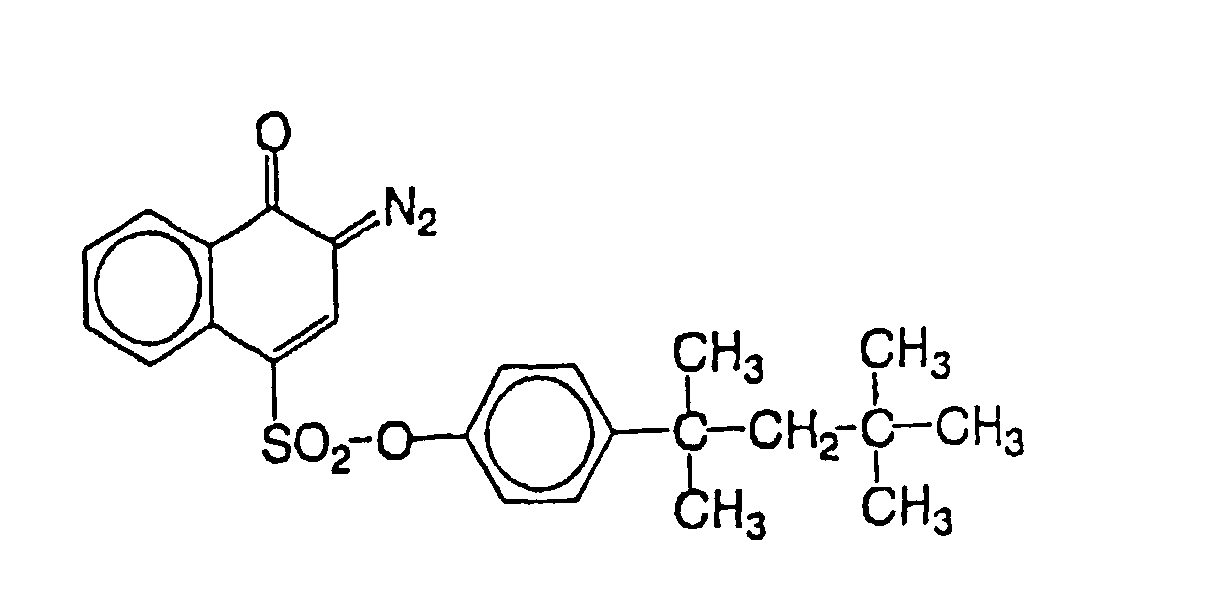
- 2 g of the electron donative colorless dye-including microcapsule solution (I), 2.25 g of the borate compound-containing solution (A), 7.36 g of the dye-containing solution (B) and 0.41 g of an aqueous 15% gelatin solution were mixed to prepare a coating solution (I) for photosensitive thermal recording layer.
- 4.5 g of an aqueous 10% gelatin solution, 4.5 g of distilled water, 0.5 g of an aqueous 2% solution of a surfactant (3) represented by the aforementioned structural formula, 0.3 g of an aqueous 2% solution of a surfactant (4) represented by the aforementioned structural formula, 0.5 g of an aqueous 2% solution of a vinyl sulfone compound (hardening agent), Cyloid 72 (FUJI-DIVISION CHEMICAL LTD.) in an amount sufficient to provide a dry coat weight of 50 mg/m2 and 1 g of Snowtex N were mixed to prepare a coating solution for protective layer.
- On a polyethylene terephthalate (PET) blue base substrate having a thickness of 175 µm, the coating solution (I) for photosensitive thermal recording layer was coated using a coating bar so that the dry weight of the photosensitive thermal recording layer was 30 g/m2, and then dried.
- On the resulting layer, the coating solution for protective layer was coated using a coating bar so that the dry weight of the protective layer was 2 g/m2, and then dried, to produce a photosensitive thermal recording material.
- The photosensitive thermal recording material was exposed to light from the protective layer side at a maximum exposure energy of 15 mJ/cm2 in the form of a step-wedged image so that the exposure energy changes in turn, using a semiconductor laser beam having a wavelength of 657 nm.
- The recording material wherein a latent image has been formed by exposure was heated on a heating plate at 120°C for 5 seconds, and then the whole surface of the photosensitive thermal recording layer of the recording material was irradiated with light on a high luminance (58000 lux) sharkstain for 30 seconds. As a result, distinct color was developed to obtain a step-wedged image wherein whiteness of the unexposed portion was high.
- In a certain step corresponding to the same exposure dose in a wedge image of the material, a difference between the exposure energy of this step and energy required to form the unexposed portion of the material [(energy required until the unexposed portion is formed) - (exposure energy of this step)] was measured and calculated and the resultant value was used as an index of the sensitivity. Accordingly, the smaller the numerical value, the higher the sensitivity is. The results are shown in Table 1.
- The resulting photosensitive thermal recording material was allowed to stand in an environment with a temperature of 35°C and a relative humidity of 80%RH for 3 days and the sensitivity was evaluated in the same manner as above. The results are shown in Table 1.
- The color density (Dmax) and fog density (Dmin) were measured by using a Macbeth transmission type densitometer (manufactured by Macbeth Co.) or a Macbeth reflection type densitometer (manufactured by Macbeth Co.). The results are shown in Table 1.
- In the same manner as in Example 1, except that the borate compound (1-7) was used in place of the borate compound (1-1) used in the preparation of the photopolymerizable composition emulsion (I), a photosensitive thermal recording material was produced, and then the same evaluation as in Example 1 was conducted. The results are shown in Table 1.
- In the same manner as in Example 1, except that the borate compound (1-8) was used in place of the borate compound (1-1) used in the preparation of the photopolymerizable composition emulsion (I), a photosensitive thermal recording material was produced, and then the same evaluation as in Example 1 was conducted. The results are shown in Table 1.
- In the same manner as in Example 1, except that the borate compound (1-9) was used in place of the borate compound (1-1) used in the preparation of the photopolymerizable composition emulsion (I), a photosensitive thermal recording material was produced, and then the same evaluation as in Example 1 was conducted. The results are shown in Table 1.
- In the same manner as in Example 1, except that the borate compound (1-10) was used in place of the borate compound (1-1) used in the preparation of the photopolymerizable composition emulsion (I), a photosensitive thermal recording material was produced, and then the same evaluation as in Example 1 was conducted. The results are shown in Table 1.
- In the same manner as in Example 1, except that a borate compound represented by the following structural formula (comparative compound 1) was used in place of the borate compound (1-1) used in the preparation of the photopolymerizable composition emulsion (I), a photosensitive thermal recording material was produced, and then the same evaluation as in Example 1 was conducted. The results are shown in Table 1.
- In the same manner as in Example 1, except that a borate compound represented by the following structural formula (comparative compound 2) was used in place of the borate compound (1-1) used in the preparation of the photopolymerizable composition emulsion (I), a photosensitive thermal recording material was produced, and then the same evaluation as in Example 1 was conducted. The results are shown in Table 1.
-

-
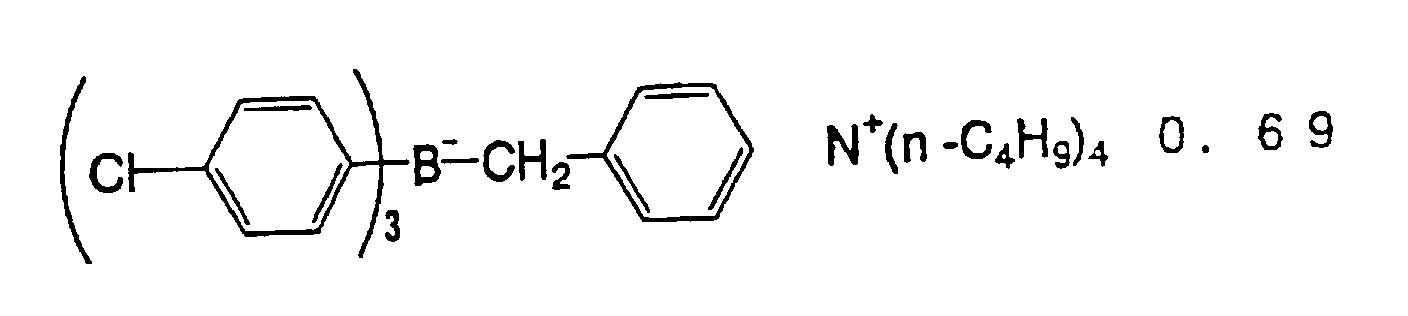
- In the same manner as in Example 1, except that a magenta color-developing electron donative colorless dye (2) represented by the following structural formula was used in place of the electron donative colorless dye (1) used in the preparation of the electron donative colorless dye-including microcapsule solution (I), an electron donative colorless dye-including microcapsule solution (II) having an average particle diameter of 0.5 µm, comprising an electron donative colorless dye (2) as a core was prepared.
-

- To a mixed solution of 0.6 g of the borate compound (1-16), 0.1 g of the spectral sensitizing dye (I), 0.1 g of the auxiliary (I) used for enhancement of sensitivity, and 3 g of isopropyl acetate (solubility in water: about 4.3%), 5 g of the electron acceptive compound (1) having a polymerizable group was added.
- The resulting solution was added to a mixed solution of 13 g of an aqueous 13% gelatin solution, 0.8 g of an aqueous 2% solution of the surfactant (1) and 0.8 g of an aqueous 2% solution of the surfactant (2), and the mixed solution was emulsified at 10000 rpm using a homogenizer (manufactured by Nippon Seiki Co., Ltd.) for 5 minutes to prepare a photopolymerizable composition emulsion (II).
- 4 g of the electron donative colorless dye-including microcapsule solution (II), 12 g of a photopolymerizable composition emulsion (II) and 12 g of an aqueous 15% gelatin solution were mixed to prepare a coating solution (II) for photosensitive thermal recording layer.
- On a substrate made of a polyester film filled with white dyes (trade name: Lumilar E-68L, manufactured by Toray Co., Ltd.) having a thickness of 100 µm, the coating solution (II) for photosensitive thermal recording layer was coated using a coating bar so that the dry weight of the photosensitive thermal recording layer was 6 g/m2, and then dried.
- On the resulting layer, the coating solution for protective layer prepared in Example 1 was coated using a coating bar so that the dry weight of the protective layer was 2 g/m2, and then dried, to produce a photosensitive thermal recording material. The resulting photosensitive thermal recording material was evaluated in the same manner as in Example 1. The results are shown in Table 1.
- In the same manner as in Example 6, except that the borate compound (1-17) was used in place of the borate compound (1-16) used in the preparation of the photopolymerizable composition emulsion (II), a photosensitive thermal recording material was produced, and then the same evaluation as in Example 6 was conducted. The results are shown in Table 1.
- In the same manner as in Example 6, except that a borate compound represented by the following structural formula (comparative compound 3) was used in place of the borate compound (1-16) used in the preparation of the photopolymerizable composition emulsion (II), a photosensitive thermal recording material was produced, and then the same evaluation as in Example 6 was conducted. The results are shown in Table 1.
-

Borate compound Sensitivity (mJ/cm2) Sensitivity after thermo-treatment (mJ/cm2) Dmax Dmin Example 1 1-1 0.57 0.59 2.68 0.05 Example 2 1-7 0.65 0.68 2.65 0.05 Example 3 1-8 0.34 0.41 2.61 0.06 Example 4 1-9 0.41 0.45 2.62 0.05 Example 5 1-10 0.69 0.71 2.65 0.05 Comparative Example 1 Comparative compound 1 0.76 0.81 2.59 0.05 Comparative Example 2 Comparative compound 2 0.62 1.38 2.53 0.06 Example 6 1-16 0.23 0.25 2.17 0.07 Example 7 1-17 0.24 0.26 2.16 0.07 Comparative Example 3 Comparative compound 3 1.08 1.11 2.02 0.07 - As is apparent from the results of Table 1, the recording materials containing the borate compound of the present invention (Examples 1 to 7) have good initial sensitivity, excellent sensitivity after the thermo-treatment and good storage properties. On the other hand, the recording materials of Comparative Examples 1 and 3 were inferior in initial sensitivity. The reason is considered to be as follows. That is, the sensitivity was lowered because the total σ constant of the borate compound was high, such as 1.02, and the electron attractive property was too strong. The recording material of Comparative Example 2 was superior in initial sensitivity, but was inferior in sensitivity after the thermo-treatment. This reason is considered as follows. That is, the acid stability is poor because an electron attractive group is absent at the ortho-position of the aryl group represented by the general formula (II).
- According to the present invention, there can be provided the novel borate compound which has high sensitivity and is superior in storage properties even in a case where an acid-containing medium is also present, and the photopolymerizable compound and the recording material which contain the same.
Claims (13)
- A borate compound represented by the following general formula (I):
General formula (I)wherein R1 represents an alkyl group which may have a substituent; R2, R3 and R4 each represents an aryl group represented by the following general formula (II); and Z+ represents a group capable of forming a cation,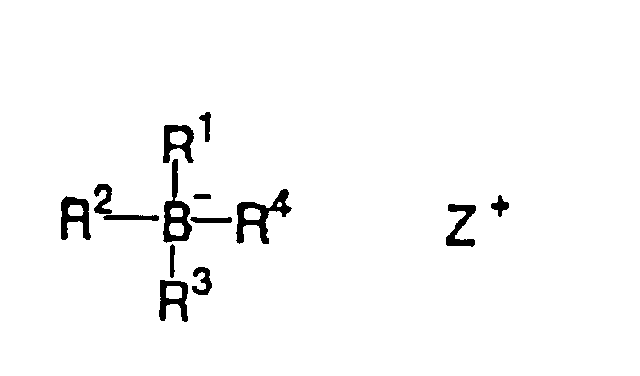
General formula (II)wherein R5 represents an electron donative group; and R6 to R9 each represents a substituent, the total Hammett σ constant of R3 to R9 being from 0 to 1.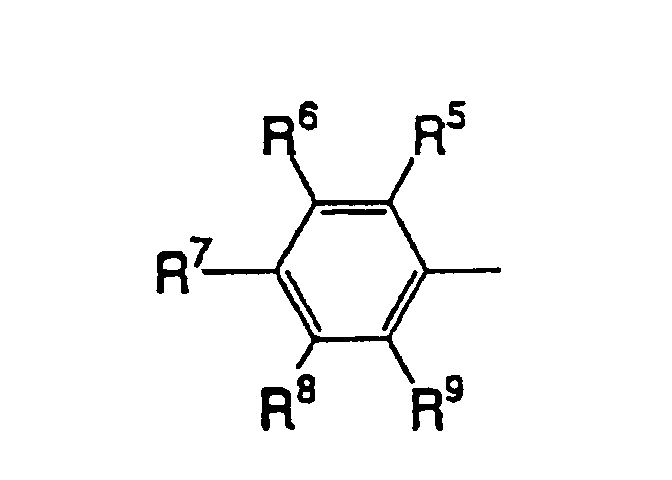
- A borate compound according to claim 1, wherein R1 is one of an alkyl and benzyl groups having 1 to 12 carbon atoms.
- A borate compound according to claim 1, wherein the total value of Hammett σ constants of R5 to R9 is from 0.1 to 0.6.
- A borate compound according to claim 1, wherein the general formula (I) is represented by one of the following general formulae (III) and (IV):
General formula (III)General formula (IV) wherein R5 represents an electron donative group; R7 and R8 each represents one of substituents represented by R6 to R9; and Z+ represents a group capable of forming a cation.
- A borate compound according to claim 4, wherein R7 in the general formula (III) and R8 in the general formula (IV) are electron attractive groups.
- A borate compound according to claim 1, wherein Z+ is selected from the group consisting of alkali metal, alkali earth metal, transition metal, quaternary ammonium, dye cation and cationic transition metal coordination complex compound.
- A borate compound according to claim 1, wherein Z+ is selected from the group consisting of lithium and sodium.
- A borate compound according to claim 1, wherein Z+ is selected from the group consisting of: tetraalkylammonium ion; dye cation; benzyltrialkylammonium ion; trialkylammonium ion; phosphonium ion or ammonium ion, which may be substituted with a neutral dye or a colorless electron acceptor; polyphosphonium ion or polyammonium ion, which may be substituted with a neutral dye or a colorless electron acceptor; onium ion; halonium ion; ferrocenium cation; and cationic transition metal.
- A photopolymerizable composition, comprising the borate compound of claim 1.
- A photopolymerizable composition according to claim 9, further comprising a dye and a radical-polymerizable compound.
- A recording material comprising a substrate and a recording layer on the substrate, said recording layer containing the photopolymerizable composition of claim 9 or 10, a color developing component A, and a color developing component B capable of reacting with the color developing component A to develop color of the color developing component (A).
- A recording material according to claim 11, wherein a combination of two components, the color developing components A and B, is selected from (a) a combination of an electron donative dye precursor and an electron attractive compound, (b) a combination of a diazonium salt compound and a coupler, (c) a combination of an organometal salt and a reducing agent, (d) a combination of a protected dye precursor and a deblocking agent, and (e) a combination of a leuco dye precursor and a deblocking agent.
- A recording material according to claim 12, wherein the color developing component A or B is contained in the form of microcapsules.
Applications Claiming Priority (4)
| Application Number | Priority Date | Filing Date | Title |
|---|---|---|---|
| JP6086299 | 1999-03-08 | ||
| JP6086299 | 1999-03-08 | ||
| JP10846699 | 1999-04-15 | ||
| JP10846699A JP2000319283A (en) | 1999-03-08 | 1999-04-15 | Borate compound and photopolymerizable composition and recording material containing the same |
Publications (2)
| Publication Number | Publication Date |
|---|---|
| EP1035124A1 true EP1035124A1 (en) | 2000-09-13 |
| EP1035124B1 EP1035124B1 (en) | 2004-05-26 |
Family
ID=26401913
Family Applications (1)
| Application Number | Title | Priority Date | Filing Date |
|---|---|---|---|
| EP00300978A Expired - Lifetime EP1035124B1 (en) | 1999-03-08 | 2000-02-08 | Borate compound, and photopolymerizable composition and recording material which contains the same |
Country Status (3)
| Country | Link |
|---|---|
| EP (1) | EP1035124B1 (en) |
| JP (1) | JP2000319283A (en) |
| DE (1) | DE60010953T2 (en) |
Cited By (3)
| Publication number | Priority date | Publication date | Assignee | Title |
|---|---|---|---|---|
| US6869746B2 (en) * | 2001-04-12 | 2005-03-22 | Fuji Photo Film Co., Ltd. | Photopolymerizable composition and recording material using the same |
| CN110049989A (en) * | 2016-12-08 | 2019-07-23 | 株式会社日本触媒 | Light produces lewis acid agent |
| CN117683372A (en) * | 2023-10-14 | 2024-03-12 | 江苏荣耀光学科技有限公司 | A kind of nanophotothermal reagent and its preparation method and application |
Families Citing this family (2)
| Publication number | Priority date | Publication date | Assignee | Title |
|---|---|---|---|---|
| JP4553442B2 (en) * | 2000-03-09 | 2010-09-29 | 日立化成工業株式会社 | Bissulfonium borate compound and process for producing the same |
| JP2014214129A (en) * | 2013-04-26 | 2014-11-17 | サンアプロ株式会社 | Curable composition and cured body using the same |
Citations (4)
| Publication number | Priority date | Publication date | Assignee | Title |
|---|---|---|---|---|
| DE19648313A1 (en) * | 1995-11-24 | 1997-05-28 | Ciba Geigy Ag | Borate coinitiators for photopolymerization |
| WO1997042227A1 (en) * | 1996-05-04 | 1997-11-13 | Ciba Specialty Chemicals Holding Inc. | Polymerisable composition |
| DE19730498A1 (en) * | 1996-07-16 | 1998-01-22 | Showa Denko Kk | Photocurable composition curing thoroughly even when pigmented or too thick to transmit light |
| DE19850139A1 (en) * | 1997-11-03 | 1999-05-12 | Ciba Geigy Ag | Photoinitiator system for photopolymerizable compositions containing a new styryl-substituted o-alkylated quinolium dye compound as electron acceptor, preferably with a borate compound as electron donor |
-
1999
- 1999-04-15 JP JP10846699A patent/JP2000319283A/en active Pending
-
2000
- 2000-02-08 EP EP00300978A patent/EP1035124B1/en not_active Expired - Lifetime
- 2000-02-08 DE DE2000610953 patent/DE60010953T2/en not_active Expired - Lifetime
Patent Citations (5)
| Publication number | Priority date | Publication date | Assignee | Title |
|---|---|---|---|---|
| DE19648313A1 (en) * | 1995-11-24 | 1997-05-28 | Ciba Geigy Ag | Borate coinitiators for photopolymerization |
| US5952152A (en) * | 1995-11-24 | 1999-09-14 | Ciba Specialty Chemicals Corporation | Borate coinitiators for photopolymerization |
| WO1997042227A1 (en) * | 1996-05-04 | 1997-11-13 | Ciba Specialty Chemicals Holding Inc. | Polymerisable composition |
| DE19730498A1 (en) * | 1996-07-16 | 1998-01-22 | Showa Denko Kk | Photocurable composition curing thoroughly even when pigmented or too thick to transmit light |
| DE19850139A1 (en) * | 1997-11-03 | 1999-05-12 | Ciba Geigy Ag | Photoinitiator system for photopolymerizable compositions containing a new styryl-substituted o-alkylated quinolium dye compound as electron acceptor, preferably with a borate compound as electron donor |
Cited By (3)
| Publication number | Priority date | Publication date | Assignee | Title |
|---|---|---|---|---|
| US6869746B2 (en) * | 2001-04-12 | 2005-03-22 | Fuji Photo Film Co., Ltd. | Photopolymerizable composition and recording material using the same |
| CN110049989A (en) * | 2016-12-08 | 2019-07-23 | 株式会社日本触媒 | Light produces lewis acid agent |
| CN117683372A (en) * | 2023-10-14 | 2024-03-12 | 江苏荣耀光学科技有限公司 | A kind of nanophotothermal reagent and its preparation method and application |
Also Published As
| Publication number | Publication date |
|---|---|
| EP1035124B1 (en) | 2004-05-26 |
| JP2000319283A (en) | 2000-11-21 |
| DE60010953T2 (en) | 2005-06-16 |
| DE60010953D1 (en) | 2004-07-01 |
Similar Documents
| Publication | Publication Date | Title |
|---|---|---|
| US6713523B2 (en) | Photopolymerizable composition and photosensitive thermal recording material | |
| US6919159B2 (en) | Photopolymerizable composition and recording material using the same | |
| US6720124B2 (en) | Recording material | |
| JP2002363207A (en) | Photopolymerizable composition and recording material using the same | |
| US6528230B1 (en) | Dye precursor, image forming material, and image forming method | |
| JP2002363206A (en) | Photopolymerizable composition and recording material using the same | |
| JP2002363208A (en) | Photopolymerizable composition and recording material using the same | |
| JP2002229196A (en) | Photopolymerizable composition and recording material | |
| JP2002363209A (en) | Photopolymerizable composition and recording material using the same | |
| EP1035124B1 (en) | Borate compound, and photopolymerizable composition and recording material which contains the same | |
| EP1298490B1 (en) | Photopolymerizable composition and recording material | |
| US20030077542A1 (en) | Photopolymerizable composition, recording material and image forming method | |
| US6416922B2 (en) | Azomethine dye precursor, image-forming material, and image-forming method | |
| JP2003057817A (en) | Photopolymerizable composition and recording material using the same | |
| JP2000327683A (en) | Borate compound, polymerizable composition and recording material containing the same | |
| US7220529B2 (en) | Photopolymerizable composition and recording material using the same | |
| JP2000212208A (en) | Photopolymerizable composition, image-forming material and image-forming process | |
| JP2002229203A (en) | Photopolymerizable composition recording material and borate compound | |
| JP2002226487A (en) | Borate compound, photopolymerizable composition containing the same and recording material | |
| JP2002293039A (en) | Image forming material and method for forming image | |
| JP3961705B2 (en) | Image forming material and image forming method | |
| JP2003002920A (en) | Polymerizable phenol derivative, photopolymerizable composition and recording material | |
| JP2004074671A (en) | Recording material | |
| JP2003076002A (en) | Recording material | |
| JP2003012609A (en) | Polymerizable phenol derivative, photopolymerizable composition, and recording material |
Legal Events
| Date | Code | Title | Description |
|---|---|---|---|
| PUAI | Public reference made under article 153(3) epc to a published international application that has entered the european phase |
Free format text: ORIGINAL CODE: 0009012 |
|
| AK | Designated contracting states |
Kind code of ref document: A1 Designated state(s): DE FR GB |
|
| AX | Request for extension of the european patent |
Free format text: AL;LT;LV;MK;RO;SI |
|
| 17P | Request for examination filed |
Effective date: 20010309 |
|
| AKX | Designation fees paid |
Free format text: DE FR GB |
|
| 17Q | First examination report despatched |
Effective date: 20010924 |
|
| GRAP | Despatch of communication of intention to grant a patent |
Free format text: ORIGINAL CODE: EPIDOSNIGR1 |
|
| RTI1 | Title (correction) |
Free format text: BORATE COMPOUND, AND PHOTOPOLYMERIZABLE COMPOSITION AND RECORDING MATERIAL WHICH CONTAINS THE SAME |
|
| GRAS | Grant fee paid |
Free format text: ORIGINAL CODE: EPIDOSNIGR3 |
|
| GRAA | (expected) grant |
Free format text: ORIGINAL CODE: 0009210 |
|
| AK | Designated contracting states |
Kind code of ref document: B1 Designated state(s): DE FR GB |
|
| REG | Reference to a national code |
Ref country code: GB Ref legal event code: FG4D |
|
| REF | Corresponds to: |
Ref document number: 60010953 Country of ref document: DE Date of ref document: 20040701 Kind code of ref document: P |
|
| ET | Fr: translation filed | ||
| PLBE | No opposition filed within time limit |
Free format text: ORIGINAL CODE: 0009261 |
|
| STAA | Information on the status of an ep patent application or granted ep patent |
Free format text: STATUS: NO OPPOSITION FILED WITHIN TIME LIMIT |
|
| 26N | No opposition filed |
Effective date: 20050301 |
|
| REG | Reference to a national code |
Ref country code: GB Ref legal event code: 732E |
|
| REG | Reference to a national code |
Ref country code: FR Ref legal event code: CD Ref country code: FR Ref legal event code: TP |
|
| PGFP | Annual fee paid to national office [announced via postgrant information from national office to epo] |
Ref country code: FR Payment date: 20130301 Year of fee payment: 14 Ref country code: GB Payment date: 20130207 Year of fee payment: 14 Ref country code: DE Payment date: 20130206 Year of fee payment: 14 |
|
| REG | Reference to a national code |
Ref country code: DE Ref legal event code: R119 Ref document number: 60010953 Country of ref document: DE |
|
| GBPC | Gb: european patent ceased through non-payment of renewal fee |
Effective date: 20140208 |
|
| REG | Reference to a national code |
Ref country code: FR Ref legal event code: ST Effective date: 20141031 |
|
| REG | Reference to a national code |
Ref country code: DE Ref legal event code: R119 Ref document number: 60010953 Country of ref document: DE Effective date: 20140902 |
|
| PG25 | Lapsed in a contracting state [announced via postgrant information from national office to epo] |
Ref country code: GB Free format text: LAPSE BECAUSE OF NON-PAYMENT OF DUE FEES Effective date: 20140208 Ref country code: DE Free format text: LAPSE BECAUSE OF NON-PAYMENT OF DUE FEES Effective date: 20140902 Ref country code: FR Free format text: LAPSE BECAUSE OF NON-PAYMENT OF DUE FEES Effective date: 20140228 |