EP1034783B1 - Amide derivatives for the treatment of retinal neurodegenerative disorders - Google Patents
Amide derivatives for the treatment of retinal neurodegenerative disorders Download PDFInfo
- Publication number
- EP1034783B1 EP1034783B1 EP98950341A EP98950341A EP1034783B1 EP 1034783 B1 EP1034783 B1 EP 1034783B1 EP 98950341 A EP98950341 A EP 98950341A EP 98950341 A EP98950341 A EP 98950341A EP 1034783 B1 EP1034783 B1 EP 1034783B1
- Authority
- EP
- European Patent Office
- Prior art keywords
- pyridyl
- substituted
- fluoro
- chloro
- hydroxy
- Prior art date
- Legal status (The legal status is an assumption and is not a legal conclusion. Google has not performed a legal analysis and makes no representation as to the accuracy of the status listed.)
- Expired - Lifetime
Links
Classifications
-
- A—HUMAN NECESSITIES
- A61—MEDICAL OR VETERINARY SCIENCE; HYGIENE
- A61K—PREPARATIONS FOR MEDICAL, DENTAL OR TOILETRY PURPOSES
- A61K31/00—Medicinal preparations containing organic active ingredients
- A61K31/16—Amides, e.g. hydroxamic acids
- A61K31/165—Amides, e.g. hydroxamic acids having aromatic rings, e.g. colchicine, atenolol, progabide
-
- C—CHEMISTRY; METALLURGY
- C07—ORGANIC CHEMISTRY
- C07D—HETEROCYCLIC COMPOUNDS
- C07D213/00—Heterocyclic compounds containing six-membered rings, not condensed with other rings, with one nitrogen atom as the only ring hetero atom and three or more double bonds between ring members or between ring members and non-ring members
- C07D213/02—Heterocyclic compounds containing six-membered rings, not condensed with other rings, with one nitrogen atom as the only ring hetero atom and three or more double bonds between ring members or between ring members and non-ring members having three double bonds between ring members or between ring members and non-ring members
- C07D213/04—Heterocyclic compounds containing six-membered rings, not condensed with other rings, with one nitrogen atom as the only ring hetero atom and three or more double bonds between ring members or between ring members and non-ring members having three double bonds between ring members or between ring members and non-ring members having no bond between the ring nitrogen atom and a non-ring member or having only hydrogen or carbon atoms directly attached to the ring nitrogen atom
- C07D213/60—Heterocyclic compounds containing six-membered rings, not condensed with other rings, with one nitrogen atom as the only ring hetero atom and three or more double bonds between ring members or between ring members and non-ring members having three double bonds between ring members or between ring members and non-ring members having no bond between the ring nitrogen atom and a non-ring member or having only hydrogen or carbon atoms directly attached to the ring nitrogen atom with hetero atoms or with carbon atoms having three bonds to hetero atoms with at the most one bond to halogen, e.g. ester or nitrile radicals, directly attached to ring carbon atoms
- C07D213/78—Carbon atoms having three bonds to hetero atoms, with at the most one bond to halogen, e.g. ester or nitrile radicals
- C07D213/81—Amides; Imides
-
- A—HUMAN NECESSITIES
- A61—MEDICAL OR VETERINARY SCIENCE; HYGIENE
- A61P—SPECIFIC THERAPEUTIC ACTIVITY OF CHEMICAL COMPOUNDS OR MEDICINAL PREPARATIONS
- A61P27/00—Drugs for disorders of the senses
- A61P27/02—Ophthalmic agents
-
- A—HUMAN NECESSITIES
- A61—MEDICAL OR VETERINARY SCIENCE; HYGIENE
- A61P—SPECIFIC THERAPEUTIC ACTIVITY OF CHEMICAL COMPOUNDS OR MEDICINAL PREPARATIONS
- A61P27/00—Drugs for disorders of the senses
- A61P27/02—Ophthalmic agents
- A61P27/06—Antiglaucoma agents or miotics
-
- C—CHEMISTRY; METALLURGY
- C07—ORGANIC CHEMISTRY
- C07C—ACYCLIC OR CARBOCYCLIC COMPOUNDS
- C07C233/00—Carboxylic acid amides
- C07C233/64—Carboxylic acid amides having carbon atoms of carboxamide groups bound to carbon atoms of six-membered aromatic rings
- C07C233/65—Carboxylic acid amides having carbon atoms of carboxamide groups bound to carbon atoms of six-membered aromatic rings having the nitrogen atoms of the carboxamide groups bound to hydrogen atoms or to carbon atoms of unsubstituted hydrocarbon radicals
-
- C—CHEMISTRY; METALLURGY
- C07—ORGANIC CHEMISTRY
- C07C—ACYCLIC OR CARBOCYCLIC COMPOUNDS
- C07C233/00—Carboxylic acid amides
- C07C233/64—Carboxylic acid amides having carbon atoms of carboxamide groups bound to carbon atoms of six-membered aromatic rings
- C07C233/66—Carboxylic acid amides having carbon atoms of carboxamide groups bound to carbon atoms of six-membered aromatic rings having the nitrogen atom of at least one of the carboxamide groups bound to a carbon atom of a hydrocarbon radical substituted by halogen atoms or by nitro or nitroso groups
-
- C—CHEMISTRY; METALLURGY
- C07—ORGANIC CHEMISTRY
- C07C—ACYCLIC OR CARBOCYCLIC COMPOUNDS
- C07C233/00—Carboxylic acid amides
- C07C233/64—Carboxylic acid amides having carbon atoms of carboxamide groups bound to carbon atoms of six-membered aromatic rings
- C07C233/67—Carboxylic acid amides having carbon atoms of carboxamide groups bound to carbon atoms of six-membered aromatic rings having the nitrogen atom of at least one of the carboxamide groups bound to a carbon atom of a hydrocarbon radical substituted by singly-bound oxygen atoms
- C07C233/68—Carboxylic acid amides having carbon atoms of carboxamide groups bound to carbon atoms of six-membered aromatic rings having the nitrogen atom of at least one of the carboxamide groups bound to a carbon atom of a hydrocarbon radical substituted by singly-bound oxygen atoms with the substituted hydrocarbon radical bound to the nitrogen atom of the carboxamide group by an acyclic carbon atom
- C07C233/69—Carboxylic acid amides having carbon atoms of carboxamide groups bound to carbon atoms of six-membered aromatic rings having the nitrogen atom of at least one of the carboxamide groups bound to a carbon atom of a hydrocarbon radical substituted by singly-bound oxygen atoms with the substituted hydrocarbon radical bound to the nitrogen atom of the carboxamide group by an acyclic carbon atom of an acyclic saturated carbon skeleton
-
- C—CHEMISTRY; METALLURGY
- C07—ORGANIC CHEMISTRY
- C07C—ACYCLIC OR CARBOCYCLIC COMPOUNDS
- C07C233/00—Carboxylic acid amides
- C07C233/64—Carboxylic acid amides having carbon atoms of carboxamide groups bound to carbon atoms of six-membered aromatic rings
- C07C233/76—Carboxylic acid amides having carbon atoms of carboxamide groups bound to carbon atoms of six-membered aromatic rings having the nitrogen atom of at least one of the carboxamide groups bound to a carbon atom of a hydrocarbon radical substituted by doubly-bound oxygen atoms
-
- C—CHEMISTRY; METALLURGY
- C07—ORGANIC CHEMISTRY
- C07C—ACYCLIC OR CARBOCYCLIC COMPOUNDS
- C07C233/00—Carboxylic acid amides
- C07C233/64—Carboxylic acid amides having carbon atoms of carboxamide groups bound to carbon atoms of six-membered aromatic rings
- C07C233/81—Carboxylic acid amides having carbon atoms of carboxamide groups bound to carbon atoms of six-membered aromatic rings having the nitrogen atom of at least one of the carboxamide groups bound to a carbon atom of a hydrocarbon radical substituted by carboxyl groups
- C07C233/82—Carboxylic acid amides having carbon atoms of carboxamide groups bound to carbon atoms of six-membered aromatic rings having the nitrogen atom of at least one of the carboxamide groups bound to a carbon atom of a hydrocarbon radical substituted by carboxyl groups with the substituted hydrocarbon radical bound to the nitrogen atom of the carboxamide group by an acyclic carbon atom
- C07C233/83—Carboxylic acid amides having carbon atoms of carboxamide groups bound to carbon atoms of six-membered aromatic rings having the nitrogen atom of at least one of the carboxamide groups bound to a carbon atom of a hydrocarbon radical substituted by carboxyl groups with the substituted hydrocarbon radical bound to the nitrogen atom of the carboxamide group by an acyclic carbon atom of an acyclic saturated carbon skeleton
-
- C—CHEMISTRY; METALLURGY
- C07—ORGANIC CHEMISTRY
- C07C—ACYCLIC OR CARBOCYCLIC COMPOUNDS
- C07C235/00—Carboxylic acid amides, the carbon skeleton of the acid part being further substituted by oxygen atoms
- C07C235/42—Carboxylic acid amides, the carbon skeleton of the acid part being further substituted by oxygen atoms having carbon atoms of carboxamide groups bound to carbon atoms of six-membered aromatic rings and singly-bound oxygen atoms bound to the same carbon skeleton
- C07C235/44—Carboxylic acid amides, the carbon skeleton of the acid part being further substituted by oxygen atoms having carbon atoms of carboxamide groups bound to carbon atoms of six-membered aromatic rings and singly-bound oxygen atoms bound to the same carbon skeleton with carbon atoms of carboxamide groups and singly-bound oxygen atoms bound to carbon atoms of the same non-condensed six-membered aromatic ring
- C07C235/46—Carboxylic acid amides, the carbon skeleton of the acid part being further substituted by oxygen atoms having carbon atoms of carboxamide groups bound to carbon atoms of six-membered aromatic rings and singly-bound oxygen atoms bound to the same carbon skeleton with carbon atoms of carboxamide groups and singly-bound oxygen atoms bound to carbon atoms of the same non-condensed six-membered aromatic ring having the nitrogen atoms of the carboxamide groups bound to hydrogen atoms or to acyclic carbon atoms
-
- C—CHEMISTRY; METALLURGY
- C07—ORGANIC CHEMISTRY
- C07C—ACYCLIC OR CARBOCYCLIC COMPOUNDS
- C07C235/00—Carboxylic acid amides, the carbon skeleton of the acid part being further substituted by oxygen atoms
- C07C235/70—Carboxylic acid amides, the carbon skeleton of the acid part being further substituted by oxygen atoms having carbon atoms of carboxamide groups and doubly-bound oxygen atoms bound to the same carbon skeleton
- C07C235/84—Carboxylic acid amides, the carbon skeleton of the acid part being further substituted by oxygen atoms having carbon atoms of carboxamide groups and doubly-bound oxygen atoms bound to the same carbon skeleton with the carbon atom of at least one of the carboxamide groups bound to a carbon atom of a six-membered aromatic ring
-
- C—CHEMISTRY; METALLURGY
- C07—ORGANIC CHEMISTRY
- C07C—ACYCLIC OR CARBOCYCLIC COMPOUNDS
- C07C237/00—Carboxylic acid amides, the carbon skeleton of the acid part being further substituted by amino groups
- C07C237/02—Carboxylic acid amides, the carbon skeleton of the acid part being further substituted by amino groups having the carbon atoms of the carboxamide groups bound to acyclic carbon atoms of the carbon skeleton
- C07C237/04—Carboxylic acid amides, the carbon skeleton of the acid part being further substituted by amino groups having the carbon atoms of the carboxamide groups bound to acyclic carbon atoms of the carbon skeleton the carbon skeleton being acyclic and saturated
- C07C237/12—Carboxylic acid amides, the carbon skeleton of the acid part being further substituted by amino groups having the carbon atoms of the carboxamide groups bound to acyclic carbon atoms of the carbon skeleton the carbon skeleton being acyclic and saturated having the nitrogen atom of at least one of the carboxamide groups bound to an acyclic carbon atom of a hydrocarbon radical substituted by carboxyl groups
-
- C—CHEMISTRY; METALLURGY
- C07—ORGANIC CHEMISTRY
- C07C—ACYCLIC OR CARBOCYCLIC COMPOUNDS
- C07C237/00—Carboxylic acid amides, the carbon skeleton of the acid part being further substituted by amino groups
- C07C237/02—Carboxylic acid amides, the carbon skeleton of the acid part being further substituted by amino groups having the carbon atoms of the carboxamide groups bound to acyclic carbon atoms of the carbon skeleton
- C07C237/22—Carboxylic acid amides, the carbon skeleton of the acid part being further substituted by amino groups having the carbon atoms of the carboxamide groups bound to acyclic carbon atoms of the carbon skeleton having nitrogen atoms of amino groups bound to the carbon skeleton of the acid part, further acylated
-
- C—CHEMISTRY; METALLURGY
- C07—ORGANIC CHEMISTRY
- C07C—ACYCLIC OR CARBOCYCLIC COMPOUNDS
- C07C237/00—Carboxylic acid amides, the carbon skeleton of the acid part being further substituted by amino groups
- C07C237/28—Carboxylic acid amides, the carbon skeleton of the acid part being further substituted by amino groups having the carbon atom of at least one of the carboxamide groups bound to a carbon atom of a non-condensed six-membered aromatic ring of the carbon skeleton
- C07C237/30—Carboxylic acid amides, the carbon skeleton of the acid part being further substituted by amino groups having the carbon atom of at least one of the carboxamide groups bound to a carbon atom of a non-condensed six-membered aromatic ring of the carbon skeleton having the nitrogen atom of the carboxamide group bound to hydrogen atoms or to acyclic carbon atoms
-
- C—CHEMISTRY; METALLURGY
- C07—ORGANIC CHEMISTRY
- C07C—ACYCLIC OR CARBOCYCLIC COMPOUNDS
- C07C255/00—Carboxylic acid nitriles
- C07C255/01—Carboxylic acid nitriles having cyano groups bound to acyclic carbon atoms
- C07C255/24—Carboxylic acid nitriles having cyano groups bound to acyclic carbon atoms containing cyano groups and singly-bound nitrogen atoms, not being further bound to other hetero atoms, bound to the same saturated acyclic carbon skeleton
- C07C255/29—Carboxylic acid nitriles having cyano groups bound to acyclic carbon atoms containing cyano groups and singly-bound nitrogen atoms, not being further bound to other hetero atoms, bound to the same saturated acyclic carbon skeleton containing cyano groups and acylated amino groups bound to the carbon skeleton
-
- C—CHEMISTRY; METALLURGY
- C07—ORGANIC CHEMISTRY
- C07D—HETEROCYCLIC COMPOUNDS
- C07D213/00—Heterocyclic compounds containing six-membered rings, not condensed with other rings, with one nitrogen atom as the only ring hetero atom and three or more double bonds between ring members or between ring members and non-ring members
- C07D213/02—Heterocyclic compounds containing six-membered rings, not condensed with other rings, with one nitrogen atom as the only ring hetero atom and three or more double bonds between ring members or between ring members and non-ring members having three double bonds between ring members or between ring members and non-ring members
- C07D213/04—Heterocyclic compounds containing six-membered rings, not condensed with other rings, with one nitrogen atom as the only ring hetero atom and three or more double bonds between ring members or between ring members and non-ring members having three double bonds between ring members or between ring members and non-ring members having no bond between the ring nitrogen atom and a non-ring member or having only hydrogen or carbon atoms directly attached to the ring nitrogen atom
- C07D213/60—Heterocyclic compounds containing six-membered rings, not condensed with other rings, with one nitrogen atom as the only ring hetero atom and three or more double bonds between ring members or between ring members and non-ring members having three double bonds between ring members or between ring members and non-ring members having no bond between the ring nitrogen atom and a non-ring member or having only hydrogen or carbon atoms directly attached to the ring nitrogen atom with hetero atoms or with carbon atoms having three bonds to hetero atoms with at the most one bond to halogen, e.g. ester or nitrile radicals, directly attached to ring carbon atoms
- C07D213/78—Carbon atoms having three bonds to hetero atoms, with at the most one bond to halogen, e.g. ester or nitrile radicals
- C07D213/81—Amides; Imides
- C07D213/82—Amides; Imides in position 3
-
- C—CHEMISTRY; METALLURGY
- C07—ORGANIC CHEMISTRY
- C07D—HETEROCYCLIC COMPOUNDS
- C07D333/00—Heterocyclic compounds containing five-membered rings having one sulfur atom as the only ring hetero atom
- C07D333/02—Heterocyclic compounds containing five-membered rings having one sulfur atom as the only ring hetero atom not condensed with other rings
- C07D333/04—Heterocyclic compounds containing five-membered rings having one sulfur atom as the only ring hetero atom not condensed with other rings not substituted on the ring sulphur atom
- C07D333/26—Heterocyclic compounds containing five-membered rings having one sulfur atom as the only ring hetero atom not condensed with other rings not substituted on the ring sulphur atom with hetero atoms or with carbon atoms having three bonds to hetero atoms with at the most one bond to halogen, e.g. ester or nitrile radicals, directly attached to ring carbon atoms
- C07D333/38—Carbon atoms having three bonds to hetero atoms with at the most one bond to halogen, e.g. ester or nitrile radicals
Definitions
- the present invention relates to amide derivatives useful as a medicament.
- the amide derivatives of the present invention are useful as a medicament for treating retinal neurodegenerative disorders and the like.
- N-t-Butyl-benzamide, N-t-butyl-4-bromobenzamide, N-t-butyl-4-nitrobenzamide, etc. are known to be useful as a medicament for treating neurodegenerative disorders such as Parkinson's disease, multiple sclerosis, Alzheimer's disease and the like (WO 95/28153, WO 96/31462).
- N-t-Butyl-3-chloro-2-pyridinecarboxamide, N-(2-hydroxy-1,1-dimethylethyl)-6-chloro-2-pyridinecarboxamide, etc. are known to be useful as a herbicide (JP 48-26918(A), JP 60-72803(A), JP 61-151174(A)).
- the present invention is intended to provide a medicament for treating retinal neurodegenerative disorders and the like.
- the inventors of the present invention have intensively carried out research, and found that amide derivatives are useful as a medicament for treating retinal degenerative disorders and the like. Thus, the present invention has been accomplished.
- the present inventions are as follows:
- Aromatic heterocyclic group includes, for example, 5- or 6-membered aromatic heterocyclic group containing 1 to 3 atoms selected independently from the group consisting of nitrogen atoms, sulfur atoms and oxygen atoms, and the like. Nitrogen atom or sulfur atom constituting heteroaryl may be oxidized.
- 5-Membered aromatic heterocyclic group includes, for example, the 5-membered aromatic heterocyclic group containing 1 or 2 atoms selected independently from the group consisting of nitrogen atoms, sulfur atoms and oxygen atoms, such as pyrrolyl, thienyl, furyl, imidazolyl, pyrazolyl, isothiazolyl, isoxazolyl and thiazolyl, oxazolyl and the like.
- 6-Membered aromatic heterocyclic group includes, for example, the 6-membered aromatic heterocyclic group containing 1 to 3 nitrogen atoms. Typical examples are pyridyl, 1-oxido-pyridyl, pyrazinyl, pyrimidinyl, pyridazinyl, and triazinyl
- Heterocyclic group includes aromatic heterocyclic group, and aliphatic heterocyclic group.
- Aliphatic heterocyclic group includes, for example, 5- or 6-membered aliphatic heterocyclic group containing 1 to 3 atoms selected independently from the group consisting of nitrogen atoms, sulfur atoms and oxygen atoms, and the like.
- 5-Membered aliphatic heterocyclic group includes, for example, the 5-membered aliphatic heterocyclic group containing 1 or 2 atoms selected independently from the group consisting of nitrogen atoms, sulfur atoms and oxygen atoms, such as pyrrolidinyl, pyrrolinyl, imidazolidinyl, pyrazolidinyl, tetrahydrofuryl, tetrahydrothienyl and dioxolanyl and the like.
- 6-Membered aliphatic heterocyclic group includes, for example, the 6-membered aliphatic heterocyclic group containing 1 or 2 atoms selected independently from the group consisting of nitrogen atoms, sulfur atoms and oxygen atoms, such as piperidyl, piperazinyl, morpholinyl, tetrahydropyranyl, and dioxanyl and the like.
- the substituent of the substituted aromatic heterocyclic group, the substituted 5-membered aromatic heterocyclic group and the substituted 6-membered aromatic heterocyclic group may be one or more and includes, for example, halogen atom, cyano, nitro, alkyl, alkyl substituted by halogen atom(s), alkoxy, alkoxy substituted by halogen atom(s), alkoxycarbonyl, alkanoylamino, amino, phenyl, alkylaminocarbonylamino, alkoxycarbonylamino, alkylsulfonylamino, carbamoyl and carbamoyl substituted by alkyl(s).
- substituents of the substituted aromatic heterocyclic group, the substituted 5-membered aromatic heterocyclic group and the substituted 6-membered aromatic heterocyclic group include, for example, halogen atom, cyano, nitro, alkyl, alkyl substituted by halogen atom(s), alkoxycarbonyl, alkanoylamino, amino, phenyl, alkylaminocarbonylamino, alkoxycarbonylamino, alkylsulfonylamino, carbamoyl and carbamoyl substituted by alkyl(s). Particularly preferable is halogen atom.
- the number of substi tuents of the substituted aromatic heterocyclic group, the substituted 5-membered aromatic heterocyclic group and the substituted 6-membered aromatic heterocyclic group may be 1, 2 or 3.
- Preferable examples are 1 and 2, and more Preferable is 1.
- Alkyl includes straight or branched C 1 -C 6 alkyl. Typical examples are methyl, ethyl, propyl, 1-methylethyl, butyl, 2-methylpropyl, pentyl, 1,2-dimethylpropyl, hexyl and 3-methylpentyl.
- Alkoxy includes straight or branched C 1 -C 6 alkoxy. Typical examples are methoxy, ethoxy, propoxy, 1-methylethoxy, butoxy, 2-methylpropoxy, pentyloxy, 1,2-dimethylpropoxy, hexyloxy and 3-methylpentoxy.
- Alkoxyalkoxy is an alkoxy group substituted by alkoxy.
- Alkoxycarbonyl is a carbonyl substituted by alkoxy.
- Alkyl substituted by halogen atom(s) and "alkoxy substituted by halogen atom(s)” are alkyl and alkoxy groups substituted by one halogen atom or more halogen atoms. Typical examples are trifluoromethyl and trifluoromethoxy.
- Alkenyl includes straight or branched alkenyl having 6 carbon atoms or less. Typical examples are vinyl, allyl, 1-propenyl and 2-butenyl, 5-hexenyl.
- Alkynyl includes straight or branched alkynyl having 6 carbon atoms or less. Typical examples are ethynyl, propargyl, 2-butynyl and 5-hexynyl.
- Alkanoyl includes, for example, straight or branched alkanoyl having 6 carbon atoms or less. Typical examples are formyl, acetyl, propionyl, butyryl, isobutyryl, valeryl, isovaleryl, pivaloyl, 2-methylbutyryl and hexanoyl.
- Cycloalkyl includes, for example, C 3 -C 8 cycloalkyl. Typical examples are cyclopropyl, cyclobutyl, cyclopentyl, cyclohexyl, cycloheptyl and cyclooctyl.
- the carbamoyl may be substituted independently by 1 or 2 alkyls.
- Halogen atom includes, for example, fluorine atom, chlorine atom, bromine atom and iodine atom. Preferable examples are fluorine atom, chlorine atom and bromine atom, and particularly preferable is fluorine atom.
- Cycloalkane includes, for example, C 3 -C 8 cycloalkane. Typical examples are cyclopropane, cyclobutane, cyclopentane, cyclohexane, cycloheptane and cyclooctane.
- Bicycloalkane includes, for example, C 7 -C 10 bicycloalkane. Typical examples are bicyclo[2.2.1]heptane and bicyclo[2.2.2]octane.
- Tricycloalkane includes, for example, C 7 -C 13 tricycloalkane.
- a typical example is adamantane.
- Substituents of the substituted alkyl, the substituted alkenyl, the substituted alkynyl, the substituted cycloalkane, the substituted bicycloalkane and the substituted tricycloalkane include, for example, cycloalkyl, alkoxy, hydroxy, halogen atom, alkoxyalkoxy, alkanoyloxy amino, alkylamino, dialkylamino, alkanoylamino and heterocyclic group such as pyrrolidino, piperidino, piperazino, 4-alkylpiperazino and morpholino.
- Alkyl, alkenyl, alkynyl, cycloalkane, bicycloalkane and tricycloalkane may be substituted independently by one or more substituents.
- R 1 , R 2 and R 3 as indicated in formulae 1, 2 and 3 are optionally substituted alkyl. More preferable are alkyl optionally substituted by hydroxy, and particularly preferable are methyl, ethyl, hydroxymethyl and hydroxyethyl.
- R 6 is hydrogen atom.
- the pharmaceutically acceptable salts include, for example, salts with inorganic acids and salts with organic acids.
- the inorganic acids include hydrochloric acid, hydrobromic acid, hydroiodic acid and sulfuric acid.
- examples of the organic acids include acetic acid, oxalic acid, citric acid, malic acid, tartaric acid, maleic acid and fumaric acid.
- the compounds of formula 1, 2 or 3 and the pharmaceutically acceptable salts thereof include their solvates such as the hydrate.
- the compounds of formula 1, 2 or 3 include their tautomers if the tautomers exist.
- the compounds of formula 1, 2 or 3 include the mixture of their geometrical isomers and the isolated isomer if the geometrical isomers exist.
- the compound of formula 1, 2 or 3 can be produced, for example, by the following methods. In the following description, the production process is illustrated with the compound of formula 1 as a representative.
- R 10 is hydrogen atom, protected hydroxy or alkyl
- Ar, n, R 1 , R 2 , R 3 , R 4 , R 5 and R 6 are as defined above.
- Protective groups in the protected hydroxy of R 10 include conventionally used protective groups (e.g. "Protective Groups in Organic Synthesis" T. W. Greene, P. M. Wuts John. Wiley and sons 1991, pp. 10-142).
- Typical examples are substituted silyl such as trimethylsilyl, triisopropylsilyl, dimethylisopropylsilyl; diethylisopropylsilyl, t-butyldimethylsilyl, diphenylmethylsilyl, t-butyldiphenylsilyl and the like; optionally substituted alkyl such as t-butyl, benzyl, trityl, methoxymethyl, methylthiomethyl, benzyloxymethyl, methoxyethoxymethyl, tetrahydropyranyl and the like, and the like.
- Preferable are t-butyl, benzyl, trityl, methoxymethyl,
- Condensation reaction of the compound of formula 4 and the compound of formula 5 can be carried out by conventional methods in peptide chemistry ("Basis and Experiment in Peptide Synthesis" by Nobuo Izumiya et. al., Maruzen, etc.).
- Typical methods are C-terminal activation methods (e.g. acid halide methods, acid azide methods, mixed acid anhydride methods, activated ester methods, symmetrical acid anhydride methods and the like), methods using coupling agents (e.g. methods using N,N'-dicyclohexylcarbodiimide and the like), N-terminal activation methods (e.g. isocyanate methods, phosphazo methods, phosphorous ester methods and the like) and the like.
- C-terminal activation methods e.g. acid halide methods, acid azide methods, mixed acid anhydride methods, activated ester methods, symmetrical acid anhydride methods and the like
- methods using coupling agents e.g
- Acid halide methods can be performed, for example, by converting the compound of formula 4 to an acid halide by a conventional method, followed by condensing with the compound of formula 5 in the presence of a base in an inert solvent such as methylene chloride and the like at 0°C to room temperature.
- the bases include, for example, organic bases such as triethylamine and the like.
- Methods using coupling agents can be performed, for example, by condensing the compound of formula 4 with the compound of formula 5 in the presence of coupling agents such as N-(3-dimethylaminopropyl)-N'-ethylcarbodiimide hydrochloride (WSC HCl) and the like, if desired, in the presence of 1-hydroxybenzotriazole (HOBt), in an inert solvent such as methylene chloride, N,N-dimethylformamide (DMF) and the like at 0°C to room temperature.
- the corresponding N-oxide compound can be prepared by oxidation with suitable oxidizing agents after condensation of the compound of formula 4 and the compound of formula 5.
- the oxidation can be performed by using an oxidizing agent such as hydrogen peroxide and the like in a solvent such as acetic acid, trifluoroacetic acid and the like at room temperature to temperature of reflux.
- the protecting group can be removed by a conventional method.
- the protecting group is t-butyl, benzyl, trityl, methoxymethyl, tetrahydropyranyl, benzyloxymethyl, methoxyethoxymethyl and the like, it can be removed by hydrogenation or hydrolysis using an acid catalyst.
- the compound of formula 1, 2 or 3 can be purified by a conventional method such as column chromatography, recrystallization and the like.
- Recrystallization solvent includes, for example, alcohol such as methanol, ethanol, 2-propanol and the like; ether such as diethyl ether and the like; ester such as ethyl acetate and the like; aromatic solvent such as toluene and the like; ketone such as acetone and the like: hydrocarbon solvent such as hexane and the like; water and the like; and mixture thereof.
- Recrystallization solvent includes, for example, alcohol such as methanol, ethanol, 2-propanol and the like; ether such as diethyl ether and the like; ester such as ethyl acetate and the like; aromatic solvent such as toluene and the like; ketone such as acetone and the like: hydrocarbon solvent such as hexane and the like; water and the like; and mixture thereof.
- the compound of formula 1, 2 or 3 or the pharmaceutically acceptable salt thereof may be administered orally or parenterally (e.g. intramuscular injection, intravenous injection, rectal administration by suppository, dermal application for liniments, eye drops or the like).
- Pharmaceutical forms for oral administration include, for example, tablets, capsules, syrups, suspensions and the like.
- Pharmaceutical forms for injection include, for example, solutions, emulsions, suspensions and the like. These compositions can be prepared by mixing the active compound with conventional carriers, excipients, binders, stabilizers and the like by conventional methods. Injection may contain buffers, solubilizers, agents for influencing osmotic pressure and the like.
- the compound is usually administered to an adult in a dose of approximately 1 - 1000 mg, preferably 10 - 500 mg per day in one portion or several portions, by the oral route.
- the compound is usually administered to an adult in a dose of approximately 0.1 - 500 mg, preferably 3 - 100 mg per day in one portion or several portions.
- WSC HCl (1.15g, 6mmol) was added to a mixture of 2, 4-difluorobenzoic acid (0. 95 g, 6 mmol), 2-fluoro-1, 1-dimethylethylamine hydrochloride (J. Med. Chem., 34 , 29-37(1991): 0. 77 g, 6 mmol), HOBt (0. 81g, 6mmol) and triethylamine (0. 91g, 9mmol) in methylene chloride (15 ml), and stirred at room temperature for 3 hours.
- WSC HCl (7.68 g, 40 mmol) was added to a mixture of 2,4-difluorobenzoic acid (6. 32 g, 40mmol), 2-amino-2-methyl-1-propanol (3. 56 g, 40 mmol) and HOBt (5.40g, 40mmol) in methylene chloride (150 ml), and stirred at room temperature for 3 hours.
- the reaction mixture was concentrated, diluted wi th ethyl acetate and washed wi th saturated aqueous NaHCO 3 , 1N hydrochloric acid, saturated aqueous NaHCO 3 and brine, successively, dried over MgSO 4 and concentrated under a reduced pressure.
- Pd(PPh 3 ) 4 (0. 42 g, 0. 37 mmol) was added to a suspension of tributyl (vinyl) tin (7. 67 g, 24. 2 mmol) and 3, 6-dichloropyridazine (3. 57 g, 24. 0 mmol) in toluene (30 ml), and stirred at 50°C for 8 hours.
- the reaction mixture was added to aqueous ammonium fluoride (100 ml), and ethyl acetate (30 ml) was added thereto and stirred for 1 hour.
- the white precipitates were removed by filtration.
- the organic layer was separated from the filtrate and the aqueous layer was extracted three times with ethyl acetate.
- AD-mix- ⁇ (Aldrich Chemical Company: 1. 39 g) was added to a mixture of t-butanol and water (1:1, 10ml) and stirred. The mixture was cooled in an ice-bath and 6-chloro-3-vinylpyridazine (0. 14 g, 1. 0 mmol) was added thereto. The resulting mixture was warmed to room temperature gradually and stirred overnight. After the reaction mixture was cooled in an ice-bath, sodium sulfite (1. 53 g) was added thereto and stirred for 1 hour. The reaction mixture was extracted with ethyl acetate and the extract was dried over Na 2 SO 4 .
- Pd(PPh 3 ) 4 (0.46 g, 0.4 mmol) was added to a solution of tributyl (vinyl) tin (6. 33 g, 20. 0 mmol) and 2, 5-dichloropyridine (2. 96 g, 20.0 mmol) in toluene (30 ml), followed by heating under reflux for 3 hours.
- the reaction mixture was added to aqueous ammonium fluoride (100 ml), and ethyl acetate (30 ml) was added thereto and stirred for 1 hour.
- the white precipitates were removed by filtration.
- the organic layer was separated from the filtrate and the aqueous layer was extracted three times with ethyl acetate.
- Example 35 X -CO 2 H
- the compounds of formulae 1, 2 and 3 are useful as a medicament for treating retinal neurodegenarative disorders.
- the retinal neurodegenarative disorders include, for example, retinitis pigmentosa, senile macular degeneration, diabetic retinopathy, glaucoma and traumatic retinal detachment.
- the compounds of formulae 2 and 3 are also useful as a medicament for treating neurodegenarative disorders (e.g. damage of central nervous system induced by stroke, hypoglycemia, cardiac arrest, perinatal asphyxia and medulla spinalis trauma, and epilepsy, Huntington's chorea, Parkinson's disease, Alzheimer's disease, and diabetic neuropathy.
- Retinal outer nuclear cells have been known to be degenerated by the constant white light exposure to albino rats (L. M. Rapp, et al., New York: Plenum, 135 (1980)). Effectiveness of the compounds of formula 1, 2 or 3 or pharmaceutical acceptable salts thereof can be evaluated by their protective action against constant light exposure-induced retinal degeneration in rats.
- the present invention is embodied by the following experiment.
- the constant white light exposure apparatus is a covered breeding box of 1020 mm in length, 425 mm in width, 520 mm in height, which is made of acryl boards and of which all inner side are covered with mirrors. Light was continuously irradiated all the day long (24 hours) using white fluorescent lamp attached to the ceiling of the apparatus. The average illuminance in the apparatus was 174.2 foot candle. After two days in the apparatus, the rats were moved to a darkroom and dark adapted for 1-4 hours.
- the rats were anesthetized with pentobarbital and placed in a stereotaxic frame. After topical mydriatica was given and electrodes were put on corneal surface, center of the forehead and the lower part of the lobe, the response in active potential of retina to the flash stimulation with fixed energy was determined from the recorded ERG (electroretinogram). The damage of retina was evaluated by the decrease in the amplitude of ERG a-wave which originated from retinal outer nuclear cells (photoreceptors). Test compounds were intraperitoneally injected just before placing the rats into the constant light exposure apparatus and at the same time on the next day to investigate its protective effect.
- each test compound in the present invention which was suspended or dissolved in 0. 5 % methylcellulose (MC) solution, was intraperitoneally administered twice to three rats in a group at the dose of 50 mg/kg.
- 0.5 % MC solution was intraperitoneally administered to the rats in MC group.
- the rats maintained in 12 hours cyclic light/dark environment were used for normal control group.
- the protection by the compounds against the retinal damage was represented as % recovery value, and the results was shown in Table 1.
- % recovery (x - z) ⁇ (y - z) ⁇ 100
- the present invention can provide a medicament for treating retinal neurodegenerative disorders and the like.
Landscapes
- Chemical & Material Sciences (AREA)
- Organic Chemistry (AREA)
- Health & Medical Sciences (AREA)
- Veterinary Medicine (AREA)
- Life Sciences & Earth Sciences (AREA)
- Ophthalmology & Optometry (AREA)
- Public Health (AREA)
- Medicinal Chemistry (AREA)
- General Health & Medical Sciences (AREA)
- Animal Behavior & Ethology (AREA)
- Pharmacology & Pharmacy (AREA)
- Nuclear Medicine, Radiotherapy & Molecular Imaging (AREA)
- Engineering & Computer Science (AREA)
- Bioinformatics & Cheminformatics (AREA)
- General Chemical & Material Sciences (AREA)
- Chemical Kinetics & Catalysis (AREA)
- Epidemiology (AREA)
- Pharmaceuticals Containing Other Organic And Inorganic Compounds (AREA)
- Pyridine Compounds (AREA)
- Acyclic And Carbocyclic Compounds In Medicinal Compositions (AREA)
- Organic Low-Molecular-Weight Compounds And Preparation Thereof (AREA)
Abstract
Description
- The present invention relates to amide derivatives useful as a medicament. The amide derivatives of the present invention are useful as a medicament for treating retinal neurodegenerative disorders and the like.
- N-t-Butyl-benzamide, N-t-butyl-4-bromobenzamide, N-t-butyl-4-nitrobenzamide, etc. are known to be useful as a medicament for treating neurodegenerative disorders such as Parkinson's disease, multiple sclerosis, Alzheimer's disease and the like (WO 95/28153, WO 96/31462). N-t-Butyl-3-chloro-2-pyridinecarboxamide, N-(2-hydroxy-1,1-dimethylethyl)-6-chloro-2-pyridinecarboxamide, etc. are known to be useful as a herbicide (JP 48-26918(A), JP 60-72803(A), JP 61-151174(A)).
- It has been known that N-t-butyl-4-fluorobenzamide, N-t-butyl-2-fluorobenzamide, N-(2-hydroxy-1,1-dimethylethyl)-2,4,5-trifluorobenzamide, N-(2-hydroxy-1,1-dimethylethyl)-2,5-difluorobenzamide, N-(2-hydroxy-1,1-dimethylethyl)-2-fluorobenzamide, N-(2-hydroxy-1,1-dimethylethyl)-5-chloro-2-fluorobenzamide, N-(2-hydroxy-1, 1-dimethylethyl)-2-fluoro-6-iodobenzamide, N-(2-hydroxy-1,1-dimethylethyl)-2,6-difluorobenzamide, N-(2-hydroxy-1,1-dimethylethyl)-2-chloro-4-fluorobenzamide, etc. were produced as synthetic intermediates (EP 511073, WO 89/06649, J. Org. Chem., 52, 713(1987). J. Org. Chem., 53, 345 (1988), EP 538231, US 3985889, etc).
- However, these documents do not disclose that the amide derivatives are effective for treating retinal neurodegenerative disorders.
- The present invention is intended to provide a medicament for treating retinal neurodegenerative disorders and the like.
- The inventors of the present invention have intensively carried out research, and found that amide derivatives are useful as a medicament for treating retinal degenerative disorders and the like. Thus, the present invention has been accomplished.
- The present inventions are as follows:
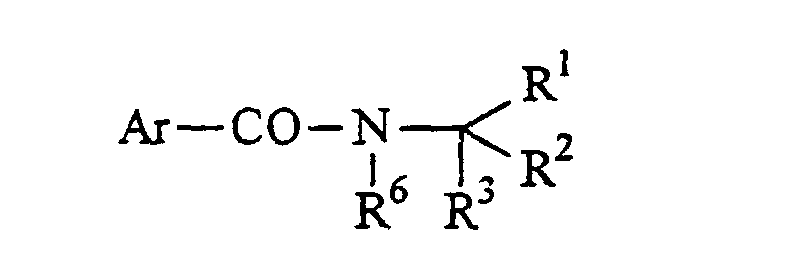
- [1] Use of a compound of the formula:
wherein Ar is substituted phenyl represented by the formula:
 or an optionally substituted aromatic heterocyclic group;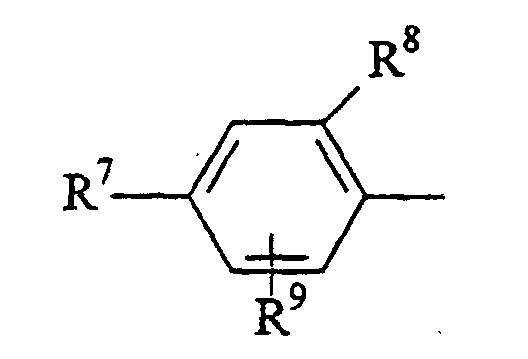
R1 is hydrogen, optionally substituted alkyl, optionally substituted alkenyl, optionally substituted alkynyl, alkoxycarbonyl, carbamoyl, alkanoyl or cyano; R2 and R3 are independently optionally substituted alkyl; or any two groups of R1, R2 and R3 may be taken together with the carbon atom adjacent thereto to form cycloalkane, or all of R1, R2 and R3 may be taken together with the carbon atom adjacent thereto to form bicycloalkane or tricycloalkane, wherein the cycloalkane, the bicycloalkane and the tricycloalkane may optionally be substituted;
R6 is hydrogen, hydroxy or alkyl;
one of R7 and R8 is flourine or chlorine; and the other is hydrogen or halogen;
R9 is hydrogen or halogen
or a pharmaceutically acceptable salt thereof;
in the manufacture of a medicament for treating retinal neurodegenerative disorder; - [2] a medicament comprising a compound of the formula:
wherein Ar1 is a substituted phenyl represented by the formula
 or an optionally substituted 6-membered heteroaryl;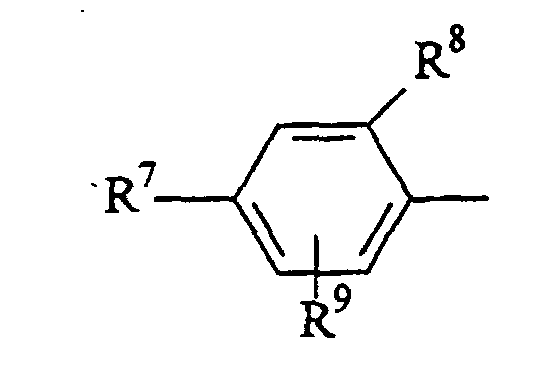
R1, R2, R3, R6, R7, R8 and R9 are as defined above;
or a pharmaceutically acceptable salt thereof; and - [3] a compound of the formula:
wherein Ar2 is a group of the formula:
 or 6-membered heteroaryl substituted by 1 to 3 halogen atoms; R1, R2, R3 and R6 are as defined above;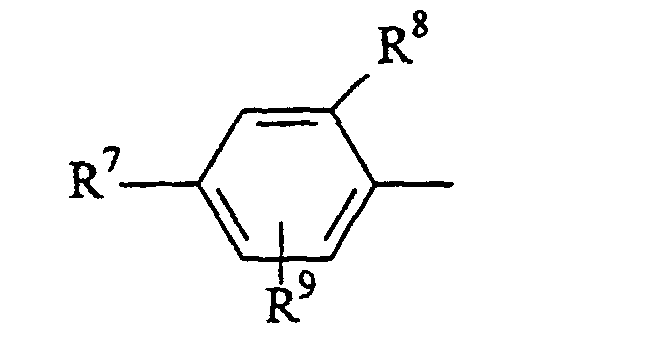
one of R7 and R8 is fluorine; the other is hydrogen or halogen atom;
R9 is hydrogen or halogen;
provided that the compound is not:
N-t-butyl-4-fluorobenzamide,
N-t-butyl-2-fluorobenzamide,
N-(2-hydroxy-1,1-dimethylethyl)-2,4,5-trifluorobenzamide,
N-(2-hydroxy-1, 1-dimethylethyl)-2, 5-difluorobenzamide,
N-(2-hydroxy-1,1-dimethylethyl)-2-fluorobenzamide,
N-(2-hydroxy-1,1-dimethylethyl)-5-chloro-2-fluorobenzamide,
N-(2-hydroxy-1,1-dimethylethyl)-2-fluoro-6-iodobenzamide,
N-(2-hydroxy-1,1-dimethylethyl)-2,6-difluorobenzamide,
N-(2-hydroxy-1,1-dimethylethyl)-2-chloro-4-fluorobenzamide,
N-t-Butyl-3-chloro-2-pyridinecarboxamide and
N-(2-hydroxy-1,1-dimethylethyl)-6-chloro-2-pyridinecarboxamide, or a pharmaceutically acceptable salt thereof. -
- "Aromatic heterocyclic group" includes, for example, 5- or 6-membered aromatic heterocyclic group containing 1 to 3 atoms selected independently from the group consisting of nitrogen atoms, sulfur atoms and oxygen atoms, and the like. Nitrogen atom or sulfur atom constituting heteroaryl may be oxidized. 5-Membered aromatic heterocyclic group includes, for example, the 5-membered aromatic heterocyclic group containing 1 or 2 atoms selected independently from the group consisting of nitrogen atoms, sulfur atoms and oxygen atoms, such as pyrrolyl, thienyl, furyl, imidazolyl, pyrazolyl, isothiazolyl, isoxazolyl and thiazolyl, oxazolyl and the like. 6-Membered aromatic heterocyclic group includes, for example, the 6-membered aromatic heterocyclic group containing 1 to 3 nitrogen atoms. Typical examples are pyridyl, 1-oxido-pyridyl, pyrazinyl, pyrimidinyl, pyridazinyl, and triazinyl
- "Heterocyclic group" includes aromatic heterocyclic group, and aliphatic heterocyclic group. Aliphatic heterocyclic group includes, for example, 5- or 6-membered aliphatic heterocyclic group containing 1 to 3 atoms selected independently from the group consisting of nitrogen atoms, sulfur atoms and oxygen atoms, and the like. 5-Membered aliphatic heterocyclic group includes, for example, the 5-membered aliphatic heterocyclic group containing 1 or 2 atoms selected independently from the group consisting of nitrogen atoms, sulfur atoms and oxygen atoms, such as pyrrolidinyl, pyrrolinyl, imidazolidinyl, pyrazolidinyl, tetrahydrofuryl, tetrahydrothienyl and dioxolanyl and the like. 6-Membered aliphatic heterocyclic group includes, for example, the 6-membered aliphatic heterocyclic group containing 1 or 2 atoms selected independently from the group consisting of nitrogen atoms, sulfur atoms and oxygen atoms, such as piperidyl, piperazinyl, morpholinyl, tetrahydropyranyl, and dioxanyl and the like.
- The substituent of the substituted aromatic heterocyclic group, the substituted 5-membered aromatic heterocyclic group and the substituted 6-membered aromatic heterocyclic group may be one or more and includes, for example, halogen atom, cyano, nitro, alkyl, alkyl substituted by halogen atom(s), alkoxy, alkoxy substituted by halogen atom(s), alkoxycarbonyl, alkanoylamino, amino, phenyl, alkylaminocarbonylamino, alkoxycarbonylamino, alkylsulfonylamino, carbamoyl and carbamoyl substituted by alkyl(s).
- Preferable substituents of the substituted aromatic heterocyclic group, the substituted 5-membered aromatic heterocyclic group and the substituted 6-membered aromatic heterocyclic group include, for example, halogen atom, cyano, nitro, alkyl, alkyl substituted by halogen atom(s), alkoxycarbonyl, alkanoylamino, amino, phenyl, alkylaminocarbonylamino, alkoxycarbonylamino, alkylsulfonylamino, carbamoyl and carbamoyl substituted by alkyl(s). Particularly preferable is halogen atom.
The number of substi tuents of the substituted aromatic heterocyclic group, the substituted 5-membered aromatic heterocyclic group and the substituted 6-membered aromatic heterocyclic group may be 1, 2 or 3. Preferable examples are 1 and 2, and more Preferable is 1. - "Alkyl" includes straight or branched C1-C6 alkyl. Typical examples are methyl, ethyl, propyl, 1-methylethyl, butyl, 2-methylpropyl, pentyl, 1,2-dimethylpropyl, hexyl and 3-methylpentyl.
- "Alkoxy" includes straight or branched C1-C6 alkoxy. Typical examples are methoxy, ethoxy, propoxy, 1-methylethoxy, butoxy, 2-methylpropoxy, pentyloxy, 1,2-dimethylpropoxy, hexyloxy and 3-methylpentoxy.
- "Alkoxyalkoxy" is an alkoxy group substituted by alkoxy. "Alkoxycarbonyl" is a carbonyl substituted by alkoxy.
- "Alkyl substituted by halogen atom(s)" and "alkoxy substituted by halogen atom(s)" are alkyl and alkoxy groups substituted by one halogen atom or more halogen atoms. Typical examples are trifluoromethyl and trifluoromethoxy.
- "Alkenyl" includes straight or branched alkenyl having 6 carbon atoms or less. Typical examples are vinyl, allyl, 1-propenyl and 2-butenyl, 5-hexenyl.
- "Alkynyl" includes straight or branched alkynyl having 6 carbon atoms or less. Typical examples are ethynyl, propargyl, 2-butynyl and 5-hexynyl.
- "Alkanoyl" includes, for example, straight or branched alkanoyl having 6 carbon atoms or less. Typical examples are formyl, acetyl, propionyl, butyryl, isobutyryl, valeryl, isovaleryl, pivaloyl, 2-methylbutyryl and hexanoyl.
- "Cycloalkyl" includes, for example, C3-C8 cycloalkyl. Typical examples are cyclopropyl, cyclobutyl, cyclopentyl, cyclohexyl, cycloheptyl and cyclooctyl.
- In the carbamoyl substituted by alkyl(s), the carbamoyl may be substituted independently by 1 or 2 alkyls.
- "Halogen atom" includes, for example, fluorine atom, chlorine atom, bromine atom and iodine atom. Preferable examples are fluorine atom, chlorine atom and bromine atom, and particularly preferable is fluorine atom.
- "Cycloalkane" includes, for example, C3-C8 cycloalkane. Typical examples are cyclopropane, cyclobutane, cyclopentane, cyclohexane, cycloheptane and cyclooctane.
- "Bicycloalkane" includes, for example, C7-C10 bicycloalkane. Typical examples are bicyclo[2.2.1]heptane and bicyclo[2.2.2]octane.
- "Tricycloalkane" includes, for example, C7-C13 tricycloalkane. A typical example is adamantane.
- Substituents of the substituted alkyl, the substituted alkenyl, the substituted alkynyl, the substituted cycloalkane, the substituted bicycloalkane and the substituted tricycloalkane include, for example, cycloalkyl, alkoxy, hydroxy, halogen atom, alkoxyalkoxy, alkanoyloxy amino, alkylamino, dialkylamino, alkanoylamino and heterocyclic group such as pyrrolidino, piperidino, piperazino, 4-alkylpiperazino and morpholino. Alkyl, alkenyl, alkynyl, cycloalkane, bicycloalkane and tricycloalkane may be substituted independently by one or more substituents.
- Preferable examples of R1, R2 and R3 as indicated in formulae 1, 2 and 3 are optionally substituted alkyl. More preferable are alkyl optionally substituted by hydroxy, and particularly preferable are methyl, ethyl, hydroxymethyl and hydroxyethyl.
- Preferable example of R6 as indicated in formulae 1, 2 and 3 is hydrogen atom.
- The pharmaceutically acceptable salts include, for example, salts with inorganic acids and salts with organic acids. Examples of the inorganic acids include hydrochloric acid, hydrobromic acid, hydroiodic acid and sulfuric acid. Examples of the organic acids include acetic acid, oxalic acid, citric acid, malic acid, tartaric acid, maleic acid and fumaric acid. The compounds of formula 1, 2 or 3 and the pharmaceutically acceptable salts thereof include their solvates such as the hydrate. The compounds of formula 1, 2 or 3 include their tautomers if the tautomers exist. The compounds of formula 1, 2 or 3 include the mixture of their geometrical isomers and the isolated isomer if the geometrical isomers exist.
- The compound of formula 1, 2 or 3 can be produced, for example, by the following methods. In the following description, the production process is illustrated with the compound of formula 1 as a representative.wherein R10 is hydrogen atom, protected hydroxy or alkyl; Ar, n, R1, R2, R3, R4, R5 and R6 are as defined above.

- Protective groups in the protected hydroxy of R10 include conventionally used protective groups (e.g. "Protective Groups in Organic Synthesis" T. W. Greene, P. M. Wuts John. Wiley and sons 1991, pp. 10-142). Typical examples are substituted silyl such as trimethylsilyl, triisopropylsilyl, dimethylisopropylsilyl; diethylisopropylsilyl, t-butyldimethylsilyl, diphenylmethylsilyl, t-butyldiphenylsilyl and the like; optionally substituted alkyl such as t-butyl, benzyl, trityl, methoxymethyl, methylthiomethyl, benzyloxymethyl, methoxyethoxymethyl, tetrahydropyranyl and the like, and the like. Preferable are t-butyl, benzyl, trityl, methoxymethyl, tetrahydropyranyl, benzyloxymethyl, methoxyethoxymethyl and the like.
- Condensation reaction of the compound of formula 4 and the compound of formula 5 can be carried out by conventional methods in peptide chemistry ("Basis and Experiment in Peptide Synthesis" by Nobuo Izumiya et. al., Maruzen, etc.). Typical methods are C-terminal activation methods (e.g. acid halide methods, acid azide methods, mixed acid anhydride methods, activated ester methods, symmetrical acid anhydride methods and the like), methods using coupling agents (e.g. methods using N,N'-dicyclohexylcarbodiimide and the like), N-terminal activation methods (e.g. isocyanate methods, phosphazo methods, phosphorous ester methods and the like) and the like.
- Acid halide methods can be performed, for example, by converting the compound of formula 4 to an acid halide by a conventional method, followed by condensing with the compound of formula 5 in the presence of a base in an inert solvent such as methylene chloride and the like at 0°C to room temperature. The bases include, for example, organic bases such as triethylamine and the like.
- Methods using coupling agents can be performed, for example, by condensing the compound of formula 4 with the compound of formula 5 in the presence of coupling agents such as N-(3-dimethylaminopropyl)-N'-ethylcarbodiimide hydrochloride (WSC HCl) and the like, if desired, in the presence of 1-hydroxybenzotriazole (HOBt), in an inert solvent such as methylene chloride, N,N-dimethylformamide (DMF) and the like at 0°C to room temperature. When Ar is optionally substituted pyridyl, the corresponding N-oxide compound can be prepared by oxidation with suitable oxidizing agents after condensation of the compound of formula 4 and the compound of formula 5. The oxidation can be performed by using an oxidizing agent such as hydrogen peroxide and the like in a solvent such as acetic acid, trifluoroacetic acid and the like at room temperature to temperature of reflux.
- When R10 is protected hydroxy, the protecting group can be removed by a conventional method. When the protecting group is t-butyl, benzyl, trityl, methoxymethyl, tetrahydropyranyl, benzyloxymethyl, methoxyethoxymethyl and the like, it can be removed by hydrogenation or hydrolysis using an acid catalyst.
- The compound of formula 1, 2 or 3 can be purified by a conventional method such as column chromatography, recrystallization and the like. Recrystallization solvent includes, for example, alcohol such as methanol, ethanol, 2-propanol and the like; ether such as diethyl ether and the like; ester such as ethyl acetate and the like; aromatic solvent such as toluene and the like; ketone such as acetone and the like: hydrocarbon solvent such as hexane and the like; water and the like; and mixture thereof. Pharmaceutically acceptable salt of the compound of formula 1, 2 or 3 can be formed by conventional methods, and the salt may be purified by recrystallization or the like.
- The compound of formula 1, 2 or 3 or the pharmaceutically acceptable salt thereof may be administered orally or parenterally (e.g. intramuscular injection, intravenous injection, rectal administration by suppository, dermal application for liniments, eye drops or the like). Pharmaceutical forms for oral administration include, for example, tablets, capsules, syrups, suspensions and the like. Pharmaceutical forms for injection include, for example, solutions, emulsions, suspensions and the like. These compositions can be prepared by mixing the active compound with conventional carriers, excipients, binders, stabilizers and the like by conventional methods. Injection may contain buffers, solubilizers, agents for influencing osmotic pressure and the like.
- Though the dose and the times for administration varies depending on the grade of the symptoms, the patient's age, body weight, administration route and the like, the compound is usually administered to an adult in a dose of approximately 1 - 1000 mg, preferably 10 - 500 mg per day in one portion or several portions, by the oral route. By injection, the compound is usually administered to an adult in a dose of approximately 0.1 - 500 mg, preferably 3 - 100 mg per day in one portion or several portions.
- The present invention will be described in detail below, referring to examples, which are not limitative of the present invention.
- The following compounds are shown as examples of the present invention:
- N-t-butyl-2-fluoro-4-bromobenzamide,
- N-t-butyl-3-fluoro-4-chlorobenzamide,
- N-t-butyl-6-chloro-nicotinamide,
- N-t-butyl-5-chloro-2-thiophenecarboxamide,
- N-t-butyl-4-chloro-2-thiophenecarboxamide,
- N-t-butyl-3-fluoro-4-chlorobenzamide,
- N-t-butyl-2,4-difluorobenzamide,
- N-(2-hydroxy-1,1-dimethylethyl)-2,4-difluorobenzamide,
- N-(2-hydroxy-1,1-dimethylethyl)-2,4,5-trifluorobenzamide,
- N-(2-hydroxy-1,1-dimethylethyl)-6-chloro-3-pyridazinecarboxamide,
- N-t-butyl-5-chloro-2-pyridinecarboxamide,
- N-(2-hydroxy-1,1-dimethylethyl)-5-chloro-2-pyridinecarboxamide,
- N-t-butyl-1-oxido-5-chloro-2-pyridinecarboxamide,
- N-t-butyl-1-oxido-2-pyridinecarboxamide,
- N-(2-hydroxy-1,1-dimethylethyl)-1-oxido-5-chloro-2-pyridinecarboxamide,
- N-(2-hydroxy-1,1-dimethylethyl)-6-chloro-3-pyridazinecarboxamide,
- N-(2-hydroxy-1,1-dimethylethyl)-3-fluoro-2-pyridinecarboxamide,
- N-(2-hydroxy-1,1-dimethylethyl)-5-fluoro-2-pyridinecarboxamide,
- N-(2-hydroxy-1,1-dimethylethyl)-6-chloronicotinamide,
- N-t-butyl-pyrazinecarboxamide,
- N-(2-hydroxy-1,1-dimethylethyl)-pyrazinecarboxamide,
- N-t-butyl-4-pyridazinecarboxamide,
- N-(2-hydroxy-1,1-dimethylethyl)-4-pyridazinecarboxamide,
- N-(2-hydroxy-1,1-dimethylethyl)-2-pyrimidinecarboxamide, and
- N-(2-hydroxy-1,1-dimethylethyl)-4-bromo-2-pyrimidinecarboxamide.
-
- In the examples section below, * represents a comparative example.
- A solution of t-butylamine (0. 2962 g, 4. 05 mmol) and triethylamine (0. 70 ml, 5. 02 mmol) in dichloromethane (2 ml) was cooled to 0 °C in an ice-bath. To the above solution was added a solution of 2,4-difluorobenzoyl chloride (0. 3652 g, 2. 07 mmol) in dichloromethane (3 ml) dropwise and stirred for 2.5 hours. The mixture was added to saturated aqueous NaHCO3 and extracted three times with ethyl acetate. The combined extracts were washed with saturated aqueous NaHCO3 and dried over MgSO4. The solvent was evaporated to give the title compound (0. 4086 g; 93%).
1H-NMR (270 MHz, CDCl3) 8.08 (td, 1H, J=8.9, 6.6 Hz), 7.02-6.93 (m, 1H), 6.84 (ddd, 1H, J=11.9, 8.6, 2.6 Hz), 6.5 (br, s, 1H), 1.47 (s, 9H) - The title compound (0. 3028 g; 84%) was prepared by the same method as that described in Example 1, using benzoyl chloride (0. 2851 g, 2. 03 mmol).
1H-NMR (270 MHz, CDCl3) 7.74-7.70 (m, 2H), 7.48-7.37 (m, 3H), 5.94 (br, 1H), 1. 48 (s, 9H) - The title compound (0. 3867 g; 90%) was prepared by the same method as that described in Example 1, using 3, 4-difluorobenzoyl chloride (0. 3563 g, 2.02 mmol).
H-NMR (270 MHz, CDCl3) 7. 58 (ddd, 1H, J=10. 9, 7. 6, 2. 3 Hz), 7. 48-7. 41 (m, 1H), 7. 19 (ddd, 1H, J=9. 6, 8. 5, 7. 7 Hz), 5. 84 (br, 1H), 1. 47 (s, 9H) - The title compound (0. 3996 g; 93%) was prepared by the same method as that described in Example 1, using 3, 5-di fluorobenzoyl chloride (0. 3555 g, 2.01 mmol).
1H-NMR (270 MHz, CDCl3) 7. 26-7. 19 (m, 2H), 6. 92 (tt, 1H, J=8. 6, 2. 3 Hz), 5.82 (br, 1H), 1. 47 (s, 9H) - The title compound (0. 4130 g; 97%) was prepared by the same method as that described in Example 1, using 2, 6-difluorobenzoyl chloride (0. 3547 g, 2.01 mmol).
1H-NMR(270 MHz, CDCl3) 7. 38-7. 29 (m, 1H), 6.92 (dd, 2H, J=8. 4, 7. 6 Hz), 5. 79 (br, 1H), 1. 47 (s, 9H) - The title compound (0. 3767 g; 96%) was prepared by the same method as that described in Example 1, using 4-fluorobenzoyl chloride (0. 3165 g, 2.00 mmol).
1H-NMR(270 MHz, CDCl3) 7. 72 (dd, 2H, J=9.2, 5.3 Hz), 7. 09 (t, 2H, J=8.6 Hz), 5. 86 (br, 1H), 1. 47 (s, 9H) - The title compound (0. 4794 g; 95%) was prepared by the same method as that described in Example 1, using 4-bromobenzoyl chloride (0. 4301 g, 1.97 mmol).
1H-NMR(270 MHz, CDCl3) 7.59 (d, 2H, J=8.9 Hz), 7.54 (d, 2H, J=8.9 Hz), 5.88 (br, 1H), 1.47 (s, 9H) - The title compound (0. 3611 g; 93%) was prepared by the same method as that described in Example 1, using 4-methylbenzoyl chloride (0. 3153 g, 2. 04 mmol).
1H-NMR (270 MHz, CDCl3) 7.61 (d, 2H, J=8.2 Hz), 7. 21 (d, 2H, J=8.2 Hz), 5.91 (br, 1H), 2. 38 (s, 3H), 1.47 (s, 9H) - The title compound (0.5017 g; >99%) was prepared by the same method as that described in Example 1, using 2, 4-dichlorobenzoyl chloride (0.4169 g, 1. 99 mmol).
1H-NMR(270 MHz, CDCl3) 7.57 (d, 1H, J=8.1 Hz), 7.40 (d, 1H, J=2.0 Hz), 7.29 (dd, 1H, J=8.1, 2.0 Hz), 5.92 (br, 1H), 1.47 (s, 9H) - The title compound (1. 0567 g; 94%) was prepared by the same method as that described in Example 1, using 4-nitrobenzoyl chloride (0. 9356 g, 5. 04 mmol).
1H-NMR (270 MHz, CDCl3) 8. 28 (d, 2H, J=8. 9 Hz), 7. 88 (d, 2H, J=8. 9 Hz), 5. 96 (br, 1H), 1. 50 (s, 9H) - Ten percent Pd/C (0.1003 g) was added to a solution of N-t-butyl-4-nitrobenzamide (0.7349 g, 3. 31 mmol) in ethyl acetate (10 ml), and stirred under a hydrogen atmosphere for 1 hour. The reaction mixture was filtered through Celite® bed and the solvent was evaporated. The residue was purified by silica gel chromatography (hexane/ethyl acetate/triethylamine = 50/100/1) to give the title compound (0.6156 g; 97%).
1H-NMR (270 MHz, CDCl3) 7. 55 (d, 2H, J=8. 7 Hz), 6. 65 (d, 2H, J=8. 7 Hz), 5. 81 (br, 1H), 3. 92 (br, 2H), 1. 45 (s, 9H) - The title compound (0. 4204 g; 99%) was prepared by the same method as that described in Example 1, using 4-chlorobenzoyl chloride (0.3507 g, 2.00 mmol).
1H-NMR (270 MHz, CDCl3) 7.65 (d, 2H, J=8.6 Hz), 7.38 (d, 2H, J=8.6 Hz), 5.88 (br, 1H), 1.47 (s, 9H) - The title compound (0.4104 g; 98%) was prepared by the same method as that described in Example 1, using 4-methoxybenzoyl chloride (0. 3444 g, 2.02 mmol).
1H-NMR(270 MHz, CDCl3) 7.68 (d, 2H, J=8.9 Hz), 6.90 (d, 2H, J=8.9 Hz), 5.87 (br, 1H), 3. 84 (s, 3H), 1. 47 (s, 9H) - To a suspension of 4-chloro-2-fluorobenzoic acid (0.3494 g, 2.00 mmol) in methylene chloride (10 ml) were added t-butylamine (0. 32 ml, 3. 05 mmol) and HOBt (0. 3248 g, 2. 40 mmol), and then WSC HCl (0. 4596 g, 2. 40 mmol) was added and stirred for 3 hours. The reaction mixture was added into water and extracted three times with ethyl acetate. The combined extracts were dried over MgSO4. The solvent was evaporated and the residue was purified by silica gel chromatography (hexane/ethyl acetate = 5/1) to give the title compound (0.4403 g; 96%).
1H-NMR(270 MHz, CDCl3) 8.01 (t, 1H, J=8.6 Hz), 7.24 (dd, 1H, J=8.6, 2.0 Hz), 7. 13 (dd, 1H, J=11. 6, 2. 0 Hz), 6.50 (br, 1H). 1. 47 (s, 9H) - The title compound (0. 3804 g; 95%) was prepared by the same method as that described in Example 1, using 2, 4-difluorobenzoyl chloride (0. 3532 g, 2. 00 mmol) and isopropylamine (0. 26 ml, 3. 05 mmol).
1H-NMR (270 MHz, CDCl3) 8.12 (td, 1H, J=8. 9, 6. 6 Hz), 6.98 (tdd, 1H, J=8. 9, 2. 3, 1.0 Hz), 6.85 (ddd, 1H, J=12.0, 8.4, 2.3 Hz), 6.45 (br, 1H), 4.35-4.25 (m, 1H), 1. 27 (d, 6H, J=6. 6 Hz) - The title compound (0. 2134 g; 39%) was prepared by the same method as that described in Example 1, using 4-methoxycarbonylbenzoyl chloride (0. 3933 g, 1.98 mmol).
1H-NMR (270 MHz, CDCl3) 8. 08 (d, 2H, J=8. 7 Hz), 7. 77 (d, 2H, J=8. 7 Hz), 5. 95 (br, 1H), 3.94 (s, 3H), 1.48 (s, 9H) - The title compound (0. 3017 g; 84%) was prepared by the same method as that described in Example 1, using isonicotinoyl chloride hydrochloride (0.3606 g, 2.02 mmol).
1H-NMR(270 MHz, CDCl3) 8. 72 (dd, 2H, J=4.3, 1. 7 Hz), 7.56 (dd, 2H, J=4. 3, 1. 7 Hz), 5. 95 (br, 1H), 1. 48 (s, 9H) - The title compound (0. 4278 g; 93%) was prepared by the same method as that described in Example 14, using 2-chloro-4-fluorobenzoic acid (0. 3492 g, 2. 00 mmol).
1H-NMR (270 MHz, CDCl3) 7. 64 (dd, 1H, J=8. 6, 6. 3 Hz), 7. 12 (dd, 1H, J=8. 6, 2.4 Hz), 7.03 (td, 1H, J=8.6, 2.4 Hz), 5.91 (br, 1H), 1.47 (s, 9H) - The title compound (0. 1856 g; 51%) was prepared by the same method as that described in Example 14, using 3-thiophenecarboxylic acid (0. 2567 g, 2.00 mmol).
1H-NMR (270 MHz, CDCl3) 7. 77 (dd, 1H, J=2. 6, 1. 7 Hz), 7. 33 (dd, 1H, J=5. 2, 2. 6 Hz), 7. 31 (dd, 1H, J=5. 2, 1. 7 Hz), 5. 76 (br, 1H), 1. 46 (s, 9H) - The title compound (0. 2966 g; 83%) was prepared by the same method as that described in Example 1, using nicotinoyl chloride hydrochloride (0.3569 g, 2.00 mmol).
1H-NMR (270 MHz, CDCl3) 8. 91 (dd; 1H, J=2. 3, 0. 8 Hz), 8. 70 (dd, 1H, J=4. 9, 1. 7 Hz), 8. 07 (ddd, 1H, J=7. 9, 2. 3, 1. 7 Hz), 7. 37 (ddd, 1H, J=7. 9, 4. 9, 0.8 Hz), 5.95 (br, 1H), 1.49 (s, 9H) - The title compound (0. 3109 g; 86%) was prepared by the same method as that described in Example 1, using picolinoyl chloride hydrochloride (0.3624 g, 2.04 mmol).
1H-NMR(270 MHz, CDCl3) 8. 52 (ddd, 1H, J=4.6, 1. 7, 1.0 Hz), 8. 18 (ddd, 1H, J=7. 9, 1. 3, 1. 0 Hz), 8. 00 (br, 1H), 7. 83 (ddd, 1H, J=7. 9, 7. 6, 1. 7 Hz), 7.40 (ddd, 1H, J=7.6, 4.6, 1.3 Hz), 1.50 (s, 9H) - The title compound (0. 3873 g; 91%) was prepared by the same method as that described in Example 14, using 2, 3-difluorobenzoic acid (0. 3159 g, 2.00 mmol).
1H-NMR (270 MHz, CDCl3) 7. 76 (ddt, 1H, J=8.1, 6. 6, 1. 6 Hz), 7,33-7.22 (m, 1H), 7.17 (tdd, 1H, J=8.1, 4.8, 1.6 Hz), 6.43 (br, 1H), 1.48 (s, 9H) - The title compound (0. 3700 g; >99%) was prepared by the same method as that described in Example 1, using 2-thiophenecarbonyl chloride (0. 2939 g, 2.00 mmol).
1H-NMR (270 MHz, CDCl3) 7. 43 (dd, 1H, J=5. 0, 1. 0 Hz), 7. 40 (dd, 1H, J=4. 0, 1. 0 Hz), 7. 04 (dd, 1H, J=5. 0, 4. 0 Hz), 5. 80 (br, 1H), 1. 46 (s, 9H) - The title compound (0. 4869 g; 95%) was prepared by the same method as that described in Example 14, using 4-phenylbenzoic acid (0.3982 g, 2.01 mmol).
1H-NMR (270 MHz, CDCl3) 7. 80 (d, 2H, J=9. 2 Hz), 7. 66-7. 59 (m, 4H), 7. 49-7. 37 (m, 3H), 5.98 (br, 1H), 1.50 (s, 9H) - The title compound (0.3921 g; 91%) was prepared by the same method as that described in Example 14, using 2, 5-difluorobenzoic acid (0.3173 g, 2.01 mmol).
1H-NMR(270 MHz, CDCl3) 7.78-7.71 (m, 1H), 7.14-7.03 (m, 2H), 6.60 (br, 1H), 1. 47 (s, 9H) - WSC HCl (1.15g, 6mmol) was added to a mixture of 2, 4-difluorobenzoic acid (0. 95 g, 6 mmol), 2-fluoro-1, 1-dimethylethylamine hydrochloride (J. Med. Chem., 34, 29-37(1991): 0. 77 g, 6 mmol), HOBt (0. 81g, 6mmol) and triethylamine (0. 91g, 9mmol) in methylene chloride (15 ml), and stirred at room temperature for 3 hours. The reaction mixture was concentrated, diluted with ethyl acetate and washed with saturated aqueous NaHCO3, 1N hydrochloric acid, saturated aqueous NaHCO3 and brine, successively, dried over MgSO4 and concentrated under a reduced pressure. The residue was purified by silica gel chromatography (hexane/ethyl acetate = 20/1) to give the title compound (0.61 g; 44%).
1H-NMR(270 MHz, CDCl3) 8.07 (1H, td, J=8.9, 6. 6Hz), 6.95-7.02 (1H, m), 6.86 (1H, ddd, J=12, 8, 3Hz), 6. 57 (1H, br), 4. 56 (2H, d, J=47. 5Hz), 1. 47 (6H, d, J=2Hz) - WSC HCl (7.68 g, 40 mmol) was added to a mixture of 2,4-difluorobenzoic acid (6. 32 g, 40mmol), 2-amino-2-methyl-1-propanol (3. 56 g, 40 mmol) and HOBt (5.40g, 40mmol) in methylene chloride (150 ml), and stirred at room temperature for 3 hours. The reaction mixture was concentrated, diluted wi th ethyl acetate and washed wi th saturated aqueous NaHCO3, 1N hydrochloric acid, saturated aqueous NaHCO3 and brine, successively, dried over MgSO4 and concentrated under a reduced pressure. The residue was purified by silica gel chromatography (hexane/ethyl acetate = 3/1) to give the title compound (6.20 g; 68%).
1H-NMR (270 MHz, CDCl3) 8. 08 (1H, td, J=8. 8, 6. 6Hz), 6. 96-7. 04 (1H, m), 6. 87 (1H, ddd, J=12, 8, 2Hz), 6.76 (1H, br), 4.43 (1H, t, J=6Hz), 3.69 (2H, d, J=6Hz), 1. 42 (6H, s) - The title compound was prepared by the same method as that described in Example 27, using 2-amino-2-methylpropionitrile (J. Med. Chem., 37, 1810-1822(1994)).
1H-NMR (270 MHz, CDCl3) 8. 18 (1H, td, J=9. 2, 6. 6Hz), 7. 00-7. 07 (1H, m), 6. 86 (1H. ddd, J=12, 8, 2Hz), 6. 71 (1H, br), 1. 82 (6H, s) - The title compound was prepared by the same method as that described in Example 26, using 2-amino-2-methylpropanamide hydrochloride.
1H-NMR (270 MHz, CDCl3) 8. 09 (1H, td, J=8. 9, 6. 6Hz), 7. 28 (1H, br), 6. 96-7. 04 (1H, m), 6. 88 (1H, ddd, J=12, 8, 2Hz), 6. 34 (1H, br), 5. 54 (1H, br), 1.70 (6H, s) - The title compound was prepared by the same method as that described in Example 26, using methyl 2-amino-2-methylpropionate hydrochloride.
1H-NMR(270 MHz, CDCl3) 8.10 (1H td, J=9.2, 6.6Hz), 7.22 (1H, br), 6.95-7.03 (1H, m), 6. 88 (1H, ddd, J=12, 8, 2Hz), 3. 79 (3H, s), 1. 67 (6H, s) - A solution of 2M trimethylsilyldiazomethane in hexane (3. 9ml, 7. 8mmol) was added dropwise to a solution of N-(2-hydroxy-1, 1-dimethylethyl)-2,4-difluorobenzamide obtained in Example 27 (0. 59 g, 2.6 mmol) and boron trifluoride diethyl etherate (43 mg, 0. 3 mmol) in methylene chloride (6 ml), and stirred at room temperature overnight. To the reaction mixture was added 1N hydrochloric acid (5 ml) dropwise, and the resulting mixture was concentrated and extracted with ethyl acetate. The extract was washed with brine, dried over MgSO4 and concentrated under a reduced pressure. The residue was purified by silica gel column chromatography (hexane/ethyl acetate = 10/1) to give the title compound (0.38 g; 60%).
1H-NMR (270 MHz, CDCl3) 8. 07 (1H, td, J=8. 9, 6. 6Hz), 6. 93-7. 00 (1H, m), 6. 88 (1H, br), 6. 83 (1H, ddd, J=12, 8, 3Hz), 3. 44 (2H, s), 3. 41 (3H, s), 1. 47 (6H, s) - To a solution of N-(2-hydroxy-1, 1-dimethylethyl)-2, 4-difluorobenzamide obtained in Example 27 (6.2 g, 27 mmol) and triethylamine (8.2 g, 81 mmol) in DMSO (60 ml) was added a solution of pyridine sulfur trioxide complex (12. 9 g, 81mmol) in DMSO (60 ml) dropwise with cooling in an ice-bath and stirred for 2 hours. The reaction mixture was poured over a mixture of ice and water, and extracted with ethyl acetate. The extract was washed with 1N hydrochloric acid, saturated aqueous NaHCO3 and brine, successively dried over Na2SO4, concentrated under a reduced pressure and the residue was crystallized from hexane/ethyl acetate to give the title compound (5.05 g; 82%).
1H-NMR (270 MHz, CDCl3) 9. 47 (1H, s), 8. 11 (1H, td, J=8. 9, 6. 6Hz), 7. 14 (1H, br), 6. 98-7. 04 (1H, m), 6. 90 (1H, ddd, J=12, 8, 2Hz), 1. 51 (6H, s) - To a solution of N-(1-formyl-1-methylethyl)-2, 4-difluorobenzamide obtained in Example 32 (1. 14 g, 5mmol) in THF (10 ml) was added 0. 9 M methyl magnesium bromide in THF (13ml, 12mmol) dropwise at -20°C. The reaction mixture was warmed gradually to room temperature over 2 hours and added to 10% aqueous ammonium chloride (100 ml). The resulting mixture was extracted with ethyl acetate, washed with saturated aqueous NaHCO3 and brine, dried over MgSO4, concentrated under a reduced pressure and the residue was crystallized from hexane/ethyl acetate to give the title compound (1.05 g; 86%).
1H-NMR (270 MHz, CDCl3) 8. 08 (1H, td, J=8. 8, 6. 6Hz), 6. 97-7. 04 (1H, m), 6. 87 (1H, ddd, J=12, 8, 2Hz), 6. 73 (1H, br), 4. 55 (1H, br d, J=6Hz), 3. 80 (1H, m), 1. 49 (3H, s), 1. 37 (3H, s), 1. 20 (3H, d, J=6. 3Hz) - To a solution of N-(2-hydroxy-1, 1-dimethylpropyl)-2, 4-difluorobenzamide obtained in Example 33 (0. 30 g, 1. 2mmol) and triethylamine (0. 37 g, 3. 7 mmol) in DMSO (3 ml) was added pyridine sulfur trioxide complex (0.59 g, 3.7 mmol) portionwise and stirred at room temperature for 3 hours. The reaction mixture was added to a mixture of ice and water and extracted with ethyl acetate. The extract was washed with 1N hydrochloric acid, saturated aqueous NaHCO3 and brine, successively dried over Na2SO4 and concentrated under a reduced pressure. The residue was crystallized from hexane/ethyl acetate to give the title compound (0.24 g; 81%).
1H-NMR (270 MHz, CDCl3) 8.08 (1H, td, J=8.9, 6.6Hz), 7.47 (1H, br), 6. 96-7. 03 (1H, m), 6. 89 (1H, ddd, J=12, 8, 2Hz), 2. 25 (3H, s), 1. 61 (6H, s) - To a solution of N-(1-methoxycarbonyl-1-methylethyl)-2, 4-difluorobenzamide obtained in Example 30 (1.51 g, 5.9mmol) in methanol (10 ml) was added 4N aqueous NaOH (10 ml), and stirred at room temperature for 30 min. The methanol was evaporated and the resulting mixture was acidified with 4N hydrochloric acid and extracted with ethyl acetate. The extract was dried over Na2SO4 and the solvent was evaporated under a reduced pressure to give the title compound (1.42 g; 99%).
1H-NMR (270 MHz, CDCl3) 12. 35 (1H, br), 8. 44 (1H, br), 7. 64 (1H, td, J=8. 7, 6. 5Hz), 7. 33 (1H, ddd, J=11, 9, 2Hz), 7. 13-7. 20 (1H, m), 1. 44 (6H, s) - The title compound was prepared by the same method as that described in Example 27, using 1,1-dimethylpropargylamine.
1H-NMR(270 MHz, CDCl3) 8.15 (1H, td, J=8.9, 7.0Hz), 6.96-7.02 (1H, m), 6.85 (1H, ddd, J=12, 8, 2Hz), 6. 76 (1H, br), 2.40 (1H, s), 1. 75 (6H, s) - Five percent Pd/BaSO4 (100 mg) was added to a solution of N-(1, 1-dimethyl-2-propynyl)-2, 4-difluorobenzamide obtained in Example 36 (1. 0g, 4. 5 mmol) and quinoline (100 mg) in methanol (20 ml), and stirred under a hydrogen atmosphere at room temperature for 1.5 hours. The catalyst was removed by filtration and the filtrate was concentrated under a reduced pressure. The residue was diluted with ethyl acetate and washed with 1N hydrochloric acid (x 3), saturated aqueous NaHCO3 and brine and dried over Na2SO4. The solvent was evaporated and the residue was purified by silica gel column chromatography (hexane/ethyl acetate = 15/1) to give the title compound (0.95 g; 94%).
1H-NMR (270 MHz, CDCl3) 8. 09 (1H, td, J=8. 9, 6. 6Hz), 6. 94-7. 01 (1H, m), 6. 85 (1H, ddd, J=12, 8, 2Hz), 6. 66 (1H, br), 6. 10 (1H dd, J=17. 5, 11Hz), 5. 18 (1H, d, J=17.5Hz), 5. 10 (1H, d, J=11Hz), 1.55 (6H, s) - To a solution of t-amylamine (0. 35 ml, 3. 0 mmol) and triethylamine (0. 56 ml, 4. 0 mmol) in methylene chloride (3 ml) was added a solution of 2,4-difluorobenzoyl chloride (0. 36 g, 2. 0 mmol) in methylene chloride (2 ml) with cooling in an ice-bath, and stirred for 1 hour. The reaction mixture was poured over saturated aqueous NaHCO3 and extracted with ethyl acetate. The extract was washed with saturated aqueous NaHCO3 and dried over MgSO4. The solvent was evaporated to give the title compound (0.47 g; >99%).
1H-NMR (270 MHz, CDCl3) 8. 07 (td, J = 9. 1, 6. 6 Hz, 1H), 7. 01-6. 93 (m, 1H), 6.84 (ddd, J = 11.9, 8.6, 2.6 Hz, 1H), 6.40 (br, 1H), 1.82 (q, J = 7.6 Hz, 2H), 1. 41 (s, 6H), 0. 91 (t, J = 7. 6 Hz, 3H) - Pd(PPh3)4 (0. 42 g, 0. 37 mmol) was added to a suspension of tributyl (vinyl) tin (7. 67 g, 24. 2 mmol) and 3, 6-dichloropyridazine (3. 57 g, 24. 0 mmol) in toluene (30 ml), and stirred at 50°C for 8 hours. The reaction mixture was added to aqueous ammonium fluoride (100 ml), and ethyl acetate (30 ml) was added thereto and stirred for 1 hour. The white precipitates were removed by filtration. The organic layer was separated from the filtrate and the aqueous layer was extracted three times with ethyl acetate. The organic layers were combined and dried over MgSO4. The solvent was evaporated and the residue was purified by silica gel chromatography (hexane/ethyl acetate = 3/1) to give the title compound (1.03 g; 31%).
- AD-mix-α (Aldrich Chemical Company: 1. 39 g) was added to a mixture of t-butanol and water (1:1, 10ml) and stirred. The mixture was cooled in an ice-bath and 6-chloro-3-vinylpyridazine (0. 14 g, 1. 0 mmol) was added thereto. The resulting mixture was warmed to room temperature gradually and stirred overnight. After the reaction mixture was cooled in an ice-bath, sodium sulfite (1. 53 g) was added thereto and stirred for 1 hour. The reaction mixture was extracted with ethyl acetate and the extract was dried over Na2SO4. The solvent was evaporated and the residue was purified by silica gel chromatography (chloroform/methanol = 10/1) to give the diol (0.14 g; 81%). The diol was dissolved in chloroform (3 ml), and saturated aqueous NaHCO3 (0. 12 ml) and sodium periodate (0. 35 g, 1. 6 mmol) were added thereto and stirred for 1 hour. Na2SO4 was added thereto and filtered off, after stirring for 1 hour. The solvent was evaporated under a reduced pressure to give 6-chloro-3-pyridazinecarboxyaldehyde (0.10g; 90%). To an aqueous solution (2 ml) of disodium hydrogen phosphate dodecahydrate (50 mg), were added acetnitrile (3 ml), 6-chloro-3-pyridazinecarboxyaldehyde (0.10 g, 0.70 mmol), 31% aqueous hydrogen peroxide (0. 12 g, 1. 1 mmol) and sodium chlorite (0. 10 g, 1. 1 mmol), and stirred for 3 hours. The precipitated solid was removed by filtration. Water (20 ml) was added to the filtrate and the resulting mixture was extracted with ethyl acetate (30 ml x 3) and the extracts were dried over Na2SO4. The solvent was evaporated to give the title compound (0.043 g; 39%).
1H-NMR(270 MHz, DMSO-d6) 8.23 (d, J=9.0 Hz, 1H), 8.09 (d, J=9.0 Hz, 1H) - To a solution of 6-chloro-3-pyridazinecarboxylic acid (0.12 g, 0.76 mmol) in methylene chloride (15 ml) were added t-butylamine (0. 21 ml, 2. 0 mmol) and N, N-bis (2-oxo-3-oxazolidinyl)phosphinic chloride (0. 24 g, 0. 93 mmol), and stirred overnight. The reaction mixture was added to saturated aqueous NaHCO3 and extracted three times with ethyl acetate. The combined organic layers were washed with brine and dried over Na2SO4. The solvent was evaporated and the residue was purified by silica gel chromatography (hexane/ethyl acetate = 2/1) to give the title compound (0.080 g; 49%).
1H-NMR (270 MHz, CDCl3) 8. 27 (d, J=8. 8 Hz, 1H), 7. 97 (br, 1H), 7. 67 (d, J=8. 8 Hz, 1H), 1. 51 (s, 9H) - Pd(PPh3)4 (0.46 g, 0.4 mmol) was added to a solution of tributyl (vinyl) tin (6. 33 g, 20. 0 mmol) and 2, 5-dichloropyridine (2. 96 g, 20.0 mmol) in toluene (30 ml), followed by heating under reflux for 3 hours. The reaction mixture was added to aqueous ammonium fluoride (100 ml), and ethyl acetate (30 ml) was added thereto and stirred for 1 hour. The white precipitates were removed by filtration. The organic layer was separated from the filtrate and the aqueous layer was extracted three times with ethyl acetate. The organic layers were combined and dried over Na2SO4. Purification through silica gel chromatography (hexane/ethyl acetate = 10/1 to 2/1) followed by evaporation of the solvent at an atmospheric pressure gives the title compound (3. 6 g) as an oil containing a solvent.
1H-NMR(270 MHz, CDCl3) 8.52 (d, J=2.4 Hz, 1H), 7.62 (dd, J=8.5, 2.4 Hz, 1H), 7. 29 (d, J=8. 5 Hz, 1H), 6. 78 (dd, J=17. 5, 10. 7 Hz, 1H), 6. 18 (dd, J=17. 5, 1. 3 Hz, 1H), 5. 51 (dd, J=10. 7, 1. 3 Hz, 1H) - Potassium carbonate (0.29 g, 2.1 mmol) was added portionwise to an aqueous solution (10 ml) of sodium periodate (2.13 g, 9.98 mmol) and potassium permanganate (0. 065 g, 0. 41 mmol). After t-butanol (5 ml) was added, 5-chloro-2-vinylpyridine obtained above (0.34 g, ca. 2 mmol) was added portionwise followed by stirring for 1 hour. Then ethylene glycol (1 ml) was added thereto and stirred for another hour. The reaction mixture was added to 5% aqueous KHSO4, extracted three times with ethyl acetate and the extracts were dried over Na2SO4. The solvent was evaporated to give the title compound (0.31 g).
1H-NMR (270 MHz, DMSO-d6) 8. 76 (dd, J=2. 3, 0. 5 Hz, 1H), 8. 12 (dd, J=8. 3, 2.3 Hz, 1H), 8.04 (dd, J=8.3, 0.5 Hz, 1H) - The title compound was prepared by the same method as that described in Example 27, using 5-chloro-2-pyridinecarboxylic acid and t-butylamine.
1H-NMR (270 MHz, CDCl3) 8. 46 (dd, J=2. 4, 0. 6 Hz, 1H), 8. 13 (dd, J=8. 4, 0. 6 Hz, 1H), 7. 85 (br, 1H), 7. 80 (dd, J=8. 4, 2. 4 Hz, 1H), 1. 49 (s, 9H) - Thirty-one percent aqueous hydrogen peroxide (1.0 ml) was added to a solution of N-t-butyl-5-chloro-2-pyridinecarboxamide obtained in Example 40 (0. 35 g, 1. 65 mmol) in trifluoroacetic acid (5 ml), and heated under reflux for 1.5 hours. The reaction mixture was added portionwise into an ice-cooled 1N aqueous NaOH and extracted three times with ethyl acetate and the extracts were dried over MgSO4. The solvent was evaporated, and the residue was purified by silica gel chromatography (hexane/ethyl acetate = 5/1 to 2/1) to give the title compound (0.24 g, 65%).
1H-NMR(270 MHz, CDCl3) 10.90 (br, 1H), 8.35 (d, J=8.5 Hz, 1H), 8.27 (d, J=1. 6 Hz, 1H), 7. 43 (dd, J=8. 5, 1. 6 Hz, 1H), 1. 47 (s, 9H) - Thirty-one percent aqueous hydrogen peroxide (22.2 g, 196 mmol) was added to a solution of 3-fluoropyridine (9.5 g, 98 mmol) in acetic acid (100 ml), and heated under reflux for 5 hours. The reaction mixture was allowed to cool and concentrated under a reduced pressure to about one third of its volume. Ethanol (10 ml) and water (50 ml) were added thereto and the mixture was concentrated again. The residue was basified with conc. aqueous NaOH and extracted with chloroform. The solvent was evaporated to dryness under a reduced pressure to give the title compound (9.0 g; 81%).
1H-NMR(270 MHz, CDCl3) 8.16 (m, 1H), 8.07 (d, J=7Hz, 1H), 7.26 (q, J=7Hz, 1H), 7.07 (t, J=7Hz, 1H) - Dimethyl sulfate (1.01 g, 8 mmol) was added to 1-oxido-3-fluoropyridine (0.9 g, 8 mmol) and stirred at 100°C for 2 hours. The reaction mixture was allowed to cool and concentrated to dryness under a reduced pressure. Water (10 ml) was added to the residue and cooled in an ice-bath. Sodium cyanide (1. 18 g, 24 mmol) was added to the mixture and stirred for 30 min. followed by stirring at room temperature for 30 min. Aqueous NaOH (1N) was added thereto and extracted with chloroform. The extract was dried over Na2SO4 and the solvent was evaporated under a reduced pressure to give a mixture of regio-isomers of fluorocyanopyridine (0.9 g). Aqueous NaOH (4N, 10 ml) was added to the mixture of regio-isomers and heated under reflux for 2.5 hours. The mixture was allowed to cool, acidified with conc. hydrochloric acid and concentrated to dryness under a reduced pressure. The residue was suspended in DMF (10 ml), and t-butylamine (1.46 g, 20 mmol), WSC HCl (3. 1 g, 16 mmol) and HOBt (2.2 g, 16 mmol) were added thereto and stirred overnight. The reaction mixture was diluted with water and extracted with ethyl acetate. The extract was washed with saturated aqueous NaHCO3 and dried over Na2SO4. The solvent was evaporated under a reduced pressure and the residue was purified by silica gel chromatography (hexane/ethyl acetate = 5/1) to give the title compound (0.19 g; 12%).
1H-NMR (270 MHz, CDCl3) 8. 34 (dt, J=4, 1. 3Hz, 1H), 7. 77 (br, 1H), 7. 53 (ddd, J=10.5, 8.5, 1. 3Hz, 1H), 7.44 (dt, J=8.5, 4Hz, 1H), 1.49 (s, 9H) - To water (100 ml) were added 5-fluoro-2-methylpyridine (J. Med. Chem., 32, 1970(1989): 2. 2 g, 20 mmol) and potassium permanganate (19. 1 g, 120 mmol), and heated under reflux for 4 hours. The reaction mixture was filtrated and the filtrate was concentrated, acidified with KHSO4, extracted with ethyl acetate and the extract was dried over Na2SO4. The solvent was evaporated to give the title compound (0.80 g; 28%).
1H-NMR(270 MHz, DMSO-d6) 8.70 (d, J=2. 8 Hz, 1H), 8.14 (dd, J=8.7, 4. 6 Hz, 1H), 7.89 (td, J=8.7, 2.8 Hz, 1H) - The title compound was prepared by the same method as that described in Example 39-3), using 5-fluoro-2-pyridinecarboxylic acid and t-butylamine.
1H-NMR(270 MHz, CDCl3) 8.35 (d, J=2.8 Hz, 1H), 8.21 (dd, J=8.6, 4.5 Hz, 1H), 7. 82 (br, 1H), 7. 52 (td, J=8. 6, 2. 8 Hz, 1H), 1. 49 (s, 9H) - The title compound was prepared by the same method as that described in Example 26, using 2,4,5-trifluorobenzoic acid and t-butylamine.
1H-NMR(270 MHz, CDCl3) 7.91 (ddd, J=11, 9, 7Hz, 1H), 6.97 (ddd, J=11, 10, 6Hz, 1H), 5.53 (br, 1H), 1.46 (s, 9H) - The title compound was prepared by the same method as that described in Example 41, using N-t-butyl-5-fluoro-2-pyridinecarboxamide obtained in Example 44.
1H-NMR(270 MHz, DMSO-d6) 10.92 (br, 1H), 8. 77 (dd, J=4.9, 2.3 Hz, 1H), 8.25 (dd, J=9. 2, 7. 0 Hz, 1H), 7. 63 (ddd, J=9. 2, 7. 0, 2. 3 Hz, 1H), 1. 38 (s, 9H) - The title compound was prepared by the same method as that described in Example 26, using 6-chloronicotinic acid and t-butylamine.
1H-NMR(270 MHz, CDCl3) 8. 67 (d, J=2. 6Hz, 1H), 8.03 (dd, J=8.3, 2.6Hz, 1H), 7.39 (dd, J=8.3, 0.7Hz, 1H), 5.88 (br, 1H), 1.48 (s, 9H) - The title compound was prepared by the same method as that described in Example 26, using 5-chloro-2-pyridinecarboxylic acid obtained in Example 40-2) and 2-amino-2-methyl-1-propanol.
1H-NMR(270 MHz, CDCl3) 8.49 (dd, J=2.4, 0.7 Hz, 1H), 8.14 (dd, J=8.6, 0.7 Hz, 1H), 8. 05 (br, 1H), 7. 83 (dd, J=8. 6, 2. 4 Hz, 1H), 4. 70 (t, J=6. 4 Hz, 1H), 3.73 (d, J=6.4 Hz, 2H), 1.43 (s, 6H) - The structures of the compounds obtained in Example 1 to 47 are as follows:
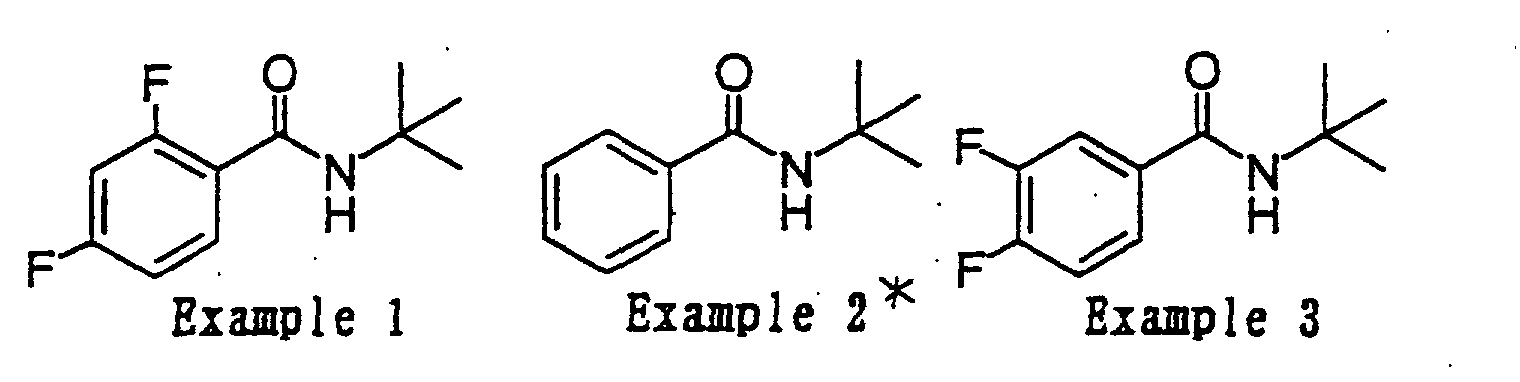


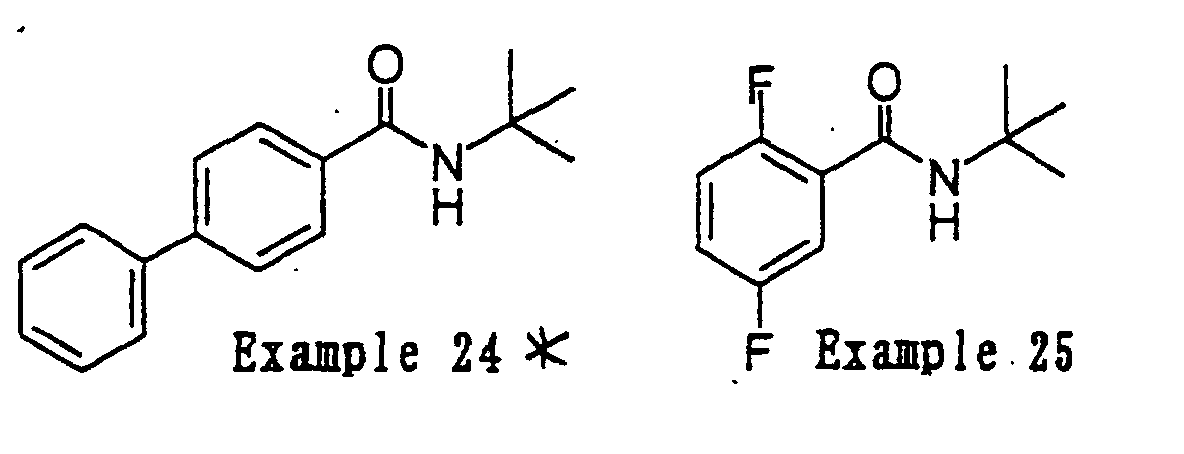 Example 26 X = -CH2F Example 27 X = -CH2OH
Example 28 X = -CN Example 29 X = -CONH2
Example 30 X = -CO2Me Example 31 X = -CH2OMe
Example 32 X = -CHO Example 33 X = -CH(OH)CH3
Example 34 X = -C(O)CH3 Example 35 X = -CO2H
Example 36 X = -C≡CH Example 37 X = -CH=CH2
Example 38 X = -CH2CH3


- The compounds of formulae 1, 2 and 3 are useful as a medicament for treating retinal neurodegenarative disorders. The retinal neurodegenarative disorders include, for example, retinitis pigmentosa, senile macular degeneration, diabetic retinopathy, glaucoma and traumatic retinal detachment. The compounds of formulae 2 and 3 are also useful as a medicament for treating neurodegenarative disorders (e.g. damage of central nervous system induced by stroke, hypoglycemia, cardiac arrest, perinatal asphyxia and medulla spinalis trauma, and epilepsy, Huntington's chorea, Parkinson's disease, Alzheimer's disease, and diabetic neuropathy.
- Retinal outer nuclear cells have been known to be degenerated by the constant white light exposure to albino rats (L. M. Rapp, et al., New York: Plenum, 135 (1980)). Effectiveness of the compounds of formula 1, 2 or 3 or pharmaceutical acceptable salts thereof can be evaluated by their protective action against constant light exposure-induced retinal degeneration in rats. The present invention is embodied by the following experiment.
- Male Wistar rats (7 weeks old, Charles River Japan Inc.) were purchased and maintained in cyclic light/dark environment (8:00-20:00/light term) for one week, and then placed within the apparatus for constant white light exposure for two days. The constant white light exposure apparatus is a covered breeding box of 1020 mm in length, 425 mm in width, 520 mm in height, which is made of acryl boards and of which all inner side are covered with mirrors. Light was continuously irradiated all the day long (24 hours) using white fluorescent lamp attached to the ceiling of the apparatus. The average illuminance in the apparatus was 174.2 foot candle. After two days in the apparatus, the rats were moved to a darkroom and dark adapted for 1-4 hours. The rats were anesthetized with pentobarbital and placed in a stereotaxic frame. After topical mydriatica was given and electrodes were put on corneal surface, center of the forehead and the lower part of the lobe, the response in active potential of retina to the flash stimulation with fixed energy was determined from the recorded ERG (electroretinogram). The damage of retina was evaluated by the decrease in the amplitude of ERG a-wave which originated from retinal outer nuclear cells (photoreceptors). Test compounds were intraperitoneally injected just before placing the rats into the constant light exposure apparatus and at the same time on the next day to investigate its protective effect.
- According to the experimental procedure described above, each test compound in the present invention, which was suspended or dissolved in 0. 5 % methylcellulose (MC) solution, was intraperitoneally administered twice to three rats in a group at the dose of 50 mg/kg. In the same way, 0.5 % MC solution was intraperitoneally administered to the rats in MC group. The rats maintained in 12 hours cyclic light/dark environment were used for normal control group. The protection by the compounds against the retinal damage was represented as % recovery value, and the results was shown in Table 1.
- x : a-wave amplitude in test compound group
- y : a-wave amplitude in normal control group
- z : a-wave amplitude in MC group
-
- The present invention can provide a medicament for treating retinal neurodegenerative disorders and the like.
| Pharmacological effect of tested compounds | ||
| Compounds | % recovery (Mean±S.E.M.) | N |
| The compound of Example 1 | 95.5 ± 12.3 | 3 |
| The compound of Example 6 | 80. 1 ± 8. 9 | 3 |
| The compound of Example 27 | 45. 7 ± 10.1 | 3 |
| The compound of Example 40 | 82. 3 ± 25. 6 | 3 |
| The compound of Example 47 | 58. 2 ± 2. 7 | 3 |
Claims (28)
- Use of a compound of the formula:wherein Ar is a substituted phenyl represented by the formula
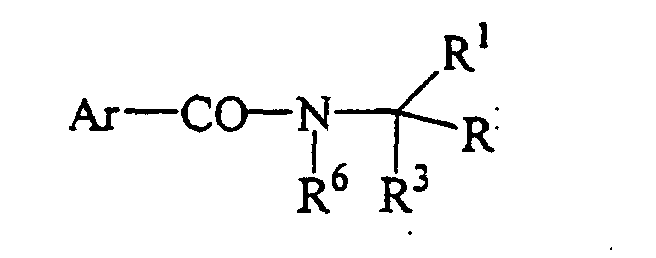 or an optionally substituted aromatic heterocyclic group;
R1 is a hydrogen atom, an optionally substituted alkyl, optionally substituted alkenyl or optionally substituted alkynyl group or an alkoxycarbonyl, carbamoyl, alkanoyl or cyano group; R2 and R3 are independently an optionally substituted alkyl group; or any two groups of R1, R2 and R3 may be taken together with the carbon atom adjacent thereto to form a cycloalkane, or all of R1, R2 and R3 may be taken together with the carbon atom adjacent thereto to form a bicycloalkane or tricycloalkane, wherein the cycloalkane, the bicycloalkane and the tricycloakane may optionally be substituted;
R6 is a hydrogen atom or a hydroxy or alkyl group;
one of R7 and R8 is fluorine or chlorine; and the other is hydrogen or halogen;
R9 is hydrogen or halogen;
or a pharmaceutically acceptable salt thereof,
in the manufacture of a medicament for treating retinal neurodegenerative disorder. - Use according to claim 1 wherein Ar is an optionally substituted aromatic heterocyclic group.
- Use according to claim 2, wherein the substituent of the substituted aromatic heterocyclic group is a halogen atom, a cyano, nitro or alkyl group, or an alkyl group substituted by one or more halogen atom(s), an alkoxy group, an alkoxy group substituted by one or more halogen atom(s), an alkoxycarbonyl, alkanoylamino, amino, phenyl, alkylaminocarbonylamino, alkoxycarbonylamino, alkylsulfonylamino or carbamoyl group or a carbamoyl group substituted by one or more alkyl group(s); and the substituent of the substituted alkyl, the substituted alkenyl, the substituted alkynyl, the substituted cycloalkane, the substituted bicycloalkane and the substituted tricycloalkane is cycloalkyl, a heterocyclic group, alkoxy, hydroxy, a halogen atom, alkoxyalkoxy, alkanoyloxy, amino, alkylamino, dialkylamino, alkanoylamino, pyrrolidino, piperidino, piperazino, 4-alkylpiperazino or mopholino.
- Use according to claim 2, wherein Ar is 2-pyridyl, 3-pyridyl, 4-pyridyl, pyrazinyl, 3-pyridazinyl, 4-pyridazinyl, 2-pyrimidinyl, 4-pyrimidinyl or 5-pyrimidinyl, wherein the phenyl, the 2-pyridyl, the 3-pyridyl, the 4-pyridyl, the pyrazinyl, the 3-pyridazinyl, the 4-pyridazinyl, the 2-pyrimidinyl, the 4-pyrimidinyl and the 5-pyrimidinyl groups are unsubstituted or substituted by 1 to 3 halogen atoms and the nitrogen atom of the 2-pyridyl, the 3-pyridyl and the 4-pyridyl is optionally oxidized.
- Use according to claim 2, wherein Ar is 5-chloro-2-pyridyl, 5-fluoro-2-pyridyl, 3-fluoro-2-pyridyl, 2-chloro-5-pyridyl, 1-oxido-5-chloro-2-pyridyl, 1-oxido-5-fluoro-2-pyridyl, 1-oxido-3-fluoro-2-pyridyl, 1-oxido-2-chloro-5-pyridyl or 6-chloro-3-pyridazinyl.
- Use according to any of claims 1 to 5, wherein R1 is methyl, ethyl, hydroxymethyl or hydroxyethyl and both of R2 and R3 are methyl.
- Use according to any of claims 1 to 6, wherein R6 is a hydrogen atom.
- Use according to claim 1, wherein Ar is substituted phenyl represented by the formula:R1 is an alkyl group substituted by a hydroxy group; R2 and R3 are independently an optionally substituted alkyl group; or any two groups of R1, R2 and R3 may be taken together with the carbon atom adjacent thereto to form a cycloalkane, or all of R1, R2 and R3 may be taken together with the carbon atom adjacent thereto to form a bicycloalkane or tricycloalkane, wherein the cycloalkane, the bicycloalkane and the tricycloakane may optionally be substituted; and R7, R8 and R9 are as defmed in claim 1.
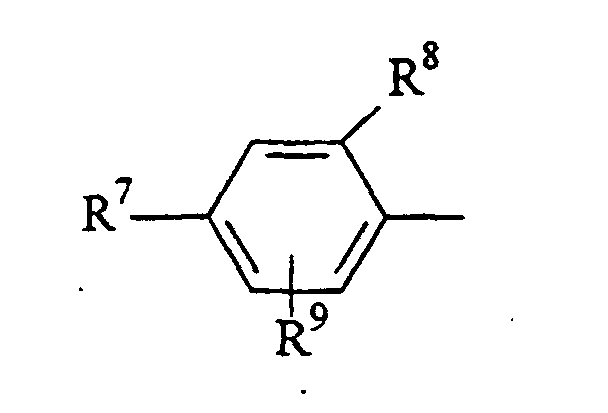
- Use according to claim 8, wherein Ar is 2, 4-difluorophenyl, 2, 4-dichlorophenyl, 4-fluorophenyl, 4-chlorophenyl, 2-fluoro-4-chlorophenyl, 2-fluoro-4-bromophenyl, 2-fluoro-4-iodophenyl or 2, 4, 5-trifluorophenyl.
- Use according to claim 8 or 9, wherein R1 is hydroxymethyl or hydroxyethyl and both of R2 and R3 are methyl.
- Use according to any of claims 8 to 10, wherein R6 is hydrogen.
- Use according to claim 1, wherein Ar is a group of the formula:R1, R2 and R3 are independently optionally substituted alkyl, wherein the substituent is cycloalkyl, alkoxy, halogen, alkoxyalkoxy, alkanoyloxy, amino, alkylamino, dialkylamino, alkanoylamino, or a heterocyclic group selected from pyrrolidino, piperidino, piperazino, 4-alkylpiperazino and morpholino; or any two of R1, R2 and R3 may be taken together with the carbon atom adjacent thereto to form a cycloalkane, or all of R1, R2 and R3 may be taken together with the carbon atom adjacent thereto to form a bicycloalkane or tricycloalkane, wherein the cycloalkane, the bicycloalkane and the tricycloalkane may optionally be substituted;

R6 is hydrogen, hydroxyl or alkyl;
one of R7 and R8 is fluorine or chlorine; and the other is hydrogen or halogen;
R9 is hydrogen or halogen. - Use according to claim 12, wherein Ar is 2, 4-difluorophenyl, 2, 4-dichlorophenyl, 4-fluorophenyl, 4-chlorophenyl, 2-fluoro-4-chlorophenyl, 2-fluoro-4-bromophenyl, 2-fluoro-4-iodophenyl, 2, 4, 5-trifluorophenyl.
- Use according to any of claims 12 to 13, wherein R1 is methyl or ethyl and both of R2 and R3 are methyl.
- Use according to any of claims 12 to 14, wherein R6 is hydrogen atom.
- Use of a compound selected from N-t-butyl-2, 4-difluorobenzaminde, N-(2-hydroxy-1,1-dimethylethyl)-2,4-difluorobenzaminde, and N-(2-hydroxy-1,1-dimethylethyl)-5-chloro-2-pyridinecarboxamide, or a pharmaceutically acceptable salt thereof, in the manufacture of a medicament for treating retinal neurodegenerative disorder.
- A medicament comprising a compound of the formula:wherein Ar1 is a substituted phenyl represented by the formula:
 or an optionally substituted 6-membered aromatic heterocyclic group;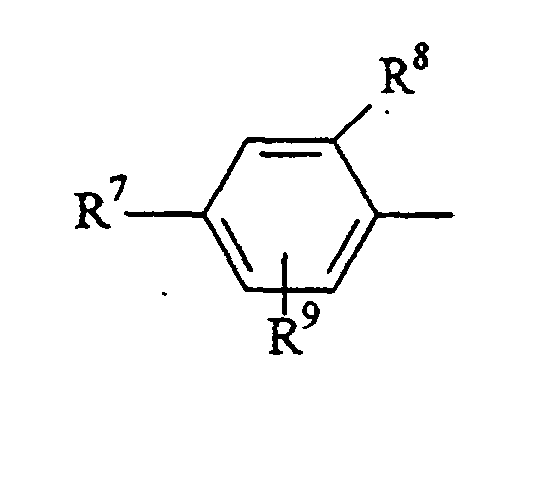
R1, R2, R3, R6, R7, R8 and R9 are as defined in claim 1;
or a pharmaceutically acceptable salt thereof. - A medicament according to claim 17 wherein the 6-membered aromatic heterocyclic group is substituted by a halogen atom, a cyano, nitro or alkyl group, an alkyl group substituted by one or more halogen atom(s), an alkoxy group, an alkoxy group substituted by one or more halogen atom(s), an alkoxycarbonyl, alkanoylamino, amino, phenyl, alkylaminocarbonylamino, alkoxycarbonylamino, alkylsulfonylamino or carbamoyl group or a carbamoyl group substituted by one or more alkyl group(s); and the substituent of the substituted alkyl, the substituted alkenyl, the substituted alkynyl, the substituted cycloalkane, the substituted bicycloalkane and the substituted tricycloalkane is cycloalkyl, a heterocyclic group, alkoxy, hydroxy, a halogen atom, alkoxyalkoxy, alkanoyloxy, amino, alkylamino, dialkylamino, alkanoylamino, pyrrolidino, piperidino, piperazino, 4-alkylpiperazino or morpholino.
- A medicament according to claim 17, wherein the optionally substituted 6-membered aromatic heterocyclic group is 2-pyridyl, 3-pyridyl, 4-pyridyl, pyrazinyl, 3-pyridazinyl, 4-pyridazinyl, 2-pyrimidinyl, 4-pyrimidinyl or 5-pyrimidinyl, wherein the 2-pyridyl, the 3-pyridyl, the 4-pyridyl, the pyrazinyl, the 3-pyridazinyl, the 4-pyridazinyl, the 2-pyrimidinyl, the 4-pyrimidinyl and the 5-pyrimidinyl groups are unsubstituted or substituted by 1 to 3 halogen atoms and the nitrogen atom of the 2-pyridyl, the 3-pyridyl and the 4-pyridyl is optionally oxidized.
- A medicament according to claim 17, wherein Ar1 is 2,4-difluorophenyl, 4-fluorophenyl, 2-fluoro-4-chlorophenyl, 2-fluoro-4-bromophenyl, 2-fluoro-4-iodophenyl, 2, 4, 5-trifluorophenyl, 5-chloro-2-pyridyl, 5-fluoro-2-pyridyl, 3-fluoro-2-pyridyl, 2-chloro-5-pyridyl, 1-oxido-5-chloro-2-pyridyl, 1-oxido-5-fluoro-2-pyridyl, 1-oxido-3-fluoro-2-pyridyl, 1-oxido-2-chloro-5-pyridyl or 6-chloro-3-pyridazinyl.
- A medicament according to any of claims 17 to 20, wherein R1 is methyl, ethyl, hydroxymethyl or hydroxyethyl and both of R2 and R3 are methyl.
- A medicament according to any of claims 17 to 21 wherein R6 is a hydrogen atom.
- A compound of the formula:wherein Ar2 is a group of the formula:
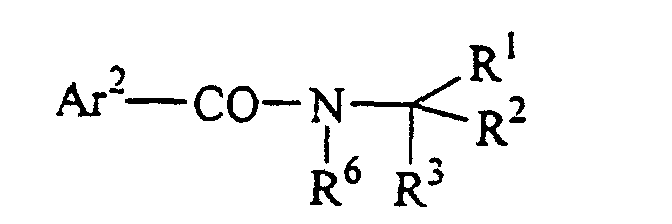 or a 6-membered aromatic heterocyclic group substituted by 1 to 3 halogen atoms;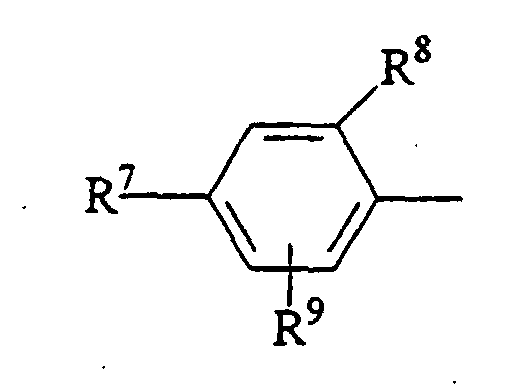
R1, R2, R3 and R6 are as defined in claim 1;
one of R7 and R8 is a fluorine atom; and the other is a hydrogen atom or a halogen atom; R9 is a hydrogen atom or a halogen atom;
provided that the compound is not
N-t-butyl-4-fluorobenzamide,
N-t-butyl-2-fluorobenzamide,
N-(2-hydroxy-1,1-dimethylethyl)-2,4,5-trifluorobenzamide,
N-(2-hydroxy,11-dimethylethyl)-2,5-difluorobenzamide,
N-(2-hydroxy,11-dimethylethyl)-2-fluorobenzamide,
N-(2-hydroxy,11-dimethylethyl)-5-chloro-2-fluorobenzamide,
N-(2-hydroxy,11-dimethylethyl)-2-fluoro-6-iodobenzamide,
N-(2-hydroxy,11-dimethylethyl)-2,6-difluorobenzamide,
N-(2-hydroxy,11-dimethylethyl)-2-chloro-4-fluorobenzamide,
N-t-Butyl-3-chloro-2-pyridinecarboxamide or
N-(2-hydroxy-1,1-dimethylethyl)-6-chloro-2-pyridinecarboxamide, or a pharmaceutically acceptable salt thereof. - A compound or a pharmaceutically acceptable salt thereof according to claim 23, wherein the 6-membered aromatic heterocyclic group is pyrazinyl, 3-pyridazinyl, 4-pyridazinyl, 2-pyrimidinyl, 4-pyrimidinyl, 5-pyrimidinyl, 2-pyridyl, 3-pyridyl, 4-pyridyl, 1-oxido-2-pyridyl, 1-oxido-3-pyridyl or 1-oxido-4-pyridyl.
- A compound or a pharmaceutically acceptable salt thereof according to claim 23 wherein Ar2 is 2,4-difluorophenyl, 2-fluoro-4-chlorophenyl, 2-fluoro-4-bromophenyl, 2-fluoro-4-iodophenyl, 2,4,5-trifluorophenyl, 5-chloro-2-pyridyl, 5-fluoro-2-pyridyl, 3-fluoro-2-pyridyl, 2-chloro-5-pyridyl, 1-oxido-5-chloro-2-pyridyl, 1-oxido-5-fluoro-2-pyridyl, 1-oxido-3-fluoro-2-pyridyl, 1-oxido-2-chloro-5-pyridyl or 6-chloro-3-pyridazinyl.
- A compound or a pharmaceutically acceptable salt thereof according to any of claims 23 to 25, wherein R1 is methyl, ethyl, hydroxymethyl or hydroxyethyl and both of R2 and R3 are methyl.
- A compound or a pharmaceutically acceptable salt thereof according to any of claims 23 to 26 wherein R6 is hydrogen atom.
- N-t-Butyl-2, 4-difluorobenzamide, N-(2-hydroxy-1,1-dimethylethyl)-2, 4-difluorobenzamide, N-(2-hydroxy-1,1-dimethylethyl)-5-chloro-2-pyridinecarboxamide or a pharmaceutically acceptable salt thereof.
Applications Claiming Priority (5)
| Application Number | Priority Date | Filing Date | Title |
|---|---|---|---|
| JP31126297 | 1997-10-27 | ||
| JP31126297 | 1997-10-27 | ||
| JP15604598 | 1998-06-04 | ||
| JP15604598 | 1998-06-04 | ||
| PCT/JP1998/004782 WO1999021543A1 (en) | 1997-10-27 | 1998-10-22 | Amide derivatives |
Publications (3)
| Publication Number | Publication Date |
|---|---|
| EP1034783A1 EP1034783A1 (en) | 2000-09-13 |
| EP1034783A4 EP1034783A4 (en) | 2001-03-28 |
| EP1034783B1 true EP1034783B1 (en) | 2004-12-15 |
Family
ID=26483890
Family Applications (1)
| Application Number | Title | Priority Date | Filing Date |
|---|---|---|---|
| EP98950341A Expired - Lifetime EP1034783B1 (en) | 1997-10-27 | 1998-10-22 | Amide derivatives for the treatment of retinal neurodegenerative disorders |
Country Status (11)
| Country | Link |
|---|---|
| US (2) | US6384033B1 (en) |
| EP (1) | EP1034783B1 (en) |
| KR (1) | KR20010031441A (en) |
| CN (1) | CN1278167A (en) |
| AT (1) | ATE284684T1 (en) |
| AU (1) | AU9646298A (en) |
| CA (1) | CA2308461A1 (en) |
| DE (1) | DE69828197T2 (en) |
| ES (1) | ES2235368T3 (en) |
| NZ (1) | NZ503823A (en) |
| WO (1) | WO1999021543A1 (en) |
Families Citing this family (11)
| Publication number | Priority date | Publication date | Assignee | Title |
|---|---|---|---|---|
| WO2000064859A1 (en) * | 1999-04-21 | 2000-11-02 | Sumitomo Pharmaceuticals Co., Ltd. | Amide derivatives |
| WO2000064430A1 (en) * | 1999-04-23 | 2000-11-02 | Sumitomo Pharmaceuticals Co., Ltd. | Apoptosis inhibitors |
| US20050113566A1 (en) * | 2003-04-25 | 2005-05-26 | Player Mark R. | Inhibitors of C-FMS kinase |
| WO2004096795A2 (en) * | 2003-04-25 | 2004-11-11 | 3-Dimensional Pharmaceuticals, Inc. | C-fms kinase inhibitors |
| US7790724B2 (en) | 2003-04-25 | 2010-09-07 | Janssen Pharmaceutica N.V. | c-fms kinase inhibitors |
| US7427683B2 (en) * | 2003-04-25 | 2008-09-23 | Ortho-Mcneil Pharmaceutical, Inc. | c-fms kinase inhibitors |
| JP2007512227A (en) * | 2003-08-06 | 2007-05-17 | セノミックス、インコーポレイテッド | T1R hetero-oligomer taste receptor, cell line expressing this receptor, and taste compound |
| MXPA06010972A (en) * | 2006-09-25 | 2009-04-17 | World Trade Imp Export Wtie Ag | Process for stabilizing famotidine. |
| US9320690B2 (en) | 2010-12-20 | 2016-04-26 | Colgate-Palmolive Company | Gelatin encapsulated oral care composition containing hydrophilic active, hydrophobic structuring agent and oil carrier |
| CN110305032A (en) * | 2019-07-11 | 2019-10-08 | 常州永和精细化学有限公司 | The preparation method of N- tert-butyl -4- aminobenzamide |
| CN115594603A (en) * | 2022-10-09 | 2023-01-13 | 湖北师范大学(Cn) | Method for preparing N-tert-butyl-4-aminobenzamide by using microchannel reactor |
Family Cites Families (15)
| Publication number | Priority date | Publication date | Assignee | Title |
|---|---|---|---|---|
| US3944675A (en) * | 1973-03-15 | 1976-03-16 | Schering Corporation | Substituted aryl and aralkyl amides in the treatment of parkinsonism |
| US3962259A (en) | 1973-12-12 | 1976-06-08 | American Hoechst Corporation | 1,3-Dihydrospiro[isobenzofuran]s and derivatives thereof |
| US3957828A (en) | 1974-08-29 | 1976-05-18 | American Hoechst Corporation | 3-Aminoalkyl-1,3-dihydro-3-phenylspiro[isobenzofurans] |
| GR66581B (en) * | 1978-02-21 | 1981-03-27 | Delalande Sa | |
| JPS5855461A (en) * | 1981-09-25 | 1983-04-01 | Sankyo Co Ltd | Amino acid derivative |
| DE3611193A1 (en) * | 1986-04-04 | 1987-10-15 | Bayer Ag | N-SUBSTITUTED BENZAMIDES |
| US4920120A (en) | 1988-01-25 | 1990-04-24 | Warner-Lambert Company | Antibacterial agents |
| FR2675802B1 (en) | 1991-04-26 | 1993-12-24 | Rhone Poulenc Rorer Sa | ANTISEROTONINS, THEIR PREPARATION AND THE MEDICINES CONTAINING THEM. |
| PL170837B1 (en) * | 1991-10-18 | 1997-01-31 | Monsanto Co | Fungicide |
| DE4327516A1 (en) * | 1993-08-17 | 1995-02-23 | Asta Medica Ag | Primary and secondary neuroprotective effects in neurodegenerative diseases of flupirtine |
| CN1109880A (en) | 1994-02-03 | 1995-10-11 | 合成实验室公司 | 3-(2-aminoethyl)-4-[3-(trifluoromethyl)benzoyl]-3,4-dihydro-2H-1,4-benzoxazine derivatives, preparation and application |
| US5472983A (en) * | 1994-04-14 | 1995-12-05 | Centaur Pharmaceuticals, Inc. | Benzamide-containing pharmaceutical compositions |
| FR2722497B1 (en) | 1994-07-13 | 1996-08-14 | Synthelabo | ESTERS OF ALPHA-4-CHLOROPHENYL) -4- (4-FLUOROPHENYL) METHYL) PIPERIDINE-1-ETHANOL, THEIR PREPARATION AND THEIR THERAPEUTIC APPLICATION |
| IL117629A (en) * | 1995-04-03 | 2000-08-13 | Centaur Pharmaceuticals Inc | Pharmaceutical compositions containing a benzamide derivative and methods for the preparation thereof |
| JPH0959236A (en) | 1995-08-23 | 1997-03-04 | Dai Ichi Seiyaku Co Ltd | Benzamide |
-
1998
- 1998-10-22 CN CN98810637A patent/CN1278167A/en active Pending
- 1998-10-22 KR KR1020007004473A patent/KR20010031441A/en not_active Withdrawn
- 1998-10-22 AU AU96462/98A patent/AU9646298A/en not_active Abandoned
- 1998-10-22 AT AT98950341T patent/ATE284684T1/en not_active IP Right Cessation
- 1998-10-22 ES ES98950341T patent/ES2235368T3/en not_active Expired - Lifetime
- 1998-10-22 WO PCT/JP1998/004782 patent/WO1999021543A1/en not_active Ceased
- 1998-10-22 CA CA002308461A patent/CA2308461A1/en not_active Abandoned
- 1998-10-22 NZ NZ503823A patent/NZ503823A/en unknown
- 1998-10-22 EP EP98950341A patent/EP1034783B1/en not_active Expired - Lifetime
- 1998-10-22 DE DE69828197T patent/DE69828197T2/en not_active Expired - Fee Related
-
2000
- 2000-04-27 US US09/559,626 patent/US6384033B1/en not_active Expired - Fee Related
-
2002
- 2002-03-26 US US10/105,271 patent/US6936736B2/en not_active Expired - Fee Related
Also Published As
| Publication number | Publication date |
|---|---|
| ATE284684T1 (en) | 2005-01-15 |
| WO1999021543A1 (en) | 1999-05-06 |
| EP1034783A4 (en) | 2001-03-28 |
| US6936736B2 (en) | 2005-08-30 |
| DE69828197D1 (en) | 2005-01-20 |
| US20020147204A1 (en) | 2002-10-10 |
| CA2308461A1 (en) | 1999-05-06 |
| KR20010031441A (en) | 2001-04-16 |
| US6384033B1 (en) | 2002-05-07 |
| EP1034783A1 (en) | 2000-09-13 |
| CN1278167A (en) | 2000-12-27 |
| DE69828197T2 (en) | 2005-12-08 |
| NZ503823A (en) | 2002-04-26 |
| ES2235368T3 (en) | 2005-07-01 |
| AU9646298A (en) | 1999-05-17 |
Similar Documents
| Publication | Publication Date | Title |
|---|---|---|
| KR100381584B1 (en) | Dihydrobenzofuran | |
| DE69418704T2 (en) | ANTHRANILE ACID DERIVATIVES | |
| JP4845733B2 (en) | 3-Aminocarbonyl, 6-phenyl substituted pyridine-1-oxide as P38 kinase inhibitor | |
| PT1864975E (en) | Nicotinamide derivates useful as p38 inhibitors | |
| JP3505189B2 (en) | 2-amino-6- (2-substituted-4-phenoxy) -substituted pyridine | |
| EP1034783A1 (en) | Amide derivatives | |
| AU2008246245A1 (en) | Diaryl ethers as opioid receptor antagonist | |
| JP2006519818A (en) | New method for manufacturing roflumilast | |
| KR20140115307A (en) | New azetidine derivatives, pharmaceutical compositions and uses thereof | |
| RS56765B1 (en) | Derivatives of 1-phenyl-2-pyridinyl alkyl alcohols as phosphodiesterase inhibitors | |
| JP4669839B2 (en) | Diphenylpyridine derivative, its production method and therapeutic use | |
| RS58786B1 (en) | Novel amine derivative or salt thereof as tnf alpha inhibitors | |
| JP2001508811A (en) | Anthranilic acid derivatives as cGMP-phosphodiesterase inhibitors | |
| DE60218436T2 (en) | PHENYL ALANOENAMIDE DERIVATIVES WITH A CYCLOBUTEN GROUP FOR USE AS INTEGRININ HIBITORS | |
| JP2005530801A (en) | 5-ethylimidazotriazinones | |
| JP2016500652A (en) | N-prop-2-ynylcarboxamide derivatives and their use as TRPA1 antagonists | |
| EP1103546B1 (en) | Process for preparation of pyridine derivatives | |
| JPH0649688B2 (en) | Pyrimidine derivative, production method thereof and pharmaceutical composition thereof | |
| US20020022642A1 (en) | Branched alkoxy-subsituted 2-aminopyridines | |
| KR20160122215A (en) | Pyrazines modulators of gpr6 | |
| EP0874849B1 (en) | 2,7-substituted octahydro-pyrrolo 1,2-a]pyrazine derivatives | |
| DE69119031T2 (en) | Diaryl methoxypiperidine derivatives | |
| AU2005254945B2 (en) | 2,4-Diaminoquinazolines for spinal muscular atrophy | |
| WO2006032384A1 (en) | Novel pyrimidine derivatives and their use as ppar-alpha modulators | |
| JP2000344752A (en) | Eye drops |
Legal Events
| Date | Code | Title | Description |
|---|---|---|---|
| PUAI | Public reference made under article 153(3) epc to a published international application that has entered the european phase |
Free format text: ORIGINAL CODE: 0009012 |
|
| 17P | Request for examination filed |
Effective date: 20000522 |
|
| AK | Designated contracting states |
Kind code of ref document: A1 Designated state(s): AT BE CH DE DK ES FI FR GB GR IE IT LI NL PT SE |
|
| A4 | Supplementary search report drawn up and despatched |
Effective date: 20010214 |
|
| AK | Designated contracting states |
Kind code of ref document: A4 Designated state(s): AT BE CH DE DK ES FI FR GB GR IE IT LI NL PT SE |
|
| RIC1 | Information provided on ipc code assigned before grant |
Free format text: 7A 61K 31/165 A, 7A 61K 31/24 B, 7A 61K 31/50 B, 7A 61K 31/38 B, 7A 61K 31/44 B, 7C 07C 233/65 B, 7C 07C 235/46 B, 7C 07C 237/30 B, 7C 07D 213/82 B, 7C 07D 333/38 B, 7C 07D 237/24 B |
|
| 17Q | First examination report despatched |
Effective date: 20030616 |
|
| GRAP | Despatch of communication of intention to grant a patent |
Free format text: ORIGINAL CODE: EPIDOSNIGR1 |
|
| RIC1 | Information provided on ipc code assigned before grant |
Ipc: 7C 07D 237/24 B Ipc: 7C 07D 333/38 B Ipc: 7C 07D 213/82 B Ipc: 7C 07C 237/30 B Ipc: 7C 07C 235/46 B Ipc: 7C 07C 233/65 B Ipc: 7A 61P 27/02 B Ipc: 7A 61K 31/44 B Ipc: 7A 61K 31/38 B Ipc: 7A 61K 31/50 B Ipc: 7A 61K 31/24 B Ipc: 7A 61K 31/165 A |
|
| RTI1 | Title (correction) |
Free format text: AMIDE DERIVATIVES FOR THE TREATMENT OF RETINAL NEURODEGENERATIVE DISORDERS |
|
| RIC1 | Information provided on ipc code assigned before grant |
Ipc: 7C 07D 237/24 B Ipc: 7C 07D 333/38 B Ipc: 7C 07D 213/82 B Ipc: 7C 07C 237/30 B Ipc: 7C 07C 235/46 B Ipc: 7C 07C 233/65 B Ipc: 7A 61P 27/02 B Ipc: 7A 61K 31/44 B Ipc: 7A 61K 31/38 B Ipc: 7A 61K 31/50 B Ipc: 7A 61K 31/24 B Ipc: 7A 61K 31/165 A |
|
| RTI1 | Title (correction) |
Free format text: AMIDE DERIVATIVES FOR THE TREATMENT OF RETINAL NEURODEGENERATIVE DISORDERS |
|
| RIC1 | Information provided on ipc code assigned before grant |
Ipc: 7C 07D 237/24 B Ipc: 7C 07D 333/38 B Ipc: 7C 07D 213/82 B Ipc: 7C 07C 237/30 B Ipc: 7C 07C 235/46 B Ipc: 7C 07C 233/65 B Ipc: 7A 61P 27/02 B Ipc: 7A 61K 31/44 B Ipc: 7A 61K 31/38 B Ipc: 7A 61K 31/50 B Ipc: 7A 61K 31/24 B Ipc: 7A 61K 31/165 A |
|
| RTI1 | Title (correction) |
Free format text: AMIDE DERIVATIVES FOR THE TREATMENT OF RETINAL NEURODEGENERATIVE DISORDERS |
|
| GRAS | Grant fee paid |
Free format text: ORIGINAL CODE: EPIDOSNIGR3 |
|
| GRAA | (expected) grant |
Free format text: ORIGINAL CODE: 0009210 |
|
| AK | Designated contracting states |
Kind code of ref document: B1 Designated state(s): AT BE CH DE DK ES FI FR GB GR IE IT LI NL PT SE |
|
| PG25 | Lapsed in a contracting state [announced via postgrant information from national office to epo] |
Ref country code: NL Free format text: LAPSE BECAUSE OF FAILURE TO SUBMIT A TRANSLATION OF THE DESCRIPTION OR TO PAY THE FEE WITHIN THE PRESCRIBED TIME-LIMIT Effective date: 20041215 Ref country code: LI Free format text: LAPSE BECAUSE OF FAILURE TO SUBMIT A TRANSLATION OF THE DESCRIPTION OR TO PAY THE FEE WITHIN THE PRESCRIBED TIME-LIMIT Effective date: 20041215 Ref country code: FI Free format text: LAPSE BECAUSE OF FAILURE TO SUBMIT A TRANSLATION OF THE DESCRIPTION OR TO PAY THE FEE WITHIN THE PRESCRIBED TIME-LIMIT Effective date: 20041215 Ref country code: CH Free format text: LAPSE BECAUSE OF FAILURE TO SUBMIT A TRANSLATION OF THE DESCRIPTION OR TO PAY THE FEE WITHIN THE PRESCRIBED TIME-LIMIT Effective date: 20041215 Ref country code: BE Free format text: LAPSE BECAUSE OF FAILURE TO SUBMIT A TRANSLATION OF THE DESCRIPTION OR TO PAY THE FEE WITHIN THE PRESCRIBED TIME-LIMIT Effective date: 20041215 Ref country code: AT Free format text: LAPSE BECAUSE OF FAILURE TO SUBMIT A TRANSLATION OF THE DESCRIPTION OR TO PAY THE FEE WITHIN THE PRESCRIBED TIME-LIMIT Effective date: 20041215 |
|
| REG | Reference to a national code |
Ref country code: GB Ref legal event code: FG4D Ref country code: CH Ref legal event code: EP |
|
| REG | Reference to a national code |
Ref country code: IE Ref legal event code: FG4D |
|
| REF | Corresponds to: |
Ref document number: 69828197 Country of ref document: DE Date of ref document: 20050120 Kind code of ref document: P |
|
| PG25 | Lapsed in a contracting state [announced via postgrant information from national office to epo] |
Ref country code: SE Free format text: LAPSE BECAUSE OF FAILURE TO SUBMIT A TRANSLATION OF THE DESCRIPTION OR TO PAY THE FEE WITHIN THE PRESCRIBED TIME-LIMIT Effective date: 20050315 Ref country code: GR Free format text: LAPSE BECAUSE OF FAILURE TO SUBMIT A TRANSLATION OF THE DESCRIPTION OR TO PAY THE FEE WITHIN THE PRESCRIBED TIME-LIMIT Effective date: 20050315 Ref country code: DK Free format text: LAPSE BECAUSE OF FAILURE TO SUBMIT A TRANSLATION OF THE DESCRIPTION OR TO PAY THE FEE WITHIN THE PRESCRIBED TIME-LIMIT Effective date: 20050315 |
|
| NLV1 | Nl: lapsed or annulled due to failure to fulfill the requirements of art. 29p and 29m of the patents act | ||
| REG | Reference to a national code |
Ref country code: CH Ref legal event code: PL |
|
| REG | Reference to a national code |
Ref country code: ES Ref legal event code: FG2A Ref document number: 2235368 Country of ref document: ES Kind code of ref document: T3 |
|
| PLBE | No opposition filed within time limit |
Free format text: ORIGINAL CODE: 0009261 |
|
| STAA | Information on the status of an ep patent application or granted ep patent |
Free format text: STATUS: NO OPPOSITION FILED WITHIN TIME LIMIT |
|
| PG25 | Lapsed in a contracting state [announced via postgrant information from national office to epo] |
Ref country code: IE Free format text: LAPSE BECAUSE OF NON-PAYMENT OF DUE FEES Effective date: 20051024 |
|
| ET | Fr: translation filed | ||
| 26N | No opposition filed |
Effective date: 20050916 |
|
| REG | Reference to a national code |
Ref country code: GB Ref legal event code: 732E |
|
| REG | Reference to a national code |
Ref country code: FR Ref legal event code: TP |
|
| REG | Reference to a national code |
Ref country code: IE Ref legal event code: MM4A |
|
| PG25 | Lapsed in a contracting state [announced via postgrant information from national office to epo] |
Ref country code: PT Free format text: LAPSE BECAUSE OF NON-PAYMENT OF DUE FEES Effective date: 20050515 |
|
| PGFP | Annual fee paid to national office [announced via postgrant information from national office to epo] |
Ref country code: DE Payment date: 20081016 Year of fee payment: 11 |
|
| PGFP | Annual fee paid to national office [announced via postgrant information from national office to epo] |
Ref country code: ES Payment date: 20081121 Year of fee payment: 11 |
|
| PGFP | Annual fee paid to national office [announced via postgrant information from national office to epo] |
Ref country code: IT Payment date: 20081029 Year of fee payment: 11 |
|
| PGFP | Annual fee paid to national office [announced via postgrant information from national office to epo] |
Ref country code: FR Payment date: 20081014 Year of fee payment: 11 |
|
| PGFP | Annual fee paid to national office [announced via postgrant information from national office to epo] |
Ref country code: GB Payment date: 20081022 Year of fee payment: 11 |
|
| REG | Reference to a national code |
Ref country code: FR Ref legal event code: ST Effective date: 20100630 |
|
| PG25 | Lapsed in a contracting state [announced via postgrant information from national office to epo] |
Ref country code: FR Free format text: LAPSE BECAUSE OF NON-PAYMENT OF DUE FEES Effective date: 20091102 Ref country code: DE Free format text: LAPSE BECAUSE OF NON-PAYMENT OF DUE FEES Effective date: 20100501 |
|
| PG25 | Lapsed in a contracting state [announced via postgrant information from national office to epo] |
Ref country code: GB Free format text: LAPSE BECAUSE OF NON-PAYMENT OF DUE FEES Effective date: 20091022 |
|
| PG25 | Lapsed in a contracting state [announced via postgrant information from national office to epo] |
Ref country code: IT Free format text: LAPSE BECAUSE OF NON-PAYMENT OF DUE FEES Effective date: 20091022 |
|
| REG | Reference to a national code |
Ref country code: ES Ref legal event code: FD2A Effective date: 20111116 |
|
| PG25 | Lapsed in a contracting state [announced via postgrant information from national office to epo] |
Ref country code: ES Free format text: LAPSE BECAUSE OF NON-PAYMENT OF DUE FEES Effective date: 20091023 |