EP1033226A2 - Process for producing thermoplastic elastomer composition and thermoplastic elastomer composition - Google Patents
Process for producing thermoplastic elastomer composition and thermoplastic elastomer composition Download PDFInfo
- Publication number
- EP1033226A2 EP1033226A2 EP00103654A EP00103654A EP1033226A2 EP 1033226 A2 EP1033226 A2 EP 1033226A2 EP 00103654 A EP00103654 A EP 00103654A EP 00103654 A EP00103654 A EP 00103654A EP 1033226 A2 EP1033226 A2 EP 1033226A2
- Authority
- EP
- European Patent Office
- Prior art keywords
- rubber
- elastomer composition
- thermoplastic elastomer
- extruder
- producing
- Prior art date
- Legal status (The legal status is an assumption and is not a legal conclusion. Google has not performed a legal analysis and makes no representation as to the accuracy of the status listed.)
- Granted
Links
Images

Classifications
-
- B—PERFORMING OPERATIONS; TRANSPORTING
- B29—WORKING OF PLASTICS; WORKING OF SUBSTANCES IN A PLASTIC STATE IN GENERAL
- B29C—SHAPING OR JOINING OF PLASTICS; SHAPING OF MATERIAL IN A PLASTIC STATE, NOT OTHERWISE PROVIDED FOR; AFTER-TREATMENT OF THE SHAPED PRODUCTS, e.g. REPAIRING
- B29C48/00—Extrusion moulding, i.e. expressing the moulding material through a die or nozzle which imparts the desired form; Apparatus therefor
- B29C48/25—Component parts, details or accessories; Auxiliary operations
- B29C48/36—Means for plasticising or homogenising the moulding material or forcing it through the nozzle or die
- B29C48/375—Plasticisers, homogenisers or feeders comprising two or more stages
- B29C48/38—Plasticisers, homogenisers or feeders comprising two or more stages using two or more serially arranged screws in the same barrel
-
- C—CHEMISTRY; METALLURGY
- C08—ORGANIC MACROMOLECULAR COMPOUNDS; THEIR PREPARATION OR CHEMICAL WORKING-UP; COMPOSITIONS BASED THEREON
- C08L—COMPOSITIONS OF MACROMOLECULAR COMPOUNDS
- C08L23/00—Compositions of homopolymers or copolymers of unsaturated aliphatic hydrocarbons having only one carbon-to-carbon double bond; Compositions of derivatives of such polymers
-
- C—CHEMISTRY; METALLURGY
- C08—ORGANIC MACROMOLECULAR COMPOUNDS; THEIR PREPARATION OR CHEMICAL WORKING-UP; COMPOSITIONS BASED THEREON
- C08J—WORKING-UP; GENERAL PROCESSES OF COMPOUNDING; AFTER-TREATMENT NOT COVERED BY SUBCLASSES C08B, C08C, C08F, C08G or C08H
- C08J3/00—Processes of treating or compounding macromolecular substances
- C08J3/20—Compounding polymers with additives, e.g. colouring
-
- C—CHEMISTRY; METALLURGY
- C08—ORGANIC MACROMOLECULAR COMPOUNDS; THEIR PREPARATION OR CHEMICAL WORKING-UP; COMPOSITIONS BASED THEREON
- C08L—COMPOSITIONS OF MACROMOLECULAR COMPOUNDS
- C08L21/00—Compositions of unspecified rubbers
-
- B—PERFORMING OPERATIONS; TRANSPORTING
- B29—WORKING OF PLASTICS; WORKING OF SUBSTANCES IN A PLASTIC STATE IN GENERAL
- B29C—SHAPING OR JOINING OF PLASTICS; SHAPING OF MATERIAL IN A PLASTIC STATE, NOT OTHERWISE PROVIDED FOR; AFTER-TREATMENT OF THE SHAPED PRODUCTS, e.g. REPAIRING
- B29C48/00—Extrusion moulding, i.e. expressing the moulding material through a die or nozzle which imparts the desired form; Apparatus therefor
- B29C48/03—Extrusion moulding, i.e. expressing the moulding material through a die or nozzle which imparts the desired form; Apparatus therefor characterised by the shape of the extruded material at extrusion
-
- B—PERFORMING OPERATIONS; TRANSPORTING
- B29—WORKING OF PLASTICS; WORKING OF SUBSTANCES IN A PLASTIC STATE IN GENERAL
- B29K—INDEXING SCHEME ASSOCIATED WITH SUBCLASSES B29B, B29C OR B29D, RELATING TO MOULDING MATERIALS OR TO MATERIALS FOR MOULDS, REINFORCEMENTS, FILLERS OR PREFORMED PARTS, e.g. INSERTS
- B29K2021/00—Use of unspecified rubbers as moulding material
Definitions
- the present invention relates to a process for producing a thermoplastic elastomer composition by melt kneading rubber and a thermoplastic resin with an extruder, and to a thermoplastic elastomer composition.
- thermoplastic elastomer composition has found wide use in various fields such as car parts, electric appliance parts and miscellaneous goods, because (i) no vulcanization process is needed, and (ii) a conventional molding machine for a thermoplastic resin is usable when molding the thermoplastic elastomer composition.
- thermoplastic elastomer composition an olefinic thermoplastic elastomer composition and a styrenic thermoplastic elastomer composition are known.
- the former composition there are generally known (i) a non-cross-linked composition obtained by melt kneading an olefin copolymer rubber and an olefin polymer resin, and (ii) a cross-linked composition obtained by melt kneading an olefin copolymer rubber and an olefin polymer resin in the presence of a cross-linking agent such as an organic peroxide to perform dynamic cross-linking.
- a cross-linking agent such as an organic peroxide to perform dynamic cross-linking.
- compositions such as (i) a composition comprising a styrene-butadiene block copolymer and an olefin polymer resin, (ii) a composition comprising a styrene-isoprene block copolymer and an olefin polymer resin, and (iii) a composition comprising a hydrogenation product of said block copolymer and an olefin polymer resin.
- thermoplastic elastomer composition As a process for producing a non-cross-linked thermoplastic elastomer composition, there is known a process wherein rubber and a thermoplastic resin are kneaded with a closed-type kneading machine such as a Banbury mixer and a kneader.
- a closed-type kneading machine such as a Banbury mixer and a kneader.
- said production process is not an efficient one, because the production process uses a batchwise kneading machine of low productivity such as a Banbury mixer and a kneader.
- thermoplastic elastomer composition As a process for producing a cross-linked thermoplastic elastomer composition, there is known a process wherein rubber and a thermoplastic resin are kneaded in advance with a closed-type kneading machine such as a Banbury mixer and a kneader; the resulting kneaded product is successively granulated to obtain pellets; and then the pellets and a cross-linking agent are melt kneaded in an extruder to perform dynamic cross-linking.
- a closed-type kneading machine such as a Banbury mixer and a kneader
- said production process has problems such that (1) the process needs a step of kneading rubber and a thermoplastic resin prior to said dynamic cross-linking step, and (2) the process is a complicated and inefficient one, because the process uses a batchwise kneading machine of low productivity such as a Banbury mixer and a kneader.
- JP-A 58-25340 and JP-A 58-152023 disclose a process, wherein a mixture of an olefin copolymer rubber in a particle form with an olefin polymer resin in a pellet form is fed through a hopper to an extruder to perform melt kneading of said olefin copolymer rubber and said olefin polymer resin and then perform dynamic cross-linking.
- the olefin copolymer rubber in a particle form is tacky, rubber having a size similar to that of a pellet can hardly be obtained; as a result, a size of the olefin copolymer rubber in a particle form becomes larger than that of the olefin polymer resin in a pellet form, so that the mixture thereof separates easily from each other in the hopper; and therefore, it is difficult to obtain a thermoplastic elastomer composition, which has a uniform composition ratio between the olefin copolymer rubber and the olefin polymer resin.
- thermoplastic elastomer composition While a thermoplastic elastomer composition is now spreading widely its uses as car interior parts such as an instrument panel (dashboard), which requires an excellent anti-fogging property, such a thermoplastic elastomer composition having an excellent anti-fogging property can hardly be obtained by the above-mentioned process, because a processing time required for a process for producing said composition is so long that the rubber and the resin are deteriorated during said processing to generate volatile low molecular weight compounds. Taking a car by way of example, various kinds of such volatile low molecular weight compounds contained in said composition evaporate, and then condense on a car windowpane to make the pane cloud, thereby causing an inconvenience of hindering the driver's visibility.
- anti-fogging property means the property free from said inconvenience.
- thermoplastic elastomer composition and an improved thermoplastic elastomer.
- thermoplastic elastomer composition with high efficiency, which has a uniform composition ratio.
- thermoplastic elastomer composition which has an excellent anti-fogging property.
- the present invention provides a process for producing a thermoplastic elastomer composition, which comprises the step of feeding rubber and a thermoplastic resin through feed throats independent of one another, respectively, to an extruder to perform melt kneading thereof, wherein the feed throats are connected to the extruder.
- the present invention also provides a thermoplastic elastomer composition having a haze value of a glass plate of not higher than about 2%, provided that the haze value is measured with use of an apparatus according to regulations prescribed in ISO 6452 after a lapse of heating time of 20 hours at a heating temperature of 100°C.
- the present invention further provides a car interior part, (i) comprising the above-mentioned thermoplastic elastomer composition, and (ii) comprising the thermoplastic elastomer composition produced by the above-mentioned process.
- each of reference symbols, L 1 , L 2 and L 3 denotes a length of one side of a nearly cuboid-form rubber; L 4 denotes a distance between axes of both screws; and L 5 denotes a lead of a screw.
- Reference numerals denote as follows:
- thermoplastic elastomer composition in accordance with the present invention is not particularly limited in rubber used, and can be applied preferably for tacky rubber.
- tacky rubber means those having property such that when rubber is formed into pellets, said pellets aggregate with one another to form aggregated lumps, which cannot be broken easily into original pellets.
- the tacky rubber contains, for example, an olefin copolymer rubber, a styrene rubber such as an emulsion polymerized styrene-butadiene rubber and a solution polymerized styrene-butadiene rubber, a polyisobutylene rubber, a butadiene rubber, a natural rubber, an isoprene rubber, an olefine rubber, an acrylonitrile-butadiene rubber, a fluororubber, a vinylpyridine rubber, a silicone rubber, a butadiene-methyl methacrylate rubber, an acrylic rubber, an ethylene-acrylic rubber, a polyurethane rubber, an epichlorohydrin rubber, a butyl rubber, a chlorobutyl rubber and a bromobutyl rubber.
- the olefin copolymer rubber is particularly preferred for the process in accordance with the present invention.
- olefin copolymer rubber means an amorphous and random elastic copolymer, wherein a content of a repeating unit derived from an olefin in the rubber is not less than 50% by mole.
- olefin copolymer rubber there can be exemplified a copolymer obtained by copolymerizing a combination of two or more monomers selected from the group consisting of ⁇ -olefins having 3 to 20 carbon atoms and ethylene.
- Examples of the ⁇ -olefins having 3 to 20 carbon atoms are straight chain ⁇ -olefins containing, for example, propylene, 1-butene, 1-pentene, 1-hexene, 1-heptene, 1-octene, 1-nonene, 1-decene, 1-undecene, 1-dodecene, 1-tridecene, 1-tetradecene, 1-pentadecene, 1-hexadecene, 1-heptadecene, 1-octadecene, 1-nanodecene and 1-eicocene; and branched ⁇ -olefins containing, for example, 3-methyl-1-butene, 3-methyl-1-penetene, 4-methyl-1-pentene, 2-ethyl-1-hexene and 2,2,4-trimethyl-1-pentene.
- Examples of the combination of two or more monomers selected from ⁇ -olefins having 3 to 20 carbon atoms and ethylene are ethylene/propylene, ethylene/1-butene, ethylene/1-hexene, ethylene/1-octene, propylene/1-butene, propylene/1-hexene, propylene/1-octene, ethylene/propylene/1-butene, ethylene/propylene/1-hexene, ethylene/propylene/1-octene, propylene/1-butene/1-hexene, propylene/1-butene/1-octene, propylene/1-butene/1-hexene/1-octene, ethylene/propylene/1-butene/1-hexene, ethylene/propylene/1-butene/1-octene and ethylene/propylene/1-butene/1-hexene/1-octene.
- the olefin copolymer rubber may contain a copolymer of two or more monomers selected from
- aliphatic non-conjugated polyenes contain 1,4-hexadiene, 1,5-hexadiene, 1,6-heptadiene, 1,6-octadiene, 1,7-octadiene, 1,8-nonadiene, 1,9-decadiene, 1,13-tetradecadiene, 1,5,9-decatriene, 3-methyl-1,4-hexadiene, 4-methyl-1, 4-hexadiene, 5-methyl-1,4-hexadiene, 4-ethyl-1,4-hexadiene, 3-methyl-1,5-hexadiene, 3,3-dimethyl-1,4-hexadiene, 3,4-dimethyl-1,5-hexadiene, 5-methyl-1,4-heptadiene, 5-ethyl-1,4-heptadiene, 5-methyl-1,5-heptadiene, 6-methyl-1,5-heptadiene, 5-ethyl-1,5-
- alicyclic non-conjugated polyenes contain vinylcyclohexene, 5-vinyl-2-norbornene, 5-ethylidene-2-norbornene, 5-methylene-2-norbornene, 5-isopropenyl-2-norbornene, cyclohexadiene, dicyclopentadiene, cyclooctadiene, 2,5-norbornadiene, 2-methyl-2,5-norbornadiene, 2-ethyl-2,5-norbornadiene, 2,3-diisopropylidene-5-norbornene, 2-ethylidene-3-isopropylidene-5-norbornene, 6-chloromethyl-5-isopropenyl-2-norbornene, 1,4-divinylcyclohexane, 1,3-divinylcyclohexane, 1,3-divinylcyclopentane, 1,5-div
- aromatic non-conjugated polyenes contain divinylbenzene and vinylisopropenylbenzene.
- Preferred examples of the aforementioned olefin copolymer rubber contain ethylene-propylene copolymer rubber, ethylene-propylene-non-conjugated diene copolymer rubber, ethylene-1-butene-non-conjugated diene copolymer rubber and propylene-1-butene copolymer rubber.
- the olefin copolymer rubber is preferable for producing the cross-linked thermoplastic elastomer composition.
- ethylene-propylene-non-conjugated diene copolymer rubber and ethylene-propylene copolymer rubber are preferred.
- non-conjugated diene used herein dicyclopentadiene, 1,4-hexadiene, cyclooctadiene, 5-methylene-2-norbornene and 5-ethylidene-2-norbornene are enumerated as preferred ones. Of these, 5-ethylidene-2-norbornene is more preferred.
- ethylene-propylene-5-ethylidene-2-norbornene copolymer rubber having a content of a unit derived from propylene of preferably from about 10 to 55% by weight, and more preferably from about 20 to 40% by weight, and a content of a unit derived from 5-ethylidene-2-norbornene of preferably from about 1 to 30% by weight, and more preferably from about 3 to 20% by weight.
- “100% by weight” means the sum of respective contents of units derived from ethylene, propylene and 5-ethylidene-2-norbornene in the copolymer.
- a process for producing the aforementioned olefin copolymer rubber is not particularly limited, and said rubber can be produced by any process known in the art.
- a catalyst used for said process is not also limited, and examples thereof are a multiple site catalyst such as a conventional solid catalyst, and a single site catalyst containing, for example, those obtained by using a metallocene complex.
- the olefin copolymer rubber commercially available rubber can also be used.
- the olefin copolymer rubber has a Mooney viscosity at 100°C (ML 1+4 100°C) of preferably from about 30 to 350, more preferably from about 120 to 350, and most preferably from about 140 to 300.
- the rubber and the thermoplastic resin used in the present invention can be used in combination with a mineral oil softening agent.
- a mineral oil softening agent can be selected from the following processes:
- the oil extended olefin copolymer rubber contains the mineral oil softening agent in an amount of usually from about 20 to 150 parts by weight, and preferably from about 30 to 120 parts by weight, based on 100 parts by weight of the olefin copolymer rubber.
- mineral oil softening agent means a high boiling point petroleum fraction used in order to improve processability and mechanical properties of the obtained thermoplastic elastomer composition.
- mineral oil softening agent examples include paraffinic fractions, naphthenic fractions and aromatic fractions. Of these, paraffinic fractions are preferred. It is not preferable to use a mineral oil softening agent which has a high content of aromatic components, because the thermoplastic elastomer composition obtained by using such a mineral oil softening agent may be increased in its staining, so that it is difficult to apply such thermoplastic elastomer composition for a transparent or light color product, or said thermoplastic elastomer composition may be deteriorated in its light resistance.
- a process for producing an oil extended olefin copolymer rubber in other words, a process for blending a mineral oil softening agent with rubber, is not particularly limited, and may be any process known in the art. There are exemplified:
- thermoplastic resin used in the present invention contains those capable of giving a thermoplastic elastomer composition by melt kneading in combination with rubber. Of these, an olefin polymer resin is preferred.
- olefin polymer resin means a resin obtained by polymerizing an olefin, and contains, for example, an ethylene homopolymer; an ⁇ -olefin homopolymer such as a propylene homopolymer; an ethylene- ⁇ -olefin copolymer such as an ethylene-1-butene copolymer; a propylene- ⁇ -olefin copolymer such as a propylene-ethylene copolymer, a propylene-1-butene copolymer and a propylene-ethylene-1-butene copolymer; and an ethylenic copolymer such as an ethylene-vinyl acetate copolymer and an ethylene-methyl methacrylate copolymer.
- olefin polymer resins preferred is a propylene based resin having an isotactic crystallinity such as a propylene homopolymer and/or a propylene- ⁇ -olefin copolymer.
- the ⁇ -olefin contains, for example, ethylene, 1-butene, 1-pentene, 3-methyl-1-butene, 1-hexene, 1-decene. 3-methyl-1-pentene, 4-methyl-1-pentene and 1-octene.
- the propylene- ⁇ -olefin copolymer there are generally known a random copolymer and a block copolymer, both of which can be used as the olefin polymer resin in the present invention.
- the propylene based resin has a melt flow rate of preferably from about 0.1 to 100 g/10 min., and more preferably from about 0.5 to 50 g/10 min., measured at a temperature of 230°C under a load of 21.18 N according to JIS K6758.
- a process for producing the above olefin polymer resin is not particularly limited, and said resin can be produced by any process known in the art.
- a catalyst used for the production process is not also limited, and examples thereof are a multiple site catalyst such as a conventional solid catalyst, and a single site catalyst containing, for example, those obtained by using a metallocene complex.
- the olefin polymer resin commercially available resins can also be used.
- thermoplastic resins one kind or, if desired, two or more kinds can be used.
- a proportion between the rubber and the thermoplastic resin used in accordance with the present invention is referably from about 20 to 95/80 to 5, more preferably from about 35 to 90/65 to 10, and most preferably from about 60 to 90/40 to 10 for production of the cross-linked thermoplastic elastomer composition.
- the non-cross-linked thermoplastic elastomer composition it is preferably from about 15 to 80/85 to 20, and more preferably from about 15 to 50/85 to 50.
- said proportion of the rubber means that of the oil extended olefin copolymer rubber.
- a process for producing a thermoplastic elastomer composition in accordance with the present invention comprises the step of feeding the above-mentioned rubber and the above-mentioned thermoplastic resin through feed throats independent of one another, respectively, to an extruder to perform melt kneading thereof, thereby obtaining a desired thermoplastic elastomer composition.
- rubber in any of a particle-form or a block-form can be used without particular limitations as far as it can be fed through the feed throat connected to the extruder.
- block-form rubber it is preferable to use block-form rubber, because (i) rubber is usually forwarded in a bale-like-form, that is, a block-form, and therefore in order to use particle-form rubber, a step of producing such particle-form rubber is required, which is a troublesome process, and (ii) particle-form tacky rubber easily aggregates with one another in a hopper to produce a large-sized lump, and thereby it is difficult to feed such rubber quantitatively to an extruder.
- the above-mentioned block- form rubber those having a volume of not less than about 27 cm 3 are preferred.
- rubber having a volume of not less than about 27 cm 3 for example, those having a volume of not less than that of a cube can be enumerated, which cube has a side length of about 3 cm.
- the rubber having such a volume there are exemplified those in a bale-like-form, which is a usual form when rubber is forwarded from a factory, and those obtained by cutting the bale-like-form rubber into a nearly cuboid-form rubber.
- a shape of the block-form rubber is not limited to a cube or a cuboid, and may be an indefinite form.
- An available block-form rubber usually has a volume of at most about 100,000 cm 3 or less, and even if highly tacky rubber is cut into small pieces, they may easily aggregate with one another, and moreover it is difficult to handle those of a small volume.
- a volume of the block-form rubber is preferably from about 100 to 100,000 cm 3 , more preferably from about 1000 to 70,000 cm 3 , and most preferably from about 2000 to 50,000 cm 3 .
- block-form rubber may be used in combination with particle-form rubber if they do not aggregate with one another in a hopper to produce a large-sized lump, or the production process and the handling thereof are not troublesome.
- the volume determination can be carried out, for example, by sinking such rubber in a liquid such as water which is filled in a vessel, and then determining the volume of the liquid which has flowed over the vessel.
- the rubber and the thermoplastic resin are independently of each other fed to the extruder.
- the block-form rubber In carrying out the pulverizing and/or softening of the block-form rubber, followed by melt kneading the resulting rubber and the thermoplastic resin, the block-form rubber is pulverized and/or softened with the extruder, and thereafter the resulting rubber is usually subjected to melt kneading with the thermoplastic resin without taking out of the system.
- the term, "without taking out of the system" means that the resulting rubber is not taken out from a series of apparatuses for storage from the feeding of the block-form rubber to the extruder to the joining with the thermoplastic resin.
- the extruder is not particularly limited in number.
- the process may be carried out with one extruder or two or more extruders. For example, there are enumerated;
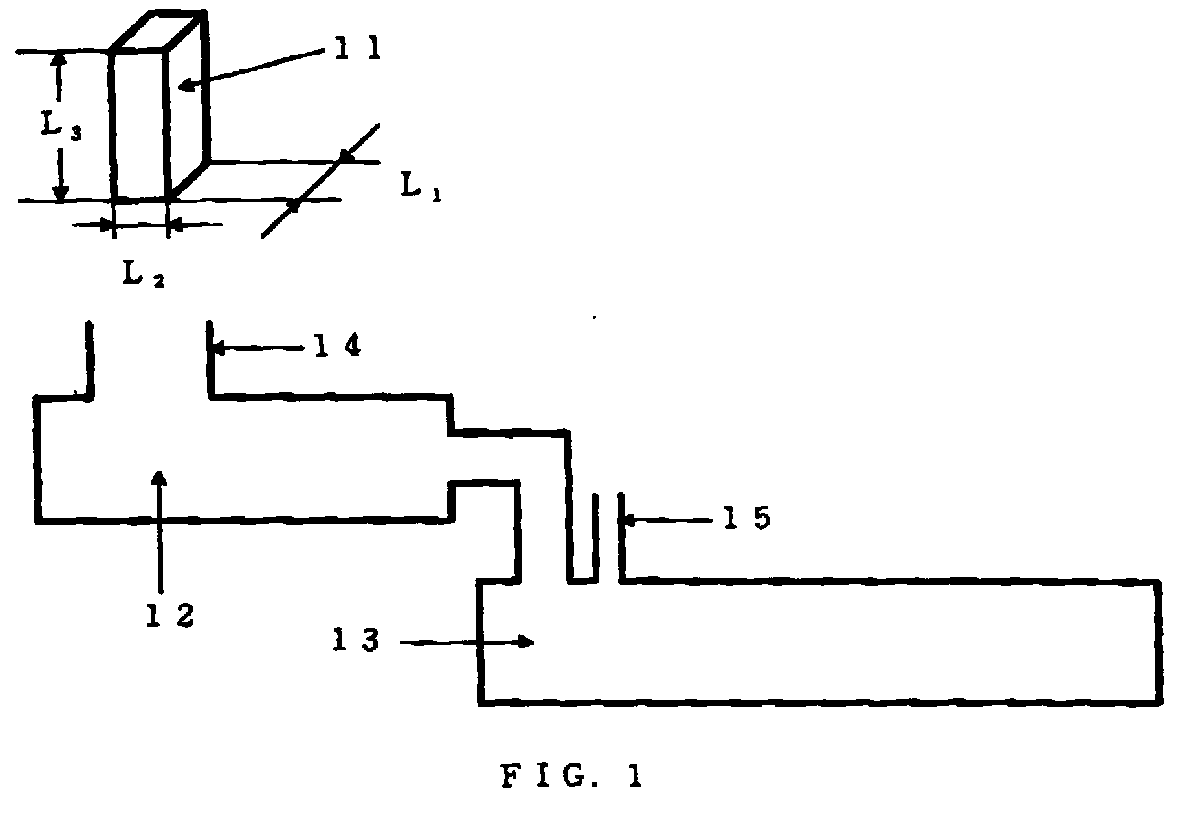
- Fig. 1 shows one embodiment of the above process (2).
- reference numeral 11 denotes a block-form rubber in a nearly cuboid-form
- reference numerals 12 , 13 , 14 and 15 denote a first extruder, a second extruder, a feed throat of the first extruder and a feed throat of the second extruder, respectively.
- the first extruder and the second extruder are connected in series.
- the block-form rubber 11 is fed from the feed throat 14 to the first extruder 12 to perform the pulverizing and/or softening, and the resulting rubber is fed to the second extruder 13 without taking out of the system.
- thermoplastic resin is fed through the feed throat 15 to the extruder 13 to perform the melt kneading of the rubber and the thermoplastic resin, thereby obtaining a desired non-cross-linked thermoplastic elastomer composition, or a desired cross-linked thermoplastic elastomer composition, provided that a dynamic cross-linking is effected at the time of the melt kneading of the rubber and the thermoplastic resin.
- any apparatus such as a known gear pump and a known static mixer may be provided to a tip portion at the downstream side of the first extruder 12 .
- a screw arranged at a rubber-feeding portion is a twin screw gyrating in a different direction, and to insert the block-form rubber between both screws gyrating in a different direction.
- screw arranged at a rubber-feeding portion means, for example, the screw arranged under the feed throat 14 in Fig. 1.
- Fig. 2 shows one embodiment of screws and barrels arranged under the feed throat 14 in Fig. 1.
- reference numerals 16 and 17 denote an axis of the screw, respectively;
- reference numerals 18 and 19 denote a flight of the screw, respectively;
- reference numerals 20 and 21 denote a barrel, respectively.
- Two screws namely, one screw having the axis 16 and the flight 18 and the other screw having the axis 17 and the flight 19 , rotate in a direction different from each other.
- the block-form rubber 11 is inserted between said both screws to be drawn therein by rotation of both screws, so that the block-form rubber 11 can be steadily fed to the extruder 12 .
- twin screw single screw extruder means an extruder, which has a different-direction rotating twin screw at its upper stream side and a single screw at its downstream side.
- both screws may be arranged so as to run in parallel with each other.
- the screws may be arranged obliquely like in an inclination type twin screw extruder. In order to feed steadily the block-form rubber to an extruder, it is preferable to arrange both screws in parallel.
- an additional equipment such as a pusher may be used as an auxiliary means.
- the block-form rubber can be fed further steadily to the extruder by inserting said rubber between both screws with the aid of the pusher.
- a length of at least one side in three sides of the nearly cuboid-form rubber is shorter than a distance between axes of both screws in order to inserting steadily the block-form rubber between both screws.
- L 1 , L 2 and L 3 denote each length of three sides of the nearly cuboid-form rubber 11 .
- distance between axes of both screws means a distance between centers of axes in both screws, and corresponds to reference symbol L 4 shown in Fig. 2.
- length of at least one side in three sides of the nearly cuboid-form rubber is shorter than a distance between axes of both screws means that any one of L 1 , L 2 and L 3 is shorter than L 4 . In other words, it means that any one of L 1 ⁇ L 4 , L 2 ⁇ L 4 and L 3 ⁇ L 4 is satisfied.
- the distance between axes of both screws can be replaced by a maximum distance between axes of both screws arranged at the block-form rubber feeding portion. Therefore, in this case, it is preferred that the length of at least one side in three sides of the nearly cuboid-form rubber is shorter than said maximum distance.
- the length of at least one side in three sides of the nearly cuboid-form rubber is shorter than a lead of the screw in order to insert steadily the block-form rubber between the screws.
- L 5 denotes a lead of the screw.
- length of at least one side in three sides of the nearly cuboid-form rubber is shorter than a lead of the screw means that any one of L 1 , L 2 and L 3 is shorter than L 5 . In other words, it means that any one of L 1 ⁇ L 5 , L 2 ⁇ L 5 and L 3 ⁇ L 5 is satisfied.
- the length of at least one side in three sides of the nearly cuboid-form rubber is shorter than the distance between axes of both screws, and also the length of at least the other one side of the nearly cuboid-form rubber is shorter than a lead of the screw.
- L 1 , L 2 and L 3 in Fig. 1 have relation of L 1 ⁇ L 2 ⁇ L 3 , both conditions of L 1 ⁇ L 4 and L 2 ⁇ L 5 , or both conditions of L 1 ⁇ L 5 and L 2 ⁇ L 4 are satisfied.
- the thermoplastic resin can be fed to the extruder through the feed throat using a known feeding apparatus such as a belt-feeder type apparatus and a screw-feeder type apparatus.
- a known feeding apparatus such as a belt-feeder type apparatus and a screw-feeder type apparatus.
- a single throat or two or more throats may be adopted.
- dynamic cross-linking can be performed at the time of melt kneading of the rubber and the thermoplastic resin.
- Fig. 3 shows a preferred embodiment of the process, wherein the olefin copolymer rubber and the olefin polymer resin are subjected to kneading and dynamic cross-linking to obtain a desired cross-linked thermoplastic elastomer composition.
- Fig. 3 shows a preferred embodiment of the process, wherein the olefin copolymer rubber and the olefin polymer resin are subjected to kneading and dynamic cross-linking to obtain a desired cross-linked thermoplastic elastomer composition.
- reference numeral 22 denotes an olefin copolymer rubber in a nearly cuboid-form
- reference numeral 23 denotes a first extruder
- reference numeral 24 denotes a second extruder
- reference numerals 25 , 26 and 27 denote a feed throat, respectively
- reference numeral 28 denotes a vent for discharging a volatile gas out of the extruder 24
- reference numeral 29 denotes a dispersing zone, wherein the olefin copolymer rubber and the olefin polymer resin are melt kneaded
- reference numeral 30 denotes a dynamic cross-linking zone.
- the nearly cuboid-form olefin copolymer rubber 22 is fed through the feed throat 25 to the extruder 23 to perform pulverizing and/or softening in the extruder 23 , and then the pulverized and/or softened olefin copolymer rubber is fed to the extruder 24 .
- the olefin polymer resin is fed to the extruder 24 through the feed throat 26 using a known supplying apparatus such as belt-feeder type apparatus and screw-feeder type apparatus.
- the olefin copolymer rubber and the olefin polymer resin are melt kneaded in the dispersing zone 29 , and then a cross-linking agent is fed through the feeding throat 27 to perform the dynamic cross-linking in the dynamic cross-linking zone 30 .
- the extruder 24 there can be used a single screw extruder, a twin screw extruder and a multi screw extruder containing a triple screw extruder, which are provided with a screw or rotor having a design to improve the kneadability.
- a screw or rotor having a design to improve the kneadability.
- the design to improve the kneadability there are enumerated, for example, dulmage, pin and multiple flight screws as the single screw extruder, and kneading disk and rotor as the twin screw extruder.
- twin screw extruder is more preferable than the single screw extruder from a viewpoint of productivity.
- a same-direction rotating type is more preferable than a different-direction rotating one, because no gnawing occurs even when operated for a long period of time.
- a preferred embodiment of the process for producing a desired thermoplastic elastomer composition is as follows.
- a bale-like olefin copolymer rubber or a cut product thereof is fed to a first extruder, wherein the screw arranged at the feed portion is a twin screw rotating in a different direction, and the distance between axes of both screws is longer than the length of at least one side in three sides of the bale-like olefin copolymer rubber or the cut product thereof, thereby the olefin copolymer rubber is softened with the first extruder, and the resulting olefin copolymer rubber is fed from the first extruder to the other extruder, wherein the olefin copolymer rubber and the olefin polymer resin are subjected to dynamic cross-linking to obtain a desired thermoplastic elastomer composition.
- More preferred is a process of using a first extruder, wherein a screw lead is longer than the length of at least one side in two sides, which are the rest obtained by removing one side, the length of which side is shorter than the distance between axes of both screws in the first extruder, out of three sides of the bale-like olefin copolymer rubber or the cut product thereof.
- the cross-linking agent used for the dynamic cross-linking is not particularly limited.
- Preferable cross-linking agents are those which are capable of performing cross-linking of the rubber.
- an organic peroxide, sulfur and a phenol resin can be used as the cross-linking agent. Of these, an organic peroxide is preferred.
- the feed throat for the cross-linking agent is not particularly limited, as is shown in Fig. 3, it is preferable to carry out the melt kneading of the olefin copolymer rubber and the olefin polymer resin in the dispersing zone 29 of the extruder 24 , and thereafter to feed the cross-linking agent through the feed throat 27 to perform the dynamic cross-linking of olefin copolymer rubber and the olefin polymer resin in the dynamic cross-linking zone 30 .
- This is particularly preferable when an organic peroxide is used as the cross-linking agent.
- cross-linking agent having a low cross-linking activity it is also possible to carry out the melt kneading of the olefin copolymer rubber, the olefin polymer resin and such a cross linking agent in the dispersing zone 29 of the extruder 24 , and thereafter to add a cross-linking promoter into the dynamic cross-linking zone 30 to perform the dynamic cross-linking.
- a cross-linking promoter into the dynamic cross-linking zone 30 to perform the dynamic cross-linking.
- the cross-linking agent used in the present invention may be in a liquid or powder form, a liquid cross-linking agent is preferred. From a viewpoint of obtaining an excellent thermoplastic elastomer composition, it is very important to improve dispersibility of the cross-linking agent. Thus, it is preferable to use the cross-linking agent in combination with a diluent containing, for example, an inorganic filler, a mineral oil and a solvent, which are inert to the cross-linking reaction. A paraffinic oil is a preferable diluent because of easy handling thereof and no substantial effect thereof on the thermoplastic elastomer composition obtained.
- the liquid and powder cross-linking agents can be fed to the extruder using a quantitative pump and a quantitative feeder, respectively.
- 2,5-dimethyl-2,5-di(t-butylperoxy)hexane is particularly preferred from a viewpoint of its odor and scorching property.
- An amount of the cross-linking agent added can usually be determined within a range of from about 0.005 to 5 parts by weight, and preferably from about 0.01 to 4 parts by weight based on 100 parts by weight of the sum of the rubber and the thermoplastic resin. When it is less than about 0.005 parts by weight, the effect of the cross-linking reaction may be insufficient. When it exceeds 5 parts by weight, it may be difficult to control the cross-linking reaction, and it is not advantageous from an economical point of view.
- the organic peroxide may be used in combination with a cross-linking co-agent. It is preferable to feed the cross-linking co-agent to (i) a throat at the upper stream than a throat, to which the cross-linking agent is fed, or (ii) to the same throat as that of feeding the cross-linking agent.
- cross-linking co-agent examples include N,N'-m-phenylenebismaleimide, toluylenebismaleimide, p-quinonedioxime, nitrobenzene, diphenylguanidine, trimethylolpropane, divinylbenzene, ethyleneglycol dimethacrylate, polyethyleneglycol dimethacrylate, trimethylolpropane trimethacrylate and allyl methacrylate.
- An amount of the cross-linking co-agent added is usually from about 0.01 to 4 parts by weight, and preferably from about 0.05 to 2 parts by weight based on 100 parts by weight of the sum of the rubber and the thermoplastic resin. An amount less than about 0.01 part by weight hardly exhibits an effect, and that exceeding about 4 parts by weight is not advantageous from an economical point of view.
- the dispersing zone 29 and the dynamic cross-linking zone 30 preferably have a screw, a rotor or others designed so as to improve a kneadability.
- a twin screw extruder is used for the dispersing zone 29 and the dynamic cross-linking zone 30 , it can be used in combination with a disk containing, for example, a forward kneading disk, a backward kneading disk and a perpendiculary intersecting kneading disk.
- a temperature of the dispersing zone 29 is at least that of melting the thermoplastic resin.
- the temperature is preferably as low as possible, provided that said thermoplastic resin can be melted at said temperature.
- a preferred temperature is from about 140 to 250°C.
- the rubber is conveyed to the extruder 24 preferably in a softened state.
- a temperature of the rubber conveyed to the extruding machine 24 is preferably from about 80 to 200°C, and more preferably from about 120 to 180°C. When the temperature is lower than about 80°C, it may be difficult to convey the rubber steadily to the extruder 24 , because the rubber is insufficiently softened. Whereas, when the temperature exceeds about 200°C, it may be insufficient to knead the rubber and the thermoplastic resin in the extruder 24 , or it may be difficult to control the successive dynamic crosslinking.
- a maximum shear rate in the dynamic cross-linking zone 30 is preferably from about 500 sec -1 to 2000 sec -1 (exclusive), and more preferably from about 1000 sec -1 to 1900 sec -1 .
- the maximum shear rate can be determined based on a minimum distance between the barrel and the screw, the inside diameter of the barrel and the rotation speed of the screw.
- a temperature of the dynamic cross-linking zone 30 can be determined depending on a kind of the cross-linking agent used.
- the organic peroxide is used as the cross-linking agent, it is preferably not lower than about 150°C, and more preferably from about 150 to 300°C in order to consume the organic peroxide almost completely at an outlet of the extruder 24 (cf. right end in Fig.3).
- a temperature of the kneaded product in the dynamic cross-linking zone 30 ranges preferably from about 180 to 290°C, and more preferably from about 200 to 280°C.
- thermoplastic elastomer When the temperature of the kneaded product reaches nearly 300°C , the decomposition or deterioration of the kneaded product, or overextended cross-linking reaction occur easily, thereby resulting in coloring or poor appearance of the thermoplastic elastomer obtained.
- a residence time of the kneaded product in the dynamic cross-linking zone 30 can be determined depending on, for example, a size of the extruder 24 , a temperature of the dynamic cross-linking zone 30 and reactants used. It is preferably not less than at least about 10 seconds, and less than 3 minutes.
- thermoplastic resin may be fed after completion of the dynamic cross-linking.
- additives such as an inorganic filler, an antioxidant, a weatherproof agent, an antistatic agent, a lubricant and a coloring pigment may be added.
- additives such as an inorganic filler, an antioxidant, a weatherproof agent, an antistatic agent, a lubricant and a coloring pigment may be added.
- they may be fed to any throat of an extruder, provided that the cross-linking reaction is not injured.
- both the cross-linked and non-cross-linked thermoplastic elastomer compositions can be obtained in a pellet form by any method known in the art such as an underwater-cutting method, a cold-cutting method and a hot-cutting method.
- a tackiness inhibitor may be adhered on the surface of the pellet-form thermoplastic elastomer composition obtained.
- the tackiness inhibitor are inorganic powders containing, for example, talc, sodium carbonate and silica, and powders containing, for example, olefin polymer resins. Of these, powders of ethylene polymer resins are preferred.
- thermoplastic elastomer composition in accordance with the present invention has a superior anti-fogging property, and has a haze value of a glass plate of not higher than about 2%, provided that the haze value is measured with use of an apparatus according to regulations prescribed in ISO 6452 after a lapse of heating time of 20 hours at a heating temperature of 100°C.
- thermoplastic elastomer composition having not higher than about 2% of the haze value measured according to the above manner is suitable for car interior parts, particularly for an instrument panel.
- a superior anti-fogging thermoplastic elastomer composition in accordance with the present invention can be obtained preferably by melt kneading rubber and a thermoplastic resin.
- the rubber preferably contains the aforementioned olefin copolymer rubber
- the thermoplastic resin preferably contains the aforementioned olefin polymer resin.
- Such a thermoplastic elastomer composition can be produced according to the aforementioned process for producing the thermoplastic elastomer composition in accordance with the present invention.
- thermoplastic elastomer composition having a uniform composition ratio there is provided an industrially advantageous process for producing a thermoplastic elastomer composition having a uniform composition ratio, according to which, even when highly tacky rubber is used, the rubber can be fed steadily to an extruder in a production process of a thermoplastic elastomer composition by melt kneading rubber and a thermoplastic resin to obtain a desired thermoplastic elastomer composition.
- a simple process for producing a thermoplastic elastomer composition having a uniform composition ratio according to which rubber can be fed further steadily to an extruder by using rubber in a block-form.
- thermoplastic elastomer composition having a superior anti-fogging property which is required in uses of car interior parts such as an instrument panel (i.e. dashboard).
- the anti-fogging property is expressed by a haze value of a glass plate, which was obtained by carrying out a fogging test using an apparatus according to ISO 6452.
- the haze value was measured according to JIS K7105.
- ISO International Organization for Standardization.
- reference numeral 31 denotes an oil bath
- reference numeral 32 denotes an oil
- reference numeral 33 denotes a glass plate
- reference numeral 34 denotes a cooling plate provided with a temperature controller
- reference numeral 35 denotes a beaker having an inside diameter of 90 mm ⁇
- reference numeral 36 denotes a silicone rubber-made ring-shaped packing.
- a clearance between the inner wall of the oil bath 31 and the outer wall of the beaker 35 is 40 mm.
- reference numeral 37 denotes a sample
- reference numerals 38 and 39 denote a chromium-plated metal ring, respectively.
- a haze value of the glass plate 33 before the fogging test was found to be 0.3%. In the present invention, a haze value of the glass plate 33 before the fogging test should not be more than 0.5%.
- the oil bath 31 and the cooling plate 34 were controlled to 100 ⁇ 2°C, and 20 ⁇ 2°C, respectively, and the sample 37 was adjusted to 80 mm ⁇ ⁇ 1 mm (thick).
- the sample 37 was heated for 20 hours in the beaker 35 , then taken out and placed under conditions of 23 ⁇ 2°C and 50% RH, and after 1 ⁇ 0.1 hour, the haze value of the glass plate 33 was measured according to JIS K7105. Said haze value obtained was used as a measure of anti-fogging property.
- Fig. 5 shows a constitution of the apparatus used in the Example.
- reference numeral 40 denotes oil extended ehtylene-propylene-5-ethylidene-2-norbornene copolymer rubber in a nearly cuboid-form of about 130 mm ⁇ about 150 mm ⁇ about 330 mm
- reference numeral 41 denotes a feed throat
- reference numerals 42 and 43 denote an extruder, respectively
- reference numerals 44 and 45 denote a feed throat, respectively
- reference numeral 46 denotes a vent for discharging a volatile gas out of the extruder 43
- reference numerals 47 , 48 , 49 and 50 denote a zone provided with kneading disks, respectively.
- the zone 47 is for dispersing and the zones 48 to 50 are for dynamic cross-linking.
- a mixture of additives were fed to the extruder 43 through the feed throat 44 , respectively, with the aid of a quantitative feeder.
- the polypropylene and the mixture of additives were fed at a feeding rate of 86.4 kg/hr and 7.48 kg/hr, respectively.
- a 10% by weight dilute product of 2,5-dimethyl-2,5-di(t-butylperoxy)hexane in a mineral oil (a paraffinic oil manufactured by Idemitsu Kosan Co., Ltd.; trademark DIANA PROCESS OIL PW380) was fed to the extruder 43 at 20.9 kg/hr using a plunger pump.
- the dynamic cross-linking was performed in the kneading disk zones 48 , 49 and 50 .
- the resulting product was formed into a pellet form using an underwater cutter to obtain an olefinic thermoplastic elastomer composition in a pellet form.
- the pellets obtained was pressed under a pressure of 10 Mpa for 2 minutes with a press adjusted to 200°C to obtain a sheet having a thickness of 1 mm.
- the resulting sheet was cut to obtain a sample of 80 mm ⁇ ⁇ 1 mm, which was then subjected to evaluation of the anti-fogging property.
- a haze value of the glass plate was found to be 0.4%.
Landscapes
- Chemical & Material Sciences (AREA)
- Health & Medical Sciences (AREA)
- Chemical Kinetics & Catalysis (AREA)
- Medicinal Chemistry (AREA)
- Polymers & Plastics (AREA)
- Organic Chemistry (AREA)
- Engineering & Computer Science (AREA)
- Mechanical Engineering (AREA)
- Processes Of Treating Macromolecular Substances (AREA)
- Compositions Of Macromolecular Compounds (AREA)
- Processing And Handling Of Plastics And Other Materials For Molding In General (AREA)
Abstract
Description
Claims (15)
- A process for producing a thermoplastic elastomer composition, which comprises the step of feeding rubber and a thermoplastic resin through feed throats independent of one another, respectively, to an extruder to perform melt kneading thereof, wherein the feed throats are connected to the extruder.
- The process for producing a thermoplastic elastomer composition according to Claim 1, wherein the rubber contains a block-form rubber having a volume of not less than about 27 cm3.
- The process for producing a thermoplastic elastomer composition according to Claim 2, wherein the block-form rubber fed to the extruder is subjected to pulverization and/or softening, and then the resulting rubber is melt kneaded with the thermoplastic resin.
- The process for producing a thermoplastic elastomer composition according to Claim 2, wherein the block-form rubber is inserted between both screws rotating in a different direction to be fed to the extruder.
- The process for producing a thermoplastic elastomer composition according to Claim 4, wherein the block-form rubber is a nearly cuboid-form rubber wherein a length of at least one side in three sides of said nearly cuboid-form rubber is shorter than a distance between axes of both screws.
- The process for producing a thermoplastic elastomer composition according to Claim 4 or 5, wherein the block-form rubber is a nearly cuboid-form rubber wherein a length of at least one side in three sides of said nearly cuboid-form rubber is shorter than a lead of the screw.
- The process for producing a thermoplastic elastomer composition according to any one of Claims 1 to 6, wherein the melt kneading is carried out under a dynamic cross-linking.
- The process for producing a thermoplastic elastomer composition according to any one of Claims 1 to 7, wherein the rubber comprises an olefin copolymer rubber.
- The process for producing a thermoplastic elastomer composition according to any one of Claims 1 to 8, wherein the thermoplastic resin comprises an olefin polymer resin.
- A thermoplastic elastomer composition having a haze value of a glass plate of not higher than about 2%, provided that the haze value is measured with use of an apparatus according to regulations prescribed in ISO 6452 after a lapse of heating time of 20 hours at a heating temperature of 100°C.
- The thermoplastic elastomer composition according to Claim 10, wherein the thermoplastic elastomer composition is produced by a process, which comprises the step of melt kneading rubber and a thermoplastic resin.
- The thermoplastic elastomer composition according to Claim 11, wherein the rubber comprises an olefin copolymer rubber.
- The thermoplastic elastomer composition according to Claim 11 or 12, wherein the thermoplastic resin comprises an olefin polymer resin.
- A car interior part comprising a thermoplastic elastomer composition, which is produced by a process comprising the step of feeding rubber and a thermoplastic resin through feed throats independent of one another, respectively, to an extruder to perform melt kneading thereof, wherein the feed throats are connected to the extruder.
- A car interior part comprising a thermoplastic elastomer composition, which has a haze value of a glass plate of not higher than about 2%, provided that the haze value is measured with use of an apparatus according to regulations prescribed in ISO 6452 after a lapse of heating time of 20 hours at a heating temperature of 100°C.
Applications Claiming Priority (2)
| Application Number | Priority Date | Filing Date | Title |
|---|---|---|---|
| JP4482499 | 1999-02-23 | ||
| JP4482499 | 1999-02-23 |
Publications (3)
| Publication Number | Publication Date |
|---|---|
| EP1033226A2 true EP1033226A2 (en) | 2000-09-06 |
| EP1033226A3 EP1033226A3 (en) | 2002-04-03 |
| EP1033226B1 EP1033226B1 (en) | 2004-04-28 |
Family
ID=12702213
Family Applications (1)
| Application Number | Title | Priority Date | Filing Date |
|---|---|---|---|
| EP00103654A Expired - Lifetime EP1033226B1 (en) | 1999-02-23 | 2000-02-21 | Process for producing thermoplastic elastomer composition |
Country Status (4)
| Country | Link |
|---|---|
| US (1) | US6399709B1 (en) |
| EP (1) | EP1033226B1 (en) |
| KR (1) | KR100580338B1 (en) |
| DE (1) | DE60010159T2 (en) |
Cited By (3)
| Publication number | Priority date | Publication date | Assignee | Title |
|---|---|---|---|---|
| EP1207034A1 (en) * | 2000-11-17 | 2002-05-22 | Mitsui Chemicals, Inc. | Method for manufacturing olefinic thermoplastic elastomer composition |
| EP1123946A3 (en) * | 2000-02-09 | 2003-11-12 | Mitsui Chemicals, Inc. | Low fogging thermoplastic elastomer composition and manufacturing method and use of same composition |
| EP1473137A1 (en) * | 2003-04-30 | 2004-11-03 | Coperion Werner & Pfleiderer GmbH & Co. KG | Process for melting and homogenizing bimodal or multimodal polyolefins |
Families Citing this family (11)
| Publication number | Priority date | Publication date | Assignee | Title |
|---|---|---|---|---|
| KR100566727B1 (en) * | 2002-02-26 | 2006-04-03 | 미쓰이 가가쿠 가부시키가이샤 | Method for producing olefinic thermoplastic elastomer composition |
| CN100389949C (en) * | 2002-07-11 | 2008-05-28 | 倍耐力轮胎公司 | Method and apparatus for continuous production of elastomeric compositions |
| DE102004011670A1 (en) * | 2003-03-17 | 2004-09-30 | Sumitomo Chemical Co., Ltd. | Process for the production of a thermoplastic elastomer composition |
| JP4034248B2 (en) * | 2003-07-11 | 2008-01-16 | 株式会社神戸製鋼所 | Quantitative supply apparatus, kneading extrusion equipment, quantitative supply method, kneading extrusion method |
| US7247675B2 (en) * | 2003-12-30 | 2007-07-24 | Kimberly-Clark Worldwide, Inc. | Elastomer compositions and method of making them |
| US7790808B2 (en) * | 2004-11-16 | 2010-09-07 | Sumitomo Chemical Company, Limited | Method for producing a thermoplastic resin composition |
| US20070244264A1 (en) * | 2006-04-14 | 2007-10-18 | Granger James E | Process and apparatus for preparation of thermoplastic polymer blends |
| US20150065625A1 (en) * | 2011-03-11 | 2015-03-05 | Exxonmobil Chemical Patents Inc. | Method of Forming Dynamically Vulcanized Thermoplastic Elastomer Films and Films Formed Therefrom |
| US10240008B2 (en) | 2014-05-12 | 2019-03-26 | Exxonmobil Chemical Patents Inc. | Thermoplastic vulcanizates and method of making the same |
| EP4255704A1 (en) | 2020-10-26 | 2023-10-11 | SABIC Global Technologies B.V. | Process for producing a polypropylene composition, and polypropylene composition so produced |
| EP4255712A1 (en) * | 2020-10-26 | 2023-10-11 | SABIC Global Technologies B.V. | Compounding extruder for producing polypropylene composition |
Family Cites Families (9)
| Publication number | Priority date | Publication date | Assignee | Title |
|---|---|---|---|---|
| JPS5825340A (en) | 1981-08-07 | 1983-02-15 | Mitsui Petrochem Ind Ltd | Production of partially crosslinked rubber/resin composition |
| JPS58152023A (en) | 1982-03-05 | 1983-09-09 | Mitsui Petrochem Ind Ltd | Preparation of partially crosslinked rubber-resin composition |
| JPH0195142A (en) | 1987-10-07 | 1989-04-13 | Toa Nenryo Kogyo Kk | Preparation of thermoplastic resin composition |
| WO1991000890A1 (en) | 1989-07-10 | 1991-01-24 | Mitsui Petrochemical Industries, Ltd. | Method of producing thermoplastic elastomer composition and thermoplastic elastomer composition produced thereby |
| JP3031022B2 (en) | 1991-12-19 | 2000-04-10 | 住友化学工業株式会社 | Method for producing thermoplastic elastomer composition |
| JPH0693143A (en) | 1992-09-11 | 1994-04-05 | Ube Ind Ltd | Thermoplastic elastomer composition |
| TW440585B (en) * | 1995-07-05 | 2001-06-16 | Mitsui Chemicals Inc | A rubber composition and its production method |
| JP3168450B2 (en) | 1995-09-29 | 2001-05-21 | 住友化学工業株式会社 | Method for producing thermoplastic elastomer composition |
| JP3601569B2 (en) * | 1997-03-26 | 2004-12-15 | 株式会社ブリヂストン | Resin-reinforced elastomer, method for producing the same, and pneumatic tire using the same |
-
2000
- 2000-02-18 US US09/506,338 patent/US6399709B1/en not_active Expired - Lifetime
- 2000-02-21 DE DE60010159T patent/DE60010159T2/en not_active Expired - Lifetime
- 2000-02-21 EP EP00103654A patent/EP1033226B1/en not_active Expired - Lifetime
- 2000-02-21 KR KR1020000008247A patent/KR100580338B1/en not_active Expired - Fee Related
Cited By (7)
| Publication number | Priority date | Publication date | Assignee | Title |
|---|---|---|---|---|
| EP1123946A3 (en) * | 2000-02-09 | 2003-11-12 | Mitsui Chemicals, Inc. | Low fogging thermoplastic elastomer composition and manufacturing method and use of same composition |
| US7049356B2 (en) | 2000-02-09 | 2006-05-23 | Mitsui Chemicals, Inc. | Low fogging thermoplastic elastomer composition and manufacturing method and use of same composition |
| EP1801153A3 (en) * | 2000-02-09 | 2008-01-30 | Mitsui Chemicals, Inc. | Low fogging thermoplastic elastomer composition and manufacturing method and use of same composition |
| EP1207034A1 (en) * | 2000-11-17 | 2002-05-22 | Mitsui Chemicals, Inc. | Method for manufacturing olefinic thermoplastic elastomer composition |
| US6599981B2 (en) | 2000-11-17 | 2003-07-29 | Mitsui Chemicals, Inc. | Method for manufacturing olefinic thermoplastic elastomer composition |
| EP1473137A1 (en) * | 2003-04-30 | 2004-11-03 | Coperion Werner & Pfleiderer GmbH & Co. KG | Process for melting and homogenizing bimodal or multimodal polyolefins |
| WO2004096523A1 (en) * | 2003-04-30 | 2004-11-11 | Coperion Werner & Pfleiderer Gmbh & Co. Kg | Method for fusing and homogenizing multimodal and bimodal polyolefins |
Also Published As
| Publication number | Publication date |
|---|---|
| KR100580338B1 (en) | 2006-05-16 |
| EP1033226A3 (en) | 2002-04-03 |
| DE60010159T2 (en) | 2005-01-20 |
| KR20000058127A (en) | 2000-09-25 |
| US6399709B1 (en) | 2002-06-04 |
| EP1033226B1 (en) | 2004-04-28 |
| DE60010159D1 (en) | 2004-06-03 |
Similar Documents
| Publication | Publication Date | Title |
|---|---|---|
| EP1033226B1 (en) | Process for producing thermoplastic elastomer composition | |
| JP3168450B2 (en) | Method for producing thermoplastic elastomer composition | |
| EP1441005B1 (en) | Thermoplastic elastomer composition and process for producing the same | |
| KR100213425B1 (en) | Process for preparing thermoplastic elastomer composition | |
| EP2094782B1 (en) | Method for producing olefinic thermoplastic elastomer | |
| JP3726617B2 (en) | Method for producing thermoplastic elastomer composition | |
| EP1338619B1 (en) | Method for manufacturing olefinic thermoplastic elastomer composition | |
| JP4155146B2 (en) | Method for producing thermoplastic elastomer composition | |
| JP4119278B2 (en) | Process for producing olefinic thermoplastic elastomer composition | |
| KR20230012477A (en) | ethylene copolymer rubber | |
| WO2002072690A1 (en) | Thermoplastic olefin elastomer composition | |
| JP5473852B2 (en) | Process for producing olefinic thermoplastic elastomer composition | |
| KR20040082292A (en) | Process for producing thermoplastic elastomer composition | |
| JPH07138378A (en) | Method for producing thermoplastic elastomer composition | |
| JP2003268122A (en) | Method for producing thermoplastic elastomer composition | |
| JP2003002996A (en) | Cross-linked foamable rubber composition, cross-linked rubber foam and method for producing the same | |
| JP2004263015A (en) | Method for producing thermoplastic elastomer composition | |
| EP4229129B1 (en) | Heat stable ethylene copolymer rubber blends | |
| CN114058107B (en) | Thermoplastic elastomer composition | |
| EP2094781B1 (en) | Method for producing olefinic thermoplastic elastomer | |
| CN100556948C (en) | Process for producing thermoplastic elastomer composition | |
| WO2025040640A1 (en) | Oil-extended ethylene copolymers | |
| JP2024534483A (en) | Ethylene-alpha-olefin-non-conjugated diene copolymers and blends thereof having high diene content per polymer chain | |
| JP2003275699A (en) | Extruder cleaning method | |
| JP2008156407A (en) | Process for producing olefinic thermoplastic elastomer |
Legal Events
| Date | Code | Title | Description |
|---|---|---|---|
| PUAI | Public reference made under article 153(3) epc to a published international application that has entered the european phase |
Free format text: ORIGINAL CODE: 0009012 |
|
| AK | Designated contracting states |
Kind code of ref document: A2 Designated state(s): AT BE CH CY DE DK ES FI FR GB GR IE IT LI LU MC NL PT SE Kind code of ref document: A2 Designated state(s): BE DE NL |
|
| AX | Request for extension of the european patent |
Free format text: AL;LT;LV;MK;RO;SI |
|
| PUAL | Search report despatched |
Free format text: ORIGINAL CODE: 0009013 |
|
| AK | Designated contracting states |
Kind code of ref document: A3 Designated state(s): AT BE CH CY DE DK ES FI FR GB GR IE IT LI LU MC NL PT SE |
|
| AX | Request for extension of the european patent |
Free format text: AL;LT;LV;MK;RO;SI |
|
| RIC1 | Information provided on ipc code assigned before grant |
Free format text: 7B 29C 47/50 A, 7C 08L 23/08 B, 7B 29K 23:00 Z |
|
| 17P | Request for examination filed |
Effective date: 20020925 |
|
| AKX | Designation fees paid |
Free format text: BE DE NL |
|
| 17Q | First examination report despatched |
Effective date: 20021205 |
|
| RTI1 | Title (correction) |
Free format text: PROCESS FOR PRODUCING THERMOPLASTIC ELASTOMER COMPOSITION |
|
| GRAP | Despatch of communication of intention to grant a patent |
Free format text: ORIGINAL CODE: EPIDOSNIGR1 |
|
| GRAS | Grant fee paid |
Free format text: ORIGINAL CODE: EPIDOSNIGR3 |
|
| GRAA | (expected) grant |
Free format text: ORIGINAL CODE: 0009210 |
|
| AK | Designated contracting states |
Kind code of ref document: B1 Designated state(s): BE DE NL |
|
| REG | Reference to a national code |
Ref country code: IE Ref legal event code: FG4D |
|
| REF | Corresponds to: |
Ref document number: 60010159 Country of ref document: DE Date of ref document: 20040603 Kind code of ref document: P |
|
| RAP2 | Party data changed (patent owner data changed or rights of a patent transferred) |
Owner name: SUMITOMO CHEMICAL COMPANY, LIMITED |
|
| NLT2 | Nl: modifications (of names), taken from the european patent patent bulletin |
Owner name: SUMITOMO CHEMICAL COMPANY, LIMITED |
|
| PLBE | No opposition filed within time limit |
Free format text: ORIGINAL CODE: 0009261 |
|
| STAA | Information on the status of an ep patent application or granted ep patent |
Free format text: STATUS: NO OPPOSITION FILED WITHIN TIME LIMIT |
|
| 26N | No opposition filed |
Effective date: 20050131 |
|
| PGFP | Annual fee paid to national office [announced via postgrant information from national office to epo] |
Ref country code: BE Payment date: 20120214 Year of fee payment: 13 |
|
| PGFP | Annual fee paid to national office [announced via postgrant information from national office to epo] |
Ref country code: NL Payment date: 20120217 Year of fee payment: 13 |
|
| BERE | Be: lapsed |
Owner name: *SUMITOMO CHEMICAL CY LTD Effective date: 20130228 |
|
| REG | Reference to a national code |
Ref country code: NL Ref legal event code: V1 Effective date: 20130901 |
|
| PG25 | Lapsed in a contracting state [announced via postgrant information from national office to epo] |
Ref country code: NL Free format text: LAPSE BECAUSE OF NON-PAYMENT OF DUE FEES Effective date: 20130901 |
|
| PG25 | Lapsed in a contracting state [announced via postgrant information from national office to epo] |
Ref country code: BE Free format text: LAPSE BECAUSE OF NON-PAYMENT OF DUE FEES Effective date: 20130228 |
|
| REG | Reference to a national code |
Ref country code: DE Ref legal event code: R079 Ref document number: 60010159 Country of ref document: DE Free format text: PREVIOUS MAIN CLASS: B29C0047500000 Ipc: B29C0048380000 |
|
| PGFP | Annual fee paid to national office [announced via postgrant information from national office to epo] |
Ref country code: DE Payment date: 20190205 Year of fee payment: 20 |
|
| REG | Reference to a national code |
Ref country code: DE Ref legal event code: R071 Ref document number: 60010159 Country of ref document: DE |