EP1031636A2 - Heavy wall steel material having superior weldability and method for producing the same - Google Patents
Heavy wall steel material having superior weldability and method for producing the same Download PDFInfo
- Publication number
- EP1031636A2 EP1031636A2 EP00301481A EP00301481A EP1031636A2 EP 1031636 A2 EP1031636 A2 EP 1031636A2 EP 00301481 A EP00301481 A EP 00301481A EP 00301481 A EP00301481 A EP 00301481A EP 1031636 A2 EP1031636 A2 EP 1031636A2
- Authority
- EP
- European Patent Office
- Prior art keywords
- steel material
- less
- heavy wall
- wall steel
- diameter
- Prior art date
- Legal status (The legal status is an assumption and is not a legal conclusion. Google has not performed a legal analysis and makes no representation as to the accuracy of the status listed.)
- Granted
Links
Images

Classifications
-
- C—CHEMISTRY; METALLURGY
- C21—METALLURGY OF IRON
- C21D—MODIFYING THE PHYSICAL STRUCTURE OF FERROUS METALS; GENERAL DEVICES FOR HEAT TREATMENT OF FERROUS OR NON-FERROUS METALS OR ALLOYS; MAKING METAL MALLEABLE, e.g. BY DECARBURISATION OR TEMPERING
- C21D8/00—Modifying the physical properties of ferrous metals or ferrous alloys by deformation combined with, or followed by, heat treatment
-
- C—CHEMISTRY; METALLURGY
- C21—METALLURGY OF IRON
- C21D—MODIFYING THE PHYSICAL STRUCTURE OF FERROUS METALS; GENERAL DEVICES FOR HEAT TREATMENT OF FERROUS OR NON-FERROUS METALS OR ALLOYS; MAKING METAL MALLEABLE, e.g. BY DECARBURISATION OR TEMPERING
- C21D8/00—Modifying the physical properties of ferrous metals or ferrous alloys by deformation combined with, or followed by, heat treatment
- C21D8/06—Modifying the physical properties of ferrous metals or ferrous alloys by deformation combined with, or followed by, heat treatment during manufacturing of rods or wires
-
- C—CHEMISTRY; METALLURGY
- C22—METALLURGY; FERROUS OR NON-FERROUS ALLOYS; TREATMENT OF ALLOYS OR NON-FERROUS METALS
- C22C—ALLOYS
- C22C33/00—Making ferrous alloys
- C22C33/02—Making ferrous alloys by powder metallurgy
- C22C33/0257—Making ferrous alloys by powder metallurgy characterised by the range of the alloying elements
- C22C33/0261—Matrix based on Fe for ODS steels
-
- C—CHEMISTRY; METALLURGY
- C22—METALLURGY; FERROUS OR NON-FERROUS ALLOYS; TREATMENT OF ALLOYS OR NON-FERROUS METALS
- C22C—ALLOYS
- C22C38/00—Ferrous alloys, e.g. steel alloys
- C22C38/04—Ferrous alloys, e.g. steel alloys containing manganese
-
- B—PERFORMING OPERATIONS; TRANSPORTING
- B22—CASTING; POWDER METALLURGY
- B22F—WORKING METALLIC POWDER; MANUFACTURE OF ARTICLES FROM METALLIC POWDER; MAKING METALLIC POWDER; APPARATUS OR DEVICES SPECIALLY ADAPTED FOR METALLIC POWDER
- B22F2998/00—Supplementary information concerning processes or compositions relating to powder metallurgy
Definitions
- the invention of the present application relates to a heavy wall steel material having superior weldability and to a method for producing the same.
- the invention of the present application relates to a highly tough high strength heavy wall steel material having superior weldability and to a method for producing the same.
- an object of the invention according to the present application is to provide the novel type of heavy wall steel material above, having increased strength and toughness and still improved in weldability.
- Another object of the present invention is to provide a method for producing the same.
- a heavy wall steel material having superior weldability which is a steel material having a diameter or a side 5 mm or more in length and which comprises oxides 1 ⁇ m or less in grain diameter homogeneously dispersed at a dispersion density in a range of from 10,000 to 100,000 particles/mm 2 and uniform ferrite grains 2 ⁇ m or less in grain diameter formed over the entire plane making a right angle with respect to the rolling direction (Claim 1).
- a method for producing a heavy wall steel material having superior weldability which comprises allowing oxide crystals 1 ⁇ m or less in grain diameter to form in the texture and uniformly dispersing them at a dispersion density of from 10,000 to 100,000 particles/mm 2 , rolling the resulting steel material through a hole profile in the temperature range of 400 °C or higher but not higher than the Ac3 transformation point, and subjecting it to a recrystallization treatment to form uniform ferrite grains 2 ⁇ m or less in grain diameter over the plane making a right angle with respect to the rolling direction, thereby obtaining a heavy wall steel material having superior weldability and having a diameter or a side 5 mm or more in length (Claim 2).
- the method for producing a heavy wall steel material having superior weldability comprises undercooling a molten steel by placing it inside an oxide slag, thereby allowing oxide crystals 1 ⁇ m or less in grain diameter to form in the texture and uniformly dispersing them at a dispersion density of from 10,000 to 100,000 particles/mm 2 (Claim 3), and wherein the molten steel contains:
- the heavy wall steel material according to the application of the present invention is a steel material which is characterized by its heavy wall and its plane making a right angle with respect to the rolling direction, said plane having a diameter or a short side 5 mm or more in length and comprising ferrite grains 2 ⁇ m or less in diameter uniformly dispersed over the entire plane, and characterized by being produced by hot rolling using a series of profile molds and recrystallization treatment.
- This material is available in various forms, such as a rod, a wire, a profile, etc.
- the heavy wall steel material having superior weldability according to the invention of the present application comprises oxides 1 ⁇ m or less in grain diameter homogeneously dispersed at a dispersion density in a range of from 10,000 to 100,000 grains/mm 2 .
- These oxides 1 ⁇ m or less in grain diameter increase the internal strain which generates during rolling of the material, and thereby divide the recrystallized ferrite grains into finer grains 2 ⁇ m or less in grain diameter.
- the strength and the toughness of the heavy wall steel material can be further increased.
- a heavy wall steel material having a tensile strength of 660 MPa or higher can be realized.
- the grain diameter of the oxides is confined to 1 ⁇ m or less by taking the strength and the toughness of the heavy wall steel material into account. If the grain diameter of the oxides should exceed 1 ⁇ m, on the other hand, the strength and the toughness of the heavy wall steel material suffer unfavorable influences.
- the oxides 1 ⁇ m or less in grain diameter are uniformly dispersed in the texture at a dispersion density in a range of from 10,000 to 100,000 particles/mm 2 , the oxides dispersed in the heat affected zone (HAZ) during welding function as nuclei to accelerate the generation of ferrites, and prevent the coarsening of crystal grains from occurring.
- the generation of coarse acicular Widmanstatten ferrites can be suppressed to improve the toughness at the HAZ.
- the heavy wall steel material having superior weldability according to the invention of the present application exhibits a further improved strength and toughness as compared with the conventional products, and yet, has excellent weldability.
- Such superior characteristics are enabled by uniformly dispersing the oxides at a predetermined grain diameter and at a particular dispersion density and by the ferrite grains of predetermined grain diameter formed over the entire plane making a right angle with respect to the rolling direction, but not by the conventionally employed means, i.e., the addition of a particular alloying element such as nickel (Ni).
- the heavy wall steel material having superior weldability according to the invention of the present application can be produced in the following manner.
- the process comprises allowing oxide crystals 1 ⁇ m or less in grain diameter to form in the texture and uniformly dispersing them at a dispersion density of from 10,000 to 100,000 particles/mm 2 , rolling the resulting steel material through a hole profile in the temperature range of 400 °C or higher but not higher than the Ac3 transformation point, and subjecting it to a recrystallization treatment to form uniform ferrite grains 2 ⁇ m or less in grain diameter over the plane making a right angle with respect to the rolling direction.
- a heavy wall steel material having superior weldability and having a diameter or a side 5 mm or more in length can be obtained.
- Profile rolling using a hole mold is effective for the formation of fine textures in the material, because the steel material can be processed from multiple directions, i.e., the material can be processed multiaxially, such as in the case of grooved roll processing. At the same time, the process steps for producing fine textures can be simplified.
- the process temperature for profile rolling is in a range of 400 °C or higher but not higher than the Ac3 transformation point. If the temperature should be lower than 400 °C, the texture turns into a simple ferrite texture elongated along a single direction and would not form an isometric texture. This results in a strength showing anisotropy. If the temperature exceeds the Ac3 transformation point, on the other hand, the rate of grain growth becomes too high as to coarsen the texture, and this impairs the strength and the toughness of the material.
- Uniform ferrite grains 2 ⁇ m or less in grain diameter are available over the entire plane making a right angle with respect to the rolling direction by performing the profile rolling and the recrystallization treatment subsequent thereto.
- oxide crystals 1 ⁇ m or less in grain diameter are formed in the texture and are uniformly dispersed at a dispersion density of from 10,000 to 100,000 particles/mm 2 prior to the sequential profile rolling and recrystallization treatment.
- This can be realized by various ways, and preferably exemplified among them is the method using undercooling.
- undercooling is effected by placing the molten steel inside slag of oxides.
- Undercooling is a state in which the melt is held at a temperature not higher than the melting point.
- the maximum degree of undercooling is one-fifth of the melting point.
- the solidification rate of the molten steel to be undercoolod is not only higher than that of rapid solidification, but also a rate non-achievable by rapid solidification.
- the increase in particle diameter of the oxide can also be suppressed.
- the generation of further finer oxides is promoted, and these oxides can bo dispersed at a higher density.
- the dispersion density of the resulting oxides attain twice or more of that achieved in rapid solidification.
- the undercooling above can be realized, more specifically, by covering the molten steel with the slag, or by flowing the molten steel into the slag.
- the content of the components is confined in the range above based on the fact as follows.
- C carbon
- carbides such as cementite accounts for 20 % by volume or more of the material
- toughness there occurs a drop in toughness. Accordingly, it is preferred that C is incorporated in the material at a quantity as such that the carbide accounts for 20 % by volume or less in the material.
- the content of silicon (Si) is present at an amount exceeding 0.8 % by weight, the steel becomes extremely brittle.
- manganese (Mn) should be present at an amount of 0.05 % by weight or more.
- Mn manganese
- the content of Mn is preferably in a range of from 0.05 to 3.0 % by weight.
- An element which produces oxides i.e., titanium (Ti), magnesium (Mg), or aluminum (Al) is incorporated at a concentration of 0.3 % by weight or less, which corresponds to an amount for the case it is present as oxide grains 1 ⁇ m or less in diameter dispersed in the texture at a dispersion density of 100,000 grains/mm 2 .
- the molten steel may contain other alloying elements which impart other characteristics to the steel material.
- their addition must be made by taking into consideration that it may not impair the particle diameter and the dispersion density, or the roll processability.
- a molten steel containing Ti as the oxide generating element was covered with a slag containing a plurality of oxides, and was undercooled by a degrees of 90 K to suppress the generation of nuclei from the surface of molten steel.
- Ti oxide which is one of the secondary deoxidized products, was dispersed as particles 1 ⁇ m or less in diameter and at a dispersion density of 50,000 grains/mm 2 or higher.
- the heavy wall steel material having excellent weldability according to the present invention and the method for producing the same is described in further detail below by making reference to examples.
- a steel having the chemical composition given in Table 1 below was buried in a mixed oxide powder or granules comprising SiO 2 , Al 2 O 3 , and Na 2 O, and was molten in an induction furnace or by resistance heating under a non-oxidizing atmosphere.
- the resulting molten steel was covered with a slag of glassy mixed oxides, and was heated to a temperature 50 K or higher than the liquidus temperature.
- the molten steel was allowed to stand still until the primary deoxidized products were adsorbed by the slag.
- Chemical composition (% by weight) C Sl Mn P S Ti 0.15 0.19 1.51 0.019 0.02 0.08
- the molten steel allowed to stand still was undercooled, and the solidification thereof was initiated at a temperature 60 K lower than the solidus temperature to prepare a cast specimen 40 mm in diameter and 60 mm in length.
- the cast specimen was reheated to 1,200 °C, and was processed into a 30 ⁇ 30 ⁇ 85 mm specimen by forging.
- the forged specimen was recrystallized by water-cooling, followed by holding it in the furnace at a temperature of 640 °C for a duration of 300 seconds. Subsequently, the specimen was subjected to grooved rolling at a draught of about 10 % per single pass to perform hole profile rolling. The specimen was subjected to repeated hole profile rolling and the subsequent recrystallization treatment until a total area reduction of 90 % was achieved, and was then water-cooled.
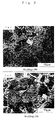
- FIG. 1 is a micrograph obtained with a scanning electron microscopy showing the texture of the steel rod material thus obtained in Example 1.
- the micrograph of FIG. 1 shows the image of the C-cross section, i.e., the cross section vertical to the rolling direction.
- the white colored portion shows the oxides
- the black colored portion shows the texture of mixed ferrite and carbide.
- the oxides are the Ti-Mn-Si complex oxides, and are dispersed at a density of 54,000 particles/mm 2 . From FIG. 1, it is confirmed that the texture of mixed ferrite and carbide has an average diameter of 0.75 ⁇ m, and that it is uniformly distributed from the surface layer to the center of the specimen.
- the rod material thus obtained was subjected to the measurement of tensile strength (TS), lower yield strength (LYS), uniform elongation (U.EL), and the total elongation (T.EL).
- TS tensile strength
- LYS lower yield strength
- U.EL uniform elongation
- T.EL total elongation
- Example 1 Comparative Ex. 1 Dispersion density of oxides (particles/mm 2 ) 54,000 Several hundreds Diameter of oxides ( ⁇ m) ⁇ 1 ⁇ 5 Draught (%) 90 90 Ferrite grain diameter ( ⁇ m) 0.75 0.79 TS (MPa) 775 724 LYS (MPa) 754 685 U.EL (%) 3.58 7.30 T. EL (%) 13.44 14.10
- Example 1 yields a tensile strength (TS) and a lower yield strength (LYS) of 700 MPa or higher, showing that the strength is higher than that of the steel rod material of Comparative Example 1, which contains less oxides dispersed therein. Furthermore, the steel rod material according to Example 1 yields a uniform elongation (U. EL) and a total elongation (T. EL) both at a value of 10 % or higher, and is therefore confirmed that this material exhibits sufficiently high toughness.
- TS tensile strength
- LES lower yield strength
- Example 1 The steel rod materials of Example 1 and Comparative Example 1 were compared with each other for their weldability.
- the rod materials were each heated to 1,400 °C at a heating rate of 100 K/s, and were then cooled therefrom to 900 °C at a cooling rate of 50 K/s, followed by further cooling to 300 °C at a cooling rate of 10 K/s, to thereby reproduce the heat affected zone (HAZ) which form at welding.
- HAZ heat affected zone
- the invention according to the present application provides a heavy wall steel material in various shapes such as a rod, a wire, a profile, etc., comprising fine oxides uniformly dispersed at a high density and thereby having superior strength as well as toughness, and furthermore improved in weldability.
Landscapes
- Chemical & Material Sciences (AREA)
- Engineering & Computer Science (AREA)
- Materials Engineering (AREA)
- Mechanical Engineering (AREA)
- Metallurgy (AREA)
- Organic Chemistry (AREA)
- Physics & Mathematics (AREA)
- Thermal Sciences (AREA)
- Crystallography & Structural Chemistry (AREA)
- Manufacturing & Machinery (AREA)
- Heat Treatment Of Steel (AREA)
- Superconductors And Manufacturing Methods Therefor (AREA)
Abstract
Description
| Chemical composition (% by weight) | |||||
| C | Sl | Mn | P | S | Ti |
| 0.15 | 0.19 | 1.51 | 0.019 | 0.02 | 0.08 |
| Example 1 | Comparative Ex. 1 | |
| Dispersion density of oxides (particles/mm2) | 54,000 | Several hundreds |
| Diameter of oxides (µm) | ≤ 1 | ≥ 5 |
| Draught (%) | 90 | 90 |
| Ferrite grain diameter (µm) | 0.75 | 0.79 |
| TS (MPa) | 775 | 724 |
| LYS (MPa) | 754 | 685 |
| U.EL (%) | 3.58 | 7.30 |
| T. EL (%) | 13.44 | 14.10 |
Claims (4)
- A heavy wall steel material having superior weldability, which is a steel material having a diameter or a side 5 mm or more in length and which comprises oxides 1 µm or less in particle diameter homogeneously dispersed at a dispersion density in a range of from 10,000 to 100,000 particles/mm2 and uniform ferrite grains 2 µm or less in grain diameter formed over the entire plane making a right angle with respect to the rolling direction.
- A method for producing a heavy wall steel material having superior weldability, which comprises allowing oxide crystals 1 µm or less in particle diameter to form in the texture and uniformly dispersing them at a dispersion density of from 10,000 to 100,000 particles/mm2, rolling the resulting steel material through a hole profile in the temperature range of 400 °C or higher but not higher than the Ac3 transformation point, and subjecting it to a recrystallization treatment to form uniform ferrite grains 2 µm or less in grain diameter over the plane making a right angle with respect to the rolling direction, thereby obtaining a heavy wall steel material having superior weldability and having a diameter or a side 5 mm or more in length.
- A method for producing a heavy wall steel material having superior weldability as claimed in Claim 2, wherein the method comprises undercooling a molten steel by placing it inside an oxide slag, thereby allowing oxide crystals 1 µm or less in particle diameter to form in the texture and uniformly dispersing them at a dispersion density of from 10,000 to 100,000 particles/mm2.
- A method for producing a heavy wall steel material having superior weldability as claimed in Claim 3, wherein the molten steel contains:carbon (C) at an amount corresponding to a quantity as such that carbides account for 20 % by volume or less in the resulting material;silicon (Si) accounting for 0.8 % by weight or less;manganese (Mn) accounting from 0.05 to 3.0 % by weight;at least one element which forms oxides, which is selected from the group consisting of Ti, Mg, and Al, said elements accounting for 0.3 % by weight either alone or in the form of a mixture thereof; andbalance iron (Fe) together with unavoidable impurities.
Applications Claiming Priority (2)
| Application Number | Priority Date | Filing Date | Title |
|---|---|---|---|
| JP4896299 | 1999-02-25 | ||
| JP04896299A JP3538613B2 (en) | 1999-02-25 | 1999-02-25 | Steel thick wall material with excellent weldability and its manufacturing method |
Publications (3)
| Publication Number | Publication Date |
|---|---|
| EP1031636A2 true EP1031636A2 (en) | 2000-08-30 |
| EP1031636A3 EP1031636A3 (en) | 2002-04-03 |
| EP1031636B1 EP1031636B1 (en) | 2004-10-13 |
Family
ID=12817919
Family Applications (1)
| Application Number | Title | Priority Date | Filing Date |
|---|---|---|---|
| EP00301481A Expired - Lifetime EP1031636B1 (en) | 1999-02-25 | 2000-02-24 | Heavy wall steel material having superior weldability and method for producing the same |
Country Status (7)
| Country | Link |
|---|---|
| US (5) | US20020026969A1 (en) |
| EP (1) | EP1031636B1 (en) |
| JP (1) | JP3538613B2 (en) |
| KR (1) | KR100628795B1 (en) |
| CN (1) | CN1144884C (en) |
| AT (1) | ATE279543T1 (en) |
| DE (1) | DE60014726T2 (en) |
Cited By (1)
| Publication number | Priority date | Publication date | Assignee | Title |
|---|---|---|---|---|
| DE102008053676A1 (en) * | 2008-10-29 | 2010-05-12 | Ab Skf | Hydrogen resistant steel component consists of steel material having particles, which are finely distributed in its matrix and have a material, which has chemical component containing first chemical element and a second chemical element |
Families Citing this family (7)
| Publication number | Priority date | Publication date | Assignee | Title |
|---|---|---|---|---|
| JP3944579B2 (en) * | 2003-05-20 | 2007-07-11 | 独立行政法人物質・材料研究機構 | Multipass warm controlled rolling process using square and oval perforated rolls. |
| JP4714828B2 (en) * | 2004-08-06 | 2011-06-29 | 独立行政法人物質・材料研究機構 | Metal wire with large strain introduced by warm controlled rolling, and manufacturing method and manufacturing apparatus thereof |
| IT1399625B1 (en) * | 2010-04-19 | 2013-04-26 | Archimede Solar Energy Srl | IMPROVEMENT IN TUBULAR SOLAR COLLECTORS. |
| JP2011246804A (en) * | 2010-04-30 | 2011-12-08 | Nippon Steel Corp | Electronic-beam welding joint and steel for electronic-beam welding, and manufacturing method therefor |
| JP5606985B2 (en) * | 2011-04-08 | 2014-10-15 | 株式会社神戸製鋼所 | Weld metal with excellent resistance to hydrogen embrittlement |
| CN102628141A (en) * | 2012-05-09 | 2012-08-08 | 武汉钢铁(集团)公司 | Low-cost high-ductility cold-bending formed steel with tensile resisting strength of 500MPa and manufacture method thereof |
| CN109665714B (en) * | 2019-02-28 | 2021-06-29 | 成都光明光电股份有限公司 | Optical glass, glass preforms, optical components and optical instruments |
Family Cites Families (9)
| Publication number | Priority date | Publication date | Assignee | Title |
|---|---|---|---|---|
| JPH05185273A (en) * | 1992-01-13 | 1993-07-27 | Tanaka Kikinzoku Kogyo Kk | Oxide dispersion strengthened platinum and structure for joining platinum alloy |
| JP3852118B2 (en) * | 1994-04-15 | 2006-11-29 | 住友金属工業株式会社 | Steel material with excellent toughness of weld heat affected zone |
| JPH093590A (en) * | 1995-06-21 | 1997-01-07 | Nippon Steel Corp | Oxide dispersion strengthened ferritic heat resistant steel sheet and method for producing the same |
| JP3464567B2 (en) * | 1995-06-23 | 2003-11-10 | 新日本製鐵株式会社 | Welded structural steel with excellent toughness in the heat affected zone |
| US5743972A (en) * | 1995-08-29 | 1998-04-28 | Kawasaki Steel Corporation | Heavy-wall structural steel and method |
| KR100340640B1 (en) * | 1997-12-16 | 2002-07-18 | 이구택 | Compound of flux for submerged arc welding |
| JP4171779B2 (en) * | 1998-03-04 | 2008-10-29 | 独立行政法人物質・材料研究機構 | Method for producing oxide-dispersed steel |
| KR20010074460A (en) * | 1998-03-26 | 2001-08-04 | 오카다 마사토시 | High-strength metal solidified material and acid steel and manufacturing methods thereof |
| JP2000080445A (en) * | 1998-09-02 | 2000-03-21 | Natl Res Inst For Metals | Oxide-dispersed steel and its manufacturing method |
-
1999
- 1999-02-25 JP JP04896299A patent/JP3538613B2/en not_active Expired - Lifetime
-
2000
- 2000-02-21 KR KR1020000008188A patent/KR100628795B1/en not_active Expired - Fee Related
- 2000-02-24 EP EP00301481A patent/EP1031636B1/en not_active Expired - Lifetime
- 2000-02-24 AT AT00301481T patent/ATE279543T1/en not_active IP Right Cessation
- 2000-02-24 DE DE60014726T patent/DE60014726T2/en not_active Expired - Fee Related
- 2000-02-25 CN CNB001026631A patent/CN1144884C/en not_active Expired - Fee Related
-
2001
- 2001-08-16 US US09/930,297 patent/US20020026969A1/en not_active Abandoned
-
2003
- 2003-02-28 US US10/375,137 patent/US20030145917A1/en not_active Abandoned
-
2005
- 2005-04-08 US US11/101,459 patent/US20050178482A1/en not_active Abandoned
-
2007
- 2007-01-26 US US11/698,171 patent/US20070119527A1/en not_active Abandoned
-
2010
- 2010-12-15 US US12/968,617 patent/US20110083775A1/en not_active Abandoned
Cited By (2)
| Publication number | Priority date | Publication date | Assignee | Title |
|---|---|---|---|---|
| DE102008053676A1 (en) * | 2008-10-29 | 2010-05-12 | Ab Skf | Hydrogen resistant steel component consists of steel material having particles, which are finely distributed in its matrix and have a material, which has chemical component containing first chemical element and a second chemical element |
| DE102008053676B4 (en) * | 2008-10-29 | 2013-03-28 | Ab Skf | Hydrogen-resistant steel component |
Also Published As
| Publication number | Publication date |
|---|---|
| KR20000058123A (en) | 2000-09-25 |
| DE60014726T2 (en) | 2006-03-09 |
| EP1031636A3 (en) | 2002-04-03 |
| ATE279543T1 (en) | 2004-10-15 |
| DE60014726D1 (en) | 2004-11-18 |
| JP2000239781A (en) | 2000-09-05 |
| US20030145917A1 (en) | 2003-08-07 |
| US20070119527A1 (en) | 2007-05-31 |
| US20020026969A1 (en) | 2002-03-07 |
| KR100628795B1 (en) | 2006-09-27 |
| EP1031636B1 (en) | 2004-10-13 |
| US20110083775A1 (en) | 2011-04-14 |
| JP3538613B2 (en) | 2004-06-14 |
| US20050178482A1 (en) | 2005-08-18 |
| CN1144884C (en) | 2004-04-07 |
| CN1297063A (en) | 2001-05-30 |
Similar Documents
| Publication | Publication Date | Title |
|---|---|---|
| US20110083775A1 (en) | Heavy wall steel material having superior weldability and method for producing the same | |
| JP4265133B2 (en) | High-tensile hot-rolled steel sheet and manufacturing method thereof | |
| EP0523375B1 (en) | Process for producing steel bar wire rod for cold working | |
| EP0620289B1 (en) | High-strength hot-rolled steel sheet excellent in uniform elongation after cold working and process for producing the same | |
| EP0839921A1 (en) | Steel having improved toughness in welding heat-affected zone | |
| CN111655884B (en) | Hot stamp-molded body | |
| US20040238075A1 (en) | Non-heat treated seamless steel tube | |
| EP0911421A1 (en) | Composite work roll for cold rolling | |
| EP1143023B1 (en) | Steel for welded structure purpose exhibiting no dependence of haz toughness on heat input and method for producing the same | |
| JP2003183766A (en) | Hot working tool materials | |
| CN112673121A (en) | Resistance welding steel pipe for torsion beam | |
| JP2005105322A (en) | Thick steel plate excellent in toughness of welded joint subjected to large heat input welding, and its production method | |
| JP2003342675A (en) | Steel with excellent toughness of base metal and heat affected zone | |
| JP3322152B2 (en) | Manufacturing method of hot-rolled high-tensile steel sheet with excellent workability | |
| JP3368309B2 (en) | High-strength pearlitic rail with excellent toughness and ductility, and method for producing the same | |
| JP3028514B2 (en) | Composite roll for rolling with excellent wear resistance and rough surface resistance | |
| GB1597278A (en) | Hot rolled wire rod having a fine-grain structure and a method of manufacturing such hot rolled wire rod | |
| JP3464567B2 (en) | Welded structural steel with excellent toughness in the heat affected zone | |
| KR100894041B1 (en) | Manufacturing method of welding rod wire | |
| JP3520241B2 (en) | Super large heat input welding steel containing Mg | |
| JPH07278736A (en) | Weld heat-affected zone steel with excellent toughness | |
| JP2000178681A (en) | Hot-rolled high-strength steel sheet excellent in formability and weldability with small material variation and its manufacturing method | |
| JP3513001B2 (en) | Ultra-high heat input welding High-strength steel for welding with excellent heat-affected zone toughness | |
| JP3507339B2 (en) | Steel plate with excellent toughness in weld heat affected zone | |
| JP2010001500A (en) | Pearlite-base high-carbon steel rail excellent in ductility |
Legal Events
| Date | Code | Title | Description |
|---|---|---|---|
| PUAI | Public reference made under article 153(3) epc to a published international application that has entered the european phase |
Free format text: ORIGINAL CODE: 0009012 |
|
| AK | Designated contracting states |
Kind code of ref document: A2 Designated state(s): AT BE CH CY DE DK ES FI FR GB GR IE IT LI LU MC NL PT SE Kind code of ref document: A2 Designated state(s): AT BE DE FR GB IT |
|
| AX | Request for extension of the european patent |
Free format text: AL;LT;LV;MK;RO;SI |
|
| PUAL | Search report despatched |
Free format text: ORIGINAL CODE: 0009013 |
|
| AK | Designated contracting states |
Kind code of ref document: A3 Designated state(s): AT BE CH CY DE DK ES FI FR GB GR IE IT LI LU MC NL PT SE |
|
| AX | Request for extension of the european patent |
Free format text: AL;LT;LV;MK;RO;SI |
|
| 17P | Request for examination filed |
Effective date: 20020925 |
|
| AKX | Designation fees paid |
Free format text: AT BE DE FR GB IT |
|
| GRAP | Despatch of communication of intention to grant a patent |
Free format text: ORIGINAL CODE: EPIDOSNIGR1 |
|
| GRAS | Grant fee paid |
Free format text: ORIGINAL CODE: EPIDOSNIGR3 |
|
| GRAA | (expected) grant |
Free format text: ORIGINAL CODE: 0009210 |
|
| AK | Designated contracting states |
Kind code of ref document: B1 Designated state(s): AT BE DE FR GB IT |
|
| REG | Reference to a national code |
Ref country code: GB Ref legal event code: FG4D |
|
| REG | Reference to a national code |
Ref country code: IE Ref legal event code: FG4D |
|
| REF | Corresponds to: |
Ref document number: 60014726 Country of ref document: DE Date of ref document: 20041118 Kind code of ref document: P |
|
| ET | Fr: translation filed | ||
| PLBE | No opposition filed within time limit |
Free format text: ORIGINAL CODE: 0009261 |
|
| STAA | Information on the status of an ep patent application or granted ep patent |
Free format text: STATUS: NO OPPOSITION FILED WITHIN TIME LIMIT |
|
| 26N | No opposition filed |
Effective date: 20050714 |
|
| PGFP | Annual fee paid to national office [announced via postgrant information from national office to epo] |
Ref country code: AT Payment date: 20070213 Year of fee payment: 8 |
|
| PGFP | Annual fee paid to national office [announced via postgrant information from national office to epo] |
Ref country code: DE Payment date: 20070216 Year of fee payment: 8 Ref country code: GB Payment date: 20070216 Year of fee payment: 8 |
|
| PGFP | Annual fee paid to national office [announced via postgrant information from national office to epo] |
Ref country code: BE Payment date: 20070316 Year of fee payment: 8 |
|
| PGFP | Annual fee paid to national office [announced via postgrant information from national office to epo] |
Ref country code: IT Payment date: 20070614 Year of fee payment: 8 |
|
| PGFP | Annual fee paid to national office [announced via postgrant information from national office to epo] |
Ref country code: FR Payment date: 20070212 Year of fee payment: 8 |
|
| BERE | Be: lapsed |
Owner name: *JAPAN AS REPRESENTED BY DIRECTOR GENERAL OF NATIO Effective date: 20080228 Owner name: *MITSUBISHI HEAVY INDUSTRIES LTD Effective date: 20080228 |
|
| GBPC | Gb: european patent ceased through non-payment of renewal fee |
Effective date: 20080224 |
|
| PG25 | Lapsed in a contracting state [announced via postgrant information from national office to epo] |
Ref country code: AT Free format text: LAPSE BECAUSE OF NON-PAYMENT OF DUE FEES Effective date: 20080224 |
|
| REG | Reference to a national code |
Ref country code: FR Ref legal event code: ST Effective date: 20081031 |
|
| PG25 | Lapsed in a contracting state [announced via postgrant information from national office to epo] |
Ref country code: DE Free format text: LAPSE BECAUSE OF NON-PAYMENT OF DUE FEES Effective date: 20080902 |
|
| PG25 | Lapsed in a contracting state [announced via postgrant information from national office to epo] |
Ref country code: BE Free format text: LAPSE BECAUSE OF NON-PAYMENT OF DUE FEES Effective date: 20080228 |
|
| PG25 | Lapsed in a contracting state [announced via postgrant information from national office to epo] |
Ref country code: FR Free format text: LAPSE BECAUSE OF NON-PAYMENT OF DUE FEES Effective date: 20080229 |
|
| PG25 | Lapsed in a contracting state [announced via postgrant information from national office to epo] |
Ref country code: GB Free format text: LAPSE BECAUSE OF NON-PAYMENT OF DUE FEES Effective date: 20080224 |
|
| PG25 | Lapsed in a contracting state [announced via postgrant information from national office to epo] |
Ref country code: IT Free format text: LAPSE BECAUSE OF NON-PAYMENT OF DUE FEES Effective date: 20080224 |