EP1031370A1 - Agent and process for treating an exhaust gas containing gaseous hydrides or organosilanes - Google Patents
Agent and process for treating an exhaust gas containing gaseous hydrides or organosilanes Download PDFInfo
- Publication number
- EP1031370A1 EP1031370A1 EP00300450A EP00300450A EP1031370A1 EP 1031370 A1 EP1031370 A1 EP 1031370A1 EP 00300450 A EP00300450 A EP 00300450A EP 00300450 A EP00300450 A EP 00300450A EP 1031370 A1 EP1031370 A1 EP 1031370A1
- Authority
- EP
- European Patent Office
- Prior art keywords
- agent
- mixture
- exhaust gas
- treating
- solid metal
- Prior art date
- Legal status (The legal status is an assumption and is not a legal conclusion. Google has not performed a legal analysis and makes no representation as to the accuracy of the status listed.)
- Withdrawn
Links
- 238000000034 method Methods 0.000 title claims abstract description 25
- 150000001282 organosilanes Chemical class 0.000 title description 4
- 150000004678 hydrides Chemical class 0.000 title 1
- 239000007787 solid Substances 0.000 claims abstract description 63
- 229910052751 metal Inorganic materials 0.000 claims abstract description 44
- 239000002184 metal Substances 0.000 claims abstract description 39
- 239000000203 mixture Substances 0.000 claims abstract description 38
- BVKZGUZCCUSVTD-UHFFFAOYSA-L Carbonate Chemical compound [O-]C([O-])=O BVKZGUZCCUSVTD-UHFFFAOYSA-L 0.000 claims abstract description 33
- 229910044991 metal oxide Inorganic materials 0.000 claims abstract description 29
- 150000004706 metal oxides Chemical class 0.000 claims abstract description 29
- 229910052987 metal hydride Inorganic materials 0.000 claims abstract description 22
- 150000004681 metal hydrides Chemical class 0.000 claims abstract description 22
- 125000002524 organometallic group Chemical group 0.000 claims abstract description 21
- 238000005469 granulation Methods 0.000 claims abstract description 8
- 230000003179 granulation Effects 0.000 claims abstract description 8
- 238000001125 extrusion Methods 0.000 claims abstract description 7
- 238000005453 pelletization Methods 0.000 claims abstract description 7
- 229910052742 iron Inorganic materials 0.000 claims abstract description 5
- 229910052802 copper Inorganic materials 0.000 claims abstract description 4
- 229910052748 manganese Inorganic materials 0.000 claims abstract description 4
- 229910052759 nickel Inorganic materials 0.000 claims abstract description 4
- 229910052725 zinc Inorganic materials 0.000 claims abstract description 4
- 239000003795 chemical substances by application Substances 0.000 claims description 76
- QPLDLSVMHZLSFG-UHFFFAOYSA-N Copper oxide Chemical compound [Cu]=O QPLDLSVMHZLSFG-UHFFFAOYSA-N 0.000 claims description 57
- GEZOTWYUIKXWOA-UHFFFAOYSA-L copper;carbonate Chemical compound [Cu+2].[O-]C([O-])=O GEZOTWYUIKXWOA-UHFFFAOYSA-L 0.000 claims description 32
- 229940116318 copper carbonate Drugs 0.000 claims description 31
- 229960004643 cupric oxide Drugs 0.000 claims description 29
- BLRPTPMANUNPDV-UHFFFAOYSA-N Silane Chemical compound [SiH4] BLRPTPMANUNPDV-UHFFFAOYSA-N 0.000 claims description 12
- 238000012856 packing Methods 0.000 claims description 10
- 230000020169 heat generation Effects 0.000 claims description 9
- 238000010438 heat treatment Methods 0.000 claims description 8
- 229910000077 silane Inorganic materials 0.000 claims description 8
- 230000001590 oxidative effect Effects 0.000 claims description 4
- 239000011164 primary particle Substances 0.000 claims description 4
- 239000000126 substance Substances 0.000 claims description 4
- XYFCBTPGUUZFHI-UHFFFAOYSA-N Phosphine Chemical compound P XYFCBTPGUUZFHI-UHFFFAOYSA-N 0.000 claims description 3
- 229910007264 Si2H6 Inorganic materials 0.000 claims description 3
- RBFQJDQYXXHULB-UHFFFAOYSA-N arsane Chemical compound [AsH3] RBFQJDQYXXHULB-UHFFFAOYSA-N 0.000 claims description 3
- 229910000070 arsenic hydride Inorganic materials 0.000 claims description 3
- 239000010949 copper Substances 0.000 claims description 3
- PZPGRFITIJYNEJ-UHFFFAOYSA-N disilane Chemical compound [SiH3][SiH3] PZPGRFITIJYNEJ-UHFFFAOYSA-N 0.000 claims description 3
- QUZPNFFHZPRKJD-UHFFFAOYSA-N germane Chemical compound [GeH4] QUZPNFFHZPRKJD-UHFFFAOYSA-N 0.000 claims description 3
- 229910052986 germanium hydride Inorganic materials 0.000 claims description 3
- 229910000073 phosphorus hydride Inorganic materials 0.000 claims description 3
- JJLJMEJHUUYSSY-UHFFFAOYSA-L Copper hydroxide Chemical compound [OH-].[OH-].[Cu+2] JJLJMEJHUUYSSY-UHFFFAOYSA-L 0.000 claims description 2
- 239000005750 Copper hydroxide Substances 0.000 claims description 2
- 125000003545 alkoxy group Chemical group 0.000 claims description 2
- 125000000217 alkyl group Chemical group 0.000 claims description 2
- 229910001956 copper hydroxide Inorganic materials 0.000 claims description 2
- 125000001997 phenyl group Chemical group [H]C1=C([H])C([H])=C(*)C([H])=C1[H] 0.000 claims description 2
- 125000000391 vinyl group Chemical group [H]C([*])=C([H])[H] 0.000 claims description 2
- 239000005751 Copper oxide Substances 0.000 claims 1
- 229910000431 copper oxide Inorganic materials 0.000 claims 1
- 239000007789 gas Substances 0.000 description 112
- 238000002156 mixing Methods 0.000 description 9
- 238000000465 moulding Methods 0.000 description 8
- 239000002245 particle Substances 0.000 description 7
- 239000004065 semiconductor Substances 0.000 description 7
- 230000000052 comparative effect Effects 0.000 description 6
- 239000011230 binding agent Substances 0.000 description 5
- 230000000694 effects Effects 0.000 description 5
- XEEYBQQBJWHFJM-UHFFFAOYSA-N iron Substances [Fe] XEEYBQQBJWHFJM-UHFFFAOYSA-N 0.000 description 4
- 238000004519 manufacturing process Methods 0.000 description 4
- 229910001220 stainless steel Inorganic materials 0.000 description 4
- 239000010935 stainless steel Substances 0.000 description 4
- 230000002195 synergetic effect Effects 0.000 description 4
- 238000006243 chemical reaction Methods 0.000 description 3
- 239000010419 fine particle Substances 0.000 description 3
- 239000000843 powder Substances 0.000 description 3
- 229910000278 bentonite Inorganic materials 0.000 description 2
- 239000000440 bentonite Substances 0.000 description 2
- SVPXDRXYRYOSEX-UHFFFAOYSA-N bentoquatam Chemical compound O.O=[Si]=O.O=[Al]O[Al]=O SVPXDRXYRYOSEX-UHFFFAOYSA-N 0.000 description 2
- 238000010790 dilution Methods 0.000 description 2
- 239000012895 dilution Substances 0.000 description 2
- 238000006073 displacement reaction Methods 0.000 description 2
- 239000001307 helium Substances 0.000 description 2
- 229910052734 helium Inorganic materials 0.000 description 2
- SWQJXJOGLNCZEY-UHFFFAOYSA-N helium atom Chemical compound [He] SWQJXJOGLNCZEY-UHFFFAOYSA-N 0.000 description 2
- 231100000086 high toxicity Toxicity 0.000 description 2
- 239000011810 insulating material Substances 0.000 description 2
- 239000011572 manganese Substances 0.000 description 2
- 229920000609 methyl cellulose Polymers 0.000 description 2
- 239000001923 methylcellulose Substances 0.000 description 2
- PXHVJJICTQNCMI-UHFFFAOYSA-N nickel Substances [Ni] PXHVJJICTQNCMI-UHFFFAOYSA-N 0.000 description 2
- 230000009257 reactivity Effects 0.000 description 2
- XLYOFNOQVPJJNP-UHFFFAOYSA-N water Substances O XLYOFNOQVPJJNP-UHFFFAOYSA-N 0.000 description 2
- 239000011701 zinc Substances 0.000 description 2
- 239000004372 Polyvinyl alcohol Substances 0.000 description 1
- 241000907663 Siproeta stelenes Species 0.000 description 1
- 239000003513 alkali Substances 0.000 description 1
- 230000015572 biosynthetic process Effects 0.000 description 1
- 230000000903 blocking effect Effects 0.000 description 1
- 150000001875 compounds Chemical class 0.000 description 1
- 229910000365 copper sulfate Inorganic materials 0.000 description 1
- XTVVROIMIGLXTD-UHFFFAOYSA-N copper(II) nitrate Chemical compound [Cu+2].[O-][N+]([O-])=O.[O-][N+]([O-])=O XTVVROIMIGLXTD-UHFFFAOYSA-N 0.000 description 1
- ARUVKPQLZAKDPS-UHFFFAOYSA-L copper(II) sulfate Chemical compound [Cu+2].[O-][S+2]([O-])([O-])[O-] ARUVKPQLZAKDPS-UHFFFAOYSA-L 0.000 description 1
- 230000006378 damage Effects 0.000 description 1
- 238000001514 detection method Methods 0.000 description 1
- 239000003989 dielectric material Substances 0.000 description 1
- 239000003085 diluting agent Substances 0.000 description 1
- 238000001035 drying Methods 0.000 description 1
- 235000010944 ethyl methyl cellulose Nutrition 0.000 description 1
- KCWYOFZQRFCIIE-UHFFFAOYSA-N ethylsilane Chemical compound CC[SiH3] KCWYOFZQRFCIIE-UHFFFAOYSA-N 0.000 description 1
- 230000002401 inhibitory effect Effects 0.000 description 1
- 238000009413 insulation Methods 0.000 description 1
- 230000007794 irritation Effects 0.000 description 1
- 230000014759 maintenance of location Effects 0.000 description 1
- 229920003087 methylethyl cellulose Polymers 0.000 description 1
- UIUXUFNYAYAMOE-UHFFFAOYSA-N methylsilane Chemical compound [SiH3]C UIUXUFNYAYAMOE-UHFFFAOYSA-N 0.000 description 1
- 238000012544 monitoring process Methods 0.000 description 1
- 238000006386 neutralization reaction Methods 0.000 description 1
- 230000003472 neutralizing effect Effects 0.000 description 1
- 210000000056 organ Anatomy 0.000 description 1
- PARWUHTVGZSQPD-UHFFFAOYSA-N phenylsilane Chemical compound [SiH3]C1=CC=CC=C1 PARWUHTVGZSQPD-UHFFFAOYSA-N 0.000 description 1
- 229920002120 photoresistant polymer Polymers 0.000 description 1
- 229920002451 polyvinyl alcohol Polymers 0.000 description 1
- 235000019353 potassium silicate Nutrition 0.000 description 1
- 230000002265 prevention Effects 0.000 description 1
- 230000005855 radiation Effects 0.000 description 1
- 230000000241 respiratory effect Effects 0.000 description 1
- 230000029058 respiratory gaseous exchange Effects 0.000 description 1
- 238000000926 separation method Methods 0.000 description 1
- NTHWMYGWWRZVTN-UHFFFAOYSA-N sodium silicate Chemical compound [Na+].[Na+].[O-][Si]([O-])=O NTHWMYGWWRZVTN-UHFFFAOYSA-N 0.000 description 1
- 230000002269 spontaneous effect Effects 0.000 description 1
Images
Classifications
-
- B—PERFORMING OPERATIONS; TRANSPORTING
- B01—PHYSICAL OR CHEMICAL PROCESSES OR APPARATUS IN GENERAL
- B01D—SEPARATION
- B01D53/00—Separation of gases or vapours; Recovering vapours of volatile solvents from gases; Chemical or biological purification of waste gases, e.g. engine exhaust gases, smoke, fumes, flue gases, aerosols
- B01D53/34—Chemical or biological purification of waste gases
-
- B—PERFORMING OPERATIONS; TRANSPORTING
- B01—PHYSICAL OR CHEMICAL PROCESSES OR APPARATUS IN GENERAL
- B01J—CHEMICAL OR PHYSICAL PROCESSES, e.g. CATALYSIS OR COLLOID CHEMISTRY; THEIR RELEVANT APPARATUS
- B01J37/00—Processes, in general, for preparing catalysts; Processes, in general, for activation of catalysts
- B01J37/0009—Use of binding agents; Moulding; Pressing; Powdering; Granulating; Addition of materials ameliorating the mechanical properties of the product catalyst
-
- B—PERFORMING OPERATIONS; TRANSPORTING
- B01—PHYSICAL OR CHEMICAL PROCESSES OR APPARATUS IN GENERAL
- B01D—SEPARATION
- B01D53/00—Separation of gases or vapours; Recovering vapours of volatile solvents from gases; Chemical or biological purification of waste gases, e.g. engine exhaust gases, smoke, fumes, flue gases, aerosols
- B01D53/34—Chemical or biological purification of waste gases
- B01D53/46—Removing components of defined structure
-
- B—PERFORMING OPERATIONS; TRANSPORTING
- B01—PHYSICAL OR CHEMICAL PROCESSES OR APPARATUS IN GENERAL
- B01D—SEPARATION
- B01D53/00—Separation of gases or vapours; Recovering vapours of volatile solvents from gases; Chemical or biological purification of waste gases, e.g. engine exhaust gases, smoke, fumes, flue gases, aerosols
- B01D53/34—Chemical or biological purification of waste gases
- B01D53/74—General processes for purification of waste gases; Apparatus or devices specially adapted therefor
- B01D53/86—Catalytic processes
- B01D53/8671—Removing components of defined structure not provided for in B01D53/8603 - B01D53/8668
-
- B—PERFORMING OPERATIONS; TRANSPORTING
- B01—PHYSICAL OR CHEMICAL PROCESSES OR APPARATUS IN GENERAL
- B01J—CHEMICAL OR PHYSICAL PROCESSES, e.g. CATALYSIS OR COLLOID CHEMISTRY; THEIR RELEVANT APPARATUS
- B01J23/00—Catalysts comprising metals or metal oxides or hydroxides, not provided for in group B01J21/00
- B01J23/06—Catalysts comprising metals or metal oxides or hydroxides, not provided for in group B01J21/00 of zinc, cadmium or mercury
-
- B—PERFORMING OPERATIONS; TRANSPORTING
- B01—PHYSICAL OR CHEMICAL PROCESSES OR APPARATUS IN GENERAL
- B01J—CHEMICAL OR PHYSICAL PROCESSES, e.g. CATALYSIS OR COLLOID CHEMISTRY; THEIR RELEVANT APPARATUS
- B01J23/00—Catalysts comprising metals or metal oxides or hydroxides, not provided for in group B01J21/00
- B01J23/16—Catalysts comprising metals or metal oxides or hydroxides, not provided for in group B01J21/00 of arsenic, antimony, bismuth, vanadium, niobium, tantalum, polonium, chromium, molybdenum, tungsten, manganese, technetium or rhenium
- B01J23/32—Manganese, technetium or rhenium
- B01J23/34—Manganese
-
- B—PERFORMING OPERATIONS; TRANSPORTING
- B01—PHYSICAL OR CHEMICAL PROCESSES OR APPARATUS IN GENERAL
- B01J—CHEMICAL OR PHYSICAL PROCESSES, e.g. CATALYSIS OR COLLOID CHEMISTRY; THEIR RELEVANT APPARATUS
- B01J23/00—Catalysts comprising metals or metal oxides or hydroxides, not provided for in group B01J21/00
- B01J23/70—Catalysts comprising metals or metal oxides or hydroxides, not provided for in group B01J21/00 of the iron group metals or copper
-
- B—PERFORMING OPERATIONS; TRANSPORTING
- B01—PHYSICAL OR CHEMICAL PROCESSES OR APPARATUS IN GENERAL
- B01J—CHEMICAL OR PHYSICAL PROCESSES, e.g. CATALYSIS OR COLLOID CHEMISTRY; THEIR RELEVANT APPARATUS
- B01J23/00—Catalysts comprising metals or metal oxides or hydroxides, not provided for in group B01J21/00
- B01J23/70—Catalysts comprising metals or metal oxides or hydroxides, not provided for in group B01J21/00 of the iron group metals or copper
- B01J23/72—Copper
-
- B—PERFORMING OPERATIONS; TRANSPORTING
- B01—PHYSICAL OR CHEMICAL PROCESSES OR APPARATUS IN GENERAL
- B01J—CHEMICAL OR PHYSICAL PROCESSES, e.g. CATALYSIS OR COLLOID CHEMISTRY; THEIR RELEVANT APPARATUS
- B01J35/00—Catalysts, in general, characterised by their form or physical properties
- B01J35/60—Catalysts, in general, characterised by their form or physical properties characterised by their surface properties or porosity
Definitions
- the present invention relates to an agent for treating an exhaust gas containing a metal hydride gas and/or an organometallic gas, and a process of treating the exhaust gas using the agent.
- it relates to a dry gas treating agent, which is used to treat an exhaust gas containing a low concentration of a metal hydride gas and an organometallic gas by passing it through the treating agent containing a solid metal oxide and a solid metal carbonate as a main component, and a treating process thereof.
- a metal hydride gas such as SiH 4 , Si 2 H 6 , GeH 4 , PH 3 , and AsH 3 , or an organosilane.
- the organosilane gas such as methylsilane, ethylsilane, and phenylsilane has attracted special interest recently because it exerts a specific performance adequate for a dry photoresist agent in the production of a semiconductor device, or a low-dielectric material for formation of a layer insulation film.
- any of these gases is drastically dangerous because of high toxicity, reactivity and spontaneous ignition property. Since these gases have high toxicity, e.g. severe irritation to the respiratory organ upon respiration, we can foresee a harmful influence on the human body and natural environment if these gases are released out of the system in a high concentration. Therefore, it is a natural responsibility for persons in charge to reduce the concentration of the organosilane gas contained in the exhaust gas from its production process and after use in the semiconductor industry in view of retention of good working atmosphere and prevention of destruction of the natural environment.
- the treating agent made of the solid metal carbonate In case of the treating agent made of the solid metal carbonate, a sufficient reaction takes place even in case of the exhaust gas having a comparatively low concentration, but the amount of the exhaust gas to be treated per volume of this treating agent is poor. If this treating agent is brought into contact with an air after passing the exhaust gas through it, high temperature heat is generated, resulting in poor handling.
- Preferred embodiments of the present invention may provide a treating process which is capable of treating in an efficient and safe manner even in case of the exhaust gas having a low concentration as a subject to be treated, and which does not require heating and does not attend generation of particles, and a treating agent.
- the present inventors have studied intensively to attain the above object. As a result, they have found that, by using a solid metal oxide in combination with a solid metal carbonate, not only drawbacks in case of using them alone are covered, but also a higher treating capability is exerted by a synergistic effect. Thus, the present invention has been completed.
- the present invention is directed to an agent for treating an exhaust gas, comprising a mixture of a solid metal oxide and a solid metal carbonate as a main component, said metal being selected from the group of metal elements consisting of Mn, Fe, Ni, Cu and Zn, said mixture having a peak intensity ratio A/B within a range from 0.2 to 8 with a proviso that a value of a maximum peak intensity at 2 ⁇ within a range from 38.6 to 39.0 0 is A (cupric oxide) and a value of a maximum peak intensity at 2 ⁇ within a range from 31.1 to 31.5° is B (basic copper carbonate) in XRD, said agent being made of a molded article obtained by granulation and/or pelletization and extrusion of the mixture.
- the present invention is also directed to a process of treating an exhaust gas, which comprises packing a packing container with a treating agent comprising a mixture of a solid metal oxide and a solid metal carbonate as a main component, and passing the exhaust gas containing a metal hydride gas and/or an organometallic gas through a bed packed with the treating agent, thereby to treat the exhaust gas at room temperature.
- the present inventors have found that, by mixing an agent for treating an exhaust gas containing a metal hydride gas and/or an organometallic gas with a solid metal oxide and a solid metal carbonate, which have conventionally been used, in a specific ratio, not only drawbacks in case of using them alone are covered, but also a higher treating capability is exerted by a synergistic effect.
- this treating agent an increase in life of the treating agent and a reduction in size of the apparatus can be attained as compared with a conventional treating process. This fact exerts a relative effect in view of energy cost.
- the gas concentration is represented by % by volume unless otherwise stated.
- exhaust gas used in the present invention refers to an exhaust gas containing the following metal hydride gas and/or organometallic gas.
- the metal hydride gas and organometallic gas contained in the exhaust gas as subjects to be treated in the present invention are as follows.
- the metal hydride gas includes, for example, SiH 4 , Si 2 H 6 , GeH 4 , PH 3 , and AsH 3
- the metal hydride gas and organometallic gas remained in the process for production semiconductors are often self-burning, and therefore transferred to the treating process after being diluted with a N 2 gas in the semiconductor factory at present.
- the concentration after the dilution varies depending on the semiconductor factory, but these gases are usually diluted so that the concentration becomes 5% by volume or lower.
- solid metal oxide and solid metal carbonate are used in the present invention, preferred are those which are safely handled and are cheap, the metal element of which is selected from the group consisting of Mn, Fe, Ni, Cu and Zn.
- a basic solid metal carbonate is also included in the solid metal carbonate.
- the basic solid metal carbonate is a substance represented by the general formula M x (CO 3 ) y (OH) z wherein M represents a metal element.
- the mixture of the solid metal oxide and solid metal carbonate may be a combination of those having the same kinds of metal elements, and a combination of those having different kinds of metal elements.
- the present inventors have found that a remarkable effect can be exerted in the treatment of the exhaust gas by using the solid, metal oxide and solid metal carbonate in combination as compared with the case of using them alone.
- Another effect is as follows. That is, when using the solid metal carbonate alone, the calorific value is higher than that in case of using the solid metal oxide alone and the temperature of the surface on exposure to an air reaches about 2000°C after passing the exhaust gas through.
- an inert component can be added as a diluting agent.
- the treating capability is also lowered as a matter of course.
- heat generation can be inhibited while inhibiting the treating capability from lowering by mixing with the solid metal oxide.
- the packing container is packed with the treating agent.
- those made of metal such as iron and stainless steel may be usually used.
- the temperature on heat generation caused by exposure to an air can be reduced to 800°C or lower, which is lower than the temperature against which the packing container is proof, by using the mixture of the solid metal oxide and solid metal carbonate.
- the mixture of the solid metal oxide and solid metal carbonate can be obtained by charging them in any ratio in a mixer and mixing.
- portion of the solid metal carbonate can be converted into the solid metal oxide by heating while controlling the temperature and time.
- a mixing ratio of the solid metal oxide to the solid metal carbonate is within a range from 1:0.2 to 1:5.
- the vapor-solid contact capability is improved by preparing the solid metal oxide and solid metal carbonate from powders having a specific surface area of 1 m 2 /g or higher, which is preferred.
- the mixture is preferably used after molding into a treating agent by granulation, pelletization and extrusion.
- the shape and size of the treating agent thus molded are not specifically limited, and proper shape and size can be selected according to the shape of the container with which the treating agent is packed.
- the molding density of the treating agent is too low, the strength of the molded article may be lowered and the molded article is powdered during the use.
- a fixed container is packed with a treating agent having a low molding density, the weight is reduced and, therefore, the volume of treating the exhaust gas per one container is lowered sometimes.
- the molding density is enhanced, the strength of the molded article increases and the fixed container can be packed with a large amount of the treating agent.
- the exhaust gas is not easily diffused into the molded article, resulting in lowering of the treating capability.
- the molding density is preferably adjusted within a range from 1.5 to 3.0 g/cm 3 .
- a binder may be used.
- the kind of the binder is not specifically limited and there can be used organic binders such as methylcellulose, methylethylcellulose, and polyvinyl alcohol; and inorganic binders such as water-glass, and bentonite.
- solid metal oxide and solid metal carbonate is a combination of a cupric oxide and a basic copper carbonate.
- the basic copper carbonate is a substance represented by Cu 2 (CO 3 ) y (OH) z , and Cu 2 (CO 3 )(OH) 2 referred to as malachite is generally used.
- the basic copper carbonate used in the present invention for example, those obtained by neutralizing copper sulfate or copper nitrate with an alkali carbonate are suitably used. In that case, fine particles are obtained by conducting the neutralization reaction in a short time.
- the metal hydride gas and/or organometallic gas contained in the exhaust gas can be treated more suitably.
- the particles of the basic copper carbonate are preferably those wherein the diameter of the primary particle determined by SEM observation is 3 ⁇ m or lower and the specific surface area is 20 m 2 /g or higher.
- cupric oxide those obtained by oxidizing powders of the basic copper carbonate or copper hydroxide with heating to a temperature within a range from 230 to 400°C can be used as the cupric oxide.
- the cupric oxide is preferably in the form of fine particles and those obtained by oxidizing the above-described basic copper carbonates are suitably used.
- the particles of the cupric oxide are preferably those wherein the diameter of the primary particle determined by SEM observation is 3 ⁇ m or lower and the specific surface area is 20 m 2 /g or higher, like the basic copper carbonate.
- the mixture containing the cupric oxide and basic copper carbonate as the main component may be those wherein the diameter of the primary particle determined by SEM observation is 3 ⁇ m or lower and the specific surface area is 20 m 2 /g or higher.
- the mixture is preferably used after molding into a molded article by granulation, pelletization and extrusion.
- the mixing ratio of the cupric oxide to the basic copper carbonate will be described below.
- the mixing ratio of the mixture of the cupric oxide and basic copper carbonate can be determined by XRD.
- a peak intensity ratio A/B was measured, with a proviso that a peak value A of the cupric oxide is a value of a maximum peak intensity at 2 ⁇ within a range from 38.6 to 39.0° and a peak value B of the basic copper carbonate is a value of a maximum peak intensity at 2 ⁇ within a range from 31.1 to 31.5°.
- the mixture having this peak intensity ratio A/B within a range from 0.2 to 8, preferably from 0.3 to 3, and more preferably from 0.5 to 2 is preferred because the exhaust gas containing the metal hydride gas and/or organometallic gas can be effectively treated.
- the synergistic effect may become too low for efficient treatment of gas containing a low concentration of the metal hydride gas and/or organometallic gas.
- the peak intensity ratio A/B is lower than 0.2, the synergistic effect is lowered and, moreover, high temperature arises in a moment on exposure to air after passing the exhaust gas through, which is not preferred.
- the process of supplying the exhaust gas while heating the packed bed so as to enhance the capability of treating the exhaust gas is also effective in the present invention, however, this heating process requires high energy cost and gives rise to generation of particles from an insulating material.
- room temperature refers to the fact that heat is not applied forcibly from the outside, and is within a range from 0 to 40°C in a usual state.
- the packed bed may be a series of packed beds, but it is preferred that a plurality of packed beds are arranged in parallel and are used alternatively as a packed bed and a virgin bed in view of the operation such as displacement of the treating agent.
- the concentration of the metal hydride gas and organometallic gas is usually reduced to 0.5 ppm or lower at an outlet of the packing container.
- the process of monitoring the outlet gas includes, for example, gas chromatograph, detecting tube, and gas detector, and any process can be used.
- the metal hydride gas or organometallic gas in the exhaust gas is calculated in terms of 100% and a value obtained by dividing an integrated amount of the gases by a capacity of the bed packed with the treating agent is taken as a treating capability per volume. A value obtained by dividing by a weight of the treating agent is taken as a treating capability per weight.
- the amount of the exhaust gas to be passed through the packed bed is represented by a space velocity (SV) value [H -1 ] as an index which shows a proportion of the amount of the exhaust gas passed through the packed bed for one hour based on the capacity of the bed packed with the treating agent.
- SV space velocity
- the treating agent tends to be leaked in a short time without treating the exhaust gas completely.
- the treating agent when using the treating agent for the industrial purpose, it is desired to treat at the SV value within a range from 10 to 1000 [H -1 ], and preferably from 30 to 500 [H -1 ].
- the mixture of the solid metal oxide and solid metal carbonate is capable of exerting a treating effect by reacting with the exhaust gas containing a low concentration of the metal hydride gas and/or organometallic gas in the packed bed or container, thereby to fix the metal component on the surface of the mixture of the solid metal oxide and solid metal carbonate.
- the specific surface area of the treating agent thus molded was 45 m 2 /g.
- the analysis was conducted by using a gas chromatograph (GC-3000, manufactured by Hitachi Corp.) equipped with a photoionization detector (PID).
- a separation column is Porapak-P® and a detection limit of silane is 0.5 ppm.
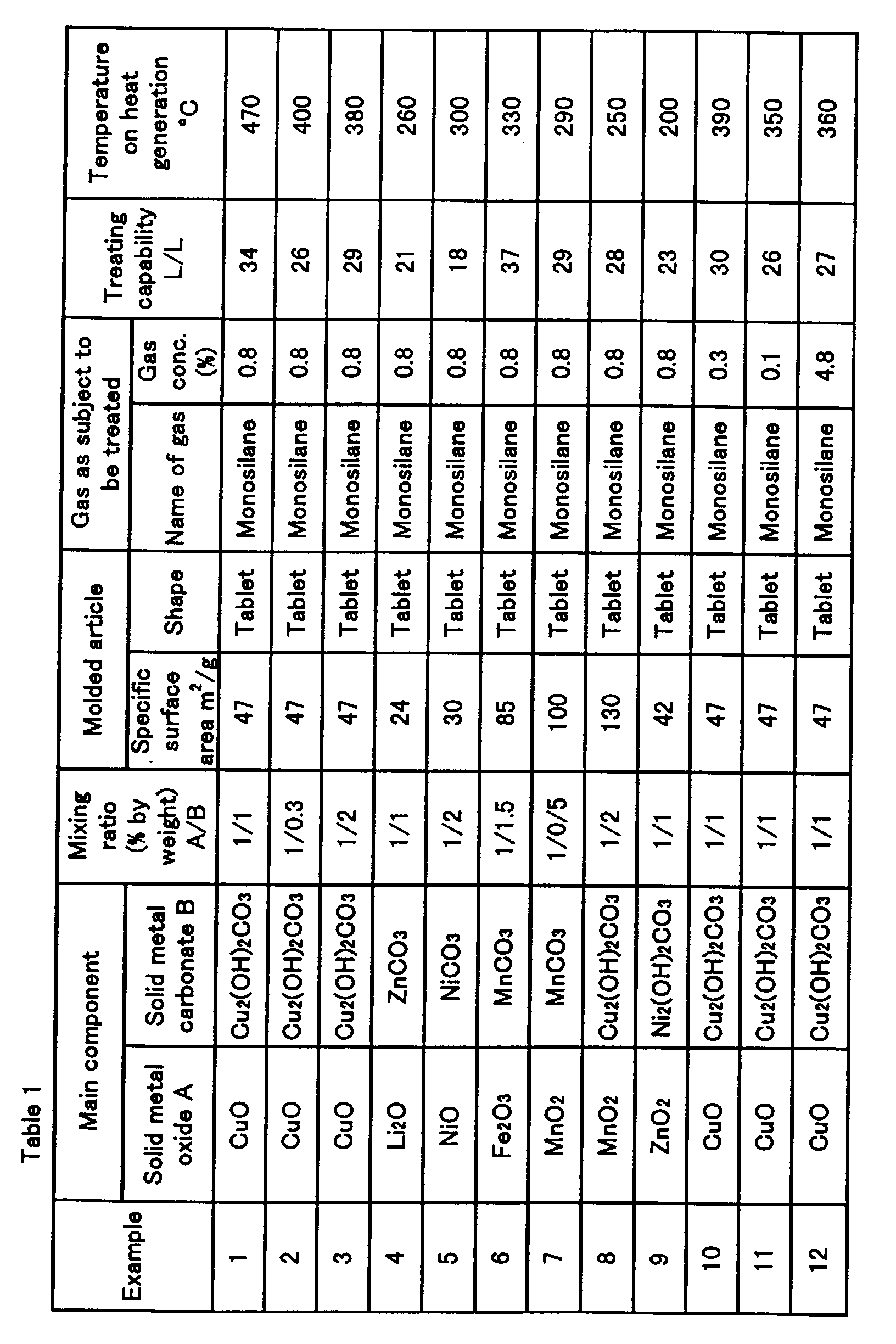
- the integrated amount of a pure silane gas penetrated when the packed bed outlet concentration exceeds 5 ppm was determined and the volume of the pure silane gas passed through one liter of the treating agent was taken as a treating capability (L/L). As is apparent from the results shown in Table 1, the treating agent showed a high treating capability.
- Example 1 The same manner as in Example 1 was repeated, except that the cupric oxide and basic copper carbonate were mixed in a mixing ratio shown in Table 1. The results are shown in Table 1.
- Example 1 The same manner as in Example 1 was repeated, except that the solid metal oxide and solid metal carbonate were mixed in a mixing ratio shown in Table 1 in place of the mixture of the cupric oxide and basic copper carbonate. The results are shown in Table 1.
- Example 1 The same manner as in Example 1 was repeated, except that the degree of dilution of the subject gas to be treated with the helium gas was changed as shown in Table 1.
- Example 2 The same manner as in Example 1 was repeated, except that the subject gas to be treated is composed of components shown in Table 2. As is apparent from the results shown in Table 2, the treating agent exerted a high treating capability.
- Example 2 In the same manner as in Example 1, except that the treating agent thus granulated was used, the exhaust gas was treated.
- cupric oxide and basic copper carbonate as those in Example 1 were mixed in an optionally changed ratio.
- 10% by weight of bentonite and 35% by weight of water were added.
- the mixture was extruded by using a desk pelleter having an opening diameter of 2.5 mm ⁇ and dried at 120°C to obtain a treating agent.
- This treating agent was analyzed by XRD (manufactured by Rigaku Co.) and a peak intensity ratio A/B was measured, with a proviso that a peak value A of the cupric oxide is a value of a maximum peak intensity at 2 ⁇ within a range from 38.6 to 39.0° and a peak value B of the basic copper carbonate is a value of a maximum peak intensity at 2 ⁇ within a range from 31.1 to 31.5°.
- Each peak intensity ratio is shown in Table 3. The same manner as in Example 1 was repeated, except that a stainless steel column having an inner diameter of 16.5 ⁇ and a length of 200 mm was packed with 40 cc of this treating agent.
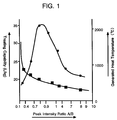
- FIG. 1 A relation between a peak intensity ratio and a treating capability value, and a peak intensity ratio and a temperature on heat generation caused by exposure to an air are shown in Fig. 1.
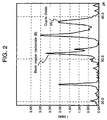
- FIG. 2 A XRD chart of Example 22 is shown in Fig. 2.
- the treating agent which was obtained by extruding the basic copper carbonate alone (Comparative Example 1) or cupric oxide alone (Comparative Example 2) in the same manner as in Examples 20 to 26, was evaluated in the same manner, respectively. The results are shown in Table 3.
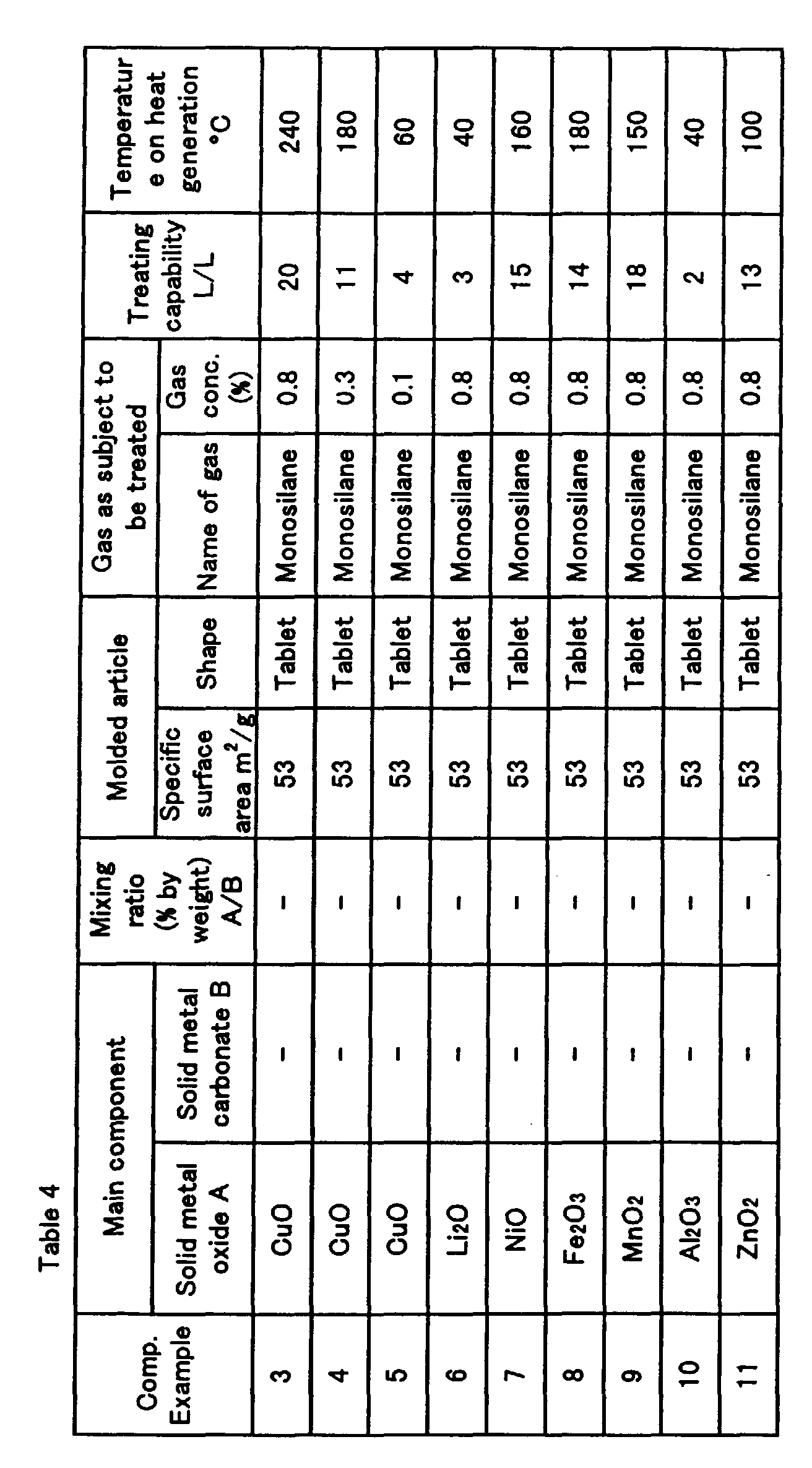
- Example 4 In the same manner as in Example 1, except that the treating agent was obtained from the solid metal oxide used in the respective Examples alone, the exhaust gas was treated. As is apparent from the results shown in Table 4, the treating agents are inferior in treating capability to the respective Examples.
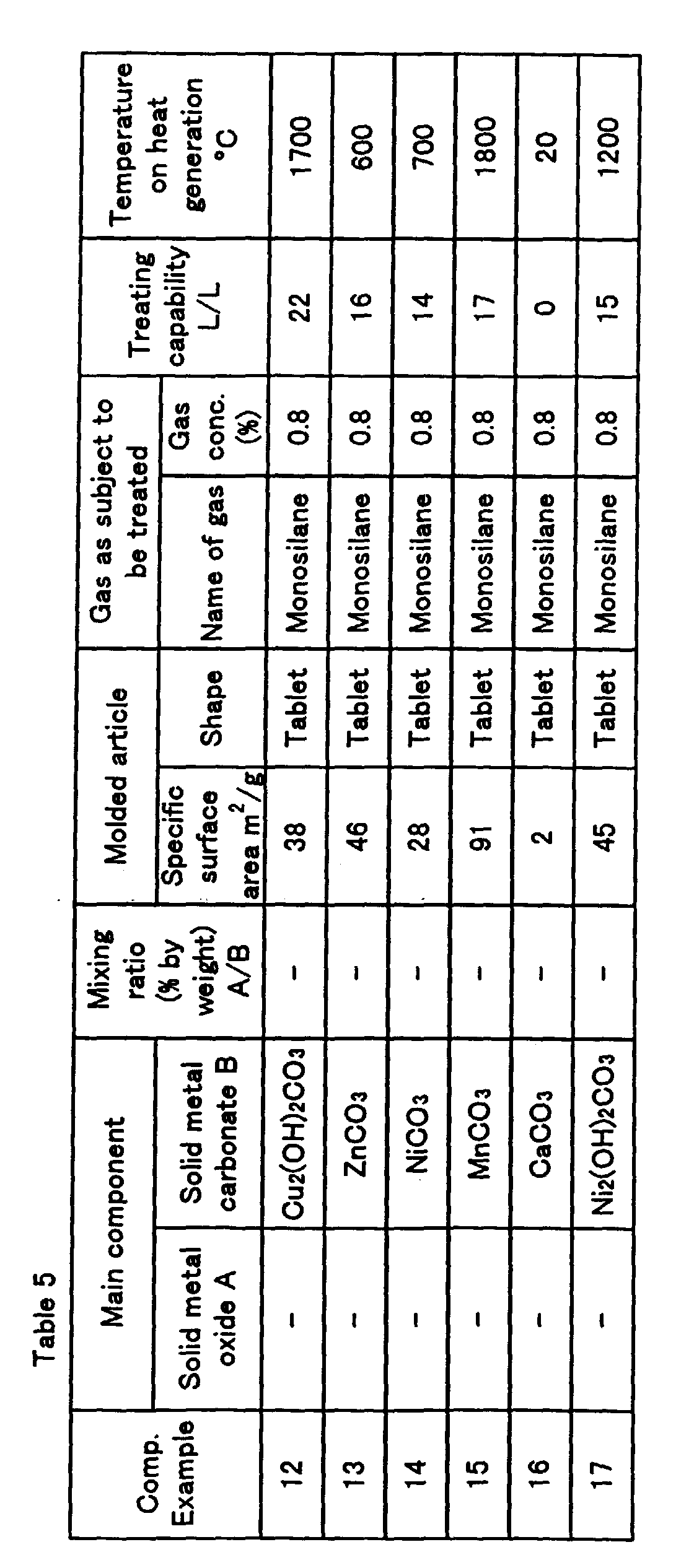
- Example 5 In the same manner as in Example 1, except that the treating agent was obtained from the solid metal carbonate used in the respective Examples alone, the exhaust gas was treated. As is apparent from the results shown in Table 5, the treating agents are inferior in treating capability to the respective Examples. It was also observed that the surface of almost all of the treating agents became red hot on exposure to an air after the treatment.
Landscapes
- Chemical & Material Sciences (AREA)
- Engineering & Computer Science (AREA)
- Chemical Kinetics & Catalysis (AREA)
- Materials Engineering (AREA)
- Organic Chemistry (AREA)
- Environmental & Geological Engineering (AREA)
- Biomedical Technology (AREA)
- Health & Medical Sciences (AREA)
- Analytical Chemistry (AREA)
- General Chemical & Material Sciences (AREA)
- Oil, Petroleum & Natural Gas (AREA)
- Treating Waste Gases (AREA)
- Solid-Sorbent Or Filter-Aiding Compositions (AREA)
Abstract
Description
- The present invention relates to an agent for treating an exhaust gas containing a metal hydride gas and/or an organometallic gas, and a process of treating the exhaust gas using the agent. In preferred embodiments, it relates to a dry gas treating agent, which is used to treat an exhaust gas containing a low concentration of a metal hydride gas and an organometallic gas by passing it through the treating agent containing a solid metal oxide and a solid metal carbonate as a main component, and a treating process thereof.
- Various gases have been used as a gas for production of a semiconductor and called as a metal hydride gas such as SiH4, Si2H6, GeH4, PH3, and AsH3, or an organosilane. Among them, the organosilane gas such as methylsilane, ethylsilane, and phenylsilane has attracted special interest recently because it exerts a specific performance adequate for a dry photoresist agent in the production of a semiconductor device, or a low-dielectric material for formation of a layer insulation film.
- However, any of these gases is drastically dangerous because of high toxicity, reactivity and spontaneous ignition property. Since these gases have high toxicity, e.g. severe irritation to the respiratory organ upon respiration, we can foresee a harmful influence on the human body and natural environment if these gases are released out of the system in a high concentration. Therefore, it is a natural responsibility for persons in charge to reduce the concentration of the organosilane gas contained in the exhaust gas from its production process and after use in the semiconductor industry in view of retention of good working atmosphere and prevention of destruction of the natural environment.
- Accordingly, it is required to make the exhaust gas harmless before release in an air, and a dry treating agent made of a solid metal oxide (Examined Patent Publication (KOKOKU) No. 4-19886) or a solid metal carbonate (Unexamined Patent Publication (KOKAI) Nos. 59-160535 and 8-192024) and a treating process using the same have hitherto been suggested.
- In case where these component are contained in the exhaust gas in a high concentration, heat is generated by the reaction with the treating agent made of the solid metal oxide and a sufficient treatment can be conducted by the successive reaction. However, in case of the exhaust gas having a comparatively low concentration, a sufficient treatment can not be conducted because of poor reactivity.
- In case of the treating agent made of the solid metal carbonate, a sufficient reaction takes place even in case of the exhaust gas having a comparatively low concentration, but the amount of the exhaust gas to be treated per volume of this treating agent is poor. If this treating agent is brought into contact with an air after passing the exhaust gas through it, high temperature heat is generated, resulting in poor handling.
- In a conventional process, it was considered to be effective to supply the exhaust gas while heating a packed bed so as to enhance the capability of treating the exhaust gas. However, this heating process requires high energy cost and gives rise to generation of particles from a heat insulating material in the vicinity of a heater and, therefore, it was a problem in a semiconductor factory where particles should be avoided.
- Preferred embodiments of the present invention may provide a treating process which is capable of treating in an efficient and safe manner even in case of the exhaust gas having a low concentration as a subject to be treated, and which does not require heating and does not attend generation of particles, and a treating agent.
- The present inventors have studied intensively to attain the above object. As a result, they have found that, by using a solid metal oxide in combination with a solid metal carbonate, not only drawbacks in case of using them alone are covered, but also a higher treating capability is exerted by a synergistic effect. Thus, the present invention has been completed.
- That is, the present invention is directed to an agent for treating an exhaust gas, comprising a mixture of a solid metal oxide and a solid metal carbonate as a main component, said metal being selected from the group of metal elements consisting of Mn, Fe, Ni, Cu and Zn, said mixture having a peak intensity ratio A/B within a range from 0.2 to 8 with a proviso that a value of a maximum peak intensity at 2 within a range from 38.6 to 39.00 is A (cupric oxide) and a value of a maximum peak intensity at 2 within a range from 31.1 to 31.5° is B (basic copper carbonate) in XRD, said agent being made of a molded article obtained by granulation and/or pelletization and extrusion of the mixture.
- The present invention is also directed to a process of treating an exhaust gas, which comprises packing a packing container with a treating agent comprising a mixture of a solid metal oxide and a solid metal carbonate as a main component, and passing the exhaust gas containing a metal hydride gas and/or an organometallic gas through a bed packed with the treating agent, thereby to treat the exhaust gas at room temperature.
- The present inventors have found that, by mixing an agent for treating an exhaust gas containing a metal hydride gas and/or an organometallic gas with a solid metal oxide and a solid metal carbonate, which have conventionally been used, in a specific ratio, not only drawbacks in case of using them alone are covered, but also a higher treating capability is exerted by a synergistic effect. By using this treating agent, an increase in life of the treating agent and a reduction in size of the apparatus can be attained as compared with a conventional treating process. This fact exerts a relative effect in view of energy cost.
-
- Fig. 1 is a graph showing a change in treating capability and a change in temperature on heat generation, depending on a peak intensity ratio A/B in XRD of a mixture of a cupric oxide and a basic copper carbonate.
- Fig. 2 is a XRD chart of a mixture of a cupric oxide and a basic copper carbonate in Example 22.
-
- The present invention will be described in more detail hereinafter. In the present invention, the gas concentration is represented by % by volume unless otherwise stated.
- The "exhaust gas" used in the present invention refers to an exhaust gas containing the following metal hydride gas and/or organometallic gas. The metal hydride gas and organometallic gas contained in the exhaust gas as subjects to be treated in the present invention are as follows. The metal hydride gas includes, for example, SiH4, Si2H6, GeH4, PH3, and AsH3, and the organometallic gas includes, for example, a compound represented by the chemical formula Rx· MHy (wherein R represents an alkoxy group, an alkyl group, a vinyl group or a phenyl group; M represents Si or Al; when M is Si, x represents 1 to 4, y represents an integer of 0 to 3, and
- The metal hydride gas and organometallic gas remained in the process for production semiconductors are often self-burning, and therefore transferred to the treating process after being diluted with a N2 gas in the semiconductor factory at present. The concentration after the dilution varies depending on the semiconductor factory, but these gases are usually diluted so that the concentration becomes 5% by volume or lower.
- Although almost all of the solid metal oxide and solid metal carbonate can be used in the present invention, preferred are those which are safely handled and are cheap, the metal element of which is selected from the group consisting of Mn, Fe, Ni, Cu and Zn.
- A basic solid metal carbonate is also included in the solid metal carbonate. The basic solid metal carbonate is a substance represented by the general formula Mx(CO3)y(OH)z wherein M represents a metal element.
- The mixture of the solid metal oxide and solid metal carbonate may be a combination of those having the same kinds of metal elements, and a combination of those having different kinds of metal elements.
- The present inventors have found that a remarkable effect can be exerted in the treatment of the exhaust gas by using the solid, metal oxide and solid metal carbonate in combination as compared with the case of using them alone.
- Another effect is as follows. That is, when using the solid metal carbonate alone, the calorific value is higher than that in case of using the solid metal oxide alone and the temperature of the surface on exposure to an air reaches about 2000°C after passing the exhaust gas through.
- To inhibit this heat generation, an inert component can be added as a diluting agent. In that case, the treating capability is also lowered as a matter of course. However, heat generation can be inhibited while inhibiting the treating capability from lowering by mixing with the solid metal oxide.
- In the treating process of the present invention, the packing container is packed with the treating agent. In this case, those made of metal such as iron and stainless steel may be usually used.
- In a conventional treating process using the solid metal carbonate, severe heat generation occurs when an air is introduced during the treatment of the exhaust gas, which was dangerous. In the present invention, the temperature on heat generation caused by exposure to an air can be reduced to 800°C or lower, which is lower than the temperature against which the packing container is proof, by using the mixture of the solid metal oxide and solid metal carbonate.
- The mixture of the solid metal oxide and solid metal carbonate can be obtained by charging them in any ratio in a mixer and mixing. Alternatively, portion of the solid metal carbonate can be converted into the solid metal oxide by heating while controlling the temperature and time. Preferably, a mixing ratio of the solid metal oxide to the solid metal carbonate is within a range from 1:0.2 to 1:5.
- The vapor-solid contact capability is improved by preparing the solid metal oxide and solid metal carbonate from powders having a specific surface area of 1 m2/g or higher, which is preferred. However, when the packing container is packed with the mixture in the form of powders, pressure loss increases and there arises troubles such as blocking at an outlet piping of the packing container, sometimes. Accordingly, the mixture is preferably used after molding into a treating agent by granulation, pelletization and extrusion.
- The shape and size of the treating agent thus molded are not specifically limited, and proper shape and size can be selected according to the shape of the container with which the treating agent is packed. In case where the molding density of the treating agent is too low, the strength of the molded article may be lowered and the molded article is powdered during the use. In case where a fixed container is packed with a treating agent having a low molding density, the weight is reduced and, therefore, the volume of treating the exhaust gas per one container is lowered sometimes. To the contrary, when the molding density is enhanced, the strength of the molded article increases and the fixed container can be packed with a large amount of the treating agent. However, the exhaust gas is not easily diffused into the molded article, resulting in lowering of the treating capability.
- Accordingly, the molding density is preferably adjusted within a range from 1.5 to 3.0 g/cm3.
- In case of molding, a binder may be used. The kind of the binder is not specifically limited and there can be used organic binders such as methylcellulose, methylethylcellulose, and polyvinyl alcohol; and inorganic binders such as water-glass, and bentonite.
- According to the present inventors' study, most preferred combination of the solid metal oxide and solid metal carbonate is a combination of a cupric oxide and a basic copper carbonate.
- The basic copper carbonate is a substance represented by Cu2(CO3)y(OH)z, and Cu2(CO3)(OH)2 referred to as malachite is generally used.
- As the basic copper carbonate used in the present invention, for example, those obtained by neutralizing copper sulfate or copper nitrate with an alkali carbonate are suitably used. In that case, fine particles are obtained by conducting the neutralization reaction in a short time. When using a basic copper carbonate of the fine particles, the metal hydride gas and/or organometallic gas contained in the exhaust gas can be treated more suitably.
- The particles of the basic copper carbonate are preferably those wherein the diameter of the primary particle determined by SEM observation is 3 µm or lower and the specific surface area is 20 m2/g or higher.
- On the other hand, those obtained by oxidizing powders of the basic copper carbonate or copper hydroxide with heating to a temperature within a range from 230 to 400°C can be used as the cupric oxide. The cupric oxide is preferably in the form of fine particles and those obtained by oxidizing the above-described basic copper carbonates are suitably used. There can also be preferably used those obtained by oxidizing portion of the basic copper carbonate to convert into the cupric oxide in the same manner as described above.
- The particles of the cupric oxide are preferably those wherein the diameter of the primary particle determined by SEM observation is 3 µm or lower and the specific surface area is 20 m2/g or higher, like the basic copper carbonate.
- Accordingly, the mixture containing the cupric oxide and basic copper carbonate as the main component may be those wherein the diameter of the primary particle determined by SEM observation is 3 µm or lower and the specific surface area is 20 m2/g or higher. In the same manner as described above, the mixture is preferably used after molding into a molded article by granulation, pelletization and extrusion.
- The mixing ratio of the cupric oxide to the basic copper carbonate will be described below.
- The mixing ratio of the mixture of the cupric oxide and basic copper carbonate can be determined by XRD. In the present invention, a peak intensity ratio A/B was measured, with a proviso that a peak value A of the cupric oxide is a value of a maximum peak intensity at 2 within a range from 38.6 to 39.0° and a peak value B of the basic copper carbonate is a value of a maximum peak intensity at 2 within a range from 31.1 to 31.5°.
- In the present invention, the mixture having this peak intensity ratio A/B within a range from 0.2 to 8, preferably from 0.3 to 3, and more preferably from 0.5 to 2 is preferred because the exhaust gas containing the metal hydride gas and/or organometallic gas can be effectively treated.
- By adjusting the peak intensity ratio A/B within the above range, a sufficient capability can be exerted in the treatment of the low-concentration exhaust gas as compared with the case of using the cupric oxide and basic copper carbonate alone. Moreover, heat generation can be reduced on exposure to an air after passing the exhaust gas through.
- When the peak intensity ratio exceeds 8, the synergistic effect may become too low for efficient treatment of gas containing a low concentration of the metal hydride gas and/or organometallic gas. On the other hand, when the peak intensity ratio A/B is lower than 0.2, the synergistic effect is lowered and, moreover, high temperature arises in a moment on exposure to air after passing the exhaust gas through, which is not preferred.
- The process of treating the exhaust gas using the treating agent of the present invention will be described below.
- Like a conventional example, the process of supplying the exhaust gas while heating the packed bed so as to enhance the capability of treating the exhaust gas is also effective in the present invention, however, this heating process requires high energy cost and gives rise to generation of particles from an insulating material.
- In the present invention, even in case of the exhaust gas containing a low concentration of the metal hydride gas and/or organometallic gas, a high effect can be obtained if the exhaust gas is passed through the packed bed at room temperature.
- The "room temperature" used herein refers to the fact that heat is not applied forcibly from the outside, and is within a range from 0 to 40°C in a usual state.
- To carry out the treating process of the present invention, the packed bed may be a series of packed beds, but it is preferred that a plurality of packed beds are arranged in parallel and are used alternatively as a packed bed and a virgin bed in view of the operation such as displacement of the treating agent.
- With respect to the exhaust gas to be released into an air after passing through the treating agent, the concentration of the metal hydride gas and organometallic gas is usually reduced to 0.5 ppm or lower at an outlet of the packing container.
- In case where a gas at the outlet of the treating container is monitored at a permissible concentration (1 to 5 ppm) at which the metal hydride gas and organometallic gas in the exhaust gas may be released into an air and, as a result, the gas was detected, the used treating agent must be quickly replaced by a new treating agent.
- The process of monitoring the outlet gas includes, for example, gas chromatograph, detecting tube, and gas detector, and any process can be used.
- In the present invention, when the metal hydride gas or organometallic gas is detected at the concentration lower than the permissible concentration in the outlet gas, the metal hydride gas or organometallic gas in the exhaust gas is calculated in terms of 100% and a value obtained by dividing an integrated amount of the gases by a capacity of the bed packed with the treating agent is taken as a treating capability per volume. A value obtained by dividing by a weight of the treating agent is taken as a treating capability per weight.
- The amount of the exhaust gas to be passed through the packed bed is represented by a space velocity (SV) value [H-1] as an index which shows a proportion of the amount of the exhaust gas passed through the packed bed for one hour based on the capacity of the bed packed with the treating agent.
- The smaller this SV value, the higher the numerical value of the treating capability becomes. It is required to increase the size of the packing container for treating agent so as to reduce the SV value. In that case, the workability on carriage or displacement tends to become inferior.
- To the contrary, when the SV value is increased, the treating agent tends to be leaked in a short time without treating the exhaust gas completely.
- Therefore, when using the treating agent for the industrial purpose, it is desired to treat at the SV value within a range from 10 to 1000 [H-1], and preferably from 30 to 500 [H-1].
- As described above, the mixture of the solid metal oxide and solid metal carbonate is capable of exerting a treating effect by reacting with the exhaust gas containing a low concentration of the metal hydride gas and/or organometallic gas in the packed bed or container, thereby to fix the metal component on the surface of the mixture of the solid metal oxide and solid metal carbonate.
- The following Examples and Comparative Examples further illustrate the present invention in more detail.
- 1 Part of a cupric oxide having a specific surface area of 53 m2/g was mixed with 1 part of a basic copper carbonate having a specific surface area of 38 m2/g. Without mixing a binder, the mixture was pelletized into a cylindrical tablet having a size of 3 mm × 3 mmH using a tablet machine to obtain a treating agent. The molding density was 2.2 g/cm3.
- The specific surface area of the treating agent thus molded was 45 m2/g. A stainless steel column having an inner diameter of 16.5 and a length of 200 mm was packed with 40 cc of this treating agent.
- Then, a silane gas (SiH4) as a subject gas to be treated was diluted with a helium gas to prepare 0.8% by volume of a silane-containing gas, which was passed through the column (SV value = 100 [H-1]) at room temperature at a flow rate of 67 cc/minute and the concentration of the silane gas was analyzed at an outlet of a packed bed. The analysis was conducted by using a gas chromatograph (GC-3000, manufactured by Hitachi Corp.) equipped with a photoionization detector (PID). A separation column is Porapak-P® and a detection limit of silane is 0.5 ppm.
- The integrated amount of a pure silane gas penetrated when the packed bed outlet concentration exceeds 5 ppm was determined and the volume of the pure silane gas passed through one liter of the treating agent was taken as a treating capability (L/L). As is apparent from the results shown in Table 1, the treating agent showed a high treating capability.
- After the silane gas was detected at the outlet, the column was purged with N2 and this treating agent was taken out on a stainless steel pallet. On heat generation, the temperature of the surface was measured by using an infrared radiation thermometer (1R-AHOT, IR-AH1S, manufactured by CHINO Co.). The maximum temperature at this time is shown in Table 1.
- The same manner as in Example 1 was repeated, except that the cupric oxide and basic copper carbonate were mixed in a mixing ratio shown in Table 1. The results are shown in Table 1.
- The same manner as in Example 1 was repeated, except that the solid metal oxide and solid metal carbonate were mixed in a mixing ratio shown in Table 1 in place of the mixture of the cupric oxide and basic copper carbonate. The results are shown in Table 1.
- The same manner as in Example 1 was repeated, except that the degree of dilution of the subject gas to be treated with the helium gas was changed as shown in Table 1.
- As is apparent from the results shown in Table 1, the treating agent exerted a high treating capability.
- The same manner as in Example 1 was repeated, except that the subject gas to be treated is composed of components shown in Table 2. As is apparent from the results shown in Table 2, the treating agent exerted a high treating capability.
- 1 Part of a cupric oxide having a specific surface area of 53 m2/g was mixed with 1 part of a basic copper carbonate having a specific surface area of 38 m2/g. To the mixture, 0.3 part of water and 0.02 part of methylcellulose were added, followed by granulation to form particles in size of 3 to 5 mm and further drying at 100°C.
- In the same manner as in Example 1, except that the treating agent thus granulated was used, the exhaust gas was treated.
- As is apparent from the results shown in Table 2, the treating agent exerted a high treating capability.
- The same cupric oxide and basic copper carbonate as those in Example 1 were mixed in an optionally changed ratio. To the mixture, 10% by weight of bentonite and 35% by weight of water were added. Then, the mixture was extruded by using a desk pelleter having an opening diameter of 2.5 mm and dried at 120°C to obtain a treating agent. This treating agent was analyzed by XRD (manufactured by Rigaku Co.) and a peak intensity ratio A/B was measured, with a proviso that a peak value A of the cupric oxide is a value of a maximum peak intensity at 2 within a range from 38.6 to 39.0° and a peak value B of the basic copper carbonate is a value of a maximum peak intensity at 2 within a range from 31.1 to 31.5°. Each peak intensity ratio is shown in Table 3. The same manner as in Example 1 was repeated, except that a stainless steel column having an inner diameter of 16.5 and a length of 200 mm was packed with 40 cc of this treating agent.
- The results are shown in Table 3. As the treating capability, a treating capability value per volume (L/L) and a treating capability value per weight (L/kg) were shown. As shown in Table 3, any of the treating agents exerted a high treating capability.
- A relation between a peak intensity ratio and a treating capability value, and a peak intensity ratio and a temperature on heat generation caused by exposure to an air are shown in Fig. 1. A XRD chart of Example 22 is shown in Fig. 2.
- The treating agent, which was obtained by extruding the basic copper carbonate alone (Comparative Example 1) or cupric oxide alone (Comparative Example 2) in the same manner as in Examples 20 to 26, was evaluated in the same manner, respectively. The results are shown in Table 3.
- In the same manner as in Example 1, except that the treating agent was obtained from the solid metal oxide used in the respective Examples alone, the exhaust gas was treated. As is apparent from the results shown in Table 4, the treating agents are inferior in treating capability to the respective Examples.
- In the same manner as in Example 1, except that the treating agent was obtained from the solid metal carbonate used in the respective Examples alone, the exhaust gas was treated. As is apparent from the results shown in Table 5, the treating agents are inferior in treating capability to the respective Examples. It was also observed that the surface of almost all of the treating agents became red hot on exposure to an air after the treatment.


Claims (17)
- An agent for treating an exhaust gas, comprising a mixture of a solid metal oxide and a solid metal carbonate, said metal being selected from the group of metal elements consisting of Mn, Fe, Ni, Cu and Zn, said agent being made of a molded article obtained by granulation, pelletization or extrusion of the mixture.
- The agent according to claim 1, wherein a solid density of the molded article obtained by granulation, pelletization or extrusion is within a range from 1.5 to 3.0 g/cm3.
- The agent according to claim 1 or 2, wherein heat generation caused on exposure of the agent to an air after passing the exhaust gas through the agent is 800°C or lower in term of the surface temperature of the agent.
- The agent according to claim 1, 2 or 3, wherein a specific surface area of the solid metal oxide, the solid metal carbonate, and/or the mixture of the solid metal oxide and the solid metal carbonate is 1 m2/g or higher.
- An agent according to any preceding claim, comprising a mixture of a cupric oxide and a basic copper carbonate as a main component, said mixture having a peak intensity ratio A/B within a range from 0.2 to 8 with a proviso that a value of a maximum peak intensity at 2 within a range from 38.6 to 39.0° is A (cupric oxide) and a value of a maximum peak intensity at 2 within a range from 31.1 to 31.5° is B (basic copper carbonate) in XRD.
- The agent according to claim 5, wherein the peak intensity ratio A/B is within a range from 0.3 to 3.
- The agent according to claim 6, wherein the peak intensity ratio A/B is within a range from 0.5 to 2.
- The agent according to claim 5, 6 or 7, wherein a diameter of a primary particle of the mixture of the cupric oxide, the basic copper carbonate, and the mixture of the cupric oxide and the basic copper carbonate is 3 µm or lower.
- The agent according to claim 5, 6, 7 or 8, wherein a specific surface area of the mixture of the cupric oxide, the basic copper carbonate, and the mixture of the cupric oxide and the basic copper carbonate is 20 m2/g or higher.
- The agent according to claim 5, 6, 7, 8 or 9, wherein a copper oxide obtained by oxidizing the basic copper carbonate or the copper hydroxide with heating is used as the cupric oxide.
- A process of treating an exhaust gas, which comprises packing a packing container with a treating agent comprising a mixture of a solid metal oxide and a solid metal carbonate, and passing the exhaust gas containing a metal hydride gas and/or an organometallic gas through a bed packed with the treating agent, thereby to treat the exhaust gas at room temperature.
- The process according to claim 11, wherein the treating agent is according to any of claims 1-10.
- The process according to claim 11, wherein the treating agent comprises a mixture of a solid metal oxide and a solid metal carbonate, said mixture having a peak intensity ratio A/B within a range from 0.2 to 8 with a proviso that a value of a maximum peak intensity at 2 within a range from 38.6 to 39.0° is A (cupric oxide) and a value of a maximum peak intensity at 2 within a range from 31.1 to 31.5° is B (basic copper carbonate) in XRD, said agent being made of a molded article obtained by granulation, pelletization or extrusion of the mixture.
- The process according to any of claims 11-13, wherein the exhaust gas contains a metal hydride gas selected from SiH4, Si2H6, GeH4, PH3, and AsH3, and/or an organometallic gas represented by the chemical formula Rx·MHy (wherein R represents an alkoxy group, an alkyl group, a vinyl group or a phenyl group; M represents Si or Al; x represents 1 to 4, y represents an integer of 0 to 3, and
- The process according to any of claims 11-14, wherein a concentration of the metal hydride gas and/or organometallic gas contained in the exhaust gas is 5% by volume or lower.
- The process according to any of claims 11-15, wherein the flow rate of the exhaust gas passed through the packed bed is such that the space velocity (SV) is within a range from 10 to 1000 [H-1].
- The process according to any of claims 11-16, wherein the treating agent comprises the mixture of the solid metal oxide and the solid metal carbonate as the main component and is capable of reducing the concentration of the silane exhaust gas to 0.5 ppm or lower.
Applications Claiming Priority (2)
| Application Number | Priority Date | Filing Date | Title |
|---|---|---|---|
| JP1292699 | 1999-01-21 | ||
| JP1292699 | 1999-01-21 |
Publications (1)
| Publication Number | Publication Date |
|---|---|
| EP1031370A1 true EP1031370A1 (en) | 2000-08-30 |
Family
ID=11818941
Family Applications (1)
| Application Number | Title | Priority Date | Filing Date |
|---|---|---|---|
| EP00300450A Withdrawn EP1031370A1 (en) | 1999-01-21 | 2000-01-21 | Agent and process for treating an exhaust gas containing gaseous hydrides or organosilanes |
Country Status (5)
| Country | Link |
|---|---|
| US (1) | US6284209B1 (en) |
| EP (1) | EP1031370A1 (en) |
| KR (1) | KR100359510B1 (en) |
| SG (1) | SG111909A1 (en) |
| TW (1) | TWI259780B (en) |
Cited By (4)
| Publication number | Priority date | Publication date | Assignee | Title |
|---|---|---|---|---|
| EP1452220A1 (en) * | 2002-12-26 | 2004-09-01 | Japan Pionics Co., Ltd. | Process for removing harmful organometallic compounds from a gas |
| EP1583600A4 (en) * | 2002-12-09 | 2006-07-05 | Applied Materials Inc | METHOD AND DEVICE FOR REDUCING TOXIC GAS CONSTITUENTS FROM A FLOW OF SEMICONDUCTOR PRODUCTION EFFLUENTS |
| US7364603B2 (en) | 2002-12-09 | 2008-04-29 | Applied Materials, Inc. | Method and apparatus for the abatement of toxic gas components from a semiconductor manufacturing process effluent stream |
| CN102935371A (en) * | 2012-11-16 | 2013-02-20 | 南开大学 | Catalyst for preparing yellow phosphorus through catalytic decomposition of phosphine gas and preparation method thereof |
Families Citing this family (1)
| Publication number | Priority date | Publication date | Assignee | Title |
|---|---|---|---|---|
| US6447576B1 (en) * | 1999-10-29 | 2002-09-10 | Japan Pionics Co., Ltd. | Cleaning agent and cleaning process of harmful gas |
Citations (6)
| Publication number | Priority date | Publication date | Assignee | Title |
|---|---|---|---|---|
| JPS5328592A (en) * | 1976-08-31 | 1978-03-16 | Mitsui Toatsu Chem Inc | Catalysts for purification of exhaust gas |
| EP0194366A1 (en) * | 1985-03-13 | 1986-09-17 | Japan Pionics., Ltd. | Method of cleaning exhaust gases |
| EP0294142A2 (en) * | 1987-06-01 | 1988-12-07 | Japan Pionics., Ltd. | Method of cleaning exhaust gases |
| EP0335792A1 (en) * | 1988-03-30 | 1989-10-04 | L'air Liquide, Societe Anonyme Pour L'etude Et L'exploitation Des Procedes Georges Claude | Process for the destruction of hydrides in an exhaust gas, and catalyst for carrying it out |
| JPH08192024A (en) * | 1995-01-20 | 1996-07-30 | Mitsui Toatsu Chem Inc | Exhaust gas treatment agent and treatment method |
| JPH08206444A (en) * | 1995-02-03 | 1996-08-13 | Nippon Sanso Kk | Harmful gas removal method |
-
2000
- 2000-01-19 SG SG200000303A patent/SG111909A1/en unknown
- 2000-01-21 US US09/488,706 patent/US6284209B1/en not_active Expired - Fee Related
- 2000-01-21 KR KR1020000003010A patent/KR100359510B1/en not_active Expired - Fee Related
- 2000-01-21 TW TW089100972A patent/TWI259780B/en not_active IP Right Cessation
- 2000-01-21 EP EP00300450A patent/EP1031370A1/en not_active Withdrawn
Patent Citations (6)
| Publication number | Priority date | Publication date | Assignee | Title |
|---|---|---|---|---|
| JPS5328592A (en) * | 1976-08-31 | 1978-03-16 | Mitsui Toatsu Chem Inc | Catalysts for purification of exhaust gas |
| EP0194366A1 (en) * | 1985-03-13 | 1986-09-17 | Japan Pionics., Ltd. | Method of cleaning exhaust gases |
| EP0294142A2 (en) * | 1987-06-01 | 1988-12-07 | Japan Pionics., Ltd. | Method of cleaning exhaust gases |
| EP0335792A1 (en) * | 1988-03-30 | 1989-10-04 | L'air Liquide, Societe Anonyme Pour L'etude Et L'exploitation Des Procedes Georges Claude | Process for the destruction of hydrides in an exhaust gas, and catalyst for carrying it out |
| JPH08192024A (en) * | 1995-01-20 | 1996-07-30 | Mitsui Toatsu Chem Inc | Exhaust gas treatment agent and treatment method |
| JPH08206444A (en) * | 1995-02-03 | 1996-08-13 | Nippon Sanso Kk | Harmful gas removal method |
Non-Patent Citations (3)
| Title |
|---|
| DATABASE WPI Section Ch Week 197817, Derwent World Patents Index; Class E19, AN 1978-31122A, XP002135416 * |
| DATABASE WPI Section Ch Week 199640, Derwent World Patents Index; Class E36, AN 1996-396292, XP002135418 * |
| DATABASE WPI Section Ch Week 199642, Derwent World Patents Index; Class E36, AN 1996-420267, XP002135417 * |
Cited By (4)
| Publication number | Priority date | Publication date | Assignee | Title |
|---|---|---|---|---|
| EP1583600A4 (en) * | 2002-12-09 | 2006-07-05 | Applied Materials Inc | METHOD AND DEVICE FOR REDUCING TOXIC GAS CONSTITUENTS FROM A FLOW OF SEMICONDUCTOR PRODUCTION EFFLUENTS |
| US7364603B2 (en) | 2002-12-09 | 2008-04-29 | Applied Materials, Inc. | Method and apparatus for the abatement of toxic gas components from a semiconductor manufacturing process effluent stream |
| EP1452220A1 (en) * | 2002-12-26 | 2004-09-01 | Japan Pionics Co., Ltd. | Process for removing harmful organometallic compounds from a gas |
| CN102935371A (en) * | 2012-11-16 | 2013-02-20 | 南开大学 | Catalyst for preparing yellow phosphorus through catalytic decomposition of phosphine gas and preparation method thereof |
Also Published As
| Publication number | Publication date |
|---|---|
| US6284209B1 (en) | 2001-09-04 |
| SG111909A1 (en) | 2005-06-29 |
| KR100359510B1 (en) | 2002-11-04 |
| KR20000071279A (en) | 2000-11-25 |
| TWI259780B (en) | 2006-08-11 |
Similar Documents
| Publication | Publication Date | Title |
|---|---|---|
| CN100522313C (en) | Method and apparatus for the abatement of toxic gas components from a semiconductor manufacturing process effluent stream | |
| EP0546464B1 (en) | Process for cleaning harmful gas | |
| EP0309099B1 (en) | Method for cleaning gas containing toxic component | |
| EP0194366B1 (en) | Method of cleaning exhaust gases | |
| KR960003147B1 (en) | Exhaust gas purification | |
| AU2016397508B2 (en) | Composition containing modified chromate-deficient red mud and method for producing same | |
| WO2004075262A2 (en) | Low pressure drop canister for fixed bed scrubber applications and method of using same | |
| US6284209B1 (en) | Agent for and process of treating exhaust gas | |
| JP3073321B2 (en) | How to purify harmful gases | |
| EP1028800B1 (en) | Process and apparatus for removing metal carbonyls and moisture from a gas | |
| US5512262A (en) | Process for cleaning harmful gas | |
| JPS60125233A (en) | High degree treatment of exhaust gas | |
| JP4406488B2 (en) | Exhaust gas treatment agent and treatment method | |
| KR20010061933A (en) | Cleaning agent and cleaning process of harmful gas | |
| JP4488616B2 (en) | Exhaust gas treatment agent and treatment method | |
| JPH10235185A (en) | Noxious gas purifying agent and purifying method | |
| US5176889A (en) | Method and apparatus for treatment of NF3 gas | |
| JP3362918B2 (en) | Exhaust gas purification method | |
| JPH0687943B2 (en) | Exhaust gas purification method | |
| US6342194B1 (en) | NF3 treating process | |
| JPH08192024A (en) | Exhaust gas treatment agent and treatment method | |
| JP3228459B2 (en) | Decomposition method of halide gas | |
| JP2812833B2 (en) | How to remove silane | |
| JPS62286524A (en) | Method for purifying exhaust gas | |
| JPH10249144A (en) | How to purify harmful gases |
Legal Events
| Date | Code | Title | Description |
|---|---|---|---|
| PUAI | Public reference made under article 153(3) epc to a published international application that has entered the european phase |
Free format text: ORIGINAL CODE: 0009012 |
|
| 17P | Request for examination filed |
Effective date: 20000210 |
|
| AK | Designated contracting states |
Kind code of ref document: A1 Designated state(s): DE FR GB |
|
| AX | Request for extension of the european patent |
Free format text: AL;LT;LV;MK;RO;SI |
|
| AKX | Designation fees paid |
Free format text: DE FR GB |
|
| RAP1 | Party data changed (applicant data changed or rights of an application transferred) |
Owner name: MITSUI CHEMICALS, INC. |
|
| 17Q | First examination report despatched |
Effective date: 20050221 |
|
| 17Q | First examination report despatched |
Effective date: 20050221 |
|
| STAA | Information on the status of an ep patent application or granted ep patent |
Free format text: STATUS: THE APPLICATION IS DEEMED TO BE WITHDRAWN |
|
| 18D | Application deemed to be withdrawn |
Effective date: 20100105 |