EP1031119B1 - A signalling system and a method for controlling the service at a restaurant - Google Patents
A signalling system and a method for controlling the service at a restaurant Download PDFInfo
- Publication number
- EP1031119B1 EP1031119B1 EP98947411A EP98947411A EP1031119B1 EP 1031119 B1 EP1031119 B1 EP 1031119B1 EP 98947411 A EP98947411 A EP 98947411A EP 98947411 A EP98947411 A EP 98947411A EP 1031119 B1 EP1031119 B1 EP 1031119B1
- Authority
- EP
- European Patent Office
- Prior art keywords
- guest
- indicator
- transmitter
- signalling system
- receiver
- Prior art date
- Legal status (The legal status is an assumption and is not a legal conclusion. Google has not performed a legal analysis and makes no representation as to the accuracy of the status listed.)
- Expired - Lifetime
Links
Images


Classifications
-
- G—PHYSICS
- G06—COMPUTING OR CALCULATING; COUNTING
- G06Q—INFORMATION AND COMMUNICATION TECHNOLOGY [ICT] SPECIALLY ADAPTED FOR ADMINISTRATIVE, COMMERCIAL, FINANCIAL, MANAGERIAL OR SUPERVISORY PURPOSES; SYSTEMS OR METHODS SPECIALLY ADAPTED FOR ADMINISTRATIVE, COMMERCIAL, FINANCIAL, MANAGERIAL OR SUPERVISORY PURPOSES, NOT OTHERWISE PROVIDED FOR
- G06Q10/00—Administration; Management
- G06Q10/06—Resources, workflows, human or project management; Enterprise or organisation planning; Enterprise or organisation modelling
-
- G—PHYSICS
- G06—COMPUTING OR CALCULATING; COUNTING
- G06Q—INFORMATION AND COMMUNICATION TECHNOLOGY [ICT] SPECIALLY ADAPTED FOR ADMINISTRATIVE, COMMERCIAL, FINANCIAL, MANAGERIAL OR SUPERVISORY PURPOSES; SYSTEMS OR METHODS SPECIALLY ADAPTED FOR ADMINISTRATIVE, COMMERCIAL, FINANCIAL, MANAGERIAL OR SUPERVISORY PURPOSES, NOT OTHERWISE PROVIDED FOR
- G06Q30/00—Commerce
- G06Q30/06—Buying, selling or leasing transactions
Definitions
- the invention relates to a signalling system for controlling the service at a restaurant where a guest at e.g. a counter can order a product, such as a hot meal for later handing over.
- the ordered product can e.g. be a hot meal which has to be prepared first.
- contact must be established with the guest in order for the hot meal to be handed over as soon as possible. This can e.g. take place by one of the staff trying to deliver the ordered hot meal to the relevant guest at a specific table.
- this process is demanding and difficult to carry out with certainty as it can be difficult to distinguish one guest from the other in passing.
- a less demanding method for establishing contact with the guest consists in calling out the code in the room by means of e.g. a loudspeaker.
- the guest's attention is drawn to the fact that he or she can now fetch the hot meal him-/herself at the counter.
- the method is noisy and therefore an inconvenience for the guests present. It can furthermore be difficult to quite make out the code when there are other guests nearby who are talking in a more or less loud manner, or when there is music at the restaurant. Thereby, misunderstandings can arise and there is a risk of the product being given to the wrong guest.
- a more discrete solution could be that the guest stated his selected table number when ordering the product, and that the staff subsequently signalled, by means of e.g. a signal lamp on the table, to the guest that the product is now ready for handing over.
- this method is not very expedient as the guest first have to find and occupy a table, and this can be difficult to do in an especially crowded room.
- the method is almost inapplicable. If the e are several guests at one table, the guests can furthermore have trouble finding out for whom the signal is really intended.
- Document DE-A-3504371 discloses a radio paging system for informing waiters that a meal is ready.
- Document US-A-5006983 discloses a wireless pafing system notifying costumers that a service resource is available.
- the object of the invention is to provide a signalling system of the kind mentioned in the opening paragraph, which is more secure, effective, and convenient to use than known so far, and which at the same time is functioning without disturbing the guests present.
- the system comprises at least one transmitter arranged to, upon operation, emit wireless signals that represent a number of predetermined codes; and a number of indicators each having its own receiver which is precoded individually with one of the codes for, upon receipt of a wireless signal representing the respective code, activating a caller belonging to the indicator to, with a sound and/or light signal, call a guest who has been given the indicator in question in connection with his order.
- a guest can conveniently sit down at any table and if needed also move to another table after the order has been given as the guest is now bringing a handed-over indicator bearing the code which corresponds to the order.
- the staff activates the indicator which thereby is made to emit a light or sound signal for attracting the attention of the guest.
- the guest can then go to the counter and in return for the indicator receive his product, or alternatively have the staff serve the product at the table.
- the signalling system is functioning in a very discrete manner. It is furthermore customer-related in such a way that the possibility of mistakes being made is almost completely eliminated.
- the only demand is that the staff makes the transmitter emit a signal that represents the correct code when the product is ready for handing over.
- the operation of the transmitter can advantageously take place by means of a remote control which has a keyboard for entry of the code which in each individual case corresponds to the ordered product.
- the advantage is obtained in that the transmitter can cover fairly many tables at the same time.
- the transmitter can be functioning according to any suitable principle, for example with radio waves or electromagnetic coupling with use of the wire loop principle.
- infrared pulse technique is used.
- the guest On ordering, the guest is instructed to place the handed-over indicator freely on his table in such a way that operative contact can be established from infrared transmitters on the ceiling of the room with the indicator which then reacts selectively when the transmitter emits the specific signal that represents the code which corresponds to the ordered product.
- An indicator can conveniently be in the form of a preferably flat disc with a housing containing the receiver and the caller, and a battery for via a switch supplying the receiver and the caller with current.
- discs will be more expensive to manufacture than simple coupons but they will not be very liable to disappear because of theft or forgetfulness. This is partly due to the fact that the discs cannot easily be used by others, partly that it is natural that the discs which the guest receive upon ordering must be given back when the guest later fetches the ordered product even if it was paid for somewhere else. Besides, the discs can be manufactured relatively inexpensively in mass production. If the discs are provided with advertising imprints, the loss of a few discs will moreover not mean any noticeable loss as the discs will still be an advertising medium.
- the signalling system can therefore advantageously comprise a magazine in which the discs are stacked on top of each other along a magnetic list for disconnecting the battery connection of the disc by magnetic action of a switch in the form of typically a red-switch.
- the discs are expediently put in the magazine from above and taken out from the bottom.
- the switch When a disc is removed from the magazine, the switch will no longer be exposed to the magnetic action, and the switch therefore reconnects the battery so that the disc again is brought in operative condition and therefore again can be used as an indicator of a guest.
- the magazine can have a stop for supporting the stack of discs, and this stop can be arranged in such a way that one and only one disc can be taken out of the magazine at a time.
- the signalling system can be arranged to be able to sustain the call signal to the individual disc for a relatively long time by means of e.g. a form of scanning where the system in a number of pulse sequences is able to sustain short, repeated call signals to all of the last handed-over discs for a period of time which can be fixed according to different criteria.
- discs are however used that in a self-sustaining way will generate their alarm signal, for example short showers of flashes from a light-emitting diode, once they have been triggered by command signals and right until they have been passivated by returning to the magazine.
- the guests will react fairly quickly to the first "ready signal", which means that the batteries will only be drained for a relatively short period at a time.
- the command signals can then be sustained for a relatively short period, e.g. 10-15 min.
- the discs can have a timer that stops the signalling after a fixed longer period, e.g. 1 ⁇ 2 hour, if the discs are not returned to the magazine before this.
- the invention is not limited to any specific technique of activating the discs as other solution models can be chosen including in combination that the signalling of the discs is only self-sustaining for a short period of time, e.g. one minute, after which they can demand reactivation from the transmitter equipment just as often.
- the command signal can then be suppressed after a certain prescribed time or by registering the arrival of the discs to the magazine.
- discs can be used that do not have batteries.
- a specific "waiting location" for the discs is prescribed.
- the location can e.g. be a clearly marked central area on the table.
- the disc can then be supplied with current from an induction coil placed under said central area.
- the invention also relates to a method for controlling the service at a restaurant where a guest at e.g. a counter can order a product, such as a hot meal for later handing over.
- a product such as a hot meal for later handing over.
- the novel and unique features of this method according to the invention consist in the fact that the guest upon ordering receives an indicator with an individually precoded wireless receiver, that the staff, when the product is ready to be handed over, by means of a transmitter emits a signal which represent the code of the issued indicator, that the receiver thereby activates a caller belonging to the indicator, which, with e.g. a sound and/or light signal, calls the guest who then receives the ordered product in return for the indicator.
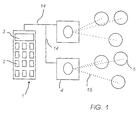
- the signalling system according to the invention in fig. 1 comprises a remote control 1 with a keyboard 2 and a display 3, and in this case, two transmitters 4 and a number of indicators 5 each in the form of a disc as shown in fig. 2 and 3.
- Fig. 2 shows a circuit 6 in such a disc.
- the circuit comprises a receiver 7, a caller 8, a battery 9, and a switch in the form of a red-switch 10.
- the entire circuit is enclosed in a flat housing 11 forming the exterior of the disc.
- the discs are precoded with each their code which in the case of the disc in fig. 3 is the number 17 which is clearly marked on the outside of the disc.
- the disc 17 is furthermore provided with an imprint which can be an advertisement and/or instructions on how the system functions and is used.
- the reference number 13 indicates a caller in the form of a light-emitting diode.
- the transmitters 4 are functioning with an infrared pulse technique.
- the transmitters are placed on the ceiling of a restaurant (not shown) so that their infrared rays can reach a large area in the room.
- a guest wants e.g. a hot meal, he or she approaches the counter (not shown) of the restaurant and gives an order and normally pays at the same time. As receipt, the guest receives a disc which e.g. might be the disc 17. The guest places this disc on his table and now calmly waits for the food to be ready for handing over.
- a disc which e.g. might be the disc 17.
- the staff enters the number 17 on the keyboard 2 of the remote control 1 for the transmitters 4 via wires 14. Thereby, the transmitters are made to emit infrared rays 15 into the room in a form that represents the number 17.
- the disc 17 is the only disc which is coded with this specific number. It is therefore only the receiver 7 of the disc 17 that is now activated by the emitted infrared rays.
- the receiver in the circuit 6 of the disc in its turn activates the caller 8 which in the case shown in fig. 3 is the light-emitting diode 13. In other cases, the caller can be a sound emitter.
- the guest who is thereby informed that the meal is ready to be fetched, then walks up to the counter and receives the ordered meal against returning the disc to the staff who then places the disc in the magazine 19 shown in fig. 4 and 5.
- the guest calls the staff by e.g. waving the disc in order to have the meal served at the table.
- the magazine consists of a vertically placed tube 20 with a wide, longitudinal slot 16. On the inner side of the tube 20 opposite the slot 16, a longitudinal magnetic list 17 is placed that fits a notch 18 made in each disc 5.
- the switch 10 in the form of a red-switch is situated immediately behind this notch 18.
- the switch is therefore affected by a magnetic field which switches off the switch so that the circuit 6 no longer uses power. Thereby, the active life of the battery is advantageously prolonged.
- the magazine has a projecting stop which prevents the stack of discs from falling out of the magazine but allows the bottom disc and only this to be pulled out as the stop is placed in such a way that the lower edge of the tube is placed a little above the top side of the bottom disc.
Landscapes
- Business, Economics & Management (AREA)
- Engineering & Computer Science (AREA)
- Economics (AREA)
- Strategic Management (AREA)
- General Business, Economics & Management (AREA)
- Finance (AREA)
- Entrepreneurship & Innovation (AREA)
- Development Economics (AREA)
- Human Resources & Organizations (AREA)
- Marketing (AREA)
- Accounting & Taxation (AREA)
- Theoretical Computer Science (AREA)
- General Physics & Mathematics (AREA)
- Physics & Mathematics (AREA)
- Game Theory and Decision Science (AREA)
- Tourism & Hospitality (AREA)
- Quality & Reliability (AREA)
- Operations Research (AREA)
- Educational Administration (AREA)
- Audible And Visible Signals (AREA)
- Selective Calling Equipment (AREA)
- Transmitters (AREA)
- Mobile Radio Communication Systems (AREA)
- Auxiliary Devices For And Details Of Packaging Control (AREA)
- Input Circuits Of Receivers And Coupling Of Receivers And Audio Equipment (AREA)
- Alarm Systems (AREA)
Abstract
Description
Claims (8)
- A signalling system for controlling the service at a restaurant where a guest at e.g. a counter can order a product, such as a hot meal for later handing over, the system comprises at least one transmitter (4) arranged to, upon operation, emit wireless signals that represent a number of predetermined codes, a number of indicators (5), and each having its own receiver (7) which is precoded individually with one of the codes for, upon receipt of a wireless signal representing the respective code, activating a caller (8) belonging to the indicator to, with a sound and/or light signal, call a guest who has been given the indicator in question in connection with his order, each indicator (5) comprises a preferably flat housing (11), and the said receiver (7) and the said caller (8) are built into the said housing (11), characterised in that a text (12) and/or an illustration at least comprising the mark of the respective code is placed on the exterior of the housing (11) such that the indicator is arranged as a coupon, which by means of the code of the indicator uniquely links the guest to the ordered product.
- A signalling system according to claim 1, characterised in that a remote control (1) with a keyboard (2) arranged to, upon entry of one of each of the predetermined codes, make the transmitter (4) emit a wireless signal which represents the entered code belongs to the transmitter.
- A signalling system according to claim 1 or 2, characterised in that the transmitter (4) is placed at a relatively high place, such as the ceiling of the restaurant.
- A signalling system according to claim 1, 2, or 3, characterised in that the transmitter (4) is arranged to emit wireless signals in the form of infrared light.
- A signalling system according to each of the claims 1 - 4, characterised in that a battery (9) furthermore is built into the housing (11) for via a switch (10) supplying the receiver (7) and the caller (8) with current.
- A signalling system according to each of the claims 1 - 5, characterised in that a magazine (19) belongs to the system for, by preferably vertical stacking, storing indicators (5) that are not in use, and that this magazine comprises a magnetic list (17) extending along the stacked indicators and serving for switching off the switches (10) of these indicators (5).
- A signalling system according to claim 6, characterised in that the magnetic beam of the magazine at the bottom has a stop extending mainly transversely to the magnetic list (17).
- A method for controlling the service at a restaurant where a guest at e.g. a counter can order a product, such as a hot meal for later handing over, that the guest upon ordering receives an indicator (5) with an individually permanently precoded wireless receiver, that the staff, when the product is ready for handing over, by means of a transmitter (4) emits a wireless signal which represents the code of the handed-over indicator (5), that the receiver (7) thereby activates a caller (8) which belongs to the indicator (5) by means of e.g. a sound and/or light signal which calls the guest, characterised in that the called guest identifies the ordered product by linking it to a text and/or an illustration placed at the indicator, said text and/or an illustration at least comprising the mark of the respective code and in that the guest receives the ordered product in return for the indicator (5) acting as a coupon.
Priority Applications (1)
| Application Number | Priority Date | Filing Date | Title |
|---|---|---|---|
| DE69806799.1T DE69806799T3 (en) | 1997-11-12 | 1998-10-08 | SIGNALING SYSTEM AND METHOD FOR MONITORING THE OPERATION IN A RESTAURANT |
Applications Claiming Priority (3)
| Application Number | Priority Date | Filing Date | Title |
|---|---|---|---|
| DK128597 | 1997-11-12 | ||
| DK128597 | 1997-11-12 | ||
| PCT/DK1998/000437 WO1999024948A1 (en) | 1997-11-12 | 1998-10-08 | A signalling system and a method for controlling the service at a restaurant |
Publications (3)
| Publication Number | Publication Date |
|---|---|
| EP1031119A1 EP1031119A1 (en) | 2000-08-30 |
| EP1031119B1 true EP1031119B1 (en) | 2002-07-24 |
| EP1031119B2 EP1031119B2 (en) | 2014-09-17 |
Family
ID=8103129
Family Applications (1)
| Application Number | Title | Priority Date | Filing Date |
|---|---|---|---|
| EP98947411.9A Expired - Lifetime EP1031119B2 (en) | 1997-11-12 | 1998-10-08 | A signalling system and a method for controlling the service at a restaurant |
Country Status (7)
| Country | Link |
|---|---|
| EP (1) | EP1031119B2 (en) |
| AT (1) | ATE221231T1 (en) |
| AU (1) | AU9433798A (en) |
| DE (1) | DE69806799T3 (en) |
| DK (1) | DK1031119T4 (en) |
| ES (1) | ES2181275T5 (en) |
| WO (1) | WO1999024948A1 (en) |
Cited By (3)
| Publication number | Priority date | Publication date | Assignee | Title |
|---|---|---|---|---|
| DE202004008782U1 (en) * | 2004-06-02 | 2005-10-13 | Grotepass, Hans-Peter, Dr. | Waiter calling system has satellite calling units switched between call and no call and central unit recording call durations and satellite unit status |
| CN102222382A (en) * | 2010-04-16 | 2011-10-19 | 帆宣系统科技股份有限公司 | Notification system of calling sequence number |
| CN104660228A (en) * | 2014-12-06 | 2015-05-27 | 贵州华阳电工有限公司 | Full-hardware type signal lamp coding circuit |
Families Citing this family (1)
| Publication number | Priority date | Publication date | Assignee | Title |
|---|---|---|---|---|
| US6804786B1 (en) * | 1999-09-10 | 2004-10-12 | Canon Kabushiki Kaisha | User customizable secure access token and multiple level portable interface |
Family Cites Families (4)
| Publication number | Priority date | Publication date | Assignee | Title |
|---|---|---|---|---|
| DE3504371A1 (en) * | 1985-02-08 | 1986-08-14 | Robert 8183 Rottach-Egern Neumeier | Paging system for restaurants |
| IL74610A (en) * | 1985-03-15 | 1990-11-05 | Rambam Maimon | Paging system,particularly for hotels |
| US5006983A (en) * | 1989-09-12 | 1991-04-09 | Addax, Inc. | Service allocation system |
| CA2055264A1 (en) * | 1991-11-12 | 1993-05-13 | Silcom Research Limited | Pager with automatic detection of insertion into holster |
-
1998
- 1998-10-08 AT AT98947411T patent/ATE221231T1/en active
- 1998-10-08 WO PCT/DK1998/000437 patent/WO1999024948A1/en not_active Ceased
- 1998-10-08 DE DE69806799.1T patent/DE69806799T3/en not_active Expired - Lifetime
- 1998-10-08 DK DK98947411.9T patent/DK1031119T4/en active
- 1998-10-08 ES ES98947411.9T patent/ES2181275T5/en not_active Expired - Lifetime
- 1998-10-08 AU AU94337/98A patent/AU9433798A/en not_active Abandoned
- 1998-10-08 EP EP98947411.9A patent/EP1031119B2/en not_active Expired - Lifetime
Cited By (4)
| Publication number | Priority date | Publication date | Assignee | Title |
|---|---|---|---|---|
| DE202004008782U1 (en) * | 2004-06-02 | 2005-10-13 | Grotepass, Hans-Peter, Dr. | Waiter calling system has satellite calling units switched between call and no call and central unit recording call durations and satellite unit status |
| CN102222382A (en) * | 2010-04-16 | 2011-10-19 | 帆宣系统科技股份有限公司 | Notification system of calling sequence number |
| CN104660228A (en) * | 2014-12-06 | 2015-05-27 | 贵州华阳电工有限公司 | Full-hardware type signal lamp coding circuit |
| CN104660228B (en) * | 2014-12-06 | 2017-02-01 | 贵州华阳电工有限公司 | Full-hardware type signal lamp coding circuit |
Also Published As
| Publication number | Publication date |
|---|---|
| ES2181275T5 (en) | 2015-01-07 |
| DE69806799T2 (en) | 2003-04-03 |
| DK1031119T4 (en) | 2014-12-01 |
| ES2181275T3 (en) | 2003-02-16 |
| DE69806799D1 (en) | 2002-08-29 |
| DK1031119T3 (en) | 2002-11-11 |
| DE69806799T3 (en) | 2015-02-12 |
| WO1999024948A1 (en) | 1999-05-20 |
| AU9433798A (en) | 1999-05-31 |
| EP1031119A1 (en) | 2000-08-30 |
| EP1031119B2 (en) | 2014-09-17 |
| ATE221231T1 (en) | 2002-08-15 |
Similar Documents
| Publication | Publication Date | Title |
|---|---|---|
| US4935720A (en) | Apparatus for the transmission of information in a restaurant | |
| US6366196B1 (en) | Restaurant waiter paging system | |
| US4701849A (en) | System for summoning service personnel and monitoring their response time | |
| US9942624B2 (en) | On-premises restaurant communication system and method | |
| US20050030176A1 (en) | Method and apparatus for asset tracking and room monitoring in establishments having multiple rooms for temporary occupancy | |
| JP2012528373A (en) | Map guidance for service-centric business staff | |
| US7026916B2 (en) | Tabletop signaling device for restaurants | |
| EP1031119B2 (en) | A signalling system and a method for controlling the service at a restaurant | |
| US4301335A (en) | Visual telephone or other annuciator ringing indicator | |
| US20120194354A1 (en) | Electronic Valet Parking Kiosk System and Method | |
| JPS60209898A (en) | Monitor | |
| US6975207B1 (en) | Waiter calling apparatus combined with a receptacle for holding various table utensils and combined with a lighted advertising display | |
| JP3919035B2 (en) | Information guidance system | |
| GB2080001A (en) | Service Call Arrangements e.g. for Restaurants | |
| EP1891613B1 (en) | Wait staff signaling apparatus | |
| US7400228B2 (en) | Retail service/server annunciator/pager, centerpiece and system | |
| JP2001523870A (en) | Security and emergency alert systems | |
| US7489239B2 (en) | Method and system for monitoring food tray activity | |
| WO1998024071A1 (en) | Security and alarm device for keys/key cards | |
| JP2004013696A (en) | Vacancy display/paging system | |
| WO1996016382A1 (en) | System for receiving and indicating calls coming from a plurality of emitters | |
| NL1010997C1 (en) | Paging system for summoning service personnel to service point such as restaurant table or retail counter in store, makes efficient use of staff | |
| JPH11161859A (en) | Service call system | |
| US20040201452A1 (en) | Patron locating methods, systems and devices | |
| JP2003187337A (en) | Wireless call system |
Legal Events
| Date | Code | Title | Description |
|---|---|---|---|
| PUAI | Public reference made under article 153(3) epc to a published international application that has entered the european phase |
Free format text: ORIGINAL CODE: 0009012 |
|
| 17P | Request for examination filed |
Effective date: 20000613 |
|
| AK | Designated contracting states |
Kind code of ref document: A1 Designated state(s): AT BE CH CY DE DK ES FI FR GB GR IE IT LI LU MC NL PT SE |
|
| GRAG | Despatch of communication of intention to grant |
Free format text: ORIGINAL CODE: EPIDOS AGRA |
|
| 17Q | First examination report despatched |
Effective date: 20010907 |
|
| GRAG | Despatch of communication of intention to grant |
Free format text: ORIGINAL CODE: EPIDOS AGRA |
|
| GRAH | Despatch of communication of intention to grant a patent |
Free format text: ORIGINAL CODE: EPIDOS IGRA |
|
| GRAH | Despatch of communication of intention to grant a patent |
Free format text: ORIGINAL CODE: EPIDOS IGRA |
|
| GRAA | (expected) grant |
Free format text: ORIGINAL CODE: 0009210 |
|
| AK | Designated contracting states |
Kind code of ref document: B1 Designated state(s): AT BE CH CY DE DK ES FI FR GB GR IE IT LI LU MC NL PT SE |
|
| PG25 | Lapsed in a contracting state [announced via postgrant information from national office to epo] |
Ref country code: GR Free format text: LAPSE BECAUSE OF FAILURE TO SUBMIT A TRANSLATION OF THE DESCRIPTION OR TO PAY THE FEE WITHIN THE PRESCRIBED TIME-LIMIT Effective date: 20020724 |
|
| REF | Corresponds to: |
Ref document number: 221231 Country of ref document: AT Date of ref document: 20020815 Kind code of ref document: T |
|
| REG | Reference to a national code |
Ref country code: GB Ref legal event code: FG4D |
|
| REG | Reference to a national code |
Ref country code: CH Ref legal event code: EP |
|
| REG | Reference to a national code |
Ref country code: IE Ref legal event code: FG4D |
|
| REF | Corresponds to: |
Ref document number: 69806799 Country of ref document: DE Date of ref document: 20020829 |
|
| PG25 | Lapsed in a contracting state [announced via postgrant information from national office to epo] |
Ref country code: PT Free format text: LAPSE BECAUSE OF FAILURE TO SUBMIT A TRANSLATION OF THE DESCRIPTION OR TO PAY THE FEE WITHIN THE PRESCRIBED TIME-LIMIT Effective date: 20021025 |
|
| PG25 | Lapsed in a contracting state [announced via postgrant information from national office to epo] |
Ref country code: CY Free format text: LAPSE BECAUSE OF FAILURE TO SUBMIT A TRANSLATION OF THE DESCRIPTION OR TO PAY THE FEE WITHIN THE PRESCRIBED TIME-LIMIT Effective date: 20021031 |
|
| REG | Reference to a national code |
Ref country code: DK Ref legal event code: T3 |
|
| REG | Reference to a national code |
Ref country code: CH Ref legal event code: NV Representative=s name: JACOBACCI & PARTNERS S.P.A. |
|
| ET | Fr: translation filed | ||
| REG | Reference to a national code |
Ref country code: ES Ref legal event code: FG2A Ref document number: 2181275 Country of ref document: ES Kind code of ref document: T3 |
|
| PLBQ | Unpublished change to opponent data |
Free format text: ORIGINAL CODE: EPIDOS OPPO |
|
| PLBI | Opposition filed |
Free format text: ORIGINAL CODE: 0009260 |
|
| PLBF | Reply of patent proprietor to notice(s) of opposition |
Free format text: ORIGINAL CODE: EPIDOS OBSO |
|
| 26 | Opposition filed |
Opponent name: AB SUPERBUS Effective date: 20030414 |
|
| NLR1 | Nl: opposition has been filed with the epo |
Opponent name: AB SUPERBUS |
|
| PLBB | Reply of patent proprietor to notice(s) of opposition received |
Free format text: ORIGINAL CODE: EPIDOSNOBS3 |
|
| PG25 | Lapsed in a contracting state [announced via postgrant information from national office to epo] |
Ref country code: IT Free format text: LAPSE BECAUSE OF NON-PAYMENT OF DUE FEES Effective date: 20051008 |
|
| PLAB | Opposition data, opponent's data or that of the opponent's representative modified |
Free format text: ORIGINAL CODE: 0009299OPPO |
|
| RAP2 | Party data changed (patent owner data changed or rights of a patent transferred) |
Owner name: P. JORGENSEN HOLDING APS |
|
| RIN2 | Information on inventor provided after grant (corrected) |
Inventor name: ANDERSEN, ALLAN |
|
| R26 | Opposition filed (corrected) |
Opponent name: AB SUPERBUS Effective date: 20030414 |
|
| NLR1 | Nl: opposition has been filed with the epo |
Opponent name: AB SUPERBUS |
|
| NLT2 | Nl: modifications (of names), taken from the european patent patent bulletin |
Owner name: P. JØRGENSEN HOLDING APS Effective date: 20080227 |
|
| RDAF | Communication despatched that patent is revoked |
Free format text: ORIGINAL CODE: EPIDOSNREV1 |
|
| APBM | Appeal reference recorded |
Free format text: ORIGINAL CODE: EPIDOSNREFNO |
|
| APBP | Date of receipt of notice of appeal recorded |
Free format text: ORIGINAL CODE: EPIDOSNNOA2O |
|
| APAH | Appeal reference modified |
Free format text: ORIGINAL CODE: EPIDOSCREFNO |
|
| APBQ | Date of receipt of statement of grounds of appeal recorded |
Free format text: ORIGINAL CODE: EPIDOSNNOA3O |
|
| PGFP | Annual fee paid to national office [announced via postgrant information from national office to epo] |
Ref country code: MC Payment date: 20091029 Year of fee payment: 12 Ref country code: LU Payment date: 20091015 Year of fee payment: 12 |
|
| PGRI | Patent reinstated in contracting state [announced from national office to epo] |
Ref country code: IT Effective date: 20091201 |
|
| PG25 | Lapsed in a contracting state [announced via postgrant information from national office to epo] |
Ref country code: MC Free format text: LAPSE BECAUSE OF NON-PAYMENT OF DUE FEES Effective date: 20101031 |
|
| APBU | Appeal procedure closed |
Free format text: ORIGINAL CODE: EPIDOSNNOA9O |
|
| PG25 | Lapsed in a contracting state [announced via postgrant information from national office to epo] |
Ref country code: LU Free format text: LAPSE BECAUSE OF NON-PAYMENT OF DUE FEES Effective date: 20101008 |
|
| PLAY | Examination report in opposition despatched + time limit |
Free format text: ORIGINAL CODE: EPIDOSNORE2 |
|
| PLBC | Reply to examination report in opposition received |
Free format text: ORIGINAL CODE: EPIDOSNORE3 |
|
| PUAH | Patent maintained in amended form |
Free format text: ORIGINAL CODE: 0009272 |
|
| STAA | Information on the status of an ep patent application or granted ep patent |
Free format text: STATUS: PATENT MAINTAINED AS AMENDED |
|
| 27A | Patent maintained in amended form |
Effective date: 20140917 |
|
| AK | Designated contracting states |
Kind code of ref document: B2 Designated state(s): AT BE CH CY DE DK ES FI FR GB GR IE IT LI LU MC NL PT SE |
|
| REG | Reference to a national code |
Ref country code: DE Ref legal event code: R102 Ref document number: 69806799 Country of ref document: DE |
|
| REG | Reference to a national code |
Ref country code: CH Ref legal event code: AELC |
|
| REG | Reference to a national code |
Ref country code: DE Ref legal event code: R102 Ref document number: 69806799 Country of ref document: DE Effective date: 20140917 |
|
| REG | Reference to a national code |
Ref country code: DK Ref legal event code: T4 Effective date: 20141124 |
|
| REG | Reference to a national code |
Ref country code: SE Ref legal event code: RPEO |
|
| REG | Reference to a national code |
Ref country code: NL Ref legal event code: T3 |
|
| REG | Reference to a national code |
Ref country code: ES Ref legal event code: DC2A Ref document number: 2181275 Country of ref document: ES Kind code of ref document: T5 Effective date: 20150107 |
|
| REG | Reference to a national code |
Ref country code: CH Ref legal event code: PCAR Free format text: NEW ADDRESS: VIA LUGANETTO 3, 6962 LUGANO (CH) |
|
| REG | Reference to a national code |
Ref country code: FR Ref legal event code: PLFP Year of fee payment: 18 |
|
| PGFP | Annual fee paid to national office [announced via postgrant information from national office to epo] |
Ref country code: DK Payment date: 20151027 Year of fee payment: 18 |
|
| PGFP | Annual fee paid to national office [announced via postgrant information from national office to epo] |
Ref country code: FI Payment date: 20151027 Year of fee payment: 18 Ref country code: GB Payment date: 20151023 Year of fee payment: 18 Ref country code: IT Payment date: 20151029 Year of fee payment: 18 Ref country code: DE Payment date: 20151027 Year of fee payment: 18 Ref country code: CH Payment date: 20151028 Year of fee payment: 18 Ref country code: IE Payment date: 20151023 Year of fee payment: 18 |
|
| PGFP | Annual fee paid to national office [announced via postgrant information from national office to epo] |
Ref country code: AT Payment date: 20151027 Year of fee payment: 18 Ref country code: NL Payment date: 20151027 Year of fee payment: 18 Ref country code: ES Payment date: 20151117 Year of fee payment: 18 Ref country code: FR Payment date: 20151023 Year of fee payment: 18 Ref country code: BE Payment date: 20151027 Year of fee payment: 18 Ref country code: SE Payment date: 20151023 Year of fee payment: 18 |
|
| PG25 | Lapsed in a contracting state [announced via postgrant information from national office to epo] |
Ref country code: BE Free format text: LAPSE BECAUSE OF NON-PAYMENT OF DUE FEES Effective date: 20161031 |
|
| REG | Reference to a national code |
Ref country code: DE Ref legal event code: R119 Ref document number: 69806799 Country of ref document: DE |
|
| REG | Reference to a national code |
Ref country code: DK Ref legal event code: EBP Effective date: 20161031 |
|
| REG | Reference to a national code |
Ref country code: CH Ref legal event code: PL |
|
| REG | Reference to a national code |
Ref country code: NL Ref legal event code: MM Effective date: 20161101 |
|
| REG | Reference to a national code |
Ref country code: AT Ref legal event code: MM01 Ref document number: 221231 Country of ref document: AT Kind code of ref document: T Effective date: 20161008 |
|
| GBPC | Gb: european patent ceased through non-payment of renewal fee |
Effective date: 20161008 |
|
| REG | Reference to a national code |
Ref country code: IE Ref legal event code: MM4A |
|
| REG | Reference to a national code |
Ref country code: FR Ref legal event code: ST Effective date: 20170630 |
|
| PG25 | Lapsed in a contracting state [announced via postgrant information from national office to epo] |
Ref country code: LI Free format text: LAPSE BECAUSE OF NON-PAYMENT OF DUE FEES Effective date: 20161031 Ref country code: GB Free format text: LAPSE BECAUSE OF NON-PAYMENT OF DUE FEES Effective date: 20161008 Ref country code: DE Free format text: LAPSE BECAUSE OF NON-PAYMENT OF DUE FEES Effective date: 20170503 Ref country code: FI Free format text: LAPSE BECAUSE OF NON-PAYMENT OF DUE FEES Effective date: 20161008 Ref country code: FR Free format text: LAPSE BECAUSE OF NON-PAYMENT OF DUE FEES Effective date: 20161102 Ref country code: CH Free format text: LAPSE BECAUSE OF NON-PAYMENT OF DUE FEES Effective date: 20161031 |
|
| PG25 | Lapsed in a contracting state [announced via postgrant information from national office to epo] |
Ref country code: SE Free format text: LAPSE BECAUSE OF NON-PAYMENT OF DUE FEES Effective date: 20161009 Ref country code: AT Free format text: LAPSE BECAUSE OF NON-PAYMENT OF DUE FEES Effective date: 20161008 Ref country code: NL Free format text: LAPSE BECAUSE OF NON-PAYMENT OF DUE FEES Effective date: 20161101 |
|
| PG25 | Lapsed in a contracting state [announced via postgrant information from national office to epo] |
Ref country code: IT Free format text: LAPSE BECAUSE OF NON-PAYMENT OF DUE FEES Effective date: 20161008 |
|
| PG25 | Lapsed in a contracting state [announced via postgrant information from national office to epo] |
Ref country code: IE Free format text: LAPSE BECAUSE OF NON-PAYMENT OF DUE FEES Effective date: 20161008 Ref country code: DK Free format text: LAPSE BECAUSE OF NON-PAYMENT OF DUE FEES Effective date: 20161031 |
|
| REG | Reference to a national code |
Ref country code: BE Ref legal event code: MM Effective date: 20161031 Ref country code: BE Ref legal event code: FP Effective date: 20141209 |
|
| PG25 | Lapsed in a contracting state [announced via postgrant information from national office to epo] |
Ref country code: ES Free format text: LAPSE BECAUSE OF FAILURE TO SUBMIT A TRANSLATION OF THE DESCRIPTION OR TO PAY THE FEE WITHIN THE PRESCRIBED TIME-LIMIT Effective date: 20020724 |
|
| REG | Reference to a national code |
Ref country code: ES Ref legal event code: FD2A Effective date: 20180626 |
|
| PG25 | Lapsed in a contracting state [announced via postgrant information from national office to epo] |
Ref country code: ES Free format text: LAPSE BECAUSE OF FAILURE TO SUBMIT A TRANSLATION OF THE DESCRIPTION OR TO PAY THE FEE WITHIN THE PRESCRIBED TIME-LIMIT Effective date: 20161009 |