EP1030833B1 - Preparation of quinonediimines from phenylenediamines using a hypochlorite as an oxidation agent - Google Patents
Preparation of quinonediimines from phenylenediamines using a hypochlorite as an oxidation agent Download PDFInfo
- Publication number
- EP1030833B1 EP1030833B1 EP98955160A EP98955160A EP1030833B1 EP 1030833 B1 EP1030833 B1 EP 1030833B1 EP 98955160 A EP98955160 A EP 98955160A EP 98955160 A EP98955160 A EP 98955160A EP 1030833 B1 EP1030833 B1 EP 1030833B1
- Authority
- EP
- European Patent Office
- Prior art keywords
- hypochlorite
- reaction
- phenyl
- mixture
- 6ppd
- Prior art date
- Legal status (The legal status is an assumption and is not a legal conclusion. Google has not performed a legal analysis and makes no representation as to the accuracy of the status listed.)
- Expired - Lifetime
Links
- WQYVRQLZKVEZGA-UHFFFAOYSA-N hypochlorite Chemical compound Cl[O-] WQYVRQLZKVEZGA-UHFFFAOYSA-N 0.000 title claims description 39
- 238000007254 oxidation reaction Methods 0.000 title description 11
- 230000003647 oxidation Effects 0.000 title description 9
- 150000004986 phenylenediamines Chemical class 0.000 title description 7
- 238000002360 preparation method Methods 0.000 title description 3
- 238000000034 method Methods 0.000 claims description 52
- 238000006243 chemical reaction Methods 0.000 claims description 49
- 239000000203 mixture Substances 0.000 claims description 37
- SUKJFIGYRHOWBL-UHFFFAOYSA-N sodium hypochlorite Chemical group [Na+].Cl[O-] SUKJFIGYRHOWBL-UHFFFAOYSA-N 0.000 claims description 20
- -1 1,4-dimethylpentyl Chemical group 0.000 claims description 19
- 239000005708 Sodium hypochlorite Substances 0.000 claims description 19
- 239000002904 solvent Substances 0.000 claims description 18
- XLYOFNOQVPJJNP-UHFFFAOYSA-N water Substances O XLYOFNOQVPJJNP-UHFFFAOYSA-N 0.000 claims description 17
- 229910052739 hydrogen Inorganic materials 0.000 claims description 13
- 239000001257 hydrogen Substances 0.000 claims description 13
- 125000004435 hydrogen atom Chemical class [H]* 0.000 claims description 13
- 125000001997 phenyl group Chemical group [H]C1=C([H])C([H])=C(*)C([H])=C1[H] 0.000 claims description 11
- 239000004215 Carbon black (E152) Substances 0.000 claims description 10
- 229930195733 hydrocarbon Natural products 0.000 claims description 10
- 150000002430 hydrocarbons Chemical class 0.000 claims description 10
- 239000007800 oxidant agent Substances 0.000 claims description 9
- 239000003444 phase transfer catalyst Substances 0.000 claims description 9
- 229910052751 metal Inorganic materials 0.000 claims description 8
- 239000002184 metal Substances 0.000 claims description 8
- 150000001875 compounds Chemical class 0.000 claims description 7
- 239000012454 non-polar solvent Substances 0.000 claims description 5
- 239000002798 polar solvent Substances 0.000 claims description 5
- CBCKQZAAMUWICA-UHFFFAOYSA-N 1,4-phenylenediamine Chemical compound NC1=CC=C(N)C=C1 CBCKQZAAMUWICA-UHFFFAOYSA-N 0.000 claims description 4
- 125000000113 cyclohexyl group Chemical group [H]C1([H])C([H])([H])C([H])([H])C([H])(*)C([H])([H])C1([H])[H] 0.000 claims description 4
- 125000001449 isopropyl group Chemical group [H]C([H])([H])C([H])(*)C([H])([H])[H] 0.000 claims description 4
- 125000002914 sec-butyl group Chemical group [H]C([H])([H])C([H])([H])C([H])(*)C([H])([H])[H] 0.000 claims description 4
- 125000001624 naphthyl group Chemical group 0.000 claims description 3
- 150000001298 alcohols Chemical class 0.000 claims description 2
- 150000003983 crown ethers Chemical class 0.000 claims description 2
- 150000002576 ketones Chemical group 0.000 claims description 2
- 150000002825 nitriles Chemical class 0.000 claims description 2
- 150000004714 phosphonium salts Chemical class 0.000 claims description 2
- 229920001223 polyethylene glycol Polymers 0.000 claims description 2
- 150000003242 quaternary ammonium salts Chemical group 0.000 claims description 2
- 125000003944 tolyl group Chemical group 0.000 claims description 2
- 125000001931 aliphatic group Chemical group 0.000 claims 2
- 229910019093 NaOCl Inorganic materials 0.000 claims 1
- WEVYAHXRMPXWCK-UHFFFAOYSA-N Acetonitrile Chemical compound CC#N WEVYAHXRMPXWCK-UHFFFAOYSA-N 0.000 description 27
- DECIPOUIJURFOJ-UHFFFAOYSA-N ethoxyquin Chemical compound N1C(C)(C)C=C(C)C2=CC(OCC)=CC=C21 DECIPOUIJURFOJ-UHFFFAOYSA-N 0.000 description 27
- HEMHJVSKTPXQMS-UHFFFAOYSA-M Sodium hydroxide Chemical compound [OH-].[Na+] HEMHJVSKTPXQMS-UHFFFAOYSA-M 0.000 description 15
- 239000000047 product Substances 0.000 description 15
- YXFVVABEGXRONW-UHFFFAOYSA-N Toluene Chemical compound CC1=CC=CC=C1 YXFVVABEGXRONW-UHFFFAOYSA-N 0.000 description 12
- 238000004128 high performance liquid chromatography Methods 0.000 description 12
- 239000010410 layer Substances 0.000 description 12
- 230000008034 disappearance Effects 0.000 description 11
- 239000007788 liquid Substances 0.000 description 11
- ZZMVLMVFYMGSMY-UHFFFAOYSA-N 4-n-(4-methylpentan-2-yl)-1-n-phenylbenzene-1,4-diamine Chemical compound C1=CC(NC(C)CC(C)C)=CC=C1NC1=CC=CC=C1 ZZMVLMVFYMGSMY-UHFFFAOYSA-N 0.000 description 10
- OKKJLVBELUTLKV-UHFFFAOYSA-N Methanol Chemical compound OC OKKJLVBELUTLKV-UHFFFAOYSA-N 0.000 description 9
- 230000015572 biosynthetic process Effects 0.000 description 9
- 239000003054 catalyst Substances 0.000 description 9
- 238000002955 isolation Methods 0.000 description 9
- AZQWKYJCGOJGHM-UHFFFAOYSA-N 1,4-benzoquinone Chemical compound O=C1C=CC(=O)C=C1 AZQWKYJCGOJGHM-UHFFFAOYSA-N 0.000 description 8
- VLKZOEOYAKHREP-UHFFFAOYSA-N n-Hexane Chemical class CCCCCC VLKZOEOYAKHREP-UHFFFAOYSA-N 0.000 description 8
- 238000004458 analytical method Methods 0.000 description 7
- 238000000926 separation method Methods 0.000 description 7
- GEYOCULIXLDCMW-UHFFFAOYSA-N 1,2-phenylenediamine Chemical compound NC1=CC=CC=C1N GEYOCULIXLDCMW-UHFFFAOYSA-N 0.000 description 6
- 239000003153 chemical reaction reagent Substances 0.000 description 6
- 239000007858 starting material Substances 0.000 description 6
- DKGAVHZHDRPRBM-UHFFFAOYSA-N Tert-Butanol Chemical compound CC(C)(C)O DKGAVHZHDRPRBM-UHFFFAOYSA-N 0.000 description 5
- 230000008901 benefit Effects 0.000 description 5
- 239000003795 chemical substances by application Substances 0.000 description 5
- 150000004053 quinones Chemical class 0.000 description 5
- 239000000243 solution Substances 0.000 description 5
- IMNFDUFMRHMDMM-UHFFFAOYSA-N N-Heptane Chemical class CCCCCCC IMNFDUFMRHMDMM-UHFFFAOYSA-N 0.000 description 4
- 230000000694 effects Effects 0.000 description 4
- 229920001971 elastomer Polymers 0.000 description 4
- 238000002156 mixing Methods 0.000 description 4
- 239000012044 organic layer Substances 0.000 description 4
- 238000003756 stirring Methods 0.000 description 4
- 238000003786 synthesis reaction Methods 0.000 description 4
- JRMUNVKIHCOMHV-UHFFFAOYSA-M tetrabutylammonium bromide Chemical compound [Br-].CCCC[N+](CCCC)(CCCC)CCCC JRMUNVKIHCOMHV-UHFFFAOYSA-M 0.000 description 4
- 238000005406 washing Methods 0.000 description 4
- ZWEHNKRNPOVVGH-UHFFFAOYSA-N 2-Butanone Chemical compound CCC(C)=O ZWEHNKRNPOVVGH-UHFFFAOYSA-N 0.000 description 3
- CSCPPACGZOOCGX-UHFFFAOYSA-N Acetone Chemical compound CC(C)=O CSCPPACGZOOCGX-UHFFFAOYSA-N 0.000 description 3
- ZAMOUSCENKQFHK-UHFFFAOYSA-N Chlorine atom Chemical compound [Cl] ZAMOUSCENKQFHK-UHFFFAOYSA-N 0.000 description 3
- YMWUJEATGCHHMB-UHFFFAOYSA-N Dichloromethane Chemical compound ClCCl YMWUJEATGCHHMB-UHFFFAOYSA-N 0.000 description 3
- XEKOWRVHYACXOJ-UHFFFAOYSA-N Ethyl acetate Chemical compound CCOC(C)=O XEKOWRVHYACXOJ-UHFFFAOYSA-N 0.000 description 3
- LYCAIKOWRPUZTN-UHFFFAOYSA-N Ethylene glycol Chemical compound OCCO LYCAIKOWRPUZTN-UHFFFAOYSA-N 0.000 description 3
- ZMXDDKWLCZADIW-UHFFFAOYSA-N N,N-Dimethylformamide Chemical compound CN(C)C=O ZMXDDKWLCZADIW-UHFFFAOYSA-N 0.000 description 3
- 239000000460 chlorine Substances 0.000 description 3
- 229910052801 chlorine Inorganic materials 0.000 description 3
- 238000004519 manufacturing process Methods 0.000 description 3
- 229940005561 1,4-benzoquinone Drugs 0.000 description 2
- PLIKAWJENQZMHA-UHFFFAOYSA-N 4-aminophenol Chemical compound NC1=CC=C(O)C=C1 PLIKAWJENQZMHA-UHFFFAOYSA-N 0.000 description 2
- FFWSICBKRCICMR-UHFFFAOYSA-N 5-methyl-2-hexanone Chemical compound CC(C)CCC(C)=O FFWSICBKRCICMR-UHFFFAOYSA-N 0.000 description 2
- XTEGARKTQYYJKE-UHFFFAOYSA-M Chlorate Chemical class [O-]Cl(=O)=O XTEGARKTQYYJKE-UHFFFAOYSA-M 0.000 description 2
- HEDRZPFGACZZDS-UHFFFAOYSA-N Chloroform Chemical compound ClC(Cl)Cl HEDRZPFGACZZDS-UHFFFAOYSA-N 0.000 description 2
- LFQSCWFLJHTTHZ-UHFFFAOYSA-N Ethanol Chemical compound CCO LFQSCWFLJHTTHZ-UHFFFAOYSA-N 0.000 description 2
- QIGBRXMKCJKVMJ-UHFFFAOYSA-N Hydroquinone Chemical compound OC1=CC=C(O)C=C1 QIGBRXMKCJKVMJ-UHFFFAOYSA-N 0.000 description 2
- KFZMGEQAYNKOFK-UHFFFAOYSA-N Isopropanol Chemical compound CC(C)O KFZMGEQAYNKOFK-UHFFFAOYSA-N 0.000 description 2
- NTIZESTWPVYFNL-UHFFFAOYSA-N Methyl isobutyl ketone Chemical compound CC(C)CC(C)=O NTIZESTWPVYFNL-UHFFFAOYSA-N 0.000 description 2
- UIHCLUNTQKBZGK-UHFFFAOYSA-N Methyl isobutyl ketone Natural products CCC(C)C(C)=O UIHCLUNTQKBZGK-UHFFFAOYSA-N 0.000 description 2
- SECXISVLQFMRJM-UHFFFAOYSA-N N-Methylpyrrolidone Chemical compound CN1CCCC1=O SECXISVLQFMRJM-UHFFFAOYSA-N 0.000 description 2
- QAOWNCQODCNURD-UHFFFAOYSA-N Sulfuric acid Chemical compound OS(O)(=O)=O QAOWNCQODCNURD-UHFFFAOYSA-N 0.000 description 2
- 230000001476 alcoholic effect Effects 0.000 description 2
- 239000003513 alkali Substances 0.000 description 2
- 230000003078 antioxidant effect Effects 0.000 description 2
- 150000004054 benzoquinones Chemical class 0.000 description 2
- HTZCNXWZYVXIMZ-UHFFFAOYSA-M benzyl(triethyl)azanium;chloride Chemical compound [Cl-].CC[N+](CC)(CC)CC1=CC=CC=C1 HTZCNXWZYVXIMZ-UHFFFAOYSA-M 0.000 description 2
- 239000011575 calcium Substances 0.000 description 2
- 230000003197 catalytic effect Effects 0.000 description 2
- XMPZTFVPEKAKFH-UHFFFAOYSA-P ceric ammonium nitrate Chemical compound [NH4+].[NH4+].[Ce+4].[O-][N+]([O-])=O.[O-][N+]([O-])=O.[O-][N+]([O-])=O.[O-][N+]([O-])=O.[O-][N+]([O-])=O.[O-][N+]([O-])=O XMPZTFVPEKAKFH-UHFFFAOYSA-P 0.000 description 2
- 125000004122 cyclic group Chemical group 0.000 description 2
- JHIVVAPYMSGYDF-UHFFFAOYSA-N cyclohexanone Chemical compound O=C1CCCCC1 JHIVVAPYMSGYDF-UHFFFAOYSA-N 0.000 description 2
- 150000004985 diamines Chemical class 0.000 description 2
- 230000007613 environmental effect Effects 0.000 description 2
- 238000011065 in-situ storage Methods 0.000 description 2
- 150000002739 metals Chemical class 0.000 description 2
- 239000003960 organic solvent Substances 0.000 description 2
- 230000001590 oxidative effect Effects 0.000 description 2
- 239000000376 reactant Substances 0.000 description 2
- 239000011541 reaction mixture Substances 0.000 description 2
- 239000011734 sodium Substances 0.000 description 2
- GEHJYWRUCIMESM-UHFFFAOYSA-L sodium sulfite Chemical compound [Na+].[Na+].[O-]S([O-])=O GEHJYWRUCIMESM-UHFFFAOYSA-L 0.000 description 2
- VZGDMQKNWNREIO-UHFFFAOYSA-N tetrachloromethane Chemical compound ClC(Cl)(Cl)Cl VZGDMQKNWNREIO-UHFFFAOYSA-N 0.000 description 2
- WGTYBPLFGIVFAS-UHFFFAOYSA-M tetramethylammonium hydroxide Chemical compound [OH-].C[N+](C)(C)C WGTYBPLFGIVFAS-UHFFFAOYSA-M 0.000 description 2
- 239000002699 waste material Substances 0.000 description 2
- AAWZDTNXLSGCEK-LNVDRNJUSA-N (3r,5r)-1,3,4,5-tetrahydroxycyclohexane-1-carboxylic acid Chemical compound O[C@@H]1CC(O)(C(O)=O)C[C@@H](O)C1O AAWZDTNXLSGCEK-LNVDRNJUSA-N 0.000 description 1
- 0 *=C(C=C1)C=CC1=N Chemical compound *=C(C=C1)C=CC1=N 0.000 description 1
- RYHBNJHYFVUHQT-UHFFFAOYSA-N 1,4-Dioxane Chemical compound C1COCCO1 RYHBNJHYFVUHQT-UHFFFAOYSA-N 0.000 description 1
- ZRMMVODKVLXCBB-UHFFFAOYSA-N 1-n-cyclohexyl-4-n-phenylbenzene-1,4-diamine Chemical compound C1CCCCC1NC(C=C1)=CC=C1NC1=CC=CC=C1 ZRMMVODKVLXCBB-UHFFFAOYSA-N 0.000 description 1
- JTTMYKSFKOOQLP-UHFFFAOYSA-N 4-hydroxydiphenylamine Chemical compound C1=CC(O)=CC=C1NC1=CC=CC=C1 JTTMYKSFKOOQLP-UHFFFAOYSA-N 0.000 description 1
- WVYWICLMDOOCFB-UHFFFAOYSA-N 4-methyl-2-pentanol Chemical compound CC(C)CC(C)O WVYWICLMDOOCFB-UHFFFAOYSA-N 0.000 description 1
- KZTCAXCBXSIQSS-UHFFFAOYSA-N 4-n-(4-methylpentan-2-yl)-4-n-phenylbenzene-1,4-diamine Chemical compound C=1C=C(N)C=CC=1N(C(C)CC(C)C)C1=CC=CC=C1 KZTCAXCBXSIQSS-UHFFFAOYSA-N 0.000 description 1
- UHJVLUYSDYOULM-UHFFFAOYSA-N 4-n-(5-methylhexan-2-yl)-1-n-phenylbenzene-1,4-diamine Chemical compound C1=CC(NC(C)CCC(C)C)=CC=C1NC1=CC=CC=C1 UHJVLUYSDYOULM-UHFFFAOYSA-N 0.000 description 1
- ILUGMXWKWLWONM-UHFFFAOYSA-N 5-phenyliminocyclohex-2-ene-1,4-dione Chemical compound O=C1C=CC(=O)CC1=NC1=CC=CC=C1 ILUGMXWKWLWONM-UHFFFAOYSA-N 0.000 description 1
- OYPRJOBELJOOCE-UHFFFAOYSA-N Calcium Chemical compound [Ca] OYPRJOBELJOOCE-UHFFFAOYSA-N 0.000 description 1
- VEXZGXHMUGYJMC-UHFFFAOYSA-M Chloride anion Chemical compound [Cl-] VEXZGXHMUGYJMC-UHFFFAOYSA-M 0.000 description 1
- KZBUYRJDOAKODT-UHFFFAOYSA-N Chlorine Chemical compound ClCl KZBUYRJDOAKODT-UHFFFAOYSA-N 0.000 description 1
- RYGMFSIKBFXOCR-UHFFFAOYSA-N Copper Chemical compound [Cu] RYGMFSIKBFXOCR-UHFFFAOYSA-N 0.000 description 1
- AAWZDTNXLSGCEK-UHFFFAOYSA-N Cordycepinsaeure Natural products OC1CC(O)(C(O)=O)CC(O)C1O AAWZDTNXLSGCEK-UHFFFAOYSA-N 0.000 description 1
- IAZDPXIOMUYVGZ-UHFFFAOYSA-N Dimethylsulphoxide Chemical compound CS(C)=O IAZDPXIOMUYVGZ-UHFFFAOYSA-N 0.000 description 1
- DGAQECJNVWCQMB-PUAWFVPOSA-M Ilexoside XXIX Chemical compound C[C@@H]1CC[C@@]2(CC[C@@]3(C(=CC[C@H]4[C@]3(CC[C@@H]5[C@@]4(CC[C@@H](C5(C)C)OS(=O)(=O)[O-])C)C)[C@@H]2[C@]1(C)O)C)C(=O)O[C@H]6[C@@H]([C@H]([C@@H]([C@H](O6)CO)O)O)O.[Na+] DGAQECJNVWCQMB-PUAWFVPOSA-M 0.000 description 1
- 229910021578 Iron(III) chloride Inorganic materials 0.000 description 1
- UTGQNNCQYDRXCH-UHFFFAOYSA-N N,N'-diphenyl-1,4-phenylenediamine Chemical compound C=1C=C(NC=2C=CC=CC=2)C=CC=1NC1=CC=CC=C1 UTGQNNCQYDRXCH-UHFFFAOYSA-N 0.000 description 1
- OUBMGJOQLXMSNT-UHFFFAOYSA-N N-isopropyl-N'-phenyl-p-phenylenediamine Chemical compound C1=CC(NC(C)C)=CC=C1NC1=CC=CC=C1 OUBMGJOQLXMSNT-UHFFFAOYSA-N 0.000 description 1
- 229930192627 Naphthoquinone Natural products 0.000 description 1
- ZLMJMSJWJFRBEC-UHFFFAOYSA-N Potassium Chemical compound [K] ZLMJMSJWJFRBEC-UHFFFAOYSA-N 0.000 description 1
- 208000034809 Product contamination Diseases 0.000 description 1
- AAWZDTNXLSGCEK-ZHQZDSKASA-N Quinic acid Natural products O[C@H]1CC(O)(C(O)=O)C[C@H](O)C1O AAWZDTNXLSGCEK-ZHQZDSKASA-N 0.000 description 1
- 150000001338 aliphatic hydrocarbons Chemical class 0.000 description 1
- 125000000217 alkyl group Chemical group 0.000 description 1
- 125000003277 amino group Chemical group 0.000 description 1
- 150000004056 anthraquinones Chemical class 0.000 description 1
- 239000003963 antioxidant agent Substances 0.000 description 1
- 150000001492 aromatic hydrocarbon derivatives Chemical class 0.000 description 1
- 150000004945 aromatic hydrocarbons Chemical class 0.000 description 1
- 125000003118 aryl group Chemical group 0.000 description 1
- 229910052791 calcium Inorganic materials 0.000 description 1
- 239000007795 chemical reaction product Substances 0.000 description 1
- 229910017052 cobalt Inorganic materials 0.000 description 1
- 239000010941 cobalt Substances 0.000 description 1
- GUTLYIVDDKVIGB-UHFFFAOYSA-N cobalt atom Chemical compound [Co] GUTLYIVDDKVIGB-UHFFFAOYSA-N 0.000 description 1
- 229910052802 copper Inorganic materials 0.000 description 1
- 239000010949 copper Substances 0.000 description 1
- 229910000071 diazene Inorganic materials 0.000 description 1
- SOCTUWSJJQCPFX-UHFFFAOYSA-N dichromate(2-) Chemical compound [O-][Cr](=O)(=O)O[Cr]([O-])(=O)=O SOCTUWSJJQCPFX-UHFFFAOYSA-N 0.000 description 1
- 229960001760 dimethyl sulfoxide Drugs 0.000 description 1
- 239000000806 elastomer Substances 0.000 description 1
- 238000005516 engineering process Methods 0.000 description 1
- 150000002148 esters Chemical class 0.000 description 1
- 150000002170 ethers Chemical class 0.000 description 1
- ANQVKHGDALCPFZ-UHFFFAOYSA-N ethyl 2-[6-(4-methylpiperazin-1-yl)-1h-benzimidazol-2-yl]acetate Chemical compound C1=C2NC(CC(=O)OCC)=NC2=CC=C1N1CCN(C)CC1 ANQVKHGDALCPFZ-UHFFFAOYSA-N 0.000 description 1
- 229910052736 halogen Inorganic materials 0.000 description 1
- 150000002367 halogens Chemical class 0.000 description 1
- 230000007062 hydrolysis Effects 0.000 description 1
- 238000006460 hydrolysis reaction Methods 0.000 description 1
- 125000002887 hydroxy group Chemical group [H]O* 0.000 description 1
- 239000004615 ingredient Substances 0.000 description 1
- RBTARNINKXHZNM-UHFFFAOYSA-K iron trichloride Chemical compound Cl[Fe](Cl)Cl RBTARNINKXHZNM-UHFFFAOYSA-K 0.000 description 1
- 230000007774 longterm Effects 0.000 description 1
- WPBNNNQJVZRUHP-UHFFFAOYSA-L manganese(2+);methyl n-[[2-(methoxycarbonylcarbamothioylamino)phenyl]carbamothioyl]carbamate;n-[2-(sulfidocarbothioylamino)ethyl]carbamodithioate Chemical compound [Mn+2].[S-]C(=S)NCCNC([S-])=S.COC(=O)NC(=S)NC1=CC=CC=C1NC(=S)NC(=O)OC WPBNNNQJVZRUHP-UHFFFAOYSA-L 0.000 description 1
- 239000000463 material Substances 0.000 description 1
- XVDBWWRIXBMVJV-UHFFFAOYSA-N n-[bis(dimethylamino)phosphanyl]-n-methylmethanamine Chemical compound CN(C)P(N(C)C)N(C)C XVDBWWRIXBMVJV-UHFFFAOYSA-N 0.000 description 1
- 150000002791 naphthoquinones Chemical class 0.000 description 1
- 230000003472 neutralizing effect Effects 0.000 description 1
- 150000002816 nickel compounds Chemical class 0.000 description 1
- 125000000962 organic group Chemical group 0.000 description 1
- ATGUVEKSASEFFO-UHFFFAOYSA-N p-aminodiphenylamine Chemical compound C1=CC(N)=CC=C1NC1=CC=CC=C1 ATGUVEKSASEFFO-UHFFFAOYSA-N 0.000 description 1
- VLTRZXGMWDSKGL-UHFFFAOYSA-M perchlorate Inorganic materials [O-]Cl(=O)(=O)=O VLTRZXGMWDSKGL-UHFFFAOYSA-M 0.000 description 1
- VLTRZXGMWDSKGL-UHFFFAOYSA-N perchloric acid Chemical class OCl(=O)(=O)=O VLTRZXGMWDSKGL-UHFFFAOYSA-N 0.000 description 1
- 239000011591 potassium Substances 0.000 description 1
- 229910052700 potassium Inorganic materials 0.000 description 1
- BDERNNFJNOPAEC-UHFFFAOYSA-N propan-1-ol Chemical compound CCCO BDERNNFJNOPAEC-UHFFFAOYSA-N 0.000 description 1
- 230000035484 reaction time Effects 0.000 description 1
- 238000011084 recovery Methods 0.000 description 1
- 150000003839 salts Chemical class 0.000 description 1
- 229910052708 sodium Inorganic materials 0.000 description 1
- 235000010265 sodium sulphite Nutrition 0.000 description 1
- 239000000126 substance Substances 0.000 description 1
- 125000001424 substituent group Chemical group 0.000 description 1
- HXJUTPCZVOIRIF-UHFFFAOYSA-N sulfolane Chemical compound O=S1(=O)CCCC1 HXJUTPCZVOIRIF-UHFFFAOYSA-N 0.000 description 1
- IXZDIALLLMRYOU-UHFFFAOYSA-N tert-butyl hypochlorite Chemical compound CC(C)(C)OCl IXZDIALLLMRYOU-UHFFFAOYSA-N 0.000 description 1
- NHGXDBSUJJNIRV-UHFFFAOYSA-M tetrabutylammonium chloride Chemical compound [Cl-].CCCC[N+](CCCC)(CCCC)CCCC NHGXDBSUJJNIRV-UHFFFAOYSA-M 0.000 description 1
- 150000003918 triazines Chemical class 0.000 description 1
- 238000010626 work up procedure Methods 0.000 description 1
- 239000008096 xylene Substances 0.000 description 1
- 150000003738 xylenes Chemical class 0.000 description 1
Classifications
-
- C—CHEMISTRY; METALLURGY
- C07—ORGANIC CHEMISTRY
- C07C—ACYCLIC OR CARBOCYCLIC COMPOUNDS
- C07C249/00—Preparation of compounds containing nitrogen atoms doubly-bound to a carbon skeleton
- C07C249/02—Preparation of compounds containing nitrogen atoms doubly-bound to a carbon skeleton of compounds containing imino groups
-
- C—CHEMISTRY; METALLURGY
- C07—ORGANIC CHEMISTRY
- C07C—ACYCLIC OR CARBOCYCLIC COMPOUNDS
- C07C2601/00—Systems containing only non-condensed rings
- C07C2601/12—Systems containing only non-condensed rings with a six-membered ring
- C07C2601/16—Systems containing only non-condensed rings with a six-membered ring the ring being unsaturated
Definitions
- This invention relates to a process for preparing quinonediimines from their corresponding phenylenediamines using a hypochlorite as an oxidation agent.
- cyclic enones The class of cyclic enones is well known in organic chemistry. Best known examples of cyclic enones are quinones such as, for example, the benzoquinones, naphthoquinones, anthraquinones, phenanthraquinones, and the like. 1,4-Benzoquinone is commonly referred to as quinone. Quinones are generally brightly colored compounds and have versatile applications in chemical synthesis, biological uses, as redox materials, as well as in industry. There are several review articles on the chemistry and applications of quinones including, for example, Kirk-Othmer Encyclopedia of Chemical Technology, Third ed., Vol. 19, pages 572-605, John Wiley & Sons, New York, 1982.
- Quinones generally are prepared by oxidizing the appropriately disubstituted aromatic hydrocarbon derivatives, the substituents being hydroxyl or amino groups in the ortho or para positions.
- 1,4-Benzoquinone for example, can be made from the oxidation of hydroquinone, p-aminophenol or p-phenylenediamine, or from quinic acid.
- the reagents generally used for the oxidation are dichromate/sulfuric acid mixture, ferric chloride, silver (II) oxide or ceric ammonium nitrate. In these cases, oxidation of the aminoaromatic compound is accompanied by hydrolysis to the corresponding quinone. Some processes may take several hours for completion of the reaction.
- US 5118807 discloses a process for preparing N-alkyl-p-quinodiimino triazine compounds and relates to the problem of providing novel anti-ozonant, which do not stain and discolor rubber articles.
- EP 708080 discloses a process for preparing N,N'-disubstituted quinonediimines with a halogen oxidizing agent in an alkali/alcoholic solution, leading to relatively low yields ranging from 76.2 to 80.1 %.
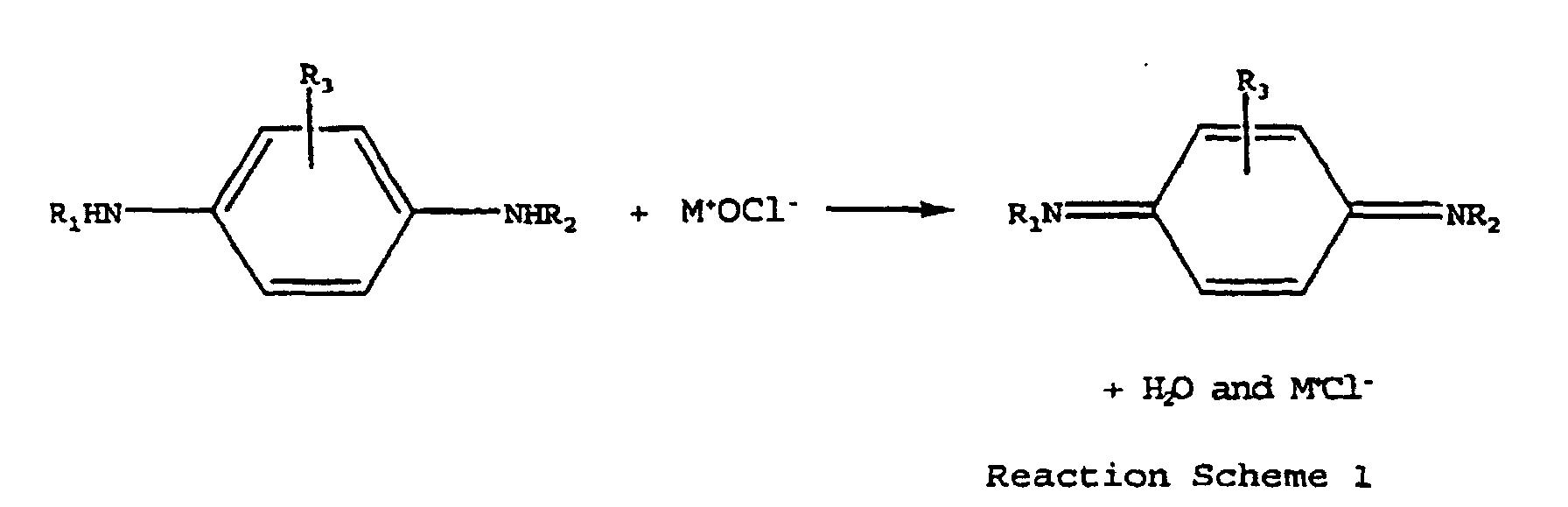
- the process according to the present invention utilizes a hypochlorite reagent which provides extremely high conversion, high selectivity, and fast reaction rates to prepare N,N'-disubstituted quinonediimine.
- a prior art process which utilizes a catalyst in the preparation of a quinoneimine compound is disclosed by Desmurs, et al. in U.S. Patent No. 5,189,218.
- the process of Desmurs, et al., which converts N-(4-hydroxyphenyl)aniline into N-phenylbenzoquinone-imine utilizes a manganese, copper, cobalt, and/or nickel compound as a catalyst in an oxidation type reaction.
- the current invention is based on the problem of providing a simple and economic process for the preparation of N,N'-disubstituted quinonediimines in high yields and with high purity.
- an advantage of the present invention is that the conversion of phenylenediamine to the corresponding quinonediimine is nearly quantitative. Thus, very little waste material remains upon completion of the reaction.
- hypochlorite oxidizing agent avoids the drawbacks associated with metal catalysts which include high cost, product contamination and environmental waste concerns.
- hypochlorite oxidizing agents as set forth herein, provide an extremely high conversion, high selectivity and faster more complete reaction compared to prior art processes.
- the object of the present invention is to provide an effective process for converting phenylenediamines into their corresponding quinonediimines (QDI's).
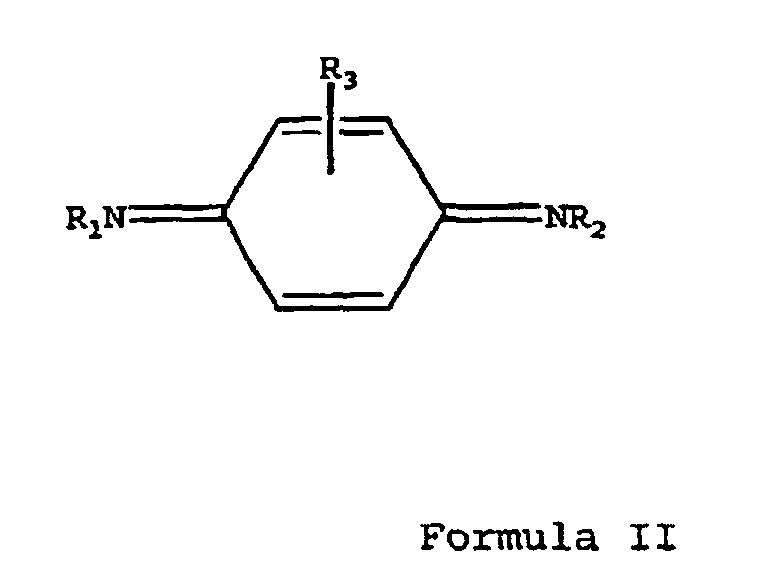
- the reaction produces a corresponding quinonediimine according to Formula II: wherein R 1 , R 2 and R 3 are the same as in the compound according to Formula I.
- R 1 , R 2 and R 3 are hydrogen, iso-propyl, sec-butyl, 1,4-dimethylpentyl, 1-ethyl-3-methylpentyl, 1-methylheptyl, phenyl, naphthyl, tolyl, or cyclohexyl.
- R 1 may also be 1,3-dimethylbutyl when R 2 is phenyl and R 3 is hydrogen.
- Hypochlorite agents include but are not limited to metal salts of hypochlorite, chlorate, perchlorate as well as organic hypochlorites such as t-butyl hypochlorite.
- M is selected from various metals such as sodium (Na), potassium (K), and calcium(Ca), or various organic groups such as alkyl, aryl and the like.
- the hypochlorite may be present in amounts ranging from 0.1 to 100 preferably 0.3 to 5 equivalents per equivalent of phenylenediamine. Using less than one equivalent of hypochlorite per equivalent of phenylenediamine allows one to produce blends of quinonediimine and unreacted phenylenediamine. When using more than one equivalent of hypochlorite, it is acceptable to recycle the unreacted hypochlorite stream.
- sodium hypochlorite can be made in situ by passing chlorine through sodium hydroxide solution.
- sodium hydroxide solution For example, one can have a reactant mixture of N-1,3-dimethylbutyl-N'-phenyl-p-phenylenediamine (Santoflex® 6PPD) and sodium hydroxide and then add chlorine gas to the reactor in known amounts and make sodium hypochlorite in situ. This would, in turn, react with Santoflex® 6PPD to give 6QDI.
- the reaction may take place in a solvent system.
- Various polar and non-polar solvents may be used in the oxidation reaction including various hydrocarbon based solvents and water.
- Organic solvents useable in the process of the present invention include, but are not limited to, alcohols such as methanol, ethanol, propanol, isopropanol, methyl isobutyl carbinol, ethylene glycol; ketones such as acetone, cyclohexanone, 4-methyl-2-pentanone (methyl isobutyl ketone), 5-methyl-2-hexanone, methyl ethyl ketone; aliphatic and aromatic hydrocarbons such as hexanes, heptanes, toluene, xylenes; nitriles such as acetonitrile; halogenated solvents such as chloroform, dichloromethane, carbon tetrachloride; water soluable solvents such as dimethyl sulphoxide,
- water may also be used in the solvent systems alone or as a mixture with the organic solvent.
- the initial phenylenediamine concentration may range in amounts of from 1% to 100% w/v.
- Polar solvents may be used alone or in admixture with non-polar solvents to increase the rate of the reaction.
- the present reaction may also take place in a neat system, without any solvent added.
- a neat system the phenylenediamine starting material is heated to a molten state, the hypochlorite is added and the mixture is stirred until completion of the reaction.
- the use of the neat system avoids the handling and flammability hazards associated with the use of solvents, especially the flammability hazards present when a solvent is used in an oxidation reaction.
- the present reaction may take place at temperatures from -200°C to 150°C, preferably from 0°C to 100°C, depending on the solvent.
- Phase transfer catalysts useable in the present invention include, but are not limited to, quaternary ammonium salts, such as tetramethylammonium hydroxide, tetraalkylammonium halides, tetra-N-butylammonium bromide, tetra-N-butylammonium chloride, benzyltriethylammonium chloride; phosphonium salts such as bis[tris(dimethylamino)phosphine]iminium chloride; crown ethers and polyethylene glycols.
- quaternary ammonium salts such as tetramethylammonium hydroxide, tetraalkylammonium halides, tetra-N-butylammonium bromide, tetra-N-butylammonium chloride, benzyltriethylammonium chloride
- phosphonium salts such as bis[tris(dimethylamino)
- phase transfer catalyst can be added directly to the reaction mixture or it can be dissolved in one of the reagents such as sodium hypochlorite or Santofle® 6PPD.
- the phase transfer catalyst may also be dissolved in a solvent used in the process or in water before addition to the reaction mass.
- Another means by which the rate of recation may be increased is through increasing the stirring or mixing rate in the reaction. By increasing the stirring or mixing, the reaction rate may be effectively adjusted to proceed at a faster pace when necessary.
- Agents such as sodium sulfite or other neutralizing agents can be added before the workup of the reaction mixture to neutralize any excess of sodium hypochlorite if present in the mixture.
- the technique used consisted of concentration of the reaction mass to remove acetonitrile followed by treatment with a hydrocarbon (for example toluene 300 mL) and water, followed by layer separation and concentration of the hydrocarbon layer leading to a dark colored liquid.
- a hydrocarbon for example toluene 300 mL
- the product was identified to be the corresponding N-1, 3-dimethylbutyl-N'-phenyl-quinonediimine (6QDI).
- 6QDI was isolated in almost quantitative yields.
- Example 3 results in an increased reaction rate compared to use of a lower concentration of sodium hypochlorite.
- increasing the concentration of sodium hypochlorite can significantly increase the rate of reaction of the claimed process.
- N-1,3-dimethylbutyl-N'-phenyl-p-phenylenediamine (Santoflex® 6PPD, 100g., 0.373 moles) which was immersed in a water bath maintained at 55°C.
- the mixture was maintained at 55°C and the reaction was monitored by taking samples after the addition of sodium hypochlorite and analyzed by HPLC for the disappearance of Santoflex® 6PPD. At the end of 3.25 hrs.
- N-1,3-dimethybutyl-N'-phenyl-quinonediimine (6QDI).
- isolation techniques can be used to isolate the product.
- the technique used in the present example consisted of addition of water, layer separation, and washing of organic layer with water to deliver dark colored liquid. The liquid was identified to be the corresponding N-1,3-dimethylbutyl-N'-phenyl-quinonediimine (6QDI) which was isolated in almost quantitative yields.
- Example 5 Following exactly the same procedure of Example 5, the same quantities of reagents as described in Example 5, and the same addition time were employed in the present example with an exception that a phase transfer catalyst was used in addition to all the other reagents.
- the catalyst used was tetrabutylammonium bromide (2.0g., 0.0062 moles). At the end of 1.5 hrs. the reaction had gone almost to completion to give the corresponding N-1,3-dimethylbutyl-N'-phenyl-quinonediimine (6QDI).
- a variety of isolation techniques can be used to isolate the product.
- the technique used in the present example consisted of addition of water, layer separation, and washing of organic layer with water to deliver dark colored liquid. The liquid was identified to be the corresponding N-1,3-dimethylbutyl-N'-phenyl-quinonediimine (6QDI) which was isolated in almost quantitative yields.
- the technique used in the present example consisted of concentration of the reaction mass to remove acetonitrile followed by treatment with a hydrocarbon (for example, toluene) and water, followed by layer separation and concentration of the hydrocarbon layer leading to a dark colored liquid.
- the product was identified to be the corresponding N-1,3-dimethylbutyl-N'-phenyl-quinonediimine (6QDI, 36 area%) and N-1,4-dimethylpentyl-N'-phenyl-quinonediimine (7QDI, 62 area%) which was isolated in almost quantitative yields.
- a mixture containing as little as 1.0% QDI to 100% QDI and 99% 6PPD to 0% 6PPD can be made by adjusting the charge of sodium hypochlorite. This process allows you to design a desired composition by controlling the amounts of reactants.
- isolation techniques can be used to isolate the product.
- the technique used in this example consisted of concentration of the reaction mass to remove acetonitrile followed by treatment with a hydrocarbon (for example, toluene at 300 mL) and water, followed by layer separation and concentration of the hydrocarbon layer leading to a dark colored liquid.
- the product was identified to be the corresponding N-1,3-dimethylbutyl-N'-phenyl-quinonediimine (6QDI) and isolated in almost quantitative yields.
- Example 3 shows the use of a polar solvent (t-butyl alcohol) in admixture with a non-polar solvent to increase the rate of reaction compared to use of the non-polar solvent alone as in Example 3.
- a polar solvent t-butyl alcohol
- the reaction has been shown to be carried out in miscible solvents such as acetonitrile or methanol, or in an immiscible solvent such as hexanes.
- miscible solvents such as acetonitrile or methanol
- immiscible solvent such as hexanes.
- the reaction is very clean and the QDI end product can be obtained in very high yields with high selectivity.
- Various methods for increasing reaction rates include increasing stirring, addition of polar solvents to the reaction, and addition of phase transfer catalysts to the reaction.
- the quinonediimines prepared by the process of the present invention exhibit multiple activities in vulcanized elastomers. These activities include long term antioxidant activity, along with antiozonant capacity. In fact, the antioxidant capacity of these antidegradants persists even after the vulcanizate has been extracted with solvents. In addition, quinonediimines provide these benefits without the negative effect on scorch generally associated with para-phenylenediamine antidegradants common to the industry. Summary of the activities of these compounds in rubber can be found in the literature. (Cain, M. E. et al., Rubber Industry, 216-226, 1975).
Landscapes
- Chemical & Material Sciences (AREA)
- Organic Chemistry (AREA)
- Organic Low-Molecular-Weight Compounds And Preparation Thereof (AREA)
Description
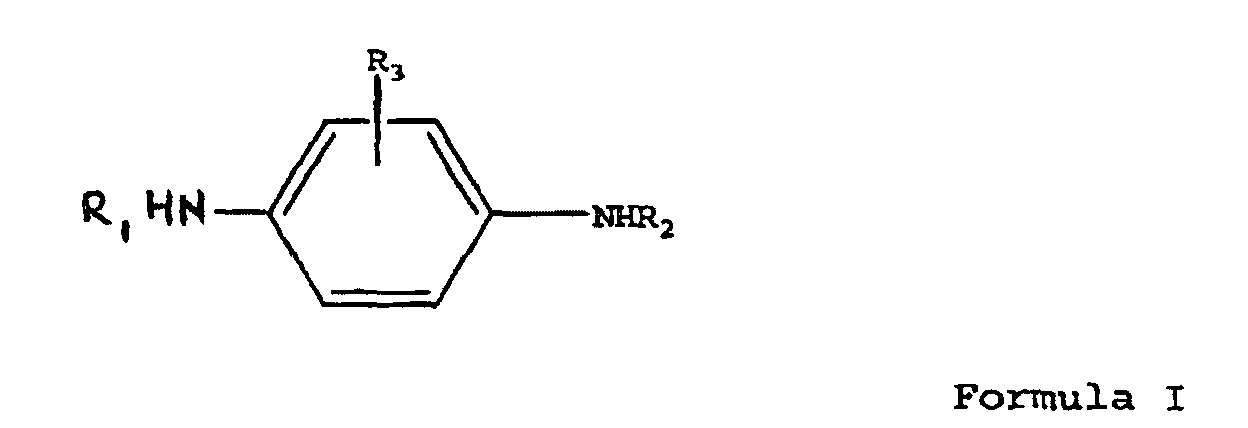
The reaction produces a corresponding quinonediimine according to Formula II:
| Sample # | Time, hrs. | Area % 6 QDI | Area % 6 PPD |
| 1 | 1 | 20.1 | 77.7 |
| 2 | 2 | 23.5 | 74.3 |
| 3 | 3 | 33.1 | 63.9 |
| 4 | 4.2 | 39.4 | 57.5 |
| 5 | 6 | 43.2 | 54.2 |
| 6 | 7 | 45.1 | 52.5 |
| 7 | 11 | 74.3 | 23.3 |
| 8 | 14 | 75.8 | 21.6 |
| 9 | 32 | 91.1 | 7.3 |
| 10 | 39 | 93.4 | 5.4 |
| Sample # | Time, hrs. | Area % 6 QDI | Area % 6PPD |
| 1 | 0.5 | 90.1 | 8.8 |
| 2 | 1 | 96.1 | 1.6 |
| 3 | 1.5 | 99 | 0.5 |
| Sample # | Area % 6QDI | Area % 6PPD |
| 1 | 0 | 97.2 |
| 2 | 13.1 | 87.0 |
| 3 | 27.1 | 70.4 |
| 4 | 39.3 | 57.7 |
| 5 | 44.4 | 50.2 |
| 6 | 50.1 | 46.4 |
| 7 | 58.4 | 31.6 |
| Sample # | Area %- 6QDI | Area % 6PPD |
| 1 | 0 | 97.6 |
| 2 | 1.55 | 96 |
| 3 | 3.26 | 95.8 |
| 4 | 5 | 93.5 |
| 5 | 21.2 | 76.8 |
| 6 | 28.5 | 69.8 |
| 7 | 34.8 | 62.6 |
| 8 | 41.8 | 55.5 |
| 9 | 51.2 | 45.9 |
| 10 | 54.5 | 34.1 |
| 11 | 67.2 | 28.4 |
| 12 | 88.9 | 6.33 |
| 13 | 97.3 | 0 |
| Sample # | Time (minutes) | Area % 6QDI | Area % 6PPD |
| 1 | 60 | 76.1 | 23.9 |
| 2 | 70 | 83.1 | 16.9 |
| 3 | 120 | 98.4 | 1.6 |
Claims (6)
- A process comprising reacting an N,N'-disuhstituted para-phenylenediamine of Formula I:wherein R1, R2 and R3 are the same or different and are selected from isopropyl, sec-butyl, cyclohexyl, phenyl, tolyl, 1,4-dimethylpentyl, naphthyl, 1-ethyl-3-methylpentyl, 1-methylheptyl, and hydrogen, or wherein R1 is 1,3-dimethylbutyl, R2 is phenyl, and R3 is hydrogen,
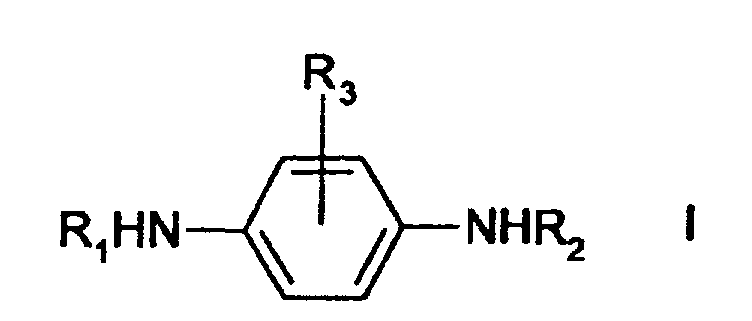
with a hypochlorite oxidizing agent, giving an N,N'-disubstituted para-quinonediimine of Formula II:wherein R1, R2 and R3 are the same as in the compound of Formula I.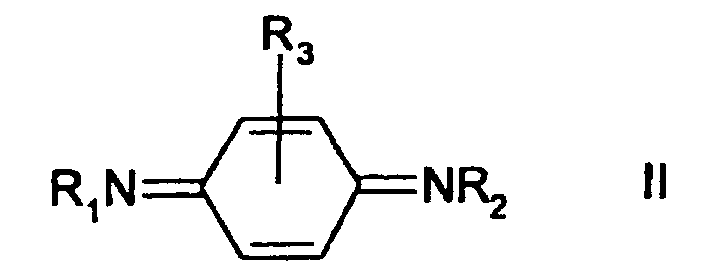
- The process of claim 1 wherein the hypochlorite is of the formula M+OCl- wherein M is selected from a metal or an organic.
- The process of claim 1 wherein the hypochlorite is sodium hypochlorite (NaOCl).
- The process of claim 1 wherein the reaction takes place in the presence of a solvent, wherein the solvent is selected from ketones, alcohols, nitriles, aliphatic and/or aromatic alkanes, aliphatic and/or aromatic alkenes, hydrocarbon solvents, water, and mixtures thereof.
- The process of claim 4 wherein the solvent comprises a polar solvent and a non-polar solvent.
- The process of claim 1 further comprising adding a phase transfer catalyst to the reaction, wherein the phase transfer catalyst is selected from quaternary ammonium salts, phosphonium salts, crown ethers, and polyethylene glycols.
Applications Claiming Priority (5)
| Application Number | Priority Date | Filing Date | Title |
|---|---|---|---|
| US6376497P | 1997-10-29 | 1997-10-29 | |
| US63764 | 1997-10-29 | ||
| US09/089,551 US6114554A (en) | 1997-10-29 | 1998-06-03 | Preparation of quinonediimines from phenylenediamines using a hypochlorite as an oxidation agent |
| US89551 | 1998-06-03 | ||
| PCT/US1998/022803 WO1999021826A1 (en) | 1997-10-29 | 1998-10-27 | Preparation of quinonediimines from phenylenediamines using a hypochlorite as an oxidation agent |
Publications (3)
| Publication Number | Publication Date |
|---|---|
| EP1030833A1 EP1030833A1 (en) | 2000-08-30 |
| EP1030833A4 EP1030833A4 (en) | 2000-11-29 |
| EP1030833B1 true EP1030833B1 (en) | 2004-02-18 |
Family
ID=26743770
Family Applications (1)
| Application Number | Title | Priority Date | Filing Date |
|---|---|---|---|
| EP98955160A Expired - Lifetime EP1030833B1 (en) | 1997-10-29 | 1998-10-27 | Preparation of quinonediimines from phenylenediamines using a hypochlorite as an oxidation agent |
Country Status (12)
| Country | Link |
|---|---|
| US (1) | US6114554A (en) |
| EP (1) | EP1030833B1 (en) |
| JP (1) | JP4354113B2 (en) |
| KR (1) | KR100551875B1 (en) |
| CN (1) | CN1137880C (en) |
| BR (1) | BR9813348A (en) |
| CA (1) | CA2308300C (en) |
| DE (1) | DE69821795T2 (en) |
| ES (1) | ES2217599T3 (en) |
| PT (1) | PT1030833E (en) |
| SK (1) | SK284853B6 (en) |
| WO (1) | WO1999021826A1 (en) |
Families Citing this family (2)
| Publication number | Priority date | Publication date | Assignee | Title |
|---|---|---|---|---|
| US6376728B1 (en) | 2000-06-20 | 2002-04-23 | Hercules Incorporated | Method, composition and mixture for inhibiting monomer polymerization |
| US7718722B2 (en) * | 2000-11-21 | 2010-05-18 | Flexsys America L.P. | Alkylthio- and aryl(heteroyl)thio-substituted p-phenylenediamines, their manufacture and their use in rubber |
Family Cites Families (15)
| Publication number | Priority date | Publication date | Assignee | Title |
|---|---|---|---|---|
| DE157288C (en) * | ||||
| US2118826A (en) * | 1936-10-27 | 1938-05-31 | Goodrich Co B F | Method of making quinone di-imides |
| US4264776A (en) * | 1976-01-02 | 1981-04-28 | Monsanto Company | Production of secondary amines |
| US4624937A (en) * | 1984-05-10 | 1986-11-25 | Monsanto Company | Process for removing surface oxides from activated carbon catalyst |
| US4696772A (en) * | 1985-02-28 | 1987-09-29 | Monsanto Company | Amine oxidation using carbon catalyst having oxides removed from surface |
| US5208280A (en) * | 1989-10-13 | 1993-05-04 | Uniroyal Chemical Company, Inc. | Elastomers and tire with N-alkyl-p-quinonediimino triazine stabilizers |
| US5118807A (en) * | 1989-10-13 | 1992-06-02 | Uniroyal Chemical Company, Inc. | N-alkyl-p-quinonediimino triazine compounds |
| US5091545A (en) * | 1990-03-02 | 1992-02-25 | The Goodyear Tire & Rubber Company | Catalytic oxidation of hydroxy containing aromatic compounds |
| FR2659651B1 (en) * | 1990-03-13 | 1993-05-14 | Rhone Poulenc Chimie | PROCESS FOR THE PREPARATION OF N-PHENYL N '- (CYCLO) ALKYL PARAPHENYLENE DIAMINES. |
| FR2659652B1 (en) * | 1990-03-13 | 1992-07-03 | Rhone Poulenc Chimie | PROCESS FOR THE PREPARATION OF N-PHENYL BENZOQUINONE-IMINE. |
| FR2659650B1 (en) * | 1990-03-13 | 1992-07-03 | Rhone Poulenc Chimie | PROCESS FOR THE PREPARATION OF N-PHENYL N '- (CYCLO) ALKYL PARAPHNYLENE DIAMINES. |
| US5371289A (en) * | 1993-03-22 | 1994-12-06 | The Goodyear Tire & Rubber Company | Preparation of N-substituted-N'-phenyl p-phenylenediamines |
| DE4437667A1 (en) * | 1994-10-21 | 1996-04-25 | Huels Chemische Werke Ag | Process for the preparation of N, N'-disubstituted p-quinone diimines, their use and organosilanes containing methacryloxy or acryloxy groups, process for their stabilization and their preparation |
| DE4437666A1 (en) * | 1994-10-21 | 1996-04-25 | Huels Chemische Werke Ag | Process for the preparation of N, N-disubstituted p-quinone diimines and their use |
| US5672725A (en) * | 1995-09-21 | 1997-09-30 | Hoechst Celanese Corp. | Process for preparing quinones |
-
1998
- 1998-06-03 US US09/089,551 patent/US6114554A/en not_active Expired - Lifetime
- 1998-10-27 JP JP2000517938A patent/JP4354113B2/en not_active Expired - Fee Related
- 1998-10-27 DE DE69821795T patent/DE69821795T2/en not_active Expired - Lifetime
- 1998-10-27 ES ES98955160T patent/ES2217599T3/en not_active Expired - Lifetime
- 1998-10-27 BR BR9813348-9A patent/BR9813348A/en not_active Application Discontinuation
- 1998-10-27 EP EP98955160A patent/EP1030833B1/en not_active Expired - Lifetime
- 1998-10-27 WO PCT/US1998/022803 patent/WO1999021826A1/en not_active Ceased
- 1998-10-27 CN CNB98811609XA patent/CN1137880C/en not_active Expired - Fee Related
- 1998-10-27 KR KR1020007004603A patent/KR100551875B1/en not_active Expired - Fee Related
- 1998-10-27 CA CA002308300A patent/CA2308300C/en not_active Expired - Fee Related
- 1998-10-27 SK SK609-2000A patent/SK284853B6/en not_active IP Right Cessation
- 1998-10-27 PT PT98955160T patent/PT1030833E/en unknown
Also Published As
| Publication number | Publication date |
|---|---|
| WO1999021826A1 (en) | 1999-05-06 |
| KR20010031560A (en) | 2001-04-16 |
| PT1030833E (en) | 2004-07-30 |
| US6114554A (en) | 2000-09-05 |
| EP1030833A1 (en) | 2000-08-30 |
| CA2308300C (en) | 2009-03-03 |
| ES2217599T3 (en) | 2004-11-01 |
| KR100551875B1 (en) | 2006-02-13 |
| JP4354113B2 (en) | 2009-10-28 |
| SK6092000A3 (en) | 2000-10-09 |
| SK284853B6 (en) | 2006-01-05 |
| BR9813348A (en) | 2000-08-22 |
| CN1280563A (en) | 2001-01-17 |
| DE69821795T2 (en) | 2004-10-07 |
| JP2001521021A (en) | 2001-11-06 |
| DE69821795D1 (en) | 2004-03-25 |
| CN1137880C (en) | 2004-02-11 |
| EP1030833A4 (en) | 2000-11-29 |
| CA2308300A1 (en) | 1999-05-06 |
Similar Documents
| Publication | Publication Date | Title |
|---|---|---|
| CA2308300C (en) | Preparation of quinonediimines from phenylenediamines using a hypochlorite as an oxidation agent | |
| US6072061A (en) | Preparation of quinoneimines from hydroxyphenylamines using a hypochlorite as an oxidation agent | |
| EP1027327B1 (en) | Formation of quinonediimines from phenylenediamines by catalytic oxidation | |
| EP1042269B1 (en) | Preparation of quinonediimines from phenylenediamines using hydrogen peroxide and a catalyst | |
| FR2784103A1 (en) | PROCESS FOR PREPARING LAURYLLACTAM BY PHOTONITROSATION OF CYCLODODECANE AND TRANSPOSITION OF BECKMANN IN THE PRESENCE OF METHANESULPHONIC ACID | |
| US6025508A (en) | Preparation of quinonediimines from phenylenediamines using oxygen and a metal or metal salt catalyst | |
| MXPA00011832A (en) | Preparation of quinonediimines from phenylenediamines using oxygen and a metal or metal salt catalyst |
Legal Events
| Date | Code | Title | Description |
|---|---|---|---|
| PUAI | Public reference made under article 153(3) epc to a published international application that has entered the european phase |
Free format text: ORIGINAL CODE: 0009012 |
|
| 17P | Request for examination filed |
Effective date: 20000421 |
|
| AK | Designated contracting states |
Kind code of ref document: A1 Designated state(s): BE DE ES FR GB GR IT PT SE |
|
| A4 | Supplementary search report drawn up and despatched |
Effective date: 20001013 |
|
| AK | Designated contracting states |
Kind code of ref document: A4 Designated state(s): BE DE ES FR GB GR IT PT SE |
|
| 17Q | First examination report despatched |
Effective date: 20020115 |
|
| GRAP | Despatch of communication of intention to grant a patent |
Free format text: ORIGINAL CODE: EPIDOSNIGR1 |
|
| GRAS | Grant fee paid |
Free format text: ORIGINAL CODE: EPIDOSNIGR3 |
|
| GRAA | (expected) grant |
Free format text: ORIGINAL CODE: 0009210 |
|
| AK | Designated contracting states |
Kind code of ref document: B1 Designated state(s): BE DE ES FR GB GR IT PT SE |
|
| REG | Reference to a national code |
Ref country code: GB Ref legal event code: FG4D |
|
| REF | Corresponds to: |
Ref document number: 69821795 Country of ref document: DE Date of ref document: 20040325 Kind code of ref document: P |
|
| REG | Reference to a national code |
Ref country code: GR Ref legal event code: EP Ref document number: 20040401337 Country of ref document: GR |
|
| REG | Reference to a national code |
Ref country code: SE Ref legal event code: TRGR |
|
| REG | Reference to a national code |
Ref country code: PT Ref legal event code: SC4A Free format text: AVAILABILITY OF NATIONAL TRANSLATION Effective date: 20040517 |
|
| REG | Reference to a national code |
Ref country code: ES Ref legal event code: FG2A Ref document number: 2217599 Country of ref document: ES Kind code of ref document: T3 |
|
| ET | Fr: translation filed | ||
| PLBE | No opposition filed within time limit |
Free format text: ORIGINAL CODE: 0009261 |
|
| STAA | Information on the status of an ep patent application or granted ep patent |
Free format text: STATUS: NO OPPOSITION FILED WITHIN TIME LIMIT |
|
| 26N | No opposition filed |
Effective date: 20041119 |
|
| PGFP | Annual fee paid to national office [announced via postgrant information from national office to epo] |
Ref country code: SE Payment date: 20091028 Year of fee payment: 12 Ref country code: ES Payment date: 20091026 Year of fee payment: 12 |
|
| PGFP | Annual fee paid to national office [announced via postgrant information from national office to epo] |
Ref country code: PT Payment date: 20091015 Year of fee payment: 12 |
|
| PGFP | Annual fee paid to national office [announced via postgrant information from national office to epo] |
Ref country code: IT Payment date: 20091027 Year of fee payment: 12 Ref country code: GB Payment date: 20091026 Year of fee payment: 12 Ref country code: FR Payment date: 20091029 Year of fee payment: 12 |
|
| PGFP | Annual fee paid to national office [announced via postgrant information from national office to epo] |
Ref country code: GR Payment date: 20091030 Year of fee payment: 12 Ref country code: BE Payment date: 20091201 Year of fee payment: 12 |
|
| BERE | Be: lapsed |
Owner name: *FLEXSYS AMERICA L.P. Effective date: 20101031 |
|
| REG | Reference to a national code |
Ref country code: PT Ref legal event code: MM4A Free format text: LAPSE DUE TO NON-PAYMENT OF FEES Effective date: 20110427 |
|
| GBPC | Gb: european patent ceased through non-payment of renewal fee |
Effective date: 20101027 |
|
| PG25 | Lapsed in a contracting state [announced via postgrant information from national office to epo] |
Ref country code: PT Free format text: LAPSE BECAUSE OF NON-PAYMENT OF DUE FEES Effective date: 20110427 Ref country code: GR Free format text: LAPSE BECAUSE OF NON-PAYMENT OF DUE FEES Effective date: 20110503 Ref country code: FR Free format text: LAPSE BECAUSE OF NON-PAYMENT OF DUE FEES Effective date: 20101102 |
|
| REG | Reference to a national code |
Ref country code: FR Ref legal event code: ST Effective date: 20110630 |
|
| PG25 | Lapsed in a contracting state [announced via postgrant information from national office to epo] |
Ref country code: GB Free format text: LAPSE BECAUSE OF NON-PAYMENT OF DUE FEES Effective date: 20101027 Ref country code: BE Free format text: LAPSE BECAUSE OF NON-PAYMENT OF DUE FEES Effective date: 20101031 |
|
| PG25 | Lapsed in a contracting state [announced via postgrant information from national office to epo] |
Ref country code: SE Free format text: LAPSE BECAUSE OF NON-PAYMENT OF DUE FEES Effective date: 20101028 |
|
| REG | Reference to a national code |
Ref country code: ES Ref legal event code: FD2A Effective date: 20111118 |
|
| PG25 | Lapsed in a contracting state [announced via postgrant information from national office to epo] |
Ref country code: IT Free format text: LAPSE BECAUSE OF NON-PAYMENT OF DUE FEES Effective date: 20101027 |
|
| PG25 | Lapsed in a contracting state [announced via postgrant information from national office to epo] |
Ref country code: ES Free format text: LAPSE BECAUSE OF NON-PAYMENT OF DUE FEES Effective date: 20101028 |
|
| PGFP | Annual fee paid to national office [announced via postgrant information from national office to epo] |
Ref country code: DE Payment date: 20151030 Year of fee payment: 18 |
|
| REG | Reference to a national code |
Ref country code: DE Ref legal event code: R119 Ref document number: 69821795 Country of ref document: DE |
|
| PG25 | Lapsed in a contracting state [announced via postgrant information from national office to epo] |
Ref country code: DE Free format text: LAPSE BECAUSE OF NON-PAYMENT OF DUE FEES Effective date: 20170503 |