EP1028597A2 - Communication apparatus, systems and method - Google Patents
Communication apparatus, systems and method Download PDFInfo
- Publication number
- EP1028597A2 EP1028597A2 EP00300880A EP00300880A EP1028597A2 EP 1028597 A2 EP1028597 A2 EP 1028597A2 EP 00300880 A EP00300880 A EP 00300880A EP 00300880 A EP00300880 A EP 00300880A EP 1028597 A2 EP1028597 A2 EP 1028597A2
- Authority
- EP
- European Patent Office
- Prior art keywords
- communication
- communication apparatus
- transmitting
- receiving
- control
- Prior art date
- Legal status (The legal status is an assumption and is not a legal conclusion. Google has not performed a legal analysis and makes no representation as to the accuracy of the status listed.)
- Withdrawn
Links
Images



Classifications
-
- H—ELECTRICITY
- H04—ELECTRIC COMMUNICATION TECHNIQUE
- H04W—WIRELESS COMMUNICATION NETWORKS
- H04W28/00—Network traffic management; Network resource management
- H04W28/16—Central resource management; Negotiation of resources or communication parameters, e.g. negotiating bandwidth or QoS [Quality of Service]
- H04W28/18—Negotiating wireless communication parameters
Definitions
- This invention relates to communication apparatus, systems and methods.
- a specific communication line established by using an integrated services digital network (ISDN), a cellular system using an up-down channel, or another communication media able to communicate bidirectionally is used for transmitting a content request signal from a terminal device of a user to a server device and for transmitting a content signal in accordance with the content request signal from the server device to the terminal device which sent the content request signal.
- ISDN integrated services digital network
- the bit rate (communication capacity) at the time of transmitting a signal from a server device to a terminal device (down direction) and a bit rate at the time of transmitting a signal from the terminal device to the server device are the same. Furthermore, the time assigned for an up direction and the down direction are also the same.
- TDD time division duplex
- the up direction communication it becomes necessary to increase the transmission power of the terminal device by the amount of shortening of the time assigned for the up direction communication within the unit time, there is a limit to an assignable time for the down direction communication for a unit time, and thus the communication time for the down direction cannot be sufficiently shortened.
- Embodiments of the present invention can provide a communication apparatus for receiving a content signal, a communication system for transmitting a content signal, and a communication system for receiving and transmitting a content signal capable of improving the bit rate of the down direction communication by using an existing bidirectional communication system and methods of the same.
- a communication apparatus comprises a communication apparatus comprising a transmitting and receiving means for transmitting and receiving a control signal to and from a first communication apparatus; a first control means for controlling the bidirectional communication between said first communication apparatus using said transmitting and receiving means; a receiving means for receiving a content signal from a second communication apparatus; and a second control means for transmitting and receiving a control signal to and from said second communication apparatus via said first communication apparatus by using said bidirectional communication controlled by said first control means and controlling the reception of said content signal by said receiving means based on results of the transmission and reception.
- the communication apparatus specifically has transmitting and receiving means which transmits and receives said control signal to and from said first communication apparatus by using a first wireless network and has receiving means which receives said content signal from said communication apparatus by using a second wireless network.
- the communication apparatus provides a communication apparatus comprising a transmitting and receiving means for transmitting and receiving a control signal to and from an other communication apparatus; a first control means for controlling bidirectional communication with said other communication apparatus using said transmitting and receiving means; a transmitting means for transmitting a content signal to said other communication apparatus; and a second control means for transmitting and receiving said control signal to and from said other communication apparatus by using said bidirectional communication controlled by said first control means and controlling transmission of said content signal by said transmitting means based on results of said transmission and reception.
- the communication system of the present invention is a communication system for performing bidirectional communication between a first communication apparatus and a second communication apparatus
- said first communication apparatus comprises a first transmitting and receiving means for transmitting and receiving a control signal with said second communication apparatus; a first control means for controlling bidirectional communication with said second communication apparatus using said first transmitting and receiving means; a transmitting means for transmitting a content signal to said second communication apparatus; and a second control means for transmitting and receiving said control signal to and from said second communication signal by using said bidirectional communication controlled by said first communication means and controlling transmission of said content signal by said first transmitting means based on results of the transmission and reception; and aid second communication apparatus comprises a second transmitting and receiving means for transmitting and receiving a control signal with said first communication apparatus; a third control means for controlling bidirectional communication with said second communication apparatus using said second transmitting and receiving means; a receiving means for receiving a content signal from said second communication apparatus; and a fourth control means for transmitting and receiving said control signal to and from said second communication signal by using said bidirectional
- the communication method of the present invention is a communication method for performing bidirectional communication between a first communication apparatus and a second communication apparatus including the steps of performing bidirectional communication between said first communication apparatus and said second communication apparatus via a first wireless network; transmitting a content signal from said first communication apparatus to said second communication apparatus via a second wireless network; and performing mobile management, call control, and wireless management necessary for said bidirectional communication using said first wireless network in an independent form from mobile management, call control, and wireless management necessary for receiving said content signal using said second wireless network.
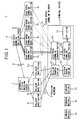
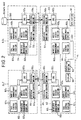
- Figure 1 is a view of the configuration of a communication system 1 of the present embodiment and Fig. 2 is a view of the configuration of the insides of the blocks shown in Fig. 1.
- the communication system 1 comprises cellular base stations 2 1 to 2 16 , high speed downlink base stations 3 1 to 3 4 , terminal devices 4 1 to 4 4 , a mobile switching center (MSC) 7, and a high speed downlink switching center 8.
- MSC mobile switching center
- bidirectional communication using the cellular network 5 that is, cellular communication
- the cellular base stations 2 1 to 2 16 and the terminal devices 4 1 to 4 4 and between an automobile cellular switching center 7 and the high speed downlink switching center 8.
- transmission using the high speed downlink network 6 is performed from the high speed downlink base stations 3 1 to 3 4 to the terminal devices 4 1 to 4 4 .
- the numbers of the cellular base stations, high speed downlink base stations, and terminal devices are not limited to the ones shown in Fig. 1.
- the wireless access method is the Time Division Duplex (TDD) mode wherein the same time is assigned in the up and down directions within a unit time
- the modulation format is the Quadrature Phase Shift Keying (QPSK).
- bidirectional communication is performed between communication nodes, and call control for assigning a channel in accordance with an occurrence of a call between the communication nodes (connecting the communication lines), position registration control for registering a position of a communication node when the communication node moves geographically, cell switching control during communication enabling transition of cells during communication, and end conversation control for disconnecting the channel in accordance with an end of the call are performed.
- the cellular base stations 2 1 to 2 16 , terminal devices 4 1 to 4 4 , automobile cellular switching center 7, and high speed downlink switching center 8 correspond to communication nodes.
- the cellular network 5 provides access control and bidirectional communication at a low bit rate between the high speed downlink base stations 3 1 to 3 4 and the terminal devices 4 1 to 4 4 when transmitting a content signal from the high speed downlink base stations 3 1 to 3 4 to the terminal devices 4 1 to 4 4 via the high speed downlink network 6.
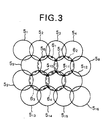
- the service area of the cellular network 5 is comprised of, for example, circular service areas 5 1 to 5 16 indicated by solid lines in Fig. 3 provided by 16 cells.
- a frequency bandwidth of, for example, 2 to 5 GHz is used, the service area is composed of a plurality of cells, and the modulation format is Quadrature Phase Shift Keying (QPSK).
- QPSK Quadrature Phase Shift Keying
- a high speed downlink network 6 for example, a wireless system having a higher bit rate than that of the cellular network 5 is used.
- the content signal can be any of a video signal, audio signal, computer program, etc.
- the service area of the high speed downlink network 6 is, for example, composed of circular service areas 6 1 to 6 4 indicated by dotted lines in Fig. 3 provided by four cells.
- the cellular base stations 2 1 to 2 16 provide service areas 5 1 to 5 16 of the cellular network 5 shown in Fig. 3.
- the cellular base stations 2 1 to 2 16 have the same configuration, so the configuration of only the cellular base station 2 2 will be explained below.
- the function blocks of the cellular base station 2 2 are sometimes realized integrated with the automobile cellular switching center 7, so the configuration of the cellular base station 2 2 will be explained as being integrated with the configuration of the automobile cellular switching center 7.
- the cellular base station 2 2 and the automobile cellular switching center 7 comprise a cellular transfer portion 81 and a cellular control portion 82.
- the cellular transfer portion 81 comprises a physical medium 51 3 , physical medium control portion 51 3 , and CRC processing portion 52 3 .
- the physical medium 50 3 is a portion directly acting on the cellular network 5.
- the physical medium control portion 51 3 performs determination, control, etc. of a wireless frequency, bandwidth, modulation format, and transfer rate.
- the CRC processing portion 52 2 performs error correction processing using cyclic redundancy check (CRC) on a signal input from the physical medium 50 3 via the cellular network 5 and processing to add a CRC code to a signal input from the cellular control portion 82.
- CRC cyclic redundancy check
- the cellular control portion 82 comprises a mobile managing portion 60 1 , call controlling portion 61 3 , wireless management portion 62 3 , and media access portion 63 3 .
- the mobile controlling portion 60 3 supports mobility of the terminal devices 4 1 to 4 4 in the cellular network 5 and performs position registration and authentication etc. with the terminal devices 4 1 to 4 4 .
- the call control portion 61 3 performs signal transmission, signal reception, hand-over, cut-off, etc. via the cellular network 5.
- the wireless management portion 62 3 selects cells of the cellular network 5 and performs setting, maintenance, switching, disconnection, etc. of the cellular network 5.
- the media access portion 63 3 performs medium access control of the cellular network 5.
- terminal devices 4 1 to 4 4 have the same configuration, the configuration of only the terminal device 4 1 will be explained below.
- the terminal device 4 1 comprises a cellular transfer portion 41, cellular control portion 42, high speed downlink transfer portion 43, high speed downlink control portion 44, display 90, application 91, and operation portion 92.
- the cellular transfer portion 41 comprises a physical medium 50 1 , physical medium control portion 51 1 , and CRC processing portion 52 1 .
- the physical medium 50 1 is a portion directly acting on the cellular network 5.
- the physical medium control portion 51 1 decides and controls a wireless frequency, bandwidth, modulation format, and transfer rate for the physical medium 50 1 .
- the CRC processing portion 52 1 performs error correction processing using cyclic redundancy check (CRC) on a signal input from the physical medium 50 1 via the cellular network 5 and processing to add a CRC code to a signal input from the cellular control portion 42.
- CRC cyclic redundancy check
- the cellular control portion 42 comprises a mobile managing portion 60 1 , call controlling portion 61 1 , wireless management portion 62 1 , and media access portion 63 1 .
- the mobile controlling portion 60 1 supports mobility of the terminal device 4 2 while communicating with the mobile management portion 60 3 of the cellular base stations 2 1 to 2 16 and performs position registration and authentication function, etc.
- the call control portion 61 1 performs signal transmission, signal reception, hand-over, cut-off, etc. via the cellular network 5.
- the wireless management portion 62 1 selects cells of the cellular network 5 and performs setting, maintenance, switching, disconnection, etc. of the cellular network 5.
- the media access portion 63 1 performs medium access control of the cellular network 5.
- the high speed downlink transfer portion 43 comprises a physical medium 50 2 , physical medium control portion 51 2 , and CRC processing portion 52 2 .
- the physical medium 50 2 is a portion directly acting on the high speed downlink network 6.
- the physical medium control portion 51 2 performs determination, control, etc. of a wireless frequency, bandwidth, modulation format, and transfer rate for the physical medium 50 2 .
- the CRC processing portion 52 2 performs error correction processing using CRC on a signal input from the physical medium 50 2 via the high speed downlink network 6.
- the high speed downlink control portion 44 comprises a mobile managing portion 60 2 , call controlling portion 61 2 , wireless management portion 62 2 , and media access portion 63 2 .
- the mobile controlling portion 60 2 supports mobility of the terminal device 4 1 in the high speed downlink network 6 with the high speed downlink switching center 8 and the mobile control portion 60 4 of the high speed downlink base stations 3 1 to 3 4 and performs position registration and authentication etc.
- the call control portion 61 2 performs signal transmission, signal reception, hand-over, cut-off, etc. via the cellular network 5 with the high speed downlink switching center 8 and the call control portion 61 4 of the high speed downlink base stations 3 1 to 3 4 via the cellular network 5.
- the wireless management portion 62 2 selects cells of the high speed downlink network 6 and performs setting, maintenance, switching, disconnection, etc. of the high speed downlink network 6 while communicating with the high speed downlink switching center 8 and the wireless management portion 62 4 of the high speed downlink base stations 3 1 to 3 4 .
- the application 91 performs processing using a content signal S93 input from the high speed downlink transfer portion 43 and outputs for example a video image and audio sound in accordance with the content signal S93 respectively from a display and a speaker.
- the operation portion 92 has at least one operation means such as a keyboard, mouse, and buttons and outputs an operation signal S92 specifying the content the user wishes to have played to the high speed downlink control portion 44 in accordance with a user's operation.
- operation means such as a keyboard, mouse, and buttons and outputs an operation signal S92 specifying the content the user wishes to have played to the high speed downlink control portion 44 in accordance with a user's operation.
- the high speed downlink base stations 3 1 to 3 4 respectively provide service areas 6 1 to 6 4 of the high speed downlink network 6 shown in Fig. 3.
- the high speed downlink base stations 3 1 to 3 4 have the same configuration, so the configuration of only the high speed downlink base station 3 1 will be explained below.
- the high speed downlink base station 3 1 and the high speed downlink switching center 8 comprise a high speed downlink transfer portion 73 and a high speed downlink control portion 74.
- the high speed downlink transfer portion 73 comprises a physical medium 50 4 , physical medium control portion 51 4 , and CRC processing portion 52 4 .
- the physical medium 50 4 is a portion directly acting on the high speed downlink network 6.
- the physical medium control portion 51 4 performs determination, control, etc. of a wireless frequency, bandwidth, modulation format, and transfer rate on the physical medium 50 4 .
- the CRC processing portion 52 4 adds a CRC code to a content signal S93 input from a data base 93.
- the high-speed downlink control portion 44 comprises a mobile managing portion 60 2 , call controlling portion 61 2 , wireless management portion 62 2 , and media access portion 63 2 .
- the mobile controlling portion 60 4 performs communication with the mobile managing portion 60 2 of the high-speed downlink control portion 44 of the terminal devices 4 1 to 4 4 via the cellular network 5, supports mobility of the terminal devices 4 1 to 4 4 in the high-speed downlink network 6 and performs position registration and authentication etc.
- the call control portion 61 3 performs signal transmission, signal reception, hand-over, disconnection, etc. via the cellular network 5.
- the wireless management portion 62 4 performs communication with the mobile managing portion 60 2 of the high-speed downlink control portion 44 of the terminal devices 4 1 to 4 4 via the cellular network 5, selects cells of the high-speed downlink network 6 and performs setting, maintenance, switching, disconnection, etc. of the high-speed cellular network 6.
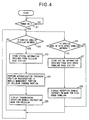
- Figure 4 is a flow chart of an example of the operation in the transmission reception waiting state in the terminal device 4 1 .
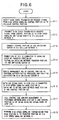
- Figure 5 is a view for explaining when a high speed transmission request of a content signal is output from the terminal device 4 1 to the high speed downlink switching center 8, and Fig. 6 is a flow chart of the operation shown in Fig. 5.
- the content signal S93 requested by the high speed transmission request signal S82a received at step S12 is read from the data base 93 in the high speed downlink control portion 74.
- the content signal S93 read from the data base 93 is transmitted from the high speed downlink base station 3 1 to the terminal device 4 1 via the high speed downlink network 6.
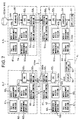
- Figure 7 is a view for explaining a signal flow of the example of the operation of transmitting a content signal from the high speed downlink switching center 8 to the terminal device 4 1 via the high speed downlink network 6 in response to a request from the high speed downlink switching center 8, while Figs. 8 and 9 are flow charts for explaining the operation shown in Fig. 7.
- a content signal is transmitted from the high speed downlink base station 3 1 to the terminal device 4 1 via the high speed downlink network 6.
- the communication speed in the down direction can be made higher just by adding the high speed downlink system using the high speed downlink base stations 3 1 to 3 4 and the high speed downlink network 6 to the existing system using the cellular base stations 2 1 to 2 16 and the cellular network 5. Therefore, the work load accompanying the faster speed can be reduced.
- the mobile management portion, call control portion, and wireless management portion are separately provided for the portion for bidirectional communication via the cellular network 5 and the portion for high speed downlink communication via the high speed downlink network 6, the frequency bandwidth, modulation format, cell structure, etc. can be set separately in accordance with need between the communication via the cellular network 5 and the communication via the high speed downlink network 6.
- the communication system 1 since the data link of the communication using the cellular network 5 and the data link of the communication using the high speed downlink network 6 are connected by the data link layer, transmission and reception of control information between the data links can be performed with high reliability. Also, the communication using the cellular network 5 and the communication using the high speed downlink network 6 can be handled as one channel at an upper layer of the data link layer.
- the present invention is not limited to the above embodiments.
- an ISDN or other cable network or a satellite telephone line network or other bidirectional communication network may be used.
- the broadcast network 6 use may be made, for example, of CS broadcasting, a communication line of cable TV, and Multi-Media Access Control (MMAC) instead of a ground wave.
- MMAC Multi-Media Access Control
- the service areas of the cellular network 5 and the service areas of the high speed downlink network 6 may be decided as shown in Figs. 10A to 10E in addition to the ones shown in Fig. 3.
- the communication speed in the down direction can be easily improved by expanding the functions of the existing apparatus.
Landscapes
- Engineering & Computer Science (AREA)
- Quality & Reliability (AREA)
- Computer Networks & Wireless Communication (AREA)
- Signal Processing (AREA)
- Mobile Radio Communication Systems (AREA)
- Bidirectional Digital Transmission (AREA)
- Time-Division Multiplex Systems (AREA)
Abstract
Description
Claims (24)
- A communication apparatus comprising:a transmitting and receiving means for transmitting and receiving a control signal to and from a first communication apparatus;a first control means for controlling the bidirectional communication between said first communication apparatus using said transmitting and receiving means;a receiving means for receiving a content signal from a second communication apparatus; anda second control means for transmitting and receiving a control signal to and from said second communication apparatus via said first communication apparatus by using said bidirectional communication controlled by said first control means and controlling the reception of said content signal by said receiving means based on results of the transmission and reception.
- A communication apparatus as set forth in claim 1, wherein:said transmitting and receiving means transmits and receives said control signal to and from said first communication apparatus by using a first wireless network andsaid receiving means receives said content signal from said communication apparatus by using a second wireless network.
- A communication apparatus as set forth in claim 2, wherein:said second control means performs at least one of mobile management, call control, and wireless management necessary for receiving said content signal using said second wireless network with said second communication apparatus by using said bidirectional communication.
- A communication apparatus as set forth in claim 3, wherein:said first control means performs mobile management, call control, and wireless management necessary for said bidirectional communication using said first wireless network in an independent form from the mobile management, call control, and wireless management by said second control means necessary for receiving said content signal using said second wireless network.
- A communication apparatus as set forth in claim 3, wherein said second control means does not perform position management for notifying a position of the communication apparatus in a waiting state of communication using said second wireless network.
- A communication apparatus as set forth in claim 1, whereinsaid second control means selects one communication condition among a plurality of communication conditions and controls reception of said content signal by said receiving means based on the selected communication condition by said transmission and reception of said control signal to and from said second communication apparatus.
- A communication apparatus as set forth in claim 1, whereinsaid second control means realizes connection with said second communication apparatus via said first communication apparatus by a data link layer.
- A communication apparatus as set forth in claim 2, wherein a bit rate of communication using said second wireless network is larger than a bit rate of communication using said first wireless network.
- A communication apparatus comprising:a transmitting and receiving means for transmitting and receiving a control signal to and from an other communication apparatus;a first control means for controlling bidirectional communication with said other communication apparatus using said transmitting and receiving means;a transmitting means for transmitting a content signal to said other communication apparatus; anda second control means for transmitting and receiving said control signal to and from said other communication apparatus by using said bidirectional communication controlled by said first control means and controlling transmission of said content signal by said transmitting means based on results of said transmission and reception.
- A communication apparatus as set forth in claim 9, whereinsaid transmitting and receiving means transmits and receives said control signal to and from said other communication apparatus by using a first wireless network andsaid transmitting means transmits said content signal to and from said other communication apparatus by using a second wireless network.
- A communication apparatus as set forth in claim 10, wherein:said second control means performs at least one of mobile management, call control, and wireless management necessary for receiving said content signal using said second wireless network with said second communication apparatus by using said bidirectional communication.
- A communication apparatus as set forth in claim 11, wherein:said first control means performs mobile management, call control, and wireless management necessary for said bidirectional communication using said first wireless network in an independent form from the mobile management, call control, and wireless management by said second control means necessary for receiving said content signal using said second wireless network.
- A communication apparatus as set forth in claim 9, whereinsaid second control means selects one communication condition among a plurality of communication conditions and controls reception of said content signal by said receiving means based on the selected communication condition by said transmission and reception of said control signal to and from said other communication apparatus.
- A communication apparatus as set forth in claim 9, whereinsaid second control means realizes connection with said other communication apparatus via said first communication apparatus by a data link layer.
- A communication apparatus as set forth in claim 10, wherein a bit rate of communication using said second wireless network is larger than a bit rate of communication using said first wireless network.
- A communication system for performing bidirectional communication between a first communication apparatus and a second communication apparatus, wherein:said first communication apparatus comprisesa first transmitting and receiving means for transmitting and receiving a control signal with said second communication apparatus;a first control means for controlling bidirectional communication with said second communication apparatus using said first transmitting and receiving meansa transmitting means for transmitting a content signal to said second communication apparatus; anda second control means for transmitting and receiving said control signal to and from said second communication signal by using said bidirectional communication controlled by said first communication means and controlling transmission of said content signal by said first transmitting means based on results of the transmission and reception; andsaid second communication apparatus comprises:a second transmitting and receiving means for transmitting and receiving a control signal with said first communication apparatus;a third control means for controlling bidirectional communication with said second communication apparatus using said second transmitting and receiving means;a receiving means for receiving a content signal from said second communication apparatus; anda fourth control means for transmitting and receiving said control signal to and from said second communication signal by using said bidirectional communication controlled by said third communication means and controlling reception of said content signal by said receiving means based on results of the transmission and reception.
- A communication apparatus as set forth in claim 1, wherein:said first transmitting and receiving means and said second transmitting and receiving means transmits and receives said control signal by using a first wireless network; andsaid receiving means receives said content signal from said transmission means via a second wireless network.
- A communication apparatus as set forth in claim 17, whereinsaid second control means performs at least one of mobile management, call control, and wireless management necessary for receiving said content signal using said second wireless network with said fourth control means by using said bidirectional communication.
- A communication apparatus as set forth in claim 18, whereinsaid first control means and said third control means perform mobile management, call control, and wireless management necessary for said bidirectional communication using said first wireless network in an independent form from mobile management, call control, and wireless management by said second control means and said fourth control means necessary for receiving said content signal using said second wireless network.
- A communication apparatus as set forth in claim 18, whereinsaid fourth control means does not perform position management for notifying a position of said second communication apparatus to said first communication apparatus in a waiting state of communication using said second wireless network.
- A communication apparatus as set forth in claim 16, whereinsaid fourth control means selects one communication condition from a plurality of communication conditions with said second control means by said transmission and reception of said control signal and controls receipt of said content signal by said receiving means based on said selected communication condition.
- A communication apparatus as set forth in claim 16, whereinsaid second control means realizes connection with said fourth control means via said first control means and said third control means by a data link layer.
- A communication apparatus as set forth in claim 17, wherein a bit rate of communication using said second wireless network is larger than a bit rate of communication using said first wireless network.
- A communication method for performing bidirectional communication between a first communication apparatus and a second communication apparatus including the steps of:performing bidirectional communication between said first communication apparatus and said second communication apparatus via a first wireless network;transmitting a content signal from said first communication apparatus to said second communication apparatus via a second wireless network; andperforming mobile management, call control, and wireless management necessary for said bidirectional communication using said first wireless network in an independent form from mobile management, call control, and wireless management necessary for receiving said content signal using said second wireless network.
Applications Claiming Priority (2)
| Application Number | Priority Date | Filing Date | Title |
|---|---|---|---|
| JP11031876A JP2000232670A (en) | 1999-02-09 | 1999-02-09 | Communication device, communication system and method |
| JP3187699 | 1999-02-09 |
Publications (2)
| Publication Number | Publication Date |
|---|---|
| EP1028597A2 true EP1028597A2 (en) | 2000-08-16 |
| EP1028597A3 EP1028597A3 (en) | 2001-11-14 |
Family
ID=12343251
Family Applications (1)
| Application Number | Title | Priority Date | Filing Date |
|---|---|---|---|
| EP00300880A Withdrawn EP1028597A3 (en) | 1999-02-09 | 2000-02-04 | Communication apparatus, systems and method |
Country Status (3)
| Country | Link |
|---|---|
| US (1) | US6711142B1 (en) |
| EP (1) | EP1028597A3 (en) |
| JP (1) | JP2000232670A (en) |
Cited By (2)
| Publication number | Priority date | Publication date | Assignee | Title |
|---|---|---|---|---|
| WO2002021738A3 (en) * | 2000-09-06 | 2002-12-27 | Deutsche Telekom Mobil | Method and system for transferring data from and to the internet by using a communication network and a radio system |
| US7505731B2 (en) | 2000-11-24 | 2009-03-17 | Nokia Corporation | System and method for delivery of content by a network based upon a predefined condition |
Families Citing this family (11)
| Publication number | Priority date | Publication date | Assignee | Title |
|---|---|---|---|---|
| US7054290B1 (en) * | 2000-03-07 | 2006-05-30 | Telefonaktiebolaget Lm Ericsson (Publ) | Methods and apparatus for dual mode operation in a wireless communication system |
| JP2001313672A (en) * | 2000-04-28 | 2001-11-09 | Toshiba Corp | Network system, packet relay device, wireless terminal, and packet processing method |
| US7016332B2 (en) * | 2000-12-05 | 2006-03-21 | Science Applications International Corporation | Method and system for a remote downlink transmitter for increasing the capacity of a multiple access interference limited spread-spectrum wireless network |
| US7061891B1 (en) * | 2001-02-02 | 2006-06-13 | Science Applications International Corporation | Method and system for a remote downlink transmitter for increasing the capacity and downlink capability of a multiple access interference limited spread-spectrum wireless network |
| EP1244231A1 (en) * | 2001-03-19 | 2002-09-25 | Telefonaktiebolaget Lm Ericsson | Hybrid frequency band system architecture for terrestrial wireless broadband access applications |
| US7209515B2 (en) | 2001-03-30 | 2007-04-24 | Science Applications International Corporation | Multistage reception of code division multiple access transmissions |
| JP3824506B2 (en) * | 2001-07-03 | 2006-09-20 | 株式会社デンソー | COMMUNICATION SYSTEM, COMMUNICATION METHOD, AND MOBILE STATION |
| US7006461B2 (en) * | 2001-09-17 | 2006-02-28 | Science Applications International Corporation | Method and system for a channel selective repeater with capacity enhancement in a spread-spectrum wireless network |
| US7257040B2 (en) * | 2005-09-27 | 2007-08-14 | Macronix International Co., Ltd. | Fast pre-charge circuit and method of providing same for memory devices |
| US7783954B2 (en) * | 2006-09-11 | 2010-08-24 | Globalfoundries Inc. | System for controlling high-speed bidirectional communication |
| CN101217811B (en) * | 2008-01-17 | 2010-06-02 | 西安西电捷通无线网络通信有限公司 | A secured transmission method for wideband wireless multimedia network broadcasting communication |
Family Cites Families (8)
| Publication number | Priority date | Publication date | Assignee | Title |
|---|---|---|---|---|
| JPS63283241A (en) * | 1987-05-15 | 1988-11-21 | Toshiba Corp | Mobile communication system |
| AU665540B2 (en) * | 1991-06-06 | 1996-01-11 | Fujitsu Limited | A mobile radio telephone apparatus |
| JP2503867B2 (en) * | 1993-05-19 | 1996-06-05 | 日本電気株式会社 | Mobile communication system |
| US5754961A (en) * | 1994-06-20 | 1998-05-19 | Kabushiki Kaisha Toshiba | Radio communication system including SDL having transmission rate of relatively high speed |
| US5600707A (en) * | 1994-08-31 | 1997-02-04 | Lucent Technologies Inc. | Wireless channel setup using low bandwidth network for selecting high bandwidth data bearer channel of another network system for data transmission |
| JP3351653B2 (en) * | 1995-03-30 | 2002-12-03 | 株式会社東芝 | Retransmission control method and terminal device for wireless communication system |
| US5629974A (en) * | 1995-11-16 | 1997-05-13 | Nokia Telecommunications Oy | Communication system providing mobility management internetworking between a C-interface radio system and an overlay mobile radio network |
| GB2313981B (en) * | 1996-06-06 | 2001-04-18 | Roke Manor Research | Assymetric communications channel for a portable computer |
-
1999
- 1999-02-09 JP JP11031876A patent/JP2000232670A/en active Pending
-
2000
- 2000-02-04 EP EP00300880A patent/EP1028597A3/en not_active Withdrawn
- 2000-02-08 US US09/500,099 patent/US6711142B1/en not_active Expired - Lifetime
Cited By (3)
| Publication number | Priority date | Publication date | Assignee | Title |
|---|---|---|---|---|
| WO2002021738A3 (en) * | 2000-09-06 | 2002-12-27 | Deutsche Telekom Mobil | Method and system for transferring data from and to the internet by using a communication network and a radio system |
| US7058394B2 (en) | 2000-09-06 | 2006-06-06 | T-Mobile Deutschland Gmbh | Method and system for communication with the Internet |
| US7505731B2 (en) | 2000-11-24 | 2009-03-17 | Nokia Corporation | System and method for delivery of content by a network based upon a predefined condition |
Also Published As
| Publication number | Publication date |
|---|---|
| JP2000232670A (en) | 2000-08-22 |
| EP1028597A3 (en) | 2001-11-14 |
| US6711142B1 (en) | 2004-03-23 |
Similar Documents
| Publication | Publication Date | Title |
|---|---|---|
| US6091967A (en) | Scalable radio platform | |
| US8380244B2 (en) | Dual mode unit for short range, high rate and long range, lower rate data communications | |
| US7024222B2 (en) | Dual mode unit for short range, high rate and long range, lower rate data communications | |
| JP5415261B2 (en) | Indication of variable control channel structure for transmission in mobile phone systems | |
| RU2360369C2 (en) | Method of selecting transport format combination with guaranteed quality of service in mobile communication system | |
| US8125946B2 (en) | Wireless network and mobile stations for implementing variable bandwidth service on demand | |
| US6711142B1 (en) | Communication apparatus, communication system, and method of the same | |
| US7317920B2 (en) | System and method for providing fast call set-up in a wireless communication system | |
| KR20030087982A (en) | System and method for providing service negotiation during a hard handoff of a mobile station in a wireless communication system | |
| KR20020079942A (en) | Method of transmitting service information, and radio system | |
| US7421280B2 (en) | Wireless network and wireless access terminals using enhanced SYNC—ID parameter | |
| US7839820B2 (en) | Mobile station and method for implementing variable bandwidth service on demand | |
| EP1810537A1 (en) | Data transport in gsm system | |
| US7133674B2 (en) | Apparatus and method for reactivating multiple packet data sessions in a wireless network | |
| KR100606015B1 (en) | System and method for providing mobile station registration in a traffic channel in a wireless communication system | |
| EP1358773A1 (en) | Radio system and method for transmitting configuration information | |
| HK1125759B (en) | Dual mode subscriber unit for short range, high rate and long range, lower rate data communications |
Legal Events
| Date | Code | Title | Description |
|---|---|---|---|
| PUAI | Public reference made under article 153(3) epc to a published international application that has entered the european phase |
Free format text: ORIGINAL CODE: 0009012 |
|
| AK | Designated contracting states |
Kind code of ref document: A2 Designated state(s): DE FR GB Kind code of ref document: A2 Designated state(s): AT BE CH CY DE DK ES FI FR GB GR IE IT LI LU MC NL PT SE |
|
| AX | Request for extension of the european patent |
Free format text: AL;LT;LV;MK;RO;SI |
|
| PUAL | Search report despatched |
Free format text: ORIGINAL CODE: 0009013 |
|
| AK | Designated contracting states |
Kind code of ref document: A3 Designated state(s): AT BE CH CY DE DK ES FI FR GB GR IE IT LI LU MC NL PT SE |
|
| AX | Request for extension of the european patent |
Free format text: AL;LT;LV;MK;RO;SI |
|
| 17P | Request for examination filed |
Effective date: 20020419 |
|
| AKX | Designation fees paid |
Free format text: DE FR GB |
|
| 17Q | First examination report despatched |
Effective date: 20021009 |
|
| STAA | Information on the status of an ep patent application or granted ep patent |
Free format text: STATUS: THE APPLICATION IS DEEMED TO BE WITHDRAWN |
|
| 18D | Application deemed to be withdrawn |
Effective date: 20030220 |