EP1028575A2 - Telecommunication system and method of providing a virtual memory extension for a subscriber set - Google Patents
Telecommunication system and method of providing a virtual memory extension for a subscriber set Download PDFInfo
- Publication number
- EP1028575A2 EP1028575A2 EP00102868A EP00102868A EP1028575A2 EP 1028575 A2 EP1028575 A2 EP 1028575A2 EP 00102868 A EP00102868 A EP 00102868A EP 00102868 A EP00102868 A EP 00102868A EP 1028575 A2 EP1028575 A2 EP 1028575A2
- Authority
- EP
- European Patent Office
- Prior art keywords
- subscriber terminal
- telephone
- unit
- entries
- base station
- Prior art date
- Legal status (The legal status is an assumption and is not a legal conclusion. Google has not performed a legal analysis and makes no representation as to the accuracy of the status listed.)
- Withdrawn
Links
- 238000000034 method Methods 0.000 title claims abstract description 13
- 238000004891 communication Methods 0.000 claims abstract description 5
- 230000005540 biological transmission Effects 0.000 claims description 7
- 238000012790 confirmation Methods 0.000 claims description 4
- 230000011664 signaling Effects 0.000 description 21
- 230000006870 function Effects 0.000 description 3
- 230000003247 decreasing effect Effects 0.000 description 1
- 230000002085 persistent effect Effects 0.000 description 1
- 230000002265 prevention Effects 0.000 description 1
Images


Classifications
-
- H—ELECTRICITY
- H04—ELECTRIC COMMUNICATION TECHNIQUE
- H04M—TELEPHONIC COMMUNICATION
- H04M1/00—Substation equipment, e.g. for use by subscribers
- H04M1/72—Mobile telephones; Cordless telephones, i.e. devices for establishing wireless links to base stations without route selection
- H04M1/725—Cordless telephones
- H04M1/72502—Cordless telephones with one base station connected to a single line
-
- H—ELECTRICITY
- H04—ELECTRIC COMMUNICATION TECHNIQUE
- H04M—TELEPHONIC COMMUNICATION
- H04M1/00—Substation equipment, e.g. for use by subscribers
- H04M1/26—Devices for calling a subscriber
- H04M1/27—Devices whereby a plurality of signals may be stored simultaneously
- H04M1/274—Devices whereby a plurality of signals may be stored simultaneously with provision for storing more than one subscriber number at a time, e.g. using toothed disc
- H04M1/2745—Devices whereby a plurality of signals may be stored simultaneously with provision for storing more than one subscriber number at a time, e.g. using toothed disc using static electronic memories, e.g. chips
- H04M1/2753—Devices whereby a plurality of signals may be stored simultaneously with provision for storing more than one subscriber number at a time, e.g. using toothed disc using static electronic memories, e.g. chips providing data content
- H04M1/2757—Devices whereby a plurality of signals may be stored simultaneously with provision for storing more than one subscriber number at a time, e.g. using toothed disc using static electronic memories, e.g. chips providing data content by data transmission, e.g. downloading
Definitions
- the invention relates to a telecommunications system for virtual memory expansion in a subscriber terminal as well as an associated method and in particular on a cordless DECT communication system with a variety of subscriber terminals arranged in a satellite shape around a base station.
- the base station is here with a public one or private network connected and arranges about it each of its subscriber terminals also has a specific identifier to. This allows both an internal connection between the subscriber terminals as well as an external connection from a respective subscriber terminal to the public or private network can be realized.
- each has a large number of subscriber terminals a non-volatile storage unit for storage of terminal-specific data, redial lists, Speed dial lists, phone book lists etc. Because of the limited Capacity of these non-volatile storage units however in particular the number of telephone entries in one Phonebook list limited (approx. 80 - 100 entries). On the other hand is an increase in the capacity of these non-volatile Storage units with high costs for the necessary and expensive memory chips.
- the invention is therefore based on the object of a telecommunications system of the type described at the beginning and an associated one Create process in which a storage capacity is enlarged without additional costs.
- this object is achieved with regard to the method by the measures of claim 1 and with regard of the telecommunications system by the features of the claim 5 solved.
- each subscriber terminal not just on his local phone records Storage unit, but also on the phone entries of the Storage units of the others in the telecommunications system located subscriber terminals can access.
- each subscriber terminal has in addition to its own local read / write unit for writing / reading locally Telephone entries of its own storage unit a reading unit for decentralized reading of telephone entries in the storage units of the other subscriber terminals.
- a reading unit for decentralized reading of telephone entries in the storage units of the other subscriber terminals.
- FIG. 1 shows a schematic representation of an inventive Telecommunication system for virtual memory expansion in a subscriber terminal.
- the telecommunication system 1 preferably consists of a base station B with a public or private network N communicates.
- the base station B becomes accordingly either as a main telephone line or as a telephone extension line operated. With base station B you can a plurality of subscriber terminals 1, 2, 3 to n connected become.
- the subscriber terminals 1 to n is preferably a cordless DECT telephone, which via a radio link with base station B in connection stand.
- subscriber terminals is an internal Call number or identifier assigned.
- the Base station B is assigned a station number or station identifier (which eliminates the use of multiple base stations B is possible in the telecommunications system).
- each subscriber terminal 1-n has one Storage unit SP1 - SPn, in which usually both terminal-specific Data as well as lists for phone entries are saved are.
- Each of these storage units preferably exists SP1, SP2, SP3, ..., SPn from a non-volatile memory such as B. an EEPROM or a FLASHROM.
- B. an EEPROM or a FLASHROM For storage of respective names with an associated phone number each of these subscriber terminals usually has one So-called phone book, which as a phone book list in the non-volatile memory unit SP1 - SPn is stored.
- every user of a subscriber terminal his special phone book with special phone entries Create TE.
- each subscriber terminal 1 - n has a respective one Output unit A1 - on.
- This preferably exists Output unit A1 - on from a graphic display unit, however, it can also be an acoustic reproduction unit or a combination of graphic and acoustic display unit exhibit.
- each subscriber terminal now has in addition to its local read / write unit to write / read the local storage unit Reading unit for decentralized reading of telephone entries in the Storage units of the other subscriber terminals. More accurate said a subscriber terminal 1 can not only according to Figure 1 the phone entries "Name X" and "Name Y" from his own Read out memory unit SP1 and display it on output unit A1, but also, for example, a telephone entry "Name Z" from the storage unit 2 of the subscriber terminal 2 and a phone entry "Name U" from the storage unit SPn of the subscriber terminal n. This way enables the telecommunications system according to Figure 1 virtual memory expansion for subscriber terminal 1, without actually enlarging its associated storage unit 1.
- Each subscriber terminal 1 to n preferably has one Memory access display, not shown, that an external Indicates memory access to its user. This allows everyone User has memory access to his storage device be displayed by another user. Basically could also be the internal number of each Subscriber terminals can be displayed or saved.
- For Prevention of unauthorized memory access by one of the other subscriber terminals to a local storage unit can also individual phone entries or groups be given an identifier by telephone entries, which only allow local reading of the phone entries, however, prevent decentralized reading of these telephone entries. This makes reading out private or personal Third party phone entries, i.e. other members of the telecommunications system prevented.
- FIG. 2 shows a schematic representation of the subscriber terminal 1 with its functional blocks essential to the invention.
- the subscriber terminal is preferably involved 1 is a cordless DECT phone that has a Radio connection to base station B is connected.
- the data transmitted over the radio link are transferred via a data path DIN / DOUT of a data processing unit DV1 fed, preferably from a microprocessor or microcomputer consists.
- the data processing unit DV1 stands via a bus system BS1 both with its own non-volatile Storage unit SP1 and its output unit A1 in connection.
- the data processing unit is also available an input unit, not shown, in connection and controls all essential functions of the subscriber terminal 1.
- the non-volatile memory unit SP1 preferably exists from an EEPROM, but it can also be a FLASHROM or a have other persistent storage.
- One already known read / write unit from conventional subscriber terminals L1 enables the writing and reading of data for respective subscriber terminal associated non-volatile memory unit SP1. More specifically, about that Read / write unit L1, for example a telephone entry TE with a name and a corresponding phone number in one Phonebook list of the non-volatile memory unit SP1 filed become. For the quick and comfortable execution of a Connection can be established at a later time Search functions in the Phonebook list searched for the respective name and the associated phone numbers can be selected. Such a thing Search and scroll through phone book lists, redial lists and speed dial lists are usually done using the following Menu items not described in more detail in connection can be selected with the output unit A1.
- the subscriber terminal has one Reading unit TR1 for decentralized reading of telephone entries. More precisely, the reading unit has TR1 for decentralized Read phone entries in the storage units of the others Subscriber terminals in the telecommunication system a transmission unit T1 to send a decentralized memory request and a receiving unit R1 for receiving a decentralized one Storage request.
- the transmission unit T1 makes a decentralized storage request with details of the respective subscriber terminal (internal Number) to base station B via the data path Issues DIN / DOUT.
- a receiving unit Rx now receives such a decentralized one Memory request, so sends the associated sending unit Tx a predetermined one according to the requirement Number of phone entries from its own storage unit SPx through base station B to the the memory request sending subscriber terminal 1 back.
- the receiving unit R1 in the subscriber terminal 1 receives these decentrally read out Telephone entries TE and gives them on the output unit A1 off.
- each telephone entry TE read out can be used in addition its respective name "Name_A”, “Name_B” also an origin identifier Have "1", "x” that represent the place of origin (Source) or the respective subscriber terminal of the displayed Features TE.
- This is a use virtual memory expansion further simplified.
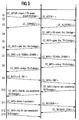
- Figure 3 shows a DECT signaling protocol of the essential Process steps for virtual memory expansion in a telecommunication system consisting of the subscriber terminal 1, the base station B and the subscriber terminal 2.
- the DECT command is used "CC_SETUP" an internal connection to the subscriber terminal 2 and reading a predetermined number of phone entries from a telephone book list TB of the subscriber terminal 2 the base station B requested.
- this command will use this command to build an internal Connection from base station B to the corresponding subscriber terminal 2 forwarded.
- a signaling step S4 the base station B the request "predetermined number read phone entries from the phone book list TB " the signaling command "CC_INFO" to the subscriber terminal 2, whereby an internal reading of the requested phone entries is carried out.
- a signaling step S5 is read out after the desired number of Telephone entries in the subscriber terminal 2 the respective information via the signaling command "CC_INFO" the base station B and from this in a signaling step S6 sent to the subscriber terminal 1.
- the so transmitted Information is in the subscriber terminal 1 from the Receiving unit R1 received and via the output unit A1 spent.
- decentralized reading of the storage unit 2 in the subscriber terminal 2 illustrates a scroll down.
- a corresponding signaling step S 7 is carried out Request to scroll ("scroll down") via the signaling command "CC_INFO" first to base station B and from this is forwarded to the subscriber terminal 2. In turn this information is received by the receiving unit R2 of the Receive subscriber terminal 2 and a corresponding "page function" to read out the other telephone entries in the Storage unit SP2 performed. In one signaling step S8 are then these read telephone entries from the phone book list TB to the base station B and from this to the subscriber terminal 1 via the signaling command "CC_INFO" transferred. In a similar way can return to phone entries that have already been read locally be scrolled ("scroll up").
- the internal connection to the Subscriber terminal 2 solved, wherein in a step S11 corresponding command to the base station B and from this the command "CC_RELEASE" issued to the subscriber terminal 2 becomes. Then in a signaling step S12 the resolution of the internal connection from the subscriber terminal 2 confirmed to the base station B, whereby in a subsequent Signaling step S13 a connection from Subscriber terminal 1 to base station B for the selected one external number can be initiated.
- the invention described above was for cordless DECT phones described. However, it is not limited to this and can also be used on corded subscriber terminals or a combination of cordless and corded Obtain subscriber terminals. In particular, there is also the possibility of several base stations B in the telecommunications system to use, which increases the number of the subscriber terminals and thus the virtual memory expansion further increased.
- DECT signaling protocol instead of the one described DECT signaling protocol also another Transmission protocol for the transmission of the respective commands used for decentralized reading of telephone entries become. For example, the data of the phone entries, e.g. "Name" and "phone number” are read together, whereby a reading process is simplified.
- a decentralized Search instead of the commands "scroll up / down" by entering and transferring a respective initial letter of a searched telephone entry.
Landscapes
- Engineering & Computer Science (AREA)
- Computer Networks & Wireless Communication (AREA)
- Signal Processing (AREA)
- Mobile Radio Communication Systems (AREA)
- Exchange Systems With Centralized Control (AREA)
Abstract
Die Erfindung betrifft ein Telekommunikationssystem und ein dazugehöriges Verfahren zur virtuellen Speichererweiterung in einem Teilnehmerendgerät. Das Telekommunikationssystem besteht hierbei aus einer Vielzahl von Teilnehmerendgeräten (1 bis n), die jeweils eine Speichereinheit (SP1 bis SPn) zum Speichern von Telefoneinträgen (TE) aufweisen und zumindest einer Basisstation (B) zum internen Verbinden von zwei Teilnehmerendgeräten oder externen Verbinden eines Teilnehmerendgeräts mit einem Kommunikationsnetzwerk (N). Jedes Teilnehmerendgerät (1 bis n) besitzt hierbei eine Leseeinheit zum dezentralen Lesen von Telefoneinträgen in Speichereinheiten der anderen Teilnehmerendgeräte über die Basisstation (B). <IMAGE>The invention relates to a telecommunication system and an associated method for virtual memory expansion in a subscriber terminal. The telecommunication system consists of a plurality of subscriber terminals (1 to n), each having a storage unit (SP1 to SPn) for storing telephone entries (TE) and at least one base station (B) for internally connecting two subscriber terminals or externally connecting a subscriber terminal with a communication network (N). Each subscriber terminal (1 to n) has a reading unit for decentralized reading of telephone entries in storage units of the other subscriber terminals via the base station (B). <IMAGE>
Description
Die Erfindung bezieht sich auf ein Telekommunikationssystem zur virtuellen Speichererweiterung in einem Teilnehmerendgerät sowie ein dazugehöriges Verfahren und insbesondere auf ein schnurloses DECT-Kommunikationssystem mit einer Vielzahl von um eine Basisstation satellitenförmig angeordneten Teilnehmerendgeräten.The invention relates to a telecommunications system for virtual memory expansion in a subscriber terminal as well as an associated method and in particular on a cordless DECT communication system with a variety of subscriber terminals arranged in a satellite shape around a base station.
Zur Erhöhung der Anzahl von Teilnehmerendgeräten an einem Telefonhauptanschluß oder einem Telefonnebenstellenanschluß werden zunehmend Telekommunikationssysteme verwendet, die aus einer Basisstation und einer Vielzahl von Teilnehmerendgeräten bestehen. Die Basisstation ist hierbei mit einem öffentlichen oder privaten Neztwerk verbunden und ordnet darüber hinaus jedem seiner Teilnehmerendgeräte eine bestimmte Kennung zu. Dadurch kann sowohl eine interne Verbindung zwischen den Teilnehmerendgeräten als auch eine externe Verbindung von einem jeweiligen Teilnehmerendgerät zum öffentlichen oder privaten Netzwerk realisiert werden.To increase the number of subscriber terminals on a main telephone connection or a telephone extension line are increasingly used telecommunication systems that are made up of a base station and a variety of subscriber terminals consist. The base station is here with a public one or private network connected and arranges about it each of its subscriber terminals also has a specific identifier to. This allows both an internal connection between the subscriber terminals as well as an external connection from a respective subscriber terminal to the public or private network can be realized.
Üblicherweise besitzt jedes aus der Vielzahl von Teilnehmerendgeräten eine nichtflüchtige Speichereinheit zum Speichern von endgerätespezifischen Daten, Wahlwiederholungslisten, Kurzwahllisten, Telefonbuchlisten usw.. Aufgrund der begrenzten Kapazität dieser nichtflüchtigen Speichereinheiten ist jedoch insbesondere die Anzahl von Telefoneinträgen in einer Telefonbuchliste begrenzt (ca. 80 - 100 Einträge). Andererseits ist eine Vergrößerung der Kapazität dieser nichtflüchtigen Speichereinheiten mit hohen Kosten für die dazu notwendigen und teuren Speicherbausteine verbunden.Usually, each has a large number of subscriber terminals a non-volatile storage unit for storage of terminal-specific data, redial lists, Speed dial lists, phone book lists etc. Because of the limited Capacity of these non-volatile storage units however in particular the number of telephone entries in one Phonebook list limited (approx. 80 - 100 entries). On the other hand is an increase in the capacity of these non-volatile Storage units with high costs for the necessary and expensive memory chips.
Der Erfindung liegt daher die Aufgabe zugrunde, ein Telekommunikationssystem der eingangs beschriebenen Art und ein dazugehöriges Verfahren zu schaffen, bei dem eine Speicherkapazität ohne Mehrkosten vergrößert wird.The invention is therefore based on the object of a telecommunications system of the type described at the beginning and an associated one Create process in which a storage capacity is enlarged without additional costs.
Erfindungsgemäß wird diese Aufgabe hinsichtlich des Verfahrens
durch die Maßnahmen des Patentanspruchs 1 und hinsichtlich
des Telekommunikationssystems durch die Merkmale des Patentanspruchs
5 gelöst.According to the invention, this object is achieved with regard to the method
by the measures of
Insbesondere durch das Auswählen eines weiteren Teilnehmerendgeräts, auf dessen Speichereinheit ein Lesezugriff über die Basisstation erfolgen soll, und dem nachfolgenden Schritt zum Lesen der Dateninhalte dieser Speichereinheit erhält man eine dezentrale Speicherverwaltung, bei der jedes Teilnehmerendgerät nicht nur auf die Telefoneinträge seiner lokalen Speichereinheit, sondern auch auf die Telefoneinträge der Speichereinheiten der weiteren im Telekommunikationssystem befindlichen Teilnehmerendgeräte zugreifen kann.In particular by selecting another subscriber terminal, read access via its storage unit the base station is to take place, and the subsequent step to read the data contents of this storage unit one obtains a decentralized memory management in which each subscriber terminal not just on his local phone records Storage unit, but also on the phone entries of the Storage units of the others in the telecommunications system located subscriber terminals can access.
Jedes Teilnehmerendgerät besitzt hierfür zusätzlich zu seiner lokalen Schreib/Leseeinheit zum lokalen Beschreiben/Lesen von Telefoneinträgen seiner eigenen Speichereinheit eine Leseeinheit zur dezentralen Lesen von Telefoneinträgen der Speichereinheiten der anderen Teilnehmerendgeräte. Auf diese Weise kann ohne kostspielige Erweiterung der Speicherkapazität eines jeweiligen Teilnehmerendgeräts seine virtuelle Speicherkapazität erheblich vergrößert werden.For this purpose, each subscriber terminal has in addition to its own local read / write unit for writing / reading locally Telephone entries of its own storage unit a reading unit for decentralized reading of telephone entries in the storage units of the other subscriber terminals. In this way can be used without an expensive expansion of the storage capacity respective subscriber terminal its virtual memory capacity be significantly enlarged.
In den Unteransprüchen sind vorteilhafte Ausgestaltungen der Erfindung gekennzeichnet.Advantageous refinements of the Invention marked.
Die Erfindung wird nachstehend anhand eines Ausführungsbeispiels unter Bezugnahme auf die Zeichnung näher beschrieben.The invention is described below using an exemplary embodiment described in more detail with reference to the drawing.
Es zeigen:
Figur 1 zeigt eine schematische Darstellung eines erfindungsgemäßen
Telekommunikationssystems zur virtuellen Speichererweiterung
in einem Teilnehmerendgerät. Das Telekommunikationssystem
gemäß Figur 1 besteht vorzugsweise aus einer Basisstation
B, die mit einem öffentlichen oder privaten Netzwerk
N in Verbindung steht. Die Basisstation B wird demzufolge
entweder als Telefonhauptanschluß oder als Telefon-Nebenstellenanschluß
betrieben. Mit der Basisstation B können
eine Vielzahl von Teilnehmerendgeräten 1, 2, 3 bis n verbunden
werden. Bei den Teilnehmerendgeräten 1 bis n gemäß Figur
1 handelt es sich vorzugsweise um schnurlose DECT-Telefone,
die über eine Funkverbindung mit der Basisstation B in Verbindung
stehen. Jedem der im Telekommunikationssystem gemäß
Figur 1 befindlichen Teilnehmerendgeräte wird eine interne
Rufnummer bzw. Kennung zugewiesen. In gleicher Weise kann der
Basisstation B eine Stationsnummer oder Stationskennung zugewiesen
werden(, wodurch die Verwendung von mehreren Basisstationen
B in dem Telekommunikationssystem möglich ist).Figure 1 shows a schematic representation of an inventive
Telecommunication system for virtual memory expansion
in a subscriber terminal. The
Aufgrund der Zuordnung von internen Rufnummern für die einzelnen
Teilnehmerendgeräte 1 bis n (und von Stationsnummern
für die Basisstationen B) ist sowohl eine interne Kommunikation
unter den Teilnehmerendgeräten über die Basisstation(en)
B als auch eine externe Kommunikation eines Teilnehmerendgeräts
über die Basisstation(en) B und ein öffentliches oder
privates Netzwerk N zu einem nicht dargestellten externen
Teilnehmerendgerät möglich. Due to the assignment of internal numbers for the
Gemäß Figur 1 besitzt jedes Teilnehmerendgerät 1 - n eine Speichereinheit SP1 - SPn, in der üblicherweise sowohl endgerätespezifische Daten als auch Listen für Telefoneinträge gespeichert sind. Vorzugsweise besteht jede dieser Speichereinheitn SP1, SP2, SP3, ..., SPn aus einem nichtflüchtigen Speicher wie z. B. einem EEPROM oder einem FLASHROM. Zur Speicherung von jeweiligen Namen mit einer dazugehörigen Rufnummer besitzt jedes dieser Teilnehmerendgeräte üblicherweise ein sogenanntes Telefonbuch, das als Telefonbuchliste in der nichtflüchtigen Speichereinheit SP1 - SPn abgelegt ist. Auf diese Weise kann jeder Benutzer eines Teilnehmerendgeräts sein spezielles Telefonbuch mit speziellen Telefoneinträgen TE anlegen. Für die Ausgabe der so abgespeicherten Telefoneinträge besitzt jedes Teilnehmerendgerät 1 - n eine jeweilige Ausgabeeinheit A1 - An. Vorzugsweise besteht diese Ausgabeeinheit A1 - An aus einer grafischen Anzeigeeinheit, sie kann jedoch auch eine akustische Wiedergabeeinheit oder eine Kombination von grafischer und akustischer Wiedergabeeinheit aufweisen.According to FIG. 1, each subscriber terminal 1-n has one Storage unit SP1 - SPn, in which usually both terminal-specific Data as well as lists for phone entries are saved are. Each of these storage units preferably exists SP1, SP2, SP3, ..., SPn from a non-volatile memory such as B. an EEPROM or a FLASHROM. For storage of respective names with an associated phone number each of these subscriber terminals usually has one So-called phone book, which as a phone book list in the non-volatile memory unit SP1 - SPn is stored. On this way every user of a subscriber terminal his special phone book with special phone entries Create TE. For the output of the telephone entries saved in this way each subscriber terminal 1 - n has a respective one Output unit A1 - on. This preferably exists Output unit A1 - on from a graphic display unit, however, it can also be an acoustic reproduction unit or a combination of graphic and acoustic display unit exhibit.
Gemäß der vorliegenden Erfindung besitzt nunmehr jedes Teilnehmerendgerät
zusätzlich zu seiner lokalen Schreib/Leseeinheit
zum Beschreiben/Lesen der lokalen Speichereinheit eine
Leseeinheit zum dezentralen Lesen von Telefoneinträgen in den
Speichereinheiten der weiteren Teilnehmerendgeräte. Genauer
gesagt kann gemäß Figur 1 ein Teilnehmerendgerät 1 nicht nur
die Telefoneinträge "Name X" und "Name Y" aus seiner eigenen
Speichereinheit SP1 auslesen und an der Ausgabeeinheit A1 anzeigen,
sondern darüber hinaus beispielsweise einen Telefoneintrag
"Name Z" aus der Speichereinheit 2 des Teilnehmerendgeräts
2 und einen Telefoneintrag "Name U" aus der Speichereinheit
SPn des Teilnehmerendgeräts n. Auf diese Weise
ermöglicht das Telekommunikationssystem gemäß Figur 1 eine
virtuelle Speichererweiterung für das Teilnehmerendgerät 1,
ohne seine dazugehörige Speichereinheit 1 tatsächlich zu vergrößern.
Die Kosten sind dadurch für jedes Teilnehmerendgerät
weiter verringert. Ferner wird der Benutzerkomfort für einen
jeweiligen Benutzer verbessert, da eine oftmals mühsame Eingabe
von Telefonbucheinträgen entfällt, sofern ein Mitglied
(Teilnehmerendgerät) des Telekommunikationssystems einen vorbestimmten
Telefoneintrag bereits durchgeführt hat.According to the present invention, each subscriber terminal now has
in addition to its local read / write unit
to write / read the local storage unit
Reading unit for decentralized reading of telephone entries in the
Storage units of the other subscriber terminals. More accurate
said a
Vorzugsweise besitzt jedes Teilnehmerendgerät 1 bis n eine
nicht dargestellte Speicherzugriffsanzeige, die einen externen
Speicherzugriff seinem Benutzer anzeigt. Dadurch kann jedem
Benutzer ein Speicherzugriff auf seine Speichereinheit
durch einen anderen Benutzer angezeigt werden. Grundsätzlich
könnte hierbei auch die interne Rufnummer des jeweiligen
Teilnehmerendgeräts angezeigt oder abgespeichert werden. Zur
Verhinderung eines nichtauthorisierten Speicherzugriffs durch
eines der weiteren Teilnehmerendgeräte auf eine lokale Speichereinheit
können ferner einzelne Telefoneinträge oder Gruppen
von Telefoneinträgen mit einer Kennung versehen werden,
die nur ein lokales Lesen der Telefoneinträge ermöglichen,
jedoch ein dezentrales Lesen dieser Telefoneinträge verhindern.
Dadurch wird das Auslesen von privaten bzw. persönlichen
Telefoneinträgen durch Dritte, d.h. andere Mitglieder
des Telekommunikationssystems, verhindert.Each
Nachfolgend wird die Funktionsweise eines Teilnehmerendgeräts 1 im Telekommunikationssystem gemäß Figur 1 im einzelnen beschrieben.The following is how a subscriber terminal works 1 in the telecommunications system according to Figure 1 described in detail.
Figur 2 zeigt eine schematische Darstellung des Teilnehmerendgeräts
1 mit seinen für die Erfindung wesentlichen Funktionsblöcken.
Vorzugsweise handelt es sich bei dem Teilnehmerendgerät
1 um ein schnurloses DECT-Telefon, das über eine
Funkverbindung mit der Basisstation B in Verbindung steht.
Die über die Funkverbindung übertragenen Daten werden über
einen Datenpfad DIN/DOUT einer Datenverarbeitungseinheit DV1
zugeführt, die vorzugsweise aus einem Mikroprozessor oder Mikrocomputer
besteht. Die Datenverarbeitungseinheit DV1 steht
über ein Bussystem BS1 sowohl mit seiner eigenen nichtflüchtigen
Speichereinheit SP1 als auch seiner Ausgabeeinheit A1
in Verbindung. Ferner steht die Datenverarbeitungseinheit mit
einer nicht dargestellten Eingabeeinheit in Verbindung und
steuert alle wesentlichen Funktionen des Teilnehmerendgeräts
1.Figure 2 shows a schematic representation of the
Die nichtflüchtige Speichereinheit SP1 besteht vorzugsweise aus einem EEPROM, sie kann jedoch auch ein FLASHROM oder einen sonstigen persistenten Speicher aufweisen. Eine bereits aus herkömmlichen Teilnehmerendgeräten bekannte Schreib/ Leseeinheit L1 ermöglicht das Beschreiben und Auslesen der zum jeweiligen Teilnehmerendgerät gehörigen nichtflüchtigen Speichereinheit SP1. Genauer gesagt kann über die Schreib/Leseeinheit L1 beispielsweise ein Telefoneintrag TE mit einem Namen und einer dazugehörigen Rufnummer in einer Telefonbuchliste der nichtflüchtigen Speichereinheit SP1 abgelegt werden. Zum schnellen und komfortablen Durchführen eines Verbindungsaufbaus kann zu einem späteren Zeitpunkt über nachfolgend nicht näher beschriebene Suchtunktionen in der Telefonbuchliste nach den jeweiligen Namen gesucht und die dazugehörigen Rufnummern ausgewählt werden. Ein derartiges Suchen und Blättern in Telefonbuchlisten, Wahlwiederholungslisten und Kurzwahllisten erfolgt üblicherweise über nachfolgend nicht näher beschriebene Menüpunkte, die in Verbindung mit der Ausgabeeinheit A1 ausgewählt werden können.The non-volatile memory unit SP1 preferably exists from an EEPROM, but it can also be a FLASHROM or a have other persistent storage. One already known read / write unit from conventional subscriber terminals L1 enables the writing and reading of data for respective subscriber terminal associated non-volatile memory unit SP1. More specifically, about that Read / write unit L1, for example a telephone entry TE with a name and a corresponding phone number in one Phonebook list of the non-volatile memory unit SP1 filed become. For the quick and comfortable execution of a Connection can be established at a later time Search functions in the Phonebook list searched for the respective name and the associated phone numbers can be selected. Such a thing Search and scroll through phone book lists, redial lists and speed dial lists are usually done using the following Menu items not described in more detail in connection can be selected with the output unit A1.
Zusätzlich zu dieser bereits bekannten Schreib/Leseeinheit L1
besitzt jedoch das erfindungsgemäße Teilnehmerendgerät eine
Leseeinheit TR1 zum dezentralen Lesen von Telefoneinträgen.
Genauer gesagt besitzt die Leseeinheit TR1 zum dezentralen
Lesen von Telefoneinträgen in den Speichereinheiten der anderen
Teilnehmerendgeräte im Telekommunikationssystem eine Sendeeinheit
T1 zum Senden einer dezentralen Speicheranforderung
und eine Empfangseinheit R1 zum Empfangen einer dezentralen
Speicheranforderung. Soll beispielsweise vom Teilnehmerendgerät
1 auf einen Telefoneintrag in einem anderen Teilnehmerendgerät
zugegriffen werden, so wählt ein Benutzer des Teilnehmerendgeräts
1 einen entsprechenden Menüpunkt oder eine
fest zugeordnete Taste für diesen dezentralen Lesezugriff
aus, wodurch die Sendeeinheit T1 eine dezentrale Speicheranforderung
mit Angabe des jeweiligen Teilnehmerendgeräts (interne
Rufnummer) an die Basisstation B über den Datenpfad
DIN/DOUT abgibt. Die Speicheranforderung wird von der Basisstation
B an das durch die interne Rufnummer gekennzeichnete
Teilnehmerendgerät weitergeleitet und dort von einer ebenfalls
vorhandenen Empfangseinheit Rx (x = 2 bis n) empfangen.
Empfängt nunmehr eine Empfangseinheit Rx eine derartige dezentrale
Speicheranforderung, so sendet die dazugehörige Sendeeinheit
Tx eine entsprechend der Anforderung vorbestimmte
Anzahl von Telefoneinträgen aus seiner eigenen Speichereinheit
SPx über die Basisstation B an das die Speicheranforderung
sendende Teilnehmerendgerät 1 zurück. Die Empfangseinheit
R1 im Teilnehmerendgerät 1 empfängt diese dezentral ausgelesenen
Telefoneinträge TE und gibt sie über die Ausgabeeinheit
A1 aus.In addition to this already known read / write unit L1
However, the subscriber terminal according to the invention has one
Reading unit TR1 for decentralized reading of telephone entries.
More precisely, the reading unit has TR1 for decentralized
Read phone entries in the storage units of the others
Subscriber terminals in the telecommunication system a transmission unit
T1 to send a decentralized memory request
and a receiving unit R1 for receiving a decentralized one
Storage request. For example, from the
Gemäß Figur 2 kann jeder ausgelesene Telefoneintrag TE neben seinem jeweiligen Namen "Name_A", "Name_B" ferner eine Ursprungskennung "1", "x" aufweisen, die den Herkunftsort (Quelle) bzw. das jeweilige Teilnehmerendgerät des angezeigten Telefoneintrags TE kennzeichnet. Dadurch wird eine Benutzung der virtuellen Speichererweiterung weiter vereinfacht.According to FIG. 2, each telephone entry TE read out can be used in addition its respective name "Name_A", "Name_B" also an origin identifier Have "1", "x" that represent the place of origin (Source) or the respective subscriber terminal of the displayed Features TE. This is a use virtual memory expansion further simplified.
Nachfolgend wird ein Verfahren zum dezentralen Lesen der Telefoneinträge TE im einzelnen beschrieben.The following is a procedure for decentralized reading of the phone entries TE described in detail.
Figur 3 zeigt ein DECT-Signalisierungsprotokoll der wesentlichen
Verfahrensschritte zur virtuellen Speichererweiterung in
einem Telekommunikationssystem bestehend aus dem Teilnehmerendgerät
1, der Basisstation B und dem Teilnehmerendgerät 2.
In einem Signalisierungsschritt S1 wird über den DECT-Befehl
"CC_SETUP" eine interne Verbindung zum Teilnehmerendgerät 2
und das Lesen einer vorbestimmten Anzahl von Telefoneinträgen
aus einer Telefonbuchliste TB des Teilnehmerendgeräts 2 bei
der Basisstation B angefordert. In einem Signalisierungsschritt
S2 wird dieser Befehl zum Aufbauen einer internen
Verbindung von der Basisstation B an das entsprechende Teilnehmerendgerät
2 weitergeleitet. In einem Signalisierungsschritt
S3 wird dieser interne Verbindungsaufbau der Basisstation
B mit dem Teilnehmerendgerät 2 dem Teilnehmerendgerät
1 mitgeteilt. In einem Signalisierungsschritt S4 sendet nunmehr
die Basisstation B die Anforderung "vorbestimme Anzahl
von Telefoneinträgen aus der Telefonbuchliste TB lesen" über
den Signalisierungsbefehl "CC_INFO" an das Teilnehmerendgerät
2, wodurch ein internes Auslesen der angeforderten Telefoneinträge
durchgeführt wird. In einem Signalisierungsschritt
S5 wird nach dem Auslesen der gewünschten Anzahl von
Telefoneinträgen im Teilnehmerendgerät 2 die jeweilige Information
über den Signalisierungsbefehl "CC_INFO" zunächst an
die Basisstation B und von dieser in einem Signalisierungsschritt
S6 an das Teilnehmerendgerät 1 gesendet. Die so übertragenen
Informationen werden im Teilnehmerendgerät 1 von der
Empfangseinheit R1 empfangen und über die Ausgabeeinheit A1
ausgegeben.Figure 3 shows a DECT signaling protocol of the essential
Process steps for virtual memory expansion in
a telecommunication system consisting of the
Zum Suchen bzw. Blättern für dezentral gelesene Telefoneinträge
können beispielsweise die nachfolgend beschriebenen Signalisierungsschritte
durchgeführt werden. Hierbei soll beim
dezentralen Lesen der Speichereinheit 2 im Teilnehmerendgerät
2 ein Weiterblättern ("scroll down") veranschaulicht werden.For searching or scrolling through decentrally read phone entries
can, for example, the signaling steps described below
be performed. Here, the
decentralized reading of the
In einem Signalisierungsschritt S 7 wird eine entsprechende
Anforderung zum Blättern ("scroll down") über den Signalislerungsbefehl
"CC_INFO" zunächst an die Basisstation B und von
dieser an das Teilnehmerendgerät 2 weitergeleitet. Wiederum
werden diese Informationen von der Empfangseinheit R2 des
Teilnehmerendgeräts 2 empfangen und eine entsprechende "Blätterfunktion"
zum Auslesen der weiteren Telefoneinträge in der
Speichereinheit SP2 durchgeführt. In einem Signalisierungsschritt
S8 werden anschließend diese ausgelesenen Telefoneinträge
aus der Telefonbuchliste TB zunächst an die Basisstation
B und von dieser zum Teilnehmerendgerät 1 über den Signalisierungsbefehl
"CC_INFO" übertragen. In ähnlicher Weise
kann zu bereits dezentral gelesenen Telefoneinträgen zurück
geblättert werden ("scroll up").A corresponding signaling step S 7 is carried out
Request to scroll ("scroll down") via the signaling command
"CC_INFO" first to base station B and from
this is forwarded to the
Wurde im Teilnehmerendgerät 1 ein geeigneter Telefoneintrag
TE beim vorstehend beschriebenen dezentralen Lesen ermittelt,
so kann er wiederum über einen Menüpunkt oder eine Festtaste
bestätigt werden ("OK"). Diese Bestätigung wird in einem Signalisierungsschritt
S9 von der Sendeeinheit T1 des Teilnehmerendgeräts
1 zur Basisstation B und von dieser zum Teilnehmerendgerät
2 übertragen. Die Übertragung der Bestätigungsinformation
findet wiederum im Signalisierungsbefehl "CC_INFO"
statt. Im Teilnehmerendgerät 2 wird diese vom Teilnehmerendgerät
1 übertragene Bestätigung ausgewertet, wodurch beispielsweise
der zweite Teil des Telefonbucheintrgs, d. h. die
dazugehörige Rufnummer des bestätigten Telefoneintrags in einem
Signalisierungsschritt S10 zunächst an die Basisstation B
und von dieser an das Teilnehmerendgerät 1 übertragen wird.Was a suitable telephone entry in
Nach Empfangen der dazugehörigen Rufnummer des bestätigten
Telefoneintrags wird vorzugsweise die interne Verbindung zum
Teilnehmerendgerät 2 gelöst, wobei in einem Schritt S11 ein
entsprechender Befehl an die Basisstation B und von dieser
der Befehl "CC_RELEASE" an das Teilnehmerendgerät 2 abgegeben
wird. In einem Signalisierungsschritt S12 wird anschließend
die Auflösung der internen Verbindung vom Teilnehmerendgerät
2 an die Basisstation B bestätigt, wodurch in einem nachfolgenden
Signalisierungsschritt S13 ein Verbindungsaufbau vom
Teilnehmerendgerät 1 zur Basisstation B für die ausgewählte
externe Rufnummer eingeleitet werden kann.After receiving the associated number of the confirmed
Telephone entry is preferably the internal connection to the
Die vorstehend beschriebene Erfindung wurde für schnurlose DECT-Telefone beschrieben. Sie ist jedoch nicht darauf beschränkt und kann sich auch auf schnurgebundene Teilnehmerendgeräte oder eine Kombination von schnurlosen und schnurgebundenen Teilnehmerendgeräten beziehen. Insbesondere besteht auch die Möglichkeit, mehrere Basisstationen B im Telekommunikationssystem zu verwenden, wodurch sich die Anzahl der Teilnehmerendgeräte und somit die virtuelle Speichererweiterung weiter erhöht. Darüber hinaus kann anstelle des beschriebenen DECT-Signalisierungsprotokolls auch ein anderes Übertragungsprotokoll zum Übertragen der jeweiligen Befehle für das dezentrale Auslesen von Telefoneinträgen verwendet werden. Beispielsweise können die Daten der Telefoneinträge, z.B. "Name" und "Rufnummer", gemeinsam ausgelesen werde, wodurch ein Lesevorgang vereinfacht wird. Ferner kann ein dezentraler Suchvorgang anstelle der Befehle "scroll up/down" durch Eingeben und Übertragen eines jeweiligen Anfangsbuchstabens eines gesuchten Telefoneintrags realisiert werden.The invention described above was for cordless DECT phones described. However, it is not limited to this and can also be used on corded subscriber terminals or a combination of cordless and corded Obtain subscriber terminals. In particular, there is also the possibility of several base stations B in the telecommunications system to use, which increases the number of the subscriber terminals and thus the virtual memory expansion further increased. In addition, instead of the one described DECT signaling protocol also another Transmission protocol for the transmission of the respective commands used for decentralized reading of telephone entries become. For example, the data of the phone entries, e.g. "Name" and "phone number" are read together, whereby a reading process is simplified. Furthermore, a decentralized Search instead of the commands "scroll up / down" by entering and transferring a respective initial letter of a searched telephone entry.
Claims (11)
bestehend aus den Schritten
consisting of the steps
dadurch gekennzeichnet,
daß das Ausgeben der vorbestimmten Anzahl von Telefoneinträgen (TE) ein grafisches Anzeigen und/oder akustisches Wiedergeben ist.Method according to claim 1,
characterized,
that the output of the predetermined number of telephone entries (TE) is a graphic display and / or acoustic display.
dadurch gekennzeichnet,
daß die Telefoneinträge (TE) Namen einer Telefonbuchliste darstellen.Method according to claim 1 or 2,
characterized,
that the telephone entries (TE) represent names of a telephone book list.
gekennzeichnet durch die weiteren Schritte:
characterized by the further steps:
daß jedes Teilnehmerendgerät (1 - n) eine Leseeinheit (TR1 - TRn) zum dezentralen Lesen von Telefoneinträgen der Speichereinheiten der anderen Teilnehmerendgeräte über die Basisstation (B) aufweist.Telecommunication system for virtual memory expansion in a subscriber terminal consisting of
that each subscriber terminal (1 - n) has a reading unit (TR1 - TRn) for decentralized reading of telephone entries in the storage units of the other subscriber terminals via the base station (B).
dadurch gekennzeichnet,
daß die Zugriffseinheit (TR1) eine Sendeeinheit (T1) zum Senden einer dezentralen Speicheranforderung und eine Empfangseinheit (R1) zum Empfangen einer dezentralen Speicheranforderung aufweist, wobei die Sendeeinheit (T1) nach Empfang einer dezentralen Speicheranforderung zumindest einen angeforderten Telefoneintrag aus der Speichereinheit (SP1) ausliest und an das die Speicheraufforderung sendende Teilnehmerendgerät zurücksendet.Telecommunication system according to claim 5,
characterized,
that the access unit (TR1) has a transmission unit (T1) for sending a decentralized storage request and a receiving unit (R1) for receiving a decentralized storage request, the transmission unit (T1) after receiving a decentralized storage request, at least one requested telephone entry from the storage unit (SP1) reads out and sends back to the subscriber terminal sending the storage request.
dadurch gekennzeichnet,
daß jedes Teilnehmerendgerät eine Schreib/Leseeinheit (L1 - Ln) zum lokalen Beschreiben/Lesen von Telefoneinträgen (TE) der Speichereinheit des eigenen Teilnehmerendgeräts aufweist.Telecommunication system according to claim 5 or 6,
characterized,
that each subscriber terminal has a read / write unit (L1-Ln) for local writing / reading of telephone entries (TE) of the storage unit of its own subscriber terminal.
dadurch gekennzeichnet,
daß jedes Teilnehmerendgerät (1 - n) eine Ausgabeeinheit (A1 - An) zum Ausgeben der dezentral und/oder lokal gelesenen Telefoneinträge (TE) aufweist.Telecommunication system according to one of the claims 5 to 7,
characterized,
that each subscriber terminal (1 - n) has an output unit (A1 - An) for outputting the decentrally and / or locally read telephone entries (TE).
dadurch gekennzeichnet,
daß die Ausgabeeinheit (A1 - An) eine grafische und/oder akustische Anzeigeeinheit darstellt.Telecommunication system according to claim 8,
characterized,
that the output unit (A1 - An) represents a graphic and / or acoustic display unit.
dadurch gekennzeichnet,
daß die Leseeinheit (TR1 - TRn) und/oder die Schreib/Leseeinheit (L1 - Ln) durch eine Datenverarbeitungseinheit (DV1 - DVn) realisiert sind.Telecommunication system according to one of the claims 5 to 9,
characterized,
that the reading unit (TR1 - TRn) and / or the writing / reading unit (L1 - Ln) are realized by a data processing unit (DV1 - DVn).
dadurch gekennzeichnet,
daß die Telefoneinträge (TE) Telefonbucheinträge darstellen, die einen Namen und eine dazugehörige Rufnummer aufweisen.Telecommunication system according to one of the claims 5 to 9,
characterized,
that the telephone entries (TE) represent telephone book entries that have a name and an associated phone number.
Applications Claiming Priority (2)
| Application Number | Priority Date | Filing Date | Title |
|---|---|---|---|
| DE19905957A DE19905957C2 (en) | 1999-02-12 | 1999-02-12 | Telecommunication system for virtual memory expansion in a subscriber terminal and associated method |
| DE19905957 | 1999-02-12 |
Publications (2)
| Publication Number | Publication Date |
|---|---|
| EP1028575A2 true EP1028575A2 (en) | 2000-08-16 |
| EP1028575A3 EP1028575A3 (en) | 2003-05-02 |
Family
ID=7897346
Family Applications (1)
| Application Number | Title | Priority Date | Filing Date |
|---|---|---|---|
| EP00102868A Withdrawn EP1028575A3 (en) | 1999-02-12 | 2000-02-11 | Telecommunication system and method of providing a virtual memory extension for a subscriber set |
Country Status (2)
| Country | Link |
|---|---|
| EP (1) | EP1028575A3 (en) |
| DE (1) | DE19905957C2 (en) |
Cited By (5)
| Publication number | Priority date | Publication date | Assignee | Title |
|---|---|---|---|---|
| EP1599026A2 (en) | 2004-04-16 | 2005-11-23 | Broadcom Corporation | Registering access device multimedia content via a broadband access gateway |
| CN100461807C (en) * | 2004-04-16 | 2009-02-11 | 美国博通公司 | Enhanced caller id information based on access device information via a broadband access gateway |
| US7522549B2 (en) | 2004-04-16 | 2009-04-21 | Broadcom Corporation | Registering access device multimedia content via a broadband access gateway |
| US7536177B2 (en) | 2004-04-16 | 2009-05-19 | Broadcom Corporation | Enhanced caller ID information based on access device information via a broadband access gateway |
| WO2009071391A1 (en) * | 2007-12-03 | 2009-06-11 | Gigaset Communications Gmbh | Method for operating a wireless mobile radio device and a wireless stationary radio device connected thereto |
Family Cites Families (6)
| Publication number | Priority date | Publication date | Assignee | Title |
|---|---|---|---|---|
| JP3031123B2 (en) * | 1993-07-21 | 2000-04-10 | 松下電器産業株式会社 | Cordless telephone equipment |
| CA2136796C (en) * | 1993-11-29 | 1998-11-24 | Shinichi Urasaka | Cordless telephone apparatus |
| JP3126011B2 (en) * | 1994-09-01 | 2001-01-22 | 株式会社日立製作所 | Telephone |
| JPH08181762A (en) * | 1994-12-27 | 1996-07-12 | Nec Corp | Abbreviated number registration method and abbreviated number registration installation |
| JP3098442B2 (en) * | 1997-01-28 | 2000-10-16 | 日本電気移動通信株式会社 | Telephone system |
| DE19728696A1 (en) * | 1997-07-04 | 1998-09-10 | Siemens Ag | Wireless telephone system |
-
1999
- 1999-02-12 DE DE19905957A patent/DE19905957C2/en not_active Expired - Fee Related
-
2000
- 2000-02-11 EP EP00102868A patent/EP1028575A3/en not_active Withdrawn
Cited By (11)
| Publication number | Priority date | Publication date | Assignee | Title |
|---|---|---|---|---|
| EP1599026A2 (en) | 2004-04-16 | 2005-11-23 | Broadcom Corporation | Registering access device multimedia content via a broadband access gateway |
| EP1587291A3 (en) * | 2004-04-16 | 2007-02-28 | Broadcom Corporation | Enhanced caller ID information based on access device information via a broadband access gateway |
| EP1599026A3 (en) * | 2004-04-16 | 2007-02-28 | Broadcom Corporation | Registering access device multimedia content via a broadband access gateway |
| CN100461807C (en) * | 2004-04-16 | 2009-02-11 | 美国博通公司 | Enhanced caller id information based on access device information via a broadband access gateway |
| US7522549B2 (en) | 2004-04-16 | 2009-04-21 | Broadcom Corporation | Registering access device multimedia content via a broadband access gateway |
| US7536177B2 (en) | 2004-04-16 | 2009-05-19 | Broadcom Corporation | Enhanced caller ID information based on access device information via a broadband access gateway |
| US8149848B2 (en) | 2004-04-16 | 2012-04-03 | Broadcom Corporation | Enhanced caller ID information based on access device information via a broadband access gateway |
| WO2009071391A1 (en) * | 2007-12-03 | 2009-06-11 | Gigaset Communications Gmbh | Method for operating a wireless mobile radio device and a wireless stationary radio device connected thereto |
| RU2444149C1 (en) * | 2007-12-03 | 2012-02-27 | Гигасет Коммуникейшн Гмбх | Method to operate wireless mobile radio device and connected wireless stationary radio device |
| US8326297B2 (en) | 2007-12-03 | 2012-12-04 | Gigaset Communications Gmbh | Method for operating a wireless mobile radio device and a wireless stationary radio device connected thereto |
| AU2008333417B2 (en) * | 2007-12-03 | 2013-05-02 | Gigaset Communications Gmbh | Method for operating a wireless mobile radio device and a wireless stationary radio device connected thereto |
Also Published As
| Publication number | Publication date |
|---|---|
| DE19905957C2 (en) | 2001-11-15 |
| EP1028575A3 (en) | 2003-05-02 |
| DE19905957A1 (en) | 2000-08-31 |
Similar Documents
| Publication | Publication Date | Title |
|---|---|---|
| EP0848531B1 (en) | Telecommunication device | |
| DE4330986C2 (en) | Method for collecting directory data from switching systems | |
| DE4325773C2 (en) | Method for establishing a telephone connection to one of several peripheral devices connected to a single subscriber line | |
| DE69833064T2 (en) | A telephone system for accessing a subscriber directory stored in a main portable telephone station for a plurality of portable child telephones | |
| DE60024230T2 (en) | INFORMATION TERMINAL, SERVER, INFORMATION DISPLAY SYSTEM AND INFORMATION PRESENTATION PROCESS | |
| DE69531052T2 (en) | Telecommunications method and a device suitable for carrying it out | |
| DE19831169C2 (en) | Method for transmitting information adapted to the performance of a terminal device via a communication network | |
| EP1161063A1 (en) | Method for creating a telephone directory in a telephone set | |
| EP0840487B1 (en) | Communication device | |
| DE19905957C2 (en) | Telecommunication system for virtual memory expansion in a subscriber terminal and associated method | |
| EP0767566B1 (en) | Method and circuit for controlling a display device for visual information | |
| DE69324989T2 (en) | Connection control procedure for personal communications | |
| DE19521853A1 (en) | Call forwarding procedure | |
| EP0353615B1 (en) | Method for updating system configuration data and individual user data in a switching exchange | |
| CH683308A5 (en) | Method and apparatus for Outside Line set in a remote branch exchange. | |
| EP1037448B1 (en) | Electronic phonebook and method for setting up a call | |
| EP0923220A2 (en) | Method for managing subscriber indIvidual data of a telecommunication terminal | |
| DE3832092C2 (en) | ||
| EP0339476B1 (en) | Method and device for the institution of electronic communication service messages composed of speech and non-speech components | |
| DE4038320C2 (en) | ||
| EP0535602A2 (en) | Programm-controlled communications system in which a connection request is simultaneously signalled at several communications terminals | |
| DE102007057986B4 (en) | A method of operating at least one mobile radio transceiver functioning according to a cordless telecommunication standard on a stationary radio transceiver functioning according to the cordless telecommunication standard, and stationary radio transceiver and mobile radio transceiver for performing the method | |
| EP2191637B1 (en) | Method and communication device for providing telephone conferences | |
| DE102004056513A1 (en) | Method and system for transmitting user data to a data-serviceable terminal integrated in a communication network | |
| DE19952607B4 (en) | A method and communication network for providing one or more features to any subscriber |
Legal Events
| Date | Code | Title | Description |
|---|---|---|---|
| PUAI | Public reference made under article 153(3) epc to a published international application that has entered the european phase |
Free format text: ORIGINAL CODE: 0009012 |
|
| AK | Designated contracting states |
Kind code of ref document: A2 Designated state(s): AT BE CH CY DE DK ES FI FR GB GR IE IT LI LU MC NL PT SE |
|
| AX | Request for extension of the european patent |
Free format text: AL;LT;LV;MK;RO;SI |
|
| K1C1 | Correction of patent application (title page) published |
Effective date: 20000816 |
|
| PUAL | Search report despatched |
Free format text: ORIGINAL CODE: 0009013 |
|
| RIC1 | Information provided on ipc code assigned before grant |
Ipc: 7H 04M 1/2745 B Ipc: 7H 04M 1/725 B Ipc: 7H 04M 1/274 A |
|
| AK | Designated contracting states |
Designated state(s): AT BE CH CY DE DK ES FI FR GB GR IE IT LI LU MC NL PT SE |
|
| AX | Request for extension of the european patent |
Extension state: AL LT LV MK RO SI |
|
| AKX | Designation fees paid | ||
| STAA | Information on the status of an ep patent application or granted ep patent |
Free format text: STATUS: THE APPLICATION IS DEEMED TO BE WITHDRAWN |
|
| REG | Reference to a national code |
Ref country code: DE Ref legal event code: 8566 |
|
| 18D | Application deemed to be withdrawn |
Effective date: 20030901 |