EP1028126A1 - Depsipeptide derivatives bearing piperazinone rings - Google Patents
Depsipeptide derivatives bearing piperazinone rings Download PDFInfo
- Publication number
- EP1028126A1 EP1028126A1 EP99935054A EP99935054A EP1028126A1 EP 1028126 A1 EP1028126 A1 EP 1028126A1 EP 99935054 A EP99935054 A EP 99935054A EP 99935054 A EP99935054 A EP 99935054A EP 1028126 A1 EP1028126 A1 EP 1028126A1
- Authority
- EP
- European Patent Office
- Prior art keywords
- group
- solution
- alkyl group
- added
- formula
- Prior art date
- Legal status (The legal status is an assumption and is not a legal conclusion. Google has not performed a legal analysis and makes no representation as to the accuracy of the status listed.)
- Withdrawn
Links
- OHRURASPPZQGQM-GCCNXGTGSA-N romidepsin Chemical group O1C(=O)[C@H](C(C)C)NC(=O)C(=C/C)/NC(=O)[C@H]2CSSCC\C=C\[C@@H]1CC(=O)N[C@H](C(C)C)C(=O)N2 OHRURASPPZQGQM-GCCNXGTGSA-N 0.000 title claims abstract description 44
- IWELDVXSEVIIGI-UHFFFAOYSA-N piperazin-2-one Chemical group O=C1CNCCN1 IWELDVXSEVIIGI-UHFFFAOYSA-N 0.000 title claims abstract description 38
- 101710095339 Apolipoprotein E Proteins 0.000 claims abstract description 32
- 102100029470 Apolipoprotein E Human genes 0.000 claims abstract description 32
- 125000004435 hydrogen atom Chemical group [H]* 0.000 claims abstract description 21
- 125000004169 (C1-C6) alkyl group Chemical group 0.000 claims abstract description 18
- 239000003795 chemical substances by application Substances 0.000 claims abstract description 17
- 125000003545 alkoxy group Chemical group 0.000 claims abstract description 10
- 238000004519 manufacturing process Methods 0.000 claims abstract description 10
- 125000004178 (C1-C4) alkyl group Chemical group 0.000 claims abstract description 9
- 229910002091 carbon monoxide Inorganic materials 0.000 claims abstract description 7
- 206010012289 Dementia Diseases 0.000 claims abstract description 5
- 208000027418 Wounds and injury Diseases 0.000 claims abstract description 5
- 239000003524 antilipemic agent Substances 0.000 claims abstract description 5
- 230000006378 damage Effects 0.000 claims abstract description 5
- 208000014674 injury Diseases 0.000 claims abstract description 5
- 125000003178 carboxy group Chemical group [H]OC(*)=O 0.000 claims description 51
- 125000006239 protecting group Chemical group 0.000 claims description 26
- 150000003839 salts Chemical class 0.000 claims description 20
- 239000003814 drug Substances 0.000 claims description 15
- 125000004454 (C1-C6) alkoxycarbonyl group Chemical group 0.000 claims description 13
- 108090000765 processed proteins & peptides Proteins 0.000 claims description 11
- 239000004480 active ingredient Substances 0.000 claims description 5
- 125000006242 amine protecting group Chemical group 0.000 claims description 4
- 239000000243 solution Substances 0.000 description 126
- 239000000543 intermediate Substances 0.000 description 119
- -1 1-methylheptyl Chemical group 0.000 description 59
- 238000006243 chemical reaction Methods 0.000 description 57
- 239000000203 mixture Substances 0.000 description 56
- YMWUJEATGCHHMB-UHFFFAOYSA-N Dichloromethane Chemical compound ClCCl YMWUJEATGCHHMB-UHFFFAOYSA-N 0.000 description 54
- 239000002904 solvent Substances 0.000 description 51
- HEDRZPFGACZZDS-MICDWDOJSA-N Trichloro(2H)methane Chemical compound [2H]C(Cl)(Cl)Cl HEDRZPFGACZZDS-MICDWDOJSA-N 0.000 description 48
- XEKOWRVHYACXOJ-UHFFFAOYSA-N Ethyl acetate Chemical compound CCOC(C)=O XEKOWRVHYACXOJ-UHFFFAOYSA-N 0.000 description 39
- OKKJLVBELUTLKV-UHFFFAOYSA-N Methanol Chemical compound OC OKKJLVBELUTLKV-UHFFFAOYSA-N 0.000 description 39
- 238000005160 1H NMR spectroscopy Methods 0.000 description 36
- 150000001875 compounds Chemical class 0.000 description 36
- 238000010898 silica gel chromatography Methods 0.000 description 31
- XLYOFNOQVPJJNP-UHFFFAOYSA-N water Substances O XLYOFNOQVPJJNP-UHFFFAOYSA-N 0.000 description 31
- UIIMBOGNXHQVGW-UHFFFAOYSA-M Sodium bicarbonate Chemical compound [Na+].OC([O-])=O UIIMBOGNXHQVGW-UHFFFAOYSA-M 0.000 description 30
- 238000001816 cooling Methods 0.000 description 27
- HEDRZPFGACZZDS-UHFFFAOYSA-N Chloroform Chemical compound ClC(Cl)Cl HEDRZPFGACZZDS-UHFFFAOYSA-N 0.000 description 26
- ZMXDDKWLCZADIW-UHFFFAOYSA-N N,N-Dimethylformamide Chemical compound CN(C)C=O ZMXDDKWLCZADIW-UHFFFAOYSA-N 0.000 description 25
- WYURNTSHIVDZCO-UHFFFAOYSA-N Tetrahydrofuran Chemical compound C1CCOC1 WYURNTSHIVDZCO-UHFFFAOYSA-N 0.000 description 24
- 238000000034 method Methods 0.000 description 24
- RTZKZFJDLAIYFH-UHFFFAOYSA-N Diethyl ether Chemical compound CCOCC RTZKZFJDLAIYFH-UHFFFAOYSA-N 0.000 description 22
- ZMANZCXQSJIPKH-UHFFFAOYSA-N Triethylamine Chemical compound CCN(CC)CC ZMANZCXQSJIPKH-UHFFFAOYSA-N 0.000 description 21
- KRKNYBCHXYNGOX-UHFFFAOYSA-N citric acid Chemical compound OC(=O)CC(O)(C(O)=O)CC(O)=O KRKNYBCHXYNGOX-UHFFFAOYSA-N 0.000 description 21
- PMZURENOXWZQFD-UHFFFAOYSA-L Sodium Sulfate Chemical compound [Na+].[Na+].[O-]S([O-])(=O)=O PMZURENOXWZQFD-UHFFFAOYSA-L 0.000 description 18
- 238000002360 preparation method Methods 0.000 description 15
- 235000017557 sodium bicarbonate Nutrition 0.000 description 15
- 229910000030 sodium bicarbonate Inorganic materials 0.000 description 15
- QOSSAOTZNIDXMA-UHFFFAOYSA-N Dicylcohexylcarbodiimide Chemical compound C1CCCCC1N=C=NC1CCCCC1 QOSSAOTZNIDXMA-UHFFFAOYSA-N 0.000 description 14
- IAZDPXIOMUYVGZ-UHFFFAOYSA-N Dimethylsulphoxide Chemical compound CS(C)=O IAZDPXIOMUYVGZ-UHFFFAOYSA-N 0.000 description 14
- LFQSCWFLJHTTHZ-UHFFFAOYSA-N Ethanol Chemical compound CCO LFQSCWFLJHTTHZ-UHFFFAOYSA-N 0.000 description 14
- 239000012044 organic layer Substances 0.000 description 14
- ZHGNHOOVYPHPNJ-UHFFFAOYSA-N Amigdalin Chemical compound FC(F)(F)C(=O)OCC1OC(OCC2OC(OC(C#N)C3=CC=CC=C3)C(OC(=O)C(F)(F)F)C(OC(=O)C(F)(F)F)C2OC(=O)C(F)(F)F)C(OC(=O)C(F)(F)F)C(OC(=O)C(F)(F)F)C1OC(=O)C(F)(F)F ZHGNHOOVYPHPNJ-UHFFFAOYSA-N 0.000 description 13
- 239000000706 filtrate Substances 0.000 description 13
- PEDCQBHIVMGVHV-UHFFFAOYSA-N Glycerine Chemical compound OCC(O)CO PEDCQBHIVMGVHV-UHFFFAOYSA-N 0.000 description 12
- FAPWRFPIFSIZLT-UHFFFAOYSA-M Sodium chloride Chemical compound [Na+].[Cl-] FAPWRFPIFSIZLT-UHFFFAOYSA-M 0.000 description 12
- VHYFNPMBLIVWCW-UHFFFAOYSA-N 4-Dimethylaminopyridine Chemical compound CN(C)C1=CC=NC=C1 VHYFNPMBLIVWCW-UHFFFAOYSA-N 0.000 description 10
- IAZDPXIOMUYVGZ-WFGJKAKNSA-N Dimethyl sulfoxide Chemical compound [2H]C([2H])([2H])S(=O)C([2H])([2H])[2H] IAZDPXIOMUYVGZ-WFGJKAKNSA-N 0.000 description 10
- VEXZGXHMUGYJMC-UHFFFAOYSA-N Hydrochloric acid Chemical compound Cl VEXZGXHMUGYJMC-UHFFFAOYSA-N 0.000 description 10
- 229940125773 compound 10 Drugs 0.000 description 10
- ZLVXBBHTMQJRSX-VMGNSXQWSA-N jdtic Chemical compound C1([C@]2(C)CCN(C[C@@H]2C)C[C@H](C(C)C)NC(=O)[C@@H]2NCC3=CC(O)=CC=C3C2)=CC=CC(O)=C1 ZLVXBBHTMQJRSX-VMGNSXQWSA-N 0.000 description 10
- 239000000725 suspension Substances 0.000 description 10
- 125000003277 amino group Chemical group 0.000 description 9
- 238000003756 stirring Methods 0.000 description 9
- KXDHJXZQYSOELW-UHFFFAOYSA-N Carbamic acid Chemical compound NC(O)=O KXDHJXZQYSOELW-UHFFFAOYSA-N 0.000 description 8
- DTQVDTLACAAQTR-UHFFFAOYSA-N Trifluoroacetic acid Chemical compound OC(=O)C(F)(F)F DTQVDTLACAAQTR-UHFFFAOYSA-N 0.000 description 8
- VLKZOEOYAKHREP-UHFFFAOYSA-N n-Hexane Chemical compound CCCCCC VLKZOEOYAKHREP-UHFFFAOYSA-N 0.000 description 8
- 239000002244 precipitate Substances 0.000 description 8
- ATRNZOYKSNPPBF-CYBMUJFWSA-N (R)-3-hydroxytetradecanoic acid Chemical compound CCCCCCCCCCC[C@@H](O)CC(O)=O ATRNZOYKSNPPBF-CYBMUJFWSA-N 0.000 description 7
- 239000012298 atmosphere Substances 0.000 description 7
- 239000003054 catalyst Substances 0.000 description 7
- 210000004027 cell Anatomy 0.000 description 7
- 239000008187 granular material Substances 0.000 description 7
- 239000010410 layer Substances 0.000 description 7
- 239000002953 phosphate buffered saline Substances 0.000 description 7
- QTBSBXVTEAMEQO-UHFFFAOYSA-N Acetic acid Chemical compound CC(O)=O QTBSBXVTEAMEQO-UHFFFAOYSA-N 0.000 description 6
- WEVYAHXRMPXWCK-UHFFFAOYSA-N Acetonitrile Chemical compound CC#N WEVYAHXRMPXWCK-UHFFFAOYSA-N 0.000 description 6
- QMMFVYPAHWMCMS-UHFFFAOYSA-N Dimethyl sulfide Chemical compound CSC QMMFVYPAHWMCMS-UHFFFAOYSA-N 0.000 description 6
- UFHFLCQGNIYNRP-UHFFFAOYSA-N Hydrogen Chemical compound [H][H] UFHFLCQGNIYNRP-UHFFFAOYSA-N 0.000 description 6
- CSNNHWWHGAXBCP-UHFFFAOYSA-L Magnesium sulfate Chemical compound [Mg+2].[O-][S+2]([O-])([O-])[O-] CSNNHWWHGAXBCP-UHFFFAOYSA-L 0.000 description 6
- CDBYLPFSWZWCQE-UHFFFAOYSA-L Sodium Carbonate Chemical compound [Na+].[Na+].[O-]C([O-])=O CDBYLPFSWZWCQE-UHFFFAOYSA-L 0.000 description 6
- 238000007796 conventional method Methods 0.000 description 6
- 229910052739 hydrogen Inorganic materials 0.000 description 6
- 239000001257 hydrogen Substances 0.000 description 6
- HQKMJHAJHXVSDF-UHFFFAOYSA-L magnesium stearate Chemical compound [Mg+2].CCCCCCCCCCCCCCCCCC([O-])=O.CCCCCCCCCCCCCCCCCC([O-])=O HQKMJHAJHXVSDF-UHFFFAOYSA-L 0.000 description 6
- 239000002609 medium Substances 0.000 description 6
- UKVIEHSSVKSQBA-UHFFFAOYSA-N methane;palladium Chemical compound C.[Pd] UKVIEHSSVKSQBA-UHFFFAOYSA-N 0.000 description 6
- 238000010647 peptide synthesis reaction Methods 0.000 description 6
- 239000011780 sodium chloride Substances 0.000 description 6
- LMDZBCPBFSXMTL-UHFFFAOYSA-N 1-ethyl-3-(3-dimethylaminopropyl)carbodiimide Chemical compound CCN=C=NCCCN(C)C LMDZBCPBFSXMTL-UHFFFAOYSA-N 0.000 description 5
- 229960000549 4-dimethylaminophenol Drugs 0.000 description 5
- 229920002153 Hydroxypropyl cellulose Polymers 0.000 description 5
- 239000012153 distilled water Substances 0.000 description 5
- 229940079593 drug Drugs 0.000 description 5
- 239000001863 hydroxypropyl cellulose Substances 0.000 description 5
- 235000010977 hydroxypropyl cellulose Nutrition 0.000 description 5
- FPIRBHDGWMWJEP-UHFFFAOYSA-N 1-hydroxy-7-azabenzotriazole Chemical compound C1=CN=C2N(O)N=NC2=C1 FPIRBHDGWMWJEP-UHFFFAOYSA-N 0.000 description 4
- AXCXHFKZHDEKTP-NSCUHMNNSA-N 4-methoxycinnamaldehyde Chemical compound COC1=CC=C(\C=C\C=O)C=C1 AXCXHFKZHDEKTP-NSCUHMNNSA-N 0.000 description 4
- 208000024827 Alzheimer disease Diseases 0.000 description 4
- ATRNZOYKSNPPBF-UHFFFAOYSA-N D-beta-hydroxymyristic acid Natural products CCCCCCCCCCCC(O)CC(O)=O ATRNZOYKSNPPBF-UHFFFAOYSA-N 0.000 description 4
- OKKJLVBELUTLKV-MZCSYVLQSA-N Deuterated methanol Chemical compound [2H]OC([2H])([2H])[2H] OKKJLVBELUTLKV-MZCSYVLQSA-N 0.000 description 4
- GUBGYTABKSRVRQ-QKKXKWKRSA-N Lactose Natural products OC[C@H]1O[C@@H](O[C@H]2[C@H](O)[C@@H](O)C(O)O[C@@H]2CO)[C@H](O)[C@@H](O)[C@H]1O GUBGYTABKSRVRQ-QKKXKWKRSA-N 0.000 description 4
- 241000699670 Mus sp. Species 0.000 description 4
- JGFZNNIVVJXRND-UHFFFAOYSA-N N,N-Diisopropylethylamine (DIPEA) Chemical compound CCN(C(C)C)C(C)C JGFZNNIVVJXRND-UHFFFAOYSA-N 0.000 description 4
- 150000007513 acids Chemical class 0.000 description 4
- 210000004899 c-terminal region Anatomy 0.000 description 4
- 210000003169 central nervous system Anatomy 0.000 description 4
- HVYWMOMLDIMFJA-DPAQBDIFSA-N cholesterol Chemical compound C1C=C2C[C@@H](O)CC[C@]2(C)[C@@H]2[C@@H]1[C@@H]1CC[C@H]([C@H](C)CCCC(C)C)[C@@]1(C)CC2 HVYWMOMLDIMFJA-DPAQBDIFSA-N 0.000 description 4
- 229940126214 compound 3 Drugs 0.000 description 4
- 230000006870 function Effects 0.000 description 4
- 125000002887 hydroxy group Chemical group [H]O* 0.000 description 4
- 238000002347 injection Methods 0.000 description 4
- 239000007924 injection Substances 0.000 description 4
- UEXQBEVWFZKHNB-UHFFFAOYSA-N intermediate 29 Natural products C1=CC(N)=CC=C1NC1=NC=CC=N1 UEXQBEVWFZKHNB-UHFFFAOYSA-N 0.000 description 4
- 239000008101 lactose Substances 0.000 description 4
- 210000000653 nervous system Anatomy 0.000 description 4
- AXCXHFKZHDEKTP-UHFFFAOYSA-N para-methoxycinnamaldehyde Natural products COC1=CC=C(C=CC=O)C=C1 AXCXHFKZHDEKTP-UHFFFAOYSA-N 0.000 description 4
- 239000000825 pharmaceutical preparation Substances 0.000 description 4
- 229920006395 saturated elastomer Polymers 0.000 description 4
- HPALAKNZSZLMCH-UHFFFAOYSA-M sodium;chloride;hydrate Chemical class O.[Na+].[Cl-] HPALAKNZSZLMCH-UHFFFAOYSA-M 0.000 description 4
- WSLDOOZREJYCGB-UHFFFAOYSA-N 1,2-Dichloroethane Chemical compound ClCCCl WSLDOOZREJYCGB-UHFFFAOYSA-N 0.000 description 3
- RYHBNJHYFVUHQT-UHFFFAOYSA-N 1,4-Dioxane Chemical compound C1COCCO1 RYHBNJHYFVUHQT-UHFFFAOYSA-N 0.000 description 3
- CSCPPACGZOOCGX-UHFFFAOYSA-N Acetone Chemical compound CC(C)=O CSCPPACGZOOCGX-UHFFFAOYSA-N 0.000 description 3
- FBPFZTCFMRRESA-FSIIMWSLSA-N D-Glucitol Natural products OC[C@H](O)[C@H](O)[C@@H](O)[C@H](O)CO FBPFZTCFMRRESA-FSIIMWSLSA-N 0.000 description 3
- FBPFZTCFMRRESA-JGWLITMVSA-N D-glucitol Chemical compound OC[C@H](O)[C@@H](O)[C@H](O)[C@H](O)CO FBPFZTCFMRRESA-JGWLITMVSA-N 0.000 description 3
- 102000004190 Enzymes Human genes 0.000 description 3
- 108090000790 Enzymes Proteins 0.000 description 3
- 239000007821 HATU Substances 0.000 description 3
- 239000007836 KH2PO4 Substances 0.000 description 3
- CBENFWSGALASAD-UHFFFAOYSA-N Ozone Chemical compound [O-][O+]=O CBENFWSGALASAD-UHFFFAOYSA-N 0.000 description 3
- 206010039966 Senile dementia Diseases 0.000 description 3
- CZMRCDWAGMRECN-UGDNZRGBSA-N Sucrose Chemical compound O[C@H]1[C@H](O)[C@@H](CO)O[C@@]1(CO)O[C@@H]1[C@H](O)[C@@H](O)[C@H](O)[C@@H](CO)O1 CZMRCDWAGMRECN-UGDNZRGBSA-N 0.000 description 3
- 229930006000 Sucrose Natural products 0.000 description 3
- 239000000654 additive Substances 0.000 description 3
- 125000001584 benzyloxycarbonyl group Chemical group C(=O)(OCC1=CC=CC=C1)* 0.000 description 3
- 230000000903 blocking effect Effects 0.000 description 3
- 229940125904 compound 1 Drugs 0.000 description 3
- 238000006482 condensation reaction Methods 0.000 description 3
- 230000002950 deficient Effects 0.000 description 3
- AJDPNPAGZMZOMN-UHFFFAOYSA-N diethyl (4-oxo-1,2,3-benzotriazin-3-yl) phosphate Chemical compound C1=CC=C2C(=O)N(OP(=O)(OCC)OCC)N=NC2=C1 AJDPNPAGZMZOMN-UHFFFAOYSA-N 0.000 description 3
- UAOMVDZJSHZZME-UHFFFAOYSA-N diisopropylamine Chemical compound CC(C)NC(C)C UAOMVDZJSHZZME-UHFFFAOYSA-N 0.000 description 3
- LOKCTEFSRHRXRJ-UHFFFAOYSA-I dipotassium trisodium dihydrogen phosphate hydrogen phosphate dichloride Chemical compound P(=O)(O)(O)[O-].[K+].P(=O)(O)([O-])[O-].[Na+].[Na+].[Cl-].[K+].[Cl-].[Na+] LOKCTEFSRHRXRJ-UHFFFAOYSA-I 0.000 description 3
- BNIILDVGGAEEIG-UHFFFAOYSA-L disodium hydrogen phosphate Chemical compound [Na+].[Na+].OP([O-])([O-])=O BNIILDVGGAEEIG-UHFFFAOYSA-L 0.000 description 3
- 229910000397 disodium phosphate Inorganic materials 0.000 description 3
- 150000002148 esters Chemical class 0.000 description 3
- 125000001495 ethyl group Chemical group [H]C([H])([H])C([H])([H])* 0.000 description 3
- RAXXELZNTBOGNW-UHFFFAOYSA-N imidazole Natural products C1=CNC=N1 RAXXELZNTBOGNW-UHFFFAOYSA-N 0.000 description 3
- 239000002198 insoluble material Substances 0.000 description 3
- 235000019359 magnesium stearate Nutrition 0.000 description 3
- 239000012046 mixed solvent Substances 0.000 description 3
- 229910000402 monopotassium phosphate Inorganic materials 0.000 description 3
- 230000001537 neural effect Effects 0.000 description 3
- LIGACIXOYTUXAW-UHFFFAOYSA-N phenacyl bromide Chemical compound BrCC(=O)C1=CC=CC=C1 LIGACIXOYTUXAW-UHFFFAOYSA-N 0.000 description 3
- GNSKLFRGEWLPPA-UHFFFAOYSA-M potassium dihydrogen phosphate Chemical compound [K+].OP(O)([O-])=O GNSKLFRGEWLPPA-UHFFFAOYSA-M 0.000 description 3
- 239000008213 purified water Substances 0.000 description 3
- 229910000029 sodium carbonate Inorganic materials 0.000 description 3
- 239000012321 sodium triacetoxyborohydride Substances 0.000 description 3
- 229960002920 sorbitol Drugs 0.000 description 3
- 239000005720 sucrose Substances 0.000 description 3
- 239000000829 suppository Substances 0.000 description 3
- 238000012360 testing method Methods 0.000 description 3
- FODJWPHPWBKDON-LJQANCHMSA-N (2r)-2-(9h-fluoren-9-ylmethoxycarbonylamino)-4-[(2-methylpropan-2-yl)oxy]-4-oxobutanoic acid Chemical compound C1=CC=C2C(COC(=O)N[C@H](CC(=O)OC(C)(C)C)C(O)=O)C3=CC=CC=C3C2=C1 FODJWPHPWBKDON-LJQANCHMSA-N 0.000 description 2
- 125000003088 (fluoren-9-ylmethoxy)carbonyl group Chemical group 0.000 description 2
- PJUPKRYGDFTMTM-UHFFFAOYSA-N 1-hydroxybenzotriazole;hydrate Chemical compound O.C1=CC=C2N(O)N=NC2=C1 PJUPKRYGDFTMTM-UHFFFAOYSA-N 0.000 description 2
- NDKDFTQNXLHCGO-UHFFFAOYSA-N 2-(9h-fluoren-9-ylmethoxycarbonylamino)acetic acid Chemical compound C1=CC=C2C(COC(=O)NCC(=O)O)C3=CC=CC=C3C2=C1 NDKDFTQNXLHCGO-UHFFFAOYSA-N 0.000 description 2
- IACMVGAGEKETDA-UHFFFAOYSA-N 5-aminopent-3-enoic acid Chemical compound NCC=CCC(O)=O IACMVGAGEKETDA-UHFFFAOYSA-N 0.000 description 2
- GUBGYTABKSRVRQ-XLOQQCSPSA-N Alpha-Lactose Chemical compound O[C@@H]1[C@@H](O)[C@@H](O)[C@@H](CO)O[C@H]1O[C@@H]1[C@@H](CO)O[C@H](O)[C@H](O)[C@H]1O GUBGYTABKSRVRQ-XLOQQCSPSA-N 0.000 description 2
- 0 CN(*)C(C(*)N(CCN(*)C1)C1=O)=O Chemical compound CN(*)C(C(*)N(CCN(*)C1)C1=O)=O 0.000 description 2
- CURLTUGMZLYLDI-UHFFFAOYSA-N Carbon dioxide Chemical compound O=C=O CURLTUGMZLYLDI-UHFFFAOYSA-N 0.000 description 2
- CKLJMWTZIZZHCS-UHFFFAOYSA-N D-OH-Asp Natural products OC(=O)C(N)CC(O)=O CKLJMWTZIZZHCS-UHFFFAOYSA-N 0.000 description 2
- GSNUFIFRDBKVIE-UHFFFAOYSA-N DMF Natural products CC1=CC=C(C)O1 GSNUFIFRDBKVIE-UHFFFAOYSA-N 0.000 description 2
- WQZGKKKJIJFFOK-GASJEMHNSA-N Glucose Natural products OC[C@H]1OC(O)[C@H](O)[C@@H](O)[C@@H]1O WQZGKKKJIJFFOK-GASJEMHNSA-N 0.000 description 2
- DHMQDGOQFOQNFH-UHFFFAOYSA-N Glycine Chemical compound NCC(O)=O DHMQDGOQFOQNFH-UHFFFAOYSA-N 0.000 description 2
- MHAJPDPJQMAIIY-UHFFFAOYSA-N Hydrogen peroxide Chemical compound OO MHAJPDPJQMAIIY-UHFFFAOYSA-N 0.000 description 2
- 208000000563 Hyperlipoproteinemia Type II Diseases 0.000 description 2
- CKLJMWTZIZZHCS-UWTATZPHSA-N L-Aspartic acid Natural products OC(=O)[C@H](N)CC(O)=O CKLJMWTZIZZHCS-UWTATZPHSA-N 0.000 description 2
- CKLJMWTZIZZHCS-REOHCLBHSA-N L-aspartic acid Chemical compound OC(=O)[C@@H](N)CC(O)=O CKLJMWTZIZZHCS-REOHCLBHSA-N 0.000 description 2
- 102100024640 Low-density lipoprotein receptor Human genes 0.000 description 2
- 241001465754 Metazoa Species 0.000 description 2
- 241000699666 Mus <mouse, genus> Species 0.000 description 2
- 229920001213 Polysorbate 20 Polymers 0.000 description 2
- JUJWROOIHBZHMG-UHFFFAOYSA-N Pyridine Chemical compound C1=CC=NC=C1 JUJWROOIHBZHMG-UHFFFAOYSA-N 0.000 description 2
- QAOWNCQODCNURD-UHFFFAOYSA-N Sulfuric acid Chemical compound OS(O)(=O)=O QAOWNCQODCNURD-UHFFFAOYSA-N 0.000 description 2
- 206010045261 Type IIa hyperlipidaemia Diseases 0.000 description 2
- HCHKCACWOHOZIP-UHFFFAOYSA-N Zinc Chemical compound [Zn] HCHKCACWOHOZIP-UHFFFAOYSA-N 0.000 description 2
- 238000002835 absorbance Methods 0.000 description 2
- 239000002253 acid Substances 0.000 description 2
- 150000008065 acid anhydrides Chemical class 0.000 description 2
- 150000001412 amines Chemical class 0.000 description 2
- 229960005261 aspartic acid Drugs 0.000 description 2
- 150000001540 azides Chemical class 0.000 description 2
- 150000007514 bases Chemical class 0.000 description 2
- AGEZXYOZHKGVCM-UHFFFAOYSA-N benzyl bromide Chemical compound BrCC1=CC=CC=C1 AGEZXYOZHKGVCM-UHFFFAOYSA-N 0.000 description 2
- WTEOIRVLGSZEPR-UHFFFAOYSA-N boron trifluoride Chemical compound FB(F)F WTEOIRVLGSZEPR-UHFFFAOYSA-N 0.000 description 2
- 239000000872 buffer Substances 0.000 description 2
- PFKFTWBEEFSNDU-UHFFFAOYSA-N carbonyldiimidazole Chemical compound C1=CN=CN1C(=O)N1C=CN=C1 PFKFTWBEEFSNDU-UHFFFAOYSA-N 0.000 description 2
- 229940125782 compound 2 Drugs 0.000 description 2
- 229940125898 compound 5 Drugs 0.000 description 2
- 239000013078 crystal Substances 0.000 description 2
- 230000007850 degeneration Effects 0.000 description 2
- 239000003085 diluting agent Substances 0.000 description 2
- 238000003379 elimination reaction Methods 0.000 description 2
- 238000002474 experimental method Methods 0.000 description 2
- 201000001386 familial hypercholesterolemia Diseases 0.000 description 2
- 201000005577 familial hyperlipidemia Diseases 0.000 description 2
- 238000001914 filtration Methods 0.000 description 2
- 239000000796 flavoring agent Substances 0.000 description 2
- IRXSLJNXXZKURP-UHFFFAOYSA-N fluorenylmethyloxycarbonyl chloride Chemical compound C1=CC=C2C(COC(=O)Cl)C3=CC=CC=C3C2=C1 IRXSLJNXXZKURP-UHFFFAOYSA-N 0.000 description 2
- 235000013355 food flavoring agent Nutrition 0.000 description 2
- 239000008103 glucose Substances 0.000 description 2
- 239000012456 homogeneous solution Substances 0.000 description 2
- 239000008172 hydrogenated vegetable oil Substances 0.000 description 2
- 238000003018 immunoassay Methods 0.000 description 2
- 239000007788 liquid Substances 0.000 description 2
- HCWCAKKEBCNQJP-UHFFFAOYSA-N magnesium orthosilicate Chemical compound [Mg+2].[Mg+2].[O-][Si]([O-])([O-])[O-] HCWCAKKEBCNQJP-UHFFFAOYSA-N 0.000 description 2
- 239000000391 magnesium silicate Substances 0.000 description 2
- 229910052919 magnesium silicate Inorganic materials 0.000 description 2
- 235000019792 magnesium silicate Nutrition 0.000 description 2
- 230000004060 metabolic process Effects 0.000 description 2
- TZBAVQKIEKDGFH-UHFFFAOYSA-N n-[2-(diethylamino)ethyl]-1-benzothiophene-2-carboxamide;hydrochloride Chemical compound [Cl-].C1=CC=C2SC(C(=O)NCC[NH+](CC)CC)=CC2=C1 TZBAVQKIEKDGFH-UHFFFAOYSA-N 0.000 description 2
- 230000004770 neurodegeneration Effects 0.000 description 2
- 208000015122 neurodegenerative disease Diseases 0.000 description 2
- CTSLXHKWHWQRSH-UHFFFAOYSA-N oxalyl chloride Chemical compound ClC(=O)C(Cl)=O CTSLXHKWHWQRSH-UHFFFAOYSA-N 0.000 description 2
- 239000000256 polyoxyethylene sorbitan monolaurate Substances 0.000 description 2
- 235000010486 polyoxyethylene sorbitan monolaurate Nutrition 0.000 description 2
- 230000001737 promoting effect Effects 0.000 description 2
- 125000001436 propyl group Chemical group [H]C([*])([H])C([H])([H])C([H])([H])[H] 0.000 description 2
- 239000012488 sample solution Substances 0.000 description 2
- 239000012279 sodium borohydride Substances 0.000 description 2
- 229910000033 sodium borohydride Inorganic materials 0.000 description 2
- 239000007858 starting material Substances 0.000 description 2
- 239000010414 supernatant solution Substances 0.000 description 2
- 125000004213 tert-butoxy group Chemical group [H]C([H])([H])C(O*)(C([H])([H])[H])C([H])([H])[H] 0.000 description 2
- WMOVHXAZOJBABW-UHFFFAOYSA-N tert-butyl acetate Chemical compound CC(=O)OC(C)(C)C WMOVHXAZOJBABW-UHFFFAOYSA-N 0.000 description 2
- 238000005406 washing Methods 0.000 description 2
- XBUXARJOYUQNTC-UHFFFAOYSA-N ()-3-Hydroxynonanoic acid Chemical compound CCCCCCC(O)CC(O)=O XBUXARJOYUQNTC-UHFFFAOYSA-N 0.000 description 1
- WMSUFWLPZLCIHP-UHFFFAOYSA-N (2,5-dioxopyrrolidin-1-yl) 9h-fluoren-9-ylmethyl carbonate Chemical compound C12=CC=CC=C2C2=CC=CC=C2C1COC(=O)ON1C(=O)CCC1=O WMSUFWLPZLCIHP-UHFFFAOYSA-N 0.000 description 1
- USPFMEKVPDBMCG-GFCCVEGCSA-N (2r)-4-methyl-2-(phenylmethoxycarbonylamino)pentanoic acid Chemical compound CC(C)C[C@H](C(O)=O)NC(=O)OCC1=CC=CC=C1 USPFMEKVPDBMCG-GFCCVEGCSA-N 0.000 description 1
- MDXGYYOJGPFFJL-MRVPVSSYSA-N (2r)-4-methyl-2-[(2-methylpropan-2-yl)oxycarbonylamino]pentanoic acid Chemical compound CC(C)C[C@H](C(O)=O)NC(=O)OC(C)(C)C MDXGYYOJGPFFJL-MRVPVSSYSA-N 0.000 description 1
- URQQEIOTRWJXBA-DDWIOCJRSA-N (2r)-4-methyl-2-[(2-methylpropan-2-yl)oxycarbonylamino]pentanoic acid;hydrate Chemical compound O.CC(C)C[C@H](C(O)=O)NC(=O)OC(C)(C)C URQQEIOTRWJXBA-DDWIOCJRSA-N 0.000 description 1
- MUCMKTPAZLSKTL-LLVKDONJSA-N (R)-3-hydroxylauric acid Chemical compound CCCCCCCCC[C@@H](O)CC(O)=O MUCMKTPAZLSKTL-LLVKDONJSA-N 0.000 description 1
- CBWALJHXHCJYTE-OAHLLOKOSA-N (R)-3-hydroxypalmitic acid Chemical compound CCCCCCCCCCCCC[C@@H](O)CC(O)=O CBWALJHXHCJYTE-OAHLLOKOSA-N 0.000 description 1
- GEYOCULIXLDCMW-UHFFFAOYSA-N 1,2-phenylenediamine Chemical compound NC1=CC=CC=C1N GEYOCULIXLDCMW-UHFFFAOYSA-N 0.000 description 1
- ASOKPJOREAFHNY-UHFFFAOYSA-N 1-Hydroxybenzotriazole Chemical compound C1=CC=C2N(O)N=NC2=C1 ASOKPJOREAFHNY-UHFFFAOYSA-N 0.000 description 1
- QLDQUTRJKCYTKN-UHFFFAOYSA-N 2h-1,2,3-benzotriazin-3-yl dimethyl phosphate Chemical compound C1=CC=CC2=CN(OP(=O)(OC)OC)NN=C21 QLDQUTRJKCYTKN-UHFFFAOYSA-N 0.000 description 1
- FPQQSJJWHUJYPU-UHFFFAOYSA-N 3-(dimethylamino)propyliminomethylidene-ethylazanium;chloride Chemical compound Cl.CCN=C=NCCCN(C)C FPQQSJJWHUJYPU-UHFFFAOYSA-N 0.000 description 1
- YHGNXQAFNHCBTK-UHFFFAOYSA-N 3-hexenedioic acid Chemical compound OC(=O)CC=CCC(O)=O YHGNXQAFNHCBTK-UHFFFAOYSA-N 0.000 description 1
- NJEQTOCYSORFGN-UHFFFAOYSA-N 3-hydroxy-4-nonoxybutanoic acid Chemical compound CCCCCCCCCOCC(O)CC(O)=O NJEQTOCYSORFGN-UHFFFAOYSA-N 0.000 description 1
- ODKGBDRYMHFJSP-UHFFFAOYSA-N 3-hydroxy-4-octoxybutanoic acid Chemical compound CCCCCCCCOCC(O)CC(O)=O ODKGBDRYMHFJSP-UHFFFAOYSA-N 0.000 description 1
- GTBWSSRICZWLGY-UHFFFAOYSA-N 3-hydroxy-4-tridecoxybutanoic acid Chemical compound CCCCCCCCCCCCCOCC(O)CC(O)=O GTBWSSRICZWLGY-UHFFFAOYSA-N 0.000 description 1
- AJMGHQCZCBSSSS-UHFFFAOYSA-N 3-hydroxy-4-undecoxybutanoic acid Chemical compound CCCCCCCCCCCOCC(O)CC(O)=O AJMGHQCZCBSSSS-UHFFFAOYSA-N 0.000 description 1
- FYSSBMZUBSBFJL-UHFFFAOYSA-N 3-hydroxydecanoic acid Chemical compound CCCCCCCC(O)CC(O)=O FYSSBMZUBSBFJL-UHFFFAOYSA-N 0.000 description 1
- FWZUXWSQLNHYIC-UHFFFAOYSA-N 3-hydroxyheptadecanoic acid Chemical compound CCCCCCCCCCCCCCC(O)CC(O)=O FWZUXWSQLNHYIC-UHFFFAOYSA-N 0.000 description 1
- POMQYTSPMKEQNB-UHFFFAOYSA-N 3-hydroxyoctadecanoic acid Chemical compound CCCCCCCCCCCCCCCC(O)CC(O)=O POMQYTSPMKEQNB-UHFFFAOYSA-N 0.000 description 1
- NDPLAKGOSZHTPH-UHFFFAOYSA-N 3-hydroxyoctanoic acid Chemical compound CCCCCC(O)CC(O)=O NDPLAKGOSZHTPH-UHFFFAOYSA-N 0.000 description 1
- TWEIYMUBCSZOPN-UHFFFAOYSA-N 4-decoxy-3-hydroxybutanoic acid Chemical compound CCCCCCCCCCOCC(O)CC(O)=O TWEIYMUBCSZOPN-UHFFFAOYSA-N 0.000 description 1
- ODGNKVWTLZODRH-UHFFFAOYSA-N 4-dodecoxy-3-hydroxybutanoic acid Chemical compound CCCCCCCCCCCCOCC(O)CC(O)=O ODGNKVWTLZODRH-UHFFFAOYSA-N 0.000 description 1
- BULODOHSYVQOJP-UHFFFAOYSA-N 9h-fluoren-9-ylmethyl 2,5-dioxopyrrolidine-1-carboxylate Chemical compound C12=CC=CC=C2C2=CC=CC=C2C1COC(=O)N1C(=O)CCC1=O BULODOHSYVQOJP-UHFFFAOYSA-N 0.000 description 1
- 241000220479 Acacia Species 0.000 description 1
- 101710095342 Apolipoprotein B Proteins 0.000 description 1
- 102100040202 Apolipoprotein B-100 Human genes 0.000 description 1
- 229910015900 BF3 Inorganic materials 0.000 description 1
- 108091003079 Bovine Serum Albumin Proteins 0.000 description 1
- OYPRJOBELJOOCE-UHFFFAOYSA-N Calcium Chemical compound [Ca] OYPRJOBELJOOCE-UHFFFAOYSA-N 0.000 description 1
- VTYYLEPIZMXCLO-UHFFFAOYSA-L Calcium carbonate Chemical compound [Ca+2].[O-]C([O-])=O VTYYLEPIZMXCLO-UHFFFAOYSA-L 0.000 description 1
- 241000283707 Capra Species 0.000 description 1
- 229920002134 Carboxymethyl cellulose Polymers 0.000 description 1
- VEXZGXHMUGYJMC-UHFFFAOYSA-M Chloride anion Chemical compound [Cl-] VEXZGXHMUGYJMC-UHFFFAOYSA-M 0.000 description 1
- AGPKZVBTJJNPAG-RFZPGFLSSA-N D-Isoleucine Chemical compound CC[C@@H](C)[C@@H](N)C(O)=O AGPKZVBTJJNPAG-RFZPGFLSSA-N 0.000 description 1
- FBPFZTCFMRRESA-KVTDHHQDSA-N D-Mannitol Chemical compound OC[C@@H](O)[C@@H](O)[C@H](O)[C@H](O)CO FBPFZTCFMRRESA-KVTDHHQDSA-N 0.000 description 1
- 229930182845 D-isoleucine Natural products 0.000 description 1
- ROHFNLRQFUQHCH-RXMQYKEDSA-N D-leucine Chemical compound CC(C)C[C@@H](N)C(O)=O ROHFNLRQFUQHCH-RXMQYKEDSA-N 0.000 description 1
- 229930182819 D-leucine Natural products 0.000 description 1
- 229920001353 Dextrin Polymers 0.000 description 1
- 239000004375 Dextrin Substances 0.000 description 1
- YXHKONLOYHBTNS-UHFFFAOYSA-N Diazomethane Chemical compound C=[N+]=[N-] YXHKONLOYHBTNS-UHFFFAOYSA-N 0.000 description 1
- XTHFKEDIFFGKHM-UHFFFAOYSA-N Dimethoxyethane Chemical compound COCCOC XTHFKEDIFFGKHM-UHFFFAOYSA-N 0.000 description 1
- SNRUBQQJIBEYMU-UHFFFAOYSA-N Dodecane Natural products CCCCCCCCCCCC SNRUBQQJIBEYMU-UHFFFAOYSA-N 0.000 description 1
- 239000006144 Dulbecco’s modified Eagle's medium Substances 0.000 description 1
- 229930091371 Fructose Natural products 0.000 description 1
- 239000005715 Fructose Substances 0.000 description 1
- RFSUNEUAIZKAJO-ARQDHWQXSA-N Fructose Chemical compound OC[C@H]1O[C@](O)(CO)[C@@H](O)[C@@H]1O RFSUNEUAIZKAJO-ARQDHWQXSA-N 0.000 description 1
- 108010010803 Gelatin Proteins 0.000 description 1
- HAVJATCHLFRDHY-KSZYUSJVSA-N Harringtonine Chemical compound C1=C2CCN3CCC[C@]43C=C(OC)[C@@H](OC(=O)[C@@](O)(CCC(C)(C)O)CC(=O)OC)[C@H]4C2=CC2=C1OCO2 HAVJATCHLFRDHY-KSZYUSJVSA-N 0.000 description 1
- 101001051093 Homo sapiens Low-density lipoprotein receptor Proteins 0.000 description 1
- CPELXLSAUQHCOX-UHFFFAOYSA-N Hydrogen bromide Chemical class Br CPELXLSAUQHCOX-UHFFFAOYSA-N 0.000 description 1
- DGAQECJNVWCQMB-PUAWFVPOSA-M Ilexoside XXIX Chemical compound C[C@@H]1CC[C@@]2(CC[C@@]3(C(=CC[C@H]4[C@]3(CC[C@@H]5[C@@]4(CC[C@@H](C5(C)C)OS(=O)(=O)[O-])C)C)[C@@H]2[C@]1(C)O)C)C(=O)O[C@H]6[C@@H]([C@H]([C@@H]([C@H](O6)CO)O)O)O.[Na+] DGAQECJNVWCQMB-PUAWFVPOSA-M 0.000 description 1
- AGPKZVBTJJNPAG-WHFBIAKZSA-N L-isoleucine Chemical compound CC[C@H](C)[C@H](N)C(O)=O AGPKZVBTJJNPAG-WHFBIAKZSA-N 0.000 description 1
- 235000010643 Leucaena leucocephala Nutrition 0.000 description 1
- 229930195725 Mannitol Natural products 0.000 description 1
- NQTADLQHYWFPDB-UHFFFAOYSA-N N-Hydroxysuccinimide Chemical compound ON1C(=O)CCC1=O NQTADLQHYWFPDB-UHFFFAOYSA-N 0.000 description 1
- 241000283973 Oryctolagus cuniculus Species 0.000 description 1
- 229910019142 PO4 Inorganic materials 0.000 description 1
- 208000018737 Parkinson disease Diseases 0.000 description 1
- 102000003992 Peroxidases Human genes 0.000 description 1
- ZLMJMSJWJFRBEC-UHFFFAOYSA-N Potassium Chemical compound [K] ZLMJMSJWJFRBEC-UHFFFAOYSA-N 0.000 description 1
- 229920002472 Starch Polymers 0.000 description 1
- SORGEQQSQGNZFI-UHFFFAOYSA-N [azido(phenoxy)phosphoryl]oxybenzene Chemical compound C=1C=CC=CC=1OP(=O)(N=[N+]=[N-])OC1=CC=CC=C1 SORGEQQSQGNZFI-UHFFFAOYSA-N 0.000 description 1
- 150000001242 acetic acid derivatives Chemical class 0.000 description 1
- 239000012190 activator Substances 0.000 description 1
- 230000010933 acylation Effects 0.000 description 1
- 238000005917 acylation reaction Methods 0.000 description 1
- 230000001476 alcoholic effect Effects 0.000 description 1
- 150000001298 alcohols Chemical class 0.000 description 1
- 150000001299 aldehydes Chemical class 0.000 description 1
- 125000000217 alkyl group Chemical group 0.000 description 1
- 229940024606 amino acid Drugs 0.000 description 1
- 150000001413 amino acids Chemical class 0.000 description 1
- 150000003863 ammonium salts Chemical class 0.000 description 1
- 230000002421 anti-septic effect Effects 0.000 description 1
- 239000003963 antioxidant agent Substances 0.000 description 1
- 229940064004 antiseptic throat preparations Drugs 0.000 description 1
- 125000001204 arachidyl group Chemical group [H]C([*])([H])C([H])([H])C([H])([H])C([H])([H])C([H])([H])C([H])([H])C([H])([H])C([H])([H])C([H])([H])C([H])([H])C([H])([H])C([H])([H])C([H])([H])C([H])([H])C([H])([H])C([H])([H])C([H])([H])C([H])([H])C([H])([H])C([H])([H])[H] 0.000 description 1
- HSDAJNMJOMSNEV-UHFFFAOYSA-N benzyl chloroformate Chemical compound ClC(=O)OCC1=CC=CC=C1 HSDAJNMJOMSNEV-UHFFFAOYSA-N 0.000 description 1
- 125000000051 benzyloxy group Chemical group [H]C1=C([H])C([H])=C(C([H])=C1[H])C([H])([H])O* 0.000 description 1
- WQZGKKKJIJFFOK-VFUOTHLCSA-N beta-D-glucose Chemical compound OC[C@H]1O[C@@H](O)[C@H](O)[C@@H](O)[C@@H]1O WQZGKKKJIJFFOK-VFUOTHLCSA-N 0.000 description 1
- 230000015572 biosynthetic process Effects 0.000 description 1
- 210000004556 brain Anatomy 0.000 description 1
- 239000011575 calcium Substances 0.000 description 1
- 229910052791 calcium Inorganic materials 0.000 description 1
- FUFJGUQYACFECW-UHFFFAOYSA-L calcium hydrogenphosphate Chemical compound [Ca+2].OP([O-])([O-])=O FUFJGUQYACFECW-UHFFFAOYSA-L 0.000 description 1
- 238000011088 calibration curve Methods 0.000 description 1
- 239000001569 carbon dioxide Substances 0.000 description 1
- 229910002092 carbon dioxide Inorganic materials 0.000 description 1
- 239000001768 carboxy methyl cellulose Substances 0.000 description 1
- 235000010948 carboxy methyl cellulose Nutrition 0.000 description 1
- 239000008112 carboxymethyl-cellulose Substances 0.000 description 1
- 230000003197 catalytic effect Effects 0.000 description 1
- 239000001913 cellulose Substances 0.000 description 1
- 229920002678 cellulose Polymers 0.000 description 1
- 235000010980 cellulose Nutrition 0.000 description 1
- 230000002490 cerebral effect Effects 0.000 description 1
- 239000003153 chemical reaction reagent Substances 0.000 description 1
- 239000003086 colorant Substances 0.000 description 1
- 238000004040 coloring Methods 0.000 description 1
- 230000000052 comparative effect Effects 0.000 description 1
- 238000009833 condensation Methods 0.000 description 1
- 230000005494 condensation Effects 0.000 description 1
- GCFAUZGWPDYAJN-UHFFFAOYSA-N cyclohexyl 3-phenylprop-2-enoate Chemical compound C=1C=CC=CC=1C=CC(=O)OC1CCCCC1 GCFAUZGWPDYAJN-UHFFFAOYSA-N 0.000 description 1
- 230000003247 decreasing effect Effects 0.000 description 1
- 125000002704 decyl group Chemical group [H]C([H])([H])C([H])([H])C([H])([H])C([H])([H])C([H])([H])C([H])([H])C([H])([H])C([H])([H])C([H])([H])C([H])([H])* 0.000 description 1
- 235000019425 dextrin Nutrition 0.000 description 1
- 235000019700 dicalcium phosphate Nutrition 0.000 description 1
- 229940095079 dicalcium phosphate anhydrous Drugs 0.000 description 1
- 235000014113 dietary fatty acids Nutrition 0.000 description 1
- HPNMFZURTQLUMO-UHFFFAOYSA-N diethylamine Chemical compound CCNCC HPNMFZURTQLUMO-UHFFFAOYSA-N 0.000 description 1
- 229940043279 diisopropylamine Drugs 0.000 description 1
- 125000003438 dodecyl group Chemical group [H]C([H])([H])C([H])([H])C([H])([H])C([H])([H])C([H])([H])C([H])([H])C([H])([H])C([H])([H])C([H])([H])C([H])([H])C([H])([H])C([H])([H])* 0.000 description 1
- 239000002552 dosage form Substances 0.000 description 1
- 230000000694 effects Effects 0.000 description 1
- 239000003995 emulsifying agent Substances 0.000 description 1
- 239000000839 emulsion Substances 0.000 description 1
- 125000003754 ethoxycarbonyl group Chemical group C(=O)(OCC)* 0.000 description 1
- VFRSADQPWYCXDG-LEUCUCNGSA-N ethyl (2s,5s)-5-methylpyrrolidine-2-carboxylate;2,2,2-trifluoroacetic acid Chemical compound OC(=O)C(F)(F)F.CCOC(=O)[C@@H]1CC[C@H](C)N1 VFRSADQPWYCXDG-LEUCUCNGSA-N 0.000 description 1
- RIFGWPKJUGCATF-UHFFFAOYSA-N ethyl chloroformate Chemical compound CCOC(Cl)=O RIFGWPKJUGCATF-UHFFFAOYSA-N 0.000 description 1
- 125000004494 ethyl ester group Chemical group 0.000 description 1
- PQVSTLUFSYVLTO-UHFFFAOYSA-N ethyl n-ethoxycarbonylcarbamate Chemical compound CCOC(=O)NC(=O)OCC PQVSTLUFSYVLTO-UHFFFAOYSA-N 0.000 description 1
- 238000001125 extrusion Methods 0.000 description 1
- 239000000194 fatty acid Substances 0.000 description 1
- 229930195729 fatty acid Natural products 0.000 description 1
- 239000012091 fetal bovine serum Substances 0.000 description 1
- 235000003599 food sweetener Nutrition 0.000 description 1
- 238000009472 formulation Methods 0.000 description 1
- 125000002485 formyl group Chemical group [H]C(*)=O 0.000 description 1
- 239000007789 gas Substances 0.000 description 1
- 239000008273 gelatin Substances 0.000 description 1
- 229920000159 gelatin Polymers 0.000 description 1
- 235000019322 gelatine Nutrition 0.000 description 1
- 235000011852 gelatine desserts Nutrition 0.000 description 1
- 150000002334 glycols Chemical class 0.000 description 1
- 238000005469 granulation Methods 0.000 description 1
- 230000003179 granulation Effects 0.000 description 1
- 239000007902 hard capsule Substances 0.000 description 1
- 238000010438 heat treatment Methods 0.000 description 1
- 125000003187 heptyl group Chemical group [H]C([*])([H])C([H])([H])C([H])([H])C([H])([H])C([H])([H])C([H])([H])C([H])([H])[H] 0.000 description 1
- 125000004051 hexyl group Chemical group [H]C([H])([H])C([H])([H])C([H])([H])C([H])([H])C([H])([H])C([H])([H])* 0.000 description 1
- 102000043555 human LDLR Human genes 0.000 description 1
- 150000003840 hydrochlorides Chemical class 0.000 description 1
- NPZTUJOABDZTLV-UHFFFAOYSA-N hydroxybenzotriazole Substances O=C1C=CC=C2NNN=C12 NPZTUJOABDZTLV-UHFFFAOYSA-N 0.000 description 1
- 239000001866 hydroxypropyl methyl cellulose Substances 0.000 description 1
- 235000010979 hydroxypropyl methyl cellulose Nutrition 0.000 description 1
- 229920003088 hydroxypropyl methyl cellulose Polymers 0.000 description 1
- UFVKGYZPFZQRLF-UHFFFAOYSA-N hydroxypropyl methyl cellulose Chemical compound OC1C(O)C(OC)OC(CO)C1OC1C(O)C(O)C(OC2C(C(O)C(OC3C(C(O)C(O)C(CO)O3)O)C(CO)O2)O)C(CO)O1 UFVKGYZPFZQRLF-UHFFFAOYSA-N 0.000 description 1
- 229940125721 immunosuppressive agent Drugs 0.000 description 1
- 239000003018 immunosuppressive agent Substances 0.000 description 1
- 230000001976 improved effect Effects 0.000 description 1
- 230000006872 improvement Effects 0.000 description 1
- 238000001727 in vivo Methods 0.000 description 1
- 150000007529 inorganic bases Chemical class 0.000 description 1
- 238000011835 investigation Methods 0.000 description 1
- 125000000959 isobutyl group Chemical group [H]C([H])([H])C([H])(C([H])([H])[H])C([H])([H])* 0.000 description 1
- 125000004491 isohexyl group Chemical group C(CCC(C)C)* 0.000 description 1
- 229960000310 isoleucine Drugs 0.000 description 1
- AGPKZVBTJJNPAG-UHFFFAOYSA-N isoleucine Natural products CCC(C)C(N)C(O)=O AGPKZVBTJJNPAG-UHFFFAOYSA-N 0.000 description 1
- 125000001972 isopentyl group Chemical group [H]C([H])([H])C([H])(C([H])([H])[H])C([H])([H])C([H])([H])* 0.000 description 1
- 125000001449 isopropyl group Chemical group [H]C([H])([H])C([H])(*)C([H])([H])[H] 0.000 description 1
- 239000007951 isotonicity adjuster Substances 0.000 description 1
- 239000007791 liquid phase Substances 0.000 description 1
- DLEDOFVPSDKWEF-UHFFFAOYSA-N lithium butane Chemical compound [Li+].CCC[CH2-] DLEDOFVPSDKWEF-UHFFFAOYSA-N 0.000 description 1
- GLXDVVHUTZTUQK-UHFFFAOYSA-M lithium hydroxide monohydrate Substances [Li+].O.[OH-] GLXDVVHUTZTUQK-UHFFFAOYSA-M 0.000 description 1
- 229940040692 lithium hydroxide monohydrate Drugs 0.000 description 1
- 210000004185 liver Anatomy 0.000 description 1
- 239000000314 lubricant Substances 0.000 description 1
- 229940009048 magnesium oxide 40 mg Drugs 0.000 description 1
- 238000012423 maintenance Methods 0.000 description 1
- 150000004701 malic acid derivatives Chemical class 0.000 description 1
- 239000000594 mannitol Substances 0.000 description 1
- 235000010355 mannitol Nutrition 0.000 description 1
- 125000002960 margaryl group Chemical group [H]C([*])([H])C([H])([H])C([H])([H])C([H])([H])C([H])([H])C([H])([H])C([H])([H])C([H])([H])C([H])([H])C([H])([H])C([H])([H])C([H])([H])C([H])([H])C([H])([H])C([H])([H])C([H])([H])C([H])([H])[H] 0.000 description 1
- 239000000463 material Substances 0.000 description 1
- 125000001160 methoxycarbonyl group Chemical group [H]C([H])([H])OC(*)=O 0.000 description 1
- YDCHPLOFQATIDS-UHFFFAOYSA-N methyl 2-bromoacetate Chemical compound COC(=O)CBr YDCHPLOFQATIDS-UHFFFAOYSA-N 0.000 description 1
- 150000004702 methyl esters Chemical class 0.000 description 1
- 125000002496 methyl group Chemical group [H]C([H])([H])* 0.000 description 1
- 150000007522 mineralic acids Chemical class 0.000 description 1
- 239000011259 mixed solution Substances 0.000 description 1
- 125000001421 myristyl group Chemical group [H]C([*])([H])C([H])([H])C([H])([H])C([H])([H])C([H])([H])C([H])([H])C([H])([H])C([H])([H])C([H])([H])C([H])([H])C([H])([H])C([H])([H])C([H])([H])C([H])([H])[H] 0.000 description 1
- PSHKMPUSSFXUIA-UHFFFAOYSA-N n,n-dimethylpyridin-2-amine Chemical compound CN(C)C1=CC=CC=N1 PSHKMPUSSFXUIA-UHFFFAOYSA-N 0.000 description 1
- MZRVEZGGRBJDDB-UHFFFAOYSA-N n-Butyllithium Substances [Li]CCCC MZRVEZGGRBJDDB-UHFFFAOYSA-N 0.000 description 1
- 125000004108 n-butyl group Chemical group [H]C([H])([H])C([H])([H])C([H])([H])C([H])([H])* 0.000 description 1
- 125000001280 n-hexyl group Chemical group C(CCCCC)* 0.000 description 1
- 125000000740 n-pentyl group Chemical group [H]C([H])([H])C([H])([H])C([H])([H])C([H])([H])C([H])([H])* 0.000 description 1
- 125000004123 n-propyl group Chemical group [H]C([H])([H])C([H])([H])C([H])([H])* 0.000 description 1
- 125000001971 neopentyl group Chemical group [H]C([*])([H])C(C([H])([H])[H])(C([H])([H])[H])C([H])([H])[H] 0.000 description 1
- 230000000508 neurotrophic effect Effects 0.000 description 1
- 125000001196 nonadecyl group Chemical group [H]C([*])([H])C([H])([H])C([H])([H])C([H])([H])C([H])([H])C([H])([H])C([H])([H])C([H])([H])C([H])([H])C([H])([H])C([H])([H])C([H])([H])C([H])([H])C([H])([H])C([H])([H])C([H])([H])C([H])([H])C([H])([H])C([H])([H])[H] 0.000 description 1
- 125000001400 nonyl group Chemical group [H]C([*])([H])C([H])([H])C([H])([H])C([H])([H])C([H])([H])C([H])([H])C([H])([H])C([H])([H])C([H])([H])[H] 0.000 description 1
- 125000002347 octyl group Chemical group [H]C([*])([H])C([H])([H])C([H])([H])C([H])([H])C([H])([H])C([H])([H])C([H])([H])C([H])([H])[H] 0.000 description 1
- 239000003921 oil Substances 0.000 description 1
- 150000007524 organic acids Chemical class 0.000 description 1
- 235000005985 organic acids Nutrition 0.000 description 1
- 150000007530 organic bases Chemical class 0.000 description 1
- 150000003891 oxalate salts Chemical class 0.000 description 1
- AICOOMRHRUFYCM-ZRRPKQBOSA-N oxazine, 1 Chemical compound C([C@@H]1[C@H](C(C[C@]2(C)[C@@H]([C@H](C)N(C)C)[C@H](O)C[C@]21C)=O)CC1=CC2)C[C@H]1[C@@]1(C)[C@H]2N=C(C(C)C)OC1 AICOOMRHRUFYCM-ZRRPKQBOSA-N 0.000 description 1
- 125000005489 p-toluenesulfonic acid group Chemical class 0.000 description 1
- 125000000913 palmityl group Chemical group [H]C([*])([H])C([H])([H])C([H])([H])C([H])([H])C([H])([H])C([H])([H])C([H])([H])C([H])([H])C([H])([H])C([H])([H])C([H])([H])C([H])([H])C([H])([H])C([H])([H])C([H])([H])C([H])([H])[H] 0.000 description 1
- 238000007911 parenteral administration Methods 0.000 description 1
- 239000002245 particle Substances 0.000 description 1
- 125000002958 pentadecyl group Chemical group [H]C([*])([H])C([H])([H])C([H])([H])C([H])([H])C([H])([H])C([H])([H])C([H])([H])C([H])([H])C([H])([H])C([H])([H])C([H])([H])C([H])([H])C([H])([H])C([H])([H])C([H])([H])[H] 0.000 description 1
- 125000001147 pentyl group Chemical group C(CCCC)* 0.000 description 1
- 108040007629 peroxidase activity proteins Proteins 0.000 description 1
- 239000000546 pharmaceutical excipient Substances 0.000 description 1
- 235000021317 phosphate Nutrition 0.000 description 1
- 150000003013 phosphoric acid derivatives Chemical class 0.000 description 1
- 125000000612 phthaloyl group Chemical group C(C=1C(C(=O)*)=CC=CC1)(=O)* 0.000 description 1
- 239000002504 physiological saline solution Substances 0.000 description 1
- 239000011591 potassium Substances 0.000 description 1
- 229960003975 potassium Drugs 0.000 description 1
- 229910052700 potassium Inorganic materials 0.000 description 1
- 239000001508 potassium citrate Substances 0.000 description 1
- 229960002635 potassium citrate Drugs 0.000 description 1
- QEEAPRPFLLJWCF-UHFFFAOYSA-K potassium citrate (anhydrous) Chemical compound [K+].[K+].[K+].[O-]C(=O)CC(O)(CC([O-])=O)C([O-])=O QEEAPRPFLLJWCF-UHFFFAOYSA-K 0.000 description 1
- 235000011082 potassium citrates Nutrition 0.000 description 1
- 239000000843 powder Substances 0.000 description 1
- 229940088417 precipitated calcium carbonate Drugs 0.000 description 1
- 230000008569 process Effects 0.000 description 1
- 108090000623 proteins and genes Proteins 0.000 description 1
- UMJSCPRVCHMLSP-UHFFFAOYSA-N pyridine Natural products COC1=CC=CN=C1 UMJSCPRVCHMLSP-UHFFFAOYSA-N 0.000 description 1
- 230000006340 racemization Effects 0.000 description 1
- 230000009467 reduction Effects 0.000 description 1
- 230000008439 repair process Effects 0.000 description 1
- 238000007363 ring formation reaction Methods 0.000 description 1
- DCKVNWZUADLDEH-UHFFFAOYSA-N sec-butyl acetate Chemical group CCC(C)OC(C)=O DCKVNWZUADLDEH-UHFFFAOYSA-N 0.000 description 1
- 125000003548 sec-pentyl group Chemical group [H]C([H])([H])C([H])([H])C([H])([H])C([H])(*)C([H])([H])[H] 0.000 description 1
- 239000011734 sodium Substances 0.000 description 1
- 229910052708 sodium Inorganic materials 0.000 description 1
- 239000007901 soft capsule Substances 0.000 description 1
- 239000007787 solid Substances 0.000 description 1
- 238000010532 solid phase synthesis reaction Methods 0.000 description 1
- 239000000600 sorbitol Substances 0.000 description 1
- 239000003381 stabilizer Substances 0.000 description 1
- 239000008107 starch Substances 0.000 description 1
- 235000019698 starch Nutrition 0.000 description 1
- 125000004079 stearyl group Chemical group [H]C([*])([H])C([H])([H])C([H])([H])C([H])([H])C([H])([H])C([H])([H])C([H])([H])C([H])([H])C([H])([H])C([H])([H])C([H])([H])C([H])([H])C([H])([H])C([H])([H])C([H])([H])C([H])([H])C([H])([H])C([H])([H])[H] 0.000 description 1
- 239000000126 substance Substances 0.000 description 1
- 150000003890 succinate salts Chemical class 0.000 description 1
- 150000003467 sulfuric acid derivatives Chemical class 0.000 description 1
- 239000006228 supernatant Substances 0.000 description 1
- 239000003765 sweetening agent Substances 0.000 description 1
- 238000003786 synthesis reaction Methods 0.000 description 1
- 235000020357 syrup Nutrition 0.000 description 1
- 239000006188 syrup Substances 0.000 description 1
- 239000003826 tablet Substances 0.000 description 1
- 239000000454 talc Substances 0.000 description 1
- 229910052623 talc Inorganic materials 0.000 description 1
- 235000012222 talc Nutrition 0.000 description 1
- 125000000999 tert-butyl group Chemical group [H]C([H])([H])C(*)(C([H])([H])[H])C([H])([H])[H] 0.000 description 1
- 125000001973 tert-pentyl group Chemical group [H]C([H])([H])C([H])([H])C(*)(C([H])([H])[H])C([H])([H])[H] 0.000 description 1
- 238000010998 test method Methods 0.000 description 1
- YLQBMQCUIZJEEH-UHFFFAOYSA-N tetrahydrofuran Natural products C=1C=COC=1 YLQBMQCUIZJEEH-UHFFFAOYSA-N 0.000 description 1
- 230000002463 transducing effect Effects 0.000 description 1
- 125000002889 tridecyl group Chemical group [H]C([*])([H])C([H])([H])C([H])([H])C([H])([H])C([H])([H])C([H])([H])C([H])([H])C([H])([H])C([H])([H])C([H])([H])C([H])([H])C([H])([H])C([H])([H])[H] 0.000 description 1
- UFTFJSFQGQCHQW-UHFFFAOYSA-N triformin Chemical compound O=COCC(OC=O)COC=O UFTFJSFQGQCHQW-UHFFFAOYSA-N 0.000 description 1
- 125000002221 trityl group Chemical group [H]C1=C([H])C([H])=C([H])C([H])=C1C([*])(C1=C(C(=C(C(=C1[H])[H])[H])[H])[H])C1=C([H])C([H])=C([H])C([H])=C1[H] 0.000 description 1
- 125000002948 undecyl group Chemical group [H]C([*])([H])C([H])([H])C([H])([H])C([H])([H])C([H])([H])C([H])([H])C([H])([H])C([H])([H])C([H])([H])C([H])([H])C([H])([H])[H] 0.000 description 1
- 235000015112 vegetable and seed oil Nutrition 0.000 description 1
- 235000019871 vegetable fat Nutrition 0.000 description 1
- 238000010792 warming Methods 0.000 description 1
- 238000005303 weighing Methods 0.000 description 1
- 239000000080 wetting agent Substances 0.000 description 1
Classifications
-
- C—CHEMISTRY; METALLURGY
- C07—ORGANIC CHEMISTRY
- C07K—PEPTIDES
- C07K5/00—Peptides containing up to four amino acids in a fully defined sequence; Derivatives thereof
- C07K5/04—Peptides containing up to four amino acids in a fully defined sequence; Derivatives thereof containing only normal peptide links
- C07K5/06—Dipeptides
- C07K5/06139—Dipeptides with the first amino acid being heterocyclic
-
- C—CHEMISTRY; METALLURGY
- C07—ORGANIC CHEMISTRY
- C07K—PEPTIDES
- C07K5/00—Peptides containing up to four amino acids in a fully defined sequence; Derivatives thereof
- C07K5/02—Peptides containing up to four amino acids in a fully defined sequence; Derivatives thereof containing at least one abnormal peptide link
- C07K5/0207—Peptides containing up to four amino acids in a fully defined sequence; Derivatives thereof containing at least one abnormal peptide link containing the structure -NH-(X)4-C(=0), e.g. 'isosters', replacing two amino acids
-
- A—HUMAN NECESSITIES
- A61—MEDICAL OR VETERINARY SCIENCE; HYGIENE
- A61K—PREPARATIONS FOR MEDICAL, DENTAL OR TOILETRY PURPOSES
- A61K38/00—Medicinal preparations containing peptides
Definitions
- This invention relates to new depsipeptide derivatives having a piperazinone ring within the molecule and medicines comprising the same as an active ingredient.
- the depsipeptide derivatives containing a piperazinone ring of the present invention have a function of accelerating the production of apolipoprotein E, and also they are useful as antihyperlipidemic agents, agents for the treatment of neurologic injury and agents for the treatment of dementia.
- WHHL rabbit which is a model animal for human familial hypercholesterolemia homozygote
- plasma cholesterol and triglyceride are remarkably decreased by transducing a gene of apolipoprotein E into a mouse liver and expressing apolipoprotein E in a large quantity (see Shimano, H. et al., Journal of Clinical Investigation, Vol. 90, pp. 2084-2091, (1992)).
- Activators of cerebral circulation and metabolism have been mainly used as an agent for the treatment of senile dementia, but they do not exhibit any improved effect on a disintegration of the central nervous system which is considered to be the cause of senile dementia.
- apolipoprotein E may be expressed at a high level in the site of nervous system which is injured and being recovered (for example, see M. J. Ignatius et al., Proc. Natl. Acad. Sci. U.S.A., 83, 1125, (1986)), which suggests that apolipoprotein E will play an important role in repairing the nervous system.
- apolipoprotein E is considered to play a role essential for the maintenance of central nervous system.
- the present inventors have studied in an effort to provide the agents for promoting the production of apolipoprotein E, and found that depsipeptide derivatives having a specific structure possess the above function.
- the present invention relates to a depsipeptide derivative containing a piperazinone ring represented by formula (1) wherein
- the present invention relates to a depsipeptide derivative containing a piperazinone ring represented by formula (1') wherein
- the present invention relates to a depsipeptide derivative having a piperazinone ring represented by formula (1'') wherein
- an alkyl group and an alkoxyl group are straight- or branched-chain, and a C 5 -C 20 alkyl group include, for example, pentyl, isopentyl, t-pentyl, 1-methylbutyl, hexyl, isohexyl, heptyl, neopentyl, 1-methylheptyl, octyl, nonyl, decyl, undecyl, dodecyl, tridecyl, tetradecyl, pentadecyl, hexadecyl, heptadecyl, octadecyl, nonadecyl, icosyl and the like.
- a C 1 -C 6 alkyl group include, for example, methyl, ethyl, n-propyl, isopropyl, n-butyl, isobutyl, t-butyl, n-pentyl, n-hexyl and the like
- a C 1 -C 6 alkoxycarbonyl include, for example, methoxycarbonyl, ethoxycarbonyl, t-butoxycarbonyl and the like.
- a C 5 -C 15 alkoxy C 1 -C 4 alkyl group for R 1 is, for example, pentyloxymethyl, hexyloxymethyl, heptyloxymethyl, octyloxymethyl, nonyloxymethyl, decynyloxymethyl, undecynyloxymethyl, tridecynyloxymethyl, tetradecynyloxymethyl, pentadecynyloxymethyl, pentyloxyethyl, hexyloxyethyl, heptyloxyethyl, octyloxyethyl, nonyloxyethyl, decynyloxyethyl, undecynyloxyethyl, tridecynyloxyethyl, tetradecynyloxyethyl, pentadecynyloxyethyl, pentyloxypropyl, hexyloxyprop
- the protecting groups for an amine include a t-butoxycarbonyl group (hereinafter referred to as "Boc”), a benzyloxycarbonyl group (hereinafter referred to as "Cbz”), a p-methoxybenzyloxycarbonyl group, a 9-fluorenylmethoxycarbonyl group (hereinafter referred to as "Fmoc”), a p-nitrobenzyloxycarbonyl group, an isobornyloxycarbonyl group, a p-biphenylisopropyloxycarbonyl group, a 3,5-dimethoxy- ⁇ , ⁇ -dimethylbenzylcarbonyl group, a methylsulfonyloxycarbonyl group, an isonicotinyloxycarbonyl group, a 2,2,2-trichloroethyloxycarbonyl group, a 2-(trimethylsilyl)-ethoxycarbonyl group, a formyl group,
- the protecting groups for the carboxyl group include esters such as benzyl ester (a benzyloxy group, hereinafter referred to as "OBzl”), tertiary butyl ester (a t-butoxy group, hereinafter referred to as "OtBu”), methyl ester, ethyl ester, phenacyl ester (phenacyloxy, hereinafter referred to as "OPac”), trichloroethyl ester, p-nitrobenzyl ester, diphenylmethyl ester, benzhydryl ester, p-methoxybenzyl ester, 4-picolyl ester, cyclohexyl ester and the like.
- esters such as benzyl ester (a benzyloxy group, hereinafter referred to as "OBzl”), tertiary butyl ester (a t-butoxy group, hereinafter referred to as "OtBu”), methyl ester,
- B' is preferably a carboxyl group.
- the invention also relates to a medicine comprising as an active ingredient a depsipeptide derivative containing a piperazinone ring represented by formula (1) and formulae (1')-(1'') in the preferred embodiments or a pharmacologically acceptable salt thereof.
- the invention relates to an accelerator for the production of apolipoprotein E, more specifically, an agent for the treatment of neurologic injury, an agent for the treatment of dementia and an antihyperlipidemic agent, which comprise as an active ingredient a depsipeptide derivative containing a piperazinone ring represented by formula (1) and formulae (1')-(1'') in the preferred embodiments or a pharmacologically acceptable salt thereof.
- a depsipeptide derivative containing a piperazinone ring or a pharmacologically acceptable salt thereof of the invention can be prepared by using methods conventionally employed in the peptide synthesis, for example, a condensing agent method, an azide method, a chloride method, an acid anhydride method, a mixed acid anhydride method, an active ester method, a redox method, an enzyme method or the like as described in Nobuo Izumiya et al., "Fundamentals and Experiments for Peptide Synthesis" (Maruzen Co., Ltd., 1985).
- the depsipeptide derivatives containing a piperazinone ring or the pharmacologically acceptable salts thereof of the invention can be prepared, for example, by protecting a carboxyl group in a 3-hydroxycarboxylic acid of the following formula wherein R 1 has the same meaning as defined above, with a protecting group to form an ester, and condensing a hydroxyl group in the 3-hydroxycarboxylic acid with a carboxyl group in an aminocarboxylic acid or the like, of which an N-terminal or a C-terminal is protected, by a conventional method, and deprotecting the N-terminal or the C-terminal of the protecting group for the aminocarboxylic acid or the like, followed by condensing with an aminocarboxylic acid or the like having the desired piperazinone ring according to a conventional method for the peptide synthesis. If necessary, the protecting group of the carboxyl group of 3-hydroxycarboxylic acid may be deprotected, and further condensed with the piperaz
- the depsipeptide derivatives can be also prepared by condensing a carboxyl group in the 3-hydroxycarboxylic acid with the piperazinone ring or a C 1 -C 6 alcohol according to a conventional method, and condensing a hydroxyl group in the 3-hydroxycarboxylic acid with a carboxyl group in an aminocarboxylic acid or the like, of which an N-terminal or a C-terminal is protected, by a conventional method, and deprotecting the N-terminal or the C-terminal of the protecting group for the aminocarboxylic acid or the like, followed by condensing with an aminocarboxylic acid or the like having the desired piperazinone ring according to a conventional method for the peptide synthesis.
- they can be prepared by preliminarily condensing an amino acid required previously with the above-mentioned aminocarboxylic acid, followed by linking it to the hydroxyl or carboxyl group in the 3-hydroxycarboxylic acid through an ester bond or an amide bond.
- the protection of the carboxyl group in the 3-hydroxycarboxylic acid can be carried out by a methylesterification reaction wherein the carboxyl group is reacted with diazomethane in a solvent such as ether, methanol or the like under ice-cooling or at room temperature, or by a benzylesterification reaction wherein the carboxyl group is reacted with benzyl bromide in the presence of a basic substance such as triethylamine, in a solvent such as dimethylformamide (hereinafter referred to as "DMF"), dimethyl sulfoxide (hereinafter referred to as "DMSO”) or the like at room temperature or under heating.
- a methylesterification reaction wherein the carboxyl group is reacted with diazomethane in a solvent such as ether, methanol or the like under ice-cooling or at room temperature
- a benzylesterification reaction wherein the carboxyl group is reacted with benzyl bromide
- the condensation of an aminocarboxylic acid to the hydroxyl group in a compound having the protected carboxyl group may be carried out using as a condensing reagent N,N'-dicyclohexylcarbodiimide (hereinafter referred to as "DCC”) or 1-ethyl-3-(3'-dimethyl-aminopropyl)carbodiimide hydrochloride, i.e., water-soluble carbodiimide (hereinafter referred to as "WSCI”) in a solvent such as ether, acetone, chloroform, dichloromethane, ethyl acetate, DMF, tetrahydrofuran (hereinafter referred to as "THF”), acetonitrile, DMSO or the like under ice-cooling or at room temperature, preferably in the presence of a catalyst for acylation such as dimethylaminopyridine (hereinafter referred to as "DMAP").
- DCC N,N'-
- 3-hydroxycarboxylic acids used as a starting material for the depsipeptide derivative containing a piperazinone ring can include 3-hydroxycaprylic acid, 3-hydroxypelargonic acid, 3-hydroxycapric acid, 3-hydroxylauric acid, 3-hydroxymyristic acid, 3-hydroxypalmitic acid, 3-hydroxymargaric acid, 3-hydroxystearic acid, 4-octyloxy-3-hydroxybutyric acid, 4-nonyloxy-3-hydroxybutyric acid, 4-decyloxy-3-hydroxybutyric acid, 4-undecyloxy-3-hydroxybutyric acid, 4-dodecyloxy-3-hydroxybutyric acid, 4-tridecyloxy-3-hydroxybutyric acid and the like.
- R-isomers or S-isomers and racemates can be used, and R-isomers are preferably used when R 1 is a C 5 -C 20 alkyl group, while S-isomers are preferably used when R 1 is a C 5 -C 15 alkoxy C 1 -C 4 alkyl group.
- the agents can be used such as DCC, WSCI, O-(1H-benzotriazol-1-yl)-N,N,N',N'-tetramethyluronium tetrafluoroborate, benzotriazol-1-yl-oxy-tris(dimethylamino)phosphonium hexafluorophosphate, 3-(dimethoxyphosphoryloxy)-1,2,3-benzotriazine (hereinafter referred to as "DEPBT”) or O-(7-azabenzotriazol-1-yl)-1,2,3-tetramethyluronium hexafluorophosphate (hereinafter referred to as "HATU”) and the like.
- DCC depsipeptide derivatives containing a piperazinone ring of the above-mentioned formula (1) using a condensing agent
- WSCI O-(1H-benzotriazol-1-yl)-N,N,N',N'-te
- HOBt N-hydroxysuccinimide
- 1-hydroxybenzotriazole hereinafter referred to as "HOBt”
- N-hydroxy-5-norbornene-2,3-dicarbodiimide beazotriazole N-hydroxy-5-norbornene-2,3-dicarbodiimide beazotriazole
- 1-hydroxy-7-azabenzotriazole hereinafter referred to as "HOAt” and the like.
- Typical condensing agents used in the azide method include diphenylphosphoric azide and the like.
- the protecting group in the process steps for the preparation of the depsipeptide derivative containing a piperazinone ring, it is required that the protecting group can be removed without giving any influence on the peptide bond.
- the elimination reaction may be appropriately selected, depending on the type of the protecting group used.
- each peptide includes, for example, chloroform, dichloromethane, ethyl acetate, DMF, DMSO, pyridine, dioxane, THF, dimethoxyethane, acetonitrile or a mixture of these two or more solvents.
- This condensation reaction is carried out at a temperature ranging from about -20 to 50°C.
- any of a liquid phase method and a solid phase method can be employed. Further, a column method or a batch method may be used.
- the present depsipeptide derivatives containing a piperazinone ring thus prepared in the form of salts can be converted to the corresponding free forms.
- the depsipeptide derivatives thus prepared in the free forms can be converted to the corresponding pharmacologically acceptable salts.
- the corresponding acidic compounds can be formed with pharmacologically acceptable inorganic or organic bases into the salts thereof such as sodium, potassium, calcium and ammonium salts.
- the corresponding basic compounds can be formed with pharmacologically acceptable inorganic or organic acids into the inorganic salts such as hydrochlorides, hydrobromides, sulfates and phosphates, or the organic salts such as acetates, succinates, oxalates, malates and tartarates.
- inorganic salts such as hydrochlorides, hydrobromides, sulfates and phosphates
- organic salts such as acetates, succinates, oxalates, malates and tartarates.
- depsipeptide derivatives containing a piperazinone ring represented by the formula (1) of the invention can be prepared by a variety of methods, illustrative examples of which are shown in the following Reaction Schemes 1-4.
- the depsipeptide derivatives containing a piperazinone ring represented by formula (1) prepared according to Reaction Schemes 1-4 or pharmacologically acceptable salts thereof act on a Hep G2 cell which is a cell for the production of apolipoprotein E, thereby potently accelerating the production of apolipoprotein E.
- they are useful as an accelerator for the production of apolipoprotein E, and also as an agent for the treatment of neurologic injury, an agent for the treatment of dementia and an antihyperlipidemic agent.
- the depsipeptide derivatives containing a piperazinone ring or pharmacologically acceptable salts thereof can be formulated into pharmaceutical preparations in various dosage forms.
- the pharmaceutical preparations include oral preparations, e.g., solid preparations such as tablets, hard capsules, soft capsules, granules and powders, and liquid preparations such as solutions, emulsions and suspensions.
- the parenteral preparations include injections, suppositories and the like.
- the pharmaceutical preparations can be prepared by adding to the depsipeptide derivatives and salts, conventional additives such as excipients, stabilizers, antiseptics, solubilizers, wetting agents, emulsifiers, lubricants, sweetening agents, colorants, flavorings, isotonic agents, buffers, antioxidants and the like.
- conventional additives such as excipients, stabilizers, antiseptics, solubilizers, wetting agents, emulsifiers, lubricants, sweetening agents, colorants, flavorings, isotonic agents, buffers, antioxidants and the like.
- the additives include starch, sucrose, fructose, lactose, glucose, mannitol, sorbitol, precipitated calcium carbonate, crystalline cellulose, carboxymethylcellulose, dextrin, gelatin, acacia, magnesium stearate, talc, hydroxypropylmethylcellulose and the like.
- the depsipeptide derivatives containing a piperazinone ring or pharmacologically acceptable salts thereof are used as the liquid preparations and injections, they can be dissolved or suspended in any conventional diluent.
- the diluents include physiological saline, Ringer's solution, aqueous glucose solution, alcohols, fatty acid esters, glycols, glycerol, animal or vegetable fats and oils, paraffins and the like. These preparations can be prepared by a conventional method.
- a usual clinical dose is, for oral administration, in the range of 0.5-5000 mg, preferably 5-500 mg per day for adult, and for parenteral administration, in the range of 0.05-5000 mg per day for adult.
- a process for the preparation of the depsipeptide derivatives is illustrated by the following Examples, a function of accelerating the production of apolipoprotein E by the depsipeptide derivatives is illustrated by the following Test Examples, and illustrative examples of pharmaceutical preparations comprising the depsipeptide derivatives as an active ingredient are given by the following Preparation Examples.
- Example 2 The reaction process steps of Example 2 are shown in Reaction Scheme 2. Specific compounds indicated by the numbers of the intermediates and compounds in this example are the same as those shown in Reaction Scheme 2.
- Example 3 The reaction process steps of Example 3 are shown in Reaction Scheme 3. Specific compounds indicated by the numbers of the intermediates and compounds in this example are the same as those shown in Reaction Scheme 3.
- Example 4 The reaction process steps of Example 4 are shown in Reaction Scheme 4. Specific compounds indicated by the numbers of the intermediates and compounds in this example are the same as those shown in Reaction Scheme 4.
- D-MEM medium Dulbecco's modified Eagle medium (manufactured by Nissui Seiyaku Co., Ltd.; hereinafter referred to as "D-MEM medium") containing 10% fetal bovine serum and 1 ml each of the suspension was poured into a 24-well tissue culture plate.
- the cells were cultivated at 37°C under an atmosphere of a mixed gas composed of 5% carbon dioxide and 95% air. After 3 days, the medium was removed by means of a pipette, and 1 ml of a fresh D-MEM medium was added.
- PBS stands for a phosphate buffered saline
- PBS-T stands for a phosphate buffered saline containing Tween 20
- a blocking solution is a phosphate buffered saline containing an immunosuppressive agent "Block Ace" attributable to lactoprotein which is manufactured by Dainippon Pharmaceutical Co., Ltd.
- PBS (pH 7.2) KH 2 PO 4 0.2 g Na 2 HPO 4 ⁇ 12H 2 O 2.9 g NaCl 8.0 g KCl 0.2 g Distilled water q.s.
- mice antihuman apolipoprotein E monoclonal antibody (manufactured by BYOSIS, S.A., France) was dissolved in a 0.05M aqueous sodium hydrogencarbonate solution (pH 9.5) at a concentration of 5 ⁇ g/ml. 50 ⁇ l each of the solution was poured into Nunc immunoplates, which were then allowed to stand at 4°C for 16 hours. They were washed three times with 300 ⁇ l of PBS, 300 ⁇ l of the blocking solution was added, and the mixture was allowed to stand at 37°C for 2 hours and then at 4°C for 16 hours.
- the mixture was washed three times with 300 ⁇ l of PBS-T, a 5000-fold diluted solution (10% aqueous Block Ace solution) of a peroxidase-labeled anti-goat IgG polyclonal antibody (manufactured by Bindingsite Co., Ltd., U.K.) was added and the mixture was allowed to stand at room temperature for 2 hours.
- a coloring solution Composition: 1 ml of 0.1M potassium citrate (pH 4.5), 0.4 ⁇ l of 30% aqueous hydrogen peroxide, 1 mg of o-phenylenediamine
- apolipoprotein E in the depsipeptide derivative containing a piperazinone ring of the invention was determined upon the calibration curve drawn up when a commercially available apolipoprotein E (Chemicon Co., Ltd., U.S.A.) was used as a standard.
- test Example the same procedure as described above was carried out except that methanol was added alone instead of the methanol solution of the depsipeptide derivative containing a piperazinone ring of the invention and an apolipoprotein E amount was measured as a control.
- a relative apolipoprotein E amount by the depsipeptide derivative containing a piperazinone ring of the invention was expressed as a relative value (%) in terms of the control defined as 100.
- Sucrose, D-sorbitol, ethyl paraoxybenzoate, propyl paraoxybenzoate and TFA salt of Compound 6 were dissolved in 60 g of purified water (warm water). After cooling, a solution of flavoring agent in glycerol and ethanol was added and then purified water was added to the mixture to make up a volume to 100 ml.
- Compound 10 was dissolved in gylcerol, and then Macrogol 4000 was added and dissolved by warming. Then, the mixture was injected into a suppository die and solidified by cooling to prepare suppositories, each weighing 1.5 g.
Landscapes
- Chemical & Material Sciences (AREA)
- Organic Chemistry (AREA)
- General Health & Medical Sciences (AREA)
- Life Sciences & Earth Sciences (AREA)
- Biochemistry (AREA)
- Biophysics (AREA)
- Health & Medical Sciences (AREA)
- Genetics & Genomics (AREA)
- Medicinal Chemistry (AREA)
- Molecular Biology (AREA)
- Proteomics, Peptides & Aminoacids (AREA)
- Crystallography & Structural Chemistry (AREA)
- Medicines That Contain Protein Lipid Enzymes And Other Medicines (AREA)
- Peptides Or Proteins (AREA)
- Pharmaceuticals Containing Other Organic And Inorganic Compounds (AREA)
Abstract
The present invention provides a new depsipeptide
derivative having a piperazinone ring within the molecule
which is represented by formula (1)
 wherein
Description
- This invention relates to new depsipeptide derivatives having a piperazinone ring within the molecule and medicines comprising the same as an active ingredient. The depsipeptide derivatives containing a piperazinone ring of the present invention have a function of accelerating the production of apolipoprotein E, and also they are useful as antihyperlipidemic agents, agents for the treatment of neurologic injury and agents for the treatment of dementia.
- It has recently been reported that a remarkable reduction in a plasma cholesterol level is observed when apolipoprotein E is administered intravenously to WHHL rabbit which is a model animal for human familial hypercholesterolemia homozygote (see Yamada et al., Proc. Natl. Acad. Sci. U.S.A., Vol. 86, pp. 665-669, (1989)), and also that plasma cholesterol and triglyceride are remarkably decreased by transducing a gene of apolipoprotein E into a mouse liver and expressing apolipoprotein E in a large quantity (see Shimano, H. et al., Journal of Clinical Investigation, Vol. 90, pp. 2084-2091, (1992)).
- As reported in these references, an increase in plasma apolipoprotein E level has been extremely effective as a method for the treatment of hyperlipemia, especially familial hypercholesterolemia homozygote which has been considered to be difficult to treat with prior drugs.
- Activators of cerebral circulation and metabolism have been mainly used as an agent for the treatment of senile dementia, but they do not exhibit any improved effect on a disintegration of the central nervous system which is considered to be the cause of senile dementia. On the other hand, it has been reported that apolipoprotein E may be expressed at a high level in the site of nervous system which is injured and being recovered (for example, see M. J. Ignatius et al., Proc. Natl. Acad. Sci. U.S.A., 83, 1125, (1986)), which suggests that apolipoprotein E will play an important role in repairing the nervous system.
- Recently, comparative studies of the neuronal metabolism and function in apolipoprotein E-deficient mice and control mice have revealed that a selective degeneration of the central nervous system is observed in apolipoprotin E-deficient mice and this is remarkably similar to the selective degeneration of the neuronal system observed in neurodegenerative diseases such as Alzheimer's disease and Parkinson's disease (see S. Chapman and D. M. Michaelson, J. Neurochem., vol. 7, No. 2, pp. 708-714, (1998)). Thus apolipoprotein E is considered to play a role essential for the maintenance of central nervous system.
- It has been reported that an administration of apolipoprotein E to apolipoprotein E-deficient mice provides a remarkable improvement in the learning capacity and restoration of neuronal structure, which suggests that apolipoprotein E plays a neurotrophic effect to maintain and restore the nervous systems in vivo, and that it is useful in the treatment of human neurodegenerative diseases (see E. Masliah et al., Brain Res. 751, pp. 307-314, (1997)).
- In view of the foregoing facts, it has been desired to elucidate drugs of increasing a plasma apolipoprotein E level for a method of treating hyperlipemia, especially familial hypercholesterolemia homozygote which has been considered to be difficult to treat with prior drugs.
- Further, it has been desired to elucidate drugs which promote the repair and growth of the nervous system and inhibit the disintegration of the central nervous system, for an agent for the treatment of a new type of senile dementia. This may be accomplished by promoting the production of apolipoprotein E.
- Under such circumstances, the present inventors have studied in an effort to provide the agents for promoting the production of apolipoprotein E, and found that depsipeptide derivatives having a specific structure possess the above function.
- The present invention relates to a depsipeptide derivative containing a piperazinone ring represented by formula (1)wherein

- X1 represents N(R4)-CO, N(R5)-CH2, CH2-CO, CH2-CH2, CH=CH, CH2-CH(OH) or CH(OH)-CH(OH), R1 represents a C5-C20 alkyl group or a C5-C15 alkoxy C1-C4 alkyl group, R2-R5 represent a hydrogen atom or a C1-C6 alkyl group,
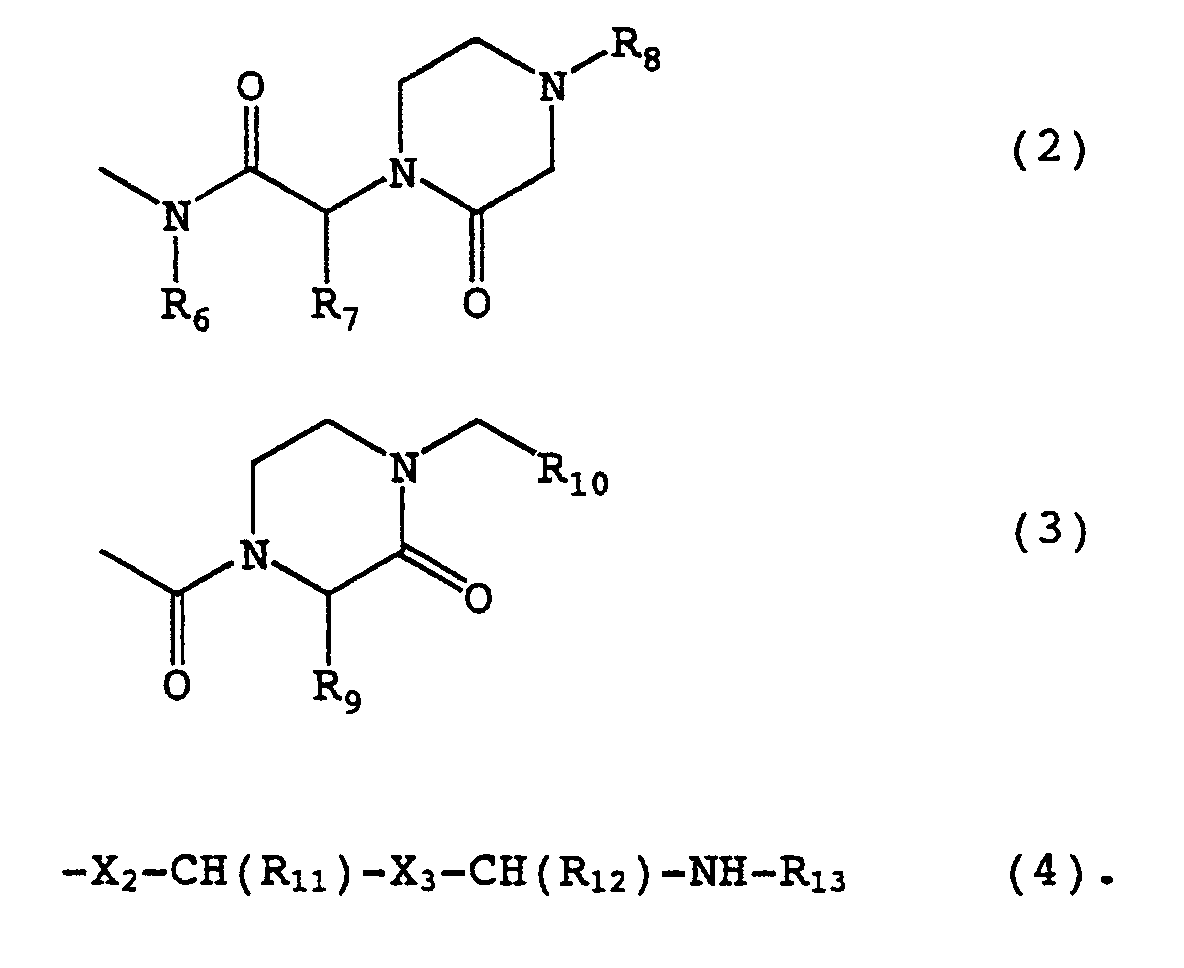
- A represents a group of formula (2), (3) or (4)
- B represents a carboxyl group, a C1-C6 alkoxycarbonyl
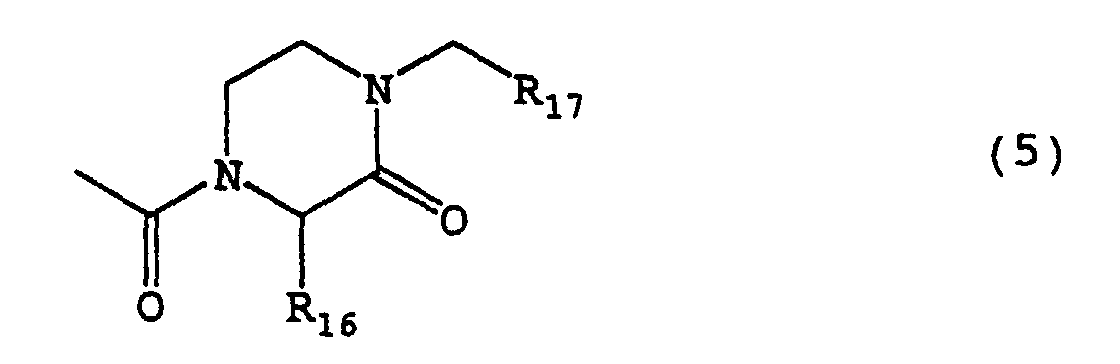
group or a group of formula (5)
wherein R16 represents (CH2)m2-COOH wherein m2 represents an integer of 1-3 or (CH2)n2-CONH2 wherein n2 represents 2 or 3, and R17 represents a hydrogen atom, a C1-C6 alkyl group, a carboxyl group or a C1-C6 alkoxycarbonyl group, provided that the carboxyl group in the above-mentioned A and B may be protected by an protecting group usually used in peptide chemistry, and that when A is a group represented by formula (4), B is a group represented by formula (5), or a pharmacologically acceptable salt thereof.
-
- In the preferred embodiment, the present invention relates to a depsipeptide derivative containing a piperazinone ring represented by formula (1')wherein

- X1 represents N(R4)-CO, N(R5)-CH2, CH2-CO, CH2-CH2, CH=CH, CH2-CH(OH) or CH(OH)-CH(OH), R1 represents a C5-C20 alkyl group or a C5-C15 alkoxy C1-C4 alkyl group, R2-R5 represent a hydrogen atom or a C1-C6 alkyl group,
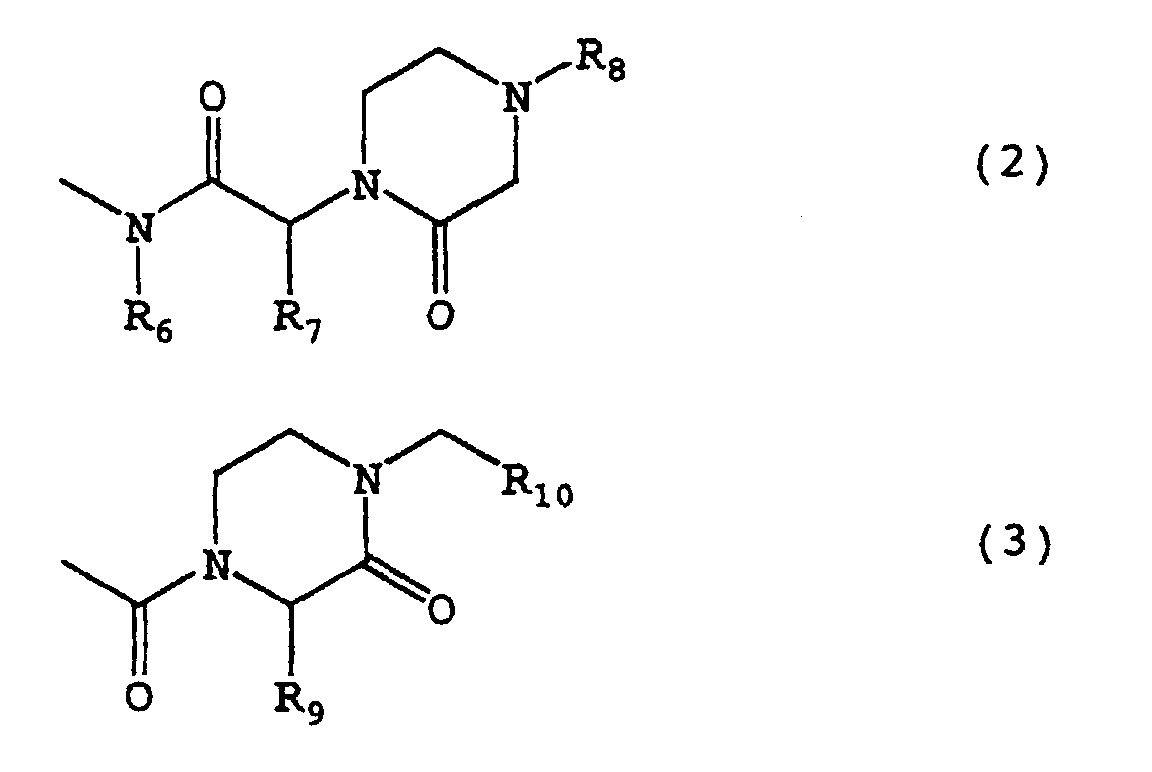
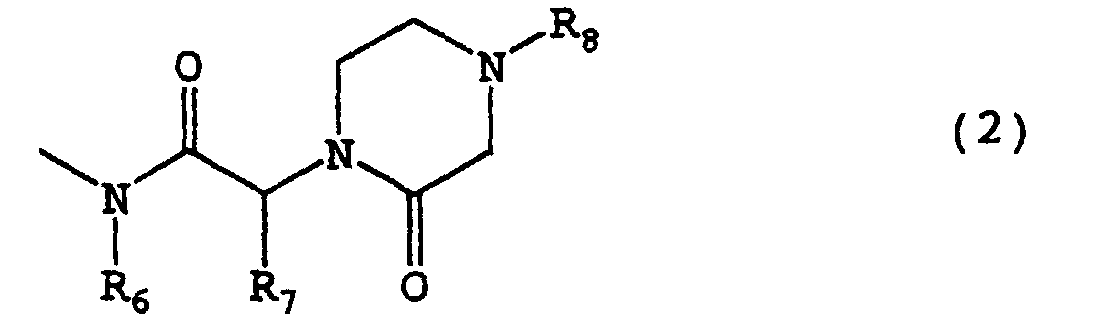
- A' represents a group of formula (2)
wherein R6 represents a hydrogen atom or a C1-C6 alkyl group, R7 represents (CH2)m1-COOH wherein m1 represents an integer of 1-3 or (CH2)n1-CONH2 wherein n1 represents 2 or 3, and R8 represents a hydrogen atom or an amine-protecting group usually used in peptide chemistry, and
- B' represents a carboxyl group or a C1-C6
alkoxycarbonyl group,
provided that the carboxyl group in the above-mentioned A' and B' may be protected by a protecting group usually used in peptide chemistry,
or a pharmacologically acceptable salt thereof. -
- In another embodiments, the present invention relates to a depsipeptide derivative having a piperazinone ring represented by formula (1'')wherein

- X1 represents N(R4)-CO, N(R5)-CH2, CH2-CO, CH2-CH2, CH=CH, CH2-CH(OH) or CH(OH)-CH(OH), R1 represents a C5-C20 alkyl group or a C5-C15 alkoxy C1-C4 alkyl group, R2-R5 represent a hydrogen atom or a C1-C6 alkyl group,
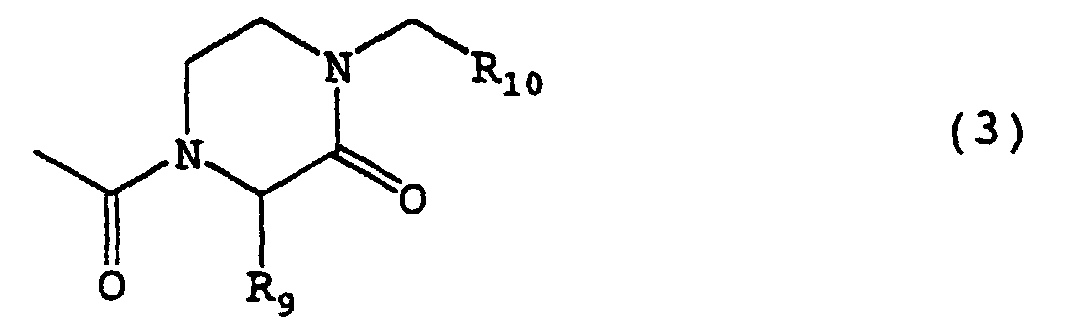
- A'' represents a group of formula (3)
wherein R9 represents (CH2)m1-COOH wherein m1 represents an integer of 1-3 or (CH2)n1-CONH2 wherein n1 represents 2 or 3, and R10 represents a hydrogen atom, a C1-C6 alkyl group, a carboxyl group or a C1-C6 alkoxycarbonyl group, and
- B' represents a carboxyl group or a C1-C6
alkoxycarbonyl group,
provided that the carboxyl group in the above-mentioned A'' and B' may be protected by an protecting group usually used in peptide chemistry,
or a pharmaceutically acceptable salt thereof. -
- In a depsipeptide derivative containing a piperazinone ring represented by formulae (1)-(1''), an alkyl group and an alkoxyl group are straight- or branched-chain, and a C5-C20 alkyl group include, for example, pentyl, isopentyl, t-pentyl, 1-methylbutyl, hexyl, isohexyl, heptyl, neopentyl, 1-methylheptyl, octyl, nonyl, decyl, undecyl, dodecyl, tridecyl, tetradecyl, pentadecyl, hexadecyl, heptadecyl, octadecyl, nonadecyl, icosyl and the like. A C1-C6 alkyl group include, for example, methyl, ethyl, n-propyl, isopropyl, n-butyl, isobutyl, t-butyl, n-pentyl, n-hexyl and the like, and a C1-C6 alkoxycarbonyl include, for example, methoxycarbonyl, ethoxycarbonyl, t-butoxycarbonyl and the like. A C5-C15 alkoxy C1-C4 alkyl group for R1 is, for example, pentyloxymethyl, hexyloxymethyl, heptyloxymethyl, octyloxymethyl, nonyloxymethyl, decynyloxymethyl, undecynyloxymethyl, tridecynyloxymethyl, tetradecynyloxymethyl, pentadecynyloxymethyl, pentyloxyethyl, hexyloxyethyl, heptyloxyethyl, octyloxyethyl, nonyloxyethyl, decynyloxyethyl, undecynyloxyethyl, tridecynyloxyethyl, tetradecynyloxyethyl, pentadecynyloxyethyl, pentyloxypropyl, hexyloxypropyl, heptyloxypropyl, octyloxypropyl, nonyloxypropyl, decynyloxypropyl, undecynyloxypropyl, tridecynyloxypropyl, tetradecynyloxypropyl, pentadecynyloxypropyl, pentyloxybutyl, hexyloxybutyl, heptyloxybutyl, octyloxybutyl, nonyloxybutyl, decynyloxybutyl, undecynyloxybutyl, tridecynyloxybutyl, tetradecynyloxybutyl, pentadecynyloxybutyl and the like.
- The protecting groups for an amine and a carboxyl group used in the depsipeptide derivatives containing a piperazinone ring represented by formula (1) of the invention are described in Nobuo Izumiya et al., "Fundamentals and Experiments for Peptide Synthesis" (Maruzen Co., Ltd., 1985).
- The protecting groups for an amine include a t-butoxycarbonyl group (hereinafter referred to as "Boc"), a benzyloxycarbonyl group (hereinafter referred to as "Cbz"), a p-methoxybenzyloxycarbonyl group, a 9-fluorenylmethoxycarbonyl group (hereinafter referred to as "Fmoc"), a p-nitrobenzyloxycarbonyl group, an isobornyloxycarbonyl group, a p-biphenylisopropyloxycarbonyl group, a 3,5-dimethoxy-α,α-dimethylbenzylcarbonyl group, a methylsulfonyloxycarbonyl group, an isonicotinyloxycarbonyl group, a 2,2,2-trichloroethyloxycarbonyl group, a 2-(trimethylsilyl)-ethoxycarbonyl group, a formyl group, a phthaloyl group, a dithiasuccinoyl group, a p-toluenesulfonyl group, a o-nitrophenylsulfenyl group, a 2-nitrophenyithio group, a 3-nitro-2-pyridinesulfenyl group, a diphenylphosphinyl group, a diphenylphosphinothioyl group, a dimethylphosphinothioyl group, a triphenylmethyl group, a 2-benzoyl-1-methylvinyl group and the like. Boc, Cbz, Fmoc and p-methoxybenzyloxycarbonyl group are preferable.
- The protecting groups for the carboxyl group include esters such as benzyl ester (a benzyloxy group, hereinafter referred to as "OBzl"), tertiary butyl ester (a t-butoxy group, hereinafter referred to as "OtBu"), methyl ester, ethyl ester, phenacyl ester (phenacyloxy, hereinafter referred to as "OPac"), trichloroethyl ester, p-nitrobenzyl ester, diphenylmethyl ester, benzhydryl ester, p-methoxybenzyl ester, 4-picolyl ester, cyclohexyl ester and the like. OBzl, OtBu, OPac and the like are preferable.
- In the depsipeptide derivatives containing a piperazinone ring represented by formulae (1') and (1''), B' is preferably a carboxyl group.
- The invention also relates to a medicine comprising as an active ingredient a depsipeptide derivative containing a piperazinone ring represented by formula (1) and formulae (1')-(1'') in the preferred embodiments or a pharmacologically acceptable salt thereof.
- More particularly, the invention relates to an accelerator for the production of apolipoprotein E, more specifically, an agent for the treatment of neurologic injury, an agent for the treatment of dementia and an antihyperlipidemic agent, which comprise as an active ingredient a depsipeptide derivative containing a piperazinone ring represented by formula (1) and formulae (1')-(1'') in the preferred embodiments or a pharmacologically acceptable salt thereof.
- A depsipeptide derivative containing a piperazinone ring or a pharmacologically acceptable salt thereof of the invention can be prepared by using methods conventionally employed in the peptide synthesis, for example, a condensing agent method, an azide method, a chloride method, an acid anhydride method, a mixed acid anhydride method, an active ester method, a redox method, an enzyme method or the like as described in Nobuo Izumiya et al., "Fundamentals and Experiments for Peptide Synthesis" (Maruzen Co., Ltd., 1985).
- The depsipeptide derivatives containing a piperazinone ring or the pharmacologically acceptable salts thereof of the invention can be prepared, for example, by protecting a carboxyl group in a 3-hydroxycarboxylic acid of the following formulawherein R1 has the same meaning as defined above, with a protecting group to form an ester, and condensing a hydroxyl group in the 3-hydroxycarboxylic acid with a carboxyl group in an aminocarboxylic acid or the like, of which an N-terminal or a C-terminal is protected, by a conventional method, and deprotecting the N-terminal or the C-terminal of the protecting group for the aminocarboxylic acid or the like, followed by condensing with an aminocarboxylic acid or the like having the desired piperazinone ring according to a conventional method for the peptide synthesis. If necessary, the protecting group of the carboxyl group of 3-hydroxycarboxylic acid may be deprotected, and further condensed with the piperazinone ring.
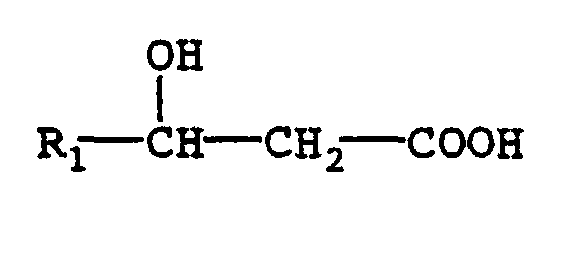
- The depsipeptide derivatives can be also prepared by condensing a carboxyl group in the 3-hydroxycarboxylic acid with the piperazinone ring or a C1-C6 alcohol according to a conventional method, and condensing a hydroxyl group in the 3-hydroxycarboxylic acid with a carboxyl group in an aminocarboxylic acid or the like, of which an N-terminal or a C-terminal is protected, by a conventional method, and deprotecting the N-terminal or the C-terminal of the protecting group for the aminocarboxylic acid or the like, followed by condensing with an aminocarboxylic acid or the like having the desired piperazinone ring according to a conventional method for the peptide synthesis.
- As an alternative method, they can be prepared by preliminarily condensing an amino acid required previously with the above-mentioned aminocarboxylic acid, followed by linking it to the hydroxyl or carboxyl group in the 3-hydroxycarboxylic acid through an ester bond or an amide bond.
- The protection of the carboxyl group in the 3-hydroxycarboxylic acid can be carried out by a methylesterification reaction wherein the carboxyl group is reacted with diazomethane in a solvent such as ether, methanol or the like under ice-cooling or at room temperature, or by a benzylesterification reaction wherein the carboxyl group is reacted with benzyl bromide in the presence of a basic substance such as triethylamine, in a solvent such as dimethylformamide (hereinafter referred to as "DMF"), dimethyl sulfoxide (hereinafter referred to as "DMSO") or the like at room temperature or under heating.
- The condensation of an aminocarboxylic acid to the hydroxyl group in a compound having the protected carboxyl group may be carried out using as a condensing reagent N,N'-dicyclohexylcarbodiimide (hereinafter referred to as "DCC") or 1-ethyl-3-(3'-dimethyl-aminopropyl)carbodiimide hydrochloride, i.e., water-soluble carbodiimide (hereinafter referred to as "WSCI") in a solvent such as ether, acetone, chloroform, dichloromethane, ethyl acetate, DMF, tetrahydrofuran (hereinafter referred to as "THF"), acetonitrile, DMSO or the like under ice-cooling or at room temperature, preferably in the presence of a catalyst for acylation such as dimethylaminopyridine (hereinafter referred to as "DMAP").
- Illustrative examples of 3-hydroxycarboxylic acids used as a starting material for the depsipeptide derivative containing a piperazinone ring can include 3-hydroxycaprylic acid, 3-hydroxypelargonic acid, 3-hydroxycapric acid, 3-hydroxylauric acid, 3-hydroxymyristic acid, 3-hydroxypalmitic acid, 3-hydroxymargaric acid, 3-hydroxystearic acid, 4-octyloxy-3-hydroxybutyric acid, 4-nonyloxy-3-hydroxybutyric acid, 4-decyloxy-3-hydroxybutyric acid, 4-undecyloxy-3-hydroxybutyric acid, 4-dodecyloxy-3-hydroxybutyric acid, 4-tridecyloxy-3-hydroxybutyric acid and the like.
- As the 3-hydroxycarboxylic acids, optically active R-isomers or S-isomers and racemates can be used, and R-isomers are preferably used when R1 is a C5-C20 alkyl group, while S-isomers are preferably used when R1 is a C5-C15 alkoxy C1-C4 alkyl group.
- In preparing the depsipeptide derivatives containing a piperazinone ring of the above-mentioned formula (1) using a condensing agent, the agents can be used such as DCC, WSCI, O-(1H-benzotriazol-1-yl)-N,N,N',N'-tetramethyluronium tetrafluoroborate, benzotriazol-1-yl-oxy-tris(dimethylamino)phosphonium hexafluorophosphate, 3-(dimethoxyphosphoryloxy)-1,2,3-benzotriazine (hereinafter referred to as "DEPBT") or O-(7-azabenzotriazol-1-yl)-1,2,3-tetramethyluronium hexafluorophosphate (hereinafter referred to as "HATU") and the like. It is also preferable to simultaneously add the additives usually employed for preventing racemization, for example, N-hydroxysuccinimide, 1-hydroxybenzotriazole (hereinafter referred to as "HOBt"), N-hydroxy-5-norbornene-2,3-dicarbodiimide beazotriazole, 1-hydroxy-7-azabenzotriazole (hereinafter referred to as "HOAt") and the like.
- Typical condensing agents used in the azide method include diphenylphosphoric azide and the like.
- Before carrying out the condensation reaction, known conventional protecting means are preferably applied to the carboxyl group, amino group and the like not involved in said condensation reaction.
- In this case, a variety of the above-mentioned protecting groups can be used in such protecting means.
- In the elimination reaction of the protecting group in the process steps for the preparation of the depsipeptide derivative containing a piperazinone ring, it is required that the protecting group can be removed without giving any influence on the peptide bond. The elimination reaction may be appropriately selected, depending on the type of the protecting group used.
- The solvents which may be used in the synthesis of each peptide include, for example, chloroform, dichloromethane, ethyl acetate, DMF, DMSO, pyridine, dioxane, THF, dimethoxyethane, acetonitrile or a mixture of these two or more solvents. This condensation reaction is carried out at a temperature ranging from about -20 to 50°C.
- For the peptide synthesis, any of a liquid phase method and a solid phase method can be employed. Further, a column method or a batch method may be used.
- The present depsipeptide derivatives containing a piperazinone ring thus prepared in the form of salts can be converted to the corresponding free forms. The depsipeptide derivatives thus prepared in the free forms can be converted to the corresponding pharmacologically acceptable salts. When the depsipeptide derivatives are in the form of the acidic compounds due to the presence of a carboxyl group therein, the corresponding acidic compounds can be formed with pharmacologically acceptable inorganic or organic bases into the salts thereof such as sodium, potassium, calcium and ammonium salts. When the depsipeptide derivatives are in the form of the basic compounds due to the presence of an amino group therein, the corresponding basic compounds can be formed with pharmacologically acceptable inorganic or organic acids into the inorganic salts such as hydrochlorides, hydrobromides, sulfates and phosphates, or the organic salts such as acetates, succinates, oxalates, malates and tartarates.
- The depsipeptide derivatives containing a piperazinone ring represented by the formula (1) of the invention can be prepared by a variety of methods, illustrative examples of which are shown in the following Reaction Schemes 1-4.
- In the reaction procedure according to Reaction Scheme 1, p-methoxycinnamic aldehyde and L-aspartic acid α-benzyl β-t-butyl ester were reacted to form Intermediate 1, Fmoc glycine was reacted with Intermediate 1 to form Intermediate 2, which was then ozonized to form Intermediate 3, and Intermediate 3 was catalytic-reduced to form Intermediate 4.
- The carboxyl group of 3-hydroxycarboxylic acid, e.g., 3-hydroxymyristic acid was protected with phenacyl bromide to give Intermediate 5, and the amino group of 5-amino-3-pentenoic acid was protected with Fmoc-Cl to give Intermediate 6. Intermediate 5 and Intermediate 6 were reacted to give Intermediate 7 and then the protecting group Fmoc for the amino group of Intermediate 7 was deprotected to give Intermediate 8.
- Intermediate 4 and Intermediate 8 as prepared above were reacted to give the aimed Compound 1. Subsequently, the protecting groups of Compound 1 were removed in turn to give Compounds 2 and 3, respectively.
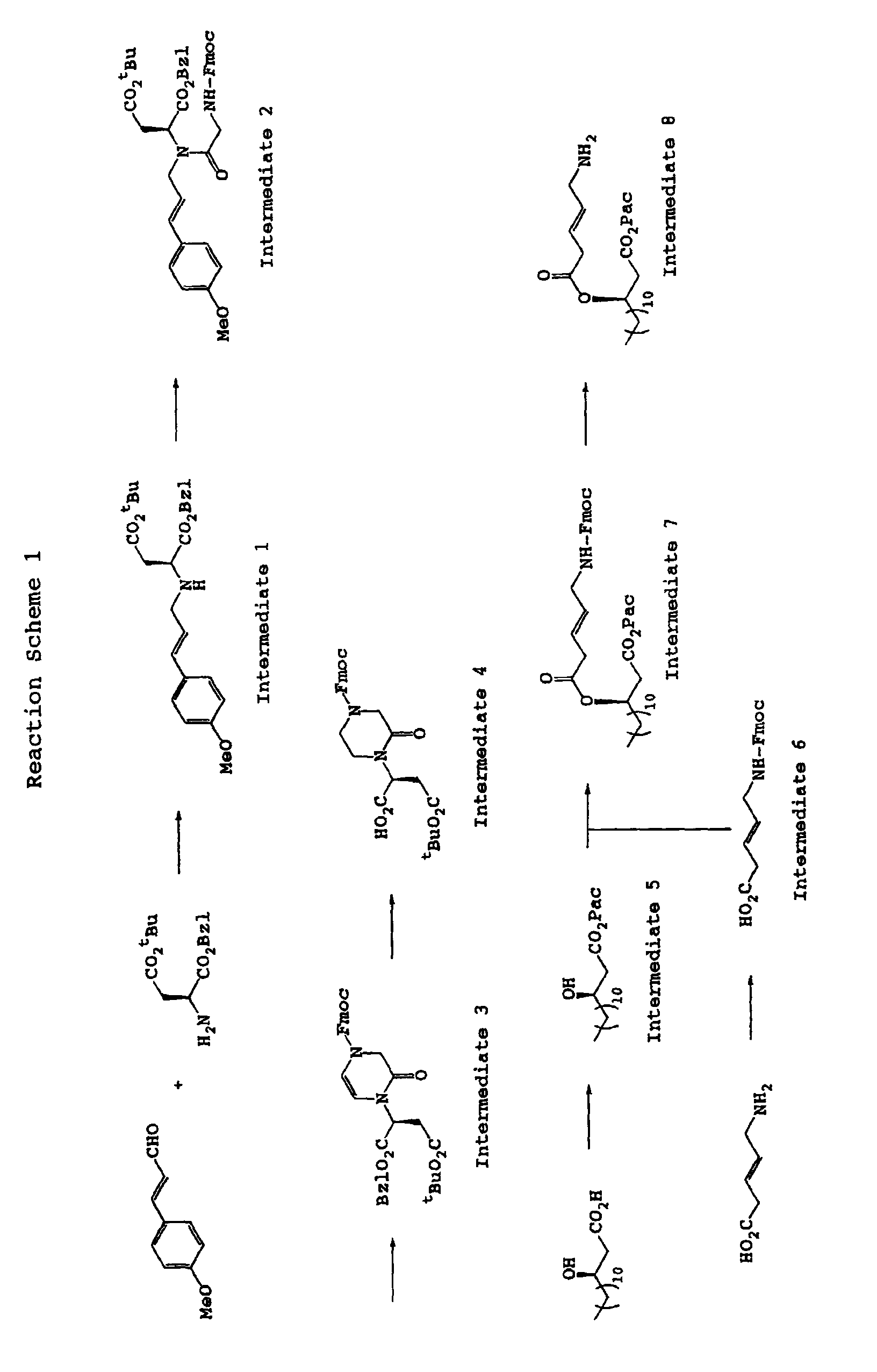
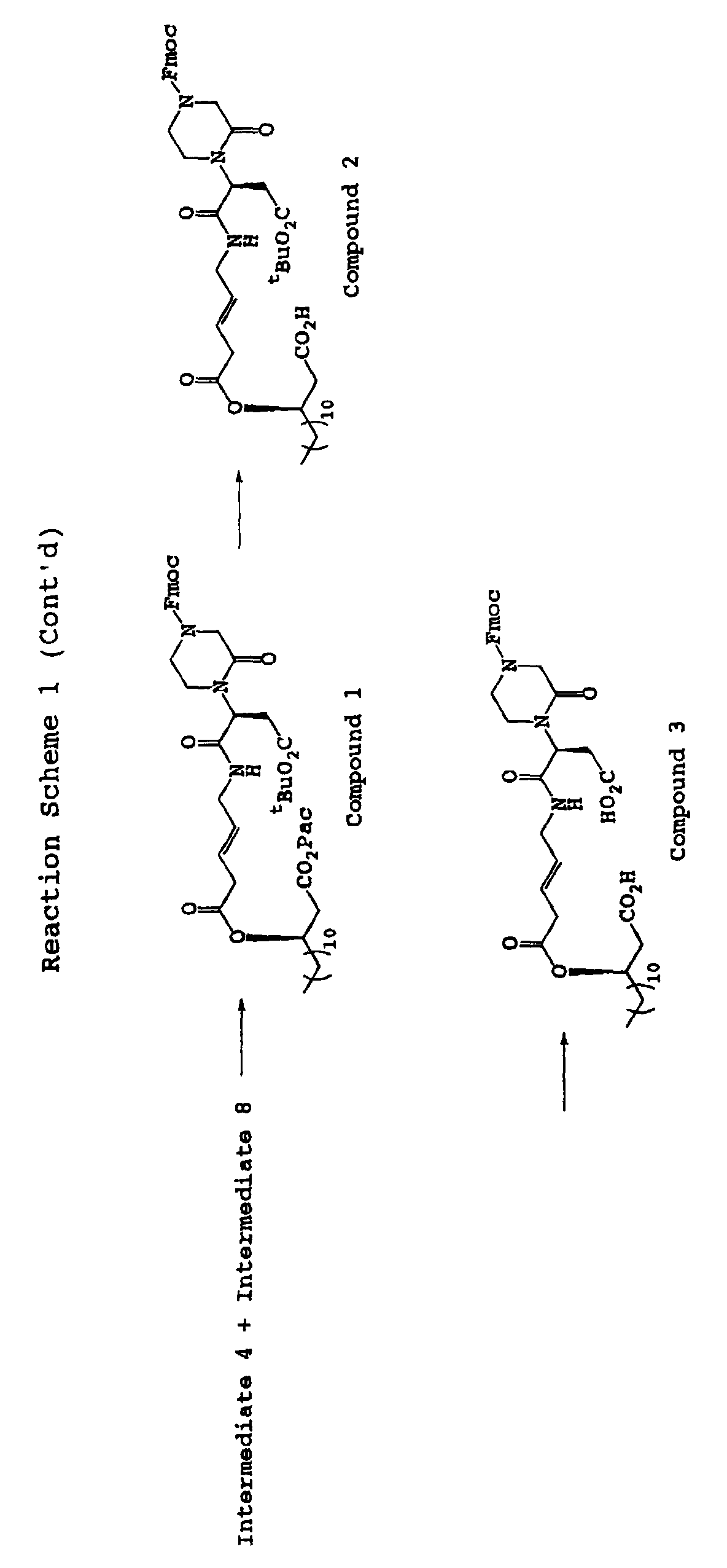


- In the reaction procedure according to Reaction Scheme 2, Boc-D-leucine was reduced with sodium borohydride to give Intermediate 9, which was then oxidized to convert an alcohol in Intermediate 9 into an aldehyde, thus giving Intermediate 10. Intermediate 10 was reacted with isoleucine having the protected carboxyl group to give Intermediate 11. The carboxyl group of Intermediate 11 was deprotected to give Intermediate 12, and the amino group of Intermediate 12 was protected to give Intermediate 13.
- The carboxyl group of 3-hydroxymyristic acid was protected to give Intermediate 14, which was then esterified with Intermediate 13 to give Intermediate 15. The protecting group for the amino group of Intermediate 15 was deprotected to give Intermediate 16. Intermediate 16 was reacted with Intermediate 4 to give Compound 4, and the protecting groups of Compound 4 were removed in turn to give Compounds 5 and 6, respectively.
- In the reaction procedure according to Reaction Scheme 3, p-methoxycinnamic aldehyde and L-glycine tert-butyl ester were reacted to give Intermediate 17, which was then reacted with Fmoc-D-aspartic acid β-tert-butyl ester to give Intermediate 18. Intermediate 18 was reacted with ozone to break the double bond, which was then subjected to cyclization to give Intermediate 19. The protecting group for the amino group of Intermediate 19 was deprotected to give Intermediate 20.
- One of the carboxyl groups in 2-buten-1,4-dicarboxylic acid was protected to give Intermediate 21, and the carboxyl group of 3-hydroxymyristic acid was protected to give Intermediate 22. Intermediate 21 and Intermediate 22 were reacted to give Intermediate 23, and the protecting group for one of the carboxyl groups in the resultant Intermediate 23 was deprotected to give Intermediate 24.
- Subsequently, Intermediate 20 and Intermediate 24 as prepared in this way were reacted to give Compound 7, and the protecting groups for the carboxyl groups of Compound 7 were deprotected to give Compound 8.
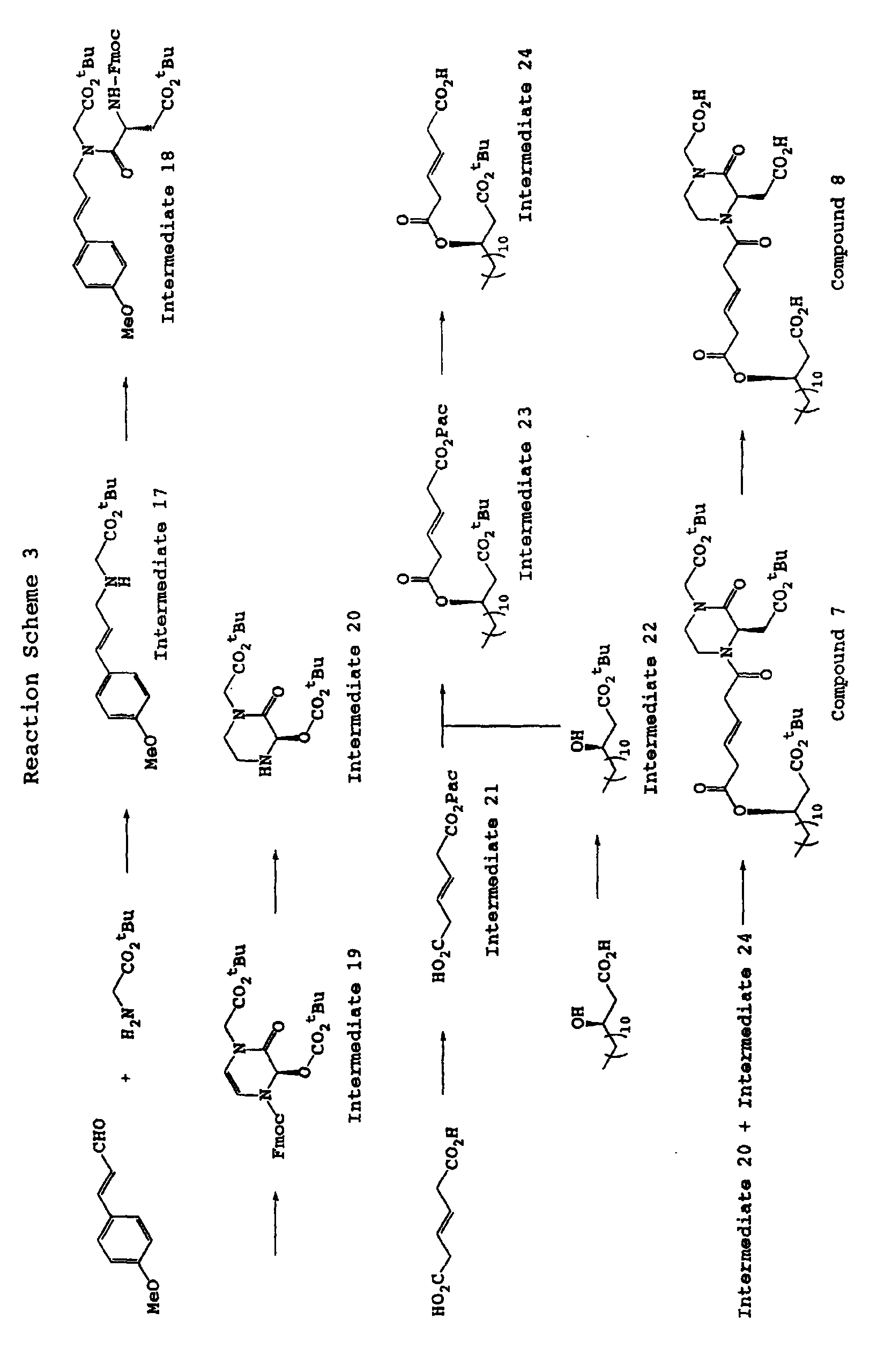
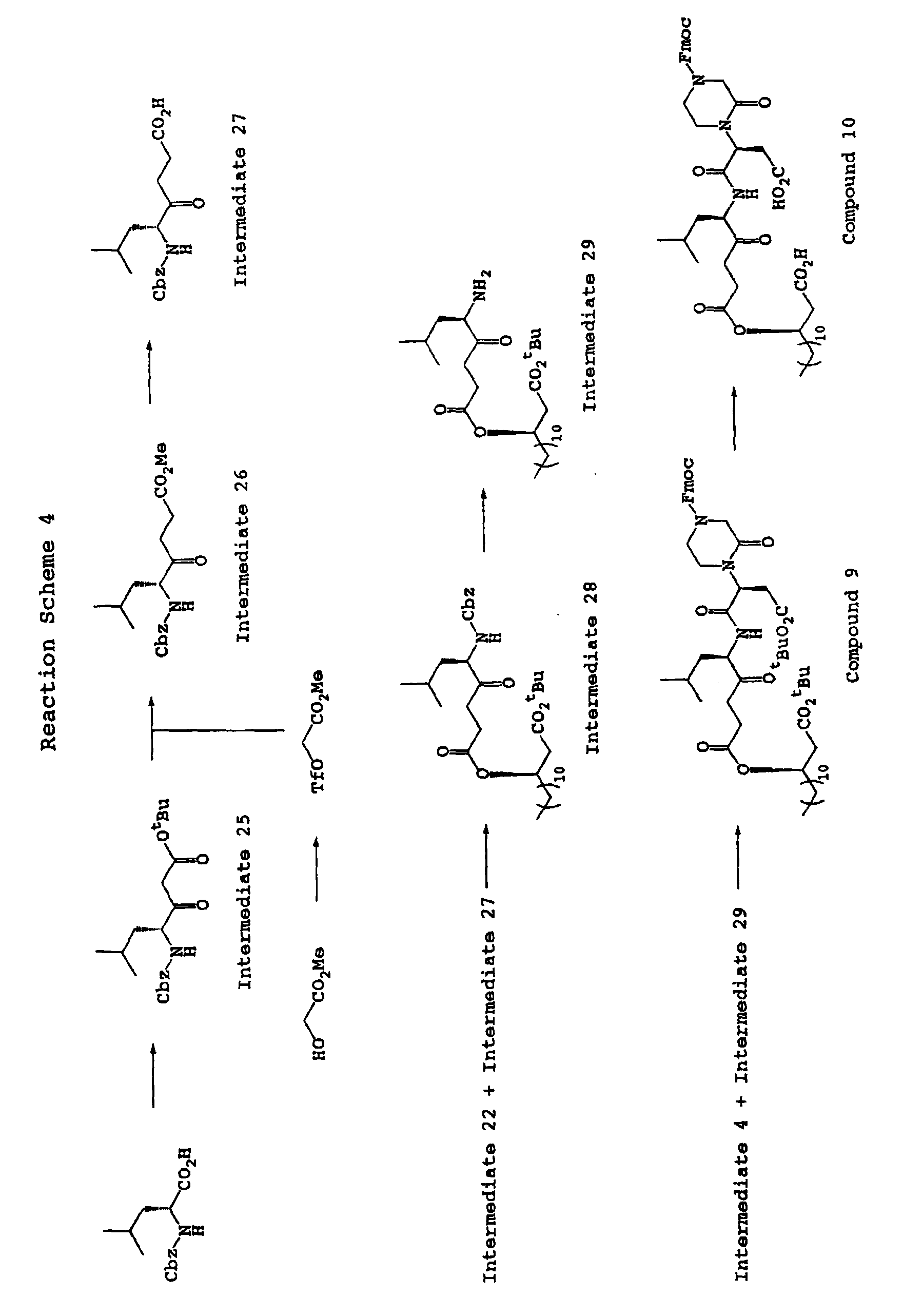
- In the reaction procedure according to Reaction Scheme 4, D-leucine having the protected amino group was used as a starting material to prepare Intermediate 25, which was then converted into Intermediate 26. The protecting group for the carboxyl group of Intermediate 26 was removed to give Intermediate 27.
- The resultant Intermediate 27 and Intermediate 22 in Reaction Scheme 3 were reacted to give Intermediate 28, and the protecting group for the amino group of the Intermediate 28 was deprotected to give Intermediate 29.
- Intermediate 29 and Intermediate 4 in Reaction Scheme 1 were reacted to give Compound 9. The protecting group for the carboxyl group of Compound 9 was deprotected to give Compound 10.
- The depsipeptide derivatives containing a piperazinone ring represented by formula (1) prepared according to Reaction Schemes 1-4 or pharmacologically acceptable salts thereof act on a Hep G2 cell which is a cell for the production of apolipoprotein E, thereby potently accelerating the production of apolipoprotein E. Thus they are useful as an accelerator for the production of apolipoprotein E, and also as an agent for the treatment of neurologic injury, an agent for the treatment of dementia and an antihyperlipidemic agent.
- The depsipeptide derivatives containing a piperazinone ring or pharmacologically acceptable salts thereof can be formulated into pharmaceutical preparations in various dosage forms. The pharmaceutical preparations include oral preparations, e.g., solid preparations such as tablets, hard capsules, soft capsules, granules and powders, and liquid preparations such as solutions, emulsions and suspensions. The parenteral preparations include injections, suppositories and the like.
- The pharmaceutical preparations can be prepared by adding to the depsipeptide derivatives and salts, conventional additives such as excipients, stabilizers, antiseptics, solubilizers, wetting agents, emulsifiers, lubricants, sweetening agents, colorants, flavorings, isotonic agents, buffers, antioxidants and the like.
- The additives include starch, sucrose, fructose, lactose, glucose, mannitol, sorbitol, precipitated calcium carbonate, crystalline cellulose, carboxymethylcellulose, dextrin, gelatin, acacia, magnesium stearate, talc, hydroxypropylmethylcellulose and the like.
- When the depsipeptide derivatives containing a piperazinone ring or pharmacologically acceptable salts thereof are used as the liquid preparations and injections, they can be dissolved or suspended in any conventional diluent. The diluents include physiological saline, Ringer's solution, aqueous glucose solution, alcohols, fatty acid esters, glycols, glycerol, animal or vegetable fats and oils, paraffins and the like. These preparations can be prepared by a conventional method.
- A usual clinical dose is, for oral administration, in the range of 0.5-5000 mg, preferably 5-500 mg per day for adult, and for parenteral administration, in the range of 0.05-5000 mg per day for adult.
- A process for the preparation of the depsipeptide derivatives is illustrated by the following Examples, a function of accelerating the production of apolipoprotein E by the depsipeptide derivatives is illustrated by the following Test Examples, and illustrative examples of pharmaceutical preparations comprising the depsipeptide derivatives as an active ingredient are given by the following Preparation Examples.
- The reaction process steps in Example 1 are shown in Reaction Scheme 1. Specific compounds indicated by the numbers of the intermediates and compounds in this example are the same as those shown in Reaction Scheme 1.
- i) To a solution of p-methoxycinnamic aldehyde (4.86
g) and L-aspartic acid α-benzyl β-t-butyl ester (8.38 g) in
1,2-dichloroethane (80 ml) was added sodium
triacetoxyborohydride (8.48 g) while stirring at room
temperature, and the mixture was stirred overnight. The
reaction solution was diluted with chloroform, washed with
5% aqueous sodium hydrogencarbonate solution, and dried over
anhydrous sodium sulfate. After the solvent was distilled
away, the residue was purified by a silica gel column
chromatography to afford Intermediate 1 (8.04 g).
- 1H-NMR (δ ppm, CDCl3) 7.31-7.36 (5H, m), 7.25-7.28 (m, 2H), 6.81-6.85 (2H, m), 6.41 (1H, d, J=16Hz), 6.03-6.10 (1H, m), 5.17 (1H, d, J=12Hz), 5.15 (1H, d, J=12Hz), 3.80 (3H, s), 3.68 (1H, t, J=6.3Hz), 3.43-3.48 (2H, m), 2.59-2.71 (2H, m), 1.41 (9H, s).
- ii) To a solution of Intermediate 1 (8.02 g) and Fmoc-glycine
(6.74 g) in DMF (30 ml) were added DEPBT (6.81 g)
and triethylamine (2.8 ml) while stirring at room
temperature, and the mixture was stirred for 5 hours. The
solvent was distilled away from the reaction solution, and
the residue was purified by a silica gel column
chromatography to afford Intermediate 2 (10.3 g).
- 1H-NMR (δ ppm, CDCl3) 7.76 (2H, d, J=7.8Hz), 7.61 (2H, d, J=7.3Hz), 7.38-7.42 (2H, m), 7.22-7.33 (7H, m), 7.14 (2H, d, J=8.3Hz), 6.80 (2H, d, J=8.3Hz), 6.55 (1H, d, J=16Hz), 5.92-5.99 (1H, m), 5.73 (1H, br), 5.08-5.15 (2H, m), 4.60-4.63 (1H, m), 4.38 (2H, d, J=7.3Hz), 4.04-4.24 (5H, m), 3.81 (3H, m), 3.21-3.26 (1H, m), 2.79-2.86 (1H, m), 1.41 (9H, s).
- iii) A solution of Intermediate 2 (10.1 g) in a mixed
solvent of dichloromethane (100 ml) and methanol (250 ml)
was cooled to -70°C, and ozone was introduced until the
reaction solution became light blue. Dimethyl sulfide (3.5
ml) was added to the reaction solution, the temperature of
which was gradually elevated to room temperature, and the
solution was further stirred overnight. The solvent was
distilled away from the reaction solution and the residue
was purified by a silica gel column chromatography to afford
Intermediate 3 (3.57 g).
- 1H-NMR (δ ppm, CDCl3) 7.88 (2H, d, J=7.8Hz), 7.64-7.66 (2H, m), 7.39-7.44 (2H, m), 7.30-7.36 (7H, m), 6.16 (1H, br), 5.61 (1H, br), 5.20-5.24 (1H, m), 5.12-5.15 (2H, m), 4.30-4.38 (3H, m), 4.03 (1H, d, J=17Hz), 3.78 (1H, d, J=17Hz), 2.88-2.95 (1H, m), 2.61-2.73 (1H, m), 1.36 (9H, s).
- iv) To a solution of Intermediate 3 (1.00 g) in
methanol (150 ml) was added 10% palladium carbon (0.72 g)
and the resultant suspension was stirred under an atmosphere
of hydrogen at room temperature for one hour. The catalyst
was filtered off and the solvent was distilled away from the
filtrate. A solution of sodium carbonate (0.37 g) in water
(4 ml) was added to the residue, a solution of N-9-fluorenylmethoxycarbonyl-succinimide
(hereinafter referred
to as "Fmoc-OSu") (0.58 g) in DMF (8 ml) was added to the
resultant suspension under ice-cooling, and the solution was
stirred at room temperature for one hour. The reaction
solution was diluted with water, and washed with diethyl
ether and ethyl acetate. While stirring the aqueous layer
on an ice-cooling bath, the layer was adjusted to a pH value
of 2 with 6N hydrochloric acid and extracted with
chloroform. The organic layer was dried over anhydrous
sodium sulfate and the solvent was distilled away. The
residue was purified by a silica gel column chromatography
to afford Intermediate 4 (0.55 g).
- 1H-NMR (δ ppm, d6-DMSO) 12.9 (1H, br), 7.87 (2H, d, J=7.3Hz), 7.61 (2H, d, J=7.8Hz), 7.39-7.43 (2H, m), 7.31-7.35 (2H, m), 4.98-5.02 (1H, m), 4.39 (2H, d, 6.8Hz), 4.29 (1H, t, 6.3Hz), 3.94 (2H, s), 3.23-3.59 (4H, m), 2.85 (1H, dd, J=6.8Hz, 16Hz), 2.66 (1H, dd, J=8.3Hz, 16Hz), 1.37 (9H, s).
- v) To a solution of (R)-3-hydroxymyristic acid (2.50
g) and triethylamine (1.43 ml) in DMF (25 ml) was added
phenacyl bromide (2.04 g) at room temperature and the
mixture was stirred overnight. After the solvent was
distilled away, the residue was diluted with ethyl acetate,
washed with water and dried over anhydrous sodium sulfate.
After the solvent was distilled away, the residue was
purified by a silica gel column chromatography to afford
Intermediate 5 (3.53 g).
- 1H-NMR (δ ppm, CDCl3) 7.92 (2H, d, J=6.8Hz), 7.63 (1H, d, J=7.3Hz), 7.50 (2H, d, J=7.6Hz), 5.48 (1H, d, J=17Hz), 5.37 (1H, d, J=17Hz), 4.09-4.18 (1H, m), 3.41 (1H, br), 2.70 (1H, dd, J=2.9, 15Hz), 2.57 (1H, dd, J=9.3, 15Hz), 1.19-1.67 (20H, m), 0.88 (3H, t, J=6.8Hz).
- vi) To a solution of 5-amino-3-pentenoic acid (1.00 g)
in 10% aqueous sodium carbonate solution (20 ml) and dioxane
(10 ml) was added a solution of Fmoc-Cl (2.20 g) in dioxane
(10 ml) under ice-cooling and the mixture was stirred
overnight. The reaction solution was diluted with ethyl
acetate and extracted three times with 10% aqueous sodium
carbonate solution. The aqueous layer was acidified with 1N
hydrochloric acid and then extracted with ethyl acetate.
The organic layer was washed successively with water and
saturated aqueous sodium chloride solution, and dried over
anhydrous sodium sulfate. The solvent was distilled away to
afford Intermediate 6 (2.44 g).
- 1H-NMR (δ ppm, CDCl3) 7.75-7.76 (2H, m), 7.57-7.59 (2H, m), 7.37-7.41 (2H, m), 7.28-7.32 (2H, m), 5.50-5.70 (2H, m), 4.88 (1H, m), 4.40-4.43 (2H, m), 4.20-4.30 (1H, m), 3.60-3.82 (2H, m), 3.00-3.12 (2H, m).
- vii) To a solution of Intermediate 5 (0.86 g),
Intermediate 6 (0.93 g) and DMAP (61 mg) in dichloromethane
(30 ml) was added DCC (0.77 g) under ice-cooling and the
mixture was stirred under ice-cooling for 2 hours and
subsequently at room temperature overnight. After the
precipitate was filtered off, the solvent was distilled
away. The residue was diluted with ethyl acetate, and
washed successively with 10% aqueous citric acid solution,
water, 5% aqueous sodium hydrogencarbonate solution and
water, and then dried over anhydrous sodium sulfate. After
the solvent was distilled away, the residue was purified by
a silica gel column chromatography to afford Intermediate 7
(1.54 g).
- 1H-NMR (δ ppm, CDCl3) 7.88 (2H, d, J=6.8Hz), 7.75 (2H, d, J=7.8Hz), 7.58 (2H, d, J=7.3Hz), 7.58 (1H, t, J=7.6Hz), 7.45 (2H, t, J=7.6Hz), 7.39 (2H, t, J=7.6Hz), 7.30 (2H, t, J=7.3Hz), 5.69-5.80 (1H, m), 5.57-5.68 (1H, m), 5.27-38 (3H, m), 4.99 (1H, br s), 4.36 (2H, d, J=6.8 Hz), 4.19 (1H, t, J=6.6 Hz), 3.81 (2H, br s), 3.05-3.17 (2H, m), 2.77 (1H, dd, J=3.4Hz), 2.75 (1H, d, J=1.5Hz), 1.53-1.76 (2H, m), 1.18-1.41 (18H, m), 0.88 (3H, t, J=6.8Hz).
- viii) To a solution of Intermediate 7 (0.33 g) in DMF (5
ml) was added diethylamine (0.5 ml) and the mixture was
stirred at room temperature for one hour. After the solvent
was distilled away from the reaction solution, the residue
was purified by a silica gel column chromatography to afford
Intermediate 8 (0.38 g).
- 1H-NMR (δ ppm, CDCl3) 7.89-7.91 (2H, m), 7.59-7.63 (1H, m), 7.47-7.51 (2H, m), 5.70-5.72 (2H, m), 5.28-5.39 (3H, m), 3.30-3.31 (2H, m), 3.09-3.11 (2H, m), 2.71-2.81 (2H, m), 2.17 (2H, br), 1.25-1.30 (20H, m), 0.88 (3H, t, J=6.8Hz).
- ix) To a solution of Intermediate 4 (0.49 g),
Intermediate 8 (0.38 g) and HOBt monohydrate (0.17 g) in
dichloromethane (15 ml) was added WSCI (0.29 g) under ice-cooling,
and the mixture was stirred under ice-cooling for
10 minutes and subsequently at room temperature overnight.
The reaction solution was diluted with chloroform, washed
with 5% aqueous sodium hydrogencarbonate solution and dried
over anhydrous sodium sulfate. After the solvent was
distilled away, the residue was purified by a silica gel
column chromatography to afford compound 1 (0.53 g).
- 1H-NMR (δ ppm, CDCl3) 7.30-7.90 (13H, m), 6.41 (1H, t, J=5.4Hz), 5.67-5.72 (1H, m), 5.52-5.59 (1H, m), 5.28-5.42 (4H, m), 2.58-4.45 (17H, m), 1.42 (9H, s), 1.25-1.37 (20H, m), 0.88 (3H, t, J=6.3Hz).
- x) To a solution of Compound 1 (0.49 g) in acetic
acid (5 ml) was added zinc powder (1 g) and the mixture was
stirred at 50°C for 2 hours. The insoluble material was
filtered off and the solvent was distilled away from the
filtrate. The residue was purified by a silica gel column
chromatography to afford Compound 2 (0.43 g).
- 1H-NMR (δ ppm, CD3OD) 7.78-7.83 (2H, m), 7.59 (2H, d, J=7.3Hz), 7.40 (2H, t, J=7.3Hz), 7.30-7.34 (2H, m), 5.64-5.72 (1H, m), 5.54-5.62 (1H, m), 5.31-5.36 (1H, m), 5.16-5.23 (1H, m), 4.50 (2H, d, J=6.3Hz), 4.25 (1H, t, J=6.3Hz), 3.34-4.03 (8H, m), 3.03 (2H, d, J=6.3Hz), 2.92 (2H, dd, J=6.8Hz, 16Hz), 2.55-2.64 (1H, m), 2.53 (2H, d, J=7.3Hz), 1.42 (9H, s), 1.26-1.38 (20H, m), 0.89 (3H, t, J=6.3Hz).
- xi) To Compound 2 (0.38 g) was added trifluoroacetic
acid (hereinafter referred to as "TFA") (1.5 ml) and the
mixture was stirred at room temperature for one hour. The
reaction solution was diluted with chloroform, washed with
water and dried over anhydrous sodium sulfate. After the
solvent was distilled away, the residue was purified by a
silica gel column chromatography to afford Compound 3 (0.27
g).
- 1H-NMR (δ ppm, d6-DMSO) 8.26 (1H, br), 7.86 (2H, d, J=7.8Hz), 7.61 (2H, d, J=7.8Hz), 7.41 (2H, t, J=7.3Hz), 7.33 (2H, t, J=7.3Hz), 5.54-5.60 (2H, m), 5.25-5.29 (1H, m), 5.08-5.11 (1H, m), 4.25-4.38 (3H, m), 3.88-3.98 (2H, m), 3.33-3.81 (6H, m), 2.90-3.00 (2H, m), 2.73-2.79 (1H, m), 2.32-2.43 (3H, m), 1.21-1.37 (20H, m), 0.84 (3H, t, J=6.8Hz).
-
- The reaction process steps of Example 2 are shown in Reaction Scheme 2. Specific compounds indicated by the numbers of the intermediates and compounds in this example are the same as those shown in Reaction Scheme 2.
- i) To a solution of Boc-D-leucine-monohydrate (8.56
g) in THF (80 ml) were added triethylamine (6 ml) and ethyl
chloroformate (3.6 ml) under ice-cooling and the mixture was
stirred for 45 minutes. After the precipitate was filtered
off, the filtrate was added dropwise to a mixed solution of
sodium borohydride (3.24 g) in THF (80 ml) and water (20 ml)
under ice-cooling over a period of 30 minutes and the
mixture was further stirred under ice-cooling for one hour.
The reaction solution was concentrated to a volume of about
30 ml under reduced pressure. The residue was diluted with
diethyl ether, washed with water and dried over anhydrous
magnesium sulfate. After the solvent was distilled away,
the residue was purified by a silica gel column
chromatography to afford Intermediate 9 (7.14 g).
- 1H-NMR (δ ppm, CDCl3) 4.59 (1H, br), 3.64-3.72 (2H, m), 3.48-3.53 (1H, m), 2.59 (1H, br), 1.63-1.72 (1H, m), 1.45 (9H, s), 1.30-1.33 (2H, m), 0.92-0.94 (6H, m).
- ii) To a solution of oxalyl chloride (2.5 ml) in
dichloromethane (80 ml) was added dropwise a solution of
DMSO (2.99 g) in dichloromethane (8 ml) at -78°C and the
mixture was stirred for 15 minutes. To the reaction
solution was added dropwise a solution of Intermediate 9
(3.14 g) in dichloromethane (50 ml) over a period of 10
minutes, and the mixture was stirred at -78°C for 30 minutes
and further at -50°C for one hour. Diisopropylethylamine
(12 ml) was added to the reaction solution, the temperature
of which was gradually elevated to room temperature over a
period of 30 minutes. Saturated brine was added to the
reaction solution, and the organic layer was separated and
dried over anhydrous sodium sulfate. The solvent was
distilled away to afford Intermediate 10 (7.87 g).
This intermediate was dissolved in 1,2-dichloroethane
(200 ml), and D-isoleucine·p-toluenesulfonic
acid salt (3.27 g) and sodium triacetoxyborohydride (2.29 g)
were added at room temperature and the mixture was stirred
for 2 hours. The reaction solution was washed with aqueous
sodium hydrogencarbonate solution and dried over anhydrous
sodium sulfate. After the solvent was distilled away, the
residue was purified by a silica gel column chromatography
to afford Intermediate 11 (3.46 g).
- 1H-NMR (δ ppm, CDCl3) 7.31-7.39 (5H, m), 5.19 (1H, d, J=12Hz), 5.12 (1H, d, J=12Hz), 4.67 (1H, br), 3.69 (1H, br), 3.06 (1H, d, J=5.9Hz), 2.56-2.61 (1H, m), 2.41-2.44 (1H, m), 1.49-1.70 (4H, m), 1.44 (9H, s), 1.11-1.22 (2H, m), 0.83-0.91 (12H, m).
- iii) To a solution of Intermediate 11 (3.46 g) in
methanol (200 ml) was added 10% palladium-carbon (0.98 g),
and the resultant suspension was stirred under an atmosphere
of hydrogen at room temperature for one hour. The catalyst
was filtered off and the filtrate was concentrated to a
volume of 20 ml under reduced pressure. The precipitated
crystals were filtered off and washed with ethanol to afford
Intermediate 12 (1.16 g).
Further, the remaining filtrate was concentrated
to a volume of 10 ml under reduced pressure and the
precipitated crystals were collected by filtration and
washed with ethanol to afford Intermediate 12 (0.46 g).
- 1H-NMR (δ ppm, d6-DMSO) 6.46 (1H, br), 3.59 (1H, br), 2.94 (1H, d, J=5.4Hz), 2.50-2.59 (2H, m), 1.49-1.64 (3H, m), 1.39 (9H, s), 1.15-1.32 (3H, m), 0.83-0.87 (12H, m).
- iv) To a solution of Intermediate 12 (1.59 g) in THF
(80 ml) was added a solution of sodium hydrogencarbonate
(2.65 g) in water (50 ml), the mixture was stirred under
ice-cooling for 10 minutes and then Cbz-Cl (3 ml) was added,
and the mixture was further stirred for 3 hours. The
reaction solution was concentrated to a volume of about 50
ml under reduced pressure, and chloroform and water were
added to the residue. While stirring on an ice bath, the
solution was adjusted to a pH value of 4 with 10% aqueous
citric acid solution. The organic layer was separated and
the aqueous layer was extracted with chloroform. The
organic layer was dried over anhydrous magnesium sulfate.
After the solvent was distilled away, the residue was
purified by a silica gel column chromatography to afford
Intermediate 13 (1.96 g).
- 1H-NMR (δ ppm, CD3OD) 7.29-7.42 (5H, m), 5.17 (1H, d, J=12Hz), 5.08 (1H, d, J=12Hz), 3.87-3.98 (2H, m), 3.40-3.45 (1H, m), 3.14-3.19 (1H, m), 2.01 (1H, br), 1.62 (1H, br), 1.42 (9H, s), 0.77-1.28 (16H, m).
- v) To a solution of (R)-3-hydroxymyristic acid (3.42
g) in DMF (30 ml) were added triethylamine (2.3 ml) and
benzyl bromide (1.8 ml) at room temperature and the mixture
was stirred for 2 days. The solvent was distilled away from
the reaction solution. The residue was diluted with ethyl
acetate, washed with water and dried over anhydrous sodium
sulfate. After the solvent was distilled away, the residue
was purified by a silica gel column chromatography to afford
Intermediate 14 (2.68 g).
- 1H-NMR (δ ppm, CDCl3) 7.32-7.39 (5H, m), 5.16 (2H, s), 4.01-4.05 (1H, m), 2.83 (1H, d, J=3.9 Hz), 2.56 (1H, dd, J=3.4, 16.6 Hz), 2.46 (1H, dd, J=8.8, 16.6 Hz), 1.41-1.43 (2H, m), 1.25-1.56 (18H, m), 0.88 (3H, t, J=6.8 Hz).
- vi) To a solution of Intermediate 13 (1.46 g),
Intermediate 14 (1.34 g) and DMAP (40 mg) in dichloromethane
(10 ml) was added DCC (0.97 g) under ice-cooling, and the
mixture was stirred under ice-cooling for 30 minutes and
subsequently at room temperature overnight. The precipitate
was filtered off, and the filtrate was washed successively
with 10% aqueous citric acid solution and water, and dried
over anhydrous sodium sulfate. After the solvent was
distilled away, the residue was purified by a silica gel
column chromatography to afford Intermediate 15 (1.09 g).
- 1H-NMR (δ ppm, d6-DMSO) 7.27-7.37 (10H, m), 6.44 (1H, br), 4.98-5.13 (5H, m), 4.06 (1H, br), 3.74 (1H, br), 3.25-3.31 (1H, m), 3.01-3.06 (1H, m), 2.59-2.64 (2H, m), 2.00 (1H, br), 1.00-1.82 (32H, m), 0.82-0.87 (15H, m).
- vii) Intermediate 15 (1.29 g) was dissolved in TFA (5
ml) and the mixture was stirred at room temperature for 90
minutes. After the solvent was distilled away from the
reaction solution, chloroform and water were added to the
residue, and the aqueous layer was adjusted to a pH value of
8 with 5% aqueous sodium hydrogencarbonate solution. The
organic layer was separated and the aqueous layer was
extracted with chloroform. The organic layer was dried over
anhydrous sodium sulfate, and the solvent was distilled away
to afford Intermediate 16 (1.08 g). 0.54 g of Intermediate
16 was dissolved in dichloromethane (5 ml), and HOAt (0.12
g), diisoprepylethylamine (0.22 ml), HATU (0.37 g) and a
solution of Intermediate 4 (0.41 g) in dichloromethane (5
ml) were added successively under ice-cooling. The
temperature of the mixture was gradually elevated to room
temperature and the mixture was further stirred overnight.
The reaction solution was diluted with chloroform, washed
with 10% aqueous citric acid solution and dried over
anhydrous sodium sulfate. After the solvent was distilled
away, the residue was purified by a silica gel column
chromatography to afford Compound 4 (0.79 g).
- 1H-NMR (δ ppm, d6-DMSO) 7.86 (2H, d, J=7.8Hz), 7.71 (1H, br), 7.60 (2H, d, J=5.3Hz), 7.31-7.42 (14H, m), 4.94-5.23 (6H, m), 4.25-4.37 (3H, m), 3.92-3.99 (3H, m), 3.08-3.55 (7H, m), 2.41-2.80 (4H, m), 2.02 (1H, br), 0.97-1.51 (34H, m), 0.75-0.86 (15H, m).
- viii) To a solution of Compound 4 (0.64 g) in methanol
(40 ml) was added 10% palladium-carbon (138 mg), and the
resultant suspension was stirred under an atmosphere of
hydrogen at room temperature for 5 hours. The catalyst was
filtered off and the solvent was distilled away from the
filtrate. The residue was dissolved in methanol (40 ml),
10% palladium-carbon (110 mg) was added, and the resultant
suspension was stirred under an atmosphere of hydrogen at
room temperature for 40 minutes. The catalyst was filtered
off and the solvent was distilled away from the filtrate.
The residue was purified by a silica gel column
chromatography to afford Compound 5 (0.35 g).
- 1H-NMR (δ ppm, d6-DMSO) 7.87 (2H, d, J=7.3Hz), 7.61 (2H, d, J=7.8Hz), 7.31-7.46 (5H, m), 5.09-5.22 (2H, m), 4.26-4.38 (3H, m), 3.90-4.01 (3H, m), 3.18-3.63 (5H, m), 2.76-2.93 (2H, m), 2.28-2.56 (4H, m), 1.02-1.54 (35H, m), 0.79-0.86 (15H, m).
- ix) Compound 5 (0.34 g) was dissolved in TFA (3 ml)
and the mixture was stirred at room temperature for 90
minutes. After the solvent was distilled away from the
reaction solution, diethyl ether (2 ml) was added to the
residue to form a homogeneous solution. This solution was
added dropwise to ice-cooled hexane (15 ml) and the
precipitate was separated out. The supernatant solution was
removed and the remaining precipitate was dried under
reduced pressure to afford a trifluoroacetate salt of
Compound 6 (0.34 g).
- 1H-NMR (δ ppm, d6-DMSO) 12.3 (1H, br), 8.70 (1H, br), 7.87 (2H, d, J=7.3Hz), 7.62 (2H, d, J=7.3Hz), 7.39-7.43 (2H, m), 7.31-7.35 (2H, m), 5.23-5.27 (1H, m), 4.55-4.59 (1H, m), 3.50-4.39 (11H, m), 2.85-3.02 (2H, m), 2.49-2.62 (4H, m), 1.98-2.02 (1H, m), 1.20-1.61 (34H, m), 0.80-0.96 (15H, m).
-
- The reaction process steps of Example 3 are shown in Reaction Scheme 3. Specific compounds indicated by the numbers of the intermediates and compounds in this example are the same as those shown in Reaction Scheme 3.
- i) To a solution of p-methoxycinnamic aldehyde (7.00
g) and L-glycine tert-butyl ester (7.25 g) in 1,2-dichloroethane
(400 ml) was added sodium triacetoxyboro-hydride
(12.7 g) at room temperature while stirring, and the
mixture was stirred for one hour. The reaction solution was
washed with 5% aqueous sodium hydrogencarbonate solution and
dried over anhydrous sodium sulfate. After the solvent was
distilled away, the residue was purified by a silica gel
column chromatography to afford Intermediate 17 (3.56 g).
- 1H-NMR (δ ppm, CDCl3) 7.28-7.32 (1H, m), 6.83-6.86 (1H, m), 6.47 (1H, d, J=16Hz), 6.11 (1H, td, J=6.3Hz, 16Hz), 3.80 (3H, s), 3.39 (2H, dd, J=1.5Hz, 6.3Hz), 3.33 (2H, m), 1.46 (9H, m).
- ii) To a solution of Intermediate 17 (6.02 g) and
Fmoc-D-aspartic acid β-tert-butyl ester (9.99 g) in DMF (30
ml) were added DEPBT (7.40 g) and triethylamine (3.2 ml) at
room temperature while stirring, and the mixture was stirred
overnight. After the solvent was distilled away from the
reaction solution, the residue was purified by a silica gel
column chromatography to afford Intermediate 18 (14.2 g).
- 1H-NMR (δ ppm, CDCl3) 7.75 (2H, d, J=7.8Hz), 7.54-7.60 (2H, m), 7.37-7.41 (2H, m), 7.26-7.32 (4H, m), 6.77-6.83 (2H, m), 6.42-6.52 (1H, m), 5.90-6.07 (1H, m), 5.70-5.74 (1H, m), 4.83-5.14 (1H, m), 3.92-4.40 (7H, m), 3.76 (3H, m), 2.74-2.81 (1H, m), 2.56-2.65 (1H, m), 1.43 (9H, s).
- iii) A solution of Intermediate 18 (14.0 g) in a mixed
solvent of dichloromethane (100 ml) and methanol (250 ml)
was cooled to -70°C, and ozone was introduced until the
reaction solution became light blue. Dimethyl sulfide (5
ml) was added to the reaction solution, the temperature of
which was gradually elevated to room temperature, and the
solution was further stirred overnight. The solvent was
distilled away from the reaction solution and the residue
was purified by a silica gel column chromatography to afford
Intermediate 19 (11.3 g).
- 1H-NMR (δ ppm, d6-DMSO) 7.81-7.87 (2H, m), 7.67 (2H, d, J=7.3Hz), 7.39-7.42 (2H, m), 7.30-7.35 (2H, m), 4.89 (1H, br), 4.79 (1H, br), 4.53-4.61 (2H, m), 4.28-4.32 (2H, m), 3.58 (1H, d, J=13Hz), 3.49 (1H, d, J=13HZ), 2.43-2.61 (2H, m), 1.42 (9H, s), 1.36 (9H, s).
- iv) To a solution of Intermediate 19 (2.85 g) in
methanol (200 ml) was added 10% palladium-carbon (2.66 g),
and the resultant suspension was stirred under an atmosphere
of hydrogen at room temperature for 7 hours. The catalyst
was filtered off and the solvent was distilled away from the
filtrate. The residue was purified by a silica gel column
chromatography to afford Intermediate 20 (0.70 g).
- 1H-NMR (δ ppm, CDCl3) 4.14 (1H, d, J=17Hz), 3.83 (1H, d, J=17Hz), 3.76 (1H, dd, J=2.9Hz, 9.3Hz), 3.52-3.58 (1H, m), 3.08-3.27 (3H, m), 2.98 (1H, dd, J=2.9Hz, 17Hz), 2.64 (1H, dd, J=9.3Hz, 17Hz), 1.47 (9H, s), 1.45 (9H, s).
- v) To a solution of trans-2-butene-1,4-dicarboxylic
acid (3.00 g) and triethylamine (3.2 ml) in DMF (50 ml) was
added a solution of phenacyl bromide (4.14 g) in DMF (20 ml)
at room temperature and the mixture was stirred overnight.
The insoluble material was filtered off and the solvent was
distilled away from the filtrate. The residue was purified
by a silica gel column chromatography to afford Intermediate
21 (3.02 g).
- 1H-NMR (δ ppm, CDCl3) 7.90-7.92 (2H, m), 7.59-7.63 (1H, m), 7.47-7.51 (2H, m), 5.72-3.83 (2H, m), 5.36 (2H, s), 3.29-3.31 (2H, m), 3.15-3.17 (2H, m).
- vi) (R)-3-hydroxymyristic acid (1.67 g) was suspended
in tert-butyl acetate (40 ml), boron trifluoride·diethyl
ether complex (3.5 ml) was added while stirring under ice-cooling,
and the mixture was stirred for 4.5 hours. Water
was added to the reaction solution, and the organic layer
was separated and dried over anhydrous sodium sulfate.
After the solvent was distilled away, the residue was
purified by a silica gel column chromatography to afford
Intermediate 22 (1.35 g).
- 1H-NMR (δ ppm, CDCl3) 3.93-3.98 (1H, m), 3.07 (1H, d, J=3.9Hz), 2.43 (1H, dd, J=2.9Hz, 17Hz), 2.31 (1H, dd, J=9.2Hz, 17Hz), 1.19-1.52 (29H, m), 0.88 (3H, t, J=6.8Hz).
- vii) To a solution of Intermediate 21 (0.31 g),
Intermediate 22 (0.30 g) and DMAP (25 mg) in dichloromethane
(3 ml) was added DCC (0.31 g) under ice-cooling, and the
mixture was stirred under ice-cooling for 5 minutes and
subsequently at room temperature for 30 minutes. After the
precipitate was filtered off, the solvent was distilled
away. The residue was purified by a silica gel column
chromatography to afford Intermediate 23 (0.46 g).
- 1H-NMR (δ ppm, CDCl3) 7.90-7.92 (2H, m), 7.59-7.64 (1H, m), 7.47-7.51 (2H, m), 5.74-5.76 (2H, m), 5.35 (2H, s), 5.17-5.25 (1H, m), 3.27-3.29 (2H, m), 3.08-3.09 (2H, m), 2.42-2.53 (2H, m), 1.43 (9H, s), 1.24-1.39 (20H, m), 0.87 (3H, t, J=6.8Hz).
- viii) To a solution of Intermediate 23 (0.51 g) in
acetic acid (10 ml) was added zinc powder (1.77 g), and the
mixture was stirred at 50°C for 3.5 hours. The insoluble
material was filtered off and the filtrate was concentrated.
The residue was purified by a silica gel column
chromatography to afford Intermediate 24 (0.39 g).
- 1H-NMR (δ ppm, CDCl3) 5.63-5.76 (2H, m), 5.18-5.35 (1H, m), 3.13 (2H, d, J=5.4Hz), 3.07 (2H, d, J=5.4Hz), 2.42-2.53 (2H, m), 1.43 (9H, s), 1.24-1.36 (20H, m), 0.88 (3H, t, J=6.8Hz).
- ix) Intermediate 24 (0.39 g) was dissolved in
dichloromethane (5 ml), and HOAt (0.14 g), diisopropyl-ethylamine
(0.32 ml), HATU (0.42 g) and a solution of
Intermediate 20 (0.40 g) in dichloromethane (6 ml) were
successively added under ice-cooling. The temperature of
the solution was gradually elevated to room temperature and
the mixture was stirred for 6.5 hours. The reaction
solution was diluted with chloroform, washed with 10%
aqueous citric acid solution and dried over anhydrous sodium
sulfate. After the solvent was distilled away, the residue
was purified by a silica gel column chromatography to afford
Compound 7 (0.61 g).
- 1H-NMR (δ ppm, CDCl3) 5.67-5.70 (2H, m), 5.17-5.20 (1H, m), 4.82-4.86 (1H, m), 3.82-4.21 (3H, m), 3.52-3.68 (1H, m), 2.74-3.32 (8H, m), 2.41-2.52 (2H, m), 1.46 (9H, s), 1.44 (9H, s), 1.42 (9H, s), 1.24-1.27 (20H, m), 0.87 (3H, t, J=6.8Hz).
- x) To Compound 7 (0.57 g) was added TFA (4 ml), and
the mixture was stirred at room temperature for 90 minutes.
After the solvent was distilled away from the reaction
solution, diethyl ether (2 ml) was added to the residue to
form a homogeneous solution. This solution was added
dropwise to ice-cooled hexane (15 ml) and the precipitate
was separated out. The supernatant solution was removed and
the remaining precipitate was dried under reduced pressure
to afford Compound 8 (0.32 g).
- 1H-NMR (δ ppm, d6-DMSO) 12.3 (3H, br), 5.57-5.67 (2H, m), 5.04-5.11 (1H, m), 4.90-4.93 (1H, m), 3.87-4.21 (3H, m), 2.66-3.66 (9H, m), 2.42-2.53 (2H, m), 1.23-1.30 (20H, m), 0.86 (3H, t, J=6.8Hz).
-
- The reaction process steps of Example 4 are shown in Reaction Scheme 4. Specific compounds indicated by the numbers of the intermediates and compounds in this example are the same as those shown in Reaction Scheme 4.
- i) To a solution of Z-D-leucine (5.30 g) in THF (80
ml) was added 1,1'-carbonyldiimidazole (3.41 g) at room
temperature, and the mixture was stirred for 2 hours.
To a solution of diisopropylamine (8.83 ml) in THF
(20 ml) was added an n-hexane solution (38.7 ml) of n-BuLi
(1.63 M) at -20°C, and the mixture was stirred for 20
minutes. To this solution was added t-butyl acetate (8.49
ml) at -78°C, and the mixture was stirred for 30 minutes.
To this mixture was added at -78°C an imidazole solution as
prepared previously. After stirring the mixture at this
temperature for one hour, 1N hydrochloric acid solution was
added and the mixture was extracted twice with ethyl
acetate. The organic layer was washed with water and
saturated brine, and dried over anhydrous magnesium sulfate.
After the solvent was distilled away, the residue was
purified by a silica gel column chromatography to afford
Intermediate 25 (5.09 g).
- 1H-NMR (δ ppm, CDCl3) 7.27-7.40 (5H, m), 5.21 (1H, d, J=8.8Hz), 5.11 (2H, s), 4.47 (1H, dt, J=3.7, 9.3Hz), 3.50 (1H, d, J=15Hz), 3.42 (1H, d, J=16Hz), 1.46 (9H, s), 1.35-1.80 (3H, m), 0.97 (3H, d, J=5.9Hz), 0.94 (3H, d, J=6.3Hz).
- ii) To a suspension of NaH (60%, 0.39 g) in THF (50
ml) was added dropwise a solution of Intermediate 25 (3.30
g) in THF (130 ml) under ice-cooling. After stirring the
mixture for 10 minutes, a solution of methyl bromoacetate
(1.7 ml) in THF (5 ml) was added. After the reaction
solution was stirred at room temperature overnight, 1N
hydrochloric acid solution was added, and the solution was
extracted with ethyl acetate. The resultant organic layer
was washed with saturated brine and dried over anhydrous
magnesium sulfate. After the solvent was distilled away,
the residue was dissolved in dichloromethane (50 ml). TFA
(16 ml) was added and the solution was stirred at room
temperature for 2 days. After the solvent was distilled
away, chloroform and saturated aqueous sodium
hydrogencarbonate solution were added. The resultant
organic layer was washed with saturated aqueous sodium
hydrogencarbonate solution and saturated brine, and dried
over anhydrous magnesium sulfate. After the solvent was
distilled away, the residue was purified by a silica gel
column chromatography to afford Intermediate 26 (2.59 g).
- 1H-NMR (δ ppm, CDCl3) 7.28-7.41 (5H, m), 5.21 (1H, d, J=7.8Hz), 5.10 (2H, s), 4.42 (1H, dt, J=4.4, 9.3Hz), 3.67 (3H, s), 2.85-2.96 (1H, m), 2.72-2.83 (1H, m), 2.51-2.71 (2H, m), 1.55-1.81 (2H, m), 1.31-1.45 (1H, m), 0.98 (3H, d, J=6.3Hz), 0.94 (3H, d, J=6.3Hz).
- iii) To a solution of Intermediate 27 (2.50 g) in a
mixed solvent of THF (45 ml) and water (45 ml) was added
lithium hydroxide monohydrate (0.63 g), and the mixture was
stirred at room temperature for 30 minutes. Diethyl ether
and saturated aqueous sodium hydrogencarbonate solution were
added, and the resultant aqueous layer was adjusted to a pH
value of 3 with 6N hydrochloric acid solution and extracted
with ethyl acetate. The organic layer was dried over
anhydrous magnesium sulfate, and the solvent was distilled
away. The residue was purified by a silica gel column
chromatography to afford Intermediate 27 (2.40 g).
- 1H-NMR (δ ppm, CDCl3) 7.28-7.40 (5H, m), 5.24 (1H, d, J=8.3Hz), 5.10 (2H, s), 4.42 (1H, dt, J=3.9, 8.8Hz), 2.52-2.94 (4H, m), 1.58-1.78 (2H, m), 1.34-1.42 (1H, m), 0.97 (3H, d, J=6.3Hz), 0.93 (3H, d, J=6.3Hz).
- iv) To a solution of intermediate 22 (0.80 g),
Intermediate 27 (0.94 g) and DMAP (22 mg) in dichloromethane
(20 ml) was added DCC (0.82 g) under ice-cooling. The
reaction solution was stirred under ice-cooling for 2 hours
and at room temperature overnight. After filtration and
concentration, ethyl acetate and 10% aqueous citric acid
solution were added. The resultant organic layer was washed
with water, 5% aqueous sodium hydrogencarbonate solution and
water, and then dried over anhydrous sodium sulfate. After
the solvent was distilled away, the residue was purified by
a silica gel column chromatography to afford Intermediate 28
(1.31 g).
- 1H-NMR (δ ppm, CDCl3) 7.28-7.41 (5H, m), 5.14-5.29 (2H, m), 5.10 (2H, s), 4.36-4.46 (1H, m), 2.38-2.95 (6H, m), 1.50-1.80 (3H, m), 1.43 (9H, s), 1.17-1.45 (20H, m), 0.98 (3H, d, J=5.9Hz), 0.94 (3H, d, J=6.3Hz), 0.88 (3H, t, J=6.8Hz).
- v) To a solution of Intermediate 28 (1.20 g) in methanol (30 ml) was added 5% palladium-carbon (0.25 g), and the resultant suspension was stirred under an atmosphere of hydrogen at room temperature for one hour. The catalyst was filtered off, and the solvent was distilled away from the filtrate to afford Intermediate 29 (0.86 g).
- vi) To a solution of the resultant Intermediate 29
(0.43 g), Intermediate 4 (0.41 g) and HOBt monohydrate (0.12
g) in dichloromethane (10 ml) was added WSCI (0.15 g) under
ice-cooling, and the mixture was stirred under ice-cooling
for 2 hours and subsequently at room temperature overnight.
Ethyl acetate and 10% aqueous citric acid solution were
added. The resultant organic layer was washed with water,
5% aqueous sodium hydrogencarbonate solution and water, and
then dried over anhydrous sodium sulfate. After the solvent
was distilled away, the residue was purified by a silica gel
column chromatography to afford compound 9 (80 mg).
- 1H-NMR (δ ppm, CDCl3) 7.77 (2H, d, J=7.8Hz), 7.56 (2H, d, J=7.3Hz), 7.41 (2H, t, J=7.3Hz), 7.32 (2H, t, J=7.6Hz), 6.57 (1H, d, J=6.8Hz), 5.49-5.57 (1H, m), 5.16 (1H, quint., J=6.1Hz), 4.33-4.58 (3H, m), 4.24 (1H, t, J=6.6Hz), 3.96-4.16 (2H, m), 3.33-3.50 (2H, m), 3.10-3.29 (2H, m), 2.78-2.98 (2H, m), 2.37-2.73 (6H, m), 1.49-1.79 (3H, m), 1.42 (9H, s), 1.41 (9H, s), 1.16-1.33 (20H, m), 0.95 (6H, d, J=6.8Hz), 0.87 (3H, t, J=6.8Hz).
- vii) TFA (1 ml) was added to Compound 9 (80 mg) and the
mixture was stirred at room temperature for one hour. The
solvent was distilled away from the filtrate to afford
Compound 10 (71 mg).
- 1H-NMR (δ ppm, d6-DMSO) 8.22 (1H, d, J=7.8Hz), 7.88 (2H, d, J=7.3Hz), 7.62 (2H, d, J=7.3Hz), 7.41 (2H, t, J=7.3Hz), 7.33 (2H, t, J=7.3Hz), 5.21 (1H, t, J=6.8Hz), 5.03 (1H, quint., J=6.2Hz), 4.37 (2H, d, J=6.3Hz), 4.22-4.31 (2H, m), 3.94 (2H, s), 3.57-3.67 (1H, m), 3.42-3.55 (1H, m), 3.30 (2H, t, J=4.9Hz), 2.86 (1H, dd, J=7.8, 16Hz), 2.64-2.72 (2H, m), 2.36-2.54 (7H, m), 1.41-1.66 (3H, m), 1.11-1.30 (20H, m), 0.88 (3H, d, J=6.3Hz), 0.79-0.86 (6H, m).
-
- The effect of the depsipeptide derivatives containing a piperazinone ring on the abilities of producing apolipoprotein E and apolipoprotein B in Hep G2 cells is illustrated below, together with the test method.
- First, Hep G2 cells of 1 × 10⁵ cells/ml were suspended in Dulbecco's modified Eagle medium (manufactured by Nissui Seiyaku Co., Ltd.; hereinafter referred to as "D-MEM medium") containing 10% fetal bovine serum and 1 ml each of the suspension was poured into a 24-well tissue culture plate. The cells were cultivated at 37°C under an atmosphere of a mixed gas composed of 5% carbon dioxide and 95% air. After 3 days, the medium was removed by means of a pipette, and 1 ml of a fresh D-MEM medium was added. Further, 10 µl of a methanol solution each of Compound 3, TFA salt of Compound 6, Compound 8 and Compound 10 which were the depsipeptide derivatives containing a piperazinone ring of the invention was added at the concentration of each compound as shown in Table 1. After 18 hours, the medium (D-MEM medium) was again replaced, 10 µl of the methanol solution each of the depsipeptide derivatives containing a piperazinone ring was added, and cultivation was further conducted at 37°C for 8 hours. The supernatant was used as a sample solution. The apolipoprotein E produced in the cultured broth was assayed by means of an enzyme immunoassay method.
- The compositions of the buffers used in the enzyme immunoassay method are summarized below. PBS stands for a phosphate buffered saline, PBS-T stands for a phosphate buffered saline containing Tween 20, and a blocking solution is a phosphate buffered saline containing an immunosuppressive agent "Block Ace" attributable to lactoprotein which is manufactured by Dainippon Pharmaceutical Co., Ltd.
PBS (pH 7.2) KH2PO4 0.2 g Na2HPO4·12H2O 2.9 g NaCl 8.0 g KCl 0.2 g Distilled water q.s. Total 1000 ml PBS-T (pH 7.2) KH2PO4 0.2 g Na2HPO4·12H2O 2.9 g NaCl 8.0 g KCl 0.2 g Tween 20 0.5 g Distilled water q.s. Total 1000 ml Blocking solution (pH 7.2) Block Ace 250 ml KH2PO4 0.2 g Na2HPO4·12H2O 2.9 g NaCl 8.0 g KCl 0.2 g Distilled water q.s. Total 1000 ml - The mouse antihuman apolipoprotein E monoclonal antibody (manufactured by BYOSIS, S.A., France) was dissolved in a 0.05M aqueous sodium hydrogencarbonate solution (pH 9.5) at a concentration of 5 µg/ml. 50 µl each of the solution was poured into Nunc immunoplates, which were then allowed to stand at 4°C for 16 hours. They were washed three times with 300 µl of PBS, 300 µl of the blocking solution was added, and the mixture was allowed to stand at 37°C for 2 hours and then at 4°C for 16 hours.
- It was again washed three times with 300 µl of PBS, 50 µl of the above sample solution (the medium for Hep G2 cells) was added, and the mixture was allowed to stand at room temperature for 2 hours. After washing the mixture three times with 300 µl of PBS-T, 50 µl of a 3000-fold diluted solution (10% aqueous Block Ace solution) of goat anti-apolipoprotein E polyclonal antibody (manufactured by Chemicon Co., Ltd., U.S.A.) was added and the mixture was allowed to stand at room temperature for 2 hours. The mixture was washed three times with 300 µl of PBS-T, a 5000-fold diluted solution (10% aqueous Block Ace solution) of a peroxidase-labeled anti-goat IgG polyclonal antibody (manufactured by Bindingsite Co., Ltd., U.K.) was added and the mixture was allowed to stand at room temperature for 2 hours. After washing the mixture five times with 300 µl of PBS-T, 100 µl of a coloring solution (Composition: 1 ml of 0.1M potassium citrate (pH 4.5), 0.4 µl of 30% aqueous hydrogen peroxide, 1 mg of o-phenylenediamine) was added and the mixture was allowed to stand for 2 minutes. The reaction was quenched by the addition of 100 µl of 2N sulfuric acid and absorbance was measured at 490 nm using absorbance at 650 nm as a control. An amount of apolipoprotein E in the depsipeptide derivative containing a piperazinone ring of the invention was determined upon the calibration curve drawn up when a commercially available apolipoprotein E (Chemicon Co., Ltd., U.S.A.) was used as a standard.
- In the Test Example, the same procedure as described above was carried out except that methanol was added alone instead of the methanol solution of the depsipeptide derivative containing a piperazinone ring of the invention and an apolipoprotein E amount was measured as a control. A relative apolipoprotein E amount by the depsipeptide derivative containing a piperazinone ring of the invention was expressed as a relative value (%) in terms of the control defined as 100.
- As shown in Table 1, it was proved that the depsipeptide derivatives containing a piperazinone ring of the invention could strongly accelerate the ability of producing apolipoprotein E at a concentration of 1 or 5 µM.
Depsipeptide derivatives having a piperazinone ring Conc. (µM) Relative amount of apolipoprotein E (%) Compound 3 1 222 Compound 3 5 373 TFA salt of Compound 6 1 280 TFA salt of Compound 6 5 458 Compound 8 1 156 Compound 10 1 228 Compound 10 5 458 Control 0 100 -
Compound 10 20 mg Magnesium silicate 20 mg Lactose 98.5 mg Hydroxypropylcellulose 7.5 mg Magnesium stearate 1 mg Hydrogenated vegetable oil 3 mg Total 150 mg - Compound 10, magnesium silicate and lactose were admixed, and the mixture was kneaded with an alcoholic solution of hydroxypropylcellulose and then granulated to appropriate particle size, dried and sized. Then, magnesium stearate and hydrogenated vegetable oil were added and blended to form uniform granules. The granules were then prepared to tablets, each having a diameter of 7.0 mm, a weight of 150 mg and a hardness of 6 kg, by means of a rotary tableting machine.
-
Compound 10 10 mg Magnesium oxide 40 mg Dibasic calcium phosphate 38 mg Lactose 10 mg Hydroxypropylcellulose 20 mg - All materials of the above formulation except for hydroxypropylcellulose were uniformly admixed, and the mixture was kneaded with an alcohol solution of hydroxypropylcellulose and then granulated by means of an extrusion granulation machine and dried to from granules. The granules were sized so as to pass through a 12-mesh sieve and remain on a 48-mesh sieve, whereby granules were prepared.
-
TFA salt of Compound 6 1.000 g Sucrose 30.000 g D-Sorbitol 70 w/v% 25.000 g Ethyl paraoxybenzoate 0.030 g Propyl paraoxybenzoate 0.015 g Flavoring agent 0.200 g Glycerol 0.150 g 96% Ethanol 0.500 g Purified water q.s. Total 100 ml - Sucrose, D-sorbitol, ethyl paraoxybenzoate, propyl paraoxybenzoate and TFA salt of Compound 6 were dissolved in 60 g of purified water (warm water). After cooling, a solution of flavoring agent in glycerol and ethanol was added and then purified water was added to the mixture to make up a volume to 100 ml.
-
TFA salt of Compound 6 10.0 mg Sodium chloride 81.0 mg Sodium hydrogencarbonate 8.40 mg Distilled water for injection q.s. Total 10.0 ml - Sodium hydrogencarbonate, sodium chloride and TFA salt of Compound 6 were dissolved in distilled water to make up a total amount to 10.0 ml.
-
Compound 10 2 g Macrogol 4000 20 g Glycerol 78 g Total 100 g - Compound 10 was dissolved in gylcerol, and then Macrogol 4000 was added and dissolved by warming. Then, the mixture was injected into a suppository die and solidified by cooling to prepare suppositories, each weighing 1.5 g.
Claims (8)
- A depsipeptide derivative containing a piperazinone ring represented by formula (1)wherein
 X1 represents N(R4)-CO, N(R5)-CH2, CH2-CO, CH2-CH2, CH=CH, CH2-CH(OH) or CH(OH)-CH(OH), R1 represents a C5-C20 alkyl group or a C5-C15 alkoxy C1-C4 alkyl group, R2-R5 represent a hydrogen atom or a C1-C6 alkyl group,A represents a group of formula (2), (3) or (4)
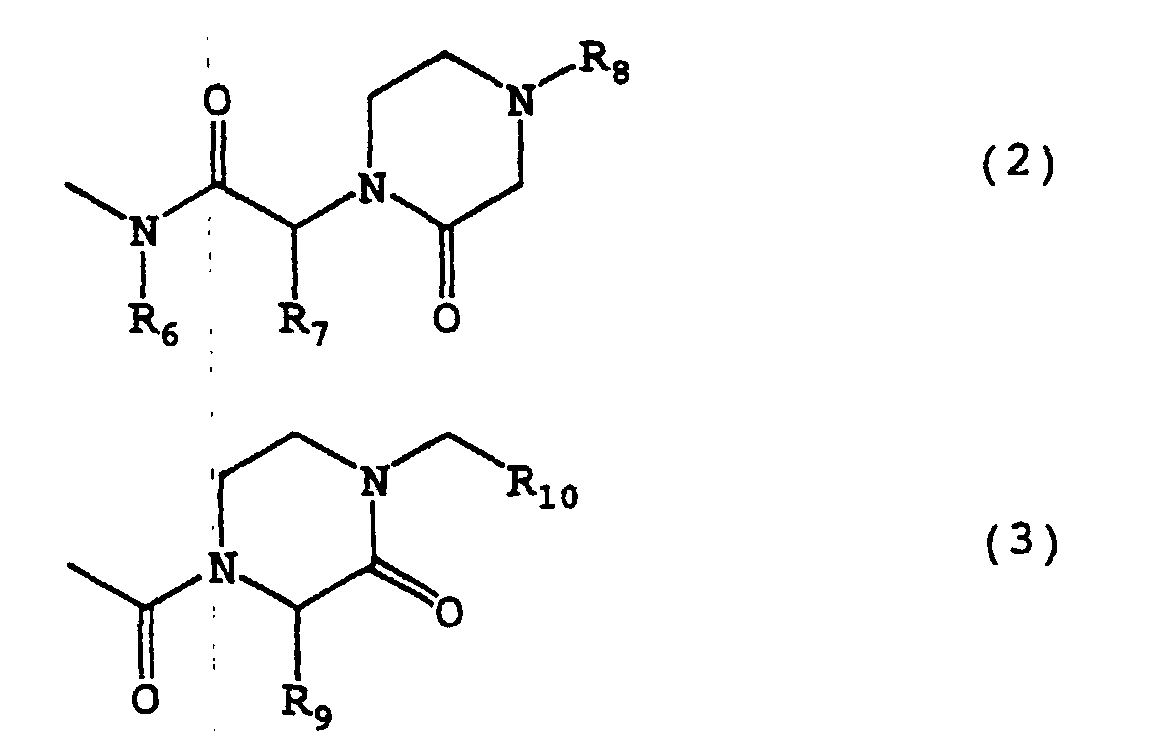 B represents a carboxyl group, a C1-C6 alkoxycarbonyl group or a group of formula (5)wherein R16 represents (CH2)m2-COOH wherein m2 represents an integer of 1-3 or (CH2)n2-CONH2 wherein n2 represents 2 or 3, and R17 represents a hydrogen atom, a C1-C6 alkyl group, a carboxyl group or a C1-C6 alkoxycarbonyl group, provided that the carboxyl group in the above-mentioned A and B may be protected by an protecting group usually used in peptide chemistry, and that when A is a group represented by formula (4), B is a group represented by formula (5), or a pharmacologically acceptable salt thereof.
- A depsipeptide derivative of claim 1 containing a piperazinone ring represented by formula (1')wherein
 X1 represents N(R4)-CO, N(R5)-CH2, CH2-CO, CH2-CH2, CH=CH, CH2-CH(OH) or CH(OH)-CH(OH), R1 represents a C5-C20 alkyl group or a C5-C15 alkoxy C1-C4 alkyl group, R2-R5 represent a hydrogen atom or a C1-C6 alkyl group,A' represents a group of formula (2)wherein R6 represents a hydrogen atom or a C1-C6 alkyl group, R7 represents (CH2)m1-COOH wherein m1 represents an integer of 1-3 or (CH2)n1-CONH2 wherein n1 represents 2 or 3, and R8 represents a hydrogen atom or an amine-protecting group usually used in peptide chemistry, and
 B' represents a carboxyl group or a C1-C6 alkoxycarbonyl group,
provided that the carboxyl group in the above-mentioned A' and B' may be protected by a protecting group usually used in peptide chemistry,
or a pharmacologically acceptable salt thereof. - A depsipeptide derivative of claim 1 containing a piperazinone ring represented by formula (1'')wherein
 X1 represents N(R4)-CO, N(R5)-CH2, CH2-CO, CH2-CH2, CH=CH, CH2-CH(OH) or CH(OH)-CH(OH), R1 represents a C5-C20 alkyl group or a C5-C15 alkoxy C1-C4 alkyl group, R2-R5 represent a hydrogen atom or a C1-C6 alkyl group,A'' represents a group of formula (3)wherein R9 represents (CH2)m1-COOH wherein m1 represents an integer of 1-3 or (CH2)n1-CONH2 wherein n1 represents 2 or 3, and R10 represents a hydrogen atom, a C1-C6 alkyl group, a carboxyl group or a C1-C6 alkoxycarbonyl group, and
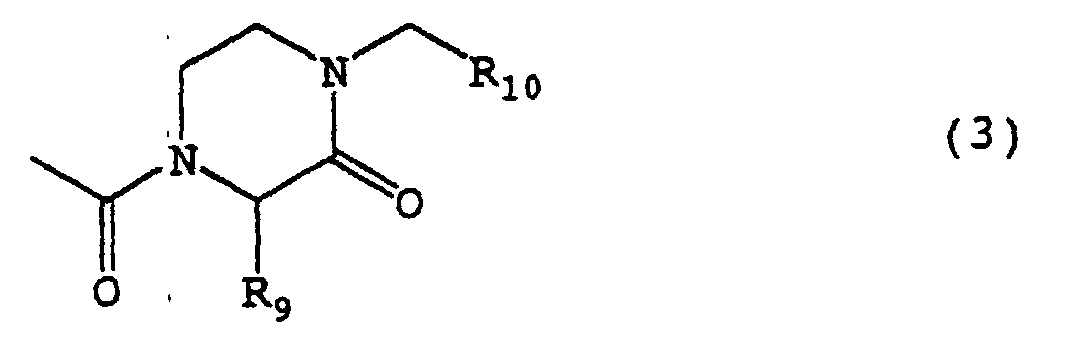 B' represents a carboxyl group or a C1-C6 alkoxycarbonyl group,
provided that the carboxyl group in the above-mentioned A'' and B' may be protected by an protecting group usually used in peptide chemistry,
or a pharmaceutically acceptable salt thereof. - A medicine which comprises as an active ingredient a depsipeptide derivative containing a piperazinone ring or a pharmacologically acceptable salt thereof as defined in claims 1 to 3.
- A medicine of claim 4 wherein the medicine is an accelerator for the production of apolipoprotein E.
- A medicine of claim 4 or 5 wherein the medicine is an agent for the treatment of neurologic injury.
- A medicine of claim 4 or 5 wherein the medicine is an agent for the treatment of dementia.
- A medicine of claim 4 or 5 wherein the medicine is an antihyperlipidemic agent.
Applications Claiming Priority (3)
| Application Number | Priority Date | Filing Date | Title |
|---|---|---|---|
| JP22039898 | 1998-08-04 | ||
| JP22039898 | 1998-08-04 | ||
| PCT/JP1999/004205 WO2000008047A1 (en) | 1998-08-04 | 1999-08-04 | Depsipeptide derivatives bearing piperazinone rings |
Publications (2)
| Publication Number | Publication Date |
|---|---|
| EP1028126A1 true EP1028126A1 (en) | 2000-08-16 |
| EP1028126A4 EP1028126A4 (en) | 2004-11-10 |
Family
ID=16750502
Family Applications (1)
| Application Number | Title | Priority Date | Filing Date |
|---|---|---|---|
| EP99935054A Withdrawn EP1028126A4 (en) | 1998-08-04 | 1999-08-04 | Depsipeptide derivatives bearing piperazinone rings |
Country Status (3)
| Country | Link |
|---|---|
| US (1) | US6288038B1 (en) |
| EP (1) | EP1028126A4 (en) |
| WO (1) | WO2000008047A1 (en) |
Cited By (1)
| Publication number | Priority date | Publication date | Assignee | Title |
|---|---|---|---|---|
| WO2000069425A3 (en) * | 1999-05-12 | 2001-03-15 | Bayer Ag | Endoparasiticidal synergistic combination containing cyclic depsipeptides and piperazines |
Families Citing this family (1)
| Publication number | Priority date | Publication date | Assignee | Title |
|---|---|---|---|---|
| KR102171710B1 (en) * | 2013-01-17 | 2020-10-30 | 얀센 파마슈티카 엔.브이. | Novel substituted pyrido-piperazinone derivatives as gamma secretase modulators |
Family Cites Families (6)
| Publication number | Priority date | Publication date | Assignee | Title |
|---|---|---|---|---|
| US4593098A (en) * | 1979-06-14 | 1986-06-03 | The Upjohn Company | Piperazinone and piperazine polypeptides |
| CA2258487A1 (en) * | 1996-06-25 | 1997-12-31 | Nisshin Flour Milling Co., Ltd. | Cyclic depsipeptides and drugs containing the same as the active ingredient |
| US6255286B1 (en) * | 1996-06-25 | 2001-07-03 | Nisshin Flour Milling Co., Ltd. | Depsipeptides and drugs containing the same as the active ingredient |
| US6211145B1 (en) * | 1997-12-25 | 2001-04-03 | Nisshin Flour Milling Co., Ltd. | Bicyclic depsipeptides |
| JPH11263797A (en) * | 1997-12-25 | 1999-09-28 | Nisshin Flour Milling Co Ltd | Depsipeptide containing n-substituted glycine residual group |
| EP0931792B1 (en) * | 1998-01-27 | 2004-01-07 | Nisshin Seifun Group Inc. | Depsipeptides containing non-natural amino acids |
-
1999
- 1999-08-04 WO PCT/JP1999/004205 patent/WO2000008047A1/en not_active Ceased
- 1999-08-04 US US09/509,132 patent/US6288038B1/en not_active Expired - Fee Related
- 1999-08-04 EP EP99935054A patent/EP1028126A4/en not_active Withdrawn
Non-Patent Citations (4)
| Title |
|---|
| BARAKAT K J ET AL: "Synthesis and biological activities of phenyl piperazine-based peptidomimetic growth hormone secretagogues" BIOORGANIC & MEDICINAL CHEMISTRY LETTERS, OXFORD, GB, vol. 8, no. 11, 2 June 1998 (1998-06-02), pages 1431-1436, XP004137217 ISSN: 0960-894X * |
| MASLIAH ELIEZER ET AL: "Neurodegeneration and cognitive impairment in apoE-deficient mice is ameliorated by infusion of recombinant apoE" BRAIN RESEARCH, vol. 751, 1997, pages 307-314, XP002295613 * |
| See also references of WO0008047A1 * |
| THOMAS KOLTER ET AL: "Synthesis of substituted chiral pperazinones as buiding blocks for peptidomimetics" LIEBIGS ANNALEN/RECUEIL: ORGANIC AND BIOORGANIC CHEMISTRY - A EUROPEAN JOURNAL, VCH PUBLISHERS, FLORIDA, US, 1995, pages 625-629, XP002198374 ISSN: 0947-3440 * |
Cited By (2)
| Publication number | Priority date | Publication date | Assignee | Title |
|---|---|---|---|---|
| WO2000069425A3 (en) * | 1999-05-12 | 2001-03-15 | Bayer Ag | Endoparasiticidal synergistic combination containing cyclic depsipeptides and piperazines |
| HRP20010918B1 (en) * | 1999-05-12 | 2011-01-31 | Bayer Animal Health Gmbh | Endoparasiticidal compositions |
Also Published As
| Publication number | Publication date |
|---|---|
| WO2000008047A8 (en) | 2000-05-04 |
| WO2000008047A1 (en) | 2000-02-17 |
| EP1028126A4 (en) | 2004-11-10 |
| US6288038B1 (en) | 2001-09-11 |
Similar Documents
| Publication | Publication Date | Title |
|---|---|---|
| RU2274642C2 (en) | Caspase inhibitors | |
| DE69513167T2 (en) | PERFLUOROALKYLL KETONES, INHIBITORS OF ELASTASE AND PROCESS FOR THEIR PRODUCTION | |
| CZ290104B6 (en) | Peptide derivative, process of its preparation and use, as well as pharmaceutical preparation containing thereof | |
| DE3783280T2 (en) | PARTIAL RETRO-INVERTED ANALOGS OF TUFTSIN, METHOD FOR THEIR PREPARATION AND PHARMACEUTICAL COMPOSITIONS THAT INCLUDE IT. | |
| EP0216539A2 (en) | Novel amino acid derivatives | |
| US6255286B1 (en) | Depsipeptides and drugs containing the same as the active ingredient | |
| JPWO1997049722A1 (en) | Depsipeptide and medicine containing it as an active ingredient | |
| AU8660491A (en) | N-(2-alkyl-3-mercaptoglutaryl)-amino-diaza cycloalkanone derivatives and their use as collagenase inhibitors | |
| DE69531459T2 (en) | ELATASE INHIBITORS | |
| DE102005014245A1 (en) | Antibacterial amide macrocycles V | |
| US6288038B1 (en) | Depsipeptide derivatives bearing piperazinone rings | |
| DE69913996T2 (en) | Depsipeptides that contain non-natural amino acids | |
| US6001815A (en) | Depsipeptides containing N-substituted glycine residue | |
| EP1797110B1 (en) | Antibacterial amide macrocycles iv | |
| US6858585B1 (en) | Cyclic depsipeptides and drugs containing the same as the active ingredient | |
| JPWO1997049724A1 (en) | Cyclic depsipeptide and medicine containing same as active ingredient | |
| US6211145B1 (en) | Bicyclic depsipeptides | |
| DE69606552T2 (en) | ACYLATED ENOL DERIVATIVES OF ALPHA KETOESTERS AND ALPHA KETOAMIDES | |
| DE69522940T2 (en) | ACYLATED ENOL DERIVATIVES AS PRELIMINARY DRUGS OF ELASTAS INHIBITORS | |
| DE69519182T2 (en) | Azapeptide derivatives | |
| JPWO2000008047A1 (en) | Depsipeptide derivatives containing a piperazinone ring | |
| US4853463A (en) | Amino acid derivatives | |
| CN100497372C (en) | Amidomethyl-substituted 1- (carboxyalkyl) -cyclopentylcarbonylamino-benzazepine -N-acetic acid derivatives, process and intermediate products for their preparation and medicaments containing these compounds | |
| JP3556967B2 (en) | 2-amino-6,7-dihydroxy-4-thiaheptanoic acid derivative | |
| JPH11322786A (en) | Depsipeptide containing non-natural amino acid |
Legal Events
| Date | Code | Title | Description |
|---|---|---|---|
| PUAI | Public reference made under article 153(3) epc to a published international application that has entered the european phase |
Free format text: ORIGINAL CODE: 0009012 |
|
| AK | Designated contracting states |
Kind code of ref document: A1 Designated state(s): DE FR GB IT |
|
| 17P | Request for examination filed |
Effective date: 20000721 |
|
| RAP1 | Party data changed (applicant data changed or rights of an application transferred) |
Owner name: NISSHIN SEIFUN GROUP INC. |
|
| A4 | Supplementary search report drawn up and despatched |
Effective date: 20040929 |
|
| STAA | Information on the status of an ep patent application or granted ep patent |
Free format text: STATUS: THE APPLICATION HAS BEEN WITHDRAWN |
|
| 18W | Application withdrawn |
Effective date: 20041202 |
|
| R18W | Application withdrawn (corrected) |
Effective date: 20041201 |