EP1027041B1 - Novel cyanoaziridines for treating cancer - Google Patents
Novel cyanoaziridines for treating cancer Download PDFInfo
- Publication number
- EP1027041B1 EP1027041B1 EP98931645A EP98931645A EP1027041B1 EP 1027041 B1 EP1027041 B1 EP 1027041B1 EP 98931645 A EP98931645 A EP 98931645A EP 98931645 A EP98931645 A EP 98931645A EP 1027041 B1 EP1027041 B1 EP 1027041B1
- Authority
- EP
- European Patent Office
- Prior art keywords
- carbons
- substituted
- aryl
- compound
- cells
- Prior art date
- Legal status (The legal status is an assumption and is not a legal conclusion. Google has not performed a legal analysis and makes no representation as to the accuracy of the status listed.)
- Expired - Lifetime
Links
- 206010028980 Neoplasm Diseases 0.000 title claims description 122
- 201000011510 cancer Diseases 0.000 title claims description 43
- QVDCANBBJMFTOO-UHFFFAOYSA-N aziridine-1-carbonitrile Chemical class N#CN1CC1 QVDCANBBJMFTOO-UHFFFAOYSA-N 0.000 title description 36
- 150000001875 compounds Chemical class 0.000 claims abstract description 73
- 125000000217 alkyl group Chemical group 0.000 claims abstract description 50
- 125000003118 aryl group Chemical group 0.000 claims abstract description 46
- 125000000623 heterocyclic group Chemical group 0.000 claims abstract description 19
- 239000001257 hydrogen Substances 0.000 claims abstract description 11
- 229910052739 hydrogen Inorganic materials 0.000 claims abstract description 11
- 125000000753 cycloalkyl group Chemical group 0.000 claims abstract description 9
- 125000003342 alkenyl group Chemical group 0.000 claims abstract description 5
- 125000001997 phenyl group Chemical group [H]C1=C([H])C([H])=C(*)C([H])=C1[H] 0.000 claims abstract description 5
- 125000004435 hydrogen atom Chemical group [H]* 0.000 claims abstract 9
- 125000000636 p-nitrophenyl group Chemical group [H]C1=C([H])C(=C([H])C([H])=C1*)[N+]([O-])=O 0.000 claims abstract 2
- 239000003814 drug Substances 0.000 claims description 37
- 206010035226 Plasma cell myeloma Diseases 0.000 claims description 35
- 238000011282 treatment Methods 0.000 claims description 21
- 239000000203 mixture Substances 0.000 claims description 17
- 125000003107 substituted aryl group Chemical group 0.000 claims description 13
- 125000004423 acyloxy group Chemical group 0.000 claims description 12
- 125000002252 acyl group Chemical group 0.000 claims description 10
- 208000034578 Multiple myelomas Diseases 0.000 claims description 9
- 208000032839 leukemia Diseases 0.000 claims description 8
- 238000009472 formulation Methods 0.000 claims description 6
- 125000001424 substituent group Chemical group 0.000 claims description 4
- 206010055113 Breast cancer metastatic Diseases 0.000 claims description 2
- 239000007864 aqueous solution Substances 0.000 claims description 2
- 125000001475 halogen functional group Chemical group 0.000 claims 3
- 239000008194 pharmaceutical composition Substances 0.000 claims 2
- 206010055114 Colon cancer metastatic Diseases 0.000 claims 1
- 206010050017 Lung cancer metastatic Diseases 0.000 claims 1
- 206010027480 Metastatic malignant melanoma Diseases 0.000 claims 1
- 208000007452 Plasmacytoma Diseases 0.000 claims 1
- 210000002919 epithelial cell Anatomy 0.000 claims 1
- 238000004519 manufacturing process Methods 0.000 claims 1
- 208000021039 metastatic melanoma Diseases 0.000 claims 1
- 125000001624 naphthyl group Chemical group 0.000 claims 1
- 125000000449 nitro group Chemical group [O-][N+](*)=O 0.000 claims 1
- 230000002611 ovarian Effects 0.000 claims 1
- 239000000546 pharmaceutical excipient Substances 0.000 claims 1
- 125000004076 pyridyl group Chemical group 0.000 claims 1
- 230000001093 anti-cancer Effects 0.000 abstract description 3
- 125000004453 alkoxycarbonyl group Chemical group 0.000 abstract description 2
- 125000000304 alkynyl group Chemical group 0.000 abstract description 2
- 210000004027 cell Anatomy 0.000 description 136
- BIXBBIPTYBJTRY-UHFFFAOYSA-N imexon Chemical compound NC1=NC(=O)N2CC12 BIXBBIPTYBJTRY-UHFFFAOYSA-N 0.000 description 70
- 229950003978 imexon Drugs 0.000 description 59
- 238000000034 method Methods 0.000 description 43
- AOJJSUZBOXZQNB-TZSSRYMLSA-N Doxorubicin Chemical compound O([C@H]1C[C@@](O)(CC=2C(O)=C3C(=O)C=4C=CC=C(C=4C(=O)C3=C(O)C=21)OC)C(=O)CO)[C@H]1C[C@H](N)[C@H](O)[C@H](C)O1 AOJJSUZBOXZQNB-TZSSRYMLSA-N 0.000 description 35
- 229940079593 drug Drugs 0.000 description 35
- 238000000338 in vitro Methods 0.000 description 35
- 210000004881 tumor cell Anatomy 0.000 description 29
- YXFVVABEGXRONW-UHFFFAOYSA-N Toluene Chemical compound CC1=CC=CC=C1 YXFVVABEGXRONW-UHFFFAOYSA-N 0.000 description 27
- 230000004044 response Effects 0.000 description 27
- 201000000050 myeloid neoplasm Diseases 0.000 description 26
- 239000003795 chemical substances by application Substances 0.000 description 24
- IAZDPXIOMUYVGZ-WFGJKAKNSA-N Dimethyl sulfoxide Chemical compound [2H]C([2H])([2H])S(=O)C([2H])([2H])[2H] IAZDPXIOMUYVGZ-WFGJKAKNSA-N 0.000 description 22
- 238000003556 assay Methods 0.000 description 21
- PGZUFTROELAOMP-UHFFFAOYSA-N aziridine-2-carbonitrile Chemical class N#CC1CN1 PGZUFTROELAOMP-UHFFFAOYSA-N 0.000 description 21
- 241001465754 Metazoa Species 0.000 description 20
- 238000011579 SCID mouse model Methods 0.000 description 20
- 150000003857 carboxamides Chemical class 0.000 description 20
- 238000005160 1H NMR spectroscopy Methods 0.000 description 19
- -1 cysteine and GSH Chemical class 0.000 description 19
- 230000000259 anti-tumor effect Effects 0.000 description 17
- 239000000975 dye Substances 0.000 description 17
- HEDRZPFGACZZDS-MICDWDOJSA-N Trichloro(2H)methane Chemical compound [2H]C(Cl)(Cl)Cl HEDRZPFGACZZDS-MICDWDOJSA-N 0.000 description 16
- 239000002246 antineoplastic agent Substances 0.000 description 16
- 201000010099 disease Diseases 0.000 description 15
- 208000037265 diseases, disorders, signs and symptoms Diseases 0.000 description 15
- 229960004679 doxorubicin Drugs 0.000 description 15
- WYURNTSHIVDZCO-UHFFFAOYSA-N Tetrahydrofuran Chemical compound C1CCOC1 WYURNTSHIVDZCO-UHFFFAOYSA-N 0.000 description 14
- 230000000694 effects Effects 0.000 description 14
- RWSXRVCMGQZWBV-WDSKDSINSA-N glutathione Chemical compound OC(=O)[C@@H](N)CCC(=O)N[C@@H](CS)C(=O)NCC(O)=O RWSXRVCMGQZWBV-WDSKDSINSA-N 0.000 description 14
- 238000001727 in vivo Methods 0.000 description 14
- 210000004940 nucleus Anatomy 0.000 description 14
- 238000002560 therapeutic procedure Methods 0.000 description 14
- 241000699670 Mus sp. Species 0.000 description 13
- 125000001072 heteroaryl group Chemical group 0.000 description 13
- 231100000419 toxicity Toxicity 0.000 description 13
- 230000001988 toxicity Effects 0.000 description 13
- UHOVQNZJYSORNB-UHFFFAOYSA-N Benzene Chemical compound C1=CC=CC=C1 UHOVQNZJYSORNB-UHFFFAOYSA-N 0.000 description 12
- 206010006187 Breast cancer Diseases 0.000 description 11
- 206010034133 Pathogen resistance Diseases 0.000 description 11
- 210000001185 bone marrow Anatomy 0.000 description 11
- 238000001990 intravenous administration Methods 0.000 description 11
- 239000012948 isocyanate Substances 0.000 description 11
- 150000002513 isocyanates Chemical class 0.000 description 11
- 239000000243 solution Substances 0.000 description 11
- 230000004614 tumor growth Effects 0.000 description 11
- IOOMXAQUNPWDLL-UHFFFAOYSA-N 2-[6-(diethylamino)-3-(diethyliminiumyl)-3h-xanthen-9-yl]-5-sulfobenzene-1-sulfonate Chemical compound C=12C=CC(=[N+](CC)CC)C=C2OC2=CC(N(CC)CC)=CC=C2C=1C1=CC=C(S(O)(=O)=O)C=C1S([O-])(=O)=O IOOMXAQUNPWDLL-UHFFFAOYSA-N 0.000 description 10
- 125000003710 aryl alkyl group Chemical group 0.000 description 10
- 230000012010 growth Effects 0.000 description 10
- 238000001802 infusion Methods 0.000 description 10
- 238000012360 testing method Methods 0.000 description 10
- 102100033350 ATP-dependent translocase ABCB1 Human genes 0.000 description 9
- 208000026310 Breast neoplasm Diseases 0.000 description 9
- 206010058467 Lung neoplasm malignant Diseases 0.000 description 9
- 108010047230 Member 1 Subfamily B ATP Binding Cassette Transporter Proteins 0.000 description 9
- 201000005202 lung cancer Diseases 0.000 description 9
- 208000020816 lung neoplasm Diseases 0.000 description 9
- 230000036515 potency Effects 0.000 description 9
- 208000002491 severe combined immunodeficiency Diseases 0.000 description 9
- 230000004083 survival effect Effects 0.000 description 9
- HEDRZPFGACZZDS-UHFFFAOYSA-N Chloroform Chemical compound ClC(Cl)Cl HEDRZPFGACZZDS-UHFFFAOYSA-N 0.000 description 8
- 108020004414 DNA Proteins 0.000 description 8
- 125000004442 acylamino group Chemical group 0.000 description 8
- 125000003545 alkoxy group Chemical group 0.000 description 8
- 238000002512 chemotherapy Methods 0.000 description 8
- 229910052736 halogen Inorganic materials 0.000 description 8
- 150000002367 halogens Chemical class 0.000 description 8
- 238000002347 injection Methods 0.000 description 8
- 239000007924 injection Substances 0.000 description 8
- 230000036961 partial effect Effects 0.000 description 8
- 239000000047 product Substances 0.000 description 8
- 230000002829 reductive effect Effects 0.000 description 8
- 125000003396 thiol group Chemical group [H]S* 0.000 description 8
- XLYOFNOQVPJJNP-UHFFFAOYSA-N water Chemical compound O XLYOFNOQVPJJNP-UHFFFAOYSA-N 0.000 description 8
- 206010009944 Colon cancer Diseases 0.000 description 7
- YLQBMQCUIZJEEH-UHFFFAOYSA-N Furan Chemical group C=1C=COC=1 YLQBMQCUIZJEEH-UHFFFAOYSA-N 0.000 description 7
- 238000006243 chemical reaction Methods 0.000 description 7
- 239000002552 dosage form Substances 0.000 description 7
- 229920006227 ethylene-grafted-maleic anhydride Polymers 0.000 description 7
- 125000000524 functional group Chemical group 0.000 description 7
- 229960003180 glutathione Drugs 0.000 description 7
- 201000001441 melanoma Diseases 0.000 description 7
- 208000002154 non-small cell lung carcinoma Diseases 0.000 description 7
- 230000009467 reduction Effects 0.000 description 7
- 208000029729 tumor suppressor gene on chromosome 11 Diseases 0.000 description 7
- 239000003981 vehicle Substances 0.000 description 7
- OGWKCGZFUXNPDA-XQKSVPLYSA-N vincristine Chemical compound C([N@]1C[C@@H](C[C@]2(C(=O)OC)C=3C(=CC4=C([C@]56[C@H]([C@@]([C@H](OC(C)=O)[C@]7(CC)C=CCN([C@H]67)CC5)(O)C(=O)OC)N4C=O)C=3)OC)C[C@@](C1)(O)CC)CC1=C2NC2=CC=CC=C12 OGWKCGZFUXNPDA-XQKSVPLYSA-N 0.000 description 7
- 229960004528 vincristine Drugs 0.000 description 7
- OGWKCGZFUXNPDA-UHFFFAOYSA-N vincristine Natural products C1C(CC)(O)CC(CC2(C(=O)OC)C=3C(=CC4=C(C56C(C(C(OC(C)=O)C7(CC)C=CCN(C67)CC5)(O)C(=O)OC)N4C=O)C=3)OC)CN1CCC1=C2NC2=CC=CC=C12 OGWKCGZFUXNPDA-UHFFFAOYSA-N 0.000 description 7
- BXBIBOQGYLPODI-UHFFFAOYSA-N 2-cyano-n-phenylaziridine-1-carboxamide Chemical compound C1C(C#N)N1C(=O)NC1=CC=CC=C1 BXBIBOQGYLPODI-UHFFFAOYSA-N 0.000 description 6
- QTBSBXVTEAMEQO-UHFFFAOYSA-N Acetic acid Chemical compound CC(O)=O QTBSBXVTEAMEQO-UHFFFAOYSA-N 0.000 description 6
- 241000282412 Homo Species 0.000 description 6
- 241000699666 Mus <mouse, genus> Species 0.000 description 6
- NWIBSHFKIJFRCO-WUDYKRTCSA-N Mytomycin Chemical compound C1N2C(C(C(C)=C(N)C3=O)=O)=C3[C@@H](COC(N)=O)[C@@]2(OC)[C@@H]2[C@H]1N2 NWIBSHFKIJFRCO-WUDYKRTCSA-N 0.000 description 6
- FAPWRFPIFSIZLT-UHFFFAOYSA-M Sodium chloride Chemical compound [Na+].[Cl-] FAPWRFPIFSIZLT-UHFFFAOYSA-M 0.000 description 6
- 125000003282 alkyl amino group Chemical group 0.000 description 6
- 238000001574 biopsy Methods 0.000 description 6
- 230000001413 cellular effect Effects 0.000 description 6
- 208000029742 colonic neoplasm Diseases 0.000 description 6
- 238000002474 experimental method Methods 0.000 description 6
- 238000010348 incorporation Methods 0.000 description 6
- 229960001156 mitoxantrone Drugs 0.000 description 6
- KKZJGLLVHKMTCM-UHFFFAOYSA-N mitoxantrone Chemical compound O=C1C2=C(O)C=CC(O)=C2C(=O)C2=C1C(NCCNCCO)=CC=C2NCCNCCO KKZJGLLVHKMTCM-UHFFFAOYSA-N 0.000 description 6
- 229930014626 natural product Natural products 0.000 description 6
- 108090000623 proteins and genes Proteins 0.000 description 6
- 238000012216 screening Methods 0.000 description 6
- 239000007787 solid Substances 0.000 description 6
- 239000002904 solvent Substances 0.000 description 6
- 150000003573 thiols Chemical class 0.000 description 6
- 210000001519 tissue Anatomy 0.000 description 6
- IJGRMHOSHXDMSA-UHFFFAOYSA-N Atomic nitrogen Chemical compound N#N IJGRMHOSHXDMSA-UHFFFAOYSA-N 0.000 description 5
- XUJNEKJLAYXESH-REOHCLBHSA-N L-Cysteine Chemical compound SC[C@H](N)C(O)=O XUJNEKJLAYXESH-REOHCLBHSA-N 0.000 description 5
- 230000010261 cell growth Effects 0.000 description 5
- XUJNEKJLAYXESH-UHFFFAOYSA-N cysteine Natural products SCC(N)C(O)=O XUJNEKJLAYXESH-UHFFFAOYSA-N 0.000 description 5
- 235000018417 cysteine Nutrition 0.000 description 5
- 239000007943 implant Substances 0.000 description 5
- 235000018102 proteins Nutrition 0.000 description 5
- 102000004169 proteins and genes Human genes 0.000 description 5
- 230000035945 sensitivity Effects 0.000 description 5
- 238000007920 subcutaneous administration Methods 0.000 description 5
- 239000000725 suspension Substances 0.000 description 5
- 125000003831 tetrazolyl group Chemical group 0.000 description 5
- SGTNSNPWRIOYBX-UHFFFAOYSA-N 2-(3,4-dimethoxyphenyl)-5-{[2-(3,4-dimethoxyphenyl)ethyl](methyl)amino}-2-(propan-2-yl)pentanenitrile Chemical compound C1=C(OC)C(OC)=CC=C1CCN(C)CCCC(C#N)(C(C)C)C1=CC=C(OC)C(OC)=C1 SGTNSNPWRIOYBX-UHFFFAOYSA-N 0.000 description 4
- KXDHJXZQYSOELW-UHFFFAOYSA-M Carbamate Chemical compound NC([O-])=O KXDHJXZQYSOELW-UHFFFAOYSA-M 0.000 description 4
- 108090000790 Enzymes Proteins 0.000 description 4
- 102000004190 Enzymes Human genes 0.000 description 4
- LFQSCWFLJHTTHZ-UHFFFAOYSA-N Ethanol Chemical compound CCO LFQSCWFLJHTTHZ-UHFFFAOYSA-N 0.000 description 4
- VGGSQFUCUMXWEO-UHFFFAOYSA-N Ethene Chemical group C=C VGGSQFUCUMXWEO-UHFFFAOYSA-N 0.000 description 4
- 239000005977 Ethylene Chemical group 0.000 description 4
- SIKJAQJRHWYJAI-UHFFFAOYSA-N Indole Chemical group C1=CC=C2NC=CC2=C1 SIKJAQJRHWYJAI-UHFFFAOYSA-N 0.000 description 4
- 206010033128 Ovarian cancer Diseases 0.000 description 4
- NQRYJNQNLNOLGT-UHFFFAOYSA-N Piperidine Chemical compound C1CCNCC1 NQRYJNQNLNOLGT-UHFFFAOYSA-N 0.000 description 4
- JUJWROOIHBZHMG-UHFFFAOYSA-N Pyridine Chemical group C1=CC=NC=C1 JUJWROOIHBZHMG-UHFFFAOYSA-N 0.000 description 4
- YTPLMLYBLZKORZ-UHFFFAOYSA-N Thiophene Chemical group C=1C=CSC=1 YTPLMLYBLZKORZ-UHFFFAOYSA-N 0.000 description 4
- 230000001464 adherent effect Effects 0.000 description 4
- 238000013459 approach Methods 0.000 description 4
- 125000005160 aryl oxy alkyl group Chemical group 0.000 description 4
- 210000003719 b-lymphocyte Anatomy 0.000 description 4
- 230000008901 benefit Effects 0.000 description 4
- 210000003169 central nervous system Anatomy 0.000 description 4
- 210000000349 chromosome Anatomy 0.000 description 4
- DQLATGHUWYMOKM-UHFFFAOYSA-L cisplatin Chemical compound N[Pt](N)(Cl)Cl DQLATGHUWYMOKM-UHFFFAOYSA-L 0.000 description 4
- 229960004316 cisplatin Drugs 0.000 description 4
- 230000005757 colony formation Effects 0.000 description 4
- 238000011161 development Methods 0.000 description 4
- 238000010828 elution Methods 0.000 description 4
- 239000012442 inert solvent Substances 0.000 description 4
- 208000015181 infectious disease Diseases 0.000 description 4
- 239000002609 medium Substances 0.000 description 4
- 125000002496 methyl group Chemical group [H]C([H])([H])* 0.000 description 4
- 125000001570 methylene group Chemical group [H]C([H])([*:1])[*:2] 0.000 description 4
- 230000036457 multidrug resistance Effects 0.000 description 4
- 230000003039 myelosuppressive effect Effects 0.000 description 4
- 238000011580 nude mouse model Methods 0.000 description 4
- 229920003023 plastic Polymers 0.000 description 4
- 239000004033 plastic Substances 0.000 description 4
- 229920006395 saturated elastomer Polymers 0.000 description 4
- 210000002966 serum Anatomy 0.000 description 4
- 239000000126 substance Substances 0.000 description 4
- 229960001722 verapamil Drugs 0.000 description 4
- SHVVSKCXWMEDRW-UHFFFAOYSA-N 3-isocyanatopyridine Chemical compound O=C=NC1=CC=CN=C1 SHVVSKCXWMEDRW-UHFFFAOYSA-N 0.000 description 3
- CSCPPACGZOOCGX-UHFFFAOYSA-N Acetone Chemical compound CC(C)=O CSCPPACGZOOCGX-UHFFFAOYSA-N 0.000 description 3
- 229920001817 Agar Polymers 0.000 description 3
- WVDDGKGOMKODPV-UHFFFAOYSA-N Benzyl alcohol Chemical compound OCC1=CC=CC=C1 WVDDGKGOMKODPV-UHFFFAOYSA-N 0.000 description 3
- OKTJSMMVPCPJKN-UHFFFAOYSA-N Carbon Chemical compound [C] OKTJSMMVPCPJKN-UHFFFAOYSA-N 0.000 description 3
- IAZDPXIOMUYVGZ-UHFFFAOYSA-N Dimethylsulphoxide Chemical compound CS(C)=O IAZDPXIOMUYVGZ-UHFFFAOYSA-N 0.000 description 3
- XEKOWRVHYACXOJ-UHFFFAOYSA-N Ethyl acetate Chemical compound CCOC(C)=O XEKOWRVHYACXOJ-UHFFFAOYSA-N 0.000 description 3
- 206010025323 Lymphomas Diseases 0.000 description 3
- 231100000002 MTT assay Toxicity 0.000 description 3
- 238000000134 MTT assay Methods 0.000 description 3
- 206010061535 Ovarian neoplasm Diseases 0.000 description 3
- 229920000954 Polyglycolide Polymers 0.000 description 3
- RWRDLPDLKQPQOW-UHFFFAOYSA-N Pyrrolidine Chemical compound C1CCNC1 RWRDLPDLKQPQOW-UHFFFAOYSA-N 0.000 description 3
- ZMANZCXQSJIPKH-UHFFFAOYSA-N Triethylamine Chemical compound CCN(CC)CC ZMANZCXQSJIPKH-UHFFFAOYSA-N 0.000 description 3
- JXLYSJRDGCGARV-WWYNWVTFSA-N Vinblastine Natural products O=C(O[C@H]1[C@](O)(C(=O)OC)[C@@H]2N(C)c3c(cc(c(OC)c3)[C@]3(C(=O)OC)c4[nH]c5c(c4CCN4C[C@](O)(CC)C[C@H](C3)C4)cccc5)[C@@]32[C@H]2[C@@]1(CC)C=CCN2CC3)C JXLYSJRDGCGARV-WWYNWVTFSA-N 0.000 description 3
- 229940122803 Vinca alkaloid Drugs 0.000 description 3
- 239000011149 active material Substances 0.000 description 3
- 208000009956 adenocarcinoma Diseases 0.000 description 3
- 239000008272 agar Substances 0.000 description 3
- 125000004450 alkenylene group Chemical group 0.000 description 3
- 125000002947 alkylene group Chemical group 0.000 description 3
- 125000004419 alkynylene group Chemical group 0.000 description 3
- 238000004458 analytical method Methods 0.000 description 3
- 229940041181 antineoplastic drug Drugs 0.000 description 3
- 230000006907 apoptotic process Effects 0.000 description 3
- 125000004104 aryloxy group Chemical group 0.000 description 3
- QVGXLLKOCUKJST-UHFFFAOYSA-N atomic oxygen Chemical compound [O] QVGXLLKOCUKJST-UHFFFAOYSA-N 0.000 description 3
- FFBZKUHRIXKOSY-UHFFFAOYSA-N aziridine-1-carboxamide Chemical class NC(=O)N1CC1 FFBZKUHRIXKOSY-UHFFFAOYSA-N 0.000 description 3
- 239000003560 cancer drug Substances 0.000 description 3
- 239000002775 capsule Substances 0.000 description 3
- 125000004432 carbon atom Chemical group C* 0.000 description 3
- 125000002915 carbonyl group Chemical group [*:2]C([*:1])=O 0.000 description 3
- 210000000170 cell membrane Anatomy 0.000 description 3
- 239000012829 chemotherapy agent Substances 0.000 description 3
- 239000000460 chlorine Substances 0.000 description 3
- 230000001332 colony forming effect Effects 0.000 description 3
- 230000006378 damage Effects 0.000 description 3
- 230000007547 defect Effects 0.000 description 3
- 230000001419 dependent effect Effects 0.000 description 3
- 230000008034 disappearance Effects 0.000 description 3
- 231100000673 dose–response relationship Toxicity 0.000 description 3
- 239000003937 drug carrier Substances 0.000 description 3
- 238000011049 filling Methods 0.000 description 3
- 239000012530 fluid Substances 0.000 description 3
- 125000005343 heterocyclic alkyl group Chemical group 0.000 description 3
- 125000002887 hydroxy group Chemical group [H]O* 0.000 description 3
- 230000016784 immunoglobulin production Effects 0.000 description 3
- 238000011081 inoculation Methods 0.000 description 3
- 238000007918 intramuscular administration Methods 0.000 description 3
- 238000007912 intraperitoneal administration Methods 0.000 description 3
- 231100000225 lethality Toxicity 0.000 description 3
- 125000005647 linker group Chemical group 0.000 description 3
- 229960004857 mitomycin Drugs 0.000 description 3
- 238000010172 mouse model Methods 0.000 description 3
- VLKZOEOYAKHREP-UHFFFAOYSA-N n-Hexane Chemical compound CCCCCC VLKZOEOYAKHREP-UHFFFAOYSA-N 0.000 description 3
- 229910052757 nitrogen Inorganic materials 0.000 description 3
- 239000003921 oil Substances 0.000 description 3
- 239000001301 oxygen Substances 0.000 description 3
- 229910052760 oxygen Inorganic materials 0.000 description 3
- 150000002978 peroxides Chemical class 0.000 description 3
- 239000008024 pharmaceutical diluent Substances 0.000 description 3
- 238000007747 plating Methods 0.000 description 3
- 239000004633 polyglycolic acid Substances 0.000 description 3
- 125000002924 primary amino group Chemical group [H]N([H])* 0.000 description 3
- 238000001959 radiotherapy Methods 0.000 description 3
- 238000011084 recovery Methods 0.000 description 3
- 239000011780 sodium chloride Substances 0.000 description 3
- 239000000829 suppository Substances 0.000 description 3
- 230000009885 systemic effect Effects 0.000 description 3
- 239000003826 tablet Substances 0.000 description 3
- 238000004809 thin layer chromatography Methods 0.000 description 3
- 231100000331 toxic Toxicity 0.000 description 3
- 230000002588 toxic effect Effects 0.000 description 3
- 229960003048 vinblastine Drugs 0.000 description 3
- JXLYSJRDGCGARV-XQKSVPLYSA-N vincaleukoblastine Chemical compound C([C@@H](C[C@]1(C(=O)OC)C=2C(=CC3=C([C@]45[C@H]([C@@]([C@H](OC(C)=O)[C@]6(CC)C=CCN([C@H]56)CC4)(O)C(=O)OC)N3C)C=2)OC)C[C@@](C2)(O)CC)N2CCC2=C1NC1=CC=CC=C21 JXLYSJRDGCGARV-XQKSVPLYSA-N 0.000 description 3
- 230000036642 wellbeing Effects 0.000 description 3
- RRFYWCGXUHFYOP-UHFFFAOYSA-N (2-isocyanatophenyl) acetate Chemical compound CC(=O)OC1=CC=CC=C1N=C=O RRFYWCGXUHFYOP-UHFFFAOYSA-N 0.000 description 2
- ZNSIOEUWGZNHAQ-UHFFFAOYSA-N (3e)-n-diazoniopyridine-3-carboximidate Chemical compound [N-]=[N+]=NC(=O)C1=CC=CN=C1 ZNSIOEUWGZNHAQ-UHFFFAOYSA-N 0.000 description 2
- LLFHBPIIXQXTLI-UHFFFAOYSA-N (4-nitrophenyl) 2-cyanoaziridine-1-carboxylate Chemical compound C1=CC([N+](=O)[O-])=CC=C1OC(=O)N1C(C#N)C1 LLFHBPIIXQXTLI-UHFFFAOYSA-N 0.000 description 2
- NXLNNXIXOYSCMB-UHFFFAOYSA-N (4-nitrophenyl) carbonochloridate Chemical compound [O-][N+](=O)C1=CC=C(OC(Cl)=O)C=C1 NXLNNXIXOYSCMB-UHFFFAOYSA-N 0.000 description 2
- MFUVCHZWGSJKEQ-UHFFFAOYSA-N 3,4-dichlorphenylisocyanate Chemical compound ClC1=CC=C(N=C=O)C=C1Cl MFUVCHZWGSJKEQ-UHFFFAOYSA-N 0.000 description 2
- 208000002008 AIDS-Related Lymphoma Diseases 0.000 description 2
- 241000220479 Acacia Species 0.000 description 2
- 108010006654 Bleomycin Proteins 0.000 description 2
- 206010065553 Bone marrow failure Diseases 0.000 description 2
- 241000282472 Canis lupus familiaris Species 0.000 description 2
- 238000011765 DBA/2 mouse Methods 0.000 description 2
- 206010059866 Drug resistance Diseases 0.000 description 2
- WQZGKKKJIJFFOK-GASJEMHNSA-N Glucose Natural products OC[C@H]1OC(O)[C@H](O)[C@@H](O)[C@@H]1O WQZGKKKJIJFFOK-GASJEMHNSA-N 0.000 description 2
- UFHFLCQGNIYNRP-UHFFFAOYSA-N Hydrogen Chemical compound [H][H] UFHFLCQGNIYNRP-UHFFFAOYSA-N 0.000 description 2
- MHAJPDPJQMAIIY-UHFFFAOYSA-N Hydrogen peroxide Chemical compound OO MHAJPDPJQMAIIY-UHFFFAOYSA-N 0.000 description 2
- 235000010643 Leucaena leucocephala Nutrition 0.000 description 2
- 206010025312 Lymphoma AIDS related Diseases 0.000 description 2
- 101710085938 Matrix protein Proteins 0.000 description 2
- 101710127721 Membrane protein Proteins 0.000 description 2
- 206010027476 Metastases Diseases 0.000 description 2
- YNAVUWVOSKDBBP-UHFFFAOYSA-N Morpholine Chemical compound C1COCCN1 YNAVUWVOSKDBBP-UHFFFAOYSA-N 0.000 description 2
- 241001529936 Murinae Species 0.000 description 2
- 241000699660 Mus musculus Species 0.000 description 2
- 238000005481 NMR spectroscopy Methods 0.000 description 2
- BHHGXPLMPWCGHP-UHFFFAOYSA-N Phenethylamine Chemical compound NCCC1=CC=CC=C1 BHHGXPLMPWCGHP-UHFFFAOYSA-N 0.000 description 2
- 239000004698 Polyethylene Substances 0.000 description 2
- WTKZEGDFNFYCGP-UHFFFAOYSA-N Pyrazole Chemical group C=1C=NNC=1 WTKZEGDFNFYCGP-UHFFFAOYSA-N 0.000 description 2
- 241000700159 Rattus Species 0.000 description 2
- 241000283984 Rodentia Species 0.000 description 2
- PXIPVTKHYLBLMZ-UHFFFAOYSA-N Sodium azide Chemical compound [Na+].[N-]=[N+]=[N-] PXIPVTKHYLBLMZ-UHFFFAOYSA-N 0.000 description 2
- NINIDFKCEFEMDL-UHFFFAOYSA-N Sulfur Chemical compound [S] NINIDFKCEFEMDL-UHFFFAOYSA-N 0.000 description 2
- IQFYYKKMVGJFEH-XLPZGREQSA-N Thymidine Chemical compound O=C1NC(=O)C(C)=CN1[C@@H]1O[C@H](CO)[C@@H](O)C1 IQFYYKKMVGJFEH-XLPZGREQSA-N 0.000 description 2
- 206010047700 Vomiting Diseases 0.000 description 2
- 230000002159 abnormal effect Effects 0.000 description 2
- 238000002835 absorbance Methods 0.000 description 2
- 230000002378 acidificating effect Effects 0.000 description 2
- RJURFGZVJUQBHK-UHFFFAOYSA-N actinomycin D Natural products CC1OC(=O)C(C(C)C)N(C)C(=O)CN(C)C(=O)C2CCCN2C(=O)C(C(C)C)NC(=O)C1NC(=O)C1=C(N)C(=O)C(C)=C2OC(C(C)=CC=C3C(=O)NC4C(=O)NC(C(N5CCCC5C(=O)N(C)CC(=O)N(C)C(C(C)C)C(=O)OC4C)=O)C(C)C)=C3N=C21 RJURFGZVJUQBHK-UHFFFAOYSA-N 0.000 description 2
- 230000001154 acute effect Effects 0.000 description 2
- 239000002671 adjuvant Substances 0.000 description 2
- 229940009456 adriamycin Drugs 0.000 description 2
- 150000001412 amines Chemical class 0.000 description 2
- 235000001014 amino acid Nutrition 0.000 description 2
- 150000001413 amino acids Chemical class 0.000 description 2
- 238000002841 anti-cancer assay Methods 0.000 description 2
- 230000000340 anti-metabolite Effects 0.000 description 2
- 229940100197 antimetabolite Drugs 0.000 description 2
- 239000002256 antimetabolite Substances 0.000 description 2
- 239000008135 aqueous vehicle Substances 0.000 description 2
- DVQHYTBCTGYNNN-UHFFFAOYSA-N azane;cyclobutane-1,1-dicarboxylic acid;platinum Chemical compound N.N.[Pt].OC(=O)C1(C(O)=O)CCC1 DVQHYTBCTGYNNN-UHFFFAOYSA-N 0.000 description 2
- 150000001540 azides Chemical class 0.000 description 2
- RWCCWEUUXYIKHB-UHFFFAOYSA-N benzophenone Chemical compound C=1C=CC=CC=1C(=O)C1=CC=CC=C1 RWCCWEUUXYIKHB-UHFFFAOYSA-N 0.000 description 2
- 239000012965 benzophenone Substances 0.000 description 2
- WGQKYBSKWIADBV-UHFFFAOYSA-N benzylamine Chemical compound NCC1=CC=CC=C1 WGQKYBSKWIADBV-UHFFFAOYSA-N 0.000 description 2
- 229920002988 biodegradable polymer Polymers 0.000 description 2
- 239000004621 biodegradable polymer Substances 0.000 description 2
- 239000004305 biphenyl Substances 0.000 description 2
- 229960001561 bleomycin Drugs 0.000 description 2
- OYVAGSVQBOHSSS-UAPAGMARSA-O bleomycin A2 Chemical compound N([C@H](C(=O)N[C@H](C)[C@@H](O)[C@H](C)C(=O)N[C@@H]([C@H](O)C)C(=O)NCCC=1SC=C(N=1)C=1SC=C(N=1)C(=O)NCCC[S+](C)C)[C@@H](O[C@H]1[C@H]([C@@H](O)[C@H](O)[C@H](CO)O1)O[C@@H]1[C@H]([C@@H](OC(N)=O)[C@H](O)[C@@H](CO)O1)O)C=1N=CNC=1)C(=O)C1=NC([C@H](CC(N)=O)NC[C@H](N)C(N)=O)=NC(N)=C1C OYVAGSVQBOHSSS-UAPAGMARSA-O 0.000 description 2
- 210000004369 blood Anatomy 0.000 description 2
- 239000008280 blood Substances 0.000 description 2
- 238000004820 blood count Methods 0.000 description 2
- 230000037396 body weight Effects 0.000 description 2
- 201000008275 breast carcinoma Diseases 0.000 description 2
- OSGAYBCDTDRGGQ-UHFFFAOYSA-L calcium sulfate Chemical compound [Ca+2].[O-]S([O-])(=O)=O OSGAYBCDTDRGGQ-UHFFFAOYSA-L 0.000 description 2
- 229910052799 carbon Inorganic materials 0.000 description 2
- 229960004562 carboplatin Drugs 0.000 description 2
- 230000030833 cell death Effects 0.000 description 2
- DDRJAANPRJIHGJ-UHFFFAOYSA-N creatinine Chemical compound CN1CC(=O)NC1=N DDRJAANPRJIHGJ-UHFFFAOYSA-N 0.000 description 2
- 208000035250 cutaneous malignant susceptibility to 1 melanoma Diseases 0.000 description 2
- HGCIXCUEYOPUTN-UHFFFAOYSA-N cyclohexene Chemical compound C1CCC=CC1 HGCIXCUEYOPUTN-UHFFFAOYSA-N 0.000 description 2
- KQWGXHWJMSMDJJ-UHFFFAOYSA-N cyclohexyl isocyanate Chemical compound O=C=NC1CCCCC1 KQWGXHWJMSMDJJ-UHFFFAOYSA-N 0.000 description 2
- LPIQUOYDBNQMRZ-UHFFFAOYSA-N cyclopentene Chemical compound C1CC=CC1 LPIQUOYDBNQMRZ-UHFFFAOYSA-N 0.000 description 2
- 229940127089 cytotoxic agent Drugs 0.000 description 2
- 231100000135 cytotoxicity Toxicity 0.000 description 2
- 230000003013 cytotoxicity Effects 0.000 description 2
- 238000013461 design Methods 0.000 description 2
- 238000001514 detection method Methods 0.000 description 2
- 239000008121 dextrose Substances 0.000 description 2
- ZUOUZKKEUPVFJK-UHFFFAOYSA-N diphenyl Chemical compound C1=CC=CC=C1C1=CC=CC=C1 ZUOUZKKEUPVFJK-UHFFFAOYSA-N 0.000 description 2
- 238000002651 drug therapy Methods 0.000 description 2
- 150000002148 esters Chemical class 0.000 description 2
- 125000001495 ethyl group Chemical group [H]C([H])([H])C([H])([H])* 0.000 description 2
- 238000011156 evaluation Methods 0.000 description 2
- 239000000796 flavoring agent Substances 0.000 description 2
- 235000013355 food flavoring agent Nutrition 0.000 description 2
- 230000002496 gastric effect Effects 0.000 description 2
- 239000007903 gelatin capsule Substances 0.000 description 2
- 239000008187 granular material Substances 0.000 description 2
- 201000005787 hematologic cancer Diseases 0.000 description 2
- 230000002489 hematologic effect Effects 0.000 description 2
- 125000004446 heteroarylalkyl group Chemical group 0.000 description 2
- 125000005842 heteroatom Chemical group 0.000 description 2
- 230000003054 hormonal effect Effects 0.000 description 2
- 210000005260 human cell Anatomy 0.000 description 2
- 239000000017 hydrogel Substances 0.000 description 2
- 230000001900 immune effect Effects 0.000 description 2
- 229940027941 immunoglobulin g Drugs 0.000 description 2
- 238000002513 implantation Methods 0.000 description 2
- 230000006872 improvement Effects 0.000 description 2
- PZOUSPYUWWUPPK-UHFFFAOYSA-N indole Chemical group CC1=CC=CC2=C1C=CN2 PZOUSPYUWWUPPK-UHFFFAOYSA-N 0.000 description 2
- RKJUIXBNRJVNHR-UHFFFAOYSA-N indolenine Chemical group C1=CC=C2CC=NC2=C1 RKJUIXBNRJVNHR-UHFFFAOYSA-N 0.000 description 2
- 230000005764 inhibitory process Effects 0.000 description 2
- 238000001361 intraarterial administration Methods 0.000 description 2
- 230000003834 intracellular effect Effects 0.000 description 2
- 125000000959 isobutyl group Chemical group [H]C([H])([H])C([H])(C([H])([H])[H])C([H])([H])* 0.000 description 2
- YDNLNVZZTACNJX-UHFFFAOYSA-N isocyanatomethylbenzene Chemical compound O=C=NCC1=CC=CC=C1 YDNLNVZZTACNJX-UHFFFAOYSA-N 0.000 description 2
- CTAPFRYPJLPFDF-UHFFFAOYSA-N isoxazole Chemical group C=1C=NOC=1 CTAPFRYPJLPFDF-UHFFFAOYSA-N 0.000 description 2
- 230000003902 lesion Effects 0.000 description 2
- 239000007788 liquid Substances 0.000 description 2
- 230000001926 lymphatic effect Effects 0.000 description 2
- HQKMJHAJHXVSDF-UHFFFAOYSA-L magnesium stearate Chemical compound [Mg+2].CCCCCCCCCCCCCCCCCC([O-])=O.CCCCCCCCCCCCCCCCCC([O-])=O HQKMJHAJHXVSDF-UHFFFAOYSA-L 0.000 description 2
- 230000003211 malignant effect Effects 0.000 description 2
- 239000003550 marker Substances 0.000 description 2
- 239000000463 material Substances 0.000 description 2
- 238000005259 measurement Methods 0.000 description 2
- 230000007246 mechanism Effects 0.000 description 2
- SGDBTWWWUNNDEQ-LBPRGKRZSA-N melphalan Chemical compound OC(=O)[C@@H](N)CC1=CC=C(N(CCCl)CCCl)C=C1 SGDBTWWWUNNDEQ-LBPRGKRZSA-N 0.000 description 2
- 229960001924 melphalan Drugs 0.000 description 2
- 230000001394 metastastic effect Effects 0.000 description 2
- 206010061289 metastatic neoplasm Diseases 0.000 description 2
- HAMGRBXTJNITHG-UHFFFAOYSA-N methyl isocyanate Chemical compound CN=C=O HAMGRBXTJNITHG-UHFFFAOYSA-N 0.000 description 2
- 230000002438 mitochondrial effect Effects 0.000 description 2
- VMGAPWLDMVPYIA-HIDZBRGKSA-N n'-amino-n-iminomethanimidamide Chemical compound N\N=C\N=N VMGAPWLDMVPYIA-HIDZBRGKSA-N 0.000 description 2
- 125000000740 n-pentyl group Chemical group [H]C([H])([H])C([H])([H])C([H])([H])C([H])([H])C([H])([H])* 0.000 description 2
- 239000002773 nucleotide Substances 0.000 description 2
- 125000003729 nucleotide group Chemical group 0.000 description 2
- 235000015097 nutrients Nutrition 0.000 description 2
- 235000019198 oils Nutrition 0.000 description 2
- 230000003287 optical effect Effects 0.000 description 2
- 239000007800 oxidant agent Substances 0.000 description 2
- 125000004430 oxygen atom Chemical group O* 0.000 description 2
- 238000007911 parenteral administration Methods 0.000 description 2
- DGTNSSLYPYDJGL-UHFFFAOYSA-N phenyl isocyanate Chemical compound O=C=NC1=CC=CC=C1 DGTNSSLYPYDJGL-UHFFFAOYSA-N 0.000 description 2
- XKJCHHZQLQNZHY-UHFFFAOYSA-N phthalimide Chemical group C1=CC=C2C(=O)NC(=O)C2=C1 XKJCHHZQLQNZHY-UHFFFAOYSA-N 0.000 description 2
- 239000006187 pill Substances 0.000 description 2
- 229920000747 poly(lactic acid) Polymers 0.000 description 2
- 239000008389 polyethoxylated castor oil Substances 0.000 description 2
- 229920000573 polyethylene Polymers 0.000 description 2
- 229920001223 polyethylene glycol Polymers 0.000 description 2
- 239000004626 polylactic acid Substances 0.000 description 2
- 239000000244 polyoxyethylene sorbitan monooleate Substances 0.000 description 2
- 235000010482 polyoxyethylene sorbitan monooleate Nutrition 0.000 description 2
- 229920001296 polysiloxane Polymers 0.000 description 2
- 229940068968 polysorbate 80 Drugs 0.000 description 2
- 229920000053 polysorbate 80 Polymers 0.000 description 2
- 239000000843 powder Substances 0.000 description 2
- 239000002244 precipitate Substances 0.000 description 2
- 239000003755 preservative agent Substances 0.000 description 2
- 150000003141 primary amines Chemical class 0.000 description 2
- 230000008569 process Effects 0.000 description 2
- 230000002035 prolonged effect Effects 0.000 description 2
- UMJSCPRVCHMLSP-UHFFFAOYSA-N pyridine Chemical group COC1=CC=CN=C1 UMJSCPRVCHMLSP-UHFFFAOYSA-N 0.000 description 2
- 230000005855 radiation Effects 0.000 description 2
- 150000003254 radicals Chemical class 0.000 description 2
- 230000008707 rearrangement Effects 0.000 description 2
- BOLDJAUMGUJJKM-LSDHHAIUSA-N renifolin D Natural products CC(=C)[C@@H]1Cc2c(O)c(O)ccc2[C@H]1CC(=O)c3ccc(O)cc3O BOLDJAUMGUJJKM-LSDHHAIUSA-N 0.000 description 2
- 230000000717 retained effect Effects 0.000 description 2
- 238000011808 rodent model Methods 0.000 description 2
- 231100000004 severe toxicity Toxicity 0.000 description 2
- 230000005783 single-strand break Effects 0.000 description 2
- 238000001228 spectrum Methods 0.000 description 2
- 230000006641 stabilisation Effects 0.000 description 2
- 238000011105 stabilization Methods 0.000 description 2
- 239000007858 starting material Substances 0.000 description 2
- UCSJYZPVAKXKNQ-HZYVHMACSA-N streptomycin Chemical compound CN[C@H]1[C@H](O)[C@@H](O)[C@H](CO)O[C@H]1O[C@@H]1[C@](C=O)(O)[C@H](C)O[C@H]1O[C@@H]1[C@@H](NC(N)=N)[C@H](O)[C@@H](NC(N)=N)[C@H](O)[C@H]1O UCSJYZPVAKXKNQ-HZYVHMACSA-N 0.000 description 2
- 125000000547 substituted alkyl group Chemical group 0.000 description 2
- 231100000338 sulforhodamine B assay Toxicity 0.000 description 2
- 238000003210 sulforhodamine B staining Methods 0.000 description 2
- 229910052717 sulfur Inorganic materials 0.000 description 2
- 239000011593 sulfur Substances 0.000 description 2
- 125000004434 sulfur atom Chemical group 0.000 description 2
- 230000001629 suppression Effects 0.000 description 2
- 239000004094 surface-active agent Substances 0.000 description 2
- 238000004114 suspension culture Methods 0.000 description 2
- 239000006188 syrup Substances 0.000 description 2
- 235000020357 syrup Nutrition 0.000 description 2
- 125000000999 tert-butyl group Chemical group [H]C([H])([H])C(*)(C([H])([H])[H])C([H])([H])[H] 0.000 description 2
- 230000001225 therapeutic effect Effects 0.000 description 2
- 229930192474 thiophene Natural products 0.000 description 2
- YNJBWRMUSHSURL-UHFFFAOYSA-N trichloroacetic acid Chemical compound OC(=O)C(Cl)(Cl)Cl YNJBWRMUSHSURL-UHFFFAOYSA-N 0.000 description 2
- LENZDBCJOHFCAS-UHFFFAOYSA-N tris Chemical compound OCC(N)(CO)CO LENZDBCJOHFCAS-UHFFFAOYSA-N 0.000 description 2
- 230000004565 tumor cell growth Effects 0.000 description 2
- 210000003462 vein Anatomy 0.000 description 2
- 230000035899 viability Effects 0.000 description 2
- 238000003139 vital dye staining Methods 0.000 description 2
- 239000008215 water for injection Substances 0.000 description 2
- DSGKWFGEUBCEIE-UHFFFAOYSA-N (2-carbonochloridoylphenyl) acetate Chemical compound CC(=O)OC1=CC=CC=C1C(Cl)=O DSGKWFGEUBCEIE-UHFFFAOYSA-N 0.000 description 1
- RAIPHJJURHTUIC-UHFFFAOYSA-N 1,3-thiazol-2-amine Chemical compound NC1=NC=CS1 RAIPHJJURHTUIC-UHFFFAOYSA-N 0.000 description 1
- JASTZOAHAWBRLM-UHFFFAOYSA-N 1-(3-isocyanatophenyl)ethanone Chemical compound CC(=O)C1=CC=CC(N=C=O)=C1 JASTZOAHAWBRLM-UHFFFAOYSA-N 0.000 description 1
- BDQNKCYCTYYMAA-UHFFFAOYSA-N 1-isocyanatonaphthalene Chemical compound C1=CC=C2C(N=C=O)=CC=CC2=C1 BDQNKCYCTYYMAA-UHFFFAOYSA-N 0.000 description 1
- ARRIEYYNOLTVTE-UHFFFAOYSA-N 2,3-dibromopropanenitrile Chemical compound BrCC(Br)C#N ARRIEYYNOLTVTE-UHFFFAOYSA-N 0.000 description 1
- OLBJNSPBWLCTOT-UHFFFAOYSA-N 2,4-dichloro-1-isocyanatobenzene Chemical compound ClC1=CC=C(N=C=O)C(Cl)=C1 OLBJNSPBWLCTOT-UHFFFAOYSA-N 0.000 description 1
- FMUSAUYSQBTDPH-UHFFFAOYSA-N 2-acetyl-n-diazoniobenzenecarboximidate Chemical compound CC(=O)C1=CC=CC=C1C([O-])=N[N+]#N FMUSAUYSQBTDPH-UHFFFAOYSA-N 0.000 description 1
- MGOLNIXAPIAKFM-UHFFFAOYSA-N 2-isocyanato-2-methylpropane Chemical compound CC(C)(C)N=C=O MGOLNIXAPIAKFM-UHFFFAOYSA-N 0.000 description 1
- JBIJLHTVPXGSAM-UHFFFAOYSA-N 2-naphthylamine Chemical compound C1=CC=CC2=CC(N)=CC=C21 JBIJLHTVPXGSAM-UHFFFAOYSA-N 0.000 description 1
- RBTBFTRPCNLSDE-UHFFFAOYSA-N 3,7-bis(dimethylamino)phenothiazin-5-ium Chemical compound C1=CC(N(C)C)=CC2=[S+]C3=CC(N(C)C)=CC=C3N=C21 RBTBFTRPCNLSDE-UHFFFAOYSA-N 0.000 description 1
- FTZIQBGFCYJWKA-UHFFFAOYSA-N 3-(4,5-dimethylthiazol-2-yl)-2,5-diphenyltetrazolium Chemical compound S1C(C)=C(C)N=C1[N+]1=NC(C=2C=CC=CC=2)=NN1C1=CC=CC=C1 FTZIQBGFCYJWKA-UHFFFAOYSA-N 0.000 description 1
- 125000003349 3-pyridyl group Chemical group N1=C([H])C([*])=C([H])C([H])=C1[H] 0.000 description 1
- BTJIUGUIPKRLHP-UHFFFAOYSA-N 4-nitrophenol Chemical compound OC1=CC=C([N+]([O-])=O)C=C1 BTJIUGUIPKRLHP-UHFFFAOYSA-N 0.000 description 1
- ZCYVEMRRCGMTRW-UHFFFAOYSA-N 7553-56-2 Chemical group [I] ZCYVEMRRCGMTRW-UHFFFAOYSA-N 0.000 description 1
- IRWJFLXBMUWAQM-UHFFFAOYSA-N 9h-xanthen-1-amine Chemical compound O1C2=CC=CC=C2CC2=C1C=CC=C2N IRWJFLXBMUWAQM-UHFFFAOYSA-N 0.000 description 1
- 125000003345 AMP group Chemical group 0.000 description 1
- 206010000830 Acute leukaemia Diseases 0.000 description 1
- QGZKDVFQNNGYKY-UHFFFAOYSA-N Ammonia Chemical compound N QGZKDVFQNNGYKY-UHFFFAOYSA-N 0.000 description 1
- 241000416162 Astragalus gummifer Species 0.000 description 1
- NOWKCMXCCJGMRR-UHFFFAOYSA-N Aziridine Chemical compound C1CN1 NOWKCMXCCJGMRR-UHFFFAOYSA-N 0.000 description 1
- 208000012526 B-cell neoplasm Diseases 0.000 description 1
- DWRXFEITVBNRMK-UHFFFAOYSA-N Beta-D-1-Arabinofuranosylthymine Natural products O=C1NC(=O)C(C)=CN1C1C(O)C(O)C(CO)O1 DWRXFEITVBNRMK-UHFFFAOYSA-N 0.000 description 1
- 208000019838 Blood disease Diseases 0.000 description 1
- 206010005746 Blood pressure fluctuation Diseases 0.000 description 1
- 206010006002 Bone pain Diseases 0.000 description 1
- 108091003079 Bovine Serum Albumin Proteins 0.000 description 1
- WKBOTKDWSSQWDR-UHFFFAOYSA-N Bromine atom Chemical compound [Br] WKBOTKDWSSQWDR-UHFFFAOYSA-N 0.000 description 1
- 108010008629 CA-125 Antigen Proteins 0.000 description 1
- 102000007269 CA-125 Antigen Human genes 0.000 description 1
- ZAMOUSCENKQFHK-UHFFFAOYSA-N Chlorine atom Chemical compound [Cl] ZAMOUSCENKQFHK-UHFFFAOYSA-N 0.000 description 1
- 206010008805 Chromosomal abnormalities Diseases 0.000 description 1
- 208000031404 Chromosome Aberrations Diseases 0.000 description 1
- 239000004971 Cross linker Substances 0.000 description 1
- CMSMOCZEIVJLDB-UHFFFAOYSA-N Cyclophosphamide Chemical compound ClCCN(CCCl)P1(=O)NCCCO1 CMSMOCZEIVJLDB-UHFFFAOYSA-N 0.000 description 1
- UHDGCWIWMRVCDJ-CCXZUQQUSA-N Cytarabine Chemical compound O=C1N=C(N)C=CN1[C@H]1[C@@H](O)[C@H](O)[C@@H](CO)O1 UHDGCWIWMRVCDJ-CCXZUQQUSA-N 0.000 description 1
- 239000012625 DNA intercalator Substances 0.000 description 1
- 231100001074 DNA strand break Toxicity 0.000 description 1
- 108010092160 Dactinomycin Proteins 0.000 description 1
- 235000019739 Dicalciumphosphate Nutrition 0.000 description 1
- 206010061818 Disease progression Diseases 0.000 description 1
- 238000002965 ELISA Methods 0.000 description 1
- 206010049119 Emotional distress Diseases 0.000 description 1
- IAYPIBMASNFSPL-UHFFFAOYSA-N Ethylene oxide Chemical compound C1CO1 IAYPIBMASNFSPL-UHFFFAOYSA-N 0.000 description 1
- 206010015866 Extravasation Diseases 0.000 description 1
- PXGOKWXKJXAPGV-UHFFFAOYSA-N Fluorine Chemical compound FF PXGOKWXKJXAPGV-UHFFFAOYSA-N 0.000 description 1
- 108010024636 Glutathione Proteins 0.000 description 1
- BLCLNMBMMGCOAS-URPVMXJPSA-N Goserelin Chemical compound C([C@@H](C(=O)N[C@H](COC(C)(C)C)C(=O)N[C@@H](CC(C)C)C(=O)N[C@@H](CCCN=C(N)N)C(=O)N1[C@@H](CCC1)C(=O)NNC(N)=O)NC(=O)[C@H](CO)NC(=O)[C@H](CC=1C2=CC=CC=C2NC=1)NC(=O)[C@H](CC=1NC=NC=1)NC(=O)[C@H]1NC(=O)CC1)C1=CC=C(O)C=C1 BLCLNMBMMGCOAS-URPVMXJPSA-N 0.000 description 1
- 108010069236 Goserelin Proteins 0.000 description 1
- 208000037147 Hypercalcaemia Diseases 0.000 description 1
- 206010020751 Hypersensitivity Diseases 0.000 description 1
- 108060003951 Immunoglobulin Proteins 0.000 description 1
- 238000012404 In vitro experiment Methods 0.000 description 1
- FBOZXECLQNJBKD-ZDUSSCGKSA-N L-methotrexate Chemical compound C=1N=C2N=C(N)N=C(N)C2=NC=1CN(C)C1=CC=C(C(=O)N[C@@H](CCC(O)=O)C(O)=O)C=C1 FBOZXECLQNJBKD-ZDUSSCGKSA-N 0.000 description 1
- GUBGYTABKSRVRQ-QKKXKWKRSA-N Lactose Natural products OC[C@H]1O[C@@H](O[C@H]2[C@H](O)[C@@H](O)C(O)O[C@@H]2CO)[C@H](O)[C@@H](O)[C@H]1O GUBGYTABKSRVRQ-QKKXKWKRSA-N 0.000 description 1
- 108010000817 Leuprolide Proteins 0.000 description 1
- PPQNQXQZIWHJRB-UHFFFAOYSA-N Methylcholanthrene Chemical compound C1=CC=C2C3=CC4=CC=C(C)C(CC5)=C4C5=C3C=CC2=C1 PPQNQXQZIWHJRB-UHFFFAOYSA-N 0.000 description 1
- ZDZOTLJHXYCWBA-VCVYQWHSSA-N N-debenzoyl-N-(tert-butoxycarbonyl)-10-deacetyltaxol Chemical compound O([C@H]1[C@H]2[C@@](C([C@H](O)C3=C(C)[C@@H](OC(=O)[C@H](O)[C@@H](NC(=O)OC(C)(C)C)C=4C=CC=CC=4)C[C@]1(O)C3(C)C)=O)(C)[C@@H](O)C[C@H]1OC[C@]12OC(=O)C)C(=O)C1=CC=CC=C1 ZDZOTLJHXYCWBA-VCVYQWHSSA-N 0.000 description 1
- 229910003844 NSO2 Inorganic materials 0.000 description 1
- 206010028813 Nausea Diseases 0.000 description 1
- 108090000854 Oxidoreductases Proteins 0.000 description 1
- 102000004316 Oxidoreductases Human genes 0.000 description 1
- 208000034530 PLAA-associated neurodevelopmental disease Diseases 0.000 description 1
- 206010061902 Pancreatic neoplasm Diseases 0.000 description 1
- 229930182555 Penicillin Natural products 0.000 description 1
- JGSARLDLIJGVTE-MBNYWOFBSA-N Penicillin G Chemical compound N([C@H]1[C@H]2SC([C@@H](N2C1=O)C(O)=O)(C)C)C(=O)CC1=CC=CC=C1 JGSARLDLIJGVTE-MBNYWOFBSA-N 0.000 description 1
- 239000004264 Petrolatum Substances 0.000 description 1
- 208000002151 Pleural effusion Diseases 0.000 description 1
- 239000004952 Polyamide Substances 0.000 description 1
- 229920002685 Polyoxyl 35CastorOil Polymers 0.000 description 1
- 239000004372 Polyvinyl alcohol Substances 0.000 description 1
- 206010060862 Prostate cancer Diseases 0.000 description 1
- 208000000236 Prostatic Neoplasms Diseases 0.000 description 1
- 108091007187 Reductases Proteins 0.000 description 1
- 229910006074 SO2NH2 Inorganic materials 0.000 description 1
- VYPSYNLAJGMNEJ-UHFFFAOYSA-N Silicium dioxide Chemical compound O=[Si]=O VYPSYNLAJGMNEJ-UHFFFAOYSA-N 0.000 description 1
- 206010041067 Small cell lung cancer Diseases 0.000 description 1
- HVUMOYIDDBPOLL-XWVZOOPGSA-N Sorbitan monostearate Chemical compound CCCCCCCCCCCCCCCCCC(=O)OC[C@@H](O)[C@H]1OC[C@H](O)[C@H]1O HVUMOYIDDBPOLL-XWVZOOPGSA-N 0.000 description 1
- 229920002472 Starch Polymers 0.000 description 1
- 108091008874 T cell receptors Proteins 0.000 description 1
- 102000016266 T-Cell Antigen Receptors Human genes 0.000 description 1
- 210000001744 T-lymphocyte Anatomy 0.000 description 1
- 229920001615 Tragacanth Polymers 0.000 description 1
- GSEJCLTVZPLZKY-UHFFFAOYSA-N Triethanolamine Chemical compound OCCN(CCO)CCO GSEJCLTVZPLZKY-UHFFFAOYSA-N 0.000 description 1
- 239000007983 Tris buffer Substances 0.000 description 1
- YZCKVEUIGOORGS-NJFSPNSNSA-N Tritium Chemical compound [3H] YZCKVEUIGOORGS-NJFSPNSNSA-N 0.000 description 1
- 102000004142 Trypsin Human genes 0.000 description 1
- 108090000631 Trypsin Proteins 0.000 description 1
- 230000005856 abnormality Effects 0.000 description 1
- 125000003668 acetyloxy group Chemical group [H]C([H])([H])C(=O)O[*] 0.000 description 1
- RJURFGZVJUQBHK-IIXSONLDSA-N actinomycin D Chemical compound C[C@H]1OC(=O)[C@H](C(C)C)N(C)C(=O)CN(C)C(=O)[C@@H]2CCCN2C(=O)[C@@H](C(C)C)NC(=O)[C@H]1NC(=O)C1=C(N)C(=O)C(C)=C2OC(C(C)=CC=C3C(=O)N[C@@H]4C(=O)N[C@@H](C(N5CCC[C@H]5C(=O)N(C)CC(=O)N(C)[C@@H](C(C)C)C(=O)O[C@@H]4C)=O)C(C)C)=C3N=C21 RJURFGZVJUQBHK-IIXSONLDSA-N 0.000 description 1
- 230000004913 activation Effects 0.000 description 1
- 208000037844 advanced solid tumor Diseases 0.000 description 1
- 239000000443 aerosol Substances 0.000 description 1
- 229940100198 alkylating agent Drugs 0.000 description 1
- 239000002168 alkylating agent Substances 0.000 description 1
- 230000000735 allogeneic effect Effects 0.000 description 1
- HXBPYFMVGFDZFT-UHFFFAOYSA-N allyl isocyanate Chemical compound C=CCN=C=O HXBPYFMVGFDZFT-UHFFFAOYSA-N 0.000 description 1
- 102000013529 alpha-Fetoproteins Human genes 0.000 description 1
- 108010026331 alpha-Fetoproteins Proteins 0.000 description 1
- SNAAJJQQZSMGQD-UHFFFAOYSA-N aluminum magnesium Chemical compound [Mg].[Al] SNAAJJQQZSMGQD-UHFFFAOYSA-N 0.000 description 1
- 239000003708 ampul Substances 0.000 description 1
- 229940094957 androgens and estrogen Drugs 0.000 description 1
- 208000007502 anemia Diseases 0.000 description 1
- 229940045799 anthracyclines and related substance Drugs 0.000 description 1
- 230000003466 anti-cipated effect Effects 0.000 description 1
- 230000003474 anti-emetic effect Effects 0.000 description 1
- 239000003416 antiarrhythmic agent Substances 0.000 description 1
- 238000011319 anticancer therapy Methods 0.000 description 1
- 229940125683 antiemetic agent Drugs 0.000 description 1
- 239000002111 antiemetic agent Substances 0.000 description 1
- 230000001640 apoptogenic effect Effects 0.000 description 1
- 238000003782 apoptosis assay Methods 0.000 description 1
- 238000011717 athymic nude mouse Methods 0.000 description 1
- SOIYHVPPYLXHNS-UHFFFAOYSA-N aziridine-2,3-dicarbonitrile Chemical compound N#CC1NC1C#N SOIYHVPPYLXHNS-UHFFFAOYSA-N 0.000 description 1
- 125000004069 aziridinyl group Chemical group 0.000 description 1
- 230000004888 barrier function Effects 0.000 description 1
- 235000019445 benzyl alcohol Nutrition 0.000 description 1
- WQZGKKKJIJFFOK-VFUOTHLCSA-N beta-D-glucose Chemical compound OC[C@H]1O[C@@H](O)[C@H](O)[C@@H](O)[C@@H]1O WQZGKKKJIJFFOK-VFUOTHLCSA-N 0.000 description 1
- IQFYYKKMVGJFEH-UHFFFAOYSA-N beta-L-thymidine Natural products O=C1NC(=O)C(C)=CN1C1OC(CO)C(O)C1 IQFYYKKMVGJFEH-UHFFFAOYSA-N 0.000 description 1
- 238000004166 bioassay Methods 0.000 description 1
- 230000015572 biosynthetic process Effects 0.000 description 1
- 235000010290 biphenyl Nutrition 0.000 description 1
- 230000017531 blood circulation Effects 0.000 description 1
- 208000015322 bone marrow disease Diseases 0.000 description 1
- 210000004556 brain Anatomy 0.000 description 1
- 210000000481 breast Anatomy 0.000 description 1
- GDTBXPJZTBHREO-UHFFFAOYSA-N bromine Substances BrBr GDTBXPJZTBHREO-UHFFFAOYSA-N 0.000 description 1
- 229910052794 bromium Inorganic materials 0.000 description 1
- 239000000872 buffer Substances 0.000 description 1
- 239000006172 buffering agent Substances 0.000 description 1
- 239000001506 calcium phosphate Substances 0.000 description 1
- 125000003917 carbamoyl group Chemical group [H]N([H])C(*)=O 0.000 description 1
- 150000001735 carboxylic acids Chemical class 0.000 description 1
- 230000015556 catabolic process Effects 0.000 description 1
- 238000004113 cell culture Methods 0.000 description 1
- 230000032823 cell division Effects 0.000 description 1
- 230000022534 cell killing Effects 0.000 description 1
- 239000006285 cell suspension Substances 0.000 description 1
- 230000003833 cell viability Effects 0.000 description 1
- 238000003570 cell viability assay Methods 0.000 description 1
- 210000001175 cerebrospinal fluid Anatomy 0.000 description 1
- 230000008859 change Effects 0.000 description 1
- 238000012512 characterization method Methods 0.000 description 1
- 150000001793 charged compounds Chemical class 0.000 description 1
- 239000003153 chemical reaction reagent Substances 0.000 description 1
- 229940044683 chemotherapy drug Drugs 0.000 description 1
- 229910052801 chlorine Inorganic materials 0.000 description 1
- FZFAMSAMCHXGEF-UHFFFAOYSA-N chloro formate Chemical compound ClOC=O FZFAMSAMCHXGEF-UHFFFAOYSA-N 0.000 description 1
- WORJEOGGNQDSOE-UHFFFAOYSA-N chloroform;methanol Chemical compound OC.ClC(Cl)Cl WORJEOGGNQDSOE-UHFFFAOYSA-N 0.000 description 1
- 230000001684 chronic effect Effects 0.000 description 1
- 238000012398 clinical drug development Methods 0.000 description 1
- 229940110456 cocoa butter Drugs 0.000 description 1
- 235000019868 cocoa butter Nutrition 0.000 description 1
- 238000004737 colorimetric analysis Methods 0.000 description 1
- 239000012230 colorless oil Substances 0.000 description 1
- 238000009096 combination chemotherapy Methods 0.000 description 1
- 230000001447 compensatory effect Effects 0.000 description 1
- 238000013329 compounding Methods 0.000 description 1
- 238000002591 computed tomography Methods 0.000 description 1
- 229920001577 copolymer Polymers 0.000 description 1
- 238000012937 correction Methods 0.000 description 1
- 239000006184 cosolvent Substances 0.000 description 1
- 229940109239 creatinine Drugs 0.000 description 1
- 230000001186 cumulative effect Effects 0.000 description 1
- 238000011498 curative surgery Methods 0.000 description 1
- 125000001995 cyclobutyl group Chemical group [H]C1([H])C([H])([H])C([H])(*)C1([H])[H] 0.000 description 1
- BMFYCFSWWDXEPB-UHFFFAOYSA-N cyclohexyl(phenyl)methanone Chemical compound C=1C=CC=CC=1C(=O)C1CCCCC1 BMFYCFSWWDXEPB-UHFFFAOYSA-N 0.000 description 1
- 125000001511 cyclopentyl group Chemical group [H]C1([H])C([H])([H])C([H])([H])C([H])(*)C1([H])[H] 0.000 description 1
- 229960004397 cyclophosphamide Drugs 0.000 description 1
- 125000001559 cyclopropyl group Chemical group [H]C1([H])C([H])([H])C1([H])* 0.000 description 1
- 229960000684 cytarabine Drugs 0.000 description 1
- 230000002559 cytogenic effect Effects 0.000 description 1
- 231100000433 cytotoxic Toxicity 0.000 description 1
- 210000001151 cytotoxic T lymphocyte Anatomy 0.000 description 1
- 239000002254 cytotoxic agent Substances 0.000 description 1
- 231100000599 cytotoxic agent Toxicity 0.000 description 1
- 230000001472 cytotoxic effect Effects 0.000 description 1
- 229960000640 dactinomycin Drugs 0.000 description 1
- 230000003247 decreasing effect Effects 0.000 description 1
- 230000007812 deficiency Effects 0.000 description 1
- 230000002950 deficient Effects 0.000 description 1
- 238000006731 degradation reaction Methods 0.000 description 1
- 230000000779 depleting effect Effects 0.000 description 1
- 238000003745 diagnosis Methods 0.000 description 1
- NEFBYIFKOOEVPA-UHFFFAOYSA-K dicalcium phosphate Chemical compound [Ca+2].[Ca+2].[O-]P([O-])([O-])=O NEFBYIFKOOEVPA-UHFFFAOYSA-K 0.000 description 1
- 229940038472 dicalcium phosphate Drugs 0.000 description 1
- 229910000390 dicalcium phosphate Inorganic materials 0.000 description 1
- HPNMFZURTQLUMO-UHFFFAOYSA-N diethylamine Chemical compound CCNCC HPNMFZURTQLUMO-UHFFFAOYSA-N 0.000 description 1
- 239000004205 dimethyl polysiloxane Substances 0.000 description 1
- 125000005982 diphenylmethyl group Chemical group [H]C1=C([H])C([H])=C(C([H])=C1[H])C([H])(*)C1=C([H])C([H])=C([H])C([H])=C1[H] 0.000 description 1
- HCUYBXPSSCRKRF-UHFFFAOYSA-N diphosgene Chemical compound ClC(=O)OC(Cl)(Cl)Cl HCUYBXPSSCRKRF-UHFFFAOYSA-N 0.000 description 1
- LOKCTEFSRHRXRJ-UHFFFAOYSA-I dipotassium trisodium dihydrogen phosphate hydrogen phosphate dichloride Chemical compound P(=O)(O)(O)[O-].[K+].P(=O)(O)([O-])[O-].[Na+].[Na+].[Cl-].[K+].[Cl-].[Na+] LOKCTEFSRHRXRJ-UHFFFAOYSA-I 0.000 description 1
- 230000005750 disease progression Effects 0.000 description 1
- 238000004090 dissolution Methods 0.000 description 1
- 230000009429 distress Effects 0.000 description 1
- 230000012361 double-strand break repair Effects 0.000 description 1
- 238000001647 drug administration Methods 0.000 description 1
- 230000036267 drug metabolism Effects 0.000 description 1
- 238000007877 drug screening Methods 0.000 description 1
- 230000005584 early death Effects 0.000 description 1
- 238000001962 electrophoresis Methods 0.000 description 1
- 239000000839 emulsion Substances 0.000 description 1
- 238000005538 encapsulation Methods 0.000 description 1
- 239000002702 enteric coating Substances 0.000 description 1
- 238000009505 enteric coating Methods 0.000 description 1
- 230000002255 enzymatic effect Effects 0.000 description 1
- 239000000262 estrogen Substances 0.000 description 1
- 229940011871 estrogen Drugs 0.000 description 1
- 125000005678 ethenylene group Chemical group [H]C([*:1])=C([H])[*:2] 0.000 description 1
- 125000005677 ethinylene group Chemical group [*:2]C#C[*:1] 0.000 description 1
- DUVOZUPPHBRJJO-UHFFFAOYSA-N ethyl 2-isocyanatoacetate Chemical compound CCOC(=O)CN=C=O DUVOZUPPHBRJJO-UHFFFAOYSA-N 0.000 description 1
- CFEPCPHKICBCJV-UHFFFAOYSA-N ethyl 4-isocyanatobenzoate Chemical compound CCOC(=O)C1=CC=C(N=C=O)C=C1 CFEPCPHKICBCJV-UHFFFAOYSA-N 0.000 description 1
- WUDNUHPRLBTKOJ-UHFFFAOYSA-N ethyl isocyanate Chemical compound CCN=C=O WUDNUHPRLBTKOJ-UHFFFAOYSA-N 0.000 description 1
- VJJPUSNTGOMMGY-MRVIYFEKSA-N etoposide Chemical compound COC1=C(O)C(OC)=CC([C@@H]2C3=CC=4OCOC=4C=C3[C@@H](O[C@H]3[C@@H]([C@@H](O)[C@@H]4O[C@H](C)OC[C@H]4O3)O)[C@@H]3[C@@H]2C(OC3)=O)=C1 VJJPUSNTGOMMGY-MRVIYFEKSA-N 0.000 description 1
- 229960005420 etoposide Drugs 0.000 description 1
- 230000001747 exhibiting effect Effects 0.000 description 1
- 230000036251 extravasation Effects 0.000 description 1
- 239000003889 eye drop Substances 0.000 description 1
- 229940012356 eye drops Drugs 0.000 description 1
- 239000012091 fetal bovine serum Substances 0.000 description 1
- 239000000706 filtrate Substances 0.000 description 1
- 238000001914 filtration Methods 0.000 description 1
- 238000000684 flow cytometry Methods 0.000 description 1
- 239000011737 fluorine Substances 0.000 description 1
- 229910052731 fluorine Inorganic materials 0.000 description 1
- 235000013305 food Nutrition 0.000 description 1
- 235000003599 food sweetener Nutrition 0.000 description 1
- 239000012737 fresh medium Substances 0.000 description 1
- 230000006870 function Effects 0.000 description 1
- 229940083124 ganglion-blocking antiadrenergic secondary and tertiary amines Drugs 0.000 description 1
- 229960005277 gemcitabine Drugs 0.000 description 1
- SDUQYLNIPVEERB-QPPQHZFASA-N gemcitabine Chemical compound O=C1N=C(N)C=CN1[C@H]1C(F)(F)[C@H](O)[C@@H](CO)O1 SDUQYLNIPVEERB-QPPQHZFASA-N 0.000 description 1
- 229960002913 goserelin Drugs 0.000 description 1
- 210000003714 granulocyte Anatomy 0.000 description 1
- 230000009036 growth inhibition Effects 0.000 description 1
- 239000001963 growth medium Substances 0.000 description 1
- 238000010438 heat treatment Methods 0.000 description 1
- 208000013210 hematogenous Diseases 0.000 description 1
- 208000014951 hematologic disease Diseases 0.000 description 1
- 230000023597 hemostasis Effects 0.000 description 1
- 238000004128 high performance liquid chromatography Methods 0.000 description 1
- 230000002962 histologic effect Effects 0.000 description 1
- 150000002430 hydrocarbons Chemical group 0.000 description 1
- 230000000148 hypercalcaemia Effects 0.000 description 1
- 208000030915 hypercalcemia disease Diseases 0.000 description 1
- 238000010191 image analysis Methods 0.000 description 1
- 102000018358 immunoglobulin Human genes 0.000 description 1
- 230000003308 immunostimulating effect Effects 0.000 description 1
- 238000000099 in vitro assay Methods 0.000 description 1
- 238000010874 in vitro model Methods 0.000 description 1
- 230000005917 in vivo anti-tumor Effects 0.000 description 1
- 238000005462 in vivo assay Methods 0.000 description 1
- 238000011534 incubation Methods 0.000 description 1
- 239000000411 inducer Substances 0.000 description 1
- 230000006698 induction Effects 0.000 description 1
- 239000004615 ingredient Substances 0.000 description 1
- 230000002401 inhibitory effect Effects 0.000 description 1
- 238000013383 initial experiment Methods 0.000 description 1
- 238000009830 intercalation Methods 0.000 description 1
- 238000007913 intrathecal administration Methods 0.000 description 1
- 230000002601 intratumoral effect Effects 0.000 description 1
- 230000005865 ionizing radiation Effects 0.000 description 1
- 125000001449 isopropyl group Chemical group [H]C([H])([H])C([H])(*)C([H])([H])[H] 0.000 description 1
- 150000002576 ketones Chemical group 0.000 description 1
- 210000003734 kidney Anatomy 0.000 description 1
- 230000003907 kidney function Effects 0.000 description 1
- 239000008101 lactose Substances 0.000 description 1
- 231100000636 lethal dose Toxicity 0.000 description 1
- GFIJNRVAKGFPGQ-LIJARHBVSA-N leuprolide Chemical compound CCNC(=O)[C@@H]1CCCN1C(=O)[C@H](CCCNC(N)=N)NC(=O)[C@H](CC(C)C)NC(=O)[C@@H](CC(C)C)NC(=O)[C@@H](NC(=O)[C@H](CO)NC(=O)[C@H](CC=1C2=CC=CC=C2NC=1)NC(=O)[C@H](CC=1N=CNC=1)NC(=O)[C@H]1NC(=O)CC1)CC1=CC=C(O)C=C1 GFIJNRVAKGFPGQ-LIJARHBVSA-N 0.000 description 1
- 229960004338 leuprorelin Drugs 0.000 description 1
- 210000004185 liver Anatomy 0.000 description 1
- 201000007270 liver cancer Diseases 0.000 description 1
- 230000003908 liver function Effects 0.000 description 1
- 208000014018 liver neoplasm Diseases 0.000 description 1
- 239000003589 local anesthetic agent Substances 0.000 description 1
- 210000004698 lymphocyte Anatomy 0.000 description 1
- 230000000527 lymphocytic effect Effects 0.000 description 1
- 239000008176 lyophilized powder Substances 0.000 description 1
- 235000019359 magnesium stearate Nutrition 0.000 description 1
- 208000015486 malignant pancreatic neoplasm Diseases 0.000 description 1
- 238000004949 mass spectrometry Methods 0.000 description 1
- 239000011159 matrix material Substances 0.000 description 1
- 230000035800 maturation Effects 0.000 description 1
- 230000010534 mechanism of action Effects 0.000 description 1
- 229960004961 mechlorethamine Drugs 0.000 description 1
- HAWPXGHAZFHHAD-UHFFFAOYSA-N mechlorethamine Chemical class ClCCN(C)CCCl HAWPXGHAZFHHAD-UHFFFAOYSA-N 0.000 description 1
- 230000001404 mediated effect Effects 0.000 description 1
- 238000002844 melting Methods 0.000 description 1
- 230000008018 melting Effects 0.000 description 1
- 239000012528 membrane Substances 0.000 description 1
- 230000003340 mental effect Effects 0.000 description 1
- 150000002734 metacrylic acid derivatives Chemical class 0.000 description 1
- 229960000485 methotrexate Drugs 0.000 description 1
- 229920000609 methyl cellulose Polymers 0.000 description 1
- 239000001923 methylcellulose Substances 0.000 description 1
- 229960000907 methylthioninium chloride Drugs 0.000 description 1
- 238000002156 mixing Methods 0.000 description 1
- 230000035772 mutation Effects 0.000 description 1
- 125000004108 n-butyl group Chemical group [H]C([H])([H])C([H])([H])C([H])([H])C([H])([H])* 0.000 description 1
- HNHVTXYLRVGMHD-UHFFFAOYSA-N n-butyl isocyanate Chemical compound CCCCN=C=O HNHVTXYLRVGMHD-UHFFFAOYSA-N 0.000 description 1
- 125000001280 n-hexyl group Chemical group C(CCCCC)* 0.000 description 1
- 230000008693 nausea Effects 0.000 description 1
- 230000001613 neoplastic effect Effects 0.000 description 1
- 239000002547 new drug Substances 0.000 description 1
- QJGQUHMNIGDVPM-UHFFFAOYSA-N nitrogen group Chemical group [N] QJGQUHMNIGDVPM-UHFFFAOYSA-N 0.000 description 1
- 125000006574 non-aromatic ring group Chemical group 0.000 description 1
- 231100000252 nontoxic Toxicity 0.000 description 1
- 230000003000 nontoxic effect Effects 0.000 description 1
- 235000021232 nutrient availability Nutrition 0.000 description 1
- 238000011275 oncology therapy Methods 0.000 description 1
- 150000007524 organic acids Chemical class 0.000 description 1
- 229940127084 other anti-cancer agent Drugs 0.000 description 1
- 208000013371 ovarian adenocarcinoma Diseases 0.000 description 1
- 230000003647 oxidation Effects 0.000 description 1
- 238000007254 oxidation reaction Methods 0.000 description 1
- QUANRIQJNFHVEU-UHFFFAOYSA-N oxirane;propane-1,2,3-triol Chemical compound C1CO1.OCC(O)CO QUANRIQJNFHVEU-UHFFFAOYSA-N 0.000 description 1
- 238000002559 palpation Methods 0.000 description 1
- 201000002528 pancreatic cancer Diseases 0.000 description 1
- 208000008443 pancreatic carcinoma Diseases 0.000 description 1
- 239000003182 parenteral nutrition solution Substances 0.000 description 1
- 229940049954 penicillin Drugs 0.000 description 1
- RGSFGYAAUTVSQA-UHFFFAOYSA-N pentamethylene Natural products C1CCCC1 RGSFGYAAUTVSQA-UHFFFAOYSA-N 0.000 description 1
- 238000003359 percent control normalization Methods 0.000 description 1
- 230000002093 peripheral effect Effects 0.000 description 1
- 235000019271 petrolatum Nutrition 0.000 description 1
- 229940066842 petrolatum Drugs 0.000 description 1
- 230000004526 pharmaceutical effect Effects 0.000 description 1
- 229940117803 phenethylamine Drugs 0.000 description 1
- GCSHUYKULREZSJ-UHFFFAOYSA-N phenyl(pyridin-2-yl)methanone Chemical compound C=1C=CC=NC=1C(=O)C1=CC=CC=C1 GCSHUYKULREZSJ-UHFFFAOYSA-N 0.000 description 1
- 239000002953 phosphate buffered saline Substances 0.000 description 1
- 230000004962 physiological condition Effects 0.000 description 1
- 210000004180 plasmocyte Anatomy 0.000 description 1
- 229920000435 poly(dimethylsiloxane) Polymers 0.000 description 1
- 229920001200 poly(ethylene-vinyl acetate) Polymers 0.000 description 1
- 229920002401 polyacrylamide Polymers 0.000 description 1
- 229920002647 polyamide Polymers 0.000 description 1
- 229940068886 polyethylene glycol 300 Drugs 0.000 description 1
- 229920000642 polymer Polymers 0.000 description 1
- 229920000136 polysorbate Polymers 0.000 description 1
- 229920002451 polyvinyl alcohol Polymers 0.000 description 1
- 229920000036 polyvinylpyrrolidone Polymers 0.000 description 1
- 239000001267 polyvinylpyrrolidone Substances 0.000 description 1
- 235000013855 polyvinylpyrrolidone Nutrition 0.000 description 1
- 230000002335 preservative effect Effects 0.000 description 1
- 108090000765 processed proteins & peptides Proteins 0.000 description 1
- 102000004196 processed proteins & peptides Human genes 0.000 description 1
- 230000005522 programmed cell death Effects 0.000 description 1
- 230000000750 progressive effect Effects 0.000 description 1
- 230000002062 proliferating effect Effects 0.000 description 1
- JKANAVGODYYCQF-UHFFFAOYSA-N prop-2-yn-1-amine Chemical compound NCC#C JKANAVGODYYCQF-UHFFFAOYSA-N 0.000 description 1
- 125000001436 propyl group Chemical group [H]C([*])([H])C([H])([H])C([H])([H])[H] 0.000 description 1
- QQONPFPTGQHPMA-UHFFFAOYSA-N propylene Natural products CC=C QQONPFPTGQHPMA-UHFFFAOYSA-N 0.000 description 1
- 125000004805 propylene group Chemical group [H]C([H])([H])C([H])([*:1])C([H])([H])[*:2] 0.000 description 1
- 230000001681 protective effect Effects 0.000 description 1
- 239000011546 protein dye Substances 0.000 description 1
- 238000000425 proton nuclear magnetic resonance spectrum Methods 0.000 description 1
- 238000000746 purification Methods 0.000 description 1
- KFUSANSHCADHNJ-UHFFFAOYSA-N pyridine-3-carbohydrazide Chemical compound NNC(=O)C1=CC=CN=C1 KFUSANSHCADHNJ-UHFFFAOYSA-N 0.000 description 1
- 239000000941 radioactive substance Substances 0.000 description 1
- 239000000376 reactant Substances 0.000 description 1
- 239000011541 reaction mixture Substances 0.000 description 1
- 108020003175 receptors Proteins 0.000 description 1
- 238000005215 recombination Methods 0.000 description 1
- 230000006798 recombination Effects 0.000 description 1
- 238000001953 recrystallisation Methods 0.000 description 1
- 238000010992 reflux Methods 0.000 description 1
- 238000005057 refrigeration Methods 0.000 description 1
- 238000011160 research Methods 0.000 description 1
- 230000002441 reversible effect Effects 0.000 description 1
- 125000006413 ring segment Chemical group 0.000 description 1
- CVHZOJJKTDOEJC-UHFFFAOYSA-N saccharin Chemical compound C1=CC=C2C(=O)NS(=O)(=O)C2=C1 CVHZOJJKTDOEJC-UHFFFAOYSA-N 0.000 description 1
- 229940081974 saccharin Drugs 0.000 description 1
- 235000019204 saccharin Nutrition 0.000 description 1
- 239000000901 saccharin and its Na,K and Ca salt Substances 0.000 description 1
- 238000009118 salvage therapy Methods 0.000 description 1
- 229930195734 saturated hydrocarbon Natural products 0.000 description 1
- 238000007789 sealing Methods 0.000 description 1
- 125000002914 sec-butyl group Chemical group [H]C([H])([H])C([H])([H])C([H])(*)C([H])([H])[H] 0.000 description 1
- 150000003335 secondary amines Chemical class 0.000 description 1
- 239000000741 silica gel Substances 0.000 description 1
- 229910002027 silica gel Inorganic materials 0.000 description 1
- 238000011125 single therapy Methods 0.000 description 1
- 239000002002 slurry Substances 0.000 description 1
- 208000000587 small cell lung carcinoma Diseases 0.000 description 1
- 239000008247 solid mixture Substances 0.000 description 1
- 239000001587 sorbitan monostearate Substances 0.000 description 1
- 235000011076 sorbitan monostearate Nutrition 0.000 description 1
- 229940035048 sorbitan monostearate Drugs 0.000 description 1
- 238000002943 spectrophotometric absorbance Methods 0.000 description 1
- 238000010186 staining Methods 0.000 description 1
- 239000008107 starch Substances 0.000 description 1
- 235000019698 starch Nutrition 0.000 description 1
- 230000001954 sterilising effect Effects 0.000 description 1
- 238000004659 sterilization and disinfection Methods 0.000 description 1
- 229960005322 streptomycin Drugs 0.000 description 1
- 238000010254 subcutaneous injection Methods 0.000 description 1
- 239000007929 subcutaneous injection Substances 0.000 description 1
- PXQLVRUNWNTZOS-UHFFFAOYSA-N sulfanyl Chemical compound [SH] PXQLVRUNWNTZOS-UHFFFAOYSA-N 0.000 description 1
- 125000000565 sulfonamide group Chemical group 0.000 description 1
- 125000000542 sulfonic acid group Chemical group 0.000 description 1
- 239000002511 suppository base Substances 0.000 description 1
- 239000000375 suspending agent Substances 0.000 description 1
- 239000003765 sweetening agent Substances 0.000 description 1
- 208000011580 syndromic disease Diseases 0.000 description 1
- 238000003786 synthesis reaction Methods 0.000 description 1
- 230000002194 synthesizing effect Effects 0.000 description 1
- 239000000454 talc Substances 0.000 description 1
- 229910052623 talc Inorganic materials 0.000 description 1
- 235000012222 talc Nutrition 0.000 description 1
- 229940063683 taxotere Drugs 0.000 description 1
- 238000010998 test method Methods 0.000 description 1
- 229940104230 thymidine Drugs 0.000 description 1
- 210000001541 thymus gland Anatomy 0.000 description 1
- 238000003325 tomography Methods 0.000 description 1
- 230000000699 topical effect Effects 0.000 description 1
- 231100000041 toxicology testing Toxicity 0.000 description 1
- 239000000196 tragacanth Substances 0.000 description 1
- 235000010487 tragacanth Nutrition 0.000 description 1
- 229940116362 tragacanth Drugs 0.000 description 1
- 230000001052 transient effect Effects 0.000 description 1
- ILWRPSCZWQJDMK-UHFFFAOYSA-N triethylazanium;chloride Chemical compound Cl.CCN(CC)CC ILWRPSCZWQJDMK-UHFFFAOYSA-N 0.000 description 1
- 229910052722 tritium Inorganic materials 0.000 description 1
- 239000012588 trypsin Substances 0.000 description 1
- 230000010304 tumor cell viability Effects 0.000 description 1
- 231100000588 tumorigenic Toxicity 0.000 description 1
- 230000000381 tumorigenic effect Effects 0.000 description 1
- 238000009827 uniform distribution Methods 0.000 description 1
- 229930195735 unsaturated hydrocarbon Natural products 0.000 description 1
- 230000002792 vascular Effects 0.000 description 1
- 235000015112 vegetable and seed oil Nutrition 0.000 description 1
- 239000008158 vegetable oil Substances 0.000 description 1
- 230000008673 vomiting Effects 0.000 description 1
- 235000012431 wafers Nutrition 0.000 description 1
- 238000005406 washing Methods 0.000 description 1
- 230000004580 weight loss Effects 0.000 description 1
- 239000000080 wetting agent Substances 0.000 description 1
- 238000010626 work up procedure Methods 0.000 description 1
Images


Classifications
-
- C—CHEMISTRY; METALLURGY
- C07—ORGANIC CHEMISTRY
- C07D—HETEROCYCLIC COMPOUNDS
- C07D401/00—Heterocyclic compounds containing two or more hetero rings, having nitrogen atoms as the only ring hetero atoms, at least one ring being a six-membered ring with only one nitrogen atom
- C07D401/02—Heterocyclic compounds containing two or more hetero rings, having nitrogen atoms as the only ring hetero atoms, at least one ring being a six-membered ring with only one nitrogen atom containing two hetero rings
- C07D401/12—Heterocyclic compounds containing two or more hetero rings, having nitrogen atoms as the only ring hetero atoms, at least one ring being a six-membered ring with only one nitrogen atom containing two hetero rings linked by a chain containing hetero atoms as chain links
-
- A—HUMAN NECESSITIES
- A61—MEDICAL OR VETERINARY SCIENCE; HYGIENE
- A61P—SPECIFIC THERAPEUTIC ACTIVITY OF CHEMICAL COMPOUNDS OR MEDICINAL PREPARATIONS
- A61P35/00—Antineoplastic agents
-
- C—CHEMISTRY; METALLURGY
- C07—ORGANIC CHEMISTRY
- C07D—HETEROCYCLIC COMPOUNDS
- C07D203/00—Heterocyclic compounds containing three-membered rings with one nitrogen atom as the only ring hetero atom
- C07D203/04—Heterocyclic compounds containing three-membered rings with one nitrogen atom as the only ring hetero atom not condensed with other rings
- C07D203/06—Heterocyclic compounds containing three-membered rings with one nitrogen atom as the only ring hetero atom not condensed with other rings having no double bonds between ring members or between ring members and non-ring members
- C07D203/16—Heterocyclic compounds containing three-membered rings with one nitrogen atom as the only ring hetero atom not condensed with other rings having no double bonds between ring members or between ring members and non-ring members with acylated ring nitrogen atoms
- C07D203/20—Heterocyclic compounds containing three-membered rings with one nitrogen atom as the only ring hetero atom not condensed with other rings having no double bonds between ring members or between ring members and non-ring members with acylated ring nitrogen atoms by carbonic acid, or by sulfur or nitrogen analogues thereof, e.g. carbamates
Definitions
- novel cyanoaziridines of the present invention are improvements on imexon.
- the novel compounds demonstrate enhanced antitumor potency (>40% decrease in IC 50 ) and there is lack of significant cross-resistance with imexon for many of the compounds.
- the substituted derivatives of 2-cyanoaziridine have a unique mechanism of action which involves covalent binding to the sulfhydryl moieties found in a number of important cellular thiols.
- GSH glutathione
- tumor cells become highly susceptible to oxidation following exposure to cyanoaziridines.
- cyanoaziridines which develop high levels of peroxides such as hydrogen peroxide, and display a compensatory increase in the enzyme, GSH-peroxidase, which normally detoxifies cellular peroxides using reduced GSH.
- GSH-peroxidase which normally detoxifies cellular peroxides using reduced GSH.
- cells exposed to cyanoaziridines undergo a form of cell death known as apoptosis, or programmed cell death. This is compatible with an increase in cellular oxidants which are known to be powerful inducers of apoptosis.
- cyanoaziridines Human 8226 cells exposed to cyanoaziridines develop characteristic lesions of apoptosis including DNA strand breaks and also display a characteristic morphology. Tumors which rely on intracellular thiols, such as cysteine and GSH for normal growth are especially sensitive to this group of antitumor agents. This includes B-cell lymphocyte-derived tumors such as multiple myeloma as well as several type of non-hematologic (solid) tumors such as lung cancer, and malignant melanoma.
- sequence of events for cell killing with the cyanoaziridines involves (1) depletion of thiols by binding to critical sulfur atoms in amino acids, peptides and proteins, (2) a buildup of organic oxidants including peroxides, and (3) induction of the apoptotic form of cell death.
- alkyl when used alone or in combination, consists of a carbon chain containing from one to eight carbon atoms.
- the alkyl groups may be a straight chain or a branched chain. It includes such groups as methyl, ethyl, propyl, isopropyl, n-butyl, sec-butyl, isobutyl, t-butyl, n-pentyl, amyl, n-hexyl, and the like.
- the preferred alkyl groups are methyl and ethyl. Lower alkyls are C1-4 and higher alkyls are C 5 -C 8 .
- Substituted alkyl refers to alkyl as just described including one or more functional groups such as lower alkyl, aryl, acyl, halogen (i.e., alkylhalos, e.g., CF 3 ), hydroxy, amino, alkoxy, alkylamino, acylamino, acyloxy, aryloxy, aryloxyalkyl, mercapto, both saturated and unsaturated cyclic hydrocarbons, heterocycles and the like. These groups may be attached to any carbon of the alkyl moiety.
- aryl is used herein to refer to an aromatic substituent which may be a single aromatic ring or multiple aromatic rings which are fused together, linked covalently, or linked to a common group such as a methylene or ethylene moiety.
- the common linking group may also be a carbonyl as in benzophenone.
- the aromatic ring(s) may include phenyl, napthyl, biphenyl, diphenylmethyl and benzophenone among others.
- aryl encompasses "arylalkyl.”
- arylalkyl is used herein to refer to a subset of “aryl” in which the aryl group is attached to the nucleus shown in Formula 1 by an alkyl group as defined herein.
- Substituted aryl refers to aryl as just described including one or more functional groups such as lower alkyl, acyl, halogen, alkylhalos ( e . g ., CF 3 ), hydroxy, amino, alkoxy, alkylamino, acylamino, acyloxy, mercapto and both saturated and unsaturated cyclic hydrocarbons which are fused to the aromatic ring(s), linked covalently or linked to a common group such as a methylene or ethylene moiety.
- the linking group may also be a carbonyl such as in cyclohexyl phenyl ketone.
- substituted aryl encompasses "substituted arylalkyl.”
- Substituted arylalkyl defines a subset of "substituted aryl” wherein the substituted aryl group is attached to the nucleus shown in Formula 1 by an alkyl group as defined herein.
- acyl is used to describe a ketone substituent, -C(O)R, where R is alkyl or substituted alkyl, aryl or substituted aryl as defined herein.
- halogen is used herein to refer to fluorine, bromine, chlorine and iodine atoms.
- hydroxy is used herein to refer to the group ⁇ OH.
- amino is used to describe primary amines, R ⁇ NH 2 .
- alkoxy is used herein to refer to the ⁇ OR group, where R is a lower alkyl, substituted lower alkyl, aryl, substituted aryl, arylalkyl or substituted arylalkyl wherein the alkyl, aryl, substituted aryl, arylalkyl and substituted arylalkyl groups are as described herein.
- Suitable alkoxy radicals include, for example, methoxy, ethoxy, phenoxy, substituted phenoxy, benzyloxy, phenethyloxy, t-butoxy, etc.
- alkylamino denotes secondary and tertiary amines wherein the alkyl groups may be either the same or different and may consist of straight or branched, saturated or unsaturated hydrocarbons.
- acylamino describes substituents of the general formula RC(O)NR', wherein R' is a lower alkyl group and R represents the nucleus shown in Formula 1 or an alkyl group, as defined herein, attached to the nucleus.
- acyloxy is used herein to describe an organic radical derived from an organic acid by the removal of the acidic hydrogen.
- Simple acyloxy groups include, for example, acetoxy, and higher homologues derived from carboxylic acids such as ethanoic, propanoic, butanoic, etc.
- the acyloxy moiety may be oriented as either a forward or reverse ester (i.e., RC(O)OR' or R'OC(O)R, respectively, wherein R comprises the portion of the ester attached either directly or through an intermediate hydrocarbon chain to the nucleus shown in claim 1).
- aryloxy denotes aromatic groups which are linked to the nucleus shown in Formula 1 directly through an oxygen atom. This term encompasses "substituted aryloxy” moieties in which the aromatic group is substituted as described above for "substituted aryl.”
- aryloxyalkyl defines aromatic groups attached, through an oxygen atom to an alkyl group, as defined herein.
- the alkyl group is attached to the nucleus shown in Formula 1.
- aryloxyalkyl encompasses "substituted aryloxyalkyl” moieties in which the aromatic group is substituted as described for "substituted aryl.”
- mercapto defines moieties of the general structure R ⁇ S ⁇ R' wherein R and R' are the same or different and are alkyl, aryl or heterocyclic as described herein.
- saturated cyclic hydrocarbon denotes groups such as the cyclopropyl, cyclobutyl, cyclopentyl, etc., and substituted analogues of these structures.
- unsaturated cyclic hydrocarbon is used to describe a monovalent non-aromatic group with at least one double bond, such as cyclopentene, cyclohexene, etc. and substituted analogues thereof.
- heteroaryl refers to aromatic rings in which one or more carbon atoms of the aromatic ring(s) are substituted by a heteroatom such as nitrogen, oxygen or sulfur.
- Heteroaryl refers to structures which may be a single aromatic ring, multiple aromatic ring(s), or one or more aromatic rings coupled to one or more non-aromatic ring(s). In structures having multiple rings, the rings can be fused together, linked covalently, or linked to a common group such as a methylene or ethylene moiety.
- the common linking group may also be a carbonyl as in phenyl pyridyl ketone.
- rings such as thiophene, pyridine, isoxazole, phthalimide, pyrazole, indole, furan, etc. or benzo-fused analogues of these rings are defined by the term "heteroaryl.”
- Heteroarylalkyl defines a subset of “heteroaryl” wherein an alkyl group, as defined herein, links the heteroaryl group to the nucleus shown in Formula 1.
- Substituted heteroaryl refers to heteroaryl as just described wherein the heteroaryl nucleus is substituted with one or more functional groups such as lower alkyl, acyl, halogen, alkylhalos ( e . g ., CF 3 ), hydroxy, amino, alkoxy, alkylamino, acylamino, acyloxy, mercapto, etc .
- substituted analogues of heteroaromatic rings such as thiophene, pyridine, isoxazole, phthalimide, pyrazole, indole, furan, etc. or benzo-fused analogues of these rings are defined by the term "substituted heteroaryl.”
- Substituted heteroarylalkyl refers to a subset of "substituted heteroaryl” as described above in which an alkyl group, as defined herein, links the heteroaryl group to the nucleus shown in Formula 1.
- heterocyclic is used herein to describe a monovalent saturated or unsaturated non-aromatic group having a single ring or multiple condensed rings from 1-12 carbon atoms and from 1-4 heteroatoms selected from nitrogen, sulfur or oxygen within the ring.
- heterocycles are, for example, tetrahydrofuran, morpholine, piperidine, pyrrolidine, etc.
- substituted heterocyclic as used herein describes a subset of “heterocyclic” wherein the heterocycle nucleus is substituted with one or more functional groups such as lower alkyl, acyl, halogen, alkylhalos ( e . g ., CF 3 ), hydroxy, amino, alkoxy, alkylamino, acylamino, acyloxy, mercapto, etc. It is preferred that the heterocyclic ring contain 5 or 6 ring atoms.
- heterocyclicalkyl defines a subset of “heterocyclic” wherein an alkyl group, as defined herein, links the heterocyclic group to the nucleus shown in Formula 1.
- substituted heterocyclicalkyl defines a subset of “heterocyclic alkyl” wherein the heterocyclic nucleus is substituted with one or more functional groups such as lower alkyl, acyl, halogen, alkylhalos (e.g., CF 3 ), hydroxy, amino, alkoxy, alkylamino, acylamino, acyloxy, mercapto, etc.
- functional groups such as lower alkyl, acyl, halogen, alkylhalos (e.g., CF 3 ), hydroxy, amino, alkoxy, alkylamino, acylamino, acyloxy, mercapto, etc.
- Alkylene refers herein to a divalent lower alkyl substituent as defined above, such as methylene (-CH 2 -), ethylene (-CH 2 CH 2 -) or propylene (-CH 2 CH 2 CH 2 -).
- substituted alkylene refers to alkylene as just described including one or more functional groups such as lower alkyl, aryl, aralkyl, acyl, halogen, hydroxyl, amino, acylamino, acyloxy, alkoxyl, mercapto and the like.
- Alkynylene refers herein to a divalent lower alkyl substituent having one or more triple bonds, such as ethynylene (-C ⁇ C-).
- Substituted alkenylene and “substituted alkynylene” refer to an alkenylene or an alkynylene as just described including one or more functional groups such as lower alkyl, aryl, aralkyl, acyl, halogen, hydroxyl, amino, acylamino, acyloxy, alkoxyl, mercapto and the like.
- the basic nucleus of Formula II, wherein X is CN can be made in accordance with the method of Jänisch, et al . ( Jänisch, et al., Synthesis 1992, 1211-1212, 1992. ) Briefly, 2,3-dibromopropionitrile is treated at 5-15 °C with amnnonia and then triethanolamine is added and the mixture is heated at reflux temperature. Following workup, the product is distilled under reduced pressure.
- R 4 is H and isocyanates are commercially available or easily prepared
- the preferred method is treatment of the basic nucleus with an isocyanate in an inert solvent such as benzene or toluene until complete disappearance of the starting material is indicated by thin-layer chromatography. Generally the product crystallizes when the reaction mixture is cooled. If not, the solvent is removed under reduced pressure to provide the product. Many appropriate isocyanates are commercially available.
- the isocyanate can be prepared from an available intermediate.
- 3-pyridylisocyanate is made by heating nicotinic acid azide in toluene by the procedure of Hyden and Wilbert. (Hyden, et al., Chem Ind (London) 3:1406-1407, 1967.)
- the preferred method for preparing the compounds of this invention is to first convert the basic nucleus into a carbamate by treating it with 1 to 1.2 equivalents of a chloroformate such as 4-nitrophenyl chloroformate or trichloromethyl chloroformate (reaction 1) in an inert solvent such as benzene, chloroform, or tetrahydrofuran at low temperature (5-20°C) and removing the solvent under reduced pressure.
- a chloroformate such as 4-nitrophenyl chloroformate or trichloromethyl chloroformate
- Conditions for conducting this reaction are to treat the carbamate with 1 to 1.2 equivalents of the amine in an inert solvent such as toluene, chloroform, or tetrahydrofuran at room temperature until thin-layer chromatography indicates complete consumption of the carbamate.
- an inert solvent such as toluene, chloroform, or tetrahydrofuran
- Many appropriate amines are commercially available. They include, but are not limited to dialkyl (diethylamine, etc .), alkynyl (propargylamine), monosubstituted aryl (2-napthylamine), disubstituted aryl (4-aminobenzoic), aryl lower alkyl (phenethylamine), heterocyclic (piperidine, ect .), and heteroaryl (2-aminothiazole).
- the compounds of this invention can be purified by recrystallization from appropriate chemically inert solvents such as toluene, chloroform, and ethyl acetate.
- the compounds described above have anticancer activity.
- a number of biological assays are available to evaluate and to optimize the choice of specific compounds for optimal antitumor activity. These assays can be roughly split into two groups those involving in vitro exposure of agents to tumor cells and in vivo antitumor assays in rodent models and rarely, in larger animals.
- the in vitro experiments for new anticancer agents generally involve the use of established tumor cell lines both of animal and, especially of human origin. These cell lines can be obtained from commercial sources such as the American Type Tissue Culture Laboratory in Bethesda, Maryland and from tumor banks at research institutions. Exposures to new agents are carried out under simulated physiological conditions of temperature, oxygen and nutrient availability in the laboratory.
- the endpoints for these in vitro assays can involve: 1) colony formation; 2) a simple quantitation of cell division over time; 3) the uptake of so called "vital" dyes which are excluded from cells with an intact cytoplasmic membrane; or 4) the incorporation of radiolabeled nutrients into a proliferating (viable) cell.
- Colony forming assays have been used both with established cell lines, as well as fresh tumor biopsies surgically removed from patients with cancer.
- cells are typically grown in petri dishes on soft agar, and the number of colonies or groups of cells (> 60 ⁇ in size) are counted either visually, or with an automated image analysis system. A comparison is then made to the untreated control cells allowed to develop colonies under identical conditions. Because colony formation is one of the hallmarks of the cancer phenotype only malignant cells will form colonies without adherence to a solid matrix. This can therefore be used as a screening procedure for new agents, and there are a number of publications which show that results obtained in colony forming assays correlates with clinical trial findings with the same drugs.
- the number of cells taking up the dye are the numerator with a denominator being the number of cells which exclude the dye.
- viability can be assessed using the incorporation of radiolabeled nutrients and/or nucleotides. This is the test method that was used in the Viking Lander to look for life on Mars with the endpoint being how much of a radioactive substance was taken up into a sample as evidence of life activity.
- a typical experiment involves the incorporation of either ( 3 H) tritium or 14 C-labeled nucleotides such as thymidine.
- Control (untreated) cells are shown to take up a substantial amount of this normal DNA building block per unit time, and the rate of incorporation is compared to that in the drug treated cells. This is a rapid and easily quantitatable assay that has the additional advantage of working well for cells that may not form large (countable) colonies.
- Drawbacks include the use of radioisotopes which present handling and disposal concerns.
- Cancer drugs are typically then injected at some later time point(s), either by intraperitoneal, intravenous or oral routes, and tumor growth rates and/or survival are determined, compared to untreated controls.
- growth rates are typically measured for tumors injected growing in the front flank of the animal, wherein perpendicular diameters of tumor width are translated into an estimate of total tumor mass or volume.
- the time to reach a predetermined mass is then compared to the time required for equal tumor growth in the untreated control animals.
- Significant findings generally involve a > 25% increase in the time to reach the predetermined mass in the treated animals compared to the controls. This is termed tumor growth inhibition.
- survival can be used as an endpoint and a comparison is made between the treated animals and the untreated or solvent treated controls.
- a significant increase in life span for a positive new agent is again > 20-25% longer life span due to the treatment.
- the cancer drugs are generally tested at doses very near the lethal dose and 10% (LD 10 ) and/or at the determined maximally-tolerated dose, that dose which produces significant toxicity, but no lethality in the same strain of animals and using the same route of administration and schedule of dosing. Similar studies can also be performed in rat tumor models although, because of the larger weight and difficulty handling these animals they are less preferred than the murine models.
- nude mice which are typically hairless and lack a functional thymus gland
- human tumors (millions of cells) are typically injected in the flank and tumor growth occurs slowly thereafter. This visible development of a palpable tumor mass is called a "take”.
- Anticancer drugs are then injected by some route (IV, IM, SQ, PO) distal to the tumor implant site, and growth rates are calculated by perpendicular measures of the widest tumor widths as described earlier.
- SCID mice A number of human tumors are known to successfully "take” in the nude mouse model, even though these animals are more susceptible to intercurrent infections due to the underlying immunologic deficiency.
- An alternative mouse model for this work involves mice with a severe combined immunodeficiency disease (SCID) wherein there is a defect in maturation of lymphocytes. Because of this, SCID mice do not produce functional B- and T-lymphocytes. However, these animals do have normal cytotoxic T-killer cell activity. Nonetheless, SCID mice will "take” a large number of human tumors. Animals with the SCID phenotype are screened for "leakiness" by measuring serum immunoglobulin production which should be minimal to undetectable if the SCID phenotype is maintained.
- SCID mice Tumor measurements and drug dosing are generally performed as above.
- the use of SCID mice has in many cases displaced the nude mouse since SCID mice seem to have a greater ability to take a larger number of human tumors and are more robust in terms of lack of sensitivity to intercurrent infections.
- positive compounds in the SCID mouse model are those that inhibit tumor growth rate by > 20-25% compared to the untreated control.
- Testing for drug resistance can involve any of the in vitro and in vivo models, although the in vitro models are better characterized.
- a cell subline is developed for resistance to a particular agent generally by serial exposure to increasing concentrations of the drug either in vitro or rarely in vivo.
- the cell line is further studied for mechanisms of resistance such as the expression of multidrug resistance membrane pumps such as p-glycoprotein or others.
- These resistant cell lines can then be tested for cross-resistance with other classic anticancer agents to develop a response pattern for a particular cell line. Using this cell line one can then evaluate a new agent for its potential to be active in the resistant cells.
- test systems are generally combined in a serial order, moving from in vitro to in vivo, to characterize the antitumor activity of a new agent.
- experiments are then planned in rodent models to evaluate whether or not the compounds that have shown activity in vitro will be tolerated and active in animals.
- the initial experiments in animals generally involve toxicity testing to determine a tolerable dose schedule and then using that dose schedule, to evaluate antitumor efficacy as described above.
- Active compounds from these two types of assays may then be tested in human tumors growing in SCID or nude mice and if activity is confirmed, these drugs then become candidates for potential clinical drug development.
- compositions of the present invention are presented for administration to humans and animals in unit dosage forms, such as tablets, capsules, pills, powders, granules, sterile parenteral solutions or suspensions, eye drops, oral solutions or suspensions, and water-in-oil emulsions containing suitable quantities of compounds of Formula I.
- unit dosage form refers to physically discrete units suitable as unitary dosages for human subjects and animals, each unit containing a predetermined quantity of active material calculated to produce the desired pharmaceutical effect in association with the required pharmaceutical diluent, carrier or vehicle.
- the specifications for the novel unit dosage forms of this invention are dictated by and directly dependent on (a) the unique characteristics of the active material and the particular effect to be achieved and (b) the limitations inherent in the art of compounding such an active material for use in humans and animals, as disclosed in detail in this specification, these being features of the present invention.
- suitable unit dosage forms in accord with this invention are tablets, capsules, pills, suppositories, powder packets, wafers, granules, cachets, teaspoonfuls, tablespoonfuls, dropperfuls, ampoules, vials, aerosols with metered discharges, segregated multiples of any of the foregoing, and other forms as herein described.
- An effective quantity of the drug is employed in treatment.
- the dosage of the specific compound for treatment depends on many factors that are well known to those skilled in the art. They include for example, the route of administration and the potency of the particular compound.
- a dosage schedule for humans of from about 0.25 to 2 grams of compound in a single dose, administered parenterally or in the compositions of this invention, are effective for treating different types of cancer.
- fluid unit dosage forms are prepared utilizing the compounds and a sterile vehicle, 0.9% sodium chloride being preferred.
- the cyanoaziridine-derivative depending on the vehicle and concentration used, can be either suspended or dissolved in the vehicle.
- the compound can be dissolved in water for injection and filtered sterilized before filling into a suitable vial or ampule and sealing.
- adjuvants such as a local anesthetic, preservative and buffering agents can be dissolved in the vehicle.
- the composition can be frozen after filling into the vial and the water removed under vacuum.
- the dry lyophilized powder is then sealed in the vial and an accompanying vial of water for injection is supplied to reconstitute the liquid prior to use.
- Parenteral suspensions can be prepared in substantially the same manner except that the compounds are suspended in the vehicle instead of being dissolved and sterilization cannot be accomplished by filtration.
- the compound can be sterilized by exposure to ethylene oxide before suspending in the sterile vehicle.
- a surfactant or wetting agent is included in the composition to facilitate uniform distribution of the cyanoaziridine derivative.
- either solid or fluid unit dosage forms can be prepared.
- the compounds of formula I are mixed with conventional ingredients such as talc, magnesium stearate, dicalcium phosphate, magnesium aluminum silicate, calcium sulfate, starch, lactose, acacia, methylcellulose, and functionally similar materials as pharmaceutical diluents or carriers.
- Capsules are prepared by mixing the compound with an inert pharmaceutical diluent and filling the mixture into a hard gelatin capsule of appropriate size.
- Soft gelatin capsules are prepared by machine encapsulation of a slurry of the compound with an acceptable vegetable oil, light liquid petrolatum or other inert oil.
- Fluid unit dosage forms for oral administration such as syrups, elixirs, and suspensions can be prepared.
- the water-soluble forms can be dissolved in an aqueous vehicle together with sugar, aromatic flavoring agents and preservatives to form a syrup.
- An elixir is prepared by using a hydroalcoholic (ethanol) vehicle with suitable sweeteners such as sugar and saccharin, together with an aromatic flavoring agent.
- Suspensions can be prepared with an aqueous vehicle with the aid of a suspending agent such as acacia, tragacanth, methylcellullose and the like.
- a suspending agent such as acacia, tragacanth, methylcellullose and the like.
- Surfactants such as Cremophor EL (polyethoxylated castor oil) or polysorbate 80 (Tween®-80) may also be included.
- a suppository can be employed to deliver the drug.
- the active compound can be incorporated into any of the known suppository bases by methods known in the art. Examples of such bases include cocoa butter, polyethylene glycols (carbowaxes), polyethylene sorbitan monostearate, and mixtures of these with other compatible materials to modify the melting point or dissolution rate. These suppositories can weigh from about 1 to 2.5 grams.
- Implants comprising polymeric devices which slowly release or slowly erode and release within the body to provide continuous supplies of the cyanoaziridine derivative are also of use. Implants include subcutaneous devices such as those routinely used to deliver the hormonal antitumor agent leuprolide or goserelin and other medicaments. Other implants include intratumoral and intraarterial devices.
- the implants may be made of polymers which generally comprise but are not limited to non-toxic hydrogels, silicones, polyethylenes, ethylene-vinyl acetate copolymers and other biodegradable polymers.
- Hydrogels include polyhydroxyalkyl methacrylates, polyacrylamide and polymethacrylamide, polyvinylpyrrolidone and polyvinyl alcohol.
- a preferred silicone is polydimethylsiloxane.
- Biodegradable polymers include polylactic acid [PLA], polyglycolic acid [PGA], copolymers of PLA and PGA, and polyamides.
- anticancer therapy is given cyclicly on an every 3 or 4 week basis in order to reduce the tumor load and allow for recovery of normal cells from toxicity.
- the cyanoaziridine derivative drugs are given by an oral or parenteral route either as a single injection of a large dose or as a series of small daily doses for up to a 4 week period of continuous daily dosing.
- the continuous dosing regimen may be performed either as a series repeated daily injections, the injection of one large slow release depot formulation (in a subcutaneous or intramuscular site), or the intravenous or intraarterial infusion of agent continuously for several sequential days. Dosing regimens are determined to maximize activity with acceptable, but moderate to severe toxicities.
- Tumor load is assessed prior to therapy by means of objective scans of the tumor such as with x-ray radiographs, computerized tomography (CAT scans), nuclear magnetic resonance (NMR) scans or direct physical palpation of the tumor mass.
- the tumor may secrete a marker substance such as alphafetoprotein from colon cancer, CA125 antigen from ovarian cancer, or serum myeloma "M" protein from multiple myeloma. The levels of these secreted products then allow for an estimate of tumor burden to be calculated.
- These direct and indirect measures of the tumor load are done pretherapy, and are then repeated at intervals following the administration of the drug in order to gauge whether or not an objective response has been obtained.
- An objective response in cancer therapy generally indicates > 50% shrinkage of the measurable tumor disease (a partial response), or complete disappearance of all measurable disease (a complete response). Typically these responses must be maintained for a certain time period, usually one month, to be classified as a true partial or complete response. In addition, there may be stabilization of the rapid growth of a tumor or there may be tumor shrinkage that is ⁇ 50%, termed a minor response. In general, increased survival is associated with obtaining a complete response to therapy and in some cases, a partial response if maintained for prolonged periods can also contribute to enhanced survival in the patient. Patients receiving chemotherapy are also typically "staged" as to the extent of their disease before and following chemotherapy are then restaged to see if this disease extent has changed.
- the tumor may shrink sufficiently and if no metastases are present, then surgical excision may be possible after chemotherapy treatment where it was not possible beforehand due to the widespread disease.
- the chemotherapy treatment with the novel cyanoaziridine is being used as an adjuvant to potentially curative surgery.
- patients may have individual lesions in the spine or elsewhere that produce symptomatic problems such as pain and these may need to have local radiotherapy applied. This may be done in addition to the continued use of the systemic cyanoaziridine.
- Patients are assessed for toxicity with each course of chemotherapy, typically looking at effects on liver function enzymes and renal function enzymes such as creatinine clearance or BUN as well as effects on the bone marrow, typically a suppression of granulocytes important for fighting infection and/or a suppression of platelets important for hemostasis or stopping blood flow.
- liver function enzymes and renal function enzymes such as creatinine clearance or BUN
- effects on the bone marrow typically a suppression of granulocytes important for fighting infection and/or a suppression of platelets important for hemostasis or stopping blood flow.
- myelosuppressive drugs the nadir in these normal blood counts, is reached between 1-3 weeks after therapy and recovery then ensues over the next week. Based on the recovery of normal white blood counts, treatments may then be resumed.
- cyanoarizidines have not demonstrated serious myelosuppression (bone marrow) toxicity to date, they may be used more frequently in a process called "dose intensification.” This indicates the more frequent dosing of a cyanoaziridine agent as a means of achieving more substantial reduction in tumor burden.
- complete and partial responses are associated with at least a 1-2 log reduction in the number of tumor cells (a 90-99% effective therapy).
- Patients with advanced cancer will typically have >10 9 tumor cells at diagnosis, multiple treatments will be required in order to reduce tumor burden to a very low state and potentially obtain a cure of the disease.
- the cyanoaziridines may be combined with other existing cytotoxic agents including other drugs which damage the bone marrow.
- the cyanoaziridines may offer a distinct advantage over existing agents because they could be combined at full dose with the full dose of bone marrow suppressing drugs due to the lack of myelosuppression for the cyanoaziridines. This has been a major advantage with the use of the nonmyelosuppressive vinca alkaloid, vincristine, in patients with acute leukemia.
- the cyanoaziridines may be combined with a large number of existing myelosuppressive agents in order to provide high dose intensity with multiple agent therapy.
- the use of multiple chemotherapy agents is desirable in order to produce a major reduction in tumor load as well as to prevent the emergence of cells resistant to a single therapy.
- cyanoaziridine derivative which could comprise several weeks of continuous drug dosing
- patients will be evaluated for response to therapy (complete and partial remissions), toxicity measured by blood work and general well-being classified performance status or quality of life analysis.
- the latter includes the general activity level of the patient and their ability to do normal daily functions. It has been found to be a strong predictor of response and some anticancer drugs may actually improve performance status and a general sense of well-being without causing a significant tumor shrinkage.
- the antimetabolite gemcitabine is an example of such a drug that was approved in pancreatic cancer for benefiting quality of life without changing overall survival or producing a high objective response rate.
- the cyanoaziridines may similarly provide a significant benefit, well-being performance status, etc. without affecting true complete or partial remission of the disease.
- responses are not assessed via the measurement of tumor diameter since these diseases are widely metastatic throughout the lymphatic and hematogenous areas of the body.
- responses to these diffusely disseminated diseases are usually measured in terms of bone marrow biopsy results wherein the number of abnormal tumor cell blasts are quantitated and complete responses are indicated by the lack of detection of any tumor cells in a bone marrow biopsy specimen.
- B-cell neoplasm multiple myeloma a serum marker, the M protein, can be measured by electrophoresis and if substantially decreased this is evidence of the response of the primary tumor.
- bone marrow biopsies can be used to quantitate the number of abnormal tumor plasma cells present in the specimen.
- higher dose therapy is typically used to affect responses in the bone marrow and/or lymphatic compartments.
- the cyanoaziridines may be injected through the intrathecal space between the third and fourth lumbar vertebrae in order to achieve high levels in the cerebral spinal fluid.
- the drugs may be injected through a subcutaneous sack connected to the brain ventricle (the Ommaya reservoir). In this way the cyanoaziridines can gain access to the central nervous system to reduce tumor cell burden in that compartment.
- Drugs useful in the central nervous system generally have low sclerosing or vesicant potential; current examples include the antimetabolites cytarabine and methotrexate.
- the cyanoaziridines also have a low sclerosing and vesicant potential.
- the drug is dissolved in a physiologic solution such as 5% dextrose in water (D5W) or 0.9% sodium chloride for injection (normal saline).
- a physiologic solution such as 5% dextrose in water (D5W) or 0.9% sodium chloride for injection (normal saline).
- This solution is then infused intravenously either via a peripheral vein or a central vascular access device at a slow infusion rate of several mL/minute.
- the infusion may be continued for several days or it may be given in a single daily injection over a period of 30 minutes to 4 hours.
- the patient is monitored for any acute distress such as a hypersensitivity reaction to the drug or a change in blood pressure or mental status.
- the veins are also monitored to make sure that medication is not leaking out (extravasation).
- the patient may remain under observation for a short time period before returning home or to work.
- the range of imexon (analog) doses may vary from 10 mg to 10 grams per day for single or consecutive daily doses. Prolonged daily dosing has been shown to be tolerable and active in tumor-bearing mice and dogs receiving therapy for up to one month.
- a "typical" clinical dose schema for humans with cancer would comprise: 1-10 g/day by IV infusion for one up to thirty consecutive days, followed by a "rest period" of 1-2 weeks, for evaluation of response and resolution of any toxicities, which are expected to involve non-cumulative gastrointestinal effects.
- the rates of infusion are typically 1-500 ⁇ g (generally 100-300) per mL per m 2 at rates of 1-500 (typically 100-300) mg/hour.
- Table 1A shows the designation numbers of imexon analogs (AMPs) and their respective chemical formulae. When an AMP designation number is used herein, its chemical formula can be found in Table 1A.
- Table 1B summarizes the projected clinical uses for the imexon analog series. Based on the current preclinical data, the imexon analogs will require parenteral administration by the intramuscular, intravenous or subcutaneous route. A depot (IM or SC) formulation would be especially advantageous to prolong drug levels and reduce injection frequency. The parent compound was not active orally in mice, but select analogs will overcome this limitation due to their enhanced stability in acidic aqueous solutions, and/or by incorporation into an oral formulation which is protected from gastrointestinal degradation (i.e., enteric coatings or other timed-release oral formulations. Clinical Uses of the Imexon Analog Series in Treating Human Cancer.
- the major toxicity with the cyanoaziridines will be acute nausea and vomiting and these will be pretreated with combinations of effective antiemetics.
- the patients will have blood work drawn to evaluate both toxic effects on different normal tissues including the bone marrow, kidney and liver as well as evidence for reduction in any of the known tumor markers as described earlier.
- the patients are reassessed on a monthly basis and therapy may be then reinstituted if there is no evidence of tumor growth and/or if there is evidence of actual response to the prior therapy as described earlier.
- Method B A solution of 175 mg of 2-cyanoaziridine and 0.36 mL of triethylamine in 5 mL of THF was cooled and stirred in an ice bath. A solution of 550 mg of 4-Nitrophenyl chloroformate in 2.5 mL of THF was added at a rate that kept the temperature below 10 °C. When the addition was complete, the solution was stirred 2 hours at room temperature and then filtered to remove triethylamine hydrochloride. The filtrate was concentrated under reduced pressure and the residual oil was stirred with 5 mL of toluene for 30 minutes.
- This compound was prepared from 2-cyanoaziridine and (2-acetoxyphenyl)isocyanate in 10% yield by the procedure described in Example 1. It had m.p. 100-102 °C: 1 H NMR (CDCl 3 , TMS) 2.38 (s, 3), 2.55 (br. s, 1), 2.64 (br. s, 1,), 3.20 (br. s, 1), 7.15 (br. s, 2), 7.2-7.6 (br. s, 1), 7.68 (br. s, 1), 7.96 (s, 1, NH). In this spectrum, the expected doublets were not resolved, but appeared as broad singlets.
- 2-Acetylbenzoic acid azide was prepared by reacting 2-acetoxybenzoyl chloride with sodium azide in acetone and water at 0-5 °C for 24 hours. It had an IR peak at 2245 cm -1 (azide). The crude azide was then heated in benzene at 70-75 °C under nitrogen for 2 hours to give 2-acetoxyphenylisocyanate.
- 2-Cyanoaziridine-1-[N-(4-chlorosulfonyl)]carboxamide was prepared from 2-cyanoaziridine and (4-chlorosulfonylpheny)isocyanate by the procedure described in Example 1. It had m.p. 142-144 °C. Without further purification, it was converted by treatment with liquid ammonia into the title compound, in overall yield of 39%: m.p.
- This compound was prepared from 2-cyanoaziridine and 1-naphthylisocyanate in 56% yield by the procedure described in Example 1. It had m.p. 98-100 °C: 1 H NMR (CDCl 3 , TMS) 2.6 (br. s, 1), 2.7 (br. s, 1), 3.2 (br. s, 1), 7.4 (br. s, 1), 7.5 (m, 2), 7.7 (br. s, 2), 7.8 (br. s, 2), 8.1 (s, 1, NH).
- 3-Pyridylisocyanate was prepared from nicotinic acid hydrazide by way of nicotinic acid azide following the literature procedure. (Hyden, et al., Chem Ind (London) 3:1406-1407, 1967.) It had an IR peak at 2250 cm -1 (isocyanate). The overall yield of the title compound was 10%.
- the compounds of the present invention were tested for antitumor activity in various model systems. These systems included the following:
- SRB Sulforhodamine B
- Sulforhodamine B is a protein binding aminoxanthene dye with two sulfonic acid groups. (Lillie, R.D., H.J. Conn's Biological Stains, 9th Ed., Baltimore; Williams & Wilkins, 1977.) It quantitates whole cell protein content by the intensity of dye staining and relates this to the number of viable cells. This assay assumes that dead cells either lyse, are removed during the procedure, or otherwise do not contribute to the colorimetric endpoint. The SRB assay is used for cells which normally adhere to surfaces (in this case plastic culture flasks or petri dishes) as part of their requirement for growth and division in vitro.
- the SRB assay is currently used by the National Cancer Institute in the anticancer drug screening program. (Skehan, et al., J Natl Cancer Inst 82:1107-1112, 1990; Rubinstein, et al., J Natl Cancer Inst 82:1113-1118, 1990.) Methodologic comparisons have shown that SRB results are linear for the number of tumor cells over a 100-fold range, and for protein content determined by a modified Lowry method or Standard Bradford (Bradford, M., Anal Biochem 72:248-254, 1976) methods. The visible pink colorimetric endpoint is also indefinitely stable and is more sensitive for quantitating cell numbers than the Lowry or Bradford colorimetric methods and is comparable in sensitivity to fluorescent detection methods. (Lillie, R.D., H.J. Conn's Biological Stains, 9th Ed., Baltimore; Williams & Wilkins, 1977.)
- Methodology Cell cultures of 10 3 -10 7 cells growing in 96-well plastic microtiter plates are fixed with 50% trichloroacetic acid (TCA) for 30 minutes at 4 °C. The cells are then stained with 0.4% (w/v) sulforhodamine B (SRB) dissolved in 1% acetic acid. Unbound dye is removed by 4 washes with 1% acetic acid, and protein-bound dye is extracted with 10 mM unbuffered Tris® base [tris(hydroxymethyl)aminomethane]. The optical density (OD) of this extracted solution is measured at 564 nM in a microtiter plate ultraviolet absorbance detector. Cell viability is expressed as percent of control by dividing the optical densities and multiplying the result by 100.
- TCA trichloroacetic acid
- SRB sulforhodamine B
- Tumors are disaggregated into single cell suspensions using mechanical, hypoosmotic, and/or enzymatic (trypsin) methods.
- the cells are plated at a concentration of 3-5 x 10 4 per 1 mL well into plastic 96-well plates.
- Growth medium containing 5-10% (vol/vol) heat-inactivated fetal bovine serum and penicillin/streptomycin (both 100 mg/mL) are added prior to incubation at 37 °C for 6 days. Afterwards the medium containing the drug is removed, the cells are centrifuged in fresh medium or phosphate-buffered saline (pH 7.4).
- a tetrazolium dye (3,4,5-dimethylthiazol-2-yl)-2,5-diphenyl tetrazolium (MTT) is then added.
- MTT (3,4,5-dimethylthiazol-2-yl)-2,5-diphenyl tetrazolium
- This dye forms a colored formazan product upon activation by mitochondrial reductases in viable cells.
- the formazan product is solubilized in acid-propanol or DMSO.
- the intensity of the color is proportional to viable cell numbers and this is quantitated by spectrophotometric absorbance at 570 nM on a micro ELISA plate reader. The results are calibrated in % control absorbance from untreated tumor cells. (Alley, et al., Cancer Res 48:589-601, 1988.)
- the SCID mouse represents an autosomal recessive mutation in an inbred strain of C 1 B-17 mice which renders the animals profoundly immunodeficient and able to accept tissue xenografts from rats, humans or other strains of mice.
- the immunologic defect results from an inability to carry out normal immunoglobulin and T-cell receptor recombination reactions during the development of T- and B-lymphocytes. This renders mice with very low levels of T- and B-cells, and low levels of antibody production which allows foreign (allogeneic or xenogeneic) tissue grafts to grow in vivo.
- SCID mice A variety of human tumor tissue types have been shown to grow into palpable tumors following subcutaneous injection into SCID mice.
- SCID mice Compared to athymic nude mice, SCID mice accept more tumor tissue types and breed more efficiently.
- the SCID mice are also more sensitive to ionizing radiation (Budach, et al., Cancer Res 52(22):6292-6296, 1992) due to a defect in DNA double strand break repair.
- the SCID mouse colony is maintained in a barrier facility with specially filtered air, autoclaved (sterilized) food and water and protective handling precautions (gloves, mask, gown) to prevent inadvertent infection.
- Tumor growth rates are plotted as mass (g) per days after inoculation.
- Drug treatments are given by intravenous (IV) or intraperitoneal (IP) injection beginning 24 hours after tumor implantation (day 1).
- IV intravenous
- IP intraperitoneal
- 20 x 10 6 8226 myeloma cells exhibiting 40-fold resistance to doxorubicin (8226) (Dalton, et al., Cancer Res 46:5125-5130, 1986) were injected in SCID mice (5/group) on day 0.
- Drug therapy began 1 day later with AMP-404 dissolved in a water-miscible co-solvent system containing (per mL): benzyl alcohol 30 mg; polysorbate 80 mw, 80 mg; polyethylene glycol 300 mw, 650 mg; and q.s. to 1.0 mL in absolute ethanol.
- the daily dose was either 50 mg/kg or 100 mg/kg. Therapy was continued daily for 4 weeks and tumors were measured three times per week up to the 7 week ending period (two weeks after stopping drug therapy).
- AMP-404 is active against multidrug-resistant human myeloma cells in vivo. Antitumor effects at the 100 mg/kg dose were associated with a mean 50% reduction in tumor volume. There was no drug-induced lethality, but this regimen did reduce total body weight by 15-20%. The lower AMP-404 dose of 50 mg/kg was not active.
- Table 3 gives the potencies of the new aziridine-1-carboxamides in a panel of human and murine tumor cells in culture.
- the tumor cell lines in this table are selected to represent a range of histological and growth phenotypes. Their characteristics are described below.
- the compounds of this invention are active at low concentrations against human breast carcinoma cells in culture, including cell lines resistant to the important clinical agents doxorubicin and mitoxantrone. They show little or no cross-resistance in these cell lines. Furthermore, they are active at comparable low concentrations against colon cancer, lung cancer, and ovarian cancer cell lines.
- An imexon-resistant 8226 myeloma cell line was selected by continuously exposing cells to gradually increasing concentrations of imexon up to 3.25 mg/mL. This cell line has slightly longer cell doubling time than 8226 sensitive cells (24 vs 20 hours).
- the survival curves for 8226 imexon-resistant cells (8226/I-R) and 8226 sensitive cells (8226/S) in the presence of imexon are showed in Figure 2 which provides dose response curves for imexon on 8226 myeloma cells.
- the dose response curve for imexon continuous exposure was determined using MTT assay. Each data point represents the mean of three experiments performed in 8 replicates.
- the imexon-resistant cell line had two additional structure rearrangements that are del(1)(p22) and add(6)(q13).
- the guanine-banded karyotype of 8226/S and 8226/I-R cells was shown in Figure 3. Since there was a rearrangement at der(7)t(3, 7) which was a characteristic of 8226/V cells (a cell line developed for resistance to verapamil), the 8226/S cells were actually 8226N cells.
- Cross-Resistance Study The cross-resistance profile of imexon-resistant cells measured by MTT assay is shown in Table 4.
- the 8226 imexon-resistant cells showed partial cross-resistance to the platinum-type DNA intrastrand cross linkers, cisplatin and carboplatin. There is also partial resistance to the bioreductive aziridine-based alkylator mitomycin C. However, this imexon-resistant cell line remains sensitive to natural products, including doxorubicin, vincristine, and bleomycin and X-radiation.
- IC 50 was measured by MTT assay. IC 50 refer to the concentration by drug that results in 50% growth inhibition. A minimum of 2 assays were performed for each drug following 250 mg/mL imexon is equivalent to 6.5 cGy radiation in sensitive cells.
- MDR multidrug-resistant
- Murine L-1210 Leukemia Cells were first described by Law, et al. from a female DBA/2 mouse exposed to topical methylcholanthrene. (Law, et al., J Natl Cancer Inst 10:179-192, 1949.) The cells represent a lymphocytic lineage and are highly tumorigenic in syngeneic DBA/2 mice, producing lethality typically 10-14 days after inoculation. This cell line has been used extensively to characterize the antitumor activity of chemotherapeutic agents.
- the L-1210 cells have a model 40-41 chromosomes and a very high plating efficiency in suspension cultures in vitro.
- L-1210 MDR Cells represent a multidrug-resistant cell line developed for resistance to the alkylating agent mitomycin C. (Dorr, et al., Biochem Pharmacol 36(19):3115-3120, 1987.) This cell line has the same general growth characteristics of the parental line, but is cross-resistant to numerous natural-product based anticancer agents. This includes anthracyclines such as doxorubicin (Adriamycin®) and vinca alkaloids such as vincristine or vinblastine.
- the L-1210 MDR cells express elevated levels of membranal P-glycoprotein and resistance can be reversed using modulators such as verapamil.
- Refractory Solid Tumors In the in vitro screening panel, a number of analogs showed roughly equipotent sensitivity across the 12 cell line panel. For several analogs tumor cell sensitivity increased in a few of the non-hematologic (or solid) tumor cell lines. This was the case for AMP 404, 415 and 416 in all 3 MCF-7 breast cancer cell lines and in the parental WiDr colon cancer cell line. Importantly, this analog has already demonstrated antitumor activity in multidrug-resistant 8226 myeloma cells growing in SCID mice. The consistent observation of maintained potency in cell lines selected for multidrug resistance to natural products further suggests that the analogs could be used in salvage therapy regimens for solid tumor patients who relapse or fail to respond after initial existing chemotherapy agents.
- Analogue 404 is formulated in a sterile, isotonic standard saline or dextrose buffer at pH 7.0 at a concentration of 500 ⁇ g/ml.
- the solution is administered intravenously to a patient with hematologic cancer at a rate of 5,000 ⁇ g/minute duration via an intravenous route.
- the total dose is 3.5 g/m 2 given 500 mg/m 2 /day x 7 days as a continuous IV infusion.
- Anti-tumor effects can be measured using the level of circulating myeloma M protein and bone marrow biopsy. Other therapeutic effects which are observed are an improvement of anemia, a correction of hypercalcemia and a diminution of bone pain. Treatment is repeated every two to four weeks until the patient responds in a suitable manner.
Landscapes
- Chemical & Material Sciences (AREA)
- Organic Chemistry (AREA)
- Health & Medical Sciences (AREA)
- Chemical Kinetics & Catalysis (AREA)
- General Chemical & Material Sciences (AREA)
- Medicinal Chemistry (AREA)
- Nuclear Medicine, Radiotherapy & Molecular Imaging (AREA)
- Pharmacology & Pharmacy (AREA)
- Life Sciences & Earth Sciences (AREA)
- Animal Behavior & Ethology (AREA)
- General Health & Medical Sciences (AREA)
- Public Health (AREA)
- Veterinary Medicine (AREA)
- Pharmaceuticals Containing Other Organic And Inorganic Compounds (AREA)
- Pyridine Compounds (AREA)
Abstract
Description
-
- Figure 1. Median tumor volumes in SCID mice treated with
AMP 404. - Figure 2. Dose response curve for imexon on 8226 myeloma cells.
- Figure 3. G-banded karyotype of 8226 myeloma cells. A: 8226 sensitive cells with unidentifiable markers. B: 8226 imexon-resistant cells with unidentifiable markers.
- Figure 4. Imexon induced single strand breaks in both 8226 imexon-sensitive and resistant cells (Imexon 50 mg/mL = 0.45 mM, 250 mg/mL = 2.25 mM).
-
- Imexon has both direct cytotoxicity to tumor cells and immunostimulatory effects. In Phase I human clinical trials conducted in Europe in 1985, it was well tolerated and produced objective responses or stabilized neoplastic diseases in cancer patients. (Sagaster et al: J Natl Cancer Inst 87:935, 1995.)
- The novel cyanoaziridines of the present invention are improvements on imexon. The novel compounds demonstrate enhanced antitumor potency (>40% decrease in IC50) and there is lack of significant cross-resistance with imexon for many of the compounds. Furthermore, there are compounds roughly equal in potency to imexon, that have no significant cross-resistance in an imexon-resistant, human myeloma cell line.
- The substituted derivatives of 2-cyanoaziridine have a unique mechanism of action which involves covalent binding to the sulfhydryl moieties found in a number of important cellular thiols. Studies using HPLC/Mass spectrometry have identified covalent attachment of the cyanoaziridine compounds (Molecular ion in positive mode) to the sulfur atoms on the amino acid cysteine (MH+ = 234) and the main cellular thiol, glutathione (GSH), (MH+ = 420). In 8226 human multiple myeloma cells. The covalent attachment occurs at the carbon of the ring-opened aziridine moiety in the cyanoaziridines. Furthermore, these cyanoaziridine drugs have been shown to deplete cysteine and GSH levels in 8226 cells direct proportion to their ability to impair cell growth. Thus, analogs with high growth-inhibitory potency also have high potency for reducing the concentrations of both cysteine (R2 = 0.984) and GSH (R2 = 0.984) by Pearson product-moment correlation coefficient analyses.
- As a consequence of depleting cellular thiols such as cysteine and GSH, tumor cells become highly susceptible to oxidation following exposure to cyanoaziridines. This has been documented in 8226 myeloma cells exposed to cyanoaziridines which develop high levels of peroxides such as hydrogen peroxide, and display a compensatory increase in the enzyme, GSH-peroxidase, which normally detoxifies cellular peroxides using reduced GSH. In addition, cells exposed to cyanoaziridines undergo a form of cell death known as apoptosis, or programmed cell death. This is compatible with an increase in cellular oxidants which are known to be powerful inducers of apoptosis. Human 8226 cells exposed to cyanoaziridines develop characteristic lesions of apoptosis including DNA strand breaks and also display a characteristic morphology. Tumors which rely on intracellular thiols, such as cysteine and GSH for normal growth are especially sensitive to this group of antitumor agents. This includes B-cell lymphocyte-derived tumors such as multiple myeloma as well as several type of non-hematologic (solid) tumors such as lung cancer, and malignant melanoma. Thus, the sequence of events for cell killing with the cyanoaziridines involves (1) depletion of thiols by binding to critical sulfur atoms in amino acids, peptides and proteins, (2) a buildup of organic oxidants including peroxides, and (3) induction of the apoptotic form of cell death.
- There are no existing anticancer agents which deplete cellular thiols. Furthermore, there are relatively few agents which are non-myelosuppressive (do not damage the bone marrow) as has been demonstrated for the cyanoaziridine-based agents.
- As used herein, the term "alkyl" when used alone or in combination, consists of a carbon chain containing from one to eight carbon atoms. The alkyl groups may be a straight chain or a branched chain. It includes such groups as methyl, ethyl, propyl, isopropyl, n-butyl, sec-butyl, isobutyl, t-butyl, n-pentyl, amyl, n-hexyl, and the like. The preferred alkyl groups are methyl and ethyl. Lower alkyls are C1-4 and higher alkyls are C5-C8.
- "Substituted alkyl" refers to alkyl as just described including one or more functional groups such as lower alkyl, aryl, acyl, halogen (i.e., alkylhalos, e.g., CF3), hydroxy, amino, alkoxy, alkylamino, acylamino, acyloxy, aryloxy, aryloxyalkyl, mercapto, both saturated and unsaturated cyclic hydrocarbons, heterocycles and the like. These groups may be attached to any carbon of the alkyl moiety.
- The term "aryl" is used herein to refer to an aromatic substituent which may be a single aromatic ring or multiple aromatic rings which are fused together, linked covalently, or linked to a common group such as a methylene or ethylene moiety. The common linking group may also be a carbonyl as in benzophenone. The aromatic ring(s) may include phenyl, napthyl, biphenyl, diphenylmethyl and benzophenone among others. The term "aryl" encompasses "arylalkyl."
- The term "arylalkyl" is used herein to refer to a subset of "aryl" in which the aryl group is attached to the nucleus shown in
Formula 1 by an alkyl group as defined herein. - "Substituted aryl" refers to aryl as just described including one or more functional groups such as lower alkyl, acyl, halogen, alkylhalos (e.g., CF3), hydroxy, amino, alkoxy, alkylamino, acylamino, acyloxy, mercapto and both saturated and unsaturated cyclic hydrocarbons which are fused to the aromatic ring(s), linked covalently or linked to a common group such as a methylene or ethylene moiety. The linking group may also be a carbonyl such as in cyclohexyl phenyl ketone. The term "substituted aryl" encompasses "substituted arylalkyl."
- "Substituted arylalkyl" defines a subset of "substituted aryl" wherein the substituted aryl group is attached to the nucleus shown in
Formula 1 by an alkyl group as defined herein. - The term "acyl" is used to describe a ketone substituent, -C(O)R, where R is alkyl or substituted alkyl, aryl or substituted aryl as defined herein.
- The term "halogen" is used herein to refer to fluorine, bromine, chlorine and iodine atoms.
- The term "hydroxy" is used herein to refer to the group ―OH.
- The term "amino" is used to describe primary amines, R―NH2.
- The term "alkoxy" is used herein to refer to the ―OR group, where R is a lower alkyl, substituted lower alkyl, aryl, substituted aryl, arylalkyl or substituted arylalkyl wherein the alkyl, aryl, substituted aryl, arylalkyl and substituted arylalkyl groups are as described herein. Suitable alkoxy radicals include, for example, methoxy, ethoxy, phenoxy, substituted phenoxy, benzyloxy, phenethyloxy, t-butoxy, etc.
- The term "alkylamino" denotes secondary and tertiary amines wherein the alkyl groups may be either the same or different and may consist of straight or branched, saturated or unsaturated hydrocarbons.
- As used herein, the term "acylamino" describes substituents of the general formula RC(O)NR', wherein R' is a lower alkyl group and R represents the nucleus shown in
Formula 1 or an alkyl group, as defined herein, attached to the nucleus. - The term "acyloxy" is used herein to describe an organic radical derived from an organic acid by the removal of the acidic hydrogen. Simple acyloxy groups include, for example, acetoxy, and higher homologues derived from carboxylic acids such as ethanoic, propanoic, butanoic, etc. The acyloxy moiety may be oriented as either a forward or reverse ester (i.e., RC(O)OR' or R'OC(O)R, respectively, wherein R comprises the portion of the ester attached either directly or through an intermediate hydrocarbon chain to the nucleus shown in claim 1).
- As used herein, the term "aryloxy" denotes aromatic groups which are linked to the nucleus shown in
Formula 1 directly through an oxygen atom. This term encompasses "substituted aryloxy" moieties in which the aromatic group is substituted as described above for "substituted aryl." - As used herein "aryloxyalkyl" defines aromatic groups attached, through an oxygen atom to an alkyl group, as defined herein. The alkyl group is attached to the nucleus shown in
Formula 1. The term "aryloxyalkyl" encompasses "substituted aryloxyalkyl" moieties in which the aromatic group is substituted as described for "substituted aryl." - As used herein, the term "mercapto" defines moieties of the general structure R―S―R' wherein R and R' are the same or different and are alkyl, aryl or heterocyclic as described herein.
- The term "saturated cyclic hydrocarbon" denotes groups such as the cyclopropyl, cyclobutyl, cyclopentyl, etc., and substituted analogues of these structures.
- The term "unsaturated cyclic hydrocarbon" is used to describe a monovalent non-aromatic group with at least one double bond, such as cyclopentene, cyclohexene, etc. and substituted analogues thereof.
- The term "heteroaryl" as used herein refers to aromatic rings in which one or more carbon atoms of the aromatic ring(s) are substituted by a heteroatom such as nitrogen, oxygen or sulfur. Heteroaryl refers to structures which may be a single aromatic ring, multiple aromatic ring(s), or one or more aromatic rings coupled to one or more non-aromatic ring(s). In structures having multiple rings, the rings can be fused together, linked covalently, or linked to a common group such as a methylene or ethylene moiety. The common linking group may also be a carbonyl as in phenyl pyridyl ketone. As used herein, rings such as thiophene, pyridine, isoxazole, phthalimide, pyrazole, indole, furan, etc. or benzo-fused analogues of these rings are defined by the term "heteroaryl."
- "Heteroarylalkyl" defines a subset of "heteroaryl" wherein an alkyl group, as defined herein, links the heteroaryl group to the nucleus shown in
Formula 1. - "Substituted heteroaryl" refers to heteroaryl as just described wherein the heteroaryl nucleus is substituted with one or more functional groups such as lower alkyl, acyl, halogen, alkylhalos (e.g., CF3), hydroxy, amino, alkoxy, alkylamino, acylamino, acyloxy, mercapto, etc. Thus, substituted analogues of heteroaromatic rings such as thiophene, pyridine, isoxazole, phthalimide, pyrazole, indole, furan, etc. or benzo-fused analogues of these rings are defined by the term "substituted heteroaryl."
- "Substituted heteroarylalkyl" refers to a subset of "substituted heteroaryl" as described above in which an alkyl group, as defined herein, links the heteroaryl group to the nucleus shown in
Formula 1. - The term "heterocyclic" is used herein to describe a monovalent saturated or unsaturated non-aromatic group having a single ring or multiple condensed rings from 1-12 carbon atoms and from 1-4 heteroatoms selected from nitrogen, sulfur or oxygen within the ring. Such heterocycles are, for example, tetrahydrofuran, morpholine, piperidine, pyrrolidine, etc.
- The term "substituted heterocyclic" as used herein describes a subset of "heterocyclic" wherein the heterocycle nucleus is substituted with one or more functional groups such as lower alkyl, acyl, halogen, alkylhalos (e.g., CF3), hydroxy, amino, alkoxy, alkylamino, acylamino, acyloxy, mercapto, etc. It is preferred that the heterocyclic ring contain 5 or 6 ring atoms.
- The term "heterocyclicalkyl" defines a subset of "heterocyclic" wherein an alkyl group, as defined herein, links the heterocyclic group to the nucleus shown in
Formula 1. - The term "substituted heterocyclicalkyl" defines a subset of "heterocyclic alkyl" wherein the heterocyclic nucleus is substituted with one or more functional groups such as lower alkyl, acyl, halogen, alkylhalos (e.g., CF3), hydroxy, amino, alkoxy, alkylamino, acylamino, acyloxy, mercapto, etc.
- "Alkylene" refers herein to a divalent lower alkyl substituent as defined above, such as methylene (-CH2-), ethylene (-CH2CH2-) or propylene (-CH2CH2CH2-). "Substituted alkylene" refers to alkylene as just described including one or more functional groups such as lower alkyl, aryl, aralkyl, acyl, halogen, hydroxyl, amino, acylamino, acyloxy, alkoxyl, mercapto and the like.
- "Alkenylene" refers herein to a divalent lower alkyl substituent having one or more double bonds, such as ethenylene (-CH=CH-). "Alkynylene" refers herein to a divalent lower alkyl substituent having one or more triple bonds, such as ethynylene (-C≡C-). "Substituted alkenylene" and "substituted alkynylene" refer to an alkenylene or an alkynylene as just described including one or more functional groups such as lower alkyl, aryl, aralkyl, acyl, halogen, hydroxyl, amino, acylamino, acyloxy, alkoxyl, mercapto and the like.
- Unless otherwise stated: (i) all numerical ranges are inclusive, i.e., 1-3 or 1 to 3 carbons includes 1,2 and 3 carbons; (ii) heterocyclical substituents may be attached through any available hydrogen that would exist in the non-radical form of the heterocycle member.
- The basic nucleus of Formula II, wherein X is CN can be made in accordance with the method of Jänisch, et al. (Jänisch, et al., Synthesis 1992, 1211-1212, 1992.) Briefly, 2,3-dibromopropionitrile is treated at 5-15 °C with amnnonia and then triethanolamine is added and the mixture is heated at reflux temperature. Following workup, the product is distilled under reduced pressure.
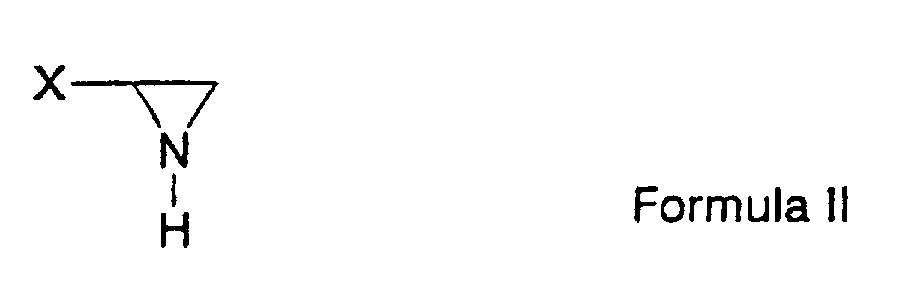
- Compounds possessing the basic nucleus can be converted into the compounds of this invention by two different methods. The preferred method depends on the structure of the product and the availability of appropriate isocyanate reagents.
- When R4 is H and isocyanates are commercially available or easily prepared, the preferred method is treatment of the basic nucleus with an isocyanate in an inert solvent such as benzene or toluene until complete disappearance of the starting material is indicated by thin-layer chromatography. Generally the product crystallizes when the reaction mixture is cooled. If not, the solvent is removed under reduced pressure to provide the product. Many appropriate isocyanates are commercially available. They include, but are not limited to alkyl (methylisocyanate, etc.), lower cycloalkyl (cyclohexylisocyanate), alkenyl (allylisocyanate), aryl (phenylisocyanate), monosubstituted aryl (tolylisocyanate, etc.), disubstituted aryl (3,4-dichlorophenylisocyanate), aryl lower alkyl (benzylisocyanate), and lower alkoxycarbonyl lower alkyl (CH2CO2C2H5), In other cases, the isocyanate can be prepared from an available intermediate. For example, 3-pyridylisocyanate is made by heating nicotinic acid azide in toluene by the procedure of Hyden and Wilbert. (Hyden, et al., Chem Ind (London) 3:1406-1407, 1967.)
- When R4 is not H or when an appropriate isocyanate is not available, the preferred method for preparing the compounds of this invention is to first convert the basic nucleus into a carbamate by treating it with 1 to 1.2 equivalents of a chloroformate such as 4-nitrophenyl chloroformate or trichloromethyl chloroformate (reaction 1) in an inert solvent such as benzene, chloroform, or tetrahydrofuran at low temperature (5-20°C) and removing the solvent under reduced pressure.The resulting

carbamate is treated with appropriate primary or secondary amines to give the desired product (reaction 2). Conditions for conducting this reaction are to treat the carbamate with 1 to 1.2 equivalents of the amine in an inert solvent such as toluene, chloroform, or tetrahydrofuran at room temperature until thin-layer chromatography indicates complete consumption of the carbamate. Many appropriate amines are commercially available. They include, but are not limited to dialkyl (diethylamine, etc.), alkynyl (propargylamine), monosubstituted aryl (2-napthylamine), disubstituted aryl (4-aminobenzoic), aryl lower alkyl (phenethylamine), heterocyclic (piperidine, ect.), and heteroaryl (2-aminothiazole). - The compounds of this invention can be purified by recrystallization from appropriate chemically inert solvents such as toluene, chloroform, and ethyl acetate.
- The compounds described above have anticancer activity. A number of biological assays are available to evaluate and to optimize the choice of specific compounds for optimal antitumor activity. These assays can be roughly split into two groups those involving in vitro exposure of agents to tumor cells and in vivo antitumor assays in rodent models and rarely, in larger animals.
- The in vitro experiments for new anticancer agents generally involve the use of established tumor cell lines both of animal and, especially of human origin. These cell lines can be obtained from commercial sources such as the American Type Tissue Culture Laboratory in Bethesda, Maryland and from tumor banks at research institutions. Exposures to new agents are carried out under simulated physiological conditions of temperature, oxygen and nutrient availability in the laboratory. The endpoints for these in vitro assays can involve: 1) colony formation; 2) a simple quantitation of cell division over time; 3) the uptake of so called "vital" dyes which are excluded from cells with an intact cytoplasmic membrane; or 4) the incorporation of radiolabeled nutrients into a proliferating (viable) cell. Colony forming assays have been used both with established cell lines, as well as fresh tumor biopsies surgically removed from patients with cancer. In this type of assay, cells are typically grown in petri dishes on soft agar, and the number of colonies or groups of cells (> 60 µ in size) are counted either visually, or with an automated image analysis system. A comparison is then made to the untreated control cells allowed to develop colonies under identical conditions. Because colony formation is one of the hallmarks of the cancer phenotype only malignant cells will form colonies without adherence to a solid matrix. This can therefore be used as a screening procedure for new agents, and there are a number of publications which show that results obtained in colony forming assays correlates with clinical trial findings with the same drugs.
- The enumeration of the total number of cells is a simplistic approach to in vitro testing with either cell lines or fresh tumor biopsies. In this assay, clumps of cells are typically disaggregated into single units which can then be counted either manually on a microscopic grid or using an automated flow system such as either flow cytometry or a Coulter® counter. Control (untreated) cell growth rates are then compared to the treated cell growth rates. Vital dye staining is another one of the older hallmarks of antitumor assays. In this type of approach cells, either untreated or treated with a cancer drug, are subsequently exposed to a dye such as methylene blue, which is normally excluded from intact (viable) cells. The number of cells taking up the dye (dead or dying) are the numerator with a denominator being the number of cells which exclude the dye. These are laborious assays which are not currently used extensively due to the time and the relatively non-specific nature of the endpoint.
- In addition to vital dye staining, viability can be assessed using the incorporation of radiolabeled nutrients and/or nucleotides. This is the test method that was used in the Viking Lander to look for life on Mars with the endpoint being how much of a radioactive substance was taken up into a sample as evidence of life activity. In tumor cell assays, a typical experiment involves the incorporation of either (3H) tritium or 14C-labeled nucleotides such as thymidine. Control (untreated) cells are shown to take up a substantial amount of this normal DNA building block per unit time, and the rate of incorporation is compared to that in the drug treated cells. This is a rapid and easily quantitatable assay that has the additional advantage of working well for cells that may not form large (countable) colonies. Drawbacks include the use of radioisotopes which present handling and disposal concerns.
- There are large banks of human and rodent tumor cell lines that are available for these types of assays. The current test system used by the National Cancer Institute uses a bank of over 60 established sensitive and multidrug -resistant human cells lines of a variety of cell subtypes. This typically involves 5-6 established and well-characterized human tumor cells of a particular subtype, such as non-small cell or small cell lung cancer, for testing new agents. Using a graphic analysis system called Compare®, the overall sensitivity in terms of dye uptake (either sulforhodamine B or MTT tetrazolium dye) are utilized. The specific goal of this approach is to identify compounds that are uniquely active in a single histologic subtype of human cancer. In addition, there are a few sublines of human cancer that demonstrate resistance to multiple agents and are known to, in some cases, express the multidrug resistance pump, p-glycoprotein. Assays using these resistant cells are currently underway for screening compounds both from NCl laboratories as well as any submitted from universities or private parties. The endpoint for the NCI assay is the incorporation of a protein dye called sulforhodamine B (for adherent tumor cells) and the reduction of a tetrazolium (blue) dye in active mitochondrial enzymes (for non-adherent, freely-floating types of cells). This latter method is particularly useful for hematologic cancers including myelomas, leukemias and lymphomas.
- Generally, once compounds have demonstrated some degree of activity in vitro at inhibiting tumor cell growth, such as colony formation or dye uptake, antitumor efficacy experiments are performed in vivo. Rodent systems are almost exclusively used for initial assays of antitumor activity since tumor growth rates and survival endpoints are well-defined, and since these animals generally reflect the same types of toxicity and drug metabolism patterns as in humans. For this work, syngeneic (same gene line) tumors are typically harvested from donor animals, disaggregated, counted and then injected back into syngeneic (same strain) host mice. Cancer drugs are typically then injected at some later time point(s), either by intraperitoneal, intravenous or oral routes, and tumor growth rates and/or survival are determined, compared to untreated controls. In these assays, growth rates are typically measured for tumors injected growing in the front flank of the animal, wherein perpendicular diameters of tumor width are translated into an estimate of total tumor mass or volume. The time to reach a predetermined mass is then compared to the time required for equal tumor growth in the untreated control animals. Significant findings generally involve a > 25% increase in the time to reach the predetermined mass in the treated animals compared to the controls. This is termed tumor growth inhibition. For non-localized tumors such as leukemia, survival can be used as an endpoint and a comparison is made between the treated animals and the untreated or solvent treated controls. In general, a significant increase in life span for a positive new agent is again > 20-25% longer life span due to the treatment. Early deaths, those occurring before any of the untreated controls, generally indicate toxicity for a new compound.
- For all these assays, the cancer drugs are generally tested at doses very near the lethal dose and 10% (LD10) and/or at the determined maximally-tolerated dose, that dose which produces significant toxicity, but no lethality in the same strain of animals and using the same route of administration and schedule of dosing. Similar studies can also be performed in rat tumor models although, because of the larger weight and difficulty handling these animals they are less preferred than the murine models.
- More recently, human tumors have been successfully transplanted in a variety of immunologically deficient mouse models. In the initial work, a mouse called the nu/nu or "nude" mouse was used to develop in vivo assays of human tumor growth. In nude mice, which are typically hairless and lack a functional thymus gland, human tumors (millions of cells) are typically injected in the flank and tumor growth occurs slowly thereafter. This visible development of a palpable tumor mass is called a "take". Anticancer drugs are then injected by some route (IV, IM, SQ, PO) distal to the tumor implant site, and growth rates are calculated by perpendicular measures of the widest tumor widths as described earlier. A number of human tumors are known to successfully "take" in the nude mouse model, even though these animals are more susceptible to intercurrent infections due to the underlying immunologic deficiency. An alternative mouse model for this work involves mice with a severe combined immunodeficiency disease (SCID) wherein there is a defect in maturation of lymphocytes. Because of this, SCID mice do not produce functional B- and T-lymphocytes. However, these animals do have normal cytotoxic T-killer cell activity. Nonetheless, SCID mice will "take" a large number of human tumors. Animals with the SCID phenotype are screened for "leakiness" by measuring serum immunoglobulin production which should be minimal to undetectable if the SCID phenotype is maintained. Tumor measurements and drug dosing are generally performed as above. The use of SCID mice has in many cases displaced the nude mouse since SCID mice seem to have a greater ability to take a larger number of human tumors and are more robust in terms of lack of sensitivity to intercurrent infections. Again, positive compounds in the SCID mouse model are those that inhibit tumor growth rate by > 20-25% compared to the untreated control.
- Testing for drug resistance can involve any of the in vitro and in vivo models, although the in vitro models are better characterized. In these tests, a cell subline is developed for resistance to a particular agent generally by serial exposure to increasing concentrations of the drug either in vitro or rarely in vivo. Once a high degree of resistance is demonstrated (generally > 4- to 5-fold) to a particular agent the cell line is further studied for mechanisms of resistance such as the expression of multidrug resistance membrane pumps such as p-glycoprotein or others. These resistant cell lines can then be tested for cross-resistance with other classic anticancer agents to develop a response pattern for a particular cell line. Using this cell line one can then evaluate a new agent for its potential to be active in the resistant cells. This has allowed for the demonstration of both mechanisms of drug resistance, as well as the identification of agents which might have utility in human cancers that have become resistant to existing chemotherapy agents. More recently, the use of resistant human tumor cells has been extended to the SCID mouse model with the development of an in vivo model of multidrug-resistant human multiple myeloma.
- All of these test systems are generally combined in a serial order, moving from in vitro to in vivo, to characterize the antitumor activity of a new agent. In general, one wishes to find out what tumor types are particularly sensitive to a new drug and conversely what tumor types are intrinsically resistant to a new agent in vitro. Using this information, experiments are then planned in rodent models to evaluate whether or not the compounds that have shown activity in vitro will be tolerated and active in animals. The initial experiments in animals generally involve toxicity testing to determine a tolerable dose schedule and then using that dose schedule, to evaluate antitumor efficacy as described above. Active compounds from these two types of assays may then be tested in human tumors growing in SCID or nude mice and if activity is confirmed, these drugs then become candidates for potential clinical drug development.
- Various compositions of the present invention are presented for administration to humans and animals in unit dosage forms, such as tablets, capsules, pills, powders, granules, sterile parenteral solutions or suspensions, eye drops, oral solutions or suspensions, and water-in-oil emulsions containing suitable quantities of compounds of Formula I.
- The term "unit dosage form", as used in the specification, refers to physically discrete units suitable as unitary dosages for human subjects and animals, each unit containing a predetermined quantity of active material calculated to produce the desired pharmaceutical effect in association with the required pharmaceutical diluent, carrier or vehicle. The specifications for the novel unit dosage forms of this invention are dictated by and directly dependent on (a) the unique characteristics of the active material and the particular effect to be achieved and (b) the limitations inherent in the art of compounding such an active material for use in humans and animals, as disclosed in detail in this specification, these being features of the present invention. Examples of suitable unit dosage forms in accord with this invention are tablets, capsules, pills, suppositories, powder packets, wafers, granules, cachets, teaspoonfuls, tablespoonfuls, dropperfuls, ampoules, vials, aerosols with metered discharges, segregated multiples of any of the foregoing, and other forms as herein described.
- An effective quantity of the drug is employed in treatment. The dosage of the specific compound for treatment depends on many factors that are well known to those skilled in the art. They include for example, the route of administration and the potency of the particular compound. A dosage schedule for humans of from about 0.25 to 2 grams of compound in a single dose, administered parenterally or in the compositions of this invention, are effective for treating different types of cancer.
- For parenteral administration, fluid unit dosage forms are prepared utilizing the compounds and a sterile vehicle, 0.9% sodium chloride being preferred. The cyanoaziridine-derivative, depending on the vehicle and concentration used, can be either suspended or dissolved in the vehicle. In preparing solutions the compound can be dissolved in water for injection and filtered sterilized before filling into a suitable vial or ampule and sealing. Advantageously, adjuvants such as a local anesthetic, preservative and buffering agents can be dissolved in the vehicle. To enhance the stability, the composition can be frozen after filling into the vial and the water removed under vacuum. The dry lyophilized powder is then sealed in the vial and an accompanying vial of water for injection is supplied to reconstitute the liquid prior to use. Parenteral suspensions can be prepared in substantially the same manner except that the compounds are suspended in the vehicle instead of being dissolved and sterilization cannot be accomplished by filtration. The compound can be sterilized by exposure to ethylene oxide before suspending in the sterile vehicle. Advantageously, a surfactant or wetting agent is included in the composition to facilitate uniform distribution of the cyanoaziridine derivative.
- For oral administration, either solid or fluid unit dosage forms can be prepared. For preparing solid compositions such as tablets, the compounds of formula I are mixed with conventional ingredients such as talc, magnesium stearate, dicalcium phosphate, magnesium aluminum silicate, calcium sulfate, starch, lactose, acacia, methylcellulose, and functionally similar materials as pharmaceutical diluents or carriers. Capsules are prepared by mixing the compound with an inert pharmaceutical diluent and filling the mixture into a hard gelatin capsule of appropriate size. Soft gelatin capsules are prepared by machine encapsulation of a slurry of the compound with an acceptable vegetable oil, light liquid petrolatum or other inert oil.
- Fluid unit dosage forms for oral administration such as syrups, elixirs, and suspensions can be prepared. The water-soluble forms can be dissolved in an aqueous vehicle together with sugar, aromatic flavoring agents and preservatives to form a syrup. An elixir is prepared by using a hydroalcoholic (ethanol) vehicle with suitable sweeteners such as sugar and saccharin, together with an aromatic flavoring agent.
- Suspensions can be prepared with an aqueous vehicle with the aid of a suspending agent such as acacia, tragacanth, methylcellullose and the like. Surfactants such as Cremophor EL (polyethoxylated castor oil) or polysorbate 80 (Tween®-80) may also be included.
- Additionally, a suppository can be employed to deliver the drug. The active compound can be incorporated into any of the known suppository bases by methods known in the art. Examples of such bases include cocoa butter, polyethylene glycols (carbowaxes), polyethylene sorbitan monostearate, and mixtures of these with other compatible materials to modify the melting point or dissolution rate. These suppositories can weigh from about 1 to 2.5 grams.
- Implants comprising polymeric devices which slowly release or slowly erode and release within the body to provide continuous supplies of the cyanoaziridine derivative are also of use. Implants include subcutaneous devices such as those routinely used to deliver the hormonal antitumor agent leuprolide or goserelin and other medicaments. Other implants include intratumoral and intraarterial devices.
- The implants may be made of polymers which generally comprise but are not limited to non-toxic hydrogels, silicones, polyethylenes, ethylene-vinyl acetate copolymers and other biodegradable polymers. Hydrogels include polyhydroxyalkyl methacrylates, polyacrylamide and polymethacrylamide, polyvinylpyrrolidone and polyvinyl alcohol. A preferred silicone is polydimethylsiloxane. Biodegradable polymers include polylactic acid [PLA], polyglycolic acid [PGA], copolymers of PLA and PGA, and polyamides.
- Without further elaboration, it is believed that one skilled in the art can, using the preceding description, practice the present invention to its fullest extent. The following detailed examples describe how to prepare the various compounds and/or perform the various processes of the invention and are to be construed as merely illustrative, and not limitations of the preceding disclosure in any way whatsoever. Those skilled in the art will promptly recognize appropriate variations from the procedures both as to reactants and as to reaction conditions and techniques.
- In general, anticancer therapy is given cyclicly on an every 3 or 4 week basis in order to reduce the tumor load and allow for recovery of normal cells from toxicity. The cyanoaziridine derivative drugs are given by an oral or parenteral route either as a single injection of a large dose or as a series of small daily doses for up to a 4 week period of continuous daily dosing. The continuous dosing regimen may be performed either as a series repeated daily injections, the injection of one large slow release depot formulation (in a subcutaneous or intramuscular site), or the intravenous or intraarterial infusion of agent continuously for several sequential days. Dosing regimens are determined to maximize activity with acceptable, but moderate to severe toxicities. Because the parent cyanoaziridine derivative imexon has not demonstrated myelosuppressive toxicity, it may be possible to continue dosing for prolonged periods with this agent in order to significantly reduce tumor burden and extend survival. These daily injections are given either as a rapid I.V. administration or as a continuous infusion or as an implantation of a slow release formulation in a subcutaneous or intramuscular site.
- Tumor load is assessed prior to therapy by means of objective scans of the tumor such as with x-ray radiographs, computerized tomography (CAT scans), nuclear magnetic resonance (NMR) scans or direct physical palpation of the tumor mass. Alternatively, the tumor may secrete a marker substance such as alphafetoprotein from colon cancer, CA125 antigen from ovarian cancer, or serum myeloma "M" protein from multiple myeloma. The levels of these secreted products then allow for an estimate of tumor burden to be calculated. These direct and indirect measures of the tumor load are done pretherapy, and are then repeated at intervals following the administration of the drug in order to gauge whether or not an objective response has been obtained. An objective response in cancer therapy generally indicates > 50% shrinkage of the measurable tumor disease (a partial response), or complete disappearance of all measurable disease (a complete response). Typically these responses must be maintained for a certain time period, usually one month, to be classified as a true partial or complete response. In addition, there may be stabilization of the rapid growth of a tumor or there may be tumor shrinkage that is < 50%, termed a minor response. In general, increased survival is associated with obtaining a complete response to therapy and in some cases, a partial response if maintained for prolonged periods can also contribute to enhanced survival in the patient. Patients receiving chemotherapy are also typically "staged" as to the extent of their disease before and following chemotherapy are then restaged to see if this disease extent has changed. In some situations the tumor may shrink sufficiently and if no metastases are present, then surgical excision may be possible after chemotherapy treatment where it was not possible beforehand due to the widespread disease. In this case the chemotherapy treatment with the novel cyanoaziridine is being used as an adjuvant to potentially curative surgery. In addition, patients may have individual lesions in the spine or elsewhere that produce symptomatic problems such as pain and these may need to have local radiotherapy applied. This may be done in addition to the continued use of the systemic cyanoaziridine.
- Patients are assessed for toxicity with each course of chemotherapy, typically looking at effects on liver function enzymes and renal function enzymes such as creatinine clearance or BUN as well as effects on the bone marrow, typically a suppression of granulocytes important for fighting infection and/or a suppression of platelets important for hemostasis or stopping blood flow. For such myelosuppressive drugs, the nadir in these normal blood counts, is reached between 1-3 weeks after therapy and recovery then ensues over the next week. Based on the recovery of normal white blood counts, treatments may then be resumed. However, because the cyanoarizidines have not demonstrated serious myelosuppression (bone marrow) toxicity to date, they may be used more frequently in a process called "dose intensification." This indicates the more frequent dosing of a cyanoaziridine agent as a means of achieving more substantial reduction in tumor burden.
- In general, complete and partial responses are associated with at least a 1-2 log reduction in the number of tumor cells (a 90-99% effective therapy). Patients with advanced cancer will typically have >109 tumor cells at diagnosis, multiple treatments will be required in order to reduce tumor burden to a very low state and potentially obtain a cure of the disease.
- Because of the lack of myelotoxicity, the cyanoaziridines may be combined with other existing cytotoxic agents including other drugs which damage the bone marrow. In this regard the cyanoaziridines may offer a distinct advantage over existing agents because they could be combined at full dose with the full dose of bone marrow suppressing drugs due to the lack of myelosuppression for the cyanoaziridines. This has been a major advantage with the use of the nonmyelosuppressive vinca alkaloid, vincristine, in patients with acute leukemia. Similarly, the cyanoaziridines may be combined with a large number of existing myelosuppressive agents in order to provide high dose intensity with multiple agent therapy.
- The use of multiple chemotherapy agents is desirable in order to produce a major reduction in tumor load as well as to prevent the emergence of cells resistant to a single therapy.
- At the end of a treatment cycle with the cyanoaziridine derivative which could comprise several weeks of continuous drug dosing, patients will be evaluated for response to therapy (complete and partial remissions), toxicity measured by blood work and general well-being classified performance status or quality of life analysis. The latter includes the general activity level of the patient and their ability to do normal daily functions. It has been found to be a strong predictor of response and some anticancer drugs may actually improve performance status and a general sense of well-being without causing a significant tumor shrinkage. The antimetabolite gemcitabine is an example of such a drug that was approved in pancreatic cancer for benefiting quality of life without changing overall survival or producing a high objective response rate. Thus, for some cancers that are not curable, the cyanoaziridines may similarly provide a significant benefit, well-being performance status, etc. without affecting true complete or partial remission of the disease.
- In hematologic disorders such as multiple myeloma, lymphoma and leukemia, responses are not assessed via the measurement of tumor diameter since these diseases are widely metastatic throughout the lymphatic and hematogenous areas of the body. Thus, responses to these diffusely disseminated diseases are usually measured in terms of bone marrow biopsy results wherein the number of abnormal tumor cell blasts are quantitated and complete responses are indicated by the lack of detection of any tumor cells in a bone marrow biopsy specimen. With the B-cell neoplasm multiple myeloma a serum marker, the M protein, can be measured by electrophoresis and if substantially decreased this is evidence of the response of the primary tumor. Again, in multiple myeloma, bone marrow biopsies can be used to quantitate the number of abnormal tumor plasma cells present in the specimen. For these diseases generally higher dose therapy is typically used to affect responses in the bone marrow and/or lymphatic compartments.
- In addition to intravenous (systemic) therapy, with some cancers, drugs may need to be given directly into the central nervous system since they have a low uptake into this compartment. Therefore, the cyanoaziridines may be injected through the intrathecal space between the third and fourth lumbar vertebrae in order to achieve high levels in the cerebral spinal fluid. Alternatively, the drugs may be injected through a subcutaneous sack connected to the brain ventricle (the Ommaya reservoir). In this way the cyanoaziridines can gain access to the central nervous system to reduce tumor cell burden in that compartment. Drugs useful in the central nervous system generally have low sclerosing or vesicant potential; current examples include the antimetabolites cytarabine and methotrexate. The cyanoaziridines also have a low sclerosing and vesicant potential.
- For a typical therapeutic use of imexon to treat a systemic cancer not in the central nervous system the drug is dissolved in a physiologic solution such as 5% dextrose in water (D5W) or 0.9% sodium chloride for injection (normal saline). This solution is then infused intravenously either via a peripheral vein or a central vascular access device at a slow infusion rate of several mL/minute. The infusion may be continued for several days or it may be given in a single daily injection over a period of 30 minutes to 4 hours. Throughout this infusion the patient is monitored for any acute distress such as a hypersensitivity reaction to the drug or a change in blood pressure or mental status. The veins are also monitored to make sure that medication is not leaking out (extravasation). At the conclusion of the infusion the patient may remain under observation for a short time period before returning home or to work.
- The range of imexon (analog) doses may vary from 10 mg to 10 grams per day for single or consecutive daily doses. Prolonged daily dosing has been shown to be tolerable and active in tumor-bearing mice and dogs receiving therapy for up to one month. Thus, a "typical" clinical dose schema for humans with cancer would comprise: 1-10 g/day by IV infusion for one up to thirty consecutive days, followed by a "rest period" of 1-2 weeks, for evaluation of response and resolution of any toxicities, which are expected to involve non-cumulative gastrointestinal effects. The rates of infusion are typically 1-500 µg (generally 100-300) per mL per m2 at rates of 1-500 (typically 100-300) mg/hour. These treatment schedules could be continued indefinitely until there is evidence of disease progression or severe toxicity.
- Table 1A shows the designation numbers of imexon analogs (AMPs) and their respective chemical formulae. When an AMP designation number is used herein, its chemical formula can be found in Table 1A.
AMP designation of imexon analogs and their respective chemical formulae. compound R AMP-400 (imexon) 403 CH3 404 C6H5 405 COCl3 406 C2H5 407 o,p-C6H3Cl2 408 pm,p-C6H3Cl2 409 H (intermed.) 410 C(CH3)3 412 CH2C6H5 413 c-C6H11 414 C4H9 415 p-FC6H4 416 p-CF3C6H4 417 p-O2NC6H4 418 Bis-cyanoaziridine 419 p-C2H5OCOC6H4 420 C2H5OCOCH2 421 C5H4N (pyr.) 422 H2NSO2C6H4 423 I-Naphthyl 424 o-CH3CO2C6H4 425 m-CH3COC6H5 - Table 1B below summarizes the projected clinical uses for the imexon analog series. Based on the current preclinical data, the imexon analogs will require parenteral administration by the intramuscular, intravenous or subcutaneous route. A depot (IM or SC) formulation would be especially advantageous to prolong drug levels and reduce injection frequency. The parent compound was not active orally in mice, but select analogs will overcome this limitation due to their enhanced stability in acidic aqueous solutions, and/or by incorporation into an oral formulation which is protected from gastrointestinal degradation (i.e., enteric coatings or other timed-release oral formulations.
Clinical Uses of the Imexon Analog Series in Treating Human Cancer. Disease Rationale Multiple Myeloma • Activity demonstrated in human tumors in vitro and in vivo (in the SCID mouse model) Lung Cancer, Breast Cancer • Parent compound active in Phase I human clinical trial Malignant Malanoma • Human cells sensitive to analogs in in vitro and parent compound active in Phase I human clinical trial and in vivo in animal AIDS-related lymphoma models AIDS-Related Lymphoma • Parent compound active in vitro • Analogs active against lymphoma cells in vitro Multidrug-Resistant (MDR) Tumors (Myeloma, Leukemia Breast and Colon Carcinoma) • Analogs not affected by p-glycoprotein-mediated MDR Prostate Cancer • Parent compound active in human tumors in vivo in the SCID mouse model - Based on the in vitro and in vivo observations of enhanced and tumor efficacy for prolonged exposure, a clinical trial design to incorporate this requirement, has been formulated for imexon and imexon-related analogs. Our prior studies of imexon in mice and dogs suggest that the maximally-tolerated human dose will be approximately 500 mg/m2/day. (Note an "average" adult is approximately 1.8 m2 in body surface area.)
- It is anticipated that the major toxicity with the cyanoaziridines will be acute nausea and vomiting and these will be pretreated with combinations of effective antiemetics. In addition, several weeks after the conclusion of the cyanoaziridine derivative infusions the patients will have blood work drawn to evaluate both toxic effects on different normal tissues including the bone marrow, kidney and liver as well as evidence for reduction in any of the known tumor markers as described earlier. In general the patients are reassessed on a monthly basis and therapy may be then reinstituted if there is no evidence of tumor growth and/or if there is evidence of actual response to the prior therapy as described earlier. These treatments may be combined with other anticancer agents given on a cyclical basis of usually every 2-4 weeks with approximately 5-6 courses typically given in order to comprise a complete trial of chemotherapy. At this time the patient is completely reassessed for response and toxicity and patients may either continue on therapy if there is some evidence of residual disease or they may go into a period of observation if the tumor has been significantly reduced. With any increasing sign of tumor spread patients may go back onto chemotherapy with the cyanoaziridine and/or other agents or a decision may be made to switch to different types of drugs and/or modality such as radiation therapy.
- The following examples are provided by way of illustration only and not by way of limitation. Those of skill will readily recognize a variety of noncritical parameters which could be changed or modified to yield essentially similar results.
- To an ice-cold mixture of 2-cyanoaziridine and toluene was added an ice-cold solution of methyl isocyanate (1.05 equivalents) in toluene at a rate to keep the temperature below 5°C. The mixture was stirred for one hour in an ice bath and then placed in a refrigerator overnight. The resulting precipitate was collected, washed with toluene, and dried under vacuum to give a 94% yield of the title compound as a solid with m.p. 98-100 °C: MS (El) 125(M+); 1H NMR (CDCl3, TMS) 2.47 (d, 1, J=3 Hz), 2.57 (d, 1, J=6 Hz) 2.8 (d, 3, J=5 Hz), 3.05 (2d, 1, J=6 Hz, 3 Hz) 6.18 (s, 1, NH).
- This compound was prepared from 2-cyanoaziridine and ethylisocyanate in 63% yield by the procedure described in Example 1. It had m.p. 58-62 °C: MS (El) 139 (M+); 1H NMR (CDCl3, TMS) 1.1 (t, 3, J=6 Hz), 2.4 (d, 1, J=3 Hz), 2.50 (d, 1, J=6 Hz), 2.97 (2d, 1, J=6 Hz, 3 Hz), 3.3 (q, 2, J=6 Hz), 6.1 (s, 1, NH).
- This compound was prepared from 2-cyanoaziridine and n-butylisocyanate in 92% yield by the procedure described in Example 1. It had m.p. 32-34 °C: 1H NMR (CDCl3, TMS) 1.0 (t, 3), 1.2-1.5 (m, 2), 1.6-2.1 (m, 2), 2.5 (d, 1, J=3 Hz), 2.55 (d, 1, J=6 Hz), 3.19 (2d, 1, J=6 Hz, 3Hz), 3.6 (m, 2), 5.8 (s, 1, NH).
- This compound was prepared from 2-cyanoaziridine and t-butylisocyanate in 81% yield by the procedure described in Example 1. It had m.p. 46-48 °C: 1H NMR (DMSO-d6, TMS) 1.4 (s, 9), 2.84 (d, 1, J=3 Hz), 2.86 (d, 1, J=6 Hz), 3.0 (2d, 1, J=6Hz, 3Hz) 5.8 (br. s, NH).
- This compound was prepared from 2-cyanoaziridine and cyclohexylisocyanate in 64% yield by the procedure described in Example 1. It had m.p. 98-102 °C: 1H NMR (CDCl3, TMS) 1.2-1.5 (m, 5), 1.6-2.1 (m, 5), 2.45 (d, 1, J=3 Hz), 2.53 (d, 1, J=6 Hz), 3.015 (2d, 1, J=6 Hz, 3 Hz), 3.6 (m,1), 5.8 (s, 1, NH).
- Method A. This compound was prepared from 2-cyanoaziridine and benzylisocyanate in 25% yield by the procedure described in Example 1. It had m.p. 42-44 °C: 1H NMR (CDCl3, TMS) 2.36 (d, 1, J=3 Hz), 2.46 (d, 1, J=6 Hz), 2.93 (2d, 1, J=6 Hz, 3 Hz), 4.4 (d, 2), 6.8 (s, 1, NH), 7.4 (m,5).
- Method B. A solution of 175 mg of 2-cyanoaziridine and 0.36 mL of triethylamine in 5 mL of THF was cooled and stirred in an ice bath. A solution of 550 mg of 4-Nitrophenyl chloroformate in 2.5 mL of THF was added at a rate that kept the temperature below 10 °C. When the addition was complete, the solution was stirred 2 hours at room temperature and then filtered to remove triethylamine hydrochloride. The filtrate was concentrated under reduced pressure and the residual oil was stirred with 5 mL of toluene for 30 minutes. The pale yellow precipitate that formed was washed with toluene (2 x 5 mL) and dried under vacuum to afford a 33% yield of 4-nitrophenyl 2-cyanoaziridine-1-carboxylate, m.p. 100-104 °C.
- A mixture of 4-nitrophenyl 2-cyanoaziridine-1-carboxylate and benzylamine (1:1.1 molar ratio) in THF was stirred vigorously at room temperature. The progress of the reaction was monitored by thin-layer chromatography on silica gel with chloroform-methanol (1:9) as solvent. When the starting materials were consumed (about 2 hours), the solution was concentrated under reduced pressure and the title compound was freed from 4-nitrophenol by washing with THF. This procedure gave the title compound with m.p 42-44 °C and a 1H NMR spectrum identical with that of the sample described in Method A.
- This compound was prepared from 2-cyanoaziridine and ethyl isocyanatoacetate in 50% yield by the procedure described in Example 1, except that it was a colorless oil and did not crystallize on refrigeration. Instead, it was dissolved in cold chloroform and diluted with cold hexane. The mixture was stirred briefly and then the solvent was decanted. The residual title compound had 1H NMR (CDCl3, TMS) 1.22 (t, 3, J=7 Hz), 2.49 (d, 1, J=3 Hz), 2.56 (d, 1, J=6 Hz), 3.07 (2d, J=6 Hz, 3 Hz), 3.91 (d, 2 ), 4.15 (q, 2, J=7 Hz ), 6.74 (t, 1, NH).
- This compound was prepared from 2-cyanoaziridine and phenylisocyanate in 71% yield by the procedure described in Example 1. It had m.p. 88-90 °C: MS (El) 187(M+); 1H NMR (DMSO-d6, TMS) 2.65 (d, 1, J=3 Hz), 2.69 (d, 1, J=6 Hz), 3.57 (2d, 1, J=6 Hz, 3 Hz), 7.05 (t, 1), 7.45 (d, 2), 7.60 (d, 2), 10.2 (s, 1, NH).
- This compound was prepared from 2-cyanoaziridine and (4-flourophenyl)isocyanate in 54% yield by the procedure described in Example 1. It had m.p. 99-100 °C: 1H NMR (DMSO-d6, TMS) 2.55 (d, 1, J=3 Hz), 2.68 (d, 1, J=6 Hz), 3.20 (2d, 1, J=6 Hz, 3 Hz), 7.0 (d, 2, J=9 Hz), 7.5 (d, 2, J=9 Hz), 10.2 (s, 1, NH).
- This compound was prepared from 2-cyanoaziridine and 4-(trifluorophenyl)isocyanate in 91% yield by the procedure described in Example 1. It had m.p. 166-168 °C: 1H NMR (DMSO-d6, TMS) 2.62 (d, 1, J=3 Hz), 2.74 (d, 1, J=6 Hz), 3.32 (2d, 1, J=6 Hz, 3 Hz), 7.54 (d, 2, J=9 Hz), 7.74 (d, 2, J=9 Hz), 10.2 (s, 1, NH).
- This compound was prepared from 2-cyanoaziridine and 4-(nitrophenyl)isocyanate in 89% yield by the procedure described in Example 1. It decomposed above 230 °C: 1H NMR (DMSO-d6, TMS) 2.77 (d, 1, J=3 Hz), 2.81 (d, 1, J=6 Hz), 3.69 (2d, 1, J=6 Hz, 3 Hz), 7.8 (d, 2, J=9 Hz), 8.2(d, 2, J=9 Hz), 10.8 (s, 1, NH).
- This compound was prepared from 2-cyanoaziridine and (2,4-dichlorophenyl)isocyanate in 50% yield by the procedure described in Example 1. It had m.p.110-114 °C: 1H NMR (DMSO-d6, TMS) 2.70 (d, 1, J=3 Hz), 2.71 (d, 1, J=6 Hz), 3.57 (2d, 1, J=6 Hz, 3 Hz), 7.4 (d, 1, J=6 Hz), 7.6 (d, 1, J=6 Hz), 7.7 (s, 1), 10.0 (s, 1, NH).
- This compound was prepared from 2-cyanoaziridine and (3,4-dichlorophenyl)isocyanate in 76% yield by the procedure described in Example 1. It had m.p. 132-134 °C: 1H NMR (DMSO-d6, TMS) 2.71 (d, 1, J=3 Hz), 2.73 (d, 1, J=6 Hz), 3.62 (2d, 1, J= 6Hz, 3 Hz), 7.5 (2d, 1, J=9 Hz, 3 Hz), 7.6 (d, 1, J=9Hz), 7.9 (d, 1, J=3 Hz), 10.6 (s, 1, NH).
- This compound was prepared from 2-cyanoaziridine and ethyl 4-isocyanatobenzoate in 90% yield by the procedure described in Example 1. It had m.p.162-165°C: 1H NMR (DMSO-d6, TMS) 1.3 (t, 3, J=6 Hz), 2.72 (d, 1, J=3 Hz), 2.76 (d, 1, J=6 Hz), 3.64 (2d, 1, J=6 Hz, 3 Hz), 4.3 (q, 2, J=6 Hz), 7.69 (d, 2, J=9 Hz), 7.73 (d, 2, J=9 Hz), 10.63 (s, 1, NH).
- This compound was prepared from 2-cyanoaziridine and (3-acetylphenyl)isocyanate in 74% yield by the procedure described in Example 1. It had m.p. 110-112 °C: 1H NMR (DMSO-d6, TMS) 2.6(s, 3), 2.71 (d, 1, J=3 Hz), 2.74 (d, 1, J=6 Hz), 3.63 (2d, 1, J=6 Hz, 3 Hz), 7.5 (t, 1, J=9 Hz), 7.7 (d, 1, J=9 Hz), 7.85 (d, 1, J=9 Hz), 8.1 (s, 1), 10.5 (s, 1, NH).
- This compound was prepared from 2-cyanoaziridine and (2-acetoxyphenyl)isocyanate in 10% yield by the procedure described in Example 1. It had m.p. 100-102 °C: 1H NMR (CDCl3, TMS) 2.38 (s, 3), 2.55 (br. s, 1), 2.64 (br. s, 1,), 3.20 (br. s, 1), 7.15 (br. s, 2), 7.2-7.6 (br. s, 1), 7.68 (br. s, 1), 7.96 (s, 1, NH). In this spectrum, the expected doublets were not resolved, but appeared as broad singlets.
- 2-Acetylbenzoic acid azide was prepared by reacting 2-acetoxybenzoyl chloride with sodium azide in acetone and water at 0-5 °C for 24 hours. It had an IR peak at 2245 cm-1 (azide). The crude azide was then heated in benzene at 70-75 °C under nitrogen for 2 hours to give 2-acetoxyphenylisocyanate.
- 2-Cyanoaziridine-1-[N-(4-chlorosulfonyl)]carboxamide was prepared from 2-cyanoaziridine and (4-chlorosulfonylpheny)isocyanate by the procedure described in Example 1. It had m.p. 142-144 °C. Without further purification, it was converted by treatment with liquid ammonia into the title compound, in overall yield of 39%: m.p. 170-174 °C; 1H NMR (DMSO-d6, TMS) 2.72 (d, 1, J=3 Hz), 2.74 (d, 1, J=6 Hz), 3.7 (2d, 1, J=6 Hz, 3 Hz), 7.26 (s, 2, SO2NH2), 7.69 (d, 2), 7.73 (d, 2), 10.6 (s, 1, CONH2).
- This compound was prepared from 2-cyanoaziridine and 1-naphthylisocyanate in 56% yield by the procedure described in Example 1. It had m.p. 98-100 °C: 1H NMR (CDCl3, TMS) 2.6 (br. s, 1), 2.7 (br. s, 1), 3.2 (br. s, 1), 7.4 (br. s, 1), 7.5 (m, 2), 7.7 (br. s, 2), 7.8 (br. s, 2), 8.1 (s, 1, NH).
- In this spectrum, the expected doublets were not resolved and appeared as broad singlets.
- This compound was prepared from 2-cyanoaziridine and 3-pyridylisocyanate by the procedure described in Example 1, except that the solvent was benzene. It had m.p. 205 °C (dec.): 1H NMR (DMSO-d6, TMS) 2.72 (d, 1, J=3 Hz), 2.76 (d, 1, J=6 Hz), 3.65 (2d, 1, J=6 Hz, 3Hz), 7.36 (d, 1), 7.97 (d, 1), 8.27 (d, 1), 8.71 (s, 1, NH), 10.5 (br. 2, 1, NH).
- 3-Pyridylisocyanate was prepared from nicotinic acid hydrazide by way of nicotinic acid azide following the literature procedure. (Hyden, et al., Chem Ind (London) 3:1406-1407, 1967.) It had an IR peak at 2250 cm-1 (isocyanate). The overall yield of the title compound was 10%.
- In vitro and in vivo model systems for testing the compounds of this invention.
- The compounds of the present invention were tested for antitumor activity in various model systems. These systems included the following:
- 1) in vitro tumor cell viability assays using MTT and SRB dye reaction endpoints.
- 2) in vivo survival studies in mice with severe combined immunodeficiency disease (SCID) bearing solid flank tumors.
-
- Background: Sulforhodamine B (SRB) is a protein binding aminoxanthene dye with two sulfonic acid groups. (Lillie, R.D., H.J. Conn's Biological Stains, 9th Ed., Baltimore; Williams & Wilkins, 1977.) It quantitates whole cell protein content by the intensity of dye staining and relates this to the number of viable cells. This assay assumes that dead cells either lyse, are removed during the procedure, or otherwise do not contribute to the colorimetric endpoint. The SRB assay is used for cells which normally adhere to surfaces (in this case plastic culture flasks or petri dishes) as part of their requirement for growth and division in vitro. The SRB assay is currently used by the National Cancer Institute in the anticancer drug screening program. (Skehan, et al., J Natl Cancer Inst 82:1107-1112, 1990; Rubinstein, et al., J Natl Cancer Inst 82:1113-1118, 1990.) Methodologic comparisons have shown that SRB results are linear for the number of tumor cells over a 100-fold range, and for protein content determined by a modified Lowry method or Standard Bradford (Bradford, M., Anal Biochem 72:248-254, 1976) methods. The visible pink colorimetric endpoint is also indefinitely stable and is more sensitive for quantitating cell numbers than the Lowry or Bradford colorimetric methods and is comparable in sensitivity to fluorescent detection methods. (Lillie, R.D., H.J. Conn's Biological Stains, 9th Ed., Baltimore; Williams & Wilkins, 1977.)
- Methodology: Cell cultures of 103-107 cells growing in 96-well plastic microtiter plates are fixed with 50% trichloroacetic acid (TCA) for 30 minutes at 4 °C. The cells are then stained with 0.4% (w/v) sulforhodamine B (SRB) dissolved in 1% acetic acid. Unbound dye is removed by 4 washes with 1% acetic acid, and protein-bound dye is extracted with 10 mM unbuffered Tris® base [tris(hydroxymethyl)aminomethane]. The optical density (OD) of this extracted solution is measured at 564 nM in a microtiter plate ultraviolet absorbance detector. Cell viability is expressed as percent of control by dividing the optical densities and multiplying the result by 100.
- Tumors are disaggregated into single cell suspensions using mechanical, hypoosmotic, and/or enzymatic (trypsin) methods. The cells are plated at a concentration of 3-5 x 10⁴ per 1 mL well into plastic 96-well plates. Growth medium containing 5-10% (vol/vol) heat-inactivated fetal bovine serum and penicillin/streptomycin (both 100 mg/mL) are added prior to incubation at 37 °C for 6 days. Afterwards the medium containing the drug is removed, the cells are centrifuged in fresh medium or phosphate-buffered saline (pH 7.4). A tetrazolium dye, (3,4,5-dimethylthiazol-2-yl)-2,5-diphenyl tetrazolium (MTT), is then added. (Mossman, T., J Immunol 65:55-63, 1983.) This dye forms a colored formazan product upon activation by mitochondrial reductases in viable cells. Typically, the formazan product is solubilized in acid-propanol or DMSO. The intensity of the color is proportional to viable cell numbers and this is quantitated by spectrophotometric absorbance at 570 nM on a micro ELISA plate reader. The results are calibrated in % control absorbance from untreated tumor cells. (Alley, et al., Cancer Res 48:589-601, 1988.)
- Background: The SCID mouse represents an autosomal recessive mutation in an inbred strain of C1B-17 mice which renders the animals profoundly immunodeficient and able to accept tissue xenografts from rats, humans or other strains of mice. (Ware, et al., J Immunol Methods 85:353-361, 1985.) The immunologic defect results from an inability to carry out normal immunoglobulin and T-cell receptor recombination reactions during the development of T- and B-lymphocytes. This renders mice with very low levels of T- and B-cells, and low levels of antibody production which allows foreign (allogeneic or xenogeneic) tissue grafts to grow in vivo. A variety of human tumor tissue types have been shown to grow into palpable tumors following subcutaneous injection into SCID mice. (Phillips, et al., Curr Top Microbiol Immunol 152:259-263, 1989.) Compared to athymic nude mice, SCID mice accept more tumor tissue types and breed more efficiently. (Phillips, et al., Curr Top Microbiol Immunol 152:259-263, 1989.) The SCID mice are also more sensitive to ionizing radiation (Budach, et al., Cancer Res 52(22):6292-6296, 1992) due to a defect in DNA double strand break repair. (Chang, et al., Cancer Res 53:1244-1248, 1993.) Because some SCID mice can spontaneously revert to a more normal phenotype, serum immunoglobulin G (IgG) levels are routinely measured and if elevated (leaky phenotype syndrome), the mouse is excluded from further study.
- Methodology: The SCID mouse colony is maintained in a barrier facility with specially filtered air, autoclaved (sterilized) food and water and protective handling precautions (gloves, mask, gown) to prevent inadvertent infection. For tumor studies, human tumor cells are grown in vitro, harvested, counted and injected subcutaneously into the front flank area. Tumor cell innocula range from 106-2x10⁷ cells/mouse. Palpable tumors begin to develop after 1-3 weeks and sizes are determined by caliper measure of the widest perpendicular diameters. These dimensions are converted to mass using the formula: (L x W2) ÷ 2
wherein W = the shorter of the two dimensions and L = the longer diameter value. - Tumor growth rates are plotted as mass (g) per days after inoculation.
- Drug treatments are given by intravenous (IV) or intraperitoneal (IP) injection beginning 24 hours after tumor implantation (day 1). For
imexon analog 404 studies, 20 x 106 8226 myeloma cells exhibiting 40-fold resistance to doxorubicin (8226) (Dalton, et al., Cancer Res 46:5125-5130, 1986) were injected in SCID mice (5/group) onday 0. Drug therapy began 1 day later with AMP-404 dissolved in a water-miscible co-solvent system containing (per mL):benzyl alcohol 30 mg;polysorbate 80 mw, 80 mg; polyethylene glycol 300 mw, 650 mg; and q.s. to 1.0 mL in absolute ethanol. The daily dose was either 50 mg/kg or 100 mg/kg. Therapy was continued daily for 4 weeks and tumors were measured three times per week up to the 7 week ending period (two weeks after stopping drug therapy). - Daily treatment with AMP-404 100 mg/kg resulted in a reduced rate of tumor growth. This was statistically significant at 3 weeks. At the end of the 6 week experiment, mean control tumor size was approximately 1,000 mm3 in the control group and in the group treated with 100 mg/kg it was approximately 300 mm3 (Table 2). This group also experienced a mean body weight loss of 15-20% compared to the control group. There was no apparent weight loss or antitumor effect in the group of SCID mice treated with 50 mg/kg of AMP-404. The tumor take rate (% of inoculated mice developing palpable tumors) was 100% in all 3 groups. The onset of developing palpable tumors was 3 weeks after inoculation. The results are provided in Figure 1. These results show that AMP-404 is active against multidrug-resistant human myeloma cells in vivo. Antitumor effects at the 100 mg/kg dose were associated with a mean 50% reduction in tumor volume. There was no drug-induced lethality, but this regimen did reduce total body weight by 15-20%. The lower AMP-404 dose of 50 mg/kg was not active.

- Table 3 gives the potencies of the new aziridine-1-carboxamides in a panel of human and murine tumor cells in culture. The tumor cell lines in this table are selected to represent a range of histological and growth phenotypes. Their characteristics are described below.
- According to Table 3, the compounds of this invention are active at low concentrations against human breast carcinoma cells in culture, including cell lines resistant to the important clinical agents doxorubicin and mitoxantrone. They show little or no cross-resistance in these cell lines. Furthermore, they are active at comparable low concentrations against colon cancer, lung cancer, and ovarian cancer cell lines.

-
- 1.0 Human Breast Tumor Cell Lines
- 1.1 MCF-7 Breast Cancer: The parental (sensitive) MCF-7 breast cancer is an estrogen-dependent adenocarcinoma originally derived from a pleural effusion in a female with advanced metastatic breast cancer. (Soule, et al., J Natl Cancer Inst 51:1409-1416, 1973.)
- 1.2 MCF-7/ADR: This multidrug-resistant MCF-7 cell line was developed by growth in medium containing serially increasing concentrations of the antitumor agent doxorubicin (Adriamycin®). (Cohen, et al., Cancer Res 46:4087-4090, 1986.) The resistance pattern is stable when the cells are grown in medium of doxorubicin and the cells are cross-resistant to numerous other natural product-based antitumor agents including vincristine, vinblastine, etoposide, and dactinomycin. The MCF-7 ADR line is 192-fold less sensitive to doxorubicin in vitro and is known to express the cell membrane efflux (resistance) pump, P-glycoprotein.
- 1.3 MCF-7/D40 and MCF-7/MITOX cell lines were developed by chronic exposure in vitro to increasing concentrations of the DNA-intercalating antitumor agents doxorubicin and mitoxantrone, respectively. (Taylor, et al., Br J Cancer 63:923-929, 1991.) These resistant cell lines have similar growth characteristics to the parental MCF-7 cells, but exhibit a multidrug resistance phenotype. The MCF-7/D40 cells express the cell membrane efflux pump, P-glycoprotein and are over 40-fold resistant to doxorubicin, mitoxantrone and the vinca alkaloids, vinblastine and vincristine. In addition, MCF-7/DOX40 cells can be sensitized (resistance reversed) using the antiarrhythmic agent verapamil. The MCF-7/MITOX cells are similarly multidrug resistant (but do not express either P-glycoprotein or the MRP resistance protein) (Futscher, et al., Biochem Pharmacol 47(9):1601-1606, 1994), and resistance is not modulated (reversed) by verapamil. Furthermore, the MCF-7/MITOX cells are only partially resistant to doxorubicin, but are highly resistant to other natural products.
- 2.0 Human WiDr Colon Cancer Cell Lines
- 2.1 WiDr: The adenocarcinoma cell line WiDr was originally isolated by Noguchi, et al. from a primary colon tumor specimen from a patient with advanced colon carcinoma. (Noguchi, et al, in Vitro 35(6):401-407, 1979.) The WiDr MITOX cell line was developed for mitoxantrone resistance by growth in serially elevated concentration of mitoxantrone. (Wallace, et al., Proc Am Assoc Cancer Res 23:767, 1982.) It is P-glycoprotein negative and exhibits 21-fold resistance to mitoxantrone, 8-fold resistance to doxorubicin and only 2-fold resistance to vincristine. (Dalton, et al., Cancer Res 48:1882-1888, 1988.)
- 3.0 A-549 Human Lung Cancer is an adenocarcinoma type of non-small cell lung cancer (NSCLC). It was established by Girard, et al. from a fresh tumor specimen obtained from a 58 year-old male with advanced lung cancer. (Girard, et al., J Natl Cancer Inst 51(5):1417-1423, 1973.) It has 5.6% plating efficiency (colony formation) on agar-coated plates, 66 modal chromosome number and grows rapidly when injected subcutaneously, forming acinar pattern tumors in immunodeficient mice. (Girard, et al., J Natl Cancer Inst 51(5):1417-1423, 1973.) Like NSCLC in vivo, A-540 lung cancer cells are relatively resistant to most chemotherapy drugs in vitro but like MCF-7 and WiDr, is used to screen for new anticancer agents in the NCI in vitro screening planel. (Alley, et al., Cancer Res 48:589-601, 1988.)
- 4.0 The Human A-375 Malignant Melanoma Cell Line was also developed by Girard, et al. (Girard, et al., J Natl Cancer Inst 51(5):1417-1423, 1973) from a 54 year-old human female with advanced melanoma. The modal chromosome number is 67 and it has a low plating (colony forming) efficiency of 0.7% when grown on agar. These cells also form rapidly growing tumors when injected subcutaneously into immunodeficient athymic (nu/nu) mice. (Girard, et al., J Natl Cancer Inst 51(5):1417-1423, 1973.) These cells are also used in the NCI drug screening panel. (Skehan, et al., J Natl Cancer Inst 82:1107-1112, 1990.)
- 5.0 Human OVCAR-3 Ovarian Carcinoma was originally isolated by Hamilton, et al. Experimental model systems of ovarian cancer; applications to the design and evaluation of new treatment approaches. Seminars in Onocology, 11:285-298, 1984, from a patient with progressive adenocarcinoma of the ovary. This patient had relapsed after receiving a combination chemotherapy regimen containing cyclophosphamide, doxorubicin and cisplatin. The cells grow as a cobblestone-like monalayer on plastic, have several chromosomal abnormalities, and possess intracellular hormonal receptors for androgens and estrogens. The OVCAR-3 cell line is resistant in vitro to clinically relevant concentrations of doxorubicin, melphalan and cisplatin. It is also one of the standard human tumor cell lines used for screening new anticancer agents at the NCI. (Alley, et al., Cancer Res 48:589-601, 1988.)
- 6.0 Development and Characterization of an Imexon-
Resistant Human 8226 Myeloma Cell Line The following unpublished studies were performed in vitro to develop and characterize a human myeloma cell line with resistance to imexon-induced cytotoxicity. The original (parental) 8226 cell line was developed by Matsuoka, et al. (Matsuoka, et al., Proc Soc Exp Biol Med 125:1246-1250, 1967). It is a lymphoblastoid cell line which stains for lambda light immunoglobulin production. It grows in vitro in suspension culture (non-adherent) and forms tumors when injected into SCID mice. (Skehan, et al., J Natl Cancer Inst 82:1107-1112, 1990.) -
- One exciting feature of our novel compounds is that they work on imexon-resistant cells. An imexon-resistant 8226 myeloma cell line was selected by continuously exposing cells to gradually increasing concentrations of imexon up to 3.25 mg/mL. This cell line has slightly longer cell doubling time than 8226 sensitive cells (24 vs 20 hours). The survival curves for 8226 imexon-resistant cells (8226/I-R) and 8226 sensitive cells (8226/S) in the presence of imexon are showed in Figure 2 which provides dose response curves for imexon on 8226 myeloma cells. The dose response curve for imexon continuous exposure was determined using MTT assay. Each data point represents the mean of three experiments performed in 8 replicates.
- We compared IC50 concentrations and there is a 4-fold resistance observed for the 8226/I-R cell line when the cells were continuously exposed to imexon for 5 days at 37 °C. The degree of resistance was relatively unstable in the absence of the drug, with the resistant cells losing substantial resistance when maintained in imexon-free medium for 20 weeks (Figure 2).
- Cytogenetic Studies: The range of chromosome counts was 48-79 in 8226/S and 51-62 for 8226/I-R with modal populations of 57-59 (59%) and 61 (40%). Both cell lines had 12 identifiable structural abnormalities, including dic(1;14), t(1;14)(p13;q32), add(3)(q29), del(5)(q32), der(5)t(5;6), der(7)t(3; 7), add(9)(p24), del(11)(q24), del(12)(p11.2), add(16)(q24), der(17) t(11; 17) and 21 qhsr. The imexon-resistant cell line had two additional structure rearrangements that are del(1)(p22) and add(6)(q13). The guanine-banded karyotype of 8226/S and 8226/I-R cells was shown in Figure 3. Since there was a rearrangement at der(7)t(3, 7) which was a characteristic of 8226/V cells (a cell line developed for resistance to verapamil), the 8226/S cells were actually 8226N cells.
- Cross-Resistance Study: The cross-resistance profile of imexon-resistant cells measured by MTT assay is shown in Table 4. The 8226 imexon-resistant cells showed partial cross-resistance to the platinum-type DNA intrastrand cross linkers, cisplatin and carboplatin. There is also partial resistance to the bioreductive aziridine-based alkylator mitomycin C. However, this imexon-resistant cell line remains sensitive to natural products, including doxorubicin, vincristine, and bleomycin and X-radiation.
Cross-Resistance Patterns of Imexon-Resistant 8226 Human Myeloma Cells to Various Antitumor Agents. IC50(M) Agent 8226/ S 8226/I-R Fold Resistance Imexon 2.7 x 10⁻⁵ 1.2 x 10⁻⁴ 4.44 Nitrogen Mustard 6.6 x 10⁻⁶ 6.0 x 10⁻⁶ 0.91 Melphalan 6.2 x 10⁻⁸ 5.3 x 10⁻⁶ 0.81 Cisplatin 1.1 x 10⁻⁶ 2.0 x 10⁻⁶ 1.85 Carboplatin 9.7 x 10⁻⁶ 1.6 x 10⁻⁵ 1.65 Mitomycin C 6.6 x 10⁻⁸ 9.9 x 10⁻⁸ 1.50 Vincristine 2.8 x 10⁻⁹ 2.4 x 10⁻⁹ 0.88 Doxorubicin 4.3 x 10⁻¹⁰ 3.2 x 10⁻¹⁰ 0.79 Bleomycin 7.0 µg/ml 7.8 µg/ml 1.11 X-Ray Radiation 4.75 4.6 0.97 - IC50 was measured by MTT assay. IC50 refer to the concentration by drug that results in 50% growth inhibition. A minimum of 2 assays were performed for each drug following 250 mg/mL imexon is equivalent to 6.5 cGy radiation in sensitive cells.
- We then composed the IC50 of the novel cyanoaziridines against the 8226/S- and 8226/I-R lines. Of the 20 compounds tested, 11 were as active against the imexon-resistant as imexon-sensitive lines showing a degree of resistance of 1.3 or less (IC50 I-R/IC50S), (Table 5).
Comparison of Imexon Analog Activity in Parental (Sensitive) and Imexon- Resistant Human 8226 Myeloma cells.IC50(µg/mL) AMP No. Example No. Sensitive Resistant Fold Resistance of IC50 R/IC50's Imexon 1.0 8.5 4.5 403 1 3.3 3.3 1.0 404 8 1.0 1.5 1.5 406 2 3.1 3.6 1.2 407 12 1.2 2.4 2.0 408 13 0.27 0.68 2.5 409 imexon intermediate 32 48 1.5 410 4 20 36 1.8 412 6 1.8 2.2 1.2 413 5 7.0 19 1.2 414 3 2.8 2.8 1.0 415 9 1.0 1.2 1.2 416 10 2.1 2.0 0.95 417 11 2.1 2.0 0.95 419 14 ND* ND* - 420 7 5.0 6.0 1.2 421 19 2.2 2.8 1.3 422 17 >100 <100 - 423 18 1.0 2.1 2.1 424 15 >100 >100 - 425 16 1.98 2.2 1.1 *ND = No data. - Using the colorimetric microculture tetrazolium (MTT) assay, imexon and 25-related analogs were studied for tumor growth inhibition in vitro. Imexon-induced DNA single strand breaks were assessed by alkaline elution. Cells were exposed to imexon for 1 hour prior to start of experiment. The fraction of 14C-labeled DNA retained on the filter is plotted against the time of elution. The cells included parental 8226 myeloma cells and the 8226 imexon-resistant cells exposed to drug (imexon or analog) continuously for 10 days at 37 °C. At the end of the exposure period, the cells were analyzed for viability using the formazan-forming tetrazolium dye (MTT) assay. For a given dose of imexon, there are fewer strand breaks in imexon-resistant cells than in sensitive cells (statistical comparison the time at which 20% of 14C remaining on the filter, p < 0.05, n = 2).
- The results show that imexon induces concentration-dependent single-stranded breaks in tumor cell DNA at drug concentrations which are within the range which inhibits myeloma tumor cell growth in vitro. These strand breaks are noted by an enhanced rate of 14C-DNA elution through the filters after a one-hour exposure to imexon (10-500 µg/mL) at 30°C. At high imexon concentrations of ≥100 µg/mL, over 75% of the radiolabeled DNA is eluted through the filters over the test period. By comparison, control cell DNA is highly retained (>95%) on the filter over the same 24 -hour elution period. These results suggest that imexon directly or indirectly damages tumor cell DNA at drug levels which are active in vitro.
- In addition, the imexon analogs have also been tested in a multidrug-resistant (MDR) mouse L-1210 leukemia cell line.
- Murine L-1210 Leukemia Cells were first described by Law, et al. from a female DBA/2 mouse exposed to topical methylcholanthrene. (Law, et al., J Natl Cancer Inst 10:179-192, 1949.) The cells represent a lymphocytic lineage and are highly tumorigenic in syngeneic DBA/2 mice, producing lethality typically 10-14 days after inoculation. This cell line has been used extensively to characterize the antitumor activity of chemotherapeutic agents. (Goldin, et al., Cancer Res (Cancer Chemotherapy Screening Data IX) 21:27-92, 1961.) The L-1210 cells have a model 40-41 chromosomes and a very high plating efficiency in suspension cultures in vitro.
- L-1210 MDR Cells represent a multidrug-resistant cell line developed for resistance to the alkylating agent mitomycin C. (Dorr, et al., Biochem Pharmacol 36(19):3115-3120, 1987.) This cell line has the same general growth characteristics of the parental line, but is cross-resistant to numerous natural-product based anticancer agents. This includes anthracyclines such as doxorubicin (Adriamycin®) and vinca alkaloids such as vincristine or vinblastine. The L-1210 MDR cells express elevated levels of membranal P-glycoprotein and resistance can be reversed using modulators such as verapamil.
- The findings are similar to those in MDR myeloma in that most of the analogs exhibit no cross-resistance in a cell line which has upregulated p-glycoprotein. The results are provided in Table 6.
Antitumor Activity of Aziridine-1 Carboxamides in Sensitive and Multidrug-Resistant (MDR) Mouse L-1210 Leukemia Cells in vitro. IC50(µg/mL) AMP No. Example No. Sensitive(s) MDR Fold Resistance of IC50's (MDR/S) 403 1 1.1 2.7 2.5 404 8 0.2 2.1 10.5 406 2 2.0 2.0 1.0 407 12 52.3 8.4 0.16 408 13 0.7 1.9 2.7 409 32 >10.0 >10.0 410 4 22.0 30.7 1.4 412 6 0.8 2.1 2.6 413 5 1.4 3.1 2.2 414 3 2.0 2.0 1.0 415 9 1.5 1.2 0.8 416 10 2.0 1.8 0.9 417 11 0.6 0.6 1.0 419 14 2.5 3.0 1.2 420 7 2.5 2.5 1.0 421 19 2.3 2.1 0.9 422 17 >10 >10 1.0 423 18 1.7 0.64 0.4 424 15 >10 >10 1.0 425 16 2.2 1.8 0.8 *Drug continuously present for 8 days; IC50 measured by MTT dye reduction assay. - Significance: These results show that (1) analogs with enhanced potency (> 40% decrease in IC50) against myeloma cell growth can be identified (Nos. 407, 415, 423 and especially, 408); (2) there is a lack of significant (> 50% IC50 change) cross-resistance with imexon for many analogs (Nos. 403, 404, 412, 414, 415, 416, 417, 419, 420, 421 and 425); and conversely (3) some analogs have no antitumor effects even at high concentrations in the parental and imexon-resistant myeloma cells (Analog Nos. 422 and 424); and finally, (4) analogs with roughly equal potency to imexon and no significant cross resistance have been identified (Analog Nos. 412, 415, 416, 417 and 425). These results suggest that improved antitumor efficacy may be achieved with selected analogs of imexon.
- Refractory Solid Tumors: In the in vitro screening panel, a number of analogs showed roughly equipotent sensitivity across the 12 cell line panel. For several analogs tumor cell sensitivity increased in a few of the non-hematologic (or solid) tumor cell lines. This was the case for
AMP 404, 415 and 416 in all 3 MCF-7 breast cancer cell lines and in the parental WiDr colon cancer cell line. Importantly, this analog has already demonstrated antitumor activity in multidrug-resistant 8226 myeloma cells growing in SCID mice. The consistent observation of maintained potency in cell lines selected for multidrug resistance to natural products further suggests that the analogs could be used in salvage therapy regimens for solid tumor patients who relapse or fail to respond after initial existing chemotherapy agents. Of note, this was the type of official indication recently given for the FDA approval of taxotere in patients with advanced breast cancer who relapse after receiving therapy with regimens containing the natural product DNA intercalator, doxorubicin. Based on the in vitro database, the imexon analogs should have clinical applicability in advanced breast cancer, lung cancer and possibly in colon cancer. - The prior preliminary clinical studies with imexon buttress the notion that imexon analogs may be useful in drug-refractory solid tumors. In an early report of European Phase I studies with imexon in cancer patients with a variety of advanced solid tumors, imexon induced objective (measurable) responses in 1/7 evaluable patients each with lung cancer, melanoma and breast cancer. (Mickshe, et al., Cancer Treat Symp 1:27-35, 1985.) Notably, the responses in lung cancer and melanoma involved complete disappearance of all measurable disease for 33 and 42 months, respectively. Furthermore, there were 8 additional patients with advanced tumors who experienced disease stabilization with durations ranging from 4-24 months. This is remarkable since all of these patients were heavily pretreated with drugs and/or radiotherapy, and by definition, in Phase I study, the optimal drug dose is not being used. A more recent report from this group has confirmed these initial observations of imexon activity for imexon doses of 1,200 mg/4 weeks up to 11,000 mg over a 24-month period. (Sagaster, et al., J Natl Cancer Inst 87(12):935-936, 1995.) In the one patient with metastatic non-small cell lung cancer (NSCLC), a complete remission has been documented for over 14 years, and stable disease was achieved in 6 patients: one with NSCLC, four with breast cancer and one with liver cancer. (Sagaster, et al., J Natl Cancer Inst 87(12):935-936, 1995.) The only consistent toxic effect noted in these patients was mild, transient nausea (13%) and vomiting (23%). Thus, imexon appears to have activity in drug-refractory solid tumors at doses which produce only mild short-term toxic effects.
- The following protocol is appropriate for
Analogue 404 to treat human myeloma which is a B-lymphocyte-derived bone marrow disease. Analogue 404 is formulated in a sterile, isotonic standard saline or dextrose buffer at pH 7.0 at a concentration of 500 µg/ml. The solution is administered intravenously to a patient with hematologic cancer at a rate of 5,000 µg/minute duration via an intravenous route. The total dose is 3.5 g/m2 given 500 mg/m2/day x 7 days as a continuous IV infusion. - Anti-tumor effects can be measured using the level of circulating myeloma M protein and bone marrow biopsy. Other therapeutic effects which are observed are an improvement of anemia, a correction of hypercalcemia and a diminution of bone pain. Treatment is repeated every two to four weeks until the patient responds in a suitable manner.
- Using the treatment protocol for example 23, but substituting a patient suffering from melanoma. Patient metastases are monitored every 8-12 weeks by x-rays and scans.
Claims (11)
- A compound of the formula:wherein X is CN;
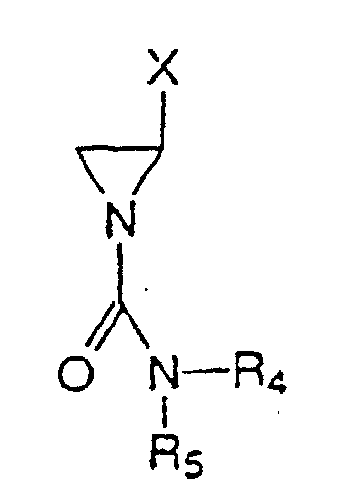
R4 is hydrogen or lower alkyl of 1-4 carbons; and
R5 is an alkyl of 1-8 carbons, lower cycloalkyl of 4-7 carbons, alkenyl of 1-6 carbons, an aryl of 4-10 carbons, a substituted aryl of 4-12 carbons; a heterocyclic group of 4-16 members, with the provi so that when R4 is hydrogen, the R5 is not CH3, C6H5, or, p-nitrophenyl. - A compound of claim 1 wherein R4 is hydrogen or lower alkyl of 1-4 carbons; and
wherein R5 is an alkyl of 1-8 carbons, lower cycloalkyl of 4-7 carbons, alkenyl of 3-6 carbons, an aryl of 4-10 carbons, a substituted aryl of 4-12 carbons having 1-2 substituents wherein the substituents are independently selected from the group consisting of lower alkyl of 1-4 carbons, nitro, halo substituted lower alkyls of 1-4 carbons, a lower alkyl substituted acyloxy of 1-5 carbons, a lower alkyl substituted acyl of 1-5 carbons, a heterocyclic group of 4-16 members. - A compound of claim 2 wherein
R4 is hydrogen; and
R5 is a straight chain alkyl of 1 to 8 carbons, an unsubstituted aryl, a mono-substituted or disubstituted aryl wherein the aryl is independently substituted with halo, lower alkyl, halo substituted lower alkyl, acyl or lower alkyl-substituted acyloxy. - A compound of claim 2 wherein
R4 is hydrogen; and
R5 is a heterocyclic group or a substituted aryl. - A compound of claim 2 wherein
R4 is hydrogen; and
R5 is a pyridyl, a substituted phenyl or a naphthyl. - The use of a compound of the formula:wherein X is CN;
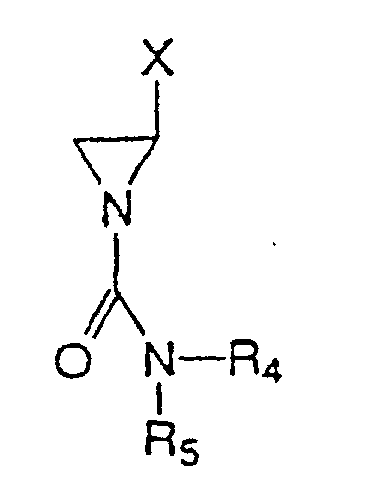
wherein R4 is hydrogen or lower alkyl of 1-4 carbons; and
wherein R5 is an alkyl of 1-8 carbons, lower cycloalkyl of 4-7 carbons, alkenyl of 1-6 carbons, an aryl of 4-10 carbons, a substituted aryl of 4-12 carbons, or a heterocyclic group of 4-16 members;
for the manufacture of a medicament for the treatment of cancer. - The use as claimed in claim 6 wherein the can cer is selected from the group comprising multiple myeloma, a β-lymphocyte plasmacytoma, advanced stage ovarian epithelial cell cancer, metastatic melanoma, leukemias of lymphoid and nonlymphoid origin, metastatic colon cancer, breast cancers and metast atic lung cancers.
- A compound as defined in claim 6 for the treatment of cancer.
- The compound of claim 8 wherein said cancer is selected from the group comprising those defined in claim 7.
- A pharmaceutical composition comprising a unit dose of a compound of claim 1 in a sterile aqueous solution, or in a water-miscible formulation.
- A pharmaceutical composition as claimed in claim 10 which further comprises pharmaceutically acceptable excipients.
Applications Claiming Priority (3)
| Application Number | Priority Date | Filing Date | Title |
|---|---|---|---|
| US5103797P | 1997-06-27 | 1997-06-27 | |
| US51037 | 1997-06-27 | ||
| PCT/US1998/013346 WO1999000120A1 (en) | 1997-06-27 | 1998-06-26 | Novel cyanoaziridines for treating cancer |
Publications (3)
| Publication Number | Publication Date |
|---|---|
| EP1027041A1 EP1027041A1 (en) | 2000-08-16 |
| EP1027041A4 EP1027041A4 (en) | 2001-06-13 |
| EP1027041B1 true EP1027041B1 (en) | 2003-10-22 |
Family
ID=21968974
Family Applications (1)
| Application Number | Title | Priority Date | Filing Date |
|---|---|---|---|
| EP98931645A Expired - Lifetime EP1027041B1 (en) | 1997-06-27 | 1998-06-26 | Novel cyanoaziridines for treating cancer |
Country Status (8)
| Country | Link |
|---|---|
| US (1) | US6297230B1 (en) |
| EP (1) | EP1027041B1 (en) |
| AT (1) | ATE252381T1 (en) |
| AU (1) | AU8171498A (en) |
| CA (1) | CA2294243C (en) |
| DE (1) | DE69819192T2 (en) |
| ES (1) | ES2210774T3 (en) |
| WO (1) | WO1999000120A1 (en) |
Families Citing this family (5)
| Publication number | Priority date | Publication date | Assignee | Title |
|---|---|---|---|---|
| WO2002041871A2 (en) * | 2000-11-21 | 2002-05-30 | Board Of Regents, The University Of Texas System | Composition comprising an imexon or derivatives thereof and lipids |
| CN1889943A (en) * | 2003-12-08 | 2007-01-03 | 美国亚利桑那大学董事会 | Synergistic anti-cancer compounds |
| US20070148660A1 (en) * | 2005-06-16 | 2007-06-28 | The Regents Of The University Of California | Treatment of maladaptive substance use with H-ras antagonists |
| WO2008045686A2 (en) * | 2006-10-12 | 2008-04-17 | The Arizona Board Of Regents On Behalf Of The University Of Arizona | Enantiomerically enriched iminopyrrolidone azirdine compositions |
| CN102531980B (en) * | 2011-12-02 | 2013-11-27 | 江苏远洋药业股份有限公司 | Method for synthetizing DL-cysteine |
Family Cites Families (3)
| Publication number | Priority date | Publication date | Assignee | Title |
|---|---|---|---|---|
| CA1092606A (en) * | 1976-10-05 | 1980-12-30 | Herbert Berger | 1-(n-acylcarbamoyl)-2-cyano-aziridines and the preparation thereof |
| DE2727550A1 (en) * | 1977-06-18 | 1979-01-04 | Boehringer Mannheim Gmbh | CANCEROSTATIC AND IMMUNSTIMULATING 1- (N-ACYL-CARBAMOYL) - 2-CYANAZIRIDINE AND METHOD OF MANUFACTURING THE SAME |
| DE2906603A1 (en) | 1979-02-21 | 1980-09-04 | Boehringer Mannheim Gmbh | N-SUBSTITUTED AZIRIDINE-2-CARBONIC ACID DERIVATIVES, METHOD FOR THE PRODUCTION THEREOF AND MEDICINAL PRODUCTS CONTAINING THESE SUBSTANCES |
-
1998
- 1998-06-26 DE DE69819192T patent/DE69819192T2/en not_active Expired - Lifetime
- 1998-06-26 EP EP98931645A patent/EP1027041B1/en not_active Expired - Lifetime
- 1998-06-26 ES ES98931645T patent/ES2210774T3/en not_active Expired - Lifetime
- 1998-06-26 AU AU81714/98A patent/AU8171498A/en not_active Abandoned
- 1998-06-26 CA CA002294243A patent/CA2294243C/en not_active Expired - Fee Related
- 1998-06-26 AT AT98931645T patent/ATE252381T1/en not_active IP Right Cessation
- 1998-06-26 WO PCT/US1998/013346 patent/WO1999000120A1/en not_active Ceased
- 1998-06-26 US US09/446,652 patent/US6297230B1/en not_active Expired - Fee Related
Also Published As
| Publication number | Publication date |
|---|---|
| CA2294243A1 (en) | 1999-01-07 |
| WO1999000120A1 (en) | 1999-01-07 |
| EP1027041A1 (en) | 2000-08-16 |
| ATE252381T1 (en) | 2003-11-15 |
| AU8171498A (en) | 1999-01-19 |
| CA2294243C (en) | 2008-12-30 |
| EP1027041A4 (en) | 2001-06-13 |
| DE69819192D1 (en) | 2003-11-27 |
| US6297230B1 (en) | 2001-10-02 |
| ES2210774T3 (en) | 2004-07-01 |
| DE69819192T2 (en) | 2004-06-09 |
Similar Documents
| Publication | Publication Date | Title |
|---|---|---|
| EP1030839B1 (en) | Use of alkylated iminosugars to treat multidrug resistance | |
| RU2267488C2 (en) | Acridine derivatives, method for their preparing and pharmaceutical composition based on thereof | |
| JP2978967B2 (en) | Novel piperazine derivative, method for producing the same, and composition containing the same | |
| EP0660823B1 (en) | N-cyano-n'-pyridylguanidines as serotonin antagonists | |
| EP1397355B1 (en) | Pyridyl cyanoguanidine compounds | |
| SK1842003A3 (en) | Novel heteroaryl derivatives and the use thereof as pharmaceuticals | |
| US20150231152A1 (en) | Fluoroalkyl and fluorocycloalkyl 1,4-benzodiazepinone compounds | |
| CZ305764B6 (en) | Cyanoguanidine compound, pharmaceutical composition or kit containing thereof | |
| EP0462179A1 (en) | Novel sulfonamides as radiosensitizers | |
| CA2161548A1 (en) | Phosphoramidates useful as antitumor agents | |
| US6297230B1 (en) | Cyanoaziridines for treating cancer | |
| CA2170508A1 (en) | Benzazole compounds for use in therapy | |
| MXPA06013559A (en) | Treatment of t-cell lymphoma using 10-propargyl-10-deazaaminopterin. | |
| EP3456712B1 (en) | Novel 2,4,6-trisubstituted s-triazine compound, preparation method therefor, and use thereof | |
| EP3560497A1 (en) | Compositions and methods for drug-sensitization or inhibition of a cancer cell | |
| EP0324521A2 (en) | Method of treating haematologic diseases and pharmaceutical compositions to be used therefor | |
| EP3280261B1 (en) | Anticancer therapeutic agents | |
| KR101693326B1 (en) | 3,4-Dihydroquinazoline Derivative and Combination Comprising the Same | |
| EP1644012B1 (en) | Quaternary chelidonine and alkaloid derivatives, process for their preparation and their use in the preparation of medicaments | |
| KR19980703718A (en) | Biologically Active Ureido Derivatives Useful for the Treatment of Multiple Sclerosis | |
| RU2801811C1 (en) | New compound and a pharmaceutical composition containing the compound for the prevention or treatment of cancer | |
| US20030236290A1 (en) | Inhibitors of animal cell motility and growth | |
| JPS61257963A (en) | Ureidoalkanoylaminocarbonylamino and imino acid and ester | |
| JPH0441145B2 (en) | ||
| US7872134B2 (en) | 2-{[2-(substituted amino)ethyl]sulfonyl}ethyl N,N-bis(2-chloroethyl)phosphorodiamidates |
Legal Events
| Date | Code | Title | Description |
|---|---|---|---|
| PUAI | Public reference made under article 153(3) epc to a published international application that has entered the european phase |
Free format text: ORIGINAL CODE: 0009012 |
|
| 17P | Request for examination filed |
Effective date: 20000121 |
|
| AK | Designated contracting states |
Kind code of ref document: A1 Designated state(s): AT BE CH CY DE DK ES FI FR GB GR IE IT LI LU MC NL PT SE |
|
| A4 | Supplementary search report drawn up and despatched |
Effective date: 20010502 |
|
| AK | Designated contracting states |
Kind code of ref document: A4 Designated state(s): AT BE CH CY DE DK ES FI FR GB GR IE IT LI LU MC NL PT SE |
|
| RAP1 | Party data changed (applicant data changed or rights of an application transferred) |
Owner name: AMPLIMED, INC. |
|
| GRAH | Despatch of communication of intention to grant a patent |
Free format text: ORIGINAL CODE: EPIDOS IGRA |
|
| RIC1 | Information provided on ipc code assigned before grant |
Free format text: 7A 61K 31/165 A, 7A 61K 31/395 B, 7A 61K 31/44 B, 7A 61P 35/00 B, 7C 07D 203/16 B, 7C 07D 401/02 B, 7C 07D 401/06 B |
|
| RIC1 | Information provided on ipc code assigned before grant |
Free format text: 7A 61K 31/165 A, 7A 61K 31/395 B, 7A 61K 31/44 B, 7A 61P 35/00 B, 7C 07D 203/16 B, 7C 07D 401/02 B, 7C 07D 401/06 B |
|
| GRAH | Despatch of communication of intention to grant a patent |
Free format text: ORIGINAL CODE: EPIDOS IGRA |
|
| GRAA | (expected) grant |
Free format text: ORIGINAL CODE: 0009210 |
|
| AK | Designated contracting states |
Kind code of ref document: B1 Designated state(s): AT BE CH CY DE DK ES FI FR GB GR IE IT LI LU MC NL PT SE |
|
| PG25 | Lapsed in a contracting state [announced via postgrant information from national office to epo] |
Ref country code: FI Free format text: LAPSE BECAUSE OF FAILURE TO SUBMIT A TRANSLATION OF THE DESCRIPTION OR TO PAY THE FEE WITHIN THE PRESCRIBED TIME-LIMIT Effective date: 20031022 Ref country code: CY Free format text: LAPSE BECAUSE OF FAILURE TO SUBMIT A TRANSLATION OF THE DESCRIPTION OR TO PAY THE FEE WITHIN THE PRESCRIBED TIME-LIMIT Effective date: 20031022 |
|
| REG | Reference to a national code |
Ref country code: GB Ref legal event code: FG4D |
|
| REG | Reference to a national code |
Ref country code: CH Ref legal event code: EP |
|
| REG | Reference to a national code |
Ref country code: IE Ref legal event code: FG4D |
|
| REF | Corresponds to: |
Ref document number: 69819192 Country of ref document: DE Date of ref document: 20031127 Kind code of ref document: P |
|
| PG25 | Lapsed in a contracting state [announced via postgrant information from national office to epo] |
Ref country code: SE Free format text: LAPSE BECAUSE OF FAILURE TO SUBMIT A TRANSLATION OF THE DESCRIPTION OR TO PAY THE FEE WITHIN THE PRESCRIBED TIME-LIMIT Effective date: 20040122 Ref country code: GR Free format text: LAPSE BECAUSE OF FAILURE TO SUBMIT A TRANSLATION OF THE DESCRIPTION OR TO PAY THE FEE WITHIN THE PRESCRIBED TIME-LIMIT Effective date: 20040122 Ref country code: DK Free format text: LAPSE BECAUSE OF FAILURE TO SUBMIT A TRANSLATION OF THE DESCRIPTION OR TO PAY THE FEE WITHIN THE PRESCRIBED TIME-LIMIT Effective date: 20040122 |
|
| REG | Reference to a national code |
Ref country code: CH Ref legal event code: NV Representative=s name: BOVARD AG PATENTANWAELTE |
|
| PG25 | Lapsed in a contracting state [announced via postgrant information from national office to epo] |
Ref country code: LU Free format text: LAPSE BECAUSE OF NON-PAYMENT OF DUE FEES Effective date: 20040626 |
|
| PG25 | Lapsed in a contracting state [announced via postgrant information from national office to epo] |
Ref country code: MC Free format text: LAPSE BECAUSE OF NON-PAYMENT OF DUE FEES Effective date: 20040630 |
|
| REG | Reference to a national code |
Ref country code: ES Ref legal event code: FG2A Ref document number: 2210774 Country of ref document: ES Kind code of ref document: T3 |
|
| ET | Fr: translation filed | ||
| PLBE | No opposition filed within time limit |
Free format text: ORIGINAL CODE: 0009261 |
|
| STAA | Information on the status of an ep patent application or granted ep patent |
Free format text: STATUS: NO OPPOSITION FILED WITHIN TIME LIMIT |
|
| 26N | No opposition filed |
Effective date: 20040723 |
|
| PG25 | Lapsed in a contracting state [announced via postgrant information from national office to epo] |
Ref country code: PT Free format text: LAPSE BECAUSE OF NON-PAYMENT OF DUE FEES Effective date: 20040322 |
|
| PGFP | Annual fee paid to national office [announced via postgrant information from national office to epo] |
Ref country code: IE Payment date: 20100526 Year of fee payment: 13 Ref country code: FR Payment date: 20100617 Year of fee payment: 13 Ref country code: ES Payment date: 20100614 Year of fee payment: 13 |
|
| PGFP | Annual fee paid to national office [announced via postgrant information from national office to epo] |
Ref country code: IT Payment date: 20100622 Year of fee payment: 13 Ref country code: AT Payment date: 20100524 Year of fee payment: 13 |
|
| PGFP | Annual fee paid to national office [announced via postgrant information from national office to epo] |
Ref country code: NL Payment date: 20100607 Year of fee payment: 13 Ref country code: CH Payment date: 20100525 Year of fee payment: 13 Ref country code: BE Payment date: 20100630 Year of fee payment: 13 |
|
| PGFP | Annual fee paid to national office [announced via postgrant information from national office to epo] |
Ref country code: GB Payment date: 20100524 Year of fee payment: 13 Ref country code: DE Payment date: 20100630 Year of fee payment: 13 |
|
| REG | Reference to a national code |
Ref country code: CH Ref legal event code: PFA Owner name: AMPLIMED, INC. Free format text: AMPLIMED, INC.#2321 CAMINO LA ZORRELA#TUCSON, AZ 85718 (US) -TRANSFER TO- AMPLIMED, INC.#2321 CAMINO LA ZORRELA#TUCSON, AZ 85718 (US) |
|
| BERE | Be: lapsed |
Owner name: *AMPLIMED INC. Effective date: 20110630 |
|
| REG | Reference to a national code |
Ref country code: NL Ref legal event code: V1 Effective date: 20120101 |
|
| REG | Reference to a national code |
Ref country code: CH Ref legal event code: PL |
|
| GBPC | Gb: european patent ceased through non-payment of renewal fee |
Effective date: 20110626 |
|
| PG25 | Lapsed in a contracting state [announced via postgrant information from national office to epo] |
Ref country code: AT Free format text: LAPSE BECAUSE OF NON-PAYMENT OF DUE FEES Effective date: 20110626 Ref country code: IT Free format text: LAPSE BECAUSE OF NON-PAYMENT OF DUE FEES Effective date: 20110626 |
|
| REG | Reference to a national code |
Ref country code: AT Ref legal event code: MM01 Ref document number: 252381 Country of ref document: AT Kind code of ref document: T Effective date: 20110626 |
|
| REG | Reference to a national code |
Ref country code: FR Ref legal event code: ST Effective date: 20120229 |
|
| REG | Reference to a national code |
Ref country code: IE Ref legal event code: MM4A |
|
| PG25 | Lapsed in a contracting state [announced via postgrant information from national office to epo] |
Ref country code: BE Free format text: LAPSE BECAUSE OF NON-PAYMENT OF DUE FEES Effective date: 20110630 |
|
| REG | Reference to a national code |
Ref country code: DE Ref legal event code: R119 Ref document number: 69819192 Country of ref document: DE Effective date: 20120103 |
|
| PG25 | Lapsed in a contracting state [announced via postgrant information from national office to epo] |
Ref country code: IE Free format text: LAPSE BECAUSE OF NON-PAYMENT OF DUE FEES Effective date: 20110627 Ref country code: FR Free format text: LAPSE BECAUSE OF NON-PAYMENT OF DUE FEES Effective date: 20110630 Ref country code: DE Free format text: LAPSE BECAUSE OF NON-PAYMENT OF DUE FEES Effective date: 20120103 Ref country code: CH Free format text: LAPSE BECAUSE OF NON-PAYMENT OF DUE FEES Effective date: 20110630 Ref country code: LI Free format text: LAPSE BECAUSE OF NON-PAYMENT OF DUE FEES Effective date: 20110630 |
|
| PG25 | Lapsed in a contracting state [announced via postgrant information from national office to epo] |
Ref country code: NL Free format text: LAPSE BECAUSE OF NON-PAYMENT OF DUE FEES Effective date: 20120101 |
|
| PG25 | Lapsed in a contracting state [announced via postgrant information from national office to epo] |
Ref country code: GB Free format text: LAPSE BECAUSE OF NON-PAYMENT OF DUE FEES Effective date: 20110626 |
|
| REG | Reference to a national code |
Ref country code: ES Ref legal event code: FD2A Effective date: 20130417 |
|
| PG25 | Lapsed in a contracting state [announced via postgrant information from national office to epo] |
Ref country code: ES Free format text: LAPSE BECAUSE OF NON-PAYMENT OF DUE FEES Effective date: 20110627 |