Background of the Invention
(1) Field of the Invention
The present invention relates to a method for producing
aluminum-containing members and such aluminum-containing members.
More specifically, the present invention relates to a method for producing
aluminum-containing members to be favorably used in semiconductor-producing
devices, liquid crystal-producing devices, etc. and such aluminum-containing
members.
(Related Art Statement)
As wirings in the semiconductors and liquid crystal panels become
finer, fine workings with dry processings are progressing. With the demand
for such fine workings, a halogen-based corrosive gas is used as a film-forming
gas or an etching gas for the semiconductors or the like.
On the other hands, it is known that aluminum nitride exhibits
high corrosion resistance against such a halogen-based: corrosion gas.
Therefore, members having aluminum nitride on their surfaces have been
used in semiconductor-producing apparatuses, liquid crystal panel-producing
apparatuses, etc.
More specifically, there are available powdery aluminum nitride
sintered materials, materials in which aluminum nitride is formed on a
substrate by using a gas phase growing method such as CVD, and materials
in which a surface of aluminum is modified and aluminum nitride is formed
thereon.
When aluminum contacts air, its surface is oxidized to form a thin
oxidized film. Since this oxidized film is an extremely stable passive phase,
the aluminum surface could not be nitrided by a simple nitriding method.
Under the circumferences, the following method has been developed to
modify the surface of aluminum and form aluminum nitride thereon.
JP-A 60-211,061 discloses a method in which after the inner
pressure of the chamber is reduced to a given pressure and hydrogen is
introduced thereinto, discharging is effected to heat the surface of a member
of such as aluminum to a given temperature, further argon gas is introduced
and discharging is effected to activate the surface of the member, and the
surface of the aluminum member or the like is ionically nitrided through
introducing nitrogen gas.
JP-A 7-166,321 discloses a method in which a nitriding aid made
of aluminum powder is contacted wit the surface of the aluminum, and
aluminum nitride is formed on the surfaces of aluminum nitride through
heating in the nitrogen atmosphere.
However, according to the method described in JP-A 60-211,061,
since aluminum nitride is formed by using discharging, the entire device is
complicated to raise the cost. Further, it is difficult for this method to
nitride, members having complicated shapes or large sizes.
Furthermore, according to a method described in JP-A 7-166,321,
since a nitriding aid is used, voids exist in a resulting surface layer of
aluminum nitride so that denseness is not sufficient. For this reason, it is an
actual situation that corrosion resistance against the halogen-based corrosive
gas is not sufficient and cannot be said to be practically satisfactory.
Further, if aluminum nitride is formed by sintering, aluminum
nitride powder needs to be sintered at a high temperature and the sintered
body is difficult to be worked, thereby raising the cost. Further, it was
extremely difficult to form members having large sizes or complicated
shapes.
In the case that aluminum nitride is formed by CVD process, the
producing device and process are complicated and precious, it is also difficult
to members having large sizes or complicated shapes.
Summary of the Invention
It is an object of the present invention to provide a method for
forming a nitride on a surface of a given substrate in a simple manner and to
provide an aluminum-containing member having a high corrosion resistance
against a halogen-based corrosive gas.
The present invention relates to a method for producing an
aluminum-containing member, comprising the steps of heating a substrate
containing at least metallic aluminum in vacuum of not more than 10-3 torrs,
and forming a nitride in a surface portion of the substrate by heating/nitriding
the substrate in a nitrogen atmosphere, continuing with said heating step.
The present invention also relates to an aluminum-containing
member comprising a substrate containing at least metallic aluminum, and a
nitride in a surface portion of the substrate, wherein the nitride contains at
least one element selected from the group consisting of metals of Group 2A,
Group 3A, Group 4A and Group 4B in Periodic Table at a higher concentration
than that in a metallic aluminum-containing portion in the substrate.
These and other objects, features and advantages of the invention
will be appreciated Upon reading of the following description of the invention
when taken in conjunction with the attached drawings, with understanding
that some modifications, variations and changes of the same could be easily
made by the skilled person in the art to which the invention pertains.
Brief Description of the Attached Drawings
For a better understanding of the invention, reference is made to
the attached drawings, wherein:
Detailed Description of the Invention
The present inventors have strenuously and repeatedly conducted
investigations to discover a new method for forming a nitride in a surface
portion of an aluminum substrate in a simple manner. In the prior art, three
steps are required to form a nitride film on the surface of the aluminum
substrate, which steps includes (1) heating the substrate, (2) removing a film
of the oxide from the surface of the substrate, and (3) effecting the nitriding
treatment for the substrate. Contrary to this, the present inventors discovered
that a film of an oxide is unexpectedly removed from a surface of the
aluminum substrate only by controlling the vacuum degree in heating the
aluminum substrate to a high level and that a nitride film may be formed on
the substrate from which the oxide film is thus removed. The present
inventors reached the present invention based on this discovery. Although a
reason for this is not clear, it is considered that an aluminum passive film on
the surface of the aluminum substrate is removed by heating at a high
vacuum degree.
A substrate made of pure aluminum (A1050: Al content>99.5 wt%)
was heated at 540°C for 2 hours together with Mg-Si based alloy (A6061)
under a vacuum degree of 2 x 10⁻⁴ torr. Then, after N2 gas was introduced
to reach a pressure of 8.0 kgf/cm3, they were heated at 555°C for 2 hours,
thereby fanning a nitrided film at the surface of the substrate. Fig. 1 is a
diagram showing an X-ray diffraction pattern of the surface of the thus
obtained member and that of the original aluminum substrate.
From the X-ray diffraction pattern in Fig. 1, peaks attributable to
aluminum nitride are observed in addition to those to aluminum. Therefore,
it is seen that aluminum nitride is formed at the surface of the member.
Fig. 2 is an SEM photograph of a polished section of the member in
Fig. 1. It is observed that a thin layer is formed on the surface of the substrate.
Therefore, it is seen that the above aluminum nitride is formed in the form of
a layer or a film of aluminum nitride. Further, it is seen that no voids are
recognized in the aluminum nitride film and that the film has high denseness.
According to the present invention, since a passive film
represented by alumina is removed from the surface of the substrate and the
nitrided film is directly formed on the surface portion of the substrate, the
nitrided film having high adhesion can be formed.
Further, since the nitrided film can be formed by the heat
treatment only, the entire apparatus can be in a simple structure. As a result,
the production cost can be also reduced.
A substrate made of a Mg-Si based aluminum alloy (A6061: A1
content > 99 wt%) was heated at 540°C for 2 hours under a vacuum degree of
1.8 x 10⁻⁴ torr. Then, after N2 gas was introduced to reach a pressure of
9.5 kgf/cm3, the substrate was heated at 540°C for 2 hours, thereby forming a
film of aluminum nitrided film at the surface of the substrate. Fig. 3 is a
diagram showing an SEM photograph of a section of the thus obtained
member. From this, it is clear that a film of aluminum nitride is formed in a
thickness of about 10 µm when the Mg-Si based aluminum alloy was used.
Fig. 4 gives diagrams showing intensifies of EDS peak at the
surface of the member thus obtained.
It is seen from Fig. 4 that the content of Si falling Group 4B in the
Periodic Table and that of Mg as Group 2A in Periodic Table in the
aluminum nitride are greater than those in the A6061 alloy, respectively.
It is considered that if the nitride such as aluminum nitride contains Si or the
like falling in Group 4B of the Periodic Table and that of Mg or the kin
Group 2A of Periodic Table in the aluminum nitride are greater than those in
the substrate, respectively, promotes nitriding of A1.
It is seen from Fig. 4, it is seen that the aluminum nitride contains
oxygen at a concentration lower than that of a metallic aluminum-containing
portion in the substrate made of the A16061 alloy, and that oxygen is
uniformly distributed in the film. Owing to this, it is seen that the nitride
formed at the surface of the substrate, such as aluminum nitride ,uniformly
occur.
As shown in the following Examples, the consolidation of the
above two effects makes the nitride formed at the surface of the substrate to
have a high hardness and extremely excellent corrosion resistance.
The term "continuously" means that the heating/nitriding is
effected without interposition of any other step after the heating step in
vacuum, while this vacuum is being kept.
In the following, embodiments of the present invention will be
explained based on specific embodiments of the present invention.
According to the aluminum-containing member-producting process
of the present invention, a substrate containing at least aluminum is heated in
vacuum of not more than 10-3 torrs, and preferably not more than
5 × 10⁻³ torrs, and preferably 5 × 10⁻⁴ torrs.
Further, the lower limit of the pressure in vacuum in the heating
step is not particularly limited, it is preferably 10-6 torrs, more preferably
10-5 torrs. In order to attain a higher vacuum degree, a large size of a pump
and a chamber corresponding to such a higher vacuum degree is necessary to
raise the cost. Further, such a higher vacuum degree will not effect any
more influence upon the nitride-forming speed.
The lower limit for the temperature of the heating treatment is not
particularly restricted, so long as the nitride can be formed on the surface of
the substrate. However, in order to readily form the nitride in a short time,
it is preferably 450°C, and more preferably 500°C.
Further, die upper limit of the temperature in the heating treatment
is not particularly restricted. However, it is preferably 450°C, and more
preferably 500°C. By so setting, the substrate containing aluminum can be
prevented from being thermally deformed.
According to the aluminum-containing member-producing process
of the present invention, after the substrate is heated in vacuum, continuously
it is heated and nitrided in the nitrogen atmosphere.
The term "continuously" means the meaning already mentioned
before.
As the nitrogen atmosphere in this heating/nitriding treatment, N2
gas, NH3 gas and N2/NH3 gas may be used.
In order to form in a short time a thick nitrided film on the
substrate having undergone the heating treatment, the gas pressure of the
nitrogen atmosphere is preferably set at not less than 1 kg/cm2, and
particularly preferably set in a range of 1.5 to 2000 kg/cm2.
Further, the heating temperature in the heating/nitriding treatment
is not particularly restricted, so long as the nitrided film can be formed on the
surface of the substrate. However, in order to form a relatively thick
nitrided film in a relatively short time as in the above, it is preferably 450°C,
and more preferably 500°C.
Further, the upper limit of the temperature in the heating treatment
is not particularly restricted. However, it is preferably 450°C, and more
preferably 500°C. By so setting, the substrate containing aluminum can be
effectively prevented from being thermally deformed as mentioned before,
The nitride thus formed on the surface of the substrate is not
necessarily present in the form of a layer or film as shown in Fig. 2. That is,
its configuration is not limited so long as the nitride affords corrosion
resistance upon the substrate itself. Therefore, the nitride may be present in
such a state that its fine particles are densely dispersed or the composition of
the nitride inclinedly varies in a direction toward the substrate with an
interface of the nitride and the substrate being unclear.
In the producing process according to the present invention) a
material which can be used for the substrate is required to contain at least
aluminum. By using such a material, casting and sintering can be readily
effected, so that a large size of a member for the semiconductor-producing
apparatus can be readily formed. Further, a passing film of such as alumina
is formed on the surface of the substrate if it is left in air. Therefore, the
producing process according to the present invention can be favorably
employed for this case.
The nitride formed on the surface of to substrate according to the
producing process of the present invention preferably contains at least one
element selected from the group consisting of metals of Group 2A, Group 3A,
Group 4A and Group 4B in Periodic Table at a higher concentration than that
in a metallic aluminum-containing portion in the substrate. The concentration
of the oxide in the nitride is preferably lower than that in the
substrate. In this case, the nitriding is accelerated and the nitride is made
uniform as mentioned before, so that the hardness of the nitride can be
increased, and excellent corrosion resistance can be afforded upon the nitride.
The content of at least one element selected from the group
consisting of metals of Group 2A, Group 3A, Group 4A and Group 4B in
Periodic Table in the nitride is preferably not less than 1.1 times, more
preferably not less than 1.5 as much as that in a metallic aluminum-containing
portion in the substrate.
The above effects are more remarkably exhibited in the case that
at least one element contained in the nitride comprises at least one of Mg and
Si. Therefore, it is preferably that as at least one element selected from the
group consisting of metals of Group 2A, Group 3A, Group 4A and Group 4B
in Periodic Table, at least one of Mg belonging to Group 2A in Periodic
Table and Si belonging to Group 4B in Periodic Table are preferred.
The content of oxygen in the nitride is not more than 2/3 times as
much as that in the metallic aluminum-containing portion in the substrate.
Further, at least one element selected from the group consisting of
metals of Group 2A, Group 3A, Group 4A and Group 4B in Periodic Table
and oxygen are dispersed in the nitride uniformly in the thickness direction
thereof from the standpoint of stabilizing the stress concentration, heat
fatigue and mechanical properties.
As mentioned in the above, the nitride having the above oxygen
content and at least one element selected from the group consisting of metals
of Group 2A, Group 3A, Group 4A and Group 4B in Periodic Table has
excellent corrosion resistance. For this reason, if the nitride is exposed to
the above-mentioned corrosive gas, change in weight of the nitride is
extremely small, particularly extremely smaller as compared with a case
where the substrate is exposed to the corrosive gas.
In order that the nitride having the above oxygen content and at
least one element selected from the group consisting of metals of Group 2A,
Group 3A, Group 4A and Group 4B in Periodic Table has high hardness,
high toughness and high corrosion resistance, the thickness of the nitride is
preferably not less than 2 µm, mire preferably not more than 5 µm.
Since the substrate containing aluminum is used, the above-mentioned
nitride is composed mainly of aluminum nitride in many cases.
Since the main component of the nitride is aluminum nitride, the effect, i.e.,
low heat expansion and high heat conductivity can be obtained.
The aluminum-containing member according to the present
invention needs to include the substrate containing at least aluminum.
Further, in the case that the nitride has the above oxygen content and at least
one element selected from the group consisting of metals of Group 2A,
Group 3A, Group 4A and Group 4B in Periodic Table, the substrate is
preferably at least one selected from aluminum, an aluminum alloy, a
composite of aluminum and a low heat expansion material, and a composite
of such an aluminum alloy and the low heat expansion material.
As the above low thermal expansion material is at least one
selected from the group consisting of AlN, SiC, Si3N4, BeO, Al2O3, BN, Mo,
W and carbon may be recited by way of example. These material function
to form a network in the substrate containing aluminum to increase the
rigidity of the substrate itself. The content of the low thermal expansion
material is preferably 10 to 90%.
As the substrate, composite materials in which a member made of
a metal, a ceramic material or a composite material thereof is surface-coated
with aluminum or an aluminum alloy may be used.
Aluminum tends to form a thick and extremely tough passive film
on its surface. Therefore, if aluminum and an aluminum alloy is used as the
substrate, the above heating step and the above heating/nitriding step are
preferably effected in an atmosphere containing a vapor of a material
containing at least one selected from elements such as Mg, Sr, Ca, Ba and Be
in Group 2A in the Periodic Table, elements such as Ce in Group 3A in the
Periodic Table, elements such as Ti and Zr in Group 4A in the Periodic Table,
and elements such as B and Si in Group 4B in the Periodic Table, By so
doing, the removal of the passive film and the nitriding of aluminum can be
effectively performed.
It is considered that oxygen at the surface of aluminum is absorbed
with a metal vapor generated in the vacuum heating step and the nitride is
formed during the heating/nitriding to accelerate the formation of the nitrided
film.
The material to produce such a metal vapor is not limited so long
as the above metal vapor can be formed therefrom. Specifically, in addition
to the above metals alone, A6061 (Mg-Si based alloy) and A7075 (Zn-Mg
based alloy) and A5083 (Mg based alloy) containing any of these metals may
be recited by way of example. Preferably, any of these materials is
coexistent with the substrate to be nitrided.
If any of such metals to accelerate the formation of the nitride film,
such as A6061 (Mg-Si based alloy) and A7075 (Zn-Mg based alloy) and
A5083 (Mg based alloy), such coexistence may be omitted.
When the nitride is formed on the surface of the substrate as
mentioned above, the nitride can contain at least one element selected from
the group consisting of metals of Group 2A, Group 3A, Group 4A and Group 4B
in Periodic Table at a high concentration than the substrate. Further, the concentration
of oxygen in the nitride can be made lower than that in the substrate.
The aluminum-containing member according to the present
invention is produced as follows.
A given substrate is placed on a sample table inside a chamber
equipped with a vacuum device including a diffusion pump. Next, this
chamber is evacuated to a given vacuum degree by the vacuum device.
Then, the member is heated to a given temperature by means of a resistant
heat generator or an infrared lamp. The member is kept at this given
temperature for 1 to 10 hours. In the heating treatment, the entire substrate
does not need to reach this temperature, but at least a surface portion of the
substrate on which a passive film is formed reaches this given temperature.
After the heating treatment, the interior of the chamber is replaced
with nitrogen gas by introducing a nitrogen gas or the like thereinto. By
adjusting the input power of the heater, the substrate is heated to a given
temperature. Then, the member is at this given temperature for 1 to
10 hours. Also in this case, the entire substrate does not need to reach this
temperature, but at least a surface portion of the substrate on which is to be
nitrided reaches this given temperature.
After the given temperature passes, the heating and the introduction
of the nitrogen gas are stopped to terminate the heating/nitriding
treatment. Then, the interior of the chamber or furnace is cooled, and the
member is taken out from it.
In the above, although the heating treatment and the heating!
nitriding treatment is effected by the same batch, these treatments may be
effected in different batches if toy are continuously effected.
The aluminum-containing members according to the present
invention can be used as members in the semiconductor-producing
apparatuses, the liquid crystal-producing apparatuses, the automobiles, etc.
Further, the aluminum-containing member according to the present
invention has excellent heat emission property. Therefore, the aluminum-containing
member according to the present invention can be favorably used
in heat emission parts requiring the heat emitting property.
Fig. 5 is a sectional view of an embodiment of a heat-emitting
member using the aluminum-containing member according to the present
invention.
In the heat-emitting member 10 shown in Fig. 10, a nitride 2 is
formed on a substrate 1, and a substrate 4 made of aluminum nitride or
silicon nitride is formed on the nitride 2 via a binder 3. A Si chip 6 is
laminated on the substrate 4 via a binder 5. The substrate 1 and the nitride 2
constitute the aluminum-containing member 7 according to the present
invention.
Since aluminum nitride and silicon nitride have high heat
conductivity and high insulation, heat generated from the Si chip can be
effectively removed by forming the substrate made of either of them on the
aluminum-containing member 7 via the binder 3.
For this purpose, the heat conductivity of aluminum nitride used
for the substrate 4 is preferably not less than 150 W/mK, more preferably not
less tan 180 W/mK. The heat conductivity of silicon nitride to be used for
the substrate 4 is preferably not less than 70 W/mK, more preferably not less
than 80 W/mK. So long as the heat-generating member is concerned, the
aluminum-containing member according to the present invention may be
naturally applied to any member other than the Si chip.
As the binder 3, a brazing material or Al-10Si-1.5Mg (BA4004) is
preferred. In this case, in order to ensure wettability between the soft solder
or brazing material, some treatment may be required to form an Ni-plated
film on the surface of the nitride 2. As the binder 5, a brazing material
having a liquid phase temperature of 600°C is preferably used. For instance,
BA4004 or a soft solder may be used.
If the aluminum-containing member according to the present
invention is used in the heat-emitting member 10 as shown in Fig. 5, the
thickness of the nitride 2 is preferably not less than 2 µm, more preferably 5
to 20 µm
(Examples)
In the following, the present invention will be explained based on
specific examples.
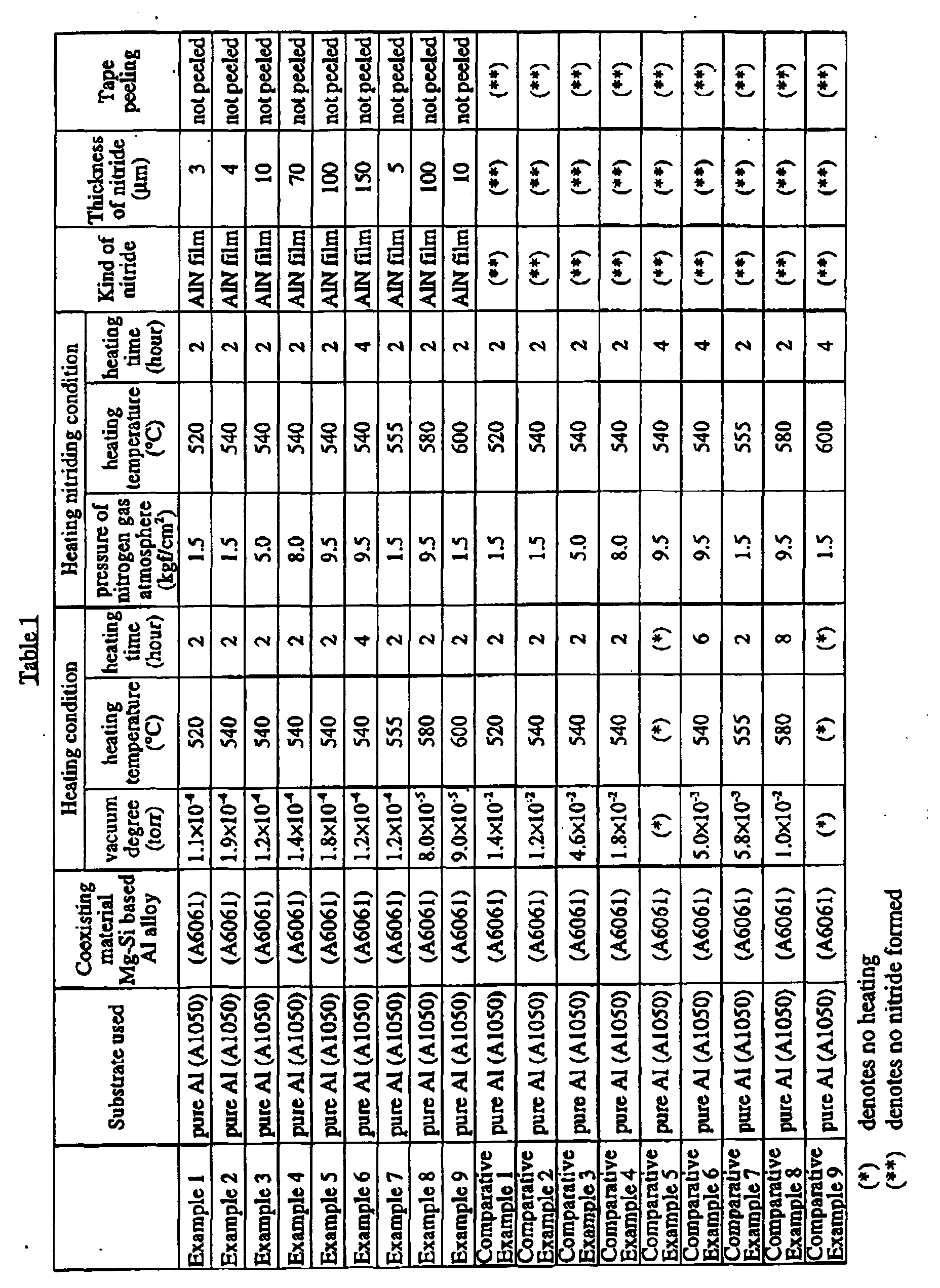
Examples 1 to 9
(Production of aluminum-containing members)
As a substrate, pure aluminum having a shape 50 × 50 × 2 mm
(A1050: Al content > 99.5 %) was used. This substrate and a Mg-Si based
Al alloy (A6061) having the same shape as that of the substrate were placed
in a graphite sheath inside an electric furnace made of graphite, and the
electric furnace was evacuated to a vacuum degree given in Table 1 by means
of a vacuum pump. Then, the substrate was heated to a temperature given
in Table 1 by passing current through the heater, and the member was kept at
this heating temperature for a time period given in Table 1.
Thereafter, N2 gas was introduced into the electric furnace to reach
a set pressure given in Table 1.
Afar the pressure reached the set level, the N2 gas was introduced
into the electric furnace at a rate of 2L/min., and control was effected to
adjust pressure inside the furnace at the set level ± 0.05 kg/cm2. Then,
while the temperature and the holding time of the substrate was set as shown
in Table 1, a nitrided film was formed on the pure alumina substrate.
When the nitrided film-formed member was cooled to 50°C or less,
the member was taken out.
The surface of thus obtained member was brown or black.
Inspection of the surface of the substrate by the X-ray diffraction revealed
that peaks of aluminum nitride were observed to show that aluminum nitride
was formed on the surface of the member.
On the other hand, observation of a section of the member with an
SEM revealed that this aluminum nitride was present in the form of a layer.
Measurement of the aluminum nitride film gave a value shown in Table 1.
(Peeling test)
The member formed with the aluminum nitride film was subjected
to a peeling test to evaluate the adhesion of the aluminum nitride film.
The peeling of the aluminum nitride film fanned above was not observed,
which revealed that the adhesion of the above aluminum nitride was
extremely strong.
(Evaluation by heating cycling test)
The member formed with the aluminum nitride film was subjected
to a heating cycling test to examine the adhesion strength of the aluminum
nitride film.
The heating cycling test was effected at 10 cycles each having
steps that heated the member from room temperature to 450°C at a heating
rate of 600°C under a vacuum degree of 10-4 torrs, kept the member at 450°C
for 2 hours, cooling it to 100°C at a cooling speed of 100°C.
Observation of the surface of the member having undergone the
heating cycling test with SEM revealed occurrence of no cracks in the
aluminum nitride film formed on the surface of the aluminum substrate.
Likewise, observation of a section of the above member with the
SEM revealed no peeling of the aluminum nitride film. Further, a peeling
test was effected by using a tape, but no peeling of the aluminum nitride was
observed.
That is, it is seen that the nitride film formed according to the
process of the present invention has extremely strong adhesion.
Comparative Examples 1 to 9
Comparative Examples 1 to 9 were effected in the same manner as
in Examples 1 to 8 except that the vacuum degree, the heating temperature
and the heating time was set as shown in Table 1, and the gas pressure of the
nitrogen atmosphere, the heating temperature and the heating time were set
as shown in Table 1.
Inspection of the surface of the thus obtained member with the
X-ray diffraction revealed no peaks of aluminum nitride. Observation of a
section of the member with the SEM revealed that no material was formed on
the aluminum substrate.
As a substrate made of an Al alloy, a Mg-Si based alloy having a
shape of 50 × 50 × 2 mm (A6061), an Cu-Mg alloy (A2024), a Mg based
alloy (A5083) and a Zn-Mg based alloy (A7075) were used. Examples 10 to
16 were effected in the same manner as in Examples 1 to 9 except that to
vacuum degree, the heating temperature and the heating time in the heating
treatment was set as shown in Table 2, and the gas pressure of the nitrogen
atmosphere, the heating temperature and the heating time in the heating/
nitriding treatment were set as shown in Table 2.
The surface of thus obtained member was brown or black.
Inspection of the surface of the substrate by the X-ray diffraction revealed
that peaks of aluminum nitride were observed to show that aluminum nitride
was formed on the surface of the member. On the other hand, observation
of a section of the member with an SEM revealed that this aluminum nitride
was present in the form of a layer. Measurement of the thickness of the
aluminum nitride film gave a value shown in Table 2.
(Peeling test)
The member formed with the aluminum nitride film was subjected
to a peeling test in the same manner as in Examples 1 to 9. As is clear from
results shown in Table 2, the peeling of the aluminum nitride film formed
above was not observed, which revealed that the adhesion of the above
aluminum nitride film was extremely strong.
(Evaluation by heating cycling test)
The member formed with the aluminum nitride film was subjected
to a heating cycling test in the same manner as in Examples 1 to 9 to examine
the adhesion strength of the aluminium nitride film.
Observation of the surface of the member having undergone the
heating cycling test with SEM revealed occurrence of no cracks in the
aluminum nitride film formed on the surface of the aluminum substrate.
Likewise) observation of a section of the above member with the SEM
revealed no peeling of the aluminum nitride film. Further, a peeling test
was effected by using a tape, but no peeling of the aluminum nitride was
observed.
That is, it is seen that the nitride film formed according to the
process of the present invention has extremely strong adhesion.
Comparative Examples 10 to 13
Comparative Examples 10 to 13 were effected in the same manner
as in Examples 10 to 16 except that the vacuum degree, the heating
temperature and the heating time in the heating treatment was set as shown in
Table 2, and the gas pressure of the nitrogen atmosphere, the heating
temperature and the heating time in the heating/nitriding treatment were set
as shown in Table 2.
Inspection of the surface of the thus obtained member with the
X-ray diffraction revealed no peaks of aluminum nitride. Observation of a
section of the member with the SEM revealed that no material was formed on
the aluminum substrate.
Example 17 was subjected to the same heating treatment and the
same heating/nitriding treatment as in Example 7 except that a Mg-Si based
alloy (A6061) having a shape of 50 × 50 × 2 mm having a surface with a film
of aluminum having a surface coated with an aluminum having a purity of
99.9 % in a thickness of 50 µm by flame spraying was used as a substrate.
Inspection of the thus obtained member by the X-ray diffraction
and the SEM observation revealed that a film of aluminum nitride was
formed in a thickness of 7 µm.
Likewise, the member formed with die aluminum nitride film was
subjected to the same heating cycling test and the heating cycling test in the
same manner as in the above Examples. As a result, neither occurrence of
cracks nor peeling of the aluminum nitride film was observed. That is, it is
seen that the aluminum nitride film formed according to this Example has
extremely strong adhesion.
(Example 18)
Example 18 was subjected to the same heating treatment and the
same heating/nitriding treatment as in Example 7 except that an Ni based
alloy having a shape of 50 × 50 × 2 mm and a surface coated with a film of
aluminum having a purity of 99.9 % in a thickness of 50 µm by flame
spraying was used as a substrate.
Inspection of the thus obtained member by the X-ray diffraction
and the SEM observation revealed that a film of aluminum nitride was
formed in a thickness of 8 µm.
Likewise, the member formed with the aluminum nitride film was
subjected to the same heating cycling test and the heating cycling test in the
same manner as in the above Examples. As a result, neither occurrence of
cracks nor peeling of the aluminum nitride film was observed. That is, it is
seen that the aluminum nitride film formed according to this Example has
extremely strong adhesion.
(Example 19)
Example 19 was subjected to the same heating treatment and the
same heating/nitriding treatment as in Example 7 except that a composite
material having a shape of 50 × 50 × 2 mm and composed of 30 wt% of
aluminum and 70 wt% of aluminum nitride was used as a substrate.
Inspection of the thus obtained member by the X-ray diffraction
and the SEM revealed that a film of aluminum nitride was formed in a
thickness of 10 µm. Further, peaks attributable to aluminum were decreased
and those to aluminum were increased as compared with an X-ray diffraction
pattern before the heating treatment and the heating/nitriding treatment.
The member was subjected to the same heating cycling test and
the heating cycling test in the same manner as in the above Examples. As a
result, neither occurrence of cracks nor peeling of the aluminum nitride film
was observed. That is, it is seen that the aluminum nitride film formed
according to this Example has extremely strong adhesion.
(Example 20)
The aluminum-containing member obtained in Example 11 was
subjected to a corrosion resistance test.
A mixed gas of NF3 75 sccm/N2 100sccm was used, and an RF
power 800W was applied to the member at 550°C under a condition of
0.1 torrs for 5 hours.
Measurement of a change in weight of the aluminum-containing
member between before and after the test shows a weight gain of 0.50 g/cm2.
Further, an EDS analysis of the contents of elements of the
aluminum-containing member and the nitride was effected at five spots at an
acceleration voltage of 20kV and a magnification of 10000 before the
corrosion resistant test. The analysis was effected by using an SEM (Model
XL-30) manufactured by Philips Co., Ltd. and an EDS (Model CDU-SUTW)
detector manufactured by EDAX Co., Ltd. Results were averaged. For a
reference purpose, a JIS standard of the substrate is shown in Table 3.
Consequently, the presence ratio of oxygen, Mg and Si is shown in Table 3.
The presence ratio in oxygen between the nitride and the substrate is as
shown in Table 4.
(Example 21)
The aluminum-containing member obtained in Example 3 was
subjected to a corrosion resistance test in the same manner as in Example 20.
As a result, the weight increased by 0.50 g/cm
2.
| Elementary analysis data of Al-nitrided produce |
| unit wt% |
| | Example 20 |
| | nitride | substrate portion | substrate (specified in JIS) |
| O | 1.30 | 2.27 | - |
| Mg | 5.45 | 1.66 | 0.8 ∼ 1.2 |
| Si | 4.07 | 0.50 | 0.4 ∼ 0.8 |
| Ratio in nitrided film portion/ substrate portion | A6061 nitrided product (Example 20) |
| O | 0.57 |
| Mg | 3.28 |
| Si | 8.14 |
Pure aluminum was subjected to a corrosion resistance test in the
same manner as in Example 20. As a result, the weight increased by
0.50 g/cm2.
(Comparative Example 15)
An MG-Si based aluminum alloy (A6061) was subjected to a
corrosion resistance test in the same manner as in Example 20. As a result,
the weight increased by 0.90 g/cm2.
(Comparative Example 15)
Examples 20 and 21 and Comparative Examples 14 and 15 show
that the aluminum-containing member according to the present invention has
smaller weight change between the corrosion resistive test and high corrosion
resistance against the corrosive gas.
(Example 22)
By using an aluminum-containing member according to the
present invention, a joined product between the aluminum-containing
member according to the present invention and a substrate 4 was prepared as
a heat-emitting member as shown in Fig. 5.
As the aluminum-containing member 7 was used that in Example
11. As binders 3, 5 was used a brazing agent (JIS BA4004 was used.
As the substrate, an aluminum nitride having sides 50 mm and a thickness d
of 1 mm with heat conductivity of 150 W.mK was used. The joining
condition was 610°C under vacuum of 10-5 torrs for 10 minutes with a load of
600 g/cm2.
The above heat-emitting member was subjected to a heating
cycling test at 10 cycles each having a condition that the member was heated to
200°C from room temperature at a heating rate of 10°C/min. in air, held at that
temperature for 1 hour, and then cooled to room temperature in four hours.
As a result, no peeling was observed between the aluminum-containing
member 7 and the substrate 4, and an excellent joined state was
maintained.
(Example 23)
Example 23 was effected in the same manner as in Example 22
except that as a substrate, silicon nitride having sides 50 mm and a thickness
d of 1 mm with heat conductivity of 70 W - mK was used instead of the
aluminum nitride substrate. The joining condition was 610°C under vacuum
of 10-5 torrs for 10 minutes with a load of 600 g/cm2.
The obtained heat-emitting member was subjected to the heating
cycling test as in Example 22, which revealed that no peeling was observed
between the aluminum-containing member 7 and the substrate 4, and an
excellent joined state was maintained.
Although the present invention has been explained in detail in the
above based on the embodiments of the invention by reciting the specific
Examples, but the invention is not limited to the above contents only. Any
modifications, changes and variations can be made without the scope of the
claimed invention.
As having been explained above, in the process for producing the
aluminum-containing member according to the present invention, the
member is heated in vacuum before the substrate onto which a nitrided film
is to be formed is heated and nitrided. By so doing, the nitride can be
formed on the surface of the substrate by the subsequent heating/nitriding
treatment.
According to the aluminum-containing member according to the
present invention, the nitride contains at least one clement selected from the
group consisting of metals of Group 2A, Group 3A, Group 4A and Group 4B
in Periodic Table at a higher concentration than tat in a metallic aluminum-containing
portion in the substrate. Therefore, according to the present
invention, the aluminum-containing member that has high hardness and high
corrosion resistance which has not been conventionally attained can be
obtained.