EP1026262A2 - Oligonucleotide primers for efficient detection of hepatitis C virus (HCV) and methods of use thereof - Google Patents
Oligonucleotide primers for efficient detection of hepatitis C virus (HCV) and methods of use thereof Download PDFInfo
- Publication number
- EP1026262A2 EP1026262A2 EP00300763A EP00300763A EP1026262A2 EP 1026262 A2 EP1026262 A2 EP 1026262A2 EP 00300763 A EP00300763 A EP 00300763A EP 00300763 A EP00300763 A EP 00300763A EP 1026262 A2 EP1026262 A2 EP 1026262A2
- Authority
- EP
- European Patent Office
- Prior art keywords
- seq
- hcv
- primer
- group
- reverse
- Prior art date
- Legal status (The legal status is an assumption and is not a legal conclusion. Google has not performed a legal analysis and makes no representation as to the accuracy of the status listed.)
- Granted
Links
Classifications
-
- C—CHEMISTRY; METALLURGY
- C12—BIOCHEMISTRY; BEER; SPIRITS; WINE; VINEGAR; MICROBIOLOGY; ENZYMOLOGY; MUTATION OR GENETIC ENGINEERING
- C12Q—MEASURING OR TESTING PROCESSES INVOLVING ENZYMES, NUCLEIC ACIDS OR MICROORGANISMS; COMPOSITIONS OR TEST PAPERS THEREFOR; PROCESSES OF PREPARING SUCH COMPOSITIONS; CONDITION-RESPONSIVE CONTROL IN MICROBIOLOGICAL OR ENZYMOLOGICAL PROCESSES
- C12Q1/00—Measuring or testing processes involving enzymes, nucleic acids or microorganisms; Compositions therefor; Processes of preparing such compositions
- C12Q1/68—Measuring or testing processes involving enzymes, nucleic acids or microorganisms; Compositions therefor; Processes of preparing such compositions involving nucleic acids
- C12Q1/6844—Nucleic acid amplification reactions
- C12Q1/686—Polymerase chain reaction [PCR]
-
- C—CHEMISTRY; METALLURGY
- C12—BIOCHEMISTRY; BEER; SPIRITS; WINE; VINEGAR; MICROBIOLOGY; ENZYMOLOGY; MUTATION OR GENETIC ENGINEERING
- C12Q—MEASURING OR TESTING PROCESSES INVOLVING ENZYMES, NUCLEIC ACIDS OR MICROORGANISMS; COMPOSITIONS OR TEST PAPERS THEREFOR; PROCESSES OF PREPARING SUCH COMPOSITIONS; CONDITION-RESPONSIVE CONTROL IN MICROBIOLOGICAL OR ENZYMOLOGICAL PROCESSES
- C12Q1/00—Measuring or testing processes involving enzymes, nucleic acids or microorganisms; Compositions therefor; Processes of preparing such compositions
- C12Q1/68—Measuring or testing processes involving enzymes, nucleic acids or microorganisms; Compositions therefor; Processes of preparing such compositions involving nucleic acids
- C12Q1/6876—Nucleic acid products used in the analysis of nucleic acids, e.g. primers or probes
- C12Q1/6888—Nucleic acid products used in the analysis of nucleic acids, e.g. primers or probes for detection or identification of organisms
-
- C—CHEMISTRY; METALLURGY
- C12—BIOCHEMISTRY; BEER; SPIRITS; WINE; VINEGAR; MICROBIOLOGY; ENZYMOLOGY; MUTATION OR GENETIC ENGINEERING
- C12Q—MEASURING OR TESTING PROCESSES INVOLVING ENZYMES, NUCLEIC ACIDS OR MICROORGANISMS; COMPOSITIONS OR TEST PAPERS THEREFOR; PROCESSES OF PREPARING SUCH COMPOSITIONS; CONDITION-RESPONSIVE CONTROL IN MICROBIOLOGICAL OR ENZYMOLOGICAL PROCESSES
- C12Q1/00—Measuring or testing processes involving enzymes, nucleic acids or microorganisms; Compositions therefor; Processes of preparing such compositions
- C12Q1/70—Measuring or testing processes involving enzymes, nucleic acids or microorganisms; Compositions therefor; Processes of preparing such compositions involving virus or bacteriophage
- C12Q1/701—Specific hybridization probes
- C12Q1/706—Specific hybridization probes for hepatitis
- C12Q1/707—Specific hybridization probes for hepatitis non-A, non-B Hepatitis, excluding hepatitis D
-
- C—CHEMISTRY; METALLURGY
- C12—BIOCHEMISTRY; BEER; SPIRITS; WINE; VINEGAR; MICROBIOLOGY; ENZYMOLOGY; MUTATION OR GENETIC ENGINEERING
- C12N—MICROORGANISMS OR ENZYMES; COMPOSITIONS THEREOF; PROPAGATING, PRESERVING, OR MAINTAINING MICROORGANISMS; MUTATION OR GENETIC ENGINEERING; CULTURE MEDIA
- C12N2770/00—MICROORGANISMS OR ENZYMES; COMPOSITIONS THEREOF; PROPAGATING, PRESERVING, OR MAINTAINING MICROORGANISMS; MUTATION OR GENETIC ENGINEERING; CULTURE MEDIA ssRNA viruses positive-sense
- C12N2770/00011—Details
- C12N2770/24011—Flaviviridae
- C12N2770/24211—Hepacivirus, e.g. hepatitis C virus, hepatitis G virus
-
- C—CHEMISTRY; METALLURGY
- C12—BIOCHEMISTRY; BEER; SPIRITS; WINE; VINEGAR; MICROBIOLOGY; ENZYMOLOGY; MUTATION OR GENETIC ENGINEERING
- C12Q—MEASURING OR TESTING PROCESSES INVOLVING ENZYMES, NUCLEIC ACIDS OR MICROORGANISMS; COMPOSITIONS OR TEST PAPERS THEREFOR; PROCESSES OF PREPARING SUCH COMPOSITIONS; CONDITION-RESPONSIVE CONTROL IN MICROBIOLOGICAL OR ENZYMOLOGICAL PROCESSES
- C12Q2565/00—Nucleic acid analysis characterised by mode or means of detection
- C12Q2565/10—Detection mode being characterised by the assay principle
- C12Q2565/125—Electrophoretic separation
Definitions
- the present invention pertains to improved methods for detecting nucleic acid sequences in biological samples, particularly sequences derived from infectious microorganisms.
- HCV Hepatitis C Virus
- HCV is currently classified as a separate genus, Hepacivirus, in the family Flaviviridae. Its genome consists of a positive-stranded RNA molecule of about 9,500 nucleotides with a single, large open reading frame (ORF) which encodes a polyprotein precursor of about 3,000 amino acids.
- ORF large open reading frame
- the large ORF is preceded by a 5' non-coding region (NCR) of about 340 nucleotides, which is the most highly conserved region of the genome.
- NCR non-coding region
- the 5' region of the ORF encodes (in a 5'-to-3' direction) a capsid protein, two envelope glycoproteins (E1 and E2), and a small protein of unknown function (P7).
- the 3' portion of the ORF encodes nonstructural proteins which include a protease, protease/helicase bi-functional protein, RNA polymerase, and regulatory peptides. The 3' portion also includes an
- HCV coding sequences from around the world has revealed considerable sequence variation among individual viral isolates. Furthermore, analyses of HCV sequences from individual patients have shown that the virus circulates as so-called "quasi-species," which contain related but not identical sequences. The variation that exists among isolates and within individual patients is believed to be the result of the low fidelity of the virally-encoded RNA-dependent RNA polymerase. The degree of genetic variability of HCV has important implications for prevention, diagnosis, and control of infection.
- EIA enzyme immuno-assays
- RIBA recombinant immunoblot assay
- the invention is directed to a method for detecting the presence of Hepatitis C Virus (HCV) RNA in a biological sample.
- the method comprises:
- the invention is directed to a method for amplifying Hepatitis C Virus (HCV) DNA.
- the method comprises:
- the invention is directed to a method for detecting the presence of Hepatitis C Virus (HCV) RNA in a biological sample.
- the method comprises:
- the invention is directed to a method for amplifying Hepatitis C Virus (HCV) DNA.
- the method comprises:
- the invention is directed to a method for detecting the presence of Hepatitis C Virus (HCV) RNA in a biological sample.
- the method comprises:
- the invention is directed to a method for amplifying Hepatitis C Virus (HCV) DNA.
- the method comprises:
- the reverse transcription reaction is performed using random oligonucleotide primers; alternatively, one or more HCV-specific reverse transcription primers, i.e., oligonucleotides having sequences that correspond to sequences in HCV RNA, may be used.
- HCV-specific reverse transcription primers i.e., oligonucleotides having sequences that correspond to sequences in HCV RNA.
- Methods for detection of amplification include, without limitation, (a) electrophoresis and (b) capture of amplification products on a solid support to which HCV-specific probes are attached followed by quantifying the bound products using a colorimetric assay.
- the invention is directed to a kit for amplifying HCV DNA derived from HCV RNA.
- the kit comprises one or more pairs of 5' NCR oligonucleotide primers, where each of the pairs of 5' NCR oligonucleotide primers comprises:
- the invention is directed to a kit for amplifying HCV cDNA derived from HCV RNA.
- the kit comprises one or more pairs of 3' NCR oligonucleotide primers, where each of the pairs of 3' NCR oligonucleotide primers comprises a forward primer consisting of the oligonucleotide 5'-GGTGGCTCCATCTTAGCCCTAGTCACG-3' (1F27) ⁇ SEQ ID NO. 8 ⁇ and a reverse primer consisting of the oligonucleotide 5'-AGGCCAGTATCAGCACTCTCTGCAGTC-3 (57R27) ⁇ SEQ ID NO. 9 ⁇ .
- the invention is directed to a kit for detecting the presence of HCV DNA.
- the kit comprises one or more pairs of 5' NCR oligonucleotide primers, where each of the pairs of 5' NCR oligonucleotide primers comprises:
- the invention is directed to a kit for detecting the presence of HCV RNA.
- the kit comprises one or more pairs of 3' NCR oligonucleotide primers, where each of the pairs of 3' NCR oligonucleotide primers comprises a forward primer consisting of the oligonucleotide 5'-GGTGGCTCCATCTTAGCCCTAGTCACG-3' (1F27) ⁇ SEQ ID NO. 8 ⁇ and a reverse primer consisting of the oligonucleotide 5'-AGGCCAGTATCAGCACTCTCTGCAGTC-3 (57R27) ⁇ SEQ ID NO. 9 ⁇ .
- the present inventors have discovered that detection of Hepatitis C Virus (HCV) RNA in biological samples is more efficient when oligonucleotides having sequences complementary to certain sequences present in HCV RNA are used as primers for amplification.
- the present invention thus provides an improved single-round, reverse transcription/amplification assay which detects low copy levels of HCV RNA.
- Oligonucleotide primers are selected based on theoretical considerations of sequence conservation, intra- and inter-molecular interactions, and the predicted secondary structures of the amplicon and surrounding sequence.
- the primers and assay system are designed to allow the co-amplification (and co-detection) of multiple regions of the HCV genome, multiple viral species, and an internal positive control (IPC) RNA (or DNA). Simultaneous amplification/detection of multiple regions of the HCV genome increases assay sensitivity and the co-amplification of an IPC decreases the likelihood of false negative results because of PCR inhibition.
- Nucleic acid or “polynucleotide” as used herein refers to purine-and pyrimidine-containing polymers of any length, either polyribonucleotides or polydeoxyribonucleotides or mixed polyribo-polydeoxyribo nucleotides. This includes single- and double-stranded molecules, such as, for example, DNA-DNA, DNA-RNA and RNA-RNA hybrids, as well as “protein nucleic acids” (PNA) formed by conjugating bases to an amino acid backbone. This also includes nucleic acids containing modified bases.
- PNA protein nucleic acids
- a "complement" of a nucleic acid sequence as used herein refers to the antisense sequence that participates in Watson-Crick base-pairing with the original sequence.
- a “primer” as used herein is an isolated oligonucleotide between about 10 and about 50 nucleotides in length, preferably between about 12 and about 25 nucleotides in length and most preferably between about 12 and about 18 nucleotides in length, that forms a duplex with a single-stranded nucleic acid sequence of interest and allows polymerization of a complementary strand using, e.g., reverse transcriptase or DNA polymerase.
- isolated nucleic acid refers to a component that is removed from its original environment (for example, its natural environment if it is naturally occurring or a reaction mixture if it is synthetic).
- An isolated nucleic acid typically contains less than about 50%, preferably less than about 75%, and most preferably less than about 90%, of the components with which it was originally associated.
- a nucleic acid sequence that is "derived from” a designated sequence refers to a sequence that corresponds to a region of the designated sequence. This encompasses sequences that are homologous or complementary to the sequence.
- An internal positive control (IPC) target nucleic acid refers to a synthetic nucleic acid sequence cloned into a plasmid vector which is subsequently linearized, typically by the action of a restriction endonuclease.
- An IPC will typically have multiple primer binding sequences surrounding a generic probe-binding region, and acts as a generic control against false negative results in nucleic acid amplification reactions.
- sequence of a preferred internal positive control target DNA is: 5'-CGCCAGCGTGGACCATCAAGTAGTAATGAACGCACGGACGAGGACATCA TAGAGATTACACCTTTATCCACAGTTCTCGGTCTAACGCAGCAGTCAGTG TATCAGCACCAGCATCCGTAGTGAGTCTTCAGTGTCTGCTCCAGGATCGT G-3' ⁇ SEQ ID NO. 10 ⁇ .
- Nucleic acids comprising any of the sequences disclosed herein or subsequences thereof can be prepared by conventional methods.
- DNA can be chemically synthesized using, e.g., the phosphoramidite solid support method of Matteucci et al ., 1981, J. Am. Chem . Soc. 103 :3 185, the method of Yoo et al ., 1989, J. Biol. Chem . 764 :17078, or other well known methods.
- the nucleic acids may also be modified by many means known in the art.
- Non-limiting examples of such modifications include methylation, "caps”, substitution of one or more of the naturally occurring nucleotides with an analog, and internucleotide modifications such as, for example, those with uncharged linkages (e.g., methyl phosphonates, phosphotriesters, phosphoroamidates, carbamates, etc.) or charged linkages (e.g., phosphorothioates, phosphorodithioates, etc.).
- uncharged linkages e.g., methyl phosphonates, phosphotriesters, phosphoroamidates, carbamates, etc.
- charged linkages e.g., phosphorothioates, phosphorodithioates, etc.
- Nucleic acids may contain one or more additional covalently linked moieties, such as, for example, proteins (e.g., nucleases, toxins, antibodies, signal peptides, poly-L-lysine, etc.), intercalators (e.g., acridine, psoralen, etc.), chelators (e.g., metals, radioactive metals, iron, oxidative metals, etc.), and alkylators.
- PNAs are also encompassed by the term "nucleic acid".
- the nucleic acid may be derivatized by formation of a methyl or ethyl phosphotriester or an alkyl phosphoramidate linkage.
- the nucleic acid sequences of the present invention may also be modified with a label capable of providing a detectable signal, either directly or indirectly. Exemplary labels include radioisotopes, fluorescent molecules, biotin, and the like.
- Amplification refers to an iterative process by which a nucleic acid is copied. Suitable methods for amplification include without limitation polymerase chain reaction, ligase chain reaction, strand displacement amplification, transcription mediated amplification, and nucleic acid single base amplification.
- the present invention provides methods for detection of HCV in biological samples. The methods are carried out by
- a biological sample is obtained from a patient by any conventional means.
- suitable biological samples include, without limitation, blood, serum, plasma, urine, breast milk, and cerebrospinal fluid.
- plasma is used as the source of HCV RNA.
- RNA "derived from" a biological sample is any RNA which was originally present in the sample and to which access has been gained by treating the sample.
- RNA is extracted from the sample using any method well known in the art, such as, e.g., methods employing guanidinium thiocyanate, or using commercially available reagents and methods such as, e.g., PureScript® from Gentra Systems, Inc. (Minneapolis MN). Any extraction procedure may be used that results in separation of the RNA from RNases, other proteins, and/or any other components that might interfere with reverse transcription.
- the sample is then subjected to reverse transcription using (a) random primers, such as random hexamer primers obtainable from Pharmacia Biotech, Piscataway, New Jersey and/or (b) primers derived from the 5' or 3' NCRs of the HCV RNA genomic sequence.
- Reverse transcription is carried out using conventional procedures, such as are described in Current Protocols in Molecular Biology , Volumes I, II, and III, 1997 (F.M.. Ausubel ed.); in U.S. Patent 5,322,770; in Young, et al., J. Clin. Microbiol . 31 (4):882 (1993); Myers et al., Biochemistry 30(3):7661 (1991).
- Other primers suitable for use as reverse transcription primers, and methods for reverse transcription which can be used in the present invention include those described in copending patent application No. (ref. CDS-212), claiming priority of USSN 09/118,520.
- the products are amplified.
- Any method for amplification may be used, including, without limitation, polymerase chain reaction (PCR), ligase chain reaction, strand displacement reaction, nucleic acid single base amplification, and transcription mediated amplification.
- PCR polymerase chain reaction
- ligase chain reaction ligase chain reaction
- strand displacement reaction nucleic acid single base amplification
- transcription mediated amplification e.g., PCR is used.
- PCR polymerase chain reaction
- ligase chain reaction e chain reaction
- strand displacement reaction e.g., strand displacement reaction
- nucleic acid single base amplification e.g., RNA polymerase chain reaction
- transcription mediated amplification e.g., RNA polymerase chain reaction
- a reaction mixture containing all of the necessary components for PCR is added directly to the reverse transcription reaction mixture. Amplification is then carried out using conditions specified by the primer pairs that are used.
- HCV-specific amplification primers are particularly advantageous in detecting HCV RNA in patient samples.
- useful primers derived from the 5' NCR of the HCV genome include those listed in Table 1 below.
- oligonucleotide Any combination of sense and antisense oligonucleotides may be used as forward and reverse amplification primers, respectively.
- Preferred pairs of 5' NCR primers for use in amplification include:
- the pair of amplification primers consists of 5'-CAGAAAGCGTCTAGCCATGGCGTTAGTA-3' ⁇ SEQ ID NO. 1 ⁇ and 5'-CGGTTCCGCAGACCACTATGGCTCTC-3' ⁇ SEQ ID NO. 4 ⁇ .
- the pair of amplification primers consists of 5'-GGGAGAGCCATAGTGGTCTGCGGAA-3' ⁇ SEQ ID NO. 2 ⁇ and 5'-CGGGGCACTCGCAAGCACCCTATCA-3' ⁇ SEQ ID NO. 7 ⁇ .
- Non-limiting examples of useful primers derived from the 3' NCR of the HCV genome include a forward primer consisting of 5'-GGTGGCTCCATCTTAGCCCTAGTCACG-3' (1F27) ⁇ SEQ ID NO. 8 ⁇ and a reverse primer consisting of 5'-AGGCCAGTATCAGCACTCTCTGCAGTC-3' (57R27) ⁇ SEQ ID NO. 9 ⁇ .
- the invention also encompasses multiplex amplification, i.e., simultaneous amplification of different sequences using different sets of primers in the same reaction mixture.
- multiplex amplification i.e., simultaneous amplification of different sequences using different sets of primers in the same reaction mixture.
- a preferred set of primer pairs that can be used simultaneously in a multiplex amplification reaction is:
- the amplified products may be detected using any method known in the art, including, without limitation, gel electrophoresis in agarose or acrylamide; non-isotopic colorimetric detection such as the SureCell® system (see, e.g., Example 1 below); ECi detection; fluorescence, and chemiluminescence.
- Reagents useful in such detection methods are available from, e.g., Molecular Probes, Eugene, Oregon and Ortho Clinical Diagnostics, Rochester, NY.
- HCV-specific amplification products indicates the presence of HCV RNA in the sample.
- HCV-specific amplification products are confirmed by their size, as predicted by the location in HCV RNA of the sequences corresponding to the amplification primers used in the reaction.
- Useful HCV-specific 5' NCR capture probes useful for colorimetric detection include, without limitation, 5'-GGGTCCTGGAGGCTGCACGACACTCAT-3' ⁇ SEQ ID NO. 11 ⁇ , 5'-CCTTTCGCGACCCAACACTACTCGGCT-3' ⁇ SEQ ID NO. 12 ⁇ , and 5'-TTTCGCGACCCAACACTACTCGGCT-3' ⁇ SEQ ID NO. 13 ⁇ .
- Useful HCV-specific 3' NCR capture probes include, without limitation, 5'-GCGGCTCACGGACCTTTCACAGCTA-3' ⁇ SEQ ID NO. 14 ⁇ and 5'-ATGCGGCTCACGGACCTTTCACAGC-3' ⁇ SEQ ID NO. 15 ⁇ .
- Kits for amplifying HCV DNA derived from HCV RNA can be prepared containing one or more pairs of forward and reverse 5' NCR oligonucleotide primers, where the forward primers may be 5'-CAGAAAGCGTCTAGCCATGGCGTTAGTA-3' (C69F28) ⁇ SEQ ID NO. 1 ⁇ , 5'-GGGAGAGCCATAGTGGTCTGCGGAA-3' (C131F25) ⁇ SEQ ID NO. 2 ⁇ , or 5'-GTGGTCTGCGGAACCGGTGAGTACAC-3 (C143F26) ⁇ SEQ ID NO. 3 ⁇ ; and the reverse primers may be 5'-CGGTTCCGCAGACCACTATGGCTCTC-3' (C133R26) ⁇ SEQ ID NO.
- the forward primers may be 5'-CAGAAAGCGTCTAGCCATGGCGTTAGTA-3' (C69F28) ⁇ SEQ ID NO. 1 ⁇ , 5'-GGGAGAGCCATAGTGGTCTGCGGAA-3' (C131
- Kits for amplifying HCV DNA derived from HCV RNA can also be prepared containing one or more pairs of forward and reverse 3' NCR oligonucleotide primers, where the forward primer may be 5'-GGTGGCTCCATCTTAGCCCTAGTCACG-3' (1F27) ⁇ SEQ ID NO. 8 ⁇ and the reverse primer may be the oligonucleotide 5'-AGGCCAGTATCAGCACTCTCTGCAGTC-3 (57R27) ⁇ SEQ ID NO. 9 ⁇ .
- the forward primer may be 5'-GGTGGCTCCATCTTAGCCCTAGTCACG-3' (1F27) ⁇ SEQ ID NO. 8 ⁇
- the reverse primer may be the oligonucleotide 5'-AGGCCAGTATCAGCACTCTCTGCAGTC-3 (57R27) ⁇ SEQ ID NO. 9 ⁇ .
- Kits for detecting the presence of HCV DNA which comprise the 5' and 3'NCR primers described above for amplification of HCV DNA derived from HCV RNA are also encompassed within the scope of the invention.
- kits may additionally comprise reagents and instructions for reverse transcription, amplification, and product detection.
- the kits can contain reverse transcriptase, deoxynucleotides, thermostable polymerases suitable for DNA amplification reactions, and reagents for labeling and detection of nucleic acids.
- the present invention finds use in the diagnosis of HCV infection in patients; in testing the efficacy of anti-HCV therapeutic regimens; and in screening the blood supply for HCV-infected samples.
- Example 1 Detection of HCV in Biological Samples: Comparison of 5' HCV amplification primers and Roche Amplicor HCV Assay
- RNA was prepared from plasma samples using PureScript® RNA isolation reagents (Gentra Systems, Minneapolis MN). Modifications to the manufacturer's protocol for body fluids included use of 40 ⁇ g glycogen, rather than 20 ⁇ g, as a carrier to aid in the precipitation of viral RNA. Additionally, in most cases, after isopropyl alcohol precipitation of the RNA and washing the RNA pellet with ethanol, the RNA pellet was resuspended in the RT buffer mix, rather than in the RNA hydration solution provided by the manufacturer.
- PCR was carried out IN A PE9600 thermocycler (Perkin-Elmer) in a 100 ⁇ l solution of 25 mM Tris-HCl, 3 mM MgCl 2 , 0.725 mM EDTA, 54 mM KCl, 3.72 mM NaCl, 40 ⁇ M DTT, 108 ⁇ g/mL gelatin (type IV), 9.5% glycerol, 0.02% Tween 20, 0.02% NP40, calf thymus DNA (2 ⁇ g), 1.2 mM of each dNTP, 0.4 ⁇ M of each primer, 10 copies linearized internal positive control (IPC) plasmid DNA, and 16 U of Taq polymerase.
- IPC linearized internal positive control
- Monoclonal antibodies to Taq, TP1-12 and TP4-9 were added to the reaction at a 50:1 and 5:1 molar ratio, respectively, to provide a 55:1 molar ratio of antibody to Taq polymerase.
- 40 cycles of amplification were performed at 96°C for 5 sec and 68°C for 40 sec.
- a post-heat step was performed for 5 min at 103°C to inactivate Taq polymerase.
- the primers used are shown in Table 2 below. PRIMER SEQUENCE LOC.
- PCR products were biotinylated by use of 5'-biotin-labeled primers (sense strand) during amplification.
- Product was captured by hybridization to oligonucleotide probes covalently attached to latex particles, which were deposited on the surface of a flow through membrane (SureCell® tests, Ortho Clinical Diagnostics, Rochester, NY).
- the probes were: 5'-GGGTCCTGGAGGCTGCACGACACTCAT-3' (designated C96-27-PRB) ⁇ SEQ ID NO. 11 ⁇ ; 5'-CCTTTCGCGACCCAACACTACTCGGCT-3' (designated C252-27-PRB) ⁇ SEQ ID NO.
- the Roche Amplicor assay (Roche Diagnostics, Kaiseraugst, Switzerland) was performed according to the manufacturer's instructions.
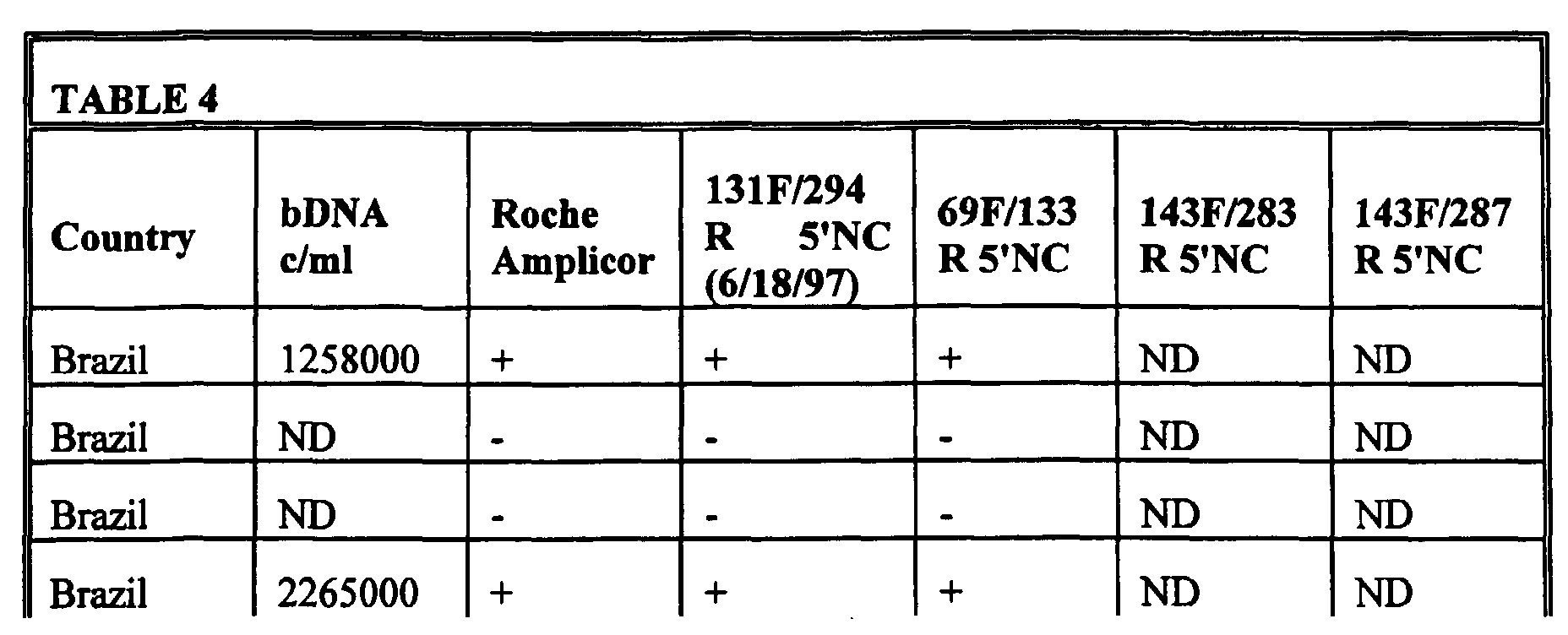
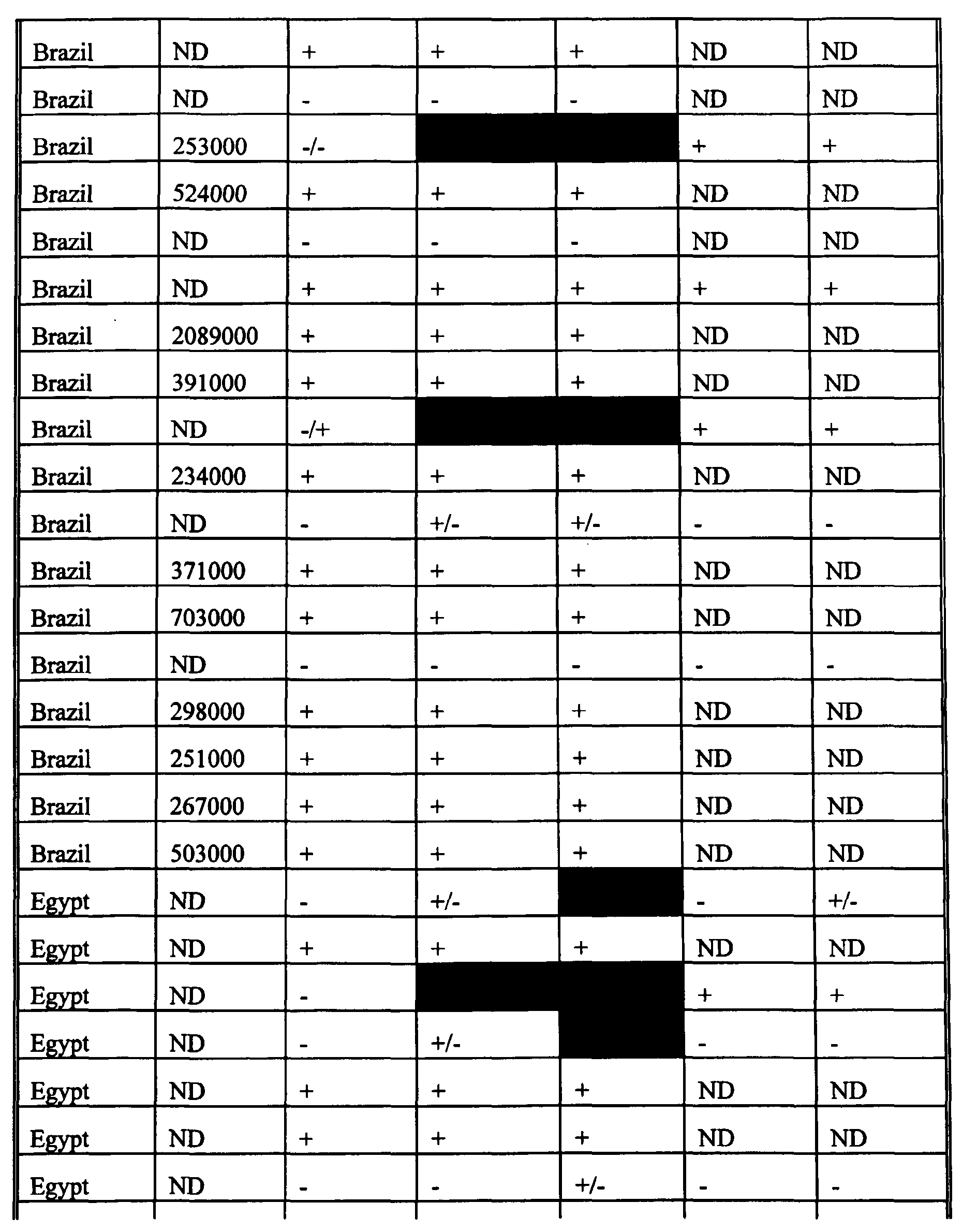
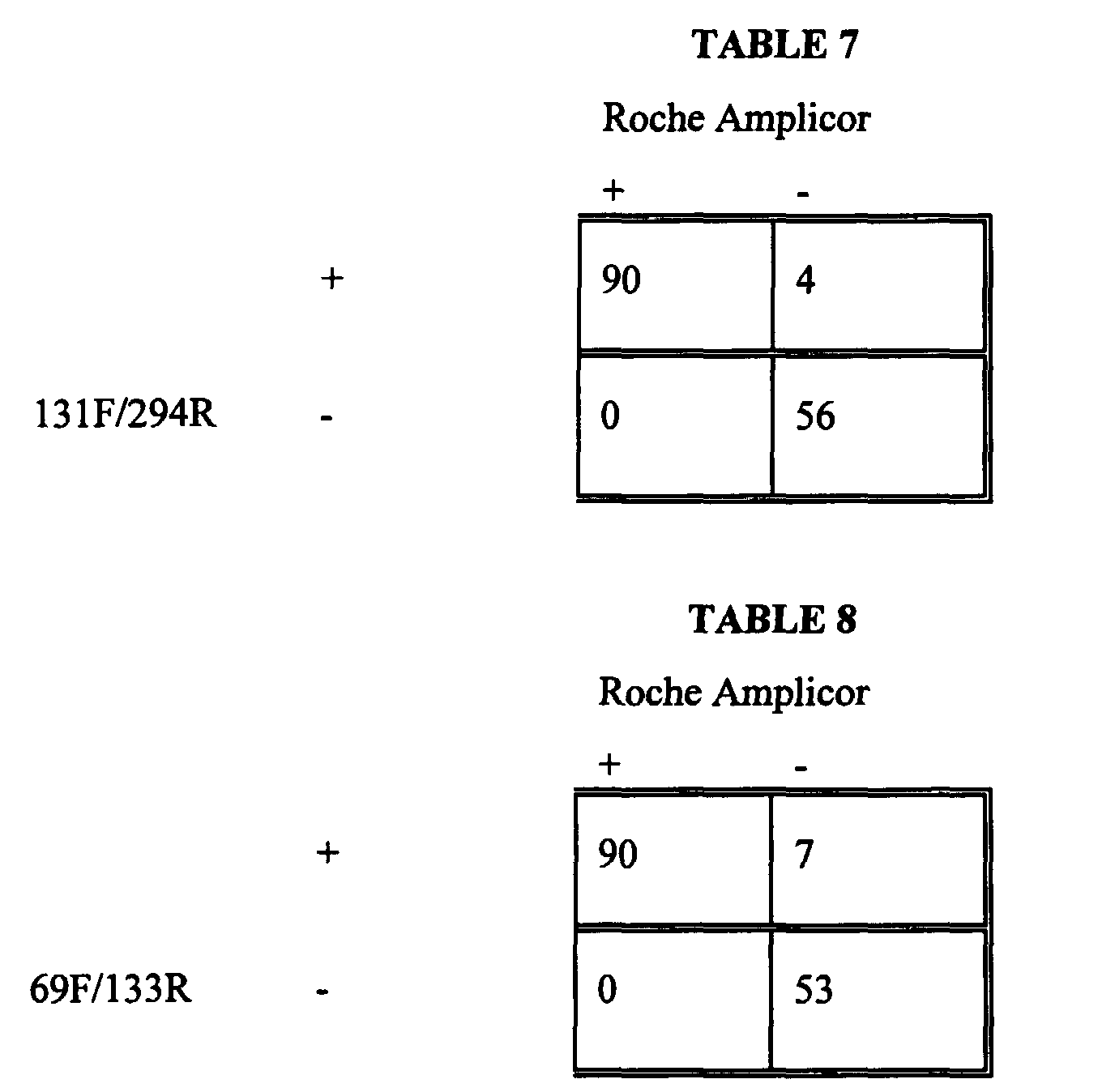
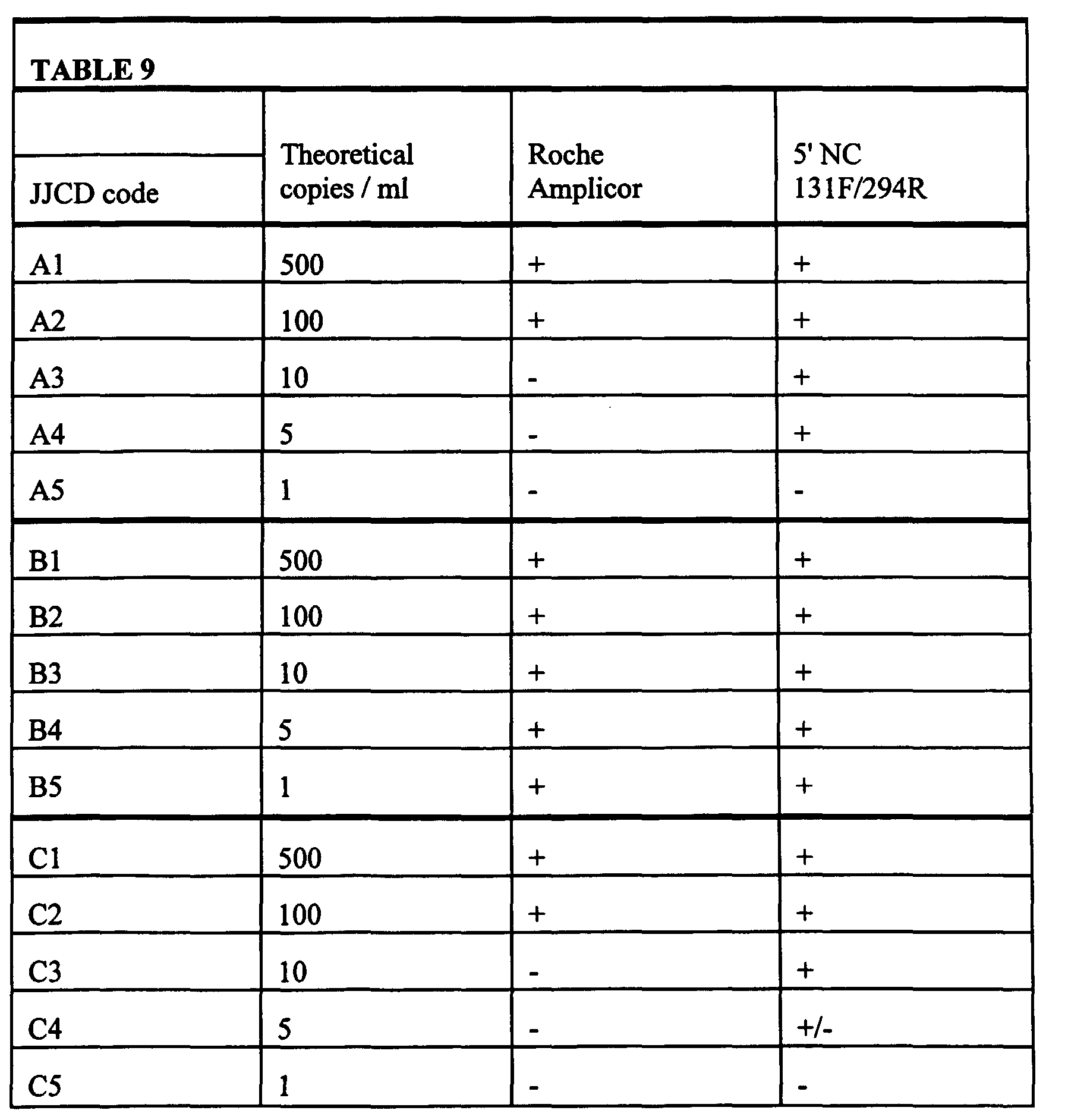
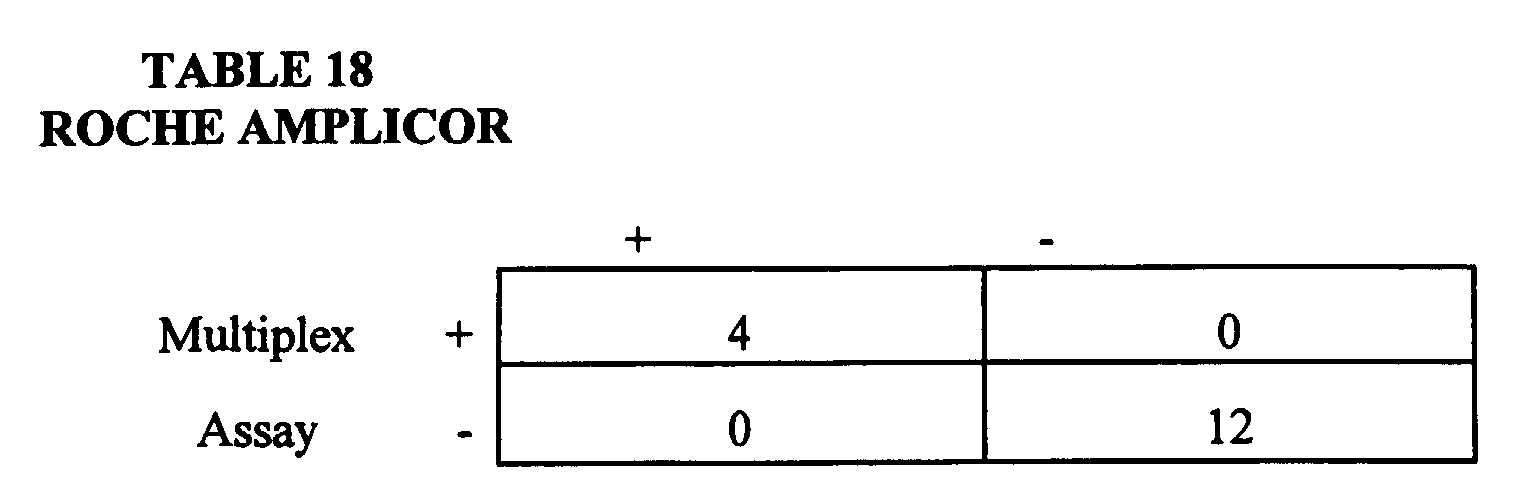
- All of the primers of the invention demonstrated superior sensitivity when compared to the Roche Amplicor assay.
- Use of the primer pair 69F/133R afforded the greatest sensitivity.
- Five samples that were negative using the Roche amplicor assay were positive using the C131/C294 primer pair of the present invention, while 11 samples tat were negative using the Roche amplicor assay were positive using the 69F/133R primer pair of the present invention.
- all of the samples with viral loads detectable by the Chiron bDNA assay were detected using the primers of the present invention, whereas three of these were not detected using the Roche Amplicor assay. None of the negative controls were scored as positive in the assay according to the present invention.
- Both 5' NCR primer pairs according to the present invention exhibited superior sensitivity relative to the Roche assay system. The greatest sensitivity was achieved using the 69F/133R primer pair, which detected the presence of HCV RNA in three additional samples compared to the C131 /C294 primer pair.
- Example 3 Detection of HCV in Biological Samples: Comparison of 3' NCR HCV amplification primers and Roche Amplicor HCV Assay
- Negative controls (interspersed through out the clinical samples) consisting of both negative plasma samples and water (no RNA) were included and all were negative in RT-PCR.
- a comparison between the results obtained using the primers of the present invention and the Roche assay system is summarized in Table 11.
- the assay according to the invention agreed with the RGH assay on 25 of the 26 negative samples.
- the advantage of the present invention is that there is less chance of carryover than when performing nested PCR, as in the latter, the tube must be opened during the reaction to add new reagents.
- the singe sample which indicates a false negative result could be an example of carryover caused by the nested PCR protocol.
- Plasma samples which had been tested for HCV using the Roche Monitor and Chiron B-DNA assays, were obtained from Boston Biomedica, Inc.
- RNA was prepared, diluted to contain between 20-1000 copies of HCV RNA/ml, and subjected to reverse transcription and amplification using the methods described in Example 1 above.
- Reverse transcription was performed using the 66RT (12-mer) primer (Table 13) or 57R27 (27-mer) primer (Table 14), and PCR was performed using 1F27 and 57R27 forward and reverse primers, respectively.
- Internal positive control (IPC) primers were also incorporated into this assay and resulted in positive scores for each sample.
- Results represent the % of samples that were positive based on gel bands and SureCell® using 3X-30PRB25 as a capture probe.
- the 3' NCR HCV assay detected 1000 viral copies/ml 100% of the time, and 200 copies/ml 88-100% of the time. At 100 copies/ml, virus was detected in approximately 50% of the samples (when using a 12-mer RT primer). A Poisson distribution would predict that at 1 copy per reaction (20 viral particles/ml), the frequency of positive results should be approximately 60%. The finding of 20% detection at this level of virus may be due to the possibility that the 3' non-coding region of HCV is not present in every viral particle, or that there is an inherent sensitivity loss in this assay when using short (12-mer) reverse transcription primers.
- Chimpanzee plasma representing various genotypes of HCV, was obtained from National Institutes of Health (NIH). Plasma was prepared and treated as described in Example 1 above.
- the 5' NCR primers were C131F and C294R (forward and reverse primers, respectively) and the 3' NCR primers were 1F27 and 57R27 (forward and reverse primers, respectively).
- the results were obtained by analysis of PCR products on 4% agarose gels stained with ethidium bromide. Positive results were based on replicate samples. The results are show in Table 15 (using 5' NCR primers) and Table 16 (using 3' NCR primers) below. Genotype Strain % pos.
- the primer system of the present invention was able to amplify all the genotype samples included in this panel.
- the C131F25/C294R25 primers identified all possible HCV genotypes to date (Genotypes 1-6).
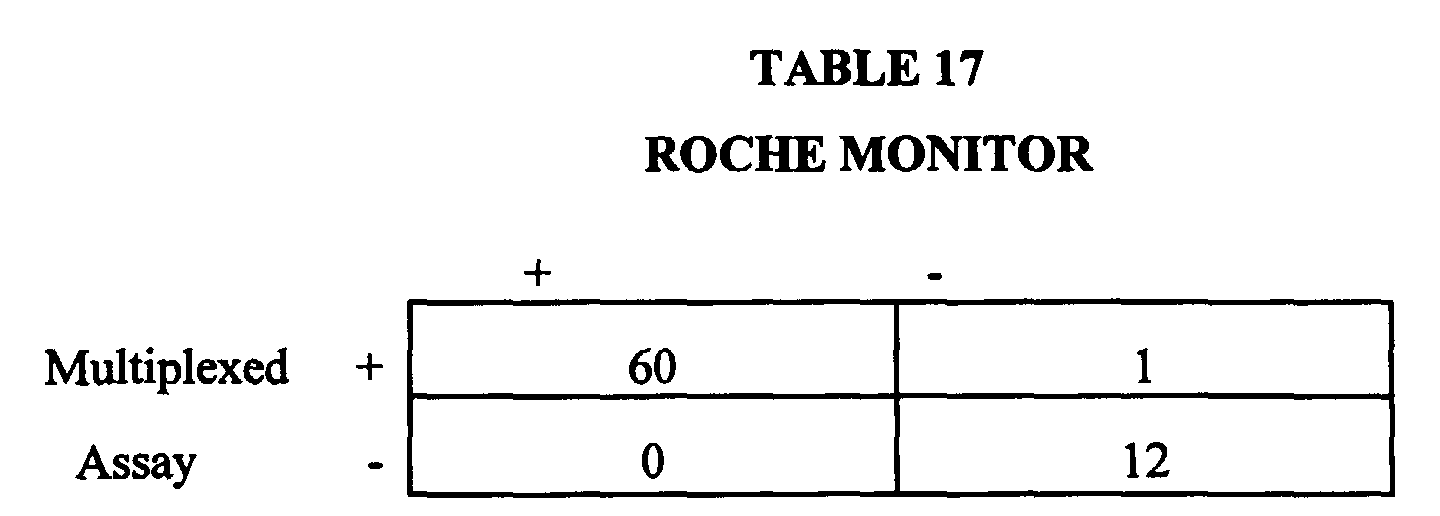
- Samples containing HCV of different genotypes (1-6, obtained from the US, Scotland, Tunisia, Saudi Arabia, and Hong Kong) were quantified using the Roche Monitor Assay, diluted to 50 viral copies per PCR reaction (1000 copies/mL), and assayed using the C131F and C294R primers as described above.
Landscapes
- Chemical & Material Sciences (AREA)
- Life Sciences & Earth Sciences (AREA)
- Health & Medical Sciences (AREA)
- Organic Chemistry (AREA)
- Proteomics, Peptides & Aminoacids (AREA)
- Engineering & Computer Science (AREA)
- Zoology (AREA)
- Wood Science & Technology (AREA)
- Immunology (AREA)
- Analytical Chemistry (AREA)
- Microbiology (AREA)
- Biochemistry (AREA)
- Biophysics (AREA)
- Molecular Biology (AREA)
- Physics & Mathematics (AREA)
- Genetics & Genomics (AREA)
- General Health & Medical Sciences (AREA)
- Biotechnology (AREA)
- Bioinformatics & Cheminformatics (AREA)
- General Engineering & Computer Science (AREA)
- Communicable Diseases (AREA)
- Chemical Kinetics & Catalysis (AREA)
- Virology (AREA)
- Measuring Or Testing Involving Enzymes Or Micro-Organisms (AREA)
Abstract
Description
where each of the pairs comprises:
where detection of the amplification products indicates the presence of HCV RNA in the sample.
where each of the pairs comprises:
where the forward primer consists of the oligonucleotide 5'-GGTGGCTCCATCTTAGCCCTAGTCACG-3' (1F27) 〈SEQ ID NO. 8〉 and the reverse primer consists of the oligonucleotide 5'-AGGCCAGTATCAGCACTCTCTGCAGTC-3' (57R27) 〈SEQ ID NO. 9〉; and
where detection of the amplification products indicates the presence of HCV RNA in the sample.
where the forward primer consists of the oligonucleotide 5'-GGTGGCTCCATCTTAGCCCTAGTCACG-3' (1F27) 〈SEQ ID NO. 8〉 and the reverse primer consists of the oligonucleotide 5'-AGGCCAGTATCAGCACTCTCTGCAGTC-3' (57R27) 〈SEQ ID NO. 9〉.
where each of the pairs of 5' NCR oligonucleotide primers comprises:
where each of the pairs of 3' NCR oligonucleotide primers comprises a forward primer consisting of the oligonucleotide 5'-GGTGGCTCCATCTTAGCCCTAGTCACG-3' (1F27) 〈SEQ ID NO. 8〉 and a reverse primer consisting of the oligonucleotide 5'-AGGCCAGTATCAGCACTCTCTGCAGTC-3 (57R27) 〈SEQ ID NO. 9〉; and
where detection of the amplification products indicates the presence of HCV RNA in the sample.
where each of the pairs of 5' NCR oligonucleotide primers comprises:
where each of the pairs of 3' NCR oligonucleotide primers comprises a forward primer consisting of the oligonucleotide 5'-GGTGGCTCCATCTTAGCCCTAGTCACG-3' (1F27) 〈SEQ ID NO. 8〉 and a reverse primer consisting of the oligonucleotide 5'-AGGCCAGTATCAGCACTCTCTGCAGTC-3 (57R27) 〈SEQ ID NO. 9〉.
5'-CGCCAGCGTGGACCATCAAGTAGTAATGAACGCACGGACGAGGACATCA TAGAGATTACACCTTTATCCACAGTTCTCGGTCTAACGCAGCAGTCAGTG TATCAGCACCAGCATCCGTAGTGAGTCTTCAGTGTCTGCTCCAGGATCGT G-3'
〈SEQ ID NO. 10〉.
| PRIMER | SEQUENCE | LOC. | S | SIN |
| C69f28 | 5'-CAGAAAGCGTCTAGCCATGGCGTTAG TA-3' | 69-96 | S | 1 |
| C131F25 | 5'-GGGAGAGCCATAGTGGTCTGCGGAA-3' | 131-155 | S | 2 |
| C143R26 | 5'-GTGGTCTGCGGAACCGGTGAGTACAC-3' | 143-168 | S | 3 |
| C133F26 | 5'-CGGTTCCGCAGACCACTATGGCTCTC-3' | 133-158 | A S | 4 |
| C282R26 | 5'-GCAAGCACCCTATCAGGCAGTACCAC A-3' | 282-308 | A S | 5 |
| C287R27 | 5'-CACTCGCAAGCACCCTATCAGGCAGT A-3' | 287-313 | A S | 6 |
| C294R25 | 5'-CGGGGCACTCGCAAGCACCCTATCA-3' | 294-318 | A S | 7 |
5'-CGGTTCCGCAGACCACTATGGCTCTC-3' 〈SEQ ID NO. 4〉 and
5'-CGGGGCACTCGCAAGCACCCTATCA-3' 〈SEQ ID NO. 7〉.
〈SEQ ID NO. 9〉.
5'-CGGGGCACTCGCAAGCACCCTATCA-3' (5' pair) 〈SEQ ID NO. 7〉 and
5'-AGGCCAGTATCAGCACTCTCTGCAGTC-3' (3' pair) 〈SEQ ID NO. 9〉 .
| PRIMER | SEQUENCE | LOC. | S | SIN |
| C69f28 | 5'-CAGAAAGCGTCTAGCCATGGCGTTAGT A-3' | 69-96 | S | 1 |
| C131F25 | 5'-GGGAGAGCCATAGTGGTCTGCGGAA-3' | 131-155 | S | 2 |
| C143F26 | 5'-GTGGTCTGCGGAACCGGTGAGTACAC-3' | 143-168 | S | 3 |
| C133R26 | 5'-CGGTTCCGCAGACCACTATGGCTCTC-3' | 133-158 | AS | 4 |
| C282R26 | 5'-GCAAGCACCCTATCAGGCAGTACCACA -3' | 282-308 | AS | 5 |
| C287R27 | 5'-CACTCGCAAGCACCCTATCAGGCAGTA -3' | 287-313 | AS | 6 |
| C294R25 | 5'-CGGGGCACTCGCAAGCACCCTATCA-3' | 294-318 | AS | 7 |
| FORWARD | REVERSE | PRODUCT SIZE (bp) |
| C69F28 | C133R26 | 90 |
| C131F25 | C294R25 | 188 |
| C143F26 | C282R27 | 166 |
| C143F26 | C282R27 | 171 |




| n | Copies/ml | Copies/rxn. | % pos. results |
| 16 | 1000 | 50 | 100% |
| 16 | 200 | 10 | 88% |
| 57 | 100 | 5 | 49% |
| 64 | 20 | 1 | 20% |
| Average | |||
| n | Copies/rxn | Visible Color | % pos. results |
| 9 | 50 | 8 | 100% |
| 10 | 10 | 8 | 100% |
| 10 | 0 | 0 | 0% |
| Genotype | Strain | % pos. results |
| 1a | H77 | + |
| 1b | H-J4 | + |
| 2a | H-J6 | + |
| 2b | C-J8 | + |
| 3a | S52 | + |
| 5a | SA13 | + |
| n | genotype | strain | # copies/rxn | % pos. results |
| 4 | 1a | H77 | 100 | 100% |
| 4 | 1b | H-J4 | 100 | 100% |
| 4 | 2a | H-J6 | 100 | 100% |
| 4 | 2b | C-J8 | 100 | 100% |
| 4 | 3a | S52 | 100 | 100% |
| 4 | 5a | SA13 | 100 | 100% |


Claims (36)
- A method for detecting the presence of Hepatitis C Virus (HCV) RNA in a biological sample, said method comprising:(A) performing a reverse transcription reaction using, as a template, RNA derived from said sample to produce HCV-specific reverse transcription products;(B) amplifying said reverse-transcription products using one or more pairs of oligonucleotide primers specific for HCV to produce HCV-specific amplification products,
wherein said pairs are selected from the group consisting of:(a) forward primer 5'-CAGAAAGCGTCTAGCCATGGCGTTAGTA-3' (C69F28) 〈SEQ ID NO. 1〉 and reverse primer 5'-CGGTTCCGCAGACCACTATGGCTCTC-3' (C133R26) 〈SEQ ID NO. 4〉;or(b) forward primer 5'-GGGAGAGCCATAGTGGTCTGCGGAA-3' (C131F25) 〈SEQ ID NO. 2〉 and reverse primer 5'-CGGGGCACTCGCAAGCACCCTATCA-3' (C294R25) 〈SEQ ID NO. 7〉; and(c) forward primer 5'-GTGGTCTGCGGAACCGGTGAGTACAC-3 (C143F26) 〈SEQ ID NO. 3〉 and a reverse primer selected from the group consisting of(i) 5'-GCAAGCACCCTATCAGGCAGTACCACA-3' (C282R27) 〈SEQ ID NO. 5〉,(ii) 5'-CACTCGCAAGCACCCTATCAGGCAGTA-3' (C287R27) 〈SEQ ID NO. 6〉; and(C) detecting said amplification products,
wherein detection of said amplification products indicates the presence of HCV RNA in said sample. - A method as defined in claim 1, wherein said reverse transcription reaction is performed using random oligonucleotide primers.
- A method as defined in claim 1, wherein said reverse transcription reaction is performed using one or more oligonucleotide primers having sequences corresponding to sequences in HCV RNA.
- A method as defined in claim 1, wherein said amplifying is performed by a method selected from the group consisting of polymerase chain reaction, ligase chain reaction, strand displacement amplification, nucleic acid single base substitution, and transcription mediated amplification.
- A method as defined in claim 1, wherein said detecting comprises visualizing said amplification products by gel electrophoresis.
- A method as defined in claim 1, wherein said detecting comprises capturing said amplification products on a solid support containing one or more HCV-specific oligonucleotide probes and quantifying said captured products using a colorimetric assay.
- A method as defined in claim 6, wherein said probes comprise a member selected from the group consisting of:(a) 5'-TTTCGCGACCCAACACTACTCGGCT-3' (C252-25-PRB) 〈SEQ ID NO. 13〉 and(b) 5'-CCTTTCGCGACCCAACACTACTCGGCT-3' (C252-27-PRB) 〈SEQ ID NO. 12〉 when said forward primer is (C131F25) or (C143F26); and
wherein said probes comprise(c) 5'-GGGTCCTGGAGGCTGCACGACACTCAT-3' (C96-22-PRB) 〈SEQ ID NO. 11〉 when said forward primer is (C69F28). - A method as defined in claim 1, wherein said sample is selected from the group consisting of blood, serum, plasma, urine, saliva, and cerebrospinal fluid.
- A method for amplifying Hepatitis C Virus (HCV) DNA, said method comprising:(A) performing a polymerase chain reaction on a DNA sample containing HCV DNA using one or more pairs of oligonucleotide primers specific for HCV to produce HCV-specific amplification products,
wherein said pairs are selected from the group consisting of:(a) forward primer 5'-CAGAAAGCGTCTAGCCATGGCGTTAGTA-3' (C69F28) 〈SEQ ID NO. 1〉 and reverse primer 5'-CGGTTCCGCAGACCACTATGGCTCTC-3' (C133R26) 〈SEQ ID NO. 4〉;or(b) forward primer 5'-GGGAGAGCCATAGTGGTCTGCGGAA-3' (C131F25) 〈SEQ ID NO. 2〉 and reverse primer 5'-CGGGGCACTCGCAAGCACCCTATCA-3' (C294R25) 〈SEQ ID NO. 7〉; and(c) forward primer 5'-GTGGTCTGCGGAACCGGTGAGTACAC-3 (C143F26) 〈SEQ ID NO. 3〉 and a reverse primer selected from the group consisting of(i) 5'-GCAAGCACCCTATCAGGCAGTACCACA-3' (C282R27) 〈SEQ ID NO. 5〉,(ii) 5'-CACTCGCAAGCACCCTATCAGGCAGTA-3' (C287R27) 〈SEQ ID NO. 6〉. - A method as defined in claim 9, further comprising:(B) detecting said amplification products,
wherein detection of said amplification products indicates the presence of HCV DNA in said sample. - A method as defined in claim 10, wherein said detecting comprises visualizing said amplification products by gel electrophoresis.
- A method as defined in claim 10, wherein said detecting comprises capturing said amplification products on a solid support containing one or more HCV-specific oligonucleotide probes and quantifying said captured products using a colorimetric assay.
- A method as defined in claim 10, wherein said probes comprise a member selected from the group consisting of:(a) 5'-TTTCGCGACCCAACACTACTCGGCT-3' (C252-25-PRB) 〈SEQ ID NO. 13〉 and(b) 5'-CCTTTCGCGACCCAACACTACTCGGCT-3' (C252-27-PRB) 〈SEQ ID NO. 12〉 when said forward primer is (C131F25) or (C143F26); and
wherein said probes comprise(c) 5'-GGGTCCTGGAGGCTGCACGACACTCAT-3' (C96-22-PRB) 〈SEQ ID NO. 11〉 when said forward primer is (C69F28). - A method for detecting the presence of Hepatitis C Virus (HCV) RNA in a biological sample, said method comprising:(A) performing a reverse transcription reaction using as a template RNA derived from said sample to produce HCV-specific reverse transcription products;(B) amplifying said reverse-transcription products using a forward primer and a reverse primer to produce HCV-specific amplification products,
wherein said forward primer consists of the oligonucleotide 5'-GGTGGCTCCATCTTAGCCCTAGTCACG-3' (1F27) 〈SEQ ID NO. 8〉 and said reverse primer consists of the oligonucleotide 5'-AGGCCAGTATCAGCACTCTCTGCAGTC-3' (57R27) 〈SEQ ID NO. 9〉; and(C) detecting said amplification products,
wherein detection of said amplification products indicates the presence of HCV RNA in said sample. - A method as defined in claim 14, wherein said reverse transcription reaction is performed using random oligonucleotide primers.
- A method as defined in claim 14, wherein said reverse transcription reaction is performed using one or more oligonucleotide primers having sequences corresponding to sequences in HCV RNA.
- A method as defined in claim 14, wherein said amplifying is performed by a method selected from the group consisting of polymerase chain reaction, ligase chain reaction, strand displacement amplification, nucleic acid single base substitution, and transcription mediated amplification.
- A method as defined in claim 14, wherein said detecting comprises visualizing said amplification products by gel electrophoresis.
- A method as defined in claim 14, wherein said detecting comprises capturing said amplification products on a solid support containing one or more HCV-specific oligonucleotide probes and quantifying said captured products using a colorimetric assay.
- A method as defined in claim 19, wherein said probes are selected from the group consisting of 5'-GCGGCTCACGGACCTTTCACAGCTA-3' (30PRB25) 〈SEQ ID NO. 14〉 and 5'-ATGCGGCTCACGGACCTTTCACAGC-3' (32PRB25) 〈SEQ ID NO. 15〉.
- A method as defined in claim 14, wherein said sample is selected from the group consisting of blood, serum, plasma, urine, saliva, and cerebrospinal fluid.
- A method for detecting the presence of Hepatitis C Virus (HCV) RNA in a biological sample, said method comprising:(A) performing a reverse transcription reaction using as a template RNA derived from said sample to produce HCV-specific reverse transcription products;(B) amplifying said reverse-transcription products using one or more pairs of 5' NCR oligonucleotide primers specific for HCV and one or more pairs of 3' NCR oligonucleotide primers to produce HCV-specific amplification products,
wherein said 5' NCR primer pairs are selected from the group consisting of:(a) forward primer 5'-CAGAAAGCGTCTAGCCATGGCGTTAGTA-3' (C69F28) 〈SEQ ID NO. 1〉 and reverse primer 5'-CGGTTCCGCAGACCACTATGGCTCTC-3' (C133R26) 〈SEQ ID NO. 4〉;or(b) forward primer 5'-GGGAGAGCCATAGTGGTCTGCGGAA-3' (C131F25) 〈SEQ ID NO. 2〉 and reverse primer 5'-CGGGGCACTCGCAAGCACCCTATCA-3' (C294R25) 〈SEQ ID NO. 7〉; and(c) forward primer 5'-GTGGTCTGCGGAACCGGTGAGTACAC-3 (C143F26) 〈SEQ ID NO. 3〉 and a reverse primer selected from the group consisting of(i) 5'-GCAAGCACCCTATCAGGCAGTACCACA-3' (C282R27) 〈SEQ ID NO. 5〉,(ii) 5'-CACTCGCAAGCACCCTATCAGGCAGTA-3' (C287R27) 〈SEQ ID NO. 6〉; and
wherein each of said pairs of 3' NCR oligonucleotide primers comprises a forward primer consisting of the oligonucleotide 5'-GGTGGCTCCATCTTAGCCCTAGTCACG-3' (1F27) 〈SEQ ID NO. 8〉 and a reverse primer consisting of the oligonucleotide 5'-AGGCCAGTATCAGCACTCTCTGCAGTC-3 (57R27) 〈SEQ ID NO. 9〉; and(C) detecting said amplification products,
wherein detection of said amplification products indicates the presence of HCV RNA in said sample. - A method as defined in claim 22, wherein said reverse transcription reaction is performed using random oligonucleotide primers.
- A method as defined in claim 22, wherein said reverse transcription reaction is performed using one or more oligonucleotide primers having sequences corresponding to sequences in HCV RNA.
- A method as defined in claim 22, wherein said amplifying is performed by a method selected from the group consisting of polymerase chain reaction, ligase chain reaction, strand displacement amplification, nucleic acid single base substitution, and transcription mediated amplification.
- A method as defined in claim 22, wherein said detecting comprises visualizing said amplification products by gel electrophoresis.
- A method as defined in claim 22, wherein said detecting comprises capturing said amplification products on a solid support containing one or more HCV-specific oligonucleotide probes and quantifying said captured products using a colorimetric assay.
- A method as defined in claim 27, wherein said probes comprise a member selected from the group consisting of:(a) 5'-TTTCGCGACCCAACACTACTCGGCT-3' (C252-25-PRB) 〈SEQ ID NO. 13〉 and(b) 5'-CCTTTCGCGACCCAACACTACTCGGCT-3' (C252-27-PRB) 〈SEQ ID NO. 12〉 when said 5' NCR forward primer is (C131F25) or (C143F26);
wherein said probes comprise(c) 5'-GGGTCCTGGAGGCTGCACGACACTCAT-3' (C96-22-PRB) 〈SEQ ID NO. 11〉 when said 5' NCR forward primer is (C69F28); and
wherein said probes comprise a member selected from the group consisting of(d) 5'-GCGGCTCACGGACCTTTCACAGCTA-3' (30PRB25) 〈SEQ ID NO. 14〉; and(e) 5'-ATGCGGCTCACGGACCTTTCACAGC-3' (32PRB25) 〈SEQ ID NO. 15〉. - A method as defined in claim 22, wherein said sample is selected from the group consisting of blood, serum, plasma, urine, saliva, and cerebrospinal fluid.
- An oligonucleotide selected from the group consisting of:
5'-CAGAAAGCGTCTAGCCATGGCGTTAGTA-3' (C69F28) 〈SEQ ID NO. 1〉.
5'-GGGAGAGCCATAGTGGTCTGCGGAA-3' (C131F25) 〈SEQ ID NO. 2〉.
5'-GTGGTCTGCGGAACCGGTGAGTACAC-3 (C143F26) 〈SEQ ID NO. 3〉.
5'-CGGTTCCGCAGACCACTATGGCTCTC-3' (C133R26) 〈SEQ ID NO. 4〉.
5'-GCAAGCACCCTATCAGGCAGTACCACA-3' (C282R27) 〈SEQ ID NO. 5〉.
5'-CACTCGCAAGCACCCTATCAGGCAGTA-3' (C287R27) 〈SEQ ID NO. 6〉.
5'-CGGGGCACTCGCAAGCACCCTATCA-3' (C294R25) 〈SEQ ID NO. 7〉.
5'-GGTGGCTCCATCTTAGCCCTAGTCACG-3' (1F27) 〈SEQ ID NO. 8〉.
5'-AGGCCAGTATCAGCACTCTCTGCAGTC-3 (57R27) 〈SEQ ID NO. 9〉.
5'-GGGTCCTGGAGGCTGCACGACACTCAT-3' (C96-22-PRB) 〈SEQ ID NO. 11〉.
5'-CCTTTCGCGACCCAACACTACTCGGCT-3' (C252-27-PRB) 〈SEQ ID NO. 12〉.
5'-TTTCGCGACCCAACACTACTCGGCT-3' (C252-25-PRB) 〈SEQ ID NO. 13〉.
5'-GCGGCTCACGGACCTTTCACAGCTA-3' (30PRB25) 〈SEQ ID NO. 14〉.
5'-ATGCGGCTCACGGACCTTTCACAGC-3' (32PRB25) 〈SEQ ID NO. 15〉. - An HCV-specific amplification primer oligonucleotide selected from the group consisting of:
5'-CAGAAAGCGTCTAGCCATGGCGTTAGTA-3' (C69F28) 〈SEQ ID NO. 1〉.
5'-GGGAGAGCCATAGTGGTCTGCGGAA-3' (C131F25) 〈SEQ ID NO. 2〉.
5'-GTGGTCTGCGGAACCGGTGAGTACAC-3 (C143F26) 〈SEQ ID NO. 3〉.
5'-CGGTTCCGCAGACCACTATGGCTCTC-3' (C133R26) 〈SEQ ID NO. 4〉.
5'-GCAAGCACCCTATCAGGCAGTACCACA-3' (C282R27) 〈SEQ ID NO. 5〉.
5'-CACTCGCAAGCACCCTATCAGGCAGTA-3' (C287R27) 〈SEQ ID NO. 6〉.
5'-CGGGGCACTCGCAAGCACCCTATCA-3' (C294R25) 〈SEQ ID NO. 7〉.
5'-GGTGGCTCCATCTTAGCCCTAGTCACG-3' (1F27) 〈SEQ ID NO. 8〉.
5'-AGGCCAGTATCAGCACTCTCTGCAGTC-3 (57R27) 〈SEQ ID NO. 9〉. - A probe comprising an oligonucleotide selected from the group consisting of:
5'-GGGTCCTGGAGGCTGCACGACACTCAT-3' (C96-22-PRB) 〈SEQ ID NO. 11〉.
5'-CCTTTCGCGACCCAACACTACTCGGCT-3' (C252-27-PRB) 〈SEQ ID NO.12〉.
5'-TTTCGCGACCCAACACTACTCGGCT-3' (C252-25-PRB) 〈SEQ ID NO. 13〉.
5'-GCGGCTCACGGACCTTTCACAGCTA-3' (30PRB25) 〈SEQ ID NO. 14〉.
5'-ATGCGGCTCACGGACCTTTCACAGC-3' (32PRB25) 〈SEQ ID NO. 15〉. - A kit for amplifying HCV DNA derived from HCV RNA, said kit comprising one or more pairs of 5' NCR oligonucleotide primers, wherein said 5' NCR primer pairs are selected from the group consisting of:(a) forward primer 5'-CAGAAAGCGTCTAGCCATGGCGTTAGTA-3' (C69F28) 〈SEQ ID NO. 1〉 and reverse primer 5'-CGGTTCCGCAGACCACTATGGCTCTC-3' (C133R26) 〈SEQ ID NO. 4〉;(b) forward primer 5'-GGGAGAGCCATAGTGGTCTGCGGAA-3' (C131F25) 〈SEQ ID NO. 2〉 and reverse primer 5'-CGGGGCACTCGCAAGCACCCTATCA-3' (C294R25) 〈SEQ ID NO. 7〉; and(c) forward primer 5'-GTGGTCTGCGGAACCGGTGAGTACAC-3 (C143F26) 〈SEQ ID No.3〉 and a reverse primer selected from the group consisting of(i) 5'-GCAAGCACCCTATCAGGCAGTACCACA-3' (C282R27) 〈SEQ ID NO. 5〉,(ii) 5'-CACTCGCAAGCACCCTATCAGGCAGTA-3' (C287R27) 〈SEQ ID NO. 6〉.
- A kit for amplifying HCV cDNA derived from HCV RNA, said kit comprising one or more pairs of 3' NCR oligonucleotide primers, wherein each of said pairs of 3' NCR oligonucleotide primers comprises a forward primer consisting of the oligonucleotide 5'-GGTGGCTCCATCTTAGCCCTAGTCACG-3' (1F27)
〈SEQ ID NO. 8〉 and a reverse primer consisting of the oligonucleotide 5'-AGGCCAGTATCAGCACTCTCTGCAGTC-3 (57R27)〈SEQ ID NO. 9〉. - A kit as defined in claim 34, further comprising one or more probes.
- A kit as defined in claim 35, wherein said probes are selected from the group consisting of:(a) 5'-GCGGCTCACGGACCTTTCACAGCTA-3' (30PRB25)
〈SEQ ID NO. 14〉; and(b) 5'-ATGCGGCTCACGGACCTTTCACAGC-3' (32PRB25)
〈SEQ ID NO. 15〉.
Applications Claiming Priority (2)
| Application Number | Priority Date | Filing Date | Title |
|---|---|---|---|
| US11849799P | 1999-02-03 | 1999-02-03 | |
| US118497 | 1999-02-03 |
Publications (3)
| Publication Number | Publication Date |
|---|---|
| EP1026262A2 true EP1026262A2 (en) | 2000-08-09 |
| EP1026262A3 EP1026262A3 (en) | 2001-11-21 |
| EP1026262B1 EP1026262B1 (en) | 2009-04-08 |
Family
ID=22378970
Family Applications (1)
| Application Number | Title | Priority Date | Filing Date |
|---|---|---|---|
| EP00300763A Expired - Lifetime EP1026262B1 (en) | 1999-02-03 | 2000-02-01 | Oligonucleotide primers for efficient detection of hepatitis C virus (HCV) and methods of use thereof |
Country Status (13)
| Country | Link |
|---|---|
| US (1) | US6638714B1 (en) |
| EP (1) | EP1026262B1 (en) |
| JP (1) | JP5450914B2 (en) |
| KR (4) | KR100869261B1 (en) |
| CN (2) | CN1237186C (en) |
| AT (1) | ATE428003T1 (en) |
| AU (1) | AU1487900A (en) |
| CA (1) | CA2296144C (en) |
| DE (1) | DE60041940D1 (en) |
| DK (1) | DK1026262T3 (en) |
| ES (1) | ES2322752T3 (en) |
| NO (1) | NO329925B1 (en) |
| PT (1) | PT1026262E (en) |
Cited By (6)
| Publication number | Priority date | Publication date | Assignee | Title |
|---|---|---|---|---|
| WO2002083948A1 (en) * | 2001-04-12 | 2002-10-24 | Biocore Co., Ltd. | Oligonucleotide chip composition for analyzing hepatitis c virus (hcv) genotype and detecting method thereof |
| WO2005071117A2 (en) | 2004-01-23 | 2005-08-04 | Biomerieux, Inc. | Primer and probe design for efficient amplification and detection of hcv 3′ non-translating region |
| WO2009087685A3 (en) * | 2008-01-04 | 2009-10-15 | Premas Biotech Pvt.Ltd | Method for detection of hepatitis nucleic acid and uses thereof |
| EP2147118A4 (en) * | 2007-04-27 | 2010-09-01 | Eragen Biosciences Inc | Materials and methods for detection of hepatitis c virus |
| WO2012019260A3 (en) * | 2010-08-11 | 2012-08-02 | Universidade Federal Do Rio De Janeiro | Synthetic rna molecule of the hepatitis c virus, production method of same and use thereof as an internal control for the quantification and/or identification of the hepatitis c virus |
| WO2013184553A1 (en) * | 2012-06-04 | 2013-12-12 | Gen-Probe Incorporated | Compositions and methods for amplifying and characterizing hcv nucleic acid |
Families Citing this family (48)
| Publication number | Priority date | Publication date | Assignee | Title |
|---|---|---|---|---|
| US7666588B2 (en) | 2001-03-02 | 2010-02-23 | Ibis Biosciences, Inc. | Methods for rapid forensic analysis of mitochondrial DNA and characterization of mitochondrial DNA heteroplasmy |
| US20030027135A1 (en) | 2001-03-02 | 2003-02-06 | Ecker David J. | Method for rapid detection and identification of bioagents |
| US20040121309A1 (en) | 2002-12-06 | 2004-06-24 | Ecker David J. | Methods for rapid detection and identification of bioagents in blood, bodily fluids, and bodily tissues |
| US7226739B2 (en) | 2001-03-02 | 2007-06-05 | Isis Pharmaceuticals, Inc | Methods for rapid detection and identification of bioagents in epidemiological and forensic investigations |
| US7718354B2 (en) | 2001-03-02 | 2010-05-18 | Ibis Biosciences, Inc. | Methods for rapid identification of pathogens in humans and animals |
| WO2004060278A2 (en) | 2002-12-06 | 2004-07-22 | Isis Pharmaceuticals, Inc. | Methods for rapid identification of pathogens in humans and animals |
| US8073627B2 (en) | 2001-06-26 | 2011-12-06 | Ibis Biosciences, Inc. | System for indentification of pathogens |
| US7217510B2 (en) | 2001-06-26 | 2007-05-15 | Isis Pharmaceuticals, Inc. | Methods for providing bacterial bioagent characterizing information |
| US8046171B2 (en) | 2003-04-18 | 2011-10-25 | Ibis Biosciences, Inc. | Methods and apparatus for genetic evaluation |
| US8057993B2 (en) | 2003-04-26 | 2011-11-15 | Ibis Biosciences, Inc. | Methods for identification of coronaviruses |
| US8158354B2 (en) | 2003-05-13 | 2012-04-17 | Ibis Biosciences, Inc. | Methods for rapid purification of nucleic acids for subsequent analysis by mass spectrometry by solution capture |
| US7964343B2 (en) | 2003-05-13 | 2011-06-21 | Ibis Biosciences, Inc. | Method for rapid purification of nucleic acids for subsequent analysis by mass spectrometry by solution capture |
| US8546082B2 (en) | 2003-09-11 | 2013-10-01 | Ibis Biosciences, Inc. | Methods for identification of sepsis-causing bacteria |
| US8097416B2 (en) | 2003-09-11 | 2012-01-17 | Ibis Biosciences, Inc. | Methods for identification of sepsis-causing bacteria |
| US8242254B2 (en) | 2003-09-11 | 2012-08-14 | Ibis Biosciences, Inc. | Compositions for use in identification of bacteria |
| US8163895B2 (en) | 2003-12-05 | 2012-04-24 | Ibis Biosciences, Inc. | Compositions for use in identification of orthopoxviruses |
| US7666592B2 (en) | 2004-02-18 | 2010-02-23 | Ibis Biosciences, Inc. | Methods for concurrent identification and quantification of an unknown bioagent |
| US8119336B2 (en) | 2004-03-03 | 2012-02-21 | Ibis Biosciences, Inc. | Compositions for use in identification of alphaviruses |
| ES2641832T3 (en) | 2004-05-24 | 2017-11-14 | Ibis Biosciences, Inc. | Mass spectrometry with selective ion filtration by setting digital thresholds |
| US20050266411A1 (en) | 2004-05-25 | 2005-12-01 | Hofstadler Steven A | Methods for rapid forensic analysis of mitochondrial DNA |
| US7811753B2 (en) | 2004-07-14 | 2010-10-12 | Ibis Biosciences, Inc. | Methods for repairing degraded DNA |
| GB0423552D0 (en) * | 2004-10-22 | 2004-11-24 | Hepcgen Ltd | Methods |
| US20060205040A1 (en) | 2005-03-03 | 2006-09-14 | Rangarajan Sampath | Compositions for use in identification of adventitious viruses |
| US8084207B2 (en) | 2005-03-03 | 2011-12-27 | Ibis Bioscience, Inc. | Compositions for use in identification of papillomavirus |
| EP1904655A2 (en) | 2005-07-21 | 2008-04-02 | Isis Pharmaceuticals, Inc. | Methods for rapid identification and quantitation of nucleic acid variants |
| AU2007353877B2 (en) | 2006-09-14 | 2012-07-19 | Ibis Biosciences, Inc. | Targeted whole genome amplification method for identification of pathogens |
| MD3300G2 (en) * | 2006-09-28 | 2007-11-30 | Институт Генетики, Физиологии И Защиты Растений Академии Наук Молдовы | Oligonucleotide primer for hepatitis C virus RNA detection |
| JP5680304B2 (en) | 2007-02-23 | 2015-03-04 | アイビス バイオサイエンシズ インコーポレイティッド | Rapid forensic DNA analysis |
| WO2008125117A1 (en) * | 2007-04-13 | 2008-10-23 | Hvidovre Hospital | Cell culture system of a hepatitis c genotype 3a and 2a chimera |
| US8454974B2 (en) | 2007-04-13 | 2013-06-04 | Hvidovre Hospital | Adaptive mutations allow establishment of JFH1-based cell culture systems for hepatitis C virus genotype 4A |
| US8618275B2 (en) | 2007-05-18 | 2013-12-31 | Hvidovre Hospital | Efficient cell culture system for hepatitis C virus genotype 5A |
| US20100291544A1 (en) * | 2007-05-25 | 2010-11-18 | Ibis Biosciences, Inc. | Compositions for use in identification of strains of hepatitis c virus |
| US9598724B2 (en) | 2007-06-01 | 2017-03-21 | Ibis Biosciences, Inc. | Methods and compositions for multiple displacement amplification of nucleic acids |
| US8569472B2 (en) * | 2007-12-20 | 2013-10-29 | Hvidovre Hospital | Efficient cell culture system for hepatitis C virus genotype 6A |
| WO2010017819A1 (en) | 2008-08-15 | 2010-02-18 | Hvidovre Hospital | EFFICIENT CELL CULTURE SYSTEM FOR HEPATITIS C VIRUS GENOTYPE 7a |
| WO2010017818A1 (en) | 2008-08-15 | 2010-02-18 | Hvidovre Hospital | Efficient cell culture system for hepatitis c virus genotype 2b |
| EP2349549B1 (en) | 2008-09-16 | 2012-07-18 | Ibis Biosciences, Inc. | Mixing cartridges, mixing stations, and related kits, and system |
| WO2010033627A2 (en) | 2008-09-16 | 2010-03-25 | Ibis Biosciences, Inc. | Sample processing units, systems, and related methods |
| US8534447B2 (en) | 2008-09-16 | 2013-09-17 | Ibis Biosciences, Inc. | Microplate handling systems and related computer program products and methods |
| WO2010037403A1 (en) | 2008-10-03 | 2010-04-08 | Hvidovre Hospital | Hepatitis c virus expressing reporter tagged ns5a protein |
| EP2396803A4 (en) | 2009-02-12 | 2016-10-26 | Ibis Biosciences Inc | Ionization probe assemblies |
| US8950604B2 (en) | 2009-07-17 | 2015-02-10 | Ibis Biosciences, Inc. | Lift and mount apparatus |
| EP2454000A4 (en) | 2009-07-17 | 2016-08-10 | Ibis Biosciences Inc | Systems for bioagent identification |
| EP2957641B1 (en) | 2009-10-15 | 2017-05-17 | Ibis Biosciences, Inc. | Multiple displacement amplification |
| KR101503039B1 (en) * | 2010-07-01 | 2015-04-29 | (주)바이오니아 | Diagnostic primer for the heatitis c virus, probe, kit including same, and method for diagnosing the hepatitis c virus using the kit |
| WO2012135975A1 (en) * | 2011-04-06 | 2012-10-11 | 瑞基海洋生物科技股份有限公司 | Mixed solution for polymerase chain reaction |
| CN106929603A (en) * | 2017-01-10 | 2017-07-07 | 上海纽思格生物科技有限公司 | A kind of modified form HCV RNA detection kits |
| ES3035799T3 (en) * | 2017-10-03 | 2025-09-09 | Abbott Molecular Inc | Assay for detecting hepatitis c virus (hcv) |
Family Cites Families (7)
| Publication number | Priority date | Publication date | Assignee | Title |
|---|---|---|---|---|
| JPH09107970A (en) * | 1995-10-17 | 1997-04-28 | Soyaku Gijutsu Kenkyusho:Kk | Nucleic acid derived from hepatitis C virus and method for detecting virus using the nucleic acid |
| US5747244A (en) | 1991-12-23 | 1998-05-05 | Chiron Corporation | Nucleic acid probes immobilized on polystyrene surfaces |
| ES2133529T3 (en) * | 1992-11-27 | 1999-09-16 | Innogenetics Nv | PROCEDURE TO TYPE HCV INSULATION. |
| JPH06153961A (en) * | 1992-11-27 | 1994-06-03 | Imuno Japan:Kk | Partial gene of hepatitis c virus and method for detecting gene of hepatitis c virus in high sensitivity |
| JPH07184695A (en) | 1993-12-27 | 1995-07-25 | Sanwa Kagaku Kenkyusho Co Ltd | Method for simply detecting hepatitis c virus |
| US5837442A (en) * | 1995-11-29 | 1998-11-17 | Roche Molecular Systems, Inc. | Oligonucleotide primers for amplifying HCV nucleic acid |
| IT1284847B1 (en) | 1996-06-07 | 1998-05-22 | Sorin Biomedica Diagnostics Sp | PROCEDURE FOR THE DETECTION OF HCV SPECIFIC NUCLEIC ACIDS |
-
2000
- 2000-01-28 US US09/493,353 patent/US6638714B1/en not_active Expired - Lifetime
- 2000-02-01 CA CA002296144A patent/CA2296144C/en not_active Expired - Fee Related
- 2000-02-01 DE DE60041940T patent/DE60041940D1/en not_active Expired - Lifetime
- 2000-02-01 AT AT00300763T patent/ATE428003T1/en active
- 2000-02-01 PT PT00300763T patent/PT1026262E/en unknown
- 2000-02-01 EP EP00300763A patent/EP1026262B1/en not_active Expired - Lifetime
- 2000-02-01 ES ES00300763T patent/ES2322752T3/en not_active Expired - Lifetime
- 2000-02-01 DK DK00300763T patent/DK1026262T3/en active
- 2000-02-02 NO NO20000536A patent/NO329925B1/en not_active IP Right Cessation
- 2000-02-02 AU AU14879/00A patent/AU1487900A/en not_active Abandoned
- 2000-02-03 JP JP2000032656A patent/JP5450914B2/en not_active Expired - Fee Related
- 2000-02-03 CN CNB001083902A patent/CN1237186C/en not_active Expired - Fee Related
- 2000-02-03 KR KR1020000005409A patent/KR100869261B1/en not_active Expired - Fee Related
- 2000-02-03 CN CNB2005101088792A patent/CN100441700C/en not_active Expired - Fee Related
-
2007
- 2007-04-30 KR KR1020070042218A patent/KR100898711B1/en not_active Expired - Fee Related
-
2008
- 2008-01-24 KR KR1020080007603A patent/KR100901086B1/en not_active Expired - Fee Related
- 2008-01-24 KR KR1020080007598A patent/KR20080014129A/en not_active Ceased
Cited By (12)
| Publication number | Priority date | Publication date | Assignee | Title |
|---|---|---|---|---|
| WO2002083948A1 (en) * | 2001-04-12 | 2002-10-24 | Biocore Co., Ltd. | Oligonucleotide chip composition for analyzing hepatitis c virus (hcv) genotype and detecting method thereof |
| US7179600B2 (en) | 2001-04-12 | 2007-02-20 | Biocore Co., Ltd. | Oligonucleotide chip composition and a method for analyzing a hepatitis C virus genotype using the composition |
| WO2005071117A2 (en) | 2004-01-23 | 2005-08-04 | Biomerieux, Inc. | Primer and probe design for efficient amplification and detection of hcv 3′ non-translating region |
| WO2005071117A3 (en) * | 2004-01-23 | 2006-04-20 | Bio Merieux Inc | Primer and probe design for efficient amplification and detection of hcv 3′ non-translating region |
| EP2147118A4 (en) * | 2007-04-27 | 2010-09-01 | Eragen Biosciences Inc | Materials and methods for detection of hepatitis c virus |
| WO2009087685A3 (en) * | 2008-01-04 | 2009-10-15 | Premas Biotech Pvt.Ltd | Method for detection of hepatitis nucleic acid and uses thereof |
| WO2012019260A3 (en) * | 2010-08-11 | 2012-08-02 | Universidade Federal Do Rio De Janeiro | Synthetic rna molecule of the hepatitis c virus, production method of same and use thereof as an internal control for the quantification and/or identification of the hepatitis c virus |
| WO2013184553A1 (en) * | 2012-06-04 | 2013-12-12 | Gen-Probe Incorporated | Compositions and methods for amplifying and characterizing hcv nucleic acid |
| US20150152513A1 (en) * | 2012-06-04 | 2015-06-04 | Gen-Probe Incorporated | Compositions and methods for amplifying and characterizing hcv nucleic acid |
| AU2013205064B2 (en) * | 2012-06-04 | 2015-07-30 | Gen-Probe Incorporated | Compositions and Methods for Amplifying and Characterizing HCV Nucleic Acid |
| US10190180B2 (en) * | 2012-06-04 | 2019-01-29 | Gen-Probe Incorporated | Compositions and methods for amplifying and characterizing HCV nucleic acid |
| US11118237B2 (en) | 2012-06-04 | 2021-09-14 | Gen-Probe Incorporated | Compositions and methods for amplifying and characterizing HCV nucleic acid |
Also Published As
| Publication number | Publication date |
|---|---|
| CA2296144A1 (en) | 2000-08-03 |
| ATE428003T1 (en) | 2009-04-15 |
| KR20000076603A (en) | 2000-12-26 |
| JP2000279200A (en) | 2000-10-10 |
| KR100901086B1 (en) | 2009-06-08 |
| PT1026262E (en) | 2009-05-21 |
| CN1827780A (en) | 2006-09-06 |
| KR20080014129A (en) | 2008-02-13 |
| DK1026262T3 (en) | 2009-07-06 |
| KR20070052723A (en) | 2007-05-22 |
| KR100898711B1 (en) | 2009-05-21 |
| NO20000536L (en) | 2000-08-04 |
| CN100441700C (en) | 2008-12-10 |
| ES2322752T3 (en) | 2009-06-26 |
| NO20000536D0 (en) | 2000-02-02 |
| EP1026262A3 (en) | 2001-11-21 |
| CN1274757A (en) | 2000-11-29 |
| KR100869261B1 (en) | 2008-11-18 |
| AU1487900A (en) | 2000-08-10 |
| CN1237186C (en) | 2006-01-18 |
| CA2296144C (en) | 2008-07-29 |
| US6638714B1 (en) | 2003-10-28 |
| DE60041940D1 (en) | 2009-05-20 |
| JP5450914B2 (en) | 2014-03-26 |
| NO329925B1 (en) | 2011-01-24 |
| KR20080014130A (en) | 2008-02-13 |
| EP1026262B1 (en) | 2009-04-08 |
Similar Documents
| Publication | Publication Date | Title |
|---|---|---|
| EP1026262B1 (en) | Oligonucleotide primers for efficient detection of hepatitis C virus (HCV) and methods of use thereof | |
| EP1026263B1 (en) | Oligonucleotide primers for reverse transcription for efficient detection of HIV-1 and HIV-2 and methods of use thereof | |
| EP1035220B1 (en) | Oligonucleotide primers for efficient multiplex detection of hepatitis C virus (HCV) and human immunodeficiency virus (HIV) and methods of use thereof | |
| EP1036847B1 (en) | Oligonucleotide primers for efficient reverse transcription of Hepatitis C Virus (HCV) RNA and methods of use thereof | |
| AU2006203092B2 (en) | Oligonucleotide primers for efficient detection of hepatitis C virus (HCV) and methods of use thereof | |
| EP3628060A1 (en) | Assay for detecting hepatitis c virus (hcv) | |
| US20050164165A1 (en) | Methods of detecting hcv genotype 1 (hcv-1) by using primers specific for the 5' non-coding region (ncr) of the hcv genome |
Legal Events
| Date | Code | Title | Description |
|---|---|---|---|
| PUAI | Public reference made under article 153(3) epc to a published international application that has entered the european phase |
Free format text: ORIGINAL CODE: 0009012 |
|
| AK | Designated contracting states |
Kind code of ref document: A2 Designated state(s): AT BE CH CY DE DK ES FI FR GB GR IE IT LI LU MC NL PT SE |
|
| AX | Request for extension of the european patent |
Free format text: AL;LT;LV;MK;RO;SI |
|
| PUAL | Search report despatched |
Free format text: ORIGINAL CODE: 0009013 |
|
| AK | Designated contracting states |
Kind code of ref document: A3 Designated state(s): AT BE CH CY DE DK ES FI FR GB GR IE IT LI LU MC NL PT SE |
|
| AX | Request for extension of the european patent |
Free format text: AL;LT;LV;MK;RO;SI |
|
| 17P | Request for examination filed |
Effective date: 20020502 |
|
| AKX | Designation fees paid |
Free format text: AT BE CH CY DE DK ES FI FR GB GR IE IT LI LU MC NL PT SE |
|
| 17Q | First examination report despatched |
Effective date: 20040602 |
|
| GRAP | Despatch of communication of intention to grant a patent |
Free format text: ORIGINAL CODE: EPIDOSNIGR1 |
|
| GRAS | Grant fee paid |
Free format text: ORIGINAL CODE: EPIDOSNIGR3 |
|
| GRAA | (expected) grant |
Free format text: ORIGINAL CODE: 0009210 |
|
| AK | Designated contracting states |
Kind code of ref document: B1 Designated state(s): AT BE CH CY DE DK ES FI FR GB GR IE IT LI LU MC NL PT SE |
|
| REG | Reference to a national code |
Ref country code: GB Ref legal event code: FG4D |
|
| REG | Reference to a national code |
Ref country code: CH Ref legal event code: EP |
|
| REG | Reference to a national code |
Ref country code: IE Ref legal event code: FG4D |
|
| REF | Corresponds to: |
Ref document number: 60041940 Country of ref document: DE Date of ref document: 20090520 Kind code of ref document: P |
|
| REG | Reference to a national code |
Ref country code: PT Ref legal event code: SC4A Free format text: AVAILABILITY OF NATIONAL TRANSLATION Effective date: 20090513 |
|
| REG | Reference to a national code |
Ref country code: GR Ref legal event code: EP Ref document number: 20090401371 Country of ref document: GR |
|
| REG | Reference to a national code |
Ref country code: ES Ref legal event code: FG2A Ref document number: 2322752 Country of ref document: ES Kind code of ref document: T3 |
|
| REG | Reference to a national code |
Ref country code: CH Ref legal event code: NV Representative=s name: E. BLUM & CO. AG PATENT- UND MARKENANWAELTE VSP |
|
| REG | Reference to a national code |
Ref country code: DK Ref legal event code: T3 |
|
| REG | Reference to a national code |
Ref country code: SE Ref legal event code: TRGR |
|
| PLBE | No opposition filed within time limit |
Free format text: ORIGINAL CODE: 0009261 |
|
| STAA | Information on the status of an ep patent application or granted ep patent |
Free format text: STATUS: NO OPPOSITION FILED WITHIN TIME LIMIT |
|
| 26N | No opposition filed |
Effective date: 20100111 |
|
| PG25 | Lapsed in a contracting state [announced via postgrant information from national office to epo] |
Ref country code: MC Free format text: LAPSE BECAUSE OF NON-PAYMENT OF DUE FEES Effective date: 20100301 |
|
| PG25 | Lapsed in a contracting state [announced via postgrant information from national office to epo] |
Ref country code: IE Free format text: LAPSE BECAUSE OF NON-PAYMENT OF DUE FEES Effective date: 20100201 |
|
| PG25 | Lapsed in a contracting state [announced via postgrant information from national office to epo] |
Ref country code: CY Free format text: LAPSE BECAUSE OF FAILURE TO SUBMIT A TRANSLATION OF THE DESCRIPTION OR TO PAY THE FEE WITHIN THE PRESCRIBED TIME-LIMIT Effective date: 20090408 |
|
| PG25 | Lapsed in a contracting state [announced via postgrant information from national office to epo] |
Ref country code: LU Free format text: LAPSE BECAUSE OF NON-PAYMENT OF DUE FEES Effective date: 20100201 |
|
| PGFP | Annual fee paid to national office [announced via postgrant information from national office to epo] |
Ref country code: NL Payment date: 20140208 Year of fee payment: 15 Ref country code: DK Payment date: 20140211 Year of fee payment: 15 Ref country code: FI Payment date: 20140211 Year of fee payment: 15 Ref country code: CH Payment date: 20140212 Year of fee payment: 15 |
|
| PGFP | Annual fee paid to national office [announced via postgrant information from national office to epo] |
Ref country code: AT Payment date: 20140128 Year of fee payment: 15 Ref country code: BE Payment date: 20140214 Year of fee payment: 15 Ref country code: GR Payment date: 20140120 Year of fee payment: 15 Ref country code: ES Payment date: 20140113 Year of fee payment: 15 |
|
| PGFP | Annual fee paid to national office [announced via postgrant information from national office to epo] |
Ref country code: PT Payment date: 20140203 Year of fee payment: 15 |
|
| REG | Reference to a national code |
Ref country code: FR Ref legal event code: PLFP Year of fee payment: 16 |
|
| PGFP | Annual fee paid to national office [announced via postgrant information from national office to epo] |
Ref country code: DE Payment date: 20150127 Year of fee payment: 16 Ref country code: IT Payment date: 20150213 Year of fee payment: 16 |
|
| PGFP | Annual fee paid to national office [announced via postgrant information from national office to epo] |
Ref country code: GB Payment date: 20150128 Year of fee payment: 16 Ref country code: SE Payment date: 20150212 Year of fee payment: 16 Ref country code: FR Payment date: 20150210 Year of fee payment: 16 |
|
| PG25 | Lapsed in a contracting state [announced via postgrant information from national office to epo] |
Ref country code: BE Free format text: LAPSE BECAUSE OF NON-PAYMENT OF DUE FEES Effective date: 20150228 |
|
| REG | Reference to a national code |
Ref country code: PT Ref legal event code: MM4A Free format text: LAPSE DUE TO NON-PAYMENT OF FEES Effective date: 20150803 |
|
| REG | Reference to a national code |
Ref country code: NL Ref legal event code: V1 Effective date: 20150901 |
|
| REG | Reference to a national code |
Ref country code: DK Ref legal event code: EBP Effective date: 20150228 |
|
| PG25 | Lapsed in a contracting state [announced via postgrant information from national office to epo] |
Ref country code: NL Free format text: LAPSE BECAUSE OF NON-PAYMENT OF DUE FEES Effective date: 20150901 |
|
| REG | Reference to a national code |
Ref country code: CH Ref legal event code: PL |
|
| REG | Reference to a national code |
Ref country code: AT Ref legal event code: MM01 Ref document number: 428003 Country of ref document: AT Kind code of ref document: T Effective date: 20150201 |
|
| PG25 | Lapsed in a contracting state [announced via postgrant information from national office to epo] |
Ref country code: PT Free format text: LAPSE BECAUSE OF NON-PAYMENT OF DUE FEES Effective date: 20150803 Ref country code: CH Free format text: LAPSE BECAUSE OF NON-PAYMENT OF DUE FEES Effective date: 20150228 Ref country code: FI Free format text: LAPSE BECAUSE OF NON-PAYMENT OF DUE FEES Effective date: 20150201 Ref country code: LI Free format text: LAPSE BECAUSE OF NON-PAYMENT OF DUE FEES Effective date: 20150228 |
|
| REG | Reference to a national code |
Ref country code: GR Ref legal event code: ML Ref document number: 20090401371 Country of ref document: GR Effective date: 20150902 |
|
| PG25 | Lapsed in a contracting state [announced via postgrant information from national office to epo] |
Ref country code: GR Free format text: LAPSE BECAUSE OF NON-PAYMENT OF DUE FEES Effective date: 20150902 Ref country code: AT Free format text: LAPSE BECAUSE OF NON-PAYMENT OF DUE FEES Effective date: 20150201 |
|
| PG25 | Lapsed in a contracting state [announced via postgrant information from national office to epo] |
Ref country code: DK Free format text: LAPSE BECAUSE OF NON-PAYMENT OF DUE FEES Effective date: 20150228 |
|
| REG | Reference to a national code |
Ref country code: ES Ref legal event code: FD2A Effective date: 20160329 |
|
| PG25 | Lapsed in a contracting state [announced via postgrant information from national office to epo] |
Ref country code: ES Free format text: LAPSE BECAUSE OF NON-PAYMENT OF DUE FEES Effective date: 20150202 |
|
| REG | Reference to a national code |
Ref country code: DE Ref legal event code: R119 Ref document number: 60041940 Country of ref document: DE |
|
| REG | Reference to a national code |
Ref country code: SE Ref legal event code: EUG |
|
| GBPC | Gb: european patent ceased through non-payment of renewal fee |
Effective date: 20160201 |
|
| REG | Reference to a national code |
Ref country code: FR Ref legal event code: ST Effective date: 20161028 |
|
| PG25 | Lapsed in a contracting state [announced via postgrant information from national office to epo] |
Ref country code: SE Free format text: LAPSE BECAUSE OF NON-PAYMENT OF DUE FEES Effective date: 20160202 |
|
| PG25 | Lapsed in a contracting state [announced via postgrant information from national office to epo] |
Ref country code: IT Free format text: LAPSE BECAUSE OF NON-PAYMENT OF DUE FEES Effective date: 20160201 |
|
| PG25 | Lapsed in a contracting state [announced via postgrant information from national office to epo] |
Ref country code: GB Free format text: LAPSE BECAUSE OF NON-PAYMENT OF DUE FEES Effective date: 20160201 Ref country code: DE Free format text: LAPSE BECAUSE OF NON-PAYMENT OF DUE FEES Effective date: 20160901 Ref country code: FR Free format text: LAPSE BECAUSE OF NON-PAYMENT OF DUE FEES Effective date: 20160229 |