EP1026256A2 - Method for the production of optically active cyanohydrins - Google Patents
Method for the production of optically active cyanohydrins Download PDFInfo
- Publication number
- EP1026256A2 EP1026256A2 EP00300853A EP00300853A EP1026256A2 EP 1026256 A2 EP1026256 A2 EP 1026256A2 EP 00300853 A EP00300853 A EP 00300853A EP 00300853 A EP00300853 A EP 00300853A EP 1026256 A2 EP1026256 A2 EP 1026256A2
- Authority
- EP
- European Patent Office
- Prior art keywords
- optically active
- cells
- enzyme
- reaction
- hydroxynitrile lyase
- Prior art date
- Legal status (The legal status is an assumption and is not a legal conclusion. Google has not performed a legal analysis and makes no representation as to the accuracy of the status listed.)
- Granted
Links
- 238000004519 manufacturing process Methods 0.000 title claims abstract description 13
- 238000000034 method Methods 0.000 title description 22
- LELOWRISYMNNSU-UHFFFAOYSA-N hydrogen cyanide Chemical compound N#C LELOWRISYMNNSU-UHFFFAOYSA-N 0.000 claims abstract description 32
- 238000006243 chemical reaction Methods 0.000 claims abstract description 30
- 108090000790 Enzymes Proteins 0.000 claims abstract description 27
- 102000004190 Enzymes Human genes 0.000 claims abstract description 21
- 150000001299 aldehydes Chemical class 0.000 claims abstract description 11
- 150000002576 ketones Chemical class 0.000 claims abstract description 11
- 244000005700 microbiome Species 0.000 claims abstract description 9
- 108010031620 mandelonitrile lyase Proteins 0.000 claims abstract description 8
- 239000007810 chemical reaction solvent Substances 0.000 claims abstract description 7
- 239000000126 substance Substances 0.000 claims abstract description 7
- 230000000694 effects Effects 0.000 claims abstract description 6
- XFXPMWWXUTWYJX-UHFFFAOYSA-N Cyanide Chemical compound N#[C-] XFXPMWWXUTWYJX-UHFFFAOYSA-N 0.000 claims abstract description 5
- 210000004027 cell Anatomy 0.000 claims description 44
- 239000003960 organic solvent Substances 0.000 claims description 8
- 239000002904 solvent Substances 0.000 claims description 6
- XLYOFNOQVPJJNP-UHFFFAOYSA-N water Substances O XLYOFNOQVPJJNP-UHFFFAOYSA-N 0.000 claims description 5
- 238000001035 drying Methods 0.000 claims description 4
- 210000004748 cultured cell Anatomy 0.000 claims 1
- 108090000856 Lyases Proteins 0.000 description 16
- 102000004317 Lyases Human genes 0.000 description 15
- 108090000623 proteins and genes Proteins 0.000 description 13
- 230000002255 enzymatic effect Effects 0.000 description 11
- 239000000243 solution Substances 0.000 description 11
- 240000004808 Saccharomyces cerevisiae Species 0.000 description 10
- 235000014680 Saccharomyces cerevisiae Nutrition 0.000 description 10
- HUMNYLRZRPPJDN-UHFFFAOYSA-N benzaldehyde Chemical compound O=CC1=CC=CC=C1 HUMNYLRZRPPJDN-UHFFFAOYSA-N 0.000 description 10
- 230000002194 synthesizing effect Effects 0.000 description 10
- 240000003183 Manihot esculenta Species 0.000 description 9
- 229920006395 saturated elastomer Polymers 0.000 description 9
- 239000000758 substrate Substances 0.000 description 8
- CSCPPACGZOOCGX-UHFFFAOYSA-N Acetone Chemical compound CC(C)=O CSCPPACGZOOCGX-UHFFFAOYSA-N 0.000 description 6
- IJGRMHOSHXDMSA-UHFFFAOYSA-N Atomic nitrogen Chemical compound N#N IJGRMHOSHXDMSA-UHFFFAOYSA-N 0.000 description 6
- ZAFNJMIOTHYJRJ-UHFFFAOYSA-N Diisopropyl ether Chemical compound CC(C)OC(C)C ZAFNJMIOTHYJRJ-UHFFFAOYSA-N 0.000 description 6
- 244000043261 Hevea brasiliensis Species 0.000 description 6
- KFZMGEQAYNKOFK-UHFFFAOYSA-N Isopropanol Chemical compound CC(C)O KFZMGEQAYNKOFK-UHFFFAOYSA-N 0.000 description 6
- 235000016735 Manihot esculenta subsp esculenta Nutrition 0.000 description 6
- 238000013019 agitation Methods 0.000 description 6
- 125000004122 cyclic group Chemical group 0.000 description 6
- 230000003287 optical effect Effects 0.000 description 6
- 238000003786 synthesis reaction Methods 0.000 description 6
- 241000196324 Embryophyta Species 0.000 description 5
- 125000003118 aryl group Chemical group 0.000 description 5
- 238000004811 liquid chromatography Methods 0.000 description 5
- VLKZOEOYAKHREP-UHFFFAOYSA-N n-Hexane Chemical compound CCCCCC VLKZOEOYAKHREP-UHFFFAOYSA-N 0.000 description 5
- QNGNSVIICDLXHT-UHFFFAOYSA-N para-ethylbenzaldehyde Natural products CCC1=CC=C(C=O)C=C1 QNGNSVIICDLXHT-UHFFFAOYSA-N 0.000 description 5
- 125000001424 substituent group Chemical group 0.000 description 5
- QIVBCDIJIAJPQS-VIFPVBQESA-N L-tryptophane Chemical compound C1=CC=C2C(C[C@H](N)C(O)=O)=CNC2=C1 QIVBCDIJIAJPQS-VIFPVBQESA-N 0.000 description 4
- 240000006240 Linum usitatissimum Species 0.000 description 4
- 235000004431 Linum usitatissimum Nutrition 0.000 description 4
- 240000006394 Sorghum bicolor Species 0.000 description 4
- 239000012062 aqueous buffer Substances 0.000 description 4
- 239000007788 liquid Substances 0.000 description 4
- 239000000203 mixture Substances 0.000 description 4
- YMWUJEATGCHHMB-UHFFFAOYSA-N Dichloromethane Chemical compound ClCCl YMWUJEATGCHHMB-UHFFFAOYSA-N 0.000 description 3
- RTZKZFJDLAIYFH-UHFFFAOYSA-N Diethyl ether Chemical compound CCOCC RTZKZFJDLAIYFH-UHFFFAOYSA-N 0.000 description 3
- 241000588724 Escherichia coli Species 0.000 description 3
- XEKOWRVHYACXOJ-UHFFFAOYSA-N Ethyl acetate Chemical compound CCOC(C)=O XEKOWRVHYACXOJ-UHFFFAOYSA-N 0.000 description 3
- 108010093096 Immobilized Enzymes Proteins 0.000 description 3
- 235000004456 Manihot esculenta Nutrition 0.000 description 3
- YXFVVABEGXRONW-UHFFFAOYSA-N Toluene Chemical compound CC1=CC=CC=C1 YXFVVABEGXRONW-UHFFFAOYSA-N 0.000 description 3
- 239000000872 buffer Substances 0.000 description 3
- -1 calboxyl group Chemical group 0.000 description 3
- 230000015556 catabolic process Effects 0.000 description 3
- 239000002299 complementary DNA Substances 0.000 description 3
- 238000006731 degradation reaction Methods 0.000 description 3
- 238000006911 enzymatic reaction Methods 0.000 description 3
- 238000000605 extraction Methods 0.000 description 3
- 229910052736 halogen Inorganic materials 0.000 description 3
- 125000002887 hydroxy group Chemical group [H]O* 0.000 description 3
- 239000000543 intermediate Substances 0.000 description 3
- 229910052757 nitrogen Inorganic materials 0.000 description 3
- 238000002360 preparation method Methods 0.000 description 3
- 238000004064 recycling Methods 0.000 description 3
- 239000011369 resultant mixture Substances 0.000 description 3
- 239000006228 supernatant Substances 0.000 description 3
- MTCFGRXMJLQNBG-REOHCLBHSA-N (2S)-2-Amino-3-hydroxypropansäure Chemical compound OC[C@H](N)C(O)=O MTCFGRXMJLQNBG-REOHCLBHSA-N 0.000 description 2
- MRLGCTNJRREZHZ-UHFFFAOYSA-N 3-phenoxybenzaldehyde Chemical compound O=CC1=CC=CC(OC=2C=CC=CC=2)=C1 MRLGCTNJRREZHZ-UHFFFAOYSA-N 0.000 description 2
- 244000144725 Amygdalus communis Species 0.000 description 2
- 235000011437 Amygdalus communis Nutrition 0.000 description 2
- 235000003840 Amygdalus nana Nutrition 0.000 description 2
- WQZGKKKJIJFFOK-GASJEMHNSA-N Glucose Natural products OC[C@H]1OC(O)[C@H](O)[C@@H](O)[C@@H]1O WQZGKKKJIJFFOK-GASJEMHNSA-N 0.000 description 2
- WHUUTDBJXJRKMK-VKHMYHEASA-N L-glutamic acid Chemical compound OC(=O)[C@@H](N)CCC(O)=O WHUUTDBJXJRKMK-VKHMYHEASA-N 0.000 description 2
- HNDVDQJCIGZPNO-YFKPBYRVSA-N L-histidine Chemical compound OC(=O)[C@@H](N)CC1=CN=CN1 HNDVDQJCIGZPNO-YFKPBYRVSA-N 0.000 description 2
- ROHFNLRQFUQHCH-YFKPBYRVSA-N L-leucine Chemical compound CC(C)C[C@H](N)C(O)=O ROHFNLRQFUQHCH-YFKPBYRVSA-N 0.000 description 2
- KDXKERNSBIXSRK-YFKPBYRVSA-N L-lysine Chemical compound NCCCC[C@H](N)C(O)=O KDXKERNSBIXSRK-YFKPBYRVSA-N 0.000 description 2
- COLNVLDHVKWLRT-QMMMGPOBSA-N L-phenylalanine Chemical compound OC(=O)[C@@H](N)CC1=CC=CC=C1 COLNVLDHVKWLRT-QMMMGPOBSA-N 0.000 description 2
- AYFVYJQAPQTCCC-GBXIJSLDSA-N L-threonine Chemical compound C[C@@H](O)[C@H](N)C(O)=O AYFVYJQAPQTCCC-GBXIJSLDSA-N 0.000 description 2
- OUYCCCASQSFEME-QMMMGPOBSA-N L-tyrosine Chemical compound OC(=O)[C@@H](N)CC1=CC=C(O)C=C1 OUYCCCASQSFEME-QMMMGPOBSA-N 0.000 description 2
- KZSNJWFQEVHDMF-BYPYZUCNSA-N L-valine Chemical compound CC(C)[C@H](N)C(O)=O KZSNJWFQEVHDMF-BYPYZUCNSA-N 0.000 description 2
- LRHPLDYGYMQRHN-UHFFFAOYSA-N N-Butanol Chemical compound CCCCO LRHPLDYGYMQRHN-UHFFFAOYSA-N 0.000 description 2
- AMQJEAYHLZJPGS-UHFFFAOYSA-N N-Pentanol Chemical compound CCCCCO AMQJEAYHLZJPGS-UHFFFAOYSA-N 0.000 description 2
- OFBQJSOFQDEBGM-UHFFFAOYSA-N Pentane Chemical compound CCCCC OFBQJSOFQDEBGM-UHFFFAOYSA-N 0.000 description 2
- 235000011432 Prunus Nutrition 0.000 description 2
- 241000220299 Prunus Species 0.000 description 2
- 235000007230 Sorghum bicolor Nutrition 0.000 description 2
- 235000011684 Sorghum saccharatum Nutrition 0.000 description 2
- DKGAVHZHDRPRBM-UHFFFAOYSA-N Tert-Butanol Chemical compound CC(C)(C)O DKGAVHZHDRPRBM-UHFFFAOYSA-N 0.000 description 2
- 238000010521 absorption reaction Methods 0.000 description 2
- 125000001931 aliphatic group Chemical group 0.000 description 2
- 125000003545 alkoxy group Chemical group 0.000 description 2
- 235000020224 almond Nutrition 0.000 description 2
- 229940024606 amino acid Drugs 0.000 description 2
- 235000001014 amino acid Nutrition 0.000 description 2
- 150000001413 amino acids Chemical class 0.000 description 2
- 125000003277 amino group Chemical group 0.000 description 2
- 238000004458 analytical method Methods 0.000 description 2
- 239000000969 carrier Substances 0.000 description 2
- 239000003054 catalyst Substances 0.000 description 2
- 238000005119 centrifugation Methods 0.000 description 2
- 230000018044 dehydration Effects 0.000 description 2
- 238000006297 dehydration reaction Methods 0.000 description 2
- 150000002148 esters Chemical class 0.000 description 2
- 239000013604 expression vector Substances 0.000 description 2
- 235000004426 flaxseed Nutrition 0.000 description 2
- 238000004108 freeze drying Methods 0.000 description 2
- 239000008103 glucose Substances 0.000 description 2
- 150000002367 halogens Chemical group 0.000 description 2
- ZSIAUFGUXNUGDI-UHFFFAOYSA-N hexan-1-ol Chemical compound CCCCCCO ZSIAUFGUXNUGDI-UHFFFAOYSA-N 0.000 description 2
- 125000004435 hydrogen atom Chemical group [H]* 0.000 description 2
- 238000006460 hydrolysis reaction Methods 0.000 description 2
- 125000001841 imino group Chemical group [H]N=* 0.000 description 2
- 230000003100 immobilizing effect Effects 0.000 description 2
- 239000002917 insecticide Substances 0.000 description 2
- ZXEKIIBDNHEJCQ-UHFFFAOYSA-N isobutanol Chemical compound CC(C)CO ZXEKIIBDNHEJCQ-UHFFFAOYSA-N 0.000 description 2
- NNICRUQPODTGRU-UHFFFAOYSA-N mandelonitrile Chemical compound N#CC(O)C1=CC=CC=C1 NNICRUQPODTGRU-UHFFFAOYSA-N 0.000 description 2
- 239000002609 medium Substances 0.000 description 2
- 108020004999 messenger RNA Proteins 0.000 description 2
- TZIHFWKZFHZASV-UHFFFAOYSA-N methyl formate Chemical compound COC=O TZIHFWKZFHZASV-UHFFFAOYSA-N 0.000 description 2
- 238000002156 mixing Methods 0.000 description 2
- 230000000704 physical effect Effects 0.000 description 2
- 235000014774 prunus Nutrition 0.000 description 2
- 239000001509 sodium citrate Substances 0.000 description 2
- NLJMYIDDQXHKNR-UHFFFAOYSA-K sodium citrate Chemical compound O.O.[Na+].[Na+].[Na+].[O-]C(=O)CC(O)(CC([O-])=O)C([O-])=O NLJMYIDDQXHKNR-UHFFFAOYSA-K 0.000 description 2
- 229960004799 tryptophan Drugs 0.000 description 2
- 239000013598 vector Substances 0.000 description 2
- 125000006702 (C1-C18) alkyl group Chemical group 0.000 description 1
- 125000004209 (C1-C8) alkyl group Chemical group 0.000 description 1
- 125000006651 (C3-C20) cycloalkyl group Chemical group 0.000 description 1
- DNIAPMSPPWPWGF-GSVOUGTGSA-N (R)-(-)-Propylene glycol Chemical compound C[C@@H](O)CO DNIAPMSPPWPWGF-GSVOUGTGSA-N 0.000 description 1
- DURPTKYDGMDSBL-UHFFFAOYSA-N 1-butoxybutane Chemical compound CCCCOCCCC DURPTKYDGMDSBL-UHFFFAOYSA-N 0.000 description 1
- MWFMGBPGAXYFAR-UHFFFAOYSA-N 2-hydroxy-2-methylpropanenitrile Chemical compound CC(C)(O)C#N MWFMGBPGAXYFAR-UHFFFAOYSA-N 0.000 description 1
- WSGYTJNNHPZFKR-UHFFFAOYSA-N 3-hydroxypropanenitrile Chemical class OCCC#N WSGYTJNNHPZFKR-UHFFFAOYSA-N 0.000 description 1
- 229930024421 Adenine Natural products 0.000 description 1
- GFFGJBXGBJISGV-UHFFFAOYSA-N Adenine Chemical compound NC1=NC=NC2=C1N=CN2 GFFGJBXGBJISGV-UHFFFAOYSA-N 0.000 description 1
- 241000894006 Bacteria Species 0.000 description 1
- WVDDGKGOMKODPV-UHFFFAOYSA-N Benzyl alcohol Chemical compound OCC1=CC=CC=C1 WVDDGKGOMKODPV-UHFFFAOYSA-N 0.000 description 1
- DKPFZGUDAPQIHT-UHFFFAOYSA-N Butyl acetate Natural products CCCCOC(C)=O DKPFZGUDAPQIHT-UHFFFAOYSA-N 0.000 description 1
- 125000004648 C2-C8 alkenyl group Chemical group 0.000 description 1
- OKTJSMMVPCPJKN-UHFFFAOYSA-N Carbon Chemical compound [C] OKTJSMMVPCPJKN-UHFFFAOYSA-N 0.000 description 1
- CKLJMWTZIZZHCS-UHFFFAOYSA-N D-OH-Asp Natural products OC(=O)C(N)CC(O)=O CKLJMWTZIZZHCS-UHFFFAOYSA-N 0.000 description 1
- 241000206602 Eukaryota Species 0.000 description 1
- CKLJMWTZIZZHCS-UWTATZPHSA-N L-Aspartic acid Natural products OC(=O)[C@H](N)CC(O)=O CKLJMWTZIZZHCS-UWTATZPHSA-N 0.000 description 1
- 235000019766 L-Lysine Nutrition 0.000 description 1
- FFEARJCKVFRZRR-UHFFFAOYSA-N L-Methionine Natural products CSCCC(N)C(O)=O FFEARJCKVFRZRR-UHFFFAOYSA-N 0.000 description 1
- ODKSFYDXXFIFQN-BYPYZUCNSA-N L-arginine Chemical compound OC(=O)[C@@H](N)CCCN=C(N)N ODKSFYDXXFIFQN-BYPYZUCNSA-N 0.000 description 1
- 229930064664 L-arginine Natural products 0.000 description 1
- 235000014852 L-arginine Nutrition 0.000 description 1
- CKLJMWTZIZZHCS-REOHCLBHSA-N L-aspartic acid Chemical compound OC(=O)[C@@H](N)CC(O)=O CKLJMWTZIZZHCS-REOHCLBHSA-N 0.000 description 1
- AGPKZVBTJJNPAG-WHFBIAKZSA-N L-isoleucine Chemical compound CC[C@H](C)[C@H](N)C(O)=O AGPKZVBTJJNPAG-WHFBIAKZSA-N 0.000 description 1
- 229930182844 L-isoleucine Natural products 0.000 description 1
- 239000004395 L-leucine Substances 0.000 description 1
- 235000019454 L-leucine Nutrition 0.000 description 1
- FFEARJCKVFRZRR-BYPYZUCNSA-N L-methionine Chemical compound CSCC[C@H](N)C(O)=O FFEARJCKVFRZRR-BYPYZUCNSA-N 0.000 description 1
- 229930195722 L-methionine Natural products 0.000 description 1
- 241000208202 Linaceae Species 0.000 description 1
- 239000004472 Lysine Substances 0.000 description 1
- RJUFJBKOKNCXHH-UHFFFAOYSA-N Methyl propionate Chemical compound CCC(=O)OC RJUFJBKOKNCXHH-UHFFFAOYSA-N 0.000 description 1
- CTQNGGLPUBDAKN-UHFFFAOYSA-N O-Xylene Chemical compound CC1=CC=CC=C1C CTQNGGLPUBDAKN-UHFFFAOYSA-N 0.000 description 1
- XBDQKXXYIPTUBI-UHFFFAOYSA-M Propionate Chemical compound CCC([O-])=O XBDQKXXYIPTUBI-UHFFFAOYSA-M 0.000 description 1
- 240000008296 Prunus serotina Species 0.000 description 1
- 235000014441 Prunus serotina Nutrition 0.000 description 1
- 235000004789 Rosa xanthina Nutrition 0.000 description 1
- 241000220222 Rosaceae Species 0.000 description 1
- 239000004473 Threonine Substances 0.000 description 1
- ACIAHEMYLLBZOI-ZZXKWVIFSA-N Unsaturated alcohol Chemical compound CC\C(CO)=C/C ACIAHEMYLLBZOI-ZZXKWVIFSA-N 0.000 description 1
- 235000006803 Ximenia Nutrition 0.000 description 1
- 241000488894 Ximenia Species 0.000 description 1
- 244000112726 Ximenia americana Species 0.000 description 1
- 235000006801 Ximenia americana Nutrition 0.000 description 1
- 239000008351 acetate buffer Substances 0.000 description 1
- KXKVLQRXCPHEJC-UHFFFAOYSA-N acetic acid trimethyl ester Natural products COC(C)=O KXKVLQRXCPHEJC-UHFFFAOYSA-N 0.000 description 1
- 239000002253 acid Substances 0.000 description 1
- 229960000643 adenine Drugs 0.000 description 1
- 150000001338 aliphatic hydrocarbons Chemical class 0.000 description 1
- 125000000217 alkyl group Chemical group 0.000 description 1
- 125000005336 allyloxy group Chemical group 0.000 description 1
- AVKUERGKIZMTKX-NJBDSQKTSA-N ampicillin Chemical compound C1([C@@H](N)C(=O)N[C@H]2[C@H]3SC([C@@H](N3C2=O)C(O)=O)(C)C)=CC=CC=C1 AVKUERGKIZMTKX-NJBDSQKTSA-N 0.000 description 1
- 229960000723 ampicillin Drugs 0.000 description 1
- 239000007864 aqueous solution Substances 0.000 description 1
- 150000004945 aromatic hydrocarbons Chemical class 0.000 description 1
- 150000008378 aryl ethers Chemical class 0.000 description 1
- 229960005261 aspartic acid Drugs 0.000 description 1
- 239000011324 bead Substances 0.000 description 1
- 239000011230 binding agent Substances 0.000 description 1
- VEMKTZHHVJILDY-UXHICEINSA-N bioresmethrin Chemical compound CC1(C)[C@H](C=C(C)C)[C@H]1C(=O)OCC1=COC(CC=2C=CC=CC=2)=C1 VEMKTZHHVJILDY-UXHICEINSA-N 0.000 description 1
- 238000010804 cDNA synthesis Methods 0.000 description 1
- 229910052799 carbon Inorganic materials 0.000 description 1
- 239000001913 cellulose Substances 0.000 description 1
- 229920002678 cellulose Polymers 0.000 description 1
- KXZJHVJKXJLBKO-UHFFFAOYSA-N chembl1408157 Chemical compound N=1C2=CC=CC=C2C(C(=O)O)=CC=1C1=CC=C(O)C=C1 KXZJHVJKXJLBKO-UHFFFAOYSA-N 0.000 description 1
- 239000007809 chemical reaction catalyst Substances 0.000 description 1
- 239000007795 chemical reaction product Substances 0.000 description 1
- 239000007979 citrate buffer Substances 0.000 description 1
- 238000004440 column chromatography Methods 0.000 description 1
- 230000000052 comparative effect Effects 0.000 description 1
- HPXRVTGHNJAIIH-UHFFFAOYSA-N cyclohexanol Chemical compound OC1CCCCC1 HPXRVTGHNJAIIH-UHFFFAOYSA-N 0.000 description 1
- 230000003247 decreasing effect Effects 0.000 description 1
- 230000000593 degrading effect Effects 0.000 description 1
- 239000012024 dehydrating agents Substances 0.000 description 1
- 238000001514 detection method Methods 0.000 description 1
- 229960004132 diethyl ether Drugs 0.000 description 1
- HBGGXOJOCNVPFY-UHFFFAOYSA-N diisononyl phthalate Chemical compound CC(C)CCCCCCOC(=O)C1=CC=CC=C1C(=O)OCCCCCCC(C)C HBGGXOJOCNVPFY-UHFFFAOYSA-N 0.000 description 1
- POLCUAVZOMRGSN-UHFFFAOYSA-N dipropyl ether Chemical compound CCCOCCC POLCUAVZOMRGSN-UHFFFAOYSA-N 0.000 description 1
- 238000004821 distillation Methods 0.000 description 1
- 229940079593 drug Drugs 0.000 description 1
- 239000003814 drug Substances 0.000 description 1
- 239000003480 eluent Substances 0.000 description 1
- 238000011049 filling Methods 0.000 description 1
- 239000007789 gas Substances 0.000 description 1
- 239000011521 glass Substances 0.000 description 1
- 229960002989 glutamic acid Drugs 0.000 description 1
- 125000005843 halogen group Chemical group 0.000 description 1
- 125000001072 heteroaryl group Chemical group 0.000 description 1
- 125000005842 heteroatom Chemical group 0.000 description 1
- FUZZWVXGSFPDMH-UHFFFAOYSA-M hexanoate Chemical compound CCCCCC([O-])=O FUZZWVXGSFPDMH-UHFFFAOYSA-M 0.000 description 1
- 229960002885 histidine Drugs 0.000 description 1
- 238000007602 hot air drying Methods 0.000 description 1
- 230000007062 hydrolysis Effects 0.000 description 1
- 229960000310 isoleucine Drugs 0.000 description 1
- 229960003136 leucine Drugs 0.000 description 1
- 239000003550 marker Substances 0.000 description 1
- 229960004452 methionine Drugs 0.000 description 1
- 229940017219 methyl propionate Drugs 0.000 description 1
- 229910052760 oxygen Inorganic materials 0.000 description 1
- 229960005190 phenylalanine Drugs 0.000 description 1
- 239000008363 phosphate buffer Substances 0.000 description 1
- 239000013612 plasmid Substances 0.000 description 1
- 239000013600 plasmid vector Substances 0.000 description 1
- NNFCIKHAZHQZJG-UHFFFAOYSA-N potassium cyanide Chemical compound [K+].N#[C-] NNFCIKHAZHQZJG-UHFFFAOYSA-N 0.000 description 1
- 239000000047 product Substances 0.000 description 1
- 238000000746 purification Methods 0.000 description 1
- 239000002728 pyrethroid Substances 0.000 description 1
- 230000006340 racemization Effects 0.000 description 1
- 239000002994 raw material Substances 0.000 description 1
- 230000000717 retained effect Effects 0.000 description 1
- 150000003839 salts Chemical class 0.000 description 1
- 239000006152 selective media Substances 0.000 description 1
- 238000000926 separation method Methods 0.000 description 1
- 229960001153 serine Drugs 0.000 description 1
- 239000013605 shuttle vector Substances 0.000 description 1
- 238000001694 spray drying Methods 0.000 description 1
- 239000003381 stabilizer Substances 0.000 description 1
- 239000007858 starting material Substances 0.000 description 1
- 125000000547 substituted alkyl group Chemical group 0.000 description 1
- 229910052717 sulfur Inorganic materials 0.000 description 1
- 239000000725 suspension Substances 0.000 description 1
- 229960002898 threonine Drugs 0.000 description 1
- 229960004441 tyrosine Drugs 0.000 description 1
- 238000001291 vacuum drying Methods 0.000 description 1
- 229960004295 valine Drugs 0.000 description 1
- 108700026220 vif Genes Proteins 0.000 description 1
- 239000008096 xylene Substances 0.000 description 1
- 210000005253 yeast cell Anatomy 0.000 description 1
Classifications
-
- C—CHEMISTRY; METALLURGY
- C12—BIOCHEMISTRY; BEER; SPIRITS; WINE; VINEGAR; MICROBIOLOGY; ENZYMOLOGY; MUTATION OR GENETIC ENGINEERING
- C12P—FERMENTATION OR ENZYME-USING PROCESSES TO SYNTHESISE A DESIRED CHEMICAL COMPOUND OR COMPOSITION OR TO SEPARATE OPTICAL ISOMERS FROM A RACEMIC MIXTURE
- C12P13/00—Preparation of nitrogen-containing organic compounds
- C12P13/002—Nitriles (-CN)
- C12P13/004—Cyanohydrins
Definitions
- the present invention relates to a method for the production of optically active cyanohydrins.
- Optically active cyanohydrins are useful as optically active intermediates for producing insecticides such as pyrethroids or as an intermediates for synthesizing drugs.
- Various methods for synthesizing optically active cyanohydrins have been proposed heretofore. However, these methods have practical problems and no method has yet been established for directly synthesizing the optically active cyanohydrins for industrial purposes.
- racemic cyanohydrin ester is chemically synthesized as a starting material, and subjected to asymmetric hydrolysis using an enzyme (JP-A-61-5794, JP-A-62-65688).
- This method is associated with problems such as multiple production steps, and the necessity of degradation, racemization and recycling of enantiomer ester that remains after the asymmetric hydrolysis reaction.
- All of the enzymes used in the above methods are obtained by being extracted from plant tissues or by immobilizing such enzymes extracted from the plant tissues. Enzyme extraction from plant tissues, however, is not suitable for industrial purposes since extraction and purification are complicated, troublesome and associated with a great amount of enzyme loss. Moreover, for immobilizing the extracted enzyme, the cost of the carriers for immobilization cannot be neglected and thus such immobilized enzyme is also not suitable for industrial use, while use of inexpensive reaction catalyst is requisite.
- recombinant cells Methods for synthesizing optically active cyanohydrins by using recombinant cells transformed with enzyme genes (hereinafter, often referred to as "recombinant cells") are also known. These methods use, for example, recombinant cells transformed with S-hydroxynitrile lyase (EC4.1.2.39) gene from tropical rubber tree ( Hevea brasiliensis ) (WO98/30711) or recombinant cells transformed with S-hydroxynitrile lyase (EC4.1.2.37) gene from cassava ( Manihot esculenta ) (Angrew, Chem. Int. Ed. Engl. 35 , 437-439, 1996; Biotechnol. Bioeng. 53 , 332-338, 1997; JP-A-9-227488). According to these methods, the enzymes need to be extracted from the recombinant cells which is as troublesome as the above-described process of extracting the enzymes from the plant tissues.
- the present invention aims at providing a method for efficiently producing optically active cyanohydrins at low cost.
- the present inventor has undergone intensive studies to solve the above-described problems, and found, for the first time, that a recombinant cell transformed with a hydroxynitrile lyase gene can itself be use in a like manner to the enzyme isolated therefrom for synthesizing optically active cyanohydrins, and that the use of this cell improves the stability of the enzymatic activity as compared to the use of the enzyme isolated therefrom, thereby accomplishing the present invention.
- the present invention is a method for the production of optically active cyanohydrins, comprising adding recombinant microorganism cells which have been transformed by introducing an hydroxynitrile lyase enzyme gene and which retain an activity of the enzyme, to a reaction system comprising a reaction solvent containing one or more aldehydes or ketones and hydrogen cyanide or a substance capable of producing cyanide ions in the reaction system.
- aldehydes or ketones as a reactive substrate may be represented by the following formula (I).
- R 1 and R 2 are (i) a hydrogen atom, (ii) a substituted or unsubstituted, linear or branched, saturated C 1-18 alkyl group, or (iii) a substituted or unsubstituted aromatic group having 5-22 cyclic members; where R 1 and R 2 do not represent hydrogen atoms at the same time.
- R 1 and R 2 represent substituted alkyl groups
- the substituent is one or more of amino group, imino group, hydroxy group, C 1-8 alkoxy group, halogen, calboxyl group, C 3-20 cycloalkyl group, or aromatic group having carbon number of up to 22 which may be substituted with a heteroatom, N, O or S (here, when the substituent is a cyclic substituent, the substituent itself may be substituted with one or more halogen, hydroxy group, linear or branched C 1-8 alkyl group, or linear or branched C 2-8 alkenyl group).
- the aromatic group may be a heteroaromatic group wherein up to 4 cyclic members are substituted with N, O and/or S.
- R 1 and R 2 represent substituted aromatic groups
- the substituent may be one or more of amino group, imino group, hydroxy group, C 1-8 alkoxy group, allyloxy group, halogen, calboxyl group, linear or branched, saturated or unsaturated C 1-22 alkyl group (here, an aromatic group may be substituted with at least 2 substituents).
- hydrogen cyanide is used as the substrate.
- the hydrogen cyanide may be supplied either in the form of liquid or gas.
- An aqueous solution of hydrogen cyanide i.e., hydrocyanic acid (or prussic acid), may also be equally employed.
- Any substance that is capable of producing cyanide ion (CN - ) upon addition to a reaction system may be used. Examples of such substances include salt of hydrogen cyanide such as sodium cyanide and potassium cyanide, or cyanhydrin compounds such as acetone cyanohydrin.
- Recombinant microorganism cells which have been cultivated in suitable media and in which enzyme production has been induced are used as the catalyst of the reactions.
- genes coding for hydroxynitrile lyase include genes coding for R-hydroxynitrile lyase derived from plants belonging to Rosaceae such as almond ( Prunus amigdalus ) (EC4.1.2.10) and blackberry ( Prunus serotina ); a gene coding for R-hydroxynitrile lyase derived from flax ( Linum usitatissimum ) belonging to Linaceae; a gene coding for S-hydroxynitrile lyase (EC4.2.2.11) derived from sorghum ( Sorghum bicolor ); a gene coding for S-hydroxynitrile lyase (EC4.1.2.37) derived from cassava ( Manihot esculenta ); a gene coding for S-hydroxynitrile lyase (EC4.1.2.39) derived from tropical rubber tree ( Hevea brasiliensis ); and a gene coding for S-hydroxynitrile lyase derived
- microorganisms that may be transformed by introducing the above-described enzyme genes are not specifically limited as long as they can incorporate and allow the above-mentioned enzyme genes to express and produce the enzymes.
- Such microorganisms are, for example, eukaryotes such as yeast and prokaryotes such as E.coli .
- the recombinant microorganism may be used as a catalyst of the reaction in the form of wet cells directly obtained from the medium, or more preferably in the form of dry cells which are subjected to drying or dehydration before use to remove the excessive amount of moisture to enhance dispersibility in the reaction system.
- the drying or dehydrating process of the cells is not specifically limited as long as the enzymatic activity of the cells is retained.
- Examples of such process include hot air drying, vacuum drying, lyophilization, spray drying, or drying with an organic solvent such as acetone.
- the dry cells are powdered, or granulated by mixing with a binder.
- the dry cells may be mixed with insoluble carriers, or may be immobilized according to a known method.
- the reaction may be carried out by employing a batch or semi-batch system.
- a continuous system is advantageous where the cells used are filled in a filling tank that allows a liquid to flow therethrough.
- the reaction solvent mainly consists of an organic solvent that has poor water solubility or are water-immiscible.
- organic solvent is not specifically limited as long as it does not influence the enzymatic reaction for synthesizing optically active cyanohydrins, and may suitably be selected depending upon physical properties of the substrates (i.e., aldehydes or ketones) used for the synthesis reaction and upon the physical properties of the cyanohydrins to be produced.
- organic solvent examples include linear or branched or cyclic, saturated or unsaturated, aliphatic or aromatic hydrocarbon solvent which may optionally be halogenated, such as pentane, hexane, toluene, xylene, methylene chloride and the like; linear or branched or cyclic, saturated or unsaturated, aliphatic or aromatic alcohol solvent which may optionally be halogenated, such as isopropyl alcohol, n-butanol, isobutanol, t-butanol, hexanol, cyclohexanol, n-amyl alcohol and the like; linear or branched or cyclic, saturated or unsaturated, aliphatic or aromatic ether solvent which may optionally be halogenated, such as diethylether, dipropylether, diisopylether, dibutylether, methyl-t-buthylether and the like; and linear or branched or branched or
- the concentration of the aldehyde or ketone contained in the reaction solvent is preferably within the range of 0.01 mM to 5 M.
- Hydrogen cyanide or the substance capable of producing cyanide ion in the reaction system is used for 1-20 mol per mol of aldehyde or ketone, and the recombinant microorganism cell is used for an amount that allows an enzymatic activity of 1 unit/mmol or more to the concentration of aldehyde or ketone.
- the enzymatic activity of the cells may be calculated as follows.
- the cells suspended in water or buffer are disrupted, and then subjected to centrifugation to obtain the supernatant.
- the supernatant and DL-mandelonitrile as a substrate, the change of absorption at a wavelength of 249.6 nm upon benzaldehyde production resulting from degradation of the substrate with the enzyme is measured.
- pH of the reaction solvent does not need to be adjusted if the above-described organic solvent is not saturated with an aqueous buffer. If the organic solvent is saturated with an aqueous buffer, the pH of the aqueous buffer is adjusted to be within the range of 3-7, preferably within the range of 3-6.
- the reaction temperature is set as low as possible within a range that allows enzyme activity, generally 0-40°C, preferably 0-30°C, to suppress by-production of racemic cyanohydrin that is irrelevant to the enzymatic reaction.
- reaction solution and the cells are separated from each other to obtain a solution containing the reaction product.
- Components other than the optically active cyanohydrin are removed from the solution, thereby obtaining the optically active cyanohydrin of interest.
- the product is separated according to a routine method such as distillation, column chromatography, extraction or the like. Upon this separation, a dehydrating agent for dehydration, a stabilizer or the like may be added.
- Total mRNA was extracted from a leaf of cassava.
- the obtained mRNA was used as a template for cDNA synthesis to construct a cDNA library of cassava.
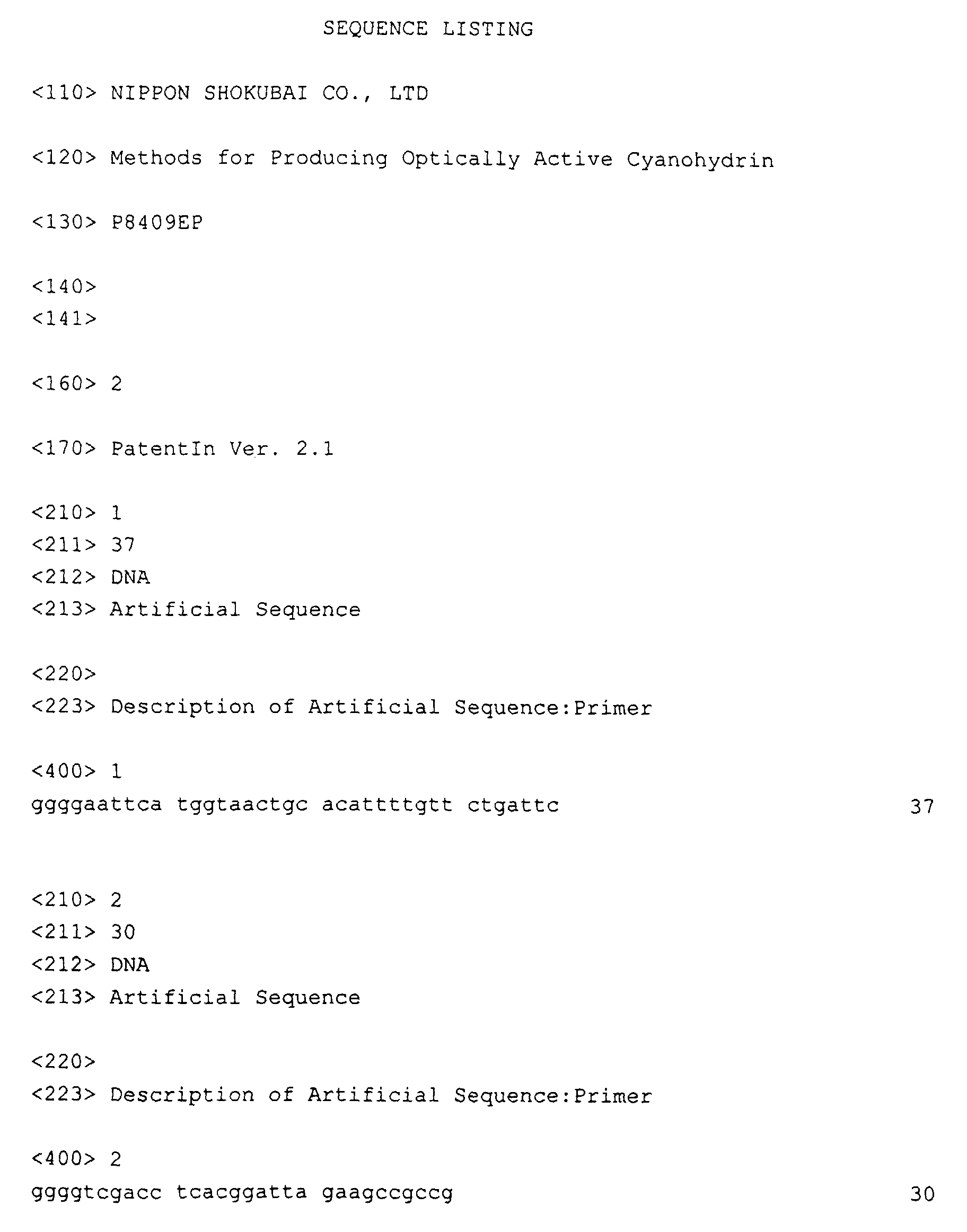
- the following PCR primers were synthesized with reference to the sequence information of cassava-derived S-hydroxynitrile lyase gene available from a publication ( Arch. Biochem. Biophys . 311 , 496-502, 1994).
- PCR was conducted for a total of 35 cycles of: 95°C for 0.5 min.; 55°C for 0.5 min.; 72°C for 1 min.
- a gene corresponding to the gene coding for S-hydroxynitrile lyase was obtained.
- the obtained gene was analyzed for its sequence and was found to be consistent with the sequence described in the publication.
- YEp352-GAP vector was obtained by introducing a GAP promoter and a terminator into YEp352 plasmid vector which is an E.coli /yeast shuttle vector containing an ampicillin-resistant gene, a sequence from yeast 2 ⁇ plasmid and a sequence of URA3 (a selective marker gene for the recombinant yeast).
- the cDNA of S-hydroxynitrile lyase obtained in (1) above was inserted between the GAP promoter and the terminator of the YEp352-GAP vector, thereby preparing yeast episomal expression vector YEp352-GC.
- YEp352-GC Using the expression vector YEp352-GC, host yeast cell, Saccharomyces cerevisiae Inv-Sc1 strain was transformed. Recombinant clones were selected in a uracil-free minimum selective medium having the following composition.
- the recombinant yeast strain (YEp352-GC-S2 strain) obtained as described above was cultured for 24 hours in a YNBDCas liquid medium having the following composition.
- Yeast nitrogen base without amino acids (Difco) 6.7 g/L Glucose 20 g/L Casamino acid 20 g/L L-tryptophan 40 mg/ml
- the culture was centrifuged to collect the cells.
- the obtained wet cells were mixed with acetone, agitated and filtrated to obtain acetone-dried cells.
- the enzymatic activities of the wet and dry cells were determined as follows.
- the cells were added with 0.1 ml of glass beads (0.5 mm diameter) and frozen with liquid nitrogen. Then, 0.2 ml of 0.15 M sodium citrate buffer (pH 5) was added to the mixture, and the cells were disrupted by agitation. The solution containing the disrupted cells was subjected to centrifugation to obtain the supernatant for the determination of the enzymatic activities. The activities were determined, using DL-mandelonitrile as a substrate, as the change of absorption at a wavelength of 249.6 nm upon benzaldehyde production resulting from degradation of the substrate with the enzyme. The activity of degrading 1 ⁇ mol of the substrate per minute was assumed 1 unit.
- the enzymatic activity of the wet cells of the recombinant strain (YEp352-GC-S2 strain) of the invention was 200 unit/g (wet weight), while the enzymatic activity of the dry cells was 1,000 unit/g.
- Example 2 The dry cells used in Example 2 were separated from the reaction solution and washed with diisopropylether. To 2.5 ml of diisopropylether. 120 mg of the washed cells, 0.5 mmol of benzaldehyde and 56.6 ⁇ l of hydrocyanic acid were added, and the resultant mixture was subjected to synthesis reaction at room temperature (20-25°C) under agitation. After 24 hours, the reaction solution was analyzed by liquid chromatography as described above. It was found that S-mandelonitrile with an optical purity of 93.6%ee was produced at a conversion rate of 71%. The reaction was repeated under the same conditions by recycling only the cells. The enzymatic activity of the cells did not decrease after a total of 5 times of reactions.
- an immobilized enzyme prepared by mixing 75 ⁇ l of enzymatic solution (491.3 unit/ml) of partially purified enzyme produced from enzyme gene recombinant E.coli , with 75 mg of avicel cellulose], 0.5 mmol of 3-phenoxybenzaldehyde and 55.6 mg of hydrocyanic acid were added, and the mixture was subjected to synthesis reaction at room temperature (20-25°C) under agitation. After 24 hours, the reaction solution was analyzed by liquid chromatography as described above, and it was found that S-3-phenoxybenzaldehyde cyanohydrin with an optical purity of 92%ee was produced at a conversion rate of 62%. The reaction was repeated under the same conditions by recycling the immobilized enzyme. As a result, the conversion rate and the optical purity decreased to 24% and 22%ee, respectively upon the second analysis, and no enzymatic activity was detected upon the third analysis.
- the wet cells of the recombinant yeast strain (YEp352-GC-S2 strain) collected in Example 1 were subjected to lyophilization to obtain lyophilized cells.
- To 2.5 ml of diisopropylether 120 mg of the lyophilized cells, 0.5 mmol of benzaldehyde and 56.6 ⁇ l of hydrocyanic acid were added, and the resultant mixture was subjected to synthesis reaction at room temperature (20-25°C) under agitation. After 45 hours, the reaction solution was analyzed by liquid chromatography as described above. As a result, it was found that S-mandelonitrile with an optical purity of 65.1%ee was produced at a conversion rate of 65%.
- optically active cyanohydrin can easily and efficiently be synthesized by using a hydroxynitrile lyase gene recombinant cell itself without the need of extracting hydroxynitrile lyase therefrom.
Landscapes
- Organic Chemistry (AREA)
- Chemical & Material Sciences (AREA)
- Engineering & Computer Science (AREA)
- Zoology (AREA)
- Life Sciences & Earth Sciences (AREA)
- Wood Science & Technology (AREA)
- Chemical Kinetics & Catalysis (AREA)
- Microbiology (AREA)
- General Chemical & Material Sciences (AREA)
- Biotechnology (AREA)
- Health & Medical Sciences (AREA)
- Biochemistry (AREA)
- Bioinformatics & Cheminformatics (AREA)
- General Engineering & Computer Science (AREA)
- General Health & Medical Sciences (AREA)
- Genetics & Genomics (AREA)
- Preparation Of Compounds By Using Micro-Organisms (AREA)
- Enzymes And Modification Thereof (AREA)
Abstract
Description
- The present invention relates to a method for the production of optically active cyanohydrins.
- Optically active cyanohydrins are useful as optically active intermediates for producing insecticides such as pyrethroids or as an intermediates for synthesizing drugs. Various methods for synthesizing optically active cyanohydrins have been proposed heretofore. However, these methods have practical problems and no method has yet been established for directly synthesizing the optically active cyanohydrins for industrial purposes.
- For example, a method for synthesizing optically active cyanohydrins as intermediates for producing pyrethroid insecticides is known. According to this method, racemic cyanohydrin ester is chemically synthesized as a starting material, and subjected to asymmetric hydrolysis using an enzyme (JP-A-61-5794, JP-A-62-65688). This method, however, is associated with problems such as multiple production steps, and the necessity of degradation, racemization and recycling of enantiomer ester that remains after the asymmetric hydrolysis reaction.
- An enzyme was recently reported which synthesized optically active cyanohydrin alone directly from aldehyde or ketone and hydrocyanic acid, and methods have been studied for synthesizing optically active cyanohydrins using this enzyme. For example, methods for synthesizing R-cyanohydrins by using R-hydroxynitrile lyase (EC4.1.2.10) derived from almond (Prunus amigdalus) or R-hydroxynitrile lyase derived from flax (Linum usitatissimum), and methods for synthesizing S-cyanohydrins by using S-hydroxynitrile lyase (EC4.1.2.11) derived from sorghum (Sorghum bicolor), S-hydroxynitrile lyase (EC4.1.2.37) derived from cassava (Manihot esculenta), or S-hydroxynitrile lyase (EC4.1.2.39) derived from tropical rubber tree (Hevea brasiliensis) are known. All of the enzymes used in the above methods are obtained by being extracted from plant tissues or by immobilizing such enzymes extracted from the plant tissues. Enzyme extraction from plant tissues, however, is not suitable for industrial purposes since extraction and purification are complicated, troublesome and associated with a great amount of enzyme loss. Moreover, for immobilizing the extracted enzyme, the cost of the carriers for immobilization cannot be neglected and thus such immobilized enzyme is also not suitable for industrial use, while use of inexpensive reaction catalyst is requisite.
- Methods for synthesizing optically active cyanohydrins by using recombinant cells transformed with enzyme genes (hereinafter, often referred to as "recombinant cells") are also known. These methods use, for example, recombinant cells transformed with S-hydroxynitrile lyase (EC4.1.2.39) gene from tropical rubber tree (Hevea brasiliensis) (WO98/30711) or recombinant cells transformed with S-hydroxynitrile lyase (EC4.1.2.37) gene from cassava (Manihot esculenta) (Angrew, Chem. Int. Ed. Engl. 35, 437-439, 1996; Biotechnol. Bioeng. 53, 332-338, 1997; JP-A-9-227488). According to these methods, the enzymes need to be extracted from the recombinant cells which is as troublesome as the above-described process of extracting the enzymes from the plant tissues.
- Thus, the present invention aims at providing a method for efficiently producing optically active cyanohydrins at low cost.
- The present inventor has undergone intensive studies to solve the above-described problems, and found, for the first time, that a recombinant cell transformed with a hydroxynitrile lyase gene can itself be use in a like manner to the enzyme isolated therefrom for synthesizing optically active cyanohydrins, and that the use of this cell improves the stability of the enzymatic activity as compared to the use of the enzyme isolated therefrom, thereby accomplishing the present invention.
- Thus, the present invention is a method for the production of optically active cyanohydrins, comprising adding recombinant microorganism cells which have been transformed by introducing an hydroxynitrile lyase enzyme gene and which retain an activity of the enzyme, to a reaction system comprising a reaction solvent containing one or more aldehydes or ketones and hydrogen cyanide or a substance capable of producing cyanide ions in the reaction system.
- This specification includes all or part of the contents as disclosed in the specification of Japanese Patent Application No. 11-25640, which is a priority document of the present application.
- Hereinafter, the present invention will be described in more detail.
- According to the present invention, aldehydes or ketones as a reactive substrate may be represented by the following formula (I).
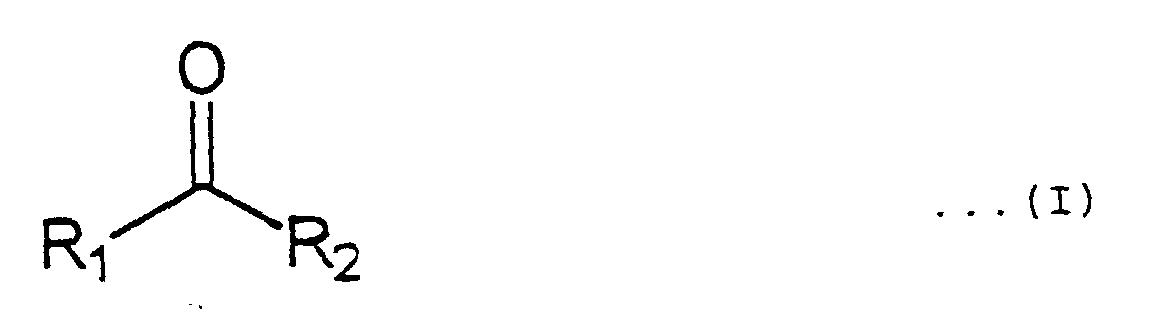
- Wherein, R1 and R2 are (i) a hydrogen atom, (ii) a substituted or unsubstituted, linear or branched, saturated C1-18 alkyl group, or (iii) a substituted or unsubstituted aromatic group having 5-22 cyclic members; where R1 and R2 do not represent hydrogen atoms at the same time.
- With respect to (ii) above, when R1 and R2 represent substituted alkyl groups, the substituent is one or more of amino group, imino group, hydroxy group, C1-8 alkoxy group, halogen, calboxyl group, C3-20 cycloalkyl group, or aromatic group having carbon number of up to 22 which may be substituted with a heteroatom, N, O or S (here, when the substituent is a cyclic substituent, the substituent itself may be substituted with one or more halogen, hydroxy group, linear or branched C1-8 alkyl group, or linear or branched C2-8 alkenyl group).
- With respect to (iii) above, the aromatic group may be a heteroaromatic group wherein up to 4 cyclic members are substituted with N, O and/or S. Where R1 and R2 represent substituted aromatic groups, the substituent may be one or more of amino group, imino group, hydroxy group, C1-8 alkoxy group, allyloxy group, halogen, calboxyl group, linear or branched, saturated or unsaturated C1-22 alkyl group (here, an aromatic group may be substituted with at least 2 substituents).
- To convert the above-described aldehydes or ketones to optically active cyanohydrins, hydrogen cyanide is used as the substrate. The hydrogen cyanide may be supplied either in the form of liquid or gas. An aqueous solution of hydrogen cyanide, i.e., hydrocyanic acid (or prussic acid), may also be equally employed. Any substance that is capable of producing cyanide ion (CN-) upon addition to a reaction system may be used. Examples of such substances include salt of hydrogen cyanide such as sodium cyanide and potassium cyanide, or cyanhydrin compounds such as acetone cyanohydrin.
- Recombinant microorganism cells which have been cultivated in suitable media and in which enzyme production has been induced are used as the catalyst of the reactions.
- Specifically, examples of genes coding for hydroxynitrile lyase include genes coding for R-hydroxynitrile lyase derived from plants belonging to Rosaceae such as almond (Prunus amigdalus) (EC4.1.2.10) and blackberry (Prunus serotina); a gene coding for R-hydroxynitrile lyase derived from flax (Linum usitatissimum) belonging to Linaceae; a gene coding for S-hydroxynitrile lyase (EC4.2.2.11) derived from sorghum (Sorghum bicolor); a gene coding for S-hydroxynitrile lyase (EC4.1.2.37) derived from cassava (Manihot esculenta); a gene coding for S-hydroxynitrile lyase (EC4.1.2.39) derived from tropical rubber tree (Hevea brasiliensis); and a gene coding for S-hydroxynitrile lyase derived from ximenia (Ximenia americana).
- The microorganisms that may be transformed by introducing the above-described enzyme genes are not specifically limited as long as they can incorporate and allow the above-mentioned enzyme genes to express and produce the enzymes. Such microorganisms are, for example, eukaryotes such as yeast and prokaryotes such as E.coli.
- The recombinant microorganism may be used as a catalyst of the reaction in the form of wet cells directly obtained from the medium, or more preferably in the form of dry cells which are subjected to drying or dehydration before use to remove the excessive amount of moisture to enhance dispersibility in the reaction system.
- The drying or dehydrating process of the cells is not specifically limited as long as the enzymatic activity of the cells is retained. Examples of such process include hot air drying, vacuum drying, lyophilization, spray drying, or drying with an organic solvent such as acetone.
- The dry cells are powdered, or granulated by mixing with a binder. Alternatively, the dry cells may be mixed with insoluble carriers, or may be immobilized according to a known method.
- Where the cells are used in a reaction solvent as a suspension, the reaction may be carried out by employing a batch or semi-batch system. On the other hand, a continuous system is advantageous where the cells used are filled in a filling tank that allows a liquid to flow therethrough.
- When a large amount of water is present in the reaction system, the optically active cyanohydrins resulting from the enzyme reactions are likely to be racemizated, or use of aldehydes or ketones having low solubility to water as the raw material will decrease the production efficiency. Accordingly, it is preferable that the reaction solvent mainly consists of an organic solvent that has poor water solubility or are water-immiscible. Such organic solvent is not specifically limited as long as it does not influence the enzymatic reaction for synthesizing optically active cyanohydrins, and may suitably be selected depending upon physical properties of the substrates (i.e., aldehydes or ketones) used for the synthesis reaction and upon the physical properties of the cyanohydrins to be produced. Specifically, examples of such organic solvent include linear or branched or cyclic, saturated or unsaturated, aliphatic or aromatic hydrocarbon solvent which may optionally be halogenated, such as pentane, hexane, toluene, xylene, methylene chloride and the like; linear or branched or cyclic, saturated or unsaturated, aliphatic or aromatic alcohol solvent which may optionally be halogenated, such as isopropyl alcohol, n-butanol, isobutanol, t-butanol, hexanol, cyclohexanol, n-amyl alcohol and the like; linear or branched or cyclic, saturated or unsaturated, aliphatic or aromatic ether solvent which may optionally be halogenated, such as diethylether, dipropylether, diisopylether, dibutylether, methyl-t-buthylether and the like; and linear or branched or cyclic, saturated or unsaturated, aliphatic or aromatic ester solvent which may optionally be halogenated, such as methyl formate, methyl acetate, ethyl acetate, butyl acetate, methyl propionate and the like. These solvents may be used alone, or two or more of them may be used in combination. These organic solvents may be saturated with an aqueous buffer of pH 7 or less such as a citrate buffer, a phosphate buffer or an acetate buffer.
- The concentration of the aldehyde or ketone contained in the reaction solvent is preferably within the range of 0.01 mM to 5 M. Hydrogen cyanide or the substance capable of producing cyanide ion in the reaction system is used for 1-20 mol per mol of aldehyde or ketone, and the recombinant microorganism cell is used for an amount that allows an enzymatic activity of 1 unit/mmol or more to the concentration of aldehyde or ketone.
- The enzymatic activity of the cells may be calculated as follows. The cells suspended in water or buffer are disrupted, and then subjected to centrifugation to obtain the supernatant. Using the supernatant and DL-mandelonitrile as a substrate, the change of absorption at a wavelength of 249.6 nm upon benzaldehyde production resulting from degradation of the substrate with the enzyme is measured.
- pH of the reaction solvent does not need to be adjusted if the above-described organic solvent is not saturated with an aqueous buffer. If the organic solvent is saturated with an aqueous buffer, the pH of the aqueous buffer is adjusted to be within the range of 3-7, preferably within the range of 3-6.
- The reaction temperature is set as low as possible within a range that allows enzyme activity, generally 0-40°C, preferably 0-30°C, to suppress by-production of racemic cyanohydrin that is irrelevant to the enzymatic reaction.
- Once the reaction is completed, the reaction solution and the cells are separated from each other to obtain a solution containing the reaction product. Components other than the optically active cyanohydrin are removed from the solution, thereby obtaining the optically active cyanohydrin of interest. The product is separated according to a routine method such as distillation, column chromatography, extraction or the like. Upon this separation, a dehydrating agent for dehydration, a stabilizer or the like may be added.
- Hereinafter, the present invention will be described in more details by way of examples, although the invention is not to be limited by these examples.
- Total mRNA was extracted from a leaf of cassava. The obtained mRNA was used as a template for cDNA synthesis to construct a cDNA library of cassava. The following PCR primers were synthesized with reference to the sequence information of cassava-derived S-hydroxynitrile lyase gene available from a publication (Arch. Biochem. Biophys. 311, 496-502, 1994).

- Using these primers and the above-obtained cDNA as a template, PCR was conducted for a total of 35 cycles of: 95°C for 0.5 min.; 55°C for 0.5 min.; 72°C for 1 min. A gene corresponding to the gene coding for S-hydroxynitrile lyase was obtained. The obtained gene was analyzed for its sequence and was found to be consistent with the sequence described in the publication.
- YEp352-GAP vector was obtained by introducing a GAP promoter and a terminator into YEp352 plasmid vector which is an E.coli/yeast shuttle vector containing an ampicillin-resistant gene, a sequence from yeast 2µ plasmid and a sequence of URA3 (a selective marker gene for the recombinant yeast). The cDNA of S-hydroxynitrile lyase obtained in (1) above was inserted between the GAP promoter and the terminator of the YEp352-GAP vector, thereby preparing yeast episomal expression vector YEp352-GC.
- Using the expression vector YEp352-GC, host yeast cell, Saccharomyces cerevisiae Inv-Sc1 strain was transformed. Recombinant clones were selected in a uracil-free minimum selective medium having the following composition.
Yeast nitrogen base without amino acids (Difco) 6.7 g/L Glucose 20 g/L Adenine 40 mg/ml L-arginine 20 mg/ml L-aspartic acid 100 mg/ml L-glutamic acid 100 mg/ml L-histidine 20 mg/ml L-isoleucine 30 mg/ml L-lysine 30 mg/ml L-methionine 20 mg/ml L-phenylalanine 50 mg/ml L-serine 375 mg/ml L-threonine 200 mg/ml L-tryptophan 40 mg/ml L-tyrosine 30 mg/ml L-valine 150 mg/ml L-leucine 60 mg/ml - The recombinant yeast strain (YEp352-GC-S2 strain) obtained as described above was cultured for 24 hours in a YNBDCas liquid medium having the following composition.
Yeast nitrogen base without amino acids (Difco) 6.7 g/L Glucose 20 g/L Casamino acid 20 g/L L-tryptophan 40 mg/ml - The enzymatic activities of the wet and dry cells were determined as follows.
- The cells were added with 0.1 ml of glass beads (0.5 mm diameter) and frozen with liquid nitrogen. Then, 0.2 ml of 0.15 M sodium citrate buffer (pH 5) was added to the mixture, and the cells were disrupted by agitation. The solution containing the disrupted cells was subjected to centrifugation to obtain the supernatant for the determination of the enzymatic activities. The activities were determined, using DL-mandelonitrile as a substrate, as the change of absorption at a wavelength of 249.6 nm upon benzaldehyde production resulting from degradation of the substrate with the enzyme. The activity of degrading 1 µmol of the substrate per minute was assumed 1 unit.
- According to the above-described determination, the enzymatic activity of the wet cells of the recombinant strain (YEp352-GC-S2 strain) of the invention was 200 unit/g (wet weight), while the enzymatic activity of the dry cells was 1,000 unit/g.
- To 2.5 ml of diisopropylether, 120 mg of the acetone-dried cells prepared in Example 1, 0.5 mmol of benzaldehyde and 56.6 µl of hydrocyanic acid were added to allow synthesis reaction at room temperature (20-25°C) under agitation. After 24 hours, the reaction solution was analyzed by liquid chromatography under the following conditions:
- Column: Chiralcel-OJ (Daicel Chemical Industries, Ltd.)
- Column temperature: 25°C
- Eluent: n-hexane:isopropyl alcohol = 80:20
- Flow rate: 0.7 ml/min
- Detection:
- (i) UV detector, wavelength 254 nm
- (ii) polarimeter As a result, S-mandelonitrile with an optical purity of 94.1%ee was produced at a conversion rate of 89.7%.
-
- The dry cells used in Example 2 were separated from the reaction solution and washed with diisopropylether. To 2.5 ml of diisopropylether. 120 mg of the washed cells, 0.5 mmol of benzaldehyde and 56.6 µl of hydrocyanic acid were added, and the resultant mixture was subjected to synthesis reaction at room temperature (20-25°C) under agitation. After 24 hours, the reaction solution was analyzed by liquid chromatography as described above. It was found that S-mandelonitrile with an optical purity of 93.6%ee was produced at a conversion rate of 71%. The reaction was repeated under the same conditions by recycling only the cells. The enzymatic activity of the cells did not decrease after a total of 5 times of reactions.
- To 2.5 ml of diisopropylether, an immobilized enzyme (prepared by mixing 75 µl of enzymatic solution (491.3 unit/ml) of partially purified enzyme produced from enzyme gene recombinant E.coli, with 75 mg of avicel cellulose], 0.5 mmol of 3-phenoxybenzaldehyde and 55.6 mg of hydrocyanic acid were added, and the mixture was subjected to synthesis reaction at room temperature (20-25°C) under agitation. After 24 hours, the reaction solution was analyzed by liquid chromatography as described above, and it was found that S-3-phenoxybenzaldehyde cyanohydrin with an optical purity of 92%ee was produced at a conversion rate of 62%. The reaction was repeated under the same conditions by recycling the immobilized enzyme. As a result, the conversion rate and the optical purity decreased to 24% and 22%ee, respectively upon the second analysis, and no enzymatic activity was detected upon the third analysis.
- The wet cells of the recombinant yeast strain (YEp352-GC-S2 strain) collected in Example 1 were subjected to lyophilization to obtain lyophilized cells. To 2.5 ml of diisopropylether, 120 mg of the lyophilized cells, 0.5 mmol of benzaldehyde and 56.6 µl of hydrocyanic acid were added, and the resultant mixture was subjected to synthesis reaction at room temperature (20-25°C) under agitation. After 45 hours, the reaction solution was analyzed by liquid chromatography as described above. As a result, it was found that S-mandelonitrile with an optical purity of 65.1%ee was produced at a conversion rate of 65%.
- To 2.5 ml of diisopropylether which had been saturated with 0.15 M sodium citrate buffer (pH 4), 120 mg of the acetone-dried cells prepared in Example 1, 1 mmol of 3-phenoxybenzaldehyde and 300 µl of hydrocyanic acid were added, and the resultant mixture was subjected to synthesis reaction at room temperature (20-25°C) under agitation. After 60 hours, the reaction solution was analyzed by liquid chromatography as described above. As a result, it was found that S-3-phenolxybenzaldehyde cyanohydrin with an optical purity of 58.6%ee was produced at a convertion rate of 96.9%.
- According to the present invention, optically active cyanohydrin can easily and efficiently be synthesized by using a hydroxynitrile lyase gene recombinant cell itself without the need of extracting hydroxynitrile lyase therefrom.
- All publications, including patent and patent applications cited herein are incorporated herein by reference in their entirety.
Claims (3)
- A method for producing optically active cyanohydrins, comprising adding recombinant microorganism cells which have been transformed by introducing a hydroxynitrile lyase enzyme gene and which retain an activity of the enzyme, to a reaction system comprising a solvent containing aldehydes or ketones, and hydrogen cyanide or a substance capable of producing cyanide ions in the reaction system.
- A method for producing optically active cyanohydrins according to claim 1, wherein the recombinant microorganism cells are obtained by drying or dehydrating cultured cells.
- A method for producing optically active cyanohydrins according to claim 1, wherein the reaction solvent is an organic solvent which is poorly-soluble in or immiscible with water.
Applications Claiming Priority (2)
| Application Number | Priority Date | Filing Date | Title |
|---|---|---|---|
| JP2564099 | 1999-02-03 | ||
| JP11025640A JP2000217590A (en) | 1999-02-03 | 1999-02-03 | Method for producing optically active cyanohydrin |
Publications (4)
| Publication Number | Publication Date |
|---|---|
| EP1026256A2 true EP1026256A2 (en) | 2000-08-09 |
| EP1026256A3 EP1026256A3 (en) | 2000-09-13 |
| EP1026256A9 EP1026256A9 (en) | 2001-05-02 |
| EP1026256B1 EP1026256B1 (en) | 2004-08-11 |
Family
ID=12171451
Family Applications (1)
| Application Number | Title | Priority Date | Filing Date |
|---|---|---|---|
| EP20000300853 Expired - Lifetime EP1026256B1 (en) | 1999-02-03 | 2000-02-03 | Method for the production of optically active cyanohydrins |
Country Status (3)
| Country | Link |
|---|---|
| EP (1) | EP1026256B1 (en) |
| JP (1) | JP2000217590A (en) |
| DE (1) | DE60012802T2 (en) |
Cited By (4)
| Publication number | Priority date | Publication date | Assignee | Title |
|---|---|---|---|---|
| DE10255597B4 (en) * | 2002-11-28 | 2006-08-10 | Biospring Gmbh | Recombinant expression of (S) -hydroxynitrile lyase from manioc esculenta in microorganisms |
| DE102006058373A1 (en) * | 2006-12-08 | 2008-06-12 | Evocatal Gmbh | (R) -hydroxynitrile-lyase from Brassicaceae |
| US9206475B2 (en) | 2000-06-06 | 2015-12-08 | Applied Biosystems, Llc | Methods for multiplexing amplification reactions |
| CN113832175A (en) * | 2021-09-13 | 2021-12-24 | 翌圣生物科技(上海)股份有限公司 | Purification-free active protein expression drying method and large-scale protein mutant library screening method |
Families Citing this family (3)
| Publication number | Priority date | Publication date | Assignee | Title |
|---|---|---|---|---|
| US20090239273A1 (en) | 2006-09-29 | 2009-09-24 | Hisashi Semba | Novel high-activity modified s-hydroxynitrile lyase |
| JP2015181397A (en) * | 2014-03-24 | 2015-10-22 | 三井化学株式会社 | Method of producing powdered catalyst |
| JP6893361B2 (en) | 2016-03-01 | 2021-06-23 | 公立大学法人 富山県立大学 | Hydroxynitrile lyase |
-
1999
- 1999-02-03 JP JP11025640A patent/JP2000217590A/en active Pending
-
2000
- 2000-02-03 EP EP20000300853 patent/EP1026256B1/en not_active Expired - Lifetime
- 2000-02-03 DE DE2000612802 patent/DE60012802T2/en not_active Expired - Fee Related
Non-Patent Citations (4)
| Title |
|---|
| HASSLACHER, M. ET AL.: "High-Level Intracellular Expression of Hydroxynitrile Lyase from the Tropical Rubber Tree Hevea brasiliensis in Microbial Hosts." PROTEIN EXPRESSION PURIF., vol. 11, no. 1, 1997, pages 61-71, XP000915456 * |
| JOHNSON, D.V. ET AL.: "The Chemoenzymatic Synthesis of (S)-13-Hydroxyoctadeca-(9Z, 11E)-dienoic Acid using the Hydroxynitrile Lyase from Hevea brasiliensis." TETRAHEDRON, vol. 53, no. 2, 1997, pages 617-624, XP004105164 * |
| P\CHLAUER, P.: "Syntheses of Homochiral Cyanohydrins in An Industrial Environment: Hxdroxy Nitrile Lyases Offer New Options." CHIMICA OGGI, vol. 16, no. 5, 1998, pages 15-19, XP000915454 * |
| TRUMMLER, K. ET AL.: "Expression of the Zn2+ -containing hydroxynitrile lyase from flax (Linum usitatissimum) in Pichia pastoris - utilization of the recombinant enzyme for enzymatic analysis and site-directed mutagenesis." PLANT SCIENCE, vol. 139, 1998, pages 19-27, XP000915455 * |
Cited By (5)
| Publication number | Priority date | Publication date | Assignee | Title |
|---|---|---|---|---|
| US9206475B2 (en) | 2000-06-06 | 2015-12-08 | Applied Biosystems, Llc | Methods for multiplexing amplification reactions |
| DE10255597B4 (en) * | 2002-11-28 | 2006-08-10 | Biospring Gmbh | Recombinant expression of (S) -hydroxynitrile lyase from manioc esculenta in microorganisms |
| DE102006058373A1 (en) * | 2006-12-08 | 2008-06-12 | Evocatal Gmbh | (R) -hydroxynitrile-lyase from Brassicaceae |
| US8940516B2 (en) | 2006-12-08 | 2015-01-27 | Evocatal Gmbh | Method for the synthesis of chiral cyanohydrins via a hydroxynitrile lyase from brassicaceae |
| CN113832175A (en) * | 2021-09-13 | 2021-12-24 | 翌圣生物科技(上海)股份有限公司 | Purification-free active protein expression drying method and large-scale protein mutant library screening method |
Also Published As
| Publication number | Publication date |
|---|---|
| DE60012802D1 (en) | 2004-09-16 |
| JP2000217590A (en) | 2000-08-08 |
| DE60012802T2 (en) | 2005-09-01 |
| EP1026256A9 (en) | 2001-05-02 |
| EP1026256A3 (en) | 2000-09-13 |
| EP1026256B1 (en) | 2004-08-11 |
Similar Documents
| Publication | Publication Date | Title |
|---|---|---|
| JP2812933B2 (en) | Process for producing (S) -cyanohydrin | |
| CA1335269C (en) | Enzymatic process for the preparation of optically active cyanohydrins | |
| CN109609582B (en) | Method for preparing L-glufosinate-ammonium by microbial catalysis racemization removal | |
| JP3253150B2 (en) | Method for producing optically active cyanohydrins | |
| EP1026256B1 (en) | Method for the production of optically active cyanohydrins | |
| JP3174171B2 (en) | Enantioselective enzymatic production of optically active cyanohydrins | |
| Loos et al. | Synthesis of Optically Active Cyanohydrins Using R-Oxynitrilase in a Liquid-Liquid Biphasic System: Part 1: An Industrially useful Procedure | |
| CA2257562C (en) | Enzymatic process for the preparation of (s)-cyanohydrins | |
| US6337196B1 (en) | Enzymatic processes for preparing (S)-cyanohydrins | |
| US20070020741A1 (en) | Process for preparing enantiomer-enriched alpha-hydroxycarboxylic acids and amides | |
| CA2124783A1 (en) | Enzymic process for preparing aliphatic s-cyanohydrins | |
| US6897058B2 (en) | Method for the preparation of enantiomerically enriched amines | |
| US6717006B1 (en) | Method for the production of optically active cyanohydrins using r-oxynitrilase | |
| US20080311636A1 (en) | Method for Producing Optically Active Alpha-Hydroxycarboxylic Acid | |
| EP1116789A1 (en) | A method for synthesizing an optically active cyanohydrin | |
| EP1311700B1 (en) | Production process of l-phenylalanine derivatives by microorganisms | |
| CN106636292B (en) | Preparation method of (1R,4S) - (-) -2-azabicyclo [2.2.1] hept-5-ene-3-ketone | |
| EP4001422A1 (en) | Preparation of optically active cyanohydrins from aldehydes and ketones using a biphasic hydroxynitrile lyase-catalyzed hydrocyanation process | |
| EP1944366A1 (en) | Novel acid-resistant mutant s-hydroxynitrile lyase | |
| JP2007117034A (en) | Method for producing optically active nipecotic acid compound | |
| US20090239273A1 (en) | Novel high-activity modified s-hydroxynitrile lyase | |
| US20040106117A1 (en) | Production process of l-phenylanine derivatives by microorganisms | |
| JP2003000294A (en) | Method for producing l-phenylalanine derivative by microorganism | |
| JP2004267059A (en) | Method for producing optically active 2-hydroxy-2-trifluoroacetic acids |
Legal Events
| Date | Code | Title | Description |
|---|---|---|---|
| PUAI | Public reference made under article 153(3) epc to a published international application that has entered the european phase |
Free format text: ORIGINAL CODE: 0009012 |
|
| PUAL | Search report despatched |
Free format text: ORIGINAL CODE: 0009013 |
|
| AK | Designated contracting states |
Kind code of ref document: A2 Designated state(s): AT BE CH CY DE DK ES FI FR GB GR IE IT LI LU MC NL PT SE |
|
| AX | Request for extension of the european patent |
Free format text: AL;LT;LV;MK;RO;SI |
|
| RIC1 | Information provided on ipc code assigned before grant |
Free format text: 7C 12P 13/00 A, 7C 12P 41/00 B, 7C 12N 9/88 - |
|
| AK | Designated contracting states |
Kind code of ref document: A3 Designated state(s): AT BE CH CY DE DK ES FI FR GB GR IE IT LI LU MC NL PT SE |
|
| AX | Request for extension of the european patent |
Free format text: AL;LT;LV;MK;RO;SI |
|
| 17P | Request for examination filed |
Effective date: 20010221 |
|
| RIN1 | Information on inventor provided before grant (corrected) |
Inventor name: SEMBA, HISASHI |
|
| AKX | Designation fees paid |
Free format text: DE FR GB |
|
| 17Q | First examination report despatched |
Effective date: 20030825 |
|
| GRAP | Despatch of communication of intention to grant a patent |
Free format text: ORIGINAL CODE: EPIDOSNIGR1 |
|
| GRAS | Grant fee paid |
Free format text: ORIGINAL CODE: EPIDOSNIGR3 |
|
| GRAA | (expected) grant |
Free format text: ORIGINAL CODE: 0009210 |
|
| AK | Designated contracting states |
Kind code of ref document: B1 Designated state(s): DE FR GB |
|
| REG | Reference to a national code |
Ref country code: GB Ref legal event code: FG4D |
|
| REF | Corresponds to: |
Ref document number: 60012802 Country of ref document: DE Date of ref document: 20040916 Kind code of ref document: P |
|
| ET | Fr: translation filed | ||
| PLBE | No opposition filed within time limit |
Free format text: ORIGINAL CODE: 0009261 |
|
| STAA | Information on the status of an ep patent application or granted ep patent |
Free format text: STATUS: NO OPPOSITION FILED WITHIN TIME LIMIT |
|
| 26N | No opposition filed |
Effective date: 20050512 |
|
| PGFP | Annual fee paid to national office [announced via postgrant information from national office to epo] |
Ref country code: GB Payment date: 20070131 Year of fee payment: 8 |
|
| PGFP | Annual fee paid to national office [announced via postgrant information from national office to epo] |
Ref country code: DE Payment date: 20070201 Year of fee payment: 8 |
|
| PGFP | Annual fee paid to national office [announced via postgrant information from national office to epo] |
Ref country code: FR Payment date: 20070208 Year of fee payment: 8 |
|
| GBPC | Gb: european patent ceased through non-payment of renewal fee |
Effective date: 20080203 |
|
| REG | Reference to a national code |
Ref country code: FR Ref legal event code: ST Effective date: 20081031 |
|
| PG25 | Lapsed in a contracting state [announced via postgrant information from national office to epo] |
Ref country code: DE Free format text: LAPSE BECAUSE OF NON-PAYMENT OF DUE FEES Effective date: 20080902 |
|
| PG25 | Lapsed in a contracting state [announced via postgrant information from national office to epo] |
Ref country code: FR Free format text: LAPSE BECAUSE OF NON-PAYMENT OF DUE FEES Effective date: 20080229 |
|
| PG25 | Lapsed in a contracting state [announced via postgrant information from national office to epo] |
Ref country code: GB Free format text: LAPSE BECAUSE OF NON-PAYMENT OF DUE FEES Effective date: 20080203 |