EP1026146A2 - A method for producing purified phenylenedioxydiacetic acids - Google Patents
A method for producing purified phenylenedioxydiacetic acids Download PDFInfo
- Publication number
- EP1026146A2 EP1026146A2 EP00300822A EP00300822A EP1026146A2 EP 1026146 A2 EP1026146 A2 EP 1026146A2 EP 00300822 A EP00300822 A EP 00300822A EP 00300822 A EP00300822 A EP 00300822A EP 1026146 A2 EP1026146 A2 EP 1026146A2
- Authority
- EP
- European Patent Office
- Prior art keywords
- aqueous solution
- phenylenedioxydiacetic acids
- alkaline aqueous
- phenylenedioxydiacetic
- acids
- Prior art date
- Legal status (The legal status is an assumption and is not a legal conclusion. Google has not performed a legal analysis and makes no representation as to the accuracy of the status listed.)
- Granted
Links
Classifications
-
- C—CHEMISTRY; METALLURGY
- C07—ORGANIC CHEMISTRY
- C07C—ACYCLIC OR CARBOCYCLIC COMPOUNDS
- C07C51/00—Preparation of carboxylic acids or their salts, halides or anhydrides
- C07C51/347—Preparation of carboxylic acids or their salts, halides or anhydrides by reactions not involving formation of carboxyl groups
- C07C51/367—Preparation of carboxylic acids or their salts, halides or anhydrides by reactions not involving formation of carboxyl groups by introduction of functional groups containing oxygen only in singly bound form
-
- C—CHEMISTRY; METALLURGY
- C07—ORGANIC CHEMISTRY
- C07C—ACYCLIC OR CARBOCYCLIC COMPOUNDS
- C07C51/00—Preparation of carboxylic acids or their salts, halides or anhydrides
- C07C51/42—Separation; Purification; Stabilisation; Use of additives
- C07C51/43—Separation; Purification; Stabilisation; Use of additives by change of the physical state, e.g. crystallisation
Definitions
- the present invention relates to a method for producing purified phenylenedioxydiacetic acids.
- Phenylenedioxydiacetic acids represented by the following general formula (I): wherein, R represents a halogen, carboxyl group or hydrocarbon group having 1 to 4 carbon atoms, and n represents an integer from 0 to 3, are used as raw materials of polyesters, polyamides and the like and industrially useful compounds.
- phenylenedioxydiacetic acids For producing purified phenylenedioxydiacetic acids, a method is known in which phenylenedioxydiacetic acids is precipitated from an alkaline aqueous solution of crude phenylenedioxydiacetic acids, which mainly contain phenylenedioxydiacetic acids, by the action of an acid.
- a mineral acid is used and the precipitation is conducted at a temperature of 80°C or higher, followed by keeping the temperature of the system at 80°C or higher (JP-A-4-173764).
- the present inventors have intensively studied the method for the precipitation of phenylenedioxydiacetic acids from an alkaline aqueous solution of crude phenylenedioxydiacetic acids by the action of an acid to obtain highly purified phenylenedioxydiacetic acids at high yield.
- the present inventors have found that highly purified phenylenedioxydiacetic acids can be obtained at high yield by conducting the precipitation of phenylenedioxydiacetic acids from an alkaline aqueous solution of crude phenylenedioxydiacetic acids by mixing the solution with an acid at 0 to 50°C, followed by raising and keeping the temperature of the mixture at 80 to 110°C.
- the present inventor further found that at least 10% by weight or more of the phenylenedioxydiacetic acids needs to be precipitated at 0 to 50°C in order to obtain intended highly purified products. The present invention was thus completed.
- the present invention provides a method for producing purified phenylenedioxydiacetic acids in which an alkaline aqueous solution of crude phenylenedioxydiacetic acids which mainly contains phenylenedioxydiacetic acids represented by the following general formula (I): wherein, R represents a halogen, carboxyl group or hydrocarbon group having 1 - 4 carbon atoms, and n represents an integer from 0 to 3, is mixed with a mineral acid to precipitate the phenylenedioxydiacetic acids, wherein at least 10% by weight of the alkaline aqueous solution is mixed with a mineral acid at 0 to 50°C; and, after completion of the mixing, the temperature of the mixture is kept at 80 to 110 °C.
- R represents a halogen, carboxyl group or hydrocarbon group having 1 - 4 carbon atoms
- n represents an integer from 0 to 3
- the phenylenedioxydiacetic acids in the present invention is represented by the above-described general formula (I).
- substituent R in the formula (I) examples include halogen atoms such as fluorine, chlorine and bromine, carboxyl group or salts thereof, and hydrocarbon groups having about 1 to 4 carbon atoms such as methyl, ethyl, t-butyl groups.
- n is an integer of 0 to 3, and preferably 0.
- Crude phenylenedioxydiacetic acids which are raw materials in the present invention mainly contain the above-described phenylenedioxydiacetic acids of formula (I).
- the content of the phenylenedioxydiacetic acids of formula (I) in crude phenylenedioxydiacetic acids is preferably about 80% by weight or more, particularly preferably about 90% by weight or more in terms of solid components.
- the alkaline aqueous solution of crude phenylenedioxydiacetic acids used in the present invention is an alkaline aqueous solution dissolving phenylenedioxydiacetic acids of the formula (I) as well as impurities. It may further contain impurities as well as phenylenedioxydiacetic acids of the formula (I) which are not dissolved and are dispersed in the form of solid. That is, the alkaline aqueous solution of crude phenylenedioxydiacetic acids used in the present invention may be in the form of slurry.
- the production method thereof is not particularly restricted and the following methods (1) and (2) can be exemplified.
- the method(2) is preferable since the content of phenylenedioxydiacetic acids in crude phenylenedioxydiacetic acids is higher.
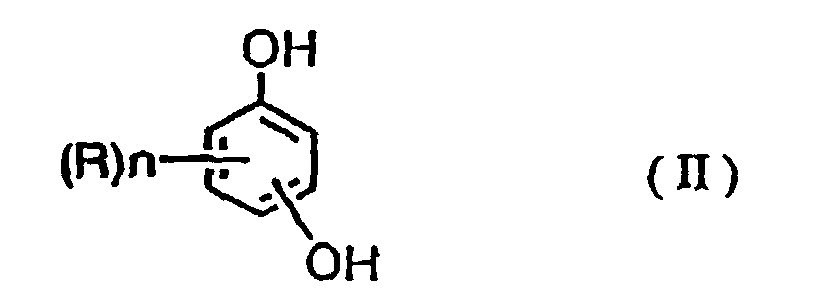
- dihydroxybenzenes of the formula (II) examples include resorcinol and hydroquinone. Among them, resorcinol is preferred.
- halogenated acetic acid examples include monochloro acetic acid and monobromo acetic acid. Among them, monochloro acetic acid is preferred.
- the amount of the halogenated acetic acid used in the method (2) is usually from about 2.0 to 4.0 mol, preferably from about 2.2 to 3.0d mol per 1 mol of the dihydroxybenzenes.
- Examples of the alkali used in the above-described method (2) include hydroxides, carbonates and the like of alkali metals such as sodium and potassium. Among them, sodium hydroxide and potassium hydroxide are preferable.
- the amount of the alkali is usually from about 1.8 to 2.5 equivalent, preferably from about 1.9 to 2.1 equivalent per 1 mol of halogenated acetic acid.
- the preferable concentration of an alkali in the aqueous solution varies depending on the kind of an alkali.
- sodium hydroxide it is preferably from about 20 to 50% by weight.
- the etherification reaction can be conducted, for example, by the following methods (1)-(3) as well as other methods.
- the etherification reaction is conducted preferably at a pH of the reaction solution of about 7.5 to 12, more preferably of about 7.5 to 8.5.
- a pH of the reaction solution of less than 7.5 is not preferable since hydroxyphenyleneoxyacetic acid tend to increase.
- a pH over 12 is not preferable since then halogenated acetic acid tends to be hydrolyzed.
- the etherification reaction is conducted at a temperature of usually from about 80 to 110°C, preferably from about 90 to 100°C.
- the etherification reaction is preferably conducted until halogenated acetic acid in the reaction mass disappears.
- the reaction time is usually from about 1 to 10 hours.
- an alkaline aqueous solution of crude phenylenedioxydiacetic acids is mixed with a mineral acid to precipitate phenylenedioxydiacetic acids, and at least 10% by weight of the alkaline aqueous solution is mixed with a mineral acid at 0 to 50°C. Thereafter, the temperature of the mixture is raised and, after completion of the mixing, the temperature is kept at 80 to 110°C.
- Examples of the method for mixing the alkaline aqueous solution of crude phenylenedioxydiacetic acids with a mineral acid to precipitate phenylenedioxydiacetic acids include the following methods (1) - (6) as well as other methods.
- any of the methods (1), (2), (4) and (5) is preferable, and particularly, the method (1) or (4) is suitable, and the method (4) is more preferable.
- Examples of the mineral acid used in the present invention include hydrochloric acid, sulfuric acid, nitric acid, phosphoric acid. Among them, sulfuric acid and hydrochloric acid are preferable, and particularly hydrochloric acid is preferable.
- a mineral acid is preferably used in the form of an aqueous solution, and the concentration thereof is usually from about 5 to 20% by weight.
- the amount of a mineral acid is usually from about 2.6 to 3.4 equivalents per 1 mol of phenylenedioxydiacetic acids of the formula (I).
- the resulting mixture is kept at 80 to 110°C, preferably at 85 to 95°C.
- the time for keeping temperature is usually from about 0.1 to 4 hours, preferably from about 0.5 to 2 hours.
- the mixture After the keeping of temperature, the mixture is cooled to about 0 to 50°C, preferably about 10 to 40°C. Then, intended purified phenylenedioxydiacetic acids can be obtained by separating the resulting crystal by a measure such as filtration and the like, and if necessary, by washing with water and drying.
- the resulting purified phenylenedioxydiacetic acids can be further purified by re-crystallization and the like, if necessary.
- II-1 represents 3-phenylenedioxydiacetic acid
- III-1 represents 1,3-hydroxyphenoxyacetic acid
- III-2 represents a mixture of 2-carboxymethyl-1,3-phenylenedioxydiacetic acid and 4-carboxymethyl-1, 3-phenylenedioxydiacetic acid.
- reaction Mass indicates the crude phenylenedioxydiacetic acids used as the raw material.
- initiation temperature in Table 1 represents the temperature of a hydrochloric acid aqueous solution at the initiation of mixing of the hydrochloric acid aqueous solution with the alkaline aqueous solution of crude phenylenedioxydiacetic acids.
- Termination temperature in Table 1 represents the temperature of the mixture when mixing of the alkaline aqueous solution of crude phenylenedioxydiacetic acids with the hydrochloric acid aqueous solution was completed.
- addition amount in Table 1 represents the weight ratio (%) of the alkaline aqueous solution mixed with the hydrochloric acid aqueous solution at 0 to 50°C to the total weight of the alkaline aqueous solution of crude phenylenedioxydiacetic acids
- time in Table 1 represents the time required for mixing of a hydrochloric acid aqueous solution with all of an alkaline aqueous solution of crude phenylenedioxydiacetic acids.
- keeping temperature in Table 1 represents the temperature of the mixture kept at the same temperature for 1 hour after mixing the hydrochloric acid aqueous solution with the alkaline aqueous solution of crude phenylenedioxydiacetic acids was completed.
Landscapes
- Chemical & Material Sciences (AREA)
- Organic Chemistry (AREA)
- Engineering & Computer Science (AREA)
- Oil, Petroleum & Natural Gas (AREA)
- Crystallography & Structural Chemistry (AREA)
- Chemical Kinetics & Catalysis (AREA)
- Organic Low-Molecular-Weight Compounds And Preparation Thereof (AREA)
Abstract

wherein at least 10% by weight of the alkaline aqueous solution is mixed with the mineral acid at 0 to 50°C, and, after completion of the mixing, the temperature of the mixture is kept at 80 to 110°C.
Description

are used as raw materials of polyesters, polyamides and the like and industrially useful compounds.

wherein at least 10% by weight of the alkaline aqueous solution is mixed with a mineral acid at 0 to 50°C; and, after completion of the mixing, the temperature of the mixture is kept at 80 to 110 °C.
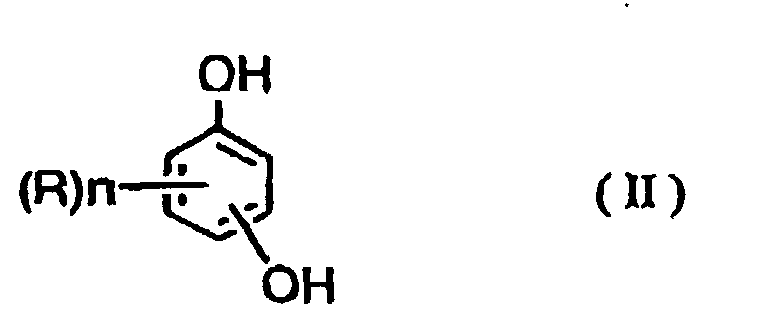
are reacted with ethylene oxide in the presence of alkali, and the resulting phenylenedioxy diethanols are oxidized in an alkaline aqueous solution to obtain an alkaline aqueous solution of crude phenylenedioxydiacetic acids (JP-B-62-28940, JP-A-3-500653 and JP-A-3-38544).
| Example | |||||||
| 1 | 2 | 3 | 4 | 5 | 6 | 7 | |
| Reaction Mass | |||||||
| II-1 | 92.09 | 93.13 | 92.27 | 92.09 | 92.94 | 93.13 | 91.87 |
| III-1 | 3.76 | 2.33 | 3.08 | 3.76 | 3.40 | 2.33 | 3.09 |
| III-2 | 4.00 | 4.55 | 4.60 | 4.00 | 3.62 | 4.55 | 5.04 |
| Initiation temperature (°C) | 14 | 20 | 11 | 29 | 9 | 45 | 20 |
| Termination temperature (°C) | 16 | 90 | 13 | 31 | 13 | 90 | 44 |
| Addition amount (%) | 100 | 43 | 100 | 100 | 100 | 11 | 100 |
| Time (min.) | 60 | 60 | 60 | 60 | 60 | 60 | 5 |
| Keeping temperature | 90 | 90 | 90 | 90 | 90 | 90 | 90 |
| Product | |||||||
| II-1 | 99.46 | 98.70 | 98.70 | 98.53 | 99.90 | 99.02 | 99.48 |
| III-1 | 0.15 | 0.06 | 0.06 | 0.23 | 0.00 | 0.33 | 0.14 |
| III-2 | 0.21 | 0.11 | 0.11 | 0.44 | 0.02 | 0.52 | 0.13 |
| Yield (%) | 90.6 | 90.1 | 90.1 | 90.6 | 90.2 | 91.8 | 88.4 |
| Comparative example | |||
| 1 | 2 | 3 | |
| Reaction Mass | |||
| II-1 | 92.09 | 92.27 | 92.62 |
| III-1 | 3.76 | 3.08 | 3.00 |
| III-2 | 4.00 | 4.60 | 4.62 |
| Initiation temperature (°C) | 88 | 8 | 60 |
| Termination temperature (°C) | 90 | 12 | 90 |
| Addition amount (%) | 0 | 100 | 0 |
| Time (min.) | 60 | 60 | 60 |
| Keeping temperature | 90 | 30 | 90 |
| Product | |||
| II-1 | 92.55 | 86.49 | 97.28 |
| III-1 | 0.73 | 1.10 | 0.39 |
| III-2 | 1.66 | 1.48 | 0.99 |
| Yield (%) | 83.1 | 89.2 | 88.2 |
Claims (6)
- A method for producing purified phenylenedioxydiacetic acids in which an alkaline aqueous solution of crude phenylenedioxydiacetic acids comprising one or more phenylenedioxydiacetic acids of formula (I):wherein R represents a halogen atom, a carboxyl group or a hydrocarbon group having 1 to 4 carbon atoms, and n represents an integer from 0 to 3, is mixed with a mineral acid to precipitate the phenylenedioxydiacetic acids, wherein at least 10% by weight of the alkaline aqueous solution is mixed with the mineral acid at 0 to 50°C, and, after completion of the mixing, the temperature of the mixture is kept at 80 to 110°C.

- A method according to claim 1 wherein the alkaline aqueous solution of crude phenylenedioxydiacetic acids is obtained by etherification of a dihydroxybenzene of formula (II):and a halogenated acetic acid in an alkaline aqueous solution.
- A method according to claim 2 wherein the dihydroxybenzene is at least one selected from resorcinol and hydroquinone.
- A method according to claim 2 or 3 wherein the halogenated acetic acid is monochloroacetic acid.
- A method according to any one of the preceding claims wherein the mineral acid is at least one selected from sulfuric acid and hydrochloric acid.
- A method according to any one of the preceding claims wherein, after completion of the mixing, the temperature of the mixture is kept at 80 to 110°C for about 0.1 to 4 hours.
Applications Claiming Priority (4)
| Application Number | Priority Date | Filing Date | Title |
|---|---|---|---|
| JP2492699 | 1999-02-02 | ||
| JP2492699 | 1999-02-02 | ||
| JP11282619A JP2000290228A (en) | 1999-02-02 | 1999-10-04 | Method for producing purified phenylenedioxydiacetic acids |
| JP28261999 | 1999-10-04 |
Publications (3)
| Publication Number | Publication Date |
|---|---|
| EP1026146A2 true EP1026146A2 (en) | 2000-08-09 |
| EP1026146A3 EP1026146A3 (en) | 2000-12-13 |
| EP1026146B1 EP1026146B1 (en) | 2003-01-02 |
Family
ID=26362511
Family Applications (1)
| Application Number | Title | Priority Date | Filing Date |
|---|---|---|---|
| EP00300822A Expired - Lifetime EP1026146B1 (en) | 1999-02-02 | 2000-02-02 | A method for producing purified phenylenedioxydiacetic acids |
Country Status (4)
| Country | Link |
|---|---|
| US (1) | US6316666B1 (en) |
| EP (1) | EP1026146B1 (en) |
| JP (1) | JP2000290228A (en) |
| ES (1) | ES2190394T3 (en) |
Cited By (1)
| Publication number | Priority date | Publication date | Assignee | Title |
|---|---|---|---|---|
| WO2007005086A1 (en) * | 2005-06-29 | 2007-01-11 | Indspec Chemical Corporation | Process for making phenylene dioxydiacetic acid and use thereof |
Families Citing this family (1)
| Publication number | Priority date | Publication date | Assignee | Title |
|---|---|---|---|---|
| JP2002308823A (en) * | 2001-04-06 | 2002-10-23 | Sumitomo Chem Co Ltd | Method for producing phenylenedioxydiacetic acids |
Family Cites Families (4)
| Publication number | Priority date | Publication date | Assignee | Title |
|---|---|---|---|---|
| DE1768900A1 (en) | 1968-07-11 | 1972-01-13 | Bayer Ag | Process for the preparation of pure dihydrazides |
| US3951599A (en) | 1972-01-07 | 1976-04-20 | Fiber Industries, Inc. | Polyamides having improved dyeability prepared from aromatic carboxylic monosulfonated compounds |
| JP2870151B2 (en) | 1990-08-02 | 1999-03-10 | 三菱化学株式会社 | Process for producing 1,3-phenylenedioxydiacetic acid |
| JP2870183B2 (en) | 1990-11-07 | 1999-03-10 | 三菱化学株式会社 | Process for producing 1,3-phenylenedioxydiacetic acid |
-
1999
- 1999-10-04 JP JP11282619A patent/JP2000290228A/en active Pending
-
2000
- 2000-02-02 US US09/495,951 patent/US6316666B1/en not_active Expired - Fee Related
- 2000-02-02 EP EP00300822A patent/EP1026146B1/en not_active Expired - Lifetime
- 2000-02-02 ES ES00300822T patent/ES2190394T3/en not_active Expired - Lifetime
Cited By (2)
| Publication number | Priority date | Publication date | Assignee | Title |
|---|---|---|---|---|
| WO2007005086A1 (en) * | 2005-06-29 | 2007-01-11 | Indspec Chemical Corporation | Process for making phenylene dioxydiacetic acid and use thereof |
| US7276571B2 (en) | 2005-06-29 | 2007-10-02 | Durairaj Raj B | Process for making phenylene dioxydiacetic acid and use thereof |
Also Published As
| Publication number | Publication date |
|---|---|
| EP1026146B1 (en) | 2003-01-02 |
| US6316666B1 (en) | 2001-11-13 |
| JP2000290228A (en) | 2000-10-17 |
| EP1026146A3 (en) | 2000-12-13 |
| ES2190394T3 (en) | 2003-08-01 |
Similar Documents
| Publication | Publication Date | Title |
|---|---|---|
| JP2718932B2 (en) | Method for producing aromatic oxycarboxylic acid | |
| EP1026146B1 (en) | A method for producing purified phenylenedioxydiacetic acids | |
| US4806683A (en) | Preparation process of cinnamic acids | |
| EP0121366B1 (en) | Process for the preparation of n-formylaspartic anhydride | |
| JP4529217B2 (en) | Method for producing purified phenylenedioxydiacetic acids | |
| JP2870183B2 (en) | Process for producing 1,3-phenylenedioxydiacetic acid | |
| EP0101625A1 (en) | Process for preparing the 2',4'-difluoro-4-hydroxy-(1,1'-diphenyl)-3-carboxylic acid | |
| JP3061859B2 (en) | Method for producing 3,3 ', 4,4'-biphenyltetracarboxylic acid | |
| JP3208458B2 (en) | Method for producing 1,4-dihydroxy-2-naphthoic acid | |
| EP0167240B1 (en) | Purification of 4-fluoro-4'-hydroxy-benzophenone | |
| JP2002308823A (en) | Method for producing phenylenedioxydiacetic acids | |
| KR880002623B1 (en) | Selective Acylation of Hydroxy-Amino-arylsulfonic Acids | |
| JP3199618B2 (en) | Method for producing 1,4-dihydroxy-2-naphthoic acid | |
| EP0853077B1 (en) | Process for producing alkyl 3-amino-4-substituted benzoates | |
| JP2943944B2 (en) | 3-Substituted-2,4,5-trifluorobenzoic acid and method for producing the same | |
| CN1067056C (en) | Method of prep. for 6-aryloxymethyl-1-hydroxy-4-methyl-2-pyridones | |
| EP0647610B1 (en) | A process for manufacturing 5-hydroxyisophthalic acid | |
| US5395943A (en) | Method for purification of 2-alkyl-4-halo-5-formylimidazoles | |
| CA2004004A1 (en) | Preparation process for aromatic hydroxycarboxylic acid | |
| JPS62132849A (en) | Production of d-or l-n-t-butoxycarbonyl-o-benzylserine | |
| JPH06107599A (en) | Production of aromatic dicarboxlic acid monoester compounds | |
| JPH10265459A (en) | 1,2,3,6tetrahydro2,2,6,6methylpyridinn-oxyl | |
| JPH04273887A (en) | Preparation of monohaloalkanoylferrocene | |
| EP0486452A2 (en) | Preparation of 2,2'-oxydisuccinate | |
| US4434104A (en) | Preparation of high purity di-lower alkyl naphthalenedisulfonates |
Legal Events
| Date | Code | Title | Description |
|---|---|---|---|
| PUAI | Public reference made under article 153(3) epc to a published international application that has entered the european phase |
Free format text: ORIGINAL CODE: 0009012 |
|
| AK | Designated contracting states |
Kind code of ref document: A2 Designated state(s): ES GB NL |
|
| AX | Request for extension of the european patent |
Free format text: AL;LT;LV;MK;RO;SI |
|
| PUAL | Search report despatched |
Free format text: ORIGINAL CODE: 0009013 |
|
| AK | Designated contracting states |
Kind code of ref document: A3 Designated state(s): AT BE CH CY DE DK ES FI FR GB GR IE IT LI LU MC NL PT SE |
|
| AX | Request for extension of the european patent |
Free format text: AL;LT;LV;MK;RO;SI |
|
| 17P | Request for examination filed |
Effective date: 20010525 |
|
| AKX | Designation fees paid |
Free format text: ES GB NL |
|
| GRAG | Despatch of communication of intention to grant |
Free format text: ORIGINAL CODE: EPIDOS AGRA |
|
| 17Q | First examination report despatched |
Effective date: 20011129 |
|
| REG | Reference to a national code |
Ref country code: DE Ref legal event code: 8566 |
|
| GRAG | Despatch of communication of intention to grant |
Free format text: ORIGINAL CODE: EPIDOS AGRA |
|
| GRAG | Despatch of communication of intention to grant |
Free format text: ORIGINAL CODE: EPIDOS AGRA |
|
| GRAH | Despatch of communication of intention to grant a patent |
Free format text: ORIGINAL CODE: EPIDOS IGRA |
|
| GRAH | Despatch of communication of intention to grant a patent |
Free format text: ORIGINAL CODE: EPIDOS IGRA |
|
| GRAA | (expected) grant |
Free format text: ORIGINAL CODE: 0009210 |
|
| AK | Designated contracting states |
Kind code of ref document: B1 Designated state(s): ES GB NL |
|
| REG | Reference to a national code |
Ref country code: GB Ref legal event code: FG4D Free format text: 20030102 |
|
| REG | Reference to a national code |
Ref country code: ES Ref legal event code: FG2A Ref document number: 2190394 Country of ref document: ES Kind code of ref document: T3 |
|
| PLBE | No opposition filed within time limit |
Free format text: ORIGINAL CODE: 0009261 |
|
| STAA | Information on the status of an ep patent application or granted ep patent |
Free format text: STATUS: NO OPPOSITION FILED WITHIN TIME LIMIT |
|
| 26N | No opposition filed |
Effective date: 20031003 |
|
| PGFP | Annual fee paid to national office [announced via postgrant information from national office to epo] |
Ref country code: GB Payment date: 20120201 Year of fee payment: 13 |
|
| PGFP | Annual fee paid to national office [announced via postgrant information from national office to epo] |
Ref country code: NL Payment date: 20120217 Year of fee payment: 13 |
|
| PGFP | Annual fee paid to national office [announced via postgrant information from national office to epo] |
Ref country code: ES Payment date: 20120307 Year of fee payment: 13 |
|
| REG | Reference to a national code |
Ref country code: NL Ref legal event code: V1 Effective date: 20130901 |
|
| GBPC | Gb: european patent ceased through non-payment of renewal fee |
Effective date: 20130202 |
|
| PG25 | Lapsed in a contracting state [announced via postgrant information from national office to epo] |
Ref country code: NL Free format text: LAPSE BECAUSE OF NON-PAYMENT OF DUE FEES Effective date: 20130901 |
|
| PG25 | Lapsed in a contracting state [announced via postgrant information from national office to epo] |
Ref country code: GB Free format text: LAPSE BECAUSE OF NON-PAYMENT OF DUE FEES Effective date: 20130202 |
|
| REG | Reference to a national code |
Ref country code: ES Ref legal event code: FD2A Effective date: 20140409 |
|
| PG25 | Lapsed in a contracting state [announced via postgrant information from national office to epo] |
Ref country code: ES Free format text: LAPSE BECAUSE OF NON-PAYMENT OF DUE FEES Effective date: 20130203 |