EP1025900A2 - Apparatus and method for pressurizing a propylene polymerization reactor - Google Patents
Apparatus and method for pressurizing a propylene polymerization reactor Download PDFInfo
- Publication number
- EP1025900A2 EP1025900A2 EP00102481A EP00102481A EP1025900A2 EP 1025900 A2 EP1025900 A2 EP 1025900A2 EP 00102481 A EP00102481 A EP 00102481A EP 00102481 A EP00102481 A EP 00102481A EP 1025900 A2 EP1025900 A2 EP 1025900A2
- Authority
- EP
- European Patent Office
- Prior art keywords
- propylene
- vessel
- temperature
- pressure
- pressurization vessel
- Prior art date
- Legal status (The legal status is an assumption and is not a legal conclusion. Google has not performed a legal analysis and makes no representation as to the accuracy of the status listed.)
- Granted
Links
Images


Classifications
-
- C—CHEMISTRY; METALLURGY
- C08—ORGANIC MACROMOLECULAR COMPOUNDS; THEIR PREPARATION OR CHEMICAL WORKING-UP; COMPOSITIONS BASED THEREON
- C08F—MACROMOLECULAR COMPOUNDS OBTAINED BY REACTIONS ONLY INVOLVING CARBON-TO-CARBON UNSATURATED BONDS
- C08F2/00—Processes of polymerisation
-
- B—PERFORMING OPERATIONS; TRANSPORTING
- B01—PHYSICAL OR CHEMICAL PROCESSES OR APPARATUS IN GENERAL
- B01J—CHEMICAL OR PHYSICAL PROCESSES, e.g. CATALYSIS OR COLLOID CHEMISTRY; THEIR RELEVANT APPARATUS
- B01J19/00—Chemical, physical or physico-chemical processes in general; Their relevant apparatus
- B01J19/18—Stationary reactors having moving elements inside
- B01J19/1812—Tubular reactors
- B01J19/1837—Loop-type reactors
-
- B—PERFORMING OPERATIONS; TRANSPORTING
- B01—PHYSICAL OR CHEMICAL PROCESSES OR APPARATUS IN GENERAL
- B01J—CHEMICAL OR PHYSICAL PROCESSES, e.g. CATALYSIS OR COLLOID CHEMISTRY; THEIR RELEVANT APPARATUS
- B01J19/00—Chemical, physical or physico-chemical processes in general; Their relevant apparatus
- B01J19/0006—Controlling or regulating processes
-
- B—PERFORMING OPERATIONS; TRANSPORTING
- B01—PHYSICAL OR CHEMICAL PROCESSES OR APPARATUS IN GENERAL
- B01J—CHEMICAL OR PHYSICAL PROCESSES, e.g. CATALYSIS OR COLLOID CHEMISTRY; THEIR RELEVANT APPARATUS
- B01J19/00—Chemical, physical or physico-chemical processes in general; Their relevant apparatus
- B01J19/0006—Controlling or regulating processes
- B01J19/0013—Controlling the temperature of the process
-
- B—PERFORMING OPERATIONS; TRANSPORTING
- B01—PHYSICAL OR CHEMICAL PROCESSES OR APPARATUS IN GENERAL
- B01J—CHEMICAL OR PHYSICAL PROCESSES, e.g. CATALYSIS OR COLLOID CHEMISTRY; THEIR RELEVANT APPARATUS
- B01J19/00—Chemical, physical or physico-chemical processes in general; Their relevant apparatus
- B01J19/18—Stationary reactors having moving elements inside
- B01J19/1812—Tubular reactors
- B01J19/1818—Tubular reactors in series
-
- B—PERFORMING OPERATIONS; TRANSPORTING
- B01—PHYSICAL OR CHEMICAL PROCESSES OR APPARATUS IN GENERAL
- B01J—CHEMICAL OR PHYSICAL PROCESSES, e.g. CATALYSIS OR COLLOID CHEMISTRY; THEIR RELEVANT APPARATUS
- B01J3/00—Processes of utilising sub-atmospheric or super-atmospheric pressure to effect chemical or physical change of matter; Apparatus therefor
- B01J3/008—Processes carried out under supercritical conditions
-
- B—PERFORMING OPERATIONS; TRANSPORTING
- B01—PHYSICAL OR CHEMICAL PROCESSES OR APPARATUS IN GENERAL
- B01J—CHEMICAL OR PHYSICAL PROCESSES, e.g. CATALYSIS OR COLLOID CHEMISTRY; THEIR RELEVANT APPARATUS
- B01J2219/00—Chemical, physical or physico-chemical processes in general; Their relevant apparatus
- B01J2219/00049—Controlling or regulating processes
- B01J2219/00051—Controlling the temperature
- B01J2219/00054—Controlling or regulating the heat exchange system
- B01J2219/00056—Controlling or regulating the heat exchange system involving measured parameters
-
- B—PERFORMING OPERATIONS; TRANSPORTING
- B01—PHYSICAL OR CHEMICAL PROCESSES OR APPARATUS IN GENERAL
- B01J—CHEMICAL OR PHYSICAL PROCESSES, e.g. CATALYSIS OR COLLOID CHEMISTRY; THEIR RELEVANT APPARATUS
- B01J2219/00—Chemical, physical or physico-chemical processes in general; Their relevant apparatus
- B01J2219/00049—Controlling or regulating processes
- B01J2219/00051—Controlling the temperature
- B01J2219/00074—Controlling the temperature by indirect heating or cooling employing heat exchange fluids
- B01J2219/00076—Controlling the temperature by indirect heating or cooling employing heat exchange fluids with heat exchange elements inside the reactor
- B01J2219/00083—Coils
-
- B—PERFORMING OPERATIONS; TRANSPORTING
- B01—PHYSICAL OR CHEMICAL PROCESSES OR APPARATUS IN GENERAL
- B01J—CHEMICAL OR PHYSICAL PROCESSES, e.g. CATALYSIS OR COLLOID CHEMISTRY; THEIR RELEVANT APPARATUS
- B01J2219/00—Chemical, physical or physico-chemical processes in general; Their relevant apparatus
- B01J2219/00049—Controlling or regulating processes
- B01J2219/00051—Controlling the temperature
- B01J2219/00074—Controlling the temperature by indirect heating or cooling employing heat exchange fluids
- B01J2219/00105—Controlling the temperature by indirect heating or cooling employing heat exchange fluids part or all of the reactants being heated or cooled outside the reactor while recycling
- B01J2219/00108—Controlling the temperature by indirect heating or cooling employing heat exchange fluids part or all of the reactants being heated or cooled outside the reactor while recycling involving reactant vapours
-
- B—PERFORMING OPERATIONS; TRANSPORTING
- B01—PHYSICAL OR CHEMICAL PROCESSES OR APPARATUS IN GENERAL
- B01J—CHEMICAL OR PHYSICAL PROCESSES, e.g. CATALYSIS OR COLLOID CHEMISTRY; THEIR RELEVANT APPARATUS
- B01J2219/00—Chemical, physical or physico-chemical processes in general; Their relevant apparatus
- B01J2219/00049—Controlling or regulating processes
- B01J2219/00162—Controlling or regulating processes controlling the pressure
-
- B—PERFORMING OPERATIONS; TRANSPORTING
- B01—PHYSICAL OR CHEMICAL PROCESSES OR APPARATUS IN GENERAL
- B01J—CHEMICAL OR PHYSICAL PROCESSES, e.g. CATALYSIS OR COLLOID CHEMISTRY; THEIR RELEVANT APPARATUS
- B01J2219/00—Chemical, physical or physico-chemical processes in general; Their relevant apparatus
- B01J2219/00049—Controlling or regulating processes
- B01J2219/00191—Control algorithm
- B01J2219/00193—Sensing a parameter
- B01J2219/00195—Sensing a parameter of the reaction system
- B01J2219/002—Sensing a parameter of the reaction system inside the reactor
-
- B—PERFORMING OPERATIONS; TRANSPORTING
- B01—PHYSICAL OR CHEMICAL PROCESSES OR APPARATUS IN GENERAL
- B01J—CHEMICAL OR PHYSICAL PROCESSES, e.g. CATALYSIS OR COLLOID CHEMISTRY; THEIR RELEVANT APPARATUS
- B01J2219/00—Chemical, physical or physico-chemical processes in general; Their relevant apparatus
- B01J2219/00049—Controlling or regulating processes
- B01J2219/00191—Control algorithm
- B01J2219/00222—Control algorithm taking actions
- B01J2219/00227—Control algorithm taking actions modifying the operating conditions
- B01J2219/00238—Control algorithm taking actions modifying the operating conditions of the heat exchange system
-
- Y—GENERAL TAGGING OF NEW TECHNOLOGICAL DEVELOPMENTS; GENERAL TAGGING OF CROSS-SECTIONAL TECHNOLOGIES SPANNING OVER SEVERAL SECTIONS OF THE IPC; TECHNICAL SUBJECTS COVERED BY FORMER USPC CROSS-REFERENCE ART COLLECTIONS [XRACs] AND DIGESTS
- Y02—TECHNOLOGIES OR APPLICATIONS FOR MITIGATION OR ADAPTATION AGAINST CLIMATE CHANGE
- Y02P—CLIMATE CHANGE MITIGATION TECHNOLOGIES IN THE PRODUCTION OR PROCESSING OF GOODS
- Y02P20/00—Technologies relating to chemical industry
- Y02P20/50—Improvements relating to the production of bulk chemicals
- Y02P20/54—Improvements relating to the production of bulk chemicals using solvents, e.g. supercritical solvents or ionic liquids
Definitions
- the present invention relates, in general, to a system, apparatus and method for polymerizing propylene including a propylene pressurization vessel operated under supercritical conditions.
- the present invention provides a method and apparatus for pressurizing a propylene polymerization system, including a pressurization vessel operated under supercritical conditions.
- the vessel contains propylene in a first region at supercritical conditions and propylene in a second region at subcritical conditions.
- pressure in the pressurization vessel is controlled by the rate of injection of superheated propylene in the supercritical region.
- the temperature of propylene in the zone containing the compressible supercritical phase may be maintained by controlling the temperature of the superheated propylene feed.
- the temperature of the superheated propylene is in the range of 200°F to 280°F, more preferably, the temperature of the superheated propylene is approximately 240°F.
- the pressure of the vessel is preferably in the range of 660 to 800 psig, more preferably in the range of 700 to 730 psig, most preferably in the range of approximately 710 psig.
- the temperature of the dense subcooled liquid propylene in the vessel is typically in the range of 80°F to 140°F, preferably 90°F to 110°F, and most preferably approximately 100°F. Operation of the pressurization vessel in this mode allows a propylene polymerization system to be pressurized and operated at levels above conventional polymerization temperatures and pressures, for example, at pressures of 660 to 700 psig.
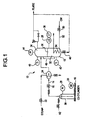
- an experimental apparatus 10 was assembled as generally as illustrated in FIGURE 1. Propylene was charged to the supply cylinder 38 which was then pressurized with nitrogen. The valve 16 between the supply cylinder 38 and the pressurization vessel 12 was opened to place an initial charge of propylene into the vessel 12 through feed line 14 and heat exchanger 24. After the initial charge of propylene had been introduced into vessel 12, the valve 16 was closed and the supply cylinder 38 was refilled with propylene. As illustrated, supply cylinder 38 is mounted on scale 18 with a weight indicator 20 for monitoring the weight of the cylinder along with a pressure monitor 28 for monitoring the pressure of the cylinder.
- the steam supply was turned on with valve 22 to supply heat and to allow the level sensor, a differential pressure ("DP") cell 26, to equilibrate.
- DP differential pressure
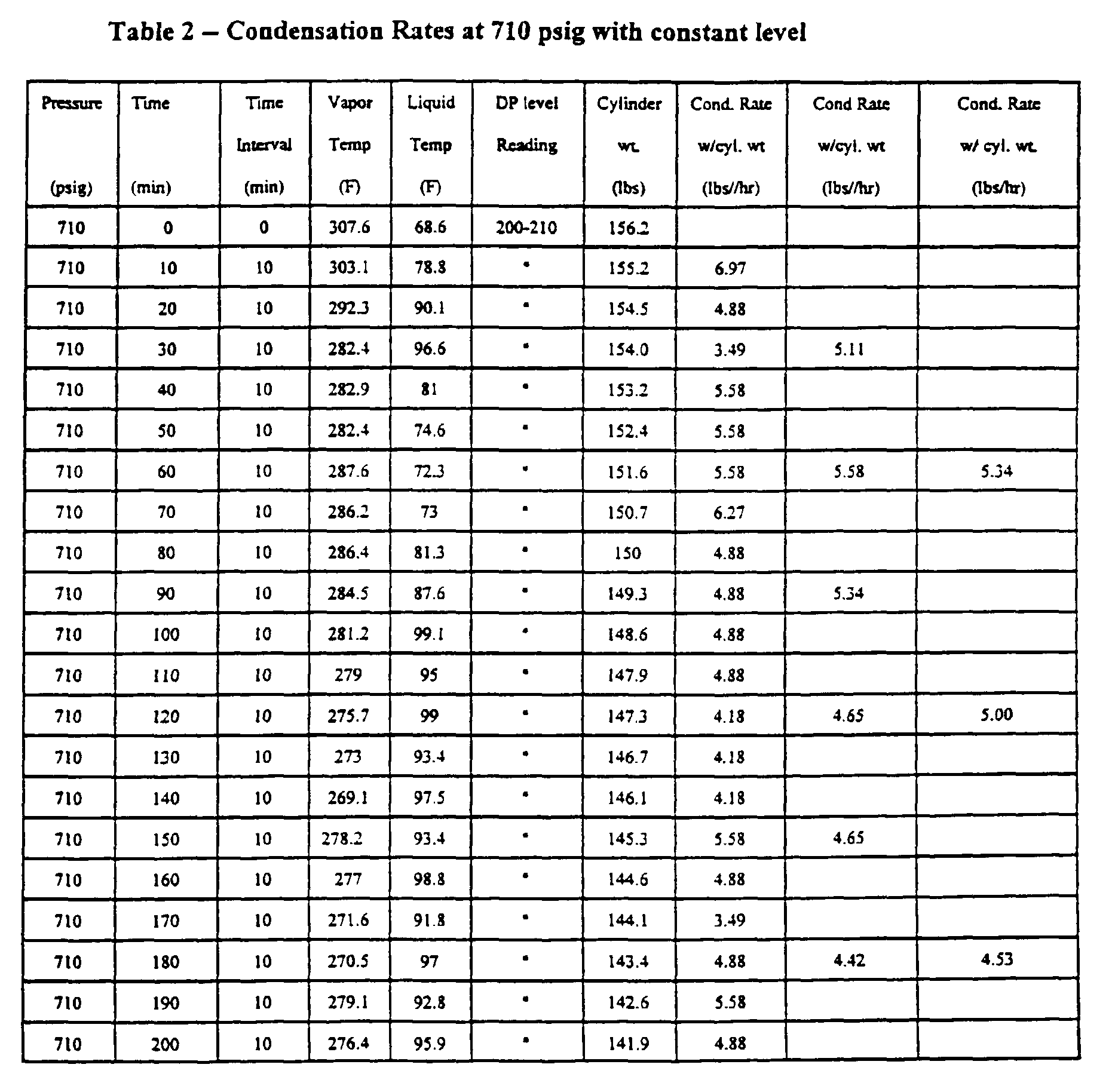
- the propylene control valve 16 was opened and the vessel 12 was brought up to operating pressure, in this case 710 psig. Readings from the DP cell 26 were transmitted to a recording device by level transmitter 36. Superheated propylene was injected into the top of the vessel 12 to keep the pressure constant while excess liquid was drained off the bottom of the tank through discharge valve 46 until the desired level in the vessel was achieved.
- the unit was operated in an increasing level mode, e.g., the level of the dense (liquid) region was allowed to increase as propylene in the compressible (vapor) region of the vessel condensed.
- the vessel was operated in a constant level mode. In the constant level mode, fluid was drained from the bottom region 32 of the vessel via discharge valve 46 in order to maintain the liquid level in the vessel within a predetermined range near the middle of the vessel.
- a propylene pressurization vessel can be designed, controlled and operated with distinct regions of the vessel containing propylene in a dense (liquid) phase and propylene in a compressible supercritical phase.
- the vessel may be pressurized with superheated propylene.
- FIGURES 2 and 3 Graphical representations of condensation rates vs. time are presented in FIGURES 2 and 3 in order to further illustrate the test results.
- pressure in the vessel may be controlled by the injection of completely vaporized, superheated propylene in the supercritical region.
- the temperature of propylene in the zone containing the compressible supercritical phase may be maintained by controlling the temperature of the superheated propylene.
- the temperature of the superheated propylene is in the range of 200°F to 280°F, more preferably, the temperature of the superheated propylene is in the range of approximately 240°F.
- the pressure of the vessel is preferably in the range of 660 to 800 psig, more preferably in the range of 700 to 730 psig, most preferably in the range of approximately 710 psig.
- the temperature of the dense subcooled liquid propylene in the vessel is typically in the range of 80°F to 140°F, preferably 90°F to 110°F, and most preferably approximately 100°F. Operation of the pressurization vessel in this mode allows a propylene polymerization system to be pressurized and operated at levels above conventional polymerization temperatures and pressures, for example at pressures of 660 to 700 psig.
- the system includes a first loop reactor 110, a second loop reactor 120 connected in series with the first loop reactor via line 160, and a propylene pressurization system generally designated 100.
- the loop reactors 110 and 120 are provided with agitators 170 to promote mixing.
- the pressurization system is, of course, applicable to single reactor systems and reactors other than loop-type reactors.
- Propylene is supplied to the system via feed line 135 which provides propylene to both loop reactors and the pressurization system 100. Propylene fed to the pressurization system passes through a heat exchanger 116. A steam supply 112 and control valve 114 are provided for heating heat exchanger 116,
- Pressurization system 100 includes a pressurization vessel 130 which is equipped with an internal cooling coil 146 positioned in the lower portion of the vessel. Cooling water is supplied to the coil via supply line 140 and the flow of cooling water is regulated by control valve 142.
- the first loop reactor 110 and second loop reactor 120 communicate with the pressurization vessel 130 via lines 132 and 134.
- Pressurization vessel 130 is equipped with an upper temperature sensor/controller 118 located in the upper portion of the vessel 130.
- the temperature sensor 118 may be located in propylene feed line 172 between the heat exchanger 116 and the pressurization vessel 130.
- the signal from the sensor 118 is transmitted to control valve 114 in steam supply line 112 to regulate the flow of steam to heat exchanger 116.
- Pressurization vessel 130 is also provided with a DP cell 150 that provides a signal to level controller 152.
- the signal from level controller 152 is transmitted to control valve 154 which regulates the discharge of propylene and polymer from the second loop reactor 120.
- control valve 154 which regulates the discharge of propylene and polymer from the second loop reactor 120.
- the control valve 154 opens to release propylene and polymer from the system.
- the level controller 152 transmits a signal to control valve 154 to close the valve.
- Pressure in the vessel 130 is regulated by the addition of superheated propylene vapor.
- the pressurization vessel 130 is equipped with a pressure controller 124 which is operatively connected to control valve 126.
- pressure controller 124 transmits a signal to control valve 126.
- Control valve 126 opens in response to the signal, supplying propylene to heat exchanger 116 wherein the propylene is superheated prior to introduction to the vessel 130.
- pressure in the vessel is preferably in the range of 660 to 800 psig, more preferably in the range of 700 to 730 psig, and most preferably in the range of approximately 710 psig.
- propylene is present in the pressurization vessel 130 in two distinct phases, a superheated compressible (vapor) phase, corresponding to upper region 131 of the vessel, and a subcooled dense (liquid) phase corresponding to region 133 in the lower portion of the vessel.
- the temperature in the upper region 131 is maintained in the range of 200°F to 280°F.
- the temperature of the superheated propylene in the upper region 131 of the vessel is in the range of approximately 240°F.
- the temperature of the dense subcooled liquid propylene in the lower region 133 of the pressurization vessel is typically in the range of 80°F to 140°F, preferably 90°F to 110°F, and most preferably approximately 100°F.
- the term "subcooled” refers to temperature below the critical temperature of propylene at the relevant pressure.
- the temperature in the lower region 133 of the pressurization vessel is maintained with internal cooling coil 146.
- the pressurization vessel 130 is equipped with a temperature sensor 144 at a location corresponding to the lower region 133 of the vessel.
- the flow of cooling water to the coil is controlled by control valve 142 which opens and closes in response to signals received from sensor 144.
- other cooling mediums such as the propylene feed to the second reactor 120, could be utilized as the cooling medium.
- An important feature of the present invention is the combined use of internal cooling of the pressurization vessel 130 and a differential pressure cell 150 in order to control the level of the dense subcooled liquid propylene in the vessel.
- propylene is present in the pressurization vessel in two phases, e.g., a compressible superheated phase and dense subcooled phase, under supercritical conditions the interface between the two phases becomes visually undetectable. Consequently, a typical level monitoring device, for example a sight glass, cannot be used to control the dense, or fluid phase, level in the pressurization vessel.
- an alternative level monitoring device e.g., a differential pressure, is needed to monitor the fluid phase level in the vessel.
- the density gradient between the superheated propylene in the upper region 131 of the vessel 130 and the dense, subcooled propylene in the lower region of the vessel must be significant enough to allow the DP cell to detect a pressure differential due to the density gradient.
- the use of an internal cooling coil 146 in vessel 130 to cool the dense liquid phase propylene in the lower region 133 of the vessel to a temperature below the critical temperature provides the required density gradient, thereby allowing the use of a DP cell as a level monitoring device.
- the vessel is operated at 710 psig.
- the temperature in a first or upper region 131 of the vessel, corresponding to the compressible, supercritical propylene, is maintained at approximately 240°F, whereas the dense, liquid phase propylene in the lower or second region 133 of the vessel 130 is cooled to approximately 100°F. though the use of internal cooling coil 146.
- the density ratio between the superheated propylene in the upper region 131 and the subcooled liquid propylene in the lower region is 4.39. This density gradient is sufficient to allow a DP cell to be used as a level indication device for vessel 130.
Landscapes
- Chemical & Material Sciences (AREA)
- Organic Chemistry (AREA)
- Chemical Kinetics & Catalysis (AREA)
- Health & Medical Sciences (AREA)
- Medicinal Chemistry (AREA)
- Polymers & Plastics (AREA)
- Physical Or Chemical Processes And Apparatus (AREA)
- Polymerisation Methods In General (AREA)
- Addition Polymer Or Copolymer, Post-Treatments, Or Chemical Modifications (AREA)
- Organic Low-Molecular-Weight Compounds And Preparation Thereof (AREA)
Abstract
Description

Claims (21)
- A propylene polymerization system;the propylene polymerization system including at least one pressurization vessel;the pressurization vessel containing propylene at a temperature and pressure above the critical temperature and pressure of propylene; and
wherein the pressurization vessel contains propylene below the critical temperature of propylene. - The system of Claim 1 wherein the pressure inside the pressurization vessel is controlled by the addition of polypropylene under supercritical conditions.
- The system of Claim 1 wherein the pressure inside the pressurization vessel is controlled by the addition of an inert gas.
- The system of Claim 1 wherein the pressurization vessel includes an internal heat exchanger for cooling propylene liquid below the critical temperature.
- The system of Claim 2 wherein the level of propylene present in the pressurization vessel below the critical temperature of propylene is monitored with a differential pressure sensing unit.
- The system of Claim 1 wherein the pressure in the pressurization vessel is between 660 and 800 psig,
wherein the pressurization vessel contains propylene at a temperature above the corresponding critical temperature of propylene; and
wherein the propylene pressurization vessel contains propylene below the corresponding critical temperature of propylene. - The system of Claim 1 wherein the pressure in the pressurization vessel is between 700 and 730 psig,
wherein the pressurization vessel contains propylene at a temperature above the corresponding critical temperature of propylene; and
wherein the propylene pressurization vessel contains propylene below the corresponding critical temperature of propylene. - The system of Claim 1 wherein the propylene pressurization vessel contains propylene in an upper region at a temperature and pressure above the critical temperature and pressure of propylene; and
wherein the propylene pressurization vessel contains propylene in a lower region below the critical temperature of propylene. - The system of Claim 8 wherein the temperature in the upper region of the pressurization vessel is maintained in the range of 200°F to 280°F.
- The system of Claim 8 wherein the temperature in the upper region of the pressurization vessel is maintained at approximately 240°F.
- The system of Claim 8 wherein the temperature in the lower region of the pressurization vessel is maintained in the range from 80°F to 140°F.
- The system of Claim 8 wherein the temperature in the lower region of the pressurization vessel is maintained at approximately 100°F.
- The system of Claim 1 wherein the pressurization vessel is connected to a propylene polymerization reactor for pressurizing the reactor and wherein the level of propylene below the critical temperature of propylene at the pressure in the pressurization vessel is controlled by the discharge from the reactor.
- The system of Claim 13 wherein the pressurization vessel includes a level controller and the propylene reactor includes a discharge valve operatively connected to the level controller for controlling the discharge of propylene from the reactor.
- A method of polymerizing propylene comprising the steps of:injecting a heated gas into a pressurization vessel to maintain a volume of propylene in a first region of the pressurization vessel in a supercritical temperature and pressure range;cooling a second region of the vessel to maintain the temperature of the propylene in the second region below the critical temperature of propylene at the pressure in the pressurization vessel.
- The method of Claim 15 further comprising the step of maintaining the temperature of propylene in the first region of the pressurization vessel in the range of 200°F to 280°F.
- The method of Claim 15 further comprising the step of maintaining the temperature in the first region of the pressurization vessel at approximately 240°F.
- The method of Claim 15 wherein the temperature in the second region of the pressurization vessel is maintained in the range from 80°F to 140°F.
- The method of Claim 15 wherein the temperature in the second region of the pressurization vessel is maintained at approximately 100°F.
- A system for pressurizing a propylene polymerization reactor, the system comprising:a pressurization vessel including an internal heat exchanger;a pressure sensor for monitoring the pressure in the vessel, the pressure sensor providing a signal indicative of the pressure in the vessel;a control valve for supplying heated gas to a first region of the vessel in response to signals from the pressure sensor, the first region of the vessel being maintained above the critical temperature and pressure of propylene;a temperature sensor for monitoring the temperature in a second region of the pressurization vessel, the temperature sensor providing a signal indicative of the temperature in the second region of the vessel; anda control valve for supplying a cooling medium to the internal heat exchanger to cool propylene in the second region below the critical temperature of propylene at the pressure in the pressurization vessel.
- The system of Claim 20 further comprising a differential pressure cell for monitoring the level of propylene in the second region of the pressurization vessel.
Applications Claiming Priority (2)
| Application Number | Priority Date | Filing Date | Title |
|---|---|---|---|
| US09/243,217 US6214944B1 (en) | 1999-02-02 | 1999-02-02 | Method for pressurizing a propylene polymerization reactor |
| US243217 | 1999-02-02 |
Publications (4)
| Publication Number | Publication Date |
|---|---|
| EP1025900A2 true EP1025900A2 (en) | 2000-08-09 |
| EP1025900A4 EP1025900A4 (en) | 2000-10-20 |
| EP1025900A3 EP1025900A3 (en) | 2000-12-06 |
| EP1025900B1 EP1025900B1 (en) | 2006-05-03 |
Family
ID=22917803
Family Applications (1)
| Application Number | Title | Priority Date | Filing Date |
|---|---|---|---|
| EP00102481A Expired - Lifetime EP1025900B1 (en) | 1999-02-02 | 2000-02-03 | Apparatus and method for pressurizing a propylene polymerization reactor |
Country Status (9)
| Country | Link |
|---|---|
| US (2) | US6214944B1 (en) |
| EP (1) | EP1025900B1 (en) |
| JP (1) | JP2000226403A (en) |
| KR (1) | KR100677662B1 (en) |
| CN (1) | CN1182160C (en) |
| AT (1) | ATE324939T1 (en) |
| DE (1) | DE60027617T2 (en) |
| ES (1) | ES2262461T3 (en) |
| TW (1) | TWI247753B (en) |
Families Citing this family (5)
| Publication number | Priority date | Publication date | Assignee | Title |
|---|---|---|---|---|
| US20060247394A1 (en) * | 2005-04-29 | 2006-11-02 | Fina Technology, Inc. | Process for increasing ethylene incorporation into random copolymers |
| CN106839576A (en) * | 2017-02-08 | 2017-06-13 | 上海原能细胞医学技术有限公司 | Refrigerating plant |
| WO2020172942A1 (en) * | 2019-02-27 | 2020-09-03 | 天津大学 | Device and method for modifying polypropylene-based insulating material for high-voltage direct-current cable |
| CN112403424B (en) * | 2020-11-26 | 2022-05-20 | 郑州工业应用技术学院 | A kind of synthetic method and device of phthalimide multifunctional organic light-emitting material |
| CN112742326A (en) * | 2020-12-21 | 2021-05-04 | 安徽国星生物化学有限公司 | Intelligent monitoring refining kettle for 2, 3-dichloropyridine synthesis |
Family Cites Families (14)
| Publication number | Priority date | Publication date | Assignee | Title |
|---|---|---|---|---|
| US3242150A (en) | 1960-03-31 | 1966-03-22 | Phillips Petroleum Co | Method and apparatus for the recovery of solid olefin polymer from a continuous path reaction zone |
| US3294772A (en) * | 1963-06-17 | 1966-12-27 | Phillips Petroleum Co | Supercritical polymerization |
| US3324093A (en) | 1963-10-21 | 1967-06-06 | Phillips Petroleum Co | Loop reactor |
| DE2409839C2 (en) | 1974-03-01 | 1982-11-18 | Basf Ag, 6700 Ludwigshafen | Process for producing small-particle olefin polymers |
| GB2094810B (en) | 1981-01-30 | 1984-09-19 | Sumitomo Chemical Co | Ethylene polymers |
| US4582816A (en) | 1985-02-21 | 1986-04-15 | Phillips Petroleum Company | Catalysts, method of preparation and polymerization processes therewith |
| US4754007A (en) | 1985-03-08 | 1988-06-28 | Enron Chemical Company | Copolymerization of ethylene |
| US4822497A (en) * | 1987-09-22 | 1989-04-18 | Modar, Inc. | Method for solids separation in a wet oxidation type process |
| DE3829293A1 (en) * | 1988-08-30 | 1990-03-15 | Bayer Ag | METHOD FOR REDUCING THE MELT VISCOSITY OF AROMATIC POLYCARBONATES, AROMATIC POLYESTER CARBONATES, AROMATIC AND / OR ARALIPHATIC POLYESTERS |
| US5173551A (en) * | 1990-03-09 | 1992-12-22 | Board Of Control Of Michigan Technological University | Free-radical retrograde precipitation-polymerization process |
| FI89929C (en) | 1990-12-28 | 1993-12-10 | Neste Oy | Process for homo- or copolymerization of ethylene |
| FI105820B (en) * | 1995-10-10 | 2000-10-13 | Borealis Tech Oy | Process for the preparation of homopolymers or copolymers of propylene |
| CN1097594C (en) * | 1995-10-10 | 2003-01-01 | 博里利斯股份公司 | Process for making propylene homo or copolymers |
| KR19980020193A (en) * | 1996-09-06 | 1998-06-25 | 고사이 아키오 | Alkylation by recycling the reactor effluent |
-
1999
- 1999-02-02 US US09/243,217 patent/US6214944B1/en not_active Expired - Fee Related
-
2000
- 2000-01-10 TW TW089100285A patent/TWI247753B/en not_active IP Right Cessation
- 2000-01-24 JP JP2000014410A patent/JP2000226403A/en active Pending
- 2000-01-31 KR KR1020000004735A patent/KR100677662B1/en not_active Expired - Fee Related
- 2000-02-02 CN CNB001019708A patent/CN1182160C/en not_active Expired - Fee Related
- 2000-02-03 EP EP00102481A patent/EP1025900B1/en not_active Expired - Lifetime
- 2000-02-03 DE DE60027617T patent/DE60027617T2/en not_active Expired - Lifetime
- 2000-02-03 ES ES00102481T patent/ES2262461T3/en not_active Expired - Lifetime
- 2000-02-03 AT AT00102481T patent/ATE324939T1/en active
-
2001
- 2001-01-31 US US09/775,087 patent/US6455010B2/en not_active Expired - Fee Related
Also Published As
| Publication number | Publication date |
|---|---|
| EP1025900A4 (en) | 2000-10-20 |
| CN1182160C (en) | 2004-12-29 |
| ES2262461T3 (en) | 2006-12-01 |
| EP1025900A3 (en) | 2000-12-06 |
| US20010005493A1 (en) | 2001-06-28 |
| KR20000057844A (en) | 2000-09-25 |
| DE60027617T2 (en) | 2006-12-21 |
| TWI247753B (en) | 2006-01-21 |
| KR100677662B1 (en) | 2007-02-05 |
| DE60027617D1 (en) | 2006-06-08 |
| US6214944B1 (en) | 2001-04-10 |
| EP1025900B1 (en) | 2006-05-03 |
| CN1265399A (en) | 2000-09-06 |
| US6455010B2 (en) | 2002-09-24 |
| JP2000226403A (en) | 2000-08-15 |
| ATE324939T1 (en) | 2006-06-15 |
Similar Documents
| Publication | Publication Date | Title |
|---|---|---|
| EP2289615A1 (en) | High pressure treatment apparatus | |
| US4619844A (en) | Method and apparatus for low pressure chemical vapor deposition | |
| EP0933583B2 (en) | Cryogenic fluid cylinder filling system | |
| EP0165416A2 (en) | Method and apparatus for controlling polymerization reaction | |
| US6214944B1 (en) | Method for pressurizing a propylene polymerization reactor | |
| Jiang et al. | Dynamics and mechanisms of methane hydrate reformation near wellbores: Investigating heat and mass transfer processes | |
| Sun et al. | Hydrate formation from CO2 saturated water under displacement condition | |
| AU2011267456A1 (en) | Methods and apparatus for filling superconductive magnets | |
| JPH11272337A (en) | Method and device for pressure-rising high purity gas to superhigh pressure | |
| JP2013520641A (en) | Apparatus and method for controlling fill level | |
| CA1094609A (en) | Apparatus and method for injecting particulate solid material into a pressurized process apparatus | |
| KR101392306B1 (en) | Method for injecting and driving reaction of super-critical phase carbon dioxide without losing it's pressure | |
| US4718772A (en) | Process and apparatus for obtaining a mixture of substances having low boiling points | |
| EP1813855A1 (en) | Process and arrangement for filling a high pressure gas container with liquefied gas under hydrostatic pressure | |
| CA2535884A1 (en) | System and method for dispensing compressed gas | |
| US5242664A (en) | Process and apparatus for the preparation of a gas flow | |
| CN108932984A (en) | A kind of two-fluid fused salt fast reactor overflow can system and its control method | |
| JP2004177353A (en) | Apparatus and method for evaluating characteristics of hydrogen absorbing material | |
| US3636992A (en) | Method and apparatus for charging a thermostatic system | |
| JP3016167B2 (en) | In-situ test equipment to determine horizontal stress of ground due to in-situ ground freezing | |
| JPH0715354B2 (en) | How to inject the hydraulic fluid into the heat pipe | |
| JP2006132957A (en) | Reaction heat measuring apparatus and reaction heat measuring method for high temperature and high pressure reaction | |
| US6113774A (en) | Antifoulant control process | |
| CN108802343A (en) | A kind of high temperature heat pump lubricating oil and working medium compatibility test device and test method | |
| CN212111225U (en) | Supercritical carbon dioxide differential scanning calorimeter complete equipment |
Legal Events
| Date | Code | Title | Description |
|---|---|---|---|
| PUAI | Public reference made under article 153(3) epc to a published international application that has entered the european phase |
Free format text: ORIGINAL CODE: 0009012 |
|
| 17P | Request for examination filed |
Effective date: 20000203 |
|
| AK | Designated contracting states |
Kind code of ref document: A2 Designated state(s): AT BE CH CY DE DK ES FI FR GB GR IE IT LI LU MC NL PT SE |
|
| AX | Request for extension of the european patent |
Free format text: AL;LT;LV;MK;RO;SI |
|
| PUAL | Search report despatched |
Free format text: ORIGINAL CODE: 0009013 |
|
| RAP1 | Party data changed (applicant data changed or rights of an application transferred) |
Owner name: FINA TECHNOLOGY, INC. |
|
| RIC1 | Information provided on ipc code assigned before grant |
Free format text: 7B 01J 3/00 A, 7B 01J 19/00 B, 7C 08F 10/06 B |
|
| AK | Designated contracting states |
Kind code of ref document: A3 Designated state(s): AT BE CH CY DE DK ES FI FR GB GR IE IT LI LU MC NL PT SE |
|
| AX | Request for extension of the european patent |
Free format text: AL;LT;LV;MK;RO;SI |
|
| AKX | Designation fees paid |
Free format text: AT BE CH CY DE DK ES FI FR GB GR IE IT LI LU MC NL PT SE |
|
| 17Q | First examination report despatched |
Effective date: 20020115 |
|
| GRAP | Despatch of communication of intention to grant a patent |
Free format text: ORIGINAL CODE: EPIDOSNIGR1 |
|
| GRAS | Grant fee paid |
Free format text: ORIGINAL CODE: EPIDOSNIGR3 |
|
| GRAA | (expected) grant |
Free format text: ORIGINAL CODE: 0009210 |
|
| AK | Designated contracting states |
Kind code of ref document: B1 Designated state(s): AT BE CH CY DE DK ES FI FR GB GR IE IT LI LU MC NL PT SE |
|
| PG25 | Lapsed in a contracting state [announced via postgrant information from national office to epo] |
Ref country code: IT Free format text: LAPSE BECAUSE OF FAILURE TO SUBMIT A TRANSLATION OF THE DESCRIPTION OR TO PAY THE FEE WITHIN THE PRESCRIBED TIME-LIMIT;WARNING: LAPSES OF ITALIAN PATENTS WITH EFFECTIVE DATE BEFORE 2007 MAY HAVE OCCURRED AT ANY TIME BEFORE 2007. THE CORRECT EFFECTIVE DATE MAY BE DIFFERENT FROM THE ONE RECORDED. Effective date: 20060503 Ref country code: FI Free format text: LAPSE BECAUSE OF FAILURE TO SUBMIT A TRANSLATION OF THE DESCRIPTION OR TO PAY THE FEE WITHIN THE PRESCRIBED TIME-LIMIT Effective date: 20060503 |
|
| REG | Reference to a national code |
Ref country code: GB Ref legal event code: FG4D |
|
| REG | Reference to a national code |
Ref country code: CH Ref legal event code: EP |
|
| REF | Corresponds to: |
Ref document number: 60027617 Country of ref document: DE Date of ref document: 20060608 Kind code of ref document: P |
|
| REG | Reference to a national code |
Ref country code: IE Ref legal event code: FG4D |
|
| PG25 | Lapsed in a contracting state [announced via postgrant information from national office to epo] |
Ref country code: DK Free format text: LAPSE BECAUSE OF FAILURE TO SUBMIT A TRANSLATION OF THE DESCRIPTION OR TO PAY THE FEE WITHIN THE PRESCRIBED TIME-LIMIT Effective date: 20060803 |
|
| REG | Reference to a national code |
Ref country code: SE Ref legal event code: TRGR |
|
| PG25 | Lapsed in a contracting state [announced via postgrant information from national office to epo] |
Ref country code: PT Free format text: LAPSE BECAUSE OF FAILURE TO SUBMIT A TRANSLATION OF THE DESCRIPTION OR TO PAY THE FEE WITHIN THE PRESCRIBED TIME-LIMIT Effective date: 20061003 |
|
| ET | Fr: translation filed | ||
| REG | Reference to a national code |
Ref country code: ES Ref legal event code: FG2A Ref document number: 2262461 Country of ref document: ES Kind code of ref document: T3 |
|
| PG25 | Lapsed in a contracting state [announced via postgrant information from national office to epo] |
Ref country code: MC Free format text: LAPSE BECAUSE OF NON-PAYMENT OF DUE FEES Effective date: 20070228 |
|
| PLBE | No opposition filed within time limit |
Free format text: ORIGINAL CODE: 0009261 |
|
| STAA | Information on the status of an ep patent application or granted ep patent |
Free format text: STATUS: NO OPPOSITION FILED WITHIN TIME LIMIT |
|
| 26N | No opposition filed |
Effective date: 20070206 |
|
| PG25 | Lapsed in a contracting state [announced via postgrant information from national office to epo] |
Ref country code: IE Free format text: LAPSE BECAUSE OF NON-PAYMENT OF DUE FEES Effective date: 20070205 |
|
| PG25 | Lapsed in a contracting state [announced via postgrant information from national office to epo] |
Ref country code: GR Free format text: LAPSE BECAUSE OF FAILURE TO SUBMIT A TRANSLATION OF THE DESCRIPTION OR TO PAY THE FEE WITHIN THE PRESCRIBED TIME-LIMIT Effective date: 20060804 |
|
| PG25 | Lapsed in a contracting state [announced via postgrant information from national office to epo] |
Ref country code: CY Free format text: LAPSE BECAUSE OF FAILURE TO SUBMIT A TRANSLATION OF THE DESCRIPTION OR TO PAY THE FEE WITHIN THE PRESCRIBED TIME-LIMIT Effective date: 20060503 Ref country code: LU Free format text: LAPSE BECAUSE OF NON-PAYMENT OF DUE FEES Effective date: 20070203 |
|
| PGFP | Annual fee paid to national office [announced via postgrant information from national office to epo] |
Ref country code: CH Payment date: 20110222 Year of fee payment: 12 |
|
| PGFP | Annual fee paid to national office [announced via postgrant information from national office to epo] |
Ref country code: FR Payment date: 20120227 Year of fee payment: 13 |
|
| PGFP | Annual fee paid to national office [announced via postgrant information from national office to epo] |
Ref country code: DE Payment date: 20120221 Year of fee payment: 13 |
|
| PGFP | Annual fee paid to national office [announced via postgrant information from national office to epo] |
Ref country code: SE Payment date: 20120217 Year of fee payment: 13 Ref country code: BE Payment date: 20120329 Year of fee payment: 13 Ref country code: GB Payment date: 20120221 Year of fee payment: 13 |
|
| PGFP | Annual fee paid to national office [announced via postgrant information from national office to epo] |
Ref country code: NL Payment date: 20120228 Year of fee payment: 13 |
|
| REG | Reference to a national code |
Ref country code: CH Ref legal event code: PL |
|
| PG25 | Lapsed in a contracting state [announced via postgrant information from national office to epo] |
Ref country code: LI Free format text: LAPSE BECAUSE OF NON-PAYMENT OF DUE FEES Effective date: 20120229 Ref country code: CH Free format text: LAPSE BECAUSE OF NON-PAYMENT OF DUE FEES Effective date: 20120229 |
|
| PGFP | Annual fee paid to national office [announced via postgrant information from national office to epo] |
Ref country code: AT Payment date: 20120213 Year of fee payment: 13 |
|
| PGFP | Annual fee paid to national office [announced via postgrant information from national office to epo] |
Ref country code: ES Payment date: 20120224 Year of fee payment: 13 |
|
| BERE | Be: lapsed |
Owner name: *FINA TECHNOLOGY INC. Effective date: 20130228 |
|
| REG | Reference to a national code |
Ref country code: NL Ref legal event code: V1 Effective date: 20130901 |
|
| REG | Reference to a national code |
Ref country code: SE Ref legal event code: EUG |
|
| REG | Reference to a national code |
Ref country code: AT Ref legal event code: MM01 Ref document number: 324939 Country of ref document: AT Kind code of ref document: T Effective date: 20130228 |
|
| GBPC | Gb: european patent ceased through non-payment of renewal fee |
Effective date: 20130203 |
|
| PG25 | Lapsed in a contracting state [announced via postgrant information from national office to epo] |
Ref country code: AT Free format text: LAPSE BECAUSE OF NON-PAYMENT OF DUE FEES Effective date: 20130228 Ref country code: SE Free format text: LAPSE BECAUSE OF NON-PAYMENT OF DUE FEES Effective date: 20130204 Ref country code: NL Free format text: LAPSE BECAUSE OF NON-PAYMENT OF DUE FEES Effective date: 20130901 |
|
| REG | Reference to a national code |
Ref country code: FR Ref legal event code: ST Effective date: 20131031 |
|
| REG | Reference to a national code |
Ref country code: DE Ref legal event code: R119 Ref document number: 60027617 Country of ref document: DE Effective date: 20130903 |
|
| PG25 | Lapsed in a contracting state [announced via postgrant information from national office to epo] |
Ref country code: GB Free format text: LAPSE BECAUSE OF NON-PAYMENT OF DUE FEES Effective date: 20130203 Ref country code: BE Free format text: LAPSE BECAUSE OF NON-PAYMENT OF DUE FEES Effective date: 20130228 Ref country code: DE Free format text: LAPSE BECAUSE OF NON-PAYMENT OF DUE FEES Effective date: 20130903 Ref country code: FR Free format text: LAPSE BECAUSE OF NON-PAYMENT OF DUE FEES Effective date: 20130228 |
|
| REG | Reference to a national code |
Ref country code: ES Ref legal event code: FD2A Effective date: 20140409 |
|
| PGFP | Annual fee paid to national office [announced via postgrant information from national office to epo] |
Ref country code: IT Payment date: 20140226 Year of fee payment: 15 |
|
| PG25 | Lapsed in a contracting state [announced via postgrant information from national office to epo] |
Ref country code: ES Free format text: LAPSE BECAUSE OF NON-PAYMENT OF DUE FEES Effective date: 20130204 |
|
| PG25 | Lapsed in a contracting state [announced via postgrant information from national office to epo] |
Ref country code: IT Free format text: LAPSE BECAUSE OF NON-PAYMENT OF DUE FEES Effective date: 20150203 |