EP1023319B1 - Immuno-reactive peptide ctl epitopes of human cytomegalovirus - Google Patents
Immuno-reactive peptide ctl epitopes of human cytomegalovirus Download PDFInfo
- Publication number
- EP1023319B1 EP1023319B1 EP98922216A EP98922216A EP1023319B1 EP 1023319 B1 EP1023319 B1 EP 1023319B1 EP 98922216 A EP98922216 A EP 98922216A EP 98922216 A EP98922216 A EP 98922216A EP 1023319 B1 EP1023319 B1 EP 1023319B1
- Authority
- EP
- European Patent Office
- Prior art keywords
- peptide
- human cytomegalovirus
- lymphocytes
- seq
- individual
- Prior art date
- Legal status (The legal status is an assumption and is not a legal conclusion. Google has not performed a legal analysis and makes no representation as to the accuracy of the status listed.)
- Expired - Lifetime
Links
- 108090000765 processed proteins & peptides Proteins 0.000 title claims abstract description 110
- 241000701024 Human betaherpesvirus 5 Species 0.000 title claims description 74
- 210000001151 cytotoxic T lymphocyte Anatomy 0.000 claims abstract description 52
- 229960005486 vaccine Drugs 0.000 claims abstract description 25
- 208000015181 infectious disease Diseases 0.000 claims abstract description 12
- 230000024932 T cell mediated immunity Effects 0.000 claims abstract description 8
- 210000001744 T-lymphocyte Anatomy 0.000 claims description 36
- 210000004027 cell Anatomy 0.000 claims description 26
- 210000000612 antigen-presenting cell Anatomy 0.000 claims description 22
- 238000000034 method Methods 0.000 claims description 17
- 241000282414 Homo sapiens Species 0.000 claims description 13
- 238000000338 in vitro Methods 0.000 claims description 13
- 241000700605 Viruses Species 0.000 claims description 12
- 230000036039 immunity Effects 0.000 claims description 12
- 108090000623 proteins and genes Proteins 0.000 claims description 12
- 239000013603 viral vector Substances 0.000 claims description 12
- 239000003814 drug Substances 0.000 claims description 10
- 108091054437 MHC class I family Proteins 0.000 claims description 9
- 238000004519 manufacturing process Methods 0.000 claims description 8
- 229940030156 cell vaccine Drugs 0.000 claims description 7
- 108020004414 DNA Proteins 0.000 claims description 6
- 239000003153 chemical reaction reagent Substances 0.000 claims description 5
- 208000024697 human cytomegalovirus infection Diseases 0.000 claims description 5
- 101710160107 Outer membrane protein A Proteins 0.000 claims description 4
- 241000700618 Vaccinia virus Species 0.000 claims description 4
- 230000000735 allogeneic effect Effects 0.000 claims description 4
- 238000003745 diagnosis Methods 0.000 claims description 4
- 230000003308 immunostimulating effect Effects 0.000 claims description 4
- 230000007420 reactivation Effects 0.000 claims description 4
- 102000043129 MHC class I family Human genes 0.000 claims description 3
- 230000004913 activation Effects 0.000 claims description 3
- 230000003190 augmentative effect Effects 0.000 claims description 3
- 238000001514 detection method Methods 0.000 claims description 3
- 230000003053 immunization Effects 0.000 claims description 3
- 238000012546 transfer Methods 0.000 claims description 3
- 239000013598 vector Substances 0.000 claims description 3
- 108091028043 Nucleic acid sequence Proteins 0.000 claims description 2
- 230000000899 immune system response Effects 0.000 claims description 2
- 208000032420 Latent Infection Diseases 0.000 claims 1
- 208000037771 disease arising from reactivation of latent virus Diseases 0.000 claims 1
- 102000004196 processed proteins & peptides Human genes 0.000 abstract description 26
- 102000008949 Histocompatibility Antigens Class I Human genes 0.000 abstract description 12
- 239000002671 adjuvant Substances 0.000 abstract description 7
- 108010088652 Histocompatibility Antigens Class I Proteins 0.000 abstract description 6
- 229920001184 polypeptide Polymers 0.000 abstract description 3
- 241000701022 Cytomegalovirus Species 0.000 abstract description 2
- 108010028921 Lipopeptides Proteins 0.000 abstract description 2
- 230000002163 immunogen Effects 0.000 abstract description 2
- 230000003213 activating effect Effects 0.000 abstract 1
- 230000029812 viral genome replication Effects 0.000 abstract 1
- 235000001014 amino acid Nutrition 0.000 description 47
- 150000001413 amino acids Chemical class 0.000 description 46
- 239000012634 fragment Substances 0.000 description 20
- 206010011831 Cytomegalovirus infection Diseases 0.000 description 16
- 201000010099 disease Diseases 0.000 description 12
- 208000037265 diseases, disorders, signs and symptoms Diseases 0.000 description 12
- 108700028369 Alleles Proteins 0.000 description 11
- 239000000427 antigen Substances 0.000 description 11
- 108091007433 antigens Proteins 0.000 description 11
- 102000036639 antigens Human genes 0.000 description 11
- 235000018102 proteins Nutrition 0.000 description 8
- 102000004169 proteins and genes Human genes 0.000 description 8
- 238000013459 approach Methods 0.000 description 6
- 241000282412 Homo Species 0.000 description 5
- 108010033276 Peptide Fragments Proteins 0.000 description 5
- 102000007079 Peptide Fragments Human genes 0.000 description 5
- 230000000694 effects Effects 0.000 description 5
- IRSCQMHQWWYFCW-UHFFFAOYSA-N ganciclovir Chemical compound O=C1NC(N)=NC2=C1N=CN2COC(CO)CO IRSCQMHQWWYFCW-UHFFFAOYSA-N 0.000 description 5
- 229960002963 ganciclovir Drugs 0.000 description 5
- 208000030507 AIDS Diseases 0.000 description 4
- COLNVLDHVKWLRT-QMMMGPOBSA-N L-phenylalanine Chemical compound OC(=O)[C@@H](N)CC1=CC=CC=C1 COLNVLDHVKWLRT-QMMMGPOBSA-N 0.000 description 4
- 108091008874 T cell receptors Proteins 0.000 description 4
- 102000016266 T-Cell Antigen Receptors Human genes 0.000 description 4
- 125000003275 alpha amino acid group Chemical group 0.000 description 4
- 210000004369 blood Anatomy 0.000 description 4
- 239000008280 blood Substances 0.000 description 4
- 239000000203 mixture Substances 0.000 description 4
- 230000004044 response Effects 0.000 description 4
- 230000003612 virological effect Effects 0.000 description 4
- BVAUMRCGVHUWOZ-ZETCQYMHSA-N (2s)-2-(cyclohexylazaniumyl)propanoate Chemical compound OC(=O)[C@H](C)NC1CCCCC1 BVAUMRCGVHUWOZ-ZETCQYMHSA-N 0.000 description 3
- 108060003393 Granulin Proteins 0.000 description 3
- 206010028980 Neoplasm Diseases 0.000 description 3
- 208000001388 Opportunistic Infections Diseases 0.000 description 3
- 108010067390 Viral Proteins Proteins 0.000 description 3
- 125000000539 amino acid group Chemical group 0.000 description 3
- 230000000890 antigenic effect Effects 0.000 description 3
- 210000001185 bone marrow Anatomy 0.000 description 3
- 210000005260 human cell Anatomy 0.000 description 3
- 210000000056 organ Anatomy 0.000 description 3
- COLNVLDHVKWLRT-UHFFFAOYSA-N phenylalanine Natural products OC(=O)C(N)CC1=CC=CC=C1 COLNVLDHVKWLRT-UHFFFAOYSA-N 0.000 description 3
- 238000011321 prophylaxis Methods 0.000 description 3
- 230000001681 protective effect Effects 0.000 description 3
- 208000037803 restenosis Diseases 0.000 description 3
- 238000002255 vaccination Methods 0.000 description 3
- 206010010356 Congenital anomaly Diseases 0.000 description 2
- 206010061598 Immunodeficiency Diseases 0.000 description 2
- 241001465754 Metazoa Species 0.000 description 2
- 108090001074 Nucleocapsid Proteins Proteins 0.000 description 2
- 108060008682 Tumor Necrosis Factor Proteins 0.000 description 2
- 102100040247 Tumor necrosis factor Human genes 0.000 description 2
- 108010087302 Viral Structural Proteins Proteins 0.000 description 2
- 208000036142 Viral infection Diseases 0.000 description 2
- 230000001154 acute effect Effects 0.000 description 2
- 238000003556 assay Methods 0.000 description 2
- 230000008901 benefit Effects 0.000 description 2
- 230000009089 cytolysis Effects 0.000 description 2
- 231100000433 cytotoxic Toxicity 0.000 description 2
- 230000001472 cytotoxic effect Effects 0.000 description 2
- 230000003247 decreasing effect Effects 0.000 description 2
- 210000004443 dendritic cell Anatomy 0.000 description 2
- 238000009795 derivation Methods 0.000 description 2
- 238000011161 development Methods 0.000 description 2
- 239000012636 effector Substances 0.000 description 2
- 230000006870 function Effects 0.000 description 2
- 230000036541 health Effects 0.000 description 2
- 230000028993 immune response Effects 0.000 description 2
- 238000002649 immunization Methods 0.000 description 2
- 238000000099 in vitro assay Methods 0.000 description 2
- 230000002458 infectious effect Effects 0.000 description 2
- 230000007246 mechanism Effects 0.000 description 2
- 230000037361 pathway Effects 0.000 description 2
- 230000002085 persistent effect Effects 0.000 description 2
- 239000013612 plasmid Substances 0.000 description 2
- 238000012545 processing Methods 0.000 description 2
- 238000011084 recovery Methods 0.000 description 2
- 230000008685 targeting Effects 0.000 description 2
- 238000012360 testing method Methods 0.000 description 2
- 238000011282 treatment Methods 0.000 description 2
- 230000006648 viral gene expression Effects 0.000 description 2
- 230000009385 viral infection Effects 0.000 description 2
- MZOFCQQQCNRIBI-VMXHOPILSA-N (3s)-4-[[(2s)-1-[[(2s)-1-[[(1s)-1-carboxy-2-hydroxyethyl]amino]-4-methyl-1-oxopentan-2-yl]amino]-5-(diaminomethylideneamino)-1-oxopentan-2-yl]amino]-3-[[2-[[(2s)-2,6-diaminohexanoyl]amino]acetyl]amino]-4-oxobutanoic acid Chemical compound OC[C@@H](C(O)=O)NC(=O)[C@H](CC(C)C)NC(=O)[C@H](CCCN=C(N)N)NC(=O)[C@H](CC(O)=O)NC(=O)CNC(=O)[C@@H](N)CCCCN MZOFCQQQCNRIBI-VMXHOPILSA-N 0.000 description 1
- HVCOBJNICQPDBP-UHFFFAOYSA-N 3-[3-[3,5-dihydroxy-6-methyl-4-(3,4,5-trihydroxy-6-methyloxan-2-yl)oxyoxan-2-yl]oxydecanoyloxy]decanoic acid;hydrate Chemical compound O.OC1C(OC(CC(=O)OC(CCCCCCC)CC(O)=O)CCCCCCC)OC(C)C(O)C1OC1C(O)C(O)C(O)C(C)O1 HVCOBJNICQPDBP-UHFFFAOYSA-N 0.000 description 1
- FWMNVWWHGCHHJJ-SKKKGAJSSA-N 4-amino-1-[(2r)-6-amino-2-[[(2r)-2-[[(2r)-2-[[(2r)-2-amino-3-phenylpropanoyl]amino]-3-phenylpropanoyl]amino]-4-methylpentanoyl]amino]hexanoyl]piperidine-4-carboxylic acid Chemical compound C([C@H](C(=O)N[C@H](CC(C)C)C(=O)N[C@H](CCCCN)C(=O)N1CCC(N)(CC1)C(O)=O)NC(=O)[C@H](N)CC=1C=CC=CC=1)C1=CC=CC=C1 FWMNVWWHGCHHJJ-SKKKGAJSSA-N 0.000 description 1
- 208000035143 Bacterial infection Diseases 0.000 description 1
- 201000004569 Blindness Diseases 0.000 description 1
- 108090000565 Capsid Proteins Proteins 0.000 description 1
- 102100023321 Ceruloplasmin Human genes 0.000 description 1
- 101710094648 Coat protein Proteins 0.000 description 1
- 208000032170 Congenital Abnormalities Diseases 0.000 description 1
- 208000027205 Congenital disease Diseases 0.000 description 1
- 206010048843 Cytomegalovirus chorioretinitis Diseases 0.000 description 1
- 206010058854 Cytomegalovirus viraemia Diseases 0.000 description 1
- 102000053602 DNA Human genes 0.000 description 1
- 208000004232 Enteritis Diseases 0.000 description 1
- 101710091045 Envelope protein Proteins 0.000 description 1
- 229930186217 Glycolipid Natural products 0.000 description 1
- 102000018713 Histocompatibility Antigens Class II Human genes 0.000 description 1
- 101800000324 Immunoglobulin A1 protease translocator Proteins 0.000 description 1
- 208000029523 Interstitial Lung disease Diseases 0.000 description 1
- 208000007766 Kaposi sarcoma Diseases 0.000 description 1
- 108091054438 MHC class II family Proteins 0.000 description 1
- 208000036626 Mental retardation Diseases 0.000 description 1
- 101001024425 Mus musculus Ig gamma-2A chain C region secreted form Proteins 0.000 description 1
- 208000031888 Mycoses Diseases 0.000 description 1
- 208000037581 Persistent Infection Diseases 0.000 description 1
- 206010035664 Pneumonia Diseases 0.000 description 1
- 108010076504 Protein Sorting Signals Proteins 0.000 description 1
- 101710188315 Protein X Proteins 0.000 description 1
- 206010038910 Retinitis Diseases 0.000 description 1
- 206010070834 Sensitisation Diseases 0.000 description 1
- 238000012300 Sequence Analysis Methods 0.000 description 1
- 101710172711 Structural protein Proteins 0.000 description 1
- 102100021696 Syncytin-1 Human genes 0.000 description 1
- 230000005867 T cell response Effects 0.000 description 1
- 206010046865 Vaccinia virus infection Diseases 0.000 description 1
- 206010058874 Viraemia Diseases 0.000 description 1
- 108010003533 Viral Envelope Proteins Proteins 0.000 description 1
- 125000003295 alanine group Chemical group N[C@@H](C)C(=O)* 0.000 description 1
- 238000004458 analytical method Methods 0.000 description 1
- 230000000840 anti-viral effect Effects 0.000 description 1
- 238000011888 autopsy Methods 0.000 description 1
- 230000001580 bacterial effect Effects 0.000 description 1
- 230000007698 birth defect Effects 0.000 description 1
- 229940031416 bivalent vaccine Drugs 0.000 description 1
- 238000010322 bone marrow transplantation Methods 0.000 description 1
- 210000004556 brain Anatomy 0.000 description 1
- 201000011510 cancer Diseases 0.000 description 1
- 229910052799 carbon Inorganic materials 0.000 description 1
- 230000015556 catabolic process Effects 0.000 description 1
- 230000006037 cell lysis Effects 0.000 description 1
- 239000003795 chemical substances by application Substances 0.000 description 1
- 238000002512 chemotherapy Methods 0.000 description 1
- 208000035850 clinical syndrome Diseases 0.000 description 1
- 238000007887 coronary angioplasty Methods 0.000 description 1
- 238000012136 culture method Methods 0.000 description 1
- 208000001763 cytomegalovirus retinitis Diseases 0.000 description 1
- 210000000805 cytoplasm Anatomy 0.000 description 1
- 230000007402 cytotoxic response Effects 0.000 description 1
- 230000006735 deficit Effects 0.000 description 1
- 238000006731 degradation reaction Methods 0.000 description 1
- 230000001419 dependent effect Effects 0.000 description 1
- 230000014155 detection of activity Effects 0.000 description 1
- 229910003460 diamond Inorganic materials 0.000 description 1
- 239000010432 diamond Substances 0.000 description 1
- 230000003292 diminished effect Effects 0.000 description 1
- 230000003828 downregulation Effects 0.000 description 1
- 229940079593 drug Drugs 0.000 description 1
- 206010014599 encephalitis Diseases 0.000 description 1
- 210000002472 endoplasmic reticulum Anatomy 0.000 description 1
- 230000009088 enzymatic function Effects 0.000 description 1
- 238000013401 experimental design Methods 0.000 description 1
- 238000002474 experimental method Methods 0.000 description 1
- 210000003754 fetus Anatomy 0.000 description 1
- 238000009472 formulation Methods 0.000 description 1
- 238000010230 functional analysis Methods 0.000 description 1
- 230000014509 gene expression Effects 0.000 description 1
- 239000003102 growth factor Substances 0.000 description 1
- 238000004128 high performance liquid chromatography Methods 0.000 description 1
- 230000002998 immunogenetic effect Effects 0.000 description 1
- 201000006747 infectious mononucleosis Diseases 0.000 description 1
- 230000003834 intracellular effect Effects 0.000 description 1
- 210000003734 kidney Anatomy 0.000 description 1
- 230000003902 lesion Effects 0.000 description 1
- 231100000636 lethal dose Toxicity 0.000 description 1
- 210000000265 leukocyte Anatomy 0.000 description 1
- 230000000670 limiting effect Effects 0.000 description 1
- 210000004185 liver Anatomy 0.000 description 1
- 210000004072 lung Anatomy 0.000 description 1
- 230000002101 lytic effect Effects 0.000 description 1
- 230000014759 maintenance of location Effects 0.000 description 1
- 230000036210 malignancy Effects 0.000 description 1
- 238000004949 mass spectrometry Methods 0.000 description 1
- 210000004779 membrane envelope Anatomy 0.000 description 1
- 238000012986 modification Methods 0.000 description 1
- 230000004048 modification Effects 0.000 description 1
- AWQGSTMURBTWED-FQEVSTJZSA-N n-[(2s)-2,6-diaminohexanoyl]hexadecanamide Chemical group CCCCCCCCCCCCCCCC(=O)NC(=O)[C@@H](N)CCCCN AWQGSTMURBTWED-FQEVSTJZSA-N 0.000 description 1
- 108020004707 nucleic acids Proteins 0.000 description 1
- 102000039446 nucleic acids Human genes 0.000 description 1
- 150000007523 nucleic acids Chemical class 0.000 description 1
- 231100000590 oncogenic Toxicity 0.000 description 1
- 230000002246 oncogenic effect Effects 0.000 description 1
- 239000002245 particle Substances 0.000 description 1
- 210000005259 peripheral blood Anatomy 0.000 description 1
- 239000011886 peripheral blood Substances 0.000 description 1
- 230000008884 pinocytosis Effects 0.000 description 1
- 108091033319 polynucleotide Proteins 0.000 description 1
- 102000040430 polynucleotide Human genes 0.000 description 1
- 239000002157 polynucleotide Substances 0.000 description 1
- 239000002243 precursor Substances 0.000 description 1
- 125000002924 primary amino group Chemical group [H]N([H])* 0.000 description 1
- 230000017854 proteolysis Effects 0.000 description 1
- 230000002829 reductive effect Effects 0.000 description 1
- 230000001105 regulatory effect Effects 0.000 description 1
- 238000007634 remodeling Methods 0.000 description 1
- 210000003079 salivary gland Anatomy 0.000 description 1
- 230000008313 sensitization Effects 0.000 description 1
- 239000007787 solid Substances 0.000 description 1
- 125000006850 spacer group Chemical group 0.000 description 1
- 238000001228 spectrum Methods 0.000 description 1
- 230000004936 stimulating effect Effects 0.000 description 1
- 230000000638 stimulation Effects 0.000 description 1
- 238000010254 subcutaneous injection Methods 0.000 description 1
- 239000007929 subcutaneous injection Substances 0.000 description 1
- 238000006467 substitution reaction Methods 0.000 description 1
- 230000004083 survival effect Effects 0.000 description 1
- 208000024891 symptom Diseases 0.000 description 1
- 208000011580 syndromic disease Diseases 0.000 description 1
- 230000001225 therapeutic effect Effects 0.000 description 1
- 238000002560 therapeutic procedure Methods 0.000 description 1
- 210000001519 tissue Anatomy 0.000 description 1
- 238000011830 transgenic mouse model Methods 0.000 description 1
- 210000004881 tumor cell Anatomy 0.000 description 1
- 241001529453 unidentified herpesvirus Species 0.000 description 1
- 210000004291 uterus Anatomy 0.000 description 1
- 208000007089 vaccinia Diseases 0.000 description 1
- 230000017613 viral reproduction Effects 0.000 description 1
Images

Classifications
-
- G—PHYSICS
- G01—MEASURING; TESTING
- G01N—INVESTIGATING OR ANALYSING MATERIALS BY DETERMINING THEIR CHEMICAL OR PHYSICAL PROPERTIES
- G01N33/00—Investigating or analysing materials by specific methods not covered by groups G01N1/00 - G01N31/00
- G01N33/48—Biological material, e.g. blood, urine; Haemocytometers
- G01N33/50—Chemical analysis of biological material, e.g. blood, urine; Testing involving biospecific ligand binding methods; Immunological testing
- G01N33/53—Immunoassay; Biospecific binding assay; Materials therefor
- G01N33/569—Immunoassay; Biospecific binding assay; Materials therefor for microorganisms, e.g. protozoa, bacteria, viruses
- G01N33/56966—Animal cells
- G01N33/56972—White blood cells
-
- A—HUMAN NECESSITIES
- A61—MEDICAL OR VETERINARY SCIENCE; HYGIENE
- A61K—PREPARATIONS FOR MEDICAL, DENTAL OR TOILETRY PURPOSES
- A61K39/00—Medicinal preparations containing antigens or antibodies
-
- A—HUMAN NECESSITIES
- A61—MEDICAL OR VETERINARY SCIENCE; HYGIENE
- A61K—PREPARATIONS FOR MEDICAL, DENTAL OR TOILETRY PURPOSES
- A61K39/00—Medicinal preparations containing antigens or antibodies
- A61K39/12—Viral antigens
-
- A—HUMAN NECESSITIES
- A61—MEDICAL OR VETERINARY SCIENCE; HYGIENE
- A61K—PREPARATIONS FOR MEDICAL, DENTAL OR TOILETRY PURPOSES
- A61K39/00—Medicinal preparations containing antigens or antibodies
- A61K39/12—Viral antigens
- A61K39/245—Herpetoviridae, e.g. herpes simplex virus
-
- A—HUMAN NECESSITIES
- A61—MEDICAL OR VETERINARY SCIENCE; HYGIENE
- A61P—SPECIFIC THERAPEUTIC ACTIVITY OF CHEMICAL COMPOUNDS OR MEDICINAL PREPARATIONS
- A61P31/00—Antiinfectives, i.e. antibiotics, antiseptics, chemotherapeutics
- A61P31/12—Antivirals
-
- A—HUMAN NECESSITIES
- A61—MEDICAL OR VETERINARY SCIENCE; HYGIENE
- A61P—SPECIFIC THERAPEUTIC ACTIVITY OF CHEMICAL COMPOUNDS OR MEDICINAL PREPARATIONS
- A61P31/00—Antiinfectives, i.e. antibiotics, antiseptics, chemotherapeutics
- A61P31/12—Antivirals
- A61P31/20—Antivirals for DNA viruses
- A61P31/22—Antivirals for DNA viruses for herpes viruses
-
- A—HUMAN NECESSITIES
- A61—MEDICAL OR VETERINARY SCIENCE; HYGIENE
- A61P—SPECIFIC THERAPEUTIC ACTIVITY OF CHEMICAL COMPOUNDS OR MEDICINAL PREPARATIONS
- A61P37/00—Drugs for immunological or allergic disorders
- A61P37/02—Immunomodulators
- A61P37/04—Immunostimulants
-
- C—CHEMISTRY; METALLURGY
- C07—ORGANIC CHEMISTRY
- C07K—PEPTIDES
- C07K14/00—Peptides having more than 20 amino acids; Gastrins; Somatostatins; Melanotropins; Derivatives thereof
- C07K14/005—Peptides having more than 20 amino acids; Gastrins; Somatostatins; Melanotropins; Derivatives thereof from viruses
-
- A—HUMAN NECESSITIES
- A01—AGRICULTURE; FORESTRY; ANIMAL HUSBANDRY; HUNTING; TRAPPING; FISHING
- A01K—ANIMAL HUSBANDRY; AVICULTURE; APICULTURE; PISCICULTURE; FISHING; REARING OR BREEDING ANIMALS, NOT OTHERWISE PROVIDED FOR; NEW BREEDS OF ANIMALS
- A01K2217/00—Genetically modified animals
- A01K2217/05—Animals comprising random inserted nucleic acids (transgenic)
-
- A—HUMAN NECESSITIES
- A61—MEDICAL OR VETERINARY SCIENCE; HYGIENE
- A61K—PREPARATIONS FOR MEDICAL, DENTAL OR TOILETRY PURPOSES
- A61K39/00—Medicinal preparations containing antigens or antibodies
- A61K2039/57—Medicinal preparations containing antigens or antibodies characterised by the type of response, e.g. Th1, Th2
-
- A—HUMAN NECESSITIES
- A61—MEDICAL OR VETERINARY SCIENCE; HYGIENE
- A61K—PREPARATIONS FOR MEDICAL, DENTAL OR TOILETRY PURPOSES
- A61K38/00—Medicinal preparations containing peptides
-
- C—CHEMISTRY; METALLURGY
- C12—BIOCHEMISTRY; BEER; SPIRITS; WINE; VINEGAR; MICROBIOLOGY; ENZYMOLOGY; MUTATION OR GENETIC ENGINEERING
- C12N—MICROORGANISMS OR ENZYMES; COMPOSITIONS THEREOF; PROPAGATING, PRESERVING, OR MAINTAINING MICROORGANISMS; MUTATION OR GENETIC ENGINEERING; CULTURE MEDIA
- C12N2710/00—MICROORGANISMS OR ENZYMES; COMPOSITIONS THEREOF; PROPAGATING, PRESERVING, OR MAINTAINING MICROORGANISMS; MUTATION OR GENETIC ENGINEERING; CULTURE MEDIA dsDNA viruses
- C12N2710/00011—Details
- C12N2710/16011—Herpesviridae
- C12N2710/16111—Cytomegalovirus, e.g. human herpesvirus 5
- C12N2710/16122—New viral proteins or individual genes, new structural or functional aspects of known viral proteins or genes
-
- C—CHEMISTRY; METALLURGY
- C12—BIOCHEMISTRY; BEER; SPIRITS; WINE; VINEGAR; MICROBIOLOGY; ENZYMOLOGY; MUTATION OR GENETIC ENGINEERING
- C12N—MICROORGANISMS OR ENZYMES; COMPOSITIONS THEREOF; PROPAGATING, PRESERVING, OR MAINTAINING MICROORGANISMS; MUTATION OR GENETIC ENGINEERING; CULTURE MEDIA
- C12N2710/00—MICROORGANISMS OR ENZYMES; COMPOSITIONS THEREOF; PROPAGATING, PRESERVING, OR MAINTAINING MICROORGANISMS; MUTATION OR GENETIC ENGINEERING; CULTURE MEDIA dsDNA viruses
- C12N2710/00011—Details
- C12N2710/16011—Herpesviridae
- C12N2710/16111—Cytomegalovirus, e.g. human herpesvirus 5
- C12N2710/16134—Use of virus or viral component as vaccine, e.g. live-attenuated or inactivated virus, VLP, viral protein
-
- C—CHEMISTRY; METALLURGY
- C12—BIOCHEMISTRY; BEER; SPIRITS; WINE; VINEGAR; MICROBIOLOGY; ENZYMOLOGY; MUTATION OR GENETIC ENGINEERING
- C12N—MICROORGANISMS OR ENZYMES; COMPOSITIONS THEREOF; PROPAGATING, PRESERVING, OR MAINTAINING MICROORGANISMS; MUTATION OR GENETIC ENGINEERING; CULTURE MEDIA
- C12N2710/00—MICROORGANISMS OR ENZYMES; COMPOSITIONS THEREOF; PROPAGATING, PRESERVING, OR MAINTAINING MICROORGANISMS; MUTATION OR GENETIC ENGINEERING; CULTURE MEDIA dsDNA viruses
- C12N2710/00011—Details
- C12N2710/24011—Poxviridae
- C12N2710/24111—Orthopoxvirus, e.g. vaccinia virus, variola
- C12N2710/24141—Use of virus, viral particle or viral elements as a vector
- C12N2710/24143—Use of virus, viral particle or viral elements as a vector viral genome or elements thereof as genetic vector
Definitions
- This invention relates to human cytomegalovirus (HCMV), and in particular to peptide fragments from a single subunit protein that function as T-cell epitopes of HCMV in human beings.
- the peptide fragments are capable of directing human cytotoxic T lymphocytes (CTL) to recognize and lyse human cells infected with HCMV.
- CTL cytotoxic T lymphocytes
- the peptide fragments can independently direct HCMV-specific CTL to lyse cells incubated with the peptide and which express HLA A, B or C genes.
- HCMV The HCMV genome is relatively large (about 235k base pairs) and has the capacity to encode more than two hundred proteins.
- HCMV is composed of a nuclear complex of nucleic acid (double-stranded DNA) surrounded by capsid proteins having structural or enzymatic functions, and an external glycopeptide- and glycolipid-containing membrane envelope.
- HCMV is a member of the herpes virus family and has been associated with a number of clinical syndromes.
- HCMV infection is relatively common and is usually self-limiting in the healthy, immunocompetent child or adult (L. Rasmussen, Curr. Top. Microbiol. Immunol. 154:221-254, 1990). Approximately ten percent (10%) of all newborn infants carry HCMV and the virus can cause severe congenital disease in the fetus or infant. Some of these newborn infants suffer congenital birth defects. Other newborn infants carry cytomegalovirus for some time before they actually show symptoms of the disease. For example, HCMV is a common cause of mental retardation in children who acquire the infection in utero from mothers carrying an active infection.
- HCMV also has been associated with morbidity and mortality in immuno-compromised patients.
- HCMV is an important consideration in the treatment of patients suffering from Acquired Immunodeficiency Syndrome (AIDS).
- AIDS Acquired Immunodeficiency Syndrome
- CMV disease has been one of the more devastating of the opportunistic infections (OI) that beset HIV-1-infected individuals whose CD4 + T cell level diminishes below 100/mm 3 .
- OI opportunistic infections
- Other disease manifestations of CMV viremia also appear as the CD4 + T cell counts drops below 100/mm 3 , including encephalitis, enteritis and pneumonia.
- OI opportunistic infections
- CMV viremia also appear as the CD4 + T cell counts drops below 100/mm 3 , including encephalitis, enteritis and pneumonia.
- At autopsy there is multi-organ involvement of CMV disease in the preponderance of AIDS patients who had severe CMV retinitis.
- HCMV ulcerative colitis .
- HCMV ulcerative colitis .
- HCMV is associated with a wide spectrum of classical syndromes including mononucleosis and interstitial pneumonia.
- HCMV also has an oncogenic potential and a possible association with certain types of malignancies including Kaposi's sarcoma.
- HCMV can cause opportunistic infections resulting in a variety of complications in, for example, immunosuppressed organ transplant patients.
- BMT post-bone marrow transplantation
- the advent of drugs such as ganciclovir with substantial anti-CMV activity dramatically reduced complications associated with post-BMT CMV infections (G. Schmidt et al. New England J. Med. 324:1005-1011 (1991) and J.M. Goodrich et al., New England J. Med. 325:1601-1607 (1991)).
- Ganciclovir is most effective when administered prophylactically before diagnosis of HCMV infection. This approach has several negative aspects including a higher proportion of recipients becoming neutropenic (one third) and increased numbers of concomitant fatal bacterial and fungal diseases (J.M. Goodrich et al., Ann. Intern. Med. 118:173-178 (1993)).
- An alternative approach in which ganciclovir was given when HCMV antigens or DNA are first detected by culture methods provided no survival advantage compared to prophylaxis or treatment post-disease for all patients (D.J. Winston et al., Ann. Intern. Med. 118:179-184 (1993)).
- there is a need for increased hospitalization and growth factor administration to treated patients which, coupled with the cost of ganciclovir prophylaxis, increases the cost of BMT after-care.
- CD8 + CTL response is believed to be an important mammalian host response to certain acute viral infections.
- HCMV infection is widespread and persistent, and may be reactivated and become clinically evident in the immunosuppressed patient, have suggested that virus-specific T-cells, including HCMV-specific CTL, play an important role in the control of persistent infection and the recovery from CMV disease.
- CD8 + CTL clones results in detectable CTL-based CMV immunity, and statistically significant diminution of CMV disease after BMT (E.A. Walter et al., N. Eng. J. Med. 333:1038-1044 (1995)).
- a desirable alternative would be to deliver a vaccine derived from HCMV that would impart immunity to a BMT recipient, a solid organ recipient, a heart patient, an AIDS patient or a woman of child-bearing years, without the need for ex vivo expansion of HCMV-specific CTL.
- the viral proteins which cause the host to recognize HCMV in a protective manner must be identified, so that their amino acid sequence information can be determined. No such vaccine presently is available, however.
- the viral life cycle provides insight as to the most effective time frame for targeting a vaccine to maximally disrupt virus production and spread.
- the viral genome is expressed sequentially via immediate early (0-2 hour), early (2-24 hour) and late (>24 hour) viral proteins.
- certain viral structural proteins such as pp65 are chaperoned into the cell because of their existence in large quantity in the viral particle. Much attention has focused upon structural virion proteins as potential immunodominant target antigens for HCMV-specific CTL responses.
- pp65 One viral structural protein, pp65, has been identified as a target antigen for CMV-specific class I MHC restricted CTL derived from the peripheral blood of most asymptomatic CMV seropositive individuals (E. Mclaughlin-Taylor et al., J. Med. Virol. 43:103-110 (1994)).
- CD8 + class I MHC restricted CTL specific for pp65 will recognize autologous HCMV-infected cells without the requirement for viral gene expression, presumably as a result of processing of the internal depot of pp65 that is transferred into the cell during infection (M.J. Gilbert et al., J. Virology 67:3461-3469 (1993)).
- CTL against pp65 or pp150 are able to recognize and lyse HCMV-infected cells in vitro within an hour of infection in the absence of viral gene expression (S.R. Riddell and P.D. Greenberg, Curr. Top. Microbiol. Immunol. 189:9-34 (1994)).
- these CTL may represent an important effector cell for limiting HCMV reactivation and progression to CMV disease, and such a cellular immune response in both immunocompromised and normal individuals would be extremely important (C.-R. Li et al., Blood 83:1971-1979 (1994)).
- CTL recognizing envelope proteins are not a substitute for pp65 and pp150 CTL because they are rarely found, arising late in infection and they are poor lytic effectors because of the down-regulation of the required Class I MHC molecules (M.J. Gilbert et al., J.Wirology 67:3461-3469 (1993)).
- the HCMV major protein IE produced abundantly early after infection, is specifically inhibited from being a stimulator of CD8 + CTL by a CMV-dependent blockade of its presentation (M. J. Gilbert et al., Nature ⁇ London ⁇ 383: 720-722, 1996). Therefore, vaccines stimulating immunity against pp65 or pp150 would be the preferred mechanism for eliciting protective immunity against CMV infection.
- HLA A*0201 Positions 2 and 9 of a nonapeptide are anchor residues for HLA A*0201, with minor contributions to binding from positions 1, 4, 3, 5, 6, 7,8 in decreasing order of importance to binding strength (J.W. Drijfhout et al., Human Immunology 43:1-12 (1995). Similar motifs have been established for decamers and undercamers for HLA A*0201. Correspondingly, unique amino acid motifs have been established for a subset of other HLA A and B alleles to predict binding peptides between 8-11 amino acids (H.G. Rammensee et al., Immunogenetics 41 (4):178-228 (1995)).
- WO 94/00150 discloses immunogens for use in human Cytomegalovirus vaccines or skin tests which comprise human cytomegalovirus matrix proteins or fractions thereof. It also discloses that such matrix proteins are target antigens for human cytomegalovirus specific cytotoxic T lymphocytes.
- Diamond et al. (Blood vol 90, No.5, 1997) : 1751-1767) describes the use of peptides that bind the HLA A*0201 motif as a vaccine without adjuvant.
- CTL are an important mechanism by which a mammalian organism defends itself against infection by viruses and possibly cancer.
- a processed form of, e.g., a viral protein minimal cytotoxic epitope (MCE) in combination with MHC class I molecules is recognized by T cells, such as CD8 + CTL.
- MCE minimal cytotoxic epitope
- T cells such as CD8 + CTL.
- functional studies of viral and tumor-specific T cells have confirmed that an MCE of 8-12 amino acids can prime an antigen presenting cell (APC) to be lysed by CD8 + CTL, as long as the APC expresses on the cell surface the correct MHC molecule that will bind the peptide.
- APC antigen presenting cell
- MCE defined for a viral antigen
- MHC restriction element to boost a CTL memory response to a virus.
- the ability of an MCE to provide protective immunity to challenge by a lethal dose of an infectious virus has been discussed in the literature.
- Vaccine developers have developed increasing interest in utilizing the MCE as the vaccine because it is capable of binding to MHC Class I molecules through external binding of the cell surface molecules without the need for internalization or processing.
- the MCE has been most effective as an immunogen when synthesized as a lipidated peptide together with a helper CD4 epitope (A. Vitiello et al., J. Clin. Invest. 95:341-349 (1995) and B.
- the present invention relates to further immunologically active peptides, capable of eliciting a cellular immune response to HCMV in humans. More particularly the peptides are selected from the group consisting of RPHERNGFTVL (SEQ ID NO: 19) and SVLGPISGHVLK (SEQ ID NO: 20). The peptides are capable of directing human CTL to recognise and lyse human cells infected with HCMV. Such immunologically active peptides, in association with an MHC Class I molecule, are recognized by CTLs of individuals having a latent (inactive) HCMV infection.
- Another aspect of the present invention provides use of a peptide as defined above for the manufacture of a medicament for use in augmenting the immune system response to HCMV infection.
- the medicament is administered to a patient in need thereof (i.e., a patient harboring a latent or active CMV infection) and the peptide will be recognized by CTLs and/or CTLps (CTL precursors) of the patient.
- CTLs and/or CTLps CTL precursors
- the immunologically active peptide may be administered to uninfected individuals to provide immunity against future infections by HCMV.
- a peptide may be administered in the form of a peptide or lipopeptide vaccine optionally with an adjuvant.
- the present invention also provides a cellular vaccine against HCMV comprising antigen presenting cells, such as autologous or allogeneic antigen presenting cells or dendritic cells that have been treated in vitro with a peptide as defined above.
- antigen presenting cells such as autologous or allogeneic antigen presenting cells or dendritic cells that have been treated in vitro with a peptide as defined above.
- the present invention also provides an antigen presenting cell prepared by contacting a cell expressing a cell surface antigen HLA molecule with a peptide as defined above.
- the immune response of an individual who is latently infected with CMV and is at risk for reactivation of CMV infection may be augmented by a method wherein T cells are removed from the individual and treated in vitro with a peptide as defined above.
- the resulting CMV-reactive CTL are reinfused autologously to the patient or allogeneically to, for example, a BMT recipient.
- Immunity against an HCMV infection may be conferred to a previously uninfected individual by a method which includes the steps of removing T cells from the individual, exposing the T cells in vitro to a peptide as defined above and then reinfusing the resulting HCMV-reactive CTL to the individual.
- the peptides defined above also may be administered to previously infected or uninfected patients, or in vitro to T cells, in the form of a polynucleotide (DNA-based) vaccine, wherein a suitable gene transfer vector, such as a plasmid or an engineered viral vector that contains DNA encoding the peptide fragment under the control of appropriate expression regulatory sequences, is administered to the patient or to T cells in culture.
- a suitable gene transfer vector such as a plasmid or an engineered viral vector that contains DNA encoding the peptide fragment under the control of appropriate expression regulatory sequences
- the present invention provides a viral vector containing a DNA sequence encoding a peptide as defined above, wherein said viral vector is capable of expressing said peptide.
- the viral vector may be derived from vaccinia, canarypox or other eukaryotic virus.
- the vector infects an antigen presenting cell which in turn presents antigen that will be recognized by CTLs of patients having a latent (inactive) HCMV infection.
- An additional aspect of the invention relates to diagnostic reagents for detection of the presence of active versus quiescent HCMV infections.
- the peptides according to the present invention can directly stimulate CTL in vitro and therefore can be used in an assay to determine the degree of immunostimulation being caused by HCMV.
- the peptides can also be used to distinguish individuals who are seropositive from those who have not been exposed to HCMV (seronegative individuals).
- T cells from a patient can be contacted in vitro with APC that have been primed with a peptide according to the present invention.
- the present invention thus provides a diagnostic reagent for the detection of HCMV comprising antigen presenting cells which have been primed with a peptide as defined above.
- the invention also provides a method of diagnosis of immune-stimulation by HCMV or of active HCMV or of exposure to HCMV of an individual in need thereof which comprises contacting the T lymphocytes of said individual in vitro with such a diagnostic reagent.
- the present invention provides a method of determining the presence or absence of HCMV-infected T lymphocytes in a sample containing T lymphocytes, comprising contacting T lymhocytes in said sample with an antigen presenting cell that has been primed with a peptide as defined above,wherein activation of said T lymphocytes in said sample indicates the presence of human cytomegalovirus-infected T lymphocytes.
- Fig. 1 shows the effect of monolipidation and dilipidation of peptides in the presence and absence of adjuvant on the ability of the peptides to elicit a cytotoxic response.
- the present invention provides an immunologically active peptide, capable of eliciting a cellular immune response to human cytomegalovirus infection, of the sequence: which binds to HLA B*07XX including B*0702 and other subtypes thereof with compatible peptide binding sites.
- the present invention provides an immunologically active peptide, capable for eliciting a cellular immune response to human cytomegalovirus infection, of the sequence: which binds to HLA A*11XX including A*1101 and other subtypes thereof with compatible peptide binding sites.
- HLA A or B Allele Specificity Number of Test Cell Lines Method(s) of Determination Minimal Cytotoxic Epitope Sequence HLA A*0101 and subtypes 3 A, B, C, D, E YSEHPTFTSQY (SEQ ID NO:3) HLA A*6801 and subtypes 3 A, B, D, E FVFPTKDVALR (SEQ ID NO:5) HLA B7 and subtypes 5 A, B, D, E TPRVTGGGAM (SEQ ID NO:7) HLA B*3502,04, 06 and subtypes 3 A, B, C, D, E , FPTKDVAL (SEQ ID NO:9) HLA B7 and subtypes 5 A, B, C, E RPHERNGFTVL (SEQ ID NO:19) HLA A*1101 and subtypes 5 A, B, C, E
- vaccines containing a combination of pp150 and/or pp65 epitopes, specific for the same or different HLA Class I restriction elements were prepared.
- a vaccine molecule which targets two or more MHC restriction elements may be preferred because it allows the production of fewer vaccine molecules, in a polymorphic population.
- Peptides with CTL epitopes which are restricted by frequently expressed HLA alleles see Table 1 are preferred, and polypeptide vaccines containing epitopes from both the pp65 and pp150 proteins, as well as an HTL epitope, are especially preferred for human vaccination against HCMV.
- HLA A,B, and C CTL epitopes are a subset of possible HLA A,B, and C CTL epitopes to be potentially included in a multiple CTL epitope vaccine molecule.
- the inclusion of multiple CTL epitopes and an HTL epitope will lengthen the peptides (in the range of 40-50 amino acids). Therefore, the hydrophobicity of the sequence is an important factor.
- HCMV polypeptide vaccines may be prepared without a covalently attached HTL epitope by using multiple CTL epitopes with a spacer of three alanine residues or another combination of amino acids between each epitope, and two palmitic acid-lysyl amides at the N-terminus, as shown in Table 3 of PCT/US 97/20236 (WO 98/21233).
- a therapeutically active form of an antigenic peptide according to the present invention may be administered to an HCMV-seropositive bone marrow transplant donor at a sufficient time (six to eight weeks, for example) in single or multiple doses separated by a given number of days or weeks prior to bone marrow transplant to enable the development of an anti-HCMV cellular immune response.
- the antigenic peptide can be formulated in per se known manners (for example, as a lipidated peptide, optionally in combination with a helper peptide and/or an adjuvant) and will be administered, preferably, in multiple doses. If an unmanipulated BMT graft will be given to the recipient, such a graft will contain 25% or more of mature T cells.
- the T cells will confer active immunity to the BMT recipient patient.
- an aliquot of T cells from the immunized donor can be administered to the patient following (for example, approximately 21 to 35 days) BMT in order to provide the recipient patient with HCMV immunity.
- the peptides of the present invention may be used in an in vitro assay to detect the presence or absence of HCMV-infected cells obtained, for example, from a patient who's HCMV status (infected or uninfected) is unknown. T lymphocytes obtained from the patient are incubated with APC primed with a peptide of the present invention. The activation of CTLs or CTLp's will reveal that the patient was infected with HCMV.
Landscapes
- Health & Medical Sciences (AREA)
- Life Sciences & Earth Sciences (AREA)
- Chemical & Material Sciences (AREA)
- Immunology (AREA)
- Virology (AREA)
- General Health & Medical Sciences (AREA)
- Medicinal Chemistry (AREA)
- Veterinary Medicine (AREA)
- Pharmacology & Pharmacy (AREA)
- Public Health (AREA)
- Animal Behavior & Ethology (AREA)
- Microbiology (AREA)
- Engineering & Computer Science (AREA)
- Organic Chemistry (AREA)
- Molecular Biology (AREA)
- Mycology (AREA)
- Hematology (AREA)
- Cell Biology (AREA)
- Epidemiology (AREA)
- Biochemistry (AREA)
- Urology & Nephrology (AREA)
- Biomedical Technology (AREA)
- Nuclear Medicine, Radiotherapy & Molecular Imaging (AREA)
- Biotechnology (AREA)
- General Chemical & Material Sciences (AREA)
- Chemical Kinetics & Catalysis (AREA)
- Oncology (AREA)
- Pathology (AREA)
- Proteomics, Peptides & Aminoacids (AREA)
- Communicable Diseases (AREA)
- Food Science & Technology (AREA)
- Physics & Mathematics (AREA)
- Analytical Chemistry (AREA)
- Zoology (AREA)
- General Physics & Mathematics (AREA)
- Tropical Medicine & Parasitology (AREA)
- Gastroenterology & Hepatology (AREA)
- Biophysics (AREA)
- Genetics & Genomics (AREA)
- Bioinformatics & Cheminformatics (AREA)
Abstract
Description
- This invention relates to human cytomegalovirus (HCMV), and in particular to peptide fragments from a single subunit protein that function as T-cell epitopes of HCMV in human beings. The peptide fragments are capable of directing human cytotoxic T lymphocytes (CTL) to recognize and lyse human cells infected with HCMV. The peptide fragments can independently direct HCMV-specific CTL to lyse cells incubated with the peptide and which express HLA A, B or C genes.
- The HCMV genome is relatively large (about 235k base pairs) and has the capacity to encode more than two hundred proteins. HCMV is composed of a nuclear complex of nucleic acid (double-stranded DNA) surrounded by capsid proteins having structural or enzymatic functions, and an external glycopeptide- and glycolipid-containing membrane envelope. HCMV is a member of the herpes virus family and has been associated with a number of clinical syndromes.
- HCMV infection is relatively common and is usually self-limiting in the healthy, immunocompetent child or adult (L. Rasmussen, Curr. Top. Microbiol. Immunol. 154:221-254, 1990). Approximately ten percent (10%) of all newborn infants carry HCMV and the virus can cause severe congenital disease in the fetus or infant. Some of these newborn infants suffer congenital birth defects. Other newborn infants carry cytomegalovirus for some time before they actually show symptoms of the disease. For example, HCMV is a common cause of mental retardation in children who acquire the infection in utero from mothers carrying an active infection.
- Several studies have begun to question whether persistent and apparently asymptomatic HCMV infection in an otherwise healthy adult poses health risks in certain individuals. For example, individuals who have undergone coronary angioplasty sometimes subsequently develop restenosis as a result of arterial remodeling. In one study, about one third of such patients with restenosis had detectable HCMV DNA in their arterial lesions (E. Speir et al., Science 265:391-394 (1994)), whereas in another study CMV seropositive patients were five times more likely to develop restenosis than their seronegative counterparts (Y.F. Zhou et al., New England J. Med. 335:624-630 (1996)). These studies suggest that decreasing the number of HCMV infected host cells can benefit certain individuals.
- HCMV also has been associated with morbidity and mortality in immuno-compromised patients. HCMV is an important consideration in the treatment of patients suffering from Acquired Immunodeficiency Syndrome (AIDS). The defining complication is retinitis, which, if left untreated, can lead to blindness. Historically, CMV disease has been one of the more devastating of the opportunistic infections (OI) that beset HIV-1-infected individuals whose CD4+ T cell level diminishes below 100/mm3. Other disease manifestations of CMV viremia also appear as the CD4+ T cell counts drops below 100/mm3, including encephalitis, enteritis and pneumonia. At autopsy there is multi-organ involvement of CMV disease in the preponderance of AIDS patients who had severe CMV retinitis.
- Patients infected with HCMV often suffer impairment of some of their vital organs, including the salivary glands, brain, kidney, liver and lungs, as a result of the effects of the disease. Furthermore, HCMV is associated with a wide spectrum of classical syndromes including mononucleosis and interstitial pneumonia. HCMV also has an oncogenic potential and a possible association with certain types of malignancies including Kaposi's sarcoma.
- HCMV can cause opportunistic infections resulting in a variety of complications in, for example, immunosuppressed organ transplant patients. Prior to the use of antiviral chemotherapy, HCMV infection had been responsible for a substantial proportion of post-bone marrow transplantation (BMT) complications (J. Meyers et al., J. Infect Dis. 153:478-488 (1986)). The advent of drugs such as ganciclovir with substantial anti-CMV activity dramatically reduced complications associated with post-BMT CMV infections (G. Schmidt et al. New England J. Med. 324:1005-1011 (1991) and J.M. Goodrich et al., New England J. Med. 325:1601-1607 (1991)). Ganciclovir is most effective when administered prophylactically before diagnosis of HCMV infection. This approach has several negative aspects including a higher proportion of recipients becoming neutropenic (one third) and increased numbers of concomitant fatal bacterial and fungal diseases (J.M. Goodrich et al., Ann. Intern. Med. 118:173-178 (1993)). An alternative approach in which ganciclovir was given when HCMV antigens or DNA are first detected by culture methods provided no survival advantage compared to prophylaxis or treatment post-disease for all patients (D.J. Winston et al., Ann. Intern. Med. 118:179-184 (1993)). Finally, because of the acute nature of the side-effects, there is a need for increased hospitalization and growth factor administration to treated patients which, coupled with the cost of ganciclovir prophylaxis, increases the cost of BMT after-care.
- Because human cytomegalovirus is relatively common, yet is associated with extremely serious health conditions, a considerable effort has been made to study the biology of the virus with the aims of improving diagnosis of the disease as well as developing preventative and therapeutic strategies.
- The mounting of a CD8+ CTL response is believed to be an important mammalian host response to certain acute viral infections. The observations that HCMV infection is widespread and persistent, and may be reactivated and become clinically evident in the immunosuppressed patient, have suggested that virus-specific T-cells, including HCMV-specific CTL, play an important role in the control of persistent infection and the recovery from CMV disease.
- In humans, protection from the development of CMV disease in immunosuppressed BMT recipients correlates with the recovery of measurable CD8+ CMV-specific class I MHC-restricted T cell responses (Quinnan et al., N. Eng. J. Med. 307:7-13 (1982); Reusser et al., Blood 78:1373-1380 (1991)). These observations led investigators to carry out clinical trials in which donor-derived CMV-specific CD8+ CTL were infused into BMT recipients as an alternative to ganciclovir prophylaxis and therapy (S.R. Riddell et al., Science 257:238-241 (1992)). The transfer of CD8+ CTL clones to allogeneic bone marrow transplant recipients results in detectable CTL-based CMV immunity, and statistically significant diminution of CMV disease after BMT (E.A. Walter et al., N. Eng. J. Med. 333:1038-1044 (1995)).
- Although successful in application, this approach has the disadvantage that it requires a sophisticated laboratory setup (which is also highly labor-intensive and costly) to derive the HCMV-specific CTL in vitro to be reinfused into a patient. A desirable alternative would be to deliver a vaccine derived from HCMV that would impart immunity to a BMT recipient, a solid organ recipient, a heart patient, an AIDS patient or a woman of child-bearing years, without the need for ex vivo expansion of HCMV-specific CTL. To develop such a vaccine, the viral proteins which cause the host to recognize HCMV in a protective manner must be identified, so that their amino acid sequence information can be determined. No such vaccine presently is available, however.
- The viral life cycle provides insight as to the most effective time frame for targeting a vaccine to maximally disrupt virus production and spread. Following HCMV entry into the host cell and uncoating, the viral genome is expressed sequentially via immediate early (0-2 hour), early (2-24 hour) and late (>24 hour) viral proteins. However, certain viral structural proteins such as pp65 are chaperoned into the cell because of their existence in large quantity in the viral particle. Much attention has focused upon structural virion proteins as potential immunodominant target antigens for HCMV-specific CTL responses.
- One viral structural protein, pp65, has been identified as a target antigen for CMV-specific class I MHC restricted CTL derived from the peripheral blood of most asymptomatic CMV seropositive individuals (E. Mclaughlin-Taylor et al., J. Med. Virol. 43:103-110 (1994)). Importantly, CD8+ class I MHC restricted CTL specific for pp65 will recognize autologous HCMV-infected cells without the requirement for viral gene expression, presumably as a result of processing of the internal depot of pp65 that is transferred into the cell during infection (M.J. Gilbert et al., J. Virology 67:3461-3469 (1993)). CTL against pp65 or pp150 (another matrix protein that is recognized frequently) are able to recognize and lyse HCMV-infected cells in vitro within an hour of infection in the absence of viral gene expression (S.R. Riddell and P.D. Greenberg, Curr. Top. Microbiol. Immunol. 189:9-34 (1994)). Thus, these CTL may represent an important effector cell for limiting HCMV reactivation and progression to CMV disease, and such a cellular immune response in both immunocompromised and normal individuals would be extremely important (C.-R. Li et al., Blood 83:1971-1979 (1994)). Alternatively, CTL recognizing envelope proteins are not a substitute for pp65 and pp150 CTL because they are rarely found, arising late in infection and they are poor lytic effectors because of the down-regulation of the required Class I MHC molecules (M.J. Gilbert et al., J.Wirology 67:3461-3469 (1993)). Finally, the HCMV major protein IE, produced abundantly early after infection, is specifically inhibited from being a stimulator of CD8+ CTL by a CMV-dependent blockade of its presentation (M. J. Gilbert et al., Nature {London} 383: 720-722, 1996). Therefore, vaccines stimulating immunity against pp65 or pp150 would be the preferred mechanism for eliciting protective immunity against CMV infection.
- It has been established that individual MHC Class I molecules preferentially bind peptides of a given motif and that the amino acid sequence of specific positions of the motif are invariant, allowing a given peptide to bind to MHC Class I molecules with high affinity. These are referred to as "anchor positions" (K. Falk et al., Nature 351:290-296 (1991)). Later studies have suggested that amino acid positions other than the anchor positions also contribute to the specificity of peptide binding to MHC Class I molecules. Additionally, residues at positions within the CTL epitope which do not interact with MHC may interact with T cells, presumably by binding the T Cell receptor (TCR). The binding of peptide amino acid residues to MHC or TCR structures is independently governed, so that substitution of TCR binding amino acid residues in many cases will not interfere with binding to the MHC molecule on the surface of an antigen presenting cell.
- Edman degradation followed by N-terminal sequence analysis has been used to sequence the peptide mixture which is bound to the MHC class I peptide binding groove. In most cases the length of these peptides is between 9 and 11 amino acids. Mass spectrometry of HPLC separated peptide mixtures can elucidate the primary sequence of individual peptides. Peptide fragments which bind to MHC identified in this manner are referred to as "naturally processed epitopes."
Alternatively, one can predict which peptides of a given length, between 9-11 amino acids, will optimally bind to individual HLA Class 1 alleles based on their conformity to a motif (K. Falk et al., Nature 351:290-296 (1991). One such motif has been established for HLA A*0201.Positions 2 and 9 of a nonapeptide are anchor residues for HLA A*0201, with minor contributions to binding from positions 1, 4, 3, 5, 6, 7,8 in decreasing order of importance to binding strength (J.W. Drijfhout et al., Human Immunology 43:1-12 (1995). Similar motifs have been established for decamers and undercamers for HLA A*0201.
Correspondingly, unique amino acid motifs have been established for a subset of other HLA A and B alleles to predict binding peptides between 8-11 amino acids (H.G. Rammensee et al., Immunogenetics 41 (4):178-228 (1995)). - WO 94/00150 discloses immunogens for use in human Cytomegalovirus vaccines or skin tests which comprise human cytomegalovirus matrix proteins or fractions thereof. It also discloses that such matrix proteins are target antigens for human cytomegalovirus specific cytotoxic T lymphocytes.
- Diamond et al. (Blood vol 90, No.5, 1997) : 1751-1767) describes the use of peptides that bind the HLA A*0201 motif as a vaccine without adjuvant.
- It is recognized that CTL are an important mechanism by which a mammalian organism defends itself against infection by viruses and possibly cancer. A processed form of, e.g., a viral protein minimal cytotoxic epitope (MCE) in combination with MHC class I molecules is recognized by T cells, such as CD8+ CTL. functional studies of viral and tumor-specific T cells have confirmed that an MCE of 8-12 amino acids can prime an antigen presenting cell (APC) to be lysed by CD8+ CTL, as long as the APC expresses on the cell surface the correct MHC molecule that will bind the peptide.
- It has been shown that the route of entry of a protein into the cell determines whether it will be processed as an antigen bound to either MHC Class I or II molecules. The endogenous or Class I pathway of protein degradation is often used by infectious viruses when they are present within cells. Viral nucleoproteins which may never reach the cell surface as full length molecules are still processed within the cell, and degraded portions are transported to the surface via MHC Class I molecules. Viral envelope glycoproteins, merely because they are cell surface molecules, do not obligatorily induce CTL recognition. Rather, it has been found that viral nucleoproteins, predominantly in the form of processed epitopes are the target antigens recognized by CD8+ CTL (A. Townsend et al., Philos. Trans. R. Soc. Lond.(Biol). 323:527-533 (1989)).
- As it has become apparent that antigens entering the cell through exogenous pathways (pinocytosis, etc.) are not typically processed and presented by Class I MHC molecules, methods to introduce proteins directly into the cytoplasm have become the focus of vaccine developers. An approach that had gained favor was to use recombinant vaccinia viruses to infect cells, delivering a large amount of intracellular antigen. The enthusiasm for using vaccinia viruses as vaccines has diminished, however, because these viruses have the potential to cause disease in immunosuppressed people, such as BMT recipients. Another approach to vaccination is to mix an antigenic protein with an adjuvant and introduce the mixture under the skin by subcutaneous injection.
- Yet another potential approach to immunization to elicit CTL is to use the MCE defined for a viral antigen in the context of a particular MHC restriction element to boost a CTL memory response to a virus. The ability of an MCE to provide protective immunity to challenge by a lethal dose of an infectious virus has been discussed in the literature. Vaccine developers have developed increasing interest in utilizing the MCE as the vaccine because it is capable of binding to MHC Class I molecules through external binding of the cell surface molecules without the need for internalization or processing. The MCE has been most effective as an immunogen when synthesized as a lipidated peptide together with a helper CD4 epitope (A. Vitiello et al., J. Clin. Invest. 95:341-349 (1995) and B. Livingston et al., J. Immunol. 159:1383-1392, 1997). Other modifications of the bivalent vaccine include inclusion of a signal sequence (KDEL) for endoplasmic reticulum retention and targeting to attain maximum activity. There is also evidence in the literature that an MCE presented by particular types of APC (e.g. dendritic cells) may cause a primary immune response to occur in the absence of viral infection or prior contact with the virus or tumor cell.
- Accordingly, in spite of significant efforts towards identifying the HCMV proteins that are recognized by CTLs, as well as the specific identification of the HCMV late structural protein pp65, improved methods of preventing and treating HCMV infection are needed. Introduction of CMV-specific CTL into a recipient is not a universally applicable and practical strategy to confer immunity to all those at-risk individuals who may need to be immunized against HCMV infection.
- Our co-pending application PCT/US 97/20236 (WO 98/21233) relates to an immunologically active peptide capable of eliciting a cellular immune response to human cytomegalovirus comprising a peptide selected from the group consisting of NX1VPMVATX2, wherein X1 is L, I, M, T, or V and X2 is V, A, C, I, L or T (SEQ ID NO: 2); YXEHPTFSQY, wherein X is S, T or L (SEQ ID NO: 4); FX1FPTKDVALX2, wherein X1 is V or T and X2 is L, R, or K (SEQ ID NO: 6); TPRVTGGGAX, wherein X is L, M, or F (SEQ ID NO: 8); and FPTKDVAL (SEQ ID NO: 9).
- The present invention relates to further immunologically active peptides, capable of eliciting a cellular immune response to HCMV in humans. More particularly the peptides are selected from the group consisting of RPHERNGFTVL (SEQ ID NO: 19) and SVLGPISGHVLK (SEQ ID NO: 20). The peptides are capable of directing human CTL to recognise and lyse human cells infected with HCMV. Such immunologically active peptides, in association with an MHC Class I molecule, are recognized by CTLs of individuals having a latent (inactive) HCMV infection.
- Another aspect of the present invention provides use of a peptide as defined above for the manufacture of a medicament for use in augmenting the immune system response to HCMV infection. The medicament is administered to a patient in need thereof (i.e., a patient harboring a latent or active CMV infection) and the peptide will be recognized by CTLs and/or CTLps (CTL precursors) of the patient.
- The immunologically active peptide may be administered to uninfected individuals to provide immunity against future infections by HCMV. Such a peptide may be administered in the form of a peptide or lipopeptide vaccine optionally with an adjuvant.
- The present invention also provides a cellular vaccine against HCMV comprising antigen presenting cells, such as autologous or allogeneic antigen presenting cells or dendritic cells that have been treated in vitro with a peptide as defined above.The present invention also provides an antigen presenting cell prepared by contacting a cell expressing a cell surface antigen HLA molecule with a peptide as defined above.
- The immune response of an individual who is latently infected with CMV and is at risk for reactivation of CMV infection may be augmented by a method wherein T cells are removed from the individual and treated in vitro with a peptide as defined above. The resulting CMV-reactive CTL are reinfused autologously to the patient or allogeneically to, for example, a BMT recipient.
- Immunity against an HCMV infection may be conferred to a previously uninfected individual by a method which includes the steps of removing T cells from the individual, exposing the T cells in vitro to a peptide as defined above and then reinfusing the resulting HCMV-reactive CTL to the individual.
- The peptides defined above also may be administered to previously infected or uninfected patients, or in vitro to T cells, in the form of a polynucleotide (DNA-based) vaccine, wherein a suitable gene transfer vector, such as a plasmid or an engineered viral vector that contains DNA encoding the peptide fragment under the control of appropriate expression regulatory sequences, is administered to the patient or to T cells in culture.
- In yet another aspect, the present invention provides a viral vector containing a DNA sequence encoding a peptide as defined above, wherein said viral vector is capable of expressing said peptide. The viral vector may be derived from vaccinia, canarypox or other eukaryotic virus. The vector infects an antigen presenting cell which in turn presents antigen that will be recognized by CTLs of patients having a latent (inactive) HCMV infection.
- An additional aspect of the invention relates to diagnostic reagents for detection of the presence of active versus quiescent HCMV infections. The peptides according to the present invention can directly stimulate CTL in vitro and therefore can be used in an assay to determine the degree of immunostimulation being caused by HCMV. The peptides can also be used to distinguish individuals who are seropositive from those who have not been exposed to HCMV (seronegative individuals). T cells from a patient can be contacted in vitro with APC that have been primed with a peptide according to the present invention.
- The present invention thus provides a diagnostic reagent for the detection of HCMV comprising antigen presenting cells which have been primed with a peptide as defined above. The invention also provides a method of diagnosis of immune-stimulation by HCMV or of active HCMV or of exposure to HCMV of an individual in need thereof which comprises contacting the T lymphocytes of said individual in vitro with such a diagnostic reagent.
- According to another aspect, the present invention provides a method of determining the presence or absence of HCMV-infected T lymphocytes in a sample containing T lymphocytes, comprising contacting T lymhocytes in said sample with an antigen presenting cell that has been primed with a peptide as defined above,wherein activation of said T lymphocytes in said sample indicates the presence of human cytomegalovirus-infected T lymphocytes.
- Fig. 1 shows the effect of monolipidation and dilipidation of peptides in the presence and absence of adjuvant on the ability of the peptides to elicit a cytotoxic response.
- Thus, in one aspect, the present invention provides an immunologically active peptide, capable of eliciting a cellular immune response to human cytomegalovirus infection, of the sequence:which binds to HLA B*07XX including B*0702 and other subtypes thereof with compatible peptide binding sites.

- According to another aspect, the present invention provides an immunologically active peptide, capable for eliciting a cellular immune response to human cytomegalovirus infection, of the sequence:which binds to HLA A*11XX including A*1101 and other subtypes thereof with compatible peptide binding sites.

- Reference is made to the following examples of PCT/US 97/20236 (WO 98/21233) for disclosure of techniques relevant to the present invention:
- Example 1 -
- Derivation of T-cell Clones
- Example 2 -
- Derivation of LCL Antigen-Presenting Cells
- Example 3 -
- In vitro Stimulation by HCMV
- Example 4 -
- Procedure for Identification of the CTL Epitope
- Example 5 -
- Use of the 495 Peptide To Induce Cell Lysis
- Example 6 -
- Generation of TNF-α by T Cell Clones
- Example 7 -
- 495 Peptide can induce CTL from PBL of HCMV Seropositive Individuals
- Example 8 -
- Human Cell Lines Which Express HLA A2, With Molecular Subtypes Other Than A*0201, Are Sensitized to Lysis by The 495 Peptide
- Example 9 -
- Animal Studies Using The 495 Peptide (SEQ ID NO:1)
- Example 10 -
- Lipidated Peptides Incorporating pp65495-503 (SEQ ID NO: 1) as IFA-Adjuvant Independent Vaccines in Animals
- Example 11 -
- Formulation of Lipidated Vaccines
- Example 12 -
- Use of Combined HTL and CTL Epitope, Lipidated at the Amino Terminus, as a Single Component Vaccine in Transgenic Mouse Studies
- The invention is illustrated by the following examples:
- The experimental design used to determine the sequence of the 495 peptide and its function is described in Examples 1-13 of PCT/US 97/20236 (WO 98/21233). The 495 peptide specifically bound to HLA A*0201 and the other subtypes shown in Example 8 thereof.
- There are over 100 known HLA Class I alleles of the A and B genes, however. (J. G. Bodmer et al., Tissue Antigens 49:297-321 (1997)). Using a combination of predictive algorithms and truncation analysis, additional peptides from pp65 that will sensitize both autologous and allogeneic cells to be lysed by MHC-restricted human CTL were identified. As discussed in Example 1 of PCT/US 97/20236 (WO 98/21233) the CTL arise from HCMV seropositive humans; therefore, the defined epitopes from pp65 were those used by humans to suppress endogenous HCMV reactivation or viremia. To define CTL reactive against HCMV pp65 in combination with specific HLA alleles, individual cloned CTL lines were tested for recognition of EBVLCL infected with pp65vac which contained one of the HLA A or B alleles found in the individual whose blood was used to derive the CTL. In cases where at least one HLA allele is shared between the EBVLCL targets and the CTL, sensitization for recognition and lysis was observed. This experiment was repeated with at least three independent cell lines containing the restricting allele. Table 1 shows the pp65 epitopes, their HLA restriction, the number of independent cell lines of the same restriction which were sensitized, and the method(s) of delineation of the epitopes. The epitopes of SEQ ID NOS: 3, 5, 7 and 9 are disclosed in Example 14 of PCT/US 97/20236 (WO 98/21233) .
HLA A or B Allele Specificity Number of Test Cell Lines Method(s) of Determination Minimal Cytotoxic Epitope Sequence HLA A*0101 and subtypes 3 A, B, C, D, E YSEHPTFTSQY (SEQ ID NO:3) HLA A*6801 and subtypes 3 A, B, D, E FVFPTKDVALR (SEQ ID NO:5) HLA B7 and subtypes 5 A, B, D, E TPRVTGGGAM (SEQ ID NO:7) HLA B*3502,04, 06 and subtypes 3 A, B, C, D, E , FPTKDVAL (SEQ ID NO:9) HLA B7 and subtypes 5 A, B, C, E RPHERNGFTVL (SEQ ID NO:19) HLA A*1101 and subtypes 5 A, B, C, E SVLGPISGHVLK (SEQ ID NO:20) Methods of Determination: (A) HLA Restriction using single HLA allele matched cell lines; (B) pp65 truncations in vaccinia viruses; (C) pp65 truncations in plasmids with detection of activity using TNF-a assay; (D) matching of amino acid residues using published motifs; (E) functional analysis using ordered overlapping peptides. - In accordance with the procedures described herein, vaccines containing a combination of pp150 and/or pp65 epitopes, specific for the same or different HLA Class I restriction elements, were prepared. For vaccination of humans there is no necessity for each epitope to have the same MHC restriction. A vaccine molecule which targets two or more MHC restriction elements may be preferred because it allows the production of fewer vaccine molecules, in a polymorphic population. Peptides with CTL epitopes which are restricted by frequently expressed HLA alleles (see Table 1) are preferred, and polypeptide vaccines containing epitopes from both the pp65 and pp150 proteins, as well as an HTL epitope, are especially preferred for human vaccination against HCMV. The HLA alleles shown in Table 1. are a subset of possible HLA A,B, and C CTL epitopes to be potentially included in a multiple CTL epitope vaccine molecule. The inclusion of multiple CTL epitopes and an HTL epitope will lengthen the peptides (in the range of 40-50 amino acids). Therefore, the hydrophobicity of the sequence is an important factor. Alternatively, HCMV polypeptide vaccines may be prepared without a covalently attached HTL epitope by using multiple CTL epitopes with a spacer of three alanine residues or another combination of amino acids between each epitope, and two palmitic acid-lysyl amides at the N-terminus, as shown in Table 3 of PCT/US 97/20236 (WO 98/21233).
- A therapeutically active form of an antigenic peptide according to the present invention may be administered to an HCMV-seropositive bone marrow transplant donor at a sufficient time (six to eight weeks, for example) in single or multiple doses separated by a given number of days or weeks prior to bone marrow transplant to enable the development of an anti-HCMV cellular immune response. The antigenic peptide can be formulated in per se known manners (for example, as a lipidated peptide, optionally in combination with a helper peptide and/or an adjuvant) and will be administered, preferably, in multiple doses. If an unmanipulated BMT graft will be given to the recipient, such a graft will contain 25% or more of mature T cells. The T cells will confer active immunity to the BMT recipient patient. Alternatively, when a T-cell depleted BMT graft is to be employed, an aliquot of T cells from the immunized donor can be administered to the patient following (for example, approximately 21 to 35 days) BMT in order to provide the recipient patient with HCMV immunity.
- The peptides of the present invention may be used in an in vitro assay to detect the presence or absence of HCMV-infected cells obtained, for example, from a patient who's HCMV status (infected or uninfected) is unknown. T lymphocytes obtained from the patient are incubated with APC primed with a peptide of the present invention. The activation of CTLs or CTLp's will reveal that the patient was infected with HCMV.
-
- (1) GENERAL INFORMATION:
- (i) APPLICANTS: DON JEFFREY DIAMOND and JOANNE YORK
- (ii) TITLE OF INVENTION: IMMUNO-REACTIVE PEPTIDE CTL EPITOPES OF HUMAN CYTOMEGALOVIRUS
- (iii) NUMBER OF SEQUENCES: 20
- (iv) CORRESPONDENCE ADDRESS:
- (A) ADDRESSEE: Bart G. Newland, Rothwell, Figg, Ernst & Kurz
- (B) STREET: 555 13th Street, NW, Suite 701E
- (C) CITY: Washington
- (D) STATE: DC
- (E) COUNTRY: USA
- (F) ZIP: 20004
- (v) COMPUTER READABLE FORM:
- (A) MEDIUM TYPE: Floppy disk
- (B) COMPUTER: IBM PC compatible
- (C) OPERATING SYSTEM: PC-DOS/MS-DOS
- (D) SOFTWARE: PatentIn Release #1.0, Version #1.30
- (vi) CURRENT APPLICATION DATA:
- (A) APPLICATION NUMBER:
- (B) FILING DATE: concurrently herewith
- (C) CLASSIFICATION:
- (vii) PRIOR APPLICATION DATA:
- (A) APPLICATION NUMBER: 09/021,298
- (B) FILING DATE: 10 FEB 1998
- (vii) PRIOR APPLICATION DATA: 08/950,064
- (A) APPLICATION NUMBER: 14 OCT 1997
- (B) FILING DATE:
- (vii) PRIOR APPLICATION DATA:
- (A) APPLICATION NUMBER: 08/747,488
- (B) FILING DATE: 12 NOV 1996
- (viii) ATTORNEY/AGENT INFORMATION:
- (A) NAME: ATTORNEY, Bart G. Newland
- (B) REGISTRATION NUMBER: 31,282
- (C) REFERENCE/DOCKET NUMBER: 1954-112 CP3
- (ix) TELECOMMUNICATION INFORMATION:
- (A) TELEPHONE: 202-783-6040
- (B) TELEFAX: 202-783-6031
- (2) INFORMATION FOR SEQ ID N0:1:
- (i) SEQUENCE CHARACTERISTICS:
- (A) LENGTH: 9 amino acids
- (B) TYPE: amino acid
- (C) STRANDEDNESS: not relevant
- (D) TOPOLOGY: not relevant
- (ii) MOLECULE TYPE: peptide
- (v) FRAGMENT TYPE: internal
- (xi) SEQUENCE DESCRIPTION: SEQ ID NO:1:

- (2) INFORMATION FOR SEQ ID NO:2:
- (i) SEQUENCE CHARACTERISTICS:
- (A) LENGTH: 9 amino acids
- (B) TYPE: amino acid
- (C) STRANDEDNESS: not relevant
- (D) TOPOLOGY: not relevant
- (ii) MOLECULE TYPE: peptide
- (v) FRAGMENT TYPE: internal
- (ix) FEATURE:
- (A) NAME/KEY: Domain
- (B) LOCATION: 2
- (D) OTHER INFORMATION: /note= "Xaa = Leu, Ile, Met, Thr, or Val"
- (ix) FEATURE:
- (A) NAME/KEY: Domain
- (B) LOCATION: 9
- (D) OTHER INFORMATION: /note= "Xaa = Val, Ala, Cys, Ile, Leu, or Thr"
- (xi) SEQUENCE DESCRIPTION: SEQ ID NO:2:

- (2) INFORMATION FOR SEQ ID NO:3:
- (i) SEQUENCE CHARACTERISTICS:
- (A) LENGTH: 11 amino acids
- (B) TYPE: amino acid
- (C) STRANDEDNESS: not relevant
- (D) TOPOLOGY: not relevant
- (ii) MOLECULE TYPE: peptide
- (v) FRAGMENT TYPE: internal
- (xi) SEQUENCE DESCRIPTION: SEQ ID NO:3:

- (2) INFORMATION FOR SEQ ID NO:4:
- (i) SEQUENCE CHARACTERISTICS:
- (A) LENGTH: 11 amino acids
- (B) TYPE: amino acid
- (C) STRANDEDNESS: not relevant
- (D) TOPOLOGY: not relevant
- (ii) MOLECULE TYPE: peptide
- (v) FRAGMENT TYPE: internal
- (ix) FEATURE:
- (A) NAME/KEY: Domain
- (B) LOCATION: 2
- (D) OTHER INFORMATION: /note= "Xaa = Ser, Thr or Leu"
- (xi) SEQUENCE DESCRIPTION: SEQ ID NO:4:

- (2) INFORMATION FOR SEQ ID NO:5:
- (i) SEQUENCE CHARACTERISTICS:
- (A) LENGTH: 11 amino acids
- (B) TYPE: amino acid
- (C) STRANDEDNESS: not relevant
- (D) TOPOLOGY: not relevant
- (ii) MOLECULE TYPE: peptide
- (v) FRAGMENT TYPE: internal
- (xi) SEQUENCE DESCRIPTION: SEQ ID NO:5:

- (2) INFORMATION FOR SEQ ID NO:6:
- (i) SEQUENCE CHARACTERISTICS:
- (A) LENGTH: 10 amino acids
- (B) TYPE: amino acid
- (C) STRANDEDNESS: not relevant
- (D) TOPOLOGY: not relevant
- (ii) MOLECULE TYPE: peptide
- (v) FRAGMENT TYPE: internal
- (ix) FEATURE:
- (A) NAME/KEY: Domain
- (B) LOCATION: 2
- (D) OTHER INFORMATION: /note= "Xaa = Val or Thr"
- (ix) FEATURE:
- (A) NAME/KEY: Domain
- (B) LOCATION: 10
- (D) OTHER INFORMATION: /note= "Xaa = Leu, Arg or Lys"
- (xi) SEQUENCE DESCRIPTION: SEQ ID NO:6:

- (2) INFORMATION FOR SEQ ID NO:7:
- (i) SEQUENCE CHARACTERISTICS:
- (A) LENGTH: 10 amino acids
- (B) TYPE: amino acid
- (C) STRANDEDNESS: not relevant
- (D) TOPOLOGY: not relevant
- (ii) MOLECULE TYPE: peptide
- (v) FRAGMENT TYPE: internal
- (xi) SEQUENCE DESCRIPTION: SEQ ID NO:7:

- (2) INFORMATION FOR SEQ ID NO:8:
- (i) SEQUENCE CHARACTERISTICS:
- (A) LENGTH: 10 amino acids
- (B) TYPE: amino acid
- (C) STRANDEDNESS: not relevant
- (D) TOPOLOGY: not relevant
- (ii) MOLECULE TYPE: peptide
- (v) FRAGMENT TYPE: internal
- (ix) FEATURE:
- (A) NAME/KEY: Domain
- (B) LOCATION: 10
- (D) OTHER INFORMATION: /note= "Xaa = Leu, Phe, or Met"
- (xi) SEQUENCE DESCRIPTION: SEQ ID NO:8:

- (2) INFORMATION FOR SEQ ID NO:9:
- (i) SEQUENCE CHARACTERISTICS:
- (A) LENGTH: 8 amino acids
- (B) TYPE: amino acid
- (C) STRANDEDNESS: not relevant
- (D) TOPOLOGY: not relevant
- (ii) MOLECULE TYPE: peptide
- (v) FRAGMENT TYPE: internal
- (xi) SEQUENCE DESCRIPTION: SEQ ID NO:9:

- (2) INFORMATION FOR SEQ ID NO:10:
- (i) SEQUENCE CHARACTERISTICS:
- (A) LENGTH: 10 amino acids
- (B) TYPE: amino acid
- (C) STRANDEDNESS: not relevant
- (D) TOPOLOGY: not relevant
- (ii) MOLECULE TYPE: peptide
- (v) FRAGMENT TYPE: internal
- (xi) SEQUENCE DESCRIPTION: SEQ ID NO:10:

- (2) INFORMATION FOR SEQ ID NO:11:
- (i) SEQUENCE CHARACTERISTICS:
- (A) LENGTH: 9 amino acids
- (B) TYPE: amino acid
- (C) STRANDEDNESS: not relevant
- (D) TOPOLOGY: not relevant
- (ii) MOLECULE TYPE: peptide
- (v) FRAGMENT TYPE: internal
- (xi) SEQUENCE DESCRIPTION: SEQ ID NO:11:

- (2) INFORMATION FOR SEQ ID NO:12:
- (i) SEQUENCE CHARACTERISTICS:
- (A) LENGTH: 9 amino acids
- (B) TYPE: amino acid
- (C) STRANDEDNESS: not relevant
- (D) TOPOLOGY: not relevant
- (ii) MOLECULE TYPE: peptide
- (v) FRAGMENT TYPE: internal
- (xi) SEQUENCE DESCRIPTION: SEQ ID NO:12:

- (2) INFORMATION FOR SEQ ID NO:13:
- (i) SEQUENCE CHARACTERISTICS:
- (A) LENGTH: 29 amino acids
- (B) TYPE: amino acid
- (C) STRANDEDNESS: not relevant
- (D) TOPOLOGY: not relevant
- (ii) MOLECULE TYPE: peptide
- (v) FRAGMENT TYPE: internal
- (xi) SEQUENCE DESCRIPTION: SEQ ID NO:13:
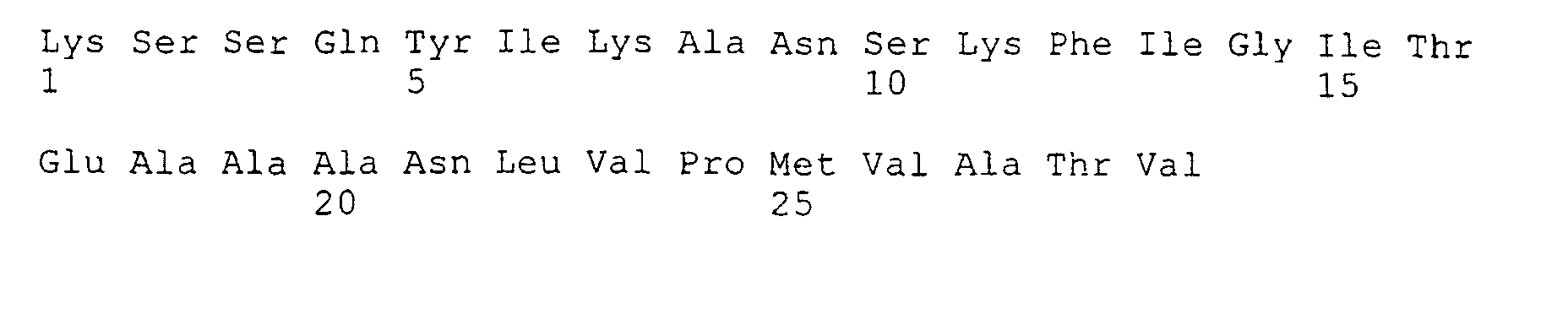
- (2) INFORMATION FOR SEQ ID NO:14:
- (i) SEQUENCE CHARACTERISTICS:
- (A) LENGTH: 29 amino acids
- (B) TYPE: amino acid
- (C) STRANDEDNESS: not relevant
- (D) TOPOLOGY: not relevant
- (ii) MOLECULE TYPE: peptide
- (v) FRAGMENT TYPE: internal
- (xi) SEQUENCE DESCRIPTION: SEQ ID NO:14:

- (2) INFORMATION FOR SEQ ID NO:15:
- (i) SEQUENCE CHARACTERISTICS:
- (A) LENGTH: 28 amino acids
- (B) TYPE: amino acid
- (C) STRANDEDNESS: not relevant
- (D) TOPOLOGY: not relevant
- (ii) MOLECULE TYPE: peptide
- (v) FRAGMENT TYPE: internal
- (ix) FEATURE:
- (A) NAME/KEY: Domain
- (B) LOCATION: 6
- (D) OTHER INFORMATION: /note= "Xaa = cyclohexylalanine or phenylalanine"
- (xi) SEQUENCE DESCRIPTION: SEQ ID NO:15:

- (2) INFORMATION FOR SEQ ID NO:16:
- (i) SEQUENCE CHARACTERISTICS:
- (A) LENGTH: 28 amino acids
- (B) TYPE: amino acid
- (C) STRANDEDNESS: not relevant
- (D) TOPOLOGY: not relevant
- (ii) MOLECULE TYPE: peptide
- (v) FRAGMENT TYPE: internal
- (ix) FEATURE:
- (A) NAME/KEY: Domain
- (B) LOCATION: 6
- (D) OTHER INFORMATION: /note= "Xaa = cyclohexylalanine or phenylalanine"
- (xi) SEQUENCE DESCRIPTION: SEQ ID NO:16:

- (2) INFORMATION FOR SEQ ID NO:17:
- (i) SEQUENCE CHARACTERISTICS:
- (A) LENGTH: 25 amino acids
- (B) TYPE: amino acid
- (C) STRANDEDNESS: not relevant
- (D) TOPOLOGY: not relevant
- (ii) MOLECULE TYPE: peptide
- (v) FRAGMENT TYPE: internal
- (ix) FEATURE:
- (A) NAME/KEY: Domain
- (B) LOCATION: 6
- (D) OTHER INFORMATION: /note= "Xaa = cyclohexylalanine or phenylalanine"
- (xi) SEQUENCE DESCRIPTION: SEQ ID NO:17:

- (2) INFORMATION FOR SEQ ID NO:18:
- (i) SEQUENCE CHARACTERISTICS:
- (A) LENGTH: 29 amino acids
- (B) TYPE: amino acid
- (C) STRANDEDNESS: not relevant
- (D) TOPOLOGY: not relevant
- (ii) MOLECULE TYPE: peptide
- (v) FRAGMENT TYPE: internal
- (xi) SEQUENCE DESCRIPTION: SEQ ID NO:18:

- (2) INFORMATION FOR SEQ ID NO:19:
- (i) SEQUENCE CHARACTERISTICS:
- (A) LENGTH: 11 amino acids
- (B) TYPE: amino acid
- (C) STRANDEDNESS: not relevant
- (D) TOPOLOGY: not relevant
- (ii) MOLECULE TYPE: peptide
- (v) FRAGMENT TYPE: internal
- (xi) SEQUENCE DESCRIPTION: SEQ ID NO:19:

- (2) INFORMATION FOR SEQ ID NO:20:
- (i) SEQUENCE CHARACTERISTICS:
- (A) LENGTH: 12 amino acids
- (B) TYPE: amino acid
- (C) STRANDEDNESS: not relevant
- (D) TOPOLOGY: not relevant
- (ii) MOLECULE TYPE: peptide
- (v) FRAGMENT TYPE: internal
- (xi) SEQUENCE DESCRIPTION: SEQ ID NO:20:

-
Claims (26)
- A peptide which elicits an MHC Class I cellular immune response to human cytomegalovirus selected from the group consisting of RPHERNGFTVL (SEQ ID NO: 19) and SVLGPISGHVLK (SEQ ID NO: 20).
- A peptide according to claim 1, wherein the sequence of said peptide is RPHERNGFTVL (SEQ ID NO: 19).
- A peptide according to claim 1, wherein the sequence of said peptide is SVLGPISGHVLK (SEQ ID NO: 20).
- A peptide according to any of claims 1 to 3 wherein said peptide is lipidated.
- A peptide according to claim 4 wherein said peptide is monolipidated.
- A peptide according to claim 4 wherein said peptide is dilipidated.
- A vaccine against human cytomegalovirus comprising a peptide of any of claims 1 to 6.
- An antigen presenting cell prepared by contacting a cell expressing a cell surface antigen HLA molecule with a peptide according to any of claims 1 to 6.
- An antigen presenting cell according to claim 8, wherein said cell surface antigen HLA molecule is B*0702.
- An antigen presenting cell according to claim 8, wherein said cell surface antigen HLA molecule is A*1101.
- A cellular vaccine against human cytomegalovirus comprising the antigen presenting cell of claim 8.
- A cellular vaccine against human cytomegalovirus according to claim 11 wherein said antigen presenting cells are autologous.
- A cellular vaccine against human cytomegalovirus according to claim 11 wherein said antigen presenting cells are allogeneic.
- A viral vector containing a DNA sequence encoding a peptide according to claim 1, wherein said viral vector is capable of expressing said peptide.
- A viral vector according to claim 14, wherein said viral vector is derived from a eukaryotic virus.
- A viral vector according to claim 15, wherein said viral vector is derived from vaccinia virus.
- A viral vector according to claim 15, wherein said viral vector is derived from canarypox.
- Use of a peptide according to any of claims 1 to 6, or a cellular vaccine according to claim 11, for the manufacture of a medicament for use in augmenting the immune system response to human cytomegalovirus infection.
- Use of a peptide according to any of claims 1 to 6, or a cellular vaccine according to claim 11, for the manufacture of a medicament for use in providing immunity against human cytomegalovirus.
- Use of a peptide according to any of claims 1 to 6, or a cellular vaccine according to claim 11, for the manufacture of a medicament for use in protecting an individual having a latent infection of human cytomegalovirus from reactivation of the infection.
- A method of determining the presence or absence of human cytomegalovirus-infected T lymphocytes in a sample containing T lymphocytes, comprising contacting T lymphocytes in said sample with an antigen presenting cell that has been primed with a peptide according to any of claims 1 to 6,wherein activation of said T lymphocytes in said sample indicates the presence of human cytomegalovirus-infected T lymphocytes.
- Use of a peptide according to any of claims 1 to 6 for the manufacture of a medicament for use in immunizing an individual against human cytomegalovirus by a method comprising removing T lymphocytes from said individual, exposing said T lymphocytes in vitro to said medicament, and then reinfusing the resulting human cytomegalovirus-reactive T lymphocytes to said individual.
- Use of a DNA encoding a peptide according to claim 1 for the manufacture of a medicament for use in providing immunity against human cytomegalovirus by a method
comprising administration of a gene transfer vector containing said medicament to said individual. - An in vitro method of preparing human cytomegalovirus-reactive human cytotoxic T lymphocytes which comprises contacting human T lymphocytes with a peptide according to any of claims 1 to 6.
- A diagnostic reagent for the detection of immunostimulation by human cytomegalovirus comprising antigen presenting cells which have been primed with a peptide according to any of claims 1 to 6.
- A method of diagnosis of:comprising contacting the T lymphocytes of said individual in vitro with a diagnostic reagent according to claim 25, wherein the degree of HCMV-specific recognition by said T lymphocytes indicates the degree of(a) immunostimulation by human cytomegalovirus of an individual, or(b) active human cytomegalovirus infection of an individual, or(c) exposure to human cytomegalovirus of an individual,(a) immunostimulation by human cytomegalovirus, or(b) active human cytomegalovirus infection, or(c) exposure to human cytomegalovirus in said individual.
Applications Claiming Priority (5)
| Application Number | Priority Date | Filing Date | Title |
|---|---|---|---|
| US95006497A | 1997-10-14 | 1997-10-14 | |
| US950064 | 1997-10-14 | ||
| US21298 | 1998-02-10 | ||
| US09/021,298 US6156317A (en) | 1996-11-12 | 1998-02-10 | Immuno-reactive peptide CTL epitopes of human cytomegalovirus |
| PCT/US1998/009652 WO1999019349A1 (en) | 1997-10-14 | 1998-05-11 | Immuno-reactive peptide ctl epitopes of human cytomegalovirus |
Publications (2)
| Publication Number | Publication Date |
|---|---|
| EP1023319A1 EP1023319A1 (en) | 2000-08-02 |
| EP1023319B1 true EP1023319B1 (en) | 2004-09-15 |
Family
ID=26694530
Family Applications (1)
| Application Number | Title | Priority Date | Filing Date |
|---|---|---|---|
| EP98922216A Expired - Lifetime EP1023319B1 (en) | 1997-10-14 | 1998-05-11 | Immuno-reactive peptide ctl epitopes of human cytomegalovirus |
Country Status (8)
| Country | Link |
|---|---|
| US (1) | US6156317A (en) |
| EP (1) | EP1023319B1 (en) |
| JP (1) | JP2001519181A (en) |
| AT (1) | ATE276270T1 (en) |
| AU (1) | AU7481498A (en) |
| CA (1) | CA2308118A1 (en) |
| DE (1) | DE69826304T2 (en) |
| WO (1) | WO1999019349A1 (en) |
Cited By (2)
| Publication number | Priority date | Publication date | Assignee | Title |
|---|---|---|---|---|
| US9404916B2 (en) | 2008-09-20 | 2016-08-02 | University College Cardiff Consultants Limited | Use of a protein kinase inhibitor to detect immune cells, such as T cells |
| US10342864B2 (en) | 2015-06-26 | 2019-07-09 | Memorial Sloan Kettering Cancer Center | Methods of treating CMV retinitis by T cell therapy |
Families Citing this family (26)
| Publication number | Priority date | Publication date | Assignee | Title |
|---|---|---|---|---|
| US6562345B1 (en) | 1996-11-12 | 2003-05-13 | City Of Hope | Immuno-reactive peptide CTL epitopes of human cytomegalovirus |
| JP2003501076A (en) | 1999-06-04 | 2003-01-14 | フロリアン・ケルン | Peptides for vaccination against human CMV |
| US6632435B1 (en) * | 1999-10-20 | 2003-10-14 | City Of Hope | CTL epitope analogs |
| US6835383B2 (en) * | 2000-03-23 | 2004-12-28 | City Of Hope | Protein kinase deficient, immunologically active CMVpp65 mutants |
| EP1612217A3 (en) * | 2000-03-27 | 2006-01-18 | City of Hope | Immuno-reactive peptide CTL epitopes of human cytomegalovirus |
| JP4099058B2 (en) | 2000-10-20 | 2008-06-11 | シティ・オブ・ホープ | Immunoreactive peptide CTL epitope of human cytomegalovirus PP150 |
| US20050221350A1 (en) | 2002-05-29 | 2005-10-06 | Toni Weinschenk | Method for identifying immunoreactive peptides |
| DE10225139A1 (en) * | 2002-05-29 | 2004-02-26 | Immatics Biotechnologies Gmbh | Methods for the identification of immunoreactive peptides |
| US20040101534A1 (en) * | 2002-06-25 | 2004-05-27 | Diamond Don J. | Adjuvant-free peptide vaccine |
| AU2003301148A1 (en) | 2002-12-23 | 2004-07-22 | Vical Incorporated | Codon-optimized polynucleotide-based vaccines against human cytomegalovirus infection |
| US7163685B2 (en) * | 2003-04-16 | 2007-01-16 | City Of Hope | Human cytomegalovirus antigens expressed in MVA and methods of use |
| US20080138354A1 (en) * | 2006-07-21 | 2008-06-12 | City Of Hope | Cytomegalovirus vaccine |
| EP2155782A2 (en) | 2007-03-26 | 2010-02-24 | Dako Denmark A/S | Mhc peptide complexes and uses thereof in infectious diseases |
| EP2167537A2 (en) * | 2007-07-03 | 2010-03-31 | Dako Denmark A/S | Compiled methods for analysing and sorting samples |
| US10611818B2 (en) | 2007-09-27 | 2020-04-07 | Agilent Technologies, Inc. | MHC multimers in tuberculosis diagnostics, vaccine and therapeutics |
| DK2254592T3 (en) | 2008-02-28 | 2019-09-09 | Dako Denmark As | MHC multimers for Borrelia diagnostics and disease |
| DK3156069T3 (en) * | 2008-06-20 | 2020-09-21 | Univ Duke | COMPOSITIONS, PROCEDURES, AND KITS FOR INDUCING AN IMMUNE RESPONSE |
| WO2010009735A2 (en) | 2008-07-23 | 2010-01-28 | Dako Denmark A/S | Combinatorial analysis and repair |
| WO2010037402A1 (en) | 2008-10-02 | 2010-04-08 | Dako Denmark A/S | Molecular vaccines for infectious disease |
| US11992518B2 (en) | 2008-10-02 | 2024-05-28 | Agilent Technologies, Inc. | Molecular vaccines for infectious disease |
| EP3364981A4 (en) | 2015-10-22 | 2019-08-07 | ModernaTX, Inc. | VACCINE AGAINST THE CYTOMEGALOVIRUS HUMAN |
| US10611800B2 (en) | 2016-03-11 | 2020-04-07 | Pfizer Inc. | Human cytomegalovirus gB polypeptide |
| WO2020127222A2 (en) | 2018-12-17 | 2020-06-25 | Immudex Aps | Panel comprising borrelia mhc multimers |
| US11629172B2 (en) | 2018-12-21 | 2023-04-18 | Pfizer Inc. | Human cytomegalovirus gB polypeptide |
| US20220332764A1 (en) * | 2019-08-29 | 2022-10-20 | Eberhard Karls Universität Tübingen | T cell epitopes of hcmv and uses of thereof |
| US11857622B2 (en) | 2020-06-21 | 2024-01-02 | Pfizer Inc. | Human cytomegalovirus GB polypeptide |
Family Cites Families (7)
| Publication number | Priority date | Publication date | Assignee | Title |
|---|---|---|---|---|
| US5075213A (en) * | 1984-07-27 | 1991-12-24 | City Of Hope | Method for detection and prevention of human cytomegalovirus infection |
| US5470730A (en) * | 1990-09-28 | 1995-11-28 | Immunex | Method for producing TH -independent cytotoxic T lymphocytes |
| WO1992005794A1 (en) * | 1990-09-28 | 1992-04-16 | Immunex Corporation | Method for producing th-independent cytotoxic t lymphocytes |
| DE69232265T2 (en) * | 1992-06-25 | 2002-08-08 | City Of Hope, Duarte | INDUCTION OF CYTOLYTIC T-LYMPHOCYTEN WITH POLYPEPTIDES OF THE CYTOMEGALIEVIRUS |
| US5405940A (en) * | 1992-08-31 | 1995-04-11 | Ludwig Institute For Cancer Research | Isolated nonapeptides derived from MAGE genes and uses thereof |
| US5827642A (en) * | 1994-08-31 | 1998-10-27 | Fred Hutchinson Cancer Research Center | Rapid expansion method ("REM") for in vitro propagation of T lymphocytes |
| DE69728289T2 (en) * | 1996-11-12 | 2005-02-24 | City Of Hope, Duarte | IMMUNOACTIVE CTL-PEPTIDEPITOPES OF HUMAN CYTOMEGALOVIRUS |
-
1998
- 1998-02-10 US US09/021,298 patent/US6156317A/en not_active Expired - Lifetime
- 1998-05-11 AT AT98922216T patent/ATE276270T1/en not_active IP Right Cessation
- 1998-05-11 AU AU74814/98A patent/AU7481498A/en not_active Abandoned
- 1998-05-11 DE DE69826304T patent/DE69826304T2/en not_active Expired - Lifetime
- 1998-05-11 CA CA002308118A patent/CA2308118A1/en not_active Abandoned
- 1998-05-11 EP EP98922216A patent/EP1023319B1/en not_active Expired - Lifetime
- 1998-05-11 WO PCT/US1998/009652 patent/WO1999019349A1/en not_active Ceased
- 1998-05-11 JP JP2000515920A patent/JP2001519181A/en active Pending
Cited By (3)
| Publication number | Priority date | Publication date | Assignee | Title |
|---|---|---|---|---|
| US9404916B2 (en) | 2008-09-20 | 2016-08-02 | University College Cardiff Consultants Limited | Use of a protein kinase inhibitor to detect immune cells, such as T cells |
| US10342864B2 (en) | 2015-06-26 | 2019-07-09 | Memorial Sloan Kettering Cancer Center | Methods of treating CMV retinitis by T cell therapy |
| US11103577B2 (en) | 2015-06-26 | 2021-08-31 | Memorial Sloan Kettering Cancer Center | Methods of treating CMV retinitis by T cell therapy |
Also Published As
| Publication number | Publication date |
|---|---|
| JP2001519181A (en) | 2001-10-23 |
| CA2308118A1 (en) | 1999-04-22 |
| WO1999019349A1 (en) | 1999-04-22 |
| DE69826304D1 (en) | 2004-10-21 |
| ATE276270T1 (en) | 2004-10-15 |
| US6156317A (en) | 2000-12-05 |
| EP1023319A1 (en) | 2000-08-02 |
| DE69826304T2 (en) | 2005-10-20 |
| AU7481498A (en) | 1999-05-03 |
Similar Documents
| Publication | Publication Date | Title |
|---|---|---|
| US6251399B1 (en) | Immuno-reactive peptide CTL epitopes of human cytomegalovirus | |
| AU2001249243B2 (en) | Immuno-reactive peptide CTL epitopes of human cytomegalovirus | |
| US6156317A (en) | Immuno-reactive peptide CTL epitopes of human cytomegalovirus | |
| US6723695B1 (en) | CTL epitopes from EBV | |
| AU2001249243A1 (en) | Immuno-reactive peptide CTL epitopes of human cytomegalovirus | |
| EP0946592B1 (en) | Immuno-reactive peptide ctl epitopes of human cytomegalovirus | |
| EP1328540B1 (en) | Immunoreactive peptidic ctl epitopes of human cytomegalovirus pp150 | |
| JP5731952B2 (en) | Human cytomegalovirus immunoreactive peptide CTL epitope | |
| AU756081B2 (en) | CTL epitopes from EBV |
Legal Events
| Date | Code | Title | Description |
|---|---|---|---|
| PUAI | Public reference made under article 153(3) epc to a published international application that has entered the european phase |
Free format text: ORIGINAL CODE: 0009012 |
|
| 17P | Request for examination filed |
Effective date: 20000322 |
|
| AK | Designated contracting states |
Kind code of ref document: A1 Designated state(s): AT BE CH CY DE DK ES FI FR GB GR IE IT LI LU MC NL PT SE |
|
| RIN1 | Information on inventor provided before grant (corrected) |
Inventor name: YORK, JOANNE Inventor name: DIAMOND, DON, JEFFREY |
|
| 17Q | First examination report despatched |
Effective date: 20020620 |
|
| GRAP | Despatch of communication of intention to grant a patent |
Free format text: ORIGINAL CODE: EPIDOSNIGR1 |
|
| GRAS | Grant fee paid |
Free format text: ORIGINAL CODE: EPIDOSNIGR3 |
|
| GRAA | (expected) grant |
Free format text: ORIGINAL CODE: 0009210 |
|
| AK | Designated contracting states |
Kind code of ref document: B1 Designated state(s): AT BE CH CY DE DK ES FI FR GB GR IE IT LI LU MC NL PT SE |
|
| PG25 | Lapsed in a contracting state [announced via postgrant information from national office to epo] |
Ref country code: NL Free format text: LAPSE BECAUSE OF FAILURE TO SUBMIT A TRANSLATION OF THE DESCRIPTION OR TO PAY THE FEE WITHIN THE PRESCRIBED TIME-LIMIT Effective date: 20040915 Ref country code: LI Free format text: LAPSE BECAUSE OF FAILURE TO SUBMIT A TRANSLATION OF THE DESCRIPTION OR TO PAY THE FEE WITHIN THE PRESCRIBED TIME-LIMIT Effective date: 20040915 Ref country code: IT Free format text: LAPSE BECAUSE OF FAILURE TO SUBMIT A TRANSLATION OF THE DESCRIPTION OR TO PAY THE FEE WITHIN THE PRESCRIBED TIME-LIMIT;WARNING: LAPSES OF ITALIAN PATENTS WITH EFFECTIVE DATE BEFORE 2007 MAY HAVE OCCURRED AT ANY TIME BEFORE 2007. THE CORRECT EFFECTIVE DATE MAY BE DIFFERENT FROM THE ONE RECORDED. Effective date: 20040915 Ref country code: FI Free format text: LAPSE BECAUSE OF FAILURE TO SUBMIT A TRANSLATION OF THE DESCRIPTION OR TO PAY THE FEE WITHIN THE PRESCRIBED TIME-LIMIT Effective date: 20040915 Ref country code: CH Free format text: LAPSE BECAUSE OF FAILURE TO SUBMIT A TRANSLATION OF THE DESCRIPTION OR TO PAY THE FEE WITHIN THE PRESCRIBED TIME-LIMIT Effective date: 20040915 Ref country code: BE Free format text: LAPSE BECAUSE OF FAILURE TO SUBMIT A TRANSLATION OF THE DESCRIPTION OR TO PAY THE FEE WITHIN THE PRESCRIBED TIME-LIMIT Effective date: 20040915 Ref country code: AT Free format text: LAPSE BECAUSE OF FAILURE TO SUBMIT A TRANSLATION OF THE DESCRIPTION OR TO PAY THE FEE WITHIN THE PRESCRIBED TIME-LIMIT Effective date: 20040915 |
|
| REG | Reference to a national code |
Ref country code: GB Ref legal event code: FG4D Ref country code: CH Ref legal event code: EP |
|
| REG | Reference to a national code |
Ref country code: IE Ref legal event code: FG4D |
|
| REF | Corresponds to: |
Ref document number: 69826304 Country of ref document: DE Date of ref document: 20041021 Kind code of ref document: P |
|
| PG25 | Lapsed in a contracting state [announced via postgrant information from national office to epo] |
Ref country code: SE Free format text: LAPSE BECAUSE OF FAILURE TO SUBMIT A TRANSLATION OF THE DESCRIPTION OR TO PAY THE FEE WITHIN THE PRESCRIBED TIME-LIMIT Effective date: 20041215 Ref country code: GR Free format text: LAPSE BECAUSE OF FAILURE TO SUBMIT A TRANSLATION OF THE DESCRIPTION OR TO PAY THE FEE WITHIN THE PRESCRIBED TIME-LIMIT Effective date: 20041215 Ref country code: DK Free format text: LAPSE BECAUSE OF FAILURE TO SUBMIT A TRANSLATION OF THE DESCRIPTION OR TO PAY THE FEE WITHIN THE PRESCRIBED TIME-LIMIT Effective date: 20041215 |
|
| PG25 | Lapsed in a contracting state [announced via postgrant information from national office to epo] |
Ref country code: ES Free format text: LAPSE BECAUSE OF FAILURE TO SUBMIT A TRANSLATION OF THE DESCRIPTION OR TO PAY THE FEE WITHIN THE PRESCRIBED TIME-LIMIT Effective date: 20041226 |
|
| REG | Reference to a national code |
Ref country code: CH Ref legal event code: PL |
|
| NLV1 | Nl: lapsed or annulled due to failure to fulfill the requirements of art. 29p and 29m of the patents act | ||
| PG25 | Lapsed in a contracting state [announced via postgrant information from national office to epo] |
Ref country code: LU Free format text: LAPSE BECAUSE OF NON-PAYMENT OF DUE FEES Effective date: 20050511 Ref country code: IE Free format text: LAPSE BECAUSE OF NON-PAYMENT OF DUE FEES Effective date: 20050511 Ref country code: CY Free format text: LAPSE BECAUSE OF FAILURE TO SUBMIT A TRANSLATION OF THE DESCRIPTION OR TO PAY THE FEE WITHIN THE PRESCRIBED TIME-LIMIT Effective date: 20050511 |
|
| PG25 | Lapsed in a contracting state [announced via postgrant information from national office to epo] |
Ref country code: MC Free format text: LAPSE BECAUSE OF NON-PAYMENT OF DUE FEES Effective date: 20050531 |
|
| PLBE | No opposition filed within time limit |
Free format text: ORIGINAL CODE: 0009261 |
|
| STAA | Information on the status of an ep patent application or granted ep patent |
Free format text: STATUS: NO OPPOSITION FILED WITHIN TIME LIMIT |
|
| ET | Fr: translation filed | ||
| 26N | No opposition filed |
Effective date: 20050616 |
|
| REG | Reference to a national code |
Ref country code: IE Ref legal event code: MM4A |
|
| PG25 | Lapsed in a contracting state [announced via postgrant information from national office to epo] |
Ref country code: PT Free format text: LAPSE BECAUSE OF NON-PAYMENT OF DUE FEES Effective date: 20050215 |
|
| REG | Reference to a national code |
Ref country code: DE Ref legal event code: R082 Ref document number: 69826304 Country of ref document: DE Representative=s name: WEICKMANN & WEICKMANN PATENT- UND RECHTSANWAEL, DE Ref country code: DE Ref legal event code: R082 Ref document number: 69826304 Country of ref document: DE Representative=s name: WEICKMANN & WEICKMANN PATENTANWAELTE - RECHTSA, DE Ref country code: DE Ref legal event code: R082 Ref document number: 69826304 Country of ref document: DE Representative=s name: PATENTANWAELTE WEICKMANN & WEICKMANN, DE |
|
| REG | Reference to a national code |
Ref country code: FR Ref legal event code: PLFP Year of fee payment: 19 |
|
| REG | Reference to a national code |
Ref country code: FR Ref legal event code: PLFP Year of fee payment: 20 |
|
| PGFP | Annual fee paid to national office [announced via postgrant information from national office to epo] |
Ref country code: GB Payment date: 20170510 Year of fee payment: 20 Ref country code: FR Payment date: 20170511 Year of fee payment: 20 Ref country code: DE Payment date: 20170502 Year of fee payment: 20 |
|
| REG | Reference to a national code |
Ref country code: DE Ref legal event code: R071 Ref document number: 69826304 Country of ref document: DE |
|
| REG | Reference to a national code |
Ref country code: GB Ref legal event code: PE20 Expiry date: 20180510 |
|
| PG25 | Lapsed in a contracting state [announced via postgrant information from national office to epo] |
Ref country code: GB Free format text: LAPSE BECAUSE OF EXPIRATION OF PROTECTION Effective date: 20180510 |