EP1022823A2 - Optical fiber for optical amplifier - Google Patents
Optical fiber for optical amplifier Download PDFInfo
- Publication number
- EP1022823A2 EP1022823A2 EP00300313A EP00300313A EP1022823A2 EP 1022823 A2 EP1022823 A2 EP 1022823A2 EP 00300313 A EP00300313 A EP 00300313A EP 00300313 A EP00300313 A EP 00300313A EP 1022823 A2 EP1022823 A2 EP 1022823A2
- Authority
- EP
- European Patent Office
- Prior art keywords
- glass
- optical fiber
- alkali metal
- metal halide
- content
- Prior art date
- Legal status (The legal status is an assumption and is not a legal conclusion. Google has not performed a legal analysis and makes no representation as to the accuracy of the status listed.)
- Granted
Links
Images

Classifications
-
- C—CHEMISTRY; METALLURGY
- C03—GLASS; MINERAL OR SLAG WOOL
- C03C—CHEMICAL COMPOSITION OF GLASSES, GLAZES OR VITREOUS ENAMELS; SURFACE TREATMENT OF GLASS; SURFACE TREATMENT OF FIBRES OR FILAMENTS MADE FROM GLASS, MINERALS OR SLAGS; JOINING GLASS TO GLASS OR OTHER MATERIALS
- C03C13/00—Fibre or filament compositions
- C03C13/04—Fibre optics, e.g. core and clad fibre compositions
-
- C—CHEMISTRY; METALLURGY
- C03—GLASS; MINERAL OR SLAG WOOL
- C03C—CHEMICAL COMPOSITION OF GLASSES, GLAZES OR VITREOUS ENAMELS; SURFACE TREATMENT OF GLASS; SURFACE TREATMENT OF FIBRES OR FILAMENTS MADE FROM GLASS, MINERALS OR SLAGS; JOINING GLASS TO GLASS OR OTHER MATERIALS
- C03C13/00—Fibre or filament compositions
- C03C13/04—Fibre optics, e.g. core and clad fibre compositions
- C03C13/041—Non-oxide glass compositions
- C03C13/043—Chalcogenide glass compositions
- C03C13/044—Chalcogenide glass compositions containing halogen, e.g. chalcohalide glass compositions
-
- H—ELECTRICITY
- H01—ELECTRIC ELEMENTS
- H01S—DEVICES USING THE PROCESS OF LIGHT AMPLIFICATION BY STIMULATED EMISSION OF RADIATION [LASER] TO AMPLIFY OR GENERATE LIGHT; DEVICES USING STIMULATED EMISSION OF ELECTROMAGNETIC RADIATION IN WAVE RANGES OTHER THAN OPTICAL
- H01S3/00—Lasers, i.e. devices using stimulated emission of electromagnetic radiation in the infrared, visible or ultraviolet wave range
- H01S3/05—Construction or shape of optical resonators; Accommodation of active medium therein; Shape of active medium
- H01S3/06—Construction or shape of active medium
- H01S3/063—Waveguide lasers, i.e. whereby the dimensions of the waveguide are of the order of the light wavelength
- H01S3/067—Fibre lasers
- H01S3/06708—Constructional details of the fibre, e.g. compositions, cross-section, shape or tapering
- H01S3/06716—Fibre compositions or doping with active elements
Definitions
- the present invention relates to optical fibers for use in optical amplifiers, and more particularly, to an optical fiber for use in an optical amplifier, which contains dysprosium ion (Dy 3+ ) and has an improved light amplification efficiency at a 1.31 ⁇ m band.
- Dy 3+ dysprosium ion
- rare earth elements for example, neodymium (Nd), praseodymium (Pr) or dysprosium (Dy) in the form of ions, are commonly implanted into a glass base.
- Nd neodymium
- Pr praseodymium
- Dy dysprosium
- fluorescence is emitted at a wavelength of 1.31 ⁇ m, which is considerably far from the zero dispersion wavelength, during the transition of 4 F 3/2 ⁇ 4 I 13/2 of Nd 3+ .
- the intensity of fluorescence emitted at the 4 F 3/2 level is very weak at a wavelength of 1.31 ⁇ m, compared to at other wavelengths, for example, at 890 nm and 1064 nm. Also, due to excited state absorption at the 4 F 3/2 level, optical gain decreases at a wavelength shorter than 1.36 ⁇ m.
- a fluoride-rich glass has been suggested as a base material, instead of the silica glass.
- the use of the fluoride-rich glass fails to increase the optical gain to a desired level at the wavelength of 1.31 ⁇ m.
- Pr 3+ as a rare earth element implanted into a glass in optical fiber manufacture, permits the utilization of fluorescence emission by the transition of 1 G 4 ⁇ 3 H 5 . Such a transition is more likely to occur than at other energy levels, and thus a high optical amplification efficiency is expected when Pr 3+ is used as a doping material.
- a fluoride glass containing ZrF 4 is widely known as a base material having a low lattice vibration energy.
- fluoride glass has a low quantum efficiency at 4% or less, and thus it is difficult to obtain satisfactory performance in view of fluorescence lifetime. For this reason, research into use of a sulfide glass which has a lower lattice vibration energy than a fluoride glass, as a base material, has actively conducted.
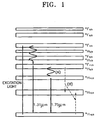
- FIG. 1 is an energy level diagram of dysprosium ion (Dy 3+ ).
- Dy 3+ dysprosium ion
- Table 1 comparatively shows the performance of optical amplifiers manufactured by implanting Dy 3+ and Pr 3+ which emit fluorescence at 1.31 ⁇ m, respectively, into a germanium-gallium-sulfide (Ge-Ga-S) glass base.
- Performance Pr 3+ Dy 3+ Cross-section of stimulated emission (10 -20 cm 2 ) 1.05 4.35 Fluorescence lifetime ( ⁇ s) 300 38 Quantum efficiency (%) 0.60 0.17 Branching ratio (%) 0.60 0.91
- the short fluorescent lifetime of Dr 3+ is caused by a multiphonon relaxation.
- the multiphonon relaxation will not be described in greater detail.
- the energy difference of Dy 3+ between the excited levels 6 F 11/2 and 6 H 9/2 , and the nearest low level 6 H 11/2 is even less at about 1800 cm -1 than that of Pr 3+ , so that the multiphonon relaxation rate far exceeds the emission rate at 1.31 ⁇ m.
- most excited ion energy is lost due to interaction of ion and phonon.
- an oxide glass, which has a relatively high phonon energy, or a fluoride glass, which has a relatively low phonon energy is used as a base material for Dy 3+ , the fluorescence emission at 1.31 ⁇ m is not possible.
- a sulfide glass allows the fluorescence emission at the wavelength of 1.31 ⁇ m, providing the possibility of using the sulfide glass as a base material for Dy 3+ .
- An object of the present invention is to provide an optical fiber for use in optical amplifiers, which contains dysprosium ions (Dy 3+ ) and has an improved light amplification efficiency at a wavelength of 1.31 ⁇ m.
- an optical fiber for an optical amplifier comprising a germanium-gallium-sulfide (Ge-Ga-S) glass, an alkali metal halide, and dysprosium (Dy) as a rare earth element.
- a germanium-gallium-sulfide (Ge-Ga-S) glass comprising a germanium-gallium-sulfide (Ge-Ga-S) glass, an alkali metal halide, and dysprosium (Dy) as a rare earth element.
- the content of alkali metal halide is in the range of approximately 1 to 20 mol % based on the total amount of Ge-Ga-S glass and alkali metal halide, and the content of rare earth element is in the range of 0.01 to 0.1 mol % based on the total amount of Ge-Ga-S glass, alkali metal halide and rare earth element.
- the alkali metal halide is KBr, CsBr, Kl or Csl.
- the alkali metal halide When KBr or CsBr is used as the alkali metal halide, an improvement of fluorescence lifetime at the 1.31 ⁇ m band is excellent regardless of the content of alkali metal halide. It is more preferable that the alkali metal halide content is greater than or equal to the Ga content, in view of the improvement of fluorescence lifetime.
- the alkali metal halide is Kl or Csl
- the Ga content in the Ge-Ga-S glass is 10 mol % or more based on the total composition of the glass, for more improvement of the fluorescence lifetime at the 1.31 ⁇ m band. It is more preferable that the alkali metal halide content is greater than or equal to the Ga content, in view of the fluorescence lifetime increase at the 1.31 ⁇ m band.
- the content of alkali metal halide is in the range of approximately 1 to 20 mol % based on the total amount of Ge-Ga-As-S glass and alkali metal halide
- the content of rare earth element is in the range of approximately 0.01 to 0.1 mol % based on the total amount of Ge-Ga-As-S glass, alkali metal halide and rare earth element.
- the fluorescence lifetime and light amplification efficiency of dysprosium ion (Dy 3+ ) at a 1.31 ⁇ m band vary depending on the degree of nonradiative transition, during which the energy excited at the 6 F 11/2 and 6 H 9/2 levels is exhausted in forms other than light.
- Such nonradiative transition is classified into multiphonon relaxation designated with (A) in FIG. 1, which is caused by the lattice vibration energy of glass, and energy transfer between neighbours Dy 3+ , which is designated with (B) in FIG. 1.
- multiphonon relaxation due to the lattice vibration considerably contributes to a decrease in light amplification efficiency by reducing the density of electrons of Dy 3+ at 6 F 11/2 and 6 H 9/2 levels.
- luminescent ions such as rare earth ions are kept in a solid base such as crystal or glass
- the luminescence ions are excited by absorbing an external energy source, and then transited to the ground state or a lower energy level, generating light energy.
- the multiphonon relaxation refers to the dissipation of useful light energy by electron-phonon interaction.
- the energy difference of the two energy levels is several times higher than the lattice vibration energy of the host, and thus multiple phonons are required to consume the excited ion energy by the host lattice vibration.
- the multiphonon relaxation rate is inversely proportional to exponential of the number of phonons.
- the lattice vibration energy of the host should be as low as possible to increase the number of phonons, which reduces the multiphonon relaxation rate.
- the lattice vibration energy of a host is inversely proportional to the square root of the mass of atoms which constitute the host, and is proportional to the square root of the bond constant of the atoms.
- the multiphonon relaxation rate can be reduced by using the host which has large-mass atoms and a weak binding force between the atoms.
- the multiphonon relaxation rate varies depending on the coupling strength of the electrons of the rare earth ions, and phonons that are present in the host.
- the multiphonon relaxation rate can also be lowered by reducing the electron-to-phonon interaction such that the coupling strength therebetween is minimized.
- a sulfide glass has a lattice vibration energy of about 350 cm -1 , which is considerably low compared to that of an oxide glass and fluoride glass. Thus, the sulfide glass seems to have a low multiphonon relaxation rate. However, the sulfide glass as a host decreases the fluorescence lifetime at 6 F 11/2 and 6 H 9/2 by Dy 3+ to approximately 38 ⁇ sec with a quantum efficiency of 17% or less. Accordingly, the electron-phonon coupling strength in the sulfide glass must be minimized.
- the present invention is for improving the fluorescence efficiency by Dy 3+ at a 1.31 ⁇ m band in an optical fiber adapting Dy 3+ as active ions, in which a general sulfide glass, which has a low lattice vibration energy, is adopted and bromine (Br) or iodine (I), which has a very weak electron-phonon coupling strength with a large mass, compared to the constituent elements of the sulfide glass, is added to minimize the electron-phonon interaction in the sulfide glass.
- the optical fiber of the present invention includes a germanium-gallium-sulfide (Ge-Ga-S) or germanium-gallium-arsenic-sulfide (Ge-Ga-As-S) glass and an alkali metal halide, and Dy, which is a rare earth element, is in the form of ions (Dy 3+ ).
- Any alkali metal halide can be used for the optical fiber.
- KBr, CsBr, Kl or Csl is preferred as the alkali metal halide.
- the content of the alkali metal halide is in the range of approximately 1 to 20 mol %, and more preferably, of approximately 1 to 10 mol %, based on the total amount of glass and alkali metal halide. If the alkali metal halide content is less than 1 mol %, the fluorescence emission efficiency of the optical fiber is poor. Meanwhile, if the alkali metal halide content is more than 20 mol %, the thermal and chemical properties of the optical fiber are deteriorated.
- the Ge-Ga-As-S glass has been devised to lower the tendency of crystallization of the Ge-Ga-S glass during the manufacture of optical fibers.
- Ge is susceptible to glassification
- Ga shows a high crystallization tendency with poor glassification capability.
- the glassification is hindered by Ga during optical fiber manufacture.
- As having excellent glassification capability is added in the case of using the sulfide glass is used as a host for forming optical fibers.
- Ge-Ga-As-S or Ge-Ga-S glass based on the total composition of the glass.
- the alkali metal halide used is Csl or Kl
- the Ga content is 10 mol % or more based on the total composition of the glass.
- the alkali metal halide is greater than or equal to the Ga content in view of the fluorescence lifetime improvement at 1.31 ⁇ m band. In other words, if the alkali metal halide content is less than the Ga content, there is no great improvement in fluorescence lifetime at the 1.31 ⁇ m band.
- Ge, Ga, S and the source of Dy 3+ are mixed in a desired ratio, and a predetermined amount of the alkali metal halide is added to the mixture.
- a predetermined amount of the mixture containing the alkali metal halide is put into a silica ampule, and then sealed under a vacuum condition.
- the silica ampule filled with the mixture is fused in a furnace at a temperature of 900-1100°C, and preferably, at a temperature of 950-1000°C. If the temperature of the furnace is higher than 1100°C, the silica ampule containing the mixture may explode due to high vapour pressure. Meanwhile, if the temperature of the furnace is lower than 900°C, the rare earth element, which has a high fusing point, does not fuse.
- the silica ampule containing the fused composition is quenched. Any technique can be adopted for the quenching of the heated silica ampule. However, it is preferable to quench the heated silica ampule in the air.
- the quenched silica ampule containing the composition is heated at near the glass transition temperature of the glass host, i.e., at 300-400°C, cooled and then broken, resulting in a glass rod.
- the obtained glass rod is heated and drawn resulting in an optical fiber according to the present invention.
- 10g of the obtained composition was put into a silica ampule and then sealed under a vacuum condition.
- the silica ampule filled with the composition was fused at a furnace which was set at 950°C for 12 hours, and then quenched in the air. Following this, the silica ampule were heated at 350°C for 2 hours, cooled and broken, resulting in a glass rod.
- the obtained glass rod was heated and drawn, resulting in an optical fiber according to the present invention.
- An optical fiber was manufactured in the same manner as in Example 1 except that Kl was used instead of KBr to prepare 0.90[Ge 25 Ga 10 S 65 ]-0.10Kl.
- An optical fiber was manufactured in the same manner as in Example 1 except that CsBr was used instead of KBr to prepare 0.90[Ge 25 Ga 10 S 65 ]-0.10CsBr.
- An optical fiber was manufactured in the same manner as in Example 1 except that Csl was used instead of KBr to prepare 0.90[Ge 25 Ga 10 S 65 ]-0.10Csl.
- An optical fiber was manufactured in the same manner as in Example 1 except that 0.95[Ge 25 Ga 10 S 65 ]-0.05KBr was prepared instead of 0.90[Ge 25 Ga 10 S 65 ]-0.10KBr.
- An optical fiber was manufactured in the same manner as in Example 1 except that 0.95[Ge 32 Ga 5 S 63 ]-0.05KBr was prepared instead of 0.90[Ge 25 Ga 10 S 65 ]-0.10KBr.
- An optical fiber was manufactured in the same manner as in Example 7 except that CsBr was used instead of KBr to prepare 0.95[Ge 32 Ga 5 S 63 ]-0.05CsBr.
- An optical fiber was manufactured in the same manner as in Example 1 except that 0.96[Ge 32 Ga 5 S 63 ]-0.04CsBr was prepared instead of 0.90[Ge 25 Ga 10 S 65 ]-0.10KBr.
- An optical fiber was manufactured in the same manner as in Example 1 except that 0.97[Ge 32 Ga 5 S 63 ]-0.03CsBr was prepared instead of 0.90[Ge 25 Ga 10 S 65 ]-0.10KBr.
- An optical fiber was manufactured in the same manner as in Example 1 except that 0.95238[Ge 29 Ga 5 S 66 ]-0.04762CsBr was prepared instead of 0.90[Ge 25 Ga 10 S 65 ]-0.10KBr.
- An optical fiber was manufactured in the same manner as in Example 1 except that 0.95[Ge 29 Ga 5 S 66 ]-0.05Kl was prepared instead of 0.90[Ge 25 Ga 10 S 65 ]-0.10KBr.
- An optical fiber was manufactured in the same manner as in Example 12 except that Csl was used instead of Kl to prepare 0.95[Ge 29 Ga 5 S 66 ]-0.05Csl.
- An optical fiber was manufactured in the same manner as in Example 1 except that As having a purity of 99.999% or more was added and CsBr was used instead of KBr, to prepare 0.95[Ge 30 As 9 Ga 1 S 60 ]-0.05CsBr, instead of 0.90[Ge 25 Ga 10 S 65 ]-0.10KBr in Example 1.
- An optical fiber was manufactured in the same manner as in Example 1 except that no KBr was added to Ge 29 Ga 10 S 65 , instead of 0.90[Ge 25 Ga 10 S 65 ]-0.10KBr.
- the fluorescence lifetime of Dy 3+ at 6 F 11/2 and 6 H 9/2 levels was measured.
- the fluorescence lifetime designated with ⁇ which is defined as the point in time at which the fluorescence intensity reaches 1/e of the initial level, was measured using a digitized oscilloscope.
- the fluorescence lifetime designated with T R which is defined as the point in time at which the fluorescence intensity reaches 1/e of the initial level under the assumption that only radiative transition by electron transition occurs, was calculated.
- Quantum efficiency designated with ⁇ was defined as the ratio of the measured and calculated fluorescence lifetimes.
- an Ar +1 laser-driven titanium (Ti)-sapphire laser emitting 914 nm light was used as a light source for excitation.
- Dy 3+ to 6 F 7/2 level which are kept in the lattice of the glass base formed of Ge-Ga-S or Ge-Ga-As-S and the alkali metal halide, with the titanium-sapphire laser
- the fluorescence produced was detected by a InSb photodetector and the wavelength thereof was screened by a 1/4m-double monochromator. Also, the detected fluorescence was analysed by a lock-in amplifier.
- the fluorescence lifetime of the optical fiber manufactured in Example 1 was 420 ⁇ sec and the quantum efficiency thereof was 90%.
- the fluorescence lifetime of the optical fiber in Example 1 was increased compared to the optical fiber manufactured in the Comparative Example, which had a fluorescence lifetime of 38 ⁇ sec and a quantum efficiency of 16.6%.
- Such an increase in fluorescence lifetime is due to a decrease in the multiphonon relaxation rate of Dy 3+ from 6 F 11/2 and 6 H 9/2 to 5 H 11/2 by the addition of KBr to the Ge-Ga-S glass.
- the fluorescence lifetime of the optical fiber in Example 2 was 270 ⁇ sec, and the optical fiber in Example 3 exhibited the longest fluorescence lifetime at 1.26 msec. This result supports that the use of CsBr further contributes to reducing the multiphonon relaxation rate of Dy 3+ from 6 F 11/2 and 6 H 9/2 levels to 6 H 11/2 level. Also, the fluorescence lifetime was 190 ⁇ sec in Example 4, 44 ⁇ sec in Example 5, 60 ⁇ sec in Example 6, 650 ⁇ sec in Example 7, and 1.12 msec in Example 8.
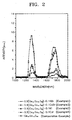
- FIG. 2 shows the fluorescence emission spectrum at 1.31 ⁇ m and 1.75 ⁇ m of the optical fibers manufactured in Examples 1 through 4 and the Comparative Example, when Dy 3+ is excited to 5 F 7/2 using a laser emitting 914 nm light as an excitation source.
- the fluorescence emission at 1.31 ⁇ m is due to the transition from and to the ground level, and that at 1.75 ⁇ m is due to the transition from to the ground level.
- the Comparative Example shows a very small fluorescence intensity at 1.31 ⁇ m compared to that shown at 1.75 ⁇ m. This result is associated with the multiphonon relaxation rate. Because in the case of using a Ge-Ga-S glass as a glass base, the multiphonon relaxation rate reaches 20000 sec -1 which is 5 times higher than the spontaneous fluorescence emission rate at 1.31 ⁇ m (about 4000 sec -1 ), most of Dy 3+ excited to 6 F 11/2 and 6 H 9/2 cannot emit fluorescence at 1.31 ⁇ m and then transit to the lower energy level 6 H 11/2 , emitting fluorescence at 1.75 ⁇ m. Thus, the intensity of fluorescence at 1.75 ⁇ m is stronger than that at 1.31 ⁇ m.
- FIG. 3 shows the variation of the fluorescence intensity at 1.31 ⁇ m with respect to time for each of the optical amplifiers manufactured in Examples 1 through 4 and the Comparative Example, wherein Dy 3+ was excited to 6 F 7/2 with a laser emitting 914 nm light to produce fluorescence at 1.31 ⁇ m, which is caused by transition from 6 F 11/2 and 6 H 9/2 levels to the ground level.
- the optical fiber that contains Dy 3+ as an active ion As described above, in the manufacture of the optical fiber that contains Dy 3+ as an active ion according to the present invention, a sulfide glass having a low lattice vibration energy is used as a glass host, and the alkali metal halide, which is able to minimize the interaction of electrons of Dy 3+ and phonons in the glass lattice, is added. As a result, the multiphonon relaxation of Dy 3+ from 6 F 11/2 and 6 H 9/2 levels to the nearest lower energy level 6 H 9/2 is slowed down, and thus the fluorescence lifetime at 1.31 ⁇ m is elongated, further improving the fluorescence efficiency of the optical fiber.
Landscapes
- Physics & Mathematics (AREA)
- Chemical & Material Sciences (AREA)
- Engineering & Computer Science (AREA)
- Optics & Photonics (AREA)
- Electromagnetism (AREA)
- Geochemistry & Mineralogy (AREA)
- Life Sciences & Earth Sciences (AREA)
- Chemical Kinetics & Catalysis (AREA)
- General Chemical & Material Sciences (AREA)
- Materials Engineering (AREA)
- Organic Chemistry (AREA)
- Plasma & Fusion (AREA)
- Glass Compositions (AREA)
- Lasers (AREA)
- Optical Fibers, Optical Fiber Cores, And Optical Fiber Bundles (AREA)
Abstract
Description
| Performance | Pr3+ | Dy3+ |
| Cross-section of stimulated emission (10-20 cm2) | 1.05 | 4.35 |
| Fluorescence lifetime (µs) | 300 | 38 |
| Quantum efficiency (%) | 0.60 | 0.17 |
| Branching ratio (%) | 0.60 | 0.91 |
Claims (14)
- An optical fiber for an optical amplifier, comprising a germanium-gallium-sulfide (Ge-Ga-S) glass, an alkali metal halide, and dysprosium (Dy) as a rare earth element.
- The optical fiber of claim 1, wherein the alkali metal halide content is in the range of approximately 1 to 20 mol % based on the total amount of Ge-Ga-S glass and alkali metal halide, and the content of rare earth element is in the range of approximately 0.01 to 0.1 mol % based on the total amount of Ge-Ga-S glass, alkali metal halide and rare earth element.
- The optical fiber of claim 1, wherein the alkali metal halide is KBr, CsBr, Kl or Csl.
- The optical fiber of claim 3, wherein the alkali metal halide is KBr or CsBr.
- The optical fiber of claim 4, wherein the alkali metal halide content is greater than or equal to the Ga content.
- The optical fiber of claim 3, wherein when the alkali metal halide is Kl or Csl, the Ga content in the Ge-Ga-S glass is 10 mol % or more based on the total composition of the glass.
- The optical fiber of claim 6, wherein the alkali metal halide content is greater than or equal to the Ga content.
- An optical fiber for an optical amplifier, comprising a germanium-gallium-arsenic-sulfide (Ge-Ga-As-S) glass, an alkali metal halide, and dysprosium (Dy) as a rare earth element.
- The optical fiber of claim 8, wherein the alkali metal halide content is in the range of approximately 1 to 20 mol % based on the total amount of Ge-Ga-As-S glass and alkali metal halide, and the content of rare earth element is in the range of approximately 0.01 to 0.1 mol % based on the total amount of Ge-Ga-As-S glass, alkali metal halide and rare earth element.
- The optical fiber of claim 8, wherein the alkali metal halide is KBr, CsBr, Kl or Csl.
- The optical fiber of claim 10, wherein the alkali metal halide is KBr or CsBr.
- The optical fiber of claim 11, wherein the alkali metal halide content is greater than or equal to the Ga content.
- The optical fiber of claim 10, wherein when the alkali metal halide is Kl or Csl, the Ga content in the Ge-Ga-As-S glass is 10 mol % or more based on the total composition of the glass.
- The optical fiber of claim 13, wherein the alkali metal halide content is greater than or equal to the Ga content.
Applications Claiming Priority (2)
| Application Number | Priority Date | Filing Date | Title |
|---|---|---|---|
| KR9901647 | 1999-01-20 | ||
| KR1019990001647A KR100322129B1 (en) | 1999-01-20 | 1999-01-20 | Optical fiber for optical amplifier |
Publications (3)
| Publication Number | Publication Date |
|---|---|
| EP1022823A2 true EP1022823A2 (en) | 2000-07-26 |
| EP1022823A3 EP1022823A3 (en) | 2001-12-12 |
| EP1022823B1 EP1022823B1 (en) | 2004-07-28 |
Family
ID=19571867
Family Applications (1)
| Application Number | Title | Priority Date | Filing Date |
|---|---|---|---|
| EP00300313A Expired - Lifetime EP1022823B1 (en) | 1999-01-20 | 2000-01-18 | Optical fiber for optical amplifier |
Country Status (6)
| Country | Link |
|---|---|
| US (1) | US6480663B1 (en) |
| EP (1) | EP1022823B1 (en) |
| JP (1) | JP3415088B2 (en) |
| KR (1) | KR100322129B1 (en) |
| CN (1) | CN1174267C (en) |
| DE (1) | DE60012380T2 (en) |
Cited By (1)
| Publication number | Priority date | Publication date | Assignee | Title |
|---|---|---|---|---|
| US6660672B2 (en) * | 2000-07-06 | 2003-12-09 | Samsung Electronics Co Ltd | Alkali halide-doped sulfide glasses for optical amplifier and fabricating method thereof |
Family Cites Families (6)
| Publication number | Priority date | Publication date | Assignee | Title |
|---|---|---|---|---|
| JPH05310440A (en) | 1992-05-08 | 1993-11-22 | Matsushita Electric Ind Co Ltd | Optical fiber, optical amplifier, optical transmission system and solid state laser |
| US5379149A (en) * | 1993-08-06 | 1995-01-03 | Kutger, The State University Of New Jersey | Glass compositions having low energy phonon spectra and light sources fabricated therefrom |
| GB9514345D0 (en) | 1995-07-13 | 1995-09-13 | British Tech Group | Glasses |
| US5694500A (en) * | 1995-10-23 | 1997-12-02 | The Regents Of The University Of California | Optical amplifier operating at 1.3 microns useful for telecommunications and based on dysprosium-doped metal chloride host materials |
| US5973824A (en) * | 1997-08-29 | 1999-10-26 | The United States Of America As Represented By The Secretary Of The Navy | Amplification by means of dysprosium doped low phonon energy glass waveguides |
| KR100485749B1 (en) | 1997-11-04 | 2005-09-30 | 삼성전자주식회사 | Ge-ga-s based glass composition having light amplifying character & light amplifier for communication network system fabricated therefrom |
-
1999
- 1999-01-20 KR KR1019990001647A patent/KR100322129B1/en not_active Expired - Fee Related
-
2000
- 2000-01-14 US US09/482,917 patent/US6480663B1/en not_active Expired - Lifetime
- 2000-01-18 EP EP00300313A patent/EP1022823B1/en not_active Expired - Lifetime
- 2000-01-18 DE DE60012380T patent/DE60012380T2/en not_active Expired - Fee Related
- 2000-01-19 JP JP2000010391A patent/JP3415088B2/en not_active Expired - Fee Related
- 2000-01-20 CN CNB001003941A patent/CN1174267C/en not_active Expired - Fee Related
Cited By (1)
| Publication number | Priority date | Publication date | Assignee | Title |
|---|---|---|---|---|
| US6660672B2 (en) * | 2000-07-06 | 2003-12-09 | Samsung Electronics Co Ltd | Alkali halide-doped sulfide glasses for optical amplifier and fabricating method thereof |
Also Published As
| Publication number | Publication date |
|---|---|
| EP1022823A3 (en) | 2001-12-12 |
| DE60012380T2 (en) | 2005-07-21 |
| KR100322129B1 (en) | 2002-02-04 |
| DE60012380D1 (en) | 2004-09-02 |
| CN1262447A (en) | 2000-08-09 |
| JP2000216469A (en) | 2000-08-04 |
| CN1174267C (en) | 2004-11-03 |
| JP3415088B2 (en) | 2003-06-09 |
| EP1022823B1 (en) | 2004-07-28 |
| US6480663B1 (en) | 2002-11-12 |
| KR20000051293A (en) | 2000-08-16 |
Similar Documents
| Publication | Publication Date | Title |
|---|---|---|
| Wei et al. | Pr3+-doped Ge Ga S glasses for 1.3 μm optical fiber amplifiers | |
| Zou et al. | Spectroscopic properties and mechanisms of excited state absorption and energy transfer upconversion for Er3+-doped glasses | |
| Oliveira et al. | Frequency upconversion in Er 3+/Yb 3+-codoped chalcogenide glass | |
| Nagli et al. | The luminescence properties of Dy-doped high silicate glass | |
| US6347177B1 (en) | Optical fiber for light amplifier | |
| Lakshminarayana et al. | Spectral analysis of RE3+ (RE= Er, Nd, Pr and Ho): GeO2–B2O3–ZnO–LiF glasses | |
| US6272277B1 (en) | Optical fiber for light amplifier | |
| CN1113045C (en) | Ge-Ga-S-based glass composition having light amplifying characteristic and apparatus for optical communications using the same | |
| EP1022823B1 (en) | Optical fiber for optical amplifier | |
| JP2002535228A (en) | GeAs sulfide glass containing P | |
| JP6901560B2 (en) | Fluorophosphate-based glass for active devices | |
| KR100383608B1 (en) | Alkaloid halogen doped sulfide glasses for optical amplifier and fabrication method thereof | |
| Choi et al. | Sensitizing effect of Yb3+ on near-infrared fluorescence emission of Cr4+-doped calcium aluminate glasses | |
| JPH0986958A (en) | Wavelength conversion glass material | |
| JPH08217491A (en) | Wavelength conversion glass material | |
| JPH08217490A (en) | Wavelength conversion glass material | |
| JPH10273336A (en) | Halide glass material for optical amplification | |
| Wyon et al. | Optical properties of Er3+ and Tm3+ doped Y2SiO5 | |
| JPH0859286A (en) | Blue light emitting glass material | |
| JPH0656468A (en) | Laser glass | |
| JPH10251041A (en) | Wavelength conversion glass material | |
| KR19990038328A (en) | Heavy Metal Oxide Glass Composition for Optical Amplification Used in Optical Communication | |
| JPH10273337A (en) | Wavelength conversion glass material | |
| JPH08217488A (en) | Wavelength conversion glass material | |
| JPH08217489A (en) | Wavelength conversion glass material |
Legal Events
| Date | Code | Title | Description |
|---|---|---|---|
| PUAI | Public reference made under article 153(3) epc to a published international application that has entered the european phase |
Free format text: ORIGINAL CODE: 0009012 |
|
| 17P | Request for examination filed |
Effective date: 20000129 |
|
| AK | Designated contracting states |
Kind code of ref document: A2 Designated state(s): AT BE CH CY DE DK ES FI FR GB GR IE IT LI LU MC NL PT SE Kind code of ref document: A2 Designated state(s): DE FR GB |
|
| AX | Request for extension of the european patent |
Free format text: AL;LT;LV;MK;RO;SI |
|
| RIN1 | Information on inventor provided before grant (corrected) |
Inventor name: KIM, HYOUN-SOO Inventor name: SHIN, YONG-BEOM, PHOT. GLASSES LAB, DPT MAT SC&EN Inventor name: HEO, JONG Inventor name: JUNG, SUN-TAE |
|
| PUAL | Search report despatched |
Free format text: ORIGINAL CODE: 0009013 |
|
| AK | Designated contracting states |
Kind code of ref document: A3 Designated state(s): AT BE CH CY DE DK ES FI FR GB GR IE IT LI LU MC NL PT SE |
|
| AX | Request for extension of the european patent |
Free format text: AL;LT;LV;MK;RO;SI |
|
| RIC1 | Information provided on ipc code assigned before grant |
Free format text: 7C 03C 3/32 A, 7C 03C 13/04 B, 7H 01S 3/067 B |
|
| AKX | Designation fees paid |
Free format text: DE FR GB |
|
| 17Q | First examination report despatched |
Effective date: 20030423 |
|
| GRAP | Despatch of communication of intention to grant a patent |
Free format text: ORIGINAL CODE: EPIDOSNIGR1 |
|
| GRAS | Grant fee paid |
Free format text: ORIGINAL CODE: EPIDOSNIGR3 |
|
| GRAA | (expected) grant |
Free format text: ORIGINAL CODE: 0009210 |
|
| AK | Designated contracting states |
Kind code of ref document: B1 Designated state(s): DE FR GB |
|
| REG | Reference to a national code |
Ref country code: GB Ref legal event code: FG4D |
|
| REG | Reference to a national code |
Ref country code: IE Ref legal event code: FG4D |
|
| REF | Corresponds to: |
Ref document number: 60012380 Country of ref document: DE Date of ref document: 20040902 Kind code of ref document: P |
|
| ET | Fr: translation filed | ||
| PLBE | No opposition filed within time limit |
Free format text: ORIGINAL CODE: 0009261 |
|
| STAA | Information on the status of an ep patent application or granted ep patent |
Free format text: STATUS: NO OPPOSITION FILED WITHIN TIME LIMIT |
|
| 26N | No opposition filed |
Effective date: 20050429 |
|
| PGFP | Annual fee paid to national office [announced via postgrant information from national office to epo] |
Ref country code: FR Payment date: 20060110 Year of fee payment: 7 |
|
| PGFP | Annual fee paid to national office [announced via postgrant information from national office to epo] |
Ref country code: DE Payment date: 20060112 Year of fee payment: 7 |
|
| PG25 | Lapsed in a contracting state [announced via postgrant information from national office to epo] |
Ref country code: DE Free format text: LAPSE BECAUSE OF NON-PAYMENT OF DUE FEES Effective date: 20070801 |
|
| GBPC | Gb: european patent ceased through non-payment of renewal fee |
Effective date: 20070118 |
|
| REG | Reference to a national code |
Ref country code: FR Ref legal event code: ST Effective date: 20070930 |
|
| PG25 | Lapsed in a contracting state [announced via postgrant information from national office to epo] |
Ref country code: GB Free format text: LAPSE BECAUSE OF NON-PAYMENT OF DUE FEES Effective date: 20070118 |
|
| PG25 | Lapsed in a contracting state [announced via postgrant information from national office to epo] |
Ref country code: FR Free format text: LAPSE BECAUSE OF NON-PAYMENT OF DUE FEES Effective date: 20070131 |
|
| PGFP | Annual fee paid to national office [announced via postgrant information from national office to epo] |
Ref country code: GB Payment date: 20060118 Year of fee payment: 7 |