EP1022719A2 - Stringed musical instrument with composite body partialy formed of metal or synthetic resin - Google Patents
Stringed musical instrument with composite body partialy formed of metal or synthetic resin Download PDFInfo
- Publication number
- EP1022719A2 EP1022719A2 EP00101015A EP00101015A EP1022719A2 EP 1022719 A2 EP1022719 A2 EP 1022719A2 EP 00101015 A EP00101015 A EP 00101015A EP 00101015 A EP00101015 A EP 00101015A EP 1022719 A2 EP1022719 A2 EP 1022719A2
- Authority
- EP
- European Patent Office
- Prior art keywords
- musical instrument
- synthetic resin
- stringed musical
- alloy
- center block
- Prior art date
- Legal status (The legal status is an assumption and is not a legal conclusion. Google has not performed a legal analysis and makes no representation as to the accuracy of the status listed.)
- Granted
Links
Images


Classifications
-
- G—PHYSICS
- G10—MUSICAL INSTRUMENTS; ACOUSTICS
- G10D—STRINGED MUSICAL INSTRUMENTS; WIND MUSICAL INSTRUMENTS; ACCORDIONS OR CONCERTINAS; PERCUSSION MUSICAL INSTRUMENTS; AEOLIAN HARPS; SINGING-FLAME MUSICAL INSTRUMENTS; MUSICAL INSTRUMENTS NOT OTHERWISE PROVIDED FOR
- G10D1/00—General design of stringed musical instruments
- G10D1/04—Plucked or strummed string instruments, e.g. harps or lyres
- G10D1/05—Plucked or strummed string instruments, e.g. harps or lyres with fret boards or fingerboards
- G10D1/08—Guitars
- G10D1/085—Mechanical design of electric guitars
Definitions
- This invention relates to a stringed musical instrument and, more particularly, to a body structure of a stringed musical instrument such as, for example, an electric guitar.
- the electric guitar comprises a body, a neck projecting from the body and strings stretched over the body and the neck.
- the body is broken down into a solid structure and a semi-acoustic structure.
- a typical example of the solid-type body is disclosed in Japanese Utility Model Publication of Examined Application No. 55-36872.
- the solid-type body disclosed therein is formed of wood, and a wooden block is shaped into the complicated configuration.
- the body is perfectly solid, or a hollow space is formed in the body.
- the wooded deck plates/ panels are a front deck plate, a back deck plate, side plates and a center block, and defines a resonator inside of the body.
- the front deck plate, the back deck plate and the side plates are, by way of example, formed of silver fir or spruce.
- the center block is usually formed of maple.
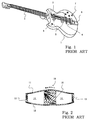
- Figure 1 illustrates a typical example of the electric guitar.
- the prior art electric guitar has a solid body 1, a neck 2, strings 3, a bridge 4, pick-ups 5, a tail piece 6, dials 7 and a power switch 8.
- the solid body 1 is formed of wood, and has a unique configuration.
- the solid body 1 has a front surface, a back surface and a side surface.
- the neck 2 is separated from the solid body 1 in figure 1, the neck 2 is fixed to the solid body 1, and projects from the side surface of the solid body 1.
- the tail piece 6 is attached to the front surface, and is located on the opposite side to the neck 2.
- the bridge 4 and the pick-ups 5 are also attached to the front surface, and are positioned between the neck 2 and the tail piece 6.
- the strings 3 are stretched between pegs at the leading end of the neck 2 and the tail piece 6, and the bridge 4 and the pick-ups 5 are under the strings 3.
- the bridge 4 gives appropriate tension to the strings 3.
- the pick-ups 5 detect vibrations of the strings 3, and convert the vibrations to electric signals.
- the pick-ups 5 are connected to a suitable amplifier, which makes a speaker system generate electric sounds.
- the dials 7 and the pick-ups 5 are energized. A player manipulates the dials 7 in order to regulate the volume, the tone color etc.
- the solid body 1 is formed as follows. Prior to a machining, an aging is required for a wooden block to be machined.
- the wooden block is 40 to 50 millimeters thick.
- the wooden block is shaped into the unique configuration by using wood working machines.
- the wood work is polished, and, thereafter, is painted.
- a rough coating is carried out for the wood work, and a primer coating, a polishing, an intermediate coating, a polishing, a finish coating and a polishing follows. Thus, the polishing and the coating are repeated, and the prior art solid body 1 is obtained.
- the bridge 4 pick-ups 5, the tail piece 6, the dials 7 and the power switch 8 are attached to the solid body 1, and the neck 2 is connected to the solid body 1. Finally, the strings 3 are stretched between the pegs and the tail piece 6.
- Figure 2 shows a semi-acoustic body of another prior art electric guitar.
- the semi-acoustic body has a built-up structure.
- a front deck plate 11, a back deck plate 12 and a side plate 13 form a hollow space 14, and a center block 15 is provided between the front deck plate 11 and the back deck plate 12.
- Strings 16 are stretched over the front deck plate 11.
- the prior art semi-acoustic body is manufactured through a process similar to that of the prior art solid body.
- the aging step, machining steps, an assembling step, the painting steps and the polishing steps are incorporated in the process for fabricating the semi-acoustic body.
- the prior art bodies i.e., both solid and semi-acoustic bodies are formed of wood.
- the manufacturer suffers from high production cost of the wooden body. This is because of the fact that the wood work passes the various steps during the manufacturing. The aging step, the machining steps, the polishing steps and the coating steps form the manufacturing process, and the manufacturer consumes a large amount of time and labor for the prior art body.
- the coating steps and the polishing steps are indispensable to the wood work, and are time-consuming. In fact, the manufacturer consumes fifty percent of the time required for the manufacturing.
- the prior art wooden bodies are low in productivity, and the manufacturer suffers from the high production cost. This is the first problem inherent in the prior art bodies.
- the second problem is the exhaust of the forest resources due to the deforestation. It is getting more difficult to obtain the wood.
- the third problem is the machinability of the wood.
- the wood is brittle, and the brittleness set a limit on the configuration of the wooden body.
- the present invention proposes to use a body frame formed of metal, alloy or synthetic resin.
- a stringed musical instrument comprising a body including a body frame formed of a first material selected from the group consisting of metal, alloy and synthetic resin and having an inner space open to a front surface and a back surface thereof, a center block formed of a second material and accommodated in the inner space and deck plates formed of a third material and fixed to the front surface and the back surface so as to confine the center block in the inner space, and at least one string stretched over the front deck plate.
- the body 20 comprises a body frame 21, a front deck plate 22, a back deck plate 23 and a center block 24.
- the body frame 21 has a contour identical with those of the front/ back deck plates 22/ 23.
- the center block 24 is accommodated inside the body frame 21, and the center block 24 and the body frame 21 are sandwiched between the front deck plate 22 and the back deck plate 23.
- the body frame 21 is formed of metal, alloy such as, for example, aluminum alloy or magnesium alloy or synthetic resin, and has two partition walls 21a/ 21b. Conductive synthetic resin may be used for the body frame 21. The conductive synthetic resin is effective against noise.
- the two partition walls 21a/ 21b divides the inner space into three sections 21c/ 21d.
- the section 21c is assigned to the center block 24, and has a contour corresponding to that of the center block 24. For this reason, the center block 24 is snugly received in the section 21c, and is fixed between the front deck plate 22 and the back deck plate 23.
- the other sections 21d are empty, and make the body frame 21 light. Electric components such as a power switch and dials are attached to the front deck plate 22, and partially project into the sections 21d.
- the power switch and the dials are similar to the power switch 8 and the dials 7, and are not shown in the figures.
- the electric components are connected through a cable (not shown) to a socket (not shown), and the socket is open to a hole 21j formed in the rear portion of the body frame 21.
- a plug is insertable through the hole 21j to the socket, and the electric components are connected through the plug-and-socket connector and a cable to an amplifier (not shown).
- the rear portion of the body frame 21 is rounded, and horn-like projections 21e/ 21f are formed on the opposite side.
- the horn-like projection 21e is longer than the other horn-like projection 21f, and the horn-like projections 21e/ 21f are connected to each other so as to form a gently curved surface 21h.
- the body frame 21 is constricted between the rear end portion and the horn-like projections 21e/ 21f, and the constricted portion 21g is gently curved.
- the center block 24 is formed of synthetic resin or wood. If the metal/ alloy and/ or the synthetic resin is used for the body frame 21 and the center block 24, the manufacturer reduces the amount of wood to be required, and a fabrication process is made simple, because neither coating nor polishing step is incorporated in a fabrication process.
- the center block 24 has a depression 24a and recesses 24b/ 24c/ 24d/ 24e.
- the boss portion of a neck 25 is snugly received in the depression 24a, and is fixed to the center block 24 by means of bolts.
- Strings 26 are stretched over the neck 25 and the body 20, and are anchored at pegs and a tail piece as similar to the prior art electric guitar.
- the recesses 24b/ 24c/ 24d are assigned to pick-ups corresponding to the pick-ups 5 (see figure 1), and the recess 24e is assigned to a bridge corresponding to the bridge 4.
- the pick-ups and the bridge are respectively accommodated in the recesses 24b/ 24c/ 24d and the recess 24e, and project over the front deck plate 22.
- the center block 24 is gradually decreased in thickness from the center portion toward the side portions (see figure 5).
- the body frame 21 and the center block 24 may be shaped into the configurations by using a diecasting technique.
- the synthetic resin is selected, the body frame 21 and/ or the center block 24 may be formed through an injection molding.
- Thermoplastic resin and thermosetting resin are available for the body frame 21 and/ or the center block 24.
- a conductive synthetic resin such as, for example, carbon- containing synthetic resin or copper- containing synthetic resin enhances anti-noise property of the body 20.
- the carbon particles or the copper particles may be dispersed in polyurethane or polyester.
- the synthetic resin is easily colored, and any painting step is required. Thus, the usage of synthetic resin makes the fabrication process simple.
- the front deck plate 22 and the back deck plate 23 have the contour identical with that of the body frame 21 as described hereinbefore. Although any hole is not formed in the back deck plate 23, the front deck plate 22 is partially cut away so as to form a cut-away 22a, and through-holes 22b/ 22c/ 22d/ 22e are formed in the front deck plate 22.
- An inner periphery defining the cut-away 22a is identical with the inner periphery of the center block 24 defining the depression 24a, and, for this reason, the depression 24a is overlapped with the cut-away 22a.
- the inner peripheries of the front deck plate 22 defining the through-holes 22b/ 22c/ 22d/ 22e are also identical with the inner peripheries of the center block 24 defining the recesses 24b/ 24c/ 24d/ 24e, respectively, and the recesses 24b/ 24c/ 24d/ 24e are respectively overlapped with the through-holes 22b/ 22c/ 22d/ 22e.
- Small circular holes 22f are further formed in the front deck plate 22. Manipulating levers pass through the small circular holes 22f, and knobs are respectively attached to the leading ends of the manipulating levers.
- the front deck plate 22 and the back deck plate 23 are formed of wood, metal, alloy, synthetic resin or composite material such as, for example, carbon-graphite. If the manufacturer selects the wood, several kinds of veneer board are available for the front deck plate 22 and the back deck plate 23.
- the veneer board may be formed from pieces of horse chestnut or pieces of sycamore.
- Aluminum alloy is an example of the alloy.
- metal, the alloy or the synthetic resin, metal/ alloy/ synthetic resin plates are shaped into the front deck plate 22 and the back deck plate 23 by using a punching machine, and any painting step is not required. As a result, the fabrication process is made simple.
- veneer boards are shaped into the front deck plate 22 and the back deck plate 23 by using a CNC (Computer Numerical Control) router machine or a template, and the wood works are painted and polished.
- Figure 6 illustrates the wood work 22 to be polished by a polishing machine 28.
- the wood works may be painted by using a roll coater (not shown), and the polishing machine may be an automatic polisher or a buff machine.
- the front deck plate 22 and the back deck plate 23 are formed of wood, the wood works are flat and are simpler than the solid wooden body. For this reason, the painting steps are easier than those for the solid wooden body are, and the manufacturer enhances the productivity of the body 20.
- the painted wood works are deformed, and are shaped into the front deck plate 22 and the back deck plate 23.
- the front deck plate 22 and the back deck plate 23 are adhered to the body frame 21 and the center block 24.
- the body frame 22 is formed of metal/ alloy or synthetic resin, and the metal/ alloy and the synthetic resin are available for other parts, i.e., the center block 24, the front deck plate 22 and the back deck plate 23.
- the metal, the alloy and the synthetic resin are abundant, and are not costly. Neither painting step nor polishing step is required for the body frame 22, and the fabrication process is simple.
- the body frame 22 serves as a side panel, and allows the manufacturer to delete the side panel from the structure. Thus, the body 20 makes the manufacturer reduce the production cost of the stringed musical instrument.
- Metal or alloy is shaped into the body frame 22 through a casting, and synthetic resin is shaped into the body frame 22 through a molding.
- the manufacturer can freely give a novel design to the body 20, and makes the stringed musical instrument attractive to users.
- the body frame 22 imparts a unique tone color to the electric sounds.
- the metal and the alloy are recycled, and are desirable from the viewpoint of the conservation of resources.
- the body frame 22 is formed of aluminum alloy or magnesium alloy, the electric guitar is light, and the body 20 formed of the conductive material is enhanced in anti-noise property.
- the synthetic resin is used, the manufacturer arbitrarily colors the body 20.
- the front deck plate 22 and the back deck plate 23 both formed from the veneer boards make the stringed musical instrument a higher grade.
- the body frame 21 may be integral with the center block 24. If so, both of the body frame 21 is identical in material with the center block 24, and the fabrication process is further simplified.
- the present invention is applicable to any kind of stringed musical instrument such as, for example, an acoustic stringed musical instrument and another kind of electric stringed musical instrument.
Landscapes
- Physics & Mathematics (AREA)
- Engineering & Computer Science (AREA)
- Acoustics & Sound (AREA)
- Multimedia (AREA)
- Stringed Musical Instruments (AREA)
- Electrophonic Musical Instruments (AREA)
Abstract
Description
characterized in that
said body (20) includes
Claims (10)
- A stringed musical instrument comprising a body (20) and at least one string (26) stretched over said body,
characterized in that
said body (20) includesa body frame (21) formed of a first material selected from the group consisting of metal, alloy and synthetic resin and having an inner space open to a front surface and a back surface thereof,a center block (24) formed of a second material and accommodated in said inner space anddeck plates (22/ 23) formed of a third material and fixed to said front surface and said back surface so as to confine said center block (24) in said inner space. - The stringed musical instrument as set forth in claim 1, in which said alloy is selected from the group consisting of aluminum alloy and magnesium alloy.
- The stringed musical instrument as set forth in claim 1, further comprising a vibration detecting unit (5) provided on one of said deck plates (22/ 23) under said at least one string (26) so as to produce an electric signal representative of vibrations of said at least one string.
- The stringed musical instrument as set forth in claim 3, in which said first material is electrically conductive.
- The stringed musical instrument as set forth in claim 4, in which said first material is synthetic resin containing conductive particles.
- The stringed musical instrument as set forth in claim 1, in which said alloy is selected from the group consisting of aluminum alloy and magnesium alloy.
- The stringed musical instrument as set forth in claim 1, in which said first material is colored synthetic resin.
- The stringed musical instrument as set forth in claim 1, in which said second material is selected from the group consisting of metal, alloy, synthetic resin and wood.
- The stringed musical instrument as set forth in any of the preceding claims in which said first material is identical with said second material,
and/or in which preferably said body frame (21) is integral with said center block (24),
and/or in which preferably said third material is selected from the group consisting of metal, alloy, synthetic resin, wood and composite material,
and/or in which preferably said wood is formed into a veneer board,
and/or in which preferably said third material is synthetic resin,
and/or in which preferably said synthetic resin is colored. - A stringed musical instrument comprising a body (20) and at least one string (26) stretched over said body,
characterized in that
said body (20) includesa body frame (21) formed of a first material
anda center block (24) formed of a second material.
Applications Claiming Priority (2)
| Application Number | Priority Date | Filing Date | Title |
|---|---|---|---|
| JP1055399 | 1999-01-19 | ||
| JP1055399 | 1999-01-19 |
Publications (3)
| Publication Number | Publication Date |
|---|---|
| EP1022719A2 true EP1022719A2 (en) | 2000-07-26 |
| EP1022719A3 EP1022719A3 (en) | 2002-04-03 |
| EP1022719B1 EP1022719B1 (en) | 2005-11-30 |
Family
ID=11753456
Family Applications (1)
| Application Number | Title | Priority Date | Filing Date |
|---|---|---|---|
| EP00101015A Expired - Lifetime EP1022719B1 (en) | 1999-01-19 | 2000-01-19 | Stringed musical instrument with composite body partialy formed of metal or synthetic resin |
Country Status (3)
| Country | Link |
|---|---|
| US (1) | US6255567B1 (en) |
| EP (1) | EP1022719B1 (en) |
| DE (1) | DE60024339T2 (en) |
Cited By (1)
| Publication number | Priority date | Publication date | Assignee | Title |
|---|---|---|---|---|
| WO2019099122A1 (en) * | 2017-11-17 | 2019-05-23 | Taylor-Listug, Inc. D/B/A Taylor Guitars | Guitar |
Families Citing this family (24)
| Publication number | Priority date | Publication date | Assignee | Title |
|---|---|---|---|---|
| US20060174753A1 (en) * | 2001-02-15 | 2006-08-10 | Thomas Aisenbrey | Musical instruments and components manufactured from conductively doped resin-based materials |
| US7544872B1 (en) * | 2002-05-24 | 2009-06-09 | James Trussart | Guitars |
| US6809245B2 (en) * | 2002-06-06 | 2004-10-26 | Rks Design, Inc. | Musical instrument having exchangeable components |
| US6653538B1 (en) * | 2003-01-29 | 2003-11-25 | Jeffrey C. Wells | Modular creased soundboard construction |
| EP1660164B1 (en) * | 2003-07-31 | 2009-04-29 | Wilson-Cook Medical Inc. | System for introducing multiple medical devices |
| US7002065B2 (en) * | 2004-03-11 | 2006-02-21 | Neil Petersen | Chassis for an electrical stringed musical instrument |
| US20050211052A1 (en) * | 2004-03-29 | 2005-09-29 | Gigliotti Patrick J | Guitar having a metal plate insert |
| DE102004041011A1 (en) * | 2004-08-24 | 2006-03-02 | Martin Schleske | Resonance plate in fiber composite construction for acoustic musical instruments |
| US7777118B2 (en) * | 2005-07-25 | 2010-08-17 | Russell Stoneback | Electromagnetic musical instrument systems and related methods |
| US7777119B2 (en) * | 2005-07-25 | 2010-08-17 | Russell Stoneback | Electromagnetic musical instruments |
| US20070163420A1 (en) * | 2006-01-14 | 2007-07-19 | Stuart Reiss | Interchangeable decorative covers for guitar components |
| USD584339S1 (en) | 2006-06-19 | 2009-01-06 | Steen Lynge | Cover sheet for guitar |
| US20080105101A1 (en) * | 2006-11-07 | 2008-05-08 | Joachim Eldring | Split solid body electric guitars |
| US20080202309A1 (en) * | 2007-02-22 | 2008-08-28 | Wiswell John R | Musical instrument and method of construction therefor |
| US7507885B2 (en) * | 2007-02-23 | 2009-03-24 | Coke David A | Structure for musical instrument body |
| US20100031807A1 (en) * | 2008-08-08 | 2010-02-11 | 117506 Canada Inc. | Chambered Electric Guitar |
| WO2013110012A1 (en) * | 2012-01-19 | 2013-07-25 | Gibson Guitar Corp. | Musical instrument transducer cavity |
| US8829318B1 (en) | 2012-08-24 | 2014-09-09 | Andrew T. DeLaFrance | Guitar component systems |
| US9378711B1 (en) * | 2014-05-21 | 2016-06-28 | Mark A. Stadnyk | Reconfigurable guitar system |
| US9852718B1 (en) | 2016-09-15 | 2017-12-26 | Dan Kelly | Modular guitar body |
| JP6981021B2 (en) * | 2017-03-15 | 2021-12-15 | ヤマハ株式会社 | Electric guitar body and electric guitar |
| ES2708148B2 (en) * | 2017-10-06 | 2020-07-01 | Ylla Ramón Planet | MUSICAL STRING INSTRUMENT FORMED AS AN INTEGRAL UNITARY STRUCTURE |
| JP7124368B2 (en) * | 2018-03-20 | 2022-08-24 | ヤマハ株式会社 | stringed instrument bodies and stringed instruments |
| US10748512B1 (en) * | 2019-02-11 | 2020-08-18 | David B. Watkins | Acoustic guitar frame |
Family Cites Families (13)
| Publication number | Priority date | Publication date | Assignee | Title |
|---|---|---|---|---|
| US3072007A (en) * | 1960-08-01 | 1963-01-08 | Glen F Burke | Guitar construction |
| US3771408A (en) * | 1972-03-17 | 1973-11-13 | Wright J Individually | Guitar body |
| JPS552460A (en) | 1978-06-22 | 1980-01-09 | Minolta Camera Kk | Pupil diameter measuring apparatus |
| JPS5536872A (en) | 1978-09-08 | 1980-03-14 | Dainippon Printing Co Ltd | Copy prevention method |
| US4290336A (en) * | 1979-03-28 | 1981-09-22 | Peavey Hartley D | Molded guitar structure and method of making same |
| GB2045993B (en) * | 1979-04-04 | 1983-05-11 | Staccato Research & Dev | Stringed musical instruments |
| US4359924A (en) * | 1981-09-28 | 1982-11-23 | Brunet James W | Stringed instrument neck construction |
| US4829870A (en) * | 1988-03-30 | 1989-05-16 | Ralston Roy A | Electric guitar |
| US4915003A (en) * | 1988-07-05 | 1990-04-10 | Emc2, Inc. | Body for an electronic stringed instrument |
| US5333527A (en) * | 1991-08-26 | 1994-08-02 | Richard Janes | Compression molded composite guitar soundboard |
| US5406874A (en) * | 1992-12-31 | 1995-04-18 | Witchel; Jim J. | Melamine sheet guitar |
| US5889221A (en) * | 1994-05-30 | 1999-03-30 | Casio Computer Co., Ltd. | Stringed instruments having impact absorber between top and back |
| US6114616A (en) | 1998-04-10 | 2000-09-05 | Naylor; Joseph F. | Guitar body |
-
2000
- 2000-01-18 US US09/484,312 patent/US6255567B1/en not_active Expired - Lifetime
- 2000-01-19 EP EP00101015A patent/EP1022719B1/en not_active Expired - Lifetime
- 2000-01-19 DE DE60024339T patent/DE60024339T2/en not_active Expired - Fee Related
Cited By (5)
| Publication number | Priority date | Publication date | Assignee | Title |
|---|---|---|---|---|
| WO2019099122A1 (en) * | 2017-11-17 | 2019-05-23 | Taylor-Listug, Inc. D/B/A Taylor Guitars | Guitar |
| CN111542873A (en) * | 2017-11-17 | 2020-08-14 | 泰勒-利斯图有限公司.Dba泰勒吉他 | Guitar |
| US10971118B2 (en) | 2017-11-17 | 2021-04-06 | Taylor-Listug, Inc. | Guitar |
| AU2018367360B2 (en) * | 2017-11-17 | 2023-06-08 | Taylor-Listug, Inc. D/B/A Taylor Guitars | Guitar |
| CN111542873B (en) * | 2017-11-17 | 2023-12-26 | 泰勒-利斯图有限公司.Dba泰勒吉他 | Guitar |
Also Published As
| Publication number | Publication date |
|---|---|
| DE60024339D1 (en) | 2006-01-05 |
| EP1022719A3 (en) | 2002-04-03 |
| US6255567B1 (en) | 2001-07-03 |
| EP1022719B1 (en) | 2005-11-30 |
| DE60024339T2 (en) | 2006-08-17 |
Similar Documents
| Publication | Publication Date | Title |
|---|---|---|
| EP1022719B1 (en) | Stringed musical instrument with composite body partialy formed of metal or synthetic resin | |
| JP2688646B2 (en) | Stringed instrument, neck member, and manufacturing method thereof | |
| US9165539B2 (en) | Multiple contiguous closed-chambered monolithic structure guitar body | |
| US5235891A (en) | Lightweight solid body guitar | |
| JPH0679216B2 (en) | Composite acoustic string instrument | |
| US8829318B1 (en) | Guitar component systems | |
| US4144793A (en) | Stringed instrument construction employing an integral, hollow, one piece body portion | |
| US5484319A (en) | Box call apparatus and method | |
| EP1156475A1 (en) | Stringed musical instrument top member | |
| US6333454B1 (en) | Acoustic support structure for stringed musical instruments and method of making same | |
| US6888054B2 (en) | Body structure of guitar | |
| JP2000276167A (en) | Body structure of stringed instrument | |
| US9305525B2 (en) | Interchangeable guitar faceplate and guitar body system | |
| US11170743B2 (en) | Lightweight body construction for stringed musical instruments | |
| US20050211052A1 (en) | Guitar having a metal plate insert | |
| US4915003A (en) | Body for an electronic stringed instrument | |
| JP6856261B2 (en) | Electric guitar | |
| JPH10124058A (en) | Body structure of electric guitar | |
| US20160372089A1 (en) | Electric Guitar with Interchangeable Faceplate and Concealed Fasteners | |
| US6998524B2 (en) | Electric guitar | |
| CN219716447U (en) | Solid wood composite spliced musical instrument drum and drum body thereof | |
| Akere | Innovative Construction of Wireless Àgídìgbo Traditional Musical Instrument: Using Experimental Design | |
| KR100336708B1 (en) | Body for guater and it's manufacturing method | |
| CN113990273A (en) | Method for manufacturing violin type electroacoustic musical instrument | |
| CN2251772Y (en) | Dual-purpose electric guitar |
Legal Events
| Date | Code | Title | Description |
|---|---|---|---|
| PUAI | Public reference made under article 153(3) epc to a published international application that has entered the european phase |
Free format text: ORIGINAL CODE: 0009012 |
|
| AK | Designated contracting states |
Kind code of ref document: A2 Designated state(s): DE GB Kind code of ref document: A2 Designated state(s): AT BE CH CY DE DK ES FI FR GB GR IE IT LI LU MC NL PT SE |
|
| AX | Request for extension of the european patent |
Free format text: AL;LT;LV;MK;RO;SI |
|
| ITF | It: translation for a ep patent filed | ||
| PUAL | Search report despatched |
Free format text: ORIGINAL CODE: 0009013 |
|
| AK | Designated contracting states |
Kind code of ref document: A3 Designated state(s): AT BE CH CY DE DK ES FI FR GB GR IE IT LI LU MC NL PT SE |
|
| AX | Request for extension of the european patent |
Free format text: AL;LT;LV;MK;RO;SI |
|
| RIC1 | Information provided on ipc code assigned before grant |
Free format text: 7G 10D 1/00 A, 7G 10D 1/08 B |
|
| 17P | Request for examination filed |
Effective date: 20021002 |
|
| AKX | Designation fees paid |
Free format text: DE GB |
|
| 17Q | First examination report despatched |
Effective date: 20040913 |
|
| GRAP | Despatch of communication of intention to grant a patent |
Free format text: ORIGINAL CODE: EPIDOSNIGR1 |
|
| GRAS | Grant fee paid |
Free format text: ORIGINAL CODE: EPIDOSNIGR3 |
|
| GRAA | (expected) grant |
Free format text: ORIGINAL CODE: 0009210 |
|
| AK | Designated contracting states |
Kind code of ref document: B1 Designated state(s): DE GB |
|
| REG | Reference to a national code |
Ref country code: GB Ref legal event code: FG4D |
|
| REF | Corresponds to: |
Ref document number: 60024339 Country of ref document: DE Date of ref document: 20060105 Kind code of ref document: P |
|
| PLBE | No opposition filed within time limit |
Free format text: ORIGINAL CODE: 0009261 |
|
| STAA | Information on the status of an ep patent application or granted ep patent |
Free format text: STATUS: NO OPPOSITION FILED WITHIN TIME LIMIT |
|
| 26N | No opposition filed |
Effective date: 20060831 |
|
| PGFP | Annual fee paid to national office [announced via postgrant information from national office to epo] |
Ref country code: DE Payment date: 20080117 Year of fee payment: 9 Ref country code: GB Payment date: 20080116 Year of fee payment: 9 |
|
| GBPC | Gb: european patent ceased through non-payment of renewal fee |
Effective date: 20090119 |
|
| PG25 | Lapsed in a contracting state [announced via postgrant information from national office to epo] |
Ref country code: DE Free format text: LAPSE BECAUSE OF NON-PAYMENT OF DUE FEES Effective date: 20090801 |
|
| PG25 | Lapsed in a contracting state [announced via postgrant information from national office to epo] |
Ref country code: GB Free format text: LAPSE BECAUSE OF NON-PAYMENT OF DUE FEES Effective date: 20090119 |