Background of the Invention
Peroxidase is an enzyme that catalyzes the oxidation
of various compounds such as phenols and amines
by peroxides. In addition, particular compounds have
been termed pseudoperoxidases because they behave in a
manner similar to the peroxidase enzyme by liberating
oxygen from hydroperoxides and transferring the oxygen
to certain acceptor compounds. Accordingly, the pseudoperoxidases
are enzyme like in that they catalyze,
or otherwise participate in, reactions between peroxides
and oxidizable compounds. The pseudoperoxidases,
which include hemoglobin and its derivatives, are regarded
as peroxidatively active substances. For example,
in the assay of urine for glucose the enzyme glucose
oxidase, in the presence of oxygen, first converts
the glucose in the urine to gluconic acid and
hydrogen peroxide after which the peroxide enzyme
which is included in the assay system catalyzes the
interaction between the hydrogen peroxide (hydroperoxide)
and an oxidizable dye, such as O-tolidine or
tetramethylbenzidine, to cause the dye which is colorless
in its reduced state to become colored thus providing
a detectable response. The degree and intensity
of the colored response are directly proportional
to the amount of hydrogen peroxide generated by the -
glucose conversion, provided there is sufficient peroxidase
present to catalyze the oxidation of the dye.
Similarly, a peroxidatively active substance such
as hemoglobin or a derivative thereof can catalyze the
interaction between a hydroperoxide and an oxidizable
dye. In such interactions, the peroxidatively active
substance imitates the peroxidase and catalyzes the
interaction between the hydroperoxide and the oxidizable
dye. The resulting interaction provides a detectable
response, such as color transition, wherein
the intensity of the response is indicative of the
concentration of the peroxidatively active substance.
Creatinine is the end metabolite when creatine
becomes creatine phosphate and is used as an energy
source for muscle contraction. The creatinine produced
is filtered by the kidney glomeruli and then excreted
into the urine without reabsorption. The determination
of creatinine in body fluids is useful for
diagnosing muscle diseases or various kidney diseases
such as nephritis and renal insufficiency. The first
practical test for the determination of creatinine,
known as the Jaffe method, involves the formation of
the red-yellowish brown colored creatinine picrate by
the bonding of picric acid and creatinine in an alkaline
solution. A more recent method for creatinine
determination is reported by Benedict and Behre in J.
Biol. Chem., 113:515 (1936) which involves the reaction
of 3,5-dinitrobenzoic acid with creatinine in an
alkaline medium. Each of these reactions require a
high pH, i.e. on the order of 12-13, in order to deprotonate
the creatinine so that the system can operate
properly. Strongly basic substances such as alkali
and alkaline earth metal hydroxides are typically
used to maintain a suitably high pH in these reagent
systems. Operating at such high pH values presents
various difficulties, especially when an absorbant
carrier such as filter paper or a porous film is used
as carrier for the reagent system. This is the case
because upon introduction of the alkali, the carrier
tends to become brittle and it is difficult to obtain
even distribution of the alkali throughout the carrier
matrix. Furthermore, when the reagents are applied to
the carrier in the form of a solution followed by
evaporating the solvent to leave a dry residue, the
dried alkali does not readily solubilize when contacted
with a fluid such as a urine sample which is
being examined for creatinine concentration.
In U.S. Patent 5,374,561 there is described a
method for the detection of creatinine in an aqueous
medium which involves contacting the medium suspected
of containing creatinine with cupric ions in the presence
of a hydroperoxide and a redox indicator which
provides a colored response in the presence of oxygen
free radicals. Also included in the creatinine reagent
formulation disclosed in this patent is citrate
to prevent urine components other than creatinine from
complexing with the cupric ions. This patent also
presents a series of equations which are believed to
represent the reaction which results in a detectable
response for the determination of creatinine:
In the foregoing scheme, reaction 1 represents
the formation of the CuII·Creatinine complex from its
resting state. Reaction 2 represents the oxidation of
the TMB dye by the transfer of 1 electron from the TMB
to the CuII·Creatinine complex to produce the non-reactive
CuI form. Reaction 3 is the regeneration
step whereby the CuI complex loses an electron to the
peroxide to regenerate the CuII. An improved buffer
system for this assay is disclosed in U.S. Patent
5,733,787.
In order to increase the sensitivity of urinary
assays and minimize the problem of high urine flow
rates which result in urine dilution, analyte/creatinine
ratios are used in urine analyte (e.g.
protein) assays to normalize the urine concentration.
Many clinically significant analytes are present in
urine and urinalysis for them can be rendered more accurate
by use of the creatinine ratio method. Among
these analytes (sometimes referred to as the target
analyte) are deoxypyridinoline, human serum albumin,
drugs of abuse such as amphetamines, barbiturates and
cocaine, clinically important protein markers such as
prostate specific antigen; kidney disease proteins
such as alpha-1-microglobulin, lactate dehydrogenase
and N-acetyl-B-D-glucosamindase; pregnancy or fertility
associated hormones such as human chorionic gonadotropin,
follicle stimulating hormone and lutenizing
hormone, markers of urinary tract infection such
as Tamm-Horsfall protein or lipopolysaccharide, beta-2-microglobulin,
amylase and chlamydial LPS.
In U.S. Patent 5,173,431 there is disclosed a
procedure for detecting proteins in fluids such as
body fluids which involves contacting the fluid with a
composition containing copper in a form capable of
forming a copper/protein complex, which serves as a
pseudoperoxidase, a peroxide and a redox indicator,
which provides a detectable response when oxidized,
together with an ionizable phosphate compound which
can be phytic acid. This method does not require the
presence of a citric acid since citric acid limits the
formation of the copper/protein complex.
Summary of the Invention
The present invention is an improvement in the
method for the detection of creatinine in a fluid test
sample which method involves contacting the test sample
with cupric ions, a hydroperoxide, citrate and an
oxidizable dye which provides a colored response in
the presence of creatinine. The improvement comprises
including in the assay formulation a stabilizing
amount of an ionizable phosphate containing compound
of formula I:
wherein 2, 3, 4 and 5 are selected from the group consisting
of
M is H or a group I or II metal, 1 is any of the above
or -O- and m and n are independently O or 1.
Referring to formula I, M is preferably hydrogen.
However, salts in which M is a group I metal ion such
as Li+, Na+, K+ or a group II metal ion such as Ca++ or
Mg++ may be used in this invention.
The creatinine assay to which the present invention
is an improvement requires an assay medium containing
cupric ions, a hydroperoxide, citric acid and
an oxidizable dye which provides a colored response in
the presence of creatinine.
The source of the cupric ion can be any soluble
copper salt whose anion does not detrimentally interact
with the reaction for the colorimetric determination
of creatinine in the assay system. Suitable
salts include copper sulfate, nitrate, oxide, hydroxide,
phosphate, iodide, chloride, bromide, acetate or
oxalate. Other soluble cupric salts may be used provided
that they allow formation of the CuII·creatinine
complex. Those salts whose anion binds too strongly
to the copper will not allow the copper II·creatinine
complex to form, and, accordingly, CuII complexes such
as those formed between cupric ions and EDTA, HEDTA,
EGTA and DTPA would not release sufficient CuII for
the formation of the CuII·creatinine complex. It has
been observed that the citrate and sulfate salts have
the lowest blank reactivity, and they are preferred.
Cupric citrate is particularly preferred since it exhibits
the least blank reactivity to other urine components
and the greatest formation of the
CuII·creatinine complex as well as preventing copper/protein
complex formation. Salts such as cupric
2,2'-bipyridine, which can oxidize the dye in the absence
of creatinine, are less desirable due to their
tendency to cause the assay to report false positives.
When copper citrate is used as the cupric ion source,
the concentration of citrate ion should be at least
that of copper, and an excess of citrate ion is preferred
to ensure complete complexation of CuII by the
citrate and to prevent complexation of other species
in the urine sample.
Typically, when urine is the aqueous fluid being
tested, the concentration of cupric ion will be from 5
to 80 mM since the reference range of creatinine in
urine is 3 to 20 mM. This range would vary in other
fluids such as serum where one would preferably employ
a concentration of cupric ion in the range of from
0.05 to 0.30 mM. The Cuprous ion tends to cause some
background interference due to oxidation of the dye in
the absence of creatinine. Accordingly, CuI salts
cannot be used.
Suitable oxidizable indicators include, for example,
benzidine; o-tolidine; a 3,3',5,5'-tetraalkylbenzidine
wherein the alkyl group includes from one to
about six carbon atoms, o-dianisidine; 2,7-diaminofluorne;
bis-(N-ethylquinol-2-one)-azine; (N-methylbenzthiazol-2-one)-(1-ethyl-3-phenyl-5-methyltriazol-2-one)-azine
or combinations thereof.
Suitable hydroperoxides for use in the present
invention include cumene hydroperoxide; 5-butyl hydroperoxide;
diisopropylbenzene hydroperoxide; 1-hydroxycyclohexane-1-hydroperoxide;
2,5-dimethyl-hexane-2,5-dihydroperoxide;
paramenthane hydroperoxide; 1,4-diisopropylbenzene
monohydroperoxide; p-t-butyl-isopropylbenzene
hydroperoxide; 2-(α-hydroperoxyisopropyl)-6-isopropylnaphthalene;
tetralin hydroperoxide
or combinations thereof.
Typically, the reagent system, comprising the
soluble copper salt, hydroperoxide and oxidizable indicator
will be dissolved in water. However, organic
solvents can be incorporated into the system provided
they do not interfere with the assay mechanism. The
concentration of the hydroperoxide and oxidizable indicator
will normally range from 10 to 150 mM with a
range of from 30 to 90 mM being preferred. The concentration
of the hydroperoxide will normally range
from 18 to 270 nM with a range of from 50 to 160 nM
being preferred.
In the practice of the invention, the assay can
be performed in either the wet or the dry (test strip)
format. In carrying out the assay, the test sample is
mixed with the copper salt, e.g. cupric citrate, the
dye and the hydroperoxide at a buffered pH, preferably
from 4.0 to 9.0, through the use of a reagent strip or
aqueous and acetonitrile solutions of reagents. Reagent
strips are prepared in the conventional manner of
dipping an absorbant carrier into an aqueous solution
of the cupric salt and buffers, drying the carrier and
then dipping it into an organic solution of the dye
and hydroperoxide with subsequent drying.
The use of phytic acid, and/or certain derivatives
thereof as circumscribed by the foregoing formula
I, has been found to have a stabilizing effect on
the formulation for determining creatinine as previously
described. This stabilization is manifested by
the dye not being oxidized to form a color thereby
leading to false positives. Without phytic acid or a
derivative thereof corresponding to the foregoing formula,
oxidation occurs in the absence of creatinine
when the formulation is exposed to heat or moisture.
While there is no intent to be bound by any particular
theory or mechanism of how the present invention
accomplishes the desired result of improving the
stability of the creatinine assay formulation, it is
believed that cupric ion is converted to cuprous ion
through exposure to oxygen, moisture and/or heat. The
cuprous ion is highly reactive towards the oxidizable
dye and hydroperoxide, e.g. TMB and DBDH even in the
absence of creatinine. It is believed that the addition
of phytic acid or derivative thereof stabilizes
the cupric ion valence state through complexation and
presents a greater barrier towards conversion by oxygen,
moisture and heat. Furthermore, phytic acid and
its derivatives do not prevent complexation of cupric
ion by creatinine and allow the assay to function as a
creatine detection method. Stronger complexation
agents, such as EDTA, also stabilize the cupric ion
valence state through complexation, but also prevent
the complexation of cupric ion by creatinine. Simple
phosphates such as glycerol-2-phosphate and sodium
phosphate do not stabilize the cupric ion valence
state.
The present invention can be performed as a solution
assay by first mixing the copper salt, phytic
acid, citrate and buffer with a specimen containing
creatine and then adding the dye, e.g. TMB, and hydroperoxide,
e.g. DBDH, in a polar solvent followed by
measuring the spectral response at 660 nm. Typically,
the reagent system is used as a test strip in the form
of an absorbant bibulous or non-bibulous support to
which the reagents are applied by dipping the strip in
the reagent solution with subsequent evaporation of
the carrier liquid. Typically, an aqueous solution is
used although polar organic solvents such as methanol,
ethanol and acetonitrile may be used as solvent for
the reagents. The absorbant substrate used for the
test strip is composed of materials commonly used as
carriers such as paper, cellulose, fabrics made of
synthetic resin, e.g. nylon or unwoven fabric. The
absorbant material is typically bound to a layer of
support material such as glass fiber or a synthetic
polymer sheet to provide structural support.
The present invention is further illustrated by
the following examples:
Example I
The formulation for detecting creatinine according
to the present invention was prepared by a two dip
method in which a strip of Whatman 3 MM filter paper
was dipped into a first solution followed by drying at
90°C until dry (≈ 5-10 minutes) and dipping into a
second solution with subsequent drying.
The dipping solutions were formulated as follows:
| First Dip |
| Component | Concentration | Range of Concentrations |
| CuSO4 | 30 mM | 0 to 80 mM |
| Citrate | 50 mM | 3 to 280 mM |
| Glycerol-2-phosphate | 500 mM | 250 to 1000 mM |
| SDS | 0.14% (w/v) | 0 to 1.2% (w/v) |
| Phytic Acid | 50 mM | 5 to 500 mM |
| pH | 6.84 | 4.0 to 9.0 |
| Water | q. s. |
| Second Dip |
| Component | Concentration | Range of Concentrations |
| TMB | 33 mM | 10 to 150 mM |
| DBDH | 73 mM | 18 to 270 mM |
| Plasdone (PVP) | 0.5% (w/v) | 0 to 4.0% (w/v) |
| Triisopropanolamine Borate (TIB) | 63 mM | 0 to 250 mM |
| Ethyl Orange Dye | 0.32% (w/v) | 0 to 2.0% (w/v) |
| Ethanol | q.s. |
Strips prepared as described above were tested
for open bottle use-life the determination of which
involves leaving a bottle of strips open at 80% humidity
for 24-48 hours and evaluating the effects on
strip performance. The creatinine strip, without any
phytic acid, showed changes in the dry pad color and
strip performance; the strip turned brown due to over-oxidation
after 24 hours. In order to evaluate the
effects of different elements of the formulation on
the dry color pad changes, strips were made which
lacked certain components. These strips were stored
uncapped at relatively high humidity and evaluated after
48 hours. The changes are summarized in Table 1:
| Visual Results of Open Bottle Use-Life Test |
| Formulation | Description | Dry Pad Color |
| | | Unexposed | Exposed |
| 25895-12-08 | no dye, Control | Pale Blue | Dirty Yellow |
| 25895-12-09 | no dye, no G-2-P | Pale Blue | Dirty Yellow |
| 25895-12-10 | no dye, no Cu-Cit | White | White |
| 25895-12-11 | no dye, no Cu-Cit,no DBDH | White | White |
| 25895-12-12 | no dye, no DBDH | Pale Blue | Pale Blue |
| 25895-12-13 | no dye, 55mM DBDH | Pale Blue | Dirty Yellow (less than control) |
| 25895-12-14 | no dye, no TMB | Pale Blue | Pale Blue |
| 25895-28-16 | no dye, no phytic acid | Pale Green | Brown |
| 25895-28-17 | no dye, no HexSA | Pale Green | Medium Green |
| 25895-28-18 | no dye, no TIB | Pale Yellow | Light Green |
The results set out in Table 1 demonstrate that
strips without phytic acid turn brown due to oxidation
of TMB by copper sulfate and DBDH. When TMB, DBDH or
copper sulfate are removed from the formulation no
browning was observed. Brown strips are almost completely
unresponsive to creatinine since TMB is consumed
and is not able to react in the assay.
Furthermore, during development of the creatinine
reagent, there was noted a large stability shift in
the data collected during the accelerated heat stress.
This shift would cause a 30 mg/dL reading to increase
beyond an acceptable level and would be manifested as
a loss of stability over the shelf life of the product.
Table 2 presents data on the creatinine reagents
stability with and without the addition of phytic
acid.
| Improvement in Stability of the Creatinine Strip with the Addition of Phytic Acid |
| | | no phytic acid | | | 50mM phytic acid |
| storage temperature | time (days) | instrument value | sd | % shift | instrument value | sd | % shift |
| 25°C | 1 | 438 | 15 | | 442 | 8 |
| 25°C | 7 | 403 | 13 | 8.6 | 445 | 6 | 0 |
| 25°C | 14 | 394 | 16 | 10.0 | 448 | 5 | 0 |
| 60°C | 7 | 282 | 6 | 35.6 | 437 | 7 | 10.8 |
The addition of phytic acid decreased this stability
shift over 2 weeks at 25°C and after 1 week at
60° C. The instrument value is expressed in decode
which is a number representing the reflectance of
color from the reagent as measured by a CLINITEK® reflectance
spectrometer. Lower numbers indicate that
more color is generated. As the decode number decreases,
the reflectance at 660 nm decreases due to
color formation from the oxidation of TMB causing it
to become blue at 660 nm and then brown at 450 nm.

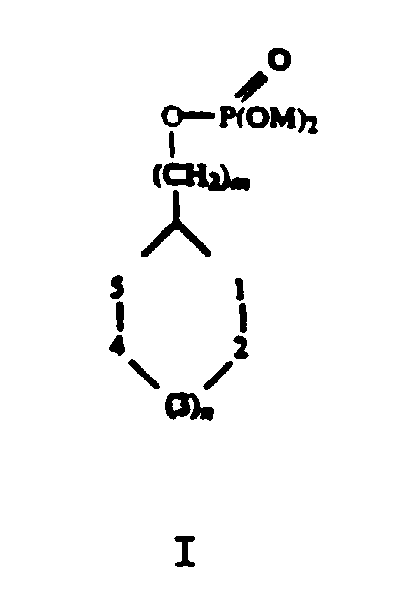
 M is H or a group I or II metal, 1 is any of the above or -O-and m and n are independently O or 1, to the fluid test sample.