EP1022306A1 - Rubber composition - Google Patents
Rubber composition Download PDFInfo
- Publication number
- EP1022306A1 EP1022306A1 EP00300423A EP00300423A EP1022306A1 EP 1022306 A1 EP1022306 A1 EP 1022306A1 EP 00300423 A EP00300423 A EP 00300423A EP 00300423 A EP00300423 A EP 00300423A EP 1022306 A1 EP1022306 A1 EP 1022306A1
- Authority
- EP
- European Patent Office
- Prior art keywords
- rubber
- weight
- ester compound
- acid
- alcohol
- Prior art date
- Legal status (The legal status is an assumption and is not a legal conclusion. Google has not performed a legal analysis and makes no representation as to the accuracy of the status listed.)
- Granted
Links
- 229920001971 elastomer Polymers 0.000 title claims abstract description 62
- 239000005060 rubber Substances 0.000 title claims abstract description 62
- 239000000203 mixture Substances 0.000 title claims abstract description 41
- -1 ester compound Chemical class 0.000 claims abstract description 73
- 235000014113 dietary fatty acids Nutrition 0.000 claims abstract description 56
- 239000000194 fatty acid Substances 0.000 claims abstract description 56
- 229930195729 fatty acid Natural products 0.000 claims abstract description 56
- 150000004665 fatty acids Chemical class 0.000 claims abstract description 55
- OYHQOLUKZRVURQ-IXWMQOLASA-N linoleic acid Natural products CCCCC\C=C/C\C=C\CCCCCCCC(O)=O OYHQOLUKZRVURQ-IXWMQOLASA-N 0.000 claims abstract description 36
- JBYXPOFIGCOSSB-GOJKSUSPSA-N 9-cis,11-trans-octadecadienoic acid Chemical compound CCCCCC\C=C\C=C/CCCCCCCC(O)=O JBYXPOFIGCOSSB-GOJKSUSPSA-N 0.000 claims abstract description 35
- 229940108924 conjugated linoleic acid Drugs 0.000 claims abstract description 35
- 150000001298 alcohols Chemical class 0.000 claims abstract description 20
- 238000006243 chemical reaction Methods 0.000 claims abstract description 17
- LFQSCWFLJHTTHZ-UHFFFAOYSA-N Ethanol Chemical compound CCO LFQSCWFLJHTTHZ-UHFFFAOYSA-N 0.000 claims description 22
- 229910000831 Steel Inorganic materials 0.000 abstract description 22
- 239000010959 steel Substances 0.000 abstract description 22
- 239000004636 vulcanized rubber Substances 0.000 abstract description 18
- 238000004073 vulcanization Methods 0.000 abstract description 15
- 230000002542 deteriorative effect Effects 0.000 abstract description 9
- YXFVVABEGXRONW-UHFFFAOYSA-N Toluene Chemical compound CC1=CC=CC=C1 YXFVVABEGXRONW-UHFFFAOYSA-N 0.000 description 42
- 235000019441 ethanol Nutrition 0.000 description 37
- 239000002253 acid Substances 0.000 description 36
- 239000004359 castor oil Substances 0.000 description 29
- 235000019438 castor oil Nutrition 0.000 description 29
- ZEMPKEQAKRGZGQ-XOQCFJPHSA-N glycerol triricinoleate Natural products CCCCCC[C@@H](O)CC=CCCCCCCCC(=O)OC[C@@H](COC(=O)CCCCCCCC=CC[C@@H](O)CCCCCC)OC(=O)CCCCCCCC=CC[C@H](O)CCCCCC ZEMPKEQAKRGZGQ-XOQCFJPHSA-N 0.000 description 29
- 230000000052 comparative effect Effects 0.000 description 17
- WERYXYBDKMZEQL-UHFFFAOYSA-N butane-1,4-diol Chemical compound OCCCCO WERYXYBDKMZEQL-UHFFFAOYSA-N 0.000 description 14
- YIWUKEYIRIRTPP-UHFFFAOYSA-N 2-ethylhexan-1-ol Chemical compound CCCCC(CC)CO YIWUKEYIRIRTPP-UHFFFAOYSA-N 0.000 description 13
- WVDDGKGOMKODPV-UHFFFAOYSA-N Benzyl alcohol Chemical compound OCC1=CC=CC=C1 WVDDGKGOMKODPV-UHFFFAOYSA-N 0.000 description 12
- OKKJLVBELUTLKV-UHFFFAOYSA-N Methanol Chemical compound OC OKKJLVBELUTLKV-UHFFFAOYSA-N 0.000 description 12
- MTHSVFCYNBDYFN-UHFFFAOYSA-N diethylene glycol Chemical compound OCCOCCO MTHSVFCYNBDYFN-UHFFFAOYSA-N 0.000 description 12
- 238000002156 mixing Methods 0.000 description 12
- WRIDQFICGBMAFQ-UHFFFAOYSA-N (E)-8-Octadecenoic acid Natural products CCCCCCCCCC=CCCCCCCC(O)=O WRIDQFICGBMAFQ-UHFFFAOYSA-N 0.000 description 10
- LQJBNNIYVWPHFW-UHFFFAOYSA-N 20:1omega9c fatty acid Natural products CCCCCCCCCCC=CCCCCCCCC(O)=O LQJBNNIYVWPHFW-UHFFFAOYSA-N 0.000 description 10
- QSBYPNXLFMSGKH-UHFFFAOYSA-N 9-Heptadecensaeure Natural products CCCCCCCC=CCCCCCCCC(O)=O QSBYPNXLFMSGKH-UHFFFAOYSA-N 0.000 description 10
- 239000005642 Oleic acid Substances 0.000 description 10
- ZQPPMHVWECSIRJ-UHFFFAOYSA-N Oleic acid Natural products CCCCCCCCC=CCCCCCCCC(O)=O ZQPPMHVWECSIRJ-UHFFFAOYSA-N 0.000 description 10
- 239000004927 clay Substances 0.000 description 10
- QXJSBBXBKPUZAA-UHFFFAOYSA-N isooleic acid Natural products CCCCCCCC=CCCCCCCCCC(O)=O QXJSBBXBKPUZAA-UHFFFAOYSA-N 0.000 description 10
- ZQPPMHVWECSIRJ-KTKRTIGZSA-N oleic acid Chemical compound CCCCCCCC\C=C/CCCCCCCC(O)=O ZQPPMHVWECSIRJ-KTKRTIGZSA-N 0.000 description 10
- XLYOFNOQVPJJNP-UHFFFAOYSA-N water Substances O XLYOFNOQVPJJNP-UHFFFAOYSA-N 0.000 description 10
- 244000043261 Hevea brasiliensis Species 0.000 description 8
- 229920003052 natural elastomer Polymers 0.000 description 8
- 229920001194 natural rubber Polymers 0.000 description 8
- 239000012744 reinforcing agent Substances 0.000 description 8
- 230000001070 adhesive effect Effects 0.000 description 7
- 150000002148 esters Chemical class 0.000 description 7
- 238000000034 method Methods 0.000 description 7
- 239000003054 catalyst Substances 0.000 description 6
- 239000012295 chemical reaction liquid Substances 0.000 description 6
- 238000001816 cooling Methods 0.000 description 6
- AXZWODMDQAVCJE-UHFFFAOYSA-L tin(II) chloride (anhydrous) Chemical compound [Cl-].[Cl-].[Sn+2] AXZWODMDQAVCJE-UHFFFAOYSA-L 0.000 description 6
- LYCAIKOWRPUZTN-UHFFFAOYSA-N Ethylene glycol Chemical compound OCCO LYCAIKOWRPUZTN-UHFFFAOYSA-N 0.000 description 5
- 239000006057 Non-nutritive feed additive Substances 0.000 description 5
- 230000008569 process Effects 0.000 description 5
- JOXIMZWYDAKGHI-UHFFFAOYSA-N toluene-4-sulfonic acid Chemical compound CC1=CC=C(S(O)(=O)=O)C=C1 JOXIMZWYDAKGHI-UHFFFAOYSA-N 0.000 description 5
- ZJCCRDAZUWHFQH-UHFFFAOYSA-N Trimethylolpropane Chemical compound CCC(CO)(CO)CO ZJCCRDAZUWHFQH-UHFFFAOYSA-N 0.000 description 4
- 235000019445 benzyl alcohol Nutrition 0.000 description 4
- 238000011156 evaluation Methods 0.000 description 4
- 239000004615 ingredient Substances 0.000 description 4
- 230000000704 physical effect Effects 0.000 description 4
- 229920002857 polybutadiene Polymers 0.000 description 4
- 238000010058 rubber compounding Methods 0.000 description 4
- 238000012360 testing method Methods 0.000 description 4
- KFZMGEQAYNKOFK-UHFFFAOYSA-N Isopropanol Chemical compound CC(C)O KFZMGEQAYNKOFK-UHFFFAOYSA-N 0.000 description 3
- DNIAPMSPPWPWGF-UHFFFAOYSA-N Propylene glycol Chemical compound CC(O)CO DNIAPMSPPWPWGF-UHFFFAOYSA-N 0.000 description 3
- NINIDFKCEFEMDL-UHFFFAOYSA-N Sulfur Chemical compound [S] NINIDFKCEFEMDL-UHFFFAOYSA-N 0.000 description 3
- 239000000853 adhesive Substances 0.000 description 3
- 230000000740 bleeding effect Effects 0.000 description 3
- 239000003795 chemical substances by application Substances 0.000 description 3
- 230000000694 effects Effects 0.000 description 3
- XPFVYQJUAUNWIW-UHFFFAOYSA-N furfuryl alcohol Chemical compound OCC1=CC=CO1 XPFVYQJUAUNWIW-UHFFFAOYSA-N 0.000 description 3
- WVDDGKGOMKODPV-ZQBYOMGUSA-N phenyl(114C)methanol Chemical compound O[14CH2]C1=CC=CC=C1 WVDDGKGOMKODPV-ZQBYOMGUSA-N 0.000 description 3
- 229920000642 polymer Polymers 0.000 description 3
- 150000005846 sugar alcohols Polymers 0.000 description 3
- 229910052717 sulfur Inorganic materials 0.000 description 3
- 239000011593 sulfur Substances 0.000 description 3
- WNWHHMBRJJOGFJ-UHFFFAOYSA-N 16-methylheptadecan-1-ol Chemical compound CC(C)CCCCCCCCCCCCCCCO WNWHHMBRJJOGFJ-UHFFFAOYSA-N 0.000 description 2
- SVTBMSDMJJWYQN-UHFFFAOYSA-N 2-methylpentane-2,4-diol Chemical compound CC(O)CC(C)(C)O SVTBMSDMJJWYQN-UHFFFAOYSA-N 0.000 description 2
- LRHPLDYGYMQRHN-UHFFFAOYSA-N N-Butanol Chemical compound CCCCO LRHPLDYGYMQRHN-UHFFFAOYSA-N 0.000 description 2
- VYPSYNLAJGMNEJ-UHFFFAOYSA-N Silicium dioxide Chemical compound O=[Si]=O VYPSYNLAJGMNEJ-UHFFFAOYSA-N 0.000 description 2
- DKGAVHZHDRPRBM-UHFFFAOYSA-N Tert-Butanol Chemical compound CC(C)(C)O DKGAVHZHDRPRBM-UHFFFAOYSA-N 0.000 description 2
- 150000007513 acids Chemical class 0.000 description 2
- 239000011324 bead Substances 0.000 description 2
- 230000015572 biosynthetic process Effects 0.000 description 2
- 238000006297 dehydration reaction Methods 0.000 description 2
- 230000032050 esterification Effects 0.000 description 2
- 238000005886 esterification reaction Methods 0.000 description 2
- 238000005755 formation reaction Methods 0.000 description 2
- PHTQWCKDNZKARW-UHFFFAOYSA-N isoamylol Chemical compound CC(C)CCO PHTQWCKDNZKARW-UHFFFAOYSA-N 0.000 description 2
- ZXEKIIBDNHEJCQ-UHFFFAOYSA-N isobutanol Chemical compound CC(C)CO ZXEKIIBDNHEJCQ-UHFFFAOYSA-N 0.000 description 2
- 229920003049 isoprene rubber Polymers 0.000 description 2
- IUJLOAKJZQBENM-UHFFFAOYSA-N n-(1,3-benzothiazol-2-ylsulfanyl)-2-methylpropan-2-amine Chemical compound C1=CC=C2SC(SNC(C)(C)C)=NC2=C1 IUJLOAKJZQBENM-UHFFFAOYSA-N 0.000 description 2
- CMAUJSNXENPPOF-UHFFFAOYSA-N n-(1,3-benzothiazol-2-ylsulfanyl)-n-cyclohexylcyclohexanamine Chemical compound C1CCCCC1N(C1CCCCC1)SC1=NC2=CC=CC=C2S1 CMAUJSNXENPPOF-UHFFFAOYSA-N 0.000 description 2
- 150000007524 organic acids Chemical class 0.000 description 2
- 239000010734 process oil Substances 0.000 description 2
- 238000012545 processing Methods 0.000 description 2
- 239000002994 raw material Substances 0.000 description 2
- 230000009257 reactivity Effects 0.000 description 2
- 230000009467 reduction Effects 0.000 description 2
- PUPZLCDOIYMWBV-UHFFFAOYSA-N (+/-)-1,3-Butanediol Chemical compound CC(O)CCO PUPZLCDOIYMWBV-UHFFFAOYSA-N 0.000 description 1
- ALSTYHKOOCGGFT-KTKRTIGZSA-N (9Z)-octadecen-1-ol Chemical compound CCCCCCCC\C=C/CCCCCCCCO ALSTYHKOOCGGFT-KTKRTIGZSA-N 0.000 description 1
- DNIAPMSPPWPWGF-GSVOUGTGSA-N (R)-(-)-Propylene glycol Chemical compound C[C@@H](O)CO DNIAPMSPPWPWGF-GSVOUGTGSA-N 0.000 description 1
- KBPLFHHGFOOTCA-UHFFFAOYSA-N 1-Octanol Chemical compound CCCCCCCCO KBPLFHHGFOOTCA-UHFFFAOYSA-N 0.000 description 1
- ZZMVLMVFYMGSMY-UHFFFAOYSA-N 4-n-(4-methylpentan-2-yl)-1-n-phenylbenzene-1,4-diamine Chemical compound C1=CC(NC(C)CC(C)C)=CC=C1NC1=CC=CC=C1 ZZMVLMVFYMGSMY-UHFFFAOYSA-N 0.000 description 1
- 229940126062 Compound A Drugs 0.000 description 1
- NLDMNSXOCDLTTB-UHFFFAOYSA-N Heterophylliin A Natural products O1C2COC(=O)C3=CC(O)=C(O)C(O)=C3C3=C(O)C(O)=C(O)C=C3C(=O)OC2C(OC(=O)C=2C=C(O)C(O)=C(O)C=2)C(O)C1OC(=O)C1=CC(O)=C(O)C(O)=C1 NLDMNSXOCDLTTB-UHFFFAOYSA-N 0.000 description 1
- 239000006237 Intermediate SAF Substances 0.000 description 1
- OYHQOLUKZRVURQ-HZJYTTRNSA-N Linoleic acid Chemical compound CCCCC\C=C/C\C=C/CCCCCCCC(O)=O OYHQOLUKZRVURQ-HZJYTTRNSA-N 0.000 description 1
- AMQJEAYHLZJPGS-UHFFFAOYSA-N N-Pentanol Chemical compound CCCCCO AMQJEAYHLZJPGS-UHFFFAOYSA-N 0.000 description 1
- 239000005062 Polybutadiene Substances 0.000 description 1
- 235000019485 Safflower oil Nutrition 0.000 description 1
- ACIAHEMYLLBZOI-ZZXKWVIFSA-N Unsaturated alcohol Chemical compound CC\C(CO)=C/C ACIAHEMYLLBZOI-ZZXKWVIFSA-N 0.000 description 1
- OCKWAZCWKSMKNC-UHFFFAOYSA-N [3-octadecanoyloxy-2,2-bis(octadecanoyloxymethyl)propyl] octadecanoate Chemical compound CCCCCCCCCCCCCCCCCC(=O)OCC(COC(=O)CCCCCCCCCCCCCCCCC)(COC(=O)CCCCCCCCCCCCCCCCC)COC(=O)CCCCCCCCCCCCCCCCC OCKWAZCWKSMKNC-UHFFFAOYSA-N 0.000 description 1
- 230000032683 aging Effects 0.000 description 1
- WNROFYMDJYEPJX-UHFFFAOYSA-K aluminium hydroxide Chemical compound [OH-].[OH-].[OH-].[Al+3] WNROFYMDJYEPJX-UHFFFAOYSA-K 0.000 description 1
- 239000003963 antioxidant agent Substances 0.000 description 1
- 230000003078 antioxidant effect Effects 0.000 description 1
- OGBUMNBNEWYMNJ-UHFFFAOYSA-N batilol Chemical class CCCCCCCCCCCCCCCCCCOCC(O)CO OGBUMNBNEWYMNJ-UHFFFAOYSA-N 0.000 description 1
- 239000006229 carbon black Substances 0.000 description 1
- 150000001868 cobalt Chemical class 0.000 description 1
- 150000001875 compounds Chemical class 0.000 description 1
- 230000021615 conjugation Effects 0.000 description 1
- 238000007796 conventional method Methods 0.000 description 1
- 238000000354 decomposition reaction Methods 0.000 description 1
- 150000001993 dienes Chemical class 0.000 description 1
- 150000005690 diesters Chemical class 0.000 description 1
- LQZZUXJYWNFBMV-UHFFFAOYSA-N dodecan-1-ol Chemical compound CCCCCCCCCCCCO LQZZUXJYWNFBMV-UHFFFAOYSA-N 0.000 description 1
- 230000003028 elevating effect Effects 0.000 description 1
- 125000004185 ester group Chemical group 0.000 description 1
- 235000019197 fats Nutrition 0.000 description 1
- 239000000945 filler Substances 0.000 description 1
- 229940051250 hexylene glycol Drugs 0.000 description 1
- WGCNASOHLSPBMP-UHFFFAOYSA-N hydroxyacetaldehyde Natural products OCC=O WGCNASOHLSPBMP-UHFFFAOYSA-N 0.000 description 1
- 230000006872 improvement Effects 0.000 description 1
- 229910017053 inorganic salt Inorganic materials 0.000 description 1
- 230000003993 interaction Effects 0.000 description 1
- 238000011835 investigation Methods 0.000 description 1
- 229940035429 isobutyl alcohol Drugs 0.000 description 1
- 238000006317 isomerization reaction Methods 0.000 description 1
- 238000004898 kneading Methods 0.000 description 1
- 235000020778 linoleic acid Nutrition 0.000 description 1
- 238000004519 manufacturing process Methods 0.000 description 1
- 238000002844 melting Methods 0.000 description 1
- 230000008018 melting Effects 0.000 description 1
- 229910052751 metal Chemical class 0.000 description 1
- 239000002184 metal Chemical class 0.000 description 1
- CRVGTESFCCXCTH-UHFFFAOYSA-N methyl diethanolamine Chemical compound OCCN(C)CCO CRVGTESFCCXCTH-UHFFFAOYSA-N 0.000 description 1
- 230000004048 modification Effects 0.000 description 1
- 238000012986 modification Methods 0.000 description 1
- SLCVBVWXLSEKPL-UHFFFAOYSA-N neopentyl glycol Chemical compound OCC(C)(C)CO SLCVBVWXLSEKPL-UHFFFAOYSA-N 0.000 description 1
- 239000003921 oil Substances 0.000 description 1
- 235000019198 oils Nutrition 0.000 description 1
- 229940055577 oleyl alcohol Drugs 0.000 description 1
- XMLQWXUVTXCDDL-UHFFFAOYSA-N oleyl alcohol Natural products CCCCCCC=CCCCCCCCCCCO XMLQWXUVTXCDDL-UHFFFAOYSA-N 0.000 description 1
- 239000012188 paraffin wax Substances 0.000 description 1
- 238000010992 reflux Methods 0.000 description 1
- 235000019384 rice bran wax Nutrition 0.000 description 1
- 239000004170 rice bran wax Substances 0.000 description 1
- 239000003813 safflower oil Substances 0.000 description 1
- 235000005713 safflower oil Nutrition 0.000 description 1
- 150000003839 salts Chemical class 0.000 description 1
- 238000007127 saponification reaction Methods 0.000 description 1
- 229920006395 saturated elastomer Polymers 0.000 description 1
- 239000000377 silicon dioxide Substances 0.000 description 1
- 229920003048 styrene butadiene rubber Polymers 0.000 description 1
- 239000000126 substance Substances 0.000 description 1
- 238000009864 tensile test Methods 0.000 description 1
- 235000007586 terpenes Nutrition 0.000 description 1
- 150000005691 triesters Chemical class 0.000 description 1
- 238000002211 ultraviolet spectrum Methods 0.000 description 1
- 235000021122 unsaturated fatty acids Nutrition 0.000 description 1
- 150000004670 unsaturated fatty acids Chemical class 0.000 description 1
Classifications
-
- C—CHEMISTRY; METALLURGY
- C08—ORGANIC MACROMOLECULAR COMPOUNDS; THEIR PREPARATION OR CHEMICAL WORKING-UP; COMPOSITIONS BASED THEREON
- C08K—Use of inorganic or non-macromolecular organic substances as compounding ingredients
- C08K5/00—Use of organic ingredients
- C08K5/04—Oxygen-containing compounds
- C08K5/10—Esters; Ether-esters
-
- C—CHEMISTRY; METALLURGY
- C08—ORGANIC MACROMOLECULAR COMPOUNDS; THEIR PREPARATION OR CHEMICAL WORKING-UP; COMPOSITIONS BASED THEREON
- C08K—Use of inorganic or non-macromolecular organic substances as compounding ingredients
- C08K5/00—Use of organic ingredients
- C08K5/04—Oxygen-containing compounds
- C08K5/10—Esters; Ether-esters
- C08K5/101—Esters; Ether-esters of monocarboxylic acids
- C08K5/103—Esters; Ether-esters of monocarboxylic acids with polyalcohols
Definitions
- the present invention relates to a rubber composition which contains a fatty acid ester and is improved in processability without deteriorating mechanical properties after vulcanization. Further, the present invention relates to a rubber composition which is excellent in adhesion between vulcanized rubber and steel and the like without deteriorating mechanical properties after vulcanization and which has good processability.
- a rubber composition for a tire is notably deteriorated in processability of unvulcanized rubber in compensation for satisfying desirable performances as a tire over a wide range.
- processing aids are various esters, for example, pentaerythritol tetrastearate (Japanese Patent Application Laid-Open No. Hei 1-115943), monoglycerides, rice bran wax and paraffin wax. While they can be expected to improve the processability, they have a problem of blooming or bleeding in vulcanized rubber.
- esters for example, pentaerythritol tetrastearate (Japanese Patent Application Laid-Open No. Hei 1-115943), monoglycerides, rice bran wax and paraffin wax. While they can be expected to improve the processability, they have a problem of blooming or bleeding in vulcanized rubber.
- Esters of a polymer acid or an alkenylsuccinic acid with a higher alcohol or a polyhydric alcohol are disclosed in Japanese Patent Application Laid-Open No. Sho 62-72733 as an ester base processing aid which solves these problems, but they reduce the mechanical properties after vulcanization and have a problem of durability in adhesion between steel and vulcanized rubber.
- a processing aid which is a mixture of a diester of aliphatic alcohol having a melting point of 10°C or lower with an organic acid, and a fatty acid is disclosed in Japanese Patent Application Laid-Open No. Sho 57-168998, but this reduces as well the mechanical properties after vulcanization and has a problem of durability in adhesion between steel and vulcanized rubber. Further, found are no descriptions on the effect of adding respective components contained in the processing aids in the form of a simple substance to a rubber composition.
- esters of an unsaturated fatty acid with a saturated or unsaturated alcohol or glycol are disclosed in Japanese Patent Application Laid-Open No. Sho 59-122532 as an agent to improve resistance to low temperature of a rubber composition.
- This agent can improve flexibility of the rubber composition but the rubber composition containing the agent has a problem that it is inferior in a low heat-generating property, strength and an adhesion property to a steel cord.
- the present invention is intended solving them, and an object thereof is to provide a rubber composition which is excellent in processability in the unvulcanized state and has an excellent low heat-generating property without deteriorating mechanical properties after vulcanization and which is excellent in adhesion between steel and vulcanized rubber.
- the rubber composition of the present invention which has good processability comprises the following items (1) to (3):
- the rubber composition of the present invention is characterized by containing, per 100 parts by weight of a vulcanizable rubber component, 0.2 to 20 parts by weight of an ester compound obtained by a reaction of an alcohol with a fatty acid having a conjugated linoleic acid content of 40 % by weight or more.
- the rubber component used in the present invention shall not specifically be restricted as long as it is vulcanizable rubber and, for example, natural rubber (NR), styrene-butadiene rubber (SBR), polybutadiene rubber (BR) and isoprene rubber (IR) can be used alone or in combination of two or more kinds thereof.
- natural rubber NR
- SBR styrene-butadiene rubber
- BR polybutadiene rubber
- IR isoprene rubber
- the ester compound used in the present invention is obtained by esterification of a fatty acid having a conjugated linoleic acid content of 40 % by weight or more with an alcohol.
- the esterification can be carried out by a dehydration reaction of a fatty acid with an alcohol.
- the fatty acid having a conjugated linoleic acid content of 40 % by weight or more, which is the raw material, can be obtained primarily by the following processes (1) to (3):
- the fatty acid having a conjugated linoleic acid content of 40 % by weight or more can be obtained by the processes (1) to (3) described above, but the process for obtaining the fatty acid shall not be restricted to these processes.
- any fatty acids can be used without specific restrictions as long as they are fatty acids having a conjugated linoleic acid content of 40 % by weight or more, but fatty acids having a conjugated linoleic acid content of 45 % by weight or more are preferred from a viewpoint of elevating reactivity with a polymer via sulfur.
- the fatty acids having a conjugated linoleic acid content of less than 40 % by weight reduce the reactivity described above, which in turn leads to bleeding and a reduction in the physical properties of vulcanized rubber, and therefore they are not preferred.
- the alcohols which can be used in the present invention include monohydric alcohols, dihydric alcohols and polyhydric alcohols of trihydric or higher alcohols. In order to obtain the ester compounds having a low viscosity, monohydric alcohols or dihydric alcohols or mixtures thereof are suited.
- monohydric alcohols or dihydric alcohols or mixtures thereof account for 60 % by weight or more of the alcohols used.
- Polyhydric alcohols of trihydric or higher alcohols can be used in combination within a range where the resulting ester compound has a viscosity which does not exceed 140mPa ⁇ s at 25°C.
- the monohydric alcohol for example, methyl alcohol, ethyl alcohol, isopropyl alcohol, butyl alcohol, isobutyl alcohol, t-butyl alcohol, amyl alcohol, isoamyl alcohol, octyl alcohol, lauryl alcohol, benzyl alcohol, 2-ethylhexyl alcohol, oleyl alcohol, isostearyl alcohol, furfuryl alcohol and terpene alcohols.
- dihydric alcohol for example, ethylene glycol, propylene glycol, butylene glycol, hexylene glycol, diethylene glycol, neopentyl glycol and N-methyldiethanolamine.
- trimethylolpropane can be used as the trihydric alcohol.
- the viscosity of the ester compound comprising the fatty acid having a conjugated linoleic acid content of 40 % by weight or more and an alcohol in the present invention varys depending on the kinds of the fatty acid and the alcohol used, and it should be low [5 to 200 mPa ⁇ s at 25°C] preferably 140 mPa ⁇ s or less at 25°C, more preferably 5 to 100 mPa ⁇ s at 25°C from a viewpoint of a reduction in the viscosity of unvulcanized rubber after blended with the ester compound.
- the blending amount of the ester compound is 0.2 to 20 parts by weight, preferably 0.5 to 5 parts by weight per 100 parts by weight of the vulcanizable rubber component described above.
- the blending amount is less than 0.2 part by weight, improvement in the processability is less likely to be expected. On the other hand, if it exceeds 20 parts by weight, the physical properties of the rubber tend to be reduced, and it is not preferred from a viewpoint of the cost.
- the rubber composition of the present invention is preferably compounded with a reinforcing agent.
- the reinforcing agent shall not specifically be restricted, and those which are generally used for rubber can be applied. Included are, for example, carbon black such as HAF, ISAF and SAF, or white fillers such as silica and aluminum hydroxide.
- the rubber composition of the present invention can suitably be blended, if necessary, with other rubber compounding ingredients which are generally used in the rubber industry, for example, sulfur, a vulcanization accelerator, a process oil and an antioxidant.
- other rubber compounding ingredients which are generally used in the rubber industry, for example, sulfur, a vulcanization accelerator, a process oil and an antioxidant.
- the blending amounts of the reinforcing agents and the rubber compounding ingredients described above shall suitably be determined respectively within the ranges where the effects of the present invention are not damaged.
- the ester compound in the present invention can reduce the viscosity of the rubber composition and elevate the fluidity thereof by blending with the other raw materials (the rubber component, the reinforcing agent, the rubber compounding ingredients and the like). Further, it has a hydrophilic group (ester group) and a lipophilic group (fatty acid) in a molecule, so that the hydrophilic group adsorbs on the surface of the reinforcing agent and the lipophilic group is compatible with rubber, whereby interaction between the reinforcing agent and the rubber in the unvalcanized state is reduced. As a result, the rubber composition is improved in processability and the reinforcing agent can be dispersed well.
- ester compound of the present invention can react with the polymer via sulfur during vulcanization, so that the mechanical properties of vulcanized rubber are not deteriorated, and blooming or bleeding are less liable to take place.
- the rubber composition of the present invention is obtained by kneading the rubber component, the ester compound, the reinforcing agent and the rubber compounding ingredients each described above by means of a mixer such as a roll, a kneader and a banbury mixer, then mold-processed, and vulcanized. It can be used for tire use such as a tire tread, a carcass, a belt, a side wall and a bead part, rubber for a conveyor belt, and other various industrial rubbers.
- a mixer such as a roll, a kneader and a banbury mixer
- the rubber composition of the present invention is, as described above, markedly excellent in processability in the unvulcanized state and has an excellent low heat-generating property without deteriorating the mechanical properties after vulcanization. Further, it is excellent as well in adhesion between steel and vulcanized rubber, and therefore it is suitably used for tire use such as a carcass, a belt, a bead part and the like.
- an adhesive such as a cobalt salt of an organic acid or an inorganic salt hydrate in an amount of, for example, 0.7 to 1.0 part by weight.
- Rubber compositions were prepared in the respective blending formations using ester compounds A to K obtained by reacting fatty acids having various conjugated linoleic acid contents with various alcohols shown in the following Table 1, and natural rubber and polybutadiene rubber as vulcanizable rubber components.
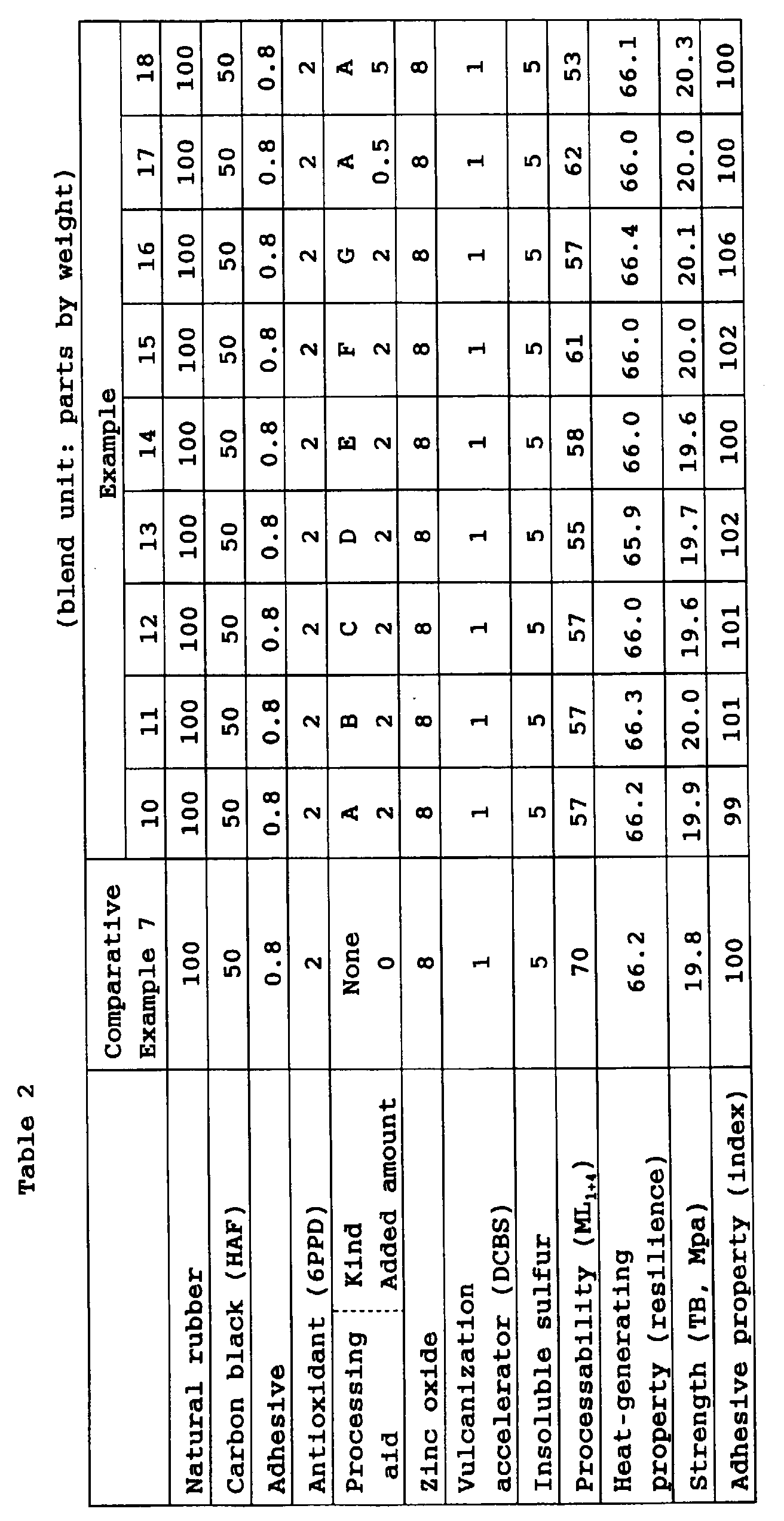
- Rubber compositions were prepared in the respective blending formations shown in the following Table 2 using ester compounds A to K obtained by reacting fatty acids having various conjugated linoleic acid contents with various alcohols, and natural rubber as a vulcanizable rubber component.
- the conjugated linoleic acid contents of the various fatty acids used for ester compounds A to K described above and the viscosities of the esters were measured by a UV spectrum method and a Brookfield type rotary viscometer, respectively.
- Ester compounds A to K were obtained by production methods described below. Hereinafter, “conjugated linoleic acid content” is referred to simply as “conjugated acid rate”.
- the rubber compositions obtained in Examples 1 to 18 and comparative Examples 1 to 12 were evaluated for physical properties of the unvulcanized state in terms of a Mooney viscosity, and the vulcanized state in terms of a heat-generating property (resilience) and tensile strength (T B ).
- the adhesive property between a steel cord and vulcanized rubber was evaluated by an index which was derived from a peel-off strength obtained by a steel cord ⁇ peel off test.
- the Mooney viscosity, the heat-generating property (resilience), the tensile strength (T B ) and the steel cord ⁇ peel off test were evaluated by the following standards, respectively. Vulcanization was carried out at 145°C for 30 minutes.
- the Mooney viscosity (ML 1+4 , 130°C) was determined according to JIS K6300-1994. It is shown that the lower the value, the better the processability in the unvulcanized state.
- the resilience was determined at room temperature (25°C) according to the rebound resilience test prescribed in JIS K6301-1995. It is shown that the higher the value is, the better the low heat-generating property is.
- the tensile strength was determined at room temperature (25°C) according to the tensile test prescribed in JIS K6301-1995. It is shown that the higher the value is, the better the tensile strength is.
- a peel-off strength (peeling strength) between a steel cord and vulcanized rubber was determined by peeling off the steel cord after embedding the steel cord in the unvulcanized rubber composition to vulcanize at 145°C for 45 minutes, and then aging it in a constant temperature bath of 100°C for 7 days.
- Examples 1 to 9 are cases where the ester compounds obtained by a reaction of various fatty acids having a conjugated linoleic acid content of 40 % by weight or more with various alcohols are blended in the blending amounts falling in the scope of the present invention respectively with 100 parts by weight of the rubber component comprising natural rubber and polybutadiene rubber.
- the blending amount of the ester compound is set to 5 parts by weight, and this is a case where the amount is increased by 2.5 times based on that of Example 1 and by 10 times based on that of Example 8. It can be found that also in this case, the processability is further improved without deteriorating the mechanical property and the low heat-generating property after vulcanization. It has been confirmed that the rubber compositions prepared in Examples 1 to 9 can suitably be used for tread rubber of a tire.
- Examples 10 to 18 are cases where the ester compounds obtained by a reaction of various fatty acids having a conjugated linoleic acid content of 40 % by weight or more with various alcohols are blended in the blending amounts falling in the scope of the present invention respectively with 100 parts by weight of the rubber component comprising natural rubber and where an adhesive (Manobond C22.5 manufactured by Rhone Poulenc Co., Ltd.) is further blended.
- the blending amount of the ester compound is set to 5 parts by weight, and this is a case where the amount is increased by 2.5 times based on that of Example 10 and by 10 times based on that of Example 17. It can be found that also in this case, the processability is further improved without deteriorating the mechanical property and the low heat-generating property after vulcanization and the adhesion between steel and vulcanized rubber.
- compositions are blended based on 100 parts by weight of the rubber component comprising natural rubber and polybutadiene rubber in Comparative Examples 1 to 6 and based on 100 parts by weight of the rubber component comprising natural rubber in Comparative Examples 7 to 12.
Landscapes
- Chemical & Material Sciences (AREA)
- Health & Medical Sciences (AREA)
- Chemical Kinetics & Catalysis (AREA)
- Medicinal Chemistry (AREA)
- Polymers & Plastics (AREA)
- Organic Chemistry (AREA)
- Compositions Of Macromolecular Compounds (AREA)
- Organic Low-Molecular-Weight Compounds And Preparation Thereof (AREA)
- Tires In General (AREA)
Abstract
Description
- The present invention relates to a rubber composition which contains a fatty acid ester and is improved in processability without deteriorating mechanical properties after vulcanization. Further, the present invention relates to a rubber composition which is excellent in adhesion between vulcanized rubber and steel and the like without deteriorating mechanical properties after vulcanization and which has good processability.
- In recent years, a rubber composition for a tire is notably deteriorated in processability of unvulcanized rubber in compensation for satisfying desirable performances as a tire over a wide range.
- In general, it is known that a process oil is blended into rubber for the purpose of providing diene base rubber with plasticity to improve processability.
- However, involved in this method is a problem that while unvulcanized rubber can be improved in processability, vulcanized rubber is reduced in mechanical properties and the like.
- On the other hand, known are rubber compositions containing fatty acids and various metal salts of fatty acids as processing aids (Japanese Patent Application Laid-Open No. Sho 62-64842 and Japanese Patent Application Laid-Open No. Sho 59-113044, etc.). They can be expected to improve the processability but have problems in that the mechanical properties after vulcanization are reduced in terms of the use of tires and that durability in adhesion between a steel cord and vulcanized rubber is deteriorated so that they can not be used for the circumference of a steel cord and are restricted in use.
- Further, used as processing aids are various esters, for example, pentaerythritol tetrastearate (Japanese Patent Application Laid-Open No. Hei 1-115943), monoglycerides, rice bran wax and paraffin wax. While they can be expected to improve the processability, they have a problem of blooming or bleeding in vulcanized rubber.
- Esters of a polymer acid or an alkenylsuccinic acid with a higher alcohol or a polyhydric alcohol are disclosed in Japanese Patent Application Laid-Open No. Sho 62-72733 as an ester base processing aid which solves these problems, but they reduce the mechanical properties after vulcanization and have a problem of durability in adhesion between steel and vulcanized rubber.
- Further, a processing aid which is a mixture of a diester of aliphatic alcohol having a melting point of 10°C or lower with an organic acid, and a fatty acid is disclosed in Japanese Patent Application Laid-Open No. Sho 57-168998, but this reduces as well the mechanical properties after vulcanization and has a problem of durability in adhesion between steel and vulcanized rubber. Further, found are no descriptions on the effect of adding respective components contained in the processing aids in the form of a simple substance to a rubber composition.
- Further, esters of an unsaturated fatty acid with a saturated or unsaturated alcohol or glycol are disclosed in Japanese Patent Application Laid-Open No. Sho 59-122532 as an agent to improve resistance to low temperature of a rubber composition. This agent can improve flexibility of the rubber composition but the rubber composition containing the agent has a problem that it is inferior in a low heat-generating property, strength and an adhesion property to a steel cord.
- As described above, the existing situation is that respective conventional rubber compositions which are improved in processability have the problems that the physical properties such as mechanical properties and a low heat-generating property are largely reduced and the adhesion between steel and vulcanized rubber is deteriorated, and a rubber composition which is improved in these problems and has good processability is desired.
- In light of the problems on the conventional techniques described above and the existing situation, the present invention is intended solving them, and an object thereof is to provide a rubber composition which is excellent in processability in the unvulcanized state and has an excellent low heat-generating property without deteriorating mechanical properties after vulcanization and which is excellent in adhesion between steel and vulcanized rubber.
- Intensive investigations of the problems described above continued by the present inventors have resulted in finding that a rubber composition which is blended with a specific ester compound is notably excellent in processability in the unvulcanized state and has an excellent low heat-generating property without deteriorating mechanical properties after vulcanization and that it is excellent as well in adhesion between steel and vulcanized rubber, and thus the present invention has been completed.
- That is, the rubber composition of the present invention which has good processability comprises the following items (1) to (3):
- (1) A rubber composition characterized by comprising, per 100 parts by weight of a vulcanizable rubber component, 0.2 to 20 parts by weight of an ester compound obtained by a reaction of an alcohol with a fatty acid having a conjugated linoleic acid content of 40 % by weight or more.
- (2) The rubber composition as described in the above item (1), wherein the alcohol contains 60 % by weight or more of monohydric alcohol and/or dihydric alcohol.
- (3) The rubber composition as described in the above item (1) or (2), wherein the ester compound has a viscosity of 140 mPa·s or less at 25°C.
-
- The embodiments of the present invention shall be explained below in detail.
- The rubber composition of the present invention is characterized by containing, per 100 parts by weight of a vulcanizable rubber component, 0.2 to 20 parts by weight of an ester compound obtained by a reaction of an alcohol with a fatty acid having a conjugated linoleic acid content of 40 % by weight or more.
- The rubber component used in the present invention shall not specifically be restricted as long as it is vulcanizable rubber and, for example, natural rubber (NR), styrene-butadiene rubber (SBR), polybutadiene rubber (BR) and isoprene rubber (IR) can be used alone or in combination of two or more kinds thereof.
- The ester compound used in the present invention is obtained by esterification of a fatty acid having a conjugated linoleic acid content of 40 % by weight or more with an alcohol.
- The esterification can be carried out by a dehydration reaction of a fatty acid with an alcohol.
- The fatty acid having a conjugated linoleic acid content of 40 % by weight or more, which is the raw material, can be obtained primarily by the following processes (1) to (3):
- (1) A process for producing dehydrated castor oil fatty acid by a dehydration reaction of castor oil fatty acid.
- (2) Modification to dehydrated castor oil fatty acid by a saponification decomposition of dehydrated castor oil.
- (3) Conjugation isomerization of a fat and oil having a high linoleic acid content such as safflower oil or the fatty acid thereof.
-
- The fatty acid having a conjugated linoleic acid content of 40 % by weight or more can be obtained by the processes (1) to (3) described above, but the process for obtaining the fatty acid shall not be restricted to these processes.
- In the present invention, any fatty acids can be used without specific restrictions as long as they are fatty acids having a conjugated linoleic acid content of 40 % by weight or more, but fatty acids having a conjugated linoleic acid content of 45 % by weight or more are preferred from a viewpoint of elevating reactivity with a polymer via sulfur.
- The fatty acids having a conjugated linoleic acid content of less than 40 % by weight reduce the reactivity described above, which in turn leads to bleeding and a reduction in the physical properties of vulcanized rubber, and therefore they are not preferred.
- The alcohols which can be used in the present invention include monohydric alcohols, dihydric alcohols and polyhydric alcohols of trihydric or higher alcohols. In order to obtain the ester compounds having a low viscosity, monohydric alcohols or dihydric alcohols or mixtures thereof are suited.
- Particularly preferably, monohydric alcohols or dihydric alcohols or mixtures thereof account for 60 % by weight or more of the alcohols used.
- Polyhydric alcohols of trihydric or higher alcohols can be used in combination within a range where the resulting ester compound has a viscosity which does not exceed 140mPa·s at 25°C.
- There can be used as the monohydric alcohol, for example, methyl alcohol, ethyl alcohol, isopropyl alcohol, butyl alcohol, isobutyl alcohol, t-butyl alcohol, amyl alcohol, isoamyl alcohol, octyl alcohol, lauryl alcohol, benzyl alcohol, 2-ethylhexyl alcohol, oleyl alcohol, isostearyl alcohol, furfuryl alcohol and terpene alcohols.
- There can be used as the dihydric alcohol, for example, ethylene glycol, propylene glycol, butylene glycol, hexylene glycol, diethylene glycol, neopentyl glycol and N-methyldiethanolamine.
- For example, trimethylolpropane can be used as the trihydric alcohol.
- The viscosity of the ester compound comprising the fatty acid having a conjugated linoleic acid content of 40 % by weight or more and an alcohol in the present invention varys depending on the kinds of the fatty acid and the alcohol used, and it should be low [5 to 200 mPa·s at 25°C] preferably 140 mPa·s or less at 25°C, more preferably 5 to 100 mPa·s at 25°C from a viewpoint of a reduction in the viscosity of unvulcanized rubber after blended with the ester compound.
- The blending amount of the ester compound is 0.2 to 20 parts by weight, preferably 0.5 to 5 parts by weight per 100 parts by weight of the vulcanizable rubber component described above.
- If the blending amount is less than 0.2 part by weight, improvement in the processability is less likely to be expected. On the other hand, if it exceeds 20 parts by weight, the physical properties of the rubber tend to be reduced, and it is not preferred from a viewpoint of the cost.
- Further, the rubber composition of the present invention is preferably compounded with a reinforcing agent. The reinforcing agent shall not specifically be restricted, and those which are generally used for rubber can be applied. Included are, for example, carbon black such as HAF, ISAF and SAF, or white fillers such as silica and aluminum hydroxide.
- Further, the rubber composition of the present invention can suitably be blended, if necessary, with other rubber compounding ingredients which are generally used in the rubber industry, for example, sulfur, a vulcanization accelerator, a process oil and an antioxidant.
- The blending amounts of the reinforcing agents and the rubber compounding ingredients described above shall suitably be determined respectively within the ranges where the effects of the present invention are not damaged.
- The ester compound in the present invention can reduce the viscosity of the rubber composition and elevate the fluidity thereof by blending with the other raw materials (the rubber component, the reinforcing agent, the rubber compounding ingredients and the like). Further, it has a hydrophilic group (ester group) and a lipophilic group (fatty acid) in a molecule, so that the hydrophilic group adsorbs on the surface of the reinforcing agent and the lipophilic group is compatible with rubber, whereby interaction between the reinforcing agent and the rubber in the unvalcanized state is reduced. As a result, the rubber composition is improved in processability and the reinforcing agent can be dispersed well.
- Further, the ester compound of the present invention can react with the polymer via sulfur during vulcanization, so that the mechanical properties of vulcanized rubber are not deteriorated, and blooming or bleeding are less liable to take place.
- The rubber composition of the present invention is obtained by kneading the rubber component, the ester compound, the reinforcing agent and the rubber compounding ingredients each described above by means of a mixer such as a roll, a kneader and a banbury mixer, then mold-processed, and vulcanized. It can be used for tire use such as a tire tread, a carcass, a belt, a side wall and a bead part, rubber for a conveyor belt, and other various industrial rubbers.
- In particular, the rubber composition of the present invention is, as described above, markedly excellent in processability in the unvulcanized state and has an excellent low heat-generating property without deteriorating the mechanical properties after vulcanization. Further, it is excellent as well in adhesion between steel and vulcanized rubber, and therefore it is suitably used for tire use such as a carcass, a belt, a bead part and the like.
- Further, in order to improve the adhesion to steel, it is effectively blended with an adhesive such as a cobalt salt of an organic acid or an inorganic salt hydrate in an amount of, for example, 0.7 to 1.0 part by weight.
- The present invention shall be explained below in further details with reference to examples and comparative examples, but the present invention shall not be restricted to the following examples.
- Rubber compositions were prepared in the respective blending formations using ester compounds A to K obtained by reacting fatty acids having various conjugated linoleic acid contents with various alcohols shown in the following Table 1, and natural rubber and polybutadiene rubber as vulcanizable rubber components.
- Rubber compositions were prepared in the respective blending formations shown in the following Table 2 using ester compounds A to K obtained by reacting fatty acids having various conjugated linoleic acid contents with various alcohols, and natural rubber as a vulcanizable rubber component.
- The conjugated linoleic acid contents of the various fatty acids used for ester compounds A to K described above and the viscosities of the esters were measured by a UV spectrum method and a Brookfield type rotary viscometer, respectively.
- Ester compounds A to K were obtained by production methods described below. Hereinafter, "conjugated linoleic acid content" is referred to simply as "conjugated acid rate".
- A: A one liter flask was charged with 364 g (1.3 mol) of dehydrated castor oil fatty acid (conjugated acid rate: 45 %), 62 g (0.69 mol) of 1,4-butylene glycol, 100 ml of toluene and 0.4 g of anhydrous stannous chloride as a catalyst, and reaction was continued at 140 to 160°C for 8 hours while removing generated water to the outside of the system. After cooling the reaction liquid to 120°C, 5 g of clay was added thereto to treat it for 10 minutes, and then it was filtered to obtain an ester compound having an acid value of 2.3 and a viscosity at 25°C of 54 mPa·s. This ester compound had a conjugated acid rate of 43 %.
- B: A one liter flask was charged with 280 g (1.0 mol) of dehydrated castor oil fatty acid (conjugated acid rate: 45 %), 169 g (1.3 mol) of 2-ethylhexanol, 100 ml of toluene and 0.3 g of paratoluenesulfonic acid, and reaction was continued at 140 to 160°C for 8 hours while removing generated water to the outside of the system. After distilling toluene and excess unreacted alcohol to recover them, the residue was treated with acid clay to obtain an ester compound having an acid value of 0.7 and a viscosity at 25°C of 14 mPa·s. This ester compound had a conjugated acid rate of 43 %.
- C: A one liter flask was charged with 280 g (1.0 mol) of dehydrated castor oil fatty acid (conjugated acid rate: 45 %), 130 g (1.2 mol) of benzyl alcohol, 100 ml of toluene and 0.3 g of paratoluenesulfonic acid, and reaction was continued at 140 to 160°C for 8 hours while removing generated water to the outside of the system. After distilling toluene and excess unreacted alcohol to recover them, the residue was treated with acid clay to obtain an ester compound having an acid value of 0.8 and a viscosity at 25°C of 16 mPa·s. This ester compound had a conjugated acid rate of 44 %.
- D: A one liter flask was charged with 280 g (1.0 mol) of dehydrated castor oil fatty acid (conjugated acid rate: 45 %), 192 g (6.0 mol) of methyl alcohol and 0.3 g of paratoluenesulfonic acid, and reaction was continued for 16 hours under reflux. After distilling the excess unreacted alcohol to recover it, the residue was distilled under reduced pressure to obtain an ester compound having an acid value of 0.3 and a viscosity at 25°C of 7 mPa·s. This ester compound had a conjugated acid rate of 41 %.
- E: A one liter flask was charged with 364 g (1.3 mol) of dehydrated castor oil fatty acid (conjugated acid rate: 45 %), 83 g (0.78 mol) of diethylene glycol, 100 ml of toluene and 0.4 g of anhydrous stannous chloride as a catalyst, and reaction was continued at 140 to 160°C for 12 hours while removing generated water to the outside of the system. After cooling the reaction liquid to 120°C. 5 g of clay was added thereto to treat it for 10 minutes, and then it was filtered to obtain an ester compound having an acid value of 6.9 and a viscosity at 25°C of 58 mPa·s. This ester compound had a conjugated acid rate of 42 %.
- F: A one liter flask was charged with 364 g (1.3 mol) of dehydrated castor oil fatty acid (conjugated acid rate: 45 %), 59 g (0.44 mol) of trimethylolpropane, 100 ml of toluene and 0.4 g of anhydrous stannous chloride as a catalyst, and reaction was continued at 150 to 180°C for 5 hours and then at 180 to 195°C for 7 hours while removing generated water to the outside of the system. After cooling the reaction liquid to 120°C, 5 g of clay was added thereto to treat it for 10 minutes, and then it was filtered to obtain an ester compound (triester) having an acid value of 6.8 and a viscosity at 25°C of 160 mPa·s. This triester compound had a conjugated acid rate of 45 %. A mixture obtained by mixing this triester compound with ester compound A in a proportion of 30 : 70 was used.
- G: A one liter flask was charged with 364 g (1.3 mol) of dehydrated castor oil fatty acid (conjugated acid rate: 50 %), 62 g (0.69 mol) of 1,4-butylene glycol, 100 ml of toluene and 0.4 g of anhydrous stannous chloride as a catalyst, and reaction was continued at 140 to 160°C for 8 hours while removing generated water to the outside of the system. After cooling the reaction liquid to 120°C, 5 g of clay was added thereto to treat it for 10 minutes, and then it was filtered to obtain an ester compound having an acid value of 2.3 and a viscosity at 25°C of 54 mPa·s. This ester compound had a conjugated acid rate of 48 %.
- H: A one liter flask was charged with 367 g (1.3 mol) of oleic acid, 62 g (0.69 mol) of 1,4-butylene glycol, 100 ml of toluene and 0.4 g of anhydrous stannous chloride as a catalyst, and reaction was continued at 140 to 160°C for 8 hours while removing generated water to the outside of the system. After cooling the reaction liquid to 120°C, 5 g of clay was added thereto to treat it for 10 minutes, and then it was filtered to obtain an ester compound having an acid value of 2.4 and a viscosity at 25°C of 55 mPa·s.
- I: A one liter flask was charged with 282 g (1.0 mol) of oleic acid, 169 g (1.3 mol) of 2-ethylhexanol, 100 ml of toluene and 0.3 g of paratoluenesulfonic acid, and reaction was continued at 140 to 160°C for 8 hours while removing generated water to the outside of the system. After distilling toluene and the excess unreacted alcohol to recover them, the residue was treated with acid clay to obtain an ester compound having an acid value of 0.8 and a viscosity at 25°C of 16 mPa·s.
- J: A one liter flask was charged with 282 g (1.0 mol) of oleic acid, 130 g (1.2 mol) of benzyl alcohol, 100 ml of toluene and 0.3 g of paratoluenesulfonic acid, and reaction was continued at 140 to 160°C for 8 hours while removing generated water to the outside of the system. After distilling toluene and the excess unreacted alcohol to recover them, the residue was treated with acid clay to obtain an ester compound having an acid value of 0.9 and a viscosity at 25°C of 18 mPa·s.
- K: A one liter flask was charged with 364 g (1.3 mol) of dehydrated castor oil fatty acid (conjugated acid rate: 35 %), 62 g (0.69 mol) of 1,4-butylene glycol, 100 ml of toluene and 0.4 g of anhydrous stannous chloride as a catalyst, and reaction was continued at 140 to 160°C for 8 hours while removing generated water to the outside of the system. After cooling the reaction liquid to 120°C, 5 g of clay was added thereto to treat it for 10 minutes, and then it was filtered to obtain an ester compound having an acid value of 2.4 and a viscosity at 25°C of 55 mPa·s. This ester compound had a conjugated acid rate of 33 %.
-
- The rubber compositions obtained in Examples 1 to 18 and comparative Examples 1 to 12 were evaluated for physical properties of the unvulcanized state in terms of a Mooney viscosity, and the vulcanized state in terms of a heat-generating property (resilience) and tensile strength (TB). The adhesive property between a steel cord and vulcanized rubber was evaluated by an index which was derived from a peel-off strength obtained by a steel cord·peel off test. These results are shown in the following Table 1 and Table 2.
- The Mooney viscosity, the heat-generating property (resilience), the tensile strength (TB) and the steel cord·peel off test were evaluated by the following standards, respectively. Vulcanization was carried out at 145°C for 30 minutes.
- The Mooney viscosity (ML1+4, 130°C) was determined according to JIS K6300-1994. It is shown that the lower the value, the better the processability in the unvulcanized state.
- The resilience was determined at room temperature (25°C) according to the rebound resilience test prescribed in JIS K6301-1995. It is shown that the higher the value is, the better the low heat-generating property is.
- The tensile strength was determined at room temperature (25°C) according to the tensile test prescribed in JIS K6301-1995. It is shown that the higher the value is, the better the tensile strength is.
- With regard to an adhesive property between a steel cord and vulcanized rubber, a peel-off strength (peeling strength) between a steel cord and vulcanized rubber was determined by peeling off the steel cord after embedding the steel cord in the unvulcanized rubber composition to vulcanize at 145°C for 45 minutes, and then aging it in a constant temperature bath of 100°C for 7 days.
- The values were shown by indexes wherein the value of Comparative Example 1 or Comparative Example 7 was set at 100. It is shown that the higher the value is, the better the adhesive property is.


- The kinds of the processing acids in the above table are shown below:
- A:
- An ester compound of dehydrated castor oil fatty acid having a conjugated linoleic acid content of 45 % with 1,4-butylene glycol
- B:
- An ester compound of dehydrated castor oil fatty acid having a conjugated linoleic acid content of 45 % with 2-ethylhexanol
- C:
- An ester compound of dehydrated castor oil fatty acid having a conjugated linoleic acid content of 45 % with benzyl alcohol
- D:
- An ester compound of dehydrated castor oil fatty acid having a conjugated linoleic acid content of 45 % with methyl alcohol
- E:
- An ester compound of dehydrated castor oil fatty acid having a conjugated linoleic acid content of 45 % with diethylene glycol
- F:
- A mixture of ester compounds of dehydrated castor oil fatty acid having a conjugated linoleic acid content of 45 % with trimethylolpropane or 1,4-butylene glycol (30 % by weight/70 % by weight)
- G:
- An ester compound of dehydrated castor oil fatty acid having a conjugated linoleic acid content of 50 % with 1,4-butylene glycol
- H:
- An ester compound of oleic acid with 1,4-butylene glycol
- I:
- An ester compound of oleic acid with 2-ethylhexanol
- J:
- An ester compound of oleic acid with benzyl alcohol
- K:
- An ester compound of dehydrated castor oil fatty acid having a conjugated linoleic acid content of 35 % with 1,4-butylene glycol
- TBBS:
- N-t-butyl-2-benzothiazolyl sulfenamide
- The kinds of the processing acids in the above table are shown below:
- A:
- An ester compound of dehydrated castor oil fatty acid having a conjugated linoleic acid content of 45 % with 1,4-butylene glycol
- B:
- An ester compound of dehydrated castor oil fatty acid having a conjugated linoleic acid content of 45 % with 2-ethylhexanol
- C:
- An ester compound of dehydrated castor oil fatty acid having a conjugated linoleic acid content of 45 % with benzyl alcohol
- D:
- An ester compound of dehydrated castor oil fatty acid having a conjugated linoleic acid content of 45 % with methyl alcohol
- E:
- An ester compound of dehydrated castor oil fatty acid having a conjugated linoleic acid content of 45 % with diethylene glycol
- F:
- A mixture of ester compounds of dehydrated castor oil fatty acid having a conjugated linoleic acid content of 45 % with trimethylolpropane or 1,4-butylene glycol (30 % by weight/70 % by weight)
- G:
- An ester compound of dehydrated castor oil fatty acid having a conjugated linoleic acid content of 50 % with 1,4-butylene glycol
- H:
- An ester compound of oleic acid with 1,4-butylene glycol
- I:
- An ester compound of oleic acid with 2-ethylhexanol
- J:
- An ester compound of oleic acid with benzyl alcohol
- K:
- An ester compound of dehydrated castor oil fatty acid having a conjugated linoleic acid content of 35 % with 1,4-butylene glycol
- Adhesive:
- Manobond C22.5 manufactured by Rhone Poulenc Co., Ltd.
- 6PPD:
- N-(1,3-dimethylbutyl)-N'-phenyl-p-phenylenediamine
- DCBS:
- N,N-dicyclohexyl-2-benzothiazolyl sulfenamide
- As apparent from the results shown in Table 1 and Table 2 described above, it has been found that the rubber compositions in Examples 1 to 9 falling in the scope of the present invention is markedly excellent in the processability in the unvulcanized state and have the excellent low heat-generating property without deteriorating the mechanical property (tensile strength) after vulcanization as compared with those in Comparative Examples 1 to 6 falling outside the scope of the present invention, and that in Examples 10 to 18, the adhesion between steel and vulcanized rubber is excellent as compared with those in Comparative Examples 7 to 12 falling outside the scope of the present invention.
- To specifically observe the examples, Examples 1 to 9 are cases where the ester compounds obtained by a reaction of various fatty acids having a conjugated linoleic acid content of 40 % by weight or more with various alcohols are blended in the blending amounts falling in the scope of the present invention respectively with 100 parts by weight of the rubber component comprising natural rubber and polybutadiene rubber. Particularly in Example 9, the blending amount of the ester compound is set to 5 parts by weight, and this is a case where the amount is increased by 2.5 times based on that of Example 1 and by 10 times based on that of Example 8. It can be found that also in this case, the processability is further improved without deteriorating the mechanical property and the low heat-generating property after vulcanization. It has been confirmed that the rubber compositions prepared in Examples 1 to 9 can suitably be used for tread rubber of a tire.
- On the other hand, Examples 10 to 18 are cases where the ester compounds obtained by a reaction of various fatty acids having a conjugated linoleic acid content of 40 % by weight or more with various alcohols are blended in the blending amounts falling in the scope of the present invention respectively with 100 parts by weight of the rubber component comprising natural rubber and where an adhesive (Manobond C22.5 manufactured by Rhone Poulenc Co., Ltd.) is further blended. Particularly in Example 18, the blending amount of the ester compound is set to 5 parts by weight, and this is a case where the amount is increased by 2.5 times based on that of Example 10 and by 10 times based on that of Example 17. It can be found that also in this case, the processability is further improved without deteriorating the mechanical property and the low heat-generating property after vulcanization and the adhesion between steel and vulcanized rubber.
- In contrast with this, to specifically observe the comparative examples falling outside the scope of the present, the compositions are blended based on 100 parts by weight of the rubber component comprising natural rubber and polybutadiene rubber in Comparative Examples 1 to 6 and based on 100 parts by weight of the rubber component comprising natural rubber in Comparative Examples 7 to 12. Comparative Examples 1 and 7 are cases (controls) where the ester compound according to the present invention is not blended; Comparative Examples 2 to 4 and Comparative Examples 8 to 10 are cases where the ester compounds obtained by reacting oleic acid with various alcohols are blended; Comparative Examples 5 and 11 are cases where the ester compounds obtained by reacting a fatty acid (dehydrated castor oil fatty acid) having a conjugated linoleic acid content of 33 % by weight, which is less than 40 % by weight, with various alcohols are blended; and Comparative Examples 6 and 12 are cases where the ester compounds obtained by reacting a fatty acid having a conjugated linoleic acid content of 40 % by weight or more with various alcohols are blended but the blending amount thereof is 0.1 part by weight, which is less than 0.2 part by weight. It can be found that in any of the cases of these Comparative Examples 1 and 12, the effects of the present invention can not be exerted.

Claims (3)
- A rubber composition characterized by containing, per 100 parts by weight of a vulcanizable rubber component, 0.2 to 20 parts by weight of an ester compound obtained by a reaction of alcohols with a fatty acid having a conjugated linoleic acid content of 40 % by weight or more.
- The rubber composition as described in claim 1, wherein monohydric alcohol and/or dihydric alcohol account for 60 % by weight or more of the alcohols.
- The rubber composition as described in claim 1 or 2, wherein the ester compound has a viscosity of 140 mPa·s or less at 25°C.
Applications Claiming Priority (2)
| Application Number | Priority Date | Filing Date | Title |
|---|---|---|---|
| JP1355099 | 1999-01-21 | ||
| JP11013550A JP2000212335A (en) | 1999-01-21 | 1999-01-21 | Rubber composition |
Publications (2)
| Publication Number | Publication Date |
|---|---|
| EP1022306A1 true EP1022306A1 (en) | 2000-07-26 |
| EP1022306B1 EP1022306B1 (en) | 2004-03-31 |
Family
ID=11836285
Family Applications (1)
| Application Number | Title | Priority Date | Filing Date |
|---|---|---|---|
| EP00300423A Expired - Lifetime EP1022306B1 (en) | 1999-01-21 | 2000-01-20 | Rubber composition |
Country Status (5)
| Country | Link |
|---|---|
| US (1) | US6525121B1 (en) |
| EP (1) | EP1022306B1 (en) |
| JP (1) | JP2000212335A (en) |
| DE (1) | DE60009363T2 (en) |
| ES (1) | ES2215569T3 (en) |
Cited By (15)
| Publication number | Priority date | Publication date | Assignee | Title |
|---|---|---|---|---|
| EP1167340A3 (en) * | 2000-06-19 | 2002-06-19 | Unilever N.V. | Cla-esters |
| US6600060B2 (en) | 2000-06-19 | 2003-07-29 | Loders Croklaan Bv | CLA-esters |
| WO2003095550A1 (en) * | 2002-05-09 | 2003-11-20 | The C.P. Hall Company | Adhesion promoter for cord-reinforced rubber and metal or polymer substrate/rubber composites |
| WO2004108871A3 (en) * | 2003-05-30 | 2005-02-17 | Electricite De France | Liquid compositions that are based on modified oleic rapeseed oil and are used as insulating liquids and heat transfer liquids, and electrical devices containing said liquid compositions |
| US6884832B2 (en) | 2002-05-09 | 2005-04-26 | The C.P. Hall Company | Adhesion promoter for cord-reinforced rubber and metal or polymer substrate/rubber composites |
| WO2005056707A1 (en) * | 2003-11-12 | 2005-06-23 | Cph Innovations Corporation | Adhesion promoters for cord-reinforced thermoplastic polymeric materials and substrate/thermoplastic polymeric material composites |
| WO2005056659A1 (en) * | 2003-11-12 | 2005-06-23 | Cph Innovations Corp. | Liquid adhesion promoter for cord-reinforced rubber and metal or polymer substrate/rubber composites |
| US7109264B2 (en) | 2002-07-17 | 2006-09-19 | Cph Innovations Corp. | Low polarity dimerate and trimerate esters as plasticizers for elastomers |
| US7122592B2 (en) | 2002-05-09 | 2006-10-17 | Cph Innovations Corp. | Adhesion promoters for cord-reinforced thermoplastic polymeric materials and substrate/thermoplastic polymeric material composites |
| US7138450B2 (en) | 2002-05-09 | 2006-11-21 | Cph Innovations Corp. | Vulcanized rubber composition with a liquid adhesion promoter containing an adhesive resin and ester |
| US7144937B2 (en) | 2002-05-09 | 2006-12-05 | Cph Innovations Corp. | Adhesion promoters for sealants |
| US7232855B2 (en) | 2002-07-17 | 2007-06-19 | Cph Innovations Corp. | Low polarity dimerate and trimerate esters as plasticizers for thermoplastic polymer/elastomer composites |
| US7285588B2 (en) | 2003-03-28 | 2007-10-23 | Hallstar Innovations Corp. | Low polarity dimerate and trimerate esters as plasticizers for thermoplastic compositions |
| US7422791B2 (en) | 2003-11-19 | 2008-09-09 | Hallstar Innovations Corp. | Joint assemblies, methods for installing joint assemblies, and jointing compositions |
| EP1724302A4 (en) * | 2004-03-12 | 2010-08-25 | Bridgestone Corp | RUBBER AND PNEUMATIC COMPOSITION USING THE SAME |
Families Citing this family (3)
| Publication number | Priority date | Publication date | Assignee | Title |
|---|---|---|---|---|
| WO2004056556A1 (en) * | 2002-12-19 | 2004-07-08 | Maurizio Galimberti | Process for producing a tyre for vehicle wheels |
| US10179479B2 (en) | 2015-05-19 | 2019-01-15 | Bridgestone Americas Tire Operations, Llc | Plant oil-containing rubber compositions, tread thereof and race tires containing the tread |
| JP6926769B2 (en) * | 2017-02-10 | 2021-08-25 | 横浜ゴム株式会社 | Rubber composition for metal adhesion |
Citations (2)
| Publication number | Priority date | Publication date | Assignee | Title |
|---|---|---|---|---|
| US5252650A (en) * | 1992-08-24 | 1993-10-12 | The Goodyear Tire & Rubber Company | Rubber compounds containing alkyl (C12 -C22) esters of a mixture of fatty acids |
| EP0849316A1 (en) * | 1996-12-17 | 1998-06-24 | Bridgestone Corporation | Rubber composition improved in processability |
Family Cites Families (6)
| Publication number | Priority date | Publication date | Assignee | Title |
|---|---|---|---|---|
| JPS57168998A (en) | 1981-04-13 | 1982-10-18 | Kao Corp | Well fluidability fatty acid composition |
| JPS59113044A (en) | 1982-12-20 | 1984-06-29 | Harima Kasei Kogyo Kk | Rubber processing auxiliary |
| JPH0238104B2 (en) | 1982-12-28 | 1990-08-29 | Kao Corp | GOMUNOTAIKANSEIKOJOZAI |
| JPS6264842A (en) | 1985-09-17 | 1987-03-23 | Ube Ind Ltd | Method for improving extrudability of rubber composition |
| JPS6272733A (en) | 1985-09-25 | 1987-04-03 | Kao Corp | Processing aid for diene rubber |
| US4788241A (en) | 1987-10-22 | 1988-11-29 | Uniroyal Chemical Company, Inc. | Tire having tread composition comprising an improved processing aid |
-
1999
- 1999-01-21 JP JP11013550A patent/JP2000212335A/en active Pending
-
2000
- 2000-01-19 US US09/487,730 patent/US6525121B1/en not_active Expired - Fee Related
- 2000-01-20 EP EP00300423A patent/EP1022306B1/en not_active Expired - Lifetime
- 2000-01-20 ES ES00300423T patent/ES2215569T3/en not_active Expired - Lifetime
- 2000-01-20 DE DE60009363T patent/DE60009363T2/en not_active Expired - Fee Related
Patent Citations (2)
| Publication number | Priority date | Publication date | Assignee | Title |
|---|---|---|---|---|
| US5252650A (en) * | 1992-08-24 | 1993-10-12 | The Goodyear Tire & Rubber Company | Rubber compounds containing alkyl (C12 -C22) esters of a mixture of fatty acids |
| EP0849316A1 (en) * | 1996-12-17 | 1998-06-24 | Bridgestone Corporation | Rubber composition improved in processability |
Cited By (19)
| Publication number | Priority date | Publication date | Assignee | Title |
|---|---|---|---|---|
| EP1167340A3 (en) * | 2000-06-19 | 2002-06-19 | Unilever N.V. | Cla-esters |
| US6600060B2 (en) | 2000-06-19 | 2003-07-29 | Loders Croklaan Bv | CLA-esters |
| US6884832B2 (en) | 2002-05-09 | 2005-04-26 | The C.P. Hall Company | Adhesion promoter for cord-reinforced rubber and metal or polymer substrate/rubber composites |
| WO2004009643A3 (en) * | 2002-05-09 | 2004-04-01 | Cp Hall Co | Liquid adhesion promoter for cord-reinforced rubber and metal or polymer substrate/rubber composites |
| WO2003095550A1 (en) * | 2002-05-09 | 2003-11-20 | The C.P. Hall Company | Adhesion promoter for cord-reinforced rubber and metal or polymer substrate/rubber composites |
| US6858664B2 (en) | 2002-05-09 | 2005-02-22 | The C. P. Hall Company | Liquid adhesion promoter for cord-reinforced rubber and metal or polymer substrate/rubber composites |
| US7144937B2 (en) | 2002-05-09 | 2006-12-05 | Cph Innovations Corp. | Adhesion promoters for sealants |
| US6969737B2 (en) | 2002-05-09 | 2005-11-29 | The C.P. Hall Company | Adhesion promoter for cord-reinforced rubber and metal or polymer substrate/rubber composites |
| US7122592B2 (en) | 2002-05-09 | 2006-10-17 | Cph Innovations Corp. | Adhesion promoters for cord-reinforced thermoplastic polymeric materials and substrate/thermoplastic polymeric material composites |
| US7138450B2 (en) | 2002-05-09 | 2006-11-21 | Cph Innovations Corp. | Vulcanized rubber composition with a liquid adhesion promoter containing an adhesive resin and ester |
| US7232855B2 (en) | 2002-07-17 | 2007-06-19 | Cph Innovations Corp. | Low polarity dimerate and trimerate esters as plasticizers for thermoplastic polymer/elastomer composites |
| US7109264B2 (en) | 2002-07-17 | 2006-09-19 | Cph Innovations Corp. | Low polarity dimerate and trimerate esters as plasticizers for elastomers |
| US7285588B2 (en) | 2003-03-28 | 2007-10-23 | Hallstar Innovations Corp. | Low polarity dimerate and trimerate esters as plasticizers for thermoplastic compositions |
| WO2004108871A3 (en) * | 2003-05-30 | 2005-02-17 | Electricite De France | Liquid compositions that are based on modified oleic rapeseed oil and are used as insulating liquids and heat transfer liquids, and electrical devices containing said liquid compositions |
| WO2005056659A1 (en) * | 2003-11-12 | 2005-06-23 | Cph Innovations Corp. | Liquid adhesion promoter for cord-reinforced rubber and metal or polymer substrate/rubber composites |
| WO2005056707A1 (en) * | 2003-11-12 | 2005-06-23 | Cph Innovations Corporation | Adhesion promoters for cord-reinforced thermoplastic polymeric materials and substrate/thermoplastic polymeric material composites |
| US7422791B2 (en) | 2003-11-19 | 2008-09-09 | Hallstar Innovations Corp. | Joint assemblies, methods for installing joint assemblies, and jointing compositions |
| EP1724302A4 (en) * | 2004-03-12 | 2010-08-25 | Bridgestone Corp | RUBBER AND PNEUMATIC COMPOSITION USING THE SAME |
| US9464183B2 (en) | 2004-03-12 | 2016-10-11 | Bridgestone Corporation | Rubber composition and pneumatic tire using the same |
Also Published As
| Publication number | Publication date |
|---|---|
| EP1022306B1 (en) | 2004-03-31 |
| DE60009363D1 (en) | 2004-05-06 |
| ES2215569T3 (en) | 2004-10-16 |
| DE60009363T2 (en) | 2005-05-19 |
| US6525121B1 (en) | 2003-02-25 |
| JP2000212335A (en) | 2000-08-02 |
Similar Documents
| Publication | Publication Date | Title |
|---|---|---|
| EP1022306B1 (en) | Rubber composition | |
| JP5572223B2 (en) | High silica content for heavy vehicle tires | |
| JP4046579B2 (en) | tire | |
| EP0801112A2 (en) | Polysiloxane composition having superior storage stability and rubber composition containing same | |
| EP2082900A1 (en) | Metal soaps incorporated in rubber compositions and method for incorporating such soaps in rubber compositions | |
| JP2002088192A (en) | Rubber blend | |
| EP2701928A1 (en) | Rubber mixtures containing silicic acid and sulfur-containing additives | |
| JP5072143B2 (en) | Polyether-containing rubber mixture | |
| JP2001172435A (en) | Method for producing rubber composition and pneumatic tire | |
| EP3385092B1 (en) | Rubber composition and tire with tread with oxidized carbon black | |
| CN1129637C (en) | Rubber composition and pneumatic tire made by using the same | |
| EP1535961A1 (en) | Tire | |
| JP3690890B2 (en) | Low exothermic rubber composition | |
| JP2011084634A (en) | Rubber composition and tire using the same | |
| JP2853980B2 (en) | Rubber composition for tire tread | |
| JP3608892B2 (en) | Silica-containing rubber composition | |
| JP2002327091A (en) | Rubber composition and rubber processing aid | |
| JPS63150339A (en) | Rubber composition of improved heat resistance | |
| JP2003514939A (en) | Rubber compound and method for producing the same | |
| JP2007224197A (en) | Rubber composition | |
| JP5015143B2 (en) | Rubber composition containing metal salt of organic acid, vulcanization method, vulcanization composition and article | |
| JP2003292673A (en) | Rubber composition and pneumatic tire using the same | |
| JPH0450940B2 (en) | ||
| EP0849316B1 (en) | Rubber composition improved in processability | |
| JPH1087881A (en) | Heavy-duty pneumatic tire |
Legal Events
| Date | Code | Title | Description |
|---|---|---|---|
| PUAI | Public reference made under article 153(3) epc to a published international application that has entered the european phase |
Free format text: ORIGINAL CODE: 0009012 |
|
| AK | Designated contracting states |
Kind code of ref document: A1 Designated state(s): DE ES FR GB IT |
|
| AX | Request for extension of the european patent |
Free format text: AL;LT;LV;MK;RO;SI |
|
| 17P | Request for examination filed |
Effective date: 20001222 |
|
| AKX | Designation fees paid |
Free format text: DE ES FR GB IT |
|
| RAP1 | Party data changed (applicant data changed or rights of an application transferred) |
Owner name: BRIDGESTONE CORPORATION |
|
| 17Q | First examination report despatched |
Effective date: 20021206 |
|
| GRAP | Despatch of communication of intention to grant a patent |
Free format text: ORIGINAL CODE: EPIDOSNIGR1 |
|
| GRAS | Grant fee paid |
Free format text: ORIGINAL CODE: EPIDOSNIGR3 |
|
| GRAA | (expected) grant |
Free format text: ORIGINAL CODE: 0009210 |
|
| AK | Designated contracting states |
Kind code of ref document: B1 Designated state(s): DE ES FR GB IT |
|
| REG | Reference to a national code |
Ref country code: GB Ref legal event code: FG4D |
|
| REF | Corresponds to: |
Ref document number: 60009363 Country of ref document: DE Date of ref document: 20040506 Kind code of ref document: P |
|
| REG | Reference to a national code |
Ref country code: ES Ref legal event code: FG2A Ref document number: 2215569 Country of ref document: ES Kind code of ref document: T3 |
|
| ET | Fr: translation filed | ||
| PGFP | Annual fee paid to national office [announced via postgrant information from national office to epo] |
Ref country code: FR Payment date: 20050110 Year of fee payment: 6 |
|
| PGFP | Annual fee paid to national office [announced via postgrant information from national office to epo] |
Ref country code: DE Payment date: 20050113 Year of fee payment: 6 |
|
| PGFP | Annual fee paid to national office [announced via postgrant information from national office to epo] |
Ref country code: GB Payment date: 20050119 Year of fee payment: 6 |
|
| PLBE | No opposition filed within time limit |
Free format text: ORIGINAL CODE: 0009261 |
|
| STAA | Information on the status of an ep patent application or granted ep patent |
Free format text: STATUS: NO OPPOSITION FILED WITHIN TIME LIMIT |
|
| PGFP | Annual fee paid to national office [announced via postgrant information from national office to epo] |
Ref country code: ES Payment date: 20050211 Year of fee payment: 6 |
|
| 26N | No opposition filed |
Effective date: 20050104 |
|
| PG25 | Lapsed in a contracting state [announced via postgrant information from national office to epo] |
Ref country code: GB Free format text: LAPSE BECAUSE OF NON-PAYMENT OF DUE FEES Effective date: 20060120 |
|
| PG25 | Lapsed in a contracting state [announced via postgrant information from national office to epo] |
Ref country code: ES Free format text: LAPSE BECAUSE OF NON-PAYMENT OF DUE FEES Effective date: 20060121 |
|
| PG25 | Lapsed in a contracting state [announced via postgrant information from national office to epo] |
Ref country code: FR Free format text: LAPSE BECAUSE OF NON-PAYMENT OF DUE FEES Effective date: 20060131 |
|
| PGFP | Annual fee paid to national office [announced via postgrant information from national office to epo] |
Ref country code: IT Payment date: 20060131 Year of fee payment: 7 |
|
| PG25 | Lapsed in a contracting state [announced via postgrant information from national office to epo] |
Ref country code: DE Free format text: LAPSE BECAUSE OF NON-PAYMENT OF DUE FEES Effective date: 20060801 |
|
| GBPC | Gb: european patent ceased through non-payment of renewal fee |
Effective date: 20060120 |
|
| REG | Reference to a national code |
Ref country code: FR Ref legal event code: ST Effective date: 20060929 |
|
| REG | Reference to a national code |
Ref country code: ES Ref legal event code: FD2A Effective date: 20060121 |
|
| PG25 | Lapsed in a contracting state [announced via postgrant information from national office to epo] |
Ref country code: IT Free format text: LAPSE BECAUSE OF NON-PAYMENT OF DUE FEES Effective date: 20070120 |